EP4192126B1 - Drahtloskommunikationsverfahren und endgerätevorrichtung - Google Patents
Drahtloskommunikationsverfahren und endgerätevorrichtung Download PDFInfo
- Publication number
- EP4192126B1 EP4192126B1 EP23154030.3A EP23154030A EP4192126B1 EP 4192126 B1 EP4192126 B1 EP 4192126B1 EP 23154030 A EP23154030 A EP 23154030A EP 4192126 B1 EP4192126 B1 EP 4192126B1
- Authority
- EP
- European Patent Office
- Prior art keywords
- network
- terminal device
- uplink
- duty cycle
- maximum
- Prior art date
- Legal status (The legal status is an assumption and is not a legal conclusion. Google has not performed a legal analysis and makes no representation as to the accuracy of the status listed.)
- Active
Links
Images

Classifications
-
- H—ELECTRICITY
- H04—ELECTRIC COMMUNICATION TECHNIQUE
- H04W—WIRELESS COMMUNICATION NETWORKS
- H04W52/00—Power management, e.g. Transmission Power Control [TPC] or power classes
- H04W52/04—Transmission power control [TPC]
- H04W52/30—Transmission power control [TPC] using constraints in the total amount of available transmission power
- H04W52/36—Transmission power control [TPC] using constraints in the total amount of available transmission power with a discrete range or set of values, e.g. step size, ramping or offsets
- H04W52/367—Power values between minimum and maximum limits, e.g. dynamic range
-
- H—ELECTRICITY
- H04—ELECTRIC COMMUNICATION TECHNIQUE
- H04W—WIRELESS COMMUNICATION NETWORKS
- H04W52/00—Power management, e.g. Transmission Power Control [TPC] or power classes
- H04W52/02—Power saving arrangements
-
- H—ELECTRICITY
- H04—ELECTRIC COMMUNICATION TECHNIQUE
- H04W—WIRELESS COMMUNICATION NETWORKS
- H04W52/00—Power management, e.g. Transmission Power Control [TPC] or power classes
- H04W52/02—Power saving arrangements
- H04W52/0209—Power saving arrangements in terminal devices
- H04W52/0212—Power saving arrangements in terminal devices managed by the network, e.g. network or access point is leader and terminal is follower
- H04W52/0216—Power saving arrangements in terminal devices managed by the network, e.g. network or access point is leader and terminal is follower using a pre-established activity schedule, e.g. traffic indication frame
-
- H—ELECTRICITY
- H04—ELECTRIC COMMUNICATION TECHNIQUE
- H04W—WIRELESS COMMUNICATION NETWORKS
- H04W52/00—Power management, e.g. Transmission Power Control [TPC] or power classes
- H04W52/04—Transmission power control [TPC]
- H04W52/18—TPC being performed according to specific parameters
- H04W52/24—TPC being performed according to specific parameters using SIR [Signal to Interference Ratio] or other wireless path parameters
-
- H—ELECTRICITY
- H04—ELECTRIC COMMUNICATION TECHNIQUE
- H04W—WIRELESS COMMUNICATION NETWORKS
- H04W52/00—Power management, e.g. Transmission Power Control [TPC] or power classes
- H04W52/04—Transmission power control [TPC]
- H04W52/38—TPC being performed in particular situations
-
- H—ELECTRICITY
- H04—ELECTRIC COMMUNICATION TECHNIQUE
- H04W—WIRELESS COMMUNICATION NETWORKS
- H04W76/00—Connection management
- H04W76/10—Connection setup
- H04W76/15—Setup of multiple wireless link connections
- H04W76/16—Involving different core network technologies, e.g. a packet-switched [PS] bearer in combination with a circuit-switched [CS] bearer
-
- H—ELECTRICITY
- H04—ELECTRIC COMMUNICATION TECHNIQUE
- H04W—WIRELESS COMMUNICATION NETWORKS
- H04W88/00—Devices specially adapted for wireless communication networks, e.g. terminals, base stations or access point devices
- H04W88/02—Terminal devices
- H04W88/06—Terminal devices adapted for operation in multiple networks or having at least two operational modes, e.g. multi-mode terminals
-
- H—ELECTRICITY
- H04—ELECTRIC COMMUNICATION TECHNIQUE
- H04W—WIRELESS COMMUNICATION NETWORKS
- H04W52/00—Power management, e.g. Transmission Power Control [TPC] or power classes
- H04W52/04—Transmission power control [TPC]
- H04W52/06—TPC algorithms
- H04W52/14—Separate analysis of uplink or downlink
- H04W52/146—Uplink power control
-
- Y—GENERAL TAGGING OF NEW TECHNOLOGICAL DEVELOPMENTS; GENERAL TAGGING OF CROSS-SECTIONAL TECHNOLOGIES SPANNING OVER SEVERAL SECTIONS OF THE IPC; TECHNICAL SUBJECTS COVERED BY FORMER USPC CROSS-REFERENCE ART COLLECTIONS [XRACs] AND DIGESTS
- Y02—TECHNOLOGIES OR APPLICATIONS FOR MITIGATION OR ADAPTATION AGAINST CLIMATE CHANGE
- Y02D—CLIMATE CHANGE MITIGATION TECHNOLOGIES IN INFORMATION AND COMMUNICATION TECHNOLOGIES [ICT], I.E. INFORMATION AND COMMUNICATION TECHNOLOGIES AIMING AT THE REDUCTION OF THEIR OWN ENERGY USE
- Y02D30/00—Reducing energy consumption in communication networks
- Y02D30/70—Reducing energy consumption in communication networks in wireless communication networks
Definitions
- Embodiments of the application relate to the field of communications, and in particular, to a method and a terminal device for wireless communication.
- SAR Specific absorption rate
- SPRINT ET AL "Revised WID on 29 dBm UE Power Class for LTE Band 41 and NR Band n41", (2018-09-09 ) discloses a method to reduce the maximum transmit power of transmitters of a terminal device when the uplink duty cycle of a second network transmitter is greater than the maximum uplink duty cycle of the second network transmitter.
- US 2012/021707 A1 discloses method for determining power level of one or more transmitters based on a power level of a primary transmitter when the transmitters are located in close proximity of each other
- Embodiments of the application provide a method and a terminal device for wireless communication, which are beneficial to preventing SAR of the terminal device from exceeding the limitation.
- a terminal device supporting multiple standards can reduce the total transmit power or the uplink duty cycle of the secondary network when the uplink duty cycle of the secondary network is greater than the maximum uplink duty cycle of the secondary network, thereby causing the SAR value of the terminal device to be lower than the preset value, which is helpful to avoid the problem of excess SAR for the terminal device.
- Embodiments of the application can be applied to various communication systems, for example, Global System of Mobile (GSM) communication system, Code Division Multiple Access (CDMA) system, Wideband Code Division Multiple Access (WCDMA) system, General Packet Radio Service (GPRS), Long Term Evolution (LTE) system, LTE Frequency Division Duplex (FDD) system, LTE Time Division Duplex (TDD) system, Universal Mobile Telecommunication System (UMTS), Worldwide Interoperability for Microwave Access (WiMAX) communication system, 5G system and the like.
- GSM Global System of Mobile
- CDMA Code Division Multiple Access
- WCDMA Wideband Code Division Multiple Access
- GPRS General Packet Radio Service
- LTE Long Term Evolution
- FDD Frequency Division Duplex
- TDD Time Division Duplex
- UMTS Universal Mobile Telecommunication System
- WiMAX Worldwide Interoperability for Microwave Access
- FIG. 1 is a schematic diagram illustrating an application scenario according to an embodiment of the application.
- a terminal device 110 is connected to a first network device 130 in a first communication system and a second network device 120 in a second communication system.
- the first network device 130 is a network device in long term evolution (LTE)
- the second network device 120 is a network device in New Radio (NR).
- LTE long term evolution
- NR New Radio
- the first network device 130 and the second network device 120 may include multiple cells.
- FIG. 1 is an example of a scenario according to an embodiment of the application, and the embodiments of the application are not limited thereto.
- the communication system adapted in the embodiments of the application may include at least multiple network devices in the first communication system and/or multiple network devices in the second communication system.
- the first communication system and the second communication system in the embodiments of the application are different, but the specific types of the first communication system and the second communication system are not limited.
- the first communication system and the second communication system may be various communication systems, such as GSM system, CDMA system, WCDMA system, GPRS, LTE system, LTE TDD, UMTS, and the like.
- the network device in the embodiments of the application may refer to any entity at the network side for sending or receiving signals.
- it may be user equipment of machine type communication (MTC), base transceiver station (BTS) in GSM or CDMA, NodeB in WCDMA, evolutionary NodeB (eNB or eNodeB) in LTE, base station in 5G networks, and the like.
- MTC machine type communication
- BTS base transceiver station
- NodeB in WCDMA
- eNB or eNodeB evolutionary NodeB in LTE
- base station in 5G networks and the like.
- the terminal device 110 may be any terminal device. Specifically, the terminal device may communicate with one or more core networks through a radio access network (RAN), and may also be referred to as an access terminal, user equipment (UE), user unit, user station, mobile station, mobile site, remote station, remote terminal, mobile device, user terminal, terminal, wireless communication device, user agent, or user device.
- RAN radio access network
- UE user equipment
- user unit user station
- mobile station mobile site
- remote station remote terminal
- mobile device user terminal
- terminal terminal, wireless communication device, user agent, or user device.
- UE user equipment
- UE user unit
- UE user unit
- WLL wireless local loop
- PDA personal digital processing
- a handheld device or computing device having wireless communication function other processing devices, in-vehicle devices, wearable devices connected to wireless modems, or a terminal device in 5G networks.
- the communication system 100 may further include other network entities such as a network controller, a mobility management entity, and the like, the embodiments of the application are not limited thereto.
- network entities such as a network controller, a mobility management entity, and the like, the embodiments of the application are not limited thereto.
- a dual connection (DC) scenario may include (LTE NR DC, EN-DC), (NR eLTE DC, NE-DC), (5GC eLTE NR DC, 5GC-EN-DC), NR DC.
- the EN-DC uses LTE nodes as the master nodes (MN), and NR nodes as slave nodes (SN) to connect evolved packet core (EPC) core network.
- the NE-DC the NR serves as the MN, and the evolved long term evolution (eLTE) serves as the SN, and connect to the 5-generation core (5GC).
- eLTE serves as the MN
- NR serves as the SN to connect to the 5GC.
- NR DC NR serves as MN
- NR serves as SN to connect to the 5GC.
- the terminal device may be connected to multiple different networks at the same time.
- the terminal device in the EN-DC scenario, is connected to the eLTE network and the NR network at the same time.
- the terminal device in this scenario may be referred to as an EN-DC terminal or a NE-DC terminal.
- FIG. 2 is a schematic flowchart of a wireless communication method according to an embodiment of the application.
- the method 200 may be performed by a terminal device that is connected to a first network and a second network at the same time. As shown in FIG. 2 , The method 200 includes the following content.
- the terminal device when an uplink duty cycle of the second network is greater than a maximum uplink duty cycle of the second network, the terminal device reduces a total transmit power of the first network and the second network and/or the uplink duty cycle of the second network, causing an SAR value of the terminal device to be less than or equal to a preset value.
- the first network is a primary network and the second network is a secondary network, that is, a connection between the terminal device and the first network is a primary connection, and a connection between the terminal device and the second network is a secondary connection.
- the first network may be LTE network
- the second network may be NR network.
- the terminal device may be referred to as an EN-DC terminal.
- the first network may be NR network.
- the second network may be LTE network.
- the terminal device may be referred to as an NE-DC terminal.
- the first network is LTE network and the second network is NR network, but the embodiments of the application are not limited thereto.
- the preset value of SAR may be a value prescribed by the standard.
- the SAR value may be preset in the terminal device, and is used for indicating a requirement of electromagnetic radiation intensity of the terminal device.
- the LTE network and the NR network correspond to different frequency bands and can transmit signals through different antennas. Therefore, the SARs brought by the LTE network and the NR network are different.
- the SAR of the terminal device is the total SAR of the first network and the second network, which may be affected by transmit power and uplink duty cycle. Generally speaking, the larger the transmit power, the larger the SAR; the larger the uplink duty cycle, and the larger the SAR. Therefore, the SAR of the terminal device can be adjusted by adjusting the transmit power or uplink duty cycle.
- the uplink duty cycle of the NR network may be considered as a proportion of time domain resources that can be used for uplink transmission in a time unit.
- the time unit may include one or more subframes, and may also include one or more time slots, or may include one or more micro time slots, and the like, which is not limited in the embodiments of the application. Assuming that there are 10 time slots in one subframe, when 3 of the 10 time slots can be used for uplink transmission and 7 time slots can be used for downlink transmission, the uplink duty cycle is 30%.
- the uplink-downlink ratio of the NR network (that is, the ratio of resources used for uplink transmission to resources used for downlink transmission in a time unit) may also be used for determining whether the power adjustment is required to reduce the SAR of the terminal device, which is not limited in the embodiments of the application.
- the uplink-downlink ratio of the LTE network can be understood as the ratio of the resources used for uplink transmission to the resources used for downlink transmission in one time unit.
- the uplink-downlink ratio of the LTE network can also be represented by the uplink duty cycle of the LTE network, which is not limited in the embodiments of the application.
- the uplink-downlink ratio of the LTE network and the uplink duty cycle of the NR network are taken as examples to describe the embodiments of the application.
- the uplink-downlink ratio of the LTE network is usually configured statically or semi-statically, for example, 60%, 50%, 40%, 30%, 25%, 10%, or the like. Therefore, the SAR of the LTE network is mainly affected by the transmit power.
- the uplink duty cycle of the NR network is usually semi-statically or dynamically configured. In other words, the uplink-downlink ratio of the terminal device at the LTE network side is usually constant, while the uplink duty cycle at the NR network side can be dynamically adjusted, and a window length of the uplink duty cycle can be any value. Therefore, the SAR value of the NR network is affected by the transmit power and the uplink duty cycle.
- the LTE network can support multiple uplink-downlink ratios, for example, 60%, 50%, 40%, 30%, 25%, or 10%.
- the terminal device can determine, corresponding to each uplink-downlink ratio, a maximum uplink duty cycle (maxUplinkDutyCycle) of the NR network. Specifically, when the uplink-downlink ratio of the LTE network is a first uplink-downlink ratio, the terminal device controls both the LTE network and the NR network to transmit signals at the maximum transmit power. Then the uplink duty cycle of the NR network is adjusted, and the SAR of the terminal device is measured. The uplink duty cycle of the NR network when the SAR reaches the preset value is recorded as a target uplink duty cycle.
- maxUplinkDutyCycle maximum uplink duty cycle
- the maximum uplink duty cycle of the NR network corresponding to the first uplink-downlink ratio of the LTE network is determined as the target uplink duty cycle. According to the above steps, the terminal device can determine the maximum uplink duty cycle of the NR network corresponding to other ones of uplink-downlink ratios of the LTE network, thereby obtaining the correspondence.
- dBm decibel milliwatts
- the terminal device may determine a correspondence when the maximum transmit power of the LTE network and the maximum transmit power of the NR network are both 23 dBm, or may determine a correspondence when the maximum transmit power of the LTE network is 26 dBm and the maximum transmit power of the NR network is 23dBm.
- the terminal device When accessing the LTE network, the terminal device can learn the uplink configuration information of the LTE network, including the uplink-downlink ratio of the LTE network, according to the system broadcast message of the LTE network. Then the terminal device can determine, based on the uplink-downlink ratio in combination with the correspondence, the maximum duty cycle of the NR network. Further, the terminal device reports the maximum uplink duty cycle of the NR network to the network device of the NR network, so that the network device of the NR network can determine the uplink and downlink scheduling of the terminal device in the NR network.
- the terminal device may also send the correspondence to the network device of the NR network.
- the terminal device may send the uplink-downlink ratio of the LTE network to the network device of the NR network, so that the network device of the NR network can determine the maximum duty cycle of the NR network according to the uplink-downlink ratio of the LTE network and the correspondence.
- the network device of the NR network can control in such a way that the uplink duty cycle of the NR network is less than or equal to the maximum duty cycle to avoid the SAR of the terminal device from exceeding the limitation.
- the terminal device when the uplink duty cycle of the NR network is greater than the maximum duty cycle of the NR network, which corresponds to the current uplink and downlink timeslot ratio of the LTE network, the terminal device has a risk of exceeding the SAR limitation. Therefore, the terminal device can reduce the total transmit power of the LTE network and the NR network or reduce the uplink duty cycle of the NR network. Optionally, the terminal device may not send uplink data in a time unit capable of uplink transmission.
- the uplink duty cycle of the second network is scheduled by a network device in the second network, or is determined autonomously by the terminal device.
- the uplink transmission of the terminal device may be an uplink transmission scheduled by the network device, or an uplink transmission initiated autonomously by the terminal device.
- the terminal device when the connection between the terminal device and the LTE network is the primary connection, the terminal device preferentially reduces the transmit power of the NR network.
- the terminal device when the connection between the terminal device and the NR network is the primary connection, the terminal device preferentially reduce the transmit power of the LTE network to reduce the SAR of the terminal device.
- the transmit power of the NR network when a degree of reduction of the transmit power of the NR network is greater than a certain threshold, for example, the transmit power of the NR network is reduced by 3 dB.
- the signal of the NR network is weak enough to be insufficient for supporting the communication connection between the NR network side and the terminal device. Therefore, the terminal device can disconnect the connection with the NR network and only retain the connection with the LTE network.
- the terminal device can choose to disconnect from the NR network and only retain the connection to the LTE network.
- a certain threshold for example, 50%
- the terminal device may choose not to use or reduce the use of the secondary network for data transmission, so as to reduce contribution of the secondary network to the SAR of the terminal device.
- FIG. 3 is a block diagram of a terminal device according to an embodiment of the application.
- the terminal device 300 establishes a connection with the first network and the second network at the same time.
- the terminal device 300 includes: a processing module 310, configured to reduce, when an uplink duty cycle of the second network is greater than a maximum uplink duty cycle of the second network, a total transmit power of the first network and the second network and/or the uplink duty cycle of the second network, causing an SAR value of the terminal device to be less than or equal to a preset value.
- the uplink duty cycle of the second network is scheduled by a network device in the second network, or is determined autonomously by the terminal device.
- the terminal device 300 further includes
- the correspondence includes a plurality of first correspondences, and each of the first correspondences corresponds to a maximum transmit power of the first network and a maximum transmit power of the second network,
- the determining module is further configured to: determine the plurality of first correspondences.
- the determining module is further configured to:
- the specific maximum transmit power of the first network is 23 dBm or 26 dBm
- the specific maximum transmit power of the second network is 23 dBm or 26 dBm
- the processing module 310 is specifically configured to: reduce a power value or a power class of the total transmit power.
- the processing module 310 is specifically configured to: preferentially reduce, when reducing the total transmit power, a transmit power of the second network.
- the processing module 310 is further configured to: disconnect from the second network while preserving a connection with the second network.
- the processing module 310 is specifically configured to: disconnect from the second network when the uplink ratio of the second network is greater than a first threshold.
- the first threshold is 50%.
- the first network is long term evolution LTE network
- the second network is new radio NR network.
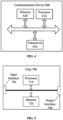
- FIG. 4 is a block diagram illustrating a communication device 600 according to an embodiment of the application.
- the communication device 600 shown in FIG. 4 includes a processor 610, which can call and run a computer program from a memory to implement the method according to the embodiments of the application.
- the communication device 600 may further include a memory 620.
- the processor 610 may call and run the computer program from the memory 620 to implement the method according to the embodiments of the application.
- the memory 620 may be a separate device independent of the processor 610, or may be integrated in the processor 610.
- the communication device 600 may further include a transceiver 630, and the processor 610 may control the transceiver 630 to communicate with other devices. Specifically, it may send information or data to other devices, or receive other information, data sent by the device.
- the transceiver 630 may include a transmitter and a receiver.
- the transceiver 630 may further include antennas, and the number of antennas may be one or more.
- the communication device 600 may be the terminal device according to an embodiment of the application, and the communication device 600 may implement a corresponding process implemented by the terminal device in each method according to the embodiments of the application, which will be not repeated here for brevity.
- FIG. 5 is a block diagram illustrating a chip according to an embodiment of the application.
- the chip 700 shown in FIG. 5 includes a processor 710, which can call and run a computer program from a memory to implement the method according to the embodiments of the application.
- the chip 700 may further include a memory 720.
- the processor 710 may call and run the computer program from the memory 720 to implement the method according to the embodiments of the application.
- the memory 720 may be a separate device independent of the processor 710, or may be integrated in the processor 710.
- the chip 700 may further include an input interface 730.
- the processor 710 may control the input interface 730 to communicate with other devices or chips. Specifically, the processor 710 may acquire information or data sent by other devices or chips.
- the chip 700 may further include an output interface 740.
- the processor 710 may control the output interface 740 to communicate with other devices or chips. Specifically, the processor 710 may output information or data to the other devices or chips.
- the chip can be applied to the terminal device according to the embodiments of the application, and the chip can implement the corresponding process implemented by the terminal device in the method according to the embodiments of the application.
- the chip can implement the corresponding process implemented by the terminal device in the method according to the embodiments of the application.
- the chip mentioned in some embodiments of the application may also be referred to as a system-level chip, a system chip, a chip system or a system-on-chip.
- the processor in the embodiments of the disclosure may be an integrated circuit chip with signal processing capability.
- the steps of the foregoing method embodiments can be completed by hardware integrated logic circuits in the processor or instructions in the form of software.
- the processor mentioned in some embodiments of the application may be a general-purpose processor, a digital signal processor (DSP), an application specific integrated circuit (ASIC), a field programmable gate array (FPGA), or other programming logic devices, discrete gate or transistor logic devices, discrete hardware components, which can achieve or implement the methods, steps and block diagrams disclosed in embodiments of the disclosure.
- the general-purpose processor may be a microprocessor or the processor may be any conventional processor or the like.
- the steps of the method disclosed in the embodiments of the disclosure may be directly embodied as being executed and completed by a hardware decoding processor, or executed and completed by a combination of hardware and software modules in the decoding processor.
- the software module can be located in a mature storage medium in the art, such as random access memory, flash memory, read-only memory, programmable read-only memory, or electrically erasable programmable memory, registers.
- the storage medium is located in the memory, and the processor reads the information in the memory and completes the steps of the above method in combination with its hardware.
- the memory mentioned in some embodiments of the application may be a volatile memory or a non-volatile memory, or may include both volatile and non-volatile memory.
- the non-volatile memory may be read-only memory (ROM), programmable read-only memory (PROM), erasable programmable read-only memory (erasable PROM, EPROM), electrical memory erasable programmable read-only memory (EPROM, EEPROM) or flash memory.
- the volatile memory may be a random access memory (RAM), which is used as an external cache.
- RAM random access memory
- static random access memory static random access memory
- DRAM dynamic random access memory
- DRAM synchronous dynamic random access memory
- SDRAM synchronous dynamic random access memory
- double data rate synchronous dynamic random access memory double data rate SDRAM, DDR SDRAM
- enhanced synchronous dynamic random access memory enhanced SDRAM
- ESDRAM synch link dynamic random access memory
- direct Rambus RAM direct Rambus RAM
- the memory in the embodiments of the disclosure may also be static random access memory (static RAM, SRAM), dynamic random access memory (dynamic RAM, DRAM), Synchronous dynamic random access memory (synchronous DRAM, SDRAM), double data rate synchronous dynamic random access memory (double data rate SDRAM, DDR SDRAM), enhanced synchronous dynamic random access memory (enhanced SDRAM, ESDRAM), synchronous connection Dynamic random access memory (synch link DRAM, SLDRAM) and direct memory bus random access memory (Direct Rambus RAM, DR RAM), and the like.
- static random access memory static random access memory
- DRAM dynamic random access memory
- SDRAM Synchronous dynamic random access memory
- double data rate synchronous dynamic random access memory double data rate SDRAM, DDR SDRAM
- enhanced synchronous dynamic random access memory enhanced synchronous dynamic random access memory
- ESDRAM enhanced synchronous dynamic random access memory
- synchronous connection Dynamic random access memory switch link DRAM, SLDRAM
- Direct Rambus RAM Direct Rambus RAM, DR RAM
- Embodiments of the disclosure further provide a computer readable storage medium, which is configured to store a computer program.
- the computer readable storage medium may be applied to the network device in some embodiments of the application, and the computer program causes the computer to execute the corresponding process implemented by the network device in each method in some embodiments of the application.
- the computer program causes the computer to execute the corresponding process implemented by the network device in each method in some embodiments of the application.
- the computer readable storage medium may be applied to the mobile terminal/terminal device in some embodiments of the application, and the computer program causes the computer to execute the corresponding process implemented by the mobile terminal/terminal device in each method in some embodiments of the application.
- the computer program causes the computer to execute the corresponding process implemented by the mobile terminal/terminal device in each method in some embodiments of the application.
- a computer program product is also provided in some embodiments of the application, including computer program instructions.
- the computer program product can be applied to the network device in some embodiments of the application, and the computer program instruction causes the computer to execute a corresponding process implemented by the network device in each method in some embodiments of the application.
- the computer program instruction causes the computer to execute a corresponding process implemented by the network device in each method in some embodiments of the application.
- the computer program product can be applied to the mobile terminal/terminal device in some embodiments of the application, and the computer program instruction causes the computer to execute a corresponding process implemented by the mobile terminal/terminal device in each method in some embodiments of the application.
- the computer program instruction causes the computer to execute a corresponding process implemented by the mobile terminal/terminal device in each method in some embodiments of the application.
- a computer program is also provided in some embodiments of the application.
- the computer program may be applied to the network device in some embodiments of the application.
- the computer program When the computer program is run on a computer, the computer is caused to execute a corresponding process implemented by the network device in each method in some embodiments of the application. For the sake of brevity, details will not be repeated here.
- the computer program may be applied to the mobile terminal/terminal device in some embodiments of the application.
- the computer program When the computer program is run on a computer, the computer is caused to execute a corresponding process implemented by the mobile terminal/terminal device in each method in some embodiments of the application. For the sake of brevity, details will not be repeated here.
- the disclosed systems, devices, and methods may be implemented in other ways.
- the device embodiments as described above are only exemplary.
- the division of the units is only a logical function division, and there may be other divisions in actual implementation.
- multiple units or components can be combined or integrated into another system, or some features can be ignored or not carried out.
- the displayed or discussed mutual coupling or direct coupling or communication connection may be indirect coupling or communication connection through some interfaces, devices or units, and may be in electrical, mechanical or other forms.
- the units described as separate components may or may not be physically separated, and the components displayed as units may or may not be physical units, that is, they may be located in one place, or they may be distributed on multiple network units. Some or all of the units may be selected according to actual needs to achieve the objectives of the solutions of the embodiments.
- the functional units in the various embodiments of the disclosure may be integrated into one processing unit, or each unit may exist alone physically, or two or more units may be integrated into one unit.
- the functions are implemented in the form of software functional units and sold or used as an independent product, they can be stored in a computer-readable storage medium.
- a computer-readable storage medium including several instructions used for causing a computer device (which may be a personal computer, a server, or a network device, and the like) to perform all or part of the steps of the method described in some embodiments of the application.
- the foregoing storage medium includes various medium that can store program codes, such as a U disk, a mobile hard disk, a ROM, a RAM, a magnetic disk, or an optical disk.
Landscapes
- Engineering & Computer Science (AREA)
- Computer Networks & Wireless Communication (AREA)
- Signal Processing (AREA)
- Mobile Radio Communication Systems (AREA)
- Transmitters (AREA)
- Transceivers (AREA)
Claims (12)
- Verfahren zur drahtlosen Kommunikation, das auf ein Endgerät (110, 300, 600), das eine Verbindung zu einem ersten Netz und einem zweiten Netz herstellt, angewendet wird, umfassend:Reduzieren, durch das Endgerät (110, 300, 600), wenn ein Uplink-Tastverhältnis des zweiten Netzes größer als ein maximales Uplink-Tastverhältnis des zweiten Netzes ist, einer Gesamtsendeleistung des ersten Netzes und des zweiten Netzes und/oder des Uplink-Tastverhältnisses des zweiten Netzes, wodurch bewirkt wird, dass ein Specific-Absorption-Ratio-Wert, SAR-Wert, des Endgeräts kleiner als oder gleich einem voreingestellten Wert ist, wobei das Uplink-Tastverhältnis des zweiten Netzes ein Anteil von Zeitbereichsressourcen ist, die zur Uplink-Übertragung in einer Zeiteinheit verwendet werden können, wobei eine Verbindung zwischen dem Endgerät und dem ersten Netz eine primäre Verbindung ist und eine Verbindung zwischen dem Endgerät und dem zweiten Netz eine sekundäre Verbindung ist,dadurch gekennzeichnet, dass das Verfahren ferner Folgendes umfasst:Erfassen, durch das Endgerät, eines aktuellen Uplink-Downlink-Verhältnisses des ersten Netzes;Bestimmen, durch das Endgerät, des maximalen Uplink-Tastverhältnisses des zweiten Netzes gemäß dem aktuellen Uplink-Downlink-Verhältnis des ersten Netzes und einer Entsprechung zwischen Uplink-Downlink-Verhältnissen des ersten Netzes und maximalen Uplink-Tastverhältnissen des zweiten Netzes; undMelden, durch das Endgerät, des maximalen Uplink-Tastverhältnisses des zweiten Netzes an ein Netzgerät (120, 130) des zweiten Netzes.
- Verfahren nach Anspruch 1, wobei das Uplink-Tastverhältnis des zweiten Netzes durch ein Netzgerät (120, 130) in dem zweiten Netz konfiguriert oder durch das Endgerät eigenständig bestimmt wird.
- Verfahren nach Anspruch 1, wobei die Entsprechung eine Vielzahl erster Entsprechungen umfasst und jede der ersten Entsprechungen einer maximalen Sendeleistung des ersten Netzes und einer maximalen Sendeleistung des zweiten Netzes entspricht,
wobei das Bestimmen, durch das Endgerät, des maximalen Uplink-Tastverhältnisses des zweiten Netzes gemäß dem aktuellen Uplink-Downlink-Verhältnis des ersten Netzes und einer Entsprechung zwischen Uplink-Downlink-Verhältnissen des ersten Netzes und maximalen Uplink-Tastverhältnissen des zweiten Netzes Folgendes umfasst:
Bestimmen, durch das Endgerät, des maximalen Uplink-Tastverhältnisses des zweiten Netzes gemäß einer maximalen Sendeleistung des ersten Netzes, einer maximalen Sendeleistung des zweiten Netzes, dem aktuellen Uplink-Downlink-Verhältnis des ersten Netzes und der Vielzahl erster Entsprechungen. - Verfahren nach Anspruch 3, ferner umfassend:
Bestimmen, durch das Endgerät, der Vielzahl erster Entsprechungen. - Verfahren nach Anspruch 4, wobei das Bestimmen, durch das Endgerät, der Vielzahl erster Entsprechungen Folgendes umfasst:Bestimmen, durch Einstellen eines Uplink-Verhältnisses des zweiten Netzes, wenn das erste Netz ein Signal mit einer maximalen Ausgangsleistung sendet und das zweite Netz ein Signal mit einer maximalen Ausgangsleistung sendet, eines Ziel-Uplink-Tastverhältnisses des zweiten Netzes, wenn der SAR-Wert den voreingestellten Wert erreicht; undBestimmen des Ziel-Uplink-Tastverhältnisses des zweiten Netzes als das maximale Uplink-Tastverhältnis des zweiten Netzes, das einem ersten Uplink-Downlink-Verhältnis entspricht, wobei das erste Uplink-Downlink-Verhältnis ein aktuelles Uplink-Downlink-Verhältnis des ersten Netzes ist.
- Verfahren nach Anspruch 5, wobei die maximale Ausgangsleistung des ersten Netzes 23 dBm oder 26 dBm beträgt.
- Verfahren nach Anspruch 5, wobei die maximale Ausgangsleistung des zweiten Netzes 23 dBm oder 26 dBm beträgt.
- Verfahren nach einem der Ansprüche 1 bis 7, wobei das erste Netz ein Long-Term-Evolution-Netz, LTE-Netz, und das zweite Netz ein New-Radio-Netz, NR-Netz, ist oder das erste Netz ein NR-Netz und das zweite Netz ein LTE-Netz ist.
- Endgerät (110, 300, 600), umfassend: einen Prozessor (310, 610) und einen Speicher (620), wobei der Speicher (620) konfiguriert ist, um ein Computerprogramm zu speichern, und der Prozessor (310, 610) konfiguriert ist, um das in dem Speicher gespeicherte Computerprogramm aufzurufen und auszuführen, wodurch das Verfahren nach einem der Ansprüche 1 bis 8 implementiert wird.
- Computerlesbares Speichermedium, das zum Speichern eines Computerprogramms verwendet wird, wobei das Computerprogramm bewirkt, dass ein Endgerät das Verfahren nach einem der Ansprüche 1 bis 8 implementiert.
- Computerprogrammprodukt, das Computerprogrammanweisungen umfasst, die bewirken, dass ein Endgerät das Verfahren nach einem der Ansprüche 1 bis 8 implementiert.
- Computerprogramm, das bewirkt, dass ein Endgerät das Verfahren nach einem der Ansprüche 1 bis 8 implementiert.
Priority Applications (1)
| Application Number | Priority Date | Filing Date | Title |
|---|---|---|---|
| EP23154030.3A EP4192126B1 (de) | 2018-09-25 | 2018-09-25 | Drahtloskommunikationsverfahren und endgerätevorrichtung |
Applications Claiming Priority (3)
| Application Number | Priority Date | Filing Date | Title |
|---|---|---|---|
| EP23154030.3A EP4192126B1 (de) | 2018-09-25 | 2018-09-25 | Drahtloskommunikationsverfahren und endgerätevorrichtung |
| EP18934740.4A EP3846547B1 (de) | 2018-09-25 | 2018-09-25 | Drahtloskommunikationsverfahren und endgerät |
| PCT/CN2018/107367 WO2020061753A1 (zh) | 2018-09-25 | 2018-09-25 | 无线通信的方法和终端设备 |
Related Parent Applications (2)
| Application Number | Title | Priority Date | Filing Date |
|---|---|---|---|
| EP18934740.4A Division EP3846547B1 (de) | 2018-09-25 | 2018-09-25 | Drahtloskommunikationsverfahren und endgerät |
| EP18934740.4A Division-Into EP3846547B1 (de) | 2018-09-25 | 2018-09-25 | Drahtloskommunikationsverfahren und endgerät |
Publications (2)
| Publication Number | Publication Date |
|---|---|
| EP4192126A1 EP4192126A1 (de) | 2023-06-07 |
| EP4192126B1 true EP4192126B1 (de) | 2024-12-18 |
Family
ID=69950282
Family Applications (2)
| Application Number | Title | Priority Date | Filing Date |
|---|---|---|---|
| EP23154030.3A Active EP4192126B1 (de) | 2018-09-25 | 2018-09-25 | Drahtloskommunikationsverfahren und endgerätevorrichtung |
| EP18934740.4A Active EP3846547B1 (de) | 2018-09-25 | 2018-09-25 | Drahtloskommunikationsverfahren und endgerät |
Family Applications After (1)
| Application Number | Title | Priority Date | Filing Date |
|---|---|---|---|
| EP18934740.4A Active EP3846547B1 (de) | 2018-09-25 | 2018-09-25 | Drahtloskommunikationsverfahren und endgerät |
Country Status (11)
| Country | Link |
|---|---|
| US (3) | US11147013B2 (de) |
| EP (2) | EP4192126B1 (de) |
| JP (1) | JP7330267B2 (de) |
| KR (1) | KR102685484B1 (de) |
| CN (2) | CN113316241B (de) |
| AU (1) | AU2018443808B2 (de) |
| BR (1) | BR112021005623A2 (de) |
| CA (1) | CA3114120C (de) |
| MX (1) | MX2021003562A (de) |
| SG (1) | SG11202103060QA (de) |
| WO (1) | WO2020061753A1 (de) |
Families Citing this family (13)
| Publication number | Priority date | Publication date | Assignee | Title |
|---|---|---|---|---|
| EP4192126B1 (de) | 2018-09-25 | 2024-12-18 | Guangdong Oppo Mobile Telecommunications Corp., Ltd. | Drahtloskommunikationsverfahren und endgerätevorrichtung |
| JP7386601B2 (ja) * | 2018-10-18 | 2023-11-27 | キヤノン株式会社 | 通信装置、通信装置の制御方法、およびプログラム |
| WO2020199221A1 (zh) * | 2019-04-04 | 2020-10-08 | Oppo广东移动通信有限公司 | 一种资源配置方法、网络设备、终端设备 |
| CN113228755A (zh) * | 2019-04-30 | 2021-08-06 | Oppo广东移动通信有限公司 | 上行发射功率辐射限制方法及相关产品 |
| US11924819B2 (en) * | 2019-05-24 | 2024-03-05 | Qualcomm Incorporated | Power limits based on signal type for managing maximum permissible exposure |
| US20210013960A1 (en) * | 2019-07-12 | 2021-01-14 | Qualcomm Incorporated | Monitored condition response in a wireless communication device via one or more relay devices |
| EP4192157A4 (de) * | 2020-08-07 | 2023-10-04 | Guangdong Oppo Mobile Telecommunications Corp., Ltd. | Verfahren zur leistungssteuerung, endgerätevorrichtung und netzwerkvorrichtung |
| KR20250105500A (ko) * | 2021-05-17 | 2025-07-08 | 애플 인크. | 무선 주파수 노출을 제어하기 위한 시스템들 및 방법들 |
| US12273828B2 (en) | 2021-06-03 | 2025-04-08 | Samsung Electronics Co., Ltd. | Electronic device performing random access procedure and method for operating thereof |
| WO2022255664A1 (ko) * | 2021-06-03 | 2022-12-08 | 삼성전자 주식회사 | 랜덤 억세스 절차를 수행하는 전자 장치 및 그 동작 방법 |
| CN113873592B (zh) * | 2021-09-29 | 2023-01-06 | 联想(北京)有限公司 | 一种信息处理方法、装置、设备及介质 |
| CN117177344A (zh) * | 2022-05-26 | 2023-12-05 | 北京小米移动软件有限公司 | 发射功率控制方法和装置、电子设备、可读存储介质 |
| EP4482223A4 (de) * | 2022-07-15 | 2025-06-18 | Samsung Electronics Co., Ltd. | Elektronische vorrichtung und verfahren zur integrierten steuerung von tas und twt |
Family Cites Families (19)
| Publication number | Priority date | Publication date | Assignee | Title |
|---|---|---|---|---|
| KR101105690B1 (ko) * | 2008-03-03 | 2012-01-17 | 닛본 덴끼 가부시끼가이샤 | 무선 기지국 및 송신 전력 결정 방법 |
| US8155598B2 (en) | 2009-01-09 | 2012-04-10 | Sony Corporation | System and method for power control in MIMO systems |
| EP2524435A4 (de) | 2010-01-14 | 2017-08-09 | Nokia Technologies Oy | Systeme, verfahren und vorrichtungen zur modemkoordinierung |
| CN102918894B (zh) | 2010-04-09 | 2016-08-03 | 瑞典爱立信有限公司 | 无线网络中用于确定上行链路接收功率目标值的方法和装置 |
| US20120021707A1 (en) | 2010-07-26 | 2012-01-26 | Qualcomm Incorporated | Apparatus and method for adjustment of transmitter power in a system |
| US9026125B2 (en) * | 2013-01-16 | 2015-05-05 | Qualcomm Incorporated | System and methods for mitigating receiver desense caused by simultaneous transmission on multi-SIM wireless communications devices |
| US9749878B2 (en) * | 2013-07-31 | 2017-08-29 | Blackberry Limited | System and method for managing communications for two networks in a communication device |
| EP2854460B1 (de) | 2013-09-27 | 2017-04-05 | Sun Patent Trust | Leistungssteuerung und Leistungsreservemitteilung für duale Konnektivität |
| WO2015074276A1 (zh) * | 2013-11-25 | 2015-05-28 | 华为技术有限公司 | 一种确定动态上下行比例配置参数的方法、系统和设备 |
| CN104125615B (zh) * | 2014-08-07 | 2017-12-15 | 华为技术有限公司 | 双频自适应并发的处理方法和装置 |
| KR20170106695A (ko) | 2016-03-14 | 2017-09-22 | 주식회사 싱귤라 | Rf 중계기 시스템의 전파 전력 제어 장치 및 방법 |
| WO2018119153A2 (en) * | 2016-12-21 | 2018-06-28 | Intel Corporation | Wireless communication technology, apparatuses, and methods |
| CN108271199B (zh) * | 2016-12-31 | 2021-10-29 | 中国移动通信集团四川有限公司 | 调整小区上下行资源配比的方法及装置 |
| US10439789B2 (en) * | 2017-05-08 | 2019-10-08 | Skyworks Solutions, Inc. | Radio frequency communication systems with dynamic waveform control and power boost |
| CN108419297B (zh) * | 2018-01-19 | 2020-11-27 | 京信通信系统(中国)有限公司 | 无线通信方法及无线接入设备、网络规划设备、终端设备 |
| CN110915285B (zh) * | 2018-04-13 | 2023-04-04 | 株式会社Ntt都科摩 | 终端及基站 |
| WO2019208906A1 (ko) * | 2018-04-26 | 2019-10-31 | 엘지전자 주식회사 | 전력 제어를 수행하는 전자 기기 |
| WO2020032866A1 (en) * | 2018-08-10 | 2020-02-13 | Telefonaktiebolaget L M Ericsson (Publ) | Power headroom report (phr) reporting determination |
| EP4192126B1 (de) | 2018-09-25 | 2024-12-18 | Guangdong Oppo Mobile Telecommunications Corp., Ltd. | Drahtloskommunikationsverfahren und endgerätevorrichtung |
-
2018
- 2018-09-25 EP EP23154030.3A patent/EP4192126B1/de active Active
- 2018-09-25 MX MX2021003562A patent/MX2021003562A/es unknown
- 2018-09-25 CN CN202110604028.6A patent/CN113316241B/zh active Active
- 2018-09-25 AU AU2018443808A patent/AU2018443808B2/en active Active
- 2018-09-25 JP JP2021517049A patent/JP7330267B2/ja active Active
- 2018-09-25 SG SG11202103060QA patent/SG11202103060QA/en unknown
- 2018-09-25 BR BR112021005623-8A patent/BR112021005623A2/pt unknown
- 2018-09-25 KR KR1020217009792A patent/KR102685484B1/ko active Active
- 2018-09-25 EP EP18934740.4A patent/EP3846547B1/de active Active
- 2018-09-25 CA CA3114120A patent/CA3114120C/en active Active
- 2018-09-25 CN CN201880098046.8A patent/CN112771932A/zh active Pending
- 2018-09-25 WO PCT/CN2018/107367 patent/WO2020061753A1/zh not_active Ceased
-
2021
- 2021-03-24 US US17/211,762 patent/US11147013B2/en active Active
- 2021-09-28 US US17/487,897 patent/US11706708B2/en active Active
-
2023
- 2023-06-09 US US18/208,012 patent/US12041539B2/en active Active
Also Published As
| Publication number | Publication date |
|---|---|
| US20220022130A1 (en) | 2022-01-20 |
| US11147013B2 (en) | 2021-10-12 |
| CN113316241B (zh) | 2023-02-17 |
| KR20210064243A (ko) | 2021-06-02 |
| AU2018443808B2 (en) | 2024-08-29 |
| WO2020061753A1 (zh) | 2020-04-02 |
| EP4192126A1 (de) | 2023-06-07 |
| AU2018443808A1 (en) | 2021-05-13 |
| EP3846547A4 (de) | 2021-08-18 |
| EP3846547A1 (de) | 2021-07-07 |
| CN113316241A (zh) | 2021-08-27 |
| CA3114120C (en) | 2023-08-15 |
| EP3846547B1 (de) | 2023-03-08 |
| CA3114120A1 (en) | 2020-04-02 |
| BR112021005623A2 (pt) | 2021-06-22 |
| KR102685484B1 (ko) | 2024-07-17 |
| US20210250855A1 (en) | 2021-08-12 |
| US20230328641A1 (en) | 2023-10-12 |
| JP2022504031A (ja) | 2022-01-13 |
| CN112771932A (zh) | 2021-05-07 |
| SG11202103060QA (en) | 2021-04-29 |
| US12041539B2 (en) | 2024-07-16 |
| US11706708B2 (en) | 2023-07-18 |
| JP7330267B2 (ja) | 2023-08-21 |
| MX2021003562A (es) | 2021-05-27 |
Similar Documents
| Publication | Publication Date | Title |
|---|---|---|
| US12041539B2 (en) | Wireless communication method and terminal device | |
| US11805487B2 (en) | Wireless communication method and device | |
| US20220217800A1 (en) | Communication method and apparatus for activating secondary cell | |
| EP3554149A1 (de) | Uplink-leistung-steuerungsverfahren und -vorrichtung | |
| CN112997545B (zh) | 无线通信方法、终端设备和网络设备 | |
| US11425663B2 (en) | Wireless communication method, terminal device, and network device | |
| CN111742583B (zh) | 通信方法、终端设备和网络设备 | |
| US11576162B2 (en) | Method and device for radio communication | |
| US10264577B2 (en) | Communications device and discontinuous transmission method | |
| CN112655250B (zh) | 无线通信的方法、终端设备和网络设备 | |
| CN117099418A (zh) | 通信方法、终端、网络设备 | |
| RU2774297C1 (ru) | Способ беспроводной связи и терминальное устройство | |
| WO2020093267A1 (zh) | 资源调整方法、装置、芯片及计算机程序 | |
| WO2020228034A9 (zh) | 一种资源管理方法、网络设备、用户设备 |
Legal Events
| Date | Code | Title | Description |
|---|---|---|---|
| PUAI | Public reference made under article 153(3) epc to a published international application that has entered the european phase |
Free format text: ORIGINAL CODE: 0009012 |
|
| STAA | Information on the status of an ep patent application or granted ep patent |
Free format text: STATUS: THE APPLICATION HAS BEEN PUBLISHED |
|
| AC | Divisional application: reference to earlier application |
Ref document number: 3846547 Country of ref document: EP Kind code of ref document: P |
|
| AK | Designated contracting states |
Kind code of ref document: A1 Designated state(s): AL AT BE BG CH CY CZ DE DK EE ES FI FR GB GR HR HU IE IS IT LI LT LU LV MC MK MT NL NO PL PT RO RS SE SI SK SM TR |
|
| STAA | Information on the status of an ep patent application or granted ep patent |
Free format text: STATUS: REQUEST FOR EXAMINATION WAS MADE |
|
| 17P | Request for examination filed |
Effective date: 20231207 |
|
| RBV | Designated contracting states (corrected) |
Designated state(s): AL AT BE BG CH CY CZ DE DK EE ES FI FR GB GR HR HU IE IS IT LI LT LU LV MC MK MT NL NO PL PT RO RS SE SI SK SM TR |
|
| GRAP | Despatch of communication of intention to grant a patent |
Free format text: ORIGINAL CODE: EPIDOSNIGR1 |
|
| STAA | Information on the status of an ep patent application or granted ep patent |
Free format text: STATUS: GRANT OF PATENT IS INTENDED |
|
| INTG | Intention to grant announced |
Effective date: 20240909 |
|
| GRAS | Grant fee paid |
Free format text: ORIGINAL CODE: EPIDOSNIGR3 |
|
| GRAA | (expected) grant |
Free format text: ORIGINAL CODE: 0009210 |
|
| STAA | Information on the status of an ep patent application or granted ep patent |
Free format text: STATUS: THE PATENT HAS BEEN GRANTED |
|
| AC | Divisional application: reference to earlier application |
Ref document number: 3846547 Country of ref document: EP Kind code of ref document: P |
|
| AK | Designated contracting states |
Kind code of ref document: B1 Designated state(s): AL AT BE BG CH CY CZ DE DK EE ES FI FR GB GR HR HU IE IS IT LI LT LU LV MC MK MT NL NO PL PT RO RS SE SI SK SM TR |
|
| REG | Reference to a national code |
Ref country code: CH Ref legal event code: EP |
|
| REG | Reference to a national code |
Ref country code: DE Ref legal event code: R096 Ref document number: 602018077864 Country of ref document: DE |
|
| REG | Reference to a national code |
Ref country code: IE Ref legal event code: FG4D |
|
| P01 | Opt-out of the competence of the unified patent court (upc) registered |
Free format text: CASE NUMBER: APP_9850/2025 Effective date: 20250226 |
|
| REG | Reference to a national code |
Ref country code: LT Ref legal event code: MG9D |
|
| PG25 | Lapsed in a contracting state [announced via postgrant information from national office to epo] |
Ref country code: HR Free format text: LAPSE BECAUSE OF FAILURE TO SUBMIT A TRANSLATION OF THE DESCRIPTION OR TO PAY THE FEE WITHIN THE PRESCRIBED TIME-LIMIT Effective date: 20241218 |
|
| PG25 | Lapsed in a contracting state [announced via postgrant information from national office to epo] |
Ref country code: FI Free format text: LAPSE BECAUSE OF FAILURE TO SUBMIT A TRANSLATION OF THE DESCRIPTION OR TO PAY THE FEE WITHIN THE PRESCRIBED TIME-LIMIT Effective date: 20241218 |
|
| PG25 | Lapsed in a contracting state [announced via postgrant information from national office to epo] |
Ref country code: BG Free format text: LAPSE BECAUSE OF FAILURE TO SUBMIT A TRANSLATION OF THE DESCRIPTION OR TO PAY THE FEE WITHIN THE PRESCRIBED TIME-LIMIT Effective date: 20241218 |
|
| PG25 | Lapsed in a contracting state [announced via postgrant information from national office to epo] |
Ref country code: NO Free format text: LAPSE BECAUSE OF FAILURE TO SUBMIT A TRANSLATION OF THE DESCRIPTION OR TO PAY THE FEE WITHIN THE PRESCRIBED TIME-LIMIT Effective date: 20250318 |
|
| REG | Reference to a national code |
Ref country code: NL Ref legal event code: MP Effective date: 20241218 |
|
| PG25 | Lapsed in a contracting state [announced via postgrant information from national office to epo] |
Ref country code: LV Free format text: LAPSE BECAUSE OF FAILURE TO SUBMIT A TRANSLATION OF THE DESCRIPTION OR TO PAY THE FEE WITHIN THE PRESCRIBED TIME-LIMIT Effective date: 20241218 Ref country code: GR Free format text: LAPSE BECAUSE OF FAILURE TO SUBMIT A TRANSLATION OF THE DESCRIPTION OR TO PAY THE FEE WITHIN THE PRESCRIBED TIME-LIMIT Effective date: 20250319 |
|
| PG25 | Lapsed in a contracting state [announced via postgrant information from national office to epo] |
Ref country code: RS Free format text: LAPSE BECAUSE OF FAILURE TO SUBMIT A TRANSLATION OF THE DESCRIPTION OR TO PAY THE FEE WITHIN THE PRESCRIBED TIME-LIMIT Effective date: 20250318 |
|
| PG25 | Lapsed in a contracting state [announced via postgrant information from national office to epo] |
Ref country code: NL Free format text: LAPSE BECAUSE OF FAILURE TO SUBMIT A TRANSLATION OF THE DESCRIPTION OR TO PAY THE FEE WITHIN THE PRESCRIBED TIME-LIMIT Effective date: 20241218 |
|
| REG | Reference to a national code |
Ref country code: AT Ref legal event code: MK05 Ref document number: 1753277 Country of ref document: AT Kind code of ref document: T Effective date: 20241218 |
|
| PG25 | Lapsed in a contracting state [announced via postgrant information from national office to epo] |
Ref country code: SM Free format text: LAPSE BECAUSE OF FAILURE TO SUBMIT A TRANSLATION OF THE DESCRIPTION OR TO PAY THE FEE WITHIN THE PRESCRIBED TIME-LIMIT Effective date: 20241218 |
|
| PG25 | Lapsed in a contracting state [announced via postgrant information from national office to epo] |
Ref country code: PL Free format text: LAPSE BECAUSE OF FAILURE TO SUBMIT A TRANSLATION OF THE DESCRIPTION OR TO PAY THE FEE WITHIN THE PRESCRIBED TIME-LIMIT Effective date: 20241218 |
|
| PG25 | Lapsed in a contracting state [announced via postgrant information from national office to epo] |
Ref country code: ES Free format text: LAPSE BECAUSE OF FAILURE TO SUBMIT A TRANSLATION OF THE DESCRIPTION OR TO PAY THE FEE WITHIN THE PRESCRIBED TIME-LIMIT Effective date: 20241218 |
|
| PG25 | Lapsed in a contracting state [announced via postgrant information from national office to epo] |
Ref country code: IS Free format text: LAPSE BECAUSE OF FAILURE TO SUBMIT A TRANSLATION OF THE DESCRIPTION OR TO PAY THE FEE WITHIN THE PRESCRIBED TIME-LIMIT Effective date: 20250418 |
|
| PG25 | Lapsed in a contracting state [announced via postgrant information from national office to epo] |
Ref country code: PT Free format text: LAPSE BECAUSE OF FAILURE TO SUBMIT A TRANSLATION OF THE DESCRIPTION OR TO PAY THE FEE WITHIN THE PRESCRIBED TIME-LIMIT Effective date: 20250421 |
|
| PG25 | Lapsed in a contracting state [announced via postgrant information from national office to epo] |
Ref country code: EE Free format text: LAPSE BECAUSE OF FAILURE TO SUBMIT A TRANSLATION OF THE DESCRIPTION OR TO PAY THE FEE WITHIN THE PRESCRIBED TIME-LIMIT Effective date: 20241218 |
|
| PG25 | Lapsed in a contracting state [announced via postgrant information from national office to epo] |
Ref country code: RO Free format text: LAPSE BECAUSE OF FAILURE TO SUBMIT A TRANSLATION OF THE DESCRIPTION OR TO PAY THE FEE WITHIN THE PRESCRIBED TIME-LIMIT Effective date: 20241218 Ref country code: AT Free format text: LAPSE BECAUSE OF FAILURE TO SUBMIT A TRANSLATION OF THE DESCRIPTION OR TO PAY THE FEE WITHIN THE PRESCRIBED TIME-LIMIT Effective date: 20241218 |
|
| PG25 | Lapsed in a contracting state [announced via postgrant information from national office to epo] |
Ref country code: SK Free format text: LAPSE BECAUSE OF FAILURE TO SUBMIT A TRANSLATION OF THE DESCRIPTION OR TO PAY THE FEE WITHIN THE PRESCRIBED TIME-LIMIT Effective date: 20241218 |
|
| PG25 | Lapsed in a contracting state [announced via postgrant information from national office to epo] |
Ref country code: CZ Free format text: LAPSE BECAUSE OF FAILURE TO SUBMIT A TRANSLATION OF THE DESCRIPTION OR TO PAY THE FEE WITHIN THE PRESCRIBED TIME-LIMIT Effective date: 20241218 |
|
| PG25 | Lapsed in a contracting state [announced via postgrant information from national office to epo] |
Ref country code: IT Free format text: LAPSE BECAUSE OF FAILURE TO SUBMIT A TRANSLATION OF THE DESCRIPTION OR TO PAY THE FEE WITHIN THE PRESCRIBED TIME-LIMIT Effective date: 20241218 |
|
| PG25 | Lapsed in a contracting state [announced via postgrant information from national office to epo] |
Ref country code: SE Free format text: LAPSE BECAUSE OF FAILURE TO SUBMIT A TRANSLATION OF THE DESCRIPTION OR TO PAY THE FEE WITHIN THE PRESCRIBED TIME-LIMIT Effective date: 20241218 |
|
| REG | Reference to a national code |
Ref country code: DE Ref legal event code: R097 Ref document number: 602018077864 Country of ref document: DE |
|
| PG25 | Lapsed in a contracting state [announced via postgrant information from national office to epo] |
Ref country code: DK Free format text: LAPSE BECAUSE OF FAILURE TO SUBMIT A TRANSLATION OF THE DESCRIPTION OR TO PAY THE FEE WITHIN THE PRESCRIBED TIME-LIMIT Effective date: 20241218 |
|
| PGFP | Annual fee paid to national office [announced via postgrant information from national office to epo] |
Ref country code: DE Payment date: 20250919 Year of fee payment: 8 |
|
| PLBE | No opposition filed within time limit |
Free format text: ORIGINAL CODE: 0009261 |
|
| STAA | Information on the status of an ep patent application or granted ep patent |
Free format text: STATUS: NO OPPOSITION FILED WITHIN TIME LIMIT |
|
| 26N | No opposition filed |
Effective date: 20250919 |