EP4190785A1 - Method for preparing forodesine - Google Patents
Method for preparing forodesine Download PDFInfo
- Publication number
- EP4190785A1 EP4190785A1 EP21850321.7A EP21850321A EP4190785A1 EP 4190785 A1 EP4190785 A1 EP 4190785A1 EP 21850321 A EP21850321 A EP 21850321A EP 4190785 A1 EP4190785 A1 EP 4190785A1
- Authority
- EP
- European Patent Office
- Prior art keywords
- compound represented
- formula
- present
- solvent
- preparing
- Prior art date
- Legal status (The legal status is an assumption and is not a legal conclusion. Google has not performed a legal analysis and makes no representation as to the accuracy of the status listed.)
- Pending
Links
Images


Classifications
-
- C—CHEMISTRY; METALLURGY
- C07—ORGANIC CHEMISTRY
- C07D—HETEROCYCLIC COMPOUNDS
- C07D487/00—Heterocyclic compounds containing nitrogen atoms as the only ring hetero atoms in the condensed system, not provided for by groups C07D451/00 - C07D477/00
- C07D487/02—Heterocyclic compounds containing nitrogen atoms as the only ring hetero atoms in the condensed system, not provided for by groups C07D451/00 - C07D477/00 in which the condensed system contains two hetero rings
- C07D487/04—Ortho-condensed systems
-
- Y—GENERAL TAGGING OF NEW TECHNOLOGICAL DEVELOPMENTS; GENERAL TAGGING OF CROSS-SECTIONAL TECHNOLOGIES SPANNING OVER SEVERAL SECTIONS OF THE IPC; TECHNICAL SUBJECTS COVERED BY FORMER USPC CROSS-REFERENCE ART COLLECTIONS [XRACs] AND DIGESTS
- Y02—TECHNOLOGIES OR APPLICATIONS FOR MITIGATION OR ADAPTATION AGAINST CLIMATE CHANGE
- Y02P—CLIMATE CHANGE MITIGATION TECHNOLOGIES IN THE PRODUCTION OR PROCESSING OF GOODS
- Y02P20/00—Technologies relating to chemical industry
- Y02P20/50—Improvements relating to the production of bulk chemicals
- Y02P20/55—Design of synthesis routes, e.g. reducing the use of auxiliary or protecting groups
Definitions
- the present invention belongs to the technical field of chemical drug synthesis, and relates to a method for preparing Forodesine.
- Forodesine also known as BCX-1777, is a purine nucleoside phosphorylase (PNP) inhibitor.
- PNP purine nucleoside phosphorylase
- Forodesine was approved as an orphan drug in the United States in 2004 for the treatment of T-cell non-Hodgkin lymphoma and chronic myeloid leukemia. It was approved as an orphan drug in the European Union in 2006, 2007 and 2010 respectively for the treatment of acute lymphocytic leukemia, cutaneous T-cell lymphoma, and chronic lymphocytic leukemia. In 2017, Forodesine was approved in Japan for the treatment of relapsed/refractory peripheral T-cell lymphoma.
- the first-line treatment options for peripheral T-cell lymphoma are mainly multi drug chemotherapy (including cyclophosphamide, doxorubicin, vincristine, and prednisone) and brentuximab vedotin (Adcetris).
- chemotherapy including cyclophosphamide, doxorubicin, vincristine, and prednisone
- brentuximab vedotin Adcetris
- three histone deacetylation inhibitors namely Chidamide, Romidepsin and Belinostat, are commonly used, in which Chidamide is only approved in China, and Romidepsin and Belinostat are only approved in the United States.
- Forodesine can effectively inhibit T-cell function and is a valuable drug for the treatment of relapsed/refractory peripheral T-cell lymphoma.
- Forodesine is also a key intermediate necessary for the synthesis of broad-spectrum antiviral drug Galidesivir (BCX-4430), which is indispensable in the synthesis of BCX-4430.
- secondary amine (8) is used as starting material and is chlorinated and dechlorinated to obtain imine (10).
- imine (10) Under the action of n-butyllithium, bromopurine derivative (2) is lithiated, and then undergoes an addition reaction with imine (10), and the obtained secondary amine intermediate is protected with Boc to obtain intermediate (11), which is then hydrogenated to remove BOM protecting group, and heated with concentrated hydrochloric acid to remove other protecting groups to obtain Forodesine hydrochloride, which is finally purified through ion exchange resin and recrystallization to obtain Forodesine.
- Patent application US20180258091A1 discloses a new process as shown below to improve the above scheme.
- n-hexyllithium is used instead of n-butyllithium, and the bromopurine derivative (2) is lithiated at -15°C, which reduces the requirement for low temperature of the reaction equipment; in addition, the method of removing the BOM protecting group through hydrogenation is changed to removing the BOM protecting group through concentrated hydrochloric acid, which avoids the dangerous high pressure hydrogenation conditions.
- the object of the present invention is to provide a new method for preparing Forodesine, another object of the present invention is to provide a method for preparing Forodesine with easily available raw materials, another object of the present invention is to provide a method for preparing Forodesine with shorter reaction scheme, another object of the present invention is to provide a method for preparing Forodesine with strong operability, easy control of operation and high safety, another object of the present invention is to provide a method for preparing Forodesine with low cost, and another object of the present invention is to provide a method for preparing Forodesine suitable for scale-up production.
- the present invention provides a method for preparing a compound represented by Formula I, comprising: treating a compound represented by Formula VII with an acid (e.g., concentrated hydrochloric acid) to generate the compound represented by Formula I; wherein:
- an acid e.g., concentrated hydrochloric acid
- the compound represented by Formula VII is treated with concentrated hydrochloric acid.
- the compound represented by Formula VII is treated with an acid under heating and refluxing conditions.
- the compound represented by Formula VII is treated with an acid under refluxing conditions for 20 to 100 hours, such as 24 to 96 hours, 36 to 84 hours, 48 to 72 hours.
- the compound represented by Formula VII is treated with an acid by a method comprising the following operations:
- the first solvent of the present invention is tetrahydrofuran or methanol.
- the first solvent of the present invention is tetrahydrofuran.
- the method for preparing the compound represented by Formula I of the present invention further comprises:
- the method for purifying the obtained solid comprises:
- R 1 is 2,4-dimethoxybenzyl (DMB), benzyl (Bn) or benzyloxymethyl (BOM).
- DMB 2,4-dimethoxybenzyl
- Bn benzyl
- BOM benzyloxymethyl
- R 1 is 2,4-dimethoxybenzyl (DMB).
- R 1 is benzyl (Bn).
- R 1 is carbobenzoxy (Cbz).
- R 1 is tert-butoxycarbonyl (Boc).
- R 1 is methoxycarbonyl
- R 1 is ethoxycarbonyl
- R 1 is phthaloyl (Pht).
- R 2 is methyl
- R 3 , R 4 , and R 5 are each independently benzyl (Bn), p-methoxybenzyl (PMB), methoxymethyl (MOM) or 1-ethoxyethyl (EE).
- R 3 , R 4 , and R 5 are each independently p-methoxybenzyl (PMB).
- R 3 , R 4 , and R 5 are each independently methoxymethyl (MOM).
- R 3 , R 4 , and R 5 are each independently 1-ethoxyethyl (EE).
- R 3 , R 4 , and R 5 are each independently trimethylsilyl (TMS).
- R 3 , R 4 , and R 5 are each independently tert-butyldimethylsilyl (TBDMS).
- R 3 , R 4 , and R 5 are each independently 2-tetrahydropyranyl (THP).
- R 6 is carbobenzoxy (Cbz), tert-butoxycarbonyl (Boc), methoxycarbonyl or ethoxy carbonyl. In some embodiments, in the compound represented by Formula VII of the present invention, R 6 is carbobenzoxy (Cbz).
- R 6 is methoxycarbonyl
- R 6 is ethoxycarbonyl
- R 6 is phthaloyl (Pht).
- R 6 is 2,4-dimethoxybenzyl (DMB).
- R 6 is benzyl (Bn).
- R 6 is benzyloxymethyl (BOM).
- R 1 is benzyloxymethyl (BOM).
- R 2 is ethyl
- R 3 , R 4 , and R 5 are each independently benzyl (Bn).
- R 6 is tert-butoxycarbonyl (Boc).
- R 1 is benzyloxymethyl (BOM)
- R 2 is methyl
- R 3 , R 4 , R 5 are each independently benzyl (Bn)
- R 6 is tert-butoxycarbonyl (Boc).
- the method for preparing the compound represented by Formula I of the present invention further comprises preparing a compound represented by Formula VII, which comprises: introducing an amino protecting group R 6 to the position 1 of a compound represented by Formula VI, wherein the definitions of R 1 , R 1 , R 3 , R 4 , R 5 and R 6 are the same as those of Formula VII.
- the compound represented by Formula VI is easily oxidized, and an amino protecting group is introduced into the compound represented by Formula VI to obtain a compound represented by Formula VII with stable properties, which is convenient for subsequent separation and purification.
- R 6 is tert-butoxycarbonyl (Boc), and the definitions of R 1 , R 2 , R 3 , R 4 , and R 5 are as described in the present invention, which is obtained by protection of the compound represented by Formula VI with Boc.
- the compound represented by Formula VI reacts with Boc anhydride under basic conditions to obtain the compound represented by Formula VII.
- the compound represented by Formula VI reacts with Boc anhydride in the presence of sodium hydroxide to obtain the compound represented by Formula VII.
- the method for preparing the compound represented by Formula I of the present invention further comprises preparing the compound represented by Formula VI, which comprises: reducing a compound represented by Formula V, wherein the definitions of R 1 , R 1 , R 3 , R 4 and R 5 are the same as those of Formula VII.
- the compound represented by Formula V is reduced with a reducing agent.
- the compound represented by Formula V is reduced with a reducing agent in a second solvent.
- the reducing agent of the present invention is zinc powder, iron powder or indium powder.
- the reducing agent of the present invention is zinc powder.
- the reducing agent of the present invention is iron powder.
- the reducing agent of the present invention is indium powder.
- the second solvent of the present invention is a mixed solvent of acetic acid and methanol, trifluoroacetic acid (TFA), 4-8M (e.g., 6M) hydrochloric acid, or a saturated aqueous solution of NH 4 Cl.
- the second solvent of the present invention is a mixed solvent of acetic acid and methanol, preferably a mixed solvent of acetic acid and methanol with a volume ratio of 1 : 3-8, for example, a mixed solvent of acetic acid and methanol with a volume ratio of 1 : 4-6, such as a mixed solvent of acetic acid and methanol with a volume ratio of 1 : 5.
- the second solvent of the present invention is trifluoroacetic acid (TFA), 4-8M (e.g., 6M) hydrochloric acid, or a saturated aqueous solution of NH 4 Cl.
- the second solvent of the present invention is trifluoroacetic acid (TFA).
- the second solvent of the present invention is 4-8M (e.g., 6M) hydrochloric acid.
- the second solvent of the present invention is a saturated aqueous solution of NH 4 Cl.
- the molar ratio of the reducing agent to the compound represented by Formula V is 15-25 : 1, such as 18-22 : 1, 20 : 1.
- the method for preparing the compound represented by Formula I of the present invention further comprises a method for preparing the compound represented by Formula V, which comprises:
- the compound represented by Formula III reacts with the compound represented by Formula IV to produce a pair of isomers with a diastereoselectivity of 7 : 1, wherein the main product is the compound represented by Formula V.
- the compound represented by Formula V is reduced to the compound represented by Formula VI, and the intermediate is easily oxidized.
- An amino protecting group is introduced into the compound represented by the Formula VI to obtain the compound of the Formula VII with stable properties, so that the diastereomers generated in the above reaction process can be easily separated.
- the metal lithium reagent of the present invention is n-butyllithium, tert-butyllithium, phenyllithium, and sec-butyllithium.
- the metal lithium reagent of the present invention is n-butyllithium.
- the metal lithium reagent of the present invention is tert-butyllithium.
- the metal lithium reagent of the present invention is phenyllithium.
- the metal lithium reagent of the present invention is sec-butyllithium.
- the compound represented by Formula II is treated with the metal lithium reagent in a third solvent.
- the third solvent of the present invention is methyl tert-butyl ether, tetrahydrofuran (THF), anisole, n-hexane or toluene.
- the third solvent of the present invention is methyl tert-butyl ether.
- the third solvent of the present invention is anhydrous methyl tert-butyl ether.
- the third solvent of the present invention is tetrahydrofuran (THF).
- the third solvent of the present invention is anisole.
- the third solvent of the present invention is n-hexane.
- the third solvent of the present invention is toluene.
- the compound represented by Formula II is treated with the metal lithium reagent under the conditions of -60°C to 0°C (e.g., -40°C, -20°C).
- the compound represented by Formula II is treated with the metal lithium reagent under the conditions of -40°C to 0°C.
- the compound represented by Formula II is treated with the metal lithium reagent under the conditions of -60°C to -20°C.
- the compound represented by Formula II is treated with the metal lithium reagent under the conditions of -40°C to -20°C.
- the molar ratio of the metal lithium reagent to the compound represented by Formula II is 1-1.5 : 1, for example, 1.2 : 1.
- the compound represented by Formula III reacts with the compound represented by Formula IV in a third solvent.
- the feed molar ratio of the compound represented by Formula II to the compound represented by Formula IV is 1.4-2.2 : 1, such as 1.6-2 : 1, for example 1.8 : 1.
- the compound represented by Formula III reacts with the compound represented by Formula IV under the conditions of -60°C to 0°C (e.g., -40°C, -20°C).
- the compound represented by Formula III reacts with the compound represented by Formula IV under the conditions of -40°C to 0°C.
- the compound represented by Formula III reacts with the compound represented by Formula IV under the conditions of -60°C to -20°C.
- the compound represented by Formula III reacts with the compound represented by Formula IV under the conditions of -40°C to -20°C.
- the present invention further provides an intermediate compound represented by Formula V, Formula VI or Formula VII, wherein, the definitions of R 1 , R 1 , R 3 , R 4 , R 5 , and R 6 are the same as those of Formula VII.
- the intermediate compound is selected from the group consisting of:
- the present invention further provides a method for preparing Forodesine or a salt thereof, comprising:
- the compound represented by Formula IV is a nitrone compound, for example, a nitrone compound represented by Formula IV in which R 3 , R 4 , R 5 are each independently of benzyl (Bn), which can be prepared by referring to a method in literature ( Tetrahedron, 2009, 65, 93-100 ).
- the compound represented by Formula II in which R 1 is benzyloxymethyl (BOM), R 2 is methyl, and X is a bromine atom can be prepared by referring to a method in literature ( Journal of Organic Chemistry, 2001, 66(17), 5723-5730 ).
- halogen group is defined to include F, Cl, Br or I.
- concentrated hydrochloric acid generally refers to hydrochloric acid with a mass fraction of 36% to 38%, and a substance concentration of 12 mol/L.
- dilute hydrochloric acid refers to hydrochloric acid with a mass fraction of less than 20%.
- the method for preparing the compound Forodesine hydrochloride represented by Formula I provided by the present invention has one or more of the following advantages:
- Figure 1 shows the 1 H-NMR nuclear magnetic spectrum of Forodesine hydrochloride of the present invention.
- Figure 2 shows the 13 C-NMR nuclear magnetic spectrum of Forodesine hydrochloride of the present invention.
- Figure 3 shows the HPLC spectrogram of Forodesine hydrochloride of the present invention.
- the reagents, methods and equipment used in the present invention are conventional reagents, methods and equipment in the art.
- the overall yield of this example was about 30%.
Landscapes
- Chemical & Material Sciences (AREA)
- Organic Chemistry (AREA)
- Organic Low-Molecular-Weight Compounds And Preparation Thereof (AREA)
- Pharmaceuticals Containing Other Organic And Inorganic Compounds (AREA)
- Nitrogen Condensed Heterocyclic Rings (AREA)
Abstract
Description
- The present application is based on and claims the benefit of priority from
Chinese application No. 202010752502.5, filed on July 30, 2020 - The present invention belongs to the technical field of chemical drug synthesis, and relates to a method for preparing Forodesine.
- Forodesine, also known as BCX-1777, is a purine nucleoside phosphorylase (PNP) inhibitor. Forodesine was approved as an orphan drug in the United States in 2004 for the treatment of T-cell non-Hodgkin lymphoma and chronic myeloid leukemia. It was approved as an orphan drug in the European Union in 2006, 2007 and 2010 respectively for the treatment of acute lymphocytic leukemia, cutaneous T-cell lymphoma, and chronic lymphocytic leukemia. In 2017, Forodesine was approved in Japan for the treatment of relapsed/refractory peripheral T-cell lymphoma.
- The first-line treatment options for peripheral T-cell lymphoma are mainly multi drug chemotherapy (including cyclophosphamide, doxorubicin, vincristine, and prednisone) and brentuximab vedotin (Adcetris). For the treatment of relapsed/refractory peripheral T-cell lymphoma, the options are limited and the effect is not satisfactory. Currently, three histone deacetylation inhibitors, namely Chidamide, Romidepsin and Belinostat, are commonly used, in which Chidamide is only approved in China, and Romidepsin and Belinostat are only approved in the United States. As a novel nucleoside metabolic inhibitor, Forodesine can effectively inhibit T-cell function and is a valuable drug for the treatment of relapsed/refractory peripheral T-cell lymphoma.
- In addition, Forodesine is also a key intermediate necessary for the synthesis of broad-spectrum antiviral drug Galidesivir (BCX-4430), which is indispensable in the synthesis of BCX-4430.
- However, the industrial preparation of Forodesine is very difficult. According to literature reports (Nature, 2014, 508, 402-405), the currently used industrial preparation scheme is as follows.
- In this scheme, secondary amine (8) is used as starting material and is chlorinated and dechlorinated to obtain imine (10). Under the action of n-butyllithium, bromopurine derivative (2) is lithiated, and then undergoes an addition reaction with imine (10), and the obtained secondary amine intermediate is protected with Boc to obtain intermediate (11), which is then hydrogenated to remove BOM protecting group, and heated with concentrated hydrochloric acid to remove other protecting groups to obtain Forodesine hydrochloride, which is finally purified through ion exchange resin and recrystallization to obtain Forodesine.
- In this preparation scheme, the preparation of the raw material secondary amine (8) is complicated and expensive, and the cost of raw materials is high; the imine formed by the two-step transformation is low in yield, unstable, and not easy to store; the removal of BOM protecting group of heterocycle requires hydrogenation, which requires special equipment and has certain risks, and all these factors are not conducive to industrial-scale production.

- Patent application
US20180258091A1 discloses a new process as shown below to improve the above scheme. In this scheme, n-hexyllithium is used instead of n-butyllithium, and the bromopurine derivative (2) is lithiated at -15°C, which reduces the requirement for low temperature of the reaction equipment; in addition, the method of removing the BOM protecting group through hydrogenation is changed to removing the BOM protecting group through concentrated hydrochloric acid, which avoids the dangerous high pressure hydrogenation conditions.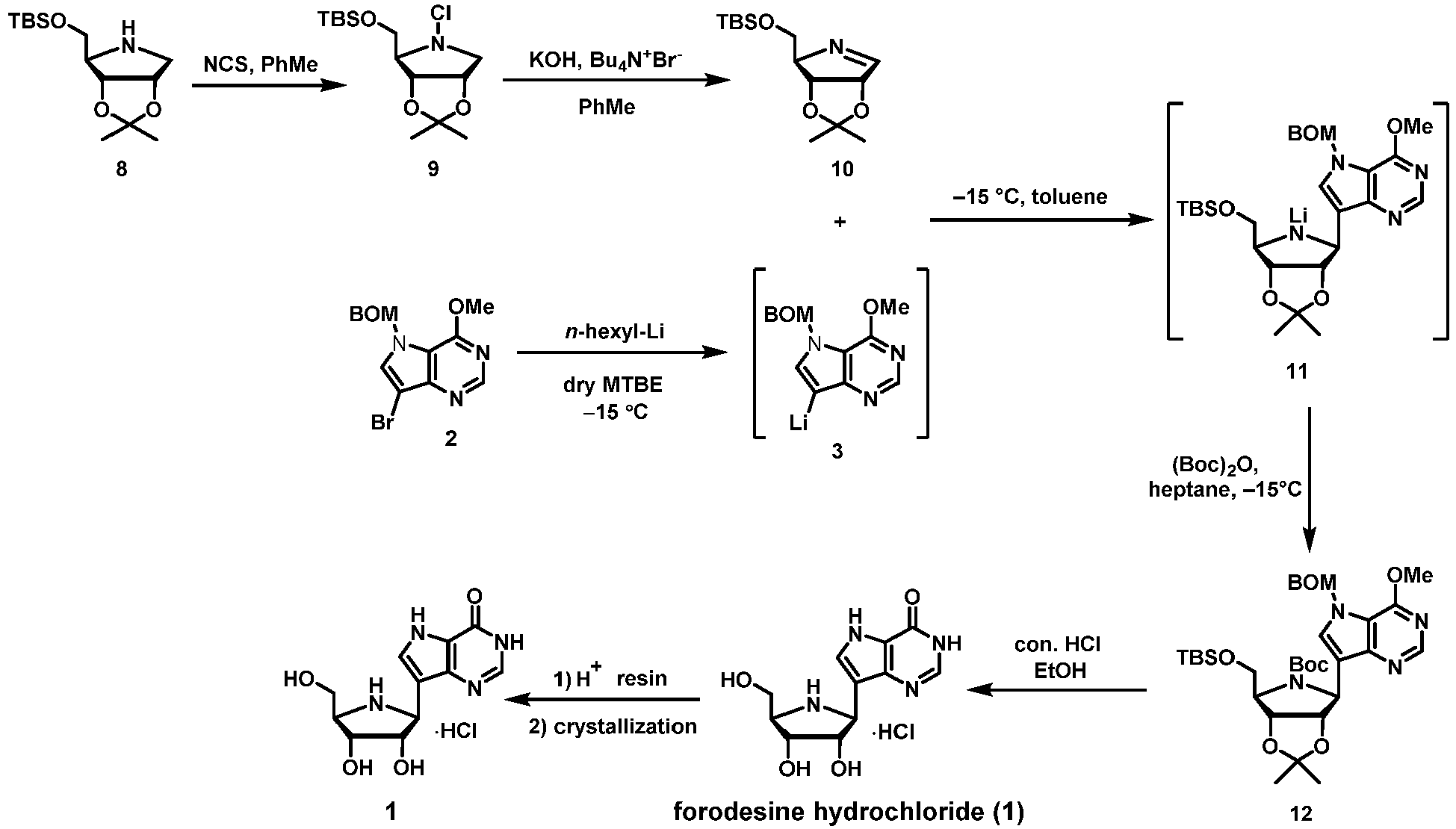
- Although the above scheme has improved the method of addition and removal of BOM protecting group, n-hexyllithium is expensive and difficult to obtain; and this method still uses secondary amine (8) as raw material, and the problems, such as cumbersome preparation process, expensive cost, the unstability of imine, and being difficult to store, are still unsolved.
- Therefore, for Forodesine, it is of great significance and high application value to develop a synthetic scheme with easily available raw materials, simple operation, low cost, and potential of industrialization.
- The object of the present invention is to provide a new method for preparing Forodesine, another object of the present invention is to provide a method for preparing Forodesine with easily available raw materials, another object of the present invention is to provide a method for preparing Forodesine with shorter reaction scheme, another object of the present invention is to provide a method for preparing Forodesine with strong operability, easy control of operation and high safety, another object of the present invention is to provide a method for preparing Forodesine with low cost, and another object of the present invention is to provide a method for preparing Forodesine suitable for scale-up production.
- For achieving the above objects, the present invention provides a method for preparing a compound represented by Formula I, comprising:
treating a compound represented by Formula VII with an acid (e.g., concentrated hydrochloric acid) to generate the compound represented by Formula I;
- R1 is an amino protecting group, such as carbobenzoxy (Cbz), tert-butoxycarbonyl (Boc), methoxycarbonyl, ethoxycarbonyl, phthaloyl (Pht), 2,4-dimethoxybenzyl (DMB), benzyl (Bn), benzyloxymethyl (BOM);
- R2 is methyl or ethyl;
- R3, R4, R5 are each independently a hydroxyl protecting group, such as trimethylsilyl (TMS), tert-butyldimethylsilyl (TBDMS), benzyl (Bn), p-methoxybenzyl (PMB), 2-tetrahydropyranyl (THP), methoxymethyl (MOM), 1-ethoxyethyl (EE);
- R6 is an amino protecting group, such as carbobenzoxy (Cbz), tert-butoxycarbonyl (Boc), methoxycarbonyl, ethoxycarbonyl, phthaloyl (Pht), 2,4-dimethoxybenzyl (DMB), benzyl (Bn), benzyloxymethyl (BOM).
- In some embodiments, in the method for preparing the compound represented by Formula I of the present invention, the compound represented by Formula VII is treated with concentrated hydrochloric acid.
- In some embodiments, in the method for preparing the compound represented by Formula I of the present invention, the compound represented by Formula VII is treated with an acid under heating and refluxing conditions.
- In some embodiments, in the method for preparing the compound represented by Formula I of the present invention, the compound represented by Formula VII is treated with an acid under refluxing conditions for 20 to 100 hours, such as 24 to 96 hours, 36 to 84 hours, 48 to 72 hours.
- In some embodiments, in the method for preparing the compound represented by Formula I of the present invention, the compound represented by Formula VII is treated with an acid by a method comprising the following operations:
- a) dissolving the compound represented by Formula VII in a first solvent to obtain a solution containing the compound represented by Formula VII;
- b) adding the acid (e.g., concentrated hydrochloric acid) to the solution containing the compound represented by Formula VII, heating and refluxing.
- In some embodiments, the first solvent of the present invention is tetrahydrofuran or methanol.
- In some embodiments, the first solvent of the present invention is tetrahydrofuran.
- In some embodiments, the method for preparing the compound represented by Formula I of the present invention further comprises:
- i) removing the first solvent, adding ethanol to the obtained product, separating out and collecting a solid;
- ii) optionally, purifying the obtained solid.
- In some embodiments, in the method for preparing the compound represented by Formula I of the present invention, the method for purifying the obtained solid comprises:
- iii) dissolving the obtained solid in water to obtain an aqueous solution;
- iv) contacting the aqueous solution with a cation exchange resin, eluting with dilute hydrochloric acid (e.g., 2-4M hydrochloric acid), and collecting an eluate;
- v) removing the solvent in the eluate, dissolving the product in dilute hydrochloric acid (e.g., 0.5-1.5M hydrochloric acid), heating to 40-60°C (e.g., 45-55°C), and cooling to room temperature;
- vi) adding ethanol to the product obtained in v), stirring at room temperature for 6-10 hours, and precipitating a solid;
- vii) cooling to 0°C and standing;
- viii) collecting a solid.
- In some embodiments, in the compound represented by Formula VII of the present invention, R1 is 2,4-dimethoxybenzyl (DMB), benzyl (Bn) or benzyloxymethyl (BOM).
- In some embodiments, in the compound represented by Formula VII of the present invention, R1 is 2,4-dimethoxybenzyl (DMB).
- In some embodiments, in the compound represented by Formula VII of the present invention, R1 is benzyl (Bn).
- In some embodiments, in the compound represented by Formula VII of the present invention, R1 is carbobenzoxy (Cbz).
- In some embodiments, in the compound represented by Formula VII of the present invention, R1 is tert-butoxycarbonyl (Boc).
- In some embodiments, in the compound represented by Formula VII of the present invention, R1 is methoxycarbonyl.
- In some embodiments, in the compound represented by Formula VII of the present invention, R1 is ethoxycarbonyl.
- In some embodiments, in the compound represented by Formula VII of the present invention, R1 is phthaloyl (Pht).
- In some embodiments, in the compound represented by Formula VII of the present invention, R2 is methyl.
- In some embodiments, in the compound represented by Formula VII of the present invention, R3, R4, and R5 are each independently benzyl (Bn), p-methoxybenzyl (PMB), methoxymethyl (MOM) or 1-ethoxyethyl (EE).
- In some embodiments, in the compound represented by Formula VII of the present invention, R3, R4, and R5 are each independently p-methoxybenzyl (PMB).
- In some embodiments, in the compound represented by Formula VII of the present invention, R3, R4, and R5 are each independently methoxymethyl (MOM).
- In some embodiments, in the compound represented by Formula VII of the present invention, R3, R4, and R5 are each independently 1-ethoxyethyl (EE).
- In some embodiments, in the compound represented by Formula VII of the present invention, R3, R4, and R5 are each independently trimethylsilyl (TMS).
- In some embodiments, in the compound represented by Formula VII of the present invention, R3, R4, and R5 are each independently tert-butyldimethylsilyl (TBDMS).
- In some embodiments, in the compound represented by Formula VII of the present invention, R3, R4, and R5 are each independently 2-tetrahydropyranyl (THP).
- In some embodiments, in the compound represented by Formula VII of the present invention, R6 is carbobenzoxy (Cbz), tert-butoxycarbonyl (Boc), methoxycarbonyl or ethoxy carbonyl. In some embodiments, in the compound represented by Formula VII of the present invention, R6 is carbobenzoxy (Cbz).
- In some embodiments, in the compound represented by Formula VII of the present invention, R6 is methoxycarbonyl.
- In some embodiments, in the compound represented by Formula VII of the present invention, R6 is ethoxycarbonyl.
- In some embodiments, in the compound represented by Formula VII of the present invention, R6 is phthaloyl (Pht).
- In some embodiments, in the compound represented by Formula VII of the present invention, R6 is 2,4-dimethoxybenzyl (DMB).
- In some embodiments, in the compound represented by Formula VII of the present invention, R6 is benzyl (Bn).
- In some embodiments, in the compound represented by Formula VII of the present invention, R6 is benzyloxymethyl (BOM).
- In some embodiments, in the compound represented by Formula VII of the present invention, R1 is benzyloxymethyl (BOM).
- In some embodiments, in the compound represented by Formula VII of the present invention, R2 is ethyl.
- In some embodiments, in the compound represented by Formula VII of the present invention, R3, R4, and R5 are each independently benzyl (Bn).
- In some embodiments, in the compound represented by Formula VII of the present invention, R6 is tert-butoxycarbonyl (Boc).
- In some embodiments, in the compound represented by Formula VII of the present invention, R1 is benzyloxymethyl (BOM), R2 is methyl, R3, R4, R5 are each independently benzyl (Bn), R6 is tert-butoxycarbonyl (Boc).
- In some embodiments, the method for preparing the compound represented by Formula I of the present invention further comprises preparing a compound represented by Formula VII, which comprises:

position 1 of a compound represented by Formula VI, wherein the definitions of R1, R1, R3, R4, R5 and R6 are the same as those of Formula VII. - The compound represented by Formula VI is easily oxidized, and an amino protecting group is introduced into the compound represented by Formula VI to obtain a compound represented by Formula VII with stable properties, which is convenient for subsequent separation and purification.
- In some embodiments, in the compound represented by Formula VII, R6 is tert-butoxycarbonyl (Boc), and the definitions of R1, R2, R3, R4, and R5 are as described in the present invention, which is obtained by protection of the compound represented by Formula VI with Boc. Preferably, the compound represented by Formula VI reacts with Boc anhydride under basic conditions to obtain the compound represented by Formula VII. More preferably, the compound represented by Formula VI reacts with Boc anhydride in the presence of sodium hydroxide to obtain the compound represented by Formula VII.
- In some embodiments, the method for preparing the compound represented by Formula I of the present invention further comprises preparing the compound represented by Formula VI, which comprises:

- In some embodiments, in the method for preparing the compound represented by Formula I of the present invention, the compound represented by Formula V is reduced with a reducing agent.
- In some embodiments, in the method for preparing the compound represented by Formula I of the present invention, the compound represented by Formula V is reduced with a reducing agent in a second solvent.
- In some embodiments, the reducing agent of the present invention is zinc powder, iron powder or indium powder.
- In some embodiments, the reducing agent of the present invention is zinc powder.
- In some embodiments, the reducing agent of the present invention is iron powder.
- In some embodiments, the reducing agent of the present invention is indium powder.
- In some embodiments, the second solvent of the present invention is a mixed solvent of acetic acid and methanol, trifluoroacetic acid (TFA), 4-8M (e.g., 6M) hydrochloric acid, or a saturated aqueous solution of NH4Cl.
- In some embodiments, the second solvent of the present invention is a mixed solvent of acetic acid and methanol, preferably a mixed solvent of acetic acid and methanol with a volume ratio of 1 : 3-8, for example, a mixed solvent of acetic acid and methanol with a volume ratio of 1 : 4-6, such as a mixed solvent of acetic acid and methanol with a volume ratio of 1 : 5.
- In some embodiments, the second solvent of the present invention is trifluoroacetic acid (TFA), 4-8M (e.g., 6M) hydrochloric acid, or a saturated aqueous solution of NH4Cl.
- In some embodiments, the second solvent of the present invention is trifluoroacetic acid (TFA).
- In some embodiments, the second solvent of the present invention is 4-8M (e.g., 6M) hydrochloric acid.
- In some embodiments, the second solvent of the present invention is a saturated aqueous solution of NH4Cl.
- In some embodiments, in the method for preparing the compound represented by Formula I of the present invention, the molar ratio of the reducing agent to the compound represented by Formula V is 15-25 : 1, such as 18-22 : 1, 20 : 1.
- In some embodiments, the method for preparing the compound represented by Formula I of the present invention further comprises a method for preparing the compound represented by Formula V, which comprises:

- a) treating a compound represented by Formula II with a metal lithium reagent to generate a compound represented by Formula III;
- b) reacting the compound represented by Formula III with a compound represented by Formula IV to generate the compound represented by Formula V,
- The compound represented by Formula III reacts with the compound represented by Formula IV to produce a pair of isomers with a diastereoselectivity of 7 : 1, wherein the main product is the compound represented by Formula V. The compound represented by Formula V is reduced to the compound represented by Formula VI, and the intermediate is easily oxidized. An amino protecting group is introduced into the compound represented by the Formula VI to obtain the compound of the Formula VII with stable properties, so that the diastereomers generated in the above reaction process can be easily separated.
- In some embodiments, the metal lithium reagent of the present invention is n-butyllithium, tert-butyllithium, phenyllithium, and sec-butyllithium.
- In some embodiments, the metal lithium reagent of the present invention is n-butyllithium.
- In some embodiments, the metal lithium reagent of the present invention is tert-butyllithium.
- In some embodiments, the metal lithium reagent of the present invention is phenyllithium.
- In some embodiments, the metal lithium reagent of the present invention is sec-butyllithium.
- In some embodiments, in the method for preparing the compound represented by Formula I of the present invention, the compound represented by Formula II is treated with the metal lithium reagent in a third solvent.
- In some embodiments, the third solvent of the present invention is methyl tert-butyl ether, tetrahydrofuran (THF), anisole, n-hexane or toluene.
- In some embodiments, the third solvent of the present invention is methyl tert-butyl ether.
- In some embodiments, the third solvent of the present invention is anhydrous methyl tert-butyl ether.
- In some embodiments, the third solvent of the present invention is tetrahydrofuran (THF).
- In some embodiments, the third solvent of the present invention is anisole.
- In some embodiments, the third solvent of the present invention is n-hexane.
- In some embodiments, the third solvent of the present invention is toluene.
- In some embodiments, in the method for preparing the compound represented by Formula I according to the present invention, the compound represented by Formula II is treated with the metal lithium reagent under the conditions of -60°C to 0°C (e.g., -40°C, -20°C).
- In some embodiments, in the method for preparing the compound represented by Formula I according to the present invention, the compound represented by Formula II is treated with the metal lithium reagent under the conditions of -40°C to 0°C.
- In some embodiments, in the method for preparing the compound represented by Formula I according to the present invention, the compound represented by Formula II is treated with the metal lithium reagent under the conditions of -60°C to -20°C.
- In some embodiments, in the method for preparing the compound represented by Formula I according to the present invention, the compound represented by Formula II is treated with the metal lithium reagent under the conditions of -40°C to -20°C.
- In some embodiments, in the method for preparing the compound represented by Formula I according to the present invention, the molar ratio of the metal lithium reagent to the compound represented by Formula II is 1-1.5 : 1, for example, 1.2 : 1.
- In some embodiments, in the method for preparing the compound represented by Formula I according to the present invention, the compound represented by Formula III reacts with the compound represented by Formula IV in a third solvent.
- In some embodiments, in the method for preparing compound represented by Formula I according to the present invention, the feed molar ratio of the compound represented by Formula II to the compound represented by Formula IV is 1.4-2.2 : 1, such as 1.6-2 : 1, for example 1.8 : 1.
- In some embodiments, in the method for preparing the compound represented by Formula I according to the present invention, the compound represented by Formula III reacts with the compound represented by Formula IV under the conditions of -60°C to 0°C (e.g., -40°C, -20°C).
- In some embodiments, in the method for preparing the compound represented by Formula I according to the present invention, the compound represented by Formula III reacts with the compound represented by Formula IV under the conditions of -40°C to 0°C.
- In some embodiments, in the method for preparing the compound represented by Formula I according to the present invention, the compound represented by Formula III reacts with the compound represented by Formula IV under the conditions of -60°C to -20°C.
- In some embodiments, in the method for preparing the compound represented by Formula I according to the present invention, the compound represented by Formula III reacts with the compound represented by Formula IV under the conditions of -40°C to -20°C.
- The present invention further provides an intermediate compound represented by Formula V, Formula VI or Formula VII,

- In some embodiments, the intermediate compound is selected from the group consisting of:

- The present invention further provides a method for preparing Forodesine or a salt thereof, comprising:
- a) preparing the compound represented by Formula I by using the method of the present invention;
- b) converting the compound represented by Formula I into a free form of Forodesine, or converting the compound represented by Formula I into a desired salt of Forodesine.
- In the present invention, the compound represented by Formula IV is a nitrone compound, for example, a nitrone compound represented by Formula IV in which R3, R4, R5 are each independently of benzyl (Bn), which can be prepared by referring to a method in literature (Tetrahedron, 2009, 65, 93-100). The compound represented by Formula II in which R1 is benzyloxymethyl (BOM), R2 is methyl, and X is a bromine atom can be prepared by referring to a method in literature (Journal of Organic Chemistry, 2001, 66(17), 5723-5730).
- Unless otherwise defined below, all technical and scientific terms used herein are intended to have the same meaning as commonly understood by one skilled in the art. References to techniques used herein are intended to refer to techniques commonly understood in the art, including those variations or substitutions of equivalent techniques that would be obvious to one skilled in the art. While the following terms are believed to be well understood by one skilled in the art, the following definitions are set forth to better explain the present invention.
- As used herein, the terms "comprising", "including", "having", "containing" or "involving" and other variations thereof herein are inclusive or open-ended and do not exclude other unenumerated elements or method steps.
- As used herein, the term "halogen" group is defined to include F, Cl, Br or I.
- As used herein, the term "concentrated hydrochloric acid" generally refers to hydrochloric acid with a mass fraction of 36% to 38%, and a substance concentration of 12 mol/L.
- As used herein, the term "dilute hydrochloric acid" refers to hydrochloric acid with a mass fraction of less than 20%.
- Unless otherwise apparent from the context, all numerical values provided herein are modified by the term "about", that is, the numerical values disclosed herein include not only the numerical value itself, but also the numerical values modified by "about". For the specific values as used herein, the term "about" should be understood as within a range of normal tolerance in the art, for example, within ±10%, ±9%, ±8%, ±7%, ±6%, ±5%, ±4%, ±3%, ±2%, ±1%, ±0.5%, ±0.1%, ±0.05% or ±0.01%.
- Beneficial effects of the present invention:
The method for preparing the compound Forodesine hydrochloride represented by Formula I provided by the present invention has one or more of the following advantages: - 1) the raw materials and solvents used in this method are cheap and easy to be obtained;
- 2) the method uses a nitrone compound as a raw material this raw material is stable and easy to be stored, easy to prepare on a large scale, simple and convenient to prepare, in which the reagents and solvents involved are cheap and easy to be obtained, and the operation is simple;
- 3) the synthesis process of this method is easy to operate, the synthesis scheme is short, and the overall yield is high, for example about 30%;
- 4) the production cost of this method is low;
- 5) the Forodesine hydrochloride prepared by this method has high purity, and the purity can reach more than 99.8%, such as 99.9%.
- 6) the method is suitable for industrial production.
-
Figure 1 shows the 1H-NMR nuclear magnetic spectrum of Forodesine hydrochloride of the present invention.
Figure 2 shows the 13C-NMR nuclear magnetic spectrum of Forodesine hydrochloride of the present invention.
Figure 3 shows the HPLC spectrogram of Forodesine hydrochloride of the present invention.
column: Agilent ZORBAX SB-C18, 4.6 × 150 mm, 5µm;
solvent: 0.1% TFA/H\2O = 100%; flow: 0.3 mL/min;
Peak information (wavelength: 254 nm):Peak # RetTime [min] Width [min] Area [mAU∗s] Height [mAU] Area % 1 7.383 0.2606 19.30883 1.03992 0.0130 2 9.307 0.2463 105.91992 6.42738 0.0714 3 10.550 0.7339 1.48284e5 3111.81201 99.9156 - In order to further illustrate the technical effect of the present invention, the present invention will be described in detail below through examples. The examples provided are merely to illustrate the method of the present invention and are not intended to limit the present invention in any way.
- Unless otherwise specified, the reagents, methods and equipment used in the present invention are conventional reagents, methods and equipment in the art.
- The compound represented by
Formula 1 of the example of the present invention, i.e., Forodesine hydrochloride, was prepared by the synthetic scheme as follows:
- 1) Preparation of Compound 5:
The bromopurine derivative (2) (22.5 g, 64.7 mmol) was dissolved in anhydrous methyl tert-butyl ether (600 mL), cooled to -20°C, and n-butyllithium (2.5M, 31 mL, 78 mmol) was slowly added dropwise. After the completion of the dropwise addition, the mixture was stirred at -20°C for 1 hour, then warmed to room temperature and stirred for 10 minutes, and then cooled to -20°C, then a nitrone (4) (15.0 g, 35.9 mmol) in methyl tert-butyl ether (50 mL) was slowly added dropwise. the resultant mixture reacted at -20°C for 15 hours, a saturated ammonium chloride solution was added to quench the reaction. the resultant mixture was warmed to room temperature, ethyl acetate was added for dilution, the organic layer and the aqueous layer were separated, the aqueous layer was extracted three times with ethyl acetate, the organic layers were combined, dried over anhydrous sodium sulfate, and the solvent was removed under reduced pressure to obtain a crude product of hydroxylamine (5), which was directly used in the next step without separation and purification. - 2) Preparation of Compound 6:
The crude hydroxylamine (5) obtained in the previous step was dissolved in a mixed solvent of acetic acid and methanol (V/V = 1 : 5, 60 mL), zinc powder (47.0 g, 0.72 mol) was added, and the mixture was heated to reflux for 2 hours. Then the reaction solution was cooled to room temperature, filtered through diatomite to remove an insoluble substance, the filtrate was concentrated and drained to obtain a crude secondary amine (6), which was directly used in the next step without separation and purification. - 3) Preparation of Compound 7:
The crude secondary amine (6) obtained in the previous step was dissolved in tetrahydrofuran (150 mL), 3M aqueous sodium hydroxide solution (150 mL, 0.45 mol) was added, the pH value of the solution was adjusted to 10, and BOC anhydride (15.7 g, 71.8 mmol) was added, and the resultant reaction solution reacted at room temperature for 15 hours. After monitoring the completion of the reaction by LC-MS, the reaction solution was filtered through diatomite to remove an insoluble substance. The tetrahydrofuran in the filtrate was removed under reduced pressure, the residue was diluted with ethyl acetate, and an organic layer and an aqueous layer were separated, the aqueous layer was extracted three times with ethyl acetate, and then the organic layers were combined, dried over anhydrous sodium sulfate, the solvent was removed under reduced pressure, and the crude product was separated and purified through silica gel column chromatography (petroleum ether : ethyl acetate (V/V) = 5 : 1) obtain a light yellow oil (7) (11.0 g, 40%). LC-MS m/z for C46H51N4O7[M+H]+calculated 771.4; found 771.4 - 4) Preparation of Forodesine hydrochloride
Compound 7 (11.0 g) was dissolved in tetrahydrofuran (50 mL), concentrated hydrochloric acid (12M (36%~38%), 100 mL) was added, the resultant mixture was heated to reflux for 72 hours, concentrated to dryness, and filtered, the solvent in the filtrate was removed under reduced pressure, a brown-red solid was obtained, to which ethanol (50 mL) was added, the resultant mixture was ground, filtered, and the solid was collected to obtain crude Forodesine hydrochloride (1) with a yield of about 78%. - 5) Purification and refinement of Forodesine hydrochloride
The solid Forodesine hydrochloride was dissolved in water, the resultant mixture was filtered through a cation exchange resin (eluted with 5L of 3M dilute hydrochloric acid), the hydrochloric acid eluate was collected, concentrated to dryness, the residue was dissolved in 1M dilute hydrochloric acid, heated to 50°C, then cooled to room temperature, ethanol was slowly added until a solid was precipitated. The resultant mixture was stirred at 20°C for 8 hours, then was cooled to 0°C and stood for 2 hours. A solid was collected through filtration, and dried to obtain a white solid Forodesine hydrochloride (about 3.0 g), and its structure and purity identification results were shown inFigures 1 to 3 , and its purity was about 99.9%. - The overall yield of this example was about 30%.
- 1H NMR (400 MHz, CD3SOCD3) δ12.38 (s, 1H), 12.18 (s, 1H), 10.47 (s, 1H), 8.45 (s, 1H), 7.89 (s, 1H), 7.65 (d, J = 4.0 Hz, 1H), 5.60 (d, J = 4.0 Hz, 1H),5.50 (d, J = 4.0 Hz, 1H), 5.46 (t, J = 4.0 Hz, 1H), 4.63 (d, J = 8.0 Hz, 1H), 4.44 - 4.39 (m, 1 H), 4.19- 4.15 (m, 1 H), 3.74- 3.71 (m, 1 H),3.50- 3.46 (m, 1 H). 13C NMR(100 MHz,CD3SOCD3) δ 153.5, 143.0, 142.2, 127.5, 118.0, 109.2, 74.0, 70.3, 65.2, 58.4, 56.5. LC-MS m/z for C11H15N4O4[M + H]+calculated 267.1; found 267.1.
- Finally, it should be noted that the above examples are only used to illustrate the technical solution of the present invention and not to limit it. Although the technical solution of the present invention has been described in detail with reference to the preferred examples, one skilled in the art should understand that the technical solution of the present invention can be modified or equivalently replaced without departing from the spirit and scope of the present invention, all of these changes should be included in the protection scope of the present invention.
Claims (13)
- A method for preparing a compound represented by Formula I, comprising:
treating a compound represented by Formula VII with an acid to generate the compound represented by Formula I; R1 is an amino protecting group, such as carbobenzoxy (Cbz), tert-butoxycarbonyl (Boc), methoxycarbonyl, ethoxycarbonyl, phthaloyl (Pht), 2,4-dimethoxybenzyl (DMB), benzyl (Bn), benzyloxymethyl (BOM);R2 is methyl or ethyl;R3, R4, R5 are each independently a hydroxyl protecting group, such as trimethylsilyl (TMS), tert-butyldimethylsilyl (TBDMS), benzyl (Bn), p-methoxybenzyl (PMB), 2-tetrahydropyranyl (THP), methoxymethyl (MOM), 1-ethoxyethyl (EE);R6 is an amino protecting group, such as carbobenzoxy (Cbz), tert-butoxycarbonyl (Boc), methoxycarbonyl, ethoxycarbonyl, phthaloyl (Pht), 2,4-dimethoxybenzyl (DMB), benzyl (Bn), benzyloxymethyl (BOM).
 - The method according to claim 1, wherein the acid is concentrated hydrochloric acid.
- The method according to claim 1, wherein the compound represented by the Formula VII is treated with the acid under heating and refluxing conditions.
- The method according to claim 3, wherein the compound represented by Formula VII is treated with the acid under refluxing conditions for 20 to 100 hours, such as 24 to 96 hours, 36 to 84 hours, and 48 to 72 hours.
- The method according to any one of claims 1-4, wherein the compound represented by Formula VII is treated with the acid by a method comprising the following operations:a) dissolving the compound represented by Formula VII in a first solvent (e.g., tetrahydrofuran, methanol, preferably tetrahydrofuran) to obtain a solution containing the compound represented by Formula VII;b) adding the acid to the solution containing the compound represented by Formula VII, heating and refluxing.
- The method according to claim 1, wherein the method further comprises:i) removing the first solvent, adding ethanol to the obtained product, separating out and collecting a solid;ii) optionally, purifying the obtained solid;preferably, the method for purifying the obtained solid comprises:iii) dissolving the obtained solid in water to obtain an aqueous solution;iv) contacting the aqueous solution with a cation exchange resin, eluting with dilute hydrochloric acid (e.g., 2-4M hydrochloric acid), and collecting an eluate;v) removing the solvent in the eluate, dissolving the product in dilute hydrochloric acid (e.g., 0.5-1.5M hydrochloric acid), heating to 40-60°C (e.g., 45-55°C), and cooling to room temperature;vi) adding ethanol to the product obtained in v), stirring at room temperature for 6-10 hours, and precipitating out a solid;vii) cooling to 0°C and standing;viii) collecting a solid.
- The method according to claim 1, wherein:preferably, R1 is 2,4-dimethoxybenzyl (DMB), benzyl (Bn) or benzyloxymethyl (BOM);preferably, R2 is methyl;preferably, R3, R4, R5 are each independently benzyl (Bn), p-methoxybenzyl (PMB), methoxymethyl (MOM) or 1-ethoxyethyl (EE);preferably, R6 is carbobenzoxy (Cbz), tert-butoxycarbonyl (Boc), methoxycarbonyl or ethoxycarbonyl.
- The method according to claim 7, wherein:preferably, R1 is benzyloxymethyl (BOM);preferably, R2 is methyl;preferably, R3, R4, R5 are each independently benzyl (Bn);preferably, R6 is tert-butoxycarbonyl (Boc).
- The method according to any one of claims 1-4 and 6-8, wherein the method further comprises a method for preparing the compound represented by Formula VII comprising:

- The method according to claim 9, wherein the method further comprises a method for preparing the compound represented by Formula VI comprising:
 reducing a compound represented by Formula V, wherein R1, R1, R3, R4, R5 are as defined in any one of claims 1-4 and 6-8;preferably, the compound represented by Formula V is reduced with a reducing agent (e.g., zinc powder, iron powder or indium powder, preferably zinc powder);preferably, the compound represented by Formula V is reduced with a reducing agent in a second solvent;preferably, the second solvent is a mixed solvent of acetic acid and methanol, trifluoroacetic acid (TFA), 4-8M (e.g., 6M) hydrochloric acid, or saturated aqueous solution of NH4Cl;preferably, the second solvent is a mixed solvent of acetic acid and methanol, preferably a mixed solvent of acetic acid and methanol with a volume ratio of 1 : 3-8, such as a mixed solvent of acetic acid and methanol with a volume ratio of 1 : 4-6, such as a mixed solvent of acetic acid and methanol with a volume ratio of 1 : 5;preferably, the molar ratio of the reducing agent to the compound represented by Formula V is 15-25 : 1, for example, 18-22 : 1, 20 : 1.
 - The method according to claim 10, wherein the method further comprised a method for preparing the compound represented by Formula V comprising:
 a) treating a compound represented by Formula II with a metal lithium reagent (e.g., n-butyllithium, tert-butyllithium, phenyllithium, sec-butyllithium, preferably n-butyllithium) to generate a compound represented by Formula III;b) reacting the compound represented by Formula III with a compound represented by Formula IV to generate the compound represented by Formula V,wherein R1, R1, R3, R4, R5 are as defined in any one of claims 1-4 and 6-8, X is halogen, preferably bromine atom and iodine atom, such as bromine atom,preferably, the compound represented by Formula II is treated with the metal lithium reagent in a third solvent (e.g., methyl tert-butyl ether, tetrahydrofuran (THF), anisole, n-hexane or toluene, preferably methyl tert-butyl ether, such as anhydrous methyl tert-butyl ether);preferably, the compound represented by the Formula II is treated with the metal lithium reagent under the conditions of -60°C to 0°C (e.g., -40°C, -20°C);preferably, the molar ratio of the metal lithium reagent to the compound represented by Formula II is 1-1.5 : 1, for example, 1.2 : 1;preferably, the compound represented by the Formula III reacts with the compound represented by the Formula IV in a third solvent (e.g., methyl tert-butyl ether, tetrahydrofuran (THF), anisole, n-hexane or toluene, preferably methyl tert-butyl ether, for example anhydrous methyl tert-butyl ether);preferably, the feed molar ratio of the compound represented by Formula II to the compound represented by Formula IV is 1.4-2.2 : 1, such as 1.6-2 : 1, such as 1.8 : 1;preferably, the compound represented by the Formula III reacts with the compound represented by the Formula IV under the conditions of -60°C to 0°C (e.g.,, -40 °C, -20 °C).
 - A compound represented by Formula V, Formula VI or Formula VII,


- A method for preparing Forodesine or salt thereof, comprising:a) preparing the compound represented by Formula I by using the method according to any one of claims 1-11;b) converting the compound represented by Formula I into a free form of Forodesine, or converting the compound represented by Formula I into a desired salt of Forodesine.
Applications Claiming Priority (2)
| Application Number | Priority Date | Filing Date | Title |
|---|---|---|---|
| CN202010752502.5A CN111704619B (en) | 2020-07-30 | 2020-07-30 | Preparation method of Forodesine |
| PCT/CN2021/107836 WO2022022376A1 (en) | 2020-07-30 | 2021-07-22 | Method for preparing forodesine |
Publications (2)
| Publication Number | Publication Date |
|---|---|
| EP4190785A1 true EP4190785A1 (en) | 2023-06-07 |
| EP4190785A4 EP4190785A4 (en) | 2024-08-21 |
Family
ID=72548132
Family Applications (1)
| Application Number | Title | Priority Date | Filing Date |
|---|---|---|---|
| EP21850321.7A Pending EP4190785A4 (en) | 2020-07-30 | 2021-07-22 | PROCESS FOR THE PRODUCTION OF FORODESINE |
Country Status (5)
| Country | Link |
|---|---|
| US (1) | US20230271970A1 (en) |
| EP (1) | EP4190785A4 (en) |
| JP (1) | JP2023537293A (en) |
| CN (1) | CN111704619B (en) |
| WO (1) | WO2022022376A1 (en) |
Families Citing this family (3)
| Publication number | Priority date | Publication date | Assignee | Title |
|---|---|---|---|---|
| CN111704619B (en) * | 2020-07-30 | 2021-10-19 | 四川大学 | Preparation method of Forodesine |
| GB202218782D0 (en) * | 2022-12-13 | 2023-01-25 | Mehrling Thomas | Purine nucleoside phosphorylase inhibitor for metabolic syndrome |
| CN118359623B (en) * | 2024-04-16 | 2025-06-27 | 上海陶术生物科技股份有限公司 | A synthesis method, intermediate and application of forodesine |
Family Cites Families (8)
| Publication number | Priority date | Publication date | Assignee | Title |
|---|---|---|---|---|
| CA2696826C (en) * | 1999-04-08 | 2013-01-08 | Industrial Research Limited | Process for preparing inhibitors of nucleoside metabolism |
| CN100567298C (en) * | 2006-09-25 | 2009-12-09 | 中国科学院化学研究所 | A kind of method for synthesizing polyhydroxypyrrolidinoid alkaloids |
| CN101475491B (en) * | 2009-01-09 | 2013-03-06 | 西北师范大学 | N-substituted 1,2-diphenylethylamine compounds and synthesizing method thereof |
| CN101693708B (en) * | 2009-09-29 | 2014-09-24 | 中国科学院化学研究所 | A kind of aryl nitrogen heterosaccharide compound and its preparation method and application |
| AR090699A1 (en) * | 2012-04-18 | 2014-12-03 | Biocryst Pharm Inc | INHIBITING COMPOUNDS OF VIRAL POLYMERASE RNA ACTIVITY |
| WO2014078778A2 (en) * | 2012-11-16 | 2014-05-22 | Biocryst Pharmaceuticals, Inc. | Antiviral azasugar-containing nucleosides |
| CA2973152A1 (en) | 2015-01-07 | 2016-07-14 | Euro-Celtique S.A. | Process for manufacture of forodesine |
| CN111704619B (en) * | 2020-07-30 | 2021-10-19 | 四川大学 | Preparation method of Forodesine |
-
2020
- 2020-07-30 CN CN202010752502.5A patent/CN111704619B/en active Active
-
2021
- 2021-07-22 EP EP21850321.7A patent/EP4190785A4/en active Pending
- 2021-07-22 WO PCT/CN2021/107836 patent/WO2022022376A1/en not_active Ceased
- 2021-07-22 US US18/018,012 patent/US20230271970A1/en active Pending
- 2021-07-22 JP JP2023506006A patent/JP2023537293A/en active Pending
Also Published As
| Publication number | Publication date |
|---|---|
| CN111704619B (en) | 2021-10-19 |
| JP2023537293A (en) | 2023-08-31 |
| WO2022022376A1 (en) | 2022-02-03 |
| EP4190785A4 (en) | 2024-08-21 |
| US20230271970A1 (en) | 2023-08-31 |
| CN111704619A (en) | 2020-09-25 |
Similar Documents
| Publication | Publication Date | Title |
|---|---|---|
| US20230271970A1 (en) | Method for preparing forodesine | |
| JP7500102B2 (en) | Intermediate for synthesizing camptothecin derivatives, production method thereof and use thereof | |
| WO2010140168A1 (en) | Improved process for preparing temozolomide | |
| US20120065392A1 (en) | Method for preparing meropenem using zinc powder | |
| OA11482A (en) | Process for preparing a protected 4-aminomethyl-pyrrolidin-3-one. | |
| WO2011004389A2 (en) | An improved process for the preparation of elvitegravir | |
| Guarna et al. | Stereoselective Meisenheimer rearrangement using BTAa's as chiral auxiliaries | |
| EP0478065B1 (en) | New intermediate for making 3-oxo-4-aza-androst-1-ene 17beta-ketones | |
| Grillot et al. | Synthesis of a structural analog of ptilomycalin A | |
| CN114315755B (en) | A synthetic method for key intermediates of Tubulysin and its analogs | |
| SE461148B (en) | POLYSILYLATED CANAMYCIN A OR B DERIVATE | |
| US20060229285A1 (en) | Crystal of intermediate for carbapenem | |
| CN114163380A (en) | Alavazepam intermediate, preparation method and application thereof | |
| CN115716799A (en) | Method for preparing cis-chiral-3-fluoro-4-hydroxypiperidine and its derivatives by reduction of organic borohydride metal reagents | |
| CN112441998B (en) | Preparation method of eribulin intermediate | |
| CN117164586B (en) | Preparation method of spiro diamine | |
| CN113831254A (en) | Preparation method of phenyl-containing compound | |
| US20240336635A1 (en) | Process for the production of (1r,2s,5r)-1-amino-5-[2-(dihydroxyboranyl)ethyl]-2-[(dimethylamino)methyl]-cyclohexane-1-carboxylic acid | |
| CN116867789B (en) | Preparation method of irinotecan derivative and intermediate thereof | |
| WO2013050375A1 (en) | Process for preparing 5-(2-{[6-(2,2-difluoro-2-phenylethoxy)hexyl]amino}-1(r)-hydroxyethyl)-8-hydroxyquinolin-2(1h)-one via a novel intermediate | |
| CN113527170B (en) | Process for preparing pyrrolomycin derivatives and intermediates therefor | |
| JP4260941B2 (en) | Azetidine-3-ol | |
| JPS63270650A (en) | P-(trans-4-aminomethylcyclohexylcarbonyl) phenylpropionic acid | |
| JPH08143517A (en) | Production of optically active 3-amino-1,2-butanediol derivative | |
| Tachibana | Syntheses of 1. BETA.-hydroxyvitamin D2 and D3. |
Legal Events
| Date | Code | Title | Description |
|---|---|---|---|
| STAA | Information on the status of an ep patent application or granted ep patent |
Free format text: STATUS: THE INTERNATIONAL PUBLICATION HAS BEEN MADE |
|
| PUAI | Public reference made under article 153(3) epc to a published international application that has entered the european phase |
Free format text: ORIGINAL CODE: 0009012 |
|
| STAA | Information on the status of an ep patent application or granted ep patent |
Free format text: STATUS: REQUEST FOR EXAMINATION WAS MADE |
|
| 17P | Request for examination filed |
Effective date: 20230201 |
|
| AK | Designated contracting states |
Kind code of ref document: A1 Designated state(s): AL AT BE BG CH CY CZ DE DK EE ES FI FR GB GR HR HU IE IS IT LI LT LU LV MC MK MT NL NO PL PT RO RS SE SI SK SM TR |
|
| DAV | Request for validation of the european patent (deleted) | ||
| DAX | Request for extension of the european patent (deleted) | ||
| A4 | Supplementary search report drawn up and despatched |
Effective date: 20240724 |
|
| RIC1 | Information provided on ipc code assigned before grant |
Ipc: C07D 487/04 20060101AFI20240718BHEP |
|
| STAA | Information on the status of an ep patent application or granted ep patent |
Free format text: STATUS: EXAMINATION IS IN PROGRESS |
|
| 17Q | First examination report despatched |
Effective date: 20250602 |