EP4188034A1 - Resistive abstimmung über laserinduziertes graphen für elektrothermische kohlenstoffallotrop-heizung - Google Patents
Resistive abstimmung über laserinduziertes graphen für elektrothermische kohlenstoffallotrop-heizung Download PDFInfo
- Publication number
- EP4188034A1 EP4188034A1 EP22209912.9A EP22209912A EP4188034A1 EP 4188034 A1 EP4188034 A1 EP 4188034A1 EP 22209912 A EP22209912 A EP 22209912A EP 4188034 A1 EP4188034 A1 EP 4188034A1
- Authority
- EP
- European Patent Office
- Prior art keywords
- lig
- region
- electrical resistance
- heater
- heating element
- Prior art date
- Legal status (The legal status is an assumption and is not a legal conclusion. Google has not performed a legal analysis and makes no representation as to the accuracy of the status listed.)
- Pending
Links
Images


Classifications
-
- H—ELECTRICITY
- H05—ELECTRIC TECHNIQUES NOT OTHERWISE PROVIDED FOR
- H05B—ELECTRIC HEATING; ELECTRIC LIGHT SOURCES NOT OTHERWISE PROVIDED FOR; CIRCUIT ARRANGEMENTS FOR ELECTRIC LIGHT SOURCES, IN GENERAL
- H05B3/00—Ohmic-resistance heating
-
- H—ELECTRICITY
- H05—ELECTRIC TECHNIQUES NOT OTHERWISE PROVIDED FOR
- H05B—ELECTRIC HEATING; ELECTRIC LIGHT SOURCES NOT OTHERWISE PROVIDED FOR; CIRCUIT ARRANGEMENTS FOR ELECTRIC LIGHT SOURCES, IN GENERAL
- H05B3/00—Ohmic-resistance heating
- H05B3/20—Heating elements having extended surface area substantially in a two-dimensional [2D] plane, e.g. plate-heater
- H05B3/22—Heating elements having extended surface area substantially in a two-dimensional [2D] plane, e.g. plate-heater non-flexible
- H05B3/26—Heating elements having extended surface area substantially in a two-dimensional [2D] plane, e.g. plate-heater non-flexible heating conductor mounted on insulating base
- H05B3/267—Heating elements having extended surface area substantially in a two-dimensional [2D] plane, e.g. plate-heater non-flexible heating conductor mounted on insulating base the insulating base being an organic material, e.g. plastic
-
- H—ELECTRICITY
- H05—ELECTRIC TECHNIQUES NOT OTHERWISE PROVIDED FOR
- H05B—ELECTRIC HEATING; ELECTRIC LIGHT SOURCES NOT OTHERWISE PROVIDED FOR; CIRCUIT ARRANGEMENTS FOR ELECTRIC LIGHT SOURCES, IN GENERAL
- H05B3/00—Ohmic-resistance heating
- H05B3/10—Heating elements characterised by the composition or nature of the materials or by the arrangement of the conductor
- H05B3/12—Heating elements characterised by the composition or nature of the materials or by the arrangement of the conductor characterised by the composition or nature of the conductive material
- H05B3/14—Heating elements characterised by the composition or nature of the materials or by the arrangement of the conductor characterised by the composition or nature of the conductive material the material being non-metallic
- H05B3/145—Carbon only, e.g. carbon black, graphite
-
- B—PERFORMING OPERATIONS; TRANSPORTING
- B64—AIRCRAFT; AVIATION; COSMONAUTICS
- B64D—EQUIPMENT FOR FITTING IN OR TO AIRCRAFT; FLIGHT SUITS; PARACHUTES; ARRANGEMENT OR MOUNTING OF POWER PLANTS OR PROPULSION TRANSMISSIONS IN AIRCRAFT
- B64D15/00—De-icing or preventing icing on exterior surfaces of aircraft
- B64D15/12—De-icing or preventing icing on exterior surfaces of aircraft by electric heating
-
- H—ELECTRICITY
- H01—ELECTRIC ELEMENTS
- H01C—RESISTORS
- H01C17/00—Apparatus or processes specially adapted for manufacturing resistors
- H01C17/22—Apparatus or processes specially adapted for manufacturing resistors adapted for trimming
- H01C17/26—Apparatus or processes specially adapted for manufacturing resistors adapted for trimming by converting resistive material
- H01C17/265—Apparatus or processes specially adapted for manufacturing resistors adapted for trimming by converting resistive material by chemical or thermal treatment, e.g. oxydation, reduction, annealing
-
- H—ELECTRICITY
- H05—ELECTRIC TECHNIQUES NOT OTHERWISE PROVIDED FOR
- H05B—ELECTRIC HEATING; ELECTRIC LIGHT SOURCES NOT OTHERWISE PROVIDED FOR; CIRCUIT ARRANGEMENTS FOR ELECTRIC LIGHT SOURCES, IN GENERAL
- H05B3/00—Ohmic-resistance heating
- H05B3/20—Heating elements having extended surface area substantially in a two-dimensional [2D] plane, e.g. plate-heater
- H05B3/34—Heating elements having extended surface area substantially in a two-dimensional [2D] plane, e.g. plate-heater flexible, e.g. heating nets or webs
- H05B3/36—Heating elements having extended surface area substantially in a two-dimensional [2D] plane, e.g. plate-heater flexible, e.g. heating nets or webs heating conductor embedded in insulating material
-
- H—ELECTRICITY
- H01—ELECTRIC ELEMENTS
- H01C—RESISTORS
- H01C17/00—Apparatus or processes specially adapted for manufacturing resistors
- H01C17/22—Apparatus or processes specially adapted for manufacturing resistors adapted for trimming
- H01C17/26—Apparatus or processes specially adapted for manufacturing resistors adapted for trimming by converting resistive material
-
- H—ELECTRICITY
- H05—ELECTRIC TECHNIQUES NOT OTHERWISE PROVIDED FOR
- H05B—ELECTRIC HEATING; ELECTRIC LIGHT SOURCES NOT OTHERWISE PROVIDED FOR; CIRCUIT ARRANGEMENTS FOR ELECTRIC LIGHT SOURCES, IN GENERAL
- H05B2203/00—Aspects relating to Ohmic resistive heating covered by group H05B3/00
- H05B2203/017—Manufacturing methods or apparatus for heaters
-
- H—ELECTRICITY
- H05—ELECTRIC TECHNIQUES NOT OTHERWISE PROVIDED FOR
- H05B—ELECTRIC HEATING; ELECTRIC LIGHT SOURCES NOT OTHERWISE PROVIDED FOR; CIRCUIT ARRANGEMENTS FOR ELECTRIC LIGHT SOURCES, IN GENERAL
- H05B2203/00—Aspects relating to Ohmic resistive heating covered by group H05B3/00
- H05B2203/032—Heaters specially adapted for heating by radiation heating
-
- H—ELECTRICITY
- H05—ELECTRIC TECHNIQUES NOT OTHERWISE PROVIDED FOR
- H05B—ELECTRIC HEATING; ELECTRIC LIGHT SOURCES NOT OTHERWISE PROVIDED FOR; CIRCUIT ARRANGEMENTS FOR ELECTRIC LIGHT SOURCES, IN GENERAL
- H05B2203/00—Aspects relating to Ohmic resistive heating covered by group H05B3/00
- H05B2203/037—Heaters with zones of different power density
-
- H—ELECTRICITY
- H05—ELECTRIC TECHNIQUES NOT OTHERWISE PROVIDED FOR
- H05B—ELECTRIC HEATING; ELECTRIC LIGHT SOURCES NOT OTHERWISE PROVIDED FOR; CIRCUIT ARRANGEMENTS FOR ELECTRIC LIGHT SOURCES, IN GENERAL
- H05B2214/00—Aspects relating to resistive heating, induction heating and heating using microwaves, covered by groups H05B3/00, H05B6/00
- H05B2214/02—Heaters specially designed for de-icing or protection against icing
-
- H—ELECTRICITY
- H05—ELECTRIC TECHNIQUES NOT OTHERWISE PROVIDED FOR
- H05B—ELECTRIC HEATING; ELECTRIC LIGHT SOURCES NOT OTHERWISE PROVIDED FOR; CIRCUIT ARRANGEMENTS FOR ELECTRIC LIGHT SOURCES, IN GENERAL
- H05B2214/00—Aspects relating to resistive heating, induction heating and heating using microwaves, covered by groups H05B3/00, H05B6/00
- H05B2214/04—Heating means manufactured by using nanotechnology
Definitions
- the embodiments herein relate to heating systems and more specifically to an aircraft feature with a heating system formed of laser-induced graphene.
- Control surfaces of an aircraft may utilize heating to avoid icing.
- an aircraft may have internal components that engage fluids, such as tubes, valves and tanks, e.g., utilized for potable or wastewater systems. Such internal components may also utilize heating for aircraft systems to operate properly. Other internal features, such as walkways and seating, may also utilize heating to provide comfort to crew and passengers.
- a method for tuning an electrical resistance of a laser-induced graphene heater.
- the method comprises forming a base carbon heating element, and determining a target electrical resistance of a laser-induced graphene (LIG) heater to be fabricated from the base carbon heating element.
- the method further comprises determining a targeted LIG pattern that provides the target electrical resistance; and directing laser energy on to the base carbon heating element based on the targeted LIG pattern to form at least one LIG region that defines a LIG pattern to from the LIG heater having the target electrical resistance.
- LIG laser-induced graphene
- the method includes an additional feature, wherein forming the at least one LIG region reduces an electrical resistance of the base carbon heating element.
- the method includes an addition feature, wherein forming the base carbon heating element includes impregnating a carbon-based precursor with a polymer material.
- the method includes an additional feature, wherein a region of the carbon-based precursor receiving the laser energy is converted into LIGthat defines the at least one LIG region.
- the method includes an additional feature, wherein the at least one LIG region has a first electrical resistance, and a region that excludes the LIG has a second electrical resistance that is greater than the at least one LIG region.
- the method includes an additional feature, wherein a first portion of the at least one LIG region includes a first amount of LIG and a second portion of the LIG region includes a second amount of LIG that is greater than the first portion.
- the method includes an additional feature, wherein the first portion of the at least one LIG region has a first electrical resistance defined by the first amount of LIG and the second portion of the at least one LIG region has a second electrical resistance defined by the second amount of the LIG that is greater than the first electrical resistance.
- a laser-induced graphene (LIG) heater comprises a base carbon heating element including a first region and a second region at a different location of the base carbon heating element with respect to the first region. LIG is formed in the second region such that the second region has different electrical resistance than the first region.
- the LIG heater includes an additional feature, wherein the first region has a first electrical resistance and the second region has a second electrical resistance defined by the LIG that is less than the first electrical resistance.
- the LIG heater includes an additional feature, wherein the first region excludes the LIG.
- the LIG heater includes an additional feature, wherein the base carbon heating element includes a plurality of the first regions and a plurality of the second regions.
- the LIG heater includes an additional feature, wherein the plurality of first regions and the plurality of second regions have an alternating arrangement spanning from one end of the base carbon heating element to an opposing end of the base carbon heating element.
- the LIG heater includes an additional feature, wherein the LIG is formed in both the first region and the second region.
- the LIG heater includes an additional feature, wherein the first region includes a first amount of the LIG and the second region includes a second amount of the LIG different from the first amount.
- the LIG heater includes an additional feature wherein the first amount of the LIG is less than the second amount of the LIG.
- the LIG heater includes an additional feature wherein the first amount of the LIG defines the first electrical resistance and the second among of the LIG defines the second electrical resistance that is greater than the first electrical resistance.
- the LIG heater includes an additional feature, wherein the LIG is formed to define a gradient pattern extending from the first amount of the LIG among of the LIG to the second amount of the LIG.
- the LIG heater includes an additional feature, wherein the base carbon heating element includes a carbon-based precursor impregnated with polymer.
- Carbon based heaters using carbon fiber, carbon nanotubes, and/or carbon allotropes have been investigated as a possible alternative to metallic heaters for aircrafts system such as ice protection. Carbon based heaters can improve on the production safety of metal foil heaters but have less design freedom than metal heater.
- Laser induced graphene (LIG) typically used to create standalone conductive traces, is a multifunctional graphene material that can be utilized to produce carbon-based heaters. Conventional LIG-based heaters are fabricated with a non-variable electrical resistance.
- LIG can be produced by directing an infrared laser on to a carbon-based precursor material. LIG processes are typically used to create standalone conductive traces. However, various non-limiting non-embodiments described herein utilizes LIG techniques to produce carbon-based heaters having a tuned (e.g., variable or adjustable) electrical resistance. In one or more non-limiting embodiments, LIG is applied to a base carbon heating that includes a carbon-based precursor impregnated with polymer to facilitate tuning of the electrical resistance of an LIG heater. In one or more non-limiting embodiments, the polymer can include, but is not limited to, thermoset resin and thermoplastic polymer.
- the electrical resistance of the LIG heater can be tuned down (e.g., reduced), for example, using applying laser energy to the base carbon heating element to induce carbonization of surrounding thermosetting/plastic matrix.
- the LIG tuning techniques described herein allows for tuning a LIG heater to achieve a targeted electrical resistance without the need to create gaps or perforations in the base carbon heating element. Accordingly, the LIG tuning techniques can be performed on plain thermosets or plastics, and then combined with the carbon-based heaters, thermosets/plastics infused carbon nanotube (CNT) non-woven fabrics, CNT Yarns, and/or CNT woven fabrics.
- CNT carbon nanotube
- the laser energy used in the LIG tuning techniques described herein can be applied locally, in a gradient fashion, or across an entire area to achieve the level of customization desired, i.e., to tune the LIG heater to a targeted electrical resistance.
- the LIG tuning techniques described herein can be combined with additional techniques such as perforation, and/or resistance increasing, for example, to further increase manufacturing precision and/or be used to increase yield via material normalization, spot correction, etc.
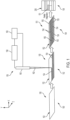
- a process flow illustrates a LIG tuning process for fabricating a LIG heater having a tuned resistance according to a non-limiting embodiment.
- a base carbon heating element 150 is formed.
- the base carbon heating element 150 extends along a first axis (e.g., an X-axis) to define a length, a second axis (e.g., a Y-axis) orthogonal to the X-axis to define a thickness, and a third axis (e.g., a Z-axis) orthogonal to the first axis and the second axis to define a width.
- a first axis e.g., an X-axis
- a second axis e.g., a Y-axis
- a third axis e.g., a Z-axis
- the base carbon heating element 150 is formed by impregnating a carbon-based precursor 152 (e.g., a carbon-based film or carbon-based substrate) with a polymer material that can be either thermoset (e.g., phenolics, polyarylacetylene - PAA) or thermoplastic (e.g., polyetheretherketone - PEEK, polyetherketoneketone - PEKK, Polyaryletherketone - PAEK, polyimide - PI).
- the carbon material can be carbon fiber and the carbon fiber volume fraction within the overall carbon/polymer material can vary based resistance target (e.g., in the range of 20 to 65%).
- a LIG tuning process is performed to tune the electrical resistance of the base carbon heating element 150.
- the electrical resistance of the base carbon heating element 150 can be turned by forming one or more LIG regions 154 on the carbon-based precursor 152.
- a laser system 156 can be utilized to form the LIG regions 154 on the carbon-based precursor 152.
- the laser system 156 includes a power supply 158 the drives a laser unit 160 to generate laser energy 162.
- the laser energy 162 is directed to the base carbon heating element 150 to form one or more regions of LIG on the carbon-based precursor 152.
- the interaction between the laser energy 162 and the carbon-based precursor material effectively modifies the physical and chemical properties of carbon-based precursor 152 at the localized region on which the laser 162 impinges on the carbon-based precursor 152 to convert or "morph" the localized region of the carbon-based precursor 152 into LIG.
- LIG patterns different patterns of LIG 154 (referred to herein as "LIG patterns" can be formed on the carbon-based precursor 152.
- the laser system 156 includes a laser controller 159 in signal communication with the power supply 158 and the laser unit 160.
- the laser controller 159 can receive inputs that select the output parameters (e.g., laser wavelengths, output frequency, laser temperature) of the laser unit 160.
- the laser controller 159 can also receive one or more input patterns. Based on the input patterns, the laser controller 159 can control the movement of the laser unit 160 such that the laser energy 162 is directed over the carbon-based precursor 152 to define a LIG pattern that matches the input pattern.
- a converted LIG region 154 has lower electrical resistance compared to a non-LIG region 155 of the carbon-based precursor 152 (i.e., regions of the carbon-based precursor 152 not converted into LIG).
- the electrical resistance of LIG regions 154 can be further tuned based on the amount of LIG formed in one or more portions of a given LIG region compared to other portions of the same LIG region.
- an LIG region 154 can be formed having a gradient pattern where the amount of formed LIG gradually increases from a first portion of the LIG region 154 (e.g., from a first end of the carbon-based precursor 152) to a second portion of the LIG region 154 (e.g., an opposing end of the carbon-based precursor 152).
- the electrical resistance of the LIG region would gradually decrease from the first portion of the carbon-based precursor 152 to the second portion of the carbon-based precursor 152.
- LIG regions 154 to define various LIG patterns can tune the overall resistance of the LIG heater 151 according to the corresponding LIG pattern(s) formed on the carbon-based precursor 152. For example, increasing the amount of LIG regions 154 formed on the carbon-based precursor 152 can reduce the overall electrical resistance of the LIG heater 151 in order to meet a targeted electrical resistance.
- different LIG pattern profiles can be used to tune the electrical of the LIG heater 151. For instance, rather than forming LIG regions 154 having a straight line profile, one or more LIG regions 154 can be formed to define a serpentine profile or a mesh pattern that achieves a different reduced electrical resistance.
- a completed LIG heater 151 is shown after completing the formation the LIG regions 155 on the carbon-based precursor 152 to define the targeted LIG pattern.
- the LIG pattern is illustrated as an alternating arrangement of LIG regions 154 and non-LIG regions 155 spanning from one end of the carbon-based precursor 152 to an opposing end of the carbon-based precursor 152 (e.g., spanning along the Z-axis). It should be appreciated, however, that the LIG pattern included in the LIG heater 151 is not limited to the alternating arrangement of LIG regions 154 and non-LIG regions 155 shown at operation 104.
- the LIG pattern can include, but is not limited to, one or more shaped patterns.
- the LIG pattern illustrated in operation 104 is formed across the entire surface of the carbon-based precursor 152, the LIG pattern is not limited thereto.
- the LIG pattern can be formed in gradient fashion on the carbon-based precursor 152, or at a localized area of the carbon-based precursor 152.
- the LIG heater 151 is integrated in an allotrope electrothermal heater system 200.
- the allotrope electrothermal heater system 200 can be applied to a localized area of a vehicle or component targeted to receive heat and is configured to pass electricity (e.g., electrical current) through the LIG heater 151.
- the heat emitted from the LIG heater 151 can then be applied to the targeted localized area.
- the localized area of a vehicle can include, for example, an inner area of an aircraft or an outer skin of the aircraft.
- the component can include, but is not limited to, an airfoil, tube, valve or tank, e.g., utilized for potable or wastewater systems.
- a flow diagram illustrates a method of tuning an electrical resistance of a laser-induced graphene heater capable of being integrated in an allotrope electrothermal heater system according to a non-limiting embodiment.
- the method begins at operation 300, and at operation 302 a base carbon heating element is formed.
- the base carbon heating element will be utilized to form a LIG heater tuned to a targeted electrical resistance as described herein.
- a target electrical resistance for a desired LIG heater is determined.
- a target LIG pattern for achieving the target electrical resistance is determined at operation 308.
- laser energy is directed to the base carbon heating element.
- one or more LIG regions are formed on the base carbon heating element in response to the impinging laser energy.
- the LIG regions are formed according to the target LIG pattern to form a LIG heater having the target resistance.
- the formed LIG heater is integrated in an allotrope electrothermal heater system, and the method ends at operation 314.
- the allotrope electrothermal heater system 200 includes a heater package 202, a power source 250, and a controller 252.
- the heater package 202 includes one or more protection layers 204, a first adhesive layer 206, a polymer sheet 208, a second adhesive layer 210, and an insulation layer 212.
- the protection layer 204 is formed of a carbon-glass fiber composite and can serve as an outer skin.
- the outer skin can serve as a control surface that is shaped as an airfoil.
- the protection layer 204 can serve as different outer skin surfaces of an aircraft 10 including but not limited to, blades, curved propellors, a nacelle bullnose, and a propeller spinner (nose cone).
- an aircraft heating system is described, the allotrope electrothermal heater system 200 can be implemented other types of heating systems such as, for example, wind turbine and marine applications.
- the polymer sheet 208 may be a thermoset polymer sheet that is formed of phenolics, polyimide (PI), cured epoxy, uncured epoxy, cured cyanate ester, uncured cyanate ester, cured polyurethane, uncured polyurethane, cured silicone, uncured silicone or polyarylacetylene (PAA).
- the polymer sheet 208 may be a thermoplastic polymer sheet formed of one or more of polyimide (PI), polyetherketoneketone (PEKK), polyaryletherkeone (PAEK), polyester, polyetheretherketone (PEEK), polyamide, polysulfone, polyetherimide, thermoplastic polyurethane (TPU), or polyethylene naphthalate (PEN).
- the polymer sheet 208 may be formed of a non-woven, woven or unidirectional polymer.
- electrical leads 209 along with LIG conductive connections 211 are formed against the polymer sheet 208.
- the electrical leads 209 may be connected to the power source 250, which is operated by the controller 252.
- the controller 252 can control various operations of the power source 250 including, but not limited to, voltage levels, current levels, power frequencies, and power duration.
- the controller 252 can receive an input target temperature and in turn, control the power source 250 to output power that drives the LIG heater 151 to generate heat that meets and/or maintains the input target temperature.
- the controller 152 can store one or more predetermined LIG input patterns that are indexed to a predetermined electrical resistance of a LIG heater 151. Accordingly, the controller 152 can receive an input target resistance for a given LIG heater 151 to be fabricated, and can select the corresponding LIG input pattern from memory that will provide the input target resistance.
- the electrical leads 209 are electrically coupled to the LIG heater 250 via the LIG electrical connections 211.
- the electrical connections 211 can include, for example, busbars and/or traces.
- the LIG connections 211 can be secured to, or formed onto, the polymer sheet 208 using known methods.
- the combination of the polymer sheet 208, the LIG heater 151, and the LIG connections 211 can effectively establish an "thermoelectrical heater", where the LIG heater 151 serves as a heating element that receives electrical power (e.g., electrical current) from the power source 250 via the LIG connections 211 and the electrical leads 209.
- the polymer sheet 212 is bonded to the protection layer 204 by the first adhesive layer 206.
- the first adhesive layer 206 can included any known suitable adhesive film or adhesive substance.
- the insulating layer 212 is bonded to the electrical leads 209 and the LIG connections 211 using the second adhesive layer 210.
- the second adhesive layer 210 can include any known suitable adhesive film or adhesive substance.
- the second adhesive layer can include the same material or a different material than the first adhesive layer 206.
- the insulating layer 212 can ensure that heat radiating from the LIG heater 151 is directed toward the protection layer 204.
- the insulating layer 212 can be formed of various materials including, but not limited to, a fiberglass composite, a polyimide or silicone insulation. Not all applications require the insulating layer. For example, ice protection for propellers may be installed on the outside of the propeller, and in such implementation, no insulation may be utilized.
Landscapes
- Engineering & Computer Science (AREA)
- Aviation & Aerospace Engineering (AREA)
- Chemical & Material Sciences (AREA)
- Chemical Kinetics & Catalysis (AREA)
- General Chemical & Material Sciences (AREA)
- Manufacturing & Machinery (AREA)
- Microelectronics & Electronic Packaging (AREA)
- Resistance Heating (AREA)
Applications Claiming Priority (1)
| Application Number | Priority Date | Filing Date | Title |
|---|---|---|---|
| US17/536,723 US20230171854A1 (en) | 2021-11-29 | 2021-11-29 | Resistive tuning via laser induced graphene for carbon allotrope electrothermal heater |
Publications (1)
| Publication Number | Publication Date |
|---|---|
| EP4188034A1 true EP4188034A1 (de) | 2023-05-31 |
Family
ID=84363604
Family Applications (1)
| Application Number | Title | Priority Date | Filing Date |
|---|---|---|---|
| EP22209912.9A Pending EP4188034A1 (de) | 2021-11-29 | 2022-11-28 | Resistive abstimmung über laserinduziertes graphen für elektrothermische kohlenstoffallotrop-heizung |
Country Status (3)
| Country | Link |
|---|---|
| US (1) | US20230171854A1 (de) |
| EP (1) | EP4188034A1 (de) |
| CN (1) | CN116193643A (de) |
Families Citing this family (1)
| Publication number | Priority date | Publication date | Assignee | Title |
|---|---|---|---|---|
| US20260011467A1 (en) * | 2024-07-02 | 2026-01-08 | The Curators Of The University Of Missouri | Active signal emission electrically conductive pipe |
Citations (2)
| Publication number | Priority date | Publication date | Assignee | Title |
|---|---|---|---|---|
| CN111432507A (zh) * | 2020-03-30 | 2020-07-17 | 北京航空航天大学 | 一种可调控激光诱导石墨烯纸加热器及其应用 |
| CN113630915A (zh) * | 2021-07-29 | 2021-11-09 | 上海师范大学 | 灵活定制高可调柔性微加热器的复合加工方法及微加热器 |
Family Cites Families (4)
| Publication number | Priority date | Publication date | Assignee | Title |
|---|---|---|---|---|
| JP2005191215A (ja) * | 2003-12-25 | 2005-07-14 | Hitachi Chem Co Ltd | 抵抗素子搭載配線板の製造法及び製造装置 |
| WO2014134369A1 (en) * | 2013-02-27 | 2014-09-04 | Vorbeck Materials | Thermal management device systems |
| US11014816B2 (en) * | 2016-06-21 | 2021-05-25 | William Marsh Rice University | Laser-induced graphene (LIG) and laser induced graphene scrolls (LIGS) materials |
| US20200087466A1 (en) * | 2018-09-14 | 2020-03-19 | Sabic Global Technologies, B.V. | Laser-induced graphene formation in polymer compositions |
-
2021
- 2021-11-29 US US17/536,723 patent/US20230171854A1/en active Pending
-
2022
- 2022-10-31 CN CN202211348428.6A patent/CN116193643A/zh active Pending
- 2022-11-28 EP EP22209912.9A patent/EP4188034A1/de active Pending
Patent Citations (2)
| Publication number | Priority date | Publication date | Assignee | Title |
|---|---|---|---|---|
| CN111432507A (zh) * | 2020-03-30 | 2020-07-17 | 北京航空航天大学 | 一种可调控激光诱导石墨烯纸加热器及其应用 |
| CN113630915A (zh) * | 2021-07-29 | 2021-11-09 | 上海师范大学 | 灵活定制高可调柔性微加热器的复合加工方法及微加热器 |
Non-Patent Citations (3)
| Title |
|---|
| BOBINGER MARCO R ET AL: "Flexible and robust laser-induced graphene heaters photothermally scribed on bare polyimide substrates", CARBON, vol. 144, 1 April 2019 (2019-04-01), pages 116 - 126, XP085616899, ISSN: 0008-6223, DOI: 10.1016/J.CARBON.2018.12.010 * |
| HUANG YEXIONG ET AL: "Improved Performance of Flexible Graphene Heater Based on Repeated Laser Writing", IEEE ELECTRON DEVICE LETTERS, IEEE, USA, vol. 41, no. 3, 10 January 2020 (2020-01-10), pages 501 - 504, XP011774224, ISSN: 0741-3106, [retrieved on 20200225], DOI: 10.1109/LED.2020.2965585 * |
| KARIMI G [0000-0002-1954-6818]: "Parametric study of laser-induced graphene conductive traces and their application as flexible heaters", INTERNATIONAL JOURNAL OF ENERGY RESEARCH 20210701 JOHN WILEY AND SONS LTD GBR, vol. 45, no. 9, 1 July 2021 (2021-07-01), pages 13712 - 13725, XP002808903, DOI: 10.1002/ER.6701 * |
Also Published As
| Publication number | Publication date |
|---|---|
| CN116193643A (zh) | 2023-05-30 |
| US20230171854A1 (en) | 2023-06-01 |
Similar Documents
| Publication | Publication Date | Title |
|---|---|---|
| US7291815B2 (en) | Composite ice protection heater and method of producing same | |
| EP3800048B1 (de) | Flugzeugstruktur aus verbundwerkstoff mit integriertem heizelement | |
| US7763833B2 (en) | Foil heating element for an electrothermal deicer | |
| US6483087B2 (en) | Thermoplastic laminate fabric heater and methods for making same | |
| US7078658B2 (en) | Heater mat made of electrically-conductive fibers | |
| EP1885600B1 (de) | Spannfähiger, leitfähiger, resistiver verbundhybriderhitzer für ein wärmeenteisungsgerät | |
| EP3334240B1 (de) | Einstellen des cnt-widerstandes unter verwendung von perforierten cnt-bogen | |
| EP4188034A1 (de) | Resistive abstimmung über laserinduziertes graphen für elektrothermische kohlenstoffallotrop-heizung | |
| JPH0647275B2 (ja) | 電流の印加により加熱され得る導電性構造複合物 | |
| US20200361612A1 (en) | Resistive heated aircraft component and method for manufacturing said aircraft component | |
| US10479512B2 (en) | Electrical de-icing for aircraft | |
| US10807326B2 (en) | Method of making complex carbon nanotube sheets | |
| CN110723294A (zh) | 飞机防冰系统及其制造方法 | |
| EP3592106B1 (de) | Beheizte bodenplatten | |
| US8630534B2 (en) | Heating system and component with such a heating system | |
| US20220411076A1 (en) | Aircraft feature with heating system formed of laser-induced graphene | |
| US20190112054A1 (en) | Integrated ice protection and lightning strike prevention | |
| BR102022022043A2 (pt) | Método de ajuste de uma resistência elétrica, e, aquecedor de grafeno induzido por laser | |
| US20230398752A1 (en) | Curing thermoset material using electric heater(s) for thermal anti-icing system | |
| EP3331317B1 (de) | Verfahren zur verbindung von nanotechnologie-kohlenstoff-allotrop-heizern | |
| US10017261B2 (en) | Electric redundant circuit | |
| US20220022286A1 (en) | Metallized carbon nanotube elements for electrothermal ice protection | |
| WO2024252315A1 (en) | Fiber reinforced composite material, comprising plies of fiber prepreg with conductive carbon nanotubes or nanofibers interlayers |
Legal Events
| Date | Code | Title | Description |
|---|---|---|---|
| PUAI | Public reference made under article 153(3) epc to a published international application that has entered the european phase |
Free format text: ORIGINAL CODE: 0009012 |
|
| STAA | Information on the status of an ep patent application or granted ep patent |
Free format text: STATUS: THE APPLICATION HAS BEEN PUBLISHED |
|
| AK | Designated contracting states |
Kind code of ref document: A1 Designated state(s): AL AT BE BG CH CY CZ DE DK EE ES FI FR GB GR HR HU IE IS IT LI LT LU LV MC ME MK MT NL NO PL PT RO RS SE SI SK SM TR |
|
| P01 | Opt-out of the competence of the unified patent court (upc) registered |
Effective date: 20230922 |
|
| STAA | Information on the status of an ep patent application or granted ep patent |
Free format text: STATUS: REQUEST FOR EXAMINATION WAS MADE |
|
| 17P | Request for examination filed |
Effective date: 20231130 |
|
| RBV | Designated contracting states (corrected) |
Designated state(s): AL AT BE BG CH CY CZ DE DK EE ES FI FR GB GR HR HU IE IS IT LI LT LU LV MC ME MK MT NL NO PL PT RO RS SE SI SK SM TR |
|
| GRAP | Despatch of communication of intention to grant a patent |
Free format text: ORIGINAL CODE: EPIDOSNIGR1 |
|
| STAA | Information on the status of an ep patent application or granted ep patent |
Free format text: STATUS: GRANT OF PATENT IS INTENDED |