EP4186943A1 - Rubber particles, composite particles, and production methods therefor - Google Patents
Rubber particles, composite particles, and production methods therefor Download PDFInfo
- Publication number
- EP4186943A1 EP4186943A1 EP21845792.7A EP21845792A EP4186943A1 EP 4186943 A1 EP4186943 A1 EP 4186943A1 EP 21845792 A EP21845792 A EP 21845792A EP 4186943 A1 EP4186943 A1 EP 4186943A1
- Authority
- EP
- European Patent Office
- Prior art keywords
- rubber
- group
- rubber particles
- per molecule
- polyester
- Prior art date
- Legal status (The legal status is an assumption and is not a legal conclusion. Google has not performed a legal analysis and makes no representation as to the accuracy of the status listed.)
- Pending
Links
- 239000002245 particle Substances 0.000 title claims abstract description 191
- 229920001971 elastomer Polymers 0.000 title claims abstract description 169
- 239000011246 composite particle Substances 0.000 title claims abstract description 47
- 238000004519 manufacturing process Methods 0.000 title claims abstract description 23
- VYPSYNLAJGMNEJ-UHFFFAOYSA-N Silicium dioxide Chemical compound O=[Si]=O VYPSYNLAJGMNEJ-UHFFFAOYSA-N 0.000 claims abstract description 56
- 125000001931 aliphatic group Chemical group 0.000 claims abstract description 47
- 229920000728 polyester Polymers 0.000 claims abstract description 45
- 125000004435 hydrogen atom Chemical group [H]* 0.000 claims abstract description 42
- 239000000377 silicon dioxide Substances 0.000 claims abstract description 28
- 238000006459 hydrosilylation reaction Methods 0.000 claims abstract description 26
- XUIMIQQOPSSXEZ-UHFFFAOYSA-N Silicon Chemical group [Si] XUIMIQQOPSSXEZ-UHFFFAOYSA-N 0.000 claims abstract description 24
- 229910052710 silicon Inorganic materials 0.000 claims abstract description 24
- 239000010703 silicon Substances 0.000 claims abstract description 24
- 229920006136 organohydrogenpolysiloxane Polymers 0.000 claims abstract description 19
- 229920001296 polysiloxane Polymers 0.000 claims abstract description 16
- 229920001577 copolymer Polymers 0.000 claims abstract description 12
- XLYOFNOQVPJJNP-UHFFFAOYSA-N water Substances O XLYOFNOQVPJJNP-UHFFFAOYSA-N 0.000 claims description 109
- 239000006185 dispersion Substances 0.000 claims description 60
- 125000004432 carbon atom Chemical group C* 0.000 claims description 29
- 229920001610 polycaprolactone Polymers 0.000 claims description 28
- 239000003054 catalyst Substances 0.000 claims description 24
- 238000003756 stirring Methods 0.000 claims description 24
- 239000000839 emulsion Substances 0.000 claims description 22
- 239000003921 oil Substances 0.000 claims description 20
- 239000004094 surface-active agent Substances 0.000 claims description 16
- 239000000047 product Substances 0.000 claims description 14
- 239000000126 substance Substances 0.000 claims description 14
- 238000006482 condensation reaction Methods 0.000 claims description 13
- 238000001035 drying Methods 0.000 claims description 11
- 239000000413 hydrolysate Substances 0.000 claims description 10
- 125000001997 phenyl group Chemical group [H]C1=C([H])C([H])=C(*)C([H])=C1[H] 0.000 claims description 6
- 238000004945 emulsification Methods 0.000 claims description 4
- 125000001183 hydrocarbyl group Chemical group 0.000 claims 5
- -1 polysiloxane structure Polymers 0.000 abstract description 111
- BASFCYQUMIYNBI-UHFFFAOYSA-N platinum Chemical compound [Pt] BASFCYQUMIYNBI-UHFFFAOYSA-N 0.000 description 29
- 150000002430 hydrocarbons Chemical group 0.000 description 19
- 238000000034 method Methods 0.000 description 18
- 229920000642 polymer Polymers 0.000 description 17
- 229920003171 Poly (ethylene oxide) Polymers 0.000 description 16
- 150000003839 salts Chemical class 0.000 description 16
- 239000000243 solution Substances 0.000 description 16
- 125000003342 alkenyl group Chemical group 0.000 description 15
- 238000005259 measurement Methods 0.000 description 15
- 229910052697 platinum Inorganic materials 0.000 description 14
- YXFVVABEGXRONW-UHFFFAOYSA-N Toluene Chemical compound CC1=CC=CC=C1 YXFVVABEGXRONW-UHFFFAOYSA-N 0.000 description 12
- 235000014113 dietary fatty acids Nutrition 0.000 description 11
- 239000000194 fatty acid Substances 0.000 description 11
- 229930195729 fatty acid Natural products 0.000 description 11
- 238000009826 distribution Methods 0.000 description 10
- 229920002379 silicone rubber Polymers 0.000 description 10
- 239000004945 silicone rubber Substances 0.000 description 10
- 125000000391 vinyl group Chemical group [H]C([*])=C([H])[H] 0.000 description 10
- OKTJSMMVPCPJKN-UHFFFAOYSA-N Carbon Chemical group [C] OKTJSMMVPCPJKN-UHFFFAOYSA-N 0.000 description 9
- ZMANZCXQSJIPKH-UHFFFAOYSA-N Triethylamine Chemical compound CCN(CC)CC ZMANZCXQSJIPKH-UHFFFAOYSA-N 0.000 description 9
- 239000007788 liquid Substances 0.000 description 9
- 150000002009 diols Chemical class 0.000 description 8
- 239000002253 acid Substances 0.000 description 7
- 238000006243 chemical reaction Methods 0.000 description 7
- 239000011248 coating agent Substances 0.000 description 7
- 238000000576 coating method Methods 0.000 description 7
- 230000018044 dehydration Effects 0.000 description 7
- 238000006297 dehydration reaction Methods 0.000 description 7
- 239000001257 hydrogen Substances 0.000 description 7
- 229910052739 hydrogen Inorganic materials 0.000 description 7
- 239000000203 mixture Substances 0.000 description 7
- CSNNHWWHGAXBCP-UHFFFAOYSA-L Magnesium sulfate Chemical compound [Mg+2].[O-][S+2]([O-])([O-])[O-] CSNNHWWHGAXBCP-UHFFFAOYSA-L 0.000 description 6
- WYURNTSHIVDZCO-UHFFFAOYSA-N Tetrahydrofuran Chemical compound C1CCOC1 WYURNTSHIVDZCO-UHFFFAOYSA-N 0.000 description 6
- 125000002091 cationic group Chemical group 0.000 description 6
- 239000003093 cationic surfactant Substances 0.000 description 6
- 239000011521 glass Substances 0.000 description 6
- 229920005906 polyester polyol Polymers 0.000 description 6
- 229920005862 polyol Polymers 0.000 description 6
- 150000003077 polyols Chemical class 0.000 description 6
- LFQSCWFLJHTTHZ-UHFFFAOYSA-N Ethanol Chemical compound CCO LFQSCWFLJHTTHZ-UHFFFAOYSA-N 0.000 description 5
- 150000001298 alcohols Chemical class 0.000 description 5
- 239000002585 base Substances 0.000 description 5
- 230000000052 comparative effect Effects 0.000 description 5
- 150000001875 compounds Chemical class 0.000 description 5
- KPUWHANPEXNPJT-UHFFFAOYSA-N disiloxane Chemical class [SiH3]O[SiH3] KPUWHANPEXNPJT-UHFFFAOYSA-N 0.000 description 5
- RTZKZFJDLAIYFH-UHFFFAOYSA-N ether Substances CCOCC RTZKZFJDLAIYFH-UHFFFAOYSA-N 0.000 description 5
- 230000003301 hydrolyzing effect Effects 0.000 description 5
- NGNBDVOYPDDBFK-UHFFFAOYSA-N 2-[2,4-di(pentan-2-yl)phenoxy]acetyl chloride Chemical compound CCCC(C)C1=CC=C(OCC(Cl)=O)C(C(C)CCC)=C1 NGNBDVOYPDDBFK-UHFFFAOYSA-N 0.000 description 4
- QGZKDVFQNNGYKY-UHFFFAOYSA-N Ammonia Chemical compound N QGZKDVFQNNGYKY-UHFFFAOYSA-N 0.000 description 4
- JVTAAEKCZFNVCJ-REOHCLBHSA-N L-lactic acid Chemical compound C[C@H](O)C(O)=O JVTAAEKCZFNVCJ-REOHCLBHSA-N 0.000 description 4
- 238000005054 agglomeration Methods 0.000 description 4
- 230000002776 aggregation Effects 0.000 description 4
- 235000011114 ammonium hydroxide Nutrition 0.000 description 4
- 125000003118 aryl group Chemical group 0.000 description 4
- 125000000484 butyl group Chemical group [H]C([*])([H])C([H])([H])C([H])([H])C([H])([H])[H] 0.000 description 4
- 238000004132 cross linking Methods 0.000 description 4
- 230000001804 emulsifying effect Effects 0.000 description 4
- 125000001495 ethyl group Chemical group [H]C([H])([H])C([H])([H])* 0.000 description 4
- 238000000605 extraction Methods 0.000 description 4
- 125000000524 functional group Chemical group 0.000 description 4
- 238000010438 heat treatment Methods 0.000 description 4
- 125000002887 hydroxy group Chemical group [H]O* 0.000 description 4
- 125000002496 methyl group Chemical group [H]C([H])([H])* 0.000 description 4
- BFXIKLCIZHOAAZ-UHFFFAOYSA-N methyltrimethoxysilane Chemical compound CO[Si](C)(OC)OC BFXIKLCIZHOAAZ-UHFFFAOYSA-N 0.000 description 4
- 238000011085 pressure filtration Methods 0.000 description 4
- 125000001436 propyl group Chemical group [H]C([*])([H])C([H])([H])C([H])([H])[H] 0.000 description 4
- 229920005989 resin Polymers 0.000 description 4
- 239000011347 resin Substances 0.000 description 4
- 239000007921 spray Substances 0.000 description 4
- 229920003169 water-soluble polymer Polymers 0.000 description 4
- GTJOHISYCKPIMT-UHFFFAOYSA-N 2-methylundecane Chemical compound CCCCCCCCCC(C)C GTJOHISYCKPIMT-UHFFFAOYSA-N 0.000 description 3
- 125000003903 2-propenyl group Chemical group [H]C([*])([H])C([H])=C([H])[H] 0.000 description 3
- VHUUQVKOLVNVRT-UHFFFAOYSA-N Ammonium hydroxide Chemical compound [NH4+].[OH-] VHUUQVKOLVNVRT-UHFFFAOYSA-N 0.000 description 3
- LYCAIKOWRPUZTN-UHFFFAOYSA-N Ethylene glycol Chemical compound OCCO LYCAIKOWRPUZTN-UHFFFAOYSA-N 0.000 description 3
- PEDCQBHIVMGVHV-UHFFFAOYSA-N Glycerine Chemical compound OCC(O)CO PEDCQBHIVMGVHV-UHFFFAOYSA-N 0.000 description 3
- VEXZGXHMUGYJMC-UHFFFAOYSA-N Hydrochloric acid Chemical compound Cl VEXZGXHMUGYJMC-UHFFFAOYSA-N 0.000 description 3
- SGVYKUFIHHTIFL-UHFFFAOYSA-N Isobutylhexyl Natural products CCCCCCCC(C)C SGVYKUFIHHTIFL-UHFFFAOYSA-N 0.000 description 3
- WMFOQBRAJBCJND-UHFFFAOYSA-M Lithium hydroxide Chemical compound [Li+].[OH-] WMFOQBRAJBCJND-UHFFFAOYSA-M 0.000 description 3
- 229910019142 PO4 Inorganic materials 0.000 description 3
- KWYUFKZDYYNOTN-UHFFFAOYSA-M Potassium hydroxide Chemical compound [OH-].[K+] KWYUFKZDYYNOTN-UHFFFAOYSA-M 0.000 description 3
- HEMHJVSKTPXQMS-UHFFFAOYSA-M Sodium hydroxide Chemical compound [OH-].[Na+] HEMHJVSKTPXQMS-UHFFFAOYSA-M 0.000 description 3
- XSTXAVWGXDQKEL-UHFFFAOYSA-N Trichloroethylene Chemical compound ClC=C(Cl)Cl XSTXAVWGXDQKEL-UHFFFAOYSA-N 0.000 description 3
- 239000003463 adsorbent Substances 0.000 description 3
- 229920003232 aliphatic polyester Polymers 0.000 description 3
- 125000000217 alkyl group Chemical group 0.000 description 3
- 125000005211 alkyl trimethyl ammonium group Chemical group 0.000 description 3
- 125000003710 aryl alkyl group Chemical group 0.000 description 3
- 230000015572 biosynthetic process Effects 0.000 description 3
- 229910052799 carbon Inorganic materials 0.000 description 3
- 239000004359 castor oil Substances 0.000 description 3
- 235000019438 castor oil Nutrition 0.000 description 3
- 125000001309 chloro group Chemical group Cl* 0.000 description 3
- MTHSVFCYNBDYFN-UHFFFAOYSA-N diethylene glycol Chemical compound OCCOCCO MTHSVFCYNBDYFN-UHFFFAOYSA-N 0.000 description 3
- GQOKIYDTHHZSCJ-UHFFFAOYSA-M dimethyl-bis(prop-2-enyl)azanium;chloride Chemical compound [Cl-].C=CC[N+](C)(C)CC=C GQOKIYDTHHZSCJ-UHFFFAOYSA-M 0.000 description 3
- 125000003700 epoxy group Chemical group 0.000 description 3
- 239000010419 fine particle Substances 0.000 description 3
- 238000005227 gel permeation chromatography Methods 0.000 description 3
- ZEMPKEQAKRGZGQ-XOQCFJPHSA-N glycerol triricinoleate Natural products CCCCCC[C@@H](O)CC=CCCCCCCCC(=O)OC[C@@H](COC(=O)CCCCCCCC=CC[C@@H](O)CCCCCC)OC(=O)CCCCCCCC=CC[C@H](O)CCCCCC ZEMPKEQAKRGZGQ-XOQCFJPHSA-N 0.000 description 3
- 125000005842 heteroatom Chemical group 0.000 description 3
- VKPSKYDESGTTFR-UHFFFAOYSA-N isododecane Natural products CC(C)(C)CC(C)CC(C)(C)C VKPSKYDESGTTFR-UHFFFAOYSA-N 0.000 description 3
- 229910052943 magnesium sulfate Inorganic materials 0.000 description 3
- 235000019341 magnesium sulphate Nutrition 0.000 description 3
- 239000000463 material Substances 0.000 description 3
- 239000002736 nonionic surfactant Substances 0.000 description 3
- 230000003287 optical effect Effects 0.000 description 3
- 125000004430 oxygen atom Chemical group O* 0.000 description 3
- 239000010452 phosphate Substances 0.000 description 3
- 238000000926 separation method Methods 0.000 description 3
- 239000002904 solvent Substances 0.000 description 3
- 238000003786 synthesis reaction Methods 0.000 description 3
- LFQCEHFDDXELDD-UHFFFAOYSA-N tetramethyl orthosilicate Chemical compound CO[Si](OC)(OC)OC LFQCEHFDDXELDD-UHFFFAOYSA-N 0.000 description 3
- 125000003944 tolyl group Chemical group 0.000 description 3
- NAWXUBYGYWOOIX-SFHVURJKSA-N (2s)-2-[[4-[2-(2,4-diaminoquinazolin-6-yl)ethyl]benzoyl]amino]-4-methylidenepentanedioic acid Chemical compound C1=CC2=NC(N)=NC(N)=C2C=C1CCC1=CC=C(C(=O)N[C@@H](CC(=C)C(O)=O)C(O)=O)C=C1 NAWXUBYGYWOOIX-SFHVURJKSA-N 0.000 description 2
- FRPZMMHWLSIFAZ-UHFFFAOYSA-N 10-undecenoic acid Chemical compound OC(=O)CCCCCCCCC=C FRPZMMHWLSIFAZ-UHFFFAOYSA-N 0.000 description 2
- 125000000094 2-phenylethyl group Chemical group [H]C1=C([H])C([H])=C(C([H])=C1[H])C([H])([H])C([H])([H])* 0.000 description 2
- YEJRWHAVMIAJKC-UHFFFAOYSA-N 4-Butyrolactone Chemical compound O=C1CCCO1 YEJRWHAVMIAJKC-UHFFFAOYSA-N 0.000 description 2
- ZCYVEMRRCGMTRW-UHFFFAOYSA-N 7553-56-2 Chemical group [I] ZCYVEMRRCGMTRW-UHFFFAOYSA-N 0.000 description 2
- NOWKCMXCCJGMRR-UHFFFAOYSA-N Aziridine Chemical compound C1CN1 NOWKCMXCCJGMRR-UHFFFAOYSA-N 0.000 description 2
- WKBOTKDWSSQWDR-UHFFFAOYSA-N Bromine atom Chemical group [Br] WKBOTKDWSSQWDR-UHFFFAOYSA-N 0.000 description 2
- ROSDSFDQCJNGOL-UHFFFAOYSA-N Dimethylamine Chemical compound CNC ROSDSFDQCJNGOL-UHFFFAOYSA-N 0.000 description 2
- BAVYZALUXZFZLV-UHFFFAOYSA-N Methylamine Chemical compound NC BAVYZALUXZFZLV-UHFFFAOYSA-N 0.000 description 2
- 229920000426 Microplastic Polymers 0.000 description 2
- KDLHZDBZIXYQEI-UHFFFAOYSA-N Palladium Chemical compound [Pd] KDLHZDBZIXYQEI-UHFFFAOYSA-N 0.000 description 2
- CDBYLPFSWZWCQE-UHFFFAOYSA-L Sodium Carbonate Chemical compound [Na+].[Na+].[O-]C([O-])=O CDBYLPFSWZWCQE-UHFFFAOYSA-L 0.000 description 2
- ULUAUXLGCMPNKK-UHFFFAOYSA-N Sulfobutanedioic acid Chemical class OC(=O)CC(C(O)=O)S(O)(=O)=O ULUAUXLGCMPNKK-UHFFFAOYSA-N 0.000 description 2
- 230000032683 aging Effects 0.000 description 2
- 125000005210 alkyl ammonium group Chemical group 0.000 description 2
- 150000005215 alkyl ethers Chemical class 0.000 description 2
- 229910052782 aluminium Inorganic materials 0.000 description 2
- XAGFODPZIPBFFR-UHFFFAOYSA-N aluminium Chemical compound [Al] XAGFODPZIPBFFR-UHFFFAOYSA-N 0.000 description 2
- 229910021529 ammonia Inorganic materials 0.000 description 2
- 239000002280 amphoteric surfactant Substances 0.000 description 2
- 239000003945 anionic surfactant Substances 0.000 description 2
- 125000001204 arachidyl group Chemical group [H]C([*])([H])C([H])([H])C([H])([H])C([H])([H])C([H])([H])C([H])([H])C([H])([H])C([H])([H])C([H])([H])C([H])([H])C([H])([H])C([H])([H])C([H])([H])C([H])([H])C([H])([H])C([H])([H])C([H])([H])C([H])([H])C([H])([H])C([H])([H])[H] 0.000 description 2
- 125000004429 atom Chemical group 0.000 description 2
- 125000002511 behenyl group Chemical group [H]C([*])([H])C([H])([H])C([H])([H])C([H])([H])C([H])([H])C([H])([H])C([H])([H])C([H])([H])C([H])([H])C([H])([H])C([H])([H])C([H])([H])C([H])([H])C([H])([H])C([H])([H])C([H])([H])C([H])([H])C([H])([H])C([H])([H])C([H])([H])C([H])([H])C([H])([H])[H] 0.000 description 2
- 125000001797 benzyl group Chemical group [H]C1=C([H])C([H])=C(C([H])=C1[H])C([H])([H])* 0.000 description 2
- WERYXYBDKMZEQL-UHFFFAOYSA-N butane-1,4-diol Chemical compound OCCCCO WERYXYBDKMZEQL-UHFFFAOYSA-N 0.000 description 2
- 125000003178 carboxy group Chemical group [H]OC(*)=O 0.000 description 2
- 230000015556 catabolic process Effects 0.000 description 2
- 230000003197 catalytic effect Effects 0.000 description 2
- 239000007795 chemical reaction product Substances 0.000 description 2
- 229910052801 chlorine Inorganic materials 0.000 description 2
- 150000001805 chlorine compounds Chemical class 0.000 description 2
- PMMYEEVYMWASQN-IMJSIDKUSA-N cis-4-Hydroxy-L-proline Chemical compound O[C@@H]1CN[C@H](C(O)=O)C1 PMMYEEVYMWASQN-IMJSIDKUSA-N 0.000 description 2
- 239000002537 cosmetic Substances 0.000 description 2
- 125000004122 cyclic group Chemical group 0.000 description 2
- 125000000753 cycloalkyl group Chemical group 0.000 description 2
- 125000000582 cycloheptyl group Chemical group [H]C1([H])C([H])([H])C([H])([H])C([H])([H])C([H])(*)C([H])([H])C1([H])[H] 0.000 description 2
- 125000000113 cyclohexyl group Chemical group [H]C1([H])C([H])([H])C([H])([H])C([H])(*)C([H])([H])C1([H])[H] 0.000 description 2
- 125000001511 cyclopentyl group Chemical group [H]C1([H])C([H])([H])C([H])([H])C([H])(*)C1([H])[H] 0.000 description 2
- 238000010908 decantation Methods 0.000 description 2
- 125000002704 decyl group Chemical group [H]C([H])([H])C([H])([H])C([H])([H])C([H])([H])C([H])([H])C([H])([H])C([H])([H])C([H])([H])C([H])([H])C([H])([H])* 0.000 description 2
- 238000006731 degradation reaction Methods 0.000 description 2
- 125000003438 dodecyl group Chemical group [H]C([H])([H])C([H])([H])C([H])([H])C([H])([H])C([H])([H])C([H])([H])C([H])([H])C([H])([H])C([H])([H])C([H])([H])C([H])([H])C([H])([H])* 0.000 description 2
- DDXLVDQZPFLQMZ-UHFFFAOYSA-M dodecyl(trimethyl)azanium;chloride Chemical compound [Cl-].CCCCCCCCCCCC[N+](C)(C)C DDXLVDQZPFLQMZ-UHFFFAOYSA-M 0.000 description 2
- 230000007613 environmental effect Effects 0.000 description 2
- 238000001914 filtration Methods 0.000 description 2
- 239000012530 fluid Substances 0.000 description 2
- 229910052731 fluorine Inorganic materials 0.000 description 2
- 125000001153 fluoro group Chemical group F* 0.000 description 2
- 235000011187 glycerol Nutrition 0.000 description 2
- KWIUHFFTVRNATP-UHFFFAOYSA-N glycine betaine Chemical compound C[N+](C)(C)CC([O-])=O KWIUHFFTVRNATP-UHFFFAOYSA-N 0.000 description 2
- 125000005843 halogen group Chemical group 0.000 description 2
- 125000000755 henicosyl group Chemical group [H]C([*])([H])C([H])([H])C([H])([H])C([H])([H])C([H])([H])C([H])([H])C([H])([H])C([H])([H])C([H])([H])C([H])([H])C([H])([H])C([H])([H])C([H])([H])C([H])([H])C([H])([H])C([H])([H])C([H])([H])C([H])([H])C([H])([H])C([H])([H])C([H])([H])[H] 0.000 description 2
- 125000003187 heptyl group Chemical group [H]C([*])([H])C([H])([H])C([H])([H])C([H])([H])C([H])([H])C([H])([H])C([H])([H])[H] 0.000 description 2
- 125000004051 hexyl group Chemical group [H]C([H])([H])C([H])([H])C([H])([H])C([H])([H])C([H])([H])C([H])([H])* 0.000 description 2
- IXCSERBJSXMMFS-UHFFFAOYSA-N hydrogen chloride Substances Cl.Cl IXCSERBJSXMMFS-UHFFFAOYSA-N 0.000 description 2
- 229910000041 hydrogen chloride Inorganic materials 0.000 description 2
- 230000002209 hydrophobic effect Effects 0.000 description 2
- 229910052740 iodine Inorganic materials 0.000 description 2
- 125000002463 lignoceryl group Chemical group [H]C([*])([H])C([H])([H])C([H])([H])C([H])([H])C([H])([H])C([H])([H])C([H])([H])C([H])([H])C([H])([H])C([H])([H])C([H])([H])C([H])([H])C([H])([H])C([H])([H])C([H])([H])C([H])([H])C([H])([H])C([H])([H])C([H])([H])C([H])([H])C([H])([H])C([H])([H])C([H])([H])C([H])([H])[H] 0.000 description 2
- 125000002960 margaryl group Chemical group [H]C([*])([H])C([H])([H])C([H])([H])C([H])([H])C([H])([H])C([H])([H])C([H])([H])C([H])([H])C([H])([H])C([H])([H])C([H])([H])C([H])([H])C([H])([H])C([H])([H])C([H])([H])C([H])([H])C([H])([H])[H] 0.000 description 2
- DNIAPMSPPWPWGF-UHFFFAOYSA-N monopropylene glycol Natural products CC(O)CO DNIAPMSPPWPWGF-UHFFFAOYSA-N 0.000 description 2
- 125000001802 myricyl group Chemical group [H]C([*])([H])C([H])([H])C([H])([H])C([H])([H])C([H])([H])C([H])([H])C([H])([H])C([H])([H])C([H])([H])C([H])([H])C([H])([H])C([H])([H])C([H])([H])C([H])([H])C([H])([H])C([H])([H])C([H])([H])C([H])([H])C([H])([H])C([H])([H])C([H])([H])C([H])([H])C([H])([H])C([H])([H])C([H])([H])C([H])([H])C([H])([H])C([H])([H])C([H])([H])C([H])([H])[H] 0.000 description 2
- 125000001421 myristyl group Chemical group [H]C([*])([H])C([H])([H])C([H])([H])C([H])([H])C([H])([H])C([H])([H])C([H])([H])C([H])([H])C([H])([H])C([H])([H])C([H])([H])C([H])([H])C([H])([H])C([H])([H])[H] 0.000 description 2
- 125000001624 naphthyl group Chemical group 0.000 description 2
- 125000001196 nonadecyl group Chemical group [H]C([*])([H])C([H])([H])C([H])([H])C([H])([H])C([H])([H])C([H])([H])C([H])([H])C([H])([H])C([H])([H])C([H])([H])C([H])([H])C([H])([H])C([H])([H])C([H])([H])C([H])([H])C([H])([H])C([H])([H])C([H])([H])C([H])([H])[H] 0.000 description 2
- 125000002347 octyl group Chemical group [H]C([*])([H])C([H])([H])C([H])([H])C([H])([H])C([H])([H])C([H])([H])C([H])([H])C([H])([H])[H] 0.000 description 2
- 150000002894 organic compounds Chemical class 0.000 description 2
- 239000003960 organic solvent Substances 0.000 description 2
- 125000000913 palmityl group Chemical group [H]C([*])([H])C([H])([H])C([H])([H])C([H])([H])C([H])([H])C([H])([H])C([H])([H])C([H])([H])C([H])([H])C([H])([H])C([H])([H])C([H])([H])C([H])([H])C([H])([H])C([H])([H])C([H])([H])[H] 0.000 description 2
- 125000002958 pentadecyl group Chemical group [H]C([*])([H])C([H])([H])C([H])([H])C([H])([H])C([H])([H])C([H])([H])C([H])([H])C([H])([H])C([H])([H])C([H])([H])C([H])([H])C([H])([H])C([H])([H])C([H])([H])C([H])([H])[H] 0.000 description 2
- 125000001147 pentyl group Chemical group C(CCCC)* 0.000 description 2
- 229920000921 polyethylene adipate Polymers 0.000 description 2
- 229920001223 polyethylene glycol Polymers 0.000 description 2
- 229920000259 polyoxyethylene lauryl ether Polymers 0.000 description 2
- BWHMMNNQKKPAPP-UHFFFAOYSA-L potassium carbonate Chemical compound [K+].[K+].[O-]C([O-])=O BWHMMNNQKKPAPP-UHFFFAOYSA-L 0.000 description 2
- YPFDHNVEDLHUCE-UHFFFAOYSA-N propane-1,3-diol Chemical compound OCCCO YPFDHNVEDLHUCE-UHFFFAOYSA-N 0.000 description 2
- 229920006395 saturated elastomer Polymers 0.000 description 2
- 239000007787 solid Substances 0.000 description 2
- 238000001179 sorption measurement Methods 0.000 description 2
- 125000004079 stearyl group Chemical group [H]C([*])([H])C([H])([H])C([H])([H])C([H])([H])C([H])([H])C([H])([H])C([H])([H])C([H])([H])C([H])([H])C([H])([H])C([H])([H])C([H])([H])C([H])([H])C([H])([H])C([H])([H])C([H])([H])C([H])([H])C([H])([H])[H] 0.000 description 2
- 230000035882 stress Effects 0.000 description 2
- 125000001424 substituent group Chemical group 0.000 description 2
- 150000005846 sugar alcohols Polymers 0.000 description 2
- WGTYBPLFGIVFAS-UHFFFAOYSA-M tetramethylammonium hydroxide Chemical compound [OH-].C[N+](C)(C)C WGTYBPLFGIVFAS-UHFFFAOYSA-M 0.000 description 2
- 125000002469 tricosyl group Chemical group [H]C([*])([H])C([H])([H])C([H])([H])C([H])([H])C([H])([H])C([H])([H])C([H])([H])C([H])([H])C([H])([H])C([H])([H])C([H])([H])C([H])([H])C([H])([H])C([H])([H])C([H])([H])C([H])([H])C([H])([H])C([H])([H])C([H])([H])C([H])([H])C([H])([H])C([H])([H])C([H])([H])[H] 0.000 description 2
- 125000002948 undecyl group Chemical group [H]C([*])([H])C([H])([H])C([H])([H])C([H])([H])C([H])([H])C([H])([H])C([H])([H])C([H])([H])C([H])([H])C([H])([H])C([H])([H])[H] 0.000 description 2
- 238000005406 washing Methods 0.000 description 2
- ALVZNPYWJMLXKV-UHFFFAOYSA-N 1,9-Nonanediol Chemical compound OCCCCCCCCCO ALVZNPYWJMLXKV-UHFFFAOYSA-N 0.000 description 1
- HXVJQEGYAYABRY-UHFFFAOYSA-N 1-ethenyl-4,5-dihydroimidazole Chemical compound C=CN1CCN=C1 HXVJQEGYAYABRY-UHFFFAOYSA-N 0.000 description 1
- GGZKJFGVSZKFLD-UHFFFAOYSA-N 1-prop-1-enyl-1h-imidazol-1-ium;chloride Chemical compound [Cl-].CC=CN1C=C[NH+]=C1 GGZKJFGVSZKFLD-UHFFFAOYSA-N 0.000 description 1
- LBTDHCQNAQRHCE-UHFFFAOYSA-N 2-[4-(2-hydroxyethoxy)cyclohexyl]oxyethanol Chemical compound OCCOC1CCC(OCCO)CC1 LBTDHCQNAQRHCE-UHFFFAOYSA-N 0.000 description 1
- MWCBGWLCXSUTHK-UHFFFAOYSA-N 2-methylbutane-1,4-diol Chemical compound OCC(C)CCO MWCBGWLCXSUTHK-UHFFFAOYSA-N 0.000 description 1
- BENPUORLYFCUJH-UHFFFAOYSA-N 2-methylheptane-1,7-diol Chemical compound OCC(C)CCCCCO BENPUORLYFCUJH-UHFFFAOYSA-N 0.000 description 1
- DYHGIZFXHVQIEA-UHFFFAOYSA-N 2-methylhexane-1,6-diol Chemical compound OCC(C)CCCCO DYHGIZFXHVQIEA-UHFFFAOYSA-N 0.000 description 1
- SDQROPCSKIYYAV-UHFFFAOYSA-N 2-methyloctane-1,8-diol Chemical compound OCC(C)CCCCCCO SDQROPCSKIYYAV-UHFFFAOYSA-N 0.000 description 1
- AAAWJUMVTPNRDT-UHFFFAOYSA-N 2-methylpentane-1,5-diol Chemical compound OCC(C)CCCO AAAWJUMVTPNRDT-UHFFFAOYSA-N 0.000 description 1
- HJIMAFKWSKZMBK-UHFFFAOYSA-N 3,3,4,4,5,5,6,6,7,7,8,8,9,9,10,10,10-heptadecafluorodecyl(trimethoxy)silane Chemical compound CO[Si](OC)(OC)CCC(F)(F)C(F)(F)C(F)(F)C(F)(F)C(F)(F)C(F)(F)C(F)(F)C(F)(F)F HJIMAFKWSKZMBK-UHFFFAOYSA-N 0.000 description 1
- KCNMSJPBWBWPAF-UHFFFAOYSA-N 3-methylheptane-1,7-diol Chemical compound OCCC(C)CCCCO KCNMSJPBWBWPAF-UHFFFAOYSA-N 0.000 description 1
- SQAJRDHPLTWZQT-UHFFFAOYSA-N 3-methylhexane-1,6-diol Chemical compound OCCC(C)CCCO SQAJRDHPLTWZQT-UHFFFAOYSA-N 0.000 description 1
- ACWBYVIQVCTYBJ-UHFFFAOYSA-N 3-methyloctane-1,8-diol Chemical compound OCCC(C)CCCCCO ACWBYVIQVCTYBJ-UHFFFAOYSA-N 0.000 description 1
- SXFJDZNJHVPHPH-UHFFFAOYSA-N 3-methylpentane-1,5-diol Chemical compound OCCC(C)CCO SXFJDZNJHVPHPH-UHFFFAOYSA-N 0.000 description 1
- UUEWCQRISZBELL-UHFFFAOYSA-N 3-trimethoxysilylpropane-1-thiol Chemical compound CO[Si](OC)(OC)CCCS UUEWCQRISZBELL-UHFFFAOYSA-N 0.000 description 1
- XDLMVUHYZWKMMD-UHFFFAOYSA-N 3-trimethoxysilylpropyl 2-methylprop-2-enoate Chemical compound CO[Si](OC)(OC)CCCOC(=O)C(C)=C XDLMVUHYZWKMMD-UHFFFAOYSA-N 0.000 description 1
- CDBAMNGURPMUTG-UHFFFAOYSA-N 4-[2-(4-hydroxycyclohexyl)propan-2-yl]cyclohexan-1-ol Chemical compound C1CC(O)CCC1C(C)(C)C1CCC(O)CC1 CDBAMNGURPMUTG-UHFFFAOYSA-N 0.000 description 1
- ZFHZIIQASZBGGD-UHFFFAOYSA-N 4-methylheptane-1,7-diol Chemical compound OCCCC(C)CCCO ZFHZIIQASZBGGD-UHFFFAOYSA-N 0.000 description 1
- QMRHLOSFDBDLPI-UHFFFAOYSA-N 4-methyloctane-1,1-diol Chemical compound CCCCC(C)CCC(O)O QMRHLOSFDBDLPI-UHFFFAOYSA-N 0.000 description 1
- IZSHZLKNFQAAKX-UHFFFAOYSA-N 5-cyclopenta-2,4-dien-1-ylcyclopenta-1,3-diene Chemical group C1=CC=CC1C1C=CC=C1 IZSHZLKNFQAAKX-UHFFFAOYSA-N 0.000 description 1
- 229920001661 Chitosan Polymers 0.000 description 1
- FBPFZTCFMRRESA-FSIIMWSLSA-N D-Glucitol Natural products OC[C@H](O)[C@H](O)[C@@H](O)[C@H](O)CO FBPFZTCFMRRESA-FSIIMWSLSA-N 0.000 description 1
- AEMRFAOFKBGASW-UHFFFAOYSA-N Glycolic acid Natural products OCC(O)=O AEMRFAOFKBGASW-UHFFFAOYSA-N 0.000 description 1
- ALQSHHUCVQOPAS-UHFFFAOYSA-N Pentane-1,5-diol Chemical compound OCCCCCO ALQSHHUCVQOPAS-UHFFFAOYSA-N 0.000 description 1
- 229920000562 Poly(ethylene adipate) Polymers 0.000 description 1
- 239000002202 Polyethylene glycol Substances 0.000 description 1
- 229920000954 Polyglycolide Polymers 0.000 description 1
- 229920000331 Polyhydroxybutyrate Polymers 0.000 description 1
- 108010039918 Polylysine Proteins 0.000 description 1
- 239000004721 Polyphenylene oxide Substances 0.000 description 1
- 229920001214 Polysorbate 60 Polymers 0.000 description 1
- 239000004793 Polystyrene Substances 0.000 description 1
- PMZURENOXWZQFD-UHFFFAOYSA-L Sodium Sulfate Chemical compound [Na+].[Na+].[O-]S([O-])(=O)=O PMZURENOXWZQFD-UHFFFAOYSA-L 0.000 description 1
- DBMJMQXJHONAFJ-UHFFFAOYSA-M Sodium laurylsulphate Chemical compound [Na+].CCCCCCCCCCCCOS([O-])(=O)=O DBMJMQXJHONAFJ-UHFFFAOYSA-M 0.000 description 1
- 229920002472 Starch Polymers 0.000 description 1
- BOTDANWDWHJENH-UHFFFAOYSA-N Tetraethyl orthosilicate Chemical compound CCO[Si](OCC)(OCC)OCC BOTDANWDWHJENH-UHFFFAOYSA-N 0.000 description 1
- ZJCCRDAZUWHFQH-UHFFFAOYSA-N Trimethylolpropane Chemical compound CCC(CO)(CO)CO ZJCCRDAZUWHFQH-UHFFFAOYSA-N 0.000 description 1
- TVYABKWHFSGGMF-UHFFFAOYSA-N [2-(hydroxymethyl)oxolan-3-yl]methanol Chemical compound OCC1CCOC1CO TVYABKWHFSGGMF-UHFFFAOYSA-N 0.000 description 1
- LUSFFPXRDZKBMF-UHFFFAOYSA-N [3-(hydroxymethyl)cyclohexyl]methanol Chemical compound OCC1CCCC(CO)C1 LUSFFPXRDZKBMF-UHFFFAOYSA-N 0.000 description 1
- YIMQCDZDWXUDCA-UHFFFAOYSA-N [4-(hydroxymethyl)cyclohexyl]methanol Chemical compound OCC1CCC(CO)CC1 YIMQCDZDWXUDCA-UHFFFAOYSA-N 0.000 description 1
- WHRYYSSZMQDPLV-UHFFFAOYSA-N [5-(hydroxymethyl)-1,4-dioxan-2-yl]methanol Chemical compound OCC1COC(CO)CO1 WHRYYSSZMQDPLV-UHFFFAOYSA-N 0.000 description 1
- YHXPFHSXEZJGEZ-UHFFFAOYSA-L [Cl-].[O-]C(=O)C=C.CC[N+](C)(C)C.CC[N+](C)(C)C Chemical compound [Cl-].[O-]C(=O)C=C.CC[N+](C)(C)C.CC[N+](C)(C)C YHXPFHSXEZJGEZ-UHFFFAOYSA-L 0.000 description 1
- 229910000288 alkali metal carbonate Inorganic materials 0.000 description 1
- 150000008041 alkali metal carbonates Chemical class 0.000 description 1
- 150000008044 alkali metal hydroxides Chemical class 0.000 description 1
- 229910001860 alkaline earth metal hydroxide Inorganic materials 0.000 description 1
- 150000003973 alkyl amines Chemical class 0.000 description 1
- 125000000304 alkynyl group Chemical group 0.000 description 1
- 150000001412 amines Chemical class 0.000 description 1
- 125000003277 amino group Chemical group 0.000 description 1
- 125000000129 anionic group Chemical group 0.000 description 1
- 230000003466 anti-cipated effect Effects 0.000 description 1
- RQPZNWPYLFFXCP-UHFFFAOYSA-L barium dihydroxide Chemical compound [OH-].[OH-].[Ba+2] RQPZNWPYLFFXCP-UHFFFAOYSA-L 0.000 description 1
- 229910001863 barium hydroxide Inorganic materials 0.000 description 1
- VEZXCJBBBCKRPI-UHFFFAOYSA-N beta-propiolactone Chemical compound O=C1CCO1 VEZXCJBBBCKRPI-UHFFFAOYSA-N 0.000 description 1
- 229960003237 betaine Drugs 0.000 description 1
- PRUUDNOIZWXFSZ-UHFFFAOYSA-N bicyclo[2.2.1]heptane-3,7-diol Chemical compound C1CC2C(O)CC1C2O PRUUDNOIZWXFSZ-UHFFFAOYSA-N 0.000 description 1
- OWBTYPJTUOEWEK-UHFFFAOYSA-N butane-2,3-diol Chemical compound CC(O)C(C)O OWBTYPJTUOEWEK-UHFFFAOYSA-N 0.000 description 1
- 125000004369 butenyl group Chemical group C(=CCC)* 0.000 description 1
- SXPLZNMUBFBFIA-UHFFFAOYSA-N butyl(trimethoxy)silane Chemical compound CCCC[Si](OC)(OC)OC SXPLZNMUBFBFIA-UHFFFAOYSA-N 0.000 description 1
- 239000006227 byproduct Substances 0.000 description 1
- AXCZMVOFGPJBDE-UHFFFAOYSA-L calcium dihydroxide Chemical compound [OH-].[OH-].[Ca+2] AXCZMVOFGPJBDE-UHFFFAOYSA-L 0.000 description 1
- 239000000920 calcium hydroxide Substances 0.000 description 1
- 229910001861 calcium hydroxide Inorganic materials 0.000 description 1
- 239000004202 carbamide Substances 0.000 description 1
- 150000001768 cations Chemical class 0.000 description 1
- 239000001913 cellulose Substances 0.000 description 1
- 229920002678 cellulose Polymers 0.000 description 1
- RLGQACBPNDBWTB-UHFFFAOYSA-N cetyltrimethylammonium ion Chemical class CCCCCCCCCCCCCCCC[N+](C)(C)C RLGQACBPNDBWTB-UHFFFAOYSA-N 0.000 description 1
- 239000007809 chemical reaction catalyst Substances 0.000 description 1
- 125000004218 chloromethyl group Chemical group [H]C([H])(Cl)* 0.000 description 1
- 239000000084 colloidal system Substances 0.000 description 1
- 238000004040 coloring Methods 0.000 description 1
- 238000013329 compounding Methods 0.000 description 1
- 238000009833 condensation Methods 0.000 description 1
- 230000005494 condensation Effects 0.000 description 1
- 239000007859 condensation product Substances 0.000 description 1
- 238000001816 cooling Methods 0.000 description 1
- ZXJWWZPUERUHLC-UHFFFAOYSA-N cycloheptane-1,4-diol Chemical compound OC1CCCC(O)CC1 ZXJWWZPUERUHLC-UHFFFAOYSA-N 0.000 description 1
- NUUPJBRGQCEZSI-UHFFFAOYSA-N cyclopentane-1,3-diol Chemical compound OC1CCC(O)C1 NUUPJBRGQCEZSI-UHFFFAOYSA-N 0.000 description 1
- 230000001877 deodorizing effect Effects 0.000 description 1
- 239000002274 desiccant Substances 0.000 description 1
- BWELVAFPJUDDFX-UHFFFAOYSA-N dodecane-1,10-diol Chemical compound CCC(O)CCCCCCCCCO BWELVAFPJUDDFX-UHFFFAOYSA-N 0.000 description 1
- VICYBMUVWHJEFT-UHFFFAOYSA-N dodecyltrimethylammonium ion Chemical class CCCCCCCCCCCC[N+](C)(C)C VICYBMUVWHJEFT-UHFFFAOYSA-N 0.000 description 1
- 230000000694 effects Effects 0.000 description 1
- 239000003822 epoxy resin Substances 0.000 description 1
- 125000004185 ester group Chemical group 0.000 description 1
- NKSJNEHGWDZZQF-UHFFFAOYSA-N ethenyl(trimethoxy)silane Chemical compound CO[Si](OC)(OC)C=C NKSJNEHGWDZZQF-UHFFFAOYSA-N 0.000 description 1
- SBRXLTRZCJVAPH-UHFFFAOYSA-N ethyl(trimethoxy)silane Chemical compound CC[Si](OC)(OC)OC SBRXLTRZCJVAPH-UHFFFAOYSA-N 0.000 description 1
- JQPARKNWUCPYTK-UHFFFAOYSA-M ethyl(trimethyl)azanium;2-methylprop-2-enoate Chemical compound CC[N+](C)(C)C.CC(=C)C([O-])=O JQPARKNWUCPYTK-UHFFFAOYSA-M 0.000 description 1
- 125000002534 ethynyl group Chemical group [H]C#C* 0.000 description 1
- 238000011156 evaluation Methods 0.000 description 1
- 150000004665 fatty acids Chemical class 0.000 description 1
- 230000002349 favourable effect Effects 0.000 description 1
- 150000004820 halides Chemical class 0.000 description 1
- 150000008282 halocarbons Chemical group 0.000 description 1
- 239000000383 hazardous chemical Substances 0.000 description 1
- OSCNKYWIVFHQMF-UHFFFAOYSA-N hept-6-enoyl chloride Chemical compound ClC(=O)CCCCC=C OSCNKYWIVFHQMF-UHFFFAOYSA-N 0.000 description 1
- SXCBDZAEHILGLM-UHFFFAOYSA-N heptane-1,7-diol Chemical compound OCCCCCCCO SXCBDZAEHILGLM-UHFFFAOYSA-N 0.000 description 1
- AHAREKHAZNPPMI-UHFFFAOYSA-N hexa-1,3-diene Chemical compound CCC=CC=C AHAREKHAZNPPMI-UHFFFAOYSA-N 0.000 description 1
- XXMIOPMDWAUFGU-UHFFFAOYSA-N hexane-1,6-diol Chemical compound OCCCCCCO XXMIOPMDWAUFGU-UHFFFAOYSA-N 0.000 description 1
- 125000006038 hexenyl group Chemical group 0.000 description 1
- MTNDZQHUAFNZQY-UHFFFAOYSA-N imidazoline Chemical compound C1CN=CN1 MTNDZQHUAFNZQY-UHFFFAOYSA-N 0.000 description 1
- 239000004615 ingredient Substances 0.000 description 1
- 238000002347 injection Methods 0.000 description 1
- 239000007924 injection Substances 0.000 description 1
- 125000003010 ionic group Chemical group 0.000 description 1
- 150000002596 lactones Chemical class 0.000 description 1
- 229910044991 metal oxide Inorganic materials 0.000 description 1
- 150000004706 metal oxides Chemical class 0.000 description 1
- RJMRIDVWCWSWFR-UHFFFAOYSA-N methyl(tripropoxy)silane Chemical compound CCCO[Si](C)(OCCC)OCCC RJMRIDVWCWSWFR-UHFFFAOYSA-N 0.000 description 1
- 230000000813 microbial effect Effects 0.000 description 1
- 238000001000 micrograph Methods 0.000 description 1
- 239000011259 mixed solution Substances 0.000 description 1
- 239000000178 monomer Substances 0.000 description 1
- PHQOGHDTIVQXHL-UHFFFAOYSA-N n'-(3-trimethoxysilylpropyl)ethane-1,2-diamine Chemical compound CO[Si](OC)(OC)CCCNCCN PHQOGHDTIVQXHL-UHFFFAOYSA-N 0.000 description 1
- SLCVBVWXLSEKPL-UHFFFAOYSA-N neopentyl glycol Chemical compound OCC(C)(C)CO SLCVBVWXLSEKPL-UHFFFAOYSA-N 0.000 description 1
- FKEGHFZKKSLOCS-UHFFFAOYSA-N non-8-enoyl chloride Chemical compound ClC(=O)CCCCCCC=C FKEGHFZKKSLOCS-UHFFFAOYSA-N 0.000 description 1
- 125000003518 norbornenyl group Chemical group C12(C=CC(CC1)C2)* 0.000 description 1
- OEIJHBUUFURJLI-UHFFFAOYSA-N octane-1,8-diol Chemical compound OCCCCCCCCO OEIJHBUUFURJLI-UHFFFAOYSA-N 0.000 description 1
- 238000004806 packaging method and process Methods 0.000 description 1
- 229910052763 palladium Inorganic materials 0.000 description 1
- 244000052769 pathogen Species 0.000 description 1
- 230000035515 penetration Effects 0.000 description 1
- JDKQTIKEGOOXTJ-UHFFFAOYSA-N pent-4-enoyl chloride Chemical compound ClC(=O)CCC=C JDKQTIKEGOOXTJ-UHFFFAOYSA-N 0.000 description 1
- WXZMFSXDPGVJKK-UHFFFAOYSA-N pentaerythritol Chemical compound OCC(CO)(CO)CO WXZMFSXDPGVJKK-UHFFFAOYSA-N 0.000 description 1
- 125000002255 pentenyl group Chemical group C(=CCCC)* 0.000 description 1
- 231100000572 poisoning Toxicity 0.000 description 1
- 230000000607 poisoning effect Effects 0.000 description 1
- 229920003207 poly(ethylene-2,6-naphthalate) Polymers 0.000 description 1
- 239000005015 poly(hydroxybutyrate) Substances 0.000 description 1
- 229920000747 poly(lactic acid) Polymers 0.000 description 1
- 229920003217 poly(methylsilsesquioxane) Polymers 0.000 description 1
- 229920002961 polybutylene succinate Polymers 0.000 description 1
- 239000004631 polybutylene succinate Substances 0.000 description 1
- 229920001707 polybutylene terephthalate Polymers 0.000 description 1
- 229920000515 polycarbonate Polymers 0.000 description 1
- 239000004417 polycarbonate Substances 0.000 description 1
- 229920000647 polyepoxide Polymers 0.000 description 1
- 229920000570 polyether Polymers 0.000 description 1
- 239000011112 polyethylene naphthalate Substances 0.000 description 1
- 229920000139 polyethylene terephthalate Polymers 0.000 description 1
- 239000005020 polyethylene terephthalate Substances 0.000 description 1
- 239000004633 polyglycolic acid Substances 0.000 description 1
- 239000004626 polylactic acid Substances 0.000 description 1
- 229920000656 polylysine Polymers 0.000 description 1
- 229920002503 polyoxyethylene-polyoxypropylene Polymers 0.000 description 1
- 229920001451 polypropylene glycol Polymers 0.000 description 1
- 229920002223 polystyrene Polymers 0.000 description 1
- 229920002215 polytrimethylene terephthalate Polymers 0.000 description 1
- 229910000027 potassium carbonate Inorganic materials 0.000 description 1
- 239000000843 powder Substances 0.000 description 1
- XRVCFZPJAHWYTB-UHFFFAOYSA-N prenderol Chemical compound CCC(CC)(CO)CO XRVCFZPJAHWYTB-UHFFFAOYSA-N 0.000 description 1
- 229950006800 prenderol Drugs 0.000 description 1
- 230000001737 promoting effect Effects 0.000 description 1
- MLGWTHRHHANFCC-UHFFFAOYSA-N prop-2-en-1-amine;hydrochloride Chemical class Cl.NCC=C MLGWTHRHHANFCC-UHFFFAOYSA-N 0.000 description 1
- 229960000380 propiolactone Drugs 0.000 description 1
- 239000008213 purified water Substances 0.000 description 1
- 125000001453 quaternary ammonium group Chemical group 0.000 description 1
- 230000035484 reaction time Effects 0.000 description 1
- 239000013558 reference substance Substances 0.000 description 1
- 229910052703 rhodium Inorganic materials 0.000 description 1
- 239000010948 rhodium Substances 0.000 description 1
- MHOVAHRLVXNVSD-UHFFFAOYSA-N rhodium atom Chemical compound [Rh] MHOVAHRLVXNVSD-UHFFFAOYSA-N 0.000 description 1
- 229910000029 sodium carbonate Inorganic materials 0.000 description 1
- 235000019333 sodium laurylsulphate Nutrition 0.000 description 1
- 229910052938 sodium sulfate Inorganic materials 0.000 description 1
- 235000011152 sodium sulphate Nutrition 0.000 description 1
- 239000000600 sorbitol Substances 0.000 description 1
- 239000008107 starch Substances 0.000 description 1
- 235000019698 starch Nutrition 0.000 description 1
- 150000003512 tertiary amines Chemical class 0.000 description 1
- UWHCKJMYHZGTIT-UHFFFAOYSA-N tetraethylene glycol Chemical compound OCCOCCOCCOCCO UWHCKJMYHZGTIT-UHFFFAOYSA-N 0.000 description 1
- YLQBMQCUIZJEEH-UHFFFAOYSA-N tetrahydrofuran Natural products C=1C=COC=1 YLQBMQCUIZJEEH-UHFFFAOYSA-N 0.000 description 1
- 229920005992 thermoplastic resin Polymers 0.000 description 1
- 125000003396 thiol group Chemical group [H]S* 0.000 description 1
- GYZQBXUDWTVJDF-UHFFFAOYSA-N tributoxy(methyl)silane Chemical compound CCCCO[Si](C)(OCCCC)OCCCC GYZQBXUDWTVJDF-UHFFFAOYSA-N 0.000 description 1
- CPUDPFPXCZDNGI-UHFFFAOYSA-N triethoxy(methyl)silane Chemical compound CCO[Si](C)(OCC)OCC CPUDPFPXCZDNGI-UHFFFAOYSA-N 0.000 description 1
- ZIBGPFATKBEMQZ-UHFFFAOYSA-N triethylene glycol Chemical compound OCCOCCOCCO ZIBGPFATKBEMQZ-UHFFFAOYSA-N 0.000 description 1
- JLGNHOJUQFHYEZ-UHFFFAOYSA-N trimethoxy(3,3,3-trifluoropropyl)silane Chemical compound CO[Si](OC)(OC)CCC(F)(F)F JLGNHOJUQFHYEZ-UHFFFAOYSA-N 0.000 description 1
- IJROHELDTBDTPH-UHFFFAOYSA-N trimethoxy(3,3,4,4,5,5,6,6,6-nonafluorohexyl)silane Chemical compound CO[Si](OC)(OC)CCC(F)(F)C(F)(F)C(F)(F)C(F)(F)F IJROHELDTBDTPH-UHFFFAOYSA-N 0.000 description 1
- ZNOCGWVLWPVKAO-UHFFFAOYSA-N trimethoxy(phenyl)silane Chemical compound CO[Si](OC)(OC)C1=CC=CC=C1 ZNOCGWVLWPVKAO-UHFFFAOYSA-N 0.000 description 1
- HQYALQRYBUJWDH-UHFFFAOYSA-N trimethoxy(propyl)silane Chemical compound CCC[Si](OC)(OC)OC HQYALQRYBUJWDH-UHFFFAOYSA-N 0.000 description 1
- BPSIOYPQMFLKFR-UHFFFAOYSA-N trimethoxy-[3-(oxiran-2-ylmethoxy)propyl]silane Chemical compound CO[Si](OC)(OC)CCCOCC1CO1 BPSIOYPQMFLKFR-UHFFFAOYSA-N 0.000 description 1
- UZNHKBFIBYXPDV-UHFFFAOYSA-N trimethyl-[3-(2-methylprop-2-enoylamino)propyl]azanium;chloride Chemical compound [Cl-].CC(=C)C(=O)NCCC[N+](C)(C)C UZNHKBFIBYXPDV-UHFFFAOYSA-N 0.000 description 1
- OEIXGLMQZVLOQX-UHFFFAOYSA-N trimethyl-[3-(prop-2-enoylamino)propyl]azanium;chloride Chemical compound [Cl-].C[N+](C)(C)CCCNC(=O)C=C OEIXGLMQZVLOQX-UHFFFAOYSA-N 0.000 description 1
- QXJQHYBHAIHNGG-UHFFFAOYSA-N trimethylolethane Chemical compound OCC(C)(CO)CO QXJQHYBHAIHNGG-UHFFFAOYSA-N 0.000 description 1
- MZFGYVZYLMNXGL-UHFFFAOYSA-N undec-10-enoyl chloride Chemical compound ClC(=O)CCCCCCCCC=C MZFGYVZYLMNXGL-UHFFFAOYSA-N 0.000 description 1
Classifications
-
- C—CHEMISTRY; METALLURGY
- C08—ORGANIC MACROMOLECULAR COMPOUNDS; THEIR PREPARATION OR CHEMICAL WORKING-UP; COMPOSITIONS BASED THEREON
- C08G—MACROMOLECULAR COMPOUNDS OBTAINED OTHERWISE THAN BY REACTIONS ONLY INVOLVING UNSATURATED CARBON-TO-CARBON BONDS
- C08G63/00—Macromolecular compounds obtained by reactions forming a carboxylic ester link in the main chain of the macromolecule
- C08G63/91—Polymers modified by chemical after-treatment
- C08G63/912—Polymers modified by chemical after-treatment derived from hydroxycarboxylic acids
-
- C—CHEMISTRY; METALLURGY
- C08—ORGANIC MACROMOLECULAR COMPOUNDS; THEIR PREPARATION OR CHEMICAL WORKING-UP; COMPOSITIONS BASED THEREON
- C08L—COMPOSITIONS OF MACROMOLECULAR COMPOUNDS
- C08L83/00—Compositions of macromolecular compounds obtained by reactions forming in the main chain of the macromolecule a linkage containing silicon with or without sulfur, nitrogen, oxygen or carbon only; Compositions of derivatives of such polymers
- C08L83/04—Polysiloxanes
-
- C—CHEMISTRY; METALLURGY
- C08—ORGANIC MACROMOLECULAR COMPOUNDS; THEIR PREPARATION OR CHEMICAL WORKING-UP; COMPOSITIONS BASED THEREON
- C08G—MACROMOLECULAR COMPOUNDS OBTAINED OTHERWISE THAN BY REACTIONS ONLY INVOLVING UNSATURATED CARBON-TO-CARBON BONDS
- C08G63/00—Macromolecular compounds obtained by reactions forming a carboxylic ester link in the main chain of the macromolecule
- C08G63/68—Polyesters containing atoms other than carbon, hydrogen and oxygen
- C08G63/695—Polyesters containing atoms other than carbon, hydrogen and oxygen containing silicon
- C08G63/6952—Polyesters containing atoms other than carbon, hydrogen and oxygen containing silicon derived from hydroxycarboxylic acids
-
- C—CHEMISTRY; METALLURGY
- C08—ORGANIC MACROMOLECULAR COMPOUNDS; THEIR PREPARATION OR CHEMICAL WORKING-UP; COMPOSITIONS BASED THEREON
- C08G—MACROMOLECULAR COMPOUNDS OBTAINED OTHERWISE THAN BY REACTIONS ONLY INVOLVING UNSATURATED CARBON-TO-CARBON BONDS
- C08G77/00—Macromolecular compounds obtained by reactions forming a linkage containing silicon with or without sulfur, nitrogen, oxygen or carbon in the main chain of the macromolecule
- C08G77/42—Block-or graft-polymers containing polysiloxane sequences
- C08G77/445—Block-or graft-polymers containing polysiloxane sequences containing polyester sequences
-
- C—CHEMISTRY; METALLURGY
- C08—ORGANIC MACROMOLECULAR COMPOUNDS; THEIR PREPARATION OR CHEMICAL WORKING-UP; COMPOSITIONS BASED THEREON
- C08J—WORKING-UP; GENERAL PROCESSES OF COMPOUNDING; AFTER-TREATMENT NOT COVERED BY SUBCLASSES C08B, C08C, C08F, C08G or C08H
- C08J3/00—Processes of treating or compounding macromolecular substances
- C08J3/12—Powdering or granulating
- C08J3/126—Polymer particles coated by polymer, e.g. core shell structures
-
- C—CHEMISTRY; METALLURGY
- C08—ORGANIC MACROMOLECULAR COMPOUNDS; THEIR PREPARATION OR CHEMICAL WORKING-UP; COMPOSITIONS BASED THEREON
- C08J—WORKING-UP; GENERAL PROCESSES OF COMPOUNDING; AFTER-TREATMENT NOT COVERED BY SUBCLASSES C08B, C08C, C08F, C08G or C08H
- C08J3/00—Processes of treating or compounding macromolecular substances
- C08J3/12—Powdering or granulating
- C08J3/128—Polymer particles coated by inorganic and non-macromolecular organic compounds
-
- C—CHEMISTRY; METALLURGY
- C08—ORGANIC MACROMOLECULAR COMPOUNDS; THEIR PREPARATION OR CHEMICAL WORKING-UP; COMPOSITIONS BASED THEREON
- C08J—WORKING-UP; GENERAL PROCESSES OF COMPOUNDING; AFTER-TREATMENT NOT COVERED BY SUBCLASSES C08B, C08C, C08F, C08G or C08H
- C08J7/00—Chemical treatment or coating of shaped articles made of macromolecular substances
- C08J7/04—Coating
- C08J7/0427—Coating with only one layer of a composition containing a polymer binder
-
- C—CHEMISTRY; METALLURGY
- C08—ORGANIC MACROMOLECULAR COMPOUNDS; THEIR PREPARATION OR CHEMICAL WORKING-UP; COMPOSITIONS BASED THEREON
- C08K—Use of inorganic or non-macromolecular organic substances as compounding ingredients
- C08K3/00—Use of inorganic substances as compounding ingredients
- C08K3/34—Silicon-containing compounds
- C08K3/36—Silica
-
- C—CHEMISTRY; METALLURGY
- C08—ORGANIC MACROMOLECULAR COMPOUNDS; THEIR PREPARATION OR CHEMICAL WORKING-UP; COMPOSITIONS BASED THEREON
- C08L—COMPOSITIONS OF MACROMOLECULAR COMPOUNDS
- C08L83/00—Compositions of macromolecular compounds obtained by reactions forming in the main chain of the macromolecule a linkage containing silicon with or without sulfur, nitrogen, oxygen or carbon only; Compositions of derivatives of such polymers
- C08L83/10—Block- or graft-copolymers containing polysiloxane sequences
-
- C—CHEMISTRY; METALLURGY
- C08—ORGANIC MACROMOLECULAR COMPOUNDS; THEIR PREPARATION OR CHEMICAL WORKING-UP; COMPOSITIONS BASED THEREON
- C08G—MACROMOLECULAR COMPOUNDS OBTAINED OTHERWISE THAN BY REACTIONS ONLY INVOLVING UNSATURATED CARBON-TO-CARBON BONDS
- C08G81/00—Macromolecular compounds obtained by interreacting polymers in the absence of monomers, e.g. block polymers
-
- C—CHEMISTRY; METALLURGY
- C08—ORGANIC MACROMOLECULAR COMPOUNDS; THEIR PREPARATION OR CHEMICAL WORKING-UP; COMPOSITIONS BASED THEREON
- C08J—WORKING-UP; GENERAL PROCESSES OF COMPOUNDING; AFTER-TREATMENT NOT COVERED BY SUBCLASSES C08B, C08C, C08F, C08G or C08H
- C08J2367/00—Characterised by the use of polyesters obtained by reactions forming a carboxylic ester link in the main chain; Derivatives of such polymers
- C08J2367/04—Polyesters derived from hydroxy carboxylic acids, e.g. lactones
-
- C—CHEMISTRY; METALLURGY
- C08—ORGANIC MACROMOLECULAR COMPOUNDS; THEIR PREPARATION OR CHEMICAL WORKING-UP; COMPOSITIONS BASED THEREON
- C08J—WORKING-UP; GENERAL PROCESSES OF COMPOUNDING; AFTER-TREATMENT NOT COVERED BY SUBCLASSES C08B, C08C, C08F, C08G or C08H
- C08J2383/00—Characterised by the use of macromolecular compounds obtained by reactions forming in the main chain of the macromolecule a linkage containing silicon with or without sulfur, nitrogen, oxygen, or carbon only; Derivatives of such polymers
- C08J2383/04—Polysiloxanes
-
- C—CHEMISTRY; METALLURGY
- C08—ORGANIC MACROMOLECULAR COMPOUNDS; THEIR PREPARATION OR CHEMICAL WORKING-UP; COMPOSITIONS BASED THEREON
- C08J—WORKING-UP; GENERAL PROCESSES OF COMPOUNDING; AFTER-TREATMENT NOT COVERED BY SUBCLASSES C08B, C08C, C08F, C08G or C08H
- C08J2383/00—Characterised by the use of macromolecular compounds obtained by reactions forming in the main chain of the macromolecule a linkage containing silicon with or without sulfur, nitrogen, oxygen, or carbon only; Derivatives of such polymers
- C08J2383/10—Block- or graft-copolymers containing polysiloxane sequences
-
- C—CHEMISTRY; METALLURGY
- C08—ORGANIC MACROMOLECULAR COMPOUNDS; THEIR PREPARATION OR CHEMICAL WORKING-UP; COMPOSITIONS BASED THEREON
- C08J—WORKING-UP; GENERAL PROCESSES OF COMPOUNDING; AFTER-TREATMENT NOT COVERED BY SUBCLASSES C08B, C08C, C08F, C08G or C08H
- C08J2483/00—Characterised by the use of macromolecular compounds obtained by reactions forming in the main chain of the macromolecule a linkage containing silicon with or without sulfur, nitrogen, oxygen, or carbon only; Derivatives of such polymers
- C08J2483/04—Polysiloxanes
Definitions
- the present invention relates to rubber particles, composite particles and production methods thereof.
- Silicone rubber particles having rubber elasticity are used as a stress reliever for resins.
- a heat-curable resin such as an epoxy resin used for packaging of electronic and electric parts
- rubber particles are often added to make it less likely for a package to break even when it is subjected to a stress upon expansion due to a heat generated by an electric part.
- rubber particles are also used in cosmetic materials for the purpose of imparting an extensibility and a feeling of use such as a soft sense of touch and a smoothness.
- silicone rubber particles there are also proposed, for example, composite particles with silicone rubber particles being coated with a polyorganosilsesquioxane resin (Patent document 1: JP-A-Hei 7-196815 ); and composite particles with silicone rubber particles being coated with metal oxide fine particles such as silica (Patent document 2: JP-A-Hei 4-348143 ). These composite particles are characterized by having a low agglomeration property and a high dispersibility.
- Patent document 3 JP-A-2001-40214 discloses organic crosslinked particles prepared by subjecting a liquid composition comprised of an aliphatic saturated bond-containing organic compound and a silicon-containing organic compound having silicon atom-bonded hydrogen atoms to a hydrosilylation reaction and yet a crosslinking reaction.
- silicone rubber particles that are to be added to for example resins and cosmetic materials have extremely small particle sizes; when discarded in the environment, it is assumed that they will directly flow into the ocean through inland water as it is tremendously difficult to collect them.
- the silicone rubber particles discarded in inland water and the ocean are not environmentally degradable as they do not have a degradation structure in the particle structure thereof; it is predicted that these particles will persistently remain in the environment.
- Patent document 3 Specifically disclosed in Patent document 3 are particles prepared by crosslinking a polypropylene oxide having an allyl group at both ends with an organopolysiloxane having silicon atom-bonded hydrogen atoms; and particles prepared by crosslinking hexadiene with dimethylpolysiloxane-methylhydrogenpolysiloxane. These particles have a poor degradability as they do not have a degradable functional group(s) serving as a factor allowing them to be degraded in the environment.
- the inventors of the present invention diligently conducted a series of studies to achieve the above object, and completed the invention as follows. That is, the inventors found that the above problems can be solved by rubber particles and composite particles that are comprised of a copolymer having a polyester structure and a polyorganosiloxane structure.
- the present invention is to provide the following rubber particles, composite particles and production methods thereof.
- the rubber particles and composite particles of the present invention have a degradability as they contain ester groups as degradable functional groups (i.e. polyester structure) and a crosslinked structure will be broken in a water-bearing environment.
- ester groups as degradable functional groups i.e. polyester structure
- a crosslinked structure will be broken in a water-bearing environment.
- particles having a poly- ⁇ -caprolactone structure as a microbial recognition skeleton can also be expected to possess an environmental degradability of rubber particles.
- the rubber particles and composite particles of the present invention are particles having a low agglomeration property, a high dispersibility and a high degradability; the rubber particles and composite particles of the present invention are anticipated as an environmental load-reducing material.
- the rubber particles of the present invention are rubber particles comprised of a copolymer having a polyester structure and an organopolysiloxane structure; the composite particles of the present invention are particles prepared by coating the surfaces of the aforesaid rubber particles with polyorganosilsesquioxane or silica.
- spherical not only refers to a state where the particle shape is a true sphere, but also encompasses a state where the particle shape is a deformed ellipsoidal body whose aspect ratio (length of major axis/length of minor axis) is normally 1 to 4, preferably 1 to 2, more preferably 1 to 1.6, even more preferably 1 to 1.4, on average.
- the shape of the particles can for example be confirmed by conducting observation using an optical microscope or an electron microscope; and the aspect ratio is a value calculated as an average value after measuring the lengths of the major and minor axes of any 100 particles shown in a micrograph.
- a volume average particle size of the rubber particles is preferably 0.1 to 50 ⁇ m, more preferably 0.5 to 40 ⁇ m, even more preferably 1 to 20 ⁇ m.
- the volume average particle size of the rubber particles is smaller than 0.1 ⁇ m, the particles will exhibit a low fluidity and thereby a higher agglomeration property. Further, when performing coating with polyorganosilsesquioxane or silica, it will be difficult to uniformly coat the particles.
- a volume average particle size larger than 50 ⁇ m will result in a deteriorated smoothness, or may lead to a feeling of roughness.
- a particle size is a volume average particle size measured by an electrical resistivity method.
- a rubber as a component of the rubber particles have no tackiness, and that a rubber hardness thereof be 5 to 90, more preferably 20 to 85, even more preferably 40 to 85, when measured by ASKER Durometer Type C as prescribed in The Society of Rubber Industry, Japan Standard (SRIS).
- a rubber hardness lower than 5 will result in a higher agglomeration property and a poor dispersibility accordingly.
- the rubber particles of the present invention are particles prepared by copolymerizing, via a hydrosilylation reaction, a liquid composition of:
- the component (A) which is the polyester having at least two aliphatic unsaturated groups per molecule may for example be one obtained by substituting the molecular chain ends of a polyester or polyester copolymer having a linear or branched structure with aliphatic unsaturated groups.
- the component (A) is one having a linear or branched structure, having at least one polyester structure (polyester repeating unit), and having aliphatic unsaturated groups at molecular chain ends.
- This component (A) is obtained by substituting the molecular chain ends of, for example, a polyester, a polyester copolymer or a polyester polyol with aliphatic unsaturated groups.
- polyesters examples include aliphatic polyesters such as poly- ⁇ -caprolactone, poly- ⁇ -propiolactone, ⁇ -butyrolactone, polylactic acid, polyhydroxybutyrate, polyglycolic acid, polyethylene adipate, polyhydroxybutyric acid, polyethylene succinate, and polybutylene succinate; and aromatic polyesters such as polyethylene terephthalate, polybutylene terephthalate, polyethylene naphthalate, and polytrimethylene terephthalate.
- an aliphatic polyester is preferred as it is considered as having a higher degradability.
- the aforesaid polyester copolymer may for example be a copolymer of the aforesaid polyester and another kind of polymer.
- Such another kind of polymer may be one selected from the aforesaid polyesters, or a polymer other than a polyester such as a polyether and a polycarbonate. Due to the above reason, it is preferred that this polyester copolymer be a copolymer of aliphatic polyesters, examples of which include a L-lactic acid/ ⁇ -caprolactone copolymer and a L-lactic acid/glycolic acid copolymer.
- polyester polyols such as polyethylene adipate)ol, poly(tetramethylene adipate)diol, and poly(ethylene adipate)diol; and polylactone polyols such as poly( ⁇ -caprolactone)diol, poly( ⁇ -caprolactone)triol, and poly( ⁇ -caprolactone)tetraol.
- polylactone polyols Preferred are polylactone polyols; more preferred are a poly( ⁇ -caprolactone)diol represented by the following formula (4), a poly( ⁇ -caprolactone)triol represented by the following formula (5), and a poly( ⁇ -caprolactone)tetraol represented by the following formula (6).
- poly( ⁇ -caprolactone)polyol there may be used, for example, a polyaddition product prepared by adding lactone to an aliphatic polyhydric alcohol having 2 to 20 carbon atoms; in the above formulae, R 6 to R 8 represent residues of such aliphatic polyhydric alcohol having 2 to 20 carbon atoms, and k, l, m and n are integers satisfying 1 ⁇ k+l+m+n ⁇ 100.
- R 6 in the formula (4) represents an aliphatic group having 2 to 20 carbon atoms, which is an aliphatic hydrocarbon group that has 2 to 20 carbon atoms and may contain a hetero atom such as an oxygen atom; specifically, R 6 is a residue derived from the following aliphatic dihydric alcohols.
- aliphatic dihydric alcohol examples include linear alcohols such as ethylene glycol, 1,3-propylene glycol, 1,4-butanediol, 1,5-pentanediol, 1,6-hexanediol, 1,7-heptanediol, 1,8-octanediol, 1,9-nonanediol, 1,10-dodecanediol, diethylene glycol, triethylene glycol, and tetraethylene glycol; branched alcohols such as 1,2-, 1,3- or 2,3-butanediol, 2-methyl-1,4-butanediol, neopentyl glycol, 2,2-diethyl-1,3-propanediol, 2-methyl-1,5-pentanediol, 3-methyl-1,5-pentanediol, 2-methyl-1,6-hexanediol, 3-methyl-1,6-hexane
- R 7 in the formula (5) represents an aliphatic group having 2 to 20 carbon atoms, which is an aliphatic hydrocarbon group that has 2 to 20 carbon atoms and may contain a hetero atom such as an oxygen atom; specifically, R 7 is a residue derived from the following aliphatic trihydric alcohols.
- aliphatic trihydric alcohol examples include glycerin, trimethylolethane, and trimethylolpropane.
- PLACCEL 305 by DAICEL CORPORATION.
- R 8 in the formula (6) represents an aliphatic group having 2 to 20 carbon atoms, which is an aliphatic hydrocarbon group that has 2 to 20 carbon atoms and may contain a hetero atom such as an oxygen atom; specifically, R 8 is a residue derived from the following aliphatic tetrahydric alcohols.
- the aliphatic tetrahydric alcohol may for example be pentaerythritol.
- a commercially available product thereof may for example be PLACCEL 410 [by DAICEL CORPORATION].
- a production method of the component (A) there may be employed a method where a molecule having an aliphatic unsaturated group at one molecular end is to be introduced into the above-exemplified polyester, polyester copolymer or polyester polyol having a linear or branched structure, via ester bond, ether bond, urethane bond, urea bond, amide bond, sulfide bond or the like.
- an acid halide or the like that is superior in stability and reaction rate of polyester at the time of reaction may be reacted with the aforesaid polylactone polyol or the like; an acid chloride is preferred in terms of availability and cost.
- an aliphatic unsaturated group be present at a molecular end moiety, examples of which include an alkenyl group such as a vinyl group, an allyl group, a butenyl group, a pentenyl group and a hexenyl group; an alkynyl group such as an ethynyl group; and a cyclic unsaturated group such as a norbornene group and a dicyclopentadienyl group.
- An alkenyl group is preferred.
- an acid chloride having an alkenyl group at a molecular end there may be listed, for example, 4-pentenoyl chloride, 6-heptenoyl chloride, 8-nonenoyl chloride, and 10-undecenoyl chloride.
- the component (A) be a liquid, more preferably have a weight-average molecular weight of 200 to 10,000 when measured by gel permeation chromatography (GPC).
- GPC gel permeation chromatography
- a weight-average molecular weight of 300 to 5,000 is even more preferred.
- a molecular weight smaller than 200 may lead to a poor degradability, and a molecular weight larger than 10,000 will make it difficult to prepare the rubber particles.
- the component (B) which is the organohydrogenpolysiloxane having at least two silicon atom-bonded hydrogen atoms per molecule may have a linear, cyclic or branched structure, of which a linear structure is preferred, and it is preferred that the component (B) have a structure expressed by the following formula (1).
- each R 1 independently represents a substituted or unsubstituted monovalent hydrocarbon group having 1 to 30 carbon atoms.
- Each R 2 independently represents a hydrogen atom, or a substituted or unsubstituted monovalent hydrocarbon group having 1 to 30 carbon atoms.
- m is a number satisfying 1 ⁇ m ⁇ 1,000, preferably 1 ⁇ m ⁇ 500;
- n is a number satisfying 0 ⁇ n ⁇ 1,000, preferably 1 ⁇ n ⁇ 500.
- the two R 2 s are hydrogen atoms; when neither of the two R 2 s is a hydrogen atom, n is 2 or larger.
- R 1 examples include alkyl groups such as a methyl group, an ethyl group, a propyl group, a butyl group, a pentyl group, a hexyl group, a heptyl group, an octyl group, a decyl group, an undecyl group, a dodecyl group, a tetradecyl group, a pentadecyl group, a hexadecyl group, a heptadecyl group, an octadecyl group, a nonadecyl group, an icosyl group, a henicosyl group, a docosyl group, a tricosyl group, a tetracosyl group, and a triacontyl group; aryl groups such as a phenyl group, a tolyl group, and a naphthyl group; aralkyl groups such
- R 2 represents a hydrogen atom, or a substituted or unsubstituted monovalent hydrocarbon group having 1 to 30 carbon atoms.
- R 2 As the substituted or unsubstituted monovalent hydrocarbon group having 1 to 30 carbon atoms, which is represented by R 2 , there may be exemplified those identical to the above-listed examples of R 1 .
- the component (B) be a diphenylsiloxy unit-containing organohydrogenpolysiloxane represented by the following formula (2).
- R 1 and R 2 are identical to those in the formula (1); each R 3 independently represents a substituted or unsubstituted monovalent hydrocarbon group having 1 to 30 carbon atoms, other than a phenyl group.
- examples of R 3 include alkyl groups such as a methyl group, an ethyl group, a propyl group, a butyl group, a pentyl group, a hexyl group, a heptyl group, an octyl group, a decyl group, an undecyl group, a dodecyl group, a tetradecyl group, a pentadecyl group, a hexadecyl group, a heptadecyl group, an octadecyl group, a nonadecyl group, an icosyl group, a henicosyl group, a docosyl group, a tricosyl group, a tetracosyl group, and a triacontyl group; aryl groups other than a phenyl group, such as a tolyl group and a naphthyl group;
- a, b and c satisfy 0 ⁇ a ⁇ 500, 1 ⁇ b ⁇ 1,000, 1 ⁇ a+b ⁇ 1,000, and 0 ⁇ c ⁇ 1,000; preferably 0 ⁇ a ⁇ 250, 1 ⁇ b ⁇ 500, and 1 ⁇ c ⁇ 500.
- c 0
- the two R 2 s are both hydrogen atoms; when neither of the two R 2 s is a hydrogen atom, c is 2 or larger.
- (A) the polyester having at least two aliphatic unsaturated groups per molecule, and (B) the organohydrogenpolysiloxane having at least two silicon atom-bonded hydrogen atoms per molecule more preferred is a composition where either the aliphatic unsaturated groups in the component (A) or the hydrogen atoms in the component (B) are present in a quantity of at least three.
- a compounding ratio between the components (A) and (B) preferred is a ratio at which the hydrosilyl groups in the component (B) are present in a quantity of 0.5 to 2.0 per 1 aliphatic unsaturated group in the component (A).
- a hydrosilylation catalyst for crosslinking the components (A) and (B) there may be listed, for example, a platinum-based catalyst, a rhodium-based catalyst and a palladium-based catalyst, of which a platinum-based catalyst is preferred.
- platinum-based catalyst include elemental platinum (including platinum black), a platinum-supported carbon or silica, chloroplatinic acid, a platinum-olefin complex, a platinum-alcohol complex, a complex of platinum and vinyl group-containing siloxane, and a complex of chloroplatinic acid and vinyl group-containing siloxane.
- the platinum-based catalyst may be added in a catalytic amount of a hydrosilylation reaction catalyst.
- the platinum-based catalyst is added in an amount of about 0.1 to 500 ppm, preferably about 0.1 to 200 ppm, more preferably about 0.5 to 100 ppm, in terms of mass of platinum in the catalyst.
- An amount smaller than 0.1 ppm will slow curing and make the catalyst more susceptible to catalyst poisoning. Meanwhile, an amount larger than 500 ppm will cause coloring of the rubber particles and is unfavorable on the economic front.
- an excessive amount of 2.2 to 8.0 mol, preferably 2.5 to 6.0 mol of a base for capturing hydrogen chloride generated is to be mixed with 1 mol of any of the polylactone polyol components of the formulae (4) to (6) or 1 mol of a polyester polyol component, and an excessive amount of 2.0 to 7.0 mol, preferably an amount of larger than 2.2 mol but not larger than 6.0 mol of the aforesaid acid chloride having an aliphatic unsaturated group at a molecular end is then delivered thereinto by drops to bring about a reaction for 30 min to 6 hours, preferably 1 to 2 hours while performing heating. After the reaction is over, the reaction product is subjected to an extraction, water washing and adsorption steps to have a by-product removed and the solvent distilled away, thus obtaining the component (A).
- the base is added to capture hydrogen chloride generated by the reaction; and as such base, there may be used one that is not reactive with polylactone polyols, polyester polyols and acid chlorides.
- base preferred is a tertiary amine, and more preferred is triethylamine.
- hydrophobic organic solvent to adjust the viscosity of the reaction product.
- hydrophobic organic solvent there are no particular limitations on such hydrophobic organic solvent; toluene is preferred in terms of solubility or the like.
- the adsorption step is a step to remove a hydrochloride of base that cannot be completely removed via the water washing step, and perform dewatering, decoloring and deodorizing.
- a known adsorbent may be used, and a number of adsorbents may be used in combination.
- adsorbent preferred are a desiccant such as magnesium sulfate and sodium sulfate; an activated carbon; and the KYOWAAD series (by Kyowa Chemical Industry Co., Ltd.).
- the rubber particles of the present invention may for example be produced by a method having the following steps (i) to (iii).
- the surfactant used in the step (i) there are no particular limitations on the surfactant used in the step (i); there may be used a non-ionic surfactant, an anionic surfactant, a cationic surfactant or an amphoteric surfactant. Any one kind of these surfactants may be used alone, or two or more kinds of them may be used in an appropriately combined manner.
- non-ionic surfactant examples include polyoxyethylene alkyl ether, polyoxyethylene polyoxypropylene alkyl ether, polyoxyethylene alkylphenyl ether, polyethylene glycol fatty acid ester, sorbitan fatty acid ester, polyoxyethylene sorbitan fatty acid ester, polyoxyethylene sorbitol fatty acid ester, glycerin fatty acid ester, polyoxyethylene glycerin fatty acid ester, polyglycerin fatty acid ester, propylene glycol fatty acid ester, polyoxyethylene castor oil, polyoxyethylene hydrogenated castor oil, polyoxyethylene hydrogenated castor oil fatty acid ester, polyoxyethylene alkylamine, polyoxyethylene fatty acid amide, polyoxyethylene-modified organopolysiloxane, and polyoxyethylene-polyoxypropylene-modified organopolysiloxane.
- anionic surfactant examples include an alkyl sulfate ester salt such as sodium lauryl sulfate, polyoxyethylene alkyl ether sulfate ester salt, polyoxyethylene alkylphenyl ether sulfate ester salt, sulfate ester salt of aliphatic alkylolamide, alkylbenzene sulfonate salt, polyoxyethylene alkylphenyl ether sulfonate salt, alkyldiphenyl ether disulfonate salt, alkanesulfonate salt, N-acyltaurate salt, dialkyl sulfosuccinate salt, monoalkyl sulfosuccinate salt, polyoxyethylene alkyl ether sulfosuccinate salt, fatty acid salt, polyoxyethylene alkyl ether carboxylate salt, N-acylamino acid salt, monoalkyl phosphate ester salt, dialkyl phosphate ester salt, and polyoxyethylene
- Examples of the cationic surfactant include an alkyltrimethylammonium salt, dialkyldimethylammonium salt, polyoxyethylene alkyldimethylammonium salt, dipolyoxyethylene alkylmethylammonium salt, tripolyoxyethylene alkylammonium salt, alkylbenzyl dimethylammonium salt, alkylpyridium salt, monoalkylamine salt, and monoalkyl amidoamine salt.
- amphoteric surfactant examples include alkyldimethylamine oxide, alkyldimethylcarboxybetaine, alkylamidopropyl dimethylcarboxybetaine, alkylhydroxysulfobetaine, and alkylcarboxymethylhydroxyethyl imidazolinium betaine.
- the surfactant be a non-ionic surfactant due to the fact that the aforementioned curable liquid silicone composition can be emulsified with a small amount of such surfactant, and that fine particles can be obtained thereby.
- the surfactant is preferably added in an amount of 0.01 to 20 parts by mass, more preferably 0.05 to 10 parts by mass, per 100 parts by mass of the emulsion.
- An amount smaller than 0.01 parts by mass will incur problems such as one that emulsification is impossible, and one that fine particles cannot be obtained.
- An amount larger than 20 parts by mass will make it difficult to coat the rubber particles with polyorganosilsesquioxane or silica in a later-described production method of composite particles.
- oil phase components in this emulsion which are (A) the polyester having at least two aliphatic unsaturated groups per molecule and (B) the organohydrogenpolysiloxane having at least two silicon atom-bonded hydrogen atoms per molecule, are preferably contained in an amount of 1 to 80 parts by mass, more preferably 10 to 60 parts by mass, per 100 parts by mass of the emulsion. An amount smaller than 1 part by mass is unfavorable in terms of efficiency; an amount larger than 80 parts by mass will make it difficult to obtain the dispersion as a rubber particle water dispersion.
- Emulsification may be performed using a known emulsifying disperser; as a general emulsifying disperser, there may be listed, for example, a high-speed rotary shear-type mixer such as a homomixer; a high-speed centrifugal radiation-type mixer such as HOMODISPER; a high-pressure injection-type emulsifying disperser such as a homogenizer; a colloid mill; and an ultrasonic emulsifying machine.
- a known emulsifying disperser as a general emulsifying disperser, there may be listed, for example, a high-speed rotary shear-type mixer such as a homomixer; a high-speed centrifugal radiation-type mixer such as HOMODISPER; a high-pressure injection-type emulsifying disperser such as a homogenizer; a colloid mill; and an ultrasonic emulsifying machine.
- the rubber particle dispersion can be obtained by curing the oil phase in the emulsion thus prepared, under the presence of the aforesaid hydrosilylation catalyst.
- This hydrosilylation catalyst may be added to the oil phase either before or after preparing the emulsion. If adding the hydrosilylation catalyst after preparing the emulsion, there is a possibility that the hydrosilylation catalyst may not disperse; in such case, the hydrosilylation catalyst may be mixed with a surfactant before addition.
- Hydrosilylation may be performed at room temperature; if the reaction cannot be completed, it may be performed while conducting heating at a temperature lower than 100°C. A hydrosilylation reaction time is appropriately selected. This method allows there to be obtained a water dispersion of rubber particles having a volume average particle size of 0.1 to 50 ⁇ m.
- Rubber particles can be obtained by drying and removing water as a continuous phase from the obtained rubber particle water dispersion.
- the drying and removal of water from the rubber particle water dispersion may for example be carried out by performing heating under a normal or reduced pressure.
- a method where water is removed by leaving the dispersion to stand still under a heated condition a method where water is removed while stirring and fluidizing the dispersion under a heated condition; a method where the dispersion is sprayed and dispersed into a hot air flow such as that generated by a spray dryer; and a method where a fluid heat medium is utilized.
- the dispersion may be condensed by a method such as thermal dehydration, filtration separation or decantation; if necessary, the dispersion may also be washed with water and/or an alcohol.
- the shape of the polyorganosilsesquioxane or silica coating the surfaces of the composite particles there are no particular limitations on the shape of the polyorganosilsesquioxane or silica coating the surfaces of the composite particles; in the case of the later-described production method, it has a granular shape. A smaller particle size thereof is preferred; specifically, a particle size of not larger than 500 nm is preferred. While the organosilsesquioxane or silica may coat part of or the entire surface of each rubber particle, it is preferred that the rubber particle be coated in a substantially solid manner throughout the entire surface thereof. Here, the coating condition, shape and particle size can be identified by observing the particle surface via an electron microscope.
- the amount of the polyorganosilsesquioxane or silica coating the particle surfaces there are no particular limitations on the amount of the polyorganosilsesquioxane or silica coating the particle surfaces; it is preferred that the polyorganosilsesquioxane or silica be present at a ratio of 0.5 to 200 parts by mass, more preferably 1 to 50 parts by mass, per 100 parts by mass of the rubber particles.
- the composite particles of the present invention are obtained by adding (F) one kind selected from an organotrialkoxysilane or tetraalkoxysilane represented by the following general formula (3) and a hydrolysate thereof to a liquid containing
- each R 4 independently represents a monovalent hydrocarbon group having 1 to 6 carbon atoms
- R 5 represents a substituted or unsubstituted monovalent hydrocarbon group having 1 to 20 carbon atoms, or -OR 4 .
- the composite particles of the present invention can be produced by a method having the following steps (i) to (v).
- step (i) and (ii) in the production method of the composite particles are similar to those of the production method of the rubber particles. Further, in the step (iii'), (D) water may be added as an optional component.
- water a purified water or the like may be used, and it may include water in the rubber particle water dispersion obtained in the step (ii) as well as water that is added as necessary.
- the alkaline substance may be any alkaline substance so long as it functions as a catalyst for the hydrolytic condensation reaction of the organotrialkoxysilane or tetraalkoxysilane.
- alkali metal hydroxides such as potassium hydroxide, sodium hydroxide and lithium hydroxide
- alkaline-earth metal hydroxides such as calcium hydroxide and barium hydroxide
- alkali metal carbonates such as potassium carbonate and sodium carbonate
- amines such as ammonia, monomethylamine and dimethylamine
- quaternary ammonium hydroxides such as tetramethylammonium hydroxide.
- ammonia which is superior in water solubility and catalytic activity, and is easily removable via volatilization; there may be used an ammonia water solution that is generally commercially available.
- the component (E) be added in an amount at which the pH of the liquid containing (C) to (E) at 25°C becomes 9.0 to 13.0, more preferably 10.0 to 12.5.
- a pH lower than 10.0 will result in an insufficient progress of the hydrolytic condensation reaction of the organotrialkoxysilane or tetraalkoxysilane; a pH higher than 13.0 will result in a higher hydrolyzation speed such that the hydrolytic condensation reaction will occur in parts other than the surfaces of the rubber particles, whereby a low coatability will be observed.
- component (F) there may also be optionally added (G) at least one kind selected from a cationic surfactant and a cationic water-soluble polymer compound.
- Cationic surfactants and cationic water-soluble polymer compounds are capable of yielding polyorganosilsesquioxane or silica by promoting the condensation reaction of the hydrolyzed organotrialkoxysilane and tetraalkoxysilane. Further, the polyorganosilsesquioxane or silica yielded may be allowed to adsorb to the surfaces of the rubber particles.
- Examples of a cationic surfactant include an alkyltrimethylammonium salt, a dialkyldimethylammonium salt, a polyoxyethylene alkyl dimethyl ammonium salt, a dipolyoxyethylene alkyl methyl ammonium salt, a tripolyoxyethylene alkyl ammonium salt, an alkylbenzyldimethylammonium salt, an alkylpyridium salt, a monoalkylamine salt, and a monoalkylamidoamine salt.
- preferred is an alkyltrimethylammonium salt; more preferred are a lauryltrimethylammonium salt and a cetyltrimethylammonium salt.
- Examples of a cationic water-soluble polymer compound include a polymer of dimethyldiallylammonium chloride, a polymer of vinylimidazoline, a polymer of methylvinylimidazolium chloride, a polymer of ethyltrimethylammonium acrylate chloride, a polymer of ethyltrimethylammonium methacrylate, a polymer of acrylamidopropyltrimethylammonium chloride, a polymer of methacrylamidopropyltrimethylammonium chloride, an epichlorohydrin-dimethylamine polymer, a polymer of ethyleneimine, a quaternized product of an ethyleneimine polymer, a polymer of an allylamine hydrochloride salt, polylysine, a cationic starch, a cationic cellulose, chitosan, and derivatives thereof obtained by for example copolymerizing these compounds with monomers having non-ionic and/or ani
- the component (G) be added in an amount of 0.001 to 2 parts by mass, more preferably 0.005 to 1 part by mass, per 100 parts by mass of the water in the liquid containing (C) to (E).
- An added amount larger than 2 parts by mass may generate polyorganosilsesquioxane or silica failing to coat the surfaces of the rubber particles.
- the polyorganosilsesquioxane or silica coating the rubber particles is formed by adding to the rubber particles one kind selected from the organotrialkoxysilane or tetraalkoxysilane represented by the general formula (3) and a hydrolysate thereof.
- R 4 represents a monovalent hydrocarbon group having 1 to 6 carbon atoms, examples of which may include a methyl group, an ethyl group, a propyl group and a butyl group.
- R 5 in the formula represents a substituted or unsubstituted monovalent hydrocarbon group having 1 to 20 carbon atoms, or -OR 4 .
- Examples of the substituted or unsubstituted monovalent hydrocarbon group having 1 to 20 carbon atoms include alkyl groups such as a methyl group, an ethyl group, a propyl group and a butyl group; aryl groups such as a phenyl group and a tolyl group; alkenyl groups such as a vinyl group and an allyl group; aralkyl groups such as a ⁇ -phenylethyl group a ⁇ -phenylpropyl group; monovalent halogenated hydrocarbon groups such as a chloromethyl group and a 3,3,3-trifluoropropyl group; and groups obtained by substituting these monovalent hydrocarbon groups with an epoxy group, amino group, mercapto group, acryloxy group, methacryloxy group or the like.
- R 5 is a substituted or unsubstituted monovalent hydrocarbon group having 1 to 20 carbon atoms
- the rubber particles will be coated with polyorganosilsesquioxane; when R 5 is -OR 4 , the rubber particles will be coated with silica.
- organotrialkoxysilane and tetraalkoxysilane used for coating may include methyltrimethoxysilane, methyltriethoxysilane, methyltripropoxysilane, methyltributoxysilane, ethyltrimethoxysilane, propyltrimethoxysilane, butyltrimethoxysilane, N-( ⁇ -aminoethyl)- ⁇ -aminopropyltrimethoxysilane, ⁇ -glycidoxypropyltrimethoxysilane, vinyltrimethoxysilane, phenyltrimethoxysilane, ⁇ -methacryloxypropyltrimethoxysilane, ⁇ -mercaptopropyltrimethoxysilane, 3,3,3-trifluoropropyltrimethoxysilane, 3,3,4,4,5,5,6,6,6-nonafluorohexyltrimethoxysilane, 3,3,
- component (F) be added in an amount of not larger than 20 parts by mass per 100 parts by mass of the water in the liquid containing (C) to (E). When this amount is larger than 20 parts by mass, a block object(s) may occur.
- hydrolyzation and condensation take place as a result of adding (F) one kind selected from the organotrialkoxysilane or tetraalkoxysilane and a hydrolysate thereof to the water solution prepared by dissolving (E) the alkaline substance and (G) at least one kind selected from a cationic surfactant and a cationic water-soluble polymer compound (optional) into (C) the rubber particle water dispersion and (D) water (optional).
- the condensation product i.e. polyorganosilsesquioxane or silica shall coat the surfaces of the rubber particles to form the composite particles.
- organotrialkoxysilane, the tetraalkoxysilane and a hydrolysate thereof be carried out while performing stirring using a normal stirrer such as that equipped with propeller blades, flat plate blades or the like.
- the organotrialkoxysilane, the tetraalkoxysilane and a hydrolysate thereof are preferably gradually added over time; a drop time is preferably 1 min to 6 hours, more preferably 10 min to 3 hours.
- the temperature in the system while performing dropping is preferably 0 to 60°C, more preferably 0 to 40°C. When the temperature is within these ranges, the surfaces of the rubber particles will be able to be coated with polyorganosilsesquioxane and silica.
- the composite particles can be obtained by drying and removing water as a continuous phase from the obtained composite particle water dispersion of the present invention.
- the removal of water may for example be carried out by heating the reacted water dispersion under a normal or reduced pressure.
- a method where water is removed by leaving the dispersion to stand still under a heated condition a method where water is removed while stirring and fluidizing the dispersion under a heated condition; a method where the dispersion is sprayed and dispersed into a hot air flow such as that generated by a spray dryer; and a method where a fluid heat medium is utilized.
- the dispersion may be condensed by a method such as thermal dehydration, filtration separation, centrifugal separation or decantation; if necessary, the dispersion may also be washed with water and/or an alcohol.
- the composite particles with the rubber particle surfaces being coated with polyorganosilsesquioxane and silica can be obtained by crushing this product with a crusher such as a jet mill, a ball mill or a hammer mill.
- a dynamic viscosity is a value measured at 25°C; "%" indicating concentrations and content rates refers to "% by mass”.
- a penetration degree of a rubber cured product is a value measured in accordance with the standards of the Society of Rubber Science and Technology, Japan (SRIS).
- the molecular weight of the component (A) is a weight-average molecular weight measured by GPC under the following conditions, with polystyrene being a reference substance.
- 200 g of a poly( ⁇ -caprolactone)diol (PLACCEL 205U by DAICEL CORPORATION, molecular weight 530, hydroxyl value 212.4 mg/g), 200 g of toluene and 95.8 g of triethylamine were added to a 1 L glass flask equipped with a stirrer, a dropping funnel, a thermometer and a cooling pipe, and mixed together at an adjusted temperature of 55°C, followed by using the dropping funnel to deliver thereinto by drops 168.9 g (an added amount at which there will be 1.1 chlorine atoms of an acid chloride per 1 hydroxyl group of the poly( ⁇ -caprolactone)diol) of an undecenoic acid chloride, after which aging was performed for two hours.
- This emulsion was then moved to a 1 L glass flask equipped with a stirrer employing anchor-shaped stirring blades, and had its temperature adjusted to 15 to 20°C, followed by delivering thereinto by drops, while performing stirring, a mixed solution of 1 g of an isododecane solution of a complex of platinum and vinyl group-containing disiloxane (platinum content 0.5%) and 0.68 g of polyoxyethylene lauryl ether, where stirring was performed for 30 min to 1 hour. Next, stirring was performed for two days with the temperature being adjusted to 40°C, thus obtaining a rubber particle water dispersion.
- the hardness of the rubber making up the rubber particles was measured as follows.
- a rubber particle water dispersion was obtained in a similar manner as the working example 1.
- 357 g of the rubber particle water dispersion obtained was moved to a 2L glass flask equipped with a stirrer employing anchor-shaped stirring blades, where further added thereto were 602.5 g of water, 19 g of a 28% ammonia water solution and 1 g of a 40% dimethyldiallylammonium chloride polymer water solution (ME Polymer H40W by TOHO Chemical Industry Co.,Ltd.).
- the pH of the solution at that time was 11.3.
- the solution prepared by hydrolyzing and condensing methyltrimethoxysilane in the rubber particle water dispersion was dehydrated to a water content of about 30%, using a pressure filtration device.
- the dehydration product was then moved to a 2L glass flask equipped with a stirrer employing anchor-shaped stirring blades, followed by adding 1,000 g of water thereto to perform stirring for 30 min, after which dehydration was performed using the pressure filtration device.
- the dehydration product was again moved to the 2L glass flask equipped with the stirrer employing the anchor-shaped stirring blades, followed by adding 1,000 g of water thereto to perform stirring for 30 min, after which dehydration was performed using the pressure filtration device.
- the dehydration product was dried at 105°C in a hot air flow dryer, and the dried product was then crushed by a jet mill to obtain particles with fluidity.
- the particles were composite particles with the rubber particles being coated with a granular polyorganosilsesquioxane throughout the entire surfaces thereof (polyorganosilsesquioxane-coated rubber particles).
- the composite particles obtained were then dispersed in water with a surfactant; and as a result of conducting measurement using the electrical resistivity method-particle size distribution measurement device (Multisizer 3 by Beckman Coulter Inc.), it was confirmed that the particle size distribution was at the same level as the above rubber particle water dispersion, and that the volume average particle size was 5 ⁇ m.
- a rubber particle water dispersion was obtained in a similar manner as the working example 1.
- 265 g of the rubber particle water dispersion obtained was moved to a 2L glass flask equipped with a stirrer employing anchor-shaped stirring blades, where further added thereto were 651.1 g of water, 2.2 g of a 2.8% ammonia water solution and 12 g (an amount at which lauryltrimethylammonium chloride will be in an amount of 0.44 parts per 100 parts by mass of water) of a 30% lauryltrimethylammonium chloride water solution (CATION BB by NOF CORPORATION).
- the pH at that time was 10.4.
- the composite particles obtained were then dispersed in water with a surfactant; and as a result of conducting measurement using the electrical resistivity method-particle size distribution measurement device (Multisizer 3 by Beckman Coulter Inc.), it was confirmed that the particle size distribution was at the same level as the above rubber particle water dispersion, and that the volume average particle size was 5 ⁇ m.
- Synthesis was conducted in a similar manner as the working example 1, except that 200 g of a poly( ⁇ -caprolactone)tetraol (PLACCEL 410 by DAICEL CORPORATION, molecular weight 1,030, hydroxyl value 216.7 mg/g) was used instead of 200 g of the poly( ⁇ -caprolactone)diol (PLACCEL 205U by DAICEL CORPORATION), the amount of triethylamine was changed from 95.8 g to 98.4 g, and the amount of the undecenoic acid chloride was changed from 168.9 g to 173.5 g (an added amount at which there will be 1.1 acid chlorides per 1 hydroxyl group).
- a rubber particle water dispersion was obtained in a similar manner as the working example 1, except that 170 g of the alkenyl group-containing poly- ⁇ -caprolactone 2 was used instead of 171 g of the alkenyl group-containing poly- ⁇ -caprolactone 1, and that there were used 85.32 g (an added amount at which there will be 1.1 hydrosilyl groups per 1 vinyl group) of the phenyl hydrogen polysiloxane represented by the formula (8) and having the dynamic viscosity of 23 mm 2 /s.
- polyorganosilsesquioxane-coated composite particles were obtained from the rubber particle water dispersion obtained in the working example 4.
- the composite particles obtained were then dispersed in water with a surfactant; and as a result of conducting measurement using the electrical resistivity method-particle size distribution measurement device (Multisizer 3 by Beckman Coulter Inc.), it was confirmed that the particle size distribution was at the same level as the above rubber particle water dispersion, and that the volume average particle size was 5 ⁇ m.
- silica-coated composite particles were obtained in a similar manner as the working example 3.
- the composite particles obtained were then dispersed in water with a surfactant; and as a result of conducting measurement using the electrical resistivity method-particle size distribution measurement device (Multisizer 3 by Beckman Coulter Inc.), it was confirmed that the particle size distribution was at the same level as the above rubber particle water dispersion, and that the volume average particle size was 5 ⁇ m.
- the particles were composite particles with the surfaces of the rubber particles being coated with a granular silica.
- a methylvinylpolysiloxane represented by the following formula (10) and having a dynamic viscosity of 600 mm 2 /s, and 1 g (an added amount at which there will be 1.1 hydrosilyl groups per 1 vinyl group) of a methyl hydrogen polysiloxane represented by the following formula (11) and having a dynamic viscosity of 27 mm 2 /s were put into a 100 mL container, and then stirred and dissolved.
- Hydrolyzability was evaluated by the following method, with regard to the planar rubber (rubber hardness: 63) that was obtained in the working example 1 and was comprised of the alkenyl group-containing poly- ⁇ -caprolactone 1 and the phenyl hydrogen polysiloxane represented by the formula (8); the planar rubber (rubber hardness: 82) that was obtained in the working example 4 and was comprised of the alkenyl group-containing poly- ⁇ -caprolactone 2 and the phenyl hydrogen polysiloxane represented by the formula (8); and the planar rubber (rubber hardness: 60) that was obtained in the comparative example 1 and was comprised of the methylvinylpolysiloxane represented by the formula (10) and the methyl hydrogen polysiloxane represented by the formula (11).
- thermo-hygrostat of a temperature of 70°C and a humidity of 90% (model IW222 by Yamato Scientific Co., Ltd.), and changes in rubber hardness were measured on a day-to-day basis.
- planar rubber (rubber hardness: 63) obtained in the working example 1 was left to stand still in a dryer of a temperature of 70°C (model DNE601 by Yamato Scientific Co., Ltd.) as well as in an environment of room temperature and a humidity of up to 65% (simulating a usage environment), where changes in rubber hardness were measured on a day-to-day basis.
- planar rubber samples of the working examples 1 and 4 that were left to stand still in the thermo-hygrostat are assumed to have a degradability as they each had a structure where the alkenyl group-containing poly- ⁇ -caprolactone and the organohydrogenpolysiloxane having the silicon atom-bonded hydrogen atoms were crosslinked under the presence of the hydrosilylation catalyst, and each exhibited a decrease in rubber hardness in the high-temperature and humidity environment of temperature 70°C, humidity 90%.
- the planar rubber sample of the comparative example 1 is assumed to have no degradability as the ingredients thereof making up the rubber do not include one having a hydrolyzable functional group(s), such as polyester, and the rubber hardness thereof was constant even in the high-temperature and humidity environment.
- the planar rubber sample of the working example 1 that was left to stand still in the dryer of 70°C, while there was observed an increase in rubber hardness that was assumed to have been associated with a slight progression of hardening due to the heat, no decrease in rubber hardness was observed, from which it can be assumed that degradation would not occur unless under the presence of water.
Landscapes
- Chemical & Material Sciences (AREA)
- Health & Medical Sciences (AREA)
- Chemical Kinetics & Catalysis (AREA)
- Medicinal Chemistry (AREA)
- Polymers & Plastics (AREA)
- Organic Chemistry (AREA)
- Inorganic Chemistry (AREA)
- Crystallography & Structural Chemistry (AREA)
- General Chemical & Material Sciences (AREA)
- Silicon Polymers (AREA)
- Compositions Of Macromolecular Compounds (AREA)
- Processes Of Treating Macromolecular Substances (AREA)
Abstract
Description
- The present invention relates to rubber particles, composite particles and production methods thereof.
- Silicone rubber particles having rubber elasticity are used as a stress reliever for resins. For example, in the case of a heat-curable resin such as an epoxy resin used for packaging of electronic and electric parts, rubber particles are often added to make it less likely for a package to break even when it is subjected to a stress upon expansion due to a heat generated by an electric part. Further, rubber particles are also used in cosmetic materials for the purpose of imparting an extensibility and a feeling of use such as a soft sense of touch and a smoothness.
- As silicone rubber particles, there are also proposed, for example, composite particles with silicone rubber particles being coated with a polyorganosilsesquioxane resin (Patent document 1:
JP-A-Hei 7-196815 JP-A-Hei 4-348143 - Further, as particles having a favorable dispersibility with respect to a thermoplastic resin or the like, Patent document 3:
JP-A-2001-40214 -
- Patent document 1:
JP-A-Hei 7-196815 - Patent document 2:
JP-A-Hei 4-348143 - Patent document 3:
JP-A-2001-40214 - However, such silicone rubber particles that are to be added to for example resins and cosmetic materials have extremely small particle sizes; when discarded in the environment, it is assumed that they will directly flow into the ocean through inland water as it is tremendously difficult to collect them. The silicone rubber particles discarded in inland water and the ocean are not environmentally degradable as they do not have a degradation structure in the particle structure thereof; it is predicted that these particles will persistently remain in the environment.
- In addition, there have been movements to restrict microplastics as microplastics in the ocean have a property of adsorbing hazardous substances in the environment and pathogens, which leads to a concern that the ecosystem will be negatively impacted. Due to such background, there is a gradual demand for a type of silicone rubber particles that are degradable and do not persistently remain as particles (solid) in the environment after use. In order for silicone rubber particles to be environmentally degraded, the crosslinked structure of the rubber particles needs to be degraded (broken) in the environment; however, since silicone rubber particles structurally do not have a degradability, a degradable functional group-containing structure has to be introduced into the crosslinked structure.
- Specifically disclosed in Patent document 3 are particles prepared by crosslinking a polypropylene oxide having an allyl group at both ends with an organopolysiloxane having silicon atom-bonded hydrogen atoms; and particles prepared by crosslinking hexadiene with dimethylpolysiloxane-methylhydrogenpolysiloxane. These particles have a poor degradability as they do not have a degradable functional group(s) serving as a factor allowing them to be degraded in the environment.
- Thus, it is an object of the present invention to provide polysiloxane structure-containing rubber particles and composite particles having a high dispersibility and degradability; and production methods thereof.
- The inventors of the present invention diligently conducted a series of studies to achieve the above object, and completed the invention as follows. That is, the inventors found that the above problems can be solved by rubber particles and composite particles that are comprised of a copolymer having a polyester structure and a polyorganosiloxane structure.
- Thus, the present invention is to provide the following rubber particles, composite particles and production methods thereof.
- [1]. Rubber particles comprised of a copolymer having a polyester structure and an organopolysiloxane structure.
- [2]. The rubber particles according to [1], wherein the rubber particles have a spherical shape and a volume average particle size of 0.1 to 50 µm.
- [3]. The rubber particles according to [1] or [2], wherein the copolymer is a hydrosilylation crosslinked product of
- (A) a polyester having at least two aliphatic unsaturated groups per molecule; and
- (B) an organohydrogenpolysiloxane having at least two silicon atom-bonded hydrogen atoms per molecule,
provided that excluded is a combination where there are two said aliphatic unsaturated groups per molecule of the component (A) and there are two said silicon atom-bonded hydrogen atoms per molecule of the component (B).
- [4]. The rubber particles according to [3], wherein the component (A) which is the polyester having at least two aliphatic unsaturated groups per molecule is a component with molecular chain ends of a polyester or polyester copolymer having a linear or branched structure being substituted with aliphatic unsaturated groups.
- [5]. The rubber particles according to [4], wherein the polyester structure of the component (A) is poly-ε-caprolactone.
- [6]. The rubber particles according to any one of [3] to [5], wherein the component (B) is an organohydrogenpolysiloxane having at least two silicon atom-bonded hydrogen atoms per molecule, which is represented by the following general formula (1):

- [7]. The rubber particles according to [6], wherein the component (B) is an organohydrogenpolysiloxane having at least two silicon atom-bonded hydrogen atoms per molecule, which is represented by the following general formula (2):

- [8]. Composite particles with the surfaces of the rubber particles according to any one of [3] to [7] being coated with polyorganosilsesquioxane or silica.
- [9]. A method for producing the rubber particles according to any one of [3] to [7], comprising:
- (i) a step of obtaining an O/W type emulsion by adding, for emulsification, a surfactant-containing water phase component to an oil phase component comprised of (A) a polyester having at least two aliphatic unsaturated groups per molecule and (B) an organohydrogenpolysiloxane having at least two silicon atom-bonded hydrogen atoms per molecule;
- (ii) a step of obtaining (C) a rubber particle water dispersion by curing the oil phase component comprised of the components (A) and (B) in the emulsion via a hydrosilylation reaction under the presence of a hydrosilylation reactive catalyst; and
- (iii) a step of obtaining rubber particles by drying and removing water as a continuous phase from (C) the rubber particle water dispersion obtained in the step (ii).
- [10]. A method for producing the composite particles according to [8], comprising:
- (i) a step of obtaining an O/W type emulsion by adding a surfactant-containing water phase component to an oil phase component and performing stirring, the oil phase component being comprised of (A) a polyester having at least two aliphatic unsaturated groups per molecule and (B) an organohydrogenpolysiloxane having at least two silicon atom-bonded hydrogen atoms per molecule;
- (ii) a step of obtaining (C) a rubber particle water dispersion by curing the oil phase component comprised of the components (A) and (B) in the emulsion via a hydrosilylation reaction under the presence of a hydrosilylation reactive catalyst;
- (iii') a step of adding (E) an alkaline substance to (C) the rubber particle water dispersion obtained in the step (ii);
- (iv) a step of obtaining a composite particle water dispersion by adding (F) one kind selected from an organotrialkoxysilane or tetraalkoxysilane represented by the following general formula (3) and a hydrolysate thereof to the rubber particle water dispersion of the step (iii') to which the alkaline substance has been added, whereby a condensation reaction is caused to allow the surfaces of the rubber particles to be coated with polyorganosilsesquioxane or silica,

- (v) a step of obtaining composite particles by drying and removing water as a continuous phase from the composite particle water dispersion obtained in the step (iv).
- The rubber particles and composite particles of the present invention have a degradability as they contain ester groups as degradable functional groups (i.e. polyester structure) and a crosslinked structure will be broken in a water-bearing environment. Particularly, in terms of the polyester structure in the particles, particles having a poly-ε-caprolactone structure as a microbial recognition skeleton can also be expected to possess an environmental degradability of rubber particles.
- In this way, the rubber particles and composite particles of the present invention are particles having a low agglomeration property, a high dispersibility and a high degradability; the rubber particles and composite particles of the present invention are anticipated as an environmental load-reducing material.
- The present invention is described in detail hereunder.
- The rubber particles of the present invention are rubber particles comprised of a copolymer having a polyester structure and an organopolysiloxane structure; the composite particles of the present invention are particles prepared by coating the surfaces of the aforesaid rubber particles with polyorganosilsesquioxane or silica.
- There are no particular limitations on the shape of the rubber particles of the present invention; a spherical shape is preferable. In the present invention, "spherical" not only refers to a state where the particle shape is a true sphere, but also encompasses a state where the particle shape is a deformed ellipsoidal body whose aspect ratio (length of major axis/length of minor axis) is normally 1 to 4, preferably 1 to 2, more preferably 1 to 1.6, even more preferably 1 to 1.4, on average. The shape of the particles can for example be confirmed by conducting observation using an optical microscope or an electron microscope; and the aspect ratio is a value calculated as an average value after measuring the lengths of the major and minor axes of any 100 particles shown in a micrograph.
- A volume average particle size of the rubber particles is preferably 0.1 to 50 µm, more preferably 0.5 to 40 µm, even more preferably 1 to 20 µm. When the volume average particle size of the rubber particles is smaller than 0.1 µm, the particles will exhibit a low fluidity and thereby a higher agglomeration property. Further, when performing coating with polyorganosilsesquioxane or silica, it will be difficult to uniformly coat the particles. A volume average particle size larger than 50 µm will result in a deteriorated smoothness, or may lead to a feeling of roughness. In the present invention, a particle size is a volume average particle size measured by an electrical resistivity method.
- It is preferred that a rubber as a component of the rubber particles have no tackiness, and that a rubber hardness thereof be 5 to 90, more preferably 20 to 85, even more preferably 40 to 85, when measured by ASKER Durometer Type C as prescribed in The Society of Rubber Industry, Japan Standard (SRIS). A rubber hardness lower than 5 will result in a higher agglomeration property and a poor dispersibility accordingly.
- It is preferred that the rubber particles of the present invention are particles prepared by copolymerizing, via a hydrosilylation reaction, a liquid composition of:
- (A) a polyester having at least two aliphatic unsaturated groups per molecule; and
- (B) an organohydrogenpolysiloxane having at least two silicon atom-bonded hydrogen atoms per molecule (excluded here is a combination where there are two such aliphatic unsaturated groups per molecule of the component (A) and there are two such silicon atom-bonded hydrogen atoms per molecule of the component (B)).
- The component (A) which is the polyester having at least two aliphatic unsaturated groups per molecule, may for example be one obtained by substituting the molecular chain ends of a polyester or polyester copolymer having a linear or branched structure with aliphatic unsaturated groups.
- That is, the component (A) is one having a linear or branched structure, having at least one polyester structure (polyester repeating unit), and having aliphatic unsaturated groups at molecular chain ends. This component (A) is obtained by substituting the molecular chain ends of, for example, a polyester, a polyester copolymer or a polyester polyol with aliphatic unsaturated groups.
- Examples of the aforesaid polyester include aliphatic polyesters such as poly-ε-caprolactone, poly-β-propiolactone, γ-butyrolactone, polylactic acid, polyhydroxybutyrate, polyglycolic acid, polyethylene adipate, polyhydroxybutyric acid, polyethylene succinate, and polybutylene succinate; and aromatic polyesters such as polyethylene terephthalate, polybutylene terephthalate, polyethylene naphthalate, and polytrimethylene terephthalate. Here, an aliphatic polyester is preferred as it is considered as having a higher degradability.
- Further, the aforesaid polyester copolymer may for example be a copolymer of the aforesaid polyester and another kind of polymer. Such another kind of polymer may be one selected from the aforesaid polyesters, or a polymer other than a polyester such as a polyether and a polycarbonate. Due to the above reason, it is preferred that this polyester copolymer be a copolymer of aliphatic polyesters, examples of which include a L-lactic acid/ε-caprolactone copolymer and a L-lactic acid/glycolic acid copolymer.
- Examples of the aforesaid polyester polyol include polyester polyols such as polyethylene adipate)ol, poly(tetramethylene adipate)diol, and poly(ethylene adipate)diol; and polylactone polyols such as poly(ε-caprolactone)diol, poly(ε-caprolactone)triol, and poly(ε-caprolactone)tetraol. Preferred are polylactone polyols; more preferred are a poly(ε-caprolactone)diol represented by the following formula (4), a poly(ε-caprolactone)triol represented by the following formula (5), and a poly(ε-caprolactone)tetraol represented by the following formula (6).


- As a poly(ε-caprolactone)polyol, there may be used, for example, a polyaddition product prepared by adding lactone to an aliphatic polyhydric alcohol having 2 to 20 carbon atoms; in the above formulae, R6 to R8 represent residues of such aliphatic polyhydric alcohol having 2 to 20 carbon atoms, and k, l, m and n are integers satisfying 1≤k+l+m+n≤100.
- R6 in the formula (4) represents an aliphatic group having 2 to 20 carbon atoms, which is an aliphatic hydrocarbon group that has 2 to 20 carbon atoms and may contain a hetero atom such as an oxygen atom; specifically, R6 is a residue derived from the following aliphatic dihydric alcohols. Examples of such aliphatic dihydric alcohol include linear alcohols such as ethylene glycol, 1,3-propylene glycol, 1,4-butanediol, 1,5-pentanediol, 1,6-hexanediol, 1,7-heptanediol, 1,8-octanediol, 1,9-nonanediol, 1,10-dodecanediol, diethylene glycol, triethylene glycol, and tetraethylene glycol; branched alcohols such as 1,2-, 1,3- or 2,3-butanediol, 2-methyl-1,4-butanediol, neopentyl glycol, 2,2-diethyl-1,3-propanediol, 2-methyl-1,5-pentanediol, 3-methyl-1,5-pentanediol, 2-methyl-1,6-hexanediol, 3-methyl-1,6-hexanediol, 2-methyl-1,7-heptanediol, 3-methyl-1,7-heptanediol, 4-methyl-1,7-heptanediol, 2-methyl-1,8-octanediol, 3-methyl-1,8-octanediol, and 4-methyloctanediol; and alicyclic alcohols such as 1,4-cyclohexanediol, 1,3-cyclohexanedimethanol, 1,4-cyclohexanediol, 1,3-cyclopentanediol, 1,4-cycloheptanediol, 2,5-bis(hydroxymethyl)-1,4-dioxane, 2,7-norbornanediol, tetrahydrofurandimethanol, 1,4-bis(hydroxyethoxy)cyclohexane, 1,4-bis(hydroxymethyl)cyclohexane, and 2,2-bis(4-hydroxycyclohexyl)propane. As a commercially available product of poly(ε-caprolactone)diol, there is known, for example, PLACCEL 205U [by DAICEL CORPORATION].
- R7 in the formula (5) represents an aliphatic group having 2 to 20 carbon atoms, which is an aliphatic hydrocarbon group that has 2 to 20 carbon atoms and may contain a hetero atom such as an oxygen atom; specifically, R7 is a residue derived from the following aliphatic trihydric alcohols. Examples of such aliphatic trihydric alcohol include glycerin, trimethylolethane, and trimethylolpropane. As a commercially available product of poly(ε-caprolactone)triol, there is known, for example, PLACCEL 305 [by DAICEL CORPORATION].
- R8 in the formula (6) represents an aliphatic group having 2 to 20 carbon atoms, which is an aliphatic hydrocarbon group that has 2 to 20 carbon atoms and may contain a hetero atom such as an oxygen atom; specifically, R8 is a residue derived from the following aliphatic tetrahydric alcohols. The aliphatic tetrahydric alcohol may for example be pentaerythritol. A commercially available product thereof may for example be PLACCEL 410 [by DAICEL CORPORATION].
- As a production method of the component (A), there may be employed a method where a molecule having an aliphatic unsaturated group at one molecular end is to be introduced into the above-exemplified polyester, polyester copolymer or polyester polyol having a linear or branched structure, via ester bond, ether bond, urethane bond, urea bond, amide bond, sulfide bond or the like. Specifically, as a molecule that has an aliphatic unsaturated group at one molecular end and forms any of the above bonds, an acid halide or the like that is superior in stability and reaction rate of polyester at the time of reaction may be reacted with the aforesaid polylactone polyol or the like; an acid chloride is preferred in terms of availability and cost. Further, it is preferred that an aliphatic unsaturated group be present at a molecular end moiety, examples of which include an alkenyl group such as a vinyl group, an allyl group, a butenyl group, a pentenyl group and a hexenyl group; an alkynyl group such as an ethynyl group; and a cyclic unsaturated group such as a norbornene group and a dicyclopentadienyl group. An alkenyl group is preferred. As an acid chloride having an alkenyl group at a molecular end, there may be listed, for example, 4-pentenoyl chloride, 6-heptenoyl chloride, 8-nonenoyl chloride, and 10-undecenoyl chloride.
- It is preferred that the component (A) be a liquid, more preferably have a weight-average molecular weight of 200 to 10,000 when measured by gel permeation chromatography (GPC). A weight-average molecular weight of 300 to 5,000 is even more preferred. A molecular weight smaller than 200 may lead to a poor degradability, and a molecular weight larger than 10,000 will make it difficult to prepare the rubber particles.
- The component (B) which is the organohydrogenpolysiloxane having at least two silicon atom-bonded hydrogen atoms per molecule, may have a linear, cyclic or branched structure, of which a linear structure is preferred, and it is preferred that the component (B) have a structure expressed by the following formula (1).
- In the formula (1), each R1 independently represents a substituted or unsubstituted monovalent hydrocarbon group having 1 to 30 carbon atoms. Each R2 independently represents a hydrogen atom, or a substituted or unsubstituted monovalent hydrocarbon group having 1 to 30 carbon atoms. m is a number satisfying 1≤m≤1,000, preferably 1≤m≤500; n is a number satisfying 0≤n≤1,000, preferably 1≤n≤500. When n=0, the two R2s are hydrogen atoms; when neither of the two R2s is a hydrogen atom, n is 2 or larger.

- Examples of R1 include alkyl groups such as a methyl group, an ethyl group, a propyl group, a butyl group, a pentyl group, a hexyl group, a heptyl group, an octyl group, a decyl group, an undecyl group, a dodecyl group, a tetradecyl group, a pentadecyl group, a hexadecyl group, a heptadecyl group, an octadecyl group, a nonadecyl group, an icosyl group, a henicosyl group, a docosyl group, a tricosyl group, a tetracosyl group, and a triacontyl group; aryl groups such as a phenyl group, a tolyl group, and a naphthyl group; aralkyl groups such as a benzyl group and a phenethyl group; cycloalkyl groups such as a cyclopentyl group, a cyclohexyl group, and a cycloheptyl group; and hydrocarbon groups obtained by substituting part of or all the carbon atom-bonded hydrogen atoms in any of these groups with atoms such as halogen atoms (fluorine atom, chlorine atom, bromine atom, iodine atom) and/or with substituent groups such as an acryloyloxy group, methacryloyloxy group, epoxy group, glycidoxy group and carboxyl group.
- In the formula (1), R2 represents a hydrogen atom, or a substituted or unsubstituted monovalent hydrocarbon group having 1 to 30 carbon atoms. As the substituted or unsubstituted monovalent hydrocarbon group having 1 to 30 carbon atoms, which is represented by R2, there may be exemplified those identical to the above-listed examples of R1.
- It is yet preferred that the component (B) be a diphenylsiloxy unit-containing organohydrogenpolysiloxane represented by the following formula (2). In the formula (2), R1 and R2 are identical to those in the formula (1); each R3 independently represents a substituted or unsubstituted monovalent hydrocarbon group having 1 to 30 carbon atoms, other than a phenyl group.

- In the formula (2), examples of R3 include alkyl groups such as a methyl group, an ethyl group, a propyl group, a butyl group, a pentyl group, a hexyl group, a heptyl group, an octyl group, a decyl group, an undecyl group, a dodecyl group, a tetradecyl group, a pentadecyl group, a hexadecyl group, a heptadecyl group, an octadecyl group, a nonadecyl group, an icosyl group, a henicosyl group, a docosyl group, a tricosyl group, a tetracosyl group, and a triacontyl group; aryl groups other than a phenyl group, such as a tolyl group and a naphthyl group; aralkyl groups such as a benzyl group and a phenethyl group; cycloalkyl groups such as a cyclopentyl group, a cyclohexyl group, and a cycloheptyl group; and hydrocarbon groups obtained by substituting part of or all the carbon atom-bonded hydrogen atoms in any of these groups with atoms such as halogen atoms (fluorine atom, chlorine atom, bromine atom, iodine atom) and/or with substituent groups such as an acryloyloxy group, methacryloyloxy group, epoxy group, glycidoxy group and carboxyl group.
- In the formula (2), a, b and c satisfy 0≤a≤500, 1<b<1,000, 1≤a+b≤1,000, and 0<c<1,000; preferably 0≤a≤250, 1<b<500, and 1<c<500. Here, when c=0, the two R2s are both hydrogen atoms; when neither of the two R2s is a hydrogen atom, c is 2 or larger.
- As for (A) the polyester having at least two aliphatic unsaturated groups per molecule, and (B) the organohydrogenpolysiloxane having at least two silicon atom-bonded hydrogen atoms per molecule, more preferred is a composition where either the aliphatic unsaturated groups in the component (A) or the hydrogen atoms in the component (B) are present in a quantity of at least three. As for a compounding ratio between the components (A) and (B), preferred is a ratio at which the hydrosilyl groups in the component (B) are present in a quantity of 0.5 to 2.0 per 1 aliphatic unsaturated group in the component (A).
- As a hydrosilylation catalyst for crosslinking the components (A) and (B), there may be listed, for example, a platinum-based catalyst, a rhodium-based catalyst and a palladium-based catalyst, of which a platinum-based catalyst is preferred. Specific examples of such platinum-based catalyst include elemental platinum (including platinum black), a platinum-supported carbon or silica, chloroplatinic acid, a platinum-olefin complex, a platinum-alcohol complex, a complex of platinum and vinyl group-containing siloxane, and a complex of chloroplatinic acid and vinyl group-containing siloxane. The platinum-based catalyst may be added in a catalytic amount of a hydrosilylation reaction catalyst. Specifically, the platinum-based catalyst is added in an amount of about 0.1 to 500 ppm, preferably about 0.1 to 200 ppm, more preferably about 0.5 to 100 ppm, in terms of mass of platinum in the catalyst. An amount smaller than 0.1 ppm will slow curing and make the catalyst more susceptible to catalyst poisoning. Meanwhile, an amount larger than 500 ppm will cause coloring of the rubber particles and is unfavorable on the economic front.
- As a production method of the component (A), there may be used, for example, the following method; however, the production method shall not be limited to the method described below. Here, an excessive amount of 2.2 to 8.0 mol, preferably 2.5 to 6.0 mol of a base for capturing hydrogen chloride generated is to be mixed with 1 mol of any of the polylactone polyol components of the formulae (4) to (6) or 1 mol of a polyester polyol component, and an excessive amount of 2.0 to 7.0 mol, preferably an amount of larger than 2.2 mol but not larger than 6.0 mol of the aforesaid acid chloride having an aliphatic unsaturated group at a molecular end is then delivered thereinto by drops to bring about a reaction for 30 min to 6 hours, preferably 1 to 2 hours while performing heating. After the reaction is over, the reaction product is subjected to an extraction, water washing and adsorption steps to have a by-product removed and the solvent distilled away, thus obtaining the component (A).
- The base is added to capture hydrogen chloride generated by the reaction; and as such base, there may be used one that is not reactive with polylactone polyols, polyester polyols and acid chlorides. As such base, preferred is a tertiary amine, and more preferred is triethylamine.
- In the extraction step, there may also be used a hydrophobic organic solvent to adjust the viscosity of the reaction product. There are no particular limitations on such hydrophobic organic solvent; toluene is preferred in terms of solubility or the like.
- The adsorption step is a step to remove a hydrochloride of base that cannot be completely removed via the water washing step, and perform dewatering, decoloring and deodorizing. A known adsorbent may be used, and a number of adsorbents may be used in combination. As such adsorbent, preferred are a desiccant such as magnesium sulfate and sodium sulfate; an activated carbon; and the KYOWAAD series (by Kyowa Chemical Industry Co., Ltd.).
- The rubber particles of the present invention may for example be produced by a method having the following steps (i) to (iii).
- (i) Preparing an O/W type emulsion by adding a surfactant-containing water phase component to an oil phase component and performing stirring, the oil phase being comprised of
- (A) the polyester having at least two aliphatic unsaturated groups per molecule; and
- (B) the organohydrogenpolysiloxane having at least two silicon atom-bonded hydrogen atoms per molecule.
- (ii) Obtaining (C) a rubber particle water dispersion by curing the oil phase component comprised of the components (A) and (B) in the O/W type emulsion under the presence of the aforesaid hydrosilylation catalyst.
- (iii) Obtaining rubber particles by drying and removing water as a continuous phase of the rubber particle water dispersion.
- There are no particular limitations on the surfactant used in the step (i); there may be used a non-ionic surfactant, an anionic surfactant, a cationic surfactant or an amphoteric surfactant. Any one kind of these surfactants may be used alone, or two or more kinds of them may be used in an appropriately combined manner.
- Examples of the non-ionic surfactant used here include polyoxyethylene alkyl ether, polyoxyethylene polyoxypropylene alkyl ether, polyoxyethylene alkylphenyl ether, polyethylene glycol fatty acid ester, sorbitan fatty acid ester, polyoxyethylene sorbitan fatty acid ester, polyoxyethylene sorbitol fatty acid ester, glycerin fatty acid ester, polyoxyethylene glycerin fatty acid ester, polyglycerin fatty acid ester, propylene glycol fatty acid ester, polyoxyethylene castor oil, polyoxyethylene hydrogenated castor oil, polyoxyethylene hydrogenated castor oil fatty acid ester, polyoxyethylene alkylamine, polyoxyethylene fatty acid amide, polyoxyethylene-modified organopolysiloxane, and polyoxyethylene-polyoxypropylene-modified organopolysiloxane.
- Examples of the anionic surfactant include an alkyl sulfate ester salt such as sodium lauryl sulfate, polyoxyethylene alkyl ether sulfate ester salt, polyoxyethylene alkylphenyl ether sulfate ester salt, sulfate ester salt of aliphatic alkylolamide, alkylbenzene sulfonate salt, polyoxyethylene alkylphenyl ether sulfonate salt, alkyldiphenyl ether disulfonate salt, alkanesulfonate salt, N-acyltaurate salt, dialkyl sulfosuccinate salt, monoalkyl sulfosuccinate salt, polyoxyethylene alkyl ether sulfosuccinate salt, fatty acid salt, polyoxyethylene alkyl ether carboxylate salt, N-acylamino acid salt, monoalkyl phosphate ester salt, dialkyl phosphate ester salt, and polyoxyethylene alkyl ether phosphate ester salt.
- Examples of the cationic surfactant include an alkyltrimethylammonium salt, dialkyldimethylammonium salt, polyoxyethylene alkyldimethylammonium salt, dipolyoxyethylene alkylmethylammonium salt, tripolyoxyethylene alkylammonium salt, alkylbenzyl dimethylammonium salt, alkylpyridium salt, monoalkylamine salt, and monoalkyl amidoamine salt.
- Examples of the amphoteric surfactant include alkyldimethylamine oxide, alkyldimethylcarboxybetaine, alkylamidopropyl dimethylcarboxybetaine, alkylhydroxysulfobetaine, and alkylcarboxymethylhydroxyethyl imidazolinium betaine.
- It is preferred that the surfactant be a non-ionic surfactant due to the fact that the aforementioned curable liquid silicone composition can be emulsified with a small amount of such surfactant, and that fine particles can be obtained thereby.
- The surfactant is preferably added in an amount of 0.01 to 20 parts by mass, more preferably 0.05 to 10 parts by mass, per 100 parts by mass of the emulsion. An amount smaller than 0.01 parts by mass will incur problems such as one that emulsification is impossible, and one that fine particles cannot be obtained. An amount larger than 20 parts by mass will make it difficult to coat the rubber particles with polyorganosilsesquioxane or silica in a later-described production method of composite particles.
- Further, the oil phase components in this emulsion which are (A) the polyester having at least two aliphatic unsaturated groups per molecule and (B) the organohydrogenpolysiloxane having at least two silicon atom-bonded hydrogen atoms per molecule, are preferably contained in an amount of 1 to 80 parts by mass, more preferably 10 to 60 parts by mass, per 100 parts by mass of the emulsion. An amount smaller than 1 part by mass is unfavorable in terms of efficiency; an amount larger than 80 parts by mass will make it difficult to obtain the dispersion as a rubber particle water dispersion.
- Emulsification may be performed using a known emulsifying disperser; as a general emulsifying disperser, there may be listed, for example, a high-speed rotary shear-type mixer such as a homomixer; a high-speed centrifugal radiation-type mixer such as HOMODISPER; a high-pressure injection-type emulsifying disperser such as a homogenizer; a colloid mill; and an ultrasonic emulsifying machine.
- The rubber particle dispersion can be obtained by curing the oil phase in the emulsion thus prepared, under the presence of the aforesaid hydrosilylation catalyst. This hydrosilylation catalyst may be added to the oil phase either before or after preparing the emulsion. If adding the hydrosilylation catalyst after preparing the emulsion, there is a possibility that the hydrosilylation catalyst may not disperse; in such case, the hydrosilylation catalyst may be mixed with a surfactant before addition. Hydrosilylation may be performed at room temperature; if the reaction cannot be completed, it may be performed while conducting heating at a temperature lower than 100°C. A hydrosilylation reaction time is appropriately selected. This method allows there to be obtained a water dispersion of rubber particles having a volume average particle size of 0.1 to 50 µm.
- Rubber particles can be obtained by drying and removing water as a continuous phase from the obtained rubber particle water dispersion. The drying and removal of water from the rubber particle water dispersion may for example be carried out by performing heating under a normal or reduced pressure. Specifically, there may be listed, for example, a method where water is removed by leaving the dispersion to stand still under a heated condition; a method where water is removed while stirring and fluidizing the dispersion under a heated condition; a method where the dispersion is sprayed and dispersed into a hot air flow such as that generated by a spray dryer; and a method where a fluid heat medium is utilized. Here, as a pretreatment of this operation, the dispersion may be condensed by a method such as thermal dehydration, filtration separation or decantation; if necessary, the dispersion may also be washed with water and/or an alcohol.
- There are no particular limitations on the shape of the polyorganosilsesquioxane or silica coating the surfaces of the composite particles; in the case of the later-described production method, it has a granular shape. A smaller particle size thereof is preferred; specifically, a particle size of not larger than 500 nm is preferred. While the organosilsesquioxane or silica may coat part of or the entire surface of each rubber particle, it is preferred that the rubber particle be coated in a substantially solid manner throughout the entire surface thereof. Here, the coating condition, shape and particle size can be identified by observing the particle surface via an electron microscope.
- There are no particular limitations on the amount of the polyorganosilsesquioxane or silica coating the particle surfaces; it is preferred that the polyorganosilsesquioxane or silica be present at a ratio of 0.5 to 200 parts by mass, more preferably 1 to 50 parts by mass, per 100 parts by mass of the rubber particles.
- The composite particles of the present invention are obtained by adding (F) one kind selected from an organotrialkoxysilane or tetraalkoxysilane represented by the following general formula (3) and a hydrolysate thereof to a liquid containing
- (C) a rubber particle water dispersion;
- (D) water (optional); and
- (E) an alkaline substance,
whereby a hydrolytic condensation reaction is caused to allow the surfaces of the rubber particles to be coated with polyorganosilsesquioxane or silica.
- In the formula (3), each R4 independently represents a monovalent hydrocarbon group having 1 to 6 carbon atoms; R5 represents a substituted or unsubstituted monovalent hydrocarbon group having 1 to 20 carbon atoms, or -OR4.
- That is, the composite particles of the present invention can be produced by a method having the following steps (i) to (v).
- (i) A step of obtaining an O/W type emulsion by adding a surfactant-containing water phase component to an oil phase component and performing stirring, the oil phase component being comprised of (A) the polyester having at least two aliphatic unsaturated groups per molecule; and (B) the organohydrogenpolysiloxane having at least two silicon atom-bonded hydrogen atoms per molecule.
- (ii) A step of obtaining (C) a rubber particle water dispersion by curing the oil phase component comprised of the components (A) and (B) in the emulsion via a hydrosilylation reaction under the presence of a hydrosilylation reactive catalyst.
- (iii') A step of adding (E) an alkaline substance to (C) the rubber particle water dispersion obtained in the step (ii).
- (iv) A step of obtaining a composite particle water dispersion by adding (F) one kind selected from the organotrialkoxysilane or tetraalkoxysilane represented by the general formula (3) and a hydrolysate thereof to the water dispersion obtained in the step (iii') which is the rubber particle water dispersion to which the alkaline substance has been added, whereby a condensation reaction is caused to allow the surfaces of the rubber particles to be coated with polyorganosilsesquioxane or silica.
- (v) A step of obtaining composite particles by drying and removing water as a continuous phase from the composite particle water dispersion obtained in the step (iv).
- The steps (i) and (ii) in the production method of the composite particles are similar to those of the production method of the rubber particles. Further, in the step (iii'), (D) water may be added as an optional component.
- There are no particular limitations on water, a purified water or the like may be used, and it may include water in the rubber particle water dispersion obtained in the step (ii) as well as water that is added as necessary.
- The alkaline substance may be any alkaline substance so long as it functions as a catalyst for the hydrolytic condensation reaction of the organotrialkoxysilane or tetraalkoxysilane. Specific examples thereof include alkali metal hydroxides such as potassium hydroxide, sodium hydroxide and lithium hydroxide; alkaline-earth metal hydroxides such as calcium hydroxide and barium hydroxide; alkali metal carbonates such as potassium carbonate and sodium carbonate; amines such as ammonia, monomethylamine and dimethylamine; and quaternary ammonium hydroxides such as tetramethylammonium hydroxide. Here, more preferred is ammonia which is superior in water solubility and catalytic activity, and is easily removable via volatilization; there may be used an ammonia water solution that is generally commercially available.
- It is preferred that the component (E) be added in an amount at which the pH of the liquid containing (C) to (E) at 25°C becomes 9.0 to 13.0, more preferably 10.0 to 12.5. A pH lower than 10.0 will result in an insufficient progress of the hydrolytic condensation reaction of the organotrialkoxysilane or tetraalkoxysilane; a pH higher than 13.0 will result in a higher hydrolyzation speed such that the hydrolytic condensation reaction will occur in parts other than the surfaces of the rubber particles, whereby a low coatability will be observed.
- When adding the component (F), there may also be optionally added (G) at least one kind selected from a cationic surfactant and a cationic water-soluble polymer compound.
- Cationic surfactants and cationic water-soluble polymer compounds are capable of yielding polyorganosilsesquioxane or silica by promoting the condensation reaction of the hydrolyzed organotrialkoxysilane and tetraalkoxysilane. Further, the polyorganosilsesquioxane or silica yielded may be allowed to adsorb to the surfaces of the rubber particles.
- Examples of a cationic surfactant include an alkyltrimethylammonium salt, a dialkyldimethylammonium salt, a polyoxyethylene alkyl dimethyl ammonium salt, a dipolyoxyethylene alkyl methyl ammonium salt, a tripolyoxyethylene alkyl ammonium salt, an alkylbenzyldimethylammonium salt, an alkylpyridium salt, a monoalkylamine salt, and a monoalkylamidoamine salt. Among these examples, preferred is an alkyltrimethylammonium salt; more preferred are a lauryltrimethylammonium salt and a cetyltrimethylammonium salt.
- Examples of a cationic water-soluble polymer compound include a polymer of dimethyldiallylammonium chloride, a polymer of vinylimidazoline, a polymer of methylvinylimidazolium chloride, a polymer of ethyltrimethylammonium acrylate chloride, a polymer of ethyltrimethylammonium methacrylate, a polymer of acrylamidopropyltrimethylammonium chloride, a polymer of methacrylamidopropyltrimethylammonium chloride, an epichlorohydrin-dimethylamine polymer, a polymer of ethyleneimine, a quaternized product of an ethyleneimine polymer, a polymer of an allylamine hydrochloride salt, polylysine, a cationic starch, a cationic cellulose, chitosan, and derivatives thereof obtained by for example copolymerizing these compounds with monomers having non-ionic and/or anionic groups. Among these examples, a polymer of dimethyldiallylammonium chloride is preferred.
- It is preferred that the component (G) be added in an amount of 0.001 to 2 parts by mass, more preferably 0.005 to 1 part by mass, per 100 parts by mass of the water in the liquid containing (C) to (E). An added amount larger than 2 parts by mass may generate polyorganosilsesquioxane or silica failing to coat the surfaces of the rubber particles.
- The polyorganosilsesquioxane or silica coating the rubber particles is formed by adding to the rubber particles one kind selected from the organotrialkoxysilane or tetraalkoxysilane represented by the general formula (3) and a hydrolysate thereof. In this formula, R4 represents a monovalent hydrocarbon group having 1 to 6 carbon atoms, examples of which may include a methyl group, an ethyl group, a propyl group and a butyl group. R5 in the formula represents a substituted or unsubstituted monovalent hydrocarbon group having 1 to 20 carbon atoms, or -OR4. Examples of the substituted or unsubstituted monovalent hydrocarbon group having 1 to 20 carbon atoms include alkyl groups such as a methyl group, an ethyl group, a propyl group and a butyl group; aryl groups such as a phenyl group and a tolyl group; alkenyl groups such as a vinyl group and an allyl group; aralkyl groups such as a β-phenylethyl group a β-phenylpropyl group; monovalent halogenated hydrocarbon groups such as a chloromethyl group and a 3,3,3-trifluoropropyl group; and groups obtained by substituting these monovalent hydrocarbon groups with an epoxy group, amino group, mercapto group, acryloxy group, methacryloxy group or the like.
- When R5 is a substituted or unsubstituted monovalent hydrocarbon group having 1 to 20 carbon atoms, the rubber particles will be coated with polyorganosilsesquioxane; when R5 is -OR4, the rubber particles will be coated with silica.
- Specific examples of the organotrialkoxysilane and tetraalkoxysilane used for coating may include methyltrimethoxysilane, methyltriethoxysilane, methyltripropoxysilane, methyltributoxysilane, ethyltrimethoxysilane, propyltrimethoxysilane, butyltrimethoxysilane, N-(β-aminoethyl)-γ-aminopropyltrimethoxysilane, γ-glycidoxypropyltrimethoxysilane, vinyltrimethoxysilane, phenyltrimethoxysilane, γ-methacryloxypropyltrimethoxysilane, γ-mercaptopropyltrimethoxysilane, 3,3,3-trifluoropropyltrimethoxysilane, 3,3,4,4,5,5,6,6,6-nonafluorohexyltrimethoxysilane, 3,3,4,4,5,5,6,6,7,7,8,8,9,9,10,10,10-heptadecafluorodecyltrimethoxysilane, tetramethoxysilane, and tetraethoxysilane.
- It is preferred that the component (F) be added in an amount of not larger than 20 parts by mass per 100 parts by mass of the water in the liquid containing (C) to (E). When this amount is larger than 20 parts by mass, a block object(s) may occur.
- By adding (F) one kind selected from the organotrialkoxysilane or tetraalkoxysilane and a hydrolysate thereof to the liquid containing (C) to (E) and (G) so as to hydrolyze and condense the organotrialkoxysilane or tetraalkoxysilane, the surfaces of the rubber particles will be coated with the polyorganosilsesquioxane or silica. Specifically, hydrolyzation and condensation take place as a result of adding (F) one kind selected from the organotrialkoxysilane or tetraalkoxysilane and a hydrolysate thereof to the water solution prepared by dissolving (E) the alkaline substance and (G) at least one kind selected from a cationic surfactant and a cationic water-soluble polymer compound (optional) into (C) the rubber particle water dispersion and (D) water (optional). The condensation product i.e. polyorganosilsesquioxane or silica shall coat the surfaces of the rubber particles to form the composite particles.
- It is preferred that addition of the organotrialkoxysilane, the tetraalkoxysilane and a hydrolysate thereof be carried out while performing stirring using a normal stirrer such as that equipped with propeller blades, flat plate blades or the like. The organotrialkoxysilane, the tetraalkoxysilane and a hydrolysate thereof are preferably gradually added over time; a drop time is preferably 1 min to 6 hours, more preferably 10 min to 3 hours.
- The temperature in the system while performing dropping is preferably 0 to 60°C, more preferably 0 to 40°C. When the temperature is within these ranges, the surfaces of the rubber particles will be able to be coated with polyorganosilsesquioxane and silica.
- After the hydrolyzation and condensation reaction was over, the composite particles can be obtained by drying and removing water as a continuous phase from the obtained composite particle water dispersion of the present invention. The removal of water may for example be carried out by heating the reacted water dispersion under a normal or reduced pressure. Specifically, there may be listed, for example, a method where water is removed by leaving the dispersion to stand still under a heated condition; a method where water is removed while stirring and fluidizing the dispersion under a heated condition; a method where the dispersion is sprayed and dispersed into a hot air flow such as that generated by a spray dryer; and a method where a fluid heat medium is utilized. Here, as a pretreatment of this operation, the dispersion may be condensed by a method such as thermal dehydration, filtration separation, centrifugal separation or decantation; if necessary, the dispersion may also be washed with water and/or an alcohol.
- If the product obtained by drying and removing water from the reacted water dispersion is agglomerated, the composite particles with the rubber particle surfaces being coated with polyorganosilsesquioxane and silica can be obtained by crushing this product with a crusher such as a jet mill, a ball mill or a hammer mill.
- The present invention is described in greater detail hereunder with reference to working and comparative examples; the invention shall not be limited to the following working examples. Further, in these examples, a dynamic viscosity is a value measured at 25°C; "%" indicating concentrations and content rates refers to "% by mass". A penetration degree of a rubber cured product is a value measured in accordance with the standards of the Society of Rubber Science and Technology, Japan (SRIS). The molecular weight of the component (A) is a weight-average molecular weight measured by GPC under the following conditions, with polystyrene being a reference substance.
-
- Developing solvent: Tetrahydrofuran (THF)
- Flow rate: 0.60 mL/min
- Detector: Differential refractive index detector (RI)
- Column: TSK Guardcolumn Super H-H
- TSK gel Super HM-N
- TSK gel Super H2500
- (All manufactured by Tosoh Corporation)
- Column temperature: 40°C
- Sample injection volume: 50 µL (THF solution with a concentration of 0.5% by mass)
- Here, 200 g of a poly(ε-caprolactone)diol (PLACCEL 205U by DAICEL CORPORATION, molecular weight 530, hydroxyl value 212.4 mg/g), 200 g of toluene and 95.8 g of triethylamine were added to a 1 L glass flask equipped with a stirrer, a dropping funnel, a thermometer and a cooling pipe, and mixed together at an adjusted temperature of 55°C, followed by using the dropping funnel to deliver thereinto by drops 168.9 g (an added amount at which there will be 1.1 chlorine atoms of an acid chloride per 1 hydroxyl group of the poly(ε-caprolactone)diol) of an undecenoic acid chloride, after which aging was performed for two hours. After aging, 200 g of water and 100 g of toluene were added, and the water phase was then moved to a separating funnel for extraction with 100 g of toluene. After extraction, the oil phase was washed with 450 g of water once and with 450 g of a saturated salt water twice, followed by adding 10 g of magnesium sulfate, 10 g of an activated carbon and 10 g of KYOWAAD 700 (by Kyowa Chemical Industry Co., Ltd.) to then perform shaking for two hours. After shaking, the magnesium sulfate, activated carbon and KYOWAAD 700 were eliminated via pressure filtration, and the solvent was distilled away at 60°C and 10 mm Hg or lower, thereby obtaining an alkenyl group-containing poly-ε-caprolactone 1 (following formula (7)).

- Here, 171 g of the alkenyl group-containing poly-ε-caprolactone 1 synthesized and 83.46 g (an added amount at which there will be 1.1 hydrosilyl groups per 1 vinyl group) of a phenyl hydrogen polysiloxane represented by the following formula (8) and having a dynamic viscosity of 23 mm2/s, were put into a 1 L container, followed by using a homomixer to stir and dissolve them at 1,500 rpm. Next, as a result of adding 1.35 g of polyoxyethylene lauryl ether and 31.5 g of water, and then using a homomixer to perform stirring at 5,000 rpm, an O/W type emulsion was obtained and an increase in viscosity was observed, after which stirring was further continued for another 10 min. Next, while performing stirring at 1,500 rpm, 258.54 g of water was used to dilute the emulsion to obtain a white emulsion.

- This emulsion was then moved to a 1 L glass flask equipped with a stirrer employing anchor-shaped stirring blades, and had its temperature adjusted to 15 to 20°C, followed by delivering thereinto by drops, while performing stirring, a mixed solution of 1 g of an isododecane solution of a complex of platinum and vinyl group-containing disiloxane (platinum content 0.5%) and 0.68 g of polyoxyethylene lauryl ether, where stirring was performed for 30 min to 1 hour. Next, stirring was performed for two days with the temperature being adjusted to 40°C, thus obtaining a rubber particle water dispersion.
- As a result of using an optical microscope to observe the shape of the rubber particles in the water dispersion obtained, it was confirmed that the rubber particles had a spherical shape; and as a result of measuring the volume average particle size thereof by an electrical resistivity method-particle size distribution measurement device (Multisizer 3 by Beckman Coulter Inc.), it was confirmed that the rubber particles had a volume average particle size of 5 µm.
- After drying the water in the obtained rubber particle water dispersion with a spray dryer whose inlet temperature was set to 150°C and whose outlet temperature was set to 80°C, there were obtained white to light yellow powdery rubber particles.
- Further, the hardness of the rubber making up the rubber particles was measured as follows. The alkenyl group-containing poly-ε-caprolactone 1, the phenyl hydrogen polysiloxane represented by the formula (8), and the isododecane solution of the complex of platinum and vinyl group-containing disiloxane (platinum content 0.5%), were mixed at the above ratio and then poured into an aluminum petri dish so that the mixture would have a thickness of 10 mm therein. After leaving the same at 40°C for two days, there was obtained a non-sticky (non-tacky) planar rubber. The hardness thereof was 63 as a result of conducting measurement using an Asker C durometer.
- A rubber particle water dispersion was obtained in a similar manner as the working example 1. Here, 357 g of the rubber particle water dispersion obtained was moved to a 2L glass flask equipped with a stirrer employing anchor-shaped stirring blades, where further added thereto were 602.5 g of water, 19 g of a 28% ammonia water solution and 1 g of a 40% dimethyldiallylammonium chloride polymer water solution (ME Polymer H40W by TOHO Chemical Industry Co.,Ltd.). The pH of the solution at that time was 11.3. After adjusting the temperature to 5 to 10°C, 25 min were spent in delivering thereinto by drops 20.5 g (an amount at which polymethylsilsesquioxane after the hydrolyzation and condensation reaction will be in an amount of 6.7 parts by mass per 100 parts by mass of the rubber particles) of methyltrimethoxysilane, during which the temperature of the solution was maintained at 5 to 10°C, and after which stirring was continued for another hour. Next, the solution was heated to 55 to 60°C and stirred for an hour while maintaining such temperature, thereby completing the hydrolyzation and condensation reaction of methyltrimethoxysilane.
- The solution prepared by hydrolyzing and condensing methyltrimethoxysilane in the rubber particle water dispersion was dehydrated to a water content of about 30%, using a pressure filtration device. The dehydration product was then moved to a 2L glass flask equipped with a stirrer employing anchor-shaped stirring blades, followed by adding 1,000 g of water thereto to perform stirring for 30 min, after which dehydration was performed using the pressure filtration device. The dehydration product was again moved to the 2L glass flask equipped with the stirrer employing the anchor-shaped stirring blades, followed by adding 1,000 g of water thereto to perform stirring for 30 min, after which dehydration was performed using the pressure filtration device. The dehydration product was dried at 105°C in a hot air flow dryer, and the dried product was then crushed by a jet mill to obtain particles with fluidity.
- As a result of observing the obtained particles with an electron microscope, it was confirmed that the particles were composite particles with the rubber particles being coated with a granular polyorganosilsesquioxane throughout the entire surfaces thereof (polyorganosilsesquioxane-coated rubber particles).
- The composite particles obtained were then dispersed in water with a surfactant; and as a result of conducting measurement using the electrical resistivity method-particle size distribution measurement device (Multisizer 3 by Beckman Coulter Inc.), it was confirmed that the particle size distribution was at the same level as the above rubber particle water dispersion, and that the volume average particle size was 5 µm.
- A rubber particle water dispersion was obtained in a similar manner as the working example 1. Here, 265 g of the rubber particle water dispersion obtained was moved to a 2L glass flask equipped with a stirrer employing anchor-shaped stirring blades, where further added thereto were 651.1 g of water, 2.2 g of a 2.8% ammonia water solution and 12 g (an amount at which lauryltrimethylammonium chloride will be in an amount of 0.44 parts per 100 parts by mass of water) of a 30% lauryltrimethylammonium chloride water solution (CATION BB by NOF CORPORATION). The pH at that time was 10.4. After adjusting the temperature to 5 to 10°C, 60 min were spent in delivering thereinto by drops 70.7 g (an amount at which silica after the hydrolyzation and condensation reaction will be in an amount of 27 parts by mass per 100 parts by mass of the rubber particles) of tetramethoxysilane, during which the temperature of the solution was maintained at 5 to 10°C, and after which stirring was performed for another three hours. Next, the solution was heated to 70 to 75°C and stirred for an hour while maintaining such temperature, thereby completing the hydrolyzation and condensation reaction of tetramethoxysilane.
- The composite particles obtained were then dispersed in water with a surfactant; and as a result of conducting measurement using the electrical resistivity method-particle size distribution measurement device (Multisizer 3 by Beckman Coulter Inc.), it was confirmed that the particle size distribution was at the same level as the above rubber particle water dispersion, and that the volume average particle size was 5 µm.
- Synthesis was conducted in a similar manner as the working example 1, except that 200 g of a poly(ε-caprolactone)tetraol (PLACCEL 410 by DAICEL CORPORATION, molecular weight 1,030, hydroxyl value 216.7 mg/g) was used instead of 200 g of the poly(ε-caprolactone)diol (PLACCEL 205U by DAICEL CORPORATION), the amount of triethylamine was changed from 95.8 g to 98.4 g, and the amount of the undecenoic acid chloride was changed from 168.9 g to 173.5 g (an added amount at which there will be 1.1 acid chlorides per 1 hydroxyl group). As a result, an alkenyl group-containing poly-ε-caprolactone 2 (weight-average molecular weight: 1,698) was obtained.

- A rubber particle water dispersion was obtained in a similar manner as the working example 1, except that 170 g of the alkenyl group-containing poly-ε-caprolactone 2 was used instead of 171 g of the alkenyl group-containing poly-ε-caprolactone 1, and that there were used 85.32 g (an added amount at which there will be 1.1 hydrosilyl groups per 1 vinyl group) of the phenyl hydrogen polysiloxane represented by the formula (8) and having the dynamic viscosity of 23 mm2/s. As a result of using an optical microscope to observe the shape of the rubber particles in the water dispersion obtained, it was confirmed that the rubber particles had a spherical shape; and as a result of measuring the volume average particle size thereof by the electrical resistivity method-particle size distribution measurement device (Multisizer 3 by Beckman Coulter Inc.), it was confirmed that the rubber particles had a volume average particle size of 5 µm. As is the case with the working example 1, after eliminating water with a spray dryer, there was obtained a white to light yellow powder. Further, as a result of measuring the hardness of the rubber making up the rubber particles in a similar manner as the working example 1, it was confirmed that the hardness of such rubber was 82.
- In a similar manner as the working example 2, polyorganosilsesquioxane-coated composite particles were obtained from the rubber particle water dispersion obtained in the working example 4. The composite particles obtained were then dispersed in water with a surfactant; and as a result of conducting measurement using the electrical resistivity method-particle size distribution measurement device (Multisizer 3 by Beckman Coulter Inc.), it was confirmed that the particle size distribution was at the same level as the above rubber particle water dispersion, and that the volume average particle size was 5 µm.
- Using the rubber particle water dispersion obtained in the working example 4, silica-coated composite particles were obtained in a similar manner as the working example 3. The composite particles obtained were then dispersed in water with a surfactant; and as a result of conducting measurement using the electrical resistivity method-particle size distribution measurement device (Multisizer 3 by Beckman Coulter Inc.), it was confirmed that the particle size distribution was at the same level as the above rubber particle water dispersion, and that the volume average particle size was 5 µm. As a result of observing these particles with an electron microscope, it was confirmed that the particles were composite particles with the surfaces of the rubber particles being coated with a granular silica.
- Here, 25 g of a methylvinylpolysiloxane represented by the following formula (10) and having a dynamic viscosity of 600 mm2/s, and 1 g (an added amount at which there will be 1.1 hydrosilyl groups per 1 vinyl group) of a methyl hydrogen polysiloxane represented by the following formula (11) and having a dynamic viscosity of 27 mm2/s were put into a 100 mL container, and then stirred and dissolved. Next, 0.06 g of the isododecane solution of the complex of platinum and vinyl group-containing disiloxane (platinum content 0.5%) was added thereto to perform stirring, after which the mixture was poured into an aluminum petri dish so that it would have a thickness of 10 mm therein. After leaving the same at 40°C for two days, there was obtained a planar rubber of a rubber composition of silicone particles. As a result of measuring the rubber hardness in a similar manner as the working example 1, it was confirmed that the hardness of this rubber was 60.


- Hydrolyzability was evaluated by the following method, with regard to the planar rubber (rubber hardness: 63) that was obtained in the working example 1 and was comprised of the alkenyl group-containing poly-ε-caprolactone 1 and the phenyl hydrogen polysiloxane represented by the formula (8); the planar rubber (rubber hardness: 82) that was obtained in the working example 4 and was comprised of the alkenyl group-containing poly-ε-caprolactone 2 and the phenyl hydrogen polysiloxane represented by the formula (8); and the planar rubber (rubber hardness: 60) that was obtained in the comparative example 1 and was comprised of the methylvinylpolysiloxane represented by the formula (10) and the methyl hydrogen polysiloxane represented by the formula (11).
- The three kinds of planar rubber samples were placed and left to stand still in a thermo-hygrostat of a temperature of 70°C and a humidity of 90% (model IW222 by Yamato Scientific Co., Ltd.), and changes in rubber hardness were measured on a day-to-day basis.
- Further, the planar rubber (rubber hardness: 63) obtained in the working example 1 was left to stand still in a dryer of a temperature of 70°C (model DNE601 by Yamato Scientific Co., Ltd.) as well as in an environment of room temperature and a humidity of up to 65% (simulating a usage environment), where changes in rubber hardness were measured on a day-to-day basis.
[Table 1] Rubber hardness (AskerC) At the start 15 days later 30 days later 45 days later 60 days later 75 days later 95 days later Working example 1 Rubber sample Thermo-hygrostat 63 58 35 Liquefied Liquefied Liquefied - Working example 4 Rubber sample Thermo-hygrostat 82 82 82 73 56 25 Liquefied Comparative example 1 Rubber sample Thermo-hygrostat 60 60 60 60 60 60 60 Working example 1 Rubber sample Dryer 63 70 70 70 70 70 70 Working example 1 Rubber sample Room temperature, Humidity up to 65% 63 63 63 63 63 63 63 - The planar rubber samples of the working examples 1 and 4 that were left to stand still in the thermo-hygrostat are assumed to have a degradability as they each had a structure where the alkenyl group-containing poly-ε-caprolactone and the organohydrogenpolysiloxane having the silicon atom-bonded hydrogen atoms were crosslinked under the presence of the hydrosilylation catalyst, and each exhibited a decrease in rubber hardness in the high-temperature and humidity environment of temperature 70°C, humidity 90%. In contrast, the planar rubber sample of the comparative example 1 is assumed to have no degradability as the ingredients thereof making up the rubber do not include one having a hydrolyzable functional group(s), such as polyester, and the rubber hardness thereof was constant even in the high-temperature and humidity environment. As for the planar rubber sample of the working example 1 that was left to stand still in the dryer of 70°C, while there was observed an increase in rubber hardness that was assumed to have been associated with a slight progression of hardening due to the heat, no decrease in rubber hardness was observed, from which it can be assumed that degradation would not occur unless under the presence of water. As for the planar rubber sample of the working example 1 that was left to stand still in the environment of room temperature and humidity up to 60%, simulating a usage environment, no decrease in rubber hardness was observed for a measurement period of 95 days, from which it can be assumed that the sample was stable in the actual usage environment for such measurement period.
Claims (10)
- Rubber particles comprised of a copolymer having a polyester structure and an organopolysiloxane structure.
- The rubber particles according to claim 1, wherein the rubber particles have a spherical shape and a volume average particle size of 0.1 to 50 µm.
- The rubber particles according to claim 1 or 2, wherein the copolymer is a hydrosilylation crosslinked product of(A) a polyester having at least two aliphatic unsaturated groups per molecule; and(B) an organohydrogenpolysiloxane having at least two silicon atom-bonded hydrogen atoms per molecule,provided that excluded is a combination where there are two said aliphatic unsaturated groups per molecule of the component (A) and there are two said silicon atom-bonded hydrogen atoms per molecule of the component (B).
- The rubber particles according to claim 3, wherein the component (A) which is the polyester having at least two aliphatic unsaturated groups per molecule is a component with molecular chain ends of a polyester or polyester copolymer having a linear or branched structure being substituted with aliphatic unsaturated groups.
- The rubber particles according to claim 4, wherein the polyester structure of the component (A) is poly-ε-caprolactone.
- The rubber particles according to any one of claims 3 to 5, wherein the component (B) is an organohydrogenpolysiloxane having at least two silicon atom-bonded hydrogen atoms per molecule, which is represented by the following general formula (1):
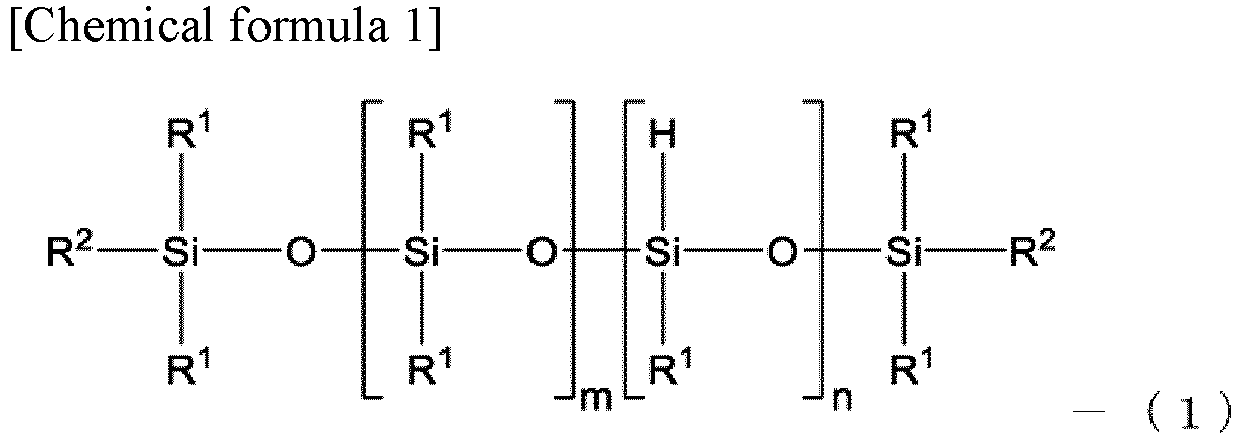
- The rubber particles according to claim 6, wherein the component (B) is an organohydrogenpolysiloxane having at least two silicon atom-bonded hydrogen atoms per molecule, which is represented by the following general formula (2):

- Composite particles with the surfaces of the rubber particles according to any one of claims 3 to 7 being coated with polyorganosilsesquioxane or silica.
- A method for producing the rubber particles according to any one of claims 3 to 7, comprising:(i) a step of obtaining an O/W type emulsion by adding, for emulsification, a surfactant-containing water phase component to an oil phase component comprised of (A) a polyester having at least two aliphatic unsaturated groups per molecule and (B) an organohydrogenpolysiloxane having at least two silicon atom-bonded hydrogen atoms per molecule;(ii) a step of obtaining (C) a rubber particle water dispersion by curing the oil phase component comprised of the components (A) and (B) in the emulsion via a hydrosilylation reaction under the presence of a hydrosilylation reactive catalyst; and(iii) a step of obtaining rubber particles by drying and removing water as a continuous phase from (C) the rubber particle water dispersion obtained in the step (ii).
- A method for producing the composite particles according to claim 8, comprising:(i) a step of obtaining an O/W type emulsion by adding a surfactant-containing water phase component to an oil phase component and performing stirring, the oil phase component being comprised of (A) a polyester having at least two aliphatic unsaturated groups per molecule and (B) an organohydrogenpolysiloxane having at least two silicon atom-bonded hydrogen atoms per molecule;(ii) a step of obtaining (C) a rubber particle water dispersion by curing the oil phase component comprised of the components (A) and (B) in the emulsion via a hydrosilylation reaction under the presence of a hydrosilylation reactive catalyst;(iii') a step of adding (E) an alkaline substance to (C) the rubber particle water dispersion obtained in the step (ii);(iv) a step of obtaining a composite particle water dispersion by adding (F) one kind selected from an organotrialkoxysilane or tetraalkoxysilane represented by the following general formula (3) and a hydrolysate thereof to the rubber particle water dispersion of the step (iii') to which the alkaline substance has been added, whereby a condensation reaction is caused to allow the surfaces of the rubber particles to be coated with polyorganosilsesquioxane or silica,
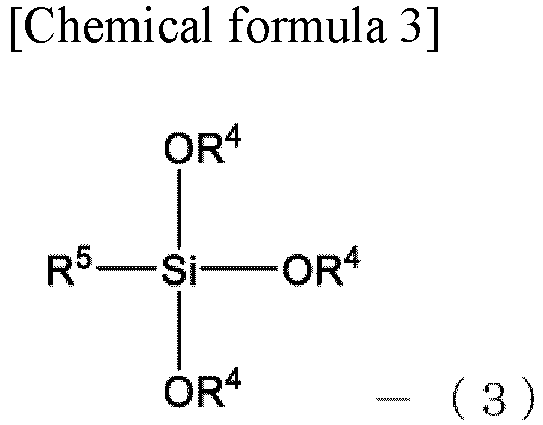 (v) a step of obtaining composite particles by drying and removing water as a continuous phase from the composite particle water dispersion obtained in the step (iv).
Applications Claiming Priority (2)
| Application Number | Priority Date | Filing Date | Title |
|---|---|---|---|
| JP2020124630 | 2020-07-21 | ||
| PCT/JP2021/026331 WO2022019179A1 (en) | 2020-07-21 | 2021-07-13 | Rubber particles, composite particles, and production methods therefor |
Publications (2)
| Publication Number | Publication Date |
|---|---|
| EP4186943A1 true EP4186943A1 (en) | 2023-05-31 |
| EP4186943A4 EP4186943A4 (en) | 2024-08-21 |
Family
ID=79728756
Family Applications (1)
| Application Number | Title | Priority Date | Filing Date |
|---|---|---|---|
| EP21845792.7A Pending EP4186943A4 (en) | 2020-07-21 | 2021-07-13 | RUBBER PARTICLES, COMPOSITE PARTICLES AND MANUFACTURING METHODS THEREOF |
Country Status (7)
| Country | Link |
|---|---|
| US (1) | US20230295426A1 (en) |
| EP (1) | EP4186943A4 (en) |
| JP (1) | JP7570797B2 (en) |
| KR (1) | KR20230041743A (en) |
| CN (1) | CN116157449B (en) |
| TW (1) | TWI882148B (en) |
| WO (1) | WO2022019179A1 (en) |
Cited By (2)
| Publication number | Priority date | Publication date | Assignee | Title |
|---|---|---|---|---|
| EP4414396A4 (en) * | 2021-10-05 | 2025-09-03 | Shinetsu Chemical Co | RUBBER PARTICLES, COMPOSITE PARTICLES AND MANUFACTURING METHODS THEREOF |
| EP4455121A4 (en) * | 2021-12-24 | 2025-12-24 | Dow Toray Co Ltd | Reactive group-containing polycaprolactone compound, novel silicone elastomer particles thereof, cosmetic composition and other uses |
Families Citing this family (5)
| Publication number | Priority date | Publication date | Assignee | Title |
|---|---|---|---|---|
| CN113372690A (en) * | 2021-06-22 | 2021-09-10 | 惠州北方树工艺品有限公司 | Flame-retardant full-biodegradable plastic and preparation method and application thereof |
| JP7706959B2 (en) * | 2021-07-01 | 2025-07-14 | 信越化学工業株式会社 | Liquid composition for silicone rubber spherical particles, silicone rubber spherical particles and method for producing the same, and silicone composite particles and method for producing the same |
| JP7743355B2 (en) * | 2022-04-08 | 2025-09-24 | 信越化学工業株式会社 | Composite particles, method for producing composite particles, and cosmetics |
| DE102022118294A1 (en) | 2022-07-21 | 2024-02-01 | Fraunhofer-Gesellschaft zur Förderung der angewandten Forschung eingetragener Verein | Biodegradable polysiloxanes |
| WO2024054422A1 (en) | 2022-09-09 | 2024-03-14 | Dow Silicones Corporation | ELASTOMER WITH C-O-Si LINKAGES BETWEEN POLYESTER BACKBONE AND CROSSLINKER |
Family Cites Families (15)
| Publication number | Priority date | Publication date | Assignee | Title |
|---|---|---|---|---|
| JP4700158B2 (en) * | 1999-11-16 | 2011-06-15 | 東レ・ダウコーニング株式会社 | Method for producing emulsion and method for producing oil composition |
| JPS6166722A (en) * | 1984-09-11 | 1986-04-05 | Univ Tohoku | Thermoplastic elastomer having low modulus |
| JP2966463B2 (en) * | 1990-03-27 | 1999-10-25 | 信越化学工業株式会社 | Curable resin composition |
| JP3059776B2 (en) | 1991-05-27 | 2000-07-04 | 東レ・ダウコーニング・シリコーン株式会社 | Method for producing silicone rubber powder |
| JPH05339511A (en) * | 1992-06-10 | 1993-12-21 | Nippon Unicar Co Ltd | Modifier for resin |
| JP2832143B2 (en) | 1993-12-28 | 1998-12-02 | 信越化学工業株式会社 | Silicone fine particles and method for producing the same |
| JPH0873664A (en) * | 1994-09-01 | 1996-03-19 | Sumitomo Bakelite Co Ltd | Production of thermoplastic elastomer |
| JPH08209037A (en) * | 1994-10-26 | 1996-08-13 | Kanegafuchi Chem Ind Co Ltd | Powder coating using a novel polyester curable composition |
| US5620825A (en) * | 1995-03-23 | 1997-04-15 | Agfa-Gevaert, N.V. | Polysiloxane modified resins for toner |
| JP5057413B2 (en) | 1999-08-03 | 2012-10-24 | 東レ・ダウコーニング株式会社 | Organic cross-linked particles, suspension thereof, and production method thereof |
| JP4371480B2 (en) * | 1999-08-03 | 2009-11-25 | 東レ・ダウコーニング株式会社 | Organic cross-linked particles, their suspensions, and methods for their production |
| JP4037579B2 (en) * | 1999-10-18 | 2008-01-23 | 株式会社カネカ | Curable composition |
| DE102004033060A1 (en) * | 2004-07-08 | 2006-01-26 | Byk-Chemie Gmbh | Polyester-modified polysiloxanes and their use as additives for thermoplastics, molding compounds and paints |
| JP6926925B2 (en) * | 2017-10-17 | 2021-08-25 | 信越化学工業株式会社 | Method for Producing Silica-Coated Silicone Elastomer Spherical Particles and Silica-Coated Silicone Elastomer Spherical Particles |
| CN118434709A (en) * | 2021-12-24 | 2024-08-02 | 陶氏东丽株式会社 | Polycaprolactone compound containing reactive groups, novel silicone elastomer particles using the same, and other uses of cosmetic compositions |
-
2021
- 2021-07-13 JP JP2022537944A patent/JP7570797B2/en active Active
- 2021-07-13 WO PCT/JP2021/026331 patent/WO2022019179A1/en not_active Ceased
- 2021-07-13 US US18/014,818 patent/US20230295426A1/en active Pending
- 2021-07-13 CN CN202180059700.6A patent/CN116157449B/en active Active
- 2021-07-13 EP EP21845792.7A patent/EP4186943A4/en active Pending
- 2021-07-13 KR KR1020237005491A patent/KR20230041743A/en active Pending
- 2021-07-16 TW TW110126213A patent/TWI882148B/en active
Cited By (2)
| Publication number | Priority date | Publication date | Assignee | Title |
|---|---|---|---|---|
| EP4414396A4 (en) * | 2021-10-05 | 2025-09-03 | Shinetsu Chemical Co | RUBBER PARTICLES, COMPOSITE PARTICLES AND MANUFACTURING METHODS THEREOF |
| EP4455121A4 (en) * | 2021-12-24 | 2025-12-24 | Dow Toray Co Ltd | Reactive group-containing polycaprolactone compound, novel silicone elastomer particles thereof, cosmetic composition and other uses |
Also Published As
| Publication number | Publication date |
|---|---|
| US20230295426A1 (en) | 2023-09-21 |
| WO2022019179A1 (en) | 2022-01-27 |
| EP4186943A4 (en) | 2024-08-21 |
| CN116157449A (en) | 2023-05-23 |
| JPWO2022019179A1 (en) | 2022-01-27 |
| JP7570797B2 (en) | 2024-10-22 |
| TWI882148B (en) | 2025-05-01 |
| TW202214750A (en) | 2022-04-16 |
| KR20230041743A (en) | 2023-03-24 |
| CN116157449B (en) | 2025-06-10 |
Similar Documents
| Publication | Publication Date | Title |
|---|---|---|
| EP4186943A1 (en) | Rubber particles, composite particles, and production methods therefor | |
| JP5614392B2 (en) | Method for producing silicone fine particles | |
| JP2832143B2 (en) | Silicone fine particles and method for producing the same | |
| US8133586B2 (en) | Silicone microparticles comprising silicone elastomer spherical microparticles coated with polyorganosilsesquioxane, and method of producing same | |
| JP5607001B2 (en) | Silicone fine particles and method for producing the same | |
| US20100112023A1 (en) | Silicone microparticles comprising silicone elastomer spherical microparticles coated with polyorganosilsesquioxane, and method of producing same | |
| EP4414396A1 (en) | Rubber particles, composite particles, and manufacturing methods therefor | |
| WO2008147072A1 (en) | Polyalkylsilsesquioxane particulates and a preparation method thereof | |
| EP2216357B1 (en) | Water-repellent fine particles and making method | |
| EP3699235A1 (en) | Production method for silica-coated spherical silicone elastomer particles and silica-coated spherical silicone elastomer particles | |
| CN114846115B (en) | Finely granulated, particle-stabilized aqueous Pickering emulsions and particles prepared therefrom | |
| EP3434715B1 (en) | Silicone particles and method for producing same | |
| EP3608352A1 (en) | Silicone particles and method for producing same | |
| JPH03281538A (en) | Silicone aqueous emulsion composition and production of silicone particulate matter using the same composition | |
| JP7200925B2 (en) | SILICONE ELASTIC PARTICLES AND VOID SILICONE ELASTOMER PARTICLES, AND METHOD FOR PRODUCING THEREOF | |
| KR101475492B1 (en) | Polyalkyl silsesquioxane fine particles and method for producing the same | |
| JP3124539B2 (en) | Curable silicone emulsion composition | |
| JP7706959B2 (en) | Liquid composition for silicone rubber spherical particles, silicone rubber spherical particles and method for producing the same, and silicone composite particles and method for producing the same |
Legal Events
| Date | Code | Title | Description |
|---|---|---|---|
| STAA | Information on the status of an ep patent application or granted ep patent |
Free format text: STATUS: THE INTERNATIONAL PUBLICATION HAS BEEN MADE |
|
| PUAI | Public reference made under article 153(3) epc to a published international application that has entered the european phase |
Free format text: ORIGINAL CODE: 0009012 |
|
| STAA | Information on the status of an ep patent application or granted ep patent |
Free format text: STATUS: REQUEST FOR EXAMINATION WAS MADE |
|
| 17P | Request for examination filed |
Effective date: 20230102 |
|
| AK | Designated contracting states |
Kind code of ref document: A1 Designated state(s): AL AT BE BG CH CY CZ DE DK EE ES FI FR GB GR HR HU IE IS IT LI LT LU LV MC MK MT NL NO PL PT RO RS SE SI SK SM TR |
|
| DAV | Request for validation of the european patent (deleted) | ||
| DAX | Request for extension of the european patent (deleted) | ||
| A4 | Supplementary search report drawn up and despatched |
Effective date: 20240722 |
|
| RIC1 | Information provided on ipc code assigned before grant |
Ipc: C08L 83/05 20060101ALI20240716BHEP Ipc: C08L 67/07 20060101ALI20240716BHEP Ipc: C08J 7/04 20200101ALI20240716BHEP Ipc: C08J 3/12 20060101ALI20240716BHEP Ipc: C08G 81/00 20060101ALI20240716BHEP Ipc: C08G 77/445 20060101AFI20240716BHEP |