EP4186591A1 - Sorptionsmittelgranulat zur trennung von kohlendioxid aus einem fluidgemisch und verfahren zur herstellung davon - Google Patents
Sorptionsmittelgranulat zur trennung von kohlendioxid aus einem fluidgemisch und verfahren zur herstellung davon Download PDFInfo
- Publication number
- EP4186591A1 EP4186591A1 EP21211413.6A EP21211413A EP4186591A1 EP 4186591 A1 EP4186591 A1 EP 4186591A1 EP 21211413 A EP21211413 A EP 21211413A EP 4186591 A1 EP4186591 A1 EP 4186591A1
- Authority
- EP
- European Patent Office
- Prior art keywords
- sorbent
- granulates
- range
- carbon dioxide
- sizes
- Prior art date
- Legal status (The legal status is an assumption and is not a legal conclusion. Google has not performed a legal analysis and makes no representation as to the accuracy of the status listed.)
- Withdrawn
Links
- CURLTUGMZLYLDI-UHFFFAOYSA-N Carbon dioxide Chemical compound O=C=O CURLTUGMZLYLDI-UHFFFAOYSA-N 0.000 title claims abstract description 195
- 239000008187 granular material Substances 0.000 title claims abstract description 183
- 239000002594 sorbent Substances 0.000 title claims abstract description 164
- 229910002092 carbon dioxide Inorganic materials 0.000 title claims abstract description 99
- 239000001569 carbon dioxide Substances 0.000 title claims abstract description 95
- 238000000034 method Methods 0.000 title claims abstract description 62
- 239000012530 fluid Substances 0.000 title claims abstract description 44
- 239000000203 mixture Substances 0.000 title claims abstract description 36
- 238000000926 separation method Methods 0.000 title claims abstract description 19
- 150000001412 amines Chemical class 0.000 claims abstract description 65
- 239000011230 binding agent Substances 0.000 claims abstract description 45
- 239000000843 powder Substances 0.000 claims abstract description 40
- 125000003277 amino group Chemical group 0.000 claims abstract description 23
- 238000001179 sorption measurement Methods 0.000 claims description 59
- 239000011148 porous material Substances 0.000 claims description 55
- 239000011347 resin Substances 0.000 claims description 38
- 229920005989 resin Polymers 0.000 claims description 38
- 239000002245 particle Substances 0.000 claims description 12
- 229920000642 polymer Polymers 0.000 claims description 12
- 238000000227 grinding Methods 0.000 claims description 10
- 239000004793 Polystyrene Substances 0.000 claims description 8
- 229920002223 polystyrene Polymers 0.000 claims description 8
- NIXOWILDQLNWCW-UHFFFAOYSA-N acrylic acid group Chemical group C(C=C)(=O)O NIXOWILDQLNWCW-UHFFFAOYSA-N 0.000 claims description 6
- 239000006185 dispersion Substances 0.000 claims description 5
- 229920005596 polymer binder Polymers 0.000 claims description 4
- 239000002491 polymer binding agent Substances 0.000 claims description 4
- XTXRWKRVRITETP-UHFFFAOYSA-N Vinyl acetate Chemical compound CC(=O)OC=C XTXRWKRVRITETP-UHFFFAOYSA-N 0.000 claims description 3
- 125000001797 benzyl group Chemical group [H]C1=C([H])C([H])=C(C([H])=C1[H])C([H])([H])* 0.000 claims description 3
- 229940117958 vinyl acetate Drugs 0.000 claims description 3
- 230000036961 partial effect Effects 0.000 claims description 2
- 239000007789 gas Substances 0.000 description 35
- 238000005469 granulation Methods 0.000 description 35
- 230000003179 granulation Effects 0.000 description 35
- 239000000463 material Substances 0.000 description 19
- 239000011324 bead Substances 0.000 description 17
- XLYOFNOQVPJJNP-UHFFFAOYSA-N water Substances O XLYOFNOQVPJJNP-UHFFFAOYSA-N 0.000 description 17
- 239000003456 ion exchange resin Substances 0.000 description 16
- 229920003303 ion-exchange polymer Polymers 0.000 description 16
- -1 C8 alkyl methacrylates Chemical class 0.000 description 15
- 238000010438 heat treatment Methods 0.000 description 15
- NWUYHJFMYQTDRP-UHFFFAOYSA-N 1,2-bis(ethenyl)benzene;1-ethenyl-2-ethylbenzene;styrene Chemical compound C=CC1=CC=CC=C1.CCC1=CC=CC=C1C=C.C=CC1=CC=CC=C1C=C NWUYHJFMYQTDRP-UHFFFAOYSA-N 0.000 description 12
- VNWKTOKETHGBQD-UHFFFAOYSA-N methane Chemical compound C VNWKTOKETHGBQD-UHFFFAOYSA-N 0.000 description 12
- 230000002902 bimodal effect Effects 0.000 description 11
- 238000005470 impregnation Methods 0.000 description 9
- 238000004519 manufacturing process Methods 0.000 description 7
- PPBRXRYQALVLMV-UHFFFAOYSA-N Styrene Chemical compound C=CC1=CC=CC=C1 PPBRXRYQALVLMV-UHFFFAOYSA-N 0.000 description 6
- 239000000654 additive Substances 0.000 description 6
- 239000003570 air Substances 0.000 description 6
- 238000003795 desorption Methods 0.000 description 6
- 239000003345 natural gas Substances 0.000 description 6
- 239000000126 substance Substances 0.000 description 6
- 230000009286 beneficial effect Effects 0.000 description 5
- 230000001627 detrimental effect Effects 0.000 description 5
- 238000010586 diagram Methods 0.000 description 5
- 239000004814 polyurethane Substances 0.000 description 5
- 229920002451 polyvinyl alcohol Polymers 0.000 description 5
- 235000019422 polyvinyl alcohol Nutrition 0.000 description 5
- 150000003141 primary amines Chemical group 0.000 description 5
- 239000004372 Polyvinyl alcohol Substances 0.000 description 4
- WGQKYBSKWIADBV-UHFFFAOYSA-N benzylamine Chemical compound NCC1=CC=CC=C1 WGQKYBSKWIADBV-UHFFFAOYSA-N 0.000 description 4
- 238000009826 distribution Methods 0.000 description 4
- MYRTYDVEIRVNKP-UHFFFAOYSA-N divinylbenzene Substances C=CC1=CC=CC=C1C=C MYRTYDVEIRVNKP-UHFFFAOYSA-N 0.000 description 4
- 230000000694 effects Effects 0.000 description 4
- 239000002737 fuel gas Substances 0.000 description 4
- 230000001965 increasing effect Effects 0.000 description 4
- 238000002156 mixing Methods 0.000 description 4
- XKJCHHZQLQNZHY-UHFFFAOYSA-N phthalimide Chemical compound C1=CC=C2C(=O)NC(=O)C2=C1 XKJCHHZQLQNZHY-UHFFFAOYSA-N 0.000 description 4
- 229920002635 polyurethane Polymers 0.000 description 4
- ZWEHNKRNPOVVGH-UHFFFAOYSA-N 2-Butanone Chemical compound CCC(C)=O ZWEHNKRNPOVVGH-UHFFFAOYSA-N 0.000 description 3
- 239000004925 Acrylic resin Substances 0.000 description 3
- 229920000178 Acrylic resin Polymers 0.000 description 3
- IJGRMHOSHXDMSA-UHFFFAOYSA-N Atomic nitrogen Chemical compound N#N IJGRMHOSHXDMSA-UHFFFAOYSA-N 0.000 description 3
- 239000011149 active material Substances 0.000 description 3
- 238000002485 combustion reaction Methods 0.000 description 3
- 230000003750 conditioning effect Effects 0.000 description 3
- 230000000670 limiting effect Effects 0.000 description 3
- 230000002829 reductive effect Effects 0.000 description 3
- 238000007873 sieving Methods 0.000 description 3
- 239000002904 solvent Substances 0.000 description 3
- XWJBRBSPAODJER-UHFFFAOYSA-N 1,7-octadiene Chemical compound C=CCCCCC=C XWJBRBSPAODJER-UHFFFAOYSA-N 0.000 description 2
- SBYMUDUGTIKLCR-UHFFFAOYSA-N 2-chloroethenylbenzene Chemical compound ClC=CC1=CC=CC=C1 SBYMUDUGTIKLCR-UHFFFAOYSA-N 0.000 description 2
- KAKZBPTYRLMSJV-UHFFFAOYSA-N Butadiene Chemical group C=CC=C KAKZBPTYRLMSJV-UHFFFAOYSA-N 0.000 description 2
- 229920005692 JONCRYL® Polymers 0.000 description 2
- CERQOIWHTDAKMF-UHFFFAOYSA-N Methacrylic acid Chemical compound CC(=C)C(O)=O CERQOIWHTDAKMF-UHFFFAOYSA-N 0.000 description 2
- UFWIBTONFRDIAS-UHFFFAOYSA-N Naphthalene Chemical compound C1=CC=CC2=CC=CC=C21 UFWIBTONFRDIAS-UHFFFAOYSA-N 0.000 description 2
- NBIIXXVUZAFLBC-UHFFFAOYSA-N Phosphoric acid Chemical compound OP(O)(O)=O NBIIXXVUZAFLBC-UHFFFAOYSA-N 0.000 description 2
- 229920002873 Polyethylenimine Polymers 0.000 description 2
- 230000000996 additive effect Effects 0.000 description 2
- XYLMUPLGERFSHI-UHFFFAOYSA-N alpha-Methylstyrene Chemical compound CC(=C)C1=CC=CC=C1 XYLMUPLGERFSHI-UHFFFAOYSA-N 0.000 description 2
- MPMBRWOOISTHJV-UHFFFAOYSA-N but-1-enylbenzene Chemical compound CCC=CC1=CC=CC=C1 MPMBRWOOISTHJV-UHFFFAOYSA-N 0.000 description 2
- 239000003245 coal Substances 0.000 description 2
- 150000001875 compounds Chemical class 0.000 description 2
- 238000013461 design Methods 0.000 description 2
- 238000009792 diffusion process Methods 0.000 description 2
- 125000002573 ethenylidene group Chemical group [*]=C=C([H])[H] 0.000 description 2
- 238000002474 experimental method Methods 0.000 description 2
- 238000001914 filtration Methods 0.000 description 2
- 125000000524 functional group Chemical group 0.000 description 2
- 238000007306 functionalization reaction Methods 0.000 description 2
- 229930195733 hydrocarbon Natural products 0.000 description 2
- 150000002430 hydrocarbons Chemical class 0.000 description 2
- 125000002887 hydroxy group Chemical group [H]O* 0.000 description 2
- 238000002386 leaching Methods 0.000 description 2
- 239000007788 liquid Substances 0.000 description 2
- 238000012986 modification Methods 0.000 description 2
- 230000004048 modification Effects 0.000 description 2
- UHOVQNZJYSORNB-UHFFFAOYSA-N monobenzene Natural products C1=CC=CC=C1 UHOVQNZJYSORNB-UHFFFAOYSA-N 0.000 description 2
- 238000012856 packing Methods 0.000 description 2
- 239000003208 petroleum Substances 0.000 description 2
- 229920001296 polysiloxane Polymers 0.000 description 2
- 229920003053 polystyrene-divinylbenzene Polymers 0.000 description 2
- 229920000915 polyvinyl chloride Polymers 0.000 description 2
- 239000004800 polyvinyl chloride Substances 0.000 description 2
- HJWLCRVIBGQPNF-UHFFFAOYSA-N prop-2-enylbenzene Chemical compound C=CCC1=CC=CC=C1 HJWLCRVIBGQPNF-UHFFFAOYSA-N 0.000 description 2
- 229920006395 saturated elastomer Polymers 0.000 description 2
- 229920002554 vinyl polymer Polymers 0.000 description 2
- 125000004209 (C1-C8) alkyl group Chemical group 0.000 description 1
- WVAFEFUPWRPQSY-UHFFFAOYSA-N 1,2,3-tris(ethenyl)benzene Chemical compound C=CC1=CC=CC(C=C)=C1C=C WVAFEFUPWRPQSY-UHFFFAOYSA-N 0.000 description 1
- IGGDKDTUCAWDAN-UHFFFAOYSA-N 1-vinylnaphthalene Chemical compound C1=CC=C2C(C=C)=CC=CC2=C1 IGGDKDTUCAWDAN-UHFFFAOYSA-N 0.000 description 1
- DSAYAFZWRDYBQY-UHFFFAOYSA-N 2,5-dimethylhexa-1,5-diene Chemical compound CC(=C)CCC(C)=C DSAYAFZWRDYBQY-UHFFFAOYSA-N 0.000 description 1
- SMZOUWXMTYCWNB-UHFFFAOYSA-N 2-(2-methoxy-5-methylphenyl)ethanamine Chemical compound COC1=CC=C(C)C=C1CCN SMZOUWXMTYCWNB-UHFFFAOYSA-N 0.000 description 1
- OEPOKWHJYJXUGD-UHFFFAOYSA-N 2-(3-phenylmethoxyphenyl)-1,3-thiazole-4-carbaldehyde Chemical compound O=CC1=CSC(C=2C=C(OCC=3C=CC=CC=3)C=CC=2)=N1 OEPOKWHJYJXUGD-UHFFFAOYSA-N 0.000 description 1
- 125000000022 2-aminoethyl group Chemical group [H]C([*])([H])C([H])([H])N([H])[H] 0.000 description 1
- KXGFMDJXCMQABM-UHFFFAOYSA-N 2-methoxy-6-methylphenol Chemical group [CH]OC1=CC=CC([CH])=C1O KXGFMDJXCMQABM-UHFFFAOYSA-N 0.000 description 1
- BFHYUNGMDZAKAQ-UHFFFAOYSA-N 2-methylprop-2-enoyl 3-oxobutaneperoxoate Chemical compound CC(=O)CC(=O)OOC(=O)C(C)=C BFHYUNGMDZAKAQ-UHFFFAOYSA-N 0.000 description 1
- IWTYTFSSTWXZFU-UHFFFAOYSA-N 3-chloroprop-1-enylbenzene Chemical compound ClCC=CC1=CC=CC=C1 IWTYTFSSTWXZFU-UHFFFAOYSA-N 0.000 description 1
- SJECZPVISLOESU-UHFFFAOYSA-N 3-trimethoxysilylpropan-1-amine Chemical compound CO[Si](OC)(OC)CCCN SJECZPVISLOESU-UHFFFAOYSA-N 0.000 description 1
- DBCAQXHNJOFNGC-UHFFFAOYSA-N 4-bromo-1,1,1-trifluorobutane Chemical compound FC(F)(F)CCCBr DBCAQXHNJOFNGC-UHFFFAOYSA-N 0.000 description 1
- HRPVXLWXLXDGHG-UHFFFAOYSA-N Acrylamide Chemical compound NC(=O)C=C HRPVXLWXLXDGHG-UHFFFAOYSA-N 0.000 description 1
- NLHHRLWOUZZQLW-UHFFFAOYSA-N Acrylonitrile Chemical compound C=CC#N NLHHRLWOUZZQLW-UHFFFAOYSA-N 0.000 description 1
- KLYCPFXDDDMZNQ-UHFFFAOYSA-N Benzyne Chemical compound C1=CC#CC=C1 KLYCPFXDDDMZNQ-UHFFFAOYSA-N 0.000 description 1
- 239000004215 Carbon black (E152) Substances 0.000 description 1
- 239000004971 Cross linker Substances 0.000 description 1
- 239000004593 Epoxy Substances 0.000 description 1
- 229920000877 Melamine resin Polymers 0.000 description 1
- GYCMBHHDWRMZGG-UHFFFAOYSA-N Methylacrylonitrile Chemical compound CC(=C)C#N GYCMBHHDWRMZGG-UHFFFAOYSA-N 0.000 description 1
- 239000004677 Nylon Substances 0.000 description 1
- 229920003171 Poly (ethylene oxide) Polymers 0.000 description 1
- 239000004695 Polyether sulfone Substances 0.000 description 1
- OKKRPWIIYQTPQF-UHFFFAOYSA-N Trimethylolpropane trimethacrylate Chemical compound CC(=C)C(=O)OCC(CC)(COC(=O)C(C)=C)COC(=O)C(C)=C OKKRPWIIYQTPQF-UHFFFAOYSA-N 0.000 description 1
- BZHJMEDXRYGGRV-UHFFFAOYSA-N Vinyl chloride Chemical compound ClC=C BZHJMEDXRYGGRV-UHFFFAOYSA-N 0.000 description 1
- QYKIQEUNHZKYBP-UHFFFAOYSA-N Vinyl ether Chemical compound C=COC=C QYKIQEUNHZKYBP-UHFFFAOYSA-N 0.000 description 1
- 239000000853 adhesive Substances 0.000 description 1
- 230000001070 adhesive effect Effects 0.000 description 1
- 230000002411 adverse Effects 0.000 description 1
- 150000007824 aliphatic compounds Chemical class 0.000 description 1
- 229910000147 aluminium phosphate Inorganic materials 0.000 description 1
- 239000012080 ambient air Substances 0.000 description 1
- 150000001408 amides Chemical class 0.000 description 1
- 238000005349 anion exchange Methods 0.000 description 1
- 125000000129 anionic group Chemical group 0.000 description 1
- 150000001491 aromatic compounds Chemical class 0.000 description 1
- 125000003118 aryl group Chemical group 0.000 description 1
- 239000012298 atmosphere Substances 0.000 description 1
- 230000001588 bifunctional effect Effects 0.000 description 1
- 230000015572 biosynthetic process Effects 0.000 description 1
- CQEYYJKEWSMYFG-UHFFFAOYSA-N butyl acrylate Chemical compound CCCCOC(=O)C=C CQEYYJKEWSMYFG-UHFFFAOYSA-N 0.000 description 1
- 125000003178 carboxy group Chemical group [H]OC(*)=O 0.000 description 1
- 230000015556 catabolic process Effects 0.000 description 1
- 125000002091 cationic group Chemical group 0.000 description 1
- 229920002678 cellulose Polymers 0.000 description 1
- 239000001913 cellulose Substances 0.000 description 1
- 238000006243 chemical reaction Methods 0.000 description 1
- 238000007265 chloromethylation reaction Methods 0.000 description 1
- 239000012539 chromatography resin Substances 0.000 description 1
- 239000011248 coating agent Substances 0.000 description 1
- 238000000576 coating method Methods 0.000 description 1
- 239000000805 composite resin Substances 0.000 description 1
- 239000000470 constituent Substances 0.000 description 1
- 239000003431 cross linking reagent Substances 0.000 description 1
- 238000005520 cutting process Methods 0.000 description 1
- 238000006731 degradation reaction Methods 0.000 description 1
- 229910001873 dinitrogen Inorganic materials 0.000 description 1
- 238000001035 drying Methods 0.000 description 1
- 239000000428 dust Substances 0.000 description 1
- 238000005485 electric heating Methods 0.000 description 1
- 230000005611 electricity Effects 0.000 description 1
- 239000000839 emulsion Substances 0.000 description 1
- 230000002708 enhancing effect Effects 0.000 description 1
- 125000003700 epoxy group Chemical group 0.000 description 1
- 239000003822 epoxy resin Substances 0.000 description 1
- STVZJERGLQHEKB-UHFFFAOYSA-N ethylene glycol dimethacrylate Substances CC(=C)C(=O)OCCOC(=O)C(C)=C STVZJERGLQHEKB-UHFFFAOYSA-N 0.000 description 1
- 238000001125 extrusion Methods 0.000 description 1
- 238000005243 fluidization Methods 0.000 description 1
- 239000000446 fuel Substances 0.000 description 1
- 150000004676 glycans Chemical class 0.000 description 1
- 125000003055 glycidyl group Chemical group C(C1CO1)* 0.000 description 1
- PYGSKMBEVAICCR-UHFFFAOYSA-N hexa-1,5-diene Chemical compound C=CCCC=C PYGSKMBEVAICCR-UHFFFAOYSA-N 0.000 description 1
- 238000009478 high shear granulation Methods 0.000 description 1
- 125000004356 hydroxy functional group Chemical group O* 0.000 description 1
- NBZBKCUXIYYUSX-UHFFFAOYSA-N iminodiacetic acid Chemical compound OC(=O)CNCC(O)=O NBZBKCUXIYYUSX-UHFFFAOYSA-N 0.000 description 1
- 230000001939 inductive effect Effects 0.000 description 1
- 239000003999 initiator Substances 0.000 description 1
- 150000002500 ions Chemical class 0.000 description 1
- IQPQWNKOIGAROB-UHFFFAOYSA-N isocyanate group Chemical group [N-]=C=O IQPQWNKOIGAROB-UHFFFAOYSA-N 0.000 description 1
- 238000013035 low temperature curing Methods 0.000 description 1
- JDSHMPZPIAZGSV-UHFFFAOYSA-N melamine Chemical compound NC1=NC(N)=NC(N)=N1 JDSHMPZPIAZGSV-UHFFFAOYSA-N 0.000 description 1
- FQPSGWSUVKBHSU-UHFFFAOYSA-N methacrylamide Chemical compound CC(=C)C(N)=O FQPSGWSUVKBHSU-UHFFFAOYSA-N 0.000 description 1
- 125000005395 methacrylic acid group Chemical group 0.000 description 1
- 239000000178 monomer Substances 0.000 description 1
- OMNKZBIFPJNNIO-UHFFFAOYSA-N n-(2-methyl-4-oxopentan-2-yl)prop-2-enamide Chemical compound CC(=O)CC(C)(C)NC(=O)C=C OMNKZBIFPJNNIO-UHFFFAOYSA-N 0.000 description 1
- 229910052757 nitrogen Inorganic materials 0.000 description 1
- 231100000989 no adverse effect Toxicity 0.000 description 1
- 229920001778 nylon Polymers 0.000 description 1
- 230000035515 penetration Effects 0.000 description 1
- DBSDMAPJGHBWAL-UHFFFAOYSA-N penta-1,4-dien-3-ylbenzene Chemical compound C=CC(C=C)C1=CC=CC=C1 DBSDMAPJGHBWAL-UHFFFAOYSA-N 0.000 description 1
- 229920003229 poly(methyl methacrylate) Polymers 0.000 description 1
- 229920001467 poly(styrenesulfonates) Polymers 0.000 description 1
- 229920002492 poly(sulfone) Polymers 0.000 description 1
- 229920002037 poly(vinyl butyral) polymer Polymers 0.000 description 1
- 229920000768 polyamine Polymers 0.000 description 1
- 229920000867 polyelectrolyte Polymers 0.000 description 1
- 229920000647 polyepoxide Polymers 0.000 description 1
- 229920000728 polyester Polymers 0.000 description 1
- 229920001225 polyester resin Polymers 0.000 description 1
- 239000004645 polyester resin Substances 0.000 description 1
- 229920006393 polyether sulfone Polymers 0.000 description 1
- 229920001223 polyethylene glycol Polymers 0.000 description 1
- 239000005020 polyethylene terephthalate Substances 0.000 description 1
- 229920000139 polyethylene terephthalate Polymers 0.000 description 1
- 239000002861 polymer material Substances 0.000 description 1
- 239000002952 polymeric resin Substances 0.000 description 1
- 239000004926 polymethyl methacrylate Substances 0.000 description 1
- 229920000098 polyolefin Polymers 0.000 description 1
- 229920001282 polysaccharide Polymers 0.000 description 1
- 239000005017 polysaccharide Substances 0.000 description 1
- 229920005990 polystyrene resin Polymers 0.000 description 1
- 239000004810 polytetrafluoroethylene Substances 0.000 description 1
- 229920001343 polytetrafluoroethylene Polymers 0.000 description 1
- 239000011118 polyvinyl acetate Substances 0.000 description 1
- 229920002689 polyvinyl acetate Polymers 0.000 description 1
- 229920006216 polyvinyl aromatic Polymers 0.000 description 1
- 229920000131 polyvinylidene Polymers 0.000 description 1
- 229920002981 polyvinylidene fluoride Polymers 0.000 description 1
- 125000002924 primary amino group Chemical group [H]N([H])* 0.000 description 1
- 238000000746 purification Methods 0.000 description 1
- 230000000717 retained effect Effects 0.000 description 1
- 239000002210 silicon-based material Substances 0.000 description 1
- 125000003808 silyl group Chemical group [H][Si]([H])([H])[*] 0.000 description 1
- 239000007787 solid Substances 0.000 description 1
- 238000001694 spray drying Methods 0.000 description 1
- 239000007858 starting material Substances 0.000 description 1
- BDHFUVZGWQCTTF-UHFFFAOYSA-M sulfonate Chemical compound [O-]S(=O)=O BDHFUVZGWQCTTF-UHFFFAOYSA-M 0.000 description 1
- 230000002195 synergetic effect Effects 0.000 description 1
- 229920003002 synthetic resin Polymers 0.000 description 1
- 229920001897 terpolymer Polymers 0.000 description 1
- 229920001187 thermosetting polymer Polymers 0.000 description 1
- 238000012546 transfer Methods 0.000 description 1
- 229920006337 unsaturated polyester resin Polymers 0.000 description 1
- 229960000834 vinyl ether Drugs 0.000 description 1
- 125000000391 vinyl group Chemical group [H]C([*])=C([H])[H] 0.000 description 1
- 239000010457 zeolite Substances 0.000 description 1
Images
Classifications
-
- B—PERFORMING OPERATIONS; TRANSPORTING
- B01—PHYSICAL OR CHEMICAL PROCESSES OR APPARATUS IN GENERAL
- B01J—CHEMICAL OR PHYSICAL PROCESSES, e.g. CATALYSIS OR COLLOID CHEMISTRY; THEIR RELEVANT APPARATUS
- B01J20/00—Solid sorbent compositions or filter aid compositions; Sorbents for chromatography; Processes for preparing, regenerating or reactivating thereof
- B01J20/30—Processes for preparing, regenerating, or reactivating
- B01J20/3042—Use of binding agents; addition of materials ameliorating the mechanical properties of the produced sorbent
-
- B—PERFORMING OPERATIONS; TRANSPORTING
- B01—PHYSICAL OR CHEMICAL PROCESSES OR APPARATUS IN GENERAL
- B01D—SEPARATION
- B01D53/00—Separation of gases or vapours; Recovering vapours of volatile solvents from gases; Chemical or biological purification of waste gases, e.g. engine exhaust gases, smoke, fumes, flue gases, aerosols
- B01D53/02—Separation of gases or vapours; Recovering vapours of volatile solvents from gases; Chemical or biological purification of waste gases, e.g. engine exhaust gases, smoke, fumes, flue gases, aerosols by adsorption, e.g. preparative gas chromatography
-
- B—PERFORMING OPERATIONS; TRANSPORTING
- B01—PHYSICAL OR CHEMICAL PROCESSES OR APPARATUS IN GENERAL
- B01J—CHEMICAL OR PHYSICAL PROCESSES, e.g. CATALYSIS OR COLLOID CHEMISTRY; THEIR RELEVANT APPARATUS
- B01J20/00—Solid sorbent compositions or filter aid compositions; Sorbents for chromatography; Processes for preparing, regenerating or reactivating thereof
- B01J20/22—Solid sorbent compositions or filter aid compositions; Sorbents for chromatography; Processes for preparing, regenerating or reactivating thereof comprising organic material
- B01J20/26—Synthetic macromolecular compounds
- B01J20/261—Synthetic macromolecular compounds obtained by reactions only involving carbon to carbon unsaturated bonds
-
- B—PERFORMING OPERATIONS; TRANSPORTING
- B01—PHYSICAL OR CHEMICAL PROCESSES OR APPARATUS IN GENERAL
- B01J—CHEMICAL OR PHYSICAL PROCESSES, e.g. CATALYSIS OR COLLOID CHEMISTRY; THEIR RELEVANT APPARATUS
- B01J20/00—Solid sorbent compositions or filter aid compositions; Sorbents for chromatography; Processes for preparing, regenerating or reactivating thereof
- B01J20/22—Solid sorbent compositions or filter aid compositions; Sorbents for chromatography; Processes for preparing, regenerating or reactivating thereof comprising organic material
- B01J20/26—Synthetic macromolecular compounds
- B01J20/265—Synthetic macromolecular compounds modified or post-treated polymers
- B01J20/267—Cross-linked polymers
-
- B—PERFORMING OPERATIONS; TRANSPORTING
- B01—PHYSICAL OR CHEMICAL PROCESSES OR APPARATUS IN GENERAL
- B01J—CHEMICAL OR PHYSICAL PROCESSES, e.g. CATALYSIS OR COLLOID CHEMISTRY; THEIR RELEVANT APPARATUS
- B01J20/00—Solid sorbent compositions or filter aid compositions; Sorbents for chromatography; Processes for preparing, regenerating or reactivating thereof
- B01J20/28—Solid sorbent compositions or filter aid compositions; Sorbents for chromatography; Processes for preparing, regenerating or reactivating thereof characterised by their form or physical properties
- B01J20/28014—Solid sorbent compositions or filter aid compositions; Sorbents for chromatography; Processes for preparing, regenerating or reactivating thereof characterised by their form or physical properties characterised by their form
- B01J20/28016—Particle form
- B01J20/28019—Spherical, ellipsoidal or cylindrical
-
- B—PERFORMING OPERATIONS; TRANSPORTING
- B01—PHYSICAL OR CHEMICAL PROCESSES OR APPARATUS IN GENERAL
- B01J—CHEMICAL OR PHYSICAL PROCESSES, e.g. CATALYSIS OR COLLOID CHEMISTRY; THEIR RELEVANT APPARATUS
- B01J20/00—Solid sorbent compositions or filter aid compositions; Sorbents for chromatography; Processes for preparing, regenerating or reactivating thereof
- B01J20/28—Solid sorbent compositions or filter aid compositions; Sorbents for chromatography; Processes for preparing, regenerating or reactivating thereof characterised by their form or physical properties
- B01J20/28014—Solid sorbent compositions or filter aid compositions; Sorbents for chromatography; Processes for preparing, regenerating or reactivating thereof characterised by their form or physical properties characterised by their form
- B01J20/2803—Sorbents comprising a binder, e.g. for forming aggregated, agglomerated or granulated products
-
- B—PERFORMING OPERATIONS; TRANSPORTING
- B01—PHYSICAL OR CHEMICAL PROCESSES OR APPARATUS IN GENERAL
- B01J—CHEMICAL OR PHYSICAL PROCESSES, e.g. CATALYSIS OR COLLOID CHEMISTRY; THEIR RELEVANT APPARATUS
- B01J20/00—Solid sorbent compositions or filter aid compositions; Sorbents for chromatography; Processes for preparing, regenerating or reactivating thereof
- B01J20/28—Solid sorbent compositions or filter aid compositions; Sorbents for chromatography; Processes for preparing, regenerating or reactivating thereof characterised by their form or physical properties
- B01J20/28054—Solid sorbent compositions or filter aid compositions; Sorbents for chromatography; Processes for preparing, regenerating or reactivating thereof characterised by their form or physical properties characterised by their surface properties or porosity
- B01J20/28088—Pore-size distribution
- B01J20/28092—Bimodal, polymodal, different types of pores or different pore size distributions in different parts of the sorbent
-
- B—PERFORMING OPERATIONS; TRANSPORTING
- B01—PHYSICAL OR CHEMICAL PROCESSES OR APPARATUS IN GENERAL
- B01J—CHEMICAL OR PHYSICAL PROCESSES, e.g. CATALYSIS OR COLLOID CHEMISTRY; THEIR RELEVANT APPARATUS
- B01J20/00—Solid sorbent compositions or filter aid compositions; Sorbents for chromatography; Processes for preparing, regenerating or reactivating thereof
- B01J20/30—Processes for preparing, regenerating, or reactivating
- B01J20/3021—Milling, crushing or grinding
-
- B—PERFORMING OPERATIONS; TRANSPORTING
- B01—PHYSICAL OR CHEMICAL PROCESSES OR APPARATUS IN GENERAL
- B01J—CHEMICAL OR PHYSICAL PROCESSES, e.g. CATALYSIS OR COLLOID CHEMISTRY; THEIR RELEVANT APPARATUS
- B01J20/00—Solid sorbent compositions or filter aid compositions; Sorbents for chromatography; Processes for preparing, regenerating or reactivating thereof
- B01J20/30—Processes for preparing, regenerating, or reactivating
- B01J20/3028—Granulating, agglomerating or aggregating
-
- B—PERFORMING OPERATIONS; TRANSPORTING
- B01—PHYSICAL OR CHEMICAL PROCESSES OR APPARATUS IN GENERAL
- B01J—CHEMICAL OR PHYSICAL PROCESSES, e.g. CATALYSIS OR COLLOID CHEMISTRY; THEIR RELEVANT APPARATUS
- B01J39/00—Cation exchange; Use of material as cation exchangers; Treatment of material for improving the cation exchange properties
- B01J39/04—Processes using organic exchangers
- B01J39/05—Processes using organic exchangers in the strongly acidic form
-
- B—PERFORMING OPERATIONS; TRANSPORTING
- B01—PHYSICAL OR CHEMICAL PROCESSES OR APPARATUS IN GENERAL
- B01J—CHEMICAL OR PHYSICAL PROCESSES, e.g. CATALYSIS OR COLLOID CHEMISTRY; THEIR RELEVANT APPARATUS
- B01J39/00—Cation exchange; Use of material as cation exchangers; Treatment of material for improving the cation exchange properties
- B01J39/08—Use of material as cation exchangers; Treatment of material for improving the cation exchange properties
- B01J39/16—Organic material
- B01J39/18—Macromolecular compounds
- B01J39/20—Macromolecular compounds obtained by reactions only involving unsaturated carbon-to-carbon bonds
-
- B—PERFORMING OPERATIONS; TRANSPORTING
- B01—PHYSICAL OR CHEMICAL PROCESSES OR APPARATUS IN GENERAL
- B01J—CHEMICAL OR PHYSICAL PROCESSES, e.g. CATALYSIS OR COLLOID CHEMISTRY; THEIR RELEVANT APPARATUS
- B01J41/00—Anion exchange; Use of material as anion exchangers; Treatment of material for improving the anion exchange properties
- B01J41/04—Processes using organic exchangers
- B01J41/07—Processes using organic exchangers in the weakly basic form
-
- B—PERFORMING OPERATIONS; TRANSPORTING
- B01—PHYSICAL OR CHEMICAL PROCESSES OR APPARATUS IN GENERAL
- B01J—CHEMICAL OR PHYSICAL PROCESSES, e.g. CATALYSIS OR COLLOID CHEMISTRY; THEIR RELEVANT APPARATUS
- B01J41/00—Anion exchange; Use of material as anion exchangers; Treatment of material for improving the anion exchange properties
- B01J41/08—Use of material as anion exchangers; Treatment of material for improving the anion exchange properties
- B01J41/12—Macromolecular compounds
- B01J41/14—Macromolecular compounds obtained by reactions only involving unsaturated carbon-to-carbon bonds
-
- B—PERFORMING OPERATIONS; TRANSPORTING
- B01—PHYSICAL OR CHEMICAL PROCESSES OR APPARATUS IN GENERAL
- B01J—CHEMICAL OR PHYSICAL PROCESSES, e.g. CATALYSIS OR COLLOID CHEMISTRY; THEIR RELEVANT APPARATUS
- B01J43/00—Amphoteric ion-exchange, i.e. using ion-exchangers having cationic and anionic groups; Use of material as amphoteric ion-exchangers; Treatment of material for improving their amphoteric ion-exchange properties
-
- B—PERFORMING OPERATIONS; TRANSPORTING
- B01—PHYSICAL OR CHEMICAL PROCESSES OR APPARATUS IN GENERAL
- B01J—CHEMICAL OR PHYSICAL PROCESSES, e.g. CATALYSIS OR COLLOID CHEMISTRY; THEIR RELEVANT APPARATUS
- B01J47/00—Ion-exchange processes in general; Apparatus therefor
- B01J47/014—Ion-exchange processes in general; Apparatus therefor in which the adsorbent properties of the ion-exchanger are involved, e.g. recovery of proteins or other high-molecular compounds
-
- B—PERFORMING OPERATIONS; TRANSPORTING
- B01—PHYSICAL OR CHEMICAL PROCESSES OR APPARATUS IN GENERAL
- B01J—CHEMICAL OR PHYSICAL PROCESSES, e.g. CATALYSIS OR COLLOID CHEMISTRY; THEIR RELEVANT APPARATUS
- B01J47/00—Ion-exchange processes in general; Apparatus therefor
- B01J47/018—Granulation; Incorporation of ion-exchangers in a matrix; Mixing with inert materials
-
- B—PERFORMING OPERATIONS; TRANSPORTING
- B01—PHYSICAL OR CHEMICAL PROCESSES OR APPARATUS IN GENERAL
- B01D—SEPARATION
- B01D2253/00—Adsorbents used in seperation treatment of gases and vapours
- B01D2253/25—Coated, impregnated or composite adsorbents
-
- B—PERFORMING OPERATIONS; TRANSPORTING
- B01—PHYSICAL OR CHEMICAL PROCESSES OR APPARATUS IN GENERAL
- B01D—SEPARATION
- B01D2257/00—Components to be removed
- B01D2257/50—Carbon oxides
- B01D2257/504—Carbon dioxide
-
- B—PERFORMING OPERATIONS; TRANSPORTING
- B01—PHYSICAL OR CHEMICAL PROCESSES OR APPARATUS IN GENERAL
- B01J—CHEMICAL OR PHYSICAL PROCESSES, e.g. CATALYSIS OR COLLOID CHEMISTRY; THEIR RELEVANT APPARATUS
- B01J2220/00—Aspects relating to sorbent materials
- B01J2220/50—Aspects relating to the use of sorbent or filter aid materials
- B01J2220/56—Use in the form of a bed
-
- Y—GENERAL TAGGING OF NEW TECHNOLOGICAL DEVELOPMENTS; GENERAL TAGGING OF CROSS-SECTIONAL TECHNOLOGIES SPANNING OVER SEVERAL SECTIONS OF THE IPC; TECHNICAL SUBJECTS COVERED BY FORMER USPC CROSS-REFERENCE ART COLLECTIONS [XRACs] AND DIGESTS
- Y02—TECHNOLOGIES OR APPLICATIONS FOR MITIGATION OR ADAPTATION AGAINST CLIMATE CHANGE
- Y02C—CAPTURE, STORAGE, SEQUESTRATION OR DISPOSAL OF GREENHOUSE GASES [GHG]
- Y02C20/00—Capture or disposal of greenhouse gases
- Y02C20/40—Capture or disposal of greenhouse gases of CO2
Definitions
- the invention relates to a method of producing sorbent granulates for separation of carbon dioxide from a carbon dioxide containing fluid mixture.
- the invention also relates to a sorbent granulate for separation of carbon dioxide from a fluid mixture. Additionally, the invention relates to a packed bed of sorbent granulate. Furthermore, the invention relates to a method for removing carbon dioxide from a carbon dioxide containing fluid mixture, in particular from a carbon dioxide containing gas stream. Further, the invention relates to a use of the sorbent granulate in a process for separation of carbon dioxide from a fluid mixture.
- Sorbent granulates are employed for separation of carbon dioxide from fluid mixtures.
- the mixture may for instance be a gas stream, e.g. ambient air, industrial gas flow, etc.
- the granulates may have various dimensions (e.g. around 1 millimeter in diameter) and can be integrated in a packed bed.
- the packed bed may have a large volume of granulate packed together.
- the carbon dioxide containing fluid or gas stream can be guided through the packed bed.
- the granules or particles of the granulate may have various three-dimensional structural shapes.
- the granules may have a spheroid shape.
- the granules are substantially sphere shaped.
- the granules may be heated for releasing the captured carbon dioxide. Direct or indirect heating is possible. In some examples indirect heating may be used by containing the sorbent granulate with a heated fluid, such as hot water, for facilitating subsequent release of captured carbon dioxide. Other ways of heating the granulates, for example direct heating, is also possible. For instance, an electric heating, infrared heating, resistive heating, inductive heating, microwave heating, etc., may be employed. In some examples, the heating can be combined with subjecting the carbon dioxide loaded sorbent to an under pressure (e.g. vacuum) in order to speed up the release process of the carbon dioxide. The released carbon dioxide can be collected.
- an under pressure e.g. vacuum
- an adsorption step is carried out in which the gas stream, is brought into contact with the one or more packed beds of granulates.
- the gas stream can flow through the packed bed and contact the granules.
- the fluid mixture or gas stream e.g. in air
- the pressure drop is often an important limiting factor which needs to be addressed adequately in the design of the packed bed.
- the invention provides for a method of producing sorbent granulates usable for separation of carbon dioxide from a carbon dioxide containing fluid mixture, the method comprising: providing an amine functionalized sorbent material having amine groups chemically bound to the sorbent material surface; grinding the sorbent material into a powder; and granulating the powder with added binder into sorbent granulates, wherein the sorbent granulates have a diameter in a range of 0.1-25 millimeter.
- the sorbent particles may be ground and then reconstituted (cf. granulation) to a desired size.
- the size of the granulates may result in a limited pressure drop over a bed of such granulates when a stream of fluid mixture is guided therethrough. Larger granulates may result in lower pressure drops over such bed of granulates.
- the granulates are formed using amine functionalized sorbent material of a finer size. By using the amine functionalized sorbent material powder with fine powder for forming the granulates, a sorbent granulate can be obtained with a bimodal pore distribution, comprising a set of pores with a smaller pore size and a set of pores with a larger pore size.
- This bimodal pore size has the effect that on the one hand accessibility of the surface of the sorbent material may be improved, and on the other hand that over-all kinetics may be improved.
- Reconstituting the ground, fine powder of sorbent material into granulates results in a larger interior surfaces of the sorbent material being accessible to the fluid mixture, and to the carbon dioxide present therein.
- the fluid mixture can access a larger part of the interior of the formed granulates, and thus the amine functional groups present on the sorption surface of the sorbent material are more accessible.
- the adsorption capacity for carbon dioxide can be increased.
- the adsorption capacity does not decrease significantly due to granulation.
- the adsorption kinetics of a granulate achievable by granulating the powder with added binder into sorbent granulates, for separation of carbon dioxide from the fluid mixture can be significantly enhanced by the method according to the disclosure.
- the presence of a bimodal pore distribution, comprising a set of pores with a larger pore size may facilitate penetration of the carbon dioxide containing fluid into the granules and improve accessibility of the set of pores with smaller pore size.
- a reduction of the adsorption capacity i.e. loss of adsorption capacity
- the method enables ensuring that the adsorption kinetics is accelerated whilst retaining the adsorption capacity. In this way, a significant synergistic beneficial effect is achieved.
- the amine functionalized sorbent material can be a non-impregnated material, or in other words the sorbent material is amine functionalized with amine groups chemically bound to the material.
- the chemical functionalization may result in a higher chemical and/or thermal stability (e.g. less leaching), e.g. at higher temperature and/or in presence of water (e.g. vapor). Additionally or alternatively, the effects of a detrimental shielding of smaller pores by an impregnation layer may be prevented.
- amine functionalized is to be understood as having amine groups chemically bound to the sorbent material, instead of impregnating the material and/or providing a coating.
- a material may be provided which has amine functionalized groups.
- the material may for instance be a polymer with chemically bound amine groups.
- the material may also be a silicon material to which hydroxy functional groups are bound.
- Various other materials may also be functionalized with amines.
- the method according to the disclosure may result in a limited adsorption capacity reduction of the granulates compared to the initial amine functionalized sorbent material.
- the capacity reduction was smaller than 10 percent, in some cases even smaller than 5 percent.
- the formed granulates have a carbon dioxide adsorption capacity which is at least 90 percent of the carbon dioxide adsorption capacity of the initial amine functionalized sorbent material which is used to reconstitute the sorbent granulate of this invention
- the fluid mixture may be a gas mixture comprising a.o. carbon dioxide.
- the fluid mixture may for example further include the conventional components such as water vapor, nitrogen gas, solid particles such as for instance dust particles, etc.
- the size of the granulates obtained by means of reconstitution of ground sorbent material may play an important role for the pressure drop over the packed bed of granulates.
- the granulates may be suitable for use in e.g. a packed bed and/or a fluidized bed, or any other type of bed considered suitable by the skilled person.
- sorbent granulates are formed which have a diameter in range of 2-4 millimeter. Granulates with such sizes used in a packed bed may result in limited/acceptable pressure drops. Larger granulates in a packed bed may result in lower pressure drops over said packed bed. However, a trade-off between an acceptable pressure drop and sufficient accessibility of the sorbent material in the packed bed can be taken into account.
- the ground sorbent material in powder form is granulated by means of a binder.
- a mixing unit can be used in which a binder is added to the sorbent material powder during mixing. Water or any other suitable solvent may also be added. Under the influence of rotation and shear the powder particles can adhere to each other forming larger granules, for instance spheroidal granules. The water or another solvent may be removed.
- the binder may ensure that the granulate is sufficiently structurally stable. Other additives may be optionally added.
- the sorbent granulates obtained by granulating the ground amine functionalized sorbent material with added binder are dried.
- the dried sorbent granulates are subsequently sieved in order to obtain granulates with a desired characteristic length or diameter.
- a sieving arrangement may be used for obtaining sorbent granulates having a diameter in the range of 2-4 millimeter. Since the granulates may have a spheroidal shape, the diameter may be considered as a length along a principal axis of the spheroidal shape.
- sorbent granulates are formed which have a diameter in range of 0.1-0.5 millimeter. Granulates with such sizes used in a fluidised bed may result in reduced/limited mass transfer limitations.
- the amine functionalized resin is porous and has, prior to grinding, pores having sizes in a first range, and wherein the formed sorbent granulates have pores having sizes in the first range and pores having sizes in a second range, wherein sizes in the second range are larger than sizes in the first range.
- a bimodal pore system can be obtained in the granulates.
- the accessibility of the active material of the granulates cf. also interior of the granulates) can be improved.
- Impregnation of the sorbent material prior to grounding it into a powder may be prevented. Performing impregnation steps can have adverse effects on the performance of the granulates. The impregnation is typically achieved to a certain level, and during grounding/crushing, the portions of the material that have not been fully impregnated may come to the outer surface of the granulates. This may result in less accessibility of the active material. Moreover, using an impregnated sorbent material may result in reduced chemical and/or thermal stability of the formed granulates. According to the disclosure, an amine functionalized sorbent material that is ground into a powder is used, resulting in formed granulates that have improved adsorption capacity and/or adsorption kinetics.
- the larger pores in the granulates can speed up the adsorption kinetics so that fluid can reach the inside of the granulates faster and/or more efficiently.
- larger granulates may be used in the packed bed of granulates whilst maintaining an adequate adsorption capacity and/or adsorption kinetics.
- a first set of pores with sizes in the first range and a second set of pores with sizes in the second range are formed.
- sizes in the second range are at least ten times larger than sizes in the first range, preferably at least ten times larger, more preferably at least thirty times larger.
- the grinding of the amine functionalized sorbent material into a powder and subsequent granulation of the powder using a binder results in produced granulates with a different porosity.
- the obtained porosity can result in improved adsorption characteristics.
- the amine functionalized sorbent material may have pores having a size of around 25 nanometer. This may prevent effective diffusion of carbon dioxide into the small pores.
- a bimodal pore size is obtained, wherein a first set of pores have a smaller size and a second set of pores have a larger size, such that adsorption of carbon dioxide can be improved.
- a reduction of adsorption capacity can be limited or even avoided.
- the adsorption kinetics can be improved.
- the adsorption capacity remains approximately the same after granulation, or only a limited reduction is obtained, for example less than 20 percent, more preferably less than 10 percent, even more preferably less than 5 percent.
- the first range is between 15-50 nanometer, preferably between 15-35 nanometer, and the second range is between 0.2-5 micrometer.
- impregnation may have detrimental effects on the adsorption capacity and/or adsorption kinetics.
- the impregnation may cover at least a portion of the pores of the sorbent material, which can significantly decrease the carbon dioxide adsorption capacity.
- the powder has particles having an average size in a range between 0.1-250 micrometer, preferably 1-200 micrometer, more preferably 5-150 micrometer, even more preferably 20-100 micrometer.
- the formed granulates may provide for significantly improved adsorption kinetics.
- a powder having particles with an average size larger than 500 micrometer, in some examples larger than 300 micrometer may have a detrimental effect on the strength of the formed granulates. In some cases, this effect may be mitigated by addition of one or more additive during the granulation process, and/or selecting a different kind of binder.
- the amine functionalized resin is a crosslinked, macroporous, polystyrene based resin, preferably a benzyl amine-co-polystrene based resin.
- the amine functionalized resin may be non-impregnated. During impregnation, the smaller pores may be lost, and that may affect a large part of the active surface.
- the benzyl amine-co-polystrene based resin is functionalized with primary amine groups produced by a phthalimide addition process (e.g. for Lewatite).
- the binder is a polymer binder.
- a polymer binder may significantly improve the structural stability and/or strength of the granulates. This may be of particular importance when the granulates are used in a packed bed. It can be prevented that the granulates break or are crushed (i.e. disintegration) when placed in the packed bed and/or during use (e.g. due to vibrations).
- Various polymer binders can be used, such as for instance PVC based binders.
- the binder comprises aqueous polymer dispersions with film forming properties, such as acrylic, acrylic-styrene or vinylacetate dispersions.
- the invention provides for a system for carrying out the method according to the disclosure.
- the system comprises a device which comprises a grinding unit for grinding a amine functionalized sorbent material into a powder, and granulation unit arranged to subsequently granulate the powder with added binder into sorbent granulates.
- the system further includes a filtering/sieving unit for obtaining the sorbent granulates having a diameter in a range of 0.1-25 millimeter.
- one or more additives are added during the granulation process.
- a strength additive may be added for increasing the strength and structural integrity of the formed granulates.
- the granulation is performed such as to form spheroid shaped granulates.
- the granulates are substantially spherical shaped. The shape and dimensions may have a great impact on packing of said granulates in a packed bed of granulates.
- the invention provides for a sorbent granulate for separation of carbon dioxide from a fluid mixture, the sorbent granulate comprising ground amine functionalized sorbent material having amine groups chemically bound to the sorbent material surface, wherein the sorbent material is interconnected by a binder, wherein the sorbent granulate has a diameter in a range of 0.1-25 millimeter, and wherein the granulate has pores having sizes in a first range and pores having sizes in a second range, wherein sizes in the second range are at least ten times larger than sizes in the first range.
- the amine functionalized sorbent material has amine groups chemically bound to its surface. Hence, the sorbent material is not impregnated.
- the granulates may have a bimodal or two-range porosity. Such a bimodal pore size can result in significantly enhanced adsorption kinetics.
- both the adsorption capacity and the adsorption kinetics are improved for the sorbent granulates according to the invention.
- the granulates may be made bigger, whilst still providing beneficial adsorption capacity and kinetics.
- the granulate comprises: the sorbent material in an amount in a range of 85-99 dry weight percentage, preferably 90-98 dry weight percentage, more preferably 92-75.5 dry weight percentage, even more preferably 93-96 dry weight percentage; and/or the binder in an amount in a range of 1-15 dry weight percentage, preferably 2-10 dry weight percentage, more preferably 2.5-8 dry weight percentage, even more preferably 4-7 dry weight percentage.
- the dry weight percentage is expressed with respect to the total weight of the sorbent granulate.
- a binder in an amount of approximately 6.5 dry weight percentage is used.
- an amine functionalized sorbent material in an amount of above 94 dry weight percentage is used.
- a relatively large amount of amine functionalized sorbent material can be used.
- the binder may for example be solvent-based or water-based.
- a binder which requires an elevated temperature for binding smaller than 150 degrees Celsius, more preferably smaller than 120 degrees Celsius, even more preferably smaller than 100 degrees Celsius.
- Such relatively low temperature binders may reduce the risk of loss of carbon dioxide adsorption capacity resulting from too high temperatures. A functional degradation of the sorbent material as a result of too high elevated temperatures may be effectively prevented.
- the sorbent material is a polymer sorbent material.
- the sorbent material is a curable resin.
- the sorbent material is a multi-component curable resin.
- the invention provides for a packed bed of sorbent granulates which are obtained by performing the method according to the disclosure.
- the sorbent granulates can have an improved performance for capturing carbon dioxide from a fluid mixture or a gas stream.
- the packed bed has a thickness between 25 to 500 millimeter, preferably 30 to 100 millimeter.
- the invention provides for a method for removing carbon dioxide from a carbon dioxide containing fluid, preferably a carbon dioxide containing gas stream, wherein sorbent granulates obtained by performing the method according to the disclosure are contacted with a gas or gaseous stream comprising carbon dioxide resulting in the adsorption of a portion of the carbon dioxide from the gas or gaseous stream and, thereby, reducing the amount of carbon dioxide in the gas or gaseous stream.
- the sorbent granulates can have a higher carbon dioxide adsorption rate.
- the gas stream is a stream of air.
- a carbon dioxide adsorption process can be carried out in different ways.
- a packed bed of stationary granules through which a fluid flow, in particular a gas flow is guided is used.
- finer granulates are used which can be fluidized in a fluidised bed. The carbon dioxide containing fluid or the carbon dioxide containing gas mixture can be guided through the fluidized bed.
- the carbon dioxide containing gas stream is an industrial gas and/or industrial gas stream, preferably with a CO2 partial pressure of above 0.5 kPa.
- the carbon dioxide containing gas stream is a residential gas stream with an elevated CO 2 concentration.
- the invention provides for a use of the sorbent granulate according to the disclosure in a process for separation of carbon dioxide from a fluid mixture.
- the amine functionalized resin is non-impregnated and has amine groups chemically bound to its surface.
- the granulation process results in granulates which have smaller pores and larger pores (bimodal pore system), which enables a better adsorption of carbon dioxide.
- the accessibility of functional groups of active material in the granulates can be improved, and the adsorption kinetics can be enhanced.
- the larger pores are formed as a result of the granulation process and allow the interior of the granulates to be more accessible by fluid.
- the invention relates to a flow reactor with a packed bed having multiple granulates according to the disclosure.
- the flow reactor having a plurality of laterally placed packed beds, wherein a gas flow is guided through each of the laterally placed packed beds.
- the sorbent material may be a resin material to which amino groups are covalently bound.
- the amino groups may have a high affinity for carbon dioxide.
- Such sorbent material may only require a low heating/conditioning temperature for subsequent desorption of the captured carbon dioxide.
- the presence of water in the fluid mixture e.g. gas stream such as air
- the amine functionalized sorbent material is a benzyne amine-co-polystyrene resin which is ground into a powder and granulated with added binder in order to form the sorbent granulates, resulting in more variation in pore sizes.
- the granulation enables the formation of additional pores in the formed granulates, such that the inner surface of the formed granulates becomes better accessible. Extrusion and/or cutting instead of granulation may not produce spheroid shaped particles. Contrary to granulation, cylindrical or cuboid particles may be formed, which make the particles less suitable for packing in a packed bed and for fluidisation in a fluidised bed.
- Granulation according to the method of the disclosure may be carried out in different ways. For instance, granulation may be carried out by using a mixer and mixing the powdered amine functionalized sorbent material with a binder and one or more optional additives.
- the granulation process is performed by using at least 90 percent amine functionalized sorbent material, and below 10 percent binder.
- the amine functionalized sorbent material may be an amine functionalized resin that is non-impregnated, and which is subsequently ground in order to form a powder which is used during the granulation process.
- any of the aspects, features and options described in view of the method apply equally to the system and/or device for carrying out said method, the sorbent granulate, the packed bed, the method for removing carbon dioxide from a gas stream and the described use of the sorbent granulate. It will also be clear that any one or more of the above aspects, features and options can be combined.
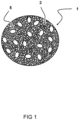
- Fig. 1 shows a sorbent granulate 1 for separation of carbon dioxide from a fluid mixture.
- the sorbent granulate 1 can be manufactured by performing the method according to the disclosure. A single granulate is shown. In some examples, multiple such granulates may be packed in a packed bed.
- the sorbent granulate 1 comprising ground amine functionalized sorbent material having amine groups chemically bound to the sorbent material surface, wherein the sorbent material is interconnected by a binder.
- the sorbent granulate has a diameter in a range of 0.1-25 millimeter, and wherein the granulate has first pores 3 having sizes in a first range and second pores 5 having sizes in a second range, wherein sizes in the second range are at least ten times larger than sizes in the first range.
- the adsorption kinetics can differ from the desorption kinetics.
- the desorption kinetics may be mainly determined by the post-treatment process (e.g. heating, vacuum, conditioning of the surrounding fluid, etc.).
- the heating of the packed bed may be an important aspect for the rate at which desorption proceeds. This partly determines the length of the cycle.
- the sorbent granulates according to the disclosure can improve the adsorption capacity. Additionally or alternatively, the pressure drop in a packed bed of the sorbent granulates according to the disclosure can be reduced, thus improving the energy efficiency.
- the sorbent granulates may be able to effectively adsorb carbon dioxide from a fluid mixture with a relatively low concentration of carbon dioxide therein, for instance a concentration of 400 ppm or even lower.
- the amine functionalized sorbent material with material having amine groups chemically bound to the sorbent material surface may be an ionic resin material.
- spherical beads of the amine functionalized sorbent material may be provided which is subsequently ground into a powder.
- the amine functionalized sorbent may be a polymer material with amino functionalities that can ensure selective binding with carbon dioxide, even with relatively low concentrations of carbon dioxide present in the fluid mixture.
- the amine functionalized sorbent may have mesopores (e.g. size of approx. 25 nanometer).
- the amine functionalized sorbent material may be commercially available.
- Lewatite is an amine functionalized sorbent material which is commercially available as an ionic resin usable for water purification.
- the amine functionalized sorbent material can release captured carbon dioxide requiring relatively low amount of energy (e.g. heating).
- the captured carbon dioxide may be effectively released by heating to a temperature remaining below 100 degrees Celsius.
- other materials such as a zeolite material may typically requires heating temperatures of 200 degrees Celsius or even more.
- the amine functionalized sorbent material (cf. covalent bound) has important advantages with respect to an impregnated material.
- the use of an amine functionalized sorbent material can effectively prevent that amines are released during the desorption step.
- the amine functionalized sorbent material is more stable and it is less likely that the amines are released during use, even when brought in contact with water (e.g. present in the gas flow).
- water e.g. present in the gas flow
- the amines may be released during desorption.
- the granulation is performed by utilizing a granulation arrangement.
- the granulation equipment is a high shear granulation device. This provides an easy way to obtain granulates of a desired size with a bimodal pore distribution. As water evaporates from the granulate (conditioning/drying process), the formed granulates may shrink, and a part of the volume where moisture used to be will remain empty, resulting in relatively large pores in the granulates. It has been observed, that a granulation process using the amine functionalized sorbent material powder and at least one binder results in granulates with an improved pore system. Additionally, the structural stability of the granulates may be improved.
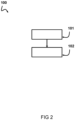
- Fig. 2 shows a schematic diagram of an embodiment of a process of producing sorbent granulates usable for separation of carbon dioxide from a fluid mixture.
- a first step 101 of the production process an amine functionalized sorbent material having amine groups chemically bound to the sorbent material surface which is ground into a powder is provided.
- the powder may for instance be obtained by means of a grinder or crushing device.
- the powder is sieved/filtered in order to have particles with sizes falling in a desired range.
- the powder is granulated into sorbent granulates using a binder.
- the granulation may for instance be performed in a granulation device, such as a mixing device.
- additives may be added to the powder and binder mixture.
- the granulation is performed such as to obtain sorbent granulates having a diameter in a range of 0.1-25 millimeter.
- a filtering/sieving step is carried out in order to isolate sorbent granulates having said dimensions.
- the grinding and/or crushing of the amine functionalized sorbent material into a powder and subsequent granulation for obtaining granulates based on the powder and at least one binder results in granulates which have beneficial properties. More particularly, the adsorption kinetics can be improved. Additionally or alternatively, the adsorption capacity can be improved. As a result, advantageously, larger granulates/beads may be packed in packed bed, resulting in a limited pressure drop and adequate adsorption kinetics. In some advantageous examples, the granulates obtained by means of the granulation step are sieved/filtered in order to have granulates having a size and/or an average size in a range of 0.1-25 millimeter. These granulates can then be packed in a packed bed which is used for separation of carbon dioxide from a gas stream.
- the granulation includes employing a high shear mixer.
- various other techniques may be employed for granulation, such as for example a spray drying technique.
- the amine functionalized sorbent materials is an ion exchange resin, preferably a weakly basic ion exchange resin, more preferably an amine functionalized resin.
- Sorbent materials suitable for use in the present invention are for example disclosed in US2019224647A1 , US2012228553A1 and US2011088550A1 .
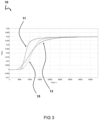
- Fig. 3 shows a schematic diagram of a graph 10 of experimental results.
- a gas stream with a constant amount of carbon dioxide (value 0.04 equals to 400 ppm carbon dioxide) is guided through a packed bed with different types of beads.
- the carbon dioxide in the gas stream is captured efficiently by the amine groups, resulting in a relatively low amount of carbon dioxide at the outlet of the packed bed.
- the carbon dioxide at the outlet of the packed bed will start to increase since some of the granulates become saturated or due to mass diffusion limitations.
- the graph shows an indication of the capacity of the sorbent granulates.
- An integral of a whole curve indicates how much carbon dioxide the packed bed of granulates can adsorb. This can be normalized to an amount of sorbent material (per gram), cf. mole CO 2 per gram of sorbent material. This value can be seen as a adsorption property of sorbent material of the granulates.
- ideal kinetics would result in a complete adsorption of the carbon dioxide at the outlet of the packed bed until the sorbent granulates are saturated, which would result in a certain increase of the carbon dioxide at the outlet of the packed bed (cf. step function). However, in reality the curve has varying steepness instead of a step function.
- the steepness of the curve may be seen as an indication of the adsorption kinetics (i.e. how well is the carbon dioxide adsorbed). More smoothed out curves (cf. less steep curves) are associated to detrimental adsorption kinetics. Various metrics or values can be used for quantifying the steepness of the curves.
- the experiments have been performed for different beads.
- the first curve 11 is obtained by using first beads, the first beads being granulated beads obtained by performing the method according to the disclosure.
- the second curve 13 is obtained by using second beads, the second beads being commercially available beads having the same size of the first beads.
- the third curve 15 is obtained by using third beads, the third beads being granulates according to the disclosure which are larger in size than the first and second beads.
- the granulates according to the disclosure can result in improved adsorption kinetics (more steep curve), even for larger granulate sizes.
- the pressure drop over a packed bed can be limited (cf. mainly related to size of granulates), whilst providing a beneficial adsorption kinetics.
- the improved adsorption kinetics which is obtained even for relatively large granulates, may be achieved by how the granulates are produced.
- a bimodal pore distribution can be obtained which can improve the adsorption kinetics despite the larger granulate size.
- a larger quantity of carbon dioxide can be captured from a fluid mixture or gas stream in a certain time period.
- a bimodal porous system is obtained with smaller pores which were present in the amine functionalized sorbent material before grinding, and additional larger pores, facilitating carbon dioxide to enter the granulates.
- the fine pores in the ground material can thus be substantially retained, and additional larger pores can be obtained in the granulates.
- the fine pores may for instance have a size around 25 nanometer, and a pore volume of around 270 mm3/mg for an exemplary amine functionalized sorbent material.
- the larger pores obtained by the granulation step may for instance having a size in a range of 1 to 10 micrometer. These additional larger pores allow the amino groups to be more easily accessible by the gas stream with carbon dioxide therein.
- the adsorption capacity has an impact on the cost of the system. For example, if the sorbent granulates are able to adsorb a large quantity of carbon dioxide, a less costly design may be obtained. However, it is also desirable to have a beneficial adsorption kinetics. For example, if the adsorption kinetics of the sorbent granulates is improved, the cycles may be made shorter since the carbon dioxide can more easily be adsorbed. This has impact on the amount of sorbent needed in the sorption setup.
- the amine functionalized resin is an ion exchange resin.
- the ion exchange resin may be a weakly basic ion exchange resin.
- the ion exchange resin is a polystyrene polymer based resin, which is crosslinked via the use of divinylbenze, and is functionalized with primary amine groups including benzylamine and wherein the resin is produced by a phthalimide process.
- the ion exchange resin may be a weakly basic ion exchange resin, or it may be a polystyrene polymer based resin, which is crosslinked via the use of divinylbenze, and is functionalized with primary amine groups including benzylamine and wherein the resin is produced by a phthalimide process.
- amine functionalized resin is in the form of bead polymers.
- the bead polymers may comprise polystyrene polymer resins comprising primary amines and crosslinked via divinylaromatics such as, for example, aminomethylated polystyrene-co-divinylbenzene (i.e., polybenzyl amine-co-divinylbenzene).
- the amine functionalized resin according to the present disclosure may be monodisperse or heterodisperse and macroporous or gel-types (microporous).
- a polymeric ion exchange resin may be produced from monovinylaromatic unsaturated compounds such as styrene, vinyltoluene, ethylstyrene, alpha-methylstyrene, chlorostyrene or chloromethylstyrene.
- Monovinylaromatic compounds (crosslinkers) used include divinyl-bearing aliphatic or aromatic compounds.
- divinylbenzene for example, use is made of divinylbenzene, divinyltoluene, trivinylbenzene, ethylene glycol dimethacrylate, trimethylol propane trimethacrylate, hexa-1,5-diene, octa-1,7-diene, 2,5-dimethyl-1,5-hexadiene and also divinyl ether.
- aromatic monomers for example, vinyl and vinylidene derivatives of benzene and of naphthalene (vinylnaphthalene, vinyltoluene, ethylstyrene, alphamethyl-styrene, chlorostyrenes, and styrene)
- various non-aromatic vinyl and vinylidene compounds may also be employed.
- the amine functionalized resin may be an ion exchange resin which utilizes is a crosslinked, weakly basic, monodisperse, macroporous, spherical, anion exchange polystyrene based resin being functionalized with primary amine groups produced by the phthalimide addition process, for example that which is commercially available from LANXESS GmbH under the brand name LEWATIT ® VP OC1065.
- the resin includes polyethylenimine (PEI); aminopropyltrimethoxysilane; polyethyleneimine-trimethoxysilane; amide or amine containing polymers including nylon, polyurethane, polyvinylamine, or melamine; and combinations thereof.
- PEI polyethylenimine
- aminopropyltrimethoxysilane aminopropyltrimethoxysilane
- polyethyleneimine-trimethoxysilane polyethyleneimine-trimethoxysilane
- amide or amine containing polymers including nylon, polyurethane, polyvinylamine, or melamine; and combinations thereof.
- the resin includes polybisphenol-A-carbonate, poly(ethylene terephthalate), polystyrene, poly(methyl methacrylate), poly(vinyl acetate), poly(vinyl chloride), polytetrafluoroethylene, polysulfone, polyether sulfone, poly(vinylidene fluoride), styrene/butyl acrylate/methacrylic acid terpolymer, and poly(vinylidene fluoride-cohexafluoropropylene).
- the ion exchange resin can be anionic, cationic or amphoteric.
- the amine functionalized resin is a particulate resin.
- the resin may include gel and macroporous ion-exchange resins such as sulfonated polystyrene-divinylbenzene and aminated polystyrene-divinylbenzene either in pure form or in mixtures (Type I, Type II or Type III) such as those available under the trademark DOWEX from the Dow Chemical Company; and; chromatography resins; bifunctional ion-exchange resins such as ion retardation resins (Biord AG11A8) or ion-exchange resins containing both sulfonate and quaternary amine functionality, sulfonated phenolic resin, polystyrene phosphoric acid or iminodiacetic acid resins, aminated acrylic or methacrylic resins, epoxy polyamine resins, aminoethyl cellulose or the like.
- gel and macroporous ion-exchange resins such as sulfonated
- binders can be used during granulation.
- the binder is an organic low temperature binder.
- water based polymer emulsion or dispersion or a thermosetting resins (and adhesives) may be used.
- An epoxy resin with aliphatic primary amine cross linking agent can cure the polymer at room temperature.
- Unsaturated polyester resin with methylethylketone can be used as the initiator.
- the organic binder is selected from low temperature curing acrylic resin, polyester resin, silicones; polyacrylics; polyvinylalcohols; polyoxyethylenes; polyelectrolytes; and polysaccharides.
- Other materials such as polyurethane may also be employed.
- polymeric binders are PVA, PVB and PEG.
- the water dispersible binder comprises a crosslinkable group, also referred to as a functional group or a curable group.
- a crosslinkable group may be selected from a hydroxyl group, a carboxyl group, an amino group, a glycidyl group, a silyl group, a silanate group, an epoxy group, a 1,3-dicarbonyl group (e.g. aceto acetoxy methacrylate of diacetone acrylamide), or an isocyanate group.
- a hydroxyl group is particularly preferred.
- the binder is water soluble or water dispersible.
- the binder may be selected from a polyolefin, a polyurethane (PU) based polymer, a polyvinyl alcohol (PVA), a polyacrylic (acrylic resin) and a polyester.
- Example of a polyurethane based binder is Incorez W835/494, commercially available from Incorez.
- Examples of polyurethane/acrylic hybrid resins are Incorez W2205, commercially available from INCOREZ; Hybridur 870 and Hybridur 878, commercially available from Air Products, EH3070E and EH1050, commercially available from EOC Belgium.
- acrylic resin examples include JURYMER ET-410 and SEK-301, commercially available from Nihon Junyaku; Encor 2171, commercially available from ARKEMA; Luhydran S945T, Joncryl OH 8312 and Joncryl OH 8313, commercially available from BASF; Neocryl XK110, commercially available from DSM; and Setaqua 510, commercially available from Nuplex, Optapix AC available from Zschimmer-Schwarz.
- Examples of a composite resin of acrylic and silicone are CERANATE WSA 1060, WSA 1070 commercially available from DIC Corporation; and H7620, H7630 and H76S0 commercially available from Asahi Kasei Corporation.
- the binder is polyvinylalcohol based, for example commercially available under the name Optapix PA.
- the binder is not water soluble.
- the stability of the granulates may be improved. Leaching for example due to the presence of water (vapor) and/or at higher temperatures may be effectively prevented.
- the sorbent granulates and the methods of the invention may be employed for various applications.
- the areas may be broadly divided into energy production and industrial emissions from chemical and materials processes.
- energy production there is contemplated herein the removal of carbon dioxide found in fuel gas produced from electricity generation (for example, steam boilers and combined cycle gas turbines) and steam production for industrial purposes (for example, steam heat and steam turbine drives).
- hydrocarbon fuel sources such as coal, petroleum liquids and natural gas, are burned to produce heat and power.
- the combustion of hydrocarbons with air results in the release of carbon dioxide as a constituent of fuel gas into the atmosphere.
- fuel gas from combustion of coal may contain around 15% (by volume) carbon dioxide along with water vapor, nitrogen and other components. While still significant, slightly lower carbon dioxide levels will generally be contained in fuel gas from combustion of petroleum liquids and natural gas as a result of their chemical makeup.
- Another broad energy production area of applicability of the subject invention is the removal of carbon dioxide from natural gas and produced gas.
- natural gas as it is removed from the well may contain varying amounts of carbon dioxide depending upon the well and the methods of enhancing natural gas production. It may often be desirable to reduce the amount of carbon dioxide from the raw natural gas, for example, as a way of meeting heat content specifications.
- Another example of applicability of the invention is upgrading of biogas into biomethane.
- any reference signs placed between parentheses shall not be construed as limiting the claim.
- the word 'comprising' does not exclude the presence of other features or steps than those listed in a claim.
- the words 'a' and 'an' shall not be construed as limited to 'only one', but instead are used to mean 'at least one', and do not exclude a plurality.
- the mere fact that certain measures are recited in mutually different claims does not indicate that a combination of these measures cannot be used to an advantage.
Landscapes
- Chemical & Material Sciences (AREA)
- Chemical Kinetics & Catalysis (AREA)
- Organic Chemistry (AREA)
- Analytical Chemistry (AREA)
- Engineering & Computer Science (AREA)
- General Chemical & Material Sciences (AREA)
- Oil, Petroleum & Natural Gas (AREA)
- Solid-Sorbent Or Filter-Aiding Compositions (AREA)
Priority Applications (5)
| Application Number | Priority Date | Filing Date | Title |
|---|---|---|---|
| EP21211413.6A EP4186591A1 (de) | 2021-11-30 | 2021-11-30 | Sorptionsmittelgranulat zur trennung von kohlendioxid aus einem fluidgemisch und verfahren zur herstellung davon |
| PCT/EP2022/083846 WO2023099562A1 (en) | 2021-11-30 | 2022-11-30 | A sorbent granulate for separation of carbon dioxide from a fluid mixture, and a method of producing thereof |
| CN202280078765.XA CN118450941A (zh) | 2021-11-30 | 2022-11-30 | 从流体混合物中分离二氧化碳的吸附剂颗粒及其生产方法 |
| CA3239485A CA3239485A1 (en) | 2021-11-30 | 2022-11-30 | A sorbent granulate for separation of carbon dioxide from a fluid mixture, and a method of producing thereof |
| EP22823479.5A EP4440740A1 (de) | 2021-11-30 | 2022-11-30 | Sorptionsmittelgranulat zur trennung von kohlendioxid aus einer fluidmischung und verfahren zur herstellung davon |
Applications Claiming Priority (1)
| Application Number | Priority Date | Filing Date | Title |
|---|---|---|---|
| EP21211413.6A EP4186591A1 (de) | 2021-11-30 | 2021-11-30 | Sorptionsmittelgranulat zur trennung von kohlendioxid aus einem fluidgemisch und verfahren zur herstellung davon |
Publications (1)
| Publication Number | Publication Date |
|---|---|
| EP4186591A1 true EP4186591A1 (de) | 2023-05-31 |
Family
ID=78820117
Family Applications (2)
| Application Number | Title | Priority Date | Filing Date |
|---|---|---|---|
| EP21211413.6A Withdrawn EP4186591A1 (de) | 2021-11-30 | 2021-11-30 | Sorptionsmittelgranulat zur trennung von kohlendioxid aus einem fluidgemisch und verfahren zur herstellung davon |
| EP22823479.5A Pending EP4440740A1 (de) | 2021-11-30 | 2022-11-30 | Sorptionsmittelgranulat zur trennung von kohlendioxid aus einer fluidmischung und verfahren zur herstellung davon |
Family Applications After (1)
| Application Number | Title | Priority Date | Filing Date |
|---|---|---|---|
| EP22823479.5A Pending EP4440740A1 (de) | 2021-11-30 | 2022-11-30 | Sorptionsmittelgranulat zur trennung von kohlendioxid aus einer fluidmischung und verfahren zur herstellung davon |
Country Status (4)
| Country | Link |
|---|---|
| EP (2) | EP4186591A1 (de) |
| CN (1) | CN118450941A (de) |
| CA (1) | CA3239485A1 (de) |
| WO (1) | WO2023099562A1 (de) |
Cited By (1)
| Publication number | Priority date | Publication date | Assignee | Title |
|---|---|---|---|---|
| WO2024056715A1 (en) * | 2022-09-15 | 2024-03-21 | Svante Technologies Inc. | Epoxidation of porous amine-based phenylic polymer resins and methods of use for carbon dioxide capture |
Families Citing this family (2)
| Publication number | Priority date | Publication date | Assignee | Title |
|---|---|---|---|---|
| WO2026063294A1 (ja) * | 2024-09-20 | 2026-03-26 | 日本碍子株式会社 | 多孔質体及びガス回収装置 |
| WO2026063295A1 (ja) * | 2024-09-20 | 2026-03-26 | 日本碍子株式会社 | 多孔質体及びガス回収装置 |
Citations (6)
| Publication number | Priority date | Publication date | Assignee | Title |
|---|---|---|---|---|
| US4719242A (en) * | 1985-12-20 | 1988-01-12 | Allied-Signal Inc. | Deionization sorbent comprised of ion exchange resin and polymer binder and ferromagnetic substance |
| US20110088550A1 (en) | 2009-10-19 | 2011-04-21 | Lanxess Sybron Chemicals Inc. | Process and apparatus for carbon dioxide capture via ion exchange resins |
| US20120228553A1 (en) | 2009-10-19 | 2012-09-13 | Lanxess Sybron Chemicals Inc. | Process and apparatus for carbon dioxide capture via ion exchange resins |
| US10065174B1 (en) * | 2015-09-28 | 2018-09-04 | U.S. Department Of Energy | Pelletized immobilized amine sorbent for CO2 capture |
| US20190224647A1 (en) | 2018-01-18 | 2019-07-25 | Research Triangle Institute | Polyamine Phosphorus Dendrimer Materials for Carbon Dioxide Capture |
| WO2021259760A1 (en) * | 2020-06-22 | 2021-12-30 | Climeworks Ag | Method and apparatus for direct air capture of carbon dioxide by using a solid polymeric support material functionalized with amino functionalities and the use of this material for carbon dioxide capture from air |
-
2021
- 2021-11-30 EP EP21211413.6A patent/EP4186591A1/de not_active Withdrawn
-
2022
- 2022-11-30 WO PCT/EP2022/083846 patent/WO2023099562A1/en not_active Ceased
- 2022-11-30 EP EP22823479.5A patent/EP4440740A1/de active Pending
- 2022-11-30 CA CA3239485A patent/CA3239485A1/en active Pending
- 2022-11-30 CN CN202280078765.XA patent/CN118450941A/zh active Pending
Patent Citations (6)
| Publication number | Priority date | Publication date | Assignee | Title |
|---|---|---|---|---|
| US4719242A (en) * | 1985-12-20 | 1988-01-12 | Allied-Signal Inc. | Deionization sorbent comprised of ion exchange resin and polymer binder and ferromagnetic substance |
| US20110088550A1 (en) | 2009-10-19 | 2011-04-21 | Lanxess Sybron Chemicals Inc. | Process and apparatus for carbon dioxide capture via ion exchange resins |
| US20120228553A1 (en) | 2009-10-19 | 2012-09-13 | Lanxess Sybron Chemicals Inc. | Process and apparatus for carbon dioxide capture via ion exchange resins |
| US10065174B1 (en) * | 2015-09-28 | 2018-09-04 | U.S. Department Of Energy | Pelletized immobilized amine sorbent for CO2 capture |
| US20190224647A1 (en) | 2018-01-18 | 2019-07-25 | Research Triangle Institute | Polyamine Phosphorus Dendrimer Materials for Carbon Dioxide Capture |
| WO2021259760A1 (en) * | 2020-06-22 | 2021-12-30 | Climeworks Ag | Method and apparatus for direct air capture of carbon dioxide by using a solid polymeric support material functionalized with amino functionalities and the use of this material for carbon dioxide capture from air |
Cited By (1)
| Publication number | Priority date | Publication date | Assignee | Title |
|---|---|---|---|---|
| WO2024056715A1 (en) * | 2022-09-15 | 2024-03-21 | Svante Technologies Inc. | Epoxidation of porous amine-based phenylic polymer resins and methods of use for carbon dioxide capture |
Also Published As
| Publication number | Publication date |
|---|---|
| CN118450941A (zh) | 2024-08-06 |
| WO2023099562A1 (en) | 2023-06-08 |
| CA3239485A1 (en) | 2023-06-08 |
| EP4440740A1 (de) | 2024-10-09 |
Similar Documents
| Publication | Publication Date | Title |
|---|---|---|
| WO2023099562A1 (en) | A sorbent granulate for separation of carbon dioxide from a fluid mixture, and a method of producing thereof | |
| EP2490789B1 (de) | Verfahren zur kohlenstoffdioxidbindung über ionenaustauschharze | |
| Qiusheng et al. | Porous zirconium alginate beads adsorbent for fluoride adsorption from aqueous solutions | |
| US6787029B2 (en) | Material for chromatography | |
| US9791211B2 (en) | Methods and compositions for drying coal | |
| US6843922B1 (en) | Bead and process for removing dissolved metal contaminants | |
| JPH0148818B2 (de) | ||
| CN1662738A (zh) | 用于滤毒罐的潜热蓄热型吸附材料及其制造方法 | |
| CN110280225B (zh) | 一种包裹相变储能胶囊的树脂吸附剂及其制备方法和应用 | |
| JP2004066153A (ja) | ホウ素選択吸着能を有する有機多孔質体、これを用いたホウ素除去モジュールおよび超純水製造装置 | |
| CN104254376A (zh) | 用于液体过滤系统的复合离子交换介质 | |
| EP2814593A1 (de) | Substrate für kohlendioxidabscheidung und verfahren zur herstellung davon | |
| CN107107022A (zh) | 具有微波吸收性能的吸附剂 | |
| CN102284279A (zh) | 一种凹凸棒土/二氧化硅复合粉末及其制备方法 | |
| CN106139818A (zh) | 一种利用相变储能材料稳定气体吸附脱附温度的方法 | |
| US9908079B2 (en) | Separation of hydrocarbons using regenerable macroporous alkylene-bridged adsorbent | |
| CA2817309A1 (en) | Methods and compositions for drying coal | |
| EP4615629A1 (de) | Hydrophobe saure gasabsorptionsmittel | |
| Daneshfozoun et al. | Kinetics, isotherms and thermodynamics of heavy metal ions sorption onto raw and agro-based magnetic biosorbent | |
| JP2006068693A (ja) | キャニスター用吸着材、その製造方法及び燃料蒸散防止用キャニスター | |
| WO2015109385A1 (en) | Carbon monolith, carbon monolith with metal impregnant and method of producing same | |
| JP2003166982A (ja) | 有機多孔質体、その製造方法および有機多孔質イオン交換体 | |
| JP7769604B2 (ja) | 潜熱蓄熱材一体型活性炭及びその製造方法 | |
| JP4176932B2 (ja) | 水分吸脱着材料 | |
| RU2619322C1 (ru) | Способ получения композиционного угольно-фторопластового сорбента для очистки сточных вод от нефтепродуктов и органических загрязнителей |
Legal Events
| Date | Code | Title | Description |
|---|---|---|---|
| PUAI | Public reference made under article 153(3) epc to a published international application that has entered the european phase |
Free format text: ORIGINAL CODE: 0009012 |
|
| STAA | Information on the status of an ep patent application or granted ep patent |
Free format text: STATUS: THE APPLICATION HAS BEEN PUBLISHED |
|
| AK | Designated contracting states |
Kind code of ref document: A1 Designated state(s): AL AT BE BG CH CY CZ DE DK EE ES FI FR GB GR HR HU IE IS IT LI LT LU LV MC MK MT NL NO PL PT RO RS SE SI SK SM TR |
|
| STAA | Information on the status of an ep patent application or granted ep patent |
Free format text: STATUS: THE APPLICATION IS DEEMED TO BE WITHDRAWN |
|
| 18D | Application deemed to be withdrawn |
Effective date: 20231201 |