EP4185767B1 - Module de turbomachine equipe d'une helice et d'aubes de stator supportees par des moyens de maintien et turbomachine correspondante - Google Patents
Module de turbomachine equipe d'une helice et d'aubes de stator supportees par des moyens de maintien et turbomachine correspondante Download PDFInfo
- Publication number
- EP4185767B1 EP4185767B1 EP21752086.5A EP21752086A EP4185767B1 EP 4185767 B1 EP4185767 B1 EP 4185767B1 EP 21752086 A EP21752086 A EP 21752086A EP 4185767 B1 EP4185767 B1 EP 4185767B1
- Authority
- EP
- European Patent Office
- Prior art keywords
- turbine engine
- pivot shaft
- axis
- engine module
- stator
- Prior art date
- Legal status (The legal status is an assumption and is not a legal conclusion. Google has not performed a legal analysis and makes no representation as to the accuracy of the status listed.)
- Active
Links
Images



Classifications
-
- B—PERFORMING OPERATIONS; TRANSPORTING
- B64—AIRCRAFT; AVIATION; COSMONAUTICS
- B64C—AEROPLANES; HELICOPTERS
- B64C11/00—Propellers, e.g. of ducted type; Features common to propellers and rotors for rotorcraft
- B64C11/008—Propellers, e.g. of ducted type; Features common to propellers and rotors for rotorcraft characterised by vibration absorbing or balancing means
-
- B—PERFORMING OPERATIONS; TRANSPORTING
- B64—AIRCRAFT; AVIATION; COSMONAUTICS
- B64C—AEROPLANES; HELICOPTERS
- B64C11/00—Propellers, e.g. of ducted type; Features common to propellers and rotors for rotorcraft
- B64C11/30—Blade pitch-changing mechanisms
- B64C11/32—Blade pitch-changing mechanisms mechanical
-
- B—PERFORMING OPERATIONS; TRANSPORTING
- B64—AIRCRAFT; AVIATION; COSMONAUTICS
- B64D—EQUIPMENT FOR FITTING IN OR TO AIRCRAFT; FLIGHT SUITS; PARACHUTES; ARRANGEMENT OR MOUNTING OF POWER PLANTS OR PROPULSION TRANSMISSIONS IN AIRCRAFT
- B64D15/00—De-icing or preventing icing on exterior surfaces of aircraft
- B64D15/02—De-icing or preventing icing on exterior surfaces of aircraft by ducted hot gas or liquid
- B64D15/04—Hot gas application
-
- F—MECHANICAL ENGINEERING; LIGHTING; HEATING; WEAPONS; BLASTING
- F01—MACHINES OR ENGINES IN GENERAL; ENGINE PLANTS IN GENERAL; STEAM ENGINES
- F01D—NON-POSITIVE DISPLACEMENT MACHINES OR ENGINES, e.g. STEAM TURBINES
- F01D17/00—Regulating or controlling by varying flow
- F01D17/10—Final actuators
- F01D17/12—Final actuators arranged in stator parts
- F01D17/14—Final actuators arranged in stator parts varying effective cross-sectional area of nozzles or guide conduits
- F01D17/16—Final actuators arranged in stator parts varying effective cross-sectional area of nozzles or guide conduits by means of nozzle vanes
- F01D17/162—Final actuators arranged in stator parts varying effective cross-sectional area of nozzles or guide conduits by means of nozzle vanes for axial flow, i.e. the vanes turning around axes which are essentially perpendicular to the rotor centre line
-
- F—MECHANICAL ENGINEERING; LIGHTING; HEATING; WEAPONS; BLASTING
- F01—MACHINES OR ENGINES IN GENERAL; ENGINE PLANTS IN GENERAL; STEAM ENGINES
- F01D—NON-POSITIVE DISPLACEMENT MACHINES OR ENGINES, e.g. STEAM TURBINES
- F01D25/00—Component parts, details, or accessories, not provided for in, or of interest apart from, other groups
- F01D25/02—De-icing means for engines having icing phenomena
-
- F—MECHANICAL ENGINEERING; LIGHTING; HEATING; WEAPONS; BLASTING
- F01—MACHINES OR ENGINES IN GENERAL; ENGINE PLANTS IN GENERAL; STEAM ENGINES
- F01D—NON-POSITIVE DISPLACEMENT MACHINES OR ENGINES, e.g. STEAM TURBINES
- F01D25/00—Component parts, details, or accessories, not provided for in, or of interest apart from, other groups
- F01D25/04—Antivibration arrangements
-
- F—MECHANICAL ENGINEERING; LIGHTING; HEATING; WEAPONS; BLASTING
- F01—MACHINES OR ENGINES IN GENERAL; ENGINE PLANTS IN GENERAL; STEAM ENGINES
- F01D—NON-POSITIVE DISPLACEMENT MACHINES OR ENGINES, e.g. STEAM TURBINES
- F01D9/00—Stators
- F01D9/06—Fluid supply conduits to nozzles or the like
- F01D9/065—Fluid supply or removal conduits traversing the working fluid flow, e.g. for lubrication-, cooling-, or sealing fluids
-
- F—MECHANICAL ENGINEERING; LIGHTING; HEATING; WEAPONS; BLASTING
- F02—COMBUSTION ENGINES; HOT-GAS OR COMBUSTION-PRODUCT ENGINE PLANTS
- F02C—GAS-TURBINE PLANTS; AIR INTAKES FOR JET-PROPULSION PLANTS; CONTROLLING FUEL SUPPLY IN AIR-BREATHING JET-PROPULSION PLANTS
- F02C7/00—Features, components parts, details or accessories, not provided for in, or of interest apart form groups F02C1/00 - F02C6/00; Air intakes for jet-propulsion plants
- F02C7/04—Air intakes for gas-turbine plants or jet-propulsion plants
- F02C7/047—Heating to prevent icing
-
- F—MECHANICAL ENGINEERING; LIGHTING; HEATING; WEAPONS; BLASTING
- F04—POSITIVE - DISPLACEMENT MACHINES FOR LIQUIDS; PUMPS FOR LIQUIDS OR ELASTIC FLUIDS
- F04D—NON-POSITIVE-DISPLACEMENT PUMPS
- F04D29/00—Details, component parts, or accessories
- F04D29/40—Casings; Connections of working fluid
- F04D29/52—Casings; Connections of working fluid for axial pumps
- F04D29/54—Fluid-guiding means, e.g. diffusers
- F04D29/56—Fluid-guiding means, e.g. diffusers adjustable
- F04D29/563—Fluid-guiding means, e.g. diffusers adjustable specially adapted for elastic fluid pumps
-
- B—PERFORMING OPERATIONS; TRANSPORTING
- B64—AIRCRAFT; AVIATION; COSMONAUTICS
- B64D—EQUIPMENT FOR FITTING IN OR TO AIRCRAFT; FLIGHT SUITS; PARACHUTES; ARRANGEMENT OR MOUNTING OF POWER PLANTS OR PROPULSION TRANSMISSIONS IN AIRCRAFT
- B64D27/00—Arrangement or mounting of power plants in aircraft; Aircraft characterised by the type or position of power plants
- B64D2027/005—Aircraft with an unducted turbofan comprising contra-rotating rotors, e.g. contra-rotating open rotors [CROR]
-
- B—PERFORMING OPERATIONS; TRANSPORTING
- B64—AIRCRAFT; AVIATION; COSMONAUTICS
- B64D—EQUIPMENT FOR FITTING IN OR TO AIRCRAFT; FLIGHT SUITS; PARACHUTES; ARRANGEMENT OR MOUNTING OF POWER PLANTS OR PROPULSION TRANSMISSIONS IN AIRCRAFT
- B64D33/00—Arrangement in aircraft of power plant parts or auxiliaries not otherwise provided for
- B64D33/02—Arrangement in aircraft of power plant parts or auxiliaries not otherwise provided for of combustion air intakes
- B64D2033/0233—Arrangement in aircraft of power plant parts or auxiliaries not otherwise provided for of combustion air intakes comprising de-icing means
-
- F—MECHANICAL ENGINEERING; LIGHTING; HEATING; WEAPONS; BLASTING
- F01—MACHINES OR ENGINES IN GENERAL; ENGINE PLANTS IN GENERAL; STEAM ENGINES
- F01D—NON-POSITIVE DISPLACEMENT MACHINES OR ENGINES, e.g. STEAM TURBINES
- F01D25/00—Component parts, details, or accessories, not provided for in, or of interest apart from, other groups
- F01D25/04—Antivibration arrangements
- F01D25/06—Antivibration arrangements for preventing blade vibration
-
- F—MECHANICAL ENGINEERING; LIGHTING; HEATING; WEAPONS; BLASTING
- F01—MACHINES OR ENGINES IN GENERAL; ENGINE PLANTS IN GENERAL; STEAM ENGINES
- F01D—NON-POSITIVE DISPLACEMENT MACHINES OR ENGINES, e.g. STEAM TURBINES
- F01D5/00—Blades; Blade-carrying members; Heating, heat-insulating, cooling or antivibration means on the blades or the members
- F01D5/12—Blades
- F01D5/26—Antivibration means not restricted to blade form or construction or to blade-to-blade connections or to the use of particular materials
-
- F—MECHANICAL ENGINEERING; LIGHTING; HEATING; WEAPONS; BLASTING
- F05—INDEXING SCHEMES RELATING TO ENGINES OR PUMPS IN VARIOUS SUBCLASSES OF CLASSES F01-F04
- F05D—INDEXING SCHEME FOR ASPECTS RELATING TO NON-POSITIVE-DISPLACEMENT MACHINES OR ENGINES, GAS-TURBINES OR JET-PROPULSION PLANTS
- F05D2260/00—Function
- F05D2260/96—Preventing, counteracting or reducing vibration or noise
-
- Y—GENERAL TAGGING OF NEW TECHNOLOGICAL DEVELOPMENTS; GENERAL TAGGING OF CROSS-SECTIONAL TECHNOLOGIES SPANNING OVER SEVERAL SECTIONS OF THE IPC; TECHNICAL SUBJECTS COVERED BY FORMER USPC CROSS-REFERENCE ART COLLECTIONS [XRACs] AND DIGESTS
- Y02—TECHNOLOGIES OR APPLICATIONS FOR MITIGATION OR ADAPTATION AGAINST CLIMATE CHANGE
- Y02T—CLIMATE CHANGE MITIGATION TECHNOLOGIES RELATED TO TRANSPORTATION
- Y02T50/00—Aeronautics or air transport
- Y02T50/60—Efficient propulsion technologies, e.g. for aircraft
Definitions
- the present invention relates to the field of turbomachines.
- a turbomachine module comprising an unducted propeller and a rectifier with stator blades. It also relates to the corresponding turbomachine.
- Turbomachines comprising at least one unducted propeller are known by the English term “open rotor” or "unducted fan". In this category of turbomachine, there are those which have two unducted and counter-rotating propellers (known by the English acronym UDF for "Unducted Dual Fan”) or those having a single unducted propeller and a rectifier comprising several stator blades (known by the English acronym USF for "Unducted Single Fan”).
- the propeller or propellers forming the propulsive part can be placed at the rear of the gas generator (or engine) so as to be of the pusher type or at the front of the gas generator so as to be of the tractor type.
- turbomachines are turboprops which are distinguished from turbojets by the use of a propeller outside the nacelle (unducted) instead of an internal fan. This makes it possible to increase the dilution ratio very significantly without being penalized by the mass of the casings or nacelles intended to surround the blades of the propeller or fan.
- An example is disclosed in the patent application US 2017/102006 .
- the stator vanes of the rectifier are generally installed on an inlet casing which carries the separation nozzle of the primary and secondary flows circulating respectively in a primary vein and around the inlet casing.
- the stator vanes extend from the inlet casing and are advantageously variable pitch. These stator vanes also have a large diameter of the order of 1 meter, or even 1.20 meters, which makes it difficult to embed the pivoting feet of the stator vanes in their housings and their mechanical resistance under vibration stress. Vibrations can cause the pivot axes to jam or the stator vane itself or surrounding components to break.
- the objective of the present invention is to provide a turbomachine module with stator blades having improved mechanical stability while being economical.
- this solution makes it possible to achieve the aforementioned objective.
- installing this holding member at least between two adjacent stator blades and the anti-vibration means of the blade pivot shaft makes it possible to improve the mechanical strength of the blades.
- the foot pivoting about the setting axis and the holding member which, on the one hand, connects the stator blades at least two by two and, on the other hand, is radially distant from the pivoting foot of the blades, generate effective holding of the stator blades.
- This configuration is also favorable to reducing the transmission of vibrations from the foot of the blades to their free ends.
- the assembly is then more rigid.
- the invention further relates to an aircraft turbomachine comprising at least one turbomachine module having any one of the preceding characteristics.
- turbomachine 1 comprising a single unducted propeller 2 and a rectifier 3 which is also unducted.
- the turbomachine is intended to be mounted on an aircraft.
- Such a turbomachine is a turboprop as shown in the figure 1 .
- This turbomachine is known by the English expression "Unducted Single Fan” as explained previously.
- the invention applies to other types of turbomachine.
- upstream is defined in relation to the circulation of gases in the turbomachine and here along the longitudinal axis X (and even from left to right on the figure 1 ).
- radial is defined with respect to a radial axis Z perpendicular to the longitudinal axis X and with respect to the distance from the longitudinal axis X.
- the turbomachine 1 comprises a gas generator 4 which typically comprises from upstream to downstream, a low pressure compressor 5, a high pressure compressor 6, a combustion chamber 7, a high pressure turbine 8 and a low pressure turbine 9.
- the low pressure compressor 5 and the low pressure turbine 9 are mechanically connected by a low pressure shaft 10 so as to form a low pressure body.
- the high pressure compressor 6 and the high pressure turbine 8 are mechanically connected by a high pressure shaft 11 so as to form a high pressure body. pressure.
- the low pressure shaft 10 extends at least partly inside the high pressure shaft 11 and are coaxial with the longitudinal axis X.
- the low pressure or low pressure body comprises the low pressure compressor which is connected to an intermediate pressure turbine.
- a free power turbine is mounted downstream of the intermediate pressure turbine and is connected to the propeller described below via a power transmission shaft to drive it in rotation.
- the unducted propeller 2 is formed of a crown of movable blades 2a which extend from a rotating casing 12 which is centered and movable in rotation about the longitudinal axis X.
- the rotating casing 12 is mounted movable relative to an internal casing 13 which extends downstream of the rotating casing 12.
- the propeller 2 is mounted upstream of the gas generator 4 (tractor configuration or “puller” in English).
- the propeller 2 is mounted downstream of the gas generator 4 (pusher configuration or “pusher” in English).
- the blades 2a of the propeller 2 can be variable pitch by means of a pitch change system 14.
- An air flow F passing through the turbomachine 1 is divided into a primary air flow F1 and a secondary air flow F2 at a separation nozzle 15.
- the latter is carried by an inlet casing 16 centered on the longitudinal axis.
- the rotating casing 12 is also mounted to move relative to the inlet casing 16.
- the latter is extended downstream by an external casing or inter-stream casing 17.
- the inlet casing 16 comprises a radially internal shell 18 and a radially external shell 19 (cf. figure 2 ) which are centered on the X axis and which partly form, respectively, the radially internal and external walls of the primary vein 20 in which the primary air flow F1 circulates.
- a plurality of structural arms 21 extend radially between the radially internal shell 18 and the radially external shell 19.
- the power shaft or the low pressure shaft 10 (respectively of the free power turbine and the low pressure turbine) drives the propeller 2 which compresses the air flow outside the external casing 17 and provides the majority of the thrust.
- a reducer 22 is interposed between the propeller 2 and the power shaft as shown in FIG. figure 1 .
- the reducer 22 can be of the planetary or epicyclic type.
- the rectifier 3 is arranged downstream of the propeller 2.
- the rectifier 3 comprises a plurality of stator vanes 23 (or fixed vanes) known by the English acronym “OGV” for Outlet Guide Vane.
- the stator vanes 23 are distributed regularly around the longitudinal axis X and extend radially in the secondary air flow F2.
- the stator vanes 23 of the rectifier 3 are arranged downstream of the blades 2a of the propeller 2 so as to straighten the air flow generated by them.
- turbomachine module a module which comprises at least one propeller and one rectifier.
- the blades of the stator vanes 23 of this module have a height substantially along the radial axis which is less than that of the blades 2a of the propeller 2. In this way, the stator vanes can straighten the flow created by the propeller 2 upstream while reducing the drag without being too heavy.
- the stator vanes 23 have a height along the radial axis which is between 30% and 90% of the radial height of the blades of the propeller 2.
- Each stator vane 23 includes a blade 24 that extends radially from a root 25.
- the blades 24 also each include an axially opposed leading edge 26a and trailing edge 26b.
- the leading and trailing edges 26a, 26b are connected by transversely opposed intrados and extrados surfaces 27.
- the stator blades 23 are advantageously variable pitch so as to optimize the performance of the turbomachine.
- a second pitch change system 34 which is mounted in the turbomachine, and in particular in the external casing 17, is connected to the blades of the stator blades 23 so as to allow them to pivot about their pitch axes.
- each stator blade foot 25 23 is mounted in an internal housing 28 which is formed in a sleeve 29.
- the latter is carried by a ring which is rigidly fixed to the input casing 16 upstream by a first tab 30 and downstream by a second tab 31.
- Each sleeve 29 is cylindrical and extends substantially along the radial axis.
- the sleeves and the tabs 30, 31 are made in one piece (monobloc). Alternatively, the sleeves 29 and the tabs 30, 31 are manufactured separately and then assembled to form a monobloc assembly.
- the foot 25 of each blade 23 is typically in the form of a pivot 32 which is pivotally mounted along a setting axis A in the internal housing 28 of the sleeve 29.
- the pivot 32 of the foot 25 is pivotally mounted by means of at least one guide bearing 33 which ensures the retention of the pivot 32 in the internal housing 28 of each sleeve 29.
- Two guide bearings can be mounted in the housing 28 and in a superimposed manner along the setting axis A.
- the bearing(s) is/are preferably, but not limited to, roller bearings.
- the pitch change system 34 comprises at least one control means 35 and at least one connecting mechanism 36 which are schematically shown in the figure 1 .
- the connecting mechanism 36 is connected on the one hand to each foot 25 of blade 24 and to the control means 35 on the other hand.
- the pivot 32 which passes through the sleeve 29 on either side along the setting axis A, comprises an internal end with an eccentric which is connected to the end of a connecting rod (not shown) of the connecting mechanism 36.
- the latter comprises a plurality of connecting rods, one of their ends of which is each connected to a blade foot.
- the other end of each connecting rod is connected to a movable member of the control means which may be a hydraulic or pneumatic cylinder.
- the setting axis A is inclined relative to the radial axis Z.
- the angle of inclination is between 5° and 45°.
- the setting axis is inclined downstream. Such an inclination allows the setting of the stator blades to have an aerodynamic effect adapted over the entire radial height of the stator blades 23.
- holding means are intended to ensure the mechanical holding of the stator blades 23.
- the holding means are coupled to the stator blades 23 via at least one pivot connection.
- at least one blade 24 of the stator blade 23 pivots relative to a holding member 37 allowing stability thereof during its pivoting and during operation of the turbomachine.
- the holding member 37 extends at least between two adjacent stator blades 23 in a circumferential direction.
- the holding member 37 is mounted radially at a distance from the root 25 of the stator blades which is crossed by the setting axis A.
- the holding member 37 is annular and extends around the longitudinal axis X (360°). In this way, the stator blades 23 are each held on the one hand, at the feet and on the other hand, at the level of a portion of the blade by the holding member 37.
- the holding member 37 is in the form of a ferrule which has an aerodynamically shaped section, for example of the NACA type.
- the holding member 37 comprises an external surface 38 and an internal surface 39 which are connected on the one hand by a first edge 40 and on the other hand by a second edge 41.
- Each blade 24 pivots by means of a pivot shaft 42 whose pivot axis B is here coaxial with the setting axis A and extends at least partly into the blade 24.
- Each blade 24 comprises a notch 43 which is located in this example approximately halfway up the blade (depending on the height of the blade measured between its radially inner end 24a and its free radially outer end 24b).
- the notch 43 extends substantially axially from a bottom 44 and the trailing edge 26b of the blade 24.
- the notch 43 opens more precisely onto the trailing edge 26b, but also transversely onto the intrados surface 27 and onto the extrados surface of the blade 24.
- the notch 43 comprises a radially inner wall 45 and a radially outer wall 46 which are opposite and spaced substantially along the radial axis.
- the bottom 44 is elongated by the radially inner and outer walls 45, 46.
- the pivot shaft 42 extends between the radially inner wall 45 and the radially outer wall 46, along the setting axis A.
- the first edge 40 of the holding member 37 is opposite and at a distance from the bottom 44 of the notch 4.
- the second extends outside the notch 43 and is axially offset from the trailing edge 26b of the blade 24.
- the surfaces 38, 39 of the holding member are at a distance from the radially inner and outer walls 45, 46 so that the blade can pivot easily.
- Each pivot shaft 42 comprises a first end 42a which is integral with the radially inner wall 45 and a second end 42b which is integral with the radially outer wall 46.
- the pivot shaft 42 and the blade 24 can be made in one piece (made from one material).
- FIG 4 illustrates an alternative embodiment of the means for holding the stator blades 23. Elements that are identical or substantially identical to those presented previously and/or with the same functions are represented by the same reference numerals.
- Each blade 24 pivots by means of a pivot shaft 42 as well.
- the latter comprises at its first end 42a at least one plate 47 which is fixed to an intrados 27 and/or extrados surface of the blade 24.
- the plate 47 is fixed by means of fixing members such as screws 53 or by welds.
- the pivot axis B is in this case offset from the plane in which the plate 47 is defined so that the pivot shaft 42 is inside the notch 43.
- the second end 42b of the pivot shaft 42 is free and at a distance from the radially external wall 46 of the blade 24.
- the second end 42b can be fixed to the blade via a plate and the first end can be free.
- the first and second ends 42a, 42b of the pivot shaft 42 can each be carried by at least one plate which is fixed to the intrados surface and/or to the extrados surface of the blade of the stator vanes 23.
- the holding member 37 comprises at least one housing 48 in which the pivot shaft 42 is mounted.
- the housing 48 is formed by a bore passing through the wall of the holding member 37 on either side and substantially along the setting axis A (substantially along the radial axis Z).
- the pivot shaft 42 here passes through the housing 48.
- the latter is cylindrical with an axis coaxial with that of the pivot shaft 42.
- the pivot shaft 42 is guided in rotation by means of at least one guide bearing 49.
- the guide bearing 49 is a rolling bearing.
- the bearing 49 comprises an inner ring, an outer ring and rolling elements arranged between the inner ring and the outer ring.
- the inner ring is integral with the pivot shaft and the outer ring is integral with an internal surface 54 of the housing 48.
- the rolling elements may be balls or rollers.
- Anti-vibration means 55 of the pivot shaft 42 are also housed in the housing 48 so as to participate in the mechanical holding of the stator blade 23 and to limit the propagation of vibrations.
- the anti-vibration means 55 are housed between an internal surface of the housing 48 and the guide bearing 49.
- the anti-vibration means 55 advantageously comprise a ring made of elastic material which is centered on the pivot axis B of the pivot shaft 42.
- the elastic material may comprise an elastomer such as a rubber.
- the holding member 37 is also supported by several arms 50 to improve the mechanical strength of the stator blades 23.
- At least one arm 50 connects the holding member 37 to a fixed structure of the turbomachine.
- the inlet casing 16 constitutes the fixed structure.
- the arms 50 extend substantially radially between the holding member 37 and the inlet casing 16.
- Each arm advantageously, but not limited to, has an aerodynamic shape with an upstream edge 50a and a downstream edge 50b which are axially opposed and which each connect a first surface and a second surface which are transversely opposed.
- the upstream edge 50a of the arms 50 extends radially at a distance from the trailing edge 26b so as to guarantee the pivoting of each blade 24.
- Each arm 50 further comprises a first end 51 which is secured to the inlet casing 16.
- the first end 51 is advantageously fixed to a ferrule of the inlet casing 16.
- the first end 51 is fixed using fixing elements such as screws, nuts, bolts or any other element allowing easy assembly and/or disassembly thereof.
- Each arm 50 also comprises a second end 52 which is secured to the holding member 37.
- the second end 52 is radially opposite the first end 51.
- the second end 52 can also be fixed by fixing elements such as screws, nuts, bolts or glue or even welding.
- the arms and the holding member 37 are formed from a single piece (made from one material).
- the bottoms 50 are each preferably hollow.
- a defrosting device 60 is also provided to prevent ice from forming at least at the pivot connection between the blades 24 and the holding member 37. The pivoting of the stator blades 23 is then guaranteed in all circumstances.
- the defrosting device 60 is intended to take hot air from the primary stream 20 and distribute it in the holding means (holding member 37 and arm 50) of the stator blades 23. The hot air is taken in particular at the low-pressure compressor 5 which raises the temperature of the air flow entering the turbomachine.
- the defrosting device 60 comprises a hot air conveying pipe 61 with a first end 62 opening into the primary vein 20.
- the device 60 comprises a control valve 63 which is arranged on the pipe 61 to control the flow rate of hot air to be taken and regulate the flow rate.
- the valve 63 is arranged downstream of the first end 62 in the direction of circulation of the hot air flow in the pipe 61.
- the pipe 61 comprises in particular a first portion 61a which is connected to the first end 62 and which runs inside at least one arm 50.
- the pipe 61 comprises a second portion 61b which is connected to the first portion 61a.
- the second portion 61b runs in the holding member 37 in a circumferential direction.
- the pipe 61 comprises a third portion 61c which is connected on the one hand to the second portion 61b and which is connected on the other hand to a second end of the pipe 61 which opens near the pivot shaft 42.
- the second portion 61b distributes hot air to all the housings 48 of the holding member.
- the pipe 61 comprises a ring portion 61d which surrounds each housing 48. In this case, the second end of the pipe 61 opens into the third portion 61c of the pipe 61 which is located in the holding member 37.
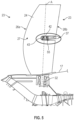
- FIG. 5 Another embodiment of the rectifier 3 installed downstream of the propeller 2 is illustrated in the figure 5 .
- the stator blades 23 of the rectifier 3 are also held at least in part by holding means comprising at least one holding member 37.
- the blades 24 of the stator blades comprise for this purpose, at least in part, a notch 43 opening into the trailing edge thereof.
- the elements identical or substantially identical to those presented previously and/or with the same functions are represented by the same numerical references.
- the difference with the previous embodiment of the Figures 1 to 3 is that the holding means 37 are devoid of arms extending radially between the outer casing and the holding member.
- the holding member 37 is annular, extends around the longitudinal axis and passes through the notches 43 of all the blades 24 of the stator vanes circumferentially.
- a pivot shaft passes radially through each notch 43.
- the blades 24 each pivot at their root and at the pivot shaft 42 located halfway up the blade.
- the pivot shaft passes through the housing 48 which is advantageously equipped with the anti-vibration means 55.
- FIG. 6 represents yet another embodiment of the rectifier 3 installed downstream of the propeller 2.
- the stator blades 23 of the rectifier 3 are also held at least in part by at least holding means. Elements identical or substantially identical to those presented previously and/or with the same functions are represented by the same reference numerals.
- the holding means comprise at least one arm 50 and at least one holding member 37 which is carried by the arm 50.
- a pivot shaft 42 is arranged at the free radially outer end 24b of at least one blade 24 of the stator blades 23.
- all the blades are equipped with a pivot shaft 42 extending radially outwards and from the radially outer end 24b.
- the holding member 37 is also mounted at the radially external end 24b of the blades 24 of the rotor blades 23 and extends circumferentially between at least two adjacent blades.
- the holding member is annular (360°) and extends around the longitudinal axis X.
- the holding member comprises several housings 48, each with a bottom 64 and an opening 65 which opens onto the internal surface 39 of the holding member 37. In other words, the housings are not through-holes.
- Each housing 48 is arranged regularly in the holding member 37 in the circumferential direction and so as to be opposite a corresponding pivot shaft 42.
- the anti-vibration means 55 and the bearing guide 49 in rotation are housed in each housing 48.
- a defrosting device 60 also equips the holding means. More precisely, the pipe 61 of the defrosting device 60, a portion of which equips the arms 50, extends into the holding member 37 in the upper part of the stator blade 23.
- the stator blades 23 are held at their root 25 and the radially external ends 27b (head of the blade) and can pivot easily, while being damped and in all circumstances.
Landscapes
- Engineering & Computer Science (AREA)
- Mechanical Engineering (AREA)
- General Engineering & Computer Science (AREA)
- Aviation & Aerospace Engineering (AREA)
- Chemical & Material Sciences (AREA)
- Combustion & Propulsion (AREA)
- Physics & Mathematics (AREA)
- Fluid Mechanics (AREA)
- Structures Of Non-Positive Displacement Pumps (AREA)
- Turbine Rotor Nozzle Sealing (AREA)
Description
- La présente invention concerne le domaine des turbomachines. En particulier un module de turbomachine comprenant une hélice non carénée et un redresseur avec des aubes de stator. Elle vise également la turbomachine correspondante.
- Des turbomachines comprenant au moins une hélice non carénée sont connues sous le terme anglais « open rotor » ou « unducted fan ». Dans cette catégorie de turbomachine, il existe celles qui ont deux hélices non carénées et contrarotatives (connues sous l'acronyme anglais UDF pour « Unducted Dual Fan ») ou celles ayant une seule hélice non carénée et un redresseur comprenant plusieurs aubes de stator (connues sous l'acronyme anglais USF pour « Unducted Single Fan »). L'hélice ou les hélices formant la partie propulsive peu(ven)t être placée(s) à l'arrière du générateur de gaz (ou moteur) de sorte à être du type pousseur ou à l'avant du générateur de gaz de sorte à être du type tracteur. Ces turbomachines sont des turbopropulseurs qui se distinguent des turboréacteurs par l'utilisation d'une hélice à l'extérieur de la nacelle (non carénée) au lieu d'une soufflante interne. Cela permet d'augmenter le taux de dilution de façon très importante sans être pénalisé par la masse des carters ou nacelles destiné(e)s à entourer les pales de l'hélice ou soufflante. Un exemple est divulgué dans la demande de brevet
US 2017/102006 . - Les aubes de stator du redresseur sont installées généralement sur un carter d'entrée qui porte le bec de séparation des flux primaire et secondaire circulant respectivement dans une veine primaire et autour du carter d'entrée. Les aubes de stator s'étendent depuis le carter d'entrée et sont avantageusement à calage variable. Ces aubes de stator présentent également un grand diamètre de l'ordre de 1 mètre, voire 1,20 mètres, qui rend difficile l'encastrement des pieds pivotants des aubes de stator dans leurs logements et leurs tenues mécaniques sous sollicitation vibratoire. Les vibrations peuvent entraîner le blocage des axes de pivotement ou la rupture de l'aube de stator elle-même ou d'organes environnants.
- L'objectif de la présente invention est de fournir un module de turbomachine avec des aubes de stator ayant une meilleure stabilité mécanique tout en étant économique.
- Nous parvenons à cet objectif conformément à l'invention grâce à un module de turbomachine d'axe longitudinal X, comportant :
- une hélice non carénée destinée à être entrainée en rotation autour de l'axe longitudinal X,
- au moins un redresseur comprenant une pluralité d'aubes de stator s'étendant sensiblement suivant un axe radial Z, chaque aube de stator comprenant un pied et une pale s'élevant radialement depuis le pied, et
- un système de changement de pas des pales des aubes de stator autour d'un axe de calage A qui traverse le pied de chaque aube de stator,
- Ainsi, cette solution permet d'atteindre l'objectif susmentionné. En particulier, le fait d'installer cet organe de maintien au moins entre deux aubes de stator adjacentes et les moyens anti-vibration de l'arbre de pivotement des aubes permet d'améliorer la tenue mécanique des aubes. Plus précisément, le pied pivotant autour de l'axe de calage et l'organe de maintien qui d'une part, relie au moins deux à deux les aubes de stator et d'autre part, est éloigné radialement du pied pivotant des aubes, engendrent un maintien efficace des aubes de stator. Cette configuration est également favorable à la diminution de la transmission des vibrations depuis le pied des aubes jusqu'à leurs extrémités libres. L'ensemble est alors plus rigide.
- Le module comprend également l'une ou plusieurs des caractéristiques suivantes, prises seules ou en combinaison :
- l'arbre de pivotement est configuré de manière à permettre un pivotement des aubes de stator par rapport à l'organe de maintien.
- l'organe de maintien comprend au moins un logement dans lequel est monté l'arbre de pivotement, au moins un palier de guidage en rotation de l'arbre de pivotement et les moyens anti-vibration qui sont agencés entre une surface interne du logement et le palier de guidage.
- les moyens anti-vibration comprennent un anneau élastique centré sur l'axe de pivotement B de l'arbre de pivotement.
- l'axe de calage A est incliné par rapport à l'axe radial Z.
- l'arbre de pivotement traverse au moins en partie la pale de chaque aube de stator suivant l'axe de calage A.
- l'arbre de pivotement est agencé à une extrémité radialement externe de chaque pale.
- l'organe de maintien est annulaire et s'étend autour de l'axe longitudinal X.
- l'organe de maintien est relié à un carter d'entrée du module de turbomachine par plusieurs bras qui sont répartis autour de l'axe longitudinal X.
- le module de turbomachine comprend un dispositif de dégivrage d'au moins l'axe de pivotement B de l'arbre de pivotement, le dispositif de dégivrage comprenant au moins une canalisation d'acheminement d'air chaud destinée à prélever de l'air chaud dans une veine primaire de la turbomachine, la canalisation d'acheminement s'étendant au moins en partie à l'intérieur de l'organe de maintien.
- chaque pale comprend une encoche qui est formée dans la pale, l'encoche comprenant un fond et débouchant sur un bord de fuite, l'arbre de pivotement s'étendant dans l'encoche suivant l'axe de pivotement B.
- le redresseur est disposé en aval de l'hélice.
- les aubes de stator présentent une hauteur radiale inférieure à une hauteur radiale des aubes de l'hélice.
- L'invention concerne en outre une turbomachine d'aéronef comprenant au moins un module de turbomachine présentant l'une quelconque des caractéristiques précédentes.
- L'invention sera mieux comprise, et d'autres buts, détails, caractéristiques et avantages de celle-ci apparaîtront plus clairement à la lecture de la description explicative détaillée qui va suivre, de modes de réalisation de l'invention donnés à titre d'exemples purement illustratifs et non limitatifs, en référence aux dessins schématiques annexés dans lesquels :
- [
Fig. 1 ] Lafigure 1 est une vue schématique, en coupe axiale et partielle d'un exemple de turbomachine avec une seule hélice non carénée et un redresseur à laquelle s'applique l'invention ; - [
Fig. 2 ] Lafigure 2 représente suivant une coupe partielle et axiale un exemple de réalisation de moyens de maintien d'un redresseur monté en aval d'une hélice d'un module de turbomachine selon l'invention ; - [
Fig. 3 ] Lafigure 3 illustre plus en détail les moyens de connexion de la pale d'une aube de redresseur avec des moyens de maintien selon lafigure 2 ; - [
Fig. 4 ] Lafigure 4 est une variante de réalisation du montage d'un arbre de pivotement sur une pale d'aube de stator de sorte à permettre le pivotement et la maintien de l'aube de stator selon l'invention ; - [
Fig. 5 ] Lafigure 5 représente suivant une coupe partielle et axiale un autre exemple de réalisation de moyens de maintien d'un redresseur monté en aval d'une hélice d'un module de turbomachine selon l'invention ; et - [
Fig. 6 ] Lafigure 6 illustre en coupe axiale et partielle encore un autre exemple de réalisation de moyens de maintien d'un redresseur monté en aval d'une hélice d'un module de turbomachine selon l'invention. - L'invention s'applique à une turbomachine 1 comprenant une seule hélice 2 non carénée et un redresseur 3 non carénée non plus. La turbomachine est destinée à être montée sur un aéronef. Une telle turbomachine est un turbopropulseur tel que représenté sur la
figure 1 . Cette turbomachine est connue sous l'expression anglaise « Unducted Single Fan » comme explicité précédemment. Bien entendu l'invention s'applique à d'autres types de turbomachine. - Dans la présente invention, et de manière générale, les termes « amont », « aval » « axial » et « axialement » sont définis par rapport à la circulation des gaz dans la turbomachine et ici suivant l'axe longitudinal X (et même de gauche à droite sur la
figure 1 ). De même, les termes « radial », « interne » et « externe » sont définis par rapport à un axe radial Z perpendiculaire à l'axe longitudinal X et au regard de l'éloignement par rapport à l'axe longitudinal X. - Sur la
figure 1 , la turbomachine 1 comprend un générateur de gaz 4 qui comporte typiquement d'amont en aval, un compresseur basse pression 5, un compresseur haute pression 6, une chambre de combustion 7, une turbine haute pression 8 et une turbine basse pression 9. Le compresseur basse pression 5 et la turbine basse pression 9 sont reliés mécaniquement par un arbre basse pression 10 de manière à former un corps basse pression. Le compresseur haute pression 6 et la turbine haute pression 8 sont reliés mécaniquement par un arbre haute pression 11 de manière à former un corps haute pression. L'arbre basse pression 10 s'étend au moins en partie à l'intérieur de l'arbre haute pression 11 et sont coaxiaux à l'axe longitudinal X. - Dans une autre configuration non représentée, le corps basse pression ou de faible pression comprend le compresseur basse pression qui est relié à une turbine de pression intermédiaire. Une turbine libre de puissance est montée en aval de la turbine de pression intermédiaire et est reliée à l'hélice décrite ci-après via un arbre de transmission de puissance pour l'entraîner en rotation.
- L'hélice 2 non carénée est formée d'une couronne de pales 2a mobiles qui s'étendent depuis un carter rotatif 12 qui est centré et mobile en rotation autour de l'axe longitudinal X. Le carter rotatif 12 est monté mobile par rapport à un carter interne 13 qui s'étend en aval du carter rotatif 12. Dans l'exemple représenté de la
figure 1 , l'hélice 2 est montée en amont du générateur de gaz 4 (configuration de tracteur ou « puller » en anglais). De manière alternative, l'hélice 2 est montée en aval du générateur de gaz 4 (configuration de pousseur ou « pusher » en anglais). Les pales 2a de l'hélice 2 peuvent être à calage variable au moyen d'un système de changement de pas 14. - Un flux d'air F qui traverse la turbomachine 1 se divise en un flux d'air primaire F1 et en un flux d'air secondaire F2 au niveau d'un bec de séparation 15. Ce dernier est porté par un carter d'entrée 16 centré sur l'axe longitudinal. Le carter rotatif 12 est également monté mobile par rapport au carter d'entrée 16. Ce dernier est prolongé en aval par un carter externe ou carter inter-veine 17. En particulier, le carter d'entrée 16 comprend une virole radialement interne 18 et une virole radialement externe 19 (cf.
figure 2 ) qui sont centrées sur l'axe X et qui forment en partie, respectivement les parois radialement interne et externe de la veine primaire 20 dans laquelle circule le flux d'air primaire F1. Une pluralité de bras structuraux 21 s'étend radialement entre la virole radialement interne 18 et la virole radialement externe 19. - L'arbre de puissance ou l'arbre basse pression 10 (respectivement de la turbine libre de puissance et de la turbine basse pression) entraîne l'hélice 2 qui comprime le flux d'air à l'extérieur du carter externe 17 et fournit la majeure partie de la poussée. Eventuellement, un réducteur 22 est interposé entre l'hélice 2 et l'arbre de puissance comme cela est représenté sur la
figure 1 . Le réducteur 22 peut être de type à train planétaire ou à train épicycloïdal. - En référence aux
figures 1 et2 , le redresseur 3 est disposé en aval de l'hélice 2. Le redresseur 3 comprend une pluralités d'aubes de stator 23 (ou aubes fixes) connues sous l'acronyme anglais « OGV » pour Outlet Guide Vane. Les aubes de stator 23 sont réparties régulièrement autour de l'axe longitudinal X et s'étendent radialement dans le flux d'air secondaire F2. Les aubes de stator 23 du redresseur 3 sont disposées en aval des pales 2a de l'hélice 2 de manière à redresser le flux d'air généré par celles-ci. - Les différents éléments décrits ci-dessus sont assemblés et/ou fabriqués de manière modulaire de sorte à les fabriquer plus facilement et à faciliter leurs maintenances. Ici, nous entendons pas module de turbomachine, un module qui comprend au moins une hélice et un redresseur.
- Suivant l'exemple, les pales des aubes de stator 23 de ce module présentent une hauteur sensiblement suivant l'axe radial qui est inférieure à celle des pales 2a de l'hélice 2. De la sorte, les aubes de stator peuvent redresser le flux créé par l'hélice 2 en amont tout en réduisant la trainée ni en étant trop lourd. Les aubes de stator 23 présentent une hauteur suivant l'axe radial qui est comprise entre 30% et 90% de la hauteur radiale des pales de l'hélice 2.
- Chaque aube de stator 23 comprend une pale 24 qui s'étend radialement depuis un pied 25. Les pales 24 comprennent également chacune un bord attaque 26a et un bord de fuite 26b opposés axialement. Les bords d'attaque et de fuite 26a, 26b sont reliés par des surfaces intrados et extrados 27 qui sont opposées transversalement. Il y a entre six et huit aubes de stator 23 autour du carter d'entrée 16.
- Les aubes de stator 23 sont avantageusement à calage variable de manière à optimiser la performance de la turbomachine. Un deuxième système de changement de pas 34 qui est monté dans la turbomachine, et en particulier dans le carter externe 17, est relié aux pales des aubes de stator 23 de manière à leur permettre de pivoter autour de leurs axes de calage. A cet effet, comme nous pouvons le voir sur la
figure 2 , chaque pied 25 d'aube de stator 23 est monté dans un logement interne 28 qui est formé dans un manchon 29. Ce dernier est porté par un anneau qui est fixé rigidement au carter d'entrée 16 en amont par une première patte 30 et en aval par une deuxième patte 31. Chaque manchon 29 est cylindrique et s'étend sensiblement suivant l'axe radial. Les manchons et les pattes 30, 31 sont venus de matière (monoblocs). De manière alternative, les manchons 29 et les pattes 30, 31 sont fabriqués séparément puis assemblés pour former un ensemble monobloc. - En référence à la
figure 2 , nous pouvons voir que le pied 25 de chaque aube 23 se présente typiquement sous la forme d'un pivot 32 qui est monté pivotant suivant un axe de calage A dans le logement interne 28 du manchon 29. Le pivot 32 du pied 25 est monté pivotant grâce à au moins un palier de guidage 33 qui assure la rétention du pivot 32 dans le logement interne 28 de chaque manchon 29. Deux paliers de guidage peuvent être montés dans le logement 28 et de manière superposée suivant l'axe de calage A. Le ou les paliers est/sont de préférence, mais non limitativement, à roulements. - Le système de changement de pas 34 comprend au moins un moyen de commande 35 et au moins un mécanisme de liaison 36 qui sont représentés schématiquement sur la
figure 1 . Le mécanisme de liaison 36 est relié d'une part, à chaque pied 25 d'aube 24 et au moyen de commande 35 d'autre part. Le pivot 32, qui traverse le manchon 29 de part et d'autre suivant l'axe de calage A, comprend une extrémité interne avec un excentrique qui est reliée à l'extrémité d'une biellette (non représentée) du mécanisme de liaison 36. Ce dernier comprend une pluralité de biellettes dont une de leurs extrémités est reliée chacune à un pied d'aube. L'autre extrémité de chaque biellette est reliée à un organe mobile du moyen de commande pouvant être un vérin hydraulique ou pneumatique. - Tel qu'illustré également sur la
figure 2 , l'axe de calage A est incliné par rapport à l'axe radial Z. L'angle d'inclinaison est compris entre 5° et 45°. De manière avantageuse, l'axe de calage est incliné vers l'aval. Une telle inclinaison permet que le calage des aubes de stator aient un effet aérodynamique adapté sur toutes la hauteur radiale des aubes de stator 23. - Suivant le mode de réalisation des
figures 2 et3 , des moyens de maintien sont destinés à assurer la tenue mécanique des aubes de stator 23. Les moyens de maintien sont couplés aux aubes de stator 23 via au moins une liaison pivot. En particulier, au moins une pale 24 d'aube de stator 23 pivote par rapport à un organe de maintien 37 permettant une stabilité de celle-ci lors de son pivotement et lors du fonctionnement de la turbomachine. L'organe de maintien 37 s'étend au moins entre deux aubes de stator 23 adjacentes suivant une direction circonférentielle. L'organe de maintien 37 est monté radialement à distance du pied 25 des aubes de stator qui est traversé par l'axe de calage A. De manière avantageuse, mais non limitativement, l'organe de maintien 37 est annulaire et s'étend autour de l'axe longitudinal X (360°). De la sorte, les aubes de stator 23 sont maintenues chacune d'une part, au niveau des pieds et d'autre part, au niveau d'une portion de la pale par l'organe de maintien 37. - L'organe de maintien 37 se présente sous la forme d'une virole qui a une section de forme aérodynamique, par exemple de type NACA. L'organe de maintien 37 comprend une surface externe 38 et une surface interne 39 qui sont reliées d'une part, par un premier bord 40 et d'autre part, par un deuxième bord 41.
- Chaque pale 24 pivote grâce à un arbre de pivotement 42 dont l'axe de pivotement B est ici coaxial à l'axe de calage A et s'étend au moins en partie dans la pale 24. Chaque pale 24 comprend une encoche 43 qui est située dans cet exemple environ à mi-hauteur de la pale (suivant la hauteur de la pale mesurée entre son extrémité radialement interne 24a et son extrémité radialement externe 24b libre). L'encoche 43 s'étend sensiblement axialement depuis un fond 44 et le bord de fuite 26b de la pale 24. L'encoche 43 débouche plus précisément sur le bord de fuite 26b, mais aussi transversalement sur la surface intrados 27 et sur la surface extrados de la pale 24. Sur la
figure 3 , nous voyons que l'encoche 43 comprend une paroi radialement interne 45 et une paroi radialement externe 46 qui sont opposées et espacées sensiblement suivant l'axe radial. Le fond 44 est allongé par les parois radialement interne et externe 45, 46. L'arbre de pivotement 42 s'étend entre la paroi radialement interne 45 et la paroi radialement externe 46, suivant l'axe de calage A. Le premier bord 40 de l'organe de maintien 37 est en regard et à distance du fond 44 de l'encoche 4. A l'inverse, le deuxième s'étend à l'extérieur de l'encoche 43 et est décalé axialement du bord de fuite 26b de la pale 24. De même les surfaces 38, 39 de l'organe de maintien sont à distance des parois radialement interne et externe 45, 46 pour que le pivotement de la pale se réalise aisément. - Chaque arbre de pivotement 42 comprend une première extrémité 42a qui est solidaire de la paroi radialement interne 45 et une deuxième extrémité 42b qui est solidaire de la paroi radialement externe 46. L'arbre de pivotement 42 et la pale 24 peuvent être réalisés d'un seul tenant (venus de matière).
- La
figure 4 illustre une variante de réalisation des moyens de maintien des aubes de stator 23. Les éléments identiques ou sensiblement identiques à ceux présentés précédemment et/ou avec les mêmes fonctions sont représentés par les mêmes références numériques. Chaque pale 24 pivote grâce à une arbre de pivotement 42 également. Ce dernier comprend à sa première extrémité 42a au moins une platine 47 qui est fixée sur une surface intrados 27 et/ou extrados de la pale 24. La platine 47 est fixée grâce à des organes de fixation tels que des vis 53 ou par des soudures. L'axe de pivotement B est dans ce cas décalé du plan dans lequel est définie la platine 47 de manière que l'arbre pivotement 42 soit à l'intérieur de l'encoche 43. La deuxième extrémité 42b de l'arbre de pivotement 42 est libre et à distance de la paroi radialement externe 46 de la pale 24. Bien entendu, la deuxième extrémité 42b peut être fixée à la pale via une platine et la première extrémité peut être libre. De même, les première et deuxième extrémités 42a, 42b de l'arbre de pivotement 42 peuvent être portées chacune par au moins une platine qui est fixée à la surface intrados et/ou à la surface extrados de la pale des aubes de stator 23. - Plus en détail sur la
figure 3 , l'organe de maintien 37 comprend au moins un logement 48 dans lequel est monté l'arbre de pivotement 42. Le logement 48 est formé par un alésage traversant la paroi de l'organe de maintien 37 de part et d'autre et sensiblement suivant l'axe de calage A (sensiblement suivant l'axe radial Z). En d'autres termes, l'arbre de pivotement 42 traverse ici le logement 48. Ce dernier est cylindrique d'axe coaxial à celui de l'arbre de pivotement 42. L'arbre de pivotement 42 est guidé en rotation au moyen d'un au moins un palier de guidage 49. De préférence, le palier de guidage 49 est à roulements. Le palier 49 comprend une bague interne, une bague externe et des éléments roulants agencés entre la bague interne et la bague externe. La bague interne est solidaire de l'arbre de pivotement et la bague externe est solidaire de une surface interne 54 du logement 48. Les éléments roulants peuvent être des billes ou des rouleaux. - Des moyens anti-vibration 55 de l'arbre de pivotement 42 sont également logés dans le logement 48 de manière à participer à la tenue mécanique de l'aube de stator 23 et à limiter la propagation des vibrations. Les moyens anti-vibration 55 sont logés entre une surface interne du logement 48 et le palier de guidage 49. En particulier, les moyens anti-vibration 55 comprennent de manière avantageuse un anneau en matériau élastique qui est centré sur l'axe de pivotement B de l'arbre de pivotement 42. Le matériau élastique peut comprend un élastomère tel qu'un caoutchouc.
- Comme nous pouvons le voir sur la
figure 1 , l'organe de maintien 37 est également supporté par plusieurs bras 50 pour améliorer la tenue mécanique des aubes de stator 23. Au moins un bras 50 relie l'organe de maintien 37 à une structure fixe de la turbomachine. Avantageusement, le carter d'entrée 16 constitue la structure fixe. Dans le présent exemple, il y a trois bras 50 qui sont répartis régulièrement autour de l'axe longitudinal X. Les bras 50 s'étendent sensiblement radialement entre l'organe de maintien 37 et le carter d'entrée 16. Chaque bras présente avantageusement, mais non limitativement une forme aérodynamique avec un bord amont 50a et bord aval 50b qui sont opposés axialement et qui relient chacun une première surface et une deuxième surface qui sont opposées transversalement. Le bord amont 50a des bras 50 s'étend radialement à distance du bord de fuite 26b de manière à garantir le pivotement de chaque pale 24. Chaque bras 50 comprend en outre une première extrémité 51 qui est solidarisée au carter d'entrée 16. La première extrémité 51 est avantageusement fixée sur une virole du carter d'entrée 16. De manière avantageuse, mais non limitativement, la première extrémité 51 est fixée grâce à des éléments de fixation tels que des vis, écrous, boulon ou tout autre élément permettant un montage et/ou un démontage de celle-ci facilement. Chaque bras 50 comprend également une deuxième extrémité 52 qui est solidarisée à l'organe de maintien 37. La deuxième extrémité 52 est opposée radialement à la première extrémité 51. La deuxième extrémité 52 peut être fixée également par des éléments de fixation tels que des vis, des écrous, boulon ou de la colle ou encore une soudure. Suivant une autre alternative, les bras et l'organe de maintien 37 sont formés d'une seule pièce (venus de matière). Les bas 50 sont chacun creux de préférence. - Comme nous pouvons le voir sur la
figure 2 et en partie sur lafigure 3 , un dispositif de dégivrage 60 est également prévu pour éviter que de la glace ne se forme au moins au niveau de la liaison pivot entre les pales 24 et l'organe de maintien 37. Le pivotement des aubes de stator 23 est alors garanti dans toutes les circonstances. Le dispositif de dégivrage 60 est destiné à prélever de l'air chaud dans la veine primaire 20 et à le distribuer dans les moyens de maintien (organe de maintien 37 et bras 50) des aubes de stator 23. L'air chaud est prélevé en particulier au niveau du compresseur basse pression 5 qui élève la température du flux d'air entrant dans la turbomachine. - Selon l'exemple représenté sur la
figure 2 , le dispositif de dégivrage 60 comprend une canalisation 61 d'acheminement d'air chaud avec une première extrémité 62 débouchant dans la veine primaire 20. Le dispositif 60 comprend une vanne de commande 63 qui est disposée sur la canalisation 61 pour commander le débit de flux d'air chaud à prélever et réguler le débit. La vanne 63 est disposée en aval de la première extrémité 62 suivant le sens de circulation du flux d'air chaud dans la canalisation 61. - La canalisation 61 comprend en particulier une première portion 61a qui est reliée à la première extrémité 62 et qui chemine à l'intérieur d'au moins un bras 50. La canalisation 61 comprend une deuxième portion 61b qui est reliée à la première portion 61a. La deuxième portion 61b chemine dans l'organe de maintien 37 suivant une direction circonférentielle. Enfin, la canalisation 61 comprend une troisième portion 61c qui est reliée d'une part à la deuxième portion 61b et qui est reliée d'autre part à une deuxième extrémité de la canalisation 61 qui débouche à proximité de l'arbre de pivotement 42. La deuxième portion 61b distribue de l'air chaud vers tous les logements 48 de l'organe de maintien. Sur la
figure 2 , la canalisation 61 comprend une portion en anneau 61d qui entoure chaque logement 48. Dans ce cas, la deuxième extrémité de la canalisation 61 débouche dans la troisième portion 61c de la canalisation 61 qui se trouve dans l'organe de maintien 37. - Un autre mode de réalisation du redresseur 3 installé en aval de l'hélice 2 est illustré sur la
figure 5 . Les aubes de stator 23 du redresseur 3 sont maintenues également au moins en partie par des moyens de maintien comprenant au moins un organe de maintien 37. Les pales 24 des aubes de stator comprennent pour cela, au moins en partie, une encoche 43 débouchant dans le bord de fuite de celles-ci. Les éléments identiques ou sensiblement identiques à ceux présentés précédemment et/ou avec les mêmes fonctions sont représentés par les mêmes références numériques. La différence avec le mode de réalisation précédent desfigures 1 à 3 , est que les moyens de maintien 37 sont dépourvus de bras s'étendant radialement entre le carter externe et l'organe de maintien. Dans ce cas, l'organe de maintien 37 est annulaire, s'étend autour de l'axe longitudinal et traverse les encoches 43 de toutes les pales 24 des aubes de stator circonférentiellement. Un arbre de pivotement traverse radialement chaque encoche 43. Les pales 24 pivotent chacune au niveau de leur pied et au niveau de l'arbre de pivotement 42 situé à mi-hauteur de la pale. En particulier, l'arbre de pivotement traverse le logement 48 qui est avantageusement équipé des moyens anti-vibration 55. - La
figure 6 représente encore un autre mode de réalisation du redresseur 3 installé en aval de l'hélice 2. Les aubes de stator 23 du redresseur 3 sont maintenues également au moins en partie par au moins des moyens de maintien. Les éléments identiques ou sensiblement identiques à ceux présentés précédemment et/ou avec les mêmes fonctions sont représentés par les mêmes références numériques. Dans le présent exemple, les moyens de maintien comprennent au moins un bras 50 et au moins un organe de maintien 37 qui est porté par le bras 50. Un arbre de pivotement 42 est agencé à l'extrémité radialement externe 24b libre d'au moins une pale 24 des aubes de stator 23. Ici, toutes les pales sont équipées d'un arbre de pivotement 42 s'étendant radialement vers l'extérieur et depuis l'extrémité radialement externe 24b. Dans ce cas, l'organe de maintien 37 est monté également à l'extrémité radialement externe 24b des pales 24 des aubes de statir 23 et s'étend circonférentiellement entre au moins deux aubes adjacentes. Avantageusement, l'organe de maintien est annulaire (360°) et s'étend autour de l'axe longitudinal X. L'organe de maintien comprend plusieurs logements 48 avec chacun un fond 64 et une ouverture 65 qui débouche sur la surface interne 39 de l'organe de maintien 37. En d'autres termes, les logements ne sont pas traversant. Chaque logement 48 est disposé régulièrement dans l'organe de maintien 37 suivant la direction circonférentielle et de manière à être en regard d'un arbre de pivotement 42 correspondant. Les moyens anti-vibration 55 et le palier de guidage 49 en rotation sont logés dans chaque logement 48. Plusieurs bras 50 s'étendent radialement entre l'organe de maintien 37 et le carter externe 17. Ceux-ci s'étendent également à distance axialement des aubes de stator et en particulier des bords de fuite 26b. Un dispositif de dégivrage 60 équipent également les moyens de maintien. Plus précisément, la canalisation 61 du dispositif de dégivrage 60 dont une portion équipe les bras 50 s'étend jusque dans l'organe de maintien 37 en partie supérieure de l'aube de stator 23. Ainsi, les aubes de stator 23 sont maintenues au niveau de leur pied 25 et des extrémités radialement externe 27b (tête de l'aube) et peuvent pivoter facilement, tout en étant amorti et en toutes circonstances.
Claims (10)
- Module de turbomachine d'axe longitudinal X, comportant :- une hélice (2) non carénée destinée à être entraînée en rotation autour de l'axe longitudinal X,- au moins un redresseur (3) comprenant une pluralité d'aubes de stator (23) s'étendant sensiblement suivant un axe radial Z, chaque aube de stator (23) comprenant un pied (25) et une pale (24) s'élevant radialement depuis le pied (25), et- un système de changement de pas (34) des pales des aubes de stator (23) autour d'un axe de calage A qui traverse le pied (25) de chaque aube de stator (23),caractérisé en ce qu'au moins deux aubes de stator (23) adjacentes sont reliées entre elles par au moins un organe de maintien (37) qui est couplé aux pales (24) des aubes de stator (23) par au moins un arbre de pivotement (42) et qui est monté radialement à distance du pied (25) des aubes de stator (23), ledit arbre de pivotement (42) s'étendant suivant un axe de pivotement B coaxial à l'axe de calage A et étant destiné à permettre un pivotement des aubes de stator (23) autour de l'axe de pivotement B, et en ce qu'il comprend des moyens anti-vibration (55) de l'arbre de pivotement (42).
- Module de turbomachine selon la revendication précédente, caractérisé en ce que l'organe de maintien (37) comprend au moins un logement (48) dans lequel est monté l'arbre de pivotement (42), au moins un palier de guidage (49) en rotation de l'arbre de pivotement (42) et les moyens anti-vibration (55) qui sont agencés entre une surface interne (54) du logement (48) et le palier de guidage (49).
- Module de turbomachine selon l'une quelconque des revendications précédentes, caractérisé en ce que les moyens anti-vibration (55) comprennent un anneau élastique centré sur l'axe de pivotement B de l'arbre de pivotement (42).
- Module de turbomachine selon l'une quelconque des revendications précédentes, caractérisé en ce que l'axe de calage A est incliné par rapport à l'axe radial Z.
- Module de turbomachine selon l'une quelconque des revendications précédentes, caractérisé en ce que l'arbre de pivotement (42) traverse au moins en partie la pale de chaque aube de stator (23) suivant l'axe de calage A.
- Module de turbomachine selon l'une quelconque des revendications 1 à 4, caractérisé en ce que l'arbre de pivotement (42) est agencé à une extrémité radialement externe (24b) de chaque pale (24).
- Module de turbomachine selon l'une quelconque des revendications précédentes, caractérisé en ce que l'organe de maintien (34) est annulaire et s'étend autour de l'axe longitudinal X.
- Module de turbomachine selon l'une quelconque des revendications précédentes, caractérisé en ce que l'organe de maintien (37) est relié à un carter d'entrée (16) du module de turbomachine par plusieurs bras (50) qui sont répartis autour de l'axe longitudinal X.
- Module de turbomachine selon l'une quelconque des revendications précédentes, caractérisé en ce qu'il comprend un dispositif de dégivrage (60) d'au moins l'axe de pivotement B de l'arbre de pivotement (42), le dispositif de dégivrage (60) comprenant au moins une canalisation (61) d'acheminement d'air chaud destinée à prélever de l'air chaud dans une veine primaire (20) de la turbomachine, la canalisation (61) d'acheminement s'étendant au moins en partie à l'intérieur de l'organe de maintien (37).
- Turbomachine (1) d'aéronef comprenant au moins un module de turbomachine selon l'une quelconque des revendications précédentes.
Applications Claiming Priority (2)
| Application Number | Priority Date | Filing Date | Title |
|---|---|---|---|
| FR2007783A FR3112809B1 (fr) | 2020-07-23 | 2020-07-23 | Module de turbomachine equipe d’une helice et d’aubes de stator supportees par des moyens de maintien et turbomachine correspondante |
| PCT/FR2021/051361 WO2022018380A1 (fr) | 2020-07-23 | 2021-07-21 | Module de turbomachine equipe d'une helice et d'aubes de stator supportees par des moyens de maintien et turbomachine correspondante |
Publications (2)
| Publication Number | Publication Date |
|---|---|
| EP4185767A1 EP4185767A1 (fr) | 2023-05-31 |
| EP4185767B1 true EP4185767B1 (fr) | 2024-10-30 |
Family
ID=73013644
Family Applications (1)
| Application Number | Title | Priority Date | Filing Date |
|---|---|---|---|
| EP21752086.5A Active EP4185767B1 (fr) | 2020-07-23 | 2021-07-21 | Module de turbomachine equipe d'une helice et d'aubes de stator supportees par des moyens de maintien et turbomachine correspondante |
Country Status (5)
| Country | Link |
|---|---|
| US (1) | US12466543B2 (fr) |
| EP (1) | EP4185767B1 (fr) |
| CN (1) | CN116018301B (fr) |
| FR (1) | FR3112809B1 (fr) |
| WO (1) | WO2022018380A1 (fr) |
Families Citing this family (8)
| Publication number | Priority date | Publication date | Assignee | Title |
|---|---|---|---|---|
| FR3115340B1 (fr) * | 2020-10-16 | 2022-09-16 | Safran Aircraft Engines | Système propulsif aéronautique ayant un rendement propulsif amélioré |
| FR3123885B1 (fr) * | 2021-06-15 | 2023-06-16 | Safran Aircraft Engines | Redresseur non carene de turbomachine equipe d’aubes de stator fixees a des pivots et turbomachine correspondante |
| FR3132123B1 (fr) * | 2022-01-21 | 2023-12-08 | Safran Aircraft Engines | Aube de redresseur de flux secondaire de turbomachine, turbomachine munie de celle-ci |
| FR3133368B1 (fr) * | 2022-03-11 | 2024-08-02 | Safran Aircraft Engines | Ensemble propulsif pour un aeronef |
| WO2024213908A1 (fr) | 2023-04-11 | 2024-10-17 | Safran Aircraft Engines | Architecture de système de propulsion comprenant une soufflante non carénée et une soufflante carénée |
| WO2024215308A1 (fr) | 2023-04-11 | 2024-10-17 | Safran Aircraft Engines | Optimisation d'un système de propulsion à rotor ouvert comprenant une hélice carénée et une hélice non carénée |
| US20250197013A1 (en) * | 2023-12-13 | 2025-06-19 | Rtx Corporation | Open rotor aircraft propulsion system with anti-icing system |
| FR3164505A1 (fr) * | 2024-07-15 | 2026-01-16 | Safran Aircraft Engines | Turbomachine pour aéronef comportant un redresseur d’entrée amélioré |
Family Cites Families (17)
| Publication number | Priority date | Publication date | Assignee | Title |
|---|---|---|---|---|
| US4856962A (en) * | 1988-02-24 | 1989-08-15 | United Technologies Corporation | Variable inlet guide vane |
| FR2814205B1 (fr) * | 2000-09-18 | 2003-02-28 | Snecma Moteurs | Turbomachine a veine d'ecoulement ameliore |
| US20100014977A1 (en) * | 2008-07-15 | 2010-01-21 | Shattuck Colman D | Variable pitch aft propeller vane system |
| FR2946010B1 (fr) * | 2009-05-29 | 2011-06-24 | Snecma | Dispositif a verin fixe pour la commande des pales de soufflante d'un turbopropulseur |
| FR2961554B1 (fr) * | 2010-06-18 | 2012-07-20 | Snecma | Secteur angulaire de redresseur pour compresseur de turbomachine, redresseur de turbomachine et turbomachine comprenant un tel secteur |
| US9410443B2 (en) * | 2012-01-27 | 2016-08-09 | United Technologies Corporation | Variable vane damping assembly |
| FR3006988B1 (fr) * | 2013-06-17 | 2015-07-03 | Snecma | Pivot de pale d'helice aerienne en forme de calotte spherique |
| EP3009607A1 (fr) * | 2014-10-13 | 2016-04-20 | United Technologies Corporation | Aube fixe-variable avec enrobage dans l'interstice |
| PL412269A1 (pl) * | 2015-05-11 | 2016-11-21 | General Electric Company | Zanurzony wlot kanału przepływu między łopatką wirnika i łopatką kierowniczą dla turbiny gazowej z otwartym wentylatorem |
| FR3036092B1 (fr) * | 2015-05-12 | 2017-06-02 | Snecma | Dispositif a arbre radial pour la commande de l'orientation des pales de soufflante d'une turbomachine a soufflante non carenee |
| US11391298B2 (en) * | 2015-10-07 | 2022-07-19 | General Electric Company | Engine having variable pitch outlet guide vanes |
| FR3050721B1 (fr) * | 2016-04-28 | 2018-04-13 | Airbus Operations | Ensemble moteur pour aeronef comprenant un bord d'attaque de mat integre a une rangee annulaire d'aubes directrices de sortie non carenees |
| FR3057909B1 (fr) * | 2016-10-21 | 2018-11-02 | Safran Aircraft Engines | Turbomachine d'aeronef comprenant une zone fusible agencee sur un arbre pivotant |
| FR3082229B1 (fr) * | 2018-06-08 | 2020-07-03 | Safran Aircraft Engines | Turbomachine avec une aube partielle de compression |
| FR3082230B1 (fr) * | 2018-06-11 | 2020-08-28 | Safran Aircraft Engines | Moteur d'aeronef a rotor non carene avec adaptation des aubes de stator |
| FR3083207B1 (fr) * | 2018-06-28 | 2020-12-25 | Safran Aircraft Engines | Ensemble propulsif pour un aeronef comprenant un rotor non carene |
| US12044194B2 (en) * | 2019-10-15 | 2024-07-23 | General Electric Company | Propulsion system architecture |
-
2020
- 2020-07-23 FR FR2007783A patent/FR3112809B1/fr active Active
-
2021
- 2021-07-21 US US18/005,948 patent/US12466543B2/en active Active
- 2021-07-21 WO PCT/FR2021/051361 patent/WO2022018380A1/fr not_active Ceased
- 2021-07-21 CN CN202180056564.5A patent/CN116018301B/zh active Active
- 2021-07-21 EP EP21752086.5A patent/EP4185767B1/fr active Active
Also Published As
| Publication number | Publication date |
|---|---|
| CN116018301B (zh) | 2023-10-17 |
| US12466543B2 (en) | 2025-11-11 |
| CN116018301A (zh) | 2023-04-25 |
| US20230271695A1 (en) | 2023-08-31 |
| EP4185767A1 (fr) | 2023-05-31 |
| FR3112809A1 (fr) | 2022-01-28 |
| FR3112809B1 (fr) | 2022-07-29 |
| WO2022018380A1 (fr) | 2022-01-27 |
Similar Documents
| Publication | Publication Date | Title |
|---|---|---|
| EP4185767B1 (fr) | Module de turbomachine equipe d'une helice et d'aubes de stator supportees par des moyens de maintien et turbomachine correspondante | |
| WO2023118686A1 (fr) | Module de turbomachine equipe d'aubes a calage variable et d'une virole annulaire d'interface | |
| EP3676480B1 (fr) | Aube de redresseur de soufflante de turbomachine, ensemble de turbomachine comprenant une telle aube et turbomachine equipee de ladite aube ou dudit ensemble | |
| EP4222052B1 (fr) | Module de turbomachine equipe d'une helice et d'aubes de stator portees par deux carters et turbomachine correspondante | |
| EP4355983B1 (fr) | Redresseur non-caréné de turbomachine, module de turbomachine et turbomachine d'aéronef | |
| WO2022069835A1 (fr) | Module de turbomachine equipe d'une helice et d'aubes de stator deportees | |
| WO2017085386A1 (fr) | Partie avant de turbomachine d'aeronef | |
| EP3810903B1 (fr) | Virole extérieure de turbomachine | |
| FR3027053A1 (fr) | Stator de turbomachine d'aeronef | |
| FR3017667A1 (fr) | Dispositif pour une helice non carenee a pales a calage variable d'une turbomachine | |
| FR3118094A1 (fr) | Aube de stator avec portion mobile, module de turbomachine equipe d’une telle aube de stator et turbomachine correspondante | |
| EP4143421B1 (fr) | Carter intermediaire de redressement avec bras structural monobloc | |
| EP3299605B1 (fr) | Carter avec bras aspirant pour turbomachine axiale | |
| EP4077880B1 (fr) | Module pour turbomachine | |
| EP3290657B1 (fr) | Stator à aubes ajustables pour compresseur de turbomachine axiale | |
| FR3109796A1 (fr) | Carter intermediaire de redressement avec bras structural rapporte | |
| FR3098850A1 (fr) | Module de turbomachine equipe de systeme de changement de pas des pales d’une helice et d’un dispositif de mise en drapeau des pales. | |
| WO2025052076A1 (fr) | Module de turbomachine comprenant des aubes a calage variable et un système a calage variable a elements de liaison | |
| FR3159011A1 (fr) | Ensemble pour turbomachine d’aeronef, notamment pour un banc d’essais, comprenant une partie tournante sur laquelle est montee une partie flottante equipee d’une tete de mesure | |
| BE1025131A1 (fr) | Arbre de transmission à double cannelure pour turbomachine | |
| WO2025186523A1 (fr) | Assemblage pour ensemble propulsif d'aeronef, de conception facilitant l'implantation d'elements a proximite les uns des autres | |
| FR3153852A1 (fr) | Ensemble de turbomachine equipe d’aubes de stator a calage variable et d’un organe de support de boitiers de roulements des aubes | |
| WO2025093843A1 (fr) | Aube de redresseur avec une fente | |
| FR3135748A1 (fr) | Ensemble propulsif pour un aeronef | |
| EP4689357A1 (fr) | Organe de stator, pour une turbomachine, equipe d'au moins une ailette et procede de montage d'au moins une ailette dans l'organe de stator |
Legal Events
| Date | Code | Title | Description |
|---|---|---|---|
| STAA | Information on the status of an ep patent application or granted ep patent |
Free format text: STATUS: UNKNOWN |
|
| STAA | Information on the status of an ep patent application or granted ep patent |
Free format text: STATUS: THE INTERNATIONAL PUBLICATION HAS BEEN MADE |
|
| PUAI | Public reference made under article 153(3) epc to a published international application that has entered the european phase |
Free format text: ORIGINAL CODE: 0009012 |
|
| STAA | Information on the status of an ep patent application or granted ep patent |
Free format text: STATUS: REQUEST FOR EXAMINATION WAS MADE |
|
| 17P | Request for examination filed |
Effective date: 20230216 |
|
| AK | Designated contracting states |
Kind code of ref document: A1 Designated state(s): AL AT BE BG CH CY CZ DE DK EE ES FI FR GB GR HR HU IE IS IT LI LT LU LV MC MK MT NL NO PL PT RO RS SE SI SK SM TR |
|
| DAV | Request for validation of the european patent (deleted) | ||
| DAX | Request for extension of the european patent (deleted) | ||
| GRAP | Despatch of communication of intention to grant a patent |
Free format text: ORIGINAL CODE: EPIDOSNIGR1 |
|
| STAA | Information on the status of an ep patent application or granted ep patent |
Free format text: STATUS: GRANT OF PATENT IS INTENDED |
|
| INTG | Intention to grant announced |
Effective date: 20240528 |
|
| GRAS | Grant fee paid |
Free format text: ORIGINAL CODE: EPIDOSNIGR3 |
|
| GRAA | (expected) grant |
Free format text: ORIGINAL CODE: 0009210 |
|
| STAA | Information on the status of an ep patent application or granted ep patent |
Free format text: STATUS: THE PATENT HAS BEEN GRANTED |
|
| AK | Designated contracting states |
Kind code of ref document: B1 Designated state(s): AL AT BE BG CH CY CZ DE DK EE ES FI FR GB GR HR HU IE IS IT LI LT LU LV MC MK MT NL NO PL PT RO RS SE SI SK SM TR |
|
| REG | Reference to a national code |
Ref country code: GB Ref legal event code: FG4D Free format text: NOT ENGLISH |
|
| REG | Reference to a national code |
Ref country code: CH Ref legal event code: EP |
|
| REG | Reference to a national code |
Ref country code: DE Ref legal event code: R096 Ref document number: 602021021052 Country of ref document: DE |
|
| REG | Reference to a national code |
Ref country code: IE Ref legal event code: FG4D Free format text: LANGUAGE OF EP DOCUMENT: FRENCH |
|
| REG | Reference to a national code |
Ref country code: LT Ref legal event code: MG9D |
|
| REG | Reference to a national code |
Ref country code: NL Ref legal event code: MP Effective date: 20241030 |
|
| PG25 | Lapsed in a contracting state [announced via postgrant information from national office to epo] |
Ref country code: IS Free format text: LAPSE BECAUSE OF FAILURE TO SUBMIT A TRANSLATION OF THE DESCRIPTION OR TO PAY THE FEE WITHIN THE PRESCRIBED TIME-LIMIT Effective date: 20250228 Ref country code: PT Free format text: LAPSE BECAUSE OF FAILURE TO SUBMIT A TRANSLATION OF THE DESCRIPTION OR TO PAY THE FEE WITHIN THE PRESCRIBED TIME-LIMIT Effective date: 20250228 Ref country code: HR Free format text: LAPSE BECAUSE OF FAILURE TO SUBMIT A TRANSLATION OF THE DESCRIPTION OR TO PAY THE FEE WITHIN THE PRESCRIBED TIME-LIMIT Effective date: 20241030 |
|
| PG25 | Lapsed in a contracting state [announced via postgrant information from national office to epo] |
Ref country code: NL Free format text: LAPSE BECAUSE OF FAILURE TO SUBMIT A TRANSLATION OF THE DESCRIPTION OR TO PAY THE FEE WITHIN THE PRESCRIBED TIME-LIMIT Effective date: 20241030 Ref country code: FI Free format text: LAPSE BECAUSE OF FAILURE TO SUBMIT A TRANSLATION OF THE DESCRIPTION OR TO PAY THE FEE WITHIN THE PRESCRIBED TIME-LIMIT Effective date: 20241030 |
|
| REG | Reference to a national code |
Ref country code: AT Ref legal event code: MK05 Ref document number: 1737050 Country of ref document: AT Kind code of ref document: T Effective date: 20241030 |
|
| PG25 | Lapsed in a contracting state [announced via postgrant information from national office to epo] |
Ref country code: BG Free format text: LAPSE BECAUSE OF FAILURE TO SUBMIT A TRANSLATION OF THE DESCRIPTION OR TO PAY THE FEE WITHIN THE PRESCRIBED TIME-LIMIT Effective date: 20241030 |
|
| PG25 | Lapsed in a contracting state [announced via postgrant information from national office to epo] |
Ref country code: ES Free format text: LAPSE BECAUSE OF FAILURE TO SUBMIT A TRANSLATION OF THE DESCRIPTION OR TO PAY THE FEE WITHIN THE PRESCRIBED TIME-LIMIT Effective date: 20241030 |
|
| PG25 | Lapsed in a contracting state [announced via postgrant information from national office to epo] |
Ref country code: NO Free format text: LAPSE BECAUSE OF FAILURE TO SUBMIT A TRANSLATION OF THE DESCRIPTION OR TO PAY THE FEE WITHIN THE PRESCRIBED TIME-LIMIT Effective date: 20250130 |
|
| PG25 | Lapsed in a contracting state [announced via postgrant information from national office to epo] |
Ref country code: LV Free format text: LAPSE BECAUSE OF FAILURE TO SUBMIT A TRANSLATION OF THE DESCRIPTION OR TO PAY THE FEE WITHIN THE PRESCRIBED TIME-LIMIT Effective date: 20241030 Ref country code: GR Free format text: LAPSE BECAUSE OF FAILURE TO SUBMIT A TRANSLATION OF THE DESCRIPTION OR TO PAY THE FEE WITHIN THE PRESCRIBED TIME-LIMIT Effective date: 20250131 Ref country code: AT Free format text: LAPSE BECAUSE OF FAILURE TO SUBMIT A TRANSLATION OF THE DESCRIPTION OR TO PAY THE FEE WITHIN THE PRESCRIBED TIME-LIMIT Effective date: 20241030 |
|
| PG25 | Lapsed in a contracting state [announced via postgrant information from national office to epo] |
Ref country code: PL Free format text: LAPSE BECAUSE OF FAILURE TO SUBMIT A TRANSLATION OF THE DESCRIPTION OR TO PAY THE FEE WITHIN THE PRESCRIBED TIME-LIMIT Effective date: 20241030 |
|
| PG25 | Lapsed in a contracting state [announced via postgrant information from national office to epo] |
Ref country code: RS Free format text: LAPSE BECAUSE OF FAILURE TO SUBMIT A TRANSLATION OF THE DESCRIPTION OR TO PAY THE FEE WITHIN THE PRESCRIBED TIME-LIMIT Effective date: 20250130 |
|
| PG25 | Lapsed in a contracting state [announced via postgrant information from national office to epo] |
Ref country code: SM Free format text: LAPSE BECAUSE OF FAILURE TO SUBMIT A TRANSLATION OF THE DESCRIPTION OR TO PAY THE FEE WITHIN THE PRESCRIBED TIME-LIMIT Effective date: 20241030 |
|
| PG25 | Lapsed in a contracting state [announced via postgrant information from national office to epo] |
Ref country code: DK Free format text: LAPSE BECAUSE OF FAILURE TO SUBMIT A TRANSLATION OF THE DESCRIPTION OR TO PAY THE FEE WITHIN THE PRESCRIBED TIME-LIMIT Effective date: 20241030 |
|
| PG25 | Lapsed in a contracting state [announced via postgrant information from national office to epo] |
Ref country code: EE Free format text: LAPSE BECAUSE OF FAILURE TO SUBMIT A TRANSLATION OF THE DESCRIPTION OR TO PAY THE FEE WITHIN THE PRESCRIBED TIME-LIMIT Effective date: 20241030 |
|
| PG25 | Lapsed in a contracting state [announced via postgrant information from national office to epo] |
Ref country code: RO Free format text: LAPSE BECAUSE OF FAILURE TO SUBMIT A TRANSLATION OF THE DESCRIPTION OR TO PAY THE FEE WITHIN THE PRESCRIBED TIME-LIMIT Effective date: 20241030 |
|
| PG25 | Lapsed in a contracting state [announced via postgrant information from national office to epo] |
Ref country code: SK Free format text: LAPSE BECAUSE OF FAILURE TO SUBMIT A TRANSLATION OF THE DESCRIPTION OR TO PAY THE FEE WITHIN THE PRESCRIBED TIME-LIMIT Effective date: 20241030 |
|
| PG25 | Lapsed in a contracting state [announced via postgrant information from national office to epo] |
Ref country code: CZ Free format text: LAPSE BECAUSE OF FAILURE TO SUBMIT A TRANSLATION OF THE DESCRIPTION OR TO PAY THE FEE WITHIN THE PRESCRIBED TIME-LIMIT Effective date: 20241030 |
|
| PG25 | Lapsed in a contracting state [announced via postgrant information from national office to epo] |
Ref country code: IT Free format text: LAPSE BECAUSE OF FAILURE TO SUBMIT A TRANSLATION OF THE DESCRIPTION OR TO PAY THE FEE WITHIN THE PRESCRIBED TIME-LIMIT Effective date: 20241030 |
|
| REG | Reference to a national code |
Ref country code: DE Ref legal event code: R097 Ref document number: 602021021052 Country of ref document: DE |
|
| PLBE | No opposition filed within time limit |
Free format text: ORIGINAL CODE: 0009261 |
|
| STAA | Information on the status of an ep patent application or granted ep patent |
Free format text: STATUS: NO OPPOSITION FILED WITHIN TIME LIMIT |
|
| PG25 | Lapsed in a contracting state [announced via postgrant information from national office to epo] |
Ref country code: SE Free format text: LAPSE BECAUSE OF FAILURE TO SUBMIT A TRANSLATION OF THE DESCRIPTION OR TO PAY THE FEE WITHIN THE PRESCRIBED TIME-LIMIT Effective date: 20241030 |
|
| 26N | No opposition filed |
Effective date: 20250731 |
|
| PGFP | Annual fee paid to national office [announced via postgrant information from national office to epo] |
Ref country code: DE Payment date: 20250722 Year of fee payment: 5 |
|
| PGFP | Annual fee paid to national office [announced via postgrant information from national office to epo] |
Ref country code: GB Payment date: 20250724 Year of fee payment: 5 |
|
| PGFP | Annual fee paid to national office [announced via postgrant information from national office to epo] |
Ref country code: FR Payment date: 20250722 Year of fee payment: 5 |
|
| REG | Reference to a national code |
Ref country code: CH Ref legal event code: H13 Free format text: ST27 STATUS EVENT CODE: U-0-0-H10-H13 (AS PROVIDED BY THE NATIONAL OFFICE) Effective date: 20260224 |
|
| PG25 | Lapsed in a contracting state [announced via postgrant information from national office to epo] |
Ref country code: LU Free format text: LAPSE BECAUSE OF NON-PAYMENT OF DUE FEES Effective date: 20250721 |
|
| REG | Reference to a national code |
Ref country code: BE Ref legal event code: MM Effective date: 20250731 |
|
| PG25 | Lapsed in a contracting state [announced via postgrant information from national office to epo] |
Ref country code: BE Free format text: LAPSE BECAUSE OF NON-PAYMENT OF DUE FEES Effective date: 20250731 |
|
| PG25 | Lapsed in a contracting state [announced via postgrant information from national office to epo] |
Ref country code: CH Free format text: LAPSE BECAUSE OF NON-PAYMENT OF DUE FEES Effective date: 20250731 |