EP4184584A1 - Rahmenlose anzeigetafel, anzeigevorrichtung und gekachelte anzeigevorrichtung - Google Patents
Rahmenlose anzeigetafel, anzeigevorrichtung und gekachelte anzeigevorrichtung Download PDFInfo
- Publication number
- EP4184584A1 EP4184584A1 EP20880335.3A EP20880335A EP4184584A1 EP 4184584 A1 EP4184584 A1 EP 4184584A1 EP 20880335 A EP20880335 A EP 20880335A EP 4184584 A1 EP4184584 A1 EP 4184584A1
- Authority
- EP
- European Patent Office
- Prior art keywords
- display area
- subpixels
- area
- light
- display
- Prior art date
- Legal status (The legal status is an assumption and is not a legal conclusion. Google has not performed a legal analysis and makes no representation as to the accuracy of the status listed.)
- Pending
Links
Images

Classifications
-
- H—ELECTRICITY
- H10—SEMICONDUCTOR DEVICES; ELECTRIC SOLID-STATE DEVICES NOT OTHERWISE PROVIDED FOR
- H10K—ORGANIC ELECTRIC SOLID-STATE DEVICES
- H10K59/00—Integrated devices, or assemblies of multiple devices, comprising at least one organic light-emitting element covered by group H10K50/00
- H10K59/30—Devices specially adapted for multicolour light emission
- H10K59/35—Devices specially adapted for multicolour light emission comprising red-green-blue [RGB] subpixels
- H10K59/353—Devices specially adapted for multicolour light emission comprising red-green-blue [RGB] subpixels characterised by the geometrical arrangement of the RGB subpixels
-
- H—ELECTRICITY
- H10—SEMICONDUCTOR DEVICES; ELECTRIC SOLID-STATE DEVICES NOT OTHERWISE PROVIDED FOR
- H10K—ORGANIC ELECTRIC SOLID-STATE DEVICES
- H10K59/00—Integrated devices, or assemblies of multiple devices, comprising at least one organic light-emitting element covered by group H10K50/00
- H10K59/10—OLED displays
- H10K59/12—Active-matrix OLED [AMOLED] displays
- H10K59/121—Active-matrix OLED [AMOLED] displays characterised by the geometry or disposition of pixel elements
-
- H—ELECTRICITY
- H10—SEMICONDUCTOR DEVICES; ELECTRIC SOLID-STATE DEVICES NOT OTHERWISE PROVIDED FOR
- H10W—GENERIC PACKAGES, INTERCONNECTIONS, CONNECTORS OR OTHER CONSTRUCTIONAL DETAILS OF DEVICES COVERED BY CLASS H10
- H10W90/00—Package configurations
-
- G—PHYSICS
- G09—EDUCATION; CRYPTOGRAPHY; DISPLAY; ADVERTISING; SEALS
- G09F—DISPLAYING; ADVERTISING; SIGNS; LABELS OR NAME-PLATES; SEALS
- G09F9/00—Indicating arrangements for variable information in which the information is built-up on a support by selection or combination of individual elements
- G09F9/30—Indicating arrangements for variable information in which the information is built-up on a support by selection or combination of individual elements in which the desired character or characters are formed by combining individual elements
- G09F9/302—Indicating arrangements for variable information in which the information is built-up on a support by selection or combination of individual elements in which the desired character or characters are formed by combining individual elements characterised by the form or geometrical disposition of the individual elements
- G09F9/3026—Video wall, i.e. stackable semiconductor matrix display modules
-
- H—ELECTRICITY
- H10—SEMICONDUCTOR DEVICES; ELECTRIC SOLID-STATE DEVICES NOT OTHERWISE PROVIDED FOR
- H10D—INORGANIC ELECTRIC SEMICONDUCTOR DEVICES
- H10D86/00—Integrated devices formed in or on insulating or conducting substrates, e.g. formed in silicon-on-insulator [SOI] substrates or on stainless steel or glass substrates
- H10D86/40—Integrated devices formed in or on insulating or conducting substrates, e.g. formed in silicon-on-insulator [SOI] substrates or on stainless steel or glass substrates characterised by multiple TFTs
- H10D86/441—Interconnections, e.g. scanning lines
-
- H—ELECTRICITY
- H10—SEMICONDUCTOR DEVICES; ELECTRIC SOLID-STATE DEVICES NOT OTHERWISE PROVIDED FOR
- H10D—INORGANIC ELECTRIC SEMICONDUCTOR DEVICES
- H10D86/00—Integrated devices formed in or on insulating or conducting substrates, e.g. formed in silicon-on-insulator [SOI] substrates or on stainless steel or glass substrates
- H10D86/40—Integrated devices formed in or on insulating or conducting substrates, e.g. formed in silicon-on-insulator [SOI] substrates or on stainless steel or glass substrates characterised by multiple TFTs
- H10D86/60—Integrated devices formed in or on insulating or conducting substrates, e.g. formed in silicon-on-insulator [SOI] substrates or on stainless steel or glass substrates characterised by multiple TFTs wherein the TFTs are in active matrices
-
- H—ELECTRICITY
- H10—SEMICONDUCTOR DEVICES; ELECTRIC SOLID-STATE DEVICES NOT OTHERWISE PROVIDED FOR
- H10H—INORGANIC LIGHT-EMITTING SEMICONDUCTOR DEVICES HAVING POTENTIAL BARRIERS
- H10H20/00—Individual inorganic light-emitting semiconductor devices having potential barriers, e.g. light-emitting diodes [LED]
- H10H20/80—Constructional details
- H10H20/81—Bodies
- H10H20/819—Bodies characterised by their shape, e.g. curved or truncated substrates
- H10H20/821—Bodies characterised by their shape, e.g. curved or truncated substrates of the light-emitting regions, e.g. non-planar junctions
-
- H—ELECTRICITY
- H10—SEMICONDUCTOR DEVICES; ELECTRIC SOLID-STATE DEVICES NOT OTHERWISE PROVIDED FOR
- H10H—INORGANIC LIGHT-EMITTING SEMICONDUCTOR DEVICES HAVING POTENTIAL BARRIERS
- H10H20/00—Individual inorganic light-emitting semiconductor devices having potential barriers, e.g. light-emitting diodes [LED]
- H10H20/80—Constructional details
- H10H20/85—Packages
- H10H20/857—Interconnections, e.g. lead-frames, bond wires or solder balls
-
- H—ELECTRICITY
- H10—SEMICONDUCTOR DEVICES; ELECTRIC SOLID-STATE DEVICES NOT OTHERWISE PROVIDED FOR
- H10H—INORGANIC LIGHT-EMITTING SEMICONDUCTOR DEVICES HAVING POTENTIAL BARRIERS
- H10H29/00—Integrated devices, or assemblies of multiple devices, comprising at least one light-emitting semiconductor element covered by group H10H20/00
- H10H29/10—Integrated devices comprising at least one light-emitting semiconductor component covered by group H10H20/00
- H10H29/14—Integrated devices comprising at least one light-emitting semiconductor component covered by group H10H20/00 comprising multiple light-emitting semiconductor components
- H10H29/142—Two-dimensional arrangements, e.g. asymmetric LED layout
-
- H—ELECTRICITY
- H10—SEMICONDUCTOR DEVICES; ELECTRIC SOLID-STATE DEVICES NOT OTHERWISE PROVIDED FOR
- H10K—ORGANIC ELECTRIC SOLID-STATE DEVICES
- H10K59/00—Integrated devices, or assemblies of multiple devices, comprising at least one organic light-emitting element covered by group H10K50/00
- H10K59/10—OLED displays
- H10K59/12—Active-matrix OLED [AMOLED] displays
-
- H—ELECTRICITY
- H10—SEMICONDUCTOR DEVICES; ELECTRIC SOLID-STATE DEVICES NOT OTHERWISE PROVIDED FOR
- H10K—ORGANIC ELECTRIC SOLID-STATE DEVICES
- H10K59/00—Integrated devices, or assemblies of multiple devices, comprising at least one organic light-emitting element covered by group H10K50/00
- H10K59/10—OLED displays
- H10K59/12—Active-matrix OLED [AMOLED] displays
- H10K59/121—Active-matrix OLED [AMOLED] displays characterised by the geometry or disposition of pixel elements
- H10K59/1213—Active-matrix OLED [AMOLED] displays characterised by the geometry or disposition of pixel elements the pixel elements being TFTs
-
- H—ELECTRICITY
- H10—SEMICONDUCTOR DEVICES; ELECTRIC SOLID-STATE DEVICES NOT OTHERWISE PROVIDED FOR
- H10K—ORGANIC ELECTRIC SOLID-STATE DEVICES
- H10K59/00—Integrated devices, or assemblies of multiple devices, comprising at least one organic light-emitting element covered by group H10K50/00
- H10K59/10—OLED displays
- H10K59/12—Active-matrix OLED [AMOLED] displays
- H10K59/123—Connection of the pixel electrodes to the thin film transistors [TFT]
-
- H—ELECTRICITY
- H10—SEMICONDUCTOR DEVICES; ELECTRIC SOLID-STATE DEVICES NOT OTHERWISE PROVIDED FOR
- H10K—ORGANIC ELECTRIC SOLID-STATE DEVICES
- H10K59/00—Integrated devices, or assemblies of multiple devices, comprising at least one organic light-emitting element covered by group H10K50/00
- H10K59/10—OLED displays
- H10K59/12—Active-matrix OLED [AMOLED] displays
- H10K59/131—Interconnections, e.g. wiring lines or terminals
Definitions
- the present invention relates to a technical field of displays, and particularly to, a bezel-less display panel, a display device, and a splice-type display device.
- display panels have been used in wider applications, for example, industries such as advertising, automobiles, and mobile phones.
- industries such as advertising, automobiles, and mobile phones.
- requirements for size of display panels used in applications such as in-vehicle panoramic display, traffic control centers etc. are higher than others.
- image segmentation technology is used to transmit signals to each separate small-sized display screen for formation of a full display.
- An object of the present invention is to provide a bezel-less display panel to overcome technical problems with conventional display panels which have a low screen aspect ratio caused by outer frames being incapable of displaying, and which form splicing marks when being configured to be spliced into a large-sized display, adversely affecting display performance.
- an embodiment of the present provides a bezel-less display panel, comprising a first display area, a second display area around the first display area, and a third display area around the second display area; wherein each of the first display area and the second display area is provided with a plurality of subpixel driving thin-film transistors (TFTs), the subpixel driving TFTs in the first display area are arranged in a distribution density equal to a distribution density of the subpixel driving TFTs in the second display area, each of the first display area, the second display area, and the third display area is provided with a plurality of light-emitting subpixels, and a distribution density of the light-emitting subpixels in the first display area is greater than that of the light-emitting subpixels in the second display area; wherein the third display area is not provided with a subpixel driving TFT, some of the subpixel driving TFTs in the second display area are connected to the light-emitting subpixels in the second display
- the second display area comprises a first straight area and a first corner area
- the third display area comprises a second straight area and a second corner area
- the light-emitting subpixels in the second straight area are connected to the subpixel driving TFTs in the first straight area through a plurality of the metal lines, respectively
- the light-emitting subpixels in the second corner area are connected to the subpixel driving TFTs in the first corner area through a plurality of the metal lines, respectively.
- the metal lines configured to connect the light-emitting subpixels in the second straight area to the subpixel driving TFTs in the first straight area are arranged in a horizontal direction or in a vertical direction.
- the metal lines configured to connect the light-emitting subpixels in the second corner area to the subpixel driving TFTs in the first corner area are arranged in an oblique direction, wherein a first angle is formed between the oblique direction and the horizontal direction or the vertical direction.
- the first angle is an acute angle.
- a sum of number of the light-emitting subpixels in the second display area and number of the light-emitting subpixels in the third display area is equal to number of the subpixel driving TFTs in the second display area.
- the light-emitting subpixels comprise a plurality of red subpixels, a plurality of green subpixels, and a plurality of blue subpixels, wherein one of the red subpixels, two of the green subpixels, and one of the blue subpixels cooperatively define a pixel unit.
- the light-emitting subpixels are arranged in an array and are configured with a plurality of the pixel units comprising a first pixel unit and a second pixel unit; wherein two of the green subpixels of the first subpixel unit are located on a same side, and one of the red subpixels and one of the blue subpixels of the first subpixel unit are located on another side, and the one of the red subpixels is located above the one of the blue subpixels; and wherein two of the green subpixels of the second subpixel unit are located on a same side, and one of the red subpixels and one of the blue subpixels of the second subpixel unit are located on another side, and the one of the blue subpixels is located above the one of the red subpixels.
- the green subpixels are disposed to correspond to middle and lower positions with respect to the red subpixels and the blue subpixels, respectively.
- any row of the pixel units is configured with a plurality of the first pixel units and the second pixel units arranged in a repeating order of the first pixel unit to the second pixel unit.
- each of the green subpixels has a light-emitting area less than a light-emitting area of each of the red subpixels and blue subpixels.
- each of the light-emitting subpixels is circular, triangular, or rectangular in shape.
- An embodiment of the present provides a display panel, comprising display device, comprising a back frame; and a bezel-less display panel disposed on the back frame, wherein the bezel-less display panel comprises a first display area, a second display area around the first display area, and a third display area around the second display area; wherein each of the first display area and the second display area is provided with a plurality of subpixel driving thin-film transistors (TFTs), the subpixel driving TFTs in the first display area are arranged in a distribution density equal to a distribution density of the subpixel driving TFTs in the second display area, each of the first display area, the second display area, and the third display area is provided with a plurality of light-emitting subpixels, and a distribution density of the light-emitting subpixels in the first display area is greater than that of the light-emitting subpixels in the second display area; and wherein the third display area is not provided with a subpixel driving TFT, some of the subpixel driving TFTs
- the second display area comprises a first straight area and a first corner area
- the third display area comprises a second straight area and a second corner area
- the light-emitting subpixels in the second straight area are connected to the subpixel driving TFTs in the first straight area through a plurality of the metal lines, respectively
- the light-emitting subpixels in the second corner area are connected to the subpixel driving TFTs in the first corner area through a plurality of the metal lines, respectively.
- a sum of number of the light-emitting subpixels in the second display area and number of the light-emitting subpixels in the third display area is equal to number of the subpixel driving TFTs in the second display area.
- the light-emitting subpixels comprise a plurality of red subpixels, a plurality of green subpixels, and a plurality of blue subpixels, wherein one of the red subpixels, two of the green subpixels, and one of the blue subpixels cooperatively define a pixel unit.
- An embodiment of the present provides a splice-type display device, comprising a back frame; and a plurality of bezel-less display panels disposed on the back frame and configured to provide a display surface, wherein each of the bezel-less display panels comprises a first display area, a second display area around the first display area, and a third display area around the second display area; wherein each of the first display area and the second display area is provided with a plurality of subpixel driving thin-film transistors (TFTs), the subpixel driving TFTs in the first display area are arranged in a distribution density equal to a distribution density of the subpixel driving TFTs in the second display area, each of the first display area, the second display area, and the third display area is provided with a plurality of light-emitting subpixels, and a distribution density of the light-emitting subpixels in the first display area is greater than that of the light-emitting subpixels in the second display area; and wherein the third display area is not provided with a sub
- the second display area comprises a first straight area and a first corner area
- the third display area comprises a second straight area and a second corner area
- the light-emitting subpixels in the second straight area are connected to the subpixel driving TFTs in the first straight area through a plurality of the metal lines, respectively
- the light-emitting subpixels in the second corner area are connected to the subpixel driving TFTs in the first corner area through a plurality of the metal lines, respectively.
- a sum of number of the light-emitting subpixels in the second display area and number of the light-emitting subpixels in the third display area is equal to number of the subpixel driving TFTs in the second display area.
- the light-emitting subpixels comprise a plurality of red subpixels, a plurality of green subpixels, and a plurality of blue subpixels, wherein one of the red subpixels, two of the green subpixels, and one of the blue subpixels cooperatively define a pixel unit.
- a display area of a display panel is divided into a first display area, a second display area around the first display area, and a third display area around the second display area.
- a plurality of subpixel driving TFTs provided in the first display area are arranged in a distribution density equal to a distribution density of a plurality of subpixel driving TFTs provided in the second display area.
- a distribution density of light-emitting subpixels in the first display area is greater than that of the light-emitting subpixels in the second display area.
- the third display area is not provided with a subpixel driving TFT.
- Some of the subpixel driving TFTs in the second display area are connected to the light-emitting subpixels in the second display area, and the other subpixel driving TFTs in the second display area are connected to the light-emitting subpixels in the third display area.
- a bezel-less display can be achieved, a screen aspect ratio, as well as a product application range, can be increased, and display differences caused by splicing marks can be prevented.
- FIG. 1 is a primary schematic structural view of a bezel-less display panel provided by an embodiment of the present application.
- the bezel-less display panel is divided into a first display area 101, a second display area 102 around the first display area 101, and a third display area 103 around the second display area 102.
- Each of the first display area 101 and the second display area 102 is provided with a plurality of subpixel driving thin-film transistors (TFTs) (not shown).
- TFTs subpixel driving thin-film transistors
- FIG. 1 is a schematic view showing a subpixel driving circuit 104 in the first display area 101 and a subpixel driving circuit 105 in the second display area 102, wherein the subpixel driving circuit 104 includes at least one of the subpixel driving TFTs, and the subpixel driving circuit 105 also includes at least one of the subpixel driving TFTs. Since details of the subpixel driving circuits 104 and 105 are not the focus of this application, a detailed structural view is not provided, nor is it described in detail. The subpixel driving circuits 104 and 105 are required only to drive light-emitting subpixels, and circuit details are not limited in this application.
- FIGs. 1 and 2 are both drawn from a top view angle.
- the subpixel driving circuits 104, 105 and the light-emitting subpixels 106, 107 have a partially overlapping configuration.
- Each of the first display area 101, the second display area 102, and the third display area 103 is provided with a plurality of light-emitting subpixels 106, 107, 108.
- a distribution density of the light-emitting subpixels 106 in the first display area 101 is greater than that of the light-emitting subpixels 107 in the second display area 102.
- the other subpixel driving TFTs (arranged in a subpixel driving circuit 2042) in the second display area 102 are connected to the light-emitting subpixels 202, 205 in the third display area 103 through a plurality of metal lines 203, 206.
- bezel-less displaying can be achieved by setting a distribution density of the subpixel driving TFTs (arranged in a subpixel driving circuit 204) in the second display area 102 equal to a distribution density of the subpixel driving TFTs (arranged in a subpixel driving circuit 104) in the first display area 101, and a distribution density of the light-emitting subpixels 107 in the second display area 102 less than a distribution density of the light-emitting subpixels 106 in the first display area 101. That is, the light-emitting subpixels 107 in the second display area 102 are only connected to some of the subpixel driving TFTs (arranged in a subpixel driving circuit 2041) in the second display area 102.
- the third display area 103 is not provided with any subpixel driving TFT, and the light-emitting subpixels 202, 205 in the third display area 103 are connected to the other subpixel driving TFTs (arranged in a subpixel driving circuit 2042) in the second display area 102 through the metal lines 203, 206, so that configuration of gate lines and driving circuits is not influenced.
- a sum of number of the light-emitting subpixels 107 in the second display area 102 and number of the light-emitting subpixels 202, 205 in the third display area 103 is equal to number of the subpixel driving TFTs (arranged in the subpixel driving circuit 204) in the second display area 102. That is, each of the light-emitting subpixels 107 in the second display area 102 and each of the light-emitting subpixels 202, 205 in the third display are 103 correspond to the subpixel driving TFTs (arranged in the subpixel driving circuit 204) in the second display area 102. Each of the subpixel driving TFTs is corresponding to one of the light-emitting subpixels.
- a distribution density of the light-emitting subpixels in the second display area 102 is reduced, and some of the light-emitting subpixels are distributed to cross to the third display area 103 (corresponding to an outer frame area in prior art), so that a complete full screen display can be achieved, and splicing marks can be prevented when forming a spliced large-sized panel.
- the bezel-less display panel further includes a source driving circuit 109, which is configured to control a voltage (gray scale value) of the light-emitting subpixels to display corresponding brightness.
- the source driving circuit 109 is generally located in the third display area 103 (corresponding to an outer frame area in prior art)
- the third display area 103 is not available to be provided with a subpixel driving circuit, causing the conventional outer frame area to be incapable of displaying, and a size of the conventional outer frame area is very difficult to be reduced.
- the present application is to dispose some of the light-emitting subpixels in the third display area 103 (corresponding to the conventional outer frame area).
- the light-emitting subpixels 202, 205 in the third display area 103 are connected to the other subpixel driving TFTs (arranged in the subpixel driving circuit 2042) in the second display area 102 through the metal lines 203, 206, thereby to achieve bezel-less display and to prevent configuration of gate lines and driving circuits from being influenced.
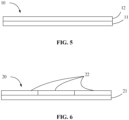
- the light-emitting subpixels include a plurality of red subpixels 110, a plurality of green subpixels 111, and a plurality of blue subpixels 112. Specifically, one of the red subpixels 110, two of the green subpixels 111, and one of the blue subpixels 112 cooperatively define a pixel unit.
- the light-emitting subpixels are arranged in an array and are configured with a plurality of the pixel units comprising a first pixel unit 113 and a second pixel unit 114.
- the green subpixels 111 are located on a same side, and one of the red subpixels 110 and one of the blue subpixels 112 are located on another side.
- the second pixel unit 114 two of the green subpixels 111 are located on a same side, and one of the red subpixels 110 and one of the blue subpixels 112 are located on another side, wherein the one of the blue subpixels 112 is located above the one of the red subpixels 110.
- Any row of the pixel units is configured with a plurality of the first pixel units and the second pixel units arranged in a repeating order of the first pixel unit 113 to the second pixel unit 114.
- each of the light-emitting subpixels is circular, triangular, or rectangular in shape.
- the red subpixel 110 and the blue subpixel 112 are both rectangular in shape
- the green subpixel 111 is circular in shape.
- each of the green subpixels 111 has a light-emitting area less than a light-emitting area of each of the red subpixels 110 and blue subpixels 112. It should be noted that since brightness of the red subpixel 110 and the blue subpixel 112 is attenuated faster and the lifespan is shorter, the red subpixel 110 and the blue subpixel 112 is configured with a larger area, so that the brightness attenuation and lifetime of the three types of pixels are uniform.
- the green subpixels 111 are disposed corresponding to middle and lower positions with respect to the red subpixels 110 and the blue subpixels 112. Specifically, taking the second pixel unit 114 as an example, one of the green subpixels 111 corresponds to a position between the red subpixel 110 and the blue sub-pixel 112, and the other green subpixel 111 corresponds to a lower position of the red subpixel 110. As a whole, the green subpixels 111 are disposed in staggered relationship with the red subpixels 110 and the blue subpixels 112. The green subpixels 111 are disposed to correspond to positions between the red subpixels 110 and the blue subpixels 112.
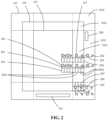
- FIG. 2 it is a primary schematic structural view of a bezel-less display panel provided by another embodiment of the present application.
- the bezel-less display panel is divided into a first display area 101, a second display area 102 around the first display area 101, and a third display area 103 around the second display area 102.
- a plurality of the subpixel driving TFTs in the first display area 101 are connected to a plurality of subpixel driving TFTs of a plurality of the subpixel driving circuits 104 in the first display area 101 through a plurality of metal lines 201, respectively.
- the second display area 102 includes a first straight area 1021 and a first corner area 1022
- the third display area 103 includes a second straight area 1031 and a second corner area 1032.
- the light-emitting subpixels 202 in the second straight area 1031 are connected to the subpixel driving TFTs of the subpixel driving circuits 204 in the first straight area 1021 through a plurality of the metal lines 203, respectively.
- the light-emitting subpixels 205 in the second corner area 1032 are connected to the subpixel driving TFTs of a plurality of subpixel driving circuits 207 in the first corner area 1022 through a plurality of the metal lines 206, respectively.
- the metal lines 203 configured to connect the light-emitting subpixels 202 in the second straight area 1031 to the subpixel driving TFTs in the first straight area 1021 are arranged substantially in a horizontal direction (left and right sides) or in a vertical direction (upper and lower sides).
- the metal lines 203 in FIG. 2 are not drawn in a horizontal direction for the reason of easy understanding.
- the metal lines 206 configured to connect the light-emitting subpixels 205 in the second corner area 1032 to the subpixel driving TFTs in the first corner area 1022 are arranged in an oblique direction, wherein a first angle a is formed between the oblique direction and the horizontal direction or the vertical direction.
- the first angle a is an acute angle. Specifically, the first angle a is greater than 0 degree and less than or equal to 45 degrees.
- the second display area 102 is divided into the first straight area 1021 and the first corner area 1022
- the third display area 103 is divided into the second straight area 1031 and the second corner area 1032
- the light-emitting subpixels 202 in the second straight area 1031 are connected to the subpixel driving TFTs in the first straight area 1021.
- the light-emitting subpixels 205 in the second corner area 1032 are connected to the subpixel driving TFTs in the first corner area 1022.
- the bezel-less display panel further includes the source driving circuit 109 and a gate driver on array (GOA) driving circuit 208.
- the GOA driving circuit 208 is configured to control switching on or switching off of any row of the light-emitting subpixels.
- the GOA driving circuit 208 includes at least a GOA TFT (corresponding to a GOA TFT 312 in FIG. 3 ). Since the GOA driving circuit 208 is generally configured in the third display area 103 (corresponding to a conventional outer frame area), the third display area 103 is not available for disposing of a subpixel driving circuit, thereby causing the conventional outer frame area to be incapable of displaying, and a size of the conventional outer frame area is very difficult to be reduced.
- the present application is to dispose some of the light-emitting subpixels in the third display area 103 (corresponding to the conventional outer frame area).
- the light-emitting subpixels in the third display area 103 are connected to the other subpixel driving TFTs in the second display area 102 through the metal lines, thereby to achieve bezel-less display and to prevent configuration of gate lines and driving circuits from being influenced.
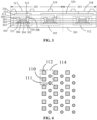
- FIG. 3 it is a schematic cross-sectional view of a second display area and a third display area of a bezel-less display panel provided by the present application. From the figure, you can clearly see various components of this application and relative positional relationships between the various components.
- the bezel-less display panel includes a buffer layer 301, a subpixel driving circuit 105 disposed on the buffer layer 301 and corresponding to the second display area 102, a subpixel driving TFT disposed in the subpixel driving circuit 105, the GOA TFT 312 on the buffer layer 301 and corresponding to the third display area 103, a planarization layer 313 disposed on the subpixel driving circuit 105 and the GOA TFT 312, and a pixel electrode 314 disposed on the planarization layer 313, a pixel definition layer 316 disposed on the planarization layer 313, a light-emitting subpixel 317 disposed on the pixel electrode 314 and corresponding to the second display area 102, a light-emitting subpixel 318 disposed on the pixel electrode 314 and corresponding of the third display area 103, and a supporting spacer 319 disposed on the pixel definition layer 316.
- a substrate (not shown) may be disposed below the buffer layer 301.
- the subpixel driving TFT located in the subpixel driving circuit 105 includes an active layer 302, a first insulating layer 303 disposed on the active layer 302, a first metal layer 304 disposed on the first insulating layer 303, a second insulating layer 305 disposed on the first metal layer 304, a second metal layer 306 disposed on the second insulating layer 305, a third insulating layer 307 disposed on the second metal layer 306, and a source 308 and a drain 309 disposed on the third insulating layer 307.
- the source 308 is connected to one end of the active layer 302 through a first via 310
- the drain 309 is connected to the other end of the active layer 302 through a second via 311.
- the pixel electrode 314 is connected to the source 308 through a third via 315.
- the light-emitting subpixel 318 in the third display area 103 is connected to the subpixel driving TFTs of the subpixel driving circuit 105 in the second display area 102 through a metal line 320.
- the metal line 320 described here may be disposed on the same layer as the pixel electrode 314, and the light-emitting subpixel 318 in the third display area 103 is connected to the source 308 through the metal line 320.
- the embodiment of the present application utilizes the subpixel driving TFTs of the subpixel driving circuit 105 in the second display area 102 to control the light-emitting subpixels in the third display area 103, so that bezel-less display can be achieved and configuration of gate lines and driving circuits will not be influenced.
- the third display area 103 may not be provided with a thin-film transistor. That is, the GOA TFT 312 can be configured in other ways, and is not limited to the disclosure of the present application.
- An embodiment of the present application provides a display device 10, including a back frame 11, and a bezel-less display panel 12 disposed on the back frame 11, wherein the bezel-less display panel 12 is the bezel-less display panel provided in the above-mentioned embodiments. Please refer to FIGs. 1 and 2 for details, which are not repeated here.
- An embodiment of the present application provides a splice-type display device 20, including a back frame 21, and a plurality of bezel-less display panels 22.
- the plurality of bezel-less display panels 22 are disposed on the back frame 21 and spliced into a display surface, wherein each of the bezel-less display panels 22 is the bezel-less display panel provided by the above-mentioned embodiments.
- FIGs. 1 and 2 for details, which are not repeated here.
- each one of the bezel-less display panels can work independently. There are no splicing marks occurred in a splice-type display panel when using the bezel-less display panels provided by the embodiments of the present application, thereby preventing adverse influence on display performance.
- a display area of a display panel is divided into a first display area, a second display area around the first display area, and a third display area around the second display area.
- a plurality of subpixel driving TFTs provided in the first display area are arranged in a distribution density equal to a distribution density of a plurality of subpixel driving TFTs provided in the second display area.
- a distribution density of light-emitting subpixels in the first display area is greater than that of the light-emitting subpixels in the second display area.
- the third display area is not provided with a subpixel driving TFT.
- Some of the subpixel driving TFTs in the second display area are connected to the light-emitting subpixels in the second display area, and the other subpixel driving TFTs in the second display area are connected to the light-emitting subpixels in the third display area.
- a bezel-less display can be achieved, a screen aspect ratio, as well as a product application range, can be increased, and display differences caused by splicing marks can be prevented, thereby overcoming technical problems with conventional display panels which have a low screen aspect ratio caused by outer frames being incapable of displaying, and which form splicing marks when being configured to be spliced into a large-sized display, adversely affecting display performance.
Landscapes
- Engineering & Computer Science (AREA)
- Microelectronics & Electronic Packaging (AREA)
- Physics & Mathematics (AREA)
- Geometry (AREA)
- Multimedia (AREA)
- General Physics & Mathematics (AREA)
- Theoretical Computer Science (AREA)
- Devices For Indicating Variable Information By Combining Individual Elements (AREA)
- Electroluminescent Light Sources (AREA)
Applications Claiming Priority (2)
| Application Number | Priority Date | Filing Date | Title |
|---|---|---|---|
| CN202010693112.5A CN111863897B (zh) | 2020-07-17 | 2020-07-17 | 一种无边框显示面板、显示装置及拼接型显示装置 |
| PCT/CN2020/114641 WO2022011815A1 (zh) | 2020-07-17 | 2020-09-11 | 一种无边框显示面板、显示装置及拼接型显示装置 |
Publications (2)
| Publication Number | Publication Date |
|---|---|
| EP4184584A1 true EP4184584A1 (de) | 2023-05-24 |
| EP4184584A4 EP4184584A4 (de) | 2024-07-24 |
Family
ID=73001928
Family Applications (1)
| Application Number | Title | Priority Date | Filing Date |
|---|---|---|---|
| EP20880335.3A Pending EP4184584A4 (de) | 2020-07-17 | 2020-09-11 | Rahmenlose anzeigetafel, anzeigevorrichtung und gekachelte anzeigevorrichtung |
Country Status (5)
| Country | Link |
|---|---|
| US (2) | US11942461B2 (de) |
| EP (1) | EP4184584A4 (de) |
| CN (1) | CN111863897B (de) |
| EA (1) | EA202190977A1 (de) |
| WO (1) | WO2022011815A1 (de) |
Families Citing this family (8)
| Publication number | Priority date | Publication date | Assignee | Title |
|---|---|---|---|---|
| CN115548052A (zh) * | 2021-06-30 | 2022-12-30 | 成都辰显光电有限公司 | 显示面板以及显示设备 |
| CN113539130B (zh) * | 2021-07-19 | 2023-04-11 | Oppo广东移动通信有限公司 | 显示模组和显示设备 |
| CN113658542A (zh) * | 2021-10-21 | 2021-11-16 | 北京中科海芯科技有限公司 | 显示装置及其驱动方法 |
| KR20230092068A (ko) | 2021-12-16 | 2023-06-26 | 삼성디스플레이 주식회사 | 표시 장치 |
| KR20230108737A (ko) | 2022-01-10 | 2023-07-19 | 삼성디스플레이 주식회사 | 표시 장치 |
| CN114550601B (zh) | 2022-02-14 | 2023-06-02 | 惠州华星光电显示有限公司 | 一种显示面板、拼接屏、显示装置及显示面板制作方法 |
| CN115273678A (zh) * | 2022-07-29 | 2022-11-01 | 武汉天马微电子有限公司 | 一种显示面板及显示装置 |
| CN118301991A (zh) * | 2023-01-03 | 2024-07-05 | 京东方科技集团股份有限公司 | 显示基板和显示装置 |
Family Cites Families (12)
| Publication number | Priority date | Publication date | Assignee | Title |
|---|---|---|---|---|
| JP2004170870A (ja) * | 2002-11-22 | 2004-06-17 | Keisuke Matsuyama | 画面接続型表示装置 |
| CN106297572A (zh) | 2015-05-29 | 2017-01-04 | 鸿富锦精密工业(深圳)有限公司 | 无边框显示装置 |
| CN105047686B (zh) * | 2015-06-30 | 2018-09-04 | 京东方科技集团股份有限公司 | 阵列基板、显示面板和显示装置 |
| CN108648679B (zh) * | 2018-05-18 | 2020-06-26 | 京东方科技集团股份有限公司 | 显示面板的驱动方法及装置、显示设备 |
| CN110504289B (zh) * | 2019-08-27 | 2022-08-16 | 武汉天马微电子有限公司 | 一种显示面板和显示装置 |
| CN114937410B (zh) * | 2019-12-02 | 2023-09-26 | 武汉天马微电子有限公司 | 一种显示面板和显示装置 |
| CN111192902B (zh) * | 2019-12-16 | 2021-05-07 | 昆山国显光电有限公司 | 显示面板及其驱动方法、显示装置 |
| KR102859244B1 (ko) * | 2019-12-31 | 2025-09-11 | 엘지디스플레이 주식회사 | 표시 장치와 이를 이용한 멀티 표시 장치 |
| CN111180494B (zh) * | 2020-01-03 | 2023-05-26 | 武汉天马微电子有限公司 | 一种显示面板及显示装置 |
| CN111048005B (zh) * | 2020-01-06 | 2021-06-22 | 昆山国显光电有限公司 | 显示面板及显示装置 |
| CN111180501B (zh) * | 2020-02-26 | 2022-06-03 | 武汉天马微电子有限公司 | 显示面板及显示装置 |
| CN113628550A (zh) * | 2020-05-07 | 2021-11-09 | 群创光电股份有限公司 | 显示装置 |
-
2020
- 2020-07-17 CN CN202010693112.5A patent/CN111863897B/zh active Active
- 2020-09-11 US US17/051,246 patent/US11942461B2/en active Active
- 2020-09-11 EP EP20880335.3A patent/EP4184584A4/de active Pending
- 2020-09-11 EA EA202190977A patent/EA202190977A1/ru unknown
- 2020-09-11 WO PCT/CN2020/114641 patent/WO2022011815A1/zh not_active Ceased
-
2024
- 2024-01-24 US US18/421,244 patent/US12272685B2/en active Active
Also Published As
| Publication number | Publication date |
|---|---|
| US12272685B2 (en) | 2025-04-08 |
| CN111863897A (zh) | 2020-10-30 |
| US20240194658A1 (en) | 2024-06-13 |
| EP4184584A4 (de) | 2024-07-24 |
| CN111863897B (zh) | 2022-12-23 |
| US11942461B2 (en) | 2024-03-26 |
| US20240006394A1 (en) | 2024-01-04 |
| EA202190977A1 (ru) | 2022-03-28 |
| WO2022011815A1 (zh) | 2022-01-20 |
Similar Documents
| Publication | Publication Date | Title |
|---|---|---|
| US12272685B2 (en) | Bezel-less display panel, display device, and splice-type display device | |
| CN109634012B (zh) | 显示面板 | |
| US9857651B2 (en) | Array substrate and liquid crystal device | |
| US20220045150A1 (en) | Amoled display panel and corresponding display device | |
| US9411199B2 (en) | Array substrate and color filter substrate of display device and method for manufacturing the same | |
| US10705373B2 (en) | Liquid crystal display panel and display device | |
| US8149228B2 (en) | Active matrix substrate | |
| KR20110124915A (ko) | 표시 장치 | |
| US20160342042A1 (en) | Pixel structure and liquid crystal display panel comprising same | |
| WO2001048546A1 (en) | Liquid crystal device | |
| US20230110225A1 (en) | Array substrate, display panel and display device having the array substrate | |
| US20160097958A1 (en) | Liquid crystal display prevented from light leakage, and method of fabricating the same | |
| US20200319519A1 (en) | Liquid crystal display panel | |
| US10845661B2 (en) | Liquid crystal display device | |
| US12165606B2 (en) | Display panel and display device | |
| JP2020531897A (ja) | 液晶ディスプレイ | |
| CN115398326B (zh) | 像素单元、阵列基板和显示面板 | |
| US20220206349A1 (en) | Display panel and device | |
| US11373608B2 (en) | Display panel and display device | |
| US20210333666A1 (en) | Array substrate and liquid crystal display panel | |
| US11275283B2 (en) | Display device having a gate lead line | |
| US7391492B2 (en) | Multi-domain LCD device and method of fabricating the same | |
| US20260029680A1 (en) | Array substrate and preparation method therefor, and display panel | |
| EA042577B1 (ru) | Дисплейная панель без рамки, дисплейное устройство и дисплейное устройство объединяемого типа | |
| CN112558207B (zh) | 一种圆形彩色滤光片及其圆形显示器 |
Legal Events
| Date | Code | Title | Description |
|---|---|---|---|
| STAA | Information on the status of an ep patent application or granted ep patent |
Free format text: STATUS: UNKNOWN |
|
| STAA | Information on the status of an ep patent application or granted ep patent |
Free format text: STATUS: THE INTERNATIONAL PUBLICATION HAS BEEN MADE |
|
| PUAI | Public reference made under article 153(3) epc to a published international application that has entered the european phase |
Free format text: ORIGINAL CODE: 0009012 |
|
| STAA | Information on the status of an ep patent application or granted ep patent |
Free format text: STATUS: REQUEST FOR EXAMINATION WAS MADE |
|
| 17P | Request for examination filed |
Effective date: 20210505 |
|
| AK | Designated contracting states |
Kind code of ref document: A1 Designated state(s): AL AT BE BG CH CY CZ DE DK EE ES FI FR GB GR HR HU IE IS IT LI LT LU LV MC MK MT NL NO PL PT RO RS SE SI SK SM TR |
|
| DAV | Request for validation of the european patent (deleted) | ||
| DAX | Request for extension of the european patent (deleted) | ||
| REG | Reference to a national code |
Ref country code: DE Ref legal event code: R079 Free format text: PREVIOUS MAIN CLASS: H01L0027320000 Ipc: H01L0027150000 |
|
| A4 | Supplementary search report drawn up and despatched |
Effective date: 20240626 |
|
| RIC1 | Information provided on ipc code assigned before grant |
Ipc: H10K 59/131 20230101ALI20240620BHEP Ipc: H10K 59/121 20230101ALI20240620BHEP Ipc: G09F 9/302 20060101ALI20240620BHEP Ipc: H01L 27/15 20060101AFI20240620BHEP |