EP4182178B1 - Dispositif de distribution d'air de climatisation pour une tourelle - Google Patents
Dispositif de distribution d'air de climatisation pour une tourelle Download PDFInfo
- Publication number
- EP4182178B1 EP4182178B1 EP21754837.9A EP21754837A EP4182178B1 EP 4182178 B1 EP4182178 B1 EP 4182178B1 EP 21754837 A EP21754837 A EP 21754837A EP 4182178 B1 EP4182178 B1 EP 4182178B1
- Authority
- EP
- European Patent Office
- Prior art keywords
- air
- cover
- turret
- rotor
- disc
- Prior art date
- Legal status (The legal status is an assumption and is not a legal conclusion. Google has not performed a legal analysis and makes no representation as to the accuracy of the status listed.)
- Active
Links
Images




Classifications
-
- B—PERFORMING OPERATIONS; TRANSPORTING
- B60—VEHICLES IN GENERAL
- B60H—ARRANGEMENTS OF HEATING, COOLING, VENTILATING OR OTHER AIR-TREATING DEVICES SPECIALLY ADAPTED FOR PASSENGER OR GOODS SPACES OF VEHICLES
- B60H1/00—Heating, cooling or ventilating devices
- B60H1/00271—HVAC devices specially adapted for particular vehicle parts or components and being connected to the vehicle HVAC unit
-
- B—PERFORMING OPERATIONS; TRANSPORTING
- B60—VEHICLES IN GENERAL
- B60H—ARRANGEMENTS OF HEATING, COOLING, VENTILATING OR OTHER AIR-TREATING DEVICES SPECIALLY ADAPTED FOR PASSENGER OR GOODS SPACES OF VEHICLES
- B60H1/00—Heating, cooling or ventilating devices
- B60H1/00357—Air-conditioning arrangements specially adapted for particular vehicles
- B60H1/00414—Air-conditioning arrangements specially adapted for particular vehicles for military, emergency, safety or security vehicles
-
- F—MECHANICAL ENGINEERING; LIGHTING; HEATING; WEAPONS; BLASTING
- F41—WEAPONS
- F41H—ARMOUR; ARMOURED TURRETS; ARMOURED OR ARMED VEHICLES; MEANS OF ATTACK OR DEFENCE, e.g. CAMOUFLAGE, IN GENERAL
- F41H7/00—Armoured or armed vehicles
- F41H7/02—Land vehicles with enclosing armour, e.g. tanks
- F41H7/03—Air-pressurised compartments for crew; Means for preventing admission of noxious substances, e.g. combustion gas from gun barrels, in crew compartments; Sealing arrangements
-
- B—PERFORMING OPERATIONS; TRANSPORTING
- B60—VEHICLES IN GENERAL
- B60H—ARRANGEMENTS OF HEATING, COOLING, VENTILATING OR OTHER AIR-TREATING DEVICES SPECIALLY ADAPTED FOR PASSENGER OR GOODS SPACES OF VEHICLES
- B60H1/00—Heating, cooling or ventilating devices
- B60H1/00271—HVAC devices specially adapted for particular vehicle parts or components and being connected to the vehicle HVAC unit
- B60H2001/003—Component temperature regulation using an air flow
Definitions
- the technical field of the invention is that of air conditioning air distribution devices for military vehicles comprising a turret.
- Air circulation in the hull is traditionally provided by a ventilation unit coupled with air conditioning and a ventilation network comprising pipes conveying air to the occupants and equipment.
- Turret ventilation is, however, very delicate due to the confinement of the turret and its pivoting nature, which makes it difficult to connect the hull ventilation network with a turret ventilation network.
- the patent EP3077235 proposes a device for distributing air conditioning between the body of a vehicle and the turret which comprises at least one circular gutter located on the periphery of the turret basket bottom.
- This gutter is integral with the chassis while a hood integral with the turret covers the open part of the gutter while rotating relative to the gutter. Fresh air injected by a mouth of the gutter can thus circulate freely in it until it comes out through an outlet mouth of the hood and this for any angular orientation of the turret relative to the chassis in it.
- Such a device poses the problem of cluttering the periphery of the turret backplane and requires having a circular shape which is not always suitable for optimal cohabitation with nearby equipment having a parallelepiped shape for example.
- the invention therefore proposes an air distribution device for a turret having a reduced footprint and facilitating its adaptation to the shape of the surrounding equipment.
- the patent application FR3057948 discloses an air conditioning air distribution device as defined in the preamble of claim 1.
- the invention relates to a device for distributing air conditioning for a turret of a vehicle mounted to rotate relative to a chassis of the vehicle, the device comprising a rotating joint intended to electrically connect the turret and the chassis of the vehicle and to be coaxial with the turret, the rotating joint comprising a stator intended to be secured to the chassis and a rotor intended to be secured to the turret, device characterized in that it comprises a cover forming a box delimiting a volume in which the rotor is housed and pierced with at least one air outlet, cover secured in a sealed manner to the rotor, cover located at the center of a first disk to which it is secured by the edges of its side walls, device comprising a second disk, applied against the first disk with the interposition of a sealing means, second disk having substantially the same diameter as the first disk, coaxial with the latter and secured to the stator, therefore able to rotate in a sealed manner relative to the first disk and closing the box delimited by the cover
- the air inlet may have an L shape which is partly delimited by the stator.
- the rotor can be secured to a bottom wall of the cover.
- At least one air outlet among the air outlet(s) is provided at one of the side walls of the cover.
- At least one air outlet among the air outlet(s) is provided at a bottom wall of the cover.
- a military vehicle 100 comprises a chassis 101 and an armed turret 102 pivotally mounted in bearing relative to the chassis 101 around a vertical axis Z.
- the vehicle 100 comprises an electric rotating joint 10 which makes it possible to transmit data and energy between the chassis 101 and the turret 102 for all angular orientations of the turret around the bearing axis Z and this independently of the number of revolutions of the turret 102 relative to the chassis 101.
- the vehicle 100 comprises an air conditioning air distribution device 1 which makes it possible to transmit fresh air produced in the chassis 101 and blown into a first pipe 11 of the device 1. The fresh air is then expelled from the device 1 into the turret 102 via a second pipe 12.
- the detail of the device 1 will be better seen in the following figures.
- the electric rotating joint 10 comprises a stator 10a secured to the chassis 101 and a rotor 10b secured to the turret 102. One pivots relative to the other around the bearing axis Z of the turret 102.
- the rotor 10b and the stator 10a are separated by a joint plane 10c.
- the device 1 comprises a cover 4 which is integral with the rotor 10b and which forms a box 4 delimiting a volume in which the rotor 10b is housed.
- the cover 4 covers the rotor 10b and is integral with the turret 102.
- the device comprises a second disk 6 which is parallel and coaxial to the first disk 5 and which is located opposite the first.
- the two disks 5 and 6 have the same diameter and are substantially pressed against each other with the interposition of a sealing means 7 close to their respective circumference.
- the sealing means 7 may be a lip seal 7 for example which will allow the relative pivoting of the disks 5 and 6 between them.
- the second disk 6 is secured to the stator 10a itself secured to the chassis 101.
- the connection between the stator 10a and the second disk 6 is airtight.
- the side walls of the cover 4 are located at a distance D from the side walls of the rotor 10b, thus defining in the internal volume of the box formed by the cover 4 a chute G intended for the circulation of air directly around the electric rotating joint 10.
- the second disk 6 with the stator 10a close the cover 4 and therefore the chute G.
- the chute G has a rectangular section taking into account the geometries of the box and the rotor 10b.
- the second disc 6 has an air inlet 3 ([ Fig.2 ]) which adjoins the stator 10a.
- the distance D between the side walls of the cover/box 4 and the walls of the rotor 10b must be chosen in such a way that the air inlet 3 always has a part of its section S which opens into the chute G, that is to say between the walls of the cover/box 4 and the walls of the rotor 10b, and this for all the angular orientations of the turret 101 relative to the chassis 102.
- first disk 5 and the second disk 6 have substantially the same diameter or at least when the second disk 6 has a diameter which is greater than the internal diagonal of the box 4 while nevertheless having a diameter sufficient for the installation of the sealing means 7 between the two discs 5 and 6.
- At least one air outlet 2 will be made in the bottom wall of the box/cover 4 or in one of the side walls of the box/cover 4.
- the air inlet 3 has an L shape delimited in part by the stator 10a. This air inlet has a maximum section S which is hatched at the [ Fig.3 ].
- the section S of air inlet 3 shown with hatching may vary but it always allows air to enter chute G.
- the chute G is located opposite a part P of the second disk 6 which prevents the escape of air from the chute G.
- a part K of the first disk 5 is located opposite a part of the air inlet 3 to prevent the escape of air to the outside of the device 1.
- the circulation of air directly around the walls of the rotor 10b allows effective cooling thereof. It is noted that the chute G is crossed by electrical conductors 16 which benefit from the circulation of fresh air in the chute G. Electrical conductors 15 connected to the stator benefit from the air conditioning of the chassis 101.
- air ducts 13 and 14 are connected respectively to the air inlet 11 and the air outlet 12 of the device 1 to facilitate the delivery of fresh air from an air conditioner 111, located in the chassis 101, to equipment 112 located in the turret 102.
- the invention therefore makes it possible to ensure continuity of air distribution between a chassis and a turret for all orientations of the turret relative to the chassis and this while occupying the minimum of space around the electric rotating joint.
Landscapes
- Engineering & Computer Science (AREA)
- Physics & Mathematics (AREA)
- Thermal Sciences (AREA)
- Mechanical Engineering (AREA)
- General Engineering & Computer Science (AREA)
- Air-Conditioning For Vehicles (AREA)
- Central Air Conditioning (AREA)
- Motor Or Generator Cooling System (AREA)
- Motor Or Generator Frames (AREA)
- Air-Flow Control Members (AREA)
Description
- Le domaine technique de l'invention est celui des dispositifs de distribution d'air de climatisation pour véhicules militaires comportant une tourelle.
- Les véhicules militaires avec tourelle nécessitent d'être climatisés et ventilés afin d'assurer des conditions de vie satisfaisantes à l'équipage et des températures de fonctionnement adéquates pour les équipements de bord.
- La circulation de l'air dans la caisse est classiquement assurée par une unité de ventilation couplée avec une climatisation et un réseau de ventilation comportant des canalisations acheminant l'air vers les occupants et les équipements. La ventilation de la tourelle est en revanche très délicate du fait du confinement de la tourelle et de son caractère pivotant qui rend difficile la connexion du réseau de ventilation de la caisse avec un réseau de ventilation de la tourelle.
- Le brevet
EP3077235 propose un dispositif de distribution d'air de climatisation entre la caisse d'un véhicule et la tourelle qui comporte au moins une gouttière circulaire située en périphérie du fond de panier de tourelle. - Cette gouttière est solidaire du châssis alors qu'un capot solidaire de la tourelle couvre la partie ouverte de la gouttière tout en tournant relativement à la gouttière. De l'air frais injecté par une bouche de la gouttière peut ainsi circuler librement dans celle-ci jusqu'à ressortir par une bouche de sortie du capot et ceci pour toute orientation angulaire de la tourelle par rapport au châssis dans celle-ci.
- Un tel dispositif pose le problème d'encombrer la périphérie du fond de panier de tourelle et impose d'avoir une forme circulaire qui n'est pas toujours adaptée à une cohabitation optimale avec des équipements proches et ayant une forme parallélépipédique par exemple.
- L'invention propose donc un dispositif de distribution d'air pour une tourelle ayant un encombrement réduit et facilitant son adaptation à la forme des équipements environnants.
- La demande de brevet
FR3057948 - Ainsi, l'invention a pour objet un dispositif de distribution d'air de climatisation pour une tourelle d'un véhicule montée rotative par rapport à un châssis du véhicule, le dispositif comprenant un joint tournant destiné à relier électriquement la tourelle et le châssis du véhicule et à être coaxial à la tourelle, le joint tournant comportant un stator destiné à être solidaire du châssis et un rotor destiné à être solidaire de la tourelle, dispositif caractérisé en ce qu'il comporte un couvercle formant un caisson délimitant un volume dans lequel se loge le rotor et percé d'au moins une sortie d'air, couvercle solidaire de manière étanche du rotor, couvercle situé au centre d'un premier disque dont il est solidaire par les bords de ses parois latérales, dispositif comportant un second disque, appliqué contre le premier disque avec interposition d'un moyen d'étanchéité, second disque ayant sensiblement le même diamètre que le premier disque, coaxial à ce-dernier et solidaire du stator, donc pouvant tourner de façon étanche par rapport au premier disque et obturant le caisson délimité par le couvercle, le second disque comportant une entrée d'air disposée à proximité du stator, les parois latérales du couvercle étant situées à une distance du rotor telle que l'entrée d'air pratiquée dans le second disque est toujours au moins en partie débouchante dans le volume du caisson pour toutes les orientations angulaires du rotor par rapport au stator.
- Selon un mode de réalisation, l'entrée d'air peut avoir une forme en L qui est délimitée en partie par le stator.
- Avantageusement, le rotor pourra être solidaire d'une paroi de fond du couvercle.
- Selon un mode particulier de réalisation, au moins une sortie d'air parmi la ou les sorties d'air est pratiquée au niveau de l'une des parois latérales du couvercle.
- Selon un mode particulier de réalisation, au moins une sortie d'air parmi la ou les sorties d'air est pratiquée au niveau d'une paroi de fond du couvercle.
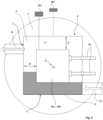
- L'invention sera mieux comprise à la lecture de la description suivante, description faite à la lumière des dessins en annexe, dessins dans lesquels :
- [
Fig.1 ] représente une vue en coupe longitudinale schématique d'un véhicule équipé d'un dispositif selon l'invention. - [
Fig.2 ] représente une vue partielle en coupe longitudinale du dispositif selon l'invention. - [
Fig.3 ] représente une vue partielle en coupe transversale du dispositif selon l'invention. - [
Fig.4 ] est analogue à la [Fig.3 ] mais montre le rotor pivoté d'environ 35° dans le sens inverse des aiguilles d'une montre. - [
Fig.5 ] est analogue à la [Fig.3 ] mais montre le rotor pivoté d'environ 100° dans le sens des aiguilles d'une montre. - Selon la [
Fig.1 ], un véhicule militaire 100 comporte un châssis 101 et une tourelle armée 102 montée pivotante en gisement par rapport au châssis 101 autour d'un axe vertical Z. - Le véhicule 100 comporte un joint tournant électrique 10 qui permet de transmettre des données et de l'énergie entre le châssis 101 et la tourelle 102 pour toutes les orientations angulaires de la tourelle autour de l'axe de gisement Z et ceci indépendamment du nombre de tours de la tourelle 102 par rapport au châssis 101.
- Le véhicule 100 comporte un dispositif de distribution d'air 1 de climatisation qui permet de transmettre de l'air frais produit en châssis 101 et insufflé dans une première conduite 11 du dispositif 1. L'air frais est ensuite expulsé du dispositif 1 dans la tourelle 102 par le biais d'une seconde conduite 12. Le détail du dispositif 1 sera mieux vu aux figures suivantes.
- A la [
Fig.2 ] on voit que le joint tournant électrique 10 comporte un stator 10a solidaire du châssis 101 et un rotor 10b solidaire de la tourelle 102. L'un pivotant par rapport à l'autre autour de l'axe de gisement Z de la tourelle 102. Le rotor 10b et le stator 10a sont séparés par un plan de joint 10c. - Le dispositif 1 comporte un couvercle 4 qui est solidaire du rotor 10b et qui forme un caisson 4 délimitant un volume dans lequel se loge le rotor 10b. Selon le mode de réalisation représenté aux figures, le couvercle 4 recouvre le rotor 10b et est solidaire de la tourelle 102.
- Des parois latérales du couvercle 4 sont solidaires d'un premier disque 5 parallèle au plan de joint 10c et centré sur l'axe de gisement Z. Ce premier disque 5 est mieux vu aux
figures 3 à 5 . - Comme visible à la [
Fig.2 ], le dispositif comporte un second disque 6 qui est parallèle et coaxial au premier disque 5 et qui est situé en regard du premier. Les deux disques 5 et 6 ont le même diamètre et sont sensiblement plaqués l'un contre l'autre avec interposition d'un moyen d'étanchéité 7 voisin de leur circonférence respective. Le moyen d'étanchéité 7 pourra être un joint à lèvre 7 par exemple qui autorisera le pivotement relatif des disques 5 et 6 entre eux. - Le second disque 6 est solidaire du stator 10a lui-même solidaire du châssis 101. La solidarisation entre stator 10a et second disque 6 est étanche à l'air.
- On note à la [
Fig.2 ] et à la [Fig.3 ] que les parois latérales du couvercle 4 sont situées à distance D des parois latérales du rotor 10b, définissant ainsi dans le volume interne du caisson formé par le couvercle 4 une goulotte G destinée à la circulation d'air directement autour du joint tournant électrique 10. Le second disque 6 avec le stator 10a obturent le couvercle 4 et donc la goulotte G. La goulotte G a une section de forme rectangulaire compte tenu des géométries du caisson et du rotor 10b. - Le second disque 6 comporte une entrée d'air 3 ([
Fig.2 ]) qui jouxte le stator 10a. La distance D entre les parois latérales du couvercle/caisson 4 et les parois du rotor 10b devra être choisie de manière telle que l'entrée d'air 3 comporte toujours une partie de sa section S qui débouche dans la goulotte G, c'est à dire entre les parois du couvercle/ caisson 4 et les parois du rotor 10b, et ceci pour toutes les orientations angulaires de la tourelle 101 par rapport au châssis 102. Ceci est concrètement toujours assuré lorsque le premier disque 5 et le second disque 6 ont sensiblement le même diamètre ou tout au moins lorsque le second disque 6 a un diamètre qui est supérieur à la diagonale interne du caisson 4 tout en ayant un diamètre néanmoins suffisant pour la mise en place du moyen d'étanchéité 7 entre les deux disques 5 et 6. - Au moins une sortie d'air 2 sera pratiquée dans la paroi de fond du caisson/couvercle 4 ou dans une des parois latérales du caisson/couvercle 4.
- Comme on le voit à la [
Fig.3 ], l'entrée d'air 3 a une forme en L délimitée en partie par le stator 10a. Cette entrée d'air a une section S maximale qui est hachurée à la [Fig.3 ]. - Du fait des formes polygonales du joint tournant 10 et de la goulotte G qui l'entoure, visibles aux
figures 3 à 5 pour différentes orientations de rotor 10b par rapport au stator 10a, la section S de l'entrée d'air 3 représentée avec des hachures peut varier mais elle permet toujours la pénétration d'air dans la goulotte G. - La mise en regard des disques 5 et 6 permet d'éviter les fuites d'air au niveau de la goulotte G ou de l'entrée d'air 3. Ainsi, à la [
Fig.4 ] la goulotte G se trouve en regard d'une partie P du second disque 6 qui empêche la fuite de l'air de la goulotte G. Sur le même principe une partie K du premier disque 5 se trouve en regard d'une partie de l'entrée d'air 3 pour éviter la fuite d'air vers l'extérieur du dispositif 1. - Avantageusement, la circulation d'air directement autour des parois du rotor 10b permet un refroidissement efficace de celui-ci. On note que la goulotte G est traversée par des conducteurs électriques 16 qui bénéficient de la circulation d'air frais dans la goulotte G. Des conducteurs électriques 15 reliés au stator bénéficient quant à eux de la climatisation du châssis 101.
- Comme visible à la [
Fig.1 ], des conduites d'air 13 et 14 sont connectées respectivement à l'entrée d'air 11 et à la sortie d'air 12 du dispositif 1 pour faciliter l'acheminement d'air frais depuis un climatiseur 111, situé dans le châssis 101, vers des équipements 112 situés dans la tourelle 102. - L'invention permet donc d'assurer une continuité de distribution de l'air entre un châssis et une tourelle pour toutes les orientations de la tourelle par rapport au châssis et ceci en occupant le minimum d'espace autour du joint tournant électrique.
Claims (5)
- Dispositif de distribution d'air (1) de climatisation pour une tourelle (102) d'un véhicule (100) montée rotative par rapport à un châssis (101) du véhicule, le dispositif (1) comprenant un joint tournant (10) destiné à relier électriquement la tourelle (102) et le châssis (101) du véhicule (100) et à être coaxial à la tourelle (102), le joint tournant (10) comportant un stator (10a) destiné à être solidaire du châssis (101) et un rotor (10b) destiné à être solidaire de la tourelle (102), dispositif (1) caractérisé en ce qu'il comporte un couvercle (4) formant un caisson délimitant un volume dans lequel se loge le rotor (10b) et percé d'au moins une sortie d'air (2), couvercle (4) solidaire de manière étanche du rotor (10b), couvercle (4) situé au centre d'un premier disque (5) dont il est solidaire par les bords de ses parois latérales, dispositif (1) comportant un second disque (6), appliqué contre le premier disque (5) avec interposition d'un moyen d'étanchéité (7), second disque (6) ayant sensiblement le même diamètre que le premier disque (5), coaxial à ce-dernier et solidaire du stator (10a), donc pouvant tourner de façon étanche par rapport au premier disque (5) et obturant le caisson délimité par le couvercle (4), le second disque (6) comportant une entrée d'air (3) disposée à proximité du stator (10a), les parois latérales du couvercle (4) étant situées à une distance (D) du rotor (10b) telle que l'entrée d'air (3) pratiquée dans le second disque (6) est toujours au moins en partie débouchante dans le volume du caisson pour toutes les orientations angulaires du rotor (10b) par rapport au stator (10a).
- Dispositif de distribution d'air (1) selon la revendication 1, caractérisé en ce que l'entrée d'air (3) a une forme en L délimitée en partie par le stator (10a).
- Dispositif de distribution d'air (1) selon une des revendications 1 ou 2, caractérisé en ce que le rotor (10b) est solidaire d'une paroi de fond du couvercle (4).
- Dispositif de distribution d'air (1) selon une des revendications 1 à 3, caractérisé en ce qu'au moins une sortie d'air (2) parmi la ou les sorties d'air (2) est pratiquée au niveau de l'une des parois latérales du couvercle (4).
- Dispositif de distribution d'air (1) selon une des revendications 1 à 4, caractérisé en ce qu'au moins une sortie d'air (2) parmi la ou les sorties d'air (2) est pratiquée au niveau d'une paroi de fond du couvercle (4).
Applications Claiming Priority (2)
| Application Number | Priority Date | Filing Date | Title |
|---|---|---|---|
| FR2007472A FR3112510B1 (fr) | 2020-07-17 | 2020-07-17 | Dispositif de distribution d'air de climatisation pour une tourelle |
| PCT/IB2021/056468 WO2022013839A1 (fr) | 2020-07-17 | 2021-07-16 | Dispositif de distribution d'air de climatisation pour une tourelle |
Publications (2)
| Publication Number | Publication Date |
|---|---|
| EP4182178A1 EP4182178A1 (fr) | 2023-05-24 |
| EP4182178B1 true EP4182178B1 (fr) | 2024-08-28 |
Family
ID=73793283
Family Applications (1)
| Application Number | Title | Priority Date | Filing Date |
|---|---|---|---|
| EP21754837.9A Active EP4182178B1 (fr) | 2020-07-17 | 2021-07-16 | Dispositif de distribution d'air de climatisation pour une tourelle |
Country Status (7)
| Country | Link |
|---|---|
| EP (1) | EP4182178B1 (fr) |
| AU (1) | AU2021307687B2 (fr) |
| ES (1) | ES2991109T3 (fr) |
| FI (1) | FI4182178T3 (fr) |
| FR (1) | FR3112510B1 (fr) |
| PL (1) | PL4182178T3 (fr) |
| WO (1) | WO2022013839A1 (fr) |
Family Cites Families (5)
| Publication number | Priority date | Publication date | Assignee | Title |
|---|---|---|---|---|
| DE102008033458A1 (de) * | 2008-07-16 | 2010-01-21 | Krauss-Maffei Wegmann Gmbh & Co. Kg | Kampffahrzeug mit einer Kühlluftverteilung |
| FR2990503B1 (fr) * | 2012-05-09 | 2014-12-05 | Nexter Systems | Dispositif de montage d'une tourelle sur un vehicule blinde et vehicule equipe d'une tourelle fixee avec un tel dispositif de montage |
| FR3014372B1 (fr) | 2013-12-05 | 2015-12-04 | Nexter Systems | Dispositif de distribution d'air de climatisation pour une tourelle d'un vehicule et vehicule comportant un tel dispositif |
| FR3057948B1 (fr) * | 2016-10-26 | 2019-03-29 | Nexter Systems | Dispositif de montage pour tourelle de vehicule |
| DE102017100168B4 (de) * | 2017-01-05 | 2024-09-26 | Rheinmetall Landsysteme Gmbh | Vorrichtung zum Austausch von Luft zwischen zwei zueinander drehbar gelagerten Räumen |
-
2020
- 2020-07-17 FR FR2007472A patent/FR3112510B1/fr active Active
-
2021
- 2021-07-16 FI FIEP21754837.9T patent/FI4182178T3/fi active
- 2021-07-16 PL PL21754837.9T patent/PL4182178T3/pl unknown
- 2021-07-16 EP EP21754837.9A patent/EP4182178B1/fr active Active
- 2021-07-16 AU AU2021307687A patent/AU2021307687B2/en active Active
- 2021-07-16 WO PCT/IB2021/056468 patent/WO2022013839A1/fr not_active Ceased
- 2021-07-16 ES ES21754837T patent/ES2991109T3/es active Active
Also Published As
| Publication number | Publication date |
|---|---|
| PL4182178T3 (pl) | 2025-01-20 |
| FR3112510B1 (fr) | 2023-03-31 |
| ES2991109T3 (es) | 2024-12-02 |
| AU2021307687B2 (en) | 2024-04-04 |
| AU2021307687A1 (en) | 2023-02-09 |
| FI4182178T3 (fi) | 2024-09-23 |
| EP4182178A1 (fr) | 2023-05-24 |
| WO2022013839A1 (fr) | 2022-01-20 |
| FR3112510A1 (fr) | 2022-01-21 |
Similar Documents
| Publication | Publication Date | Title |
|---|---|---|
| FR3014029A1 (fr) | Pulseur d'aspiration destine a un dispositif de chauffage, ventilation et/ou climatisation d'un vehicule automobile | |
| CA3154857C (fr) | Dispositif d'echappement anti propagation de batteries lithium-ion d'aeronef | |
| FR2952856A1 (fr) | Unite electronique adaptee pour etre positionnee sur la face interne d'une bande de roulement d'un pneumatique | |
| FR3014372A1 (fr) | Dispositif de distribution d'air de climatisation pour une tourelle d'un vehicule et vehicule comportant un tel dispositif | |
| FR3045741A1 (fr) | Pulseur d'aspiration destine a un dispositif de chauffage, ventilation et/ou climatisation d'un vehicule automobile et dispositif de chauffage, ventilation et/ou climatisation | |
| FR2735426A1 (fr) | Dispositif de chauffage-ventilation et/ou de climatisation de l'habitacle d'un vehicule automobile | |
| EP4182178B1 (fr) | Dispositif de distribution d'air de climatisation pour une tourelle | |
| US11050110B2 (en) | Battery arrangement for a motor vehicle and motor vehicle | |
| EP2239829B1 (fr) | Support moteur pour un moteur d'entraînement d'un groupe moto-ventilateur d'un appareil de chauffage, de ventilation et/ou de climatisation, d'un véhicule automobile | |
| EP1308631B1 (fr) | Groupe moto-ventilateur | |
| FR2859239A1 (fr) | Dispositif de regulation thermique de gaz d'echappement | |
| FR2957987A1 (fr) | Support moteur pour un moteur d'entrainement d'un groupe moto-ventilateur d'un appareil de chauffage, ventilation et/ou climatisation pour un vehicule automobile | |
| EP3222448B1 (fr) | Dispositif de distribution d'air pour tourelle | |
| EP1095802B1 (fr) | Dispositif de distribution d'un flux d'air dans une installation de ventilation, chauffage et/ou climatisation d'un véhicule automobile | |
| EP3436296B1 (fr) | Système pour dispositif de chauffage, de ventilation ou de climatisation d'un véhicule | |
| EP2168795B2 (fr) | Installation de chauffage, ventilation et/ou climatisation munie d'un dispositif d'évacuation de condensats | |
| WO2020207693A1 (fr) | Ensemble comprenant un caisson et un conduit de caisson de basse à géométrie évolutive | |
| FR3022987B1 (fr) | Dispositif de generation d'un flux d'air | |
| FR3057948A1 (fr) | Dispositif de montage pour tourelle de vehicule | |
| EP2794314B1 (fr) | Caisson d'une unité de chauffage, ventilation et/ou climatisation | |
| FR2877419A1 (fr) | Bague d'adaptation et support pour groupe moto-ventilateur d'appareils de climatisation. | |
| EP4028654B1 (fr) | Module de refroidissement pour véhicule automobile à turbomachine tangentielle | |
| FR3133661A1 (fr) | Groupe motorisé de ventilation | |
| FR2963625A1 (fr) | Installation pour la collecte des gaz d'une pluralite de cuves d'electrolyse et dispositif d'ajustement pour une telle installation | |
| EP3568657B1 (fr) | Radiateur à plaque d'extrémité en u orientée vers l'intérieur, et système de chauffage, ventilation ou climatisation correspondant |
Legal Events
| Date | Code | Title | Description |
|---|---|---|---|
| STAA | Information on the status of an ep patent application or granted ep patent |
Free format text: STATUS: UNKNOWN |
|
| STAA | Information on the status of an ep patent application or granted ep patent |
Free format text: STATUS: THE INTERNATIONAL PUBLICATION HAS BEEN MADE |
|
| PUAI | Public reference made under article 153(3) epc to a published international application that has entered the european phase |
Free format text: ORIGINAL CODE: 0009012 |
|
| STAA | Information on the status of an ep patent application or granted ep patent |
Free format text: STATUS: REQUEST FOR EXAMINATION WAS MADE |
|
| 17P | Request for examination filed |
Effective date: 20230215 |
|
| AK | Designated contracting states |
Kind code of ref document: A1 Designated state(s): AL AT BE BG CH CY CZ DE DK EE ES FI FR GB GR HR HU IE IS IT LI LT LU LV MC MK MT NL NO PL PT RO RS SE SI SK SM TR |
|
| DAV | Request for validation of the european patent (deleted) | ||
| DAX | Request for extension of the european patent (deleted) | ||
| GRAP | Despatch of communication of intention to grant a patent |
Free format text: ORIGINAL CODE: EPIDOSNIGR1 |
|
| STAA | Information on the status of an ep patent application or granted ep patent |
Free format text: STATUS: GRANT OF PATENT IS INTENDED |
|
| INTG | Intention to grant announced |
Effective date: 20240314 |
|
| RAP3 | Party data changed (applicant data changed or rights of an application transferred) |
Owner name: KNDS FRANCE |
|
| GRAS | Grant fee paid |
Free format text: ORIGINAL CODE: EPIDOSNIGR3 |
|
| GRAA | (expected) grant |
Free format text: ORIGINAL CODE: 0009210 |
|
| STAA | Information on the status of an ep patent application or granted ep patent |
Free format text: STATUS: THE PATENT HAS BEEN GRANTED |
|
| AK | Designated contracting states |
Kind code of ref document: B1 Designated state(s): AL AT BE BG CH CY CZ DE DK EE ES FI FR GB GR HR HU IE IS IT LI LT LU LV MC MK MT NL NO PL PT RO RS SE SI SK SM TR |
|
| REG | Reference to a national code |
Ref country code: CH Ref legal event code: EP |
|
| REG | Reference to a national code |
Ref country code: DE Ref legal event code: R096 Ref document number: 602021018000 Country of ref document: DE |
|
| REG | Reference to a national code |
Ref country code: FI Ref legal event code: FGE |
|
| REG | Reference to a national code |
Ref country code: IE Ref legal event code: FG4D Free format text: LANGUAGE OF EP DOCUMENT: FRENCH |
|
| REG | Reference to a national code |
Ref country code: NL Ref legal event code: FP |
|
| REG | Reference to a national code |
Ref country code: ES Ref legal event code: FG2A Ref document number: 2991109 Country of ref document: ES Kind code of ref document: T3 Effective date: 20241202 |
|
| REG | Reference to a national code |
Ref country code: LT Ref legal event code: MG9D |
|
| REG | Reference to a national code |
Ref country code: AT Ref legal event code: MK05 Ref document number: 1717596 Country of ref document: AT Kind code of ref document: T Effective date: 20240828 |
|
| PG25 | Lapsed in a contracting state [announced via postgrant information from national office to epo] |
Ref country code: GR Free format text: LAPSE BECAUSE OF FAILURE TO SUBMIT A TRANSLATION OF THE DESCRIPTION OR TO PAY THE FEE WITHIN THE PRESCRIBED TIME-LIMIT Effective date: 20241129 Ref country code: PT Free format text: LAPSE BECAUSE OF FAILURE TO SUBMIT A TRANSLATION OF THE DESCRIPTION OR TO PAY THE FEE WITHIN THE PRESCRIBED TIME-LIMIT Effective date: 20241230 |
|
| PG25 | Lapsed in a contracting state [announced via postgrant information from national office to epo] |
Ref country code: BG Free format text: LAPSE BECAUSE OF FAILURE TO SUBMIT A TRANSLATION OF THE DESCRIPTION OR TO PAY THE FEE WITHIN THE PRESCRIBED TIME-LIMIT Effective date: 20240828 |
|
| PG25 | Lapsed in a contracting state [announced via postgrant information from national office to epo] |
Ref country code: LV Free format text: LAPSE BECAUSE OF FAILURE TO SUBMIT A TRANSLATION OF THE DESCRIPTION OR TO PAY THE FEE WITHIN THE PRESCRIBED TIME-LIMIT Effective date: 20240828 |
|
| PG25 | Lapsed in a contracting state [announced via postgrant information from national office to epo] |
Ref country code: AT Free format text: LAPSE BECAUSE OF FAILURE TO SUBMIT A TRANSLATION OF THE DESCRIPTION OR TO PAY THE FEE WITHIN THE PRESCRIBED TIME-LIMIT Effective date: 20240828 Ref country code: IS Free format text: LAPSE BECAUSE OF FAILURE TO SUBMIT A TRANSLATION OF THE DESCRIPTION OR TO PAY THE FEE WITHIN THE PRESCRIBED TIME-LIMIT Effective date: 20241228 |
|
| PG25 | Lapsed in a contracting state [announced via postgrant information from national office to epo] |
Ref country code: HR Free format text: LAPSE BECAUSE OF FAILURE TO SUBMIT A TRANSLATION OF THE DESCRIPTION OR TO PAY THE FEE WITHIN THE PRESCRIBED TIME-LIMIT Effective date: 20240828 |
|
| PG25 | Lapsed in a contracting state [announced via postgrant information from national office to epo] |
Ref country code: RS Free format text: LAPSE BECAUSE OF FAILURE TO SUBMIT A TRANSLATION OF THE DESCRIPTION OR TO PAY THE FEE WITHIN THE PRESCRIBED TIME-LIMIT Effective date: 20241128 |
|
| PG25 | Lapsed in a contracting state [announced via postgrant information from national office to epo] |
Ref country code: RS Free format text: LAPSE BECAUSE OF FAILURE TO SUBMIT A TRANSLATION OF THE DESCRIPTION OR TO PAY THE FEE WITHIN THE PRESCRIBED TIME-LIMIT Effective date: 20241128 Ref country code: PT Free format text: LAPSE BECAUSE OF FAILURE TO SUBMIT A TRANSLATION OF THE DESCRIPTION OR TO PAY THE FEE WITHIN THE PRESCRIBED TIME-LIMIT Effective date: 20241230 Ref country code: LV Free format text: LAPSE BECAUSE OF FAILURE TO SUBMIT A TRANSLATION OF THE DESCRIPTION OR TO PAY THE FEE WITHIN THE PRESCRIBED TIME-LIMIT Effective date: 20240828 Ref country code: IS Free format text: LAPSE BECAUSE OF FAILURE TO SUBMIT A TRANSLATION OF THE DESCRIPTION OR TO PAY THE FEE WITHIN THE PRESCRIBED TIME-LIMIT Effective date: 20241228 Ref country code: HR Free format text: LAPSE BECAUSE OF FAILURE TO SUBMIT A TRANSLATION OF THE DESCRIPTION OR TO PAY THE FEE WITHIN THE PRESCRIBED TIME-LIMIT Effective date: 20240828 Ref country code: GR Free format text: LAPSE BECAUSE OF FAILURE TO SUBMIT A TRANSLATION OF THE DESCRIPTION OR TO PAY THE FEE WITHIN THE PRESCRIBED TIME-LIMIT Effective date: 20241129 Ref country code: BG Free format text: LAPSE BECAUSE OF FAILURE TO SUBMIT A TRANSLATION OF THE DESCRIPTION OR TO PAY THE FEE WITHIN THE PRESCRIBED TIME-LIMIT Effective date: 20240828 Ref country code: AT Free format text: LAPSE BECAUSE OF FAILURE TO SUBMIT A TRANSLATION OF THE DESCRIPTION OR TO PAY THE FEE WITHIN THE PRESCRIBED TIME-LIMIT Effective date: 20240828 |
|
| PG25 | Lapsed in a contracting state [announced via postgrant information from national office to epo] |
Ref country code: SM Free format text: LAPSE BECAUSE OF FAILURE TO SUBMIT A TRANSLATION OF THE DESCRIPTION OR TO PAY THE FEE WITHIN THE PRESCRIBED TIME-LIMIT Effective date: 20240828 Ref country code: RO Free format text: LAPSE BECAUSE OF FAILURE TO SUBMIT A TRANSLATION OF THE DESCRIPTION OR TO PAY THE FEE WITHIN THE PRESCRIBED TIME-LIMIT Effective date: 20240828 Ref country code: DK Free format text: LAPSE BECAUSE OF FAILURE TO SUBMIT A TRANSLATION OF THE DESCRIPTION OR TO PAY THE FEE WITHIN THE PRESCRIBED TIME-LIMIT Effective date: 20240828 |
|
| PG25 | Lapsed in a contracting state [announced via postgrant information from national office to epo] |
Ref country code: EE Free format text: LAPSE BECAUSE OF FAILURE TO SUBMIT A TRANSLATION OF THE DESCRIPTION OR TO PAY THE FEE WITHIN THE PRESCRIBED TIME-LIMIT Effective date: 20240828 |
|
| PG25 | Lapsed in a contracting state [announced via postgrant information from national office to epo] |
Ref country code: SK Free format text: LAPSE BECAUSE OF FAILURE TO SUBMIT A TRANSLATION OF THE DESCRIPTION OR TO PAY THE FEE WITHIN THE PRESCRIBED TIME-LIMIT Effective date: 20240828 |
|
| REG | Reference to a national code |
Ref country code: DE Ref legal event code: R097 Ref document number: 602021018000 Country of ref document: DE |
|
| PLBE | No opposition filed within time limit |
Free format text: ORIGINAL CODE: 0009261 |
|
| STAA | Information on the status of an ep patent application or granted ep patent |
Free format text: STATUS: NO OPPOSITION FILED WITHIN TIME LIMIT |
|
| PGFP | Annual fee paid to national office [announced via postgrant information from national office to epo] |
Ref country code: FI Payment date: 20250620 Year of fee payment: 5 |
|
| PGFP | Annual fee paid to national office [announced via postgrant information from national office to epo] |
Ref country code: GB Payment date: 20250619 Year of fee payment: 5 |
|
| PGFP | Annual fee paid to national office [announced via postgrant information from national office to epo] |
Ref country code: NO Payment date: 20250627 Year of fee payment: 5 |
|
| PGFP | Annual fee paid to national office [announced via postgrant information from national office to epo] |
Ref country code: NL Payment date: 20250620 Year of fee payment: 5 Ref country code: BE Payment date: 20250626 Year of fee payment: 5 |
|
| PGFP | Annual fee paid to national office [announced via postgrant information from national office to epo] |
Ref country code: FR Payment date: 20250620 Year of fee payment: 5 |
|
| PGFP | Annual fee paid to national office [announced via postgrant information from national office to epo] |
Ref country code: CZ Payment date: 20250624 Year of fee payment: 5 |
|
| 26N | No opposition filed |
Effective date: 20250530 |
|
| PG25 | Lapsed in a contracting state [announced via postgrant information from national office to epo] |
Ref country code: SE Free format text: LAPSE BECAUSE OF FAILURE TO SUBMIT A TRANSLATION OF THE DESCRIPTION OR TO PAY THE FEE WITHIN THE PRESCRIBED TIME-LIMIT Effective date: 20240828 |
|
| PGFP | Annual fee paid to national office [announced via postgrant information from national office to epo] |
Ref country code: ES Payment date: 20250801 Year of fee payment: 5 |
|
| PGFP | Annual fee paid to national office [announced via postgrant information from national office to epo] |
Ref country code: DE Payment date: 20250724 Year of fee payment: 5 |
|
| PGFP | Annual fee paid to national office [announced via postgrant information from national office to epo] |
Ref country code: IT Payment date: 20250630 Year of fee payment: 5 Ref country code: PL Payment date: 20250701 Year of fee payment: 5 |
|
| REG | Reference to a national code |
Ref country code: CH Ref legal event code: H13 Free format text: ST27 STATUS EVENT CODE: U-0-0-H10-H13 (AS PROVIDED BY THE NATIONAL OFFICE) Effective date: 20260224 |
|
| PG25 | Lapsed in a contracting state [announced via postgrant information from national office to epo] |
Ref country code: LU Free format text: LAPSE BECAUSE OF NON-PAYMENT OF DUE FEES Effective date: 20250716 |
|
| PG25 | Lapsed in a contracting state [announced via postgrant information from national office to epo] |
Ref country code: CH Free format text: LAPSE BECAUSE OF NON-PAYMENT OF DUE FEES Effective date: 20250731 |