EP4180102A1 - Styrolraffinationsverfahren mit einer kombination aus fallfilmverdampfer und wärmepumpentechnologie zur bereitstellung einer für eine trennsäule benötigten wärmequelle - Google Patents
Styrolraffinationsverfahren mit einer kombination aus fallfilmverdampfer und wärmepumpentechnologie zur bereitstellung einer für eine trennsäule benötigten wärmequelle Download PDFInfo
- Publication number
- EP4180102A1 EP4180102A1 EP22818169.9A EP22818169A EP4180102A1 EP 4180102 A1 EP4180102 A1 EP 4180102A1 EP 22818169 A EP22818169 A EP 22818169A EP 4180102 A1 EP4180102 A1 EP 4180102A1
- Authority
- EP
- European Patent Office
- Prior art keywords
- styrene
- column
- ethylbenzene
- heat pump
- low pressure
- Prior art date
- Legal status (The legal status is an assumption and is not a legal conclusion. Google has not performed a legal analysis and makes no representation as to the accuracy of the status listed.)
- Pending
Links
- PPBRXRYQALVLMV-UHFFFAOYSA-N Styrene Chemical compound C=CC1=CC=CC=C1 PPBRXRYQALVLMV-UHFFFAOYSA-N 0.000 title claims abstract description 863
- 238000000926 separation method Methods 0.000 title claims abstract description 168
- 239000011552 falling film Substances 0.000 title claims abstract description 99
- 238000000034 method Methods 0.000 title claims abstract description 59
- 238000005516 engineering process Methods 0.000 title claims abstract description 40
- 238000007670 refining Methods 0.000 title claims abstract description 28
- YNQLUTRBYVCPMQ-UHFFFAOYSA-N Ethylbenzene Chemical compound CCC1=CC=CC=C1 YNQLUTRBYVCPMQ-UHFFFAOYSA-N 0.000 claims abstract description 494
- 239000000047 product Substances 0.000 claims description 169
- XLYOFNOQVPJJNP-UHFFFAOYSA-N water Substances O XLYOFNOQVPJJNP-UHFFFAOYSA-N 0.000 claims description 45
- UHOVQNZJYSORNB-UHFFFAOYSA-N Benzene Chemical compound C1=CC=CC=C1 UHOVQNZJYSORNB-UHFFFAOYSA-N 0.000 claims description 36
- YXFVVABEGXRONW-UHFFFAOYSA-N Toluene Chemical compound CC1=CC=CC=C1 YXFVVABEGXRONW-UHFFFAOYSA-N 0.000 claims description 33
- 238000006356 dehydrogenation reaction Methods 0.000 claims description 17
- 239000000203 mixture Substances 0.000 claims description 14
- 238000011084 recovery Methods 0.000 claims description 10
- 238000010992 reflux Methods 0.000 claims description 10
- 238000009833 condensation Methods 0.000 claims description 8
- 230000005494 condensation Effects 0.000 claims description 8
- 238000004064 recycling Methods 0.000 claims description 6
- 239000002994 raw material Substances 0.000 claims description 5
- 238000010438 heat treatment Methods 0.000 claims description 4
- 238000011144 upstream manufacturing Methods 0.000 claims description 3
- 239000006227 byproduct Substances 0.000 claims description 2
- 238000001704 evaporation Methods 0.000 claims description 2
- 230000008020 evaporation Effects 0.000 claims description 2
- 238000005265 energy consumption Methods 0.000 abstract description 20
- 238000012546 transfer Methods 0.000 abstract description 13
- 238000004519 manufacturing process Methods 0.000 abstract description 11
- 230000008901 benefit Effects 0.000 abstract description 5
- 230000007774 longterm Effects 0.000 abstract description 3
- 239000012071 phase Substances 0.000 description 67
- 239000004234 Yellow 2G Substances 0.000 description 19
- 239000004231 Riboflavin-5-Sodium Phosphate Substances 0.000 description 16
- 239000007788 liquid Substances 0.000 description 14
- 239000002151 riboflavin Substances 0.000 description 13
- 239000004149 tartrazine Substances 0.000 description 13
- 239000004230 Fast Yellow AB Substances 0.000 description 12
- 230000000052 comparative effect Effects 0.000 description 11
- 238000006243 chemical reaction Methods 0.000 description 10
- 238000002309 gasification Methods 0.000 description 9
- VXNZUUAINFGPBY-UHFFFAOYSA-N 1-Butene Chemical compound CCC=C VXNZUUAINFGPBY-UHFFFAOYSA-N 0.000 description 7
- 239000007791 liquid phase Substances 0.000 description 7
- 238000013461 design Methods 0.000 description 5
- 238000010586 diagram Methods 0.000 description 5
- 238000004821 distillation Methods 0.000 description 5
- GOOHAUXETOMSMM-UHFFFAOYSA-N Propylene oxide Chemical compound CC1CO1 GOOHAUXETOMSMM-UHFFFAOYSA-N 0.000 description 4
- 238000012856 packing Methods 0.000 description 4
- 238000006116 polymerization reaction Methods 0.000 description 4
- OKKJLVBELUTLKV-UHFFFAOYSA-N Methanol Chemical compound OC OKKJLVBELUTLKV-UHFFFAOYSA-N 0.000 description 3
- 230000005611 electricity Effects 0.000 description 3
- 229920006248 expandable polystyrene Polymers 0.000 description 3
- 239000000463 material Substances 0.000 description 3
- 239000004172 quinoline yellow Substances 0.000 description 3
- 229920003048 styrene butadiene rubber Polymers 0.000 description 3
- 239000004229 Alkannin Substances 0.000 description 2
- RGSFGYAAUTVSQA-UHFFFAOYSA-N Cyclopentane Chemical compound C1CCCC1 RGSFGYAAUTVSQA-UHFFFAOYSA-N 0.000 description 2
- OFBQJSOFQDEBGM-UHFFFAOYSA-N Pentane Chemical compound CCCCC OFBQJSOFQDEBGM-UHFFFAOYSA-N 0.000 description 2
- 239000004793 Polystyrene Substances 0.000 description 2
- 239000002174 Styrene-butadiene Substances 0.000 description 2
- 239000004676 acrylonitrile butadiene styrene Substances 0.000 description 2
- 230000003197 catalytic effect Effects 0.000 description 2
- 230000008878 coupling Effects 0.000 description 2
- 238000010168 coupling process Methods 0.000 description 2
- 238000005859 coupling reaction Methods 0.000 description 2
- 230000000694 effects Effects 0.000 description 2
- 239000010408 film Substances 0.000 description 2
- 229920005669 high impact polystyrene Polymers 0.000 description 2
- 239000004797 high-impact polystyrene Substances 0.000 description 2
- 239000003112 inhibitor Substances 0.000 description 2
- 238000009434 installation Methods 0.000 description 2
- NNPPMTNAJDCUHE-UHFFFAOYSA-N isobutane Chemical compound CC(C)C NNPPMTNAJDCUHE-UHFFFAOYSA-N 0.000 description 2
- 229920002223 polystyrene Polymers 0.000 description 2
- 238000012545 processing Methods 0.000 description 2
- 229920005989 resin Polymers 0.000 description 2
- 239000011347 resin Substances 0.000 description 2
- 229920006337 unsaturated polyester resin Polymers 0.000 description 2
- NWUYHJFMYQTDRP-UHFFFAOYSA-N 1,2-bis(ethenyl)benzene;1-ethenyl-2-ethylbenzene;styrene Chemical compound C=CC1=CC=CC=C1.CCC1=CC=CC=C1C=C.C=CC1=CC=CC=C1C=C NWUYHJFMYQTDRP-UHFFFAOYSA-N 0.000 description 1
- CHRJZRDFSQHIFI-UHFFFAOYSA-N 1,2-bis(ethenyl)benzene;styrene Chemical compound C=CC1=CC=CC=C1.C=CC1=CC=CC=C1C=C CHRJZRDFSQHIFI-UHFFFAOYSA-N 0.000 description 1
- VGGSQFUCUMXWEO-UHFFFAOYSA-N Ethene Chemical compound C=C VGGSQFUCUMXWEO-UHFFFAOYSA-N 0.000 description 1
- 239000005977 Ethylene Substances 0.000 description 1
- 206010057040 Temperature intolerance Diseases 0.000 description 1
- XECAHXYUAAWDEL-UHFFFAOYSA-N acrylonitrile butadiene styrene Chemical compound C=CC=C.C=CC#N.C=CC1=CC=CC=C1 XECAHXYUAAWDEL-UHFFFAOYSA-N 0.000 description 1
- 229920000122 acrylonitrile butadiene styrene Polymers 0.000 description 1
- 238000004458 analytical method Methods 0.000 description 1
- 230000009286 beneficial effect Effects 0.000 description 1
- 238000009835 boiling Methods 0.000 description 1
- LKAVYBZHOYOUSX-UHFFFAOYSA-N buta-1,3-diene;2-methylprop-2-enoic acid;styrene Chemical compound C=CC=C.CC(=C)C(O)=O.C=CC1=CC=CC=C1 LKAVYBZHOYOUSX-UHFFFAOYSA-N 0.000 description 1
- MTAZNLWOLGHBHU-UHFFFAOYSA-N butadiene-styrene rubber Chemical compound C=CC=C.C=CC1=CC=CC=C1 MTAZNLWOLGHBHU-UHFFFAOYSA-N 0.000 description 1
- IAQRGUVFOMOMEM-UHFFFAOYSA-N butene Natural products CC=CC IAQRGUVFOMOMEM-UHFFFAOYSA-N 0.000 description 1
- 238000004364 calculation method Methods 0.000 description 1
- 238000003889 chemical engineering Methods 0.000 description 1
- 239000007795 chemical reaction product Substances 0.000 description 1
- 229920006026 co-polymeric resin Polymers 0.000 description 1
- 229920001577 copolymer Polymers 0.000 description 1
- 230000001808 coupling effect Effects 0.000 description 1
- 230000007613 environmental effect Effects 0.000 description 1
- BXOUVIIITJXIKB-UHFFFAOYSA-N ethene;styrene Chemical group C=C.C=CC1=CC=CC=C1 BXOUVIIITJXIKB-UHFFFAOYSA-N 0.000 description 1
- 238000002474 experimental method Methods 0.000 description 1
- 238000000895 extractive distillation Methods 0.000 description 1
- 239000012530 fluid Substances 0.000 description 1
- 230000008543 heat sensitivity Effects 0.000 description 1
- DMEGYFMYUHOHGS-UHFFFAOYSA-N heptamethylene Natural products C1CCCCCC1 DMEGYFMYUHOHGS-UHFFFAOYSA-N 0.000 description 1
- 239000003456 ion exchange resin Substances 0.000 description 1
- 229920003303 ion-exchange polymer Polymers 0.000 description 1
- 239000001282 iso-butane Substances 0.000 description 1
- 239000004816 latex Substances 0.000 description 1
- 229920000126 latex Polymers 0.000 description 1
- 238000012986 modification Methods 0.000 description 1
- 230000004048 modification Effects 0.000 description 1
- 239000000178 monomer Substances 0.000 description 1
- IJDNQMDRQITEOD-UHFFFAOYSA-N n-butane Chemical compound CCCC IJDNQMDRQITEOD-UHFFFAOYSA-N 0.000 description 1
- 230000003647 oxidation Effects 0.000 description 1
- 238000007254 oxidation reaction Methods 0.000 description 1
- 229920000642 polymer Polymers 0.000 description 1
- SCUZVMOVTVSBLE-UHFFFAOYSA-N prop-2-enenitrile;styrene Chemical compound C=CC#N.C=CC1=CC=CC=C1 SCUZVMOVTVSBLE-UHFFFAOYSA-N 0.000 description 1
- QQONPFPTGQHPMA-UHFFFAOYSA-N propylene Natural products CC=C QQONPFPTGQHPMA-UHFFFAOYSA-N 0.000 description 1
- 125000004805 propylene group Chemical group [H]C([H])([H])C([H])([*:1])C([H])([H])[*:2] 0.000 description 1
- 238000000197 pyrolysis Methods 0.000 description 1
- 230000035484 reaction time Effects 0.000 description 1
- 238000004088 simulation Methods 0.000 description 1
- 229920000638 styrene acrylonitrile Polymers 0.000 description 1
- 239000011145 styrene acrylonitrile resin Substances 0.000 description 1
- 239000011115 styrene butadiene Substances 0.000 description 1
- 238000006467 substitution reaction Methods 0.000 description 1
- 238000012360 testing method Methods 0.000 description 1
- 229920002725 thermoplastic elastomer Polymers 0.000 description 1
Images



Classifications
-
- B—PERFORMING OPERATIONS; TRANSPORTING
- B01—PHYSICAL OR CHEMICAL PROCESSES OR APPARATUS IN GENERAL
- B01D—SEPARATION
- B01D3/00—Distillation or related exchange processes in which liquids are contacted with gaseous media, e.g. stripping
- B01D3/14—Fractional distillation or use of a fractionation or rectification column
- B01D3/32—Other features of fractionating columns ; Constructional details of fractionating columns not provided for in groups B01D3/16 - B01D3/30
- B01D3/322—Reboiler specifications
-
- B—PERFORMING OPERATIONS; TRANSPORTING
- B01—PHYSICAL OR CHEMICAL PROCESSES OR APPARATUS IN GENERAL
- B01D—SEPARATION
- B01D3/00—Distillation or related exchange processes in which liquids are contacted with gaseous media, e.g. stripping
- B01D3/007—Energy recuperation; Heat pumps
-
- B—PERFORMING OPERATIONS; TRANSPORTING
- B01—PHYSICAL OR CHEMICAL PROCESSES OR APPARATUS IN GENERAL
- B01D—SEPARATION
- B01D3/00—Distillation or related exchange processes in which liquids are contacted with gaseous media, e.g. stripping
- B01D3/14—Fractional distillation or use of a fractionation or rectification column
-
- B—PERFORMING OPERATIONS; TRANSPORTING
- B01—PHYSICAL OR CHEMICAL PROCESSES OR APPARATUS IN GENERAL
- B01D—SEPARATION
- B01D3/00—Distillation or related exchange processes in which liquids are contacted with gaseous media, e.g. stripping
- B01D3/14—Fractional distillation or use of a fractionation or rectification column
- B01D3/143—Fractional distillation or use of a fractionation or rectification column by two or more of a fractionation, separation or rectification step
-
- B—PERFORMING OPERATIONS; TRANSPORTING
- B01—PHYSICAL OR CHEMICAL PROCESSES OR APPARATUS IN GENERAL
- B01D—SEPARATION
- B01D3/00—Distillation or related exchange processes in which liquids are contacted with gaseous media, e.g. stripping
- B01D3/42—Regulation; Control
-
- B—PERFORMING OPERATIONS; TRANSPORTING
- B01—PHYSICAL OR CHEMICAL PROCESSES OR APPARATUS IN GENERAL
- B01D—SEPARATION
- B01D5/00—Condensation of vapours; Recovering volatile solvents by condensation
- B01D5/0057—Condensation of vapours; Recovering volatile solvents by condensation in combination with other processes
- B01D5/006—Condensation of vapours; Recovering volatile solvents by condensation in combination with other processes with evaporation or distillation
-
- C—CHEMISTRY; METALLURGY
- C07—ORGANIC CHEMISTRY
- C07C—ACYCLIC OR CARBOCYCLIC COMPOUNDS
- C07C7/00—Purification; Separation; Use of additives
- C07C7/005—Processes comprising at least two steps in series
-
- C—CHEMISTRY; METALLURGY
- C07—ORGANIC CHEMISTRY
- C07C—ACYCLIC OR CARBOCYCLIC COMPOUNDS
- C07C7/00—Purification; Separation; Use of additives
- C07C7/04—Purification; Separation; Use of additives by distillation
-
- Y—GENERAL TAGGING OF NEW TECHNOLOGICAL DEVELOPMENTS; GENERAL TAGGING OF CROSS-SECTIONAL TECHNOLOGIES SPANNING OVER SEVERAL SECTIONS OF THE IPC; TECHNICAL SUBJECTS COVERED BY FORMER USPC CROSS-REFERENCE ART COLLECTIONS [XRACs] AND DIGESTS
- Y02—TECHNOLOGIES OR APPLICATIONS FOR MITIGATION OR ADAPTATION AGAINST CLIMATE CHANGE
- Y02B—CLIMATE CHANGE MITIGATION TECHNOLOGIES RELATED TO BUILDINGS, e.g. HOUSING, HOUSE APPLIANCES OR RELATED END-USER APPLICATIONS
- Y02B30/00—Energy efficient heating, ventilation or air conditioning [HVAC]
- Y02B30/52—Heat recovery pumps, i.e. heat pump based systems or units able to transfer the thermal energy from one area of the premises or part of the facilities to a different one, improving the overall efficiency
-
- Y—GENERAL TAGGING OF NEW TECHNOLOGICAL DEVELOPMENTS; GENERAL TAGGING OF CROSS-SECTIONAL TECHNOLOGIES SPANNING OVER SEVERAL SECTIONS OF THE IPC; TECHNICAL SUBJECTS COVERED BY FORMER USPC CROSS-REFERENCE ART COLLECTIONS [XRACs] AND DIGESTS
- Y02—TECHNOLOGIES OR APPLICATIONS FOR MITIGATION OR ADAPTATION AGAINST CLIMATE CHANGE
- Y02P—CLIMATE CHANGE MITIGATION TECHNOLOGIES IN THE PRODUCTION OR PROCESSING OF GOODS
- Y02P20/00—Technologies relating to chemical industry
- Y02P20/10—Process efficiency
Definitions
- the present disclosure belongs to the technical field of petrochemical engineering, and in particular, to method for refining styrene by using combined falling film reboilers and heat pump technology to provide heat source of separation column.
- Styrene is the third largest polymer monomer next only to ethylene and propylene.
- styrene is mainly used in the production of polystyrene and acrylonitrile-butadiene-styrene (ABS)/styrene-acrylonitrile (SAN) resin.
- Expandable polystyrene accounts for about 38%
- non-expandable polystyrene generally purpose polystyrene (GPPS)/high impact polystyrene (HIPS)
- ABS/SAN resin accounts for about 10%
- unsaturated polyester resin URR
- SBR/SBL styrene butadiene rubber/styrene butadiene latex
- styrene based copolymers styrene based thermoplastic elastomer, methacrylic acid butadiene styrene copolymer resin, styrene-divinylbenzene ion exchange resin, etc.
- the mainstream methods for producing styrene include the catalytic dehydrogenation of ethylbenzene, the co-production of styrene and propylene oxide (namely, the propylene oxide/styrene monomer (PO/SM) process), the ethylbenzene dehydrogenation and selective oxidation process, and the recovery from pyrolysis gasoline by extractive distillation, etc., wherein the catalytic dehydrogenation of ethylbenzene and the co-production of styrene and propylene oxide (namely, the PO/SM process) are mainly used.
- the co-production of styrene and propylene oxide accounts for about 85% of the styrene production capacity.
- the distillation process for separating ethylbenzene/styrene from a dehydrogenated liquid mixture by a high pressure column and a low pressure column coupled to the high pressure column is the most advanced energy-saving process for separating ethylbenzene/styrene from the dehydrogenated liquid mixture.
- the Chinese patent CN1163289C discloses a series reboiling method for an ethylbenzene/styrene column.
- the patent requires providing a high pressure column and a low pressure column thermally coupled to the high pressure column, and steam at the top of the high pressure column is used as a heat source of a reboiler of the low pressure column.
- the high pressure column and the low pressure column have the same feeding source, with the same composition and temperature, and the products separated by the kettles of the high pressure column and low pressure column have the same composition and serve as the fed material of another column.
- this solution only achieves the thermal coupling of the high and low pressure ethylbenzene/styrene columns themselves, and the thermal energy utilization rate is still at a low level.
- the Chinese patent CN101602640B discloses a method for separating ethylbenzene/styrene that is energy-saving, which divides the ethylbenzene/styrene separation column into two columns from a single column for operation.
- the steam at the top of the ethylbenzene/styrene separation column A is partially or wholly introduced into the compressor, and the compressed process gas is used as the heat source of the reboiler of the ethylbenzene/styrene separation column B.
- the patent additionally uses compressor pressurization to ensure the thermal coupling effect between high and low pressure columns. This method involves high energy consumption and poor economy, and can only conduct heat pump cycle between high and low pressure ethylbenzene/styrene columns. Energy utilization needs to be further improved.
- the Chinese patent CN105669354B discloses a method for separating ethylbenzene dehydrogenation reaction products, which separates a dehydrogenated liquid mixture through a crude styrene separation column.
- the gas phase containing benzene, toluene, and ethylbenzene at the top of the column is compressed as the heat source of the reboilers for separating benzene and toluene at the top of the column, and ethylbenzene at the kettle, and as the heat source of the reboiler of the styrene product column.
- the separation of ethylbenzene/styrene is realized by only one column, and the compressor inlet gas contains almost all benzene and toluene brought in by the dehydrogenated liquid mixture, so the compressor inlet pressure and temperature are low, which will lead to high consumption and poor economy.
- An objective of the present disclosure is to solve the shortcomings of the prior art, and discloses a method for refining styrene by using falling film reboilers and heat pump technology to provide a heat source of a separation column.
- the method based on an energy-saving technology of coupled high and low pressure ethylbenzene/styrene separation columns, through an open or closed heat pump cycle, combined with the arrangement and utilization of the falling film reboilers, energy consumption in the styrene separation process is further greatly reduced, an energy utilization rate is improved, and the economic efficiency of the device is improved.
- a technical solution of the present disclosure is as follows: a method for refining styrene by using falling film reboilers and heat pump technology to provide a heat source of a separation column is provided.
- a refining route from upstream to downstream includes a pre-separation column, a high pressure ethylbenzene/styrene column, a low pressure ethylbenzene/styrene column, and a styrene product column, and a total flow at a kettle of the pre-separation column from a bottom of the pre-separation column is divided into two streams in which one of the streams is fed into the high pressure ethylbenzene/styrene column and other is fed into the low pressure ethylbenzene/styrene column.
- Ethylbenzene flows separated from tops of the high pressure ethylbenzene/styrene column and the low pressure ethylbenzene/styrene column are fed into a ethylbenzene dehydrogenation unit as a raw material, and flows from corresponding kettles are fed into the styrene product column. Tar with styrene not completely removed in a column kettle of the styrene product column is fed into a styrene recovery system.
- a mixture of benzene and toluene separated from a top of the pre-separation column is continuously separated to obtain benzene returned to an ethylbenzene unit as a raw material and toluene as a by-product.
- the low pressure ethylbenzene/styrene column is connected to a reboiler of the low pressure ethylbenzene/styrene column, a product flow of the low pressure ethylbenzene/styrene column obtained from a bottom of the low pressure ethylbenzene/styrene column is fed into the styrene product column, and a circulation flow of the low pressure ethylbenzene/styrene column flows through the reboiler of the low pressure ethylbenzene/styrene column and is partially gasified through heating by a gas phase flow distilled from the top of the high pressure ethylbenzene/styrene column and then returned to the bottom of the low pressure ethylbenzene/styrene column.
- the high pressure ethylbenzene/styrene column is connected to a reboiler of the high pressure ethylbenzene/styrene column, a product flow of the high pressure ethylbenzene/styrene column from a bottom of the high pressure ethylbenzene/styrene column is fed into the styrene product column, and a distillate from the top of the high pressure ethylbenzene/styrene column is fed into the reboiler of the low pressure ethylbenzene/styrene column.
- An open heat pump cycle or a closed heat pump cycle is set at the top of the low pressure ethylbenzene/styrene column.
- the pre-separation column is provided with a reboiler using a gas phase medium fed by an open or closed heat pump as a heat source.
- the styrene product column is provided with a reboiler using a gas phase medium fed by the open or closed heat pump as a heat source.
- the open heat pump cycle is as follows: the top of the low pressure ethylbenzene/styrene column is connected to an ethylbenzene heat pump compressor, and part of a gas phase flow from the top of the low pressure ethylbenzene/styrene column is compressed by the ethylbenzene heat pump compressor and then configured as a heat source of the pre-separation column and/or the styrene product column.
- Another part of the gas phase flow that is unpressurized is fed into a condenser of the low pressure ethylbenzene/styrene column for condensation, condensate and a flow condensed by the reboiler of the pre-separation column and/or the reboiler of the styrene product column are collected together and pressurized as a total condensate flow, part of the total condensate flow is configured as reflux of the low pressure ethylbenzene/styrene column, and a remaining part of the total condensate is sent to the ethylbenzene dehydrogenation unit for recycling as a extracted flow.
- the closed heat pump cycle is as follows: the gas phase flow at the top of the low pressure ethylbenzene/styrene column is fed into a heat pump working medium evaporator of the low pressure ethylbenzene/styrene column as a heat source for evaporation of a heat pump working medium, and an uncondensed flow is continuously fed into an aftercondenser of the low pressure ethylbenzene/styrene column for condensation.
- the evaporated heat pump working medium is pressurized by a working medium heat pump compressor and fed into the reboiler of the pre-separation column and/or the reboiler of the styrene product column as a heat source, and a heat pump working medium condensed by the reboiler of the pre-separation column and/or the reboiler of the styrene product column is recycled back to the heat pump working medium evaporator of the low pressure ethylbenzene/styrene column.
- the ethylbenzene heat pump compressor and the working medium heat pump compressor can be jointly arranged, and provide heat for the reboiler of the pre-separation column and the reboiler of the styrene product column simultaneously.
- compressors with different outlet pressures are arranged independently according to different condensing pressures required by heat source sides of the reboiler of the pre-separation column and the reboiler of the styrene product column.
- the reboiler on the pre-separation column, the reboiler on the styrene product column, and the low pressure ethylbenzene/styrene reboiler are all falling film reboilers.
- both the falling film reboiler of the pre-separation column and the falling film reboiler of the styrene product column are equipped with a circulating pump to establish a circulation flow required by the falling film reboilers.
- the top of the pre-separation column is connected to a condenser of the pre-separation column
- a top of the styrene product column is connected to a condenser of the styrene product column
- both the condenser of the pre-separation column and the condenser of the styrene product column utilize circulating water as a cold source.
- the circulating water for the condenser of the styrene product column and the condenser of the pre-separation column is connected in series with circulating water for the condenser of the low pressure ethylbenzene/styrene column, and both the condenser of the styrene product column and the condenser of the pre-separation column are placed in a front portion of a circulating water flow path.
- the circulating water for the condenser of the styrene product column and the condenser of the pre-separation column is connected in series with circulating water for the aftercondenser of the low pressure ethylbenzene/styrene column, and both the condenser of the styrene product column and the condenser of the pre-separation column are placed in a front portion of a circulating water flow path.
- the low pressure ethylbenzene/styrene column has an operating pressure of 7-17 KPaA.
- the pre-separation column has an operating pressure of 12-19 KPaA.
- the styrene product column has an operating pressure of 2-5 KPaA.
- the dehydrogenated liquid mixture contains water, benzene, toluene, ethylbenzene, styrene, and tar.
- benzene, toluene and trace water in the dehydrogenated liquid mixture are separated, and ethylbenzene, styrene, and tar are separated at the column kettle, so the temperature difference between the top and bottom of the pre-separation column is large.
- the typical temperature at the top of the pre-separation column is 55.18°C
- the typical temperature at the bottom of the pre-separation column is 91.9°C
- the temperature difference between the top and bottom of the pre-separation column is 36.72°C.
- the temperature of gas phase styrene at the top of the styrene product column is 63.56°C
- the corresponding pressure at the column kettle of the styrene product column is 9 KPaA
- the column kettle liquid has a styrene content of 70%
- the reboiler has an outlet temperature of 78.87°C.
- the temperature difference between the top and bottom of the styrene product column is small, so a heat pump that uses the gas phase at the top of the styrene product column as a heat source to heat the column kettle of the styrene product column can be provided.
- Example I a method for refining styrene by using falling film reboilers and open heat pump technology to provide a heat source required by a separation column
- the present disclosure added a heat pump circulation device to the existing distillation processing device for separating ethylbenzene/styrene from a dehydrogenated liquid mixture with a high pressure column and a low pressure column coupled to the high pressure column.
- the heat pump cycle namely the reverse Carnot cycle, was as follows: a small amount of high-grade energy was applied to the low temperature heat of the fluid at the top of the recovery column through the compressor to raise its temperature level, which could be used as the heat source at the bottom of the column, so as to save energy and operating costs.
- the heat pump technology could be divided into open heat pump technology and a closed heat pump technology.
- the open heat pump technology was a technology that uses a compressor to directly compress high-concentration gas-phase ethylbenzene at the top of the low pressure ethylbenzene/styrene column as the heat sources of reboilers of the pre-separation column and the styrene product column.
- This example focused on a method of refining styrene by using open heat pump technology and falling film reboilers to provide heat sources required by the pre-separation column and the styrene product column.
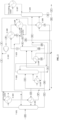
- the specific process route is shown in FIG. 1 .
- the refining process route of styrene from upstream to downstream was provided with four key columns in sequence: a pre-separation column T-101, a high pressure ethylbenzene/styrene column T-102, a low pressure ethylbenzene/styrene column T-103, and a styrene product column T-104.
- the pre-separation column T-101 separates benzene and toluene in the dehydrogenated liquid mixture from the top thereof and separates ethylbenzene, styrene, and tar in the dehydrogenated liquid mixture from the column kettle thereof.
- the high pressure ethylbenzene/styrene column T-102 and the low pressure ethylbenzene/styrene column T-103 separate the ethylbenzene from the tops thereof, separate the styrene and the tar from the column kettle thereof, had the same function, and were thermally coupled.
- the styrene product column T-104 separates the styrene from the top thereof, and separates all the tar along with a small amount of the styrene entrained from the column kettle thereof.
- the top of the pre-separation column T-101 was connected to a condenser of the pre-separation column E-102.
- the condensed liquid phase was collected through a reflux tank and pressurized to be used as reflux and extract.
- a total flow at the column kettle of the pre-separation column 11 from the bottom of pre-separation column T-101 is divided into two streams (namely, feed of the high pressure ethylbenzene/styrene column 13 and feed of the low pressure ethylbenzene/styrene column 14) one of which is fed into the high pressure ethylbenzene/styrene column T-102 and the other is fed into the low pressure ethylbenzene/styrene column T-103.
- the lower area of the pre-separation column T-101 is connected to a falling film reboiler of the pre-separation column E-101.
- the styrene product column T-104 is connected to a falling film reboiler of the styrene product column E-106.
- a total flow 15 from the bottom of the styrene product column T-104 is divided into feed of a styrene recovery column 17 and a circulation flow of the styrene product column 16.
- the circulation flow of the styrene product column 16 flows through the falling film reboiler of the styrene product column E-106, and the heated circulation flow of the styrene product column 16 is output and returned to the lower area of the styrene product column T-104.
- the top of the styrene product column is connected to a condenser of the styrene product column E-107.
- the condensed liquid phase is collected through a reflux tank and pressurized to be used as a reflux and a extracted product styrene.
- the high pressure ethylbenzene/styrene column T-102 is connected to a reboiler of the high pressure ethylbenzene/styrene column E-103.
- the product flow of the high pressure column 21, which mainly contains high-concentration styrene monomer, from the bottom of the high pressure ethylbenzene/styrene column T-102 is fed into the styrene product column T-104.
- a gas phase distillate at the top of the high pressure ethylbenzene/styrene column mainly contains ethylbenzene.
- the gas phase distillate at the top of the high pressure ethylbenzene/styrene column is used for the heat supply of the falling film reboiler of the low pressure ethylbenzene/styrene column.
- the gas phase distillate is condensed after heat transfer to the falling film reboiler of the low pressure ethylbenzene/styrene column.
- One part of the condensed gas phase distillate is used as a reflux, and the other part of the condensed gas phase distillate is extracted as circulating ethylbenzene and fed into a dehydrogenation unit for recycling.
- the low pressure ethylbenzene/styrene column T-103 is connected to a falling film reboiler of the low pressure ethylbenzene/styrene column E-104.
- Effluent of the low pressure ethylbenzene/styrene column 18, which mainly contains high-concentration styrene monomer, from the bottom of the low pressure ethylbenzene/styrene column T-103 is divided into a product flow of the ethylbenzene/styrene low pressure column 20 and a circulation flow of the low pressure ethylbenzene/styrene column 19.
- the product flow of the ethylbenzene/styrene low pressure column 20 is fed into the styrene product column T-104, and the circulation flow of the low pressure ethylbenzene/styrene column 19 flows through the falling film reboiler of the low pressure ethylbenzene/styrene column E-104, and is partially gasified through heating by the gas phase flow distillate at the top of the high pressure ethylbenzene/styrene column and returned to the bottom of the low pressure ethylbenzene/styrene column T-103.
- the gas phase flow at the top of the low pressure ethylbenzene/styrene column 1 is divided into two gas phase flows.
- One gas phase flow can be divided into a first gas phase flow 2 and a second gas phase flow 3 after being pressurized by an ethylbenzene heat pump compressor C-101.
- the first gas phase flow 2 is fed into the falling film reboiler of the pre-separation column E-101 as the heat source of the pre-separation column T-101
- the second gas phase flow 3 is fed into the falling film reboiler of the styrene product column E-106 as the heat source of the styrene product column T-104.
- the other unpressurized gas phase flow 4 is fed into a condenser of the low pressure ethylbenzene/styrene column E-105 for condensation, and condensate 5 and a first condensed flow 6 condensed by the falling film reboiler of the pre-separation column E-101 and a second condensed flow 7 condensed by the falling film reboiler of the styrene product columnE-106 are collected together and pressurized as a total condensate flow 8.
- the total condensate flow 8 is transported to an ethylbenzene dehydrogenation unit for recycling as the reflux 9 of the low pressure ethylbenzene/styrene column T-103 or as the total extracted flow 10.
- the condenser of the low pressure ethylbenzene/styrene column E-105 played an auxiliary role in adjusting the condensing load during startup and shutdown or under fluctuating operating conditions.
- the falling film reboiler of the pre-separation column E-101 needs to be equipped with a circulating pump to establish the circulation flow of the pre-separation column 12.
- the falling film reboiler of the styrene product column E-106 needs to be equipped with a circulating pump to establish the circulation flow of the styrene product column 16.
- the condenser of the pre-separation column E-102, the condenser of the low pressure ethylbenzene/styrene column E-105, and the condenser of the styrene product column E-107 in this example still use circulating water as a cold source, just like the coupled high and low pressure sequential separation process mentioned above.
- the circulating water for the condenser of the styrene product column E-107 and the condenser of the pre-separation column E-102 are connected in series with circulating water for the condenser of the low pressure ethylbenzene/styrene column E-105, and both the condenser of the styrene product column E-107 and the condenser of the pre-separation column E-102 are placed in a front portion of a circulating water flow path, so as to reduce circulating water consumption.
- Example II a method for refining styrene by using falling film reboilers and closed heat pump technology to provide a heat source of a separation column
- This example focused on a method for refining styrene by using closed heat pump technology and reboilers to provide a heat source of the separation column.
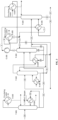
- the specific process route is shown in FIG. 2 .
- the gas phase flow at the top of the low pressure ethylbenzene/styrene column 1 is fed into a heat pump working medium evaporator of the low pressure ethylbenzene/styrene column E-108, and the uncondensed gas phase flow is continuously fed into the aftercondenser of the low pressure ethylbenzene/styrene column E-109 for condensation.
- the evaporated heat pump working medium 4' is pressurized by a working medium heat pump compressor C-102 and divided into a first heat pump working medium gas phase flow 2' and a second heat pump working medium gas phase flow 3'.
- the two gas phase flows are fed into the reboiler of the pre-separation column E-101 and/or the reboiler of the styrene product column E-106 respectively as a heat source.
- a first condensed heat pump working medium 6' and a second condensed heat pump working medium 7' condensed in E-101/106 are combined into a total condensed heat pump working medium 5', and recycled back to the heat pump working medium evaporator of the low pressure ethylbenzene/styrene column E-108 for continuous gasification for recycling.
- the falling film reboiler of the pre-separation column E-101 needs to be equipped with a circulating pump to establish the circulation flow of the pre-separation column 12 required by the falling film reboiler.
- the falling film reboiler of the styrene product column E-106 needs to be equipped with a circulating pump to establish the circulation flow of the styrene product column 16 required by the falling film reboiler.
- the closed heat pump gasifies the heat pump working medium using high-concentration gas-phase ethylbenzene separated from the top of the low pressure ethylbenzene/styrene column T-103, and the gasified heat pump working medium is pressurized.
- the indirectly gasified and pressurized heat pump working medium is fed into the falling film reboiler with low heat transfer temperature difference requirement to serve as the heat source of the pre-separation column T-101 or the styrene product column T-104 in the styrene separation process.
- the closed heat pump working medium needs to be a medium with a pressure suitable for selection and low power of the compressor after being evaporated by the gas phase flow at the top of the low pressure ethylbenzene/styrene column, such as n-butane, isobutane, butene, pentane, cyclopentane, benzene, and methanol, etc.
- the condenser of the pre-separation column E-102, the aftercondenser of the low pressure ethylbenzene/styrene column E-109, and the condenser of the styrene product column E-107 in this example still uses circulating water as a cold source, just like the distillation device for separating ethylbenzene/styrene with high pressure column and low pressure column coupled to the high pressure column mentioned above.
- the circulating water used for the condenser of the styrene product column E-107 and the condenser of the pre-separation column E-102 are connected in series with circulating water used for the aftercondenser of the low pressure ethylbenzene/styrene column E-109, and both the condenser of the styrene product column E-107 and the condenser of the pre-separation column E-102 are placed in a front portion of a circulating water flow path, so as to increase the heat transfer temperature difference between E-102 and E-107 and reduce circulating water consumption.
- the reboiler of the pre-separation column, the reboiler of the styrene product column, and the low pressure ethylbenzene/styrene reboiler used in the above examples and the following application examples are all falling film reboilers.
- the reason for choosing the falling film reboiler is as follows: the falling film reboiler is one kind of reboiler, in addition to the kettle reboiler, the horizontal thermosyphon reboiler, the vertical thermosyphon reboiler, the forced circulation reboiler, etc.
- the falling film reboiler needs to be additionally equipped with a liquid phase circulating pump and a liquid phase distribution device, such as a distribution head and a liquid phase distribution disk, etc.
- a liquid phase circulating pump and a liquid phase distribution device, such as a distribution head and a liquid phase distribution disk, etc.
- the liquid phase is pulled into a film along the wall of a heat exchange tube through the distribution device, and the gas phase is evaporated along the film.
- Other types of reboilers, such as the thermosyphon reboiler do not need to be provided with additional circulating pumps which relied on the density difference of their own liquid after heating to circulate.
- the installation height of the falling film reboiler relative to the column body is generally not specified, but the installation height of the thermosyphon reboiler relative to the column kettle and the gas phase and liquid phase inlets and outlets need to be specially determined according to operating conditions thereof and material properties.
- the falling film reboiler is more suitable for treatment of materials with high vacuum, strong heat sensitivity and high viscosity than the thermosyphon reboiler.
- the heat transfer temperature difference between the tube side and the shell side of the falling film reboiler can be reduced, and the heat exchange efficiency is high.
- the falling film reboiler needed to be selected to reduce the heat transfer temperature difference between the tube side and the shell side of the falling film reboiler by increasing the styrene content in the products of the kettle of the styrene product column and reducing the gasification rate of the falling film reboiler.
- a styrene separation unit for producing styrene by dehydrogenation of 500,000 tons of ethylbenzene is taken as an example.
- the top of the low pressure ethylbenzene/styrene column T-103 contains high-concentration gas-phase ethylbenzene, which is pressurized by the ethylbenzene heat pump compressor C-101, and only provides a heat source for the falling film reboiler of the styrene product column E-106.
- the specific process route is shown in FIG. 3 .
- a styrene separation unit for producing styrene by dehydrogenation of 500,000 tons of ethylbenzene is taken as an example.
- High-concentration gas-phase ethylbenzene distilled from the top of the low pressure ethylbenzene/styrene column T-103 is pressurized by the ethylbenzene heat pump compressor C-101, and only provides a heat source for the falling film reboiler of the pre-separation column E-101.
- the specific process route is shown in FIG. 4 .
- a styrene separation unit for producing styrene by dehydrogenation of 500,000 tons of ethylbenzene is taken as an example.
- This application example uses the closed heat pump technology, the flow at the top of the low pressure ethylbenzene/styrene column T-103 is fed into the heat pump working medium evaporator of the low pressure ethylbenzene/styrene column E-108, and the uncondensed flow is continuously fed into the aftercondenser of the low pressure ethylbenzene/styrene separation column E-109 for condensation.
- a second heat pump working medium gas phase flow 3' obtained after the evaporated heat pump working medium 4' is pressurized by the working medium heat pump compressor C-102 is fed into the falling film reboiler of the styrene product column E-106 as the heat source.
- the second condensing heat pump working medium 7' condensed in the falling film reboiler of the styrene product column E-106 is recycled back to the heat pump working medium evaporator of the low pressure ethylbenzene/styrene column E-108 for further gasification and recycling. Details are shown in FIG. 5 .
- a traditional styrene separation unit for producing styrene by dehydrogenation of 500,000 tons of ethylbenzene is taken as an example.
- the styrene product column uses 0.04 MPaG steam as the heat source:
- the present disclosure realizes the thermal coupling between the low pressure ethylbenzene/styrene column T-103, the pre-separation column T-101, and the styrene product column T-104 by increasing the heat pump cycle process and combining the use of the falling film reboilers, which can further greatly reduce the energy consumption in the styrene separation process on the basis of the energy-saving technology of coupled high and low pressure ethylbenzene/styrene separation columns, can recover the investment cost after several years of operation, and has remarkable long-term economic and environmental benefits.
Landscapes
- Chemical & Material Sciences (AREA)
- Organic Chemistry (AREA)
- Chemical Kinetics & Catalysis (AREA)
- Engineering & Computer Science (AREA)
- Analytical Chemistry (AREA)
- Oil, Petroleum & Natural Gas (AREA)
- Water Supply & Treatment (AREA)
- Organic Low-Molecular-Weight Compounds And Preparation Thereof (AREA)
- Vaporization, Distillation, Condensation, Sublimation, And Cold Traps (AREA)
Applications Claiming Priority (2)
| Application Number | Priority Date | Filing Date | Title |
|---|---|---|---|
| CN202111145258.7A CN113877227B (zh) | 2021-09-28 | 2021-09-28 | 一种降膜式再沸器和热泵技术组合提供分离塔所需热源的苯乙烯精制方法 |
| PCT/CN2022/108063 WO2023050988A1 (zh) | 2021-09-28 | 2022-07-27 | 一种降膜式再沸器和热泵技术组合提供分离塔所需热源的苯乙烯精制方法 |
Publications (2)
| Publication Number | Publication Date |
|---|---|
| EP4180102A1 true EP4180102A1 (de) | 2023-05-17 |
| EP4180102A4 EP4180102A4 (de) | 2024-04-03 |
Family
ID=79007541
Family Applications (1)
| Application Number | Title | Priority Date | Filing Date |
|---|---|---|---|
| EP22818169.9A Pending EP4180102A4 (de) | 2021-09-28 | 2022-07-27 | Styrolraffinationsverfahren mit einer kombination aus fallfilmverdampfer und wärmepumpentechnologie zur bereitstellung einer für eine trennsäule benötigten wärmequelle |
Country Status (4)
| Country | Link |
|---|---|
| US (1) | US12121835B2 (de) |
| EP (1) | EP4180102A4 (de) |
| CN (1) | CN113877227B (de) |
| WO (1) | WO2023050988A1 (de) |
Cited By (1)
| Publication number | Priority date | Publication date | Assignee | Title |
|---|---|---|---|---|
| CN120364457A (zh) * | 2025-06-30 | 2025-07-25 | 四川丁点儿食品开发股份有限公司 | 一种酱料炒制用上料系统及方法 |
Families Citing this family (2)
| Publication number | Priority date | Publication date | Assignee | Title |
|---|---|---|---|---|
| CN112500261B (zh) * | 2020-11-30 | 2023-10-17 | 云南能投硅材科技发展有限公司 | 一种有机硅粗单体与氯甲烷分离的节能、精制装置及方法 |
| CN113877227B (zh) * | 2021-09-28 | 2022-09-30 | 常州瑞华化工工程技术股份有限公司 | 一种降膜式再沸器和热泵技术组合提供分离塔所需热源的苯乙烯精制方法 |
Family Cites Families (16)
| Publication number | Priority date | Publication date | Assignee | Title |
|---|---|---|---|---|
| CH504391A (fr) * | 1963-05-28 | 1971-03-15 | Halcon International Inc | Procédé pour séparer l'éthylbenzène non transformé d'un courant gazeux |
| KR900008691B1 (ko) * | 1984-04-26 | 1990-11-27 | 신니쯔 데쯔가가꾸 가부시끼가이샤 | 스틸렌류의 증류방법 |
| DE4235431C1 (de) * | 1992-10-21 | 1994-01-20 | Huels Chemische Werke Ag | Verfahren zur Trennung von Ethylbenzol/Styrol durch Destillation eines flüssigen, überwiegend aus Styrol und Ethylbenzol bestehenden Gemisches |
| US6171449B1 (en) * | 1998-06-19 | 2001-01-09 | Washington Group International, Inc. | Cascade reboiling of ethylbenzene/styrene columns |
| CN1227197C (zh) * | 2002-04-10 | 2005-11-16 | 中国石油化工股份有限公司 | 苯乙烯分离方法 |
| US8742186B2 (en) * | 2008-04-04 | 2014-06-03 | Lummus Technology Inc. | Batch process and system for the production of olefins |
| CN101602640B (zh) * | 2008-06-12 | 2012-10-10 | 中国石油化工股份有限公司 | 乙苯/苯乙烯的节能分离方法 |
| CN101596372B (zh) * | 2009-06-19 | 2011-07-20 | 北京化工大学 | 一种内部热耦合蒸馏塔的塔器及其控制工艺 |
| KR101172422B1 (ko) * | 2009-12-11 | 2012-08-08 | 에스케이씨 주식회사 | 폐열 회수 시스템 |
| WO2014098816A1 (en) * | 2012-12-19 | 2014-06-26 | Stone & Webster Process Technology, Inc. | Method for reducing energy consumption in a process to purify styrene monomer |
| CN105669354B (zh) | 2014-11-20 | 2018-04-06 | 中国石油化工股份有限公司 | 乙苯脱氢反应产物分离方法 |
| CN105669353B (zh) | 2014-11-20 | 2018-04-06 | 中国石油化工股份有限公司 | 乙苯苯乙烯分离方法 |
| KR102266540B1 (ko) * | 2016-09-16 | 2021-06-18 | 루머스 테크놀로지 엘엘씨 | 통합된 프로판 탈수소 공정 |
| CN106631663B (zh) | 2016-11-28 | 2023-06-27 | 山东齐鲁石化工程有限公司 | 苯乙烯节能生产装置 |
| CN109675333B (zh) * | 2017-10-19 | 2021-09-14 | 中国石化工程建设有限公司 | 热泵驱动的苯塔分馏装置及方法 |
| CN113877227B (zh) | 2021-09-28 | 2022-09-30 | 常州瑞华化工工程技术股份有限公司 | 一种降膜式再沸器和热泵技术组合提供分离塔所需热源的苯乙烯精制方法 |
-
2021
- 2021-09-28 CN CN202111145258.7A patent/CN113877227B/zh active Active
-
2022
- 2022-07-27 EP EP22818169.9A patent/EP4180102A4/de active Pending
- 2022-07-27 WO PCT/CN2022/108063 patent/WO2023050988A1/zh not_active Ceased
- 2022-07-27 US US18/009,541 patent/US12121835B2/en active Active
Cited By (1)
| Publication number | Priority date | Publication date | Assignee | Title |
|---|---|---|---|---|
| CN120364457A (zh) * | 2025-06-30 | 2025-07-25 | 四川丁点儿食品开发股份有限公司 | 一种酱料炒制用上料系统及方法 |
Also Published As
| Publication number | Publication date |
|---|---|
| CN113877227B (zh) | 2022-09-30 |
| CN113877227A (zh) | 2022-01-04 |
| EP4180102A4 (de) | 2024-04-03 |
| US20240238694A1 (en) | 2024-07-18 |
| US12121835B2 (en) | 2024-10-22 |
| WO2023050988A1 (zh) | 2023-04-06 |
Similar Documents
| Publication | Publication Date | Title |
|---|---|---|
| EP4180102A1 (de) | Styrolraffinationsverfahren mit einer kombination aus fallfilmverdampfer und wärmepumpentechnologie zur bereitstellung einer für eine trennsäule benötigten wärmequelle | |
| CN100584421C (zh) | 差压低能耗精馏方法及设备 | |
| CN101734999B (zh) | 乙苯/苯乙烯顺序分离共沸热回收方法 | |
| EP4144716A1 (de) | Verfahren zur herstellung von vinylacetat | |
| CN101348412A (zh) | 用于苯乙烯精馏的节能方法 | |
| CN112358375B (zh) | 两塔双热泵集成的1-丁烯精制节能工艺及装置 | |
| CN102423539B (zh) | 一种催化反应精馏过程的节能方法及装置 | |
| CN115888155A (zh) | 用于三组分混合物分离的精馏系统及精馏工艺 | |
| RU2802428C1 (ru) | Способ очистки стирола с использованием совместного действия ребойлеров c падающей пленкой и технологии теплового насоса с целью получения источника тепла для разделительной колонны | |
| CN105669353B (zh) | 乙苯苯乙烯分离方法 | |
| CN213760551U (zh) | 具有热泵热集成的1-丁烯精制节能装置 | |
| EP4302853A1 (de) | Ethylbenzolverdampfer mit niedrigem druckabfall und energiesparendes verfahren zur ethylenverdampfung in einem styroldehydrierungs-reaktionssystem | |
| CN213760550U (zh) | 两塔双热泵集成的1-丁烯精制节能装置 | |
| CN113440882B (zh) | 一种应用于苯乙烯分离系统的装置及方法 | |
| CN101633597A (zh) | 苯乙烯精馏的节能方法 | |
| CN118236715A (zh) | 用于丙烷丙烯分离的热泵精馏装置 | |
| CN210096970U (zh) | 一种糠醛多效反应精馏装置 | |
| CN105669354B (zh) | 乙苯脱氢反应产物分离方法 | |
| RU2832969C2 (ru) | Испаритель этилбензола с низким перепадом давления и процесс энергосбережения для испарения этилбензола в реакционной системе дегидрирования для получения стирола | |
| CN216837757U (zh) | 脱氢二乙烯苯制备装置 | |
| US12551820B2 (en) | Low-pressure drop ethylbenzene evaporator and energy-saving process for ethylbenzene vaporization in styrene dehydrogenation reaction system | |
| CN222694020U (zh) | 一种合成橡胶生产过程中溶剂精制热能利用装置 | |
| CN206375840U (zh) | 苯乙烯节能生产装置 | |
| CN220610336U (zh) | 一种醚后碳四分离聚合级1-丁烯系统 | |
| CN203890269U (zh) | 乙苯/苯乙烯分离塔塔顶热回收工艺用装置 |
Legal Events
| Date | Code | Title | Description |
|---|---|---|---|
| STAA | Information on the status of an ep patent application or granted ep patent |
Free format text: STATUS: UNKNOWN |
|
| STAA | Information on the status of an ep patent application or granted ep patent |
Free format text: STATUS: THE INTERNATIONAL PUBLICATION HAS BEEN MADE |
|
| PUAI | Public reference made under article 153(3) epc to a published international application that has entered the european phase |
Free format text: ORIGINAL CODE: 0009012 |
|
| STAA | Information on the status of an ep patent application or granted ep patent |
Free format text: STATUS: REQUEST FOR EXAMINATION WAS MADE |
|
| 17P | Request for examination filed |
Effective date: 20221215 |
|
| AK | Designated contracting states |
Kind code of ref document: A1 Designated state(s): AL AT BE BG CH CY CZ DE DK EE ES FI FR GB GR HR HU IE IS IT LI LT LU LV MC MK MT NL NO PL PT RO RS SE SI SK SM TR |
|
| RAP3 | Party data changed (applicant data changed or rights of an application transferred) |
Owner name: CHANGZHOU RUIHUA CHEMICAL ENGINEERING TECHNOLOGY CO., LTD. |
|
| A4 | Supplementary search report drawn up and despatched |
Effective date: 20240304 |
|
| RIC1 | Information provided on ipc code assigned before grant |
Ipc: B01D 3/00 20060101ALI20240227BHEP Ipc: C07C 15/073 20060101ALI20240227BHEP Ipc: C07C 7/00 20060101ALI20240227BHEP Ipc: C07C 7/04 20060101ALI20240227BHEP Ipc: C07C 15/46 20060101ALI20240227BHEP Ipc: B01D 3/42 20060101ALI20240227BHEP Ipc: B01D 3/32 20060101ALI20240227BHEP Ipc: B01D 3/14 20060101AFI20240227BHEP |
|
| DAV | Request for validation of the european patent (deleted) | ||
| DAX | Request for extension of the european patent (deleted) |