EP4179741B1 - Adressierung von d2d-übertragungen durch geographischen zielbereich - Google Patents
Adressierung von d2d-übertragungen durch geographischen zielbereich Download PDFInfo
- Publication number
- EP4179741B1 EP4179741B1 EP20743085.1A EP20743085A EP4179741B1 EP 4179741 B1 EP4179741 B1 EP 4179741B1 EP 20743085 A EP20743085 A EP 20743085A EP 4179741 B1 EP4179741 B1 EP 4179741B1
- Authority
- EP
- European Patent Office
- Prior art keywords
- wireless communication
- transmission
- communication device
- geographical area
- incoming
- Prior art date
- Legal status (The legal status is an assumption and is not a legal conclusion. Google has not performed a legal analysis and makes no representation as to the accuracy of the status listed.)
- Active
Links
Images





Classifications
-
- H—ELECTRICITY
- H04—ELECTRIC COMMUNICATION TECHNIQUE
- H04W—WIRELESS COMMUNICATION NETWORKS
- H04W4/00—Services specially adapted for wireless communication networks; Facilities therefor
- H04W4/06—Selective distribution of broadcast services, e.g. multimedia broadcast multicast service [MBMS]; Services to user groups; One-way selective calling services
-
- H—ELECTRICITY
- H04—ELECTRIC COMMUNICATION TECHNIQUE
- H04L—TRANSMISSION OF DIGITAL INFORMATION, e.g. TELEGRAPHIC COMMUNICATION
- H04L12/00—Data switching networks
- H04L12/02—Details
- H04L12/16—Arrangements for providing special services to substations
- H04L12/18—Arrangements for providing special services to substations for broadcast or conference, e.g. multicast
- H04L12/1845—Arrangements for providing special services to substations for broadcast or conference, e.g. multicast broadcast or multicast in a specific location, e.g. geocast
-
- H—ELECTRICITY
- H04—ELECTRIC COMMUNICATION TECHNIQUE
- H04L—TRANSMISSION OF DIGITAL INFORMATION, e.g. TELEGRAPHIC COMMUNICATION
- H04L12/00—Data switching networks
- H04L12/02—Details
- H04L12/16—Arrangements for providing special services to substations
- H04L12/18—Arrangements for providing special services to substations for broadcast or conference, e.g. multicast
- H04L12/189—Arrangements for providing special services to substations for broadcast or conference, e.g. multicast in combination with wireless systems
-
- H—ELECTRICITY
- H04—ELECTRIC COMMUNICATION TECHNIQUE
- H04L—TRANSMISSION OF DIGITAL INFORMATION, e.g. TELEGRAPHIC COMMUNICATION
- H04L61/00—Network arrangements, protocols or services for addressing or naming
- H04L61/50—Address allocation
- H04L61/5069—Address allocation for group communication, multicast communication or broadcast communication
-
- H—ELECTRICITY
- H04—ELECTRIC COMMUNICATION TECHNIQUE
- H04W—WIRELESS COMMUNICATION NETWORKS
- H04W40/00—Communication routing or communication path finding
- H04W40/02—Communication route or path selection, e.g. power-based or shortest path routing
- H04W40/20—Communication route or path selection, e.g. power-based or shortest path routing based on geographic position or location
-
- H—ELECTRICITY
- H04—ELECTRIC COMMUNICATION TECHNIQUE
- H04L—TRANSMISSION OF DIGITAL INFORMATION, e.g. TELEGRAPHIC COMMUNICATION
- H04L2101/00—Indexing scheme associated with group H04L61/00
- H04L2101/60—Types of network addresses
- H04L2101/69—Types of network addresses using geographic information, e.g. room number
-
- H—ELECTRICITY
- H04—ELECTRIC COMMUNICATION TECHNIQUE
- H04W—WIRELESS COMMUNICATION NETWORKS
- H04W28/00—Network traffic management; Network resource management
- H04W28/02—Traffic management, e.g. flow control or congestion control
- H04W28/0226—Traffic management, e.g. flow control or congestion control based on location or mobility
-
- H—ELECTRICITY
- H04—ELECTRIC COMMUNICATION TECHNIQUE
- H04W—WIRELESS COMMUNICATION NETWORKS
- H04W28/00—Network traffic management; Network resource management
- H04W28/02—Traffic management, e.g. flow control or congestion control
- H04W28/0231—Traffic management, e.g. flow control or congestion control based on communication conditions
- H04W28/0236—Traffic management, e.g. flow control or congestion control based on communication conditions radio quality, e.g. interference, losses or delay
-
- H—ELECTRICITY
- H04—ELECTRIC COMMUNICATION TECHNIQUE
- H04W—WIRELESS COMMUNICATION NETWORKS
- H04W4/00—Services specially adapted for wireless communication networks; Facilities therefor
- H04W4/02—Services making use of location information
-
- H—ELECTRICITY
- H04—ELECTRIC COMMUNICATION TECHNIQUE
- H04W—WIRELESS COMMUNICATION NETWORKS
- H04W4/00—Services specially adapted for wireless communication networks; Facilities therefor
- H04W4/30—Services specially adapted for particular environments, situations or purposes
- H04W4/40—Services specially adapted for particular environments, situations or purposes for vehicles, e.g. vehicle-to-pedestrians [V2P]
Definitions
- the present invention relates to methods for controlling device-to-device (D2D) communication and to corresponding devices, systems, and computer programs.
- D2D device-to-device
- D2D communication modes to enable direct communication between UEs (user equipments), sometimes also referred to as sidelink communication.
- D2D communication modes may for example be used for vehicle communications, e.g., including communication between vehicles, between vehicles and roadside communication infrastructure and, possibly, between vehicles and cellular networks. Due to wide range of different types of devices that might be involved in the communication with the vehicles, vehicle-to-everything (V2X) communication is another term used to refer to this class of communication. Vehicle communications have the potential to increase traffic safety, reduce energy consumption and enable new services related to intelligent transportation systems.
- V2X vehicle-to-everything
- LTE V2X functionalities have been designed for broadcast transmissions, i.e., for transmissions where all receivers within a certain range of a transmitter may receive a message from the transmitter, i.e., may be regarded as intended recipients. In fact, the transmitter may not be aware or otherwise be able to control the group of intended receivers.
- V2X functionalities for the NR technology are for example described in 3GPP TR 38.885 V16.0.0 (2019-03 ).
- V2X services are considered, by supporting also groupcast, multicast, or unicast transmissions, in which the intended receiver of a message consists of only a subset of the receivers within a certain range of the transmitter (groupcast) or of a single receiver (unicast).
- groupcast multicast
- unicast a single receiver
- the see-through functionality where one vehicle provides video data from a front facing camera to a following vehicle, may involve V2X communication of only a pair of vehicles, for which unicast transmissions may be a preferred choice.
- NR sidelink communication supports D2D communication of UEs with and without network coverage, with varying degrees of interaction between the UEs and the network, including the possibility of standalone, network-less operation.
- NR sidelink communication For NR sidelink communication, unicast at access stratum is supported for services requiring high reliability. Between the same UE pair, there can be multiple sidelink unicast links and each link can support multiple SL QoS flows/radio bearers, established via a sidelink radio interface, in the NR and LTE technology referred to as "PC5". At the access stratum, each link can be identified by the source and destination Layer 2 identity (L2 ID).
- L2 ID Layer 2 identity
- Fig. 1A schematically illustrates utilization of multiple sidelink unicast links between two UEs for supporting multiple different services.
- the sidelink unicast link can be established by means of a direct discovery procedure.
- an initiating UE who intends to communicate with a specific UE or another UE supporting a specific service will broadcast a Direct Communication Request message.
- the initiating UE includes a higher layer identifier of the target UE in the Direct Communication Request message. This case is also referred to as "UE oriented Layer-2 link establishment”.
- the Direct Communication Request message may include a service identifier instead of the identifier of a specific target UE. This is also referred to as "service oriented Layer-2 link establishment”.
- FIG. 1B schematically illustrates an example of a procedure for sidelink unicast link establishment, involving UE oriented Layer-2 link establishment and/or service-oriented Layer-2 link establishment.
- NSPS National Security and Public Safety
- TETRA Terrestrial Trunked Radio
- data rates are in the order of a few kbit/s at most, which is regarded to be not sufficient to support future NSPS use case scenarios.
- the NSPS use case requires enhanced coverage and high reliability of communication.
- Some scenarios of the NSPS use case also involve operation without support from infrastructure, e.g., NSPS communication in tunnels, inside certain buildings, or in certain emergency situations where the infrastructure is destroyed or non-operative.
- NR sidelink communication can be efficiently addressed, such as communication among a group of workers in a building or at an emergency site.
- NSPS group communication scenarios can be efficiently addressed, such as communication among a group of workers in a building or at an emergency site.
- utilization of multi-hop wireless connections formed of multiple sidelink unicast links could help to enable communication between devices which are not capable of establishing a direct sidelink unicast connection.
- a commander may want to talk to all first responders in a building.
- such targeting of UEs in a certain area can be achieved by addressing the same message by unicast D2D transmissions to each UE which is assumed to be in the area or by groupcast D2D transmissions to groups of UEs which are assumed to be in the area.
- This typically requires that the same message is transmitted multiple times and also requires information about where the individual UEs or groups are located.
- the message can be distributed by flooding, i.e., by broadcasting it to all UEs and causing each UE which receives the message to also forward the message to further UEs within the range of the receiving UE.
- the message is typically also received by UEs belonging to the group of intended recipients, and it may be up to each UE to decide whether and how to use the received message.
- transmitting the same message multiple times with unicast addressing of individual UEs may result in rather poor resource efficiency.
- the resource efficiency may be low because it can occur that the message is received or forwarded by an excessive number of UEs not belonging to the group of intended recipients. This may result in excessive duplicated transmissions or in congestion of the network.
- a routing protocol for vehicular ad-hoc networks is described om " B-MFR Routing Protocol for Vehicular Ad Hoc Networks", by Ramshringar Raw, D K Lobiyal, 2010 International Conference on Networking and Information Technology, IEEE (2010 ).
- wireless communication devices may include various types of UEs or other wireless devices (WDs).
- WD wireless device
- the term “wireless device” (WD) refers to a device capable, configured, arranged, and/or operable to communicate wirelessly with network nodes and/or other WDs.
- WD may be used interchangeably herein with UE.
- Communicating wirelessly may involve transmitting and/or receiving wireless signals using electromagnetic waves, radio waves, infrared waves, and/or other types of signals suitable for conveying information through air.
- a WD may be configured to transmit and/or receive information without direct human interaction.
- a WD may be designed to transmit information to a network on a predetermined schedule, when triggered by an internal or external event, or in response to requests from the network.
- Examples of a WD include, but are not limited to, a smart phone, a mobile phone, a cell phone, a Voice over IP (VoIP) phone, a wireless local loop phone, a desktop computer, a Personal Digital Assistant (PDA), a wireless camera, a gaming console or device, a music storage device, a playback appliance, a wearable terminal device, a wireless endpoint, a mobile station, a tablet, a laptop, Laptop Embedded Equipment (LEE), Laptop Mounted Equipment (LME), a smart device, a wireless Customer Premise Equipment (CPE), a vehicle mounted wireless terminal device, a connected vehicle, etc.
- VoIP Voice over IP
- PDA Personal Digital Assistant
- PDA Personal Digital Assistant
- a wireless camera a gaming console or device
- music storage device a playback appliance
- a wearable terminal device a wireless endpoint
- a mobile station a tablet, a laptop, Laptop Embedded Equipment (LEE), Laptop Mounted Equipment (LME), a smart device
- a WD may also represent a machine or other device that performs monitoring and/or measurements, and transmits the results of such monitoring and/or measurements to another WD and/or a network node.
- the WD may in this case be a Machine-to-Machine (M2M) device, which may in a 3GPP context be referred to as a Machine-Type Communication (MTC) device.
- M2M Machine-to-Machine
- MTC Machine-Type Communication
- the WD may be a UE implementing the 3GPP Narrowband loT (NB-loT) standard.
- a WD may represent a vehicle or other equipment that is capable of monitoring and/or reporting on its operational status or other functions associated with its operation.
- a WD as described above may represent the endpoint of a wireless connection, in which case the device may be referred to as a wireless terminal.
- a WD as described above may be mobile, in which case it may also be referred to as a mobile device or a mobile terminal.
- the illustrated concepts particularly concern WDs that support D2D communication, for example by implementing a 3GPP standard for sidelink communication, Vehicle-to-Vehicle (V2V), Vehicle-to-Infrastructure (V2I), Vehicle-to-Everything (V2X).
- the D2D communication may for example be based on the LTE radio technology or the NR radio technology as specified by 3GPP, e.g., on the PC5 interface of the LTE or NR technology.
- the illustrated concepts could also be applied to other radio technologies, e.g., a WLAN (Wireless Local Area Network) technology.
- multiple geographical areas are defined, e.g., by using RRC (Radio Resource Control), broadcasted SI (SI), and/or network operator preconfiguration. These geographical areas are then used as a basis for addressing D2D transmissions by including an area identifier into the D2D transmission to identify the geographical area the D2D transmission is addressed to.
- Direct (single-hop) or multi-hop D2D transmissions may be used to convey the D2D transmission to one or more UEs in the target geographical area. Accordingly, a D2D transmission may be conveyed via a direct or single-hop D2D path or via a multi-hop D2D path formed of multiple D2D path segments each corresponding to a direct D2D path.
- a gateway UE is a UE that provides a direct D2D path between two adjacent geographical areas. This is achieved by the gateway UE being located in a first geographical area and having a direct D2D connection to another UE in the adjacent second geographical area. This other UE may be regarded as being a counterpart gateway UE. From the perspective of the second geographical area, the counterpart gateway UE may act as a gateway UE to the first geographical area.
- Using the area identifier for addressing the D2D transmission to a target geographical area may also be referred to as "geocasting" of the D2D transmission.
- the illustrated concepts thus allow for providing a D2D geocasting mechanism.
- the D2D geocasting mechanism may also be combined with other addressing mechanisms suitable for D2D communication, e.g., by using a groupcasting mechanism to identify a subset of the UEs in the target geographical area.
- Fig. 2A illustrates an exemplary scenario involving V2X communications.
- Fig. 2A shows various UEs 10, which may engage in V2X communication or other D2D communication, illustrated by solid arrows.
- Fig. 2A shows an access node 100 of a wireless communication network, e.g., an eNB of the LTE technology or a gNB of the NR technology, or an access point of a WLAN.
- a wireless communication network e.g., an eNB of the LTE technology or a gNB of the NR technology
- At least some of the UEs 10 may also be capable of communicating by using DL radio transmissions and/or UL radio transmissions, illustrated by broken arrows.
- the UEs illustrated in Fig. 2A comprise vehicles, a drone, a mobile phone, and a person, e.g., a pedestrian, a cyclist, a driver of a vehicle, or a passenger of a vehicle.
- the radio transmissions may be performed by a communication module installed in the vehicle, and that in the case of the person the radio transmissions may be performed by a radio device carried or worn by the person, e.g., a wristband device or similar wearable device.
- V2X communication devices or D2D communication device are merely exemplary and that in the illustrated concepts other types of V2X communication device or D2D communication device could be utilized as well, e.g., RSUs (roadside units) or other infrastructure based V2X communication devices, V2X communication devices based in an aircraft, like an airplane, or helicopter, in a spacecraft, in a train or car of a train, in a ship, in a motorcycles, in a bicycle, in a mobility scooter, or in any other kind of mobility or transportation device.
- RSUs roadside units
- V2X communication devices based in an aircraft like an airplane, or helicopter, in a spacecraft, in a train or car of a train, in a ship, in a motorcycles, in a bicycle, in a mobility scooter, or in any other kind of mobility or transportation device.
- the UEs 10 may be located in various geographical areas. and the D2D geocasting mechanism may be used to efficiently address the V2X communication to the UEs 10 located in a certain geographical area.
- Fig. 2B illustrates an exemplary D2D communication scenario.
- Fig. 2B shows multiple UEs 10, which are connected to each other by radio links implementing direct wireless links (illustrated by double-headed arrows).
- one of the UEs 10 is connected by a radio link to an access node 100 of a wireless communication network, e.g., to an eNB of the LTE technology, or a gNB of the NR technology.
- the access node 100 is part of a RAN (Radio Access Network) of the wireless communication network, which typically also includes further access nodes to provide a desired coverage of the wireless communication network.
- Fig. 2B shows a core network (CN) 210 of the wireless communication network.
- the CN 210 may provide connectivity of the UEs 10 to other data networks, e.g., through a GW 220 provided in the CN 210. Further, the CN 210 may also include various nodes for controlling operation of the UEs 10.
- the radio links may be used for D2D communication between the UEs 10. Further, the radio link to the wireless communication network may be used for controlling or otherwise assisting the D2D communication. Further, the D2D communication and/or data communication with the wireless communication network may be used for providing various kinds of services to the UEs 10, e.g., a voice service, a multimedia service, a data service, an intelligent transportation system (ITS) or similar vehicular management or coordination service, and/or an NSPS service. Such services may be based on applications which are executed on the UE 10 and/or on a device linked to the UE 10. Accordingly, in the illustrated concepts a D2D transmission may convey or correspond to a V2X message, an ITS message, or some other kind of message related to a service.
- ITS intelligent transportation system
- Fig. 2B illustrates an application service platform 250 in the CN 210 of the wireless communication network. Further, Fig. 2B illustrates one or more application servers 300 provided outside the wireless communication network.
- the application(s) executed on the UE 10 and/or on one or more other devices linked to the UE 10 may use the radio links with one or more other UEs 10, the application service platform 250, and/or the application server(s) 300, thereby enabling the corresponding service(s) on the UE 10.
- the services utilized by the UEs 10 may thus be hosted on the network side, e.g., on the application service platform 250 or on the application server(s) 300.
- some of the services may also network-independent so that they can be utilized without requiring an active data connection to the wireless communication network. This may for example apply to certain V2X or NSPS services. Such services may however still be assisted from the network side while the UE 10 is in coverage of the wireless communication network.
- the UEs 10 may be located in various geographical areas, and the D2D geocasting mechanism of the illustrated concepts may be used to efficiently address the D2D communication to the UEs 10 located in a certain geographical area. In this way, it is for example possible to utilize support the service(s) on the UEs 10 by geocasting based D2D communication.
- the UEs 10 are assumed to be a mobile phone and vehicles or vehicle-based communication devices, e.g., a vehicle-mounted or vehicle-integrated communication module, or a smartphone or other user device linked to vehicle systems.
- vehicle-based communication devices e.g., a vehicle-mounted or vehicle-integrated communication module, or a smartphone or other user device linked to vehicle systems.
- other types of UE could be used as well, e.g., a device carried by a pedestrian, or an infrastructure-based device, such as a roadside unit, like for example illustrated in Fig. 2A .
- Fig. 3 schematically illustrates an NSPS communication scenario.
- Fig. 3 shows multiple UEs 10, which may exchange NSPS messages associated with one or more NSPS services using D2D communication, e.g., based on the LTE sidelink communication or NR sidelink communication.
- the NSPS services may be assisted from the network, by exchanging NSPS messages via access node 100.
- the NSPS services may for example include group communication of rescue vehicles, rescue personnel or other equipment or personnel of public safety related organizations.
- Such communication may also involve utilizing the illustrated D2D geocasting mechanism to address an NSPS message by including an area identifier to identify a target geographical area.
- the NSPS message may be efficiently conveyed to all UEs or to a subset of the UEs in the target geographical area.
- Fig. 4 shows an example for further illustrating the D2D geocasting mechanism of the illustrated concepts.
- Fig. 4 illustrates a plurality of geographical areas, denoted as area #1, area #2, area #3, area #4, area #5, area #6, area #7, area #8, and area #9.
- An area identifier is assigned to each of the geographical areas and may be used to uniquely identify the geographical area.
- the area identifier may correspond to a numerical value.
- area #1 may be identified by numerical value 1
- area #2 may be identified by numerical value 2
- area #3 may be identified by numerical value 3
- area #4 may be identified by numerical value 4
- area #5 may be identified by numerical value 5
- area #6 may be identified by numerical value 6
- area #7 may be identified by numerical value 7
- area #8 may be identified by numerical value 8
- area #9 may be identified by numerical value 9.
- a plurality of UEs may be located in the different geographical areas. In the illustrated example, a first UE (UE0), a second UE (UE1), and a third UE (UE2) are located in area #5.
- a fourth UE (UE3) and a fifth UE (UE4) are located in area #2.
- a sixth UE (UE5), a seventh UE (UE6), and an eight UE (UE7) are located in area #1.
- a ninth UE (UE8) and a tenth UE (UE9) are located in area #3.
- An eleventh UE (UE10) is located in area #4.
- a twelfth UE (UE11) and a thirteenth UE (UE12) are located in area #6.
- An fourteenth UE (UE13) is located in area #7.
- An fifteenth UE (UE14) is located in area #9.
- area #8 includes no UE.
- the geographical areas may be defined on the basis of a zone configuration as also utilized for controlling radio resource pools for sidelink transmissions.
- a zone configuration may be provided to the UE per RRC (Radio Resource Control) configuration, by SI (System Information) configuration, and/or per network operator pre-configuration.
- the zone configuration may define multiple zones defined in terms of one or more of the following elements: zone length, zone width, total number of zones configured with respect to longitude, and total number of zones configured with respect to latitude.
- L denotes a value of the zone length
- W denotes a value of the zone width
- Nx denotes the total number of zones configured with respect to longitude
- Ny denotes the total number of zones configured with respect to latitude
- x denotes the geodesic distance in longitude between UE's current location and geographical coordinates (0, 0) according to the WGS84 model
- y denotes the geodesic distance in latitude between UE's current location and geographical coordinates (0, 0) according to the WGS84 model.
- the geographical areas utilized in the illustrated concepts may correspond to these zones or may be defined on the basis of these zones, e.g., by defining each of the geographical areas in terms of a combination of multiple zones.
- UE0 located in area #5
- area #1 is not adjacent to area #5
- UE0 first selects area #2 and area #4 as candidates which can be expected to provide a D2D path to the target geographical area, i.e., to area #1. For example, this can be based on the information that each of area #2 and area #4 is adjacent to both area #1 and to area #5.
- UE0 In a first hop, UE0 first sends the D2D transmission to UE1, which acts as a gateway UE to area #2, and to UE2, which acts as a gateway to area #4.
- the first hop D2D transmission is received by UE3.
- area #4 the first hop D2D transmission is received by UE10.
- UE3 sends the D2D transmission to UE4, which acts as a gateway to area #1.
- area #1 i.e., in the target area
- the second hop D2D transmission is received by UE5.
- UE5 sends the D2D transmission to the other UEs in the target area, i.e., to UE6 and UE7.
- Concerning area #4, the illustrated example assumes that the D2D transmission cannot be further propagated to area #1, because area #4 includes no UE acting as a gateway to area #1.
- the D2D geocasting mechanism may thus operate as follows: Without limitation, it can be assumed that all UEs are capable of relaying a D2D transmission from the previous hop to the next hop. Further, it can be assumed that all UEs have established connection with the other UEs within its communication range. These other UEs may be in the same geographical area or in an adjacent geographical area.
- each UE may maintain a routing table.
- the routing tables may be managed on the basis of mutual information exchange between the UEs, e.g., as part of the D2D communication. Accordingly, each UE may learn its routing table from received D2D transmissions.
- management of the routing tables could also be supported from the network side, e.g., based on information provided by one or more nodes of the wireless communication network. Such information could be provided in broadcasted SI or by RRC signaling.
- each UE is aware of the geographical area where it is located. For example, each UE may derive its geographical position using the GPS (Global Positioning System) or other satellite positioning system, and/or using a network based positioning mechanism. The geographical position of the UE may then be compared to the definitions of the geographical areas to determine the geographical area where the UE is located. This may for example be accomplished using the above-mentioned relations to derive the Zone_id.
- GPS Global Positioning System
- UE types include: An "initial UE” which initially generates a D2D transmission, i.e., is the source of the D2D transmission. An “intermediate UE” which receive a D2D transmission from a previous hop and forwards the D2D transmission to the next hop. A “gateway UE” which keeps a D2D connection to one or more UEs in another geographical area.
- a "target UE” which is located in the target geographical area and constitutes an intended recipient of the D2D transmission.
- the roles may overlap.
- the initial UE could also be a gateway UE.
- an intermediate UE could also be a gateway UE.
- a target UE could also be an intermediate UE and/or a gateway UE.
- an initial UE When an initial UE wants to send a D2D transmission to the UEs in a certain target geographical area, it associates the D2D transmission with an address of the target geographical area.
- This address will in the following be referred to as area identifier. It may for example correspond to a numerical value, e.g., like the above-mentioned zone identifiers.
- Associating the D2D transmission with the address is accomplished by incorporating the area identifier into the D2D transmission, e.g., into a packet header or frame header.
- the initial UE then sends the D2D transmission with the area identifier to a gateway UE which is expected to enable delivery of the D2D transmission to the target geographical area. Sending the D2D transmission to the gateway UE may also be accomplished via one or more intermediate UEs.
- the D2D transmission is then further relayed by the intermediate and/or gateway UEs until it reaches the target UEs in the target geographical area.
- the gateway UE provides one or more direct D2D connections to one or more UEs in one or more neighboring geographical areas.
- the gateway UE may thus facilitate delivery of the D2D transmission towards the target geographical area.
- this UE can be determined whether this UE should be regarded as a gateway UE: If a UE has a D2D connection to another UE in a different geographical area, it can be regarded as gateway UEs to this geographical area.
- Information about the context of such gateway UE may be made available to the other UEs in the same geographical area and to the respective counterpart gateway UE(s) in the other geographical area(s).
- the context of the gateway UE may indicate to which of the geographical areas the gateway UE provides a D2D connection, a channel quality of the D2D connection to the other geographical area, the UE type of the counterpart gateway UEs, the number of counterpart gateway UEs, or the like.
- D2D transmissions to and/or from a gateway UE may be assigned a higher priority than other D2D transmissions. This prioritization may for example be provided on access stratum level.
- a UE relaying or otherwise transmitting the D2D transmission to other UEs within the same geographical area may use a unicast transmission mode, a groupcast transmission mode, a broadcast transmission mode, or a combination of two or more of these transmission modes.
- each UE may maintain a routing table.
- the routing table of a given UE may include the following information:
- a UE may first select one or more gateway UEs in its own geographical area, which are expected to enable reaching the target geographical area. The UE may then first send the D2D transmission to the identified gateway UE(s). This may be accomplished through a direct D2D connection to the gateway UE. If no such direct D2D connection to the gateway UE is available, sending the D2D transmission to the identified gateway UE may also be accomplished through one or more intermediate UEs.
- UE0 is the initial UE and selects UE1 and UE2 as gateway UEs.
- the UE3 selects UE4 as a further gateway UE which allows for reaching the target geographical area, i.e., area #1.
- the UE may first try to find a gateway UE that has direct D2D connection to the target geographical area. If this is not possible, the UE may try to find gateway UEs that can reach a neighbor geographical area of the target geographical area. For example, in the scenario illustrated in Fig. 4 , the target geographical area is area#1. However, for UE0 no gateway UE is available in area #5 that has a direct D2D connection to area#1. Nonetheless, UE0 may determine from its routing table and/or from the configuration information defining the geographical areas that area#2 and area#4 are neighbor geographical areas of area#1.
- gateway UEs are available in area #5, namely UE1 and UE2. Accordingly, in the example of Fig. 4 , UE0 selects UE1 and UE2 as gateway UEs and first sends its D2D transmission to these gateway UEs. In such situations where multiple gateway UEs are available, the UE may also select among these multiple gateway UEs. For example, the UE may select the gateway UE which provides the shortest path to the target geographical area. This may for example consider an expected number of D2D hops from the gateway UE to the target geographical area and/or an expected number of hops from the UE to the gateway UE.
- gateway UEs In some scenarios where multiple gateway UEs are associated with the same neighbor geographical area, only one gateway UE among them may be selected. This selection may be based on channel quality, e.g., measured in terms of RSRP (Reference Signal Received Power) or RSRQ (Reference Signal Received Quality), between the gateway UE and the initial UE. Additionally or alternatively also the channel quality, e.g., measured in terms of RSRP or RSRQ, of at least some or even all other hops to the gateway UE may be considered in the selection.
- RSRP Reference Signal Received Power
- RSRQ Reference Signal Received Quality
- the selection may be based on the length of the D2D path to the target geographical area, e.g., by considering an expected number of D2D hops from the gateway UE to the target geographical area and/or an expected number of hops from the UE to the gateway UE.
- the UE can add an address of the selected gateway UE(s) to the D2D transmission, e.g., by including it in a packet header or frame header.
- the address may for example correspond to a device identifier.
- the D2D transmission may then include the area identifier of the target geographical area and the device identifier of the selected gateway UE(s).
- the UE may then check its routing table to identify a next hop intermediate UE which allows to reach the selected gateway UE(s). Next, the UE may then send the D2D transmission to the selected next hop intermediate UE.
- the UE may also directly send the D2D transmission to the selected gateway UE(s), i.e., if a direct D2D connection to the selected gateway UE is available. If multiple gateway UEs are selected, the D2D transmission may be replicated to be sent separately to each of the multiple gateway UEs.
- an intermediate UE may check the indicated address of gateway UE(s) and check its routing table to identify a next hop intermediate UE which allows to reach the selected gateway UE(s). The intermediate UE may then relay the D2D transmission to the selected next hop intermediate UE. In some scenarios, the intermediate UE may also directly send the D2D transmission to the selected gateway UE(s), i.e., if a direct D2D connection to the selected gateway UE is available.
- the above operations of sending or relaying a D2D transmission to one or more selected gateway UEs may involve that the UE generates a MAC PDU (Medium Access Control Packet Data Unit) which includes the address of the selected gateway UE and the address of the selected next hop intermediate UE in its packet header. The UE may then send this MAC PDU to the selected next hop intermediate UE. In some scenarios, the UE may also directly send the MAC PDU to the selected gateway UE(s), i.e., if a direct D2D connection to the selected gateway UE is available. In this case, the packet header of the MAC PDU would not include an address of a next hop intermediate UE. If multiple gateway UEs are selected, the same data may be sent to each of the multiple gateway UEs in separate MAC PDUs.
- MAC PDU Medium Access Control Packet Data Unit
- the gateway UE may select one or more counterpart gateway UEs in its neighbor geographical area. Specifically, it may select those counterpart gateway UEs which are expected to allow reaching the target geographical area. The gateway UE may then send the D2D transmission to the selected counterpart gateway UE(s). In some scenarios, if multiple counterpart gateway UEs are selected, the gateway UE may replicate the D2D transmission to be sent separately to each of the multiple counterpart gateway UEs, e.g., as separate MAC PDUs.
- the counterpart gateway UE may then operate in a similar manner as described above for selecting one or more further gateway UEs which are expected to allow reaching the target geographical area. For example, in the scenario of Fig. 4 , when UE1 receives the D2D transmission from UE0, UE1 is a gateway UE to area #2 and relays the D2D transmission to UE3, which is a counterpart gateway UE in area #2.
- UE3 then proceeds by identifying a further gateway UE which allows for reaching the target area, i.e., area #1, and selects UE4 that has a direct D2D connection to area #1. UE3 then relays the D2D transmission to UE4.
- a further gateway UE which allows for reaching the target area, i.e., area #1, and selects UE4 that has a direct D2D connection to area #1.
- UE3 then relays the D2D transmission to UE4.
- the D2D transmission is delivered to the target UEs within the target geographical area. This may involve distributing the D2D transmission to all UEs in the target geographical area. Alternatively, the D2D transmission could be delivered to only a subset of the UEs in the target geographical area, i.e., the target UEs may be only a subset of the UEs in the target geographical area.
- the D2D transmission will arrive at a gateway UE of the target geographical area, from a neighboring geographical area.
- the initial UE could already be located in the target geographical area. In this case, arrival of the D2D transmission at the target geographical area would already occur when the initial UE generates the D2D transmission.
- delivering the D2D transmission to the target UEs may involve that the gateway UE floods the D2D transmission into a sub-network consisting of all the target UEs within the target geographical area.
- the initial UE could flood the D2D transmission into a sub-network consisting of all the target UEs within the target geographical area.
- the gateway UE or initial UE could check its routing table and replicate the D2D transmission to be sent separately to each of the target UEs, e.g., as separate MAC PDUs. This may involve adding a respective device address of the target UE to the D2D transmission. In some scenarios, this may also involve replacing the area identifier of the target geographical area with the respective device address.
- the gateway UE or initial UE could check its routing table and groupcast the D2D transmission to at least some of the target UEs. This may involve adding a respective group address assigned to some of the target UEs to the D2D transmission. In this case, the same MAC PDU could be decoded by the target UEs of the group addressed by the groupcast transmission. In some scenarios, this may also involve replacing the area identifier of the target geographical area with the respective group address.
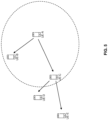
- Fig. 5 shows an example of delivering the D2D transmission in the target geographical area.
- UE-A sends a D2D transmission in a groupcast transmission mode, with the D2D transmission being addresses to UE-B, UE-C, UE-D, and UE-E.
- the communication range from UE-A is illustrated by a broken line.
- the transmission from UE-A can directly reach UE-B and UE-C, but cannot directly reach UE-D and UE-E.
- UE-C can determine that it is located at the edge of UE-A's communication range.
- UE-C can estimate that these UEs can be reached from UE-C, but not from UE-A. UE-C can thus decide to resend the D2D transmission received from UE-A towards UE-D and UE-E. This can be accomplished in a unicast transmission mode, which targets UE-D and UE-E by two separate D2D transmissions, or in a groupcast transmission mode which targets UE-D and UE-E by a single D2D transmission which decodable by both UEs.
- Fig. 6 shows a flowchart for illustrating a method, which may be utilized for implementing the illustrated concepts.
- the method of Fig. 6 may be used for implementing the illustrated concepts in a wireless communication device, e.g., corresponding to any of the above-mentioned UEs.
- the wireless communication device may be a vehicle or vehicle-mounted device, but other types of WD, e.g., as mentioned above, could be used as well.
- wireless communication device may also include a memory storing program code for implementing at least some of the below described functionalities or steps of the method of Fig. 6 .
- the wireless communication device obtains configuration information defining multiple geographical areas.
- the wireless communication device may receive at least a part of the configuration information by RRC signaling while the wireless communication device is connected to a wireless communication network.
- the wireless communication device may receive at least a part of the configuration information by broadcasted system information while the wireless communication device is in coverage of a wireless communication network.
- the wireless communication device may receive at least a part of the configuration information by operator preconfiguration.
- the geographical areas may for example be defined in terms of longitude, latitude, width along the latitude direction, and/or length along the longitude direction. In some scenarios the geographical areas may be defined based on zones as also used for resource assignment for D2D transmissions, e.g., as used for allocating resource pools in the sidelink mode of the LTE or NR technology.
- the wireless communication device may store first information.
- the first information may be part of the above-mentioned routing tables.
- the wireless communication device may store first information indicating one or more wireless communication devices located in the first geographical area and providing a direct D2D path to the second geographical area.
- the wireless communication device may store the first information based on one or more incoming D2D transmissions received from other wireless communication devices in the first geographical area. Accordingly, the wireless communication device may learn the first information from received D2D transmissions.
- the wireless communication device may store second information.
- the second information may be part of the above-mentioned routing tables.
- the second information may overlap with the first information stored at step 620.
- the second information may indicate one or more other wireless communication devices connected by a direct D2D path to the wireless communication device.
- These wireless communication devices may include wireless communication devices located in the same geographical area as the wireless communication device and wireless communication devices located in one or more adjacent geographical areas.
- the wireless communication device may store the second information based on one or more incoming D2D transmissions received from other wireless communication devices. Accordingly, the wireless communication device may learn the second information from received D2D transmissions.
- the second information may include a device identifier of each of the one or more other wireless communication devices. Further, the second information may include, for each of the one or more other wireless communication devices, an area identifier of the geographical area where the other wireless communication device is located. Further, the second information may indicate, for each of the one or more other wireless communication devices, further wireless communication devices connected by a D2D path to the wireless communication device. The second information may thus indicate multi-hop information which allows for determining which other wireless communication devices could be reached through the other wireless communication device.
- the second information may indicate, for each of the one or more other wireless communication devices, whether the other wireless communication device provides a direct D2D path between a first geographical area, where the other wireless communication device is located, and at least one second geographical area which is adjacent to the first geographical area, i.e., whether the other wireless communication device is a gateway.
- the wireless communication device may receive an incoming D2D transmission.
- the incoming D2D transmission may include an area identifier to identify one of the geographical areas as target geographical area of the incoming D2D transmission and to address the incoming D2D transmission to one or more wireless communication devices in the identified target geographical area of the incoming D2D transmission.
- the wireless communication device may receive the incoming D2D transmission via one or more multi-hop D2D paths each formed by one or more intermediate wireless communication devices forwarding the D2D transmission from one D2D path segment to a next D2D path segment.
- Each of these one or more multi-hop D2D paths may include one of the one or more wireless communication devices providing a direct D2D path between two geographical areas, i.e., gateways.
- the incoming D2D transmission may include multiple area identifiers to identify two or more of the geographical areas as target geographical areas of the incoming D2D transmission and to address the incoming D2D transmission to one or more wireless communication devices in the identified target geographical areas of the incoming D2D transmission.
- the wireless communication device may then determine whether it is a target recipient of the received incoming D2D transmission. For this purpose, the wireless communication device may also determine its own geographical position, e.g., based on satellite positioning measurements, network based positioning measurements, and/or other positioning mechanisms.
- the incoming D2D transmission may also include additional address information to address the incoming D2D transmission to a subset of the wireless communication devices in the target geographical area of the incoming D2D transmission.
- the wireless communication device may further consider the additional address information when determining whether it is a target recipient of the D2D transmission.
- the wireless communication device determines one or more gateways, i.e., wireless communication devices located in the first geographical area and providing a direct D2D path to at least one second geographical area, which is adjacent to the first geographical area and is expected to provide a D2D path to the target geographical area.
- the wireless communication device may determine the one or more gateways based on the first information stored at step 620.
- the wireless communication device may select at least one of the multiple gateways. For example, for each of the multiple gateways, the wireless device may determine a respective number of D2D path segments to a target geographical area of an outgoing D2D transmission and select the at least of the multiple gateways based on the determined numbers of D2D path segments to the target geographical area of the outgoing D2D transmission. For example, the wireless communication device may select the gateway providing the lowest number of path segments, to thereby keep the resulting multi-hop D2D path as short as possible.
- the wireless device may determine a respective number of D2D path segments from the wireless communication device to the gateway and select the at least one of the gateways based on the determined numbers of D2D path segments from the wireless device to the gateway. For example, the wireless communication device may select the gateway providing the lowest number of path segments, to thereby keep the resulting multi-hop D2D path as short as possible. Further, for each of the multiple gateways, the wireless device may determine a respective channel quality of at least one D2D path segment between the wireless communication device and the gateway, e.g., in terms of an RSRP or RSRQ, and select the at least of the multiple gateways based on the determined channel qualities.
- the wireless communication device may select the gateway providing higher channel qualities, to thereby overall channel quality of the resulting multi-hop D2D path as high as possible.
- the selection may also be based on the channel qualities of all D2D path segments between the wireless communication device and the gateway.
- the wireless communication device may also select at least two of the multiple gateways.
- the wireless communication device sends an outgoing D2D transmission comprising an area identifier to identify one of the geographical areas as target geographical area of the outgoing D2D transmission and to address the outgoing D2D transmission to one or more wireless communication devices in the identified target geographical area of the outgoing D2D transmission.
- the wireless communication device may send the outgoing D2D transmission via one or more multi-hop D2D paths each formed by one or more intermediate wireless communication devices forwarding the D2D transmission from one D2D path segment to a next D2D path segment.
- Each of these one or more multi-hop D2D paths may include one of the one or more wireless communication devices providing a direct D2D path to at least one second geographical area, i.e., gateways, as determined or selected at step 650.
- each of the one or more multi-hop D2D paths may include a further wireless communication device located in the at least one second geographical area and providing a direct D2D path to the first geographical area, i.e., a counterpart gateway in the second geographical area.
- the wireless communication device may control the sending of the outgoing D2D transmission based on the second information stored at step 630. This may for example involve selecting an output D2D path or selecting a unicast transmission mode, groupcast transmission mode, and/or broadcast transmission mode.
- step 660 may also involve that the wireless communication device forwards at least a part of the received incoming D2D transmission in the outgoing D2D transmission.
- the area identifier of the outgoing D2D transmission may correspond to the area identifier of the received incoming D2D transmission.
- the wireless communication device may decide whether to forward the incoming D2D transmission based on at least one of the following conditions being met:
- step 660 may also involve that, in response to the wireless communication device being located in the target geographical area of the incoming D2D transmission, the wireless communication device adds to the outgoing D2D transmission at least one device identifier and/or group identifier assigned to at least one wireless communication device which is located in the target geographical area.
- the outgoing D2D transmission comprises a respective device identifier for each of the one or more gateways determined at step 650.
- step 660 may involve that the wireless communication device sends the D2D transmission via the multi-hop D2D paths including the selected gateways. In this way, the D2D transmission may be sent in a redundant manner, thereby improving chances of successfully reaching the target geographical area.
- the outgoing D2D transmission may be addressed to all wireless communication devices in the target geographical area of the outgoing D2D transmission.
- the outgoing D2D may include additional address information to address the outgoing D2D transmission to a subset of the wireless communication devices in the target geographical area of the outgoing D2D transmission.
- the wireless communication device may prioritize the outgoing D2D transmission over one or more other D2D transmissions.
- the outgoing D2D transmission may include multiple area identifiers to identify two or more of the geographical areas as target geographical areas of the outgoing D2D transmission and to address the outgoing D2D transmission to one or more wireless communication devices in the identified target geographical areas of the outgoing D2D transmission.
- Fig. 7 shows a block diagram for illustrating functionalities of a wireless communication device 700 which operates according to the method of Fig. 6 .
- the wireless communication device 700 may for example correspond to any of the above-mentioned UEs.
- the wireless communication device 700 may be provided with a module 710 configured to obtain configuration information defining geographical areas, such as explained in connection with step 610.
- the wireless communication device 700 device may be provided with a module 720 configured to store first information, such as explained in connection with step 620.
- the wireless communication device 700 may be provided with a module 730 configured to store second information, such as explained in connection with step 630.
- the wireless communication device 700 may be provided with a module 740 configured to receive an incoming D2D transmission, such as explained in connection with step 640. Further, the wireless communication device 700 may be provided with a module 750 configured to determine one or more gateways, such as explained in connection with step 650. Further, the wireless communication device 700 may be provided with a module 760 configured to send an outgoing D2D transmission, such as explained in connection with step 660.
- the wireless communication device 700 may include further modules for implementing other functionalities, such as known functionalities of a UE in the LTE and/or NR radio technology. Further, it is noted that the modules of the wireless communication device 700 do not necessarily represent a hardware structure of the wireless communication device 700, but may also correspond to functional elements, e.g., implemented by hardware, software, or a combination thereof.
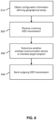
- Fig. 8 shows a flowchart for illustrating a method, which may be utilized for implementing the illustrated concepts.
- the method of Fig. 8 may be used for implementing the illustrated concepts in a wireless communication device, e.g., corresponding to any of the above-mentioned UEs.
- the wireless communication device may be a vehicle or vehicle-mounted device, but other types of WD, e.g., as mentioned above, could be used as well.
- wireless communication device may also include a memory storing program code for implementing at least some of the below described functionalities or steps of the method of Fig. 8 .
- the wireless communication device obtains configuration information defining multiple geographical areas.
- the wireless communication device may receive at least a part of the configuration information by RRC signaling while the wireless communication device is connected to a wireless communication network.
- the wireless communication device may receive at least a part of the configuration information by broadcasted system information while the wireless communication device is in coverage of a wireless communication network.
- the wireless communication device may receive at least a part of the configuration information by operator preconfiguration.
- the geographical areas may for example be defined in terms of longitude, latitude, width along the latitude direction, and/or length along the longitude direction. In some scenarios the geographical areas may be defined based on zones as also used for resource assignment for D2D transmissions, e.g., as used for allocating resource pools in the sidelink mode of the LTE or NR technology.
- the wireless communication device receives an incoming D2D transmission.
- the incoming D2D transmission includes an area identifier to identify one of the geographical areas as target geographical area of the incoming D2D transmission and to address the incoming D2D transmission to one or more wireless communication devices in the identified target geographical area of the incoming D2D transmission.
- the wireless communication device may receive the incoming D2D transmission via one or more multi-hop D2D paths each formed by one or more intermediate wireless communication devices forwarding the D2D transmission from one D2D path segment to a next D2D path segment.
- Each of these one or more multi-hop D2D paths may include one of the one or more wireless communication devices providing a direct D2D path between two geographical areas, i.e., gateways.
- the incoming D2D transmission may include multiple area identifiers to identify two or more of the geographical areas as target geographical areas of the incoming D2D transmission and to address the incoming D2D transmission to one or more wireless communication devices in the identified target geographical areas of the incoming D2D transmission.
- the wireless communication device determines based on the geographical area where the wireless communication device is located and the identified target geographical area of the received incoming D2D transmission, whether the wireless communication device is a target recipient of the received incoming D2D transmission.
- the wireless communication device may also determine its own geographical position, e.g., based on satellite positioning measurements, network based positioning measurements, and/or other positioning mechanisms.
- the incoming D2D transmission may also include additional address information to address the incoming D2D transmission to a subset of the wireless communication devices in the target geographical area of the incoming D2D transmission.
- the wireless communication device may further consider the additional address information when determining whether it is a target recipient of the D2D transmission.
- the wireless communication device may send an outgoing D2D transmission.
- the outgoing D2D transmission may include an area identifier to identify one of the geographical areas as target geographical area of the outgoing D2D transmission and to address the outgoing D2D transmission to one or more wireless communication devices in the identified target geographical area of the outgoing D2D transmission.
- the wireless communication device may send the outgoing D2D transmission via one or more multi-hop D2D paths each formed by one or more intermediate wireless communication devices forwarding the D2D transmission from one D2D path segment to a next D2D path segment.
- Each of these one or more multi-hop D2D paths may include one or more wireless communication devices providing a direct D2D path between two of the geographical areas, i.e., gateways. Such gateways may be determined and selected in a similar manner as explained in connection with step 650 of Fig. 6 .
- the wireless communication device may control the sending of the outgoing D2D transmission based on various information stored by the wireless communication device. Controlling sending of the outgoing D2D transmission may for example involve selecting an output D2D path or selecting a unicast transmission mode, groupcast transmission mode, and/or broadcast transmission mode.
- the information used for controlling sending of the outgoing D2D transmission may be part of the above-mentioned routing tables.
- the information may for example indicate one or more other wireless communication devices connected by a direct D2D path to the wireless communication device.
- These wireless communication devices may include wireless communication devices located in the same geographical area as the wireless communication device and wireless communication devices located in one or more adjacent geographical areas.
- the wireless communication device may store the second information based on one or more incoming D2D transmissions received from other wireless communication devices.
- the information may include a device identifier of each of the one or more other wireless communication devices. Further, the information may include, for each of the one or more other wireless communication devices, an area identifier of the geographical area where the other wireless communication device is located. Further, the information may indicate, for each of the one or more other wireless communication devices, further wireless communication devices connected by a D2D path to the wireless communication device. The second information may thus indicate multi-hop information which allows for determining which other wireless communication devices could be reached through the other wireless communication device.
- the second information may indicate, for each of the one or more other wireless communication devices, whether the other wireless communication device provides a direct D2D path between a first geographical area, where the wireless communication device is located, and at least one second geographical area which is adjacent to the first geographical area, i.e., whether the other wireless communication device is a gateway.
- step 840 may also involve that the wireless communication device forwards at least a part of the received incoming D2D transmission in the outgoing D2D transmission.
- the area identifier of the outgoing D2D transmission may correspond to the area identifier of the received incoming D2D transmission.
- the wireless communication device may decide whether to forward the incoming D2D transmission based on at least one of the following conditions being met:
- step 840 may also involve that, in response to the wireless communication device being located in the target geographical area of the incoming D2D transmission, the wireless communication device adds to the outgoing D2D transmission at least one device identifier and/or group identifier assigned to at least one wireless communication device which is located in the target geographical area.
- the outgoing D2D transmission comprises a respective device identifier for each of the one or more gateways to be used for forwarding the D2D transmission to another geographical area.
- the outgoing D2D transmission may include multiple area identifiers to identify two or more of the geographical areas as target geographical areas of the outgoing D2D transmission and to address the outgoing D2D transmission to one or more wireless communication devices in the identified target geographical areas of the outgoing D2D transmission.
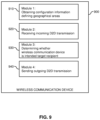
- Fig. 9 shows a block diagram for illustrating functionalities of a wireless communication device 900 which operates according to the method of Fig. 8 .
- the wireless communication device 900 may for example correspond to any of the above-mentioned UEs.
- the wireless communication device 900 may be provided with a module 910 configured to obtain configuration information defining geographical areas, such as explained in connection with step 810.
- the wireless communication device 900 device may be provided with a module 920 configured to receive an incoming D2D transmission, such as explained in connection with step 820.
- the wireless communication device 900 may be provided with a module 930 configured to determine whether it is a target recipient of a received D2D transmission, such as explained in connection with step 830.
- the wireless communication device 900 may be provided with a module 940 configured to send an outgoing D2D transmission, such as explained in connection with step 840.
- the wireless communication device 900 may include further modules for implementing other functionalities, such as known functionalities of a UE in the LTE and/or NR radio technology. Further, it is noted that the modules of the wireless communication device 900 do not necessarily represent a hardware structure of the wireless communication device 900, but may also correspond to functional elements, e.g., implemented by hardware, software, or a combination thereof.
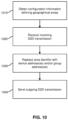
- Fig. 10 shows a flowchart for illustrating a method, which may be utilized for implementing the illustrated concepts.
- the method of Fig. 10 may be used for implementing the illustrated concepts in a wireless communication device, e.g., corresponding to any of the above-mentioned UEs.
- the wireless communication device may be a vehicle or vehicle-mounted device, but other types of WD, e.g., as mentioned above, could be used as well.
- wireless communication device may also include a memory storing program code for implementing at least some of the below described functionalities or steps of the method of Fig. 10 .
- the wireless communication device obtains configuration information defining multiple geographical areas.
- the wireless communication device may receive at least a part of the configuration information by RRC signaling while the wireless communication device is connected to a wireless communication network.
- the wireless communication device may receive at least a part of the configuration information by broadcasted system information while the wireless communication device is in coverage of a wireless communication network.
- the wireless communication device may receive at least a part of the configuration information by operator preconfiguration.
- the geographical areas may for example be defined in terms of longitude, latitude, width along the latitude direction, and/or length along the longitude direction. In some scenarios the geographical areas may be defined based on zones as also used for resource assignment for D2D transmissions, e.g., as used for allocating resource pools in the sidelink mode of the LTE or NR technology.
- the wireless communication device receives an incoming D2D transmission.
- the incoming D2D transmission includes an area identifier to identify one of the geographical areas as target geographical area of the incoming D2D transmission and to address the incoming D2D transmission to one or more wireless communication devices in the identified target geographical area of the incoming D2D transmission.
- the wireless communication device may receive the incoming D2D transmission via one or more multi-hop D2D paths each formed by one or more intermediate wireless communication devices forwarding the D2D transmission from one D2D path segment to a next D2D path segment.
- Each of these one or more multi-hop D2D paths may include one of the one or more wireless communication devices providing a direct D2D path between two geographical areas, i.e., gateways.
- the incoming D2D transmission may include multiple area identifiers to identify two or more of the geographical areas as target geographical areas of the incoming D2D transmission and to address the incoming D2D transmission to one or more wireless communication devices in the identified target geographical areas of the incoming D2D transmission.
- the wireless communication device may determine based on the geographical area where the wireless communication device is located and the identified target geographical area of the received incoming D2D transmission, whether the wireless communication device is a target recipient of the received incoming D2D transmission. For this purpose, the wireless communication device may also determine its own geographical position, e.g., based on satellite positioning measurements, network based positioning measurements, and/or other positioning mechanisms.
- the incoming D2D transmission may also include additional address information to address the incoming D2D transmission to a subset of the wireless communication devices in the target geographical area of the incoming D2D transmission.
- the wireless communication device may further consider the additional address information when determining whether it is a target recipient of the D2D transmission.
- the wireless communication device in response to the wireless communication device being located in the target geographical area of the incoming D2D transmission, the wireless communication device replaces the area identifier of the incoming D2D transmission with at least one device identifier and/or group identifier assigned to at least one wireless communication device which is located in the target geographical area.
- the wireless communication device sends an outgoing D2D transmission which forwards at least a part of the received incoming D2D transmission with the area identifier being replaced by the at least one device identifier and/or the at least one group identifier.
- the wireless communication device may decide whether to forward the incoming D2D transmission based on at least one of the following conditions being met:
- the wireless communication device may send the outgoing D2D transmission via one or more multi-hop D2D paths each formed by one or more intermediate wireless communication devices forwarding the D2D transmission from one D2D path segment to a next D2D path segment.
- the wireless communication device may control the sending of the outgoing D2D transmission based on various information stored by the wireless communication device. Controlling sending of the outgoing D2D transmission may for example involve selecting an output D2D path or selecting a unicast transmission mode, groupcast transmission mode, and/or broadcast transmission mode.
- the information used for controlling sending of the outgoing D2D transmission may be part of the above-mentioned routing tables.
- the information may for example indicate one or more other wireless communication devices connected by a direct D2D path to the wireless communication device.
- These wireless communication devices may include wireless communication devices located in the same geographical area as the wireless communication device and wireless communication devices located in one or more adjacent geographical areas.
- the wireless communication device may store the information based on one or more incoming D2D transmissions received from other wireless communication devices.
- the information may include a device identifier of each of the one or more other wireless communication devices. Further, the information may include, for each of the one or more other wireless communication devices, an area identifier of the geographical area where the other wireless communication device is located. Further, the information may indicate, for each of the one or more other wireless communication devices, further wireless communication devices connected by a D2D path to the wireless communication device. The second information may thus indicate multi-hop information which allows for determining which other wireless communication devices could be reached through the other wireless communication device.
- the second information may indicate, for each of the one or more other wireless communication devices, whether the other wireless communication device provides a direct D2D path between a first geographical area, where the wireless communication device is located, and at least one second geographical area which is adjacent to the first geographical area, i.e., whether the other wireless communication device is a gateway.
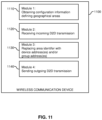
- Fig. 11 shows a block diagram for illustrating functionalities of a wireless communication device 1100 which operates according to the method of Fig. 10 .
- the wireless communication device 1100 may for example correspond to any of the above-mentioned UEs.
- the wireless communication device 1100 may be provided with a module 1110 configured to obtain configuration information defining geographical areas, such as explained in connection with step 1010.
- the wireless communication device 900 device may be provided with a module 1120 configured to receive an incoming D2D transmission, such as explained in connection with step 1020.
- the wireless communication device 1100 may be provided with a module 1130 configured to replace an area identifier of the received incoming D2D transmission, such as explained in connection with step 1030.
- the wireless communication device 1100 may be provided with a module 1140 configured to send an outgoing D2D transmission, such as explained in connection with step 1040.
- the wireless communication device 1100 may include further modules for implementing other functionalities, such as known functionalities of a UE in the LTE and/or NR radio technology. Further, it is noted that the modules of the wireless communication device 1100 do not necessarily represent a hardware structure of the wireless communication device 1100, but may also correspond to functional elements, e.g., implemented by hardware, software, or a combination thereof.
- a first wireless communication device could operate according to the method of Fig. 6 to send the outgoing D2D transmission
- a second wireless communication device could operate according to the method of Fig. 6 or 8 to handle this outgoing D2D transmission as the incoming D2D transmission of step 820 or of step 1020.
- the same wireless communication device could implement functionalities corresponding to the steps of two or more of the method of Fig. 6 , the method of Fig. 8 , and the method of Fig. 10 .
- Fig. 12 illustrates a processor-based implementation of a wireless communication device 1200 which may be used for implementing the above-described concepts.
- the structures as illustrated in Fig. 12 may be used for implementing the concepts in any of the above-mentioned UEs.
- the wireless communication device 1200 includes one or more radio interfaces 1210.
- the radio interface(s) 1210 may for example be based on the NR technology or the LTE technology.
- the radio interface(s) 1210 may support D2D communication, e.g., using sidelink communication as specified for the NR technology or the LTE technology.
- the wireless communication device 1200 may include one or more processors 1250 coupled to the radio interface(s) 1210 and a memory 1260 coupled to the processor(s) 1250.
- the radio interface(s) 1210, the processor(s) 1250, and the memory 1260 could be coupled by one or more internal bus systems of the wireless communication device 1200.
- the memory 1260 may include a Read-Only-Memory (ROM), e.g., a flash ROM, a Random Access Memory (RAM), e.g., a Dynamic RAM (DRAM) or Static RAM (SRAM), a mass storage, e.g., a hard disk or solid state disk, or the like.
- ROM Read-Only-Memory
- RAM Random Access Memory
- DRAM Dynamic RAM
- SRAM Static RAM
- mass storage e.g., a hard disk or solid state disk, or the like.
- the memory 1260 may include software 1270 and/or firmware 1280.
- the memory 1260 may include suitably configured program code to be executed by the processor(s) 1250 so as to implement the above-described functionalities for controlling D2D communication, such as explained in connection with Figs. 6 to 11 .
- the structures as illustrated in Fig. 12 are merely schematic and that the wireless communication device 1200 may actually include further components which, for the sake of clarity, have not been illustrated, e.g., further interfaces, such as a dedicated management interface, or further processors.
- the memory 1260 may include further program code for implementing known functionalities of a UE.
- a computer program may be provided for implementing functionalities of the wireless communication device 1200, e.g., in the form of a physical medium storing the program code and/or other data to be stored in the memory 1260 or by making the program code available for download or by streaming.
- the concepts as described above may be used for efficiently addressing D2D transmissions.
- the concepts may be used for efficiently targeting a D2D transmission to devices in a certain geographical area. This may be achieved with low signaling overhead and high resource efficiency.
- the illustrated concepts may allow for efficiently determining a single or multi-hop D2D path to the target geographical area. This may also help to avoid or reduce possible transmission delays.
- the illustrated concepts may be applied in connection with various kinds of radio technologies, without limitation to the LTE technology or NR technology, e.g., in connection with WLAN technologies. Further, the concepts may be applied with respect to various types of UEs, without limitation to vehicle-based UEs. Further, the concepts may be applied in connection with various services supported by D2D communication, without limitation to V2X or NSPS services.
- the concepts may be applied to various protocol layer, without limitation to PHY, MAC, or application layer, e.g., to the IP (Internet Protocol) layer or PDCP (Packet Data Convergence Protocol) / Adaptation layer, and utilize identifiers provided by these protocol layers to identify the UEs, groups of UEs or geographical areas.
- IP Internet Protocol
- PDCP Packet Data Convergence Protocol
- Adaptation layer e.g., IP (Internet Protocol) layer or PDCP (Packet Data Convergence Protocol) / Adaptation layer
- the above concepts may be implemented by using correspondingly designed software to be executed by one or more processors of an existing device or apparatus, or by using dedicated device hardware.
- the illustrated apparatuses or devices may each be implemented as a single device or as a system of multiple interacting devices or modules.
Landscapes
- Engineering & Computer Science (AREA)
- Computer Networks & Wireless Communication (AREA)
- Signal Processing (AREA)
- Multimedia (AREA)
- Mobile Radio Communication Systems (AREA)
Claims (17)
- Verfahren zur Steuerung einer Kommunikation von Vorrichtung zu Vorrichtung, D2D, wobei das Verfahren umfasst, dass:eine drahtlose Kommunikationsvorrichtung (10; 700; 900; 1100; 1200) Konfigurationsinformationen erhält, die mehrere geografische Gebiete definieren; unddie drahtlose Kommunikationsvorrichtung (10; 700; 900; 1100; 1200) über einen oder mehrere Mehrsprung-D2D-Pfade, die jeweils durch eine oder mehrere zwischengeschaltete drahtlose Kommunikationsvorrichtungen gebildet werden, die die D2D-Übertragung von einem D2D-Pfadsegment zu einem nächsten D2D-Pfadsegment weiterleiten, eine abgehende D2D-Übertragung sendet, die eine Gebietskennung umfasst, um eines der geografischen Gebiete als geografisches Zielgebiet der abgehenden D2D-Übertragung zu identifizieren und die abgehende D2D-Übertragung an eine oder mehrere drahtlose Kommunikationsvorrichtungen in dem identifizierten geografischen Zielgebiet der abgehenden D2D-Übertragung zu adressieren.
- Verfahren nach Anspruch 1, umfassend, dass:die drahtlose Kommunikationsvorrichtung (10; 700; 900; 1100; 1200) in Reaktion darauf, dass die drahtlose Kommunikationsvorrichtung (10; 700; 900; 1100; 1200) sich in einem ersten der geografischen Gebiete befindet und das geografische Zielgebiet der abgehenden D2D-Übertragung sich von dem ersten geografischen Gebiet unterscheidet, eine oder mehrere drahtlose Kommunikationsvorrichtungen (10; 700; 900; 1100; 1200) bestimmt, die sich in dem ersten geografischen Gebiet befinden und einen direkten D2D-Pfad zu mindestens einem zweiten geografischen Gebiet bereitstellen, das benachbart zu dem ersten geografischen Gebiet ist und voraussichtlich einen D2D-Pfad zu dem geografischen Zielgebiet bereitstellt,wobei jeder des einen oder der mehreren Mehrsprung-D2D-Pfade eine der einen oder der mehreren drahtlosen Kommunikationsvorrichtungen (10; 700; 900; 1100; 1200) umfasst, die einen direkten D2D-Pfad zu dem mindestens einen zweiten geografischen Gebiet bereitstellen.
- Verfahren nach Anspruch 2, umfassend, dass:die drahtlose Kommunikationsvorrichtung (10; 700; 900; 1100; 1200) für jede der mehreren drahtlosen Kommunikationsvorrichtungen (10; 700; 900; 1100; 1200), die einen direkten D2D-Pfad zu dem mindestens einen zweiten geografischen Gebiet bereitstellen, eine jeweilige Anzahl von D2D-Pfadsegmenten zu dem geografischen Zielgebiet der abgehenden D2D-Übertragung bestimmt und die drahtlose Kommunikationsvorrichtung (10; 700; 900; 1100; 1200) mindestens eine der mehreren drahtlosen Kommunikationsvorrichtungen (10; 700; 900; 1100; 1200), die einen direkten D2D-Pfad zu dem mindestens einen zweiten geografischen Gebiet bereitstellen, basierend auf den bestimmten Anzahlen von D2D-Pfadesegmenten zu dem geografischen Zielgebiet der abgehenden D2D-Übertragung auswählt; und/oderdie drahtlose Kommunikationsvorrichtung (10; 700; 900; 1100; 1200) für jede der mehreren drahtlosen Kommunikationsvorrichtungen (10; 700; 900; 1100; 1200), die einen direkten D2D-Pfad zu dem mindestens einen zweiten geografischen Gebiet bereitstellen, eine jeweilige Anzahl von D2D-Pfadsegmenten von der drahtlosen Kommunikationsvorrichtung (10; 700; 900; 1100; 1200) zu der drahtlosen Kommunikationsvorrichtung (10; 700; 900; 1100; 1200) bestimmt, die einen direkten D2D-Pfad zu dem mindestens einen zweiten geografischen Gebiet bereitstellt, und die drahtlose Kommunikationsvorrichtung (10; 700; 900; 1100; 1200) mindestens eine der mehreren drahtlosen Kommunikationsvorrichtungen (10; 700; 900; 1100; 1200), die einen direkten D2D-Pfad zu dem mindestens einen zweiten geografischen Gebiet bereitstellen, basierend auf den bestimmten Anzahlen von D2D-Pfadesegmenten von der drahtlosen Kommunikationsvorrichtung (10; 700; 900; 1100; 1200) zu der drahtlosen Kommunikationsvorrichtung (10; 700; 900; 1100; 1200) auswählt, die einen direkten D2D-Pfad zu dem mindestens einen zweiten geografischen Gebiet bereitstellt; und/oderdie drahtlose Kommunikationsvorrichtung (10; 700; 900; 1100; 1200) für jede der mehreren drahtlosen Kommunikationsvorrichtungen (10; 700; 900; 1100; 1200), die einen direkten D2D-Pfad zu dem mindestens einen zweiten geografischen Gebiet bereitstellen, eine jeweilige Kanalqualität mindestens eines D2D-Pfadsegments zwischen der drahtlosen Kommunikationsvorrichtung (10; 700; 900; 1100; 1200) und der drahtlosen Kommunikationsvorrichtung (10; 700; 900; 1100; 1200) bestimmt, die einen direkten D2D-Pfad zu dem mindestens einen zweiten geografischen Gebiet bereitstellt, und die drahtlose Kommunikationsvorrichtung (10; 700; 900; 1100; 1200) mindestens eine der mehreren drahtlosen Kommunikationsvorrichtungen (10; 700; 900; 1100; 1200), die einen direkten D2D-Pfad zu dem mindestens einen zweiten geografischen Gebiet bereitstellen, basierend auf den bestimmten Kanalqualitäten auswählt.
- Verfahren nach Anspruch 2 oder 3, umfassend, dass:die drahtlose Kommunikationsvorrichtung (10; 700; 900; 1100; 1200) für jedes von einem oder mehreren zweiten geografischen Gebieten, die benachbart zu dem ersten geografischen Gebiet sind, erste Informationen speichert, die eine oder mehrere drahtlose Kommunikationsvorrichtungen (10; 700; 900; 1100; 1200) angeben, die sich in dem ersten geografischen Gebiet befinden und einen direkten D2D-Pfad zu dem zweiten geografischen Gebiet bereitstellen, wobei die ersten Informationen auf einer oder mehreren eingehenden D2D-Übertragungen basieren, die von anderen drahtlosen Kommunikationsvorrichtungen (10; 700; 900; 1100; 1200) empfangen werden; unddie drahtlose Kommunikationsvorrichtung (10; 700; 900; 1100; 1200) basierend auf den gespeicherten ersten Informationen die eine oder die mehreren drahtlosen Kommunikationsvorrichtungen (10; 700; 900; 1100; 1200) bestimmt, die einen direkten D2D-Pfad zu dem mindestens einen zweiten geografischen Gebiet bereitstellen.
- Verfahren nach einem der vorhergehenden Ansprüche, umfassend, dass:die drahtlose Kommunikationsvorrichtung (10; 700; 900; 1100; 1200) zweite Informationen speichert, die eine oder mehrere andere drahtlose Kommunikationsvorrichtungen (10; 700; 900; 1100; 1200) angeben, die durch einen direkten D2D-Pfad mit der drahtlosen Kommunikationsvorrichtung (10; 700; 900; 1100; 1200) verbunden sind; unddie drahtlose Kommunikationsvorrichtung (10; 700; 900; 1100; 1200) das Senden der abgehenden D2D-Übertragung basierend auf den gespeicherten zweiten Informationen steuert,wobei die zweiten Informationen eine Vorrichtungskennung jeder der einen oder der mehreren anderen drahtlosen Kommunikationsvorrichtungen (10; 700; 900; 1100; 1200) umfassen und/oderwobei die zweiten Informationen für jede der einen oder der mehreren anderen drahtlosen Kommunikationsvorrichtungen (10; 700; 900; 1100; 1200) eine Gebietskennung des geografischen Gebiets umfassen, in dem sich die andere die drahtlose Kommunikationsvorrichtung (10; 700; 900; 1100; 1200) befindet, und/oderwobei die zweiten Informationen für jede der einen oder der mehreren anderen drahtlosen Kommunikationsvorrichtungen (10; 700; 900; 1100; 1200) ferner drahtlose Kommunikationsvorrichtungen (10; 700; 900; 1100; 1200) angeben, die durch einen D2D-Pfad mit der drahtlosen Kommunikationsvorrichtung (10; 700; 900; 1100; 1200) verbunden sind, und/oderwobei die zweiten Informationen für jede der einen oder der mehreren anderen drahtlosen Kommunikationsvorrichtungen (10; 700; 900; 1100; 1200) angeben, ob die andere drahtlose Kommunikationsvorrichtung (10; 700; 900; 1100; 1200) einen direkten D2D-Pfad zwischen dem ersten geografischen Gebiet und mindestens einem zweiten geografischen Gebiet bereitstellt, das benachbart zu dem ersten geografischen Gebiet ist.
- Verfahren nach einem der vorhergehenden Ansprüche,wobei die abgehende D2D-Übertragung zusätzliche Adressinformationen umfasst, um die abgehende D2D-Übertragung an eine Teilmenge der drahtlosen Kommunikationsvorrichtungen (10; 700; 900; 1100; 1200) in dem geografischen Zielgebiet der abgehenden D2D-Übertragung zu adressieren; und/oderwobei die drahtlose Kommunikationsvorrichtung (10; 700; 900; 1100; 1200) in Reaktion darauf, dass die drahtlose Kommunikationsvorrichtung (10; 700; 900; 1100; 1200) einen direkten D2D-Pfad zwischen zweien der geografischen Gebiete bereitstellt, die abgehende D2D-Übertragung gegenüber einer oder mehreren anderen D2D-Übertragungen priorisiert.
- Verfahren zur Steuerung einer Kommunikation von Vorrichtung zu Vorrichtung, D2D, wobei das Verfahren umfasst, dass:eine drahtlose Kommunikationsvorrichtung (10; 700; 900; 1100; 1200) Konfigurationsinformationen erhält, die mehrere geografische Gebiete definieren;die drahtlose Kommunikationsvorrichtung (10; 700; 900; 1100; 1200) über einen oder mehrere Mehrsprung-D2D-Pfade, die jeweils durch eine oder mehrere zwischengeschaltete drahtlose Kommunikationsvorrichtungen gebildet werden, die die D2D-Übertragung von einem D2D-Pfadsegment zu einem nächsten D2D-Pfadsegment weiterleiten, eine eingehende D2D-Übertragung empfängt, die eine Gebietskennung umfasst, um eines der geografischen Gebiete als geografisches Zielgebiet der eingehenden D2D-Übertragung zu identifizieren und die eingehende D2D-Übertragung an eine oder mehrere drahtlose Kommunikationsvorrichtungen (10; 700; 900; 1100; 1200) in dem identifizierten geografischen Zielgebiet der eingehenden D2D-Übertragung zu adressieren; unddie drahtlose Kommunikationsvorrichtung (10; 700; 900; 1100; 1200) basierend darauf, ob sich die drahtlose Kommunikationsvorrichtung (10; 700; 900; 1100; 1200) in dem identifizierten geografischen Zielgebiet der eingehenden D2D-Übertragung befindet, bestimmt, ob sie ein Zielempfänger der eingehenden D2D-Übertragung ist.
- Verfahren nach Anspruch 7, umfassend:
wobei der Mehrsprung-D2D-Pfad mindestens eine drahtlose Kommunikationsvorrichtung (10; 700; 900; 1100; 1200) umfasst, die einen direkten D2D-Pfad zwischen zweien der geografischen Gebiete bereitstellt. - Verfahren nach Anspruch 7 oder 8,wobei die eingehende D2D-Übertragung zusätzliche Adressinformationen umfasst, um die eingehende D2D-Übertragung an eine Teilmenge der drahtlosen Kommunikationsvorrichtungen (10; 700; 900; 1100; 1200) in dem geografischen Zielgebiet zu adressieren, undwobei die drahtlose Kommunikationsvorrichtung (10; 700; 900; 1100; 1200) ferner basierend auf den zusätzlichen Adressinformationen bestimmt, ob sie ein Zielempfänger der eingehenden D2D-Übertragung ist.
- Verfahren zur Steuerung einer Kommunikation von Vorrichtung zu Vorrichtung, D2D, wobei das Verfahren umfasst, dass:eine drahtlose Kommunikationsvorrichtung (10; 700; 900; 1100; 1200) Konfigurationsinformationen erhält, die mehrere geografische Gebiete definieren;die drahtlose Kommunikationsvorrichtung (10; 700; 900; 1100; 1200) über einen oder mehrere Mehrsprung-D2D-Pfade, die durch eine oder mehrere zwischengeschaltete drahtlose Kommunikationsvorrichtungen (10; 700; 900; 1100; 1200) gebildet werden, die die D2D-Übertragung von einem D2D-Pfadsegment zu einem nächsten D2D-Pfadsegment weiterleiten, eine eingehende D2D-Übertragung empfängt, die eine Gebietskennung umfasst, um eines der geografischen Gebiete als geografisches Zielgebiet der eingehenden D2D-Übertragung zu identifizieren und die eingehende D2D-Übertragung an eine oder mehrere drahtlose Kommunikationsvorrichtungen (10; 700; 900; 1100; 1200) in dem identifizierten geografischen Zielgebiet der eingehenden D2D-Übertragung zu adressieren;die drahtlose Kommunikationsvorrichtung (10; 700; 900; 1100; 1200) in Reaktion darauf, dass sich die drahtlose Kommunikationsvorrichtung (10; 700; 900; 1100; 1200) in dem geografischen Zielbereich der eingehenden D2D-Übertragung befindet, die Gebietskennung durch mindestens eine Vorrichtungskennung und/oder mindestens eine Gruppenkennung ersetzt, die mindestens einer drahtlosen Kommunikationsvorrichtung (10; 700; 900; 1100; 1200) zugeordnet ist, die sich in dem identifizierten geografischen Zielgebiet der eingehenden D2D-Übertragung befindet; unddie drahtlose Kommunikationsvorrichtung (10; 700; 900; 1100; 1200) eine abgehende D2D-Übertragung sendet, die zumindest einen Teil der empfangenen eingehenden D2D-Übertragung weiterleitet, wobei die Gebietskennung durch die mindestens eine Vorrichtungskennung und/oder die mindestens eine Gruppenkennung ersetzt ist.
- Verfahren nach Anspruch 10, umfassend:
wobei der Mehrsprung-D2D-Pfad mindestens eine drahtlose Kommunikationsvorrichtung (10; 700; 900; 1100; 1200) umfasst, die einen direkten D2D-Pfad zwischen zweien der geografischen Gebiete bereitstellt. - Verfahren nach Anspruch 10 oder 11,wobei die eingehende D2D-Übertragung zusätzliche Adressinformationen umfasst, um die eingehende D2D-Übertragung an eine Teilmenge der drahtlosen Kommunikationsvorrichtungen (10; 700; 900; 1100; 1200) in dem geografischen Zielgebiet zu adressieren, undwobei die drahtlose Kommunikationsvorrichtung (10; 700; 900; 1100; 1200) die mindestens eine Vorrichtungskennung und/oder die mindestens eine Gruppenkennung basierend auf den zusätzlichen Adressinformationen bestimmt.
- Verfahren nach einem der vorhergehenden Ansprüche, umfassend, dass:die drahtlose Kommunikationsvorrichtung (10; 700; 900; 1100; 1200) zumindest einen Teil der Konfigurationsinformationen durch Funkressourcenkonfigurationssignalisierung empfängt, während die drahtlose Kommunikationsvorrichtung (10; 700; 900; 1100; 1200) an das drahtlosen Kommunikationsnetzwerk angeschlossen ist; und/oderdie drahtlose Kommunikationsvorrichtung (10; 700; 900; 1100; 1200) zumindest einen Teil der Konfigurationsinformationen durch per Broadcast gesendete Systeminformationen empfängt, während die drahtlose Kommunikationsvorrichtung (10; 700; 900; 1100; 1200) in dem Abdeckungsbereich des drahtlosen Kommunikationsnetzwerks ist; und/oderdie drahtlose Kommunikationsvorrichtung (10; 700; 900; 1100; 1200) zumindest einen Teil der Konfigurationsinformationen durch Vorkonfiguration durch den Betreiber empfängt.
- Drahtlose Kommunikationsvorrichtung (10; 700; 900; 1100; 1200), wobei die drahtlose Kommunikationsvorrichtung (10; 700; 900; 1100; 1200) für Folgendes konfiguriert ist:Erhalten von Konfigurationsinformationen, die mehrere geografische Gebiete definieren; undSenden über einen oder mehrere Mehrsprung-D2D-Pfade, die jeweils durch eine oder mehrere zwischengeschaltete drahtlose Kommunikationsvorrichtungen gebildet werden, die die D2D-Übertragung von einem D2D-Pfadsegment zu einem nächsten D2D-Pfadsegment weiterleiten, einer abgehenden D2D-Übertragung, die eine Gebietskennung umfasst, um eines der geografischen Gebiete als geografisches Zielgebiet der abgehenden D2D-Übertragung zu identifizieren und die abgehende D2D-Übertragung an eine oder mehrere drahtlose Kommunikationsvorrichtungen (10; 700; 900; 1100; 1200) in dem identifizierten geografischen Zielgebiet der abgehenden D2D-Übertragung zu adressieren.
- Drahtlose Kommunikationsvorrichtung (10; 700; 900; 1100; 1200), wobei die drahtlose Kommunikationsvorrichtung (10; 700; 900; 1100; 1200) für Folgendes konfiguriert ist:Erhalten von Konfigurationsinformationen, die mehrere geografische Gebiete definieren; undEmpfangen über einen oder mehrere Mehrsprung-D2D-Pfade, die jeweils durch eine oder mehrere zwischengeschaltete drahtlose Kommunikationsvorrichtungen gebildet werden, die die D2D-Übertragung von einem D2D-Pfadsegment zu einem nächsten D2D-Pfadsegment weiterleiten, einer eingehenden D2D-Übertragung, die eine Gebietskennung umfasst, um eines der geografischen Gebiete als ein geografisches Zielgebiet der eingehenden D2D-Übertragung zu identifizieren und die eingehende D2D-Übertragung an eine oder mehrere drahtlose Kommunikationsvorrichtungen (10; 700; 900; 1100; 1200) in dem identifizierten geografischen Zielgebiet der eingehenden D2D-Übertragung zu adressieren; undBestimmen basierend darauf, ob sich die drahtlose Kommunikationsvorrichtung (10; 700; 900; 1100; 1200) in dem identifizierten geografischen Zielgebiet der eingehenden D2D-Übertragung befindet, ob sie ein Zielempfänger der eingehenden D2D-Übertragung ist.
- Drahtlose Kommunikationsvorrichtung (10; 700; 900; 1100; 1200), wobei die drahtlose Kommunikationsvorrichtung (10; 700; 900; 1100; 1200) für Folgendes konfiguriert ist:Erhalten von Konfigurationsinformationen, die mehrere geografische Gebiete definieren; undEmpfangen über einen oder mehrere Mehrsprung-D2D-Pfade, die durch eine oder mehrere zwischengeschaltete drahtlose Kommunikationsvorrichtungen (10; 700; 900; 1100; 1200) gebildet werden, die die D2D-Übertragung von einem D2D-Pfadsegment zu einem nächsten D2D-Pfadsegment weiterleiten, einer eingehenden D2D-Übertragung, die eine Gebietskennung umfasst, um eines der geografischen Gebiete als geografisches Zielgebiet der eingehenden D2D-Übertragung zu identifizieren und die eingehende D2D-Übertragung an eine oder mehrere drahtlose Kommunikationsvorrichtungen (10; 700; 900; 1100; 1200) in dem identifizierten geografischen Zielgebiet der eingehenden D2D-Übertragung zu adressieren;wobei die drahtlose Kommunikationsvorrichtung (10; 700; 900; 1100; 1200) in Reaktion darauf, dass sich die drahtlose Kommunikationsvorrichtung (10; 700; 900; 1100; 1200) in dem geografischen Zielbereich der eingehenden D2D-Übertragung befindet, die Gebietskennung durch mindestens eine Vorrichtungskennung und/oder mindestens eine Gruppenkennung ersetzt, die mindestens einer drahtlosen Kommunikationsvorrichtung (10; 700; 900; 1100; 1200) zugeordnet ist, die sich in dem identifizierten geografischen Zielgebiet der eingehenden D2D-Übertragung befindet; undSenden einer abgehenden D2D-Übertragung, die zumindest einen Teil der empfangenen eingehenden D2D-Übertragung weiterleitet, wobei die Gebietskennung durch die mindestens eine Vorrichtungskennung und/oder die mindestens eine Gruppenkennung ersetzt ist.
- Computerprogramm oder Computerprogrammprodukt, umfassend Programmcode, der von mindestens einem Prozessor einer drahtlosen Kommunikationsvorrichtung (10, 700; 900; 1100; 1200) ausgeführt werden soll, wobei die Ausführung des Programmcodes die drahtlose Kommunikationsvorrichtung (10, 700; 900; 1100; 1200) zum Durchführen eines Verfahrens nach einem der Ansprüche 1 bis 13 veranlasst.
Applications Claiming Priority (1)
| Application Number | Priority Date | Filing Date | Title |
|---|---|---|---|
| PCT/EP2020/069467 WO2022008060A1 (en) | 2020-07-09 | 2020-07-09 | Addressing of d2d transmissions by target geographical area |
Publications (2)
| Publication Number | Publication Date |
|---|---|
| EP4179741A1 EP4179741A1 (de) | 2023-05-17 |
| EP4179741B1 true EP4179741B1 (de) | 2025-06-04 |
Family
ID=71728708
Family Applications (1)
| Application Number | Title | Priority Date | Filing Date |
|---|---|---|---|
| EP20743085.1A Active EP4179741B1 (de) | 2020-07-09 | 2020-07-09 | Adressierung von d2d-übertragungen durch geographischen zielbereich |
Country Status (3)
| Country | Link |
|---|---|
| US (1) | US12501341B2 (de) |
| EP (1) | EP4179741B1 (de) |
| WO (1) | WO2022008060A1 (de) |
Families Citing this family (3)
| Publication number | Priority date | Publication date | Assignee | Title |
|---|---|---|---|---|
| WO2022120653A1 (zh) * | 2020-12-09 | 2022-06-16 | 华为技术有限公司 | 一种路由方法、装置以及系统 |
| JP7561960B2 (ja) * | 2021-02-25 | 2024-10-04 | 本田技研工業株式会社 | 通信装置、基地局、制御方法、およびプログラム |
| CN116232785A (zh) * | 2022-12-16 | 2023-06-06 | 珠海格力电器股份有限公司 | 广播方法、装置、电子设备及存储介质 |
Family Cites Families (4)
| Publication number | Priority date | Publication date | Assignee | Title |
|---|---|---|---|---|
| WO2017052690A1 (en) | 2015-09-24 | 2017-03-30 | Intel Corporation | Congestion control for vehicular-to-anything services |
| EP3854158A1 (de) | 2018-09-19 | 2021-07-28 | Telefonaktiebolaget LM Ericsson (publ) | Verfahren zur ressourcenauswahl für sidelink-richtkommunikation |
| US11375431B2 (en) * | 2018-09-21 | 2022-06-28 | Qualcomm Incorporated | Zone based relay control |
| US12490045B2 (en) * | 2018-09-26 | 2025-12-02 | Qualcomm Incorporated | Transmission with indication of geographic area |
-
2020
- 2020-07-09 EP EP20743085.1A patent/EP4179741B1/de active Active
- 2020-07-09 WO PCT/EP2020/069467 patent/WO2022008060A1/en not_active Ceased
- 2020-07-09 US US18/013,410 patent/US12501341B2/en active Active
Non-Patent Citations (1)
| Title |
|---|
| JIANJUN ZHANG ET AL: "GeoGrid: A Scalable Location Service Network", DISTRIBUTED COMPUTING SYSTEMS, 2007. ICDCS '07. 27TH INTERNATIONAL CON FERENCE ON, IEEE, PI, 1 June 2007 (2007-06-01), pages 60 - 60, XP031114042, ISBN: 978-0-7695-2837-3 * |
Also Published As
| Publication number | Publication date |
|---|---|
| US20230247518A1 (en) | 2023-08-03 |
| WO2022008060A1 (en) | 2022-01-13 |
| US12501341B2 (en) | 2025-12-16 |
| EP4179741A1 (de) | 2023-05-17 |
Similar Documents
| Publication | Publication Date | Title |
|---|---|---|
| Kar et al. | A critical review of 3GPP standardization of device-to-device communication in cellular networks | |
| CN111201834B (zh) | 使用侧链路发现消息的装置发现 | |
| US10743154B2 (en) | Method and apparatus for forwarding vehicle to everything service | |
| Cao et al. | On optimal device-to-device resource allocation for minimizing end-to-end delay in VANETs | |
| US10356564B2 (en) | Method and apparatus for enhancing MBMS/SC-PTM procedures for V2X communication in wireless communication system | |
| CN104205665B (zh) | 包括蜂窝网络且为至少一个移动装置服务的蜂窝通信系统 | |
| EP3618391A1 (de) | Relaisentdeckung und relaisweiterleitungsverfahren sowie vorrichtung und speichermedium | |
| JP6810746B2 (ja) | 通信装置、基地局及びネットワーク装置 | |
| CN104717714A (zh) | 路由信息发送、接收的方法、装置及路由信息处理系统 | |
| US8995319B2 (en) | Terminal of supporting direct communication using infra communication and direct communication method of the same | |
| EP4179741B1 (de) | Adressierung von d2d-übertragungen durch geographischen zielbereich | |
| WO2017026408A1 (ja) | 無線端末 | |
| US20230139318A1 (en) | Management of Direct Wireless Link Establishment by D2D Communication Devices | |
| JP2025022935A (ja) | ユーザ機器(ue)の発見のための方法および装置 | |
| CN114375585A (zh) | Nr侧链路组通信 | |
| CN114503458A (zh) | 用于管理网络资源的系统、方法和装置 | |
| Kim et al. | LTE network enhancement for vehicular safety communication | |
| WO2021134696A1 (zh) | 多跳路径数据传输方法及相关装置 | |
| US12342301B2 (en) | Priority management for D2D communication devices as synchronization source | |
| Sharma et al. | Multipath reliable range node selection distance vector routing for VANET: Design approach | |
| Cheng et al. | Ssdnet: Small-world super-dense device-to-device wireless networks | |
| WO2024037210A1 (zh) | 广播安全通信的方法和装置 | |
| WO2022023100A1 (en) | Technique of relaying capability information to a network node | |
| Soleimani et al. | A comparative study of possible solutions for transmission of vehicular safety messages in LTE-based networks | |
| WO2025032116A1 (en) | Apparatus for distributing emergency messages in a cellular network and related method |
Legal Events
| Date | Code | Title | Description |
|---|---|---|---|
| STAA | Information on the status of an ep patent application or granted ep patent |
Free format text: STATUS: UNKNOWN |
|
| STAA | Information on the status of an ep patent application or granted ep patent |
Free format text: STATUS: THE INTERNATIONAL PUBLICATION HAS BEEN MADE |
|
| PUAI | Public reference made under article 153(3) epc to a published international application that has entered the european phase |
Free format text: ORIGINAL CODE: 0009012 |
|
| STAA | Information on the status of an ep patent application or granted ep patent |
Free format text: STATUS: REQUEST FOR EXAMINATION WAS MADE |
|
| 17P | Request for examination filed |
Effective date: 20230208 |
|
| AK | Designated contracting states |
Kind code of ref document: A1 Designated state(s): AL AT BE BG CH CY CZ DE DK EE ES FI FR GB GR HR HU IE IS IT LI LT LU LV MC MK MT NL NO PL PT RO RS SE SI SK SM TR |
|
| STAA | Information on the status of an ep patent application or granted ep patent |
Free format text: STATUS: EXAMINATION IS IN PROGRESS |
|
| 17Q | First examination report despatched |
Effective date: 20230707 |
|
| DAV | Request for validation of the european patent (deleted) | ||
| DAX | Request for extension of the european patent (deleted) | ||
| GRAP | Despatch of communication of intention to grant a patent |
Free format text: ORIGINAL CODE: EPIDOSNIGR1 |
|
| STAA | Information on the status of an ep patent application or granted ep patent |
Free format text: STATUS: GRANT OF PATENT IS INTENDED |
|
| INTG | Intention to grant announced |
Effective date: 20250203 |
|
| GRAS | Grant fee paid |
Free format text: ORIGINAL CODE: EPIDOSNIGR3 |
|
| GRAA | (expected) grant |
Free format text: ORIGINAL CODE: 0009210 |
|
| STAA | Information on the status of an ep patent application or granted ep patent |
Free format text: STATUS: THE PATENT HAS BEEN GRANTED |
|
| AK | Designated contracting states |
Kind code of ref document: B1 Designated state(s): AL AT BE BG CH CY CZ DE DK EE ES FI FR GB GR HR HU IE IS IT LI LT LU LV MC MK MT NL NO PL PT RO RS SE SI SK SM TR |
|
| REG | Reference to a national code |
Ref country code: GB Ref legal event code: FG4D |
|
| REG | Reference to a national code |
Ref country code: CH Ref legal event code: EP |
|
| REG | Reference to a national code |
Ref country code: DE Ref legal event code: R096 Ref document number: 602020052294 Country of ref document: DE |
|
| REG | Reference to a national code |
Ref country code: IE Ref legal event code: FG4D |
|
| REG | Reference to a national code |
Ref country code: NL Ref legal event code: FP |
|
| PGFP | Annual fee paid to national office [announced via postgrant information from national office to epo] |
Ref country code: NL Payment date: 20250726 Year of fee payment: 6 |
|
| PG25 | Lapsed in a contracting state [announced via postgrant information from national office to epo] |
Ref country code: FI Free format text: LAPSE BECAUSE OF FAILURE TO SUBMIT A TRANSLATION OF THE DESCRIPTION OR TO PAY THE FEE WITHIN THE PRESCRIBED TIME-LIMIT Effective date: 20250604 Ref country code: ES Free format text: LAPSE BECAUSE OF FAILURE TO SUBMIT A TRANSLATION OF THE DESCRIPTION OR TO PAY THE FEE WITHIN THE PRESCRIBED TIME-LIMIT Effective date: 20250604 |
|
| PGFP | Annual fee paid to national office [announced via postgrant information from national office to epo] |
Ref country code: DE Payment date: 20250729 Year of fee payment: 6 |
|
| REG | Reference to a national code |
Ref country code: LT Ref legal event code: MG9D |
|
| PG25 | Lapsed in a contracting state [announced via postgrant information from national office to epo] |
Ref country code: GR Free format text: LAPSE BECAUSE OF FAILURE TO SUBMIT A TRANSLATION OF THE DESCRIPTION OR TO PAY THE FEE WITHIN THE PRESCRIBED TIME-LIMIT Effective date: 20250905 Ref country code: NO Free format text: LAPSE BECAUSE OF FAILURE TO SUBMIT A TRANSLATION OF THE DESCRIPTION OR TO PAY THE FEE WITHIN THE PRESCRIBED TIME-LIMIT Effective date: 20250904 |
|
| PG25 | Lapsed in a contracting state [announced via postgrant information from national office to epo] |
Ref country code: PL Free format text: LAPSE BECAUSE OF FAILURE TO SUBMIT A TRANSLATION OF THE DESCRIPTION OR TO PAY THE FEE WITHIN THE PRESCRIBED TIME-LIMIT Effective date: 20250604 |
|
| PG25 | Lapsed in a contracting state [announced via postgrant information from national office to epo] |
Ref country code: BG Free format text: LAPSE BECAUSE OF FAILURE TO SUBMIT A TRANSLATION OF THE DESCRIPTION OR TO PAY THE FEE WITHIN THE PRESCRIBED TIME-LIMIT Effective date: 20250604 |
|
| PGFP | Annual fee paid to national office [announced via postgrant information from national office to epo] |
Ref country code: GB Payment date: 20250728 Year of fee payment: 6 |
|
| PG25 | Lapsed in a contracting state [announced via postgrant information from national office to epo] |
Ref country code: HR Free format text: LAPSE BECAUSE OF FAILURE TO SUBMIT A TRANSLATION OF THE DESCRIPTION OR TO PAY THE FEE WITHIN THE PRESCRIBED TIME-LIMIT Effective date: 20250604 |
|
| PG25 | Lapsed in a contracting state [announced via postgrant information from national office to epo] |
Ref country code: RS Free format text: LAPSE BECAUSE OF FAILURE TO SUBMIT A TRANSLATION OF THE DESCRIPTION OR TO PAY THE FEE WITHIN THE PRESCRIBED TIME-LIMIT Effective date: 20250904 |
|
| PG25 | Lapsed in a contracting state [announced via postgrant information from national office to epo] |
Ref country code: LV Free format text: LAPSE BECAUSE OF FAILURE TO SUBMIT A TRANSLATION OF THE DESCRIPTION OR TO PAY THE FEE WITHIN THE PRESCRIBED TIME-LIMIT Effective date: 20250604 |
|
| PG25 | Lapsed in a contracting state [announced via postgrant information from national office to epo] |
Ref country code: PT Free format text: LAPSE BECAUSE OF FAILURE TO SUBMIT A TRANSLATION OF THE DESCRIPTION OR TO PAY THE FEE WITHIN THE PRESCRIBED TIME-LIMIT Effective date: 20251006 |
|
| REG | Reference to a national code |
Ref country code: AT Ref legal event code: MK05 Ref document number: 1801527 Country of ref document: AT Kind code of ref document: T Effective date: 20250604 |
|
| PG25 | Lapsed in a contracting state [announced via postgrant information from national office to epo] |
Ref country code: IS Free format text: LAPSE BECAUSE OF FAILURE TO SUBMIT A TRANSLATION OF THE DESCRIPTION OR TO PAY THE FEE WITHIN THE PRESCRIBED TIME-LIMIT Effective date: 20251004 |
|
| PG25 | Lapsed in a contracting state [announced via postgrant information from national office to epo] |
Ref country code: SM Free format text: LAPSE BECAUSE OF FAILURE TO SUBMIT A TRANSLATION OF THE DESCRIPTION OR TO PAY THE FEE WITHIN THE PRESCRIBED TIME-LIMIT Effective date: 20250604 Ref country code: AT Free format text: LAPSE BECAUSE OF FAILURE TO SUBMIT A TRANSLATION OF THE DESCRIPTION OR TO PAY THE FEE WITHIN THE PRESCRIBED TIME-LIMIT Effective date: 20250604 |
|
| PG25 | Lapsed in a contracting state [announced via postgrant information from national office to epo] |
Ref country code: CZ Free format text: LAPSE BECAUSE OF FAILURE TO SUBMIT A TRANSLATION OF THE DESCRIPTION OR TO PAY THE FEE WITHIN THE PRESCRIBED TIME-LIMIT Effective date: 20250604 |
|
| PG25 | Lapsed in a contracting state [announced via postgrant information from national office to epo] |
Ref country code: EE Free format text: LAPSE BECAUSE OF FAILURE TO SUBMIT A TRANSLATION OF THE DESCRIPTION OR TO PAY THE FEE WITHIN THE PRESCRIBED TIME-LIMIT Effective date: 20250604 |
|
| PG25 | Lapsed in a contracting state [announced via postgrant information from national office to epo] |
Ref country code: SK Free format text: LAPSE BECAUSE OF FAILURE TO SUBMIT A TRANSLATION OF THE DESCRIPTION OR TO PAY THE FEE WITHIN THE PRESCRIBED TIME-LIMIT Effective date: 20250604 |
|
| PG25 | Lapsed in a contracting state [announced via postgrant information from national office to epo] |
Ref country code: IT Free format text: LAPSE BECAUSE OF FAILURE TO SUBMIT A TRANSLATION OF THE DESCRIPTION OR TO PAY THE FEE WITHIN THE PRESCRIBED TIME-LIMIT Effective date: 20250604 |
|
| REG | Reference to a national code |
Ref country code: CH Ref legal event code: H13 Free format text: ST27 STATUS EVENT CODE: U-0-0-H10-H13 (AS PROVIDED BY THE NATIONAL OFFICE) Effective date: 20260224 |
|
| REG | Reference to a national code |
Ref country code: DE Ref legal event code: R097 Ref document number: 602020052294 Country of ref document: DE |
|
| PG25 | Lapsed in a contracting state [announced via postgrant information from national office to epo] |
Ref country code: RO Free format text: LAPSE BECAUSE OF FAILURE TO SUBMIT A TRANSLATION OF THE DESCRIPTION OR TO PAY THE FEE WITHIN THE PRESCRIBED TIME-LIMIT Effective date: 20250604 |
|
| PG25 | Lapsed in a contracting state [announced via postgrant information from national office to epo] |
Ref country code: LU Free format text: LAPSE BECAUSE OF NON-PAYMENT OF DUE FEES Effective date: 20250709 |
|
| REG | Reference to a national code |
Ref country code: BE Ref legal event code: MM Effective date: 20250731 |
|
| PG25 | Lapsed in a contracting state [announced via postgrant information from national office to epo] |
Ref country code: MC Free format text: LAPSE BECAUSE OF FAILURE TO SUBMIT A TRANSLATION OF THE DESCRIPTION OR TO PAY THE FEE WITHIN THE PRESCRIBED TIME-LIMIT Effective date: 20250604 |
|
| PLBE | No opposition filed within time limit |
Free format text: ORIGINAL CODE: 0009261 |
|
| STAA | Information on the status of an ep patent application or granted ep patent |
Free format text: STATUS: NO OPPOSITION FILED WITHIN TIME LIMIT |
|
| PG25 | Lapsed in a contracting state [announced via postgrant information from national office to epo] |
Ref country code: DK Free format text: LAPSE BECAUSE OF FAILURE TO SUBMIT A TRANSLATION OF THE DESCRIPTION OR TO PAY THE FEE WITHIN THE PRESCRIBED TIME-LIMIT Effective date: 20250604 |
|
| PG25 | Lapsed in a contracting state [announced via postgrant information from national office to epo] |
Ref country code: BE Free format text: LAPSE BECAUSE OF NON-PAYMENT OF DUE FEES Effective date: 20250731 |
|
| REG | Reference to a national code |
Ref country code: CH Ref legal event code: L10 Free format text: ST27 STATUS EVENT CODE: U-0-0-L10-L00 (AS PROVIDED BY THE NATIONAL OFFICE) Effective date: 20260416 |