EP4177166B1 - System und verfahren zur dämpfung von maschineninduzierten schwingungen in einem werkstück - Google Patents
System und verfahren zur dämpfung von maschineninduzierten schwingungen in einem werkstück Download PDFInfo
- Publication number
- EP4177166B1 EP4177166B1 EP22200545.6A EP22200545A EP4177166B1 EP 4177166 B1 EP4177166 B1 EP 4177166B1 EP 22200545 A EP22200545 A EP 22200545A EP 4177166 B1 EP4177166 B1 EP 4177166B1
- Authority
- EP
- European Patent Office
- Prior art keywords
- workpiece
- examples
- natural frequency
- grippers
- linear actuator
- Prior art date
- Legal status (The legal status is an assumption and is not a legal conclusion. Google has not performed a legal analysis and makes no representation as to the accuracy of the status listed.)
- Active
Links
Images







Classifications
-
- B—PERFORMING OPERATIONS; TRANSPORTING
- B64—AIRCRAFT; AVIATION; COSMONAUTICS
- B64F—GROUND OR AIRCRAFT-CARRIER-DECK INSTALLATIONS SPECIALLY ADAPTED FOR USE IN CONNECTION WITH AIRCRAFT; DESIGNING, MANUFACTURING, ASSEMBLING, CLEANING, MAINTAINING OR REPAIRING AIRCRAFT, NOT OTHERWISE PROVIDED FOR; HANDLING, TRANSPORTING, TESTING OR INSPECTING AIRCRAFT COMPONENTS, NOT OTHERWISE PROVIDED FOR
- B64F5/00—Designing, manufacturing, assembling, cleaning, maintaining or repairing aircraft, not otherwise provided for; Handling, transporting, testing or inspecting aircraft components, not otherwise provided for
- B64F5/10—Manufacturing or assembling aircraft, e.g. jigs therefor
-
- B—PERFORMING OPERATIONS; TRANSPORTING
- B23—MACHINE TOOLS; METAL-WORKING NOT OTHERWISE PROVIDED FOR
- B23Q—DETAILS, COMPONENTS, OR ACCESSORIES FOR MACHINE TOOLS, e.g. ARRANGEMENTS FOR COPYING OR CONTROLLING; MACHINE TOOLS IN GENERAL CHARACTERISED BY THE CONSTRUCTION OF PARTICULAR DETAILS OR COMPONENTS; COMBINATIONS OR ASSOCIATIONS OF METAL-WORKING MACHINES, NOT DIRECTED TO A PARTICULAR RESULT
- B23Q11/00—Accessories fitted to machine tools for keeping tools or parts of the machine in good working condition or for cooling work; Safety devices specially combined with or arranged in, or specially adapted for use in connection with, machine tools
- B23Q11/0032—Arrangements for preventing or isolating vibrations in parts of the machine
- B23Q11/0039—Arrangements for preventing or isolating vibrations in parts of the machine by changing the natural frequency of the system or by continuously changing the frequency of the force which causes the vibration
-
- B—PERFORMING OPERATIONS; TRANSPORTING
- B23—MACHINE TOOLS; METAL-WORKING NOT OTHERWISE PROVIDED FOR
- B23Q—DETAILS, COMPONENTS, OR ACCESSORIES FOR MACHINE TOOLS, e.g. ARRANGEMENTS FOR COPYING OR CONTROLLING; MACHINE TOOLS IN GENERAL CHARACTERISED BY THE CONSTRUCTION OF PARTICULAR DETAILS OR COMPONENTS; COMBINATIONS OR ASSOCIATIONS OF METAL-WORKING MACHINES, NOT DIRECTED TO A PARTICULAR RESULT
- B23Q17/00—Arrangements for observing, indicating or measuring on machine tools
- B23Q17/09—Arrangements for observing, indicating or measuring on machine tools for indicating or measuring cutting pressure or for determining cutting-tool condition, e.g. cutting ability, load on tool
- B23Q17/0952—Arrangements for observing, indicating or measuring on machine tools for indicating or measuring cutting pressure or for determining cutting-tool condition, e.g. cutting ability, load on tool during machining
- B23Q17/0971—Arrangements for observing, indicating or measuring on machine tools for indicating or measuring cutting pressure or for determining cutting-tool condition, e.g. cutting ability, load on tool during machining by measuring mechanical vibrations of parts of the machine
- B23Q17/0976—Detection or control of chatter
-
- B—PERFORMING OPERATIONS; TRANSPORTING
- B23—MACHINE TOOLS; METAL-WORKING NOT OTHERWISE PROVIDED FOR
- B23Q—DETAILS, COMPONENTS, OR ACCESSORIES FOR MACHINE TOOLS, e.g. ARRANGEMENTS FOR COPYING OR CONTROLLING; MACHINE TOOLS IN GENERAL CHARACTERISED BY THE CONSTRUCTION OF PARTICULAR DETAILS OR COMPONENTS; COMBINATIONS OR ASSOCIATIONS OF METAL-WORKING MACHINES, NOT DIRECTED TO A PARTICULAR RESULT
- B23Q3/00—Devices holding, supporting, or positioning work or tools, of a kind normally removable from the machine
- B23Q3/02—Devices holding, supporting, or positioning work or tools, of a kind normally removable from the machine for mounting on a work-table, tool-slide, or analogous part
- B23Q3/06—Work-clamping means
- B23Q3/062—Work-clamping means adapted for holding workpieces having a special form or being made from a special material
- B23Q3/065—Work-clamping means adapted for holding workpieces having a special form or being made from a special material for holding workpieces being specially deformable, e.g. made from thin-walled or elastic material
-
- B—PERFORMING OPERATIONS; TRANSPORTING
- B64—AIRCRAFT; AVIATION; COSMONAUTICS
- B64F—GROUND OR AIRCRAFT-CARRIER-DECK INSTALLATIONS SPECIALLY ADAPTED FOR USE IN CONNECTION WITH AIRCRAFT; DESIGNING, MANUFACTURING, ASSEMBLING, CLEANING, MAINTAINING OR REPAIRING AIRCRAFT, NOT OTHERWISE PROVIDED FOR; HANDLING, TRANSPORTING, TESTING OR INSPECTING AIRCRAFT COMPONENTS, NOT OTHERWISE PROVIDED FOR
- B64F5/00—Designing, manufacturing, assembling, cleaning, maintaining or repairing aircraft, not otherwise provided for; Handling, transporting, testing or inspecting aircraft components, not otherwise provided for
- B64F5/50—Handling or transporting aircraft components
-
- B—PERFORMING OPERATIONS; TRANSPORTING
- B23—MACHINE TOOLS; METAL-WORKING NOT OTHERWISE PROVIDED FOR
- B23Q—DETAILS, COMPONENTS, OR ACCESSORIES FOR MACHINE TOOLS, e.g. ARRANGEMENTS FOR COPYING OR CONTROLLING; MACHINE TOOLS IN GENERAL CHARACTERISED BY THE CONSTRUCTION OF PARTICULAR DETAILS OR COMPONENTS; COMBINATIONS OR ASSOCIATIONS OF METAL-WORKING MACHINES, NOT DIRECTED TO A PARTICULAR RESULT
- B23Q1/00—Members which are comprised in the general build-up of a form of machine, particularly relatively large fixed members
- B23Q1/03—Stationary work or tool supports
- B23Q1/035—Stationary work or tool supports with an array of longitudinally movable rods defining a reconfigurable support surface
-
- B—PERFORMING OPERATIONS; TRANSPORTING
- B23—MACHINE TOOLS; METAL-WORKING NOT OTHERWISE PROVIDED FOR
- B23Q—DETAILS, COMPONENTS, OR ACCESSORIES FOR MACHINE TOOLS, e.g. ARRANGEMENTS FOR COPYING OR CONTROLLING; MACHINE TOOLS IN GENERAL CHARACTERISED BY THE CONSTRUCTION OF PARTICULAR DETAILS OR COMPONENTS; COMBINATIONS OR ASSOCIATIONS OF METAL-WORKING MACHINES, NOT DIRECTED TO A PARTICULAR RESULT
- B23Q3/00—Devices holding, supporting, or positioning work or tools, of a kind normally removable from the machine
- B23Q3/02—Devices holding, supporting, or positioning work or tools, of a kind normally removable from the machine for mounting on a work-table, tool-slide, or analogous part
- B23Q3/06—Work-clamping means
- B23Q3/08—Work-clamping means other than mechanically-actuated
- B23Q3/088—Work-clamping means other than mechanically-actuated using vacuum means
-
- F—MECHANICAL ENGINEERING; LIGHTING; HEATING; WEAPONS; BLASTING
- F16—ENGINEERING ELEMENTS AND UNITS; GENERAL MEASURES FOR PRODUCING AND MAINTAINING EFFECTIVE FUNCTIONING OF MACHINES OR INSTALLATIONS; THERMAL INSULATION IN GENERAL
- F16F—SPRINGS; SHOCK-ABSORBERS; MEANS FOR DAMPING VIBRATION
- F16F15/00—Suppression of vibrations in systems; Means or arrangements for avoiding or reducing out-of-balance forces, e.g. due to motion
- F16F15/002—Suppression of vibrations in systems; Means or arrangements for avoiding or reducing out-of-balance forces, e.g. due to motion characterised by the control method or circuitry
-
- F—MECHANICAL ENGINEERING; LIGHTING; HEATING; WEAPONS; BLASTING
- F16—ENGINEERING ELEMENTS AND UNITS; GENERAL MEASURES FOR PRODUCING AND MAINTAINING EFFECTIVE FUNCTIONING OF MACHINES OR INSTALLATIONS; THERMAL INSULATION IN GENERAL
- F16F—SPRINGS; SHOCK-ABSORBERS; MEANS FOR DAMPING VIBRATION
- F16F15/00—Suppression of vibrations in systems; Means or arrangements for avoiding or reducing out-of-balance forces, e.g. due to motion
- F16F15/02—Suppression of vibrations of non-rotating, e.g. reciprocating systems; Suppression of vibrations of rotating systems by use of members not moving with the rotating systems
-
- F—MECHANICAL ENGINEERING; LIGHTING; HEATING; WEAPONS; BLASTING
- F16—ENGINEERING ELEMENTS AND UNITS; GENERAL MEASURES FOR PRODUCING AND MAINTAINING EFFECTIVE FUNCTIONING OF MACHINES OR INSTALLATIONS; THERMAL INSULATION IN GENERAL
- F16F—SPRINGS; SHOCK-ABSORBERS; MEANS FOR DAMPING VIBRATION
- F16F2230/00—Purpose; Design features
- F16F2230/0052—Physically guiding or influencing
- F16F2230/0058—Physically guiding or influencing using inserts or exterior elements, e.g. to affect stiffness
Definitions
- the present disclosure relates generally to workpiece processing and, more particularly, to systems and methods for damping machine-induced vibrations in a workpiece induced during a machining operation.
- Composite parts are commonly used in applications where light weight and high strength are desired, such as in aircraft and vehicles.
- one or more machining or other processing operations are performed on the composite part, such as drilling holes, machining features, and trimming edges.
- machining or other processing operations are performed on the composite part, such as drilling holes, machining features, and trimming edges.
- composite parts may tend to vibrate during the machining operation.
- Such vibrations may present challenges related to the accuracy of the machining operation.
- post-machining operations such as shimming or rework, may be required.
- These challenges may also limit the capacity for determinant assembly or predictive assembly of a manufactured structure that includes the composite part. Accordingly, those skilled in the art continue with research and development efforts in the field of composite manufacturing.
- a vacuum-suction-type support jig is equipped with a curved, rigid suction surface, projection/retraction holes formed in each section of the suction surface, and a vacuum pump for applying negative pressure to the projection/retraction holes, wherein it is possible to vacuum-suction a curved, plate-shaped workpiece to the suction surface, and perform thin-wall machining on the curved inner-surface side of the plate-shaped workpiece.
- the plate-shaped workpiece Before being vacuum-suctioned to the suction surface, the plate-shaped workpiece is first suctioned to and held by a plurality of suction tubes projecting from the projection/retraction holes, then pulled to the suction surface by retraction of the suction tubes into the projection/retraction holes, and then vacuum-suctioned to the suction surface by application of the negative pressure to the projection/retraction holes".
- An English translation of the abstract of FR 2 861 326 A1 states: "The method involves placing a machining tool at a work zone of a panels machining face. A holding part is placed at a support zone situated on a holding face of the panel opposite to the face. The zone is placed in opposition with respect to the panel. The tool and part are displaced synchronously to maintain opposition of the support and work zones for machining a part of the face".
- the abstract of WO 99/46079 A1 states: "A flexible fixture system and method wherein a single fixture system can accommodate and hold a plurality of different workpieces, i.e. the various workpieces comprising the different flight surfaces of a wing.
- the flexible fixture system comprises a plurality of posts each including a plurality of different contoured formers, one former for each of the different workpieces to be accommodated and held by the flexible fixture system.
- the required former on each post is selected automatically and moved into position for operative association with the workpiece.
- the contoured formers include powered clamps for holding details to be fastened to the workpiece.
- Each post of the flexible fixture system also includes a plurality of holding devices, such as suction cup type devices, which are moved into position to hold the workpiece and maintain its curvature".
- US 2021/187676 A1 states: "A system and method for drilling a hole in a vehicle structure and installing a fastener in the hole.
- a drill plate having openings and associated machine-readable elements is positioned on the structure.
- a drill gun is positioned in a particular opening and reads hole information from the associated element, and a computer determines whether the drill gun is properly set-up to drill the hole.
- a fastener insertion gun is positioned in the particular opening and reads fastener information from the element, and the computer determines whether the hole has been drilled and, if so, whether the fastener insertion gun is properly set-up to insert the fastener.
- a fastener delivery subsystem stores, tracks, and delivers fasteners to the fastener insertion gun.
- a system computer monitors the drilling of every hole, the insertion of every fastener, and the overall operation of the fastener delivery subsystem".
- the present disclosure is directed to a system 100 for damping vibrations in a workpiece 102.
- the system 100 facilitates one or more processing operation, such as at least one machining operation, being performed on the workpiece 102. Additionally, the system 100 facilitates automated indexing of the workpiece 102 within a work cell and conformance of the workpiece 102 to a predetermined or desired shape within the work cell during a processing operation. As such, the system 100 advantageously improves the accuracy and precision of the machining operation and facilitates determinant assembly or predictive assembly of a structure that includes the workpiece 102.
- the workpiece 102 is made of a composite material, such as a fiber reinforced polymer (e.g., a composite workpiece).
- the workpiece 102 is made of a metallic material (e.g., a metallic workpiece).
- the workpiece 102 is made of any other suitable material or combination of materials.
- composite workpiece refers to any object, article, item, or structure made of a cured composite material.
- post-cure refers to a condition of a composite material after a curing operation, such as by application of heat and/or pressure, to cure, anneal, dry, and/or harden the composite material.
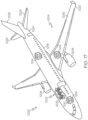
- the workpiece 102 is, or forms, a part of or a component of a larger manufactured article or structure, such as an aircraft (e.g., aircraft 1200 shown in Fig. 15 ) or a component of an aircraft.
- the workpiece 102 is a wing panel 1230 (e.g., as shown in Fig. 15 ) of the aircraft 1200.
- a machining operation e.g., drilling, boring, milling, cutting, routing, trimming, etc.
- a workpiece e.g., a composite workpiece or a metallic workpiece
- vibrations may move the workpiece away from a desired, or indexed, position and/or may temporarily change the shape of the workpiece away from a desired shape during machining.
- Such movement and/or deformation may lead to inaccuracies in the machining operation.
- the undesirable effect of such vibrations may increase for relatively long and thin workpieces, such as panels, stiffeners, and the like.
- the principles and implementations of the system 100 disclosed herein enable the workpiece 102 to be maintained at a desired position and/or maintained in a desired shape during a machining operation while damping machine-induced vibrations. As such, machining inaccuracies or inconsistencies due to vibrations may be reduced or eliminated.
- a manufacturing environment 224 facilitates processing of the workpiece 102, such as machining (e.g., drilling, boring, milling, routing, etc.), trimming (e.g., cutting), coating, painting, sub-assembly (e.g., assembly of other parts of components to the workpiece 102), and the like.
- processing refers to post-cure processing of the workpiece 102.
- the manufacturing environment 224 includes a plurality of work cells 226, identified individually as a first work cell 228, a second work cell 230, a third work cell 232, a fourth work cell 234, a fifth work cell 236, etc.
- the manufacturing environment 224 may include any number of work cells 226, depending, for example, on a number of processing operations to be performed on the workpiece 102.
- Each one of the work cells 226 facilitates or corresponds to a different processing operation associated with the manufacture of the workpiece 102.
- each one of the work cells 226 includes one or more systems, sub-systems, apparatuses, and/or machines (not shown in Fig. 1 ) that perform at least one processing operation.
- the work cells 226 are interlinked (e.g., in series or in parallel) and cooperate to automate at least a portion of the fabrication process.
- the system 100 includes, or is associated with, at least one of the work cells 226.
- at least a portion of the system 100 e.g., one or more components of the system 100
- the second work cell 230 e.g., as shown in Figs. 3-7
- at least a portion of the system 100 is associated with another one of the work cells 226.
- the system 100 forms a sub-system of the manufacturing environment 224.
- the system 100 facilitates transporting the workpiece 102 through the work cells 226. In one or more examples, the system 100 also facilitates holding the workpiece 102 in each one of the work cells 226. In one or more examples, the system 100 further facilitates performing at least one processing operation on the workpiece 102 in each one of the work cells 226. In one or more examples, the system 100 additionally facilitates damping machine-induced vibrations in the workpiece 102 during the processing operation.
- the system 100 also facilitates indexing the workpiece 102 relative to each one of the work cells 226. In one or more examples, the system 100 further facilitates conforming the workpiece 102 to a desired shape in each one of the work cells 226. In one or more examples, the system 100 additionally facilitates generating and/or updating a digital model of the workpiece 102 after a processing operation is performed on the workpiece 102.
- the system 100 includes a plurality of workpiece holders 106.
- the workpiece holders 106 hold the workpiece 102 in one of the work cells 226 (e.g., the second work cell 230 as shown in Figs. 3-6 ).
- more than one of the work cells 226 e.g., the second work cell 230, the third work cell 232, the fourth work cell 234, etc. includes the workpiece holders 106.
- the system 100 includes a machine tool 134, which may also be referred to as a machining tool.
- the machine tool 134 is positioned in one of the work cells 226 (e.g., the second work cell 230 as shown in Figs. 4 and 6 ).
- the machine tool 134 performs at least one machining operation on the workpiece 102 while the workpiece 102 is held by the workpiece holders 106.
- more than one of the work cells 226 e.g., the second work cell 230, the third work cell 232, the fourth work cell 234, etc. includes the machine tool 134.
- the system 100 includes a damping apparatus 174.
- the damping apparatus 174 is positioned in one of the work cells 226 (e.g., the second work cell 230 as shown in Figs. 3-7 ).
- the damping apparatus 174 is selectively coupled to the workpiece 102.
- the damping apparatus 174 selectively controls machine-induced vibrations in the workpiece 102 during the machining operation. For example, the damping apparatus 174 reduces vibrations in the workpiece 102 that are induced by the machining operation.
- more than one of the work cells 226 includes the damping apparatus 174.
- vibrations in the workpiece 102 that are induced by the machining operation may also be referred to as machine-induced vibrations and refer to vibrations resulting from or induced by interaction between the machine tool 134 and the workpiece 102 during the machining operation.
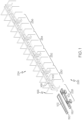
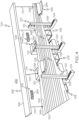
- the system 100 includes a plurality of damping apparatuses 104. At least one of the damping apparatuses 104 (e.g., the damping apparatus 174) is positioned between a directly adjacent pair of the workpiece holders 106 (e.g., as shown in Figs. 3-7 ).
- Figs. 3-7 illustrate examples of the second work cell 230.
- the examples of the second work cell 230 may be substantially the same as any other one of the work cells 226 (e.g., the third work cell 232, the fourth work cell 234, etc.).
- any one of the work cells 226 may include substantially the same features (e.g., workpiece holders 106, machine tool 134, damping apparatus 174, etc.) and/or operate in substantially the same manner as the examples of the second work cell 230, while performing the same or a different processing operation as another one of the work cells 226.
- each one of the workpiece holders 106 is selectively controlled to index the workpiece 102 in the second work cell 230.
- the workpiece holders 106 appropriately position the workpiece 102 in the second work cell 230 for performance of a processing operation, for example, performed by the machine tool 134.
- Appropriately positioning and/or indexing the workpiece 102 in each one of the work cells 226 (e.g., the second work cell 230) using the workpiece holders 106 may be performed by any suitable manner or technique.
- the workpiece holders 106 utilizes repeatable machine positioning and machine accuracy to appropriately position and/or index the workpiece 102.
- the system 100 utilizes a metrology system 108 (e.g., as shown in Figs. 2 , 5 and 6 ) to provide appropriate positioning and/or indexing of the workpiece 102.
- the workpiece holders 106 conform the workpiece 102 to a desired shape of the workpiece 102, for example, before and/or during performance of a processing operation.
- the desired shape of the workpiece 102 is an as-built shape of the workpiece 102.
- the term "as-built,” such as in reference to an as-built condition or an as-built shape of the workpiece 102 refers to a condition of the workpiece 102 in which the workpiece 102 has a shape (e.g., geometry, profile, contour, structural features, and the like) that is substantially the same as a design or nominal shape of the workpiece 102.
- a shape e.g., geometry, profile, contour, structural features, and the like
- the desired or as-built shape of the workpiece 102 is a shape of the workpiece 102 that is substantially the same as a shape of the workpiece 102 as cured on a tool or mandrel (e.g., tool 150) and prior to separation from the tool or mandrel.
- a tool or mandrel e.g., tool 150
- the desired shape of the workpiece 102 is an as-machined shape of the workpiece 102.
- the term "as-machined,” such as in reference to an as-machined condition or an as-machined shape of the workpiece 102 refers to a post-processing condition of the workpiece 102 in which the workpiece 102 has a shape (e.g., geometry, profile, contour, structural features, and the like) after a processing operation (e.g., one or more machining operations) is performed on the workpiece 102.
- each one of the workpiece holders 106 includes a base 128 and a clamp 120 that is coupled to the base 128.
- the clamp 120 is configured to or is operable to clamp (e.g., hold and secure) the workpiece 102 is a predetermined position and prevent movement of the workpiece 102.
- the clamp 120 is a C-shaped clamp.
- the clamp 120 of each one of the workpiece holders 106 includes a first jaw 122, a support member 124 that is coupled to the first jaw 122, and a second jaw 126 that is coupled to the support member 124.
- the second jaw 126 is movable (e.g., linearly movable) along the support member 124 relative to the first jaw 122 to clamp or unclamp the workpiece 102 between the first jaw 122 and the second jaw 126.
- the workpiece 102 includes a first surface 144 and a second surface 220 that is opposite the first surface 144.
- the first jaw 122 contacts the first surface 144 and the second jaw 126 contacts the second surface 220 when the workpiece 102 is clamped by the clamp 120.
- the clamp 120 includes a plurality of numerical control contacts 136. Throughout the present disclosure, the term "numerical control” may be referred to as "NC.”
- the numerical control contacts 136 are located along the first jaw 122.
- the clamp 120 also includes a plurality of force control contacts 138. The force control contacts 138 are located along the second jaw 126.
- Each one of the numerical control contacts 136 is selectively movable (e.g., extendable and retractable) relative to the first jaw 122 to a numerical control location.
- the numerical control location for each one of the numerical control contacts 136 is predetermined or preprogrammed, for example, based on the desired shape of the workpiece 102.
- the numerical control locations correspond to coordinate locations on the first surface 144 of the workpiece 102 represented by an as-built model 116 of the workpiece 102.
- the numerical control contacts 136 match a shape or contour of the first surface 144 of the workpiece 102 having the desired shape.
- Each one of the force control contacts 138 is selectively movable (e.g., extendable and retractable) relative to the second jaw 126 to apply a shaping force to the workpiece 102.
- a portion of the first surface 144 of the workpiece 102 is supported on, is support by, or is in contact with one or more of the numerical control contacts 136 before the workpiece 102 is clamped between the first jaw 122 and the second jaw 126.
- the second jaw 126 is moved toward the first jaw 122 to move the force control contacts 138 toward the second surface 220 of the workpiece 102.
- the second jaw 126 is moved toward the first jaw 122 until at least one of the force control contacts 138 is in contact with the second surface 220 of the workpiece 102.
- the second jaw 126 is moved toward the first jaw 122 to clamp a portion of the workpiece 102 between the first jaw 122 and the second jaw 126 and, more particularly, between at least one of the numerical control contacts 136 and at least one of the force control contacts 138.
- each one of the force control contacts 138 moves into contact with the second surface 220 of the workpiece 102 and applies the shaping force to urge the portion of the workpiece 102 toward and against the numerical control contacts 136.
- the clamp 120 is movable relative to the base 128.
- the clamp 120 is linearly movable along at least one axis and/or is rotationally moveable about at least one axis relative to the base 128.
- movement of the clamp 120 relative to the base 128 appropriately positions (e.g., indexes) the workpiece 102 in the second work cell 230.
- movement of the clamp 120 relative to the base 128 appropriately positions the clamp 120 in the second work cell 230 and/or relative to the workpiece 102.
- the base 128 is movable relative to the second work cell 230.
- the base 128 is linearly movable along at least one axis and/or is rotationally moveable about at least one axis relative to the second work cell 230.
- movement of the base 128 appropriately positions (e.g., indexes) the workpiece 102 in the second work cell 230.
- movement of the base 128 appropriately positions the clamp 120 in the second work cell 230 and/or relative to the workpiece 102.
- the clamp 120 rotates relative to the base 128 to adjust an angular orientation of the workpiece 102.
- the workpiece holders 106 rotate the workpiece 102 from a first orientation (e.g., approximately horizontal as shown in Fig. 3 ) to a second orientation (e.g., approximately vertical as shown in Figs. 4 and 5 ) for performance of a processing operation.
- the workpiece 102 is loaded onto the workpiece holders 106 in an approximately horizontal orientation (e.g., as shown in Fig. 3 ) and is repositioned to an approximately vertical orientation (e.g., as shown in Figs.
- the workpiece 102 is loaded onto the workpiece holders 106 in an approximately vertical orientation and is repositioned to an approximately horizontal orientation for performance of a machining operation.
- the workpiece 102 is loaded onto the workpiece holders 106 in an approximately horizontal or vertical orientation and is maintained in that orientation for performance of a machining operation, while being selectively positioned for indexing.
- the orientation of the workpiece 102 when being loaded onto the workpiece holders 106 and/or while undergoing a machining operation may depend on various factors, such as, but not limited to, the configuration (e.g., geometry, size, shape, material composition, etc.) of the workpiece 102, the type of machining operation performed on the workpiece 102, the type of machine tool 134 performing the machining operation, and the like.
- the workpiece 102 is initially positioned or loaded in the clamp 120, between the first jaw 122 and the second jaw 126, in the first orientation (e.g., approximately horizontal orientation as shown in Fig. 3 ). With the workpiece 102 in the first orientation (e.g., approximately horizontal orientation), the clamp 120 clamps the workpiece 102 between the first jaw 122 and the second jaw 126 and, more particularly, between the numerical control contacts 136 and the force control contacts 138. In one or more examples, the numerical control contacts 136 and the force control contacts 138 conform the workpiece 102 to the desired shape.
- the first orientation e.g., approximately horizontal orientation
- the clamp 120 clamps the workpiece 102 between the first jaw 122 and the second jaw 126 and, more particularly, between the numerical control contacts 136 and the force control contacts 138.
- the numerical control contacts 136 and the force control contacts 138 conform the workpiece 102 to the desired shape.
- the clamp 120 rotationally moves relative to the base 128 to move the workpiece 102 from the first orientation (e.g., approximately horizontal orientation) to the second orientation (e.g., approximately vertical orientation as shown in Figs. 4 and 5 ).
- a processing operation e.g., drilling operation
- the clamp 120 relative to the base 128 and/or movement of the base 128 relative to the second work cell 230 indexes the workpiece 102 for performance of the processing operation.
- the damping apparatus 174 is selectively coupled to the workpiece 102 after the workpiece holders 106 position (e.g., index) the workpiece 102 in the second work cell 230 and/or after the workpiece holders 106 conform the workpiece 102 to the desired shape (e.g., when performed). In one or more examples, the damping apparatus 174 is selectively coupled to the first surface 144 of the workpiece 102.
- the workpiece holders 106 position and hold the workpiece 102 in an upright or upstanding position such that the first surface 144 of the workpiece 102 is generally oriented in an approximately vertical position.
- the damping apparatus 174 access, engages and is coupled to the workpiece 102 from the side.
- the workpiece holders 106 position and hold the workpiece 102 in a side lying or prostrate position such that the first surface 144 of the workpiece 102 is in an approximately horizontal orientation.
- the damping apparatus 174 access, engages and is coupled to the workpiece 102 from the top or the bottom.
- the damping apparatus 174 selectively controls a natural frequency 250 ( Fig. 2 ) of the workpiece 102. In one or more examples, the damping apparatus 174 selectively modifies the natural frequency 250 ( Fig. 2 ) of the workpiece 102. For example, with the damping apparatus 174 coupled to the workpiece 102, the damping apparatus 174 selectively controls or modifies the natural frequency 250 of a portion of the workpiece 102, for example, a portion 254 (e.g., as shown in Figs. 4 and 5 ) of the workpiece 102 that extends between the directly adjacent pair of the workpiece holders 106.
- a portion 254 e.g., as shown in Figs. 4 and 5
- the natural frequency 250 of the workpiece 102, or any portion of the workpiece 102 (e.g., portion 254), is the frequency at which the workpiece 102 resonates or tends to oscillate.
- the natural frequency 250 of the workpiece 102, or of a portion (e.g., the portion 254) of the workpiece 102 is selectively controlled or otherwise modified by increasing a mass 103 (e.g., as shown in Fig. 2 ) of the portion 254 of the workpiece 102 using the damping apparatus 174.
- a mass 103 e.g., as shown in Fig. 2
- the mass 103 of the portion 254 is increased by a mass 107 (e.g., as shown in Fig. 2 ) of the damping apparatus 174.
- the natural frequency 250 of the workpiece 102, or of a portion of the workpiece 102 is modified by increasing a stiffness 105 of a portion of the workpiece 102.
- the stiffness 105 of the portion 254 is increased by connection of the damping apparatus 174.
- the natural frequency 250 of the portion 254 of the workpiece 102 is selectively controlled or modified such that the natural frequency 250 of the portion 254 of the workpiece 102 is different than a frequency 260 of an oscillating force 256 ( Fig. 2 ) applied to the workpiece 102 by the machine tool 134 during the machining operation.
- the oscillating force 256 is an external, periodic force that is applied to the workpiece 102 by the machine tool 134 during the machining operation.
- the oscillating force 256 induces forced oscillations to occur in the workpiece 102, which generate vibrations. It can be appreciated that when the frequency 260 of the oscillating force 256 applied to the workpiece 102 is near the natural frequency 250 of the workpiece 102, or the portion 254 of the workpiece 102, the amplitude of the oscillation becomes large.
- the natural frequency 250 of the workpiece 102 is modified or selectively controlled such that a modified natural frequency 252 of at least a portion of the workpiece 102 is within a desired or predetermined range of frequencies (e.g., frequency range).
- the modified natural frequency 252 can be tuned based on placement of the damping apparatus 174.
- the modified natural frequency 252 refers to the natural frequency 250 of at least a portion of the workpiece 102 as modified and selectively controlled by the damping apparatus 174.
- the natural frequency 250 of at least a portion of the workpiece 102 is selectively controlled by the damping apparatus 174 such that the modified natural frequency 252 of at least a portion of the workpiece 102 is within the desired frequency range that is suitable to reduce the machine-induced vibrations in the workpiece 102 resulting from the machining operation.
- the natural frequency 250 of the portion 254 of the workpiece 102 is modified such that the natural frequency 250 (e.g., modified natural frequency 252) of the portion 254 of the workpiece 102 is less than the frequency 260 of the oscillating force 256 applied to the workpiece 102 by the machine tool 134 during the machining operation.
- the natural frequency 250 e.g., modified natural frequency 252
- the natural frequency 250 of the portion 254 of the workpiece 102 is modified such that the natural frequency 250 (e.g., modified natural frequency 252) of the portion 254 of the workpiece 102 is less than approximately one-half of the frequency 260 of the oscillating force 256 applied to the workpiece 102 by the machine tool 134 during the machining operation.
- the natural frequency 250 e.g., modified natural frequency 252
- the modified natural frequency 252 of at least a portion (e.g., portion 254) of the workpiece 102 is less than approximately one-half of the frequency 260 of the oscillating force 256 applied to the workpiece 102 provides the desired frequency range enables selective control (e.g., reduction) of the machine-induced vibrations.
- the natural frequency 250 of the portion 254 of the workpiece 102 is modified such that the natural frequency 250 of the portion 254 of the workpiece 102 is less than approximately one-third of the frequency 260 of the oscillating force 256 applied to the workpiece 102 by the machine tool 134 during the machining operation.
- Selectively controlling the natural frequency 250 such that the modified natural frequency 252 of at least a portion (e.g., portion 254) of the workpiece 102 is less than approximately one-third of the frequency 260 of the oscillating force 256 applied to the workpiece 102 provides the desired frequency range enables selective control (e.g., further reduction) of the machine-induced vibrations.
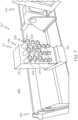
- the damping apparatus 174 includes a fixture base 198 and a plurality of grippers 200.
- Each one of the grippers 200 is coupled to the fixture base 198.
- Each one of the grippers 200 is selectively movable (e.g., selectively extendable and retractable) relative to the fixture base 198.
- each one of the grippers 200 is configured to selectively extend or retract relative to the fixture base 198 such that one or more of the grippers 200 contacts and connects to the workpiece 102, such as to a portion of the first surface 144 of the workpiece 102.
- Connection of one or more of the grippers 200 to the workpiece 102 selectively controls or modifies the natural frequency 250 of the workpiece 102.
- selective extension and retraction of the grippers 200 enables connection of select ones of the grippers 200 to the workpiece 102, thereby, enabling selective control of the natural frequency 250 of the workpiece 102.
- extension of select ones of the grippers 200 also enables connection to the workpiece 102 at locations on a surface of the workpiece 102 where a shape or contour of the surface of the workpiece 102 is compatible or suitable for mating and connection by the grippers 200.
- retraction of select ones of the grippers 200 also enables the damping apparatus 174 to avoid locations on the surface where a shape, contour, or other feature of the surface of the workpiece 102 is incompatible or difficult for mating and connection by the grippers 200.
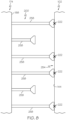
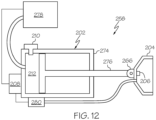
- the natural frequency 250 ( Fig. 1 ) of the portion 254 of the workpiece 102 is selectively controlled or modified by selecting one or more locations 222 of the portion 254 of the workpiece 102 (e.g., on the first surface 144) and selectively connecting one or more of the grippers 200 to the workpiece 102 at the one or more locations 222 (e.g., as shown in Fig. 12 ).
- an intensity supplied by each one of the grippers 200 in contact with and connected to the workpiece 102 can be varied or selectively controlled to effectuate a desired change in a local or global frequency of the workpiece 102.
- the system 100 includes a computing device 110.
- the computing device 110 is adapted to manipulate data representing the workpiece 102 and data representing the damping apparatus 174 and/or the workpiece holders 106.
- the computing device 110 is also adapted to provide operating instructions to the damping apparatus 174, the workpiece holders 106 and/or the machine tool 134.
- the damping of machine-induced vibrations and the natural frequency 250 if the workpiece 102 is modified or selectively controlled dependent upon a measured frequency as different machining operations are performed at different locations on the workpiece 102 and/or from workpiece 102 to workpiece 102.
- the damping of machine-induced vibrations and the natural frequency 250 if the workpiece 102 is customized to each workpiece 102 and/or for a particular location on or portion of the workpiece 102.
- the workpiece holders 106 are selectively controlled (e.g., by instructions provided by the computing device 110) to index the workpiece 102 within one of the work cells 226 (e.g., the second work cell 230).
- the computing device 110 is programmed with an indexed position of the workpiece 102 based on a virtual indexed position of a digital model (e.g., a nominal model or an as-built model) of the workpiece 102 in the second work cell 230.
- the computing device 110 is operable to instruct the workpiece holders 106 to move the workpiece 102 to the indexed position.
- the workpiece holders 106 are selectively controlled (e.g., by instructions provided by the computing device 110) to conform the workpiece 102 to the desired shape (e.g., the as-built shape).
- the computing device 110 is programmed with the numerical control locations for each one of the numerical control contacts 136 and the shaping force applied to the workpiece 102 by the each one of the force control contacts 138, for example, based on a digital model (e.g., a nominal model or an as-built model) of the workpiece 102.
- the computing device 110 is operable to instruct the workpiece holders 106 to selectively extend or retract corresponding ones of the numerical control contacts 136 and the force control contacts 138 to conform the workpiece 102 to the desired shape or otherwise control the shape of the workpiece 102 as held by the workpiece holders 106.
- the workpiece 102 e.g., a composite workpiece
- the tool 150 e.g., as shown in Fig. 1
- the as-built model 116 is generated that represents the workpiece 102 in the as-built shape.
- an initial processing operation (e.g., a machining, drilling, or trimming operation) may be performed on the workpiece 102, for example, while the workpiece 102 is on the tool 150 (e.g., in the first work cell 228).
- the workpiece 102 is digitized after the initial processing operation.
- the as-built model 116 may also represent initially machined features of the workpiece 102.
- the workpiece 102 is removed from the tool 150 and is transported from the first work cell 228 to the workpiece holders 106 of the second work cell 230 for performance of a subsequent processing operation.
- the metrology system 108 is associated with, or forms a portion of, the first work cell 228. In one or more examples, the metrology system 108 is movable into the first work cell 228. In one or more examples, at least a portion of the metrology system 108 is positioned in the second work cell 230.
- the metrology system 108 digitizes the workpiece 102, for example, while the workpiece 102 is on the tool 150. In one or more examples, the metrology system 108 generates measurement data 132 (e.g., as shown in Fig. 2 ) for the workpiece 102. In one or more examples, the measurement data 132 represents at least a portion of the workpiece 102, for example, while the workpiece 102 is on the tool 150, having the as-built shape. Accordingly, the measurement data 132 may also be referred to as-built measurement data.
- the metrology system 108 digitizes at least the second surface 220 of the workpiece 102 such that the measurement data 132 represents the shape, contour, and features (e.g., edges, holes, etc.) of the second surface 220 of the workpiece 102.
- the measurement data 132 is used to generate the as-built model 116 (e.g., as shown in Fig. 2 ) that is representative of the workpiece 102.
- the computing device 110 is adapted to manipulate the scan data representing the workpiece 102 (e.g., measurement data 132) and/or to generate models representing the workpiece 102 (e.g., the as-built model 116) based on the scanned measurement data generated by the metrology system 108.
- the computing device 110 is operable to determine (e.g., approximate) the natural frequency 250 of the workpiece 102, such as of the portion 254 of the workpiece 102. In one or more examples, the computing device 110 determines the natural frequency 250 of the workpiece 102 (e.g., the portion 254) by analyzing a real-time model 112 ( Fig. 2 ) of the workpiece 102, for example, as held and/or conformed by the workpiece holders 106.
- the term "real-time,” such as in reference to a real-time condition or a real-time shape of the workpiece 102, refers to an immediate or present condition of the workpiece 102 at a point in time in which the workpiece 102 has a shape (e.g., geometry, profile, contour, structural features, and the like) as presently positioned, such as before or during a processing operation (e.g., one or more machining operations).
- a shape e.g., geometry, profile, contour, structural features, and the like
- the metrology system 108 is associated with, or forms a portion of, at least one of the work cells 226. In one or more examples, the metrology system 108 is movable into the second work cell 230. In one or more examples, at least a portion of the metrology system 108 is positioned in the second work cell 230.
- the metrology system 108 digitizes the workpiece 102, for example, while the workpiece 102 is held in the second work cell 230 by the workpiece holders 106, for example, in an indexed position and conformed to the desired shape. In one or more examples, the metrology system 108 generates the measurement data 132 (e.g., as shown in Fig. 2 ) for the workpiece 102. In one or more examples, the measurement data 132 represents at least a portion of the workpiece 102 while the workpiece 102 is positioned (e.g., indexed) in the second work cell 230 by the workpiece holders 106 and has the desired shape, for example, as held by the workpiece holders 106. Accordingly, the measurement data 132 may also be referred to as real-time measurement data.
- the metrology system 108 digitizes at least the first surface 144 of the workpiece 102 such that the measurement data 132 represents the shape, contour, and features (e.g., edges, holes, etc.) of the first surface 144 of the workpiece 102.
- the metrology system 108 digitizes at least the second surface 220 of the workpiece 102 such that the measurement data 132 represents the shape, contour, and features (e.g., edges, holes, etc.) of the second surface 220 of the workpiece 102.
- the metrology system 108 digitizes the first surface 144 and the second surface 220 of the workpiece 102 such that the measurement data 132 represents the shape, contour, and features (e.g., edges, holes, etc.) of the first surface 144 and the second surface 220 of the workpiece 102.
- the measurement data 132 is used to generate the real-time model 112 (e.g., as shown in Fig. 2 ) that is representative of the workpiece 102.
- the computing device 110 is adapted to manipulate the scan data representing the workpiece 102 (e.g., measurement data 132) and/or to generate models representing the workpiece 102 (e.g., the real-time model 112) based on the scanned measurement data generated by the metrology system 108.
- the metrology system 108 includes a scanner 264 (e.g., as shown in Figs. 5 and 6 ). In one or more examples, the metrology system 108 includes more than one scanner.
- the scanner 264 e.g., one or more scanners
- the scanner 264 are associated with or are positioned in each one of the work cells 226.
- the scanner 264 scans and digitizes at least a portion of the workpiece 102.
- the scanner 264 is any one of various types of three-dimensional (3D) scanners.
- the scanner 264 includes, or is, a photogrammetric scanner, such as a photogrammetric camera.
- the scanner 264 includes, or is, one of a laser triangulation scanner, a structured light scanner, other laser-based scanners or metrology systems, and the like.
- the scanner 264 of the metrology system 108 captures the geometry (e.g., size and shape), contour (e.g., curvature), physical features (e.g., holes, edges, etc.), and other details of the workpiece 102.
- Scan data e.g., measurement data 132
- the model of the workpiece 102 is a digital three-dimensional representation of the workpiece 102.
- the computing device 110 is operable to compare the real-time model 112 to the as-built model 116 (or a nominal model of the workpiece 102) of the workpiece 102.
- the computing device 110 is adapted to perform various transforms (e.g., rigid body transforms and/or coordinate frame transforms) and/or other data manipulation operations (e.g., global best fit operations) to virtually compare the real-time model 112 to the as-built model 116.
- various transforms e.g., rigid body transforms and/or coordinate frame transforms
- other data manipulation operations e.g., global best fit operations
- comparison of the real-time model 112 to the as-built model 116 determines whether the workpiece 102 is appropriately indexed in the second work cell 230. In situations where the comparison of the real-time model 112 to the as-built model 116 indicates that the workpiece 102 is not appropriately indexed, the computing device 110 is operable to instruct the workpiece holders 106 to adjust the position of the workpiece 102 in the second work cell 230 based on the comparison, such that the workpiece 102 is appropriately indexed.
- comparison of the real-time model 112 to the as-built model 116 determines whether the workpiece 102 is conformed to the desired shape in the second work cell 230. In situations where the comparison of the real-time model 112 to the as-built model 116 indicates that the workpiece 102 is not conformed to the desired shape, the computing device 110 is operable to instruct the workpiece holders 106 to adjust the clamp 120 (e.g., modify the position and/or orientation of the clamp 120 relative to the workpiece 102, modify the location of the second jaw 126 relative to the first jaw 122, modify the numerical control location of one or more of the numerical control contacts 136, etc.) based on the comparison, such that the workpiece 102 is conformed to the desired shape.
- the clamp 120 e.g., modify the position and/or orientation of the clamp 120 relative to the workpiece 102, modify the location of the second jaw 126 relative to the first jaw 122, modify the numerical control location of one or more of the numerical control contacts 136, etc.
- the computing device 110 determines (e.g., approximates) the natural frequency 250 of the workpiece 102 with the workpiece 102 held by the workpiece holders 106 (e.g., in the indexed position and conformed to the desired shape).
- the computing device 110 determines (e.g., approximates) the natural frequency 250 of the workpiece 102 (e.g., the portion 254) by analyzing additional data and/or other information representing the workpiece 102, such as the geometry, mass, and stiffness of the workpiece 102 (e.g., the portion 254), the locations of the workpiece holders 106 relative to the workpiece 102 (e.g., the location and orientation of the clamp 120 on the workpiece 102), the distance between the adjacent pair of workpiece holders 106, and the like.
- a frequency of the machine-induced vibrations in the workpiece 102 is measured during the machining operation performed by the machine tool 134.
- the computing device 110 is adapted to analyze the measured frequency at different locations on the workpiece 102 and determine (e.g., calculate) a modification for the natural frequency 250 (e.g., modified natural frequency 252) of the workpiece 102 needed to reduce the machine-induced vibrations, for example, by selecting locations for connection of select ones of the grippers 200, the number of grippers 200 to be connected to the workpiece 102, and the like, thereby increasing the mass 103 and/or the stiffness 105 of at least a portion (e.g., portion 254) of the workpiece 102.
- the computing device 110 is further operable to select the one or more locations 222 on the workpiece 102, such as on the portion 254 of the workpiece 102, for connection of the one or more of the grippers 200.
- the locations 222 for connection of the grippers 200 are selected such that the modified natural frequency 252 ( Fig. 2 ) of the workpiece 102, such as of the portion 254 of the workpiece 102, is less than the frequency 260 of the oscillating force 256 applied to the workpiece 102 by the machine tool 134 during the machining operation.
- the locations 222 on the workpiece 102 are extracted, calculated, or otherwise determined from the real-time model 112 ( Fig. 2 ) and analysis of the natural frequency 250 of the workpiece 102.
- selection of the locations for coupling select ones of the grippers 200 based on the analysis of the natural frequency 250 and the frequency 260 of the oscillating force 256 applied to the workpiece 102 by the machine tool 134 enables the modified natural frequency 252 to be tuned to a desired frequency or frequency range.
- the damping apparatus 174 has any number of the grippers 200.
- the grippers 200 may be arranged in any desirable configuration or pattern, such as in an array of rows.
- each one of the grippers 200 e.g., identified individually as a gripper 258 as shown in Figs. 8-12
- the vacuum cup 204 is coupled to the linear actuator 202.
- the gripper 258 illustrated in Figs. 9-12 is an example of any one of the grippers 200 (e.g., as shown in Figs. 8 and 9 ).
- the linear actuator 202 includes an outboard end that is linearly movable relative to the fixture base 198 along a movement axis.
- the vacuum cup 204 is located at (e.g., coupled to) the outboard end of the linear actuator 202. As such, the linear actuator 202 linearly moves the vacuum cup 204 relative to the fixture base 198 along the movement axis into selective contact with a surface (e.g., the first surface 144) of the workpiece 102 (e.g., as shown in Figs. 9-11 ).
- the vacuum cup 204 is configured to grip the workpiece 102 using vacuum. For example, with the vacuum cup 204 in contact with the surface of the workpiece 102, the vacuum cup 204 grips the workpiece 102 using a vacuum formed between the vacuum cup 204 and the surface of the workpiece 102. Upon activation of the vacuum, the vacuum cup 204 provides a holding force that is sufficient to hold the workpiece 102 in a fixed position.
- the linear actuator 202 is configured to lock linear movement of and, thus, lock a linear position of the vacuum cup 204 along the movement axis.
- lock and “locking,” for example, in reference to movement and/or position, refers to immobilizing or making the element to which the term refers immovable.
- gripping the workpiece 102 at the locations 222 with the grippers 200 holds the workpiece 102 in a rigidly fixed position between the adjacent pair of workpiece holders 106, which modifies the natural frequency 250 of the workpiece 102 and prevents, or greatly reduces, vibration in the workpiece 102 during the machining operation.
- the outboard end of the linear actuator 202 and the vacuum cup 204 support the workpiece 102 from behind (e.g., backs up the portion 254 of the workpiece 102), opposite to a machining load applied to the workpiece 102 by the machine tool 134, during the machining operation.
- the mass 103 and/or stiffness 105 of the portion 254 of the workpiece 102 is increased at the associated one of the locations 222.
- the linear actuator 202 moves through a range of movement, for example, between a first position 268 (e.g., as shown in Fig. 9 ) and a second position 270 (e.g., as shown in Fig. 10 ). Movement of the linear actuator 202 similar moves the vacuum cup 204 between the first position 268 and the second position 270.
- the first position 268 refers to any position in which the vacuum cup 204 is not in contact with the workpiece 102 and may be referred to as an unactuated position, a rest position, a retracted position, or a noncontact position.
- the second position 270 refers to a position in which the vacuum cup 204 is in contact with the workpiece 102 and may be referred to as an actuated position, an extended position, or a contact position.
- a negative pressure generated by the vacuum formed between the vacuum cup 204 and the surface (e.g., first surface 144) of the workpiece 102 moves the linear actuator 202 through a range of motion from the second position 270 to a third position 272 (e.g., as shown in Fig. 11 ).
- the third position 272 refers to a position in which the vacuum cup 204 is coupled to the workpiece 102 and may be referred to as a locked position.
- the linear actuator 202 selectively, linearly moves (e.g., extends) the vacuum cup 204 relative to the fixture base 198 and to the surface of the workpiece 102 along the movement axis from the first position 268 (e.g., unactuated position shown in Fig. 9 ) to the second position 270 (e.g., actuated position shown in Fig. 10 ) in which the vacuum cup 204 is in contact with the surface of the workpiece 102.
- the linear actuator 202 is configured to enable free linear movement along the movement axis.
- free linear movement refers to unrestricted or unobstructed movement of the element to which the term refers.
- the vacuum formed between the vacuum cup 204 and the surface of the workpiece 102 urges further linear movement (e.g., extension) of the linear actuator 202 along the movement axis into the third position 272 (e.g., the locked position as shown Fig. 11 ).
- the linear actuator 202 With the linear actuator 202 in the third position 272, the linear actuator 202 is further configured to fix linear movement along the movement axis, thereby fixing the vacuum cup 204 in the third position 272 (e.g., as shown in Fig. 11 ).
- the vacuum formed between the vacuum cup 204 and the surface of the workpiece 102 securely holds the workpiece 102 and couples the workpiece 102 to the damping apparatus 174.
- fixing the linear position of the linear actuator 202 in the third position 272 supports the workpiece 102, thus, modifying the natural frequency 250 of the workpiece 102.
- the gripper 258 (e.g., each one of the grippers 200) also includes an actuator control unit 208.
- the actuator control unit 208 controls linear movement (e.g., extension and retraction) of the linear actuator 202 to place the vacuum cup 204 in contact with the workpiece 102.
- the actuator control unit 208 also controls application of the vacuum.
- the gripper 258 (e.g., each one of the grippers 200) includes a power-transmitting component 212 (e.g., as shown in Figs. 2 and 12 ).
- the power-transmitting component 212 drives linear movement (e.g., extension and retraction) of the linear actuator 202, for example, under direction from the actuator control unit 208.
- the power-transmitting component 212 is operatively coupled to a power source 278 (e.g., as shown in Fig. 12 ).
- the gripper 258 (e.g., each one of the grippers 200) also includes an actuator stop-lock 210.
- the actuator stop-lock 210 selectively locks a position of the linear actuator 202, for example, under direction from the actuator control unit 208.
- the actuator stop-lock 210 is operable to fix, or lock, the outboard end of the linear actuator 202 and, thus, the vacuum cup 204 in the third position 272 (e.g., as shown in Fig. 11 ).
- the actuator stop-lock 210 is operatively coupled with the power-transmitting component 212 to lock linear movement of the linear actuator 202 along the movement axis, for example, when the linear actuator 202 is in the third position 272.
- the linear actuator 202 includes a stationary member 274 that is coupled to the fixture base 198 and a movable member 276 that is coupled to the stationary member 274.
- the movable member 276 is linearly movable relative to the stationary member 274 along the movement axis.
- a free end of the movable member 276 defines the outboard end of the linear actuator 202.
- the power-transmitting component 212 is operatively coupled with the power source 278 and with the stationary member 274 and the movable member 276.
- the power-transmitting component 212 is operable to selectively drive linear movement of (e.g., extend) the movable member 276 relative to the stationary member 274 along the movement axis, for example, from the first position 268 (e.g., as shown in Fig. 9 ) to the second position 270 (e.g., as shown in Fig. 10 ).
- the power-transmitting component 212 is configured to enable free linear movement of the movable member 276 relative to the stationary member 274.
- the vacuum created by the vacuum cup 204 linearly moves (e.g., further extends) the movable member 276 from the second position 270 to the third position 272 (e.g., as shown in Fig. 11 ).
- the actuator stop-lock 210 is operatively coupled with the power-transmitting component 212 to lock linear movement of the movable member 276 relative to the stationary member 274 along the movement axis, for example, when the linear actuator 202 is in the third position 272.
- the actuator control unit 208 selectively controls linear movement of the linear actuator 202 via control of the power source 278, control of the power-transmitting component 212, and/or control of the actuator stop-lock 210. In one or more examples, the actuator control unit 208 selectively controls application of the vacuum applied by the vacuum cup 204, for example, via control of a vacuum source 280. In one or more examples, the system 100 also includes at least one power supply (not shown) that provides power, as needed, to the various components of the system 100.
- the gripper 258 (e.g., each one of the grippers 200) includes a pivot coupling 266.
- the pivot coupling 266 pivotally couples the outboard end of the linear actuator 202 and the vacuum cup 204 together.
- the pivot coupling 266 enables the vacuum cup 204 to pivot relative to the linear actuator 202 about at least one pivot axis.
- the movement axis extends through the pivot coupling 266.
- the pivot axis is perpendicular to the movement axis.
- the vacuum cup 204 being pivotable relative to the linear actuator 202 enables self-adjustment of an angular orientation of the vacuum cup 204 relative to the workpiece 102 to accommodate for different shapes and/or contours of the portion 254 of the workpiece 102.
- the actuator control unit 208 causes engagement of (e.g., activates or energizes) the power-transmitting component 212 to extend the linear actuator 202 from the first position 268 (e.g., as shown in Fig. 9 ) to the second position 270 (e.g., as shown in Fig. 10 ), which places the vacuum cup 204 in contact with the workpiece 102.
- the actuator control unit 208 causes disengagement of (e.g., deactivates or deenergizes) the power-transmitting component 212 to enable free extension of the linear actuator 202.
- the actuator control unit 208 applies the vacuum to further extend the linear actuator 202 from the second position 270 to the third position 272 (e.g., as shown in Fig. 11 ). With the vacuum formed between the vacuum cup 204 and the workpiece 102 and the power-transmitting component 212 disengaged, the actuator control unit 208 engages the actuator stop-lock 210 to lock the linear actuator 202 in the third position 272.
- the linear actuator 202 is a hydraulic linear actuator
- the power source 278 is a hydraulic pump
- the power-transmitting component 212 is pressurized hydraulic fluid.
- the stationary member 274 includes a hollow cylinder and the movable member 276 includes a piston located inside the hollow cylinder and a piston rod coupled to the piston (e.g., a free end of the piston rod defines the outboard end of the linear actuator 202).
- the pressurized hydraulic fluid within the hollow cylinder acts on the piston and drives linear movement of the piston.
- the actuator stop-lock 210 is a hydraulic valve that is operable to close off the hydraulic system and hydrostatically lock the hydraulic actuator.
- the linear actuator 202 is a pneumatic linear actuator
- the power source 278 is a compressor
- the power-transmitting component 212 is pressurized gas (e.g., air).
- the stationary member 274 includes a hollow cylinder and the movable member 276 includes a piston located inside the hollow cylinder and a piston rod coupled to the piston (e.g., a free end of the piston rod defines the outboard end of the linear actuator 202).
- the pressurized gas within the hollow cylinder acts on the piston and drives linear movement of the piston.
- the actuator stop-lock 210 is a pneumatic valve that is operable to close off the pneumatic system and lock the pneumatic actuator.
- the linear actuator 202 is a mechanical or electromechanical linear actuator
- the power source 278 is a motor
- the power-transmitting component 212 includes a drive mechanism that operates to convert rotary motion of the motor into linear motion of the movable member 276 (e.g., a screw drive, a rack and pinion drive, a chain drive, a belt drive, and the like).
- the stationary member 274 includes a hollow housing and the movable member 276 includes a rod (e.g., a free end of the rod defines the outboard end of the linear actuator 202).
- the drive mechanism within the hollow housing acts on the rod and drives linear movement of the rod.
- the actuator stop-lock 210 is a mechanical rod lock that is operable to restrict operation of the drive mechanism.
- the vacuum source 280 is coupled to (e.g., in fluid communication with) the vacuum cup 204.
- the vacuum source 280 includes least one vacuum generator that is coupled to (e.g., in fluid communication with) the vacuum cup 204, such as via at least one air line (e.g., hose or tube) that directs a flow of air and at least one air supply valve that controls the flow of air.
- the air supply valve is an electrically controlled solenoid valve that is operatively coupled with and commanded by the actuator control unit 208 and/or the computing device 110.
- the power source 278 and/or the vacuum source 280 are dedicated to each one of the grippers 200. In other examples, the power source 278 and/or the vacuum source 280 are shared by more than one of the grippers 200. In these examples, the system 100 includes at least one vacuum supply manifold and/or at least one power supply manifold that distributes vacuum and/or power to more than one of the grippers 200.
- the actuator control unit 208 is dedicated to each one of the grippers 200. In other examples, the actuator control unit 208 is shared by more than one of the grippers 200.
- the gripper 258 (e.g., each one of the grippers 200) includes a sensor 206.
- the sensor 206 is configured or is operable to determine when the linear actuator 202 is in the second position 270. In one or more examples, the sensor 206 detects contact of the vacuum cup 204 with the workpiece 102. In one or more examples, the sensor 206 is located at the outboard end of the linear actuator 202. In one or more examples, the sensor 206 is located proximate to the vacuum cup 204.
- the senor 206 is a position sensor that is operable to detect a position of the outboard end of the linear actuator 202. In one or more examples, the sensor 206 is a contact sensor that is operable to detect when the vacuum cup 204 is in contact with the workpiece 102. In one or more examples, the sensor 206 is a proximity sensor that is operable to detect when the linear actuator 202 (e.g., the outboard end) is near the workpiece 102. Any other suitable type of sensor is also contemplated.
- the linear actuator 202 is commanded to cease linear movement (e.g., extension).
- the linear actuator 202 disengages or releases to enable free linear movement (e.g., extension).
- the vacuum is then applied to the surface of the workpiece 102 by the vacuum cup 204 to grip the workpiece 102.
- the vacuum draws, or otherwise pulls, the linear actuator 202 toward the workpiece 102 and positions the linear actuator 202 in the third position 272 (e.g., as shown in Fig. 11 ).
- the senor 206 is coupled to or is in communication with the actuator control unit 208 and/or the computing device 110.
- the actuator control unit 208 selectively controls linear movement of the linear actuator 202 via control of the power source 278, control of the power-transmitting component 212, and/or control of the actuator stop-lock 210 based on signals from the sensor 206 indicative of the position of the of the linear actuator 202.
- each one of the grippers 200 includes a bellows cover 214.
- the bellows cover 214 surrounds at least a portion of the linear actuator 202 that is located external to the fixture base 198.
- the bellows cover 214 is configured to enable linear movement (e.g., extension and retraction) of the linear actuator 202.
- the bellows cover 214 protects the linear actuator 202 and prevents debris (e.g., from the machining operation) from interacting with the linear actuator 202.
- the damping apparatus 174 (e.g., each one of the damping apparatuses 104) is movable in or relative to one of the work cells 226 (e.g., the second work cell 230) and/or relative to the workpiece 102.
- the damping apparatus 174 is linearly moveable along at least one axis to move and locate the grippers 200 relative to the workpiece 102.
- the damping apparatus 174 is rotationally movable along at least one axis to move and orient the grippers 200 relative to the workpiece 102.
- the fixture base 198 includes a pedestal 216 and a stanchion 218.
- the stanchion 218 is coupled to the pedestal 216.
- the grippers 200 are coupled to and are moveable (e.g., extend and retract) relative to the stanchion 218.
- the fixture base 198 is movable in the second work cell 230 and relative to the workpiece 102. Generally, movement of the fixture base 198 relative to the workpiece 102 also moves the grippers 200 relative to the workpiece 102 (e.g., relative to the first surface 144) of the workpiece 102, thereby selectively positioning the grippers 200 relative to a connecting surface (e.g., first surface 144) of the workpiece 102. For example, movement of the fixture base 198 selectively moves and positions the grippers 200 in at least one of a horizontal or vertical direction relative to the first surface 144 of the workpiece 102 (e.g., in a chordwise direction and/or a spanwise direction of a wing panel).
- movement of the fixture base 198 relative to the workpiece 102 enables connection of the grippers 200 to the workpiece 102 at locations on a surface of the workpiece 102 where a shape or contour of the surface of the workpiece 102 is compatible or suitable for mating and connection by the grippers 200 and avoidance at locations on the surface where a shape, contour, or other feature of the surface of the workpiece 102 is incompatible or difficult for mating and connection by the grippers 200.
- the stanchion 218 is movable relative to the pedestal 216.
- the stanchion 218 is linearly moveable along at least one axis relative to the pedestal 216 to move and locate the grippers 200 relative to the workpiece 102.
- the stanchion 218 is rotationally movable along at least one axis relative to the pedestal 216 to move and orient the grippers 200 relative to the workpiece 102.
- the pedestal 216 is movable in a corresponding one of the work cells 226 (e.g., the second work cell 230) relative to the workpiece 102.
- the pedestal 216 is linearly moveable along at least one axis to move and locate the stanchion 218 relative to the workpiece 102.
- the pedestal 216 is rotationally movable along at least one axis to move and orient the stanchion 218 relative to the workpiece 102.
- the principles and implementations of the system 100 disclosed herein enable the digital model to be updated after a machining operation is performed, such that the digital model is representative of an as-machined shape of the workpiece 102.
- the updated digital model of the workpiece 102 (e.g., in the as-machined shape) may be used to index the workpiece 102 before a subsequent processing operation is performed on the workpiece 102.
- the updated digital model of the workpiece 102 may also be used to conform the workpiece 102 to the desired shape (e.g., an as-machined shape) during a subsequent processing operation performed on the workpiece 102.
- the updated digital model of the workpiece 102 may also be used to determine the natural frequency 250 of the workpiece 102 and to select the locations 222 on the workpiece 102 for coupling of the grippers 200 of the damping apparatus 174, which modify the natural frequency 250 to dampen the machine-induced vibrations.
- the principles of the system 100 disclosed herein also enable determinant assembly or predictive assembly of the workpiece 102 based on the digital model of the workpiece 102, which is updated throughout processing of the workpiece 102.
- the metrology system 108 digitizes the workpiece 102, for example, during and/or after performing the processing operation and while the workpiece 102 is held by the workpiece holders 106 and coupled to the damping apparatus 174.
- the metrology system 108 generates the measurement data 132 (e.g., as shown in Fig. 2 ) for the workpiece 102.
- the measurement data 132 represents at least a portion of the workpiece 102 after the machining operation, for example, performed by the machine tool 134. Accordingly, the measurement data 132 may also be referred to as as-machined measurement data.
- the metrology system 108 digitizes at least the first surface 144 of the workpiece 102 such that the measurement data 132 represents the shape, contour, previous features (e.g., prior formed edges, holes, etc.) and newly added features (e.g., newly formed edges, holes, etc.) of the first surface 144 of the workpiece 102.
- the metrology system 108 digitizes at least the second surface 220 of the workpiece 102 such that the measurement data 132 represents the shape, contour, previous features (e.g., prior formed edges, holes, etc.) and newly added features (e.g., newly formed edges, holes, etc.) of the second surface 220 of the workpiece 102.
- the metrology system 108 digitizes the first surface 144 and the second surface 220 of the workpiece 102 such that the measurement data 132 represents the shape, contour, previous features (e.g., prior formed edges, holes, etc.) and newly added features (e.g., newly formed edges, holes, etc.) of the first surface 144 and the second surface 220 of the workpiece 102.
- the measurement data 132 is used to update the digital model of workpiece 102 (e.g., the as-built model 116) or to generate an as-machined model 180 (e.g., as shown in Fig. 2 ) that is representative of the workpiece 102 having the as-machined shape. Accordingly, the as-machined model 180 represents an update to the as-built model 116, which includes features formed during the machining operation.
- the computing device 110 is adapted to manipulate the scan data representing the workpiece 102 (e.g., measurement data 132) and/or to generate models representing the workpiece 102 (e.g., the as-machined model 180) based on the scanned measurement data generated by the metrology system 108.
- this process implemented by the system 100 may be repeated any number of times as the workpiece 102 moves through the other work cells 226 of the manufacturing environment 224.
- workpiece holders 106 associated with each one of the work cells 226 hold the workpiece 102 during performance of a subsequent processing operation, index the workpiece 102 before performing the subsequent processing operation, and/or conform the workpiece 102 to the desired shape before performing the subsequent processing operation.
- the damping apparatuses 104 associated with each one of the work cells 226 connect to the workpiece 102 at the locations 222 selected to modify the natural frequency 250 of the workpiece 102 as desired to control (e.g., reduce) vibrations during the processing operation.
- the as-machined model 180 may be generated or updated after each subsequent processing operation, such that, upon completion of all processing operations, the as-machined model 180 represents the workpiece 102 having the as-built shape and all the machined features.
- the workpiece 102 fabricated in this manner may be used for determinant assembly or predictive assembly of another structure, such as the wing 1220 of the aircraft 1200 (e.g., as shown in Fig. 15 ).
- the workpiece 102 is successively transported from one of the work cells 226 (e.g., the second work cell 230) to another one of the work cells 226 (e.g., the third work cell 232) for performance of subsequent processing operations.
- This process may be repeated any number of times to move the workpiece 102 through the work cells 226 and to perform any number of processing operations.
- the workpiece holders 106 and the damping apparatuses 104 may be used in any one of the work cells 226, as described herein above and illustrated in Figs. 3-6 , to dampen machine-induced vibrations during a machining operation.
- the system 100 includes an overhead workpiece handler 166.
- the overhead workpiece handler 166 is coupled to the workpiece 102.
- the overhead workpiece handler 166 supports the workpiece 102 while transporting the workpiece 102 between the work cells 226.
- the overhead workpiece handler 166 transports the workpiece 102 between the work cells 226 of the manufacturing environment 224.
- the overhead workpiece handler 166 transports the workpiece 102 from the second work cell 230, following the processing operation, to the third work cell 232 for performance of a subsequent processing operation, and so on.
- the overhead workpiece handler 166 carries the workpiece in the approximately vertical orientation.
- the overhead workpiece handler 166 supports the workpiece 102 during the processing operation and while the workpiece 102 is held by the workpiece holders 106 and is coupled to the damping apparatus 174.
- the overhead workpiece handler 166 includes a support beam 168 and a plurality of hangers 170.
- the hangers 170 are connected to the support beam 168 and to the workpiece 102 such that the workpiece 102 is suspended from the support beam 168, such as in the approximately vertical orientation.
- the hangers 170 are connected to the workpiece 102 at, or using, holes 248 machined in the workpiece 102, such that the workpiece 102 is suspended from the hangers 170 by the holes 248.
- the holes 248 are machined through the workpiece 102 while the workpiece 102 is on the tool 150 (e.g., in the first work cell 228 as shown in Fig. 1 ) and has the as-built shape.
- the holes 248 are represented in the as-built model 116 and in the real-time model 112 and are used as alignment features during comparison (e.g., transform) of the real-time model 112 to the as-built model 116 for indexing the workpiece 102 and/or for conforming the workpiece 102 to the as-built shape.
- computing device 110 may include a single computer or several interconnected computers.
- the computing device 110 may include any collection of computing devices that individually or jointly execute a set (or multiple sets) of instructions to implement any one or more of the operations discussed herein.
- the computing device 110 includes a processor 240 (e.g., at least one processing unit) that is coupled to memory 238.
- the memory 238 includes program code 242 that is executable by the processor 240 to perform one or more operations.
- the phrase "the computing device 110 is adapted to" refers to the computing device 110 being configured or otherwise operable to perform a function, such as the program code 242 being executed by the processor 240 to perform a desired operation or function.
- the program code 242 is any coded instructions that is (e.g., computer readable and/or machine readable.
- the memory 238 is any a non-transitory computer readable and/or machine readable medium, such as a hard disk drive, flash memory, read-only memory, a compact disk, a digital versatile disk, a cache, random-access memory, and/or any other storage device or storage disk in which information is stored for any duration (e.g., for extended time periods, permanently, for brief instances, for temporarily buffering, and/or for caching of the information).
- a hard disk drive such as a hard disk drive, flash memory, read-only memory, a compact disk, a digital versatile disk, a cache, random-access memory, and/or any other storage device or storage disk in which information is stored for any duration (e.g., for extended time periods, permanently, for brief instances, for temporarily buffering, and/or for caching of the information).
- the computing device 110 is adapted to perform various transforms (e.g., rigid body transforms and/or coordinate frame transforms) and/or other data manipulation operations (e.g., global best fit operations) to virtually compare digital models that are representative of the workpiece 102 (e.g., the real-time model 112, the as-built model 116, the as-machined model, etc.). These operations may be used to index the workpiece 102, conform the workpiece 102 to the desired shape, and select the locations 222 for connection of the grippers 200 to modify the natural frequency 250 of the workpiece 102 as desired.
- various transforms e.g., rigid body transforms and/or coordinate frame transforms
- other data manipulation operations e.g., global best fit operations
- the present disclosure is also directed to a method for damping vibrations in the workpiece 102 using the system 100.
- the present disclosure is further directed to the workpiece 102 manufactured using the system 100.
- the present disclosure is additionally directed to the system 100 for damping vibrations in the workpiece 102 that includes the damping apparatus 174 (e.g., at least one of the damping apparatuses 104).
- the present disclosure is also directed to the damping apparatus 174, such as the plurality of damping apparatuses 104, for damping machine-induced vibrations in the workpiece 102, for example, in at least one of the work cells 226 of the manufacturing environment 224 during a processing operation (e.g., a machining operation).
- the present disclosure is also directed to a method 1000 for damping vibrations in the workpiece 102.
- the method 1000 for damping vibrations in the workpiece 102 is implemented during, or forms a portion of, a method for processing or manufacturing the workpiece 102.
- the method 1000 for damping vibrations in the workpiece 102 is implemented during, or forms a portion of, a method for fabricating a portion of an aircraft 1200 (e.g., as shown in Fig. 17 ).
- the method 1000 is implemented using the system 100.
- the method 1000 is implemented using the damping apparatus 174.
- the method 1000 includes, or begins with, a step of forming the workpiece 102.
- the workpiece 102 is made or formed of a composite material (e.g., is a composite workpiece).
- the workpiece 102 is made or formed of a metallic material (e.g., is a metallic workpiece).
- the workpiece 102 may also be considered or referred to as a pre-cursor workpiece in which the workpiece 102 is in a condition prior to machining or post-formation processing operations being performed on the workpiece 102.
- the step of forming the workpiece 102 includes a step of forming a composite layup on a tool surface of the tool 150.
- the method 1000 includes a step of forming the composite layup on a dedicate layup tool and a step of transferring the composite layup to the tool 150 for curing.
- the method 1000 also includes a step of curing the composite layup (e.g., an uncured or "green" composite) on the tool 150 to form the workpiece 102 (e.g., a cured composite workpiece).
- the method 1000 includes a step of performing at least one (e.g., an initial) processing operation on the workpiece 102, for example, while the workpiece 102 (e.g., the composite workpiece) is on the tool 150, having the as-built shape.
- the holes 248 may be machined (e.g., drilled) through the workpiece 102, while the workpiece 102 is on the tool 150 and has the as-built shape.
- the method 1000 includes a step of digitizing at least a portion of the workpiece 102 having the as-build shape.
- the step of digitizing the workpiece 102 includes a step of generating the measurement data 132 (e.g., as-built measurement data) for the workpiece 102.
- the measurement data 132 is generated using the metrology system 108.
- the measurement data 132 is generated while the workpiece 102 is on the tool 150 and has the as-built shape.
- the step of digitizing at least a portion of the workpiece 102 includes a step of generating the as-built model 116 using the measurement data 132.
- the method 1000 includes a step of demolding the workpiece 102 from the tool 150.
- the step of demolding the workpiece 102 includes a step of separating the workpiece 102 from the tool surface and a step of removing the workpiece 102 from the tool 150.
- the step of demolding is preformed automatically or semi-automatically using a material handler. In one or more examples, the step of demolding is performed manually.
- the method 1000 includes a step of transporting the workpiece 102.
- the workpiece 102 is transported from one of the work cells 226 (e.g., the first work cell 228) to another one of the work cells 226 (e.g., the second work cell 230) of the manufacturing environment 224.
- the workpiece 102 is transported from one of the work cells 226 (e.g., the first work cell 228) to another one of the work cells 226 (e.g., the second work cell 230) using a material handler. In one or more examples, the workpiece 102 is transported from one of the work cells 226 (e.g., the second work cell 230) to another one of the work cells 226 (e.g., the third work cell 232) using the overhead workpiece handler 166.
- the method 1000 includes a step of (block 1002) holding the workpiece 102.
- the workpiece 102 is held using the workpiece holders 106.
- the workpiece 102 is held in one of the work cells 226 (e.g., the second work cell 230) using the workpiece holders 106.
- the workpiece holders 106 hold the workpiece 102 in an upright or upstanding position such that the first surface 144 is oriented approximately vertical.
- the method 1000 includes a step of indexing the workpiece 102.
- the workpiece 102 is indexed using the workpiece holders 106.
- the method 1000 includes a step of conforming the workpiece 102 to the desired shape of the workpiece 102. In one or more examples, the workpiece 102 is conformed to the desired shape using the workpiece holders 106.
- the method 1000 includes a step of digitizing at least a portion of the workpiece 102 with the workpiece 102 held in one of the work cells 226 (e.g., the second work cell 230), for example, in the indexed position and/or in the conformed shape as held by the workpiece holders 106.
- the step of digitizing at least a portion of the workpiece 102 includes a step of generating the measurement data 132 (e.g., real-time measurement data) for the workpiece 102.
- the measurement data 132 is generated using the metrology system 108.
- the measurement data 132 is generated while the workpiece 102 is held by the workpiece holders 106 in the indexed position and has the desired shape.
- the step of digitizing at least a portion of the workpiece 102 includes a step of generating the real-time model 112 using the measurement data 132.
- the method 1000 includes a step of comparing the real-time model 112 (e.g., real-time measurement data) to the as-built model 116 (e.g., as-built measurement data).
- step of comparing the real-time model 112 to the as-built model 116 includes a step of determining a transform that fits the real-time model 112 to the as-built model 116.
- the method 1000 includes a step of confirming that the workpiece 102 is appropriately indexed based on the comparison of the real-time model 112 to the as-built model 116. In one or more examples, the method 1000 includes a step of confirming that the workpiece 102 is conformed to the as-built shape based on the comparison of the real-time model 112 to the as-built model 116.
- the method 1000 includes a step of (block 1004) coupling the damping apparatus 174 to the workpiece 102.
- the damping apparatus 174 is coupled to the workpiece 102 between a directly adjacent pair of the workpiece holders 106.
- the damping apparatus 174 is coupled to the first surface of the workpiece 102.
- the damping apparatus 174 selectively controls the natural frequency 250 of the workpiece 102, for example, prior to or during the machining operation performed using the machine tool 134.
- the method 1000 includes a step of (block 1006) selectively controlling the natural frequency 250 of the workpiece 102.
- the natural frequency 250 of at least a portion (e.g., portion 254) of the workpiece 102 is performed using the damping apparatus 174.
- the step of (block 1006) controlling the natural frequency 250 of the workpiece 102 includes a step of (block 1008) modifying the natural frequency 250 of the workpiece 102, such as of at least a portion (e.g., portion 254) of the workpiece 102, for example, that extends between the directly adjacent pair of the workpiece holders 106.
- the natural frequency 250 of at least a portion (e.g., portion 254) of the workpiece 102 is modified by the damping apparatus 174 such that the modified natural frequency 252 of the workpiece 102 is less than a frequency of the machine-induced vibrations.
- the method 1000 includes a step of (block 1010) performing a machining operation on the workpiece 102.
- damping apparatus 174 is coupled to the workpiece 102 (e.g., block 1004) and the natural frequency 250 of the workpiece 102 is selectively controlled or modified (e.g., block 1006) before the machining operation is performed on the workpiece 102 (e.g., block 1010).
- the machining operation is performed while the workpiece 102 is held by the workpiece holders 106 and the damping apparatus 174 is coupled to the workpiece 102.
- the machining operation is automatically performed using the machine tool 134, for example, under direction from the computing device 110.
- the method 1000 includes a step of (block 1012) selectively controlling machine-induced vibrations in the workpiece 102 during the machining operation (e.g., vibrations induced by the machining operation).
- the machine-induced vibrations are selectively controlled by controlling or modifying the natural frequency 250 of the workpiece 102 using the damping apparatus 174.
- step of (block 1012) selectively controlling the machine-induced vibrations includes a step of (block 1014) reducing the machine-induced vibrations in the workpiece 102 during the machining operation.
- the step of (block 1006) selectively controlling the natural frequency 250 of the workpiece 102 includes a step of increasing the mass 103 of at least the portion 254 of the workpiece 102.
- the step of (block 1006) selectively controlling the natural frequency 250 of the workpiece 102 includes a step of increasing the stiffness 105 of at least the portion 254 of the workpiece 102.
- the natural frequency 250 of at least the portion 254 of the workpiece 102 is modified such that the modified natural frequency 252 of at least the portion 254 of the workpiece 102 is different than the frequency 260 of the oscillating force 256 applied to the workpiece 102 by the machine tool 134 during the machining operation.
- a portion (e.g., portion 254) of the workpiece 102 for which the natural frequency 250 is being selectively controlled is a portion of the workpiece 102 upon which the machining operation is being performed.
- the natural frequency 250 of the workpiece 102 is selectively controlled at more than one portion by coupling the plurality of damping apparatuses 104 to more than one portion 254 of the workpiece 102.
- the desired range of the natural frequency 250 (e.g., the modified natural frequency 252) as selectively controlled by the damping apparatus 174 may depend on various factors, such as, but not limited to, the configuration (e.g., geometry, size, shape, material composition, etc.) of the workpiece 102, the type of machining operation performed on the workpiece 102, the type of machine tool 134 performing the machining operation, and the like.
- the natural frequency 250 of the portion 254 of the workpiece 102 is modified such that the modified natural frequency 252 of the portion 254 of the workpiece 102 is less than the frequency 260 of the oscillating force 256 applied to the workpiece 102 by the machine tool 134 during the machining operation.
- the natural frequency 250 of the portion 254 of the workpiece 102 is modified such that the modified natural frequency 252 of the portion 254 of the workpiece 102 is less than approximately one-half of the frequency 260 of the oscillating force 256 applied to the workpiece 102 by the machine tool 134 during the machining operation.
- the natural frequency 250 of the portion 254 of the workpiece 102 is modified such that the modified natural frequency 252 of the portion 254 of the workpiece 102 is less than approximately one-third of the frequency 260 of the oscillating force 256 applied to the workpiece 102 by the machine tool 134 during the machining operation.
- the step of (block 1006) selectively controlling the natural frequency 250 of the workpiece 102 includes a step of selectively connecting one or more of the plurality of grippers 200 of the damping apparatus 174 to the workpiece 102 at one or more locations 222.
- the damping apparatus 174 includes the fixture base 198 and the plurality of grippers 200, which is coupled to the fixture base 198. Each one of the grippers 200 is selectively movable (e.g., extendable and retractable) relative to the fixture base 198 to be selectively connected to the workpiece 102.
- the natural frequency 250 of the portion 254 of the workpiece 102 is modified by selecting one or more locations 222 on the portion of the workpiece 102 and selectively connecting one or more of the grippers 200 to the workpiece 102 at the one or more locations 222.
- the select grippers 200 connected to the workpiece 102 at the locations 222 increase the mass 103 of at least a portion of the workpiece 102 and/or increase the stiffness 105 of at least a portion of the workpiece 102.
- the method 1000 includes a step of (block 1016) determining the natural frequency 250 of the workpiece 102 or at least a portion (e.g., portion 254) of the workpiece 102.
- the natural frequency 250 of the workpiece 102 can be determined by any one of various suitable techniques.
- the natural frequency 250 is determined by analyzing the real-time model 112 of the workpiece 102, for example, as held by the workpiece holders 106, and calculating the natural frequency 250. Alternatively, the natural frequency 250 can be measured.
- the method 1000 includes a step of determining (e.g., detecting or measuring) a frequency of the machine-induced vibrations and/or the frequency 260 of the oscillating force 256 applied to the workpiece 102 by the machine tool 134 during the machining operation.
- the method 1000 includes a step of (block 1018) selecting the one or more locations 222 on the workpiece 102 for connection of the one or more of the plurality of grippers 200.
- the one or more locations 222 are selected such that the modified natural frequency 252 of at least a portion (e.g., portion 254) of the workpiece 102 is less than the frequency 260 of the oscillating force 256 applied to the workpiece 102 by the machine tool 134 during the machining operation.
- the natural frequency 250 of at least a portion (e.g., portion 254) of the workpiece 102 is selectively controlled or modified by the select grippers 200 such that the modified natural frequency 252 of the workpiece 102 is less than a frequency of the machine-induced vibrations.
- the step of (block 1004) coupling the damping apparatus 174 to the workpiece 102 includes a step of extending the linear actuator 202 of at least one of a plurality of grippers 200 of the damping apparatus 174.
- the step of (block 1004) coupling the damping apparatus 174 to the workpiece 102 also includes a step of placing the vacuum cup 204, coupled to the linear actuator 202, in contact with the workpiece 102.
- the step of (block 1004) coupling the damping apparatus 174 to the workpiece 102 further includes a step of applying vacuum between the vacuum cup 204 and the workpiece 102.
- the step of (block 1004) coupling the damping apparatus 174 to the workpiece 102 also includes a step of engaging the power-transmitting component 212 of at least the one of the plurality of grippers 200 to extend the linear actuator 202 from the first position 268 to the second position 270 that places the vacuum cup 204 in contact with the workpiece 102.
- the step of (block 1004) coupling the damping apparatus 174 to the workpiece 102 also includes a step of disengaging the power-transmitting component 212 to enable free extension of the linear actuator 202.
- the step of (block 1004) coupling the damping apparatus 174 to the workpiece 102 further includes a step of further extending the linear actuator 202 to a third position 272 in response to the step of applying the vacuum between the vacuum cup 204 and the workpiece 102.
- the step of (block 1004) coupling the damping apparatus 174 to the workpiece 102 additionally includes a step of engaging the actuator stop-lock 210 of at least the one of the plurality of grippers 200 to lock the linear actuator 202 in the third position 272.
- the method 1000 includes a step of detecting contact of the vacuum cup 204 with the workpiece 102. In one or more examples, the step of detecting contact is performed using the sensor 206.
- the fixture base 198 includes the pedestal 216 and the stanchion 218 that is coupled to the pedestal 216.
- the grippers 200 are coupled to the stanchion 218.
- the step of (block 1004) coupling the damping apparatus 174 to the workpiece 102 includes a step of moving the pedestal 216 relative to the workpiece 102.
- the step of (block 1004) coupling the damping apparatus 174 to the workpiece 102 includes a step of moving the stanchion 218 relative to the pedestal 216.
- the step of (block 1004) coupling the damping apparatus 174 to the workpiece 102 includes a step of extending one or more of the grippers 200 from the stanchion 218.
- At least a portion of the steps described above are repeated a number of times as the workpiece 102 moves through the work cells 226 and a number of post-processing operations are performed on the workpiece 102.
- the present disclosure is also directed to a system (e.g., the system 100) for damping vibrations in the workpiece 102 implemented according to the method 1000.
- the present disclosure is further directed to the workpiece 102 manufacturing according to the method 1000.
- the present disclosure is further directed to a portion of the aircraft 1200 assembled according to the method 1000.
- the present disclosure is also directed to a method 2000 for selectively increasing the mass 103 of the workpiece 102.
- the method 2000 is implemented during, or forms a portion of, a method for processing or manufacturing the workpiece 102.
- the method 2000 is implemented during, or forms a portion of, a method for fabricating a portion of an aircraft 1200 (e.g., as shown in Fig. 17 ).
- the method 2000 is implemented using the system 100.
- the method 2000 is implemented using the damping apparatus 174.
- the method 2000 includes a step of (block 2002) selecting one or more locations 222 on the workpiece 102. In one or more examples, the method 2000 also includes a step of (block 2004) coupling the damping apparatus 174 the workpiece 102 at the one or more locations 222. In one or more examples, the method 2000 further includes a step of (block 2006) increasing the mass 103 of at least a portion (e.g., portion 254) of the workpiece 102, including the one or more locations 222, by the mass 107 of the damping apparatus 174.
- the step of (block 2004) coupling the damping apparatus 174 to the workpiece 102 includes a step of coupling one or more of the plurality of grippers 200 of the damping apparatus 174 to a surface (e.g., first surface 144) of the workpiece 102 at the one or more locations 222.
- the method 2000 is an example of the step of (block 1006) selectively controlling the natural frequency 250 of the workpiece 102 of the method 1000 (e.g., as shown in Fig. 13 ). Accordingly, while not explicitly illustrated in Fig. 14 , the method 2000 may also include one or more of the operational steps described herein above and/or illustrated in Fig. 13 in reference to the method 1000.
- the workpiece 102 is made of a composite material. In one or more examples, according to the method 2000, the workpiece 102 is made of a metallic material.
- the present disclosure is also directed to a method 3000 for selectively modifying the natural frequency 250 of the workpiece 102.
- the method 3000 is implemented during, or forms a portion of, a method for processing or manufacturing the workpiece 102.
- the method 3000 is implemented during, or forms a portion of, a method for fabricating a portion of an aircraft 1200 (e.g., as shown in Fig. 17 ).
- the method 3000 is implemented using the system 100.
- the method 3000 is implemented using the damping apparatus 174.
- the method 3000 includes a step of (block 3002) determining the natural frequency 250 of the workpiece 102. In one or more examples, the method 3000 includes a step of (block 3004) modifying the natural frequency 250 of at least a portion (e.g., portion 254) of the workpiece 102 by at least one of a step of (block 3006) increasing a mass 103 of at least the portion 254 of the workpiece 102 and/or a step of (block 3008) increasing a stiffness 105 of at least a portion 254 of the workpiece 102 when the oscillating force 256 is applied to the workpiece 102 by the machine tool 134 during the machining operation.
- block 3004 modifying the natural frequency 250 of at least a portion (e.g., portion 254) of the workpiece 102 by at least one of a step of (block 3006) increasing a mass 103 of at least the portion 254 of the workpiece 102 and/or a step of (block 3008) increasing a stiffness 105 of at least a portion 254
- the natural frequency 250 is modified, for example, the mass 103 and/or the stiffness 105 of the workpiece 102 is increased, such that the modified natural frequency 252 of at least the portion 254 of the workpiece 102 is less than the frequency 260 of the oscillating force 256 applied to the workpiece 102 by the machine tool 134 during the machining operation.
- the method 3000 is an example of the step of (block 1008) modifying the natural frequency 250 of the workpiece 102 and the step of (block 1016) determining the natural frequency 250 of the workpiece 102 of the method 1000 (e.g., as shown in Fig. 13 ). Accordingly, while not explicitly illustrated in Fig. 15 , the method 3000 may also include one or more of the operational steps described herein above and/or illustrated in Fig. 13 in reference to the method 1000.
- the workpiece 102 is made of a composite material. In one or more examples, according to the method 3000, the workpiece 102 is made of a metallic material.
- examples of the system 100, the method 1000, and the workpiece 102 may be related to, or used in the context of, an aircraft manufacturing and service method 1100, as shown in the flow diagram of Fig. 16 and the aircraft 1200, as schematically illustrated in Fig. 17 .
- the aircraft 1200 and/or the aircraft production and service method 1100 may utilize the workpiece 102 that is held and machined while damping machine-induced vibration using the system 100, described herein and illustrated in Figs. 1-12 , and/or according to the method 1000, described herein and illustrated in Fig. 13 , the method 2000, described herein and illustrated in Fig. 14 and/or the method 3000, described herein and illustrated in Fig. 15 .
- examples of the aircraft 1200 may include an airframe 1202 having the interior 1206.
- the aircraft 1200 also includes a plurality of high-level systems 1204.
- Examples of the high-level systems 1204 include one or more of a propulsion system 1208, an electrical system 1210, a hydraulic system 1212, an environmental system 1214 and a flight control system 1216.
- the aircraft 1200 may include any number of other types of systems, such as a communications system, a flight control system, a guidance system, a weapons system, and the like.
- the workpiece 102 made (e.g., held, machined and/or processed) using the system 100 and/or according to the method 1000 forms a component of the airframe 1202, such as a wing 1220, a fuselage 1218, a tail 1224, a vertical stabilizer 1226, a horizontal stabilizer 1228 or a panel, a stringer, a spar, or another component thereof.
- the service method 1100 includes specification and design of the aircraft 1200 (block 1102) and material procurement (block 1104).
- component and subassembly manufacturing (block 1106) and system integration (block 1108) of the aircraft 1200 take place. Thereafter, the aircraft 1200 goes through certification and delivery (block 1110) to be placed in service (block 1112).
- Routine maintenance and service (block 1114) includes modification, reconfiguration, refurbishment, etc. of one or more systems of the aircraft 1200.
- a system integrator may include, without limitation, any number of spacecraft manufacturers and major-system subcontractors; a third party may include, without limitation, any number of vendors, subcontractors, and suppliers; and an operator may be an airline, leasing company, military entity, service organization, and so on.
- Examples of the system 100, the damping apparatus 174 and the methods 1000, 2000, 3000 shown and described herein may be employed during any one or more of the stages of the manufacturing and service method 1100 shown in the flow diagram illustrated by Fig. 16 .
- manufacture of the workpiece 102 in accordance with the methods 1000, 2000, 3000 and/or using the system 100 or the damping apparatus 174 may form a portion of component and subassembly manufacturing (block 1106) and/or system integration (block 1108).
- the workpiece 102 manufactured in accordance with the methods 1000, 2000, 3000 and/or using the system 100 or the damping apparatus 174 may be utilized in a manner similar to components or subassemblies prepared while the aircraft 1200 is in service (block 1112).
- the workpiece 102 manufactured in accordance with the methods 1000, 2000, 3000 and/or using the system 100 or the damping apparatus 174 may be utilized during system integration (block 1108) and certification and delivery (block 1110).
- manufacture of the workpiece 102 in accordance with the methods 1000, 2000, 3000 and/or using the system 100 or the damping apparatus 174 may be utilized, for example and without limitation, while the aircraft 1200 is in service (block 1112) and during maintenance and service (block 1114).
- spare and or replacement composite parts may be fabricated in accordance with the methods 1000, 2000, 3000 and/or using the system 100 or the damping apparatus 174, which may be installed due to a prescribed maintenance cycle or after a realization of damage to a composite part.
- performing at least a portion of the processing operation on the workpiece 102 while the workpiece 102 is held, indexed and/or conformed to the desired shape by the workpiece holders 106 and while machine-induced vibration is dampened using the damping apparatus 174 in one or more of the work cells 226, may improve the accuracy and speed of the processing operation.
- updating the model of the workpiece 102 (e.g., the as-machined model 180) after each subsequent processing operation may enable determinant assembly or predictive assembly using the workpiece 102.
- the examples and principles disclosed herein may be applied to other industries, such as the automotive industry, the space industry, the construction industry, and other design and manufacturing industries. Accordingly, in addition to aircraft, the examples and principles disclosed herein may apply to composite structures, systems, and methods of making the same for other types of vehicles (e.g., land vehicles, marine vehicles, space vehicles, etc.) and stand-alone structures.
- vehicles e.g., land vehicles, marine vehicles, space vehicles, etc.
- example means that one or more feature, structure, element, component, characteristic, and/or operational step described in connection with the example is included in at least one aspect, embodiment, and/or implementation of the subject matter according to the present disclosure.
- the phrases “an example,” “another example,” “one or more examples,” and similar language throughout the present disclosure may, but do not necessarily, refer to the same example.
- the subject matter characterizing any one example may, but does not necessarily, include the subject matter characterizing any other example.
- subject matter characterizing any one example may be, but is not necessarily, combined with the subject matter characterizing any other example.
- first,” “second,” “third,” etc. are used herein merely as labels, and are not intended to impose ordinal, positional, or hierarchical requirements on the items to which these terms refer. Moreover, reference to, e.g., a “second” item does not require or preclude the existence of, e.g., a "first” or lower-numbered item, and/or, e.g., a "third” or higher-numbered item.
- Coupled refers to two or more elements that are joined, linked, fastened, attached, connected, put in communication, or otherwise associated (e.g., mechanically, electrically, fluidly, optically, electromagnetically) with one another.
- the elements may be associated directly or indirectly.
- element A may be directly associated with element B.
- element A may be indirectly associated with element B, for example, via another element C. It will be understood that not all associations among the various disclosed elements are necessarily represented. Accordingly, couplings other than those depicted in the figures may also exist.
- relative positional e.g., locational and/or orientational
- orientational e.g., orientational and/or orientational terms
- approximations of such positional terms e.g., approximately parallel, approximately perpendicular, approximately, vertical, approximately horizontal, etc.
- the term “approximately” refers to or represent a condition that is close to, but not exactly, the stated condition that still performs the desired function or achieves the desired result.
- the term “approximately” refers to a condition that is within an acceptable predetermined tolerance or accuracy, such as to a condition that is within 10% of the stated condition.
- the term “approximately” does not exclude a condition that is exactly the stated condition.
- the term “substantially” refers to a condition that is essentially the stated condition that performs the desired function or achieves the desired result.
Landscapes
- Engineering & Computer Science (AREA)
- Manufacturing & Machinery (AREA)
- Transportation (AREA)
- Mechanical Engineering (AREA)
- Aviation & Aerospace Engineering (AREA)
- Auxiliary Devices For Machine Tools (AREA)
Claims (15)
- Dämpfungseinrichtung (174) zum Steuern von maschineninduzierten Vibrationen in einem Werkstück (102) während eines Bearbeitungsvorgangs, wobei die Dämpfungseinrichtung (174) Folgendes umfasst:eine Befestigungsbasis (198); undeine Vielzahl von Greifern (200), die mit der Befestigungsbasis (198) verbunden sind,wobei jeder der Vielzahl von Greifern (200) relativ zu der Befestigungsbasis (198) selektiv ausfahrbar und einfahrbar ist, um selektiv mit dem Werkstück (102) verbunden zu werden,wobei durch die Verbindung eines oder mehrerer der Vielzahl von Greifern (200) mit dem Werkstück (102) eine Eigenfrequenz (250) des Werkstücks (102) modifiziert,wobei die Eigenfrequenz (250) des Werkstücks (102) durch Auswählen einer oder mehrerer Stellen (222) auf dem Werkstück (102) und selektives Verbinden eines oder mehrerer der Vielzahl von Greifern (200) mit dem Werkstück (102) an der einen oder den mehreren Stellen (222) modifiziert wird,ferner umfassend eine Rechenvorrichtung (110), die betreibbar ist zum:Bestimmen der Eigenfrequenz (250) von mindestens einem Abschnitt (254) des Werkstücks (102) durch Analysieren eines Echtzeitmodells (112) des Werkstücks (102), das von einer Vielzahl von Werkstückhaltern (106) gehalten wird; undAuswählen der einen oder mehreren Stellen (222) auf dem Werkstück (102) zum Verbinden des einen oder mehrerer der Vielzahl von Greifern (200), so dass eine modifizierte Eigenfrequenz (252) des Abschnitts (254) des Werkstücks (102) kleiner ist als eine Frequenz (260) einer oszillierenden Kraft (256), die während des Bearbeitungsvorgangs durch eine Werkzeugmaschine (134) auf das Werkstück (102) ausgeübt wird.
- Dämpfungseinrichtung (174) nach Anspruch 1, wobei jeder der Vielzahl von Greifern (200) Folgendes umfasst:einen linearen Aktuator (202);einen Saugnapf (204), der mit dem linearen Aktuator (202) gekoppelt ist, wobei der Saugnapf (204) das Werkstück (102) unter Verwendung von Vakuum greift; undeine Aktuatorsteuereinheit (208), die das Ausfahren und Einfahren des linearen Aktuators (202) steuert, um den Saugnapf (204) in Kontakt mit dem Werkstück (102) zu bringen, und die das Anlegen des Vakuums steuert.
- Dämpfungseinrichtung (174) nach Anspruch 2, wobei:
jeder der Vielzahl von Greifern (200) ferner umfasst:eine kraftübertragende Komponente (212), die das Ausfahren und Einfahren des linearen Aktuators (202) antreibt; undeine Aktuatoranschlagsperre (210), die selektiv eine Position des linearen Aktuators (202) sperrt;die Aktuatorsteuereinheit (208) die kraftübertragende Komponente (212) zuschaltet, um den linearen Aktuator (202) von einer ersten Position (268) in eine zweite Position (270) auszufahren, die den Saugnapf (204) in Kontakt mit dem Werkstück (102) bringt;beim Kontakt des Saugnapfs (204) mit dem Werkstück (102) die Aktuatorsteuereinheit (208) die kraftübertragende Komponente (212) ausschaltet, um ein freies Ausfahren des linearen Aktuators (202) zu ermöglichen;wenn der Vakuumsauger (204) mit dem Werkstück (102) in Kontakt ist und die kraftübertragende Komponente (212) ausgeschaltet ist, wendet die Aktuatorsteuereinheit (208) das Vakuum an, um den linearen Aktuator (202) weiter in eine dritte Position (272) auszufahren; undwenn das Vakuum zwischen dem Saugnapf (204) und dem Werkstück (102) gebildet ist und die kraftübertragende Komponente (212) ausgerückt ist, schaltet die Aktuatorsteuereinheit (208) die Aktuatoranschlagssperre (210) zu, um den linearen Aktuator (202) in der dritten Position (272) zu sperren. - Dämpfungseinrichtung (174) nach Anspruch 2 oder 3, wobei jeder der Vielzahl von Greifern (200) ferner einen Sensor (206) umfasst, der den Kontakt des Saugnapfs (204) mit dem Werkstück (102) erkennt.
- Dämpfungseinrichtung (174) nach einem der Ansprüche 2 bis 4, wobei jeder der Vielzahl von Greifern (200) ferner eine Balgabdeckung (214) umfasst, die einen Abschnitt (254) des linearen Aktuators (202) umgibt, der sich außerhalb der Befestigungsbasis (198) befindet.
- Dämpfungseinrichtung (174) nach einem der Ansprüche 1 bis 5, wobei:
die Befestigungsbasis (198) umfasst:einen Sockel (216); undeine Stütze (218), die mit dem Sockel (216) gekoppelt ist; unddie Vielzahl von Greifern (200) mit der Stütze (218) gekoppelt und relativ zu dieser beweglich ist. - System (100) zum Dämpfen von Schwingungen in einem Werkstück (102), wobei das System (100) umfasst:eine Arbeitszelle (230);eine Vielzahl von Werkstückhaltern (106) zum Halten des Werkstücks (102) in der Arbeitszelle (230);eine Werkzeugmaschine (134), die sich in der Arbeitszelle (230) befindet, wobei die Werkzeugmaschine (134) einen Bearbeitungsvorgang an dem Werkstück (102) ausführt, während das Werkstück (102) von der Vielzahl von Werkstückhaltern (106) gehalten wird; unddie Dämpfungseinrichtung (174) nach einem der Ansprüche 1 bis 6, die mit dem Werkstück (102) gekoppelt ist, wobei die Dämpfungseinrichtung (174) maschinenbedingte Schwingungen in dem Werkstück (102) während des Bearbeitungsvorgangs steuert.
- Verfahren (1000) zum Dämpfen von Schwingungen in einem Werkstück (102), wobei das Verfahren (1000) die folgenden Schritte umfasst:Halten des Werkstücks (102);selektives Steuern einer Eigenfrequenz (250) des Werkstücks (102);Durchführen eines Bearbeitungsvorgangs an dem Werkstück (102); undKoppeln einer Dämpfungseinrichtung (174) mit dem Werkstück (102),wobei der Schritt des selektiven Steuerns einer Eigenfrequenz (250) des Werkstücks (102) während des Bearbeitungsvorgangs unter Verwendung der Dämpfungseinrichtung (174) durchgeführt wird, und wobei der Schritt des selektiven Steuerns der Eigenfrequenz (250) des Werkstücks (102) das selektive Verbinden eines oder mehrerer von einer Vielzahl von Greifern (200) der Dämpfungseinrichtung (174) mit dem Werkstück (102) an einer oder mehreren Stellen (222) umfasst,ferner umfassend:Bestimmen der Eigenfrequenz (250) des Werkstücks (102) durch Analysieren eines Echtzeitmodells (112) des Werkstücks (102); undAuswählen der einen oder mehreren Stellen (222) auf dem Werkstück (102) zum Verbinden des einen oder mehrerer der Vielzahl von Greifern (200), so dass eine modifizierte Eigenfrequenz (250) mindestens eines Abschnitts (254) des Werkstücks (102) kleiner ist als eine Frequenz (260) einer oszillierenden Kraft (256), die während des Bearbeitungsvorgangs durch eine Werkzeugmaschine (134) auf das Werkstück (102) ausgeübt wird.
- Verfahren (1000) nach Anspruch 8, wobei der Schritt des selektiven Steuerns der Eigenfrequenz (250) des Werkstücks (102) das Erhöhen einer Masse (103) von mindestens einem Abschnitt (254) des Werkstücks (102) umfasst.
- Verfahren (1000) nach Anspruch 8 oder 9, wobei der Schritt des selektiven Steuerns der Eigenfrequenz (250) des Werkstücks (102) das Erhöhen einer Steifigkeit (105) von mindestens einem Abschnitt (254) des Werkstücks (102) umfasst.
- Verfahren (1000) nach einem der Ansprüche 8 bis 10, wobei die Eigenfrequenz (250) des Werkstücks (102) so modifiziert wird, dass eine modifizierte Eigenfrequenz (250) von mindestens einem Abschnitt (254) des Werkstücks (102) sich von einer Frequenz (260) einer Schwingungskraft (256) unterscheidet, die während des Bearbeitungsvorgangs von einer Werkzeugmaschine (134) auf das Werkstück (102) ausgeübt wird.
- Verfahren (1000) nach Anspruch 11, wobei die Eigenfrequenz (250) des Werkstücks (102) so modifiziert wird, dass eine modifizierte Eigenfrequenz (250) von mindestens eines Abschnitts (254) des Werkstücks (102) kleiner ist als eine Frequenz (260) einer Schwingungskraft (256), die während des Bearbeitungsvorgangs von einer Werkzeugmaschine (134) auf das Werkstück (102) ausgeübt wird.
- Verfahren (1000) nach einem der Ansprüche 8 bis 12, wobei der Schritt des Koppelns der Dämpfungseinrichtung (174) mit dem Werkstück (102) umfasst:Ausfahren eines linearen Aktuators (202) von mindestens einem einer Vielzahl von Greifern (200) der Dämpfungseinrichtung (174);Platzieren eines Saugnapfs (204), der mit dem linearen Aktuator (202) gekoppelt ist, in Kontakt mit dem Werkstück (102); undAnlegen eines Vakuums zwischen dem Saugnapf (204) und dem Werkstück (102).
- Verfahren (1000) nach Anspruch 13, wobei der Schritt des Koppelns der Dämpfungseinrichtung (174) mit dem Werkstück (102) ferner umfasst:Zuschalten einer kraftübertragenden Komponente (212) von mindestens einem der Vielzahl von Greifern (200), um den linearen Aktuator (202) von einer ersten Position (268) in eine zweite Position (270) auszufahren, die den Saugnapf (204) in Kontakt mit dem Werkstück (102) bringt;bei Kontakt des Saugnapfs (204) mit dem Werkstück (102), Abschalten der kraftübertragenden Komponente (212), um ein freies Ausfahren des linearen Aktuators (202) zu ermöglichen;wobei der Saugnapf (204) in Kontakt mit dem Werkstück (102) ist und die kraftübertragende Komponente (212) abgeschaltet ist, weiteres Ausfahren des linearen Aktuators (202) in eine dritte Position (272) als Reaktion auf den Schritt des Anlegens des Vakuums zwischen dem Saugnapf (204) und dem Werkstück (102); undwenn das Vakuum zwischen dem Saugnapf (204) und dem Werkstück (102) gebildet ist und die kraftübertragende Komponente (212) ausgeschaltet ist, Zuschalten einer Aktuatoranschlagssperre (210) von mindestens einem der Vielzahl von Greifern (200), um den linearen Aktuator (202) in der dritten Position (272) zu sperren.
- Verfahren (1000) nach Anspruch 14, das ferner das Erkennen des Kontakts des Saugnapfs (204) mit dem Werkstück (102) umfasst.
Applications Claiming Priority (2)
| Application Number | Priority Date | Filing Date | Title |
|---|---|---|---|
| US202163275048P | 2021-11-03 | 2021-11-03 | |
| NL2029836A NL2029836B1 (en) | 2021-11-19 | 2021-11-19 | System and method for damping machine-induced vibrations in a workpiece |
Publications (2)
| Publication Number | Publication Date |
|---|---|
| EP4177166A1 EP4177166A1 (de) | 2023-05-10 |
| EP4177166B1 true EP4177166B1 (de) | 2025-04-02 |
Family
ID=83507566
Family Applications (1)
| Application Number | Title | Priority Date | Filing Date |
|---|---|---|---|
| EP22200545.6A Active EP4177166B1 (de) | 2021-11-03 | 2022-10-10 | System und verfahren zur dämpfung von maschineninduzierten schwingungen in einem werkstück |
Country Status (1)
| Country | Link |
|---|---|
| EP (1) | EP4177166B1 (de) |
Family Cites Families (4)
| Publication number | Priority date | Publication date | Assignee | Title |
|---|---|---|---|---|
| US6418602B2 (en) | 1998-03-12 | 2002-07-16 | General Electro Mechanical Corporation | Flexible fixture system and method |
| FR2861326B3 (fr) | 2003-10-24 | 2006-02-03 | Dufieux Ind | Procede et dispositif d'usinage de panneaux |
| JP5766485B2 (ja) | 2011-03-31 | 2015-08-19 | 三菱重工業株式会社 | 真空吸着式サポート治具、これを用いた板状ワークの加工方法および加工体 |
| US11370073B2 (en) | 2019-12-18 | 2022-06-28 | Spirit Aerosystems, Inc. | System and method for drilling holes and installing fasteners in vehicle structures |
-
2022
- 2022-10-10 EP EP22200545.6A patent/EP4177166B1/de active Active
Also Published As
| Publication number | Publication date |
|---|---|
| EP4177166A1 (de) | 2023-05-10 |
Similar Documents
| Publication | Publication Date | Title |
|---|---|---|
| EP3726314B1 (de) | Verfahren, systeme und kopfstrukturen zur kalibrierung der werkzeugbefestigung und nachhärtungsbefestigung | |
| US6170157B1 (en) | Determinant spar assembly | |
| EP0888201B1 (de) | Determinative montage für flügelholm | |
| US20240261923A1 (en) | System and method for damping machine-induced vibrations in a workpiece | |
| CN114516422A (zh) | 飞行器机翼的组装线制作和组装 | |
| EP4177166B1 (de) | System und verfahren zur dämpfung von maschineninduzierten schwingungen in einem werkstück | |
| CN114516411B (zh) | 组装机翼的方法和系统 | |
| JP7807213B2 (ja) | 対応付け装置及び対応付け方法 | |
| NL2029836B1 (en) | System and method for damping machine-induced vibrations in a workpiece | |
| US11806947B2 (en) | Forming system and method for forming a contoured composite structure | |
| EP4000895A1 (de) | Indexiervorrichtung und verfahren zum indexieren | |
| US20220169364A1 (en) | Stiffened composite panel with integrated shim | |
| EP4177169B1 (de) | System und verfahren zur handhabung eines verbundwerkstücks in einer arbeitszelle | |
| JP2022080863A (ja) | ラインで組み立てられる胴体セグメントのための輪郭強化 | |
| US12017333B2 (en) | System and method for handling a composite workpiece in a work cell | |
| NL2029834B1 (en) | System and method for handling composite workpiece in work cell | |
| EP4177168B1 (de) | System und verfahren zur nachhärtungsverarbeitung eines verbundwerkstücks | |
| US20230136548A1 (en) | System and method for post-cure processing of a composite workpiece | |
| NL2029835B1 (en) | System and method for post-cure processing of composite workpiece | |
| US20220152756A1 (en) | Indexing apparatus and method of indexing | |
| CN114516417A (zh) | 飞行器机翼的组装线制造和组装 | |
| CN114516418B (en) | Method, system and non-transitory computer readable medium for inspecting a wing panel | |
| EP4177170B1 (de) | Systeme und verfahren zur unterstützung eines werkstücks in einer fertigungsumgebung | |
| US20250170786A1 (en) | Ceramic composite manufacturing systems and methods | |
| US11986917B2 (en) | Indexing apparatus and method of indexing |
Legal Events
| Date | Code | Title | Description |
|---|---|---|---|
| PUAI | Public reference made under article 153(3) epc to a published international application that has entered the european phase |
Free format text: ORIGINAL CODE: 0009012 |
|
| STAA | Information on the status of an ep patent application or granted ep patent |
Free format text: STATUS: THE APPLICATION HAS BEEN PUBLISHED |
|
| AK | Designated contracting states |
Kind code of ref document: A1 Designated state(s): AL AT BE BG CH CY CZ DE DK EE ES FI FR GB GR HR HU IE IS IT LI LT LU LV MC ME MK MT NL NO PL PT RO RS SE SI SK SM TR |
|
| STAA | Information on the status of an ep patent application or granted ep patent |
Free format text: STATUS: REQUEST FOR EXAMINATION WAS MADE |
|
| 17P | Request for examination filed |
Effective date: 20231109 |
|
| RBV | Designated contracting states (corrected) |
Designated state(s): AL AT BE BG CH CY CZ DE DK EE ES FI FR GB GR HR HU IE IS IT LI LT LU LV MC ME MK MT NL NO PL PT RO RS SE SI SK SM TR |
|
| GRAP | Despatch of communication of intention to grant a patent |
Free format text: ORIGINAL CODE: EPIDOSNIGR1 |
|
| STAA | Information on the status of an ep patent application or granted ep patent |
Free format text: STATUS: GRANT OF PATENT IS INTENDED |
|
| INTG | Intention to grant announced |
Effective date: 20241028 |
|
| RIC1 | Information provided on ipc code assigned before grant |
Ipc: F16F 15/02 20060101ALI20241018BHEP Ipc: F16F 15/00 20060101ALI20241018BHEP Ipc: B23Q 3/08 20060101ALI20241018BHEP Ipc: B23Q 11/00 20060101ALI20241018BHEP Ipc: B23Q 1/03 20060101ALI20241018BHEP Ipc: B23Q 17/09 20060101ALI20241018BHEP Ipc: B23Q 3/06 20060101ALI20241018BHEP Ipc: B64F 5/50 20170101ALI20241018BHEP Ipc: B64F 5/10 20170101AFI20241018BHEP |
|
| GRAS | Grant fee paid |
Free format text: ORIGINAL CODE: EPIDOSNIGR3 |
|
| GRAA | (expected) grant |
Free format text: ORIGINAL CODE: 0009210 |
|
| STAA | Information on the status of an ep patent application or granted ep patent |
Free format text: STATUS: THE PATENT HAS BEEN GRANTED |
|
| AK | Designated contracting states |
Kind code of ref document: B1 Designated state(s): AL AT BE BG CH CY CZ DE DK EE ES FI FR GB GR HR HU IE IS IT LI LT LU LV MC ME MK MT NL NO PL PT RO RS SE SI SK SM TR |
|
| REG | Reference to a national code |
Ref country code: GB Ref legal event code: FG4D |
|
| REG | Reference to a national code |
Ref country code: CH Ref legal event code: EP |
|
| REG | Reference to a national code |
Ref country code: IE Ref legal event code: FG4D |
|
| REG | Reference to a national code |
Ref country code: DE Ref legal event code: R096 Ref document number: 602022012511 Country of ref document: DE |
|
| REG | Reference to a national code |
Ref country code: NL Ref legal event code: MP Effective date: 20250402 |
|
| PG25 | Lapsed in a contracting state [announced via postgrant information from national office to epo] |
Ref country code: NL Free format text: LAPSE BECAUSE OF FAILURE TO SUBMIT A TRANSLATION OF THE DESCRIPTION OR TO PAY THE FEE WITHIN THE PRESCRIBED TIME-LIMIT Effective date: 20250402 |
|
| REG | Reference to a national code |
Ref country code: AT Ref legal event code: MK05 Ref document number: 1781106 Country of ref document: AT Kind code of ref document: T Effective date: 20250402 |
|
| PG25 | Lapsed in a contracting state [announced via postgrant information from national office to epo] |
Ref country code: ES Free format text: LAPSE BECAUSE OF FAILURE TO SUBMIT A TRANSLATION OF THE DESCRIPTION OR TO PAY THE FEE WITHIN THE PRESCRIBED TIME-LIMIT Effective date: 20250402 Ref country code: FI Free format text: LAPSE BECAUSE OF FAILURE TO SUBMIT A TRANSLATION OF THE DESCRIPTION OR TO PAY THE FEE WITHIN THE PRESCRIBED TIME-LIMIT Effective date: 20250402 Ref country code: PT Free format text: LAPSE BECAUSE OF FAILURE TO SUBMIT A TRANSLATION OF THE DESCRIPTION OR TO PAY THE FEE WITHIN THE PRESCRIBED TIME-LIMIT Effective date: 20250804 |
|
| REG | Reference to a national code |
Ref country code: LT Ref legal event code: MG9D |
|
| PG25 | Lapsed in a contracting state [announced via postgrant information from national office to epo] |
Ref country code: GR Free format text: LAPSE BECAUSE OF FAILURE TO SUBMIT A TRANSLATION OF THE DESCRIPTION OR TO PAY THE FEE WITHIN THE PRESCRIBED TIME-LIMIT Effective date: 20250703 Ref country code: NO Free format text: LAPSE BECAUSE OF FAILURE TO SUBMIT A TRANSLATION OF THE DESCRIPTION OR TO PAY THE FEE WITHIN THE PRESCRIBED TIME-LIMIT Effective date: 20250702 |
|
| PG25 | Lapsed in a contracting state [announced via postgrant information from national office to epo] |
Ref country code: PL Free format text: LAPSE BECAUSE OF FAILURE TO SUBMIT A TRANSLATION OF THE DESCRIPTION OR TO PAY THE FEE WITHIN THE PRESCRIBED TIME-LIMIT Effective date: 20250402 |
|
| PG25 | Lapsed in a contracting state [announced via postgrant information from national office to epo] |
Ref country code: BG Free format text: LAPSE BECAUSE OF FAILURE TO SUBMIT A TRANSLATION OF THE DESCRIPTION OR TO PAY THE FEE WITHIN THE PRESCRIBED TIME-LIMIT Effective date: 20250402 |
|
| PG25 | Lapsed in a contracting state [announced via postgrant information from national office to epo] |
Ref country code: HR Free format text: LAPSE BECAUSE OF FAILURE TO SUBMIT A TRANSLATION OF THE DESCRIPTION OR TO PAY THE FEE WITHIN THE PRESCRIBED TIME-LIMIT Effective date: 20250402 |
|
| PG25 | Lapsed in a contracting state [announced via postgrant information from national office to epo] |
Ref country code: AT Free format text: LAPSE BECAUSE OF FAILURE TO SUBMIT A TRANSLATION OF THE DESCRIPTION OR TO PAY THE FEE WITHIN THE PRESCRIBED TIME-LIMIT Effective date: 20250402 |
|
| PG25 | Lapsed in a contracting state [announced via postgrant information from national office to epo] |
Ref country code: RS Free format text: LAPSE BECAUSE OF FAILURE TO SUBMIT A TRANSLATION OF THE DESCRIPTION OR TO PAY THE FEE WITHIN THE PRESCRIBED TIME-LIMIT Effective date: 20250702 |
|
| PG25 | Lapsed in a contracting state [announced via postgrant information from national office to epo] |
Ref country code: IS Free format text: LAPSE BECAUSE OF FAILURE TO SUBMIT A TRANSLATION OF THE DESCRIPTION OR TO PAY THE FEE WITHIN THE PRESCRIBED TIME-LIMIT Effective date: 20250802 |
|
| PG25 | Lapsed in a contracting state [announced via postgrant information from national office to epo] |
Ref country code: LV Free format text: LAPSE BECAUSE OF FAILURE TO SUBMIT A TRANSLATION OF THE DESCRIPTION OR TO PAY THE FEE WITHIN THE PRESCRIBED TIME-LIMIT Effective date: 20250402 |
|
| PGFP | Annual fee paid to national office [announced via postgrant information from national office to epo] |
Ref country code: DE Payment date: 20251029 Year of fee payment: 4 |
|
| PG25 | Lapsed in a contracting state [announced via postgrant information from national office to epo] |
Ref country code: DK Free format text: LAPSE BECAUSE OF FAILURE TO SUBMIT A TRANSLATION OF THE DESCRIPTION OR TO PAY THE FEE WITHIN THE PRESCRIBED TIME-LIMIT Effective date: 20250402 Ref country code: SM Free format text: LAPSE BECAUSE OF FAILURE TO SUBMIT A TRANSLATION OF THE DESCRIPTION OR TO PAY THE FEE WITHIN THE PRESCRIBED TIME-LIMIT Effective date: 20250402 |
|
| PGFP | Annual fee paid to national office [announced via postgrant information from national office to epo] |
Ref country code: FR Payment date: 20251027 Year of fee payment: 4 |
|
| PG25 | Lapsed in a contracting state [announced via postgrant information from national office to epo] |
Ref country code: CZ Free format text: LAPSE BECAUSE OF FAILURE TO SUBMIT A TRANSLATION OF THE DESCRIPTION OR TO PAY THE FEE WITHIN THE PRESCRIBED TIME-LIMIT Effective date: 20250402 |
|
| PG25 | Lapsed in a contracting state [announced via postgrant information from national office to epo] |
Ref country code: EE Free format text: LAPSE BECAUSE OF FAILURE TO SUBMIT A TRANSLATION OF THE DESCRIPTION OR TO PAY THE FEE WITHIN THE PRESCRIBED TIME-LIMIT Effective date: 20250402 |
|
| PG25 | Lapsed in a contracting state [announced via postgrant information from national office to epo] |
Ref country code: SK Free format text: LAPSE BECAUSE OF FAILURE TO SUBMIT A TRANSLATION OF THE DESCRIPTION OR TO PAY THE FEE WITHIN THE PRESCRIBED TIME-LIMIT Effective date: 20250402 |
|
| PG25 | Lapsed in a contracting state [announced via postgrant information from national office to epo] |
Ref country code: IT Free format text: LAPSE BECAUSE OF FAILURE TO SUBMIT A TRANSLATION OF THE DESCRIPTION OR TO PAY THE FEE WITHIN THE PRESCRIBED TIME-LIMIT Effective date: 20250402 |
|
| PLBE | No opposition filed within time limit |
Free format text: ORIGINAL CODE: 0009261 |
|
| STAA | Information on the status of an ep patent application or granted ep patent |
Free format text: STATUS: NO OPPOSITION FILED WITHIN TIME LIMIT |