EP4174513B1 - Vehicular lamp fitting and radar structure - Google Patents
Vehicular lamp fitting and radar structure Download PDFInfo
- Publication number
- EP4174513B1 EP4174513B1 EP22204167.5A EP22204167A EP4174513B1 EP 4174513 B1 EP4174513 B1 EP 4174513B1 EP 22204167 A EP22204167 A EP 22204167A EP 4174513 B1 EP4174513 B1 EP 4174513B1
- Authority
- EP
- European Patent Office
- Prior art keywords
- bracket
- radar
- outer lens
- unit
- vehicular lamp
- Prior art date
- Legal status (The legal status is an assumption and is not a legal conclusion. Google has not performed a legal analysis and makes no representation as to the accuracy of the status listed.)
- Active
Links
Images






Classifications
-
- B—PERFORMING OPERATIONS; TRANSPORTING
- B60—VEHICLES IN GENERAL
- B60Q—ARRANGEMENT OF SIGNALLING OR LIGHTING DEVICES, THE MOUNTING OR SUPPORTING THEREOF OR CIRCUITS THEREFOR, FOR VEHICLES IN GENERAL
- B60Q1/00—Arrangement of optical signalling or lighting devices, the mounting or supporting thereof or circuits therefor
- B60Q1/0029—Spatial arrangement
- B60Q1/0035—Spatial arrangement relative to the vehicle
-
- B—PERFORMING OPERATIONS; TRANSPORTING
- B60—VEHICLES IN GENERAL
- B60Q—ARRANGEMENT OF SIGNALLING OR LIGHTING DEVICES, THE MOUNTING OR SUPPORTING THEREOF OR CIRCUITS THEREFOR, FOR VEHICLES IN GENERAL
- B60Q1/00—Arrangement of optical signalling or lighting devices, the mounting or supporting thereof or circuits therefor
- B60Q1/0017—Devices integrating an element dedicated to another function
- B60Q1/0023—Devices integrating an element dedicated to another function the element being a sensor, e.g. distance sensor, camera
-
- B—PERFORMING OPERATIONS; TRANSPORTING
- B60—VEHICLES IN GENERAL
- B60Q—ARRANGEMENT OF SIGNALLING OR LIGHTING DEVICES, THE MOUNTING OR SUPPORTING THEREOF OR CIRCUITS THEREFOR, FOR VEHICLES IN GENERAL
- B60Q1/00—Arrangement of optical signalling or lighting devices, the mounting or supporting thereof or circuits therefor
- B60Q1/02—Arrangement of optical signalling or lighting devices, the mounting or supporting thereof or circuits therefor the devices being primarily intended to illuminate the way ahead or to illuminate other areas of way or environments
- B60Q1/04—Arrangement of optical signalling or lighting devices, the mounting or supporting thereof or circuits therefor the devices being primarily intended to illuminate the way ahead or to illuminate other areas of way or environments the devices being headlights
- B60Q1/0491—Shock absorbing devices therefor
-
- B—PERFORMING OPERATIONS; TRANSPORTING
- B60—VEHICLES IN GENERAL
- B60R—VEHICLES, VEHICLE FITTINGS, OR VEHICLE PARTS, NOT OTHERWISE PROVIDED FOR
- B60R11/00—Arrangements for holding or mounting articles, not otherwise provided for
-
- B—PERFORMING OPERATIONS; TRANSPORTING
- B60—VEHICLES IN GENERAL
- B60R—VEHICLES, VEHICLE FITTINGS, OR VEHICLE PARTS, NOT OTHERWISE PROVIDED FOR
- B60R19/00—Wheel guards; Radiator guards, e.g. grilles; Obstruction removers; Fittings damping bouncing force in collisions
- B60R19/02—Bumpers, i.e. impact receiving or absorbing members for protecting vehicles or fending off blows from other vehicles or objects
- B60R19/48—Bumpers, i.e. impact receiving or absorbing members for protecting vehicles or fending off blows from other vehicles or objects combined with, or convertible into, other devices or objects, e.g. bumpers combined with road brushes, bumpers convertible into beds
- B60R19/50—Bumpers, i.e. impact receiving or absorbing members for protecting vehicles or fending off blows from other vehicles or objects combined with, or convertible into, other devices or objects, e.g. bumpers combined with road brushes, bumpers convertible into beds with lights or registration plates
-
- G—PHYSICS
- G01—MEASURING; TESTING
- G01S—RADIO DIRECTION-FINDING; RADIO NAVIGATION; DETERMINING DISTANCE OR VELOCITY BY USE OF RADIO WAVES; LOCATING OR PRESENCE-DETECTING BY USE OF THE REFLECTION OR RERADIATION OF RADIO WAVES; ANALOGOUS ARRANGEMENTS USING OTHER WAVES
- G01S13/00—Systems using the reflection or reradiation of radio waves, e.g. radar systems; Analogous systems using reflection or reradiation of waves whose nature or wavelength is irrelevant or unspecified
- G01S13/88—Radar or analogous systems specially adapted for specific applications
- G01S13/93—Radar or analogous systems specially adapted for specific applications for anti-collision purposes
- G01S13/931—Radar or analogous systems specially adapted for specific applications for anti-collision purposes of land vehicles
-
- G—PHYSICS
- G01—MEASURING; TESTING
- G01S—RADIO DIRECTION-FINDING; RADIO NAVIGATION; DETERMINING DISTANCE OR VELOCITY BY USE OF RADIO WAVES; LOCATING OR PRESENCE-DETECTING BY USE OF THE REFLECTION OR RERADIATION OF RADIO WAVES; ANALOGOUS ARRANGEMENTS USING OTHER WAVES
- G01S7/00—Details of systems according to groups G01S13/00, G01S15/00, G01S17/00
- G01S7/02—Details of systems according to groups G01S13/00, G01S15/00, G01S17/00 of systems according to group G01S13/00
- G01S7/027—Constructional details of housings, e.g. form, type, material or ruggedness
-
- B—PERFORMING OPERATIONS; TRANSPORTING
- B60—VEHICLES IN GENERAL
- B60R—VEHICLES, VEHICLE FITTINGS, OR VEHICLE PARTS, NOT OTHERWISE PROVIDED FOR
- B60R11/00—Arrangements for holding or mounting articles, not otherwise provided for
- B60R2011/0001—Arrangements for holding or mounting articles, not otherwise provided for characterised by position
- B60R2011/004—Arrangements for holding or mounting articles, not otherwise provided for characterised by position outside the vehicle
-
- B—PERFORMING OPERATIONS; TRANSPORTING
- B60—VEHICLES IN GENERAL
- B60R—VEHICLES, VEHICLE FITTINGS, OR VEHICLE PARTS, NOT OTHERWISE PROVIDED FOR
- B60R11/00—Arrangements for holding or mounting articles, not otherwise provided for
- B60R2011/0042—Arrangements for holding or mounting articles, not otherwise provided for characterised by mounting means
- B60R2011/008—Adjustable or movable supports
-
- B—PERFORMING OPERATIONS; TRANSPORTING
- B60—VEHICLES IN GENERAL
- B60R—VEHICLES, VEHICLE FITTINGS, OR VEHICLE PARTS, NOT OTHERWISE PROVIDED FOR
- B60R19/00—Wheel guards; Radiator guards, e.g. grilles; Obstruction removers; Fittings damping bouncing force in collisions
- B60R19/02—Bumpers, i.e. impact receiving or absorbing members for protecting vehicles or fending off blows from other vehicles or objects
- B60R19/48—Bumpers, i.e. impact receiving or absorbing members for protecting vehicles or fending off blows from other vehicles or objects combined with, or convertible into, other devices or objects, e.g. bumpers combined with road brushes, bumpers convertible into beds
- B60R19/50—Bumpers, i.e. impact receiving or absorbing members for protecting vehicles or fending off blows from other vehicles or objects combined with, or convertible into, other devices or objects, e.g. bumpers combined with road brushes, bumpers convertible into beds with lights or registration plates
- B60R2019/505—Bumpers, i.e. impact receiving or absorbing members for protecting vehicles or fending off blows from other vehicles or objects combined with, or convertible into, other devices or objects, e.g. bumpers combined with road brushes, bumpers convertible into beds with lights or registration plates with lights
-
- G—PHYSICS
- G01—MEASURING; TESTING
- G01S—RADIO DIRECTION-FINDING; RADIO NAVIGATION; DETERMINING DISTANCE OR VELOCITY BY USE OF RADIO WAVES; LOCATING OR PRESENCE-DETECTING BY USE OF THE REFLECTION OR RERADIATION OF RADIO WAVES; ANALOGOUS ARRANGEMENTS USING OTHER WAVES
- G01S13/00—Systems using the reflection or reradiation of radio waves, e.g. radar systems; Analogous systems using reflection or reradiation of waves whose nature or wavelength is irrelevant or unspecified
- G01S13/88—Radar or analogous systems specially adapted for specific applications
- G01S13/93—Radar or analogous systems specially adapted for specific applications for anti-collision purposes
- G01S13/931—Radar or analogous systems specially adapted for specific applications for anti-collision purposes of land vehicles
- G01S2013/9327—Sensor installation details
- G01S2013/93271—Sensor installation details in the front of the vehicles
-
- G—PHYSICS
- G01—MEASURING; TESTING
- G01S—RADIO DIRECTION-FINDING; RADIO NAVIGATION; DETERMINING DISTANCE OR VELOCITY BY USE OF RADIO WAVES; LOCATING OR PRESENCE-DETECTING BY USE OF THE REFLECTION OR RERADIATION OF RADIO WAVES; ANALOGOUS ARRANGEMENTS USING OTHER WAVES
- G01S13/00—Systems using the reflection or reradiation of radio waves, e.g. radar systems; Analogous systems using reflection or reradiation of waves whose nature or wavelength is irrelevant or unspecified
- G01S13/88—Radar or analogous systems specially adapted for specific applications
- G01S13/93—Radar or analogous systems specially adapted for specific applications for anti-collision purposes
- G01S13/931—Radar or analogous systems specially adapted for specific applications for anti-collision purposes of land vehicles
- G01S2013/9327—Sensor installation details
- G01S2013/93277—Sensor installation details in the lights
Definitions
- the present disclosure relates to a vehicular lamp fitting and a radar structure, and in particular to a vehicular lamp fitting and a radar structure capable of preventing (or suppressing) vibrations of a radar unit (and as a result, capable of preventing the detection area of the radar unit from being significantly changed).
- Japanese Unexamined Patent Application Publication No. 2020-38181 discloses a vehicular lamp fitting including a lamp housing, a radar unit (a radar apparatus) attached to a plate-like part extending downward from the lower part of the lamp housing, and a radar cover disposed in front of the radar unit (see, in particular, Fig. 2 of Japanese Unexamined Patent Application Publication No. 2020-38181 ).
- the radar unit is used for detecting an object by transmitting a high-frequency electromagnetic wave (e.g., millimeter wave) around a vehicle and receiving a reflected wave from the object existing within a transmission range of the electromagnetic wave.
- a high-frequency electromagnetic wave e.g., millimeter wave
- WO 2021 024887 A discloses a right-side vehicular lamp which includes: a lamp housing; a lamp cover; an illumination unit disposed in a lamp chamber; a radar configured to acquire radar data representing the surrounding environment of a vehicle by emitting radio waves toward the outside of the vehicle; a concealment part that is disposed so as to face the radar so as to conceal the radar from the outside of the vehicle and that is configured to allow the radio waves emitted from the radar to pass through; a support member that is fixed to a vehicle body and that is configured to support and fix the radar; and a positioning part that is disposed between the concealment part and the support member and that is configured to determine a position of the radar with respect to the concealment part.
- the concealment part is formed integrally with the lamp cover.
- the positioning part is fixed to the concealment part and engages elastically with the support member.
- the radar unit is attached to the plate-like part which extends downward from the lower part of the lamp housing in a cantilevered manner.
- the plate-like part extending in the cantilevered manner and the radar unit attached to this plate-like part
- the base (the fixed part) of the plate-like part acts as the fulcrum, so that the detection area of the radar unit is significantly changed.
- the present disclosure has been made in order to solve the above-described problem, and an object thereof is to provide a vehicular lamp fitting and a radar structure capable of preventing (or suppressing) vibrations of a radar unit (and as a result, capable of preventing the detection area of the radar unit from being significantly changed).
- a vehicular lamp fitting as set forth in the appended claims.
- a vehicular lamp fitting according to an aspect includes: a lamp housing; an outer lens attached to the lamp housing, the outer lens comprising a recessed part and forming a first space between the outer lens and the lamp housing; a lamp unit disposed in the first space; a radar cover disposed in a state of covering the recessed part and forming a second space between the radar cover and the recessed part; a bracket disposed in the second space; a radar unit disposed in the second space in a state where the radar unit is detachably fixed to the bracket; and a first fixing part fixing one end of the bracket to the outer lens; and a second fixing part fixing the other end of the bracket to the lamp housing, wherein,the first fixed part is provided above the radar unit, and the second fixed part is provided below the radar unit.
- bracket to which the radar unit is fixed does not extend in the cantilevered manner, but one end of the bracket is fixed to the outer lens and the other end thereof is fixed to the lamp housing.
- the effect of the heat (the heat generated by the lamp unit) on the radar unit can be reduced. This is because the radar unit is disposed in the second space (formed by the outer lens and the radar cover) in which the temperature is lower than that in the first space (formed by the lamp housing and the outer lens) where the temperature is raised due to the heat generated by the lamp unit.
- each of the radar unit and the radar cover is detachably fixed to the bracket, so that the radar unit can be replaced by removing the radar cover from the bracket without removing the vehicular lamp fitting itself from the vehicle.
- the first fixing part may be provided on the outer lens, and may fix one end of the bracket to the outer lens in a state where one end of the bracket is sandwiched.
- the radar cover may be detachably fixed to the bracket.
- At least one positioning rib which abuts against (i.e., is in contact with) the other of the recessed part and the bracket, may be provided.
- the positioning rib may be a positioning rib configured to maintain a gap between the radar cover and the recessed part uniform.
- the other end of the bracket may extend through at least one bending part so as to stride over the recessed part.
- the other end of the bracket may eventually extend toward the lamp housing, and the tip of the other end of the bracket may be fixed to the lamp housing by the second fixing part.
- a stepped part may be formed between the outer lens and a part of the radar cover located adjacent to the outer lens.
- an end of the radar cover adjacent to the outer lens may bend backward through a bending part and thereby be disposed behind the outer lens.
- the outer lens may be transparent to visible light
- the radar cover may be opaque to visible light
- a radar structure includes: a radar cover forming a space between the radar cover and the bracket in a state where the radar cover is detachably fixed to the bracket; and a radar unit that is disposed in the space in a state where the radar unit detachably fixed to the bracket.
- a vehicular lamp fitting and a radar structure capable of preventing (or suppressing) vibrations of a radar unit (and as a result, capable of preventing the detection area of the radar unit from being significantly changed).
- a vehicular lamp fitting 10 which is an embodiment according to the present disclosure, will be described hereinafter with reference to the attached drawings.
- the same reference numerals (or symbols) are attached to corresponding components throughout the drawings, and redundant explanations thereof are omitted as appropriate.
- Fig. 1 is a front view of the vehicular lamp fitting 10.
- Fig. 2 is a top view of the vehicular lamp fitting 10.
- the vehicular lamp fitting 10 is a vehicular lamp fitting that functions as a headlamp, and is mounted on each of the left and right sides of the front end of a vehicle such as an automobile (not shown). Since the vehicular lamp fittings 10 mounted on both the left and right sides of the front end of the vehicle are symmetrical to each other, only the vehicular lamp fitting 10 mounted on the left side (the left side when facing the front side of the vehicle) of the front end of the vehicle will be described hereinafter as a representative example.
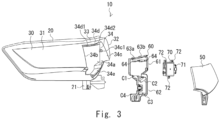
- Fig. 3 is an exploded perspective view of the vehicular lamp fitting 10.
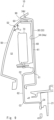
- Fig. 4 is a perspective view as seen in a direction indicated by an arrow 80 in Fig. 2 .
- Fig. 5 is a cross-sectional view taken along a line A-A in Fig. 4 .
- Fig. 6 is a cross-sectional view taken along a line B-B in Fig. 4 .
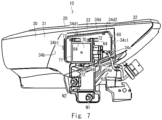
- Fig. 7 is a side view of the vehicular lamp fitting 10 (in which illustration of a radar cover 50 is omitted).
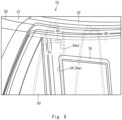
- Fig. 8 is an enlarged view of a part of the vehicular lamp fitting 10 (a see-through view).
- the vehicular lamp fitting 10 includes a lamp housing 20, an outer lens 30, lamp unit 40, a radar cover 50, a bracket 60, and a radar unit 70.
- the lamp housing 20 is made of a synthetic resin such as acrylic and polycarbonate, and includes an extension part 21 extending downward from the lower end of the outer lens 30 (see Figs. 3 and 5 ).
- the outer lens 30 is made of a material that is transparent to light (visible light) emitted by the lamp unit 40, and, for example, made of a transparent resin (a synthetic resin) such as acrylic and polycarbonate.
- the outer lens 30 is attached to the lamp housing 20 in a state in which it covers the opening of the lamp housing 20, and forms a space S1 (an example of the first space in the present disclosure) between the outer lens 30 and the lamp housing 20 (see Fig. 2 ).
- the outer lens 30 is welded to the lamp housing 20 (the opening end) along its whole peripheral edge.
- the outer lens 30 includes a front lens part 31 disposed on the front-end side of the vehicle, a side lens part 32 disposed on the lateral side of the vehicle, and a curved lens part 33 disposed between the front lens part 31 and the side lens part 32.
- the outer lens 30 may have an arbitrary shape as desired according to the design of the vehicle or the like.
- the outer lens 30 includes a recessed part 34.
- the recessed part 34 is disposed on the front side of the curved lens part 33.
- the recessed part 34 is a recessed part into which the bracket 60 (and the radar cover 50 and the radar unit 70 attached to the bracket 60) is inserted.
- the recessed part 34 is surrounded by a bottom surface 34a disposed on the rear side, side surfaces 34b and 34c disposed on both the left and right sides, respectively, of the bottom surface 34a, an upper surface 34d disposed above the bottom surface 34a, and a lower surface 34e disposed below the bottom surface 34a (see Figs. 3 and 7 , etc.).
- a positioning rib 34b1 that abuts against one side of the bracket 60 (the radar-unit holding part 61) is provided (see Fig. 7 ).
- a positioning rib 34c1 that abuts against the other side of the bracket 60 (the radar-unit holding part 61) is provided (see Figs. 3 and 7 ).
- a positioning rib that abuts against the upper end of the bracket 60 (the radar-unit holding part 61) is provided in the upper surface 34d of the recessed part 34.
- the lamp unit 40 is disposed in the space S1 formed by the outer lens 30 and the lamp housing 20 (see Fig. 2 ).
- the bracket 60 is made of a synthetic resin such as acrylic and polycarbonate, and includes a radar-unit holding part 61 that holds the radar unit 70, and an extension part 62 extending downward from the radar-unit holding part 61 (see Figs. 3 and 5 , etc.).
- the lower end of the bracket 60 (the extension part 62) is fixed to the extension part 21 of the lamp housing 20 by screws N1 (see Figs 1 and 5 ), so that the lower end of the bracket 60 (an example of the other end of the bracket in the present disclosure) is fixed to the lamp housing 20 (the extension part 21). Since the extension part 62 of the bracket 60 extends backward from the third bending part C3 toward the extension part 21 of the lamp housing 20, when the lower end of the bracket 60 is fixed by the screws N1, the tightening force from the front to the rear is applied more easily. As a result, it is possible to firmly fix the bracket 60 to the lamp housing 20.
- the screws N1 are an example of the second fixing part in the present disclosure.
- the bracket 60 As the upper end of the bracket 60 (the radar-unit holding part 61) abuts against the positioning rib (not shown) provided in the upper surface 34d of the recessed part 34 of the outer lens 30, the bracket 60 is positioned relative to the outer lens 30 (the recessed part 34) in the up/down direction. Note that the positioning ribs 34b1 and 34c1, and the like may be provided in the bracket 60.
- the radar cover 50 is made of a material opaque to visible light, such as a black synthetic resin.
- the radar cover 50 is provided to protect the radar unit 70 from stepping stones or the like and to improve the appearance.
- the radar cover 50 is disposed while cover the recessed part 34 of the outer lens 30, and forms a space S2 (an example of the second space in the present disclosure) between the radar cover 50 and the outer lens 30 (the recessed part 34) (see Fig. 5 ).
- the lower end of the radar cover 50 is fixed to the bracket 60 by screws N2 (see Fig. 1 ), so that the lower end of the radar cover 50 is fixed to the bracket 60.
- the radar cover 50 is large enough to cover the area through which electromagnetic waves transmitted from the radar unit 70 (millimeter waves having the angle of divergence ⁇ V in the vertical direction (hereinafter also referred to as the vertical divergence angle ⁇ V ) (see Fig. 5 ) and the angle of divergence ⁇ H in the horizontal direction (hereinafter also referred to as the horizontal divergence angle ⁇ H ) (see Fig. 2 )) pass through, and may have an arbitrary shape as desired according to the design of the vehicle or the like as long as it satisfies the aforementioned condition.
- the radar unit 70 (the radar apparatus) includes the case 71, a transmitting antenna and a receiving antenna (both of which are not shown) housed in the case 71, and so on.
- the radar unit 70 is a millimeter-wave radar unit that transmits electromagnetic waves (millimeter waves) from the transmitting antenna.
- the electromagnetic waves (the millimeter waves) pass through the radar cover 50 and are transmitted to a range having a vertical divergence angle ⁇ V (see Fig. 5 ) and a horizontal divergence angle ⁇ H (see Fig. 2 ). Further, the radar unit 70 receives, by the receiving antenna, reflected waves which have been reflected by an object present in the aforementioned transmission range and have passed through the radar cover 50.
- the vehicular lamp fitting 10 having the above-described configuration is mounted on a vehicle by fixing a flange part(s) provided in the lamp housing 20 to the vehicle (e.g., the frame of the vehicle body or the bumper) by screws.
- both the left and right sides of the bracket 60 abuts against the positioning ribs 34b1 and 34c1 provided in the side surfaces 34b and 34c of the recessed part 34 of the outer lens 30 (see Fig. 7 ).
- the bracket 60 is positioned relative to the outer lens 30 (the recessed part 34) in the left/right direction.
- the upper end of the bracket 60 (the radar-unit holding part 61) abuts against the positioning ribs (not shown) provided in the upper surface 34d of the recessed part 34 of the outer lens 30.
- the bracket 60 is positioned relative to the outer lens 30 (the recessed part 34) in the up/down direction.
- the hook parts 51 which are inserted into the through holes 63 and protrude to the rear side, do not interfere with (e.g., collide against) the bottom surface 34a of the recessed part 34 (see Fig. 8 ).
- the lower end of the radar cover 50 is fixed to the bracket 60 by screws N2 (see Figs. 1 and 7 ). As a result, the lower end of the radar cover 50 is fixed to the bracket 60.
- bracket 60 to which the radar unit 70 is fixed does not extend in the cantilevered manner, but one end of the bracket 60 is fixed to the outer lens 30 and the other end thereof is fixed to the lamp housing 20.
- Figs. 9 and 10 show a modified example of the radar cover 50.
- a stepped part 90 may be formed between the outer lens 30 and the radar cover 50 by positioning the end of the radar cover 50 adjacent to the outer lens 30 (the upper end in Fig. 9 ) behind the outer lens 30.
- This stepped part 90 can be formed, for example, by bending the end (the upper end in Fig. 10 ) of the radar cover 50 backward along a bending part 52 (indicated by a dashed line in Fig. 10 ).
- the angle ⁇ 52 (see Fig. 9 ) of this bending part 52 may be an arbitrary angle.
Landscapes
- Engineering & Computer Science (AREA)
- Radar, Positioning & Navigation (AREA)
- Remote Sensing (AREA)
- Mechanical Engineering (AREA)
- Physics & Mathematics (AREA)
- Computer Networks & Wireless Communication (AREA)
- General Physics & Mathematics (AREA)
- Electromagnetism (AREA)
- Radar Systems Or Details Thereof (AREA)
- Lighting Device Outwards From Vehicle And Optical Signal (AREA)
Description
- The present disclosure relates to a vehicular lamp fitting and a radar structure, and in particular to a vehicular lamp fitting and a radar structure capable of preventing (or suppressing) vibrations of a radar unit (and as a result, capable of preventing the detection area of the radar unit from being significantly changed).
-
Japanese Unexamined Patent Application Publication No. 2020-38181 Fig. 2 ofJapanese Unexamined Patent Application Publication No. 2020-38181 -
WO 2021 024887 A discloses a right-side vehicular lamp which includes: a lamp housing; a lamp cover; an illumination unit disposed in a lamp chamber; a radar configured to acquire radar data representing the surrounding environment of a vehicle by emitting radio waves toward the outside of the vehicle; a concealment part that is disposed so as to face the radar so as to conceal the radar from the outside of the vehicle and that is configured to allow the radio waves emitted from the radar to pass through; a support member that is fixed to a vehicle body and that is configured to support and fix the radar; and a positioning part that is disposed between the concealment part and the support member and that is configured to determine a position of the radar with respect to the concealment part. The concealment part is formed integrally with the lamp cover. The positioning part is fixed to the concealment part and engages elastically with the support member. - However, in the vehicular lamp fitting disclosed in
Japanese Unexamined Patent Application Publication No. 2020-38181 - The present disclosure has been made in order to solve the above-described problem, and an object thereof is to provide a vehicular lamp fitting and a radar structure capable of preventing (or suppressing) vibrations of a radar unit (and as a result, capable of preventing the detection area of the radar unit from being significantly changed).
- In accordance with the present invention, a vehicular lamp fitting as set forth in the appended claims is provided. In particular, a vehicular lamp fitting according to an aspect includes: a lamp housing; an outer lens attached to the lamp housing, the outer lens comprising a recessed part and forming a first space between the outer lens and the lamp housing; a lamp unit disposed in the first space; a radar cover disposed in a state of covering the recessed part and forming a second space between the radar cover and the recessed part; a bracket disposed in the second space; a radar unit disposed in the second space in a state where the radar unit is detachably fixed to the bracket; and a first fixing part fixing one end of the bracket to the outer lens; and a second fixing part fixing the other end of the bracket to the lamp housing, wherein,the first fixed part is provided above the radar unit, and the second fixed part is provided below the radar unit.
- By the above-described configuration, it is possible to prevent (or suppress) vibrations of the radar unit (and as a result, to prevent the detection area of the radar unit from being significantly changed).
- This is because the bracket to which the radar unit is fixed does not extend in the cantilevered manner, but one end of the bracket is fixed to the outer lens and the other end thereof is fixed to the lamp housing.
- Further, there is another advantage that the effect of the heat (the heat generated by the lamp unit) on the radar unit can be reduced. This is because the radar unit is disposed in the second space (formed by the outer lens and the radar cover) in which the temperature is lower than that in the first space (formed by the lamp housing and the outer lens) where the temperature is raised due to the heat generated by the lamp unit.
- Further, there is an advantage that maintenance can be easily performed when the radar unit fails. This is because each of the radar unit and the radar cover is detachably fixed to the bracket, so that the radar unit can be replaced by removing the radar cover from the bracket without removing the vehicular lamp fitting itself from the vehicle.
- Further, in the above-described vehicular lamp fitting, the first fixing part may be provided on the outer lens, and may fix one end of the bracket to the outer lens in a state where one end of the bracket is sandwiched.
- Further, in the above-described vehicular lamp fitting, the radar cover may be detachably fixed to the bracket.
- Further, in the above-described vehicular lamp fitting, in one of the recessed part and the bracket, at least one positioning rib, which abuts against (i.e., is in contact with) the other of the recessed part and the bracket, may be provided.
- Further, in the above-described vehicular lamp fitting, the positioning rib may be a positioning rib configured to maintain a gap between the radar cover and the recessed part uniform.
- Further, in the above-described vehicular lamp fitting, the other end of the bracket may extend through at least one bending part so as to stride over the recessed part.
- Further, in the above-described vehicular lamp fitting, the other end of the bracket may eventually extend toward the lamp housing, and the tip of the other end of the bracket may be fixed to the lamp housing by the second fixing part.
- Further, in the above-described vehicular lamp fitting, a stepped part may be formed between the outer lens and a part of the radar cover located adjacent to the outer lens.
- Further, in the above-described vehicular lamp fitting, an end of the radar cover adjacent to the outer lens may bend backward through a bending part and thereby be disposed behind the outer lens.
- Further, in the above-described vehicular lamp fitting, the outer lens may be transparent to visible light, and the radar cover may be opaque to visible light.
- A radar structure according to another aspect includes: a radar cover forming a space between the radar cover and the bracket in a state where the radar cover is detachably fixed to the bracket; and a radar unit that is disposed in the space in a state where the radar unit detachably fixed to the bracket.
- According to the present disclosure, it is possible to provide a vehicular lamp fitting and a radar structure capable of preventing (or suppressing) vibrations of a radar unit (and as a result, capable of preventing the detection area of the radar unit from being significantly changed).
- The above and other objects, features and advantages of the present disclosure will become more fully understood from the detailed description given hereinbelow and the accompanying drawings which are given by way of illustration only, and thus are not to be considered as limiting the present disclosure.
-
-
Fig. 1 is a front view of a vehicular lamp fitting 10; -
Fig. 2 is a top view of a vehicular lamp fitting 10; -
Fig. 3 is an exploded perspective view of the vehicular lamp fitting 10; -
Fig. 4 is a view as seen in a direction indicated by anarrow 80 inFig. 2 ; -
Fig. 5 is a cross-sectional view taken along a line A-A inFig. 4 ; -
Fig. 6 is a cross-sectional view taken along a line B-B inFig. 4 ; -
Fig. 7 is a side view of the vehicular lamp fitting 10 (in which illustration of aradar cover 50 is omitted); -
Fig. 8 is an enlarged perspective view of a part of thevehicular lamp fitting 10; -
Fig. 9 shows a modified example of theradar cover 50; -
Fig. 10 shows another modified example of theradar cover 50; and -
Fig. 11 shows an example (a modified example) in which one end of a bracket 60A is fixed to alamp housing 20 by a screw N3 and the other end (the lower end) of the bracket 60A is fixed to thelamp housing 20 by a screw N1. - A vehicular lamp fitting 10, which is an embodiment according to the present disclosure, will be described hereinafter with reference to the attached drawings. The same reference numerals (or symbols) are attached to corresponding components throughout the drawings, and redundant explanations thereof are omitted as appropriate.
-
Fig. 1 is a front view of the vehicular lamp fitting 10.Fig. 2 is a top view of the vehicular lamp fitting 10. - The vehicular lamp fitting 10 according to this embodiment is a vehicular lamp fitting that functions as a headlamp, and is mounted on each of the left and right sides of the front end of a vehicle such as an automobile (not shown). Since the
vehicular lamp fittings 10 mounted on both the left and right sides of the front end of the vehicle are symmetrical to each other, only the vehicular lamp fitting 10 mounted on the left side (the left side when facing the front side of the vehicle) of the front end of the vehicle will be described hereinafter as a representative example. -
Fig. 3 is an exploded perspective view of the vehicular lamp fitting 10.Fig. 4 is a perspective view as seen in a direction indicated by anarrow 80 inFig. 2 .Fig. 5 is a cross-sectional view taken along a line A-A inFig. 4 .Fig. 6 is a cross-sectional view taken along a line B-B inFig. 4 .Fig. 7 is a side view of the vehicular lamp fitting 10 (in which illustration of aradar cover 50 is omitted).Fig. 8 is an enlarged view of a part of the vehicular lamp fitting 10 (a see-through view). - As shown in
Figs. 2 and3 , etc., thevehicular lamp fitting 10 includes alamp housing 20, anouter lens 30,lamp unit 40, aradar cover 50, abracket 60, and aradar unit 70. - The
lamp housing 20 is made of a synthetic resin such as acrylic and polycarbonate, and includes anextension part 21 extending downward from the lower end of the outer lens 30 (seeFigs. 3 and5 ). - The
outer lens 30 is made of a material that is transparent to light (visible light) emitted by thelamp unit 40, and, for example, made of a transparent resin (a synthetic resin) such as acrylic and polycarbonate. Theouter lens 30 is attached to thelamp housing 20 in a state in which it covers the opening of thelamp housing 20, and forms a space S1 (an example of the first space in the present disclosure) between theouter lens 30 and the lamp housing 20 (seeFig. 2 ). Theouter lens 30 is welded to the lamp housing 20 (the opening end) along its whole peripheral edge. - As shown in
Figs. 2 and3 , theouter lens 30 includes afront lens part 31 disposed on the front-end side of the vehicle, aside lens part 32 disposed on the lateral side of the vehicle, and acurved lens part 33 disposed between thefront lens part 31 and theside lens part 32. Note that theouter lens 30 may have an arbitrary shape as desired according to the design of the vehicle or the like. - The
outer lens 30 includes arecessed part 34. Therecessed part 34 is disposed on the front side of thecurved lens part 33. The recessedpart 34 is a recessed part into which the bracket 60 (and theradar cover 50 and theradar unit 70 attached to the bracket 60) is inserted. The recessedpart 34 is surrounded by abottom surface 34a disposed on the rear side, side surfaces 34b and 34c disposed on both the left and right sides, respectively, of thebottom surface 34a, anupper surface 34d disposed above thebottom surface 34a, and alower surface 34e disposed below thebottom surface 34a (seeFigs. 3 and7 , etc.). Since thebottom surface 34a of the recessedpart 34 is surrounded by the side surfaces 34b and 34c disposed on both the left and right sides, and the upper andlower surfaces lower surface 34e is not provided. - In the one
side surface 34b of the recessedpart 34, a positioning rib 34b1 that abuts against one side of the bracket 60 (the radar-unit holding part 61) is provided (seeFig. 7 ). Similarly, in theother side surface 34c of the recessedpart 34, a positioning rib 34c1 that abuts against the other side of the bracket 60 (the radar-unit holding part 61) is provided (seeFigs. 3 and7 ). Further, although it is not shown, a positioning rib that abuts against the upper end of the bracket 60 (the radar-unit holding part 61) is provided in theupper surface 34d of the recessedpart 34. - Further, flange parts 34d1 and 34d2 are provided in the
upper surface 34d of the recessed part 34 (seeFigs. 3 and7 , etc.). The flange parts 34d1 and 34d2 are disposed in such a manner that a space into which theflange parts bottom surface 34a of the recessed part 34 (seeFig. 5 ). - The
lamp unit 40 is disposed in the space S1 formed by theouter lens 30 and the lamp housing 20 (seeFig. 2 ). - The
lamp unit 40 is a lamp unit for a headlamp. Thelamp unit 40 may be any of a projector-type lamp unit, a reflector-type lamp unit, a direct-projection-type (direct-emission-type) lamp unit, and a lamp unit using a light guiding member (a light guiding rod or a light guiding plate), or may be any other lamp unit. When the headlamp light source for the headlamp (not shown) is turned on, light emitted from the light source for the headlamp passes through thefront lens part 31 of theouter lens 30, and is emitted to the outside. In this way, the headlamp is implemented. - The
bracket 60 is made of a synthetic resin such as acrylic and polycarbonate, and includes a radar-unit holding part 61 that holds theradar unit 70, and anextension part 62 extending downward from the radar-unit holding part 61 (seeFigs. 3 and5 , etc.). - In the radar-
unit holding part 61, engagement parts 64 (disposed at three places inFig. 3 ), which engages with flange parts 72 (three places inFig. 3 ) provided in the radar unit 70 (the case 71), are provided. Each of theengagement parts 64 is, for example, a pair of claw parts (hook parts) that sandwiches a respective one of theflange parts 72 provided in the radar unit 70 (the case 71) from both the left and right sides, and theengagement parts 64 are disposed at places (three places inFig. 3 ) corresponding to those of the flange parts 72 (three places inFig. 3 ). - As shown in
Fig. 5 , theextension part 62 extends forward from the lower end of the radar-unit holding part 61 through a first bending part C1, extends downward through a second bending part C2, extends backward through a third bending part C3, and extends downward through a fourth bending part C4. - As described above, the
extension part 62 is formed so as to extend across the recessedpart 34 provided in the outer lens 30 (i.e., thelower surface 34e disposed below thebottom surface 34a). Note that thelower surface 34e may not be provided, and thebottom surface 34a of the recessedpart 34 provided in theouter lens 30 may have a flat shape extending in the vertically downward direction (the downward direction inFig. 5 ). In this case, theextension part 62 of thebracket 60 may not be provided, and theextension part 62 may have a flat shape extending in the vertically downward direction. - The
bracket 60 is detachably fixed to the outer lens 30 (the recessed part 34) and the lamp housing 20 (the extension part 21). Specifically, as shown inFigs. 5 and7 , theflange parts upper surface 34d of the recessedpart 34 of theouter lens 30 and thebottom surface 34a, so that the upper end of the bracket 60 (an example of the one end of the bracket in the present disclosure) is fixed to the outer lens 30 (the recessed part 34) in a state in which the upper end of thebracket 60 is sandwiched (i.e., interposed) between the flange parts 34d1 and 34d2 and thebottom surface 34a. The flange parts 34d1 and 34d2 are an example of the first fixing part in the present disclosure. - Meanwhile, the lower end of the bracket 60 (the extension part 62) is fixed to the
extension part 21 of thelamp housing 20 by screws N1 (seeFigs 1 and5 ), so that the lower end of the bracket 60 (an example of the other end of the bracket in the present disclosure) is fixed to the lamp housing 20 (the extension part 21). Since theextension part 62 of thebracket 60 extends backward from the third bending part C3 toward theextension part 21 of thelamp housing 20, when the lower end of thebracket 60 is fixed by the screws N1, the tightening force from the front to the rear is applied more easily. As a result, it is possible to firmly fix thebracket 60 to thelamp housing 20. The screws N1 are an example of the second fixing part in the present disclosure. - As described above, in the state in which the
bracket 60 is detachably fixed to the outer lens 30 (the recessed part 34) and the lamp housing 20 (the extension part 21), the bracket 60 (the rear surface of the radar-unit holding part 61) and thebottom surface 34a of the recessedpart 34 of theouter lens 30 are opposed to each other (seeFig. 5 ). Further, as both the left and right sides of the bracket 60 (the radar-unit holding part 61) abut against the positioning ribs 34b1 and 34c1, respectively, provided in the side surfaces 34b and 34c of the recessedpart 34 of the outer lens 30 (seeFig. 7 ), thebracket 60 is positioned relative to the outer lens 30 (the recessed part 34) in the left/right direction. Further, as the upper end of the bracket 60 (the radar-unit holding part 61) abuts against the positioning rib (not shown) provided in theupper surface 34d of the recessedpart 34 of theouter lens 30, thebracket 60 is positioned relative to the outer lens 30 (the recessed part 34) in the up/down direction. Note that the positioning ribs 34b1 and 34c1, and the like may be provided in thebracket 60. - The
radar cover 50 is made of a material opaque to visible light, such as a black synthetic resin. Theradar cover 50 is provided to protect theradar unit 70 from stepping stones or the like and to improve the appearance. Theradar cover 50 is disposed while cover the recessedpart 34 of theouter lens 30, and forms a space S2 (an example of the second space in the present disclosure) between theradar cover 50 and the outer lens 30 (the recessed part 34) (seeFig. 5 ). - The
radar cover 50 is detachably fixed to thebracket 60. Specifically, a pair of left and right hook parts 51 (only one of thehook parts 51 is shown inFig. 8 ) provided at the upper end of theradar cover 50 are inserted into a pair of left and right through holes 63 (only one of the throughholes 63 is shown inFig. 7 ) formed at the upper end of thebracket 60, and are engaged with the peripheries of the through holes 63 (seeFig. 8 ), so that the upper end of theradar cover 50 is fixed to thebracket 60. Note that in order to prevent thehook parts 51, which are inserted into the throughholes 63 and protrude to the rear side, from interfering with (e.g., colliding against) thebottom surface 34a of the recessedpart 34, recessed parts 34a1 are provided in parts of thebottom surface 34a of the recessedpart 34 corresponding to thehook parts 51 protruding from the throughholes 63 to the rear side (seeFig. 8 ). - Meanwhile, the lower end of the
radar cover 50 is fixed to thebracket 60 by screws N2 (seeFig. 1 ), so that the lower end of theradar cover 50 is fixed to thebracket 60. - Note that it is sufficient if the
radar cover 50 is large enough to cover the area through which electromagnetic waves transmitted from the radar unit 70 (millimeter waves having the angle of divergence θV in the vertical direction (hereinafter also referred to as the vertical divergence angle θV) (seeFig. 5 ) and the angle of divergence θH in the horizontal direction (hereinafter also referred to as the horizontal divergence angle θH) (seeFig. 2 )) pass through, and may have an arbitrary shape as desired according to the design of the vehicle or the like as long as it satisfies the aforementioned condition. - The radar unit 70 (the radar apparatus) includes the
case 71, a transmitting antenna and a receiving antenna (both of which are not shown) housed in thecase 71, and so on. Theradar unit 70 is a millimeter-wave radar unit that transmits electromagnetic waves (millimeter waves) from the transmitting antenna. The electromagnetic waves (the millimeter waves) pass through theradar cover 50 and are transmitted to a range having a vertical divergence angle θV (seeFig. 5 ) and a horizontal divergence angle θH (seeFig. 2 ). Further, theradar unit 70 receives, by the receiving antenna, reflected waves which have been reflected by an object present in the aforementioned transmission range and have passed through theradar cover 50. The received signal is processed by a control apparatus such as an ECU (Electronic Control Unit) (not shown), so that the object (e.g., a distance, an angle, and a velocity of the object) is detected. In theradar unit 70, for example, millimeter waves in a frequency band of 76 to 81 GHz, in particular, in a frequency band of 79 GHz, are used. However, the frequency band is not limited to these frequency bands. - Note that the radar method of the
radar unit 70 may be either of a pulse method or a CW (Continuous Wave) method, or may be any other method. Further, the antenna method of theradar unit 70 may be any of a mechanical scanning method, a beam switching method, a phased array method, and a digital forming method, or may be any other method. - The
radar unit 70 is detachably fixed to thebracket 60. Specifically, as shown inFig. 7 , theradar unit 70 is detachably fixed to thebracket 60 as the engagement parts 64 (three places inFig. 7 ) provided in thebracket 60 engage with the flange parts 72 (three places inFig. 7 ) provided in thecase 71. Note that theradar unit 70 may be detachably fixed to thebracket 60 by using, instead of using theengagement parts 64, known fixing means such as screws. - Although it is not shown in the drawings, the vehicular lamp fitting 10 having the above-described configuration is mounted on a vehicle by fixing a flange part(s) provided in the
lamp housing 20 to the vehicle (e.g., the frame of the vehicle body or the bumper) by screws. - Next, a procedure for detachably fixing the
bracket 60, to which theradar unit 70 and theradar cover 50 are detachably fixed as described above, to the outer lens 30 (the recessed part 34) will be described. - Firstly, the
flange parts upper surface 34d of the recessedpart 34 of theouter lens 30 and thebottom surface 34a thereof (seeFig. 5 ). As a result, the upper end of the bracket 60 (an example of the one end of the bracket in the present disclosure) is fixed to the outer lens 30 (the recessed part 34) in the state in which the upper end of thebracket 60 is sandwiched (i.e., interposed) between the flange parts 34d1 and 34d2 and thebottom surface 34a. - Next, the lower end of the bracket 60 (the extension part 62) is fixed to the
extension part 21 of thelamp housing 20 by using screws N1 (seeFigs. 1 and5 ). As a result, the lower end of the bracket 60 (an example of the other end of the bracket in the present disclosure) is fixed to the lamp housing 20 (the extension part 21). - When doing so, both the left and right sides of the bracket 60 (the radar-unit holding part 61) abuts against the positioning ribs 34b1 and 34c1 provided in the side surfaces 34b and 34c of the recessed
part 34 of the outer lens 30 (seeFig. 7 ). As a result, thebracket 60 is positioned relative to the outer lens 30 (the recessed part 34) in the left/right direction. Further, the upper end of the bracket 60 (the radar-unit holding part 61) abuts against the positioning ribs (not shown) provided in theupper surface 34d of the recessedpart 34 of theouter lens 30. As a result, thebracket 60 is positioned relative to the outer lens 30 (the recessed part 34) in the up/down direction. - As described above, the
bracket 60 is positioned relative to the outer lens 30 (the recessed part 34) in the up/down and left/right directions, so that the gap between theradar cover 50 and the recessed part 34 (see symbols G1 to G3 inFig. 1 ) is kept uniform. In this way, the appearance is improved. - Since the upper end of the
bracket 60 is fixed to the outer lens 30 (the recessed part 34) and the lower end of thebracket 60 is fixed to the lamp housing 20 (the extension part 21) as described above, thebracket 60 is prevented from widely vibrating even when the vehicle on which the vehicular lamp fitting 10 is mounted vibrates during the traveling. As a result, it is possible to prevent the FOV (Field of View, i.e., the detection width) of theradar unit 70 from widely shaking, and thereby to prevent an error, such as losing sight of the target, from occurring. - Next, a procedure for replacing the
radar unit 70 will be described. - Firstly, the screws N2 (see
Figs. 1 and7 ) are removed (i.e., unscrewed) and theradar cover 50 is removed from thebracket 60. As a result, theradar unit 70 is exposed. Next, theradar unit 70 is removed from thebracket 60 and replaced by anotherradar unit 70. When doing so, since theradar unit 70 is detachably fixed to thebracket 60 by theengagement parts 64, theradar unit 70 can be easily replaced by anotherradar unit 70. - Next, a procedure for attaching the
radar cover 50 to thebracket 60 after theradar unit 70 is replaced will be described. - After the
radar unit 70 is replaced by anotherradar unit 70 as described above, firstly, the pair of left and right hook parts 51 (only one of thehook parts 51 is shown inFig. 8 ) provided at the upper end of theradar cover 50 are inserted into the pair of left and right through holes 63 (only one of the throughholes 63 is shown inFig. 8 ) formed at the upper end of thebracket 60, and are engaged with the peripheries of these throughholes 63. As a result, the upper end of theradar cover 50 is fixed to thebracket 60. At this time, since the recessed parts 34a1 are provided in the parts of thebottom surface 34a of the recessedpart 34 corresponding to thehook parts 51, which protrude from the throughholes 63 to the rear side, thehook parts 51, which are inserted into the throughholes 63 and protrude to the rear side, do not interfere with (e.g., collide against) thebottom surface 34a of the recessed part 34 (seeFig. 8 ). - Next, the lower end of the
radar cover 50 is fixed to thebracket 60 by screws N2 (seeFigs. 1 and7 ). As a result, the lower end of theradar cover 50 is fixed to thebracket 60. - As described above, according to this embodiment, it is possible to prevent (or suppress) vibrations of the radar unit 70 (and as a result, to prevent the detection area of the
radar unit 70 from being significantly changed). - This is because the
bracket 60 to which theradar unit 70 is fixed does not extend in the cantilevered manner, but one end of thebracket 60 is fixed to theouter lens 30 and the other end thereof is fixed to thelamp housing 20. - Further, according to this embodiment, there is another advantage that the effect of the heat (the heat generated by the lamp unit 40) on the
radar unit 70 can be reduced. This is because theradar unit 70 is disposed in the second space S2 (formed by theouter lens 30 and the radar cover 50) in which the temperature is lower than that in the first space S1 (formed by thelamp housing 20 and the outer lens 30) where the temperature is raised due to the heat generated by thelamp unit 40. - Further, according to this embodiment, there is an advantage that maintenance can be easily performed when the radar unit fails. This is because each of the
radar unit 70 and theradar cover 50 is detachably fixed to thebracket 60, so that theradar unit 70 can be replaced by removing theradar cover 50 from thebracket 60 without removing the vehicular lamp fitting 10 itself from the vehicle (not shown). - Further, according to this embodiment, it is possible to prevent the distance between the
radar unit 70 and theradar cover 50 from changing (and as a result, to prevent noises from occurring in electromagnetic waves (radar signals) that pass through theradar cover 50 and are transmitted to an area around the vehicle). In this way, it is possible to prevent the accuracy of the detection of an object present around the vehicle from deteriorating. - This is because the
radar unit 70 and theradar cover 50 are fixed to one and thesame bracket 60. That is, since theradar unit 70 and theradar cover 50 are fixed to thesame bracket 60, theradar unit 70 and theradar cover 50 vibrate similarly by vibration (For example, vibration during driving) of a vehicle (not shown) on which thevehicular lamp 10 is mounted, and as a result, the distance between theradar unit 70 and theradar cover 50 does not change. - Next, a modified example will be described.
-
Figs. 9 and10 show a modified example of theradar cover 50. - As shown in
Fig. 9 , a steppedpart 90 may be formed between theouter lens 30 and theradar cover 50 by positioning the end of theradar cover 50 adjacent to the outer lens 30 (the upper end inFig. 9 ) behind theouter lens 30. This steppedpart 90 can be formed, for example, by bending the end (the upper end inFig. 10 ) of theradar cover 50 backward along a bending part 52 (indicated by a dashed line inFig. 10 ). The angle θ52 (seeFig. 9 ) of this bendingpart 52 may be an arbitrary angle. - A gap G3 (see
Fig. 5 ) is formed between theouter lens 30 and theradar cover 50 in the vehicular lamp fitting 10 according to the above-described embodiment. Therefore, when the vehicle on which the vehicular lamp fitting 10 is mounted is traveling in the rain, rainwater may enter the gap G3. To cope with this, a steppedpart 90 is provided as in the case of this modified example, so that the direction of the wind that the vehicle on which the vehicular lamp fitting 10 is mounted receives during the traveling can be changed, and hence the direction of the rainwater can be changed. Therefore, it is possible to prevent the rainwater from entering the gap G3. Further, by forming an inclined surface in the steppedpart 90, the direction of the wind can be controlled. Therefore, it is possible to change the direction of rainwater in a proactive manner, and thereby to facilitate the effect of preventing rainwater from entering the gap G3 even further. - Although an example in which one end (the upper end) of the
bracket 60 is fixed to the outer lens 30 (the recessed part 34) and the other end (the lower end) of thebracket 60 is fixed to thelamp housing 20 has been described in the above-described embodiment, the present disclosure is not limited to this example. For example, as shown inFig. 11 , both of one end and the other end (the lower end) of a bracket 60A may be fixed to thelamp housing 20. In this way, the bracket 60A can be fixed to thelamp housing 20 more firmly.Fig. 11 shows an example (a modified example) in which one end of the bracket 60A is fixed to thelamp housing 20 by a screw N3 and the other end (the lower end) of the bracket 60A is fixed to thelamp housing 20 by a screw N1. - The bracket 60A is made of a synthetic resin such as acrylic or polycarbonate, and includes a radar-
unit holding part 61 that holds theradar unit 70, anextension part 62 extending downward from the lower end of the radar-unit holding part 61, and anextension part 63 extending backward from the upper end of the radar-unit holding part 61 (seeFig. 11 ). - As shown in
Fig. 11 , theextension part 63 extends backward from the upper end of the radar-unit holding part 61 through a fifth bending part C5 and aninclined part 64, and further extends backward through sixth to ninth bending parts C6 to C9 so as to extend across the junction between thelamp housing 20 and theouter lens 30. As described above, theextension part 63 extends rearward from the upper end of the radar-unit holding part 61 so as to extend across the junction of thelamp housing 20 and theouter lens 30. - Further, in the modified example shown in
Fig. 11 , theinclined part 64 of the bracket 60A and theradar cover 50 are arranged so that they are flush (or roughly flush) with each other across a small gap G4 (i.e., with a small gap G4 interposed therebetween). In this way, the appearance is improved. - Further, in the modified example shown in
Fig. 11 , since theupper surface 34d of the recessedpart 34 is omitted, the radar-unit holding part 61 of the bracket 60A can have a simple shape extending in the up/down direction inFig. 11 . - Further, although an example in which a vehicular lamp fitting according to the present disclosure is applied to a headlamp has been described in the above-described embodiment, the present disclosure is not limited to this example. For example, the present disclosure may be applied to a vehicular lamp fitting other than the headlamp. For example, the present disclosure may be applied to a vehicular lamp fitting such as a rear combination lamp, and may also be applied to other vehicular lamp fittings.
- All the numeral values mentioned in the above-described embodiments are merely examples, and numeral values different from them can be uses as appropriate.
Claims (10)
- A vehicular lamp fitting comprising:a lamp housing (20);an outer lens (30) attached to the lamp housing (20), the outer lens (30) comprising a recessed part (34) and forming a first space (S1) between the outer lens (30) and the lamp housing (20);a lamp unit (40) disposed in the first space (S1);a radar cover (50) disposed in a state of covering the recessed part (34) and forming a second space (S2) between the radar cover (50) and the recessed part (34);a bracket (60) disposed in the second space (S2);a radar unit (70) disposed in the second space (S2) in a state where the radar unit (70) is detachably fixed to the bracket (60); and characterized by comprisinga first fixing part (34d1, 34d2) fixing one end of the bracket (60) to the outer lens (30); anda second fixing part (N1) fixing the other end of the bracket (60) to the lamp housing (20), wherein,the first fixed part (34d1, 34d2) is provided above the radar unit (70), and the second fixed part (N1) is provided below the radar unit (70).
- The vehicular lamp fitting according to Claim 1, wherein the first fixing part (34d1, 34d2) is provided on the outer lens (30), and fixes one end of the bracket (60) to the outer lens (30) in a state where one end of the bracket (60) is sandwiched.
- The vehicular lamp fitting according to Claim 1, wherein the radar cover (50) is detachably fixed to the bracket (60).
- The vehicular lamp fitting according to Claim 2, wherein in one of the recessed part (34) and the bracket (60), at least one positioning rib, which abuts against the other of the recessed part (34) and the bracket (60), is provided.
- The vehicular lamp fitting according to Claim 4, wherein the positioning rib is a positioning rib (34b1, 34c1) configured to maintain a gap between the radar cover (50) and the recessed part (34) uniform.
- The vehicular lamp fitting according to Claim 1, wherein the other end of the bracket (60) extends through at least one bending part so as to stride over the recessed part (34).
- The vehicular lamp fitting according to Claim 6, wherein the other end of the bracket (60) eventually extends toward the lamp housing (20), and the tip of the other end of the bracket (60) is fixed to the lamp housing (20) by the second fixing part (N1).
- The vehicular lamp fitting according to Claim 1, wherein a stepped part (90) is formed between the outer lens (30) and a part of the radar cover (50) located adjacent to the outer lens (30).
- The vehicular lamp fitting according to Claim 8, wherein an end of the radar cover (50) adjacent to the outer lens (30) bends backward through a bending part and thereby be disposed behind the outer lens (30).
- The vehicular lamp fitting according to Claim 1, wherein the outer lens (30) is transparent to visible light, and the radar cover (50) is opaque to visible light.
Applications Claiming Priority (1)
| Application Number | Priority Date | Filing Date | Title |
|---|---|---|---|
| US17/516,737 US12162397B2 (en) | 2021-11-02 | 2021-11-02 | Vehicular lamp fitting and radar structure |
Publications (2)
| Publication Number | Publication Date |
|---|---|
| EP4174513A1 EP4174513A1 (en) | 2023-05-03 |
| EP4174513B1 true EP4174513B1 (en) | 2025-07-02 |
Family
ID=84043803
Family Applications (1)
| Application Number | Title | Priority Date | Filing Date |
|---|---|---|---|
| EP22204167.5A Active EP4174513B1 (en) | 2021-11-02 | 2022-10-27 | Vehicular lamp fitting and radar structure |
Country Status (4)
| Country | Link |
|---|---|
| US (1) | US12162397B2 (en) |
| EP (1) | EP4174513B1 (en) |
| JP (1) | JP2023068630A (en) |
| CN (1) | CN116061795A (en) |
Families Citing this family (3)
| Publication number | Priority date | Publication date | Assignee | Title |
|---|---|---|---|---|
| CN121100081A (en) * | 2023-03-31 | 2025-12-09 | 印度摩托车国际有限公司 | Vehicle front radar integration |
| JP2024165800A (en) * | 2023-05-18 | 2024-11-28 | スタンレー電気株式会社 | Detachable radar cover structure |
| JP7709493B2 (en) * | 2023-07-28 | 2025-07-16 | 本田技研工業株式会社 | Vehicle lighting with detection device |
Family Cites Families (9)
| Publication number | Priority date | Publication date | Assignee | Title |
|---|---|---|---|---|
| JP4842161B2 (en) * | 2007-01-31 | 2011-12-21 | 株式会社小糸製作所 | Vehicle lighting |
| CN201423983Y (en) * | 2009-05-26 | 2010-03-17 | 上海通用汽车有限公司 | Rearview mirror device with steering lamp |
| US10144424B2 (en) * | 2015-04-09 | 2018-12-04 | Toyota Jidosha Kabushiki Kaisha | Arrangement structure for vicinity information detection sensor |
| JP7124577B2 (en) | 2018-09-06 | 2022-08-24 | トヨタ自動車株式会社 | Radar installation structure |
| JP7132887B2 (en) * | 2019-05-29 | 2022-09-07 | 本田技研工業株式会社 | vehicle light body |
| JP7138597B2 (en) * | 2019-05-29 | 2022-09-16 | 本田技研工業株式会社 | vehicle light body |
| US12055626B2 (en) * | 2019-08-05 | 2024-08-06 | Koito Manufacturing Co., Ltd. | Vehicle lamp and vehicle |
| EP4043909A1 (en) * | 2019-09-10 | 2022-08-17 | Koito Manufacturing Co., Ltd. | Vehicle light fitting, radar module, radar, and vehicle |
| JP2021091303A (en) * | 2019-12-10 | 2021-06-17 | トヨタ自動車株式会社 | Head lamp unit structure |
-
2021
- 2021-11-02 US US17/516,737 patent/US12162397B2/en active Active
-
2022
- 2022-10-20 JP JP2022168181A patent/JP2023068630A/en active Pending
- 2022-10-27 EP EP22204167.5A patent/EP4174513B1/en active Active
- 2022-11-02 CN CN202211359961.2A patent/CN116061795A/en active Pending
Also Published As
| Publication number | Publication date |
|---|---|
| US20230139390A1 (en) | 2023-05-04 |
| EP4174513A1 (en) | 2023-05-03 |
| JP2023068630A (en) | 2023-05-17 |
| US12162397B2 (en) | 2024-12-10 |
| CN116061795A (en) | 2023-05-05 |
Similar Documents
| Publication | Publication Date | Title |
|---|---|---|
| EP4174513B1 (en) | Vehicular lamp fitting and radar structure | |
| US11634064B1 (en) | Vehicular lamp fitting and radar structure | |
| US12429582B2 (en) | Vehicle lamp and vehicle | |
| JP2020038181A (en) | Mounting structure of radar device | |
| JP7124147B1 (en) | Radar mounting structure | |
| US20230139713A1 (en) | Vehicular lamp fitting and radar structure | |
| US12066563B2 (en) | Vehicular lamp fitting, radar-cover removing method, and radar-cover attaching method | |
| CN212685403U (en) | Vehicle lamp and vehicle | |
| JP2009266733A (en) | Vehicular lamp | |
| US12559021B2 (en) | Vehicular lamp fitting | |
| EP4024611A1 (en) | Radar device | |
| US6433750B1 (en) | Reception antenna for radio wave marker | |
| US12434619B2 (en) | Bracket attachment structure | |
| JP2024165801A (en) | Detachable radar cover structure | |
| US12263778B2 (en) | Bracket attachment structure | |
| US20260125017A1 (en) | Bumper cover structure | |
| CN121989853A (en) | bumper cover structure | |
| WO2024237176A1 (en) | Radar cover attachment/detachment structure | |
| KR102566960B1 (en) | Radar apparatus | |
| JP2025153844A (en) | Vehicle structure | |
| JP2023112232A (en) | vehicle lamp | |
| CN121989852A (en) | Radar bracket | |
| WO2022123845A1 (en) | Radar device |
Legal Events
| Date | Code | Title | Description |
|---|---|---|---|
| PUAI | Public reference made under article 153(3) epc to a published international application that has entered the european phase |
Free format text: ORIGINAL CODE: 0009012 |
|
| STAA | Information on the status of an ep patent application or granted ep patent |
Free format text: STATUS: REQUEST FOR EXAMINATION WAS MADE |
|
| 17P | Request for examination filed |
Effective date: 20221027 |
|
| AK | Designated contracting states |
Kind code of ref document: A1 Designated state(s): AL AT BE BG CH CY CZ DE DK EE ES FI FR GB GR HR HU IE IS IT LI LT LU LV MC ME MK MT NL NO PL PT RO RS SE SI SK SM TR |
|
| RBV | Designated contracting states (corrected) |
Designated state(s): AL AT BE BG CH CY CZ DE DK EE ES FI FR GB GR HR HU IE IS IT LI LT LU LV MC ME MK MT NL NO PL PT RO RS SE SI SK SM TR |
|
| GRAP | Despatch of communication of intention to grant a patent |
Free format text: ORIGINAL CODE: EPIDOSNIGR1 |
|
| STAA | Information on the status of an ep patent application or granted ep patent |
Free format text: STATUS: GRANT OF PATENT IS INTENDED |
|
| INTG | Intention to grant announced |
Effective date: 20250219 |
|
| GRAS | Grant fee paid |
Free format text: ORIGINAL CODE: EPIDOSNIGR3 |
|
| GRAA | (expected) grant |
Free format text: ORIGINAL CODE: 0009210 |
|
| STAA | Information on the status of an ep patent application or granted ep patent |
Free format text: STATUS: THE PATENT HAS BEEN GRANTED |
|
| AK | Designated contracting states |
Kind code of ref document: B1 Designated state(s): AL AT BE BG CH CY CZ DE DK EE ES FI FR GB GR HR HU IE IS IT LI LT LU LV MC ME MK MT NL NO PL PT RO RS SE SI SK SM TR |
|
| REG | Reference to a national code |
Ref country code: GB Ref legal event code: FG4D |
|
| REG | Reference to a national code |
Ref country code: CH Ref legal event code: EP |
|
| REG | Reference to a national code |
Ref country code: DE Ref legal event code: R096 Ref document number: 602022016789 Country of ref document: DE |
|
| RAP4 | Party data changed (patent owner data changed or rights of a patent transferred) |
Owner name: STANLEY ELECTRIC CO., LTD. Owner name: HONDA MOTOR CO., LTD. |
|
| REG | Reference to a national code |
Ref country code: IE Ref legal event code: FG4D |
|
| REG | Reference to a national code |
Ref country code: NL Ref legal event code: MP Effective date: 20250702 |
|
| PG25 | Lapsed in a contracting state [announced via postgrant information from national office to epo] |
Ref country code: PT Free format text: LAPSE BECAUSE OF FAILURE TO SUBMIT A TRANSLATION OF THE DESCRIPTION OR TO PAY THE FEE WITHIN THE PRESCRIBED TIME-LIMIT Effective date: 20251103 |
|
| PG25 | Lapsed in a contracting state [announced via postgrant information from national office to epo] |
Ref country code: NL Free format text: LAPSE BECAUSE OF FAILURE TO SUBMIT A TRANSLATION OF THE DESCRIPTION OR TO PAY THE FEE WITHIN THE PRESCRIBED TIME-LIMIT Effective date: 20250702 |
|
| REG | Reference to a national code |
Ref country code: AT Ref legal event code: MK05 Ref document number: 1809820 Country of ref document: AT Kind code of ref document: T Effective date: 20250702 |
|
| PG25 | Lapsed in a contracting state [announced via postgrant information from national office to epo] |
Ref country code: IS Free format text: LAPSE BECAUSE OF FAILURE TO SUBMIT A TRANSLATION OF THE DESCRIPTION OR TO PAY THE FEE WITHIN THE PRESCRIBED TIME-LIMIT Effective date: 20251102 |
|
| PGFP | Annual fee paid to national office [announced via postgrant information from national office to epo] |
Ref country code: DE Payment date: 20251029 Year of fee payment: 4 |
|
| PG25 | Lapsed in a contracting state [announced via postgrant information from national office to epo] |
Ref country code: NO Free format text: LAPSE BECAUSE OF FAILURE TO SUBMIT A TRANSLATION OF THE DESCRIPTION OR TO PAY THE FEE WITHIN THE PRESCRIBED TIME-LIMIT Effective date: 20251002 |
|
| REG | Reference to a national code |
Ref country code: LT Ref legal event code: MG9D |
|
| PG25 | Lapsed in a contracting state [announced via postgrant information from national office to epo] |
Ref country code: AT Free format text: LAPSE BECAUSE OF FAILURE TO SUBMIT A TRANSLATION OF THE DESCRIPTION OR TO PAY THE FEE WITHIN THE PRESCRIBED TIME-LIMIT Effective date: 20250702 |
|
| PG25 | Lapsed in a contracting state [announced via postgrant information from national office to epo] |
Ref country code: FI Free format text: LAPSE BECAUSE OF FAILURE TO SUBMIT A TRANSLATION OF THE DESCRIPTION OR TO PAY THE FEE WITHIN THE PRESCRIBED TIME-LIMIT Effective date: 20250702 |
|
| PG25 | Lapsed in a contracting state [announced via postgrant information from national office to epo] |
Ref country code: HR Free format text: LAPSE BECAUSE OF FAILURE TO SUBMIT A TRANSLATION OF THE DESCRIPTION OR TO PAY THE FEE WITHIN THE PRESCRIBED TIME-LIMIT Effective date: 20250702 |
|
| PG25 | Lapsed in a contracting state [announced via postgrant information from national office to epo] |
Ref country code: GR Free format text: LAPSE BECAUSE OF FAILURE TO SUBMIT A TRANSLATION OF THE DESCRIPTION OR TO PAY THE FEE WITHIN THE PRESCRIBED TIME-LIMIT Effective date: 20251003 |
|
| PG25 | Lapsed in a contracting state [announced via postgrant information from national office to epo] |
Ref country code: SE Free format text: LAPSE BECAUSE OF FAILURE TO SUBMIT A TRANSLATION OF THE DESCRIPTION OR TO PAY THE FEE WITHIN THE PRESCRIBED TIME-LIMIT Effective date: 20250702 Ref country code: CZ Free format text: LAPSE BECAUSE OF FAILURE TO SUBMIT A TRANSLATION OF THE DESCRIPTION OR TO PAY THE FEE WITHIN THE PRESCRIBED TIME-LIMIT Effective date: 20250702 |
|
| PG25 | Lapsed in a contracting state [announced via postgrant information from national office to epo] |
Ref country code: LV Free format text: LAPSE BECAUSE OF FAILURE TO SUBMIT A TRANSLATION OF THE DESCRIPTION OR TO PAY THE FEE WITHIN THE PRESCRIBED TIME-LIMIT Effective date: 20250702 |
|
| PG25 | Lapsed in a contracting state [announced via postgrant information from national office to epo] |
Ref country code: BG Free format text: LAPSE BECAUSE OF FAILURE TO SUBMIT A TRANSLATION OF THE DESCRIPTION OR TO PAY THE FEE WITHIN THE PRESCRIBED TIME-LIMIT Effective date: 20250702 Ref country code: PL Free format text: LAPSE BECAUSE OF FAILURE TO SUBMIT A TRANSLATION OF THE DESCRIPTION OR TO PAY THE FEE WITHIN THE PRESCRIBED TIME-LIMIT Effective date: 20250702 |
|
| PG25 | Lapsed in a contracting state [announced via postgrant information from national office to epo] |
Ref country code: RS Free format text: LAPSE BECAUSE OF FAILURE TO SUBMIT A TRANSLATION OF THE DESCRIPTION OR TO PAY THE FEE WITHIN THE PRESCRIBED TIME-LIMIT Effective date: 20251002 |
|
| PG25 | Lapsed in a contracting state [announced via postgrant information from national office to epo] |
Ref country code: ES Free format text: LAPSE BECAUSE OF FAILURE TO SUBMIT A TRANSLATION OF THE DESCRIPTION OR TO PAY THE FEE WITHIN THE PRESCRIBED TIME-LIMIT Effective date: 20250702 |
|
| PG25 | Lapsed in a contracting state [announced via postgrant information from national office to epo] |
Ref country code: RO Free format text: LAPSE BECAUSE OF FAILURE TO SUBMIT A TRANSLATION OF THE DESCRIPTION OR TO PAY THE FEE WITHIN THE PRESCRIBED TIME-LIMIT Effective date: 20250702 |
|
| PG25 | Lapsed in a contracting state [announced via postgrant information from national office to epo] |
Ref country code: SM Free format text: LAPSE BECAUSE OF FAILURE TO SUBMIT A TRANSLATION OF THE DESCRIPTION OR TO PAY THE FEE WITHIN THE PRESCRIBED TIME-LIMIT Effective date: 20250702 |
|
| PG25 | Lapsed in a contracting state [announced via postgrant information from national office to epo] |
Ref country code: DK Free format text: LAPSE BECAUSE OF FAILURE TO SUBMIT A TRANSLATION OF THE DESCRIPTION OR TO PAY THE FEE WITHIN THE PRESCRIBED TIME-LIMIT Effective date: 20250702 |
|
| PG25 | Lapsed in a contracting state [announced via postgrant information from national office to epo] |
Ref country code: IT Free format text: LAPSE BECAUSE OF FAILURE TO SUBMIT A TRANSLATION OF THE DESCRIPTION OR TO PAY THE FEE WITHIN THE PRESCRIBED TIME-LIMIT Effective date: 20250702 |
|
| PG25 | Lapsed in a contracting state [announced via postgrant information from national office to epo] |
Ref country code: SK Free format text: LAPSE BECAUSE OF FAILURE TO SUBMIT A TRANSLATION OF THE DESCRIPTION OR TO PAY THE FEE WITHIN THE PRESCRIBED TIME-LIMIT Effective date: 20250702 Ref country code: EE Free format text: LAPSE BECAUSE OF FAILURE TO SUBMIT A TRANSLATION OF THE DESCRIPTION OR TO PAY THE FEE WITHIN THE PRESCRIBED TIME-LIMIT Effective date: 20250702 |