EP4171936B1 - Method and application unit for applying a sound-absorbing material in an inner cavity of a pneumatic tyre - Google Patents
Method and application unit for applying a sound-absorbing material in an inner cavity of a pneumatic tyre Download PDFInfo
- Publication number
- EP4171936B1 EP4171936B1 EP21736308.4A EP21736308A EP4171936B1 EP 4171936 B1 EP4171936 B1 EP 4171936B1 EP 21736308 A EP21736308 A EP 21736308A EP 4171936 B1 EP4171936 B1 EP 4171936B1
- Authority
- EP
- European Patent Office
- Prior art keywords
- sound
- absorbing material
- strip
- protective lining
- pneumatic tyre
- Prior art date
- Legal status (The legal status is an assumption and is not a legal conclusion. Google has not performed a legal analysis and makes no representation as to the accuracy of the status listed.)
- Active
Links
Images




Classifications
-
- B—PERFORMING OPERATIONS; TRANSPORTING
- B29—WORKING OF PLASTICS; WORKING OF SUBSTANCES IN A PLASTIC STATE IN GENERAL
- B29D—PRODUCING PARTICULAR ARTICLES FROM PLASTICS OR FROM SUBSTANCES IN A PLASTIC STATE
- B29D30/00—Producing pneumatic or solid tyres or parts thereof
- B29D30/0061—Accessories, details or auxiliary operations not otherwise provided for
-
- B—PERFORMING OPERATIONS; TRANSPORTING
- B29—WORKING OF PLASTICS; WORKING OF SUBSTANCES IN A PLASTIC STATE IN GENERAL
- B29D—PRODUCING PARTICULAR ARTICLES FROM PLASTICS OR FROM SUBSTANCES IN A PLASTIC STATE
- B29D30/00—Producing pneumatic or solid tyres or parts thereof
- B29D30/06—Pneumatic tyres or parts thereof (e.g. produced by casting, moulding, compression moulding, injection moulding, centrifugal casting)
- B29D30/0681—Parts of pneumatic tyres; accessories, auxiliary operations
-
- B—PERFORMING OPERATIONS; TRANSPORTING
- B26—HAND CUTTING TOOLS; CUTTING; SEVERING
- B26D—CUTTING; DETAILS COMMON TO MACHINES FOR PERFORATING, PUNCHING, CUTTING-OUT, STAMPING-OUT OR SEVERING
- B26D7/00—Details of apparatus for cutting, cutting-out, stamping-out, punching, perforating, or severing by means other than cutting
- B26D7/08—Means for treating work or cutting member to facilitate cutting
- B26D7/10—Means for treating work or cutting member to facilitate cutting by heating
-
- B—PERFORMING OPERATIONS; TRANSPORTING
- B26—HAND CUTTING TOOLS; CUTTING; SEVERING
- B26D—CUTTING; DETAILS COMMON TO MACHINES FOR PERFORATING, PUNCHING, CUTTING-OUT, STAMPING-OUT OR SEVERING
- B26D7/00—Details of apparatus for cutting, cutting-out, stamping-out, punching, perforating, or severing by means other than cutting
- B26D7/08—Means for treating work or cutting member to facilitate cutting
- B26D7/14—Means for treating work or cutting member to facilitate cutting by tensioning the work
-
- B—PERFORMING OPERATIONS; TRANSPORTING
- B26—HAND CUTTING TOOLS; CUTTING; SEVERING
- B26F—PERFORATING; PUNCHING; CUTTING-OUT; STAMPING-OUT; SEVERING BY MEANS OTHER THAN CUTTING
- B26F3/00—Severing by means other than cutting; Apparatus therefor
- B26F3/002—Precutting and tensioning or breaking
-
- B—PERFORMING OPERATIONS; TRANSPORTING
- B60—VEHICLES IN GENERAL
- B60C—VEHICLE TYRES; TYRE INFLATION; TYRE CHANGING; CONNECTING VALVES TO INFLATABLE ELASTIC BODIES IN GENERAL; DEVICES OR ARRANGEMENTS RELATED TO TYRES
- B60C19/00—Tyre parts or constructions not otherwise provided for
- B60C19/002—Noise damping elements provided in the tyre structure or attached thereto, e.g. in the tyre interior
Definitions
- the present invention relates to a method and application unit for applying a sound-absorbing material in an inner cavity of a pneumatic tyre.
- a pneumatic tyre comprises a toroidal carcass, which has two annular beads and supports an annular tread. Between the carcass and the tread, a tread belt is interposed which is provided with a number of tread plies. Within the carcass ply, an innerliner is arranged which is airtight, constitutes an inner lining and has the function of retaining the air within the pneumatic tyre in order to maintain the inflation pressure of the pneumatic tyre itself over time.
- pneumatic tyres that are internally provided with a sound-absorbing material (generally a sponge) for reducing the noise generated by a pneumatic tyre rolling on a road surface.
- a sound-absorbing material generally a sponge
- the sound-absorbing material is applied to a pneumatic tyre that has already been vulcanized (inasmuch as the sound absorbing material would not be able to withstand, without being damaged, the combination of heat and pressure that is applied during the vulcanization process), and in particular it is glued to the inner surface of the pneumatic tyre (comprising the innerliner) at the tread (i.e., corresponding to the area of the pneumatic tyre that comes into contact with the asphalt) and possibly also at part of the side walls.
- the sound-absorbing material is provided with an adhesive layer that is applied to the surface that is intended to contact the inner cavity of the pneumatic tyre and is initially covered (protected) with a removable protective lining (" liner ”) that serves the function of both protecting the adhesive layer, and the function of making it possible to wind the sound absorbing material into a coil without the sound-absorbing material sticking to itself.
- liner a removable protective lining
- the process for the application of the sound-absorbing material inside the inner cavity of a pneumatic tyre provides for starting with a strip of sound-absorbing material (possibly wound into a coil) of a standard length that is more than required; it is then necessary, initially, to cut the strip of sound-absorbing material in order to eliminate the excess part and thereby confer to the strip of sound-absorbing material the length required depending upon the inner circumference of the pneumatic tyre whereupon the strip of sound-absorbing material is to be glued; in other words, it is necessary, initially, to cut the strip of acoustic material to size. After being cut to size, the strip of sound-absorbing material is wound onto itself such as to form a coil.
- an operator loads the coil of the strip of sound-absorbing material that has been cut to size into an applicator device comprising an applicator roller that is configured in order to press, after the removal of the protective lining (which occurs a moment before pressing the sound-absorbing material against the inner surface), the sound-absorbing material against the inner surface of the pneumatic tyre; furthermore, the applicator device comprises a protective lining recovery drum whereupon the same protective lining is wound after being separated from the sound-absorbing material (i.e. after having completed its function).
- the applicator roller and the recovery drum are provided with actuating means that are suitable for bringing the same into rotation around the respective axis of rotation thereof, at appropriate and synchronous speeds, in such a way as to prevent the protective lining and/or the sound-absorbing material from tearing due to excessive tension or being too loose.
- the operator When the operator loads the strip of sound-absorbing material into the applicator device, the operator has to manually separate, from the sound-absorbing material, an initial part of the protective lining, which has to then be inserted (again manually) into a slot in the recovery drum.
- the protective lining it is preferable to separate the protective lining from the sound-absorbing material just before the application thereof in such a way as to leave the adhesive exposed to air for as short a period of time as possible, in order to prevent foreign objects (debris, dust, dirt, insects...) from accidentally adhering to the adhesive layer.
- the previously vulcanized pneumatic tyre is supported upon motorized rollers that cause it to rotate and that are provided with fixed side rails that prevent any lateral translation of the pneumatic tyre itself.
- an applicator device is inserted into the pneumatic tyre, carried by the motorized rollers, that presses a leading end of the strip of sound-absorbing material against the inner surface of the pneumatic tyre; the pneumatic tyre is then dragged into rotation by the motorized rollers in order to make it possible to apply the sound-absorbing material over the entire inner surface (i.e., making a full turn and thereby imparting an annular shape to the sound-absorbing material).
- the sound-absorbing material does not undergo elongations or compressions which, after a few thousand kilometers of use of the pneumatic tyre, may lead to cracks within the sound-absorbing material itself.
- the object of the present invention is to provide a method and an application unit for applying a sound-absorbing material within an inner cavity of a pneumatic tyre, which method and application unit make it possible to render the entire application cycle more efficient (i.e. quicker and less expensive) and also more effective (i.e. capable of avoiding damage to the adhesive layer during the separation of the initial part of the protective lining from the sound-absorbing material).
- a method and an application unit are provided for applying a sound-absorbing material inside an inner cavity of a pneumatic tyre, according to the independent claims 1 and 15.
- the numeral 1 denotes, in the entirety thereof, a pneumatic tyre that is mounted on a rim and that comprises a toroidal carcass having two annular beads and that supports an annular tread. Between the carcass and the tread, a tread belt is interposed which is provided with a number of tread plies. Within the carcass ply, an innerliner is arranged which is airtight, constitutes an inner lining and has the function of retaining the air within the pneumatic tyre in order to maintain the inflation pressure of the pneumatic tyre itself over time.
- a loop of sound absorbing material 2 is affixed (generally a sponge) to reduce the noise generated by the rolling of the pneumatic tyre upon the road surface.
- the sound-absorbing material 2 is applied to a pneumatic tyre 1 that has already been vulcanized (inasmuch as the sound absorbing material 2 would not be able to withstand, without being damaged, the combination of heat and pressure that is applied during the vulcanization process), and in particular it is glued to the inner surface of the pneumatic tyre 1 (comprising the innerliner) at the tread (i,e, corresponding to the area of the pneumatic tyre contacts with the asphalt) and possibly (but not necessarily) also at part of the side walls.
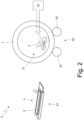
- an application unit that is suitable for applying the sound-absorbing material 2, having an annular form, to the inner cavity of the pneumatic tyre 1.
- the application unit 3 comprises a separation station S1, wherein an excess end 5 (illustrated in Figures 4 and 5 ) is separated from a strip 4 of sound-absorbing material 2 and a coupling station S2, wherein the strip 4 of sound-absorbing material 2 (deprived of the excess end 5) is applied to the inner cavity of the pneumatic tyre 1.
- the strip 4 of sound-absorbing material 2 initially, has a standard length that, depending upon the inner circumference of the inner cavity of the pneumatic tyre 1, is greater than the required length, and therefore, initially, it is necessary to cut it to size, removing from the strip 4 of sound-absorbing material 2 the excess end 5 in such a way as to confer to the same strip 4 of sound-absorbing material 2 the required length (calculated as a function of the inner circumference of the pneumatic tyre 1).
- the strip 4 of sound-absorbing material 2 is provided on one side with an adhesive layer 6 that is intended to connect the sound-absorbing material 2 to the inner surface of the pneumatic tyre and that is covered by a protective lining 7 (i.e., with a ribbon of plastic material that adheres in a removable manner to the adhesive layer 6).
- the adhesive layer 6 is applied to the surface of the sound-absorbing material 2 that is intended to come into contact with the inner cavity of the pneumatic tyre 1 and that is initially covered (protected) with the removable protective lining 7 that serves both the function of protecting the adhesive layer 6 and the function of making it possible to wind the strip 4 of sound absorbing material 2 into a coil without the sound absorbing material 2 sticking to itself.
- the strip 4 of sound-absorbing material 2 is cut in such a way as to separate the excess end 5 and to thereby confer the required length (in order to implement, without overlapping, a loop of sound-absorbing material 2 within the pneumatic tyre 1) to the strip 4 of sound-absorbing material 2;
- the strip 4 of sound-absorbing material 2 initially has a length that is only slightly longer than necessary, and therefore the cutting to size of the strip 4 of sound-absorbing material 2 involves the waste of only a small piece of sound-absorbing material 2 (i.e., the excess end 5 is small in size, generally ranging from a few centimeters to a few tens of centimeters).
- a separation opening 8 is formed that starts from the opposite side of the protective lining 7, ends at the protective lining 7, which remains intact, and separates the excess end 5 from the remaining part of the strip 4 of 2 sound-absorbing material; in other words, the separation opening 8 involves the entire depth of the sound-absorbing material 2, separating the excess end 5 from the remaining part of the strip 4 of sound-absorbing material 2, and the separation opening 8 does not involve the protective lining 7 which remains intact, constituting a residual connection between the excess end 5 and the remaining part of the strip 4 of sound-absorbing material 2.
- the implementation of the separation opening 8 anticipates cutting, starting from an opposite side of the protective lining 7, the strip 4 of sound-absorbing material 2, leaving intact a residual portion 9 of the sound-absorbing material 2 (illustrated in Figure 4 ) in the vicinity of the protective lining 7; the residual portion 9 of the sound-absorbing material 2 is then fractured by bending the excess end 5 in relation to the remaining part of the strip 4 of sound-absorbing material 2 in order to complete the separation opening 8 (as illustrated in Figure 5 ).
- the residual portion 9 of the sound-absorbing material 2 is cooled such as to allow for clean fracturing of the residual portion 9 by means of bending. That is to say, in order be able to break the residual portion 9 of the sound-absorbing material 2 by bending it, it is necessary for the residual portion 9 to be sufficiently fragile, i.e., insufficiently elastic; in order to make the residual portion 9 sufficiently fragile, the same residual portion 9 is cooled to a (suitably) brittle state by cooling the sound-absorbing material 2 close to the glass transition temperature (determined according to the ISO 11357-2 standard).
- the residual portion 9 of the sound-absorbing material 2 is cooled to temperatures no higher than 10°C in relation to the glass transition temperature (determined according to the ISO 11357-2 standard) of the sound absorbing material 2 and preferably cooled to temperatures that are 5°C lower than the glass transition temperature (determined according to the ISO 11357-2 standard).
- the cooling of the sound-absorbing material 2 can be performed in blowing a low temperature cryogen gas 10 against the residual portion 9, dipping the sound-absorbing material 2 into a cryogenic liquid (bath), or placing (passing) the sound-absorbing material 2 within a cooling chamber that is partially open at both ends.
- the working temperature of the cooling system depends upon the glass transition temperature (determined according to the ISO 11357-2 standard) of the sound-absorbing material 2 and must be such as to confer to the sound-absorbing material 2, which constitutes the residual portion 9, sufficient brittleness for it to break when bent.
- the separation opening 8 is not implemented in part by means of mechanical cutting (i.e., using a sharp instrument) and in part by breaking it when bent, but is fully implemented by means of laser cutting; in fact, simple mechanical cutting (i.e., using a sharp instrument) may not provide sufficient accuracy in order to completely cut the sound-absorbing material 2 whilst leaving intact the protective lining 7, whilst laser cutting could ensure such sufficient accuracy (also because a laser might etch the sound-absorbing material 2 in a better way and the protective lining 7 in a worse way).
- water-cutting may be used (which might etch the sound-absorbing material 2 in a better way and the protective lining 7 in a worse way), or else ultrasonic cutting could be used (which might etch the sound-absorbing material 2 in a better way and the protective lining 7 in a worse way).
- the separation station S1 comprises a support plane 11 having a portion 12 whereupon the strip 4 of sound-absorbing material 2 rests and a portion 13 whereupon the excess end 5 rests and which is hinged to the part 12 in order to rotate in relation to the part 12 around an axis of rotation 14 (illustrated in Figure 3 ) arranged at the separation opening 8.
- the part 13 of the support plane 11 is kept parallel to the part 12 of the support plane 11 by means of an elastic element 15 (for example, a helical spring, illustrated in Figure 4 );
- the separation station S1 comprises a pusher 16 (driven by an actuator device 17) that by pressing against the excess end 5 leads to the rotation of the part 13 of the support plane 11 in relation to the part 12 of the support plane 11 around the axis 14 of rotation in such a way as to bend the strip 4 of sound-absorbing material 2, and thereby determine the brittle fracturing of the residual portion 9.
- a nozzle 18 is arranged which is oriented towards the support plane 11, is connected to a reservoir containing the cryogen gas 10, and that is suitable for emitting a jet of cryogen gas 10 which (mainly) impacts the residual portion 9 such as to freeze the same residual portion 9, thereby rendering it fragile.
- the pusher 16 initially pushes against the excess end 5 in order to rotate the excess end 5, moving it away from the remaining part of the strip 4 of sound-absorbing material 2 in such a way as to widen the separation opening 8, thereby exposing the residual portion 9 to the nozzle 18; at this point, the pusher 16 temporarily stops, the nozzle 18 emits a jet of cryogen gas 10, which (mainly) impacts the residual portion 9 (by now well exposed to the nozzle 18), and only when the jet of cryogen gas 10 ends does the pusher 16 resume the movement thereof in order to further rotate the excess end 5, thereby determining at this point the brittle fracturing of the residual portion 9 that has been frozen.
- the pusher 16 may initially rotate the excess end 5 by 20-40° in order to expose the residual portion 9 to the nozzle 18; subsequently, the pusher 16 may then rotate the excess end 5 until it reaches 60-90° in order to result in the brittle fracturing of the residual portion 9 that has been frozen.
- the excess end 5 is bent in relation to the remaining part of the strip 4 of sound-absorbing material 2 until it reaches a first bending angle (for example equal to 20-40°) such as to widen the separation opening 8, the low temperature cryogen gas 10 is blown against the residual portion 9, and finally the excess end 5 is bent further in relation to the remaining part of the strip 4 of sound-absorbing material 2 until it reaches a second bending angle (for example equal to 60-90°) greater than the first bending angle in order to break the residual portion 9.
- a first bending angle for example equal to 20-40°
- the low temperature cryogen gas 10 is blown against the residual portion 9
- the excess end 5 is bent further in relation to the remaining part of the strip 4 of sound-absorbing material 2 until it reaches a second bending angle (for example equal to 60-90°) greater than the first bending angle in order to break the residual portion 9.
- the separation station S1 comprises a sharp instrument 19 (for example, a rotating circular blade) that is used to implement, by means of mechanical cutting, the initial part of the separation opening 8, or to cut the strip 4 of sound-absorbing material 2 until reaching the residual portion 9.
- a sharp instrument 19 for example, a rotating circular blade
- the strip 4 of sound-absorbing material 2 is wound on itself such as to form a coil (which terminates externally with the excess end 5) and is then transferred (in more or less an automated manner) to the coupling station S2.
- the coupling station S2 comprises a support device that is suitable for supporting and bringing into rotation, around a central axis thereof, the pneumatic tyre 1.
- the support device 20 comprises motorized rollers whereupon the pneumatic tyre 1 itself rests and side rails (not illustrated) that contain the pneumatic tyre 1, preventing the pneumatic tyre 1 from performing any form of lateral translation during the rotational movement thereof.
- the coupling station S2 comprises an applicator device 21 that is suitable for applying the strip 4 of sound-absorbing material 2 to the inner surface of the pneumatic tyre 1, progressively removing the protective lining 7. That is to say, the applicator device 21 progressively separates the protective lining 7 from the strip 4 of sound-absorbing material 2 as the strip 4 of sound-absorbing material 2 is applied to the inner cavity of the pneumatic tyre 1; in particular, the applicator device 21 initially pulls the excess end 5 in relation to the remaining part of the strip 4 of sound-absorbing material 2 such as to separate the protective lining 7 from the strip 4 of sound-absorbing material 2, i.e., the applicator device 21 uses the excess end 5 as a gripping point in order to begin to separate the protective lining 7 from the strip 4 of sound-absorbing material 2.
- the coupling station S2 comprises a movement device 22 that supports the applicator device 21 and that is suitable for moving the applicator device 21 between a loading/unloading position wherein the applicator device 21 is separated from the pneumatic tyre 1 (that is external to the pneumatic tyre 1) and a work position (illustrated in Figure 2 ) wherein the applicator device 21 is located within the pneumatic tyre 1.
- a new strip 4 of sound-absorbing material 2 wound into a coil, is loaded into the applicator device 21 whilst only the previously applied protective lining 7 of a strip 4 of sound-absorbing material 2 is unloaded (removed) from the applicator device 21.
- a new strip 4 of sound-absorbing material 2 inserted into the applicator device 21, is applied to the inner cavity of the pneumatic tyre 1.
- the applicator device 21 comprises a housing 23 that is suitable for containing the strip 4 of sound-absorbing material 2 wound into a coil, an applicator roller 24 which, being mounted rotating around an axis of rotation 25, is suitable for pressing the strip 4 of sound-absorbing material 2 against the inner surface of the pneumatic tyre 1 in order to adhere the strip 4 of sound-absorbing material 2 to the inner surface of the pneumatic tyre 1, and a recovery roller 26 that is mounted rotating around an axis 27 of rotation parallel to the axis 25 of rotation, and that is suitable for winding the protective lining 7, step-by-step, such that the protective lining 7 is separated from the strip 4 of sound-absorbing material 2.
- the housing 23 is arranged above the applicator roller 24 and above the recovery drum 26.
- the applicator device 21 comprises an applicator roller 24 that is configured to press the sound-absorbing material 2 against the inner surface of the pneumatic tyre 1, after the removal of the protective lining 7, which occurs a moment before pressing the sound-absorbing material 2 against the inner surface of the pneumatic tyre 1; furthermore, the applicator device 21 comprises a protective lining recovery drum 26, whereupon the same protective lining 7 is wound after being separated from the sound-absorbing material 2, i.e., after having completed its function.
- the protective lining 7 from the sound-absorbing material 2, just before the application thereof, in such a way as to leave the layer 6 of adhesive exposed to air for as short a period of time as possible, in order to prevent foreign objects (debris, dust, dirt, insects%) from accidentally adhering to the adhesive layer.
- the applicator roller 24 and the recovery drum 26 are provided with actuating means that are suitable for bringing them into rotation around the respective axis 25 and 27 of rotation at appropriate and synchronous speeds in such a way as to prevent the protective lining 7 and/or the sound-absorbing material 2 from tearing due to excessive tension or being too loose.
- the recovery drum 26 is provided with a motorized grip member 28 (for example a gripper provided with two opposing jaws) that is suitable for grasping the excess end 5 of the strip 4 of sound-absorbing material 2 that is wound into a coil and located in the housing 23; i.e., the recovery drum 26 supports the motorized grip member 28 that is suitable for grasping the excess end 5 of the strip 4 of sound-absorbing material 2.
- a motorized grip member 28 for example a gripper provided with two opposing jaws
- the recovery drum 26 is mounted movable in the applicator device 21 in order to move itself to different positions (illustrated in Figures 6-10 ) along a circular trajectory (i.e., along an arc of circumference); i.e., the recovery drum 26, other than being mounted rotating around the central axis 27 of rotation in order to rotate upon itself, it is pivotally mounted in order to rotate around a further axis 29 of rotation that is parallel and eccentric (i.e., non-coaxial) in relation to the axis 25 and 27 of rotation (i.e., in relation to the applicator roller 24 and the recovery drum 26).
- an actuator device 30 is provided that moves, as will be explained below, the recovery drum 26, by rotating the recovery drum 26 about the axis 29 of rotation (i.e., causing the recovery drum 26 to complete a circular path).
- the applicator device 21 comprises a presser roller 31 that is suitable for pressing the strip 4 of sound-absorbing material 2 against the applicator roller 24 and that is mounted idling at one end of an arm that is hinged such as to rotate around an axis 32 of rotation (parallel to the axis 25, 27 and 29 of rotation) under the control of an actuator device 33.
- the presser roller 31 In rotating around the axis 32 of rotation, the presser roller 31 is movable between a passive position (illustrated in Figures 6 and 7 ) wherein the presser roller 31 is at a distance from the applicator roller 24 and from the strip 4 of sound-absorbing material 2, and an active position (illustrated in Figures 8, 9 and 10 ) wherein the presser roller 31 presses the strip 4 of sound-absorbing material 2 against the applicator roller 24.
- the applicator device 21 Whilst the applicator device 21 is located in the loading/unloading position (i.e., externally to the pneumatic tyre 1), the strip 4 of sound-absorbing material 2 is inserted, coiled, into the housing 23 of the applicator device 21, arranging the excess end 5 outside the housing 23 and facing downwards. Subsequently, the motorized grip member 28 of the recovery drum 26 grasps the excess end 5, thereby rendering the excess end 5 integral to the same recovery drum 26; during this step, the recovery drum 26 is arranged at an initial position (illustrated in Figure 6 ) wherein the recovery drum 26 is arranged to the left of the applicator drum 24 (i.e., from a first side of the applicator drum 24) and is facing an outlet of the housing 23.
- the actuator device 30 moves the recovery drum 26, which is holding the excess end 5, from the initial position (illustrated in Figure 6 ) to an intermediate position (illustrated in Figure 7 ) wherein the recovery drum 26 is arranged to the right of the applicator drum 24 (i.e., from a second side of the applicator drum 24 opposite the first side) such as to partially wind the strip 4 of sound-absorbing material 2 around the applicator roller 24.
- the actuator device 30 moves the recovery drum 26, which is holding the excess end 5, from the first side of the applicator roller 24 to the second side of the applicator roller 24 opposite the first side, such as to partially wind the strip 4 of sound-absorbing material 2 around the applicator roller 24.
- the actuator device 33 moves the presser roller 31 from the passive position (illustrated in Figure 7 ) to the active position (illustrated in Figure 8 ) such as to press the strip 4 of sound-absorbing material 2 against the applicator roller 24.
- the actuator device 30 moves the recovery drum 26, which is holding the excess end 5, from the intermediate position (illustrated in Figures 7 and 8 ) to a final position (illustrated in Figure 9 ) wherein the recovery drum 26 is arranged to the left of the applicator drum 24 (i.e., from the first side of the applicator drum 24) such as to separate part of the protective lining 7 from the strip 4 of sound-absorbing material 2.
- the actuator device 30 moves the recovery drum 26, which is holding the excess end 5, from the second side of the applicator roller 24 to the first side of the applicator roller 24, such as to separate part of the protective lining 7 from the strip 4 of sound-absorbing material 2.
- the applicator device 21 is suitable for pulling the excess end 5 in relation to the remaining part of the strip 4 of sound-absorbing material 2 such as to separate the protective lining 7 from the strip 4 of sound-absorbing material 2.
- the final position (illustrated in Figure 9 ) of the recovery drum 26 is different than the initial position (illustrated in Figure 7 ) of the recovery drum 26, i.e., when the recovery drum 26 is moved from the second side of the applicator roller 24 to the first side of the applicator roller 24, then it is arranged in the final position (illustrated in Figure 9 ), which is different in relation to the initial position (illustrated in Figure 6 ) that is assumed in order to grasp the excess end 5 (i.e. to grasp the initial part of the protective lining 7).
- the recovery drum 26 is moved from the intermediate position (illustrated in Figures 7 and 8 ), which is located at the second side of the applicator roller 24, to the final position (illustrated in Figures 9 and 10 ), which is located at the first side of the applicator roller 24, before inserting the applicator device 21 (comprising the applicator roller 24 and the recovery drum 26) into the pneumatic tyre 1.
- the movement device 22 moves the applicator device 21 between the loading/unloading position (assumed in Figures 6-9 ), wherein the applicator device 21 is separated from, and external to, the pneumatic tyre 1, and the work position (illustrated in Figures 2 and 10 ) wherein the applicator device 21 is located inside the pneumatic tyre 1.
- the applicator roller 24 presses the strip 4 of sound-absorbing material 2 against the inner cavity of the pneumatic tyre 1, whilst the pneumatic tyre 1 is caused to rotate and, simultaneously, the recovery drum 26 is rotated synchronously with the pneumatic tyre 1, such as to wind the protective lining 7 around the recovery drum 26, step-by-step, as the protective lining 7 is separated from the strip 4 of sound-absorbing material 2.
- the applicator device 21, when it is in the work position within the pneumatic tyre 4, is configured to progressively separate the protective lining 7 from the strip 4 of sound-absorbing material 2, step-by-step, as the strip 4 of sound-absorbing material 2 is applied to the inner cavity of the pneumatic tyre 1.
- the presser roller 31 moves away from the strip 4 of sound-absorbing material 2 before commencing with the rotation of the pneumatic tyre 1; i.e., the actuator device 33 moves the presser roller 31 from the active position (illustrated in Figures 8, 9 and 10 ) to the passive position (illustrated in Figures 6 and 7 ) before commencing with the rotation of the pneumatic tyre 1.
- the application unit 3 described above has many advantages.
- the application unit 3 described above enables to fully automate the processing cycle, also as regards the separation of the initial part of the protective lining 7 from the sound-absorbing material 2; this result is obtained by virtue of the fact that the initial part of the protective lining 7 can be grasped by grasping the excess end 5 which can be easily grasped, also in an automated manner (being of considerable size and substantially disconnected from the remaining part of the strip 4 of sound-absorbing material 2).
- the application unit 3 described above allows for the whole application cycle to be more efficient (i.e., faster and less expensive, especially by virtue of the possibility of complete automation) and also more effective (i.e., capable of ensuring high quality of application such to avert any damage to the sound-absorbing material 2).
- the application unit 3 described above ensures that, during the application within the inner cavity of the pneumatic tyre 1, the sound-absorbing material 2 does not undergo elongations or compressions which, after a few thousand kilometers of use of the pneumatic tyre 1, may lead to cracks within the same sound-absorbing material 2.
Landscapes
- Engineering & Computer Science (AREA)
- Mechanical Engineering (AREA)
- Life Sciences & Earth Sciences (AREA)
- Forests & Forestry (AREA)
- Physics & Mathematics (AREA)
- Optics & Photonics (AREA)
- Tires In General (AREA)
- Tyre Moulding (AREA)
- Ropes Or Cables (AREA)
- Application Of Or Painting With Fluid Materials (AREA)
- Processing And Handling Of Plastics And Other Materials For Molding In General (AREA)
Description
- The present invention relates to a method and application unit for applying a sound-absorbing material in an inner cavity of a pneumatic tyre.
- As is known, a pneumatic tyre comprises a toroidal carcass, which has two annular beads and supports an annular tread. Between the carcass and the tread, a tread belt is interposed which is provided with a number of tread plies. Within the carcass ply, an innerliner is arranged which is airtight, constitutes an inner lining and has the function of retaining the air within the pneumatic tyre in order to maintain the inflation pressure of the pneumatic tyre itself over time.
- In recent years the development of pneumatic tyres has been directed towards pneumatic tyres that are internally provided with a sound-absorbing material (generally a sponge) for reducing the noise generated by a pneumatic tyre rolling on a road surface.
- The sound-absorbing material is applied to a pneumatic tyre that has already been vulcanized (inasmuch as the sound absorbing material would not be able to withstand, without being damaged, the combination of heat and pressure that is applied during the vulcanization process), and in particular it is glued to the inner surface of the pneumatic tyre (comprising the innerliner) at the tread (i.e., corresponding to the area of the pneumatic tyre that comes into contact with the asphalt) and possibly also at part of the side walls.
- The sound-absorbing material is provided with an adhesive layer that is applied to the surface that is intended to contact the inner cavity of the pneumatic tyre and is initially covered (protected) with a removable protective lining ("liner") that serves the function of both protecting the adhesive layer, and the function of making it possible to wind the sound absorbing material into a coil without the sound-absorbing material sticking to itself.
- Typically, the process for the application of the sound-absorbing material inside the inner cavity of a pneumatic tyre provides for starting with a strip of sound-absorbing material (possibly wound into a coil) of a standard length that is more than required; it is then necessary, initially, to cut the strip of sound-absorbing material in order to eliminate the excess part and thereby confer to the strip of sound-absorbing material the length required depending upon the inner circumference of the pneumatic tyre whereupon the strip of sound-absorbing material is to be glued; in other words, it is necessary, initially, to cut the strip of acoustic material to size. After being cut to size, the strip of sound-absorbing material is wound onto itself such as to form a coil.
- In practice an operator loads the coil of the strip of sound-absorbing material that has been cut to size into an applicator device comprising an applicator roller that is configured in order to press, after the removal of the protective lining (which occurs a moment before pressing the sound-absorbing material against the inner surface), the sound-absorbing material against the inner surface of the pneumatic tyre; furthermore, the applicator device comprises a protective lining recovery drum whereupon the same protective lining is wound after being separated from the sound-absorbing material (i.e. after having completed its function). The applicator roller and the recovery drum are provided with actuating means that are suitable for bringing the same into rotation around the respective axis of rotation thereof, at appropriate and synchronous speeds, in such a way as to prevent the protective lining and/or the sound-absorbing material from tearing due to excessive tension or being too loose.
- When the operator loads the strip of sound-absorbing material into the applicator device, the operator has to manually separate, from the sound-absorbing material, an initial part of the protective lining, which has to then be inserted (again manually) into a slot in the recovery drum. During the application of sound-absorbing material, it is preferable to separate the protective lining from the sound-absorbing material just before the application thereof in such a way as to leave the adhesive exposed to air for as short a period of time as possible, in order to prevent foreign objects (debris, dust, dirt, insects...) from accidentally adhering to the adhesive layer.
- In the meantime, the previously vulcanized pneumatic tyre is supported upon motorized rollers that cause it to rotate and that are provided with fixed side rails that prevent any lateral translation of the pneumatic tyre itself. In response to an operator command, an applicator device is inserted into the pneumatic tyre, carried by the motorized rollers, that presses a leading end of the strip of sound-absorbing material against the inner surface of the pneumatic tyre; the pneumatic tyre is then dragged into rotation by the motorized rollers in order to make it possible to apply the sound-absorbing material over the entire inner surface (i.e., making a full turn and thereby imparting an annular shape to the sound-absorbing material).
- The method described above for the application of sound-absorbing material within a pneumatic tyre inevitably requires the manual intervention of an operator in order to separate the initial part of the protective lining from the sound-absorbing material; moreover, this operation is particularly long and complicated, even for an experienced operator, and can result in damage to the adhesive layer.
- Furthermore, it is important that, during the application within the cavity, the sound-absorbing material does not undergo elongations or compressions which, after a few thousand kilometers of use of the pneumatic tyre, may lead to cracks within the sound-absorbing material itself.
- Documents
JP 2007 168243 A JP 2020 001179 A DE 10 2018 217579 A1 andEP 3533596 A1 disclose examples for methods and units for applying a sound-absorbing material in an inner cavity of a pneumatic tyre. - The object of the present invention is to provide a method and an application unit for applying a sound-absorbing material within an inner cavity of a pneumatic tyre, which method and application unit make it possible to render the entire application cycle more efficient (i.e. quicker and less expensive) and also more effective (i.e. capable of avoiding damage to the adhesive layer during the separation of the initial part of the protective lining from the sound-absorbing material).
- According to the present invention a method and an application unit are provided for applying a sound-absorbing material inside an inner cavity of a pneumatic tyre, according to the
independent claims - The dependent claims 2-14 describe preferred embodiments of the present invention forming an integral part of the present description.
- The present invention will now be described with reference to the attached drawings, which show an exemplary, non-limiting embodiment, wherein:
-
Figure 1 is a schematic view of a pneumatic tyre provided with sound-absorbing material arranged inside an inner cavity of a pneumatic tyre; - la
figure 2 è una vista schematica di una unità di applicazione per applicare un materiale fonoassorbente in una cavità interna di uno pneumatico; -
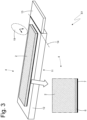
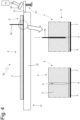
Figures 3 ,4 and5 are multiple views at different instants of operation of a separation station of the application unit ofFigure 2 , wherein an excess end is separated from a strip of sound-absorbing material; and -
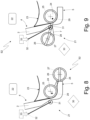
Figures 6-10 are multiple views at different instants of operation of a coupling station of the application unit ofFigure 2 wherein a strip of sound-absorbing material is applied to an inner cavity of a pneumatic tyre. - In
Figure 1 , thenumeral 1 denotes, in the entirety thereof, a pneumatic tyre that is mounted on a rim and that comprises a toroidal carcass having two annular beads and that supports an annular tread. Between the carcass and the tread, a tread belt is interposed which is provided with a number of tread plies. Within the carcass ply, an innerliner is arranged which is airtight, constitutes an inner lining and has the function of retaining the air within the pneumatic tyre in order to maintain the inflation pressure of the pneumatic tyre itself over time. Inside the inner cavity of thepneumatic tyre 1, i.e., in contact with the inner surface of thepneumatic tyre 1 comprising the innerliner, a loop ofsound absorbing material 2 is affixed (generally a sponge) to reduce the noise generated by the rolling of the pneumatic tyre upon the road surface. - The sound-absorbing
material 2 is applied to apneumatic tyre 1 that has already been vulcanized (inasmuch as thesound absorbing material 2 would not be able to withstand, without being damaged, the combination of heat and pressure that is applied during the vulcanization process), and in particular it is glued to the inner surface of the pneumatic tyre 1 (comprising the innerliner) at the tread (i,e, corresponding to the area of the pneumatic tyre contacts with the asphalt) and possibly (but not necessarily) also at part of the side walls. - In
Figure 2 , indicated in the entirety thereof with thenumber 3 is an application unit that is suitable for applying the sound-absorbingmaterial 2, having an annular form, to the inner cavity of thepneumatic tyre 1. Theapplication unit 3 comprises a separation station S1, wherein an excess end 5 (illustrated inFigures 4 and5 ) is separated from astrip 4 of sound-absorbingmaterial 2 and a coupling station S2, wherein thestrip 4 of sound-absorbing material 2 (deprived of the excess end 5) is applied to the inner cavity of thepneumatic tyre 1. - In particular, the
strip 4 of sound-absorbingmaterial 2, initially, has a standard length that, depending upon the inner circumference of the inner cavity of thepneumatic tyre 1, is greater than the required length, and therefore, initially, it is necessary to cut it to size, removing from thestrip 4 of sound-absorbingmaterial 2 theexcess end 5 in such a way as to confer to thesame strip 4 of sound-absorbingmaterial 2 the required length (calculated as a function of the inner circumference of the pneumatic tyre 1). - As illustrated in
Figures 3 ,4 and5 , thestrip 4 of sound-absorbingmaterial 2 is provided on one side with anadhesive layer 6 that is intended to connect the sound-absorbingmaterial 2 to the inner surface of the pneumatic tyre and that is covered by a protective lining 7 (i.e., with a ribbon of plastic material that adheres in a removable manner to the adhesive layer 6). That is to say that theadhesive layer 6 is applied to the surface of the sound-absorbingmaterial 2 that is intended to come into contact with the inner cavity of thepneumatic tyre 1 and that is initially covered (protected) with the removableprotective lining 7 that serves both the function of protecting theadhesive layer 6 and the function of making it possible to wind thestrip 4 ofsound absorbing material 2 into a coil without thesound absorbing material 2 sticking to itself. - As previously stated, initially, in the separation station S1 the
strip 4 of sound-absorbingmaterial 2 is cut in such a way as to separate theexcess end 5 and to thereby confer the required length (in order to implement, without overlapping, a loop of sound-absorbingmaterial 2 within the pneumatic tyre 1) to thestrip 4 of sound-absorbingmaterial 2; normally thestrip 4 of sound-absorbingmaterial 2 initially has a length that is only slightly longer than necessary, and therefore the cutting to size of thestrip 4 of sound-absorbingmaterial 2 involves the waste of only a small piece of sound-absorbing material 2 (i.e., theexcess end 5 is small in size, generally ranging from a few centimeters to a few tens of centimeters). - As illustrated in
Figure 5 , by means of thestrip 4 of sound-absorbing material 2 aseparation opening 8 is formed that starts from the opposite side of theprotective lining 7, ends at theprotective lining 7, which remains intact, and separates theexcess end 5 from the remaining part of thestrip 4 of 2 sound-absorbing material; in other words, theseparation opening 8 involves the entire depth of the sound-absorbingmaterial 2, separating theexcess end 5 from the remaining part of thestrip 4 of sound-absorbingmaterial 2, and theseparation opening 8 does not involve theprotective lining 7 which remains intact, constituting a residual connection between theexcess end 5 and the remaining part of thestrip 4 of sound-absorbingmaterial 2. - As illustrated in
Figures 3 ,4 and5 , the implementation of the separation opening 8 anticipates cutting, starting from an opposite side of theprotective lining 7, thestrip 4 of sound-absorbingmaterial 2, leaving intact aresidual portion 9 of the sound-absorbing material 2 (illustrated inFigure 4 ) in the vicinity of theprotective lining 7; theresidual portion 9 of the sound-absorbingmaterial 2 is then fractured by bending theexcess end 5 in relation to the remaining part of thestrip 4 of sound-absorbingmaterial 2 in order to complete the separation opening 8 (as illustrated inFigure 5 ). - According to a preferred embodiment, the
residual portion 9 of the sound-absorbingmaterial 2 is cooled such as to allow for clean fracturing of theresidual portion 9 by means of bending. That is to say, in order be able to break theresidual portion 9 of the sound-absorbingmaterial 2 by bending it, it is necessary for theresidual portion 9 to be sufficiently fragile, i.e., insufficiently elastic; in order to make theresidual portion 9 sufficiently fragile, the sameresidual portion 9 is cooled to a (suitably) brittle state by cooling the sound-absorbingmaterial 2 close to the glass transition temperature (determined according to the ISO 11357-2 standard). Consequently, theresidual portion 9 of the sound-absorbingmaterial 2 is cooled to temperatures no higher than 10°C in relation to the glass transition temperature (determined according to the ISO 11357-2 standard) of thesound absorbing material 2 and preferably cooled to temperatures that are 5°C lower than the glass transition temperature (determined according to the ISO 11357-2 standard). The cooling of the sound-absorbingmaterial 2 can be performed in blowing a lowtemperature cryogen gas 10 against theresidual portion 9, dipping the sound-absorbingmaterial 2 into a cryogenic liquid (bath), or placing (passing) the sound-absorbingmaterial 2 within a cooling chamber that is partially open at both ends. The working temperature of the cooling system depends upon the glass transition temperature (determined according to the ISO 11357-2 standard) of the sound-absorbingmaterial 2 and must be such as to confer to the sound-absorbingmaterial 2, which constitutes theresidual portion 9, sufficient brittleness for it to break when bent. - According to a different embodiment, not illustrated, the
separation opening 8 is not implemented in part by means of mechanical cutting (i.e., using a sharp instrument) and in part by breaking it when bent, but is fully implemented by means of laser cutting; in fact, simple mechanical cutting (i.e., using a sharp instrument) may not provide sufficient accuracy in order to completely cut the sound-absorbingmaterial 2 whilst leaving intact theprotective lining 7, whilst laser cutting could ensure such sufficient accuracy (also because a laser might etch the sound-absorbingmaterial 2 in a better way and theprotective lining 7 in a worse way). As an alternative to laser cutting, water-cutting may be used (which might etch the sound-absorbingmaterial 2 in a better way and theprotective lining 7 in a worse way), or else ultrasonic cutting could be used (which might etch the sound-absorbingmaterial 2 in a better way and theprotective lining 7 in a worse way). - The separation station S1 comprises a
support plane 11 having aportion 12 whereupon thestrip 4 of sound-absorbingmaterial 2 rests and aportion 13 whereupon theexcess end 5 rests and which is hinged to thepart 12 in order to rotate in relation to thepart 12 around an axis of rotation 14 (illustrated inFigure 3 ) arranged at theseparation opening 8. According to a preferred embodiment, thepart 13 of thesupport plane 11 is kept parallel to thepart 12 of thesupport plane 11 by means of an elastic element 15 (for example, a helical spring, illustrated inFigure 4 ); the separation station S1 comprises a pusher 16 (driven by an actuator device 17) that by pressing against theexcess end 5 leads to the rotation of thepart 13 of thesupport plane 11 in relation to thepart 12 of thesupport plane 11 around theaxis 14 of rotation in such a way as to bend thestrip 4 of sound-absorbingmaterial 2, and thereby determine the brittle fracturing of theresidual portion 9. - At the
axis 14 of rotation (i.e., at the boundary between the twoparts support plane 11 wherein theseparation opening 8 is located), anozzle 18 is arranged which is oriented towards thesupport plane 11, is connected to a reservoir containing thecryogen gas 10, and that is suitable for emitting a jet ofcryogen gas 10 which (mainly) impacts theresidual portion 9 such as to freeze the sameresidual portion 9, thereby rendering it fragile. - According to a preferred embodiment, the
pusher 16 initially pushes against theexcess end 5 in order to rotate theexcess end 5, moving it away from the remaining part of thestrip 4 of sound-absorbingmaterial 2 in such a way as to widen theseparation opening 8, thereby exposing theresidual portion 9 to thenozzle 18; at this point, thepusher 16 temporarily stops, thenozzle 18 emits a jet ofcryogen gas 10, which (mainly) impacts the residual portion 9 (by now well exposed to the nozzle 18), and only when the jet ofcryogen gas 10 ends does thepusher 16 resume the movement thereof in order to further rotate theexcess end 5, thereby determining at this point the brittle fracturing of theresidual portion 9 that has been frozen. By way of example, thepusher 16 may initially rotate theexcess end 5 by 20-40° in order to expose theresidual portion 9 to thenozzle 18; subsequently, thepusher 16 may then rotate theexcess end 5 until it reaches 60-90° in order to result in the brittle fracturing of theresidual portion 9 that has been frozen. - In other words, initially, in the separation station S1, the
excess end 5 is bent in relation to the remaining part of thestrip 4 of sound-absorbingmaterial 2 until it reaches a first bending angle (for example equal to 20-40°) such as to widen theseparation opening 8, the lowtemperature cryogen gas 10 is blown against theresidual portion 9, and finally theexcess end 5 is bent further in relation to the remaining part of thestrip 4 of sound-absorbingmaterial 2 until it reaches a second bending angle (for example equal to 60-90°) greater than the first bending angle in order to break theresidual portion 9. - As illustrated in
Figures 3 and4 , the separation station S1 comprises a sharp instrument 19 (for example, a rotating circular blade) that is used to implement, by means of mechanical cutting, the initial part of theseparation opening 8, or to cut thestrip 4 of sound-absorbingmaterial 2 until reaching theresidual portion 9. - As illustrated in
Figure 2 , once thestrip 4 of sound-absorbingmaterial 2 has completed the processing cycle thereof in the separation station S1 (i.e., when theseparation opening 8 has been completed which separates theexcess end 5 from the remaining part of thestrip 4 of sound-absorbingmaterial 2, leaving intact the protective lining 7), thestrip 4 of sound-absorbingmaterial 2 is wound on itself such as to form a coil (which terminates externally with the excess end 5) and is then transferred (in more or less an automated manner) to the coupling station S2. - The coupling station S2 comprises a support device that is suitable for supporting and bringing into rotation, around a central axis thereof, the
pneumatic tyre 1. In particular, thesupport device 20 comprises motorized rollers whereupon thepneumatic tyre 1 itself rests and side rails (not illustrated) that contain thepneumatic tyre 1, preventing thepneumatic tyre 1 from performing any form of lateral translation during the rotational movement thereof. - The coupling station S2 comprises an
applicator device 21 that is suitable for applying thestrip 4 of sound-absorbingmaterial 2 to the inner surface of thepneumatic tyre 1, progressively removing theprotective lining 7. That is to say, theapplicator device 21 progressively separates theprotective lining 7 from thestrip 4 of sound-absorbingmaterial 2 as thestrip 4 of sound-absorbingmaterial 2 is applied to the inner cavity of thepneumatic tyre 1; in particular, theapplicator device 21 initially pulls theexcess end 5 in relation to the remaining part of thestrip 4 of sound-absorbingmaterial 2 such as to separate theprotective lining 7 from thestrip 4 of sound-absorbingmaterial 2, i.e., theapplicator device 21 uses theexcess end 5 as a gripping point in order to begin to separate theprotective lining 7 from thestrip 4 of sound-absorbingmaterial 2. - The coupling station S2 comprises a
movement device 22 that supports theapplicator device 21 and that is suitable for moving theapplicator device 21 between a loading/unloading position wherein theapplicator device 21 is separated from the pneumatic tyre 1 (that is external to the pneumatic tyre 1) and a work position (illustrated inFigure 2 ) wherein theapplicator device 21 is located within thepneumatic tyre 1. In the loading/unloading position, anew strip 4 of sound-absorbingmaterial 2, wound into a coil, is loaded into theapplicator device 21 whilst only the previously appliedprotective lining 7 of astrip 4 of sound-absorbingmaterial 2 is unloaded (removed) from theapplicator device 21. Conversely, in the work position (illustrated inFigure 2 ) anew strip 4 of sound-absorbingmaterial 2, inserted into theapplicator device 21, is applied to the inner cavity of thepneumatic tyre 1. - According to that illustrated in
Figures 6-10 , theapplicator device 21 comprises ahousing 23 that is suitable for containing thestrip 4 of sound-absorbingmaterial 2 wound into a coil, anapplicator roller 24 which, being mounted rotating around an axis ofrotation 25, is suitable for pressing thestrip 4 of sound-absorbingmaterial 2 against the inner surface of thepneumatic tyre 1 in order to adhere thestrip 4 of sound-absorbingmaterial 2 to the inner surface of thepneumatic tyre 1, and arecovery roller 26 that is mounted rotating around anaxis 27 of rotation parallel to theaxis 25 of rotation, and that is suitable for winding theprotective lining 7, step-by-step, such that theprotective lining 7 is separated from thestrip 4 of sound-absorbingmaterial 2. In particular, thehousing 23 is arranged above theapplicator roller 24 and above therecovery drum 26. In other words, theapplicator device 21 comprises anapplicator roller 24 that is configured to press the sound-absorbingmaterial 2 against the inner surface of thepneumatic tyre 1, after the removal of theprotective lining 7, which occurs a moment before pressing the sound-absorbingmaterial 2 against the inner surface of thepneumatic tyre 1; furthermore, theapplicator device 21 comprises a protectivelining recovery drum 26, whereupon the sameprotective lining 7 is wound after being separated from the sound-absorbingmaterial 2, i.e., after having completed its function. - During the application of the sound-absorbing
material 2, it is preferable to separate theprotective lining 7 from the sound-absorbingmaterial 2, just before the application thereof, in such a way as to leave thelayer 6 of adhesive exposed to air for as short a period of time as possible, in order to prevent foreign objects (debris, dust, dirt, insects...) from accidentally adhering to the adhesive layer. - The
applicator roller 24 and therecovery drum 26 are provided with actuating means that are suitable for bringing them into rotation around therespective axis protective lining 7 and/or the sound-absorbingmaterial 2 from tearing due to excessive tension or being too loose. - The
recovery drum 26 is provided with a motorized grip member 28 (for example a gripper provided with two opposing jaws) that is suitable for grasping theexcess end 5 of thestrip 4 of sound-absorbingmaterial 2 that is wound into a coil and located in thehousing 23; i.e., therecovery drum 26 supports themotorized grip member 28 that is suitable for grasping theexcess end 5 of thestrip 4 of sound-absorbingmaterial 2. - The
recovery drum 26 is mounted movable in theapplicator device 21 in order to move itself to different positions (illustrated inFigures 6-10 ) along a circular trajectory (i.e., along an arc of circumference); i.e., therecovery drum 26, other than being mounted rotating around thecentral axis 27 of rotation in order to rotate upon itself, it is pivotally mounted in order to rotate around afurther axis 29 of rotation that is parallel and eccentric (i.e., non-coaxial) in relation to theaxis applicator roller 24 and the recovery drum 26). In particular, anactuator device 30 is provided that moves, as will be explained below, therecovery drum 26, by rotating therecovery drum 26 about theaxis 29 of rotation (i.e., causing therecovery drum 26 to complete a circular path). - The
applicator device 21 comprises apresser roller 31 that is suitable for pressing thestrip 4 of sound-absorbingmaterial 2 against theapplicator roller 24 and that is mounted idling at one end of an arm that is hinged such as to rotate around anaxis 32 of rotation (parallel to theaxis actuator device 33. In rotating around theaxis 32 of rotation, thepresser roller 31 is movable between a passive position (illustrated inFigures 6 and 7 ) wherein thepresser roller 31 is at a distance from theapplicator roller 24 and from thestrip 4 of sound-absorbingmaterial 2, and an active position (illustrated inFigures 8, 9 and10 ) wherein thepresser roller 31 presses thestrip 4 of sound-absorbingmaterial 2 against theapplicator roller 24. - Whilst the
applicator device 21 is located in the loading/unloading position (i.e., externally to the pneumatic tyre 1), thestrip 4 of sound-absorbingmaterial 2 is inserted, coiled, into thehousing 23 of theapplicator device 21, arranging theexcess end 5 outside thehousing 23 and facing downwards. Subsequently, themotorized grip member 28 of therecovery drum 26 grasps theexcess end 5, thereby rendering theexcess end 5 integral to thesame recovery drum 26; during this step, therecovery drum 26 is arranged at an initial position (illustrated inFigure 6 ) wherein therecovery drum 26 is arranged to the left of the applicator drum 24 (i.e., from a first side of the applicator drum 24) and is facing an outlet of thehousing 23. - Subsequently, the
actuator device 30 moves therecovery drum 26, which is holding theexcess end 5, from the initial position (illustrated inFigure 6 ) to an intermediate position (illustrated inFigure 7 ) wherein therecovery drum 26 is arranged to the right of the applicator drum 24 (i.e., from a second side of theapplicator drum 24 opposite the first side) such as to partially wind thestrip 4 of sound-absorbingmaterial 2 around theapplicator roller 24. In other words, theactuator device 30 moves therecovery drum 26, which is holding theexcess end 5, from the first side of theapplicator roller 24 to the second side of theapplicator roller 24 opposite the first side, such as to partially wind thestrip 4 of sound-absorbingmaterial 2 around theapplicator roller 24. - Subsequently and as illustrated in
Figure 8 , theactuator device 33 moves thepresser roller 31 from the passive position (illustrated inFigure 7 ) to the active position (illustrated inFigure 8 ) such as to press thestrip 4 of sound-absorbingmaterial 2 against theapplicator roller 24. - Subsequently and as illustrated in
Figure 9 , theactuator device 30 moves therecovery drum 26, which is holding theexcess end 5, from the intermediate position (illustrated inFigures 7 and8 ) to a final position (illustrated inFigure 9 ) wherein therecovery drum 26 is arranged to the left of the applicator drum 24 (i.e., from the first side of the applicator drum 24) such as to separate part of theprotective lining 7 from thestrip 4 of sound-absorbingmaterial 2. In other words, theactuator device 30 moves therecovery drum 26, which is holding theexcess end 5, from the second side of theapplicator roller 24 to the first side of theapplicator roller 24, such as to separate part of theprotective lining 7 from thestrip 4 of sound-absorbingmaterial 2. When therecovery drum 26 is moved from the intermediate position (illustrated inFigures 7 and8 ), which is located at the second side of theapplicator roller 24, to the final position (illustrated inFigures 9 and10 ), which is located at the first side of theapplicator roller 24, theprotective lining 7 is partially wound around therecovery drum 26. - Thus, the
applicator device 21 is suitable for pulling theexcess end 5 in relation to the remaining part of thestrip 4 of sound-absorbingmaterial 2 such as to separate theprotective lining 7 from thestrip 4 of sound-absorbingmaterial 2. - In particular, the final position (illustrated in
Figure 9 ) of therecovery drum 26 is different than the initial position (illustrated inFigure 7 ) of therecovery drum 26, i.e., when therecovery drum 26 is moved from the second side of theapplicator roller 24 to the first side of theapplicator roller 24, then it is arranged in the final position (illustrated inFigure 9 ), which is different in relation to the initial position (illustrated inFigure 6 ) that is assumed in order to grasp the excess end 5 (i.e. to grasp the initial part of the protective lining 7). - It should be noted that the
recovery drum 26 is moved from the intermediate position (illustrated inFigures 7 and8 ), which is located at the second side of theapplicator roller 24, to the final position (illustrated inFigures 9 and10 ), which is located at the first side of theapplicator roller 24, before inserting the applicator device 21 (comprising theapplicator roller 24 and the recovery drum 26) into thepneumatic tyre 1. - At this point and as illustrated in
Figure 10 , themovement device 22 moves theapplicator device 21 between the loading/unloading position (assumed inFigures 6-9 ), wherein theapplicator device 21 is separated from, and external to, thepneumatic tyre 1, and the work position (illustrated inFigures 2 and10 ) wherein theapplicator device 21 is located inside thepneumatic tyre 1. In the work position (illustrated inFigures 2 and10 ), theapplicator roller 24 presses thestrip 4 of sound-absorbingmaterial 2 against the inner cavity of thepneumatic tyre 1, whilst thepneumatic tyre 1 is caused to rotate and, simultaneously, therecovery drum 26 is rotated synchronously with thepneumatic tyre 1, such as to wind theprotective lining 7 around therecovery drum 26, step-by-step, as theprotective lining 7 is separated from thestrip 4 of sound-absorbingmaterial 2. - In other words, the
applicator device 21, when it is in the work position within thepneumatic tyre 4, is configured to progressively separate theprotective lining 7 from thestrip 4 of sound-absorbingmaterial 2, step-by-step, as thestrip 4 of sound-absorbingmaterial 2 is applied to the inner cavity of thepneumatic tyre 1. - According to a preferred embodiment, the
presser roller 31 moves away from thestrip 4 of sound-absorbingmaterial 2 before commencing with the rotation of thepneumatic tyre 1; i.e., theactuator device 33 moves thepresser roller 31 from the active position (illustrated inFigures 8, 9 and10 ) to the passive position (illustrated inFigures 6 and 7 ) before commencing with the rotation of thepneumatic tyre 1. - The embodiments described herein may be combined without departing from the scope of protection of the present invention.
- The
application unit 3 described above has many advantages. - In the first place, the
application unit 3 described above enables to fully automate the processing cycle, also as regards the separation of the initial part of theprotective lining 7 from the sound-absorbingmaterial 2; this result is obtained by virtue of the fact that the initial part of theprotective lining 7 can be grasped by grasping theexcess end 5 which can be easily grasped, also in an automated manner (being of considerable size and substantially disconnected from the remaining part of thestrip 4 of sound-absorbing material 2). - Furthermore, the
application unit 3 described above allows for the whole application cycle to be more efficient (i.e., faster and less expensive, especially by virtue of the possibility of complete automation) and also more effective (i.e., capable of ensuring high quality of application such to avert any damage to the sound-absorbing material 2). - In particular, the
application unit 3 described above ensures that, during the application within the inner cavity of thepneumatic tyre 1, the sound-absorbingmaterial 2 does not undergo elongations or compressions which, after a few thousand kilometers of use of thepneumatic tyre 1, may lead to cracks within the same sound-absorbingmaterial 2. -
- 1 pneumatic tyre
- 2 sound-absorbing material
- 3 application unit
- 4 strip
- 5 excess end
- 6 adhesive layer
- 7 protective lining
- 8 separation opening
- 9 residual portion
- 10 cryogen gas
- 11 support plane
- 12 part
- 13 part
- 14 axis of rotation
- 15 elastic element
- 16 pusher
- 17 actuator device
- 18 nozzle
- 19 sharp instrument
- 20 motorized rollers
- 21 applicator device
- 22 movement device
- 23 housing
- 24 applicator roller
- 25 axis of rotation
- 26 recovery drum
- 27 axis of rotation
- 27 presser member
- 29 axis of rotation
- 30 actuator device
- 31 presser roller
- 32 axis of rotation
- 33 actuator device
- S1 separation station
- S2 coupling station
Claims (15)
- Method of application for applying a sound-absorbing material (2) to an inner cavity of a pneumatic tyre (1) using a strip (4) of sound-absorbing material (2) provided on one side with an adhesive layer (6) covered with a protective lining (7); the application method comprises the steps of:eliminating an excess end (5) of the strip (4) of sound-absorbing material (2) such as to confer a required length to the same strip (4) of sound-absorbing material (2); andprogressively separating the protective lining (7) from the strip (4) of sound-absorbing material (2), step-by-step, as the strip (4) of sound-absorbing material (2) is applied to the inner cavity of the pneumatic tyre (1);the method of application is characterized in that it comprises the further steps of:implementing by means of the strip (4) of sound-absorbing material (2) a separation opening (8) that starts from an opposite side of the protective lining (7) and ends at the protective lining (7) that remains intact and separates the excess end (5) from the remaining part of the strip (4) of sound-absorbing material (2); andpulling the excess end (5) in relation to the remaining part of the strip (4) of sound-absorbing material (2) such as to separate the protective lining (7) from the strip (4) of sound-absorbing material (2).
- Method of application according to claim 1, wherein the step of forming the separation opening (8) comprises the further steps of:cutting, starting from an opposite side of the protective lining (7), the strip (4) of sound-absorbing material (2) leaving intact a residual portion (9) of the sound-absorbing material (2) in the vicinity of the protective lining (7); andbreaking the residual portion (9) of the sound-absorbing material (2) by bending the excess end (5) in relation to the remaining part of the strip (4) of sound-absorbing material (2) in order to complete the separation opening (8).
- Method of application according to claim 2, wherein the strip (4) of sound-absorbing material (2) is cut by means of a sharp instrument (19).
- Method of application according to claim 2 or 3 and comprising the further step of cooling the residual portion (9) of the sound-absorbing material (2) before breaking the same residual portion (9).
- Method of application according to claim 4, wherein the residual portion (9) of the sound-absorbing material (2) is cooled in order to make it assume a fragile state.
- Method of application according to claim 4 or 5, wherein the residual portion (9) of the sound-absorbing material (2) is cooled to temperatures not higher than 10°C in relation to the glass transition temperature of the sound-absorbing material (2) and preferably lower, in particular 5°C in relation to the glass transition temperature of the sound-absorbing material (2).
- Method of application according to claim 4, 5 or 6, wherein the residual portion (9) of the sound-absorbing material (2) is cooled by immersion in a cryogenic liquid, or else by passing it through a cooling chamber.
- Method of application according to claim 4, 5 or 6, wherein the residual portion (9) of the sound-absorbing material (2) is cooled in blowing a low temperature cryogen gas (10) against the residual portion (9).
- Method of application according to claim 8 and comprising the steps of:initially bending the excess end (5) in relation to the remaining part of the strip (4) of sound-absorbing material (2) until it reaches a first bending angle in order to widen the separation opening (8);blowing a low temperature cryogen gas (10) against the residual portion (9); andfurther bending the excess end (5) in relation to the remaining part of the strip (4) of sound-absorbing material (2) until it reaches a second bending angle, greater than the first bending angle, in order to break the residual portion (9).
- Method of application according to one of the claims from 2 to 9, wherein the support plane (11) has a first part (12) whereupon the strip (4) of sound-absorbing material (2) rests and a second part (13) whereupon the excess end (5) rests and which is hinged to the first part (12) in order to rotate in relation to the first part (12) around an axis (14) of rotation arranged at the separation opening (8).
- Method of application according to claim 10, wherein the second part (13) of the support plane (11) is maintained parallel to the first part (12) of the support plane (11) by an elastic element (15).
- Method of application according to claim 10 or 11, wherein a pusher (16) is used that, in pressing against the excess end (5), determines the rotation of the second part (13) of the support plane (11) in relation to the first part (12) of the support plane (11).
- Method of application according to one of the claims from 1 to 12 and comprising the further steps of:grasping the excess end (5) by means of a grip member (28) that is integral to a recovery drum (26) and whilst the recovery drum (26) is at a first side of an applicator roller (24);moving the recovery drum (26), which is holding the excess end (5), from the first side of the applicator roller (24) to the second side of the applicator roller (24), opposite the first side, such as to partially wind the strip (4) of sound-absorbing material (2) around the applicator roller (24);pressing the strip (4) of sound-absorbing material (2) against the applicator roller (24) by means of a presser roller (31); andmoving the recovery drum (26), which is holding the excess end (5), from the second side of the applicator roller (24) to the first side of the applicator roller (24), such as to separate part of the protective lining (7) from the strip (4) of sound-absorbing material (2).
- Method of application according to claim 13 and comprising the further steps of:pressing, by means of the applicator roller (24), the strip (4) of sound-absorbing material (2) against the inner cavity of the pneumatic tyre (1) whilst the pneumatic tyre (1) is caused to rotate; androtating the recovery drum (26) synchronously with the pneumatic tyre (1) in order to wind the protective lining (7) around the recovery drum (26), step-by-step, as the protective lining (7) is separated from the strip (4) of sound-absorbing material (2).
- Application unit (3) for applying a sound-absorbing material (2) in an inner cavity of a pneumatic tyre (1) using a strip (4) of sound-absorbing material (2) provided on one side with an adhesive layer (6) covered with a protective lining (7); the application unit (3) comprising:a separation station (S1) that is suitable for eliminating an excess end (5) of the strip (4) of sound-absorbing material (2) such as to confer a required length to the same strip (4) of sound-absorbing material (2); andan applicator device (21) that is configured in order to progressively separate the protective lining (7) from the strip (4) of sound-absorbing material (2), step-by-step, as the strip (4) of sound-absorbing material (2) is applied to the inner cavity of the pneumatic tyre (1);the application unit (3) is characterized in that:the separation station (S1) is configured such as to implement, by means of the strip (4) of sound-absorbing material (2), a separation opening (8) that starts from an opposite side of the protective lining (7) and ends at the protective lining (7) which remains intact, and to separate the excess end (5) from the remaining part of the strip (4) of sound-absorbing material (2); andthe applicator device (21) is suitable for pulling the excess end (5) in relation to the remaining part of the strip (4) of sound-absorbing material (2) such as to separate the protective lining (7) from the strip (4) of sound-absorbing material (2).
Applications Claiming Priority (2)
| Application Number | Priority Date | Filing Date | Title |
|---|---|---|---|
| IT102020000015739A IT202000015739A1 (en) | 2020-06-30 | 2020-06-30 | METHOD AND APPLICATION UNIT FOR APPLYING A SOUNDPROOFING MATERIAL INTO AN INTERNAL CAVITY OF A TIRE |
| PCT/EP2021/067540 WO2022002796A1 (en) | 2020-06-30 | 2021-06-25 | Method and application unit for applying a sound-absorbing material in an inner cavity of a pneumatic tyre |
Publications (2)
| Publication Number | Publication Date |
|---|---|
| EP4171936A1 EP4171936A1 (en) | 2023-05-03 |
| EP4171936B1 true EP4171936B1 (en) | 2024-08-07 |
Family
ID=72473840
Family Applications (1)
| Application Number | Title | Priority Date | Filing Date |
|---|---|---|---|
| EP21736308.4A Active EP4171936B1 (en) | 2020-06-30 | 2021-06-25 | Method and application unit for applying a sound-absorbing material in an inner cavity of a pneumatic tyre |
Country Status (8)
| Country | Link |
|---|---|
| US (1) | US12409624B2 (en) |
| EP (1) | EP4171936B1 (en) |
| JP (1) | JP7462078B2 (en) |
| CN (1) | CN115884861A (en) |
| ES (1) | ES2991129T3 (en) |
| HU (1) | HUE068597T2 (en) |
| IT (1) | IT202000015739A1 (en) |
| WO (1) | WO2022002796A1 (en) |
Families Citing this family (1)
| Publication number | Priority date | Publication date | Assignee | Title |
|---|---|---|---|---|
| EP4541569B1 (en) | 2023-10-22 | 2026-03-04 | Bridgestone Europe NV/SA | Method and application unit for applying a sound-absorbing material in an inner cavity of a pneumatic tyre |
Family Cites Families (15)
| Publication number | Priority date | Publication date | Assignee | Title |
|---|---|---|---|---|
| JPS58191138A (en) * | 1982-05-04 | 1983-11-08 | Yokohama Rubber Co Ltd:The | Cutting method of belt like material |
| JPH09503735A (en) * | 1993-10-18 | 1997-04-15 | ミネソタ マイニング アンド マニュファクチャリング カンパニー | Tape dispenser |
| JP2007112395A (en) | 2005-10-24 | 2007-05-10 | Sumitomo Rubber Ind Ltd | Pneumatic tire and rim assembly |
| JP4746421B2 (en) * | 2005-12-21 | 2011-08-10 | 住友ゴム工業株式会社 | Method for pasting strip sponge material to inner surface of tread and pasting device |
| JP4755543B2 (en) | 2006-06-30 | 2011-08-24 | 住友ゴム工業株式会社 | Method for applying strip sponge material and application device |
| WO2008064140A2 (en) * | 2006-11-17 | 2008-05-29 | Thomas Michael R | Cryogenic cooling system |
| KR100971729B1 (en) * | 2008-10-20 | 2010-07-22 | 금호타이어 주식회사 | Sound absorbing material attachment device of tire |
| US20110041309A1 (en) * | 2009-08-24 | 2011-02-24 | Peter Ross Shepler | Method of installing tire electronics in a tire |
| DE102013111239A1 (en) | 2013-10-11 | 2015-05-21 | Continental Reifen Deutschland Gmbh | Method for connecting a sound absorber made of a foam material with the tire inner side of a vehicle tire |
| US10926499B2 (en) | 2014-10-29 | 2021-02-23 | Pirelli Tyre S.P.A. | Process and apparatus for automatically applying a noise reducing element to a tyre for vehicle wheels |
| JP6447612B2 (en) | 2016-10-31 | 2019-01-09 | 横浜ゴム株式会社 | Apparatus and method for affixing belt-like member to tire inner surface |
| JP6859856B2 (en) | 2017-06-06 | 2021-04-14 | 住友ゴム工業株式会社 | Band-shaped sponge material pasting device |
| JP6551580B1 (en) * | 2018-06-25 | 2019-07-31 | 横浜ゴム株式会社 | Apparatus and method for attaching strip-shaped member to tire inner surface |
| JP7099917B2 (en) * | 2018-09-14 | 2022-07-12 | 株式会社イノアックコーポレーション | Tire sound absorbing material manufacturing method and slit processing equipment |
| DE102018217579A1 (en) * | 2018-10-15 | 2020-04-16 | Continental Reifen Deutschland Gmbh | Conveying device for conveying a band-shaped sound absorber, assembly system, and method for mounting the band-shaped sound absorber on a tire |
-
2020
- 2020-06-30 IT IT102020000015739A patent/IT202000015739A1/en unknown
-
2021
- 2021-06-25 HU HUE21736308A patent/HUE068597T2/en unknown
- 2021-06-25 ES ES21736308T patent/ES2991129T3/en active Active
- 2021-06-25 US US18/011,936 patent/US12409624B2/en active Active
- 2021-06-25 CN CN202180050638.4A patent/CN115884861A/en active Pending
- 2021-06-25 EP EP21736308.4A patent/EP4171936B1/en active Active
- 2021-06-25 JP JP2022580902A patent/JP7462078B2/en active Active
- 2021-06-25 WO PCT/EP2021/067540 patent/WO2022002796A1/en not_active Ceased
Also Published As
| Publication number | Publication date |
|---|---|
| CN115884861A (en) | 2023-03-31 |
| JP7462078B2 (en) | 2024-04-04 |
| JP2023531550A (en) | 2023-07-24 |
| US12409624B2 (en) | 2025-09-09 |
| HUE068597T2 (en) | 2025-01-28 |
| IT202000015739A1 (en) | 2021-12-30 |
| ES2991129T3 (en) | 2024-12-03 |
| WO2022002796A1 (en) | 2022-01-06 |
| US20230234311A1 (en) | 2023-07-27 |
| EP4171936A1 (en) | 2023-05-03 |
Similar Documents
| Publication | Publication Date | Title |
|---|---|---|
| US20250353267A1 (en) | Method and application unit for applying a sound-absorbing material in an inner cavity of a pneumatic tire | |
| EP3134340B1 (en) | Foil removal device and a method for removing a foil from a tire tread | |
| RU2696455C2 (en) | Method and installation for automatic application of noise suppressing element on tire for wheels of vehicles | |
| JPH0255345B2 (en) | ||
| EP4171936B1 (en) | Method and application unit for applying a sound-absorbing material in an inner cavity of a pneumatic tyre | |
| US4718961A (en) | Method and device for the fabrication of plastic sleeves | |
| JP4755543B2 (en) | Method for applying strip sponge material and application device | |
| JPS59207227A (en) | Method and apparatus for winding band-shaped member about tire molding drum | |
| CN101428479B (en) | Bead structure building apparatus in green tire buidling machine | |
| EP4541569B1 (en) | Method and application unit for applying a sound-absorbing material in an inner cavity of a pneumatic tyre | |
| CN115443212B (en) | Method and system for applying a layer of sound absorbing material to a surface of an inner cavity of a pneumatic tire | |
| EP4061625B1 (en) | Process and apparatus for building tyres for vehicle wheels | |
| EP1818163B1 (en) | Method and system for producing a precured tread strip | |
| JP2022117154A (en) | RUBBER MEMBER MOLDING METHOD AND RUBBER MEMBER MOLDING DEVICE | |
| JPH0372454B2 (en) |
Legal Events
| Date | Code | Title | Description |
|---|---|---|---|
| STAA | Information on the status of an ep patent application or granted ep patent |
Free format text: STATUS: UNKNOWN |
|
| STAA | Information on the status of an ep patent application or granted ep patent |
Free format text: STATUS: THE INTERNATIONAL PUBLICATION HAS BEEN MADE |
|
| PUAI | Public reference made under article 153(3) epc to a published international application that has entered the european phase |
Free format text: ORIGINAL CODE: 0009012 |
|
| STAA | Information on the status of an ep patent application or granted ep patent |
Free format text: STATUS: REQUEST FOR EXAMINATION WAS MADE |
|
| 17P | Request for examination filed |
Effective date: 20230127 |
|
| AK | Designated contracting states |
Kind code of ref document: A1 Designated state(s): AL AT BE BG CH CY CZ DE DK EE ES FI FR GB GR HR HU IE IS IT LI LT LU LV MC MK MT NL NO PL PT RO RS SE SI SK SM TR |
|
| DAV | Request for validation of the european patent (deleted) | ||
| DAX | Request for extension of the european patent (deleted) | ||
| GRAP | Despatch of communication of intention to grant a patent |
Free format text: ORIGINAL CODE: EPIDOSNIGR1 |
|
| STAA | Information on the status of an ep patent application or granted ep patent |
Free format text: STATUS: GRANT OF PATENT IS INTENDED |
|
| INTG | Intention to grant announced |
Effective date: 20240305 |
|
| GRAS | Grant fee paid |
Free format text: ORIGINAL CODE: EPIDOSNIGR3 |
|
| GRAA | (expected) grant |
Free format text: ORIGINAL CODE: 0009210 |
|
| STAA | Information on the status of an ep patent application or granted ep patent |
Free format text: STATUS: THE PATENT HAS BEEN GRANTED |
|
| AK | Designated contracting states |
Kind code of ref document: B1 Designated state(s): AL AT BE BG CH CY CZ DE DK EE ES FI FR GB GR HR HU IE IS IT LI LT LU LV MC MK MT NL NO PL PT RO RS SE SI SK SM TR |
|
| REG | Reference to a national code |
Ref country code: GB Ref legal event code: FG4D |
|
| REG | Reference to a national code |
Ref country code: CH Ref legal event code: EP |
|
| REG | Reference to a national code |
Ref country code: DE Ref legal event code: R096 Ref document number: 602021016881 Country of ref document: DE |
|
| REG | Reference to a national code |
Ref country code: IE Ref legal event code: FG4D |
|
| REG | Reference to a national code |
Ref country code: LT Ref legal event code: MG9D |
|
| REG | Reference to a national code |
Ref country code: ES Ref legal event code: FG2A Ref document number: 2991129 Country of ref document: ES Kind code of ref document: T3 Effective date: 20241203 |
|
| REG | Reference to a national code |
Ref country code: NL Ref legal event code: MP Effective date: 20240807 |
|
| PG25 | Lapsed in a contracting state [announced via postgrant information from national office to epo] |
Ref country code: NO Free format text: LAPSE BECAUSE OF FAILURE TO SUBMIT A TRANSLATION OF THE DESCRIPTION OR TO PAY THE FEE WITHIN THE PRESCRIBED TIME-LIMIT Effective date: 20241107 |
|
| REG | Reference to a national code |
Ref country code: AT Ref legal event code: MK05 Ref document number: 1710495 Country of ref document: AT Kind code of ref document: T Effective date: 20240807 |
|
| PG25 | Lapsed in a contracting state [announced via postgrant information from national office to epo] |
Ref country code: NL Free format text: LAPSE BECAUSE OF FAILURE TO SUBMIT A TRANSLATION OF THE DESCRIPTION OR TO PAY THE FEE WITHIN THE PRESCRIBED TIME-LIMIT Effective date: 20240807 Ref country code: PL Free format text: LAPSE BECAUSE OF FAILURE TO SUBMIT A TRANSLATION OF THE DESCRIPTION OR TO PAY THE FEE WITHIN THE PRESCRIBED TIME-LIMIT Effective date: 20240807 Ref country code: GR Free format text: LAPSE BECAUSE OF FAILURE TO SUBMIT A TRANSLATION OF THE DESCRIPTION OR TO PAY THE FEE WITHIN THE PRESCRIBED TIME-LIMIT Effective date: 20241108 Ref country code: FI Free format text: LAPSE BECAUSE OF FAILURE TO SUBMIT A TRANSLATION OF THE DESCRIPTION OR TO PAY THE FEE WITHIN THE PRESCRIBED TIME-LIMIT Effective date: 20240807 Ref country code: PT Free format text: LAPSE BECAUSE OF FAILURE TO SUBMIT A TRANSLATION OF THE DESCRIPTION OR TO PAY THE FEE WITHIN THE PRESCRIBED TIME-LIMIT Effective date: 20241209 |
|
| PG25 | Lapsed in a contracting state [announced via postgrant information from national office to epo] |
Ref country code: BG Free format text: LAPSE BECAUSE OF FAILURE TO SUBMIT A TRANSLATION OF THE DESCRIPTION OR TO PAY THE FEE WITHIN THE PRESCRIBED TIME-LIMIT Effective date: 20240807 |
|
| PG25 | Lapsed in a contracting state [announced via postgrant information from national office to epo] |
Ref country code: LV Free format text: LAPSE BECAUSE OF FAILURE TO SUBMIT A TRANSLATION OF THE DESCRIPTION OR TO PAY THE FEE WITHIN THE PRESCRIBED TIME-LIMIT Effective date: 20240807 |
|
| PG25 | Lapsed in a contracting state [announced via postgrant information from national office to epo] |
Ref country code: IS Free format text: LAPSE BECAUSE OF FAILURE TO SUBMIT A TRANSLATION OF THE DESCRIPTION OR TO PAY THE FEE WITHIN THE PRESCRIBED TIME-LIMIT Effective date: 20241207 Ref country code: AT Free format text: LAPSE BECAUSE OF FAILURE TO SUBMIT A TRANSLATION OF THE DESCRIPTION OR TO PAY THE FEE WITHIN THE PRESCRIBED TIME-LIMIT Effective date: 20240807 |
|
| PG25 | Lapsed in a contracting state [announced via postgrant information from national office to epo] |
Ref country code: HR Free format text: LAPSE BECAUSE OF FAILURE TO SUBMIT A TRANSLATION OF THE DESCRIPTION OR TO PAY THE FEE WITHIN THE PRESCRIBED TIME-LIMIT Effective date: 20240807 |
|
| PG25 | Lapsed in a contracting state [announced via postgrant information from national office to epo] |
Ref country code: RS Free format text: LAPSE BECAUSE OF FAILURE TO SUBMIT A TRANSLATION OF THE DESCRIPTION OR TO PAY THE FEE WITHIN THE PRESCRIBED TIME-LIMIT Effective date: 20241107 |
|
| REG | Reference to a national code |
Ref country code: HU Ref legal event code: AG4A Ref document number: E068597 Country of ref document: HU |
|
| PG25 | Lapsed in a contracting state [announced via postgrant information from national office to epo] |
Ref country code: RS Free format text: LAPSE BECAUSE OF FAILURE TO SUBMIT A TRANSLATION OF THE DESCRIPTION OR TO PAY THE FEE WITHIN THE PRESCRIBED TIME-LIMIT Effective date: 20241107 Ref country code: PT Free format text: LAPSE BECAUSE OF FAILURE TO SUBMIT A TRANSLATION OF THE DESCRIPTION OR TO PAY THE FEE WITHIN THE PRESCRIBED TIME-LIMIT Effective date: 20241209 Ref country code: PL Free format text: LAPSE BECAUSE OF FAILURE TO SUBMIT A TRANSLATION OF THE DESCRIPTION OR TO PAY THE FEE WITHIN THE PRESCRIBED TIME-LIMIT Effective date: 20240807 Ref country code: NO Free format text: LAPSE BECAUSE OF FAILURE TO SUBMIT A TRANSLATION OF THE DESCRIPTION OR TO PAY THE FEE WITHIN THE PRESCRIBED TIME-LIMIT Effective date: 20241107 Ref country code: NL Free format text: LAPSE BECAUSE OF FAILURE TO SUBMIT A TRANSLATION OF THE DESCRIPTION OR TO PAY THE FEE WITHIN THE PRESCRIBED TIME-LIMIT Effective date: 20240807 Ref country code: LV Free format text: LAPSE BECAUSE OF FAILURE TO SUBMIT A TRANSLATION OF THE DESCRIPTION OR TO PAY THE FEE WITHIN THE PRESCRIBED TIME-LIMIT Effective date: 20240807 Ref country code: IS Free format text: LAPSE BECAUSE OF FAILURE TO SUBMIT A TRANSLATION OF THE DESCRIPTION OR TO PAY THE FEE WITHIN THE PRESCRIBED TIME-LIMIT Effective date: 20241207 Ref country code: HR Free format text: LAPSE BECAUSE OF FAILURE TO SUBMIT A TRANSLATION OF THE DESCRIPTION OR TO PAY THE FEE WITHIN THE PRESCRIBED TIME-LIMIT Effective date: 20240807 Ref country code: GR Free format text: LAPSE BECAUSE OF FAILURE TO SUBMIT A TRANSLATION OF THE DESCRIPTION OR TO PAY THE FEE WITHIN THE PRESCRIBED TIME-LIMIT Effective date: 20241108 Ref country code: FI Free format text: LAPSE BECAUSE OF FAILURE TO SUBMIT A TRANSLATION OF THE DESCRIPTION OR TO PAY THE FEE WITHIN THE PRESCRIBED TIME-LIMIT Effective date: 20240807 Ref country code: BG Free format text: LAPSE BECAUSE OF FAILURE TO SUBMIT A TRANSLATION OF THE DESCRIPTION OR TO PAY THE FEE WITHIN THE PRESCRIBED TIME-LIMIT Effective date: 20240807 Ref country code: AT Free format text: LAPSE BECAUSE OF FAILURE TO SUBMIT A TRANSLATION OF THE DESCRIPTION OR TO PAY THE FEE WITHIN THE PRESCRIBED TIME-LIMIT Effective date: 20240807 |
|
| P01 | Opt-out of the competence of the unified patent court (upc) registered |
Free format text: CASE NUMBER: APP_8771/2025 Effective date: 20250220 |
|
| PG25 | Lapsed in a contracting state [announced via postgrant information from national office to epo] |
Ref country code: DK Free format text: LAPSE BECAUSE OF FAILURE TO SUBMIT A TRANSLATION OF THE DESCRIPTION OR TO PAY THE FEE WITHIN THE PRESCRIBED TIME-LIMIT Effective date: 20240807 Ref country code: SM Free format text: LAPSE BECAUSE OF FAILURE TO SUBMIT A TRANSLATION OF THE DESCRIPTION OR TO PAY THE FEE WITHIN THE PRESCRIBED TIME-LIMIT Effective date: 20240807 |
|
| PG25 | Lapsed in a contracting state [announced via postgrant information from national office to epo] |
Ref country code: EE Free format text: LAPSE BECAUSE OF FAILURE TO SUBMIT A TRANSLATION OF THE DESCRIPTION OR TO PAY THE FEE WITHIN THE PRESCRIBED TIME-LIMIT Effective date: 20240807 |
|
| PG25 | Lapsed in a contracting state [announced via postgrant information from national office to epo] |
Ref country code: CZ Free format text: LAPSE BECAUSE OF FAILURE TO SUBMIT A TRANSLATION OF THE DESCRIPTION OR TO PAY THE FEE WITHIN THE PRESCRIBED TIME-LIMIT Effective date: 20240807 |
|
| PG25 | Lapsed in a contracting state [announced via postgrant information from national office to epo] |
Ref country code: SK Free format text: LAPSE BECAUSE OF FAILURE TO SUBMIT A TRANSLATION OF THE DESCRIPTION OR TO PAY THE FEE WITHIN THE PRESCRIBED TIME-LIMIT Effective date: 20240807 |
|
| REG | Reference to a national code |
Ref country code: DE Ref legal event code: R097 Ref document number: 602021016881 Country of ref document: DE |
|
| PLBE | No opposition filed within time limit |
Free format text: ORIGINAL CODE: 0009261 |
|
| STAA | Information on the status of an ep patent application or granted ep patent |
Free format text: STATUS: NO OPPOSITION FILED WITHIN TIME LIMIT |
|
| PGFP | Annual fee paid to national office [announced via postgrant information from national office to epo] |
Ref country code: DE Payment date: 20250520 Year of fee payment: 5 |
|
| 26N | No opposition filed |
Effective date: 20250508 |
|
| PGFP | Annual fee paid to national office [announced via postgrant information from national office to epo] |
Ref country code: HU Payment date: 20250613 Year of fee payment: 5 Ref country code: FR Payment date: 20250520 Year of fee payment: 5 |
|
| PG25 | Lapsed in a contracting state [announced via postgrant information from national office to epo] |
Ref country code: SE Free format text: LAPSE BECAUSE OF FAILURE TO SUBMIT A TRANSLATION OF THE DESCRIPTION OR TO PAY THE FEE WITHIN THE PRESCRIBED TIME-LIMIT Effective date: 20240807 |
|
| PGFP | Annual fee paid to national office [announced via postgrant information from national office to epo] |
Ref country code: ES Payment date: 20250701 Year of fee payment: 5 |
|
| REG | Reference to a national code |
Ref country code: CH Ref legal event code: H13 Free format text: ST27 STATUS EVENT CODE: U-0-0-H10-H13 (AS PROVIDED BY THE NATIONAL OFFICE) Effective date: 20260127 |
|
| PG25 | Lapsed in a contracting state [announced via postgrant information from national office to epo] |
Ref country code: IT Free format text: LAPSE BECAUSE OF FAILURE TO SUBMIT A TRANSLATION OF THE DESCRIPTION OR TO PAY THE FEE WITHIN THE PRESCRIBED TIME-LIMIT Effective date: 20240807 |
|
| PG25 | Lapsed in a contracting state [announced via postgrant information from national office to epo] |
Ref country code: MC Free format text: LAPSE BECAUSE OF FAILURE TO SUBMIT A TRANSLATION OF THE DESCRIPTION OR TO PAY THE FEE WITHIN THE PRESCRIBED TIME-LIMIT Effective date: 20240807 |
|
| PG25 | Lapsed in a contracting state [announced via postgrant information from national office to epo] |
Ref country code: LU Free format text: LAPSE BECAUSE OF NON-PAYMENT OF DUE FEES Effective date: 20250625 |
|
| GBPC | Gb: european patent ceased through non-payment of renewal fee |
Effective date: 20250625 |
|
| REG | Reference to a national code |
Ref country code: BE Ref legal event code: MM Effective date: 20250630 |
|
| PG25 | Lapsed in a contracting state [announced via postgrant information from national office to epo] |
Ref country code: GB Free format text: LAPSE BECAUSE OF NON-PAYMENT OF DUE FEES Effective date: 20250625 |
|
| PG25 | Lapsed in a contracting state [announced via postgrant information from national office to epo] |
Ref country code: IE Free format text: LAPSE BECAUSE OF NON-PAYMENT OF DUE FEES Effective date: 20250625 |
|
| PG25 | Lapsed in a contracting state [announced via postgrant information from national office to epo] |
Ref country code: RO Free format text: LAPSE BECAUSE OF FAILURE TO SUBMIT A TRANSLATION OF THE DESCRIPTION OR TO PAY THE FEE WITHIN THE PRESCRIBED TIME-LIMIT Effective date: 20240807 Ref country code: BE Free format text: LAPSE BECAUSE OF NON-PAYMENT OF DUE FEES Effective date: 20250630 |
|
| PG25 | Lapsed in a contracting state [announced via postgrant information from national office to epo] |
Ref country code: CH Free format text: LAPSE BECAUSE OF NON-PAYMENT OF DUE FEES Effective date: 20250630 |