EP4170944B1 - Frequenzsprung-interferenzdetektion unter verwendung von decoder-codewortmetriken - Google Patents
Frequenzsprung-interferenzdetektion unter verwendung von decoder-codewortmetriken Download PDFInfo
- Publication number
- EP4170944B1 EP4170944B1 EP22201822.8A EP22201822A EP4170944B1 EP 4170944 B1 EP4170944 B1 EP 4170944B1 EP 22201822 A EP22201822 A EP 22201822A EP 4170944 B1 EP4170944 B1 EP 4170944B1
- Authority
- EP
- European Patent Office
- Prior art keywords
- channel
- metrics
- codeword
- channels
- codewords
- Prior art date
- Legal status (The legal status is an assumption and is not a legal conclusion. Google has not performed a legal analysis and makes no representation as to the accuracy of the status listed.)
- Active
Links
Images


Classifications
-
- H—ELECTRICITY
- H04—ELECTRIC COMMUNICATION TECHNIQUE
- H04B—TRANSMISSION
- H04B1/00—Details of transmission systems, not covered by a single one of groups H04B3/00 - H04B13/00; Details of transmission systems not characterised by the medium used for transmission
- H04B1/69—Spread spectrum techniques
- H04B1/713—Spread spectrum techniques using frequency hopping
- H04B1/715—Interference-related aspects
-
- H—ELECTRICITY
- H04—ELECTRIC COMMUNICATION TECHNIQUE
- H04B—TRANSMISSION
- H04B1/00—Details of transmission systems, not covered by a single one of groups H04B3/00 - H04B13/00; Details of transmission systems not characterised by the medium used for transmission
- H04B1/69—Spread spectrum techniques
- H04B1/713—Spread spectrum techniques using frequency hopping
- H04B1/7143—Arrangements for generation of hop patterns
-
- H—ELECTRICITY
- H04—ELECTRIC COMMUNICATION TECHNIQUE
- H04B—TRANSMISSION
- H04B17/00—Monitoring; Testing
- H04B17/30—Monitoring; Testing of propagation channels
- H04B17/309—Measuring or estimating channel quality parameters
- H04B17/345—Interference values
-
- H—ELECTRICITY
- H04—ELECTRIC COMMUNICATION TECHNIQUE
- H04L—TRANSMISSION OF DIGITAL INFORMATION, e.g. TELEGRAPHIC COMMUNICATION
- H04L1/00—Arrangements for detecting or preventing errors in the information received
- H04L1/004—Arrangements for detecting or preventing errors in the information received by using forward error control
- H04L1/0045—Arrangements at the receiver end
- H04L1/0047—Decoding adapted to other signal detection operation
-
- H—ELECTRICITY
- H04—ELECTRIC COMMUNICATION TECHNIQUE
- H04L—TRANSMISSION OF DIGITAL INFORMATION, e.g. TELEGRAPHIC COMMUNICATION
- H04L1/00—Arrangements for detecting or preventing errors in the information received
- H04L1/004—Arrangements for detecting or preventing errors in the information received by using forward error control
- H04L1/0045—Arrangements at the receiver end
- H04L1/0047—Decoding adapted to other signal detection operation
- H04L1/005—Iterative decoding, including iteration between signal detection and decoding operation
-
- H—ELECTRICITY
- H04—ELECTRIC COMMUNICATION TECHNIQUE
- H04L—TRANSMISSION OF DIGITAL INFORMATION, e.g. TELEGRAPHIC COMMUNICATION
- H04L1/00—Arrangements for detecting or preventing errors in the information received
- H04L1/20—Arrangements for detecting or preventing errors in the information received using signal quality detector
-
- H—ELECTRICITY
- H04—ELECTRIC COMMUNICATION TECHNIQUE
- H04L—TRANSMISSION OF DIGITAL INFORMATION, e.g. TELEGRAPHIC COMMUNICATION
- H04L5/00—Arrangements affording multiple use of the transmission path
- H04L5/0001—Arrangements for dividing the transmission path
- H04L5/0003—Two-dimensional division
- H04L5/0005—Time-frequency
- H04L5/0007—Time-frequency the frequencies being orthogonal, e.g. OFDM(A) or DMT
- H04L5/0012—Hopping in multicarrier systems
-
- H—ELECTRICITY
- H04—ELECTRIC COMMUNICATION TECHNIQUE
- H04B—TRANSMISSION
- H04B1/00—Details of transmission systems, not covered by a single one of groups H04B3/00 - H04B13/00; Details of transmission systems not characterised by the medium used for transmission
- H04B1/69—Spread spectrum techniques
- H04B1/713—Spread spectrum techniques using frequency hopping
- H04B1/715—Interference-related aspects
- H04B2001/7152—Interference-related aspects with means for suppressing interference
-
- H—ELECTRICITY
- H04—ELECTRIC COMMUNICATION TECHNIQUE
- H04B—TRANSMISSION
- H04B1/00—Details of transmission systems, not covered by a single one of groups H04B3/00 - H04B13/00; Details of transmission systems not characterised by the medium used for transmission
- H04B1/69—Spread spectrum techniques
- H04B1/713—Spread spectrum techniques using frequency hopping
- H04B1/7156—Arrangements for sequence synchronisation
- H04B2001/71563—Acquisition
Definitions
- Frequency-hopping is a method of transmitting radio signals by rapidly changing the carrier frequency among many distinct frequencies occupying a large spectral band.
- the available frequency bandwidth is divided into smaller sub-bands (hereinafter also referred to as a "band” or a "channel”).
- Signals rapidly change (also referred to as "hop") their carrier frequencies among the center frequencies of these channels in a predetermined order.
- the changes are controlled by a pattern known to both transmitter and the receiver. Interference at a specific frequency will only affect the portion of the signal in the same channel as the specific frequency.
- frequency hopping is highly resistant to narrowband interference, and signals are difficult to intercept if the frequency-hopping pattern is not known.
- the transmission quality of each channel in a frequency-hopping system may be different at different times, and a particular channel may have a much worse transmission quality than the rest of the channels during a particular time period, which could worsen the transmission quality of the whole communication system.
- Existing technologies are able to measure the qualities of the channels directly, such as based on measuring the signal-to-noise ratios, and when the measured quality of a particular channel is sufficiently poor, the effect of the low-quality channel may be mitigated by reducing the usage of such a channel and/or allocating communications to plurality of channels.
- US7903626 B2 discloses channel qualification and selection in a multi radio system, using adaptive frequency hopping, by packet error rate , PER, measurement.
- the length of a packet is determined, the packet error rate is determined, an error threshold is determined based on the packet length, and if the error rate is more than the error threshold, the channel is removed from the set of active channels in the frequency hopping pattern, otherwise it is maintained.
- the principles described herein are related to a wireless digital communication system and/or a method for mitigating interference and/or estimating the communication qualities of each channel in a frequency-hopping communication system based on codeword metrics obtained during decoding of codewords.
- the method includes decoding a plurality of code blocks into a plurality of codewords using a particular error control coding method.
- Each of the plurality of code blocks includes portions received from a plurality of channels in the frequency hopping channel system.
- one or more codeword metrics are determined based on cost of correcting errors during the decoding of the plurality of code blocks.
- the codeword metrics include (1) a number of errors corrected during decoding of a code block, (2) a number of bits being flipped during decoding of a code block, (3) whether the code block is retransmitted, and/or (4) a number of iterations of an error correction process being performed during decoding of a codeword.
- one or more channel metrics of the plurality of channels are inferred. Based on the inferred channel metrics, a reliability metric of the channel is reduced, or symbols received from a particular channel are ignored.
- the inferred channel metrics of a channel indicate a relative channel quality compared to an overall channel quality of all the plurality of channels.
- one or more channel metrics of the plurality of channels are inferred. Based on the inferred channel metrics, a reliability metric of the channel is reduced, or symbols received from a particular channel are ignored.
- the inferred channel metrics of a channel indicate a relative channel quality compared to an overall channel quality of all the plurality of channels.
- the principles described herein are related to wireless digital communication systems.
- the principles described herein are related to using codeword metrics of a forward error correction (FEC) decoder with respect to difficulty in decoding codewords to infer interference and/or estimate transmission quality in a particular channel among multiple frequency hopping channels.
- FEC forward error correction
- an FEC encoder maps an information word (composed of bits) or sequence, and one or more error correction bits, into a codeword or coded sequence of bits according to an FEC scheme.
- a transmitter including a modulator
- a receiver including a demodulator receives and processes the sub-messages from the various channels, reassembles the sub-messages into a sequence, and produces estimates of the symbols.
- the estimated symbols in the sub-messages or messages are then translated into sequences of bits, which may be based on a soft or a hard decision method.
- a sequence of bits also referred to as a code block
- the frequency channels may corrupt some of those symbols.
- the estimated symbols may not be the original symbols that were transmitted by the transmitter, and the code blocks may not be the original codewords.
- the FEC decoder processes the code blocks to provide an estimate of the transmitted codeword.
- the decoding process may also provide metrics about the quality of the received symbols (hereinafter also referred to as “symbol metrics") and/or the accuracy of the estimated codeword (hereinafter also referred to as “codeword metrics"). These metrics may be cheap or free (i.e., requiring little or no additional computations) as often they are an indication of the number of errors corrected.
- a channel metric processor is able to infer the channel qualities of the multiple frequency channels and/or detect interference. Note, the translation from symbols to bits may or may not take place in the FEC decoder.
- one or more channel metrics may be inferred.
- the channel metric of a particular channel may be compared with an average channel metric of all the channels (or an average codeword metric of all the codewords transmitted via all the channels) to determine a relative channel quality of the particular channel.
- the channel metric may be monitored over time to determine a change from a baseline average channel metric for that particular channel.
- the system may determine an interference is present.
- embodiments may reduce or stop using the particular channel and/or allocate communications to different channels.
- FIG. 1 illustrates an example of an environment of a wireless communication system 100.
- the wireless communication system 100 includes one or more source devices 110, and one or more destination devices 130 Note that while the system is shown as a point-to-point communication system, other embodiments may be implemented in mesh networks where communications pass between various intermediary nodes. Thus, communications are not necessarily direct, as shown in Figure 1 .
- the source device 110 includes a transmitter 112 configured to send out a wireless signal having the destination device 130 as a destination.
- the destination device 130 includes a receiver 132 configured to receive the signal transmitted by the source device 110.
- each of the source devices 110 and destination devices 130 may be a mobile phone, a tablet, a laptop computer, a radio, or any object that is coupled to a communication circuitry and/or device, such as (but not limited to) a ground vehicle, an airplane, a watercraft, and/or a satellite.
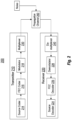
- FIG. 2 illustrates a functional block diagram of an example of a communications link 200, including a transmitter 210 and a receiver 220.
- the transmitter 210 includes a source coder 214, an FEC encoder 216, a modulator 218, and a multiplexer 230.
- the FEC encoder 216 is configured to add redundancy, for example, in a form for a forward error correction code, in order to provide information that can be used to correct to transmission errors introduced by the channel 260.
- the receiver 220 includes a de-multiplexer 240, a demodulator 228, an FEC decoder 226, and a source decoder 224.
- the FEC decoder 226 is configured to eliminate most of the errors that may be present in the resulting bitstream.
- the FEC decoder 226 is also able to generate codeword metrics indicating the amount of error in a received block. As noted previously, this is cheaply obtained as it is essentially a measure of how much "work" the FEC decoder 226 needed to perform to correct to received code blocks to arrive at the correct codeword.
- these codeword metrics can be used to infer the quality of the propagation channel, and indeed as will be illustrated in Figure 3 below, to infer the quality of individual channels of the propagation channel, such as when different channels are used in a frequency hopping system such as that illustrated in Figure 3 .
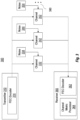
- FIG 3 illustrates a functional block diagram of a frequency hopping system 300 that implements the principles described herein.
- Figure 3 is shown as a more simplified version of the systems in Figure 2 to focus on the particularities of the FEC encoding and decoding, and how that functionality can be used to infer channel quality for different frequency channels.
- the frequency hopping system 300 includes a transmitter 310 and a receiver 360.
- the transmitter 310 includes an FEC encoder 314 configured to encode digital information into codewords by encoding information words with redundant information to allow the FEC decoder 362 of the receiver 360 to detect a limited number of errors that may occur anywhere in the message, and often to correct these errors without retransmission.
- the encoded codewords are then modulated and multiplexed into signals having different frequencies.
- a particular codeword may be split up into different segments, such that different segments of the same codeword are transmitted over different channels, e.g., one or more of channels 332, 342, 352.
- the ellipsis 380 represents that there may be any number of channels in the frequency hopping system 300.
- different codewords may be transmitted using different sets of channels. See e.g., Figure 4 showing messages 410, 420, and 430 each having segments transmitted in different channels, and using different sets of channels for each codeword.
- the channels 332, 342, 352 will corrupt the transmitted signals.
- a wireless radio channel may attenuate and distort the signals and add noise 334, 344, 354 to the signals.
- the noise 334, 344, 354 may be random noise, cosmic radiation, intentional interference from jammers, unintentional interference (such as from other radio transmissions), etc., and/or a combination thereof.
- the amount of noise is often measured by signal-to-noise ratios. The lower the signal-to-noise ratio, the more transmission errors are likely to occur, and more error corrections must be performed during the decoding process by the FEC decoder 362.
- the various particular segments for each codeword will be reassembled into a code block which is then decoded by the FEC decoder 362 to attempt to recover the codeword.
- the FEC decoder 362 further includes a channel metric processor 364 configured to count the number for errors corrected during the decoding of the code block.
- the codeword metrics of the codewords that were transmitted via a particular channel can be used by the channel metric processor 364 to infer one or more channel metrics of the various channels 332, 342, and/or 352.
- the channel metric processor 364 can indirectly infer channel metrics for individual channels to identify channel qualities.
- the decoder 362 or the receiver 360 may then perform actions to mitigate the effect of the particular channel 332, 342, 352.
- the receiver360 may notify the transmitter 310 about the interference in the particular channel 332, 342, 352, causing the transmitter 310 to reduce the usage of the particular channel and/or allocate data transmission to different channels.
- the receiver 360 may reduce the reliability (e.g., a reliability metric) of the particular channel and possibly ignore the symbols from the particular channel during decoding.
- the communications between the source device that hosts the transmitter 310 and the destination device that hosts the receiver 360 are in both directions.
- each source device and destination device have both an encoder and a decoder.
- one of the source or destination device may cause the other side or both sides to reduce the usage of the particular channel.
- inferring channel quality may occur over time based on collecting multiple codeword metrics.
- some embodiments use relevant metrics compared to an overall channel quality (e.g., an average quality of all the channels).
- a weighted average of codeword metrics and or channel metrics is used, where the weighting is performed based on time. That is, more recent codeword metrics and channel metrics have a higher weight than metrics that occurred more in the past. In this way, previous interference in a channel will not be weighted as high as current interference, and indeed such previous interference will have a decaying weight that eventually causes the interference to have little or no effect on determining channel quality.
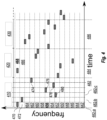
- FIG 4 is a chart illustrating an example of a process of transmitting three messages 410, 420, 430 in a frequency hopping system.
- Each message 410, 420, 430 corresponds to a codeword.
- the FEC encoder 216 maps an information word (composed of bits) or bit sequence into a codeword or coded sequence of bits.
- the modulator 218 arranges these bits and maps them into messages composed of symbols. According to the claimed invention, these messages are split up into multiple segments, each of which is transmitted over a frequency channel.
- messages 410, 420, 430 are examples of these messages that are split up into multiple segments (also referred to as sub-messages).
- the vertical axis represents the overall frequency band, which has been divided into multiple sub-bands (i.e., channels 442-468).
- the horizontal axis represents a period of time, which is divided into periods 482, 484, and 486, during which each of the three messages 410, 420, and 430 is being transmitted.
- the message 410 is transmitted during the time period 482
- message 420 is transmitted after the transmission of the message 410 during the time period 484
- the message 430 is transmitted after the transmission of the message 420 during the time period 486.
- each message 410, 420, 430 has been divided into 6 sub-messages, and each of which is transmitted via a different channel selected from the sub-channels 442-468 at a particular sub-time interval within the time interval 482, 484, or 486.
- the sub-messages of each message 410, 420, 430 are transmitted via different channels at different sub-time intervals at a predetermined sequence.
- message 410 has been divided into sub-messages 470-480.
- the sub-message 470 is first transmitted via the sub-channel 468 during the sub-time interval 482-a; the sub-message 472 is then transmitted via the sub-channel 466 during the sub-time interval 482-b; thereafter, the sub-message 480 is transmitted via the sub-channel 452 during the sub-time interval 482-c, and so on and so forth.
- each of the messages 420 and 430 is also divided into 6 sub-messages, and each of those sub-messages is also transmitted via one of the sub-channels 442-468 during a sub-time interval based on a predetermined sequence.
- the receiver processes the symbols of the sub-messages/messages and translates the symbols into sequences of bits.
- the sequence of the different sub-channels that are used to transmit the sub-messages is known to a receiver.
- the receiver can concatenate the sub-messages into messages or concatenate the sequences of bits corresponding to sub-messages into code blocks corresponding to codewords.
- the translation from symbols (via soft decoding and/or hard decoding) to bits may take place inside or outside the FEC decoder.
- the decoding process may also provide metrics about the quality of the received symbols (i.e., symbol metrics) and/or the accuracy of the estimated codeword (i.e., codeword metrics).
- each of the channels 442-468 may have different transmission qualities. Generally, a worse channel quality would result in more errors in the decoding process.
- the principles described herein cause the FEC decoder or the receiver to account for the errors that occurred during the decoding of each codeword. The decoding errors are then analyzed to obtain one or more statistical metrics for each channel 442-468.
- channel 468 For example, for channel 468, during the time period 472-476, sub-messages in messages 410 and 420 were transmitted via the channel 468. However, no sub-message in message 430 was transmitted via the channel 468 during the same time period. If errors were detected in the process of decoding messages 410 and 420, but not message 430, this indicates that the channel 468 may be of poor quality, or interference may be present in the channel 468 during the time period 472-476.
- channel 456 during the time period 472-476, sub-messages in messages 410 and 430 were transmitted via the channel 456. However, no sub-message in message 420 was transmitted in the channel 456. If more errors were detected during the decoding of messages 410 and 430, but not fewer errors were detected during the decoding of message 420, this indicates that the channel 456 may be a bad channel, or interference may be present in the channel 456 during the time period 472-476.
- This process may repeat for each channel 442-470, and one or more codeword metrics may be obtained based on the errors that occurred during the decoding of messages that at least partially transmitted via the corresponding channel.
- the one or more codeword metrics of each channel includes a weighted average of multiple codeword metrics, where a greater weight is given to a codeword metric that is based on codewords received in a more recent time interval.
- each of the plurality of codeword metrics is determined based on codewords received in each of multiple time intervals.
- Figure 5 illustrates a flowchart of an example method 500 for indirectly detecting interference in a particular frequency hopping channel based on one or more codeword metrics associated with messages that were at least partially transmitted via the particular frequency hopping channel.
- the method 500 may be implemented at the frequency hopping system 300 of Figure 3 , the receiver 220 of Figure 2 .
- the method 500 includes receiving sub-messages via multiple frequency hopping channels (act 510). Each of the sub-messages is transmitted via a particular frequency hopping channel.
- the method 500 also includes converting sub-messages into multiple code blocks (act 520). Each of the code blocks corresponds to a codeword.
- the method 500 further includes decoding each of the code blocks into a code word based on a particular error control coding method (act 530).
- one or more codeword metrics are determined (act 540). For each particular channel of the plurality of channels, one or more channel metrics is inferred based on the codeword metrics associated with codewords that were at least partially transmitted via the particular channel (act 550). Based on the inferred channel metrics, a reliability metric of a particular channel is reduced, or symbols received via a particular channel is ignored during decoding of incoming code blocks (act 560).
- the methods may be practiced by a computer system including one or more processors and computer-readable media such as computer memory.
- the computer memory may store computer-executable instructions that when executed by one or more processors cause various functions to be performed, such as the acts recited in the embodiments.
- Embodiments of the present invention may comprise or utilize a special purpose or general-purpose computer including computer hardware, as discussed in greater detail below.
- Embodiments within the scope of the present invention also include physical and other computer-readable media for carrying or storing computer-executable instructions and/or data structures.
- Such computer-readable media can be any available media that can be accessed by a general purpose or special purpose computer system.
- Computer-readable media that store computer-executable instructions are physical storage media.
- Computer-readable media that carry computer-executable instructions are transmission media.
- embodiments of the invention can comprise at least two distinctly different kinds of computer-readable media: physical computer-readable storage media and transmission computer-readable media.
- Physical computer-readable storage media includes RAM, ROM, EEPROM, CD-ROM or other optical disk storage (such as CDs, DVDs, etc.), magnetic disk storage or other magnetic storage devices, or any other medium which can be used to store desired program code means in the form of computer-executable instructions or data structures and which can be accessed by a general purpose or special purpose computer.
- a "network” is defined as one or more data links that enable the transport of electronic data between computer systems and/or modules and/or other electronic devices.
- Transmission media can include a network and/or data links which can be used to carry desired program code means in the form of computer-executable instructions or data structures and which can be accessed by a general purpose or special purpose computer. Combinations of the above are also included within the scope of computer-readable media.
- program code means in the form of computer-executable instructions or data structures can be transferred automatically from transmission computer-readable media to physical computer-readable storage media (or vice versa).
- program code means in the form of computer-executable instructions or data structures received over a network or data link can be buffered in RAM within a network interface module (e.g., a "NIC"), and then eventually transferred to computer system RAM and/or to less volatile computer-readable physical storage media at a computer system.
- NIC network interface module
- computer-readable physical storage media can be included in computer system components that also (or even primarily) utilize transmission media.
- Computer-executable instructions comprise, for example, instructions and data which cause a general-purpose computer, special purpose computer, or special purpose processing device to perform a certain function or group of functions.
- the computer-executable instructions may be, for example, binaries, intermediate format instructions such as assembly language, or even source code.
- the invention may be practiced in network computing environments with many types of computer system configurations, including, personal computers, desktop computers, laptop computers, message processors, hand-held devices, multi-processor systems, microprocessor-based or programmable consumer electronics, network PCs, minicomputers, mainframe computers, mobile telephones, PDAs, pagers, routers, switches, and the like.
- the invention may also be practiced in distributed system environments where local and remote computer systems, which are linked (either by hardwired data links, wireless data links, or by a combination of hardwired and wireless data links) through a network, both perform tasks.
- program modules may be located in both local and remote memory storage devices.
- the functionality described herein can be performed, at least in part, by one or more hardware logic components.
- illustrative types of hardware logic components include Field-programmable Gate Arrays (FPGAs), Application-specific Integrated Circuits (ASICs), Application-specific Standard Products (ASSPs), System-on-a-chip systems (SOCs), Complex Programmable Logic Devices (CPLDs), etc.
Landscapes
- Engineering & Computer Science (AREA)
- Signal Processing (AREA)
- Computer Networks & Wireless Communication (AREA)
- Quality & Reliability (AREA)
- Physics & Mathematics (AREA)
- Electromagnetism (AREA)
- Detection And Prevention Of Errors In Transmission (AREA)
- Noise Elimination (AREA)
- Circuits Of Receivers In General (AREA)
- Monitoring And Testing Of Transmission In General (AREA)
Claims (9)
- Ein Verfahren (500) zum Abschwächen von Interferenzen in einem Frequenzsprungkanalsystem auf der Grundlage von Codewort-Metriken, die während der Decodierung von Codeblöcken erhalten werden, wobei das Verfahren umfasst:Decodieren (530) einer Vielzahl von Codeblöcken in eine Vielzahl von Codewörtern unter Verwendung eines bestimmten Verfahrens zur Fehlerkontrollcodierung, wobei jeder der Vielzahl von Codeblöcken Abschnitte umfasst, die von einer Vielzahl von Kanälen in dem Frequenzsprungkanalsystem empfangen werden;Bestimmen (540) einer oder mehrerer Codewort-Metriken für jeden dekodierten Codeblock basierend auf den Kosten der Fehlerkorrektur während der Dekodierung der Vielzahl von Codeblöcken;Ableiten (550) einer oder mehrerer Kanal-Metriken der Vielzahl von Kanälen basierend auf der einen oder den mehreren Codewort-Metriken der Vielzahl von Codewörtern; undbasierend auf den Kanal-Metriken eine Zuverlässigkeits-Metrik eines bestimmten Kanals zu reduzieren (560) oder ankommende Symbole zu ignorieren, die über einen bestimmten Kanal während der Decodierung von Codeblöcken empfangen werden;wobei die eine oder die mehreren Codewort-Metriken zumindest beinhalten, ob ein Codeblock erneut übertragen wird.
- Das Verfahren (500) nach Anspruch 1, wobei die eine oder die mehreren Codewort-Metriken ferner eine Anzahl von Fehlern beinhalten, die während der Decodierung eines Codeblocks korrigiert werden.
- Das Verfahren (500) nach Anspruch 1, wobei die eine oder mehrere Codewort-Metriken ferner eine Anzahl von Bits umfassen, die während der Decodierung des Codeblocks umgedreht werden.
- Das Verfahren (500) nach Anspruch 1, wobei die eine oder mehrere Codewort-Metriken ferner eine Anzahl von Iterationen eines Fehlerkorrekturprozesses umfassen, der während der Decodierung eines Codeblocks durchgeführt wird.
- Das Verfahren (500) nach Anspruch 1, wobei die eine oder mehreren Kanalmessgrößen eines Kanals eine relative Kanalqualität im Vergleich zu einer Gesamtkanalqualität aller mehreren Kanäle anzeigen.
- Das Verfahren (500) nach Anspruch 5, wobei das Verfahren ferner das Bestimmen einer durchschnittlichen Kanalqualität aller mehreren Kanäle auf der Grundlage der einen oder mehreren Codewortmessgrößen aller mehreren Codewörter umfasst.
- Das Verfahren (500) nach Anspruch 6, wobei das Verfahren ferner umfasst:Aggregieren von Codewort-Metriken von Codewörtern, die zumindest teilweise über einen bestimmten Kanal übertragen werden; undAbleiten einer oder mehrerer Kanal-Metriken des bestimmten Kanals auf der Grundlage der aggregierten Codewort-Metriken und der durchschnittlichen Kanalqualität der Vielzahl von Kanälen.
- Das Verfahren (500) nach Anspruch 1, ferner umfassend:
Berechnen eines gewichteten Durchschnitts von Codewort-Metriken von Codewörtern, die zumindest teilweise über einen bestimmten Kanal übertragen werden, wobei eine Codewort-Metrik, die auf in einem aktuelleren Zeitintervall empfangenen Codewörtern basiert, stärker gewichtet wird. - Das Verfahren (500) nach Anspruch 6, wobei das Verfahren ferner umfasst:
wenn die relative Kanalqualität eines bestimmten Kanals niedriger als ein Schwellenwert ist, Bestimmen, dass in dem bestimmten Kanal Interferenzen vorhanden sind.
Applications Claiming Priority (1)
| Application Number | Priority Date | Filing Date | Title |
|---|---|---|---|
| US17/504,985 US11728843B2 (en) | 2021-10-19 | 2021-10-19 | Frequency hopping interference detection using decoder codeword metrics |
Publications (2)
| Publication Number | Publication Date |
|---|---|
| EP4170944A1 EP4170944A1 (de) | 2023-04-26 |
| EP4170944B1 true EP4170944B1 (de) | 2025-05-14 |
Family
ID=83898115
Family Applications (1)
| Application Number | Title | Priority Date | Filing Date |
|---|---|---|---|
| EP22201822.8A Active EP4170944B1 (de) | 2021-10-19 | 2022-10-17 | Frequenzsprung-interferenzdetektion unter verwendung von decoder-codewortmetriken |
Country Status (3)
| Country | Link |
|---|---|
| US (1) | US11728843B2 (de) |
| EP (1) | EP4170944B1 (de) |
| IL (1) | IL297382B2 (de) |
Families Citing this family (1)
| Publication number | Priority date | Publication date | Assignee | Title |
|---|---|---|---|---|
| US12494817B2 (en) * | 2021-10-28 | 2025-12-09 | Telefonaktiebolaget Lm Ericsson (Publ) | Transmitting a signal |
Family Cites Families (52)
| Publication number | Priority date | Publication date | Assignee | Title |
|---|---|---|---|---|
| US5048057A (en) * | 1990-01-02 | 1991-09-10 | At&T Bell Laboratories | Wireless local area network |
| US5259030A (en) * | 1991-07-17 | 1993-11-02 | Harris Corporation | Antijam improvement method and apparatus |
| GB2269075B (en) * | 1992-07-24 | 1996-04-10 | Roke Manor Research | Improvements in or relating to mobile cellular radio systems |
| US5546429A (en) * | 1992-11-09 | 1996-08-13 | Motorola, Inc. | Frequency hopping code division multiple access radio communication unit |
| US5794128A (en) * | 1995-09-20 | 1998-08-11 | The United States Of America As Represented By The Secretary Of The Army | Apparatus and processes for realistic simulation of wireless information transport systems |
| US5793795A (en) * | 1996-12-04 | 1998-08-11 | Motorola, Inc. | Method for correcting errors from a jamming signal in a frequency hopped spread spectrum communication system |
| US5832026A (en) * | 1996-12-04 | 1998-11-03 | Motorola, Inc. | Method for correcting errors from a fading signal in a frequency hopped spread spectrum communcation system |
| US6873601B1 (en) * | 1999-05-04 | 2005-03-29 | Carriercomm, Inc. | Radio network performance management |
| US7046644B1 (en) * | 2000-11-27 | 2006-05-16 | Nokia Mobile Phones Ltd. | Adaptive transmission channel allocation method and system for ISM and unlicensed frequency bands |
| US7433683B2 (en) * | 2000-12-28 | 2008-10-07 | Northstar Acquisitions, Llc | System for fast macrodiversity switching in mobile wireless networks |
| US6731700B1 (en) * | 2001-01-04 | 2004-05-04 | Comsys Communication & Signal Processing Ltd. | Soft decision output generator |
| US7027418B2 (en) * | 2001-01-25 | 2006-04-11 | Bandspeed, Inc. | Approach for selecting communications channels based on performance |
| KR20030003988A (ko) * | 2001-07-04 | 2003-01-14 | 전자부품연구원 | 무선 개인 망 네트워크 시스템의 적응형 주파수 도약장치 |
| KR100463786B1 (ko) * | 2002-09-16 | 2004-12-29 | 주식회사 오픈솔루션 | 적응적 주파수 선택 방식을 이용한 무선 데이터 전송방법및 장치 |
| US7100101B1 (en) * | 2002-11-08 | 2006-08-29 | Xilinx, Inc. | Method and apparatus for concatenated and interleaved turbo product code encoding and decoding |
| WO2004098141A1 (en) * | 2003-04-24 | 2004-11-11 | Bae Systems Information And Electronic Systems Integration Inc | Multiuser detection aided multiple access differential frequency-hopped spread spectrum |
| DE10320176B3 (de) * | 2003-05-06 | 2004-12-09 | Infineon Technologies Ag | Verfahren zur Selektion der Frequenzkanäle eines ein Frequenzsprungverfahren verwendenden Funksystems |
| DE10320157B3 (de) | 2003-05-06 | 2004-11-11 | Infineon Technologies Ag | Kanalqualifizierung und -selektion in einem mehrkanaligen Funksystem durch Paketfehlerraten-Messung |
| US7453853B2 (en) * | 2003-10-09 | 2008-11-18 | Ericsson Technology Licensing Ab | Adaptive correlation of access codes in a packet-based communication system |
| US7266757B1 (en) * | 2004-01-29 | 2007-09-04 | Xilinx, Inc. | Pipelined architecture implementing recursion processes for forward error correction |
| US20060013172A1 (en) * | 2004-07-16 | 2006-01-19 | Nokia Corporation | RSSI threshold selection for channel measurements based on RSSI of the received packets |
| US7684464B2 (en) * | 2004-12-21 | 2010-03-23 | Qualcomm Incorporated | Method and apparatus for performing channel assessment in a wireless communication system |
| CA2545950C (en) * | 2005-05-06 | 2013-10-01 | Her Majesty The Queen In Right Of Canada, As Represented By The Minister Of Industry Through The Communications Research Centre Canada | Iterative non-coherent cpm decoder |
| US8223904B2 (en) * | 2005-08-22 | 2012-07-17 | Qualcomm Incorporated | Multiple hypothesis decoding |
| EP1958366B1 (de) * | 2005-12-05 | 2018-01-17 | QUALCOMM Incorporated | Hierarchische kodierung für multicast-botschaften |
| US8363738B2 (en) * | 2005-12-05 | 2013-01-29 | Qualcomm Incorporated | Hierarchical coding for multicast messages |
| US7653117B2 (en) * | 2006-03-16 | 2010-01-26 | Harris Corporation | Method for decoding digital data in a frequency hopping communication system |
| US8428100B2 (en) * | 2007-10-08 | 2013-04-23 | Honeywell International Inc. | System and methods for securing data transmissions over wireless networks |
| TWI517604B (zh) * | 2010-09-24 | 2016-01-11 | 瑞昱半導體股份有限公司 | 利用頻譜密度之適應性跳頻機制之裝置與方法 |
| US8948305B2 (en) * | 2010-11-16 | 2015-02-03 | Panasonic Intellectual Property Corporation Of America | Transmission method, transmission apparatus, reception method and reception apparatus |
| US8625723B2 (en) * | 2011-03-03 | 2014-01-07 | Lg Electronics Inc. | Method and apparatus for performing demapping in wireless communication system |
| WO2014023355A1 (en) * | 2012-08-09 | 2014-02-13 | Telefonaktiebolaget L M Ericsson (Publ) | A method and a node for detecting phase noise in mimo communication systems |
| US9197365B2 (en) * | 2012-09-25 | 2015-11-24 | Nvidia Corporation | Decoding a coded data block |
| EP2926488A1 (de) * | 2012-11-28 | 2015-10-07 | Sony Corporation | Empfänger zum empfangen von daten in einem rundfunksystem mit redundanzdaten |
| US9319916B2 (en) * | 2013-03-15 | 2016-04-19 | Isco International, Llc | Method and appartus for signal interference processing |
| US9294223B2 (en) * | 2014-01-31 | 2016-03-22 | Harris Corporation | Reception of co-channel signals |
| US9374107B1 (en) * | 2014-05-15 | 2016-06-21 | L-3 Communications Corp. | Time shared protograph LDPC decoder |
| DE102016010432B4 (de) * | 2016-08-27 | 2023-01-05 | Diehl Metering Systems Gmbh | Verfahren zur Selektion der Frequenzkanäle eines Kommunikationssystems |
| CN109983775A (zh) * | 2016-12-30 | 2019-07-05 | 深圳市大疆创新科技有限公司 | 用于基于反馈的数据发送的系统和方法 |
| WO2018145242A1 (en) * | 2017-02-07 | 2018-08-16 | Qualcomm Incorporated | A low complexity puncturing method for low-rate polar codes |
| CN109983708B (zh) * | 2017-05-05 | 2021-04-27 | 深圳市大疆创新科技有限公司 | 用于跳频集选择的方法和系统 |
| WO2019095190A1 (en) * | 2017-11-16 | 2019-05-23 | Qualcomm Incorporated | Reduced overhead error detection code design for decoding a codeword |
| WO2019154518A1 (en) * | 2018-02-12 | 2019-08-15 | Intel IP Corporation | Methods and devices for device-to-device communications |
| DE102018206162B3 (de) * | 2018-04-20 | 2019-09-19 | Fraunhofer-Gesellschaft zur Förderung der angewandten Forschung e.V. | Interferenzdetektion und Unterdrückung in nichtkoordinierten Systemen |
| US11212144B1 (en) * | 2018-06-29 | 2021-12-28 | Marvell Asia Pte, Ltd. | Methods and apparatus for decoding received uplink transmissions |
| US11082083B2 (en) * | 2019-03-25 | 2021-08-03 | General Dynamics Mission Systems, Inc. | Node having a multi-user rake receiver for use in a cooperative broadcast multi-hop network that employs broadcast flood routing and multi-hop transmission with cooperative beamforming |
| WO2020251305A1 (ko) * | 2019-06-12 | 2020-12-17 | 엘지전자 주식회사 | 무선통신시스템에서 신호를 전송하는 방법 |
| US11398892B2 (en) * | 2019-09-06 | 2022-07-26 | Qualcomm Incorporated | Bandwidth part (BWP) hopping for interference mitigation |
| US11558147B2 (en) * | 2020-02-11 | 2023-01-17 | Marvell Asia Pte, LTD | Methods and apparatus for decoding received uplink transmissions using log-likelihood ratio (LLR) optimization |
| US11552675B1 (en) * | 2021-07-01 | 2023-01-10 | L3Harris Technologies, Inc. | Excision of interference with hopped waveforms |
| US12063063B2 (en) * | 2021-09-16 | 2024-08-13 | L3Harris Technologies, Inc. | Rake receiver and related methods |
| US11601216B1 (en) * | 2021-11-30 | 2023-03-07 | L3Harris Technologies, Inc. | Alignment detection by full and partial FEC decoding |
-
2021
- 2021-10-19 US US17/504,985 patent/US11728843B2/en active Active
-
2022
- 2022-10-17 EP EP22201822.8A patent/EP4170944B1/de active Active
- 2022-10-18 IL IL297382A patent/IL297382B2/en unknown
Also Published As
| Publication number | Publication date |
|---|---|
| IL297382A (en) | 2023-05-01 |
| EP4170944A1 (de) | 2023-04-26 |
| IL297382B1 (en) | 2024-07-01 |
| US20230121235A1 (en) | 2023-04-20 |
| IL297382B2 (en) | 2024-11-01 |
| US11728843B2 (en) | 2023-08-15 |
Similar Documents
| Publication | Publication Date | Title |
|---|---|---|
| RU2239950C2 (ru) | Способ декодирования режимов работы кодека с использованием априорного знания | |
| Afisiadis et al. | Coded LoRa frame error rate analysis | |
| EP3491758B1 (de) | Design von feedback-bits von hybrider automatischer wiederholungsanfrage (harq) für polare codes | |
| US8385324B2 (en) | Method and device for managing allocation of data transmission paths in a meshed communications network, corresponding computer program product and storage means | |
| US8054819B2 (en) | System and method for setting a data rate in TDMA communications | |
| US10153864B2 (en) | Method for dynamic and selective FD-DSDF transmission of a digital signal for a MAMRC system with several full-duplex relays, and corresponding program product and relay device | |
| US20190297649A1 (en) | Coded Random Access Mechanism for Communication Networks | |
| US11601216B1 (en) | Alignment detection by full and partial FEC decoding | |
| KR20200042375A (ko) | 조기 종료를 위해 극성 코드에서 분산 crc를 인터리빙하는 시스템 및 방법 | |
| JP5517677B2 (ja) | 無線通信システム、及び、無線通信方法 | |
| US20080240305A1 (en) | Message Decoding With Apriori Information and Soft Combining | |
| US20200296019A1 (en) | Determining packet loss in a fronthaul link | |
| US20070124654A1 (en) | Apparatus and method for decoding a received message with a priori information | |
| EP4170944A1 (de) | Frequenzsprung-interferenzdetektion unter verwendung von decoder-codewortmetriken | |
| US6678854B1 (en) | Methods and systems for providing a second data signal on a frame of bits including a first data signal and an error-correcting code | |
| US12425050B2 (en) | Method and apparatus for encoding and decoding signal in wireless communication system, and system for providing same | |
| CN109565330B (zh) | 中继方法、半双工中继器、电信系统和信息介质 | |
| Nguyen et al. | Superimposed frame synchronization optimization for finite blocklength regime | |
| US20170331584A1 (en) | Method and device for flexible, selective ssdf relaying | |
| AU757909B2 (en) | Frame erasure for digital data transmission systems | |
| US9455798B2 (en) | Forward error correction (FEC) to support successive interference cancellation (SIC) | |
| JP5631262B2 (ja) | 移動無線通信システム及び移動無線通信方法 | |
| Xu et al. | An efficient anti-jamming piecewise coding in cognitive OFDM | |
| Orooji et al. | Performance analysis of spectrum monitoring for cognitive radios | |
| Mo et al. | A novel and blind detection scheme for asymmetric PCMA system |
Legal Events
| Date | Code | Title | Description |
|---|---|---|---|
| PUAI | Public reference made under article 153(3) epc to a published international application that has entered the european phase |
Free format text: ORIGINAL CODE: 0009012 |
|
| STAA | Information on the status of an ep patent application or granted ep patent |
Free format text: STATUS: REQUEST FOR EXAMINATION WAS MADE |
|
| 17P | Request for examination filed |
Effective date: 20221020 |
|
| AK | Designated contracting states |
Kind code of ref document: A1 Designated state(s): AL AT BE BG CH CY CZ DE DK EE ES FI FR GB GR HR HU IE IS IT LI LT LU LV MC ME MK MT NL NO PL PT RO RS SE SI SK SM TR |
|
| GRAP | Despatch of communication of intention to grant a patent |
Free format text: ORIGINAL CODE: EPIDOSNIGR1 |
|
| STAA | Information on the status of an ep patent application or granted ep patent |
Free format text: STATUS: GRANT OF PATENT IS INTENDED |
|
| RIC1 | Information provided on ipc code assigned before grant |
Ipc: H04L 5/00 20060101ALI20250221BHEP Ipc: H04L 1/20 20060101ALI20250221BHEP Ipc: H04B 17/345 20150101ALI20250221BHEP Ipc: H04L 1/00 20060101AFI20250221BHEP |
|
| GRAS | Grant fee paid |
Free format text: ORIGINAL CODE: EPIDOSNIGR3 |
|
| INTG | Intention to grant announced |
Effective date: 20250311 |
|
| GRAA | (expected) grant |
Free format text: ORIGINAL CODE: 0009210 |
|
| STAA | Information on the status of an ep patent application or granted ep patent |
Free format text: STATUS: THE PATENT HAS BEEN GRANTED |
|
| AK | Designated contracting states |
Kind code of ref document: B1 Designated state(s): AL AT BE BG CH CY CZ DE DK EE ES FI FR GB GR HR HU IE IS IT LI LT LU LV MC ME MK MT NL NO PL PT RO RS SE SI SK SM TR |
|
| REG | Reference to a national code |
Ref country code: GB Ref legal event code: FG4D |
|
| REG | Reference to a national code |
Ref country code: CH Ref legal event code: EP |
|
| P01 | Opt-out of the competence of the unified patent court (upc) registered |
Free format text: CASE NUMBER: APP_17510/2025 Effective date: 20250410 |
|
| REG | Reference to a national code |
Ref country code: DE Ref legal event code: R096 Ref document number: 602022014588 Country of ref document: DE |
|
| REG | Reference to a national code |
Ref country code: IE Ref legal event code: FG4D |
|
| REG | Reference to a national code |
Ref country code: NL Ref legal event code: MP Effective date: 20250514 |
|
| PG25 | Lapsed in a contracting state [announced via postgrant information from national office to epo] |
Ref country code: ES Free format text: LAPSE BECAUSE OF FAILURE TO SUBMIT A TRANSLATION OF THE DESCRIPTION OR TO PAY THE FEE WITHIN THE PRESCRIBED TIME-LIMIT Effective date: 20250514 Ref country code: PT Free format text: LAPSE BECAUSE OF FAILURE TO SUBMIT A TRANSLATION OF THE DESCRIPTION OR TO PAY THE FEE WITHIN THE PRESCRIBED TIME-LIMIT Effective date: 20250915 Ref country code: FI Free format text: LAPSE BECAUSE OF FAILURE TO SUBMIT A TRANSLATION OF THE DESCRIPTION OR TO PAY THE FEE WITHIN THE PRESCRIBED TIME-LIMIT Effective date: 20250514 |
|
| REG | Reference to a national code |
Ref country code: LT Ref legal event code: MG9D |
|
| PG25 | Lapsed in a contracting state [announced via postgrant information from national office to epo] |
Ref country code: GR Free format text: LAPSE BECAUSE OF FAILURE TO SUBMIT A TRANSLATION OF THE DESCRIPTION OR TO PAY THE FEE WITHIN THE PRESCRIBED TIME-LIMIT Effective date: 20250815 Ref country code: NO Free format text: LAPSE BECAUSE OF FAILURE TO SUBMIT A TRANSLATION OF THE DESCRIPTION OR TO PAY THE FEE WITHIN THE PRESCRIBED TIME-LIMIT Effective date: 20250814 |
|
| PG25 | Lapsed in a contracting state [announced via postgrant information from national office to epo] |
Ref country code: NL Free format text: LAPSE BECAUSE OF FAILURE TO SUBMIT A TRANSLATION OF THE DESCRIPTION OR TO PAY THE FEE WITHIN THE PRESCRIBED TIME-LIMIT Effective date: 20250514 Ref country code: PL Free format text: LAPSE BECAUSE OF FAILURE TO SUBMIT A TRANSLATION OF THE DESCRIPTION OR TO PAY THE FEE WITHIN THE PRESCRIBED TIME-LIMIT Effective date: 20250514 |
|
| REG | Reference to a national code |
Ref country code: AT Ref legal event code: MK05 Ref document number: 1795720 Country of ref document: AT Kind code of ref document: T Effective date: 20250514 |
|
| PG25 | Lapsed in a contracting state [announced via postgrant information from national office to epo] |
Ref country code: BG Free format text: LAPSE BECAUSE OF FAILURE TO SUBMIT A TRANSLATION OF THE DESCRIPTION OR TO PAY THE FEE WITHIN THE PRESCRIBED TIME-LIMIT Effective date: 20250514 |
|
| PG25 | Lapsed in a contracting state [announced via postgrant information from national office to epo] |
Ref country code: HR Free format text: LAPSE BECAUSE OF FAILURE TO SUBMIT A TRANSLATION OF THE DESCRIPTION OR TO PAY THE FEE WITHIN THE PRESCRIBED TIME-LIMIT Effective date: 20250514 |
|
| PG25 | Lapsed in a contracting state [announced via postgrant information from national office to epo] |
Ref country code: AT Free format text: LAPSE BECAUSE OF FAILURE TO SUBMIT A TRANSLATION OF THE DESCRIPTION OR TO PAY THE FEE WITHIN THE PRESCRIBED TIME-LIMIT Effective date: 20250514 |
|
| PG25 | Lapsed in a contracting state [announced via postgrant information from national office to epo] |
Ref country code: RS Free format text: LAPSE BECAUSE OF FAILURE TO SUBMIT A TRANSLATION OF THE DESCRIPTION OR TO PAY THE FEE WITHIN THE PRESCRIBED TIME-LIMIT Effective date: 20250814 |
|
| PG25 | Lapsed in a contracting state [announced via postgrant information from national office to epo] |
Ref country code: IS Free format text: LAPSE BECAUSE OF FAILURE TO SUBMIT A TRANSLATION OF THE DESCRIPTION OR TO PAY THE FEE WITHIN THE PRESCRIBED TIME-LIMIT Effective date: 20250914 |
|
| PG25 | Lapsed in a contracting state [announced via postgrant information from national office to epo] |
Ref country code: LV Free format text: LAPSE BECAUSE OF FAILURE TO SUBMIT A TRANSLATION OF THE DESCRIPTION OR TO PAY THE FEE WITHIN THE PRESCRIBED TIME-LIMIT Effective date: 20250514 |
|
| PGFP | Annual fee paid to national office [announced via postgrant information from national office to epo] |
Ref country code: DE Payment date: 20251029 Year of fee payment: 4 |
|
| PG25 | Lapsed in a contracting state [announced via postgrant information from national office to epo] |
Ref country code: SM Free format text: LAPSE BECAUSE OF FAILURE TO SUBMIT A TRANSLATION OF THE DESCRIPTION OR TO PAY THE FEE WITHIN THE PRESCRIBED TIME-LIMIT Effective date: 20250514 Ref country code: DK Free format text: LAPSE BECAUSE OF FAILURE TO SUBMIT A TRANSLATION OF THE DESCRIPTION OR TO PAY THE FEE WITHIN THE PRESCRIBED TIME-LIMIT Effective date: 20250514 |
|
| PGFP | Annual fee paid to national office [announced via postgrant information from national office to epo] |
Ref country code: IT Payment date: 20251031 Year of fee payment: 4 |
|
| PGFP | Annual fee paid to national office [announced via postgrant information from national office to epo] |
Ref country code: FR Payment date: 20251027 Year of fee payment: 4 |
|
| PGFP | Annual fee paid to national office [announced via postgrant information from national office to epo] |
Ref country code: TR Payment date: 20251007 Year of fee payment: 4 |
|
| PG25 | Lapsed in a contracting state [announced via postgrant information from national office to epo] |
Ref country code: CZ Free format text: LAPSE BECAUSE OF FAILURE TO SUBMIT A TRANSLATION OF THE DESCRIPTION OR TO PAY THE FEE WITHIN THE PRESCRIBED TIME-LIMIT Effective date: 20250514 |
|
| PG25 | Lapsed in a contracting state [announced via postgrant information from national office to epo] |
Ref country code: EE Free format text: LAPSE BECAUSE OF FAILURE TO SUBMIT A TRANSLATION OF THE DESCRIPTION OR TO PAY THE FEE WITHIN THE PRESCRIBED TIME-LIMIT Effective date: 20250514 |
|
| PG25 | Lapsed in a contracting state [announced via postgrant information from national office to epo] |
Ref country code: SK Free format text: LAPSE BECAUSE OF FAILURE TO SUBMIT A TRANSLATION OF THE DESCRIPTION OR TO PAY THE FEE WITHIN THE PRESCRIBED TIME-LIMIT Effective date: 20250514 |
|
| PG25 | Lapsed in a contracting state [announced via postgrant information from national office to epo] |
Ref country code: RO Free format text: LAPSE BECAUSE OF FAILURE TO SUBMIT A TRANSLATION OF THE DESCRIPTION OR TO PAY THE FEE WITHIN THE PRESCRIBED TIME-LIMIT Effective date: 20250514 |
|
| REG | Reference to a national code |
Ref country code: DE Ref legal event code: R097 Ref document number: 602022014588 Country of ref document: DE |
|
| PLBE | No opposition filed within time limit |
Free format text: ORIGINAL CODE: 0009261 |
|
| STAA | Information on the status of an ep patent application or granted ep patent |
Free format text: STATUS: NO OPPOSITION FILED WITHIN TIME LIMIT |
|
| REG | Reference to a national code |
Ref country code: CH Ref legal event code: L10 Free format text: ST27 STATUS EVENT CODE: U-0-0-L10-L00 (AS PROVIDED BY THE NATIONAL OFFICE) Effective date: 20260325 |
|
| 26N | No opposition filed |
Effective date: 20260217 |