EP4169232B1 - Verfahren und vorrichtung zur ergänzung einer signalisierungs-kommunikations-nachricht - Google Patents
Verfahren und vorrichtung zur ergänzung einer signalisierungs-kommunikations-nachricht Download PDFInfo
- Publication number
- EP4169232B1 EP4169232B1 EP21740141.3A EP21740141A EP4169232B1 EP 4169232 B1 EP4169232 B1 EP 4169232B1 EP 21740141 A EP21740141 A EP 21740141A EP 4169232 B1 EP4169232 B1 EP 4169232B1
- Authority
- EP
- European Patent Office
- Prior art keywords
- terminal
- identity
- user
- message
- network
- Prior art date
- Legal status (The legal status is an assumption and is not a legal conclusion. Google has not performed a legal analysis and makes no representation as to the accuracy of the status listed.)
- Active
Links
Images

Classifications
-
- H—ELECTRICITY
- H04—ELECTRIC COMMUNICATION TECHNIQUE
- H04M—TELEPHONIC COMMUNICATION
- H04M3/00—Automatic or semi-automatic exchanges
- H04M3/42—Systems providing special services or facilities to subscribers
- H04M3/42025—Calling or Called party identification service
- H04M3/42034—Calling party identification service
- H04M3/42059—Making use of the calling party identifier
-
- H—ELECTRICITY
- H04—ELECTRIC COMMUNICATION TECHNIQUE
- H04L—TRANSMISSION OF DIGITAL INFORMATION, e.g. TELEGRAPHIC COMMUNICATION
- H04L67/00—Network arrangements or protocols for supporting network services or applications
- H04L67/50—Network services
- H04L67/56—Provisioning of proxy services
- H04L67/561—Adding application-functional data or data for application control, e.g. adding metadata
-
- H—ELECTRICITY
- H04—ELECTRIC COMMUNICATION TECHNIQUE
- H04M—TELEPHONIC COMMUNICATION
- H04M3/00—Automatic or semi-automatic exchanges
- H04M3/42—Systems providing special services or facilities to subscribers
- H04M3/42025—Calling or Called party identification service
- H04M3/42034—Calling party identification service
- H04M3/42042—Notifying the called party of information on the calling party
-
- H—ELECTRICITY
- H04—ELECTRIC COMMUNICATION TECHNIQUE
- H04M—TELEPHONIC COMMUNICATION
- H04M3/00—Automatic or semi-automatic exchanges
- H04M3/42—Systems providing special services or facilities to subscribers
- H04M3/436—Arrangements for screening incoming calls, i.e. evaluating the characteristics of a call before deciding whether to answer it
- H04M3/4365—Arrangements for screening incoming calls, i.e. evaluating the characteristics of a call before deciding whether to answer it based on information specified by the calling party, e.g. priority or subject
-
- H—ELECTRICITY
- H04—ELECTRIC COMMUNICATION TECHNIQUE
- H04M—TELEPHONIC COMMUNICATION
- H04M2203/00—Aspects of automatic or semi-automatic exchanges
- H04M2203/60—Aspects of automatic or semi-automatic exchanges related to security aspects in telephonic communication systems
- H04M2203/6045—Identity confirmation
Definitions
- the application for invention is located in the field of telecommunications and in a preferred but non-limiting manner in the area of telephone and video telephony services.
- Telecom operators offer many identity management services to their customers to help them with their communications. Thanks to these services, it is for example possible for a called party to know the identity of the caller when establishing a call (CLIP service for Calling Line Identification Presentation or OIP for Originating Identification Presentation).
- CLIP service for Calling Line Identification Presentation
- OIP for Originating Identification Presentation This service can be provided as long as the identity of the caller is received by the network of the called party's operator and the caller has not requested the masking of his identity via a CLIR type service. (Calling Line Identification Restriction) or OIR (Originating Identification Restriction).
- CLIR Calling Line Identification Restriction
- OIR Oleating Identification Restriction
- the COLP Connected Line Presentation
- TIP Terminal Identification Presentation
- caller name display (CNIP for Calling Name Identity Presentation).
- This service allows, when the CLIP/OIP caller number display service is subscribed and active, and when the caller number is available and not hidden, to display the name of the caller to the called party.
- the CNIP service is particularly interesting for businesses/companies. Indeed, the presentation of their identity (name/brand) rather than a simple telephone number which is generally not known to the called party, allows for more effective communication. However, the identity displayed to the called party may contain erroneous information without the company concerned being aware of it, which may harm it.
- Telecommunications operators can also offer specific telephone services such as a call screening service to their called customers and replace the identity of the caller with an identity of the service considered, for example a “technical” telephone number. .
- All of these services may result in the modification or deletion of the calling identity displayed on the called party's terminal when establishing a call.
- the identity thus modified can, for example, cause calls to be rejected by the called party without the caller being aware of it. This may be the case when a caller unknowingly uses a telephone line with the CLIR/OIR service activated or when the CLIP/OIP service subscribed to by the called party does not work or has been deactivated voluntarily or involuntarily by the called party.
- the called party can also filter calls based on additional information provided by the CNIP service.
- the calling identity displayed on the called party's terminal can also be modified following poor management of the communication by network equipment. Indeed, the calling identity can be lost as a result of poor SIP (Session Initiation Protocol) or ISUP (ISDN Signaling User Part) signaling, for example when call signaling is relayed by different transit networks.
- SIP Session Initiation Protocol
- ISUP ISDN Signaling User Part
- the called party's network displays either the non-certified calling identity, that is to say declared in the SIP FROM field of the SIP INVITE signaling message, either the certified calling identity added by the caller's network with 2 possible contents, one in SIP URI format and the other in TEL URI format, each of which may have different data.
- An example in the prior art is document EP2611100 .
- Some regulatory services such as emergency services, may also systematically display the caller's identity to the called party without the caller being aware of it.
- a user who calls a value-added service such as for example, an Audiotel service in France, is not necessarily aware that its operator will systematically hide its identity during the call.
- such a method makes it possible to enrich the signaling of a communication between a calling user and a called user with new information inserted by the enrichment device located in the telecommunications network of the called user. , tamper-proof by a third party to the network of the called party and the caller and conveyed transparently after its insertion to the network of the calling user, and intended to be presented to the calling user on the terminal on which he carries out communication.
- This information is the identity of the caller actually presented (displayed or vocalized) at the called party's terminal.
- identity we mean a sequence of characters and/or binary data which is used to identify a user or their terminal such as a telephone number (MSISDN), an email address, a postal address, an IP address, a MAC address , a name, a first name, etc.
- MSISDN telephone number
- email address a postal address
- IP address a postal address
- IP address a postal address
- MAC address a MAC address
- name a first name, etc.
- message signaling a communication we mean any message allowing the establishment of the communication or the communication itself exchanged between at least two terminals. Furthermore, no limitation is attached to the nature of the communication between the first and the second terminal. It may be a voice over IP (VoIP) type telephone or video call or a call sent over a network based on circuit-switched technology, or a communication sent within the framework of instant messaging or email, SMS, etc.
- VoIP voice over IP
- first and the second user can belong to the same network, in other words the first and the second network can be a single and same network or on the contrary be distinct networks, operated by the same operator or by different operators.
- a method as described above is characterized in that said at least one identity of said first user is obtained from said first signaling message.
- this embodiment makes it possible to use a signaling message already existing and exchanged between the first and the second terminal to convey the identity of the first user restored by the second terminal.
- the identity is for example memorized by the second device upon reception of the first signaling message then inserted in the second signaling message.
- a method as described above is characterized in that said at least one identity of said first user is obtained from the second terminal.
- This embodiment makes it possible to obtain from the second terminal, for example via a dedicated request, the identity of the first user restored by the second terminal.
- the second terminal can, upon receipt of the first signaling message, search for example in a list of contacts stored locally for a match with an identity of the first user present in the first signaling message and retrieve an associated identity which will be returned to the second user by the second terminal.
- the restored identity can also be entered by the second terminal in a first signaling field of the second message before insertion by the enrichment device in a second signaling field of the second message.
- a method as described above is characterized in that the insertion step is conditioned by the value of at least one service parameter.
- This embodiment makes it possible to condition, depending on the value of a service parameter, the insertion into the second signaling message, by the second device, of the identity of the first user restored by the second terminal.
- the second user may not want the first user to obtain the identity restored by the second terminal and may have subscribed to an option with their telecommunications operator allowing this identity not to be sent/provided to the first user.
- This embodiment also makes it possible to take into account the case where the service parameter is a parameter which indicates that the first network or the first terminal is not suitable for restoring the identity restored by the second terminal.
- said at least one parameter is obtained from a server located in said second telecommunications network.
- This embodiment makes it possible to obtain the service parameter from a server located in the second network such as for example a server hosting the profile of the second user with the options subscribed to with its telecommunications operator.
- said at least one parameter is obtained from said second terminal.
- This embodiment makes it possible to obtain the service parameter from the second terminal in the case where the latter gives the possibility to the second user via a configuration parameter to accept or refuse that the first user obtains the identity restored by the second terminal.
- said at least one parameter is obtained from said first signaling message.
- This embodiment makes it possible to obtain from the first signaling message a service parameter which indicates for example that the first network or the first terminal is not suitable for restoring the identity restored by the second terminal.
- module can correspond as well to a software component as to a hardware component or a set of hardware and software components, a software component itself corresponding to one or more computer programs or subprograms or more generally to any element of a program capable of implementing a function or a set of functions as described for the modules concerned.
- a hardware component corresponds to any element of a hardware assembly capable of implementing a function or a set of functions for the module concerned (integrated circuit, smart card, memory card, etc. .).
- the invention also relates to a server comprising an enrichment device as described above.
- the invention also relates to gateway equipment comprising an enrichment device as described above.
- the invention also relates to a terminal comprising an enrichment device as described above.
- the invention also relates to a computer program comprising instructions for implementing the above method according to any of the particular embodiments described above, when said program is executed by a processor.
- the method can be implemented in various ways, notably in wired form or in software form.
- This program may use any programming language, and be in the form of source code, object code, or intermediate code between source code and object code, such as in a partially compiled form, or in any other desirable shape.
- the invention also relates to a recording medium or information medium readable by a computer, and comprising instructions for a computer program as mentioned above.
- the recording media mentioned above can be any entity or device capable of storing the program.
- the support may comprise a storage means, such as a ROM, for example a CD ROM or a microelectronic circuit ROM, or even a magnetic recording means, for example a hard disk.
- the recording media may correspond to a transmissible medium such as an electrical or optical signal, which may be conveyed via an electrical or optical cable, by radio or by other means.
- the programs according to the invention can in particular be downloaded on an Internet type network.
- the recording media may correspond to an integrated circuit in which the program is incorporated, the circuit being adapted to execute or to be used in the execution of the method in question.
- This enrichment device and this computer program have characteristics and advantages similar to those described previously in relation to the enrichment process.
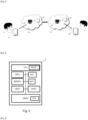
- FIG. 1 illustrates an example of an environment for implementing the invention according to a particular embodiment of the invention.
- the implementation environment comprises a first terminal 101 of a user U1 connected to a telecommunications network 100, adapted to establish or receive communications with a second terminal 105 of a user U2 connected to a telecommunications network 103 according to state of the art.
- Terminals 101 and 105 are for example mobile terminals, fixed terminals, connected objects, voice assistants or any other terminal capable of establishing and receiving communications.
- Telecommunications networks 100 and 103 are respectively operated by the telecommunications operators of users U1 and U2.
- the servers 102 and 104 are application servers respectively located in the telecommunications networks 100 and 103 capable of relaying and supporting communication between the terminals 101 and 105.
- the server 104 executes the method of enriching a signaling message .
- the implementation environment may also include a database 106, for example located within the telecommunications network 103, accessible from the server 104 and configured to store at least one service parameter associated with an offer/option subscribed by the caller or with an offer/option subscribed by the called party with their telecommunications operator whose value makes it possible to determine whether the insertion step of the enrichment process must be carried out.
- the service parameter may also be a parameter indicating that the calling operator's network is capable of supporting or not, for example following a technical malfunction, an offer/option subscribed to by the caller or a service provided. through the network of the called party's operator to the caller.
- the implementation environment also comprises a database 107, for example located within the telecommunications network 100, accessible from the server 102 and configured to store at least one parameter of service associated with an offer/option subscribed by the caller with his telecommunications operator whose value makes it possible to determine whether the insertion step of the enrichment process must be carried out.
- a database 107 for example located within the telecommunications network 100, accessible from the server 102 and configured to store at least one parameter of service associated with an offer/option subscribed by the caller with his telecommunications operator whose value makes it possible to determine whether the insertion step of the enrichment process must be carried out.
- the environment described in support of the figure 1 is made up of two telecommunications networks.
- the networks 100 and 103 can be one and the same telecommunications network.
- the environment may include more than two telecommunications networks and include, for example, a third interconnection network allowing communication between networks 100 and 103.
- the signaling of a communication is transported in a manner transparent (ie without modification) between the first network and the second network in particular, when interconnection/transit networks are used between the first network and the second network, these networks convey the signaling of the communication from the first network to the second network without modifying it.
- FIG. 2 illustrates the hardware architecture of a device E configured to implement the enrichment method according to a particular embodiment of the invention.
- this device has the hardware architecture of a computer. It notably includes a PROC1 processor, an MV1 RAM, a MEM1 read-only memory and an MF1 non-volatile flash memory. Such means are known per se and are not described in more detail here.
- the read-only memory constitutes a recording medium in accordance with the invention, readable by the processor PROC1 and on which is recorded here a computer program PG1 in accordance with the invention, this program comprising instructions for implementing the steps of the enrichment process as described above, when the program is executed by the processor PROC1.
- the code instructions of the computer program PG1 are for example loaded into a memory before being executed by the processor PROC1.
- the processor PROC1 of the processing unit UT 1 implements in particular the steps of the enrichment process according to any one of the particular embodiments described in relation to the figures 1 And 3 , according to the instructions of the computer program PG1.
- the device E also comprises a first obtaining module OBT1 capable of obtaining communication signaling messages via for example an IP network.
- the obtaining module OBT1 is for example used to obtain communication signaling messages coming from a terminal such as for example the terminal 105.
- the device E further comprises a transmission module SND1 capable of transmitting messages signaling a communication via for example an IP network.
- the transmission module SND1 is for example used to transmit to a terminal such as the terminal 101 the signaling messages obtained via the module OBT1.
- the device E further comprises a second obtaining module OBT2 capable of obtaining from for example a message signaling a communication established between the calling user of the terminal 101 and the called user of the terminal 105 or via a message coming from of the terminal 105, an identity of the caller restored by the terminal 105 of the called party.
- a second obtaining module OBT2 capable of obtaining from for example a message signaling a communication established between the calling user of the terminal 101 and the called user of the terminal 105 or via a message coming from of the terminal 105, an identity of the caller restored by the terminal 105 of the called party.
- the device E also includes an INSER1 module capable of inserting an identity of the caller obtained via the OBT2 module into a communication signaling message.
- the device E can further comprise a third obtaining module (not shown) capable of obtaining from for example a digital storage space such as an internal memory or a database , or from a communication signaling message or via a network request one or more service parameters.
- the service parameter(s) are for example parameters associated with an offer/option subscribed to by the caller or to an offer/option subscribed to by the called party with their telecommunications operator, the value of which makes it possible to determine whether the step d insertion of the enrichment process must be carried out.
- FIG. 3 illustrates steps of the method for enriching a signaling message according to a particular embodiment of the invention.
- FIG 3 uses the same environment as that described in support of the figure 1 .
- the user U1 will initiate communication with the user U2. More precisely, the terminal 101 of the user U1 sends a SIP INVITE message to an identifier of the user U2.
- the identifier is for example a telephone number (MSISDN), an email address, or any other identifier allowing U2 to be reachable.
- the SIP INVITE message sent by the terminal 101 to an identifier of the user U2 is, in a known manner, a message for initiating a communication with the user U2.
- An identity of the user U1, called a non-certified identity is included in the call signaling, in the FROM field present in the header of the SIP INVITE message.
- the uncertified identity of the user U1 is an identity declared by the user and/or the terminal 101 such as an MSISDN, an email address, an IP address or any other character and/or data string binaries. Note that, in a known manner, the different information placed in the headers of the SIP INVITE message belongs to or even constitutes the signaling of the call.
- the signaling protocol used to initiate and then establish the communication can also be the H.323 protocol, MGCP, ISUP (ISDN Signaling User Part), BICC (Bearer Independent Call Control), SIP-I (Session Initiation Protocol - ISUP ), WebRTC (Web Real Time Communication) or any other signaling protocol capable of initiating/establishing a communication.
- the signaling messages exchanged between terminals 101 and 105 will be SIP messages.
- step E20 the SIP INVITE message is received then handled by the server 102 of the telecommunications network 100.
- the server 102 can position in the signaling of the message, for example in the SIP field P-Asserted-Id an identity called the certified identity of the caller U1 and/or modify the uncertified identity already present.
- certified identity we mean an identity that a trusted entity (e.g. network operator or other trusted authority) establishes and guarantees.
- This certified identity can for example be an MSISDN, an email address, a name or any other string of characters and/or binary data making it possible to identify the user U1.
- the SIP INVITE message is sent to the server 104 located within the telecommunications network 103 of the telecommunications operator of the user U2.
- the SIP INVITE message is then received by the server 104 in step E31.
- the server 104 can, if the user U2 has subscribed to a CNIP type service with his telecommunications operator, that the OIP service is activated and that the caller has not hidden his identity, consult a database with the certified and/or non-certified identity of the caller as search key contained in the SIP INVITE message to obtain a new identity, called resolved identity, of the caller.
- the search in the database is for example carried out on the basis of an MSISDN of the caller and the resolved identity can be the name and/or first name of the caller or any other character string.
- This resolved identity can then be inserted by the server 104 in the signaling of the SIP INVITE message, for example at the level of the SIP DISPLAY parameter of the FROM field present in the SIP INVITE message.
- the server 104 transfers the SIP INVITE message to the terminal 105. Note that, just before sending the SIP INVITE message, the server 104 can memorize the identity(ies) of the caller present in the signaling of the message.
- the terminal On reception (E42) of the SIP INVITE message, the terminal will process the message and restore, for example textually or vocally, an identity of the caller, that is to say an identity of the user U1, to the user U2.
- the terminal can restore different identities depending on its configuration, the configuration of the called party's network (U2) and/or the services subscribed to by the users U1 and U2 from their telecommunications operator.
- the terminal 105 can for example restore a non-certified identity of the caller (U1) and/or a certified identity of the caller (U1) present in the SIP INVITE message received.
- the terminal can also return to the user U2 a resolved identity obtained from the CNIP service database but also an empty, “anonymous” or default identity, such as for example a predefined character string, if the OIP service of the The called party is deactivated if the identity of the caller present in the SIP INVITE message has been altered by network equipment or if the user U1 has the OIR service activated.
- the identity presented can also be a so-called “technical” identity such as a character string such as a prefix or a predefined telephone number, associated with a telecommunications service, when the user U2 has subscribed for example to a telephone service. filtering of anonymous calls. The technical identity then allows the user U2 to know that this is a filtered incoming call and therefore to process this call in a specific manner.
- step E43 the terminal 105 responds via a SIP 180 Ringing message.
- the message is then received by the server 104 in step E33.
- the server 104 can, during step E33, modify the signaling of the SIP 180 Ringing message and insert an identity, for example certified and/or non-certified, memorized during step E32 and which has been returned to the user U2 via terminal 105 during step E42.
- This information can for example be inserted in the SIP DISPLAY parameter of the uncertified calling identity present in the FROM field or in the SIP DISPLAY parameter of the certified calling identity in the PAI field or even in a new dedicated SIP header. Note that in most cases the called party's network "decides" which identity must be restored at the called terminal. Call signaling between the called network (server 104 and network 103) and called terminal (105) has only a single signaling field to carry the caller identity selected by the called network.
- the identity of the caller returned by the terminal 105 to the user U2 can however be an identity present in a network directory or a database located at the terminal 105 such as a list of contacts or a Phone book.
- the terminal 105 can, upon receipt of the SIP INVITE message (E42), search in a list of contacts stored locally or in a network directory for a match with an identity of the caller present in the SIP INVITE message and retrieve an associated identity .
- the terminal 105 can for example via the MSISDN present in the FROM field of the SIP INVITE message search in its contact list for the last name and/or first name and/or a character string associated with the MSISDN.
- the server 104 can also obtain from the terminal 105 the identity of the caller actually returned by the terminal 105 to the user U2.
- the server 104 can for example obtain from the terminal 105 the identity of the caller actually restored via a dedicated message using the SIP protocol or any other communication protocol capable of establishing communication between the terminal 105 and the server 104.
- the server 104 can also obtain the identity of the caller actually restored via the SIP 180 Ringing message received during step E33.
- step E43 the terminal 105, during step E43, has previously added to the signaling of the SIP 180 Ringing message the identity of the caller actually restored, for example in the SIP DISPLAY parameter of the uncertified calling identity present in the FROM field or in the SIP DISPLAY parameter of the certified calling identity of the PAI field or even in a new dedicated SIP header.
- the server 104 can, depending on a service parameter such as for example an activation status (activated/not activated) associated with an option subscribed by the user U2 with his telecommunications operator , do not insert an identity in the SIP 180 Ringing message received in step E33.
- a service parameter such as for example an activation status (activated/not activated) associated with an option subscribed by the user U2 with his telecommunications operator
- the user U2 may not want the caller (U1) to obtain the calling identity returned by his terminal (105) and may have subscribed to an option with his telecommunications operator allowing this identity not to be sent /provided to the caller (U1).
- the server 104 can obtain the service parameter via a network request or from a database/file of the server 104.
- the server 104 can obtain the service parameter from the terminal 105. This is for example the case when the user U2 declares at the terminal 105, via for example the positioning of a parameter, do not want the caller to obtain the calling identity restored on his terminal 105.
- the service parameter can also be obtained by the server 104 from a server located in the network 100. This is for example the case when the user U1 has not subscribed to a service with his telecommunications operator allowing the restitution (vocally or textually) on his terminal of his identity previously restored on the terminal of the called party or when the network 100 is not capable of supporting modified signaling messages with the identity of the caller for example inserted in a new SIP field.
- this service parameter can be retrieved via a dedicated message or from the signaling of the SIP INVITE message received by the server 104 in step E31.
- step E34 the server 104 will transmit the SIP 180 Ringing signaling message.
- the SIP 180 Ringing message is then received by the server 102 during step E24 then the server sends the message during step E25 to the terminal 101.
- step E15 the terminal receives the SIP 180 Ringing signaling message and can restore to the user U1, vocally or visually via a character string on a screen, the calling identity (i.e. the identity of the user U1) returned by the terminal 105 to the user U2 during step E42.
- the calling identity i.e. the identity of the user U1
- the user U1 will have the possibility of knowing his identity restored by the terminal 105 to the user U2 whom he wishes to contact.
- the terminal 101 is able to exploit and interpret this new field.
- the execution of the enrichment process can be conditioned by data present in the SIP INVITE message.
- This data is for example inserted by the terminal 101 (E10) in a field of the signaling of the SIP INVITE message such as the SIP Supported header to indicate to the network 100 that the terminal 101 can restore to U1 the identity of U1 restored by terminal 105 to U2 when establishing a call.
- the server 102 can modify this data and/or insert one depending on a service parameter or the capabilities of the network 100 to support certain functionalities such as for example the possibility of supporting signaling messages comprising the identity of the caller inserted by the enrichment method during step E33.
- the server 104 can detect the presence of the given in the SIP INIVITE message and interpret it in order to execute or not the enrichment process during step E33.
- the insertion of the identity of the caller (E33) is carried out only in a SIP 200 OK signaling message.
- This embodiment makes it possible to take into account the case where the SIP INVITE message is transmitted by the called party's network to several terminals belonging to the called party.
- the final response SIP 200 OK sent only by the terminal of the called party who takes the call, provides the caller with the identity of the caller which has been returned to the called party.
- the insertion of the identity of the caller (E33) can be carried out in a SIP 200 OK and/or SIP 183 In Progress and/or SIP 180 Ringing signaling message.
- the signaling protocol used to initiate and then establish the communication can also be the H.323 protocol, MGCP, ISUP (ISDN Signaling User Part), BICC (Bearer Independent Call Control), SIP-I (Session Initiation Protocol - ISUP) or WebRTC (Web Real Time Communication).
- the signaling message used can for example be the SETUP message.
- the signaling message can be the IAM message (Initiate Address Message).
- the message used by the SIP-I protocol can be a combination of the messages used by the SIP and ISUP protocols. Indeed, the SIP-I protocol encapsulates the IAM message in the SIP INVITE message.
- the signaling message can be the Create Connection message and for WebRTC a proprietary message.
- the signaling messages corresponding to the SIP 180 Ringing message can be the Alerting message for the H323 protocol, the ACM (Address Complete Message) or CPG (Call ProGress) message for the ISUP or BICC protocols, the Notification Command message for the MGCP protocol and a proprietary message for the WebRTC protocol
- the enrichment process can be executed by the terminal 105.
- the enrichment process can be executed by gateway equipment (not shown) located for example in the network 103.
- Gateway equipment means intermediate equipment ensuring the redirection or routing of data packets between the different terminals and networks connected to it.
- the gateway equipment is for example a residential gateway which makes it possible to connect a local communication network and an extended network such as the Internet network.
- a residential gateway notably integrates a DHCP server. It carries out the routing of data packets, and can also play the role of firewall, proxy, DNS relay (for English “Domain Name Server”), IGD service provider (for English “Internet Gateway Device, Internet Gateway Device), etc.
- a service gateway may be equipment known in France as a “box”, such as LiveBox equipment (marketed product from Orange, registered trademark).
Landscapes
- Engineering & Computer Science (AREA)
- Signal Processing (AREA)
- Library & Information Science (AREA)
- Computer Networks & Wireless Communication (AREA)
- Telephonic Communication Services (AREA)
Claims (12)
- Verfahren zur Ergänzung, durch eine Vorrichtung zur Ergänzung eines zweiten Telekommunikationsnetzes, einer zweiten Signalisierungsnachricht einer Verbindung, die von einem zweiten Endgerät eines zweiten Nutzers des zweiten Netzes gesendet wird als Antwort auf eine erste Signalisierungsnachricht der Verbindung, die von einem ersten Endgerät eines ersten Nutzers eines ersten Telekommunikationsnetzes gesendet wird, wobei das Verfahren dadurch gekennzeichnet ist, dass es umfasst:- einen ersten Schritt des Erhaltens der zweiten Signalisierungsnachricht;- einen zweiten Schritt des Erhaltens mindestens einer Identität des ersten Nutzers, die von dem zweiten Endgerät an den zweiten Nutzer ausgegeben wird;- einen Schritt des Einfügens der mindestens einen erhaltenen Identität durch die Vorrichtung des zweiten Netzes in die zweite Signalisierungsnachricht;- einen Schritt des Sendens der zweiten Signalisierungsnachricht an das erste Endgerät.
- Verfahren nach Anspruch 1, dadurch gekennzeichnet, dass die mindestens eine Identität des ersten Nutzers aus der ersten Signalisierungsnachricht erhalten wird.
- Verfahren nach Anspruch 1, dadurch gekennzeichnet, dass die mindestens eine Identität des ersten Nutzers von dem zweiten Endgerät aus erhalten wird.
- Verfahren nach Anspruch 1, dadurch gekennzeichnet, dass der Schritt des Einfügens durch den Wert mindestens eines Dienstparameters bedingt wird.
- Verfahren nach Anspruch 4, dadurch gekennzeichnet, dass der mindestens eine Parameter von einem Server aus erhalten wird, der in dem zweiten Telekommunikationsnetz gelegen ist.
- Verfahren nach Anspruch 4, dadurch gekennzeichnet, dass der mindestens eine Parameter von dem zweiten Endgerät aus erhalten wird.
- Verfahren nach Anspruch 4, dadurch gekennzeichnet, dass der mindestens eine Parameter aus der ersten Signalisierungsnachricht erhalten wird.
- Vorrichtung zur Ergänzung einer zweiten Signalisierungsnachricht einer Verbindung, die von einem zweiten Endgerät eines zweiten Nutzers eines zweiten Telekommunikationsnetzes gesendet wird als Antwort auf eine erste Signalisierungsnachricht der Verbindung, die von einem ersten Endgerät eines ersten Nutzers eines ersten Telekommunikationsnetzes gesendet wird, wobei die Vorrichtung dadurch gekennzeichnet ist, dass sie umfasst:- ein erstes Modul zum Erhalten der zweiten Signalisierungsnachricht;- ein zweites Modul zum Erhalten mindestens einer Identität des ersten Nutzers, die auf dem zweiten Endgerät an den zweiten Nutzer ausgegeben wird;- ein Modul zum Einfügen der mindestens einen erhaltenen Identität durch die Vorrichtung des zweiten Netzes in die zweite Signalisierungsnachricht;- ein Modul zum Senden der zweiten Signalisierungsnachricht an das erste Endgerät.
- Server mit einer Vorrichtung zur Ergänzung nach Anspruch 8.
- Gateway-Einrichtung mit einer Vorrichtung zur Ergänzung nach Anspruch 8.
- Endgerät mit einer Vorrichtung zur Ergänzung nach Anspruch 8.
- Computerprogramm, das Anweisungen umfasst, die bei der Ausführung des Programms durch einen Prozessor das Verfahren zur Ergänzung nach einem der Ansprüche 1 bis 7 ausführen.
Applications Claiming Priority (2)
| Application Number | Priority Date | Filing Date | Title |
|---|---|---|---|
| FR2006549A FR3111508A1 (fr) | 2020-06-23 | 2020-06-23 | Procédé et dispositif d’enrichissement d’un message de signalisation d’une communication. |
| PCT/FR2021/051112 WO2021260306A1 (fr) | 2020-06-23 | 2021-06-18 | Procédé et dispositif d'enrichissement d'un message de signalisation d'une communication |
Publications (2)
| Publication Number | Publication Date |
|---|---|
| EP4169232A1 EP4169232A1 (de) | 2023-04-26 |
| EP4169232B1 true EP4169232B1 (de) | 2024-07-24 |
Family
ID=72644405
Family Applications (1)
| Application Number | Title | Priority Date | Filing Date |
|---|---|---|---|
| EP21740141.3A Active EP4169232B1 (de) | 2020-06-23 | 2021-06-18 | Verfahren und vorrichtung zur ergänzung einer signalisierungs-kommunikations-nachricht |
Country Status (3)
| Country | Link |
|---|---|
| EP (1) | EP4169232B1 (de) |
| FR (1) | FR3111508A1 (de) |
| WO (1) | WO2021260306A1 (de) |
Family Cites Families (4)
| Publication number | Priority date | Publication date | Assignee | Title |
|---|---|---|---|---|
| US7978833B2 (en) * | 2003-04-18 | 2011-07-12 | At&T Intellectual Property I, L.P. | Private caller ID messaging |
| US20080175223A1 (en) * | 2004-12-29 | 2008-07-24 | Marian Croak | Method and apparatus for providing multiple calling name identifiers for a phone number |
| US8938545B2 (en) * | 2011-12-30 | 2015-01-20 | Avaya Inc. | SIP transfer in a back-to-back user agent (B2BUA) environment |
| FR3052618A1 (fr) * | 2016-06-08 | 2017-12-15 | Orange | Procede d'enrichissement d'une signalisation d'une communication et dispositif |
-
2020
- 2020-06-23 FR FR2006549A patent/FR3111508A1/fr not_active Ceased
-
2021
- 2021-06-18 EP EP21740141.3A patent/EP4169232B1/de active Active
- 2021-06-18 WO PCT/FR2021/051112 patent/WO2021260306A1/fr not_active Ceased
Also Published As
| Publication number | Publication date |
|---|---|
| WO2021260306A1 (fr) | 2021-12-30 |
| EP4169232A1 (de) | 2023-04-26 |
| FR3111508A1 (fr) | 2021-12-17 |
Similar Documents
| Publication | Publication Date | Title |
|---|---|---|
| WO2010076497A1 (fr) | Procede de notification et passerelle d'acces a un reseau de voix sur ip | |
| EP4169232B1 (de) | Verfahren und vorrichtung zur ergänzung einer signalisierungs-kommunikations-nachricht | |
| WO2021260307A1 (fr) | Procédé et dispositif de transformation d'un message de signalisation d'une communication | |
| EP3811604A1 (de) | Verfahren und vorrichtung zur filterung einer kommunikation | |
| WO2007048975A1 (fr) | Procede et systeme de protection d'un lien d'acces a un serveur | |
| EP1678907A1 (de) | System und verfahren zur verbindung zwischen mindestens zwei multimediaendgeräten verbunden durch ein festes oder zellulares netzwerk | |
| EP3754956B1 (de) | Verfahren, vorrichtung und rechnerprogramm zum erkennen einer manipulation der anrufer-id | |
| EP3648443B1 (de) | Verwaltung einer kommunikation zwischen einem anrufenden kommunikations-endgerät mit einer haupt-anrufskennung und einer neben-anrufskennung, und einem angerufenen kommunikations-endgerät. | |
| FR3037755A1 (fr) | Etablissement d'une communication par allocation a un terminal appelant d'un identifiant d'appel intermediaire dedie a la communication | |
| EP1944992A1 (de) | Abschlusssystem für Anrufe an Mobilnummern über IP ohne Mitwirkung des Mobilfunknetzes | |
| EP3466042A1 (de) | Verfahren zur einschätzung der identität eines anruferendgeräts | |
| EP1974534B1 (de) | Verfahren und vorrichtung zur verwaltung von personalkommunikationen von mindestens einem benutzer | |
| FR3121808A1 (fr) | Procédés et dispositifs d’enrichissement et de traitement d’un message de signalisation | |
| EP3482577B1 (de) | Einrichtung einer kommunikation durch zuweisung eines zwischenanrufidentifikators für die kommunikation zu einem anrufenden endgerät | |
| EP2100430B1 (de) | Telekommunikationsverfahren und System mit Zugang zum selben Informationssatz für mindestens zwei verschiedene Benutzer | |
| EP2007119B1 (de) | System und Verfahren zur Verwaltung der Identifizierung des Betreibers der Rufnummer eines Teilnehmers an einem Computerterminal | |
| EP1820328B1 (de) | Einheitliches anruflogbuchverfahren und system | |
| FR3123529A1 (fr) | Procédé de traitement d’un appel téléphonique dans un réseau de communication, procédé d’émission, procédé de réception d’un tel appel, dispositifs, système et programmes d’ordinateur correspondants. | |
| FR2887727A1 (fr) | Procede de personnalisation de la carte de visite d'un appele selon l'identite d'un appelant | |
| FR2887726A1 (fr) | Procede de personnalisation de la carte de visite d'un appelant selon l'identite d'un appele | |
| FR2895863A1 (fr) | Procede et dispositif de gestion des communications personnelles d'au moins un utilisateur | |
| FR2895862A1 (fr) | Procede et dispositif de gestion des communications personnelles d'au moins un utilisateur | |
| WO2004100517A2 (fr) | Couplage automatique d'applications entre utilisateurs et telephonie | |
| FR2941832A1 (fr) | Procede et dispositif pour un systeme d'interconnexion entre reseaux cellulaires |
Legal Events
| Date | Code | Title | Description |
|---|---|---|---|
| STAA | Information on the status of an ep patent application or granted ep patent |
Free format text: STATUS: UNKNOWN |
|
| STAA | Information on the status of an ep patent application or granted ep patent |
Free format text: STATUS: THE INTERNATIONAL PUBLICATION HAS BEEN MADE |
|
| PUAI | Public reference made under article 153(3) epc to a published international application that has entered the european phase |
Free format text: ORIGINAL CODE: 0009012 |
|
| STAA | Information on the status of an ep patent application or granted ep patent |
Free format text: STATUS: REQUEST FOR EXAMINATION WAS MADE |
|
| 17P | Request for examination filed |
Effective date: 20230103 |
|
| AK | Designated contracting states |
Kind code of ref document: A1 Designated state(s): AL AT BE BG CH CY CZ DE DK EE ES FI FR GB GR HR HU IE IS IT LI LT LU LV MC MK MT NL NO PL PT RO RS SE SI SK SM TR |
|
| DAV | Request for validation of the european patent (deleted) | ||
| DAX | Request for extension of the european patent (deleted) | ||
| RAP3 | Party data changed (applicant data changed or rights of an application transferred) |
Owner name: ORANGE |
|
| REG | Reference to a national code |
Ref legal event code: R079 Ref country code: DE Ref legal event code: R079 Ref document number: 602021016185 Country of ref document: DE Free format text: PREVIOUS MAIN CLASS: H04L0029080000 Ipc: H04M0003220000 |
|
| GRAP | Despatch of communication of intention to grant a patent |
Free format text: ORIGINAL CODE: EPIDOSNIGR1 |
|
| STAA | Information on the status of an ep patent application or granted ep patent |
Free format text: STATUS: GRANT OF PATENT IS INTENDED |
|
| RIC1 | Information provided on ipc code assigned before grant |
Ipc: H04L 67/561 20220101ALI20240125BHEP Ipc: H04M 3/436 20060101ALI20240125BHEP Ipc: H04M 3/42 20060101ALI20240125BHEP Ipc: H04M 3/22 20060101AFI20240125BHEP |
|
| INTG | Intention to grant announced |
Effective date: 20240208 |
|
| GRAS | Grant fee paid |
Free format text: ORIGINAL CODE: EPIDOSNIGR3 |
|
| GRAA | (expected) grant |
Free format text: ORIGINAL CODE: 0009210 |
|
| STAA | Information on the status of an ep patent application or granted ep patent |
Free format text: STATUS: THE PATENT HAS BEEN GRANTED |
|
| AK | Designated contracting states |
Kind code of ref document: B1 Designated state(s): AL AT BE BG CH CY CZ DE DK EE ES FI FR GB GR HR HU IE IS IT LI LT LU LV MC MK MT NL NO PL PT RO RS SE SI SK SM TR |
|
| REG | Reference to a national code |
Ref country code: GB Ref legal event code: FG4D Free format text: NOT ENGLISH |
|
| REG | Reference to a national code |
Ref country code: CH Ref legal event code: EP |
|
| REG | Reference to a national code |
Ref country code: IE Ref legal event code: FG4D Free format text: LANGUAGE OF EP DOCUMENT: FRENCH Ref country code: DE Ref legal event code: R096 Ref document number: 602021016185 Country of ref document: DE |
|
| REG | Reference to a national code |
Ref country code: LT Ref legal event code: MG9D |
|
| REG | Reference to a national code |
Ref country code: NL Ref legal event code: MP Effective date: 20240724 |
|
| PG25 | Lapsed in a contracting state [announced via postgrant information from national office to epo] |
Ref country code: PT Free format text: LAPSE BECAUSE OF FAILURE TO SUBMIT A TRANSLATION OF THE DESCRIPTION OR TO PAY THE FEE WITHIN THE PRESCRIBED TIME-LIMIT Effective date: 20241125 |
|
| REG | Reference to a national code |
Ref country code: AT Ref legal event code: MK05 Ref document number: 1707357 Country of ref document: AT Kind code of ref document: T Effective date: 20240724 |
|
| PG25 | Lapsed in a contracting state [announced via postgrant information from national office to epo] |
Ref country code: NL Free format text: LAPSE BECAUSE OF FAILURE TO SUBMIT A TRANSLATION OF THE DESCRIPTION OR TO PAY THE FEE WITHIN THE PRESCRIBED TIME-LIMIT Effective date: 20240724 |
|
| PG25 | Lapsed in a contracting state [announced via postgrant information from national office to epo] |
Ref country code: PT Free format text: LAPSE BECAUSE OF FAILURE TO SUBMIT A TRANSLATION OF THE DESCRIPTION OR TO PAY THE FEE WITHIN THE PRESCRIBED TIME-LIMIT Effective date: 20241125 Ref country code: NL Free format text: LAPSE BECAUSE OF FAILURE TO SUBMIT A TRANSLATION OF THE DESCRIPTION OR TO PAY THE FEE WITHIN THE PRESCRIBED TIME-LIMIT Effective date: 20240724 |
|
| PG25 | Lapsed in a contracting state [announced via postgrant information from national office to epo] |
Ref country code: NO Free format text: LAPSE BECAUSE OF FAILURE TO SUBMIT A TRANSLATION OF THE DESCRIPTION OR TO PAY THE FEE WITHIN THE PRESCRIBED TIME-LIMIT Effective date: 20241024 |
|
| PG25 | Lapsed in a contracting state [announced via postgrant information from national office to epo] |
Ref country code: GR Free format text: LAPSE BECAUSE OF FAILURE TO SUBMIT A TRANSLATION OF THE DESCRIPTION OR TO PAY THE FEE WITHIN THE PRESCRIBED TIME-LIMIT Effective date: 20241025 Ref country code: FI Free format text: LAPSE BECAUSE OF FAILURE TO SUBMIT A TRANSLATION OF THE DESCRIPTION OR TO PAY THE FEE WITHIN THE PRESCRIBED TIME-LIMIT Effective date: 20240724 Ref country code: PL Free format text: LAPSE BECAUSE OF FAILURE TO SUBMIT A TRANSLATION OF THE DESCRIPTION OR TO PAY THE FEE WITHIN THE PRESCRIBED TIME-LIMIT Effective date: 20240724 |
|
| PG25 | Lapsed in a contracting state [announced via postgrant information from national office to epo] |
Ref country code: BG Free format text: LAPSE BECAUSE OF FAILURE TO SUBMIT A TRANSLATION OF THE DESCRIPTION OR TO PAY THE FEE WITHIN THE PRESCRIBED TIME-LIMIT Effective date: 20240724 |
|
| PG25 | Lapsed in a contracting state [announced via postgrant information from national office to epo] |
Ref country code: LV Free format text: LAPSE BECAUSE OF FAILURE TO SUBMIT A TRANSLATION OF THE DESCRIPTION OR TO PAY THE FEE WITHIN THE PRESCRIBED TIME-LIMIT Effective date: 20240724 |
|
| PG25 | Lapsed in a contracting state [announced via postgrant information from national office to epo] |
Ref country code: IS Free format text: LAPSE BECAUSE OF FAILURE TO SUBMIT A TRANSLATION OF THE DESCRIPTION OR TO PAY THE FEE WITHIN THE PRESCRIBED TIME-LIMIT Effective date: 20241124 Ref country code: AT Free format text: LAPSE BECAUSE OF FAILURE TO SUBMIT A TRANSLATION OF THE DESCRIPTION OR TO PAY THE FEE WITHIN THE PRESCRIBED TIME-LIMIT Effective date: 20240724 |
|
| PG25 | Lapsed in a contracting state [announced via postgrant information from national office to epo] |
Ref country code: HR Free format text: LAPSE BECAUSE OF FAILURE TO SUBMIT A TRANSLATION OF THE DESCRIPTION OR TO PAY THE FEE WITHIN THE PRESCRIBED TIME-LIMIT Effective date: 20240724 |
|
| PG25 | Lapsed in a contracting state [announced via postgrant information from national office to epo] |
Ref country code: RS Free format text: LAPSE BECAUSE OF FAILURE TO SUBMIT A TRANSLATION OF THE DESCRIPTION OR TO PAY THE FEE WITHIN THE PRESCRIBED TIME-LIMIT Effective date: 20241024 Ref country code: ES Free format text: LAPSE BECAUSE OF FAILURE TO SUBMIT A TRANSLATION OF THE DESCRIPTION OR TO PAY THE FEE WITHIN THE PRESCRIBED TIME-LIMIT Effective date: 20240724 |
|
| PG25 | Lapsed in a contracting state [announced via postgrant information from national office to epo] |
Ref country code: RS Free format text: LAPSE BECAUSE OF FAILURE TO SUBMIT A TRANSLATION OF THE DESCRIPTION OR TO PAY THE FEE WITHIN THE PRESCRIBED TIME-LIMIT Effective date: 20241024 Ref country code: PL Free format text: LAPSE BECAUSE OF FAILURE TO SUBMIT A TRANSLATION OF THE DESCRIPTION OR TO PAY THE FEE WITHIN THE PRESCRIBED TIME-LIMIT Effective date: 20240724 Ref country code: NO Free format text: LAPSE BECAUSE OF FAILURE TO SUBMIT A TRANSLATION OF THE DESCRIPTION OR TO PAY THE FEE WITHIN THE PRESCRIBED TIME-LIMIT Effective date: 20241024 Ref country code: LV Free format text: LAPSE BECAUSE OF FAILURE TO SUBMIT A TRANSLATION OF THE DESCRIPTION OR TO PAY THE FEE WITHIN THE PRESCRIBED TIME-LIMIT Effective date: 20240724 Ref country code: IS Free format text: LAPSE BECAUSE OF FAILURE TO SUBMIT A TRANSLATION OF THE DESCRIPTION OR TO PAY THE FEE WITHIN THE PRESCRIBED TIME-LIMIT Effective date: 20241124 Ref country code: HR Free format text: LAPSE BECAUSE OF FAILURE TO SUBMIT A TRANSLATION OF THE DESCRIPTION OR TO PAY THE FEE WITHIN THE PRESCRIBED TIME-LIMIT Effective date: 20240724 Ref country code: GR Free format text: LAPSE BECAUSE OF FAILURE TO SUBMIT A TRANSLATION OF THE DESCRIPTION OR TO PAY THE FEE WITHIN THE PRESCRIBED TIME-LIMIT Effective date: 20241025 Ref country code: FI Free format text: LAPSE BECAUSE OF FAILURE TO SUBMIT A TRANSLATION OF THE DESCRIPTION OR TO PAY THE FEE WITHIN THE PRESCRIBED TIME-LIMIT Effective date: 20240724 Ref country code: ES Free format text: LAPSE BECAUSE OF FAILURE TO SUBMIT A TRANSLATION OF THE DESCRIPTION OR TO PAY THE FEE WITHIN THE PRESCRIBED TIME-LIMIT Effective date: 20240724 Ref country code: BG Free format text: LAPSE BECAUSE OF FAILURE TO SUBMIT A TRANSLATION OF THE DESCRIPTION OR TO PAY THE FEE WITHIN THE PRESCRIBED TIME-LIMIT Effective date: 20240724 Ref country code: AT Free format text: LAPSE BECAUSE OF FAILURE TO SUBMIT A TRANSLATION OF THE DESCRIPTION OR TO PAY THE FEE WITHIN THE PRESCRIBED TIME-LIMIT Effective date: 20240724 |
|
| PG25 | Lapsed in a contracting state [announced via postgrant information from national office to epo] |
Ref country code: DK Free format text: LAPSE BECAUSE OF FAILURE TO SUBMIT A TRANSLATION OF THE DESCRIPTION OR TO PAY THE FEE WITHIN THE PRESCRIBED TIME-LIMIT Effective date: 20240724 Ref country code: RO Free format text: LAPSE BECAUSE OF FAILURE TO SUBMIT A TRANSLATION OF THE DESCRIPTION OR TO PAY THE FEE WITHIN THE PRESCRIBED TIME-LIMIT Effective date: 20240724 Ref country code: SM Free format text: LAPSE BECAUSE OF FAILURE TO SUBMIT A TRANSLATION OF THE DESCRIPTION OR TO PAY THE FEE WITHIN THE PRESCRIBED TIME-LIMIT Effective date: 20240724 |
|
| PG25 | Lapsed in a contracting state [announced via postgrant information from national office to epo] |
Ref country code: EE Free format text: LAPSE BECAUSE OF FAILURE TO SUBMIT A TRANSLATION OF THE DESCRIPTION OR TO PAY THE FEE WITHIN THE PRESCRIBED TIME-LIMIT Effective date: 20240724 |
|
| PG25 | Lapsed in a contracting state [announced via postgrant information from national office to epo] |
Ref country code: CZ Free format text: LAPSE BECAUSE OF FAILURE TO SUBMIT A TRANSLATION OF THE DESCRIPTION OR TO PAY THE FEE WITHIN THE PRESCRIBED TIME-LIMIT Effective date: 20240724 |
|
| REG | Reference to a national code |
Ref country code: DE Ref legal event code: R097 Ref document number: 602021016185 Country of ref document: DE |
|
| PG25 | Lapsed in a contracting state [announced via postgrant information from national office to epo] |
Ref country code: SK Free format text: LAPSE BECAUSE OF FAILURE TO SUBMIT A TRANSLATION OF THE DESCRIPTION OR TO PAY THE FEE WITHIN THE PRESCRIBED TIME-LIMIT Effective date: 20240724 Ref country code: IT Free format text: LAPSE BECAUSE OF FAILURE TO SUBMIT A TRANSLATION OF THE DESCRIPTION OR TO PAY THE FEE WITHIN THE PRESCRIBED TIME-LIMIT Effective date: 20240724 |
|
| PLBE | No opposition filed within time limit |
Free format text: ORIGINAL CODE: 0009261 |
|
| STAA | Information on the status of an ep patent application or granted ep patent |
Free format text: STATUS: NO OPPOSITION FILED WITHIN TIME LIMIT |
|
| 26N | No opposition filed |
Effective date: 20250425 |
|
| PGFP | Annual fee paid to national office [announced via postgrant information from national office to epo] |
Ref country code: FR Payment date: 20250520 Year of fee payment: 5 |
|
| PG25 | Lapsed in a contracting state [announced via postgrant information from national office to epo] |
Ref country code: SE Free format text: LAPSE BECAUSE OF FAILURE TO SUBMIT A TRANSLATION OF THE DESCRIPTION OR TO PAY THE FEE WITHIN THE PRESCRIBED TIME-LIMIT Effective date: 20240724 |
|
| REG | Reference to a national code |
Ref country code: DE Ref legal event code: R119 Ref document number: 602021016185 Country of ref document: DE |
|
| REG | Reference to a national code |
Ref country code: CH Ref legal event code: H13 Free format text: ST27 STATUS EVENT CODE: U-0-0-H10-H13 (AS PROVIDED BY THE NATIONAL OFFICE) Effective date: 20260127 |
|
| PG25 | Lapsed in a contracting state [announced via postgrant information from national office to epo] |
Ref country code: MC Free format text: LAPSE BECAUSE OF FAILURE TO SUBMIT A TRANSLATION OF THE DESCRIPTION OR TO PAY THE FEE WITHIN THE PRESCRIBED TIME-LIMIT Effective date: 20240724 |
|
| PG25 | Lapsed in a contracting state [announced via postgrant information from national office to epo] |
Ref country code: LU Free format text: LAPSE BECAUSE OF NON-PAYMENT OF DUE FEES Effective date: 20250618 |
|
| GBPC | Gb: european patent ceased through non-payment of renewal fee |
Effective date: 20250618 |
|
| REG | Reference to a national code |
Ref country code: BE Ref legal event code: MM Effective date: 20250630 |
|
| PG25 | Lapsed in a contracting state [announced via postgrant information from national office to epo] |
Ref country code: GB Free format text: LAPSE BECAUSE OF NON-PAYMENT OF DUE FEES Effective date: 20250618 |
|
| PG25 | Lapsed in a contracting state [announced via postgrant information from national office to epo] |
Ref country code: IE Free format text: LAPSE BECAUSE OF NON-PAYMENT OF DUE FEES Effective date: 20250618 Ref country code: DE Free format text: LAPSE BECAUSE OF NON-PAYMENT OF DUE FEES Effective date: 20260101 |
|
| PG25 | Lapsed in a contracting state [announced via postgrant information from national office to epo] |
Ref country code: BE Free format text: LAPSE BECAUSE OF NON-PAYMENT OF DUE FEES Effective date: 20250630 |
|
| PG25 | Lapsed in a contracting state [announced via postgrant information from national office to epo] |
Ref country code: CH Free format text: LAPSE BECAUSE OF NON-PAYMENT OF DUE FEES Effective date: 20250630 |