EP4169114B1 - Batteriemodul mit einer mehrzahl an batteriezellen und verfahren zur herstellung eines solchen - Google Patents
Batteriemodul mit einer mehrzahl an batteriezellen und verfahren zur herstellung eines solchen Download PDFInfo
- Publication number
- EP4169114B1 EP4169114B1 EP21733387.1A EP21733387A EP4169114B1 EP 4169114 B1 EP4169114 B1 EP 4169114B1 EP 21733387 A EP21733387 A EP 21733387A EP 4169114 B1 EP4169114 B1 EP 4169114B1
- Authority
- EP
- European Patent Office
- Prior art keywords
- battery
- cell
- clamping element
- battery cell
- battery cells
- Prior art date
- Legal status (The legal status is an assumption and is not a legal conclusion. Google has not performed a legal analysis and makes no representation as to the accuracy of the status listed.)
- Active
Links
Images


Classifications
-
- H—ELECTRICITY
- H01—ELECTRIC ELEMENTS
- H01M—PROCESSES OR MEANS, e.g. BATTERIES, FOR THE DIRECT CONVERSION OF CHEMICAL ENERGY INTO ELECTRICAL ENERGY
- H01M50/00—Constructional details or processes of manufacture of the non-active parts of electrochemical cells other than fuel cells, e.g. hybrid cells
- H01M50/20—Mountings; Secondary casings or frames; Racks, modules or packs; Suspension devices; Shock absorbers; Transport or carrying devices; Holders
- H01M50/289—Mountings; Secondary casings or frames; Racks, modules or packs; Suspension devices; Shock absorbers; Transport or carrying devices; Holders characterised by spacing elements or positioning means within frames, racks or packs
- H01M50/291—Mountings; Secondary casings or frames; Racks, modules or packs; Suspension devices; Shock absorbers; Transport or carrying devices; Holders characterised by spacing elements or positioning means within frames, racks or packs characterised by their shape
-
- H—ELECTRICITY
- H01—ELECTRIC ELEMENTS
- H01M—PROCESSES OR MEANS, e.g. BATTERIES, FOR THE DIRECT CONVERSION OF CHEMICAL ENERGY INTO ELECTRICAL ENERGY
- H01M50/00—Constructional details or processes of manufacture of the non-active parts of electrochemical cells other than fuel cells, e.g. hybrid cells
- H01M50/20—Mountings; Secondary casings or frames; Racks, modules or packs; Suspension devices; Shock absorbers; Transport or carrying devices; Holders
- H01M50/204—Racks, modules or packs for multiple batteries or multiple cells
- H01M50/207—Racks, modules or packs for multiple batteries or multiple cells characterised by their shape
- H01M50/213—Racks, modules or packs for multiple batteries or multiple cells characterised by their shape adapted for cells having curved cross-section, e.g. round or elliptic
-
- H—ELECTRICITY
- H01—ELECTRIC ELEMENTS
- H01M—PROCESSES OR MEANS, e.g. BATTERIES, FOR THE DIRECT CONVERSION OF CHEMICAL ENERGY INTO ELECTRICAL ENERGY
- H01M50/00—Constructional details or processes of manufacture of the non-active parts of electrochemical cells other than fuel cells, e.g. hybrid cells
- H01M50/20—Mountings; Secondary casings or frames; Racks, modules or packs; Suspension devices; Shock absorbers; Transport or carrying devices; Holders
- H01M50/262—Mountings; Secondary casings or frames; Racks, modules or packs; Suspension devices; Shock absorbers; Transport or carrying devices; Holders with fastening means, e.g. locks
-
- H—ELECTRICITY
- H01—ELECTRIC ELEMENTS
- H01M—PROCESSES OR MEANS, e.g. BATTERIES, FOR THE DIRECT CONVERSION OF CHEMICAL ENERGY INTO ELECTRICAL ENERGY
- H01M50/00—Constructional details or processes of manufacture of the non-active parts of electrochemical cells other than fuel cells, e.g. hybrid cells
- H01M50/20—Mountings; Secondary casings or frames; Racks, modules or packs; Suspension devices; Shock absorbers; Transport or carrying devices; Holders
- H01M50/289—Mountings; Secondary casings or frames; Racks, modules or packs; Suspension devices; Shock absorbers; Transport or carrying devices; Holders characterised by spacing elements or positioning means within frames, racks or packs
- H01M50/293—Mountings; Secondary casings or frames; Racks, modules or packs; Suspension devices; Shock absorbers; Transport or carrying devices; Holders characterised by spacing elements or positioning means within frames, racks or packs characterised by the material
-
- Y—GENERAL TAGGING OF NEW TECHNOLOGICAL DEVELOPMENTS; GENERAL TAGGING OF CROSS-SECTIONAL TECHNOLOGIES SPANNING OVER SEVERAL SECTIONS OF THE IPC; TECHNICAL SUBJECTS COVERED BY FORMER USPC CROSS-REFERENCE ART COLLECTIONS [XRACs] AND DIGESTS
- Y02—TECHNOLOGIES OR APPLICATIONS FOR MITIGATION OR ADAPTATION AGAINST CLIMATE CHANGE
- Y02E—REDUCTION OF GREENHOUSE GAS [GHG] EMISSIONS, RELATED TO ENERGY GENERATION, TRANSMISSION OR DISTRIBUTION
- Y02E60/00—Enabling technologies; Technologies with a potential or indirect contribution to GHG emissions mitigation
- Y02E60/10—Energy storage using batteries
-
- Y—GENERAL TAGGING OF NEW TECHNOLOGICAL DEVELOPMENTS; GENERAL TAGGING OF CROSS-SECTIONAL TECHNOLOGIES SPANNING OVER SEVERAL SECTIONS OF THE IPC; TECHNICAL SUBJECTS COVERED BY FORMER USPC CROSS-REFERENCE ART COLLECTIONS [XRACs] AND DIGESTS
- Y02—TECHNOLOGIES OR APPLICATIONS FOR MITIGATION OR ADAPTATION AGAINST CLIMATE CHANGE
- Y02P—CLIMATE CHANGE MITIGATION TECHNOLOGIES IN THE PRODUCTION OR PROCESSING OF GOODS
- Y02P70/00—Climate change mitigation technologies in the production process for final industrial or consumer products
- Y02P70/50—Manufacturing or production processes characterised by the final manufactured product
Definitions
- the invention is based on a battery module with a plurality of battery cells according to the type of the independent claim.
- the present invention also relates to a method for producing such a battery module.
- battery modules can consist of a plurality of individual battery cells, which can be electrically connected to one another in series and/or in parallel, so that the individual battery cells are connected together to form the battery module.
- battery modules are connected together to form batteries or entire battery systems.
- the battery cells can be held by two almost identically designed cell holders.
- the battery cells must be fixed in the axial and radial direction of the battery cell.
- bow-shaped axial clamping elements and hook-shaped radial clamping elements can form this axial and radial fixation of the battery cell.
- the clamping elements are designed to be elastic in such a way that assembly of the battery cells deforms the clamping elements and thus a mechanical fixation is formed.
- DE102018208342A1 discloses a housing for a battery module.
- the housing serves to accommodate at least one battery cell.
- the housing comprises at least one battery cell holder, which has at least one recess which is at least approximately circular-cylindrical and at least approximately rotationally symmetrical to a central axis running in an axial direction, and which extends from an upper side of the battery cell holder to an underside of the battery cell holder.
- At least one axial spring element is arranged in the at least one recess of the battery cell holder in such a way that a battery cell inserted into the at least one recess of the battery cell holder is received in a spring-elastic manner in the axial direction.
- a battery module with a plurality of battery cells having the features of the independent claim offers the advantage that a mechanical tensioning of the plurality of battery cells can be formed in a reliable, robust manner.
- a battery module with a plurality of cylindrical battery cells is provided.
- the battery cells are designed in particular as lithium-ion battery cells.
- the battery cells are electrically connected to one another in series and/or in parallel.
- the battery module also comprises a first cell holder element.
- the first cell holder element is made of a first material.
- the first cell holder element also has a plurality of essentially cylindrical receptacles. One battery cell is accommodated in each receptacle.
- a clamping element is arranged between at least two battery cells.
- the clamping element is made of a second material.
- the second material is different from the first material.
- the clamping element is arranged on the first cell holder element.
- the clamping element is arranged within the receptacles of the at least two battery cells in such a way that the clamping element forms a mechanical force for clamping the battery cell onto the respective battery cell.
- cylindrical battery cells can also be referred to as round cells.
- Cylindrical battery cells essentially have a cylindrical outer surface with a circular cross-sectional area, which is closed off on both opposite sides by a circular base or cover surface.
- the cylindrical battery cells are particularly preferably round cells of the 18650 type, which have a diameter of 18 mm and a height of 65 mm.
- Cylindrical receptacles are hollow bodies that are at least partially delimited by a cylindrical outer surface with a circular cross-sectional area.
- the cylindrical receptacles also have a base surface or cover surface that also delimits the cylindrical receptacle.
- the cylindrical hollow body On the opposite side, the cylindrical hollow body has an opening through which a battery cell can be inserted.
- an arrangement between at least two battery cells is to be understood as meaning that the clamping element is arranged between the at least two battery cells in such a way that the clamping element mechanically contacts the respective battery cell and can thereby form a force for clamping the battery cell onto the respective battery cell.
- the clamping element is arranged in a center of gravity of the respective cross-sectional areas of the at least two battery cells.
- the clamping element in order to arrange the clamping element on the first cell holder element, the clamping element can be injection-molded onto the first cell holder element, for example by means of a two-component process, or the clamping element can be inserted or inserted into the first cell holder element.
- the second material has a higher elasticity than the first material. In other words, this means that the second material is softer than the first material. This allows efficient, robust bracing to be formed.
- the clamping element is arranged between three battery cells.
- the clamping element made of a second material is arranged between three battery cells on the first cell holder element.
- the clamping element is also arranged within the receptacles of the three battery cells in such a way that the clamping element creates a mechanical force to clamp the battery cell onto the respective battery cell.
- At least one clamping element is advantageously assigned to each of the battery cells. This makes it possible to reliably mechanically fix each battery cell of the plurality of battery cells.
- a battery cell can also be assigned several clamping elements, such as three clamping elements.
- the assignment of a clamping element to a battery cell should be understood to mean that the clamping element mechanically contacts the respective battery cell and can thereby form a force to clamp the battery cell onto the assigned battery cell.
- the clamping element comprises a first section which is designed to generate a mechanical force for clamping the battery cell in the radial direction or in the axial and radial direction.
- the generation of a mechanical force in the radial direction means that a force acts perpendicularly on the outer surface.
- the first section can be designed as a projection or a thickening of the clamping element.
- the clamping element is wedge-shaped. Such a projection can clamp the battery cell in the radial and axial direction, for example.
- the clamping element has a second section which is designed to form a mechanical force for clamping the battery cell in the axial direction on the respective battery cell.
- the formation of a mechanical force in the axial direction is to be understood as meaning that a force acts on the base or cover surface in the longitudinal direction of the battery cell.
- the first section is arranged essentially perpendicular to the second section.
- the battery module also has a second cell holder element.
- the second cell holder element is made of the first material.
- the second cell holder element has a plurality of essentially cylindrical receptacles.
- the second cell holder element can be designed identically to the first cell holder element.
- a battery cell is accommodated in a receptacle formed jointly by a receptacle of the first cell holder element and a receptacle of the second cell holder element.
- a clamping element made of the second material can also be arranged on the second cell holder element between at least two battery cells, wherein the clamping element is also arranged within the receptacles of the at least two battery cells in such a way that the clamping element forms a mechanical force for clamping the battery cell onto the respective battery cell.
- the present invention also relates to a method for producing a battery module as described above with a plurality of cylindrically shaped battery cells.
- a clamping element made from a second material is arranged on a first cell holder element made from a first material, which has a plurality of essentially cylindrically shaped receptacles.
- a battery cell is held in a receptacle in such a way that a clamping element is arranged between at least two battery cells and the clamping element forms a mechanical force for clamping the battery cell onto the respective battery cell.
- the battery module can be made more flexible and robust with respect to a tolerance of the cylindrically shaped battery cells.
- the clamping element can be optimally and independently adapted to the corresponding application.
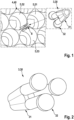
- the Figure 1 shows an arrangement of a clamping element 3 on a first cell holder element 4.
- the first cell holder element 4 is made of a first material 40.
- the first material 40 can be, for example, a polymer material.
- the first cell holder element 4 comprises a plurality of receptacles 5.
- the first cell holder element 4 has a first receptacle 51, a second receptacle 52 and a third receptacle 53.
- the receptacles 5 are essentially cylindrical.
- the receptacles 5 are each designed to accommodate a battery cell 2.
- the first receptacle 51 accommodates a first battery cell 21, the second receptacle 52 a second battery cell 22 and the third receptacle 53 a third battery cell 23.
- the clamping element 3 is made of a second material 30.
- the second material 30 can be a polymer material, for example.
- the first material 40 is different from the second material 30.
- the second material 30 has a higher elasticity than the first material 40.
- the clamping element 3 has a first section 31 and a second section 32.
- the first section 31 is designed to generate a mechanical force for clamping the battery cell 2 in the radial direction on the respective battery cell 2.
- the second section 32 is designed to generate a mechanical force for clamping the battery cell 2 in the axial direction on the respective battery cell 2.
- the clamping element 3 can also be wedge-shaped.
- first section 31 of the clamping element 3 or the second section 32 of the clamping element 3 are arranged at right angles to each other.
- the Figure 1 shows in particular a first method step for producing a battery module 10 according to the invention, in which the clamping element 3 is arranged on a first cell holder element 4.
- a clamping element 3 is arranged on the first cell holder element 4 between at least two battery cells 2.
- the clamping element 3 is arranged between three battery cells 2.
- each of the battery cells 2 is assigned at least one clamping element 3.
- the clamping element 3 can be connected to the first cell holder element 4 in particular by means of a plug connection.
- the first cell holder element 4 can have a plug receptacle 8, for example.
- the Figure 2 shows the clamping element 3 in a bottom view.
- the first section 31 and the second section 32 can be seen.
- the second portion 32 forms a stop which limits the arrangement in the depth direction.
- FIG 3 shows an arrangement of a battery cell 2, in particular a lithium ion battery cell 20, in a receptacle 5 of the first cell holder element 4.
- the battery cell 2 is designed as a cylindrical battery cell 2.
- a battery cell 2 is accommodated in each receptacle 5 of the first cell holder element 4.
- Each receptacle 5 of the first cell holder element 4 therefore accommodates one battery cell 2 of the plurality of battery cells 2.
- This plurality of battery cells 2 can be electrically connected to one another in series and/or in parallel.
- the clamping element 3 is arranged within the receptacle 5 of the first cell holder element 4.
- the clamping element 3 is arranged within the first receptacle 51, the second receptacle 52 and the Figure 3 not visible third receptacle 53.
- the clamping element 3 is arranged in the battery module 10 between three battery cells 2.
- the Figure 4 shows schematically in a sectional view from the side a section of a battery module 10 according to the invention.
- a first cell holder element 4 can be seen, which is made from the first material 40. Furthermore, the clamping element 3 can be seen, which is made from the second material 30.
- the first cell holder element 4 additionally has a projection 6, which is designed to form an additional mechanical force for bracing the battery cell 2 on the respective battery cell 2.
- the projection 6 forms a mechanical force in the radial direction on the respective battery cell 2.
- a cylindrical battery cell 2 can be seen.
- the battery cell 2 can also be seen in dashed lines before being arranged in the holder 5.
- the Figure 4 a second method step for producing a battery module 10 according to the invention, in which a battery cell 2 is arranged in the receptacle 5.
- the clamping element 3 generates a mechanical force to clamp the battery cell 2 onto the battery cell 2.
- the battery module 10 may further comprise a second cell holder element formed from the first material 3.
- the second cell holder element is identical to the first cell holder element 4 and has a plurality of substantially cylindrical receptacles.
- the second cell holder element can be placed on the first cell holder element 4 with the battery cells 2 accommodated in the receptacles 5, so that a total of one battery cell 2 is accommodated in a receptacle formed jointly by a receptacle 5 of the first cell holder element 4 and a receptacle of the second cell holder element.
- the Figure 5 shows different designs of a clamping element 3.
- the embodiment shown on the right differs from the two embodiments shown on the left in that it has a first section 31 and a second section 32.
- different cylindrically shaped battery cells 2 can also be selected, in particular from different manufacturers.
Landscapes
- Chemical & Material Sciences (AREA)
- Chemical Kinetics & Catalysis (AREA)
- Electrochemistry (AREA)
- General Chemical & Material Sciences (AREA)
- Battery Mounting, Suspending (AREA)
Description
- Die Erfindung geht aus von einem Batteriemodul mit einer Mehrzahl an Batteriezellen nach Gattung des unabhängigen Anspruchs. Gegenstand der vorliegenden Erfindung ist auch ein Verfahren zur Herstellung eines solchen Batteriemoduls.
- Aus dem Stand der Technik ist bekannt, dass Batteriemodule aus einer Mehrzahl an einzelnen Batteriezellen bestehen können, welche seriell und/oder parallel elektrisch leitend miteinander verschaltet sein können, so dass die einzelnen Batteriezellen zu dem Batteriemodul zusammengeschaltet sind.
- Weiterhin werden solche Batteriemodule zu Batterien bzw. zu gesamten Batteriesystemen zusammengeschaltet.
- Insbesondere bei Batteriemodulen mit sogenannten zylindrischen Batteriezellen können die Batteriezellen durch zwei nahezu identisch ausgebildete Zellhalter aufgenommen werden. Die Batteriezellen sind dabei in axialer und radialer Richtung der Batteriezelle zu fixieren. Dazu können bügelförmige axiale Spannelemente und hakenförmige radiale Spannelemente diese axiale und radiale Fixierung der Batteriezelle ausbilden. Die Spannelemente sind dabei in der Art elastisch ausgebildet, dass eine Montage der Batteriezellen die Spannelemente verformt und dadurch eine mechanische Fixierung ausgebildet ist. Im Falle einer mechanischen Überlast, wie beispielsweise einer schockartigen Belastung, ist die Fixierung oft nicht ausreichend und eine plastische Verformung der Spannelemente kann dazu führen, dass diese nach Beendigung der mechanischen Überlast nicht mehr in ihre ursprüngliche Form bzw. Lage zurückkehren können und dadurch keine ausreichende Fixierung mehr zur Verfügung stellen können.
- Auch eine vergleichbar steifere Ausbildung der Spannelemente ist mit dem Problem behaftet, dass dadurch Toleranzen an den solchen Spannelementen reduziert werden.
DE102018208342A1 offenbart ein Gehäuse für ein Batteriemodul. - Das Gehäuse dient zur Aufnahme mindestens einer Batteriezelle. Das Gehäuse um-fasst mindestens einen Batteriezellhalter, welcher mindestens eine Vertiefung aufweist, die zumindest annährend kreiszylindrisch und zumindest annährend rotationssymmetrisch zu einer in eine Axialrichtung verlaufende Mittelachse ausgebildet ist, und welche sich von einer Oberseite des Batteriezellhalters auf eine Unterseite des Batteriezellhalters zu erstreckt. Dabei ist in der mindestens einen Vertiefung des Batteriezellhalters mindestens ein Axialfederelement derart angeordnet, dass eine in die min- destens eine Vertiefung des Batteriezellhalters eingesetzte Batteriezelle in der Axialrichtung federelastisch aufgenommen ist.
- Ein Batteriemodul mit einer Mehrzahl an Batteriezellen mit den Merkmalen des unabhängigen Anspruchs bietet den Vorteil, dass auf zuverlässige, robuste Weise eine mechanische Verspannung der Mehrzahl an Batteriezellen ausgebildet werden kann.
- Dazu wird ein Batteriemodul mit einer Mehrzahl an zylindrisch ausgebildeten Batteriezellen zur Verfügung stellt. Die Batteriezellen sind dabei insbesondere als Lithium-lonen-Batteriezellen ausgebildet. Zudem sind die Batteriezellen elektrisch leitend seriell und/oder parallel miteinander verschaltet.
- Zudem umfasst das Batteriemodul ein erstes Zellhalterelement. Das erste Zellhalterelement ist dabei aus einem ersten Material ausgebildet. Weiterhin weist das erste Zellhalterelement eine Mehrzahl an im Wesentlichen zylindrisch ausgebildeten Aufnahmen auf. Dabei ist jeweils eine Batteriezelle in einer Aufnahme aufgenommen.
- Zwischen zumindest zwei Batteriezellen ist dabei ein Spannelement angeordnet.
- Das Spannelement ist dabei aus einem zweiten Material ausgebildet. Insbesondere ist das zweite Material von dem ersten Material verschieden. Weiterhin ist das Spannelement an dem ersten Zellhalterelement angeordnet. Das Spannelement ist dabei in der Art innerhalb der Aufnahmen der zumindest zwei Batteriezellen angeordnet, dass das Spannelement eine mechanische Kraft zu einer Verspannung der Batteriezelle auf die jeweilige Batteriezelle ausbildet.
- Durch die in den abhängigen Ansprüchen aufgeführten Maßnahmen sind vorteilhafte Weiterbildungen und Verbesserungen der im unabhängigen Anspruch angegebenen Vorrichtung möglich.
- An dieser Stelle sei angemerkt, dass zylindrische Batteriezellen auch als Rundzellen bezeichnet sein können. Zylindrische Batteriezellen weisen Im Wesentlichen eine zylindrische Mantelfläche mit einer kreisrunden Querschnittsfläche auf, welche an ihren beiden gegenüberliegenden Seiten jeweils von einer kreisrunden Boden- bzw. Deckelfläche abgeschlossen ist. Besonders bevorzugt sind die zylindrischen Batteriezellen jeweils Rundzellen vom Typ 18650, welche einen Durchmesser von 18 mm und eine Höhe von 65 mm aufweisen.
- Zylindrische Aufnahmen sind an dieser Stelle jeweils Hohlkörper, welche zumindest teilweise durch eine zylindrische Mantelfläche mit einer kreisrunden Querschnittsfläche begrenzt sind. Weiterhin weisen die zylindrischen Aufnahmen eine Bodenfläche oder Deckelfläche auf, welche die zylindrische Aufnahme ebenfalls begrenzt. An der gegenüberliegenden Seite weist der zylindrische Hohlkörper eine Öffnung auf, durch welche eine Batteriezelle eingesetzt werden kann.
- An dieser Stelle sei bemerkt, dass unter einer Anordnung zwischen zumindest zwei Batteriezellen verstanden sein soll, dass das Spannelement zwischen den zumindest zwei Batteriezellen in der Art zugeordnet ist, dass das Spannelement die jeweilige Batteriezelle mechanisch kontaktiert und dadurch eine Kraft zu einer Verspannung der Batteriezelle auf die jeweilige Batteriezelle ausbilden kann. In einem besonders bevorzugten Fall ist das Spannelement dabei in einem Flächenschwerpunkt der jeweiligen Querschnittsflächen der zumindest zwei Batteriezellen angeordnet.
- Ferner sei an dieser Stelle bemerkt, dass zu einer Anordnung des Spannelements an dem ersten Zellhalterelement das Spannelement an dem ersten Zellhalterelement angespritzt werden kann, beispielsweise mittels eines Zweikomponentenverfahrens, oder das Spannelement in das erste Zellhalterelement eingelegt bzw. eingesetzt werden kann.
- Es ist zweckmäßig, wenn das zweite Material eine höhere Elastizität aufweist als das erste Material. Mit anderen Worten ausgedrückt bedeutet dies, dass das zweite Material weicher ist als das erste Material. Dadurch kann eine effiziente, robuste Verspannung ausgebildet werden.
- Besonders bevorzugt ist es, wenn das Spannelement zwischen drei Batteriezellen angeordnet ist. Insbesondere ist das aus einem zweiten Material ausgebildete Spannelement dabei also zwischen drei Batteriezellen an dem ersten Zellhalterelement angeordnet. Dabei ist das Spannelement weiterhin in der Art innerhalb der Aufnahmen der drei Batteriezellen angeordnet, dass das Spannelement eine mechanische Kraft zu einer Verspannung der Batteriezelle auf die jeweilige Batteriezelle ausbildet. Eine solche Ausbildung bietet den Vorteil einer robusten, zuverlässigen Verspannung der Mehrzahl an zylindrisch ausgebildeten Batteriezellen, bei der ein zur Verfügung stehender Bauraum besonders effizient ausgenutzt werden kann.
- Vorteilhafterweiße ist jeder der Batteriezellen zumindest ein Spannelement zugeordnet. Dadurch ist es möglich, jede Batteriezelle der Mehrzahl an Batteriezellen zuverlässig mechanisch zu fixieren. An dieser Stelle sei angemerkt, dass besonders bevorzugt einer Batteriezelle auch mehrere Spannelemente, wie beispielsweise drei Spannelemente, zugeordnet sein können. An dieser Stelle sei angemerkt, dass unter einer Zuordnung eines Spannelements zu einer Batteriezelle verstanden sein soll, dass das Spannelement die jeweilige Batteriezelle mechanisch kontaktiert und dadurch eine Kraft zu einer Verspannung der Batteriezelle auf die zugeordnete Batteriezelle ausbilden kann.
- Besonders zweckmäßig umfasst das Spannelement einen ersten Abschnitt, welcher dazu ausgebildet ist, eine mechanische Kraft zu einer Verspannung der Batteriezelle in radialer Richtung oder axialer und radialer Richtung auszubilden. Unter Ausbildung einer mechanischen Kraft in radialer Richtung ist zu verstehen, dass senkrecht auf die Mantelfläche eine Kraft einwirkt. Insbesondere kann der erste Abschnitt dabei als ein Vorsprung oder eine Verdickung des Spannelements ausgebildet sein. Insbesondre ist das Spannelement keilförmig ausgebildet. Eine solches kann die Batteriezelle bspw. in radialer und axialer Richtung verspannen.
- Es ist auch zweckmäßig, wenn das Spannelement einen zweiten Abschnitt aufweist, welcher dazu ausgebildet ist, eine mechanische Kraft zu einer Verspannung der Batteriezelle in axialer Richtung auf die jeweilige Batteriezelle auszubilden. Unter Ausbildung einer mechanischen Kraft in axialer Richtung ist zu verstehen, dass in der Längsrichtung der Batteriezelle auf die Boden- bzw. Deckelfläche eine Kraft einwirkt. Insbesondere ist der erste Abschnitt dabei im Wesentlichen senkrecht zu dem zweiten Abschnitt angeordnet.
- Von Vorteil ist es, wenn das Batteriemodul zudem ein zweites Zellhalterelement aufweist. Das zweite Zellhalterelement ist dabei aus dem ersten Material ausgebildet. Weiterhin weist das zweite Zellhalterelement eine Mehrzahl an im Wesentlichen zylindrisch ausgebildeten Aufnahmen auf. Insbesondere kann das zweite Zellhalterelement identisch dem ersten Zellhalterelement ausgebildet sein. Dabei ist jeweils eine Batteriezelle in einer gemeinsam durch eine Aufnahme des ersten Zellhalterelements und eine Aufnahme des zweiten Zellhalterelements ausgebildeten Aufnahme aufgenommen. An dieser Stelle sei angemerkt, dass auch an dem zweiten Zellhalterelement zwischen zumindest zwei Batteriezellen ein aus dem zweiten Material ausgebildetes Spannelement an dem zweiten Zellhalterelement angeordnet sein kann, wobei das Spannelement weiterhin in der Art innerhalb der Aufnahmen der zumindest zwei Batteriezellen angeordnet ist, dass das Spannelement eine mechanische Kraft zu einer Verspannung der Batteriezelle auf die jeweilige Batteriezelle ausbildet.
- Gegenstand der vorliegenden Erfindung ist auch ein Verfahren zur Herstellung eines eben beschriebenen Batteriemoduls mit einer Mehrzahl an zylindrisch ausgebildeten Batteriezellen. Dabei wird in einem ersten Verfahrensschritt ein aus einem zweiten Material ausgebildetes Spannelement an einem aus einem ersten Material ausgebildeten ersten Zellhalterelement, welches eine Mehrzahl an im Wesentlichen zylindrisch ausgebildeten Aufnahmen aufweist, angeordnet. Dabei wird in einem zweiten Verfahrensschritt jeweils eine Batteriezelle in einer Aufnahme in der Art aufgenommen wird, dass zwischen zumindest zwei Batteriezellen ein Spannelement angeordnet ist und das Spannelement eine mechanische Kraft zu einer Verspannung der Batteriezelle auf die jeweilige Batteriezelle ausbildet.
- Insbesondere kann mit einer erfindungsgemäßen Ausführungsform eines Batteriemoduls durch Fixierung der Batteriezelle mittels des Spannelements das Batteriemodul flexibler und robuster gegenüber einer Toleranz der zylindrisch ausgebildeten Batteriezellen gestaltet werden. Weiterhin kann das Spannelement optimal und unabhängig auf die entsprechende Anwendung angepasst werden.
- Ausführungsbeispiele der Erfindung sind in den Zeichnungen dargestellt und in der nachfolgenden Beschreibung näher erläutert.
- Es zeigt:
- Figur 1
- eine Anordnung eines Spannelements an einem ersten Zellhalterelement,
- Figur 2
- das Spannelement in einer Unteransicht,
- Figur 3
- eine Anordnung einer Batteriezelle in einer Aufnahme des ersten Zellhalterelements,
- Figur 4
- schematisch eine Herstellung eines erfindungsgemäßen Batteriemoduls mit in einer Schnittansicht eines Ausschnitts eines erfindungsgemäßen Batteriemoduls und
- Figur 5
- unterschiedliche Ausführungsformen eines Spannelements.
- Die
Figur 1 zeigt eine Anordnung eines Spannelements 3 an einem ersten Zellhalterelement 4. - Das erste Zellhalterelement 4 ist dabei aus einem ersten Material 40 ausgebildet. Das erste Material 40 kann dabei beispielsweise ein polymerer Werkstoff sein.
- Das erste Zellhalterelement 4 umfasst dabei eine Mehrzahl an Aufnahmen 5. Insbesondere weist das erste Zellhalterelement 4 eine erste Aufnahme 51, eine zweite Aufnahme 52 und eine dritte Aufnahme 53 auf. Die Aufnahmen 5 sind dabei im Wesentlichen zylindrisch ausgebildet. Die Aufnahmen 5 sind dabei dazu ausgebildet, jeweils eine Batteriezelle 2 aufzunehmen. Beispielsweise nimmt die erste Aufnahme 51 eine erste Batteriezelle 21 auf, die zweite Aufnahme 52 eine zweite Batteriezelle 22 und die dritte Aufnahme 53 eine dritte Batteriezelle 23.
- Das Spannelement 3 ist dabei aus einem zweiten Material 30 ausgebildet. Das zweite Material 30 kann dabei beispielsweise ein polymerer Werkstoff sein. Das erste Material 40 ist dabei verschieden von dem zweiten Material 30. Insbesondere weist das zweite Material 30 eine höhere Elastizität auf als das erste Material 40.
- Das Spannelement 3 weist einen ersten Abschnitt 31 und einen zweiten Abschnitt 32 auf. Der erste Abschnitt 31 ist dazu ausgebildet, eine mechanische Kraft zu einer Verspannung der Batteriezelle 2 in radialer Richtung auf die jeweilige Batteriezelle 2 auszubilden. Der zweite Abschnitt 32 ist dazu ausgebildet, eine mechanische Kraft zu einer Verspannung der Batteriezelle 2 in axialer Richtung auf die jeweilige Batteriezelle 2 auszubilden. An dieser Stelle sei bemerkt, dass das Spannelement 3 auch keilförmig ausgebildet sein kann.
- Insbesondere sind der erste Abschnitt 31 des Spannelements 3 oder der zweite Abschnitt 32 des Spannelements 3 rechtwinklig zueinander angeordnet.
- Die
Figur 1 zeigt insbesondere einen ersten Verfahrensschritt zur Herstellung eines erfindungsgemäßen Batteriemoduls 10, bei dem das Spannelement 3 an einem ersten Zellhalterelement 4 angeordnet wird. - Beispielsweise ist aus der
Figur 1 auch zu erkennen, dass in einem erfindungsgemäßen Batteriemodul 10 zwischen zumindest zwei Batteriezellen 2 ein Spannelement 3 an dem ersten Zellhalterelement 4 angeordnet ist. Insbesondere ist das Spannelement 3 dabei zwischen drei Batteriezellen 2 angeordnet. An dieser Stelle sei weiterhin angemerkt, dass in dem Batteriemodul 10 jeder der Batteriezellen 2 zumindest ein Spannelement 3 zugeordnet ist. - Dabei kann das Spannelement 3 insbesondere mittels einer Steckverbindung mit dem ersten Zellhalterelement 4 verbunden werden. Dazu kann das erste Zellhalterelement 4 beispielsweise eine Steckaufnahme 8 aufweisen.
- Die
Figur 2 zeigt das Spannelement 3 in einer Unteransicht. Dabei sind der erste Abschnitt 31 und der zweite Abschnitt 32 zu erkennen. Insbesondere ist zu erkennen, dass der zweite Abschnitt 32 einen Anschlag ausbildet, welcher die Anordnung in der Tiefenrichtung begrenzt. -
Figur 3 zeigt eine Anordnung einer Batteriezelle 2, insbesondere einer Lithiumlonen-Batteriezelle 20, in einer Aufnahme 5 des ersten Zellhalterelements 4. Die Batteriezelle 2 ist dabei als zylindrische Batteriezelle 2 ausgebildet. Dabei wird in jeder Aufnahme 5 des ersten Zellhalterelements 4 eine Batteriezelle 2 aufgenommen. In jeder Aufnahme 5 des ersten Zellhalterelements 4 ist also jeweils eine Batteriezelle 2 der Mehrzahl an Batteriezellen 2 aufgenommen. Diese Mehrzahl an Batteriezellen 2 kann elektrisch leitend seriell und/oder parallel miteinander verschaltet werden. - Weiterhin ist zu erkennen, dass das Spannelement 3 innerhalb der Aufnahme 5 des ersten Zellhalterelements 4 angeordnet ist. Insbesondere ist das Spannelement 3 dabei innerhalb der ersten Aufnahme 51, der zweiten Aufnahme 52 und der in der
Figur 3 nicht zu erkennenden dritten Aufnahme 53 angeordnet. Somit ist das Spannelement 3 in dem Batteriemodul 10 zwischen drei Batteriezellen 2 angeordnet. - Die
Figur 4 zeigt schematisch in einer Schnittansicht von der Seite einen Ausschnitt eines erfindungsgemäßen Batteriemoduls 10. - Dabei ist zunächst ein erstes Zellhalterelement 4 zu erkennen, welches aus dem ersten Material 40 ausgebildet ist. Weiterhin ist das Spannelement 3 zu erkennen, welches aus dem zweiten Material 30 ausgebildet ist.
- Das erste Zellhalterelement 4 weist hierbei zusätzlich noch einen Vorsprung 6 auf, welcher dazu ausgebildet ist, eine zusätzliche mechanische Kraft zu einer Verspannung der Batteriezelle 2 auf die jeweilige Batteriezelle 2 auszubilden. Insbesondere bildet der Vorsprung 6 eine mechanische Kraft in radialer Richtung auf die jeweilige Batteriezelle 2 aus.
- Zudem ist eine zylindrisch ausgebildete Batteriezelle 2 zu erkennen. Gestrichelt liniert ist weiterhin die Batteriezelle 2 vor der Anordnung in der Aufnahme 5 zu erkennen.
- Insbesondere zeigt die
Figur 4 einen zweiten Verfahrensschritt zur Herstellung eines erfindungsgemäßen Batteriemoduls 10, bei dem eine Batteriezelle 2 in der Aufnahme 5 angeordnet wird. - Insbesondere ist aus der
Figur 4 zu erkennen, dass das Spannelement 3 eine mechanische Kraft zu einer Verspannung der Batteriezelle 2 auf die Batteriezelle 2 ausbildet. - An dieser Stelle sei angemerkt, dass das Batteriemodul 10 weiterhin ein aus dem ersten Material 3 ausgebildetes zweites Zellhalterelement aufweisen kann.
- Das zweite Zellhalterelement ist identisch dem ersten Zellhalterelement 4 ausgebildet und weist eine Mehrzahl an im Wesentlichen zylindrisch ausgebildeten Aufnahmen auf.
- Dabei kann das zweite Zellhalterelement auf das erste Zellhalterelement 4 mit den in den Aufnahmen 5 aufgenommenen Batteriezellen 2 aufgesetzt werden, sodass insgesamt jeweils eine Batteriezelle 2 in einer gemeinsam durch eine Aufnahme 5 des ersten Zellhalterelements 4 und eine Aufnahme des zweiten Zellhalterelements ausgebildeten Aufnahme aufgenommen ist.
- Die
Figur 5 zeigt unterschiedliche Ausführungsformen eines Spannelements 3. - Die rechts dargestellte Ausführungsform unterscheidet sich von den beiden links dargestellten Ausführungsform dadurch, dass diese einen ersten Abschnitt 31 und einen zweiten Abschnitt 32 aufweist.
- Die beiden links dargestellten Ausführungsformen weisen hingegen eine Verdickung 7 auf.
- Allen drei Ausführungsform ist gemeinsam, dass sie mittels einer Steckverbindung mit dem ersten Zellhalterelement 4 verbunden werden können.
- Durch solche unterschiedlichen Ausführungsformen können auch unterschiedliche zylindrisch ausgebildete Batteriezellen 2 insbesondere auch von unterschiedlichen Herstellern ausgewählt werden.
Claims (8)
- Batteriemodul mit einer Mehrzahl an zylindrisch ausgebildeten Batteriezellen (2), insbesondere Lithium-Ionen-Batteriezellen (20), welche elektrisch leitend seriell und/oder parallel miteinander verschaltet sind, und einem aus einem ersten Material (40) ausgebildeten ersten Zellhalterelement (4), welches eine Mehrzahl an im Wesentlichen zylindrisch ausgebildeten Aufnahmen (5) aufweist, wobei jeweils eine Batteriezelle (2) in einer Aufnahme (5) aufgenommen ist,
dadurch gekennzeichnet, dass
zwischen zumindest zwei Batteriezellen (2) ein aus einem zweiten Material (30) ausgebildetes Spannelement (3) an dem ersten Zellhalterelement (4) angeordnet ist, wobei das Spannelement (3) weiterhin in der Art innerhalb der Aufnahmen (5) der zumindest zwei Batteriezellen (2) angeordnet ist, dass das Spannelement (3) eine mechanische Kraft zu einer Verspannung der Batteriezelle (2) auf die jeweilige Batteriezelle (2) ausbildet. - Batteriemodul nach dem vorhergehenden Anspruch 1,
dadurch gekennzeichnet, dass
das zweite Material (30) eine höhere Elastizität aufweist als das erste Material (40). - Batteriemodul nach einem der vorhergehenden Ansprüche 1 bis 2,
dadurch gekennzeichnet, dass
das Spannelement (3) zwischen drei Batteriezellen (2) angeordnet ist. - Batteriemodul nach einem der vorhergehenden Ansprüche 1 bis 3,
dadurch gekennzeichnet, dass
jeder der Batteriezellen (2) zumindest ein Spannelement (3) zugeordnet ist. - Batteriemodul nach einem der vorhergehenden Ansprüche 1 bis 4,
dadurch gekennzeichnet, dass
das Spannelement (3) einen ersten Abschnitt (31) aufweist, welcher ausgebildet ist, eine mechanische Kraft zu einer Verspannung der Batteriezelle (2) in radialer Richtung auf die jeweilige Batteriezelle (2) auszubilden. - Batteriemodul nach einem der vorhergehenden Ansprüche 1 bis 5,
dadurch gekennzeichnet, dass
das Spannelement (3) einen zweiten Abschnitt (32) aufweist, welcher ausgebildet ist, eine mechanische Kraft zu einer Verspannung der Batteriezelle (2) in axialer Richtung auf die jeweilige Batteriezelle (2) auszubilden. - Batteriemodul nach einem der vorhergehenden Ansprüche 1 bis 6,
dadurch gekennzeichnet, dass
das Batteriemodul (10) ein aus dem ersten Material (30) ausgebildetes zweites Zellhalterelement aufweist, welches eine Mehrzahl an im Wesentlichen zylindrisch ausgebildeten Aufnahmen aufweist, wobei jeweils eine Batteriezelle (2) in einer gemeinsam durch eine Aufnahme (5) des ersten Zellhalterelements (4) und eine Aufnahme des zweiten Zellhalterelements ausgebildeten Aufnahme aufgenommen ist. - Verfahren zur Herstellung eines Batteriemoduls (10) mit einer Mehrzahl an zylindrisch ausgebildeten Batteriezellen (2) nach einem der Ansprüche 1 bis 7, wobei in einem ersten Verfahrensschritt ein aus einem zweiten Material (30) ausgebildetes Spannelement (3) an einem aus einem ersten Material (40) ausgebildeten ersten Zellhalterelement (4), welches eine Mehrzahl an im Wesentlichen zylindrisch ausgebildeten Aufnahmen (5) aufweist, angeordnet wird, wobei in einem zweiten Verfahrensschritt jeweils eine Batteriezelle (2) in einer Aufnahme (5) in der Art aufgenommen wird, dass zwischen zumindest zwei Batteriezellen (2) ein Spannelement (3) angeordnet ist und das Spannelement (3) eine mechanische Kraft zu einer Verspannung der Batteriezelle (2) auf die jeweilige Batteriezelle (2) ausbildet.
Applications Claiming Priority (2)
| Application Number | Priority Date | Filing Date | Title |
|---|---|---|---|
| DE102020207760.6A DE102020207760A1 (de) | 2020-06-23 | 2020-06-23 | Batteriemodul mit einer Mehrzahl an Batteriezellen und Verfahren zur Herstellung eines solchen |
| PCT/EP2021/065470 WO2021259640A1 (de) | 2020-06-23 | 2021-06-09 | Batteriemodul mit einer mehrzahl an batteriezellen und verfahren zur herstellung eines solchen |
Publications (2)
| Publication Number | Publication Date |
|---|---|
| EP4169114A1 EP4169114A1 (de) | 2023-04-26 |
| EP4169114B1 true EP4169114B1 (de) | 2024-08-21 |
Family
ID=76522927
Family Applications (1)
| Application Number | Title | Priority Date | Filing Date |
|---|---|---|---|
| EP21733387.1A Active EP4169114B1 (de) | 2020-06-23 | 2021-06-09 | Batteriemodul mit einer mehrzahl an batteriezellen und verfahren zur herstellung eines solchen |
Country Status (4)
| Country | Link |
|---|---|
| EP (1) | EP4169114B1 (de) |
| DE (1) | DE102020207760A1 (de) |
| TW (1) | TW202205727A (de) |
| WO (1) | WO2021259640A1 (de) |
Families Citing this family (1)
| Publication number | Priority date | Publication date | Assignee | Title |
|---|---|---|---|---|
| DE102024210103A1 (de) * | 2024-10-18 | 2026-04-23 | Robert Bosch Gesellschaft mit beschränkter Haftung | Zellhalter für eine Batterieanordnung |
Family Cites Families (5)
| Publication number | Priority date | Publication date | Assignee | Title |
|---|---|---|---|---|
| DE102012000996B4 (de) | 2012-01-20 | 2022-01-27 | Sew-Eurodrive Gmbh & Co Kg | Anordnung mit einer Leiterplatte und Bauelementen |
| JP5812903B2 (ja) | 2012-03-08 | 2015-11-17 | アイシン軽金属株式会社 | 円筒型電池の保持構造体 |
| JP6151940B2 (ja) | 2013-03-22 | 2017-06-21 | 豊田合成株式会社 | 電池装置 |
| DE102018208342A1 (de) | 2018-05-28 | 2019-11-28 | Robert Bosch Gmbh | Gehäuse für ein Batteriemodul und Batteriemodul |
| DE102019211359A1 (de) | 2018-11-30 | 2020-06-04 | Robert Bosch Gmbh | Batteriezellenhalter sowie Batteriesystem |
-
2020
- 2020-06-23 DE DE102020207760.6A patent/DE102020207760A1/de not_active Withdrawn
-
2021
- 2021-06-09 WO PCT/EP2021/065470 patent/WO2021259640A1/de not_active Ceased
- 2021-06-09 EP EP21733387.1A patent/EP4169114B1/de active Active
- 2021-06-21 TW TW110122584A patent/TW202205727A/zh unknown
Also Published As
| Publication number | Publication date |
|---|---|
| TW202205727A (zh) | 2022-02-01 |
| WO2021259640A1 (de) | 2021-12-30 |
| EP4169114A1 (de) | 2023-04-26 |
| DE102020207760A1 (de) | 2021-12-23 |
Similar Documents
| Publication | Publication Date | Title |
|---|---|---|
| WO2012130423A1 (de) | Batterie für ein kraftfahrzeug | |
| EP3804003B1 (de) | Gehäuse für ein batteriemodul und batteriemodul | |
| DE102016220989A1 (de) | Batteriezellhalter zur federelastischen Aufnahme mindestens einer Batteriezelle, Batteriemodulgehäuse und Batteriemodul sowie Verfahren zur Herstellung des Batteriemoduls | |
| EP4169114B1 (de) | Batteriemodul mit einer mehrzahl an batteriezellen und verfahren zur herstellung eines solchen | |
| EP0495778B1 (de) | Filter-steckverbinder | |
| DE102019210766A1 (de) | Kontaktfeder mit Federring (betrifft Kreisel-Konzept, z.H. Herr Stingl) | |
| EP3473496B1 (de) | Haltevorrichtung und baugruppe mit einer haltevorrichtung | |
| EP3552256B1 (de) | Batterie und verfahren zur herstellung einer batterie | |
| EP4352817A1 (de) | Batteriemodul, verfahren zur herstellung eines solchen und kraftfahrzeug | |
| EP3764477B1 (de) | Kontaktträger für einen steckverbinder | |
| DE102023206932B4 (de) | Testkontaktor zum Testen eines elektrisch leitfähigen Testelements, Verfahren zur Herstellung eines Testkontaktors zum Testen eines elektrisch leitfähigen Testelements, sowie Verwendung eines Stützelements für einen Testkontaktor | |
| DE102021205610A1 (de) | Batteriemodul, Verfahren zur Herstellung eines solchen und Kraftfahrzeug | |
| EP4560370B1 (de) | Spleissschutzaufnahme | |
| DE102023119306B4 (de) | Testkontaktor zum Testen eines elektrisch leitfähigen Testelements, sowie Verfahren zur Herstellung eines Testkontaktors zum Testen eines elektrisch leitfähigen Testelements | |
| DE102023206948B4 (de) | Einsatz für einen Testkontaktor zum Testen eines elektrisch leitfähigen Testelements, Testkontaktor zum Testen eines elektrisch leitfähigen Testelements, sowie Verwendung eines Einsatzes für einen Testkontaktor zum Testen eines elektrisch leitfähigen Testelements | |
| DE102023206931B4 (de) | Einsatz für einen Testkontaktor zum Testen eines elektrisch leitfähigen Testelements, Testkontaktor zum Testen eines elektrisch leitfähigen Testelements, sowie Verwendung eines Einsatzes für einen Testkontaktor zum Testen eines elektrisch leitfähigen Testelements | |
| DE102022125074B3 (de) | Kontaktelement zum elektrisch leitfähigen kontaktieren eines batteriezellengehäuses | |
| DE102020126505A1 (de) | Anschlussklemme | |
| DE102019216717A1 (de) | Batteriemodul | |
| DE102019118922B4 (de) | Kontaktträger für einen Steckverbinder sowie Steckverbinder | |
| DE112022002892T5 (de) | Vorrichtung zur Halterung einer Vielzahl von Magnetventilen | |
| DE102024100558A1 (de) | Schussvorrichtung | |
| EP3467899B1 (de) | Akkupack für mehrere akkus | |
| DE102025121840A1 (de) | Leiteranschlussklemme | |
| DE102019205352A1 (de) | Batteriezellaufnahmeelement und Batteriemodul |
Legal Events
| Date | Code | Title | Description |
|---|---|---|---|
| STAA | Information on the status of an ep patent application or granted ep patent |
Free format text: STATUS: UNKNOWN |
|
| STAA | Information on the status of an ep patent application or granted ep patent |
Free format text: STATUS: THE INTERNATIONAL PUBLICATION HAS BEEN MADE |
|
| PUAI | Public reference made under article 153(3) epc to a published international application that has entered the european phase |
Free format text: ORIGINAL CODE: 0009012 |
|
| STAA | Information on the status of an ep patent application or granted ep patent |
Free format text: STATUS: REQUEST FOR EXAMINATION WAS MADE |
|
| 17P | Request for examination filed |
Effective date: 20230123 |
|
| AK | Designated contracting states |
Kind code of ref document: A1 Designated state(s): AL AT BE BG CH CY CZ DE DK EE ES FI FR GB GR HR HU IE IS IT LI LT LU LV MC MK MT NL NO PL PT RO RS SE SI SK SM TR |
|
| DAV | Request for validation of the european patent (deleted) | ||
| DAX | Request for extension of the european patent (deleted) | ||
| GRAP | Despatch of communication of intention to grant a patent |
Free format text: ORIGINAL CODE: EPIDOSNIGR1 |
|
| STAA | Information on the status of an ep patent application or granted ep patent |
Free format text: STATUS: GRANT OF PATENT IS INTENDED |
|
| INTG | Intention to grant announced |
Effective date: 20240313 |
|
| GRAS | Grant fee paid |
Free format text: ORIGINAL CODE: EPIDOSNIGR3 |
|
| GRAA | (expected) grant |
Free format text: ORIGINAL CODE: 0009210 |
|
| STAA | Information on the status of an ep patent application or granted ep patent |
Free format text: STATUS: THE PATENT HAS BEEN GRANTED |
|
| AK | Designated contracting states |
Kind code of ref document: B1 Designated state(s): AL AT BE BG CH CY CZ DE DK EE ES FI FR GB GR HR HU IE IS IT LI LT LU LV MC MK MT NL NO PL PT RO RS SE SI SK SM TR |
|
| REG | Reference to a national code |
Ref country code: GB Ref legal event code: FG4D Free format text: NOT ENGLISH |
|
| REG | Reference to a national code |
Ref country code: CH Ref legal event code: EP |
|
| REG | Reference to a national code |
Ref country code: DE Ref legal event code: R096 Ref document number: 502021004870 Country of ref document: DE |
|
| REG | Reference to a national code |
Ref country code: IE Ref legal event code: FG4D Free format text: LANGUAGE OF EP DOCUMENT: GERMAN |
|
| REG | Reference to a national code |
Ref country code: LT Ref legal event code: MG9D |
|
| REG | Reference to a national code |
Ref country code: NL Ref legal event code: MP Effective date: 20240821 |
|
| PG25 | Lapsed in a contracting state [announced via postgrant information from national office to epo] |
Ref country code: NO Free format text: LAPSE BECAUSE OF FAILURE TO SUBMIT A TRANSLATION OF THE DESCRIPTION OR TO PAY THE FEE WITHIN THE PRESCRIBED TIME-LIMIT Effective date: 20241121 |
|
| PG25 | Lapsed in a contracting state [announced via postgrant information from national office to epo] |
Ref country code: NL Free format text: LAPSE BECAUSE OF FAILURE TO SUBMIT A TRANSLATION OF THE DESCRIPTION OR TO PAY THE FEE WITHIN THE PRESCRIBED TIME-LIMIT Effective date: 20240821 Ref country code: FI Free format text: LAPSE BECAUSE OF FAILURE TO SUBMIT A TRANSLATION OF THE DESCRIPTION OR TO PAY THE FEE WITHIN THE PRESCRIBED TIME-LIMIT Effective date: 20240821 Ref country code: GR Free format text: LAPSE BECAUSE OF FAILURE TO SUBMIT A TRANSLATION OF THE DESCRIPTION OR TO PAY THE FEE WITHIN THE PRESCRIBED TIME-LIMIT Effective date: 20241122 Ref country code: PT Free format text: LAPSE BECAUSE OF FAILURE TO SUBMIT A TRANSLATION OF THE DESCRIPTION OR TO PAY THE FEE WITHIN THE PRESCRIBED TIME-LIMIT Effective date: 20241223 Ref country code: PL Free format text: LAPSE BECAUSE OF FAILURE TO SUBMIT A TRANSLATION OF THE DESCRIPTION OR TO PAY THE FEE WITHIN THE PRESCRIBED TIME-LIMIT Effective date: 20240821 |
|
| PG25 | Lapsed in a contracting state [announced via postgrant information from national office to epo] |
Ref country code: BG Free format text: LAPSE BECAUSE OF FAILURE TO SUBMIT A TRANSLATION OF THE DESCRIPTION OR TO PAY THE FEE WITHIN THE PRESCRIBED TIME-LIMIT Effective date: 20240821 |
|
| PG25 | Lapsed in a contracting state [announced via postgrant information from national office to epo] |
Ref country code: LV Free format text: LAPSE BECAUSE OF FAILURE TO SUBMIT A TRANSLATION OF THE DESCRIPTION OR TO PAY THE FEE WITHIN THE PRESCRIBED TIME-LIMIT Effective date: 20240821 |
|
| PG25 | Lapsed in a contracting state [announced via postgrant information from national office to epo] |
Ref country code: IS Free format text: LAPSE BECAUSE OF FAILURE TO SUBMIT A TRANSLATION OF THE DESCRIPTION OR TO PAY THE FEE WITHIN THE PRESCRIBED TIME-LIMIT Effective date: 20241221 |
|
| PG25 | Lapsed in a contracting state [announced via postgrant information from national office to epo] |
Ref country code: HR Free format text: LAPSE BECAUSE OF FAILURE TO SUBMIT A TRANSLATION OF THE DESCRIPTION OR TO PAY THE FEE WITHIN THE PRESCRIBED TIME-LIMIT Effective date: 20240821 |
|
| PG25 | Lapsed in a contracting state [announced via postgrant information from national office to epo] |
Ref country code: RS Free format text: LAPSE BECAUSE OF FAILURE TO SUBMIT A TRANSLATION OF THE DESCRIPTION OR TO PAY THE FEE WITHIN THE PRESCRIBED TIME-LIMIT Effective date: 20241121 Ref country code: ES Free format text: LAPSE BECAUSE OF FAILURE TO SUBMIT A TRANSLATION OF THE DESCRIPTION OR TO PAY THE FEE WITHIN THE PRESCRIBED TIME-LIMIT Effective date: 20240821 |
|
| PG25 | Lapsed in a contracting state [announced via postgrant information from national office to epo] |
Ref country code: RS Free format text: LAPSE BECAUSE OF FAILURE TO SUBMIT A TRANSLATION OF THE DESCRIPTION OR TO PAY THE FEE WITHIN THE PRESCRIBED TIME-LIMIT Effective date: 20241121 Ref country code: PT Free format text: LAPSE BECAUSE OF FAILURE TO SUBMIT A TRANSLATION OF THE DESCRIPTION OR TO PAY THE FEE WITHIN THE PRESCRIBED TIME-LIMIT Effective date: 20241223 Ref country code: PL Free format text: LAPSE BECAUSE OF FAILURE TO SUBMIT A TRANSLATION OF THE DESCRIPTION OR TO PAY THE FEE WITHIN THE PRESCRIBED TIME-LIMIT Effective date: 20240821 Ref country code: NO Free format text: LAPSE BECAUSE OF FAILURE TO SUBMIT A TRANSLATION OF THE DESCRIPTION OR TO PAY THE FEE WITHIN THE PRESCRIBED TIME-LIMIT Effective date: 20241121 Ref country code: NL Free format text: LAPSE BECAUSE OF FAILURE TO SUBMIT A TRANSLATION OF THE DESCRIPTION OR TO PAY THE FEE WITHIN THE PRESCRIBED TIME-LIMIT Effective date: 20240821 Ref country code: LV Free format text: LAPSE BECAUSE OF FAILURE TO SUBMIT A TRANSLATION OF THE DESCRIPTION OR TO PAY THE FEE WITHIN THE PRESCRIBED TIME-LIMIT Effective date: 20240821 Ref country code: IS Free format text: LAPSE BECAUSE OF FAILURE TO SUBMIT A TRANSLATION OF THE DESCRIPTION OR TO PAY THE FEE WITHIN THE PRESCRIBED TIME-LIMIT Effective date: 20241221 Ref country code: HR Free format text: LAPSE BECAUSE OF FAILURE TO SUBMIT A TRANSLATION OF THE DESCRIPTION OR TO PAY THE FEE WITHIN THE PRESCRIBED TIME-LIMIT Effective date: 20240821 Ref country code: GR Free format text: LAPSE BECAUSE OF FAILURE TO SUBMIT A TRANSLATION OF THE DESCRIPTION OR TO PAY THE FEE WITHIN THE PRESCRIBED TIME-LIMIT Effective date: 20241122 Ref country code: FI Free format text: LAPSE BECAUSE OF FAILURE TO SUBMIT A TRANSLATION OF THE DESCRIPTION OR TO PAY THE FEE WITHIN THE PRESCRIBED TIME-LIMIT Effective date: 20240821 Ref country code: ES Free format text: LAPSE BECAUSE OF FAILURE TO SUBMIT A TRANSLATION OF THE DESCRIPTION OR TO PAY THE FEE WITHIN THE PRESCRIBED TIME-LIMIT Effective date: 20240821 Ref country code: BG Free format text: LAPSE BECAUSE OF FAILURE TO SUBMIT A TRANSLATION OF THE DESCRIPTION OR TO PAY THE FEE WITHIN THE PRESCRIBED TIME-LIMIT Effective date: 20240821 |
|
| PG25 | Lapsed in a contracting state [announced via postgrant information from national office to epo] |
Ref country code: RO Free format text: LAPSE BECAUSE OF FAILURE TO SUBMIT A TRANSLATION OF THE DESCRIPTION OR TO PAY THE FEE WITHIN THE PRESCRIBED TIME-LIMIT Effective date: 20240821 Ref country code: DK Free format text: LAPSE BECAUSE OF FAILURE TO SUBMIT A TRANSLATION OF THE DESCRIPTION OR TO PAY THE FEE WITHIN THE PRESCRIBED TIME-LIMIT Effective date: 20240821 Ref country code: SM Free format text: LAPSE BECAUSE OF FAILURE TO SUBMIT A TRANSLATION OF THE DESCRIPTION OR TO PAY THE FEE WITHIN THE PRESCRIBED TIME-LIMIT Effective date: 20240821 |
|
| PG25 | Lapsed in a contracting state [announced via postgrant information from national office to epo] |
Ref country code: EE Free format text: LAPSE BECAUSE OF FAILURE TO SUBMIT A TRANSLATION OF THE DESCRIPTION OR TO PAY THE FEE WITHIN THE PRESCRIBED TIME-LIMIT Effective date: 20240821 |
|
| PG25 | Lapsed in a contracting state [announced via postgrant information from national office to epo] |
Ref country code: CZ Free format text: LAPSE BECAUSE OF FAILURE TO SUBMIT A TRANSLATION OF THE DESCRIPTION OR TO PAY THE FEE WITHIN THE PRESCRIBED TIME-LIMIT Effective date: 20240821 |
|
| PG25 | Lapsed in a contracting state [announced via postgrant information from national office to epo] |
Ref country code: SK Free format text: LAPSE BECAUSE OF FAILURE TO SUBMIT A TRANSLATION OF THE DESCRIPTION OR TO PAY THE FEE WITHIN THE PRESCRIBED TIME-LIMIT Effective date: 20240821 Ref country code: IT Free format text: LAPSE BECAUSE OF FAILURE TO SUBMIT A TRANSLATION OF THE DESCRIPTION OR TO PAY THE FEE WITHIN THE PRESCRIBED TIME-LIMIT Effective date: 20240821 |
|
| REG | Reference to a national code |
Ref country code: DE Ref legal event code: R097 Ref document number: 502021004870 Country of ref document: DE |
|
| PLBE | No opposition filed within time limit |
Free format text: ORIGINAL CODE: 0009261 |
|
| STAA | Information on the status of an ep patent application or granted ep patent |
Free format text: STATUS: NO OPPOSITION FILED WITHIN TIME LIMIT |
|
| PGFP | Annual fee paid to national office [announced via postgrant information from national office to epo] |
Ref country code: AT Payment date: 20250721 Year of fee payment: 5 |
|
| 26N | No opposition filed |
Effective date: 20250522 |
|
| PG25 | Lapsed in a contracting state [announced via postgrant information from national office to epo] |
Ref country code: SE Free format text: LAPSE BECAUSE OF FAILURE TO SUBMIT A TRANSLATION OF THE DESCRIPTION OR TO PAY THE FEE WITHIN THE PRESCRIBED TIME-LIMIT Effective date: 20240821 |
|
| PGFP | Annual fee paid to national office [announced via postgrant information from national office to epo] |
Ref country code: DE Payment date: 20250814 Year of fee payment: 5 |
|
| REG | Reference to a national code |
Ref country code: CH Ref legal event code: H13 Free format text: ST27 STATUS EVENT CODE: U-0-0-H10-H13 (AS PROVIDED BY THE NATIONAL OFFICE) Effective date: 20260127 |
|
| PG25 | Lapsed in a contracting state [announced via postgrant information from national office to epo] |
Ref country code: MC Free format text: LAPSE BECAUSE OF FAILURE TO SUBMIT A TRANSLATION OF THE DESCRIPTION OR TO PAY THE FEE WITHIN THE PRESCRIBED TIME-LIMIT Effective date: 20240821 |
|
| PG25 | Lapsed in a contracting state [announced via postgrant information from national office to epo] |
Ref country code: LU Free format text: LAPSE BECAUSE OF NON-PAYMENT OF DUE FEES Effective date: 20250609 |
|
| GBPC | Gb: european patent ceased through non-payment of renewal fee |
Effective date: 20250609 |
|
| REG | Reference to a national code |
Ref country code: BE Ref legal event code: MM Effective date: 20250630 |
|
| PG25 | Lapsed in a contracting state [announced via postgrant information from national office to epo] |
Ref country code: GB Free format text: LAPSE BECAUSE OF NON-PAYMENT OF DUE FEES Effective date: 20250609 |
|
| PG25 | Lapsed in a contracting state [announced via postgrant information from national office to epo] |
Ref country code: IE Free format text: LAPSE BECAUSE OF NON-PAYMENT OF DUE FEES Effective date: 20250609 |
|
| PG25 | Lapsed in a contracting state [announced via postgrant information from national office to epo] |
Ref country code: BE Free format text: LAPSE BECAUSE OF NON-PAYMENT OF DUE FEES Effective date: 20250630 |
|
| PG25 | Lapsed in a contracting state [announced via postgrant information from national office to epo] |
Ref country code: FR Free format text: LAPSE BECAUSE OF NON-PAYMENT OF DUE FEES Effective date: 20250630 |
|
| PG25 | Lapsed in a contracting state [announced via postgrant information from national office to epo] |
Ref country code: CH Free format text: LAPSE BECAUSE OF NON-PAYMENT OF DUE FEES Effective date: 20250630 |