EP4166399B1 - Vehicle control method and device, storage medium, and vehicle - Google Patents
Vehicle control method and device, storage medium, and vehicle Download PDFInfo
- Publication number
- EP4166399B1 EP4166399B1 EP22201092.8A EP22201092A EP4166399B1 EP 4166399 B1 EP4166399 B1 EP 4166399B1 EP 22201092 A EP22201092 A EP 22201092A EP 4166399 B1 EP4166399 B1 EP 4166399B1
- Authority
- EP
- European Patent Office
- Prior art keywords
- parking system
- vehicle
- output signal
- instruction
- hydraulic
- Prior art date
- Legal status (The legal status is an assumption and is not a legal conclusion. Google has not performed a legal analysis and makes no representation as to the accuracy of the status listed.)
- Active
Links
Images
Classifications
-
- B—PERFORMING OPERATIONS; TRANSPORTING
- B60—VEHICLES IN GENERAL
- B60T—VEHICLE BRAKE CONTROL SYSTEMS OR PARTS THEREOF; BRAKE CONTROL SYSTEMS OR PARTS THEREOF, IN GENERAL; ARRANGEMENT OF BRAKING ELEMENTS ON VEHICLES IN GENERAL; PORTABLE DEVICES FOR PREVENTING UNWANTED MOVEMENT OF VEHICLES; VEHICLE MODIFICATIONS TO FACILITATE COOLING OF BRAKES
- B60T7/00—Brake-action initiating means
- B60T7/12—Brake-action initiating means for automatic initiation; for initiation not subject to will of driver or passenger
-
- B—PERFORMING OPERATIONS; TRANSPORTING
- B60—VEHICLES IN GENERAL
- B60T—VEHICLE BRAKE CONTROL SYSTEMS OR PARTS THEREOF; BRAKE CONTROL SYSTEMS OR PARTS THEREOF, IN GENERAL; ARRANGEMENT OF BRAKING ELEMENTS ON VEHICLES IN GENERAL; PORTABLE DEVICES FOR PREVENTING UNWANTED MOVEMENT OF VEHICLES; VEHICLE MODIFICATIONS TO FACILITATE COOLING OF BRAKES
- B60T13/00—Transmitting braking action from initiating means to ultimate brake actuator with power assistance or drive; Brake systems incorporating such transmitting means, e.g. air-pressure brake systems
- B60T13/10—Transmitting braking action from initiating means to ultimate brake actuator with power assistance or drive; Brake systems incorporating such transmitting means, e.g. air-pressure brake systems with fluid assistance, drive, or release
- B60T13/66—Electrical control in fluid-pressure brake systems
-
- B—PERFORMING OPERATIONS; TRANSPORTING
- B60—VEHICLES IN GENERAL
- B60T—VEHICLE BRAKE CONTROL SYSTEMS OR PARTS THEREOF; BRAKE CONTROL SYSTEMS OR PARTS THEREOF, IN GENERAL; ARRANGEMENT OF BRAKING ELEMENTS ON VEHICLES IN GENERAL; PORTABLE DEVICES FOR PREVENTING UNWANTED MOVEMENT OF VEHICLES; VEHICLE MODIFICATIONS TO FACILITATE COOLING OF BRAKES
- B60T13/00—Transmitting braking action from initiating means to ultimate brake actuator with power assistance or drive; Brake systems incorporating such transmitting means, e.g. air-pressure brake systems
- B60T13/74—Transmitting braking action from initiating means to ultimate brake actuator with power assistance or drive; Brake systems incorporating such transmitting means, e.g. air-pressure brake systems with electrical assistance or drive
-
- B—PERFORMING OPERATIONS; TRANSPORTING
- B60—VEHICLES IN GENERAL
- B60T—VEHICLE BRAKE CONTROL SYSTEMS OR PARTS THEREOF; BRAKE CONTROL SYSTEMS OR PARTS THEREOF, IN GENERAL; ARRANGEMENT OF BRAKING ELEMENTS ON VEHICLES IN GENERAL; PORTABLE DEVICES FOR PREVENTING UNWANTED MOVEMENT OF VEHICLES; VEHICLE MODIFICATIONS TO FACILITATE COOLING OF BRAKES
- B60T13/00—Transmitting braking action from initiating means to ultimate brake actuator with power assistance or drive; Brake systems incorporating such transmitting means, e.g. air-pressure brake systems
- B60T13/74—Transmitting braking action from initiating means to ultimate brake actuator with power assistance or drive; Brake systems incorporating such transmitting means, e.g. air-pressure brake systems with electrical assistance or drive
- B60T13/745—Transmitting braking action from initiating means to ultimate brake actuator with power assistance or drive; Brake systems incorporating such transmitting means, e.g. air-pressure brake systems with electrical assistance or drive acting on a hydraulic system, e.g. a master cylinder
-
- B—PERFORMING OPERATIONS; TRANSPORTING
- B60—VEHICLES IN GENERAL
- B60W—CONJOINT CONTROL OF VEHICLE SUB-UNITS OF DIFFERENT TYPE OR DIFFERENT FUNCTION; CONTROL SYSTEMS SPECIALLY ADAPTED FOR HYBRID VEHICLES; ROAD VEHICLE DRIVE CONTROL SYSTEMS FOR PURPOSES NOT RELATED TO THE CONTROL OF A PARTICULAR SUB-UNIT
- B60W10/00—Conjoint control of vehicle sub-units of different type or different function
- B60W10/18—Conjoint control of vehicle sub-units of different type or different function including control of braking systems
- B60W10/182—Conjoint control of vehicle sub-units of different type or different function including control of braking systems including control of parking brakes
-
- B—PERFORMING OPERATIONS; TRANSPORTING
- B60—VEHICLES IN GENERAL
- B60W—CONJOINT CONTROL OF VEHICLE SUB-UNITS OF DIFFERENT TYPE OR DIFFERENT FUNCTION; CONTROL SYSTEMS SPECIALLY ADAPTED FOR HYBRID VEHICLES; ROAD VEHICLE DRIVE CONTROL SYSTEMS FOR PURPOSES NOT RELATED TO THE CONTROL OF A PARTICULAR SUB-UNIT
- B60W10/00—Conjoint control of vehicle sub-units of different type or different function
- B60W10/18—Conjoint control of vehicle sub-units of different type or different function including control of braking systems
- B60W10/184—Conjoint control of vehicle sub-units of different type or different function including control of braking systems with wheel brakes
- B60W10/188—Conjoint control of vehicle sub-units of different type or different function including control of braking systems with wheel brakes hydraulic brakes
-
- B—PERFORMING OPERATIONS; TRANSPORTING
- B60—VEHICLES IN GENERAL
- B60W—CONJOINT CONTROL OF VEHICLE SUB-UNITS OF DIFFERENT TYPE OR DIFFERENT FUNCTION; CONTROL SYSTEMS SPECIALLY ADAPTED FOR HYBRID VEHICLES; ROAD VEHICLE DRIVE CONTROL SYSTEMS FOR PURPOSES NOT RELATED TO THE CONTROL OF A PARTICULAR SUB-UNIT
- B60W10/00—Conjoint control of vehicle sub-units of different type or different function
- B60W10/18—Conjoint control of vehicle sub-units of different type or different function including control of braking systems
- B60W10/184—Conjoint control of vehicle sub-units of different type or different function including control of braking systems with wheel brakes
- B60W10/192—Conjoint control of vehicle sub-units of different type or different function including control of braking systems with wheel brakes electric brakes
-
- B—PERFORMING OPERATIONS; TRANSPORTING
- B60—VEHICLES IN GENERAL
- B60W—CONJOINT CONTROL OF VEHICLE SUB-UNITS OF DIFFERENT TYPE OR DIFFERENT FUNCTION; CONTROL SYSTEMS SPECIALLY ADAPTED FOR HYBRID VEHICLES; ROAD VEHICLE DRIVE CONTROL SYSTEMS FOR PURPOSES NOT RELATED TO THE CONTROL OF A PARTICULAR SUB-UNIT
- B60W30/00—Purposes of road vehicle drive control systems not related to the control of a particular sub-unit, e.g. of systems using conjoint control of vehicle sub-units
- B60W30/18—Propelling the vehicle
- B60W30/18009—Propelling the vehicle related to particular drive situations
- B60W30/18027—Drive off, accelerating from standstill
-
- B—PERFORMING OPERATIONS; TRANSPORTING
- B60—VEHICLES IN GENERAL
- B60W—CONJOINT CONTROL OF VEHICLE SUB-UNITS OF DIFFERENT TYPE OR DIFFERENT FUNCTION; CONTROL SYSTEMS SPECIALLY ADAPTED FOR HYBRID VEHICLES; ROAD VEHICLE DRIVE CONTROL SYSTEMS FOR PURPOSES NOT RELATED TO THE CONTROL OF A PARTICULAR SUB-UNIT
- B60W30/00—Purposes of road vehicle drive control systems not related to the control of a particular sub-unit, e.g. of systems using conjoint control of vehicle sub-units
- B60W30/18—Propelling the vehicle
- B60W30/18009—Propelling the vehicle related to particular drive situations
- B60W30/18109—Braking
- B60W30/18118—Hill holding
-
- B—PERFORMING OPERATIONS; TRANSPORTING
- B60—VEHICLES IN GENERAL
- B60T—VEHICLE BRAKE CONTROL SYSTEMS OR PARTS THEREOF; BRAKE CONTROL SYSTEMS OR PARTS THEREOF, IN GENERAL; ARRANGEMENT OF BRAKING ELEMENTS ON VEHICLES IN GENERAL; PORTABLE DEVICES FOR PREVENTING UNWANTED MOVEMENT OF VEHICLES; VEHICLE MODIFICATIONS TO FACILITATE COOLING OF BRAKES
- B60T2201/00—Particular use of vehicle brake systems; Special systems using also the brakes; Special software modules within the brake system controller
- B60T2201/06—Hill holder; Start aid systems on inclined road
Definitions
- the invention relates to the technical field of vehicle control, and in particular to a vehicle control method and device, a computer-readable storage medium, and a vehicle.
- traditional parking systems include a mechanical parking system, an electronic parking brake (EPB) system, a hydraulic parking system, and the like.
- EPB electronic parking brake
- the hydraulic parking system is a technology that implements vehicle braking in a hydraulic manner.
- the hydraulic parking system is provided as an extension of an electronic stability program (ESP) of a vehicle.
- ESP electronic stability program
- a processor measures levelness of the vehicle and a torque of wheels through a series of sensors, make a determination on a flow trend of the vehicle, and apply an appropriate braking force to the wheels to make the vehicle stand still; and when the vehicle starts to move forward, an electronic system detects parameters such as a braking force of the accelerator to determine whether the brake is released.
- This is especially suitable for use in urban areas with frequent traffic lights or scenarios with many up and down slopes, which can greatly simplify user operations and provide users with convenience.
- a separate hydraulic parking system cannot meet a functional safety backup requirement when parking fails under an automatic driving condition, and maintaining a high hydraulic pressure for a long time may cause problems such as overheating of a brake motor.
- the EPB system is a technology that implements parking braking by using an electronic control method, and its function is similar to a mechanical lever handbrake.
- the EPB system can automatically apply parking braking after an engine is turned off.
- a user does not need to manually turn off an electronic handbrake when a vehicle starts again, because the electronic handbrake is automatically turned off when the vehicle starts by stepping on an accelerator. This makes starting and stopping of a vehicle more convenient and reliable.
- the EPB system has relatively long response time of pulling up and releasing, failing to implement same quick response as the hydraulic parking system.
- the EPB system cannot implement pressure build-up control with a slop like the hydraulic parking system.
- DE 11 2017 004 784 T5 relates to a brake control device capable of reducing a load due to overlapping generation of a hydraulic braking force and a parking braking force to a predetermined vehicle wheel, while maintaining a steady state more reliably.
- a vehicle control method includes: receiving a first control instruction; sending a first output signal based on the first control instruction, wherein the first output signal is used to instruct a hydraulic parking system to start pressure build-up; and sending a second output signal upon the hydraulic parking system reaching a predetermined first state, where the second output signal is used to instruct an electronic parking system to start to be pulled up or released; sending a third output signal upon the electronic parking system reaching a predetermined second state, the third output signal is used to instruct the hydraulic parking system to start to release pressure.
- the first control instruction includes a stopping instruction and a starting instruction.
- the second output signal is used to instruct the electronic parking system to start to be pulled up.
- the first control instruction is the starting instruction, the second output signal is used to instruct the electronic parking system to start to be released.
- the first state of the hydraulic parking system includes that pressure build-up has been completed for a first time threshold and pressure build-up has not been completed after a second time threshold.
- the second state of the electronic parking system includes that the electronic parking system has been fully pulled up for a third time threshold.
- the first state of the hydraulic parking system includes that pressure build-up has been completed for a fourth time threshold.
- the sending of the second output signal is further upon a starting torque being greater than a torque required to overcome a slope.
- the second state of the electronic parking system includes that the electronic parking system has been fully released for a fifth time threshold.
- a vehicle control device includes a receiving apparatus, configured to receive a first control instruction.
- the vehicle control device further includes a sending apparatus, configured to: send a first output signal based on the first control instruction, and send a second output signal upon a hydraulic parking system reaching a predetermined first state.
- the first output signal is used to instruct the hydraulic parking system to start pressure build-up, and the second output signal is used to instruct an electronic parking system to start to be pulled up or released.
- a vehicle control device which includes a memory, a processor, and a computer program stored on the memory and executable on the processor.
- the computer program is executed by the processor, the vehicle control method described above is implemented.
- a vehicle is provided, and the vehicle includes any one of the vehicle control devices described above.
- a computer-readable storage medium storing a computer program.
- the computer program is executed by the processor, the vehicle control method described above is implemented.
- a hydraulic parking system and an electronic parking system are controlled in a coupled manner in vehicle starting and stopping conditions, implementing a function backup in a case of a single function failure, and providing a user with highly comfortable, reliable, and safe vehicle starting and stopping experience.
- the terms such as “first” and “second” herein are intended to distinguish between similar objects, and do not necessarily describe a sequence of objects in terms of time, space, size, and the like.
- the terms “including/comprising”, “having”, and similar expressions herein are intended to mean a non-exclusive inclusion.
- the term “vehicle” or another similar term herein include general a motor vehicle, such as a passenger vehicle (including a sport utility vehicle, a bus, a trucks, etc.), and various commercial vehicles, and include a hybrid vehicle, an electric vehicle, a plug-in hybrid electric vehicle, and the like.
- the hybrid vehicle is a vehicle with two or more power sources, such as a vehicle powered by a gasoline engine and an electric motor.
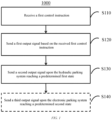
- FIG. 1 is a schematic flowchart of a vehicle control method 1000 according to an embodiment of the invention. As shown in FIG. 1 , the vehicle control method 1000 includes the following steps.
- a first control instruction is received.
- the first control instruction may be a stopping instruction, a starting instruction, and the like for a vehicle.
- step S120 a first output signal is sent based on the first control instruction received in step S110.
- the first output signal is used to instruct a hydraulic parking system to start pressure build-up.
- the hydraulic parking system "starts pressure build-up" means that a hydraulic pressure of the hydraulic parking system starts to increase.
- step S130 a second output signal is sent upon the hydraulic parking system reaching a predetermined first state.
- the second output signal is used to instruct the electronic parking system to start to be pulled up or released.
- step S140 (shown in a dashed frame in FIG. 1 ), a third output signal is sent upon the electronic parking system reaching a predetermined second state.
- the third output signal is used to instruct the hydraulic parking system to start to release pressure.
- the hydraulic parking system "starts to release pressure" means that the hydraulic pressure of the hydraulic parking system starts to decrease.
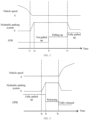
- FIG. 2 shows states of a vehicle speed, a hydraulic parking system, and an electronic parking system in a stopping scenario in the embodiment illustrated in FIG. 1 .
- step S110 at time t A , a stopping instruction is received.
- the stopping instruction is sent by another controller (for example, another electronic control unit (ECU) or another domain control unit (DCU)) of the vehicle when the vehicle decelerates to a specific threshold.
- another controller for example, another electronic control unit (ECU) or another domain control unit (DCU)
- ECU electronice control unit
- DCU domain control unit
- the stopping instruction may alternatively be sent by another controller of the vehicle in another predetermined state.
- the vehicle is using an advanced driver assistance system (ADAS) function
- ADAS advanced driver assistance system
- the stopping instruction may alternatively be sent by a user through a human-machine interface (HMI), or sent in another manner.
- HMI human-machine interface
- step S120 still at time t A , a first output signal is sent to the hydraulic parking system based on the received stopping instruction, so that the hydraulic parking system starts pressure build-up. Then, the hydraulic parking system performs pressure build-up gradually, and at time t B , the pressure build-up is completed.
- step S130 at time tc, a second output signal is sent to the electronic parking system upon the hydraulic parking system reaching a predetermined first state, so that the electronic parking system starts to be pulled up.
- the first state of the hydraulic parking system may, for example, be that pressure build-up has been completed for a first time threshold.
- the first time threshold herein is a threshold predetermined for the hydraulic parking system, which may be any suitable time threshold such as 0 ms, 1 ms, or 2 ms.
- the first time threshold is 0s, once pressure build-up of the hydraulic parking system is completed, the second output signal is sent to start pulling up of the electronic parking system.
- the electronic parking system does not start to be pulled up until time tc (that is, the second output signal is not sent until time tc).
- the first time threshold is t C -t B .
- the vehicle first gradually reduces a vehicle speed to zero through the hydraulic parking system, and then maintains a parked state through the electronic parking system.
- the hydraulic parking system can respond quickly and implements a specific slope of pressure build-up to provide users with a comfortable experience.
- maintaining stopping and parking in a manner of using the hydraulic parking system after using the electronic parking system may prevent a brake motor from overheating caused by a high hydraulic pressure for a long time.
- the first state of the hydraulic parking system may, for example, be that pressure build-up has not been completed after a second time threshold.
- the second time threshold is a time threshold predetermined for the hydraulic parking system, which may be any suitable time threshold such as 5 ms, 8 ms, or 10 ms. If the pressure build-up still fails to be completed when a pressure build-up duration exceeds the threshold, a failure may occur in the hydraulic parking system. In this case, the second output signal is sent to start pulling up of the electronic parking system, and stopping operation is completed under cooperation of the electronic parking system. Therefore, according to the vehicle control method in this embodiment, the electronic parking system can be started to perform stopping operation when the hydraulic parking system fails, implementing a failure backup of a system, and improving safety and reliability of the system.
- the first state of the hydraulic parking system is not limited to the above two states, but also includes any another suitable predetermined state associated with the hydraulic parking system.
- step S140 at time t D , a third output signal is sent upon the electronic parking system reaching a predetermined second state, so that the hydraulic parking system starts to release pressure.
- the second state of the electronic parking system may, for example, be that the electronic parking system has been fully pulled up for a third time threshold.
- the third time threshold herein is a threshold predetermined for the electronic parking system, which may be any suitable time threshold such as 0 ms, 1 ms, or 2 ms.
- the third time threshold is 0s, that is, once the electronic parking system is fully pulled up at time t D , the third output signal is sent, so that the electronic parking system starts to release pressure.
- a manner of waiting for the electronic parking system to be fully pulled up and then releasing pressure of the hydraulic parking system can effectively avoid a problem of slippage that may be caused by direct release of pressure during pulling up of the electronic parking system.
- the second state of the electronic parking system is not limited to the state exemplified above, but includes any another suitable predetermined state associated with the electronic parking system.
- FIG. 3 shows states of a vehicle speed, a hydraulic parking system, and an electronic parking system in a starting scenario in the embodiment illustrated in FIG. 1 .
- step S110 at time t E , a starting instruction is received.
- the received starting instruction may be received from an HMI, or another controller (for example, a controller for an ADAS function) of the vehicle.
- a vehicle speed is zero
- a hydraulic pressure is zero
- the electronic parking system is in a fully pulled state.
- step S120 still at time t E , a first output signal is sent to the hydraulic parking system based on the received starting instruction, so that the hydraulic parking system starts pressure build-up. Then, the hydraulic parking system performs pressure build-up gradually, and at time t F , the pressure build-up is completed.
- step S130 at time t F , a second output signal is sent to the electronic parking system upon the hydraulic parking system reaching a predetermined first state, so that the electronic parking system starts to be released.
- the first state of the hydraulic parking system is that the electronic parking system starts to be released once the hydraulic parking system completes pressure build-up.
- the invention is not limited thereto, and the first state of the hydraulic parking system may alternatively be that pressure build-up has been completed for a fourth time threshold.
- the fourth time threshold herein is a threshold predetermined for the hydraulic parking system, which may be any suitable time threshold such as 0 ms, 1 ms, or 2 ms. In the embodiment shown in FIG.
- the third time threshold is 0s, that is, once pressure build-up of the hydraulic parking system is completed, the second output signal is sent to start releasing of the electronic parking system.
- a manner of waiting for the hydraulic parking system to complete pressure build-up and then releasing the electronic parking system can effectively avoid a problem of slippage that may be caused by directly releasing of the electronic parking system during starting.
- the first state of the hydraulic parking system is not limited to the above state, but also includes any another suitable predetermined state associated with the hydraulic parking system.
- sending of the second output signal used to instruct the electronic parking system to start to be released may further be upon a starting torque being greater than a torque required to overcome a slope. This is because, in some scenarios, a vehicle may be parked on a slope, and release of the electronic parking system in this case not only needs to consider whether pressure build-up is completed, but also the torque required to overcome the slope, so as to avoid the problem of slippage.
- step S140 at time t G , a third output signal is sent upon the electronic parking system reaching a predetermined second state, so that the hydraulic parking system starts to release pressure.
- the second state of the electronic parking system may, for example, be that the electronic parking system has been fully released for a fifth time threshold.
- the fifth time threshold herein is a threshold predetermined for the electronic parking system, which may be any suitable time threshold such as 0 ms, 1 ms, or 2 ms. In the embodiment illustrated in FIG.
- the fifth time threshold is 0s, that is, once the electronic parking system is fully released at time t G , the third output signal is sent, so that the hydraulic parking system starts to release pressure, and at the same time the speed of the vehicle began to increase and the vehicle starts to move.
- a hydraulic pressure is maintained to avoid the problem of slippage.
- the hydraulic parking system starts to release pressure, and the vehicle starts to move.
- the second state of the electronic parking system is not limited to the state exemplified above, but includes any another suitable predetermined state associated with the electronic parking system.
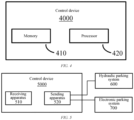
- FIG. 4 is a block diagram of a vehicle control device 4000 according to an embodiment of the invention.
- the control device 4000 includes a memory 410 and a processor 420. Although not shown in FIG. 4 , the control device 4000 further includes a computer program stored on the memory 410 and executable on the processor 420, thereby implementing various steps in the vehicle control method in the foregoing embodiments.
- the memory 410 may be a random access memory (RAM), a read-only memory (ROM), an electrically programmable read-only memory (EPROM), an electrically erasable programmable read-only memory (EEPROM) or an optical disk storage device, a magnetic disk storage device, or any another medium capable of carrying or storing desired program code in the form of machine-executable instructions or data structures and capable of being accessed by the processor 420.
- the processor 420 may be any suitable dedicated or general-purpose processor such as a field-programmable gate array (FPGA), an application-specific integrated circuit (ASIC), or a digital signal processor (DSP).
- FPGA field-programmable gate array
- ASIC application-specific integrated circuit
- DSP digital signal processor
- control device 4000 may be a separate device used for control of a hydraulic parking system and an electronic parking system in a coupled manner, or may be combined in another processing device such as an ECU or a DCU.
- FIG. 5 is a block diagram of a vehicle control device 5000 according to an embodiment of the invention.
- the vehicle control device 5000 includes a receiving apparatus 510 and a sending apparatus 520.
- the receiving apparatus 510 is configured to receive a first control instruction.
- the first control instruction may be a stopping instruction, a starting instruction, and the like for a vehicle. Similar to that in the above embodiment, the stopping instruction may be sent by another controller (for example, another ECU or another DCU) of the vehicle, may be sent by a user through an HMI, or sent in another manner.
- the sending apparatus 520 is configured to send a first output signal to a hydraulic parking system 600 based on the first control instruction received by the receiving apparatus 510.
- the first output signal is used to instruct the hydraulic parking system 600 to start pressure build-up.
- the sending apparatus 520 may directly send the first output signal to the hydraulic parking system 600 as shown in FIG. 5 , or may indirectly send the first output signal to the hydraulic parking system 600 via a DCU or another ECU.
- the sending apparatus 520 is further configured to send a second output signal to an electronic parking system 700 upon the hydraulic parking system 600 reaching a predetermined first state.
- the second output signal is used to instruct the electronic parking system 700 to start to be pulled up or released. Similar to the above description, the sending apparatus 520 may directly send the second output signal to the electronic parking system 700 as shown in FIG. 5 , or may indirectly send the second output signal to the electronic parking system 700 via a DCU or another ECU.
- the second output signal is used to instruct the electronic parking system 700 to start to be pulled up.
- the first state of the hydraulic parking system 600 is, for example, that pressure build-up has been completed for a first time threshold; pressure build-up has not been completed after a second time threshold; or the like.
- the first time threshold and the second time threshold are time thresholds separately predetermined for the hydraulic parking system 600.
- the first time threshold may be any suitable time threshold, such as 0 ms, 1 ms, or 2 ms.
- the second time threshold may be any suitable time threshold, such as 5 ms, 8 ms, or 10 ms. If the pressure build-up has not been completed when a pressure build-up duration exceeds the second time threshold, a failure may occur in the hydraulic parking system 600. In this case, the second output signal is sent to start pulling up of the electronic parking system 700, and stopping operation is completed under cooperation of the electronic parking system 700.
- the second output signal is used to instruct the electronic parking system 700 to start to be released.
- the first state of the hydraulic parking system 600 includes that pressure build-up has been completed for a fourth time threshold.
- the fourth time threshold is a threshold predetermined for the hydraulic parking system 600, which may be any suitable time threshold such as 0 ms, 1 ms, or 2 ms.
- the third time threshold is 0s, as shown in FIG. 3 , once pressure build-up of the hydraulic parking system 600 is completed, the second output signal is sent to start releasing of the electronic parking system 700.
- the first state of the hydraulic parking system is not limited to the above state, but also includes any suitable predetermined state associated with the hydraulic parking system 600.
- the sending apparatus 520 is further configured to send a third output signal to the hydraulic parking system 600 upon the electronic parking system 700 reaching a predetermined second state.
- the third output signal is used to instruct the hydraulic parking system 600 to start to release pressure.
- the second state of the electronic parking system 700 may, for example, be that the electronic parking system 700 has been fully pulled up for a third time threshold.
- the third time threshold herein is a threshold predetermined for the electronic parking system 700, which may be any suitable time threshold such as 0 ms, 1 ms, or 2 ms.
- the third time threshold is 0s, that is, once the electronic parking system 700 is fully pulled up at time t D , the third output signal is sent, so that the hydraulic parking system 600 starts to release pressure.
- the second state of the electronic parking system 700 may, for example, be that the electronic parking system 700 has been fully released for a fifth time threshold.
- the fifth time threshold herein is a threshold predetermined for the electronic parking system 700, which may be any suitable time threshold such as 0 ms, 1 ms, or 2 ms.
- the fifth time threshold is 0s, that is, once the electronic parking system 700 is fully released at time t G , the third output signal is sent, so that the hydraulic parking system 600 starts to release pressure.
- the second state of the electronic parking system is not limited to the state exemplified above, but includes any another suitable predetermined state associated with the electronic parking system 700.
- the error detection method provided in the one or more embodiments of the invention can be implemented by using a computer program.
- a computer storage medium for example, a USB flash drive
- the vehicle control method in one or more embodiments of the invention can be performed by running the computer program.
- a hydraulic parking system and an electronic parking system are controlled in a coupled manner, implementing a function backup in a case of a single function failure, and providing a user with highly comfortable, reliable, and safe vehicle starting and stopping experience.
- a hydraulic parking system that has a fast response speed and performs pressure build-up with a specific slope can be first used to stop a vehicle, so as to provide a user with fast and comfortable stopping experience, and then an electronic parking system is used for keeping the vehicle stopped and parked, to prevent a motor from overheating caused by long-term operation of the hydraulic parking system.
- a hydraulic parking system in a vehicle stopping condition, is first used for pressure build-up and a slope torque is considered, and then an electronic parking system is released, which can effectively avoid slippage possibly caused by direct release of the electronic parking system, improving safety of vehicle control.
Landscapes
- Engineering & Computer Science (AREA)
- Transportation (AREA)
- Mechanical Engineering (AREA)
- Chemical & Material Sciences (AREA)
- Combustion & Propulsion (AREA)
- Automation & Control Theory (AREA)
- Regulating Braking Force (AREA)
Description
- The invention relates to the technical field of vehicle control, and in particular to a vehicle control method and device, a computer-readable storage medium, and a vehicle.
- At present, traditional parking systems include a mechanical parking system, an electronic parking brake (EPB) system, a hydraulic parking system, and the like.
- The hydraulic parking system is a technology that implements vehicle braking in a hydraulic manner. Generally, the hydraulic parking system is provided as an extension of an electronic stability program (ESP) of a vehicle. In a hydraulic parking mode, a processor measures levelness of the vehicle and a torque of wheels through a series of sensors, make a determination on a flow trend of the vehicle, and apply an appropriate braking force to the wheels to make the vehicle stand still; and when the vehicle starts to move forward, an electronic system detects parameters such as a braking force of the accelerator to determine whether the brake is released. This is especially suitable for use in urban areas with frequent traffic lights or scenarios with many up and down slopes, which can greatly simplify user operations and provide users with convenience. However, a separate hydraulic parking system cannot meet a functional safety backup requirement when parking fails under an automatic driving condition, and maintaining a high hydraulic pressure for a long time may cause problems such as overheating of a brake motor.
- The EPB system is a technology that implements parking braking by using an electronic control method, and its function is similar to a mechanical lever handbrake. The EPB system can automatically apply parking braking after an engine is turned off. In addition, with the EPB system, a user does not need to manually turn off an electronic handbrake when a vehicle starts again, because the electronic handbrake is automatically turned off when the vehicle starts by stepping on an accelerator. This makes starting and stopping of a vehicle more convenient and reliable. However, the EPB system has relatively long response time of pulling up and releasing, failing to implement same quick response as the hydraulic parking system. Moreover, the EPB system cannot implement pressure build-up control with a slop like the hydraulic parking system. Therefore, use of the EPB system alone may have problems such as slippage and long response time.
DE 11 2017 004 784 T5 relates to a brake control device capable of reducing a load due to overlapping generation of a hydraulic braking force and a parking braking force to a predetermined vehicle wheel, while maintaining a steady state more reliably. - According to an aspect of the invention, a vehicle control method is provided. The vehicle control method includes: receiving a first control instruction; sending a first output signal based on the first control instruction, wherein the first output signal is used to instruct a hydraulic parking system to start pressure build-up; and sending a second output signal upon the hydraulic parking system reaching a predetermined first state, where the second output signal is used to instruct an electronic parking system to start to be pulled up or released; sending a third output signal upon the electronic parking system reaching a predetermined second state, the third output signal is used to instruct the hydraulic parking system to start to release pressure.
- As an alternative or addition to the foregoing solution, in the vehicle control method according to an embodiment of the invention, the first control instruction includes a stopping instruction and a starting instruction. When the first control instruction is the stopping instruction, the second output signal is used to instruct the electronic parking system to start to be pulled up. When the first control instruction is the starting instruction, the second output signal is used to instruct the electronic parking system to start to be released.
- As an alternative or addition to the foregoing solution, in the vehicle control method according to an embodiment of the invention, when the first control instruction is the stopping instruction, the first state of the hydraulic parking system includes that pressure build-up has been completed for a first time threshold and pressure build-up has not been completed after a second time threshold.
- As an alternative or addition to the foregoing solution, in the vehicle control method according to an embodiment of the invention, when the first control instruction is the stopping instruction, the second state of the electronic parking system includes that the electronic parking system has been fully pulled up for a third time threshold.
- As an alternative or addition to the foregoing solution, in the vehicle control method according to an embodiment of the invention, when the first control instruction is the starting instruction, the first state of the hydraulic parking system includes that pressure build-up has been completed for a fourth time threshold.
- As an alternative or addition to the foregoing solution, in the vehicle control method according to an embodiment of the invention, the sending of the second output signal is further upon a starting torque being greater than a torque required to overcome a slope.
- As an alternative or addition to the foregoing solution, in the vehicle control method according to an embodiment of the invention, when the first control instruction is the starting instruction, the second state of the electronic parking system includes that the electronic parking system has been fully released for a fifth time threshold.
- According to another example, a vehicle control device is provided. The vehicle control device includes a receiving apparatus, configured to receive a first control instruction. The vehicle control device further includes a sending apparatus, configured to: send a first output signal based on the first control instruction, and send a second output signal upon a hydraulic parking system reaching a predetermined first state. The first output signal is used to instruct the hydraulic parking system to start pressure build-up, and the second output signal is used to instruct an electronic parking system to start to be pulled up or released.
- According to another aspect of the invention, a vehicle control device is provided, which includes a memory, a processor, and a computer program stored on the memory and executable on the processor. When the computer program is executed by the processor, the vehicle control method described above is implemented.
- According to still another aspect of the invention, a vehicle is provided, and the vehicle includes any one of the vehicle control devices described above.
- According to yet another aspect of the invention, a computer-readable storage medium storing a computer program is provided. When the computer program is executed by the processor, the vehicle control method described above is implemented.
- According to the vehicle control solution provided in the invention, a hydraulic parking system and an electronic parking system are controlled in a coupled manner in vehicle starting and stopping conditions, implementing a function backup in a case of a single function failure, and providing a user with highly comfortable, reliable, and safe vehicle starting and stopping experience.
- The above and other objectives and advantages of the invention will be clearer and more thorough from the following detailed description in conjunction with the drawings.
-
FIG. 1 is a schematic flowchart of avehicle control method 1000 according to an embodiment of the invention. -
FIG. 2 shows states of a vehicle speed, a hydraulic parking system, and an electronic parking system in a stopping scenario in the embodiment ofFIG. 1 . -
FIG. 3 shows states of a vehicle speed, a hydraulic parking system, and an electronic parking system in a starting scenario in the embodiment ofFIG. 1 . -
FIG. 4 is a block diagram of a vehicle control device 4000 according to an embodiment of the invention. -
FIG. 5 is a block diagram of avehicle control device 5000 according to an embodiment of the invention. - It should be noted that the terms such as "first" and "second" herein are intended to distinguish between similar objects, and do not necessarily describe a sequence of objects in terms of time, space, size, and the like. In addition, unless otherwise specified, the terms "including/comprising", "having", and similar expressions herein are intended to mean a non-exclusive inclusion. Furthermore, the term "vehicle" or another similar term herein include general a motor vehicle, such as a passenger vehicle (including a sport utility vehicle, a bus, a trucks, etc.), and various commercial vehicles, and include a hybrid vehicle, an electric vehicle, a plug-in hybrid electric vehicle, and the like. The hybrid vehicle is a vehicle with two or more power sources, such as a vehicle powered by a gasoline engine and an electric motor.
- Various exemplary embodiments according to the invention will be described below in detail with reference to the accompanying drawings.
-
FIG. 1 is a schematic flowchart of avehicle control method 1000 according to an embodiment of the invention. As shown inFIG. 1 , thevehicle control method 1000 includes the following steps. - In step S110, a first control instruction is received. The first control instruction may be a stopping instruction, a starting instruction, and the like for a vehicle.
- In step S120, a first output signal is sent based on the first control instruction received in step S110. The first output signal is used to instruct a hydraulic parking system to start pressure build-up.
- In the context of the invention, the hydraulic parking system "starts pressure build-up" means that a hydraulic pressure of the hydraulic parking system starts to increase.
- In step S130, a second output signal is sent upon the hydraulic parking system reaching a predetermined first state. The second output signal is used to instruct the electronic parking system to start to be pulled up or released.
- In step S140 (shown in a dashed frame in
FIG. 1 ), a third output signal is sent upon the electronic parking system reaching a predetermined second state. The third output signal is used to instruct the hydraulic parking system to start to release pressure. - In the context of the invention, the hydraulic parking system "starts to release pressure" means that the hydraulic pressure of the hydraulic parking system starts to decrease.
- An embodiment of a vehicle control method in which the first control instruction is the stopping instruction is specifically described below in combination with
FIG. 1 andFIG. 2. FIG. 2 shows states of a vehicle speed, a hydraulic parking system, and an electronic parking system in a stopping scenario in the embodiment illustrated inFIG. 1 . - In step S110, at time tA, a stopping instruction is received. The stopping instruction is sent by another controller (for example, another electronic control unit (ECU) or another domain control unit (DCU)) of the vehicle when the vehicle decelerates to a specific threshold. As shown in
FIG. 2 , before time tA, the vehicle speed gradually decreases. Because neither the hydraulic parking system nor the electronic parking system is activated, a hydraulic pressure is zero, and the electronic parking system is also not pulled up. - However, the invention is not limited thereto, and the stopping instruction may alternatively be sent by another controller of the vehicle in another predetermined state. For example, when the vehicle is using an advanced driver assistance system (ADAS) function, once an ADAS failure is detected, the vehicle sends the stopping instruction immediately. In addition, the stopping instruction may alternatively be sent by a user through a human-machine interface (HMI), or sent in another manner.
- In step S120, still at time tA, a first output signal is sent to the hydraulic parking system based on the received stopping instruction, so that the hydraulic parking system starts pressure build-up. Then, the hydraulic parking system performs pressure build-up gradually, and at time tB, the pressure build-up is completed.
- In step S130, at time tc, a second output signal is sent to the electronic parking system upon the hydraulic parking system reaching a predetermined first state, so that the electronic parking system starts to be pulled up.
- In this embodiment, the first state of the hydraulic parking system may, for example, be that pressure build-up has been completed for a first time threshold. The first time threshold herein is a threshold predetermined for the hydraulic parking system, which may be any suitable time threshold such as 0 ms, 1 ms, or 2 ms. When the first time threshold is 0s, once pressure build-up of the hydraulic parking system is completed, the second output signal is sent to start pulling up of the electronic parking system. In the embodiment illustrated in
FIG. 2 , after pressure build-up is completed at time tB, the electronic parking system does not start to be pulled up until time tc (that is, the second output signal is not sent until time tc). Thus, the first time threshold is tC-tB. In this way, the vehicle first gradually reduces a vehicle speed to zero through the hydraulic parking system, and then maintains a parked state through the electronic parking system. The hydraulic parking system can respond quickly and implements a specific slope of pressure build-up to provide users with a comfortable experience. In addition, maintaining stopping and parking in a manner of using the hydraulic parking system after using the electronic parking system may prevent a brake motor from overheating caused by a high hydraulic pressure for a long time. - In another embodiment, the first state of the hydraulic parking system may, for example, be that pressure build-up has not been completed after a second time threshold. The second time threshold is a time threshold predetermined for the hydraulic parking system, which may be any suitable time threshold such as 5 ms, 8 ms, or 10 ms. If the pressure build-up still fails to be completed when a pressure build-up duration exceeds the threshold, a failure may occur in the hydraulic parking system. In this case, the second output signal is sent to start pulling up of the electronic parking system, and stopping operation is completed under cooperation of the electronic parking system. Therefore, according to the vehicle control method in this embodiment, the electronic parking system can be started to perform stopping operation when the hydraulic parking system fails, implementing a failure backup of a system, and improving safety and reliability of the system.
- It should be noted that, "the first state of the hydraulic parking system" is not limited to the above two states, but also includes any another suitable predetermined state associated with the hydraulic parking system.
- In step S140, at time tD, a third output signal is sent upon the electronic parking system reaching a predetermined second state, so that the hydraulic parking system starts to release pressure.
- In this embodiment, the second state of the electronic parking system may, for example, be that the electronic parking system has been fully pulled up for a third time threshold. The third time threshold herein is a threshold predetermined for the electronic parking system, which may be any suitable time threshold such as 0 ms, 1 ms, or 2 ms. In the embodiment shown in
FIG. 2 , the third time threshold is 0s, that is, once the electronic parking system is fully pulled up at time tD, the third output signal is sent, so that the electronic parking system starts to release pressure. A manner of waiting for the electronic parking system to be fully pulled up and then releasing pressure of the hydraulic parking system can effectively avoid a problem of slippage that may be caused by direct release of pressure during pulling up of the electronic parking system. - It should be noted that, "the second state of the electronic parking system" is not limited to the state exemplified above, but includes any another suitable predetermined state associated with the electronic parking system.
- An embodiment of a vehicle control method in which the first control instruction is the starting instruction is specifically described below in combination with
FIG. 1 andFIG. 3. FIG. 3 shows states of a vehicle speed, a hydraulic parking system, and an electronic parking system in a starting scenario in the embodiment illustrated inFIG. 1 . - In step S110, at time tE, a starting instruction is received. The received starting instruction may be received from an HMI, or another controller (for example, a controller for an ADAS function) of the vehicle. When the starting instruction is received, as shown in
FIG. 3 , a vehicle speed is zero, a hydraulic pressure is zero, and the electronic parking system is in a fully pulled state. - In step S120, still at time tE, a first output signal is sent to the hydraulic parking system based on the received starting instruction, so that the hydraulic parking system starts pressure build-up. Then, the hydraulic parking system performs pressure build-up gradually, and at time tF, the pressure build-up is completed.
- In step S130, at time tF, a second output signal is sent to the electronic parking system upon the hydraulic parking system reaching a predetermined first state, so that the electronic parking system starts to be released. In this embodiment, the first state of the hydraulic parking system is that the electronic parking system starts to be released once the hydraulic parking system completes pressure build-up. However, the invention is not limited thereto, and the first state of the hydraulic parking system may alternatively be that pressure build-up has been completed for a fourth time threshold. The fourth time threshold herein is a threshold predetermined for the hydraulic parking system, which may be any suitable time threshold such as 0 ms, 1 ms, or 2 ms. In the embodiment shown in
FIG. 3 , the third time threshold is 0s, that is, once pressure build-up of the hydraulic parking system is completed, the second output signal is sent to start releasing of the electronic parking system. A manner of waiting for the hydraulic parking system to complete pressure build-up and then releasing the electronic parking system can effectively avoid a problem of slippage that may be caused by directly releasing of the electronic parking system during starting. It should be noted that, "the first state of the hydraulic parking system" is not limited to the above state, but also includes any another suitable predetermined state associated with the hydraulic parking system. - Furthermore, in addition to being upon the hydraulic parking system reaching the predetermined first state, sending of the second output signal used to instruct the electronic parking system to start to be released may further be upon a starting torque being greater than a torque required to overcome a slope. This is because, in some scenarios, a vehicle may be parked on a slope, and release of the electronic parking system in this case not only needs to consider whether pressure build-up is completed, but also the torque required to overcome the slope, so as to avoid the problem of slippage.
- In step S140, at time tG, a third output signal is sent upon the electronic parking system reaching a predetermined second state, so that the hydraulic parking system starts to release pressure. In this embodiment, the second state of the electronic parking system may, for example, be that the electronic parking system has been fully released for a fifth time threshold. The fifth time threshold herein is a threshold predetermined for the electronic parking system, which may be any suitable time threshold such as 0 ms, 1 ms, or 2 ms. In the embodiment illustrated in
FIG. 3 , the fifth time threshold is 0s, that is, once the electronic parking system is fully released at time tG, the third output signal is sent, so that the hydraulic parking system starts to release pressure, and at the same time the speed of the vehicle began to increase and the vehicle starts to move. Thus, during releasing of the electronic parking system, a hydraulic pressure is maintained to avoid the problem of slippage. After the electronic parking system is fully released, the hydraulic parking system starts to release pressure, and the vehicle starts to move. - It should be noted that, "the second state of the electronic parking system" is not limited to the state exemplified above, but includes any another suitable predetermined state associated with the electronic parking system.
-
FIG. 4 is a block diagram of a vehicle control device 4000 according to an embodiment of the invention. The control device 4000 includes amemory 410 and aprocessor 420. Although not shown inFIG. 4 , the control device 4000 further includes a computer program stored on thememory 410 and executable on theprocessor 420, thereby implementing various steps in the vehicle control method in the foregoing embodiments. - The
memory 410 may be a random access memory (RAM), a read-only memory (ROM), an electrically programmable read-only memory (EPROM), an electrically erasable programmable read-only memory (EEPROM) or an optical disk storage device, a magnetic disk storage device, or any another medium capable of carrying or storing desired program code in the form of machine-executable instructions or data structures and capable of being accessed by theprocessor 420. Theprocessor 420 may be any suitable dedicated or general-purpose processor such as a field-programmable gate array (FPGA), an application-specific integrated circuit (ASIC), or a digital signal processor (DSP). - In an application scenario of a vehicle, the control device 4000 may be a separate device used for control of a hydraulic parking system and an electronic parking system in a coupled manner, or may be combined in another processing device such as an ECU or a DCU.
-
FIG. 5 is a block diagram of avehicle control device 5000 according to an embodiment of the invention. Thevehicle control device 5000 includes a receivingapparatus 510 and a sending apparatus 520. - Specifically, the receiving
apparatus 510 is configured to receive a first control instruction. The first control instruction may be a stopping instruction, a starting instruction, and the like for a vehicle. Similar to that in the above embodiment, the stopping instruction may be sent by another controller (for example, another ECU or another DCU) of the vehicle, may be sent by a user through an HMI, or sent in another manner. - The sending apparatus 520 is configured to send a first output signal to a
hydraulic parking system 600 based on the first control instruction received by the receivingapparatus 510. The first output signal is used to instruct thehydraulic parking system 600 to start pressure build-up. Herein, the sending apparatus 520 may directly send the first output signal to thehydraulic parking system 600 as shown inFIG. 5 , or may indirectly send the first output signal to thehydraulic parking system 600 via a DCU or another ECU. - The sending apparatus 520 is further configured to send a second output signal to an electronic parking system 700 upon the
hydraulic parking system 600 reaching a predetermined first state. The second output signal is used to instruct the electronic parking system 700 to start to be pulled up or released. Similar to the above description, the sending apparatus 520 may directly send the second output signal to the electronic parking system 700 as shown inFIG. 5 , or may indirectly send the second output signal to the electronic parking system 700 via a DCU or another ECU. - In some embodiments where the first control instruction received by the receiving
apparatus 510 is the stopping instruction, the second output signal is used to instruct the electronic parking system 700 to start to be pulled up. The first state of thehydraulic parking system 600 is, for example, that pressure build-up has been completed for a first time threshold; pressure build-up has not been completed after a second time threshold; or the like. The first time threshold and the second time threshold are time thresholds separately predetermined for thehydraulic parking system 600. The first time threshold may be any suitable time threshold, such as 0 ms, 1 ms, or 2 ms. When the first time threshold is 0s, once pressure build-up of thehydraulic parking system 600 is completed, the sending apparatus 520 sends the second output signal to start pulling up of the electronic parking system. The second time threshold may be any suitable time threshold, such as 5 ms, 8 ms, or 10 ms. If the pressure build-up has not been completed when a pressure build-up duration exceeds the second time threshold, a failure may occur in thehydraulic parking system 600. In this case, the second output signal is sent to start pulling up of the electronic parking system 700, and stopping operation is completed under cooperation of the electronic parking system 700. - In some embodiments where the first control instruction received by the receiving
apparatus 510 is the starting instruction, the second output signal is used to instruct the electronic parking system 700 to start to be released. The first state of thehydraulic parking system 600 includes that pressure build-up has been completed for a fourth time threshold. The fourth time threshold is a threshold predetermined for thehydraulic parking system 600, which may be any suitable time threshold such as 0 ms, 1 ms, or 2 ms. When the third time threshold is 0s, as shown inFIG. 3 , once pressure build-up of thehydraulic parking system 600 is completed, the second output signal is sent to start releasing of the electronic parking system 700. - Similar to the above description, "the first state of the hydraulic parking system" is not limited to the above state, but also includes any suitable predetermined state associated with the
hydraulic parking system 600. - The sending apparatus 520 is further configured to send a third output signal to the
hydraulic parking system 600 upon the electronic parking system 700 reaching a predetermined second state. The third output signal is used to instruct thehydraulic parking system 600 to start to release pressure. - In some embodiments where the first control instruction received by the receiving
apparatus 510 is the stopping instruction, the second state of the electronic parking system 700 may, for example, be that the electronic parking system 700 has been fully pulled up for a third time threshold. The third time threshold herein is a threshold predetermined for the electronic parking system 700, which may be any suitable time threshold such as 0 ms, 1 ms, or 2 ms. For example, in the embodiment illustrated inFIG. 2 , the third time threshold is 0s, that is, once the electronic parking system 700 is fully pulled up at time tD, the third output signal is sent, so that thehydraulic parking system 600 starts to release pressure. - In some embodiments where the first control instruction received by the receiving
apparatus 510 is the starting instruction, the second state of the electronic parking system 700 may, for example, be that the electronic parking system 700 has been fully released for a fifth time threshold. The fifth time threshold herein is a threshold predetermined for the electronic parking system 700, which may be any suitable time threshold such as 0 ms, 1 ms, or 2 ms. In the embodiment illustrated inFIG. 3 , the fifth time threshold is 0s, that is, once the electronic parking system 700 is fully released at time tG, the third output signal is sent, so that thehydraulic parking system 600 starts to release pressure. - Similar to the above description, "the second state of the electronic parking system" is not limited to the state exemplified above, but includes any another suitable predetermined state associated with the electronic parking system 700.
- It should be understood that, some of the block diagrams shown in the accompanying drawings of the invention are functional entities and do not necessarily correspond to physically or logically independent entities. These functional entities may be implemented in the form of software, in one or more hardware modules or integrated circuits, or in different networks and/or processor apparatuses and/or micro-controller apparatuses.
- In addition, those skilled in the art readily understand that the error detection method provided in the one or more embodiments of the invention can be implemented by using a computer program. For example, when a computer storage medium (for example, a USB flash drive) storing the computer program is connected to a computer, the vehicle control method in one or more embodiments of the invention can be performed by running the computer program.
- To sum up, according to the vehicle control solution of an aspect of the invention, a hydraulic parking system and an electronic parking system are controlled in a coupled manner, implementing a function backup in a case of a single function failure, and providing a user with highly comfortable, reliable, and safe vehicle starting and stopping experience. According to the vehicle control solution of an aspect of the invention, a hydraulic parking system that has a fast response speed and performs pressure build-up with a specific slope can be first used to stop a vehicle, so as to provide a user with fast and comfortable stopping experience, and then an electronic parking system is used for keeping the vehicle stopped and parked, to prevent a motor from overheating caused by long-term operation of the hydraulic parking system. According to the vehicle control solution of an aspect of the invention, in a vehicle stopping condition, maintaining a hydraulic level of a hydraulic parking system during pulling up of the electronic parking system can effectively avoid a problem of slippage that may be caused by direct release of pressure during the pulling up of the electronic parking system. According to the vehicle control solution of an aspect of the invention, in a vehicle starting condition, a hydraulic parking system is first used for pressure build-up and a slope torque is considered, and then an electronic parking system is released, which can effectively avoid slippage possibly caused by direct release of the electronic parking system, improving safety of vehicle control.
Claims (10)
- A vehicle control method (1000), comprising:receiving a first control instruction (S110);sending a first output signal based on the first control instruction, wherein the first output signal is used to instruct a hydraulic parking system to start pressure build-up (S120);sending a second output signal upon the hydraulic parking system reaching a predetermined first state, wherein the second output signal is used to instruct an electronic parking system to start to be pulled up or released (S130); said method being characterized bysending a third output signal upon the electronic parking system reaching a predetermined second state (S140), wherein the third output signal is used to instruct the hydraulic parking system to start to release pressure.
- The vehicle control method (1000) according to claim 1, wherein the first control instruction comprises a stopping instruction or a starting instruction,when the first control instruction is the stopping instruction, the second output signal is used to instruct the electronic parking system to start to be pulled up; andwhen the first control instruction is the starting instruction, the second output signal is used to instruct the electronic parking system to start to be released.
- The vehicle control method (1000) according to claim 2, wherein
when the first control instruction is the stopping instruction, the first state of the hydraulic parking system comprises that pressure build-up has been completed for a first time threshold and pressure build-up has not been completed after a second time threshold. - The vehicle control method (1000) according to claim 2 or 3, wherein
when the first control instruction is the stopping instruction, the second state of the electronic parking system comprises that the electronic parking system has been fully pulled up for a third time threshold. - The vehicle control method (1000) according to claim 2, 3, or 4, wherein
when the first control instruction is the starting instruction, the first state of the hydraulic parking system comprises that pressure build-up has been completed for a fourth time threshold. - The vehicle control method (1000) according to any one of claims 2 to 5, wherein
the sending of the second output signal is further upon a starting torque being greater than a torque required to overcome a slope. - The vehicle control method (1000) according to any one of claims 2 to 6, wherein
when the first control instruction is the starting instruction, the second state of the electronic parking system comprises that the electronic parking system has been fully released for a fifth time threshold. - A vehicle control device (4000), comprising a memory (410), a processor (420), and a computer program stored on the memory (410) and executable on the processor (420), wherein when the computer program is executed by the processor (420), the vehicle control method according to any one of claims 1 to 7 is implemented.
- A vehicle, comprising a vehicle control device according to claim 8.
- A computer-readable storage medium storing a computer program, wherein when the computer program is executed by a processor, the vehicle control method according to any one of claims 1 to 7 is implemented.
Applications Claiming Priority (1)
| Application Number | Priority Date | Filing Date | Title |
|---|---|---|---|
| CN202111192654.5A CN113696870B (en) | 2021-10-13 | 2021-10-13 | Vehicle control method, device, storage medium and vehicle |
Publications (2)
| Publication Number | Publication Date |
|---|---|
| EP4166399A1 EP4166399A1 (en) | 2023-04-19 |
| EP4166399B1 true EP4166399B1 (en) | 2025-06-04 |
Family
ID=78662815
Family Applications (1)
| Application Number | Title | Priority Date | Filing Date |
|---|---|---|---|
| EP22201092.8A Active EP4166399B1 (en) | 2021-10-13 | 2022-10-12 | Vehicle control method and device, storage medium, and vehicle |
Country Status (3)
| Country | Link |
|---|---|
| US (1) | US12344207B2 (en) |
| EP (1) | EP4166399B1 (en) |
| CN (1) | CN113696870B (en) |
Families Citing this family (2)
| Publication number | Priority date | Publication date | Assignee | Title |
|---|---|---|---|---|
| CN112519802A (en) * | 2021-01-05 | 2021-03-19 | 蔚来汽车科技(安徽)有限公司 | Vehicle control method and system, vehicle, and storage medium |
| US12522185B2 (en) * | 2023-12-14 | 2026-01-13 | Honda Motor Co., Ltd. | Control device, control method, and storage medium storing control program |
Family Cites Families (19)
| Publication number | Priority date | Publication date | Assignee | Title |
|---|---|---|---|---|
| JPS5856929A (en) * | 1981-09-30 | 1983-04-04 | Aisin Warner Ltd | Hydraulic control unit for four-wheel drive transfer |
| DE19632863B4 (en) * | 1996-08-14 | 2007-10-18 | Bayerische Motoren Werke Ag | Motor vehicle with a parking brake system |
| US7344205B2 (en) * | 2004-06-01 | 2008-03-18 | Advics Co., Ltd | Parking assist control apparatus and storage medium for parking assist control program |
| DE102005023665C5 (en) * | 2005-05-23 | 2020-05-14 | Knorr-Bremse Systeme für Nutzfahrzeuge GmbH | Method for automatically braking a vehicle equipped with an electronically controlled braking device |
| US7854282B2 (en) * | 2007-12-10 | 2010-12-21 | International Humanities Center | Hybrid electric vehicle |
| JP6011518B2 (en) * | 2013-11-21 | 2016-10-19 | トヨタ自動車株式会社 | Vehicle control apparatus and control method |
| KR101970238B1 (en) * | 2014-05-30 | 2019-04-22 | 주식회사 만도 | Braking system and braking control method in parking |
| CN108473012B (en) * | 2015-12-11 | 2022-05-03 | 伊顿智能动力有限公司 | Autonomous docking system |
| US20180043895A1 (en) * | 2016-08-12 | 2018-02-15 | GM Global Technology Operations LLC | Vehicle soft-park control system |
| JP6540643B2 (en) * | 2016-09-23 | 2019-07-10 | 株式会社アドヴィックス | Brake control device |
| CN106627547B (en) * | 2016-11-17 | 2019-01-29 | 广州汽车集团股份有限公司 | Electronic brake system, method for starting and the vehicle of compatible automatic parking function |
| JP6745739B2 (en) * | 2017-02-23 | 2020-08-26 | 日立オートモティブシステムズ株式会社 | Brake system |
| CN109435941B (en) * | 2018-10-10 | 2021-11-05 | 北京新能源汽车股份有限公司 | Method and system for controlling automatic parking of vehicle, vehicle and storage medium |
| KR102714869B1 (en) * | 2019-05-15 | 2024-10-08 | 현대자동차주식회사 | Method for Manual Transmission Automobile Remote Start Based On Parking Force and Remote Start System Thereof |
| CN110194170A (en) * | 2019-07-01 | 2019-09-03 | 安徽江淮汽车集团股份有限公司 | A kind of ramp parking control method, device and storage medium |
| CN112109690B (en) * | 2019-07-17 | 2022-06-21 | 上汽通用五菱汽车股份有限公司 | Automatic parking control method, device and computer readable storage medium |
| DE102020113864A1 (en) * | 2019-12-10 | 2021-06-10 | Ford Global Technologies Llc | Motor vehicle and method of operating a motor vehicle |
| CN111071061A (en) * | 2019-12-26 | 2020-04-28 | 上海擎度汽车科技有限公司 | Starting and releasing method of electronic parking system of new energy unmanned automobile |
| WO2023050367A1 (en) * | 2021-09-30 | 2023-04-06 | 华为技术有限公司 | Brake assembly, brake system, vehicle, and control method for brake system |
-
2021
- 2021-10-13 CN CN202111192654.5A patent/CN113696870B/en active Active
-
2022
- 2022-10-12 EP EP22201092.8A patent/EP4166399B1/en active Active
- 2022-10-13 US US18/046,184 patent/US12344207B2/en active Active
Also Published As
| Publication number | Publication date |
|---|---|
| CN113696870B (en) | 2024-11-26 |
| EP4166399A1 (en) | 2023-04-19 |
| CN113696870A (en) | 2021-11-26 |
| US12344207B2 (en) | 2025-07-01 |
| US20230115978A1 (en) | 2023-04-13 |
Similar Documents
| Publication | Publication Date | Title |
|---|---|---|
| US11713037B2 (en) | Controlling of a dual-processors type electrical parking device in event of emergency braking | |
| CN108944874B (en) | Control method and system for electric automobile remote control driving | |
| CN114248630B (en) | An anti-slope parking control method for electric vehicles, a whole vehicle controller, and a medium | |
| CN112109690B (en) | Automatic parking control method, device and computer readable storage medium | |
| CN103895531B (en) | Pure electric vehicle uphill starting control method | |
| CN114454864B (en) | Anti-slip control method and device for vehicle, vehicle and storage medium | |
| CN109017736B (en) | Electric brake compensation control method and device and automobile | |
| CN112109724B (en) | Adaptive cruise control system activation method, vehicle, and readable storage medium | |
| CN108622049B (en) | A kind of automatic parking device and method with memory function | |
| CN110435443B (en) | Ramp auxiliary control method, device, equipment and storage medium | |
| CN111923909A (en) | Automatic parking control system and control method for automatic transmission vehicle | |
| US12344207B2 (en) | Vehicle control method and device, storage medium, and vehicle | |
| CN108639037B (en) | Electric brake compensation control method, controller, electric power-assisted auxiliary system and automobile | |
| US9802612B2 (en) | Vehicle engine activation control system | |
| US12139122B2 (en) | Vehicle brake system | |
| CN114435147B (en) | Hill start control method and device for automobile, vehicle and storage medium | |
| CN111469917B (en) | Vehicle steering control method and device | |
| CN114274939A (en) | EPB motor working state monitoring method and device, VCU and storage medium | |
| CN110949354A (en) | Parking system | |
| CN109263481B (en) | Method for assisting in controlling hill start of electric automobile | |
| CN114701499A (en) | Ramp parking control method, device, equipment and storage medium | |
| CN116215531B (en) | Control methods, devices, electronic equipment and storage media for vehicle ramp parking | |
| CN106218418B (en) | A kind of response control system and method based on electric vehicle parking brake signal | |
| CN209757071U (en) | automatic hold system based on electric braking | |
| CN115431978A (en) | Vehicle control method, device, medium and equipment |
Legal Events
| Date | Code | Title | Description |
|---|---|---|---|
| PUAI | Public reference made under article 153(3) epc to a published international application that has entered the european phase |
Free format text: ORIGINAL CODE: 0009012 |
|
| STAA | Information on the status of an ep patent application or granted ep patent |
Free format text: STATUS: REQUEST FOR EXAMINATION WAS MADE |
|
| 17P | Request for examination filed |
Effective date: 20221112 |
|
| AK | Designated contracting states |
Kind code of ref document: A1 Designated state(s): AL AT BE BG CH CY CZ DE DK EE ES FI FR GB GR HR HU IE IS IT LI LT LU LV MC ME MK MT NL NO PL PT RO RS SE SI SK SM TR |
|
| GRAP | Despatch of communication of intention to grant a patent |
Free format text: ORIGINAL CODE: EPIDOSNIGR1 |
|
| STAA | Information on the status of an ep patent application or granted ep patent |
Free format text: STATUS: GRANT OF PATENT IS INTENDED |
|
| RIC1 | Information provided on ipc code assigned before grant |
Ipc: B60W 30/18 20120101ALI20250130BHEP Ipc: B60W 10/192 20120101ALI20250130BHEP Ipc: B60W 10/188 20120101ALI20250130BHEP Ipc: B60W 10/18 20120101ALI20250130BHEP Ipc: B60T 7/12 20060101AFI20250130BHEP |
|
| INTG | Intention to grant announced |
Effective date: 20250214 |
|
| GRAS | Grant fee paid |
Free format text: ORIGINAL CODE: EPIDOSNIGR3 |
|
| GRAA | (expected) grant |
Free format text: ORIGINAL CODE: 0009210 |
|
| STAA | Information on the status of an ep patent application or granted ep patent |
Free format text: STATUS: THE PATENT HAS BEEN GRANTED |
|
| AK | Designated contracting states |
Kind code of ref document: B1 Designated state(s): AL AT BE BG CH CY CZ DE DK EE ES FI FR GB GR HR HU IE IS IT LI LT LU LV MC ME MK MT NL NO PL PT RO RS SE SI SK SM TR |
|
| REG | Reference to a national code |
Ref country code: GB Ref legal event code: FG4D |
|
| REG | Reference to a national code |
Ref country code: CH Ref legal event code: EP |
|
| REG | Reference to a national code |
Ref country code: DE Ref legal event code: R096 Ref document number: 602022015418 Country of ref document: DE |
|
| REG | Reference to a national code |
Ref country code: IE Ref legal event code: FG4D |
|
| REG | Reference to a national code |
Ref country code: NL Ref legal event code: MP Effective date: 20250604 |
|
| PG25 | Lapsed in a contracting state [announced via postgrant information from national office to epo] |
Ref country code: FI Free format text: LAPSE BECAUSE OF FAILURE TO SUBMIT A TRANSLATION OF THE DESCRIPTION OR TO PAY THE FEE WITHIN THE PRESCRIBED TIME-LIMIT Effective date: 20250604 Ref country code: ES Free format text: LAPSE BECAUSE OF FAILURE TO SUBMIT A TRANSLATION OF THE DESCRIPTION OR TO PAY THE FEE WITHIN THE PRESCRIBED TIME-LIMIT Effective date: 20250604 |
|
| REG | Reference to a national code |
Ref country code: LT Ref legal event code: MG9D |
|
| PG25 | Lapsed in a contracting state [announced via postgrant information from national office to epo] |
Ref country code: NO Free format text: LAPSE BECAUSE OF FAILURE TO SUBMIT A TRANSLATION OF THE DESCRIPTION OR TO PAY THE FEE WITHIN THE PRESCRIBED TIME-LIMIT Effective date: 20250904 Ref country code: GR Free format text: LAPSE BECAUSE OF FAILURE TO SUBMIT A TRANSLATION OF THE DESCRIPTION OR TO PAY THE FEE WITHIN THE PRESCRIBED TIME-LIMIT Effective date: 20250905 |
|
| PG25 | Lapsed in a contracting state [announced via postgrant information from national office to epo] |
Ref country code: PL Free format text: LAPSE BECAUSE OF FAILURE TO SUBMIT A TRANSLATION OF THE DESCRIPTION OR TO PAY THE FEE WITHIN THE PRESCRIBED TIME-LIMIT Effective date: 20250604 |
|
| PG25 | Lapsed in a contracting state [announced via postgrant information from national office to epo] |
Ref country code: BG Free format text: LAPSE BECAUSE OF FAILURE TO SUBMIT A TRANSLATION OF THE DESCRIPTION OR TO PAY THE FEE WITHIN THE PRESCRIBED TIME-LIMIT Effective date: 20250604 |
|
| PG25 | Lapsed in a contracting state [announced via postgrant information from national office to epo] |
Ref country code: HR Free format text: LAPSE BECAUSE OF FAILURE TO SUBMIT A TRANSLATION OF THE DESCRIPTION OR TO PAY THE FEE WITHIN THE PRESCRIBED TIME-LIMIT Effective date: 20250604 |
|
| PG25 | Lapsed in a contracting state [announced via postgrant information from national office to epo] |
Ref country code: RS Free format text: LAPSE BECAUSE OF FAILURE TO SUBMIT A TRANSLATION OF THE DESCRIPTION OR TO PAY THE FEE WITHIN THE PRESCRIBED TIME-LIMIT Effective date: 20250904 |
|
| PG25 | Lapsed in a contracting state [announced via postgrant information from national office to epo] |
Ref country code: LV Free format text: LAPSE BECAUSE OF FAILURE TO SUBMIT A TRANSLATION OF THE DESCRIPTION OR TO PAY THE FEE WITHIN THE PRESCRIBED TIME-LIMIT Effective date: 20250604 |
|
| PG25 | Lapsed in a contracting state [announced via postgrant information from national office to epo] |
Ref country code: NL Free format text: LAPSE BECAUSE OF FAILURE TO SUBMIT A TRANSLATION OF THE DESCRIPTION OR TO PAY THE FEE WITHIN THE PRESCRIBED TIME-LIMIT Effective date: 20250604 |
|
| PG25 | Lapsed in a contracting state [announced via postgrant information from national office to epo] |
Ref country code: PT Free format text: LAPSE BECAUSE OF FAILURE TO SUBMIT A TRANSLATION OF THE DESCRIPTION OR TO PAY THE FEE WITHIN THE PRESCRIBED TIME-LIMIT Effective date: 20251006 |
|
| REG | Reference to a national code |
Ref country code: AT Ref legal event code: MK05 Ref document number: 1800069 Country of ref document: AT Kind code of ref document: T Effective date: 20250604 |
|
| PG25 | Lapsed in a contracting state [announced via postgrant information from national office to epo] |
Ref country code: IS Free format text: LAPSE BECAUSE OF FAILURE TO SUBMIT A TRANSLATION OF THE DESCRIPTION OR TO PAY THE FEE WITHIN THE PRESCRIBED TIME-LIMIT Effective date: 20251004 |
|
| PGFP | Annual fee paid to national office [announced via postgrant information from national office to epo] |
Ref country code: DE Payment date: 20251021 Year of fee payment: 4 |
|
| PG25 | Lapsed in a contracting state [announced via postgrant information from national office to epo] |
Ref country code: SM Free format text: LAPSE BECAUSE OF FAILURE TO SUBMIT A TRANSLATION OF THE DESCRIPTION OR TO PAY THE FEE WITHIN THE PRESCRIBED TIME-LIMIT Effective date: 20250604 Ref country code: AT Free format text: LAPSE BECAUSE OF FAILURE TO SUBMIT A TRANSLATION OF THE DESCRIPTION OR TO PAY THE FEE WITHIN THE PRESCRIBED TIME-LIMIT Effective date: 20250604 |
|
| PGFP | Annual fee paid to national office [announced via postgrant information from national office to epo] |
Ref country code: FR Payment date: 20251030 Year of fee payment: 4 |
|
| PG25 | Lapsed in a contracting state [announced via postgrant information from national office to epo] |
Ref country code: CZ Free format text: LAPSE BECAUSE OF FAILURE TO SUBMIT A TRANSLATION OF THE DESCRIPTION OR TO PAY THE FEE WITHIN THE PRESCRIBED TIME-LIMIT Effective date: 20250604 |
|
| PG25 | Lapsed in a contracting state [announced via postgrant information from national office to epo] |
Ref country code: EE Free format text: LAPSE BECAUSE OF FAILURE TO SUBMIT A TRANSLATION OF THE DESCRIPTION OR TO PAY THE FEE WITHIN THE PRESCRIBED TIME-LIMIT Effective date: 20250604 |
|
| PG25 | Lapsed in a contracting state [announced via postgrant information from national office to epo] |
Ref country code: SK Free format text: LAPSE BECAUSE OF FAILURE TO SUBMIT A TRANSLATION OF THE DESCRIPTION OR TO PAY THE FEE WITHIN THE PRESCRIBED TIME-LIMIT Effective date: 20250604 |
|
| PG25 | Lapsed in a contracting state [announced via postgrant information from national office to epo] |
Ref country code: IT Free format text: LAPSE BECAUSE OF FAILURE TO SUBMIT A TRANSLATION OF THE DESCRIPTION OR TO PAY THE FEE WITHIN THE PRESCRIBED TIME-LIMIT Effective date: 20250604 |
|
| PG25 | Lapsed in a contracting state [announced via postgrant information from national office to epo] |
Ref country code: RO Free format text: LAPSE BECAUSE OF FAILURE TO SUBMIT A TRANSLATION OF THE DESCRIPTION OR TO PAY THE FEE WITHIN THE PRESCRIBED TIME-LIMIT Effective date: 20250604 |
|
| REG | Reference to a national code |
Ref country code: DE Ref legal event code: R097 Ref document number: 602022015418 Country of ref document: DE |
|
| PLBE | No opposition filed within time limit |
Free format text: ORIGINAL CODE: 0009261 |
|
| STAA | Information on the status of an ep patent application or granted ep patent |
Free format text: STATUS: NO OPPOSITION FILED WITHIN TIME LIMIT |
|
| PG25 | Lapsed in a contracting state [announced via postgrant information from national office to epo] |
Ref country code: DK Free format text: LAPSE BECAUSE OF FAILURE TO SUBMIT A TRANSLATION OF THE DESCRIPTION OR TO PAY THE FEE WITHIN THE PRESCRIBED TIME-LIMIT Effective date: 20250604 |
|
| REG | Reference to a national code |
Ref country code: CH Ref legal event code: L10 Free format text: ST27 STATUS EVENT CODE: U-0-0-L10-L00 (AS PROVIDED BY THE NATIONAL OFFICE) Effective date: 20260416 |
|
| 26N | No opposition filed |
Effective date: 20260305 |