EP4165705B1 - Bipolarplatte und brennstoffzellenstapel - Google Patents
Bipolarplatte und brennstoffzellenstapel Download PDFInfo
- Publication number
- EP4165705B1 EP4165705B1 EP21801452.0A EP21801452A EP4165705B1 EP 4165705 B1 EP4165705 B1 EP 4165705B1 EP 21801452 A EP21801452 A EP 21801452A EP 4165705 B1 EP4165705 B1 EP 4165705B1
- Authority
- EP
- European Patent Office
- Prior art keywords
- channel
- flow
- elevation
- bipolar plate
- flow divider
- Prior art date
- Legal status (The legal status is an assumption and is not a legal conclusion. Google has not performed a legal analysis and makes no representation as to the accuracy of the status listed.)
- Active
Links
Images


Classifications
-
- H—ELECTRICITY
- H01—ELECTRIC ELEMENTS
- H01M—PROCESSES OR MEANS, e.g. BATTERIES, FOR THE DIRECT CONVERSION OF CHEMICAL ENERGY INTO ELECTRICAL ENERGY
- H01M8/00—Fuel cells; Manufacture thereof
- H01M8/02—Details
- H01M8/0202—Collectors; Separators, e.g. bipolar separators; Interconnectors
- H01M8/0258—Collectors; Separators, e.g. bipolar separators; Interconnectors characterised by the configuration of channels, e.g. by the flow field of the reactant or coolant
- H01M8/026—Collectors; Separators, e.g. bipolar separators; Interconnectors characterised by the configuration of channels, e.g. by the flow field of the reactant or coolant characterised by grooves, e.g. their pitch or depth
-
- H—ELECTRICITY
- H01—ELECTRIC ELEMENTS
- H01M—PROCESSES OR MEANS, e.g. BATTERIES, FOR THE DIRECT CONVERSION OF CHEMICAL ENERGY INTO ELECTRICAL ENERGY
- H01M8/00—Fuel cells; Manufacture thereof
- H01M8/02—Details
- H01M8/0202—Collectors; Separators, e.g. bipolar separators; Interconnectors
- H01M8/0258—Collectors; Separators, e.g. bipolar separators; Interconnectors characterised by the configuration of channels, e.g. by the flow field of the reactant or coolant
- H01M8/0265—Collectors; Separators, e.g. bipolar separators; Interconnectors characterised by the configuration of channels, e.g. by the flow field of the reactant or coolant the reactant or coolant channels having varying cross sections
-
- H—ELECTRICITY
- H01—ELECTRIC ELEMENTS
- H01M—PROCESSES OR MEANS, e.g. BATTERIES, FOR THE DIRECT CONVERSION OF CHEMICAL ENERGY INTO ELECTRICAL ENERGY
- H01M8/00—Fuel cells; Manufacture thereof
- H01M8/24—Grouping of fuel cells, e.g. stacking of fuel cells
- H01M8/241—Grouping of fuel cells, e.g. stacking of fuel cells with solid or matrix-supported electrolytes
-
- H—ELECTRICITY
- H01—ELECTRIC ELEMENTS
- H01M—PROCESSES OR MEANS, e.g. BATTERIES, FOR THE DIRECT CONVERSION OF CHEMICAL ENERGY INTO ELECTRICAL ENERGY
- H01M8/00—Fuel cells; Manufacture thereof
- H01M8/24—Grouping of fuel cells, e.g. stacking of fuel cells
- H01M8/2465—Details of groupings of fuel cells
- H01M8/2483—Details of groupings of fuel cells characterised by internal manifolds
-
- H—ELECTRICITY
- H01—ELECTRIC ELEMENTS
- H01M—PROCESSES OR MEANS, e.g. BATTERIES, FOR THE DIRECT CONVERSION OF CHEMICAL ENERGY INTO ELECTRICAL ENERGY
- H01M8/00—Fuel cells; Manufacture thereof
- H01M8/10—Fuel cells with solid electrolytes
- H01M2008/1095—Fuel cells with polymeric electrolytes
-
- Y—GENERAL TAGGING OF NEW TECHNOLOGICAL DEVELOPMENTS; GENERAL TAGGING OF CROSS-SECTIONAL TECHNOLOGIES SPANNING OVER SEVERAL SECTIONS OF THE IPC; TECHNICAL SUBJECTS COVERED BY FORMER USPC CROSS-REFERENCE ART COLLECTIONS [XRACs] AND DIGESTS
- Y02—TECHNOLOGIES OR APPLICATIONS FOR MITIGATION OR ADAPTATION AGAINST CLIMATE CHANGE
- Y02E—REDUCTION OF GREENHOUSE GAS [GHG] EMISSIONS, RELATED TO ENERGY GENERATION, TRANSMISSION OR DISTRIBUTION
- Y02E60/00—Enabling technologies; Technologies with a potential or indirect contribution to GHG emissions mitigation
- Y02E60/30—Hydrogen technology
- Y02E60/50—Fuel cells
Definitions
- the invention relates to a bipolar plate, which is formed with a reactant flow field on its mutually pointing plate surfaces.
- Each of the reactant flow fields comprises a plurality of flow channels for a reaction medium delimited by walls of webs.
- Each of the reactant flow fields is fluidly connected to its associated media port. This connection is made via a distribution panel in a distribution area located outside an active area.
- the distribution field has at least one channel which is provided with a flow divider for dividing a flowing reaction medium before it is introduced into the active area. A plurality of such channels of the distribution field with flow dividers is also possible.
- the invention also relates to a fuel cell stack with a plurality of fuel cells to which such bipolar plates are assigned.
- Fuel cell devices are used to chemically convert a fuel with oxygen into water to produce electrical energy.
- fuel cells contain the so-called membrane electrode assembly (MEA) as a core component, which is a composite of a proton-conducting membrane and an electrode (anode and cathode) arranged on both sides of the membrane.
- MEA membrane electrode assembly
- GDL gas diffusion layers
- the fuel in particular hydrogen H 2 or a hydrogen-containing Gas mixture fed to the anode, where an electrochemical oxidation of H 2 to H + takes place with the release of electrons.
- the protons H + are transported from the anode space into the cathode space via the electrolyte or the membrane, which separates the reaction spaces from one another in a gas-tight manner and electrically insulates them.
- the electrons provided at the anode are fed to the cathode via an electrical line.
- Oxygen or a gas mixture containing oxygen is supplied to the cathode, so that a reduction of O 2 to O 2- takes place with the absorption of electrons.
- these oxygen anions react in the cathode space with the protons transported across the membrane to form water.
- the reactant gases are supplied to the electrodes of the fuel cells using bipolar plates.
- a cooling medium is also passed through the bipolar plates due to the heat generated during the fuel cell reaction, so that three different media are passed through the bipolar plates in a very small space.
- main channels ports
- seals are used that seal the main channels lengthwise through the fuel cell stack. In addition, there must be a good seal against the cooling medium flowing in coolant channels.
- the DE 10 2008 033 211 A1 and the EP 2 026 393 A1 proposes to specifically vary the flow cross section of the flow channels of the reactant flow field along their longitudinal extent in order to compensate for pressure losses.
- a bipolar plate in which the active area is divided into an entry area and a remaining subarea is the DE 10 2016 111 638 A1 to be removed, whereby the flow guides of the two subareas are formed with different flow cross sections.
- CN 108 736 037 A describes a bipolar plate that has a flow divider in its distribution area. Upstream of the flow divider, a projection extending from the adjacent web projects into the channel. US 2012/321987 describes a distribution area in which the channels have different depths. U
- the bipolar plate according to the invention is characterized in particular by the fact that the channel having the flow divider has a channel elevation, which comprises an increase which is present at a predetermined distance upstream of the flow divider.
- the central media flow which is pronounced due to laminar flow, is forced to widen by reducing the height of the channel, so that the cross-sectional shape of the media flow changes from a round to an elliptical shape and therefore hits the flow divider more gently.
- the channel increase has a descent at the end of the channel increase, which is under a second predetermined distance upstream of the flow divider. In this way, a short, particularly uniform, elevation of the channel base is created at a short distance in front of the flow divider.
- the first distance of the rise is from 1.5 cm to 3 cm in front of the flow divider, with the second distance of the descent preferably being from 0.5 cm to 1.5 cm in front of the flow divider.
- the channel elevation may extend around the flow divider and thus to have a descent provided on both sides of the flow divider as the end of the channel elevation. In this way, an elevation, in particular a uniform area, is created with a start in front of the flow divider and two ends after the flow divider, which leads to an even gentler impact of the media flow and thus enables a more even distribution.
- Fuel cell stack 1 shown consists of a plurality of fuel cells 2 connected in series.
- Each of the fuel cells 2 comprises an anode and a cathode as well as a proton-conducting membrane separating the anode from the cathode.
- the two electrodes together with the membrane form a membrane-electrode arrangement 7 (MEA for short).
- MEA membrane-electrode arrangement 7
- the membrane is formed from an ionomer, preferably a sulfonated tetrafluoroethylene polymer (PTFE) or a polymer of perfluorinated sulfonic acid (PFSA).
- PTFE sulfonated tetrafluoroethylene polymer
- PFSA perfluorinated sulfonic acid
- the membrane may be formed as a sulfonated hydrocarbon membrane.
- Fuel for example hydrogen is supplied to the anodes via anode spaces within the fuel cell stack 1.
- Fuel or fuel molecules are split into protons and electrons at the anode.
- the membrane allows protons (for example H + ) to pass through, but is impermeable to electrons (e-).
- the following reaction occurs at the anode: 2H 2 ⁇ 4H + + 4e - (oxidation/electron release). While the protons pass through the membrane to the cathode, the electrons are conducted via an external circuit to the cathode or to an energy storage device.
- Cathode gas for example oxygen or air containing oxygen
- Cathode gas can be supplied to the cathodes via cathode spaces within the fuel cell stack 1, so that the following reaction takes place on the cathode side: O 2 + 4H + + 4e - ⁇ 2H 2 O (reduction/electron absorption).
- the fuel cell stack 1 is supplied with compressed air via a cathode fresh gas line by a compressor.
- the fuel cell stack 1 is connected to a cathode exhaust line.
- hydrogen held ready in a hydrogen tank is supplied to the fuel cell stack 1 via an anode fresh gas line to provide the gas required for the electrochemical reaction in a fuel cell 2 reactants.
- These gases are transferred to bipolar plates 3, which have main channels 4 (ports) for the distribution of the gases to the membrane and the discharge.
- the bipolar plates have main coolant channels 5 (ports) for the passage of a cooling medium in a coolant channel 6, so that three different media are guided in a very small space.
- FIG. 2 A detailed section of the fuel cell stack 1 along section II-II Figure 1 is in Figure 2 shown. This cut runs through the active region 13 of the fuel cell stack 1.
- the active region 13 of the bipolar plate 3 is of course not electrochemically active itself, but it is arranged adjacent to those constituents of the fuel cell 2 in which the electrochemical fuel cell reaction takes place. It can be seen that the bipolar plate 3 in this active region 13 has the reactant flow fields on its mutually pointing surfaces, which are arranged opposite one another and thus form an opposite configuration.
- the reactant flow fields each have a plurality of flow channels 9 for the respective reaction medium, which are delimited by walls 11 of webs 10.
- the webs 10 and the flow channels 9 of one of the individual plates 8 are designed to run opposite to the webs 10 and the flow channels 9 of the others of the individual plates 8 in this active area 13. In this way, coolant channels 6 of a coolant flow field extending between the individual plates 8 are formed.
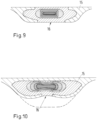
- This channel elevation 16 widens the quasi-circular cross-sectional distribution of the flow velocity of the laminar flow, as shown in the cross-sectional view of Figure 9 is illustrated. For example, it forms elliptical flow velocity ranges. In this way, the flow hits the flow dividers 12 "more gently", which results in an improved distribution of the medium to the subsequent areas of the distribution field or to the subsequent active area 13 of the reactor flow field.
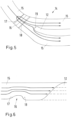
- FIGs 5 and 6 A first design can be seen in which the channel elevation 16 has a descent 18 as the end of the channel elevation 16, which is present at a second predetermined distance upstream of the flow divider 12.
- the channel elevation 16 thus begins and ends just before the flow divider 12, which is sufficient to cause a broadening of the flow velocity distribution.
- FIGs 7 and 8 A second design can be seen in which the channel elevation 16 extends around the flow divider 12 and continues a little further behind it. In this way, the channel elevation 16 has a descent 18 provided on both sides of the flow divider 12 as the end of the channel elevation 16.
- Figure 10 refers to the possibility that the channel elevation 16 is convex in the longitudinal direction of flow.
- this convex channel elevation 16 is formed in the middle of the channel; i.e. where the media flow has the highest flow speed. Due to this centrally or centrally arranged convex channel elevation 16, the speed distribution of the media flow is changed, in particular broadened, so that the media flow hits the flow divider 12 "more gently". It should be noted that other shapes for the channel elevations 16 are also possible, which lead to a desired redistribution of the areas for the flow velocities.
- Each of the flow dividers 12 shown has been provided with a rounding 19, which additionally promotes the division or redistribution of the media flow.
Landscapes
- Life Sciences & Earth Sciences (AREA)
- Engineering & Computer Science (AREA)
- Manufacturing & Machinery (AREA)
- Sustainable Development (AREA)
- Sustainable Energy (AREA)
- Chemical & Material Sciences (AREA)
- Chemical Kinetics & Catalysis (AREA)
- Electrochemistry (AREA)
- General Chemical & Material Sciences (AREA)
- Fuel Cell (AREA)
Description
- Die Erfindung betrifft eine Bipolarplatte, die an ihren voneinander wegweisenden Plattenoberflächen jeweils mit einem Reaktantenflussfeld gebildet ist. Jedes der Reaktantenflussfelder umfasst mehrere durch Wandungen von Stegen begrenzte Strömungskanäle für ein Reaktionsmedium. Jedes der Reaktantenflussfelder ist strömungsmechanisch mit dem ihm zugehörigen Medienport verbunden. Diese Verbindung erfolgt über ein Verteilerfeld in einem außerhalb eines aktiven Bereichs befindlichen Verteilbereich. Das Verteilerfeld weist wenigstens einen Kanal auf, der mit einem Strömungsteiler zur Aufteilung eines strömenden Reaktionsmediums vor dessen Einleitung in den aktiven Bereich versehen ist. Eine Mehrzahl an solchen Kanälen des Verteilerfelds mit Strömungsteiler ist ebenfalls möglich. Die Erfindung betrifft außerdem einen Brennstoffzellenstapel mit einer Mehrzahl an Brennstoffzellen, denen derartige Bipolarplatten zugeordnet sind.
- Brennstoffzellenvorrichtungen werden für die chemische Umsetzung eines Brennstoffs mit Sauerstoff zu Wasser genutzt, um elektrische Energie zu erzeugen. Hierfür enthalten Brennstoffzellen als Kernkomponente die sogenannte Membran-Elektroden-Einheit (MEA für membrane electrode assembly), die ein Verbund aus einer protonenleitenden Membran und jeweils einer, beidseitig an der Membran angeordneten Elektrode (Anode und Kathode) ist. Zudem können Gasdiffusionslagen (GDL) beidseitig der Membran-Elektroden-Einheit an den der Membran abgewandten Seiten der Elektroden angeordnet sein. Im Betrieb der Brennstoffzellenvorrichtung mit einer Mehrzahl zu einem Brennstoffzellenstapel zusammengefasster Brennstoffzellen wird der Brennstoff, insbesondere Wasserstoff H2 oder ein wasserstoffhaltiges Gasgemisch der Anode zugeführt, wo eine elektrochemische Oxidation von H2 zu H+ unter Abgabe von Elektronen stattfindet. Über den Elektrolyten oder die Membran, welche die Reaktionsräume gasdicht voneinander trennt und elektrisch isoliert, erfolgt ein Transport der Protonen H+ aus dem Anodenraum in den Kathodenraum. Die an der Anode bereitgestellten Elektronen werden über eine elektrische Leitung der Kathode zugeleitet. Der Kathode wird Sauerstoff oder ein sauerstoffhaltiges Gasgemisch zugeführt, so dass eine Reduktion von O2 zu O2- unter Aufnahme der Elektronen stattfindet. Gleichzeitig reagieren im Kathodenraum diese Sauerstoffanionen mit den über die Membran transportierten Protonen unter Bildung von Wasser.
- Den Elektroden der Brennstoffzellen werden mittels Bipolarplatten die Reaktantengase zugeführt. Zusätzlich zu den Reaktantengasen wird aufgrund der bei der Brennstoffzellenreaktion erzeugten Wärme auch ein Kühlmedium durch die Bipolarplatten durchgeführt, so dass auf kleinstem Raum drei verschiedene Medien durch die Bipolarplatten geführt werden.
- Bei der Versorgung der Brennstoffzellen mit den Reaktanten werden diese über Hauptkanäle (Ports) in die Bipolarplatten geleitet, die eine Verteilung der Reaktanten in einen aktiven Bereich bewirken soll, um mittels eines Flussfeldes die gesamte Fläche der Elektroden möglichst gleichmäßig zu versorgen. Da in dem Brennstoffzellenstapel mehrere Bipolarplatten mit den Membran-Elektroden-Einheiten gestapelt sind, werden Dichtungen eingesetzt, die die Hauptkanäle längs durch den Brennstoffzellenstapel abdichten. Zusätzlich muss eine gute Abdichtung gegenüber dem in Kühlmittelkanälen strömenden Kühlmedium erfolgen.
- Um eine Gleichverteilung des Reaktionsmediums über den aktiven Bereich der Bipolarplatte hervorrufen, schlagen die
DE 10 2008 033 211 A1 und dieEP 2 026 393 A1 vor, den Strömungsquerschnitt der Strömungskanäle des Reaktantenflussfelds entlang ihrer Längserstreckung gezielt zu variieren, um Druckverluste auszugleichen. Eine Bipolarplatte, bei der der aktive Bereich in einen Eintrittsbereich und einen verbleibenden Teilbereich gegliedert ist, ist derDE 10 2016 111 638 A1 zu entnehmen, wobei die Strömungsführungen der beiden Teilbereiche mit einem unterschiedlichen Strömungsquerschnitten gebildet sind. - Außerhalb des aktiven Bereichs, insbesondere in demjenigen Bereich, in welchem ausgehend von den Medienports die Versorgung des aktiven Bereichs erfolgt, ist es üblich, die Betriebsmedien gleichmäßig durch den gezielten Einsatz von Verzweigungen der Strömungsführung zu verteilen. In diesem Verteilbereich fällt es bei der Aufteilung eines einzelnen Kanals in zwei, drei oder vier Kanäle des folgenden Bereichs, insbesondere bei hohen Volumenströmen und/oder Strömungsgeschwindigkeiten, zunehmend schwerer, eine gleichmäßige Aufteilung des Gesamtvolumenstroms zu erzielen. Dadurch kann das Verteilerfeld zu einer Ungleichverteilung des Reaktionsmediums an den aktiven Bereich der Bipolarplatte führen.
-
CN 108 736 037 A beschreibt eine Bipolarplatte, die in ihrem Verteilbereich einen Strömungsteiler besitzt. Strömauf des Strömungsteilers ragt ein sich vom benachbarten Steg erstreckender Vorsprung in den Kanal vor.US 2012/321987 beschreibt einen Verteilbereich, in dem die Kanäle unterschiedliche Tiefen aufweisen. U - Es ist daher die Aufgabe der vorliegenden Erfindung, eine Bipolarplatte und einen Brennstoffzellenstapel bereitzustellen, die dem vorstehenden Nachteil Rechnung tragen.
- Diese Aufgabe wird mit einer Bipolarplatte mit den Merkmalen des Anspruchs 1 und durch einen Brennstoffzellenstapel mit den Merkmalen des Anspruchs 10 gelöst. Vorteilhafte Ausgestaltungen mit zweckmäßigen Weiterbildungen der Erfindung sind in den abhängigen Ansprüchen angegeben.
- Die erfindungsgemäße Bipolarplatte zeichnet sich insbesondere dadurch aus, dass der den Strömungsteiler aufweisende Kanal eine Kanalanhebung aufweist, welche einen Anstieg umfasst, der unter einem vorgegebenen Abstand stromauf des Strömungsteilers vorliegt. Auf diese Weise wird der aufgrund laminarer Strömung ausgeprägte zentrale Medienstrom durch Reduzierung der Höhe des Kanals eine Verbreiterung aufgezwungen, so dass die Querschnittsform der Medienströmung von einer runden in eine elliptische Form übergeht und deshalb sanfter auf den Strömungsteiler auftrifft.
- Dabei ist die Möglichkeit gegeben, dass die Kanalanhebung einen Abstieg als Abschluss der Kanalanhebung aufweist, der unter einem zweiten vorgegebenen Abstand stromauf des Strömungsteilers vorliegt. Auf diese Weise ist also eine kurze, insbesondere gleichmäßige, Anhebung des Kanalgrunds in geringem Abstand vor dem Strömungsteiler geschaffen. Rein beispielhaft beträgt dabei der erste Abstand des Anstiegs von 1,5 cm bis 3 cm vor dem Strömungsteiler, wobei der zweite Abstand des Abstiegs vorzugsweise von 0,5 cm bis 1,5 cm vor dem Strömungsteiler liegt.
- Es ist aber alternativ auch möglich, dass sich die Kanalanhebung bis um den Strömungsteiler erstreckt und somit einen beidseits des Strömungsteilers vorgesehenen Abstieg als Abschluss der Kanalanhebung aufweist. Auf diese Weise ist also eine, insbesondere gleichmäßig flächige, Anhebung mit einem Beginn vor dem Strömungsteiler und zwei Enden nach dem Strömungsteiler geschaffen, die zu einem noch sanfteren Auftreffen des Medienstroms führt und damit eine gleichmäßigere Verteilung ermöglicht.
- Um die im Querschnitt verbreiterte laminare Strömung vor einer Entstehung von Turbulenzen zu schützen, ist es von Vorteil, wenn zwischen dem Anstieg und dem wenigstens einen Abstieg der Kanalanhebung ein konstanter Strömungsquerschnitt des Kanals vorliegt.
- In diesem Zuge ist es auch sinnvoll, wenn die Kanalanhebung in Strömungslängsrichtung über die gesamte Breite des Kanals gleichmäßig oder konstant gebildet ist.
- Da es in vielen Fällen genügt, das Zentrum des laminaren Medienstroms zu beeinflussen, um die Querschnittsform der Medienströmung von einer runden zu einer elliptischen oder länglichen Form zu wandeln, ist es sinnvoll, wenn die Kanalanhebung in Strömungslängsrichtung konvex gebildet ist, insbesondere dann wenn diese konvexe Kanalanhebung in der Kanalmitte ausgebildet ist.
- Weiterhin ist die Möglichkeit vorhanden, dass eine ungleichmäßige Kanalanhebung vorliegt, die derart optimiert ist, dass bereits eine Vorprägung des Volumenstroms vor dem Strömungsteiler erfolgt, sodass der Medienstrom bereits zu einer Aufteilung angeregt wird. Diese Gestaltung geht daher hinaus über die bloße Aufteilung des Stroms mit Hilfe des Strömungsteilers alleine.
- Für eine Verbreiterung des kreisrunden Querschnitts der laminaren Medienströmung hat es sich als vorteilhaft erwiesen, wenn der Anstieg der Kanalanhebung im Kanal zu einer Anhebung von 20 Prozent bis 50 Prozent gegenüber der Kanaltiefe (bzw. Kanalhöhe) eines anhebungsfreien Abschnitts des Kanals führt. Dadurch wird also auch der Strömungsquerschnitt für die laminare Strömung um 20 Prozent bis 50 Prozent reduziert, bei einer entsprechenden Umverteilung der größten Strömungsgeschwindigkeit des Medienstroms.
- Für eine noch sanftere Umlenkung und Umverteilung des Medienstroms trägt außerdem bei, wenn der Strömungsteiler mit einer Verrundung versehen ist.
- Die in Verbindung mit der erfindungsgemäßen Bipolarplatte erläuterten Vorteile, vorteilhafte Ausgestaltungen und Wirkungen, gelten in gleichem Maße für den erfindungsgemäßen Brennstoffzellenstapel, der mit einer Mehrzahl an Brennstoffzellen mit den erfindungsgemäßen Bipolarplatten ausgerüstet ist. Auch dieser zeichnet sich durch eine verbesserte Verteilung der Betriebsmedien aus, aufgrund der im Verteilbereich eingesetzten Kanalanhebungen.
- Die vorstehend in der Beschreibung genannten Merkmale und Merkmalskombinationen sowie die nachfolgend in der Figurenbeschreibung genannten und/oder in den Figuren alleine gezeigten Merkmale und Merkmalskombinationen sind nicht nur in der jeweils angegebenen Kombination, sondern auch in anderen Kombinationen oder in Alleinstellung verwendbar, ohne den Rahmen der Erfindung zu verlassen. Es sind somit auch Ausführungen als von der Erfindung umfasst und offenbart anzusehen, die in den Figuren nicht explizit gezeigt oder erläutert sind, jedoch durch separierte Merkmalskombinationen aus den erläuterten Ausführungen hervorgehen und erzeugbar sind.
- Weitere Vorteile, Merkmale und Einzelheiten der Erfindung ergeben sich aus den Ansprüchen, der nachfolgenden Beschreibung bevorzugter Ausführungsformen sowie anhand der Zeichnungen. Dabei zeigen:
- Fig. 1
- eine schematische Darstellung eines eine Mehrzahl von Brennstoffzellen aufweisenden Brennstoffzellenstapels mit den die Hauptkanälen zeigenden Bipolarplatten,
- Fig. 2
- eine schematische Detaildarstellung des Schnitts II-II durch den aktiven Bereich der Bipolarplatte aus
Figur 1 , - Fig. 3
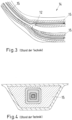
- eine schematische Detaildraufsicht auf einen Kanal mit Strömungsteiler im Verteilbereich einer der
Figur 1 entsprechenden Bipolarplatte gemäß dem Standes der Technik (mit Strömungsverteilung), - Fig. 4
- eine schematische Schnittansicht durch einen Kanal mit einer Illustration der im laminaren Medienstrom vorliegenden Strömungsgeschwindigkeitsbereichen,
- Fig. 5
- eine der
Figur 3 entsprechende Darstellung des Verteilbereichs mit einer stromauf des Strömungsteilers beginnenden und stromauf des Strömungsteilers endenden Kanalanhebung, - Fig. 6
- eine Seitenansicht auf den Kanal aus
Figur 5 , - Fig. 7
- eine der
Figur 3 entsprechende Darstellung des Verteilbereichs mit einer stromauf des Strömungsteilers beginnenden und stromab des Strömungsteilers endenden Kanalanhebung, - Fig. 8
- eine Seitenansicht auf den Kanals aus
Figur 7 , - Fig. 9
- die sich aufgrund der Kanalanhebung ergebende Verbreiterung der Strömungsgeschwindigkeitsbereiche in einer Querschnittsansicht, und
- Fig. 10
- die sich aufgrund einer konvex geformten Kanalanhebung ergebende Verbreiterung der Strömungsgeschwindigkeitsbereiche in einer Querschnittsansicht.
- Ein in
Figur 1 gezeigter Brennstoffzellenstapel 1 besteht aus einer Mehrzahl von in Reihe geschalteter Brennstoffzellen 2. Jede der Brennstoffzellen 2 umfasst eine Anode und eine Kathode sowie eine die Anode von der Kathode trennende protonenleitfähige Membran. Die beiden Elektroden zusammen mit der Membran bilden eine Membran-Elektroden-Anordnung 7 (kurz: MEA). Die Membran ist aus einem lonomer, vorzugsweise einem sulfonierten Tetrafluorethylen-Polymer (PTFE) oder einem Polymer der perfluorierten Sulfonsäure (PFSA) gebildet. Alternativ kann die Membran als eine sulfonierte Hydrocarbon-Membran gebildet sein. - Über Anodenräume innerhalb des Brennstoffzellenstapels 1 wird den Anoden Brennstoff (zum Beispiel Wasserstoff) zugeführt. In einer Polymerelektrolytmembranbrennstoffzelle (PEM-Brennstoffzelle) werden an der Anode Brennstoff oder Brennstoffmoleküle in Protonen und Elektronen aufgespaltet. Die Membran lässt die Protonen (zum Beispiel H+) hindurch, ist aber undurchlässig für die Elektronen (e-). An der Anode erfolgt dabei die folgende Reaktion: 2H2 → 4H+ + 4e- (Oxidation/Elektronenabgabe). Während die Protonen durch die Membran zur Kathode hindurchtreten, werden die Elektronen über einen externen Stromkreis an die Kathode oder an einen Energiespeicher geleitet. Über Kathodenräume innerhalb des Brennstoffzellenstapels 1 kann den Kathoden Kathodengas (zum Beispiel Sauerstoff oder Sauerstoff enthaltende Luft) zugeführt werden, so dass kathodenseitig die folgende Reaktion stattfindet: O2 + 4H+ + 4e- → 2H2O (Reduktion/Elektronenaufnahme).
- Dem Brennstoffzellenstapel 1 wird über eine Kathodenfrischgasleitung durch einen Verdichter komprimierte Luft zugeführt wird. Zusätzlich ist der Brennstoffzellenstapel 1 mit einer Kathodenabgasleitung verbunden. Anodenseitig wird dem Brennstoffzellenstapel 1 in einem Wasserstofftank bereitgehaltener Wasserstoff über eine Anodenfrischgasleitung zugeführt zur Bereitstellung der für die elektrochemische Reaktion in einer Brennstoffzelle 2 erforderlichen Reaktanten. Diese Gase werden an Bipolarplatten 3 übergeben, die für die Verteilung der Gase an die Membran und der Ausleitung Hauptkanäle 4 (Ports) aufweisen. Zusätzlich weisen die Bipolarplatten Hauptkühlmittelkanäle 5 (Ports) für die Durchleitung eines Kühlmediums in einem Kühlmittelkanal 6 auf, so dass auf kleinstem Raum drei verschiedene Medien geführt werden.
- In
Figur 1 sind also auch die jeweils zu Paaren zusammengefassten Hauptkanäle 4, 5 einer Mehrzahl den Brennstoffzellenstapel 1 bildenden Brennstoffzellen 2 mit Bipolarplatten 3 gezeigt. - Ein Detailausschnitt des Brennstoffzellenstapels 1 entlang des Schnittes II-II aus
Figur 1 ist inFigur 2 gezeigt. Dieser Schnitt verläuft durch den aktiven Bereich 13 des Brennstoffzellenstapels 1. Der aktive Bereich 13 der Bipolarplatte 3 ist dabei selbstverständlich selbst nicht elektrochemisch aktiv, aber er ist zu denjenigen Konstituenten der Brennstoffzelle 2 benachbart angeordnet, bei welchen die elektrochemische Brennstoffzellenreaktion erfolgt. Es ist zu erkennen, dass die Bipolarplatte 3 in diesem aktiven Bereich 13 auf ihren voneinander wegweisenden Oberflächen die Reaktantenflussfelder aufweist, die sich gegenüberliegend angeordnet sind und damit eine gegenüberliegende Konfiguration ausbilden. Die Reaktantenflussfelder weisen jeweils eine Mehrzahl von durch Wandungen 11 von Stegen 10 begrenzten Strömungskanälen 9 für das jeweilige Reaktionsmedium auf. Die Stege 10 und die Strömungskanäle 9 der Einen der Einzelplatten 8 sind in diesem aktiven Bereich 13 also gegenüberliegend zu den Stegen 10 und den Strömungskanälen 9 der Anderen der Einzelplatten 8 verlaufend gestaltet. Auf diese Weise werden Kühlmittelkanäle 6 eines sich zwischen den Einzelplatten 8 erstreckenden Kühlmittelflussfelds gebildet. - Es ist erforderlich, die Betriebsmedien möglichst gleichmäßig in den aktiven Bereich 13 der Bipolarplatte verteilt einzuleiten, weshalb es bekannt ist, zwischen den Medienports 4, 5 und dem aktiven Bereich 13 einen Verteilbereich mit einem Kanäle 15 umfassenden Verteilerfeld einzubringen. Die Kanäle 15 sind weisen hierzu geeignete Verzweigungen auf, die durch Strömungsteiler 12 realisiert werden, wobei sich stromab des Strömungsteilers dann zwei der Kanäle 15 fortsetzen. Aus
Figuren 3 und 4 wird dies in einer Detailansicht illustriert, wobei das Betriebsmedium in Form einer laminaren Strömung auf den Strömungsteiler 12 auftrifft.Figur 4 verdeutlicht dabei, dass im Zentrum des Querschnitts des Kanals 15 die höchste Strömungsgeschwindigkeit der Strömung vorherrscht. Diese höchste Strömungsgeschwindigkeit trifft deshalb auf den Strömungsteiler 12 auf. - Diesem Problem stellt sich die erfindungsgemäße Bipolarplatte 3, wobei der den Strömungsteiler 12 aufweisende Kanal 15 eine Kanalanhebung 16 aufweist, welche einen Anstieg 17 umfasst, der unter einem vorgegebenen Abstand stromauf des Strömungsteilers 12 vorliegt. Durch diese Kanalanhebung 16 wird die im Querschnitt quasi kreisflächige Verteilung der Strömungsgeschwindigkeit der laminaren Strömung verbreitert, wie dies in der Querschnittsansicht von
Figur 9 illustriert ist. So formt sie beispielsweise elliptische Strömungsgeschwindigkeitsbereiche aus. Auf diese Weise trifft die Strömung "sanfter" auf die Strömungsteiler 12 auf, was eine verbesserte Verteilung des Mediums auf die nachfolgenden Bereiche des Verteilerfelds oder auf den nachfolgenden aktiven Bereich 13 des Reaktenflussfelds bewirkt. - In
Figuren 5 und 6 ist eine erste Gestaltung zu erkennen, bei der die Kanalanhebung 16 einen Abstieg 18 als Abschluss der Kanalanhebung 16 aufweist, der unter einem zweiten vorgegebenen Abstand stromauf des Strömungsteilers 12 vorliegt. Somit beginnt und endet die Kanalanhebung 16 also knapp vor dem Strömungsteiler 12, was ausreicht um eine Verbreiterung der Strömungsgeschwindigkeitsverteilung hervorzurufen. - In
Figuren 7 und 8 ist eine zweite Gestaltung zu erkennen, bei der sich die Kanalanhebung 16 bis um den Strömungsteiler 12 herum erstreckt und dahinter noch ein Stück fortsetzt. Auf diese Weise weist die Kanalanhebung 16 einen beidseits des Strömungsteilers 12 vorgesehenen Abstieg 18 als Abschluss der Kanalanhebung 16 auf. - Bei beiden Gestaltungen liegt zwischen dem Anstieg 17 und dem wenigstens einen Abstieg 18 der Kanalanhebung 16 ein konstanter Strömungsquerschnitt des Kanals 15 vor, wobei die Kanalanhebung 12 in Strömungslängsrichtung über die gesamte Breite des Kanals 15 gleichmäßig oder konstant gebildet ist. Der Anstieg 17 der Kanalanhebung 16 im Kanal 15 führt dabei nicht zu einer vollständigen Blockade des Medienstroms oder zu einer echten Aufteilung, vielmehr führen die Anstiege 17 der jeweiligen Kanalanhebung 16 vorzugsweise lediglich zu einer Anhebung von 20 Prozent bis 50 Prozent gegenüber der Kanaltiefe oder Kanalhöhe eines anhebungsfreien Abschnitts des Kanals 15.
-
Figur 10 verweist abschließend noch auf die Möglichkeit, dass die Kanalanhebung 16 in Strömungslängsrichtung konvex gebildet ist. Diese konvexe Kanalanhebung 16 ist vorliegend in der Kanalmitte ausgebildet; also dort, wo die größte Strömungsgeschwindigkeit des Medienstroms vorliegt. Aufgrund dieser zentral oder mittig angeordneten konvexen Kanalanhebung 16 wird die Geschwindigkeitsverteilung des Medienstroms verändert, insbesondere verbreitert, so dass der Medienstrom "sanfter" auf die Strömungsteiler 12 auftrifft. Es sei darauf hingewiesen, dass auch andere Formgebungen für die Kanalanhebungen 16 möglich sind, die zu einem gewünschten Umverteilen der Bereiche für die Strömungsgeschwindigkeiten führen. - Jeder der gezeigten Strömungsteiler 12 ist mit einer Verrundung 19 versehen worden, was die Aufteilung oder Umverteilung des Medienstroms zusätzlich begünstigt.
- Im Ergebnis ist mit der vorliegenden Erfindung also eine Gleichverteilung der Medienströme bereits im Verteilbereich 14 gegeben, so dass eine verbesserte Medienverteilung über die gesamte Bipolarplatte 3 und zugleich über den gesamten Brennstoffzellenstapel 1 vorliegt.
-
- 1
- Brennstoffzellenstapel
- 2
- Brennstoffzelle
- 3
- Bipolarplatte
- 4
- Hauptkanal für Reaktanten
- 5
- Hauptkühlmittelkanal für Kühlmedium
- 6
- Kühlmittelkanal
- 7
- Membran-Elektroden-Anordnung (MEA)
- 8
- Einzelplatte
- 9
- Strömungskanal
- 10
- Steg
- 11
- Wandung
- 12
- Strömungsteiler
- 13
- Aktiver Bereich
- 14
- Verteilbereich
- 15
- Kanal (Verteilbereich / Verteilerfeld)
- 16
- Kanalanhebung
- 17
- Anstieg
- 18
- Abstieg
- 19
- Verrundung
Claims (10)
- Bipolarplatte (3) die an ihren voneinander wegweisenden Plattenoberflächen jeweils mit einem Reaktantenflussfeld gebildet ist, welches mehrere durch Wandungen (11) von Stegen (10) begrenzte Strömungskanäle (9) für ein Reaktionsmedium umfasst, wobei das jeweilige Reaktantenflussfeld strömungsmechanisch mit einem Medienport (4, 5) über ein Verteilerfeld in einem außerhalb eines aktiven Bereichs (13) befindlichen Verteilbereich (14) verbunden ist, wobei wenigstens ein Kanal (15) des Verteilerfelds mit einem Strömungsteiler (12) zur Aufteilung eines strömenden Reaktionsmediums vor dessen Einleitung in den aktiven Bereich (13) versehen ist, dadurch gekennzeichnet, dass der den Strömungsteiler (12) aufweisende Kanal (15) eine Kanalanhebung (16) aufweist, welche einen Anstieg (17) umfasst, der unter einem vorgegebenen Abstand stromauf des Strömungsteilers (12) vorliegt.
- Bipolarplatte (3) nach Anspruch 1, dadurch gekennzeichnet, dass die Kanalanhebung (16) einen Abstieg (18) als Abschluss der Kanalanhebung (16) aufweist, der unter einem zweiten vorgegebenen Abstand stromauf des Strömungsteilers (12) vorliegt.
- Bipolarplatte (3) nach Anspruch 1, dadurch gekennzeichnet, dass sich die Kanalanhebung (16) bis um den Strömungsteiler (12) erstreckt und somit einen beidseits des Strömungsteilers (12) vorgesehenen Abstieg (18) als Abschluss der Kanalanhebung (16) aufweist.
- Bipolarplatte (3) nach Anspruch 2 oder 3, dadurch gekennzeichnet, dass zwischen dem Anstieg (17) und dem wenigstens einen Abstieg (18) der Kanalanhebung (16) ein konstanter Strömungsquerschnitt des Kanals (15) vorliegt.
- Bipolarplatte (3) nach einem der Ansprüche 1 bis 4, dadurch gekennzeichnet, dass die Kanalanhebung (12) in Strömungslängsrichtung über die gesamte Breite des Kanals (15) gleichmäßig oder konstant gebildet ist.
- Bipolarplatte (3) nach einem der Ansprüche 1 bis 4, dadurch gekennzeichnet, dass die Kanalanhebung (16) in Strömungslängsrichtung konvex gebildet ist.
- Bipolarplatte (3) nach Anspruch 6, dadurch gekennzeichnet, dass die konvexe Kanalanhebung (16) in der Kanalmitte ausgebildet ist.
- Bipolarplatte (3) nach einem der Ansprüche 1 bis 7, dadurch gekennzeichnet, dass der Anstieg (17) der Kanalanhebung (16) im Kanal (15) zu einer Anhebung von 20 Prozent bis 50 Prozent gegenüber der Kanaltiefe eines anhebungsfreien Abschnitts des Kanals (15) führt.
- Bipolarplatte (3) nach einem der Ansprüche 1 bis 8, dadurch gekennzeichnet, dass der Strömungsteiler (12) mit einer Verrundung (19) versehen ist.
- Brennstoffzellenstapel (1) umfassend eine Mehrzahl an Brennstoffzellen (2) mit Bipolarplatten (3) nach einem der Ansprüche 1 bis 9.
Applications Claiming Priority (2)
| Application Number | Priority Date | Filing Date | Title |
|---|---|---|---|
| DE102020128279.6A DE102020128279A1 (de) | 2020-10-28 | 2020-10-28 | Bipolarplatte und Brennstoffzellenstapel |
| PCT/EP2021/079471 WO2022090125A1 (de) | 2020-10-28 | 2021-10-25 | Bipolarplatte und brennstoffzellenstapel |
Publications (2)
| Publication Number | Publication Date |
|---|---|
| EP4165705A1 EP4165705A1 (de) | 2023-04-19 |
| EP4165705B1 true EP4165705B1 (de) | 2024-03-13 |
Family
ID=78483262
Family Applications (1)
| Application Number | Title | Priority Date | Filing Date |
|---|---|---|---|
| EP21801452.0A Active EP4165705B1 (de) | 2020-10-28 | 2021-10-25 | Bipolarplatte und brennstoffzellenstapel |
Country Status (5)
| Country | Link |
|---|---|
| US (1) | US12394805B2 (de) |
| EP (1) | EP4165705B1 (de) |
| CN (1) | CN115868049A (de) |
| DE (1) | DE102020128279A1 (de) |
| WO (1) | WO2022090125A1 (de) |
Families Citing this family (1)
| Publication number | Priority date | Publication date | Assignee | Title |
|---|---|---|---|---|
| DE102024123593A1 (de) * | 2024-08-19 | 2026-02-19 | Ekpo Fuel Cell Technologies Gmbh | Bipolarplatte für eine elektrochemische Vorrichtung |
Citations (5)
| Publication number | Priority date | Publication date | Assignee | Title |
|---|---|---|---|---|
| US20080131755A1 (en) * | 2006-12-05 | 2008-06-05 | Jong Hyun Lee | Separating Plate for Fuel Cell |
| US20090169964A1 (en) * | 2005-12-16 | 2009-07-02 | Sadao Ikeda | Separator of Fuel Cell |
| EP2618413A1 (de) * | 2010-09-16 | 2013-07-24 | Toyota Jidosha Kabushiki Kaisha | Separator für eine brennstoffzelle, brennstoffzelle und verfahren zur herstellung einer brennstoffzelle |
| US20170110740A1 (en) * | 2014-03-31 | 2017-04-20 | Intelligent Energy Limited | Cooling plates for fuel cells |
| EP3331076A1 (de) * | 2015-07-31 | 2018-06-06 | LG Chem, Ltd. | Separatorplatte und brennstoffzellenstapel damit |
Family Cites Families (15)
| Publication number | Priority date | Publication date | Assignee | Title |
|---|---|---|---|---|
| JP4523089B2 (ja) | 1999-04-09 | 2010-08-11 | 本田技研工業株式会社 | 燃料電池スタック |
| EP2026393A1 (de) | 2007-08-13 | 2009-02-18 | Nissan Motor Co., Ltd. | Brennstoffzellenseparatoreinheit und Brennstoffzelle |
| DE102008033211A1 (de) | 2008-07-15 | 2010-01-21 | Daimler Ag | Bipolarplatte für eine Brennstoffzellenanordnung, insbesondere zur Anordnung zwischen zwei benachbarten Membran-Elektroden-Anordnungen |
| CN201430181Y (zh) * | 2009-06-19 | 2010-03-24 | 武汉银泰科技燃料电池有限公司 | 一种燃料电池空气极板 |
| JP5422700B2 (ja) | 2011-06-16 | 2014-02-19 | 本田技研工業株式会社 | 燃料電池 |
| KR101313382B1 (ko) * | 2011-09-08 | 2013-10-01 | 현대하이스코 주식회사 | 냉각수 흐름을 개선한 연료전지용 금속 분리판 및 이를 구비하는 연료전지 스택 |
| WO2013105956A1 (en) | 2012-01-12 | 2013-07-18 | Utc Power Corporation | Fuel cell reactant flow field having impediments to flow |
| DE102016111638A1 (de) | 2016-06-24 | 2017-12-28 | Volkswagen Ag | Bipolarplatte mit variabler Breite der Reaktionsgaskanäle im Eintrittsbereich des aktiven Bereichs, Brennstoffzellenstapel und Brennstoffzellensystem mit solchen Bipolarplatten sowie Fahrzeug |
| CN108736037B (zh) * | 2017-04-20 | 2024-03-26 | 天津新氢动力科技有限公司 | 一种燃料电池双极板 |
| JP6772200B2 (ja) | 2018-01-09 | 2020-10-21 | 本田技研工業株式会社 | 発電セル |
| JP7081517B2 (ja) | 2019-01-31 | 2022-06-07 | トヨタ紡織株式会社 | 燃料電池用セパレータ |
| CN210443621U (zh) * | 2019-07-31 | 2020-05-01 | 上海佑戈金属科技有限公司 | 金属基质双极板 |
| CN111029611A (zh) | 2019-12-09 | 2020-04-17 | 中国第一汽车股份有限公司 | 一种流场板及燃料电池 |
| CN111211336B (zh) | 2020-02-20 | 2025-02-14 | 太原科技大学 | 一种燃料电池变截面台阶形流道的金属双极板 |
| CN111668506B (zh) * | 2020-06-28 | 2024-07-05 | 武汉雄韬氢雄燃料电池科技有限公司 | 一种新型氢燃料电池金属双极板 |
-
2020
- 2020-10-28 DE DE102020128279.6A patent/DE102020128279A1/de active Pending
-
2021
- 2021-10-25 US US18/004,003 patent/US12394805B2/en active Active
- 2021-10-25 CN CN202180047117.3A patent/CN115868049A/zh active Pending
- 2021-10-25 EP EP21801452.0A patent/EP4165705B1/de active Active
- 2021-10-25 WO PCT/EP2021/079471 patent/WO2022090125A1/de not_active Ceased
Patent Citations (5)
| Publication number | Priority date | Publication date | Assignee | Title |
|---|---|---|---|---|
| US20090169964A1 (en) * | 2005-12-16 | 2009-07-02 | Sadao Ikeda | Separator of Fuel Cell |
| US20080131755A1 (en) * | 2006-12-05 | 2008-06-05 | Jong Hyun Lee | Separating Plate for Fuel Cell |
| EP2618413A1 (de) * | 2010-09-16 | 2013-07-24 | Toyota Jidosha Kabushiki Kaisha | Separator für eine brennstoffzelle, brennstoffzelle und verfahren zur herstellung einer brennstoffzelle |
| US20170110740A1 (en) * | 2014-03-31 | 2017-04-20 | Intelligent Energy Limited | Cooling plates for fuel cells |
| EP3331076A1 (de) * | 2015-07-31 | 2018-06-06 | LG Chem, Ltd. | Separatorplatte und brennstoffzellenstapel damit |
Also Published As
| Publication number | Publication date |
|---|---|
| DE102020128279A1 (de) | 2022-04-28 |
| US12394805B2 (en) | 2025-08-19 |
| EP4165705A1 (de) | 2023-04-19 |
| US20230261213A1 (en) | 2023-08-17 |
| WO2022090125A1 (de) | 2022-05-05 |
| CN115868049A (zh) | 2023-03-28 |
Similar Documents
| Publication | Publication Date | Title |
|---|---|---|
| DE102014206335A1 (de) | Bipolarplatte und Brennstoffzelle mit einer solchen | |
| DE102015215231A1 (de) | Bipolarplatte sowie Brennstoffzellensystem mit einer solchen | |
| DE102015214517A1 (de) | Bipolarplatte und Membran-Elektroden-Einheit für eine in einem Brennstoffzellenstapel angeordnete Brennstoffzelle, Brennstoffzelle und Brennstoffzellenstapel | |
| DE112007000282T5 (de) | Brennstoffzelle | |
| DE102018200673A1 (de) | Bipolarplatte, Brennstoffzelle und ein Kraftfahrzeug | |
| EP4154335B1 (de) | Bipolarplatte und brennstoffzellenstapel | |
| WO2015150533A1 (de) | Bipolarplatte sowie brennstoffzelle mit einer solchen | |
| EP3430662A1 (de) | Bipolarplatte mit variabler breite der reaktionsgaskanäle im eintrittsbereich des aktiven bereichs, brennstoffzellenstapel und brennstoffzellensystem mit solchen bipolarplatten sowie fahrzeug | |
| DE102022122717B3 (de) | Bipolarplatte und elektrochemische Zelle | |
| DE102015200427A1 (de) | Brennstoffzellensystem mit mehreren Brennstoffzellenstapeln | |
| DE112005002123B4 (de) | Bipolarplatte mit Versetzungen | |
| WO2022090125A1 (de) | Bipolarplatte und brennstoffzellenstapel | |
| DE102005035098A1 (de) | PEM-Brennstoffzelle mit Zudosierungsraum | |
| EP4150687B1 (de) | Bipolarplatte und brennstoffzellenstapel | |
| EP4165706B1 (de) | Einzelzelle und brennstoffzellenstapel mit elastischen strukturen zur gleichverteilung von betriebsmedien | |
| DE102015223930A1 (de) | Bipolarplatte sowie Brennstoffzelle | |
| WO2017085030A1 (de) | Brennstoffzellenstapel bipolarplatten aufweisend sowie brennstoffzellensystem | |
| DE10321946B4 (de) | Brennstoffzellenseparator und Verwendung des Brennstoffzellenseparators in einer Brennstoffzelle | |
| DE102014217050A1 (de) | Bipolarplatte und Brennstoffzelle | |
| DE102022208625A1 (de) | Separatorplatte und elektrochemische Zelle | |
| DE102015200573A1 (de) | Bipolarplatte und Brennstoffzelle mit einer solchen | |
| DE102020213580A1 (de) | Verteilerplatte für eine elektrochemische Zelle und elektrochemische Zelle | |
| DE102020128562A1 (de) | Bipolarplatte mit einsetzbarer Blende und Brennstoffzellenstapel | |
| DE102020133764A1 (de) | Bipolarplatte mit verschachtelt angeordneten Medienports der Reaktanten und Brennstoffzellenstapel | |
| DE102015222245A1 (de) | Polarplatte für einen Brennstoffzellenstapel |
Legal Events
| Date | Code | Title | Description |
|---|---|---|---|
| STAA | Information on the status of an ep patent application or granted ep patent |
Free format text: STATUS: UNKNOWN |
|
| STAA | Information on the status of an ep patent application or granted ep patent |
Free format text: STATUS: THE INTERNATIONAL PUBLICATION HAS BEEN MADE |
|
| PUAI | Public reference made under article 153(3) epc to a published international application that has entered the european phase |
Free format text: ORIGINAL CODE: 0009012 |
|
| STAA | Information on the status of an ep patent application or granted ep patent |
Free format text: STATUS: REQUEST FOR EXAMINATION WAS MADE |
|
| 17P | Request for examination filed |
Effective date: 20230112 |
|
| AK | Designated contracting states |
Kind code of ref document: A1 Designated state(s): AL AT BE BG CH CY CZ DE DK EE ES FI FR GB GR HR HU IE IS IT LI LT LU LV MC MK MT NL NO PL PT RO RS SE SI SK SM TR |
|
| P01 | Opt-out of the competence of the unified patent court (upc) registered |
Effective date: 20230529 |
|
| GRAP | Despatch of communication of intention to grant a patent |
Free format text: ORIGINAL CODE: EPIDOSNIGR1 |
|
| STAA | Information on the status of an ep patent application or granted ep patent |
Free format text: STATUS: GRANT OF PATENT IS INTENDED |
|
| DAV | Request for validation of the european patent (deleted) | ||
| DAX | Request for extension of the european patent (deleted) | ||
| INTG | Intention to grant announced |
Effective date: 20231129 |
|
| GRAS | Grant fee paid |
Free format text: ORIGINAL CODE: EPIDOSNIGR3 |
|
| GRAA | (expected) grant |
Free format text: ORIGINAL CODE: 0009210 |
|
| STAA | Information on the status of an ep patent application or granted ep patent |
Free format text: STATUS: THE PATENT HAS BEEN GRANTED |
|
| AK | Designated contracting states |
Kind code of ref document: B1 Designated state(s): AL AT BE BG CH CY CZ DE DK EE ES FI FR GB GR HR HU IE IS IT LI LT LU LV MC MK MT NL NO PL PT RO RS SE SI SK SM TR |
|
| REG | Reference to a national code |
Ref country code: GB Ref legal event code: FG4D Free format text: NOT ENGLISH |
|
| REG | Reference to a national code |
Ref country code: CH Ref legal event code: EP |
|
| REG | Reference to a national code |
Ref country code: DE Ref legal event code: R096 Ref document number: 502021003000 Country of ref document: DE |
|
| REG | Reference to a national code |
Ref country code: IE Ref legal event code: FG4D Free format text: LANGUAGE OF EP DOCUMENT: GERMAN |
|
| PG25 | Lapsed in a contracting state [announced via postgrant information from national office to epo] |
Ref country code: LT Free format text: LAPSE BECAUSE OF FAILURE TO SUBMIT A TRANSLATION OF THE DESCRIPTION OR TO PAY THE FEE WITHIN THE PRESCRIBED TIME-LIMIT Effective date: 20240313 |
|
| REG | Reference to a national code |
Ref country code: LT Ref legal event code: MG9D |
|
| PG25 | Lapsed in a contracting state [announced via postgrant information from national office to epo] |
Ref country code: GR Free format text: LAPSE BECAUSE OF FAILURE TO SUBMIT A TRANSLATION OF THE DESCRIPTION OR TO PAY THE FEE WITHIN THE PRESCRIBED TIME-LIMIT Effective date: 20240614 |
|
| REG | Reference to a national code |
Ref country code: NL Ref legal event code: MP Effective date: 20240313 |
|
| PG25 | Lapsed in a contracting state [announced via postgrant information from national office to epo] |
Ref country code: HR Free format text: LAPSE BECAUSE OF FAILURE TO SUBMIT A TRANSLATION OF THE DESCRIPTION OR TO PAY THE FEE WITHIN THE PRESCRIBED TIME-LIMIT Effective date: 20240313 Ref country code: RS Free format text: LAPSE BECAUSE OF FAILURE TO SUBMIT A TRANSLATION OF THE DESCRIPTION OR TO PAY THE FEE WITHIN THE PRESCRIBED TIME-LIMIT Effective date: 20240613 |
|
| PG25 | Lapsed in a contracting state [announced via postgrant information from national office to epo] |
Ref country code: ES Free format text: LAPSE BECAUSE OF FAILURE TO SUBMIT A TRANSLATION OF THE DESCRIPTION OR TO PAY THE FEE WITHIN THE PRESCRIBED TIME-LIMIT Effective date: 20240313 |
|
| PG25 | Lapsed in a contracting state [announced via postgrant information from national office to epo] |
Ref country code: RS Free format text: LAPSE BECAUSE OF FAILURE TO SUBMIT A TRANSLATION OF THE DESCRIPTION OR TO PAY THE FEE WITHIN THE PRESCRIBED TIME-LIMIT Effective date: 20240613 Ref country code: NO Free format text: LAPSE BECAUSE OF FAILURE TO SUBMIT A TRANSLATION OF THE DESCRIPTION OR TO PAY THE FEE WITHIN THE PRESCRIBED TIME-LIMIT Effective date: 20240613 Ref country code: LT Free format text: LAPSE BECAUSE OF FAILURE TO SUBMIT A TRANSLATION OF THE DESCRIPTION OR TO PAY THE FEE WITHIN THE PRESCRIBED TIME-LIMIT Effective date: 20240313 Ref country code: HR Free format text: LAPSE BECAUSE OF FAILURE TO SUBMIT A TRANSLATION OF THE DESCRIPTION OR TO PAY THE FEE WITHIN THE PRESCRIBED TIME-LIMIT Effective date: 20240313 Ref country code: GR Free format text: LAPSE BECAUSE OF FAILURE TO SUBMIT A TRANSLATION OF THE DESCRIPTION OR TO PAY THE FEE WITHIN THE PRESCRIBED TIME-LIMIT Effective date: 20240614 Ref country code: FI Free format text: LAPSE BECAUSE OF FAILURE TO SUBMIT A TRANSLATION OF THE DESCRIPTION OR TO PAY THE FEE WITHIN THE PRESCRIBED TIME-LIMIT Effective date: 20240313 Ref country code: ES Free format text: LAPSE BECAUSE OF FAILURE TO SUBMIT A TRANSLATION OF THE DESCRIPTION OR TO PAY THE FEE WITHIN THE PRESCRIBED TIME-LIMIT Effective date: 20240313 Ref country code: BG Free format text: LAPSE BECAUSE OF FAILURE TO SUBMIT A TRANSLATION OF THE DESCRIPTION OR TO PAY THE FEE WITHIN THE PRESCRIBED TIME-LIMIT Effective date: 20240313 |
|
| PG25 | Lapsed in a contracting state [announced via postgrant information from national office to epo] |
Ref country code: SE Free format text: LAPSE BECAUSE OF FAILURE TO SUBMIT A TRANSLATION OF THE DESCRIPTION OR TO PAY THE FEE WITHIN THE PRESCRIBED TIME-LIMIT Effective date: 20240313 Ref country code: LV Free format text: LAPSE BECAUSE OF FAILURE TO SUBMIT A TRANSLATION OF THE DESCRIPTION OR TO PAY THE FEE WITHIN THE PRESCRIBED TIME-LIMIT Effective date: 20240313 |
|
| PG25 | Lapsed in a contracting state [announced via postgrant information from national office to epo] |
Ref country code: NL Free format text: LAPSE BECAUSE OF FAILURE TO SUBMIT A TRANSLATION OF THE DESCRIPTION OR TO PAY THE FEE WITHIN THE PRESCRIBED TIME-LIMIT Effective date: 20240313 |
|
| PG25 | Lapsed in a contracting state [announced via postgrant information from national office to epo] |
Ref country code: NL Free format text: LAPSE BECAUSE OF FAILURE TO SUBMIT A TRANSLATION OF THE DESCRIPTION OR TO PAY THE FEE WITHIN THE PRESCRIBED TIME-LIMIT Effective date: 20240313 |
|
| PG25 | Lapsed in a contracting state [announced via postgrant information from national office to epo] |
Ref country code: IS Free format text: LAPSE BECAUSE OF FAILURE TO SUBMIT A TRANSLATION OF THE DESCRIPTION OR TO PAY THE FEE WITHIN THE PRESCRIBED TIME-LIMIT Effective date: 20240713 |
|
| PG25 | Lapsed in a contracting state [announced via postgrant information from national office to epo] |
Ref country code: PT Free format text: LAPSE BECAUSE OF FAILURE TO SUBMIT A TRANSLATION OF THE DESCRIPTION OR TO PAY THE FEE WITHIN THE PRESCRIBED TIME-LIMIT Effective date: 20240715 Ref country code: SM Free format text: LAPSE BECAUSE OF FAILURE TO SUBMIT A TRANSLATION OF THE DESCRIPTION OR TO PAY THE FEE WITHIN THE PRESCRIBED TIME-LIMIT Effective date: 20240313 |
|
| PG25 | Lapsed in a contracting state [announced via postgrant information from national office to epo] |
Ref country code: EE Free format text: LAPSE BECAUSE OF FAILURE TO SUBMIT A TRANSLATION OF THE DESCRIPTION OR TO PAY THE FEE WITHIN THE PRESCRIBED TIME-LIMIT Effective date: 20240313 Ref country code: CZ Free format text: LAPSE BECAUSE OF FAILURE TO SUBMIT A TRANSLATION OF THE DESCRIPTION OR TO PAY THE FEE WITHIN THE PRESCRIBED TIME-LIMIT Effective date: 20240313 |
|
| PG25 | Lapsed in a contracting state [announced via postgrant information from national office to epo] |
Ref country code: PL Free format text: LAPSE BECAUSE OF FAILURE TO SUBMIT A TRANSLATION OF THE DESCRIPTION OR TO PAY THE FEE WITHIN THE PRESCRIBED TIME-LIMIT Effective date: 20240313 |
|
| PG25 | Lapsed in a contracting state [announced via postgrant information from national office to epo] |
Ref country code: SK Free format text: LAPSE BECAUSE OF FAILURE TO SUBMIT A TRANSLATION OF THE DESCRIPTION OR TO PAY THE FEE WITHIN THE PRESCRIBED TIME-LIMIT Effective date: 20240313 |
|
| PG25 | Lapsed in a contracting state [announced via postgrant information from national office to epo] |
Ref country code: SM Free format text: LAPSE BECAUSE OF FAILURE TO SUBMIT A TRANSLATION OF THE DESCRIPTION OR TO PAY THE FEE WITHIN THE PRESCRIBED TIME-LIMIT Effective date: 20240313 Ref country code: SK Free format text: LAPSE BECAUSE OF FAILURE TO SUBMIT A TRANSLATION OF THE DESCRIPTION OR TO PAY THE FEE WITHIN THE PRESCRIBED TIME-LIMIT Effective date: 20240313 Ref country code: RO Free format text: LAPSE BECAUSE OF FAILURE TO SUBMIT A TRANSLATION OF THE DESCRIPTION OR TO PAY THE FEE WITHIN THE PRESCRIBED TIME-LIMIT Effective date: 20240313 Ref country code: PT Free format text: LAPSE BECAUSE OF FAILURE TO SUBMIT A TRANSLATION OF THE DESCRIPTION OR TO PAY THE FEE WITHIN THE PRESCRIBED TIME-LIMIT Effective date: 20240715 Ref country code: PL Free format text: LAPSE BECAUSE OF FAILURE TO SUBMIT A TRANSLATION OF THE DESCRIPTION OR TO PAY THE FEE WITHIN THE PRESCRIBED TIME-LIMIT Effective date: 20240313 Ref country code: IS Free format text: LAPSE BECAUSE OF FAILURE TO SUBMIT A TRANSLATION OF THE DESCRIPTION OR TO PAY THE FEE WITHIN THE PRESCRIBED TIME-LIMIT Effective date: 20240713 Ref country code: EE Free format text: LAPSE BECAUSE OF FAILURE TO SUBMIT A TRANSLATION OF THE DESCRIPTION OR TO PAY THE FEE WITHIN THE PRESCRIBED TIME-LIMIT Effective date: 20240313 Ref country code: CZ Free format text: LAPSE BECAUSE OF FAILURE TO SUBMIT A TRANSLATION OF THE DESCRIPTION OR TO PAY THE FEE WITHIN THE PRESCRIBED TIME-LIMIT Effective date: 20240313 |
|
| PG25 | Lapsed in a contracting state [announced via postgrant information from national office to epo] |
Ref country code: IT Free format text: LAPSE BECAUSE OF FAILURE TO SUBMIT A TRANSLATION OF THE DESCRIPTION OR TO PAY THE FEE WITHIN THE PRESCRIBED TIME-LIMIT Effective date: 20240313 |
|
| REG | Reference to a national code |
Ref country code: DE Ref legal event code: R097 Ref document number: 502021003000 Country of ref document: DE |
|
| PG25 | Lapsed in a contracting state [announced via postgrant information from national office to epo] |
Ref country code: IT Free format text: LAPSE BECAUSE OF FAILURE TO SUBMIT A TRANSLATION OF THE DESCRIPTION OR TO PAY THE FEE WITHIN THE PRESCRIBED TIME-LIMIT Effective date: 20240313 |
|
| PG25 | Lapsed in a contracting state [announced via postgrant information from national office to epo] |
Ref country code: DK Free format text: LAPSE BECAUSE OF FAILURE TO SUBMIT A TRANSLATION OF THE DESCRIPTION OR TO PAY THE FEE WITHIN THE PRESCRIBED TIME-LIMIT Effective date: 20240313 |
|
| PLBE | No opposition filed within time limit |
Free format text: ORIGINAL CODE: 0009261 |
|
| STAA | Information on the status of an ep patent application or granted ep patent |
Free format text: STATUS: NO OPPOSITION FILED WITHIN TIME LIMIT |
|
| PG25 | Lapsed in a contracting state [announced via postgrant information from national office to epo] |
Ref country code: DK Free format text: LAPSE BECAUSE OF FAILURE TO SUBMIT A TRANSLATION OF THE DESCRIPTION OR TO PAY THE FEE WITHIN THE PRESCRIBED TIME-LIMIT Effective date: 20240313 |
|
| 26N | No opposition filed |
Effective date: 20241216 |
|
| PG25 | Lapsed in a contracting state [announced via postgrant information from national office to epo] |
Ref country code: SI Free format text: LAPSE BECAUSE OF FAILURE TO SUBMIT A TRANSLATION OF THE DESCRIPTION OR TO PAY THE FEE WITHIN THE PRESCRIBED TIME-LIMIT Effective date: 20240313 |
|
| REG | Reference to a national code |
Ref country code: CH Ref legal event code: PL |
|
| PG25 | Lapsed in a contracting state [announced via postgrant information from national office to epo] |
Ref country code: MC Free format text: LAPSE BECAUSE OF FAILURE TO SUBMIT A TRANSLATION OF THE DESCRIPTION OR TO PAY THE FEE WITHIN THE PRESCRIBED TIME-LIMIT Effective date: 20240313 |
|
| PG25 | Lapsed in a contracting state [announced via postgrant information from national office to epo] |
Ref country code: BE Free format text: LAPSE BECAUSE OF NON-PAYMENT OF DUE FEES Effective date: 20241031 Ref country code: LU Free format text: LAPSE BECAUSE OF NON-PAYMENT OF DUE FEES Effective date: 20241025 |
|
| PG25 | Lapsed in a contracting state [announced via postgrant information from national office to epo] |
Ref country code: CH Free format text: LAPSE BECAUSE OF NON-PAYMENT OF DUE FEES Effective date: 20241031 |
|
| REG | Reference to a national code |
Ref country code: BE Ref legal event code: MM Effective date: 20241031 |
|
| PG25 | Lapsed in a contracting state [announced via postgrant information from national office to epo] |
Ref country code: IE Free format text: LAPSE BECAUSE OF NON-PAYMENT OF DUE FEES Effective date: 20241025 |
|
| PGFP | Annual fee paid to national office [announced via postgrant information from national office to epo] |
Ref country code: DE Payment date: 20251031 Year of fee payment: 5 |
|
| PGFP | Annual fee paid to national office [announced via postgrant information from national office to epo] |
Ref country code: GB Payment date: 20251024 Year of fee payment: 5 |
|
| PGFP | Annual fee paid to national office [announced via postgrant information from national office to epo] |
Ref country code: AT Payment date: 20260113 Year of fee payment: 5 |
|
| PGFP | Annual fee paid to national office [announced via postgrant information from national office to epo] |
Ref country code: FR Payment date: 20251029 Year of fee payment: 5 |
|
| PG25 | Lapsed in a contracting state [announced via postgrant information from national office to epo] |
Ref country code: CY Free format text: LAPSE BECAUSE OF FAILURE TO SUBMIT A TRANSLATION OF THE DESCRIPTION OR TO PAY THE FEE WITHIN THE PRESCRIBED TIME-LIMIT; INVALID AB INITIO Effective date: 20211025 |
|
| PG25 | Lapsed in a contracting state [announced via postgrant information from national office to epo] |
Ref country code: HU Free format text: LAPSE BECAUSE OF FAILURE TO SUBMIT A TRANSLATION OF THE DESCRIPTION OR TO PAY THE FEE WITHIN THE PRESCRIBED TIME-LIMIT; INVALID AB INITIO Effective date: 20211025 |