EP4159894A1 - Dampfelektrolyseursystem zur herstellung von wasserstoff und entsprechendes verfahren - Google Patents
Dampfelektrolyseursystem zur herstellung von wasserstoff und entsprechendes verfahren Download PDFInfo
- Publication number
- EP4159894A1 EP4159894A1 EP21200112.7A EP21200112A EP4159894A1 EP 4159894 A1 EP4159894 A1 EP 4159894A1 EP 21200112 A EP21200112 A EP 21200112A EP 4159894 A1 EP4159894 A1 EP 4159894A1
- Authority
- EP
- European Patent Office
- Prior art keywords
- steam
- gas
- electrolyser cell
- feeding gas
- cell
- Prior art date
- Legal status (The legal status is an assumption and is not a legal conclusion. Google has not performed a legal analysis and makes no representation as to the accuracy of the status listed.)
- Granted
Links
Images


Classifications
-
- C—CHEMISTRY; METALLURGY
- C25—ELECTROLYTIC OR ELECTROPHORETIC PROCESSES; APPARATUS THEREFOR
- C25B—ELECTROLYTIC OR ELECTROPHORETIC PROCESSES FOR THE PRODUCTION OF COMPOUNDS OR NON-METALS; APPARATUS THEREFOR
- C25B1/00—Electrolytic production of inorganic compounds or non-metals
- C25B1/01—Products
- C25B1/02—Hydrogen or oxygen
- C25B1/04—Hydrogen or oxygen by electrolysis of water
- C25B1/042—Hydrogen or oxygen by electrolysis of water by electrolysis of steam
-
- C—CHEMISTRY; METALLURGY
- C25—ELECTROLYTIC OR ELECTROPHORETIC PROCESSES; APPARATUS THEREFOR
- C25B—ELECTROLYTIC OR ELECTROPHORETIC PROCESSES FOR THE PRODUCTION OF COMPOUNDS OR NON-METALS; APPARATUS THEREFOR
- C25B1/00—Electrolytic production of inorganic compounds or non-metals
-
- C—CHEMISTRY; METALLURGY
- C25—ELECTROLYTIC OR ELECTROPHORETIC PROCESSES; APPARATUS THEREFOR
- C25B—ELECTROLYTIC OR ELECTROPHORETIC PROCESSES FOR THE PRODUCTION OF COMPOUNDS OR NON-METALS; APPARATUS THEREFOR
- C25B15/00—Operating or servicing cells
-
- C—CHEMISTRY; METALLURGY
- C25—ELECTROLYTIC OR ELECTROPHORETIC PROCESSES; APPARATUS THEREFOR
- C25B—ELECTROLYTIC OR ELECTROPHORETIC PROCESSES FOR THE PRODUCTION OF COMPOUNDS OR NON-METALS; APPARATUS THEREFOR
- C25B15/00—Operating or servicing cells
- C25B15/02—Process control or regulation
- C25B15/021—Process control or regulation of heating or cooling
-
- C—CHEMISTRY; METALLURGY
- C25—ELECTROLYTIC OR ELECTROPHORETIC PROCESSES; APPARATUS THEREFOR
- C25B—ELECTROLYTIC OR ELECTROPHORETIC PROCESSES FOR THE PRODUCTION OF COMPOUNDS OR NON-METALS; APPARATUS THEREFOR
- C25B15/00—Operating or servicing cells
- C25B15/08—Supplying or removing reactants or electrolytes; Regeneration of electrolytes
-
- C—CHEMISTRY; METALLURGY
- C25—ELECTROLYTIC OR ELECTROPHORETIC PROCESSES; APPARATUS THEREFOR
- C25B—ELECTROLYTIC OR ELECTROPHORETIC PROCESSES FOR THE PRODUCTION OF COMPOUNDS OR NON-METALS; APPARATUS THEREFOR
- C25B15/00—Operating or servicing cells
- C25B15/08—Supplying or removing reactants or electrolytes; Regeneration of electrolytes
- C25B15/083—Separating products
-
- C—CHEMISTRY; METALLURGY
- C25—ELECTROLYTIC OR ELECTROPHORETIC PROCESSES; APPARATUS THEREFOR
- C25B—ELECTROLYTIC OR ELECTROPHORETIC PROCESSES FOR THE PRODUCTION OF COMPOUNDS OR NON-METALS; APPARATUS THEREFOR
- C25B15/00—Operating or servicing cells
- C25B15/08—Supplying or removing reactants or electrolytes; Regeneration of electrolytes
- C25B15/087—Recycling of electrolyte to electrochemical cell
-
- C—CHEMISTRY; METALLURGY
- C25—ELECTROLYTIC OR ELECTROPHORETIC PROCESSES; APPARATUS THEREFOR
- C25B—ELECTROLYTIC OR ELECTROPHORETIC PROCESSES FOR THE PRODUCTION OF COMPOUNDS OR NON-METALS; APPARATUS THEREFOR
- C25B9/00—Cells or assemblies of cells; Constructional parts of cells; Assemblies of constructional parts, e.g. electrode-diaphragm assemblies; Process-related cell features
- C25B9/17—Cells comprising dimensionally-stable non-movable electrodes; Assemblies of constructional parts thereof
-
- C—CHEMISTRY; METALLURGY
- C25—ELECTROLYTIC OR ELECTROPHORETIC PROCESSES; APPARATUS THEREFOR
- C25B—ELECTROLYTIC OR ELECTROPHORETIC PROCESSES FOR THE PRODUCTION OF COMPOUNDS OR NON-METALS; APPARATUS THEREFOR
- C25B9/00—Cells or assemblies of cells; Constructional parts of cells; Assemblies of constructional parts, e.g. electrode-diaphragm assemblies; Process-related cell features
- C25B9/17—Cells comprising dimensionally-stable non-movable electrodes; Assemblies of constructional parts thereof
- C25B9/19—Cells comprising dimensionally-stable non-movable electrodes; Assemblies of constructional parts thereof with diaphragms
- C25B9/23—Cells comprising dimensionally-stable non-movable electrodes; Assemblies of constructional parts thereof with diaphragms comprising ion-exchange membranes in or on which electrode material is embedded
-
- C—CHEMISTRY; METALLURGY
- C25—ELECTROLYTIC OR ELECTROPHORETIC PROCESSES; APPARATUS THEREFOR
- C25B—ELECTROLYTIC OR ELECTROPHORETIC PROCESSES FOR THE PRODUCTION OF COMPOUNDS OR NON-METALS; APPARATUS THEREFOR
- C25B9/00—Cells or assemblies of cells; Constructional parts of cells; Assemblies of constructional parts, e.g. electrode-diaphragm assemblies; Process-related cell features
- C25B9/60—Constructional parts of cells
- C25B9/65—Means for supplying current; Electrode connections; Electric inter-cell connections
-
- C—CHEMISTRY; METALLURGY
- C25—ELECTROLYTIC OR ELECTROPHORETIC PROCESSES; APPARATUS THEREFOR
- C25B—ELECTROLYTIC OR ELECTROPHORETIC PROCESSES FOR THE PRODUCTION OF COMPOUNDS OR NON-METALS; APPARATUS THEREFOR
- C25B9/00—Cells or assemblies of cells; Constructional parts of cells; Assemblies of constructional parts, e.g. electrode-diaphragm assemblies; Process-related cell features
- C25B9/60—Constructional parts of cells
- C25B9/67—Heating or cooling means
-
- Y—GENERAL TAGGING OF NEW TECHNOLOGICAL DEVELOPMENTS; GENERAL TAGGING OF CROSS-SECTIONAL TECHNOLOGIES SPANNING OVER SEVERAL SECTIONS OF THE IPC; TECHNICAL SUBJECTS COVERED BY FORMER USPC CROSS-REFERENCE ART COLLECTIONS [XRACs] AND DIGESTS
- Y02—TECHNOLOGIES OR APPLICATIONS FOR MITIGATION OR ADAPTATION AGAINST CLIMATE CHANGE
- Y02E—REDUCTION OF GREENHOUSE GAS [GHG] EMISSIONS, RELATED TO ENERGY GENERATION, TRANSMISSION OR DISTRIBUTION
- Y02E60/00—Enabling technologies; Technologies with a potential or indirect contribution to GHG emissions mitigation
- Y02E60/30—Hydrogen technology
- Y02E60/36—Hydrogen production from non-carbon containing sources, e.g. by water electrolysis
Definitions
- the present invention relates to a steam electrolyser system for the production of hydrogen and a method for operating said steam electrolyser system.
- An encouraging method for large-scale hydrogen production is high-temperature electrolysis by means of reactors that deploy steam electrolyser cells, such as solid-oxide electrolyser cells (SOE), or reactors that deploy reversible steam electrolyser cells, that can operate as electrolyser or fuel cell, such as reversible solid oxide cells (rSOC).
- High temperature electrolysis is more efficient than low-temperature electrolysis because part of the energy is supplied as heat, which is usually cheaper than electricity. This heat is either being supplied from an external heat releasing source such as an incinerator, a catalytic or chemical reactor, or a nuclear reactor, or supplied by the Joule heat generated by the electrolysis reactor itself, and can be valorised as useful heat in the endothermic steam conversion reaction.
- a steam electrolyser cell basically consists of a gas-impermeable electrolyte, a porous steam-receiving electrode, and a counter-electrode which has opposite polarity.
- molecular hydrogen is formed either at the steam electrode or at the counter-electrode.
- Solid oxide cells known today constitute substantial amounts of ceramic, and are therefore vulnerable to thermomechanical stress. To ensure the longevity of the electrolyser cell, it is therefore preferable to have a uniform temperature distribution. This is achieved by controlled heating (when the cell operates in endothermic mode), controlled cooling (cell in exothermic mode), or by imposing an electrical current across the cells such that heat required for the endothermic electrolysis reaction is supplied by Joule heat generated within the electrolyser cells due to their internal electrical resistance related to the transport of oxygen ions and electrons (i.e. the cell ohmic losses), activation polarizations and concentration polarizations. This operating point, where the electrolysis efficiency is 100%, is called the thermal-neutral voltage.
- a well-known method to control the temperature of solid oxide electrolyser (SOE) cells is by introducing air in the anode stream side and adjusting the air flow and air temperature at the counter electrode side ( Chem. Eng. Trans., Vol. 61, 2017, p. 1069 ).
- Specific designs using air control have been described in patent application CA2626751A1 , where air needed for the SOE stack is provided by a gas turbine, using incident heat to preheat the air, and where SOE exhaust air is recycled.
- patent application EP2674515A1 suggests controlling the temperature by integrating a feedback loop from the stack exhaust to a heat exchanger and a thermal conditioning unit upstream the SOE stack.
- patent application US20100200422A1 proposes to use steam instead of air to control the SOE stack temperature.
- Patent application US20170279134A1 proposes to control the temperature of the SOE stack by integrating a heat exchanger in the interconnectors with separate conduits for a heat-transfer fluid. In all of these cases, the active heating and cooling adds to the system complexity.
- Patent US8231774B2 proposes to dissipate excess heat when the SOE stack is operated in exothermic mode, and to use that stored heat when the stack is operated in endothermic mode. More specifically, phase-change materials can be used for temperature control in dynamically operated SOE systems.
- Patent application US20140329161A1 suggests interposing plates in the SOE stack that include such material, while Dillig et al. suggests applying so-called heat-pipes (Fuel Cells, Vol. 14, 2014, p. 479 ). In all of these cases, it may satisfy temporary temperature excursions, but it may not be a solution if these excursions last too long. Therefore, frequent cycling between exothermic and endothermic mode is necessary, where it is not clear if this can be balanced with the intermittent, unpredictable nature of renewable power (e.g. wind, solar).
- renewable power e.g. wind, solar
- Patent application WO2007048997A3 describes a system including two solid-oxide electrolyser stacks, one operating at high efficiency at relatively high temperature, the other operating at lower temperature. If the operating conditions are such that the first stack is operated in endothermic mode (low current) at high temperature, thus requiring the input of thermal energy, this heat is provided by the second stack that, due to the higher internal resistance at the lower operating temperature, still will be operated in exothermic mode, even at the low electric current.
- the advantage is that for both stacks small thermal gradients can be realized, while temperature control in endothermic mode based on external heat supply can be suppressed or even avoided.
- a disadvantage is that the system relies on at least two stacks, with one stack (the one operating at lower temperature) operating at lower electrical efficiency.
- Patent application EP3221494A1 discloses methods to operate SOE or SOFC stacks in potentiostatic or gal-vanostatic mode. More specifically, patent US8163158 proposes to control the stack voltage close to the thermal-neutral voltage under varying electricity input by varying the steam concentration in a hydrogen-steam feed, while the total flow rate is preferably kept constant. The reactant concentration is increased when more electrical power is available, and is decreased when the available power is low. The patent further teaches that the hydrogen preferably comes from a recirculation loop, where more hydrogen gas needs to be recycled when electricity availability is low. This poses two drawbacks.
- a recirculation loop adds to the system complexity, and therefore makes the system more expensive and less easy to control.
- recirculation of higher amounts of hydrogen, which requires more electric power, in order to maintain thermal-neutral voltage in times of low electricity availability results in an efficiency penalty.
- a first aspect of the invention relates to a steam electrolysis system for the production of hydrogen.
- the system may also be suitable for the production of oxygen and/or carbon monoxide and/or hydrogen.
- the system comprises at least one steam electrolyser cell, comprising a positive electrode, a negative electrode and a gas-impermeable electrolyte.
- the positive electrode is electrically connected to the negative electrode and the negative electrode is electrically connected to the positive electrode.
- the electrolyte is arranged between the positive electrode and the negative electrode.
- the system comprises at least one feeding gas arrangement, comprising at least one electric steam generator and at least one feeding gas supply route for supplying a flow of feeding gas comprising at least steam from the at least one feeding gas arrangement to the at least one steam electrolyser cell.
- the system also comprises at least one gas moving device for removing hydrogen from the at least one steam electrolyser cell and at least one external power supply source for operating the system.
- the at least one external power supply is electrically coupled to the at least one electric steam generator of the feeding gas arrangement and to the least one steam electrolyser cell.
- the at least one steam electrolyser cell and the at least one electric steam generator are electrically connected in parallel.
- both devices Due to the parallel arrangement of the at least one steam electrolyser cell and the at least one electric steam generator, both devices are able to independently adjust their operating point in a beneficial way without additional control, thus providing a simple and reliable system without the need of further controlling elements.
- the system can comprise an auxiliary gas heater which can be arranged in parallel to the at least one steam electrolyser cell and the at least one electric steam generator.
- the auxiliary gas heater can be an air pre-heater.
- Such an arrangement is of particular advantage where a high temperature steam electrolyser is operated with air that is electrically heated.
- the at least one steam electrolyser cell can be a solid-oxide electrolyser cell or a reversible solid-oxide cell (rSOC).
- An rSOC can operate as a solid-oxide electrolyser (SOE) or as a solid-oxide fuel cell (SOFC).
- SOE solid-oxide electrolyser
- SOFC solid-oxide fuel cell
- the at least one steam electrolyser cell can be a ceramic-oxide electrolyser cell, phosphorous acid electrolyser cell or a molten carbonate electrolyser cell.
- the at least one gas moving device can be arranged upstream or downstream of the electrolyser.
- the gas moving device for example a blower, allows extraction of the product gas from the cell by creating over-pressure upstream the electrolyser, or under-pressure downstream the electrolyser.
- the system can also comprise more than one gas moving device, for example one for each electrode.
- the electrolyser system can also comprise a gas separation device as described in more detail further below.
- the cells can be arranged in stacks, preferably single flat-plate cells are put into series in stacks or assemblies.
- the stack may comprise 10-200, preferably 50 to 100 repeat elements.
- the stack arrangement allows a large-scale production of hydrogen.
- the at least one electric steam generator is preferably electrically connected in parallel with the stack arrangement.
- the gas-impermeable electrolyte can be an oxygen ion conducting electrolyte.
- the hydrogen-producing electrode In case of an oxygen ion conducting electrolyte, the hydrogen-producing electrode generates hydrogen by stripping oxygen ions from the steam that is fed to this electrode. This oxygen stripping requires the presence of electrons, so the hydrogen producing electrode is the cathode. These oxygen ions then traverse through the electrolyte and finally arrive at the counter-electrode. In case this counter-electrode is not fed with a gas, oxygen gas will be formed that has to be extracted from the reactor, for example by the gas moving device. In other cases a sweep gas will be used to remove the oxygen gas. This sweep gas is a gas that does not react with the oxygen gas, and could for example be air or another inert gas such as nitrogen.
- the counter-electrode could also be fed with one or more reactants that react with the oxygen ions.
- other compounds such as carbon dioxide can be fed to the hydrogen forming electrode as well, where oxygen ions will also be stripped from these molecules. In the case of CO 2 this would typically result in carbon monoxide.
- the electrolyte can be a proton conducting electrolyte.
- the hydrogen-generating electrode is the cathode, but in the case of oxygen ion conducting electrolyte the steam (and other oxygen-ion donating gases) will be fed to the cathode, while in the case of proton conducting electrolyte, the steam (and other proton-donating gases) will be fed to the anode.
- An oxygen-ion-conducting electrolyte can comprise zirconia-and ceria-based materials.
- the electrolyte has a fluorite-type crystal structure, MX 2 being the predominant crystal type. It contains a cubic unit cell with cations occupying the face-centred positions and anions at the tetrahedral sites.
- the cubic structure can be stabilised at room temperature by introducing acceptor-based cations into the lattice, thereby introducing oxygen vacancies.
- Dopant cations can be yttrium (Y 3+ ), erbium (Er 3+ ), gadolinium (Gd 3+ ), europium (Eu 3+ ), dysprosium (Dy 3+ ), scandium (Sc 3+ ), calcium (Ca 2+ ), ytterbium (Yb 3+ ) and magnesium (Mg 2+ ).
- Yttria-stabilised electrolyte is preferred since it can operate within high temperature ranges like 600 - 1000 °C.
- Doping can be in the range of 5 to 10 mol %, preferably 8 mol % and in particular preferred for yttria doped zirconia.
- Nickel (Ni)-based composites with yttria (Y 2 O 3 )-stabilised zirconia (ZrO 2 ) (YSZ) and yttrium (Y)-doped barium cerate zirconate (BCZY), known for oxygen ion and proton conduction, are used as hydrogen electrodes. They are less cost intense compared to platinum, show reasonable electrochemical activity, chemical stability and matching thermal expansion coefficient with the other components of the cell.
- a proton-conducting-electrolyte is preferably a perovskite-type based oxide with the preferred formula of ABO 3 , where A sites are typically occupied by larger cations than B sites and analogous in size to the O-site anions.
- the A site can be occupied by an alkaline earth element such as barium, strontium or calcium.
- the B site can be occupied by a tetravalent element such as zirconium or cerium.
- the compounds can be doped with trivalent elements to enhance protonic conductivity, such as yttrium, neodymium, samarium, ytterbium, indium, europium and gadolinium.
- the counter-electrode can be an air electrode, transporting oxygen ions/electrons.
- the air electrode can be composites of perovskite materials, such as strontium (Sr)-doped lanthanum manganite (LSM), strontium-doped lanthanum cobaltite (LSC), or strontium-doped lanthanum cobalt ferrite (LSCF), with oxygen-ion or proton-conducting materials, such as yttria (Y 2 O 3 )-stabilised zirconia (ZrO 2 ) (YSZ), gadolinia(Gd)-doped ceria (GDC), and yttrium (Y)-doped barium cerate zirconate (BCZY).
- perovskite materials such as strontium (Sr)-doped lanthanum manganite (LSM), strontium-doped lanthanum cobaltite (LSC), or strontium-
- the at least one electric steam generator is an electric steam boiler or an electrode steam boiler.
- the term electric steam boiler can be used for steam generators that rely on sending electric power through a resistive wire
- the term electrode steam boiler can be used for steam generators that rely on sending electric power through the water itself by means of a positive and a negative electrode immersed in the water.
- the steam boiler can potentially accumulate steam produced in excess to the steam required by the process.
- the properties of the at least one steam electrolyser cell combined with the resistive properties of the at least one electric steam boiler or electrode steam boiler allow a simple a reliable system for operating the system without additional control.
- the system can comprise at least one gas separation device for the separation and/or purification of different product gases.
- the at least one gas separation device can be based on any of the known gas separation techniques.
- techniques for separation of gases include adsorption and/or absorption techniques.
- the techniques may involve temperature (e.g. temperature swing adsorption) or pressure cycling (e.g. pressure swing adsorption).
- the technique may be used to remove gaseous compounds or to reuse the adsorbent or absorbent. It may also be suitable to remove gaseous contaminants such as traces of undesired gases from a gas stream where the adsorbent/absorbent is disposed of when saturated.
- the at least one gas separation device may also comprise a cryogenic separation element in which one of the compounds in a mixture of gaseous compounds experiences a phase change while the remaining compounds stay in their gaseous phase, for example a condenser.
- the at least one gas separation device may also comprise a concentration driven or electrically driven membrane that permits passage of one gas compound, either in gaseous state or as ions that are incorporated in the membrane material, while the other gas compounds cannot cross the membrane.
- the system can comprise more than one gas separation device, preferably two and preferably one for each electrode site.
- the at least one gas separation device has the advantage of separating product gas from non-reacted feeding gas, allowing recirculation of the non-reacted feeding gas to the system and thus making the feeding gas consumption more efficient. Further, the device allows purification of the product gases.
- the system can comprise at least one steam condenser in fluid connection with the at least one electrolyser cell, preferably by means of at least one gas separation device.
- the steam condenser can be an additional part of the gas separation device or can be the gas separation device itself.
- the steam condenser can be an efficient way to separate converted gas from non-converted steam, allowing the steam to be condensed and reverted to the electric steam generator.
- the heat recovered from the steam condensation is usable for heating water that is fed to the electric steam generator, thus lowering the electrical demand of the electric steam generator.
- the at least one feeding gas arrangement comprises a co-feeding gas-supply.
- the co-feeding gas supply may provide co-gas for the reaction and/or auxiliary gas for maintenance of the system.
- auxiliary gas like hydrogen or any other reducing gas can be added for maintenance of the respective electrode, since it may help to prevent oxidation of the electrode.
- the auxiliary gas or co-gas can be a pure gas or a mixture of gases.
- the gas supply can be connected or connectable to one or more gas sources.
- a gas source can be: a gas bottle filled with a reactant gas or reactant gas mixture; a reactor for a chemical reaction, wherein the gas is produced through a chemical reaction; a gas station, or gas tank.
- the system according to the invention can be used to produce fuels like hydrogen (H 2 ), methane (CH 4 ), methanol (CH 3 OH), dimethyl ether (CH 3 -O-CH 3 ) or other fuels and/or ammonia (NH 3 ) based on electrolysis.
- the conversion depends on the initial gases used and working mode of the cell.
- hydrogen (H 2 ) can be produced from water (H 2 O) and carbon monoxide (CO) from carbon dioxide (CO 2 ).
- the power of the power supply source is fluctuating power. Fluctuating power may result if natural sources such as wind or sun are used for power generation.
- operation with fluctuating power requires additional control to prevent thermal runaway of the SOEs.
- renewable power generating resources can be used to operate the system.
- a nominally available power share between the at least one electric steam generator and the at least one steam electrolyser cell can be in the range of 10:90 to 50:50, preferably 17:83.
- the exact power share between electrolysis (EL), steam generation (Ev) and auxiliary gas heater (Aux. Heat) can depend on the chosen nominal operating point.
- the following table gives three examples corresponding to 60 %, 70% and 80% steam conversion (SC).
- SC steam conversion
- the system can comprise a supervising device.
- the supervising device can comprise elements that allow monitoring of the system. It may comprise sensors for controlling or monitoring voltage or temperature, for controlling the feeding gas supply or the exhaust gas. It may contain blowers to move gas through the system. It may contain electronic elements to allow remote control. It may comprise computing systems.
- the supervising device is electrically connected or connectable to a non-fluctuating power source.
- the supervising device should preferably be prioritized with regard to power supply to secure optimal working conditions.
- the power can be provided from an electric utility or back-up power. This allows operation if fluctuating power is temporarily not available and also allows for keeping the system in stand-by mode.
- the system may further comprise power limiters, preferably arranged in the at least one electric steam generator. These power limiters can additionally prevent overheating and thus avoids failure of the system. In particular, overloading of the system can be avoided which may damage the equipment.
- the power limiters can be installed in the electric steam generator and/or the solid-oxide electrolyser, typically with power limiting techniques such as filled-forward, constant current source or a fold-back characteristic. The power limiters do by no means restrict the invention since the power between the power limiters and the electric steam generator and/or steam electrolyser cell may adjust independently or freely, respectively.
- the at least one steam electrolyser cell is operable or operated at thermal-neutral conditions.
- the arrangement can provide an operation of the at least one electrolyser cell at a fixed potential.
- the lower voltage limit, where potentiostatic operation is possible is related to the Nernst-potential, while the upper limit depends on what the materials used in the electrolyser cell can withstand.
- the best way is to operate the electrolyser cell at or around the thermal-neutral voltage, in order to balance heat consumption of the electrolytic reaction with Joule heat generated by the internal resistance of the electrolyser and the electric power that goes through it.
- thermal-neutral refers to operating conditions in which the heat produced in the electrolyser due to internal electrical losses equals the heat needed for the splitting of the steam. It usually refers to a cell voltage defined by dH/2F, where dH is the molar enthalpy of the water splitting reaction and F is Faraday's constant.
- the cell voltage for the co-electrolysis of CO 2 and H 2 O in one gas mixture is usually in the range of 1.2 - 1.5 V.
- the system can comprise a recycling system for recirculation of non-converted feeding gas.
- the recycling system can comprise a condenser as previously described.
- the recycling system can be connected or is connectable to the at least one gas separation device, the gas separation device as previously described.
- the recycling system can also be part of the co-feeding system in which non-converted gas is re-fed to the system.
- the system can further comprise an additional auxiliary water heater for pre-heating or evaporation of water.
- the heat may result from internal heat recovery.
- An auxiliary heat source can serve as a back-up in case of any failure ensuring stabile working conditions.
- a second aspect of the invention refers to a method of operating a steam electrolysis system.
- the method comprises the steps of:
- the step of imposing a voltage across the at least one electrolyser cell can occur before or after suppling feeding gas, but before supplying feeding gas is preferred.
- the voltage is preferably kept upon removing the feeding gas.
- the voltage can be in the range of 1.2 to 1.5 V per stack repeating element.
- the at least one steam electrolyser cell can be of a type as previously described.
- the method allows the following operation when the least one electrolyser cell and the at least one electric steam generator are electrically connected in parallel:
- the at least one steam electrolyser cell for example the solid-oxide electrolyser (SOE) cell
- SOE solid-oxide electrolyser
- the at least one electric steam generator starts to produce steam at full power, which is then fed to the at least one electrolyser cell. This causes the internal resistance of the electrolyser cell to drop and thus current to flow through the electrolyser cell. Due to the power consumption in the electrolyser cell, less electric power is available for the at least one electric steam generator.
- the feeding gas can comprise additional gas or gas mixtures as previously described.
- the system is advantageously operated with fluctuating electric power.
- 10 % to 50 % of the nominally available electric power can be supplied to the at least one electric steam generator and 50 % to 90 % of the nominally available electrical power can be supplied to the at least one steam electrolyser cell.
- the electrical operation of the supervising devise is preferably prioritized to allow full control of the system.
- the at least one steam electrolyser cell can be operated at thermal-neutral conditions as previously described.
- non-converted feeding gas is recycled by recirculation to the at least one electrolyser cell to avoid loss of non-converted gas and to allow efficient working of the system.
- the resistive properties of the electrolyser cell are not constant but depend on the operating conditions of the system such as operating temperature, current density, steam utilization and the like.
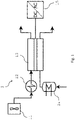
- Figure 1 shows the stream connectivity of a basic steam electrolyser system 1.
- the system comprises a blower 11 to feed air to the counter electrode and that creates over-pressure upstream the electrolyser, an auxiliary heat source 12 to preheat air, a steam electrolyser cell in form of a solid-oxide electrolyser cell 13 that receives DC current from the AC-DC converter, an electric steam generator 14 and a AC-DC converter 15, which would be needed in case the system receives AC power.
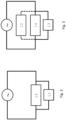
- FIG 2 shows the parallel electrical connectivity of the electric steam generator 14 and the solid-oxide electrolyser cell 13. The fluctuating power is indicated by the wave enclosed by the circle.
- FIG 3 an arrangement is shown where also the auxiliary heat source 12 to preheat air is arranged in parallel to the electrolyser cell 13 and the electric steam generator 14.
- the fluctuating power is indicated by the wave enclosed by the circle.
- the fluctuating power can either be AC current, which for example could come from the grid, from wind power, or from hydropower, or solar-thermal, or DC current, for example from PV.
- the electrolyser operates at fixed DC voltage, for example 400 V. In the case of an AC power source, an AC-DC converter (not shown) may produce the required fixed DC-voltage for the electrolyser, e.g. 100 V.
- AC-DC or DC-DC conversion may be deployed for the steam generator and/or the electric air preheater.
- the electrolyser cell,the steam generator and the auxiliary air preheater can operate at fixed voltage but the power fluctuation can result in fluctuating current.
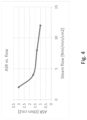
- FIG 4 shows how the total internal resistance of the electrolyser cell (expressed as area specific resistance ASR) can depend on the supplied steam flow. It can be observed that the ASR generally drops as the steam flow increases.
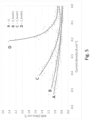
- FIG 5 shows how the total internal resistance of the eletrolyser cell (expressed as ASR) can depend on the current density.
- ASR as a function of SOE current density is provided for a steam feed flow of 2 (D), 4 (C), 8 (B) and 12 (A) Nml.min -1 .cm -2 . It can be observed that the ASR generally increases with current density.
- a constant flow of hydrogen was added to the steam feed flow in order to maintain the steam electrode.
- Figure 6 shows the distribution of the available electrical power between the electric steam generator 14 and the electrolyser cell 13.
- Curve 41 indicates the electrical power of the electric steam generator divided by the total electrical power (P ev /P tot ).
- the nominal power line is indicated with 42.
- Figure 7 shows the distribution of the available electrical power between the electric steam generator 14 and the electrolyser cell 13 and an auxiliary electrical heating 12, which is an electrical air preheater in parallel arrangement with the electrolyser and the steam generator (see Figure 3 ).
- Curve 51 indicates the electrical power of the electric steam generator divided by the total electrical power (P ev /P tot ) and is different from curve 41.
Landscapes
- Chemical & Material Sciences (AREA)
- Engineering & Computer Science (AREA)
- Chemical Kinetics & Catalysis (AREA)
- Electrochemistry (AREA)
- Materials Engineering (AREA)
- Metallurgy (AREA)
- Organic Chemistry (AREA)
- Inorganic Chemistry (AREA)
- Life Sciences & Earth Sciences (AREA)
- Sustainable Development (AREA)
- Automation & Control Theory (AREA)
- Electrolytic Production Of Non-Metals, Compounds, Apparatuses Therefor (AREA)
- Fuel Cell (AREA)
Priority Applications (14)
| Application Number | Priority Date | Filing Date | Title |
|---|---|---|---|
| FIEP21200112.7T FI4159894T3 (fi) | 2021-09-30 | 2021-09-30 | Höyryelektrolyysijärjestelmä vedyn tuottamista varten sekä vastaava menetelmä |
| PL21200112.7T PL4159894T3 (pl) | 2021-09-30 | 2021-09-30 | Układ elektrolizera parowego do wytwarzania wodoru i odpowiedni sposób |
| EP21200112.7A EP4159894B1 (de) | 2021-09-30 | 2021-09-30 | Dampfelektrolyseursystem zur herstellung von wasserstoff und entsprechendes verfahren |
| ES21200112T ES2984745T3 (es) | 2021-09-30 | 2021-09-30 | Sistema electrolizador de vapor para la producción de hidrógeno y método correspondiente |
| DK21200112.7T DK4159894T3 (da) | 2021-09-30 | 2021-09-30 | Dampelektrolysesystem til fremstilling af hydrogen og tilsvarende fremgangsmåde |
| PCT/EP2022/075595 WO2023052135A1 (en) | 2021-09-30 | 2022-09-15 | Steam electrolyser system for the production of hydrogen and corresponding method |
| CA3231191A CA3231191A1 (en) | 2021-09-30 | 2022-09-15 | Steam electrolyser system for the production of hydrogen and corresponding method |
| JP2024520517A JP2024536334A (ja) | 2021-09-30 | 2022-09-15 | 水素の生成のための蒸気電解槽システムおよび対応する方法 |
| AU2022356137A AU2022356137A1 (en) | 2021-09-30 | 2022-09-15 | Steam electrolyser system for the production of hydrogen and corresponding method |
| MA64898A MA64898B1 (fr) | 2021-09-30 | 2022-09-15 | Système d'électrolyseur de vapeur pour la production d'hydrogène et procédé correspondant |
| CN202280065827.3A CN118019877A (zh) | 2021-09-30 | 2022-09-15 | 用于制造氢气的蒸汽电解槽系统和相应的方法 |
| KR1020247014121A KR20240110798A (ko) | 2021-09-30 | 2022-09-15 | 수소 생성을 위한 증기 전해조 시스템 및 상응하는 방법 |
| US18/696,569 US20240384421A1 (en) | 2021-09-30 | 2022-09-15 | Steam electrolyser system for the production of hydrogen and corresponding method |
| CL2024000939A CL2024000939A1 (es) | 2021-09-30 | 2024-03-28 | Sistema de electrolizador de vapor para la producción de hidrógeno y método correspondiente |
Applications Claiming Priority (1)
| Application Number | Priority Date | Filing Date | Title |
|---|---|---|---|
| EP21200112.7A EP4159894B1 (de) | 2021-09-30 | 2021-09-30 | Dampfelektrolyseursystem zur herstellung von wasserstoff und entsprechendes verfahren |
Publications (2)
| Publication Number | Publication Date |
|---|---|
| EP4159894A1 true EP4159894A1 (de) | 2023-04-05 |
| EP4159894B1 EP4159894B1 (de) | 2024-05-08 |
Family
ID=78080155
Family Applications (1)
| Application Number | Title | Priority Date | Filing Date |
|---|---|---|---|
| EP21200112.7A Active EP4159894B1 (de) | 2021-09-30 | 2021-09-30 | Dampfelektrolyseursystem zur herstellung von wasserstoff und entsprechendes verfahren |
Country Status (14)
| Country | Link |
|---|---|
| US (1) | US20240384421A1 (de) |
| EP (1) | EP4159894B1 (de) |
| JP (1) | JP2024536334A (de) |
| KR (1) | KR20240110798A (de) |
| CN (1) | CN118019877A (de) |
| AU (1) | AU2022356137A1 (de) |
| CA (1) | CA3231191A1 (de) |
| CL (1) | CL2024000939A1 (de) |
| DK (1) | DK4159894T3 (de) |
| ES (1) | ES2984745T3 (de) |
| FI (1) | FI4159894T3 (de) |
| MA (1) | MA64898B1 (de) |
| PL (1) | PL4159894T3 (de) |
| WO (1) | WO2023052135A1 (de) |
Citations (12)
| Publication number | Priority date | Publication date | Assignee | Title |
|---|---|---|---|---|
| WO2007048997A2 (en) | 2005-10-28 | 2007-05-03 | Rolls-Royce Plc | Electrolysis |
| US20070119718A1 (en) * | 2004-02-18 | 2007-05-31 | Gm Global Technology Operations, Inc. | Optimizing photovoltaic-electrolyzer efficiency |
| US20100200422A1 (en) | 2007-09-25 | 2010-08-12 | Commissariat A L' Energie Atomique | High temperature electrolyser with temperature homogenisation device |
| US8163158B2 (en) | 2008-05-12 | 2012-04-24 | Enrg, Inc. | Operation of an electrolysis cell |
| US8231774B2 (en) | 2008-04-18 | 2012-07-31 | The Boeing Company | Thermal management of a high temperature fuel cell electrolyzer |
| EP2648314A1 (de) * | 2010-12-03 | 2013-10-09 | Hitachi, Ltd. | Natürliches energiespeichersystem |
| EP2674515A1 (de) | 2012-06-11 | 2013-12-18 | Siemens Aktiengesellschaft | Temperaturregelung eines Hochtemperatur-Elektrolyseurs |
| US20140329161A1 (en) | 2011-10-28 | 2014-11-06 | Commissariat A L'energie Atomique Et Aux Ene Alt | High-temperature or fuel-cell electrochemical system having improved thermal management |
| US20160244890A1 (en) | 2013-10-25 | 2016-08-25 | Electricite De France | Control of a high temperature electrolyzer |
| EP3168330A1 (de) * | 2014-07-11 | 2017-05-17 | Kabushiki Kaisha Toshiba | Vorrichtung und verfahren zur wasserstoffproduktion mit hochtemperatur-wasserdampfelektrolyse |
| EP3221494A1 (de) | 2014-11-21 | 2017-09-27 | Commissariat à l'Énergie Atomique et aux Énergies Alternatives | Elektrolysator und brennstoffzelle mit potentiostatischer steuerung und steuerung bei einer konstanten umwandlungsrate |
| US20170279134A1 (en) | 2014-08-22 | 2017-09-28 | Commissariat A L'energie Atomique Et Aux Energies Alternatives | Method for high-temperature electrolysis or co-electrolysis, method for producing electricity by means of an sofc fuel cell, and associated interconnectors, reactors and operating methods |
-
2021
- 2021-09-30 EP EP21200112.7A patent/EP4159894B1/de active Active
- 2021-09-30 DK DK21200112.7T patent/DK4159894T3/da active
- 2021-09-30 PL PL21200112.7T patent/PL4159894T3/pl unknown
- 2021-09-30 FI FIEP21200112.7T patent/FI4159894T3/fi active
- 2021-09-30 ES ES21200112T patent/ES2984745T3/es active Active
-
2022
- 2022-09-15 AU AU2022356137A patent/AU2022356137A1/en active Pending
- 2022-09-15 MA MA64898A patent/MA64898B1/fr unknown
- 2022-09-15 WO PCT/EP2022/075595 patent/WO2023052135A1/en not_active Ceased
- 2022-09-15 CN CN202280065827.3A patent/CN118019877A/zh active Pending
- 2022-09-15 CA CA3231191A patent/CA3231191A1/en active Pending
- 2022-09-15 US US18/696,569 patent/US20240384421A1/en active Pending
- 2022-09-15 KR KR1020247014121A patent/KR20240110798A/ko active Pending
- 2022-09-15 JP JP2024520517A patent/JP2024536334A/ja active Pending
-
2024
- 2024-03-28 CL CL2024000939A patent/CL2024000939A1/es unknown
Patent Citations (13)
| Publication number | Priority date | Publication date | Assignee | Title |
|---|---|---|---|---|
| US20070119718A1 (en) * | 2004-02-18 | 2007-05-31 | Gm Global Technology Operations, Inc. | Optimizing photovoltaic-electrolyzer efficiency |
| WO2007048997A2 (en) | 2005-10-28 | 2007-05-03 | Rolls-Royce Plc | Electrolysis |
| CA2626751A1 (en) | 2005-10-28 | 2007-05-03 | Rolls-Royce Plc | Electrolysis |
| US20100200422A1 (en) | 2007-09-25 | 2010-08-12 | Commissariat A L' Energie Atomique | High temperature electrolyser with temperature homogenisation device |
| US8231774B2 (en) | 2008-04-18 | 2012-07-31 | The Boeing Company | Thermal management of a high temperature fuel cell electrolyzer |
| US8163158B2 (en) | 2008-05-12 | 2012-04-24 | Enrg, Inc. | Operation of an electrolysis cell |
| EP2648314A1 (de) * | 2010-12-03 | 2013-10-09 | Hitachi, Ltd. | Natürliches energiespeichersystem |
| US20140329161A1 (en) | 2011-10-28 | 2014-11-06 | Commissariat A L'energie Atomique Et Aux Ene Alt | High-temperature or fuel-cell electrochemical system having improved thermal management |
| EP2674515A1 (de) | 2012-06-11 | 2013-12-18 | Siemens Aktiengesellschaft | Temperaturregelung eines Hochtemperatur-Elektrolyseurs |
| US20160244890A1 (en) | 2013-10-25 | 2016-08-25 | Electricite De France | Control of a high temperature electrolyzer |
| EP3168330A1 (de) * | 2014-07-11 | 2017-05-17 | Kabushiki Kaisha Toshiba | Vorrichtung und verfahren zur wasserstoffproduktion mit hochtemperatur-wasserdampfelektrolyse |
| US20170279134A1 (en) | 2014-08-22 | 2017-09-28 | Commissariat A L'energie Atomique Et Aux Energies Alternatives | Method for high-temperature electrolysis or co-electrolysis, method for producing electricity by means of an sofc fuel cell, and associated interconnectors, reactors and operating methods |
| EP3221494A1 (de) | 2014-11-21 | 2017-09-27 | Commissariat à l'Énergie Atomique et aux Énergies Alternatives | Elektrolysator und brennstoffzelle mit potentiostatischer steuerung und steuerung bei einer konstanten umwandlungsrate |
Non-Patent Citations (2)
| Title |
|---|
| CHEM. ENG. TRANS.,, vol. 61, 2017, pages 1069 |
| FUEL CELLS, vol. 14, 2014, pages 479 |
Also Published As
| Publication number | Publication date |
|---|---|
| US20240384421A1 (en) | 2024-11-21 |
| DK4159894T3 (da) | 2024-05-27 |
| AU2022356137A1 (en) | 2024-03-21 |
| PL4159894T3 (pl) | 2024-09-23 |
| KR20240110798A (ko) | 2024-07-16 |
| MA64898A1 (fr) | 2024-07-31 |
| CA3231191A1 (en) | 2023-04-06 |
| FI4159894T3 (fi) | 2024-07-11 |
| CL2024000939A1 (es) | 2024-08-23 |
| MA64898B1 (fr) | 2025-02-28 |
| CN118019877A (zh) | 2024-05-10 |
| JP2024536334A (ja) | 2024-10-04 |
| ES2984745T3 (es) | 2024-10-30 |
| EP4159894B1 (de) | 2024-05-08 |
| WO2023052135A1 (en) | 2023-04-06 |
Similar Documents
| Publication | Publication Date | Title |
|---|---|---|
| US20050112425A1 (en) | Fuel cell for hydrogen production, electricity generation and co-production | |
| CN110690855A (zh) | 一种基于氢储能的新型净零能耗建筑的能源系统 | |
| US20230193486A1 (en) | Systems and methods for generating synthesis gas for ammonia production | |
| JP7351708B2 (ja) | エネルギーマネージメントシステム | |
| US20230226486A1 (en) | Methods for carbon dioxide capture and related systems | |
| US20260011764A1 (en) | Sofc for the combined production of electricity and nitric oxide | |
| EP4280325A1 (de) | Protonenleitendes soec und sauerstoffionenleitende sofc-verbindungsvorrichtung | |
| Gupta et al. | Solid oxide fuel cell: a review | |
| EP4159894B1 (de) | Dampfelektrolyseursystem zur herstellung von wasserstoff und entsprechendes verfahren | |
| He et al. | Electrochemical hydrogen production | |
| RU2855548C2 (ru) | Система парового электролиза для производства водорода и соответствующий способ | |
| WO2024133419A1 (en) | System and method for converting ammonia to power in a balancing power system | |
| Cotana et al. | A cylindrical molten carbonate fuel cell supplied with landfill biogas | |
| CN115732730A (zh) | 一种可逆固体氧化物电池系统及氢氧制备方法 | |
| Akkinapragada et al. | SOFC-based fuel cells for load following stationary applications | |
| RU2836840C1 (ru) | Способ эксплуатации твердооксидного топливного элемента (тотэ) для комбинированного производства электрической энергии и оксида азота(ii) | |
| KR20160007821A (ko) | 우수한 연료 효율을 갖는 직접탄소 연료전지 시스템 | |
| US12331417B1 (en) | Methods and systems for the conversion of carbon dioxide to chemicals and/or fuels utilizing steam electrolysis | |
| US20250197328A1 (en) | Methods and systems for the conversion of carbon dioxide to chemicals and/or fuels utilizing steam electrolysis | |
| WO2024204595A1 (ja) | 水蒸気電解装置および水蒸気電解方法 | |
| Campbell et al. | Solid oxide fuel cell power system | |
| KR20250093044A (ko) | 수소 생산 시스템 | |
| Rasooly | Solid Oxide Fuel Cells | |
| IT202300001728A1 (it) | Sistema a celle elettrochimiche con accumulo di energia termica e relativo metodo | |
| Akikusa et al. | Development of intermediate temperature SOFC module and system |
Legal Events
| Date | Code | Title | Description |
|---|---|---|---|
| PUAI | Public reference made under article 153(3) epc to a published international application that has entered the european phase |
Free format text: ORIGINAL CODE: 0009012 |
|
| STAA | Information on the status of an ep patent application or granted ep patent |
Free format text: STATUS: THE APPLICATION HAS BEEN PUBLISHED |
|
| AK | Designated contracting states |
Kind code of ref document: A1 Designated state(s): AL AT BE BG CH CY CZ DE DK EE ES FI FR GB GR HR HU IE IS IT LI LT LU LV MC MK MT NL NO PL PT RO RS SE SI SK SM TR |
|
| STAA | Information on the status of an ep patent application or granted ep patent |
Free format text: STATUS: REQUEST FOR EXAMINATION WAS MADE |
|
| 17P | Request for examination filed |
Effective date: 20230926 |
|
| RBV | Designated contracting states (corrected) |
Designated state(s): AL AT BE BG CH CY CZ DE DK EE ES FI FR GB GR HR HU IE IS IT LI LT LU LV MC MK MT NL NO PL PT RO RS SE SI SK SM TR |
|
| GRAP | Despatch of communication of intention to grant a patent |
Free format text: ORIGINAL CODE: EPIDOSNIGR1 |
|
| STAA | Information on the status of an ep patent application or granted ep patent |
Free format text: STATUS: GRANT OF PATENT IS INTENDED |
|
| INTG | Intention to grant announced |
Effective date: 20240220 |
|
| GRAS | Grant fee paid |
Free format text: ORIGINAL CODE: EPIDOSNIGR3 |
|
| GRAA | (expected) grant |
Free format text: ORIGINAL CODE: 0009210 |
|
| STAA | Information on the status of an ep patent application or granted ep patent |
Free format text: STATUS: THE PATENT HAS BEEN GRANTED |
|
| P01 | Opt-out of the competence of the unified patent court (upc) registered |
Effective date: 20240327 |
|
| AK | Designated contracting states |
Kind code of ref document: B1 Designated state(s): AL AT BE BG CH CY CZ DE DK EE ES FI FR GB GR HR HU IE IS IT LI LT LU LV MC MK MT NL NO PL PT RO RS SE SI SK SM TR |
|
| REG | Reference to a national code |
Ref country code: GB Ref legal event code: FG4D |
|
| REG | Reference to a national code |
Ref country code: CH Ref legal event code: EP |
|
| REG | Reference to a national code |
Ref country code: DK Ref legal event code: T3 Effective date: 20240522 |
|
| REG | Reference to a national code |
Ref country code: DE Ref legal event code: R096 Ref document number: 602021012994 Country of ref document: DE |
|
| REG | Reference to a national code |
Ref country code: IE Ref legal event code: FG4D |
|
| REG | Reference to a national code |
Ref country code: FI Ref legal event code: FGE |
|
| REG | Reference to a national code |
Ref country code: NL Ref legal event code: FP |
|
| REG | Reference to a national code |
Ref country code: LT Ref legal event code: MG9D |
|
| REG | Reference to a national code |
Ref country code: GR Ref legal event code: EP Ref document number: 20240401667 Country of ref document: GR Effective date: 20240819 |
|
| REG | Reference to a national code |
Ref country code: AT Ref legal event code: UEP Ref document number: 1685049 Country of ref document: AT Kind code of ref document: T Effective date: 20240508 |
|
| PG25 | Lapsed in a contracting state [announced via postgrant information from national office to epo] |
Ref country code: IS Free format text: LAPSE BECAUSE OF FAILURE TO SUBMIT A TRANSLATION OF THE DESCRIPTION OR TO PAY THE FEE WITHIN THE PRESCRIBED TIME-LIMIT Effective date: 20240908 |
|
| PG25 | Lapsed in a contracting state [announced via postgrant information from national office to epo] |
Ref country code: BG Free format text: LAPSE BECAUSE OF FAILURE TO SUBMIT A TRANSLATION OF THE DESCRIPTION OR TO PAY THE FEE WITHIN THE PRESCRIBED TIME-LIMIT Effective date: 20240508 |
|
| PG25 | Lapsed in a contracting state [announced via postgrant information from national office to epo] |
Ref country code: HR Free format text: LAPSE BECAUSE OF FAILURE TO SUBMIT A TRANSLATION OF THE DESCRIPTION OR TO PAY THE FEE WITHIN THE PRESCRIBED TIME-LIMIT Effective date: 20240508 |
|
| PG25 | Lapsed in a contracting state [announced via postgrant information from national office to epo] |
Ref country code: PT Free format text: LAPSE BECAUSE OF FAILURE TO SUBMIT A TRANSLATION OF THE DESCRIPTION OR TO PAY THE FEE WITHIN THE PRESCRIBED TIME-LIMIT Effective date: 20240909 |
|
| REG | Reference to a national code |
Ref country code: EE Ref legal event code: FG4A Ref document number: E024504 Country of ref document: EE Effective date: 20240627 |
|
| PG25 | Lapsed in a contracting state [announced via postgrant information from national office to epo] |
Ref country code: LV Free format text: LAPSE BECAUSE OF FAILURE TO SUBMIT A TRANSLATION OF THE DESCRIPTION OR TO PAY THE FEE WITHIN THE PRESCRIBED TIME-LIMIT Effective date: 20240508 |
|
| REG | Reference to a national code |
Ref country code: ES Ref legal event code: FG2A Ref document number: 2984745 Country of ref document: ES Kind code of ref document: T3 Effective date: 20241030 |
|
| PG25 | Lapsed in a contracting state [announced via postgrant information from national office to epo] |
Ref country code: HR Free format text: LAPSE BECAUSE OF FAILURE TO SUBMIT A TRANSLATION OF THE DESCRIPTION OR TO PAY THE FEE WITHIN THE PRESCRIBED TIME-LIMIT Effective date: 20240508 Ref country code: BG Free format text: LAPSE BECAUSE OF FAILURE TO SUBMIT A TRANSLATION OF THE DESCRIPTION OR TO PAY THE FEE WITHIN THE PRESCRIBED TIME-LIMIT Effective date: 20240508 Ref country code: PT Free format text: LAPSE BECAUSE OF FAILURE TO SUBMIT A TRANSLATION OF THE DESCRIPTION OR TO PAY THE FEE WITHIN THE PRESCRIBED TIME-LIMIT Effective date: 20240909 Ref country code: LV Free format text: LAPSE BECAUSE OF FAILURE TO SUBMIT A TRANSLATION OF THE DESCRIPTION OR TO PAY THE FEE WITHIN THE PRESCRIBED TIME-LIMIT Effective date: 20240508 Ref country code: IS Free format text: LAPSE BECAUSE OF FAILURE TO SUBMIT A TRANSLATION OF THE DESCRIPTION OR TO PAY THE FEE WITHIN THE PRESCRIBED TIME-LIMIT Effective date: 20240908 Ref country code: RS Free format text: LAPSE BECAUSE OF FAILURE TO SUBMIT A TRANSLATION OF THE DESCRIPTION OR TO PAY THE FEE WITHIN THE PRESCRIBED TIME-LIMIT Effective date: 20240808 |
|
| PG25 | Lapsed in a contracting state [announced via postgrant information from national office to epo] |
Ref country code: CZ Free format text: LAPSE BECAUSE OF FAILURE TO SUBMIT A TRANSLATION OF THE DESCRIPTION OR TO PAY THE FEE WITHIN THE PRESCRIBED TIME-LIMIT Effective date: 20240508 |
|
| PG25 | Lapsed in a contracting state [announced via postgrant information from national office to epo] |
Ref country code: SK Free format text: LAPSE BECAUSE OF FAILURE TO SUBMIT A TRANSLATION OF THE DESCRIPTION OR TO PAY THE FEE WITHIN THE PRESCRIBED TIME-LIMIT Effective date: 20240508 Ref country code: RO Free format text: LAPSE BECAUSE OF FAILURE TO SUBMIT A TRANSLATION OF THE DESCRIPTION OR TO PAY THE FEE WITHIN THE PRESCRIBED TIME-LIMIT Effective date: 20240508 |
|
| PG25 | Lapsed in a contracting state [announced via postgrant information from national office to epo] |
Ref country code: SM Free format text: LAPSE BECAUSE OF FAILURE TO SUBMIT A TRANSLATION OF THE DESCRIPTION OR TO PAY THE FEE WITHIN THE PRESCRIBED TIME-LIMIT Effective date: 20240508 |
|
| PG25 | Lapsed in a contracting state [announced via postgrant information from national office to epo] |
Ref country code: SM Free format text: LAPSE BECAUSE OF FAILURE TO SUBMIT A TRANSLATION OF THE DESCRIPTION OR TO PAY THE FEE WITHIN THE PRESCRIBED TIME-LIMIT Effective date: 20240508 Ref country code: SK Free format text: LAPSE BECAUSE OF FAILURE TO SUBMIT A TRANSLATION OF THE DESCRIPTION OR TO PAY THE FEE WITHIN THE PRESCRIBED TIME-LIMIT Effective date: 20240508 Ref country code: RO Free format text: LAPSE BECAUSE OF FAILURE TO SUBMIT A TRANSLATION OF THE DESCRIPTION OR TO PAY THE FEE WITHIN THE PRESCRIBED TIME-LIMIT Effective date: 20240508 Ref country code: CZ Free format text: LAPSE BECAUSE OF FAILURE TO SUBMIT A TRANSLATION OF THE DESCRIPTION OR TO PAY THE FEE WITHIN THE PRESCRIBED TIME-LIMIT Effective date: 20240508 |
|
| REG | Reference to a national code |
Ref country code: DE Ref legal event code: R097 Ref document number: 602021012994 Country of ref document: DE |
|
| PLBE | No opposition filed within time limit |
Free format text: ORIGINAL CODE: 0009261 |
|
| STAA | Information on the status of an ep patent application or granted ep patent |
Free format text: STATUS: NO OPPOSITION FILED WITHIN TIME LIMIT |
|
| 26N | No opposition filed |
Effective date: 20250211 |
|
| PG25 | Lapsed in a contracting state [announced via postgrant information from national office to epo] |
Ref country code: SI Free format text: LAPSE BECAUSE OF FAILURE TO SUBMIT A TRANSLATION OF THE DESCRIPTION OR TO PAY THE FEE WITHIN THE PRESCRIBED TIME-LIMIT Effective date: 20240508 Ref country code: MC Free format text: LAPSE BECAUSE OF FAILURE TO SUBMIT A TRANSLATION OF THE DESCRIPTION OR TO PAY THE FEE WITHIN THE PRESCRIBED TIME-LIMIT Effective date: 20240508 |
|
| PG25 | Lapsed in a contracting state [announced via postgrant information from national office to epo] |
Ref country code: LU Free format text: LAPSE BECAUSE OF NON-PAYMENT OF DUE FEES Effective date: 20240930 |
|
| REG | Reference to a national code |
Ref country code: BE Ref legal event code: MM Effective date: 20240930 |
|
| PG25 | Lapsed in a contracting state [announced via postgrant information from national office to epo] |
Ref country code: BE Free format text: LAPSE BECAUSE OF NON-PAYMENT OF DUE FEES Effective date: 20240930 |
|
| PG25 | Lapsed in a contracting state [announced via postgrant information from national office to epo] |
Ref country code: IE Free format text: LAPSE BECAUSE OF NON-PAYMENT OF DUE FEES Effective date: 20240930 |
|
| PG25 | Lapsed in a contracting state [announced via postgrant information from national office to epo] |
Ref country code: SE Free format text: LAPSE BECAUSE OF FAILURE TO SUBMIT A TRANSLATION OF THE DESCRIPTION OR TO PAY THE FEE WITHIN THE PRESCRIBED TIME-LIMIT Effective date: 20240508 |
|
| PGFP | Annual fee paid to national office [announced via postgrant information from national office to epo] |
Ref country code: NL Payment date: 20250814 Year of fee payment: 5 |
|
| REG | Reference to a national code |
Ref country code: CH Ref legal event code: U11 Free format text: ST27 STATUS EVENT CODE: U-0-0-U10-U11 (AS PROVIDED BY THE NATIONAL OFFICE) Effective date: 20251001 |
|
| PGFP | Annual fee paid to national office [announced via postgrant information from national office to epo] |
Ref country code: FI Payment date: 20250912 Year of fee payment: 5 |
|
| PGFP | Annual fee paid to national office [announced via postgrant information from national office to epo] |
Ref country code: DE Payment date: 20250805 Year of fee payment: 5 Ref country code: DK Payment date: 20250911 Year of fee payment: 5 |
|
| PGFP | Annual fee paid to national office [announced via postgrant information from national office to epo] |
Ref country code: NO Payment date: 20250909 Year of fee payment: 5 Ref country code: GR Payment date: 20250818 Year of fee payment: 5 |
|
| PGFP | Annual fee paid to national office [announced via postgrant information from national office to epo] |
Ref country code: PL Payment date: 20250725 Year of fee payment: 5 Ref country code: IT Payment date: 20250825 Year of fee payment: 5 |
|
| PGFP | Annual fee paid to national office [announced via postgrant information from national office to epo] |
Ref country code: GB Payment date: 20250807 Year of fee payment: 5 |
|
| PGFP | Annual fee paid to national office [announced via postgrant information from national office to epo] |
Ref country code: AT Payment date: 20251020 Year of fee payment: 5 Ref country code: FR Payment date: 20250808 Year of fee payment: 5 |
|
| PGFP | Annual fee paid to national office [announced via postgrant information from national office to epo] |
Ref country code: EE Payment date: 20250828 Year of fee payment: 5 |
|
| PGFP | Annual fee paid to national office [announced via postgrant information from national office to epo] |
Ref country code: CH Payment date: 20251001 Year of fee payment: 5 |
|
| PG25 | Lapsed in a contracting state [announced via postgrant information from national office to epo] |
Ref country code: CY Free format text: LAPSE BECAUSE OF FAILURE TO SUBMIT A TRANSLATION OF THE DESCRIPTION OR TO PAY THE FEE WITHIN THE PRESCRIBED TIME-LIMIT; INVALID AB INITIO Effective date: 20210930 |
|
| PGFP | Annual fee paid to national office [announced via postgrant information from national office to epo] |
Ref country code: ES Payment date: 20251016 Year of fee payment: 5 |
|
| PG25 | Lapsed in a contracting state [announced via postgrant information from national office to epo] |
Ref country code: HU Free format text: LAPSE BECAUSE OF FAILURE TO SUBMIT A TRANSLATION OF THE DESCRIPTION OR TO PAY THE FEE WITHIN THE PRESCRIBED TIME-LIMIT; INVALID AB INITIO Effective date: 20210930 |