EP4159481A1 - Pneumatic tire - Google Patents
Pneumatic tire Download PDFInfo
- Publication number
- EP4159481A1 EP4159481A1 EP21812919.5A EP21812919A EP4159481A1 EP 4159481 A1 EP4159481 A1 EP 4159481A1 EP 21812919 A EP21812919 A EP 21812919A EP 4159481 A1 EP4159481 A1 EP 4159481A1
- Authority
- EP
- European Patent Office
- Prior art keywords
- ply
- tire
- reinforcement layer
- belt
- width direction
- Prior art date
- Legal status (The legal status is an assumption and is not a legal conclusion. Google has not performed a legal analysis and makes no representation as to the accuracy of the status listed.)
- Granted
Links
Images

Classifications
-
- B—PERFORMING OPERATIONS; TRANSPORTING
- B60—VEHICLES IN GENERAL
- B60C—VEHICLE TYRES; TYRE INFLATION; TYRE CHANGING; CONNECTING VALVES TO INFLATABLE ELASTIC BODIES IN GENERAL; DEVICES OR ARRANGEMENTS RELATED TO TYRES
- B60C9/00—Reinforcements or ply arrangement of pneumatic tyres
- B60C9/18—Structure or arrangement of belts or breakers, crown-reinforcing or cushioning layers
- B60C9/1835—Rubber strips or cushions at the belt edges
- B60C9/185—Rubber strips or cushions at the belt edges between adjacent or radially below the belt plies
-
- B—PERFORMING OPERATIONS; TRANSPORTING
- B60—VEHICLES IN GENERAL
- B60C—VEHICLE TYRES; TYRE INFLATION; TYRE CHANGING; CONNECTING VALVES TO INFLATABLE ELASTIC BODIES IN GENERAL; DEVICES OR ARRANGEMENTS RELATED TO TYRES
- B60C9/00—Reinforcements or ply arrangement of pneumatic tyres
- B60C9/18—Structure or arrangement of belts or breakers, crown-reinforcing or cushioning layers
- B60C9/20—Structure or arrangement of belts or breakers, crown-reinforcing or cushioning layers built-up from rubberised plies each having all cords arranged substantially parallel
-
- B—PERFORMING OPERATIONS; TRANSPORTING
- B60—VEHICLES IN GENERAL
- B60C—VEHICLE TYRES; TYRE INFLATION; TYRE CHANGING; CONNECTING VALVES TO INFLATABLE ELASTIC BODIES IN GENERAL; DEVICES OR ARRANGEMENTS RELATED TO TYRES
- B60C15/00—Tyre beads, e.g. ply turn-up or overlap
- B60C15/06—Flipper strips, fillers, or chafing strips and reinforcing layers for the construction of the bead
- B60C15/0628—Flipper strips, fillers, or chafing strips and reinforcing layers for the construction of the bead comprising a bead reinforcing layer
- B60C15/0653—Flipper strips, fillers, or chafing strips and reinforcing layers for the construction of the bead comprising a bead reinforcing layer with particular configuration of the cords in the respective bead reinforcing layer
-
- B—PERFORMING OPERATIONS; TRANSPORTING
- B60—VEHICLES IN GENERAL
- B60C—VEHICLE TYRES; TYRE INFLATION; TYRE CHANGING; CONNECTING VALVES TO INFLATABLE ELASTIC BODIES IN GENERAL; DEVICES OR ARRANGEMENTS RELATED TO TYRES
- B60C9/00—Reinforcements or ply arrangement of pneumatic tyres
- B60C9/0007—Reinforcements made of metallic elements, e.g. cords, yarns, filaments or fibres made from metal
-
- B—PERFORMING OPERATIONS; TRANSPORTING
- B60—VEHICLES IN GENERAL
- B60C—VEHICLE TYRES; TYRE INFLATION; TYRE CHANGING; CONNECTING VALVES TO INFLATABLE ELASTIC BODIES IN GENERAL; DEVICES OR ARRANGEMENTS RELATED TO TYRES
- B60C9/00—Reinforcements or ply arrangement of pneumatic tyres
- B60C9/18—Structure or arrangement of belts or breakers, crown-reinforcing or cushioning layers
- B60C9/1835—Rubber strips or cushions at the belt edges
- B60C2009/1864—Rubber strips or cushions at the belt edges wrapped around the edges of the belt
-
- B—PERFORMING OPERATIONS; TRANSPORTING
- B60—VEHICLES IN GENERAL
- B60C—VEHICLE TYRES; TYRE INFLATION; TYRE CHANGING; CONNECTING VALVES TO INFLATABLE ELASTIC BODIES IN GENERAL; DEVICES OR ARRANGEMENTS RELATED TO TYRES
- B60C9/00—Reinforcements or ply arrangement of pneumatic tyres
- B60C9/18—Structure or arrangement of belts or breakers, crown-reinforcing or cushioning layers
- B60C9/20—Structure or arrangement of belts or breakers, crown-reinforcing or cushioning layers built-up from rubberised plies each having all cords arranged substantially parallel
- B60C2009/2038—Structure or arrangement of belts or breakers, crown-reinforcing or cushioning layers built-up from rubberised plies each having all cords arranged substantially parallel using lateral belt strips at belt edges, e.g. edge bands
-
- B—PERFORMING OPERATIONS; TRANSPORTING
- B60—VEHICLES IN GENERAL
- B60C—VEHICLE TYRES; TYRE INFLATION; TYRE CHANGING; CONNECTING VALVES TO INFLATABLE ELASTIC BODIES IN GENERAL; DEVICES OR ARRANGEMENTS RELATED TO TYRES
- B60C9/00—Reinforcements or ply arrangement of pneumatic tyres
- B60C9/18—Structure or arrangement of belts or breakers, crown-reinforcing or cushioning layers
- B60C9/20—Structure or arrangement of belts or breakers, crown-reinforcing or cushioning layers built-up from rubberised plies each having all cords arranged substantially parallel
- B60C2009/2048—Structure or arrangement of belts or breakers, crown-reinforcing or cushioning layers built-up from rubberised plies each having all cords arranged substantially parallel characterised by special physical properties of the belt plies
-
- B—PERFORMING OPERATIONS; TRANSPORTING
- B60—VEHICLES IN GENERAL
- B60C—VEHICLE TYRES; TYRE INFLATION; TYRE CHANGING; CONNECTING VALVES TO INFLATABLE ELASTIC BODIES IN GENERAL; DEVICES OR ARRANGEMENTS RELATED TO TYRES
- B60C15/00—Tyre beads, e.g. ply turn-up or overlap
- B60C15/06—Flipper strips, fillers, or chafing strips and reinforcing layers for the construction of the bead
- B60C2015/0614—Flipper strips, fillers, or chafing strips and reinforcing layers for the construction of the bead characterised by features of the chafer or clinch portion, i.e. the part of the bead contacting the rim
-
- B—PERFORMING OPERATIONS; TRANSPORTING
- B60—VEHICLES IN GENERAL
- B60C—VEHICLE TYRES; TYRE INFLATION; TYRE CHANGING; CONNECTING VALVES TO INFLATABLE ELASTIC BODIES IN GENERAL; DEVICES OR ARRANGEMENTS RELATED TO TYRES
- B60C15/00—Tyre beads, e.g. ply turn-up or overlap
- B60C15/06—Flipper strips, fillers, or chafing strips and reinforcing layers for the construction of the bead
- B60C2015/0617—Flipper strips, fillers, or chafing strips and reinforcing layers for the construction of the bead comprising a cushion rubber other than the chafer or clinch rubber
- B60C2015/0621—Flipper strips, fillers, or chafing strips and reinforcing layers for the construction of the bead comprising a cushion rubber other than the chafer or clinch rubber adjacent to the carcass turnup portion
-
- B—PERFORMING OPERATIONS; TRANSPORTING
- B60—VEHICLES IN GENERAL
- B60C—VEHICLE TYRES; TYRE INFLATION; TYRE CHANGING; CONNECTING VALVES TO INFLATABLE ELASTIC BODIES IN GENERAL; DEVICES OR ARRANGEMENTS RELATED TO TYRES
- B60C15/00—Tyre beads, e.g. ply turn-up or overlap
- B60C15/06—Flipper strips, fillers, or chafing strips and reinforcing layers for the construction of the bead
- B60C2015/0617—Flipper strips, fillers, or chafing strips and reinforcing layers for the construction of the bead comprising a cushion rubber other than the chafer or clinch rubber
- B60C2015/0625—Flipper strips, fillers, or chafing strips and reinforcing layers for the construction of the bead comprising a cushion rubber other than the chafer or clinch rubber provided at the terminal edge portion of a carcass or reinforcing layer
-
- B—PERFORMING OPERATIONS; TRANSPORTING
- B60—VEHICLES IN GENERAL
- B60C—VEHICLE TYRES; TYRE INFLATION; TYRE CHANGING; CONNECTING VALVES TO INFLATABLE ELASTIC BODIES IN GENERAL; DEVICES OR ARRANGEMENTS RELATED TO TYRES
- B60C15/00—Tyre beads, e.g. ply turn-up or overlap
- B60C15/06—Flipper strips, fillers, or chafing strips and reinforcing layers for the construction of the bead
- B60C15/0628—Flipper strips, fillers, or chafing strips and reinforcing layers for the construction of the bead comprising a bead reinforcing layer
- B60C2015/0646—Flipper strips, fillers, or chafing strips and reinforcing layers for the construction of the bead comprising a bead reinforcing layer at the axially inner side of the carcass main portion not wrapped around the bead core
-
- B—PERFORMING OPERATIONS; TRANSPORTING
- B60—VEHICLES IN GENERAL
- B60C—VEHICLE TYRES; TYRE INFLATION; TYRE CHANGING; CONNECTING VALVES TO INFLATABLE ELASTIC BODIES IN GENERAL; DEVICES OR ARRANGEMENTS RELATED TO TYRES
- B60C15/00—Tyre beads, e.g. ply turn-up or overlap
- B60C15/06—Flipper strips, fillers, or chafing strips and reinforcing layers for the construction of the bead
- B60C15/0628—Flipper strips, fillers, or chafing strips and reinforcing layers for the construction of the bead comprising a bead reinforcing layer
- B60C2015/065—Flipper strips, fillers, or chafing strips and reinforcing layers for the construction of the bead comprising a bead reinforcing layer at the axially outer side of the carcass turn-up portion not wrapped around the bead core
-
- B—PERFORMING OPERATIONS; TRANSPORTING
- B60—VEHICLES IN GENERAL
- B60C—VEHICLE TYRES; TYRE INFLATION; TYRE CHANGING; CONNECTING VALVES TO INFLATABLE ELASTIC BODIES IN GENERAL; DEVICES OR ARRANGEMENTS RELATED TO TYRES
- B60C2200/00—Tyres specially adapted for particular applications
- B60C2200/06—Tyres specially adapted for particular applications for heavy duty vehicles
Definitions
- the present disclosure relates to a pneumatic tire.
- pneumatic tires provided with a carcass and an inclined belt formed by plies that include a plurality of cords arranged in parallel to each other are known.
- stress tends to concentrate at locations such as the tire widthwise outer end of the inclined belt and the tire radial outer end of the turn-up portion of the carcass due to the difference in rigidity from the surrounding rubber, thereby causing cracks in the rubber that can easily become the core of separation.
- Patent literature (PTL) 1 discloses a pneumatic radial tire in which a supplementary reinforcement layer is disposed adjacent to the cut-off portion of the cords at the widthwise edge of the belt layer or the carcass ply wrap-around edge, thereby reducing the difference in rigidity from the surrounding rubber, which in turn reduces the above-described stress concentration.
- PTL 2 discloses a pneumatic radial tire that has non-woven fiber/rubber composite layer, in which a rubber component is impregnated into a non-woven fabric formed by organic fibers, disposed at the tire widthwise end of the belt.
- a reinforcement layer such as the supplementary reinforcement layer in PTL 1 and the non-woven fiber/rubber composite layer in PTL 2 is provided, thereby suppressing the occurrence of separation at the position of the cut edge of the plies, such as the widthwise edge of the belt layer or the carcass ply wrap-around edge.
- a pneumatic tire in a first aspect of the present disclosure includes a ply including a plurality of cords arranged in parallel to each other, a cover rubber covering the ply and configuring a tire outer surface, and a reinforcement layer that, at a position of a cut edge of the ply, covers the cut edge of the ply on one side or both sides in a ply thickness direction, wherein the reinforcement layer is configured by a non-woven fabric comprising metal fibers or a rubber sheet material having metal fibers embedded therein.
- a pneumatic tire capable of relieving stress concentration at the position of the end of the reinforcing layer, in addition to relieving stress concentration at the location of the cut edge of the ply, can be provided.
- the "applicable rim” refers to a standard rim designated in the following standards in accordance with tire size ("Design Rim” in the YEAR BOOK of the Tire and Rim Association, Inc. (TRA), and “Measuring Rim” in the STANDARDS MANUAL of the European Tyre and Rim Technological Organisation (ETRTO)).
- the standards are determined according to an effective industrial standard in areas where the tire is produced or used. Examples of the standards include the YEAR BOOK of the TRA in the USA, the STANDARDS MANUAL of the ETRTO in Europe, and the JATMA YEAR BOOK of the Japan Automobile Tyre Manufacturers Association (JATMA) in Japan.
- the "applicable rim” includes sizes that could be included in the future in the aforementioned industrial standards, in addition to current sizes. Examples of the sizes that could be described in the future in the aforementioned industrial standards include the sizes described under "FUTURE DEVELOPMENTS" in the ETRTO 2013 edition. In the case of a size not listed in the aforementioned industrial standards, the “applicable rim” refers to a rim whose width corresponds to the bead width of the pneumatic tire.
- the “prescribed internal pressure” refers to the air pressure (maximum air pressure) corresponding to the maximum load capability of a single wheel for the applicable size/ply rating in the aforementioned JATMA YEAR BOOK or the like. In the case of a size not described in the aforementioned industrial standards, the “prescribed internal pressure” refers to the air pressure (maximum air pressure) corresponding to the maximum load capability prescribed for each vehicle on which the tire is mounted.
- maximum load refers to the tire maximum load capability specified in the aforementioned standards, such as JATMA, for tires of the applicable size, or in the case of sizes not specified in the aforementioned industrial standards, the “maximum load” refers to the load corresponding to the maximum load capability specified for each vehicle on which the tire is mounted.
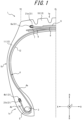
- FIG. 1 illustrates a pneumatic tire 1 (hereinafter simply referred to as "tire 1") according to the present disclosure.
- tire 1 is a cross-sectional view of the tire 1, in a cross-section parallel to the tire width direction A and including the tire center axis, in the reference state in which the tire 1 is mounted on an applicable rim, filled to the prescribed internal pressure, and under no load.
- this cross-section is referred to as the "tire widthwise cross-section”.
- FIG. 1 illustrates a tire widthwise cross-section on only one side of tire equatorial plane CL in the tire width direction A.
- the tire may have an asymmetrical configuration with respect to the tire equatorial plane CL.
- the tire 1 includes a tread portion 1a, a pair of sidewall portions 1b extending from both ends of the tread portion 1a in the tire width direction A inward in the tire radial direction B, and a pair of bead portions 1c provided at the inner ends of the sidewall portions 1b in the tire radial direction B.
- the tire 1 is a radial tire and has a configuration suitable for use as a pneumatic tire for trucks, buses, and other heavy load vehicles.
- the "tread portion 1a" refers to the portion sandwiched by tread ends TE on both sides in the tire width direction A.
- the “bead portion 1c” refers to the portion in the tire radial direction B where the below-described bead member 3 is located.
- the “sidewall portion 1b” refers to the portion between the tread portion 1a and the bead portion 1c.
- the “tread edge TE” refers to the outermost position of the contact patch in the tire width direction when the tire is mounted on the above-described applicable rim, filled to the above-described prescribed internal pressure, and placed under the maximum load.
- the outer surface of the tire includes the outer surface of the tread portion 1a, which is the surface on the outer side of the tread portion 1a in the tire radial direction B, the outer surface of the sidewall portion 1b, which is the surface on the outer side of the sidewall portion 1b in the tire width direction A, and the outer surface of the bead portion 1c, which is the surface on the outer side of the bead portion 1c in the tire width direction A.
- the tire 1 includes bead members 3, a carcass ply 4, a chafer 5, four layers of belt plies 6 to 9, tread rubber 10 and side rubber 11 as cover rubber 13, an inner liner 12, and a reinforcement layer 21.
- the bead member 3 is embedded in the bead portion 1c.
- the bead member 3 in the present embodiment is a bead core.
- the bead member 3 may be further provided with a rubber bead filler located outward from the bead core in the tire radial direction B.
- the bead core as the bead member 3 includes a plurality of bead cords that are coated by rubber.
- the bead cords are formed by steel cords.
- the steel cords can, for example, be made of steel monofilaments or twisted wires.
- the carcass ply 4 extends toroidally to straddle the pair of bead portions 1c, more specifically to straddle the pair of bead members 3.
- the carcass ply 4 of the present embodiment has a radial structure.
- the carcass ply 4 extends toroidally across a pair of bead members 3 and is folded from inside to outside in the tire width direction A around each bead member 3.
- the carcass ply 4 in the present embodiment includes a plurality of ply cords 34 (see FIG. 3 ) arranged in parallel to each other and coating rubber 35 (see FIG. 3 ) that covers the plurality of ply cords 34.
- the carcass ply 4 may be configured by, for example, arranging a plurality of ply cords that are made of brass, or plated with a material including brass, in parallel and bonding adjacent ply cords.
- the tire 1 in the present embodiment includes one carcass ply 4 but may instead include two or more carcass plies 4.
- the plurality of ply cords 34 of the carcass ply 4 are arranged at an angle of, for example, 75° to 90° with respect to the tire circumferential direction C.
- the ply cords 34 of the carcass ply 4 can be metal cords, such as steel cords.
- the steel cords can be made of steel monofilaments or twisted wires with, for example, a brass coating on the surface.
- the ply cords 34 may also be organic fiber cords, for example, with a brass coating on the surface.
- the carcass ply 4 has a main body 4a located between the pair of bead members 3 and a turn-up portion 4b that is formed by being connected to the main body 4a and turned up from inside to outside in the tire width direction A around each bead member 3.
- the bead member 3 in the present embodiment is formed by a bead core but may further include a bead filler extending so as to taper outward in the tire radial direction B of the bead core.
- the bead filler is arranged between the main body 4a and the turn-up portion 4b of the carcass ply 4.
- the chafer 5 is arranged outward from each bead member 3 in the tire width direction A and outward from the turn-up portion 4b of the carcass ply 4 in the tire width direction A. Therefore, when the tire 1 is mounted on an applicable rim, damage to the bead portion 1c by the rim flange of the applicable rim can be suppressed.
- the inner end of the chafer 5 in the tire radial direction B may be wrapped around the bead member 3 from the outside to the inside in the tire width direction A.
- the chafer 5 can, for example, be a chafer ply using a metal cord, such as a steel cord, or an organic fiber cord as the ply cord.
- the belt plies 6 to 9 are disposed in the tread portion 1a. Specifically, the belt plies 6 to 9 are disposed outside of the carcass ply 4 in the tire radial direction B relative to the crown of the carcass ply 4.
- the tire 1 in the present embodiment includes four layers of belt plies 6 to 9, but the number of layers is not particularly limited as long as at least one layer is provided.
- Each belt ply 6 to 9 includes a plurality of ply cords 32 (see FIG. 3 ) arranged in parallel to each other and coating rubber 33 (see FIG. 3 ) that covers the plurality of ply cords 32.
- each belt ply 6 to 9 may be configured by, for example, arranging a plurality of ply cords that are made of brass, or plated with a material including brass, in parallel and bonding adjacent ply cords.
- Each belt ply 6 to 9 forms a sloped belt layer in which the cord cut edges 32a of the ply cords 32 are exposed at both ends in the tire width direction A.
- the plurality of ply cords 32 in each belt ply 6 to 9 extends at an angle with respect to the tire width direction A and the tire circumferential direction C.
- the ply cords 32 are arranged to be inclined at an angle of 10° to 60° with respect to the tire circumferential direction C.
- the ply cords 32 in each belt ply 6 to 9 can be metal cords, such as steel cords.
- the steel cords can be made of steel monofilaments or twisted wires with, for example, a brass coating on the surface.
- the ply cords 32 may also be organic fiber cords, for example, with a brass coating on the surface.
- the tread rubber 10 covers the crown portion of the main body 4a of the carcass ply 4 and covers the outer side, in the tire radial direction B, of the four layers of belt plies 6 to 9.
- the outer surface of the tread portion 1a in the present embodiment is configured by the tread rubber 10.
- a tread pattern including circumferential grooves extending in the tire circumferential direction C, widthwise grooves extending in the tire width direction A, and the like is formed on the outer surface of the tread portion 1a.
- the side rubber 11 covers the outside, in the tire width direction A, of the main body 4a and the turn-up portion 4b of the carcass ply 4.
- the outer surface of the sidewall portion 1b and the outer surface of the bead portion 1c in the present embodiment are configured by the side rubber 11.
- the upper end of the side rubber 11 in the tire radial direction B is connected to the end of the above-described tread rubber 10 in the tire width direction A.
- the tread rubber 10 and side rubber 11 in the present embodiment as a whole form the cover rubber 13 of the tire 1, which covers the carcass ply 4 and the belt plies 6 to 9 and configures the tire outer surface.
- the inner liner 12 covers the tire inner surface side of the main body 4a of the carcass ply 4 and configures the tire inner surface of the tire 1.
- the inner liner 12 is layered onto the tire inner surface side of the main body 4a of the carcass ply 4.
- the inner liner 12 may, for example, be formed from a butyl-based rubber having low air permeability.
- Butyl-based rubber refers to butyl rubber and butyl halide rubber, which is a derivative thereof.
- the tire 1 in the present embodiment includes two reinforcement layers 21, i.e., a belt reinforcement layer 21a and a carcass reinforcement layer 21b.
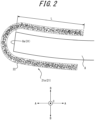
- FIG. 2 is an enlarged view of the area near the belt reinforcement layer 21a illustrated in FIG. 1 .
- the configuration of the carcass reinforcement layer 21b is the same as that of the belt reinforcement layer 21a.
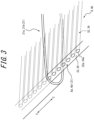
- FIG. 3 illustrates the details of the mounting configuration of the belt reinforcement layer 21a and the carcass reinforcement layer 21b. As described above, the configuration of the carcass reinforcement layer 21b is the same as that of the belt reinforcement layer 21a. Therefore, for the sake of convenience, FIG.
- the ply cords 32, 34 illustrated in FIG. 3 may be arrayed at any angle with respect to the extension direction of the cut edge 31 of the ply (the tire circumferential direction C in FIG. 3 ).
- FIG. 3 for the sake of convenience, a cross-section of a portion of the belt reinforcement layer 21a and the carcass reinforcement layer 21b is illustrated.
- the belt reinforcement layer 21a that is one of the reinforcement layers 21 covers the outer edge 8a, which acts as the cut edge 31 of the belt ply 8, at both sides (the inner side and outer side in the tire radial direction B in the present embodiment) in the belt ply thickness direction (the thickness direction of the belt ply 8 in the present embodiment, which is a direction equivalent to the tire radial direction B), which acts as the ply thickness direction.
- a cord cut edge 32a of the belt cord as the ply cord 32 is exposed.
- the belt reinforcement layer 21a in the present embodiment extends in the tire width direction A so as to straddle the position, in the tire width direction A, of the outer edge 8a at both sides, in the tire radial direction B, of the outer edge 8a, which acts as the cut edge 31 of the belt ply 8.
- the portion located at both sides, in the tire radial direction B, of the outer edge 8a of the belt ply 8 has a U-shaped cross-section connected farther outward, in the tire width direction A, than the belt ply 8, but this portion may be configured as separate, non-connected belt reinforcement layers.
- the belt reinforcement layer 21a in the present embodiment extends in the tire width direction A so as to straddle the position, in the tire width direction A, of the outer edge 8a of the belt ply 8, but this configuration is not limiting.
- belt plies may be arranged separately at both sides in the tire width direction A.
- the belt reinforcement layer 21a may extend in the tire width direction A so as to straddle the position, in the tire width direction A, of the inner edge of the belt plies in the tire width direction A.
- the belt reinforcement layer 21b that is the other one of the reinforcement layers 21 covers the outer edge 4b1, which acts as the cut edge 31 of the carcass ply 4, at both sides (the inner side and outer side in the tire width direction A in the present embodiment) in the carcass ply thickness direction (the thickness direction at the position of the turn-up portion 4b of the carcass ply 4 in the present embodiment, which is a direction equivalent to the tire width direction A), which acts as the ply thickness direction.
- a cord cut edge 34a of the ply cord 34 is exposed.
- the carcass reinforcement layer 21b in the present embodiment extends in the tire radial direction B so as to straddle the position, in the tire radial direction B, of the outer edge 4b1 at both sides, in the tire width direction A, of the outer edge 4b1, which acts as the cut edge 31 of the carcass ply 4.
- the portion located at both sides, in the tire width direction A, of the outer edge 4b1 of the carcass ply 4 has a U-shaped cross-section connected farther outward, in the tire radial direction B, than the turn-up portion 4b of the carcass ply 4, but this portion may be configured as separate, non-connected belt carcass reinforcement layers.
- the belt reinforcement layer 21a as the reinforcement layer 21 is configured by a non-woven fabric formed from metal fibers 22.
- the tensile rigidity of the belt reinforcement layer 21a is smaller than the tensile rigidity of the belt ply 8.
- the configuration of the carcass reinforcement layer 21b is the same as the configuration of the belt reinforcement layer 21a, and the carcass reinforcement layer 21b is also configured by a non-woven fabric formed from metal fibers 22.
- the tensile rigidity of the carcass reinforcement layer 21b is smaller than the tensile rigidity of the carcass ply 4.
- such a belt reinforcement layer 21a can suppress the concentration of stress, due to the difference in rigidity from the surrounding rubber, at the outer edge 8a of the belt ply 8 where the cord cut edge 32a of the ply cord 32 is exposed. Furthermore, since the belt reinforcement layer 21a is configured by a non-woven fabric formed from metal fibers 22, the belt reinforcement layer 21a itself is more flexible and deformable than if the belt reinforcement layer were configured by a metallic plate. At the end of the belt reinforcement layer 21a in the tire width direction A, the difference in rigidity from the surrounding rubber can therefore be reduced.
- the belt reinforcement layer 21a is configured by a non-woven fabric formed from metal fibers 22, the adhesiveness with the surrounding rubber is greater than if the belt reinforcement layer were configured by a non-woven fabric of organic fibers. In this way, at the end of the belt reinforcement layer 21a in the tire width direction A, the difference in rigidity from the surrounding rubber is reduced, while the adhesiveness with the surrounding rubber is increased. The stress concentration at the location of the end of the belt reinforcement layer 21a in the tire width direction A can therefore be relieved.
- provision of the above-described belt reinforcement layer 21a can also relieve the stress concentration at the location of the end of the belt reinforcement layer 21a. Consequently, the durability of the tire 1 can be improved.
- such a carcass reinforcement layer 21b can suppress the concentration of stress, due to the difference in rigidity from the surrounding rubber, at the outer edge 4b 1 of the turn-up portion 4b of the carcass ply 4 where the cord cut edge 34a of the ply cord 34 is exposed. Furthermore, since the carcass reinforcement layer 21b is configured by a non-woven fabric formed from metal fibers 22, the carcass reinforcement layer 21b itself is more flexible and deformable than if the carcass reinforcement layer were configured by a metallic plate. At the end of the carcass reinforcement layer 21b in the tire radial direction B, the difference in rigidity from the surrounding rubber can therefore be reduced.
- the carcass reinforcement layer 21b is configured by a non-woven fabric formed from metal fibers 22, the adhesiveness with the surrounding rubber is greater than if the carcass reinforcement layer were configured by a non-woven fabric of organic fibers. In this way, at the end of the carcass reinforcement layer 21b in the tire radial direction B, the difference in rigidity from the surrounding rubber is reduced, while the adhesiveness with the surrounding rubber is increased. The stress concentration at the location of the end of the carcass reinforcement layer 21b in the tire radial direction B can therefore be relieved.
- the reinforcement layer 21 configured by a non-woven fabric formed from metal fibers 22 can be manufactured by various methods, and the manufacturing method is not limited.
- a needle punch can be used to entangle metal fibers 22, obtained by various cutting methods, into a felt-like shape.
- the diameter of the metal fibers 22 can be changed by, for example, changing the amount of cutting, and the diameter of the metal fibers 22 that configure the above-described belt reinforcement layer 21a and carcass reinforcement layer 21b can be the same or different.
- the thickness and density of the non-woven fabric formed from the metal fibers 22 can be changed by, for example, changing the amount of metal fibers 22 that are punched and changing the number of vertical movements per unit time during needle punching.
- the belt reinforcement layer 21a and the carcass reinforcement layer 21b in the present embodiment are configured by a non-woven fabric formed from metal fibers 22, but this configuration is not limiting.
- the reinforcement layer 21 may be configured by a rubber sheet material in which the metal fibers 22 are embedded.
- the reinforcement layer 21 is preferably configured by a non-woven fabric, as in the present embodiment.
- the belt reinforcement layer 21a as the reinforcement layer 21 in the present embodiment covers the outer edge 8a of the belt ply 8 at both sides (the inner side and outer side in the tire radial direction B in the present embodiment) in the ply thickness direction with respect to the position of the outer edge 8a as the cut edge 31 of the belt ply 8, where the cord cut edge 32a of the ply cord 32 is exposed, but this configuration is not limiting.
- the belt reinforcement layer 21a may cover the outer edge 8a of the belt ply 8 at one side (the inner side or outer side in the tire radial direction B in the present embodiment) in the ply thickness direction with respect to the position of the outer edge 8a as the cut edge 31 of the belt ply 8.
- the belt reinforcement layer 21a as the reinforcement layer 21 in the present embodiment has a substantially U-shaped cross-section in a tire widthwise cross-sectional view.
- the belt reinforcement layer 21a is disposed so as to cover the outer edge 8a of the belt ply 8 and a portion of the inner surface and outer surface of the belt ply 8 connected to this outer edge 8a in a tire widthwise cross-sectional view.
- the belt reinforcement layer 21a in the present embodiment covers the outer edge 8a of the belt ply 8 at both sides (the inner side and outer side in the tire radial direction B in the present embodiment) in the ply thickness direction with respect to the position of the outer edge 8a of the belt ply 8, where the cord cut edge 32a of the ply cord 32 is exposed.
- the belt reinforcement layer 21a may cover the outer edge 8a of the belt ply 8 at only one side (the inner side or outer side in the tire radial direction B in the present embodiment) in the ply thickness direction with respect to the position of the outer edge 8a of the belt ply 8, where the cord cut edge 32a of the ply cord 32 is exposed.
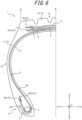
- belt reinforcement layers 121a, 221a may, in a tire widthwise cross-sectional view, extend outward in the tire width direction A to cover only a portion of the outer surface of the belt ply 8 connected to the outer edge 8a of the belt ply 8 (see FIG. 5 ) or cover only a portion of the inner surface (see FIG. 6 ), without bending in the tire radial direction B along the outer edge 8a of the belt ply 8.
- the carcass reinforcement layer 21b as the reinforcement layer 21 in the present embodiment covers the outer edge 4b1 of the turn-up portion 4b of the carcass ply 4 at both sides (the inner side and outer side in the tire width direction A in the present embodiment) in the ply thickness direction with respect to the position of the outer edge 4b1 of the turn-up portion 4b as the cut edge 31 of the carcass ply 4, where the cord cut edge 34a of the ply cord 34 is exposed, but this configuration is not limiting.
- the carcass reinforcement layer 21b may cover the outer edge 4b1 of the turn-up portion 4b of the carcass ply 4 at one side (the inner side or outer side in the tire width direction A in the present embodiment) in the ply thickness direction with respect to the position of the outer edge 4b1 of the turn-up portion 4b as the cut edge 31 of the carcass ply 4.
- the carcass reinforcement layer 21b as the reinforcement layer 21 in the present embodiment has a substantially U-shaped cross-section in a tire widthwise cross-sectional view.
- the belt reinforcement layer 21b is disposed so as to cover the outer edge 4b1 of the turn-up portion 4b of the carcass ply 4 and a portion of the inner surface and outer surface of the turn-up portion 4b connected to this outer edge 4b1 in a tire widthwise cross-sectional view.
- the carcass reinforcement layer 21b as the reinforcement layer 21 in the present embodiment covers the outer edge 4b1 of the turn-up portion 4b of the carcass ply 4 at both sides (the inner side and outer side in the tire width direction A in the present embodiment) in the ply thickness direction with respect to the position of the outer edge 4b1 of the turn-up portion 4b of the carcass ply 4, where the cord cut edge 34a of the ply cord 34 is exposed.
- the carcass reinforcement layer 21b may cover the outer edge 4b1 of the turn-up portion 4b of the carcass ply 4 at only one side (the inner side or outer side in the tire width direction A in the present embodiment) in the ply thickness direction with respect to the position of the outer edge 4b1 of the turn-up portion 4b, where the cord cut edge 34a of the ply cord 34 of the carcass ply 4 is exposed.
- the carcass reinforcement layer 21b may cover the outer edge 4b1 of the turn-up portion 4b of the carcass ply 4 at only one side (the inner side or outer side in the tire width direction A in the present embodiment) in the ply thickness direction with respect to the position of the outer edge 4b1 of the turn-up portion 4b, where the cord cut edge 34a of the ply cord 34 of the carcass ply 4 is exposed.
- carcass reinforcement layers 121b, 221b may, in a tire widthwise cross-sectional view, extend outward in the tire radial direction B to cover only a portion of the outer surface of the turn-up portion 4b connected to the outer edge 4b1 of the turn-up portion 4b of the carcass ply 4 (see FIG. 5 ) or cover only a portion of the inner surface (see FIG. 6 ), without bending in the tire width direction A along the outer edge 4b1 of the turn-up portion 4b of the carcass ply 4.
- the belt reinforcement layer 21a in the present embodiment is provided around the outer edge 8a of one belt ply 8 among the four layers of belt plies 6 to 9, but this configuration is not limiting.
- the belt reinforcement layer 21a may be provided around the outer edge of one or more belt plies among the other three belt plies 6, 7, 9 in addition to or instead of the belt ply 8.
- the belt ply 8 and the carcass ply 4 have been illustrated as plies to be reinforced by the reinforcement layer 21, but these specific examples are not limiting. Therefore, the reinforcement layer 21 may, for example, be disposed adjacent to a cut edge of a chafer ply forming the chafer 5 to reinforce the chafer ply. Specifically, the reinforcement layer 21 may extend in the tire radial direction B so that, with respect to the outer edge of the chafer ply in the tire radial direction B, the reinforcement layer 21 straddles the position, in the tire radial direction B, of the outer edge of the chafer ply in the tire radial direction B at one or both sides in the tire width direction A. Furthermore, the reinforcement layer 21 may be arranged to reinforce another ply.
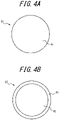
- FIG. 4A is a cross-sectional view of the metal fiber 22 configuring the reinforcement layer 21.
- the metal fiber 22 is configured by steel, copper, aluminum, nickel, or an alloy including any of these.
- the metal fiber 22 illustrated in FIG. 4A is formed from a wire 41 composed of the above-described metal materials.
- the metal fibers 22 configuring the reinforcement layer 21 are preferably formed from brass. In this way, the adhesiveness to the surrounding rubber is enhanced as compared not only to organic fibers but also to metal fibers formed from the other metal materials described above, and the stress concentration at the end of the reinforcement layer 21 can be further relieved.
- the surface of the metal fiber 22 can be configured as a coating film 43 formed from a binary alloy of copper and zinc, or a ternary alloy of copper, zinc, and cobalt, as illustrated in FIG. 4B .
- the metal fiber 22 illustrated in FIG. 4B is configured by a wire 42 as the base material and a coating film 43 laminated on the surface of the wire 42.
- the method of forming such a film 43 is not particularly limited but may, for example, be electrolytic treatment by binary alloy plating or ternary alloy plating, or a method of alloying by heat treatment after penetrating in copper plating and zinc plating baths to perform laminated plating treatment.
- the density of the non-woven fabric configuring the reinforcement layer 21 is preferably 100 g/m 2 to 900 g/m 2 and in particular is preferably 200 g/m 2 to 600 g/m 2 .
- the density of the non-woven fabric configuring the belt reinforcement layer 21a is in the above range, the stress concentration at the end of the belt reinforcement layer 21a in the tire width direction A can be further relieved. Consequently, the durability of the tire 1 can be further improved.
- the density of the non-woven fabric configuring the carcass reinforcement layer 21b is in the above range, the stress concentration at the end of the carcass reinforcement layer 21b in the tire radial direction B can be further relieved. Consequently, the durability of the tire 1 can be further improved.
- the density of the non-woven fabric configuring the reinforcement layer 21 refers to the mass per unit area as measured in accordance with ISO 9073-1. Specifically, the density of the non-woven fabric configuring the reinforcement layer 21 can be calculated by removing the non-woven fabric from the tire 1, melting or incinerating the rubber to remove the rubber, and then weighing the non-woven fabric itself and calculating the density.
- the filament diameter of the non-woven fabric configuring the reinforcement layer 21 is preferably 10 ⁇ m to 75 ⁇ m and in particular is preferably 20 ⁇ m to 50 ⁇ m.
- the area may be replaced by the circular area. In this way, the durability of the tire 1 can be further enhanced, and an excessive increase in weight of the tire 1 can be also suppressed, for the same reasons as for the above-described density of the non-woven fabric.
- the reinforcement layer 21 and the ply preferably overlap by 10 mm or more in a ply extension direction orthogonal to the ply thickness direction.
- the belt reinforcement layer 21a and the belt ply 8 in the present embodiment preferably have an overlap region L of 10 mm or more in the belt ply extension direction that is orthogonal to the belt ply thickness direction. While omitted from the drawings, the same is also true for the carcass reinforcement layer 21b and the turn-up portion 4b of the carcass ply 4 in the present embodiment.
- the carcass reinforcement layer 21b and the turn-up portion 4b of the carcass ply 4 in the present embodiment have an overlap region of 10 mm or more in the carcass ply extension direction that is orthogonal to the carcass ply thickness direction.
- the above-described overlap region L is preferably 20 mm to 60 mm. In this way, the durability of the tire 1 can be further enhanced, and an excessive increase in weight of the tire 1 can be also suppressed, for the same reasons as for the above-described density of the non-woven fabric.
- This verification test used three test pieces in which the cut edges of a plurality of steel fibers and the cut edges of another plurality of steel fibers were embedded in rubber so as to face each other while separated by approximately 10 mm.
- the cut edges of the steel fibers were uncovered.
- organic fibers extending along the fiber direction of the steel fibers were arranged between the cut edges of the separate pluralities of steel fibers that were facing each other.
- the overlap region L (see FIG. 2 ) of the second test piece X2 was 30 mm.
- the organic fibers used were nylon 6, with a mass of 470 dtex/1, and a number of embedded fibers equivalent to 78 fibers/5 cm.
- the cut edges of the steel fibers were covered by a non-woven fabric formed from brass fibers and affixed to the steel fibers.
- the overlap region L (see FIG. 2 ) of the third test piece X3 was 30 mm.
- the brass used was C2680, the filament diameter of the non-woven fabric was 25 ⁇ m, and the density was 300 g/m 2 .
- test piece X1 to X3 were repeatedly subjected to a minimum load of 0.1 kN and a maximum load of 0.2 kN in the opposite direction (fiber direction) from the cut edges of the steel fibers at an ambient temperature of 70°C, and the number of repetitions to rupture was compared. Table 1 lists the results. [Table 1] Reinforcement Number of repetitions Test piece X1 none 1 Test piece X2 organic fibers 3 Test piece X3 brass non-woven fabric 18
- the present disclosure relates to a pneumatic tire.
Landscapes
- Engineering & Computer Science (AREA)
- Mechanical Engineering (AREA)
- Tires In General (AREA)
Abstract
Description
- The present disclosure relates to a pneumatic tire.
- Conventionally, pneumatic tires provided with a carcass and an inclined belt formed by plies that include a plurality of cords arranged in parallel to each other are known. During travel on a road surface, stress tends to concentrate at locations such as the tire widthwise outer end of the inclined belt and the tire radial outer end of the turn-up portion of the carcass due to the difference in rigidity from the surrounding rubber, thereby causing cracks in the rubber that can easily become the core of separation.
- Patent literature (PTL) 1 discloses a pneumatic radial tire in which a supplementary reinforcement layer is disposed adjacent to the cut-off portion of the cords at the widthwise edge of the belt layer or the carcass ply wrap-around edge, thereby reducing the difference in rigidity from the surrounding rubber, which in turn reduces the above-described stress concentration.
- Also, PTL 2 discloses a pneumatic radial tire that has non-woven fiber/rubber composite layer, in which a rubber component is impregnated into a non-woven fabric formed by organic fibers, disposed at the tire widthwise end of the belt.
-
- PTL 1:
JP 2005-145318 A - PTL 2:
JP 2003-154810 A - According to the pneumatic radial tires disclosed as pneumatic tires in PTL 1 and 2, a reinforcement layer such as the supplementary reinforcement layer in PTL 1 and the non-woven fiber/rubber composite layer in PTL 2 is provided, thereby suppressing the occurrence of separation at the position of the cut edge of the plies, such as the widthwise edge of the belt layer or the carcass ply wrap-around edge. However, there is still room for improvement in terms of reducing the stress concentration at the position of the end of the reinforcement layer itself in the pneumatic tires disclosed in PTL 1 and 2.
- It is an aim of the present disclosure to provide a pneumatic tire capable of relieving stress concentration at the position of the end of the reinforcement layer, in addition to relieving stress concentration at the location of the cut edge of the ply.
- A pneumatic tire in a first aspect of the present disclosure includes a ply including a plurality of cords arranged in parallel to each other, a cover rubber covering the ply and configuring a tire outer surface, and a reinforcement layer that, at a position of a cut edge of the ply, covers the cut edge of the ply on one side or both sides in a ply thickness direction, wherein the reinforcement layer is configured by a non-woven fabric comprising metal fibers or a rubber sheet material having metal fibers embedded therein.
- According to the present disclosure, a pneumatic tire capable of relieving stress concentration at the position of the end of the reinforcing layer, in addition to relieving stress concentration at the location of the cut edge of the ply, can be provided.
- In the accompanying drawings:
-
FIG. 1 is a tire widthwise cross-sectional view of a pneumatic tire as an embodiment of the present disclosure; -
FIG. 2 is an enlarged view of the area near a belt reinforcement layer illustrated inFIG. 1 ; -
FIG. 3 is a diagram illustrating details of a mounting configuration of the belt reinforcement layer and a carcass reinforcement layer illustrated inFIG. 1 ; -
FIG. 4A is a cross-sectional view of a metal fiber forming a reinforcement layer of the pneumatic tire illustrated inFIG. 1 ; -
FIG. 4B is a cross-sectional view of a variation of the metal fiber illustrated inFIG. 4A ; -
FIG. 5 is a diagram illustrating a variation of the reinforcement layer illustrated inFIG. 1 ; and -
FIG. 6 is a diagram illustrating another variation of the reinforcement layer illustrated inFIG. 1 . - Embodiments of a pneumatic tire according to the present disclosure are described below with reference to the drawings. Configurations that are common across drawings are labeled with the same reference signs.
- Hereafter, unless otherwise specified, the dimensions, length relationships, positional relationships, and the like of each element are assumed to be measured in a reference state in which the pneumatic tire is mounted on an applicable rim, filled to a prescribed internal pressure, and under no load.
- The "applicable rim" refers to a standard rim designated in the following standards in accordance with tire size ("Design Rim" in the YEAR BOOK of the Tire and Rim Association, Inc. (TRA), and "Measuring Rim" in the STANDARDS MANUAL of the European Tyre and Rim Technological Organisation (ETRTO)). The standards are determined according to an effective industrial standard in areas where the tire is produced or used. Examples of the standards include the YEAR BOOK of the TRA in the USA, the STANDARDS MANUAL of the ETRTO in Europe, and the JATMA YEAR BOOK of the Japan Automobile Tyre Manufacturers Association (JATMA) in Japan.
- The "applicable rim" includes sizes that could be included in the future in the aforementioned industrial standards, in addition to current sizes. Examples of the sizes that could be described in the future in the aforementioned industrial standards include the sizes described under "FUTURE DEVELOPMENTS" in the ETRTO 2013 edition. In the case of a size not listed in the aforementioned industrial standards, the "applicable rim" refers to a rim whose width corresponds to the bead width of the pneumatic tire.
- The "prescribed internal pressure" refers to the air pressure (maximum air pressure) corresponding to the maximum load capability of a single wheel for the applicable size/ply rating in the aforementioned JATMA YEAR BOOK or the like. In the case of a size not described in the aforementioned industrial standards, the "prescribed internal pressure" refers to the air pressure (maximum air pressure) corresponding to the maximum load capability prescribed for each vehicle on which the tire is mounted. The "maximum load" described below refers to the tire maximum load capability specified in the aforementioned standards, such as JATMA, for tires of the applicable size, or in the case of sizes not specified in the aforementioned industrial standards, the "maximum load" refers to the load corresponding to the maximum load capability specified for each vehicle on which the tire is mounted.
-
FIG. 1 illustrates a pneumatic tire 1 (hereinafter simply referred to as "tire 1") according to the present disclosure. Specifically,FIG. 1 is a cross-sectional view of the tire 1, in a cross-section parallel to the tire width direction A and including the tire center axis, in the reference state in which the tire 1 is mounted on an applicable rim, filled to the prescribed internal pressure, and under no load. Hereafter, this cross-section is referred to as the "tire widthwise cross-section". Since the tire 1 has a symmetrical configuration with respect to the tire equatorial plane CL,FIG. 1 illustrates a tire widthwise cross-section on only one side of tire equatorial plane CL in the tire width direction A. However, the tire may have an asymmetrical configuration with respect to the tire equatorial plane CL. - As illustrated in
FIG. 1 , the tire 1 includes atread portion 1a, a pair ofsidewall portions 1b extending from both ends of thetread portion 1a in the tire width direction A inward in the tire radial direction B, and a pair of bead portions 1c provided at the inner ends of thesidewall portions 1b in the tire radial direction B. The tire 1 is a radial tire and has a configuration suitable for use as a pneumatic tire for trucks, buses, and other heavy load vehicles. Herein, the "tread portion 1a" refers to the portion sandwiched by tread ends TE on both sides in the tire width direction A. The "bead portion 1c" refers to the portion in the tire radial direction B where the below-describedbead member 3 is located. The "sidewall portion 1b" refers to the portion between thetread portion 1a and the bead portion 1c. The "tread edge TE" refers to the outermost position of the contact patch in the tire width direction when the tire is mounted on the above-described applicable rim, filled to the above-described prescribed internal pressure, and placed under the maximum load. - Furthermore, the outer surface of the tire includes the outer surface of the
tread portion 1a, which is the surface on the outer side of thetread portion 1a in the tire radial direction B, the outer surface of thesidewall portion 1b, which is the surface on the outer side of thesidewall portion 1b in the tire width direction A, and the outer surface of the bead portion 1c, which is the surface on the outer side of the bead portion 1c in the tire width direction A. - The tire 1 includes
bead members 3, acarcass ply 4, achafer 5, four layers ofbelt plies 6 to 9,tread rubber 10 andside rubber 11 ascover rubber 13, aninner liner 12, and areinforcement layer 21. - The
bead member 3 is embedded in the bead portion 1c. Thebead member 3 in the present embodiment is a bead core. Thebead member 3 may be further provided with a rubber bead filler located outward from the bead core in the tire radial direction B. The bead core as thebead member 3 includes a plurality of bead cords that are coated by rubber. The bead cords are formed by steel cords. The steel cords can, for example, be made of steel monofilaments or twisted wires. - The
carcass ply 4 extends toroidally to straddle the pair of bead portions 1c, more specifically to straddle the pair ofbead members 3. The carcass ply 4 of the present embodiment has a radial structure. - Specifically, the
carcass ply 4 extends toroidally across a pair ofbead members 3 and is folded from inside to outside in the tire width direction A around eachbead member 3. The carcass ply 4 in the present embodiment includes a plurality of ply cords 34 (seeFIG. 3 ) arranged in parallel to each other and coating rubber 35 (seeFIG. 3 ) that covers the plurality of ply cords 34. Instead of including the coating rubber 35, however, thecarcass ply 4 may be configured by, for example, arranging a plurality of ply cords that are made of brass, or plated with a material including brass, in parallel and bonding adjacent ply cords. The tire 1 in the present embodiment includes onecarcass ply 4 but may instead include two or more carcass plies 4. The plurality of ply cords 34 of thecarcass ply 4 are arranged at an angle of, for example, 75° to 90° with respect to the tire circumferential direction C. The ply cords 34 of the carcass ply 4 (seeFIG. 3 ) can be metal cords, such as steel cords. The steel cords can be made of steel monofilaments or twisted wires with, for example, a brass coating on the surface. The ply cords 34 may also be organic fiber cords, for example, with a brass coating on the surface. - More specifically, the
carcass ply 4 has amain body 4a located between the pair ofbead members 3 and a turn-upportion 4b that is formed by being connected to themain body 4a and turned up from inside to outside in the tire width direction A around eachbead member 3. As described above, thebead member 3 in the present embodiment is formed by a bead core but may further include a bead filler extending so as to taper outward in the tire radial direction B of the bead core. When thebead member 3 includes such a bead filler, the bead filler is arranged between themain body 4a and the turn-upportion 4b of thecarcass ply 4. - The
chafer 5 is arranged outward from eachbead member 3 in the tire width direction A and outward from the turn-upportion 4b of the carcass ply 4 in the tire width direction A. Therefore, when the tire 1 is mounted on an applicable rim, damage to the bead portion 1c by the rim flange of the applicable rim can be suppressed. - As illustrated in
FIG. 1 , in a tire widthwise cross-sectional view, the inner end of thechafer 5 in the tire radial direction B may be wrapped around thebead member 3 from the outside to the inside in the tire width direction A. - The
chafer 5 can, for example, be a chafer ply using a metal cord, such as a steel cord, or an organic fiber cord as the ply cord. - The belt plies 6 to 9 are disposed in the
tread portion 1a. Specifically, the belt plies 6 to 9 are disposed outside of the carcass ply 4 in the tire radial direction B relative to the crown of thecarcass ply 4. The tire 1 in the present embodiment includes four layers of belt plies 6 to 9, but the number of layers is not particularly limited as long as at least one layer is provided. Each belt ply 6 to 9 includes a plurality of ply cords 32 (seeFIG. 3 ) arranged in parallel to each other and coating rubber 33 (seeFIG. 3 ) that covers the plurality of ply cords 32. Instead of including the coating rubber 33, however, each belt ply 6 to 9 may be configured by, for example, arranging a plurality of ply cords that are made of brass, or plated with a material including brass, in parallel and bonding adjacent ply cords. Each belt ply 6 to 9 forms a sloped belt layer in which the cord cut edges 32a of the ply cords 32 are exposed at both ends in the tire width direction A. The plurality of ply cords 32 in each belt ply 6 to 9 extends at an angle with respect to the tire width direction A and the tire circumferential direction C. For example, the ply cords 32 are arranged to be inclined at an angle of 10° to 60° with respect to the tire circumferential direction C. The ply cords 32 in each belt ply 6 to 9 can be metal cords, such as steel cords. The steel cords can be made of steel monofilaments or twisted wires with, for example, a brass coating on the surface. The ply cords 32 may also be organic fiber cords, for example, with a brass coating on the surface. - The
tread rubber 10 covers the crown portion of themain body 4a of thecarcass ply 4 and covers the outer side, in the tire radial direction B, of the four layers of belt plies 6 to 9. The outer surface of thetread portion 1a in the present embodiment is configured by thetread rubber 10. A tread pattern including circumferential grooves extending in the tire circumferential direction C, widthwise grooves extending in the tire width direction A, and the like is formed on the outer surface of thetread portion 1a. - The
side rubber 11 covers the outside, in the tire width direction A, of themain body 4a and the turn-upportion 4b of thecarcass ply 4. The outer surface of thesidewall portion 1b and the outer surface of the bead portion 1c in the present embodiment are configured by theside rubber 11. The upper end of theside rubber 11 in the tire radial direction B is connected to the end of the above-describedtread rubber 10 in the tire width direction A. - In this way, the
tread rubber 10 andside rubber 11 in the present embodiment as a whole form thecover rubber 13 of the tire 1, which covers thecarcass ply 4 and the belt plies 6 to 9 and configures the tire outer surface. - The
inner liner 12 covers the tire inner surface side of themain body 4a of thecarcass ply 4 and configures the tire inner surface of the tire 1. Theinner liner 12 is layered onto the tire inner surface side of themain body 4a of thecarcass ply 4. Theinner liner 12 may, for example, be formed from a butyl-based rubber having low air permeability. Butyl-based rubber refers to butyl rubber and butyl halide rubber, which is a derivative thereof. - At a position of a
cut edge 31 of a ply, thereinforcement layer 21 covers thecut edge 31 of the ply on one side or both sides in the ply thickness direction. The tire 1 in the present embodiment includes tworeinforcement layers 21, i.e., abelt reinforcement layer 21a and acarcass reinforcement layer 21b.FIG. 2 is an enlarged view of the area near thebelt reinforcement layer 21a illustrated inFIG. 1 . The configuration of thecarcass reinforcement layer 21b is the same as that of thebelt reinforcement layer 21a.FIG. 3 illustrates the details of the mounting configuration of thebelt reinforcement layer 21a and thecarcass reinforcement layer 21b. As described above, the configuration of thecarcass reinforcement layer 21b is the same as that of thebelt reinforcement layer 21a. Therefore, for the sake of convenience,FIG. 3 does not distinguish between the mounting configuration of thebelt reinforcement layer 21a and thecarcass reinforcement layer 21b. The ply cords 32, 34 illustrated inFIG. 3 may be arrayed at any angle with respect to the extension direction of thecut edge 31 of the ply (the tire circumferential direction C inFIG. 3 ). InFIG. 3 , for the sake of convenience, a cross-section of a portion of thebelt reinforcement layer 21a and thecarcass reinforcement layer 21b is illustrated. - As illustrated in
FIGS. 1 to 3 , with respect to anouter edge 8a in the tire width direction A, which acts as thecut edge 31 of thebelt ply 8, thebelt reinforcement layer 21a that is one of the reinforcement layers 21 covers theouter edge 8a, which acts as thecut edge 31 of thebelt ply 8, at both sides (the inner side and outer side in the tire radial direction B in the present embodiment) in the belt ply thickness direction (the thickness direction of the belt ply 8 in the present embodiment, which is a direction equivalent to the tire radial direction B), which acts as the ply thickness direction. At theouter edge 8a as thecut edge 31 of the belt ply 8 in the present embodiment, acord cut edge 32a of the belt cord as the ply cord 32 is exposed. Thebelt reinforcement layer 21a in the present embodiment extends in the tire width direction A so as to straddle the position, in the tire width direction A, of theouter edge 8a at both sides, in the tire radial direction B, of theouter edge 8a, which acts as thecut edge 31 of thebelt ply 8. In thebelt reinforcement layer 21a in the present embodiment, the portion located at both sides, in the tire radial direction B, of theouter edge 8a of thebelt ply 8 has a U-shaped cross-section connected farther outward, in the tire width direction A, than thebelt ply 8, but this portion may be configured as separate, non-connected belt reinforcement layers. Also, thebelt reinforcement layer 21a in the present embodiment extends in the tire width direction A so as to straddle the position, in the tire width direction A, of theouter edge 8a of thebelt ply 8, but this configuration is not limiting. For example, belt plies may be arranged separately at both sides in the tire width direction A. In such a case, thebelt reinforcement layer 21a may extend in the tire width direction A so as to straddle the position, in the tire width direction A, of the inner edge of the belt plies in the tire width direction A. In other words, it suffices for thebelt reinforcement layer 21a to extend in the tire width direction A so as to straddle the position, in the tire width direction A, of the end, in the tire width direction A, acting as thecut edge 31 of thebelt ply 8. - As illustrated in
FIGS. 1 to 3 , with respect to an outer edge 4b1, in the tire radial direction B, of the turn-upportion 4b that acts as thecut edge 31 of thecarcass ply 4, thebelt reinforcement layer 21b that is the other one of the reinforcement layers 21 covers the outer edge 4b1, which acts as thecut edge 31 of thecarcass ply 4, at both sides (the inner side and outer side in the tire width direction A in the present embodiment) in the carcass ply thickness direction (the thickness direction at the position of the turn-upportion 4b of the carcass ply 4 in the present embodiment, which is a direction equivalent to the tire width direction A), which acts as the ply thickness direction. At the outer edge 4b1 as the cut edge of the carcass ply 4 in the present embodiment, acord cut edge 34a of the ply cord 34 is exposed. Thecarcass reinforcement layer 21b in the present embodiment extends in the tire radial direction B so as to straddle the position, in the tire radial direction B, of the outer edge 4b1 at both sides, in the tire width direction A, of the outer edge 4b1, which acts as thecut edge 31 of thecarcass ply 4. In thebelt reinforcement layer 21b in the present embodiment, the portion located at both sides, in the tire width direction A, of the outer edge 4b1 of thecarcass ply 4 has a U-shaped cross-section connected farther outward, in the tire radial direction B, than the turn-upportion 4b of thecarcass ply 4, but this portion may be configured as separate, non-connected belt carcass reinforcement layers. - As illustrated in
FIG. 2 , thebelt reinforcement layer 21a as thereinforcement layer 21 is configured by a non-woven fabric formed frommetal fibers 22. The tensile rigidity of thebelt reinforcement layer 21a is smaller than the tensile rigidity of thebelt ply 8. As described above, the configuration of thecarcass reinforcement layer 21b is the same as the configuration of thebelt reinforcement layer 21a, and thecarcass reinforcement layer 21b is also configured by a non-woven fabric formed frommetal fibers 22. The tensile rigidity of thecarcass reinforcement layer 21b is smaller than the tensile rigidity of thecarcass ply 4. - During travel on a road surface by a vehicle on which the tire 1 is mounted, such a
belt reinforcement layer 21a can suppress the concentration of stress, due to the difference in rigidity from the surrounding rubber, at theouter edge 8a of the belt ply 8 where the cord cutedge 32a of the ply cord 32 is exposed. Furthermore, since thebelt reinforcement layer 21a is configured by a non-woven fabric formed frommetal fibers 22, thebelt reinforcement layer 21a itself is more flexible and deformable than if the belt reinforcement layer were configured by a metallic plate. At the end of thebelt reinforcement layer 21a in the tire width direction A, the difference in rigidity from the surrounding rubber can therefore be reduced. In addition, since thebelt reinforcement layer 21a is configured by a non-woven fabric formed frommetal fibers 22, the adhesiveness with the surrounding rubber is greater than if the belt reinforcement layer were configured by a non-woven fabric of organic fibers. In this way, at the end of thebelt reinforcement layer 21a in the tire width direction A, the difference in rigidity from the surrounding rubber is reduced, while the adhesiveness with the surrounding rubber is increased. The stress concentration at the location of the end of thebelt reinforcement layer 21a in the tire width direction A can therefore be relieved. In other words, in addition to relieving the stress concentration at the location of theouter edge 8a of thebelt ply 8, where the cord cutedge 32a of the ply cord 32 is exposed, provision of the above-describedbelt reinforcement layer 21a can also relieve the stress concentration at the location of the end of thebelt reinforcement layer 21a. Consequently, the durability of the tire 1 can be improved. - Similarly, during travel on a road surface by a vehicle on which the tire 1 is mounted, such a
carcass reinforcement layer 21b can suppress the concentration of stress, due to the difference in rigidity from the surrounding rubber, at theouter edge 4b 1 of the turn-upportion 4b of the carcass ply 4 where the cord cutedge 34a of the ply cord 34 is exposed. Furthermore, since thecarcass reinforcement layer 21b is configured by a non-woven fabric formed frommetal fibers 22, thecarcass reinforcement layer 21b itself is more flexible and deformable than if the carcass reinforcement layer were configured by a metallic plate. At the end of thecarcass reinforcement layer 21b in the tire radial direction B, the difference in rigidity from the surrounding rubber can therefore be reduced. In addition, since thecarcass reinforcement layer 21b is configured by a non-woven fabric formed frommetal fibers 22, the adhesiveness with the surrounding rubber is greater than if the carcass reinforcement layer were configured by a non-woven fabric of organic fibers. In this way, at the end of thecarcass reinforcement layer 21b in the tire radial direction B, the difference in rigidity from the surrounding rubber is reduced, while the adhesiveness with the surrounding rubber is increased. The stress concentration at the location of the end of thecarcass reinforcement layer 21b in the tire radial direction B can therefore be relieved. In other words, in addition to relieving the stress concentration at the location of theouter edge 4b 1 of the turn-upportion 4b of thecarcass ply 4, where the cord cutedge 34a of the ply cord 34 is exposed, provision of the above-describedcarcass reinforcement layer 21b can also relieve the stress concentration at the location of the end of thecarcass reinforcement layer 21b. Consequently, the durability of the tire 1 can be improved. - The
reinforcement layer 21 configured by a non-woven fabric formed frommetal fibers 22 can be manufactured by various methods, and the manufacturing method is not limited. For example, a needle punch can be used to entanglemetal fibers 22, obtained by various cutting methods, into a felt-like shape. The diameter of themetal fibers 22 can be changed by, for example, changing the amount of cutting, and the diameter of themetal fibers 22 that configure the above-describedbelt reinforcement layer 21a andcarcass reinforcement layer 21b can be the same or different. The thickness and density of the non-woven fabric formed from themetal fibers 22 can be changed by, for example, changing the amount ofmetal fibers 22 that are punched and changing the number of vertical movements per unit time during needle punching. - The
belt reinforcement layer 21a and thecarcass reinforcement layer 21b in the present embodiment are configured by a non-woven fabric formed frommetal fibers 22, but this configuration is not limiting. Thereinforcement layer 21 may be configured by a rubber sheet material in which themetal fibers 22 are embedded. However, thereinforcement layer 21 is preferably configured by a non-woven fabric, as in the present embodiment. By thereinforcement layer 21 being a non-woven fabric, the edges of themetal fibers 22 tend not to be exposed on the outer surface of thereinforcement layer 21, and the occurrence of cracks in the surrounding rubber can be suppressed. - As illustrated in
FIGS. 1 to 3 , thebelt reinforcement layer 21a as thereinforcement layer 21 in the present embodiment covers theouter edge 8a of the belt ply 8 at both sides (the inner side and outer side in the tire radial direction B in the present embodiment) in the ply thickness direction with respect to the position of theouter edge 8a as thecut edge 31 of thebelt ply 8, where the cord cutedge 32a of the ply cord 32 is exposed, but this configuration is not limiting. Thebelt reinforcement layer 21a may cover theouter edge 8a of the belt ply 8 at one side (the inner side or outer side in the tire radial direction B in the present embodiment) in the ply thickness direction with respect to the position of theouter edge 8a as thecut edge 31 of thebelt ply 8. - Specifically, the
belt reinforcement layer 21a as thereinforcement layer 21 in the present embodiment has a substantially U-shaped cross-section in a tire widthwise cross-sectional view. Thebelt reinforcement layer 21a is disposed so as to cover theouter edge 8a of thebelt ply 8 and a portion of the inner surface and outer surface of the belt ply 8 connected to thisouter edge 8a in a tire widthwise cross-sectional view. In this way, thebelt reinforcement layer 21a in the present embodiment covers theouter edge 8a of the belt ply 8 at both sides (the inner side and outer side in the tire radial direction B in the present embodiment) in the ply thickness direction with respect to the position of theouter edge 8a of thebelt ply 8, where the cord cutedge 32a of the ply cord 32 is exposed. In contrast, thebelt reinforcement layer 21a may cover theouter edge 8a of the belt ply 8 at only one side (the inner side or outer side in the tire radial direction B in the present embodiment) in the ply thickness direction with respect to the position of theouter edge 8a of thebelt ply 8, where the cord cutedge 32a of the ply cord 32 is exposed. In other words, as in the variations illustrated inFIGS. 5 and6 ,belt reinforcement layers outer edge 8a of the belt ply 8 (seeFIG. 5 ) or cover only a portion of the inner surface (seeFIG. 6 ), without bending in the tire radial direction B along theouter edge 8a of thebelt ply 8. - Furthermore, as illustrated in
FIGS. 1 to 3 , thecarcass reinforcement layer 21b as thereinforcement layer 21 in the present embodiment covers the outer edge 4b1 of the turn-upportion 4b of the carcass ply 4 at both sides (the inner side and outer side in the tire width direction A in the present embodiment) in the ply thickness direction with respect to the position of the outer edge 4b1 of the turn-upportion 4b as thecut edge 31 of thecarcass ply 4, where the cord cutedge 34a of the ply cord 34 is exposed, but this configuration is not limiting. Thecarcass reinforcement layer 21b may cover the outer edge 4b1 of the turn-upportion 4b of the carcass ply 4 at one side (the inner side or outer side in the tire width direction A in the present embodiment) in the ply thickness direction with respect to the position of the outer edge 4b1 of the turn-upportion 4b as thecut edge 31 of thecarcass ply 4. - Specifically, the
carcass reinforcement layer 21b as thereinforcement layer 21 in the present embodiment has a substantially U-shaped cross-section in a tire widthwise cross-sectional view. Thebelt reinforcement layer 21b is disposed so as to cover the outer edge 4b1 of the turn-upportion 4b of thecarcass ply 4 and a portion of the inner surface and outer surface of the turn-upportion 4b connected to this outer edge 4b1 in a tire widthwise cross-sectional view. In this way, thecarcass reinforcement layer 21b as thereinforcement layer 21 in the present embodiment covers the outer edge 4b1 of the turn-upportion 4b of the carcass ply 4 at both sides (the inner side and outer side in the tire width direction A in the present embodiment) in the ply thickness direction with respect to the position of the outer edge 4b1 of the turn-upportion 4b of thecarcass ply 4, where the cord cutedge 34a of the ply cord 34 is exposed. In contrast, thecarcass reinforcement layer 21b may cover the outer edge 4b1 of the turn-upportion 4b of the carcass ply 4 at only one side (the inner side or outer side in the tire width direction A in the present embodiment) in the ply thickness direction with respect to the position of the outer edge 4b1 of the turn-upportion 4b, where the cord cutedge 34a of the ply cord 34 of thecarcass ply 4 is exposed. In other words, as in the variations illustrated inFIGS. 5 and6 , carcass reinforcement layers 121b, 221b may, in a tire widthwise cross-sectional view, extend outward in the tire radial direction B to cover only a portion of the outer surface of the turn-upportion 4b connected to the outer edge 4b1 of the turn-upportion 4b of the carcass ply 4 (seeFIG. 5 ) or cover only a portion of the inner surface (seeFIG. 6 ), without bending in the tire width direction A along the outer edge 4b1 of the turn-upportion 4b of thecarcass ply 4. - Furthermore, the
belt reinforcement layer 21a in the present embodiment is provided around theouter edge 8a of onebelt ply 8 among the four layers of belt plies 6 to 9, but this configuration is not limiting. Thebelt reinforcement layer 21a may be provided around the outer edge of one or more belt plies among the other threebelt plies belt ply 8. - In the present embodiment, the
belt ply 8 and the carcass ply 4 have been illustrated as plies to be reinforced by thereinforcement layer 21, but these specific examples are not limiting. Therefore, thereinforcement layer 21 may, for example, be disposed adjacent to a cut edge of a chafer ply forming thechafer 5 to reinforce the chafer ply. Specifically, thereinforcement layer 21 may extend in the tire radial direction B so that, with respect to the outer edge of the chafer ply in the tire radial direction B, thereinforcement layer 21 straddles the position, in the tire radial direction B, of the outer edge of the chafer ply in the tire radial direction B at one or both sides in the tire width direction A. Furthermore, thereinforcement layer 21 may be arranged to reinforce another ply. -
FIG. 4A is a cross-sectional view of themetal fiber 22 configuring thereinforcement layer 21. Themetal fiber 22 is configured by steel, copper, aluminum, nickel, or an alloy including any of these. In other words, themetal fiber 22 illustrated inFIG. 4A is formed from awire 41 composed of the above-described metal materials. In particular, themetal fibers 22 configuring thereinforcement layer 21 are preferably formed from brass. In this way, the adhesiveness to the surrounding rubber is enhanced as compared not only to organic fibers but also to metal fibers formed from the other metal materials described above, and the stress concentration at the end of thereinforcement layer 21 can be further relieved. However, instead of themetal fiber 22 itself being formed from brass, the surface of themetal fiber 22 can be configured as acoating film 43 formed from a binary alloy of copper and zinc, or a ternary alloy of copper, zinc, and cobalt, as illustrated inFIG. 4B . Themetal fiber 22 illustrated inFIG. 4B is configured by awire 42 as the base material and acoating film 43 laminated on the surface of thewire 42. The method of forming such afilm 43 is not particularly limited but may, for example, be electrolytic treatment by binary alloy plating or ternary alloy plating, or a method of alloying by heat treatment after penetrating in copper plating and zinc plating baths to perform laminated plating treatment. - The density of the non-woven fabric configuring the
reinforcement layer 21 is preferably 100 g/m2 to 900 g/m2 and in particular is preferably 200 g/m2 to 600 g/m2. When the density of the non-woven fabric configuring thebelt reinforcement layer 21a is in the above range, the stress concentration at the end of thebelt reinforcement layer 21a in the tire width direction A can be further relieved. Consequently, the durability of the tire 1 can be further improved. When the density of the non-woven fabric configuring thecarcass reinforcement layer 21b is in the above range, the stress concentration at the end of thecarcass reinforcement layer 21b in the tire radial direction B can be further relieved. Consequently, the durability of the tire 1 can be further improved. Furthermore, when the density of the non-woven fabric configuring thereinforcement layer 21 is in the above range, an excessive increase in the weight of the tire 1 due to thereinforcement layer 21 can also be suppressed. The density of the non-woven fabric configuring thereinforcement layer 21 refers to the mass per unit area as measured in accordance with ISO 9073-1. Specifically, the density of the non-woven fabric configuring thereinforcement layer 21 can be calculated by removing the non-woven fabric from the tire 1, melting or incinerating the rubber to remove the rubber, and then weighing the non-woven fabric itself and calculating the density. - Furthermore, the filament diameter of the non-woven fabric configuring the
reinforcement layer 21 is preferably 10 µm to 75 µm and in particular is preferably 20 µm to 50 µm. In a case in which the cross-section is rectangular, the area may be replaced by the circular area. In this way, the durability of the tire 1 can be further enhanced, and an excessive increase in weight of the tire 1 can be also suppressed, for the same reasons as for the above-described density of the non-woven fabric. - In a tire widthwise cross-sectional view, the
reinforcement layer 21 and the ply preferably overlap by 10 mm or more in a ply extension direction orthogonal to the ply thickness direction. Specifically, as illustrated inFIG. 2 , thebelt reinforcement layer 21a and the belt ply 8 in the present embodiment preferably have an overlap region L of 10 mm or more in the belt ply extension direction that is orthogonal to the belt ply thickness direction. While omitted from the drawings, the same is also true for thecarcass reinforcement layer 21b and the turn-upportion 4b of the carcass ply 4 in the present embodiment. In other words, thecarcass reinforcement layer 21b and the turn-upportion 4b of the carcass ply 4 in the present embodiment have an overlap region of 10 mm or more in the carcass ply extension direction that is orthogonal to the carcass ply thickness direction. The above-described overlap region L is preferably 20 mm to 60 mm. In this way, the durability of the tire 1 can be further enhanced, and an excessive increase in weight of the tire 1 can be also suppressed, for the same reasons as for the above-described density of the non-woven fabric. - Next, an overview, along with the results, of a verification test conducted to verify the above-described effects of the
reinforcement layer 21 are described. This verification test used three test pieces in which the cut edges of a plurality of steel fibers and the cut edges of another plurality of steel fibers were embedded in rubber so as to face each other while separated by approximately 10 mm. In the first test piece X1, the cut edges of the steel fibers were uncovered. In the second test piece X2, organic fibers extending along the fiber direction of the steel fibers were arranged between the cut edges of the separate pluralities of steel fibers that were facing each other. The overlap region L (seeFIG. 2 ) of the second test piece X2 was 30 mm. The organic fibers used werenylon 6, with a mass of 470 dtex/1, and a number of embedded fibers equivalent to 78 fibers/5 cm. In the third test piece X3, the cut edges of the steel fibers were covered by a non-woven fabric formed from brass fibers and affixed to the steel fibers. The overlap region L (seeFIG. 2 ) of the third test piece X3 was 30 mm. The brass used was C2680, the filament diameter of the non-woven fabric was 25 µm, and the density was 300 g/m2. For the verification test, these three test pieces X1 to X3 were repeatedly subjected to a minimum load of 0.1 kN and a maximum load of 0.2 kN in the opposite direction (fiber direction) from the cut edges of the steel fibers at an ambient temperature of 70°C, and the number of repetitions to rupture was compared. Table 1 lists the results.[Table 1] Reinforcement Number of repetitions Test piece X1 none 1 Test piece X2 organic fibers 3 Test piece X3 brass non-woven fabric 18 - The pneumatic tire according to the present disclosure is not limited to the specific configurations described in the above embodiments. Various modifications and changes may be made without departing from the scope of the claims.
- The present disclosure relates to a pneumatic tire.
-
- 1
- Pneumatic tire
- 1a
- Tread portion
- 1b
- Sidewall portion
- 1c
- Bead portion
- 3
- Bead member
- 4
- Carcass ply (ply)
- 4a
- Main body
- 4b
- Turn-up portion
- 4b1
- Outer edge of turn-up portion (cut edge)
- 5
- Chafer
- 6 to 9
- Belt ply (ply)
- 8a
- Outer edge of belt ply (tire widthwise edge of cut edge)
- 10
- Tread rubber (cover rubber)
- 11
- Side rubber (cover rubber)
- 12
- Inner liner
- 13
- Cover rubber
- 21
- Reinforcement layer
- 21a, 121a, 221a
- Belt reinforcement layer (reinforcement layer)
- 21b, 121b, 221b
- Carcass reinforcement layer (reinforcement layer)
- 22
- Metal fiber
- 31
- Cut edge of ply
- 32
- Ply cord of belt ply (cord)
- 32a
- Cord cut edge
- 33
- Coating rubber of belt ply
- 34
- Ply cord of carcass ply (cord)
- 34a
- Cord cut edge
- 35
- Coating rubber of carcass ply
- 41, 42
- Wire rod
- 43
- Coating film
- A
- Tire width direction
- B
- Tire radial direction
- C
- Tire circumferential direction
- CL
- Tire equatorial plane
- L
- Overlap region
- TE
- Tread edge
Claims (10)
- A pneumatic tire comprising:a ply including a plurality of cords arranged in parallel to each other;a cover rubber covering the ply and configuring a tire outer surface; anda reinforcement layer that, at a position of a cut edge of the ply, covers the cut edge of the ply on one side or both sides in a ply thickness direction, whereinthe reinforcement layer is configured bya non-woven fabric comprising metal fibers, ora rubber sheet material having metal fibers embedded therein.
- The pneumatic tire according to claim 1, wherein the metal fibers comprise steel, copper, aluminum, nickel, or an alloy including any of these.
- The pneumatic tire according to claim 2, wherein the metal fibers comprise brass.
- The pneumatic tire according to claim 1, wherein a surface of the metal fibers is configured by a coating film comprising a binary alloy of copper and zinc or a ternary alloy of copper, zinc, and cobalt.
- The pneumatic tire according to any one of claims 1 to 4, whereinthe reinforcement layer is a non-woven fabric configured by metal fibers, anda density of the non-woven fabric is from 100 g/m2 to 900 g/m2.
- The pneumatic tire according to any one of claims 1 to 5, whereinthe reinforcement layer is a non-woven fabric configured by metal fibers, anda filament diameter of the non-woven fabric is from 10 µm to 75 µm.
- The pneumatic tire according to any one of claims 1 to 6, wherein in a tire widthwise cross-sectional view, the reinforcement layer and the ply overlap by 10 mm or more in a ply extension direction orthogonal to the ply thickness direction.
- The pneumatic tire according to any one of claims 1 to 7, whereinthe ply is a carcass ply arranged to straddle a pair of bead members,the cut edge of the ply is an outer edge, in a tire radial direction, of a turn-up portion of the carcass ply that is wrapped around the pair of bead members and is turned up outward in a tire width direction with respect to the pair of bead members, andthe reinforcement layer extends in a tire radial direction, with respect to the outer edge of the turn-up portion of the carcass ply, so as to straddle a position of the outer edge in the tire radial direction on one side or both sides in the tire width direction.
- The pneumatic tire according to any one of claims 1 to 7, whereinthe ply is a belt ply disposed in a tread portion, and the cords extend at an angle relative to a tire width direction and a tire circumferential direction,the cut edge of the ply is an edge of the belt ply in the tire width direction, andthe reinforcement layer extends in the tire width direction, with respect to the edge of the belt ply, so as to straddle a position of the edge in the tire width direction on one side or both sides in a tire radial direction.
- The pneumatic tire according to any one of claims 1 to 7, further comprising:a carcass ply comprising a turn-up portion formed by turning up around a bead member from inside to outside in a tire width direction, whereinthe ply is a chafer ply arranged outward from the bead member in the tire width direction and outward from the turn-up portion of the carcass ply in the tire width direction,the cut edge of the ply is an outer edge of the chafer ply in a tire radial direction, andthe reinforcement layer extends in the tire radial direction, with respect to the outer edge of the chafer ply, so as to straddle a position of the outer edge in the tire radial direction on one side or both sides in the tire width direction.
Applications Claiming Priority (2)
| Application Number | Priority Date | Filing Date | Title |
|---|---|---|---|
| JP2020092585A JP7323490B2 (en) | 2020-05-27 | 2020-05-27 | pneumatic tire |
| PCT/JP2021/000564 WO2021240862A1 (en) | 2020-05-27 | 2021-01-08 | Pneumatic tire |
Publications (3)
| Publication Number | Publication Date |
|---|---|
| EP4159481A1 true EP4159481A1 (en) | 2023-04-05 |
| EP4159481A4 EP4159481A4 (en) | 2023-12-13 |
| EP4159481B1 EP4159481B1 (en) | 2024-12-25 |
Family
ID=78744186
Family Applications (1)
| Application Number | Title | Priority Date | Filing Date |
|---|---|---|---|
| EP21812919.5A Active EP4159481B1 (en) | 2020-05-27 | 2021-01-08 | Pneumatic tire |
Country Status (5)
| Country | Link |
|---|---|
| US (1) | US20230191843A1 (en) |
| EP (1) | EP4159481B1 (en) |
| JP (1) | JP7323490B2 (en) |
| CN (1) | CN115551723A (en) |
| WO (1) | WO2021240862A1 (en) |
Cited By (1)
| Publication number | Priority date | Publication date | Assignee | Title |
|---|---|---|---|---|
| EP4353888A4 (en) * | 2021-06-10 | 2024-10-09 | Bridgestone Corporation | Nonwoven body and tire |
Families Citing this family (2)
| Publication number | Priority date | Publication date | Assignee | Title |
|---|---|---|---|---|
| JP7333289B2 (en) * | 2020-05-27 | 2023-08-24 | 株式会社ブリヂストン | pneumatic tire |
| JP2024081506A (en) * | 2022-12-06 | 2024-06-18 | 株式会社ブリヂストン | Pneumatic tires |
Family Cites Families (17)
| Publication number | Priority date | Publication date | Assignee | Title |
|---|---|---|---|---|
| US3095027A (en) * | 1959-10-12 | 1963-06-25 | Firestone Tire & Rubber Co | Pneumatic tire |
| GB1472745A (en) * | 1973-06-26 | 1977-05-04 | Dunlop Ltd | Pneumatic tyres |
| JP2005153591A (en) * | 2003-11-21 | 2005-06-16 | Sumitomo Rubber Ind Ltd | Motorcycle tire for off-road |
| JP2006160108A (en) * | 2004-12-08 | 2006-06-22 | Sumitomo Rubber Ind Ltd | Pneumatic radial tire |
| JP2006199087A (en) * | 2005-01-19 | 2006-08-03 | Bridgestone Corp | Pneumatic tire, and its manufacturing method |
| JP2006347394A (en) * | 2005-06-16 | 2006-12-28 | Sumitomo Rubber Ind Ltd | Pneumatic tire |
| US20100065184A1 (en) * | 2008-09-18 | 2010-03-18 | Osama Hamzeh | Reinforcing structure for pneumatic tires |
| JP2012245655A (en) * | 2011-05-25 | 2012-12-13 | Bridgestone Corp | Method of manufacturing pneumatic tire and pneumatic tire |
| JP5860271B2 (en) * | 2011-11-24 | 2016-02-16 | 株式会社ブリヂストン | Pneumatic tire |
| JP6009255B2 (en) * | 2012-07-17 | 2016-10-19 | 東洋ゴム工業株式会社 | Pneumatic tire |
| JP6509519B2 (en) * | 2014-10-08 | 2019-05-08 | Toyo Tire株式会社 | Pneumatic tire |
| JP2016165923A (en) * | 2015-03-09 | 2016-09-15 | 株式会社ブリヂストン | Pneumatic tire |
| JP6892282B2 (en) * | 2017-02-22 | 2021-06-23 | 株式会社ブリヂストン | Pneumatic tires and their manufacturing methods |
| JP2018197075A (en) * | 2017-05-24 | 2018-12-13 | 株式会社ブリヂストン | Pneumatic tire |
| JP6785193B2 (en) * | 2017-06-16 | 2020-11-18 | 株式会社ブリヂストン | Resin metal composite members for tires and tires |
| JP6921668B2 (en) * | 2017-07-19 | 2021-08-18 | 株式会社ブリヂストン | Pneumatic tires |
| JP2020001472A (en) * | 2018-06-25 | 2020-01-09 | 株式会社ブリヂストン | Pneumatic tire |
-
2020
- 2020-05-27 JP JP2020092585A patent/JP7323490B2/en active Active
-
2021
- 2021-01-08 EP EP21812919.5A patent/EP4159481B1/en active Active
- 2021-01-08 US US17/997,739 patent/US20230191843A1/en not_active Abandoned
- 2021-01-08 WO PCT/JP2021/000564 patent/WO2021240862A1/en not_active Ceased
- 2021-01-08 CN CN202180031999.4A patent/CN115551723A/en not_active Withdrawn
Cited By (1)
| Publication number | Priority date | Publication date | Assignee | Title |
|---|---|---|---|---|
| EP4353888A4 (en) * | 2021-06-10 | 2024-10-09 | Bridgestone Corporation | Nonwoven body and tire |
Also Published As
| Publication number | Publication date |
|---|---|
| JP2021187236A (en) | 2021-12-13 |
| EP4159481B1 (en) | 2024-12-25 |
| JP7323490B2 (en) | 2023-08-08 |
| CN115551723A (en) | 2022-12-30 |
| EP4159481A4 (en) | 2023-12-13 |
| US20230191843A1 (en) | 2023-06-22 |
| WO2021240862A1 (en) | 2021-12-02 |
Similar Documents
| Publication | Publication Date | Title |
|---|---|---|
| EP3059102B1 (en) | Pneumatic tire | |
| EP2292450B1 (en) | Heavy duty pneumatic tire | |
| EP4159481B1 (en) | Pneumatic tire | |
| EP2796300B1 (en) | Pneumatic tire for heavy loads | |
| EP2818332B1 (en) | Pneumatic tire | |
| JP6343170B2 (en) | Pneumatic tire | |
| US20210394563A1 (en) | Tire | |
| EP2853419B1 (en) | Pneumatic tire | |
| EP2062722A1 (en) | Manufacturing method for heavy-duty pneumatic tyre | |
| US9440406B2 (en) | Pneumatic tire and method of forming circumferential belt layer of the same | |
| EP3805016A1 (en) | Pneumatic tire | |
| US20200376904A1 (en) | Pneumatic Tire | |
| EP3636454B1 (en) | Tire | |
| EP4159480A1 (en) | Pneumatic tire | |
| JP4136651B2 (en) | Pneumatic tire and manufacturing method thereof | |
| JP2024081506A (en) | Pneumatic tires | |
| JP2024081503A (en) | Pneumatic tires | |
| JP3837217B2 (en) | Heavy duty pneumatic radial tire | |
| WO2024122099A1 (en) | Pneumatic tire | |
| JP2024081505A (en) | Pneumatic tires | |
| CN115776950A (en) | Tyre for vehicle wheels |
Legal Events
| Date | Code | Title | Description |
|---|---|---|---|
| STAA | Information on the status of an ep patent application or granted ep patent |
Free format text: STATUS: THE INTERNATIONAL PUBLICATION HAS BEEN MADE |
|
| PUAI | Public reference made under article 153(3) epc to a published international application that has entered the european phase |
Free format text: ORIGINAL CODE: 0009012 |
|
| STAA | Information on the status of an ep patent application or granted ep patent |
Free format text: STATUS: REQUEST FOR EXAMINATION WAS MADE |
|
| 17P | Request for examination filed |
Effective date: 20221122 |
|
| AK | Designated contracting states |
Kind code of ref document: A1 Designated state(s): AL AT BE BG CH CY CZ DE DK EE ES FI FR GB GR HR HU IE IS IT LI LT LU LV MC MK MT NL NO PL PT RO RS SE SI SK SM TR |
|
| DAV | Request for validation of the european patent (deleted) | ||
| DAX | Request for extension of the european patent (deleted) | ||
| REG | Reference to a national code |
Ref country code: DE Ref legal event code: R079 Free format text: PREVIOUS MAIN CLASS: B60C0009000000 Ipc: B60C0009200000 Ref document number: 602021023989 Country of ref document: DE |
|
| A4 | Supplementary search report drawn up and despatched |
Effective date: 20231115 |
|
| RIC1 | Information provided on ipc code assigned before grant |
Ipc: B60C 9/04 20060101ALI20231109BHEP Ipc: B60C 9/18 20060101ALI20231109BHEP Ipc: B60C 15/06 20060101ALI20231109BHEP Ipc: B60C 15/00 20060101ALI20231109BHEP Ipc: B60C 9/20 20060101AFI20231109BHEP |
|
| GRAP | Despatch of communication of intention to grant a patent |
Free format text: ORIGINAL CODE: EPIDOSNIGR1 |
|
| STAA | Information on the status of an ep patent application or granted ep patent |
Free format text: STATUS: GRANT OF PATENT IS INTENDED |
|
| INTG | Intention to grant announced |
Effective date: 20240723 |
|
| P01 | Opt-out of the competence of the unified patent court (upc) registered |
Free format text: CASE NUMBER: APP_47432/2024 Effective date: 20240816 |
|
| GRAS | Grant fee paid |
Free format text: ORIGINAL CODE: EPIDOSNIGR3 |
|
| GRAA | (expected) grant |
Free format text: ORIGINAL CODE: 0009210 |
|
| STAA | Information on the status of an ep patent application or granted ep patent |
Free format text: STATUS: THE PATENT HAS BEEN GRANTED |
|
| AK | Designated contracting states |
Kind code of ref document: B1 Designated state(s): AL AT BE BG CH CY CZ DE DK EE ES FI FR GB GR HR HU IE IS IT LI LT LU LV MC MK MT NL NO PL PT RO RS SE SI SK SM TR |
|
| REG | Reference to a national code |
Ref country code: GB Ref legal event code: FG4D |
|
| REG | Reference to a national code |
Ref country code: CH Ref legal event code: EP |
|
| REG | Reference to a national code |
Ref country code: DE Ref legal event code: R096 Ref document number: 602021023989 Country of ref document: DE |
|
| REG | Reference to a national code |
Ref country code: IE Ref legal event code: FG4D |
|
| REG | Reference to a national code |
Ref country code: LT Ref legal event code: MG9D |
|
| PG25 | Lapsed in a contracting state [announced via postgrant information from national office to epo] |
Ref country code: HR Free format text: LAPSE BECAUSE OF FAILURE TO SUBMIT A TRANSLATION OF THE DESCRIPTION OR TO PAY THE FEE WITHIN THE PRESCRIBED TIME-LIMIT Effective date: 20241225 |
|
| PG25 | Lapsed in a contracting state [announced via postgrant information from national office to epo] |
Ref country code: FI Free format text: LAPSE BECAUSE OF FAILURE TO SUBMIT A TRANSLATION OF THE DESCRIPTION OR TO PAY THE FEE WITHIN THE PRESCRIBED TIME-LIMIT Effective date: 20241225 |
|
| PG25 | Lapsed in a contracting state [announced via postgrant information from national office to epo] |
Ref country code: BG Free format text: LAPSE BECAUSE OF FAILURE TO SUBMIT A TRANSLATION OF THE DESCRIPTION OR TO PAY THE FEE WITHIN THE PRESCRIBED TIME-LIMIT Effective date: 20241225 |
|
| PG25 | Lapsed in a contracting state [announced via postgrant information from national office to epo] |
Ref country code: NO Free format text: LAPSE BECAUSE OF FAILURE TO SUBMIT A TRANSLATION OF THE DESCRIPTION OR TO PAY THE FEE WITHIN THE PRESCRIBED TIME-LIMIT Effective date: 20250325 |
|
| PG25 | Lapsed in a contracting state [announced via postgrant information from national office to epo] |
Ref country code: GR Free format text: LAPSE BECAUSE OF FAILURE TO SUBMIT A TRANSLATION OF THE DESCRIPTION OR TO PAY THE FEE WITHIN THE PRESCRIBED TIME-LIMIT Effective date: 20250326 Ref country code: LV Free format text: LAPSE BECAUSE OF FAILURE TO SUBMIT A TRANSLATION OF THE DESCRIPTION OR TO PAY THE FEE WITHIN THE PRESCRIBED TIME-LIMIT Effective date: 20241225 |
|
| PGFP | Annual fee paid to national office [announced via postgrant information from national office to epo] |
Ref country code: AT Payment date: 20250417 Year of fee payment: 5 |
|
| PG25 | Lapsed in a contracting state [announced via postgrant information from national office to epo] |
Ref country code: RS Free format text: LAPSE BECAUSE OF FAILURE TO SUBMIT A TRANSLATION OF THE DESCRIPTION OR TO PAY THE FEE WITHIN THE PRESCRIBED TIME-LIMIT Effective date: 20250325 |
|
| REG | Reference to a national code |
Ref country code: NL Ref legal event code: MP Effective date: 20241225 |
|
| PG25 | Lapsed in a contracting state [announced via postgrant information from national office to epo] |
Ref country code: NL Free format text: LAPSE BECAUSE OF FAILURE TO SUBMIT A TRANSLATION OF THE DESCRIPTION OR TO PAY THE FEE WITHIN THE PRESCRIBED TIME-LIMIT Effective date: 20241225 |
|
| REG | Reference to a national code |
Ref country code: AT Ref legal event code: MK05 Ref document number: 1753877 Country of ref document: AT Kind code of ref document: T Effective date: 20241225 |
|
| PG25 | Lapsed in a contracting state [announced via postgrant information from national office to epo] |
Ref country code: SM Free format text: LAPSE BECAUSE OF FAILURE TO SUBMIT A TRANSLATION OF THE DESCRIPTION OR TO PAY THE FEE WITHIN THE PRESCRIBED TIME-LIMIT Effective date: 20241225 |
|
| PG25 | Lapsed in a contracting state [announced via postgrant information from national office to epo] |
Ref country code: PL Free format text: LAPSE BECAUSE OF FAILURE TO SUBMIT A TRANSLATION OF THE DESCRIPTION OR TO PAY THE FEE WITHIN THE PRESCRIBED TIME-LIMIT Effective date: 20241225 |
|
| PG25 | Lapsed in a contracting state [announced via postgrant information from national office to epo] |
Ref country code: ES Free format text: LAPSE BECAUSE OF FAILURE TO SUBMIT A TRANSLATION OF THE DESCRIPTION OR TO PAY THE FEE WITHIN THE PRESCRIBED TIME-LIMIT Effective date: 20241225 |
|
| PG25 | Lapsed in a contracting state [announced via postgrant information from national office to epo] |
Ref country code: IS Free format text: LAPSE BECAUSE OF FAILURE TO SUBMIT A TRANSLATION OF THE DESCRIPTION OR TO PAY THE FEE WITHIN THE PRESCRIBED TIME-LIMIT Effective date: 20250425 |
|
| PG25 | Lapsed in a contracting state [announced via postgrant information from national office to epo] |
Ref country code: PT Free format text: LAPSE BECAUSE OF FAILURE TO SUBMIT A TRANSLATION OF THE DESCRIPTION OR TO PAY THE FEE WITHIN THE PRESCRIBED TIME-LIMIT Effective date: 20250428 |
|
| PG25 | Lapsed in a contracting state [announced via postgrant information from national office to epo] |
Ref country code: EE Free format text: LAPSE BECAUSE OF FAILURE TO SUBMIT A TRANSLATION OF THE DESCRIPTION OR TO PAY THE FEE WITHIN THE PRESCRIBED TIME-LIMIT Effective date: 20241225 |
|
| PG25 | Lapsed in a contracting state [announced via postgrant information from national office to epo] |
Ref country code: AT Free format text: LAPSE BECAUSE OF FAILURE TO SUBMIT A TRANSLATION OF THE DESCRIPTION OR TO PAY THE FEE WITHIN THE PRESCRIBED TIME-LIMIT Effective date: 20241225 Ref country code: RO Free format text: LAPSE BECAUSE OF FAILURE TO SUBMIT A TRANSLATION OF THE DESCRIPTION OR TO PAY THE FEE WITHIN THE PRESCRIBED TIME-LIMIT Effective date: 20241225 |
|
| PG25 | Lapsed in a contracting state [announced via postgrant information from national office to epo] |
Ref country code: SK Free format text: LAPSE BECAUSE OF FAILURE TO SUBMIT A TRANSLATION OF THE DESCRIPTION OR TO PAY THE FEE WITHIN THE PRESCRIBED TIME-LIMIT Effective date: 20241225 |
|
| PG25 | Lapsed in a contracting state [announced via postgrant information from national office to epo] |
Ref country code: CZ Free format text: LAPSE BECAUSE OF FAILURE TO SUBMIT A TRANSLATION OF THE DESCRIPTION OR TO PAY THE FEE WITHIN THE PRESCRIBED TIME-LIMIT Effective date: 20241225 |
|
| PG25 | Lapsed in a contracting state [announced via postgrant information from national office to epo] |
Ref country code: IT Free format text: LAPSE BECAUSE OF FAILURE TO SUBMIT A TRANSLATION OF THE DESCRIPTION OR TO PAY THE FEE WITHIN THE PRESCRIBED TIME-LIMIT Effective date: 20241225 |
|
| REG | Reference to a national code |
Ref country code: CH Ref legal event code: PL |
|
| PG25 | Lapsed in a contracting state [announced via postgrant information from national office to epo] |
Ref country code: SE Free format text: LAPSE BECAUSE OF FAILURE TO SUBMIT A TRANSLATION OF THE DESCRIPTION OR TO PAY THE FEE WITHIN THE PRESCRIBED TIME-LIMIT Effective date: 20241225 |
|
| PG25 | Lapsed in a contracting state [announced via postgrant information from national office to epo] |
Ref country code: MC Free format text: LAPSE BECAUSE OF FAILURE TO SUBMIT A TRANSLATION OF THE DESCRIPTION OR TO PAY THE FEE WITHIN THE PRESCRIBED TIME-LIMIT Effective date: 20241225 Ref country code: LU Free format text: LAPSE BECAUSE OF NON-PAYMENT OF DUE FEES Effective date: 20250108 |
|
| REG | Reference to a national code |
Ref country code: DE Ref legal event code: R097 Ref document number: 602021023989 Country of ref document: DE |
|
| PG25 | Lapsed in a contracting state [announced via postgrant information from national office to epo] |
Ref country code: DK Free format text: LAPSE BECAUSE OF FAILURE TO SUBMIT A TRANSLATION OF THE DESCRIPTION OR TO PAY THE FEE WITHIN THE PRESCRIBED TIME-LIMIT Effective date: 20241225 |
|
| PG25 | Lapsed in a contracting state [announced via postgrant information from national office to epo] |
Ref country code: BE Free format text: LAPSE BECAUSE OF NON-PAYMENT OF DUE FEES Effective date: 20250131 |
|
| PG25 | Lapsed in a contracting state [announced via postgrant information from national office to epo] |
Ref country code: CH Free format text: LAPSE BECAUSE OF NON-PAYMENT OF DUE FEES Effective date: 20250131 |
|
| REG | Reference to a national code |
Ref country code: BE Ref legal event code: MM Effective date: 20250131 |
|
| PLBE | No opposition filed within time limit |
Free format text: ORIGINAL CODE: 0009261 |
|
| STAA | Information on the status of an ep patent application or granted ep patent |
Free format text: STATUS: NO OPPOSITION FILED WITHIN TIME LIMIT |
|
| GBPC | Gb: european patent ceased through non-payment of renewal fee |
Effective date: 20250325 |
|
| 26N | No opposition filed |
Effective date: 20250926 |
|
| PG25 | Lapsed in a contracting state [announced via postgrant information from national office to epo] |
Ref country code: GB Free format text: LAPSE BECAUSE OF NON-PAYMENT OF DUE FEES Effective date: 20250325 |
|
| PG25 | Lapsed in a contracting state [announced via postgrant information from national office to epo] |
Ref country code: IE Free format text: LAPSE BECAUSE OF NON-PAYMENT OF DUE FEES Effective date: 20250108 |
|
| PGFP | Annual fee paid to national office [announced via postgrant information from national office to epo] |
Ref country code: DE Payment date: 20260121 Year of fee payment: 6 |
|
| PGFP | Annual fee paid to national office [announced via postgrant information from national office to epo] |
Ref country code: FR Payment date: 20260123 Year of fee payment: 6 |