EP4159397A1 - Behandlungsverfahren und vorrichtung für das recycling eines photovoltaikmoduls - Google Patents
Behandlungsverfahren und vorrichtung für das recycling eines photovoltaikmoduls Download PDFInfo
- Publication number
- EP4159397A1 EP4159397A1 EP22193950.7A EP22193950A EP4159397A1 EP 4159397 A1 EP4159397 A1 EP 4159397A1 EP 22193950 A EP22193950 A EP 22193950A EP 4159397 A1 EP4159397 A1 EP 4159397A1
- Authority
- EP
- European Patent Office
- Prior art keywords
- layer
- photovoltaic module
- machining
- forming
- photovoltaic
- Prior art date
- Legal status (The legal status is an assumption and is not a legal conclusion. Google has not performed a legal analysis and makes no representation as to the accuracy of the status listed.)
- Granted
Links
Images


Classifications
-
- B—PERFORMING OPERATIONS; TRANSPORTING
- B29—WORKING OF PLASTICS; WORKING OF SUBSTANCES IN A PLASTIC STATE IN GENERAL
- B29B—PREPARATION OR PRETREATMENT OF THE MATERIAL TO BE SHAPED; MAKING GRANULES OR PREFORMS; RECOVERY OF PLASTICS OR OTHER CONSTITUENTS OF WASTE MATERIAL CONTAINING PLASTICS
- B29B17/00—Recovery of plastics or other constituents of waste material containing plastics
- B29B17/02—Separating plastics from other materials
-
- B—PERFORMING OPERATIONS; TRANSPORTING
- B09—DISPOSAL OF SOLID WASTE; RECLAMATION OF CONTAMINATED SOIL
- B09B—DISPOSAL OF SOLID WASTE NOT OTHERWISE PROVIDED FOR
- B09B2101/00—Type of solid waste
- B09B2101/15—Electronic waste
-
- B—PERFORMING OPERATIONS; TRANSPORTING
- B29—WORKING OF PLASTICS; WORKING OF SUBSTANCES IN A PLASTIC STATE IN GENERAL
- B29B—PREPARATION OR PRETREATMENT OF THE MATERIAL TO BE SHAPED; MAKING GRANULES OR PREFORMS; RECOVERY OF PLASTICS OR OTHER CONSTITUENTS OF WASTE MATERIAL CONTAINING PLASTICS
- B29B17/00—Recovery of plastics or other constituents of waste material containing plastics
- B29B17/02—Separating plastics from other materials
- B29B2017/0213—Specific separating techniques
- B29B2017/0217—Mechanical separating techniques; devices therefor
-
- B—PERFORMING OPERATIONS; TRANSPORTING
- B29—WORKING OF PLASTICS; WORKING OF SUBSTANCES IN A PLASTIC STATE IN GENERAL
- B29B—PREPARATION OR PRETREATMENT OF THE MATERIAL TO BE SHAPED; MAKING GRANULES OR PREFORMS; RECOVERY OF PLASTICS OR OTHER CONSTITUENTS OF WASTE MATERIAL CONTAINING PLASTICS
- B29B17/00—Recovery of plastics or other constituents of waste material containing plastics
- B29B17/02—Separating plastics from other materials
- B29B2017/0213—Specific separating techniques
- B29B2017/0279—Optical identification, e.g. cameras or spectroscopy
Definitions
- the present invention relates to a treatment method for recycling a photovoltaic module as well as to a treatment installation for recycling a photovoltaic module.
- a photovoltaic module comprises photovoltaic cells intended to convert solar energy into electrical energy.
- Such a photovoltaic module comprises many interesting materials to recover and recover, when the module is at the end of its life or fails.
- a first method consists in grinding the module in its entirety, then subjecting it to various thermal and/or chemical treatments in order to separate the materials which enter into its composition, such as glass, silver, copper, silicon. This first method is however costly in terms of energy and not very respectful of the environment.
- the invention also relates to a treatment installation for recycling a photovoltaic module, the installation being as defined in claim 5. Particularities of the installation are defined in the dependent claims.
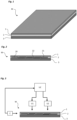
- the front face of the photovoltaic module M corresponds to a face of the module receiving the light rays and the rear face corresponds to the face opposite the front face.
- each layer of the photovoltaic module has two opposite faces, a first face oriented towards the rear and a second face oriented towards the front.
- protection element an element that can have a stiffening function and/or a surface protection function.
- the photovoltaic module M is shown turned over, so that its rear face is located above and the front face is located below.
- the different layers of the module are not shown to scale.
- the first layer 1 can have a thickness of a few hundred ⁇ m (for example about 350 ⁇ m)
- the second layer 2 can have a thickness which can go up to 1 mm
- the third layer 3 can have a thickness of about 3 to 4mm.
- the first layer 1 can in particular perform a gas and water impermeability function, an electrical protection/insulation function and a mechanical protection function.
- This first layer 1 can be made from a fluorinated polymer. It may be polyvinyl fluoride (PVF), for example marketed under the name TEDLAR (registered trademark) by the company DuPont (registered trademark).
- PVF polyvinyl fluoride
- the first layer 1 can itself be composed of a stack of several strata: a PVF stratum, a PET (poly(ethylene terephthalate) stratum), a PVF stratum.
- the encapsulation envelope 21 is conventionally made of a polymer such as EVA (Ethylene-Vinyl Acetate) forming a material on which the first layer 1 can adhere on one side and the third layer 3 on the other side and allow the assembly of the three layers together.
- EVA Ethylene-Vinyl Acetate
- THE three layers can be assembled together by hot rolling, so that the first layer and the third layer adhere to the material of the encapsulation casing, thus forming a one-piece stack.
- the photovoltaic cells 20 are connected together, in series/parallel, forming several chains ("string" in English) of cells.
- the photovoltaic module M can comprise a frame (not shown), for example in aluminum, arranged on the periphery of the stack to stiffen the module M.
- this frame, as well as the electrical junction box (not shown) generally fixed to the rear face of the module M, are removed beforehand.
- the method of the invention is in fact dedicated more particularly to the treatment of the stack of layers of the photovoltaic module M.
- the invention applies to a photovoltaic module M whose first layer 1 is formed of an easily machinable material, such as a material of the polymer type.
- the principle of the invention consists in machining the first layer 1 first and collecting the chips 100 from this first machining operation, then machining the second layer 2 and collecting the chips 200 from this second operation. machining.
- the third layer 3, for example made of glass, can then be recovered in its entirety.
- the treatment method of the invention is implemented using a suitable treatment installation.
- the processing installation comprises a first machining station U1 dedicated to the machining of the first layer 1 and a second machining station U2 dedicated to the machining of the second layer 2. It comprises also a processing and control unit UC, responsible for controlling the machining stations by taking into account input parameters and measurement data, for example supplied by sensors C.
- This processing and control unit UC is advantageously a programmable automaton equipped with several input/output modules.
- the photovoltaic module M to be treated is immobilized flat, for example by using an adhesive, mechanical clamps and/or a suction system.
- the photovoltaic module is advantageously turned over, so that its rear face is made available for machining (as in the appended figures).
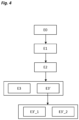
- FIG. 4 represents a diagram showing the different steps of the method of the invention and its possible variants.
- length and width of the photovoltaic module M are of course optional and are acquired to optimize the implementation of the method. This is the case, for example, of the density/hardness of the materials making up each layer, data which is useful for controlling the machining speed applied to each machining station U1, U2, with the final aim of maintaining in particular a motor torque compatible with the motorization installed.
- the processing and control unit UC thus acquires the data useful for characterizing the module. They can be entered manually by an operator and/or determined automatically, using sensors C of the installation, connected to input modules of the processing and control unit UC.
- These layer thickness data and advantageously of density/hardness allow the processing and control unit UC to control each machining station U1, U2 in an appropriate manner, to properly select the zones to be machined in order to target the materials of interest and to machine the maximum material , minimizing losses.
- the machining head and/or the grain size of the abrasive belt used can also be adapted.
- a second stage represented on the figure 5 , consists of a first machining of the first layer 1.
- This first machining is carried out with first machining means.
- the first machining means may comprise an abrasive belt 50 or a grinding wheel, actuated in rotation by a motor to remove, on each pass, at least part of the material making up the first layer 1.
- abrasive belt 50 or the grinding wheel is brought parallel to the surface of the first layer. It is controlled so as to bring its sanding face against the surface of the first layer 1.
- the chips 100 resulting from the machining of the first layer are collected in first collection means 101.
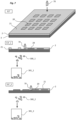
- a third stage represented on the figure 6 and on the figure 7 , consists of a second machining of the second layer 2.
- This third step is implemented after the second step described above. It is launched when the material forming the first layer 1 is completely removed, in order to avoid any mixing between the materials forming the first layer 1 and those forming the second layer 2.
- an intermediate step could be provided, located between the second step and the third step, with a shallow depth of pass machining carried out astride on both layers.
- the powders then obtained should then be separated from the others, for specific treatment.
- the machining implemented during this third step makes it possible to remove the material forming the whole of the second layer 2 and according to the invention to select the zones to be machined in order to carry out a sorting between the materials forming the encapsulation envelope 21 and the materials forming the photovoltaic cells 20.
- the machining means can be formed of an abrasive belt 60 or a grinding wheel, actuated in rotation and controlled to perform one or more passes on the second layer 2 with a view to sand the second coat.
- the abrasive belt 60 or the grinding wheel is brought parallel to the surface of the second layer 2. It is controlled so as to bring its sanding face against the surface of the second layer 2.
- the chips 200 obtained are a mixture of the materials forming both the encapsulation envelope and the photovoltaic cells. They are collected in collection means 201 separated from the first collection means 101.
- the machining means comprise a cutter 70 operable in rotation.
- the cutter 70 is controlled to select the areas to be machined and allows the second layer 2 to be removed in a localized manner.
- the head of the cutter 70 is brought perpendicular to the surface of the second layer 2 and is driven in rotation to attack the material, in the targeted zone.
- the machining can continue to finish removing the second layer 2.
- the shavings 300_1, 300_2 removed are collected separately in second collection means 301_1, 301_2.
- This machining can be carried out using the same cutter 70 or another cutter. It would also be possible to use an abrasive belt or a diamond wire to remove the remaining areas not yet machined by the first milling.
- each machining step is independent and can be implemented according to one or other of the variants described above.
- the processing and control unit UC can be configured to ensure a new control of the thicknesses of each layer of the photovoltaic module M.
- the pressure applied to the belt or the grinding wheel to perform the machining will be done using multiple rollers/shoes across the width of the belt.
- the thickness of material removed will be identical despite the topology irregularities, so that each fraction of chips collected is as pure as possible.
- the two machining steps are carried out dry, in order to avoid any degradation of the materials collected, such as the oxidation of metals for example. It should be noted that everything that has been described above for the treatment method of the invention applies within the framework of the treatment installation and vice versa.
- the processing installation comprises the hardware and software means for implementing the processing method.
Landscapes
- Engineering & Computer Science (AREA)
- Environmental & Geological Engineering (AREA)
- Mechanical Engineering (AREA)
- Photovoltaic Devices (AREA)
- Processing Of Solid Wastes (AREA)
Applications Claiming Priority (1)
| Application Number | Priority Date | Filing Date | Title |
|---|---|---|---|
| FR2110481A FR3127710B1 (fr) | 2021-10-04 | 2021-10-04 | Procédé de traitement pour recyclage d'un module photovoltaïque |
Publications (3)
| Publication Number | Publication Date |
|---|---|
| EP4159397A1 true EP4159397A1 (de) | 2023-04-05 |
| EP4159397B1 EP4159397B1 (de) | 2025-11-05 |
| EP4159397C0 EP4159397C0 (de) | 2025-11-05 |
Family
ID=79170777
Family Applications (1)
| Application Number | Title | Priority Date | Filing Date |
|---|---|---|---|
| EP22193950.7A Active EP4159397B1 (de) | 2021-10-04 | 2022-09-05 | Behandlungsverfahren und vorrichtung für das recycling eines photovoltaikmoduls |
Country Status (2)
| Country | Link |
|---|---|
| EP (1) | EP4159397B1 (de) |
| FR (1) | FR3127710B1 (de) |
Citations (6)
| Publication number | Priority date | Publication date | Assignee | Title |
|---|---|---|---|---|
| JP2014104406A (ja) * | 2012-11-27 | 2014-06-09 | Yokohama Yushi Kogyo Kk | 太陽電池モジュールのリサイクル方法 |
| FR3017551A1 (fr) * | 2014-02-20 | 2015-08-21 | Recyclage Valorisation Photovoltaique R V P | Procede et installation de recyclage de panneaux photovoltaiques |
| US20160318034A1 (en) * | 2013-12-20 | 2016-11-03 | La Mia Energia Scarl | De-assembling system for a photovoltaic panel enabling salvage of original materials |
| US20180133720A1 (en) | 2016-11-11 | 2018-05-17 | Korea Institute Of Energy Research | Partial dismantling device of photovoltaic module |
| EP3352227A1 (de) | 2015-09-18 | 2018-07-25 | Toho Kasei Co., Ltd. | Recyclingverfahren für solarbatteriemodul |
| WO2019043329A1 (fr) | 2017-08-30 | 2019-03-07 | Commissariat à l'énergie atomique et aux énergies alternatives | Procede de desassemblage d'un module photovoltaïque et installation associee |
-
2021
- 2021-10-04 FR FR2110481A patent/FR3127710B1/fr active Active
-
2022
- 2022-09-05 EP EP22193950.7A patent/EP4159397B1/de active Active
Patent Citations (6)
| Publication number | Priority date | Publication date | Assignee | Title |
|---|---|---|---|---|
| JP2014104406A (ja) * | 2012-11-27 | 2014-06-09 | Yokohama Yushi Kogyo Kk | 太陽電池モジュールのリサイクル方法 |
| US20160318034A1 (en) * | 2013-12-20 | 2016-11-03 | La Mia Energia Scarl | De-assembling system for a photovoltaic panel enabling salvage of original materials |
| FR3017551A1 (fr) * | 2014-02-20 | 2015-08-21 | Recyclage Valorisation Photovoltaique R V P | Procede et installation de recyclage de panneaux photovoltaiques |
| EP3352227A1 (de) | 2015-09-18 | 2018-07-25 | Toho Kasei Co., Ltd. | Recyclingverfahren für solarbatteriemodul |
| US20180133720A1 (en) | 2016-11-11 | 2018-05-17 | Korea Institute Of Energy Research | Partial dismantling device of photovoltaic module |
| WO2019043329A1 (fr) | 2017-08-30 | 2019-03-07 | Commissariat à l'énergie atomique et aux énergies alternatives | Procede de desassemblage d'un module photovoltaïque et installation associee |
Also Published As
| Publication number | Publication date |
|---|---|
| FR3127710A1 (fr) | 2023-04-07 |
| FR3127710B1 (fr) | 2024-02-09 |
| EP4159397B1 (de) | 2025-11-05 |
| EP4159397C0 (de) | 2025-11-05 |
Similar Documents
| Publication | Publication Date | Title |
|---|---|---|
| EP3676879B1 (de) | Verfahren zur demontage eines photovoltaikmoduls und zugehörige anlage | |
| FR3017551A1 (fr) | Procede et installation de recyclage de panneaux photovoltaiques | |
| CN108122735A (zh) | 晶片的加工方法 | |
| EP4309216B1 (de) | Verfahren zum transfer einer schicht einer heterostruktur | |
| EP4159397B1 (de) | Behandlungsverfahren und vorrichtung für das recycling eines photovoltaikmoduls | |
| FR3070541B1 (fr) | Procede de desassemblage d'un module photovoltaique et installation associee | |
| KR20230023378A (ko) | 다중 연삭 모듈을 이용한 태양광 모듈 부분 박리 장치 | |
| JP4705418B2 (ja) | ウェーハの加工方法 | |
| EP3939072B1 (de) | System zum brechen einer vielzahl von waferanordnungen | |
| EP0798113B1 (de) | Verfahren und Maschine zum Herstellen von Platten | |
| EP3990260B1 (de) | Verfahren und maschine zur automatisierung der herstellung eines gegenstandes nach einem schicht für schicht additiven herstellungsverfahren von festkörper/festkörper-typ. | |
| EP4565037A1 (de) | Verfahren zur demontage der rückschicht eines photovoltaikmoduls | |
| CN220642925U (zh) | 超薄盖板玻璃边部蚀刻系统 | |
| FR1465837A (fr) | Procédé et dispositifs de surfaçage, notamment pour feuilles de verre ou similaires | |
| EP4385734B1 (de) | Verfahren zur delaminierung einer mehrschichtigen vorrichtung | |
| FR2987166A1 (fr) | Procede de transfert d'une couche | |
| EP2017048A1 (de) | Höhenkalibriervorrichtung für Bauelemente | |
| FR2622821A1 (fr) | Procede et dispositif pour detourer des plaques de grandes dimensions transversales et de faible epaisseur | |
| EP3159916B1 (de) | Verfahren zur verdünnung von proben | |
| EP4378654A1 (de) | Verarbeitungsverfahren zur wiederverwertung eines photovoltaikmoduls | |
| EP4298660B1 (de) | Verfahren zur herstellung des rests eines donorsubstrats, dessen schicht durch delamination entfernt wurde | |
| EP3823013B1 (de) | Verfahren zur demontage eines stapels von mindestens drei substraten | |
| EP0192532B1 (de) | Lamellenholz und Verfahren und Vorrichtung zu dessen kontinuierlicher Fertigung | |
| FR3139409A1 (fr) | Procédé de préparation de la face avant d’une plaque de carbure de silicium polycristallin | |
| CN105993063A (zh) | 用于基板处理的方法 |
Legal Events
| Date | Code | Title | Description |
|---|---|---|---|
| PUAI | Public reference made under article 153(3) epc to a published international application that has entered the european phase |
Free format text: ORIGINAL CODE: 0009012 |
|
| STAA | Information on the status of an ep patent application or granted ep patent |
Free format text: STATUS: REQUEST FOR EXAMINATION WAS MADE |
|
| 17P | Request for examination filed |
Effective date: 20220905 |
|
| AK | Designated contracting states |
Kind code of ref document: A1 Designated state(s): AL AT BE BG CH CY CZ DE DK EE ES FI FR GB GR HR HU IE IS IT LI LT LU LV MC MK MT NL NO PL PT RO RS SE SI SK SM TR |
|
| STAA | Information on the status of an ep patent application or granted ep patent |
Free format text: STATUS: EXAMINATION IS IN PROGRESS |
|
| 17Q | First examination report despatched |
Effective date: 20240325 |
|
| RAP3 | Party data changed (applicant data changed or rights of an application transferred) |
Owner name: COMMISSARIAT A L'ENERGIE ATOMIQUE ET AUX ENERGIESALTERNATIVES |
|
| GRAP | Despatch of communication of intention to grant a patent |
Free format text: ORIGINAL CODE: EPIDOSNIGR1 |
|
| STAA | Information on the status of an ep patent application or granted ep patent |
Free format text: STATUS: GRANT OF PATENT IS INTENDED |
|
| INTG | Intention to grant announced |
Effective date: 20250612 |
|
| GRAS | Grant fee paid |
Free format text: ORIGINAL CODE: EPIDOSNIGR3 |
|
| GRAA | (expected) grant |
Free format text: ORIGINAL CODE: 0009210 |
|
| STAA | Information on the status of an ep patent application or granted ep patent |
Free format text: STATUS: THE PATENT HAS BEEN GRANTED |
|
| AK | Designated contracting states |
Kind code of ref document: B1 Designated state(s): AL AT BE BG CH CY CZ DE DK EE ES FI FR GB GR HR HU IE IS IT LI LT LU LV MC MK MT NL NO PL PT RO RS SE SI SK SM TR |
|
| REG | Reference to a national code |
Ref country code: CH Ref legal event code: F10 Free format text: ST27 STATUS EVENT CODE: U-0-0-F10-F00 (AS PROVIDED BY THE NATIONAL OFFICE) Effective date: 20251105 Ref country code: GB Ref legal event code: FG4D Free format text: NOT ENGLISH |
|
| REG | Reference to a national code |
Ref country code: DE Ref legal event code: R096 Ref document number: 602022024306 Country of ref document: DE |
|
| U01 | Request for unitary effect filed |
Effective date: 20251112 |