EP4157722B1 - Verfahren zur schätzung der kollision zwischen mindestens einem stück weltraummüll und einem satelliten - Google Patents
Verfahren zur schätzung der kollision zwischen mindestens einem stück weltraummüll und einem satelliten Download PDFInfo
- Publication number
- EP4157722B1 EP4157722B1 EP21728541.0A EP21728541A EP4157722B1 EP 4157722 B1 EP4157722 B1 EP 4157722B1 EP 21728541 A EP21728541 A EP 21728541A EP 4157722 B1 EP4157722 B1 EP 4157722B1
- Authority
- EP
- European Patent Office
- Prior art keywords
- satellite
- tca
- real
- orbit
- time
- Prior art date
- Legal status (The legal status is an assumption and is not a legal conclusion. Google has not performed a legal analysis and makes no representation as to the accuracy of the status listed.)
- Active
Links
Images




Classifications
-
- B—PERFORMING OPERATIONS; TRANSPORTING
- B64—AIRCRAFT; AVIATION; COSMONAUTICS
- B64G—COSMONAUTICS; VEHICLES OR EQUIPMENT THEREFOR
- B64G1/00—Cosmonautic vehicles
- B64G1/22—Parts of, or equipment specially adapted for fitting in or to, cosmonautic vehicles
- B64G1/52—Protection, safety or emergency devices; Survival aids
- B64G1/56—Protection against meteoroids or space debris
-
- B—PERFORMING OPERATIONS; TRANSPORTING
- B64—AIRCRAFT; AVIATION; COSMONAUTICS
- B64G—COSMONAUTICS; VEHICLES OR EQUIPMENT THEREFOR
- B64G1/00—Cosmonautic vehicles
- B64G1/22—Parts of, or equipment specially adapted for fitting in or to, cosmonautic vehicles
- B64G1/66—Arrangements or adaptations of apparatus or instruments, not otherwise provided for
- B64G1/68—Arrangements or adaptations of apparatus or instruments, not otherwise provided for of meteoroid or space debris detectors
-
- B—PERFORMING OPERATIONS; TRANSPORTING
- B64—AIRCRAFT; AVIATION; COSMONAUTICS
- B64G—COSMONAUTICS; VEHICLES OR EQUIPMENT THEREFOR
- B64G1/00—Cosmonautic vehicles
- B64G1/22—Parts of, or equipment specially adapted for fitting in or to, cosmonautic vehicles
- B64G1/24—Guiding or controlling apparatus, e.g. for attitude control
- B64G1/242—Orbits and trajectories
- B64G1/2429—Station keeping
-
- B—PERFORMING OPERATIONS; TRANSPORTING
- B64—AIRCRAFT; AVIATION; COSMONAUTICS
- B64G—COSMONAUTICS; VEHICLES OR EQUIPMENT THEREFOR
- B64G1/00—Cosmonautic vehicles
- B64G1/22—Parts of, or equipment specially adapted for fitting in or to, cosmonautic vehicles
- B64G1/24—Guiding or controlling apparatus, e.g. for attitude control
- B64G1/244—Spacecraft control systems
-
- B—PERFORMING OPERATIONS; TRANSPORTING
- B64—AIRCRAFT; AVIATION; COSMONAUTICS
- B64G—COSMONAUTICS; VEHICLES OR EQUIPMENT THEREFOR
- B64G1/00—Cosmonautic vehicles
- B64G1/22—Parts of, or equipment specially adapted for fitting in or to, cosmonautic vehicles
- B64G1/66—Arrangements or adaptations of apparatus or instruments, not otherwise provided for
Definitions
- the present invention relates to a method for estimating collision between at least one piece of space debris and a satellite orbiting the Earth. More particularly, the present invention relates to a method allowing a satellite in Earth orbit to be able to calculate autonomously on board the satellite, its probability of collision with at least one piece of space debris as well as maneuvers to avoid at least one piece of space debris. .
- the current context is marked by an increase in mega constellation projects, where up to 1000 satellites can be operated.
- the number of debris tracked is likely to increase significantly: the population of tracking debris will increase from 20,000 to 100,000 objects when the radar area of detected debris decreases from 10 to 5 cm. These two phenomena will lead to a higher number of calculations of probability of collision with debris and therefore also calculation of debris avoidance maneuvers, thus increasing the workload of ground operators.
- the present invention aims to remedy these drawbacks with a completely innovative approach.
- the subject of the present invention is a method for estimating collision between a satellite orbiting the Earth and at least one piece of space debris, the method comprising the steps claimed in claim 1.
- the method according to the invention further comprises a step implemented by the calculation means on board the satellite preceding the step of calculating the first collision probability, of: determination of the nearest passage date corresponding to a real nearest passage date, by successive increment, from a reference nearest passage date predetermined by the processing means of information on the ground and transmitted beforehand to the satellite, of a time shift verifying, at the date of the closest real passage, an almost zero result of the scalar product of a difference between a real orbital position of the satellite and an orbital position of the space debris with a difference between an actual orbital speed of the satellite and an orbital speed of the space debris, the orbital position and the orbital speed of the satellite and respectively of the space debris being obtained from the orbit of the satellite and respectively of the space debris.
- the step of calculating the first collision probability comprises the maximization of the first collision probability by dilution of the covariances of the orbital positions of the satellite and said space debris.
- the date of the avoidance maneuvers takes place according to an argument of latitude of maneuver opposed to the argument of the latitude of collision with the space debris.
- each avoidance maneuver includes the direction relating to the maximum radial separation associated with the free maneuver time slot allocated to each avoidance maneuver.
- each avoidance maneuver includes a maximum speed difference authorized during the free maneuver time slot allocated to each avoidance maneuver.
- Another subject of the invention relates to a collision estimation system between a satellite orbiting the Earth and at least one piece of space debris, as claimed in claim 12.
- a first advantage of the invention is to allow the orbit measured in real time to be taken into account by a satellite navigation device for estimating the risk of collision.
- Another advantage is to simplify all the calculations which can thus be carried out by calculation means on board the satellite.
- calculation means on board the satellite, can autonomously anticipate a correction of its trajectory.
- corrections can be anticipated by the calculation means on board the satellite. Corrections can also be made by the calculation means on board the satellite for one or more pieces of debris.
- An advantage is also that the calculation means on board the satellite for implementing the invention are limited compared to the processing means on the ground, but allow increased precision in the estimation of the collision risk and in the anticipation of avoidance maneuvers.
- Yet another advantage is that the collision risk estimates, as well as the calculations of possible avoidance maneuvers, can be ordered as close as possible to the nearest passage date.
- passage via the ground loop requires calculations to be made further in advance, which increases uncertainties and generally results in avoidance maneuvers which were not necessarily necessary.
- a satellite 10 in orbit around the Earth 12 and a space debris 1 also in orbit around the Earth 12 are represented.
- a satellite is capable of autonomously managing its station-keeping maneuvers. Information relating to satellite station-keeping maneuvers is only available on the ground during specific dates during which the satellite is in the field of communication with the ground communication antennas allowing the radio link between the satellite and the operators. on the ground. To this end, taking into account the station keeping maneuver of the satellite in the estimation of the satellite's orbit by the operators cannot generally be carried out in real time, which does not make it possible to correctly estimate the risk of collision, to the extent that the ground is not able to correctly predict the trajectory of the satellite.
- the satellite 10 can only be in communication with a satellite control center 18 when it is in the communication field or fields of vision 14 of communications means 16 on the ground connected to the satellite control center 18.
- the satellite 10 is represented at a first moment T 0 in its theoretical orbit, known by the satellite control center 18, that is to say in its orbit linked to its mission or also called reference orbit X ref of the satellite .
- the satellite control center 18 comprises means for processing information and communicating with the satellites.
- the information processing means may include, for example, a microcontroller or processors executing programs configured to calculate a set of data necessary for the satellites.
- the means of communication may include transmitting and receiving antennas to transmit all the data necessary to the satellites.
- the satellite 10 is also represented in another orbit, called the real orbit X real of the satellite 10 at a time T 1 after the time T 0 .
- the reference orbit X ref of the satellite may differ from the real orbit X real of the satellite 10.
- the satellite 10 includes, for example, a navigation device enabling it to know its orbital position in real time.
- the difference between the trajectory of the real orbit X real and the trajectory of the reference orbit X ref relates in particular to the fact that the satellite 10 controls its maneuvers to remain close to the trajectory of the reference orbit X ref , without being perfectly controlled.
- the space debris d 1 has its own orbit X d1 corresponding to its own orbital trajectory.
- the ground satellite control center 18 collaborates in particular with space debris monitoring agencies such as, for example, the American organization CSOC (Combined Space Operations Center), or the international organization SDA (The Space Data Association). From the data representative of the orbit of the space debris X d1 and its covariance COV d1 , as well as from the reference orbit is capable of determining a date of the closest reference TCA ref passage of space debris 1 with the satellite 10.
- the date of the closest reference TCA ref passage corresponds to the date on which the distance between the average reference orbital position and the average orbital position of the debris is the smallest.
- the date of the closest TCA ref reference passage of the space debris with the satellite 10 estimated on the ground may differ from a date of the closest real real TCA passage between the space debris and the satellite when we considers the real average orbital trajectory of the satellite 10 corresponding to its real orbit as measured by the on-board navigation means.
- This real real TCA closest passage date cannot be determined on the ground, since the satellite control center 18 only knows the reference orbit X ref of the satellite and not the real orbit of the X real of the satellite.
- the satellite 10 is configured to estimate a probability of collision P 1 between the space debris d 1 and the satellite 10 at an closest TCA passage date as a function of its actual orbit.
- the satellite is thus able to calculate the probability of collision at the nearest actual TCA real passage date as it could also do at the nearest reference TCA ref passage date.
- the satellite 10 comprises calculation means which may, for example and in a non-limiting manner, include a microcontroller.
- it is necessary to know the orbit of the satellite 10 and its covariance COV sat at this earliest date.
- TCA passage as well as the orbital position of the space debris d 1 and its covariance COV d1 on this date of the nearest TCA passage.
- a data ephemeris allowing a state difference to be propagated, also called state transition data ephemeris or state transition matrix, allowing propagation of the real orbit X real (t) of the satellite and its covariance Cov at this date of the closest reference TCA passage.
- At least one state transition matrix ⁇ is determined by the satellite control center 18.
- the state transition matrix ⁇ allows for example a propagation, at the date of the closest reference TCA ref passage, of the real orbit X real of the satellite and its covariance COV sat measured at a time t 0 .
- the satellite 10 With the aim of making the satellite 10 autonomous on its ability to more precisely estimate a probability of collision with space debris, it is possible to calculate, by the means of processing the information on the ground, the matrix of state transition ⁇ and communicate to the satellite 10 this state transition matrix ⁇ (t 0 ->TCA ref ). The satellite 10 will thus be able to determine its orbit at t 0 then its orbit on the date of the closest TCA reference ref passage.
- Equation (2) is for example used to determine the real orbit the ground control center.
- Several state transition matrices between two instants of interest corresponding for example to predictable avoidance maneuvers envisaged, can be provided to the satellite.
- the satellite 10 can also receive from the satellite control center 18 information including in particular the orbit and the covariance linked to the space debris, the date of the closest passage TCA reference ref and the reference orbit X ref of the satellite 10 in at least two moments of interest corresponding to the instant of triggering of the probability calculation and to the date of the nearest reference passage.
- the satellite's orbit corresponds to a set of six-dimensional elements.
- An example orbit will be detailed later.
- the reference orbit The state transition matrix ⁇ can be calculated from a limited expansion around the satellite's reference orbit and will be sent to the satellite at the same time as information relating to the space debris orbit and its covariance.
- the propagation used during the calculation using the state transition matrix ⁇ can thus take into account complex models necessary for high precision.
- An advantage of calculating the state transition matrix ⁇ from the satellite control center 18 is in particular to be able to benefit from much greater computing power than that which can be on board the satellite 10.
- the propagation of the reference orbit X ref of the satellite 10 can be determined, by information processing means on the ground, according to a free drift propagation of the reference orbit that is to say without maneuvering the satellite 10, from the activation date t cur until the date of the closest passage TCA reference ref .
- the information processing means on the ground determine the reference orbit X ref of the satellite 10 and the state transition matrix ( ⁇ (t cur ⁇ TCA ref ) between the activation date and the date of nearest reference passage.
- the state transition matrix ( ⁇ (t cur ⁇ TCA ref ) between the activation date and the nearest passage date is applied to the orbital gap, determined at the activation date, to deduce a gap orbital on the date of closest passage.
- the satellite 10 has also carried out a maneuver after the activation date.
- This maneuver generates on the real orbit a maneuver of the satellite 10 results in a real orbital correction
- X real TCA ref X ref TCA ref + ⁇ X TCA ref + ⁇ X man TCA ref
- the advantage of formulating the orbital position deviation ⁇ X man (TCA ref ) according to equation (9) is that the effects of the maneuver are separated with the effects integrated over time on the actual orbit on the date closest passage TCA ref reference with maneuver X real_a (TCA ref ) and without maneuver X real_b (TCA ref ).
- the direct effect of a maneuver concerns the parameters of the orbit of satellite 10, namely: the semi-major axis ⁇ a', the eccentricity vector [e x , e y ], the inclination 'i', and sometimes the right ascension ' ⁇ ' of the ascending node of the orbital plane of satellite 10.
- d ⁇ dt X t 0 ⁇ 1 + d ⁇ dt X t 0 . t 1 ⁇ t 0 for which, d ⁇ dt X t 0 And d ⁇ dt X t 0 are the angular rates corresponding respectively to the right ascension ' ⁇ ' of the ascending node of the orbital plane of satellite 10 and the argument of the latitude ' ⁇ ' of satellite 10, including the secular effect ⁇ J2'.
- the calculation means of the satellite 10 are configured to determine the date of the closest passage TCA real real taking into account the real orbit X real of the satellite 10.
- a linear approximation of the orbital trajectory X d1 (t) of the space debris d 1 in the orbital plane of the satellite is represented.
- the reference closest passage date TCA ref may differ from the actual closest passage date TCA real .
- the scalar product of the vector ⁇ X real representative of the difference in orbital position between the real orbital position of satellite 10 and the orbital position of space debris 1 , with the difference in orbital speed ⁇ V between the satellite 10 and the space debris 1 must be zero or almost zero. In other words the following equation must be verified: ⁇ X ⁇ real .
- ⁇ X real represents the difference in orbital position between the satellite 10 and the space debris d 1 on the date of the closest passage TCA real real
- ⁇ V represents the difference in orbital speed between the satellite 10 and the space debris d 1 on the date of the closest real TCA passage.
- the calculation means of the satellite 10 are configured to determine the time difference ⁇ TCA between two real real TCA closest passage dates calculated successively.
- the first time shift ⁇ TCA corresponds to the difference between the date of the closest reference TCA ref passage and the first estimate of TCA real .
- ⁇ X real (TCA real_N-1 ) represents the difference between the real orbital position of satellite 10 and the orbital position of space debris d 1 on the nearest passage date, according to the iteration considered on the nearest passage date
- ⁇ V (TCA real_N-1 ) represents
- the satellite 10 can advantageously determine its real orbit and the orbit of the debris d 1 , as well as their covariance associated with the date of the closest reference TCA ref passage or the date of the closest real TCA real passage.
- the calculation means of the satellite 10 made it possible to determine, as described previously, in particular according to a state transition matrix ⁇ , the orbits and the associated covariances of the space debris d 1 and the satellite 10 at the date of more close to TCA ref reference passage.
- the calculation means of the satellite 10 also make it possible to calculate the real orbit of X real of the satellite 10 and the orbit i.e. only Keplerian.
- the calculation means of the satellite 10 make it possible to propagate the real orbit of real real.
- the calculation means of the satellite 10 are configured to calculate the collision probability P 1 between the satellite 10 on its real orbital trajectory X real and the space debris d 1 .
- space debris 1 and satellite 10 according to their relative orbital position ⁇ X real (TCA_real) on the nearest TCA_real passage date considered, as well as their covariance COV sat , COV d1 are represented and projected in a plane P(O,x,y), this plane P(O,x,y) being taken orthogonal to the relative speed ⁇ V between satellite 10 and space debris 1 .
- the satellite 10 and the space debris d 1 are modeled respectively according to a circle of radius R 10 for the satellite and of radius Rd 1 for the space debris d 1 .
- the relative distance between the satellite 10 and the space debris d 1 is projected into the plane of the orbit of the satellite 10, as well as its associated COV dr covariance.
- the covariance COV dr of the relative distance is expressed by the sum of the covariance of the satellite 10 and the space debris d 1 .
- a set Cr(x,y) is defined as a set of points x, y in the circle of cumulative radius R cu representative of the sum of the radius R 10 of the satellite 10 modeled and the radius R d1 of the space debris d 1 modeled.
- the set Cr(x,y) of points x,y meets the criterion according to which: x 2 + y 2 ⁇ R 2 cu
- the collision probability P 1 corresponds to the probability for which the difference in distance between the satellite 10 and the space debris d 1 can be less than the cumulative radius R cu .
- the collision probability P 1 can therefore be calculated by integrating the probability density function of the distance difference on the circle of cumulative radius R cu .
- the calculation means on board the satellite evaluate the collision probability P 1 according to a semi-analytical, or even preferably analytical, expression.
- P 1 ⁇ 1 2 2 ⁇ ⁇ x e ⁇ 1 2 x ⁇ x ⁇ ⁇ x 2 erf y ⁇ + r 2 ⁇ x 2 2 ⁇ y ⁇ erf y ⁇ ⁇ r 2 ⁇ x 2 2 ⁇ y dx
- the analytical formulation allows the best speed of calculation of the collision probability P 1 between the satellite 10 and the space debris d 1 .
- the determination of the real orbit X real of the satellite 10 and the orbit Preferably, in order to take into account such uncertainty in the calculation of the collision probability P 1 between the satellite 10 and the space debris d 1 , it is possible to maximize the collision probability P 1 by moving both the covariance COV sat of the real X real orbit of the satellite and the COV d1 covariance of the X orbit d1 of the space debris d 1 .
- a coefficient K sat linked to the covariance COV sat of the satellite 10 and a coefficient K d1 linked to the covariance COV d1 of the space debris d 1 are added relative to the calculation of the probability P 1 of collision.
- Such an optimum can be, for example and in a non-limiting manner, determined according to a gradient method referred to as the golden ratio method.
- the pair (Ks, Kd) of coefficients where each coefficient is included in an interval ranging from 0.2 to 5.
- the method for estimating collision between space debris d 1 and satellite 10 orbiting Earth 12 includes estimating the collision probability P 1 for which the collision could occur on the earliest passing date TCA considered, that is to say either the date of the closest reference TCA ref passage or the date of the closest real TCA real passage.
- the collision estimation method may include the determination of one or more maneuvers ⁇ V .
- d avoidance making it possible to reduce the probability of collision P 1 of the satellite 10 with the debris d1 on the date of the closest TCA passage considered, that is to say at an orbital position corresponding to an argument of the latitude ⁇ col at the date of the nearest TCA passage considered, also says argument of the latitude ⁇ collision pass .
- each maneuver ⁇ V Optimally, each maneuver ⁇ V.
- a preliminary step M0 of the collision estimation method comprises the determination of the argument of the latitude ⁇ col of the satellite 10 for which the collision may be probable, that is to say the argument of the latitude ⁇ col collision.
- the calculation means on board the satellite 10 can determine the argument of the latitude ⁇ collision pass .
- the probability of collision P 1 according to the real orbit example and in a non-limiting manner, a threshold called critical threshold, above which it is considered that the risk of collision is too high to maintain the orbit of the satellite as it is.
- a first maneuver ⁇ V. d _1 of avoidance must be determined by the calculation means on board the satellite 10.
- the calculation means are configured to estimate the first maneuver ⁇ V. d _1 of avoidance allowing the radial separation between the satellite 10 and the space debris 1 on the date of the nearest TCA passage considered.
- This first maneuver ⁇ V. d _1 avoidance must preferably be executed for an orbital position of the satellite 10 opposite to that which the satellite 10 will have on the nearest TCA passage date considered in order to maximize the separation radial between the satellite 10 and the space debris 1 on the date of the nearest TCA passage considered.
- This first maneuver ⁇ V. d _1 avoidance must also be sufficiently distant in time so that it can be executed before the probable collision.
- the calculation means on board the satellite 10 are configured to estimate a new trajectory of the real real X orbit of the satellite 10 as explained according to the Figure 3 and according to equations (7) and (9) of the present invention.
- the calculation means on board the satellite 10 are configured to re-estimate the collision probability P 1 following the first maneuver ⁇ V. d _1 avoidance.
- the collision probability P 1 following the first maneuver ⁇ V. d _1 of determined avoidance is greater than the predefined collision probability threshold P th .
- a second maneuver ⁇ V. d _2 of avoidance is determined by the calculation means on board the satellite 10.
- the second maneuver ⁇ V. d _ 2 of avoidance must be preferably executed according to an orbital position of the satellite 10 during an orbit before the first maneuver ⁇ V. d _1 avoidance. More precisely, the orbital position of the satellite 10 for which the execution of the second maneuver ⁇ V.
- d _ 2 avoidance could be effective, could be chosen, for example and in a non-limiting manner, at an orbital position of the satellite 10 corresponding to an argument of latitude ⁇ man 2 of first maneuver ⁇ V.
- the calculation means on board the satellite 10 are configured to estimate a new orbital trajectory of the satellite 10 as explained according to the Figure 3 and according to equations (7) and (9) of the present invention.
- the calculation means on board the satellite 10 are configured to re-estimate the collision probability P 1 following the second maneuver ⁇ V. d _ 2 avoidance.
- the collision probability P 1 following the second maneuver ⁇ V. d _ 2 of determined avoidance is less than the predefined collision probability threshold P th .
- the calculation means on board the satellite 10 can either evaluate other avoidance maneuvers in addition to the first ⁇ V maneuver. d _1 of avoidance and the second maneuver ⁇ V. d _ 2 avoidance according to the same principle as that explained for the first ⁇ V maneuver. d _1 for avoidance and for the second maneuver ⁇ V. d _2 of avoidance, or consider that the accumulation of the first maneuver ⁇ V. d _ 1 of avoidance and the second maneuver ⁇ V. d _2 of avoidance is sufficient to limit the risk of collision between the satellite 10 and the space debris 1 .
- a ⁇ V maneuver. d avoidance may include a maximum variation ⁇ V max in speed which can be linked for example and in a non-limiting manner to the maximum available energy consumption of the satellite propulsion device 10 authorized for a ⁇ V maneuver. d avoidance.
- a minimum variation ⁇ V min in the speed of the satellite 10 is for example defined. This minimum variation is linked to the minimum thrust energy necessary for the satellite 10 to change the orbit of the satellite 10.
- the collision probability P 1 following the second maneuver ⁇ V. d _2 of avoidance determined is lower to the predefined collision probability threshold P th , it is possible to add an optimization step MO including the optimization of the second maneuver ⁇ V. d _2 avoidance, so as to, for example and in a non-limiting manner, limit the energy necessary for this second maneuver ⁇ V. d _2 of avoidance making it possible to obtain for example a collision probability P 1 equal to or even closest to the predefined collision probability threshold P th .
- the collision probability P1 can be recalculated according to a new speed difference ⁇ V_2' of the second maneuver ⁇ V.
- the direction d _2 of the second ⁇ V maneuver. d _ 2 avoidance can also be adjusted.
- the management d _2 of the second ⁇ V maneuver. d _2 avoidance will be adjusted according to either direction d _2 in the direction of the speed of satellite 10, i.e. in one direction d _2 in a direction opposite to the speed of the satellite 10 in order to maximize the radial separation at the nearest TCA passage date considered.
- the collision estimation method can relate to a plurality of space debris.
- a step M_d 1 relating to the determination of the probability of collision P 1 with the first space debris d 1 is represented.
- This step M_d 1 relating to the calculation of the collision probability P 1 was carried out with a first maneuver ⁇ V.
- d _ 21 of avoidance respectively planned to be carried out when the satellite10 will be in orbital position corresponding to an argument of latitude ⁇ man 11 of first maneuver ⁇ V.
- a step M_d 2 representative of the estimation of the probability of collision P 2 with the second space debris d 2 is represented. This step M_d 2 relating to the calculation of the probability P 2 with the second space debris d 2 was carried out with a first maneuver ⁇ V. d _12 avoidance and a second ⁇ V maneuver.
- d _22 of avoidance respectively planned to be carried out when the satellite 10 will be in orbital position corresponding to an argument of latitude ⁇ man 12 of first maneuver ⁇ V.
- the first maneuver ⁇ V. d _11 of avoidance linked to the first space debris d 1 is in temporal conflict with the second maneuver ⁇ V. d _22 of avoidance linked to the second space debris d 2 .
- the argument of the latitude ⁇ man 11 ⁇ col 1 - ⁇ linked to the first maneuver ⁇ V.
- the second maneuver ⁇ V. d _22 of avoidance linked to the second space debris d 2 includes an encroachment zone with the first maneuver ⁇ V. d _11 avoidance of the first spatial debris d 1 so that this encroachment zone corresponds to a zone where the first maneuver ⁇ V. d _11 avoidance of the first space debris d 1 cannot be performed due to the presence of the second maneuver ⁇ V. d _22 of avoidance linked to the second space debris d 2 .
- one solution consists of shifting the ⁇ V maneuvers. d of avoidances associated with debris of as much orbit as necessary until there is no longer any overlap between the ⁇ V maneuvers. d avoidance measures planned for the avoidance of the first space debris with the ⁇ V maneuvers. d avoidance of the second space debris.
- the first maneuver ⁇ V. d _11 to avoid the first debris d 1 and the second maneuver ⁇ V. d _21 of avoidance of the first debris d 1 have both been shifted from a previous orbit to their initially determined orbital position. More precisely, the argument of the latitude ⁇ man 11 of the first maneuver ⁇ V.
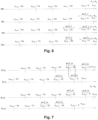
- an example of a period of revolution of the satellite 10 around the Earth also called the orbital period of the satellite 10 around the Earth 12, is represented schematically by a discontinuous circle formed by several arcs of a circle.
- Each arc of a circle represents a time slot that can be dedicated to an operation of the satellite 10.
- the orbital period of the satellite 10 may include nine time slots provided for various predetermined operations of the satellite 10 such as charging operations of a power supply battery of the satellite 10, corrections if necessary of the attitude of the satellite 10, photographs of the Earth 12 and or any other operations of the satellite 10.
- the orbital period of the satellite 10 can include six time slots not dedicated to predetermined operations that we will be named in the remainder of the description as free slots Sl 1 , Sl 2 , Sl 3 , Sl 4 , Sl 5 , Sl 6 for maneuvering.
- the collision estimation method can include the determination of the best free maneuver slot Sl 1 , Sl 2 , Sl 3 , Sl 4 , Sl 5 , Sl 6 during which a maneuver d avoidance can be carried out so as to obtain the lowest collision probability P 1 .
- the collision estimation method may also include the determination of a plurality of ⁇ V maneuvers. d consecutive avoidance, each free maneuvering slot Sl 1 , Sl 2 , Sl 3 , Sl 4 , Sl 5 , Sl 6 associated with each maneuver ⁇ V. d avoidance which must be selected so as to limit the number of maneuvers ⁇ V.
- Five lines represent five successive steps M0, M1, M2, M3, MF for determining free slots Sl 1 , Sl 2 , Sl 3 , Sl 4 , Sl 5 , Sl 6 for maneuvering and ⁇ V maneuvers. d avoidance making it possible to reduce the probability of collision P 1 of the satellite 10 with the space debris d 1 . More particularly, the first line represents a preliminary step M0 of determining the free maneuvering slots Sl 1 , Sl 2 , Sl 3 , Sl 4 , Sl 5 , Sl 6 allowing the execution of maneuvers ⁇ V.
- the second line, the third line and the fourth line respectively represent a first step M1 of determining a first maneuver ⁇ V. d _1 of avoidance, a second step M2 of determining a second maneuver ⁇ V.
- the fifth line represents a final step MF according to which the third maneuver ⁇ V. d _3 avoidance is optimized so as, for example, to limit the energy necessary for this third maneuver ⁇ V. d _3 of avoidance making it possible to obtain for example a collision probability P 1 equal to or even closest to the predefined collision probability threshold P th .
- the preliminary step M0 consists of determining the free maneuvering slots Sl 1 , Sl 2 , Sl 3 , Sl 4 , Sis, Sl 6 allowing the execution of ⁇ V maneuvers.
- d avoidance according to a maneuver duration, a minimum date and a maximum maneuver date ⁇ V.
- d avoidance which are defined as follows: the minimum date corresponds to the date when we can actually start carrying out maneuvers. In general, said minimum date corresponds to the date of activation of the calculation of the maneuver to which we can add a margin corresponding for example to the minimum preheating duration of the nozzles of the thrust systems of satellite 10.
- the maximum date is the date of the nearest TCA passage considered, only the free maneuvering slots Sl 1 , Sl 2 , Sl 3 , Sl 4 , Sis, Sl 6 which last longer than a minimum duration thus allowing a minimum necessary thrust to the change of orbit of the satellite 10 are preserved such that for example and in a non-limiting manner, a predefined minimum duration of five minutes.
- the duration separating two free consecutive maneuver slots Sl 1 , Sl 2 can also be taken into account during the determination of a plurality of maneuvers ⁇ V. d avoidance, a minimum duration between two maneuvers ⁇ V. d avoidance, that is to say between two pushes which may be necessary. Consequently, only the free maneuvering slots Sl 1 , Sl 2 , Sl 3 , Sl 4 , Sis, Sl 6 which allow a minimum duration between pushes already planned are retained, such as for example and without limitation, a predefined duration of twenty minutes.
- the preliminary step M0 also consists of the classification of the free operating slots Sl 1 , Sl 2 , Sl 3 , Sl 4 , Sis, Sl 6 according to a notation representative of the maximum possible radial separation on each of the free slots Sl 1 , Sl 2 , Sl 3 , Sl 4 , Sis, Sl 6 for maneuvering between the satellite 10 and the space debris on the date of the nearest TCA passage considered.
- the purpose of a ⁇ V maneuver. d avoidance is to create a radial separation at the earliest TCA crossing date to consider.
- the determination of the radial separation ⁇ r on the date of the nearest TCA passage considered associated with each of the free maneuvering slots Sl 1 , Sl 2 , Sl 3 , Sl 4 , Sis, Sl 6 first comprises a step of determining the maximum duration d_max_sl of the maneuver ⁇ V. d avoidance relative to each of the free maneuvering slots Sl 1 , Sl 2 , Sl 3 , Sl 4 , Sis, Sl 6 .
- the maximum duration d_max_sl of the maneuver ⁇ V. d avoidance is for example the duration of the free maneuvering slot considered if this is less than the maximum maneuvering duration d_max_aut ⁇ V.
- the maximum duration d_max_sl of the maneuver ⁇ V. d avoidance is the maximum duration d_max_aut of maneuver ⁇ V. d authorized when the duration of the free maneuvering slot is greater than said maximum maneuvering duration ⁇ V. d .
- Determining the maximum radial separation ⁇ r for each of the free maneuvering slots Sl 1 , Sl 2 , Sl 3 , Sl 4 , Sl 5 , Sl 6 amounts to finding a direction of thrust d in the plane of the orbit, that is to say to determine the azimuth az, that is to say the angle between the speed V of the satellite and the direction of thrust d relating to the ⁇ V maneuver. d avoidance, which maximizes the radial separation ⁇ r.
- r man represents the radial position of the satellite 10 at the time of the ⁇ V maneuver.
- ⁇ man represents the argument of the latitude of the satellite 10 at the time of the maneuver ⁇ V. d avoidance, more precisely at the middle of the free maneuvering slot considered.
- the notation of all the free maneuvering slots Sl 1 , Sl 2 , Sl 3 , Sl 4 , Sis, Sl 6 can be carried out according to the determination of the maximum radial separation ⁇ r, according to a separation positive radial or according to a negative radial separation.
- a rating out of 10 is distributed to all the free maneuvering slots Sl 1 , Sl 2 , Sl 3 , Sl 4 , Sis, Sl 6 for which, was determined according to equation (27), the radial separation ⁇ r maximum.
- the free maneuvering slot with the highest rating is the third free maneuvering slot Sl 3 .
- step M1 the determination of the collision probability P 1 of the satellite 10 with the debris d 1 is carried out according to a first maneuver ⁇ V. d _1 of avoidance placed on the third free maneuvering slot Sl 3 .
- the speed difference ⁇ V_1 associated with the first maneuver ⁇ V. d _1 of avoidance is the maximum speed difference authorized relative to the third free maneuvering slot Sl 3 according to equation (26).
- d _1 of avoidance corresponds to the attitude determined to optimize the radial separation ⁇ r, that is to say a direction d _1 corresponding to the azimuth az determined according to equation (28), either for a positive radial separation ⁇ r, or for a negative radial separation ⁇ r.
- the satellite calculation means are configured to propagate the real orbit X real of the satellite 10, taking into account the first maneuver ⁇ V. d _1 of avoidance until the nearest TCA passage date considered so as to determine the probability of collision P 1 with the space debris d 1 on the nearest TCA passage date considered.
- the collision probability P 1 determined following the first maneuver ⁇ V. d _1 of avoidance remains too high with regard to the predefined threshold of probability P th of collision.
- step M2 the determination of the collision probability P 1 of the satellite 10 with the debris d 1 is carried out according to a second maneuver ⁇ V. d _ 2 of avoidance placed on the fifth free maneuver slot Sl 5 , the calculation of the collision probability P 1 of the satellite 10 being done taking into account the combination of the first maneuver ⁇ V. d _1 avoidance with the second maneuver ⁇ V. d _2 avoidance.
- the speed difference ⁇ V_2 associated with the second maneuver ⁇ V. d _ 2 of avoidance is the maximum speed difference authorized relative to the fifth free maneuvering slot Sl 5 according to equation (26).
- d _ 2 of avoidance corresponds to the attitude determined to optimize the radial separation ⁇ r, that is to say a direction d _2 corresponding to the azimuth az determined according to equation (28), and according to a radial separation ⁇ r of the same type as the radial separation ⁇ r associated with the first maneuver ⁇ V.
- d _1 of avoidance that is to say either positive or negative.
- the satellite calculation means are configured to propagate the real orbit X real of the satellite 10, taking into account the first maneuver ⁇ V. d _1 avoidance and the second maneuver ⁇ V. d _2 avoidance until the nearest TCA passage date considered so as to determine the probability of collision P 1 with space debris d 1 on the nearest TCA passage date considered.
- the deviation ⁇ X man (TCA ref ) of orbital position defined according to equation (7) and equation (9) is a deviation comprising the deviation ⁇ Xsl 3 of orbital position due to the first maneuver ⁇ V.
- ⁇ X man (TCA ref ) ⁇ X man (sl 3 ) + ⁇ X man (sl 5 ) + X real_a (TCA ref ) - X real_b (TCA ref ), the orbital differences ⁇ X man (sl 3 ) and ⁇ X man (sl 5 ) generated during the third free maneuvering slot Sl 3 and the fifth free maneuvering slot Sis being dependent on the thrust vector of the satellite 10 relating respectively to the thrust of the first maneuver ⁇ V.
- step M3 the determination of the collision probability P 1 of the satellite 10 with the debris d 1 is carried out according to a third maneuver ⁇ V. d _3 of avoidance placed on the second free maneuver slot Sl 2 , the calculation of the collision probability P 1 of the satellite 10 being done taking into account the combination of the first maneuver ⁇ V. d _1 avoidance with the second maneuver ⁇ V. d _2 of avoidance and also with the third maneuver ⁇ V. d _ 3 avoidance.
- the speed difference ⁇ V_3 associated with the third maneuver ⁇ V. d _3 of avoidance is the maximum speed difference authorized relative to the second free maneuvering slot Sl 2 according to equation (26).
- d _ 3 of avoidance corresponds to the attitude determined to optimize the radial separation ⁇ r, that is to say a direction d _3 corresponding to the azimuth az determined according to equation (28), and according to a radial separation ⁇ r of the same type as the radial separation ⁇ r associated with the first maneuver ⁇ V. d _1 of avoidance and the second maneuver ⁇ V. d _2 of avoidance, that is to say either positive or negative.
- the calculation means of the satellite 10 are configured to propagate the real real X orbit of the satellite 10, taking into account the first maneuver ⁇ V. d _1 avoidance, the second maneuver ⁇ V. d _2 avoidance and the third maneuver ⁇ V. d _3 of avoidance until the nearest TCA passage date considered so as to determine the probability of collision P 1 with the space debris d 1 on the nearest TCA passage date considered.
- the orbital position deviation ⁇ X man defined according to equation (7) and equation (9) is a deviation comprising the orbital position deviation ⁇ Xsl 3 due to the first maneuver ⁇ V. d _1 of avoidance during the third free maneuver slot Sl 3 , the deviation ⁇ Xsl 5 of orbital position due to the second maneuver ⁇ V. d _2 of avoidance during the fifth free maneuver slot Sl 5 and the deviation ⁇ Xsl 2 of orbital position due to the third maneuver ⁇ V. d _3 of avoidance during the second free maneuvering slot Sl 2 , i.e.
- ⁇ X man (TCA ref ) ⁇ X man (sl 3 ) + ⁇ X man (sl 5 ) + ⁇ X man (sl 2 ) + X real_a (TCA ref ) - X real_b (TCA Ref ), the orbital differences ⁇ x Man (SL 3 ), ⁇ x Man (SL 5 ) and respectively ⁇ x Man (SL 2 ) generated during the third free slot SL 3 of maneuver, during the fifth free niche SL 5 maneuver and respectively during the second free maneuver slot Sl 2 being dependent on the thrust vector of the satellite 10 relating to the thrust of the first maneuver ⁇ V. d _1 of avoidance, to the thrust of the second maneuver ⁇ V. d _2 of avoidance and respectively to the thrust of the third maneuver ⁇ V. d _3 avoidance.
- the collision probability P 1 determined following the first maneuver ⁇ V. d _1 avoidance in combination with the second maneuver ⁇ V. d _2 of avoidance and with the third maneuver ⁇ V. d _3 of avoidance is less than the predefined probability threshold P th of collision.
- the collision probability P1 can be recalculated according to a speed difference ⁇ V_3 of the third maneuver ⁇ V. d _ 3 reduced avoidance with regard to the initial speed difference, the initial speed difference being able to be a maximum speed difference.
- the direction d _3 of the third maneuver ⁇ V. d _3 avoidance can also be adjusted. It is advantageously possible to carry out the calculations of probability P 1 of collision according to either a positive radial separation, or according to a negative radial separation, the type of separation making it possible to obtain the lowest probability P 1 of collision being that retained for all ⁇ V maneuvers. d avoidance.
- the collision estimation method can relate to a plurality of space debris for which ⁇ V maneuvers. d avoidance must be placed on the free maneuvering slots Sl 1 , Sl 2 , Sl 3 , Sl 4 , Sis, Sl 6 .
- a step M_d 1 relating to the determination of the probability of collision P 1 with the first space debris d 1 according to the date of the TCA passage considered and corresponding to an argument of the latitude ⁇ col 1 of the satellite on this date more close TCA passage considered is shown.
- This step M_d 1 relating to the calculation of the collision probability P 1 was carried out according to a first maneuver ⁇ V.
- the free maneuvering slots allowing ⁇ V maneuvers. d avoidance of the second space debris are identified and noted.
- the six free maneuvering slots Sl 1 , Sl 2 , Sl 3 , Sl 4 , Sis, Sl 6 identified to potentially carry out the ⁇ V maneuvers.
- d avoidance linked to the first space debris d 1 are also potentially free slots Sl 1 , Sl 2 , Sl 3 , Sl 4 , Sl 5 , Sl 6 for maneuvering during which ⁇ V maneuvers. d avoidance linked to the second space debris d 2 are achievable.
- a seventh free maneuvering slot Sl 7 located in time between the date of the closest TCA passage considered with the first space debris d 1 and the date of the closest TCA passage considered with the second debris d 2 is determined.
- the fifth free maneuvering slot Sis has the best rating, that is to say a rating of 12.
- the seventh free maneuvering slot Sl 7 has the second best rating, that is to say a rating of 9, and the sixth free maneuvering slot Sl 6 has the third best rating, that is to say a rating of 6.
- the other free maneuvering slots have ratings lower than that of the third best free maneuvering slot.
- the free maneuvering slots Sl 2 , Sl 3 , Sis already provided for ⁇ V maneuvers. d avoidance of the first space debris cannot also be provided for ⁇ V maneuvers. d avoidance of the second debris d 2 .
- the fifth free slot Sis for maneuvering although comprising the best notation representative of the maximum radial separation ⁇ r of the satellite 10 possible on this slot free to maneuver, cannot be provided for a ⁇ V maneuver. d avoidance of the second debris d 2 .
- avoidance maneuvers for the second debris d 2 are determined on the available free maneuvering slots so as to obtain a probability of collision P 2 between the satellite 10 and the second space debris d 2 less than or even equal to the predefined collision probability threshold P th . More particularly and in a non-limiting manner, a first maneuver ⁇ V. d _12 for avoiding the second space debris d 2 is determined on the seventh free maneuvering slot Sl 7 , a second maneuver ⁇ V. d _22 of avoidance to be carried out during the sixth free maneuver slot Sl 6 is also identified so as to obtain a probability of collision P 2 between the satellite 10 and the second space debris d 2 less than or even equal to the predefined probability threshold P th collision.
- FIG. 1 A non-limiting example of a flowchart relating to the method 100 for estimating a collision between the satellite 10 orbiting the Earth 12 and a piece of space debris is illustrated in Figure 1 .
- Figure 11 The first three steps 110, 120, 130 are steps carried out on the ground, for example, at the satellite control center 18.
- the satellite control center 18 is configured to carry out a first step 110 of obtaining the orbit reference ref of the satellite 10, of the orbit X d1 of the space debris d 1 and of their associated covariance COV sat , COV d1 .
- a second step comprises the determination 120 of an ephemeris of state transition data ⁇ p(t, t 0 ) representative of the reference trajectory of the orbit X ref of the satellite 10. More particularly, the ephemeris of data state transition matrix ⁇ (t, t 0 ) can be an ephemeris of state transition matrix.
- the last step of the method 100 carried out on the ground is a step of communication 130 to the satellite 10 of the reference orbit X ref and the orbit X d1 of the space debris d 1 as well as their associated covariance COV sat , COV d1 , and the state transition data ephemeris ⁇ (t, t 0 ). It should be noted that by default, the orbital data relating to at least one space debris 1 are also communicated to the satellite 10. A date predetermined closest passage TCA reference ref between the satellite 10 and the at least one piece of space debris is also communicated to the satellite 10.
- the communication step 130 can include the transmission from the satellite control center 18, of an activation date t cur for the calculation of the probability P 1 of collision; a state transition matrix ⁇ (t cur ⁇ TCA ref ) between the activation date t cur and the nearest transition date TCA ref reference; the reference orbital position of the satellite on the activation date t cur and the date of closest passage TCA reference ref ; and the orbital position and the covariance of the space debris d 1 on the date of the closest reference ref TCA passage.
- a first step on board the satellite 10 consists of determining 140 the actual real orbital position X of the satellite 10.
- the method 100 comprises a step of propagation 150 of the real orbit X real (t) of the satellite 10, of the orbit X d1 of the debris d 1 space, and their associated covariance COV sat , COV d1 , until the date of the closest TCA passage according to the ephemeris of the state transition data ⁇ (t, t 0 ) and the reference orbit X ref of the satellite 10.
- an optional step of determining 155 of a date of closest real TCA passage can be determined according to the description of the figure 4 .
- a step 160 of calculating a probability P 1 of collision between the satellite 10 and the at least one space debris can be carried out either on the date of the closest TCA ref reference passage, or, preferably on the date of the closest TCA real passage determined in the previous optional step.
- Steps 170 to 200 relate more particularly to steps linked to determining the probability of collisions following a first maneuver ⁇ V. d _1 collision avoidance to reduce the probability of collision if this is for example and in a non-limiting manner greater than a predefined threshold of probability P th of collision.
- the method comprises a step 170 of determining a first maneuver ⁇ V. d _1 avoidance of at least one space debris d 1 on a date of first maneuver ⁇ V. d _ 1 predetermined avoidance according to a thrust of the satellite 10 optimizing the radial separation from the real X real orbit (t) of the satellite 10.
- the first avoidance maneuver having a direct effect on the real X real orbit of the satellite comprises a step 180 of correcting the actual orbital position X real (t) of the satellite 10 on the date of the first ⁇ V maneuver.
- d _1 of avoidance according to a first orbital correction ⁇ X man dependent on the thrust vector of the satellite 10 relating to the first maneuver ⁇ V.
- d _1 avoidance in accordance with the description of the Figure 3 .
- the method 100 comprises a step of propagation 190 of a first corrected real orbit of the satellite 10 from the corrected real orbital position X real (t) and its covariance COV sat until the date of closest passage TCA considered according to the ephemeris of the state transition data ⁇ p(t, t 0 ) and the reference orbit X ref of the satellite 10 or more particularly according to the state transition matrix ⁇ between the activation date t heart of the calculation of a first new collision probability P 1 and the date of the closest passage TCA reference ref .
- the method 100 comprises, following the determination of the first corrected real orbit of the satellite 10, a step 200 of calculating the first new probability of collision P 1 between the satellite 10 and the at least one space debris d 1 on the date closest TCA passage considered according to the first corrected real X real (t) orbit of the satellite 10.
- Steps 210 to 240 relate more particularly to steps linked to determining the probability of collisions following a second maneuver ⁇ V. d _2 collision avoidance to reduce the new probability of collision following the first maneuver ⁇ V. d _1 of avoidance if this is for example and in a non-limiting manner always greater than the predefined probability threshold P th of collision.
- the method 100 can understand a step 210 of determining a second maneuver ⁇ V. d _2 avoidance of at least one space debris d 1 on a date of second maneuver ⁇ V. d _2 of predetermined avoidance according to a thrust of the satellite 10 optimizing the radial separation from the first corrected real X real orbit of the satellite 10 determined in step 190.
- a second orbital correction dependent on the thrust vector of the satellite 10 relating to the second maneuver ⁇ V. d 2 avoidance.
- the method 100 comprises a step of propagation 230 of a second corrected real orbit of the satellite 10 from the corrected orbital position of the satellite 10 in the previous step 220 and its covariance COV sat until the date of addition close passage TCA considered according to the ephemeris of the state transition data ⁇ p(t, t 0 ) and the reference orbit X ref of the satellite 10 or more particularly according to the state transition matrix ⁇ between the date d activation t core of the calculation of a second new collision probability P 1 and the date of the closest passage TCA reference ref .
- the method 100 comprises, following the determination of the corrected second real orbit of the satellite 10, a step 240 of calculating the second new probability P 1 of collision between the satellite 10 and the at least one space debris d 1 on the date closest TCA passage considered according to the corrected second real orbit of satellite 10.
- steps 170 to 240 the second new collision probability P 1 was still too high, that is to say for example still higher than the predefined collision probability threshold P th , other steps similar to steps 170 to 200 and 210 to 240 can be added so as to determine other avoidance maneuvers making it possible to reduce the probability of collision between the satellite 10 and the at least one piece of space debris.
- the avoidance maneuvers can take place according to an argument of latitude ⁇ man of maneuver opposite to the argument of latitude ⁇ cal of collision with the spatial debris d 1 , so as to optimize the radial separation with the current orbit of satellite 10.
- the method 100 may comprise a first step of determining 300 a plurality of free maneuvering time slots Sl 1 , Sl 2 , Sl 3 , Sl 4 , Sis, Sl 6 each allowing the execution of a ⁇ V maneuver. d avoidance of at least one space debris. Although it would be possible to assign ⁇ V to each maneuver. d avoidance a maneuver date ⁇ V.
- the method comprises a step 310 of determining the maximum possible radial separation ⁇ r between the satellite 10 and the at least one space debris d 1 on the date of the closest TCA passage considered on each of the free slots Sl 1 , Sl 2 , Sl 3 , Sl 4 , Sis, Sl 6 of determined maneuver then a step of classification 320 of the free time slots Sl 1 , Sl 2 , Sl 3 , Sl 4 , Sis, Sl 6 according to a notation representative of the radial separation ⁇ r determined for each free maneuvering slot Sl 1 , Sl 2 , Sl 3 , Sl 4 , Sis, Sl 6 .
- the method 100 includes an allocation step 330 to each ⁇ V maneuver. d avoidance, the free time slot Sl 1 , Sl 2 , Sl 3 , Sl 4 , Sis, Sl 6 for maneuver of best determined rating distinct from the free time slot Sl 1 , Sl 2, Sl 3 , Sl 4 , Sis, Sl 6 of another maneuver ⁇ V. d avoidance.
- the method can for example be implemented by devices of the type of device 400 as represented in Figure 13 .
- the device 400 for implementing the method of adjusting the orbital trajectory of the satellite 10 may comprise an information processing unit 402 of the processor type such as, for example and in a non-limiting manner, a processor specialized in signal processing , or a microcontroller, or any other type of circuit allowing to execute software type instructions.
- the device 400 also includes RAM 404 associated with the information processing unit 402.
- the information processing unit 402 is configured to execute a program, also called a computer program, comprising instructions implementing implements the method 100 for adjusting the orbital trajectory of a satellite 10 described above.
- the instructions are loaded into the RAM of the device 400 from any type of storage media 406 such as for example and without limitation, a non-volatile type memory or an external memory such as a removable storage memory card . Instructions can also be loaded via a connection to a communications network.
Landscapes
- Engineering & Computer Science (AREA)
- Remote Sensing (AREA)
- Aviation & Aerospace Engineering (AREA)
- Radar, Positioning & Navigation (AREA)
- Chemical & Material Sciences (AREA)
- Combustion & Propulsion (AREA)
- Automation & Control Theory (AREA)
- Health & Medical Sciences (AREA)
- Critical Care (AREA)
- Emergency Medicine (AREA)
- General Health & Medical Sciences (AREA)
- Position Fixing By Use Of Radio Waves (AREA)
- Control Of Position, Course, Altitude, Or Attitude Of Moving Bodies (AREA)
- Radar Systems Or Details Thereof (AREA)
Claims (12)
- Verfahren (100) zur Kollisionsschätzung zwischen einem Satelliten (10) in Umlaufbahn um die Erde (12) und mindestens einem Weltraumschrott (d1), wobei das Verfahren (100) die von Informationsverarbeitungsmitteln am Boden implementierten Schritte umfasst des:- Erhaltens (110) einer Referenzbahn (Xref) des Satelliten (10) und seiner Kovarianz (COVsat) und einer Bahn (Xd1) des Weltraumschrotts (d1) und seiner Kovarianz (COVd1);- Bestimmens eines Referenzdatums eines nächsten Vorbeiflugs (TCAref), das dem Datum entspricht, an dem eine Entfernung zwischen einer mittleren Referenzbahnposition des Satelliten (10) und einer mittleren Bahnposition des Weltraumschrotts (d1) am kleinsten ist;- Bestimmens (120) mindestens einer Zustandsübergangsmatrix (ϕ(tcur->TCAref)), die eine Fortpflanzung der Referenzbahn (Xref) des Satelliten (10) und seiner Kovarianz (COVsat) zwischen einem Aktivierungsdatum (tcur) und dem Referenzdatum des nächsten Vorbeiflugs (TCAref) ermöglicht;wobei das Verfahren (100) einen von Kommunikationsmitteln (16) am Boden implementierten Schritt umfasst des:- Kommunizierens (130) mindestens der folgenden Informationen an den Satelliten (10) : das Aktivierungsdatum (tcur), die Referenzbahn (Xref) des Satelliten am Aktivierungsdatum (tcur) und am Referenzdatum des nächsten Vorbeiflugs (TCAref), die Bahn (Xd1) des Weltraumschrotts (d1) und seine Kovarianz (COVd1) am Referenzdatum des nächsten Vorbeiflugs (TCAref), und die Zustandsübergangsmatrix (ϕ(tcur->TCAref));wobei das Verfahren (100) die von Rechenmitteln an Bord des Satelliten (10) implementierten Schritte umfasst des:- Bestimmens (140), in Echtzeit, einer realen Bahn (Xreal) des Satelliten (10) am Aktivierungsdatum (tcur) durch eine Navigationsvorrichtung des Satelliten;- Fortpflanzens (150) der realen Bahn (Xreal) des Satelliten (10) und seiner Kovarianz (COVsat) bis zum Referenzdatum des nächsten Vorbeiflugs (TCAref) in Abhängigkeit von der Zustandsübergangsmatrix (ϕ(tcur->TCAref)), der Referenzbahn (Xref) des Satelliten (10) am Referenzdatum des nächsten Vorbeiflugs (TCAref) und einer Bahndifferenz (ΔX) zwischen der realen Bahn (Xreal) und der Referenzbahn (Xref) des Satelliten (10) am Aktivierungsdatum (tcur);- Berechnens (160), am Aktivierungsdatum (tcur), einer ersten Kollisionswahrscheinlichkeit (P1) zwischen dem Satelliten (10) und dem Weltraumschrott (d1) in Abhängigkeit von Bahnpositionen des Satelliten und des Schrotts an einem Datum des nächsten Vorbeiflugs (TCA), das dem Referenzdatum des nächsten Vorbeiflugs (TCAref) oder einem realen Datum des nächsten Vorbeiflugs (TCAreal) entspricht, welches unter Berücksichtigung der realen Bahn (Xreal) des Satelliten (10) berechnet wurde, um die Notwendigkeit, den Bahnpfad des Satelliten (10) zu verändern, zu bewerten, wobei jede Bahnposition des Satelliten bzw. des Weltraumschrotts auf Grundlage der Bahn des Satelliten bzw. des Weltraumschrotts erhalten wird.
- Verfahren (100) nach dem vorstehenden Anspruch, das zudem einen von den Rechenmitteln an Bord des Satelliten (10) implementierten, dem Schritt des Berechnens (160) der ersten Kollisionswahrscheinlichkeit (P1) vorausgehenden Schritt umfasst des:
Bestimmens (155) des Datums des nächsten Vorbeiflugs (TCA), das dem realen Datum des nächsten Vorbeiflugs (TCAreal) entspricht, durch sukzessives Inkrementieren ab dem Referenzdatum des nächsten Vorbeiflugs (TCAref), das von den Informationsverarbeitungsmitteln am Boden vorbestimmt und zuvor an den Satelliten übertragen wurde, eines Zeitversatzes (ΔTCA), der am realen Datum des nächsten Vorbeiflugs (TCAreal_N) ein Ergebnis von quasi Null des Skalarprodukts einer Abweichung (ΔX ) zwischen einer realen Bahnposition des Satelliten und einer Bahnposition des Weltraumschrotts mit einer Abweichung (ΔV ) zwischen einer realen Bahngeschwindigkeit des Satelliten und einer Bahngeschwindigkeit des Weltraumschrotts verifiziert, wobei die Bahnposition und die Bahngeschwindigkeit des Satelliten bzw. des Weltraumschrotts auf Grundlage der Bahn (Xreal, Xd1) des Satelliten bzw. des Weltraumschrotts erhalten werden. - Verfahren (100) nach einem der vorstehenden Ansprüche, dadurch gekennzeichnet, dass der Schritt des Berechnens (160) der ersten Kollisionswahrscheinlichkeit (P1), der von Rechenmitteln an Bord des Satelliten implementiert wird, das Maximieren der ersten Kollisionswahrscheinlichkeit (P1) durch Verringern der Kovarianzen der Bahnpositionen des Satelliten (10) und des Weltraumschrotts (d1) umfasst.
- Verfahren (100) nach einem der vorstehenden Ansprüche, das, wenn die erste Kollisionswahrscheinlichkeit (P1) größer ist als eine vordefinierte Kollisionswahrscheinlichkeitsschwelle (Pth), weiter die von Rechenmitteln an Bord des Satelliten (10) implementierten Schritte umfasst des:- Bestimmens (170) eines ersten Weltraumschrott- (d1) Ausweichmanövers (ΔV.
d _1) an einem vorbestimmten Datum eines ersten Ausweichmanövers (ΔV.d _1) gemäß einem ersten Schub des Satelliten (10), der die radiale Trennung von der realen Bahn (Xrea(t)) des Satelliten (10) optimiert;- Korrigierens (180) der realen Bahnposition (Xreal(t)) des Satelliten (10) am Datum des ersten Ausweichmanövers (ΔV.d _1) gemäß einer ersten Bahnkorrektur (ΔXman), die vom Schubvektor des Satelliten (10) in Bezug auf das erste Ausweichmanöver (ΔV.d _1) abhängig ist;- Fortpflanzens (190) einer korrigierten zweiten realen Bahn (Xreal(t)) des Satelliten (10) ab der korrigierten realen Bahnposition (Xreal(t)) und seiner Kovarianz (COVsat) bis zum Datum des nächsten Vorbeiflugs (TCA) in Abhängigkeit von der Zustandsübergangsmatrix (ϕ(tcur->TCAref)) und der Referenzbahn (Xref) des Satelliten (10) ;- Berechnens (200) einer zweiten Kollisionswahrscheinlichkeit zwischen dem Satelliten (10) und dem Weltraumschrott (d1) am Datum des nächsten Vorbeiflugs (TCA) gemäß der zweiten realen Bahn (Xreal(t)) des Satelliten (10). - Verfahren (100) nach Anspruch 4, das, wenn die zweite Kollisionswahrscheinlichkeit größer ist als die vordefinierte Kollisionswahrscheinlichkeitsschwelle (Pth), zudem die von Rechenmitteln an Bord des Satelliten (10) implementierten Schritte umfasst des:- Bestimmens (210) eines zweiten Weltraumschrott- (d1) Ausweichmanövers (ΔV.
d _2) an einem vorbestimmten Datum eines zweiten Ausweichmanövers (ΔV.d _2) gemäß einem zweiten Schub des Satelliten (10), der die radiale Trennung von der zweiten realen Bahn (Xreal(t)) des Satelliten (10) optimiert;- Korrigierens (220) der Bahnposition des Satelliten (10) auf der zweiten realen Bahn (Xreal(t)) am Datum des zweiten Ausweichmanövers (ΔV.d _2) gemäß einer zweiten Bahnkorrektur (ΔXman), die vom Schubvektor des Satelliten (10) in Bezug auf das zweite Ausweichmanöver (ΔV.d _2) abhängig ist;- Fortpflanzens (230) einer korrigierten dritten realen Bahn (Xreal(t)) des Satelliten (10) ab der korrigierten Bahnposition des Satelliten (10) im vorhergehenden Schritt und seiner Kovarianz (COVsat) bis zum Datum des nächsten Vorbeiflugs (TCA) in Abhängigkeit von der Zustandsübergangsmatrix (ϕ(tcur->TCAref)) und der Referenzbahn (Xref) des Satelliten (10) ;- Berechnens (240) einer dritten Kollisionswahrscheinlichkeit zwischen dem Satelliten (10) und dem Weltraumschrott (d1) am Datum des nächsten Vorbeiflugs (TCA) gemäß der dritten realen Bahn (Xreal(t)) des Satelliten (10). - Verfahren (100) nach einem der Ansprüche 4 oder 5, wobei das Datum der Ausweichmanöver (ΔV.
d ) gemäß einem Manöver-Breitengradargument (αman ) stattfindet, das dem Argument des Breitengrads einer Kollision (αcol ) mit dem Weltraumschrott (d1) entgegengesetzt ist. - Verfahren (100) nach einem der Ansprüche 4 bis 5, wobei das Datum der Ausweichmanöver (ΔV.
d ) gemäß den Schritten bestimmt wird des:- Bestimmens (300) einer Vielzahl von freien Manöverzeitfenstern (SI1, SI2, SI3, SI4, SI5, SI6), die jeweils das Ausführen eines Weltraumschrott- (d1) Ausweichmanövers (ΔV.d ) ermöglichen;- Zuweisens (330), zu jedem Ausweichmanöver (ΔV.d ), eines Manöverdatums (ΔV.d ) während eines bestimmten freien Manöverzeitfensters (SI1, SI2, SI3, SI4, SI5, SI6), das sich von einem anderen freien Zeitfenster (SI1, SI2, SI3, SI4, SI5, SI6) eines anderen Ausweichmanövers (ΔV.d ) unterscheidet. - Verfahren (100) nach dem vorstehenden Anspruch, wobei der Schritt des Zuweisens (330) die Schritte umfasst des:- Bestimmens (310) der maximal möglichen radialen Trennung (Δr) zwischen dem Satelliten (10) und dem Weltraumschrott (d1) am Datum des nächsten Vorbeiflugs (TCA) an jedem der bestimmten freien Manöverfenster (SI1, SI2, SI3, SI4, SI5, SI6) ;- Klassifizierens (320) der freien Zeitfenster (SI1, SI2, SI3, SI4, SI5, SI6) gemäß einer Notation, die für die für jedes freie Manöverfenster (SI1, SI2, SI3, SI4, SI5, SI6) bestimmte radiale Trennung (Δr) repräsentativ ist;wobei der Schritt des Zuweisens (330) das Zuweisen, zu jedem Ausweichmanöver (ΔV.
d ), des freien Manöverzeitfensters (SI1, SI2, SI3, SI4, SI5, SI6) mit der besten bestimmten Notation umfasst, das sich vom freien Zeitfenster (SI1, SI2, SI3, SI4, SI5, SI6) eines anderen Ausweichmanövers (ΔV.d ) unterscheidet. - Verfahren (100) nach dem vorstehenden Anspruch, wobei jedes Ausweichmanöver (ΔV.
d ) die Richtung (d) in Bezug auf die maximale radiale Trennung (Δr) umfasst, die dem freien Manöverzeitfenster (SI1, SI2, SI3, SI4, SI5, SI6) zugeordnet ist, welches jedem Ausweichmanöver (ΔV.d ) zugewiesen ist. - Verfahren (100) nach einem der Ansprüche 8 oder 9, wobei jedes Ausweichmanöver (ΔV.
d ) eine maximale Geschwindigkeitsabweichung (ΔVmax) umfasst, die während des freien Manöverzeitfensters (SI3), das jedem Ausweichmanöver (ΔV.d) zugewiesen ist, zulässig ist. - Verfahren (100) nach einem der Ansprüche 4 bis 10, wobei jede Bahnkorrektur (ΔXman) in Bezug auf jedes Ausweichmanöver (ΔV.
d ) gemäß den Schritten bestimmt wird des:- Fortpflanzens der realen Bahn (Xreal(t)) des Satelliten (10) bis zum Datum (tman) des Ausweichmanövers (ΔV.d ), um eine Bahnposition (Xreal_b(tman)) vor dem Manöver zu erhalten;- Bewertens der Auswirkung des Manövers (ΔXman(tman)), die auf die Bahn (Xreal_b(tman)) vor dem Manöver angewendet wird, am Datum (tman) des Ausweichmanövers (ΔV.d ), um die reale Bahn (Xreal_a(tman)) nach dem Ausweichmanöver (ΔV.d ) am Datum (tman) des Ausweichmanövers (ΔV.d ) zu bestimmen;- Fortpflanzens der Bahn (Xreal_b(tman)) vor dem Manöver bis zum Datum des nächsten Vorbeiflugs (TCA), um eine Bahnposition (Xreal_b(TCA)) der realen Bahn ohne Ausweichmanöver (ΔV.d ) am Datum des nächsten Vorbeiflugs (TCA) zu erhalten;- Fortpflanzens der Bahnposition (Xreal_a(tman)) nach dem Manöver bis zum Datum des nächsten Vorbeiflugs (TCA), um eine Bahnposition (Xreal_a(TCA)) der realen Bahn mit Ausweichmanöver am Datum des nächsten Vorbeiflugs (TCA) zu erhalten;- Bestimmens der Abweichung (ΔXman(TCAref)) der Bahnposition am Datum des nächsten Vorbeiflugs (TCA) gemäß der Auswirkung des Manövers (ΔXman(tman)), gemäß der Bahnposition (Xreal_b(TCA)) der realen Bahn ohne Ausweichmanöver (ΔV.d ) am Datum des nächsten Vorbeiflugs (TCA) und gemäß der Bahnposition (Xreal_a(TCA)) der realen Bahn mit Ausweichmanöver am Datum des nächsten Vorbeiflugs (TCA). - System zur Kollisionsschätzung zwischen einem Satelliten (10) in Umlaufbahn um die Erde (12) und mindestens einem Weltraumschrott (d1), wobei das System Informationsverarbeitungsmittel am Boden und Kommunikationsmittel (16) am Boden umfasst, die konfiguriert sind zum:- Erhalten einer Referenzbahn (Xref) des Satelliten (10) und seiner Kovarianz (COVsat) und einer Bahn (Xd1) des Weltraumschrotts (d1) und seiner Kovarianz (COVd1);- Bestimmen eines Referenzdatums eines nächsten Vorbeiflugs (TCAref), das dem Datum entspricht, an dem eine Entfernung zwischen einer mittleren Referenzbahnposition des Satelliten (10) und einer mittleren Bahnposition des Weltraumschrotts (d1) am kleinsten ist;- Bestimmen mindestens einer Zustandsübergangsmatrix (ϕ(tcur->TCAref)), die eine Fortpflanzung der Referenzbahn (Xref) des Satelliten (10) und seiner Kovarianz (COVsat) zwischen einem Aktivierungsdatum (tcur) und dem Referenzdatum des nächsten Vorbeiflugs (TCAref) ermöglicht;- Kommunizieren mindestens der folgenden Informationen an den Satelliten (10) : das Aktivierungsdatum (tcur), die Referenzbahn (Xref) des Satelliten am Aktivierungsdatum (tcur) und am Referenzdatum des nächsten Vorbeiflugs (TCAref), die Bahn (Xd1) des Weltraumschrotts (d1) und seine Kovarianz (COVd1) am Referenzdatum des nächsten Vorbeiflugs (TCAref), und die Zustandsübergangsmatrix (ϕ(tcur->TCAref)); wobei das System an Bord des Satelliten (10) befindliche Rechenmittel umfasst, die konfiguriert sind zum:- Bestimmen, in Echtzeit, einer realen Bahn (Xreal) des Satelliten (10) am Aktivierungsdatum (tcur) durch eine Navigationsvorrichtung des Satelliten;- Fortpflanzen der realen Bahn (Xreal) des Satelliten (10) und seiner Kovarianz (COVsat) bis zum Referenzdatum des nächsten Vorbeiflugs (TCAref) in Abhängigkeit von der Zustandsübergangsmatrix (ϕ(tcur->TCAref)), der Referenzbahn (Xref) des Satelliten (10) am Referenzdatum des nächsten Vorbeiflugs (TCAref) und einer Bahndifferenz (ΔX) zwischen der realen Bahn (Xreal) und der Referenzbahn (Xref) des Satelliten (10) am Aktivierungsdatum (tcur);- Berechnen, am Aktivierungsdatum (tcur), einer ersten Kollisionswahrscheinlichkeit (P1) zwischen dem Satelliten (10) und dem Weltraumschrott (d1) in Abhängigkeit von Bahnpositionen des Satelliten und des Schrotts an einem Datum des nächsten Vorbeiflugs (TCA), das dem Referenzdatum des nächsten Vorbeiflugs (TCAref) oder einem realen Datum des nächsten Vorbeiflugs (TCAreal) entspricht, welches unter Berücksichtigung der realen Bahn (Xreal) des Satelliten (10) berechnet wurde, um die Notwendigkeit, den Bahnpfad des Satelliten (10) zu verändern, zu bewerten, wobei jede Bahnposition des Satelliten bzw. des Weltraumschrotts auf Grundlage der Bahn des Satelliten bzw. des Weltraumschrotts erhalten wird.
Applications Claiming Priority (2)
| Application Number | Priority Date | Filing Date | Title |
|---|---|---|---|
| FR2005477 | 2020-05-25 | ||
| PCT/EP2021/063905 WO2021239732A1 (fr) | 2020-05-25 | 2021-05-25 | Procédé d'estimation de collision entre au moins un débris spatial et un satellite |
Publications (3)
| Publication Number | Publication Date |
|---|---|
| EP4157722A1 EP4157722A1 (de) | 2023-04-05 |
| EP4157722B1 true EP4157722B1 (de) | 2024-03-20 |
| EP4157722C0 EP4157722C0 (de) | 2024-03-20 |
Family
ID=73013506
Family Applications (1)
| Application Number | Title | Priority Date | Filing Date |
|---|---|---|---|
| EP21728541.0A Active EP4157722B1 (de) | 2020-05-25 | 2021-05-25 | Verfahren zur schätzung der kollision zwischen mindestens einem stück weltraummüll und einem satelliten |
Country Status (5)
| Country | Link |
|---|---|
| US (1) | US11787568B2 (de) |
| EP (1) | EP4157722B1 (de) |
| AU (1) | AU2021279256B2 (de) |
| ES (1) | ES2979012T3 (de) |
| WO (1) | WO2021239732A1 (de) |
Families Citing this family (8)
| Publication number | Priority date | Publication date | Assignee | Title |
|---|---|---|---|---|
| EP4039599A4 (de) * | 2019-10-01 | 2023-02-22 | Mitsubishi Electric Corporation | Eindringwarnvorrichtung für weltraumobjekt, eindringwarnverfahren für weltraumobjekt, eindringwarnprogramm für weltraumobjekt, satellitenkonstellationsbildungssystem, schuttentfernungssatellit, bodenausrüstung und eindringwarnsystem für weltraumobjekt |
| JP7241238B2 (ja) * | 2020-03-26 | 2023-03-16 | 三菱電機株式会社 | 衛星コンステレーション形成システム、メガコンステレーション事業装置、および地上設備 |
| JP7773623B2 (ja) * | 2021-08-20 | 2025-11-19 | ヴィアサット,インコーポレイテッド | 低軌道衛星の追跡 |
| CN116659521B (zh) * | 2023-06-01 | 2024-05-07 | 山东理工大学 | 空间碎片双弧测角值一体化定初轨及关联方法及装置 |
| CN117022678B (zh) * | 2023-08-29 | 2024-01-26 | 北京航天驭星科技有限公司 | 规避碰撞风险的方法、系统、电子设备、介质 |
| US12028654B1 (en) | 2023-11-27 | 2024-07-02 | NorthStar Earth & Space Inc. | System and method for generating a plurality of celestial image features from a plurality of images of a sky |
| CN118193897B (zh) * | 2024-05-14 | 2024-07-26 | 北京航天驭星科技有限公司 | 空间碎片的选择方法及系统、卫星升轨的方法及控制系统 |
| CN119469054A (zh) * | 2024-10-25 | 2025-02-18 | 北京控制工程研究所 | 一种基于天基测角信息的空间碎片抵近感知方法 |
Citations (1)
| Publication number | Priority date | Publication date | Assignee | Title |
|---|---|---|---|---|
| WO2012021760A2 (en) * | 2010-08-12 | 2012-02-16 | The Government Of The United States Of America As Represented By The Secretary Of The Navy | Improved orbit covariance estimation and analysis (ocean) system and method |
Family Cites Families (11)
| Publication number | Priority date | Publication date | Assignee | Title |
|---|---|---|---|---|
| US20030025042A1 (en) * | 2001-08-06 | 2003-02-06 | Campbell Jonathan W. | Solar wing and tether mechanisms for asteroid uncooperative docking and asteroid orbit adjustments |
| US7437246B2 (en) * | 2006-08-01 | 2008-10-14 | Raytheon Company | Method of determining a collision avoidance maneuver |
| US8833702B2 (en) * | 2012-05-07 | 2014-09-16 | Robert Briskman | Autonomous satellite orbital debris avoidance system and method |
| KR101537301B1 (ko) * | 2013-10-28 | 2015-07-20 | 한국항공우주연구원 | Csm 기반 충돌위험 분석 시스템 |
| US9963251B2 (en) * | 2015-05-27 | 2018-05-08 | The Aerospace Corporation | Systems and methods for estimating parameters of a spacecraft based on emission from an atomic or molecular product of a plume from the spacecraft |
| US20180346153A1 (en) * | 2017-05-30 | 2018-12-06 | Launchspace Technologies Corporation | Apparatus and Methods for Orbital Sensing and Debris Removal |
| US10551994B2 (en) * | 2017-08-09 | 2020-02-04 | Analytical Graphics Inc. | Probability of collision bounding surfaces |
| US10887024B2 (en) * | 2018-10-03 | 2021-01-05 | Raytheon Company | Optical beamforming photonic integrated circuit (PIC) |
| US11667407B2 (en) * | 2019-05-10 | 2023-06-06 | The Government Of The United States Of America, As Represented By The Secretary Of The Navy | System and method for automated intercept avoidance for spacecraft |
| US11807404B2 (en) * | 2020-06-28 | 2023-11-07 | Mitsubishi Electric Research Laboratories Inc. | Abort-safe vehicle rendezvous in case of partial control failure |
| US12187462B2 (en) * | 2021-01-04 | 2025-01-07 | University Of Southern California | Using genetic algorithms for safe swarm trajectory optimization |
-
2021
- 2021-05-25 AU AU2021279256A patent/AU2021279256B2/en active Active
- 2021-05-25 WO PCT/EP2021/063905 patent/WO2021239732A1/fr not_active Ceased
- 2021-05-25 US US17/927,655 patent/US11787568B2/en active Active
- 2021-05-25 ES ES21728541T patent/ES2979012T3/es active Active
- 2021-05-25 EP EP21728541.0A patent/EP4157722B1/de active Active
Patent Citations (1)
| Publication number | Priority date | Publication date | Assignee | Title |
|---|---|---|---|---|
| WO2012021760A2 (en) * | 2010-08-12 | 2012-02-16 | The Government Of The United States Of America As Represented By The Secretary Of The Navy | Improved orbit covariance estimation and analysis (ocean) system and method |
Also Published As
| Publication number | Publication date |
|---|---|
| AU2021279256B2 (en) | 2023-04-06 |
| US20230211896A1 (en) | 2023-07-06 |
| WO2021239732A1 (fr) | 2021-12-02 |
| EP4157722C0 (de) | 2024-03-20 |
| ES2979012T3 (es) | 2024-09-23 |
| US11787568B2 (en) | 2023-10-17 |
| EP4157722A1 (de) | 2023-04-05 |
| AU2021279256A1 (en) | 2022-11-24 |
Similar Documents
| Publication | Publication Date | Title |
|---|---|---|
| EP4157722B1 (de) | Verfahren zur schätzung der kollision zwischen mindestens einem stück weltraummüll und einem satelliten | |
| EP2921923B1 (de) | Verfahren zur Nachverfolgung einer Umlaufbahn oder einer Beförderungsphase in die Umlaufbahn eines Raumfahrzeugs, insbesondere mit elektrischem Antrieb, und Gerät für die Umsetzung dieses Verfahrens | |
| EP3494402B1 (de) | System und globales verfahren zur geolokalisierung unter verwendung von ungenauen distanz- und ankerpositionsmessungen | |
| EP3034411B1 (de) | Steuerungsverfahren zur positionierung eines satelliten | |
| EP2428934B1 (de) | Verfahren zur Schätzung der Bewegung eines Trägers im Verhältnis zu einer Umgebung, und Berechnungsvorrichtung für ein Navigationssystem | |
| EP4157723B1 (de) | Verfahren zur einstellung der umlaufbahn eines satelliten | |
| EP2738103B1 (de) | Verfahren und System zum Einbringen eines Satelliten in einen Orbit | |
| EP2998765B1 (de) | System zum ausschluss eines ausfalls eines satelliten in einem gnss-system | |
| EP3921235B1 (de) | Verfahren zur lageregelung eines satelliten im überlebensmodus ohne a-priori-kenntnis der lokalen umlaufzeit des satelliten | |
| EP1205732B1 (de) | Inertialnavigationseinheit mit integriertem GPS-Empfänger | |
| EP1628139B1 (de) | Verfahren zur Ortungsbestimmung eines Radiofrequenzsignal-Empfängers ohne Kenntnis der Anfangsposition, und Empfänger dafür | |
| EP4658565A1 (de) | Raumfahrzeug mit einem autonomen orbitsteuermodul und antikollisionsmodul sowie kollisionsschutz- und stationsbewahrungsautonomes verwaltungsverfahren für ein raumfahrzeug | |
| EP2804016A1 (de) | Verbessertes Verfahren zur Bestimmung der Position und/oder Geschwindigkeit eines gesteuerten Fahrzeugs, sowie entsprechendes System | |
| EP3485238A1 (de) | Verfahren zur thermischen messung des tanks eines raumfahrzeuges und raumfahrzeug mit mitteln zur durchführung solch eines verfahrens | |
| WO2004017089A2 (fr) | Recepteur de positionnement par satellite avec correction d'erreurs d'inter-correlation | |
| WO2016135144A1 (fr) | Procede de determination des parametres de guidage d'un satellite pour faire suivre a la ligne de visee de son instrument une trajectoire | |
| EP3776471B1 (de) | Verfahren zum auffinden eines ziels aus einer elliptischen kontur | |
| EP4100696A1 (de) | Navigationsunterstützungsverfahren für einen mobilen träger | |
| EP3168648B1 (de) | Verfahren zur detektion einer falschen synchronisierung eines empfängers mit einem satelliten, entsprechendes modul und entsprechendes computerprogrammprodukt | |
| FR3032181A1 (fr) | Procede d'utilisation d'un satellite agile d'observation, procede de determination d'un plan de mission et satellite associe | |
| FR3059793A1 (fr) | Procede de supervision d'un module de controle d'orbite autonome d'un satellite a partir du sol, produit programme d'ordinateur et systeme de supervision associes | |
| WO2024008640A1 (fr) | Dispositif et procédé de navigation et de positionnement | |
| EP3711203B1 (de) | System und verfahren zum datieren eines in einem kraftfahrzeug erfassten ereignisses | |
| EP0902898A1 (de) | Satellitenempfänger mit prüfung der integrität mittels berechnung der geschwindigkeit | |
| EP2006707A1 (de) | Verfahren zur Ermittlung einer Schutzgrenze mit Kompensation von Berechnungsverzögerungen |
Legal Events
| Date | Code | Title | Description |
|---|---|---|---|
| STAA | Information on the status of an ep patent application or granted ep patent |
Free format text: STATUS: UNKNOWN |
|
| STAA | Information on the status of an ep patent application or granted ep patent |
Free format text: STATUS: THE INTERNATIONAL PUBLICATION HAS BEEN MADE |
|
| PUAI | Public reference made under article 153(3) epc to a published international application that has entered the european phase |
Free format text: ORIGINAL CODE: 0009012 |
|
| STAA | Information on the status of an ep patent application or granted ep patent |
Free format text: STATUS: REQUEST FOR EXAMINATION WAS MADE |
|
| 17P | Request for examination filed |
Effective date: 20221201 |
|
| AK | Designated contracting states |
Kind code of ref document: A1 Designated state(s): AL AT BE BG CH CY CZ DE DK EE ES FI FR GB GR HR HU IE IS IT LI LT LU LV MC MK MT NL NO PL PT RO RS SE SI SK SM TR |
|
| DAV | Request for validation of the european patent (deleted) | ||
| DAX | Request for extension of the european patent (deleted) | ||
| GRAP | Despatch of communication of intention to grant a patent |
Free format text: ORIGINAL CODE: EPIDOSNIGR1 |
|
| STAA | Information on the status of an ep patent application or granted ep patent |
Free format text: STATUS: GRANT OF PATENT IS INTENDED |
|
| INTG | Intention to grant announced |
Effective date: 20231201 |
|
| GRAS | Grant fee paid |
Free format text: ORIGINAL CODE: EPIDOSNIGR3 |
|
| GRAA | (expected) grant |
Free format text: ORIGINAL CODE: 0009210 |
|
| STAA | Information on the status of an ep patent application or granted ep patent |
Free format text: STATUS: THE PATENT HAS BEEN GRANTED |
|
| AK | Designated contracting states |
Kind code of ref document: B1 Designated state(s): AL AT BE BG CH CY CZ DE DK EE ES FI FR GB GR HR HU IE IS IT LI LT LU LV MC MK MT NL NO PL PT RO RS SE SI SK SM TR |
|
| REG | Reference to a national code |
Ref country code: GB Ref legal event code: FG4D Free format text: NOT ENGLISH |
|
| REG | Reference to a national code |
Ref country code: CH Ref legal event code: EP |
|
| REG | Reference to a national code |
Ref country code: IE Ref legal event code: FG4D Free format text: LANGUAGE OF EP DOCUMENT: FRENCH |
|
| REG | Reference to a national code |
Ref country code: DE Ref legal event code: R096 Ref document number: 602021010707 Country of ref document: DE |
|
| U01 | Request for unitary effect filed |
Effective date: 20240326 |
|
| U07 | Unitary effect registered |
Designated state(s): AT BE BG DE DK EE FI FR IT LT LU LV MT NL PT SE SI Effective date: 20240408 |
|
| U20 | Renewal fee for the european patent with unitary effect paid |
Year of fee payment: 4 Effective date: 20240530 |
|
| PG25 | Lapsed in a contracting state [announced via postgrant information from national office to epo] |
Ref country code: GR Free format text: LAPSE BECAUSE OF FAILURE TO SUBMIT A TRANSLATION OF THE DESCRIPTION OR TO PAY THE FEE WITHIN THE PRESCRIBED TIME-LIMIT Effective date: 20240621 |
|
| PG25 | Lapsed in a contracting state [announced via postgrant information from national office to epo] |
Ref country code: RS Free format text: LAPSE BECAUSE OF FAILURE TO SUBMIT A TRANSLATION OF THE DESCRIPTION OR TO PAY THE FEE WITHIN THE PRESCRIBED TIME-LIMIT Effective date: 20240620 Ref country code: HR Free format text: LAPSE BECAUSE OF FAILURE TO SUBMIT A TRANSLATION OF THE DESCRIPTION OR TO PAY THE FEE WITHIN THE PRESCRIBED TIME-LIMIT Effective date: 20240320 |
|
| PG25 | Lapsed in a contracting state [announced via postgrant information from national office to epo] |
Ref country code: RS Free format text: LAPSE BECAUSE OF FAILURE TO SUBMIT A TRANSLATION OF THE DESCRIPTION OR TO PAY THE FEE WITHIN THE PRESCRIBED TIME-LIMIT Effective date: 20240620 Ref country code: NO Free format text: LAPSE BECAUSE OF FAILURE TO SUBMIT A TRANSLATION OF THE DESCRIPTION OR TO PAY THE FEE WITHIN THE PRESCRIBED TIME-LIMIT Effective date: 20240620 Ref country code: HR Free format text: LAPSE BECAUSE OF FAILURE TO SUBMIT A TRANSLATION OF THE DESCRIPTION OR TO PAY THE FEE WITHIN THE PRESCRIBED TIME-LIMIT Effective date: 20240320 Ref country code: GR Free format text: LAPSE BECAUSE OF FAILURE TO SUBMIT A TRANSLATION OF THE DESCRIPTION OR TO PAY THE FEE WITHIN THE PRESCRIBED TIME-LIMIT Effective date: 20240621 |
|
| REG | Reference to a national code |
Ref country code: ES Ref legal event code: FG2A Ref document number: 2979012 Country of ref document: ES Kind code of ref document: T3 Effective date: 20240923 |
|
| PG25 | Lapsed in a contracting state [announced via postgrant information from national office to epo] |
Ref country code: IS Free format text: LAPSE BECAUSE OF FAILURE TO SUBMIT A TRANSLATION OF THE DESCRIPTION OR TO PAY THE FEE WITHIN THE PRESCRIBED TIME-LIMIT Effective date: 20240720 |
|
| PG25 | Lapsed in a contracting state [announced via postgrant information from national office to epo] |
Ref country code: SM Free format text: LAPSE BECAUSE OF FAILURE TO SUBMIT A TRANSLATION OF THE DESCRIPTION OR TO PAY THE FEE WITHIN THE PRESCRIBED TIME-LIMIT Effective date: 20240320 |
|
| PG25 | Lapsed in a contracting state [announced via postgrant information from national office to epo] |
Ref country code: CZ Free format text: LAPSE BECAUSE OF FAILURE TO SUBMIT A TRANSLATION OF THE DESCRIPTION OR TO PAY THE FEE WITHIN THE PRESCRIBED TIME-LIMIT Effective date: 20240320 |
|
| PG25 | Lapsed in a contracting state [announced via postgrant information from national office to epo] |
Ref country code: PL Free format text: LAPSE BECAUSE OF FAILURE TO SUBMIT A TRANSLATION OF THE DESCRIPTION OR TO PAY THE FEE WITHIN THE PRESCRIBED TIME-LIMIT Effective date: 20240320 |
|
| PG25 | Lapsed in a contracting state [announced via postgrant information from national office to epo] |
Ref country code: SK Free format text: LAPSE BECAUSE OF FAILURE TO SUBMIT A TRANSLATION OF THE DESCRIPTION OR TO PAY THE FEE WITHIN THE PRESCRIBED TIME-LIMIT Effective date: 20240320 |
|
| PG25 | Lapsed in a contracting state [announced via postgrant information from national office to epo] |
Ref country code: SM Free format text: LAPSE BECAUSE OF FAILURE TO SUBMIT A TRANSLATION OF THE DESCRIPTION OR TO PAY THE FEE WITHIN THE PRESCRIBED TIME-LIMIT Effective date: 20240320 Ref country code: SK Free format text: LAPSE BECAUSE OF FAILURE TO SUBMIT A TRANSLATION OF THE DESCRIPTION OR TO PAY THE FEE WITHIN THE PRESCRIBED TIME-LIMIT Effective date: 20240320 Ref country code: RO Free format text: LAPSE BECAUSE OF FAILURE TO SUBMIT A TRANSLATION OF THE DESCRIPTION OR TO PAY THE FEE WITHIN THE PRESCRIBED TIME-LIMIT Effective date: 20240320 Ref country code: PL Free format text: LAPSE BECAUSE OF FAILURE TO SUBMIT A TRANSLATION OF THE DESCRIPTION OR TO PAY THE FEE WITHIN THE PRESCRIBED TIME-LIMIT Effective date: 20240320 Ref country code: IS Free format text: LAPSE BECAUSE OF FAILURE TO SUBMIT A TRANSLATION OF THE DESCRIPTION OR TO PAY THE FEE WITHIN THE PRESCRIBED TIME-LIMIT Effective date: 20240720 Ref country code: CZ Free format text: LAPSE BECAUSE OF FAILURE TO SUBMIT A TRANSLATION OF THE DESCRIPTION OR TO PAY THE FEE WITHIN THE PRESCRIBED TIME-LIMIT Effective date: 20240320 |
|
| REG | Reference to a national code |
Ref country code: DE Ref legal event code: R097 Ref document number: 602021010707 Country of ref document: DE |
|
| REG | Reference to a national code |
Ref country code: CH Ref legal event code: PL |
|
| PG25 | Lapsed in a contracting state [announced via postgrant information from national office to epo] |
Ref country code: MC Free format text: LAPSE BECAUSE OF FAILURE TO SUBMIT A TRANSLATION OF THE DESCRIPTION OR TO PAY THE FEE WITHIN THE PRESCRIBED TIME-LIMIT Effective date: 20240320 |
|
| PLBE | No opposition filed within time limit |
Free format text: ORIGINAL CODE: 0009261 |
|
| STAA | Information on the status of an ep patent application or granted ep patent |
Free format text: STATUS: NO OPPOSITION FILED WITHIN TIME LIMIT |
|
| PG25 | Lapsed in a contracting state [announced via postgrant information from national office to epo] |
Ref country code: MC Free format text: LAPSE BECAUSE OF FAILURE TO SUBMIT A TRANSLATION OF THE DESCRIPTION OR TO PAY THE FEE WITHIN THE PRESCRIBED TIME-LIMIT Effective date: 20240320 Ref country code: CH Free format text: LAPSE BECAUSE OF NON-PAYMENT OF DUE FEES Effective date: 20240531 |
|
| 26N | No opposition filed |
Effective date: 20241223 |
|
| PG25 | Lapsed in a contracting state [announced via postgrant information from national office to epo] |
Ref country code: IE Free format text: LAPSE BECAUSE OF NON-PAYMENT OF DUE FEES Effective date: 20240525 |
|
| U20 | Renewal fee for the european patent with unitary effect paid |
Year of fee payment: 5 Effective date: 20250528 |
|
| PGFP | Annual fee paid to national office [announced via postgrant information from national office to epo] |
Ref country code: GB Payment date: 20250527 Year of fee payment: 5 |
|
| PG25 | Lapsed in a contracting state [announced via postgrant information from national office to epo] |
Ref country code: HU Free format text: LAPSE BECAUSE OF FAILURE TO SUBMIT A TRANSLATION OF THE DESCRIPTION OR TO PAY THE FEE WITHIN THE PRESCRIBED TIME-LIMIT; INVALID AB INITIO Effective date: 20210525 |
|
| PG25 | Lapsed in a contracting state [announced via postgrant information from national office to epo] |
Ref country code: CY Free format text: LAPSE BECAUSE OF FAILURE TO SUBMIT A TRANSLATION OF THE DESCRIPTION OR TO PAY THE FEE WITHIN THE PRESCRIBED TIME-LIMIT; INVALID AB INITIO Effective date: 20210525 |
|
| PGFP | Annual fee paid to national office [announced via postgrant information from national office to epo] |
Ref country code: ES Payment date: 20250630 Year of fee payment: 5 |
|
| U1N | Appointed representative for the unitary patent procedure changed after the registration of the unitary effect |
Representative=s name: SANTARELLI; FR |