EP4157409B1 - Künstliches beatmungssystem - Google Patents
Künstliches beatmungssystem Download PDFInfo
- Publication number
- EP4157409B1 EP4157409B1 EP21731303.0A EP21731303A EP4157409B1 EP 4157409 B1 EP4157409 B1 EP 4157409B1 EP 21731303 A EP21731303 A EP 21731303A EP 4157409 B1 EP4157409 B1 EP 4157409B1
- Authority
- EP
- European Patent Office
- Prior art keywords
- air
- oxygen
- ventilation system
- mixture
- artificial ventilation
- Prior art date
- Legal status (The legal status is an assumption and is not a legal conclusion. Google has not performed a legal analysis and makes no representation as to the accuracy of the status listed.)
- Active
Links
Images



Classifications
-
- A—HUMAN NECESSITIES
- A61—MEDICAL OR VETERINARY SCIENCE; HYGIENE
- A61M—DEVICES FOR INTRODUCING MEDIA INTO, OR ONTO, THE BODY; DEVICES FOR TRANSDUCING BODY MEDIA OR FOR TAKING MEDIA FROM THE BODY; DEVICES FOR PRODUCING OR ENDING SLEEP OR STUPOR
- A61M16/00—Devices for influencing the respiratory system of patients by gas treatment, e.g. ventilators; Tracheal tubes
- A61M16/0045—Means for re-breathing exhaled gases, e.g. for hyperventilation treatment
-
- A—HUMAN NECESSITIES
- A61—MEDICAL OR VETERINARY SCIENCE; HYGIENE
- A61L—METHODS OR APPARATUS FOR STERILISING MATERIALS OR OBJECTS IN GENERAL; DISINFECTION, STERILISATION OR DEODORISATION OF AIR; CHEMICAL ASPECTS OF BANDAGES, DRESSINGS, ABSORBENT PADS OR SURGICAL ARTICLES; MATERIALS FOR BANDAGES, DRESSINGS, ABSORBENT PADS OR SURGICAL ARTICLES
- A61L9/00—Disinfection, sterilisation or deodorisation of air
- A61L9/16—Disinfection, sterilisation or deodorisation of air using physical phenomena
- A61L9/18—Radiation
- A61L9/20—Ultraviolet radiation
-
- A—HUMAN NECESSITIES
- A61—MEDICAL OR VETERINARY SCIENCE; HYGIENE
- A61M—DEVICES FOR INTRODUCING MEDIA INTO, OR ONTO, THE BODY; DEVICES FOR TRANSDUCING BODY MEDIA OR FOR TAKING MEDIA FROM THE BODY; DEVICES FOR PRODUCING OR ENDING SLEEP OR STUPOR
- A61M16/00—Devices for influencing the respiratory system of patients by gas treatment, e.g. ventilators; Tracheal tubes
- A61M16/0003—Accessories therefor, e.g. sensors, vibrators, negative pressure
-
- A—HUMAN NECESSITIES
- A61—MEDICAL OR VETERINARY SCIENCE; HYGIENE
- A61M—DEVICES FOR INTRODUCING MEDIA INTO, OR ONTO, THE BODY; DEVICES FOR TRANSDUCING BODY MEDIA OR FOR TAKING MEDIA FROM THE BODY; DEVICES FOR PRODUCING OR ENDING SLEEP OR STUPOR
- A61M16/00—Devices for influencing the respiratory system of patients by gas treatment, e.g. ventilators; Tracheal tubes
- A61M16/021—Devices for influencing the respiratory system of patients by gas treatment, e.g. ventilators; Tracheal tubes operated by electrical means
- A61M16/022—Control means therefor
-
- A—HUMAN NECESSITIES
- A61—MEDICAL OR VETERINARY SCIENCE; HYGIENE
- A61M—DEVICES FOR INTRODUCING MEDIA INTO, OR ONTO, THE BODY; DEVICES FOR TRANSDUCING BODY MEDIA OR FOR TAKING MEDIA FROM THE BODY; DEVICES FOR PRODUCING OR ENDING SLEEP OR STUPOR
- A61M16/00—Devices for influencing the respiratory system of patients by gas treatment, e.g. ventilators; Tracheal tubes
- A61M16/021—Devices for influencing the respiratory system of patients by gas treatment, e.g. ventilators; Tracheal tubes operated by electrical means
- A61M16/022—Control means therefor
- A61M16/024—Control means therefor including calculation means, e.g. using a processor
-
- A—HUMAN NECESSITIES
- A61—MEDICAL OR VETERINARY SCIENCE; HYGIENE
- A61M—DEVICES FOR INTRODUCING MEDIA INTO, OR ONTO, THE BODY; DEVICES FOR TRANSDUCING BODY MEDIA OR FOR TAKING MEDIA FROM THE BODY; DEVICES FOR PRODUCING OR ENDING SLEEP OR STUPOR
- A61M16/00—Devices for influencing the respiratory system of patients by gas treatment, e.g. ventilators; Tracheal tubes
- A61M16/06—Respiratory or anaesthetic masks
- A61M16/0605—Means for improving the adaptation of the mask to the patient
- A61M16/0627—Means for improving the adaptation of the mask to the patient with sealing means on a part of the body other than the face, e.g. helmets, hoods or domes
-
- A—HUMAN NECESSITIES
- A61—MEDICAL OR VETERINARY SCIENCE; HYGIENE
- A61M—DEVICES FOR INTRODUCING MEDIA INTO, OR ONTO, THE BODY; DEVICES FOR TRANSDUCING BODY MEDIA OR FOR TAKING MEDIA FROM THE BODY; DEVICES FOR PRODUCING OR ENDING SLEEP OR STUPOR
- A61M16/00—Devices for influencing the respiratory system of patients by gas treatment, e.g. ventilators; Tracheal tubes
- A61M16/08—Bellows; Connecting tubes ; Water traps; Patient circuits
- A61M16/0816—Joints or connectors
-
- A—HUMAN NECESSITIES
- A61—MEDICAL OR VETERINARY SCIENCE; HYGIENE
- A61M—DEVICES FOR INTRODUCING MEDIA INTO, OR ONTO, THE BODY; DEVICES FOR TRANSDUCING BODY MEDIA OR FOR TAKING MEDIA FROM THE BODY; DEVICES FOR PRODUCING OR ENDING SLEEP OR STUPOR
- A61M16/00—Devices for influencing the respiratory system of patients by gas treatment, e.g. ventilators; Tracheal tubes
- A61M16/08—Bellows; Connecting tubes ; Water traps; Patient circuits
- A61M16/0875—Connecting tubes
-
- A—HUMAN NECESSITIES
- A61—MEDICAL OR VETERINARY SCIENCE; HYGIENE
- A61M—DEVICES FOR INTRODUCING MEDIA INTO, OR ONTO, THE BODY; DEVICES FOR TRANSDUCING BODY MEDIA OR FOR TAKING MEDIA FROM THE BODY; DEVICES FOR PRODUCING OR ENDING SLEEP OR STUPOR
- A61M16/00—Devices for influencing the respiratory system of patients by gas treatment, e.g. ventilators; Tracheal tubes
- A61M16/08—Bellows; Connecting tubes ; Water traps; Patient circuits
- A61M16/0883—Circuit type
- A61M16/0891—Closed circuit, e.g. for anaesthesia
-
- A—HUMAN NECESSITIES
- A61—MEDICAL OR VETERINARY SCIENCE; HYGIENE
- A61M—DEVICES FOR INTRODUCING MEDIA INTO, OR ONTO, THE BODY; DEVICES FOR TRANSDUCING BODY MEDIA OR FOR TAKING MEDIA FROM THE BODY; DEVICES FOR PRODUCING OR ENDING SLEEP OR STUPOR
- A61M16/00—Devices for influencing the respiratory system of patients by gas treatment, e.g. ventilators; Tracheal tubes
- A61M16/10—Preparation of respiratory gases or vapours
- A61M16/1005—Preparation of respiratory gases or vapours with O2 features or with parameter measurement
-
- A—HUMAN NECESSITIES
- A61—MEDICAL OR VETERINARY SCIENCE; HYGIENE
- A61M—DEVICES FOR INTRODUCING MEDIA INTO, OR ONTO, THE BODY; DEVICES FOR TRANSDUCING BODY MEDIA OR FOR TAKING MEDIA FROM THE BODY; DEVICES FOR PRODUCING OR ENDING SLEEP OR STUPOR
- A61M16/00—Devices for influencing the respiratory system of patients by gas treatment, e.g. ventilators; Tracheal tubes
- A61M16/10—Preparation of respiratory gases or vapours
- A61M16/105—Filters
- A61M16/106—Filters in a path
-
- A—HUMAN NECESSITIES
- A61—MEDICAL OR VETERINARY SCIENCE; HYGIENE
- A61M—DEVICES FOR INTRODUCING MEDIA INTO, OR ONTO, THE BODY; DEVICES FOR TRANSDUCING BODY MEDIA OR FOR TAKING MEDIA FROM THE BODY; DEVICES FOR PRODUCING OR ENDING SLEEP OR STUPOR
- A61M16/00—Devices for influencing the respiratory system of patients by gas treatment, e.g. ventilators; Tracheal tubes
- A61M16/10—Preparation of respiratory gases or vapours
- A61M16/12—Preparation of respiratory gases or vapours by mixing different gases
- A61M16/122—Preparation of respiratory gases or vapours by mixing different gases with dilution
- A61M16/125—Diluting primary gas with ambient air
-
- A—HUMAN NECESSITIES
- A61—MEDICAL OR VETERINARY SCIENCE; HYGIENE
- A61M—DEVICES FOR INTRODUCING MEDIA INTO, OR ONTO, THE BODY; DEVICES FOR TRANSDUCING BODY MEDIA OR FOR TAKING MEDIA FROM THE BODY; DEVICES FOR PRODUCING OR ENDING SLEEP OR STUPOR
- A61M16/00—Devices for influencing the respiratory system of patients by gas treatment, e.g. ventilators; Tracheal tubes
- A61M16/10—Preparation of respiratory gases or vapours
- A61M16/12—Preparation of respiratory gases or vapours by mixing different gases
- A61M16/122—Preparation of respiratory gases or vapours by mixing different gases with dilution
- A61M16/125—Diluting primary gas with ambient air
- A61M16/127—Diluting primary gas with ambient air by Venturi effect, i.e. entrainment mixers
-
- A—HUMAN NECESSITIES
- A61—MEDICAL OR VETERINARY SCIENCE; HYGIENE
- A61M—DEVICES FOR INTRODUCING MEDIA INTO, OR ONTO, THE BODY; DEVICES FOR TRANSDUCING BODY MEDIA OR FOR TAKING MEDIA FROM THE BODY; DEVICES FOR PRODUCING OR ENDING SLEEP OR STUPOR
- A61M16/00—Devices for influencing the respiratory system of patients by gas treatment, e.g. ventilators; Tracheal tubes
- A61M16/20—Valves specially adapted to medical respiratory devices
- A61M16/201—Controlled valves
-
- A—HUMAN NECESSITIES
- A61—MEDICAL OR VETERINARY SCIENCE; HYGIENE
- A61L—METHODS OR APPARATUS FOR STERILISING MATERIALS OR OBJECTS IN GENERAL; DISINFECTION, STERILISATION OR DEODORISATION OF AIR; CHEMICAL ASPECTS OF BANDAGES, DRESSINGS, ABSORBENT PADS OR SURGICAL ARTICLES; MATERIALS FOR BANDAGES, DRESSINGS, ABSORBENT PADS OR SURGICAL ARTICLES
- A61L2209/00—Aspects relating to disinfection, sterilisation or deodorisation of air
- A61L2209/10—Apparatus features
- A61L2209/11—Apparatus for controlling air treatment
- A61L2209/111—Sensor means, e.g. motion, brightness, scent, contaminant sensors
-
- A—HUMAN NECESSITIES
- A61—MEDICAL OR VETERINARY SCIENCE; HYGIENE
- A61L—METHODS OR APPARATUS FOR STERILISING MATERIALS OR OBJECTS IN GENERAL; DISINFECTION, STERILISATION OR DEODORISATION OF AIR; CHEMICAL ASPECTS OF BANDAGES, DRESSINGS, ABSORBENT PADS OR SURGICAL ARTICLES; MATERIALS FOR BANDAGES, DRESSINGS, ABSORBENT PADS OR SURGICAL ARTICLES
- A61L2209/00—Aspects relating to disinfection, sterilisation or deodorisation of air
- A61L2209/10—Apparatus features
- A61L2209/14—Filtering means
-
- A—HUMAN NECESSITIES
- A61—MEDICAL OR VETERINARY SCIENCE; HYGIENE
- A61M—DEVICES FOR INTRODUCING MEDIA INTO, OR ONTO, THE BODY; DEVICES FOR TRANSDUCING BODY MEDIA OR FOR TAKING MEDIA FROM THE BODY; DEVICES FOR PRODUCING OR ENDING SLEEP OR STUPOR
- A61M16/00—Devices for influencing the respiratory system of patients by gas treatment, e.g. ventilators; Tracheal tubes
- A61M16/0057—Pumps therefor
- A61M16/0066—Blowers or centrifugal pumps
-
- A—HUMAN NECESSITIES
- A61—MEDICAL OR VETERINARY SCIENCE; HYGIENE
- A61M—DEVICES FOR INTRODUCING MEDIA INTO, OR ONTO, THE BODY; DEVICES FOR TRANSDUCING BODY MEDIA OR FOR TAKING MEDIA FROM THE BODY; DEVICES FOR PRODUCING OR ENDING SLEEP OR STUPOR
- A61M16/00—Devices for influencing the respiratory system of patients by gas treatment, e.g. ventilators; Tracheal tubes
- A61M16/10—Preparation of respiratory gases or vapours
- A61M16/105—Filters
- A61M16/106—Filters in a path
- A61M16/1065—Filters in a path in the expiratory path
-
- A—HUMAN NECESSITIES
- A61—MEDICAL OR VETERINARY SCIENCE; HYGIENE
- A61M—DEVICES FOR INTRODUCING MEDIA INTO, OR ONTO, THE BODY; DEVICES FOR TRANSDUCING BODY MEDIA OR FOR TAKING MEDIA FROM THE BODY; DEVICES FOR PRODUCING OR ENDING SLEEP OR STUPOR
- A61M16/00—Devices for influencing the respiratory system of patients by gas treatment, e.g. ventilators; Tracheal tubes
- A61M16/20—Valves specially adapted to medical respiratory devices
- A61M16/208—Non-controlled one-way valves, e.g. exhalation, check, pop-off non-rebreathing valves
-
- A—HUMAN NECESSITIES
- A61—MEDICAL OR VETERINARY SCIENCE; HYGIENE
- A61M—DEVICES FOR INTRODUCING MEDIA INTO, OR ONTO, THE BODY; DEVICES FOR TRANSDUCING BODY MEDIA OR FOR TAKING MEDIA FROM THE BODY; DEVICES FOR PRODUCING OR ENDING SLEEP OR STUPOR
- A61M16/00—Devices for influencing the respiratory system of patients by gas treatment, e.g. ventilators; Tracheal tubes
- A61M16/22—Carbon dioxide-absorbing devices ; Other means for removing carbon dioxide
-
- A—HUMAN NECESSITIES
- A61—MEDICAL OR VETERINARY SCIENCE; HYGIENE
- A61M—DEVICES FOR INTRODUCING MEDIA INTO, OR ONTO, THE BODY; DEVICES FOR TRANSDUCING BODY MEDIA OR FOR TAKING MEDIA FROM THE BODY; DEVICES FOR PRODUCING OR ENDING SLEEP OR STUPOR
- A61M16/00—Devices for influencing the respiratory system of patients by gas treatment, e.g. ventilators; Tracheal tubes
- A61M16/0003—Accessories therefor, e.g. sensors, vibrators, negative pressure
- A61M2016/0027—Accessories therefor, e.g. sensors, vibrators, negative pressure pressure meter
-
- A—HUMAN NECESSITIES
- A61—MEDICAL OR VETERINARY SCIENCE; HYGIENE
- A61M—DEVICES FOR INTRODUCING MEDIA INTO, OR ONTO, THE BODY; DEVICES FOR TRANSDUCING BODY MEDIA OR FOR TAKING MEDIA FROM THE BODY; DEVICES FOR PRODUCING OR ENDING SLEEP OR STUPOR
- A61M16/00—Devices for influencing the respiratory system of patients by gas treatment, e.g. ventilators; Tracheal tubes
- A61M16/0003—Accessories therefor, e.g. sensors, vibrators, negative pressure
- A61M2016/003—Accessories therefor, e.g. sensors, vibrators, negative pressure with a flowmeter
- A61M2016/0033—Accessories therefor, e.g. sensors, vibrators, negative pressure with a flowmeter electrical
-
- A—HUMAN NECESSITIES
- A61—MEDICAL OR VETERINARY SCIENCE; HYGIENE
- A61M—DEVICES FOR INTRODUCING MEDIA INTO, OR ONTO, THE BODY; DEVICES FOR TRANSDUCING BODY MEDIA OR FOR TAKING MEDIA FROM THE BODY; DEVICES FOR PRODUCING OR ENDING SLEEP OR STUPOR
- A61M16/00—Devices for influencing the respiratory system of patients by gas treatment, e.g. ventilators; Tracheal tubes
- A61M16/10—Preparation of respiratory gases or vapours
- A61M16/1005—Preparation of respiratory gases or vapours with O2 features or with parameter measurement
- A61M2016/102—Measuring a parameter of the content of the delivered gas
- A61M2016/1025—Measuring a parameter of the content of the delivered gas the O2 concentration
-
- A—HUMAN NECESSITIES
- A61—MEDICAL OR VETERINARY SCIENCE; HYGIENE
- A61M—DEVICES FOR INTRODUCING MEDIA INTO, OR ONTO, THE BODY; DEVICES FOR TRANSDUCING BODY MEDIA OR FOR TAKING MEDIA FROM THE BODY; DEVICES FOR PRODUCING OR ENDING SLEEP OR STUPOR
- A61M16/00—Devices for influencing the respiratory system of patients by gas treatment, e.g. ventilators; Tracheal tubes
- A61M16/10—Preparation of respiratory gases or vapours
- A61M16/1005—Preparation of respiratory gases or vapours with O2 features or with parameter measurement
- A61M2016/102—Measuring a parameter of the content of the delivered gas
- A61M2016/103—Measuring a parameter of the content of the delivered gas the CO2 concentration
-
- A—HUMAN NECESSITIES
- A61—MEDICAL OR VETERINARY SCIENCE; HYGIENE
- A61M—DEVICES FOR INTRODUCING MEDIA INTO, OR ONTO, THE BODY; DEVICES FOR TRANSDUCING BODY MEDIA OR FOR TAKING MEDIA FROM THE BODY; DEVICES FOR PRODUCING OR ENDING SLEEP OR STUPOR
- A61M2205/00—General characteristics of the apparatus
- A61M2205/05—General characteristics of the apparatus combined with other kinds of therapy
- A61M2205/051—General characteristics of the apparatus combined with other kinds of therapy with radiation therapy
- A61M2205/053—General characteristics of the apparatus combined with other kinds of therapy with radiation therapy ultraviolet
-
- A—HUMAN NECESSITIES
- A61—MEDICAL OR VETERINARY SCIENCE; HYGIENE
- A61M—DEVICES FOR INTRODUCING MEDIA INTO, OR ONTO, THE BODY; DEVICES FOR TRANSDUCING BODY MEDIA OR FOR TAKING MEDIA FROM THE BODY; DEVICES FOR PRODUCING OR ENDING SLEEP OR STUPOR
- A61M2205/00—General characteristics of the apparatus
- A61M2205/33—Controlling, regulating or measuring
- A61M2205/3368—Temperature
-
- A—HUMAN NECESSITIES
- A61—MEDICAL OR VETERINARY SCIENCE; HYGIENE
- A61M—DEVICES FOR INTRODUCING MEDIA INTO, OR ONTO, THE BODY; DEVICES FOR TRANSDUCING BODY MEDIA OR FOR TAKING MEDIA FROM THE BODY; DEVICES FOR PRODUCING OR ENDING SLEEP OR STUPOR
- A61M2205/00—General characteristics of the apparatus
- A61M2205/58—Means for facilitating use, e.g. by people with impaired vision
- A61M2205/587—Lighting arrangements
-
- A—HUMAN NECESSITIES
- A61—MEDICAL OR VETERINARY SCIENCE; HYGIENE
- A61M—DEVICES FOR INTRODUCING MEDIA INTO, OR ONTO, THE BODY; DEVICES FOR TRANSDUCING BODY MEDIA OR FOR TAKING MEDIA FROM THE BODY; DEVICES FOR PRODUCING OR ENDING SLEEP OR STUPOR
- A61M2230/00—Measuring parameters of the user
- A61M2230/005—Parameter used as control input for the apparatus
-
- A—HUMAN NECESSITIES
- A61—MEDICAL OR VETERINARY SCIENCE; HYGIENE
- A61M—DEVICES FOR INTRODUCING MEDIA INTO, OR ONTO, THE BODY; DEVICES FOR TRANSDUCING BODY MEDIA OR FOR TAKING MEDIA FROM THE BODY; DEVICES FOR PRODUCING OR ENDING SLEEP OR STUPOR
- A61M2230/00—Measuring parameters of the user
- A61M2230/04—Heartbeat characteristics, e.g. ECG, blood pressure modulation
- A61M2230/06—Heartbeat rate only
-
- A—HUMAN NECESSITIES
- A61—MEDICAL OR VETERINARY SCIENCE; HYGIENE
- A61M—DEVICES FOR INTRODUCING MEDIA INTO, OR ONTO, THE BODY; DEVICES FOR TRANSDUCING BODY MEDIA OR FOR TAKING MEDIA FROM THE BODY; DEVICES FOR PRODUCING OR ENDING SLEEP OR STUPOR
- A61M2230/00—Measuring parameters of the user
- A61M2230/20—Blood composition characteristics
- A61M2230/205—Blood composition characteristics partial oxygen pressure (P-O2)
-
- A—HUMAN NECESSITIES
- A61—MEDICAL OR VETERINARY SCIENCE; HYGIENE
- A61M—DEVICES FOR INTRODUCING MEDIA INTO, OR ONTO, THE BODY; DEVICES FOR TRANSDUCING BODY MEDIA OR FOR TAKING MEDIA FROM THE BODY; DEVICES FOR PRODUCING OR ENDING SLEEP OR STUPOR
- A61M2230/00—Measuring parameters of the user
- A61M2230/40—Respiratory characteristics
- A61M2230/42—Rate
-
- A—HUMAN NECESSITIES
- A61—MEDICAL OR VETERINARY SCIENCE; HYGIENE
- A61M—DEVICES FOR INTRODUCING MEDIA INTO, OR ONTO, THE BODY; DEVICES FOR TRANSDUCING BODY MEDIA OR FOR TAKING MEDIA FROM THE BODY; DEVICES FOR PRODUCING OR ENDING SLEEP OR STUPOR
- A61M2230/00—Measuring parameters of the user
- A61M2230/40—Respiratory characteristics
- A61M2230/43—Composition of exhalation
- A61M2230/432—Composition of exhalation partial CO2 pressure (P-CO2)
Definitions
- the present invention relates to an artificial ventilation system.
- the ventilation system is suitable for application to CPAP (Continuous Positive Airway Pressure) breathing helmets.
- CPAP Continuous Positive Airway Pressure
- Breathing helmets of the type with continuous positive pressure mechanical ventilation are known, which allow to provide artificial ventilation to a patient with breathing difficulties.
- Known type helmets are completely transparent and fasten around the head with straps that can pass under the armpits. They are portable devices, sufficiently comfortable and light, which have a fairly low cost for a medical device.
- the internal volume is several liters (it allows the easy movement of the head) and the most comfortable models weigh a few hundred grams; they are all equipped with various safety systems, such as gauges to measure the internal pressure and anti-suffocation valves.
- CPAP helmets are versatile and potentially very useful devices to cope with the COVID-19 emergency. These tools are used for patients who require respiratory assistance but are not so severe that ICU (intensive care unit) admission is required.
- An object of the present invention is to provide a fully automated artificial ventilation system which does not require frequent checks by specialized medical personnel.
- an artificial ventilation system is provided with the characteristics set out in the attached independent product claim.
- a control method of the artificial ventilation system is described, but not claimed.
- This method allows automatic control of the entire artificial ventilation system and implements innovative control strategies.
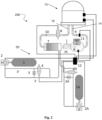
- the system comprises a respiratory helmet 13, for example, a respiratory helmet so-called CPAP (acronym from the English Continuous Positive Airway Pressure) of a known type and therefore not further described except for what will be said below about a device that can be implemented within it.
- the respiratory helmet 13, worn by a patient who needs artificial ventilation will be fed by a mixture of air and oxygen and possibly also by a secondary medical gas, for example ozone by means of a supply duct 14, according to the hydraulic scheme that will be described, and the air containing carbon dioxide emitted by the patient will be expelled through the exhaust duct 15.
- CPAP continuous Positive Airway Pressure
- the supply of the air / oxygen mixture is carried out in a gas supply system 50.
- the supply is achieved thanks to a suitable suction means which, in the example of figure 1 , is an ejector 5 which works by applying the known Venturi principle.
- the air is taken from the external environment while the oxygen is contained under pressure in a tank 1.
- the tank 1 could be a compressed oxygen cylinder.
- a first control valve 2 regulates the mixing between air or oxygen and a first duct 3' and a second duct 3" branch off from it.
- the first duct 3' constitutes the supply line to the ejector 5, while the second duct 3" feeds the secondary flow to the ejector 5.
- the two flows at the inlet to the ejector 5 must have different pressures, since the fluid at a higher pressure will have to "drag" the fluid at a lower pressure, having a single flow at an intermediate pressure at the outlet of the ejector 5.
- the pressure difference between the two ducts 3' and 3" (and therefore between the two flows entering the ejector 5) is achieved by means of a calibrated orifice 3 interposed between the two ducts.
- a second control valve 4 determines the flow rate of the secondary flow of air and oxygen to the ejector 5.
- the concentration of oxygen in the air is determined by the first control valve 2 while the flow rate of the air / oxygen mixture is determined by the second control valve 4.
- the plenum 6 can be provided with a light device 11 with ultraviolet radiation which guarantees the sterilization of the air / oxygen mixture, avoiding the spread of any contagion.
- the air-oxygen mixture could be integrated with the presence of a second medical gas, for example, ozone.
- a second medical gas for example, ozone.
- ozone is an excellent sanitizer to eliminate germs and bacteria. Its very high oxidizing power makes it an effective sanitizer and deodorant, certainly of interest in the current contingency of the fight against Covid 19.
- the supply of this secondary gas is very similar to that of the air / oxygen mixture.
- the air / oxygen mixture (possibly the air / oxygen / SMG mixture) reaches the respiratory helmet 13 by means of the supply duct 14, along which there is a first non-return valve 9 which prevents the backflow of the mixture.
- the mixture thus fed is then available for inspiration by the patient wearing the helmet 13.
- the exhausted air i.e. the air rich in carbon dioxide (CO2) exhaled by the patient
- CO2 carbon dioxide
- a second non-return valve return 10 prevents the backflow of carbon dioxide towards the respiratory helmet 13.
- the air / CO2 mixture is then filtered into the filter element 7 and the air thus purified from CO2 rejoins the main flow of the air / oxygen mixture directed to the plenum 6.
- the artificial ventilation system 100 can be controlled automatically and for this purpose also includes a control unit 12 which can manage input data and control the appropriate actuators.
- the input data may be, according to a non-exhaustive list, the flow rate and pressure of the air / oxygen mixture (possibly of the air / oxygen / SMG mixture), the concentration of oxygen and CO2 in the respiratory helmet 13, as well as pressure and temperature always inside the helmet.
- the SpO2 oxygen saturation data is also fundamental, to which additional biomedical parameters, such as heart rate and respiratory rate, can be added.
- the control unit 12 will operate the first control valve 2 and the second control valve 4 to regulate the oxygen concentration and the flow rate of the air / oxygen mixture in the supply duct 14 (as well as, similarly the first control valve 2A and the second control valve 4A to regulate the concentration of SMG and the flow rate of the air / SMG mixture, if a second medical gas is present).
- the control unit 12 will also operate the third control valve 8 to adjust the exhaust air flow in the exhaust duct 15.
- FIG 2 illustrates an artificial ventilation system 200 in a second embodiment of the invention.
- the ventilation system 200 includes the respiratory helmet 13.
- the ventilation systems referred to in Figures 1 and 2 differ only by the fact that in the diagram of Figure 2 there is a different gas supply system 50' which differs from the previous one only for the suction means which, according to this embodiment, is an electric fan 25.
- the fan creates an overpressure for the ventilation of the patient inside the helmet 13 and creates a low pressure for the intake of breathed air (rich in CO2) from the helmet.
- the choice of the suction means, ejector rather than fan or other similar means, will be dictated by the specific applications: the ejector, a static organ, may be more reliable, where an electric fan could guarantee greater flexibility within the required pressure head.
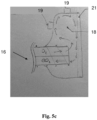
- the artificial ventilation system 100, 200 is provided with a particular layout involving the supply duct 14, the exhaust duct 15 and the respiratory helmet 13, as illustrated in Figures 5a to 5c .
- the supply duct 14 and the exhaust duct 15 are integrated in the first casing 16 which connects to a second casing 17 inside the respiratory helmet 13.
- the first casing 16 is in turn integrated in a coupling 18 which can be attached to the breathing helmet 13 by means of a bayonet connection or by means of threaded connections.
- the coupling 18 can be provided with sensors 19 in communication with the control unit 12 for the transmission of the parameters involved in the control strategies, as described hereafter.
- the first casing 16 groups together the supply duct 14 of the air / oxygen mixture (possibly air / oxygen / SMG) and the exhaust duct 15 of the exhausted air, rich in CO2. Inside the first casing 16 the two flows are evidently separated by means of a separation septum 20, as visible in Figure 5b . Similarly, also inside the second casing 17 the two flows will remain separated by a similar separation septum (not visible from the drawings).
- the second casing 17, inside the respiratory helmet 13, is provided with a double plurality of holes. A first plurality of holes 17' allows the air / oxygen mixture to escape inside the helmet 13, while the second plurality of holes 17" serves for the entry into the second casing 17 of the exhausted air, exhaled by the patient and therefore rich in CO2.
- the "flute" conformation of the second casing 17 is advantageous for a better circulation of the two flows (oxygen entering the helmet, CO2 exiting the helmet).
- the sanitization of the coupling 18 and of the sensors 19 is carried out by removing the coupling 18 from the respiratory helmet 13, sealing it with a suitable cap 21 and leaving the artificial ventilation system in operation. In this way, the mixture of air and oxygen will continue to circulate sterilizing the sensors thanks to its passage through the light device 11 with ultraviolet radiation.
- the artificial ventilation system 100, 200 can be managed and controlled automatically by means of the control unit 12.
- a first control method 300 of the artificial ventilation system has two priority levels and is based on a closed loop control.
- the control unit maintains the patient's oxygen saturation SpO2 at the desired level, i.e. above a first threshold value and, at the same time, limits the CO2 concentration to helmet interior below a second threshold value.
- the control method optimizes the consumption of the externally supplied oxygen as well as patient comfort by keeping the air / oxygen mixture entering the helmet and the helmet pressure and temperature in corresponding predetermined intervals.
- the first control method 300 is illustrated in Figure 3 which represents a block diagram thereof.
- a first control line 310 has as its objective the complete automation of the management of the respiratory helmet 13 according to the first priority level.
- Control line 310 includes a closed-loop controller 320, such as a proportional-integrative-derivative (PID) controller, which adjusts the patient's oxygen saturation by comparing the input SPO2 saturation (the current value) with the desired level, above a first threshold value; the regulator 330 which manages the sequence of the implementation of the control valves; the actuators 340 and 350 enslaved to the regulator 330 which receive the logic command from the regulator 330 and give an electric command, respectively, to the third control valve 8 which regulates the flow rate of the outgoing flow from the helmet 13 (and therefore the CO2 flow rate) and to the second control valve 4 which regulates the flow of the air / oxygen mixture; the CO2 controller 360 that manages and monitors the amount of CO2 inside the helmet; a logic switch 370 which alternately connects the actuator 350 with the regulator 330 or with the CO2 controller 360.
- PID proportional-integrative-derivative
- the PID controller 320 communicates such a value to the regulator 330 which sets the sequence of the control valve actuation, which can be in the following order: first regulation of the exhaust air flow (containing CO2) by means of the actuator 340 which activates the third control valve 8 and subsequently, if the room for maneuver on the exhaust air flow control is ended (in other words, if the third control valve 8 is in an extreme position and is not further adjustable), regulation of the flow of the air / oxygen mixture by means of the actuator 350 which operates the second control valve 4.
- the regulator 330 sets the sequence of the control valve actuation, which can be in the following order: first regulation of the exhaust air flow (containing CO2) by means of the actuator 340 which activates the third control valve 8 and subsequently, if the room for maneuver on the exhaust air flow control is ended (in other words, if the third control valve 8 is in an extreme position and is not further adjustable), regulation of the flow of the air / oxygen mixture by means of the actuator 350 which operates the second control valve 4.
- This strategy is active, as described, when the CO2 concentration value remains below a second threshold value, monitoring chaired by the CO2 controller 360. Should the CO2 concentration exceed the second threshold value, the CO2 controller 360 has the authority to reverse the control valve actuation logic.
- the regulator 330 "ordered" by the CO2 controller 360, will use the logic switch 370 to enslave the actuator 350 to control the CO2 concentration.
- the actuator 350 will then actuate the second control valve 4 to regulate (in this case increase) the flow of the air / oxygen mixture inside the respiratory helmet 13.
- the closed-loop control of the patient's oxygen saturation remains active by means of the PID controller 320, but in this case the regulator 330 will only manage the actuator 340 which operates the third control valve 8 to regulate the exhaust air flow.
- a second control line 380 with lower priority can be dedicated to the patient's comfort and contains suitable algorithms for monitoring some of his biomedical parameters.
- the second control line 380 proceeds in parallel with respect to the first control line 310, of higher priority, obviously subordinated to the correct operation of the parameters controlled by the first control line 310.
- the second control method 400 uses a dynamic model of the process to predict its future evolution and choose the best control action.
- control method of the artificial ventilation system has two priority levels:
- the block diagram of figure 4 shows:
- the state observer 410 receives as input data (see Figure 4 ):
- the estimation model implemented in the state observer 410 allows instead to have as output data, by way of example, the models of the following physiological parameters of lung functions: C: flows of oxygen and CO2 in the pulmonary alveoli and blood compartments, instantaneous volume of the lungs, pressure in the alveoli, etc.
- the parameters indicated with A, B and C constitute input data for the controller 420.
- the controller 420 can manage:
- the controller 420 is able to calculate the optimal values of oxygen saturation and CO2 concentration and to predict the evolution of the model results over a time interval defined by a number N of time steps, using a predetermined sequence of manipulable parameters E within the same time interval.
- the algorithm is based on the optimization of an objective function, which evaluates the distance of the control system from the objectives and optimal control constraints, minimizing this distance.
- the control objectives are assessed in the predetermined time interval in which appropriate penalties are defined on the ability of the control system to follow its objectives and on the effort to implement the control valves.
- the objective function tends to make the oxygen saturation reach its maximum value of 100, as well as to keep the CO2 concentration below its maximum threshold.
- the optimization process of the objective function will have to take into account further control constraints related to:
- the controller 420 will find the optimal sequence of manipulable parameters E (position of the second 4 and third control valve 8) which minimize the objective function in the time interval N. Obviously, only the first optimum activation will be used, then the controller 420 will act on the regulation of the exhaust air flow by means of the actuator 340 which activates the third control valve 8 and on the regulation of the air / oxygen mixture flow by means of the actuator 350 which activates the second control valve 4.
- the first control method 300 and the second control method 400 both derive from a single methodology which presents a strategy based on at least two priority levels. They are declined according to different approaches and can be used alternatively depending on the applications.
- the first control method 300 is certainly easier to be implemented, does not require specific modeling (for example, mathematical models of lung functions) and does not require high computational skills.
- the second control method 400 is more complex, requiring sophisticated modeling of lung functions and higher computational capacity. On the contrary, however, it allows in a single framework to monitor and assist patients with severe respiratory problems. Furthermore, due to its predictive approach and estimating the internal states of respiratory functions, the second control method is faster in reacting to any worsening of the patient's situation. Finally, it is more adaptable to a wider class of pathologies.
- the control method 300, 400 for the artificial ventilation system 100, 200 may undergo further variations.
- it may also be able to control a mixture consisting of air / oxygen / SMG, in this case also acting on the control valve 4A of the air / SMG mixture.
- the artificial ventilation system object of the present invention has undoubted advantages: it does not require any fixed infrastructure, since only needs the respiratory helmet, at least one cylinder for compressed oxygen, the electro-hydraulic circuitry, the ultraviolet light device and the control electronics.
- the artificial ventilation system is therefore completely portable and has ample flexibility for any application.
- the system is fully automatically controllable, with control strategies also based on sophisticated predictive algorithms, and does not require the presence on site of a health worker.
Landscapes
- Health & Medical Sciences (AREA)
- Veterinary Medicine (AREA)
- Public Health (AREA)
- Life Sciences & Earth Sciences (AREA)
- Animal Behavior & Ethology (AREA)
- General Health & Medical Sciences (AREA)
- Pulmonology (AREA)
- Anesthesiology (AREA)
- Heart & Thoracic Surgery (AREA)
- Biomedical Technology (AREA)
- Engineering & Computer Science (AREA)
- Hematology (AREA)
- Emergency Medicine (AREA)
- Epidemiology (AREA)
- Respiratory Apparatuses And Protective Means (AREA)
- Accommodation For Nursing Or Treatment Tables (AREA)
- External Artificial Organs (AREA)
Claims (7)
- Künstliches Beatmungssystem (100, 200), umfassend:- einen Atemhelm (13),- Saugmittel (5, 25), die die Luft aus der Umgebung ansaugen,- einen Tank (1) zur Aufnahme von unter Druck stehendem Sauerstoff,- ein erstes Steuerventil (2), das die Mischung von Luft/Sauerstoff regelt,- ein zweites Steuerventil (4), das die Strömungsrate des Luft/Sauerstoffgemischs regelt,- ein Plenum (6) zur Aufnahme des Luft-Sauerstoffgemischs, das das Saugmittel (5) verlässt,- einen Zufuhrkanal (14), der es dem Luft/Sauerstoffgemisch ermöglicht, den Atemschutzhelm (13) zu erreichen,- ein erstes Rückschlagventil (9), das den Rückfluss des Luft/Sauerstoffgemischs aus dem Zufuhrkanal (14) verhindert,- einen Abluftkanal (15) für das Luft/CO2-Gemisch,- ein Filterelement (7) des Luft/CO2-Gemisches in Fluidverbindung mit dem Plenum (6), und- eine Steuereinheit (12) zur Regulierung von zumindest der Sauerstoffsättigung und der Kohlendioxidkonzentration im Inneren des Atemschutzhelms (13);das künstliche Beatmungssystem (100, 200) ist dadurch gekennzeichnet, dass:- die Strömungsrate des Luft/CO2-Gemisches im Abluftkanal (15) durch ein drittes Steuerventil (8) geregelt wird,- der Zufuhrkanal (14) und der Abluftkanal (15) in einem ersten Gehäuse (16) integriert sind, das mit einem zweiten Gehäuse (17) im Inneren des Atemschutzhelms (13) verbunden ist,- wobei in dem ersten Gehäuse (16) und dem zweiten Gehäuse (17) die beiden Ströme mittels eines Trennseptums (20) getrennt bleiben, und- das zweite Gehäuse (17) eine erste Vielzahl von Löchern (17') aufweist, die es dem Luft-/Sauerstoffgemisch ermöglichen, in den Atemhelm (13) zu strömen, und eine zweite Vielzahl von Löchern (17") für den Eintritt der abgesaugten CO2-reichen Luft in das zweite Gehäuse (17).
- Künstliches Beatmungssystem (100, 200) nach Anspruch 1, wobei das erste Gehäuse (16) in eine Kupplung (18) integriert ist.
- Künstliches Beatmungssystem (100, 200) nach Anspruch 2, wobei die Kupplung (18) mit Sensoren (19) ausgestattet ist, die mit der Steuereinheit (12) in Verbindung stehen.
- Künstliches Beatmungssystem (100, 200) nach einem der vorhergehenden Ansprüche, wobei das Plenum (6) eine Ultraviolettlichtvorrichtung (11) zum Sterilisieren der Luft/Sauerstoff-Gemisch.
- Künstliches Beatmungssystem (100, 200) nach einem der vorhergehenden Ansprüche, wobei:- das Saugmittel ein Ejektor (5) ist, der von einem Hauptstrom gespeist wird, der aus einem ersten Kanal (3') kommt, der sich stromabwärts des ersten Steuerventils (2) befindet, und von einem Sekundärstrom, der aus einem zweiten Kanal (3") kommt, der parallel zum ersten Kanal (3') ist und sich ebenfalls stromabwärts des ersten Steuerventils (2) befindet, und- eine kalibrierte Öffnung (3), die zwischen den beiden Kanälen (3', 3") angeordnet ist, erzeugt einen Druckunterschied zwischen dem Sekundärstrom und dem Hauptstrom.
- Künstliches Beatmungssystem (200) nach einem der Ansprüche 1 bis 4, wobei das Saugmittel (5) ein elektrischer Ventilator (25) ist, der einen Überdruck zur Belüftung im Inneren des Atemhelms (13) und einen Unterdruck zum Ansaugen der vom Atemhelm (13) eingeatmeten Luft erzeugt.
- Künstliches Beatmungssystem (100, 200) nach Anspruch 1, wobei dem LuftSauerstoff-Gemisch ein zweites Luft-/Medizingasgemisch hinzugefügt wird und das künstliche Beatmungssystem (100, 200) einen zweiten Tank (1A), ein erstes Steuerventil (2A) zum Mischen der Luft und des Medizingases, eine zweite kalibrierte Öffnung (3A) zum Erzielen eines Druckabfalls und ein zweites Steuerventil (4A) zum Regeln der Strömungsrate dieses zweiten Luft-/Medizingasgemisches umfasst.
Applications Claiming Priority (2)
| Application Number | Priority Date | Filing Date | Title |
|---|---|---|---|
| IT102020000013012A IT202000013012A1 (it) | 2020-06-01 | 2020-06-01 | Sistema di ventilazione artificiale e relativo metodo di controllo |
| PCT/IB2021/054704 WO2021245516A1 (en) | 2020-06-01 | 2021-05-28 | Artificial ventilation system and related control method |
Publications (3)
| Publication Number | Publication Date |
|---|---|
| EP4157409A1 EP4157409A1 (de) | 2023-04-05 |
| EP4157409B1 true EP4157409B1 (de) | 2024-11-27 |
| EP4157409C0 EP4157409C0 (de) | 2024-11-27 |
Family
ID=72087084
Family Applications (1)
| Application Number | Title | Priority Date | Filing Date |
|---|---|---|---|
| EP21731303.0A Active EP4157409B1 (de) | 2020-06-01 | 2021-05-28 | Künstliches beatmungssystem |
Country Status (5)
| Country | Link |
|---|---|
| US (1) | US20230256187A1 (de) |
| EP (1) | EP4157409B1 (de) |
| CN (1) | CN115715211A (de) |
| IT (1) | IT202000013012A1 (de) |
| WO (1) | WO2021245516A1 (de) |
Families Citing this family (5)
| Publication number | Priority date | Publication date | Assignee | Title |
|---|---|---|---|---|
| WO2022079642A1 (en) | 2020-10-13 | 2022-04-21 | Politecnico Di Torino | Cpap kit to support breathing |
| CN119072342A (zh) * | 2022-02-11 | 2024-12-03 | 费雪派克医疗保健有限公司 | 呼吸回路 |
| EP4342512A1 (de) * | 2022-09-20 | 2024-03-27 | Slava Polanski | Vorrichtung zum inhalieren eines gasgemisches mit zumindest einem anteil ozon |
| PL444270A1 (pl) * | 2023-03-31 | 2024-10-07 | Politechnika Warszawska | Symulator układu oddechowego człowieka do badań hełmów stosowanych do wsparcia układu oddechowego pacjentów z niewydolnością płucną |
| CN117100966B (zh) * | 2023-10-12 | 2024-05-17 | 广州蓝仕威克医疗科技有限公司 | 一种空氧及氧气和二氧化碳混合通气控制气路及呼吸装置 |
Family Cites Families (14)
| Publication number | Priority date | Publication date | Assignee | Title |
|---|---|---|---|---|
| US2785674A (en) * | 1955-08-17 | 1957-03-19 | Hanorah H Wong | Oxygen mask |
| DE3536519A1 (de) * | 1985-10-12 | 1987-04-16 | Draegerwerk Ag | Kopfhaube zur aufrechterhaltung einer sauerstoff-konzentration |
| CA2625592A1 (en) * | 2005-09-09 | 2007-03-15 | Essex P.B. & R. Corp. | Breathing apparatus |
| US20080078393A1 (en) * | 2005-11-22 | 2008-04-03 | General Electric Company | Respiratory monitoring with cannula receiving respiratory airflows, differential pressure transducer, and ventilator |
| US20080142015A1 (en) * | 2006-01-27 | 2008-06-19 | David Groll | Apparatus to provide continuous positive airway pressure |
| WO2007128571A2 (en) * | 2006-05-08 | 2007-11-15 | Medizinische Universität Innsbruck | Helmet |
| US20090055987A1 (en) * | 2007-09-05 | 2009-03-05 | Illinois Tool Works Inc. | Airflow Headgear for a Welding Helmet |
| GB0915819D0 (en) * | 2009-09-10 | 2009-10-07 | Smiths Medical Int Ltd | Breathing apparatus |
| WO2012103490A1 (en) * | 2011-01-27 | 2012-08-02 | Precision Capnography | Method and device for monitoring carbon dioxide |
| US20160095994A1 (en) * | 2014-10-01 | 2016-04-07 | Third Wind, Llc | Hypoxic Breathing Apparatus and Method |
| EP3259001B1 (de) * | 2015-03-31 | 2025-04-23 | Fisher&Paykel Healthcare Limited | Vorrichtung zur oxygenierung und/oder co2-beseitigung |
| DE112017000410T5 (de) * | 2016-01-18 | 2018-10-11 | Fisher & Paykel Healthcare Limited | Befeuchtung von Atemgasen |
| US20190167928A1 (en) * | 2016-08-25 | 2019-06-06 | Monatomics Technology | Medical device for the closed-circuit administration of a gaseous mixture to a spontaneously breathing patient, and associated adjustment system |
| CN108785812A (zh) * | 2018-06-15 | 2018-11-13 | 威海威高海盛医用设备有限公司 | 一种氧气、二氧化碳混合吸氧方法、吸氧装置及其使用方法 |
-
2020
- 2020-06-01 IT IT102020000013012A patent/IT202000013012A1/it unknown
-
2021
- 2021-05-28 CN CN202180045760.2A patent/CN115715211A/zh active Pending
- 2021-05-28 EP EP21731303.0A patent/EP4157409B1/de active Active
- 2021-05-28 WO PCT/IB2021/054704 patent/WO2021245516A1/en not_active Ceased
- 2021-05-28 US US17/928,723 patent/US20230256187A1/en active Pending
Also Published As
| Publication number | Publication date |
|---|---|
| CN115715211A (zh) | 2023-02-24 |
| WO2021245516A1 (en) | 2021-12-09 |
| EP4157409A1 (de) | 2023-04-05 |
| US20230256187A1 (en) | 2023-08-17 |
| EP4157409C0 (de) | 2024-11-27 |
| IT202000013012A1 (it) | 2021-12-01 |
Similar Documents
| Publication | Publication Date | Title |
|---|---|---|
| EP4157409B1 (de) | Künstliches beatmungssystem | |
| US11383058B2 (en) | Apparatus and method for delivering fluids and/or gases to the lungs | |
| EP1984050B1 (de) | Vorrichtung zur Regulierung mechanischer Beatmung | |
| CN105980014A (zh) | 双压力传感器患者通气设备 | |
| CN109303960A (zh) | 一种通气治疗设备及控制方法 | |
| CN110812638B (zh) | 基于ards肺保护性策略的智能闭环机械通气控制系统及方法 | |
| CN109124941A (zh) | 一种新型一体式医用空气加压舱 | |
| KR20230128025A (ko) | 호흡 보조 시스템 및 방법 | |
| CN116457045A (zh) | 呼吸辅助设备和方法 | |
| EP0615764B1 (de) | Vorrichtung und Verfahren zur Steuerung eines geschlossenen Regelkreises zum Einatmungsdruck in einem Beatmungsgerät | |
| CN115515688A (zh) | 循环呼吸器设备 | |
| CN110996833A (zh) | 带支撑件的结构化屏障-排出型医用口罩 | |
| EP4161622B1 (de) | Ventilator | |
| EP4126145B1 (de) | Modulares beatmungssystem zur zeitgesteuerten adaptiven beatmung eines oder mehrerer patienten oder lungen | |
| CN115590269B (zh) | 一种可供氧的口鼻防护系统及方法 | |
| GB2584109A (en) | Control system | |
| EP4228727A1 (de) | Cpap-kit zur unterstützung der atmung | |
| KR20010109443A (ko) | 지능형 인큐베이터 시스템 및 그 제어방법 | |
| US11992614B2 (en) | Respiratory device | |
| US20230166848A1 (en) | Method and apparatuses for delivering hyperbaric gas and/or treating respiratory illnesses, post covid syndrome(s) and chronic traumatic encephalopathy | |
| Veisi et al. | Adaptive Fractional Sliding Mode Controller for Controlling Airway Pressure in an Artificial Ventilation System | |
| CN113117199A (zh) | 一种无创呼吸机控制系统 | |
| WO2021250449A1 (en) | Portable breathing support equipment | |
| KR100624337B1 (ko) | 지속적 기도양압 치료를 위한 양압호흡기 | |
| JPH11206884A (ja) | ファジー理論制御を用いた人工呼吸器の自動ウィニングシステムおよび自動ウィニングプログラムを記録した記録媒体 |
Legal Events
| Date | Code | Title | Description |
|---|---|---|---|
| STAA | Information on the status of an ep patent application or granted ep patent |
Free format text: STATUS: UNKNOWN |
|
| STAA | Information on the status of an ep patent application or granted ep patent |
Free format text: STATUS: THE INTERNATIONAL PUBLICATION HAS BEEN MADE |
|
| PUAI | Public reference made under article 153(3) epc to a published international application that has entered the european phase |
Free format text: ORIGINAL CODE: 0009012 |
|
| STAA | Information on the status of an ep patent application or granted ep patent |
Free format text: STATUS: REQUEST FOR EXAMINATION WAS MADE |
|
| 17P | Request for examination filed |
Effective date: 20221207 |
|
| AK | Designated contracting states |
Kind code of ref document: A1 Designated state(s): AL AT BE BG CH CY CZ DE DK EE ES FI FR GB GR HR HU IE IS IT LI LT LU LV MC MK MT NL NO PL PT RO RS SE SI SK SM TR |
|
| DAV | Request for validation of the european patent (deleted) | ||
| DAX | Request for extension of the european patent (deleted) | ||
| GRAP | Despatch of communication of intention to grant a patent |
Free format text: ORIGINAL CODE: EPIDOSNIGR1 |
|
| STAA | Information on the status of an ep patent application or granted ep patent |
Free format text: STATUS: GRANT OF PATENT IS INTENDED |
|
| INTG | Intention to grant announced |
Effective date: 20240619 |
|
| GRAS | Grant fee paid |
Free format text: ORIGINAL CODE: EPIDOSNIGR3 |
|
| GRAA | (expected) grant |
Free format text: ORIGINAL CODE: 0009210 |
|
| STAA | Information on the status of an ep patent application or granted ep patent |
Free format text: STATUS: THE PATENT HAS BEEN GRANTED |
|
| AK | Designated contracting states |
Kind code of ref document: B1 Designated state(s): AL AT BE BG CH CY CZ DE DK EE ES FI FR GB GR HR HU IE IS IT LI LT LU LV MC MK MT NL NO PL PT RO RS SE SI SK SM TR |
|
| REG | Reference to a national code |
Ref country code: GB Ref legal event code: FG4D |
|
| REG | Reference to a national code |
Ref country code: CH Ref legal event code: EP |
|
| REG | Reference to a national code |
Ref country code: IE Ref legal event code: FG4D |
|
| REG | Reference to a national code |
Ref country code: DE Ref legal event code: R096 Ref document number: 602021022451 Country of ref document: DE |
|
| U01 | Request for unitary effect filed |
Effective date: 20241224 |
|
| U07 | Unitary effect registered |
Designated state(s): AT BE BG DE DK EE FI FR IT LT LU LV MT NL PT RO SE SI Effective date: 20250114 |
|
| PG25 | Lapsed in a contracting state [announced via postgrant information from national office to epo] |
Ref country code: IS Free format text: LAPSE BECAUSE OF FAILURE TO SUBMIT A TRANSLATION OF THE DESCRIPTION OR TO PAY THE FEE WITHIN THE PRESCRIBED TIME-LIMIT Effective date: 20250327 Ref country code: HR Free format text: LAPSE BECAUSE OF FAILURE TO SUBMIT A TRANSLATION OF THE DESCRIPTION OR TO PAY THE FEE WITHIN THE PRESCRIBED TIME-LIMIT Effective date: 20241127 |
|
| PG25 | Lapsed in a contracting state [announced via postgrant information from national office to epo] |
Ref country code: ES Free format text: LAPSE BECAUSE OF FAILURE TO SUBMIT A TRANSLATION OF THE DESCRIPTION OR TO PAY THE FEE WITHIN THE PRESCRIBED TIME-LIMIT Effective date: 20241127 |
|
| PG25 | Lapsed in a contracting state [announced via postgrant information from national office to epo] |
Ref country code: NO Free format text: LAPSE BECAUSE OF FAILURE TO SUBMIT A TRANSLATION OF THE DESCRIPTION OR TO PAY THE FEE WITHIN THE PRESCRIBED TIME-LIMIT Effective date: 20250227 |
|
| PG25 | Lapsed in a contracting state [announced via postgrant information from national office to epo] |
Ref country code: GR Free format text: LAPSE BECAUSE OF FAILURE TO SUBMIT A TRANSLATION OF THE DESCRIPTION OR TO PAY THE FEE WITHIN THE PRESCRIBED TIME-LIMIT Effective date: 20250228 |
|
| PG25 | Lapsed in a contracting state [announced via postgrant information from national office to epo] |
Ref country code: PL Free format text: LAPSE BECAUSE OF FAILURE TO SUBMIT A TRANSLATION OF THE DESCRIPTION OR TO PAY THE FEE WITHIN THE PRESCRIBED TIME-LIMIT Effective date: 20241127 |
|
| PG25 | Lapsed in a contracting state [announced via postgrant information from national office to epo] |
Ref country code: RS Free format text: LAPSE BECAUSE OF FAILURE TO SUBMIT A TRANSLATION OF THE DESCRIPTION OR TO PAY THE FEE WITHIN THE PRESCRIBED TIME-LIMIT Effective date: 20250227 |
|
| U20 | Renewal fee for the european patent with unitary effect paid |
Year of fee payment: 5 Effective date: 20250526 |
|
| PG25 | Lapsed in a contracting state [announced via postgrant information from national office to epo] |
Ref country code: SM Free format text: LAPSE BECAUSE OF FAILURE TO SUBMIT A TRANSLATION OF THE DESCRIPTION OR TO PAY THE FEE WITHIN THE PRESCRIBED TIME-LIMIT Effective date: 20241127 |
|
| PGFP | Annual fee paid to national office [announced via postgrant information from national office to epo] |
Ref country code: GB Payment date: 20250527 Year of fee payment: 5 |
|
| PGFP | Annual fee paid to national office [announced via postgrant information from national office to epo] |
Ref country code: CH Payment date: 20250601 Year of fee payment: 5 |
|
| PG25 | Lapsed in a contracting state [announced via postgrant information from national office to epo] |
Ref country code: SK Free format text: LAPSE BECAUSE OF FAILURE TO SUBMIT A TRANSLATION OF THE DESCRIPTION OR TO PAY THE FEE WITHIN THE PRESCRIBED TIME-LIMIT Effective date: 20241127 |
|
| PG25 | Lapsed in a contracting state [announced via postgrant information from national office to epo] |
Ref country code: CZ Free format text: LAPSE BECAUSE OF FAILURE TO SUBMIT A TRANSLATION OF THE DESCRIPTION OR TO PAY THE FEE WITHIN THE PRESCRIBED TIME-LIMIT Effective date: 20241127 |
|
| PGFP | Annual fee paid to national office [announced via postgrant information from national office to epo] |
Ref country code: IE Payment date: 20250523 Year of fee payment: 5 |
|
| PLBE | No opposition filed within time limit |
Free format text: ORIGINAL CODE: 0009261 |
|
| STAA | Information on the status of an ep patent application or granted ep patent |
Free format text: STATUS: NO OPPOSITION FILED WITHIN TIME LIMIT |
|
| 26N | No opposition filed |
Effective date: 20250828 |