EP4155355A1 - Water-based ink for inkjet recording and ink cartridge - Google Patents
Water-based ink for inkjet recording and ink cartridge Download PDFInfo
- Publication number
- EP4155355A1 EP4155355A1 EP21834585.8A EP21834585A EP4155355A1 EP 4155355 A1 EP4155355 A1 EP 4155355A1 EP 21834585 A EP21834585 A EP 21834585A EP 4155355 A1 EP4155355 A1 EP 4155355A1
- Authority
- EP
- European Patent Office
- Prior art keywords
- water
- based ink
- inkjet recording
- preservative
- acidic preservative
- Prior art date
- Legal status (The legal status is an assumption and is not a legal conclusion. Google has not performed a legal analysis and makes no representation as to the accuracy of the status listed.)
- Pending
Links
- XLYOFNOQVPJJNP-UHFFFAOYSA-N water Substances O XLYOFNOQVPJJNP-UHFFFAOYSA-N 0.000 title claims abstract description 96
- 230000002335 preservative effect Effects 0.000 claims abstract description 76
- 239000003755 preservative agent Substances 0.000 claims abstract description 62
- 230000002378 acidificating effect Effects 0.000 claims abstract description 60
- 239000004094 surface-active agent Substances 0.000 claims abstract description 30
- JEQRBTDTEKWZBW-UHFFFAOYSA-N dehydroacetic acid Chemical compound CC(=O)C1=C(O)OC(C)=CC1=O JEQRBTDTEKWZBW-UHFFFAOYSA-N 0.000 claims abstract description 14
- 239000004287 Dehydroacetic acid Substances 0.000 claims abstract description 13
- 235000019258 dehydroacetic acid Nutrition 0.000 claims abstract description 13
- 229940061632 dehydroacetic acid Drugs 0.000 claims abstract description 13
- PGRHXDWITVMQBC-UHFFFAOYSA-N dehydroacetic acid Natural products CC(=O)C1C(=O)OC(C)=CC1=O PGRHXDWITVMQBC-UHFFFAOYSA-N 0.000 claims abstract description 13
- -1 unsaturated fatty acid salt Chemical class 0.000 claims description 27
- 239000000203 mixture Substances 0.000 claims description 25
- 235000021122 unsaturated fatty acids Nutrition 0.000 claims description 22
- 238000009472 formulation Methods 0.000 claims description 19
- 150000004670 unsaturated fatty acids Chemical class 0.000 claims description 13
- 229940071120 dehydroacetate Drugs 0.000 claims description 12
- HSFWRNGVRCDJHI-UHFFFAOYSA-N alpha-acetylene Natural products C#C HSFWRNGVRCDJHI-UHFFFAOYSA-N 0.000 claims description 7
- 125000005677 ethinylene group Chemical group [*:2]C#C[*:1] 0.000 claims description 5
- WSWCOQWTEOXDQX-MQQKCMAXSA-M (E,E)-sorbate Chemical group C\C=C\C=C\C([O-])=O WSWCOQWTEOXDQX-MQQKCMAXSA-M 0.000 claims description 4
- 229940075554 sorbate Drugs 0.000 claims description 4
- CHHHXKFHOYLYRE-UHFFFAOYSA-M 2,4-Hexadienoic acid, potassium salt (1:1), (2E,4E)- Chemical compound [K+].CC=CC=CC([O-])=O CHHHXKFHOYLYRE-UHFFFAOYSA-M 0.000 claims description 3
- 239000004288 Sodium dehydroacetate Substances 0.000 claims description 3
- 239000004283 Sodium sorbate Substances 0.000 claims description 3
- 235000010241 potassium sorbate Nutrition 0.000 claims description 3
- 239000004302 potassium sorbate Substances 0.000 claims description 3
- 229940069338 potassium sorbate Drugs 0.000 claims description 3
- 235000019259 sodium dehydroacetate Nutrition 0.000 claims description 3
- 229940079839 sodium dehydroacetate Drugs 0.000 claims description 3
- LROWVYNUWKVTCU-STWYSWDKSA-M sodium sorbate Chemical compound [Na+].C\C=C\C=C\C([O-])=O LROWVYNUWKVTCU-STWYSWDKSA-M 0.000 claims description 3
- 235000019250 sodium sorbate Nutrition 0.000 claims description 3
- DSOWAKKSGYUMTF-GZOLSCHFSA-M sodium;(1e)-1-(6-methyl-2,4-dioxopyran-3-ylidene)ethanolate Chemical group [Na+].C\C([O-])=C1/C(=O)OC(C)=CC1=O DSOWAKKSGYUMTF-GZOLSCHFSA-M 0.000 claims description 3
- 229940015975 1,2-hexanediol Drugs 0.000 claims description 2
- COBPKKZHLDDMTB-UHFFFAOYSA-N 2-[2-(2-butoxyethoxy)ethoxy]ethanol Chemical compound CCCCOCCOCCOCCO COBPKKZHLDDMTB-UHFFFAOYSA-N 0.000 claims description 2
- SXFJDZNJHVPHPH-UHFFFAOYSA-N 3-methylpentane-1,5-diol Chemical compound OCCC(C)CCO SXFJDZNJHVPHPH-UHFFFAOYSA-N 0.000 claims description 2
- BEFDCLMNVWHSGT-UHFFFAOYSA-N ethenylcyclopentane Chemical compound C=CC1CCCC1 BEFDCLMNVWHSGT-UHFFFAOYSA-N 0.000 claims description 2
- FHKSXSQHXQEMOK-UHFFFAOYSA-N hexane-1,2-diol Chemical compound CCCCC(O)CO FHKSXSQHXQEMOK-UHFFFAOYSA-N 0.000 claims description 2
- 235000010199 sorbic acid Nutrition 0.000 claims description 2
- 239000004334 sorbic acid Substances 0.000 claims description 2
- 229940075582 sorbic acid Drugs 0.000 claims description 2
- 230000003287 optical effect Effects 0.000 abstract description 31
- 239000003086 colorant Substances 0.000 abstract description 10
- 150000003839 salts Chemical class 0.000 abstract description 7
- 235000020777 polyunsaturated fatty acids Nutrition 0.000 abstract 2
- 239000000976 ink Substances 0.000 description 95
- 238000011156 evaluation Methods 0.000 description 56
- 230000000052 comparative effect Effects 0.000 description 29
- 239000000975 dye Substances 0.000 description 14
- 239000002609 medium Substances 0.000 description 11
- 239000002253 acid Substances 0.000 description 8
- LYCAIKOWRPUZTN-UHFFFAOYSA-N ethylene glycol Natural products OCCO LYCAIKOWRPUZTN-UHFFFAOYSA-N 0.000 description 8
- 238000000034 method Methods 0.000 description 7
- 238000010926 purge Methods 0.000 description 7
- 238000007599 discharging Methods 0.000 description 6
- 239000000126 substance Substances 0.000 description 6
- WGCNASOHLSPBMP-UHFFFAOYSA-N hydroxyacetaldehyde Natural products OCC=O WGCNASOHLSPBMP-UHFFFAOYSA-N 0.000 description 5
- SVTBMSDMJJWYQN-UHFFFAOYSA-N 2-methylpentane-2,4-diol Chemical compound CC(O)CC(C)(C)O SVTBMSDMJJWYQN-UHFFFAOYSA-N 0.000 description 4
- PEDCQBHIVMGVHV-UHFFFAOYSA-N Glycerine Chemical compound OCC(O)CO PEDCQBHIVMGVHV-UHFFFAOYSA-N 0.000 description 4
- WERYXYBDKMZEQL-UHFFFAOYSA-N butane-1,4-diol Chemical compound OCCCCO WERYXYBDKMZEQL-UHFFFAOYSA-N 0.000 description 4
- ZBNARPCCDMHDDV-UHFFFAOYSA-N chembl1206040 Chemical compound C1=C(S(O)(=O)=O)C=C2C=C(S(O)(=O)=O)C(N=NC3=CC=C(C=C3C)C=3C=C(C(=CC=3)N=NC=3C(=CC4=CC(=CC(N)=C4C=3O)S(O)(=O)=O)S(O)(=O)=O)C)=C(O)C2=C1N ZBNARPCCDMHDDV-UHFFFAOYSA-N 0.000 description 4
- MTHSVFCYNBDYFN-UHFFFAOYSA-N diethylene glycol Chemical class OCCOCCO MTHSVFCYNBDYFN-UHFFFAOYSA-N 0.000 description 4
- 229920001343 polytetrafluoroethylene Polymers 0.000 description 4
- 239000004810 polytetrafluoroethylene Substances 0.000 description 4
- 239000000047 product Substances 0.000 description 4
- 239000000080 wetting agent Substances 0.000 description 4
- PUPZLCDOIYMWBV-UHFFFAOYSA-N (+/-)-1,3-Butanediol Chemical compound CC(O)CCO PUPZLCDOIYMWBV-UHFFFAOYSA-N 0.000 description 3
- NECRQCBKTGZNMH-UHFFFAOYSA-N 3,5-dimethylhex-1-yn-3-ol Chemical compound CC(C)CC(C)(O)C#C NECRQCBKTGZNMH-UHFFFAOYSA-N 0.000 description 3
- IHZXTIBMKNSJCJ-UHFFFAOYSA-N 3-{[(4-{[4-(dimethylamino)phenyl](4-{ethyl[(3-sulfophenyl)methyl]amino}phenyl)methylidene}cyclohexa-2,5-dien-1-ylidene)(ethyl)azaniumyl]methyl}benzene-1-sulfonate Chemical compound C=1C=C(C(=C2C=CC(C=C2)=[N+](C)C)C=2C=CC(=CC=2)N(CC)CC=2C=C(C=CC=2)S([O-])(=O)=O)C=CC=1N(CC)CC1=CC=CC(S(O)(=O)=O)=C1 IHZXTIBMKNSJCJ-UHFFFAOYSA-N 0.000 description 3
- STOOUUMSJPLRNI-UHFFFAOYSA-N 5-amino-4-hydroxy-3-[[4-[4-[(4-hydroxyphenyl)diazenyl]phenyl]phenyl]diazenyl]-6-[(4-nitrophenyl)diazenyl]naphthalene-2,7-disulfonic acid Chemical compound OS(=O)(=O)C1=CC2=CC(S(O)(=O)=O)=C(N=NC=3C=CC(=CC=3)C=3C=CC(=CC=3)N=NC=3C=CC(O)=CC=3)C(O)=C2C(N)=C1N=NC1=CC=C([N+]([O-])=O)C=C1 STOOUUMSJPLRNI-UHFFFAOYSA-N 0.000 description 3
- CSCPPACGZOOCGX-UHFFFAOYSA-N Acetone Chemical compound CC(C)=O CSCPPACGZOOCGX-UHFFFAOYSA-N 0.000 description 3
- KFZMGEQAYNKOFK-UHFFFAOYSA-N Isopropanol Chemical compound CC(C)O KFZMGEQAYNKOFK-UHFFFAOYSA-N 0.000 description 3
- OKKJLVBELUTLKV-UHFFFAOYSA-N Methanol Chemical compound OC OKKJLVBELUTLKV-UHFFFAOYSA-N 0.000 description 3
- ZMXDDKWLCZADIW-UHFFFAOYSA-N N,N-Dimethylformamide Chemical compound CN(C)C=O ZMXDDKWLCZADIW-UHFFFAOYSA-N 0.000 description 3
- LRHPLDYGYMQRHN-UHFFFAOYSA-N N-Butanol Chemical compound CCCCO LRHPLDYGYMQRHN-UHFFFAOYSA-N 0.000 description 3
- DNIAPMSPPWPWGF-UHFFFAOYSA-N Propylene glycol Chemical compound CC(O)CO DNIAPMSPPWPWGF-UHFFFAOYSA-N 0.000 description 3
- DKGAVHZHDRPRBM-UHFFFAOYSA-N Tert-Butanol Chemical compound CC(C)(C)O DKGAVHZHDRPRBM-UHFFFAOYSA-N 0.000 description 3
- CQPFMGBJSMSXLP-UHFFFAOYSA-M acid orange 7 Chemical compound [Na+].OC1=CC=C2C=CC=CC2=C1N=NC1=CC=C(S([O-])(=O)=O)C=C1 CQPFMGBJSMSXLP-UHFFFAOYSA-M 0.000 description 3
- WPYMKLBDIGXBTP-UHFFFAOYSA-N benzoic acid Chemical compound OC(=O)C1=CC=CC=C1 WPYMKLBDIGXBTP-UHFFFAOYSA-N 0.000 description 3
- HZBTZQVWJPRVDN-UHFFFAOYSA-J copper;disodium;5-[[4-[4-[[2,6-dioxido-3-[(2-oxido-5-sulfonatophenyl)diazenyl]phenyl]diazenyl]phenyl]phenyl]diazenyl]-2-oxidobenzoate;hydron Chemical compound [H+].[H+].[Na+].[Na+].[Cu+2].C1=C([O-])C(C(=O)[O-])=CC(N=NC=2C=CC(=CC=2)C=2C=CC(=CC=2)N=NC=2C(=C(N=NC=3C(=CC=C(C=3)S([O-])(=O)=O)[O-])C=CC=2[O-])[O-])=C1 HZBTZQVWJPRVDN-UHFFFAOYSA-J 0.000 description 3
- 238000001035 drying Methods 0.000 description 3
- 235000019441 ethanol Nutrition 0.000 description 3
- 239000000835 fiber Substances 0.000 description 3
- 239000002736 nonionic surfactant Substances 0.000 description 3
- 239000000344 soap Substances 0.000 description 3
- 238000003860 storage Methods 0.000 description 3
- VRVDFJOCCWSFLI-UHFFFAOYSA-K trisodium 3-[[4-[(6-anilino-1-hydroxy-3-sulfonatonaphthalen-2-yl)diazenyl]-5-methoxy-2-methylphenyl]diazenyl]naphthalene-1,5-disulfonate Chemical compound [Na+].[Na+].[Na+].COc1cc(N=Nc2cc(c3cccc(c3c2)S([O-])(=O)=O)S([O-])(=O)=O)c(C)cc1N=Nc1c(O)c2ccc(Nc3ccccc3)cc2cc1S([O-])(=O)=O VRVDFJOCCWSFLI-UHFFFAOYSA-K 0.000 description 3
- DNIAPMSPPWPWGF-VKHMYHEASA-N (+)-propylene glycol Chemical compound C[C@H](O)CO DNIAPMSPPWPWGF-VKHMYHEASA-N 0.000 description 2
- YPFDHNVEDLHUCE-UHFFFAOYSA-N 1,3-propanediol Substances OCCCO YPFDHNVEDLHUCE-UHFFFAOYSA-N 0.000 description 2
- ARXJGSRGQADJSQ-UHFFFAOYSA-N 1-methoxypropan-2-ol Chemical compound COCC(C)O ARXJGSRGQADJSQ-UHFFFAOYSA-N 0.000 description 2
- MHOFGBJTSNWTDT-UHFFFAOYSA-M 2-[n-ethyl-4-[(6-methoxy-3-methyl-1,3-benzothiazol-3-ium-2-yl)diazenyl]anilino]ethanol;methyl sulfate Chemical compound COS([O-])(=O)=O.C1=CC(N(CCO)CC)=CC=C1N=NC1=[N+](C)C2=CC=C(OC)C=C2S1 MHOFGBJTSNWTDT-UHFFFAOYSA-M 0.000 description 2
- 229920001817 Agar Polymers 0.000 description 2
- LFQSCWFLJHTTHZ-UHFFFAOYSA-N Ethanol Chemical compound CCO LFQSCWFLJHTTHZ-UHFFFAOYSA-N 0.000 description 2
- IAYPIBMASNFSPL-UHFFFAOYSA-N Ethylene oxide Chemical compound C1CO1 IAYPIBMASNFSPL-UHFFFAOYSA-N 0.000 description 2
- SECXISVLQFMRJM-UHFFFAOYSA-N N-Methylpyrrolidone Chemical compound CN1CCCC1=O SECXISVLQFMRJM-UHFFFAOYSA-N 0.000 description 2
- 241000282320 Panthera leo Species 0.000 description 2
- WYURNTSHIVDZCO-UHFFFAOYSA-N Tetrahydrofuran Chemical compound C1CCOC1 WYURNTSHIVDZCO-UHFFFAOYSA-N 0.000 description 2
- AMPCGOAFZFKBGH-UHFFFAOYSA-O [4-[[4-(dimethylamino)phenyl]-[4-(methylamino)phenyl]methylidene]cyclohexa-2,5-dien-1-ylidene]-dimethylazanium Chemical compound C1=CC(NC)=CC=C1C(C=1C=CC(=CC=1)N(C)C)=C1C=CC(=[N+](C)C)C=C1 AMPCGOAFZFKBGH-UHFFFAOYSA-O 0.000 description 2
- 239000004480 active ingredient Substances 0.000 description 2
- 239000000654 additive Substances 0.000 description 2
- 239000008272 agar Substances 0.000 description 2
- 239000003945 anionic surfactant Substances 0.000 description 2
- DMSMPAJRVJJAGA-UHFFFAOYSA-N benzo[d]isothiazol-3-one Chemical compound C1=CC=C2C(=O)NSC2=C1 DMSMPAJRVJJAGA-UHFFFAOYSA-N 0.000 description 2
- BTANRVKWQNVYAZ-UHFFFAOYSA-N butan-2-ol Chemical compound CCC(C)O BTANRVKWQNVYAZ-UHFFFAOYSA-N 0.000 description 2
- BMRWNKZVCUKKSR-UHFFFAOYSA-N butane-1,2-diol Chemical compound CCC(O)CO BMRWNKZVCUKKSR-UHFFFAOYSA-N 0.000 description 2
- 239000003795 chemical substances by application Substances 0.000 description 2
- SWXVUIWOUIDPGS-UHFFFAOYSA-N diacetone alcohol Chemical compound CC(=O)CC(C)(C)O SWXVUIWOUIDPGS-UHFFFAOYSA-N 0.000 description 2
- 150000002009 diols Chemical class 0.000 description 2
- FPVGTPBMTFTMRT-UHFFFAOYSA-L disodium;2-amino-5-[(4-sulfonatophenyl)diazenyl]benzenesulfonate Chemical compound [Na+].[Na+].C1=C(S([O-])(=O)=O)C(N)=CC=C1N=NC1=CC=C(S([O-])(=O)=O)C=C1 FPVGTPBMTFTMRT-UHFFFAOYSA-L 0.000 description 2
- 230000000694 effects Effects 0.000 description 2
- 235000019233 fast yellow AB Nutrition 0.000 description 2
- 235000013305 food Nutrition 0.000 description 2
- 235000011187 glycerol Nutrition 0.000 description 2
- 239000001963 growth medium Substances 0.000 description 2
- 239000012528 membrane Substances 0.000 description 2
- 229920001515 polyalkylene glycol Polymers 0.000 description 2
- 229920000166 polytrimethylene carbonate Polymers 0.000 description 2
- 239000011148 porous material Substances 0.000 description 2
- BDERNNFJNOPAEC-UHFFFAOYSA-N propan-1-ol Chemical compound CCCO BDERNNFJNOPAEC-UHFFFAOYSA-N 0.000 description 2
- YGSDEFSMJLZEOE-UHFFFAOYSA-N salicylic acid Chemical compound OC(=O)C1=CC=CC=C1O YGSDEFSMJLZEOE-UHFFFAOYSA-N 0.000 description 2
- 235000010378 sodium ascorbate Nutrition 0.000 description 2
- 229960005055 sodium ascorbate Drugs 0.000 description 2
- PPASLZSBLFJQEF-RKJRWTFHSA-M sodium ascorbate Substances [Na+].OC[C@@H](O)[C@H]1OC(=O)C(O)=C1[O-] PPASLZSBLFJQEF-RKJRWTFHSA-M 0.000 description 2
- PPASLZSBLFJQEF-RXSVEWSESA-M sodium-L-ascorbate Chemical compound [Na+].OC[C@H](O)[C@H]1OC(=O)C(O)=C1[O-] PPASLZSBLFJQEF-RXSVEWSESA-M 0.000 description 2
- 150000005846 sugar alcohols Polymers 0.000 description 2
- 239000004034 viscosity adjusting agent Substances 0.000 description 2
- KXOXLYRTAZLDIS-MXWKQRLJSA-N (2R)-1-[(2S)-1-[(2R)-1-ethoxypropan-2-yl]oxypropan-2-yl]oxypropan-2-ol Chemical compound CCOC[C@@H](C)OC[C@H](C)OC[C@@H](C)O KXOXLYRTAZLDIS-MXWKQRLJSA-N 0.000 description 1
- CYSGHNMQYZDMIA-UHFFFAOYSA-N 1,3-Dimethyl-2-imidazolidinon Chemical compound CN1CCN(C)C1=O CYSGHNMQYZDMIA-UHFFFAOYSA-N 0.000 description 1
- RYHBNJHYFVUHQT-UHFFFAOYSA-N 1,4-Dioxane Chemical compound C1COCCO1 RYHBNJHYFVUHQT-UHFFFAOYSA-N 0.000 description 1
- RWNUSVWFHDHRCJ-UHFFFAOYSA-N 1-butoxypropan-2-ol Chemical compound CCCCOCC(C)O RWNUSVWFHDHRCJ-UHFFFAOYSA-N 0.000 description 1
- JOLQKTGDSGKSKJ-UHFFFAOYSA-N 1-ethoxypropan-2-ol Chemical compound CCOCC(C)O JOLQKTGDSGKSKJ-UHFFFAOYSA-N 0.000 description 1
- FENFUOGYJVOCRY-UHFFFAOYSA-N 1-propoxypropan-2-ol Chemical compound CCCOCC(C)O FENFUOGYJVOCRY-UHFFFAOYSA-N 0.000 description 1
- VZSRBBMJRBPUNF-UHFFFAOYSA-N 2-(2,3-dihydro-1H-inden-2-ylamino)-N-[3-oxo-3-(2,4,6,7-tetrahydrotriazolo[4,5-c]pyridin-5-yl)propyl]pyrimidine-5-carboxamide Chemical compound C1C(CC2=CC=CC=C12)NC1=NC=C(C=N1)C(=O)NCCC(N1CC2=C(CC1)NN=N2)=O VZSRBBMJRBPUNF-UHFFFAOYSA-N 0.000 description 1
- OAYXUHPQHDHDDZ-UHFFFAOYSA-N 2-(2-butoxyethoxy)ethanol Chemical compound CCCCOCCOCCO OAYXUHPQHDHDDZ-UHFFFAOYSA-N 0.000 description 1
- WMDZKDKPYCNCDZ-UHFFFAOYSA-N 2-(2-butoxypropoxy)propan-1-ol Chemical compound CCCCOC(C)COC(C)CO WMDZKDKPYCNCDZ-UHFFFAOYSA-N 0.000 description 1
- MTVLEKBQSDTQGO-UHFFFAOYSA-N 2-(2-ethoxypropoxy)propan-1-ol Chemical compound CCOC(C)COC(C)CO MTVLEKBQSDTQGO-UHFFFAOYSA-N 0.000 description 1
- GZMAAYIALGURDQ-UHFFFAOYSA-N 2-(2-hexoxyethoxy)ethanol Chemical compound CCCCCCOCCOCCO GZMAAYIALGURDQ-UHFFFAOYSA-N 0.000 description 1
- SBASXUCJHJRPEV-UHFFFAOYSA-N 2-(2-methoxyethoxy)ethanol Chemical compound COCCOCCO SBASXUCJHJRPEV-UHFFFAOYSA-N 0.000 description 1
- CUDYYMUUJHLCGZ-UHFFFAOYSA-N 2-(2-methoxypropoxy)propan-1-ol Chemical compound COC(C)COC(C)CO CUDYYMUUJHLCGZ-UHFFFAOYSA-N 0.000 description 1
- DJCYDDALXPHSHR-UHFFFAOYSA-N 2-(2-propoxyethoxy)ethanol Chemical compound CCCOCCOCCO DJCYDDALXPHSHR-UHFFFAOYSA-N 0.000 description 1
- XYVAYAJYLWYJJN-UHFFFAOYSA-N 2-(2-propoxypropoxy)propan-1-ol Chemical compound CCCOC(C)COC(C)CO XYVAYAJYLWYJJN-UHFFFAOYSA-N 0.000 description 1
- XNWFRZJHXBZDAG-UHFFFAOYSA-N 2-METHOXYETHANOL Chemical compound COCCO XNWFRZJHXBZDAG-UHFFFAOYSA-N 0.000 description 1
- JDSQBDGCMUXRBM-UHFFFAOYSA-N 2-[2-(2-butoxypropoxy)propoxy]propan-1-ol Chemical compound CCCCOC(C)COC(C)COC(C)CO JDSQBDGCMUXRBM-UHFFFAOYSA-N 0.000 description 1
- WFSMVVDJSNMRAR-UHFFFAOYSA-N 2-[2-(2-ethoxyethoxy)ethoxy]ethanol Chemical compound CCOCCOCCOCCO WFSMVVDJSNMRAR-UHFFFAOYSA-N 0.000 description 1
- LCZVSXRMYJUNFX-UHFFFAOYSA-N 2-[2-(2-hydroxypropoxy)propoxy]propan-1-ol Chemical compound CC(O)COC(C)COC(C)CO LCZVSXRMYJUNFX-UHFFFAOYSA-N 0.000 description 1
- WAEVWDZKMBQDEJ-UHFFFAOYSA-N 2-[2-(2-methoxypropoxy)propoxy]propan-1-ol Chemical compound COC(C)COC(C)COC(C)CO WAEVWDZKMBQDEJ-UHFFFAOYSA-N 0.000 description 1
- KCBPVRDDYVJQHA-UHFFFAOYSA-N 2-[2-(2-propoxyethoxy)ethoxy]ethanol Chemical compound CCCOCCOCCOCCO KCBPVRDDYVJQHA-UHFFFAOYSA-N 0.000 description 1
- FYYLCPPEQLPTIQ-UHFFFAOYSA-N 2-[2-(2-propoxypropoxy)propoxy]propan-1-ol Chemical compound CCCOC(C)COC(C)COC(C)CO FYYLCPPEQLPTIQ-UHFFFAOYSA-N 0.000 description 1
- ZNQVEEAIQZEUHB-UHFFFAOYSA-N 2-ethoxyethanol Chemical compound CCOCCO ZNQVEEAIQZEUHB-UHFFFAOYSA-N 0.000 description 1
- YEYKMVJDLWJFOA-UHFFFAOYSA-N 2-propoxyethanol Chemical compound CCCOCCO YEYKMVJDLWJFOA-UHFFFAOYSA-N 0.000 description 1
- YLZOPXRUQYQQID-UHFFFAOYSA-N 3-(2,4,6,7-tetrahydrotriazolo[4,5-c]pyridin-5-yl)-1-[4-[2-[[3-(trifluoromethoxy)phenyl]methylamino]pyrimidin-5-yl]piperazin-1-yl]propan-1-one Chemical compound N1N=NC=2CN(CCC=21)CCC(=O)N1CCN(CC1)C=1C=NC(=NC=1)NCC1=CC(=CC=C1)OC(F)(F)F YLZOPXRUQYQQID-UHFFFAOYSA-N 0.000 description 1
- XPFCZYUVICHKDS-UHFFFAOYSA-N 3-methylbutane-1,3-diol Chemical compound CC(C)(O)CCO XPFCZYUVICHKDS-UHFFFAOYSA-N 0.000 description 1
- AVERNFJXXRIVQN-XSDYUOFFSA-N 5-[(4-ethoxyphenyl)diazenyl]-2-[(e)-2-[4-[(4-ethoxyphenyl)diazenyl]-2-sulfophenyl]ethenyl]benzenesulfonic acid Chemical compound C1=CC(OCC)=CC=C1N=NC(C=C1S(O)(=O)=O)=CC=C1\C=C\C1=CC=C(N=NC=2C=CC(OCC)=CC=2)C=C1S(O)(=O)=O AVERNFJXXRIVQN-XSDYUOFFSA-N 0.000 description 1
- DEXFNLNNUZKHNO-UHFFFAOYSA-N 6-[3-[4-[2-(2,3-dihydro-1H-inden-2-ylamino)pyrimidin-5-yl]piperidin-1-yl]-3-oxopropyl]-3H-1,3-benzoxazol-2-one Chemical compound C1C(CC2=CC=CC=C12)NC1=NC=C(C=N1)C1CCN(CC1)C(CCC1=CC2=C(NC(O2)=O)C=C1)=O DEXFNLNNUZKHNO-UHFFFAOYSA-N 0.000 description 1
- 239000005711 Benzoic acid Substances 0.000 description 1
- OKTJSMMVPCPJKN-UHFFFAOYSA-N Carbon Chemical compound [C] OKTJSMMVPCPJKN-UHFFFAOYSA-N 0.000 description 1
- HMEKVHWROSNWPD-UHFFFAOYSA-N Erioglaucine A Chemical compound [NH4+].[NH4+].C=1C=C(C(=C2C=CC(C=C2)=[N+](CC)CC=2C=C(C=CC=2)S([O-])(=O)=O)C=2C(=CC=CC=2)S([O-])(=O)=O)C=CC=1N(CC)CC1=CC=CC(S([O-])(=O)=O)=C1 HMEKVHWROSNWPD-UHFFFAOYSA-N 0.000 description 1
- 229930194542 Keto Natural products 0.000 description 1
- 239000002200 LIPON - lithium phosphorus oxynitride Substances 0.000 description 1
- FXHOOIRPVKKKFG-UHFFFAOYSA-N N,N-Dimethylacetamide Chemical compound CN(C)C(C)=O FXHOOIRPVKKKFG-UHFFFAOYSA-N 0.000 description 1
- MKYBYDHXWVHEJW-UHFFFAOYSA-N N-[1-oxo-1-(2,4,6,7-tetrahydrotriazolo[4,5-c]pyridin-5-yl)propan-2-yl]-2-[[3-(trifluoromethoxy)phenyl]methylamino]pyrimidine-5-carboxamide Chemical compound O=C(C(C)NC(=O)C=1C=NC(=NC=1)NCC1=CC(=CC=C1)OC(F)(F)F)N1CC2=C(CC1)NN=N2 MKYBYDHXWVHEJW-UHFFFAOYSA-N 0.000 description 1
- NIPNSKYNPDTRPC-UHFFFAOYSA-N N-[2-oxo-2-(2,4,6,7-tetrahydrotriazolo[4,5-c]pyridin-5-yl)ethyl]-2-[[3-(trifluoromethoxy)phenyl]methylamino]pyrimidine-5-carboxamide Chemical compound O=C(CNC(=O)C=1C=NC(=NC=1)NCC1=CC(=CC=C1)OC(F)(F)F)N1CC2=C(CC1)NN=N2 NIPNSKYNPDTRPC-UHFFFAOYSA-N 0.000 description 1
- AFCARXCZXQIEQB-UHFFFAOYSA-N N-[3-oxo-3-(2,4,6,7-tetrahydrotriazolo[4,5-c]pyridin-5-yl)propyl]-2-[[3-(trifluoromethoxy)phenyl]methylamino]pyrimidine-5-carboxamide Chemical compound O=C(CCNC(=O)C=1C=NC(=NC=1)NCC1=CC(=CC=C1)OC(F)(F)F)N1CC2=C(CC1)NN=N2 AFCARXCZXQIEQB-UHFFFAOYSA-N 0.000 description 1
- VCUFZILGIRCDQQ-KRWDZBQOSA-N N-[[(5S)-2-oxo-3-(2-oxo-3H-1,3-benzoxazol-6-yl)-1,3-oxazolidin-5-yl]methyl]-2-[[3-(trifluoromethoxy)phenyl]methylamino]pyrimidine-5-carboxamide Chemical compound O=C1O[C@H](CN1C1=CC2=C(NC(O2)=O)C=C1)CNC(=O)C=1C=NC(=NC=1)NCC1=CC(=CC=C1)OC(F)(F)F VCUFZILGIRCDQQ-KRWDZBQOSA-N 0.000 description 1
- ALQSHHUCVQOPAS-UHFFFAOYSA-N Pentane-1,5-diol Chemical compound OCCCCCO ALQSHHUCVQOPAS-UHFFFAOYSA-N 0.000 description 1
- 239000002202 Polyethylene glycol Substances 0.000 description 1
- 239000004372 Polyvinyl alcohol Substances 0.000 description 1
- ZJCCRDAZUWHFQH-UHFFFAOYSA-N Trimethylolpropane Chemical compound CCC(CO)(CO)CO ZJCCRDAZUWHFQH-UHFFFAOYSA-N 0.000 description 1
- GRPFBMKYXAYEJM-UHFFFAOYSA-M [4-[(2-chlorophenyl)-[4-(dimethylamino)phenyl]methylidene]cyclohexa-2,5-dien-1-ylidene]-dimethylazanium;chloride Chemical compound [Cl-].C1=CC(N(C)C)=CC=C1C(C=1C(=CC=CC=1)Cl)=C1C=CC(=[N+](C)C)C=C1 GRPFBMKYXAYEJM-UHFFFAOYSA-M 0.000 description 1
- 230000002411 adverse Effects 0.000 description 1
- 150000001298 alcohols Chemical class 0.000 description 1
- 150000001408 amides Chemical class 0.000 description 1
- BCTILSWHJRTUIE-UHFFFAOYSA-N azanium;4-[4-[bis[4-(dimethylamino)phenyl]-hydroxymethyl]-3-methyl-5-oxo-4h-pyrazol-1-yl]benzenesulfonate Chemical compound [NH4+].C1=CC(N(C)C)=CC=C1C(O)(C=1C=CC(=CC=1)N(C)C)C1C(=O)N(C=2C=CC(=CC=2)S([O-])(=O)=O)N=C1C BCTILSWHJRTUIE-UHFFFAOYSA-N 0.000 description 1
- WXLFIFHRGFOVCD-UHFFFAOYSA-L azophloxine Chemical compound [Na+].[Na+].OC1=C2C(NC(=O)C)=CC(S([O-])(=O)=O)=CC2=CC(S([O-])(=O)=O)=C1N=NC1=CC=CC=C1 WXLFIFHRGFOVCD-UHFFFAOYSA-L 0.000 description 1
- VJDDAARZIFHSQY-UHFFFAOYSA-N basic black 2 Chemical compound [Cl-].C=1C2=[N+](C=3C=CC=CC=3)C3=CC(N(CC)CC)=CC=C3N=C2C=CC=1NN=C1C=CC(=O)C=C1 VJDDAARZIFHSQY-UHFFFAOYSA-N 0.000 description 1
- 239000000981 basic dye Substances 0.000 description 1
- 235000010233 benzoic acid Nutrition 0.000 description 1
- 235000012709 brilliant black BN Nutrition 0.000 description 1
- OWBTYPJTUOEWEK-UHFFFAOYSA-N butane-2,3-diol Chemical compound CC(O)C(C)O OWBTYPJTUOEWEK-UHFFFAOYSA-N 0.000 description 1
- 229910052799 carbon Inorganic materials 0.000 description 1
- POIUWJQBRNEFGX-XAMSXPGMSA-N cathelicidin Chemical compound C([C@@H](C(=O)N[C@@H](CCCNC(N)=N)C(=O)N[C@@H](CCCCN)C(=O)N[C@@H](CO)C(=O)N[C@@H](CCCCN)C(=O)N[C@@H](CCC(O)=O)C(=O)N[C@@H](CCCCN)C(=O)N[C@@H]([C@@H](C)CC)C(=O)NCC(=O)N[C@@H](CCCCN)C(=O)N[C@@H](CCC(O)=O)C(=O)N[C@@H](CC=1C=CC=CC=1)C(=O)N[C@@H](CCCCN)C(=O)N[C@@H](CCCNC(N)=N)C(=O)N[C@@H]([C@@H](C)CC)C(=O)N[C@@H](C(C)C)C(=O)N[C@@H](CCC(N)=O)C(=O)N[C@@H](CCCNC(N)=N)C(=O)N[C@@H]([C@@H](C)CC)C(=O)N[C@@H](CCCCN)C(=O)N[C@@H](CC(O)=O)C(=O)N[C@@H](CC=1C=CC=CC=1)C(=O)N[C@@H](CC(C)C)C(=O)N[C@@H](CCCNC(N)=N)C(=O)N[C@@H](CC(N)=O)C(=O)N[C@@H](CC(C)C)C(=O)N[C@@H](C(C)C)C(=O)N1[C@@H](CCC1)C(=O)N[C@@H](CCCNC(N)=N)C(=O)N[C@@H]([C@@H](C)O)C(=O)N[C@@H](CCC(O)=O)C(=O)N[C@@H](CO)C(O)=O)NC(=O)[C@H](CC=1C=CC=CC=1)NC(=O)[C@H](CC(O)=O)NC(=O)CNC(=O)[C@H](CC(C)C)NC(=O)[C@@H](N)CC(C)C)C1=CC=CC=C1 POIUWJQBRNEFGX-XAMSXPGMSA-N 0.000 description 1
- 239000003093 cationic surfactant Substances 0.000 description 1
- 239000001913 cellulose Substances 0.000 description 1
- 229920002678 cellulose Polymers 0.000 description 1
- IWWWBRIIGAXLCJ-BGABXYSRSA-N chembl1185241 Chemical compound C1=2C=C(C)C(NCC)=CC=2OC2=C\C(=N/CC)C(C)=CC2=C1C1=CC=CC=C1C(=O)OCC IWWWBRIIGAXLCJ-BGABXYSRSA-N 0.000 description 1
- 239000013065 commercial product Substances 0.000 description 1
- 239000004148 curcumin Substances 0.000 description 1
- 230000007423 decrease Effects 0.000 description 1
- 230000002950 deficient Effects 0.000 description 1
- 239000008367 deionised water Substances 0.000 description 1
- XXJWXESWEXIICW-UHFFFAOYSA-N diethylene glycol monoethyl ether Chemical compound CCOCCOCCO XXJWXESWEXIICW-UHFFFAOYSA-N 0.000 description 1
- SZXQTJUDPRGNJN-UHFFFAOYSA-N dipropylene glycol Chemical compound OCCCOCCCO SZXQTJUDPRGNJN-UHFFFAOYSA-N 0.000 description 1
- 239000000982 direct dye Substances 0.000 description 1
- AOMZHDJXSYHPKS-UHFFFAOYSA-L disodium 4-amino-5-hydroxy-3-[(4-nitrophenyl)diazenyl]-6-phenyldiazenylnaphthalene-2,7-disulfonate Chemical compound [Na+].[Na+].[O-]S(=O)(=O)C1=CC2=CC(S([O-])(=O)=O)=C(N=NC=3C=CC=CC=3)C(O)=C2C(N)=C1N=NC1=CC=C([N+]([O-])=O)C=C1 AOMZHDJXSYHPKS-UHFFFAOYSA-L 0.000 description 1
- YCMOBGSVZYLYBZ-UHFFFAOYSA-L disodium 5-[[4-[4-[(2-amino-8-hydroxy-6-sulfonatonaphthalen-1-yl)diazenyl]phenyl]phenyl]diazenyl]-2-hydroxybenzoate Chemical compound NC1=CC=C2C=C(C=C(O)C2=C1N=NC1=CC=C(C=C1)C1=CC=C(C=C1)N=NC1=CC=C(O)C(=C1)C(=O)O[Na])S(=O)(=O)O[Na] YCMOBGSVZYLYBZ-UHFFFAOYSA-L 0.000 description 1
- 238000005516 engineering process Methods 0.000 description 1
- 150000002170 ethers Chemical class 0.000 description 1
- 230000002538 fungal effect Effects 0.000 description 1
- GCXZDAKFJKCPGK-UHFFFAOYSA-N heptane-1,2-diol Chemical compound CCCCCC(O)CO GCXZDAKFJKCPGK-UHFFFAOYSA-N 0.000 description 1
- XXMIOPMDWAUFGU-UHFFFAOYSA-N hexane-1,6-diol Chemical compound OCCCCCCO XXMIOPMDWAUFGU-UHFFFAOYSA-N 0.000 description 1
- 229940051250 hexylene glycol Drugs 0.000 description 1
- 238000005286 illumination Methods 0.000 description 1
- 150000002576 ketones Chemical class 0.000 description 1
- BEJNERDRQOWKJM-UHFFFAOYSA-N kojic acid Chemical compound OCC1=CC(=O)C(O)=CO1 BEJNERDRQOWKJM-UHFFFAOYSA-N 0.000 description 1
- 229960004705 kojic acid Drugs 0.000 description 1
- WZNJWVWKTVETCG-UHFFFAOYSA-N kojic acid Natural products OC(=O)C(N)CN1C=CC(=O)C(O)=C1 WZNJWVWKTVETCG-UHFFFAOYSA-N 0.000 description 1
- JQZWHMOVSQRYRN-UHFFFAOYSA-M n-(2-chloroethyl)-n-ethyl-3-methyl-4-[2-(1,3,3-trimethylindol-1-ium-2-yl)ethenyl]aniline;chloride Chemical compound [Cl-].CC1=CC(N(CCCl)CC)=CC=C1C=CC1=[N+](C)C2=CC=CC=C2C1(C)C JQZWHMOVSQRYRN-UHFFFAOYSA-M 0.000 description 1
- 239000003002 pH adjusting agent Substances 0.000 description 1
- FJKROLUGYXJWQN-UHFFFAOYSA-N papa-hydroxy-benzoic acid Natural products OC(=O)C1=CC=C(O)C=C1 FJKROLUGYXJWQN-UHFFFAOYSA-N 0.000 description 1
- 230000000149 penetrating effect Effects 0.000 description 1
- WCVRQHFDJLLWFE-UHFFFAOYSA-N pentane-1,2-diol Chemical compound CCCC(O)CO WCVRQHFDJLLWFE-UHFFFAOYSA-N 0.000 description 1
- 229920000570 polyether Polymers 0.000 description 1
- 229920001223 polyethylene glycol Polymers 0.000 description 1
- 229920001451 polypropylene glycol Polymers 0.000 description 1
- 229920002451 polyvinyl alcohol Polymers 0.000 description 1
- HNJBEVLQSNELDL-UHFFFAOYSA-N pyrrolidin-2-one Chemical compound O=C1CCCN1 HNJBEVLQSNELDL-UHFFFAOYSA-N 0.000 description 1
- 239000000985 reactive dye Substances 0.000 description 1
- 230000001105 regulatory effect Effects 0.000 description 1
- 239000011347 resin Substances 0.000 description 1
- 229920005989 resin Polymers 0.000 description 1
- 229960004889 salicylic acid Drugs 0.000 description 1
- KKJOSHGDFRDDGD-UHFFFAOYSA-M sodium 2-[[4-methyl-3-(phenylsulfamoyl)phenyl]diazenyl]-4-sulfonaphthalen-1-olate Chemical compound [Na+].Cc1ccc(cc1S(=O)(=O)Nc1ccccc1)N=Nc1cc(c2ccccc2c1O)S([O-])(=O)=O KKJOSHGDFRDDGD-UHFFFAOYSA-M 0.000 description 1
- BQHRKYUXVHKLLZ-UHFFFAOYSA-M sodium 7-amino-2-[[4-[(4-aminophenyl)diazenyl]-2-methoxy-5-methylphenyl]diazenyl]-3-sulfonaphthalen-1-olate Chemical compound [Na+].COc1cc(N=Nc2ccc(N)cc2)c(C)cc1N=Nc1c(O)c2cc(N)ccc2cc1S([O-])(=O)=O BQHRKYUXVHKLLZ-UHFFFAOYSA-M 0.000 description 1
- UDTJJVCMRRCRDB-UHFFFAOYSA-M sodium;4-(3-methyl-5-oxo-4-phenyldiazenyl-4h-pyrazol-1-yl)benzenesulfonate Chemical compound [Na+].CC1=NN(C=2C=CC(=CC=2)S([O-])(=O)=O)C(=O)C1N=NC1=CC=CC=C1 UDTJJVCMRRCRDB-UHFFFAOYSA-M 0.000 description 1
- 239000002904 solvent Substances 0.000 description 1
- 238000003892 spreading Methods 0.000 description 1
- YLQBMQCUIZJEEH-UHFFFAOYSA-N tetrahydrofuran Natural products C=1C=COC=1 YLQBMQCUIZJEEH-UHFFFAOYSA-N 0.000 description 1
- GMMAPXRGRVJYJY-UHFFFAOYSA-J tetrasodium 4-acetamido-5-hydroxy-6-[[7-sulfonato-4-[(4-sulfonatophenyl)diazenyl]naphthalen-1-yl]diazenyl]naphthalene-1,7-disulfonate Chemical compound [Na+].[Na+].[Na+].[Na+].OC1=C2C(NC(=O)C)=CC=C(S([O-])(=O)=O)C2=CC(S([O-])(=O)=O)=C1N=NC(C1=CC(=CC=C11)S([O-])(=O)=O)=CC=C1N=NC1=CC=C(S([O-])(=O)=O)C=C1 GMMAPXRGRVJYJY-UHFFFAOYSA-J 0.000 description 1
- MPCYPRXRVWZKGF-UHFFFAOYSA-J tetrasodium 5-amino-3-[[4-[4-[(8-amino-1-hydroxy-3,6-disulfonatonaphthalen-2-yl)diazenyl]phenyl]phenyl]diazenyl]-4-hydroxynaphthalene-2,7-disulfonate Chemical compound [Na+].[Na+].[Na+].[Na+].C1=C(S([O-])(=O)=O)C=C2C=C(S([O-])(=O)=O)C(N=NC3=CC=C(C=C3)C3=CC=C(C=C3)N=NC3=C(C=C4C=C(C=C(C4=C3O)N)S([O-])(=O)=O)S([O-])(=O)=O)=C(O)C2=C1N MPCYPRXRVWZKGF-UHFFFAOYSA-J 0.000 description 1
- SMBAGGHBUKLZPQ-UHFFFAOYSA-J tetrasodium 6-amino-4-hydroxy-3-[[7-sulfinato-4-[(4-sulfonatophenyl)diazenyl]naphthalen-1-yl]diazenyl]naphthalene-2,7-disulfonate Chemical compound C1=CC(=CC=C1N=NC2=C3C=CC(=CC3=C(C=C2)N=NC4=C(C5=CC(=C(C=C5C=C4S(=O)(=O)[O-])S(=O)(=O)[O-])N)O)S(=O)[O-])S(=O)(=O)[O-].[Na+].[Na+].[Na+].[Na+] SMBAGGHBUKLZPQ-UHFFFAOYSA-J 0.000 description 1
- YODZTKMDCQEPHD-UHFFFAOYSA-N thiodiglycol Chemical compound OCCSCCO YODZTKMDCQEPHD-UHFFFAOYSA-N 0.000 description 1
- 229950006389 thiodiglycol Drugs 0.000 description 1
- ZIBGPFATKBEMQZ-UHFFFAOYSA-N triethylene glycol Chemical compound OCCOCCOCCO ZIBGPFATKBEMQZ-UHFFFAOYSA-N 0.000 description 1
- JLGLQAWTXXGVEM-UHFFFAOYSA-N triethylene glycol monomethyl ether Chemical compound COCCOCCOCCO JLGLQAWTXXGVEM-UHFFFAOYSA-N 0.000 description 1
- QXJQHYBHAIHNGG-UHFFFAOYSA-N trimethylolethane Chemical compound OCC(C)(CO)CO QXJQHYBHAIHNGG-UHFFFAOYSA-N 0.000 description 1
Images

Classifications
-
- C—CHEMISTRY; METALLURGY
- C09—DYES; PAINTS; POLISHES; NATURAL RESINS; ADHESIVES; COMPOSITIONS NOT OTHERWISE PROVIDED FOR; APPLICATIONS OF MATERIALS NOT OTHERWISE PROVIDED FOR
- C09D—COATING COMPOSITIONS, e.g. PAINTS, VARNISHES OR LACQUERS; FILLING PASTES; CHEMICAL PAINT OR INK REMOVERS; INKS; CORRECTING FLUIDS; WOODSTAINS; PASTES OR SOLIDS FOR COLOURING OR PRINTING; USE OF MATERIALS THEREFOR
- C09D11/00—Inks
- C09D11/30—Inkjet printing inks
- C09D11/32—Inkjet printing inks characterised by colouring agents
- C09D11/328—Inkjet printing inks characterised by colouring agents characterised by dyes
-
- B—PERFORMING OPERATIONS; TRANSPORTING
- B41—PRINTING; LINING MACHINES; TYPEWRITERS; STAMPS
- B41J—TYPEWRITERS; SELECTIVE PRINTING MECHANISMS, i.e. MECHANISMS PRINTING OTHERWISE THAN FROM A FORME; CORRECTION OF TYPOGRAPHICAL ERRORS
- B41J2/00—Typewriters or selective printing mechanisms characterised by the printing or marking process for which they are designed
- B41J2/005—Typewriters or selective printing mechanisms characterised by the printing or marking process for which they are designed characterised by bringing liquid or particles selectively into contact with a printing material
- B41J2/01—Ink jet
- B41J2/17—Ink jet characterised by ink handling
- B41J2/175—Ink supply systems ; Circuit parts therefor
- B41J2/17503—Ink cartridges
-
- C—CHEMISTRY; METALLURGY
- C09—DYES; PAINTS; POLISHES; NATURAL RESINS; ADHESIVES; COMPOSITIONS NOT OTHERWISE PROVIDED FOR; APPLICATIONS OF MATERIALS NOT OTHERWISE PROVIDED FOR
- C09D—COATING COMPOSITIONS, e.g. PAINTS, VARNISHES OR LACQUERS; FILLING PASTES; CHEMICAL PAINT OR INK REMOVERS; INKS; CORRECTING FLUIDS; WOODSTAINS; PASTES OR SOLIDS FOR COLOURING OR PRINTING; USE OF MATERIALS THEREFOR
- C09D11/00—Inks
- C09D11/02—Printing inks
- C09D11/03—Printing inks characterised by features other than the chemical nature of the binder
- C09D11/033—Printing inks characterised by features other than the chemical nature of the binder characterised by the solvent
-
- C—CHEMISTRY; METALLURGY
- C09—DYES; PAINTS; POLISHES; NATURAL RESINS; ADHESIVES; COMPOSITIONS NOT OTHERWISE PROVIDED FOR; APPLICATIONS OF MATERIALS NOT OTHERWISE PROVIDED FOR
- C09D—COATING COMPOSITIONS, e.g. PAINTS, VARNISHES OR LACQUERS; FILLING PASTES; CHEMICAL PAINT OR INK REMOVERS; INKS; CORRECTING FLUIDS; WOODSTAINS; PASTES OR SOLIDS FOR COLOURING OR PRINTING; USE OF MATERIALS THEREFOR
- C09D11/00—Inks
- C09D11/02—Printing inks
- C09D11/03—Printing inks characterised by features other than the chemical nature of the binder
- C09D11/037—Printing inks characterised by features other than the chemical nature of the binder characterised by the pigment
-
- C—CHEMISTRY; METALLURGY
- C09—DYES; PAINTS; POLISHES; NATURAL RESINS; ADHESIVES; COMPOSITIONS NOT OTHERWISE PROVIDED FOR; APPLICATIONS OF MATERIALS NOT OTHERWISE PROVIDED FOR
- C09D—COATING COMPOSITIONS, e.g. PAINTS, VARNISHES OR LACQUERS; FILLING PASTES; CHEMICAL PAINT OR INK REMOVERS; INKS; CORRECTING FLUIDS; WOODSTAINS; PASTES OR SOLIDS FOR COLOURING OR PRINTING; USE OF MATERIALS THEREFOR
- C09D11/00—Inks
- C09D11/30—Inkjet printing inks
- C09D11/38—Inkjet printing inks characterised by non-macromolecular additives other than solvents, pigments or dyes
Definitions
- the present invention relates to a water-based ink for inkjet recording and an ink cartridge.
- a method that increases coloring agent density is known as a method for improving the optical density (OD value) of a recorded matter made using a water-based ink (for example, see Patent Document 1).
- Patent Document 1 Japanese Unexamined Patent Application Publication No. 2004-231711
- an object of the present invention is to provide a water-based ink for inkjet recording which is capable of improving the optical density (OD value) of a recorded matter made using a water-based ink, without increasing the coloring agent density.
- the water-based ink for inkjet recording of the present invention is characterized by including a dye, water, an acidic preservative, and at least one of a surfactant and penetrant.
- the water-based ink for inkjet recording of the present invention can improve the optical density (OD value) of a recorded matter made using a water-based ink without increasing the coloring agent density and can impart preservative properties, by including the acidic preservative in the formulation.
- the water-based ink for inkjet recording of the present invention is also improved in color saturation by including the acidic preservative in the formulation.
- FIG. 1 is a schematic perspective view illustrating a configuration of one example of the inkjet recording device of the present invention.
- saturation is calculated by the following formula from a* and b* based on the L*a*b* color system (CIE1976 (L*a*b*) color system) standard made by the International Commission on Illumination (CIE) in 1976 (see JIS Z 8729).
- CIE1976 (L*a*b*) color system CIE1976 (L*a*b*) color system
- CIE International Commission on Illumination
- the water-based ink for inkjet recording of the present invention (hereinafter referred to as "water-based ink” or “ink”) will be described.
- the water-based ink of the present invention includes a dye, water, an acidic preservative, and at least one of a surfactant and a penetrant.
- the dye is not particularly limited, and examples include direct dyes, acidic dyes, basic dyes, reactive dyes, and the like.
- Specific examples of the dye include C.I. Direct Black, C.I. Direct Blue, C.I. Direct Red, C.I. Direct Yellow, C.I. Direct Orange, C.I. Direct Violet, C.I. Direct Brown, C.I. Direct Green, C.I. Acid Black, C.I. Acid Blue, C.I. Acid Red, C.I. Acid Yellow, C.I. Acid Orange, C.I. Acid Violet, C.I. Basic Black, C.I. Basic Blue, C.I. Basic Red, C.I. Basic Violet, C.I. Food Black, and the like.
- Examples of the C.I. Direct Black include C.I.
- Examples of the C.I. Direct Blue include C.I. Direct Blue 6, 22, 25, 71, 86, 90, 106, 199, and the like.
- Examples of the C.I. Direct Red include C.I. Direct Red 1, 4, 17, 28, 83, 227, and the like.
- Examples of the C.I. Direct Yellow include C.I. Direct Yellow 12, 24, 26, 86, 98, 132, 142, 173, and the like.
- Examples of the C.I. Direct Orange include C.I. Direct Orange 34, 39, 44, 46, 60, and the like.
- Examples of the C.I. Direct Violet include C.I. Direct Violet 47, 48, and the like. Examples of the C.I.
- Direct Brown include C.I. Direct Brown 109 and the like.
- Examples of the C.I. Direct Green include C.I. Direct Green 59 and the like.
- Examples of the C.I. Acid Black Include C.I. Acid Black 2, 7, 24, 26, 31, 52, 63, 112, 118, and the like.
- Examples of the C.I. Acid Blue include C.I. Acid Blue 9, 22, 40, 59, 90, 93, 102, 104, 117, 120, 167, 229, 234 and the like.
- Examples of the C.I. Acid Red include C.I. Acid Red 1, 6, 32, 37, 51, 52, 80, 85, 87, 92, 94, 115, 180, 256, 289, 315, 317, and the like. Examples of the C.I.
- Acid Yellow include C.I. Acid Yellow 11, 17, 23, 25, 29, 42, 61, 71, and the like.
- Examples of the C.I. Acid Orange include C.I. Acid Orange 7, 19, and the like.
- Examples of the C.I. Acid Violet include C.I. Acid Violet 49 and the like.
- Examples of the C.I. Basic Black include C.I. Basic Black 2 and the like.
- Examples of the C.I. Basic Blue include C.I. Basic Blue 1, 3, 5, 7, 9, 24, 25, 26, 28, 29, and the like.
- Examples of the C.I. Basic Red include C.I. Basic Red 1, 2, 9, 12, 13, 14, 37, and the like.
- Examples of the C.I. Basic Violet include C.I. Basic Violet 7, 14, 27, and the like.
- Examples of the C.I. Food Black include C.I. Food Black 1, 2, and the like.
- the formulation amount of the dye with respect to the total amount of water-based ink is, for example, 0.1 to 20% by weight, preferably 0.3 to 10% by weight.
- One type of the dye may be used alone, or two or more types may be used in combination.
- the water is preferably de-ionized water or pure water.
- the amount of formulation amount of water (water ratio) with respect to the total amount of the water-based ink is appropriately determined according to desired ink characteristics and the like.
- the water ratio may be, for example, the remainder after other components.
- the water-based ink of the present invention further includes an acidic preservative.
- the acidic preservative preferably includes at least one of a polyvalent unsaturated fatty acid, a polyvalent unsaturated fatty acid salt, dehydroacetic acid, and a dehydroacetate.
- the polyvalent unsaturated fatty acid is preferably sorbic acid
- the polyvalent unsaturated fatty acid salt is preferably a sorbate.
- the sorbate preferably includes at least one of potassium sorbate and sodium sorbate.
- the dehydroacetate is preferably sodium dehydroacetate.
- the acidic preservative may include another preservative (hereinafter referred to as "other preservative") in addition to or instead of at the least one of a polyvalent unsaturated fatty acid, a polyvalent unsaturated fatty acid salt, dehydroacetic acid, and a dehydroacetate.
- other preservatives include salicylic acid, benzoic acid, benzoate, and the like.
- One type of the acidic preservative may be used alone, or two or more types may be used in combination.
- the formulation amount of the acidic preservative with respect to the total amount of water-based ink is not particularly limited and is, for example, 0.1 to 10% by weight, preferably 0.1 to 6% by weight, and more preferably 0.3 to 6.0% by weight. Furthermore, when the acidic preservative is at least one of dehydroacetic acid and a dehydroacetate, the formulation amount of the acidic preservative with respect to the total amount of water-based ink is, for example, 0.1 to 10% by weight, preferably 0.3 to 6% by weight, and more preferably 1.0 to 5.0% by weight.
- the water-based ink of the present invention by including the acidic preservative in the formulation, can improve the optical density (OD value) and saturation of a recorded matter made using a water-based ink without increasing the coloring agent density, and can impart preservative properties.
- the mechanism for improving the optical density (OD value) by adding the acidic preservative is, for example, presumed to be the following.
- the acidic preservative is a polyvalent unsaturated fatty acid and/or a salt thereof
- the polyvalent unsaturated fatty acid and/or the salt thereof has a lower molecular weight than the dye, and therefore is believed to penetrate the fibers of the recording medium prior to the dye.
- the polyvalent unsaturated fatty acid and/or the salt thereof has many carbon (C) double bonds (unsaturated bonds), and thus the polyvalent unsaturated fatty acid and/or the salt thereof can bind to components contained in the recording medium, and inhibit the dye from penetrating the deep fibers of the recording medium, enabling the dye to more readily remain on the surface of the recording medium. It is presumed that the optical density (OD value) and the saturation are improved as a result. Furthermore, it is presumed the surfactant promotes spreading of the dye along the fibers of the recording medium, and as a result, spaces between the dots are filled, improving the optical density (OD value) and the saturation.
- the acidic preservative is dehydroacetic acid and/or a salt thereof
- the dehydroacetic acid and/or the salt thereof and the dye are miscible in water.
- the solvent and the like soak into and evaporate on the surface of the recording medium, and thus the amount of water decreases. It is presumed that as a result, the dye agglomerates, improving the optical density (OD value) and the saturation.
- the mechanism is only a presumption, and the present invention is not limited thereto.
- the water-based ink of the present invention can impart preservative properties without using industrial acidic preservatives and thus can be safely used without, for example, exerting adverse effects on the environment and the health of the human body.
- the water-based ink further includes a surfactant.
- a surfactant examples include acetylene-based surfactants and the like.
- acetylene-based surfactant examples include "Olfine ® E1004,” “Olfine ® E1008,” and “Olfine ® E1010” made by Nissin Chemical Industry Co., Ltd., “Surfynol ® 440,” “Surfynol ® 465,” and “Surfynol ® 485" made by Air Products and Chemicals, Inc., "Acetylenol ® E40” and “Acetylenol ® E100” made by Kawaken Fine Chemicals Co., Ltd., and the like.
- the water-based ink may contain another surfactant in addition to or instead of the acetylene-based surfactant.
- surfactants include the nonionic surfactant "EMULGEN ® “ series, “RHEODOL ® “ series, “EMASOL ® “ series, “EXCEL ® “ series, “EMANON ® “ series, “AMIET ® “ series, “AMINON ® “ series, and the like made by Kao Corporation, the nonionic surfactant "Sorbon ® “ series and the like made by Toho Chemical Industry Co., Ltd., the nonionic surfactant "DOBANOX ® “ series, "LEOCOL ® “ series, “LEOX ® “ series, “LAOL, LEOCOL ® “ series, “LIONOL ® “ series, “CADENAX ®” series, “LIONON ® “ series, “LEOFAT ® “ series, and the like made by Lion Corporation, the anionic surfactant "EMAL ® " series
- the formulation amount of the surfactant is, for example, 0.01 to 5% by weight, preferably 0.05 to 5% by weight, and more preferably 0.05 to 3.0% by weight.
- the formulation amount of the acetylene-based surfactant with respect to the total amount of water-based ink is, for example, 0.01 to 5% by weight, preferably 0.05 to 3% by weight.
- the formulation amount of the acidic preservative and the surfactant relative to the total amount of the water-based ink preferably satisfies the following Condition (X1) when the acidic preservative is, for example, at least one of a polyvalent unsaturated fatty acid and a polyvalent unsaturated fatty acid salt.
- the following Condition (X1) preferably has a lower limit of 1 or higher from the perspective of increasing the OD value and saturation. Furthermore, the following Condition (X1) is preferably 55 or less from the perspective of ink discharging stability. 1 ⁇ A 1 / B ⁇ 55
- the formulation amount of the acidic preservative and the surfactant relative to the total amount of the water-based ink preferably satisfies the following Condition (X2) when the acidic preservative is, for example, at least one of dehydroacetic acid and a dehydroacetate.
- the following Condition (X2) preferably has a lower limit of 1 or higher from the perspective of increasing the OD value and saturation.
- the following Condition (X2) is preferably 60 or less from the perspective of ink discharging stability. 1 ⁇ A 2 / B ⁇ 60
- the water-based ink further includes a penetrant for regulating the drying rate on the recording medium.
- the penetrant contains at least one of an alkylene diol and a glycol ether compound.
- alkylene diol examples include 1,2-hexanediol, 1,2-heptanediol, 1,3-propanediol, 1,2-butanediol, 1,3-butanediol, 1,4-butanediol, 2,3-butanediol, 3-methyl-1,3-butanediol, 1,3-propanediol, 1,2-butanediol, 1,2-pentanediol, 1,4-butanediol, 1,5-pentanediol, 1,6-hexanediol, 2-methyl-2,4-pentanediol, and 3-methyl-1,5-pentanediol.
- glycol ether compounds include ethylene glycol methyl ether, ethylene glycol ethyl ether, ethylene glycol-n-propyl ether, diethylene glycol methyl ether, diethylene glycol ethyl ether, diethylene glycol-n-propyl ether, diethylene glycol-n-butyl ether, diethylene glycol-n-hexyl ether, triethylene glycol methyl ether, triethylene glycol ethyl ether, triethylene glycol-n-propyl ether, triethylene glycol-n-butyl ether, propylene glycol methyl ether, propylene glycol ethyl ether, propylene glycol-n-propyl ether, propylene glycol-n-butyl ether, dipropylene glycol methyl ether, dipropylene glycol ethyl ether, dipropylene glycol-n-propyl ether, dipropylene glycol-n-butyl ether,
- the formulation amount of the penetrant with respect to the total amount of water-based ink is, for example, 1 to 20% by weight, preferably 1 to 15% by weight, and more preferably 1 to 10% by weight.
- the formulation amount of at least one of the alkylene diol and the glycol ether compound with respect to the total amount of water-based ink is, for example, 1 to 20% by weight, preferably 1 to 15% by weight, and more preferably 1 to 10% by weight.
- the formulation amount of the acidic preservative and the penetrant relative to the total amount of the water-based ink preferably satisfies the following Condition (Y1) when the acidic preservative is, for example, at least one of a polyvalent unsaturated fatty acid and a polyvalent unsaturated fatty acid salt.
- the following Condition (Y1) preferably has a lower limit of 0.1 or higher from the perspective of increasing the OD value and saturation. Furthermore, the following Condition (Y1) is preferably 10 or less from the perspective of ink discharging stability. 0.1 ⁇ A 1 / C ⁇ 10
- the formulation amount of the acidic preservative and the penetrant relative to the total amount of the water-based ink preferably satisfies the following Condition (Y2) when the acidic preservative is, for example, at least one of dehydroacetic acid and a dehydroacetate.
- the following Condition (Y2) preferably has a lower limit of 0.02 or higher from the perspective of increasing the OD value and saturation.
- the following condition (Y2) is preferably 6 or less from the perspective of ink discharging stability. 0.02 ⁇ A 2 / C ⁇ 6
- the water-based ink may further contain a wetting agent for preventing drying of the water-based ink on the nozzle tip of the inkjet head.
- the wetting agent is not particularly limited, and examples include lower alcohols such as methyl alcohol, ethyl alcohol, n-propyl alcohol, isopropyl alcohol, n-butyl alcohol, sec-butyl alcohol, tert-butyl alcohol; amides such as dimethylformamide and dimethylacetamide; ketones such as acetone; keto alcohols such as diacetone alcohol; ethers such as tetrahydrofuran and dioxane; polyethers such as polyalkylene glycol; polyhydric alcohols such as alkylene glycol, glycerin, trimethylolpropane, and trimethylol ethane; 2-pyrrolidone; N-methyl-2-pyrrolidone; 1,3-dimethyl-2-imidazolidinone; and the like.
- lower alcohols such as methyl alcohol, ethyl alcohol, n-propyl alcohol, isopropyl alcohol, n-butyl alcohol, sec-butyl alcohol
- polyalkylene glycol examples include polyethylene glycol, polypropylene glycol, and the like.
- alkylene glycol examples include ethylene glycol, propylene glycol, butylene glycol, diethylene glycol, triethylene glycol, dipropylene glycol, tripropylene glycol, thiodiglycol, hexylene glycol, and the like.
- wetting agents may be used alone, or two or more types may be used in combination.
- polyhydric alcohols such as alkylene glycol, glycerin, and the like are preferable.
- the formulation amount of the wetting agent with respect to the total amount of water-based ink is, for example, 0 to 95% by weight, preferably 5 to 80% by weight, and more preferably 5 to 50% by weight.
- the water-based ink may further include conventionally known additives as necessary.
- the additives include pH adjusting agents, viscosity adjusting agents, surface tension adjusting agents, mildew-proofing agents, and the like.
- the viscosity adjusting agent include polyvinyl alcohol, cellulose, watersoluble resin, and the like.
- the ink cartridge of the present invention is characterized by including a water-based ink for inkjet recording, the water-based ink being the water-based ink for inkjet recording of the present invention.
- a conventionally known body can be used as the body of the ink cartridge.
- the inkjet recording device of the present invention is an in inkjet recording device including an ink storage part and ink discharge means and which discharges ink stored in the ink storage part via the ink discharge means, wherein the water-based ink for inkjet recording of the present invention is stored in the ink storage part.
- the inkjet recording method of the present invention is an inkjet recording method for recording by discharging a water-based ink onto a recording medium by an inkjet system, wherein the water-based ink for inkjet recording of the present invention is used as the water-based ink.
- the inkjet recording method of the present invention can, for example, be performed by using the inkjet recording device of the present invention.
- the recording includes letter printing, image printing, printing, and the like.
- FIG. 1 illustrates a configuration of one example of the inkjet recording device of the present invention.
- this inkjet recording device 1 includes four ink cartridges 2, ink discharging means (inkjet head) 3, a head unit 4, a carriage 5, a drive unit 6, a platen roller 7, and a purge device 8 as main components.
- the four ink cartridges 2 include water-based inks in the four colors of yellow, magenta, cyan and black, each including one color. At least one of the four colors of water-based inks is the water-based ink for inkjet recording of the present invention.
- the inkjet head 3 installed in the head unit 4 records on a recording medium (for example, recording paper) P.
- the four ink cartridges 2 and the head unit 4 are mounted on the carriage 5.
- the drive unit 6 drives the carriage 5 back and forth in a linear direction.
- a conventionally known drive unit for example, see JP 2008-246821 A
- the platen roller 7 extends in the reciprocating direction of the carriage 5 and is disposed opposing the inkjet head 3.
- the purge device 8 sucks up defective ink containing bubbles or the like that accumulates in the inkjet head 3.
- a conventionally known purge device for example, see JP 2008-246821 A ) can be used as the purge device 8.
- a wiper member 20 is disposed adjacent to the purge device 8 on the platen roller 7 side of the purge device 8.
- the wiper member 20 is formed in a spatula shape and wipes the nozzle forming surface of the inkjet head 3 in conjunction with the movement of the carriage 5.
- the cap 18 covers a plurality of nozzles of the inkjet head 3 that is returned to a reset position when recording is completed.
- the inkjet recording device 1 of the present example has four ink cartridges 2 mounted on one carriage 5 together with the head unit 4.
- Each of the four ink cartridges 2 of the inkjet recording device 1 may be installed on a separate carriage from the head unit 4.
- Each cartridge of the four ink cartridges 2 may be disposed and fixed within the inkjet recording device 1, rather than being mounted on the carriage 5.
- each of the four ink cartridges 2 and the head unit 4 mounted on the carriage 5 are connected by a tube or the like, and the water-based ink is supplied from each of the four ink cartridges 2 to the head unit 4.
- Inkjet recording using this inkjet recording device 1 is, for example, performed as follows. First, the recording paper P is fed from a paper feeding cassette (not illustrated) provided to the side of or below of the inkjet recording device 1. The recording paper P is introduced between the inkjet head 3 and the platen roller 7. Predetermined recording is performed on the introduced recording paper P by using the water-based ink discharged from the inkjet head 3. The recording paper P is ejected from the inkjet recording device 1 after recording.
- the recorded matter recorded in the water-based ink of the present invention has a high optical density (OD value). Illustration of the paper feeding mechanism and paper ejecting mechanism of the recording paper P is omitted in FIG. 1 .
- the device illustrated in FIG. 1 adopts a serial inkjet head, but the present invention is not limited thereto.
- the inkjet recording device may employ a line-type inkjet head.
- the water-based inks of Examples 1-1 to 1-10 and Comparative Examples 1-1 to 1-5 were subjected to (a) recording density evaluation, (b) saturation evaluation, and (c) preservative property evaluation according to the following methods.
- the water-based inks of Examples 1-1 to 1-10 and Comparative Examples 1-1 to 1-5 were applied to a recording medium ("Multipaper Super White+” made by Askul Corporation) such that the application amount per unit area was approximately 0.90 mg/cm 2 , producing an evaluation sample.
- Optical densities (OD value) of five locations in the evaluation sample were measured using a SpectroEye spectrophotometer (light source: D50, viewing angle: 2°, ANSI-T) made by X-Rite, Incorporated, and the average value was obtained.
- the optical density (OD value) difference ( ⁇ OD) was calculated by subtracting the optical density (OD value) in Comparative Example 1-1, in which the evaluation sample was produced using only a water-based cyan ink (C.I. Direct Blue 199) without using an acidic preservative, from the optical density (OD value) in Examples 1-1 to 1-9 and Comparative Examples 1-2 to 1-4.
- the optical density (OD value) difference ( ⁇ OD) was calculated by subtracting the optical density (OD value) in Comparative Example 1-5, in which the evaluation sample was produced using only a water-based magenta ink (C.I. Acid Red 289) without using an acidic preservative, from the optical density (OD value) in Example 1-10.
- the recording density was evaluated according to the following evaluation criteria.
- the saturation (C*) of five locations in the evaluation sample in the recording density evaluation (a) was measured using the SpectroEye spectrophotometer, the average value was obtained, and the cyan and magenta saturation were evaluated according to the following evaluation criteria.
- the water-based inks of Examples 1-1 to 1-10 and Comparative Examples 1-1 to 1-5 were applied to a standard agar culture medium and stored for three days in a 35°C temperature environment. Then, it was visually checked whether a fungal colony had developed in the standard agar culture medium, and the preservative properties were evaluated according to the following evaluation criteria.
- Table 1 and Table 2 show the water-based ink composition and evaluation results of the water-based inks of Examples 1-1 to 1-10 and Comparative Examples 1-1 to 1-5.
- the water-based inks of Examples 2-1 to 2-14 and Comparative Examples 2-1 to 2-6 were applied to a recording medium ("Multipaper Super White+” made by Askul Corporation) such that the application amount per unit area was approximately 0.90 mg/cm 2 , producing an evaluation sample.
- Optical densities (OD value) of five locations in the evaluation sample were measured using a SpectroEye spectrophotometer (light source: D50, viewing angle: 2°, ANSI-T) made by X-Rite, Incorporated, and the average value was obtained.
- the optical density (OD value) difference ( ⁇ OD) was calculated by subtracting the optical density (OD value) in Comparative Example 2-1, in which the evaluation sample was produced using only a water-based cyan ink (C.I. Direct Blue 199) without using an acidic preservative, from the optical density (OD value) in Examples 2-1 to 2-13 and Comparative Examples 2-2 to 2-5.
- the optical density (OD value) difference ( ⁇ OD) was calculated by subtracting the optical density (OD value) in Comparative Example 2-6, in which the evaluation sample was produced using only a water-based magenta ink (C.I. Acid Red 289) without using an acidic preservative, from the optical density (OD value) in Example 2-14.
- the recording density was evaluated according to the following evaluation criteria.
- Table 3 and Table 4 show the ink composition and evaluation results of the water-based inks of Examples 2-1 to 2-14 and Comparative Examples 2-1 to 2-6.
- the water-based ink of the present invention can improve the optical density (OD value) and saturation of a recorded matter made using a water-based ink without increasing the coloring agent density and can impart preservative properties.
- the applications of the water-based ink of the present invention are not particularly limited, and it can be widely applied to various types of inkjet recording.
Landscapes
- Chemical & Material Sciences (AREA)
- Life Sciences & Earth Sciences (AREA)
- Engineering & Computer Science (AREA)
- Materials Engineering (AREA)
- Wood Science & Technology (AREA)
- Organic Chemistry (AREA)
- Chemical Kinetics & Catalysis (AREA)
- General Chemical & Material Sciences (AREA)
- Inks, Pencil-Leads, Or Crayons (AREA)
- Ink Jet Recording Methods And Recording Media Thereof (AREA)
- Ink Jet (AREA)
Abstract
Description
- The present invention relates to a water-based ink for inkjet recording and an ink cartridge.
- A method that increases coloring agent density is known as a method for improving the optical density (OD value) of a recorded matter made using a water-based ink (for example, see Patent Document 1).
- Patent Document 1:
Japanese Unexamined Patent Application Publication No. 2004-231711 - However, when the coloring agent density is increased, there are problems in that cost increases, and the stability of the water-based ink is reduced.
- Thus, an object of the present invention is to provide a water-based ink for inkjet recording which is capable of improving the optical density (OD value) of a recorded matter made using a water-based ink, without increasing the coloring agent density.
- To achieve the foregoing object, the water-based ink for inkjet recording of the present invention is characterized by including a dye, water, an acidic preservative, and at least one of a surfactant and penetrant.
- The water-based ink for inkjet recording of the present invention can improve the optical density (OD value) of a recorded matter made using a water-based ink without increasing the coloring agent density and can impart preservative properties, by including the acidic preservative in the formulation. The water-based ink for inkjet recording of the present invention is also improved in color saturation by including the acidic preservative in the formulation.
- [
FIG. 1] FIG. 1 is a schematic perspective view illustrating a configuration of one example of the inkjet recording device of the present invention. - In the present invention, saturation (C*) is calculated by the following formula from a* and b* based on the L*a*b* color system (CIE1976 (L*a*b*) color system) standard made by the International Commission on Illumination (CIE) in 1976 (see JIS Z 8729).

- The water-based ink for inkjet recording of the present invention (hereinafter referred to as "water-based ink" or "ink") will be described. The water-based ink of the present invention includes a dye, water, an acidic preservative, and at least one of a surfactant and a penetrant.
- The dye is not particularly limited, and examples include direct dyes, acidic dyes, basic dyes, reactive dyes, and the like. Specific examples of the dye include C.I. Direct Black, C.I. Direct Blue, C.I. Direct Red, C.I. Direct Yellow, C.I. Direct Orange, C.I. Direct Violet, C.I. Direct Brown, C.I. Direct Green, C.I. Acid Black, C.I. Acid Blue, C.I. Acid Red, C.I. Acid Yellow, C.I. Acid Orange, C.I. Acid Violet, C.I. Basic Black, C.I. Basic Blue, C.I. Basic Red, C.I. Basic Violet, C.I. Food Black, and the like. Examples of the C.I. Direct Black include C.I. Direct Black 17, 19, 32, 51, 71, 108, 146, 154, 168, and the like. Examples of the C.I. Direct Blue include C.I. Direct Blue 6, 22, 25, 71, 86, 90, 106, 199, and the like. Examples of the C.I. Direct Red include C.I. Direct Red 1, 4, 17, 28, 83, 227, and the like. Examples of the C.I. Direct Yellow include C.I. Direct Yellow 12, 24, 26, 86, 98, 132, 142, 173, and the like. Examples of the C.I. Direct Orange include C.I. Direct Orange 34, 39, 44, 46, 60, and the like. Examples of the C.I. Direct Violet include C.I. Direct Violet 47, 48, and the like. Examples of the C.I. Direct Brown include C.I. Direct Brown 109 and the like. Examples of the C.I. Direct Green include C.I. Direct Green 59 and the like. Examples of the C.I. Acid Black Include C.I.
Acid Black 2, 7, 24, 26, 31, 52, 63, 112, 118, and the like. Examples of the C.I. Acid Blue include C.I. Acid Blue 9, 22, 40, 59, 90, 93, 102, 104, 117, 120, 167, 229, 234 and the like. Examples of the C.I. Acid Red include C.I.Acid Red 1, 6, 32, 37, 51, 52, 80, 85, 87, 92, 94, 115, 180, 256, 289, 315, 317, and the like. Examples of the C.I. Acid Yellow include C.I. Acid Yellow 11, 17, 23, 25, 29, 42, 61, 71, and the like. Examples of the C.I. Acid Orange include C.I. Acid Orange 7, 19, and the like. Examples of the C.I. Acid Violet include C.I. Acid Violet 49 and the like. Examples of the C.I. Basic Black include C.I.Basic Black 2 and the like. Examples of the C.I. Basic Blue include C.I.Basic Blue 1, 3, 5, 7, 9, 24, 25, 26, 28, 29, and the like. Examples of the C.I. Basic Red include C.I.Basic Red 1, 2, 9, 12, 13, 14, 37, and the like. Examples of the C.I. Basic Violet include C.I. Basic Violet 7, 14, 27, and the like. Examples of the C.I. Food Black include C.I.Food Black 1, 2, and the like. - The formulation amount of the dye with respect to the total amount of water-based ink is, for example, 0.1 to 20% by weight, preferably 0.3 to 10% by weight.
- One type of the dye may be used alone, or two or more types may be used in combination.
- The water is preferably de-ionized water or pure water. The amount of formulation amount of water (water ratio) with respect to the total amount of the water-based ink is appropriately determined according to desired ink characteristics and the like. The water ratio may be, for example, the remainder after other components.
- As described above, the water-based ink of the present invention further includes an acidic preservative.
- The acidic preservative preferably includes at least one of a polyvalent unsaturated fatty acid, a polyvalent unsaturated fatty acid salt, dehydroacetic acid, and a dehydroacetate. The polyvalent unsaturated fatty acid is preferably sorbic acid, and the polyvalent unsaturated fatty acid salt is preferably a sorbate. The sorbate preferably includes at least one of potassium sorbate and sodium sorbate. The dehydroacetate is preferably sodium dehydroacetate.
- The acidic preservative may include another preservative (hereinafter referred to as "other preservative") in addition to or instead of at the least one of a polyvalent unsaturated fatty acid, a polyvalent unsaturated fatty acid salt, dehydroacetic acid, and a dehydroacetate. Examples of the other preservatives include salicylic acid, benzoic acid, benzoate, and the like.
- One type of the acidic preservative may be used alone, or two or more types may be used in combination.
- The formulation amount of the acidic preservative with respect to the total amount of water-based ink is not particularly limited and is, for example, 0.1 to 10% by weight, preferably 0.1 to 6% by weight, and more preferably 0.3 to 6.0% by weight. Furthermore, when the acidic preservative is at least one of dehydroacetic acid and a dehydroacetate, the formulation amount of the acidic preservative with respect to the total amount of water-based ink is, for example, 0.1 to 10% by weight, preferably 0.3 to 6% by weight, and more preferably 1.0 to 5.0% by weight.
- As described above, the water-based ink of the present invention, by including the acidic preservative in the formulation, can improve the optical density (OD value) and saturation of a recorded matter made using a water-based ink without increasing the coloring agent density, and can impart preservative properties. The mechanism for improving the optical density (OD value) by adding the acidic preservative is, for example, presumed to be the following. When the acidic preservative is a polyvalent unsaturated fatty acid and/or a salt thereof, the polyvalent unsaturated fatty acid and/or the salt thereof has a lower molecular weight than the dye, and therefore is believed to penetrate the fibers of the recording medium prior to the dye. The polyvalent unsaturated fatty acid and/or the salt thereof has many carbon (C) double bonds (unsaturated bonds), and thus the polyvalent unsaturated fatty acid and/or the salt thereof can bind to components contained in the recording medium, and inhibit the dye from penetrating the deep fibers of the recording medium, enabling the dye to more readily remain on the surface of the recording medium. It is presumed that the optical density (OD value) and the saturation are improved as a result. Furthermore, it is presumed the surfactant promotes spreading of the dye along the fibers of the recording medium, and as a result, spaces between the dots are filled, improving the optical density (OD value) and the saturation. When the acidic preservative is dehydroacetic acid and/or a salt thereof, the dehydroacetic acid and/or the salt thereof and the dye are miscible in water. However, the solvent and the like soak into and evaporate on the surface of the recording medium, and thus the amount of water decreases. It is presumed that as a result, the dye agglomerates, improving the optical density (OD value) and the saturation. However, the mechanism is only a presumption, and the present invention is not limited thereto.
- The water-based ink of the present invention can impart preservative properties without using industrial acidic preservatives and thus can be safely used without, for example, exerting adverse effects on the environment and the health of the human body.
- The water-based ink further includes a surfactant. Examples of the surfactant include acetylene-based surfactants and the like.
- For example, a commercial product may be used as the acetylene-based surfactant. Examples of the commercial products include "Olfine ® E1004," "Olfine ® E1008," and "Olfine ® E1010" made by Nissin Chemical Industry Co., Ltd., "Surfynol ® 440," "Surfynol ® 465," and "Surfynol ® 485" made by Air Products and Chemicals, Inc., "Acetylenol ® E40" and "Acetylenol ® E100" made by Kawaken Fine Chemicals Co., Ltd., and the like.
- The water-based ink may contain another surfactant in addition to or instead of the acetylene-based surfactant. Examples of other surfactants include the nonionic surfactant "EMULGEN ®" series, "RHEODOL ®" series, "EMASOL ®" series, "EXCEL ®" series, "EMANON ®" series, "AMIET ®" series, "AMINON ®" series, and the like made by Kao Corporation, the nonionic surfactant "Sorbon ®" series and the like made by Toho Chemical Industry Co., Ltd., the nonionic surfactant "DOBANOX ®" series, "LEOCOL ®" series, "LEOX ®" series, "LAOL, LEOCOL ®" series, "LIONOL ®" series, "CADENAX ®" series, "LIONON ®" series, "LEOFAT ®" series, and the like made by Lion Corporation, the anionic surfactant "EMAL ®" series, "LATEMUL ®" series, "VENOL ®" series, "NEOPELEX ®" series, NS SOAP, KS SOAP, OS SOAP and "PELEX ®" series, and the like made by Kao Corporation, the anionic surfactant "LIPOLAN ®" series, "LIPON ®" series, "SUNNOL ®" series, "LIPOTAC ® TE, ENAGICOL" series, "LIPAL ®" series, "LOTAT ®" series, and the like made by Lion Corporation, the cationic surfactant "Catiogen ® ES-OW", "Catiogen ® ES-L," and the like made by DKS Co., Ltd. One type of the surfactant may be used alone, or two or more types may be used in combination.
- The formulation amount of the surfactant is, for example, 0.01 to 5% by weight, preferably 0.05 to 5% by weight, and more preferably 0.05 to 3.0% by weight. In particular, the formulation amount of the acetylene-based surfactant with respect to the total amount of water-based ink is, for example, 0.01 to 5% by weight, preferably 0.05 to 3% by weight.
- The formulation amount of the acidic preservative and the surfactant relative to the total amount of the water-based ink preferably satisfies the following Condition (X1) when the acidic preservative is, for example, at least one of a polyvalent unsaturated fatty acid and a polyvalent unsaturated fatty acid salt. The following Condition (X1) preferably has a lower limit of 1 or higher from the perspective of increasing the OD value and saturation. Furthermore, the following Condition (X1) is preferably 55 or less from the perspective of ink discharging stability.

- A1: Formulated amount of the acidic preservative (% by weight)
- B: Formulated amount of the surfactant (% by weight)
- Conversely, the formulation amount of the acidic preservative and the surfactant relative to the total amount of the water-based ink preferably satisfies the following Condition (X2) when the acidic preservative is, for example, at least one of dehydroacetic acid and a dehydroacetate. The following Condition (X2) preferably has a lower limit of 1 or higher from the perspective of increasing the OD value and saturation. Furthermore, the following Condition (X2) is preferably 60 or less from the perspective of ink discharging stability.

- A2: Formulated amount of the acidic preservative (% by weight)
- B: Formulated amount of the surfactant (% by weight)
- The water-based ink further includes a penetrant for regulating the drying rate on the recording medium.
- The penetrant contains at least one of an alkylene diol and a glycol ether compound. Examples of the alkylene diol include 1,2-hexanediol, 1,2-heptanediol, 1,3-propanediol, 1,2-butanediol, 1,3-butanediol, 1,4-butanediol, 2,3-butanediol, 3-methyl-1,3-butanediol, 1,3-propanediol, 1,2-butanediol, 1,2-pentanediol, 1,4-butanediol, 1,5-pentanediol, 1,6-hexanediol, 2-methyl-2,4-pentanediol, and 3-methyl-1,5-pentanediol. Examples of the glycol ether compounds include ethylene glycol methyl ether, ethylene glycol ethyl ether, ethylene glycol-n-propyl ether, diethylene glycol methyl ether, diethylene glycol ethyl ether, diethylene glycol-n-propyl ether, diethylene glycol-n-butyl ether, diethylene glycol-n-hexyl ether, triethylene glycol methyl ether, triethylene glycol ethyl ether, triethylene glycol-n-propyl ether, triethylene glycol-n-butyl ether, propylene glycol methyl ether, propylene glycol ethyl ether, propylene glycol-n-propyl ether, propylene glycol-n-butyl ether, dipropylene glycol methyl ether, dipropylene glycol ethyl ether, dipropylene glycol-n-propyl ether, dipropylene glycol-n-butyl ether, tripropylene glycol methyl ether, tripropylene glycol ethyl ether, tripropylene glycol-n-propyl ether, tripropylene glycol-n-butyl ether, and the like. One type of the penetrant may be used alone, or two or more types may be used in combination.
- The formulation amount of the penetrant with respect to the total amount of water-based ink is, for example, 1 to 20% by weight, preferably 1 to 15% by weight, and more preferably 1 to 10% by weight. In particular the formulation amount of at least one of the alkylene diol and the glycol ether compound with respect to the total amount of water-based ink is, for example, 1 to 20% by weight, preferably 1 to 15% by weight, and more preferably 1 to 10% by weight.
- The formulation amount of the acidic preservative and the penetrant relative to the total amount of the water-based ink preferably satisfies the following Condition (Y1) when the acidic preservative is, for example, at least one of a polyvalent unsaturated fatty acid and a polyvalent unsaturated fatty acid salt. The following Condition (Y1) preferably has a lower limit of 0.1 or higher from the perspective of increasing the OD value and saturation. Furthermore, the following Condition (Y1) is preferably 10 or less from the perspective of ink discharging stability.

- A1: Formulated amount of the acidic preservative (% by weight)
- C: Formulated amount of the penetrant (% by weight)
- Conversely, the formulation amount of the acidic preservative and the penetrant relative to the total amount of the water-based ink preferably satisfies the following Condition (Y2) when the acidic preservative is, for example, at least one of dehydroacetic acid and a dehydroacetate. The following Condition (Y2) preferably has a lower limit of 0.02 or higher from the perspective of increasing the OD value and saturation. Furthermore, the following condition (Y2) is preferably 6 or less from the perspective of ink discharging stability.

- A2: Formulated amount of the acidic preservative (% by weight)
- C: Formulated amount of the penetrant (% by weight)
- The water-based ink may further contain a wetting agent for preventing drying of the water-based ink on the nozzle tip of the inkjet head.
- The wetting agent is not particularly limited, and examples include lower alcohols such as methyl alcohol, ethyl alcohol, n-propyl alcohol, isopropyl alcohol, n-butyl alcohol, sec-butyl alcohol, tert-butyl alcohol; amides such as dimethylformamide and dimethylacetamide; ketones such as acetone; keto alcohols such as diacetone alcohol; ethers such as tetrahydrofuran and dioxane; polyethers such as polyalkylene glycol; polyhydric alcohols such as alkylene glycol, glycerin, trimethylolpropane, and trimethylol ethane; 2-pyrrolidone; N-methyl-2-pyrrolidone; 1,3-dimethyl-2-imidazolidinone; and the like. Examples of the polyalkylene glycol include polyethylene glycol, polypropylene glycol, and the like. Examples of the alkylene glycol include ethylene glycol, propylene glycol, butylene glycol, diethylene glycol, triethylene glycol, dipropylene glycol, tripropylene glycol, thiodiglycol, hexylene glycol, and the like. One type of these wetting agents may be used alone, or two or more types may be used in combination. Of these, polyhydric alcohols such as alkylene glycol, glycerin, and the like are preferable.
- The formulation amount of the wetting agent with respect to the total amount of water-based ink is, for example, 0 to 95% by weight, preferably 5 to 80% by weight, and more preferably 5 to 50% by weight.
- The water-based ink may further include conventionally known additives as necessary. Examples of the additives include pH adjusting agents, viscosity adjusting agents, surface tension adjusting agents, mildew-proofing agents, and the like. Examples of the viscosity adjusting agent include polyvinyl alcohol, cellulose, watersoluble resin, and the like.
- Next, the ink cartridge of the present invention is characterized by including a water-based ink for inkjet recording, the water-based ink being the water-based ink for inkjet recording of the present invention. For example, a conventionally known body can be used as the body of the ink cartridge.
- Next, the inkjet recording device and inkjet recording method of the present invention will be described.
- The inkjet recording device of the present invention is an in inkjet recording device including an ink storage part and ink discharge means and which discharges ink stored in the ink storage part via the ink discharge means, wherein the water-based ink for inkjet recording of the present invention is stored in the ink storage part.
- The inkjet recording method of the present invention is an inkjet recording method for recording by discharging a water-based ink onto a recording medium by an inkjet system, wherein the water-based ink for inkjet recording of the present invention is used as the water-based ink.
- The inkjet recording method of the present invention can, for example, be performed by using the inkjet recording device of the present invention. The recording includes letter printing, image printing, printing, and the like.
-
FIG. 1 illustrates a configuration of one example of the inkjet recording device of the present invention. As illustrated, this inkjet recording device 1 includes fourink cartridges 2, ink discharging means (inkjet head) 3, a head unit 4, acarriage 5, adrive unit 6, a platen roller 7, and a purge device 8 as main components. - The four
ink cartridges 2 include water-based inks in the four colors of yellow, magenta, cyan and black, each including one color. At least one of the four colors of water-based inks is the water-based ink for inkjet recording of the present invention. The inkjet head 3 installed in the head unit 4 records on a recording medium (for example, recording paper) P. The fourink cartridges 2 and the head unit 4 are mounted on thecarriage 5. Thedrive unit 6 drives thecarriage 5 back and forth in a linear direction. For example, a conventionally known drive unit (for example, seeJP 2008-246821 A drive unit 6. The platen roller 7 extends in the reciprocating direction of thecarriage 5 and is disposed opposing the inkjet head 3. - The purge device 8 sucks up defective ink containing bubbles or the like that accumulates in the inkjet head 3. For example, a conventionally known purge device (for example, see
JP 2008-246821 A - A
wiper member 20 is disposed adjacent to the purge device 8 on the platen roller 7 side of the purge device 8. Thewiper member 20 is formed in a spatula shape and wipes the nozzle forming surface of the inkjet head 3 in conjunction with the movement of thecarriage 5. InFIG. 1 , in order to prevent drying of the water-based ink, thecap 18 covers a plurality of nozzles of the inkjet head 3 that is returned to a reset position when recording is completed. - The inkjet recording device 1 of the present example has four
ink cartridges 2 mounted on onecarriage 5 together with the head unit 4. However, the present invention is not limited thereto. Each of the fourink cartridges 2 of the inkjet recording device 1 may be installed on a separate carriage from the head unit 4. Each cartridge of the fourink cartridges 2 may be disposed and fixed within the inkjet recording device 1, rather than being mounted on thecarriage 5. In these embodiments, for example, each of the fourink cartridges 2 and the head unit 4 mounted on thecarriage 5 are connected by a tube or the like, and the water-based ink is supplied from each of the fourink cartridges 2 to the head unit 4. - Inkjet recording using this inkjet recording device 1 is, for example, performed as follows. First, the recording paper P is fed from a paper feeding cassette (not illustrated) provided to the side of or below of the inkjet recording device 1. The recording paper P is introduced between the inkjet head 3 and the platen roller 7. Predetermined recording is performed on the introduced recording paper P by using the water-based ink discharged from the inkjet head 3. The recording paper P is ejected from the inkjet recording device 1 after recording. The recorded matter recorded in the water-based ink of the present invention has a high optical density (OD value). Illustration of the paper feeding mechanism and paper ejecting mechanism of the recording paper P is omitted in
FIG. 1 . - The device illustrated in
FIG. 1 adopts a serial inkjet head, but the present invention is not limited thereto. The inkjet recording device may employ a line-type inkjet head. - Next, examples of the present invention will be described together with comparative examples. Note, the present invention is not limited or restricted by the following examples and comparative examples.
- Each component in the water-based ink composition (Tables 1 and 2) was uniformly mixed. Then, the obtained mixture was filtered using a hydrophilic polytetrafluoroethylene (PTFE) membrane filter (pore diameter 0.20 µm) made by Toyo Roshi Kaisha, Ltd. to obtain the water-based ink for inkjet recording in Examples 1-1 to 1-10 and Comparative Examples 1-1 to 1-5. Note, as shown in Table 1, Examples 1-1 to 1-10 used either potassium sorbate or sodium sorbate as the acidic preservative.
- The water-based inks of Examples 1-1 to 1-10 and Comparative Examples 1-1 to 1-5 were subjected to (a) recording density evaluation, (b) saturation evaluation, and (c) preservative property evaluation according to the following methods.
- The water-based inks of Examples 1-1 to 1-10 and Comparative Examples 1-1 to 1-5 were applied to a recording medium ("Multipaper Super White+" made by Askul Corporation) such that the application amount per unit area was approximately 0.90 mg/cm2, producing an evaluation sample. Optical densities (OD value) of five locations in the evaluation sample were measured using a SpectroEye spectrophotometer (light source: D50, viewing angle: 2°, ANSI-T) made by X-Rite, Incorporated, and the average value was obtained. Next, the optical density (OD value) difference (ΔOD) was calculated by subtracting the optical density (OD value) in Comparative Example 1-1, in which the evaluation sample was produced using only a water-based cyan ink (C.I. Direct Blue 199) without using an acidic preservative, from the optical density (OD value) in Examples 1-1 to 1-9 and Comparative Examples 1-2 to 1-4. Similarly, the optical density (OD value) difference (ΔOD) was calculated by subtracting the optical density (OD value) in Comparative Example 1-5, in which the evaluation sample was produced using only a water-based magenta ink (C.I. Acid Red 289) without using an acidic preservative, from the optical density (OD value) in Example 1-10. The recording density was evaluated according to the following evaluation criteria.
-
- A: Improvement of optical density (OD value) (ΔOD) was 0.03 or more.
- B: Improvement of optical density (OD value) (ΔOD) was 0.01 to 0.02.
- C: Improvement of optical density (OD value) (ΔOD) was 0 or less.
- The saturation (C*) of five locations in the evaluation sample in the recording density evaluation (a) was measured using the SpectroEye spectrophotometer, the average value was obtained, and the cyan and magenta saturation were evaluated according to the following evaluation criteria.
-
- A: Saturation (C*) was 51 or more.
- B: Saturation (C*) was 50 or more and less than 51.
- C: Saturation (C*) was 49 or less.
-
- A: Saturation (C*) was 72 or more.
- B: Saturation (C*) was 71 or more and less than 72.
- C: Saturation (C*) was 70 or less.
- The water-based inks of Examples 1-1 to 1-10 and Comparative Examples 1-1 to 1-5 were applied to a standard agar culture medium and stored for three days in a 35°C temperature environment. Then, it was visually checked whether a fungal colony had developed in the standard agar culture medium, and the preservative properties were evaluated according to the following evaluation criteria.
-
- A: No colonies developed
- C: A colony developed
- Table 1 and Table 2 show the water-based ink composition and evaluation results of the water-based inks of Examples 1-1 to 1-10 and Comparative Examples 1-1 to 1-5.


- * 1: Made by Kanto Chemical Co., Ltd.
- *2: Made by Kanto Chemical Co., Ltd.
- *3: Made by Arch Chemicals, Inc.
- *4: Made by Kanto Chemical Co., Ltd.
- *5: Acetylene glycol-based surfactant (ethylene oxide (10 mol) adduct of diol): Nissin Chemical Industry Co., Ltd.; active ingredient = 100%
- *6: Acetylene glycol-based surfactant (ethylene oxide (4 mol) adduct of diol): Nissin Chemical Industry Co., Ltd.; active ingredient = 100%
- *7: Made by Kanto Chemical Co., Ltd.
- As shown in Table 1, the results of the recording density evaluation, saturation evaluation, and preservative property evaluation were all satisfactory in Examples 1-1 to 1-10.
- Conversely, as shown in Table 2, the results of the saturation evaluation and preservative property evaluation were poor for Comparative Examples 1-1 and 1-5, which did not use the acidic preservative. Also, the saturation evaluation was poor for Comparative Example 1-2, which used neither the surfactant nor the penetrant. Furthermore, in Comparative Example 1-3, which used 1,2-dibenzinthiazolin-3-one (product name: PROXEL GXL from LONZA) instead of the acidic preservative, the results of the recording evaluation were poor. Moreover, the results of the saturation evaluation and preservative property evaluation were poor in Comparative Example 1-4, which used sodium ascorbate instead of the acidic preservative.
- Each component in the water-based ink composition (Tables 3 and 4) was uniformly mixed. Then, the obtained mixture was filtered using a hydrophilic polytetrafluoroethylene (PTFE) membrane filter (pore diameter 0.20 µm) made by Toyo Roshi Kaisha, Ltd. to obtain the water-based ink for inkjet recording in Examples 2-1 to 2-14 and Comparative Examples 2-1 to 2-6. Note, as shown in Table 3, Examples 2-1 to 2-14 used sodium dehydroacetate as the acidic preservative.
- Other than performing the (a) recording density evaluation as follows, the water-based inks of Examples 2-1 to 2-14 and Comparative Examples 2-1 to 2-6 were subjected to(b) saturation evaluation, and (c) preservative property evaluation in the same manner as Examples 1-1 to 1-10 and Comparative Examples 1-1 to 1-5.
- The water-based inks of Examples 2-1 to 2-14 and Comparative Examples 2-1 to 2-6 were applied to a recording medium ("Multipaper Super White+" made by Askul Corporation) such that the application amount per unit area was approximately 0.90 mg/cm2, producing an evaluation sample. Optical densities (OD value) of five locations in the evaluation sample were measured using a SpectroEye spectrophotometer (light source: D50, viewing angle: 2°, ANSI-T) made by X-Rite, Incorporated, and the average value was obtained. Next, the optical density (OD value) difference (ΔOD) was calculated by subtracting the optical density (OD value) in Comparative Example 2-1, in which the evaluation sample was produced using only a water-based cyan ink (C.I. Direct Blue 199) without using an acidic preservative, from the optical density (OD value) in Examples 2-1 to 2-13 and Comparative Examples 2-2 to 2-5. Similarly, the optical density (OD value) difference (ΔOD) was calculated by subtracting the optical density (OD value) in Comparative Example 2-6, in which the evaluation sample was produced using only a water-based magenta ink (C.I. Acid Red 289) without using an acidic preservative, from the optical density (OD value) in Example 2-14. The recording density was evaluated according to the following evaluation criteria.
-
- A: Improvement of optical density (OD value) (ΔOD) was 0.03 or more.
- B: Improvement of optical density (OD value) (ΔOD) was 0.01 to 0.02.
- C: Improvement of optical density (OD value) (ΔOD) was 0 or less.
- Table 3 and Table 4 show the ink composition and evaluation results of the water-based inks of Examples 2-1 to 2-14 and Comparative Examples 2-1 to 2-6.


- As shown in Table 3, and the results of the recording density evaluation and preservative property evaluation were all satisfactory in Examples 2-1 to 2-14.
- Conversely, as shown in Table 4, the results of the saturation evaluation and preservative property evaluation were poor for Comparative Examples 2-1 and 2-6, which did not use the acidic preservative. Also, the saturation evaluation was poor for Comparative Example 2-2, which used neither the surfactant nor the penetrant. Furthermore, in Comparative Example 2-3, which used 1,2-dibenzinthiazolin-3-one (product name: PROXEL GXL from LONZA) instead of the acidic preservative, the results of the recording evaluation were poor. Moreover, the results of the saturation evaluation and preservative property evaluation were poor in Comparative Example 2-4, which used sodium ascorbate instead of the acidic preservative. Moreover, the results of the recording density evaluation, saturation evaluation, and preservative property evaluation were poor in Comparative Example 2-5, which used kojic acid instead of the acidic preservative.
- As described above, the water-based ink of the present invention can improve the optical density (OD value) and saturation of a recorded matter made using a water-based ink without increasing the coloring agent density and can impart preservative properties. The applications of the water-based ink of the present invention are not particularly limited, and it can be widely applied to various types of inkjet recording.
-
- 1
- Inkjet recording device
- 2
- Ink cartridge
- 3
- Ink discharge means (inkjet head)
- 4
- Head unit
- 5
- Carriage
- 6
- Drive unit
- 7
- Platen roller
- 8
- Purge device


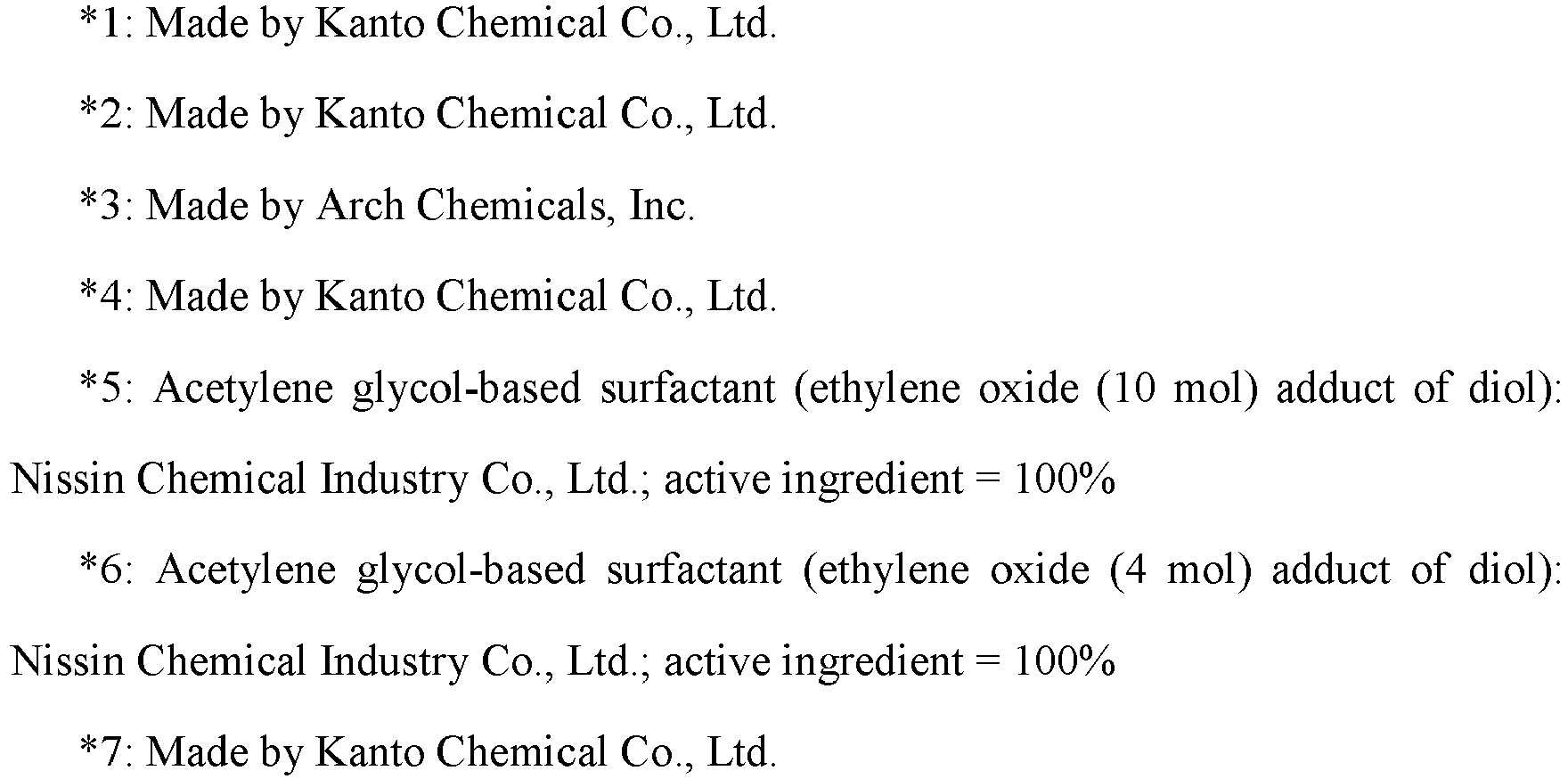
Claims (14)
- A water-based ink for inkjet recording, comprising a dye, water, an acidic preservative, and at least one of a surfactant and a penetrant.
- The water-based ink for inkjet recording according to claim 1, wherein the acidic preservative is at least one of a polyvalent unsaturated fatty acid, a polyvalent unsaturated fatty acid salt, dehydroacetic acid, and a dehydroacetate.
- The water-based ink for inkjet recording according to claim 2, wherein the polyvalent unsaturated fatty acid is sorbic acid,
and the polyvalent unsaturated fatty acid salt is a sorbate. - The water-based ink for inkjet recording according to claim 3, wherein the sorbate includes at least one of potassium sorbate and sodium sorbate.
- The water-based ink for inkjet recording according to any one of claims 2 to 4, wherein the dehydroacetate is sodium dehydroacetate.
- The water-based ink for inkjet recording according to any one of claims 1 to 5, wherein the content of the acidic preservative is 0.3% by mass to 6.0% by mass.
- The water-based ink for inkjet recording according to any one of claims 1 to 6, wherein the acidic preservative is at least one of dehydroacetic acid and a dehydroacetate, and the content of at least one of the dehydroacetic acid and the dehydroacetate is 1.0% by mass to 5.0% by mass.
- The water-based ink for inkjet recording according to any one of claims 1 to 7, wherein the surfactant is an acetylene-based surfactant.
- The water-based ink for inkjet recording according to any one of claims 1 to 8, wherein the content of the surfactant is 0.05% by mass to 3.0% by mass.
- The water-based ink for inkjet recording according to any one of claims 1 to 9, wherein the penetrant includes at least one of an alkylene diol and a glycol ether compound.
- The water-based ink for inkjet recording according to any one of claims 1 to 10, wherein the formulation amount of the penetrant is 1.0% by mass to 10.0% by mass.
- The water-based ink for inkjet recording according to claim 10 or 11, wherein at least one of the alkylene diol and the glycol ether compound is at least one selected from the group consisting of 1,2-hexanediol, 3-methyl-1,5-pentanediol, and triethylene glycol-n-butyl ether (BTG).
- The water-based ink for inkjet recording according to any one of claims 1 to 12, wherein,when the acidic preservative is at least one of a polyvalent unsaturated fatty acid and a polyvalent unsaturated fatty acid salt, the formulation amounts of the acidic preservative and the surfactant satisfy the following Condition (X1), andwhen the acidic preservative is at least one of dehydroacetic acid and a dehydroacetate, the formulation amounts of the acidic preservative and the surfactant satisfy the following Condition (X2):
 A1: Formulated amount of the acidic preservative (% by weight)B: Formulated amount of the surfactant (% by weight)
 A2: Formulated amount of the acidic preservative (% by weight)B: Formulated amount of the surfactant (% by weight).
 - The water-based ink for inkjet recording according to any one of claims 1 to 13, wherein,when the acidic preservative is at least one of a polyvalent unsaturated fatty acid and a polyvalent unsaturated fatty acid salt, the added amounts of the acidic preservative and the penetrant satisfy the following Condition (Y1), andwhen the acidic preservative is at least one of dehydroacetic acid and a dehydroacetate, the added amounts of the acidic preservative and the penetrant satisfy the following Condition (Y2):
 A1: Formulated amount of the acidic preservative (% by weight)C: Formulated amount of the penetrant (% by weight)
 A2: Formulated amount of the acidic preservative (% by weight)C: Formulated amount of the penetrant (% by weight).
Applications Claiming Priority (2)
| Application Number | Priority Date | Filing Date | Title |
|---|---|---|---|
| JP2020111248A JP7669648B2 (en) | 2020-06-29 | 2020-06-29 | Water-based ink and ink cartridge for ink-jet recording |
| PCT/JP2021/024106 WO2022004585A1 (en) | 2020-06-29 | 2021-06-25 | Water-based ink for inkjet recording and ink cartridge |
Publications (2)
| Publication Number | Publication Date |
|---|---|
| EP4155355A1 true EP4155355A1 (en) | 2023-03-29 |
| EP4155355A4 EP4155355A4 (en) | 2024-06-26 |
Family
ID=79316065
Family Applications (1)
| Application Number | Title | Priority Date | Filing Date |
|---|---|---|---|
| EP21834585.8A Pending EP4155355A4 (en) | 2020-06-29 | 2021-06-25 | AQUEOUS INK FOR INKJET RECORDING, AND INK CARTRIDGE |
Country Status (4)
| Country | Link |
|---|---|
| US (1) | US20230193061A1 (en) |
| EP (1) | EP4155355A4 (en) |
| JP (1) | JP7669648B2 (en) |
| WO (1) | WO2022004585A1 (en) |
Family Cites Families (21)
| Publication number | Priority date | Publication date | Assignee | Title |
|---|---|---|---|---|
| JPS61101572A (en) * | 1984-10-23 | 1986-05-20 | Ricoh Co Ltd | water based ink |
| JPS61101574A (en) * | 1984-10-23 | 1986-05-20 | Ricoh Co Ltd | water based ink |
| JPS61101568A (en) * | 1984-10-23 | 1986-05-20 | Ricoh Co Ltd | water based ink |
| JP2517600B2 (en) * | 1986-11-06 | 1996-07-24 | 株式会社リコー | Recording liquid |
| JP2711098B2 (en) * | 1987-09-10 | 1998-02-10 | 株式会社リコー | Inkjet recording method |
| JPH0633006A (en) * | 1992-07-14 | 1994-02-08 | Ricoh Co Ltd | Ink composition for ink jet recording and ink jet recording method |
| JP3350117B2 (en) * | 1992-11-27 | 2002-11-25 | 株式会社リコー | Ink and recording method using the same |
| JP2000327965A (en) * | 1999-05-20 | 2000-11-28 | Ricoh Co Ltd | Black aqueous ink |
| JP3924993B2 (en) * | 1999-06-10 | 2007-06-06 | セイコーエプソン株式会社 | Ink for inkjet recording |
| JP4017349B2 (en) * | 2000-09-29 | 2007-12-05 | 株式会社リコー | Recording liquid, recording liquid cartridge, recording apparatus, recording method, and recording medium |
| JP3874336B2 (en) * | 2000-12-05 | 2007-01-31 | 株式会社リコー | Recording liquid, ink jet recording method using the same, and recording apparatus |
| JP2002249693A (en) * | 2001-02-27 | 2002-09-06 | Fuji Xerox Co Ltd | Ink jet recording ink composition |
| JP4264969B2 (en) | 2003-01-29 | 2009-05-20 | セイコーエプソン株式会社 | Aqueous pigment ink composition, and recording method, recording system and recorded matter using the same |
| US7442244B2 (en) * | 2004-03-22 | 2008-10-28 | Seiko Epson Corporation | Water-base ink composition |
| JP2008246821A (en) | 2007-03-30 | 2008-10-16 | Brother Ind Ltd | Pretreatment liquid, ink set, ink jet recording apparatus and ink jet recording method |
| JP2009286998A (en) * | 2008-05-01 | 2009-12-10 | Seiko Epson Corp | Ink composition for inkjet recording |
| KR101795639B1 (en) * | 2015-10-19 | 2017-11-16 | 최수진 | Aqueous transferring ink for use of textile for inkjet printer and textile transferring paper for the same |
| CN105400292A (en) * | 2016-01-06 | 2016-03-16 | 上海安诺其集团股份有限公司 | Active dye ink |
| JP6984154B2 (en) * | 2017-03-31 | 2021-12-17 | ブラザー工業株式会社 | Ink set and recording method |
| JP2020094084A (en) * | 2018-12-10 | 2020-06-18 | ローランドディー.ジー.株式会社 | Aqueous inkjet ink and inkjet recording method |
| CN109627848B (en) * | 2018-12-10 | 2022-01-25 | 郑州鸿盛数码科技股份有限公司 | Functional ink and printing method thereof |
-
2020
- 2020-06-29 JP JP2020111248A patent/JP7669648B2/en active Active
-
2021
- 2021-06-25 EP EP21834585.8A patent/EP4155355A4/en active Pending
- 2021-06-25 WO PCT/JP2021/024106 patent/WO2022004585A1/en not_active Ceased
-
2022
- 2022-12-27 US US18/146,550 patent/US20230193061A1/en active Pending
Also Published As
| Publication number | Publication date |
|---|---|
| EP4155355A4 (en) | 2024-06-26 |
| JP2022010590A (en) | 2022-01-17 |
| WO2022004585A1 (en) | 2022-01-06 |
| US20230193061A1 (en) | 2023-06-22 |
| JP7669648B2 (en) | 2025-04-30 |
Similar Documents
| Publication | Publication Date | Title |
|---|---|---|
| JP5704379B2 (en) | Ink set for ink jet recording, ink jet recording apparatus and ink jet recording method | |
| JP6432782B2 (en) | Water-based ink for ink-jet recording and ink cartridge | |
| EP0712912B1 (en) | Water-based dispersion ink for bubble jet printing and ink-jet recording method and apparatus using same | |
| JP5682748B2 (en) | Aqueous ink set for ink jet recording, ink jet recording method and ink jet recording apparatus | |
| JP4737725B2 (en) | Water-based ink for ink jet recording, ink cartridge, and ink jet recording apparatus | |
| EP3075795B1 (en) | Water-based ink for ink-jet recording | |
| JP6300084B2 (en) | Water-based ink for ink-jet recording and ink cartridge | |
| US20230193061A1 (en) | Water-based ink, printed recording medium, and ink cartridge | |
| JP2017132963A (en) | Ink set for inkjet recording | |
| EP4155079B1 (en) | Water-based ink for ink-jet recording and ink cartridge | |
| JP6103368B2 (en) | Water-based ink for ink jet recording, ink cartridge, and ink jet recording apparatus | |
| JP7654941B2 (en) | Water-based ink for ink-jet recording | |
| JP6057074B2 (en) | Water-based ink for ink jet recording, ink cartridge, and ink jet recording apparatus | |
| JP7351121B2 (en) | Water-based ink for inkjet recording | |
| JP5445765B2 (en) | Treatment liquid for ink jet recording, ink set, and ink jet recording method | |
| JP7351119B2 (en) | Water-based ink for inkjet recording | |
| EP3000855B1 (en) | Water-based ink for ink-jet recording | |
| US9540530B2 (en) | Water-based ink for ink-jet recording, ink cartridge and ink-jet recording apparatus | |
| JP2021014536A (en) | Water-based ink for inkjet recording | |
| JP2021014538A (en) | Water-based ink for inkjet recording and ink set | |
| JP2015067811A (en) | Aqueous ink for inkjet recording and ink cartridge |
Legal Events
| Date | Code | Title | Description |
|---|---|---|---|
| STAA | Information on the status of an ep patent application or granted ep patent |
Free format text: STATUS: THE INTERNATIONAL PUBLICATION HAS BEEN MADE |
|
| PUAI | Public reference made under article 153(3) epc to a published international application that has entered the european phase |
Free format text: ORIGINAL CODE: 0009012 |
|
| STAA | Information on the status of an ep patent application or granted ep patent |
Free format text: STATUS: REQUEST FOR EXAMINATION WAS MADE |
|
| 17P | Request for examination filed |
Effective date: 20221223 |
|
| AK | Designated contracting states |
Kind code of ref document: A1 Designated state(s): AL AT BE BG CH CY CZ DE DK EE ES FI FR GB GR HR HU IE IS IT LI LT LU LV MC MK MT NL NO PL PT RO RS SE SI SK SM TR |
|
| P01 | Opt-out of the competence of the unified patent court (upc) registered |
Effective date: 20230526 |
|
| DAV | Request for validation of the european patent (deleted) | ||
| DAX | Request for extension of the european patent (deleted) | ||
| A4 | Supplementary search report drawn up and despatched |
Effective date: 20240527 |
|
| RIC1 | Information provided on ipc code assigned before grant |
Ipc: C09D 11/38 20140101ALI20240521BHEP Ipc: C09D 11/328 20140101AFI20240521BHEP |