EP4155143B1 - Automobile electronic parking execution controller with double-mcu redundancy design - Google Patents
Automobile electronic parking execution controller with double-mcu redundancy design Download PDFInfo
- Publication number
- EP4155143B1 EP4155143B1 EP21852154.0A EP21852154A EP4155143B1 EP 4155143 B1 EP4155143 B1 EP 4155143B1 EP 21852154 A EP21852154 A EP 21852154A EP 4155143 B1 EP4155143 B1 EP 4155143B1
- Authority
- EP
- European Patent Office
- Prior art keywords
- resistor
- mcu
- pin
- motor
- pins
- Prior art date
- Legal status (The legal status is an assumption and is not a legal conclusion. Google has not performed a legal analysis and makes no representation as to the accuracy of the status listed.)
- Active
Links
Images


Classifications
-
- B—PERFORMING OPERATIONS; TRANSPORTING
- B60—VEHICLES IN GENERAL
- B60T—VEHICLE BRAKE CONTROL SYSTEMS OR PARTS THEREOF; BRAKE CONTROL SYSTEMS OR PARTS THEREOF, IN GENERAL; ARRANGEMENT OF BRAKING ELEMENTS ON VEHICLES IN GENERAL; PORTABLE DEVICES FOR PREVENTING UNWANTED MOVEMENT OF VEHICLES; VEHICLE MODIFICATIONS TO FACILITATE COOLING OF BRAKES
- B60T7/00—Brake-action initiating means
- B60T7/12—Brake-action initiating means for automatic initiation; for initiation not subject to will of driver or passenger
- B60T7/22—Brake-action initiating means for automatic initiation; for initiation not subject to will of driver or passenger initiated by contact of vehicle, e.g. bumper, with an external object, e.g. another vehicle, or by means of contactless obstacle detectors mounted on the vehicle
-
- B—PERFORMING OPERATIONS; TRANSPORTING
- B60—VEHICLES IN GENERAL
- B60T—VEHICLE BRAKE CONTROL SYSTEMS OR PARTS THEREOF; BRAKE CONTROL SYSTEMS OR PARTS THEREOF, IN GENERAL; ARRANGEMENT OF BRAKING ELEMENTS ON VEHICLES IN GENERAL; PORTABLE DEVICES FOR PREVENTING UNWANTED MOVEMENT OF VEHICLES; VEHICLE MODIFICATIONS TO FACILITATE COOLING OF BRAKES
- B60T8/00—Arrangements for adjusting wheel-braking force to meet varying vehicular or ground-surface conditions, e.g. limiting or varying distribution of braking force
- B60T8/32—Arrangements for adjusting wheel-braking force to meet varying vehicular or ground-surface conditions, e.g. limiting or varying distribution of braking force responsive to a speed condition, e.g. acceleration or deceleration
- B60T8/88—Arrangements for adjusting wheel-braking force to meet varying vehicular or ground-surface conditions, e.g. limiting or varying distribution of braking force responsive to a speed condition, e.g. acceleration or deceleration with failure responsive means, i.e. means for detecting and indicating faulty operation of the speed responsive control means
- B60T8/885—Arrangements for adjusting wheel-braking force to meet varying vehicular or ground-surface conditions, e.g. limiting or varying distribution of braking force responsive to a speed condition, e.g. acceleration or deceleration with failure responsive means, i.e. means for detecting and indicating faulty operation of the speed responsive control means using electrical circuitry
-
- B—PERFORMING OPERATIONS; TRANSPORTING
- B60—VEHICLES IN GENERAL
- B60T—VEHICLE BRAKE CONTROL SYSTEMS OR PARTS THEREOF; BRAKE CONTROL SYSTEMS OR PARTS THEREOF, IN GENERAL; ARRANGEMENT OF BRAKING ELEMENTS ON VEHICLES IN GENERAL; PORTABLE DEVICES FOR PREVENTING UNWANTED MOVEMENT OF VEHICLES; VEHICLE MODIFICATIONS TO FACILITATE COOLING OF BRAKES
- B60T13/00—Transmitting braking action from initiating means to ultimate brake actuator with power assistance or drive; Brake systems incorporating such transmitting means, e.g. air-pressure brake systems
- B60T13/74—Transmitting braking action from initiating means to ultimate brake actuator with power assistance or drive; Brake systems incorporating such transmitting means, e.g. air-pressure brake systems with electrical assistance or drive
-
- B—PERFORMING OPERATIONS; TRANSPORTING
- B60—VEHICLES IN GENERAL
- B60T—VEHICLE BRAKE CONTROL SYSTEMS OR PARTS THEREOF; BRAKE CONTROL SYSTEMS OR PARTS THEREOF, IN GENERAL; ARRANGEMENT OF BRAKING ELEMENTS ON VEHICLES IN GENERAL; PORTABLE DEVICES FOR PREVENTING UNWANTED MOVEMENT OF VEHICLES; VEHICLE MODIFICATIONS TO FACILITATE COOLING OF BRAKES
- B60T17/00—Component parts, details, or accessories of power brake systems not covered by groups B60T8/00, B60T13/00 or B60T15/00, or presenting other characteristic features
- B60T17/18—Safety devices; Monitoring
- B60T17/22—Devices for monitoring or checking brake systems; Signal devices
-
- B—PERFORMING OPERATIONS; TRANSPORTING
- B60—VEHICLES IN GENERAL
- B60T—VEHICLE BRAKE CONTROL SYSTEMS OR PARTS THEREOF; BRAKE CONTROL SYSTEMS OR PARTS THEREOF, IN GENERAL; ARRANGEMENT OF BRAKING ELEMENTS ON VEHICLES IN GENERAL; PORTABLE DEVICES FOR PREVENTING UNWANTED MOVEMENT OF VEHICLES; VEHICLE MODIFICATIONS TO FACILITATE COOLING OF BRAKES
- B60T7/00—Brake-action initiating means
- B60T7/12—Brake-action initiating means for automatic initiation; for initiation not subject to will of driver or passenger
- B60T7/122—Brake-action initiating means for automatic initiation; for initiation not subject to will of driver or passenger for locking of reverse movement
-
- B—PERFORMING OPERATIONS; TRANSPORTING
- B60—VEHICLES IN GENERAL
- B60T—VEHICLE BRAKE CONTROL SYSTEMS OR PARTS THEREOF; BRAKE CONTROL SYSTEMS OR PARTS THEREOF, IN GENERAL; ARRANGEMENT OF BRAKING ELEMENTS ON VEHICLES IN GENERAL; PORTABLE DEVICES FOR PREVENTING UNWANTED MOVEMENT OF VEHICLES; VEHICLE MODIFICATIONS TO FACILITATE COOLING OF BRAKES
- B60T8/00—Arrangements for adjusting wheel-braking force to meet varying vehicular or ground-surface conditions, e.g. limiting or varying distribution of braking force
- B60T8/32—Arrangements for adjusting wheel-braking force to meet varying vehicular or ground-surface conditions, e.g. limiting or varying distribution of braking force responsive to a speed condition, e.g. acceleration or deceleration
- B60T8/88—Arrangements for adjusting wheel-braking force to meet varying vehicular or ground-surface conditions, e.g. limiting or varying distribution of braking force responsive to a speed condition, e.g. acceleration or deceleration with failure responsive means, i.e. means for detecting and indicating faulty operation of the speed responsive control means
- B60T8/92—Arrangements for adjusting wheel-braking force to meet varying vehicular or ground-surface conditions, e.g. limiting or varying distribution of braking force responsive to a speed condition, e.g. acceleration or deceleration with failure responsive means, i.e. means for detecting and indicating faulty operation of the speed responsive control means automatically taking corrective action
-
- H—ELECTRICITY
- H02—GENERATION; CONVERSION OR DISTRIBUTION OF ELECTRIC POWER
- H02P—CONTROL OR REGULATION OF ELECTRIC MOTORS, ELECTRIC GENERATORS OR DYNAMO-ELECTRIC CONVERTERS; CONTROLLING TRANSFORMERS, REACTORS OR CHOKE COILS
- H02P23/00—Arrangements or methods for the control of AC motors characterised by a control method other than vector control
- H02P23/14—Estimation or adaptation of motor parameters, e.g. rotor time constant, flux, speed, current or voltage
-
- B—PERFORMING OPERATIONS; TRANSPORTING
- B60—VEHICLES IN GENERAL
- B60T—VEHICLE BRAKE CONTROL SYSTEMS OR PARTS THEREOF; BRAKE CONTROL SYSTEMS OR PARTS THEREOF, IN GENERAL; ARRANGEMENT OF BRAKING ELEMENTS ON VEHICLES IN GENERAL; PORTABLE DEVICES FOR PREVENTING UNWANTED MOVEMENT OF VEHICLES; VEHICLE MODIFICATIONS TO FACILITATE COOLING OF BRAKES
- B60T2201/00—Particular use of vehicle brake systems; Special systems using also the brakes; Special software modules within the brake system controller
- B60T2201/10—Automatic or semi-automatic parking aid systems
-
- B—PERFORMING OPERATIONS; TRANSPORTING
- B60—VEHICLES IN GENERAL
- B60T—VEHICLE BRAKE CONTROL SYSTEMS OR PARTS THEREOF; BRAKE CONTROL SYSTEMS OR PARTS THEREOF, IN GENERAL; ARRANGEMENT OF BRAKING ELEMENTS ON VEHICLES IN GENERAL; PORTABLE DEVICES FOR PREVENTING UNWANTED MOVEMENT OF VEHICLES; VEHICLE MODIFICATIONS TO FACILITATE COOLING OF BRAKES
- B60T2250/00—Monitoring, detecting, estimating vehicle conditions
-
- B—PERFORMING OPERATIONS; TRANSPORTING
- B60—VEHICLES IN GENERAL
- B60T—VEHICLE BRAKE CONTROL SYSTEMS OR PARTS THEREOF; BRAKE CONTROL SYSTEMS OR PARTS THEREOF, IN GENERAL; ARRANGEMENT OF BRAKING ELEMENTS ON VEHICLES IN GENERAL; PORTABLE DEVICES FOR PREVENTING UNWANTED MOVEMENT OF VEHICLES; VEHICLE MODIFICATIONS TO FACILITATE COOLING OF BRAKES
- B60T2270/00—Further aspects of brake control systems not otherwise provided for
- B60T2270/40—Failsafe aspects of brake control systems
- B60T2270/402—Back-up
-
- B—PERFORMING OPERATIONS; TRANSPORTING
- B60—VEHICLES IN GENERAL
- B60T—VEHICLE BRAKE CONTROL SYSTEMS OR PARTS THEREOF; BRAKE CONTROL SYSTEMS OR PARTS THEREOF, IN GENERAL; ARRANGEMENT OF BRAKING ELEMENTS ON VEHICLES IN GENERAL; PORTABLE DEVICES FOR PREVENTING UNWANTED MOVEMENT OF VEHICLES; VEHICLE MODIFICATIONS TO FACILITATE COOLING OF BRAKES
- B60T2270/00—Further aspects of brake control systems not otherwise provided for
- B60T2270/40—Failsafe aspects of brake control systems
- B60T2270/406—Test-mode; Self-diagnosis
-
- B—PERFORMING OPERATIONS; TRANSPORTING
- B60—VEHICLES IN GENERAL
- B60T—VEHICLE BRAKE CONTROL SYSTEMS OR PARTS THEREOF; BRAKE CONTROL SYSTEMS OR PARTS THEREOF, IN GENERAL; ARRANGEMENT OF BRAKING ELEMENTS ON VEHICLES IN GENERAL; PORTABLE DEVICES FOR PREVENTING UNWANTED MOVEMENT OF VEHICLES; VEHICLE MODIFICATIONS TO FACILITATE COOLING OF BRAKES
- B60T2270/00—Further aspects of brake control systems not otherwise provided for
- B60T2270/40—Failsafe aspects of brake control systems
- B60T2270/413—Plausibility monitoring, cross check, redundancy
Definitions
- the present invention relates to the technical field of electrical automobile control, and in particular to an automobile electronic parking execution controller with a double-micro control unit (MCU) redundancy design.
- MCU double-micro control unit
- An automobile electronic parking brake control system is mainly composed of a microcontroller, an IO processing circuit, an H-bridge drive circuit, a parking switch circuit and a biaxial acceleration sensor.
- the microcontroller and the H-bridge drive circuit form a core module of the electronic parking brake system.
- the automobile electronic parking brake system since a single MCU is used as a mainstream control device, there are certain crash fault and failure risks, which may affect the safety of an automobile parking brake.
- the document CN 106 154 894 A discloses a double microcontroller unit vehicle controller of an electric vehicle which has a main MCU connected with an input end of a relay drive module whose enable terminal is connected with a monitoring MCU.
- the present invention aims to provide an automobile electronic parking execution controller with a double-MCU redundancy design, where one more monitoring MCU U1 is introduced. After a main MCU U2 crashes, the main MCU U2 can still be quickly restored through the monitoring MCU U1, so that the main MCU U2 quickly enters a response state to recover its parking brake control ability, which greatly improves the safety of a system and makes the whole system more reliable in application.
- two ends of the motor respectively control connection directions of a positive pole and a negative pole of the motor through a single-pole double-throw relay RL1 so as to control a clockwise or anticlockwise rotation of the motor.
- the motor is driven by a pulse width modulation (PWM) switch through an MOS power switch to regulate a rotation speed and torque of the motor.
- PWM pulse width modulation
- the pin 6 of the monitoring MCU U1 is connected to a resistor R74, and the other end of the resistor R74 is connected to a resistor R75 and the gate of the MOS switch Q12; the other end of the resistor R75 and a source of the MOS switch Q12 are grounded; a drain of the MOS switch Q12 is connected to a drain of the MOS switch Q11, a negative pole of a diode D20, a base of a triode Q9 and a resistor R69; the other end of the resistor R69 is connected to a 13V power supply;
- the main MCU U2 restores the monitoring MCU U1 when the monitoring MCU U1 is abnormal.
- an automobile electronic parking execution controller with a double-MCU redundancy design which comprises a parking switch circuit, a biaxial acceleration sensor unit, a main MCU U2 and a monitoring MCU U1.
- the main MCU U2 controls a parking motor by means of detecting signals of the parking switch circuit and the biaxial acceleration sensor. Controlling the parking motor through the parking switch circuit, the biaxial acceleration sensor unit and the single MCU is the prior art, which will not be excessively described here.
- a double-MCU redundancy design control logic is added while keeping an original circuit connection.
- the monitoring MCU U1 monitors a running state of a whole control system, and restores the main MCU U2 when the main MCU U2 is abnormal.
- the main MCU U2 restores the monitoring MCU U1 when the monitoring MCU U1 is abnormal.
- the parking motor is a DC motor which is driven by a PWM switch through an MOS power switch to regulate a rotation speed and torque of the motor.
- two ends of the motor control connection directions of a positive pole and a negative pole of the motor respectively through a single-pole double-throw (SPDT) relay RL1, so that the connections of the positive pole and the negative pole at the two ends of the motor are exchanged by the two paths of single-pole double-throw relays RL1 to control a clockwise or anticlockwise rotation of the motor.
- the relay DC motor drive unit is an excellent architecture for replacing the H-bridge drive circuit, and has low cost and reliable running.
- the monitoring MCU U1 is U1
- the main MCU U2 is U2.
- Pins 5 and 12 are not used.
- a pin 6 is connected to a gate of a motor drive circuit switch MOS and sends a motor drive control signal.
- a pin 7 is connected to a pin 96 of the main MCU U2, and the main MCU U2 sends an enable chip select signal to U1 to enable U1.
- Pins 8, 13 and 14 input and output SPI signals and are connected to SPI memories (MISO, MOSI, SCK), and pins 91, 92 and 93 of the main MCU U2 are connected to SPI sensors (MOSI, MISO, SCK).
- the SPI signals are used for monitoring whether the main MCU U2 on an SPI bus makes an error in reading and writing an internal memory chip; and if an error occurs, the main MCU U2 is restored according to a corresponding control logic.
- a pin 9 is connected to a Hall sensor U5 used for measuring a working current of the motor, and the monitoring MCU unit U1 is used for determining whether the motor is in a normal working state. If the current is overloaded, a signal is sent out through the pin 6 to control the running of the motor.
- a pin 10 is connected to a tension sensor and used for determining whether a load driven by the motor is in a normal working state. In case of an overload, the pin 6 sends a signal to control the running of the motor so as to control a tension load.
- a pin 11 is used for restoration outputting to restore the main MCU U2 according to a predetermined algorithm. How to restore the MCU is the prior art, which will not be excessively described here.
- Pins 15 and 16 are respectively connected to pins 71 and 72 of the main MCU U2, and communication and interaction between the main MCU U2 and the monitoring MCU U1 are achieved through a UART signal, which is a data exchange channel for completing active-standby switching between the main MCU U2 and the monitoring MCU U1.
- the main MCU U2 accesses relevant states of the monitoring MCU U1 through a UART bus and the monitoring MCU U1 cannot respond correctly in a corresponding time period, it is determined that the monitoring MCU U1 is abnormal.
- the main MCU U2 restores the monitoring MCU U1.
- the main MCU U2 sends a segment of pseudo-random code, and the monitoring MCU U1 calculates its cyclic redundancy check (CRC) and returns it to the main MCU U2.
- CRC cyclic redundancy check
- the main MCU U2 calculates a verification result according to the CRC. If the result is consistent, it indicates that the monitoring MCU U1 is normal, otherwise, it indicates that the monitoring MCU U1 is abnormal.
- Pins 17, 18, 19 and 20 are used for inputting parking switch input signals, and converting the four parking switch input signals into analog voltage signals within 5 V through a resistor-capacitor network, so that collection and state determination of an MCU AD converter are facilitated.
- the monitoring MCU U1 determines whether a user initiates a clamping or releasing action according to a preset logic, and then controls the clockwise and anticlockwise rotations of the motor to drive the tension load.
- Pins 43 and 95 are connected to the Hall sensor U5.
- a pin 43 is used for inputting a motor working current detection signal
- a pin 95 is used for inputting overcurrent and overload signals when the motor works.
- the pin 6 of the monitoring MCU U1 is connected to a resistor R74, and the other end of the resistor R74 is connected to a resistor R75 and the gate of the MOS switch Q12; the other end of the resistor R75 and a source of the MOS switch Q12 are grounded; a drain of the MOS switch Q12 is connected to a drain of the MOS switch Q11, a negative pole of a diode D20, a base of a triode Q9 and a resistor R69; the other end of the resistor R69 is connected to a 13V power supply;
- the monitoring MCU U1 of the present invention is a redundancy control core of the electronic parking brake control system.
- the monitoring MCU U1 can independently monitor the running state of the whole control system, warn abnormalities, and process the abnormalities according to the preset control logic.
- the monitoring MCU U1 can restore the main MCU U2 when the main MCU U2 is abnormal.
- the main MCU U2 can restore the monitoring MCU U1 when the monitoring MCU U1 is abnormal.
- the design of a relay DC motor drive unit is the core of low cost of the electronic parking brake control system.
- the relay DC motor drive unit adopts two paths of SPDT relays to control the clockwise and anticlockwise rotations of the motor, and adopts the MOS power switch to carry out PWM switch driving, so as to drop the voltage and regulate the speed. If a duty ratio is larger, the output power of the motor is higher, so that regulation of a rotation speed and torque is achieved.
- the motor is connected to the Hall sensor U5 used for measuring the working current of the motor, and sends signals to the input pins of the ADCs of U1 and U2, i.e., pin 9 of U1 and pin 43 of U2, to calculate a load.
- the diodes are also connected to eliminate a reverse electromotive force and protect a power bus from being affected by surge attack.
- the controller is simple, reliable and low in cost, and is an economic brushless DC motor control and drive method, and is the core of cost policy protection.
- the main MCU U2 After the controller is powered up, the main MCU U2 is normally powered up, checks its running alone, and sends enable to the pin 7 of the monitoring MCU U1 to enable a monitoring function.
- the monitoring MCU U1 mainly monitors data accesses (pins 8, 13 and 14) of the main MCU U2 and the SPI memories, inputting of external switch signals (pins 17, 18, 19 and 20), motor current signals (pin 9), and tension sensor signals (pin 10), compares them with a working state truth table pre-stored in the monitoring MCU U1, and monitors whether the working logic among the four factors meets expectation. If yes, the monitoring MCU U1 continues to keep monitoring.
- the pin 6 drives the motor to be powered off and communicates with the main MCU U2 through the UART (pins 15 and 16) to prompt that the main MCU U2 works abnormally.
- the monitoring MCU U1 saves diagnosis information and prepares to enter an initial restoration state.
- the monitoring MCU U1 saves its state information, and the pin 11 of the monitoring MCU U1 sends a restoration signal to the main MCU U2 to complete one round of abnormality restoration.
- a fault restoration program is quickly executed to ensure normal parking.
Landscapes
- Engineering & Computer Science (AREA)
- Transportation (AREA)
- Mechanical Engineering (AREA)
- Power Engineering (AREA)
- Valves And Accessory Devices For Braking Systems (AREA)
- Control Of Direct Current Motors (AREA)
- Control Of Electric Motors In General (AREA)
Description
- The present invention relates to the technical field of electrical automobile control, and in particular to an automobile electronic parking execution controller with a double-micro control unit (MCU) redundancy design.
- An automobile electronic parking brake control system is mainly composed of a microcontroller, an IO processing circuit, an H-bridge drive circuit, a parking switch circuit and a biaxial acceleration sensor. The microcontroller and the H-bridge drive circuit form a core module of the electronic parking brake system. In the automobile electronic parking brake system, since a single MCU is used as a mainstream control device, there are certain crash fault and failure risks, which may affect the safety of an automobile parking brake.
- The document
CN 106 154 894 A discloses a double microcontroller unit vehicle controller of an electric vehicle which has a main MCU connected with an input end of a relay drive module whose enable terminal is connected with a monitoring MCU. - The present invention aims to provide an automobile electronic parking execution controller with a double-MCU redundancy design, where one more monitoring MCU U1 is introduced. After a main MCU U2 crashes, the main MCU U2 can still be quickly restored through the monitoring MCU U1, so that the main MCU U2 quickly enters a response state to recover its parking brake control ability, which greatly improves the safety of a system and makes the whole system more reliable in application.
- The technical purpose of the present invention is realized by the following technical solution:
- Provided is an automobile electronic parking execution controller with a double-MCU redundancy design, which comprises a parking switch circuit, a biaxial acceleration sensor unit, a main micro control unit (MCU) U2 and a monitoring MCU U1, wherein the main MCU U2 controls a parking motor by means of detecting signals of the parking switch circuit and the biaxial acceleration sensor;
- the monitoring MCU U1 monitors a running state of a whole control system, and restores the main MCU U2 when the main MCU U2 is abnormal.
- Even further, two ends of the motor respectively control connection directions of a positive pole and a negative pole of the motor through a single-pole double-throw relay RL1 so as to control a clockwise or anticlockwise rotation of the motor.
- Even further, the motor is driven by a pulse width modulation (PWM) switch through an MOS power switch to regulate a rotation speed and torque of the motor.
- Even further, in the monitoring MCU U1,
- a
pin 3 is connected to a 5V power supply and a capacitor C98, and apin 4 is connected to the other end of the capacitor C98 and grounded; - a
pin 6 is connected to a gate of a motor drive circuit MOS switch Q12 and sends a motor drive control signal; - the pin 9 is connected to the Hall sensor U5 used for measuring a working current of the motor, and is used for determining whether the motor is in a normal working state; if the current is overloaded, a signal is sent out through the
pin 6 to control the running of the motor. - Even further, in the main MCU U2,
- a
pin 84 is connected to a 5V power supply and a capacitor C101, and apin 83 is connected to the other end of the capacitor C101 and grounded; -
pins - a
pin 10 is connected to a gate of a motor drive MOS switch Q11; -
pins - Even further, the
pin 6 of the monitoring MCU U1 is connected to a resistor R74, and the other end of the resistor R74 is connected to a resistor R75 and the gate of the MOS switch Q12; the other end of the resistor R75 and a source of the MOS switch Q12 are grounded; a drain of the MOS switch Q12 is connected to a drain of the MOS switch Q11, a negative pole of a diode D20, a base of a triode Q9 and a resistor R69; the other end of the resistor R69 is connected to a 13V power supply; - a source of the MOS switch Q11 is grounded; the gate is connected to a resistor R72; the other end of the resistor R72 is connected to a resistor R70 and the
pin 10 of the main MCU U2, and the other end of the resistor R70 is connected to the 5V power supply; - a collector of the triode Q9 is connected to a resistor R68, and the other end of the resistor R68 is connected to the 13V power supply; an emitter of Q9 is connected to a positive pole of the diode D20 and a resistor R71; the other end of the resistor R71 is connected to a capacitor C65, a resistor R73, a negative pole of a voltage-stabilizing diode D21 and a gate of an MOS switch Q10, and the other ends of the capacitor C65, the resistor R73 and the voltage-stabilizing diode D21 and a source of the MOS switch Q10 are grounded;
- a drain of the MOS switch Q10 is connected to positive poles of a diode D14 and a diode D15 and
pins 1 of the two paths of single-pole double-throw relays RL1;pins 2 of the two paths of single-pole double-throw relays RL1 are connected to the 13V power supply;pins 3 of the two paths of single-pole double-throw relays RL1 are connected to a positive pole of a diode D16 and a drain of an MOS switch Q7; a gate of the MOS switch Q7 is connected to a resistor R55 and a resistor R56; the other end of the resistor R55 is connected to thepin 13 of the main MCU U2; the other end of the resistor R56 and a source of the MOS switch Q7 are grounded; -
pins 4 of the two paths of single-pole double-throw relays RL1are connected to a negative pole of D16,pins 6 of the two paths of single-pole double-throw relays RL1, a negative pole of a diode D10 and the 13V power supply;pins 5 of the two paths of single-pole double-throw relays RL1 are connected to a positive pole of thediode D 10 and a drain of an MOS switch Q6; a gate of the MOS switch Q6 is connected to a resistor R49 and a resistor R50; the other end of the resistor R49 is connected to thepin 12 of the main MCU U2; the other end of the resistor R50 and a source of Q6 are grounded; -
pins 7 of the two paths of single-pole double-throw relays RL1 are connected to an end B of a brush direct current (DC) motor, a negative pole of D14 and capacitors C38, C39 and C47, and the other end of the capacitor C47 is grounded; an end A of the DC motor is connected to the other ends of the capacitors C38 and C39 andpins pins 8 of the two paths of single-pole double-throw relays RL1 are connected to a negative pole of the diode D15, a capacitor C48, andpins - a
pin 5 of the Hall sensor U5 is grounded, and apin 6 of the Hall sensor U5 is connected to a resistor R54; the other end of the resistor R54 is connected to thepin 95 of the main MCU U2; apin 7 of the Hall sensor U5 is connected to a resistor R51 and a resistor R52; the other end of the resistor R51 is connected to thepin 43 of the main MCU U2 and a capacitor C41, and the other end of the capacitor C41 is grounded; the other end of the resistor R52 is connected to the pin 9 of the monitoring MCU U1 and a capacitor C45, and the other end of the capacitor C45 is connected to thepin 5 of U5; apin 8 of the Hall sensor U5 is connected to a resistor R53, the 5V power supply and a capacitor C40; the other end of the resistor R53 is connected to thepin 6 of the Hall sensor U5; and the other end of the capacitor C40 is grounded. - Even further, in the monitoring MCU U1,
-
pins - a
pin 7 is connected to apin 96 of the main MCU U2, and the main MCU U2 sends an enable chip select signal to the monitoring MCU U1 to enable the monitoring MCU U1; -
pins pins - a
pin 10 is connected to a tension sensor and used for determining whether a load driven by the motor is in a normal working state; in case of an overload, thepin 6 sends a signal to control the running of the motor so as to control a tension load; - a
pin 11 is used for restoration outputting to restore the main MCU U2; -
pins pins -
pins - Even further, the main MCU U2 restores the monitoring MCU U1 when the monitoring MCU U1 is abnormal.
- In conclusion, the present invention has the following beneficial effects:
- 1. By means of introducing one more monitoring MCU U1, after a main MCU U2 crashes, the main MCU U2 can still be quickly restored through the monitoring MCU U1, so that the main MCU U2 quickly enters a response state to recover its parking brake control ability, which greatly improves the safety of a system and makes the whole system more reliable in application.
- 2. A high-power H-bridge drive circuit has higher cost, and a relay DC motor drive unit adopts two paths of single-pole double-throw (SPDT) relays to control the clockwise and anticlockwise rotations of the motor, and adopts an MOS power switch to carry out PWM switch driving, so as to regulate the rotation speed and the torque. The relay DC motor drive unit is an excellent scheme for replacing the H-bridge drive circuit, and the low cost and reliable running are the technical core.
-
-
FIG. 1 is a schematic diagram of connection of an overall system of the present invention. -
FIG. 2 is a signal connection diagram of a main MCU U2 and a monitoring MCU U1 in a double-MCU redundancy design architecture. -
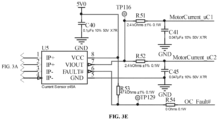
FIG. 3A-3E is a motor MOS drive connection circuit. - The detailed description of the present invention is further illustrated below with reference to the accompanying drawings, the present invention is however only limited by the appended claims.
- As shown in
FIG. 1 , provided is an automobile electronic parking execution controller with a double-MCU redundancy design, which comprises a parking switch circuit, a biaxial acceleration sensor unit, a main MCU U2 and a monitoring MCU U1. The main MCU U2 controls a parking motor by means of detecting signals of the parking switch circuit and the biaxial acceleration sensor. Controlling the parking motor through the parking switch circuit, the biaxial acceleration sensor unit and the single MCU is the prior art, which will not be excessively described here. - A double-MCU redundancy design control logic is added while keeping an original circuit connection. Specifically, the monitoring MCU U1 monitors a running state of a whole control system, and restores the main MCU U2 when the main MCU U2 is abnormal. The main MCU U2 restores the monitoring MCU U1 when the monitoring MCU U1 is abnormal.
- As shown in
FIG. 2 andFIG. 3A-3E , the parking motor is a DC motor which is driven by a PWM switch through an MOS power switch to regulate a rotation speed and torque of the motor. In order to reduce the cost risk, two ends of the motor control connection directions of a positive pole and a negative pole of the motor respectively through a single-pole double-throw (SPDT) relay RL1, so that the connections of the positive pole and the negative pole at the two ends of the motor are exchanged by the two paths of single-pole double-throw relays RL1 to control a clockwise or anticlockwise rotation of the motor. The relay DC motor drive unit is an excellent architecture for replacing the H-bridge drive circuit, and has low cost and reliable running. - As shown in
FIG. 2 , the monitoring MCU U1 is U1, and the main MCU U2 is U2. - In the monitoring MCU U1,
-
pins -
Pins pin 3 is connected to a 5V power supply and a capacitor C98, and thepin 4 is connected to the other end of the capacitor C98 and grounded. -
Pins - A
pin 6 is connected to a gate of a motor drive circuit switch MOS and sends a motor drive control signal. - A
pin 7 is connected to apin 96 of the main MCU U2, and the main MCU U2 sends an enable chip select signal to U1 to enable U1. -
Pins - A pin 9 is connected to a Hall sensor U5 used for measuring a working current of the motor, and the monitoring MCU unit U1 is used for determining whether the motor is in a normal working state. If the current is overloaded, a signal is sent out through the
pin 6 to control the running of the motor. - A
pin 10 is connected to a tension sensor and used for determining whether a load driven by the motor is in a normal working state. In case of an overload, thepin 6 sends a signal to control the running of the motor so as to control a tension load. - A
pin 11 is used for restoration outputting to restore the main MCU U2 according to a predetermined algorithm. How to restore the MCU is the prior art, which will not be excessively described here. -
Pins pins - When the main MCU U2 accesses relevant states of the monitoring MCU U1 through a UART bus and the monitoring MCU U1 cannot respond correctly in a corresponding time period, it is determined that the monitoring MCU U1 is abnormal. The main MCU U2 restores the monitoring MCU U1. For example, the main MCU U2 sends a segment of pseudo-random code, and the monitoring MCU U1 calculates its cyclic redundancy check (CRC) and returns it to the main MCU U2. The main MCU U2 calculates a verification result according to the CRC. If the result is consistent, it indicates that the monitoring MCU U1 is normal, otherwise, it indicates that the monitoring MCU U1 is abnormal.
-
Pins - As shown in
FIG. 2 , in the main MCU U2, - pins 83 and 84 are used for working power supply inputting connection. A
pin 84 is connected to a 5V power supply and a capacitor C101, and apin 83 is connected to the other end of the capacitor C101 and grounded; - pins 12 and 13 are connected to the two paths of single-pole double-throw relays RL1 to control the clockwise and anticlockwise rotations of the motor;
- a
pin 10 is connected to a gate of a motor drive circuit MOS switch Q11 and is used for driving Q11 to be turned on or turned off, so as to drive a high-power MOSFET Q10 of a rear electrode to be turned on or turned off to power on or power off the motor. -
Pins pin 43 is used for inputting a motor working current detection signal, and apin 95 is used for inputting overcurrent and overload signals when the motor works. - As shown in
FIG. 3A-3E , specifically, thepin 6 of the monitoring MCU U1 is connected to a resistor R74, and the other end of the resistor R74 is connected to a resistor R75 and the gate of the MOS switch Q12; the other end of the resistor R75 and a source of the MOS switch Q12 are grounded; a drain of the MOS switch Q12 is connected to a drain of the MOS switch Q11, a negative pole of a diode D20, a base of a triode Q9 and a resistor R69; the other end of the resistor R69 is connected to a 13V power supply; - a source of the MOS switch Q11 is grounded; the gate is connected to a resistor R72; the other end of the resistor R72 is connected to a resistor R70 and the
pin 10 of the main MCU U2, and the other end of the resistor R70 is connected to the 5V power supply; - a collector of the triode Q9 is connected to a resistor R68, and the other end of the resistor R68 is connected to the 13V power supply; an emitter of Q9 is connected to a positive pole of the diode D20 and a resistor R71; the other end of the resistor R71 is connected to a capacitor C65, a resistor R73, a negative pole of a voltage-stabilizing diode D21 and a gate of an MOS switch Q10, and the other ends of the capacitor C65, the resistor R73 and the voltage-stabilizing diode D21 and a source of the MOS switch Q10 are grounded;
- a drain of the MOS switch Q10 is connected to positive poles of a diode D14 and a diode D15 and pins 1 of the two paths of single-pole double-throw relays RL1; pins 2 of the two paths of single-pole double-throw relays RL1 are connected to the 13V power supply;
pins 3 of the two paths of single-pole double-throw relays RL1 are connected to a positive pole of a diode D16 and a drain of an MOS switch Q7; a gate of the MOS switch Q7 is connected to a resistor R55 and a resistor R56; the other end of the resistor R55 is connected to thepin 13 of the main MCU U2; the other end of the resistor R56 and a source of the MOS switch Q7 are grounded; -
pins 4 of the two paths of single-pole double-throw relays RL1are connected to a negative pole of D16, pins 6 of the two paths of single-pole double-throw relays RL1, a negative pole of a diode D10 and the 13V power supply;pins 5 of the two paths of single-pole double-throw relays RL1 are connected to a positive pole of thediode D 10 and a drain of an MOS switch Q6; a gate of the MOS switch Q6 is connected to a resistor R49 and a resistor R50; the other end of the resistor R49 is connected to thepin 12 of the main MCU U2; the other end of the resistor R50 and a source of Q6 are grounded; -
pins 7 of the two paths of single-pole double-throw relays RL1 are connected to an end B of a brush direct current (DC) motor, a negative pole of D14 and capacitors C38, C39 and C47, and the other end of the capacitor C47 is grounded; an end A of the DC motor is connected to the other ends of the capacitors C38 and C39 and pins 1 and 2 of the Hall sensor U5; pins 8 of the two paths of single-pole double-throw relays RL1 are connected to a negative pole of the diode D15, a capacitor C48, and pins 3 and 4 of the Hall sensor U5; the other end of the capacitor C48 is grounded; - a
pin 5 of the Hall sensor U5 is grounded, and apin 6 of the Hall sensor U5 is connected to a resistor R54; the other end of the resistor R54 is connected to thepin 95 of the main MCU U2; apin 7 of the Hall sensor U5 is connected to a resistor R51 and a resistor R52; the other end of the resistor R51 is connected to thepin 43 of the main MCU U2 and a capacitor C41, and the other end of the capacitor C41 is grounded; the other end of the resistor R52 is connected to the pin 9 of the monitoring MCU U1 and a capacitor C45, and the other end of the capacitor C45 is connected to thepin 5 of U5; apin 8 of the Hall sensor U5 is connected to a resistor R53, the 5V power supply and a capacitor C40; the other end of the resistor R53 is connected to thepin 6 of the Hall sensor U5; and the other end of the capacitor C40 is grounded. - The monitoring MCU U1 of the present invention is a redundancy control core of the electronic parking brake control system. The monitoring MCU U1 can independently monitor the running state of the whole control system, warn abnormalities, and process the abnormalities according to the preset control logic. The monitoring MCU U1 can restore the main MCU U2 when the main MCU U2 is abnormal. The main MCU U2 can restore the monitoring MCU U1 when the monitoring MCU U1 is abnormal. Thus, the redundancy operations of the control system are achieved.
- The design of a relay DC motor drive unit is the core of low cost of the electronic parking brake control system. The relay DC motor drive unit adopts two paths of SPDT relays to control the clockwise and anticlockwise rotations of the motor, and adopts the MOS power switch to carry out PWM switch driving, so as to drop the voltage and regulate the speed. If a duty ratio is larger, the output power of the motor is higher, so that regulation of a rotation speed and torque is achieved. The motor is connected to the Hall sensor U5 used for measuring the working current of the motor, and sends signals to the input pins of the ADCs of U1 and U2, i.e., pin 9 of U1 and pin 43 of U2, to calculate a load. The diodes are also connected to eliminate a reverse electromotive force and protect a power bus from being affected by surge attack. The controller is simple, reliable and low in cost, and is an economic brushless DC motor control and drive method, and is the core of cost policy protection.
- After the controller is powered up, the main MCU U2 is normally powered up, checks its running alone, and sends enable to the
pin 7 of the monitoring MCU U1 to enable a monitoring function. The monitoring MCU U1 mainly monitors data accesses (pins 8, 13 and 14) of the main MCU U2 and the SPI memories, inputting of external switch signals (pins 17, 18, 19 and 20), motor current signals (pin 9), and tension sensor signals (pin 10), compares them with a working state truth table pre-stored in the monitoring MCU U1, and monitors whether the working logic among the four factors meets expectation. If yes, the monitoring MCU U1 continues to keep monitoring. If no, thepin 6 drives the motor to be powered off and communicates with the main MCU U2 through the UART (pins 15 and 16) to prompt that the main MCU U2 works abnormally. The monitoring MCU U1 saves diagnosis information and prepares to enter an initial restoration state. When receiving a restoration confirm from the main MCU U2 through the UART, the monitoring MCU U1 saves its state information, and thepin 11 of the monitoring MCU U1 sends a restoration signal to the main MCU U2 to complete one round of abnormality restoration. A fault restoration program is quickly executed to ensure normal parking.
Claims (8)
- An automobile electronic parking execution controller with a double-micro control unit (MCU) redundancy design, comprising:a parking switch circuit, a biaxial acceleration sensor unit, a main MCU (U2) and a monitoring MCU (U1), wherein the main MCU (U2) controls a parking motor by means of detecting signals of the parking switch circuit and the biaxial acceleration sensor; characterized in thatthe monitoring MCU (U1) monitors a running state of a whole control system, and restores the main MCU (U2) when the main MCU (U2) is abnormal;a pin 3 is connected to a 5V power supply and a capacitor (C98), and a pin 4 is connected to the other end of the capacitor (C98) and grounded;a pin 6 is connected to a gate of a motor drive circuit MOS switch (Q12) and sends a motor drive control signal;a pin 9 is connected to a Hall sensor (U5) used for measuring a working current of the motor, and is used for determining whether the motor is in a normal working state; if the current is overloaded, a signal is sent out through the pin 6 to control the running of the motor;two ends of the motor control connection directions of a positive pole and a negative pole of the motor respectively through a single-pole double-throw relay (RL1) to control a clockwise or anticlockwise rotation of the motor; and the motor is driven by a pulse width modulation (PWM) switch through the MOS switch to regulate a rotation speed and torque of the motor.
- The automobile electronic parking execution controller with the double-MCU redundancy design according to claim 1, wherein the two ends of the motor respectively control the connection directions of the positive pole and the negative pole of the motor through the single-pole double-throw relay (RL1) to control the clockwise or anticlockwise rotation of the motor.
- The automobile electronic parking execution controller with the double-MCU redundancy design according to claim 2, wherein the motor is driven by the PWM switch through the MOS switch to regulate the rotation speed and the torque of the motor.
- The automobile electronic parking execution controller with the double-MCU redundancy design according to claim 3, wherein in the monitoring MCU (U1),a pin 3 is connected to a 5V power supply and a capacitor (C98), and a pin 4 is connected to the other end of the capacitor (C98) and grounded;a pin 6 is connected to a gate of a motor drive circuit MOS switch (Q12) and sends a motor drive control signal;the pin 9 is connected to the Hall sensor (U5) used for measuring a working current of the motor, and is used for determining whether the motor is in a normal working state; if the current is overloaded, a signal is sent out through the pin 6 to control the running of the motor.
- The automobile electronic parking execution controller with the double-MCU redundancy design according to claim 4, wherein in the main MCU (U2),a pin 84 is connected to a 5V power supply and a capacitor (C101), and a pin 83 is connected to the other end of the capacitor (C101) and grounded;pins 12 and 13 are connected to the two paths of single-pole double-throw relays (RL1) to control the clockwise and anticlockwise rotations of the motor;a pin 10 is connected to a gate of a motor drive MOS switch (Q11);pins 43 and 95 are connected to the Hall sensor (U5).
- The automobile electronic parking execution controller with the double-MCU redundancy design according to claim 5, wherein the pin 6 of the monitoring MCU (U1) is connected to a resistor (R74), and the other end of the resistor (R74) is connected to a resistor (R75) and the gate of the MOS switch (Q12); the other end of the resistor (R75) and a source of the MOS switch (Q12) are grounded; a drain of the MOS switch (Q12) is connected to a drain of the MOS switch (Q11), a negative pole of a diode (D20), a base of a triode (Q9) and a resistor (R69); the other end of the resistor (R69) is connected to a 13V power supply;a source of the MOS switch (Q11) is grounded; the gate is connected to a resistor (R72); the other end of the resistor (R72) is connected to a resistor (R70) and the pin 10 of the main MCU (U2), and the other end of the resistor (R70) is connected to the 5V power supply;a collector of the triode (Q9) is connected to a resistor (R68), and the other end of the resistor (R68) is connected to the 13V power supply; an emitter of the triode (Q9) is connected to a positive pole of the diode (D20) and a resistor (R71); the other end of the resistor (R71) is connected to a capacitor (C65), a resistor (R73), a negative pole of a voltage-stabilizing diode (D21) and a gate of an MOS switch (Q10), and the other ends of the capacitor (C65), the resistor (R73) and the voltage-stabilizing diode (D21) and a source of the MOS switch (Q10) are grounded;a drain of the MOS switch (Q10) is connected to positive poles of a diode (D14) and a diode (D15) and pins 1 of the two paths of single-pole double-throw relays (RL1); pins 2 of the two paths of single-pole double-throw relays (RL1) are connected to the 13V power supply; pins 3 of the two paths of single-pole double-throw relays (RL1) are connected to a positive pole of a diode (D16) and a drain of an MOS switch (Q7); a gate of the MOS switch (Q7) is connected to a resistor (R55) and a resistor (R56); the other end of the resistor (R55) is connected to the pin 13 of the main MCU (U2); the other end of the resistor (R56) and a source of the MOS switch (Q7) are grounded;pins 4 of the two paths of single-pole double-throw relays (RL1) are connected to a negative pole of the diode (D16), pins 6 of the two paths of single-pole double-throw relays (RL1), a negative pole of a diode (D10) and the 13V power supply; pins 5 of the two paths of single-pole double-throw relays (RL1) are connected to a positive pole of the diode (D10) and a drain of an MOS switch (Q6); a gate of the MOS switch (Q6) is connected to a resistor (R49) and a resistor (R50); the other end of the resistor (R49) is connected to the pin 12 of the main MCU (U2); the other end of the resistor (R50) and a source of the MOS switch (Q6) are grounded;pins 7 of the two paths of single-pole double-throw relays (RL1) are connected to an end B of a brush direct current (DC) motor, a negative pole of the diode (D14) and capacitors (C38), (C39) and (C47), and the other end of the capacitor (C47) is grounded; an end A of the DC motor is connected to the other ends of the capacitors (C38) and (C39) and pins 1 and 2 of the Hall sensor (U5); pins 8 of the two paths of single-pole double-throw relays (RL1) are connected to a negative pole of the diode (D15), a capacitor (C48), and pins 3 and 4 of the Hall sensor (U5); the other end of the capacitor (C48) is grounded;a pin 5 of the Hall sensor (U5) is grounded, and a pin 6 of the Hall sensor (U5) is connected to a resistor (R54); the other end of the resistor (R54) is connected to the pin 95 of the main MCU (U2); a pin 7 of the Hall sensor (U5) is connected to a resistor (R51) and a resistor (R52); the other end of the resistor (R51) is connected to the pin 43 of the main MCU (U2) and a capacitor (C41), and the other end of the capacitor (C41) is grounded; the other end of the resistor (R52) is connected to the pin 9 of the monitoring MCU (U1) and a capacitor (C45), and the other end of the capacitor (C45) is connected to the pin 5 of the Hall sensor (U5); a pin 8 of the Hall sensor (U5) is connected to a resistor (R53), the 5V power supply and a capacitor (C40); the other end of the resistor (R53) is connected to the pin 6 of the Hall sensor (U5); and the other end of the capacitor (C40) is grounded.
- The automobile electronic parking execution controller with the double-MCU redundancy design according to claim 3 or 6, wherein in the monitoring MCU (U1),pins 1 and 2 are respectively used for restoration inputting and program downloading signal connection of the monitoring MCU (U1);a pin 7 is connected to a pin 96 of the main MCU (U2), and the main MCU (U2) sends an enable chip select signal to the monitoring MCU (U1) to enable the monitoring MCU (U1);pins 8, 13 and 14 input and output serial peripheral interface (SPI) signals and are connected to SPI memories, and pins 91, 92 and 93 of the main MCU (U2) are connected to SPI sensors; the SPI signals are used for monitoring whether the main MCU (U2) on an SPI bus makes an error in reading and writing an internal memory chip; if an error occurs, the main MCU (U2) is restored according to a corresponding control logic;a pin 10 is connected to a tension sensor and used for determining whether a load driven by the motor is in a normal working state; in case of an overload, the pin 6 sends a signal to control the running of the motor to control a tension load;a pin 11 is a restoration output to restore the main MCU (U2);pins 15 and 16 are respectively connected to pins 71 and 72 of the main MCU (U2) and are used for communication and interaction between the main MCU (U2) and the monitoring MCU (U1);pins 17, 18, 19 and 20 are used for inputting parking switch signals; after a combination state is converted by an analog-to-digital converter (AD) inside the monitoring MCU (U1), the monitoring MCU (U1) determines whether a user initiates a clamping or releasing action according to a preset logic, and then controls the clockwise and anticlockwise rotations of the motor to drive the tension load.
- The automobile electronic parking execution controller with the double-MCU redundancy design according to claim 1, wherein the main MCU (U2) restores the monitoring MCU (U1) when the monitoring MCU (U1) is abnormal.
Applications Claiming Priority (2)
| Application Number | Priority Date | Filing Date | Title |
|---|---|---|---|
| CN202010787348.5A CN111907505B (en) | 2020-08-07 | 2020-08-07 | Automobile electronic parking execution controller with double-MCU redundancy design |
| PCT/CN2021/110816 WO2022028520A1 (en) | 2020-08-07 | 2021-08-05 | Automobile electronic parking execution controller having double-mcu redundancy design |
Publications (3)
| Publication Number | Publication Date |
|---|---|
| EP4155143A1 EP4155143A1 (en) | 2023-03-29 |
| EP4155143A4 EP4155143A4 (en) | 2023-12-27 |
| EP4155143B1 true EP4155143B1 (en) | 2024-07-31 |
Family
ID=73282956
Family Applications (1)
| Application Number | Title | Priority Date | Filing Date |
|---|---|---|---|
| EP21852154.0A Active EP4155143B1 (en) | 2020-08-07 | 2021-08-05 | Automobile electronic parking execution controller with double-mcu redundancy design |
Country Status (5)
| Country | Link |
|---|---|
| US (1) | US12358477B2 (en) |
| EP (1) | EP4155143B1 (en) |
| JP (1) | JP7572463B2 (en) |
| CN (1) | CN111907505B (en) |
| WO (1) | WO2022028520A1 (en) |
Families Citing this family (14)
| Publication number | Priority date | Publication date | Assignee | Title |
|---|---|---|---|---|
| CN111907505B (en) * | 2020-08-07 | 2021-02-19 | 格陆博科技有限公司 | Automobile electronic parking execution controller with double-MCU redundancy design |
| CN112319453B (en) * | 2020-12-01 | 2025-11-21 | 杭叉集团股份有限公司 | Fork truck formula AGV and braking system thereof |
| CN112622845B (en) * | 2020-12-23 | 2021-12-21 | 万向钱潮股份有限公司 | Hot standby electronic parking brake system coordination control method |
| CN113830040A (en) * | 2021-03-30 | 2021-12-24 | 上海汇众汽车制造有限公司 | An electronic parking control system and its control method |
| CN113422499A (en) * | 2021-06-04 | 2021-09-21 | 浙江亚太机电股份有限公司 | Circuit for isolating and driving MOS (Metal oxide semiconductor) transistor by double MCUs (micro control units) |
| CN113848950A (en) * | 2021-10-21 | 2021-12-28 | 广州文远知行科技有限公司 | Controller control method and device, vehicle and storage medium |
| CN114312720B (en) * | 2021-11-30 | 2024-05-10 | 浙江亚太机电股份有限公司 | Hardware redundancy integrated electro-hydraulic brake-by-wire system and method |
| CN114814269A (en) * | 2022-04-27 | 2022-07-29 | 北京英创汇智科技有限公司 | ABS wheel speed acquisition circuit with double MCU redundancy design |
| CN115695153B (en) * | 2023-01-03 | 2023-03-21 | 长沙莫之比智能科技有限公司 | CAN communication monitoring and automatic abnormal recovery method |
| CN116118697B (en) * | 2023-03-03 | 2026-02-17 | 开沃新能源汽车集团股份有限公司 | A small vehicle brake-by-wire device and its braking method |
| CN117598090B (en) * | 2023-12-25 | 2025-10-31 | 深圳市优必选科技股份有限公司 | Cutter head operation control circuit, safety protection system and mowing robot |
| CN117644846B (en) * | 2024-01-30 | 2024-05-03 | 千顾汽车科技(江苏)有限公司 | A hydraulic decoupling intelligent braking system and device |
| CN120517372B (en) * | 2025-07-25 | 2025-09-12 | 格陆博科技有限公司 | Vehicle braking system and method based on electronic hydraulic active pressurization |
| CN120922056B (en) * | 2025-10-13 | 2025-12-05 | 浙江孚乔图科技有限公司 | Vehicle power distribution control circuit and control method based on dual MCU redundancy control |
Family Cites Families (25)
| Publication number | Priority date | Publication date | Assignee | Title |
|---|---|---|---|---|
| US5644290A (en) * | 1993-06-16 | 1997-07-01 | Rhodes; Michael E. | Blackout control system |
| JP4050528B2 (en) | 2002-03-01 | 2008-02-20 | 株式会社オートネットワーク技術研究所 | Load driving circuit and load driving method |
| AU2006220596B2 (en) * | 2005-03-07 | 2012-03-08 | Crown Equipment Corporation | Braking system for a lift truck |
| JP2006335114A (en) | 2005-05-31 | 2006-12-14 | Toyota Motor Corp | Vehicle traveling path discrimination device and vehicle traveling path discrimination method |
| TWI330448B (en) * | 2007-04-10 | 2010-09-11 | Anpec Electronics Corp | Motor driving circuit having low current consumption under a standby mode |
| JP2008296849A (en) | 2007-06-04 | 2008-12-11 | Hi-Lex Corporation | In-vehicle electronic control device failure detection device |
| CN102371997B (en) * | 2010-08-19 | 2013-12-04 | 香港生产力促进局 | Charging and motor driving hybrid device for electric automobile and electric automobile |
| DE102011084534A1 (en) * | 2010-10-18 | 2012-04-19 | Continental Teves Ag & Co. Ohg | Fail-safe parking brake for motor vehicles |
| KR20130019465A (en) * | 2011-08-17 | 2013-02-27 | 주식회사 만도 | Method and system for parking control |
| KR20140017830A (en) * | 2012-08-01 | 2014-02-12 | 현대모비스 주식회사 | Emergency starting apparatus and method in smartkey system |
| JP6308092B2 (en) | 2014-10-06 | 2018-04-11 | 株式会社デンソー | Electronic control unit |
| CN106154894A (en) * | 2015-04-01 | 2016-11-23 | 天津易众腾动力技术有限公司 | Entire car controllers based on double MPU and method for safety monitoring thereof |
| KR102564853B1 (en) | 2015-04-21 | 2023-08-09 | 삼성전자주식회사 | Battery control apparatus, battery module, battery pack, and battery control method |
| DE102016006810A1 (en) * | 2016-06-03 | 2017-02-16 | Daimler Ag | Method for operating an electrically actuated parking brake of a vehicle and electrically operated parking brake |
| CN206049408U (en) * | 2016-08-31 | 2017-03-29 | 河南森地新能源汽车股份有限公司 | A kind of electric machine control system of used for electric vehicle pair of ECU module |
| CN206922676U (en) * | 2017-05-24 | 2018-01-23 | 比亚迪股份有限公司 | A kind of direct current generator and its positive and reverse rotation control circuit |
| DE102017209314A1 (en) * | 2017-06-01 | 2018-12-06 | Robert Bosch Gmbh | Method for operating a parking brake and control unit for operating a parking brake |
| CN207257563U (en) * | 2017-08-11 | 2018-04-20 | 宝沃汽车(中国)有限公司 | Time-delay reset system and vehicle control device |
| CN108639038B (en) * | 2018-07-11 | 2024-03-15 | 格陆博科技有限公司 | A dual MCU control system applied to automotive electronic parking brakes |
| CN111169471B (en) * | 2018-11-12 | 2021-09-21 | 比亚迪股份有限公司 | Integrated vehicle safety controller, safety control system, method and vehicle |
| JP2020104769A (en) | 2018-12-28 | 2020-07-09 | トヨタ自動車株式会社 | Parking brake system |
| KR102029723B1 (en) * | 2019-05-08 | 2019-10-08 | 주식회사 대경산전 | Control integrated system that can monitor power plant deterioration and optimize efficiency point control and fault diagnosis of motor |
| CN211075855U (en) * | 2019-08-12 | 2020-07-24 | 格陆博科技有限公司 | An electronic parking and P-gear parking control system applied to motor vehicles |
| CN210578326U (en) * | 2019-09-19 | 2020-05-19 | 浙江亚太机电股份有限公司 | Direct current motor current detection control circuit of electronic parking system |
| CN111907505B (en) * | 2020-08-07 | 2021-02-19 | 格陆博科技有限公司 | Automobile electronic parking execution controller with double-MCU redundancy design |
-
2020
- 2020-08-07 CN CN202010787348.5A patent/CN111907505B/en active Active
-
2021
- 2021-08-05 WO PCT/CN2021/110816 patent/WO2022028520A1/en not_active Ceased
- 2021-08-05 EP EP21852154.0A patent/EP4155143B1/en active Active
- 2021-08-05 JP JP2022580104A patent/JP7572463B2/en active Active
- 2021-08-05 US US18/012,652 patent/US12358477B2/en active Active
Also Published As
| Publication number | Publication date |
|---|---|
| US20230249656A1 (en) | 2023-08-10 |
| JP2023536786A (en) | 2023-08-30 |
| EP4155143A4 (en) | 2023-12-27 |
| US12358477B2 (en) | 2025-07-15 |
| CN111907505A (en) | 2020-11-10 |
| JP7572463B2 (en) | 2024-10-23 |
| EP4155143A1 (en) | 2023-03-29 |
| CN111907505B (en) | 2021-02-19 |
| WO2022028520A1 (en) | 2022-02-10 |
Similar Documents
| Publication | Publication Date | Title |
|---|---|---|
| EP4155143B1 (en) | Automobile electronic parking execution controller with double-mcu redundancy design | |
| EP3575126B1 (en) | Motor controller | |
| CN114103838A (en) | Power control apparatus and method for autonomous vehicle | |
| JP5742356B2 (en) | Control device for electric power steering device | |
| CN201901171U (en) | Electric power-assisted steering control system adopting dual-microcomputer to jointly control relay | |
| CN110829949A (en) | Electric drive system fault protection method and device, vehicle and storage medium | |
| CN110936821B (en) | Automobile motor controller, control system and automobile | |
| JP7424790B2 (en) | vehicle power system | |
| JP7358651B2 (en) | Motor control system and motor control device | |
| JP2018137944A (en) | Abnormality diagnosis device | |
| CN115421068B (en) | A MOSFET short-circuit fault detection system and method for a three-phase bridge inverter circuit | |
| CN104494689A (en) | Automotive electric power steering control system | |
| CN117962629B (en) | Motor controllers, powertrains and electric vehicles with short-circuit isolation function | |
| CN113715905A (en) | Redundant integrated electric drive unit and control method thereof | |
| CN117681661A (en) | A motor safety protection device and an electric drive system including the device | |
| CN110539643A (en) | Method and device for controlling high voltage of electric automobile | |
| CN204296852U (en) | A kind of Electric Power Steering Control System of Automobile | |
| CN112994558B (en) | Asynchronous motor controller | |
| CN211630101U (en) | Safe torque turn-off control circuit and motor controller | |
| CN115224668A (en) | Safe torque off control circuit and control system | |
| JP6854429B2 (en) | Vehicle drive | |
| CN221851715U (en) | Vehicle and protection circuit | |
| CN116061705B (en) | A control circuit for an electric vehicle and its drive motor | |
| EP4574520A1 (en) | Safety apparatus and method for operating the safety apparatus | |
| WO2021117636A1 (en) | Drive control device for electric motor |
Legal Events
| Date | Code | Title | Description |
|---|---|---|---|
| STAA | Information on the status of an ep patent application or granted ep patent |
Free format text: STATUS: THE INTERNATIONAL PUBLICATION HAS BEEN MADE |
|
| PUAI | Public reference made under article 153(3) epc to a published international application that has entered the european phase |
Free format text: ORIGINAL CODE: 0009012 |
|
| STAA | Information on the status of an ep patent application or granted ep patent |
Free format text: STATUS: REQUEST FOR EXAMINATION WAS MADE |
|
| 17P | Request for examination filed |
Effective date: 20221223 |
|
| AK | Designated contracting states |
Kind code of ref document: A1 Designated state(s): AL AT BE BG CH CY CZ DE DK EE ES FI FR GB GR HR HU IE IS IT LI LT LU LV MC MK MT NL NO PL PT RO RS SE SI SK SM TR |
|
| DAV | Request for validation of the european patent (deleted) | ||
| DAX | Request for extension of the european patent (deleted) | ||
| A4 | Supplementary search report drawn up and despatched |
Effective date: 20231128 |
|
| RIC1 | Information provided on ipc code assigned before grant |
Ipc: B60T 7/12 20060101ALI20231122BHEP Ipc: G05B 19/042 20060101ALI20231122BHEP Ipc: B60T 8/92 20060101ALI20231122BHEP Ipc: B60T 17/22 20060101ALI20231122BHEP Ipc: B60T 13/74 20060101AFI20231122BHEP |
|
| GRAP | Despatch of communication of intention to grant a patent |
Free format text: ORIGINAL CODE: EPIDOSNIGR1 |
|
| STAA | Information on the status of an ep patent application or granted ep patent |
Free format text: STATUS: GRANT OF PATENT IS INTENDED |
|
| INTG | Intention to grant announced |
Effective date: 20240412 |
|
| GRAS | Grant fee paid |
Free format text: ORIGINAL CODE: EPIDOSNIGR3 |
|
| GRAA | (expected) grant |
Free format text: ORIGINAL CODE: 0009210 |
|
| STAA | Information on the status of an ep patent application or granted ep patent |
Free format text: STATUS: THE PATENT HAS BEEN GRANTED |
|
| GRAF | Information related to payment of grant fee modified |
Free format text: ORIGINAL CODE: EPIDOSCIGR3 |
|
| AK | Designated contracting states |
Kind code of ref document: B1 Designated state(s): AL AT BE BG CH CY CZ DE DK EE ES FI FR GB GR HR HU IE IS IT LI LT LU LV MC MK MT NL NO PL PT RO RS SE SI SK SM TR |
|
| REG | Reference to a national code |
Ref country code: CH Ref legal event code: EP Ref country code: GB Ref legal event code: FG4D |
|
| REG | Reference to a national code |
Ref country code: DE Ref legal event code: R096 Ref document number: 602021016613 Country of ref document: DE |
|
| REG | Reference to a national code |
Ref country code: IE Ref legal event code: FG4D |
|
| REG | Reference to a national code |
Ref country code: LT Ref legal event code: MG9D |
|
| REG | Reference to a national code |
Ref country code: NL Ref legal event code: MP Effective date: 20240731 |
|
| PG25 | Lapsed in a contracting state [announced via postgrant information from national office to epo] |
Ref country code: PT Free format text: LAPSE BECAUSE OF FAILURE TO SUBMIT A TRANSLATION OF THE DESCRIPTION OR TO PAY THE FEE WITHIN THE PRESCRIBED TIME-LIMIT Effective date: 20241202 |
|
| REG | Reference to a national code |
Ref country code: AT Ref legal event code: MK05 Ref document number: 1708187 Country of ref document: AT Kind code of ref document: T Effective date: 20240731 |
|
| PG25 | Lapsed in a contracting state [announced via postgrant information from national office to epo] |
Ref country code: PT Free format text: LAPSE BECAUSE OF FAILURE TO SUBMIT A TRANSLATION OF THE DESCRIPTION OR TO PAY THE FEE WITHIN THE PRESCRIBED TIME-LIMIT Effective date: 20241202 |
|
| PG25 | Lapsed in a contracting state [announced via postgrant information from national office to epo] |
Ref country code: NO Free format text: LAPSE BECAUSE OF FAILURE TO SUBMIT A TRANSLATION OF THE DESCRIPTION OR TO PAY THE FEE WITHIN THE PRESCRIBED TIME-LIMIT Effective date: 20241031 |
|
| PG25 | Lapsed in a contracting state [announced via postgrant information from national office to epo] |
Ref country code: NL Free format text: LAPSE BECAUSE OF FAILURE TO SUBMIT A TRANSLATION OF THE DESCRIPTION OR TO PAY THE FEE WITHIN THE PRESCRIBED TIME-LIMIT Effective date: 20240731 Ref country code: PL Free format text: LAPSE BECAUSE OF FAILURE TO SUBMIT A TRANSLATION OF THE DESCRIPTION OR TO PAY THE FEE WITHIN THE PRESCRIBED TIME-LIMIT Effective date: 20240731 Ref country code: FI Free format text: LAPSE BECAUSE OF FAILURE TO SUBMIT A TRANSLATION OF THE DESCRIPTION OR TO PAY THE FEE WITHIN THE PRESCRIBED TIME-LIMIT Effective date: 20240731 Ref country code: GR Free format text: LAPSE BECAUSE OF FAILURE TO SUBMIT A TRANSLATION OF THE DESCRIPTION OR TO PAY THE FEE WITHIN THE PRESCRIBED TIME-LIMIT Effective date: 20241101 |
|
| PG25 | Lapsed in a contracting state [announced via postgrant information from national office to epo] |
Ref country code: BG Free format text: LAPSE BECAUSE OF FAILURE TO SUBMIT A TRANSLATION OF THE DESCRIPTION OR TO PAY THE FEE WITHIN THE PRESCRIBED TIME-LIMIT Effective date: 20240731 |
|
| PG25 | Lapsed in a contracting state [announced via postgrant information from national office to epo] |
Ref country code: LV Free format text: LAPSE BECAUSE OF FAILURE TO SUBMIT A TRANSLATION OF THE DESCRIPTION OR TO PAY THE FEE WITHIN THE PRESCRIBED TIME-LIMIT Effective date: 20240731 |
|
| PG25 | Lapsed in a contracting state [announced via postgrant information from national office to epo] |
Ref country code: IS Free format text: LAPSE BECAUSE OF FAILURE TO SUBMIT A TRANSLATION OF THE DESCRIPTION OR TO PAY THE FEE WITHIN THE PRESCRIBED TIME-LIMIT Effective date: 20241130 Ref country code: AT Free format text: LAPSE BECAUSE OF FAILURE TO SUBMIT A TRANSLATION OF THE DESCRIPTION OR TO PAY THE FEE WITHIN THE PRESCRIBED TIME-LIMIT Effective date: 20240731 |
|
| PG25 | Lapsed in a contracting state [announced via postgrant information from national office to epo] |
Ref country code: HR Free format text: LAPSE BECAUSE OF FAILURE TO SUBMIT A TRANSLATION OF THE DESCRIPTION OR TO PAY THE FEE WITHIN THE PRESCRIBED TIME-LIMIT Effective date: 20240731 |
|
| PG25 | Lapsed in a contracting state [announced via postgrant information from national office to epo] |
Ref country code: ES Free format text: LAPSE BECAUSE OF FAILURE TO SUBMIT A TRANSLATION OF THE DESCRIPTION OR TO PAY THE FEE WITHIN THE PRESCRIBED TIME-LIMIT Effective date: 20240731 Ref country code: RS Free format text: LAPSE BECAUSE OF FAILURE TO SUBMIT A TRANSLATION OF THE DESCRIPTION OR TO PAY THE FEE WITHIN THE PRESCRIBED TIME-LIMIT Effective date: 20241031 |
|
| PG25 | Lapsed in a contracting state [announced via postgrant information from national office to epo] |
Ref country code: RS Free format text: LAPSE BECAUSE OF FAILURE TO SUBMIT A TRANSLATION OF THE DESCRIPTION OR TO PAY THE FEE WITHIN THE PRESCRIBED TIME-LIMIT Effective date: 20241031 Ref country code: PL Free format text: LAPSE BECAUSE OF FAILURE TO SUBMIT A TRANSLATION OF THE DESCRIPTION OR TO PAY THE FEE WITHIN THE PRESCRIBED TIME-LIMIT Effective date: 20240731 Ref country code: NO Free format text: LAPSE BECAUSE OF FAILURE TO SUBMIT A TRANSLATION OF THE DESCRIPTION OR TO PAY THE FEE WITHIN THE PRESCRIBED TIME-LIMIT Effective date: 20241031 Ref country code: NL Free format text: LAPSE BECAUSE OF FAILURE TO SUBMIT A TRANSLATION OF THE DESCRIPTION OR TO PAY THE FEE WITHIN THE PRESCRIBED TIME-LIMIT Effective date: 20240731 Ref country code: LV Free format text: LAPSE BECAUSE OF FAILURE TO SUBMIT A TRANSLATION OF THE DESCRIPTION OR TO PAY THE FEE WITHIN THE PRESCRIBED TIME-LIMIT Effective date: 20240731 Ref country code: IS Free format text: LAPSE BECAUSE OF FAILURE TO SUBMIT A TRANSLATION OF THE DESCRIPTION OR TO PAY THE FEE WITHIN THE PRESCRIBED TIME-LIMIT Effective date: 20241130 Ref country code: HR Free format text: LAPSE BECAUSE OF FAILURE TO SUBMIT A TRANSLATION OF THE DESCRIPTION OR TO PAY THE FEE WITHIN THE PRESCRIBED TIME-LIMIT Effective date: 20240731 Ref country code: GR Free format text: LAPSE BECAUSE OF FAILURE TO SUBMIT A TRANSLATION OF THE DESCRIPTION OR TO PAY THE FEE WITHIN THE PRESCRIBED TIME-LIMIT Effective date: 20241101 Ref country code: FI Free format text: LAPSE BECAUSE OF FAILURE TO SUBMIT A TRANSLATION OF THE DESCRIPTION OR TO PAY THE FEE WITHIN THE PRESCRIBED TIME-LIMIT Effective date: 20240731 Ref country code: ES Free format text: LAPSE BECAUSE OF FAILURE TO SUBMIT A TRANSLATION OF THE DESCRIPTION OR TO PAY THE FEE WITHIN THE PRESCRIBED TIME-LIMIT Effective date: 20240731 Ref country code: BG Free format text: LAPSE BECAUSE OF FAILURE TO SUBMIT A TRANSLATION OF THE DESCRIPTION OR TO PAY THE FEE WITHIN THE PRESCRIBED TIME-LIMIT Effective date: 20240731 Ref country code: AT Free format text: LAPSE BECAUSE OF FAILURE TO SUBMIT A TRANSLATION OF THE DESCRIPTION OR TO PAY THE FEE WITHIN THE PRESCRIBED TIME-LIMIT Effective date: 20240731 |
|
| REG | Reference to a national code |
Ref country code: DE Ref legal event code: R119 Ref document number: 602021016613 Country of ref document: DE |
|
| REG | Reference to a national code |
Ref country code: CH Ref legal event code: PL |
|
| PG25 | Lapsed in a contracting state [announced via postgrant information from national office to epo] |
Ref country code: SM Free format text: LAPSE BECAUSE OF FAILURE TO SUBMIT A TRANSLATION OF THE DESCRIPTION OR TO PAY THE FEE WITHIN THE PRESCRIBED TIME-LIMIT Effective date: 20240731 Ref country code: RO Free format text: LAPSE BECAUSE OF FAILURE TO SUBMIT A TRANSLATION OF THE DESCRIPTION OR TO PAY THE FEE WITHIN THE PRESCRIBED TIME-LIMIT Effective date: 20240731 Ref country code: DK Free format text: LAPSE BECAUSE OF FAILURE TO SUBMIT A TRANSLATION OF THE DESCRIPTION OR TO PAY THE FEE WITHIN THE PRESCRIBED TIME-LIMIT Effective date: 20240731 |
|
| PG25 | Lapsed in a contracting state [announced via postgrant information from national office to epo] |
Ref country code: LU Free format text: LAPSE BECAUSE OF NON-PAYMENT OF DUE FEES Effective date: 20240805 |
|
| PG25 | Lapsed in a contracting state [announced via postgrant information from national office to epo] |
Ref country code: MC Free format text: LAPSE BECAUSE OF FAILURE TO SUBMIT A TRANSLATION OF THE DESCRIPTION OR TO PAY THE FEE WITHIN THE PRESCRIBED TIME-LIMIT Effective date: 20240731 Ref country code: CH Free format text: LAPSE BECAUSE OF NON-PAYMENT OF DUE FEES Effective date: 20240831 Ref country code: EE Free format text: LAPSE BECAUSE OF FAILURE TO SUBMIT A TRANSLATION OF THE DESCRIPTION OR TO PAY THE FEE WITHIN THE PRESCRIBED TIME-LIMIT Effective date: 20240731 |
|
| PG25 | Lapsed in a contracting state [announced via postgrant information from national office to epo] |
Ref country code: CZ Free format text: LAPSE BECAUSE OF FAILURE TO SUBMIT A TRANSLATION OF THE DESCRIPTION OR TO PAY THE FEE WITHIN THE PRESCRIBED TIME-LIMIT Effective date: 20240731 |
|
| PG25 | Lapsed in a contracting state [announced via postgrant information from national office to epo] |
Ref country code: IT Free format text: LAPSE BECAUSE OF FAILURE TO SUBMIT A TRANSLATION OF THE DESCRIPTION OR TO PAY THE FEE WITHIN THE PRESCRIBED TIME-LIMIT Effective date: 20240731 Ref country code: SK Free format text: LAPSE BECAUSE OF FAILURE TO SUBMIT A TRANSLATION OF THE DESCRIPTION OR TO PAY THE FEE WITHIN THE PRESCRIBED TIME-LIMIT Effective date: 20240731 |
|
| PLBE | No opposition filed within time limit |
Free format text: ORIGINAL CODE: 0009261 |
|
| STAA | Information on the status of an ep patent application or granted ep patent |
Free format text: STATUS: NO OPPOSITION FILED WITHIN TIME LIMIT |
|
| REG | Reference to a national code |
Ref country code: BE Ref legal event code: MM Effective date: 20240831 |
|
| 26N | No opposition filed |
Effective date: 20250501 |
|
| PG25 | Lapsed in a contracting state [announced via postgrant information from national office to epo] |
Ref country code: DE Free format text: LAPSE BECAUSE OF NON-PAYMENT OF DUE FEES Effective date: 20250301 |
|
| PG25 | Lapsed in a contracting state [announced via postgrant information from national office to epo] |
Ref country code: BE Free format text: LAPSE BECAUSE OF NON-PAYMENT OF DUE FEES Effective date: 20240831 |
|
| PG25 | Lapsed in a contracting state [announced via postgrant information from national office to epo] |
Ref country code: IE Free format text: LAPSE BECAUSE OF NON-PAYMENT OF DUE FEES Effective date: 20240805 |
|
| PG25 | Lapsed in a contracting state [announced via postgrant information from national office to epo] |
Ref country code: SE Free format text: LAPSE BECAUSE OF FAILURE TO SUBMIT A TRANSLATION OF THE DESCRIPTION OR TO PAY THE FEE WITHIN THE PRESCRIBED TIME-LIMIT Effective date: 20240731 |
|
| PGFP | Annual fee paid to national office [announced via postgrant information from national office to epo] |
Ref country code: FR Payment date: 20250811 Year of fee payment: 5 |
|
| PG25 | Lapsed in a contracting state [announced via postgrant information from national office to epo] |
Ref country code: CY Free format text: LAPSE BECAUSE OF FAILURE TO SUBMIT A TRANSLATION OF THE DESCRIPTION OR TO PAY THE FEE WITHIN THE PRESCRIBED TIME-LIMIT; INVALID AB INITIO Effective date: 20210805 |
|
| PG25 | Lapsed in a contracting state [announced via postgrant information from national office to epo] |
Ref country code: HU Free format text: LAPSE BECAUSE OF FAILURE TO SUBMIT A TRANSLATION OF THE DESCRIPTION OR TO PAY THE FEE WITHIN THE PRESCRIBED TIME-LIMIT; INVALID AB INITIO Effective date: 20210805 |