EP4155111B1 - Systemgehäuse eines e-achsen-moduls - Google Patents
Systemgehäuse eines e-achsen-moduls Download PDFInfo
- Publication number
- EP4155111B1 EP4155111B1 EP22195153.6A EP22195153A EP4155111B1 EP 4155111 B1 EP4155111 B1 EP 4155111B1 EP 22195153 A EP22195153 A EP 22195153A EP 4155111 B1 EP4155111 B1 EP 4155111B1
- Authority
- EP
- European Patent Office
- Prior art keywords
- system housing
- power electronics
- housing
- cooling
- stator winding
- Prior art date
- Legal status (The legal status is an assumption and is not a legal conclusion. Google has not performed a legal analysis and makes no representation as to the accuracy of the status listed.)
- Active
Links
Images








Classifications
-
- H—ELECTRICITY
- H02—GENERATION; CONVERSION OR DISTRIBUTION OF ELECTRIC POWER
- H02K—DYNAMO-ELECTRIC MACHINES
- H02K11/00—Structural association of dynamo-electric machines with electric components or with devices for shielding, monitoring or protection
- H02K11/30—Structural association with control circuits or drive circuits
- H02K11/33—Drive circuits, e.g. power electronics
-
- B—PERFORMING OPERATIONS; TRANSPORTING
- B60—VEHICLES IN GENERAL
- B60K—ARRANGEMENT OR MOUNTING OF PROPULSION UNITS OR OF TRANSMISSIONS IN VEHICLES; ARRANGEMENT OR MOUNTING OF PLURAL DIVERSE PRIME-MOVERS IN VEHICLES; AUXILIARY DRIVES FOR VEHICLES; INSTRUMENTATION OR DASHBOARDS FOR VEHICLES; ARRANGEMENTS IN CONNECTION WITH COOLING, AIR INTAKE, GAS EXHAUST OR FUEL SUPPLY OF PROPULSION UNITS IN VEHICLES
- B60K11/00—Arrangement in connection with cooling of propulsion units
- B60K11/02—Arrangement in connection with cooling of propulsion units with liquid cooling
-
- B—PERFORMING OPERATIONS; TRANSPORTING
- B60—VEHICLES IN GENERAL
- B60L—PROPULSION OF ELECTRICALLY-PROPELLED VEHICLES; SUPPLYING ELECTRIC POWER FOR AUXILIARY EQUIPMENT OF ELECTRICALLY-PROPELLED VEHICLES; ELECTRODYNAMIC BRAKE SYSTEMS FOR VEHICLES IN GENERAL; MAGNETIC SUSPENSION OR LEVITATION FOR VEHICLES; MONITORING OPERATING VARIABLES OF ELECTRICALLY-PROPELLED VEHICLES; ELECTRIC SAFETY DEVICES FOR ELECTRICALLY-PROPELLED VEHICLES
- B60L1/00—Supplying electric power to auxiliary equipment of vehicles
- B60L1/02—Supplying electric power to auxiliary equipment of vehicles to electric heating circuits
- B60L1/04—Supplying electric power to auxiliary equipment of vehicles to electric heating circuits fed by the power supply line
- B60L1/06—Supplying electric power to auxiliary equipment of vehicles to electric heating circuits fed by the power supply line using only one supply
-
- B—PERFORMING OPERATIONS; TRANSPORTING
- B60—VEHICLES IN GENERAL
- B60L—PROPULSION OF ELECTRICALLY-PROPELLED VEHICLES; SUPPLYING ELECTRIC POWER FOR AUXILIARY EQUIPMENT OF ELECTRICALLY-PROPELLED VEHICLES; ELECTRODYNAMIC BRAKE SYSTEMS FOR VEHICLES IN GENERAL; MAGNETIC SUSPENSION OR LEVITATION FOR VEHICLES; MONITORING OPERATING VARIABLES OF ELECTRICALLY-PROPELLED VEHICLES; ELECTRIC SAFETY DEVICES FOR ELECTRICALLY-PROPELLED VEHICLES
- B60L3/00—Electric devices on electrically-propelled vehicles for safety purposes; Monitoring operating variables, e.g. speed, deceleration or energy consumption
- B60L3/0023—Detecting, eliminating, remedying or compensating for drive train abnormalities, e.g. failures within the drive train
- B60L3/0061—Detecting, eliminating, remedying or compensating for drive train abnormalities, e.g. failures within the drive train relating to electrical machines
-
- H—ELECTRICITY
- H02—GENERATION; CONVERSION OR DISTRIBUTION OF ELECTRIC POWER
- H02K—DYNAMO-ELECTRIC MACHINES
- H02K5/00—Casings; Enclosures; Supports
- H02K5/04—Casings or enclosures characterised by the shape, form or construction thereof
- H02K5/10—Casings or enclosures characterised by the shape, form or construction thereof with arrangements for protection from ingress, e.g. water or fingers
-
- H—ELECTRICITY
- H02—GENERATION; CONVERSION OR DISTRIBUTION OF ELECTRIC POWER
- H02K—DYNAMO-ELECTRIC MACHINES
- H02K5/00—Casings; Enclosures; Supports
- H02K5/04—Casings or enclosures characterised by the shape, form or construction thereof
- H02K5/15—Mounting arrangements for bearing-shields or end plates
-
- H—ELECTRICITY
- H02—GENERATION; CONVERSION OR DISTRIBUTION OF ELECTRIC POWER
- H02K—DYNAMO-ELECTRIC MACHINES
- H02K5/00—Casings; Enclosures; Supports
- H02K5/04—Casings or enclosures characterised by the shape, form or construction thereof
- H02K5/18—Casings or enclosures characterised by the shape, form or construction thereof with ribs or fins for improving heat transfer
-
- H—ELECTRICITY
- H02—GENERATION; CONVERSION OR DISTRIBUTION OF ELECTRIC POWER
- H02K—DYNAMO-ELECTRIC MACHINES
- H02K5/00—Casings; Enclosures; Supports
- H02K5/04—Casings or enclosures characterised by the shape, form or construction thereof
- H02K5/20—Casings or enclosures characterised by the shape, form or construction thereof with channels or ducts for flow of cooling medium
- H02K5/203—Casings or enclosures characterised by the shape, form or construction thereof with channels or ducts for flow of cooling medium specially adapted for liquids, e.g. cooling jackets
-
- H—ELECTRICITY
- H02—GENERATION; CONVERSION OR DISTRIBUTION OF ELECTRIC POWER
- H02K—DYNAMO-ELECTRIC MACHINES
- H02K5/00—Casings; Enclosures; Supports
- H02K5/04—Casings or enclosures characterised by the shape, form or construction thereof
- H02K5/22—Auxiliary parts of casings not covered by groups H02K5/06-H02K5/20, e.g. shaped to form connection boxes or terminal boxes
-
- H—ELECTRICITY
- H02—GENERATION; CONVERSION OR DISTRIBUTION OF ELECTRIC POWER
- H02K—DYNAMO-ELECTRIC MACHINES
- H02K7/00—Arrangements for handling mechanical energy structurally associated with dynamo-electric machines, e.g. structural association with mechanical driving motors or auxiliary dynamo-electric machines
- H02K7/10—Structural association with clutches, brakes, gears, pulleys or mechanical starters
- H02K7/116—Structural association with clutches, brakes, gears, pulleys or mechanical starters with gears
-
- H—ELECTRICITY
- H02—GENERATION; CONVERSION OR DISTRIBUTION OF ELECTRIC POWER
- H02K—DYNAMO-ELECTRIC MACHINES
- H02K9/00—Arrangements for cooling or ventilating
- H02K9/19—Arrangements for cooling or ventilating for machines with closed casing and closed-circuit cooling using a liquid cooling medium, e.g. oil
-
- B—PERFORMING OPERATIONS; TRANSPORTING
- B60—VEHICLES IN GENERAL
- B60K—ARRANGEMENT OR MOUNTING OF PROPULSION UNITS OR OF TRANSMISSIONS IN VEHICLES; ARRANGEMENT OR MOUNTING OF PLURAL DIVERSE PRIME-MOVERS IN VEHICLES; AUXILIARY DRIVES FOR VEHICLES; INSTRUMENTATION OR DASHBOARDS FOR VEHICLES; ARRANGEMENTS IN CONNECTION WITH COOLING, AIR INTAKE, GAS EXHAUST OR FUEL SUPPLY OF PROPULSION UNITS IN VEHICLES
- B60K1/00—Arrangement or mounting of electrical propulsion units
- B60K2001/001—Arrangement or mounting of electrical propulsion units one motor mounted on a propulsion axle for rotating right and left wheels of this axle
-
- B—PERFORMING OPERATIONS; TRANSPORTING
- B60—VEHICLES IN GENERAL
- B60K—ARRANGEMENT OR MOUNTING OF PROPULSION UNITS OR OF TRANSMISSIONS IN VEHICLES; ARRANGEMENT OR MOUNTING OF PLURAL DIVERSE PRIME-MOVERS IN VEHICLES; AUXILIARY DRIVES FOR VEHICLES; INSTRUMENTATION OR DASHBOARDS FOR VEHICLES; ARRANGEMENTS IN CONNECTION WITH COOLING, AIR INTAKE, GAS EXHAUST OR FUEL SUPPLY OF PROPULSION UNITS IN VEHICLES
- B60K1/00—Arrangement or mounting of electrical propulsion units
- B60K2001/003—Arrangement or mounting of electrical propulsion units with means for cooling the electrical propulsion units
-
- B—PERFORMING OPERATIONS; TRANSPORTING
- B60—VEHICLES IN GENERAL
- B60K—ARRANGEMENT OR MOUNTING OF PROPULSION UNITS OR OF TRANSMISSIONS IN VEHICLES; ARRANGEMENT OR MOUNTING OF PLURAL DIVERSE PRIME-MOVERS IN VEHICLES; AUXILIARY DRIVES FOR VEHICLES; INSTRUMENTATION OR DASHBOARDS FOR VEHICLES; ARRANGEMENTS IN CONNECTION WITH COOLING, AIR INTAKE, GAS EXHAUST OR FUEL SUPPLY OF PROPULSION UNITS IN VEHICLES
- B60K1/00—Arrangement or mounting of electrical propulsion units
- B60K2001/003—Arrangement or mounting of electrical propulsion units with means for cooling the electrical propulsion units
- B60K2001/006—Arrangement or mounting of electrical propulsion units with means for cooling the electrical propulsion units the electric motors
-
- B—PERFORMING OPERATIONS; TRANSPORTING
- B60—VEHICLES IN GENERAL
- B60L—PROPULSION OF ELECTRICALLY-PROPELLED VEHICLES; SUPPLYING ELECTRIC POWER FOR AUXILIARY EQUIPMENT OF ELECTRICALLY-PROPELLED VEHICLES; ELECTRODYNAMIC BRAKE SYSTEMS FOR VEHICLES IN GENERAL; MAGNETIC SUSPENSION OR LEVITATION FOR VEHICLES; MONITORING OPERATING VARIABLES OF ELECTRICALLY-PROPELLED VEHICLES; ELECTRIC SAFETY DEVICES FOR ELECTRICALLY-PROPELLED VEHICLES
- B60L2210/00—Converter types
- B60L2210/40—DC to AC converters
-
- H—ELECTRICITY
- H02—GENERATION; CONVERSION OR DISTRIBUTION OF ELECTRIC POWER
- H02K—DYNAMO-ELECTRIC MACHINES
- H02K15/00—Processes or apparatus specially adapted for manufacturing, assembling, maintaining or repairing of dynamo-electric machines
- H02K15/14—Casings; Enclosures; Supports
-
- H—ELECTRICITY
- H02—GENERATION; CONVERSION OR DISTRIBUTION OF ELECTRIC POWER
- H02K—DYNAMO-ELECTRIC MACHINES
- H02K2213/00—Specific aspects, not otherwise provided for and not covered by codes H02K2201/00 - H02K2211/00
- H02K2213/12—Machines characterised by the modularity of some components
-
- H—ELECTRICITY
- H02—GENERATION; CONVERSION OR DISTRIBUTION OF ELECTRIC POWER
- H02K—DYNAMO-ELECTRIC MACHINES
- H02K5/00—Casings; Enclosures; Supports
- H02K5/04—Casings or enclosures characterised by the shape, form or construction thereof
- H02K5/16—Means for supporting bearings, e.g. insulating supports or means for fitting bearings in the bearing-shields
- H02K5/173—Means for supporting bearings, e.g. insulating supports or means for fitting bearings in the bearing-shields using bearings with rolling contact, e.g. ball bearings
- H02K5/1732—Means for supporting bearings, e.g. insulating supports or means for fitting bearings in the bearing-shields using bearings with rolling contact, e.g. ball bearings radially supporting the rotary shaft at both ends of the rotor
-
- H—ELECTRICITY
- H02—GENERATION; CONVERSION OR DISTRIBUTION OF ELECTRIC POWER
- H02K—DYNAMO-ELECTRIC MACHINES
- H02K7/00—Arrangements for handling mechanical energy structurally associated with dynamo-electric machines, e.g. structural association with mechanical driving motors or auxiliary dynamo-electric machines
- H02K7/08—Structural association with bearings
- H02K7/083—Structural association with bearings radially supporting the rotary shaft at both ends of the rotor
Definitions
- the invention relates to a system housing of an e-axle module with a stator winding and a rotor of an electric machine, which is mounted in at least a first bearing plate and a second bearing plate. Furthermore, the invention relates to the use of the system housing of an e-axle module in an electrically driven vehicle.
- E-axle modules usually have housings made as cast components, which are complex to manufacture as a primary component and are relatively heavy. Cast components, on the other hand, have good thermal conductivity properties and can be adapted to a wide range of operating conditions and manufactured individually, although this stands in the way of large-scale production.
- modular gearbox housings are known, but they have the disadvantage that they have a large number of components, which makes assembly considerably more expensive and entails a large number of interfaces that can lead to incorrect assembly steps within the assembly of such housings.
- EP3488514 A1 is considered to be the closest prior art and discloses the features of the preamble of independent claim 1.
- the object of the invention is to provide a system housing of an e-axle module for an electrically powered vehicle, which has a smaller number of components than system housings of e-axle modules known from the prior art and can be manufactured cost-effectively.
- the invention also relates to the use of the system housing of an e-axle module in an electrically driven vehicle according to the features of independent claim 11.
- a system housing of an e-axis module proposed, wherein the E-axis module comprises a stator winding and a rotor an electrical machine, which is mounted in at least a first bearing plate and a second bearing plate.
- the system housing proposed according to the invention is designed as a double-walled extruded housing which comprises a channel system which extends beneath a cooling surface of an assembly space of a power electronics.
- the system housing proposed according to the invention which in an advantageous development of the system housing according to the invention can be designed as a double-walled extruded profile, provides a cost-effective component suitable for large-scale production, which is characterized by an external geometry on which a large number of bearing and damping elements as well as fastening elements can be provided at different points, which can be adapted to a wide variety of installation conditions, whereby a very high level of flexibility can be achieved while at the same time being cost-effective to manufacture.
- the system housing proposed according to the invention, it has an external geometry which has a number of ribs running essentially in the longitudinal direction of the system housing. Since these ribs are designed to be spaced apart from one another in the circumferential direction of the system housing, they can serve as fastening points both for bearing and damping elements and for fastening elements on the vehicle body.
- At least one bearing and/or damping element and at least one fastening element are arranged on the outer geometry of the system housing. Since these can be moved laterally on the outer geometry in the longitudinal direction of the system housing, individual customer requests can be taken into account with regard to the installation location or with regard to the interfaces to be provided between the system housing of the e-axle module and the vehicle or the vehicle body.
- the system housing proposed according to the invention whose external geometry is designed in such a way that it comprises in particular a number of grooves, which are preferably designed as longitudinal grooves.
- This also allows the advantages of an essentially double-walled, as extruded extruded profile, since the grooves can be introduced directly into the housing during its manufacture as a continuous cast component.
- the grooves extending over the entire length in the longitudinal direction of the system housing are continuous so that fastening points can be provided at different points within the individual grooves, which also brings with it a high degree of variability of the system housing proposed according to the invention and can be flexibly adapted to the most diverse customer requirements.
- the cooling channel system below the cooling surface of the assembly space for the power electronics comprises at least one cooling rib.
- the cooling channel system running through the double-walled extruded system housing not only cools the shell of the system housing, but also enables the cooling surface of the receiving space for the power electronics integrated into the system housing to be cooled. If cooling ribs are provided below the receiving surface for a lower flat surface of the power electronics component, a significantly improved heat transport of waste heat produced by the power electronics during operation can be ensured. This means that the cooling system proposed according to the invention can be used to effectively cool targeted locations where high levels of waste heat are produced.
- the cooling channel system in the area of the cooling surface either has an opening for direct cooling of the power electronics or the cooling surface of the power electronics can be indirectly tempered via the cooling ribs below the cooling surface mentioned above.
- the solution proposed according to the invention makes it possible to implement direct and indirect cooling of the power electronics component, the assembly space of which is integrated into the double-walled extruded system housing.
- the system housing has an additional bearing carrier mounted centrally in it, which supports the rotor of the electrical machine between the Stator winding in the system housing on the one hand and the gear arrangement on the rotor shaft of the rotor on the other hand, and also separates these components from each other.
- the bearing carrier which is mounted in the middle of the system housing, not only creates an additional bearing option for the rotor shaft of the rotor of the electric machine, but also a "wet running" part in which the gear arrangement is housed and separated from the "dry" part of the rotor of the electric machine. Accordingly, in addition to an additional support function, the additional bearing carrier also takes on the separation of the "wet running" part and the dry part within the system housing of the e-axis module.
- the system housing proposed according to the invention can be designed such that the power electronics are mounted in the mounting space provided in the system housing essentially in a vertical direction, wherein the power electronics have contact openings which, during assembly, move into contact openings to the stator winding in a vertical direction.
- the system housing proposed according to the invention can be configured such that the power electronics are inserted laterally into the assembly space essentially in a horizontal direction, i.e. can be designed as a slide-in part.
- both the contacts of the power electronics and their contact openings to the stator winding can be designed in an oblique orientation, so that the contacts directly contact the contact openings to the stator winding during lateral assembly, ie when the power electronics are pushed sideways into the assembly space.
- an electrical contact between the power electronics and the stator winding can alternatively be established via at least one contacting part.
- the external geometry can be used for individual fastening.
- the external geometry of an advantageous development of the system housing proposed according to the invention comprises ribs that extend essentially continuously in the longitudinal direction of the system housing and are spaced apart from one another in the circumferential direction of the system housing.
- the system housing proposed according to the invention has a significant weight advantage compared to housings produced using the primary molding process of casting. Furthermore, the interfaces are significantly reduced by minimizing components, so that errors during assembly can be almost completely eliminated.
- the double-walled extruded system housing comprises at least two lateral bearing plates which close it and in which bearings are accommodated for accommodating the rotor of the electrical machine.
- the system housing proposed according to the invention is characterized by the fact that an assembly space for the power electronics is integrated into it and a cooling surface which delimits the assembly space for accommodating the power electronics is arranged in the cooling channel system of the system housing proposed according to the invention is integrated.
- direct cooling of the power electronics can take place through an opening in the cooling surface
- the alternative solution proposed enables both variants of cooling, ie direct and indirect cooling.
- the power electronics can be installed in the assembly space essentially in a vertical direction, i.e. from the top of the system housing.
- a horizontal direction i.e. as a slide-in component in the assembly space for the power electronics.
- the contacts preferably made on the underside of the power electronics can be directly contacted with contact openings of the stator winding in the system housing.
- the side bearing plates of the system housing, which seal its cavity, can also be advantageously designed so that they represent cover parts and side end surfaces of the assembly space for the power electronics in the system housing.
- an additional bearing carrier is provided centrally in the system housing in the bearing locations of the rotor in the bearing shields, which additionally supports the rotor shaft of the rotor of the electrical machine.
- FIG. 1 1 shows a system housing 12 of an E-axis module 10 designed according to the invention.
- the system housing 12 is a double-walled, extruded housing 14, in particular a continuous cast component.
- a cooling channel system 16 runs through the double wall of the extruded housing 14, as can be seen from Figure 1
- the system housing 12 has a mounting space 18 for accommodating a power electronics unit (not shown in detail here).
- An external geometry 106 is formed on the system housing 12 proposed according to the invention.
- the external geometry 106 extends essentially to the longitudinal direction 108 running perpendicular to the plane of the drawing.
- the external geometry 106 can preferably be formed by a number of ribs 110.
- the external geometry 106 of the extruded housing 14, which serves as the system housing 12, comprises a first groove 20 and a second groove 22. These also extend into the plane of the drawing according to Figure 1 .
- the first groove 20 and the second groove 22 define a cooling surface 24.
- the underside of a substantially planar power electronics is applied to this and fixed by means of the grooves 20, 22.
- a first fastening element 26 and a second Fastening element 28 is shown.
- bearing and/or damping elements 34, 36 are arranged on the outer geometry 106.
- the system housing 12 of the e-axle module 10 can be fastened or mounted at fastening points provided individually on the vehicle. Since the external geometry 106 of the system housing 12 has the ribs 110 extending in the longitudinal direction 108, an individual positioning of the fastening elements 26, 28 or the bearing and/or damping elements 34, 36 in an individual manner is possible.
- the outer geometry 106 has a number of grooves, namely a first longitudinal groove 38, a second longitudinal groove 40, a third longitudinal groove 42 and a fourth longitudinal groove 44.
- the longitudinal grooves 38, 40, 42, 44 can also be used to fix and attach the system housing 12 to individual suspension and bearing points in the vehicle.
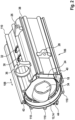
- Figure 2 shows a perspective view of the system housing 12 designed according to the invention according to Figure 1 .
- the mounting space 18 for accommodating power electronics is integrated into the system housing 12, which is designed as a double-walled extruded housing 14.
- the fastening elements 26, 28 are provided at individual locations between adjacent ribs 110 of the outer geometry 106 of the system housing 12; the same applies to the bearing and/or damping elements 34, 36, which are also arranged between adjacent ribs 110 of the outer geometry 106 extending in the longitudinal direction 108.
- Figure 3 shows the course of a coolant flow through the double-walled extruded housing 14.
- the system housing 12 proposed according to the invention designed as a double-walled extruded housing 14 of an extruded profile, has the cooling channel system 16, through which the cooling fluid flow 46 flows.
- the cooling fluid flow 46 passes through an area located below the cooling surface 24, in which at least one cooling rib 48 is arranged. This improves the heat transfer from the Figure 3 not shown, power electronics placed on the cooling surface 24 to the cooling fluid circulating in the cooling channel system 16. This is fed to the cooling channel system 16 of the system housing 12 via an inlet 30 and leaves the cooling channel system 16 via an outlet 32 and transports the absorbed waste heat out of the system housing 12.
- Figure 3 further shows the ribs 110 of the outer geometry 106 which are formed in the plane of the drawing, ie here coinciding with the longitudinal direction 108. Furthermore, Figure 3 which also extends in the longitudinal direction 108 perpendicular to the plane of the drawing according to Figure 3 extending longitudinal grooves 38, 40, 42, 44. From the illustration according to Figure 3 It is also apparent that the cooling surface 24 is delimited by the first groove 20 and the second groove 22 and that the cooling surface 24 is substantially flat in order to realize an improved heat transfer.
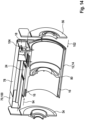
- the E-axis module 10 comprises, in addition to the system housing 12 designed according to the invention, which is designed as a double-walled extruded housing 14, a first bearing plate 54 and a second bearing plate 56, which is designed in a bell shape 58.
- a stator winding 50 and a gear arrangement 52 are accommodated inside the system housing 12.
- the gear arrangement 52 can have a single-stage or multi-stage planetary gear.
- a power electronics 70 is essentially a rectangular component on the here only indicated System housing 12 is accommodated flat.
- the cooling fluid flow 46 runs from the inlet 30 to the outlet 32 and transports the waste heat generated during operation of the e-axis module 10 out of the system housing 12.
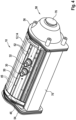
- Figure 4 also shows a rotor 76 of an electrical machine with the system housing designed according to the invention, on whose rotor shaft the gear arrangement 52 is located.
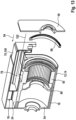
- FIG. 5 shows a perspective view of the second bearing plate 56, designed in bell shape 58.
- the second bearing plate 56 comprises an inner axial ribbing 60 and a first ring-shaped sealing element 62, a second, also ring-shaped sealing element 64 and a third ring-shaped sealing element 66.
- Figures 6.1 and 6.2 illustrate the installation of the power electronics 70 in the assembly space 18 of the system housing 12.
- the power electronics 70 is, for example, laterally, ie in the direction of the drawing plane according to Figure 6.1 inserted into the assembly space 18.
- the power electronics 70 contacts the cooling surface 24 with its lower flat surface. Below the cooling surface 24 there is at least one cooling rib 48, via which the cooling fluid transports away waste heat that is generated during operation of the power electronics 70.
- Figure 6.1 also shows that the power electronics 70 is fixed in its base area by the first groove 20 and the second groove 22.
- the external geometry 106 of the system housing 12, preferably designed as a double-walled extruded housing 14, has ribs 110 extending in the longitudinal direction 108, analogous to the figures described above.
- outer geometry 106 of the advantageously designed system housing 12 comprises the longitudinal grooves 38, 40, 42, 44, which also extend in the longitudinal direction 108, ie in the plane of the drawing according to Figure 6.1 extend.
- Figure 6.2 shows in detail that the first groove 20 with an overlap 72 covers the lower, widened area of the power electronics 70 with clearance.
- the cooling fins 48 are located below or next to the cooling surface 24, via which the waste heat transport of the waste heat generated during operation of the power electronics 70 is optimized.
- Figure 7 is an exploded view of the components of the system housing 12 designed according to the invention.
- the assembly room 18 is designed to accommodate the Figure 7 not shown power electronics is integrated into the system housing 12, designed as a double-walled extruded housing 14.
- the cooling surface 24, which delimits the mounting space 18 for accommodating the power electronics, is provided with a housing opening 78, so that direct cooling of the Figure 7 not shown, but which can be placed in the assembly space 18.
- a bearing support 80 is located in the interior of the system housing 12, via which the rotor shaft of the rotor 76 of the electric machine is additionally supported.
- On one side of the bearing support 80 is the gear arrangement 52, accommodated in the second bearing plate 56, while on the opposite side of the bearing support 80, surrounded by the stator winding 50, is the rotor winding of the rotor 76.
- the rotor shaft of the rotor 76 is accommodated in the first bearing plate 54.
- the power electronics 70 are mounted in the vertical mounting direction 92 on the top side of the system housing 12 proposed according to the invention, designed as a double-walled extruded housing 14, in particular on the cooling surface 24.
- the power electronics 70 comprises a number of contacts 82, which pass through contact openings 84, designed in a corresponding number, and provide an electrical connection between the power electronics 70 and the Figure 13 not shown stator winding 50 of the electrical machine.
- the cover 86 encloses the power electronics 70 on all sides.
- the inlet 30 and the outlet 32 for the cooling fluid are located on the side of the system housing 12.
- the contact openings 84 extend essentially in the vertical direction corresponding to the extension of the contacts 82 on the underside of the power electronics 70.
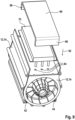
- Figure 9 shows a variant of the system housing 12 proposed according to the invention, in which the power electronics 70 are also electrically contacted in the vertical mounting direction 92 on the cooling surface 24 of the mounting space 18.
- the contacts 82 extend essentially vertically from the underside of the power electronics 70; the contact openings 84 to the stator winding 50 of the electrical machine are designed accordingly.
- the mounting space 18 for accommodating the power electronics 70 is delimited by side walls that are part of the system housing 12, which is designed according to the invention as a double-walled extruded housing 14.
- the cover 86 comprises bevels 88 on each of the short sides.
- Figure 10 shows a variant of the system housing 12 proposed according to the invention, the components of which are shown here in an exploded view.
- the system housing 12 is formed by the first bearing plate 54 and the second bearing plate 56 after the components have been assembled in accordance with the Figures 7 to 11 Also in the version according to Figure 10
- the assembly of the power electronics 70 is carried out essentially in the vertical assembly direction 92.
- the contacts 82 on the underside of the power electronics 70 are inserted into corresponding contact openings 84 of the cooling surface 24 and represent an electrical connection between the power electronics 70 and the stator winding 50 of the electrical machine (not shown here).
- the cover 86 is in the embodiment according to Figure 15 with side rounded curvatures 90.
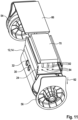
- Figure 11 shows a variant of the system housing 12 proposed according to the invention, also designed as a double-walled extruded housing 14, in which the cover part 86 is attached to the first bearing plate 54.
- the contacts 82 extending on the underside of the power electronics 70 are electrically contacted in the contact openings 84 in the cooling surface 24, which are designed in a corresponding number.
- the inlet 30 and the outlet 32 for the cooling fluid flowing through the double-walled extruded housing 14 are located on the side of the system housing 12.
- Figure 12 shows a variant of the system housing 12 proposed according to the invention, in which the power electronics 70 are inserted into the assembly space 18 in a horizontal assembly direction 94.
- the contacts 82 on the underside of the power electronics 70 as well as the contact openings 84 in an oblique orientation 96.
- the system housing 12 also designed here as a double-walled extruded housing 14, is closed by the first bearing plate 54 and the second bearing plate 56. There are surfaces on the bearing plates 54 and 56 which close the assembly space 18 after the power electronics 70 has been installed.
- FIGS 13 and 14 show embodiments of the system housing 12 proposed according to the invention, in which the power electronics 70 is essentially designed as a plug-in part 100.
- the power electronics 70 designed as a plug-in part 100 is inserted in the horizontal assembly direction 94 into the assembly space 18 according to the Figures 13 and 14 according to Figure 18, after the power electronics 70 have been pushed in, their position in the assembly space 18 can be fixed by a half-shell 98.
- the housing opening 78 is formed so that direct cooling of the power electronics 70 can take place via the cooling fluid circulating in the cooling channel system 16.
- Figure 14 shows the assembly of the power electronics 70, also designed as a plug-in part 100, in the horizontal assembly direction 94 in the assembly space 18.
- the assembly space 18 is closed by the first bearing plate 54 and the second bearing plate 56.
- the additionally provided bearing carrier 80 which additionally supports the rotor shaft of the rotor 76 (not shown here).
- at least one contacting part 104 provides the electrical contact between the power electronics 70 and the Figure 14 not shown stator winding 50.
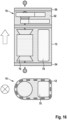
- Figure 15 shows an alternative embodiment of the E-axis module 10.
- the gear arrangement 52 of the E-axis module 10 is designed with a spur gear.
- Figure 16 shows an alternative embodiment of the E-axis module 10.
- the gear arrangement 52 of the E-axis module 10 is designed with a coaxial spur gear.
- Figure 17 shows an alternative embodiment of the E-axis module 10.
- the gear arrangement 52 of the E-axis module 10 is designed with a coaxial planetary gear.
Landscapes
- Engineering & Computer Science (AREA)
- Power Engineering (AREA)
- Transportation (AREA)
- Mechanical Engineering (AREA)
- Chemical & Material Sciences (AREA)
- Combustion & Propulsion (AREA)
- Microelectronics & Electronic Packaging (AREA)
- Life Sciences & Earth Sciences (AREA)
- Sustainable Development (AREA)
- Sustainable Energy (AREA)
- Physics & Mathematics (AREA)
- Thermal Sciences (AREA)
- Motor Or Generator Frames (AREA)
Description
- Die Erfindung bezieht sich auf ein Systemgehäuse eines E-Achsen-Moduls mit einer Statorwicklung und einem Rotor einer elektrischen Maschine, der in mindestens einem ersten Lagerschild und einem zweiten Lagerschild gelagert ist. Des Weiteren bezieht sich die Erfindung auf die Verwendung des Systemgehäuses eines E-Achsen-Moduls in einem elektrisch angetriebenen Fahrzeug.
- E-Achsen-Module weisen üblicherweise als Gussbauteile gefertigte Gehäuse auf, die einerseits als urformendes Bauteil aufwändig in der Herstellung sind und andererseits ein relativ hohes Gewicht haben. Gussbauteile verfügen hingegen über gute Wärmeleiteigenschaften und können an die unterschiedlichsten Einsatzbedingungen angepasst und individuell hergestellt werden, was jedoch einer Großserienfertigung im Wege steht.
- Andererseits sind modular aufgebaute Getriebegehäuse bekannt, die jedoch mit dem Nachteil einhergehen, dass diese eine große Anzahl von Bauteilen aufweisen, was die Montage erheblich verteuert und eine Vielzahl von Schnittstellen mit sich bringt, die zu fehlerhaften Montageschritten innerhalb der Montage solcher Gehäuse führen können.
-
EP3488514 A1 ist als nächstliegender Stand der Technik angesehen und offenbart die Merkmale der Präambel des unabhängigen Anspruchs 1. - Die Aufgabe der Erfindung ist, ein Systemgehäuse eines E-Achsen-Moduls für ein elektrisch angetriebenes Fahrzeug bereitzustellen, das gegenüber aus dem Stand der Technik bekannten Systemgehäusen von E-Achsen-Modulen eine geringere Anzahl von Bauteilen aufweist und kostengünstig hergestellt werden kann.
- Die erfindungsgemäße Aufgabe wird durch ein Systemgehäuse gemäß den Merkmalen des unabhängigen Anspruchs 1 gelöst. Vorteilhafte Ausgestaltungen des Systemgehäuses eines E-Achsen-Moduls werden in den abhängigen Ansprüchen beschrieben.
- Die Erfindung bezieht sich auch auf die Verwendung des Systemgehäuses eines E-Achsen-Moduls in einem elektrisch angetriebenen Fahrzeugs gemäß den Merkmalen des unabhängigen Anspruchs 11.
- Erfindungsgemäß wird ein Systemgehäuse eines E-Achsen-Moduls vorgeschlagen, wobei das E-Achsen-Modul eine Statorwicklung und einen Rotor einer elektrischen Maschine umfasst, der in mindestens einem ersten Lagerschild und einem zweiten Lagerschild gelagert ist. Das erfindungsgemäß vorgeschlagene Systemgehäuse ist als doppelwandiges extrudiertes Gehäuse ausgeführt, das ein Kanalsystem umfasst, welches sich unterhalb einer Kühlfläche eines Montageraums einer Leistungselektronik erstreckt.
- Durch das erfindungsgemäß vorgeschlagene Systemgehäuse, welches in einer vorteilhaften Weiterbildung des erfindungsgemäßen Systemgehäuses als doppelwandiges extrudiertes Strangpressprofil ausgebildet sein kann, wird ein kostengünstiges großseriengeeignetes Bauteil bereitgestellt, welches sich durch eine Außengeometrie auszeichnet, an der an unterschiedlichen Stellen eine Vielzahl von Lagerungs- und Dämpfungselementen sowie Befestigungselementen vorgesehen werden kann, die an unterschiedlichste Einbaubedingungen angepasst werden können, wodurch sich eine sehr hohe Flexibilität bei gleichzeitig kostengünstiger Herstellung erreichen lässt.
- In einer vorteilhaften Weiterbildung des erfindungsgemäß vorgeschlagenen Systemgehäuses weist dieses eine Außengeometrie auf, die eine Anzahl von sich im Wesentlichen in Längsrichtung des Systemgehäuses verlaufenden Rippen aufweist. Diese Rippen können, da sie in Umfangsrichtung des Systemgehäuses voneinander beabstandet ausgeführt sind, als Befestigungsstellen sowohl für Lagerungs- und Dämpfungselemente als auch für Befestigungselemente an der Fahrzeugkarosserie dienen.
- In einer vorteilhaften Weiterbildung des erfindungsgemäß vorgeschlagenen Systemgehäuses sind an der Außengeometrie des Systemgehäuses mindestens ein Lagerungs- und/oder Dämpfungselement sowie mindestens ein Befestigungselement angeordnet. Da diese an der Außengeometrie seitlich in Längsrichtung des Systemgehäuses gesehen verschiebbar sind, können individuelle Kundenwünsche berücksichtigt werden hinsichtlich des Einbauortes beziehungsweise hinsichtlich der vorzusehenden Schnittstellen zwischen dem Systemgehäuse des E-Achsen-Moduls und dem Fahrzeug beziehungsweise der Fahrzeugkarosserie.
- Darüber hinaus ist bei einer vorteilhaften Weiterbildung des erfindungsgemäß vorgeschlagenen Systemgehäuses dessen Außengeometrie so beschaffen, dass dieses insbesondere eine Anzahl von Nuten, die vorzugsweise als Längsnuten ausgeführt sind, umfasst. Auch hierdurch können die Vorteile eines im Wesentlichen doppelwandig, als extrudiertes Strangpressprofil ausgebildeten Systemgehäuses genutzt werden, da die Nuten unmittelbar in das Gehäuse, bei dessen Fertigung als Stranggussbauteil, eingebracht werden können. Die sich über die gesamte Länge in Längsrichtung des Systemgehäuses erstreckenden Nuten sind durchgängig ausgeführt, so dass an unterschiedlichen Stellen innerhalb der einzelnen Nuten Befestigungspunkte vorgesehen werden können, was ebenfalls eine hohe Varianz des erfindungsgemäß vorgeschlagenen Systemgehäuses mit sich bringt und flexibel an die unterschiedlichsten Kundenwünsche angepasst werden kann.
- Eine vorteilhafte Weiterbildung des erfindungsgemäß vorgeschlagenen Systemgehäuses zeichnet sich des Weiteren dadurch aus, dass das Kühlkanalsystem unterhalb der Kühlfläche des Montageraumes der Leistungselektronik mindestens eine Kühlverrippung umfasst. Das das doppelwandige extrudierte Systemgehäuse durchziehende Kühlkanalsystem kühlt nicht nur den Mantel des Systemgehäuses, sondern ermöglicht darüber hinaus die Kühlung der Kühlfläche des in das Systemgehäuse integrierten Aufnahmeraums für die Leistungselektronik . Ist unterhalb der Aufnahmefläche für eine untere Planfläche des Bauteils der Leistungselektronik eine Kühlverrippung vorgesehen, so kann ein erheblich verbesserter Wärmetransport von Abwärme, die die Leistungselektronik während ihres Betriebs produziert, gewährleistet werden. Dies bedeutet, dass durch das erfindungsgemäß vorgeschlagene Kühlsystem gezielt an Stellen effektiv gekühlt werden kann, wo eine hohe Abwärmeproduktion auftritt.
- In einer vorteilhaften Weiterbildung des erfindungsgemäß vorgeschlagenen Systemgehäuses weist das Kühlkanalsystem im Bereich der Kühlfläche entweder eine Öffnung zur direkten Kühlung der Leistungselektronik auf oder die Kühlfläche der Leistungselektronik ist mittelbar über die bereits vorstehend erwähnte Kühlverrippung unterhalb der Kühlfläche temperierbar. Durch die erfindungsgemäß vorgeschlagene Lösung besteht die Möglichkeit der Implementierung einer direkten und einer indirekten Kühlung des Leistungselektronikbauteils, dessen Montageraum in das doppelwandige extrudierte Systemgehäuse integriert ist.
- Erfindungsgemäß weist das Systemgehäuse einen mittig in diesem montierten zusätzlichen Lagerträger auf, der den Rotor der elektrischen Maschine zwischen der Statorwicklung im Systemgehäuse einerseits und der Getriebeanordnung auf der Rotorwelle des Rotors andererseits abstützt und zudem diese Komponenten voneinander trennt. Durch den Lagerträger, der im Systemgehäuse in dessen Mitte angebracht ist, wird nicht nur eine zusätzliche Lagerungsmöglichkeit der Rotorwelle des Rotors der elektrischen Maschine kreiert, sondern darüber hinaus auch ein "nasslaufender" Teil, in dem die Getriebeanordnung untergebracht ist vom "trockenen" Teil des Rotors der elektrischen Maschine getrennt wird. Demnach übernimmt der zusätzliche Lagerträger neben einer zusätzlichen Abstützfunktion auch die Trennung von "nasslaufendem" Teil und trockenem Teil innerhalb des Systemgehäuses des E-Achsen-Moduls.
- Das erfindungsgemäß vorgeschlagene Systemgehäuse kann in einer vorteilhaften Ausführungsvariante derart gestaltet sein, dass die Leistungselektronik in dem im Systemgehäuse vorgehaltenen Montageraum im Wesentlichen in vertikaler Richtung montiert wird, wobei die Leistungselektronik Kontaktierungsöffnungen aufweist, die bei der Montage in vertikaler Richtung in Kontaktierungsöffnungen zur Statorwicklung einfahren.
- In einer anderen vorteilhaften Ausführungsvariante des erfindungsgemäß vorgeschlagenen Systemgehäuses kann dieses derart konfiguriert sein, dass die Leistungselektronik in den Montageraum im Wesentlichen in horizontaler Richtung seitlich eingeschoben wird, also als Einschubteil ausgeführt sein kann.
- Bei der letztgenannten vorteilhaften Ausführungsvariante des erfindungsgemäß vorgeschlagenen Systemgehäuses können beispielsweise sowohl die Kontaktierungen der Leistungselektronik als auch deren Kontaktöffnungen zur Statorwicklung in Schrägorientierung ausgeführt sein, so dass die Kontaktierungen bei der seitlichen Montage, d. h. dem seitlichen Einschieben der Leistungselektronik in den Montageraum, die Kontaktierungsöffnungen zur Statorwicklung unmittelbar kontaktieren.
- Bei einer vorteilhaften Weiterbildung des erfindungsgemäß vorgeschlagenen Systemgehäuses kann alternativ auch eine elektrische Kontaktierung zwischen der Leistungselektronik und der Statorwicklung über mindestens ein Kontaktierungsteil hergestellt werden.
- Durch die erfindungsgemäß vorgeschlagene Ausführung des Systemgehäuses als doppelwandiges, extrudiertes Gehäuse, insbesondere als von einem extrudierten Strangpressprofil abgetrennten Profils, kann die Außengeometrie zur individuellen Befestigung genutzt werden. Dazu umfasst die Außengeometrie einer vorteilhaften Weiterbildung des erfindungsgemäß vorgeschlagenen Systemgehäuses sich im Wesentlichen kontinuierlich in Längsrichtung des Systemgehäuses gesehen erstreckende Verrippungen, die in Umfangsrichtung des Systemgehäuses gesehen voneinander beabstandet sind.
- Innerhalb dieser Abstände, d. h. zweier benachbarter Rippen, können Lagerungs- und Dämpfungselemente, beispielsweise Gummilager oder dergleichen, sowie Befestigungselemente, die eine Verschraubungsmöglichkeit zur Karrosserie eines Fahrzeugs darstellen, vorgesehen werden. Dies erhöht in signifikanter Weise die Flexibilität der Befestigungsstellen des erfindungsgemäß vorgeschlagenen Systemgehäuses und erlaubt eine individuelle Kundenkonfiguration. Es müssen an der Außengeometrie lediglich die Befestigungspunkte so variiert werden, dass diese zu den am Fahrzeug vorgesehenen Befestigungspunkten korrespondieren.
- Darüber hinaus weist das erfindungsgemäß vorgeschlagene Systemgehäuse einen erheblichen Gewichtsvorteil auf verglichen mit im Urformverfahren des Gießens hergestellten Gehäusen. Weiterhin sind die Schnittstellen durch eine Minimierung von Bauteilen erheblich reduziert, so dass Fehler bei der Montage nahezu ausgeschlossen werden können. Das doppelwandig extrudiert ausgebildete Systemgehäuse umfasst mindestens zwei dieses verschließende seitliche Lagerplatten, in denen Lager zur Aufnahme des Rotors der elektrischen Maschine aufgenommen sind. Darüber hinaus zeichnet sich das erfindungsgemäß vorgeschlagene Systemgehäuse dadurch aus, dass in dieses ein Montageraum für die Leistungselektronik integriert ist und eine den Montageraum zur Aufnahme der Leistungselektronik begrenzende Kühlfläche in das Kühlkanalsystem des erfindungsgemäß vorgeschlagenen Systemgehäuses integriert ist. Es kann einerseits eine direkte Kühlung der Leistungselektronik durch eine Öffnung in der Kühlfläche erfolgen, andererseits besteht alternativ die Möglichkeit, durch Vorsehen mindestens einer Kühlverrippung innerhalb der Kühlfläche eine indirekte Kühlung der Leistungselektronik durch Wärmeabfuhr von deren Unterseite an die Kühlfläche in das Kühlfluid vorzunehmen. Durch die alternativ vorgeschlagene Lösung sind beide Varianten der Kühlung, d. h. die direkte sowie die indirekte Kühlung möglich.
- Bei einer vorteilhaften Weiterbildung des erfindungsgemäß vorgeschlagenen Systemgehäuses kann die Leistungselektronik in den Montageraum im Wesentlichen in vertikaler Richtung, d. h. von der Oberseite des Systemgehäuses her, erfolgen. Es besteht alternativ die Möglichkeit, die Leistungselektronik in horizontaler Richtung, d. h. als Einschubbauteil im Montageraum für die Leistungselektronik zu montieren. Bei der Montage, ob in vertikaler oder in horizontaler Richtung, können die bevorzugt an der Unterseite der Leistungselektronik ausgeführten Kontaktierungen unmittelbar mit Kontaktierungsöffnungen der Statorwicklung im Systemgehäuse kontaktiert werden. Die seitlichen Lagerschilde des Systemgehäuses, die dessen Hohlraum abdichten, können zudem in vorteilhafter Weise so ausgebildet sein, dass diese Deckelteile sowie seitliche Abschlussflächen des Montageraums für die Leistungselektronik im Systemgehäuse darstellen.
- Beim erfindungsgemäß vorgeschlagenen Systemgehäuse ist in den Lagerungstellen des Rotors in den Lagerschilden ein zusätzlicher Lagerträger mittig im Systemgehäuse vorgesehen, der die Rotorwelle des Rotors der elektrischen Maschine zusätzlich abstützt.
- Ausführungsformen der Erfindung werden anhand der Zeichnungen und der nachfolgenden Beschreibung näher erläutert.
- Es zeigen:
-
Figur 1 eine Seitenansicht des erfindungsgemäß vorgeschlagenen Systemgehäuses mit Montageraum für die Leistungselektronik -
Figur 2 eine perspektivische Darstellung des erfindungsgemäßen Systemgehäuses gemäß der Darstellung inFigur 1 , -
Figur 3 den Verlauf einer Kühlfluidströmung durch das doppelwandig ausgeführte, extrudierte erfindungsgemäße Systemgehäuse, -
Figur 4 eine perspektivische Ansicht eines komplettierten E-Achsen-Moduls mit in dieses integriertem erfindungsgemäßem Systemgehäuse, -
Figur 5 eine perspektivische Widergabe eines Lagerschildes des erfindungsgemäßen Systemgehäuses, -
Figur 6.1 eine im Montageraum des erfindungsgemäßen Systemgehäuses montierte Leistungselektronik, -
Figur 6.2 ein Detail der Aufnahme der Leistungselektronik im Aufnahmeraum auf der Kühlfläche des erfindungsgemäßen Systemgehäuses, -
Figur 7 eine Explosionsdarstellung der Komponenten des erfindungsgemäßen Systemgehäuses, -
Figur 8 den Einbau einer Leistungselektronik in vertikaler Montagerichtung auf dem erfindungsgemäßen Systemgehäuse, -
Figur 9 die Montage der Leistungselektronik in vertikaler Richtung im erfindungsgemäßen Systemgehäuse und das Aufbringen eines Deckels auf diese, -
Figur 10 die Explosionsdarstellung der Komponenten des E-Achsen-Moduls mit dem erfindungsgemäßen Systemgehäuse, -
Figur 11 einen in einem Lagerschild montierten Deckel zur Abdeckung des in vertikaler Montagerichtung auf dem erfindungsgemäßen Systemgehäuse montierten Leistungselektronikbauteils, -
Figur 12 eine Montage der Leistungselektronik in horizontaler Montagerichtung mit in Schrägorientierung ausgeführten Kontaktierungen und Kontaktierungsöffnungen zur Statorwicklung im erfindungsgemäßen Systemgehäuse, -
Figur 13 eine Explosionsdarstellung des erfindungsgemäßen Systemgehäuses mit als Einschubteil ausgebildeter Leistungselektronik, die in horizontaler Montagerichtung montiert wird und mittels einer Halbschale und eines Lagerschildes fixiert ist, -
Figur 14 eine Ausführungsvariante des erfindungsgemäßen Systemgehäuses, in dessen Montageraum die als Einschubteil ausgeführte Leistungselektronik eingeschoben wird und mittels eines Kontaktierungsteils mit der Statorwicklung der elektrischen Maschine kontaktiert wird, -
Figur 15 eine alternative Ausführungsform des E-Achsen-Moduls 10, -
Figur 16 eine weitere alternative Ausführungsform des E-Achsen-Moduls 10 und -
Figur 17 eine weitere alternative Ausführungsform des E-Achsen-Moduls 10. - In der nachfolgenden Beschreibung der Ausführungsformen der Erfindung werden gleiche oder ähnliche Elemente mit gleichen Bezugszeichen bezeichnet, wobei auf eine wiederholte Beschreibung dieser Elemente in Einzelfällen verzichtet wird. Die Figuren stellen den Gegenstand der Erfindung nur schematisch dar.
- Der Darstellung gemäß
Figur 1 ist ein erfindungsgemäß ausgeführtes Systemgehäuse 12 eines E-Achsen-Moduls 10 zu entnehmen. Das Systemgehäuse 12 ist ein doppelwandig ausgeführtes, extrudiertes Gehäuse 14, insbesondere ein Stranggussbauteil. Durch die Doppelwand des extrudierten Gehäuses 14 verläuft ein Kühlkanalsystem 16, wie ausFigur 1 hervorgeht. Am Systemgehäuse 12 befindet sich ein Montageraum 18 zur Aufnahme einer hier nicht näher dargestellten Leistungselektronik. Am erfindungsgemäß vorgeschlagenen Systemgehäuse 12 ist eine Außengeometrie 106 ausgebildet. Die Außengeometrie 106 erstreckt sich im Wesentlichen zur senkrecht in die Zeichenebene verlaufenden Längsrichtung 108. Die Außengeometrie 106 kann vorzugsweise durch eine Anzahl von Rippen 110 gebildet werden. Des Weiteren umfasst die Außengeometrie 106 des extrudierten Gehäuses 14, das als Systemgehäuse 12 dient, eine erste Nut 20 sowie eine zweite Nut 22. Diese erstrecken sich ebenfalls in die Zeichenebene gemäßFigur 1 . Die erste Nut 20 und die zweite Nut 22 begrenzen eine Kühlfläche 24. Auf dieser wird die Unterseite einer im Wesentlichen plan ausgebildeten Leistungselektronik aufgebracht und mittels der Nuten 20, 22 fixiert. An der Außengeometrie 106 des Systemgehäuses 12 sind ein erstes Befestigungselement 26 und ein zweites Befestigungselement 28 dargestellt. Des Weiteren sind an der Außengeometrie 106 Lager- und/oder Dämpfungselemente 34, 36 angeordnet. - Mittels der Befestigungselemente 26, 28 sowie der Lager- und/oder Dämpfungselemente 34, 36 kann das Systemgehäuse 12 des E-Achsen-Moduls 10 an individuell am Fahrzeug vorgesehenen Befestigungspunkten befestigt beziehungsweise gelagert werden. Da die Außengeometrie 106 des Systemgehäuses 12 die sich in Längsrichtung 108 erstreckenden Rippen 110 aufweist, ist eine individuelle Positionierung der Befestigungselemente 26, 28 beziehungsweise der Lager- und/oder Dämpfungselemente 34, 36 auf individuelle Weise möglich.
- Aus der Seitenansicht gemäß
Figur 1 ergibt sich zudem, dass die Außengeometrie 106 eine Anzahl von Nuten, nämlich eine erste Längsnut 38, eine zweite Längsnut 40, eine dritte Längsnut 42 sowie eine vierte Längsnut 44 aufweist. Die Längsnuten 38, 40, 42, 44 können ebenfalls zur Fixierung und Befestigung des Systemgehäuses 12 an individuellen Aufhängungs- und Lagerpunkten im Fahrzeug dienen. -
Figur 2 zeigt eine perspektivische Darstellung des erfindungsgemäß ausgeführten Systemgehäuses 12 gemäßFigur 1 . Aus der perspektivischen Darstellung gemäßFigur 2 geht hervor, dass der Montageraum 18 zur Aufnahme einer Leistungselektronik in das als doppelwandig extrudiertes Gehäuse 14 ausgebildeten Systemgehäuses 12 integriert ist. Aus der perspektivischen Darstellung gemäßFigur 2 lässt sich zudem entnehmen, dass zwischen benachbarten Rippen 110 der Außengeometrie 106 des Systemgehäuses 12 die Befestigungselemente 26, 28 an individuellen Stellen vorgesehen sind; ebenso verhält es sich mit den Lager und/oder Dämpfungselementen 34, 36, die ebenfalls zwischen benachbarten, sich in Längsrichtung 108 erstreckenden Rippen 110 der Außengeometrie 106 angeordnet sind. Aufgrund der Längserstreckung der Rippen 110 parallel zur Längsrichtung 108 des extrudierten Gehäuses 14 ergeben sich unterschiedliche, individuelle Positionierungsmöglichkeiten und damit flexible Individuallösungen ermöglichende Befestigungsmöglichkeiten als vorteilhafte Weiterbildungen des erfindungsgemäß vorgeschlagenen Systemgehäuses 12 des E-Achsen-Moduls 10. -
Figur 3 zeigt den Verlauf einer Kühlmittelströmung durch das doppelwandig ausgeführte extrudierte Gehäuse 14. - Wie aus der Seitenansicht gemäß
Figur 3 näher hervorgeht, weist das erfindungsgemäß vorgeschlagene Systemgehäuse 12, ausgeführt als doppelwandiges extrudiertes Gehäuse 14 eines Extrusionsprofils, das Kühlkanalsystem 16 auf, welches von der Kühlfluidströmung 46 durchströmt wird. Die Kühlfluidströmung 46 passiert während der Passage des Kühlkanalsystems 16 einen unterhalb der Kühlfläche 24 liegenden Bereich, in welchem mindestens eine Kühlverrippung 48 angeordnet ist. Diese verbessert den Wärmeübergang von der inFigur 3 nicht dargestellten auf der Kühlfläche 24 platzierten Leistungselektronik an das im Kühlkanalsystem 16 zirkulierende Kühlfluid. Dieses wird über einen Einlass 30 dem Kühlkanalsystem 16 des Systemgehäuses 12 zugeführt und verlässt über einen Auslass 32 das Kühlkanalsystem 16 und transportiert die aufgenommene Abwärme aus dem Systemgehäuse 12. -
Figur 3 zeigt des Weiteren die sich in die Zeichenebene, d. h. hier mit der Längsrichtung 108 zusammenfallend, ausgebildeten Rippen 110 der Außengeometrie 106. Weiterhin zeigtFigur 3 die sich ebenfalls in Längsrichtung 108 senkrecht zur Zeichenebene gemäßFigur 3 erstreckenden Längsnuten 38, 40, 42, 44. Aus der Darstellung gemäßFigur 3 geht darüber hinaus hervor, dass die Kühlfläche 24 von der ersten Nut 20 sowie der zweiten Nut 22 begrenzt ist und die Kühlfläche 24 im Wesentlichen eben verläuft, um einen verbesserten Wärmeübergang zu realisieren. - Der perspektivischen Darstellung gemäß
Figur 4 ist das E-Achsen-Modul 10 zu entnehmen. Das E-Achsen-Modul 10 umfasst neben dem erfindungsgemäß ausgeführten Systemgehäuse 12, welches als doppelwandiges extrudiertes Gehäuse 14 ausgebildet ist, ein erstes Lagerschild 54 sowie ein zweites Lagerschild 56, das in Glockenform 58 ausgebildet ist. Im Inneren des Systemgehäuses 12 sind eine Statorwicklung 50 sowie eine Getriebeanordnung 52 aufgenommen. Die Getriebeanordnung 52 kann ein ein- oder mehrstufiges Planetengetriebe aufweisen. - Aus
Figur 4 geht des Weiteren hervor, dass eine Leistungselektronik 70 im Wesentlichen als rechteckförmiges Bauelement auf dem hier nur angedeuteten Systemgehäuse 12 plan aufgenommen ist. Innerhalb des Systemgehäuses 12, das als doppelwandiges extrudiertes Gehäuse 14 ausgeführt ist, verläuft die Kühlfluidströmung 46 ausgehend vom Einlass 30 zum Auslass 32 und transportiert die im Betrieb des E-Achsen-Moduls 10 entstehende Abwärme aus dem Systemgehäuse 12 hinaus. -
Figur 4 zeigt darüber hinaus einen Rotor 76 einer elektrischen Maschine mit dem erfindungsgemäß ausgeführten Systemgehäuse, an dessen Rotorwelle sich die Getriebeanordnung 52 befindet. -
Figur 5 zeigt eine perspektivische Darstellung des zweiten Lagerschilds 56, ausgebildet in Glockenform 58. Das zweite Lagerschild 56 umfasst eine innere Axialverrippung 60 sowie ein erstes ringförmig ausgebildetes Dichtungselement 62, ein zweites, ebenfalls ringförmig ausgebildetes Dichtungselement 64 sowie ein drittes ringförmig ausgebildetes Dichtungselement 66. -
Figuren 6.1 und 6.2 verdeutlichen die Aufnahme der Leistungselektronik 70 im Montageraum 18 des Systemgehäuses 12. Die Leistungselektronik 70 ist beispielsweise seitlich, d. h. in Richtung der Zeichenebene gemäßFigur 6.1 in den Montageraum 18 eingeschoben. Die Leistungselektronik 70 kontaktiert mit ihrer unteren Planfläche die Kühlfläche 24. Unterhalb der Kühlfläche 24 befindet sich mindestens eine Kühlverrippung 48, über welche das Kühlfluid Abwärme abtansportiert, die beim Betrieb der Leistungselektronik 70 entsteht.Figur 6.1 zeigt darüber hinaus, dass die Leistungselektronik 70 in ihrem Fußbereich von der ersten Nut 20 und der zweiten Nut 22 übergriffen, fixiert ist. Die Außengeometrie 106 des Systemgehäuses 12, vorzugsweise als doppelwandiges extrudiertes Gehäuse 14 ausgebildet, weist analog zu den vorstehend beschriebenen Figuren sich in Längsrichtung 108 erstreckende Rippen 110 auf. - Darüber hinaus umfasst die Außengeometrie 106 des vorteilhaft ausgestalteten Systemgehäuses 12 die Längsnuten 38, 40, 42, 44, die sich ebenfalls in Längsrichtung 108, d. h. in die Zeichenebene gemäß
Figur 6.1 erstrecken. -
Figur 6.2 zeigt im Detail, dass die erste Nut 20 mit einem Übergriff 72 den unteren, verbreiterten Bereich der Leistungselektronik 70 mit Spiel überdeckt. Wie aus der vergrößerten Darstellung gemäßFigur 6.2 hervorgeht, befinden sich unterhalb beziehungsweise neben der Kühlfläche 24 die Kühlverrippungen 48, über welche eine Optimierung des Abwärmetransports der Abwärme, die beim Betrieb der Leistungselektronik 70 entsteht, erfolgt. -
Figur 7 ist eine Explosionsdarstellung der Komponenten des erfindungsgemäß ausgeführten Systemgehäuses 12 zu entnehmen. - Aus
Figur 7 geht hervor, dass der Montageraum 18 zur Aufnahme der inFigur 7 nicht dargestellten Leistungselektronik in das Systemgehäuse 12, ausgebildet als doppelwandiges extrudiertes Gehäuse 14, integriert ist. Die Kühlfläche 24, die den Montageraum 18 zur Aufnahme der Leistungselektronik begrenzt, ist mit einem Gehäusedurchbruch 78 versehen, so dass eine direkte Kühlung der inFigur 7 nicht dargestellten, jedoch im Montageraum 18 platzierbaren Leistungselektronik erfolgen kann. - Erfindungsgemäß befindet sich im Innenraum des Systemgehäuses 12 ein Lagerträger 80, über welchen die Rotorwelle des Rotors 76 der elektrischen Maschine zusätzlich abgestützt wird. Auf der einen Seite des Lagerträgers 80 befindet sich die Getriebeanordnung 52, aufgenommen im zweiten Lagerschild 56, während sich auf der gegenüberliegenden Seite des Lagerträgers 80, von der Statorwicklung 50 umschlossen, die Rotorwicklung des Rotors 76 befindet. Die Rotorwelle des Rotors 76 ist im ersten Lagerschild 54 aufgenommen.
- Aus der Darstellung gemäß
Figur 8 geht hervor, dass auf der Oberseite des erfindungsgemäß vorgeschlagenen Systemgehäuses 12, ausgeführt als doppelwandiges extrudiertes Gehäuse 14, insbesondere auf der Kühlfläche 24 die Leistungselektronik 70 in vertikaler Montagerichtung 92 montiert wird. An ihrer vorzugsweise plan ausgebildeten Unterseite umfasst die Leistungselektronik 70 eine Anzahl von Kontaktierungen 82, die Kontaktierungsöffnungen 84, in korrespondierender Anzahl ausgeführt, durchsetzen und eine elektrische Verbindung zwischen der Leistungselektronik 70 und der inFigur 13 nicht dargestellten Statorwicklung 50 der elektrischen Maschine herstellen. Nach Montage der Leistungselektronik 70 in vertikaler Montagerichtung 92 auf der Oberseite des Systemgehäuses 12 erfolgt deren Abdeckung mittels des Deckels 86. Der Deckel 86 umschließt die Leistungselektronik 70 allseitig. Seitlich am Systemgehäuse 12 befinden sich der Einlass 30 sowie der Auslass 32 für das Kühlfluid. In der Ausführungsvariante gemäßFigur 8 erstrecken sich die Kontaktierungsöffnungen 84 im Wesentlichen in vertikaler Richtung korrespondierend zur Erstreckung der Kontaktierungen 82 an der Unterseite der Leistungselektronik 70. -
Figur 9 zeigt eine Ausführungsvariante des erfindungsgemäß vorgeschlagenen Systemgehäuses 12, bei dem die Leistungselektronik 70 ebenfalls in vertikaler Montagerichtung 92 auf der Kühlfläche 24 des Montageraums 18 elektrisch kontaktiert wird. Die Kontaktierungen 82 erstrecken sich im Wesentlichen vertikal verlaufend von der Unterseite der Leistungselektronik 70; dementsprechend sind die Kontaktierungsöffnungen 84 zur Statorwicklung 50 der elektrischen Maschine ausgeführt. Der Montageraum 18 zur Aufnahme der Leistungselektronik 70 ist von Seitenwänden begrenzt, die Teil des Systemgehäuses 12 sind, das erfindungsgemäß als doppelwandiges extrudiertes Gehäuse 14 ausgeführt ist. - Der Deckel 86 umfasst in dieser Ausführungsvariante Abkantungen 88 an den jeweils kurzen Seiten.
-
Figur 10 zeigt eine Ausführungsvariante des erfindungsgemäß vorgeschlagenen Systemgehäuses 12, dessen Komponenten hier in Explosionsdarstellung dargestellt sind. Das Systemgehäuse 12 wird durch das erste Lagerschild 54 und das zweite Lagerschild 56 nach der Montage der Komponenten gemäß denFiguren 7 bis 11 verschlossen. Auch in der Ausführungsvariante gemäßFigur 10 erfolgt die Montage der Leistungselektronik 70 im Wesentlichen in vertikaler Montagerichtung 92. Die Kontaktierungen 82 an der Unterseite der Leistungselektronik 70 werden in entsprechende korrespondierend ausgebildete Kontaktierungsöffnungen 84 der Kühlfläche 24 eingesteckt und stellen eine elektrische Verbindung zwischen der Leistungselektronik 70 und der hier nicht dargestellten Statorwicklung 50 der elektrischen Maschine dar. Der Deckel 86 ist in der Ausführungsvariante gemäßFigur 15 mit seitlich abgerundeten Wölbungen 90 versehen. -
Figur 11 zeigt eine Ausführungsvariante des erfindungsgemäß vorgeschlagenen Systemgehäuses 12, ebenfalls ausgeführt als doppelwandiges extrudiertes Gehäuse 14, bei welchem am ersten Lagerschild 54 das Deckelteil 86 befestigt ist. Nach Montage der Leistungselektronik 70 im Montageraum 18 in im Wesentlichen vertikaler Montagerichtung 92 werden die sich an der Unterseite der Leistungselektronik 70 erstreckenden Kontaktierungen 82 in die in korrespondierender Anzahl ausgeführten Kontaktierungsöffnungen 84 in der Kühlfläche 24 elektrisch kontaktiert. Seitlich am Systemgehäuse 12 befinden sich der Einlass 30 und der Auslass 32 für das das doppelwandig ausgeführte extrudierte Gehäuse 14 durchströmende Kühlfluid. -
Figur 12 zeigt eine Ausführungsvariante des erfindungsgemäß vorgeschlagenen Systemgehäuses 12, bei der die Leistungselektronik 70 in horizontaler Montagerichtung 94 in den Montageraum 18 eingeschoben wird. Im Unterschied zu den vorstehend beschriebenen Ausführungsvarianten mit vertikaler Montagerichtung 92 der Leistungselektronik 70 verlaufen in der Darstellung gemäßFigur 12 die Kontaktierungen 82 an der Unterseite der Leistungselektronik 70 ebenso wie die Kontaktierungsöffnungen 84 in Schrägorientierung 96. Dies bedeutet, dass beim seitlichen Einschieben der Leistungselektronik 70 die in Schrägorientierung 96 angeordneten Kontaktierungen 82 in die Kontaktierungsöffnungen 84 einfahren und ein Flächenkontakt zwischen der Kühlfläche 24 und der Unterseite der Leistungselektronik 70 entsteht. Das Systemgehäuse 12, auch hier ausgeführt als doppelwandiges extrudiertes Gehäuse 14, ist vom ersten Lagerschild 54 und vom zweiten Lagerschild 56 verschlossen. An den Lagerschilden 54 und 56 befinden sich jeweils Flächen, die nach Montage der Leistungselektronik 70 im Montageraum 18 diesen verschließen. - Die
Figuren 13 und14 zeigen Ausführungsvarianten des erfindungsgemäß vorgeschlagenen Systemgehäuses 12, bei welchen die Leistungselektronik 70 im Wesentlichen als Einschubteil 100 ausgeführt ist. Die als Einschubteil 100 ausgeführte Leistungselektronik 70 wird in horizontaler Montagerichtung 94 in den Montageraum 18 gemäß denFiguren 13 und14 seitlich eingeschoben. Gemäß Figur 18 kann nach Einschieben der Leistungselektronik 70 deren Position im Montageraum 18 durch eine Halbschale 98 fixiert werden. Im Systemgehäuse 12 ist in der Ausführungsvariante gemäßFigur 13 der Gehäusedurchbruch 78 ausgebildet, so dass eine direkte Kühlung der Leistungselektronik 70 über das im Kühlkanalsystem 16 zirkulierende Kühlfluid erfolgen kann. Für den Fall, dass alternativ kein Gehäusedurchbruch 78 vorgesehen ist, kann eine indirekte Kühlung der Leistungselektronik 70 dadurch erfolgen, dass über die Kühlfläche 24 und eine unterhalb dieser verlaufenden Kühlverrippung 48 die Abwärme der Leistungselektronik 70 an das Kühlfluid übertragen werden kann. AusFigur 13 geht hervor, dass mittig im Systemgehäuse 12, ausgeführt als doppelwandiges extrudiertes Gehäuse 14 mit Kühlkanalsystem 16, der Lagerträger 80 angeordnet ist, ebenso wie die Statorwicklung 50 in das Systemgehäuse 12 eingelassen ist. Mit Bezugszeichen 102 ist die Montagerichtung des zweiten Lagerschildes 56 nach Fixierung der Halbschale 98 bezeichnet. -
Figur 14 zeigt die Montage der Leistungselektronik 70, ebenfalls ausgebildet als Einschubteil 100, in horizontaler Montagerichtung 94 in dem Montageraum 18. Nach Montage der als Einschubteil 100 ausgeführten Leistungselektronik 70 wird der Montageraum 18 durch das erste Lagerschild 54 sowie das zweite Lagerschild 56 verschlossen. In der Mitte des erfindungsgemäß vorgeschlagenen Systemgehäuses 12 befindet sich analog zur Darstellung gemäßFigur 13 der zusätzlich vorgesehene Lagerträger 80, der die hier nicht dargestellte Rotorwelle des Rotors 76 zusätzlich abstützt. Aus der Darstellung gemäßFigur 14 geht hervor, dass mindestens ein Kontaktierungsteil 104 den elektrischen Kontakt zwischen der Leistungselektronik 70 und der inFigur 14 nicht dargestellten Statorwicklung 50 herstellt. Nach Montage der Leistungselektronik 70 im Montageraum 18 erfolgt dessen Verschluss durch entsprechende Flächen, die am ersten Lagerschild 54 sowie am zweiten Lagerschild 56 ausgeführt sind. -
Figur 15 zeigt eine alternative Ausführungsform des E-Achsen-Moduls 10. - Gleiche Elemente in Bezug auf die
Figuren 1 bis 14 sind mit gleichen Bezugszeichen versehen und werden nicht näher erläutert. In dieser Ausführungsform ist die Getriebeanordnung 52 des E-Achsen-Moduls 10 mit Stirnradgetriebe ausgeführt. -
Figur 16 zeigt eine alternative Ausführungsform des E-Achsen-Moduls 10. - Gleiche Elemente in Bezug auf die
Figuren 1 bis 15 sind mit gleichen Bezugszeichen versehen und werden nicht näher erläutert. In dieser Ausführungsform ist die Getriebeanordnung 52 des E-Achsen-Moduls 10 mit koaxialem Stirnradgetriebe ausgeführt. -
Figur 17 zeigt eine alternative Ausführungsform des E-Achsen-Moduls 10. - Gleiche Elemente in Bezug auf die
Figuren 1 bis 16 sind mit gleichen Bezugszeichen versehen und werden nicht näher erläutert. In dieser Ausführungsform ist die Getriebeanordnung 52 des E-Achsen-Moduls 10 mit koaxialem Planetengetriebe ausgeführt. - Die Erfindung ist nicht auf die hier beschriebenen Ausführungsbeispiele und die darin hervorgehobenen Aspekte beschränkt. Vielmehr ist innerhalb des durch die Ansprüche angegebenen Bereichs eine Vielzahl von Abwandlungen möglich, die im Rahmen fachmännischen Handelns liegen.
Claims (11)
- Systemgehäuse (12) eines E-Achsen-Moduls (10) für ein elektrisch angetriebenes Fahrzeug mit einer Statorwicklung (50) und einem Rotor (76) einer elektrischen Maschine, der in mindestens einem ersten Lagerschild (54) und einem zweiten Lagerschild (56) gelagert ist, wobei das Systemgehäuse (12) als doppelwandiges extrudiertes Gehäuse (14) ausgeführt ist, welches ein Kühlkanalsystem (16) umfasst, das sich unterhalb einer Kühlfläche (24) eines Montageraumes (18) einer Leistungselektronik (70) erstreckt, dadurch gekennzeichnet, dass das Systemgehäuse (12) einen mittig in dessen Innenraum montierten, zusätzlichen Lagerträger (80) aufnimmt, der eine im ersten Lagerschild (54) aufgenommene Rotorwelle des Rotors (76) der elektrischen Maschine zwischen der Statorwicklung (50) im Systemgehäuse (12) einerseits und einer auf der gegenüberliegenden Seite des Lagerträgers (80) im zweiten Lagerschild (56) aufgenommenen Getriebeanordnung (52) andererseits zusätzlich abstützt und einen nasslaufenden Teil des Systemgehäuses (12), in dem die Getriebeanordnung (52) untergebracht ist, von einem trockenen Teil des Systemgehäuses (12), in dem der Rortor (76) der elektrischen Maschine untergebracht ist, voneinander trennt.
- Systemgehäuse (12) gemäß Anspruch 1, dadurch gekennzeichnet, dass dieses eine Außengeometrie (106) aufweist, die eine Anzahl von sich in Längsrichtung (108) des Systemgehäuses (12) verlaufender Rippen (110) aufweist.
- Systemgehäuse (12) gemäß den Ansprüchen 1 bis 2, dadurch gekennzeichnet, dass an der Außengeometrie (106) des Systemgehäuses (12) mindestens ein Lagerungs- und/oder Dämpfungselement (34, 36) sowie mindestens ein Befestigungselement (26, 28) angeordnet sind.
- Systemgehäuse (12) gemäß den Ansprüchen 1 bis 3, dadurch gekennzeichnet, dass die Außengeometrie (106) des Systemgehäuses (12) eine Anzahl von Nuten (38, 40, 42, 44), insbesondere Längsnuten, umfasst.
- Systemgehäuse (12) gemäß den Ansprüchen 1 bis 4, dadurch gekennzeichnet, dass das Kühlkanalsystem (16) unterhalb der Kühlfläche (24) des Montageraums (18) der Leistungselektronik (70) mindestens eine Kühlverrippung (48) umfasst.
- Systemgehäuse (12) gemäß den Ansprüchen 1 bis 5, dadurch gekennzeichnet, dass das Kühlkanalsystem (16) im Bereich der Kühlfläche (24) eine Öffnung (78) zur direkten Kühlung der Leistungselektronik (70) aufweist, oder die Kühlfläche (24) unterhalb der Leistungselektronik (70) mittelbar über die Kühlverrippung (48) temperiert wird.
- Systemgehäuse (12) gemäß den Ansprüchen 1 bis 6, dadurch gekennzeichnet, dass die Leistungselektronik (76) in den Montageraum (18) in vertikaler Richtung (92) montiert wird, deren Kontaktierungen (82) Kontaktierungsöffnungen (84) der Statorwicklung (50) kontaktieren.
- Systemgehäuse (12) gemäß den Ansprüchen 1 bis 6, dadurch gekennzeichnet, dass die Leistungselektronik (70) in dem Montageraum (18) in horizontaler Richtung (94) als ein Schubteil (100) montierbar ist.
- Systemgehäuse (12) gemäß Anspruch 8, dadurch gekennzeichnet, dass sowohl die Kontaktierungen (82) der Leistungselektronik (70) als auch die Kontaktierungsöffnungen (84) der Statorwicklung (50) in Schrägorientierung (96) ausgeführt sind und die Leistungselektronik (70) als Einschubteil (100) im Montageraum (18) diese kontaktiert.
- Systemgehäuse (12) gemäß Anspruch 8, dadurch gekennzeichnet, dass die Leistungselektronik (70) durch mindestens ein Kontaktierungsteil (104) mit der Statorwicklung (50) elektrisch kontaktiert ist.
- Verwendung des Systemgehäuses (12) eines E-Achsen-Moduls (10) gemäß den Ansprüchen 1 bis 10 in einem elektrisch angetriebenen Fahrzeug.
Applications Claiming Priority (1)
| Application Number | Priority Date | Filing Date | Title |
|---|---|---|---|
| DE102021210793.1A DE102021210793A1 (de) | 2021-09-28 | 2021-09-28 | Systemgehäuse eines E-Achsen-Moduls |
Publications (2)
| Publication Number | Publication Date |
|---|---|
| EP4155111A1 EP4155111A1 (de) | 2023-03-29 |
| EP4155111B1 true EP4155111B1 (de) | 2024-06-05 |
Family
ID=83283284
Family Applications (1)
| Application Number | Title | Priority Date | Filing Date |
|---|---|---|---|
| EP22195153.6A Active EP4155111B1 (de) | 2021-09-28 | 2022-09-12 | Systemgehäuse eines e-achsen-moduls |
Country Status (2)
| Country | Link |
|---|---|
| EP (1) | EP4155111B1 (de) |
| DE (1) | DE102021210793A1 (de) |
Citations (1)
| Publication number | Priority date | Publication date | Assignee | Title |
|---|---|---|---|---|
| EP3488514B1 (de) * | 2016-07-20 | 2021-09-15 | LG Electronics Inc. | Gehäuse für elektromotor |
Family Cites Families (5)
| Publication number | Priority date | Publication date | Assignee | Title |
|---|---|---|---|---|
| DE102010041589A1 (de) * | 2010-09-29 | 2012-03-29 | Robert Bosch Gmbh | Gehäuseelement zur Aufnahme einer Leistungselektronik einer Elektromaschine, Gehäuse für eine Elektromaschine, Werkzeug zur Herstellung eines Gehäuseelementes sowie Verfahren zur Herstellung eines Gehäuses für eine Elektromaschine |
| DE102014223909A1 (de) * | 2014-11-24 | 2016-05-25 | Lenze Drives Gmbh | Motorsystem |
| CN106911228A (zh) * | 2015-12-22 | 2017-06-30 | 大陆汽车投资(上海)有限公司 | 电动汽车用集成驱动装置 |
| KR102501848B1 (ko) * | 2017-09-18 | 2023-02-23 | 로베르트 보쉬 게엠베하 | 전기 모터 및 인버터 조립체 |
| DE102019105479A1 (de) * | 2019-03-05 | 2020-09-10 | Avl Software And Functions Gmbh | Elektrische Maschine mit integrierter Leistungselektronik |
-
2021
- 2021-09-28 DE DE102021210793.1A patent/DE102021210793A1/de active Pending
-
2022
- 2022-09-12 EP EP22195153.6A patent/EP4155111B1/de active Active
Patent Citations (1)
| Publication number | Priority date | Publication date | Assignee | Title |
|---|---|---|---|---|
| EP3488514B1 (de) * | 2016-07-20 | 2021-09-15 | LG Electronics Inc. | Gehäuse für elektromotor |
Also Published As
| Publication number | Publication date |
|---|---|
| DE102021210793A1 (de) | 2023-03-30 |
| EP4155111A1 (de) | 2023-03-29 |
Similar Documents
| Publication | Publication Date | Title |
|---|---|---|
| DE102008059967B4 (de) | Batterie und Verfahren zur Herstellung einer Batterie mit einer in einem Batteriegehäuse angeordneten Wärmeleitplatte | |
| EP2446492B1 (de) | Vorrichtung zur spannungsversorgung eines kraftfahrzeugs mit einem kühlerblock | |
| EP2719564B1 (de) | Batteriesystem für ein Kraftfahrzeug | |
| DE102009006990A1 (de) | Karosserieaufbau mit einem Hohlraum | |
| EP2087258A1 (de) | Elektromotorischer linearantrieb | |
| EP2626566B1 (de) | Elektromotor | |
| DE102019201986A1 (de) | Batteriegehäuse zur Aufnahme wenigstens eines Zellmoduls einer Traktionsbatterie | |
| EP3557654A1 (de) | Montageanordnung eines elektrisch antreibbaren kraftfahrzeugs | |
| DE102015207127A1 (de) | Verriegelungs-Struktur zwischen einem Element, das zu lagern ist und einem Lagerungs-Körper | |
| DE102017005313B4 (de) | Energiespeicher und Kraftfahrzeug | |
| DE2532772A1 (de) | Plattenspeicher-laufwerkeinheit | |
| EP3467854A1 (de) | Elektrische baueinheit in gehäuse aus unterschiedlichen materialien | |
| DE202017007694U1 (de) | Spannungswandler zur Leistungsversorgung einer elektrischen Maschine für Kraftfahrzeuge | |
| DE102014013958A1 (de) | Flüssigkeitsgekühltes Kraftfahrzeugsteuergerät, Kraftfahrzeug mit diesem, sowie Verfahren zur Kühlung eines elektronischen Bauelements eines Kraftfahrzeugsteuergeräts | |
| DE102020212685A1 (de) | Vorrichtung zur Ölversorgung einer elektrischen Maschine und elektrische Maschine umfassend eine Vorrichtung zur Ölversorgung | |
| EP3468320B1 (de) | Elektrische baueinheit in gehäuse aus unterschiedlichen materialien | |
| EP3467855B1 (de) | Elektrische baueinheit | |
| EP4155111B1 (de) | Systemgehäuse eines e-achsen-moduls | |
| DE102018125283B4 (de) | Batteriemodul | |
| WO2021175535A1 (de) | Systemgehäuse für ein antriebssystem | |
| DE102013021670A1 (de) | Hochvoltbatterie, Kühlkörper dafür und ein Kraftfahrzeug mit einer Hochvoltbatterie | |
| DE102010032900A1 (de) | Kühlvorrichtung für eine Fahrzeugbatterie mit mehreren Batteriezellengruppen und Fahrzeugbatteriebaugruppe | |
| WO2022122358A1 (de) | E-achsen-modul mit einer elektrischen maschine | |
| DE102016106180A1 (de) | Kühlvorrichtung für die Kühlung wenigstens einer elektrischen Komponente eines Fahrzeugs | |
| DE3635987C2 (de) |
Legal Events
| Date | Code | Title | Description |
|---|---|---|---|
| PUAI | Public reference made under article 153(3) epc to a published international application that has entered the european phase |
Free format text: ORIGINAL CODE: 0009012 |
|
| STAA | Information on the status of an ep patent application or granted ep patent |
Free format text: STATUS: THE APPLICATION HAS BEEN PUBLISHED |
|
| AK | Designated contracting states |
Kind code of ref document: A1 Designated state(s): AL AT BE BG CH CY CZ DE DK EE ES FI FR GB GR HR HU IE IS IT LI LT LU LV MC MK MT NL NO PL PT RO RS SE SI SK SM TR |
|
| STAA | Information on the status of an ep patent application or granted ep patent |
Free format text: STATUS: REQUEST FOR EXAMINATION WAS MADE |
|
| 17P | Request for examination filed |
Effective date: 20230929 |
|
| RBV | Designated contracting states (corrected) |
Designated state(s): AL AT BE BG CH CY CZ DE DK EE ES FI FR GB GR HR HU IE IS IT LI LT LU LV MC MK MT NL NO PL PT RO RS SE SI SK SM TR |
|
| GRAP | Despatch of communication of intention to grant a patent |
Free format text: ORIGINAL CODE: EPIDOSNIGR1 |
|
| STAA | Information on the status of an ep patent application or granted ep patent |
Free format text: STATUS: GRANT OF PATENT IS INTENDED |
|
| INTG | Intention to grant announced |
Effective date: 20240315 |
|
| GRAS | Grant fee paid |
Free format text: ORIGINAL CODE: EPIDOSNIGR3 |
|
| GRAA | (expected) grant |
Free format text: ORIGINAL CODE: 0009210 |
|
| STAA | Information on the status of an ep patent application or granted ep patent |
Free format text: STATUS: THE PATENT HAS BEEN GRANTED |
|
| AK | Designated contracting states |
Kind code of ref document: B1 Designated state(s): AL AT BE BG CH CY CZ DE DK EE ES FI FR GB GR HR HU IE IS IT LI LT LU LV MC MK MT NL NO PL PT RO RS SE SI SK SM TR |
|
| REG | Reference to a national code |
Ref country code: CH Ref legal event code: EP |
|
| REG | Reference to a national code |
Ref country code: DE Ref legal event code: R096 Ref document number: 502022000990 Country of ref document: DE |
|
| REG | Reference to a national code |
Ref country code: IE Ref legal event code: FG4D Free format text: LANGUAGE OF EP DOCUMENT: GERMAN |
|
| REG | Reference to a national code |
Ref country code: LT Ref legal event code: MG9D |
|
| PG25 | Lapsed in a contracting state [announced via postgrant information from national office to epo] |
Ref country code: BG Free format text: LAPSE BECAUSE OF FAILURE TO SUBMIT A TRANSLATION OF THE DESCRIPTION OR TO PAY THE FEE WITHIN THE PRESCRIBED TIME-LIMIT Effective date: 20240605 |
|
| REG | Reference to a national code |
Ref country code: NL Ref legal event code: MP Effective date: 20240605 |
|
| PG25 | Lapsed in a contracting state [announced via postgrant information from national office to epo] |
Ref country code: HR Free format text: LAPSE BECAUSE OF FAILURE TO SUBMIT A TRANSLATION OF THE DESCRIPTION OR TO PAY THE FEE WITHIN THE PRESCRIBED TIME-LIMIT Effective date: 20240605 Ref country code: FI Free format text: LAPSE BECAUSE OF FAILURE TO SUBMIT A TRANSLATION OF THE DESCRIPTION OR TO PAY THE FEE WITHIN THE PRESCRIBED TIME-LIMIT Effective date: 20240605 |
|
| PG25 | Lapsed in a contracting state [announced via postgrant information from national office to epo] |
Ref country code: GR Free format text: LAPSE BECAUSE OF FAILURE TO SUBMIT A TRANSLATION OF THE DESCRIPTION OR TO PAY THE FEE WITHIN THE PRESCRIBED TIME-LIMIT Effective date: 20240906 |
|
| PG25 | Lapsed in a contracting state [announced via postgrant information from national office to epo] |
Ref country code: ES Free format text: LAPSE BECAUSE OF FAILURE TO SUBMIT A TRANSLATION OF THE DESCRIPTION OR TO PAY THE FEE WITHIN THE PRESCRIBED TIME-LIMIT Effective date: 20240605 |
|
| PG25 | Lapsed in a contracting state [announced via postgrant information from national office to epo] |
Ref country code: LV Free format text: LAPSE BECAUSE OF FAILURE TO SUBMIT A TRANSLATION OF THE DESCRIPTION OR TO PAY THE FEE WITHIN THE PRESCRIBED TIME-LIMIT Effective date: 20240605 |
|
| PG25 | Lapsed in a contracting state [announced via postgrant information from national office to epo] |
Ref country code: NO Free format text: LAPSE BECAUSE OF FAILURE TO SUBMIT A TRANSLATION OF THE DESCRIPTION OR TO PAY THE FEE WITHIN THE PRESCRIBED TIME-LIMIT Effective date: 20240905 Ref country code: LV Free format text: LAPSE BECAUSE OF FAILURE TO SUBMIT A TRANSLATION OF THE DESCRIPTION OR TO PAY THE FEE WITHIN THE PRESCRIBED TIME-LIMIT Effective date: 20240605 Ref country code: HR Free format text: LAPSE BECAUSE OF FAILURE TO SUBMIT A TRANSLATION OF THE DESCRIPTION OR TO PAY THE FEE WITHIN THE PRESCRIBED TIME-LIMIT Effective date: 20240605 Ref country code: GR Free format text: LAPSE BECAUSE OF FAILURE TO SUBMIT A TRANSLATION OF THE DESCRIPTION OR TO PAY THE FEE WITHIN THE PRESCRIBED TIME-LIMIT Effective date: 20240906 Ref country code: FI Free format text: LAPSE BECAUSE OF FAILURE TO SUBMIT A TRANSLATION OF THE DESCRIPTION OR TO PAY THE FEE WITHIN THE PRESCRIBED TIME-LIMIT Effective date: 20240605 Ref country code: ES Free format text: LAPSE BECAUSE OF FAILURE TO SUBMIT A TRANSLATION OF THE DESCRIPTION OR TO PAY THE FEE WITHIN THE PRESCRIBED TIME-LIMIT Effective date: 20240605 Ref country code: BG Free format text: LAPSE BECAUSE OF FAILURE TO SUBMIT A TRANSLATION OF THE DESCRIPTION OR TO PAY THE FEE WITHIN THE PRESCRIBED TIME-LIMIT Effective date: 20240605 Ref country code: RS Free format text: LAPSE BECAUSE OF FAILURE TO SUBMIT A TRANSLATION OF THE DESCRIPTION OR TO PAY THE FEE WITHIN THE PRESCRIBED TIME-LIMIT Effective date: 20240905 |
|
| PG25 | Lapsed in a contracting state [announced via postgrant information from national office to epo] |
Ref country code: NL Free format text: LAPSE BECAUSE OF FAILURE TO SUBMIT A TRANSLATION OF THE DESCRIPTION OR TO PAY THE FEE WITHIN THE PRESCRIBED TIME-LIMIT Effective date: 20240605 |
|
| PG25 | Lapsed in a contracting state [announced via postgrant information from national office to epo] |
Ref country code: NL Free format text: LAPSE BECAUSE OF FAILURE TO SUBMIT A TRANSLATION OF THE DESCRIPTION OR TO PAY THE FEE WITHIN THE PRESCRIBED TIME-LIMIT Effective date: 20240605 |
|
| PG25 | Lapsed in a contracting state [announced via postgrant information from national office to epo] |
Ref country code: PT Free format text: LAPSE BECAUSE OF FAILURE TO SUBMIT A TRANSLATION OF THE DESCRIPTION OR TO PAY THE FEE WITHIN THE PRESCRIBED TIME-LIMIT Effective date: 20241007 |
|
| PG25 | Lapsed in a contracting state [announced via postgrant information from national office to epo] |
Ref country code: PT Free format text: LAPSE BECAUSE OF FAILURE TO SUBMIT A TRANSLATION OF THE DESCRIPTION OR TO PAY THE FEE WITHIN THE PRESCRIBED TIME-LIMIT Effective date: 20241007 |
|
| PG25 | Lapsed in a contracting state [announced via postgrant information from national office to epo] |
Ref country code: PL Free format text: LAPSE BECAUSE OF FAILURE TO SUBMIT A TRANSLATION OF THE DESCRIPTION OR TO PAY THE FEE WITHIN THE PRESCRIBED TIME-LIMIT Effective date: 20240605 |
|
| PG25 | Lapsed in a contracting state [announced via postgrant information from national office to epo] |
Ref country code: EE Free format text: LAPSE BECAUSE OF FAILURE TO SUBMIT A TRANSLATION OF THE DESCRIPTION OR TO PAY THE FEE WITHIN THE PRESCRIBED TIME-LIMIT Effective date: 20240605 |
|
| PG25 | Lapsed in a contracting state [announced via postgrant information from national office to epo] |
Ref country code: IS Free format text: LAPSE BECAUSE OF FAILURE TO SUBMIT A TRANSLATION OF THE DESCRIPTION OR TO PAY THE FEE WITHIN THE PRESCRIBED TIME-LIMIT Effective date: 20241005 |
|
| PG25 | Lapsed in a contracting state [announced via postgrant information from national office to epo] |
Ref country code: CZ Free format text: LAPSE BECAUSE OF FAILURE TO SUBMIT A TRANSLATION OF THE DESCRIPTION OR TO PAY THE FEE WITHIN THE PRESCRIBED TIME-LIMIT Effective date: 20240605 |
|
| PG25 | Lapsed in a contracting state [announced via postgrant information from national office to epo] |
Ref country code: SK Free format text: LAPSE BECAUSE OF FAILURE TO SUBMIT A TRANSLATION OF THE DESCRIPTION OR TO PAY THE FEE WITHIN THE PRESCRIBED TIME-LIMIT Effective date: 20240605 Ref country code: RO Free format text: LAPSE BECAUSE OF FAILURE TO SUBMIT A TRANSLATION OF THE DESCRIPTION OR TO PAY THE FEE WITHIN THE PRESCRIBED TIME-LIMIT Effective date: 20240605 |
|
| PG25 | Lapsed in a contracting state [announced via postgrant information from national office to epo] |
Ref country code: SM Free format text: LAPSE BECAUSE OF FAILURE TO SUBMIT A TRANSLATION OF THE DESCRIPTION OR TO PAY THE FEE WITHIN THE PRESCRIBED TIME-LIMIT Effective date: 20240605 |
|
| PG25 | Lapsed in a contracting state [announced via postgrant information from national office to epo] |
Ref country code: SM Free format text: LAPSE BECAUSE OF FAILURE TO SUBMIT A TRANSLATION OF THE DESCRIPTION OR TO PAY THE FEE WITHIN THE PRESCRIBED TIME-LIMIT Effective date: 20240605 Ref country code: SK Free format text: LAPSE BECAUSE OF FAILURE TO SUBMIT A TRANSLATION OF THE DESCRIPTION OR TO PAY THE FEE WITHIN THE PRESCRIBED TIME-LIMIT Effective date: 20240605 Ref country code: RO Free format text: LAPSE BECAUSE OF FAILURE TO SUBMIT A TRANSLATION OF THE DESCRIPTION OR TO PAY THE FEE WITHIN THE PRESCRIBED TIME-LIMIT Effective date: 20240605 Ref country code: PL Free format text: LAPSE BECAUSE OF FAILURE TO SUBMIT A TRANSLATION OF THE DESCRIPTION OR TO PAY THE FEE WITHIN THE PRESCRIBED TIME-LIMIT Effective date: 20240605 Ref country code: IS Free format text: LAPSE BECAUSE OF FAILURE TO SUBMIT A TRANSLATION OF THE DESCRIPTION OR TO PAY THE FEE WITHIN THE PRESCRIBED TIME-LIMIT Effective date: 20241005 Ref country code: EE Free format text: LAPSE BECAUSE OF FAILURE TO SUBMIT A TRANSLATION OF THE DESCRIPTION OR TO PAY THE FEE WITHIN THE PRESCRIBED TIME-LIMIT Effective date: 20240605 Ref country code: CZ Free format text: LAPSE BECAUSE OF FAILURE TO SUBMIT A TRANSLATION OF THE DESCRIPTION OR TO PAY THE FEE WITHIN THE PRESCRIBED TIME-LIMIT Effective date: 20240605 |
|
| PG25 | Lapsed in a contracting state [announced via postgrant information from national office to epo] |
Ref country code: IT Free format text: LAPSE BECAUSE OF FAILURE TO SUBMIT A TRANSLATION OF THE DESCRIPTION OR TO PAY THE FEE WITHIN THE PRESCRIBED TIME-LIMIT Effective date: 20240605 |
|
| REG | Reference to a national code |
Ref country code: DE Ref legal event code: R097 Ref document number: 502022000990 Country of ref document: DE |
|
| PLBE | No opposition filed within time limit |
Free format text: ORIGINAL CODE: 0009261 |
|
| STAA | Information on the status of an ep patent application or granted ep patent |
Free format text: STATUS: NO OPPOSITION FILED WITHIN TIME LIMIT |
|
| PG25 | Lapsed in a contracting state [announced via postgrant information from national office to epo] |
Ref country code: DK Free format text: LAPSE BECAUSE OF FAILURE TO SUBMIT A TRANSLATION OF THE DESCRIPTION OR TO PAY THE FEE WITHIN THE PRESCRIBED TIME-LIMIT Effective date: 20240605 |
|
| PG25 | Lapsed in a contracting state [announced via postgrant information from national office to epo] |
Ref country code: MC Free format text: LAPSE BECAUSE OF FAILURE TO SUBMIT A TRANSLATION OF THE DESCRIPTION OR TO PAY THE FEE WITHIN THE PRESCRIBED TIME-LIMIT Effective date: 20240605 |
|
| 26N | No opposition filed |
Effective date: 20250306 |
|
| PG25 | Lapsed in a contracting state [announced via postgrant information from national office to epo] |
Ref country code: LU Free format text: LAPSE BECAUSE OF NON-PAYMENT OF DUE FEES Effective date: 20240912 |
|
| REG | Reference to a national code |
Ref country code: BE Ref legal event code: MM Effective date: 20240930 |
|
| PG25 | Lapsed in a contracting state [announced via postgrant information from national office to epo] |
Ref country code: BE Free format text: LAPSE BECAUSE OF NON-PAYMENT OF DUE FEES Effective date: 20240930 |
|
| PG25 | Lapsed in a contracting state [announced via postgrant information from national office to epo] |
Ref country code: IE Free format text: LAPSE BECAUSE OF NON-PAYMENT OF DUE FEES Effective date: 20240912 |
|
| PG25 | Lapsed in a contracting state [announced via postgrant information from national office to epo] |
Ref country code: SE Free format text: LAPSE BECAUSE OF FAILURE TO SUBMIT A TRANSLATION OF THE DESCRIPTION OR TO PAY THE FEE WITHIN THE PRESCRIBED TIME-LIMIT Effective date: 20240605 |
|
| PGFP | Annual fee paid to national office [announced via postgrant information from national office to epo] |
Ref country code: AT Payment date: 20251020 Year of fee payment: 4 Ref country code: FR Payment date: 20250922 Year of fee payment: 4 |
|
| PGFP | Annual fee paid to national office [announced via postgrant information from national office to epo] |
Ref country code: DE Payment date: 20251121 Year of fee payment: 4 |
|
| PG25 | Lapsed in a contracting state [announced via postgrant information from national office to epo] |
Ref country code: CY Free format text: LAPSE BECAUSE OF FAILURE TO SUBMIT A TRANSLATION OF THE DESCRIPTION OR TO PAY THE FEE WITHIN THE PRESCRIBED TIME-LIMIT; INVALID AB INITIO Effective date: 20220912 |
|
| PG25 | Lapsed in a contracting state [announced via postgrant information from national office to epo] |
Ref country code: HU Free format text: LAPSE BECAUSE OF FAILURE TO SUBMIT A TRANSLATION OF THE DESCRIPTION OR TO PAY THE FEE WITHIN THE PRESCRIBED TIME-LIMIT; INVALID AB INITIO Effective date: 20220912 |