EP4152862B1 - Kommunikationsverfahren und -vorrichtung - Google Patents
Kommunikationsverfahren und -vorrichtung Download PDFInfo
- Publication number
- EP4152862B1 EP4152862B1 EP21817878.8A EP21817878A EP4152862B1 EP 4152862 B1 EP4152862 B1 EP 4152862B1 EP 21817878 A EP21817878 A EP 21817878A EP 4152862 B1 EP4152862 B1 EP 4152862B1
- Authority
- EP
- European Patent Office
- Prior art keywords
- end device
- timer
- sci
- transmission
- resource
- Prior art date
- Legal status (The legal status is an assumption and is not a legal conclusion. Google has not performed a legal analysis and makes no representation as to the accuracy of the status listed.)
- Active
Links
Images





Classifications
-
- H—ELECTRICITY
- H04—ELECTRIC COMMUNICATION TECHNIQUE
- H04W—WIRELESS COMMUNICATION NETWORKS
- H04W72/00—Local resource management
- H04W72/20—Control channels or signalling for resource management
- H04W72/25—Control channels or signalling for resource management between terminals via a wireless link, e.g. sidelink
-
- H—ELECTRICITY
- H04—ELECTRIC COMMUNICATION TECHNIQUE
- H04L—TRANSMISSION OF DIGITAL INFORMATION, e.g. TELEGRAPHIC COMMUNICATION
- H04L5/00—Arrangements affording multiple use of the transmission path
- H04L5/003—Arrangements for allocating sub-channels of the transmission path
- H04L5/0053—Allocation of signalling, i.e. of overhead other than pilot signals
-
- H—ELECTRICITY
- H04—ELECTRIC COMMUNICATION TECHNIQUE
- H04W—WIRELESS COMMUNICATION NETWORKS
- H04W72/00—Local resource management
- H04W72/04—Wireless resource allocation
- H04W72/044—Wireless resource allocation based on the type of the allocated resource
- H04W72/0446—Resources in time domain, e.g. slots or frames
-
- H—ELECTRICITY
- H04—ELECTRIC COMMUNICATION TECHNIQUE
- H04W—WIRELESS COMMUNICATION NETWORKS
- H04W76/00—Connection management
- H04W76/10—Connection setup
- H04W76/14—Direct-mode setup
-
- H—ELECTRICITY
- H04—ELECTRIC COMMUNICATION TECHNIQUE
- H04W—WIRELESS COMMUNICATION NETWORKS
- H04W76/00—Connection management
- H04W76/20—Manipulation of established connections
- H04W76/28—Discontinuous transmission [DTX]; Discontinuous reception [DRX]
-
- H—ELECTRICITY
- H04—ELECTRIC COMMUNICATION TECHNIQUE
- H04W—WIRELESS COMMUNICATION NETWORKS
- H04W72/00—Local resource management
- H04W72/40—Resource management for direct mode communication, e.g. D2D or sidelink
-
- Y—GENERAL TAGGING OF NEW TECHNOLOGICAL DEVELOPMENTS; GENERAL TAGGING OF CROSS-SECTIONAL TECHNOLOGIES SPANNING OVER SEVERAL SECTIONS OF THE IPC; TECHNICAL SUBJECTS COVERED BY FORMER USPC CROSS-REFERENCE ART COLLECTIONS [XRACs] AND DIGESTS
- Y02—TECHNOLOGIES OR APPLICATIONS FOR MITIGATION OR ADAPTATION AGAINST CLIMATE CHANGE
- Y02D—CLIMATE CHANGE MITIGATION TECHNOLOGIES IN INFORMATION AND COMMUNICATION TECHNOLOGIES [ICT], I.E. INFORMATION AND COMMUNICATION TECHNOLOGIES AIMING AT THE REDUCTION OF THEIR OWN ENERGY USE
- Y02D30/00—Reducing energy consumption in communication networks
- Y02D30/70—Reducing energy consumption in communication networks in wireless communication networks
Definitions
- This application relates to the field of communication technologies, and in particular, to a communications method and apparatus.
- CN110708145A describes a HARQ process management method comprising the following steps: receiving direct connection control information; judging whether the direct connection control information indicates an HARQ process identifier or not; and determining an HARQ process associated with the direct connection control information according to a judgment result.
- the SCI is associated with the HARQ process for receiving the corresponding data according to whether the SCI received in the data transmission process indicates the HARQ process identifier or not.
- CN108781451A describes a user device in a wireless communications system that supports D2D communications, said user device having a selection unit and a transmission unit.
- the selection unit selects a plurality of controlinformation resources for repeatedly sending control information, from a resource pool for control information; and selects a plurality of data resources for repeatedly sending data, from a resourcepool for data transmission.
- the transmission unit uses the plurality of control information resources and repeatedly sends control information including information specifying the plurality of data resources; and uses the plurality of data resources and repeatedly sends data.
- the selection unit selects the plurality of control information resources and the plurality of data resources such that acontrol information resource for initial transmission of control information, among the plurality of control information resources, and a data resource for initial transmission of data, among the plurality of data resources, are in the same subframe.
- a transmit-end device can autonomously determine an idle transmission resource, and then send sidelink control information (sidelink control information, SCI) to a receive-end device, to reserve a transmission resource for transmitting information about sidelink data transmission.
- sidelink control information sidelink control information
- SCI sidelink control information
- the receive-end device can monitor a physical sidelink control channel (physical sidelink control channel, PSCCH) to obtain the SCI. If the DRX-on duration timer does not run, the receive-end device cannot monitor the PSCCH, and therefore the receive-end device cannot receive the SCI from the transmit-end device in time.
- the SCI can indicate a resource location of a physical sidelink shared channel (physical sidelink shared channel, PSSCH). Therefore, when the receive-end device does not receive the SCI, the receive-end device cannot receive data transmission information corresponding to the SCI, and consequently, a data transmission delay is large.
- PSSCH physical sidelink shared channel
- Embodiments of this application provide a communications method and apparatus, to shorten a data transmission delay.
- the terms “first”, “second”, and the like are intended to distinguish between different objects or distinguish between different processing of a same object, but do not indicate a particular order of the objects.
- the terms “including”, “having”, or any other variant thereof in descriptions of this application are intended to cover a non-exclusive inclusion.
- a process, a method, a system, a product, or a device that includes a series of steps or units is not limited to the listed steps or units, but optionally further includes other unlisted steps or units, or optionally further includes other inherent steps or units of the process, the method, the product, or the device.
- "a plurality of" includes two or more.
- the terminal device may periodically enter a sleep state, and does not need to monitor a physical downlink control channel (physical downlink control channel, PDCCH), to reduce power consumption.
- a DRX cycle includes at least time of a DRX-on duration timer (DRX-on duration timer) and a possible period of sleep time (opportunity for DRX).
- Time of a DRX-on duration timer is also referred to as "on duration (on duration)”
- a period of sleep time is also referred to as a “sleep periodicity”, which refers to non-active time (non-active time) in a DRX cycle.
- the terminal device does not need to monitor the PDCCH.
- the DRX parameter further includes a DRX start offset (DRX start offset) and a quantity of subframes in a long DRX cycle.
- the DRX start offset is a start subframe of the DRX cycle.
- the quantity of subframes in the long DRX cycle is a quantity of subframes occupied by a long DRX cycle. Both the two parameters are determined by using a long DRX-cycle start offset (long DRX-cycle start offset) field.
- SL communication process data information is transmitted by using a physical sidelink shared channel (physical sidelink shared channel, PSSCH), and control information such as SCI is carried by using a physical sidelink control channel (physical sidelink control channel, PSCCH).
- PSSCH physical sidelink shared channel
- PSCCH physical sidelink control channel
- the SL communication process has two transmission modes, that is, a mode (mode) 1 and a transmission mode 2.
- mode 1 is also referred to as a mode 1 for short
- the transmission mode 2 is also referred to as a mode 2 for short.
- a transmission resource of a terminal device is allocated by a network device, and the terminal device transmits information on the transmission resource allocated by the network device.
- the network device allocates a single transmission resource to the terminal device, or may allocate a periodic transmission resource to the terminal device.
- Step 2 The terminal device 1 determines a sensing window (sensing window).
- the sensing window is preset duration before the n moment, such as 1000 ms.
- a start moment of the sensing window is denoted as n - T 0
- an end moment of the sensing window is denoted as n-T proc ,0 .
- the terminal device 1 may perform step 1 before performing step 2, or may perform step 2 before performing step 1, or may simultaneously perform step 1 and step 2.
- An execution sequence of step 1 and step 2 is not limited in this embodiment of this application.
- Step 3 The terminal device 1 determines a resource selection window (resource selection window).
- the resource selection window is preset duration after the n moment.
- a start moment of the resource selection window is denoted as n + T 1
- an end moment of the resource selection window is denoted as n + T 2 where T 1 ⁇ 4 ms , and 40 m s ⁇ T 2 ⁇ 100 ms .
- Step 4 The terminal device 1 selects a transmission resource from the resource selection window based on a sensing result of the sensing window, to transmit data information.
- the sensing result includes a detection result of a physical sidelink control channel (physical sidelink control channel, PSCCH) and a measurement value of reference signal received power (reference signal received power, RSRP) of a physical sidelink shared channel (physical sidelink shared channel, PSSCH) corresponding to the PSCCH.
- PSCCH physical sidelink control channel
- RSRP reference signal received power
- a reserved transmission resource may be periodic or may be aperiodic. If the reserved transmission resource is periodic, a maximum of N max transmission resources are reserved in a resource reservation periodicity. Transmission resources in different resource reservation periodicities may transmit a same TB block, or may transmit different TB blocks. Transmission resources in a same resource reservation periodicity transmit a same TB block. Transmission resources in a same resource reservation periodicity may transmit different TB blocks.
- a resource reservation periodicity includes three transmission resources, which may be respectively denoted as a transmission resource 1, a transmission resource 2, and a transmission resource 3.
- a receive-end device successfully receives a TB 1 on the transmission resource 1. In this case, the receive-end device feeds back an acknowledgement (acknowledgement, ACK) message to a transmit-end device.
- the transmission resource 2 or the transmission resource 3 does not need to continue to transmit the TB 1, and may transmit another transport block, such as a TB 2.
- step 3 a possible specific implementation process of step 3 is described by using FIG. 3 as an example.
- all resources in the resource selection window are combined to form a candidate resource set S_A, and a quantity of resources in the candidate resource set S_A is A.
- the PSCCH corresponding to the PSSCH indicates that a terminal device 2 that sends the PSCCH reserves a time-frequency resource required for subsequent transmission (for example, in FIG. 3 , the time-frequency resource reserved by the terminal device 2 that sends the PSCCH is a time-frequency resource that A1 corresponds to a resource A in the sensing window and that is at a time domain location of 100 ms, 200 ms, 300 ms, ..., or the like after the resource A).
- the terminal device 1 excludes, from the candidate resource set S_A, the transmission resource reserved by the terminal device 2. In this case, it is recorded that a quantity of remaining resources in the candidate resource set S_A is equal to B.
- the terminal device further determines, from the remaining B resources in the candidate resource set S_A, a transmission resource used to transmit data information.
- a transmission resource reserved by the terminal device 1 is shown in a block in FIG. 4 .
- a resource reservation periodicity of the transmission resource is T.
- a thin solid-line block represents a transmission resource used to transmit the TB 1
- a thick solid-line block represents a transmission resource used to transmit the TB 2.
- different resource reservation periodicities are used to transmit different TBs.
- Step 5 The terminal device 1 sends a transport block on the selected transmission resource.
- a transport block includes SCI and data information, or a transport block is a PSSCH scheduled by the SCI.
- the SCI includes a data transmission process number and resource reservation information.
- the data transmission process number corresponds to a process of transmitting data information, so that the receive-end device receives the data information.
- the resource reservation information includes a quantity N max of reserved transmission resources.
- the resource reservation information further includes a resource reservation periodicity. In this case, N max represents a quantity of reserved transmission resources in a resource reservation periodicity.
- a reserved transmission resource is a periodic transmission resource is still used as an example.
- three transmission resources are reserved in a resource reservation periodicity.
- a region represented by a thick solid block in FIG. 5 indicates a transmission resource carrying SCI
- a region represented by a thin solid block in FIG. 5 indicates a transmission resource carrying data information.
- a dashed line with an arrow in FIG. 5 indicates that SCI includes a data transmission process number used to receive data information.
- a solid line with an arrow in FIG. 5 indicates that SCI includes resource reservation information.
- SCI can forward (forward) indicate a reserved transmission resource.
- An arrow pointing to the right is used as an example.
- a solid line pointing from the first transmission resource to a second transmission resource indicates that SCI in the first transmission resource is used to indicate a resource location of the second reserved transmission resource.
- a solid line pointing from the first transmission resource to a third transmission resource indicates that the SCI in the first transmission resource is used to indicate a resource location of the third reserved transmission resource.
- a solid line pointing from the second transmission resource to the third transmission resource indicates that SCI in the second transmission resource is used to indicate the resource location of the third reserved transmission resource.
- the SCI when the SCI is located in the last reserved transmission resource, the SCI may only backward indicate a reserved transmission resource.
- the terminal device 60 may further include a subscriber unit (subscriber unit), a cellular phone (cellular phone), a smart phone (smart phone), a wireless data card, a personal digital assistant (personal digital assistant, PDA) computer, a tablet computer, a handheld (handheld) device, a laptop computer (laptop computer), a machine type communication (machine type communication, MTC) terminal (terminal), user equipment (user equipment, UE), a mobile terminal, and the like.
- the terminal device 60 may be a component in any of the foregoing devices (for example, the terminal device 60 may be a chip system in any of the foregoing devices).
- the network device 70 is an apparatus deployed in a radio access network to provide a wireless communication function.
- the network device 70 may be a device that communicates with the wireless terminal device 60 on an air interface of an access network by using one or more cells.
- An apparatus implementing a function of the network device 70 may be the network device 70, or may be an apparatus (for example, a chip in the network device 70) supporting the network device 70 in implementing the function.
- the network device 70 may perform attribute management on the air interface.
- the base station device may further coordinate attribute management of the air interface.
- the network device 70 includes various forms of macro base stations and micro base stations (also referred to as small cells), such as a relay device of a relay station or a chip in the relay device, a transmission/reception point (transmission/reception point, TRP), an evolved network NodeB (evolved NodeB, eNB), a gNodeB (gNodeB, gNB) in a next-generation network, and an evolved NodeB (ng evolved NodeB, ng-eNB) connected to a next-generation core network.
- the network device 70 may be a base band unit (base band unit, BBU) and a remote radio unit (remote radio unit, RRU).
- the network device 70 may be a BBU pool (BBU pool) and an RRU.
- the communications system shown in FIG. 6 and FIG. 7 may be applied to a current Long Term Evolution (long term evolution, LTE) or Long Term Evolution advanced (LTE advanced, LTE-A) system, or may be applied to a 5G network currently formulated or another network in the future.
- LTE Long Term Evolution
- LTE advanced Long Term Evolution advanced
- the communications system may also be applied to a system in which LTE and 5G are mixed for networking or another system. This is not specifically limited in this embodiment of this application.
- the network device 70 and the terminal device 60 in the communications system may correspond to different names. A person skilled in the art may understand that the names constitute no limitation on the devices.
- the communications system and a service scenario described in the embodiments of this application are intended to describe the technical solutions in the embodiments of this application more clearly, and do not constitute a limitation on the technical solutions provided in the embodiments of this application.
- a person of ordinary skill in the art may learn that, with evolution of a network architecture and emergence of a new service scenario, the technical solutions provided in the embodiments of this application are also applicable to a similar technical problem.
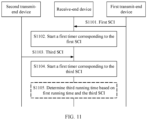
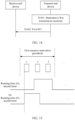
- the receive-end device starts a first timer based on the first SCI.
- Running time of the first timer is described as first running time.
- the first running time may also be referred to as any one of the following: a time period in which the first timer is in an on (on) state, a time period after the first timer is started, a time period in which the first timer is in a start state, a time period after the first timer is restarted, or a time period in which the first timer is in a restart state.
- the first running time is used by the receive-end device to monitor second SCI and/or information about sidelink data transmission. For example, "... is used by ... to monitor” may be understood as “... is used to monitor ".
- the running time of the first timer is used by the receive-end device to monitor the second SCI may be understood as: The running time of the first timer is used to monitor the second SCI by the receive-end device.
- the data transmission information includes at least one of control information in a PSCCH, control information in a PSSCH, or data information in the PSSCH.
- the first-level SCI is located in the PSCCH
- the second-level SCI is located in the PSSCH.
- the data transmission information includes the control information in the PSCCH and the control information in the PSSCH.
- the data transmission information includes the control information in the PSCCH, the control information in the PSSCH, and the data information in the PSSCH.
- the first timer may be a DRX inactivity timer.
- the DRX inactivity timer specifies duration in which the receive-end device is in an active state or an on (on) state after successfully decoding first SCI that indicates initial transmission. That the receive-end device is in an active state means that the receive-end device is continuously in the active state, and that the receive-end device is in an on (on) state means that the receive-end device is continuously in the on (on) state.
- a unit of the duration is any one of a slot, a mini-slot, and a symbol. The duration may be determined based on at least one of a quantity of slots, a quantity of mini-slots, or a quantity of symbols.
- the DRX inactivity timer specifies duration in which the receive-end device is in an active state or an on (on) state after initially successfully decoding first SCI that indicates initial transmission, successfully decoding, for the first time, the first SCI that indicates retransmission, or newly receiving the first SCI that indicates retransmission. That the receive-end device is in an active state means that the receive-end device is continuously in the active state, and that the receive-end device is in an on (on) state means that the receive-end device is continuously in the on (on) state.
- a unit of the duration is any one of a slot, a mini-slot, and a symbol. The duration may be determined based on at least one of a quantity of slots, a quantity of mini-slots, or a quantity of symbols.
- the DRX inactivity timer in this application may also be referred to as a sidelink (sidelink, SL) DRX inactivity timer.
- decoding may also be referred to as parsing, demodulation, or correctly receiving or correctly received.
- Successful decoding may also be referred to as correct decoding or decoding.
- Initial time is the first time or is the first time for a hybrid automatic repeat request (hybrid automatic repeat request, HARQ) process.
- hybrid automatic repeat request hybrid automatic repeat request
- Whether data information is initial transmission is specific to a terminal device that starts the DRX inactivity timer. For example, when a terminal device 1 sends a transport block (transport block, TB) 1 to a terminal device 2 for the first time, the receive-end device 2 does not receive the TB 1 from the terminal device 1. That the TB 1 from the terminal device 1 is not received includes: SCI from the terminal device 1 is not correctly demodulated, or the TB 1 from the terminal device 1 is not correctly received. The terminal device 2 does not start the DRX inactivity timer. Next, when the terminal device 1 sends the TB 1 to the terminal device 2 again, the receive-end device 2 receives the TB 1 from the terminal device 1.
- transport block transport block
- the terminal device 2 receives the TB 1 for the first time, and the terminal device 2 starts the DRX inactivity timer. That the TB 1 from the terminal device 1 is received includes: The SCI from the terminal device 1 is correctly demodulated, or the TB 1 from the terminal device 1 is correctly received.
- initial transmission may also be referred to as initial transmission (initial transmission).
- first SCI that indicates initial transmission includes two meanings.
- the second-level SCI includes a new data indicator (new data indicator, NDI) and a HARQ process.
- NDI new data indicator
- the receive-end device receives first SCI that indicates initial transmission.
- the receive-end device receives first SCI that indicates initial transmission.
- the receive-end device starts the first timer.
- start of "the first timer of the receive-end device” is as follows: In a case of initial transmission, the receive-end device starts the first timer.
- S802 a specific implementation process of S802 may be described in the following manners.
- the receive-end device starts the first timer if data transmission indicated by the first SCI is initial transmission.
- the receive-end device starts the first timer if the receive-end device successfully decodes the first SCI and data transmission information indicated by the first SCI is data information of initial transmission.
- the receive-end device starts the first timer after the receive-end device successfully decodes first SCI that indicates initial sidelink transmission.
- the receive-end device starts the first timer if data transmission indicated by the first SCI is retransmission and retransmitted data is in new transmission for the receive-end device (that is, previous transmission of the data is not detected by the receive-end device).
- sidelink transmission is new transmission is determined by the receive-end device.
- “Indicating that sidelink transmission is new transmission” is information in the first SCI sent by the first transmit-end device.
- any one of initial transmission/initial time of transmission/first time of transmission may be replaced with new transmission (new transmission) or initial transmission (initial transmission).
- the first SCI is the first-level SCI and the second-level SCI in the two levels of SCI.
- the second-level SCI includes an initial transmission indication or a retransmission indication, and the second-level SCI depends on decoding of the first-level SCI. Therefore, the receive-end device starts the first timer after successfully decoding the first SCI that indicates initial sidelink transmission.
- the receive-end device starts the first timer if data transmission indicated by the first SCI is initial transmission
- the receive-end device receives SCI that indicates initial transmission; or when the first SCI indicates retransmitted data and the receive-end device receives the first SCI for the first time, the receive-end device receives SCI that indicates initial transmission.
- the receive-end device receives, for the first time, the first SCI scheduling the retransmitted data.
- the first SCI may fail to be received.
- the receive-end device fails to receive the first SCI in initial transmission, because the first timer of the receive-end device is started, in a subsequent period of time, the receive-end device is still in an active periodicity and can continue to receive information from the first transmit-end device. If the first transmit-end device retransmits the foregoing data transmission information or initially transmits other data transmission information, the receive-end device can still receive the foregoing data transmission information, thereby improving efficiency of transmitting data transmission information, and improving detection reliability.
- a manner in which the receive-end device determines the first running time may be, for example, but is not limited to the following manners.
- the receive-end device can also determine that the first running time overlaps a time domain resource carrying the second SCI, thereby improving a rate of successfully receiving the second SCI on the foregoing transmission resource.
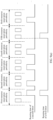
- the first running time such as the first running time shown in a first row in FIG. 9(d) , overlaps a time domain resource that carries the second SCI and that is in the transmission resource 1 in the second target periodicity, and overlaps a time domain resource that carries the second SCI and that is in the transmission resource 2 in the first target periodicity.
- the first running time such as the first running time shown in a second row in FIG. 9(d) , overlaps a time domain resource that carries the second SCI and that is in the transmission resource 1 in the second target periodicity, and overlaps a time domain resource that carries the second SCI and that is in the transmission resource 2 in the second target periodicity.
- the first running time overlaps a time domain resource that carries the second SCI and that is in the transmission resource 1 in the second target periodicity, overlaps a time domain resource that carries the second SCI and that is in the transmission resource 2 in the first target periodicity, and overlaps a time domain resource that carries the second SCI and that is in the transmission resource 2 in the second target periodicity.
- the receive-end device can also determine that first running time overlaps a time domain resource carrying the second SCI, thereby improving a rate of successfully receiving the second SCI on the foregoing transmission resource.
- the first running time overlaps at least a time domain resource that carries the second SCI and that is in a first transmission resource in the second target periodicity.
- the first target periodicity is a resource reservation periodicity for receiving the first SCI
- the second target periodicity is a resource reservation periodicity after the first target periodicity.
- the first transmission resource is earlier than the transmission resource receiving the first SCI, which may also be referred to as follows: The transmission resource receiving the first SCI is a resource after the first transmission resource, or the transmission resource receiving the first SCI is later than the first transmission resource in time domain.
- the at least one transmission resource includes the first transmission resource and a second transmission resource
- the first transmission resource and the second transmission resource are located in a same resource periodicity, and the first transmission resource is earlier than the second transmission resource. If the transmission resource receiving the first SCI is the first transmission resource and is located in the first target periodicity, the first running time overlaps at least one of the following:
- SCI transmitted on the first transmission resource in the first target periodicity may be an SCI that fails to be received by the receive-end device, or may be an SCI that indicates aperiodic transmission. This is not limited in this embodiment of this application.
- the first running time may be continuous or may be discontinuous.
- “the first running time is continuous” means that after the first timer is started, the first timer is always in a running state until a preset moment is reached.
- “The first running time is discontinuous” means that there is an interval in a period of time.
- duration of the first timer is 35 slots, and the first timer is intermittent two times and is intermittent for five slots each time, a length of on duration (on duration) of actual running of the first timer is 25 slots.
- duration of the first timer is 25 slots
- a length of on duration (on duration) of actual running of the first timer is 25 slots
- a length of actual on duration is 35 slots.
- intermittent running of the first timer may mean that the first timer is intermittent one time, or may mean that the first timer is intermittent a plurality of times.
- the first timer may run based on a specific periodicity, or may run aperiodically.
- a block represents a transmission resource.
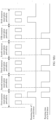
- the receive-end device fails to receive, on the transmission resource A1, the first SCI from the first transmit-end device, or the receive-end device successfully receives, on the transmission resource A1, the first SCI from the first transmit-end device, but a transmission resource indicated by the first SCI on the transmission resource A1 is aperiodic" is shown by a block marked with "X" in FIG. 10(c) .
- running time of a subsequently started first timer includes running time of a previously started first timer, even if some first timers fail, it can be ensured that the receive-end device is in an active periodicity on a time domain resource in a transmission resource indicated by the first SCI, to receive SCI from the first transmit-end device in time, thereby increasing a rate of successfully receiving SCI.
- the receive-end device uses a union of the first running time and the second running time as the third running time
- a block represents a transmission resource.
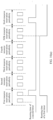
- the first SCI reserves a periodic resource.
- a resource reservation periodicity includes one transmission resource.
- a transmission resource in a first resource reservation periodicity is denoted as a transmission resource A1
- a transmission resource in a second resource reservation periodicity is denoted as a transmission resource A2
- a transmission resource in a third resource reservation periodicity is denoted as a transmission resource A3.
- the first running time is shown by a thick solid line in FIG. 13 .
- the third SCI reserves an aperiodic transmission resource, for example, a transmission resource B1 and a transmission resource B2 in FIG. 13 .
- the second running time is shown by a thin solid line in FIG. 13 .
- the third running time is a union of the first running time and the second running time, as shown in FIG. 13 .
- the receive-end device takes a union to determine running time of a subsequently started first timer, so that the running time of the subsequently started first timer includes running time of a previously started first timer, so as to prevent the receive-end device from omitting control information and data transmission information on a reserved transmission resource.
- first timers in the communications method described in FIG. 8 to FIG. 13 refer to first timers on the receive-end device side.
- second timers in the communications method described in FIG. 8 to FIG. 13 refer to second timers on the receive-end device side.
- the foregoing describes a communications method on a receive-end device side.
- the following describes a resource reservation process of a transmit-end device.
- the communications method in this embodiment of this application includes the following steps.
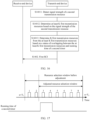
- a transmit-end device determines k first transmission resources.
- a time domain resource that carries first SCI and that is in the k first transmission resources overlaps running time of a second timer.
- the k first transmission resources are resources in K first transmission resources.
- the running time of the second timer belongs to an active periodicity of the transmit-end device.
- the running time of the second timer is used by the transmit-end device to monitor sidelink control information and/or information about sidelink data transmission, or may be used by the transmit-end device to send the sidelink control information and/or the information about sidelink data transmission.
- the running time of the second timer may be configured by a network device. Running time of second timers of different terminal devices is consistent with each other. To be specific, if the second timer of the transmit-end device is in a running state, a second timer of a receive-end device is also in the running state.
- the time domain resource that carries the first SCI and that is in the k first transmission resources determined by the transmit-end device also overlaps running time of the second timer of the receive-end device.
- the running time of the second timer may be configured by a sidelink transmit-end device.
- a group header of a group configures same running time of a second timer for a group member.
- the first SCI is first-level SCI in two levels of SCI, or the first SCI is second-level SCI in the two levels of SCI, or the first SCI is the first-level SCI and the second-level SCI in the two levels of SCI.
- the K first transmission resources are transmission resources reserved by the transmit-end device.
- the first transmission resource may be a periodic transmission resource, or may be an aperiodic transmission resource. If the first transmission resource is a periodic transmission resource, the first SCI indicates a resource reservation periodicity, and the K first transmission resources are transmission resources in one resource reservation periodicity.
- both K and k are positive integers, and 1 ⁇ k ⁇ K.
- the parameter k may be a predefined parameter, or may be configured by a network device.
- the network device sends second configuration information to the transmit-end device.
- the transmit-end device receives the second configuration information from the network device.
- the second configuration information indicates a value of k.
- the second configuration information includes a plurality of information elements.
- One information element is used to indicate the value of k.
- the transmit-end device may reserve, based on the value of k indicated by the second configuration information, a first transmission resource that overlaps the running time of the second timer.
- locations of the k first transmission resources are specifically described below.
- the k first transmission resources may be the last k first transmission resources in the K first transmission resources.
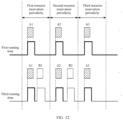
- three transmission resources are reserved in a resource reservation periodicity, and the three transmission resources are respectively denoted as a transmission resource 1, a transmission resource 2, and a transmission resource 3.
- the running time of the second timer in the first row overlaps the transmission resource 2 and the transmission resource 3.
- the k first transmission resources may be the first k first transmission resources in the K first transmission resources.
- a time domain resource that carries the first SCI and that is in the first k first transmission resources in the K first transmission resources overlaps the running time of the second timer.
- three transmission resources are reserved in a resource reservation periodicity, and the three transmission resources are respectively denoted as a transmission resource 1, a transmission resource 2, and a transmission resource 3.
- the running time of the second timer in the second row overlaps the transmission resource 1 and the transmission resource 2.
- each first transmission resource can forward indicate a reserved transmission resource.
- the receive-end device can determine, based on a state indicated by the first SCI for a transmission resource, a first transmission resource after the k first transmission resources, and further continue to receive the first SCI on the first transmission resource after the k first transmission resources, to improve utilization of the transmission resource, so that the receive-end device can receive more first SCI.
- the transmit-end device detects signal strength of a second transmission resource.
- the second transmission resource overlaps running time of a preset timer.
- the preset timer includes at least one of the following timers:
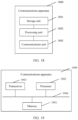
- the communications apparatus 1900 includes a processor 1902, a transceiver 1903, and a memory 1901.
Landscapes
- Engineering & Computer Science (AREA)
- Signal Processing (AREA)
- Computer Networks & Wireless Communication (AREA)
- Mobile Radio Communication Systems (AREA)
Claims (13)
- Kommunikationsverfahren, das umfasst:Empfangen (S801), durch eine empfangsseitige Vorrichtung, erster Sidelink-Steuerinformationen, SCI, von einer übertragungsseitigen Vorrichtung; undStarten (S802), durch die empfangsseitige Vorrichtung, eines ersten Zeitgebers basierend auf den ersten SCI, wobei die Laufzeit des ersten Zeitgebers durch die empfangsseitige Vorrichtung verwendet wird, um die zweiten SCI und/oder Informationen über die Sidelink-Datenübertragung zu überwachen, und wobei der erste Zeitgeber ein DRX-Inaktivitätszeitgeber ist;wobei das Empfangen, durch eine empfangsseitige Vorrichtung, von ersten SCI von einer übertragungsseitigen Vorrichtung umfasst:
Empfangen, durch die empfangsseitige Vorrichtung, der ersten SCI von der übertragungsseitigen Vorrichtung in der Laufzeit eines zweiten Zeitgebers, wobei die Laufzeit des zweiten Zeitgebers durch die empfangsseitige Vorrichtung verwendet wird, um Sidelink-Steuerinformationen und/oder Informationen über die Sidelink-Datenübertragung zu überwachen, und wobei der zweite Zeitgeber ein DRX-Einschaltdauer-Zeitgeber ist. - Kommunikationsverfahren nach Anspruch 1, wobei das Starten, durch die empfangsseitige Vorrichtung, eines ersten Zeitgebers basierend auf den ersten SCI umfasst:
Starten, durch die empfangsseitige Vorrichtung, des ersten Zeitgebers, falls die empfangsseitige Vorrichtung bestimmt, dass die durch die ersten SCI angegebene Sidelink-Übertragung eine neue Übertragung ist. - Kommunikationsverfahren nach einem der Ansprüche 1 bis 2, wobei das Starten, durch die empfangsseitige Vorrichtung, eines ersten Zeitgebers basierend auf den ersten SCI umfasst: Starten, durch die empfangsseitige Vorrichtung, des ersten Zeitgebers, falls die durch die ersten SCI angegebene Sidelink-Übertragung eine neue Übertragung ist; oder
Starten, durch die empfangsseitige Vorrichtung, des ersten Zeitgebers, falls die durch die ersten SCI angegebene Sidelink-Übertragung keine neue Übertragung ist und die Sidelink-Übertragung eine neue Übertragung für die empfangsseitige Vorrichtung ist. - Kommunikationsverfahren nach einem der Ansprüche 1 bis 3, wobei das Verfahren ferner umfasst:Bestimmen, durch die empfangsseitige Vorrichtung, der Laufzeit des ersten Zeitgebers basierend auf mindestens einer Übertragungsressource, die durch die ersten SCI angegeben wird, wobeidie Laufzeit des ersten Zeitgebers mindestens eine Zeitbereichsressource überlappt, die verwendet wird, um die zweiten SCI zu tragen.
- Kommunikationsverfahren nach Anspruch 4, wobeidie Laufzeit des ersten Zeitgebers mindestens eine Zeitbereichsressource umfasst, die die zweiten SCI trägt und die sich in einer anfänglichen Übertragungsressource in einer (F-1)ten Ressourcenreservierungsperiodizität befindet; undeine Zeitbereichsressource, die die zweiten SCI trägt und die sich in einer anfänglichen Übertragungsressource in einer Ften Ressourcenreservierungsperiodizität befindet, die Laufzeit des zweiten Zeitgebers überlappt, und die Zeitbereichsressource, die die zweiten SCI trägt und die sich in der anfänglichen Übertragungsressource in der (F-1)ten Ressourcenreservierungsperiodizität befindet, die Laufzeit des zweiten Zeitgebers nicht überlappt; und F eine positive Ganzzahl ist, und die Laufzeit des zweiten Zeitgebers durch die empfangsseitige Vorrichtung verwendet wird, um Sidelink-Steuerinformationen und/oder Informationen über die Sidelink-Datenübertragung zu überwachen.
- Kommunikationsverfahren, das umfasst:Bestimmen (S1401), durch eine übertragungsseitige Vorrichtung, von k ersten Übertragungsressourcen, wobei eine Zeitbereichsressource, die erste Sidelink-Steuerinformationen, SCI, trägt und die sich in den k ersten Übertragungsressourcen befindet, die Laufzeit eines zweiten Zeitgebers überlappt, wobei der zweite Zeitgeber ein DRX-Einschaltdauer-Zeitgeber ist; k eine positive Ganzzahl, und k ≥ 1 ist; und die k ersten Übertragungsressourcen Übertragungsressourcen sind, die durch die übertragungsseitige Vorrichtung reserviert sind, und die Laufzeit des zweiten Zeitgebers durch die übertragungsseitige Vorrichtung verwendet wird, um Sidelink-Steuerinformationen und/oder Informationen über die Sidelink-Datenübertragung zu überwachen; undSenden (S1402), durch die übertragungsseitige Vorrichtung, der ersten SCI an eine empfangsseitige Vorrichtung auf den k ersten Übertragungsressourcen;wobei die k ersten Übertragungsressourcen die ersten k ersten Übertragungsressourcen in K ersten Übertragungsressourcen sind, die K ersten Übertragungsressourcen Übertragungsressourcen sind, die durch die übertragungsseitige Vorrichtung reserviert sind, und K eine positive Ganzzahl ist.
- Kommunikationsverfahren nach Anspruch 6, wobei k ein vordefinierter Parameter ist; oder
wobei das Verfahren ferner umfasst:
Empfangen, durch die übertragungsseitige Vorrichtung, von zweiten Konfigurationsinformationen von einer Netzwerkvorrichtung, wobei die zweiten Konfigurationsinformationen einen Wert von k angeben. - Kommunikationsverfahren nach einem der Ansprüche 6 bis 7, wobei das Bestimmen, durch eine übertragungsseitige Vorrichtung, von k ersten Übertragungsressourcen umfasst:Erkennen, durch die übertragungsseitige Vorrichtung, der Signalstärke einer zweiten Übertragungsressource, wobei die zweite Übertragungsressource die Laufzeit eines voreingestellten Zeitgebers überlappt;Bestimmen, durch die übertragungsseitige Vorrichtung, von mindestens K ersten Übertragungsressourcen, basierend auf der Signalstärke der zweiten Übertragungsressource; undBestimmen, durch die übertragungsseitige Vorrichtung, der k ersten Übertragungsressourcen aus den mindestens K ersten Übertragungsressourcen basierend auf einem Status der Überlappung zwischen den mindestens K ersten Übertragungsressourcen und der Laufzeit des zweiten Zeitgebers.
- Kommunikationsverfahren nach Anspruch 8, wobei
der voreingestellte Zeitgeber mindestens einen der folgenden Zeitgeber umfasst:einen ersten Zeitgeber, wobei die Laufzeit des ersten Zeitgebers durch die übertragungsseitige Vorrichtung verwendet wird, um Sidelink-Steuerinformationen und/oder Informationen über die Sidelink-Datenübertragung zu überwachen, wobei der erste Zeitgeber ein DRX-Inaktivitätszeitgeber ist;den zweiten Zeitgeber; undeinen Zeitgeber für die erneute Übertragung. - Kommunikationsverfahren nach einem der Ansprüche 6 bis 9, wobei die k ersten Übertragungsressourcen Übertragungsressourcen in einer Ressourcenreservierungsperiodizität sind.
- Einrichtung, wobei die Einrichtung konfiguriert ist, um das Verfahren nach einem der Ansprüche 1 bis 5 durchzuführen oder das Verfahren nach einem der Ansprüche 6 bis 10 durchzuführen.
- Computerlesbares Speichermedium, das Befehle umfasst, die, wenn sie durch Verarbeitungsmodule einer empfangsseitigen Vorrichtung ausgeführt werden, die empfangsseitige Vorrichtung veranlassen, das Verfahren nach einem der Ansprüche 1 bis 5 durchzuführen, oder, wenn sie durch Verarbeitungsmodule einer übertragungsseitigen Vorrichtung ausgeführt werden, die übertragungsseitige Vorrichtung veranlassen, das Verfahren nach einem der Ansprüche 6 bis 10 durchzuführen.
- Computerprogrammprodukt, das Befehle umfasst, die, wenn sie durch Verarbeitungsmodule einer empfangsseitigen Vorrichtung ausgeführt werden, die empfangsseitige Vorrichtung veranlassen, das Verfahren nach einem der Ansprüche 1 bis 5 durchzuführen, oder, wenn sie durch Verarbeitungsmodule einer übertragungsseitigen Vorrichtung ausgeführt werden, die übertragungsseitige Vorrichtung veranlassen, das Verfahren nach einem der Ansprüche 6 bis 10 durchzuführen.
Applications Claiming Priority (2)
| Application Number | Priority Date | Filing Date | Title |
|---|---|---|---|
| CN202010486439.5A CN113766640B (zh) | 2020-06-01 | 2020-06-01 | 通信方法及装置 |
| PCT/CN2021/097557 WO2021244501A1 (zh) | 2020-06-01 | 2021-05-31 | 通信方法及装置 |
Publications (3)
| Publication Number | Publication Date |
|---|---|
| EP4152862A1 EP4152862A1 (de) | 2023-03-22 |
| EP4152862A4 EP4152862A4 (de) | 2023-12-06 |
| EP4152862B1 true EP4152862B1 (de) | 2025-07-09 |
Family
ID=78782776
Family Applications (1)
| Application Number | Title | Priority Date | Filing Date |
|---|---|---|---|
| EP21817878.8A Active EP4152862B1 (de) | 2020-06-01 | 2021-05-31 | Kommunikationsverfahren und -vorrichtung |
Country Status (4)
| Country | Link |
|---|---|
| US (1) | US12414136B2 (de) |
| EP (1) | EP4152862B1 (de) |
| CN (1) | CN113766640B (de) |
| WO (1) | WO2021244501A1 (de) |
Families Citing this family (12)
| Publication number | Priority date | Publication date | Assignee | Title |
|---|---|---|---|---|
| WO2021263106A2 (en) * | 2020-06-26 | 2021-12-30 | Ofinno, Llc | Discontinuous reception |
| KR102842263B1 (ko) * | 2020-09-16 | 2025-08-06 | 엘지전자 주식회사 | Nr v2x에서 sl drx를 기반으로 통신을 수행하는 방법 및 장치 |
| KR102693471B1 (ko) * | 2020-10-22 | 2024-08-09 | 엘지전자 주식회사 | Nr v2x에서 sl drx 동작을 수행하는 방법 및 장치 |
| KR20230092903A (ko) * | 2020-10-22 | 2023-06-26 | 엘지전자 주식회사 | Nr v2x에서 drx 온-듀레이션의 오정렬로 인한 패킷 상실을 해결하는 방법 및 장치 |
| CN114449658B (zh) * | 2020-11-03 | 2025-05-30 | 华为技术有限公司 | 资源处理方法、装置及存储介质 |
| CN114726484B (zh) * | 2021-01-05 | 2024-06-18 | 大唐移动通信设备有限公司 | 直接通信接口的定时器维护方法、装置及可读存储介质 |
| CN113424471B (zh) * | 2021-05-10 | 2022-12-27 | 北京小米移动软件有限公司 | 确定资源的方法、装置及存储介质 |
| US12082291B2 (en) * | 2021-08-06 | 2024-09-03 | Qualcomm Incorporated | Sensing for sidelink discontinuous reception (DRX) |
| US11930498B2 (en) * | 2021-09-07 | 2024-03-12 | Qualcomm Incorporated | Techniques for scheduling sidelink communications in multiple time periods |
| CN118339862A (zh) * | 2022-01-07 | 2024-07-12 | Oppo广东移动通信有限公司 | 信息传输方法、通信设备及可读存储介质 |
| CN116489767A (zh) * | 2022-01-14 | 2023-07-25 | 维沃移动通信有限公司 | 寻呼方法、终端及网络侧设备 |
| CN118250818A (zh) * | 2022-12-23 | 2024-06-25 | 维沃移动通信有限公司 | 信息传输方法、装置及终端 |
Family Cites Families (14)
| Publication number | Priority date | Publication date | Assignee | Title |
|---|---|---|---|---|
| CN101547078B (zh) * | 2008-03-24 | 2012-01-04 | 电信科学技术研究院 | 非连续接收数据方法、设备及非连续调度数据系统 |
| CN101841823B (zh) * | 2009-03-16 | 2012-06-27 | 电信科学技术研究院 | 多载波系统中非连续监听控制信道的方法及装置 |
| CN107027181B (zh) * | 2016-02-02 | 2020-02-04 | 电信科学技术研究院 | 一种上行控制信息的传输方法及装置 |
| WO2017169835A1 (ja) * | 2016-03-31 | 2017-10-05 | 株式会社Nttドコモ | ユーザ装置及び送信方法 |
| WO2017204726A1 (en) * | 2016-05-24 | 2017-11-30 | Telefonaktiebolaget Lm Ericsson (Publ) | Methods and apparatus for configuring a discontinuous reception mode in a wireless network |
| EP3614774B1 (de) * | 2017-08-10 | 2021-05-19 | Guangdong Oppo Mobile Telecommunications Corp., Ltd. | Verfahren zur vorrichtung-zu-vorrichtung-kommunikation und endgerätevorrichtung |
| CN111096026B (zh) * | 2017-09-28 | 2023-02-28 | 5G Ip控股有限责任公司 | 控制新无线电的非连续接收的装置及方法 |
| CN111148077B (zh) * | 2018-11-02 | 2021-06-29 | 华为技术有限公司 | 传输方法和装置 |
| CN119070958A (zh) * | 2019-08-14 | 2024-12-03 | 现代自动车株式会社 | 在支持侧链通信的无线通信系统中发送和接收harq响应的方法和装置 |
| CN110708145B (zh) * | 2019-09-30 | 2021-11-30 | 展讯通信(上海)有限公司 | Harq进程管理方法、装置、终端及存储介质 |
| WO2021145745A1 (ko) * | 2020-01-17 | 2021-07-22 | 엘지전자 주식회사 | Nr v2x에서 사이드링크 harq 피드백 정보를 기반으로 사이드링크 통신을 수행하는 방법 및 장치 |
| KR20220126759A (ko) * | 2020-01-21 | 2022-09-16 | 에프쥐 이노베이션 컴퍼니 리미티드 | 사이드링크 패킷 교환 동작을 위한 방법 및 사용자 장비 |
| KR20210118542A (ko) * | 2020-03-23 | 2021-10-01 | 주식회사 아이티엘 | 무선 통신 시스템에서 단말간 통신에 기초한 네트워크와 단말간 링크에 대한 drx 방법 및 장치 |
| CN113677020B (zh) * | 2020-05-15 | 2025-03-04 | 华为技术有限公司 | 通信方法、装置及系统 |
-
2020
- 2020-06-01 CN CN202010486439.5A patent/CN113766640B/zh active Active
-
2021
- 2021-05-31 WO PCT/CN2021/097557 patent/WO2021244501A1/zh not_active Ceased
- 2021-05-31 EP EP21817878.8A patent/EP4152862B1/de active Active
-
2022
- 2022-11-30 US US18/060,116 patent/US12414136B2/en active Active
Also Published As
| Publication number | Publication date |
|---|---|
| WO2021244501A1 (zh) | 2021-12-09 |
| CN113766640A (zh) | 2021-12-07 |
| US20230106109A1 (en) | 2023-04-06 |
| EP4152862A1 (de) | 2023-03-22 |
| US12414136B2 (en) | 2025-09-09 |
| EP4152862A4 (de) | 2023-12-06 |
| CN113766640B (zh) | 2024-11-19 |
Similar Documents
| Publication | Publication Date | Title |
|---|---|---|
| EP4152862B1 (de) | Kommunikationsverfahren und -vorrichtung | |
| US11910470B2 (en) | DRX handling in LTE license assisted access operation | |
| US11751245B2 (en) | Method and wireless communication system for handling timer operation | |
| JP7522765B2 (ja) | 端末デバイスのウェイクアップ方法及び装置、ネットワーク・デバイス、並びに端末デバイス | |
| US9591673B2 (en) | Method and apparatus for providing machine initial access procedure for machine to machine communication | |
| EP2941062A1 (de) | Übertragungssteuerungsverfahren und übertragungsverfahren und -vorrichtung | |
| EP3031277B1 (de) | Benutzervorrichtung zur datenkommunikation und verfahren | |
| US20240188178A1 (en) | Sidelink discontinuous reception procedures | |
| EP4280707A1 (de) | Übertragungskonfigurationsverfahren und -vorrichtung sowie zugehörige vorrichtung | |
| CN113647182A (zh) | 无线通信的方法和设备 | |
| US20240172321A1 (en) | Methods, Node, UE and Computer Readable Media for Aligning Partial Sensing Configuration with DRX Configuration | |
| JP7605963B2 (ja) | データ送信のための方法および装置 | |
| US20240008001A1 (en) | Method for resource selection and first device | |
| EP4301073A1 (de) | Datenneuübertragungsverfahren und zugehörige vorrichtungen | |
| WO2026036412A1 (zh) | 一种无线通信方法及设备、存储介质 | |
| WO2025161434A1 (zh) | 传输方法、通信装置及存储介质 | |
| CN121815405A (zh) | 通信方法、装置、设备、存储介质及程序产品 | |
| CN116918380A (zh) | 激活时间的确定方法、装置、设备及存储介质 |
Legal Events
| Date | Code | Title | Description |
|---|---|---|---|
| STAA | Information on the status of an ep patent application or granted ep patent |
Free format text: STATUS: THE INTERNATIONAL PUBLICATION HAS BEEN MADE |
|
| PUAI | Public reference made under article 153(3) epc to a published international application that has entered the european phase |
Free format text: ORIGINAL CODE: 0009012 |
|
| STAA | Information on the status of an ep patent application or granted ep patent |
Free format text: STATUS: REQUEST FOR EXAMINATION WAS MADE |
|
| 17P | Request for examination filed |
Effective date: 20221216 |
|
| AK | Designated contracting states |
Kind code of ref document: A1 Designated state(s): AL AT BE BG CH CY CZ DE DK EE ES FI FR GB GR HR HU IE IS IT LI LT LU LV MC MK MT NL NO PL PT RO RS SE SI SK SM TR |
|
| DAV | Request for validation of the european patent (deleted) | ||
| DAX | Request for extension of the european patent (deleted) | ||
| REG | Reference to a national code |
Ipc: H04W0072250000 Ref country code: DE Ref legal event code: R079 Ref document number: 602021033912 Country of ref document: DE Free format text: PREVIOUS MAIN CLASS: H04W0072040000 |
|
| A4 | Supplementary search report drawn up and despatched |
Effective date: 20231103 |
|
| RIC1 | Information provided on ipc code assigned before grant |
Ipc: H04L 5/00 20060101ALI20231027BHEP Ipc: H04W 76/14 20180101ALI20231027BHEP Ipc: H04W 76/28 20180101ALI20231027BHEP Ipc: H04W 72/0446 20230101ALI20231027BHEP Ipc: H04W 72/04 20230101ALI20231027BHEP Ipc: H04W 72/25 20230101AFI20231027BHEP |
|
| GRAP | Despatch of communication of intention to grant a patent |
Free format text: ORIGINAL CODE: EPIDOSNIGR1 |
|
| STAA | Information on the status of an ep patent application or granted ep patent |
Free format text: STATUS: GRANT OF PATENT IS INTENDED |
|
| INTG | Intention to grant announced |
Effective date: 20250211 |
|
| GRAS | Grant fee paid |
Free format text: ORIGINAL CODE: EPIDOSNIGR3 |
|
| GRAA | (expected) grant |
Free format text: ORIGINAL CODE: 0009210 |
|
| STAA | Information on the status of an ep patent application or granted ep patent |
Free format text: STATUS: THE PATENT HAS BEEN GRANTED |
|
| AK | Designated contracting states |
Kind code of ref document: B1 Designated state(s): AL AT BE BG CH CY CZ DE DK EE ES FI FR GB GR HR HU IE IS IT LI LT LU LV MC MK MT NL NO PL PT RO RS SE SI SK SM TR |
|
| REG | Reference to a national code |
Ref country code: GB Ref legal event code: FG4D |
|
| REG | Reference to a national code |
Ref country code: CH Ref legal event code: EP |
|
| REG | Reference to a national code |
Ref country code: IE Ref legal event code: FG4D |
|
| REG | Reference to a national code |
Ref country code: DE Ref legal event code: R096 Ref document number: 602021033912 Country of ref document: DE |
|
| REG | Reference to a national code |
Ref country code: NL Ref legal event code: MP Effective date: 20250709 |
|
| PG25 | Lapsed in a contracting state [announced via postgrant information from national office to epo] |
Ref country code: PT Free format text: LAPSE BECAUSE OF FAILURE TO SUBMIT A TRANSLATION OF THE DESCRIPTION OR TO PAY THE FEE WITHIN THE PRESCRIBED TIME-LIMIT Effective date: 20251110 |
|
| PG25 | Lapsed in a contracting state [announced via postgrant information from national office to epo] |
Ref country code: NL Free format text: LAPSE BECAUSE OF FAILURE TO SUBMIT A TRANSLATION OF THE DESCRIPTION OR TO PAY THE FEE WITHIN THE PRESCRIBED TIME-LIMIT Effective date: 20250709 |
|
| REG | Reference to a national code |
Ref country code: AT Ref legal event code: MK05 Ref document number: 1813082 Country of ref document: AT Kind code of ref document: T Effective date: 20250709 |
|
| PG25 | Lapsed in a contracting state [announced via postgrant information from national office to epo] |
Ref country code: IS Free format text: LAPSE BECAUSE OF FAILURE TO SUBMIT A TRANSLATION OF THE DESCRIPTION OR TO PAY THE FEE WITHIN THE PRESCRIBED TIME-LIMIT Effective date: 20251109 |
|
| PG25 | Lapsed in a contracting state [announced via postgrant information from national office to epo] |
Ref country code: NO Free format text: LAPSE BECAUSE OF FAILURE TO SUBMIT A TRANSLATION OF THE DESCRIPTION OR TO PAY THE FEE WITHIN THE PRESCRIBED TIME-LIMIT Effective date: 20251009 |
|
| REG | Reference to a national code |
Ref country code: LT Ref legal event code: MG9D |
|
| PG25 | Lapsed in a contracting state [announced via postgrant information from national office to epo] |
Ref country code: AT Free format text: LAPSE BECAUSE OF FAILURE TO SUBMIT A TRANSLATION OF THE DESCRIPTION OR TO PAY THE FEE WITHIN THE PRESCRIBED TIME-LIMIT Effective date: 20250709 |
|
| PG25 | Lapsed in a contracting state [announced via postgrant information from national office to epo] |
Ref country code: FI Free format text: LAPSE BECAUSE OF FAILURE TO SUBMIT A TRANSLATION OF THE DESCRIPTION OR TO PAY THE FEE WITHIN THE PRESCRIBED TIME-LIMIT Effective date: 20250709 |
|
| PG25 | Lapsed in a contracting state [announced via postgrant information from national office to epo] |
Ref country code: HR Free format text: LAPSE BECAUSE OF FAILURE TO SUBMIT A TRANSLATION OF THE DESCRIPTION OR TO PAY THE FEE WITHIN THE PRESCRIBED TIME-LIMIT Effective date: 20250709 |
|
| PG25 | Lapsed in a contracting state [announced via postgrant information from national office to epo] |
Ref country code: GR Free format text: LAPSE BECAUSE OF FAILURE TO SUBMIT A TRANSLATION OF THE DESCRIPTION OR TO PAY THE FEE WITHIN THE PRESCRIBED TIME-LIMIT Effective date: 20251010 |
|
| PG25 | Lapsed in a contracting state [announced via postgrant information from national office to epo] |
Ref country code: SE Free format text: LAPSE BECAUSE OF FAILURE TO SUBMIT A TRANSLATION OF THE DESCRIPTION OR TO PAY THE FEE WITHIN THE PRESCRIBED TIME-LIMIT Effective date: 20250709 |
|
| PG25 | Lapsed in a contracting state [announced via postgrant information from national office to epo] |
Ref country code: LV Free format text: LAPSE BECAUSE OF FAILURE TO SUBMIT A TRANSLATION OF THE DESCRIPTION OR TO PAY THE FEE WITHIN THE PRESCRIBED TIME-LIMIT Effective date: 20250709 |
|
| PG25 | Lapsed in a contracting state [announced via postgrant information from national office to epo] |
Ref country code: PL Free format text: LAPSE BECAUSE OF FAILURE TO SUBMIT A TRANSLATION OF THE DESCRIPTION OR TO PAY THE FEE WITHIN THE PRESCRIBED TIME-LIMIT Effective date: 20250709 Ref country code: BG Free format text: LAPSE BECAUSE OF FAILURE TO SUBMIT A TRANSLATION OF THE DESCRIPTION OR TO PAY THE FEE WITHIN THE PRESCRIBED TIME-LIMIT Effective date: 20250709 |
|
| PG25 | Lapsed in a contracting state [announced via postgrant information from national office to epo] |
Ref country code: RS Free format text: LAPSE BECAUSE OF FAILURE TO SUBMIT A TRANSLATION OF THE DESCRIPTION OR TO PAY THE FEE WITHIN THE PRESCRIBED TIME-LIMIT Effective date: 20251009 |
|
| PG25 | Lapsed in a contracting state [announced via postgrant information from national office to epo] |
Ref country code: ES Free format text: LAPSE BECAUSE OF FAILURE TO SUBMIT A TRANSLATION OF THE DESCRIPTION OR TO PAY THE FEE WITHIN THE PRESCRIBED TIME-LIMIT Effective date: 20250709 |
|
| PG25 | Lapsed in a contracting state [announced via postgrant information from national office to epo] |
Ref country code: SM Free format text: LAPSE BECAUSE OF FAILURE TO SUBMIT A TRANSLATION OF THE DESCRIPTION OR TO PAY THE FEE WITHIN THE PRESCRIBED TIME-LIMIT Effective date: 20250709 |
|
| PG25 | Lapsed in a contracting state [announced via postgrant information from national office to epo] |
Ref country code: DK Free format text: LAPSE BECAUSE OF FAILURE TO SUBMIT A TRANSLATION OF THE DESCRIPTION OR TO PAY THE FEE WITHIN THE PRESCRIBED TIME-LIMIT Effective date: 20250709 |
|
| PG25 | Lapsed in a contracting state [announced via postgrant information from national office to epo] |
Ref country code: IT Free format text: LAPSE BECAUSE OF FAILURE TO SUBMIT A TRANSLATION OF THE DESCRIPTION OR TO PAY THE FEE WITHIN THE PRESCRIBED TIME-LIMIT Effective date: 20250709 |