EP4152450B1 - Kühlsystem in einem brennstoffzellenelektrofahrzeug und verfahren zur steuerung eines kühlsystems in einem brennstoffzellenelektrofahrzeug - Google Patents
Kühlsystem in einem brennstoffzellenelektrofahrzeug und verfahren zur steuerung eines kühlsystems in einem brennstoffzellenelektrofahrzeug Download PDFInfo
- Publication number
- EP4152450B1 EP4152450B1 EP21196959.7A EP21196959A EP4152450B1 EP 4152450 B1 EP4152450 B1 EP 4152450B1 EP 21196959 A EP21196959 A EP 21196959A EP 4152450 B1 EP4152450 B1 EP 4152450B1
- Authority
- EP
- European Patent Office
- Prior art keywords
- coolant
- chamber
- thermal energy
- fcev
- chambers
- Prior art date
- Legal status (The legal status is an assumption and is not a legal conclusion. Google has not performed a legal analysis and makes no representation as to the accuracy of the status listed.)
- Active
Links
Images


Classifications
-
- B—PERFORMING OPERATIONS; TRANSPORTING
- B60—VEHICLES IN GENERAL
- B60L—PROPULSION OF ELECTRICALLY-PROPELLED VEHICLES; SUPPLYING ELECTRIC POWER FOR AUXILIARY EQUIPMENT OF ELECTRICALLY-PROPELLED VEHICLES; ELECTRODYNAMIC BRAKE SYSTEMS FOR VEHICLES IN GENERAL; MAGNETIC SUSPENSION OR LEVITATION FOR VEHICLES; MONITORING OPERATING VARIABLES OF ELECTRICALLY-PROPELLED VEHICLES; ELECTRIC SAFETY DEVICES FOR ELECTRICALLY-PROPELLED VEHICLES
- B60L58/00—Methods or circuit arrangements for monitoring or controlling batteries or fuel cells, specially adapted for electric vehicles
- B60L58/30—Methods or circuit arrangements for monitoring or controlling batteries or fuel cells, specially adapted for electric vehicles for monitoring or controlling fuel cells
- B60L58/32—Methods or circuit arrangements for monitoring or controlling batteries or fuel cells, specially adapted for electric vehicles for monitoring or controlling fuel cells for controlling the temperature of fuel cells, e.g. by controlling the electric load
- B60L58/33—Methods or circuit arrangements for monitoring or controlling batteries or fuel cells, specially adapted for electric vehicles for monitoring or controlling fuel cells for controlling the temperature of fuel cells, e.g. by controlling the electric load by cooling
-
- H—ELECTRICITY
- H01—ELECTRIC ELEMENTS
- H01M—PROCESSES OR MEANS, e.g. BATTERIES, FOR THE DIRECT CONVERSION OF CHEMICAL ENERGY INTO ELECTRICAL ENERGY
- H01M8/00—Fuel cells; Manufacture thereof
- H01M8/04—Auxiliary arrangements, e.g. for control of pressure or for circulation of fluids
- H01M8/04007—Auxiliary arrangements, e.g. for control of pressure or for circulation of fluids related to heat exchange
- H01M8/04029—Heat exchange using liquids
-
- H—ELECTRICITY
- H01—ELECTRIC ELEMENTS
- H01M—PROCESSES OR MEANS, e.g. BATTERIES, FOR THE DIRECT CONVERSION OF CHEMICAL ENERGY INTO ELECTRICAL ENERGY
- H01M8/00—Fuel cells; Manufacture thereof
- H01M8/04—Auxiliary arrangements, e.g. for control of pressure or for circulation of fluids
- H01M8/04007—Auxiliary arrangements, e.g. for control of pressure or for circulation of fluids related to heat exchange
- H01M8/04052—Storage of heat in the fuel cell system
-
- H—ELECTRICITY
- H01—ELECTRIC ELEMENTS
- H01M—PROCESSES OR MEANS, e.g. BATTERIES, FOR THE DIRECT CONVERSION OF CHEMICAL ENERGY INTO ELECTRICAL ENERGY
- H01M8/00—Fuel cells; Manufacture thereof
- H01M8/04—Auxiliary arrangements, e.g. for control of pressure or for circulation of fluids
- H01M8/04007—Auxiliary arrangements, e.g. for control of pressure or for circulation of fluids related to heat exchange
- H01M8/04067—Heat exchange or temperature measuring elements, thermal insulation, e.g. heat pipes, heat pumps, fins
- H01M8/04074—Heat exchange unit structures specially adapted for fuel cell
-
- H—ELECTRICITY
- H01—ELECTRIC ELEMENTS
- H01M—PROCESSES OR MEANS, e.g. BATTERIES, FOR THE DIRECT CONVERSION OF CHEMICAL ENERGY INTO ELECTRICAL ENERGY
- H01M8/00—Fuel cells; Manufacture thereof
- H01M8/04—Auxiliary arrangements, e.g. for control of pressure or for circulation of fluids
- H01M8/04298—Processes for controlling fuel cells or fuel cell systems
- H01M8/04313—Processes for controlling fuel cells or fuel cell systems characterised by the detection or assessment of variables; characterised by the detection or assessment of failure or abnormal function
- H01M8/0438—Pressure; Ambient pressure; Flow
- H01M8/04425—Pressure; Ambient pressure; Flow at auxiliary devices, e.g. reformers, compressors, burners
-
- H—ELECTRICITY
- H01—ELECTRIC ELEMENTS
- H01M—PROCESSES OR MEANS, e.g. BATTERIES, FOR THE DIRECT CONVERSION OF CHEMICAL ENERGY INTO ELECTRICAL ENERGY
- H01M8/00—Fuel cells; Manufacture thereof
- H01M8/04—Auxiliary arrangements, e.g. for control of pressure or for circulation of fluids
- H01M8/04298—Processes for controlling fuel cells or fuel cell systems
- H01M8/04313—Processes for controlling fuel cells or fuel cell systems characterised by the detection or assessment of variables; characterised by the detection or assessment of failure or abnormal function
- H01M8/04537—Electric variables
- H01M8/04604—Power, energy, capacity or load
-
- H—ELECTRICITY
- H01—ELECTRIC ELEMENTS
- H01M—PROCESSES OR MEANS, e.g. BATTERIES, FOR THE DIRECT CONVERSION OF CHEMICAL ENERGY INTO ELECTRICAL ENERGY
- H01M8/00—Fuel cells; Manufacture thereof
- H01M8/04—Auxiliary arrangements, e.g. for control of pressure or for circulation of fluids
- H01M8/04298—Processes for controlling fuel cells or fuel cell systems
- H01M8/04694—Processes for controlling fuel cells or fuel cell systems characterised by variables to be controlled
- H01M8/04701—Temperature
- H01M8/04723—Temperature of the coolant
-
- H—ELECTRICITY
- H01—ELECTRIC ELEMENTS
- H01M—PROCESSES OR MEANS, e.g. BATTERIES, FOR THE DIRECT CONVERSION OF CHEMICAL ENERGY INTO ELECTRICAL ENERGY
- H01M8/00—Fuel cells; Manufacture thereof
- H01M8/04—Auxiliary arrangements, e.g. for control of pressure or for circulation of fluids
- H01M8/04298—Processes for controlling fuel cells or fuel cell systems
- H01M8/04694—Processes for controlling fuel cells or fuel cell systems characterised by variables to be controlled
- H01M8/04746—Pressure; Flow
- H01M8/04768—Pressure; Flow of the coolant
-
- B—PERFORMING OPERATIONS; TRANSPORTING
- B60—VEHICLES IN GENERAL
- B60L—PROPULSION OF ELECTRICALLY-PROPELLED VEHICLES; SUPPLYING ELECTRIC POWER FOR AUXILIARY EQUIPMENT OF ELECTRICALLY-PROPELLED VEHICLES; ELECTRODYNAMIC BRAKE SYSTEMS FOR VEHICLES IN GENERAL; MAGNETIC SUSPENSION OR LEVITATION FOR VEHICLES; MONITORING OPERATING VARIABLES OF ELECTRICALLY-PROPELLED VEHICLES; ELECTRIC SAFETY DEVICES FOR ELECTRICALLY-PROPELLED VEHICLES
- B60L2200/00—Type of vehicles
- B60L2200/18—Buses
-
- B—PERFORMING OPERATIONS; TRANSPORTING
- B60—VEHICLES IN GENERAL
- B60L—PROPULSION OF ELECTRICALLY-PROPELLED VEHICLES; SUPPLYING ELECTRIC POWER FOR AUXILIARY EQUIPMENT OF ELECTRICALLY-PROPELLED VEHICLES; ELECTRODYNAMIC BRAKE SYSTEMS FOR VEHICLES IN GENERAL; MAGNETIC SUSPENSION OR LEVITATION FOR VEHICLES; MONITORING OPERATING VARIABLES OF ELECTRICALLY-PROPELLED VEHICLES; ELECTRIC SAFETY DEVICES FOR ELECTRICALLY-PROPELLED VEHICLES
- B60L2200/00—Type of vehicles
- B60L2200/36—Vehicles designed to transport cargo, e.g. trucks
-
- H—ELECTRICITY
- H01—ELECTRIC ELEMENTS
- H01M—PROCESSES OR MEANS, e.g. BATTERIES, FOR THE DIRECT CONVERSION OF CHEMICAL ENERGY INTO ELECTRICAL ENERGY
- H01M2250/00—Fuel cells for particular applications; Specific features of fuel cell system
- H01M2250/20—Fuel cells in motive systems, e.g. vehicle, ship, plane
-
- Y—GENERAL TAGGING OF NEW TECHNOLOGICAL DEVELOPMENTS; GENERAL TAGGING OF CROSS-SECTIONAL TECHNOLOGIES SPANNING OVER SEVERAL SECTIONS OF THE IPC; TECHNICAL SUBJECTS COVERED BY FORMER USPC CROSS-REFERENCE ART COLLECTIONS [XRACs] AND DIGESTS
- Y02—TECHNOLOGIES OR APPLICATIONS FOR MITIGATION OR ADAPTATION AGAINST CLIMATE CHANGE
- Y02E—REDUCTION OF GREENHOUSE GAS [GHG] EMISSIONS, RELATED TO ENERGY GENERATION, TRANSMISSION OR DISTRIBUTION
- Y02E60/00—Enabling technologies; Technologies with a potential or indirect contribution to GHG emissions mitigation
- Y02E60/30—Hydrogen technology
- Y02E60/50—Fuel cells
Definitions
- the invention relates to a vehicle comprising a cooling system.
- the invention further relates to a method of controlling a cooling system in a fuel cell electric vehicle. Additionally, the invention relates to a computer program, a computer readable medium and a control unit for performing the steps of the method.
- the invention can be applied in heavy-duty vehicles, such as trucks, buses and construction equipment. Although the invention will be exemplified with respect to a truck, the invention is not restricted to this particular vehicle, but may also be used in other vehicles such as cars.
- the vehicle industry is striving to reduce CO 2 emissions.
- Various alternatives to diesel and gasoline have been developed for energizing the vehicles.
- One such alternative is battery electric vehicles.
- Another alternative is the use of hydrogen gas.
- the chemical energy of the hydrogen may, for example, be converted into mechanical energy in an internal combustion engine or into electric energy in fuel cells, in order to propel the vehicle.
- FCEVs Fuel cell electric vehicles
- a circulating flowing coolant is used for cooling the fuel cells.
- the heat deposited from the fuel cells to the coolant is usually dissipated into the ambient through a heat exchanger.
- a fan may be placed behind the heat exchanger to increase the cooling capacity of the heat exchanger by driving ambient air through the heat exchanger.
- the cooling power provided is proportional to the fan power and the vehicle speed.
- the cooling power is also limited by the size of the heat exchanger and the temperature of the ambient air.
- the energy required to dissipate the heat energy increases and the arrangement is less efficient at higher heat loads due to the properties of the fan.
- the maximum cooling power is limited by the design power of the fan. In view of the above, it would be desirable to increase the cooling capacity of existing arrangements as well as to reduce parasitic load due to the fan to improve the energy efficiency of the vehicle.
- An object of the invention is to provide a system and a method, which at least partly mitigate the drawbacks of the prior art.
- the object is achieved by a system and by a method according to the accompanying independent claims.
- a cooling buffer may advantageously be provided to cater for situations when the normal cooling capacity of a heat exchanger and fan is not enough.
- the inventors have realized that such a cooling buffer may be charged when the ratio of the cooling power vs. fan power is above a predefined value or value range (typically when the cooling capacity is considered to be in excess of what is needed to cool the fuel cells), and when the cooling power vs. fan power is below said predefined value or value range (i.e. not enough cooling capacity to cool the fuel cells) then the cooling buffer may be discharged.
- An advantage of providing a "hot buffer" is that, when the cooling power vs. fan power is above the predefined value or value range, i.e. when the cooling capacity of the heat exchanger and fan is in excess, thermal energy may advantageously be provided from the hot buffer to make better use of the cooling capacity, and at least some of this additional cooling may be used to charge the cooling buffer.
- a cooling system which comprises a first ("hot”) chamber and a second (“cold”) chamber that can thermally affect the coolant in the coolant circuit in a controlled manner, an improved cooling capacity and energy efficiency is achieved.
- the positive displacement device may for instance be, or comprise, a fan. However, it may be any other device that moves an external fluid (typically air) to assist the heat exchanger in dissipating heat to the environment.
- the positive displacement device may be, or comprise, a compressor.
- fan power in this disclosure, it does not necessarily mean that the positive displacement device is a fan. Rather this term is used consistently for simplicity, regardless of the specific type of positive displacement device.
- the abbreviation COPfan will be introduced below, and it should be understood that this likewise is not limited to the positive displacement device being a fan.
- the fan power of the positive displacement device is a measure of the energy supplied to the positive displacement device.
- the cooling power is a measure of how much heat can be rejected to the environment under current operating conditions of the vehicle.
- the cooling power may thus be affected by the outside air temperature, the vehicle speed (air speed) and the speed of the positive displacement device.
- the control unite may thus determine the present ratio of cooling power/fan power of the positive displacement device, e.g. based on sensor inputs, such as including speed sensor, temperature sensors, etc.
- the ratio of cooling power provided for a given fan power is thus the Coefficient of Performance of the fan (COPfan).
- COPfan Coefficient of Performance of the fan
- the inventive concept provides a strategy to harvest cooling power available at operating points where COPfan is very high and deploy that in operating points where cooling power is insufficient or COPfan is very low.
- the inventive concept increases cooling capacity and enables a reduction in power required to operate the cooling system.
- the ratio, COPfan may thus be compared to a predefined value or to a predefined value range.
- a predefined value range may be advantageous as it allows for tolerances and errors of margin which might occur from for example sensor inputs.
- it may be desirable to have a first value to be exceeded for charging the cooling system (i.e. the ratio COPfan is above such a first value) and to be below a different second value for discharging the cooling system (i.e. the ratio COPfan is below such second value).
- the first and second values may together define a value range.
- the first chamber is configured to contain relatively hot fluid, i.e. it functions as a hot buffer
- the second chamber is configured to contain relatively cold fluid, i.e. it functions as a cooling buffer.
- the temperature of the relatively hot fluid will normally be above the average temperature of the coolant in the coolant circuit.
- the thermal potential energy of the fluid in first chamber is normally positive relative to the thermal energy of the coolant in the coolant circuit.
- the temperature of the relatively cold fluid will normally be below the average temperature of the coolant in the coolant circuit.
- the thermal potential energy of the fluid in second chamber is normally negative relative to the thermal energy of the coolant in the coolant circuit.
- the control unit may include a microprocessor, microcontroller, programmable digital signal processor or another programmable device.
- the control unit may also, or instead, include an application specific integrated circuit, a programmable gate array or programmable array logic, a programmable logic device, or a digital signal processor. Where it includes a programmable device such as the microprocessor, microcontroller or programmable digital signal processor mentioned above, the processor may further include computer executable code that controls operation of the programmable device.
- the transferring of thermal energy between the coolant in the coolant circuit and the chambers may accomplished in various manners.
- the thermal energy may be transferred via fluid connections or via thermal connections.
- the thermal energy may in some embodiments be transferred by passing a fluid to/from thee coolant circuit, and in some embodiments by providing an interface the temperature of which may be controlled and by which the coolant can pass to pick up or release heat.
- the cooling system comprises fluid connections for providing said first and second chambers in fluid communication with said coolant circuit, wherein thermal energy is provided to said chambers by passing coolant into said chambers, and wherein thermal energy is released from said chambers by passing coolant away from the chambers.
- Fluid connections provide a simple and practical way of transferring thermal energy.
- the fluid that flows through the fluid connections is some of the coolant in the coolant circuit.
- the coolant has passed through the fuel cell arrangement, its temperature has been raised. Some of that coolant having raised temperature may suitably be diverted to the first chamber and stored. Later, when COPfan is high, the hot coolant may be returned to the coolant circuit. Similarly, when the coolant has passed through the heat exchanger and lowered its temperature, the cooled coolant may be diverted into the second chamber and stored. Later, when COPfan is low, the cooled coolant may be returned to the coolant circuit.
- At least one of the first and second chamber may be in fluid communication with the coolant circuit by means of a single fluid connection in which fluid may be passed both ways, e.g. using a bi-directional pump.
- at least one of the first and second chamber may be in fluid communication with the coolant circuit by means of two fluid connections, one for leading fluid into the chamber (e.g. via a valve that can be selectively opened and closed) and one for returning fluid to the coolant circuit (e.g. via a pump).
- the cooling system comprises valves for regulating flow of coolant to and from said chambers, wherein the control unit is configured to control said valves based on the value of said ratio.
- Valves provide a simple and effective way to control the fluid flow and thus thermal energy transfer. For example, when the ratio, COPfan, is above the predefined value or value range, then a valve at the first chamber may be closed preventing coolant to pass into the first chamber while a valve at the second chamber may be opened allowing coolant to pass into the second chamber.
- cold thermal energy is stored in the first chamber for future cooling of the coolant.
- the ratio, COPfan is below the predefined value or value range, i.e.
- a valve at the second chamber may be closed preventing the relatively cool fluid from entering the second chamber (all the cooled fluid is needed to the be supplied to the fuel cells) and the stored cold thermal energy may be released from the second chamber as a supplement to aid in cooling the fuel cells.
- the a valve at the first chamber is suitably open to allow the coolant heated by the fuel cells to the be stored in the first chamber as a hot buffer for future use when the cooling efficiency is once again in excess.
- the cooling system comprises a first pump for pumping coolant from the first chamber to the coolant circuit and a second pump for pumping coolant from the second chamber to the coolant circuit, wherein the control unit is configured to activate the first pump when said ratio is above said pre-defined value or value range, wherein the control unit is configured to activate the second pump when said ratio is below said pre-defined value or value range.
- a pump is a well-controllable component for transferring fluid from the chambers to the coolant circuit.
- the first and second chambers are variable volume chambers located in a common vessel, the chambers being separated by a movable separation member, such as a diaphragm or a plunger, wherein the pressure difference across the movable separation member is used for driving the coolant out from the respective chamber when the control unit controls said valves based on said ratio.
- a movable separation member such as a diaphragm or a plunger
- the control unit only needs to control the opening and closing of the valves, and the pressure difference across the movable separation member will after opening of a valve cause the movable separation member to move and thus push the fluid out of the relevant chamber.
- the force of the movable separation member which has been built up by the creating the pressure difference, may replace the force exerted by the pumps in the previous examples.
- the cooling system comprises a heat exchanging device in thermal connection to the first chamber and the second chamber, wherein thermal energy is transferred between the coolant circuit and the first and second chambers via said heat exchanging device.
- the first and second chambers may advantageously contain a different fluid than the coolant in the coolant circuit. For example, a less expensive fluid may be used in the chambers.
- the control unit is configured to monitor the state of charge of an electrical storage system (ESS) of the FCEV, and upon determination of a certain surplus of energy in the ESS the control unit controls at least a part of said surplus of energy to be supplied to the positive displacement device to increase the thermal energy removed from the heat exchanger, wherein thermal energy from the first chamber is provided to the coolant of the coolant circuit and is passed into the heat exchanger, after which part of the thermal energy of the cooled coolant leaving the heat exchanger is provided to and stored in the second chamber.
- ESS electrical storage system
- the control unit controls at least a part of said surplus of energy to be supplied to the positive displacement device to increase the thermal energy removed from the heat exchanger, wherein thermal energy from the first chamber is provided to the coolant of the coolant circuit and is passed into the heat exchanger, after which part of the thermal energy of the cooled coolant leaving the heat exchanger is provided to and stored in the second chamber.
- This is advantageous as excess electrical energy may be used to boost the performance of the positive displacement device.
- control unit is configured to increase the fan power of the positive displacement device when the FCEV is operating at a point when said ratio is above said pre-defined value or value range. This is particularly advantageous in combination with surplus of energy in the ESS being supplied to the positive displacement device.
- a vehicle comprising a cooling system according to the first aspect, including any embodiment thereof.
- the advantages of the vehicle of the second aspect are largely analogous to the advantages of the cooling system of the first aspect, including any embodiment thereof.
- said providing of thermal energy to/from either one of the first and second chambers comprises transferring coolant between the coolant circuit and the first and second chambers, respectively.
- the cooling system further comprises a heat exchanging device in thermal connection with the first and second chambers, wherein said providing of thermal energy to/from either one of the first and second chambers comprises transferring thermal energy between the coolant of the coolant circuit and the first and second chambers, respectively via said heat exchanging device.
- the method comprises:
- the method comprises increasing the fan power of the positive displacement device when the FCEV is operating at a point when said ratio is above said pre-defined value or value range.
- a computer program comprising program code means for performing the steps of the method of the third aspect, including any embodiment thereof, when said program is run on a computer.
- the advantages of the computer program of the fourth aspect are largely analogous to the advantages of the method of the third aspect, including any embodiment thereof.
- a computer readable medium carrying a computer program comprising program code means for performing the steps of the method of the third aspect, including any embodiment thereof, when said program product is run on a computer.
- the advantages of the computer readable medium is largely analogous to the advantages of the method of the third aspect, including any embodiment thereof.
- a control unit for controlling a cooling system of a fuel cell electric vehicle (FCEV), the control unit being configured to perform the steps of the method according to the third aspect, including any embodiment thereof.
- FCEV fuel cell electric vehicle
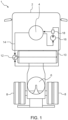
- Fig. 1 illustrates schematically a vehicle 1 (in particular a fuel cell electric vehicle, FCEV) on which at least some exemplary embodiments of the invention may be implemented.
- vehicle 1 in particular a fuel cell electric vehicle, FCEV
- FCEV fuel cell electric vehicle
- the truck comprises a cab 2 in which a driver may operate the vehicle 1.
- the vehicle 1 comprises an energy conversion system 4 which includes a stack of fuel cells.
- the illustration is made relative to a schematic outline of certain parts of a truck, however, it should be understood that the specific location of the components may be placed differently than in the exemplary illustration.
- a connector 6 for towing a trailer and a pair of rear wheels 8 of the truck have been schematically indicated.
- the fuel cells 4 may be provided at the cab 2, for example under the cab 2.
- the hydrogen tanks 10 are merely illustrated schematically and only two are shown. However, it should be understood that the vehicle 1 may have more hydrogen tanks, or fewer.
- the hydrogen tanks 10 may suitably be held by a rack attached to the chassis, or by any other suitable support structure.
- the vehicle 1 further comprises a heat exchanger 12 and a cooling passage 14 for circulating a coolant, i.e. a cooling fluid, such as a liquid, for example glycol-based.
- a coolant i.e. a cooling fluid, such as a liquid, for example glycol-based.
- the cooling passage 14 extends from the heat exchanger 12 and passes along the stack of fuel cells 4 for transporting heat away from the stack of fuel cells 4.
- a pump 16 is provided to pump coolant that has taken up heat from the stack of fuel cells 4. Downstream of the pump 16 there may be provided a thermostat 18 which senses the temperature of the coolant in the conduit and if the temperature is above a predefined value the coolant may be led back to the heat exchanger 12 to be cooled down before returning to the stack of fuel cells 4. If the thermostat 18 determines that the temperature of the coolant is still low enough, it may be returned to the stack of fuel cells 4 without being led through the heat exchanger 12.
- the vehicle 1 illustrated in Fig. 1 may suitably be modified by implementing a cooling system in accordance with the following exemplary embodiments that will now be discussed.
- Fig. 2 illustrates very schematically a cooling system 20 according to at least one exemplary embodiment of the invention.
- fuel cells 22 in some type of fuel cell arrangement, for example in the form of a stack of fuel cells.
- the fuel cells 22 need to be cooled and a coolant pump 24 is provided to pump the coolant around a coolant passage or coolant circuit 26.
- the coolant pump 24 pumps the coolant from the fuel cells 22 to and through a heat exchanger 28 and back to the fuel cells 22.
- a thermostat to determine if the temperature of the coolant is still low enough for it to be returned to the fuel cells 22 without being led through the heat exchanger 28.
- a positive displacement device 30, here illustrated in the form of a fan, for blowing air onto the heat exchanger 28 to improve dissipation of heat from the heat exchanger 28.
- the dissipation of heat is not only dependent on the flow of air from the positive displacement device 30, but may also be dependent on other factors such as the exterior relative air flow caused by the vehicle speed, the air temperature, the type of coolant, the mass of coolant, etc.
- the cooling system 20 also comprises a first chamber 32, such as in a tank, and a second chamber 34, such as in another tank.
- Each one of the first chamber 32 and second chamber 34 is operatively connected to the coolant circuit 26. More specifically, there are provided fluid connections 36, 38, 40, 42 for enabling communication of fluid between the coolant circuit 26 on the one hand and the first and second chambers 32, 34 on the other hand.
- the communication for each one of the first and second chambers 32, 34 may be established by a single bi-directional conduit, in the present illustration the communication is established by means of an inlet conduit 36, 38 and an outlet conduit 40, 42.
- Each inlet conduit 36, 38 allows fluid in the form of coolant to be diverted from the coolant circuit 26 and into the respective first and second chamber 32, 34.
- a valve 44, 46 is provided in each inlet conduit 36, 38 to enable or disable transfer of coolant from the coolant circuit 26 to the first and second chambers 32, 34.
- Each outlet conduit 40, 42 allows fluid to be passed from the first and second chambers 32, 34, respectively, to the coolant circuit 26.
- coolant that has once been diverted and stored in the first and second chambers 32, 34 may at a later point in time be returned to the coolant circuit 26.
- a pump 48, 50 is provided in each outlet conduit 40, 42 to enable transfer of coolant from the respective chamber 32, 34 to the coolant circuit 26.
- the cooling system 20 further comprises a control unit 60.
- the control unit 60 may communicate with other components wirelessly or by wire.
- the control unit 60 is configured to monitor the ratio of cooling power/fan power (COPfan) of the positive displacement device 30.
- the control unit 60 is also configured to control thermal energy transfer between the coolant and said chambers 32, 34 based on said ratio.
- COPfan cooling power/fan power
- the first chamber 32 is configured to contain relatively hot fluid.
- the second chamber 34 is located downstream of the heat exchanger 28 but upstream of the fuel cells 22, the second chamber 34 is configured to contain relatively cold fluid.
- control unit 60 is configured to cause thermal energy from the first chamber 32 to be provided to the coolant in the coolant circuit 26 and passed into the heat exchanger 28, after which part of the thermal energy of the cooled coolant leaving the heat exchanger 28 is provided to and stored in the second chamber 34.
- control unit 60 is configured to provide stored cold thermal energy from the second chamber 34 to the coolant in the coolant circuit to reduce the temperature of the coolant before it is passed to the fuel cells 22, after which part of the thermal energy of the heated coolant leaving the fuel cells 22 is provided to and stored in the first chamber 32.
- a schematic control unit 60 is only illustrated in Fig. 2 , such a control unit is, in practice, also included in the other exemplary embodiments (that will be discussed below) for controlling the operation of the cooling system and performing the method of controlling the cooling system of those exemplary embodiments.
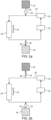
- Figs. 2a and 2b illustrate, in accordance with at least one exemplary embodiment, a method of operating the cooling system 20 of Fig. 2 .
- Fig 2a illustrates the operation of the cooling system 20 during a charge mode of the cooling system 20.
- Fig. 2b illustrates the operation of the cooling system 20 during a discharge mode of the cooling system 20.
- active conduits are shown in Figs. 2a and 2b . Thus, when a valve is closed, the corresponding conduit is not illustrated.
- Fig. 2a illustrates that if the vehicle is operating at a point where the ratio (COPfan) is above a predefined value or value range, the fluid from the first chamber 32 is pumped into the coolant circuit 26 and is passed into the heat exchanger 28.
- thermal energy from the first chamber 32 is provided to the coolant in the coolant circuit 26 and is passed into the heat exchanger 28.
- the fan power of the positive displacement device 30 may be increased to achieve the required coolant outlet temperature from the heat exchanger 28.
- the valve 46 at the inlet conduit 38 of the second chamber 34 is open and part of the cooled fluid enters the second chamber 34. In other words, part of the thermal energy of the cooled coolant leaving the heat exchanger 28 is provided to and stored in the second chamber 34.
- Fig. 2b illustrates that if the vehicle is operating at a point where the ratio (COPfan) is below the predefined value or value range, the fluid from the second chamber 34 is pumped (by means of the pump 50 in outlet conduit 42, controlled by the control unit) into the coolant circuit 26 and flows through the fuel cells 22.
- the stored cold thermal energy from the second chamber 34 is provided to the coolant in the coolant circuit 26 to reduce the temperature of the coolant before it is passed to the fuel cells 22 of the vehicle.
- Part of the fluid heated by the fuel cells 22 is then diverted into the first chamber 32 via the open valve 44 in the inlet conduit 36 to the first chamber 32.
- part of the thermal energy of the heated coolant leaving the fuel cells 22 is provided to and stored in the first chamber 32.
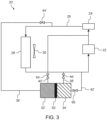
- Fig. 3 illustrates a cooling system 20' according to at least another exemplary embodiment of the invention.
- each one of the first chamber 32' and the second chamber 34' can be arranged in fluid communication with the coolant circuit 26.
- the moving force is achieved by means of a diaphragm 62 subjected to a differential pressure.
- the first and the second chambers 32', 34' may be provided in a common vessel, but are separated by the intermediate diaphragm 62 extending across the vessel.
- first and second chambers 32', 34' are variable volume chambers, wherein the volume is varied based on the movement of the diaphragm 62.
- any other appropriate movable separation member may be used instead of a diaphragm, such as for instance a plunger.
- each chamber 32', 34' is associated with an inlet conduit 36', 38' and an outlet conduit 40', 42'.
- the inlet conduits 36', 38' as well as the outlet conduits 40', 42' are provided with valves 44', 46', 64, 66.
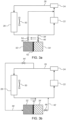
- Figs. 3a and 3b illustrate, in accordance with at least one exemplary embodiment, a method of operating the cooling system 20' of Fig. 3 .
- Fig. 3a illustrates the operation of the cooling system 20' during a charge mode of the cooling system 20'.
- Fig. 3b illustrates the operation of the cooling system 20' during a discharge mode of the cooling system 20'.
- active conduits are shown in Figs. 3a and 3b . Thus, when a valve is closed, the corresponding conduit is not illustrated.
- Fig. 3a illustrates that if the vehicle is at a point where the ratio (COPfan) is above a predefined value or value range, the fluid from the first chamber 32' is pressed into the coolant circuit 26 and is passed into the heat exchanger 28.
- the valve 46' at the inlet conduit 38' to the second chamber 34' has been opened and the valve 64 at the outlet conduit 40' from the first chamber 32' is open. Since the coolant pump 24 displaces the coolant in the coolant circuit 26, the coolant enters the second chamber 34' creating a higher pressure than in the first chamber 32' (pressure difference indicated by the pair of arrows pointing left in the figure). This causes the diaphragm 62 to push coolant out from the first chamber 32'.
- the ratio COPfan
- thermal energy from the first chamber 32' is provided to the coolant in the coolant circuit 26 and is passed into the heat exchanger 28, and part of the thermal energy of the cooled coolant leaving the heat exchanger 28 is provided to and stored in the second chamber 34'.
- Fig. 3b illustrates that if the vehicle is operating at a point where the ratio (COPfan) is below the predefined value or value range, the opening and closing of the valves are switched.
- the valve 44' at the inlet conduit 36' to the first chamber 32' is opened and the valve 66 at the outlet conduit 42' from the second chamber 34' is opened.
- the pressure difference is reversed (indicated by the pair of arrows point to the right in the figure) and the diaphragm 62 will cause fluid from the second chamber 34' to be pushed into the coolant circuit 26 and to flow through the fuel cells 22.
- the stored cold thermal energy from the second chamber 34' is provided to the coolant in the coolant circuit 26 to reduce the temperature of the coolant before it is passed to the fuel cells 22 of the vehicle, and part of the thermal energy of the heated coolant leaving the fuel cells 22 is diverted to and stored in the first chamber 32'.
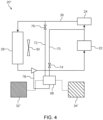
- Fig. 4 illustrates a cooling system 20" according to at least yet another exemplary embodiment of the invention. Unlike the exemplary embodiments shown in Figs. 2 and 3 , the embodiment in Fig. 4 does not allow fluid communication between the coolant circuit 26 and the first and second chambers 32", 34". Instead, thermal energy is transferred through a thermal connection.
- the cooling system 20" comprises a heat exchanging device 68 which is in thermal connection with the first chamber 32" and the second chamber 34" (illustrated by the dotted lines). Thermal energy is transferred between the coolant circuit 26 and the first and second chambers 32", 34" via said heat exchanging device 68. Thus, fluid may pass through the heat exchanging device 68 between the first and second chambers 32", 34".
- the fluid may be a different fluid than the coolant fluid.
- Fig. 4 also shows that the cooling system 20" has a first passage 70 and a second passage 72, each one having a valve 74, 76.
- the heat exchanging device 68 is located in a bypass portion 78 to the coolant circuit 26.
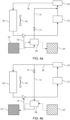
- Figs. 4a and 4b illustrate, in accordance with at least one exemplary embodiment, a method of operating the cooling system 20" of Fig. 4 .
- Fig. 4a illustrates the operation of the cooling system 20" during a charge mode of the cooling system 20".
- Fig. 4b illustrates the operation of the cooling system 20" during a discharge mode of the cooling system 20".
- active conduits are shown in Figs. 4a and 4b . Thus, when a valve is closed, the corresponding conduit is not illustrated.
- Fig. 4a illustrates that if the vehicle is at a point where the ratio (COPfan) is above a predefined value or value range, part of the coolant that has exited the heat exchanger 28 is diverted into the bypass portion 78 to be led through the heat exchanging device 68.
- the separate fluid from the first chamber 32" is moved through the heat exchanging device 68 (e.g. by means of a pump).
- the fluid moves through the heat exchanging device 68 it will transfers thermal energy to the coolant.
- the coolant will be heated, while the fluid will be cooled.
- the cooled fluid enters and is stored in the second chamber 34".
- part of the cooled coolant that exits the heat exchanger 28 is guided to the fuel cells 22, but another part is guided through the heat exchanging device 68 in the bypass portion 78.
- the heated coolant leaves the heat exchanging device 68 and is guided via the first passage and its opened valve 74 to a location downstream of the fuel cells 22 but upstream of the heat exchanger 28.
- thermal energy from the first chamber 32" is provided to the coolant, however, here via the heat exchanging device 68, and is passed into the heat exchanger 28, and part of the thermal energy of the cooled coolant leaving the heat exchanger 28 is provided to and stored in the second chamber 34" as stored cold thermal energy.
- Fig. 4b illustrates that if the vehicle is operating at a point where the ratio (COPfan) is below the predefined value or value range, the fluid from the second chamber 34" is moved through the heat exchanging device 68 (e.g. by means of a pump). Simultaneously, some of the coolant is diverted to pass through the heat exchanging device 68 via the now operand valve 76 of the second passage 72, and thermal energy will be transferred from the coolant to the other fluid in the heat exchanging device 68. Thus, the chamber fluid will take up heat and then be passed to the first chamber 34", while the coolant will lose heat and be cooled and then passed via the bypass portion 78 (in reverse direction) back to the coolant circuit 26 and the fuel cells 22.
- the ratio COPfan
- the stored cold thermal energy from the second chamber 34" is provided to the coolant in the coolant circuit to reduce the temperature of the coolant before it is passed to the fuel cells 22 of the vehicle, and part of the thermal energy of the heated coolant leaving the fuel cells 22 is passed to and stored in the first chamber 32".
- Fig. 5 illustrates a cooling system 20′′′ according to at least a further exemplary embodiment of the invention.
- the cooling system 20′′′ substantially corresponds to the cooling system of Fig. 2 .
- Fig. 5 illustrates that the vehicle has an electrical storage system (EES) 80.
- the control unit 60 is configured to monitor the state of charge of the EES 80. When the control unit 60 determines that the EES 80 has a certain surplus of energy, then the control unit 60 controls at least part of said surplus of energy to be supplied to the positive displacement device 30 to increase the thermal energy removed from the heat exchanger 28. This may in particular be done in a charge mode, i.e.
- control unit 60 may thus suitably be configured to increase the fan power of the positive displacement device 30 when the vehicle is operating at a point when said ratio ( COPfan ) is above said pre-defined value or value range.
- control unit 60 is in practice included also in the other exemplary embodiments (e.g. Figs. 3 and 4 ), although not specifically illustrated. Furthermore, the control unit 60 may for those other exemplary embodiments (e.g. Figs. 3 and 4 ) monitor the state of charge of an EES of the vehicle and transfer surplus energy to the positive displacement device 30 in the corresponding manner as shown and explained with reference to the exemplary embodiment of Fig. 5 .
Landscapes
- Engineering & Computer Science (AREA)
- Sustainable Energy (AREA)
- Life Sciences & Earth Sciences (AREA)
- Sustainable Development (AREA)
- Chemical Kinetics & Catalysis (AREA)
- Chemical & Material Sciences (AREA)
- Manufacturing & Machinery (AREA)
- Electrochemistry (AREA)
- General Chemical & Material Sciences (AREA)
- Power Engineering (AREA)
- Transportation (AREA)
- Mechanical Engineering (AREA)
- Fuel Cell (AREA)
- Electric Propulsion And Braking For Vehicles (AREA)
Claims (16)
- Brennstoffzellenelektrofahrzeug (FCEV) (1), umfassend ein Kühlsystem (20, 20', 20", 20‴), wobei das Kühlsystem Folgendes umfasst:- einen Kühlmittelkreis (26), in dem ein Kühlmittel umläuft,- einen Wärmetauscher (28) zum Kühlen des umlaufenden Kühlmittels,- eine Verdrängungsvorrichtung (30) zum Entfernen thermischer Energie von dem Wärmetauscher in die Umwelt,- eine erste Kammer (32, 32', 32''), die dazu konfiguriert ist, relativ heißes Fluid zu enthalten,- eine zweite Kammer (34, 34', 34''), die dazu konfiguriert ist, relativ kaltes Fluid zu enthalten,- dadurch gekennzeichnet, dass das FCEV eine Steuerungseinheit (60) umfasst, die dazu konfiguriert ist, das Verhältnis von Kühlleistung/Lüfterleistung der Verdrängungsvorrichtung zu überwachen, und dazu konfiguriert ist, thermische Energieübertragung zwischen dem Kühlmittel und den Kammern basierend auf dem Verhältnis zu steuern, wobeiwenn das FCEV an einem Punkt betrieben wird, an dem das Verhältnis über einem vordefinierten Wert oder Wertebereich liegt, thermische Energie von der ersten Kammer dem Kühlmittel in dem Kühlmittelkreis bereitgestellt wird und in den Wärmetauscher übergeben wird, wonach ein Teil der thermischen Energie des gekühlten Kühlmittels, das den Wärmetauscher verlässt, der zweiten Kammer bereitgestellt und in dieser gespeichert wird, undwenn das FCEV an einem Punkt betrieben wird, an dem das Verhältnis unter dem vordefinierten Wert oder Wertebereich liegt, gespeicherte kalte thermische Energie von der zweiten Kammer dem Kühlmittel in dem Kühlmittelkreis bereitgestellt wird, um die Temperatur des Kühlmittels zu verringern, bevor es den Brennstoffzellen (22) des FCEV übergeben wird, wonach ein Teil der thermischen Energie des erhitzten Kühlmittels, das die Brennstoffzellen verlässt, der ersten Kammer bereitgestellt und in dieser gespeichert wird.
- FCEV nach Anspruch 1, wobei das Kühlsystem (20, 20', 20‴) Fluidverbindungen (36, 38, 40, 42, 36', 38', 40', 42') zum Bereitstellen der ersten und der zweiten Kammer (32, 34, 32', 34') in Fluidkommunikation mit dem Kühlmittelkreis (26) umfasst, wobei thermische Energie den Kammern durch Übergeben von Kühlmittel in die Kammern bereitgestellt wird und wobei thermische Energie aus den Kammern durch Übergeben von Kühlmittel von den Kammern weg freigegeben wird.
- FCEV nach Anspruch 2, wobei das Kühlsystem (20, 20', 20‴) Ventile (44, 46, 44', 46', 64, 66) zum Regeln des Flusses von Kühlmittel zu und von den Kammern (32, 34, 32', 34') umfasst, wobei die Steuerungseinheit (60) dazu konfiguriert ist, die Ventile basierend auf dem Wert des Verhältnisses zu steuern.
- FCEV nach einem der Ansprüche 2-3, wobei das Kühlsystem (20, 20''') eine erste Pumpe (48) zum Pumpen von Kühlmittel von der ersten Kammer (32) zu dem Kühlmittelkreis (26) und eine zweite Pumpe (50) zum Pumpen von Kühlmittel von der zweiten Kammer (34) zu dem Kühlmittelkreis umfasst, wobei die Steuerungseinheit (60) dazu konfiguriert ist, die erste Pumpe zu aktivieren, wenn das Verhältnis über dem vordefinierten Wert oder Wertebereich liegt, wobei die Steuerungseinheit dazu konfiguriert ist, die zweite Pumpe zu aktivieren, wenn das Verhältnis unter dem vordefinierten Wert oder Wertebereich liegt.
- FCEV nach einem der Ansprüche 2-3, wobei die erste und die zweite Kammer (32', 34') Kammern mit variablem Volumen sind, die sich in einem gemeinsamen Gefäß befinden, wobei die Kammern durch ein bewegliches Trennungselement (62), wie etwa eine Membran oder einen Stößel, getrennt werden, wobei die Druckdifferenzen über dem beweglichen Trennungselement dazu verwendet werden, das Kühlmittel aus der jeweiligen Kammer hinauszutreiben, wenn die Steuerungseinheit (60) die Ventile basierend auf dem Verhältnis steuert.
- FCEV nach Anspruch 1, wobei das Kühlsystem (20'') ferner eine Wärmetauschvorrichtung (68) in thermischer Verbindung mit der ersten Kammer (32") und der zweiten Kammer (34") umfasst, wobei thermische Energie zwischen dem Kühlmittelkreis (26) und der ersten und der zweiten Kammer über die Wärmetauschvorrichtung übertragen wird.
- FCEV nach einem der Ansprüche 1-6, wobei die Steuerungseinheit (60) dazu konfiguriert ist, den Ladezustand eines elektrischen Speichersystems (ESS) (80) des FCEV (1) zu überwachen, und, nach Bestimmen eines gewissen Überschusses an Energie in dem ESS, die Steuerungseinheit mindestens einen Teil des Überschusses an Energie dazu steuert, an die Verdrängungsvorrichtung (30) geliefert zu werden, um die thermische Energie, die aus dem Wärmetauscher (28) entfernt wird, zu erhöhen, wobei thermische Energie von der ersten Kammer (32) dem Kühlmittel des Kühlmittelkreises bereitgestellt wird und in den Wärmetauscher übergeben wird, wonach ein Teil der thermischen Energie des gekühlten Kühlmittels, das den Wärmetauscher verlässt, der zweiten Kammer (34) bereitgestellt und in dieser gespeichert wird.
- FCEV nach einem der Ansprüche 1-7, wobei die Steuerungseinheit (60) dazu konfiguriert ist, die Lüfterleistung der Verdrängungsvorrichtung (30) zu erhöhen, wenn das FCEV (1) an einem Punkt betrieben wird, an dem das Verhältnis über dem vordefinierten Wert oder Wertebereich liegt.
- Verfahren zum Steuern eines Kühlsystems in einem Brennstoffzellenelektrofahrzeug (FCEV), wobei das Kühlsystem einen Kühlmittelkreis (26), in dem ein Kühlmittel umläuft, einen Wärmetauscher (28) zum Kühlen des umlaufenden Kühlmittels und eine Verdrängungsvorrichtung (30) zum Entfernen thermischer Energie aus dem Wärmetauscher in die Umwelt umfasst, wobei das Verfahren Folgendes umfasst:- Bereitstellen einer ersten Kammer (32, 32', 32''), die dazu konfiguriert ist, relativ heißes Fluid zu enthalten, und einer zweiten Kammer (34, 34', 34''), die dazu konfiguriert ist, relativ kaltes Fluid zu enthalten,- Überwachen des Verhältnisses von Kühlleistung/Lüfterleistung der Verdrängungsvorrichtung und- wenn das FCEV an einem Punkt betrieben wird, an dem das Verhältnis über einem vordefinierten Wert oder Wertebereich liegt, wird thermische Energie von der ersten Kammer dem Kühlmittel in dem Kühlmittelkreis bereitgestellt und wird in den Wärmetauscher übergeben, wonach ein Teil der thermischen Energie des gekühlten Kühlmittels, das den Wärmetauscher verlässt, der zweiten Kammer bereitgestellt und in dieser gespeichert wird, und- wenn das FCEV an einem Punkt betrieben wird, an dem das Verhältnis unter dem vordefinierten Wert oder Wertebereich liegt, wird gespeicherte kalte thermische Energie von der zweiten Kammer dem Kühlmittel in dem Kühlmittelkreis bereitgestellt, um die Temperatur des Kühlmittels zu verringern, bevor es den Brennstoffzellen des FCEV übergeben wird, wonach ein Teil der thermischen Energie des erhitzten Kühlmittels, das die Brennstoffzellen verlässt, der ersten Kammer bereitgestellt und in dieser gespeichert wird.
- Verfahren nach Anspruch 9, wobei das Bereitstellen thermischer Energie zu/von entweder der einen oder der anderen der ersten und der zweiten Kammer (32, 32', 34, 34') Übertragen von Kühlmittel zwischen dem Kühlmittelkreis (26) beziehungsweise der ersten und der zweiten Kammer umfasst.
- Verfahren nach Anspruch 9, wobei das Kühlsystem ferner eine Wärmetauschvorrichtung in thermischer Verbindung mit der ersten und der zweiten Kammer (32'', 34'') umfasst, wobei das Bereitstellen thermischer Energie zu/von entweder der einen oder der anderen der ersten und der zweiten Kammer Übertragen thermischer Energie zwischen dem Kühlmittel des Kühlmittelkreises (26) beziehungsweise der ersten und der zweiten Kammer über die Wärmetauschvorrichtung (28) umfasst.
- Verfahren nach einem der Ansprüche 9-11, umfassend- Überwachen des Ladezustands eines elektrischen Speichersystems (ESS) (80) des FCEV,- nach Bestimmen eines gewissen Überschusses an Energie in dem ESS Liefern mindestens eines Teiles des Überschusses an Energie an die Verdrängungsvorrichtung (30), um die thermische Energie, die aus dem Wärmetauscher (28) entfernt wird, zu erhöhen, und- Bereitstellen thermischer Energie von der ersten Kammer (32) zu dem Kühlmittel des Kühlmittelkreises, das in den Wärmetauscher übergeben wird, wonach ein Teil der thermischen Energie des gekühlten Kühlmittels, das den Wärmetauscher verlässt, der zweiten Kammer (34) bereitgestellt und in dieser gespeichert wird.
- Verfahren nach einem der Ansprüche 9-12, umfassend Erhöhen der Lüfterleistung der Verdrängungsvorrichtung (30), wenn das FCEV an einem Punkt betrieben wird, an dem das Verhältnis über dem vordefinierten Wert oder Wertebereich liegt.
- Computerprogramm, umfassend Programmcodemittel zum Durchführen der Schritte nach einem der Ansprüche 9-13, wenn das Programm auf einem Computer ausgeführt wird.
- Computerlesbares Medium, das ein Computerprogramm trägt, das Programmcodemittel zum Durchführen der Schritte nach einem der Ansprüche 9-13 umfasst, wenn das Programmprodukt auf einem Computer ausgeführt wird.
- Steuerungseinheit zum Steuern eines Kühlsystems eines Brennstoffzellenelektrofahrzeugs (FCEV), wobei die Steuerungseinheit dazu konfiguriert ist, die Schritte des Verfahrens nach einem der Ansprüche 9-13 durchzuführen.
Priority Applications (3)
| Application Number | Priority Date | Filing Date | Title |
|---|---|---|---|
| EP21196959.7A EP4152450B1 (de) | 2021-09-15 | 2021-09-15 | Kühlsystem in einem brennstoffzellenelektrofahrzeug und verfahren zur steuerung eines kühlsystems in einem brennstoffzellenelektrofahrzeug |
| CN202211073140.2A CN115805850A (zh) | 2021-09-15 | 2022-09-02 | 燃料电池电动车辆中的冷却系统和控制燃料电池电动车辆中的冷却系统的方法 |
| US17/903,316 US12286031B2 (en) | 2021-09-15 | 2022-09-06 | Cooling system in a fuel cell electric vehicle and method of controlling a cooling system in a fuel cell electric vehicle |
Applications Claiming Priority (1)
| Application Number | Priority Date | Filing Date | Title |
|---|---|---|---|
| EP21196959.7A EP4152450B1 (de) | 2021-09-15 | 2021-09-15 | Kühlsystem in einem brennstoffzellenelektrofahrzeug und verfahren zur steuerung eines kühlsystems in einem brennstoffzellenelektrofahrzeug |
Publications (3)
| Publication Number | Publication Date |
|---|---|
| EP4152450A1 EP4152450A1 (de) | 2023-03-22 |
| EP4152450B1 true EP4152450B1 (de) | 2024-09-04 |
| EP4152450C0 EP4152450C0 (de) | 2024-09-04 |
Family
ID=77801483
Family Applications (1)
| Application Number | Title | Priority Date | Filing Date |
|---|---|---|---|
| EP21196959.7A Active EP4152450B1 (de) | 2021-09-15 | 2021-09-15 | Kühlsystem in einem brennstoffzellenelektrofahrzeug und verfahren zur steuerung eines kühlsystems in einem brennstoffzellenelektrofahrzeug |
Country Status (3)
| Country | Link |
|---|---|
| US (1) | US12286031B2 (de) |
| EP (1) | EP4152450B1 (de) |
| CN (1) | CN115805850A (de) |
Families Citing this family (1)
| Publication number | Priority date | Publication date | Assignee | Title |
|---|---|---|---|---|
| TWI899915B (zh) * | 2024-03-26 | 2025-10-01 | 財團法人車輛研究測試中心 | 燃料電池冷卻系統及燃料電池控溫方法 |
Family Cites Families (5)
| Publication number | Priority date | Publication date | Assignee | Title |
|---|---|---|---|---|
| DE10142923A1 (de) * | 2000-09-21 | 2002-04-18 | Daimler Chrysler Ag | Hybridantriebsvorrichtung und Verfahren zum Betreiben der Hybridantriebsvorrichtung |
| DE202006014065U1 (de) * | 2005-09-20 | 2006-11-16 | Sartorius Ag | Brennstoffzellensystem |
| JP6308189B2 (ja) | 2015-09-08 | 2018-04-11 | トヨタ自動車株式会社 | 燃料電池システム |
| DE102019132088B4 (de) * | 2019-11-27 | 2025-07-31 | Rolls-Royce Solutions GmbH | Brennstoffzellensystem, Verfahren zum Betreiben eines Brennstoffzellensystems, Fahrzeug, Klimasystem |
| CN112531184B (zh) * | 2021-02-08 | 2021-04-27 | 北京亿华通科技股份有限公司 | 用于燃料电池的热管理装置、控制方法和存储介质 |
-
2021
- 2021-09-15 EP EP21196959.7A patent/EP4152450B1/de active Active
-
2022
- 2022-09-02 CN CN202211073140.2A patent/CN115805850A/zh active Pending
- 2022-09-06 US US17/903,316 patent/US12286031B2/en active Active
Also Published As
| Publication number | Publication date |
|---|---|
| EP4152450A1 (de) | 2023-03-22 |
| US12286031B2 (en) | 2025-04-29 |
| CN115805850A (zh) | 2023-03-17 |
| EP4152450C0 (de) | 2024-09-04 |
| US20230078213A1 (en) | 2023-03-16 |
Similar Documents
| Publication | Publication Date | Title |
|---|---|---|
| CN109367438B (zh) | 一种应用于混合动力车型的电池热管理系统 | |
| US10220722B2 (en) | Operation of combined cooling circuit for power electronics and battery | |
| US10730403B2 (en) | System and method to utilize waste heat from power electronics to heat high voltage battery | |
| US11884275B2 (en) | Method for controlling a vehicle in association with a descent, a powertrain, a vehicle, a computer program and a computer-readable medium | |
| US8534571B2 (en) | Switchable radiator bypass valve set point to improve energy efficiency | |
| US11088408B2 (en) | Battery temperature raising device | |
| CN105799450B (zh) | 蒸汽压缩式热泵系统中的除冰控制 | |
| US11807069B2 (en) | Electrically driven motor vehicle | |
| US20120327596A1 (en) | Thermal management system using a phase-change material for vehicle with electric traction motor | |
| US20100126692A1 (en) | Integrated hybrid heat exchanger with multi-sectional structure | |
| US10549605B2 (en) | Heating system and method for heating a vehicle interior of a vehicle having an internal combustion engine | |
| US12327852B2 (en) | Cooling system for a vehicle | |
| US10987993B2 (en) | Thermal management system for electrified vehicle | |
| US20230278415A1 (en) | Multiple circuit thermal management system comprising mixing lines, and vehicle | |
| US11318861B2 (en) | Coolant system for a vehicle | |
| US12286031B2 (en) | Cooling system in a fuel cell electric vehicle and method of controlling a cooling system in a fuel cell electric vehicle | |
| CN216886248U (zh) | 车辆热管理系统及车辆 | |
| CN110608083B (zh) | 冷却剂压力调节器系统 | |
| EP4282672B1 (de) | Wärmeverwaltungssystem für elektrofahrzeug und fahrzeug | |
| NL2035930B1 (en) | Commercial vehicle comprising a multi radiator cooling system | |
| CN116552189A (zh) | 混合动力车辆用热管理系统及其工作方法 |
Legal Events
| Date | Code | Title | Description |
|---|---|---|---|
| PUAI | Public reference made under article 153(3) epc to a published international application that has entered the european phase |
Free format text: ORIGINAL CODE: 0009012 |
|
| STAA | Information on the status of an ep patent application or granted ep patent |
Free format text: STATUS: THE APPLICATION HAS BEEN PUBLISHED |
|
| AK | Designated contracting states |
Kind code of ref document: A1 Designated state(s): AL AT BE BG CH CY CZ DE DK EE ES FI FR GB GR HR HU IE IS IT LI LT LU LV MC MK MT NL NO PL PT RO RS SE SI SK SM TR |
|
| STAA | Information on the status of an ep patent application or granted ep patent |
Free format text: STATUS: REQUEST FOR EXAMINATION WAS MADE |
|
| 17P | Request for examination filed |
Effective date: 20230811 |
|
| RBV | Designated contracting states (corrected) |
Designated state(s): AL AT BE BG CH CY CZ DE DK EE ES FI FR GB GR HR HU IE IS IT LI LT LU LV MC MK MT NL NO PL PT RO RS SE SI SK SM TR |
|
| GRAP | Despatch of communication of intention to grant a patent |
Free format text: ORIGINAL CODE: EPIDOSNIGR1 |
|
| STAA | Information on the status of an ep patent application or granted ep patent |
Free format text: STATUS: GRANT OF PATENT IS INTENDED |
|
| INTG | Intention to grant announced |
Effective date: 20240503 |
|
| GRAS | Grant fee paid |
Free format text: ORIGINAL CODE: EPIDOSNIGR3 |
|
| GRAA | (expected) grant |
Free format text: ORIGINAL CODE: 0009210 |
|
| STAA | Information on the status of an ep patent application or granted ep patent |
Free format text: STATUS: THE PATENT HAS BEEN GRANTED |
|
| RIN1 | Information on inventor provided before grant (corrected) |
Inventor name: BLOMGREN, FREDRIK Inventor name: BHAVANI SHANKAR, VIJAI SHANKAR |
|
| AK | Designated contracting states |
Kind code of ref document: B1 Designated state(s): AL AT BE BG CH CY CZ DE DK EE ES FI FR GB GR HR HU IE IS IT LI LT LU LV MC MK MT NL NO PL PT RO RS SE SI SK SM TR |
|
| REG | Reference to a national code |
Ref country code: GB Ref legal event code: FG4D |
|
| REG | Reference to a national code |
Ref country code: CH Ref legal event code: EP |
|
| REG | Reference to a national code |
Ref country code: IE Ref legal event code: FG4D |
|
| REG | Reference to a national code |
Ref country code: DE Ref legal event code: R096 Ref document number: 602021018222 Country of ref document: DE |
|
| U01 | Request for unitary effect filed |
Effective date: 20240923 |
|
| U07 | Unitary effect registered |
Designated state(s): AT BE BG DE DK EE FI FR IT LT LU LV MT NL PT RO SE SI Effective date: 20241015 |
|
| U20 | Renewal fee for the european patent with unitary effect paid |
Year of fee payment: 4 Effective date: 20241016 |
|
| PG25 | Lapsed in a contracting state [announced via postgrant information from national office to epo] |
Ref country code: NO Free format text: LAPSE BECAUSE OF FAILURE TO SUBMIT A TRANSLATION OF THE DESCRIPTION OR TO PAY THE FEE WITHIN THE PRESCRIBED TIME-LIMIT Effective date: 20241204 |
|
| PG25 | Lapsed in a contracting state [announced via postgrant information from national office to epo] |
Ref country code: GR Free format text: LAPSE BECAUSE OF FAILURE TO SUBMIT A TRANSLATION OF THE DESCRIPTION OR TO PAY THE FEE WITHIN THE PRESCRIBED TIME-LIMIT Effective date: 20241205 Ref country code: PL Free format text: LAPSE BECAUSE OF FAILURE TO SUBMIT A TRANSLATION OF THE DESCRIPTION OR TO PAY THE FEE WITHIN THE PRESCRIBED TIME-LIMIT Effective date: 20240904 |
|
| PG25 | Lapsed in a contracting state [announced via postgrant information from national office to epo] |
Ref country code: HR Free format text: LAPSE BECAUSE OF FAILURE TO SUBMIT A TRANSLATION OF THE DESCRIPTION OR TO PAY THE FEE WITHIN THE PRESCRIBED TIME-LIMIT Effective date: 20240904 |
|
| PG25 | Lapsed in a contracting state [announced via postgrant information from national office to epo] |
Ref country code: ES Free format text: LAPSE BECAUSE OF FAILURE TO SUBMIT A TRANSLATION OF THE DESCRIPTION OR TO PAY THE FEE WITHIN THE PRESCRIBED TIME-LIMIT Effective date: 20240904 |
|
| PG25 | Lapsed in a contracting state [announced via postgrant information from national office to epo] |
Ref country code: PL Free format text: LAPSE BECAUSE OF FAILURE TO SUBMIT A TRANSLATION OF THE DESCRIPTION OR TO PAY THE FEE WITHIN THE PRESCRIBED TIME-LIMIT Effective date: 20240904 Ref country code: NO Free format text: LAPSE BECAUSE OF FAILURE TO SUBMIT A TRANSLATION OF THE DESCRIPTION OR TO PAY THE FEE WITHIN THE PRESCRIBED TIME-LIMIT Effective date: 20241204 Ref country code: HR Free format text: LAPSE BECAUSE OF FAILURE TO SUBMIT A TRANSLATION OF THE DESCRIPTION OR TO PAY THE FEE WITHIN THE PRESCRIBED TIME-LIMIT Effective date: 20240904 Ref country code: GR Free format text: LAPSE BECAUSE OF FAILURE TO SUBMIT A TRANSLATION OF THE DESCRIPTION OR TO PAY THE FEE WITHIN THE PRESCRIBED TIME-LIMIT Effective date: 20241205 Ref country code: ES Free format text: LAPSE BECAUSE OF FAILURE TO SUBMIT A TRANSLATION OF THE DESCRIPTION OR TO PAY THE FEE WITHIN THE PRESCRIBED TIME-LIMIT Effective date: 20240904 |
|
| PG25 | Lapsed in a contracting state [announced via postgrant information from national office to epo] |
Ref country code: IS Free format text: LAPSE BECAUSE OF FAILURE TO SUBMIT A TRANSLATION OF THE DESCRIPTION OR TO PAY THE FEE WITHIN THE PRESCRIBED TIME-LIMIT Effective date: 20250104 |
|
| PG25 | Lapsed in a contracting state [announced via postgrant information from national office to epo] |
Ref country code: SM Free format text: LAPSE BECAUSE OF FAILURE TO SUBMIT A TRANSLATION OF THE DESCRIPTION OR TO PAY THE FEE WITHIN THE PRESCRIBED TIME-LIMIT Effective date: 20240904 |
|
| PG25 | Lapsed in a contracting state [announced via postgrant information from national office to epo] |
Ref country code: CZ Free format text: LAPSE BECAUSE OF FAILURE TO SUBMIT A TRANSLATION OF THE DESCRIPTION OR TO PAY THE FEE WITHIN THE PRESCRIBED TIME-LIMIT Effective date: 20240904 |
|
| PG25 | Lapsed in a contracting state [announced via postgrant information from national office to epo] |
Ref country code: SK Free format text: LAPSE BECAUSE OF FAILURE TO SUBMIT A TRANSLATION OF THE DESCRIPTION OR TO PAY THE FEE WITHIN THE PRESCRIBED TIME-LIMIT Effective date: 20240904 |
|
| REG | Reference to a national code |
Ref country code: CH Ref legal event code: PL |
|
| PG25 | Lapsed in a contracting state [announced via postgrant information from national office to epo] |
Ref country code: RS Free format text: LAPSE BECAUSE OF FAILURE TO SUBMIT A TRANSLATION OF THE DESCRIPTION OR TO PAY THE FEE WITHIN THE PRESCRIBED TIME-LIMIT Effective date: 20240904 |
|
| PG25 | Lapsed in a contracting state [announced via postgrant information from national office to epo] |
Ref country code: MC Free format text: LAPSE BECAUSE OF FAILURE TO SUBMIT A TRANSLATION OF THE DESCRIPTION OR TO PAY THE FEE WITHIN THE PRESCRIBED TIME-LIMIT Effective date: 20240904 |
|
| PLBE | No opposition filed within time limit |
Free format text: ORIGINAL CODE: 0009261 |
|
| STAA | Information on the status of an ep patent application or granted ep patent |
Free format text: STATUS: NO OPPOSITION FILED WITHIN TIME LIMIT |
|
| PG25 | Lapsed in a contracting state [announced via postgrant information from national office to epo] |
Ref country code: CH Free format text: LAPSE BECAUSE OF NON-PAYMENT OF DUE FEES Effective date: 20240930 |
|
| PG25 | Lapsed in a contracting state [announced via postgrant information from national office to epo] |
Ref country code: IE Free format text: LAPSE BECAUSE OF NON-PAYMENT OF DUE FEES Effective date: 20240915 |
|
| 26N | No opposition filed |
Effective date: 20250605 |
|
| U20 | Renewal fee for the european patent with unitary effect paid |
Year of fee payment: 5 Effective date: 20250925 |
|
| PG25 | Lapsed in a contracting state [announced via postgrant information from national office to epo] |
Ref country code: CY Free format text: LAPSE BECAUSE OF FAILURE TO SUBMIT A TRANSLATION OF THE DESCRIPTION OR TO PAY THE FEE WITHIN THE PRESCRIBED TIME-LIMIT; INVALID AB INITIO Effective date: 20210915 |
|
| PG25 | Lapsed in a contracting state [announced via postgrant information from national office to epo] |
Ref country code: HU Free format text: LAPSE BECAUSE OF FAILURE TO SUBMIT A TRANSLATION OF THE DESCRIPTION OR TO PAY THE FEE WITHIN THE PRESCRIBED TIME-LIMIT; INVALID AB INITIO Effective date: 20210915 |