EP4152178A1 - Verfahren zum trainieren eines bild-text-vergleichsmodells, vorrichtung, speichermedium und computerprogrammprodukt - Google Patents
Verfahren zum trainieren eines bild-text-vergleichsmodells, vorrichtung, speichermedium und computerprogrammprodukt Download PDFInfo
- Publication number
- EP4152178A1 EP4152178A1 EP22196023.0A EP22196023A EP4152178A1 EP 4152178 A1 EP4152178 A1 EP 4152178A1 EP 22196023 A EP22196023 A EP 22196023A EP 4152178 A1 EP4152178 A1 EP 4152178A1
- Authority
- EP
- European Patent Office
- Prior art keywords
- text
- image
- sample
- model
- feature representation
- Prior art date
- Legal status (The legal status is an assumption and is not a legal conclusion. Google has not performed a legal analysis and makes no representation as to the accuracy of the status listed.)
- Withdrawn
Links
Images


Classifications
-
- G—PHYSICS
- G06—COMPUTING OR CALCULATING; COUNTING
- G06F—ELECTRIC DIGITAL DATA PROCESSING
- G06F16/00—Information retrieval; Database structures therefor; File system structures therefor
- G06F16/50—Information retrieval; Database structures therefor; File system structures therefor of still image data
- G06F16/58—Retrieval characterised by using metadata, e.g. metadata not derived from the content or metadata generated manually
-
- G—PHYSICS
- G06—COMPUTING OR CALCULATING; COUNTING
- G06F—ELECTRIC DIGITAL DATA PROCESSING
- G06F16/00—Information retrieval; Database structures therefor; File system structures therefor
- G06F16/50—Information retrieval; Database structures therefor; File system structures therefor of still image data
- G06F16/53—Querying
- G06F16/532—Query formulation, e.g. graphical querying
-
- G—PHYSICS
- G06—COMPUTING OR CALCULATING; COUNTING
- G06V—IMAGE OR VIDEO RECOGNITION OR UNDERSTANDING
- G06V30/00—Character recognition; Recognising digital ink; Document-oriented image-based pattern recognition
- G06V30/10—Character recognition
- G06V30/19—Recognition using electronic means
- G06V30/191—Design or setup of recognition systems or techniques; Extraction of features in feature space; Clustering techniques; Blind source separation
- G06V30/19147—Obtaining sets of training patterns; Bootstrap methods, e.g. bagging or boosting
-
- G—PHYSICS
- G06—COMPUTING OR CALCULATING; COUNTING
- G06F—ELECTRIC DIGITAL DATA PROCESSING
- G06F16/00—Information retrieval; Database structures therefor; File system structures therefor
- G06F16/50—Information retrieval; Database structures therefor; File system structures therefor of still image data
- G06F16/58—Retrieval characterised by using metadata, e.g. metadata not derived from the content or metadata generated manually
- G06F16/583—Retrieval characterised by using metadata, e.g. metadata not derived from the content or metadata generated manually using metadata automatically derived from the content
-
- G—PHYSICS
- G06—COMPUTING OR CALCULATING; COUNTING
- G06F—ELECTRIC DIGITAL DATA PROCESSING
- G06F16/00—Information retrieval; Database structures therefor; File system structures therefor
- G06F16/50—Information retrieval; Database structures therefor; File system structures therefor of still image data
- G06F16/58—Retrieval characterised by using metadata, e.g. metadata not derived from the content or metadata generated manually
- G06F16/583—Retrieval characterised by using metadata, e.g. metadata not derived from the content or metadata generated manually using metadata automatically derived from the content
- G06F16/5846—Retrieval characterised by using metadata, e.g. metadata not derived from the content or metadata generated manually using metadata automatically derived from the content using extracted text
-
- G—PHYSICS
- G06—COMPUTING OR CALCULATING; COUNTING
- G06F—ELECTRIC DIGITAL DATA PROCESSING
- G06F18/00—Pattern recognition
- G06F18/20—Analysing
- G06F18/21—Design or setup of recognition systems or techniques; Extraction of features in feature space; Blind source separation
- G06F18/214—Generating training patterns; Bootstrap methods, e.g. bagging or boosting
-
- G—PHYSICS
- G06—COMPUTING OR CALCULATING; COUNTING
- G06V—IMAGE OR VIDEO RECOGNITION OR UNDERSTANDING
- G06V30/00—Character recognition; Recognising digital ink; Document-oriented image-based pattern recognition
- G06V30/10—Character recognition
- G06V30/19—Recognition using electronic means
- G06V30/191—Design or setup of recognition systems or techniques; Extraction of features in feature space; Clustering techniques; Blind source separation
- G06V30/1916—Validation; Performance evaluation
Definitions
- the present disclosure relates to the field of artificial intelligence, in particular to the technical fields of knowledge mapping and deep learning, and specifically relates to a method training for an image-text matching model, an apparatus, a computer readable storage medium and a computer program product.
- Artificial intelligence is a discipline of making computers to simulate certain thinking processes and intelligent behaviors of people (such as learning, reasoning, thinking, planning, etc.), involving both hardware-level technologies and software-level technologies.
- Artificial intelligence hardware technologies generally include technologies such as sensors, dedicated artificial intelligence chips, cloud computing, distributed storage, and big data processing.
- Artificial intelligence software technologies mainly include computer vision technology, speech recognition technology, natural language processing technology, machine learning/deep learning, big data processing technology, knowledge mapping technology and other major directions.
- the present disclosure provides a computer-implemented method for training an image-text matching model, an apparatus, a computer readable storage medium, and a computer program product.
- a computer-implemented method includes: obtaining a sample text and a sample image corresponding to the sample text; labeling a true semantic tag for the sample text according to a first preset rule; inputting the sample text into the text coding sub-model, and obtain a text feature representation of the sample text and a predicted semantic tag output by the text coding sub-model; inputting the sample image into the image coding sub-model, and obtain an image feature representation of the sample image output by the image coding sub-model; calculating a first loss based on the true semantic tag and the predicted semantic tag; calculating a contrast loss based on the text feature representation of the sample text and the image feature representation of the sample image; adjusting a parameter of the text coding sub-model at least based on the first loss and the contrast loss; and adjusting a parameter of the image coding sub-model based on the contrast loss.
- an apparatus for training an image-text matching model includes a text coding sub-model and an image coding sub-model.
- the apparatus includes: a first obtaining module, configured to obtain a sample text and a sample image corresponding to the sample text; a semantic labeling module, configured to label a true semantic tag for the sample text according to a first preset rule; a second obtaining module, configured to input the sample text into the text coding sub-model, and obtain a text feature representation of the sample text and a predicted semantic tag output by the text coding sub-model; a third obtaining module, configured to input the sample image into the image coding sub-model, and obtain an image feature representation of the sample image output by the image coding sub-model; a first calculating module, configured to calculate a first loss based on the true semantic tag and the predicted semantic tag; a contrast loss calculating module, configured to calculate a contrast loss based on the text feature representation of the sample text and the image feature representation of the
- a non-transitory computer readable storage medium storing a computer instruction
- the computer instruction is used for enabling a computer to execute the abovementioned method.
- a computer program product includes a computer program, wherein the computer program, when executed by a processor, implements the abovementioned method.
- an image-text matching model and a method for training the model may be provided.
- image retrieval through input of characters may be realized, and characters and images can be matched accurately and efficiently.
- first, second, etc. to describe various elements is not intended to limit a positional relationship, timing relationship or importance relationship of these elements, and such terms are only used for distinguishing one element from another element.
- a first element and a second element may refer to the same instance of the element, while in some cases they may refer to different instances based on the context of the description.
- Fig. 1 illustrates a schematic diagram of an exemplary system 100 in which various methods described herein can be implemented according to an embodiment of the present disclosure.
- the system 100 includes one or more client devices 101, 102, 103, 104, 105 and 106, a server 120, and one or more communication networks 110 coupling the one or more client devices to the server 120.
- the client devices 101, 102, 103, 104, 105, and 106 may be configured to execute one or more application programs.
- the server 120 may run one or more services or software applications that can execute a method for training an image-text matching model and a method for realizing image-text retrieval by utilizing the image-text matching model.
- the server 120 may further provide other services or software applications including a non-virtual environment and a virtual environment.
- these services may be provided as web-based services or cloud services, for example, be provided for a user of the client devices 101, 102, 103, 104, 105, and/or 106 under a software-as-a-service (SaaS) model.
- SaaS software-as-a-service
- the server 120 may include one or more components that realize a function executed by the server 120. These components may include software components executable by one or more processors, hardware components, or a combination thereof.
- the user operating the client devices 101, 102, 103, 104, 105, and/or 106 may in turn utilize one or more client application programs to interact with the server 120 so as to utilize services provided by these components.
- client application programs may be utilized to interact with the server 120 so as to utilize services provided by these components.
- Fig. 1 is one example of a system for implementing the various methods described herein, and is not intended to be limiting.
- the user may use the client devices 101, 102, 103, 104, 105, and/or 106 to input a text to retrieve a corresponding image.
- the client devices may provide an interface that enables the user of the client devices to interact with the client devices.
- the client devices may also output information to the user via the interface.
- Fig. 1 depicts only six types of client devices, those of skill in the art will be able to understand that the present disclosure may support any quantity of client devices.
- the client devices 101, 102, 103, 104, 105, and/or 106 may include various types of computer devices, such as portable handheld devices, general purpose computers (such as personal computers and laptop computers), workstation computers, wearable devices, smart screen devices, self-service terminal devices, service robots, gaming systems, thin clients, various messaging devices, sensors or other sensing devices, etc.
- These computer devices may run various types and versions of software application programs and operating systems, such as MICROSOFT Windows, APPLE iOS, UNIX-like operating systems, and Linux or Linux-like operating systems (such as GOOGLE Chrome OS); or include various mobile operating systems, such as MICROSOFT Windows Mobile OS, iOS, Windows Phone, and Android.
- the portable handheld devices may include cellular phones, smart phones, tablet computers, personal digital assistants (PDAs), and the like.
- the wearable devices may include head mounted displays (such as smart glasses) and other devices.
- the gaming systems may include various handheld gaming devices, Internet-enabled gaming devices, and the like.
- the client devices can execute a variety of different application programs, such as various Internet-related application programs, communication application programs (e.g., e-mail application programs), and Short Message Service (SMS) application programs, and may use various communication protocols.
- application programs such as various Internet-related application programs, communication application programs (e.g., e-mail application programs), and Short Message Service (SMS) application programs, and may use various communication protocols.
- SMS Short Message Service
- a network 110 may be any type of network known to those of skill in the art that may support data communication by using any one of a variety of available protocols (including but not limited to TCP/IP, SNA, IPX, and the like).
- one or more networks 110 may be a local area network (LAN), an Ethernet-based network, a token ring, a wide area network (WAN), the Internet, a virtual network, a virtual private network (VPN), an intranet, an extranet, a public switched telephone network (PSTN), an infrared network, a wireless network (e.g., Bluetooth and WIFI) and/or any combination of these and/or other networks.
- the server 120 may include one or more general purpose computers, special purpose server computers (e.g., PC (personal computer) servers, UNIX servers, and midrange servers), blade servers, mainframe computers, server clusters, or any other suitable arrangement and/or combination.
- the server 120 may include one or more virtual machines running a virtual operating system, or other computing architecture involving virtualization (e.g., one or more flexible pools of logical storage devices that may be virtualized to maintain the server's virtual storage devices).
- the server 120 may run one or more services or software applications that provide the functions described below.
- a computing unit in the server 120 may run one or more operating systems including any one of the operating systems described above, as well as any commercially available server operating systems.
- the server 120 may also run any one of a variety of additional server application programs and/or middle-tier application programs, including HTTP servers, FTP servers, CGI servers, JAVA servers, database servers, etc.
- the server 120 may include one or more application programs, so as to analyze and consolidate data feeds and/or event updates received from the user of the client devices 101, 102, 103, 104, 105, and 106.
- the server 120 may also include one or more application programs to display the data feeds and/or real-time events via one or more display devices of the client devices 101, 102, 103, 104, 105, and 106.
- the server 120 may be a server of a distributed system, or a server combined with a blockchain.
- the server 120 may also be a cloud server, or an intelligent cloud computing server or an intelligent cloud host with artificial intelligence technology.
- the cloud server is a host product in a cloud computing service system to solve the defects of high management difficulty and weak business expansibility in a traditional physical host and virtual private server (VPS) services.
- VPN virtual private server
- the system 100 may also include one or more databases 130.
- these databases may be used for storing data and other information.
- one or more of the databases 130 may be used for storing information such as an audio file and an image file.
- Databases 130 may be resident in various locations.
- a data storage library used by the server 120 may be located locally in the server 120, or may be away from the server 120 and may communicate with the server 120 based on a network or a dedicated connection.
- the databases 130 may be of different types.
- the data storage library used by the server 120 may be a database, for example, a relationship database.
- One or more of the databases may respond to a command and store, update and retrieve data of the databases and from the databases.
- one or more of the databases 130 may also be used by an application program to store application program data.
- the databases used by the application program may be databases of different types, for example, a key-value storage library, an object storage library, or a regular storage library backed by a file system.
- the system 100 in Fig. 1 may be configured and operated in various manners, so that it is enabled to apply various methods and apparatus described according to the present disclosure.
- Fig. 2 illustrates a flow chart of a method for training an image-text matching model according to some embodiments of the present disclosure.
- Fig. 3 illustrates a schematic diagram of a principle of training an image-text matching model according to some embodiments of the present disclosure.
- the image-text matching model includes a text coding sub-model 310 and an image coding sub-model 320.
- Fig. 310 illustrates a text coding sub-model 310 and an image coding sub-model 320.
- the method 200 includes: step S201, a sample text 301 and a sample image 306 corresponding to the sample text 301 are obtained; step S203, a true semantic tag 304 of the sample text 301 is labeled according to a first preset rule; step S205, the sample text 301 is input into the text coding sub-model 310 so as to obtain text feature representation 311 of the sample text 301 and a predicted semantic tag 314 output by the text coding sub-model 310; step S207, the sample image 306 is input into the image coding sub-model 320 so as to obtain image feature representation of the sample image output by the image coding sub-model 320; step S209, a first loss is calculated based on the true semantic tag 304 and the predicted semantic tag 314; step S211, a contrast loss is calculated based on the text feature representation 311 of the sample text and the image feature representation of the sample image; step S213, one or more parameters of the text coding sub-model 310 is adjusted at least based on the first loss
- the sample image 306 illustrated in Fig. 3 includes a positive sample image 302 that is matched with the sample text 301 and a negative sample image 303 that is not matched with the sample text 301, which enables the model to learn a matching relationship between the sample text 301 and the positive sample image 302 as well as a non-matching relationship between the sample text 301 and the negative sample image 303. It can be understood that, the model may be trained only by utilizing the positive sample image 302.
- At least one of the text coding sub-model 310 and the image coding sub-model 320 is a pre-training model.
- a large amount of corpus is used to train a pre-trained model before performing a target task, so that the pre-trained model can obtain semantic and grammatical information, thereby enhancing performance of the target task.
- the text coding sub-model 310 when the text coding sub-model 310 is a pre-trained model, the text coding sub-model 310 may be pre-trained through a large amount of corpus, so that the text coding sub-model 310 can obtain semantic information.
- fine-tuning is performed on the image-text matching model based on the first loss and the contrast loss, which can achieve retention of a semantic information perception capability of the text coding sub-model 310, and can improve a training speed and performance of the image-text matching model.
- the text coding sub-model 310 may, without limitation to, adopt a coding structure based on transformer and use a [cls] vector to represent overall representation of the text.
- the sample image 306 may be a single picture, or the sample image 306 may include a plurality of video frames of a sample video.
- the sample image includes a plurality of frames in the sample video
- a video aggregation model may be used to aggregate the abovementioned sequence of the image features of the plurality of video frames into a vector.
- the vector v video is the image feature representation of the sample image.
- step S201 the sample text 301 and the sample image 306 are obtained.
- the obtained sample text 301 may be, for example, "a celebrity A and a celebrity B jointly participated in a program C”
- the sample image 306 may include the plurality of video frames of the sample video.
- Fig. 3 only exemplarily illustrates one frame in a positive sample video and one frame in a negative sample video.
- Step S203 the true semantic tag 304 of the sample text 301 is labeled according to the first preset rule.
- step S203 includes: mask labeling is performed on one or more target words in the sample text 301 to label each target word as a true semantic tag 304.
- mask labeling may be performed on "program C” in the sample text 301 "a celebrity A and a celebrity B jointly participated in a program C” to label "program C" as a true semantic tag 304.
- Step S205 the sample text 301 is input into the text coding sub-model 310 to obtain the text feature representation 311 of the sample text 301 and the predicted semantic tag 314 output by the text coding sub-model 310.
- a process of outputting the predicted semantic tag 314 is: according to "a celebrity A and a celebrity B jointly participated in a XXX", a word corresponding to a position "XXX” is predicted, where "XXX" represents a location of mask labeling, and the true semantic tag is known to be "program C”.
- the model is trained to make the predicted semantic tag 314 output by the model to be the true semantic tag 304.
- Step S207 the sample image 306 is input into the image coding sub-model 320 so as to obtain the image feature representation of the sample image output by the image coding sub-model 320.
- an image feature v img i.e. the image feature representation of the sample image
- the first loss is calculated based on the true semantic tag 304 and the predicted semantic tag 314.
- Step S211 the contrast loss is calculated based on the text feature representation 311 of the sample text and the image feature representation of the sample image.
- the sample image 306 includes the positive sample image 302 that is matched with the sample text 301 and the negative sample image 303 that is not matched with the sample text 301, and the image feature representation includes positive sample image feature representation 312 and negative sample image feature representation 313.
- calculating a contrast loss based on the text feature representation 311 of the sample text 301 and the image feature representation of the sample image includes: a contrast loss is calculated based on the text feature representation 311 of the sample text 301 as well as the positive sample image feature representation 312 and the negative sample image feature representation 313 of the sample image.
- Fig. 3 illustrates a schematic diagram of one sample image 306 according to an embodiment of the present disclosure.
- the sample image 306 includes the positive sample image 302, and the positive sample image 302 is a poster picture of a variety show program "program C" and is an image that has been manually labeled to be matched with the sample text 301; and the sample image 306 further includes the negative sample image 303, and the negative sample image 303 is another picture and is an image that has been manually labeled to be not matched with the sample text 301.
- the model is trained to enable the similarity between the sample text 301 and the positive sample image 302 to be as large as possible, and to enable the similarity between the sample text 301 and the negative sample image 303 to be as small as possible.
- the sample text 301 includes a positive sample text that is matched with the sample image and a negative sample text that is not matched with the sample image
- the text feature representation 311 includes positive example text feature representation and negative example text feature representation.
- calculating a contrast function based on the text feature representation 311 of the sample text 301 and the image feature representation of the sample image includes: a contrast function is calculated based on the positive example text feature representation and the negative example text feature representation of the sample text 301 as well as the image feature representation of the sample image.
- Step S213 the parameter of the text coding sub-model 310 is adjusted at least based on the first loss and the contrast loss.
- Step S215 a parameter of the image coding sub-model 320 is adjusted based on the contrast loss.
- Adjusting the parameter of the text coding sub-model 310 based on the first loss may enable the text coding sub-model 310 to retain text semantics. Adjusting the parameter of the text coding sub-model 310 and the parameter of the image coding sub-model 320 based on the contrast loss may enable a similarity between the text feature representation 311 of the sample text output by the text coding sub-model 310 and the image feature representation 312 of the positive sample image output by the image coding sub-model 320 to be larger.
- output of the text coding sub-model 310 further includes a predicted attribute tag 315
- the method further includes: a true attribute tag 305 of the sample text 301 is labeled according to a second preset rule; and a second loss is calculated based on the true attribute tag 305 and the predicted attribute tag 315.
- adjusting a parameter of the text coding sub-model 310 at least based on the first loss and the contrast loss includes: a parameter of the text coding sub-model 310 is adjusted based on the first loss, the second loss and the contrast loss.
- labeling a true attribute tag 305 of the sample text 301 according to a second preset rule includes: a true attribute tag 305 of at least one entity word in the sample text 301 is labeled.
- true attribute tags 305 of a plurality of entity words in the sample text 301 may also be labeled simultaneously and prediction may be performed on the plurality of true attribute tags 305.
- the text coding sub-model 310 may be enabled to repeatedly obtain attribute information of the entity words themselves, thus further enhancing an effect of the image-text matching model.
- a true attribute tag 305 of "celebrity A" in the sample text 301 "a celebrity A and a celebrity B jointly participated in a program C" is "actor”.
- a process of outputting a predicted attribute tag 315 is: a career attribute tag of "celebrity A" is predicted according to "a celebrity A and a celebrity B jointly participated in a program C”.
- the parameter of the text coding sub-model 310 is adjusted, which may enable the text coding sub-model 310 to obtain the attribute information of the words themselves, enhance semantic and grammatical information of the text coding sub-model 310, and enable the model to better learn an association relationship between images and texts.
- a method 400 for realizing image-text retrieval by utilizing the image-text matching model obtained by training through using the above method 200 is further provided.
- the image-text matching model includes a text coding sub-model and an image coding sub-model, as shown in Fig. 4 .
- the method 400 includes: step S401, a to-be-retrieved text is input into the text coding sub-model so as to obtain text feature representation of the to-be-retrieved text output by the text coding sub-model; step S403, a similarity between the to-be-retrieved text and each image in an image database is calculated based on the text feature representation of the to-be-retrieved text and an image feature representation of the each image in the image database, wherein the image feature representation of the each image in the image database is obtained by utilizing the image coding sub-model; and step S405, at least one image that is matched with the to-be-retrieved text is determined from the image database based on the corresponding similarity.
- an apparatus 500 for training an image-text matching model includes a text coding sub-model and an image coding sub-model.
- Fig. 5 illustrates a structural block diagram of an apparatus 500 for training an image-text matching model according to an embodiment of the present disclosure. As shown in Fig. 5 , the apparatus 500 includes a first obtaining module 501, a semantic labeling module 502, a second obtaining module 503, a third obtaining module 504, a first calculating module 505, a contrast loss calculating module 506, a first parameter adjusting module 507, and a second parameter adjusting module 508.
- the first obtaining module 501 is configured to obtain a sample text and a sample image corresponding to the sample text.
- the semantic labeling module 502 is configured to label a true semantic tag for the sample text according to a first preset rule.
- the second obtaining module 503 is configured to input the sample text into the text coding sub-model, and obtain a text feature representation of the sample text and a predicted semantic tag output by the text coding sub-model.
- the third obtaining module 504 is configured to input the sample image into the image coding sub-model, and obtain an image feature representation of the sample image output by the image coding sub-model.
- the first calculating module 505 is configured to calculate a first loss based on the true semantic tag and the predicted semantic tag.
- the contrast loss calculating module 506 is configured to calculate a contrast loss based on the text feature representation of the sample text and the image feature representation of the sample image.
- the first parameter adjusting module 507 is configured to adjust one or more parameters of the text coding sub-model at least based on the first loss and the contrast loss.
- the second parameter adjusting module 508 is configured to adjust one or more parameters of the image coding sub-model based on the contrast loss.
- output of the text coding sub-model further includes a predicted attribute tag
- the apparatus further includes an attribute labeling module 509 and a second calculating module 510.
- the attribute labeling module 509 is configured to label a true attribute tag for the sample text according to a second preset rule.
- the second calculating module 510 is configured to calculate a second loss based on the true attribute tag and the predicted attribute tag, wherein the first parameter adjusting module is configured to adjust the parameters of the text coding sub-model based on the first loss, the second loss and the contrast loss.
- the attribute labeling module 509 is configured to label a true attribute tag of at least one entity word in the sample text.
- the semantic labeling module 502 is configured to perform mask labeling on one or more target words in the sample text so as to label each target word as a true semantic tag, wherein the target word is matched with the sample image.
- the sample image includes a positive sample image that is matched with the sample text and a negative sample image that is not matched with the sample text
- the image feature representation includes positive sample image feature representation and negative sample image feature representation
- the contrast loss calculating module 506 is configured to calculate the contrast loss based on the text feature representation of the sample text as well as the positive sample image feature representation and the negative sample image feature representation of the sample image.
- the sample text includes a positive sample text that is matched with the sample image and a negative sample text that is not matched with the sample image
- the text feature representation includes text positive example feature representation and text negative example feature representation
- the contrast loss calculating module 506 is configured to calculate the contrast loss based on the text positive example feature representation and the text negative example feature representation of the sample text as well as the image feature representation of the sample image.
- an apparatus 600 for realizing image-text retrieval by utilizing an image-text matching model obtained by training through the abovementioned training method is further provided.
- Fig. 6 illustrates a structural block diagram of an apparatus 600 for realizing image-text retrieval by utilizing an image-text matching model according to an embodiment of the present disclosure.
- the image-text matching model includes a text coding sub-model and an image coding sub-model.
- the apparatus 600 includes an obtaining module 601, a calculating module 602, and a determining module 603.
- the obtaining module 601 is configured to input a to-be-retrieved text into the text coding sub-model, and obtain text feature representation of the to-be-retrieved text output by the text coding sub-model.
- the calculating module 602 is configured to calculate a similarity between the to-be-retrieved text and each image in an image database based on the text feature representation of the to-be-retrieved text and an image feature representation of each image in the image database, wherein the image feature representation of the each image in the image database is obtained by utilizing the image coding sub-model.
- the determining module 603 is configured to determine at least one image that is matched with the to-be-retrieved text from the image database based on the corresponding similarity.
- an electronic device includes: at least one processor; and a memory in communication connection with the at least one processor, wherein the memory stores an instruction executable by the at least one processor, and the instruction is executed by the at least one processor so as to enable the at least one processor to execute the abovementioned method.
- a non-transitory computer readable storage medium storing a computer instruction is further provided, wherein the computer instruction is used for enabling a computer to execute the abovementioned method.
- a computer program product is further provided, and includes a computer program, wherein the computer program, when executed by a processor, implements the abovementioned method.
- the electronic device is an example of hardware devices that can be applied to various aspects of the present disclosure.
- the electronic device is intended to represent various forms of digital electronic computer devices, such as laptop computers, desktop computers, workstations, personal digital assistants, servers, blade servers, mainframe computers, and other suitable computers.
- the electronic device may also represent various forms of mobile devices, such as personal digital processors, cellular phones, smart phones, wearable devices, and other similar computing devices. Components shown herein, their connections and relationships, and their functions are exemplary only, and are not intended to limit implementations of the present disclosure described and/or claimed herein.
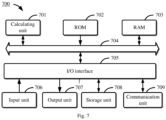
- the device 700 includes a computing unit 701, which may execute various appropriate actions and processing according to a computer program stored in a read-only memory (ROM) 702 or a computer program loaded to a random access memory (RAM) 703 from a storage unit 708.
- ROM read-only memory
- RAM random access memory
- various programs and data needed for operations of the device 700 may be further stored.
- the computing unit 701, the ROM 702 and the RAM 703 are mutually connected through a bus 704.
- An input/output (I/O) interface 705 is also connected to the bus 704.
- a plurality of components in the device 700 are connected to the I/O interface 705, including: an input unit 706, an output unit 707, the storage unit 708 and a communication unit 709.
- the input unit706 may be any type of device capable of inputting information to the device 700.
- the input unit 706 may receive input number or character information and generate key signal input related to a user setting and/or function control of the electronic device and may include but is not limited to a mouse, a keyboard, a touch screen, a trackpad, a trackball, a joystick, a microphone and/or a remote-control unit.
- the output unit 707 may be any type of device capable of displaying information and may include but is not limited to a display, a speaker, a video/audio output terminal, a vibrator and/or a printer.
- the storage unit 708 may include but is not limited to a magnetic disk and a compact disc.
- the communication unit 709 may allow the device 700 to exchange information/data with other devices through a computer network, such as the Internet and/or various telecommunication networks, and may include but is not limited to a modem, a network card, an infrared communication device, a wireless communication transceiver and/or a chipset, for example, a Bluetooth TM device, a 1302.11 device, a WiFi device, a WiMax device, a cellular communication device and/or similar items.
- the computing unit 701 may be various general-purpose and/or special-purpose processing components with processing and computing capacity. Some examples of the computing unit 701 include but are not limited to a central processing unit (CPU), a graphics processing unit (GPU), various special-purpose artificial intelligence (AI) computing chips, various computing units for running a machine learning model algorithm, a digital signal processor (DSP), and any appropriate processor, controller, microcontroller and the like.
- the computing unit 701 executes each method and processing described above, for example, the method 200 or the method 400.
- the method 200 or the method 400 may be realized as a computer software program, which is tangibly contained in a machine readable medium, for example, the storage unit 708.
- a part of or all of the computer program may be loaded and/or installed onto the device 700 via the ROM 702 and/or the communication unit 709.
- the computer program When the computer program is loaded to the RAM 703 and is executed by the computing unit 701, one or more steps of the method 200 or the method 400 described above can be executed.
- the computing unit 701 may be configured to execute the method 200 or the method 400 in any other appropriate mode (for example, by means of firmware).
- Various implementations of the systems and technologies described above in this paper may be implemented in a digital electronic circuit system, an integrated circuit system, a field programmable gate array (FPGA), an application specific integrated circuit (ASIC), an application specific standard part (ASSP), a system on chip (SOC), a load programmable logic device (CPLD), computer hardware, firmware, software and/or their combinations.
- FPGA field programmable gate array
- ASIC application specific integrated circuit
- ASSP application specific standard part
- SOC system on chip
- CPLD load programmable logic device
- These various implementations may include: being implemented in one or more computer programs, wherein the one or more computer programs may be executed and/or interpreted on a programmable system including at least one programmable processor, and the programmable processor may be a special-purpose or general-purpose programmable processor, and may receive data and instructions from a storage system, at least one input apparatus, and at least one output apparatus, and transmit the data and the instructions to the storage system, the at least one input apparatus, and the at least one output apparatus.
- Program codes for implementing the methods of the present disclosure may be written in any combination of one or more programming languages. These program codes may be provided to processors or controllers of a general-purpose computer, a special-purpose computer or other programmable data processing apparatuses, so that when executed by the processors or controllers, the program codes enable the functions/operations specified in the flow diagrams and/or block diagrams to be implemented.
- the program codes may be executed completely on a machine, partially on the machine, partially on the machine and partially on a remote machine as a separate software package, or completely on the remote machine or server.
- a machine readable medium may be a tangible medium that may contain or store a program for use by or in connection with an instruction execution system, apparatus or device.
- the machine readable medium may be a machine readable signal medium or a machine readable storage medium.
- the machine readable medium may include but not limited to an electronic, magnetic, optical, electromagnetic, infrared, or semiconductor system, apparatus or device, or any suitable combination of the above contents.
- machine readable storage medium will include electrical connections based on one or more lines, a portable computer disk, a hard disk, a random access memory (RAM), a read only memory (ROM), an erasable programmable read only memory (EPROM or flash memory), an optical fiber, a portable compact disk read only memory (CD-ROM), an optical storage device, a magnetic storage device, or any suitable combination of the above contents.
- RAM random access memory
- ROM read only memory
- EPROM or flash memory erasable programmable read only memory
- CD-ROM compact disk read only memory
- magnetic storage device or any suitable combination of the above contents.
- the systems and techniques described herein may be implemented on a computer, and the computer has: a display apparatus for displaying information to the users (e.g., a CRT (cathode ray tube) or LCD (liquid crystal display) monitor); and a keyboard and a pointing device (e.g., a mouse or trackball), through which the users may provide input to the computer.
- a display apparatus for displaying information to the users
- a keyboard and a pointing device e.g., a mouse or trackball
- Other types of apparatuses may further be used to provide interactions with users; for example, feedback provided to the users may be any form of sensory feedback (e.g., visual feedback, auditory feedback, or tactile feedback); an input from the users may be received in any form (including acoustic input, voice input or tactile input).
- the systems and techniques described herein may be implemented in a computing system including background components (e.g., as a data server), or a computing system including middleware components (e.g., an application server) or a computing system including front-end components (e.g., a user computer with a graphical user interface or a web browser through which a user may interact with the implementations of the systems and technologies described herein), or a computing system including any combination of such background components, middleware components, or front-end components.
- the components of the system may be interconnected by digital data communication (e.g., a communication network) in any form or medium. Examples of the communication network include: a local area network (LAN), a wide area network (WAN) and the Internet.
- a computer system may include a client and a server.
- the client and the server are generally away from each other and usually interact through a communication network.
- a relation between the client and the server is generated by running a computer program with a mutual client-server relation on a corresponding computer.
- the server may be a cloud server, or a server of a distributed system, or a server combined with a blockchain.
- steps can be reranked, added or deleted by using various forms of flows shown above.
- all the steps recorded in the present disclosure can be executed in parallel, or in sequence or in different orders.
- no limitation is made herein.
Landscapes
- Engineering & Computer Science (AREA)
- Theoretical Computer Science (AREA)
- Physics & Mathematics (AREA)
- General Physics & Mathematics (AREA)
- Data Mining & Analysis (AREA)
- Computer Vision & Pattern Recognition (AREA)
- General Engineering & Computer Science (AREA)
- Library & Information Science (AREA)
- Multimedia (AREA)
- Databases & Information Systems (AREA)
- Life Sciences & Earth Sciences (AREA)
- Artificial Intelligence (AREA)
- Bioinformatics & Cheminformatics (AREA)
- Bioinformatics & Computational Biology (AREA)
- Evolutionary Biology (AREA)
- Evolutionary Computation (AREA)
- Mathematical Physics (AREA)
- Information Retrieval, Db Structures And Fs Structures Therefor (AREA)
- Image Analysis (AREA)
Applications Claiming Priority (1)
| Application Number | Priority Date | Filing Date | Title |
|---|---|---|---|
| CN202111101658.8A CN113836333B (zh) | 2021-09-18 | 2021-09-18 | 图文匹配模型的训练方法、实现图文检索的方法、装置 |
Publications (1)
| Publication Number | Publication Date |
|---|---|
| EP4152178A1 true EP4152178A1 (de) | 2023-03-22 |
Family
ID=78960110
Family Applications (1)
| Application Number | Title | Priority Date | Filing Date |
|---|---|---|---|
| EP22196023.0A Withdrawn EP4152178A1 (de) | 2021-09-18 | 2022-09-16 | Verfahren zum trainieren eines bild-text-vergleichsmodells, vorrichtung, speichermedium und computerprogrammprodukt |
Country Status (3)
| Country | Link |
|---|---|
| US (1) | US12333837B2 (de) |
| EP (1) | EP4152178A1 (de) |
| CN (1) | CN113836333B (de) |
Families Citing this family (51)
| Publication number | Priority date | Publication date | Assignee | Title |
|---|---|---|---|---|
| CN113836333B (zh) * | 2021-09-18 | 2024-01-16 | 北京百度网讯科技有限公司 | 图文匹配模型的训练方法、实现图文检索的方法、装置 |
| CN114445831A (zh) * | 2022-01-14 | 2022-05-06 | 北京百度网讯科技有限公司 | 一种图文预训练方法、装置、设备以及存储介质 |
| CN114549874B (zh) * | 2022-03-02 | 2024-03-08 | 北京百度网讯科技有限公司 | 多目标图文匹配模型的训练方法、图文检索方法及装置 |
| EP4239644A1 (de) * | 2022-03-04 | 2023-09-06 | Koninklijke Philips N.V. | Modalitätsübergreifender datenabgleich |
| WO2023165942A1 (en) * | 2022-03-04 | 2023-09-07 | Koninklijke Philips N.V. | Cross-modality data matching |
| CN114625923B (zh) * | 2022-03-18 | 2024-01-09 | 北京百度网讯科技有限公司 | 视频检索模型的训练方法、视频检索方法、装置以及设备 |
| CN114861758B (zh) * | 2022-04-06 | 2025-02-18 | 北京百度网讯科技有限公司 | 多模态数据处理方法、装置、电子设备及可读存储介质 |
| CN114612749B (zh) * | 2022-04-20 | 2023-04-07 | 北京百度网讯科技有限公司 | 神经网络模型训练方法及装置、电子设备和介质 |
| CN114782722B (zh) * | 2022-04-29 | 2023-02-03 | 北京百度网讯科技有限公司 | 图文相似度的确定方法、装置及电子设备 |
| CN114972910B (zh) * | 2022-05-20 | 2023-05-23 | 北京百度网讯科技有限公司 | 图文识别模型的训练方法、装置、电子设备及存储介质 |
| CN115115914B (zh) * | 2022-06-07 | 2024-02-27 | 腾讯科技(深圳)有限公司 | 信息识别方法、装置以及计算机可读存储介质 |
| CN114880441B (zh) * | 2022-07-06 | 2023-02-10 | 北京百度网讯科技有限公司 | 视觉内容生成方法、装置、系统、设备和介质 |
| CN114896373B (zh) | 2022-07-15 | 2022-12-09 | 苏州浪潮智能科技有限公司 | 图文互检模型训练方法及装置、图文互检方法、设备 |
| CN115269895A (zh) * | 2022-07-29 | 2022-11-01 | 腾讯科技(武汉)有限公司 | 一种问答方法和相关装置 |
| CN115272698A (zh) * | 2022-07-29 | 2022-11-01 | 北京百度网讯科技有限公司 | 确定对象属性的方法、深度学习模型的训练方法和装置 |
| CN115512176A (zh) * | 2022-08-15 | 2022-12-23 | Oppo广东移动通信有限公司 | 模型训练方法、图像理解方法、装置、介质与电子设备 |
| CN115512005A (zh) * | 2022-08-22 | 2022-12-23 | 华为技术有限公司 | 一种数据处理方法及其装置 |
| CN115631251B (zh) * | 2022-09-07 | 2023-09-22 | 北京百度网讯科技有限公司 | 基于文本生成图像的方法、装置、电子设备和介质 |
| WO2024065645A1 (zh) * | 2022-09-30 | 2024-04-04 | 北京京东方技术开发有限公司 | 图像文本匹配模型的训练方法、装置、设备及存储介质 |
| CN115292455B (zh) * | 2022-10-08 | 2023-03-24 | 有米科技股份有限公司 | 图文匹配模型的训练方法及装置 |
| CN115687664A (zh) * | 2022-10-26 | 2023-02-03 | 阿里巴巴(中国)有限公司 | 中文图文检索方法及中文图文检索的数据处理方法 |
| CN115905608B (zh) * | 2022-11-15 | 2025-04-15 | 腾讯科技(深圳)有限公司 | 图像特征获取方法、装置、计算机设备、存储介质 |
| CN116028824B (zh) * | 2022-12-28 | 2026-02-03 | 北京百度网讯科技有限公司 | 文本匹配模型的训练方法、文本查询方法、装置和设备 |
| CN116030318A (zh) * | 2023-01-10 | 2023-04-28 | 北京有竹居网络技术有限公司 | 用于图像编码学习和应用的方法、装置、设备和介质 |
| CN116070615A (zh) * | 2023-01-29 | 2023-05-05 | 北京达佳互联信息技术有限公司 | 文本处理模型生成方法、装置、电子设备和存储介质 |
| CN116259060A (zh) * | 2023-02-17 | 2023-06-13 | 马上消费金融股份有限公司 | 图像分类模型的训练方法及装置 |
| CN116166843B (zh) * | 2023-03-02 | 2023-11-07 | 北京中科闻歌科技股份有限公司 | 基于细粒度感知的文本视频跨模态检索方法和装置 |
| CN115860587A (zh) * | 2023-03-02 | 2023-03-28 | 广州市玄武无线科技股份有限公司 | 基于图文匹配的拜访考核方法、装置、设备及存储介质 |
| CN116467607B (zh) * | 2023-03-28 | 2024-03-01 | 阿里巴巴(中国)有限公司 | 信息匹配方法和存储介质 |
| CN116401546B (zh) * | 2023-03-31 | 2026-02-27 | 联想(北京)有限公司 | 数据处理方法、装置及电子设备和存储介质 |
| CN116561270B (zh) * | 2023-04-11 | 2025-11-21 | 阿里巴巴达摩院(杭州)科技有限公司 | 问答方法以及问答模型训练方法 |
| CN117011860B (zh) * | 2023-04-20 | 2026-04-24 | 国网浙江省电力有限公司杭州市富阳区供电公司 | 应用于电力设备巡检报告图文的模型预训练方法及设备 |
| CN116756359A (zh) * | 2023-05-10 | 2023-09-15 | 华南师范大学 | 一种对比语言图像预训练模型的训练方法及应用方法 |
| CN116631566B (zh) * | 2023-05-23 | 2024-05-24 | 广州合昊医疗科技有限公司 | 一种基于大数据的医学影像报告智能生成方法 |
| CN116644315B (zh) * | 2023-05-25 | 2025-09-16 | 平安科技(深圳)有限公司 | 视觉隐喻挖掘方法、装置、电子设备及介质 |
| CN116704477A (zh) * | 2023-06-14 | 2023-09-05 | 北京百度网讯科技有限公司 | 自动驾驶场景图像生成方法、训练方法、装置和设备 |
| CN116756281A (zh) * | 2023-06-15 | 2023-09-15 | 中国工商银行股份有限公司 | 知识问答方法、装置、设备和介质 |
| CN116841506B (zh) * | 2023-06-30 | 2024-05-03 | 北京百度网讯科技有限公司 | 程序代码生成方法及装置、模型训练方法及装置 |
| CN116844168A (zh) * | 2023-06-30 | 2023-10-03 | 北京百度网讯科技有限公司 | 确定文本的方法、深度学习模型的训练方法和装置 |
| CN116955588B (zh) * | 2023-08-03 | 2026-04-07 | 平安科技(深圳)有限公司 | 文本生成模型的训练方法、装置、设备及存储介质 |
| CN116992493B (zh) * | 2023-09-01 | 2024-02-06 | 滨州八爪鱼网络科技有限公司 | 数字盲盒的生成方法及其系统 |
| CN117351330B (zh) * | 2023-09-28 | 2025-04-25 | 北京百度网讯科技有限公司 | 图像处理方法、图像处理模型的训练方法、装置和设备 |
| CN117076711A (zh) * | 2023-10-12 | 2023-11-17 | 北京汇通天下物联科技有限公司 | 驾驶行为识别模型的训练方法、识别方法、装置及设备 |
| CN117609531A (zh) * | 2023-11-30 | 2024-02-27 | 北京度友信息技术有限公司 | 图像搜索方法和装置 |
| CN118154912B (zh) * | 2024-05-11 | 2024-09-17 | 北京百度网讯科技有限公司 | 图像生成模型的处理方法、装置、设备及存储介质 |
| CN118658167B (zh) * | 2024-05-31 | 2026-01-27 | 支付宝(杭州)数字服务技术有限公司 | 一种模型的处理方法、装置及设备 |
| CN121119105A (zh) * | 2024-06-11 | 2025-12-12 | 北京字跳网络技术有限公司 | 一种图像生成方法、装置、电子设备及存储介质 |
| CN118470782B (zh) * | 2024-07-12 | 2024-09-17 | 微网优联科技(成都)有限公司 | 基于深度神经网络的人脸检测方法及设备 |
| CN118865029B (zh) * | 2024-09-26 | 2025-01-24 | 苏州元脑智能科技有限公司 | 一种模型训练及检索方法、计算机程序产品、设备、介质 |
| CN119206596B (zh) * | 2024-11-28 | 2025-05-23 | 国网智能科技股份有限公司 | 一种电力设备多模态大模型异常检测方法、系统、设备及介质 |
| CN121438869B (zh) * | 2025-12-29 | 2026-04-17 | 科大讯飞股份有限公司 | 音频感知大模型训练方法以及音频处理方法 |
Citations (2)
| Publication number | Priority date | Publication date | Assignee | Title |
|---|---|---|---|---|
| US20200380298A1 (en) * | 2019-05-30 | 2020-12-03 | Adobe Inc. | Text-to-Visual Machine Learning Embedding Techniques |
| WO2021042763A1 (en) * | 2019-09-03 | 2021-03-11 | Guangdong Oppo Mobile Telecommunications Corp., Ltd. | Image searches based on word vectors and image vectors |
Family Cites Families (6)
| Publication number | Priority date | Publication date | Assignee | Title |
|---|---|---|---|---|
| US10515295B2 (en) * | 2017-10-27 | 2019-12-24 | Adobe Inc. | Font recognition using triplet loss neural network training |
| CN112257452B (zh) * | 2020-09-21 | 2024-05-14 | 北京达佳互联信息技术有限公司 | 情感识别模型的训练方法、装置、设备和存储介质 |
| CN112650867B (zh) * | 2020-12-25 | 2024-09-24 | 北京中科闻歌科技股份有限公司 | 图片匹配方法、装置、电子设备以及存储介质 |
| US11947908B2 (en) * | 2021-04-07 | 2024-04-02 | Baidu Usa Llc | Word embedding with disentangling prior |
| CN113360700B (zh) * | 2021-06-30 | 2023-09-29 | 北京百度网讯科技有限公司 | 图文检索模型的训练和图文检索方法、装置、设备和介质 |
| CN113836333B (zh) * | 2021-09-18 | 2024-01-16 | 北京百度网讯科技有限公司 | 图文匹配模型的训练方法、实现图文检索的方法、装置 |
-
2021
- 2021-09-18 CN CN202111101658.8A patent/CN113836333B/zh active Active
-
2022
- 2022-09-13 US US17/943,458 patent/US12333837B2/en active Active
- 2022-09-16 EP EP22196023.0A patent/EP4152178A1/de not_active Withdrawn
Patent Citations (2)
| Publication number | Priority date | Publication date | Assignee | Title |
|---|---|---|---|---|
| US20200380298A1 (en) * | 2019-05-30 | 2020-12-03 | Adobe Inc. | Text-to-Visual Machine Learning Embedding Techniques |
| WO2021042763A1 (en) * | 2019-09-03 | 2021-03-11 | Guangdong Oppo Mobile Telecommunications Corp., Ltd. | Image searches based on word vectors and image vectors |
Non-Patent Citations (1)
| Title |
|---|
| CHENG QINGRONG ET AL: "Deep attentional fine-grained similarity network with adversarial learning for cross-modal retrieval", MULTIMEDIA TOOLS AND APPLICATIONS, KLUWER ACADEMIC PUBLISHERS, BOSTON, US, vol. 79, no. 41-42, 20 August 2020 (2020-08-20), pages 31401 - 31428, XP037267423, ISSN: 1380-7501, [retrieved on 20200820], DOI: 10.1007/S11042-020-09450-Z * |
Also Published As
| Publication number | Publication date |
|---|---|
| US12333837B2 (en) | 2025-06-17 |
| CN113836333A (zh) | 2021-12-24 |
| CN113836333B (zh) | 2024-01-16 |
| US20230005284A1 (en) | 2023-01-05 |
Similar Documents
| Publication | Publication Date | Title |
|---|---|---|
| EP4152178A1 (de) | Verfahren zum trainieren eines bild-text-vergleichsmodells, vorrichtung, speichermedium und computerprogrammprodukt | |
| US12423576B2 (en) | Method and apparatus for updating parameter of multi-task model, and storage medium | |
| US12175198B2 (en) | Document processing | |
| EP4080384A1 (de) | Objektempfehlungsverfahren und vorrichtung, computervorrichtung und speichermedium | |
| US20220237376A1 (en) | Method, apparatus, electronic device and storage medium for text classification | |
| EP4123592A2 (de) | Verfahren zur erkennung von mensch-objekt-interaktionen, neuronales netzwerk und zugehöriges lernverfahren, vorrichtung, und medium | |
| EP3910553A2 (de) | Bildverarbeitungsverfahren, trainingsverfahren für ein neuronales netzwerk, vorrichtung und medium | |
| CN114219046B (zh) | 模型训练方法、匹配方法、装置、系统、电子设备和介质 | |
| CN116450917A (zh) | 信息搜索方法及装置、电子设备和介质 | |
| CN115438214A (zh) | 处理文本图像的方法、神经网络及其训练方法 | |
| US12079268B2 (en) | Object recommendation | |
| CN114821233B (zh) | 目标检测模型的训练方法及装置、设备和介质 | |
| CN116152607A (zh) | 目标检测方法、训练目标检测模型的方法及装置 | |
| CN115964462A (zh) | 对话内容处理方法、对话理解模型的训练方法和装置 | |
| CN114511694B (zh) | 图像识别方法、装置、电子设备和介质 | |
| US20220004801A1 (en) | Image processing and training for a neural network | |
| CN117709471A (zh) | 可解释性分析方法、装置、设备和介质 | |
| CN115797660A (zh) | 图像检测方法、装置、电子设备和存储介质 | |
| CN115578501A (zh) | 图像处理方法、装置、电子设备和存储介质 | |
| CN116050543A (zh) | 数据处理方法、装置、电子设备、介质和芯片 | |
| CN115564992A (zh) | 图像分类方法和图像分类模型的训练方法 | |
| US20250061311A1 (en) | Data generation | |
| CN114860836B (zh) | 失效兴趣点的挖掘方法及装置、设备和介质 | |
| CN115170536B (zh) | 图像检测方法、模型的训练方法和装置 | |
| US20230044508A1 (en) | Data labeling processing |
Legal Events
| Date | Code | Title | Description |
|---|---|---|---|
| PUAI | Public reference made under article 153(3) epc to a published international application that has entered the european phase |
Free format text: ORIGINAL CODE: 0009012 |
|
| STAA | Information on the status of an ep patent application or granted ep patent |
Free format text: STATUS: REQUEST FOR EXAMINATION WAS MADE |
|
| 17P | Request for examination filed |
Effective date: 20220916 |
|
| AK | Designated contracting states |
Kind code of ref document: A1 Designated state(s): AL AT BE BG CH CY CZ DE DK EE ES FI FR GB GR HR HU IE IS IT LI LT LU LV MC MK MT NL NO PL PT RO RS SE SI SK SM TR |
|
| STAA | Information on the status of an ep patent application or granted ep patent |
Free format text: STATUS: THE APPLICATION HAS BEEN WITHDRAWN |
|
| 18W | Application withdrawn |
Effective date: 20230919 |