EP4239644A1 - Modalitätsübergreifender datenabgleich - Google Patents
Modalitätsübergreifender datenabgleich Download PDFInfo
- Publication number
- EP4239644A1 EP4239644A1 EP22172557.5A EP22172557A EP4239644A1 EP 4239644 A1 EP4239644 A1 EP 4239644A1 EP 22172557 A EP22172557 A EP 22172557A EP 4239644 A1 EP4239644 A1 EP 4239644A1
- Authority
- EP
- European Patent Office
- Prior art keywords
- data sample
- data
- type
- training
- sample
- Prior art date
- Legal status (The legal status is an assumption and is not a legal conclusion. Google has not performed a legal analysis and makes no representation as to the accuracy of the status listed.)
- Withdrawn
Links
- 238000012549 training Methods 0.000 claims abstract description 186
- 238000000034 method Methods 0.000 claims abstract description 66
- 238000000605 extraction Methods 0.000 claims description 42
- 230000015654 memory Effects 0.000 claims description 7
- 230000003247 decreasing effect Effects 0.000 claims description 5
- 238000013502 data validation Methods 0.000 abstract 1
- 238000010801 machine learning Methods 0.000 description 14
- 238000010586 diagram Methods 0.000 description 12
- 238000002059 diagnostic imaging Methods 0.000 description 11
- 230000000875 corresponding effect Effects 0.000 description 9
- 230000006870 function Effects 0.000 description 9
- 238000012545 processing Methods 0.000 description 9
- 238000004590 computer program Methods 0.000 description 8
- 238000013136 deep learning model Methods 0.000 description 8
- 238000005516 engineering process Methods 0.000 description 8
- 238000013528 artificial neural network Methods 0.000 description 7
- 238000004891 communication Methods 0.000 description 5
- 230000003902 lesion Effects 0.000 description 5
- 238000005457 optimization Methods 0.000 description 5
- 238000013135 deep learning Methods 0.000 description 4
- 238000012360 testing method Methods 0.000 description 4
- 238000002591 computed tomography Methods 0.000 description 3
- 239000000284 extract Substances 0.000 description 3
- 238000002372 labelling Methods 0.000 description 3
- 238000013421 nuclear magnetic resonance imaging Methods 0.000 description 3
- 230000003287 optical effect Effects 0.000 description 3
- 238000013527 convolutional neural network Methods 0.000 description 2
- 238000002600 positron emission tomography Methods 0.000 description 2
- 238000002604 ultrasonography Methods 0.000 description 2
- 230000000007 visual effect Effects 0.000 description 2
- 230000006978 adaptation Effects 0.000 description 1
- 238000013473 artificial intelligence Methods 0.000 description 1
- 230000002596 correlated effect Effects 0.000 description 1
- 238000007405 data analysis Methods 0.000 description 1
- 238000011161 development Methods 0.000 description 1
- 201000010099 disease Diseases 0.000 description 1
- 208000037265 diseases, disorders, signs and symptoms Diseases 0.000 description 1
- 238000009826 distribution Methods 0.000 description 1
- 239000004973 liquid crystal related substance Substances 0.000 description 1
- 238000013507 mapping Methods 0.000 description 1
- 238000010339 medical test Methods 0.000 description 1
- 238000003062 neural network model Methods 0.000 description 1
- 210000002569 neuron Anatomy 0.000 description 1
- 239000013307 optical fiber Substances 0.000 description 1
- 239000004065 semiconductor Substances 0.000 description 1
- 230000006403 short-term memory Effects 0.000 description 1
- 230000003068 static effect Effects 0.000 description 1
Images




Classifications
-
- G—PHYSICS
- G16—INFORMATION AND COMMUNICATION TECHNOLOGY [ICT] SPECIALLY ADAPTED FOR SPECIFIC APPLICATION FIELDS
- G16H—HEALTHCARE INFORMATICS, i.e. INFORMATION AND COMMUNICATION TECHNOLOGY [ICT] SPECIALLY ADAPTED FOR THE HANDLING OR PROCESSING OF MEDICAL OR HEALTHCARE DATA
- G16H30/00—ICT specially adapted for the handling or processing of medical images
- G16H30/20—ICT specially adapted for the handling or processing of medical images for handling medical images, e.g. DICOM, HL7 or PACS
-
- G—PHYSICS
- G16—INFORMATION AND COMMUNICATION TECHNOLOGY [ICT] SPECIALLY ADAPTED FOR SPECIFIC APPLICATION FIELDS
- G16H—HEALTHCARE INFORMATICS, i.e. INFORMATION AND COMMUNICATION TECHNOLOGY [ICT] SPECIALLY ADAPTED FOR THE HANDLING OR PROCESSING OF MEDICAL OR HEALTHCARE DATA
- G16H30/00—ICT specially adapted for the handling or processing of medical images
- G16H30/40—ICT specially adapted for the handling or processing of medical images for processing medical images, e.g. editing
Definitions
- Embodiments of the present disclosure generally relate to the field of automated data analysis technologies and in particular, to a method, system, and computer storage medium for cross-modality data matching.
- cross-modality data matching is to input an image to search for a text document describing the image. In this case, the image and the text document are considered as data in two different modalities.
- Another example for the cross-modality data matching is to match an image of a certain style with another image of a different style.
- the cross-modality data matching is useful in the medical field.
- writing reports is a tedious and time-consuming work for experienced radiologists and physicians, whereas it is rather a challenge for young and junior radiologists and physicians to quickly write the high-quality reports for medical imaging data.
- a radiologist may need to read hundreds of clinical images per workday and write reports about the clinical images. Considering such a case, it is desired to facilitate writing of reports about medical imaging. Even if the reports cannot be automatically produced and issued due to the complicated nature of medical imaging data, it would be helpful to reduce time and improve the quality by recommending some existing high-quality reports about medical images that are matched with an input medical image.
- AI artificial intelligence
- example embodiments of the present disclosure provide a solution for cross-modality data matching.
- a computer-implemented method comprises constructing a data matching model to be configured to determine whether an input data sample matches with a reference data sample included in either one of a first dataset of a first type and a second dataset of a second type; obtaining a first training sample set comprising a first anchor data sample of a first type, and a first positive data sample and a first negative data sample of a second type; obtaining a second training sample set comprising a second anchor data sample of the second type, and a second positive data sample and a second negative data sample of the first type; and training the data matching model with the first and second training sample sets according to a training objective, the training objective configured to enable the trained data matching model to determine that the first positive data sample matches with and the first negative data sample mismatches with the first anchor data sample, and to determine that the second positive data sample matches with and the second negative data sample mismatches with the second anchor data sample.
- a computing system comprising at least one processor; and at least one memory comprising computer readable instructions which, when executed by the at least one processor of the electronic device, cause the electronic device to perform acts comprising: constructing a data matching model to be configured to determine whether an input data sample matches with a reference data sample included in either one of a first dataset of a first type and a second dataset of a second type; obtaining a first training sample set comprising a first anchor data sample of a first type, and a first positive data sample and a first negative data sample of a second type; obtaining a second training sample set comprising a second anchor data sample of the second type, and a second positive data sample and a second negative data sample of the first type; and training the data matching model with the first and second training sample sets according to a training objective, the training objective configured to enable the trained data matching model to determine that the first positive data sample matches with and the first negative data sample mismatches with the first anchor data sample, and to determine that
- a computer readable medium comprises instructions which, when executed by at least one processor, cause the at least one processor to perform the method of the first aspect.
- references in the present disclosure to "one embodiment,” “an embodiment,” “an example embodiment,” and the like indicate that the embodiment described may include a particular feature, structure, or characteristic, but it is not necessary that every embodiment includes the particular feature, structure, or characteristic. Moreover, such phrases are not necessarily referring to the same embodiment. Further, when a particular feature, structure, or characteristic is described in connection with an example embodiment, it is submitted that it is within the knowledge of one skilled in the art to affect such feature, structure, or characteristic in connection with other embodiments whether or not explicitly described.
- first and second etc. may be used herein to describe various elements, these elements should not be limited by these terms. These terms are only used to distinguish one element from another. For example, a first element could be termed a second element, and similarly, a second element could be termed a first element, without departing from the scope of example embodiments.
- the term “and/or” includes any and all combinations of one or more of the listed terms.
- model is referred to as an association between an input and an output learned from training data, and thus a corresponding output may be generated for a given input after the training.
- the generation of the model may be based on a machine learning technique.
- Deep learning is one of the machine learning algorithms which processes an input and provide the corresponding output using processing units in multiple layers.
- model may also be referred to as “machine learning model”, “learning model”, “machine learning network”, or “learning network,” which are used interchangeably herein.
- Neural network (NN) model is an example deep learning model.
- a neural network can process an input and provides a corresponding output and it generally includes an input layer, an output layer and one or more hidden layers between the input and output layers.
- the neural network used in the deep learning applications generally includes a plurality of hidden layers to increase the depth of the network.
- Individual layers of the neural network model are connected in sequence, such that an output of a preceding layer is provided as an input for a following layer, where the input layer receives the input of the neural network while the output of the output layer acts as the final output of the neural network.
- Each layer of the neural network includes one or more nodes (also referred to as processing nodes or neurons), each of which processes the input from the preceding layer.
- machine learning may include three stages, i.e., a training stage, a test stage, and an application stage (also referred to as an inference stage).
- a given machine learning network may be trained iteratively using a great amount of training data until the network can obtain, from the training data, consistent inference similar to those that human intelligence can make.
- the machine learning network may be regarded as being capable of learning the association between the input and the output (also referred to an input-output mapping) from the training data.
- the set of parameter values of the trained network is determined.
- a test input is applied to the trained model to test whether the machine learning network can provide a correct output, so as to determine the performance of the network.
- the machine learning network may be used to process an actual network input based on the set of parameter values obtained in the training and to determine the corresponding network output.
- a machine learning model called a data matching model
- the data matching model is trained with data samples of a first type and a second type to meet a certain training objective.
- an efficient and advanced data matching model can be offered for an input data sample of any of the two types.
- the data matching model can be used to determine matching data samples of any of the two types for the input data sample regardless the type of the input data sample. As such, it is feasible to obtain desired matching data results by providing input data samples of either of the two types.
- Fig. 1 illustrates an example environment 100 in which embodiments of the present disclosure may be implemented.
- the environment 100 comprises a model training system 110 and a model applying system 120.
- the model training system 110 and the model applying system 120 can be implemented as a single physical device or system to perform their functionalities described herein.
- the model training system 110 and/or the model applying system 120 may include any system or device having the computing capability, such as computing systems, mainframes, servers, edges devices, and/or the like. The scope of the present disclosure is not limited in this regard.
- the model training system 100 is configured to train a data matching model 112.
- the data matching model 112 is constructed to implement a data matching task. For an input data sample of one type, it is expected to find one or more data samples of another type that matches with the input data sample.
- different types of data samples are considered as different data modalities.
- the data matching implemented by the data matching model 112 is thus considered as a cross-modality data matching task.
- the data matching model 112 is configured to determine whether an input data sample matches with respective data samples from a first dataset of a first type and a second dataset of a second type.
- the different types of data samples may include an image type and a text type. In an example, it may be expected to search for matching images given a text document or search for matching text documents given an image.
- the different types of data samples may include different image types which may have visual contents in different styles. In an example, given an image of a certain type, it may be expected to search for matching images of a different type.
- An image and a text document are considered to match with each other if the text document contains text accurately describing the image.
- Two images are considered to match with each other if they present the same or similar visual contents.
- Two text documents may be considered to match with each other if they present the same or similar textual contents.
- the different types of data samples may include medical types.
- the different types may include a medical image type such as a Computed Tomography (CT)-based image, X-ray based image data, Positron Emission Tomography (PET)-based image, medical ultrasonography-based image, Nuclear Magnetic Resonance Imaging (NMRI)-based image, and/or any other images based on medical imaging technology.
- the different types of data samples may further include a medical text type as such a medical report describing observations/findings in a corresponding medical image, interpretation about a medical image, potential diagnostic information, medical recommendations, and/or the like.
- the radiologist may need to write a radiology report for the medical image, to describe his/her observations on the medical image.
- the medical image and the radiology report are generally considered to match with each other.
- the matching medical images and/or textual reports can provide some guidance or recommendation to write an accurate high-quality report for the newly produced medical image.
- some medical researchers may also want find as much as possible similar medical images and associated medical reports about a same disease or lesion. In either case, the data matching between medical image data and medical text data is useful.
- the different types may include different medical image types, including a CT-based image, X-ray based image, PET-based image, medical ultrasonography-based image, NMRI-based image, and/or any other images based on medical imaging technology.
- the medical image type may include a dynamic image sequence which includes more than one static image. For example, some medical imaging examine may produce a series of medical images about a body part, and some key images may be selected for use in diagnose.
- different medical imaging technologies can be applied for a same body part of a patient, to check whether there is any lesion on the body part. Different medical imaging technologies may have different complexity and costs, and lead to different accuracies in terms of diagnose.
- the physicians may choose to first perform one type of medical imaging on a patient under examination, such as a cheaper or quicker one.
- the data matching process may utilize the medical image as an input to find matching images of a second type generated through another medical image technology (which is believed to have a higher accuracy).
- a pair of matching images of the first and second types can be associated with each other, for example, belong to a same patient. If it is observed from the matching images of the second type that some potential lesions occur, the physician may determine that the patient under examination may probably have similar lesions and then choose to apply the other medical image technology with more complexity but higher accuracy. Otherwise, if it is observed from the matching images of the second type that no potential lesion is found, the following complicated medical imaging procedure may be omitted for the patient. That is, the cross-modality data matching for medical images of different types can help determine whether further complicated examination is needed. As a result, the whole medical examination process can be accelerated, the medical resources can be reserved and the cost for the patients is also reduced.
- cross-modality data matching Some examples of cross-modality data matching have been introduced above. It should be appreciated that many other types may be involved for the cross-modality data matching. It should be appreciated that and it can be applied in many other fields in addition to the medical field. The scope of the present disclosure is not limited in this regard.
- the model training system 110 obtains a first training dataset 101 comprising data samples of a first type and a second training dataset 102 of a second type. Each of the first and second datasets 101, 102 comprises a plurality of data samples of the respective type. In some embodiments, at least some of the data samples in the first training dataset 101 may be labeled or marked as matching with respective data samples in the second training dataset 102.
- the model training system 110 can perform the training process of the data matching model 112 according to a certain training objective, which will be described in detail below.
- the data matching model 112 may be constructed to have a set of initial parameter values.
- the set of parameter values of the data matching model 112 may be updated until the training objective is achieved.
- the trained data matching model 112 can be obtained, which may have a set of trained parameter values.
- the trained data matching model 112 may be provided to the model applying system 120 to apply for new data samples.
- the model applying system 120 obtains a target data sample 122 which may be of either the first type or the second type.
- the model applying system 120 have access to a first target dataset 131 including data samples of the first type and a second target dataset 132 including data samples of the second type.
- the data samples included in the first target dataset 131 of the first type may be different, the same, or partially the same as those included in the first training dataset 101 of the first type.
- the data samples in the second target dataset 132 of the second type may be different, the same, or partially the same those included in the second training dataset 102, although their types are respectively the same.
- the model applying system 120 uses the trained data matching model 112 to generate a matching result 140, which indicates whether the target data sample 122 matches with any data samples in the first target dataset 131 and/or in the second target dataset 132.
- FIG. 2 illustrates a block diagram of architecture of the data matching model 112 according to some embodiments of the present disclosure.
- the data matching model 112 is a machine learning or deep learning model.
- the data matching model 112 may be constructed using various machine learning or deep learning model architectures.
- the data matching model 112 comprises a feature extraction part 210 for the first type (represented as f I ( ⁇ )) and a feature extraction part 220 for the second type (represented as f R ( ⁇ )).
- the feature extraction part 210 is configured to extract a feature representation of the input data sample if an input data sample 202 to the data matching model 112 is of the first type
- the feature extraction part 220 is configured to extract a feature representation of the input data sample 202 if the input data sample 202 is of the second type.
- a feature representation is in form of multi-dimension vector, to characterize the input data sample.
- the input data sample 202 may be input to either the feature extraction part 210 or the feature extraction part 220 depending on its type.
- the feature extraction part 210 may be constructed as a machine learning or deep learning model that is suitable to process or extract feature representations of data samples of the first type, and the feature extraction part 220 may be constructed as a machine learning or deep learning model that is suitable to process or extract feature representations of data samples of the second type.
- the feature extraction part 210 may be constructed as a Convolutional Neural Network (CNN) model, or any other deep learning model that is suitable for processing image data.
- CNN Convolutional Neural Network
- the feature extraction part 210 may be constructed as a deep learning model suitable for nature language processing, such as a language model, a BERT model, an Auto-encoder model, a Long Short-Term Memory (LSTM) model, or any other deep learning model that is suitable for processing text data.
- LSTM Long Short-Term Memory
- one or both of the feature extraction parts 210 and 220 may be pre-trained models which have initial parameter values determined through the pre-training processes.
- the data matching model 112 further includes a match scoring part 230.
- the match scoring part 230 is configured to receive the feature representation of the input data sample 202 from the feature extraction part 210 or 220, and determine respective matching scores between the input data sample 202 and respective data samples in a first dataset of the first type and/or a second dataset of the second type, based on the feature representation of the input data sample 202 and feature representations of the respective data samples in the first dataset and/or second dataset.
- the feature representations of the respective data samples in the first dataset may be extracted by the feature extraction part 210 and the feature representations of the respective data samples in the second dataset 220 may be extracted by the feature extraction part 220.
- An output 232 of the match scoring part 230 may include the respective matching scores between the input data sample 202 and the respective data samples in one or both of the two datasets.
- Each matching score indicates a matching level between the input data sample 202 and a data sample in a dataset, to indicate whether the two data samples math with each other.
- data samples in the first training dataset 101 and the second training dataset 102 are input to the data matching model 112 and the matching scores between different data samples in the two training datasets are determined and used to update the set of parameter values of the data matching model 112, as will be discussed in detail later.
- the target data sample 122 is input to the trained data matching model 112 and matching scores between the target data sample 122 and data samples in one or both of the first and second target datasets 131, 132 are determined.
- Example embodiments of the model training stage for the data matching model 112 will be described first and then example embodiments of the model applying stage.
- a triplet loss is utilized when determining the training objective for the data matching model 112.
- data samples in the two training datasets 101 and 102 are organized as respective pairs of training data sample sets, each training data sample set being constructed as a triplet training sample comprising three data samples from the two training datasets 101 and 102.
- Fig. 3 illustrates an example of constructing training sample sets for training the data matching model 112.
- the first training dataset 101 of the first type comprises medical images
- the second training dataset 102 of the second type comprises medical images.
- an i -th training sample set 301 comprises an anchor data sample 310 (represented as I i ) of the first type, a positive data sample 311 (represented as R i + ) of the second type, and a negative data sample 312 (represented as R i ⁇ ) of the second type.
- An j -th training sample set 302 comprises an anchor data sample 320 (represented as R j ) of the second type, a positive data sample 321 (represented as I j + ) of the first type, and a negative data sample 322 (represented as I j ⁇ ) of the first type.
- the anchor data sample I i is selected from the first training dataset 101 of the first type, and the positive and negative data samples R i + and R i ⁇ are selected from the second training dataset 102 of the second type.
- the "positive" data sample R i + matches with the anchor data sample I i , which means that the medical report of the positive data sample R i + describes observations from the medical image of the anchor data sample I i in the example of Fig. 3 .
- the medical report and the medical images of a same patient obtained for a medical test may be considered to match with each other.
- the "negative" data sample R i ⁇ mismatches with the anchor data sample I i , which may mean that the medical report of the negative data sample R i + does not contain observations from the medical image of the anchor data sample I i .
- the anchor data sample R j is selected from the second training dataset 102 of the second type, and the positive and negative data samples I j + and I j ⁇ are selected from the first training dataset 101 of the first type.
- the positive data sample I j + matches with the anchor data sample R j
- the negative data sample I j ⁇ mismatches with the anchor data sample R j .
- the model training may explore anchor data samples from one modality, together with positive and negative data samples from the other modality.
- a plurality of pairs of training data sample sets similar to those as illustrated in Fig. 3 may be constructed from the first and second training datasets 101, 102.
- the model training system 110 may obtain labelling information for the first and second training datasets 101 and 102, indicating which data sample in the first training dataset 101 matches and/or mismatches with which data sample(s) in the second training dataset 102.
- the model training system 110 may randomly select the anchor data sample I i from the first training dataset 101 and the anchor data sample R j from the second training dataset 102, and then select the corresponding positive and negative data samples based on the labelling information.
- the labelling information may indicate only the matching of the data samples among the two training datasets 101, 102, and thus the negative data samples in each data sample set may be selected randomly from other data samples or may be computed via hard negative samples.
- Fig. 4 illustrates a block diagram of the model training system 110 for training the data matching model 112 according to some embodiments of the present disclosure.
- the example architecture of the data matching model 112 in Fig. 2 is illustrated as an example here for the model training.
- the model training system 110 comprises a model updating part 440 which is configured to train the data matching model 112, more specifically, to determine parameter value updates for the set of parameter values of the data matching model 112.
- the model updating part 440 comprises a triplet loss-based training module 442 configured to train the data matching model 112 with at least a pair of training sample sets 301, 302 using a triplet loss, so as to meet the training objective.
- the training objective is configured so as to enable the trained data matching model 112 to determine that the positive data sample 311 R i + matches with the anchor data sample 310 I i and the negative data sample 312 R i ⁇ mismatches with the anchor data sample 310 I i , as well as to determine that the positive data sample 321 I j + matches with and the negative data sample 322 I j ⁇ mismatches with the anchor data sample 320 R j .
- the triplet loss-based training model 442 may be configured to construct a triplet loss function to optimize or update the data matching model 112.
- the triplet loss is to optimize the difference between an anchor data sample and a positive data sample as small as possible, and the difference between the anchor data samples and a negative data samples as large as possible.
- the match scoring part 230 is configured as a scoring function to determine a matching score between two data samples based on a distance between feature representations of the two data samples.
- the triplet loss is taken into account to mainly update the parameter values of the feature extraction parts 210, 220 ( f I ( ⁇ )) and f R ( ⁇ )) so that they can generate feature representations with a small distance for matching data samples of two types as well as generate feature representations with a large distance for mismatching data samples of two types.
- the triplet loss function may be constructed as a loss function based on the following differences: a difference between the positive data sample 311 R i + and the anchor data sample 310 I i and a difference between the negative data sample 312 R i ⁇ and the anchor data sample 310 I i for the training sample set 301, and a difference between the positive data sample 321 I j + and the anchor data sample 320 R j and a difference between the negative data sample 322 I j ⁇ and the anchor data sample 320 R j for the training sample set 302.
- the difference between two data samples may be determined as a match scoring between the two data samples, to measure whether the two data samples match with each other or not.
- the data samples in each of the two training sample sets 301, 302 may be input to the corresponding feature extraction parts 210, 220, depending on their types.
- the corresponding feature extraction parts 210, 220 extracts, with their current set of parameter values, feature representations of those data samples are provided to the match scoring part 230 to determine matching scores.
- the match scoring part 230 determines a first matching score between the anchor data sample 310 I i and the positive data sample 311 R i + , a second matching score between the anchor data sample 310 I i and the negative data sample 312 R i ⁇ for the training sample set 301, and a third matching score between the anchor data sample 320 R j and the positive data sample 321 I j + and a fourth matching score between the anchor data sample 320 R j and the negative data sample 322 I j ⁇ for the training sample set 302.
- Fig. 4 although two instances of the match scoring parts 220 are illustrated, they may be considered as a same part with the shared parameter values.
- the triple loss function may be optimized by decreasing the sum of a first difference between the first matching score and the second matching score and a second difference between the third matching score and the fourth matching score, so as to meet the training objective.
- i represents the i th training sample set with an anchor data sample of the first type
- j represents the j th training sample set with an anchor data sample of the second type.
- f I ( I i ) represents the feature representation of the anchor data sample 310 I i extracted by the feature extraction part 210
- f R R i + represents the feature representation of the positive data sample 311 R i + extracted by the feature extraction part 220
- f R R i ⁇ represents the feature representation of the negative data sample 312 R i ⁇ extracted by the feature extraction part 220
- f R ( R j ) represents the feature representation of the anchor data sample 320 R j extracted by the feature extraction part 220
- f I I j + represents the feature representation of the positive data sample 321 I j + extracted by the feature extraction part 210
- f I I j ⁇ represents the feature representation of the negative data sample 322 I j ⁇ extracted by the feature extraction part 210.
- d ( ⁇ ) represents a difference or a distance between the feature representations of the two data samples, which may indicate the matching score of the two data samples.
- the item ⁇ represents a minimal gap between the difference for the anchor data sample and the positive data sample and the difference for the anchor data sample and the negative data sample.
- the value of ⁇ is a hyper-parameter which may be predetermined or configured.
- ⁇ ⁇ + represents that if a resulting value within ⁇ ⁇ is larger than zero, this value may be determined as a triplet loss; otherwise, if the resulting value within ⁇ ⁇ is smaller than or equal to zero, than the triplet loss is zero.
- the training objective for the data matching is based on the triplet loss in Equation (1), the training objective is to optimize or minimize the triplet loss.
- the triplet loss-based training module 442 may determine parameter value updates for the respective parts of the data matching model 112 such that the triplet loss determined based on the set of updated parameter values is decreased and finally minimized and the training objective is met.
- the triplet loss-based training module 442 may utilize various model training methods, such as random gradient descent and its variants to determine the parameter value updates.
- the set of parameter values for the data matching model 112 may be updated iteratively using training sample sets constructed from the first and second training datasets 101, 102, so as to meet the training objective.
- the data matching model 112 can be well trained to determine matching data samples for an input data sample of any of the two modalities (or types).
- an adversarial strategy may be further applied during the training process of the data matching model 112.
- the adversarial strategy is leveraged to conduct cross-modality alignment, resulting in the in-distinguishability between data samples of different modalities, such as medical images and medical reports.
- the cross-modality alignment may be implemented by a discriminator model in a generative adversarial network (GAN), which makes use of the discriminator model to confuse heterogeneous modalities, for example, the medical images and reports.
- GAN generative adversarial network
- Fig. 5 illustrates a block diagram of the model training system 110 for training the data matching model 112 according to the embodiments related to the adversarial strategy.
- the model training system 110 comprises a discriminator model 450 (represented as " D ").
- the discriminator model 450 serves as an adversary to conduct adversarial domain adaptation, which aims to fail to distinguish whether a feature representation is extracted from a data sample of the first type or a data sample of the second type. More specifically, the discriminator model 450 may be constructed to attempt to discriminate modalities of data samples, for example, to determine whether a data sample is the first type (e.g., a medical image) or the second type (e.g., a medical report).
- the discriminator model 450 is constructed to determine a probability of a data sample being of the first type or of the second type based on a feature representation of the data sample.
- the feature representation of the data sample may be extracted by the feature extraction part 210 or 220, depending on its type.
- the discriminator model 450 may be a discriminator from a GAN.
- the discriminator model 450 is also configured with a set of parameter values, to process the input feature representation of a data sample and output the probability.
- the data matching model may be jointly trained with the discriminator model 450.
- the training objective for the data matching model 112 may be further configured to cause the discriminator model 450 to fail to discriminate types of the matching data samples in the first and second training datasets 101, 102.
- the training objective is configured to cause the discriminator model 450 to fail to discriminate the types of the anchor data sample 310 I i and the positive data sample 311 R i + and/or the types of the anchor data sample 320 R j and the positive data sample 321 I j + .
- the feature extraction parts 210 and 220 may be trained to generate aligned feature representations for the matching data samples of the different types so that the discriminator model 450 may not be able to distinguish the types of the data samples.
- the feature extraction parts 210 and 220 may be enhanced to extract more aligned feature representations for a pair of matching data samples of different types, such that the discriminator model 450 cannot distinguish whether a data sample is from the first training dataset 101 of the first type or the second training dataset 102 of the second type.
- the model updating part 440 comprises an adversarial alignment module 442 configured to jointly train the data matching model 112 and the discriminator model 450 based on the adversarial strategy, together with the triplet loss-based training module 442.
- the adversarial alignment module 442 may employ the min-max optimization to converge to the training objective of causing the discriminator model 450 to fail to discriminate types of matching data samples.
- Equation (2) p ( I , R ) represents a set of matching data samples from the two types in the training datasets 101, 102; i represents the i th data sample of the first type, and r represents the r th data sample of the second type that matches with the ith data sample; ( f I ( i )) represents an output probability of the ith data sample being the first type by the discriminator model 450; (1- ( f R ( r )) represents an output probability of the r th data sample being the first type by the discriminator model 450.
- the output probability by the discriminator model 450 is determined based on the feature representation of the corresponding data sample extracted by the feature extraction part 210 f I ( ⁇ ) or the feature extraction part 220 f R ( ⁇ ) with their current parameter values.
- the adversarial alignment module 442 may determine parameter value updates for the discriminator model 450 so as to maximize D ( f I ( i )) and D ( f R ( r )), and parameter value updates for the feature extraction parts 210, 220, so as to minimize max D l adv with respect to ( f I , f R ).
- the discriminator model 450 and the feature extraction parts 210, 220 may be both dynamically updated/trained until they reach the min-max optimization.
- a feature representation of a data sample generated by the feature extraction part 210 or 220 are indistinguishable (or a close to indistinguishable as possible) from a feature representation of a data sample generated by the feature extraction part 220 or 210 through the discriminator model 450.
- the training objective may be met if both the triplet loss function is optimized and the min-max optimization is achieved.
- the trained data matching model 112 may be determined with a set of trained parameter values.
- the trained data matching model 112 may be utilized to predict matching data samples in different modalities.
- the trained discriminator model 450 may be discarded as it is generally useless in the following model applying stage.
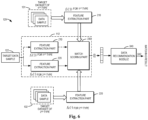
- Fig. 6 illustrates a block diagram of the model applying system 120 for performing data matching according to some embodiments of the present disclosure.
- the trained data matching model 112 determined by the model training system 110 may be utilized in the model applying system 120.
- the trained data matching model 112 is used to determine one or more matching data samples for the input target data sample 122. Depending on the type of the target data sample 122, it may be input to either the feature extraction part 210 for the first type or the feature extraction part 220 for the second type, to generate a target feature representation of the target data sample 122.
- the target feature representation of the target data sample 122 may be provided to the match scoring part 230 in the trained data matching model 112.
- the match scoring part 230 may determine target matching scores between the target data sample and respective data samples included in the first target dataset 131 of the first type and/or respective data samples included in the second target dataset 132 of the second type.
- the matching scoring part 230 may also obtain respective feature representations of the data samples included in the first target dataset 131 and/or the second target dataset 132, and determine the target matching scores based on the feature representation of the target data sample 122 and the respective feature representations of the data samples.
- the feature representations of the data samples included in the first target dataset 131 may be determined using the feature extraction part 210 for the first type
- the feature representations of the data samples included in the second target dataset 132 may be determined using the feature extraction part 220 for the second type.
- the feature representations of the data samples in the first and second target datasets 131, 132 may be determined in advance and stored for use in determining the matching scores for the input target data sample 122.
- the matching scoring part 230 may provide an output 632 to indicate the determined target matching scores.
- the output 632 may be provided to a data recommendation module 640 included in the model applying system 120.
- the data recommendation module 640 is configured to provide a matching result 642, which comprises at least one indication of at least one of the data samples in the first training dataset 131 and/or the second training dataset 132 based on the determined target matching scores. For example, the data recommendation module 640 may select a predetermined number of data samples (which may be larger than or equal to one) having the highest target matching scores with the target data sample 122. Alternatively, the data recommendation module 640 may select one or more data samples having their target matching scores exceeding a predetermined threshold score.
- the data sample(s) indicated by the data recommendation module 640 may be provided or presented as a recommendation to the user. For example, by inputting a target medical image to the model applying system 120, the physician may be recommended with one or more medical reports stored in the database which are determined to match with the target medical image, to facilitate the report writing for the target medical image.
- the data matching model 112 is trained with the triplet loss determined from two kinds of training sample sets 301, 302, it is capable of determining matching data samples of a different type from the input target data sample 122 or matching data samples of the sample type as the input target data sample 122.
- the target data sample 122 is of the first type
- the data matching model 112 is capable of determining matching scores between the target data sample 122 and data samples in the second target dataset 132 of the second type different from the first type.
- the data matching model 112 is capable of determining matching scores between the target data sample 122 and data samples in the first target dataset 131 of the same first type.
- the user may indicate matching data samples of the same or different types are expected for the target data sample 122.
- the model applying system 120 may receive a user input indicating at least one of the first and second types. According to the user input, the model applying system 120 may determine data samples in which one or both of the first and second target datasets 131, 132 are to be considered. The model applying system 120 may cause the data matching model 112 to determine matching scores between the target data sample and data samples included in the determined target dataset(s). In this way, the user may be able to control the type(s) of expected matching data samples.
- Fig. 7 illustrates a flowchart of an example method 700 according to some embodiments of the present disclosure.
- the method 700 can be implemented by the model training system in Fig. 1 .
- the model training system 110 constructs a data matching model to be configured to determine whether an input data sample matches with a reference data sample included in either one of a first dataset of a first type and a second dataset of a second type.
- the first and the second types comprise medical data types.
- the first type comprises a medical text type
- the second type comprises a medical image type
- the first type comprises a first medical image type
- the second type comprises a second medical image type.
- the model training system 110 obtains a first training sample set comprising a first anchor data sample of a first type, and a first positive data sample and a first negative data sample of a second type.
- the model training system 110 obtains a second training sample set comprising a second anchor data sample of the second type, and a second positive data sample and a second negative data sample of the first type.
- the model training system 110 trains the data matching model with the first and second training sample sets according to a training objective.
- the training objective is configured to enable the trained data matching model to determine that the first positive data sample matches with and the first negative data sample mismatches with the first anchor data sample, and to determine that the second positive data sample matches with and the second negative data sample mismatches with the second anchor data sample.
- the model training system 110 determines, using the data matching model, a first matching score between the first anchor data sample and the first positive data sample, a second matching score between the first anchor data sample and the first negative data sample, a third matching score between the second anchor data sample and the second positive data sample, and a fourth matching score between the second anchor data sample and the second negative data sample.
- the model training system 110 updates the data matching model by decreasing a sum of a first difference between the first matching score and the second matching score and a second difference between the third matching score and the fourth matching score to meet the training objective.
- the data matching model comprises: a first feature extraction part configured to extract a feature representation of the input data sample if the input data sample is of the first type, a second feature extraction part configured to extract the feature representation of the input data sample if the input data sample is of the second type, and a match scoring part configured to determine a matching score between the input data sample and the reference data sample based on the feature representation of the input data and a feature representations of the reference data sample.
- the model training system 110 constructs a discriminator model to be configured to determine a probability of a data sample being of the first type or of the second type based on a feature representation of the data sample.
- the model training system 110 jointly trains the data matching model and the discriminator model with the first and second training sample sets according to the training objective.
- the training objective is further configured to cause the discriminator model to fail to discriminate the types of the first anchor data sample and the first positive data sample and/or the types of the second anchor data sample and the second positive data sample.
- the data matching model trained by the process 700 may be provide for use, as will be described below with reference to Fig. 8 .
- Fig. 8 illustrates a flowchart of an example method according to some other embodiments of the present disclosure.
- the method 800 can be implemented by the model applying system 120 in Fig. 2 .
- the model applying system 120 obtains the trained data matching model.
- the model applying system 120 obtains a target data sample of the first type or the second type.
- the model applying system 120 determines, using the trained data matching model, target matching scores between the target data sample and respective data samples included in a first target dataset of the first type and/or in a second target dataset of the second type.
- the model applying system 120 provides at least one indication of at least one of the data samples based on the determined target matching scores.
- the model applying system 120 receives a user input indicating at least one of the first and second types, and determines at least one of the first and second target datasets of the at least one of the first and second types indicated by the user input. The model applying system 120 determines the target matching scores between the target data sample and data samples included in the determined at least one of the first and second target datasets.
- Fig. 9 illustrates a block diagram of an example computing system/device 900 suitable for implementing example embodiments of the present disclosure.
- the system/device 900 can be implemented as or implemented in the model training system 110 and/or the model applying system 120 in Fig. 1 .
- the system/device 900 may be a general-purpose computer, a physical computing device, or a portable electronic device, or may be practiced in distributed cloud computing environments where tasks are performed by remote processing devices that are linked through a communication network.
- the system/device 900 can be used to implement the method 700 of Fig. 7 and/or the method 800 of Fig. 8 .
- the system/device 900 includes a processor 901 which is capable of performing various processes according to a program stored in a read only memory (ROM) 902 or a program loaded from a storage unit 908 to a random access memory (RAM) 903.
- ROM read only memory
- RAM random access memory
- data required when the processor 901 performs the various processes or the like is also stored as required.
- the processor 901, the ROM 902 and the RAM 903 are connected to one another via a bus 904.
- An input/output (I/O) interface 905 is also connected to the bus 904.
- the processor 901 may be of any type suitable to the local technical network and may include one or more of the following: general purpose computers, special purpose computers, microprocessors, digital signal processors (DSPs), graphic processing unit (GPU), co-processors, and processors based on multicore processor architecture, as non-limiting examples.
- the system/device 900 may have multiple processors, such as an application-specific integrated circuit chip that is slaved in time to a clock which synchronizes the main processor.
- a plurality of components in the system/device 900 are connected to the I/O interface 905, including an input unit 906, such as keyboard, a mouse, or the like; an output unit 907 including a display such as a cathode ray tube (CRT), a liquid crystal display (LCD), or the like, and a loudspeaker or the like; the storage unit 908, such as disk and optical disk, and the like; and a communication unit 909, such as a network card, a modem, a wireless transceiver, or the like.
- the communication unit 909 allows the system/device 900 to exchange information/data with other devices via a communication network, such as the Internet, various telecommunication networks, and/or the like.
- the methods and processes described above, such as the method 700 and/or method 800 can also be performed by the processor 901.
- the method 700 and/or method 800 can be implemented as a computer software program or a computer program product tangibly included in the computer readable medium, e.g., storage unit 908.
- the computer program can be partially or fully loaded and/or embodied to the system/device 900 via ROM 902 and/or communication unit 909.
- the computer program includes computer executable instructions that are executed by the associated processor 901.
- processor 901 can be configured via any other suitable manners (e.g., by means of firmware) to execute the method 700 and/or method 800 in other embodiments.
- a computer program product comprising instructions which, when executed by a processor of an apparatus, cause the apparatus to perform steps of any one of the methods described above.
- a computer readable medium comprising program instructions for causing an apparatus to perform at least steps of any one of the methods described above.
- the computer readable medium may be a non-transitory computer readable medium in some embodiments.
- example embodiments of the present disclosure provide a computer readable medium comprising program instructions for causing an apparatus to perform at least the method in the second aspect described above.
- the computer readable medium may be a non-transitory computer readable medium in some embodiments.
- various example embodiments of the present disclosure may be implemented in hardware or special purpose circuits, software, logic or any combination thereof. Some aspects may be implemented in hardware, while other aspects may be implemented in firmware or software which may be executed by a controller, microprocessor or other computing device. While various aspects of the example embodiments of the present disclosure are illustrated and described as block diagrams, flowcharts, or using some other pictorial representations, it will be appreciated that the blocks, apparatuses, systems, techniques, or methods described herein may be implemented in, as non-limiting examples, hardware, software, firmware, special purpose circuits or logic, general purpose hardware or controller or other computing devices, or some combination thereof.
- the present disclosure also provides at least one computer program product tangibly stored on a non-transitory computer readable storage medium.
- the computer program product includes computer-executable instructions, such as those included in program modules, being executed in a device on a target real or virtual processor, to carry out the methods/processes as described above.
- program modules include routines, programs, libraries, objects, classes, components, data structures, or the like that perform particular tasks or implement particular abstract types.
- the functionality of the program modules may be combined or split between program modules as desired in various embodiments.
- Computer-executable instructions for program modules may be executed within a local or distributed device. In a distributed device, program modules may be located in both local and remote storage media.
- the computer readable medium may be a computer readable signal medium or a computer readable storage medium.
- a computer readable medium may include but is not limited to an electronic, magnetic, optical, electromagnetic, infrared, or semiconductor system, apparatus, or device, or any suitable combination of the foregoing. More specific examples of the computer readable storage medium would include an electrical connection having one or more wires, a portable computer diskette, a hard disk, a random access memory (RAM), a read-only memory (ROM), an erasable programmable read-only memory (EPROM or Flash memory), an optical fiber, a portable compact disc read-only memory (CD-ROM), an optical storage device, a magnetic storage device, or any suitable combination of the foregoing.
- Computer program code for carrying out methods disclosed herein may be written in any combination of one or more programming languages.
- the program code may be provided to a processor or controller of a general purpose computer, special purpose computer, or other programmable data processing apparatus, such that the program codes, when executed by the processor or controller, cause the functions/operations specified in the flowcharts and/or block diagrams to be implemented.
- the program code may execute entirely on a computer, partly on the computer, as a stand-alone software package, partly on the computer and partly on a remote computer or entirely on the remote computer or server.
- the program code may be distributed on specially-programmed devices which may be generally referred to herein as "modules".
- modules may be written in any computer language and may be a portion of a monolithic code base, or may be developed in more discrete code portions, such as is typical in object-oriented computer languages.
- the modules may be distributed across a plurality of computer platforms, servers, terminals, mobile devices and the like. A given module may even be implemented such that the described functions are performed by separate processors and/or computing hardware platforms.
Landscapes
- Health & Medical Sciences (AREA)
- Nuclear Medicine, Radiotherapy & Molecular Imaging (AREA)
- Radiology & Medical Imaging (AREA)
- Engineering & Computer Science (AREA)
- Epidemiology (AREA)
- General Health & Medical Sciences (AREA)
- Medical Informatics (AREA)
- Primary Health Care (AREA)
- Public Health (AREA)
- Image Analysis (AREA)
Priority Applications (1)
| Application Number | Priority Date | Filing Date | Title |
|---|---|---|---|
| PCT/EP2023/054889 WO2023165942A1 (en) | 2022-03-04 | 2023-02-28 | Cross-modality data matching |
Applications Claiming Priority (1)
| Application Number | Priority Date | Filing Date | Title |
|---|---|---|---|
| CN2022079263 | 2022-03-04 |
Publications (1)
| Publication Number | Publication Date |
|---|---|
| EP4239644A1 true EP4239644A1 (de) | 2023-09-06 |
Family
ID=81603499
Family Applications (1)
| Application Number | Title | Priority Date | Filing Date |
|---|---|---|---|
| EP22172557.5A Withdrawn EP4239644A1 (de) | 2022-03-04 | 2022-05-10 | Modalitätsübergreifender datenabgleich |
Country Status (1)
| Country | Link |
|---|---|
| EP (1) | EP4239644A1 (de) |
Citations (5)
| Publication number | Priority date | Publication date | Assignee | Title |
|---|---|---|---|---|
| US20200097604A1 (en) * | 2018-09-21 | 2020-03-26 | Microsoft Technology Licensing, Llc | Stacked cross-modal matching |
| CN111382748A (zh) * | 2020-02-28 | 2020-07-07 | 北京小米松果电子有限公司 | 图像翻译方法、装置及存储介质 |
| CN113343705A (zh) * | 2021-04-26 | 2021-09-03 | 山东师范大学 | 一种基于文本语义的细节保持图像生成方法及系统 |
| US20210365727A1 (en) * | 2019-05-30 | 2021-11-25 | Adobe Inc. | Text-to-Visual Machine Learning Embedding Techniques |
| CN113836333A (zh) * | 2021-09-18 | 2021-12-24 | 北京百度网讯科技有限公司 | 图文匹配模型的训练方法、实现图文检索的方法、装置 |
-
2022
- 2022-05-10 EP EP22172557.5A patent/EP4239644A1/de not_active Withdrawn
Patent Citations (5)
| Publication number | Priority date | Publication date | Assignee | Title |
|---|---|---|---|---|
| US20200097604A1 (en) * | 2018-09-21 | 2020-03-26 | Microsoft Technology Licensing, Llc | Stacked cross-modal matching |
| US20210365727A1 (en) * | 2019-05-30 | 2021-11-25 | Adobe Inc. | Text-to-Visual Machine Learning Embedding Techniques |
| CN111382748A (zh) * | 2020-02-28 | 2020-07-07 | 北京小米松果电子有限公司 | 图像翻译方法、装置及存储介质 |
| CN113343705A (zh) * | 2021-04-26 | 2021-09-03 | 山东师范大学 | 一种基于文本语义的细节保持图像生成方法及系统 |
| CN113836333A (zh) * | 2021-09-18 | 2021-12-24 | 北京百度网讯科技有限公司 | 图文匹配模型的训练方法、实现图文检索的方法、装置 |
Similar Documents
| Publication | Publication Date | Title |
|---|---|---|
| US12260294B2 (en) | Generative adversarial network medical image generation for training of a classifier | |
| Vayadande et al. | Innovative approaches for skin disease identification in machine learning: A comprehensive study | |
| US10929420B2 (en) | Structured report data from a medical text report | |
| US11176188B2 (en) | Visualization framework based on document representation learning | |
| US10540578B2 (en) | Adapting a generative adversarial network to new data sources for image classification | |
| US10937540B2 (en) | Medical image classification based on a generative adversarial network trained discriminator | |
| US20200093455A1 (en) | Method and system of building hospital-scale chest x-ray database for entity extraction and weakly-supervised classification and localization of common thorax diseases | |
| US20200372654A1 (en) | Sampling latent variables to generate multiple segmentations of an image | |
| US10984024B2 (en) | Automatic processing of ambiguously labeled data | |
| CN107292086A (zh) | 图像分析问答 | |
| JP2020530177A (ja) | ディープニューラルネットワークを使用したコンピュータ支援診断 | |
| US12512211B2 (en) | Semi-supervised learning using co-training of radiology report and medical images | |
| Bakasa et al. | Stacked ensemble deep learning for pancreas cancer classification using extreme gradient boosting | |
| Wiggins et al. | Natural language processing of radiology text reports: interactive text classification | |
| CN115910263A (zh) | 基于知识图谱的pet/ct影像报告结论辅助生成方法及装置 | |
| CN117577253A (zh) | 基于大数据的医疗临床数据质量分析方法及系统 | |
| Ucan et al. | Generating medical reports with a novel deep learning architecture | |
| Rao et al. | Rexerr: Synthesizing clinically meaningful errors in diagnostic radiology reports | |
| Zhu et al. | Multimodal large language model with knowledge retrieval using flowchart embedding for forming follow-up recommendations for pancreatic cystic lesions | |
| Hoebers et al. | Artificial intelligence research in radiation oncology: a practical guide for the clinician on concepts and methods | |
| EP4141878A1 (de) | Hinweisbasierte medizinische berichtsunterstützung | |
| EP4239644A1 (de) | Modalitätsübergreifender datenabgleich | |
| WO2023165942A1 (en) | Cross-modality data matching | |
| Li et al. | Uncertainty-Supervised Interpretable and Robust Evidential Segmentation | |
| Punneshetty et al. | Fine Tuning Idefic 9b With LORA for Multimodal Medical VQA |
Legal Events
| Date | Code | Title | Description |
|---|---|---|---|
| PUAI | Public reference made under article 153(3) epc to a published international application that has entered the european phase |
Free format text: ORIGINAL CODE: 0009012 |
|
| STAA | Information on the status of an ep patent application or granted ep patent |
Free format text: STATUS: THE APPLICATION HAS BEEN PUBLISHED |
|
| AK | Designated contracting states |
Kind code of ref document: A1 Designated state(s): AL AT BE BG CH CY CZ DE DK EE ES FI FR GB GR HR HU IE IS IT LI LT LU LV MC MK MT NL NO PL PT RO RS SE SI SK SM TR |
|
| STAA | Information on the status of an ep patent application or granted ep patent |
Free format text: STATUS: THE APPLICATION IS DEEMED TO BE WITHDRAWN |
|
| 18D | Application deemed to be withdrawn |
Effective date: 20240307 |