EP4150693B1 - Umweltfreundliche wiederaufladbare zink/wasser-polysulfid-flussbatterie mit hoher energieeffizienz - Google Patents
Umweltfreundliche wiederaufladbare zink/wasser-polysulfid-flussbatterie mit hoher energieeffizienz Download PDFInfo
- Publication number
- EP4150693B1 EP4150693B1 EP21729814.0A EP21729814A EP4150693B1 EP 4150693 B1 EP4150693 B1 EP 4150693B1 EP 21729814 A EP21729814 A EP 21729814A EP 4150693 B1 EP4150693 B1 EP 4150693B1
- Authority
- EP
- European Patent Office
- Prior art keywords
- weight
- particles
- electrolyte
- zinc
- polysulfide
- Prior art date
- Legal status (The legal status is an assumption and is not a legal conclusion. Google has not performed a legal analysis and makes no representation as to the accuracy of the status listed.)
- Active
Links
Images













Classifications
-
- H—ELECTRICITY
- H01—ELECTRIC ELEMENTS
- H01M—PROCESSES OR MEANS, e.g. BATTERIES, FOR THE DIRECT CONVERSION OF CHEMICAL ENERGY INTO ELECTRICAL ENERGY
- H01M8/00—Fuel cells; Manufacture thereof
- H01M8/18—Regenerative fuel cells, e.g. redox flow batteries or secondary fuel cells
- H01M8/184—Regeneration by electrochemical means
- H01M8/188—Regeneration by electrochemical means by recharging of redox couples containing fluids; Redox flow type batteries
-
- H—ELECTRICITY
- H01—ELECTRIC ELEMENTS
- H01M—PROCESSES OR MEANS, e.g. BATTERIES, FOR THE DIRECT CONVERSION OF CHEMICAL ENERGY INTO ELECTRICAL ENERGY
- H01M8/00—Fuel cells; Manufacture thereof
- H01M8/02—Details
- H01M8/0202—Collectors; Separators, e.g. bipolar separators; Interconnectors
- H01M8/023—Porous and characterised by the material
- H01M8/0239—Organic resins; Organic polymers
-
- H—ELECTRICITY
- H01—ELECTRIC ELEMENTS
- H01M—PROCESSES OR MEANS, e.g. BATTERIES, FOR THE DIRECT CONVERSION OF CHEMICAL ENERGY INTO ELECTRICAL ENERGY
- H01M8/00—Fuel cells; Manufacture thereof
- H01M8/02—Details
- H01M8/0202—Collectors; Separators, e.g. bipolar separators; Interconnectors
- H01M8/023—Porous and characterised by the material
- H01M8/0241—Composites
- H01M8/0245—Composites in the form of layered or coated products
-
- Y—GENERAL TAGGING OF NEW TECHNOLOGICAL DEVELOPMENTS; GENERAL TAGGING OF CROSS-SECTIONAL TECHNOLOGIES SPANNING OVER SEVERAL SECTIONS OF THE IPC; TECHNICAL SUBJECTS COVERED BY FORMER USPC CROSS-REFERENCE ART COLLECTIONS [XRACs] AND DIGESTS
- Y02—TECHNOLOGIES OR APPLICATIONS FOR MITIGATION OR ADAPTATION AGAINST CLIMATE CHANGE
- Y02E—REDUCTION OF GREENHOUSE GAS [GHG] EMISSIONS, RELATED TO ENERGY GENERATION, TRANSMISSION OR DISTRIBUTION
- Y02E60/00—Enabling technologies; Technologies with a potential or indirect contribution to GHG emissions mitigation
- Y02E60/30—Hydrogen technology
- Y02E60/50—Fuel cells
Definitions
- the present invention relates to a zinc/aqueous polysulfide rechargeable flow battery that avoids the use of toxic or environmentally harmful chemicals.
- the Redox Flow Battery represents a promising and versatile architecture, able to accumulate high amounts of energy and characterized by a long lifecycle.
- An RFB cell is constituted mainly by two half-cells separate by a membrane (or separator), each containing an electrode (positive and negative electrodes respectively) and an electrolyte.
- Current collectors are generally present, in contact with the electrical circuit outside the RFB; bipolar plates separate the current collectors from the electrodes.
- the electrolytes, called anolyte and catholyte contain the redox-active species dissolved in an aqueous or non-aqueous solvent and flow in the half-cells, in contact with the electrodes, thanks to external pumps.
- This structure results in a complete decoupling of the power and energy density of the device because, as opposed to a traditional static battery architecture, the active material is stored outside the cell in two external tanks. In this way the volume of the reservoirs guarantees the possibility to scale up the system according to need, determining the overall energy density of the battery; in order to achieve an effective volumetric energy density, the solubility of the active species must be considered and optimized.
- the power output is, on the other hand, determined by the active area of the electrodes because only the electrolyte that is inside the cell undergoes a redox reaction.
- the most common electrodes are carbon materials, like carbon felt because of its high active surface area and chemical inertness toward most solutions and pH.
- Patent US 2020/0006796 A1 describes an aqueous polysulfide-based electrochemical cell using a polysulfide-based electrolyte, used as anolyte, for the assembly of a rechargeable flow battery in alkaline conditions, coupled with a catholyte based on manganate, permanganate or iron-cyanide ions, exploiting the redox reactions of ions dissolved into them.
- a second problem of the battery of this paper is linked to the negative half-cell (anolyte), because in the disclosed conditions the OH - species are consumed accordingly to the reaction Zn 2+ + 40H - ⁇ Zn(OH) 4 2- ; since the solubility of zincate species increases with the concentration of OH-, the reduction of the electrolyte pH favors the formation of a passive layer on the electrode surface, causing the electrical conductivity decay over time.
- the solid-state ceramic separator reported by Gross et al ., shows an intrinsically low ionic conductivity (1 mS cm -1 ) and a high thickness (500 ⁇ m), preventing the battery to operate at high current and power densities, with a low peak power of 1 mW cm -2 at 2.5 mA cm -2 .
- the present invention relates to a rechargeable flow battery based on safe, low cost and earth abundant materials able to provide a power source with high energy efficiency.
- the present invention provides a zinc-polysulfide RFB comprising:
- the two electrolytes are circulated, by means of the two pumps, to and from the corresponding half-cell.
- the electrodes in the two half-cells may be static, e.g. metallic, slurry electrodes or porous carbon electrodes; alternatively, and independently from each other, the electrodes in the two half-cells may be flowable, i.e. the first electrolyte may contain the electrode in form of dispersed conductive particles where Zn can be deposited onto, and/or the second electrolyte may contain the electrode in form of dispersed conductive particles where polysulfide oxido-reduction (redox) reaction can occur.
- redox polysulfide oxido-reduction
- the electrode contained in the second half-cell is modified with a catalyst necessary to promote and sustain the electrochemical reactions involving sulfur species during charge and discharge phases of the battery.
- a catalyst may refer to a single catalyst or a mixture of different catalytic materials, as described later on.
- the first electrolyte may comprise a hydrogen evolution-suppressing agent, a complexing agent and/or a buffering agent.
- the second electrolyte may comprise a complexing agent and/or a buffering agent.
- thickener additives may be included in the electrolytes formulation.
- an aqueous RFB is obtained by coupling an alkaline zinc electrolyte with an aqueous polysulfide electrolyte.
- This invention not only addresses the issues related to toxicity and high costs, previously described, of the RFB systems of the prior art, but also allows to achieve high efficiency and safety: indeed, zinc is one of the most abundant and cheap elements and sulfur, another very cheap element, in the presence of alkali metal ions shows a high solubility in aqueous electrolytes, forming chains of polysulfides with different lengths, increasing in this way the energy density of the battery.
- the chemistry of the RFB of the present invention allows working in alkaline conditions, avoiding the issues associated to acidic environments.
- the battery of the present invention is a rechargeable flow battery, where electrolytes flow from an external tank to the electrochemical cell, decoupling in this way power and energy density of the device and allowing the possibility to charge and discharge the battery at higher current densities and for longer times.
- the redox reaction taking place in the cathodic compartment of a RFB of the present invention namely, S 4 2- ⁇ S 2-
- the RFB of the present invention also avoids the above-described problems encountered with the anolyte half-cell and the solid-state ceramic separator of the paper of M. M. Gross et al.
- the system described in the present invention works at current densities up to fifty times higher than any available prior art device based on similar chemistry, with higher stability over cycles and longer battery lifetime.
- the solvent when referred to the liquid phase of the electrolytes (both the anolyte and the catholyte), it is meant water or a water-based mixtures containing at least 40% by volume of water with one or more compounds selected among C1-C4 alcohols, ethylene glycol, acetic acid, glycerol, or a combination of two or more thereof, preferably C1-C4 alcohols, ethylene glycol, or a combination thereof.
- the solvent comprises water and a polar protic solvent with a water percentage higher than 70% by volume, preferably higher than 80% by volume, still more preferably higher than 90%.
- the preparation of any electrolyte is described as a sequence of steps (i), (ii), .... While the first step of any preparation, (i), consists in providing a solvent and adding a first compound to produce an ionic conductive solution, the order of the following steps (that is, the order of addition of components to obtain the complete composition of each electrolyte) can be altered and the next components can be added in any sequence, as will be apparent to the skilled person.
- Rechargeable flow batteries work as energy sources when they operate in discharge mode, while act as energy storage devices when they operate in charge (recharge) mode.
- the two different half-cells reactions involved during charge and discharge phase are: 1. Charge phase: Zn 2+ + 2e - ⁇ Zn 0 Negative electrode, cathode, reduction Positive electrode, anode, oxidation 2. Discharge phase: Zn 0 ⁇ Zn 2+ + 2e - Negative electrode, anode, oxidation Positive electrode, cathode, reduction
- the electrolyte containing the zinc ions, reacting at the negative electrode, is called anolyte, while the electrolyte containing the polysulfide ions, reacting at the positive electrode, is called catholyte.
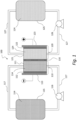
- Fig. 1 schematically represents a zinc-polysulfide RFB of the invention, 100, in its most general embodiment.
- RFB 100 is formed by the coupling of a first half-cell, 110, to a second half-cell, 120, through a membrane separator 130.
- the first half-cell comprises a container 111 in which is present the first electrolyte 114 and an electrode 112, that can be both flow-through (3D) or planar (2D), in electric contact with a current collector, 113; the first electrolyte 114 is recirculated to an external reservoir 115 by means of a pump 116, a valve system (not shown in the figure) and piping 117.
- the second half-cell comprises a container 121 in which is present the second electrolyte 124 and an electrode 122, that can be both flow-through (3D) or planar (2D), in electric contact with a current collector, 123; the second electrolyte 124 is recirculated to an external reservoir 125 by means of a pump 126, a valve system (not shown in the figure) and piping 127.
- the second half-cell is also present a catalyst necessary to promote the redox reactions of polysulfides chains; the catalyst is not represented in the general embodiment of Fig. 1 , which is intended to represent the general construction of an RFB of the invention; the various possible ways of introducing the catalyst in the second half-cell will be presented in detail in the following, with reference to the description of the various specific embodiments of the invention.
- an RFB of the invention in its most general configuration is reported below, divided into two separate parts; the first part referred to the charge or recharge phase (i.e., the RFB acting as an energy storage device) and the second part referred to the discharge phase (i.e., the RFB acting as an energy source); this avoids ambiguities in the use of terms like cathode/anode and similar.
- (re)charge in the first half-cell 110 takes place the cathodic reaction, that is, the reduction of Zn 2+ to metallic zinc, at the surface of electrode 112.
- the first electrolyte, 114 is stored in external tank 115, and flows by means of pump 116 through half-cell 110 while the redox reaction occurs. Once the redox reaction has taken place, the first electrolyte is recirculated to storage tank 115 through external pipe 117, while the fresh/regenerated electrolyte can enter the electrolytic cell.
- the second half-cell 120 includes electrode 122 in contact with the second electrolyte 124 and a current collector (123); in this half-cell takes place the anodic reaction, the oxidation of polysulfides, at the surface of electrode 122.
- the second electrolyte, 124 is stored in external tank 125, and flows by means of pump 126 through half-cell 120 while the redox reaction occurs. Once the redox reaction has taken place, the second electrolyte is recirculated to storage tank 125 through external pipe 127, while the fresh/regenerated electrolyte can enter the electrolytic cell.
- the zinc-polysulfide RFB 100 of the invention operates contrary to the (re)charge phase described above.
- the elements of the RFB are the same, but in this case in the first half-cell takes place the oxidation reaction of metallic zinc to Zn 2+ , while in the second half-cell takes place the reduction reaction of polysulfides.
- a complete RFB of the invention is made of the coupling of two different half-cells divided by a membrane separator.
- the Zn-based alkaline electrolyte (the first electrolyte)
- the first electrolyte of the invention contains Zn 2+ ions and may be prepared by dissolving any suitable source of zinc ions in an aqueous supporting electrolyte containing one or more hydroxides.
- the anolyte is prepared by dissolving a zinc compound, e.g. zinc oxide (ZnO), zinc hydroxide (Zn(OH) 2 ), acetate (Zn(CH 3 COO) 2 ), chloride (ZnCl 2 ), carbonate (ZnCOs) or a combination of two or more thereof in the solvent.
- a zinc compound e.g. zinc oxide (ZnO), zinc hydroxide (Zn(OH) 2 ), acetate (Zn(CH 3 COO) 2 ), chloride (ZnCl 2 ), carbonate (ZnCOs) or a combination of two or more thereof in the solvent.
- this electrolyte is produced by dissolving zinc acetate or chloride, in order to have a concentration of Zn 2+ ions between 0.001 M and 1.5 M, preferably from 0.01 M to 1 M, still more preferably from 0.1 M to 1 M, in the solvent containing one or more compounds selected among sodium hydroxide, potassium hydroxide, lithium hydroxide, ammonium hydroxide, bismuth hydroxide or a combination of two or more thereof.
- the overall concentration of hydroxides is between 0.5 M and 20 M, preferably from 1 M to 12 M, still more preferably from 1.5 M to 10 M;
- ZnO is dissolved in an aqueous solution containing NaOH at a concentration ranging from 5 M to 10 M, in such an amount to give rise to a concentration of Zn 2+ ions of 0.3 M to 1 M.
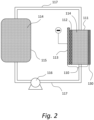
- the first half-cell using this first possible composition of anolyte is represented schematically in Fig. 2 , and corresponds to the first half-cell 110 already described with reference to Fig. 1 (in this figure, and in all figures described below representing half-cells, is also shown the presence of the membrane separator); this basic anolyte, containing only the solvent, zinc ions and at least one hydroxide, is electrolyte 114.
- the anolyte is obtained by:
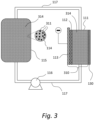
- a first half-cell, 310, using the anolyte having this second possible composition is represented schematically in Fig. 3 .
- the anolyte of this embodiment, 314, is obtained adding conductive particles 311 to the electrolyte 114 described above; this situation is represented in the inset in Fig. 3 .
- the anolyte is in contact with the planar electrode, 112.
- the anolyte contains electroactive particles containing zinc in a supporting electrolyte.
- the average size of the particles is in the range from 10 nm to 1000 ⁇ m, preferably from 20 nm to 500 ⁇ m, more preferably from 20 nm to 200 ⁇ m, still more preferably from 20 nm to 10 ⁇ m.
- This electrolyte may be prepared by:
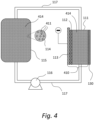
- a first half-cell, 410, using the anolyte according to this third possible composition is represented schematically in Fig. 4 .
- the anolyte of this embodiment, 414 is obtained adding electroactive particles 411 to the electrolyte 114 described above; this situation is represented in the inset in Fig. 4 .
- the anolyte is in contact with the planar electrode, 112.
- the anolyte is obtained by dissolving or suspending, in a supporting electrolyte, electroactive particles containing zinc and carbon particles forming a percolated conductive network in/on which redox reaction can occur.
- the average size of both particles of the dispersion is in the range from 10 nm to 1000 ⁇ m, preferably from 20 nm to 500 ⁇ m, more preferably from 20 nm to 200 ⁇ m, still more preferably from 20 nm to 10 ⁇ m.
- This electrolyte may be prepared by:
- a first half-cell, 510, using the anolyte according to this fourth possible composition is represented schematically in Fig. 5 .
- the anolyte of this embodiment, 514 is obtained adding to the electrolyte 114 described above conductive particles 311, that in this case are only carbon-based particles, and zinc-based electroactive particles 411; this situation is represented in the inset in Fig. 5 .
- the anolyte is in contact with the planar electrode, 112.
- the anolyte contains electroactive particles containing zinc in a supporting electrolyte.
- the average size of the particles is in the range from 10 nm to 1000 ⁇ m, preferably from 20 nm to 500 ⁇ m, more preferably from 20 nm to 200 ⁇ m, still more preferably from 20 nm to 10 ⁇ m.
- This electrolyte may be prepared by:
- a first half-cell, 610, using the anolyte according to this fifth possible composition is represented schematically in Fig. 6 .
- the liquid phase of this anolyte comprises a solvent and a hydroxide, and differs from electrolyte 114 of the previous embodiments in that it does not contain dissolved zinc salts; this liquid phase acts thus as a supporting electrolyte and is indicated by numeral 134.
- the anolyte of this embodiment, 614 is obtained adding electroactive particles 411 to the supporting electrolyte 134; this situation is represented in the inset in Fig. 6 . Inside the electrochemical cell the anolyte is in contact with the planar electrode, 112.
- the anolyte is obtained by dissolving or suspending, in a supporting electrolyte, electroactive particles containing zinc and carbon particles forming a percolated conductive network in/on which redox reaction can occur.
- the average size of both particles of the dispersion is in the range from 10 nm to 1000 ⁇ m, preferably from 20 nm to 500 ⁇ m, more preferably from 20 nm to 200 ⁇ m, still more preferably from 20 nm to 10 ⁇ m.
- This electrolyte may be prepared by:
- a first half-cell, 710, using the anolyte according to this sixth possible composition is represented schematically in Fig. 7 .
- the anolyte of this embodiment, 714 is obtained adding to the supporting electrolyte 134 described above conductive particles 311, that in this case are only carbon-based particles, and zinc-based electroactive particles 411; this situation is represented in the inset in Fig. 7 .
- the anolyte is in contact with the planar electrode, 112.
- any suitable metallic element able to be co-deposited with zinc, forming an alloy can be added to the anolyte of any one of the embodiments above.
- metallic elements in the form of ions, are obtained from their respective salts, oxides and hydroxides and properly selected in order to (i) shift the zinc electrochemical potential and (ii) to increase the overvoltage of hydrogen evolution.
- These metallic elements selected among Pb, Mn, Sn, Fe, Ni, Cu, Mg, Ti, Co, Al, Li, Zr or a combination of two or more thereof. In a preferred embodiment they are introduced in a concentration ranging from 0.001 M to 1 M, preferably from 0.01 M to 0.5 M, still more preferably from 0.05 M to 0.3 M.
- any one of the anolytes described above may further contain additives such as hydrogen evolution suppressor(s), Zn complexing agents, leveling agent(s), brightener(s), corrosion protective compounds, and similar additives, for stabilizing the operation of the first half-cell and increasing the battery performances, as detailed below.
- additives such as hydrogen evolution suppressor(s), Zn complexing agents, leveling agent(s), brightener(s), corrosion protective compounds, and similar additives, for stabilizing the operation of the first half-cell and increasing the battery performances, as detailed below.
- a first possible additive of the first electrolyte is a hydrogen evolution suppressor.
- This component is added in order to increase the battery coulombic efficiency and to reduce side reaction during the charging phase; this additive could be also effective in avoiding pH variation of the electrolyte.
- the hydrogen evolution suppressor may be selected among silicates, Pb, Bi, Mn, W, Cd, As, Sb, Sn, In and their oxides, boric acid or a combination thereof, in an overall concentration in the range between 0.001 M to 5 M, preferably from 0.01 M to 2 M, still more preferably from 0.05 M to 1 M.
- the anolyte may further contain Rochelle salts in a concentration between 0.001 M and 10 M, preferably from 0.1 M to 5 M, preferably from 0.5 M to 2 M; these salt act complexing zinc ions and increasing the conductivity of the electrolyte.
- Leveling agents include, e.g., polyethylene glycol (PEG), polyethylenimine (PEI), thiourea, quaternary ammonium salts, dextrins, cyclodextrins, sucrose, polytetrafluoroethylene (PTFE), sodium dodecyl sulfate (SDS), polyacrylic acid, glucose and cellulose or combinations thereof, with a concentration between 0.0001 ppm to 10000 ppm, preferably from 0.002 ppm to 5000 ppm, still more preferably from 1 ppm to 1000 ppm.
- the Zn-based electrolyte contains PEI from 0.01 ppm to 5000 ppm, preferably from 1 ppm to 2000 ppm, more preferably from 5 ppm to 1000 ppm.
- plasticizer additives may be added to the electrolyte formulation.
- These additives comprise polyols (such as polyethylene glycol (PEG), ethylene glycol, diethylene glycol (DEG), tetraethylene glycol (TEG), propylene glycol (PG), glycerol, mannitol, sorbitol, xylitol), monosaccharides (e.g., glucose, mannose, fructose, sucrose), fatty acids, urea, ethanolamine, triethanolamine, vegetable oils, lecithin, waxes, amino acids, surfactants and oleic acid, in a range between 0.1% by weight and 5% by weight, more preferably between 0.3% by weight and 3% by weight, still more preferably between 0.5% by weight and 1% by weight.
- PEG polyethylene glycol
- DEG diethylene glycol
- TEG tetraethylene glycol
- PG propylene glycol
- glycerol glycerol
- the invention relates also the addition of thickener additives necessary to guarantee the best particles dispersion and a suitable electrolyte viscosity in case of dispersed particles.
- the amount of these organic additives is comprised in a range between 0.0001% to 10% by weight of the electrolyte, preferably from 0.1% by weight to 5% by weight, still more preferably from 0.1% by weight to 1% by weight.
- the zinc-based electrolyte contains organic additives selected among xanthan gum, gum arabic, carboxymethyl cellulose, chitosan, agar-agar, sodium alginate and polyethylene oxide in an amount comprised in a range between 0.0001% to 10% by weight of the electrolyte, preferably from 0.1% by weight to 5% by weight, still more preferably from 0.1% by weight to 1% by weight.
- the aqueous polysulfide-based electrolyte (the second electrolyte)
- the second electrolyte of the invention contains polysulfide ions and requires the presence of a catalyst for its working.
- the co-presence of polysulfide ions and catalyst may be achieved according to vary different embodiments, which are described in detail below.
- the selection of water or a water-based mixture as the liquid phase of the electrolyte, and their combination with other chemicals described below, allows to exploit the electrochemical reaction of short-lenght polysulfide chains fostered by the combination with the developed electrocatalytic materials.
- a first second electrolyte, or catholyte, of the invention may be prepared by:
- Na 2 S is dissolved in a concentration of 2 M to 3 M, with an elemental sulfur concentration from 3 M to 12 M in an aqueous solution containing NaOH whose concentration ranging from 2 M to 8 M.
- the static electrode contained in the second half-cell is modified with the catalyst necessary to promote catholyte electrochemical reactions; this is generally a catalytic metal M, in particular selected from the group of metals Mo, Zr, Ti, Ni, In, Pb, Zn, Fe, Co, Cu, Mn, Cd, Bi, Al, Ga, Cr, W, Nb, Au, Ag, Pt, Ru, Ir, Pd and their alloys, and compounds of one or more metals.
- M-X or M-M'-X
- a second half-cell, 620, using the catholyte according to this first possible composition is represented schematically in Fig. 8 .
- the catholyte of this embodiment, 124 contains the solvent, at least one hydroxide, and polysulfide ions.
- the catalyst is present in the form of particles 623 adhered on the surface of electrode 622.
- a second embodiment of catholyte of the invention is obtained by introducing dispersed catalytic particles in it.
- This electrolyte may be prepared by:
- the average size of the dispersed catalytic particles is in the range from 10 nm to 1000 ⁇ m, preferably from 20 nm to 500 ⁇ m, more preferably from 20 nm to 200 ⁇ m, still more preferably from 20 nm to 10 ⁇ m.
- These catalytic particles may be made of the same metals and metal alloys and compounds listed above as modifier of electrode 622.
- a second half-cell, 720, using the catholyte according to this second possible composition is represented schematically in Fig. 9 .
- the catholyte of this embodiment, 721 is obtained adding catalytic particles 711 (represented by stars in the inset in the figure) to the electrolyte 124 described above.
- the planar electrode, 722 in contact with catholyte 721 has no catalytic particles adhered to its surface.
- a third possible embodiment of catholyte of the invention is obtained by introducing, in the supporting electrolyte, dispersed catalytic particles previously described and conductive particles, preferably carbon-based particles, forming a percolated conductive network in/on which redox reaction can occur.
- the average size of the particles of the dispersion is in the range from 10 nm to 1000 ⁇ m, preferably from 20 nm to 500 ⁇ m, more preferably from 20 nm to 200 ⁇ m, still more preferably from 20 nm to 10 ⁇ m.
- This electrolyte may be prepared by:
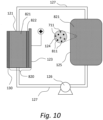
- a second half-cell, 820, using the catholyte according to this third possible composition is represented schematically in Fig. 10 .
- the catholyte of this embodiment, 821 is obtained adding to the electrolyte 124 previously described catalytic particles 711 and conductive particles 811 (both kinds of particles are represented in the inset in the figure). Also in this case the planar electrode, 822, in contact with catholyte 821 does not require catalytic particles adhered to its surface.
- the catholyte includes some conductive particles decorated with catalytic particles dispersed into the electrolyte, forming a percolated conductive network in/on which redox reaction can occur.
- the average size of the conductive particles is in the range from 10 nm to 1000 ⁇ m, preferably from 20 nm to 500 ⁇ m, more preferably from 20 nm to 200 ⁇ m, still more preferably from 20 nm to 10 ⁇ m.
- This electrolyte may be prepared by:
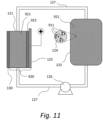
- a second half-cell, 920, using the catholyte according to this fourth possible composition is represented schematically in Fig. 11 .
- the catholyte of this embodiment, 921 is obtained adding to the electrolyte 124 previously described particles 911 (in the inset) obtained decorating basic conductive particles with catalytic particles.
- Electrode 922 has no catalytic particles adhered to its surface.
- a fifth possible embodiment of the invention is a catholyte including electroactive particles containing sulfide ions dispersed in a supporting electrolyte and reacting by means of redox reactions thanks to the presence of the catalyst on the surface of the static electrode.
- the average size of the electroactive particles is in the range from 10 nm to 1000 ⁇ m, preferably from 20 nm to 500 ⁇ m, more preferably from 20 nm to 200 ⁇ m, still more preferably from 20 nm to 10 ⁇ m.
- This electrolyte may be prepared by:
- a second half-cell, 1020, using the catholyte according to this fifth possible composition is represented schematically in Fig. 12 .
- the liquid phase of this catholyte comprises a solvent and a hydroxide, and differs from electrolyte 124 of the previous embodiments in that it does not contain sulfides; this liquid phase acts thus as a supporting electrolyte and is indicated by numeral 144.
- the catholyte of this embodiment, 1021 consists of the supporting electrolyte 144 added with the electroactive particles 1011 containing sulfide ions.
- the electrode 1022 can be a catalyst-modified static electrode similar to electrode 622, or it may be in the form of a slurry electrode.
- the catholyte contains some electroactive particles containing sulfide ions dispersed in a supporting electrolyte and reacting by means of redox reactions thanks to the presence of catalytic particles co-dispersed in it.
- the average size of the particles is in the range from 10 nm to 1000 ⁇ m, preferably from 20 nm to 500 ⁇ m, more preferably from 20 nm to 200 ⁇ m, still more preferably from 20 nm to 10 ⁇ m.
- This electrolyte may be prepared by:
- a second half-cell, 1120, using the catholyte according to this sixth possible composition is represented schematically in Fig. 13 .
- the catholyte of this embodiment, 1121 consists of the supporting electrolyte, 144, added with electroactive particles 1011 containing sulfide ions, and catalytic particles 711. Inside the electrochemical cell the catholyte is in contact with the planar electrode, 1122.
- this includes (i) electroactive particles containing sulfide ions dispersed in a supporting electrolyte, (ii) catalytic particles necessary to promote redox reaction of the catholyte and (iii) flowable electrodes in form of conductive particles, preferably carbon-based particles, forming a percolated conductive network in/on which redox reaction can occur.
- the average size of all dispersed particles is in the range from 10 nm to 1000 ⁇ m, preferably from 20 nm to 500 ⁇ m, more preferably from 20 nm to 200 ⁇ m, still more preferably from 20 nm to 10 ⁇ m.
- This electrolyte may be prepared by:
- a second half-cell, 1220, using the catholyte according to this seventh possible composition is represented schematically in Fig. 14 .
- the catholyte of this embodiment, 1221 consists of the supporting electrolyte, 144, added with electroactive particles 1011 containing sulfide ions, catalytic particles 711 and conductive particles 811, which form in this case the slurry/flowable electrode in contact with a 2D electrode 1222.
- the catholyte includes some electroactive particles containing sulfide ions decorated by catalyst particles dispersed in a supporting electrolyte and a static electrode with/without catalyst on which redox reaction can occur.
- the average size of the decorated electroactive particles is in the range from 10 nm to 1000 ⁇ m, preferably from 20 nm to 500 ⁇ m, more preferably from 20 nm to 200 ⁇ m, still more preferably from 20 nm to 10 ⁇ m.
- This electrolyte may be prepared by:
- the catholyte includes some electroactive particles containing sulfide ions decorated by catalyst particles dispersed in a supporting electrolyte and flowable electrodes in form of conductive particles, preferably carbon-based particles, forming a percolated conductive network in/on which redox reaction can occur.
- the average size of the decorated electroactive particles is in the range from 10 nm to 1000 ⁇ m, preferably from 20 nm to 500 ⁇ m, more preferably from 20 nm to 200 ⁇ m, still more preferably from 20 nm to 10 ⁇ m.
- This electrolyte may be prepared by:
- the second half-cell, 1420, obtained with this ninth possible catholyte composition, 1421, is represented schematically in Fig. 16 ; numeral 1311 in the inset indicates the sulfide-based electroactive particles having on their surface the catalyst particles, while numeral 811 indicates the conductive particles. The particles are dispersed in the supporting electrolyte 144.
- the catholyte includes some electroactive particles containing sulfide ions dispersed in a supporting electrolyte and flowable electrodes in form of conductive particles, preferably carbon-based particles, decorated by catalyst particles, forming a percolated conductive network in/on which redox reaction can occur.
- the average size of the particles is in the range from 10 nm to 1000 ⁇ m, preferably from 20 nm to 500 ⁇ m, more preferably from 20 nm to 200 ⁇ m, still more preferably from 20 nm to 10 ⁇ m.
- the catholyte may be prepared:
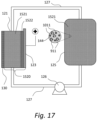
- the second half-cell, 1520, obtained with this tenth possible catholyte composition, 1521, is represented schematically in Fig. 17 ; numeral 1011 in the inset indicates the sulfide-based electroactive particles, while numeral 911 indicates the conductive particles having on their surface the catalyst particles.
- the particles are dispersed in the supporting electrolyte 144 and inside the electrochemical cell the catholyte is in contact with the planar electrode 1522.
- this includes (i) electroactive particles containing sulfide ions dispersed in a supporting electrolyte (ii) catalytic particles necessary to promote redox reaction of the catholyte and (iii) flowable electrodes in form of conductive particles, preferably carbon-based particles, forming a percolated conductive network in/on which redox reaction can occur.
- the average size of all dispersed particles is in the range from 10 nm to 1000 ⁇ m, preferably from 20 nm to 500 ⁇ m, more preferably from 20 nm to 200 ⁇ m, still more preferably from 20 nm to 10 ⁇ m.
- This electrolyte may be prepared by:
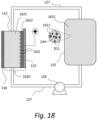
- a second half-cell, 1620, using the catholyte according to this eleventh possible composition is represented schematically in Fig. 18 .
- the catholyte of this embodiment, 1621 consists of the supporting electrolyte, 144, added with electroactive particles 1011 containing sulfide ions, and conductive particles 811, which form in this case the slurry/flowable electrode in contact with a 2D catalyst-modified static electrode 1622 similar to electrode 622, comprising catalyst particles 623 on its surface.
- a twelfth possible embodiment of the invention is a catholyte including electroactive particles containing sulfide ions dispersed in a supporting electrolyte and reacting by means of redox reactions thanks to the presence of the catalyst on the surface of the static electrode.
- the average size of the electroactive particles is in the range from 10 nm to 1000 ⁇ m, preferably from 20 nm to 500 ⁇ m, more preferably from 20 nm to 200 ⁇ m, still more preferably from 20 nm to 10 ⁇ m.
- This electrolyte may be prepared by:
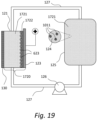
- a second half-cell, 1720, using the catholyte according to this twelfth possible composition is represented schematically in Fig. 19 .
- the catholyte of this embodiment, 1721 is obtained adding to the electrolyte 124 the electroactive particles 1011 containing sulfide ions.
- the electrode 1722 can be a catalyst-modified static electrode similar to electrode 622.
- the catholyte contains some electroactive particles containing sulfide ions dispersed in a supporting electrolyte and reacting by means of redox reactions thanks to the presence of catalytic particles co-dispersed in it.
- the average size of the particles is in the range from 10 nm to 1000 ⁇ m, preferably from 20 nm to 500 ⁇ m, more preferably from 20 nm to 200 ⁇ m, still more preferably from 20 nm to 10 ⁇ m.
- This electrolyte may be prepared by:
- a second half-cell, 1820, using the catholyte according to this thirteenth possible composition is represented schematically in Fig. 20 .
- the catholyte of this embodiment, 1821 consists of the electrolyte 124, added with electroactive particles 1011 containing sulfide ions, and catalytic particles 711. Inside the electrochemical cell the catholyte is in contact with the planar electrode, 1822.
- this includes (i) electroactive particles containing sulfide ions dispersed in a supporting electrolyte (ii) catalytic particles necessary to promote redox reaction of the catholyte and (iii) flowable electrodes in form of conductive particles, preferably carbon-based particles, forming a percolated conductive network in/on which redox reaction can occur.
- the average size of all dispersed particles is in the range from 10 nm to 1000 ⁇ m, preferably from 20 nm to 500 ⁇ m, more preferably from 20 nm to 200 ⁇ m, still more preferably from 20 nm to 10 ⁇ m.
- This electrolyte may be prepared by:
- a second half-cell, 1920, using the catholyte according to this fourteenth possible composition is represented schematically in Fig. 21 .
- the catholyte of this embodiment, 1921 consists of the electrolyte 124 added with electroactive particles 1011 containing sulfide ions, catalytic particles 711 and conductive particles 811, which form in this case the slurry/flowable electrode in contact with a 2D electrode 1922.
- the catholyte includes some electroactive particles containing sulfide ions decorated by catalyst particles dispersed in a supporting electrolyte and a static electrode with/without catalyst on which redox reaction can occur.
- the average size of the decorated electroactive particles is in the range from 10 nm to 1000 ⁇ m, preferably from 20 nm to 500 ⁇ m, more preferably from 20 nm to 200 ⁇ m, still more preferably from 20 nm to 10 ⁇ m.
- This electrolyte may be prepared by:
- This composition of catholyte 2021 and the resulting second half-cell 2020 are represented in Fig. 22 , in which numeral 1311 in the inset indicates the sulfide-based electroactive particles having on their surface the catalyst particles, suspended in electrolyte 124.
- the catholyte includes some electroactive particles containing sulfide ions decorated by catalyst particles dispersed in a supporting electrolyte and flowable electrodes in form of conductive particles, preferably carbon-based particles, forming a percolated conductive network in/on which redox reaction can occur.
- the average size of the decorated electroactive particles is in the range from 10 nm to 1000 ⁇ m, preferably from 20 nm to 500 ⁇ m, more preferably from 20 nm to 200 ⁇ m, still more preferably from 20 nm to 10 ⁇ m.
- This electrolyte may be prepared by:
- the second half-cell, 2120, obtained with this sixteenth possible catholyte composition, 2121, is represented schematically in Fig. 23 ; numeral 1311 in the inset indicates the sulfide-based electroactive particles having on their surface the catalyst particles, while numeral 811 indicates the conductive particles. The particles are dispersed in the electrolyte 124.
- the catholyte includes some electroactive particles containing sulfide ions dispersed in a supporting electrolyte and flowable electrodes in form of conductive particles, preferably carbon-based particles, decorated by catalyst particles, forming a percolated conductive network in/on which redox reaction can occur.
- the average size of the particles is in the range from 10 nm to 1000 ⁇ m, preferably from 20 nm to 500 ⁇ m, more preferably from 20 nm to 200 ⁇ m, still more preferably from 20 nm to 10 ⁇ m.
- the catholyte may be prepared:
- the second half-cell, 2220, obtained with this eighteenth possible catholyte composition, 2221, is represented schematically in Fig. 24 ; numeral 1011 in the inset indicates the sulfide-based electroactive particles, while numeral 911 indicates the conductive particles having on their surface the catalyst particles. The particles are dispersed in the electrolyte 124 and inside the electrochemical cell the catholyte is in contact with the planar electrode 2222.
- this includes (i) electroactive particles containing sulfide ions dispersed in a supporting electrolyte (ii) catalytic particles necessary to promote redox reaction of the catholyte and (iii) flowable electrodes in form of conductive particles, preferably carbon-based particles, forming a percolated conductive network in/on which redox reaction can occur.
- the average size of all dispersed particles is in the range from 10 nm to 1000 ⁇ m, preferably from 20 nm to 500 ⁇ m, more preferably from 20 nm to 200 ⁇ m, still more preferably from 20 nm to 10 ⁇ m.
- This electrolyte may be prepared by:
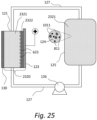
- a second half-cell, 2320, using the catholyte according to this nineteenth possible composition is represented schematically in Fig. 25 .
- the catholyte of this embodiment, 2321 consists of the electrolyte 124, added with electroactive particles 1011 containing sulfide ions, and conductive particles 811, which form in this case the slurry/flowable electrode in contact with a 2D catalyst-modified static electrode 2322 similar to electrode 622.
- Any one of the catholytes described above can be obtained using sulfur-based solutions, preferably selected among those coming from refining processes for the treatment of sulfur dioxide or any other S-containing waste compounds and/or solutions.
- Any one of the catholytes described above may further contain plasticizers and/or thickeners as additives for stabilizing the operation of the second half-cell and increasing the battery performances.
- Plasticizer additives that can be added comprise polyols (such as polyethylene glycol (PEG), ethylene glycol, diethylene glycol (DEG), tetraethylene glycol (TEG), propylene glycol (PG), glycerol, mannitol, sorbitol, xylitol), monosaccharides (e.g., glucose, mannose, fructose, sucrose), fatty acids, urea, ethanolamine, triethanolamine, vegetable oils, lecithin, waxes, amino acids, surfactants and oleic acid, in a range between 0.1% by weight and 5% by weight, more preferably between 0.3% by weight and 3% by weight, still more preferably between 0.5% by weight and 1% by weight.
- polyols such as polyethylene glycol (PEG), ethylene glycol, diethylene glycol (DEG), tetraethylene glycol (TEG), propylene glycol (PG), glycerol, mannitol, sorbito
- Thickener additives guarantee the best particles dispersion and a suitable electrolyte viscosity in case of dispersed particles and dispersed catalysts.
- the amount of these organic additives is comprised in a range between 0.0001 % to 10% by weight of the electrolyte, preferably from 0.1% by weight to 5% by weight, still more preferably from 0.1% by weight to 1% by weight.
- the catholyte contains organic additives selected among xanthan gum, gum arabic, carboxymethyl cellulose, chitosan, agar-agar, sodium alginate and polyethylene oxide.
- the electrodes used in the Zn-polysulfide RFB of the invention can be selected from any kind of electrode material.
- the electrodes may be made of carbon-based or metallic material (for instance a plate or in the form of a foam or a net), or they may be in the form of dispersed electrodes.
- the former electrode is indicated as static electrode and can be a flow-through 3D one like carbon felt or a planar 2D one like a graphite plate; in the latter case it is indicated as flowable electrode.
- Carbon-based static electrodes may be e.g., of graphite sheets, carbon felt, or carbon-based fabric; alternatively, carbon-based electrodes are formed of carbon-based conductive particles dispersed in a polymer matrix. Carbon-based electrodes are suitable for both the first and the second half-cells.
- metallic static electrodes for use in the first half-cell may consist in a Zn metallic plate, coated Zn metallic plate, Zn metallic foams, Zn coated metallic foams or net.
- the static electrodes, both metallic or carbon-based electrodes are modified by a catalyst(s), as described later, necessary to promote and sustain redox reactions of the dissolved species.
- the carbon-based electrode is a carbon felt modified electrode.
- the metallic electrodes to be used in the second half-cell are modified metallic foams.
- Flowable dispersed electrodes in the form of a percolated network of dispersed conductive particles, may consists in organic or inorganic conductive particles, functionalized particles or a fluidized bed electrode in the form of particles. These electrodes can be dispersed in both electrolytes; they are particles in/on which redox reactions can occur.
- Examples of these dispersed electrodes are metallic particles, expanded graphite, graphite, graphene, graphene oxide, reduced graphene oxide, active carbon, transition metal oxide particles, carbon-based, materials decorated with metal oxide particles, carbon nanotubes, carbon blacks particles, acetylene black particles, metal-coated particles or a combination of two or more thereof;
- the average size of these particles is in the range from 10 nm to 1000 ⁇ m, preferably from 20 nm to 500 ⁇ m, more preferably from 20 nm to 200 ⁇ m, still more preferably from 20 nm to 10 ⁇ m.
- the flowable electrodes in the Zn-based electrolyte may contain Zn particles, Zn oxide particles, Zn coated particles and/or carbon-based particles, selected among graphene, expanded graphite, reduced graphene oxide, active carbon, carbon blacks, acetylene black, carbon nanotubes or a combination of two or more thereof are then introduced to form a conductive percolation path inside the electrolyte.
- the overall concentration ranges from 0.01% by weight to 20% by weight, preferably from 0.1% by weight to 10% by weight, still more preferably from 1% by weight to 5% by weight.
- the flowable electrode in the second half-cell may contain conductive particles, preferably carbon-based particles, selected among graphene, expanded graphite, reduced graphene oxide, active carbon, carbon blacks, acetylene black, carbon nanotubes or a combination of two or more thereof are then introduced to form a conductive percolation path inside the electrolyte.
- the overall concentration ranges from 0.01 % by weight to 20% by weight, preferably from 0.1% by weight to 10% by weight, still more preferably from 1% by weight to 5% by weight.
- flowable dispersed electrodes provide a high surface area to minimize the over potential for zinc plating/dissolution and a higher cycle life (compared to plating on a flat electrode); in case of flowable dispersed electrodes in the polysulfide half-cell, the addition of flowable electrodes can induce a higher battery capacity and a better behavior at high operative rates.
- Slurry/flowable electrodes are in the form of an ink of electrically conductive particles in/on which redox reactions can occur.
- Materials useful for the production of these slurry electrodes are metallic particles, graphite, graphene, graphene oxide, transition metal oxide particles, carbon-based materials decorated with metal oxide particles, carbon nanotubes, carbon blacks particles, acetylene black particles, metal-coated particles, reduced graphene oxide, active carbon or a combination of two or more thereof.
- the average size of the particles of the slurry is in the range from 10 nm to 1000 ⁇ m, preferably from 20 nm to 500 ⁇ m, more preferably from 20 nm to 200 ⁇ m, still more preferably from 20 nm to 10 ⁇ m.
- Polymeric powders can be introduced in the mixture, acting as binders for the other particles.
- the amount of conductive carbon particles in the slurry electrode is selected from 50% to 95%, in another embodiment from 60% to 90%, in still another embodiment from 70% to 80% of the overall electrode mass.
- the amount of active particles containing zinc can be selected from 1% to 50%, more preferably from 5% to 30%, still more preferably from 10% to 20% of the overall electrode mass.
- the amount of binder is selected from 0.1% to 20%, more preferably from 0.5% to 10%, still more preferably from 5% to 10% of the overall electrode mass.
- the composition of the slurry can be tuned in order to impart electrode conductivity to the two electrolytes.
- slurry electrodes employed in the first half-cell are a slurry of electrically conductive particles in/on which the Zn 2+ /Zn redox reaction can occur.
- Materials useful for the production of these slurry electrodes are metallic particles, Zn particles, Zn coated particles, graphite, expanded graphite, graphene, graphene oxide, transition metal oxide particles, carbon-based materials decorated with metal oxide particles, carbon nanotubes, carbon blacks particles, acetylene black particles, reduced graphene oxide, active carbon or a combination of two or more thereof;
- the average size of the particles of the slurry is in the range from 10 nm to 1000 ⁇ m, preferably from 20 nm to 500 ⁇ m, more preferably from 20 nm to 200 ⁇ m, still more preferably from 20 nm to 10 ⁇ m.
- slurry electrodes for use in the second half-cell are formed of a slurry of electrically conductive particles on which sulfide redox reaction can occur; materials useful for the production of this slurry electrode are, e.g., metallic powder, graphite, expanded graphite, graphene oxide, carbon nanotubes, transition metal oxide particles, carbon-based materials decorated with metal oxide particles, reduced graphene oxide, active carbon, acetylene black, or a combination of two or more thereof; the average size of the particles of the slurry is in the range from 10 nm to 1000 ⁇ m, preferably from 20 nm to 500 ⁇ m, more preferably from 20 nm to 200 ⁇ m, still more preferably from 20 nm to 100 ⁇ m.
- the electrode contained in the second half-cell is modified with a catalytic material to promote and sustain the electrochemical reactions involving sulfur species during charge and discharge phases of the battery.
- Said catalytic material is generally a catalytic metal M, in particular selected from the group of metals Mo, Zr, Ti, Ni, In, Pb, Zn, Fe, Co, Cu, Mn, Cd, Bi, Al, Ga, Cr, W, Nb, Au, Ag, Pt, Ru, Ir, Pd, alloys and intermetallic compounds thereof, and compounds of one or more metals.
- Examples of alloys/intermetallic compounds useful for the objects of the invention are CosNi, FesCo, Fe 9 Co 7 and CosCu.
- Said catalyst may comprise a mixture of two or more materials belonging to the same or different sub-class, as for example two different sulfides, a sulfide and an oxide, a sulfide and selenide, an oxide and a selenide, and all the combinations of chalcogenides.
- the present invention relates also to the mixture of different crystalline phases, for materials with the same (e.g. hexagonal or cubic Co) or different elemental composition (e.g. CoS, CoS 2 , Co 3 S 4 , Co 9 S 8 ); amorphous compounds are also considered.
- the preferred catalysts for use in the invention are CoOOH, Co(OH) 2 , Co 3 O 4 , CoO, CoO 2 , Co 3 S 4 , Co 9 S 8 , CoS 2 , CoSe, CoSe 2 , Co 3 Se 4 , Co 9 Se 8 , NiSe, NiSe 2 , Ni 3 Se 4 , Ni 9 Se 8 , MoSe 2 , Bi 2 S 3 , WS 2 , WSe 2 , CuO, Cu 3 Se 2 , Co 2 CuS 4 , CoCuS 4 , CoNiOOH, CoFeOOH, NiCo 2 O 4 , CosNiSs, Co 2 NiS 4 , Co 2 NiSe 4 , CoNiSe 4 or mixtures thereof.
- Co 3 S 4 , CoS 2 , or a mixture thereof is employed.
- the catalyst may be deposited directly onto the electrode surface following any suitable methods known in the art i.e. by chemical (e.g. hydrothermal, chemical bath deposition, etc), physical (e.g. sputtering, evaporation, reactive annealing, etc) and electrochemical (e.g. electrodeposition, etc) means or by a combination thereof.
- a sulfide compounds may be synthesized through direct co-electrodeposition of the metal and sulfur or following a two steps process i.e. by the growth of the metallic layer, followed by reactive annealing in sulfur containing atmosphere.
- the deposition of a metal oxide is followed by reactive process, either chemical or physical, to obtain the desired chalcogenide (e.g. sulfide, selenides, etc).
- the formation of nanostructures, such as nanowires and nanorods may be achieved by direct grown on the carbon collector electrode by hydrothermal annealing.
- the metal catalyst may be also in the form of slurry: catalytic powders, obtained through chemical reaction possibly in combination with ball milling, may be dispersed in a binder and applied on the electrode.
- the average size of the catalytic particles of the slurry is in the range from 10 nm to 1000 ⁇ m, preferably from 20 nm to 500 ⁇ m, more preferably from 20 nm to 200 ⁇ m, still more preferably from 20 nm to 10 ⁇ m.
- Polymeric powders can be introduced in the mixture, acting as binders for the other particles.
- the amount of catalytic particles in the slurry is selected from 50% to 95%, in another embodiment from 60% to 90%, in still another embodiment from 70% to 80% of the overall electrode mass.
- the amount of binder is selected from 0.1% to 20%, more preferably from 0.5% to 10%, still more preferably from 5% to 10% of the overall electrode mass.
- the slurry contains also conductive particles selected among metallic particles, graphite, graphene, graphene oxide, reduced graphene oxide, active carbon, metal oxide particles, carbon-based materials decorated with metal oxide particles, carbon nanotubes, carbon blacks particles, acetylene black carbon, metal-coated particles or a combination of two or more thereof.
- the average size of the catalytic particles of the slurry is in the range from 10 nm to 1000 ⁇ m, preferably from 20 nm to 500 ⁇ m, more preferably from 20 nm to 200 ⁇ m, still more preferably from 20 nm to 10 ⁇ m.
- the catalyst is dispersed in form of particles in the polysulfide-based catholyte.
- the materials these particles are made of are the same reported above for the embodiment in which the catalyst modifies the electrode.
- These particles can be obtained by any suitable method known in the art e.g. chemical precipitation, hydrothermal synthesis, reactive annealing of metallic particles, reactive ball milling, chemical conversion.
- the membrane separator The membrane separator
- the two half-cells are in contact through a membrane separator.
- the separator can be chosen as desired for a particular purpose or intended use.
- the separator is a porous separator without any active ion-exchange material; Celgard ® separators or similar can be used.
- solid state glasses can be also used.
- Na-ion or Li-ion glasses, selected among sulfide-based ones, are used in order to guarantee a cationic exchange of Na + or Li + ions between the two half-cells.
- the membrane is an ion-selective porous membrane.
- the separator can be chosen among all suitable materials acting as ionic membrane, depending on purpose.
- the membrane is a cationic membrane suitable for batteries where anolyte and catholyte have a different pH, to reduce as much as possible electrolytes cross mixing.
- a National TM (co-polymer of perfluorosulfonic acid and polytetrafluoroethylene) membrane is employed.
- ionic particles are dispersed together with conductive particles, preferably carbon-based particles, in a solid/semi-solid polymeric electrolyte, selected among co-polymer of perfluorosulfonic acid and polytetrafluoroethylene, poly-vinyl alcohol (PVA), chitosan, poly-acrylic acid (PAA), gelatin, etc. and applied on any of the previously introduced ionic membranes, thus obtaining a multilayer separator.
- PVA poly-vinyl alcohol
- PAA poly-acrylic acid
- gelatin etc.
- the role of the ionic particles is to block the active ions of the two electrolytes, reducing the cross mixing effect.
- the catalyst is applied on the separator between the two half-cells.
- the catalyst is dispersed together with conductive particles, preferably carbon-based particles, in a polymeric binder, selected among co-polymer of perfluorosulfonic acid and polytetrafluoroethylene, PVA, chitosan, PAA, gelatin, etc. and applied on any of the previously cited ionic membranes, obtaining multilayer separator, referred herein as catalyst-decorated separator.
- conductive particles preferably carbon-based particles
- a polymeric binder selected among co-polymer of perfluorosulfonic acid and polytetrafluoroethylene, PVA, chitosan, PAA, gelatin, etc.
- the carbon-decorated particles are dispersed in a polymeric binder, selected among co-polymer of perfluorosulfonic acid and polytetrafluoroethylene, PVA, chitosan, PAA, gelatin, etc. and applied on any of the previously cited ionic membranes, obtaining multilayer separator, called herein as catalyst-decorated separator.
- a multilayer separator 160 consists of a first homogeneous layer 161 coupled to a second layer, 162, containing carbon-based particles decorated with catalyst (163) and non-catalytic particles (164). This kind of separator can be applied to any RFB configuration described in the present application.
- the membrane in case of any ion-exchange materials, in all configuration (i.e. mono- or multi-layer(s)), the membrane is swelled in 1 M NaOH or 1 M KOH solution, prior the utilization, in order to guarantee a proper efficient ion exchange between the anolyte and the catholyte during the electrochemical reaction. Swelling time is selected depending on the type of membrane. Alternative membranes, including all known solid/semi-solid organic-inorganic composite electrolytes are also contemplated.
- a Zn-polysulfide flow battery in accordance with the present invention can generally have a cell potential from about 0.7 V to 1.4 V, depending on polysulfide amount and catalyst(s) used.
- the Zn-polysulfide RFB is generally environmentally friendly, non-toxic and safer if compared to other flow batteries.
- the electrochemical device of the present invention allows to work at higher pH values increasing the battery lifetime and reducing strongly the maintenance costs.
- the Zn-polysulfide flow battery of the invention is significantly cheaper than known RFBs: the cost of this battery may be lower than 200 USD/kWh for the battery components and lower than 60 USD/kWh for the electrolyte and tanks, providing an energy efficiency as high as 70-85%.
- the RFB cell of the present invention can be also electrically coupled in a so-called stacked configuration, connected either in series to obtain higher voltage values, or in parallel to obtain higher current outputs.
- a solution has been prepared dissolving sodium hydroxide, NaOH, in Millipore water at room temperature with a concentration of 6 M, followed by 0.1 M of zinc oxide, ZnO.
- Bismuth oxide, Bi 2 O 3 has been added to increase the conductivity of the final solution.
- the final formulation is shown in Table 1.
- the as-prepared solution can work from 25 °C to 70 °C.
- Table 1 example of Zn based electrolyte Chemical compound Chemical formula Molar mass [g/mol] Concentration [g/L] Concentration [mol/l] Sodium hydroxide NaOH 40.00 240.00 6.00 Zinc oxide ZnO 81.38 8.14 0.10 Bismuth oxide Bi 2 O 3 465.90 2.33 0.005
- a solution has been prepared dissolving potassium hydroxide, KOH, in Millipore water at room temperature with a concentration of 6 M, followed by 0.1 M of zinc acetate, (Zn(CH 3 COO) 2 ), lithium hydroxide, LiOH, has been added to increase the conductivity of the final solution.
- the final formulation is shown in Table 2.
- the as-prepared solution can work from 25 °C to 70 °C.
- Table 2 example of Zn based electrolyte Chemical compound Chemical formula Molar mass [g/mol] Concentration [g/L] Concentration [mol/l] Potassium hydroxide KOH 56.11 336.66 6.00 Zinc acetate Zn(CH 3 COO) 2 ⁇ 2H 2 O 219.50 21.95 0.10 Lithium hydroxide LiOH 23.95 2.39 0.10
- a solution has been prepared dissolving potassium hydroxide, KOH, in Millipore water at room temperature with a concentration of 6 M, followed by 0.1 M of zinc acetate, (Zn(CH 3 COO) 2 ), 3% by weight of carbon black particles with an average diameter in the range from 500 and 700 nm, has been added as flowable electrodes.
- the final formulation is shown in Table 3.
- the as-prepared solution can work from 25 °C to 70 °C.
- Table 3 example of Zn based electrolyte Chemical compound Chemical formula Molar mass [g/mol] Concentration [g/L] Concentration [mol/l] Potassium hydroxide KOH 56.11 336.66 6.00 Zinc acetate Zn(CH 3 COO) 2 -2H 2 O 219.50 21.95 0.10 Carbon Black C 12.01 8.52 0.71
- a solution has been prepared dissolving sodium hydroxide, NaOH, and potassium hydroxide, KOH, in Millipore water at room temperature with an overall concentration of 7 M, followed by 0.3 M of zinc acetate, (Zn(CH 3 COO) 2 ).Lithium hydroxide, LiOH, has been added to increase the conductivity of the final solution.
- the final formulation is shown in Table 4.
- the as-prepared solution can work from 25 °C to 70 °C.
- Table 5 example of Zn based electrolyte Chemical compound Chemical formula Molar mass [g/mol] Concentration [g/L] Concentration [mol/l] Potassium hydroxide KOH 56.11 336.66 6.00 Xanthan gum (C 35 H 49 O 29 ) x 933.00 10.00 0.01 Zinc oxide (particles) ZnO 81.38 20.00 0.25 Zinc (particles) Zn 65.3 150.00 2.29
- a solution has been prepared dissolving NaOH in Millipore water at room temperature with a concentration of 4 M, followed by 3 M of elemental sulfur, S. Once the S was completely dissolved, 1 M of Na2S were added to the solution in order to increase the S content inside the solution.
- the final formulation is shown in Table 6.
- the as prepared solution can work from 25 °C to 70 °C.
- Table 6 example of Zn based electrolyte Chemical compound Chemical formula Molar mass [g/mol] Concentration [g/L] Concentration [mol/l] Sodium hydroxide NaOH 40.00 160.00 4.00 Sulfur S 32.06 96.18 3.00 Sodium sulfide Na 2 S 142.04 142.04 1.00
- a solution has been prepared dissolving KOH in Millipore water at room temperature with a concentration of 3 M, followed by 1 M of elemental sulfur, S. Once the S was completely dissolved, 1 M of K 2 S were added to the solution in order to increase the S content inside the solution.
- the final formulation is shown in Table 7.
- the as-prepared solution can work from 25 °C to 70 °C.
- Table 7 example of polysulfide-based electrolyte Chemical compound Chemical formula Molar mass [g/mol] Concentration [g/L] Concentration [mol/l] Potassium hydroxide KOH 56.11 168.33 3.00 Sulfur S 32.06 32.06 1.00 Potassium sulfide K 2 S 110.26 110.26 1.00
- a solution has been prepared dissolving NaOH and KOH in Millipore water at room temperature with an overall concentration of 5 M, followed by 2 M of elemental sulfur. Once sulfur was completely dissolved, 0.5 M of Na 2 S and 0.5 M of K 2 S were added to the solution in order to increase the S content inside the solution. 3% by weight of carbon black particles with an average diameter between 100 and 200 ⁇ m has been added as flowable electrodes.
- the final formulation is shown in Table 8.
- the as-prepared solution can work from 25 °C to 70 °C.
- Table 8 example of polysulfide-based electrolyte Chemical compound Chemical formula Molar mass [g/mol] Concentration [g/L] Concentration [mol/l] Sodium hydroxide NaOH 40.00 80.00 2.00 Potassium hydroxide KOH 56.11 168.33 3.00 Sulfur S 32.06 64.12 2.00 Sodium sulfide Na 2 S 142.04 71.02 0.50 Potassium sulfide K 2 S 110.26 55.13 0.50 Carbon Black C 12.01 13.56 1.13
- a solution has been prepared dissolving NaOH and KOH in Millipore water at room temperature with an overall concentration of 5 M, followed by 2 M of elemental sulfur, S. Once the S was completely dissolved, 0.5 M of Na 2 S and 0.5 M of K 2 S were added to the solution in order to increase the S content inside the solution.
- the final formulation is shown in Table 8. 1% by weight of Co 3 S 4 is then added to the electrolyte as a dispersed catalyst.
- the as-prepared solution can work from 25 °C to 70 °C.
- Table 9 example of polysulfide-based electrolyte Chemical compound Chemical formula Molar mass [g/mol] Concentration [g/L] Concentration [mol/l] Sodium hydroxide NaOH 40.00 80.00 2.00 Potassium hydroxide KOH 56.11 168.33 3.00 Sulfur S 32.06 64.12 2.00 Sodium sulfide Na 2 S 142.04 71.02 0.50 Potassium sulfide K 2 S 110.26 55.13 0.50 Cobalt sulfide Co 3 S 4 305.07 4.43 0.0145
- the catalyst deposition was obtained in this case following a two steps procedure: (i) cobalt deposition on the carbon felt electrode, followed by (ii) reactive annealing in a tubular furnace in a sulfur-containing atmosphere.
- the electrodeposition of metallic Co layer was performed in acidic conditions applying a current density of 20 mA/cm 2 applied for 10 minutes.
- the metalized sample was subjected to sulfurization process in a tubular furnace at temperature of 400 °C for 30 minutes, under a nitrogen flow of 3 L/min. The sample has been directly inserted in the pre-heated furnace followed by cooling in air. Sulfur powder (20 mg) was placed along with the cobalt coated carbon felt electrode.
- the catalyst deposition was obtained in this case following a two steps procedure: (i) cobalt deposition on the carbon felt electrode, followed by (ii) reactive annealing in a tubular furnace in a sulfur-containing atmosphere.
- the electrodeposition of metallic Co layer was performed in acidic conditions applying a current density of 20 mA/cm 2 applied for 10 minutes.
- the metalized sample was subjected to sulfurization process in a tubular at temperature of 400 °C for 60 minutes, under a nitrogen flow of 3 L/h. The sample has been directly inserted in the pre-heated furnace followed by cooling in air. Sulfur powder (100 mg) was placed along with the cobalt coated carbon felt electrode.
- the catalyst prepared according to Example 10 has been characterized by X-ray diffraction (XRD) technique. The results are shown in Figure 30 .
- XRD X-ray diffraction
- the catalyst prepared according to Example 11 has been characterized by X-ray diffraction (XRD) technique. The results are shown in Figure 31 .
- XRD X-ray diffraction
- the electrolytes prepared in Examples 1 and 6 have been used to produce a Zn-polysulfide RFB obtained by coupling a first half-cell according to Fig. 2 with a second half-cell according to Fig. 8 , through a single-layer membrane separator 130; in this first RFB a catalyst was not included. Electrochemical tests have been carried out in this RFB with a pumping system using a Biologic VMP-300 potentiostat/galvanostat, applying a current density of 10 mA cm -2 . The nominal area for the two electrodes was equal to 25 cm 2 , resulting in a total applied current of 250 mA in the charge phase and -250 mA in the discharge phase.
- the catalyst effect on the battery performance is highlighted on single charge/discharge cycle; the graph obtained in this test is shown in Fig. 32 as a dotted line.
- a high cell voltage was recorded during the charge phase as an indication of the high overpotential required to sustain the oxidation processes.
- the cell voltage immediately dropped to 0.3 V during the discharge phase, indicating the inability of the bare carbon felt to trigger the polysulfides redox reactions.
- a second RFB comprising in this case a cobalt sulfide material obtained by following the procedure described in Gross et al. paper (page 10614) indicated in Fig. 32 and 33 as (Co-S).
- the performance of this RFB has been tested in single charge/discharge cycle as for the previous case; the result of this test is represented by the dashed line in Fig. 32 .
- This RFB gave rise to a faradaic efficiency (FE) of 92.2 % and an energy efficiency (EE) of 71.6%.
- FE faradaic efficiency
- EE energy efficiency
- a RFB has been produced as in the two previous cases, with the difference that in this case (according to the invention) a cobalt sulfide catalyst obtained as described in Example 11 was used in the catholyte half-cell.
- the RFB performances over cycles with the catalyst of the prior art resulted unstable over time, detrimentally affecting the RFB performances and the cyclelife.
- Fig. 33 shows charge and discharge cycles for the RFB produced with the catalyst of the prior art (Gross et al.), represented as dotted lines, and for the RFB produced with the catalyst of the present invention, represented as solid lines.
- the electrolytes prepared in Examples 1 and 6 have been used to produce a Zn-polysulfide RFB obtained by coupling a first half-cell according to Fig. 2 with a second half-cell according to Fig. 8 , through a single-layer membrane separator 130.
- the catalyst of the catholyte half-cell was obtained according to Example 11. Electrochemical tests have been carried out in this RFB with a pumping system using a Biologic VMP-300 potentiostat/galvanostat, applying a current density of 10 mA cm -2 . The nominal area for the two electrodes was equal to 25 cm 2 , resulting in a total applied current of 250 mA in the charge phase and -250 mA in the discharge phase.
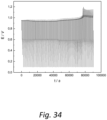
- Figure 34 shows the classical graph of charge and discharge cycles for this RFB. In Figure 35 the current efficiency relative cycles are also reported.
- the electrolytes prepared in Examples 1 and 7 have been used to produce a Zn-polysulfide RFB having the same structure as the battery of Example 18. Electrochemical tests have been carried out in this RFB with a pumping system using a Biologic VMP-300 potentiostat/galvanostat, applying a current density of 10 mA cm -2 . The nominal area for the two electrodes was equal to 25 cm 2 , resulting in a total applied current of 250 mA during the charge phase and -250 mA during the discharge phase.
- Figure 36 shows the classical graph of charge and discharge cycles for this RFB.
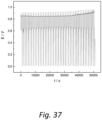
- the electrolytes prepared in Examples 4 and 6 have been used to produce a Zn-polysulfide RFB having the same structure as the battery of Example 18. Electrochemical tests have been carried out in this RFB with a pumping system using a Biologic VMP-300 potentiostat/galvanostat, applying a current density of 10 mA cm -2 . The nominal area for the two electrodes was equal to 25 cm 2 , resulting in a total applied current of 250 mA during the charge phase and -250 mA during the discharge phase.
- Figure 37 shows the classical graph of charge and discharge cycles for this RFB.
- the electrolytes prepared in Examples 3 and 7 have been used to produce a Zn-polysulfide RFB having the same structure as the battery of Example 18. Electrochemical tests have been carried out in this RFB with a pumping system using a Biologic VMP-300 potentiostat/galvanostat, applying a current density of 10 mA cm -2 . The nominal area for the two electrodes was equal to 25 cm 2 , resulting in a total applied current of 250 mA during the charge phase and -250 mA during the discharge phase.
- Figure 38 shows the classical graph of charge and discharge cycles for this RFB.
- the electrolytes prepared in Examples 2 and 6 have been used to produce a Zn-polysulfide RFB having the structure obtained combining the first half cell of Figure 3 and the second half cell of Figure 8 .
- the catalyst of the catholyte half-cell was obtained according to Example 11. Electrochemical tests have been carried out in this RFB with a pumping system using a Biologic VMP-300 potentiostat/galvanostat, applying a current density of 10 mA cm -2 . The nominal area for the two electrodes was equal to 25 cm 2 , resulting in a total applied current of 250 mA during the charge phase and -250 mA during the discharge phase.
- Figure 39 shows the classical graph of charge and discharge cycles for this RFB. The volumetric capacity for the battery using the same electrolyte is shown in Figure 40 .
Landscapes
- Chemical & Material Sciences (AREA)
- Sustainable Energy (AREA)
- Life Sciences & Earth Sciences (AREA)
- Engineering & Computer Science (AREA)
- Manufacturing & Machinery (AREA)
- Sustainable Development (AREA)
- Chemical Kinetics & Catalysis (AREA)
- Electrochemistry (AREA)
- General Chemical & Material Sciences (AREA)
- Composite Materials (AREA)
- Hybrid Cells (AREA)
- Fuel Cell (AREA)
- Inert Electrodes (AREA)
- Battery Electrode And Active Subsutance (AREA)
Claims (15)
- Wiederaufladbare Zink-Polysulfid-Flussbatterie (100), umfassend:- eine erste Halbzelle (110; 310; 410; 510; 610; 710), umfassend einen ersten Elektrolyten (114; 314; 414; 514; 614; 714), der eine Quelle von Zn2+-Ionen enthält, und eine statische (112) oder fließfähige Elektrode, die innerhalb der ersten Halbzelle angeordnet ist, wobei die erste Halbzelle in einer geschlossenen Konfiguration durch eine erste Pumpe (116) mit einem ersten externen Tank (115) verbunden ist, der den ersten Elektrolyten enthält;- eine zweite Halbzelle (120; 620; 720; 820; 920; 1020; 1120; 1220; 1320; 1420; 1520; 1620; 1720; 1820; 1920; 2020; 2120; 2220; 2320), umfassend einen zweiten Elektrolyten (124; 721; 821; 921; 1021; 1121; 1221; 1321; 1421; 1521; 1621; 1721; 1821; 1921; 2021; 2121; 2221; 2321), in dem Polysulfide gelöst sind, und eine statische (122; 622; 722; 822; 922; 1022; 1122; 1222; 1322; 1422; 1522; 1622; 1722; 1822; 1922; 2022; 2122; 2222; 2322) oder fließfähige Elektrode, die innerhalb der zweiten Halbzelle angeordnet ist, wobei die zweite Halbzelle in einer geschlossenen Konfiguration durch eine zweite Pumpe (126) mit einem zweiten externen Tank (125) verbunden ist, der den zweiten Elektrolyten enthält;- in der zweiten Halbzelle, einen Katalysator (623) auf der Oberfläche einer statischen Elektrode (622) oder in dem zweiten Elektrolyten in Form von Partikeln (711; 911) dispergiert; und- einen Separator (130; 160) zwischen den zwei Halbzellen.
- Wiederaufladbare Zink-Polysulfid-Flussbatterie nach Anspruch 1, wobei der erste Elektrolyt (114) Folgendes umfasst:- ein Lösungsmittel, ausgewählt aus Wasser und Mischungen auf Wasserbasis, enthaltend mindestens 40 Vol.- % Wasser mit einer oder mehreren Verbindungen, ausgewählt aus C1-C4-Alkoholen, Ethylenglykol, Essigsäure, Glycerin oder einer Kombination aus zwei oder mehr davon;- eine oder mehrere Verbindungen, ausgewählt aus Natriumhydroxid, Kaliumhydroxid, Lithiumhydroxid, Ammoniumhydroxid und Wismuthydroxid, in einer Gesamtkonzentration zwischen 0,01 Mund 20 M; und- eine Quelle von Zinkionen, ausgewählt aus Zinkoxid, Zinkhydroxid, Zinkacetat, Zinkchlorid, Zinkcarbonat oder einer Kombination davon, in einer solchen Menge, dass sie eine Konzentration von Zn2+-Ionen zwischen 0,001 M und 1,5 M aufweist.
- Wiederaufladbare Zink-Polysulfid-Flussbatterie nach Anspruch 2, wobei der erste Elektrolyt (314; 414; 514) ferner Folgendes umfasst:- leitfähige Partikel (311) auf Zinkbasis und/oder auf Kohlenstoffbasis, ausgewählt aus Zinkpartikeln, Zinkoxidpartikeln, verzinkten Partikeln, Graphen, expandiertem Graphit, reduziertem Graphenoxid, Aktivkohle, Rußen, Acetylenruß, Kohlenstoffnanoröhren oder einer Kombination davon, in einer Gesamtkonzentration von 0,01 Gew.- % bis 20 Gew.- %; und/oder- organische und/oder anorganische elektroaktive Partikel (411), die Zinkionen in verschiedenen Oxidationsstufen in einer Menge im Bereich von 0,01 Gew.-% bis 50 Gew.- % enthalten.
- Wiederaufladbare Zink-Polysulfid-Flussbatterie nach Anspruch 1, wobei der erste Elektrolyt (614, 714) Folgendes umfasst:- ein Lösungsmittel, ausgewählt aus Wasser und Mischungen auf Wasserbasis, enthaltend mindestens 40 Vol.- % Wasser mit einer oder mehreren Verbindungen, ausgewählt aus C1-C4-Alkoholen, Ethylenglykol, Essigsäure, Glycerin oder einer Kombination aus zwei oder mehr davon;- eine oder mehrere Verbindungen, ausgewählt aus Natriumhydroxid, Kaliumhydroxid, Lithiumhydroxid, Ammoniumhydroxid und Wismuthydroxid, in einer Gesamtkonzentration zwischen 0,01 Mund 20 M;- als Quelle von Zinkionen organische und/oder anorganische elektroaktive Partikel (411), die Zinkionen in verschiedenen Oxidationsstufen in einer Menge im Bereich von 0,01 Gew.- % bis 50 Gew.- % enthalten;- optional leitfähige Partikel (311) auf Zinkbasis und/oder auf Kohlenstoffbasis, ausgewählt aus Zinkpartikeln, Zinkoxidpartikeln, verzinkten Partikeln, Graphen, expandiertem Graphit, reduziertem Graphenoxid, Aktivkohle, Rußen, Acetylenruß, Kohlenstoffnanoröhren oder einer Kombination davon, in einer Gesamtkonzentration von 0,01 Gew.- % bis 20 Gew.- %.
- Wiederaufladbare Zink-Polysulfid-Flussbatterie nach einem der Ansprüche 1 bis 4, wobei der erste Elektrolyt ferner eines oder mehrere der Folgenden umfasst:- ein Salz, Oxid oder Hydroxid eines oder mehrerer Metalle, die in der Lage sind, das elektrochemische Zinkpotential zu verschieben und die Überspannung der Wasserstoffentwicklung zu erhöhen, ausgewählt aus Pb, Mn, Sn, Fe, Ni, Cu, Mg, Ti, Co, Al, Li, Zr, in einer Konzentration im Bereich von 0,001 M bis 1 M;- einen Wasserstoffentwicklungsunterdrücker, ausgewählt aus Silikaten, Borsäure, den Metallen Pb, Bi, Mn, W, Cd, As, Sb, Sn und In, den Oxiden dieser Metalle oder einer Kombination davon, in einer Gesamtkonzentration im Bereich von 0,001 M bis 5 M;- Rochelle-Salze in einer Konzentration zwischen 0,001 Mund 10 M;- ein Verlaufmittel, ausgewählt aus Polyethylenglykol, Polyethylenimin, Thioharnstoff, quaternären Ammoniumsalzen, Dextrinen, Cyclodextrinen, Saccharose, Polytetrafluorethylen, Natriumdodecylsulfat, Polyacrylsäure, Glucose, Cellulose und Kombinationen davon, mit einer Konzentration zwischen 0,0001 ppm und 10000 ppm;- ein Weichmacheradditiv, ausgewählt aus Polyolen, Ethylenglykol, Diethylenglykol, Tetraethylenglykol, Propylenglykol, Glycerin, Mannit, Sorbit, Xylit, Monosacchariden, Fettsäuren, Harnstoff, Ethanolamin, Triethanolamin, Pflanzenölen, Lecithin, Wachsen, Aminosäuren, Tensiden und Ölsäure, in einem Bereich zwischen 0,1 Gew.- % und 5 Gew.- % des ersten Elektrolyten;- ein Verdickungsmitteladditiv in einem Bereich zwischen 0,0001 Gew.- % und 10 Gew.- % des ersten Elektrolyten; und- ein organisches Additiv, ausgewählt aus Xanthangummi, Gummi arabicum, Carboxymethylcellulose, Chitosan, Agar-Agar, Natriumalginat und Polyethylenoxid, in einer Menge zwischen 0,0001 Gew.- % bis 10 Gew.- % des ersten Elektrolyten.
- Wiederaufladbare Zink-Polysulfid-Flussbatterie nach Anspruch 1, wobei der zweite Elektrolyt (124) Folgendes umfasst:- ein Lösungsmittel, ausgewählt aus Wasser und Mischungen auf Wasserbasis, enthaltend mindestens 40 Vol.- % Wasser mit einer oder mehreren Verbindungen, ausgewählt aus C1-C4-Alkoholen, Ethylenglykol, Essigsäure, Glycerin oder einer Kombination aus zwei oder mehr davon;- eine oder mehrere Verbindungen, ausgewählt aus Natriumhydroxid, Kaliumhydroxid, Lithiumhydroxid, Ammoniumhydroxid und Wismuthydroxid, in einer Gesamtkonzentration zwischen 0,01 Mund 20 M; und- eine Quelle von Polysulfiden, ausgewählt aus Lithiumsulfid, Natriumsulfid, Kaliumsulfid oder einer Kombination aus zwei oder mehr davon, in einer solchen Menge, dass sie eine Gesamtkonzentration von S2--Ionen zwischen 0,01 Mund 20 M aufweist; und- elementaren Schwefel, S, in stöchiometrischer Menge, um A2S4-Ketten zu bilden, wobei A Li, Na, K oder eine Kombination davon ist.
- Wiederaufladbare Zink-Polysulfid-Flussbatterie nach Anspruch 6, wobei der zweite Elektrolyt (721; 821; 921; 1721; 1821; 1921; 2021; 2121; 2221; 2321) ferner mindestens eines von Folgendem umfasst:- katalytische Partikel (711) in einer Menge von 0,001 Gew.- % bis 10 Gew.- % des zweiten Elektrolyten;- leitfähige Partikel (811), ausgewählt aus Graphen, expandiertem Graphit, reduziertem Graphenoxid, Aktivkohle, Rußen, Acetylenruß, Kohlenstoffnanoröhren oder einer Kombination aus zwei oder mehr davon in einer Gesamtkonzentration von 0,01 Gew.- % bis 20 Gew.- % des zweiten Elektrolyten;- leitfähige Partikel, die durch Katalysatorpartikel (911) dekoriert sind, wobei die leitfähige Komponente aus Graphen, expandiertem Graphit, reduziertem Graphenoxid, Aktivkohle, Rußen, Acetylenruß, Kohlenstoffnanoröhren oder einer Kombination aus zwei oder mehr davon ausgewählt ist und wobei die leitfähigen Partikel, die durch Katalysatorpartikel dekoriert sind, in einer Konzentration von 0,01 Gew.- % bis 20 Gew.- % des zweiten Elektrolyten vorhanden sind;- organische und/oder anorganische elektroaktive Partikel (1011) auf Sulfidbasis, die Sulfidionen in verschiedenen Oxidationsstufen in einer Menge im Bereich von 0,01 Gew.- % bis 50 Gew.- % des zweiten Elektrolyten enthalten; und- organische und/oder anorganische elektroaktive Partikel auf Sulfidbasis, die Sulfidionen enthalten und durch Katalysatorpartikel (1311) dekoriert sind, in einer Menge von 0,01 Gew.- % bis 50 Gew.- % des zweiten Elektrolyten.
- Wiederaufladbare Zink-Polysulfid-Flussbatterie nach Anspruch 1, wobei der zweite Elektrolyt (1021) Folgendes umfasst:- ein Lösungsmittel, ausgewählt aus Wasser und Mischungen auf Wasserbasis, enthaltend mindestens 40 Vol.- % Wasser mit einer oder mehreren Verbindungen, ausgewählt aus C1-C4-Alkoholen, Ethylenglykol, Essigsäure, Glycerin oder einer Kombination aus zwei oder mehr davon;- eine oder mehrere Verbindungen, ausgewählt aus Natriumhydroxid, Kaliumhydroxid, Lithiumhydroxid, Ammoniumhydroxid und Wismuthydroxid, in einer Gesamtkonzentration zwischen 0,01 Mund 20 M; und- organische und/oder anorganische elektroaktive Partikel auf Sulfidbasis, die Sulfidionen (1011) als Quelle von Polysulfidionen in einer Menge im Bereich von 0,01 Gew.- % bis 50 Gew.- % enthalten.
- Wiederaufladbare Zink-Polysulfid-Flussbatterie nach Anspruch 1, wobei der zweite Elektrolyt (1321) Folgendes umfasst:- ein Lösungsmittel, ausgewählt aus Wasser und Mischungen auf Wasserbasis, enthaltend mindestens 40 Vol.- % Wasser mit einer oder mehreren Verbindungen, ausgewählt aus C1-C4-Alkoholen, Ethylenglykol, Essigsäure, Glycerin oder einer Kombination aus zwei oder mehr davon;- eine oder mehrere Verbindungen, ausgewählt aus Natriumhydroxid, Kaliumhydroxid, Lithiumhydroxid, Ammoniumhydroxid und Wismuthydroxid, in einer Gesamtkonzentration zwischen 0,01 Mund 20 M; und- organische und/oder anorganische elektroaktive Partikel auf Sulfidbasis, die Sulfidionen enthalten und durch Katalysatorpartikel (1311) dekoriert sind, in einer Menge von 0,01 Gew.- % bis 50 Gew.- % des zweiten Elektrolyten.
- Wiederaufladbare Zink-Polysulfid-Flussbatterie nach einem der Ansprüche 8 oder 9, wobei der zweite Elektrolyt (1121; 1221; 1421; 1521; 1621) ferner mindestens eines von Folgendem umfasst:- katalytische Partikel (711) in einer Menge von 0,001 Gew.- % bis 10 Gew.- % des zweiten Elektrolyten;- leitfähige Partikel (811), ausgewählt aus Graphen, expandiertem Graphit, reduziertem Graphenoxid, Aktivkohle, Rußen, Acetylenruß, Kohlenstoffnanoröhren oder einer Kombination aus zwei oder mehr davon in einer Gesamtkonzentration von 0,01 Gew.- % bis 20 Gew.- % des zweiten Elektrolyten; und- leitfähige Partikel, die durch Katalysatorpartikel (911) dekoriert sind, wobei die leitfähige Komponente aus Graphen, expandiertem Graphit, reduziertem Graphenoxid, Aktivkohle, Rußen, Acetylenruß, Kohlenstoffnanoröhren oder einer Kombination aus zwei oder mehr davon ausgewählt ist und wobei die leitfähigen Partikel, die durch Katalysatorpartikel dekoriert sind, in einer Konzentration von 0,01 Gew.- % bis 20 Gew.- % des zweiten Elektrolyten vorhanden sind.
- Wiederaufladbare Zink-Polysulfid-Flussbatterie nach einem der Ansprüche 1 bis 10, wobei der Katalysator auf der Oberfläche einer statischen Elektrode oder in Form von Partikeln in dem zweiten Elektrolyten dispergiert ein Metall ist, das aus der Gruppe der Metalle Mo, Zr, Ti, Ni, In, Pb, Zn, Fe, Co, Cu, Mn, Cd, Bi, Al, Ga, Cr, W, Nb, Au, Ag, Pt, Ru, Ir, Pd, Legierungen und intermetallischen Verbindungen davon und deren Verbindungen ausgewählt ist.
- Wiederaufladbare Zink-Polysulfid-Flussbatterie nach Anspruch 11, wobei die Metallverbindungen aus Oxiden, gemischten Oxiden, Chalkogeniden, gemischten Chalkogeniden, Nitriden, Oxonitriden und Carbonitriden der Metalle und kohlenstoffbasierten Verbindungen von Nicht-Edelmetallen ausgewählt sind.
- Wiederaufladbare Zink-Polysulfid-Flussbatterie nach Anspruch 12, wobei die Metallverbindungen aus CoOOH, Co(OH)2, Co3Q4, CoO, CoOz, Co3S4, Co9S8, CoSz, CoSe, CoSe2, Co3Se4, Co9Se8, NiSe, NiSe2, Ni3Se4, Ni9Se8, MoSe2, Bi2S3, WS2, WSe2, CuO, Cu3Se2, Co2CuS4, CoCuS4, CoNiOOH, CoFeOOH, NiCo2O4, CosNiSs, Co2NiS4, Co2NiSe4, CoNiSe4 und Mischungen davon ausgewählt sind.
- Wiederaufladbare Zink-Polysulfid-Flussbatterie nach einem der Ansprüche 1 bis 13, wobei der zweite Elektrolyt ferner eines oder mehrere der Folgenden umfasst:- ein Weichmacheradditiv, ausgewählt aus Polyolen, Ethylenglykol, Diethylenglykol, Tetraethylenglykol, Propylenglykol, Glycerin, Mannit, Sorbit, Xylit, Monosacchariden, Fettsäuren, Harnstoff, Ethanolamin, Triethanolamin, Pflanzenölen, Lecithin, Wachsen, Aminosäuren, Tensiden und Ölsäure, in einem Bereich zwischen 0,1 Gew.- % und 5 Gew.- % des zweiten Elektrolyten;- ein Verdickungsmitteladditiv in einem Bereich zwischen 0,0001 Gew.- % und 10 Gew.- % des ersten Elektrolyten; und- ein organisches Additiv, ausgewählt aus Xanthangummi, Gummi arabicum, Carboxymethylcellulose, Chitosan, Agar-Agar, Natriumalginat und Polyethylenoxid, in einer Menge zwischen 0,0001 Gew.- % bis 10 Gew.- % des ersten Elektrolyten.
- Wiederaufladbare Zink-Polysulfid-Flussbatterie nach einem der Ansprüche 1 bis 14, wobei der Separator ausgewählt ist aus:- einen Separator einheitlicher Zusammensetzung (130), ausgewählt aus einem porösen Separator ohne aktives Ionenaustauschermaterial, einer ionenselektiven porösen Membran, einem keramischen Festkörperseparator oder einem Glaskeramikseparator, einem Glas auf Na-Ionensulfid-Basis, einem Glas auf Li-Ionensulfid-Basis oder einer Membran gefertigt aus einem Copolymer aus Perfluorsulfonsäure und Polytetrafluorethylen, und- einen mehrschichtigen Separator (160), der aus mindestens einer ersten homogenen Schicht (161) besteht, die mit einer zweiten Schicht (162) gekoppelt ist, wobei die zweite Schicht aus Polyvinylalkohol (PVA), Chitosan, Polyacrylsäure (PAA), Gelatine und einem Copolymer aus Perfluorsulfonsäure und Polytetrafluorethylen gefertigt ist, wobei die zweite Schicht ionische Partikel und/oder leitfähige Partikel auf Kohlenstoffbasis enthält.
Applications Claiming Priority (2)
| Application Number | Priority Date | Filing Date | Title |
|---|---|---|---|
| IT102020000011263A IT202000011263A1 (it) | 2020-05-15 | 2020-05-15 | Batteria di flusso ricaricabile ecologica con alta efficienza energetica a base zinco/polisolfuro acquoso |
| PCT/EP2021/062896 WO2021229087A1 (en) | 2020-05-15 | 2021-05-14 | Environmentally friendly zinc/aqueous polysulfide rechargeable flow battery with high energy efficiency |
Publications (3)
| Publication Number | Publication Date |
|---|---|
| EP4150693A1 EP4150693A1 (de) | 2023-03-22 |
| EP4150693C0 EP4150693C0 (de) | 2024-09-11 |
| EP4150693B1 true EP4150693B1 (de) | 2024-09-11 |
Family
ID=71662287
Family Applications (1)
| Application Number | Title | Priority Date | Filing Date |
|---|---|---|---|
| EP21729814.0A Active EP4150693B1 (de) | 2020-05-15 | 2021-05-14 | Umweltfreundliche wiederaufladbare zink/wasser-polysulfid-flussbatterie mit hoher energieeffizienz |
Country Status (9)
| Country | Link |
|---|---|
| US (1) | US12555813B2 (de) |
| EP (1) | EP4150693B1 (de) |
| JP (1) | JP7730341B2 (de) |
| CN (1) | CN115917808A (de) |
| AU (1) | AU2021270362A1 (de) |
| CA (1) | CA3182705A1 (de) |
| ES (1) | ES2992111T3 (de) |
| IT (1) | IT202000011263A1 (de) |
| WO (1) | WO2021229087A1 (de) |
Families Citing this family (3)
| Publication number | Priority date | Publication date | Assignee | Title |
|---|---|---|---|---|
| CN114988859B (zh) * | 2022-06-11 | 2023-04-25 | 广东欧文莱陶瓷有限公司 | 一种具有导热功能的陶瓷薄板 |
| CN115465862A (zh) * | 2022-09-21 | 2022-12-13 | 济宁学院 | 琼脂衍生的氮掺杂多孔碳材料及其制备方法和应用 |
| CN115624980B (zh) * | 2022-12-26 | 2023-03-10 | 四川大学 | 一种金属硒基生物催化材料及其制备方法和用途 |
Family Cites Families (5)
| Publication number | Priority date | Publication date | Assignee | Title |
|---|---|---|---|---|
| US8828573B2 (en) * | 2011-11-15 | 2014-09-09 | Polyplus Battery Company | Electrode structures for aqueous electrolyte lithium sulfur batteries |
| JP6160087B2 (ja) * | 2013-01-11 | 2017-07-12 | 株式会社豊田中央研究所 | 電池 |
| JP2014170715A (ja) * | 2013-03-05 | 2014-09-18 | Toyota Central R&D Labs Inc | 電池 |
| US20200308719A1 (en) * | 2016-11-28 | 2020-10-01 | North Carolina State University | Catalysts for hydrogen evolution reaction including transition metal chalcogenide films and methods of forming the same |
| EP3815167A4 (de) | 2018-06-29 | 2022-03-16 | Form Energy, Inc. | Wässrige poylsulfidbasierte elektrochemische zelle |
-
2020
- 2020-05-15 IT IT102020000011263A patent/IT202000011263A1/it unknown
-
2021
- 2021-05-14 US US17/924,399 patent/US12555813B2/en active Active
- 2021-05-14 CA CA3182705A patent/CA3182705A1/en active Pending
- 2021-05-14 AU AU2021270362A patent/AU2021270362A1/en active Pending
- 2021-05-14 WO PCT/EP2021/062896 patent/WO2021229087A1/en not_active Ceased
- 2021-05-14 ES ES21729814T patent/ES2992111T3/es active Active
- 2021-05-14 EP EP21729814.0A patent/EP4150693B1/de active Active
- 2021-05-14 JP JP2022569128A patent/JP7730341B2/ja active Active
- 2021-05-14 CN CN202180049604.3A patent/CN115917808A/zh active Pending
Also Published As
| Publication number | Publication date |
|---|---|
| JP7730341B2 (ja) | 2025-08-27 |
| EP4150693A1 (de) | 2023-03-22 |
| WO2021229087A1 (en) | 2021-11-18 |
| US12555813B2 (en) | 2026-02-17 |
| US20230187675A1 (en) | 2023-06-15 |
| CA3182705A1 (en) | 2021-11-18 |
| AU2021270362A1 (en) | 2022-12-15 |
| JP2023526292A (ja) | 2023-06-21 |
| IT202000011263A1 (it) | 2021-11-15 |
| EP4150693C0 (de) | 2024-09-11 |
| CN115917808A (zh) | 2023-04-04 |
| ES2992111T3 (es) | 2024-12-09 |
Similar Documents
| Publication | Publication Date | Title |
|---|---|---|
| Shi et al. | An overview and future perspectives of rechargeable zinc batteries | |
| Guo et al. | Bifunctional electrocatalysts for rechargeable Zn-air batteries | |
| US10992003B2 (en) | Air-breathing aqueous sulfur rechargeable batteries | |
| Kang et al. | Rechargeable aqueous zinc‐ion batteries with mild electrolytes: a comprehensive review | |
| Yu et al. | Mixed metal sulfides for electrochemical energy storage and conversion | |
| Rajput et al. | Recent progress on copper‐based electrode materials for overall water‐splitting | |
| EP4150693B1 (de) | Umweltfreundliche wiederaufladbare zink/wasser-polysulfid-flussbatterie mit hoher energieeffizienz | |
| US11664497B2 (en) | Ultrastable rechargeable manganese battery with solid-liquid-gas reactions | |
| US20240047714A1 (en) | Rechargeable flow battery | |
| WO2021080687A2 (en) | A high-energy rechargeable al-co2 battery for co2 capture/conversion and electric power generation/storage | |
| Peng et al. | Efficient MnO and Co nanoparticles coated with N-doped carbon as a bifunctional electrocatalyst for rechargeable Zn-air batteries | |
| Guo et al. | Activating hierarchically hortensia-like CoAl layered double hydroxides by alkaline etching and anion modulation strategies for the efficient oxygen evolution reaction | |
| Mozaffari et al. | Recent advances in solar rechargeable seawater batteries based on semiconductor photoelectrodes | |
| Khan et al. | Ce hydroxide-interfaced NiFe sulfide electrocatalyst with improved performance for the oxygen evolution reaction | |
| Umer et al. | Facile synthesis of novel Cu 2 NiBiX 4 (X= Se, S) chalcogenides as bifunctional electrocatalysts for oxygen evolution reaction (OER) and supercapacitive performance | |
| Patra et al. | Graphene-based nanocomposites as electrode materials for Zn-air batteries | |
| Chandrasekaran et al. | Supercapacitor performance of a nanocomposite of dilithium and β-NiS | |
| Garg et al. | Sustainable zinc-air batteries: advances, challenges, and opportunities | |
| Belet | Development of Carbon-Free Zinc-Air Batteries |
Legal Events
| Date | Code | Title | Description |
|---|---|---|---|
| STAA | Information on the status of an ep patent application or granted ep patent |
Free format text: STATUS: UNKNOWN |
|
| STAA | Information on the status of an ep patent application or granted ep patent |
Free format text: STATUS: THE INTERNATIONAL PUBLICATION HAS BEEN MADE |
|
| PUAI | Public reference made under article 153(3) epc to a published international application that has entered the european phase |
Free format text: ORIGINAL CODE: 0009012 |
|
| STAA | Information on the status of an ep patent application or granted ep patent |
Free format text: STATUS: REQUEST FOR EXAMINATION WAS MADE |
|
| 17P | Request for examination filed |
Effective date: 20221111 |
|
| AK | Designated contracting states |
Kind code of ref document: A1 Designated state(s): AL AT BE BG CH CY CZ DE DK EE ES FI FR GB GR HR HU IE IS IT LI LT LU LV MC MK MT NL NO PL PT RO RS SE SI SK SM TR |
|
| P01 | Opt-out of the competence of the unified patent court (upc) registered |
Effective date: 20230615 |
|
| DAV | Request for validation of the european patent (deleted) | ||
| DAX | Request for extension of the european patent (deleted) | ||
| GRAP | Despatch of communication of intention to grant a patent |
Free format text: ORIGINAL CODE: EPIDOSNIGR1 |
|
| STAA | Information on the status of an ep patent application or granted ep patent |
Free format text: STATUS: GRANT OF PATENT IS INTENDED |
|
| INTG | Intention to grant announced |
Effective date: 20231004 |
|
| GRAS | Grant fee paid |
Free format text: ORIGINAL CODE: EPIDOSNIGR3 |
|
| GRAJ | Information related to disapproval of communication of intention to grant by the applicant or resumption of examination proceedings by the epo deleted |
Free format text: ORIGINAL CODE: EPIDOSDIGR1 |
|
| GRAL | Information related to payment of fee for publishing/printing deleted |
Free format text: ORIGINAL CODE: EPIDOSDIGR3 |
|
| STAA | Information on the status of an ep patent application or granted ep patent |
Free format text: STATUS: REQUEST FOR EXAMINATION WAS MADE |
|
| INTC | Intention to grant announced (deleted) | ||
| GRAP | Despatch of communication of intention to grant a patent |
Free format text: ORIGINAL CODE: EPIDOSNIGR1 |
|
| STAA | Information on the status of an ep patent application or granted ep patent |
Free format text: STATUS: GRANT OF PATENT IS INTENDED |
|
| INTG | Intention to grant announced |
Effective date: 20240415 |
|
| GRAS | Grant fee paid |
Free format text: ORIGINAL CODE: EPIDOSNIGR3 |
|
| GRAA | (expected) grant |
Free format text: ORIGINAL CODE: 0009210 |
|
| STAA | Information on the status of an ep patent application or granted ep patent |
Free format text: STATUS: THE PATENT HAS BEEN GRANTED |
|
| AK | Designated contracting states |
Kind code of ref document: B1 Designated state(s): AL AT BE BG CH CY CZ DE DK EE ES FI FR GB GR HR HU IE IS IT LI LT LU LV MC MK MT NL NO PL PT RO RS SE SI SK SM TR |
|
| REG | Reference to a national code |
Ref country code: GB Ref legal event code: FG4D |
|
| REG | Reference to a national code |
Ref country code: CH Ref legal event code: EP |
|
| REG | Reference to a national code |
Ref country code: DE Ref legal event code: R096 Ref document number: 602021018675 Country of ref document: DE |
|
| REG | Reference to a national code |
Ref country code: IE Ref legal event code: FG4D |
|
| U01 | Request for unitary effect filed |
Effective date: 20241011 |
|
| U07 | Unitary effect registered |
Designated state(s): AT BE BG DE DK EE FI FR IT LT LU LV MT NL PT RO SE SI Effective date: 20241029 |
|
| P04 | Withdrawal of opt-out of the competence of the unified patent court (upc) registered |
Free format text: CASE NUMBER: APP_58194/2024 Effective date: 20241025 |
|
| REG | Reference to a national code |
Ref country code: ES Ref legal event code: FG2A Ref document number: 2992111 Country of ref document: ES Kind code of ref document: T3 Effective date: 20241209 |
|
| REG | Reference to a national code |
Ref country code: GR Ref legal event code: EP Ref document number: 20240402604 Country of ref document: GR Effective date: 20241209 |
|
| PG25 | Lapsed in a contracting state [announced via postgrant information from national office to epo] |
Ref country code: HR Free format text: LAPSE BECAUSE OF FAILURE TO SUBMIT A TRANSLATION OF THE DESCRIPTION OR TO PAY THE FEE WITHIN THE PRESCRIBED TIME-LIMIT Effective date: 20240911 |
|
| PG25 | Lapsed in a contracting state [announced via postgrant information from national office to epo] |
Ref country code: RS Free format text: LAPSE BECAUSE OF FAILURE TO SUBMIT A TRANSLATION OF THE DESCRIPTION OR TO PAY THE FEE WITHIN THE PRESCRIBED TIME-LIMIT Effective date: 20241211 |
|
| PG25 | Lapsed in a contracting state [announced via postgrant information from national office to epo] |
Ref country code: RS Free format text: LAPSE BECAUSE OF FAILURE TO SUBMIT A TRANSLATION OF THE DESCRIPTION OR TO PAY THE FEE WITHIN THE PRESCRIBED TIME-LIMIT Effective date: 20241211 Ref country code: HR Free format text: LAPSE BECAUSE OF FAILURE TO SUBMIT A TRANSLATION OF THE DESCRIPTION OR TO PAY THE FEE WITHIN THE PRESCRIBED TIME-LIMIT Effective date: 20240911 |
|
| PG25 | Lapsed in a contracting state [announced via postgrant information from national office to epo] |
Ref country code: IS Free format text: LAPSE BECAUSE OF FAILURE TO SUBMIT A TRANSLATION OF THE DESCRIPTION OR TO PAY THE FEE WITHIN THE PRESCRIBED TIME-LIMIT Effective date: 20250111 |
|
| PG25 | Lapsed in a contracting state [announced via postgrant information from national office to epo] |
Ref country code: SM Free format text: LAPSE BECAUSE OF FAILURE TO SUBMIT A TRANSLATION OF THE DESCRIPTION OR TO PAY THE FEE WITHIN THE PRESCRIBED TIME-LIMIT Effective date: 20240911 |
|
| PG25 | Lapsed in a contracting state [announced via postgrant information from national office to epo] |
Ref country code: CZ Free format text: LAPSE BECAUSE OF FAILURE TO SUBMIT A TRANSLATION OF THE DESCRIPTION OR TO PAY THE FEE WITHIN THE PRESCRIBED TIME-LIMIT Effective date: 20240911 Ref country code: PL Free format text: LAPSE BECAUSE OF FAILURE TO SUBMIT A TRANSLATION OF THE DESCRIPTION OR TO PAY THE FEE WITHIN THE PRESCRIBED TIME-LIMIT Effective date: 20240911 |
|
| PG25 | Lapsed in a contracting state [announced via postgrant information from national office to epo] |
Ref country code: SK Free format text: LAPSE BECAUSE OF FAILURE TO SUBMIT A TRANSLATION OF THE DESCRIPTION OR TO PAY THE FEE WITHIN THE PRESCRIBED TIME-LIMIT Effective date: 20240911 |
|
| U20 | Renewal fee for the european patent with unitary effect paid |
Year of fee payment: 5 Effective date: 20250523 |
|
| PGFP | Annual fee paid to national office [announced via postgrant information from national office to epo] |
Ref country code: GB Payment date: 20250527 Year of fee payment: 5 |
|
| PGFP | Annual fee paid to national office [announced via postgrant information from national office to epo] |
Ref country code: NO Payment date: 20250523 Year of fee payment: 5 |
|
| PLBE | No opposition filed within time limit |
Free format text: ORIGINAL CODE: 0009261 |
|
| STAA | Information on the status of an ep patent application or granted ep patent |
Free format text: STATUS: NO OPPOSITION FILED WITHIN TIME LIMIT |
|
| PGFP | Annual fee paid to national office [announced via postgrant information from national office to epo] |
Ref country code: GR Payment date: 20250523 Year of fee payment: 5 |
|
| PGFP | Annual fee paid to national office [announced via postgrant information from national office to epo] |
Ref country code: CH Payment date: 20250601 Year of fee payment: 5 |
|
| PGFP | Annual fee paid to national office [announced via postgrant information from national office to epo] |
Ref country code: TR Payment date: 20250506 Year of fee payment: 5 |
|
| 26N | No opposition filed |
Effective date: 20250612 |
|
| PGFP | Annual fee paid to national office [announced via postgrant information from national office to epo] |
Ref country code: ES Payment date: 20250630 Year of fee payment: 5 |
|
| PG25 | Lapsed in a contracting state [announced via postgrant information from national office to epo] |
Ref country code: MC Free format text: LAPSE BECAUSE OF FAILURE TO SUBMIT A TRANSLATION OF THE DESCRIPTION OR TO PAY THE FEE WITHIN THE PRESCRIBED TIME-LIMIT Effective date: 20240911 |
|
| PG25 | Lapsed in a contracting state [announced via postgrant information from national office to epo] |
Ref country code: IE Free format text: LAPSE BECAUSE OF NON-PAYMENT OF DUE FEES Effective date: 20250514 |