EP4149920B1 - Verfahren zur synthese von isocyanaten - Google Patents
Verfahren zur synthese von isocyanaten Download PDFInfo
- Publication number
- EP4149920B1 EP4149920B1 EP21720172.2A EP21720172A EP4149920B1 EP 4149920 B1 EP4149920 B1 EP 4149920B1 EP 21720172 A EP21720172 A EP 21720172A EP 4149920 B1 EP4149920 B1 EP 4149920B1
- Authority
- EP
- European Patent Office
- Prior art keywords
- group
- general formula
- compound
- substituted
- unsubstituted
- Prior art date
- Legal status (The legal status is an assumption and is not a legal conclusion. Google has not performed a legal analysis and makes no representation as to the accuracy of the status listed.)
- Active
Links
Classifications
-
- C—CHEMISTRY; METALLURGY
- C07—ORGANIC CHEMISTRY
- C07C—ACYCLIC OR CARBOCYCLIC COMPOUNDS
- C07C263/00—Preparation of derivatives of isocyanic acid
- C07C263/04—Preparation of derivatives of isocyanic acid from or via carbamates or carbamoyl halides
-
- C—CHEMISTRY; METALLURGY
- C07—ORGANIC CHEMISTRY
- C07F—ACYCLIC, CARBOCYCLIC OR HETEROCYCLIC COMPOUNDS CONTAINING ELEMENTS OTHER THAN CARBON, HYDROGEN, HALOGEN, OXYGEN, NITROGEN, SULFUR, SELENIUM OR TELLURIUM
- C07F7/00—Compounds containing elements of Groups 4 or 14 of the Periodic Table
- C07F7/02—Silicon compounds
- C07F7/08—Compounds having one or more C—Si linkages
- C07F7/0834—Compounds having one or more O-Si linkage
-
- C—CHEMISTRY; METALLURGY
- C07—ORGANIC CHEMISTRY
- C07F—ACYCLIC, CARBOCYCLIC OR HETEROCYCLIC COMPOUNDS CONTAINING ELEMENTS OTHER THAN CARBON, HYDROGEN, HALOGEN, OXYGEN, NITROGEN, SULFUR, SELENIUM OR TELLURIUM
- C07F7/00—Compounds containing elements of Groups 4 or 14 of the Periodic Table
- C07F7/02—Silicon compounds
- C07F7/08—Compounds having one or more C—Si linkages
- C07F7/10—Compounds having one or more C—Si linkages containing nitrogen having a Si-N linkage
-
- C—CHEMISTRY; METALLURGY
- C07—ORGANIC CHEMISTRY
- C07F—ACYCLIC, CARBOCYCLIC OR HETEROCYCLIC COMPOUNDS CONTAINING ELEMENTS OTHER THAN CARBON, HYDROGEN, HALOGEN, OXYGEN, NITROGEN, SULFUR, SELENIUM OR TELLURIUM
- C07F7/00—Compounds containing elements of Groups 4 or 14 of the Periodic Table
- C07F7/02—Silicon compounds
- C07F7/08—Compounds having one or more C—Si linkages
- C07F7/12—Organo silicon halides
-
- C—CHEMISTRY; METALLURGY
- C07—ORGANIC CHEMISTRY
- C07F—ACYCLIC, CARBOCYCLIC OR HETEROCYCLIC COMPOUNDS CONTAINING ELEMENTS OTHER THAN CARBON, HYDROGEN, HALOGEN, OXYGEN, NITROGEN, SULFUR, SELENIUM OR TELLURIUM
- C07F7/00—Compounds containing elements of Groups 4 or 14 of the Periodic Table
- C07F7/02—Silicon compounds
- C07F7/08—Compounds having one or more C—Si linkages
- C07F7/18—Compounds having one or more C—Si linkages as well as one or more C—O—Si linkages
- C07F7/1804—Compounds having Si-O-C linkages
-
- C—CHEMISTRY; METALLURGY
- C07—ORGANIC CHEMISTRY
- C07F—ACYCLIC, CARBOCYCLIC OR HETEROCYCLIC COMPOUNDS CONTAINING ELEMENTS OTHER THAN CARBON, HYDROGEN, HALOGEN, OXYGEN, NITROGEN, SULFUR, SELENIUM OR TELLURIUM
- C07F7/00—Compounds containing elements of Groups 4 or 14 of the Periodic Table
- C07F7/02—Silicon compounds
- C07F7/08—Compounds having one or more C—Si linkages
- C07F7/18—Compounds having one or more C—Si linkages as well as one or more C—O—Si linkages
- C07F7/1804—Compounds having Si-O-C linkages
- C07F7/1872—Preparation; Treatments not provided for in C07F7/20
- C07F7/1888—Preparation; Treatments not provided for in C07F7/20 by reactions involving the formation of other Si-linkages, e.g. Si-N
-
- C—CHEMISTRY; METALLURGY
- C07—ORGANIC CHEMISTRY
- C07F—ACYCLIC, CARBOCYCLIC OR HETEROCYCLIC COMPOUNDS CONTAINING ELEMENTS OTHER THAN CARBON, HYDROGEN, HALOGEN, OXYGEN, NITROGEN, SULFUR, SELENIUM OR TELLURIUM
- C07F7/00—Compounds containing elements of Groups 4 or 14 of the Periodic Table
- C07F7/02—Silicon compounds
- C07F7/08—Compounds having one or more C—Si linkages
- C07F7/18—Compounds having one or more C—Si linkages as well as one or more C—O—Si linkages
- C07F7/1896—Compounds having one or more Si-O-acyl linkages
-
- C—CHEMISTRY; METALLURGY
- C07—ORGANIC CHEMISTRY
- C07F—ACYCLIC, CARBOCYCLIC OR HETEROCYCLIC COMPOUNDS CONTAINING ELEMENTS OTHER THAN CARBON, HYDROGEN, HALOGEN, OXYGEN, NITROGEN, SULFUR, SELENIUM OR TELLURIUM
- C07F7/00—Compounds containing elements of Groups 4 or 14 of the Periodic Table
- C07F7/02—Silicon compounds
- C07F7/08—Compounds having one or more C—Si linkages
- C07F7/18—Compounds having one or more C—Si linkages as well as one or more C—O—Si linkages
- C07F7/1804—Compounds having Si-O-C linkages
- C07F7/1872—Preparation; Treatments not provided for in C07F7/20
- C07F7/188—Preparation; Treatments not provided for in C07F7/20 by reactions involving the formation of Si-O linkages
-
- Y—GENERAL TAGGING OF NEW TECHNOLOGICAL DEVELOPMENTS; GENERAL TAGGING OF CROSS-SECTIONAL TECHNOLOGIES SPANNING OVER SEVERAL SECTIONS OF THE IPC; TECHNICAL SUBJECTS COVERED BY FORMER USPC CROSS-REFERENCE ART COLLECTIONS [XRACs] AND DIGESTS
- Y02—TECHNOLOGIES OR APPLICATIONS FOR MITIGATION OR ADAPTATION AGAINST CLIMATE CHANGE
- Y02P—CLIMATE CHANGE MITIGATION TECHNOLOGIES IN THE PRODUCTION OR PROCESSING OF GOODS
- Y02P20/00—Technologies relating to chemical industry
- Y02P20/50—Improvements relating to the production of bulk chemicals
- Y02P20/54—Improvements relating to the production of bulk chemicals using solvents, e.g. supercritical solvents or ionic liquids
Definitions
- the invention relates to a process for the synthesis of isocyanates, in particular aliphatic and aromatic isocyanates. It relates in particular to a process for the synthesis of monoisocyanates and for the synthesis of diisocyanates. It also relates to the use of compounds for the preparation of an isocyanate.
- Isocyanates are an extremely important raw material in numerous industries.
- the main products made from diisocyanates are polyurethanes, which are used in many areas as soft and hard foams, as components for paints and plastic parts, insulation, etc.
- monoisocyanates are also important reactive intermediates, for example to provide urea derivatives or carbamate derivatives for the synthesis of active ingredients, e.g. for pharmaceutical products.
- Industrially, isocyanates are synthesized using phosgene, an extremely toxic and reactive gas. Due to their toxicity, production takes place in cost-intensive, hermetically sealed plants in which the gas is fed directly for recycling after synthesis.
- O-silylated carbamates which are formed by CO 2 insertion into aminosilanes according to the process of the invention (step 2 in Scheme 9), can also be cleaved by thermolysis. However, during the thermal decomposition of these mono-silylated carbamates, no isocyanates are formed, but the corresponding urea derivatives (a) EN 10 2009 045 849 A1 ); C. Wiltzsch, K. Kraushaar, A. Schwarzer, E. Kroke, Z. Naturforsch. 2011, 66b, 917 ; K. Kraushaar, C. Wiltzsch, J. Wagler, U. Böhme, A. Schwarzer, G. Roewer, E. Kroke, Organometallics 2012, 31, 4779 .).
- the object of the invention is to eliminate the disadvantages of the prior art.
- a process for the synthesis of isocyanates, in particular aliphatic and aromatic mono-, di- and triisocyanates is to be specified which enables their economical production without the use of phosgene.
- the process according to the invention enables the production of isocyanates, in particular aliphatic and aromatic isocyanates, in high yields and in high purity.
- the isocyanates can be produced without the use of phosgene.
- the process according to the invention therefore enables the safe production of isocyanates.
- the process according to the invention is associated with low energy consumption. It can be carried out at comparatively moderate temperatures. The use of a catalyst is not necessary. The process according to the invention can therefore be carried out without the use of a catalyst.
- the process according to the invention can be used to produce mono-, di- and triisocyanates.
- the first organosilicon compound has a second silicon atom Si 1 to which a second unit of the formula GI is bonded.
- the first organosilicon compound has a second silicon atom Si 1 to which a second unit of the formula GI is bonded, and a third silicon atom Si 1 to which a third unit of the formula GI is bonded.
- the first organosilicon compound can have further silicon atoms Si 1 to which a unit of the formula GI is bonded.
- the number of silicon atoms Si 1 to which a unit of the formula GI is bonded corresponds to the number of isocyanate groups that the isocyanate produced has.
- a hydrogen atom is bonded to the nitrogen atom.
- no further hydrogen atom may be bonded to this nitrogen atom. This applies to aliphatic and aromatic isocyanates regardless of whether they are substituted or unsubstituted, aliphatic or aromatic isocyanates.
- the designation "Si 1 " identifies silicon atoms which the first organosilicon compound has.
- the designation “Si 2 " identifies the silicon atom which the second organosilicon compound has.
- the exponents "1" and “2" serve only to indicate the affiliation of the silicon atoms to the respective formulas GI and G-II.
- the first organosilicon compound is an O -silylated carbamate.
- the compound of general formula II is a general example of an O -silylated carbamate.
- the compound of general formula II is a compound of general formula II-A when A 1 is R 1.
- the compound of general formula II is a compound of general formula II-B when A 1 is a group G-III.
- R 1 and R 2 have the meanings given in connection with formula II.
- R 2 and Z have the meanings given in connection with formula II.
- Compounds of the general formula II-A are suitable for the preparation of monoisocyanates
- compounds of the general formula II-B are suitable for the preparation of diisocyanates.
- R 1 is preferably a substituted or unsubstituted aliphatic group having 1 to 18 carbon atoms or a substituted or unsubstituted aromatic group having 6 to 18 carbon atoms. If R 1 is an aliphatic group, it may be a branched or unbranched group. R 1 may be a substituted or unsubstituted aliphatic group having 1 to 18 carbon atoms or having 1 to 12 carbon atoms.
- R 1 is selected from the group consisting of a substituted or unsubstituted alkyl group having 1 to 18 carbon atoms, a substituted or unsubstituted heteroalkyl group having 1 to 18 carbon atoms, a substituted or unsubstituted alkenyl group having 1 to 18 carbon atoms, a substituted or unsubstituted alkynyl group having 1 to 18 carbon atoms, a substituted or unsubstituted cycloalkyl group, a substituted or unsubstituted heterocycloalkyl group, a substituted or unsubstituted aryl group, a substituted or unsubstituted heteroaryl group, a substituted or unsubstituted alkylaryl group and a substituted or unsubstituted arylalkyl group.
- R 1 is selected from the group consisting of a substituted or unsubstituted alkyl group having 1 to 12 carbon atoms, a substituted or unsubstituted alkenyl group having 1 to 12 carbon atoms, a substituted or unsubstituted aryl group, a substituted or unsubstituted heteroaryl group, a substituted or unsubstituted alkylaryl group, and a substituted or unsubstituted arylalkyl group.
- R 1 is an alkyl group
- R 1 can, for example, be selected from the group consisting of a substituted or unsubstituted methyl group, a substituted or unsubstituted ethyl group, a substituted or unsubstituted propyl group, a substituted or unsubstituted butyl group, a substituted or unsubstituted pentyl group, a substituted or unsubstituted hexyl group and a substituted or unsubstituted octyl group.
- R 1 is an alkenyl group
- R 1 can, for example, be a substituted or unsubstituted allyl group.
- R 1 can, for example, be a substituted or unsubstituted phenyl group. If R 1 is an arylalkyl group, R 1 can, for example , be a substituted or unsubstituted benzyl group.
- R 1 can be selected from the group consisting of n -butyl, n -octyl, allyl, phenyl, and benzyl. In another example, R 1 is isopentyl.
- Z is preferably a substituted or unsubstituted aliphatic group having 1 to 18 carbon atoms or a substituted or unsubstituted aromatic group having 6 to 18 carbon atoms. If Z is an aliphatic group, it may be a branched or unbranched group. Z may be a substituted or unsubstituted aliphatic group having 1 to 18 carbon atoms or having 1 to 12 carbon atoms.
- Z is a divalent group, in contrast to R 1 , which is a monovalent group.
- Z may be a substituted or unsubstituted group having at least one substituted or unsubstituted alkylene group and/or at least one substituted or unsubstituted arylene or heteroarylene group.
- Z may be selected from a group consisting of a substituted or unsubstituted alkylene group having 1 to 18 carbon atoms, a substituted or unsubstituted phenylene group, and a substituted or unsubstituted phenylenebisalkylene group in which each alkylene group on each occurrence is independently an alkylene group having 1 to 12 carbon atoms.
- R 2 is each independently a substituted or unsubstituted alkyl group having 1 to 6 carbon atoms on each occurrence. More preferably, in the compound of the general formula II, R 2 is each independently selected from the group consisting of a substituted or unsubstituted methyl group, a substituted or unsubstituted ethyl group, a substituted or unsubstituted propyl group and a substituted or unsubstituted butyl group on each occurrence.
- R 2 is selected independently of one another at each occurrence from the group consisting of an unsubstituted methyl group, an unsubstituted ethyl group, an unsubstituted propyl group and an unsubstituted butyl group, with a methyl group being particularly preferred.
- R 2 can have the same meaning or different meanings at each occurrence.
- all R 2 are a methyl group.
- silylating agents may also be used.
- examples of other silylating agents include, but are not limited to, aminosilanes that enable transamination or transsilylation, and silazanes. See, for example, PL Fuchs (ed.) Handbook of reagents for organic synthesis, John Wiley & Sons Inc, London, 2011 Further examples of suitable silylating agents are given in Table 1 .
- the second organosilicon compound carries a leaving group X. It serves as a silylating agent.
- the compound of the general formula III is a general example of such a silane.
- X may be selected from the group consisting of a halogen, a sulfonate, a carbamate, -OR 4 , -NR 7 R 8 and an N-heterocycle. It may be provided that X is a sulfonate.
- the term "sulfonate” is understood to mean an R S -SO 2 -O- group.
- R S may be, for example, a branched or unbranched substituted or unsubstituted C 1 -C 6 alkyl group, a substituted or unsubstituted aryl group, a substituted or unsubstituted alkylaryl group or a substituted or unsubstituted silane group.
- R S is CH 3 -, CF 3 -, CH 3 -C 6 H 4 - or -O-Si(CH 3 ) 3 .
- the sulfonate can, for example, be selected from the group consisting of a toluenesulfonic acid ester group, a methylsulfonic acid ester group and a trifluoromethylsulfonic acid ester group.
- a toluenesulfonic acid ester group is understood to mean an -OTs group, where Ts is tosyl.
- a methylsulfonic acid ester group is understood to mean an -OMs group, where Ms is mesyl.
- a trifluoromethylsulfonic acid ester group is understood to mean CF 3 -SO 2 -O-.
- a trifluoromethylsulfonic acid ester group is also referred to as a triflate.
- X is a carbamate.
- carbamate is understood to mean a (R N ) 2 N-CO-O- group.
- R N can be, for example, a branched or unbranched substituted or unsubstituted C 1 -C 6 alkyl group, a substituted or unsubstituted aryl group or a substituted or unsubstituted alkylaryl group.
- R N is CH 3 - or CH 3 -CH 2 -.
- An example of a compound of the general formula III in which X is a carbamate is (CH 3 ) 3 Si-O-CO-N(CH 3 ) 2 .
- X is -NR 7 R 8 .
- R 7 and R 8 are each independently a substituted or unsubstituted alkyl group having 1 to 6 carbon atoms, for example methyl or ethyl.
- R 7 is a substituted or unsubstituted alkyl group having 1 to 6 carbon atoms and R 8 is -C(O)R 9 , where R 9 is preferably a substituted or unsubstituted alkyl group having 1 to 6 carbon atoms.
- R 7 is methyl and R 8 is -COCF 3 , -COCH 3 or -COCF 2 CF 2 CF 3 .
- N-heterocycle describes a heterocycloalkyl group as defined herein or a heteroaryl group as defined herein, each with the proviso that at least one of the heteroatoms is nitrogen.
- X is preferably selected from the group consisting of chlorine, a toluenesulfonic acid ester group, a methylsulfonic acid ester group and a trifluoromethylsulfonic acid ester group.
- X is a trifluoromethylsulfonic acid ester group (triflate).
- R 3 is independently selected at each occurrence from the group consisting of a substituted or unsubstituted methyl group, a substituted or unsubstituted ethyl group, a substituted or unsubstituted propyl group and a substituted or unsubstituted phenyl group.
- R 3 is selected at each occurrence independently from the group consisting of an unsubstituted methyl group, an unsubstituted ethyl group, an unsubstituted propyl group and an unsubstituted phenyl group, with a methyl group being particularly preferred.
- R 3 can have the same meaning or different meanings at each occurrence.
- all R 3 are a methyl group.
- a particularly preferred compound of general formula III is trimethylsilyl trifluoromethanesulfonate, which is also referred to as trimethylsilyl triflate.
- R 5 is, independently of one another, at each occurrence, an unsubstituted alkyl group having 1 to 6 carbon atoms and that R 6 is a fluorinated or unsubstituted alkyl group having 1 to 6 carbon atoms.
- R 5 and R 6 can each be a methyl group.
- the silylating agent is N,O-bis(trimethylsilyl)acetamide (BSA).
- R 9 is a substituted or unsubstituted alkyl group having 1 to 6 carbon atoms.
- An example of such a compound of the general formula III is (CH 3 ) 3 Si-O-CO-CCl 3 .
- Table 1 shows further examples of suitable silylating agents.
- Table 1 No. formula Name (abbreviation) S1 N,O -Bis(trimethylsilyl)acetamide (BSA) S2 N , O -Bis(trimethylsilyl)-trifluoroacetamide (BSTFA) S3 N -Methyl- N -trimethylsilylheptafluorobutyramide (MSHFBA) S4 Trimethylchlorosilane (TMCS) S5 Trimethylsilyl azide (TMSA) S6 N -(Trimethylsilyl)diethylamine (TMSDEA) S7 Trimethylsilyl -N , N -dimethylcarbamate (DMCTMS) S8 Trimethylsilyltrichloroacetate (TMSTCA) S9 O,O '-Bis(trimethylsilyl)sulfate (BSS) S10 N -Methyl- N -trimethylsilyl acetamide
- the compound of general formula IV-A is a compound of general formula IV when A 2 is R 1.
- the compound of general formula IV-B is a compound of general formula IV when A is a group G-IV.
- R 1 , R 2 and R 3 have the meanings given in connection with formula II.
- R 2 , R 3 and Z have the meanings given in connection with formula II.
- R 3 has at each occurrence the meanings given in connection with the compound of general formula III.
- a compound of the general formula IV-A is an N,O -bissilylated carbamate. Such a compound is particularly suitable for the preparation of monoisocyanates.
- Examples of an N , O -bissilylated carbamate are N,O -bis(trimethylsilyl)-N-phenyl-carbamate ( 1 ), N,O -bis(trimethylsilyl)-N ,n -octyl-carbamate ( 2 ) and N,O -bis(trimethylsilyl)-N-benzyl-carbamate ( 5 ).
- a compound of the general formula IV-B has two N,O- bissilylated carbamate groups. Such a compound is particularly suitable for the preparation of diisocyanates.
- Examples of a compound with two N , O -bissilylated carbamate groups are p -[ N , N ', O , O '-tetrakis(trimethylsilyl)-carbamato]-benzene ( 3 ), m -[ N , N ', O , O '-tetrakis(trimethylsilyl)-carbamato]-xylene ( 4 ) and 1,8-[ N , N ', O , O '-tetrakis(trimethylsilyl)-carbamato]-octane ( 6 ).
- the mentioned compounds are shown in Table 2: ⁇ u>Table 2 ⁇ /u> No.
- the compound of general formula IV can be obtained by reacting the compound of general formula II with the compound of general formula III. This reaction is a silylation. By means of silylation, a second silyl group is introduced into a carbamate group. The second silyl group is bonded to the nitrogen atom of the carbamate group, while the first silyl group is bonded to an oxygen atom of the carbamate group.
- the compound of general formula IV-A can be obtained by reacting the compound of general formula II-A with the compound of general formula III.
- the compound of general formula IV-B can be obtained by reacting the compound of general formula II-B with the compound of general formula III.
- the compound of general formula I is a compound of general formula IA if A 3 is R 1.
- the compound of general formula I is a compound of general formula IB if A 3 is a group GV.
- R 1 has the meanings given in connection with formula II. If R 1 is octyl, the compound of general formula I is octyl isocyanate; if R 1 is phenyl, the compound of general formula I is phenyl isocyanate; if R 1 is benzyl, the compound of general formula I is benzyl isocyanate.
- formula IB Z has the meanings given in connection with formula II. If Z is phenylene, the compound of general formula I is a diisocyanatobenzene, for example a 1,4-diisocyanatobenzene. If Z is xylylene, the compound of general formula I is a diisocyanatoxylylene, for example a 1,3-xylylene diisocyanate (abbreviation mXDI).
- the compound of general formula IV can be converted into the compound of general formula I by thermolysis.
- a compound of general formula IV-A can be converted into the compound of general formula I-A by thermolysis.
- a compound of general formula IV-B can be converted into the compound of general formula I-B by thermolysis.
- Scheme 1 illustrates the preparation of an isocyanate by silylation of the first organosilicon compound having a GI unit to give the third organosilicon compound having a G-II unit and subsequent conversion of the third organosilicon compound to an isocyanate.
- the silylation is carried out by reacting the first organosilicon compound with the second organosilicon compound.
- the silylation described is particularly suitable, for example, for the silylation of aromatic O-trimethylsilylated carbamates, whereby aromatic N , O -bistrimethylsilylated carbamates are obtained.
- the silylation is also suitable for the silylation of, for example, aliphatic O-trimethylsilylated carbamates, whereby aliphatic N , O -bistrimethylsilylated carbamates are obtained.
- Scheme 2 illustrates the preparation of an isocyanate of the general formula I.
- a compound of the general formula II is silylated with a compound of the general formula III to obtain a compound of the general formula IV.
- the compound of the general formula IV is then subjected to thermolysis to obtain the isocyanate of the general formula I.
- the indication " ⁇ T” stands for the application of an increased temperature during thermolysis.
- Scheme 3 illustrates the preparation of an isocyanate of the general formula IA.
- a compound of the general formula II-A is silylated with a compound of the general formula III to obtain a compound of the general formula IV-A.
- the compound of the general formula IV-A is then subjected to thermolysis to obtain the isocyanate of the general formula IA.
- Scheme 4 illustrates the preparation of an isocyanate of the general formula IB.
- a compound of the general formula II-B is silylated with a compound of the general formula III to obtain a compound of the general formula IV-B.
- the compound of the general formula IV-B is then subjected to thermolysis to obtain the isocyanate of the general formula IB.
- the silylation of the first organosilicon compound, in particular the compound of the general formula II, is preferably carried out in the presence of an auxiliary base.
- the auxiliary base serves to bind the leaving group split off from the second organosilicon compound, i.e. the silylating agent, during the silylation, as well as the hydrogen atom split off from the NH group of the compound of the general formula II.
- This group is the group X in the compound of the general formula III.
- the auxiliary base is preferably an amine, for example a trialkylamine, such as triethylamine, or aniline.
- a preferred auxiliary base is a triethylamine.
- an auxiliary base is used to prepare a compound of the general formula I, the aliphatic or aromatic radical of which corresponds to the aliphatic or aromatic radical of the compound of the general formula I.
- a compound of the general formula VI-A can be used as an auxiliary base to prepare a compound of the general formula IA.
- Benzylamine is therefore a suitable auxiliary base for the production of benzyl isocyanate, and aniline for the production of phenyl isocyanate.
- the silylating agent is trimethylchlorosilane and the Auxiliary base around triethylamine, triethylamine hydrochloride ((CH 3 CH 2 ) 3 N*HCl) is formed during silylation.
- the silylation is preferably carried out in an aprotic organic solvent.
- Nonpolar solvents are particularly preferred.
- suitable solvents are n-pentane, n-hexane and anisole, with n-pentane being particularly preferred.
- the first organosilicon compound and the second organosilicon compound are used in a molar ratio such that for each carbamate unit of the formula G-I of the first organosilicon compound there is at least one molecule of the second organosilicon compound.
- the molar ratio of the first organosilicon compound to the second organosilicon compound is 1:n x (1 to 1.5), particularly preferably 1:n x (1 to 1.2), where n is the number of carbamate units of the formula G-I. If a monoisocyanate is to be produced, the first organosilicon compound has one carbamate unit of the formula G-I, so that n is 1.
- the first organosilicon compound has two carbamate units of the formula G-I, so that n is 2. If a triisocyanate is to be prepared, the first organosilicon compound has three carbamate units of the formula G-I, so that n is 3. A slight excess of the second organosilicon compound is preferred, based on the number of carbamate units of the first organosilicon compound. If an auxiliary base is used, the second organosilicon compound and the auxiliary base can be used in a molar ratio of 1:1 to 1.5, preferably 1:1 to 1.2.
- the silylation is preferably carried out at a temperature between 0 and 50 °C, more preferably between 0 and 25 °C and particularly preferably at room temperature.
- Room temperature is understood to mean a temperature between 15 and 25 °C.
- the silylation is preferably carried out under ambient pressure. It can be carried out under an inert gas atmosphere, wherein nitrogen or argon, for example, can be used as the inert gas.
- Thermolysis is a thermal cracking process.
- Thermolysis is preferably carried out at a temperature of 100 to 400 °C, more preferably at a temperature of 150 to 350 °C and particularly preferably at a temperature of 230 to 300 °C.
- the temperature should not exceed 400 °C in order to prevent isocyanates from reacting with one another to form di-, tri- or oligomers.
- Thermolysis is preferably carried out without using solvents.
- Thermolysis is preferably carried out under ambient pressure. It can be carried out under an inert gas atmosphere, with nitrogen or argon, for example, being able to be used as the inert gas.
- the thermolysis may be carried out using a temperature profile.
- the temperature profile may comprise two or more temperature levels, each temperature level being applied for a predetermined period of time.
- Each of the temperature levels applied may be 20 to 80 °C, for example 30 to 50 °C, higher than the previously applied temperature range.
- the predetermined period of time may be between 1 min and 2 h.
- the process according to the invention provides for the use of the first organosilicon compound which has a unit GI, for example a compound of the general formula II.
- This first organosilicon compound can be prepared by inserting carbon dioxide into an aminosilane.
- An aminosilane is understood to mean a compound which has been obtained by silylation of a primary amine group to obtain a direct N-Si bond.
- Scheme 5 illustrates the preparation of a compound of the general formula II-A by inserting carbon dioxide into an aminosilane of the general formula VA.
- R 1 and R 2 have the meanings given in connection with general formula II.
- Scheme 6 illustrates the preparation of a compound of general formula II-B by insertion of carbon dioxide into an aminosilane of general formula VB.
- the aminosilane of the general formula VB is a compound obtained by silylation of two terminal primary amine groups of a molecule to obtain two direct N-Si bonds. It can be regarded as a doubly monosilylated primary diamine.
- R 2 and Z have the meanings given in connection with the general formula II.
- the insertion of carbon dioxide can be effected by introducing gaseous carbon dioxide into the aminosilane or a solution of the aminosilane in a solvent.
- the solvent is preferably an aprotic organic solvent, for example tetrahydrofuran, diethyl ether, toluene, n-pentane or n-hexane, with tetrahydrofuran being particularly preferred.
- the insertion can be carried out under ambient pressure or under excess pressure.
- the use of excess pressure is particularly expedient when R 1 is a substituted or unsubstituted aromatic group or when Z is a substituted or unsubstituted aromatic group.
- the excess pressure is preferably between 1.5 and 10 bar.
- the insertion can be carried out under an inert gas atmosphere, with nitrogen, for example, being used as the inert gas. or argon can be used. Further details on the insertion of carbon dioxide into an aminosilane can be found, for example, EN 10 2009 045 849 A1 be taken.
- the compound of general formula VII is a silane which carries a leaving group X 1.
- a milder silylating agent can be selected compared to the silylation with the compound of general formula III.
- a silylating agent is considered milder if it is less reactive.
- the use of a milder silylating agent is possible because a hydrogen atom of a primary amine group can be silylated more easily than the hydrogen atom of a carbamate group.
- X 1 is selected from the group consisting of a halogen, a sulfonate and a group -OR 4 . It can be provided that X 1 is a sulfonate, i.e. an R S -SO 2 -O group.
- R S can be, for example, a branched or unbranched substituted or unsubstituted C 1 -C 6 alkyl group, an aryl group or an alkylaryl group.
- R S is CH 3 -, CF 3 - or CH 3 -C 6 H 4 -.
- the sulfonate can be selected, for example, from the group consisting of a toluenesulfonic acid ester group, a methylsulfonic acid ester group and a trifluoromethylsulfonic acid ester group.
- X 1 is preferably selected from the group consisting of chlorine, a toluenesulfonic acid ester group, a methylsulfonic acid ester group and a trifluoromethylsulfonic acid ester group.
- X 1 is chlorine.
- R 2 is at each occurrence an unsubstituted alkyl group having 1 to 6 carbon atoms and X 1 is chlorine.
- the compound of general formula VII is a trialkylchlorosilane.
- a particularly preferred compound of general formula VII is trimethylchlorosilane. This is an inexpensive silylating agent.
- Scheme 8 shows the preparation of an aminosilane of the general formula VB by silylation of a primary amine of the general formula VI-B.
- Compound VB is an amine that has two primary amino groups.
- the silylation of the primary amine is preferably carried out in the presence of an auxiliary base.
- the auxiliary base serves to bind the leaving group split off from the silylating agent, e.g. the compound of the general formula VII, during the silylation, as well as the hydrogen atom split off from the NH group of the compound of the general formula II. This group is the group X 1 in the compound of the general formula VII.
- the auxiliary base is preferably an amine, for example a trialkylamine, such as triethylamine, or aniline.
- a preferred auxiliary base is a triethylamine.
- an auxiliary base is used to prepare a compound of the general formula I, the aliphatic or aromatic radical of which corresponds to the aliphatic or aromatic radical of the compound of the general formula I.
- a compound of the general formula VI-A can be used as an auxiliary base to prepare a compound of the general formula IA.
- Benzylamine is therefore a suitable auxiliary base for the production of benzyl isocyanate, and aniline for the production of phenyl isocyanate.
- the compound of the general formula VI-A or VI-B is then not only the starting material, but also the auxiliary base.
- the compound of the general formula VI-A or VI-B in excess of the Silylating agents can be used, for example in a molar ratio of 2:1. If 1 molecule of a compound of the general formula VI-A or VI-B is added to 1 molecule of the silylating agent trimethylchlorosilane, HCl is formed, which in turn is intercepted by a second molecule of the compound of the general formula VI-A or VI-B. Thus, 1 molecule of trimethylchlorosilane consumes 2 molecules of the compound of the general formula VI-A or VI-B.
- auxiliary base Without the use of an auxiliary base, there is a risk that the leaving group will form a reactive acid which impairs the formation of an aminosilane, e.g. the compound of the general formula VA or VB.
- a trialkylchlorosilane is used as a silylating agent, hydrogen chloride is formed during silylation, which is intercepted with the auxiliary base.
- the silylating agent is trimethylchlorosilane and the auxiliary base is triethylamine, triethylamine hydrochloride ((CH 3 CH 2 ) 3 N*HCl) is formed during silylation.
- the silylation of the primary amine for example the primary amine of the general formula VI-A or VI-B, can be carried out under the conditions described above in connection with the silylation of the first organic compound, for example the compound of the general formula II.
- the silylation of the primary amine is carried out at room temperature and ambient pressure.
- a catalyst is not required.
- the aminosilanes are obtained in high yields.
- the process according to the invention can be a two-stage process.
- the preparation of an isocyanate compound starts from the first organosilicon compound (e.g. a compound of the general formula II).
- the two-stage process provides for the silylation of the first organosilicon compound to obtain the compound of the third organosilicon compound (in the case of a compound of the general formula II, this is a compound of the general formula IV) and the subsequent thermolysis of the third organosilicon compound to the isocyanate compound (in the case of a compound of the general formula IV, this is a compound of the general formula I).
- the two-stage process can be carried out at ambient pressure. Ambient pressure can be understood to mean atmospheric pressure.
- the two-stage process can be carried out under an inert gas atmosphere.
- the process according to the invention is a four-stage process.
- the four-stage process provides for the silylation of a primary amine to obtain an aminosilane (1st stage), the insertion of carbon dioxide into the aminosilane to obtain the first organosilicon compound (e.g.
- the four-stage synthesis of isocyanates comprises the synthesis of aminosilanes from primary amines and a silylating agent such as trialkylchlorosilane (stage 1), the reaction of the aminosilanes with CO 2 to form O -silylated carbamates (stage 2), followed by a second silylation step (stage 3) to obtain N , O -bissilylated carbamates and the final thermolysis of the bissilylated CO 2 insertion products, ie the N , O -bissilylated carbamates (stage 4).
- a silylating agent such as trialkylchlorosilane
- the four-stage process dispenses with phosgene, relies on CO 2 as a carbon and oxygen source and runs without catalysts at moderate temperatures.
- the first two stages (stages 1 and 2) are also characterized by the advantages of the entire process according to the invention, such as good yields, low heats of reaction, etc. All four stages can be carried out under ambient pressure. Ambient pressure can be understood as atmospheric pressure.
- the two-stage process can be carried out under an inert gas atmosphere. The use of supercritical CO 2 is not planned.
- siloxanes are formed as a by-product in addition to the target compound, ie an isocyanate compound.
- the siloxanes are disiloxanes.
- Scheme 10 shows the thermolysis of a compound of the general formula IV, whereby in addition to the compound of the general formula I, a disiloxane of the general formula VIII is formed:
- R 2 has the meanings given in connection with the compound of general formula II at each occurrence and R 3 has the meanings given in connection with the compound of general formula III at each occurrence.
- the compound of general formula VIII is hexamethyldisiloxane.
- Hexamethyldisiloxane has various uses, e.g. it can be converted into trimethylsilyl halides using halogens or hydrohalic acid. It is also used in the production of silicone oils to adjust the molecular weight distributions.
- aliphatic refers to a branched or unbranched or cyclic hydrocarbon component, including a component containing both cyclic and chain elements which may be fully saturated or mono- or polyunsaturated.
- saturated hydrocarbon components include alkyl groups, alkylene groups and cycloalkyl groups.
- unsaturated hydrocarbon components include alkenyl groups and alkynyl groups.
- the aliphatic hydrocarbon component may optionally contain one or more, for example one to four, heteroatoms selected from the group consisting of O, N, S, Si and Ge.
- aromatic refers to a hydrocarbon component having at least one aromatic ring, including a component containing both at least one aromatic and at least one chain element, which may be fully saturated or mono- or polyunsaturated.
- aromatic rings include aryl groups, heteroaryl groups, arylene groups, and heteroarylene groups.
- chain elements include alkylene groups.
- aromatic groups containing at least one aromatic ring and at least one chain element include alkylenearylene groups, arylenebis(alkylene) groups, and alkylenebis(arylene) groups.
- the aromatic hydrocarbon component may optionally contain one or more, for example one to four, heteroatoms selected from the group consisting of O, N, S, Si, and Ge.
- alkyl refers in particular to a saturated aliphatic hydrocarbon group having a branched or unbranched carbon chain with 1 to 12 carbon atoms, preferably 1 to 8 carbon atoms and particularly preferably 1 to 6 carbon atoms.
- alkyl groups include, but are not limited to, methyl, ethyl, propyl, isopropyl, isobutyl, sec -butyl, tert -butyl, pentyl, n -hexyl, octyl, dodecyl and the like.
- the alkyl group may optionally be substituted with one or more substituents wherein each substituent is independently alkyl, alkoxy, halogen, haloalkyl, amino, monoalkylamino, dialkylamino, SiR z 3 , Si(OR z ) 3 , SiR z (OR z ) 2 , wherein R z is independently at each occurrence hydrogen or alkyl as defined herein excluding SiH 3 , or a siloxane group, unless specifically stated otherwise.
- the alkyl group may be partially or perfluorinated.
- the alkyl group may optionally contain one or more heteroatoms selected from the group consisting of O, N, S, Si and Ge.
- the alkyl group may contain one or more chains consisting of two or more, for example 2 to 12, Si atoms.
- heteroalkyl refers to an alkyl group as defined herein wherein one, two or three hydrogen atoms have been replaced by a substituent independently selected from the group consisting of -OR a , -NR b R c , -S(O) w R d (wherein w is an integer from 0 to 2), SiR z 3 , Si(OR z ) 3 and SiR z (OR z ) 2 , provided that the point of attachment of the heteroalkyl radical is a carbon atom, wherein R a is acyl, alkyl, cycloalkyl or cycloalkylalkyl; R b and R c are independently acyl, alkyl, cycloalkyl or cycloalkylalkyl; and when w is 0, R d is alkyl, cycloalkyl or cycloalkylalkyl, and when w is 1 or 2, R d is alky
- cycloalkyl refers in particular to saturated carbocyclic groups consisting of mono- or bicyclic rings and having from 3 to 12 ring atoms.
- the cycloalkyl group may optionally be substituted with one or more substituents, each substituent independently being alkyl, alkoxy, amino, monoalkylamino, dialkylamino, SiR z 3 , Si(OR z ) 3 , SiR z (OR z ) 2 , wherein R z at each occurrence is independently hydrogen or alkyl as defined herein excluding SiH 3 , or a siloxane group, unless specifically stated otherwise.
- cycloalkyl groups include, but are not limited to, cyclopropyl, cyclobutyl, cyclopentyl, cyclohexyl, cycloheptyl, and the like.
- the cycloalkyl group may be partially or perfluorinated.
- the cycloalkyl group may optionally contain one or more heteroatoms selected from the group consisting of O, N, S, Si and Ge.
- heterocycloalkyl refers to a saturated cyclic ring having 5 to 12 ring atoms, wherein 1 to 4 of the ring atoms are heteroatoms selected from one or more of N, O and S and the remaining ring atoms are carbon atoms.
- heterocycloalkyl groups include, but are not limited to, piperidinyl, piperazinyl, homopiperazinyl, azepinyl, pyrrolidinyl, pyrazolidinyl, imidazolinyl, imidazolidinyl, oxazolidinyl, isoxazolidinyl, morpholinyl, thiazolidinyl, isothiazolidinyl, quinuclidinyl, tetrahydrofuryl, tetrahydropyranyl, thiomorpholinyl, dihydroquinolinyl and 1,4-diazepane.
- the heterocycloalkyl group may optionally be substituted with one or more substituents, each substituent independently being alkyl, alkoxy, amino, monoalkylamino, dialkylamino, SiR z 3 , Si(OR z ) 3 , SiR z (OR z ) 2 , wherein R z at each occurrence independently is hydrogen or alkyl, as defined herein, except SiH 3 , or a siloxane group, unless specifically stated otherwise.
- the heterocycloalkyl group may be partially or perfluorinated.
- alkenyl refers in particular to an unsaturated aliphatic hydrocarbon group having a branched or unbranched carbon chain of 2 to 12 carbon atoms, preferably 2 to 8 carbon atoms, and most preferably 2 to 6 carbon atoms, having at least one olefinic double bond and more preferably a single double bond.
- alkenyl groups include, but are not limited to, vinyl, allyl, methallyl, 1,1-dimethylallyl, propenyl, butenyl, pentadienyl, hexenyl, octenyl, and the like. An allyl group is preferred.
- the alkenyl group may optionally be substituted with one or more substituents, each substituent independently being alkyl, alkoxy, halogen, haloalkyl, amino, monoalkylamino, dialkylamino, SiR z 3 , Si(OR z ) 3 , SiR z (OR z ) 2 , wherein R z is independently hydrogen or alkyl as defined herein excluding SiH 3 at each occurrence, or a siloxane group, unless specifically stated otherwise.
- the alkenyl group may be partially or perfluorinated.
- the alkenyl group may optionally contain one or more heteroatoms selected from the group consisting of O, N, S, Si and Ge.
- the alkenyl group may contain one or more chains consisting of two or more, for example 2 to 12, Si atoms.
- alkynyl refers in particular to an unsaturated aliphatic hydrocarbon group having a branched or unbranched carbon chain of 2 to 12 carbon atoms, preferably 2 to 8 carbon atoms, and most preferably 2 to 6 carbon atoms, and having at least one olefinic triple bond and more preferably a single triple bond.
- alkynyl groups include, but are not limited to, acetylenyl, propargyl, n-but-2-yn-1-yl, and the like. A propargyl group is preferred.
- the alkynyl group may optionally be substituted with one or more substituents, each substituent independently being alkyl, alkoxy, halogen, haloalkyl, amino, monoalkylamino, dialkylamino SiR z 3 , Si(OR z ) 3 , SiR z (OR z ) 2 , wherein R z at each occurrence is independently hydrogen or alkyl as defined herein excluding SiH 3 , or a siloxane group, unless specifically stated otherwise.
- the alkynyl group may optionally contain one or more heteroatoms selected from the group consisting of O, N, S, Si and Ge.
- the alkynyl group may contain one or more chains consisting of two or more, for example 2 to 12, Si atoms.
- alkoxy refers in particular to a group of the formula -OR, wherein R is an alkyl group as defined herein.
- alkoxy moieties include, but are not limited to, methoxy, ethoxy, isopropoxy, and the like.
- the alkoxy group may optionally be substituted with one or more substituents, each substituent independently being alkyl, alkoxy, halogen, haloalkyl, amino, monoalkylamino, dialkylamino, SiR z 3 , Si(OR z ) 3 , SiR z (OR z ) 2 , wherein R z at each occurrence independently is hydrogen or alkyl as defined herein excluding SiH 3 , or a siloxane group, unless specifically stated otherwise.
- halogen refers to fluorine, chlorine, bromine or iodine.
- aryl refers to a cyclic aromatic hydrocarbon group consisting of or having a mono- or bicyclic aromatic ring system having 5 to 10 ring atoms, preferably 5 or 6 ring atoms.
- the aryl group may optionally be a substituted aryl group.
- aryl groups include, but are not limited to, phenyl, naphthyl, naphthalenyl, fluorenyl, indenyl, pentalenyl, azulenyl, oxydiphenyl, biphenyl, methylenediphenyl, aminodiphenyl, diphenylsulfidyl, diphenylsulfonyl, diphenylisopropylidenyl, benzodioxanyl, benzofuranyl, benzodioxylyl, benzopyranyl, benzoxazinyl, benzoxazinonyl, benzopiperadinyl, benzopiperazinyl, benzopyrrolidinyl, benzomorpholinyl, methylenedioxyphenyl, ethylenedioxyphenyl, and the like, including partially hydrogenated derivatives thereof.
- substituted aryl group refers in particular to an aryl group optionally substituted independently by one to four substituents, preferably one or two substituents, selected from alkyl, cycloalkyl, heteroalkyl, halogen, alkoxy, amino, acylamino, monoalkylamino, dialkylamino, SiR z 3 , Si(OR z ) 3 , SiR z (OR z ) 2 (wherein R z is independently hydrogen or alkyl as defined herein at each occurrence, excluding SiH 3 ), a siloxane group, haloalkyl, haloalkoxy, alkanesulfonyl, -COR (wherein R is alkyl, phenyl or phenylalkyl), -(CR'R") n -COOR (wherein n is an integer from 0 to 5, R' and R" are independently hydrogen or alkyl, and R is alkyl, cycloalkyl, hetero
- heteroaryl refers to a monocyclic or bicyclic group having 5 to 10, more preferably 5 to 6 ring atoms with at least one aromatic ring and further containing one, two, three or four ring heteroatoms selected from N, O and S, with the remaining ring atoms being C.
- the heteroaryl may optionally be substituted with one, two, three or four substituents, each substituent independently being amino, or for the non-aromatic portion of the cyclic ring also by oxo, unless specifically stated otherwise.
- heteroaryl groups include, but are not limited to, optionally substituted imidazolyl, optionally substituted oxazolyl, optionally substituted thiazolyl, optionally substituted pyrazinyl, optionally substituted pyrrolyl, optionally substituted pyridinyl, optionally substituted pyrimidinyl, optionally substituted indonyl, optionally substituted isoquinolinyl, optionally substituted carbazol-9-yl, optionally substituted furanyl, optionally substituted benzofuranyl, optionally substituted Benzo[1,2,3]thiadiazolyl, optionally substituted benzo[b]thiophenyl, optionally substituted 9H-thioxanthenyl and optionally substituted thieno[2,3-c]pyridinyl.
- alkylaryl refers particularly to a group of the formula -R g R h , where R g is an arylene group and R h is an alkyl group as defined herein.
- the alkylaryl group may optionally be a substituted alkylaryl group.
- alkylaryl groups include, but are not limited to, o-tolyl, m-tolyl, p-tolyl, o -tert- butylphenyl, m -tert- butylphenyl, p-tert-butylphenyl, and the like.
- arylalkyl refers particularly to a group of the formula -R e R f , where R e is an alkylene group and R f is an aryl group as defined herein.
- the arylalkyl group may optionally be a substituted arylalkyl group. Examples of arylalkyl groups include, but are not limited to, benzyl, phenylethyl, 3-(3-chlorophenyl)-2-methylpentyl, and the like.
- alkylene refers in particular to a divalent saturated aliphatic hydrocarbon group having a branched or unbranched carbon chain with 1 to 12 carbon atoms, preferably 1 to 8 carbon atoms and particularly preferably 1 to 6 carbon atoms.
- alkylene groups include, but are not limited to, methylene, ethylene, propylene, butylene and the like.
- the alkylene group may optionally be substituted with one or more substituents, each substituent independently being alkyl, alkoxy, halogen, haloalkyl, amino, monoalkylamino, dialkylamino, SiR z 3 , Si(OR z ) 3 , SiR z (OR z ) 2 , wherein R z at each occurrence is independently hydrogen or alkyl as defined herein, excluding SiH 3 , or a siloxane group, unless specifically stated otherwise.
- the alkylene group may be partially or perfluorinated.
- the alkylene group may optionally contain one or more heteroatoms selected from the group consisting of O, N, S, Si and Ge.
- the alkylene group may contain one or more chains consisting of two or more, for example 2 to 12, Si atoms.
- arylene refers to a divalent cyclic aromatic hydrocarbon group consisting of a mono- or bicyclic aromatic ring system having 5 to 10 ring atoms, preferably 5 or 6 ring atoms.
- the arylene group may optionally be a substituted arylene group. Examples of arylene groups include, but are not limited to, phenylene, naphthylene.
- substituted arylene group refers in particular to an arylene group optionally substituted independently by one to four substituents, preferably one or two substituents, selected from alkyl, cycloalkyl, heteroalkyl, halogen, alkoxy, amino, acylamino, monoalkylamino, dialkylamino, SiR z 3 , Si(OR z ) 3 , SiR z (OR z ) 2 (wherein R z is independently hydrogen or alkyl as defined herein at each occurrence, excluding SiH 3 ), a siloxane group, haloalkyl, haloalkoxy, alkanesulfonyl, -COR (wherein R is alkyl, phenyl or phenylalkyl), -(CR'R") n -COOR (wherein n is an integer from 0 to 5, R' and R" are independently hydrogen or alkyl, and R is alkyl, cycloalkyl, hetero
- heteroarylene refers to a divalent cyclic aromatic hydrocarbon group consisting of a mono- or bicyclic aromatic ring system having 5 to 10 ring atoms, preferably 5 or 6 ring atoms, wherein the ring system contains one, two, three or four ring heteroatoms selected from N, O and S, with the remaining ring atoms being C.
- the heteroarylene group may optionally be a substituted heteroarylene group. Examples of heteroarylene groups include, but are not limited to, pyrenylene and furylene.
- substituted heteroarylene group refers in particular to a heteroarylene group optionally substituted independently by one to four substituents, preferably one or two substituents, selected from alkyl, cycloalkyl, heteroalkyl, halogen, alkoxy, amino, acylamino, monoalkylamino, dialkylamino, SiR z 3 , Si z (OR z ) 3 , SiR z (OR z ) 2 (wherein R z is independently hydrogen or alkyl as defined herein at each occurrence, excluding SiH 3 ), a siloxane group, haloalkyl, haloalkoxy, alkanesulfonyl, -COR (wherein R is alkyl, phenyl or phenylalkyl), -(CR'R") n -COOR (wherein n is an integer from 0 to 5, R' and R" are independently hydrogen or alkyl, and R is alkyl, and R is alky
- alkylenearylene refers particularly to a group of the formula -R m R n -, where R m is an arylene group and R n is an alkylene group as defined herein.
- the alkylenearylene group may optionally be a substituted alkylenearylene group. Examples of alkylenearylene groups include, but are not limited to, phenylenemethylene, phenyleneethylene, phenylene-n-propylene, and the like.
- arylenebis(alkylene) refers particularly to a group of the formula -R n R m R n -, wherein R m is an arylene group and R n is independently at each occurrence an alkylene group as defined herein.
- the arylenebis(alkylene) may optionally be a substituted arylenebis(alkylene).
- Examples of arylenebis(alkylene) include, but are not limited to, phenylenebis(methylene), phenylenebis(ethylene), phenylenebis(n-propylene), and the like.
- alkylenebis(arylene) refers particularly to a group of the formula -R m R n R m -, wherein R m is independently at each occurrence an arylene group and R n is an alkylene group as defined herein.
- the alkylenebis(arylene) may optionally be a substituted alkylenebis(arylene).
- alkylenebis(arylene) include, but are not limited to, methylenebis(phenylene), ethylenebis(phenylene), n -propylenebis(phenylene), and the like.
- the process according to the invention and the uses according to the invention offer a safe, phosgene-free synthesis route for isocyanates.
- inexpensive raw materials are used, isocyanates are obtained in high yields and high purity, and usable co-products, i.e. siloxanes, are obtained as by-products.
- the synthesis route has low energy consumption. This is due, among other things, to the fact that the synthesis route is associated with lower heats of reaction. In addition, the synthesis route does not require catalysts.
- the process according to the invention enables in particular the safe and economical synthesis of diisocyanates. These diisocyanates can be used as monomers for the production of polyurethanes.
- the process according to the invention and the uses according to the invention are particularly suitable for the production of aromatic isocyanates, in particular isocyanates in which R 1 is aryl, such as phenyl, or Z contains an arylene group, such as phenylene or phenylenebis(methylene).
- Isocyanates 11 and 12 can be prepared according to the four-step synthesis route shown in Scheme 11.
- Scheme 11 shows a variant of the four-step synthesis route shown in Scheme 9 which is suitable for the preparation of monoisocyanates.
- R 1 is phenyl
- R 2 and R 3 are each occurrence methyl
- X 1 is chlorine and X is triflate.
- R 1 is n -octyl
- R 2 and R 3 are each occurrence methyl
- X 1 is chlorine and X is triflate.
- benzyl isocyanate can also be prepared using the procedure shown in Scheme 11.
- R 1 in this case is benzyl
- R 2 and R 3 are methyl at each occurrence
- X 1 is chlorine and X is triflate.
- the isocyanate 16 can be prepared according to the four-step synthesis route shown in Scheme 12.
- Scheme 12 shows a variant of the four-step synthesis route shown in Scheme 9 which is suitable for the preparation of diisocyanates.
- Z is -(CH 2 ) 8 -, R 2 and R 3 are methyl at each occurrence, X 1 is chlorine and X is triflate.
- 1,3-bis(isocyanatomethyl)benzene also known as m-xylylene diisocyanate
- Z in this case is 1,3-phenylenebis(methylene)
- R 2 and R 3 are methyl at each occurrence
- X 1 is chlorine and X is triflate.
- Phenyl isocyanate (compound 11 ) was prepared according to the procedures shown in Scheme 11. Phenyl isocyanate is an example of an aromatic monoisocyanate.
- N , O -bis(trimethylsilyl) -N -phenyl-carbamate ( 1 ) were filled into the sump ball of the Kugelrohr still under inert conditions.
- the sump ball and the middle ball were pushed into the heating chamber (tube furnace) while the outer ball was cooled in a water bath.
- a temperature profile was run through at a rotation of 20 revolutions per minute (rpm). The furnace was heated to 170 °C for 30 minutes, then the temperature was increased to 200 °C for a further 30 minutes and finally heated to 230 °C for another 30 minutes. After melting the solid used, an accumulation of colorless liquid could be observed in both the middle and the outer sphere.
- the spheres were cooled to room temperature and transferred inertly into Schlenk vessels.
- the composition was investigated using NMR spectroscopy. While undecomposed carbamate was still found in the middle sphere, the 29 Si NMR spectrum of the outer sphere only showed the presence of hexamethyldisiloxane. These results are confirmed by the 13 C NMR spectra.
- the 13 C NMR spectra of the middle and outer sphere each contain a signal at 134.0 ppm, which can be clearly assigned to the phenyl isocyanate.
- n -Octyl isocyanate (compound 12 ) was prepared according to the procedures shown in Scheme 11.
- n -Octyl isocyanate is an example of an aliphatic monoisocyanate.
- N , O -bis(trimethylsilyl)- N , n -octyl carbamate ( 2 ) were filled into the bottom ball of the Kugelrohr still under inert conditions.
- the bottom ball and the middle ball were pushed into the heating chamber (tube furnace) while the outer ball was cooled in a water bath.
- the carbamate was heated to 300 °C for 2 hours while the Kugelrohr still was rotated continuously at 20 rpm.
- the middle ball contained a yellow liquid at the end of the reaction time and the bottom ball was almost empty.
- the balls were then cooled to room temperature and transferred to Schlenk vessels under inert conditions.
- the composition was investigated using NMR spectroscopy.
- 1,8-Diisocyanatooctane (compound 16) was prepared according to the procedures shown in Scheme 12. 1,8-Diisocyanatooctane is an example of an aliphatic diisocyanate.
- the corresponding band in the IR-ATR spectrum is at 2253 cm -1 .
- the comparison with a commercial sample of 1,8-diisocyanatooctane shows complete agreement.
- i -Pentyl isocyanate (compound 21 ) was prepared according to the procedures shown in Scheme 11.
- i -Pentyl isocyanate is another example of an aliphatic monoisocyanate.
- R 1 is i-pentyl
- R 2 and R 3 are methyl at each occurrence
- X 1 is chlorine and X is triflate.
- i-pentyl or “isopentyl” refers to a group of the formula (H 3 C) 2 CH-CH 2 -CH 2 -.
- N , O -bis(trimethylsilyl)- N , i -pentyl-carbamate ( 22 ) is a compound of the general formula IV-A in which R 1 is i-pentyl.
- N, O -bis(trimethylsilyl)- N , i- pentyl-carbamate ( 22 ) has the following formula:
- the aminosilane N -trimethylsilyl- i -pentylamine was obtained as a colorless liquid in a yield of 88% (9.12 g, 57.25 mmol). The purity of the product was confirmed by NMR spectroscopy.
- the balls were then cooled to room temperature and transferred inertly to Schlenk vessels.
- the colorless liquid of the outer sphere was examined using NMR spectroscopy.
- the 29 Si NMR spectrum only shows the presence of hexamethyldisiloxane (7.1 ppm).
- the carbamate used is completely decomposed.
- These results are confirmed by the 13 C NMR spectrum (hexamethyldisiloxane at 1.7 ppm).
- the 13 C NMR spectrum shows a signal at 122.2 ppm, which can be clearly assigned to isopentyl isocyanate (other associated signals: 41.0, 40.1, 25.2, 21.9 ppm).
- the assignment was additionally confirmed using IR spectroscopy.
- the characteristic vibration of the carbonyl group of the carbamate at around 1690 cm -1 has completely disappeared, while the intensive isocyanate band can be found at 2270 cm -1 .
- the bands at 1252, 1053, 841 cm -1 can be assigned to hexamethyldisiloxane.
- Benzyl isocyanate (compound 23 ) was prepared according to the procedures shown in Scheme 11.
- Benzyl isocyanate is another example of an aliphatic monoisocyanate. Referring to Scheme 11, in Example 5, R 1 is benzyl, R 2 and R 3 are methyl at each occurrence, X 1 is chlorine and X is triflate.
- the solvent was removed from the reaction solution by cold distillation to afford the target product, N , O -bis(trimethylsilyl)- N -benzyl carbamate ( 5 ), as an intense yellow, slightly viscous liquid (37.58 g, 127.17 mmol, 94% yield).
- the identity of the target product was confirmed by NMR spectroscopy.
- the outer sphere also contained trimethylsilyl isocyanate (4.2 ppm) as silicon-containing components in the 29 Si-NMR spectrum. This was confirmed in the 13 C-NMR spectrum: HMDSO (1.9 ppm), Me 3 SiNCO (0.9, 124.0 ppm). It was also noticeable that the CH 2 bridge of the benzyl group was not present at around 46 ppm, but instead an intense signal was seen at 21.5 ppm. Together with the signals in the aromatic shift range, the formation of toluene could be identified (137.9, 129.2, 128.4, 125.5, 21.5 ppm).
- Allyl isocyanate (compound 2 4 ) was prepared according to the procedures shown in Scheme 11. Allyl isocyanate is another example of an aliphatic monoisocyanate. Referring to Scheme 11, in Example 6, R 1 is allyl, R 2 and R 3 are methyl at each occurrence, X 1 is chlorine, and X is triflate.
- N,O -bis(trimethylsilyl)- N -allyl carbamate ( 25 ) is a compound of the general formula IV-A, in which R 1 is allyl.
- N,O -bis (trimethylsilyl)- N -allyl carbamate ( 25 ) has the following formula:
- N-trimethylsilyl-allylamine (commercially purchased) were mixed with 20 ml of dry THF and transferred to an autoclave under inert conditions.
- the CO 2 insertion reaction was carried out at 8 bar CO 2 pressure with constant stirring for a period of 43.5 hours. After releasing the pressure and transferring the reaction mixture to a Schlenk vessel with 5 ml of THF under inert conditions, the solvent was removed in a cold distillation and the insertion product was obtained as an intense yellow, slightly viscous liquid. In this way, 9.55 g (55.10 mmol, 93% yield) of N-allyl-O-trimethylsilyl-carbamate were obtained. The identity and purity of the target compound were confirmed by NMR spectroscopy.
Landscapes
- Chemical & Material Sciences (AREA)
- Organic Chemistry (AREA)
- Chemical Kinetics & Catalysis (AREA)
Description
- Die Erfindung betrifft ein Verfahren zur Synthese von Isocyanaten, insbesondere von aliphatischen und aromatischen Isocyanaten. Sie betrifft insbesondere ein Verfahren zur Synthese von Monoisocyanaten und zur Synthese von Diisocyanaten. Sie betrifft ferner die Verwendung von Verbindungen zur Herstellung eines Isocyanates.
- Isocyanate stellen einen überaus wichtigen Rohstoff in zahlreichen Branchen dar. Hauptprodukte, die aus Diisocyanaten hergestellt werden, sind Polyurethane, die als Weich- und Hartschäume, als Komponenten für Lacke und Kunststoffteile, Isolierungen etc. in vielen Bereichen zum Einsatz kommen. Aber auch Monoisocyanate stellen wichtige reaktive Zwischenprodukte dar, um beispielsweise Harnstoff-Derivate oder Carbamat-Derivate für die Wirkstoffsynthese bereitzustellen, z. B. für pharmazeutische Produkte. Industriell werden Isocyanate unter Verwendung von Phosgen, einem äußerst giftigen und reaktiven Gas, synthetisiert. Aufgrund der Toxizität erfolgt die Produktion in kostenintensiven, hermetisch abgeriegelten Anlagen, in denen das Gas nach der Synthese direkt der Verwertung zugeführt wird. Die Synthese von Isocyanaten unter Verwendung von Phosgen wird in Lebedev, A. V., et al., in "Organosilicon synthesis of isocyanates: II. Synthesis of aliphatic, carbocyclic, and fattyaromatic isocyanates", Russian Journal of General Chemistry, Bd. 76, Nr. 3, 1. März 2006, Seiten 469-477, beschrieben.
- Forschungen zu Phosgen-freien Synthesewegen von Isocyanaten wurden zahlreich durchgeführt, jedoch konnte sich keine dieser Methoden für Synthesen im größeren Maßstab durchsetzen. Beispielreaktionen sind das thermische Cracking von Carbamaten und Carbamidsäurechloriden, die Übertragung von Carbonyl-Gruppen auf Amine oder die Zersetzung von Aziden. Diese Reaktionen gehen alle mit unwirtschaftlichen Nachteilen einher, z. B. hohen Temperaturen und Drücken sowie teuren Katalysatoren. Um diesen Nachteilen entgegenzuwirken, wurde die Anwendbarkeit von CO2 als kostengünstige Carbonyl-Ressource umfangreich untersucht. Aber auch diese Umsetzungen führten nur durch den Einsatz von Katalysatoren zu einem akzeptablen Umsatz.
- Die Entstehung von Isocyanaten beim Cracking von Carbamaten wurde postuliert und im Falle von N-silylierten (also monosilylierten) Carbamaten beschrieben. Als Ausgangsverbindung galten dabei besonders silylierte Carbamate als vielversprechend, da durch die Silylierung die für das Cracking benötigte Temperatur reduziert werden kann (G. Greber, H. R. Kricheldorf, Angew. Chem. 1968, 80, 1028). Jedoch muss für diese Synthese zunächst ein Carbamidsäurechlorid, -anhydrid oder -ester mit vergleichsweise großem Aufwand hergestellt und als Ausgangsmaterial für die N-Silylierung zur Verfügung gestellt werden. Diese Edukte können nicht durch CO2-Insertion in Aminosilane dargestellt werden. Unter Aminosilanen werden dabei Verbindungen verstanden, die durch Silylierung einer primären Amingruppe unter Erhalt einer direkten N-Si-Bindung erhalten wurden.
- Auch O-silylierte Carbamate, die nach dem erfindungsgemäßen Verfahren durch CO2-Insertion in Aminosilane entstehen (Stufe 2 in den Schema 9), lassen sich durch Thermolyse spalten. Jedoch werden bei der thermischen Zersetzung von diesen einfach-silylierten Carbamaten keine Isocyanate, sondern die entsprechenden Harnstoffderivate gebildet (a)
DE 10 2009 045 849 A1 ); b) C. Wiltzsch, K. Kraushaar, A. Schwarzer, E. Kroke, Z. Naturforsch. 2011, 66b, 917; c) K. Kraushaar, C. Wiltzsch, J. Wagler, U. Böhme, A. Schwarzer, G. Roewer, E. Kroke, Organometallics 2012, 31, 4779.). - Knausz et al. postulierten 1983 die Bildung eines N,O-bissilylierten Carbamats in der kondensierten Gasphase und dessen simultane Zersetzung zum Isocyanat beim Cracking einfach-silylierter aliphatischer Carbamate (D. Knausz, A. Meszticzky, L. Szakács, B. Csäkväri, K. Üjszäszy, J. Organomet. Chem. 1983, 256, 11). Das Isocyanat konnte allerdings weder nachgewiesen noch isoliert werden, da dieses anschließend mit dem ebenfalls bei der Reaktion freigesetzten Amin sofort zum entsprechenden Harnstoff-Derivat reagiert.
- Weitere Ansätze beziehen sich auf trimethylsilylierte aliphatische Dicarbamate, welche jedoch auf Katalysatoren und Wasserfänger angewiesen sind (V. F. Mironov, V. D. Sheludyakov, A. D. Kirilin, Zh. Obshch. Khim. 1976, 46, 2396) oder ausschließlich Harnstoffe als Produkte erzielen (R. Szalay, Z. Böcskei, D. Knausz, C. Loväsz, K. Üjszäszy, L. Szakács, P. Sohär, J. Organomet. Chem. 1996, 510, 93). Fuchter et al. entwickelten eine Ein-Schritt-Synthese von Harnstoffderivaten unter Verwendung von aliphatischen Aminosilanen und superkritischem CO2 (M. J. Fuchter, C. J. Smith, M. W. S. Tsang, A. Boyer, S. Säubern, J. H. Ryan, A. B. Holmes, Chem. Commun. (Cambridge, U. K.) 2008, 2152). O-Silylcarbamate entstehen als isolierbare Zwischenprodukte. Unter Betrachtung der Forschung von Knausz (1983) vermuten sie die intermediäre Bildung von Isocyanaten. Die Arbeit mit superkritischem CO2 stellt einen entscheidenden, wirtschaftlichen Nachteil dar.
- Es ist daher nach wie vor wünschenswert, einen Phosgen-freien Syntheseweg zu finden, der eine wirtschaftliche Herstellung von Isocyanaten ermöglicht. Außerdem ist Reduktion von kostenintensiven Parametern erwünscht. Insbesondere sollen hohe Ausbeuten, ein geringer Energieverbrauch und eine Verwendung von kostengünstigen Rohstoffen erreicht werden.
- Aufgabe der Erfindung ist es, die Nachteile nach dem Stand der Technik zu beseitigen. Es soll insbesondere ein Verfahren zur Synthese von Isocyanaten, insbesondere von aliphatischen und aromatischen Mono-, Di- und Triisocyanaten, angegeben werden, das deren wirtschaftliche Herstellung ohne Verwendung von Phosgen ermöglicht.
- Diese Aufgabe wird durch die Merkmale der Ansprüche 1 und 15 gelöst. Zweckmäßige Ausgestaltungen der Erfindungen ergeben sich aus den Merkmalen der Unteransprüche.
- Nach Maßgabe der Erfindung ist ein Verfahren zur Herstellung von Isocyanaten vorgesehen, wobei
- (i) eine erste siliciumorganische Verbindung, die zumindest ein Silicium-Atom Si1 und eine daran gebundene Einheit der Formel G-I


- (ii) die dritte siliciumorganische Verbindung durch Thermolyse zu einem Isocyanat umgesetzt wird, wobei die Einheit der Formel G-II in eine Isocyanat-Gruppe überführt wird.
- Das erfindungsgemäße Verfahren ermöglicht die Herstellung von Isocyanaten, insbesondere von aliphatischen und aromatischen Isocyanaten, in hohen Ausbeuten und in hoher Reinheit. Dabei können die Isocyanate ohne Einsatz von Phosgen hergestellt werden. Das erfindungsgemäße Verfahren ermöglicht daher die sichere Herstellung von Isocyanaten. Außerdem ist das erfindungsgemäße Verfahren mit einem geringer Energieverbrauch verbunden. Es kann bei vergleichsweise moderaten Temperaturen durchgeführt werden. Der Einsatz eines Katalysators ist nicht erforderlich. Das erfindungsgemäße Verfahren kann deshalb ohne Verwendung eines Katalysators durchgeführt werden.
- Das erfindungsgemäße Verfahren kann zur Herstellung von Mono-, Di- und Triisocyanaten verwendet werden. Zur Herstellung eines Diisocyanates weist die erste siliciumorganische Verbindung ein zweites Silicium-Atom Si1 auf, an das eine zweite Einheit der Formel G-I gebunden ist. Zur Herstellung eines Triisocyanates weist die erste siliciumorganische Verbindung ein zweites Silicium-Atom Si1, an das eine zweite Einheit der Formel G-I gebunden ist, und ein drittes Siliciumatom Si1 auf, an das eine dritte Einheit der Formel G-I gebunden ist. Die erste siliciumorganische Verbindung kann weitere Silicium-Atome Si1, an die jeweils eine Einheit der Formel G-I gebunden ist, aufweisen. Die Zahl der Silicium-Atome Si1, an die jeweils eine Einheit der Formel G-I gebunden ist, entspricht der Zahl der Isocyanat-Gruppen, die das hergestellte Isocyanat aufweist. In der Einheit der Formel G-I ist ein Wasserstoffatom an das Stickstoffatom gebunden. Zur Herstellung von aliphatischen und aromatischen Isocyanaten darf kein weiteres Wasserstoffatom an dieses Stickstoffatom gebunden sein. Das gilt für aliphatische und aromatische Isocyanate unabhängig davon, ob sie substituierte oder unsubstituierte, aliphatische oder aromatische Isocyanate sind.
- Die Angabe "Si1" kennzeichnet Siliciumatome, die die erste siliciumorganische Verbindung aufweist. Die Angabe "Si2" kennzeichnet das Siliciumatom, das die zweite siliciumorganische Verbindung aufweist. Die Exponenten "1" und "2" dienen lediglich zur Kennzeichnung der Zugehörigkeit der Siliciumatome zu den jeweiligen Formeln G-I und G-II. Bei der Umsetzung der ersten siliciumorganischen Verbindung mit der zweiten siliciumorganischen Verbindung wird die dritte siliciumorganische Verbindung erhalten, die sowohl die Siliciumatome Si1, die aus der ersten siliciumorganischen Verbindung stammen, als auch die Siliciumatome Si2, die aus der zweiten siliciumorganischen Verbindung stammen, enthält.
- Erfindungsgemäß kann vorgesehen sein, dass die erste siliciumorganische Verbindung eine Verbindung der allgemeinen Formel II

- A1 R1 oder eine Gruppe der allgemeinen Formel G-III ist:

- R1 eine substituierte oder unsubstituierte, aliphatische oder aromatische Gruppe ist;
- R2 bei jedem Auftreten unabhängig voneinander jeweils aus der Gruppe ausgewählt ist, die aus Wasserstoff, einer substituierten oder unsubstituierten Alkylgruppe mit 1 bis 12 Kohlenstoffatomen und einer substituierten oder unsubstituierten Arylgruppe besteht, mit der Maßgabe, dass an jedes Siliciumatom Si1 zumindest ein Rest R2 gebunden ist, der nicht Wasserstoff ist; und
- Z eine substituierte oder unsubstituierte, aliphatische oder aromatische Gruppe ist.
- Die erste siliciumorganische Verbindung ist ein O-silyliertes Carbamat. Die Verbindung der allgemeinen Formel II ist ein allgemeines Beispiel eines O-silylierten Carbamats. Die Verbindung der allgemeinen Formel II ist eine Verbindung der allgemeinen Formel II-A, wenn A1 R1 ist. Die Verbindung der allgemeinen Formel II ist eine Verbindung der allgemeinen Formel II-B, wenn A1 eine Gruppe G-III ist.

- R1 ist vorzugsweise eine substituierte oder unsubstituierte, aliphatische Gruppe mit 1 bis 18 Kohlenstoffatomen oder eine substituierte oder unsubstituierte aromatische Gruppe mit 6 bis 18 Kohlenstoffatomen. Ist R1 eine aliphatische Gruppe, so kann vorgesehen sein, dass sie eine verzweigte oder unverzweigte Gruppe ist. R1 kann eine substituierte oder unsubstituierte aliphatische Gruppe mit 1 bis 18 Kohlenstoffatomen oder mit 1 bis 12 Kohlenstoffatomen sein.
- Es kann vorgesehen sein, dass R1 aus der Gruppe ausgewählt ist, die aus einer substituierten oder unsubstituierten Alkylgruppe mit 1 bis 18 Kohlenstoffatomen, einer substituierten oder unsubstituierten Heteroalkylgruppe mit 1 bis 18 Kohlenstoffatomen, einer substituierten oder unsubstituierten Alkenylgruppe mit 1 bis 18 Kohlenstoffatomen, einer substituierten oder unsubstituierten Alkinylgruppe mit 1 bis 18 Kohlenstoffatomen, einer substituierte oder unsubstituierten Cycloalkylgruppe, einer substituierte oder unsubstituierte Heterocycloalkylgruppe, einer substituierten oder unsubstituierten Arylgruppe, einer substituierten oder unsubstituierten Heteroarylgruppe, einer substituierte oder unsubstituierten Alkylarylgruppe und einer substituierten oder unsubstituierten Arylalkylgruppe besteht. Stärker bevorzugt ist R1 aus der Gruppe ausgewählt, die aus einer substituierten oder unsubstituierten Alkylgruppe mit 1 bis 12 Kohlenstoffatomen, einer substituierten oder unsubstituierten Alkenylgruppe mit 1 bis 12 Kohlenstoffatomen, einer substituierten oder unsubstituierten Arylgruppe, einer substituierten oder unsubstituierten Heteroarylgruppe, einer substituierten oder unsubstituierten Alkylarylgruppe und einer substituierten oder unsubstituierten Arylalkylgruppe besteht. Ist R1 eine Alkygruppe, so kann R1 beispielsweise aus der Gruppe ausgewählt sein, die aus einer substituierten oder unsubstituierten Methyl-Gruppe, einer substituierten oder unsubstituierten Ethyl-Gruppe, einer substituierten oder unsubstituierten Propyl-Gruppe, einer substituierten oder unsubstituierten Butyl-Gruppe, einer substituierten oder unsubstituierten Pentyl-Gruppe, einer substituierten oder unsubstituierten Hexyl-Gruppe und einer substituierten oder unsubstituierten Octyl-Gruppe besteht. Ist R1 eine Alkenylgruppe, so kann R1 beispielsweise eine substituierte oder unsubstituierte Allylgruppe sein. Ist R1 eine Arylgruppe, so kann R1 beispielsweise eine substituierte oder unsubstituierte Phenyl-Gruppe sein. Ist R1 eine Arylalkylgruppe, so kann R1 beispielsweise eine substituierte oder unsubstituierte Benzyl-Gruppe sein. Beispielsweise kann R1 aus der Gruppe ausgewählt sein, die aus n-Butyl, n-Octyl, Allyl, Phenyl und Benzyl besteht. In einem anderen Beispiel ist R1 Isopentyl.
- Z ist vorzugsweise eine substituierte oder unsubstituierte, aliphatische Gruppe mit 1 bis 18 Kohlenstoffatomen oder eine substituierte oder unsubstituierte aromatische Gruppe mit 6 bis 18 Kohlenstoffatomen. Ist Z eine aliphatische Gruppe, so kann vorgesehen sein, dass sie eine verzweigte oder unverzweigte Gruppe ist. Z kann eine substituierte oder unsubstituierte aliphatische Gruppe mit 1 bis 18 Kohlenstoffatomen oder mit 1 bis 12 Kohlenstoffatomen sein.
- Z ist im Gegensatz zu R1, das eine einwertige Gruppe ist, eine zweiwertige Gruppe. Es kann vorgesehen sein, dass Z eine substituierte oder unsubstituierte Gruppe ist, die zumindest eine substituierte oder unsubstituierte Alkylengruppe und/oder zumindest eine substituierte oder unsubstituierte Arylen- oder Heteroarylengruppe aufweist. Beispielsweise kann Z aus einer Gruppe ausgewählt sein, die aus einer substituierten oder unsubstituierten Alkylengruppe mit 1 bis 18 Kohlenstoffatomen, einer substituierter oder unsubstituierten Phenylengruppe und einer substituierten oder unsubstituierten Phenylenbisalkylengruppe, in der jede Alkylengruppe bei jedem Auftreten unabhängig voneinander jeweils eine Alkylengruppe mit 1 bis 12 Kohlenstoffatomen ist, besteht.
- Es ist vorgesehen, dass an jedes Siliciumatom Si1 zumindest ein Rest R2 gebunden ist, der nicht Wasserstoff ist. Damit ist ein -Si1H3 ausgeschlossen. Vorzugsweise sind in der Verbindung der allgemeinen Formel II R2 bei jedem Auftreten unabhängig voneinander jeweils eine substituierte oder unsubstituierten Alkylgruppe mit 1 bis 6 Kohlenstoffatomen. Stärker bevorzugt ist in der Verbindung der allgemeinen Formel II R2 bei jedem Auftreten unabhängig voneinander jeweils aus der Gruppe ausgewählt, die aus einer substituierten oder unsubstituierten Methyl-Gruppe, einer substituierten oder unsubstituierten Ethyl-Gruppe, einer substituierten oder unsubstituierten Propyl-Gruppe und einer substituierten oder unsubstituierten Butyl-Gruppe besteht. Noch stärker bevorzugt sind in der Verbindung der allgemeinen Formel II R2 bei jedem Auftreten unabhängig voneinander jeweils aus der Gruppe ausgewählt, die aus einer unsubstituierten Methyl-Gruppe, einer unsubstituierten Ethyl-Gruppe, einer unsubstituierten Propyl-Gruppe und einer unsubstituierten Butyl-Gruppe besteht, wobei eine Methyl-gruppe besonders bevorzugt ist. In der Verbindung der allgemeinen Formel II können R2 bei jedem Auftreten die gleiche Bedeutung oder unterschiedliche Bedeutungen aufweisen. Vorzugsweise sind alle R2 eine Methylgruppe.
- Bei der zweiten siliciumorganischen Verbindung handelt es sich um ein Silylierungsmittel. Erfindungsgemäß kann vorgesehen sein, dass die zweite siliciumorganische Verbindung eine Verbindung der allgemeinen Formel III

- X aus der Gruppe ausgewählt ist, die aus einem Halogen, -CN, -OCN, -SCN, -N3, einem Sulfonat, einem Carbamat, -O-R4, -NR7R8 und einem N-Heterocyclus besteht;
- R3 bei jedem Auftreten unabhängig voneinander jeweils aus der Gruppe ausgewählt ist, die aus Wasserstoff einer substituierten oder unsubstituierten Alkylgruppe mit 1 bis 12 Kohlenstoffatomen und einer substituierten oder unsubstituierten Arylgruppe besteht, mit der Maßgabe, dass an jedes Silicium-atom Si2 zumindest ein Rest R3 gebunden ist, der nicht Wasserstoff ist;
- R4 -C(O)R9 oder eine Gruppe der allgemeinen Formel G-VI

- R5 bei jedem Auftreten unabhängig voneinander jeweils eine substituierte oder unsubstituierte Alkylgruppe mit 1 bis 12 Kohlenstoffatomen ist;
- R6 eine substituierte oder unsubstituierte Alkylgruppe mit 1 bis 12 Kohlenstoffatomen ist;
- R7 und R8 unabhängig voneinander jeweils eine substituierte oder unsubstituierte Alkylgruppe mit 1 bis 12 Kohlenstoffatomen oder -C(O)R9 sind; und
- R9 eine substituierte oder unsubstituierte Alkylgruppe mit 1 bis 12 Kohlenstoffatomen ist.
- Es können jedoch auch andere Silylierungsmittel eingesetzt werden. Beispiele anderer Silylierungsmittel umfassen, ohne darauf beschränkt zu sein, Aminosilane, die eine Transaminierung oder eine Transsilylierung ermöglichen, und Silazane. Siehe beispielsweise P. L. Fuchs (Hrsg.) Handbook of reagents for organic synthesis, John Wiley & Sons Inc, London, 2011 . Weitere Beispiele geeigneter Silylierungsmittel sind in Tabelle 1 angegeben.
- Die zweite siliciumorganische Verbindung trägt eine Abgangsgruppe X. Sie dient als Silylierungsmittel. Die Verbindung der allgemeinen Formel III ist ein allgemeines Beispiel eines solchen Silans.
- X kann aus der Gruppe ausgewählt sein, die aus einem Halogen, einem Sulfonat, einem Carbamat, -O-R4, -NR7R8 und einem N-Heterocyclus besteht. Es kann vorgesehen sein, dass X ein Sulfonat ist. Unter dem Begriff "Sulfonat" wird eine RS-SO2-O-Gruppe verstanden. RS kann beispielsweise eine verzweigte oder unverzweigte substituierte oder unsubstituierte C1-C6-Alkylgruppe, eine substituierte oder unsubstituierte Arylgruppe, eine substituierte oder unsubstituierte Alkylarylgruppe oder eine substituierte oder unsubstituierte Silangruppe sein. Vorzugsweise ist RS CH3-, CF3-, CH3-C6H4- oder -O-Si(CH3)3. Das Sulfonat kann beispielsweise aus der Gruppe ausgewählt sein, die aus einer Toluolsulfonsäureester-Gruppe, einer Methylsulfonsäureester-Gruppe und einer Trifluormethylsulfonsäureester-Gruppe besteht. Unter einer Toluolsulfonsäureester-Gruppe wird eine -OTs-Gruppe verstanden, wobei Ts Tosyl ist. Unter einer Methylsulfonsäureester-Gruppe wird eine -OMs-Gruppe verstanden, wobei Ms Mesyl ist. Unter einer Trifluormethylsulfonsäureester-Gruppe wird CF3-SO2-O- verstanden. Eine Trifluormethylsulfonsäureester-Gruppe wird auch als Triflat bezeichnet.
- Es kann vorgesehen sein, dass X ein Carbamat ist. Unter dem Begriff "Carbamat" wird eine (RN)2N-CO-O-Gruppe verstanden. RN kann beispielsweise eine verzweigte oder unverzweigte substituierte oder unsubstituierte C1-C6-Alkylgruppe, eine substituierte oder unsubstituierte Arylgruppe oder eine substituierte oder unsubstituierte Alkylarylgruppe sein. Vorzugsweise ist RN CH3- oder CH3-CH2-. Ein Beispiel einer Verbindung der allgemeinen Formel III, in der X ein Carbamat ist, ist (CH3)3Si-O-CO-N(CH3)2.
- Es kann vorgesehen sein, dass X -NR7R8 ist. In einer Variante sind R7 und R8 unabhängig voneinander jeweils eine substituierte oder unsubstituierte Alkylgruppe mit 1 bis 6 Kohlenstoffatomen, beispielsweise Methyl oder Ethyl. In einer anderen Variante ist R7 eine substituierte oder unsubstituierte Alkylgruppe mit 1 bis 6 Kohlenstoffatomen und R8 -C(O)R9, wobei R9 bevorzugt eine substituierte oder unsubstituierte Alkylgruppe mit 1 bis 6 Kohlenstoffatomen ist. Beispielsweise sind R7 Methyl und R8 -COCF3, -COCH3 oder -COCF2CF2CF3.
- Es kann vorgesehen sein, dass X ein N-Heterocyclus ist. Der Begriff "N-Heterocyclus" beschreibt eine Heterocycloalkyl-Gruppe, wie hierin definiert, oder eine Heteroarylgruppe, wie hierin definiert, jeweils mit der Maßgabe, dass zumindest eines der Heteroatome Stickstoff ist.
- In der Verbindung der allgemeinen Formel III ist X vorzugsweise aus der Gruppe ausgewählt, die aus Chlor, einer Toluolsulfonsäureester-Gruppe, einer Methylsulfonsäureester-Gruppe und einer Trifluormethylsulfonsäureester-Gruppe besteht. Bevorzugt ist X eine Trifluormethylsulfonsäureester-Gruppe (Triflat).
- Es ist vorgesehen, dass an jedes Siliciumatom Si2 zumindest ein Rest R3 gebunden ist, der nicht Wasserstoff ist. Damit ist ein X-Si2H3 ausgeschlossen. Vorzugsweise ist in der Verbindung der allgemeinen Formel III R3 bei jedem Auftreten unabhängig voneinander jeweils eine substituierte oder unsubstituierte Alkylgruppe mit 1 bis 6 Kohlenstoffatomen oder Phenyl. Stärker bevorzugt ist in der Verbindung der allgemeinen Formel III R3 bei jedem Auftreten unabhängig voneinander jeweils aus der Gruppe ausgewählt, die aus einer substituierten oder unsubstituierten Methyl-Gruppe, einer substituierten oder unsubstituierten Ethyl-Gruppe, einer substituierten oder unsubstituierten Propyl-Gruppe und einer substituierten oder unsubstituierten Phenyl-Gruppe besteht. Noch stärker bevorzugt ist in der Verbindung der allgemeinen Formel III R3 bei jedem Auftreten unabhängig voneinander jeweils aus der Gruppe ausgewählt, die aus einer unsubstituierten Methyl-Gruppe, einer unsubstituierten Ethyl-Gruppe, einer unsubstituierten Propyl-Gruppe und einer unsubstituierten Phenyl-Gruppe besteht, wobei eine Methylgruppe besonders bevorzugt ist. In der Verbindung der allgemeinen Formel III kann R3 bei jedem Auftreten die gleiche Bedeutung oder unterschiedliche Bedeutungen aufweisen. Vorzugsweise sind alle R3 eine Methylgruppe. Eine besonders bevorzugte Verbindung der allgemeinen Formel III ist Trimethylsilyl-trifluormethansulfonat, das auch als Trimethylsilyltriflat bezeichnet wird.
- Ist X -O-R4 und ist R4 eine Gruppe der allgemeinen Formel G-VI, so kann vorgesehen sein, dass R5 bei jedem Auftreten unabhängig voneinander jeweils eine unsubstituierte Alkylgruppe mit 1 bis 6 Kohlenstoffatomen ist und dass R6 eine fluorierte oder unsubstituierte Alkylgruppe mit 1 bis 6 Kohlenstoffatomen ist. Beispielsweise können alle R5 und R6 jeweils eine Methylgruppe sein. In diesem Fall ist das Silylierungsmittel N,O-Bis(trimethylsilyl)acetamid (BSA).
- Ist X -O-R4 und ist R4 -C(O)R9, so kann vorgesehen sein, dass R9 eine substituierte oder unsubstituierte Alkylgruppe mit 1 bis 6 Kohlenstoffatomen ist. Ein Beispiel einer solchen Verbindung der allgemeinen Formel III ist (CH3)3Si-O-CO-CCl3.
- Tabelle 1 zeigt weitere Beispiele geeigneter Silylierungsmittel.
Tabelle 1 Nr. Formel Name (Abkürzung) S1 
N,O-Bis(trimethylsilyl)-acetamid (BSA) S2 
N,O-Bis(trimethylsilyl)-trifluoracetamid (BSTFA) S3 
N-Methyl-N-trimethylsilylheptafluorbutyramid (MSHFBA) S4 
Trimethylchlorsilan (TMCS) S5 
Trimethylsilylazid (TMSA) S6 
N-(Trimethylsilyl)diethylamin (TMSDEA) S7 
Trimethylsilyl-N,N-dimethylcarbamat (DMCTMS) S8 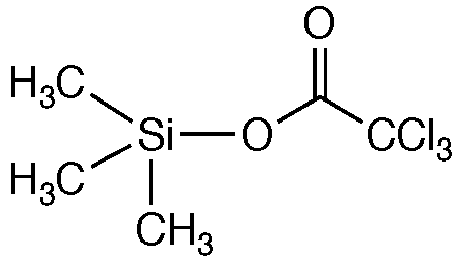
Trimethylsilyltrichloracetat (TMSTCA) S9 
O,O'-Bis(trimethylsilyl)sulfat (BSS) S10 
N-Methyl-N-trimethylsilyl-acetamid (MSA) S11 
N-Methyl-N-trimethylsilyl-trifluoracetamid (MSTFA) S12 
4-Trimethylsiloxy-3 -penten-2-on (TMSacac) S13 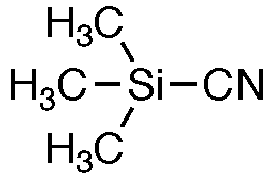
Trimethylsilylcyanid (TMSCN) S14 
N-(Trimethylsilyl)-dimethylamin (TMSDMA) S15 
3-Trimethylsilyl-2-oxazolidinon (TMSO) S16 
Trimethylsilyltriflat (TMSTF) - Es kann vorgesehen sein, dass die dritte siliciumorganische Verbindung eine Verbindung der allgemeinen Formel IV

- A2 R1 oder eine Gruppe der allgemeinen Formel G-IV ist:

- R1, R2, R3 und Z die in Zusammenhang mit der Verbindung der allgemeinen Formel II angegebenen Bedeutungen haben; und
- R3 bei jedem Auftreten die in Zusammenhang mit der Verbindung der allgemeinen Formel III angegebenen Bedeutungen hat.
- Die Verbindung der allgemeinen Formel IV-A ist eine Verbindung der allgemeinen Formel IV, wenn A2 R1 ist. Die Verbindung der allgemeinen Formel IV-B ist eine Verbindung der allgemeinen Formel IV, wenn A eine Gruppe G-IV ist.

- In Formel IV-A haben R1, R2 und R3 die im Zusammenhang mit der Formel II angegebenen Bedeutungen. In Formel IV-B haben R2, R3 und Z die im Zusammenhang mit der Formel II angegebenen Bedeutungen. In den Formeln IV-A und IV-B haben R3 bei jedem Auftreten die in Zusammenhang mit der Verbindung der allgemeinen Formel III angegebenen Bedeutungen.
- Eine Verbindung der allgemeinen Formel IV-A ist ein N,O-bissilyliertes Carbamat. Eine solche Verbindung ist insbesondere zur Herstellung von Monoisocyanaten geeignet. Beispiele eines N,O-bissilylierten Carbamats sind N,O-Bis(trimethylsilyl)-N-phenyl-carbamat (1), N,O-Bis(trimethylsilyl)-N,n-octyl-carbamat (2) und N,O-Bis(trimethylsilyl)-N-benzyl-carbamat (5). Eine Verbindung der allgemeinen Formel IV-B weist zwei N,O-bissilylierte Carbamat-Gruppen auf. Eine solche Verbindung ist insbesondere zur Herstellung von Diisocyanaten geeignet. Beispiele einer Verbindung mit zwei N,O-bissilylierten Carbamat-Gruppen sind p-[N,N',O,O'-Tetrakis(trimethylsily1)-carbamato]-benzen (3), m-[N,N',O,O'-Tetrakis(trimethylsilyl)-carbamato]-xylen (4) und 1,8-[N,N',O,O'-Tetrakis(trimethylsilyl)-carbamato]-octan (6). Die genannten Verbindungen sind in Tabelle 2 gezeigt:
Tabelle 2 Nr. Formel Name 1 
N,O-Bis(trimethylsilyl)-N-phenyl-carbamat (R1 = Phenyl) 2 
N,O-Bis(trimethylsilyl)-N,n-octyl-carbamat (R1 = n-Octyl) 3 
p-[N,N',O,O'-Tetrakis(trimethylsilyl)-carbamato]-benzen (Z = p-Phenylen) 4 
m-[N,N',O,O'-Tetrakis(trimethylsilyl)-carbamato]-xylen (Z = m-Xylylen)) 5 
N,O-Bis(trimethylsilyl)-N-benzyl-carbamat (R1 = Benzyl) 6 
1,8-[N,N',O,O'-Tetrakis(trimethylsilyl)-carbamato]-octan (Z = -(CH2)8-) - Die Verbindung der allgemeinen Formel IV kann durch Umsetzen der Verbindung der allgemeinen Formel II mit der Verbindung der allgemeinen Formel III erhalten werden. Diese Umsetzung ist eine Silylierung. Mittels der Silylierung wird eine zweite Silylgruppe in eine Carbamatgruppe eingeführt. Die zweite Silylgruppe ist an das Stickstoffatom der Carbamatgruppe gebunden, während die erste Silylgruppe an ein Sauerstoffatom der Carbamatgruppe gebunden ist. Die Verbindung der allgemeinen Formel IV-A kann durch Umsetzen der Verbindung der allgemeinen Formel II-A mit der Verbindung der allgemeinen Formel III erhalten werden. Die Verbindung der allgemeinen Formel IV-B kann durch Umsetzen der Verbindung der allgemeinen Formel II-B mit der Verbindung der allgemeinen Formel III erhalten werden.
- Das erfindungsgemäße Verfahren ermöglich die Herstellung von Isocyanaten. Isocyanate werden in der vorliegenden Erfindung auch als Isocyanat-Verbindungen bezeichnet. Bei einem Isocyanat kann es sich um eine Verbindung der allgemeinen Formel I
A3-N=C=O (Formel I)
handeln, worin - A3 R1 oder eine Gruppe der Formel G-V ist:

- R1 und Z die in Zusammenhang mit der Verbindung der allgemeinen Formel II angegebenen Bedeutungen haben.
- Die Verbindung der allgemeinen Formel I ist eine Verbindung der allgemeinen Formel I-A, wenn A3 R1 ist. Die Verbindung der allgemeinen Formel I ist eine Verbindung der allgemeinen Formel I-B, wenn A3 eine Gruppe G-V ist.
R1-N=C=O (Formel I-A)
O=C=N-Z-N=C=O (Formel I-B)
- In Formel I-A hat R1 die im Zusammenhang mit der Formel II angegebenen Bedeutungen. Ist R1 Octyl, so ist die Verbindung der allgemeinen Formel I Octylisocyanat, ist R1 Phenyl, so ist die Verbindung der allgemeinen Formel I Phenylisocyanat, ist R1 Benzyl, so ist die Verbindung der allgemeinen Formel I Benzylisocyanat. In Formel I-B hat Z die im Zusammenhang mit der Formel II angegebenen Bedeutungen. Ist Z Phenylen, so ist die Verbindung der allgemeinen Formel I ein Diisocyanatobenzen, beispielsweise ein 1,4-Diisocyanatobenzen. Ist Z Xylylen, so ist die Verbindung der allgemeinen Formel I ein Diisocyanatoxylylen, beispielsweise ein 1,3-Xylylendiisocyanat (Abkürzung mXDI).
- Die Verbindung der allgemeinen Formel IV kann durch Thermolyse in die Verbindung der allgemeinen Formel I überführt werden. Insbesondere kann eine Verbindung der allgemeinen Formel IV-A durch Thermolyse in die Verbindung der allgemeinen Formel I-A umgesetzt werden. Eine Verbindung der allgemeinen Formel IV-B kann durch Thermolyse in die Verbindung der allgemeinen Formel I-B umgesetzt werden.
- Schema 1 veranschaulicht die Herstellung eines Isocyanates durch Silylierung der ersten siliciumorganischen Verbindung, die eine Einheit G-I aufweist, unter Erhalt der dritten siliciumorganischen Verbindung, die eine Einheit G-II aufweist, und die anschließende Umsetzung der dritten siliciumorganischen Verbindung zu einem Isocyanat.

- Schema 2 veranschaulicht die Herstellung eines Isocyanates der allgemeinen Formel I. Dazu wird eine Silylierung einer Verbindung der allgemeinen Formel II mit einer Verbindung der allgemeinen Formel III unter Erhalt einer Verbindung der allgemeinen Formel IV vorgenommen. Die Verbindung der allgemeinen Formel IV wird anschließend einer Thermolyse unter Erhalt des Isocyanates der allgemeinen Formel I unterzogen.

- Schema 3 veranschaulicht die Herstellung eines Isocyanates der allgemeinen Formel I-A. Dazu wird eine Silylierung einer Verbindung der allgemeinen Formel II-A mit einer Verbindung der allgemeinen Formel III unter Erhalt einer Verbindung der allgemeinen Formel IV-A vorgenommen. Die Verbindung der allgemeinen Formel IV-A wird anschließend einer Thermolyse unter Erhalt des Isocyanates der allgemeinen Formel I-A unterzogen.

- Schema 4 veranschaulicht die Herstellung eines Isocyanates der allgemeinen Formel I-B. Dazu wird eine Silylierung einer Verbindung der allgemeinen Formel II-B mit einer Verbindung der allgemeinen Formel III unter Erhalt einer Verbindung der allgemeinen Formel IV-B vorgenommen. Die Verbindung der allgemeinen Formel IV-B wird anschließend einer Thermolyse unter Erhalt des Isocyanates der allgemeinen Formel I-B unterzogen.

- Die Silylierung der ersten siliciumorganischen Verbindung, insbesondere der Verbindung der allgemeinen Formel II, wird vorzugsweise in Gegenwart einer Hilfsbase durchgeführt. Die Hilfsbase dient zur Bindung der bei der Silylierung von der zweiten siliciumorganischen Verbindung, d. h. dem Silylierungsmittel, abgespaltenen Abgangsgruppe sowie des Wasserstoffatoms, das von der NH-Gruppe der Verbindung der allgemeinen Formel II abgespalten wird. Diese Gruppe ist die Gruppe X in der Verbindung der allgemeinen Formel III. Bei der Hilfsbase handelt es sich vorzugsweise um ein Amin, beispielsweise um ein Trialkylamin, wie Triethylamin, oder Anilin. Eine bevorzugte Hilfsbase ist ein Triethylamin. Es kann vorgesehen sein, dass zur Herstellung einer Verbindung der allgemeinen Formel I eine Hilfsbase eingesetzt wird, deren aliphatischer oder aromatischer Rest dem aliphatischen bzw. aromatischen Rest der Verbindung der allgemeinen Formel I entspricht. Beispielsweise kann zur Herstellung einer Verbindung der allgemeinen Formel I-A eine Verbindung der allgemeinen Formel VI-A als Hilfsbase eingesetzt werden. Zur Herstellung von Benzyl-isocyanat ist somit Benzylamin eine geeignete Hilfsbase, für die Herstellung von Phenylisocyanat Anilin. Ohne den Einsatz einer Hilfsbase kann die Gefahr bestehen, dass die Abgangsgruppe eine reaktive Säure bildet, die die Bildung der dritten silciumorganischen Verbindung, insbesondere der Verbindung der allgemeinen Formel IV, beeinträchtigt. Handelt es sich bei dem Silylierungsmittel um Trimethylchlorsilan und bei der Hilfsbase um Triethylamin, wird bei der Silylierung Triethylaminhydrochlorid ((CH3CH2)3N*HCl) gebildet.
- Die Silylierung wird vorzugsweise in einem aprotischen organischen Lösungsmittel durchgeführt. Besonders bevorzugt sind unpolare Lösungsmittel. Beispiele geeigneter Lösungsmittel sind n-Pentan, n-Hexan und Anisol, wobei n-Pentan besonders bevorzugt ist.
- Vorzugsweise werden die erste siliciumorganische Verbindung und die zweite siliciumorganische Verbindung in einem solchen molaren Verhältnis eingesetzt, dass auf jede Carbamat-Einheit der Formel G-I der ersten siliciumorganischen Verbindung zumindest ein Molekül der zweiten siliciumorganischen Verbindung kommt. Es kann vorgesehen sein, dass das molare Verhältnis der ersten siliciumorganischen Verbindung zu der zweiten siliciumorganischen Verbindung 1 : n x (1 bis 1,5) beträgt, besonders bevorzugt 1 : n x (1 bis 1,2), wobei n die Zahl der Carbamat-Einheiten der Formel G-I ist. Soll ein Monoisocyanat hergestellt werden, so weist die erste siliciumorganische Verbindung eine Carbamat-Einheit der Formel G-I auf, so dass n gleich 1 ist. Soll ein Diisocyanat hergestellt werden, so weist die erste siliciumorganische Verbindung zwei Carbamat-Einheiten der Formel G-I auf, so dass n gleich 2 ist. Soll ein Triisocyanat hergestellt werden, so weist die erste siliciumorganische Verbindung drei Carbamat-Einheiten der Formel G-I auf, so dass n gleich 3 ist. Ein leichter Überschuss der zweiten siliciumorganischen Verbindung ist, bezogen auf die Zahl der Carbamat-Einheiten der ersten siliciumorganischen Verbindung, bevorzugt. Wird eine Hilfsbase verwendet, so können die zweite siliciumorganische Verbindung und die Hilfsbase in einem molaren Verhältnis von 1 : 1 bis 1,5, bevorzugt von 1 : 1 bis 1,2 verwendet werden.
- Die Silylierung wird vorzugsweise bei einer Temperatur zwischen 0 und 50 °C, stärker bevorzugt bei 0 bis 25 °C und besonders bevorzugt bei Raumtemperatur durchgeführt. Unter Raumtemperatur wird eine Temperatur zwischen 15 und 25 °C verstanden. Die Silylierung wird vorzugsweise unter Umgebungsdruck durchgeführt. Sie kann unter einer Inertgasatmosphäre durchgeführt werden, wobei als Inertgas beispielsweise Stickstoff oder Argon verwendet werden können.
- Die Thermolyse ist ein Verfahren zum thermischen Cracken. Die Thermolyse wird vorzugsweise bei einer Temperatur von 100 bis 400 °C, stärker bevorzugt bei einer Temperatur von 150 bis 350 °C und besonders bevorzugt bei einer Temperatur von 230 bis 300 °C durchgeführt. Die Temperatur sollte 400 °C nicht übersteigen, um eine Reaktion von Isocyanaten untereinander unter Bildung von Di-, Tri- oder Oligomeren zu verhindern. Die Thermolyse wird vorzugsweise ohne Einsatz von Lösungsmittel durchgeführt. Die Thermolyse wird vorzugsweise unter Umgebungsdruck durchgeführt. Sie kann unter einer Inertgasatmosphäre durchgeführt werden, wobei als Inertgas beispielsweise Stickstoff oder Argon verwendet werden können.
- Die Thermolyse kann unter Anwendung eines Temperaturprofils durchgeführt werden. Das Temperaturprofil kann zwei oder mehr Temperaturstufen umfassen, wobei jede Temperaturstufe für einen vorgegebenen Zeitraum angewendet wird. Jede der angewendeten Temperaturstufen kann um 20 bis 80 °C, beispielsweise um 30 bis 50 °C, über dem zuvor angewendeten Temperaturbereich liegen. Der vorgegebene Zeitraum kann zwischen 1 min und 2 h liegen.
- Das erfindungsgemäße Verfahren sieht die Verwendung der ersten siliciumorganischen Verbindung vor, die eine Einheit G-I aufweist, beispielsweise eine Verbindung der allgemeinen Formel II. Diese erste siliciumorganische Verbindung kann durch Insertion von Kohlenstoffdioxid in ein Aminosilan hergestellt werden. Unter einem Aminosilan wird dabei eine Verbindung verstanden, die durch Silylierung einer primären Amingruppe unter Erhalt einer direkten N-Si-Bindung erhalten wurde. Schema 5 veranschaulicht die Herstellung einer Verbindung der allgemeinen Formel II-A durch Insertion von Kohlenstoffdioxid in ein Aminosilan der allgemeinen Formel V-A.


- Die Insertion von Kohlenstoffdioxid kann durch Einleiten von gasförmigen Kohlenstoffdioxid in das Aminosilan oder eine Lösung des Aminosilans in einem Lösungsmittel bewirkt werden. Bei dem Lösungsmittel handelt es sich vorzugsweise um ein aprotisches organisches Lösungsmittel, beispielsweise um Tetrahydrofuran, Diethylether, Toluol, n-Pentan oder n-Hexan, wobei Tetrahydrofuran besonders bevorzugt ist. Die Insertion kann unter Umgebungsdruck oder unter Überdruck durchgeführt werden. Die Anwendung eines Überdrucks ist insbesondere dann zweckmäßig, wenn R1 eine substituierte oder unsubstituierte aromatische Gruppe ist oder wenn Z eine substituierte oder unsubstituierte aromatische Gruppe ist. Vorzugsweise beträgt der Überdruck zwischen 1,5 und 10 bar. Die Insertion kann unter einer Inertgasatmosphäre durchgeführt werden, wobei als Inertgas beispielsweise Stickstoff oder Argon verwendet werden können. Weitere Einzelheiten zur Insertion von Kohlenstoffdioxid in ein Aminosilan können beispielsweise
DE 10 2009 045 849 A1 entnommen werden. - Aminosilane, insbesondere die Aminosilane der allgemeinen Formel V-A und V-B, können aus substituierten oder unsubstituierten, aliphatischen oder aromatischen primären Aminen durch Silylierung der Amingruppe mit einem Silylierungsmittel hergestellt werden. Als Silylierungsmittel können die zweite siliciumorganische Verbindung, beispielsweise die Verbindung der allgemeinen Formel III, oder andere Silylierungsmittel eingesetzt werden. Schema 7 zeigt die Herstellung eines Aminosilans der allgemeinen Formel V-A durch Silylierung eines primären Amins der allgemeinen Formel VI-A.

- ist X1 aus der Gruppe ausgewählt, die aus einem Halogen, -CN, -OCN, -SCN, -N3, einem Sulfonat und einer Gruppe -O-R4 besteht;
- hat R2 bei jedem Auftreten die im Zusammenhang mit der Verbindung der allgemeinen Formel II angegebenen Bedeutungen;
- haben R4 bei jedem Auftreten und R5 die im Zusammenhang mit Formel III angegebenen Bedeutungen. Es können auch andere Silylierungsmittel eingesetzt werden. Beispiele anderer Silylierungsmittel umfassen, ohne darauf beschränkt zu sein, Aminosilane, die eine Transaminierung oder eine Transsilylierung ermöglichen, und Silazane. Weitere Beispiele geeigneter Silylierungsmittel sind in Tabelle 1 angegeben.
- Die Verbindung der allgemeinen Formel VII ist ein Silan, das eine Abgangsgruppe X1 trägt. Zur Silylierung des primären Amins kann ein - im Vergleich zur Silylierung mit der Verbindung der allgemeinen Formel III - milderes Silylierungsmittel gewählt werden. Ein Silylierungsmittel wird als milder angesehen, wenn es weniger reaktiv ist. Der Einsatz eines milderen Silylierungsmittels ist möglich, weil ein Wasserstoffatom einer primären Amingruppe leichter silyliert werden kann als das Wasserstoffatom einer Carbamat-Gruppe.
- Vorzugsweise ist X1 aus der Gruppe ausgewählt, die aus einem Halogen, einem Sulfonat und einer Gruppe -O-R4 besteht. Es kann vorgesehen sein, dass X1 ein Sulfonat, also eine RS-SO2-O-Gruppe ist. RS kann beispielsweise eine verzweigte oder unverzweigte substituierte oder unsubstituierte C1-C6-Alkylgruppe, eine Arylgruppe oder eine Alkylarylgruppe sein. Vorzugsweise ist RS CH3-, CF3- oder CH3-C6H4-. Das Sulfonat kann beispielsweise aus der Gruppe ausgewählt sein, die aus einer Toluolsulfonsäureester-Gruppe, einer Methylsulfonsäureester-Gruppe und einer Trifluormethylsulfonsäureester-Gruppe besteht. In der Verbindung der allgemeinen Formel VII ist X1 vorzugsweise aus der Gruppe ausgewählt, die aus Chlor, einer Toluolsulfonsäureester-Gruppe, einer Methylsulfonsäureester-Gruppe und einer Trifluormethylsulfonsäureester-Gruppe besteht. Bevorzugt ist X1 Chlor.
- Vorzugsweise ist in der Verbindung der allgemeinen Formel VII R2 bei jedem Auftreten eine unsubstituierte Alkylgruppe mit 1 bis 6 Kohlenstoffatomen und ist X1 Chlor. In diesem Fall ist die Verbindung der allgemeinen Formel VII ein Trialkylchlorsilan. Eine besonders bevorzugte Verbindung der allgemeinen Formel VII ist Trimethylchlorsilan. Dabei handelt es sich um ein preiswertes Silylierungsmittel.
- Weist das primäre Amin weitere primäre Aminogruppen auf, so werden diese Aminogruppen ebenfalls silyliert. Schema 8 zeigt die Herstellung eines Aminosilans der allgemeinen Formel V-B durch Silylierung eines primären Amins der allgemeinen Formel VI-B. Verbindung V-B ist ein Amin, das zwei primäre Aminogruppen aufweist.

- In der Verbindung der allgemeinen Formel VI-B hat Z die im Zusammenhang mit der allgemeinen Formel II angegebenen Bedeutungen. Die Verbindung der allgemeinen Formel VII ist vorstehend im Zusammenhang mit Schema 7 beschrieben worden.
- Die Silylierung des primären Amins, beispielsweise des primären Amins der allgemeinen Formel VI-A oder VI-B, wird vorzugsweise in Gegenwart einer Hilfsbase durchgeführt. Die Hilfsbase dient zur Bindung der bei der Silylierung von dem Silylierungsmittel, z. B. der Verbindung der allgemeinen Formel VII, abgespaltenen Abgangsgruppe sowie des Wasserstoffatoms, das von der NH-Gruppe der Verbindung der allgemeinen Formel II abgespalten wird. Diese Gruppe ist die Gruppe X1 in der Verbindung der allgemeinen Formel VII. Bei der Hilfsbase handelt es sich vorzugsweise um ein Amin, beispielsweise um ein Trialkylamin, wie Triethylamin, oder Anilin. Eine bevorzugte Hilfsbase ist ein Triethylamin. Es kann vorgesehen sein, dass zur Herstellung einer Verbindung der allgemeinen Formel I eine Hilfsbase eingesetzt wird, deren aliphatischer oder aromatischer Rest dem aliphatischen bzw. aromatischen Rest der Verbindung der allgemeinen Formel I entspricht. Beispielsweise kann zur Herstellung einer Verbindung der allgemeinen Formel I-A eine Verbindung der allgemeinen Formel VI-A als Hilfsbase eingesetzt werden. Zur Herstellung von Benzyl-isocyanat ist somit Benzylamin eine geeignete Hilfsbase, für die Herstellung von Phenylisocyanat Anilin. Die Verbindung der allgemeinen Formel VI-A oder VI-B ist dann nicht nur Ausgangsstoff, sondern auch Hilfsbase. Es ist deshalb zweckmäßig, die Verbindung der allgemeinen Formel VI-A oder VI-B im Überschuss zu dem Silylierungsmittel einzusetzen, beispielsweise in einem molaren Verhältnis von 2 : 1. Kommt auf 1 Molekül des Silylierungsmittels Trimethylchlorsilan 1 Molekül einer Verbindung der allgemeinen Formel VI-A oder VI-B, so bildet sich HCl, was wiederum von einem zweiten Molekül der Verbindung der allgemeinen Formel VI-A bzw. VI-B abgefangen wird. Somit verbraucht 1 Molekül Trimethylchlorsilan 2 Moleküle der Verbindung der allgemeinen Formel VI-A bzw. VI-B. Ohne den Einsatz einer Hilfsbase kann die Gefahr bestehen, dass die Abgangsgruppe eine reaktive Säure bildet, die die Bildung eines Aminosilans, z. B. der Verbindung der allgemeinen Formel V-A oder V-B, beeinträchtigt. Wird ein Trialkylchorsilan als Silylierungsmittel eingesetzt, entsteht bei der Silylierung Chlorwasserstoff, der mit der Hilfsbase abgefangen wird. Handelt es sich bei dem Silylierungsmittel um Trimethylchlorsilan und bei der Hilfsbase um Triethylamin, wird bei der Silylierung Triethylaminhydrochlorid ((CH3CH2)3N*HCl) gebildet.
- Die Silylierung des primären Amins, beispielsweise des primären Amins der allgemeinen Formel VI-A oder VI-B, kann unter den Bedingungen vorgenommen werden, die im Zusammenhang mit der Silylierung der ersten organischen Verbindung, beispielsweise der Verbindung der allgemeinen Formel II vorstehend beschrieben sind. Vorzugsweise wird die Silylierung des primären Amins bei Raumtemperatur und Umgebungsdruck durchgeführt. Ein Katalysator ist nicht erforderlich. Die Aminosilane werden in hohen Ausbeuten erhalten.
- Das erfindungsgemäße Verfahren kann ein zweistufiges Verfahren sein. In diesem Fall geht die Herstellung einer Isocyanat-Verbindung von der ersten siliciumorganischen Verbindung (z. B. einer Verbindung der allgemeinen Formel II) aus. Das zweistufige Verfahren sieht die Silylierung der ersten siliciumorganischen Verbindung unter Erhalt der Verbindung der dritten siliciumorganischen Verbindung (im Fall einer Verbindung der allgemeinen Formel II ist das eine Verbindung der allgemeinen Formel IV) und die anschließende Thermolyse der dritten siliciumorganischen Verbindung zu der Isocyanat-Verbindung (im Fall einer Verbindung der allgemeinen Formel IV ist das eine Verbindung der allgemeinen Formel I) vor. Das zweistufige Verfahren kann bei Umgebungsdruck durchgeführt werden. Unter Umgebungsdruck kann atmosphärischer Druck verstanden werden. Das zweistufige Verfahren kann unter einer Inertgasatmosphäre durchgeführt werden.
- Geht die Herstellung einer Isocyanat-Verbindung hingegen von einem primären Amin aus, so ist das erfindungsgemäße Verfahren ein vierstufiges Verfahren. Das vierstufige Verfahren sieht die Silylierung eines primären Amins unter Erhalt eines Aminosilans (1. Stufe), die Insertion von Kohlenstoffdioxid in das Aminosilan unter Erhalt der ersten siliciumorganischen Verbindung (z. B. einer Verbindung der allgemeinen Formel II) (2. Stufe), die Silylierung der ersten siliciumorganischen Verbindung unter Erhalt der Verbindung der dritten siliciumorganischen Verbindung (im Fall einer Verbindung der allgemeinen Formel II ist das eine Verbindung der allgemeinen Formel IV) (3. Stufe) und die anschließende Thermolyse der dritten siliciumorganischen Verbindung zu der Isocyanat-Verbindung (im Fall einer Verbindung der allgemeinen Formel IV ist das eine Verbindung der allgemeinen Formel I) (4. Stufe) vor. Schema 9 veranschaulicht die Herstellung einer Isocyanat-Verbindung mittels des vierstufigen Verfahrens.

- Die vierstufige Synthese von Isocyanaten, beispielsweise von Mono- und Diisocyanaten, umfasst die Synthese von Aminosilanen aus primären Aminen und einem Silylierungsmittel wie z. B. Trialkylchlorsilan (Stufe 1), die Umsetzung der Aminosilane mit CO2 zu O-silylierten Carbamaten (Stufe 2), gefolgt von einem zweiten Silylierungschritt (Stufe 3) unter Erhalt von N,O-bissilylierten Carbamaten und der finalen Thermolyse der bissilylierten CO2-Insertionsprodukte, d. h. der N,O-bissilylierten Carbamate, (Stufe 4). Das vierstufige Verfahren verzichtet auf Phosgen, setzt auf CO2 als Kohlen- und Sauerstoffquelle und läuft ohne Katalysatoren bei moderaten Temperaturen ab. Auch die beiden ersten Stufen (Stufen 1 und 2) zeichnen sich durch die Vorteile des gesamten erfindungsgemäßen Verfahrens, wie u. a. gute Ausbeuten, geringe Reaktionswärmen etc. aus. Alle vier Stufen können unter Umgebungsdruck durchgeführt werden. Unter Umgebungsdruck kann atmosphärischer Druck verstanden werden. Das zweistufige Verfahren kann unter einer Inertgasatmosphäre durchgeführt werden. Der Einsatz von superkritischem CO2 ist nicht vorgesehen.
- Es ist ein besonderer Vorteil des erfindungsgemäßen Verfahrens, dass bei der Thermolyse der dritten siliciumorganischen Verbindung, beispielsweise einer Verbindung der allgemeinen Formel IV, neben der Zielverbindung, d. h. einer Isocyanat-Verbindung, als Koppelprodukt Siloxane gebildet werden. Bei den Siloxanen handelt es sich im einfachsten Fall um Disiloxane. Schema 10 zeigt die Thermolyse einer Verbindung der allgemeinen Formel IV, wobei neben der Verbindung der allgemeinen Formel I ein Disiloxan der allgemeinen Formel VIII gebildet wird:

- Der Ausdruck "aliphatisch" bezieht sich, sofern nichts anderes angegeben ist, auf eine verzweigte oder unverzweigte oder cyclische Kohlenwasserstoffkomponente, einschließlich einer Komponente, die sowohl cyclische als auch Kettenelemente enthält, die vollständig gesättigt oder einfach oder mehrfach ungesättigt sein können. Beispiele für gesättigte Kohlenwasserstoffkomponenten umfassen Alkylgruppen, Alkylengruppen und Cycloalkylgruppen. Beispiele für ungesättigte Kohlenwasserstoffkomponenten umfassen Alkenylgruppen und Alkinylgruppen. Die aliphatische Kohlenwasserstoffkomponente kann gegebenenfalls ein oder mehrere, beispielsweise ein bis vier Heteroatome enthalten, die aus der Gruppe ausgewählt sind, die aus O, N, S, Si und Ge besteht.
- Der Ausdruck "aromatisch" bezieht sich, sofern nichts anderes angegeben ist, auf eine Kohlenwasserstoffkomponente, die zumindest einen aromatischen Ring aufweist, einschließlich einer Komponente, die sowohl zumindest einen aromatischen als auch zumindest ein Kettenelement enthält, das vollständig gesättigt oder einfach oder mehrfach ungesättigt sein kann. Beispiele für aromatische Ringe umfassen Arylgruppen, Heteroarylgruppen, Arylengruppen und Heteroarylengruppen. Beispiele für Kettenelemente umfassen Alkylengruppe. Beispiele für aromatische Gruppen, die zumindest einen aromatischen Ring als auch zumindest ein Kettenelement enthalten sind, umfassen Alkylenarylengruppen, Arylenbis(alkylen)gruppen und Alkylenbis(arylen)gruppen. Die aromatische Kohlenwasserstoffkomponente kann gegebenenfalls ein oder mehrere, beispielsweise ein bis vier Heteroatome enthalten, die aus der Gruppe ausgewählt sind, die aus O, N, S, Si und Ge besteht.
- Der Ausdruck "Alkyl" bezieht sich, sofern nichts anderes angegeben ist, insbesondere auf eine gesättigte aliphatische Kohlenwasserstoff-Gruppe mit einer verzweigten oder unverzweigten Kohlenstoffkette mit 1 bis 12 Kohlenstoffatomen, vorzugsweise 1 bis 8 Kohlenstoffatomen und besonders bevorzugt 1 bis 6 Kohlenstoffatomen. Beispiele von Alkylgruppen umfassen, sind aber nicht beschränkt auf Methyl, Ethyl, Propyl, Isopropyl, Isobutyl, sec-Butyl, tert-Butyl, Pentyl, n-Hexyl, Octyl, Dodecyl und dergleichen. Die Alkylgruppe kann gegebenenfalls mit einem oder mehreren Substituenten substituiert sein, wobei jeder Substituent unabhängig Alkyl, Alkoxy, Halogen, Halogenalkyl, Amino, Monoalkylamino, Dialkylamino, SiRz 3, Si(ORz)3 , SiRz(ORz)2, worin Rz bei jedem Auftreten unabhängig voneinander Wasserstoff oder Alkyl, wie hierin definiert, ausgenommen SiH3 ist, oder eine Siloxangruppe ist, wenn nicht speziell anders angegeben. Die Alkylgruppe kann teil- oder perfluoriert sein. Die Alkylgruppe kann gegebenenfalls ein oder mehrere Heteroatome enthalten, die aus der Gruppe ausgewählt sind, die aus O, N, S, Si und Ge besteht. Die Alkylgruppe kann eine oder mehrere Ketten, die aus zwei oder mehr, beispielsweise 2 bis 12 Si-Atomen bestehen, enthalten.
- Der Ausdruck "Heteroalkyl" bezieht sich, sofern nichts anderes angegeben ist, auf eine Alkylgruppe, wie hierin definiert, wobei ein, zwei oder drei Wasserstoffatome durch einen Substituenten, unabhängig ausgewählt aus der Gruppe, bestehend aus -ORa, -NRbRc, -S(O)wRd (worin w eine Ganzzahl von 0 bis 2 ist), SiRz 3, Si(ORz)3 und SiRz(ORz)2, ersetzt wurden, unter der Voraussetzung, dass der Anlagerungspunkt des Heteroalkylrestes ein Kohlenstoffatom ist, wobei Ra Acyl, Alkyl, Cycloalkyl oder Cycloalkylalkyl ist; Rb und Rc unabhängig voneinander Acyl, Alkyl, Cycloalkyl oder Cycloalkylalkyl sind; und wenn w 0 ist, Rd Alkyl, Cycloalkyl oder Cycloalkylalkyl ist, und wenn w 1 oder 2 ist, Rd Alkyl, Cycloalkyl oder Cycloalkylalkyl ist; Rz bei jedem Auftreten unabhängig voneinander Wasserstoff oder Alkyl, wie hierin definiert, ausgenommen SiH3 ist.
- Der Ausdruck "Cycloalkyl" bezieht sich, sofern nichts anderes angegeben ist, insbesondere auf gesättigte, carbocyclische Gruppen, die aus mono- oder bicyclischen Ringen bestehen und 3 bis 12 Ringatome aufweisen. Die Cycloalkylgruppe kann gegebenenfalls mit einem oder mehreren Substituenten substituiert sein, wobei jeder Substituent unabhängig Alkyl, Alkoxy, Amino, Monoalkylamino, Dialkylamino, SiRz 3, Si(ORz)3, SiRz(ORz)2, worin Rz bei jedem Auftreten unabhängig voneinander Wasserstoff oder Alkyl, wie hierin definiert, ausgenommen SiH3 ist, oder eine Siloxangruppe ist, wenn nicht speziell anders angegeben. Beispiele von Cycloalkylgruppen umfassen, sind aber nicht beschränkt auf, Cyclopropyl, Cyclobutyl, Cyclopentyl, Cyclohexyl, Cycloheptyl und dergleichen. Die Cycloalkylgruppe kann teil- oder perfluoriert sein. Die Cycloalkylgruppe kann gegebenenfalls ein oder mehrere Heteroatome enthalten, die aus der Gruppe ausgewählt sind, die aus O, N, S, Si und Ge besteht.
- Der Ausdruck "Heterocycloalkyl" bezieht sich, sofern nichts anderes angegeben ist, auf einen gesättigten cyclischen Ring mit 5 bis 12 Ringatomen, wobei 1 bis 4 der Ringatome Heteroatome, die aus einem oder mehreren von N, O und S ausgewählt sind, und die verbliebenen Ringatome Kohlenstoffatome sind. Beispiele von Heterocycloalkylgruppen umfassen, sind jedoch nicht beschränkt auf Piperidinyl, Piperazinyl, Homopiperazinyl, Azepinyl, Pyrrolidinyl, Pyrazolidinyl, Imidazolinyl, Imidazolidinyl, Oxazolidinyl, Isoxazolidinyl, Morpholinyl, Thiazolidinyl, Isothiazolidinyl, Chinuclidinyl, Tetrahydrofuryl, Tetrahydropyranyl, Thiomorpholinyl, Dihydrochinolinyl und 1,4-Diazepan. Die Heterocycloalkylgruppe kann gegebenenfalls mit einem oder mehreren Substituenten substituiert sein, wobei jeder Substituent unabhängig Alkyl, Alkoxy, Amino, Monoalkylamino, Dialkylamino, SiRz 3, Si(ORz)3, SiRz(ORz)2, worin Rz bei jedem Auftreten unabhängig voneinander Wasserstoff oder Alkyl, wie hierin definiert, ausgenommen SiH3 ist, oder eine Siloxangruppe ist, wenn nicht speziell anders angegeben. Die Heterocycloalkylgruppe kann teil- oder perfluoriert sein.
- Der Ausdruck "Alkenyl" bezieht sich, sofern nichts anderes angegeben ist, insbesondere auf eine ungesättigte aliphatische Kohlenwasserstoff-Gruppe mit einer verzweigten oder unverzweigten Kohlenstoffkette mit 2 bis 12 Kohlenstoffatomen, vorzugsweise 2 bis 8 Kohlenstoffatomen und besonders bevorzugt 2 bis 6 Kohlenstoffatomen, die mindestens eine olefinische Doppelbindung und stärker bevorzugt eine einzige Doppelbindung aufweist. Beispiele von Alkenylgruppen umfassen, sind aber nicht beschränkt auf Vinyl, Allyl, Methallyl, 1,1-Dimethylallyl, Propenyl, Butenyl, Pentadienyl, Hexenyl, Octenyl und dergleichen. Eine Allylgruppe ist bevorzugt. Die Alkenylgruppe kann gegebenenfalls mit einem oder mehreren Substituenten substituiert sein, wobei jeder Substituent unabhängig Alkyl, Alkoxy, Halogen, Halogenalkyl, Amino, Monoalkylamino, Dialkylamino, SiRz 3, Si(ORz)3, SiRz(ORz)2, worin Rz bei jedem Auftreten unabhängig voneinander Wasserstoff oder Alkyl, wie hierin definiert, ausgenommen SiH3 ist, oder eine Siloxangruppe ist, wenn nicht speziell anders angegeben. Die Alkenylgruppe kann teil- oder perfluoriert sein. Die Alkenylgruppe kann gegebenenfalls ein oder mehrere Heteroatome enthalten, die aus der Gruppe ausgewählt sind, die aus O, N, S, Si und Ge besteht. Die Alkenylgruppe kann eine oder mehrere Ketten, die aus zwei oder mehr, beispielsweise 2 bis 12 Si-Atomen bestehen, enthalten.
- Der Ausdruck "Alkinyl" bezieht sich, sofern nichts anderes angegeben ist, insbesondere auf eine ungesättigte aliphatische Kohlenwasserstoff-Gruppe mit einer verzweigten oder unverzweigten Kohlenstoffkette mit 2 bis 12 Kohlenstoffatomen, vorzugsweise 2 bis 8 Kohlenstoffatomen und besonders bevorzugt 2 bis 6 Kohlenstoffatomen, die mindestens eine olefinische Dreifachbindung und stärker bevorzugt eine einzige Dreifachbindung aufweist. Beispiele von Alkinylgruppen umfassen, sind aber nicht beschränkt auf Acetylenyl, Propargyl, n-But-2-in-1-yl und dergleichen. Eine Propargylgruppe ist bevorzugt. Die Alkinylgruppe kann gegebenenfalls mit einem oder mehreren Substituenten substituiert sein, wobei jeder Substituent unabhängig Alkyl, Alkoxy, Halogen, Halogenalkyl, Amino, Monoalkylamino, Dialkylamino SiRz 3, Si(ORz)3 , SiRz(ORz)2, worin Rz bei jedem Auftreten unabhängig voneinander Wasserstoff oder Alkyl, wie hierin definiert, ausgenommen SiH3 ist, oder eine Siloxangruppe ist, wenn nicht speziell anders angegeben. Die Alkinylgruppe kann gegebenenfalls ein oder mehrere Heteroatome enthalten, die aus der Gruppe ausgewählt sind, die aus O, N, S, Si und Ge besteht. Die Alkinylgruppe kann eine oder mehrere Ketten, die aus zwei oder mehr, beispielsweise 2 bis 12 Si-Atomen bestehen, enthalten.
- Der Ausdruck "Alkoxy" bezieht sich, sofern nichts anderes angegeben ist, insbesondere auf eine Gruppe der Formel -OR, worin R eine Alkylgruppe ist, wie hierin definiert. Beispiele von Alkoxykomponenten umfassen, sind aber nicht beschränkt auf Methoxy, Ethoxy, Isopropoxy und dergleichen. Die Alkoxygruppe kann gegebenenfalls mit einem oder mehreren Substituenten substituiert sein, wobei jeder Substituent unabhängig Alkyl, Alkoxy, Halogen, Halogenalkyl, Amino, Monoalkylamino, Dialkylamino, SiRz 3, Si(ORz)3, SiR z(ORz)2, worin Rz bei jedem Auftreten unabhängig voneinander Wasserstoff oder Alkyl, wie hierin definiert, ausgenommen SiH3 ist, oder eine Siloxangruppe ist, wenn nicht speziell anders angegeben.
- Der Ausdruck "Acyl" bezieht sich auf eine Gruppe der Formel -C(=O)R, wobei R Alkyl, wie hierin definiert, ist.
- Der Ausdruck "Halogen" bezieht sich auf Fluor, Chlor, Brom oder Iod.
- Der Ausdruck "Aryl" bezieht sich, sofern nichts anderes angegeben ist, auf eine cyclische, aromatische Kohlenwasserstoffgruppe, die aus einem mono- oder bicyclischen aromatischen Ringsystem mit 5 bis 10 Ringatomen, bevorzugt 5 oder 6 Ringatomen, besteht oder ein solches Ringsystem aufweist. Die Arylgruppe kann gegebenenfalls eine substituierte Arylgruppe sein. Beispiele von Arylgruppen umfassen, sind aber nicht beschränkt auf Phenyl, Naphthyl, Naphthalenyl, Fluorenyl, Indenyl, Pentalenyl, Azulenyl, Oxydiphenyl, Biphenyl, Methylendiphenyl, Aminodiphenyl, Diphenylsulfidyl, Diphenylsulfonyl, Diphenylisopropylidenyl, Benzodioxanyl, Benzofuranyl, Benzodioxylyl, Benzopyranyl, Benzoxazinyl, Benzoxazinonyl, Benzopiperadinyl, Benzopiperazinyl, Benzopyrrolidinyl, Benzomorpholinyl, Methylendioxyphenyl, Ethylendioxyphenyl und dergleichen, einschließlich teilweise hydrierte Derivate davon. Der Ausdruck "substituierte Arylgruppe" bezieht sich insbesondere auf eine Arylgruppe, die gegebenenfalls unabhängig mit ein bis vier Substituenten, bevorzugt einem oder zwei Substituenten, ausgewählt aus Alkyl, Cycloalkyl, Heteroalkyl, Halogen, Alkoxy, Amino, Acylamino, Monoalkylamino, Dialkylamino, SiRz 3, Si(ORz)3 , SiRz(ORz)2 (worin Rz bei jedem Auftreten unabhängig voneinander Wasserstoff oder Alkyl, wie hierin definiert, ausgenommen SiH3 ist), einer Siloxangruppe, Halogenalkyl, Halogenalkoxy, Alkansulfonyl, -COR (worin R Alkyl, Phenyl oder Phenylalkyl ist), -(CR'R")n-COOR (worin n eine Ganzzahl von 0 bis 5 ist, R' und R" unabhängig voneinander Wasserstoff oder Alkyl sind, und R Alkyl, Cycloalkyl, Cycloalkylalkyl, Phenyl oder Phenylalkyl ist) oder -(CR'R")n-CONRa'Rb' (worin n eine Ganzzahl von 0 bis 5 ist, R' und R" unabhängig voneinander Wasserstoff oder Alkyl sind und Ra' und Rb' unabhängig voneinander Alkyl, Cycloalkyl, Cycloalkylalkyl, Phenyl oder Phenylalkyl sind), substituiert ist.
- Der Ausdruck "Heteroaryl" bezieht sich, sofern nichts anderes angegeben ist, auf eine monocyclische oder bicyclische Gruppe mit 5 bis 10, stärker bevorzugt 5 bis 6 Ringatomen mit mindestens einem aromatischen Ring und ferner enthaltend ein, zwei, drei oder vier Ringheteroatome, ausgewählt aus N, O und S, wobei die verbleibenden Ringatome C sind. Das Heteroaryl kann gegebenenfalls mit einem, zwei, drei oder vier Substituenten substituiert sein, wobei jeder Substituent unabhängig Amino ist, oder für den nicht aromatischen Teil des cyclischen Rings auch durch Oxo, sofern nicht speziell anders angegeben. Beispiele von Heteroarylgruppen umfassen, sind jedoch nicht beschränkt auf gegebenenfalls substituiertes Imidazolyl, gegebenenfalls substituiertes Oxazolyl, gegebenenfalls substituiertes Thiazolyl, gegebenenfalls substituiertes Pyrazinyl, gegebenenfalls substituiertes Pyrrolyl, gegebenenfalls substituiertes Pyridinyl, gegebenenfalls substituiertes Pyrimidinyl, gegebenenfalls substituiertes Indonyl, gegebenenfalls substituiertes Isochinolinyl, gegebenenfalls substituiertes Carbazol-9-yl, gegebenenfalls substituiertes Furanyl, gegebenenfalls substituiertes Benzofuranyl, gegebenenfalls substituiertes Benzo[1,2,3]thiadiazolyl, gegebenenfalls substituiertes Benzo[b]thiophenyl, gegebenenfalls substituiertes 9H-Thioxanthenyl und gegebenenfalls substituiertes Thieno[2,3-c]pyridinyl.
- Der Ausdruck "Alkylaryl" bezieht sich, sofern nichts anderes angegeben ist, insbesondere auf eine Gruppe der Formel -RgRh, wobei Rg eine Arylengruppe ist und Rh eine Alkylgruppe ist, wie hierin definiert. Die Alkylarylgruppe kann gegebenenfalls eine substituierte Alkylarylgruppe sein. Beispiele von Alkylarylgruppen umfassen, sind aber nicht beschränkt auf o-Tolyl, m-Tolyl p-Tolyl, o-tert-Butylphenyl, m-tert- Butylphenyl, p-tert-Butylphenyl und dergleichen.
- Der Ausdruck "Arylalkyl" bezieht sich, sofern nichts anderes angegeben ist, insbesondere auf eine Gruppe der Formel -ReRf, wobei Re eine Alkylengruppe ist und Rf eine Arylgruppe ist, wie hierin definiert. Die Arylalkylgruppe kann gegebenenfalls eine substituierte Arylalkylgruppe sein. Beispiele von Arylalkylgruppen umfassen, sind aber nicht beschränkt auf Benzyl, Phenylethyl, 3-(3-Chlorphenyl)-2-methylpentyl und dergleichen.
- Der Ausdruck "Alkylen" bezieht sich dabei insbesondere auf eine zweiwertige gesättigte aliphatische Kohlenwasserstoff-Gruppe mit einer verzweigten oder unverzweigten Kohlenstoffkette mit 1 bis 12 Kohlenstoffatomen, vorzugsweise 1 bis 8 Kohlenstoffatomen und besonders bevorzugt 1 bis 6 Kohlenstoffatomen. Beispiele von Alkylengruppen umfassen, sind aber nicht beschränkt auf Methylen, Ethylen, Propylen, Butylen und dergleichen. Die Alkylengruppe kann gegebenenfalls mit einem oder mehreren Substituenten substituiert sein, wobei jeder Substituent unabhängig Alkyl, Alkoxy, Halogen, Halogenalkyl, Amino, Monoalkylamino, Dialkylamino, SiRz 3, Si(ORz)3, SiRz(ORz)2, worin Rz bei jedem Auftreten unabhängig voneinander Wasserstoff oder Alkyl, wie hierin definiert, ausgenommen SiH3 ist, oder eine Siloxangruppe ist, wenn nicht speziell anders angegeben. Die Alkylengruppe kann teil- oder perfluoriert sein. Die Alkylengruppe kann gegebenenfalls ein oder mehrere Heteroatome enthalten, die aus der Gruppe ausgewählt sind, die aus O, N, S, Si und Ge besteht. Die Alkylengruppe kann eine oder mehrere Ketten, die aus zwei oder mehr, beispielsweise 2 bis 12 Si-Atomen bestehen, enthalten.
- Der Ausdruck "Arylen" bezieht sich, sofern nichts anderes angegeben ist, auf eine zweiwertige cyclische, aromatische Kohlenwasserstoffgruppe, die aus einem mono- oder bicyclischen aromatischen Ringsystem mit 5 bis 10 Ringatomen, bevorzugt 5 oder 6 Ringatomen, besteht. Die Arylengruppe kann gegebenenfalls eine substituierte Arylengruppe sein. Beispiele von Arylengruppen umfassen, sind aber nicht beschränkt auf Phenylen, Naphthylen. Der Ausdruck "substituierte Arylengruppe" bezieht sich insbesondere auf eine Arylengruppe, die gegebenenfalls unabhängig mit ein bis vier Substituenten, bevorzugt einem oder zwei Substituenten, ausgewählt aus Alkyl, Cycloalkyl, Heteroalkyl, Halogen, Alkoxy, Amino, Acylamino, Monoalkylamino, Dialkylamino, SiRz 3, Si(ORz)3, SiRz(ORz)2 (worin Rz bei jedem Auftreten unabhängig voneinander Wasserstoff oder Alkyl, wie hierin definiert, ausgenommen SiH3 ist), einer Siloxangruppe, Halogenalkyl, Halogenalkoxy, Alkansulfonyl, -COR (worin R Alkyl, Phenyl oder Phenylalkyl ist), -(CR'R")n-COOR (worin n eine Ganzzahl von 0 bis 5 ist, R' und R" unabhängig voneinander Wasserstoff oder Alkyl sind, und R Alkyl, Cycloalkyl, Cycloalkylalkyl, Phenyl oder Phenylalkyl ist) oder -(CR'R")n-CONRa'Rb' (worin n eine Ganzzahl von 0 bis 5 ist, R' und R" unabhängig voneinander Wasserstoff oder Alkyl sind und Ra' und Rb' unabhängig voneinander Alkyl, Cycloalkyl, Cycloalkylalkyl, Phenyl oder Phenylalkyl sind), substituiert ist.
- Der Ausdruck "Heteroarylen" bezieht sich, sofern nichts anderes angegeben ist, auf eine zweiwertige cyclische, aromatische Kohlenwasserstoffgruppe, die aus einem mono- oder bicyclischen aromatischen Ringsystem mit 5 bis 10 Ringatomen, bevorzugt 5 oder 6 Ringatomen, besteht, wobei das Ringsystem ein, zwei, drei oder vier Ringheteroatome, ausgewählt aus N, O und S, wobei die verbleibenden Ringatome C sind, enthält. Die Heteroarylengruppe kann gegebenenfalls eine substituierte Heteroarylengruppe sein. Beispiele von Heteroarylengruppen umfassen, sind aber nicht beschränkt auf Pyrenylen und Furylen. Der Ausdruck "substituierte Heteroarylengruppe" bezieht sich insbesondere auf eine Heteroarylengruppe, die gegebenenfalls unabhängig mit ein bis vier Substituenten, bevorzugt einem oder zwei Substituenten, ausgewählt aus Alkyl, Cycloalkyl, Heteroalkyl, Halogen, Alkoxy, Amino, Acylamino, Monoalkylamino, Dialkylamino, SiRz 3, Siz(ORz)3, SiRz(ORz)2 (worin Rz bei jedem Auftreten unabhängig voneinander Wasserstoff oder Alkyl, wie hierin definiert, ausgenommen SiH3 ist), einer Siloxangruppe, Halogenalkyl, Halogenalkoxy, Alkansulfonyl, -COR (worin R Alkyl, Phenyl oder Phenylalkyl ist), -(CR'R")n-COOR (worin n eine Ganzzahl von 0 bis 5 ist, R' und R" unabhängig voneinander Wasserstoff oder Alkyl sind, und R Alkyl, Cycloalkyl, Cycloalkylalkyl, Phenyl oder Phenylalkyl ist) oder -(CR'R")a-CONRa'Rb' (worin n eine Ganzzahl von 0 bis 5 ist, R' und R" unabhängig voneinander Wasserstoff oder Alkyl sind und Ra' und Rb' unabhängig voneinander Alkyl, Cycloalkyl, Cycloalkylalkyl, Phenyl oder Phenylalkyl sind), substituiert ist.
- Der Ausdruck "Alkylenarylen" bezieht sich, sofern nichts anderes angegeben ist, insbesondere auf eine Gruppe der Formel -RmRn-, wobei Rm eine Arylengruppe ist und Rn eine Alkylengruppe ist, wie hierin definiert. Die Alkylenarylengruppe kann gegebenenfalls eine substituierte Alkylenarylengruppe sein. Beispiele von Alkylenarylengruppen umfassen, sind aber nicht beschränkt auf Phenylenmethylen, Phenylenethylen, Phenylen-n-propylen und dergleichen.
- Der Ausdruck "Arylenbis(alkylen)" bezieht sich, sofern nichts anderes angegeben ist, insbesondere auf eine Gruppe der Formel -RnRmRn-, wobei Rm eine Arylengruppe ist und Rn bei jedem Auftreten unabhängig voneinander jeweils ein Alkylengruppe ist, wie hierin definiert. Das Arylenbis(alkylen) kann gegebenenfalls eine substituiertes Arylenbis(alkylen) sein. Beispiele von Arylenbis(alkylen) umfassen, sind aber nicht beschränkt auf Phenylenbis(methylen), Phenylenbis(ethylen), Phenylenbis(n-propylen) und dergleichen.
- Der Ausdruck "Alkylenbis(arylen)" bezieht sich, sofern nichts anderes angegeben ist, insbesondere auf eine Gruppe der Formel -RmRnRm-, wobei Rm bei jedem Auftreten unabhängig voneinander jeweils eine Arylengruppe ist und Rn eine Alkylengruppe ist, wie hierin definiert. Das Alkylenbis(arylen) kann gegebenenfalls ein substituiertes Alkylenbis(arylen) sein. Beispiele von Alkylenbis(arylen) umfassen, sind aber nicht beschränkt auf Methylenbis(phenylen), Ethylenbis(phenylen), n-Propylenbis(phenylen) und dergleichen.
- Nach Maßgabe der Erfindung ist ferner die Verwendung einer Verbindung der allgemeinen Formel II

- A1 eine Gruppe der allgemeinen Formel G-III ist:

- R2 bei jedem Auftreten unabhängig voneinander jeweils aus der Gruppe ausgewählt ist, die aus Wasserstoff, einer substituierten oder unsubstituierten Alkylgruppe mit 1 bis 12 Kohlenstoffatomen und einer substituierten oder unsubstituierten Arylgruppe besteht, mit der Maßgabe, dass an jedes Siliciumatom Si1 zumindest ein Rest R2 gebunden ist, der nicht Wasserstoff ist;
- Z eine substituierte oder unsubstituierte, aliphatische oder aromatische Gruppe ist ist; zur Herstellung einer Isocyanat-Verbindung der allgemeinen Formel I
A3-N=C=O (Formel I),
vorgesehen, worin - A3 eine Gruppe der Formel G-V ist:

- Z die in Zusammenhang mit der Verbindung der allgemeinen Formel II angegebenen Bedeutungen hat.
- Nach Maßgabe der Erfindung ist außerdem die Verwendung einer Verbindung der allgemeinen Formel IV

- A2 eine Gruppe der allgemeinen Formel G-IV ist:

- R2 bei jedem Auftreten unabhängig voneinander jeweils aus der Gruppe ausgewählt ist, die aus Wasserstoff, einer substituierten oder unsubstituierten Alkylgruppe mit 1 bis 12 Kohlenstoffatomen und einer substituierten oder unsubstituierten Arylgruppe besteht, mit der Maßgabe, dass an jedes Siliciumatom Si1 zumindest ein Rest R2 gebunden ist, der nicht Wasserstoff ist;
- R3 bei jedem Auftreten die in Zusammenhang mit der Verbindung der allgemeinen Formel III angegebenen Bedeutungen hat;
- Z eine substituierte oder unsubstituierte, aliphatische oder aromatische Gruppe ist;
- zur Herstellung einer Isocyanat-Verbindung der allgemeinen Formel I
A3-N=C=O (Formel I),
- vorgesehen, worin
- A3 eine Gruppe der Formel G-V ist:

- Z die in Zusammenhang mit der Verbindung der allgemeinen Formel II angegebene Bedeutung hat.
- A3 eine Gruppe der Formel G-V ist:
- Einzelheiten zu den erfindungsgemäßen Verwendungen können der Beschreibung des erfindungsgemäßen Verfahrens entnommen werden.
- Das erfindungsgemäße Verfahren und die erfindungsgemäßen Verwendungen bieten einen sicheren, Phosgen-freien Syntheseweg für Isocyanate. Dabei werde kostengünstige Rohstoffe verwendet, Isocyanate in hohen Ausbeuten und hoher Reinheit erhalten und als Nebenprodukte nutzbare Koppelprodukte, d. h. Siloxane, erhalten. Der Syntheseweg weist einen niedrigen Energieverbrauch auf. Das ist unter anderem darauf zurückzuführen, dass der Syntheseweg mit geringeren Reaktionswärmen verbunden ist. Außerdem kommt der Syntheseweg ohne Katalysatoren aus. Das erfindungsgemäße Verfahren ermöglicht insbesondere die sichere und wirtschaftliche Synthese von Diisocyanten. Diese Diisocyante können als Monomere für die Herstellung von Polyurethanen eingesetzt werden. Das erfindungsgemäße Verfahren und die erfindungsgemäßen Verwendungen sind insbesondere für die Herstellung von aromatischen Isocyanaten geeignet, insbesondere von Isocyanaten, in denen R1 Aryl, wie Phenyl, oder Z eine Arylengruppe enthält, wie Phenylen oder Phenylenbis(methylen), ist.
- Die Erfindung wird nachstehend anhand von Ausführungsbeispielen, die die Erfindung nicht einschränken sollen, näher erläutert.
- In den Beispielen wird die Herstellung der Isocyanate 11, 12 und 16 ausgehend von primären Aminen beschrieben. Die Isocyanate 11 und 12 können nach dem in Schema 11 gezeigten vierstufigen Syntheseweg hergestellt werden.

- Mittels der in Schema 11 gezeigten Verfahrensweise kann beispielsweise auch Benzylisocyanat hergestellt werden. Bezogen auf Schema 11 ist R1 in diesem Fall Benzyl, R2 und R3 bei jedem Auftreten Methyl, X1 Chlor und X Triflat.
- Das Isocyanat 16 kann nach dem in Schema 12 gezeigten vierstufigen Syntheseweg hergestellt werden.

- Mittels der in Schema 12 gezeigten Verfahrensweise kann beispielsweise auch 1,3-Bis(isocyanatomethyl)benzen hergestellt werden, das auch als m-Xylylendiisocynat bezeichnet wird. Bezogen auf Schema 12 ist Z in diesem Fall 1,3-Phenylenbis(methylen), R2 und R3 bei jedem Auftreten Methyl, X1 Chlor und X Triflat.
- Phenylisocyanat (Verbindung 11) wurde gemäß den in Schema 11 gezeigten Verfahren hergestellt. Phenylisocyanat ist ein Beispiel eines aromatischen Monoisocyanats.
- 4,28 g (46,00 mmol) Anilin wurden zusammen mit 5,10 g (50,50 mmol) Triethylamin in 100 ml n-Pentan vorgelegt. Unter Rühren im Eisbad erfolgte die Zugabe von 5,12 g (47,16 mmol) Trimethylchlorsilan über einen Tropftrichter. Beim Zutropfen des Silans konnte die Bildung eines weißen Feststoffes sowie eine weiße Rauchentwicklung beobachtet werden. Nach vollständiger Zugabe des Chlorsilans wurde das Gemisch auf Raumtemperatur erwärmt und für 24 Stunden gerührt. Nach Entfernen des weißen Feststoffes durch Filtration sowie Entfernen des Lösungsmittels unter vermindertem Druck konnten 7,13 g (43,14 mmol) N Trimethylsilylanilin als klare, farblose Flüssigkeit erhalten werden. Die Ausbeute beträgt 94 %. Die Reinheit des Produktes wurde mittels NMR-Spektroskopie bestätigt.
- 1H-NMR (400 MHz, C6D6, δ [ppm]): 7,08-6,43 (m, 5H, ArH), 3,46 (s, 1H, NH), 0,15 (s, 9H, SiMe3). 13C-NMR (101 MHz, C6D6, δ [ppm]): 148,1 (ArC), 129,6 (ArCH), 117,9 (ArCH), 116,7 (ArCH), 0,2 (SiMe3). 29Si-NMR (79 MHz, C6D6, δ [ppm]): 2,1.
- 7,56 g (45,7 mmol) N Trimethylsilylanilin wurden mit 20 ml trockenem Tetrahydrofuran (THF) vermengt und unter inerten Bedingungen in einen großen Autoklav gefüllt. Der Autoklav wurde mit 8 bar CO2-Überdruck beaufschlagt und für 24 Stunden unter diesen Bedingungen stehen gelassen. Der Druck wurde in regelmäßigen Abständen kontrolliert. Nach Ablauf der Reaktionszeit wurde das klare, hellgelbe Reaktionsgemisch inert in ein Schlenk-Gefäß überführt. Nach wenigen Minuten konnte die Bildung von farblosen Kristallnadeln beobachtet werden. Das Lösungsmittel wurde unter vermindertem Druck entfernt und der erhaltene, weiße Feststoff für 3 Stunden im Vakuum getrocknet. Auf diesem Weg konnten 8,62 g (41,17 mmol) N-Phenyl-O-trimethylsilyl-carbamat in einer Ausbeute von 90 % erhalten werden. Die Identität und Reinheit der Zielverbindung wurden mittels NMR-Spektroskopie bestätigt.
- 1H-NMR (400 MHz, THF-d8, δ [ppm]): 8,64 (s, 1H, NH), 7,46-6,92 (m, 5H, ArH), 0,30 (s, 9H, SiMe3). 13C-NMR (101 MHz, THF-d8, δ [ppm]): 153,0 (CO), 140,8 (ArC), 129,4 (ArCH), 123,1 (ArCH), 118,9 (ArCH), 0,1 (SiMe3). 29Si-NMR (79 MHz, THF-d8, δ [ppm]): 22,2. Elementaranalyse: berechnet N 6,69 %, C 57,38 %, H 7,22 %; gemessen N 6,79 %, C 57,14 %, H 7,053 %.
- 6,87 g (32,82 mmol) N-Phenyl-O-trimethylsilyl-carbamat wurden zusammen mit 3,40 g (33,60 mmol) Triethylamin in 100 ml n-Pentan gelöst. Das Gemisch wurde im Eisbad gerührt. Über einen Tropftrichter wurden 7,28 g (32,76 mmol) Trimethylsilyltriflat zugetropft. Es konnte die Bildung einer flockenartigen zweiten Phase beobachtet werden. Das Gemisch wurde anschließend auf Raumtemperatur erwärmt und für 2 Stunden bei dieser Temperatur gerührt. Die entstandene zweite Phase wurde in einem Kältegemisch aus Trockeneis und Isopropanol zum Erstarren gebracht und die überstehende Lösung abdekantiert. Das Lösungsmittel wurde unter reduziertem Druck entfernt, wobei das Ausfallen eines weißen Feststoffes beobachtet werden konnte. Der Feststoff wurde für 2 Stunden im Vakuum getrocknet. Auf diese Weise konnten mit einer Ausbeute von 83 % 7,69 g (27,32 mmol) N,O-Bis(trimethylsilyl)-N-phenyl-carbamat (1) erhalten werden. Die Identität und Reinheit des Zielproduktes wurden mittels NMR-Spektroskopie sowie Einkristall-Röntgenstrukturanalyse bestätigt.
- 1H-NMR (400 MHz, CDCl3, δ [ppm]): 7,11-6,84 (m, 5H, ArH), 0,12 (s, 9H, SiMe3). 13C-NMR (101 MHz, CDCl3, δ [ppm]): 157,1 (CO), 141,6 (ArC), 128,7 (ArCH), 126,5 (ArCH), 119,5-116,1 (ArCH), 0,7 (SiMe3). 29Si-NMR (79 MHz, CDCl3, δ [ppm]): 23,4, 10,7. Elementaranalyse: berechnet N 4,98 %, C 55,47 %, H 8,24 %; gemessen N 5.07 %, C 55,01 %, H 8,215 %.
- Einige Gramm N,O-Bis(trimethylsilyl)-N-phenyl-carbamat (1) wurden unter inerten Bedingungen in die Sumpf-Kugel der Kugelrohrdestille gefüllt. Die Sumpf-Kugel sowie die mittlere Kugel wurden in den Heizraum (Röhrenofen) geschoben, während die äußere Kugel im Wasserbad gekühlt wurde. Bei einer Drehung von 20 Umdrehungen pro Minute (U/min) wurde ein Temperaturprofil durchlaufen. Der Ofen wurde für 30 Minuten auf 170 °C erwärmt, anschließend wurde die Temperatur für weitere 30 Minuten auf 200 °C erhöht und abschließend für ebenfalls 30 min auf 230 °C erhitzt. Nach dem Schmelzen des eingesetzten Feststoffes konnte eine Ansammlung von farbloser Flüssigkeit sowohl in der mittleren als auch in der äußeren Kugel beobachtet werden. Die Kugeln wurden nach Ablauf der Reaktionszeit auf Raumtemperatur abgekühlt und inert in Schlenk-Gefäße überführt. Die Untersuchung der Zusammensetzung erfolgte mittels NMR-Spektroskopie. Während in der mittleren Kugel noch unzersetztes Carbamat vorzufinden war, zeigte sich im 29Si-NMR-Spektrum der äußeren Kugel nur die Anwesenheit von Hexamethyldisiloxan. Diese Ergebnisse werden von den 13C-NMR-Spektren bestätigt. Zudem findet sich in den 13C-NMR-Spektren der mittleren und äußeren Kugel jeweils ein Signal bei 134,0 ppm, welches eindeutig dem Phenyl-Isocyanat zugeordnet werden kann. Während in der mittleren Kugel eine Vielzahl weiterer Signale auf ein Stoffgemisch verschiedener Spezies hindeutet, findet sich in der Probe der äußeren Kugel nur das Isocyanat zusammen mit Hexamethyldisiloxan (13C: δ = 2,0 ppm). Ferner wurde die Anwesenheit des Isocyanates mittels IR-ATR-Spektroskopie überprüft. Auch hier konnte eindeutig die Isocyanat-Bande bei 2258 cm-1 identifiziert werden. Der Vergleich beider Analysen mit einer kommerziell erhältlichen Probe des Phenyl-Isocyanates lieferte exakte Übereinstimmungen.
- n-Octyl-isocyanat (Verbindung 12) wurde gemäß den in Schema 11 gezeigten Verfahren hergestellt. n-Octyl-isocyanat ist ein Beispiel eines aliphatischen Monoisocyanats.
- 6,02 g (46,56 mmol) n-Octylamin wurden zusammen mit 4,79 g (47,31 mmol) Triethylamin in 100 ml Diethylether vorgelegt. Unter Rühren im Eisbad erfolgte die Zugabe von 5,04 g (46,39 mmol) Trimethylchlorsilan über einen Tropftrichter. Beim Zutropfen des Silans konnte die Bildung eines wei-ßen Feststoffes sowie eine weiße Rauchentwicklung beobachtet werden. Anschließend wurde das Gemisch auf Raumtemperatur erwärmt und für 24 Stunden gerührt. Nach Entfernen des weißen Feststoffes mittels Filtration sowie Entfernen des Lösungsmittels unter vermindertem Druck konnten mit einer Ausbeute von 87 % 8,11 g (40,24 mmol) N-Trimethylsilyl-n-octylamin als klare, farblose Flüssigkeit erhalten werden. Die Reinheit des Produktes wurde mittels NMR-Spektroskopie bestätigt.
- 1H-NMR (400 MHz, CDCl3, δ [ppm]): 2,81 (t, 2H, CH2), 1,50-1,40 (m, 12H, CH2), 1,01 (t, 3H, CH3), 0,49 (s, 1H, NH), 0,15 (s, 9H, SiMe3). 13C-NMR (101 MHz, CDCl3, δ [ppm]): 42,0 (CH2), 35,0 (CH2), 32,1 (CH2), 29,7 (CH2), 29,5 (CH2), 27,1 (CH2), 22,8 (CH2), 14,1 (CH3), 0,0 (SiMe3). 29Si-NMR (79 MHz, CDCl3, δ [ppm]): 3,0.
- 8,11 g (40,24 mmol) N-Trimethylsilyl-n-octylamin wurden mit 44 ml trockenem THF vermengt und im Eisbad gekühlt. Für 30 Minuten erfolgte die Gaseinleitung von CO2 unter konstantem Rühren des Reaktionsgemisches. Anschließend wurde das Lösungsmittel in einer Kältedestillation entfernt und das Insertionsprodukt als klare, farblose Flüssigkeit gewonnen. Es konnten 8,68 g (35,35 mmol) N,n-Octyl-O-trimethylsilyl-carbamat erhalten werden, was einer Ausbeute von 88 % entspricht. Die Identität und Reinheit der Zielverbindung wurden mittels NMR-Spektroskopie bestätigt.
- 1H-NMR (400 MHz, CDCl3, δ [ppm]): 5,54 (s, 1H, NH), 3,10 (t, 2H, CH2), 1,49-1,29 (m, 12H, CH2), 0,88 (t, 3H, CH3), 0,26 (s, 9H, SiMe3). 13C-NMR (101 MHz, CDCl3, δ [ppm]): 155,5 (CO), 41,1 (CH2), 31,9 (CH2), 30,1 (CH2), 29,4 (CH2), 27,0 (CH2), 25,7 (CH2), 22,7 (CH2), 14,1 (CH3), 0,0 (SiMe3). 29Si-NMR (79 MHz, CDCl3, δ [ppm]): 21,7.
- 8,68 g (35,35 mmol) N,n-Octyl-O-trimethylsilyl-carbamat wurden zusammen mit 3,64 g (35,99 mmol) Triethylamin in 100 ml n-Pentan gelöst und im Eisbad gerührt. Über einen Tropftrichter wurden 8,05 g (36,23 mmol) Trimethylsilyltriflat zugetropft. Es konnte die Bildung einer zweiten Phase am Boden des Schlenkkolbens beobachtet werden. Das Gemisch wurde anschließend für 3 Stunden bei Raumtemperatur gerührt. Die entstandene 2. Phase wurde im Trockeneis/Isopropanol-Kältegemisch zum Erstarren gebracht und die überstehende Lösung abdekantiert. In einer Kältedestillation wurde das Lösungsmittel entfernt, wobei eine schwach gelbe, klare Flüssigkeit im Reaktionskolben verbleibt. Auf diese Weise konnten 8,83 g (27,81 mmol) N,O-Bis(trimethylsilyl)-N,n-octyl-carbamat (2) erhalten werden. Dies entspricht einer Ausbeute von 79 %. Die Identität und Reinheit des Zielproduktes wurde mittels NMR-Spektroskopie bestätigt.
- 1H-NMR (400 MHz, CDCl3, δ [ppm]): 5,37 (s, 1H, NH), 3,01 (t, 2H, CH2), 1,38-1,20 (m, 12H, CH2), 0,80 (t, 3H, CH3), 0,20 (s, 9H, SiMe3), 0,14 (s, 9H, SiMe3). 13C-NMR (101 MHz, CDCl3, δ [ppm]): 157,6 (CO), 44,8 (CH2), 32,0 (CH2), 31,1 (CH2), 29,7 (CH2), 29,5 (CH2), 27,2 (CH2), 22,8 (CH2), 14,2 (CH3), 0,8 (SiMe3), 0,0 (SiMe3). 29Si-NMR (79 MHz, CDCl3, δ [ppm]): 21,3, 8,8.
- Einige Milliliter N,O-Bis(trimethylsilyl)-N,n-octyl-carbamat (2) wurden unter inerten Bedingungen in die Sumpf-Kugel der Kugelrohrdestille gefüllt. Die Sumpf-Kugel sowie die mittlere Kugel wurden in den Heizraum (Röhrenofen) geschoben, während die äußere Kugel im Wasserbad gekühlt wurde. Das Carbamat wurde für 2 Stunden auf 300 °C erhitzt, während die Kugelrohrdestille kontinuierlich mit 20 U/min gedreht wurde. In der äußeren Kugel sammelte sich eine farblose Flüssigkeit an. Die mittlere Kugel enthielt am Ende der Reaktionszeit eine gelbe Flüssigkeit, und die Sumpf-Kugel war nahezu leer. Die Kugeln wurden anschließend auf Raumtemperatur abgekühlt und inert in Schlenk-Gefäße überführt. Die Untersuchung der Zusammensetzung erfolgte mittels NMR-Spektroskopie. Während in der mittleren Kugel noch unzersetztes Carbamat vorzufinden war, zeigte sich im 29Si-NMR-Spektrum der äußeren Kugel nur die Anwesenheit von Hexamethyldisiloxan. Diese Ergebnisse werden von den 13C-NMR-Spektren bestätigt. Zudem findet sich in dem 13C-NMR-Spektrum der äußeren Kugel jeweils ein Signal bei 120,5 ppm, welches eindeutig dem n-Octyl-isocyanat zugeordnet werden kann. Während in der mittleren Kugel eine Vielzahl weiterer Signale auf ein Stoffgemisch verschiedener Spezies hindeutet, findet sich in der Probe der äußeren Kugel nur das Isocyanat zusammen mit Hexamethyldisiloxan (13C: δ = 2,0 ppm). Der Vergleich der Analyse mit einer kommerziell erhältlichen Probe des n-Octyl-Isocyanates lieferte exakte Übereinstimmungen.
- 1,8-Diisocyanatooctan (Verbindung 16) wurde gemäß den in Schema 12 gezeigten Verfahren hergestellt. 1,8-Diisocyanatooctan ist ein Beispiel eines aliphatischen Diisocyanats.
- 3,10 g (21,52 mmol) 1,8-Diaminooctan wurden zusammen mit 5,12 g (50,63 mmol) Triethylamin in 140 ml Diethylether vorgelegt. Unter Rühren im Eisbad erfolgte die Zugabe von 4,99 g (45,97 mmol) Trimethylchlorsilan über einen Tropftrichter. Beim Zutropfen des Silans konnte die Bildung eines weißen Feststoffes sowie eine weiße Rauchentwicklung beobachtet werden. Nach vollständiger Zugabe des Chlorsilans wurde das Gemisch über Nacht bei Raumtemperatur gerührt. Nach Entfernen des weißen Feststoffes durch Filtration sowie Entfernen des Lösungsmittels unter vermindertem Druck konnten das Aminosilan als farblose Flüssigkeit gewonnen werden. Auf diese Weise konnten 4,71 g (16,33 mmol) N,N'-Bis(trimethylsilyl)-1,8-diaminooctan erhalten werden. Die Ausbeute beträgt 76 %. Die Reinheit des Produktes wurde mittels NMR-Spektroskopie bestätigt.
- 1H-NMR (400 MHz, CDCl3, δ [ppm]): 2,81 (m, 4H, CH2), 1,49-1,41 (m, 12H, CH2), 0,45 (s, 2H, NH), 0,15 (s, 18H, SiMe3). 13C-NMR (101 MHz, CDCl3, δ [ppm]): 41,9 (CH2), 34,9 (CH2), 29,6 (CH2), 26,9 (CH2), 0,0 (SiMe3). 29Si-NMR (79 MHz, CDCl3, δ [ppm]): 2,9.
- 7,04 g (24,39 mmol) N,N`-Bis(trimethylsilyl)-1,8-diaminooctan wurden mit 40 ml trockenem THF vermengt. Die COz-Insertion erfolgte mittels Gaseinleitung für 20 Minuten, während das Reaktionsgemisch gerührt und im Eisbad gekühlt wurde. Das Lösungsmittel wurde unter vermindertem Druck entfernt und der erhaltene, weiße Feststoff im Vakuum getrocknet. Auf diesem Weg konnten 8,52 g (22,62 mmol) 1,8-[O, O '-Bis(trimethylsilyl)-carbamato]-octan in einer Ausbeute von 93 % erhalten werden. Die Identität und Reinheit der Zielverbindung wurden mittels NMR-Spektroskopie bestätigt.
- 1H-NMR (400 MHz, CDCl3, δ [ppm]): 6,05 (s, 2H, NH), 3,06 (m, 4H, CH2), 1,46-1,31 (m, 12H, CH2), 0,08 (s, 18H, SiMe3). 13C-NMR (101 MHz, CDCl3, δ [ppm]): 155,6 (CO), 41,2 (CH2), 30,2 (CH2), 29,6 (CH2), 27,1 (CH2), 0,0 (SiMe3). 29Si-NMR (79 MHz, CDCl3, δ [ppm]): 20,9.
- 6,22 g (16,53 mmol) 1,8-[O,O`-Bis(trimethylsilyl)-carbamato]-octan wurden zusammen mit 3,37 g (33,34 mmol) Triethylamin in 50 ml Anisol gelöst. Das Gemisch wurde im Eisbad gerührt. Über einen Tropftrichter wurden 7,38 g (33,19 mmol) Trimethylsilyltriflat zugetropft. Es konnte die Bildung einer flockenartigen zweiten Phase beobachtet werden. Das Gemisch wurde anschließend auf Raumtemperatur erwärmt und für 2 Stunden bei dieser Temperatur gerührt. Die entstandene zweite Phase wurde in einem Kältegemisch aus Trockeneis und Isopropanol zum Erstarren gebracht und die überstehende Lösung abdekantiert. Das Lösungsmittel wurde unter reduziertem Druck entfernt, wobei das Ausfallen eines weißen Feststoffes beobachtet werden konnte. Der Feststoff wurde für 4 Stunden im Vakuum getrocknet. Auf diese Weise konnten 8,12 g (15,58 mmol) 1.8-[N,N',O,O'-Tetrakis(trimethylsilyl)-carbamato]-octan (6) erhalten werden, was einer Ausbeute von 94 % entspricht. Die Identität und Reinheit des Zielproduktes wurden mittels NMR-Spektroskopie bestätigt.
- 1H-NMR (400 MHz, CDCl3, δ [ppm]): 8,78 (s, 2H, NH), 3,07 (m, 4H, CH2), 1,44-1,26 (m, 12H, CH2), 0,29 (s, 18H, SiMe3), 0,22 (s, 18H, SiMe3). 13C-NMR (101 MHz, CDCl3, δ [ppm]): 157,1 (CO), 44,8 (CH2), 30,9 (CH2), 29,5 (CH2), 27,0 (CH2), 0,8 (SiMe3), 0,0 (SiMe3). 29Si-NMR (79 MHz, CDCl3, δ [ppm]): 22,0, 9,5.
- Einige Gramm 1,8-[N,N',O,O'-Tetrakis(trimethylsilyl)-carbamato]-octan (6) wurden in die Sumpfkugel der Kugelrohrdestille unter inerten Bedingungen eingefüllt. Die Sumpf-Kugel sowie die mittlere Kugel wurden in den Heizraum (Röhrenofen) geschoben, während die äußere Kugel im Wasserbad gekühlt wurde. Das Carbamat wurde für 1 Stunde auf 170 °C, 1 Stunde auf 200 °C und 30 min auf 250 °C erhitzt, während die Kugelrohrdestille kontinuierlich mit 30 U/min gedreht wurde. Zum Ende der Heizphase konnte eine Ansammlung von farbloser Flüssigkeit in der äußeren Kugel beobachtet werden, während sich in der Sumpf-Kugel eine gelbe, polymerartige Schicht gebildet hat. Nach erfolgter Thermolyse wurden die einzelnen Kugeln der Kugelrohrdestille separat mittels NMR-Spektroskopie untersucht. Das Vorliegen des Diisocyanates konnte eindeutig über NMR- und IR-Spektroskopie nachgewiesen werden.
- Das 13C-NMR-Spektrum der äußeren Kugel zeigt neben Hexamethyldisiloxan (13C: δ = 2,0 ppm, 29Si: δ = 7,1 ppm) das Diisocyanat bei einer Verschiebung von 120,5 ppm. Die zugehörige Bande im IR-ATR-Spektrum liegt bei 2253 cm-1. Der Vergleich mit einer kommerziellen Probe von 1,8-Diisocyanatooctan liefert eine vollständige Übereinstimmung.
- i-Pentyl-isocyanat (Verbindung 21) wurde gemäß den in Schema 11 gezeigten Verfahren hergestellt. i-Pentyl-isocyanat ist ein weiteres Beispiel eines aliphatischen Monoisocyanats. Bezogen auf Schema 11 sind in Beispiel 4 R1 i-Pentyl, R2 und R3 bei jedem Auftreten Methyl, X1 Chlor und X Triflat. Unter der Angabe "i-Pentyl" oder "Isopentyl" wird eine Gruppe der Formel (H3C)2CH-CH2-CH2- verstanden.
- N,O-Bis(trimcthylsilyl)-N,i-pentyl-carbamat (22) ist eine Verbindung der allgemeinen Formel IV-A, in der R1 i-Pentyl ist. N,O-Bis(trimethylsilyl)-N,i-pentyl-carbamat (22) weist folgende Formel auf:
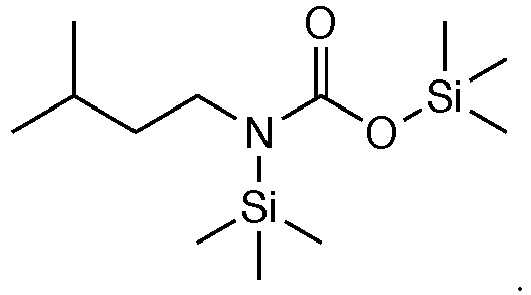
- 5,65 g (64,81 mmol) i-Pentylamin wurden zusammen mit 9,81 g (96,99 mmol) Triethylamin in 150 ml Diethylether vorgelegt. Unter Rühren im Eisbad erfolgte die Zugabe von 9,81 g (90,32 mmol) Trimethylchlorsilan über einen Tropftrichter. Beim Zutropfen des Silans konnte neben der Bildung eines weißen Feststoffes eine weiße Rauchentwicklung beobachtet werden. Anschließend wurde das Gemisch auf Raumtemperatur erwärmt und für 96 Stunden gerührt. Der Feststoff wurde über eine Filtration abgetrennt und das Lösungsmittel unter vermindertem Druck entfernt. Das Aminosilan N-Trimethylsilyl-i-pentylamin wurde als farblose Flüssigkeit in einer Ausbeute von 88 % (9,12 g, 57,25 mmol) erhalten. Die Reinheit des Produktes wurde mittels NMR-Spektroskopie bestätigt.
- 1H-NMR (500 MHz, CDCl3, δ [ppm]): 2,69 (t, J = 7,4 Hz, 2H), 1,60 (dq, J = 13,4, 6,7 Hz, 1H), 1,29 - 1,21 (m, 2H), 0.85 (d, J = 6,7 Hz, 6H), 0,24 (s, 1H, NH), 0,00 (s, 9H, SiMe3). 13C-NMR (101 MHz, CDCl3, δ [ppm]): 44,2 (CH2), 39,9 (CH2), 25,5 (CH), 22,6 (CH3), -0,1 (SiMe3). 29Si-NMR (79 MHz, CDCl3, δ [ppm]): 3,0.
- 7,99 g (50,11 mmol) N-Trimethylsilyl-i-pentylamin wurden mit 10 ml trockenem THF vermengt und unter inerten Bedingungen in einen Autoklav überführt. Der Autoklav wurde mit 8 bar CO2-Druck beaufschlagt. Die Reaktion erfolgte unter konstantem Rühren für eine Zeitspanne von 3 Stunden. Nach Ablassen des Druckes und inertem Überführen des Reaktionsgemisches in ein Schlenk-Gefäß wurde das Lösungsmittel in einer Kältedestillation entfernt und das Insertionsprodukt als klare, farblose Flüssigkeit gewonnen. Es konnten 9,55 g (46,98 mmol) N,i-Pentyl-O-trimethylsilyl-carbamat erhalten werden. Dies entspricht einer Ausbeute von 94 %. Die Identität und Reinheit der Zielverbindung wurden mittels NMR-Spektroskopie bestätigt.
- 1H-NMR (500 MHz, CDCl3, δ [ppm]): 5,19 (t, J = 6,1 Hz, 1H, NH), 2,92 - 2,81 (m, 2H), 1,36 (dp, J = 13,3, 6,7 Hz, 1H), 1,17 - 1,06 (m, 2H), 0,65 (d, J = 6,7 Hz, 6H), 0,00 (s, 9H, SiMe3). 13C-NMR (101 MHz, CDCl3, δ [ppm]): 155,1 (CO), 40,1 (CH2), 39,0 (CH2), 25,5 (CH), 22,2 (CH3), -0,3 (SiMe3). 29Si-NMR (79 MHz, CDCl3, δ [ppm]): 21,8.
- 9,55 g (46,98 mmol) N,i-Pentyl-O-trimethylsilyl-carbamat wurden zusammen mit 5,07 g (50,06 mmol) Triethylamin in 90 ml n-Pentan gelöst und im Eisbad gerührt. Über einen Tropftrichter wurden 11,02 g (49,59 mmol) Trimethylsilyltriflat zugetropft, wobei die Bildung einer weißen, zweiten Phase am Boden des Schlenkkolbens beobachtet werden konnte. Das Gemisch wurde anschließend über Nacht bei Raumtemperatur gerührt. Die entstandene 2. Phase wurde im Trockeneis/Isopropanol-Kältegemisch zum Erstarren gebracht und die überstehende Lösung abdekantiert. Das Lösungsmittel wurde mittels Kältedestillation entfernt. Auf diese Weise konnten 8,38 g (30,40 mmol, Ausbeute 65 %) N,O-Bis(trimethylsilyl)-N,i-pentyl-carbamat (22) als schwach gelbe Flüssigkeit erhalten werden. Die Identität des Zielproduktes wurde mittels NMR-Spektroskopie bestätigt.
- 1H-NMR (500 MHz, CDCl3, δ [ppm]): 2,93 - 2,80 (m, 2H), 1,31 (dh, J = 13,3, 6,7 Hz, 1H), 1,13 (ddd, J = 11,7, 7,6, 5,9 Hz, 2H), 0,67 (d, J = 6,7 Hz, 6H), 0,06 (s, 9H, SiMe3), 0,00 (s, 9H, SiMe3). 13C-NMR (101 MHz, CDCl3, δ [ppm]): 157,3 (CO), 43,0 (CH2), 39,6 (CH2), 26,2 (CH), 22,4 (CH3), 0,5 (SiMe3), -0,3 (SiMe3). 29Si-NMR (79 MHz, CDCl3, δ [ppm]): 21,9 (Si-O), 9,5 (Si-N).
- 1,38 g (4,99 mmol) N,O-Bis(trimethylsilyl)-N,i-pentyl-carbamat (22) wurden unter inerten Bedingungen in die Sumpf-Kugel der Kugelrohrdestille gefüllt. Die Sumpf-Kugel sowie die mittlere Kugel wurden in den Heizraum (Röhrenofen) geschoben und die Apparatur auf eine Neigung von 45° gestellt. Das Carbamat wurde bei kontinuierlicher Drehung von 30 U/min für 1 Stunde auf 250 °C und weitere 30 min auf 300 °C erhitzt. Anschließend wurde die Apparatur in eine waagerechte Position gebracht und erneut für 30 min auf 300 °C geheizt. In der äußeren und mittleren Kugel sammelte sich eine farblose Flüssigkeit an. Die Sumpf-Kugel war am Ende der Reaktionszeit nahezu leer. Die Kugeln wurden anschließend auf Raumtemperatur abgekühlt und inert in Schlenk-Gefäße überführt. Die Untersuchung der farblosen Flüssigkeit der äußeren Kugel erfolgte mittels NMR-Spektroskopie. Das 29Si-NMR-Spektrum zeigt nur die Anwesenheit von Hexamethyldisiloxan (7,1 ppm). Das eingesetzte Carbamat ist vollständig zersetzt. Diese Ergebnisse werden von dem 13C-NMR-Spektrum bestätigt (Hexamethyldisiloxan bei 1,7 ppm). Zudem findet sich in dem 13C-NMR-Spektrum ein Signal bei 122,2 ppm, welches eindeutig dem Isopentyl-isocyanat zugeordnet werden kann (weitere zugehörige Signale: 41,0, 40,1, 25,2, 21,9 ppm). Die Zuordnung wurde mittels IR-Spektroskopie zusätzlich bestätigt. Die charakteristische Schwingung der Carbonylgruppe des Carbamats bei rund 1690 cm-1 ist vollständig verschwunden, während bei 2270 cm-1 die intensive Isocyanat-Bande zu finden ist. Die Banden bei 1252, 1053, 841 cm-1 können dem Hexamethyldisiloxan zugeordnet werden.
- Benzyl-isocyanat (Verbindung 23) wurde gemäß den in Schema 11 gezeigten Verfahren hergestellt. Benzyl-isocyanat ist ein weiteres Beispiel eines aliphatischen Monoisocyanats. Bezogen auf Schema 11 sind in Beispiel 5 R1 Benzyl, R2 und R3 bei jedem Auftreten Methyl, X1 Chlor und X Triflat. Unter der Angabe "Benzyl" oder wird eine Gruppe der Formel H5C6-CH2- verstanden.
- 5,03 g (46,90 mmol) Benzylamin wurden zusammen mit 4,91 g (48,55 mmol) Triethylamin in 160 ml Diethylether vorgelegt. Unter Rühren im Eisbad erfolgte die Zugabe von 5,17 g (47,56 mmol) Trimethylchlorsilan über einen Tropftrichter, wobei die Bildung eines weißen Feststoffes sowie eine weiße Rauchentwicklung beobachtet werden konnten. Anschließend wurde das Gemisch auf Raumtemperatur erwärmt und über Nacht gerührt. Der Feststoff wurde über eine Filtration abgetrennt und das Lösungsmittel mittels Kältedestillation entfernt. Das Aminosilan N-Trimethylsilyl-benzylamin wurde als farblose Flüssigkeit in einer Ausbeute von 89 % (7,45 g, 41,52 mmol) erhalten. Die Reinheit des Produktes wurde mittels NMR-Spektroskopie bestätigt.
- 1H-NMR (500 MHz, CDCl3, δ [ppm]): 7,15 (m, 4H), 7,05 (m, 1H), 3,77 (d, J = 8,0 Hz, 2H), 0,55 (s, 1H, NH), 0,00 (s, 9H, SiMe3). 13C-NMR (101 MHz, CDCl3, δ [ppm]): 144,2 (C), 128,1(CH), 126,8 (CH), 126,3 (CH), 45,6 (CH2), 0,0 (SiMe3). 29Si-NMR (79 MHz, CDCl3, δ [ppm]): 3,9.
- 6,78 g (37,81 mmol) N Trimethylsilyl-benzylamin wurden mit 20 ml trockenem THF vermengt, unter inerten Bedingungen in einen Autoklav überführt und eine Stunde mit 8 bar CO2-Druck beaufschlagt. Nach Ablassen des Druckes und inertem Überführen des Reaktionsgemisches in ein Schlenk-Gefäß wurde das Lösungsmittel in einer Kältedestillation entfernt und das Insertionsprodukt als farblose, viskose Flüssigkeit mit einer Ausbeute von 94 % (7,90 g, 35,37 mmol) gewonnen. Nach einigen Tagen Lagerung bei Raumtemperatur konnte die Bildung von farblosen Kristallen beobachtet werden. Die Identität und Reinheit der Zielverbindung wurden mittels NMR-Spektroskopie bestätigt.
- 1H-NMR (500 MHz, CDCl3, δ [ppm]): 7,14 (m, 5H), 6,17 (s, 1H, NH), 4,15 (d, J = 6,2 Hz, 2H, CH2), 0,23 (s, 9H, SiMe3). 13C-NMR (101 MHz, CDCl3, δ [ppm]): 155,0 (CO), 128,6 (C), 127,8 (CH), 126,8 (CH), 126,5 (CH), 44,2 (CH2), -0,5 (SiMe3). 29Si-NMR (79 MHz, CDCl3, δ [ppm]): 23,2. Elementaranalyse: berechnet N 6,27 %, C 59,16 %, H 7,67 %, gemessen N 6,81 %, C 59,02 %, H 7,408 %
- 30,33 g (135,80 mmol) N-Benzyl-O-trimethylsilyl-carbamat wurden zusammen mit 14,48 g (143,07 mmol) Triethylamin in 100 ml Diethylether gelöst und im Eisbad gerührt. Über einen Tropftrichter wurden 32,62 g (146,76 mmol) Trimethylsilyltriflat zugetropft, wobei die Bildung einer wei-ßen, zweiten Phase am Boden des Schlenkkolbens beobachtet werden konnte. Das Gemisch wurde anschließend über Nacht bei Raumtemperatur gerührt, bevor die entstandene 2. Phase im Trockeneis/Isopropanol-Kältegemisch zum Erstarren gebracht und die überstehende Lösung abdekantiert wurde. Das Lösungsmittel wurde mittels Kältedestillation aus der Reaktionslösung entfernt und lieferte das Zielprodukt, N,O-Bis(trimethylsilyl)-N-benzyl-carbamat (5), als intensiv gelbe, leicht viskose Flüssigkeit (37,58 g, 127,17 mmol, 94% Ausbeute). Die Identität des Zielproduktes wurde mittels NMR-Spektroskopie bestätigt.
- 1H-NMR (500 MHz, CDCl3, δ [ppm]): 7,18 (m, 5H), 4,41 (s, 2H, CH2), 0,33 (s, 9H, SiMe3), 0,19 (s, 9H, SiMe3). 13C-NMR (101 MHz, CDCl3, δ [ppm]): 158,2 (CO), 140,4 (C), 128,4 (CH), 126,6 (CH), 126,4 (CH), 48,1 (CH2), 0,8 (SiMe3), 0,0 (SiMe3). 29Si-NMR (79 MHz, CDCl3, δ [ppm]): 22,6 (O-Si), 10,9 (N-Si).
- 3,13 g (4,50 mmol) N,O-Bis(trimethylsilyl)-N-benzyl-carbamat (5) wurden unter inerten Bedingungen in die Sumpf-Kugel der Kugelrohrdestille gefüllt. Die Sumpf-Kugel sowie die mittlere Kugel wurden in den Heizraum (Röhrenofen) geschoben und die Apparatur auf eine Neigung von 45° gestellt. Das Carbamat wurde bei kontinuierlicher Drehung von 20 U/min für je 30 Minuten auf 200 °C und 250 °C, 10 Minuten 300 °C und weitere 90 Minuten auf 250 °C erhitzt. Der Druckausgleich war über eine Ölfalle gewährleistet. 50 Minuten nach Heizbeginn wurde die Apparatur in eine waagerechte Position gebracht. Ab 250 °C sammelte sich in der äußeren eine farblose Flüssigkeit (1,82 g) und in der mittleren Kugel eine gelbe Flüssigkeit (0,38 g) an. Die Sumpf-Kugel enthielt am Ende der Reaktionszeit geringe Mengen eines hochviskosen, dunkelbraunen Rückstandes (0,64 g). Die Kugeln wurden anschließend auf Raumtemperatur abgekühlt und inert mit CDCl3 als Lösungsmittel in Schlenk-Gefäße überführt. Die Untersuchung der Fraktionen erfolgte mittels NMR-Spektroskopie.
- Äußere Kugel: Das 29Si-NMR-Spektrum zeigte nur die Anwesenheit von Hexamethyldisiloxan (7,3 ppm). Das eingesetzte Carbamat war vollständig zersetzt. Diese Ergebnisse wurden von dem 13C-NMR-Spektrum bestätigt (Hexamethyldisiloxan bei 1,7 ppm). Zudem fanden sich in dem 13C-NMR-Spektrum Signale, welche eindeutig dem Benzyl-isocyanat durch Vergleich mit einer kommerziell erhältlichen Probe zugeordnet werden können (137,0, 128,7, 127,8, 126,6, 123,7, 46,4 ppm). Sowohl die mittlere Fraktion, als auch der Rückstand wiesen eine Vielzahl von Signalen im 29Si- und 13C-NMR Spektrum auf. Eine Zuordnung konnte nicht vorgenommen werden. Eine Untersuchung mittels Gaschromatographie liefert weitere Aufschlüsse über die Zusammensetzung der äußeren Fraktion: Retentionszeit (RT) 1,565 min - 16,95 % - CDCl3; RT 1,771 min - 0,68 % - Me3Si-isocyanat (wobei Me eine Methylgruppe bezeichnet); RT 2,043 min - 64,85 % - Hexamethyldisiloxan (HMDSO); RT 2,554 min - 3,67 % - Toluol; RT 6,447 min - 9,48 % - Benzyl-isocyanat (23); RT 10,765 min - 0,81 % - N,O-Bis(trimethylsilyl)-N-benzyl-carbamat (5).
- In einem weiteren Experiment wurden 8,38 g (28,36 mmol) N,O-Bis(trimethylsilyl)-N-benzyl-carbamat (5) direkt auf 300 °C für 2,5 Stunden in der Kugelrohrdestille bei 30 U/min unter Normaldruck erhitzt. Die erste Stunde war die Apparatur auf eine Neigung von 45 ° gestellt. Nach Ende der Reaktionszeit hatte sich eine farblose Flüssigkeit mit weißen Flocken in der äußeren Kugel (1,74 g) gesammelt, während die mittlere Kugel nahezu leer war (0,22 g) und sich ein hochviskoser, tiefbrauner Rückstand (2,47 g) in der Sumpf-Kugel gebildet hatte. Alle Fraktionen wurden mittels NMR-Spektroskopie untersucht. Erneut zeigten sich eine Vielzahl von Signalen im 29Si- und 13C-NMR Spektrum der mittleren Kugel und des Rückstandes, welche nicht weiter zugeordnet werden konnten. Die äußere Kugel enthielt neben HMDSO (7,3 ppm) noch Trimethylsilyl-isocyanat (4,2 ppm) als siliciumhaltige Komponenten im 29Si-NMR Spektrum. Dies bestätigte sich im 13C-NMR Spektrum: HMDSO (1,9 ppm), Me3SiNCO (0,9, 124,0 ppm). Zusätzlich fiel auf, dass die CH2-Brücke der Benzyl-Gruppe bei rund 46 ppm nicht vorhanden war, sich aber stattdessen ein intensives Signal bei 21,5 ppm zeigte. Zusammen mit den Signalen im aromatischen Verschiebungsbereich konnte die Bildung von Toluol identifiziert werden (137,9, 129,2, 128,4, 125,5, 21,5 ppm).
- Allyl-isocyanat (Verbindung 24) wurde gemäß den in Schema 11 gezeigten Verfahren hergestellt. Allyl-isocyanat ist ein weiteres Beispiel eines aliphatischen Monoisocyanats. Bezogen auf Schema 11 sind in Beispiel 6 R1 Allyl, R2 und R3 bei jedem Auftreten Methyl, X1 Chlor und X Triflat. Unter der Angabe "Allyl" wird eine Gruppe der Formel H2C=CH-CH2- verstanden.
- N,O-Bis(trimethylsilyl)-N-allyl-carbamat (25) ist eine Verbindung der allgemeinen Formel IV-A, in der R1 Allyl ist. N, O-Bis(trimethylsilyl)-N-allyl-carbamat (25) weist folgende Formel auf:

- Zu einem Gemisch aus 5,07 (88,75 mmol) Allylamin und 8,86 g (87,53 mmol) Triethylamin in 100 ml trockenem n-Pentan wurden unter Rühren und Eisbadkühlung 9,73 g (89,59 mmol) Trimethylchlorsilan zugetropft. Es erfolgte die Bildung eines weißen Niederschlages, welcher nach 2-tägigem Rühren bei Raumtemperatur mittels Filtration abgetrennt wurde. Das Lösungsmittel wurde mit Hilfe einer Kältedestillation abgetrennt und der Erfolg der Synthese mittels NMR-Spektroskopie überprüft. Neben dem gewünschten N-Trimethylsilyl-allylamin (26) hatte sich das zugehörige Silazan (N,N-bis(trimethylsilyl)-allylamin (27) gebildet.
- 1H-NMR (500 MHz, CDCl3, δ [ppm]): 5,82 - 5,59 (m, 1H), 4,92 (dd, J = 17,0, 1,8 Hz, 2H), 4,76 (dd, J = 10,1, 1,5 Hz, 1H), 3,26 (dt, J = 4,4, 2,0 Hz, 0H), 3,14 (d, J = 5,3 Hz, 7H), -0,09 (s, 2H), - 0,15 (s, 9H, SiMe3). 13C-NMR (101 MHz, CDCl3, δ [ppm]): 141,2 (27)/140,9 (26) (CH), 113,3 (27)/112,8 (26) (CH2), 47,4 (27)/44,6 (26) (CH2), 0,0 (SiMe3). 29Si-NMR (79 MHz, CDCl3, δ [ppm]): 4,1 (26), 6,5 (27).
- 7,65 g (59,18 mmol) N-Trimethylsilyl-allylamin (kommerziell erworben) wurden mit 20 ml trockenem THF vermengt und unter inerten Bedingungen in einen Autoklav überführt. Die CO2-Insertionsreaktion erfolgte mit 8 bar CO2-Druck unter konstantem Rühren für eine Zeitspanne von 43,5 Stunden. Nach Ablassen des Druckes und inertem Überführen des Reaktionsgemisches mit 5 ml THF in ein Schlenk-Gefäß wurde das Lösungsmittel in einer Kältedestillation entfernt und das Insertionsprodukt als intensiv gelbe, leicht viskose Flüssigkeit gewonnen. Auf diesem Weg konnten 9,55 g (55,10 mmol, 93 % Ausbeute) N-Allyl-O-trimethylsilyl-carbamat erhalten werden. Die Identität und Reinheit der Zielverbindung wurden mittels NMR-Spektroskopie bestätigt.
- 1H-NMR (500 MHz, CDCl3, δ [ppm]): 5,70 - 5,45 (m, 1H), 5,29 (s, 1H, NH), 4,93 (dd, J = 17,2, 1,6 Hz, 1H), 4,84 (dd, J = 10,3, 1,5 Hz, 1H), 3,50 (t, J = 5,7 Hz, 2H), 0,04 (s, 9H, SiMe3). 13C-NMR (101 MHz, CDCl3, δ [ppm]): 155,6 (CO), 135,2 (CH), 115,7 (CH2), 43,7 (CH2), 0,3 (SiMe3). 29Si-NMR (79 MHz, CDCl3, δ [ppm]): 22,3.
- 8,43 g (48,62 mmol) N-Allyl-O-trimethylsilyl-carbamat wurden zusammen mit 5,28 g (52,14 mmol) Triethylamin in 100 ml n-Pentan gelöst und im Eisbad gerührt. Über einen Tropftrichter wurden 11,37 g (51,15 mmol) Trimethylsilyltriflat zugetropft, wobei die Bildung einer intensiv orangen, zweiten Phase am Boden des Schlenkkolbens beobachtet werden konnte. Das Gemisch wurde anschließend über Nacht bei Raumtemperatur gerührt. Die entstandene 2. Phase wurde im Trockeneis/Isopropanol-Kältegemisch zum Erstarren gebracht und die überstehende Lösung abdekantiert. Nach Entfernen des Lösungsmittels über eine Kältedestillation konnten 10,24 g (41,70 mmol, Ausbeute 86 %) N,O-Bis(trimethylsilyl)-N-allyl-carbamat (25) als orange Flüssigkeit erhalten werden. Die Identität des Zielproduktes wurde mittels NMR-Spektroskopie bestätigt.
- 1H-NMR (500 MHz, CDCl3, δ [ppm]): 5,67 - 5,53 (m, 1H), 4,88 (d, J = 1,8 Hz, 2H), 4,86 - 4,80 (m, 2H), 3,56 (d, J = 5,1 Hz, 2H), 0,10 (s, 9H, SiMe3), 0,04 (s, 9H, SiMe3). 13C-NMR (101 MHz, CDCl3, δ [ppm]): 157,4 (CO), 136,1 (CH), 114,3 (CH2), 46,7 (CH2), 0,6 (SiMe3), -0,1 (SiMe3). 29Si-NMR (79 MHz, CDCl3, δ [ppm]): 22,4 (Si-O), 10,5 (Si-N).
- 1,09 g (4,43 mmol) N,O-Bis(trimethylsilyl)-N-allyl-carbamat (25) wurden unter inerten Bedingungen in die Sumpf-Kugel der Kugelrohrdestille gefüllt und zusammen mit der mittlere Kugel in den Heizraum (Röhrenofen) geschoben. Die Apparatur wurde auf eine Neigung von 45° gestellt. Das Carbamat wurde bei kontinuierlicher Drehung von 30 U/min unter Normaldruck für 1 Stunde auf 250 °C und weitere 30 min auf 300 °C erhitzt. Die Apparatur wurde eine Stunde nach Heizbeginn in die waagerechte Position gebracht. In der äußeren Kugel sammelte sich eine farblose Flüssigkeit an. Während die mittlere Kugel am Ende der Reaktionszeit nahezu leer war, hatte sich in der Sumpf-Kugel ein schwarzer Film an der Glaswand gebildet. Die Kugeln wurden anschließend auf Raumtemperatur abgekühlt und die äußere Fraktion inert in Schlenk-Gefäße überführt, bevor die Zusammensetzung mittels NMR-Spektroskopie untersucht wurde. Das 29Si-NMR-Spektrum zeigte nur die Anwesenheit von Hexamethyldisiloxan (7,2 ppm), während das eingesetzte Carbamat vollständig zersetzt war. Diese Ergebnisse wurden von dem 13C-NMR-Spektrum bestätigt (Hexamethyldisiloxan bei 2,0 ppm). Die weiteren Signale im 13C-NMR Spektrum zeigten eine genaue Übereinstimmung mit einer Probe kommerziell erhältlichen Allyl-isocyanates. Die Signallagen sind: 133,3, 123,9, 116,1, 39,7 ppm. Die Zuordnung wurde durch die charakteristische Schwingung der Isocyanatgruppe bei 2262 cm-1 im IR-Spektrum zusätzlich bestätigt. Die Gehaltsbestimmung mittels Gaschromatographie ergab eine Zusammensetzung von 66,05 % Hexamethyldisiloxan und 28,38 % Allyl-isocyanat.
Claims (15)
- Verfahren zur Herstellung von Isocyanaten, wobei(i) eine erste siliciumorganische Verbindung, die zumindest ein Silicium-Atom Si1 und eine daran gebundene Einheit der Formel G-I
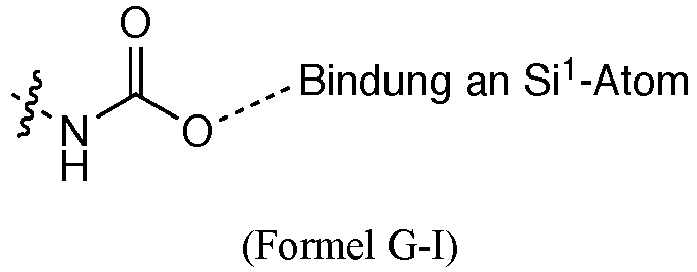
 (ii) die dritte siliciumorganische Verbindung durch Thermolyse zu einem Isocyanat umgesetzt wird, wobei die Einheit der Formel G-II in eine Isocyanat-Gruppe überführt wird.
 - Verfahren nach Anspruch 1, dadurch gekennzeichnet, dass die erste siliciumorganische Verbindung eine Verbindung der allgemeinen Formel II
 A1 R1 oder eine Gruppe der allgemeinen Formel G-III ist:
 R1 eine substituierte oder unsubstituierte, aliphatische oder aromatische Gruppe ist;R2 bei jedem Auftreten unabhängig voneinander jeweils aus der Gruppe ausgewählt ist, die aus Wasserstoff, einer substituierten oder unsubstituierten Alkylgruppe mit 1 bis 12 Kohlenstoffatomen und einer substituierten oder unsubstituierten Arylgruppe besteht, mit der Maßgabe, dass an jedes Siliciumatom Si1 zumindest ein Rest R2 gebunden ist, der nicht Wasserstoff ist; undZ eine substituierte oder unsubstituierte, aliphatische oder aromatische Gruppe ist;die zweite siliciumorganische Verbindung eine Verbindung der allgemeinen Formel III
 X aus der Gruppe ausgewählt ist, die aus einem Halogen, -CN, -OCN, -SCN, -N3, einem Sulfonat, einem Carbamat, -O-R4, -NR7R8 oder einem N-Heterocyclus besteht;R3 bei jedem Auftreten unabhängig voneinander jeweils aus der Gruppe ausgewählt ist, die aus Wasserstoff, einer substituierten oder unsubstituierten Alkylgruppe mit 1 bis 12 Kohlenstoffatomen und einer substituierten oder unsubstituierten Arylgruppe besteht, mit der Maßgabe, dass an jedes Siliciumatom Si2 zumindest ein Rest R3 gebunden ist, der nicht Wasserstoff ist;R4 -C(O)R9 oder eine Gruppe der allgemeinen Formel G-VI
 R5 bei jedem Auftreten unabhängig voneinander jeweils eine substituierte oder unsubstituierte Alkylgruppe mit 1 bis 12 Kohlenstoffatomen ist;R6 eine substituierte oder unsubstituierte Alkylgruppe mit 1 bis 12 Kohlenstoffatomen ist;R7 und R8 unabhängig voneinander jeweils -C(O)R9 oder eine substituierte oder unsubstituierte Alkylgruppe mit 1 bis 12 Kohlenstoffatomen sind; undR9 eine substituierte oder unsubstituierte Alkylgruppe mit 1 bis 12 Kohlenstoffatomen ist; und die dritte siliciumorganische Verbindung eine Verbindung der allgemeinen Formel IV
 A2 R1 oder eine Gruppe der allgemeinen Formel G-IV ist:
 R2 bei jedem Auftreten und Z die in Zusammenhang mit der Verbindung der allgemeinen Formel II angegebenen Bedeutungen haben; undR3 bei jedem Auftreten die in Zusammenhang mit der Verbindung der allgemeinen Formel III angegebene Bedeutungen hat;wobei die Verbindung der allgemeinen Formel II mit der Verbindung der allgemeinen Formel III zu der Verbindung der allgemeinen Formel IV umgesetzt wird und die Verbindung der allgemeinen Formel IV durch Thermolyse in eine Isocyanat-Verbindung der allgemeinen Formel I
 worinA3 R1 oder eine Gruppe der Formel G-V ist:
 R1 und Z die in Zusammenhang mit der Verbindung der allgemeinen Formel II angegebenen Bedeutungen haben;umgesetzt wird.
 - Verfahren nach Anspruch 2, dadurch gekennzeichnet, dass R1 in den Verbindungen der allgemeinen Formel I, II und IV aus der Gruppe ausgewählt ist, die aus einer substituierten oder unsubstituierten Alkylgruppe mit 1 bis 18 Kohlenstoffatomen, einer substituierten oder unsubstituierten Heteroalkylgruppe mit 1 bis 18 Kohlenstoffatomen, einer substituierten oder unsubstituierten Alkenylgruppe mit 1 bis 18 Kohlenstoffatomen, einer substituierten oder unsubstituierten Alkinylgruppe mit 1 bis 18 Kohlenstoffatomen, einer substituierten oder unsubstituierten Arylgruppe und einer substituierten oder unsubstituierten Heteroarylgruppe, besteht.
- Verfahren nach Anspruch 2 oder Anspruch 3, dadurch gekennzeichnet, dass R1 in den Verbindungen der allgemeinen Formel I, II und IV aus der Gruppe ausgewählt ist, die aus Methyl, Ethyl, Propyl, Butyl, Pentyl, Hexyl, Octyl und Phenyl besteht.
- Verfahren nach einem der Ansprüche 2 bis 4, dadurch gekennzeichnet, dass Z in den Verbindungen der allgemeinen Formel I, II und IV aus der Gruppe ausgewählt ist, die aus einer substituierten oder unsubstituierten Alkylengruppe mit 1 bis 12 Kohlenstoffatomen, einer substituierten oder unsubstituierten Phenylengruppe und einer substituierten oder unsubstituierten Phenylenbisalkylengruppe, in der jede Alkylengruppe bei jedem Auftreten unabhängig voneinander jeweils eine Alkylengruppe mit 1 bis 12 Kohlenstoffatomen ist, besteht.
- Verfahren nach einem der Ansprüche 2 bis 5, dadurch gekennzeichnet, dass X in der Verbindung der allgemeinen Formel III aus der Gruppe ausgewählt ist, die aus Chlor, einer Toluolsulfonsäureester-Gruppe, einer Methylsulfonsäureester-Gruppe und einer Trifluormethylsulfonsäureester-Gruppe besteht.
- Verfahren nach einem der Ansprüche 2 bis 6, dadurch gekennzeichnet, dass R3 bei jedem Auftreten in den Verbindungen der allgemeinen Formel III und IV unabhängig voneinander jeweils eine substituierte oder unsubstituierte Alkylgruppe mit 1 bis 6 Kohlenstoffatomen oder eine substituierte oder unsubstituierte Phenylgruppe ist.
- Verfahren nach einem der Ansprüche 2 bis 7, dadurch gekennzeichnet, dass alle R2 in den Verbindungen der allgemeinen Formel I, II und IV jeweils eine Methylgruppe sind und/oder alle R3 in den Verbindungen der allgemeinen Formel III und IV jeweils eine Methylgruppe sind.
- Verfahren nach einem der vorstehenden Ansprüche, dadurch gekennzeichnet, dass die Silylierung bei einer Temperatur von 0 bis 50 °C durchgeführt wird.
- Verfahren nach einem der vorstehenden Ansprüche, dadurch gekennzeichnet, dass die Silylierung in einem unpolaren organischen Lösungsmittel in Gegenwart einer Hilfsbase durchgeführt wird.
- Verfahren nach einem der vorstehenden Ansprüche, dadurch gekennzeichnet, dass die Thermolyse bei einer Temperatur von 150 bis 400 °C durchgeführt wird.
- Verfahren nach einem der vorstehenden Ansprüche, dadurch gekennzeichnet, dass die Thermolyse unter Anwendung eines Temperaturprofils durchgeführt wird, das zwei oder mehr Temperaturstufen umfasst, wobei jede Temperaturstufe für einen vorgegebenen Zeitraum angewendet wird und jede angewendete Temperaturstufe um 20 bis 80 °C über dem zuvor angewendeten Temperaturbereich liegt.
- Verfahren nach Anspruch 12, dadurch gekennzeichnet, dass der vorgegebene Zeitraum zwischen 1 min und 2 h liegt.
- Verfahren nach einem der vorstehenden Ansprüche, dadurch gekennzeichnet, dass die Thermolyse in Gegenwart eines Inertgases durchgeführt wird.
- Verwendung einer Verbindung der allgemeinen Formel II
 A1 eine Gruppe der allgemeinen Formel G-III ist:
 R2 bei jedem Auftreten unabhängig voneinander jeweils aus der Gruppe ausgewählt ist, die aus Wasserstoff, einer substituierten oder unsubstituierten Alkylgruppe mit 1 bis 12 Kohlenstoffatomen und einer substituierten oder unsubstituierten Arylgruppe besteht, mit der Maßgabe, dass an jedes Siliciumatom Si1 zumindest ein Rest R2 gebunden ist, der nicht Wasserstoff ist;Z eine substituierte oder unsubstituierte, aliphatische oder aromatische Gruppe ist;zur Herstellung einer Isocyanat-Verbindung der allgemeinen Formel I
A3-N=C=O (Formel I),
worinA3 eine Gruppe der Formel G-V ist: worin Z die in Zusammenhang mit der Verbindung der allgemeinen Formel II angegebenen Bedeutungen hat.
Applications Claiming Priority (2)
| Application Number | Priority Date | Filing Date | Title |
|---|---|---|---|
| DE102020113028.7A DE102020113028B3 (de) | 2020-05-13 | 2020-05-13 | Verfahren zur Synthese von Isocyanaten |
| PCT/DE2021/100312 WO2021228301A1 (de) | 2020-05-13 | 2021-03-30 | Verfahren zur synthese von isocyanaten |
Publications (3)
| Publication Number | Publication Date |
|---|---|
| EP4149920A1 EP4149920A1 (de) | 2023-03-22 |
| EP4149920C0 EP4149920C0 (de) | 2024-07-31 |
| EP4149920B1 true EP4149920B1 (de) | 2024-07-31 |
Family
ID=75588025
Family Applications (1)
| Application Number | Title | Priority Date | Filing Date |
|---|---|---|---|
| EP21720172.2A Active EP4149920B1 (de) | 2020-05-13 | 2021-03-30 | Verfahren zur synthese von isocyanaten |
Country Status (6)
| Country | Link |
|---|---|
| US (1) | US12559452B2 (de) |
| EP (1) | EP4149920B1 (de) |
| DE (1) | DE102020113028B3 (de) |
| ES (1) | ES2994304T3 (de) |
| HU (1) | HUE069081T2 (de) |
| WO (1) | WO2021228301A1 (de) |
Families Citing this family (1)
| Publication number | Priority date | Publication date | Assignee | Title |
|---|---|---|---|---|
| DE102020113028B3 (de) | 2020-05-13 | 2021-06-24 | Technische Universität Bergakademie Freiberg | Verfahren zur Synthese von Isocyanaten |
Family Cites Families (2)
| Publication number | Priority date | Publication date | Assignee | Title |
|---|---|---|---|---|
| DE102009045849B4 (de) | 2009-10-20 | 2018-03-08 | Technische Universität Bergakademie Freiberg | Verfahren zur Herstellung von Oligo- und Polysiloxanen |
| DE102020113028B3 (de) | 2020-05-13 | 2021-06-24 | Technische Universität Bergakademie Freiberg | Verfahren zur Synthese von Isocyanaten |
-
2020
- 2020-05-13 DE DE102020113028.7A patent/DE102020113028B3/de active Active
-
2021
- 2021-03-30 US US17/914,519 patent/US12559452B2/en active Active
- 2021-03-30 ES ES21720172T patent/ES2994304T3/es active Active
- 2021-03-30 WO PCT/DE2021/100312 patent/WO2021228301A1/de not_active Ceased
- 2021-03-30 EP EP21720172.2A patent/EP4149920B1/de active Active
- 2021-03-30 HU HUE21720172A patent/HUE069081T2/hu unknown
Also Published As
| Publication number | Publication date |
|---|---|
| US20230140949A1 (en) | 2023-05-11 |
| EP4149920A1 (de) | 2023-03-22 |
| DE102020113028B3 (de) | 2021-06-24 |
| EP4149920C0 (de) | 2024-07-31 |
| WO2021228301A1 (de) | 2021-11-18 |
| ES2994304T3 (en) | 2025-01-21 |
| HUE069081T2 (hu) | 2025-02-28 |
| US12559452B2 (en) | 2026-02-24 |
Similar Documents
| Publication | Publication Date | Title |
|---|---|---|
| EP0212058B1 (de) | N-Silylpropyl-N'Acyl-Harnstoffe und Verfahren zur Herstellung | |
| CA1148969A (en) | Process for the preparation of n,o-disubstituted urethanes suitable as a starting material for the preparation of isocyanates | |
| US4130576A (en) | Method for preparing isocyanates from halosilyl carbamates | |
| DE2917493A1 (de) | Verfahren zur herstellung von aliphatischen und cycloaliphatischen di- und polyurethanen | |
| JP3273059B2 (ja) | ウレタンおよびカーボネートの製造方法 | |
| DE2917490A1 (de) | Verfahren zur herstellung von aliphatischen und cycloaliphatischen di- und polyurethanen | |
| EP1136495A2 (de) | 1:1-Monoaddukte aus sekundären Aminoalkylalkoxysilanen und Diisocyanaten sowie ein Verfahren zu ihrer Herstellung | |
| DE3888991T2 (de) | Aminokohlenwasserstoff-substituierte Ketoximosilane. | |
| DE102020113028B3 (de) | Verfahren zur Synthese von Isocyanaten | |
| EP2176273B1 (de) | Verfahren zur herstellung von aminoorganosilanen | |
| EP0416236B1 (de) | Verfahren zur Abtrennung von Isocyansäure aus einem Gemisch von Isocyansäure und Ammoniak | |
| EP1853613A1 (de) | Verfahren zur herstellung von alkoxysilylmethylisocyanuraten | |
| JPH0524896B2 (de) | ||
| DE102023103209A1 (de) | Verfahren zur Herstellung von aliphatischen N,O-silylierten Carbamaten | |
| KR880006174A (ko) | 시클로헥실 모노 및 디우레탄과 그로부터 유도된 모노-및 디이소시아네이트의 제조 방법,그 방법에 의해 제조된 신규 모노이소시아네트 및 이를 포함하는 경화성 조성물 | |
| EP3233729B1 (de) | Verfahren zum herstellen von perhalogeniertem cyclohexasilan-anion | |
| JPS628446B2 (de) | ||
| EP0636606B1 (de) | Verfahren zur Herstellung flüssiger Aminaddukte fluorgruppenhaltiger Amide | |
| DE69930733T2 (de) | Herstellung von substituierten (amino)alkoxysilanen | |
| DE102023127669A1 (de) | Verfahren zur Herstellung von Halogenalkoxy(organo)silanen und -siloxanen sowie Pseudohalogenalkoxy(organo)silanen und -siloxanen | |
| Blencowe et al. | Alternative syntheses of linear polyurethanes using masked isocyanate monomers | |
| EP0307756A2 (de) | Verfahren zur Herstellung von Isocyanaten und ihre Verwendung zur Herstellung von Estergruppen aufweisenden Polyisocyanaten und ausgewählte derartige Estergruppen aufweisende Polyisocyanate | |
| DE102009045849B4 (de) | Verfahren zur Herstellung von Oligo- und Polysiloxanen | |
| DE69907094T2 (de) | Organosiliziumverbindungen und deren Herstellung | |
| EP3728277B1 (de) | Oxamidoester-gruppen aufweisende silane |
Legal Events
| Date | Code | Title | Description |
|---|---|---|---|
| STAA | Information on the status of an ep patent application or granted ep patent |
Free format text: STATUS: UNKNOWN |
|
| STAA | Information on the status of an ep patent application or granted ep patent |
Free format text: STATUS: THE INTERNATIONAL PUBLICATION HAS BEEN MADE |
|
| PUAI | Public reference made under article 153(3) epc to a published international application that has entered the european phase |
Free format text: ORIGINAL CODE: 0009012 |
|
| STAA | Information on the status of an ep patent application or granted ep patent |
Free format text: STATUS: REQUEST FOR EXAMINATION WAS MADE |
|
| 17P | Request for examination filed |
Effective date: 20220819 |
|
| AK | Designated contracting states |
Kind code of ref document: A1 Designated state(s): AL AT BE BG CH CY CZ DE DK EE ES FI FR GB GR HR HU IE IS IT LI LT LU LV MC MK MT NL NO PL PT RO RS SE SI SK SM TR |
|
| DAV | Request for validation of the european patent (deleted) | ||
| DAX | Request for extension of the european patent (deleted) | ||
| GRAP | Despatch of communication of intention to grant a patent |
Free format text: ORIGINAL CODE: EPIDOSNIGR1 |
|
| STAA | Information on the status of an ep patent application or granted ep patent |
Free format text: STATUS: GRANT OF PATENT IS INTENDED |
|
| RIC1 | Information provided on ipc code assigned before grant |
Ipc: C07F 7/08 20060101ALI20240206BHEP Ipc: C07F 7/18 20060101ALI20240206BHEP Ipc: C07F 7/12 20060101ALI20240206BHEP Ipc: C07F 7/10 20060101ALI20240206BHEP Ipc: C07C 265/14 20060101ALI20240206BHEP Ipc: C07C 265/08 20060101ALI20240206BHEP Ipc: C07C 265/06 20060101ALI20240206BHEP Ipc: C07C 265/04 20060101ALI20240206BHEP Ipc: C07C 263/04 20060101AFI20240206BHEP |
|
| INTG | Intention to grant announced |
Effective date: 20240222 |
|
| GRAS | Grant fee paid |
Free format text: ORIGINAL CODE: EPIDOSNIGR3 |
|
| GRAA | (expected) grant |
Free format text: ORIGINAL CODE: 0009210 |
|
| STAA | Information on the status of an ep patent application or granted ep patent |
Free format text: STATUS: THE PATENT HAS BEEN GRANTED |
|
| REG | Reference to a national code |
Ref country code: DE Ref legal event code: R081 Ref document number: 502021004585 Country of ref document: DE Owner name: TECHNISCHE UNIVERSITAET BERGAKADEMIE FREIBERG,, DE Free format text: FORMER OWNER: ANMELDERANGABEN UNKLAR / UNVOLLSTAENDIG, 80297 MUENCHEN, DE |
|
| AK | Designated contracting states |
Kind code of ref document: B1 Designated state(s): AL AT BE BG CH CY CZ DE DK EE ES FI FR GB GR HR HU IE IS IT LI LT LU LV MC MK MT NL NO PL PT RO RS SE SI SK SM TR |
|
| REG | Reference to a national code |
Ref country code: CH Ref legal event code: EP Ref country code: GB Ref legal event code: FG4D Free format text: NOT ENGLISH |
|
| REG | Reference to a national code |
Ref country code: DE Ref legal event code: R096 Ref document number: 502021004585 Country of ref document: DE |
|
| REG | Reference to a national code |
Ref country code: IE Ref legal event code: FG4D Free format text: LANGUAGE OF EP DOCUMENT: GERMAN |
|
| U01 | Request for unitary effect filed |
Effective date: 20240830 |
|
| U07 | Unitary effect registered |
Designated state(s): AT BE BG DE DK EE FI FR IT LT LU LV MT NL PT RO SE SI Effective date: 20240910 |
|
| PG25 | Lapsed in a contracting state [announced via postgrant information from national office to epo] |
Ref country code: NO Free format text: LAPSE BECAUSE OF FAILURE TO SUBMIT A TRANSLATION OF THE DESCRIPTION OR TO PAY THE FEE WITHIN THE PRESCRIBED TIME-LIMIT Effective date: 20241031 |
|
| PG25 | Lapsed in a contracting state [announced via postgrant information from national office to epo] |
Ref country code: PL Free format text: LAPSE BECAUSE OF FAILURE TO SUBMIT A TRANSLATION OF THE DESCRIPTION OR TO PAY THE FEE WITHIN THE PRESCRIBED TIME-LIMIT Effective date: 20240731 Ref country code: GR Free format text: LAPSE BECAUSE OF FAILURE TO SUBMIT A TRANSLATION OF THE DESCRIPTION OR TO PAY THE FEE WITHIN THE PRESCRIBED TIME-LIMIT Effective date: 20241101 |
|
| REG | Reference to a national code |
Ref country code: ES Ref legal event code: FG2A Ref document number: 2994304 Country of ref document: ES Kind code of ref document: T3 Effective date: 20250121 |
|
| PG25 | Lapsed in a contracting state [announced via postgrant information from national office to epo] |
Ref country code: IS Free format text: LAPSE BECAUSE OF FAILURE TO SUBMIT A TRANSLATION OF THE DESCRIPTION OR TO PAY THE FEE WITHIN THE PRESCRIBED TIME-LIMIT Effective date: 20241130 |
|
| PG25 | Lapsed in a contracting state [announced via postgrant information from national office to epo] |
Ref country code: HR Free format text: LAPSE BECAUSE OF FAILURE TO SUBMIT A TRANSLATION OF THE DESCRIPTION OR TO PAY THE FEE WITHIN THE PRESCRIBED TIME-LIMIT Effective date: 20240731 |
|
| PG25 | Lapsed in a contracting state [announced via postgrant information from national office to epo] |
Ref country code: RS Free format text: LAPSE BECAUSE OF FAILURE TO SUBMIT A TRANSLATION OF THE DESCRIPTION OR TO PAY THE FEE WITHIN THE PRESCRIBED TIME-LIMIT Effective date: 20241031 |
|
| PG25 | Lapsed in a contracting state [announced via postgrant information from national office to epo] |
Ref country code: RS Free format text: LAPSE BECAUSE OF FAILURE TO SUBMIT A TRANSLATION OF THE DESCRIPTION OR TO PAY THE FEE WITHIN THE PRESCRIBED TIME-LIMIT Effective date: 20241031 Ref country code: PL Free format text: LAPSE BECAUSE OF FAILURE TO SUBMIT A TRANSLATION OF THE DESCRIPTION OR TO PAY THE FEE WITHIN THE PRESCRIBED TIME-LIMIT Effective date: 20240731 Ref country code: NO Free format text: LAPSE BECAUSE OF FAILURE TO SUBMIT A TRANSLATION OF THE DESCRIPTION OR TO PAY THE FEE WITHIN THE PRESCRIBED TIME-LIMIT Effective date: 20241031 Ref country code: IS Free format text: LAPSE BECAUSE OF FAILURE TO SUBMIT A TRANSLATION OF THE DESCRIPTION OR TO PAY THE FEE WITHIN THE PRESCRIBED TIME-LIMIT Effective date: 20241130 Ref country code: HR Free format text: LAPSE BECAUSE OF FAILURE TO SUBMIT A TRANSLATION OF THE DESCRIPTION OR TO PAY THE FEE WITHIN THE PRESCRIBED TIME-LIMIT Effective date: 20240731 Ref country code: GR Free format text: LAPSE BECAUSE OF FAILURE TO SUBMIT A TRANSLATION OF THE DESCRIPTION OR TO PAY THE FEE WITHIN THE PRESCRIBED TIME-LIMIT Effective date: 20241101 |
|
| REG | Reference to a national code |
Ref country code: HU Ref legal event code: AG4A Ref document number: E069081 Country of ref document: HU |
|
| PG25 | Lapsed in a contracting state [announced via postgrant information from national office to epo] |
Ref country code: SM Free format text: LAPSE BECAUSE OF FAILURE TO SUBMIT A TRANSLATION OF THE DESCRIPTION OR TO PAY THE FEE WITHIN THE PRESCRIBED TIME-LIMIT Effective date: 20240731 |
|
| U20 | Renewal fee for the european patent with unitary effect paid |
Year of fee payment: 5 Effective date: 20250317 |
|
| PG25 | Lapsed in a contracting state [announced via postgrant information from national office to epo] |
Ref country code: CZ Free format text: LAPSE BECAUSE OF FAILURE TO SUBMIT A TRANSLATION OF THE DESCRIPTION OR TO PAY THE FEE WITHIN THE PRESCRIBED TIME-LIMIT Effective date: 20240731 |
|
| PG25 | Lapsed in a contracting state [announced via postgrant information from national office to epo] |
Ref country code: SK Free format text: LAPSE BECAUSE OF FAILURE TO SUBMIT A TRANSLATION OF THE DESCRIPTION OR TO PAY THE FEE WITHIN THE PRESCRIBED TIME-LIMIT Effective date: 20240731 |
|
| PLBE | No opposition filed within time limit |
Free format text: ORIGINAL CODE: 0009261 |
|
| STAA | Information on the status of an ep patent application or granted ep patent |
Free format text: STATUS: NO OPPOSITION FILED WITHIN TIME LIMIT |
|
| 26N | No opposition filed |
Effective date: 20250501 |
|
| PG25 | Lapsed in a contracting state [announced via postgrant information from national office to epo] |
Ref country code: MC Free format text: LAPSE BECAUSE OF FAILURE TO SUBMIT A TRANSLATION OF THE DESCRIPTION OR TO PAY THE FEE WITHIN THE PRESCRIBED TIME-LIMIT Effective date: 20240731 |
|
| PG25 | Lapsed in a contracting state [announced via postgrant information from national office to epo] |
Ref country code: IE Free format text: LAPSE BECAUSE OF NON-PAYMENT OF DUE FEES Effective date: 20250330 |
|
| U1K | Transfer of rights of the unitary patent after the registration of the unitary effect |
Owner name: CYNIO GMBH; DE |
|
| PGFP | Annual fee paid to national office [announced via postgrant information from national office to epo] |
Ref country code: GB Payment date: 20260327 Year of fee payment: 6 |
|
| REG | Reference to a national code |
Ref country code: CH Ref legal event code: U11 Free format text: ST27 STATUS EVENT CODE: U-0-0-U10-U11 (AS PROVIDED BY THE NATIONAL OFFICE) Effective date: 20260424 |
|
| U20 | Renewal fee for the european patent with unitary effect paid |
Year of fee payment: 6 Effective date: 20260331 |
|
| PGFP | Annual fee paid to national office [announced via postgrant information from national office to epo] |
Ref country code: HU Payment date: 20260428 Year of fee payment: 6 |
|
| PG25 | Lapsed in a contracting state [announced via postgrant information from national office to epo] |
Ref country code: CY Free format text: LAPSE BECAUSE OF FAILURE TO SUBMIT A TRANSLATION OF THE DESCRIPTION OR TO PAY THE FEE WITHIN THE PRESCRIBED TIME-LIMIT Effective date: 20240731 |
|
| PG25 | Lapsed in a contracting state [announced via postgrant information from national office to epo] |
Ref country code: TR Free format text: LAPSE BECAUSE OF FAILURE TO SUBMIT A TRANSLATION OF THE DESCRIPTION OR TO PAY THE FEE WITHIN THE PRESCRIBED TIME-LIMIT Effective date: 20240731 |
|
| PGFP | Annual fee paid to national office [announced via postgrant information from national office to epo] |
Ref country code: ES Payment date: 20260420 Year of fee payment: 6 |
|
| PGFP | Annual fee paid to national office [announced via postgrant information from national office to epo] |
Ref country code: CH Payment date: 20260424 Year of fee payment: 6 |