EP4149238B1 - Verfahren zur bereitstellung von saatgut von sphagnum - Google Patents
Verfahren zur bereitstellung von saatgut von sphagnum Download PDFInfo
- Publication number
- EP4149238B1 EP4149238B1 EP21727200.4A EP21727200A EP4149238B1 EP 4149238 B1 EP4149238 B1 EP 4149238B1 EP 21727200 A EP21727200 A EP 21727200A EP 4149238 B1 EP4149238 B1 EP 4149238B1
- Authority
- EP
- European Patent Office
- Prior art keywords
- sphagnum
- suspension
- fragments
- thickening agent
- optionally
- Prior art date
- Legal status (The legal status is an assumption and is not a legal conclusion. Google has not performed a legal analysis and makes no representation as to the accuracy of the status listed.)
- Active
Links
Images











Classifications
-
- A—HUMAN NECESSITIES
- A01—AGRICULTURE; FORESTRY; ANIMAL HUSBANDRY; HUNTING; TRAPPING; FISHING
- A01H—NEW PLANTS OR NON-TRANSGENIC PROCESSES FOR OBTAINING THEM; PLANT REPRODUCTION BY TISSUE CULTURE TECHNIQUES
- A01H11/00—Bryophytes, e.g. mosses, liverworts
-
- A—HUMAN NECESSITIES
- A01—AGRICULTURE; FORESTRY; ANIMAL HUSBANDRY; HUNTING; TRAPPING; FISHING
- A01G—HORTICULTURE; CULTIVATION OF VEGETABLES, FLOWERS, RICE, FRUIT, VINES, HOPS OR SEAWEED; FORESTRY; WATERING
- A01G22/00—Cultivation of specific crops or plants not otherwise provided for
- A01G22/30—Moss
Definitions
- the present disclosure relates to Sphagnum, in particular to methods of providing a seedstock of Sphagnum.
- Sphagnum is a genus of moss. It is a lower plant, or a non-vascular plant, and is an example of a bryophyte. It is often referred to as peat moss and typically grows in the wild in peatlands or wetlands. Examples of suitable habitats for Sphagnum include bogs, such as raised bogs and blanket bogs, moors, mires, and fens. Sphagnum has a particularly high capacity for maintaining water in its hyaline cells. As such, in its natural environment, Sphagnum typically grows in wet conditions such as in peatlands.
- Peatlands around the world are formed when lower layers of Sphagnum decay to form peat, while the upper layer continues to grow on the surface. As a result of this, carbon is stored within the peat while the actively-growing upper Sphagnum continues sequestering carbon dioxide from the atmosphere. Peatlands cover approximately 3% of the land on the Earth's surface, but store over 500 Gigatonnes of carbon - more than all other vegetation types combined.
- the actively-growing upper Sphagnum has been eroded (or is now absent) in many peatlands, thereby exposing the peat to the atmosphere. This absence of surface Sphagnum enables carbon to be released from the peatland.
- Peat is also used as horticultural growing media. As this peat is harvested from the wild, this damages peatlands and ultimately exacerbates carbon emissions. There is a growing demand for alternatives to peat in growing media, and Sphagnum itself has been identified as a key peat alternative. Therefore, there exists a need for an effective method of growing Sphagnum for the purposes of harvest, such as for growing media.
- Sphagnum does not have roots. This has several implications, one of which is that water is not primarily taken up from below (e.g. from roots), and instead water is absorbed through the main body of the plant, such as the stem, leaves, or branches. Sphagnum spreads primarily from new offshoots called innovations. As used herein, the term “innovation” may otherwise be referred to as a "growing point”.
- An individual plant of Sphagnum grows in a strand.
- a strand of Sphagnum comprises a stem with small leaves arranged intermittently along the length of the stem. The strand also comprises larger branches shooting off from the stem. At the top of the stem, the strand comprises a capitulum which is a head of new innovations.
- Sphagnum The capitulum is the primary growth point of Sphagnum. Due to this, water is primarily desired at the top of Sphagnum, which makes good use of collecting water e.g. from rain or irrigation from above.
- Sphagnum can also comprise innovations where branches sprout off from the main stem. The innovations can eventually result in new stems which break off from the original stem to form a new strand of Sphagnum. Multiple strands of Sphagnum together grow as a hummock. The creation of new strands is a result of vegetative reproduction of Sphagnum, and allows Sphagnum to grow into carpets covering a surface.
- Sphagnum can also reproduce via spores, but the abundance of spores of Sphagnum is often very low in the wild, and at most sites reproduction via spores is limited, and in any case is limited to a specific and narrow window of time in the year. As such, vegetative reproduction often dominates.
- Sphagnum Another property of Sphagnum resulting from its lack of roots is that it cannot be planted in conventional ways.
- Typical methods of applying Sphagnum to a surface involve partially burying a clump of Sphagnum, such as in undergrowth on a peatland.
- Providing clumps of Sphagnum results in a non-uniform coverage of Sphagnum in the discrete areas of the clumps, and requires a large amount of starting material which can be expensive, especially if a high degree of initial coverage is desired.
- Sphagnum is often translocated from other wild sources, using a large amount of starting material is of course damaging to the environment. Where a sustainable production of Sphagnum is possible, for example through tissue culture, the damage to the environment can be mitigated, but the cost of providing an initial large amount of starting material can be expensive, and often prohibitively so.
- Sphagnum Other methods of applying Sphagnum include dispersing strands of Sphagnum onto a surface, such as an exposed peatland for restoration. Such methods are ineffective as the strands are not secured to the ground, often dry out before establishing and anchoring themselves, and blow away in wind or rain - both of which are particularly significant factors on peatlands.
- the present disclosure seeks to address one or more of the above problems.
- CN103609443 A discloses a method for obtaining and cultivating sphagnum protonema.
- JP2007129912 A discloses a unit for cultivating peat moss structured so that peat moss plant bodies, water and gas containing carbon dioxide coexist in a space including an external wall part or the whole of which allows transmission of light from outside, and substantially filled with steam.
- GB2478353 A discloses restoration techniques where wild Sphagnum is harvested from a donor site and planted at a receptor site.
- a suspension of Sphagnum comprising: a fluid solution comprising: water; and a thickening agent dissolved in the water, wherein the thickening agent comprises a cellulose-based or a starch-based thickening agent; and a plurality of fragments of Sphagnum suspended in the solution.
- a suspension of Sphagnum which is not independently claimed, but may be provided as part of the method of the claimed invention as described herein, comprising: a fluid solution comprising: water; and a cellulose-based thickening agent dissolved in the water; and a plurality of fragments of Sphagnum suspended in the solution.
- a suspension of Sphagnum which is not independently claimed, but may be provided as part of the method of the claimed invention as described herein, comprising: a fluid solution comprising: water; a thickening agent; and a plurality of fragments of Sphagnum suspended in the solution.
- the suspension further comprises nutrients.
- the nutrients comprise calcium.
- the thickening agent comprises a cellulose-based thickening agent.
- the thickening agent comprises a starch-based thickening agent.
- the fluid solution is a liquid above 0 °C and below 50 °C, preferably at least between 5 °C and 25 °C.
- the fluid solution also comprises a thickening agent.
- the thickening agent is dissolved into the water, and is thus water-soluble.
- the thickening agent acts to thicken the solution.
- the thickening agent increases the viscosity of the solution.
- the viscosity of the solution is thus higher than liquid water alone.
- This solution may be referred to as a thickened fluid solution or a viscous fluid.
- the fluid solution may be referred to as a liquid gel.
- the fluid solution should be differentiated from solids in which sufficient amounts of thickening agents, gelling agents, or solidifying agents are added to a liquid such that the liquid turns into a solid.
- the fluid solution is not a solid.
- the fluid solution is not a solid gel.
- the fluid solution is able to flow.
- the fluid solution may be able to take on the shape of its container, for example as a liquid.
- the thickening agent is dissolved in the water. This should be differentiated from situations where a thickening agent is merely mixed with water.
- the thickening agent comprises a starch-based thickening agent. Starch is insoluble in water at room temperature. Therefore, merely adding starch to water will not provide a thickened fluid solution as described herein. Instead, the starch can be heated to dissolve into the water in a process referred to as starch gelatinization, at which point the starch acts to thicken the water to form a fluid solution.
- the thickening agent comprises a cellulose-based or a starch-based thickening agent.
- cellulose-based preferably connotes a thickening agent comprising cellulose, such as a compound containing cellulose.
- the thickening agent contains cellulose and is made from cellulose, but may be formed of other atoms or molecules.
- the thickening agent may be derived from cellulose.
- a cellulose-based thickening agent is hydroxyethyl cellulose.
- starch-based preferably connotes a thickening agent comprising starch.
- the suspension contains one or more thickening agents.
- the suspension may contain a cellulose-based thickening agent and a starch-based thickening agent.
- the thickening agent may consist of a particular thickening agent.
- the thickening agent may consist of a cellulose-based thickening agent.
- the thickening agent may consist of a starch-based thickening agent.
- the thickening agent comprises a cellulose-based thickening agent.
- the cellulose-based thickening agent is more preferable to the starch-based thickening agent.
- Cellulose is a polysaccharide. It is preferable for the cellulose to be obtained from plant material.
- the thickening agent comprises a cellulose ether. Even more preferably, the thickening agent comprises hydroxyethyl cellulose. Hydroxyethyl cellulose is often referred to as HEC. Hydroxyethyl cellulose has been found to be particularly preferable as it is compatible with Sphagnum, and has been found to be non-toxic and to support growth of the Sphagnum. It has also been found to provide the desired physical characteristics of the fluid solution, including the ability to suspend Sphagnum.
- the hydroxyethyl cellulose has an average molecular weight of at least 500,000 Da (daltons, or unified atomic mass unit), more preferably at least 750,000 Da, even more preferably at least 1,000,000 Da, still more preferably at least 1,250,000 Da.
- the average molecular weight is between 1,000,000 Da and 1,500,000 Da. Providing a higher average molecular weight allows the viscosity to be higher for a given concentration in aqueous solution.
- the thickening agent comprises methyl cellulose, such as carboxymethyl cellulose.
- the fluid solution comprises between 1 g and 20 g of hydroxyethyl cellulose per L of water, more preferably between 2 g and 18 g, even more preferably between 3 g and 15 g, and still more preferably between 4 g and 12 g. Even more preferably, the fluid solution comprises between 5 g and 10 g of hydroxyethyl cellulose per L of water. This has been found to provide an optimum viscosity to provide the benefits as described herein. For Natrosol TM HX, preferably the solution comprises between 5 g and 15 g of thickening agent per L of water, more preferably between 8 g and 10 g, most preferably about 9 g per L.
- the solution comprises between 2 g and 10 g of thickening agent per L of water, more preferably between 5 g and 8 g.
- thickening agent per L of water
- this provides optimum properties of the suspension, such as the viscosity.
- providing between 5 and 15 g of hydroxyethyl cellulose per L of water ensures that the Sphagnum is well suspended and flows with the fluid solution and does not float or sink when stored in containers.
- the fluid solution comprises between 2 g and 13 g of hydroxyethyl cellulose per L of water, wherein the hydroxyethyl cellulose has an average molecular weight of between 1,000,000 Da and 1,300,000 Da. More preferably, the fluid solution with the hydroxyethyl cellulose having an average molecular weight of between 1,000,000 Da and 1,300,000 Da comprises between 3 g and 12 g of hydroxyethyl cellulose per L of water, even more preferably between 4 g and 11 g, and still more preferably between 5 g and 10 g.
- starch can be dissolved in water by heating the starch and water. Depending on the starch, the mixture can be heated to around 55 °C - 85 °C in order to dissolve the starch in the water. This is known as starch gelatinization. By dissolving starch in water in this manner, a thickened fluid solution can be obtained.
- the fluid solution comprises between 10 g and 100 g of starch per L of water, preferably between 20 g and 50 g, more preferably between 30 g and 40 g.
- the thickening agent comprises a natural starch, such as a maize starch.
- the thickening agent comprises a partially pregelatinized starch.
- the thickening agent comprises between 30 g and 40 g of a partially pregelatinized starch.
- the thickening agent comprises LYCATAB (RTM) PGS, commercially available from Roquette Pharma.
- the thickening agent comprises a pregelatinized starch (i.e. fully pregelatinized). This is soluble is cold water, which is preferable for providing the thickening agent dissolved in water.
- the thickening agent comprises PREGEFLO (RTM) CH 40, commercially available from Roquette Pharma.
- the thickening agent comprises a polymer-based thickening agent.
- a polymer is a molecule of repeating monomer sub-units.
- the polymer may be natural or synthetic.
- the thickening agent comprises a polysaccharide-based thickening agent.
- a polysaccharide is a carbohydrate polymer chain comprising monomers of monosaccharides bonded together.
- Starch is an example of a polysaccharide, and is made from a chain of glucose monomers, where glucose is a monosaccharide.
- a polysaccharide-based thickening agent preferably means a thickening agent derived from or comprising a polysaccharide.
- the thickening agent comprises a protein-based thickening agent.
- the thickening agent may comprise gelatine.
- the thickening agent may comprise collagen.
- the thickening agent may comprise chickpea water.
- the thickening agent may comprise guar gum.
- the thickening agent may comprise xanthan gum.
- the thickening agent comprises a fibre-based thickening agent.
- the thickening agent may comprise chia seeds.
- the thickening agent comprises psyllium husk.
- the thickening agent comprises a flour for example coconut flour, chickpea flour, or cornflour.
- the thickening agent does not comprise sodium alginate.
- the thickening agent does not comprise algin.
- Algin or otherwise known as alginic acid, is a polysaccharide. Algin is derived from algae (a non-vascular plant), and is thus not derived from a vascular plant. Algin is often used in salt form as sodium alginate. Sodium alginate is soluble in water, and is often combined with calcium, such as in the form of calcium chloride, to solidify the sodium alginate solution into a solid gel. The calcium forms cross links with the alginate and causes the solution to solidify, and the resultant calcium alginate is not soluble in water. This method is often used for producing solid alginate beads, such as in food preparation.
- sodium alginate in the solution of the present disclosure because the algin clumps and solidifies in the presence of calcium nutrients.
- the water used may comprise nutrients such as calcium (such as in ground water which absorbs calcium from soil/rocks), and therefore alginate may solidify when used even where calcium is not specifically added as a nutrient.
- calcium can often be found in soil where the suspension is spread, and may cause the alginate to solidify.
- alginate has been found to impede growth of Sphagnum as alginate clumps around the Sphagnum and prevents water and air uptake.
- the thickening agent does not comprise agar.
- Agar is a solid at room temperature (e.g. 20 °C), and therefore does not provide a fluid solution suitable for use in the present disclosure.
- agar can be used as a solid growth medium, such as during in vitro cultivation of Sphagnum, this does not form a suspension as the Sphagnum merely rests on the solid medium, and the agar does not form a fluid solution.
- the thickening agent optionally comprises a homopolymer.
- a homopolymer is a polymer comprising repeating monomer units of the same monomer. This is in contrast, for example, to a copolymer which comprises two or more monomers alternating in a chain.
- the homopolymer comprises a glucose monomer.
- cellulose and starch are homopolymers comprising glucose monomers.
- algin is a copolymer and is not a homopolymer.
- each monomer of the thickening agent is optionally electrically neutral.
- each monomer of the thickening agent does not comprise a carboxylate group.
- cellulose and starch have glucose monomers which are electrically neutral and do not comprise a carboxylate group.
- the fluid solution also comprises nutrients.
- the nutrients can be provided to facilitate growth of the Sphagnum within the suspension.
- the nutrients can be dissolved into the water, and are thus water-soluble.
- the nutrients may be in the form of nutritional salts.
- the nutrients can provide conditions which facilitate the growth of Sphagnum. This can be particularly beneficial for fragments of Sphagnum when they initially begin growing. Especially on peatlands where conditions are harsh, providing nutrients to facilitate growth can result in better establishment, especially initially.
- By providing the nutrients in the suspension it is not necessary to apply any further nutrients for a set period of time, for example until after the Sphagnum has established and starts growing rapidly (e.g. two to three weeks when grown in a greenhouse, or two to three months when grown in a field).
- Sphagnum When Sphagnum is grown on a peatland, it is not normally supplemented with nutrients after establishment due to its inaccessibility and therefore providing the initial nutrient supply is especially beneficial. Where Sphagnum is grown for growing media purposes, such as in a greenhouse or in a field, it may be beneficial to treat the Sphagnum at a later stage with irrigation and further nutrients to facilitate growth. In such cases, the nutrients in the suspension provide an initial source.
- the nutrients can be mixed throughout the solution leading to uniform access to the nutrients by the Sphagnum.
- the nutrients are homogeneously or substantially homogeneously dispersed throughout the suspension. This facilitates uniformity of growth of the Sphagnum when the suspension is applied over a surface, due to the uniform supply of nutrients.
- the thickened solution also retains the nutrients within the suspension. In the absence of a thickening agent, the nutrients would not be well retained, and could be washed away or separated from the Sphagnum.
- the thickening agent therefore holds the nutrients to provide a supply to the Sphagnum over an extended period of time. Because the nutrients are held in the suspension, this provides an improved system compared to simply providing nutrients via irrigation onto a suspension not comprising nutrients. Applying nutrients, particularly shortly after application of the suspension, can result in washing away the suspension before it is established. It is therefore preferable to not apply irrigation or treatment with nutrients for a period, such as at least two weeks, after application.
- the amount of nutrients can be adjusted depending on the amount of Sphagnum in the suspension.
- the above nutrient levels may be used for 100 g of Sphagnum per L of suspension (100 g calculated using the standardised mass per volume by compressing Sphagnum by 16 g / cm 2 , which provides a dry weight of around 1.43 g).
- the values disclosed herein are optimised for 100 g of standard weight of Sphagnum, and each value may be scaled to a different concentration for a different amount of Sphagnum.
- the nutrients may comprise between 1 mg and 100 mg of calcium per 100 g standardised weight (compressed by 16 g / cm 2 ) of Sphagnum.
- the nutrients may comprise between 0.7 mg and 70 mg of calcium per 1 g dry weight of Sphagnum.
- the suspension does not solidify in the presence of calcium.
- the fluid solution remains fluid in the presence of calcium.
- calcium may be added to the suspension as a nutrient.
- calcium may be present in the soil to which the suspension is applied.
- calcium may be present in the water of the suspension, or water added to the suspension such as irrigation during growth. Therefore, it is preferable for the suspension to remain fluid and not solidify in the presence of calcium, which allows it to be adapted for use in cultivation.
- the suspension does not solidify in the presence of any nutrients, including the nutrients disclosed herein such as magnesium.
- the nutrients comprise at least one of: magnesium, nitrogen, potassium, and/or phosphorus.
- this can be in addition or instead of the presence of calcium.
- the nutrients comprise magnesium.
- the nutrients comprise at least 0.1 mg of magnesium per L of water.
- the nutrients comprise less than 50 mg of magnesium per L of water.
- the nutrients comprise between 0.33 mg and 32.93 mg of magnesium per L of water. More preferably, the nutrients comprise between 1 mg and 15 mg of magnesium per L of water, even more preferably between 3 mg and 10 mg.
- the amount of magnesium can be adjusted depending on the amount of Sphagnum per L of suspension.
- the nutrients comprise between 0.1 mg and 50 mg of magnesium per 100 g standardised weight (compressed by 16 g / cm 2 ) of Sphagnum.
- the nutrients may comprise between 0.07 mg and 50 mg of magnesium per 1 g dry weight of Sphagnum.
- the nutrients comprise nitrogen.
- nitrogen preferably includes nitrogen-containing elements or compounds, and is thus a total nitrogen content of the nutrients present.
- nitrogen includes nitrate, ammonium, and ureic nitrogen.
- the nutrients comprise phosphorus.
- the nutrients comprise at least 5 mg of phosphorus per L of water.
- the nutrients comprise less than 75 mg of phosphorus per L of water.
- the nutrients comprise between 10.99 mg and 61.41 mg of phosphorus per L of water. More preferably, the nutrients comprise between 5 mg and 50 mg of phosphorus per L of water, even more preferably between 10 mg and 20 mg.
- the amount of phosphorus can be adjusted depending on the amount of Sphagnum per L of suspension.
- the nutrients comprise between 5 mg and 75 mg of phosphorus per 100 g standardised weight (compressed by 16 g / cm 2 ) of Sphagnum.
- the nutrients may comprise between 3.5 mg and 55 mg of phosphorus per 1 g dry weight of Sphagnum.
- the nutrients comprise sulphur.
- the nutrients comprise between 4.30 mg and 65.59 mg of sulphur per L of water.
- the nutrients comprise iron.
- the nutrients comprise between 0.31 mg and 9.15 mg of iron per L of water.
- the nutrients comprise sodium, manganese, copper, zinc, boron, molybdenum, and/or chloride.
- the nutrients comprise between 2.51 mg and 53.47 mg of sodium per L of water, between 0.21 mg and 1.94 mg of manganese per L of water, between 0.09 mg and 0.25 mg of copper per L of water, between 0.37 mg and 1.56 mg of zinc per L of water, between 0.14 mg and 1.02 mg of boron per L of water, between 0.01 mg and 0.15 mg of molybdenum per L of water, and/or between 0.16 mg and 97.64 mg of chloride per L of water.
- Some nutrients may be present in the soil on which the suspension is spread, and therefore some nutrients may not be necessary to include in the suspension.
- the suspension does not comprise sugar (e.g. sucrose), vitamins, and/or plant growth hormones.
- the fluid solution does not solidify for at least 6 hours at a temperature between 5 °C and 25 °C.
- the suspension is non-setting.
- the term "non-setting” preferably means the suspension does not solidify for at least 6 hours, in particular at 20 °C, preferably between 5 °C and 25 °C.
- the suspension is non-setting in the presence of calcium. In other words, preferably the fluid solution remains a liquid.
- the fluid solution generally increases in thickness at a lower temperature but will not solidify until frozen.
- a cellulose-based thickening agent such as hydroxyethyl cellulose
- the solution does not freeze even at 0 °C.
- the solution will become less viscous and above 30 °C it will become very liquid. Above 40 °C it will start to damage the Sphagnum. It is therefore preferable to keep the suspension stored between 0 °C and 30 °C.
- the suspension is thus a thickened fluid solution carrying fragments of Sphagnum, which are held in the suspension.
- Sphagnum species is Sphagnum palustre.
- Sphagnum palustre may be preferable for use in a growing medium because of its physical properties.
- the plurality of fragments of Sphagnum comprises at least one of the Sphagnum species disclosed herein.
- the plurality of fragments of Sphagnum comprises at least 2, 3, 4, 5 or more Sphagnum species.
- the fragments of Sphagnum are held dispersed within the solution, and at least some of the fragments of Sphagnum do not float on the solution and/or do not sink beneath the solution. In other words, the fragments are not left behind when the solution is moved, such as by being poured or spread. This means that the Sphagnum can be distributed onto a surface effectively when the suspension is applied. Once the suspension has been applied, the suspension also retains the Sphagnum substantially in position such that the Sphagnum does not fall out of the suspension e.g. by sinking to the bottom.
- the fragments of Sphagnum are dispersed evenly throughout the suspension.
- the Sphagnum may be homogeneously spread out in the solution (i.e. uniform density).
- it can be acceptable to provide a thoroughly mixed suspension for example such that at least 50% of the fragments are not settled at the bottom or the top of the mixture.
- the thickening agent provides properties of the suspension that help retain the Sphagnum itself within the suspension. By thoroughly mixing the Sphagnum within the solution of the suspension, the Sphagnum can be distributed throughout the suspension, and the viscosity of the solution will retain the Sphagnum. In the absence of a suitable thickening agent, the Sphagnum would not be held suspended by the water alone, and instead would sink to the bottom of the solution. Equally, the thickening agent and quantity thereof is preferably chosen to enable sufficient mixing. If the viscosity is too high, the Sphagnum will not mix in well, may float on top of the upper surface of the thick solution or may be damaged by the mixing.
- the suspension does not clump around the Sphagnum.
- the suspension will not clump around the Sphagnum and/or around the nutrients.
- a cellulose-based thickening agent or a starch-based thickening agent acts as a suitable thickening agent which provides the above benefits.
- the suspension can be used to provide a more uniform density of Sphagnum when spread over a surface than conventional techniques.
- the Sphagnum can be mixed to create a substantially uniform density of Sphagnum within the suspension and, because the suspension can retain the Sphagnum well, when the suspension is applied to the surface, the density can be preserved.
- the thickening agent aids this retention when compared to thinner, less viscous liquids such as in the absence of a thickening agent dissolved in the fluid solution.
- the suspension can provide a uniform density of Sphagnum which can be applied more evenly than conventional techniques.
- a substantially uniform density of Sphagnum can be applied by spraying, compared to planting individual clumps of Sphagnum over an area.
- the coverage of a surface can be increased more easily, as the suspension can be spread to entirely cover a surface.
- the density of Sphagnum within the suspension can then be controlled to provide the desired initial coverage of Sphagnum over the area.
- the thickened solution is preferably sticky. This allows the suspension to stick to the surface to which it is applied and provides a securing means to secure the suspension to the surface. This can alleviate the problem of unsecured Sphagnum blowing away or being washed away by rain. Instead, the suspension can retain the Sphagnum in position for long enough to provide nutrients to the Sphagnum during its initial establishment phase and long enough that the Sphagnum becomes established enough to continue growing.
- the suspension provides capillary contact with a surface to which it is applied to enable fluid transfer between the surface and the suspension.
- capillary contact preferably means providing a fluid pathway, such as through capillary action.
- the suspension can contact the surface to which it is applied, and provide a fluid pathway between the surface and the Sphagnum, thereby enabling fluid transfer.
- the suspension when applied to a peat surface, the suspension can enable the transfer of water and nutrients from the peat into the solution for use by the Sphagnum in growth.
- the capillary contact is promoted by the thickened fluid solution because the surface area in contact with the surface is increased compared to a solid (e.g. a solid gel) due to its flowing properties.
- the fluid solution in the suspension allows the suspension to be spread over a surface, for example by spraying. This allows vast areas to be covered quickly, especially when the spraying can be conducted by a machine or a hand-held sprayer, and much faster than applying clumps of Sphagnum by hand. Spraying also allows for much easier application than a solid suspension.
- the Sphagnum can be sprayed more easily than long strands which have been found to clog and tangle in a spraying system.
- the fragments are easily sprayed and avoid clogging or tangling.
- the suspension is capable of being sprayed through a nozzle having a diameter of between 5 mm and 10 mm.
- the viscosity of the suspension is provided to enable such spraying. If the suspension is too viscous, for example if it comprises a more solid gel, the suspension would not be able to be sprayed through such a nozzle. It is preferable for the suspension to be capable of being sprayed in this way, while retaining the Sphagnum dispersed in the solution.
- the thickened fluid solution of the present disclosure provides an optimised suspension for holding Sphagnum for applying to a surface.
- the fluid solution has a viscosity of between 1000 and 4000 mPa ⁇ s at 25 °C. More preferably, the fluid solution has a viscosity of between 1500 and 4000 mPa ⁇ s at 25 °C, even more preferably between 1750 and 3750, still more preferably between 2000 and 3500. As used herein, the viscosity is measured using the standard Brookfield scale, such as using a Brookfield Dial Reading Viscometer LVF, commercially available from Brookfield Engineering Laboratories, Inc, USA.
- a representation of the viscosity may be obtained in accordance with Examples 10 and 11.
- the time for the suspension to cross the 15 cm line is proportional to the viscosity.
- the time at 15 °C is between 5 s and 60 s. This provides a suspension that is able to sufficiently flow, and differentiates from solid gels. More preferably, the time at 15 °C is between 10 and 50 s, even more preferably between 15 and 45 s, even more preferably between 20 and 40 s, still more preferably between 25 and 35 s, most preferably between 28 and 32 s.
- the suspension without the Sphagnum has a time of between 5 s and 30 s, more preferably between 10 s and 20 s, even mor preferably between 12.5 s and 17.5 s.
- the thickening agent can be selected to provide the desired propertied. This can provide the desirable properties of the suspension which permit the Sphagnum to be sufficiently held and suspended.
- the time at a temperature between 10 °C and 25 °C is between 5 s and 60 s, more preferably between 10 and 50 s.
- the fluid solution has a pH of between 3.5 and 6.5, preferably between 5.0 and 6.0.
- the source is not translocated from a wild site.
- the Sphagnum used is not translocated from another wild site such as a peatland.
- the Sphagnum is sourced from a cultivated source.
- the Sphagnum could be cultivated or grown in a greenhouse. In some examples, this could originate from a wild site, but the Sphagnum can be bulked up by cultivation in a greenhouse, meaning that more Sphagnum can be used for a certain amount taken from the wild site.
- the fragments of Sphagnum are cultivated in vitro. This means that the Sphagnum has been propagated under controlled laboratory conditions, such as in a culture vessel such as a petri dish, a test tube, or other sterile container.
- the in vitro Sphagnum has been cultivated using tissue culture techniques.
- the fragments of Sphagnum are micropropagated. This means that the Sphagnum was grown using clonal tissue culture techniques to produce genetically identical plantlets. This is typically performed in a laboratory by initiating Sphagnum in vitro. This can require only a small amount of wild harvested material, reducing the environmental impact.
- cultivating "in vivo" preferably means cultivating outside of laboratory conditions, such as outside of in vitro or tissue culture conditions.
- the Sphagnum is transferred to and grown in vivo such as in a greenhouse.
- the Sphagnum is cultivated in vivo for at least one month, preferably at least four months.
- the Sphagnum is then harvested and chopped to form the plurality of fragments of Sphagnum for use in the suspension of the present disclosure.
- Providing fragments of Sphagnum involves chopping strands of Sphagnum to provide the desired length.
- a desired length may be between 5 mm and 30 mm.
- At least 50% by mass of the fragments of Sphagnum have a length of at least 5 mm.
- smaller fragments may form due to inefficiencies in the chopping mechanism and the tendency of branches and leaves to break off due to the fragility of the strands.
- a chopping mechanism By suitable choice of a chopping mechanism, this effect can be mitigated, but a small proportion of the fragments will have a length shorter than desired. For example, it is desirable to minimise the number of fragments with a length less than 5 mm. These fragments tend to have fewer potential growing points, are less sturdy, and have a lower probability of quality establishment.
- less than 60% by mass of the fragments of Sphagnum in the suspension will have a length less than 5 mm, more preferably less than 50%, still more preferably less than 40%, yet more preferably less than 35%. Measurements of the number of fragments less than 5 mm are shown in Example 3 below.
- the fragments of Sphagnum have a mean length of between 5 mm and 50 mm, preferably between 5 mm and 30 mm.
- fragments of Sphagnum having a length of at least 5 mm have a mean length of between 5 mm and 30 mm.
- fragments of Sphagnum having a length of at least 5 mm have a mean length of between 5 mm and 50 mm.
- the fragments of Sphagnum having a length of at least 5 mm have a mean length of between 5 mm and 25 mm, more preferably between 7.5 mm and 20 mm, even more preferably between 7.5 and 15 mm. Measurements of the lengths of fragments of Sphagnum are shown in Example 4 below.
- the suspension comprises at least 1000 fragments of Sphagnum having a length of at least 5 mm per L of fluid solution.
- the suspension comprises at least 2000 fragments of Sphagnum having a length of at least 5 mm per L of fluid solution. Measurements of the numbers of fragments of Sphagnum are shown in Example 3 below.
- the suspension comprises a total mass of fragments of Sphagnum of at least 50 g per L of fluid solution.
- the suspension comprises a total mass of fragments of Sphagnum of between 50 g and 100 g per L of fluid solution, preferably about 100 g per L.
- the suspension comprises a total mass of fragments of Sphagnum of at least 25 g per L of fluid solution.
- the suspension comprises a total mass of fragments of Sphagnum of less than 500 g per L of fluid solution.
- the suspension comprises a total mass of fragments of Sphagnum of less than 400 g per L of fluid solution, preferably less than 300 g per L.
- the total mass can be calculated by compressing the Sphagnum to a standardised mass per volume by compressing with a force of 16 g / cm 2 to remove excess water to ensure a standardised mass.
- the suspension comprises a total dry mass of fragments of Sphagnum of at least 1 g per L of fluid solution.
- the dry mass can be calculated by drying the Sphagnum to remove the water. As is standard in the art, the drying can be performed by heating the Sphagnum at around 110 °C for at least 24 hours. Alternatively, the drying can be performed by drying at around 25 °C in a humidity of less than 50 % until no further weight loss is measured. This ensures that all water has been evaporated, and that remaining is the dry mass of the Sphagnum. Of course, this will kill the Sphagnum, so this merely provides a useful method for calculation of the dry mass. Measurements of the total dry mass of fragments of Sphagnum are shown in Example 6 below.
- the fragments of Sphagnum have a mean stem diameter of between 0.1 mm and 1 mm. Measurements of the stem diameter of fragments of Sphagnum are shown in Example 5 below.
- a method of producing a suspension of Sphagnum comprising: providing a plurality of fragments of Sphagnum; preparing a fluid solution comprising: providing water; and dissolving a thickening agent in the water, wherein the thickening agent comprises a cellulose-based or a starch-based thickening agent; and mixing the plurality of fragments of Sphagnum with the fluid solution to suspend the plurality of fragments of Sphagnum in the fluid solution.
- a method of producing a suspension of Sphagnum comprising: providing a plurality of fragments of Sphagnum; preparing a fluid solution comprising: providing water; and dissolving a thickening agent in the water; and mixing the plurality of fragments of Sphagnum with the fluid solution to suspend the plurality of fragments of Sphagnum in the fluid solution.
- the suspension further comprises nutrients.
- the nutrients comprise calcium.
- the thickening agent comprises a cellulose-based thickening agent.
- the thickening agent comprises a starch-based thickening agent.
- the method of the second example comprises providing the suspension comprising any of the features described in relation to the suspension of the first example.
- a method of providing a seedstock of Sphagnum comprising: providing in vitro Sphagnum; applying the Sphagnum to a growth surface; cultivating the Sphagnum in vivo on the growth surface; harvesting the cultivated Sphagnum from the growth surface; chopping the harvested Sphagnum to provide a plurality of fragments of in vivo Sphagnum; and mixing the plurality of fragments of Sphagnum with a first fluid solution to provide a seedstock of Sphagnum for cultivation, the seedstock comprising a suspension of the plurality of fragments of the in vivo Sphagnum in the first fluid solution.
- the Sphagnum may be any one or more of the species of Sphagnum disclosed herein.
- the Sphagnum is Sphagnum palustre.
- the Sphagnum is in vitro. This means that the Sphagnum has been propagated under controlled laboratory conditions.
- the in vitro Sphagnum has been cultivated using tissue culture techniques.
- the Sphagnum has been micropropagated. This means that the Sphagnum was grown using clonal tissue culture techniques to produce genetically identical plantlets.
- the in vitro Sphagnum has been cultured under sterile conditions or substantially sterile conditions.
- in vitro Sphagnum encompasses Sphagnum which has been grown under in vitro conditions, such as in a laboratory.
- the in vitro Sphagnum is in contrast to in vivo Sphagnum which has been grown outside of controlled laboratory conditions, such as in a greenhouse or on a field.
- Growing in vitro isolates the Sphagnum and reduces exposure to pathogens, resulting in a cleaner product.
- Clonal propagation in vitro can produce identical plantlets from the original source.
- the in vitro Sphagnum has not been grown in vivo, e.g. outside of a laboratory such as in a greenhouse, before being applied to the growth surface.
- the term "in vitro Sphagnum” preferably does not include Sphagnum that has been cultivated outside of laboratory conditions, for example for more than one month, before being applied to the growth surface.
- the in vitro Sphagnum may be briefly removed from in vitro conditions, such as during the preparation of a suspension comprising the in vitro Sphagnum as will be described below, for example by removing the Sphagnum from the laboratory for chopping into fragments and mixing with a fluid solution to form a suspension of in vitro Sphagnum, and that the term "in vitro Sphagnum" thus preferably extends to this brief period outside of laboratory conditions.
- the in vitro Sphagnum is clean.
- the Sphagnum can be grown in a nutrient medium and for example supplemented with artificial lighting to culture the Sphagnum in vitro.
- the Sphagnum may be grown in culture vessels such as petri dishes which are sealed or substantially sealed to prevent contamination. The exposure of the in vitro Sphagnum to contaminants is thus minimal.
- the cultures and/or equipment may also be sterilised before initiation, reducing the risk of contamination and ensuring a clean product.
- micropropagated in vitro Sphagnum allows clonal production which provides a sustainable source, with less damage to the environment than harvesting wild Sphagnum.
- a particular desired species can also be selected, for example selecting particular species and/or from a particular location which can be important for restoration and reintroduction purposes.
- particular species that have desirable growth characteristics for Sphagnum farming may be selected. For example, Sphagnum palustre has been found to be particularly well suited for its physical properties and produces a high productivity harvest and a high volume growing media.
- the Sphagnum is applied to a growth surface.
- the growth surface is a surface suitable for facilitating growth of the Sphagnum.
- the growth surface may comprise a growth substrate such as compost, soil, sand, peat, dried Sphagnum, and/or alternative growing media.
- the Sphagnum is then cultivated in vivo on the growth surface.
- cultivating preferably means maintaining the Sphagnum in a live state. Cultivating encompasses and preferably refers to facilitating growth of the Sphagnum.
- the method comprises growing the Sphagnum in vivo on the growth surface.
- cultivating "in vivo” preferably means cultivating outside of in vitro conditions, or in other words outside of controlled laboratory conditions. For example, in vivo cultivating encompasses cultivating in a greenhouse or in a field.
- the Sphagnum is then harvested from the growth surface. After a desired period of time cultivating the Sphagnum, the Sphagnum can be removed from the growth surface. This may be determined by the length of time, or by the size or coverage of the Sphagnum after a sufficient amount of growth.
- the harvested Sphagnum is then chopped to provide a seedstock of Sphagnum for cultivation, the seedstock comprising a plurality of fragments of the in vivo Sphagnum.
- the harvested in vivo Sphagnum is chopped into a plurality of fragments which form the seedstock.
- the purpose of the chopping is to provide fragments of a desired size for further growth.
- the chopped fragments are still alive and capable of growth.
- the harvested Sphagnum is alive when chopped.
- the harvested Sphagnum is preferably not dried out or dead before chopping.
- the plurality of fragments of in vivo Sphagnum thus provide the seedstock.
- the seedstock acts as a supply of Sphagnum for further growth.
- the seedstock can be used by spreading the fragments on a growth surface for growth.
- the term "seedstock” does not mean seeds per se, but rather vegetative pieces of Sphagnum which can be used for further growth.
- Sphagnum can be grown from fragments of vegetative material, fragments can be used as a seedstock.
- the seedstock includes a suspension of Sphagnum as will be described below, which can act as a particularly effective means for spreading the Sphagnum.
- the resultant in vivo Sphagnum in the seedstock is particularly suitable for further growth. Because it originated from an in vitro source, it retains the properties of that source. For example, the material is clonal and its propagation is sustainable, and it is still relatively clean given appropriate in vivo conditions of cultivation.
- Sphagnum typically grows from individual discrete growing points called innovations. In whole plants of wild Sphagnum, each strand grows primarily from a large capitulum at the top of the stem. This results in a very small number of growing points in a defined area of Sphagnum, largely constrained by the number of capitula.
- In vitro Sphagnum forms a long thin strand with a small capitulum and without any branches.
- An example strand of in vitro Sphagnum is shown in Figure 1 .
- the stem comprises small leaves spaced around 0.5 - 1 mm apart along the length of the stem. If in vitro Sphagnum is used as a seedstock, many of the advantages of in vitro material are realised e.g. a clean and sustainable product.
- each leaf has the potential to form an innovation.
- each leaf is a potential innovation.
- one or more leaves will typically form an innovation and begin to grow when applied to a growth surface. This results in a large number of innovations compared to only the capitulum growing. Providing a large number of innovations is useful in a seedstock as it increases the initial coverage of Sphagnum.
- the seedstock can be further improved by cultivating the in vitro Sphagnum in vivo, and then using the subsequent material as the seedstock.
- the in vivo Sphagnum comprises a number of branches along the length of the stem, more similar to wild Sphagnum.
- the branches are typically arranged around 5 mm apart along the length of the stem.
- the branches can form innovations.
- the branches are potential innovations, rather than the leaves.
- By chopping the fragments to generally provide around one branch per fragment a potential innovation can be provided per fragment. This results in a slightly lower number of total innovations compared to the same amount of in vitro material. Therefore, it might be expected that the growth performance would be worse.
- the in vivo Sphagnum provides an improvement of growth compared to the in vitro Sphagnum, especially over the initial establishment growth phase.
- the stem diameter of the fragments is much larger than the diameter of the stems of in vitro Sphagnum. This allows for better water and nutrient absorption and transport, which promote better growth when the in vivo seedstock is applied to a growth surface.
- the thicker stems provide a stronger material which is more resilient to drought and contaminants, and has better water holding capacity.
- the size of each innovation is also much larger than the size of the innovations of the in vitro Sphagnum. As each individual growing point is much larger, this means that it is more hardy and resilient when further cultivated. This makes it particularly well-suited for initial establishment, especially in harsh conditions such as on a peatland.
- the in vivo Sphagnum originating from the in vitro source still has a higher density of innovations than wild-harvested Sphagnum.
- the cultivation phase of the present method hence results in the Sphagnum becoming more adapted to the environment, so that when the seedstock is applied to a surface and grown on, it establishes faster and more effectively.
- the larger innovations are less dominated by competitors such as algae, other mosses, or liverworts, and result in improved efficiency of establishment over in vitro Sphagnum.
- the thicker stems provide an improved water holding capacity which can improve establishment in poor conditions.
- the in vivo Sphagnum of the seedstock thus provides an optimum between the number of innovations from the in vitro material, and the larger and more robust innovations from cultivating in vivo.
- the in vivo fragments are faster to establish because of their larger growing points.
- the fragments are also more resistant to the environmental conditions due to their exposure during the cultivating step of the method. This also avoids the effect of shock to the in vitro Sphagnum after immediate spreading directly from the laboratory.
- the fragments of in vivo Sphagnum have a mean stem diameter which is at least 50% thicker than a mean stem diameter of the in vitro Sphagnum.
- the fragments of in vivo Sphagnum have a mean stem diameter which is at least 20% thicker than a mean stem diameter of the in vitro Sphagnum, preferably at least 30% thicker, more preferably at least 40%, still more preferably at least 50%, even more preferably at least 60%, yet more preferably at least 70%.
- at least 25% of the fragments of in vivo Sphagnum have a stem diameter at least 25% thicker than a mean stem diameter of the in vitro Sphagnum, preferably at least 50% thicker.
- at least 50% of the fragments of in vivo Sphagnum have a stem diameter at least 25% thicker than a mean stem diameter of the in vitro Sphagnum, preferably at least 50% thicker.
- the fragments of in vivo Sphagnum have a mean stem diameter of at least 0.4 mm.
- the fragments of in vivo Sphagnum have a mean stem diameter of at least 0.3 mm, preferably at least 0.35 mm, more preferably at least 0.4 mm, even more preferably at least 0.45 mm.
- the in vitro Sphagnum has a mean stem diameter of less than 0.3 mm.
- the in vitro Sphagnum have a mean stem diameter of less than 0.45 mm, preferably less than 0.4 mm, more preferably less than 0.35 mm, even more preferably less than 0.3 mm.
- the mean stem diameter of the fragments of in vivo Sphagnum is at least 0.05 mm larger than the mean stem diameter of the in vitro Sphagnum, preferably at least 0.075 mm, more preferably at least 0.1 mm, even more preferably at least 0.15 mm, still more preferably at least 0.2 mm.
- the fragments of in vivo Sphagnum have a mean length of between 5 and 50 mm.
- the fragments of in vivo Sphagnum have a mean length of between 5 and 30 mm, preferably between 10 and 20 mm. It is preferable to maximise the number of fragments of in vivo Sphagnum with a length of at least 5 mm to maximise the number of fragments with a branch with the potential to form an innovation.
- at least 25% of the fragments of in vivo Sphagnum have a length of at least 5 mm, preferably at least 30%, more preferably at least 40%, even more preferably at least 50%.
- at least 25% of the fragments of in vivo Sphagnum have a length between 5 mm and 50 mm, preferably at least 30%, more preferably at least 40%, even more preferably at least 50%.
- the providing in vitro Sphagnum comprises chopping in vitro Sphagnum into a plurality of fragments of in vitro Sphagnum.
- the in vitro Sphagnum fragments may have any length described in relation to the in vivo Sphagnum.
- the fragments of in vitro Sphagnum may have a mean length of between 5 and 50 mm, preferably between 5 and 30 mm.
- the providing in vitro Sphagnum comprises mixing the plurality of fragments of in vitro Sphagnum with a second fluid solution to provide a first suspension of in vitro Sphagnum.
- the fragments of in vitro Sphagnum may be mixed with the second fluid solution by stirring with a mechanical stirrer, or by stirring with a utensil operated by hand.
- the second fluid solution comprises water and a thickening agent dissolved in the water.
- the suspension may comprise any of the features of the suspension described herein, such as in the first example of the present disclosure.
- the second fluid solution may comprise any of the features described in relation to the fluid solution of the first example of the present disclosure.
- the thickening agent may comprise a cellulose-based or a starch-based thickening agent.
- the thickening agent is cellulose-based, more preferably is hydroxyethyl cellulose, such as in a concentration described above.
- the fluid solution may comprise nutrients as described above.
- the suspension of in vitro Sphagnum comprises at least 50 g of in vitro Sphagnum per L of the second fluid solution.
- the second fluid solution comprises a total dry mass of fragments of Sphagnum of at least 1 g per L of water, more preferably at least 1.5 g, even more preferably at least 2 g.
- the applying comprises applying the suspension of in vitro Sphagnum onto the growth surface at a density of between 0.5 and 5 L / m 2 .
- the applying comprises applying the suspension of in vitro Sphagnum onto the growth surface at a density of between 0.5 and 3 L / m 2 .
- the applying comprises applying the suspension of in vitro Sphagnum onto the growth surface at a density of between 1 and 3 L / m 2 .
- the suspension is applied onto the growth surface between 1.5 and 2.5 L / m 2 , most preferably approximately 2 L / m 2 .
- the applying comprises spraying the suspension of in vitro Sphagnum onto the growth surface.
- the spraying comprises pumping the suspension of in vitro Sphagnum through an aperture to hit a deflecting plate.
- the aperture is less than 10 mm in diameter, more preferably between 5 mm and 10 mm, most preferably about 6 mm.
- the deflecting plate provides spreading over a greater area and a more even spread.
- the suspension may be sprayed by using a peristaltic pump.
- a peristaltic pump evenly pumps the suspension without the fragments of Sphagnum tangling in the pump. For fragments sizes below about 30 mm, a peristaltic pump has been found to provide optimum pumping without tangling.
- the pump may be a vane pump having smooth soft vanes to prevent damage to the Sphagnum.
- the applying comprises applying the suspension in discrete amounts onto the growth surface.
- the suspension may be pumped onto individual cells in a plug cell tray. This results in small clumps of Sphagnum growing on individual plugs of the growth surface, such as a growing medium.
- the growth surface comprises compost, soil, sand, peat, and/or dried Sphagnum.
- the growth surface may comprise an alternative growing media, such as a peat-free growing media.
- the growth surface comprises peat and/or dried Sphagnum.
- the growth surface is preferably the uppermost surface, for example exposed to the air (before Sphagnum is applied).
- the growth substrate may be a growing medium such as compost, peat, dried Sphagnum, and/or alternative growing media.
- the growth surface may be an outdoor area such as a field or a peatland.
- the growth surface may be a horticultural growing bed, such as an indoor or outdoor bed.
- the growth surface may be arranged in a tray, such as a horticultural tray for use in a greenhouse or polytunnel or outdoors.
- the growth surface may comprise a horticultural growing medium (e.g. a peat-based growing medium) applied to a tray.
- the tray may be a plug cell tray having individual cells for plugs, or it may be a carpet tray having a single larger region for growing media.
- the cultivating is carried out under controlled environmental conditions.
- the controlled environmental conditions controlled comprise at least one of: irrigation, nutrient supply, lighting, shading, temperature, and/or humidity.
- the cultivating may be carried out in an indoor growing room such as a greenhouse or a polytunnel.
- the indoor growing room is heated.
- the indoor growing room comprises artificial lighting to replace or supplement natural lighting for growth of Sphagnum.
- the cultivating is carried out in a greenhouse, optionally wherein the greenhouse is temperature and/or humidity controlled.
- the cultivating comprises irrigating the Sphagnum.
- the irrigating comprises applying water to the Sphagnum at a rate of at least 1 L / m 2 / day.
- the irrigating is performed using spray irrigation such as using small droplet sprinklers or a misting system.
- the amount of irrigation can be dependent on water loss by evaporation. In other words, humidity airflow can affect the water application required, and more or less water can be applied as necessary.
- the cultivating comprises applying nutrients to the Sphagnum.
- the nutrients are contained in water supplied via irrigation.
- the nutrients may be the same or different to nutrients provided in the suspension.
- the nutrients are applied after cultivating for at least two weeks.
- the suspension contains a supply of nutrients, in some cases it is not necessary to supply nutrients for an initial period of cultivation.
- the nutrients may comprise any of the nutrients in any of the concentrations or ranges as described in relation to the first or second examples of the present disclosure.
- the cultivating is carried out for at least one month.
- the cultivating is carried out for at least four months. More preferably, the cultivating is carried out for between four and six months. In some cases, the cultivating can be carried out for longer, such as when outside and the Sphagnum growth is slower.
- the chopping the harvested Sphagnum comprises chopping such that at least 50 % by weight of the fragments of in vivo Sphagnum have a length of at least 5 mm.
- the providing the seedstock of Sphagnum comprises mixing the plurality of fragments of in vivo Sphagnum with the first fluid solution to provide a suspension of in vivo Sphagnum.
- the first fluid solution may be the same as the second fluid solution.
- the first fluid solution may be different.
- it may have a different thickening agent or concentration, or a different nutrient composition.
- the seedstock may comprise a fluid solution, while the in vitro Sphagnum is not suspended in a fluid solution.
- the first fluid solution is not limited to the inclusion of the second fluid solution.
- the first fluid solution comprises water and a thickening agent dissolved in the water.
- the first fluid solution may comprise any of the features of the fluid solution disclosed herein, such as in the first example of the present disclosure.
- the thickening agent may comprise a cellulose-based or a starch-based thickening agent.
- the first fluid solution may comprise nutrients such as calcium.
- the first fluid solution comprises hydroxyethyl cellulose as a thickening agent. Concentrations of hydroxyethyl cellulose described herein may be used.
- the first fluid solution comprises between 3 g and 12 g of hydroxyethyl cellulose per L of water, more preferably between 4 g and 11 g, even more preferably between 5 g and 10 g.
- the first fluid solution comprises more thickening agent than the second fluid solution.
- the first fluid solution comprises around 0.5 g more of hydroxyethyl cellulose per L of water.
- the first fluid solution comprises a total dry mass of fragments of Sphagnum of at least 1 g per L of water.
- the seedstock comprises the suspension of Sphagnum.
- the suspension provides a particularly effective means for carrying the Sphagnum and for spreading it.
- the method further comprises applying the seedstock of Sphagnum to a growth surface.
- the method further comprises applying the seedstock of Sphagnum to a growth surface.
- the method comprises: providing in vitro Sphagnum; applying the Sphagnum to a growth surface; cultivating the Sphagnum in vivo on the growth surface; harvesting the cultivated Sphagnum from the growth surface; chopping the harvested Sphagnum to provide seedstock of Sphagnum for cultivation, the seedstock comprising a plurality of fragments of the in vivo Sphagnum; and applying the seedstock of Sphagnum to a growth surface.
- the growth surface may comprise any of the features described above in relation to the growth surface on which the first suspension is applied.
- applying the seedstock of Sphagnum to a growth surface may comprise spraying the suspension of in vivo Sphagnum on the growth surface. Applying the seedstock to a growth surface allows cultivation of the Sphagnum in the seedstock.
- the method further comprises cultivating the Sphagnum in the seedstock in vivo on the growth surface.
- the cultivating may comprise any of the features described above in relation to cultivating the in vitro Sphagnum in vivo on the growth surface.
- the cultivating may be performed indoors, such as in a greenhouse which may be heated.
- the method further comprises harvesting the Sphagnum of the seedstock from the growth surface.
- This Sphagnum can then be planted at a site, for example for peatland restoration.
- clumps of Sphagnum can be taken after at least four months growth and planted at a site, which can provide faster establishment than covering an area with chopped fragments.
- This second generation Sphagnum will have desirable properties in that the establishment is improved compared to in vitro material and wild harvested Sphagnum, and also further improved compared to first generation in vivo material.
- the method comprises providing a growing medium comprising the harvested Sphagnum of the seedstock, comprising drying the harvested Sphagnum of the seedstock.
- the method further comprises chopping the harvested Sphagnum from the seedstock to provide a second seedstock of Sphagnum for cultivation, the second seedstock comprising a plurality of fragments of second generation in vivo Sphagnum.
- This provides a further seedstock containing second generation in vivo Sphagnum, which provides a useful mechanism to encourage rapid establishment from small fragments.
- the Sphagnum may be chopped as described herein and to lengths described herein.
- the providing the second seedstock comprises mixing the plurality of fragments of second generation in vivo Sphagnum with a third fluid solution to provide a suspension of second generation in vivo Sphagnum.
- the third fluid solution may comprise any of the features described above in relation to the first or second fluid solutions, or the fluid solution of the first example of the present disclosure.
- the third fluid solution comprises water and a thickening agent dissolved in the water.
- the thickening agent is a cellulose-based or starch-based thickening agent.
- the thickening agent comprises hydroxyethyl cellulose.
- the third fluid solution comprises between 5 g and 10 g of hydroxyethyl cellulose per L of water.
- the third fluid solution comprises a total dry mass of fragments of Sphagnum of at least 1 g per L of water.
- This third suspension can then be cultivated such as for producing growing media as described above.
- a seedstock of Sphagnum obtainable by the method of the first aspect.
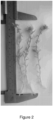
- the physical difference between the in vitro Sphagnum and the resulting in vivo Sphagnum of the seedstock represents a significant and detectable technical alteration imparted by the process. For example, clear differences are shown in Figures 1 and 2 .
- the seedstock is detectably different compared to prior Sphagnum as the second generation Sphagnum has visible differences which lead to faster establishment and growth rate. Moreover, the seedstock is different as it contains a plurality of fragments of such Sphagnum.
- Embodiments related to the method may be applied to the Sphagnum obtainable by the method, and vice versa.
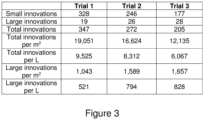
- Suspensions of Sphagnum were prepared in accordance with the present disclosure. Three trials were performed. Trial 1 was in vitro Sphagnum taken immediately from the laboratory after 3 months of growth. Trial 2 was first generation in vivo Sphagnum harvested after 6 months of growth in a heated indoor greenhouse, where in vitro Sphagnum was applied to produce the in vivo Sphagnum. Trial 3 was also first generation in vivo Sphagnum harvested after 6 months of growth in a heated indoor greenhouse, but the Sphagnum was unchopped.
- the strands of Sphagnum of Trial 1 and 2 were chopped into typical lengths of around 5 to 30 mm by a machine. In Trial 3, the strands were not chopped, and had a typical length of around 50-100 mm.
- a fluid solution was then prepared by preparing a nutrient stock solution.
- Hortimix 15-5-15 was used, commercially available from Hortifeeds, UK. The nutrients were then diluted in water to provide 0.75 g of Hortimix 15-5-15 per L of water.
- a thickening agent was then dissolved in the nutrient solution.
- the thickening agent was hydroxyethyl cellulose, in the form of Natrosol TM HX, commercially available from Ashland, USA. 8 mg of hydroxyethyl cellulose was used per L of solution.
- the fragments of Sphagnum of each trial were then mixed with the solution. This suspended the fragments of Sphagnum within the thickened solution. The suspension was then sprayed onto a surface at an application rate of 2 L per m 2 and cultivated in an indoor heated greenhouse for 4 weeks. Irrigation was supplied by applying water to keep damp, and no further nutrients were applied.
- a photograph was taken of each of the three trials.
- a standardising ring was placed on the Sphagnum surface in the photograph for calibrating size.
- an adjustment ratio was calculated for calibration.
- the width and length of the photograph was then measured for each trial, and these values were multiplied together to provide a measured area for each photograph. This area was then multiplied by the adjustment ratio to provide the true area in the photograph.
- the unchopped in vivo Sphagnum shows a significant drop in the number of innovations compared to the chopped in vivo Sphagnum, showing that the capitula inhibits the number of growing points along the stem.
- in vitro Sphagnum Although the number of innovations of in vitro Sphagnum is larger than in vivo Sphagnum, the number of large innovations is much more in the in vivo trial. This shows that the in vivo Sphagnum becomes more robust and produces larger innovations which helps initial establishment. Large innovations are particularly important for initial survival in poor conditions, such as on peatlands.
- the in vivo Sphagnum of Trial 2 shows a significant improvement over the in vitro Sphagnum of Trial 1 and the unchopped Sphagnum of Trial 3.
- Suspensions of Sphagnum were prepared in accordance with the present disclosure. Three trials were performed, with three replicate samples for each trial. Trial 1 was in vitro Sphagnum taken immediately from the laboratory. Trial 2 was first generation in vivo Sphagnum harvested after approximately 6 months of growth in a greenhouse, where in vitro Sphagnum was applied to produce the in vivo Sphagnum. Trial 3 was second generation in vivo Sphagnum, which was first generation in vivo Sphagnum subsequently chopped and grown again in the greenhouse for a further 6 months.
- the strands of Sphagnum of each trial were chopped into typical lengths of around 5 to 30 mm by a machine.
- a fluid solution was then prepared by preparing a nutrient stock solution. Hortimix 15-5-15 was used, commercially available from Hortifeeds, UK. The nutrients were then diluted in water to provide 0.75 g of Hortimix 15-5-15 per L of water.
- a thickening agent was then dissolved in the nutrient solution. The thickening agent was hydroxyethyl cellulose, in the form of Natrosol TM HX, commercially available from Ashland, USA. 8 mg of hydroxyethyl cellulose was used per L of solution.
- the fragments of Sphagnum of each trial were then mixed with the solution. This suspended the fragments of Sphagnum within the thickened solution.
- the suspension was then sprayed onto a growth surface in the form of a tray holding a growing medium, at an application rate of 3 L of suspension per m 2 .
- the tray had a surface area of 2016 cm 2 .
- the Sphagnum was then cultivated outside for 5 weeks. Irrigation was supplied by applying water to keep the Sphagnum damp, and no further nutrients were applied.
- the numerical results are shown in a table in Figure 7 .
- the percentage coverage results are shown in a graph in Figure 8 .
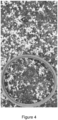
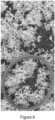
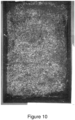
- Figures 9 to 11 show the photographs of the innovation results of a replicate of Trials 1 to 3, respectively.
- the number of small innovations per quarter tray (504 cm 2 ) for the in vitro Sphagnum was 54.3 with an error, based on the variation in the replicate trials, of 2.0.
- the number of large innovations per quarter tray for the in vitro Sphagnum was 0.0 with an error of 0.0.
- the percentage coverage of small and large innovations was 2.7 % with an error of 0.1 %.
- the percentage coverage from innovations increases significantly between the in vitro Sphagnum of Trial 1 and the in vivo Sphagnum of Trial 2 that had undergone the method of the present disclosure. As shown in Figure 10 , not only is the total coverage larger, but there are more larger innovations (capitula) than Figure 9 . This reduces the time for establishment and further improves the survival rate. This confirms that, especially in poor conditions such as outdoor establishment, the in vivo Sphagnum achieves better initial establishment and obtains a higher coverage. This is particularly important for applying Sphagnum for restoration of peatlands, as typically Sphagnum will have to be applied to a harsh environment, so survival in the absence of shelter, heat, and nutrients, for example, is hugely beneficial.
- Trial 1 was in vitro Sphagnum taken immediately from the laboratory after 4 months of growth.
- Trial 2 was first generation in vivo Sphagnum harvested after 6 months of growth in a heated indoor greenhouse, where in vitro Sphagnum was applied to produce the in vivo Sphagnum.
- Trial 3 was second generation in vivo Sphagnum harvested after 6 months of growth in a heated indoor greenhouse, where the first generation in vivo Sphagnum was harvested after 6 months of growth in a heated indoor greenhouse and applied to produce the second generation in vivo Sphagnum.
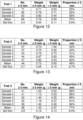
- Samples of 1 g of Sphagnum were harvested. Water content was standardised by compressing the Sphagnum with a force corresponding to 16 g / cm 2 to provide a standardised mass per volume. Three samples were taken for Trial 1, and five samples were taken for Trial 2 and 3.
- the samples were floated in water and all fragments having a length of at least 5 mm were selected for counting. The remaining material was strained in a sieve and removed with tweezers for weighing.
- the weight of the fragments having a length of at least 5 mm was measured, and the number of fragments was counted. The weight of the fragments of less than 5 mm was also measured. The weight was standardised by draining until no more water drained by gravity, and then weighing. The proportion of fragments having a length of at least 5 mm by weight for each sample was then calculated. This process was repeated for each sample in each trial. The mean and standard deviations for each trial were then calculated. The number of fragments having a length of at least 5 mm per L of suspension was then calculated for each trial by multiplying the average number of fragments counted per sample and multiplying by 100 to provide the number of fragments per 100 g (approximately per L of suspension). The results are shown in Figures 12 to 14 .
- Trial 1 was in vitro Sphagnum taken immediately from the laboratory after 4 months of growth.
- Trial 2 was first generation in vivo Sphagnum harvested after 6 months of growth in a heated indoor greenhouse, where in vitro Sphagnum was applied to produce the in vivo Sphagnum.
- Trial 3 was second generation in vivo Sphagnum harvested after 6 months of growth in a heated indoor greenhouse, where the first generation in vivo Sphagnum was harvested after 6 months of growth in a heated indoor greenhouse and applied to produce the second generation in vivo Sphagnum.
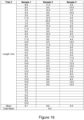
- Samples of approximately 1 g of Sphagnum were harvested. Water content was standardised by compressing the Sphagnum with a force corresponding to 16 g / cm 2 to provide a standardised mass per volume. Three samples were taken for each of the trials.
- the samples were floated in water and all fragments having a length of at least 5 mm were selected for counting.
- the lengths of the fragments of at least 5 mm in length in each sample were measured by using a fine scale steel ruler. The mean length of the fragments for each sample was then calculated. The mean length of the fragments for each trial was then calculated. The results are shown in Figures 15 to 17 .
- Trial 1 was in vitro Sphagnum taken immediately from the laboratory after 4 months of growth.
- Trial 2 was first generation in vivo Sphagnum harvested after 6 months of growth in a heated indoor greenhouse, where in vitro Sphagnum was applied to produce the in vivo Sphagnum.
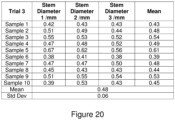
- Trial 3 was second generation in vivo Sphagnum harvested after 6 months of growth in a heated indoor greenhouse, where the first generation in vivo Sphagnum was harvested after 6 months of growth in a heated indoor greenhouse and applied to produce the second generation in vivo Sphagnum. Samples of approximately 100 g of Sphagnum were harvested. Ten sample strands were selected at random from these for each of the trials.
- the diameter of the stems of the strands in each sample were measured.
- the stem diameter is measured as the thickness of the stem, preferably perpendicular to the length of the stem.
- a microscope was used to measure the diameter of the stem in pixels, and this was converted into a diameter is mm.
- the microscope used has a standard magnification of 449 pixels per mm. In other cases, such as for larger diameters, this can be measured by using a length measuring tool such as callipers. Three measurements were taken over the length of each strand. The mean diameter for each sample was then calculated by summing the measurements and dividing by the number of measurements (three).
- the mean diameter of the stems for each trial was then calculated.
- the mean can thus be calculated by summing the average diameter of each sample and dividing the total sum by the number of samples (ten). The results are shown in Figures 18 to 20 .
- Trial 1 was in vitro Sphagnum taken immediately from the laboratory after 4 months of growth.
- Trial 2 was first generation in vivo Sphagnum harvested after 6 months of growth in a heated indoor greenhouse, where in vitro Sphagnum was applied to produce the in vivo Sphagnum.
- Trial 3 was second generation in vivo Sphagnum harvested after 6 months of growth in a heated indoor greenhouse, where the first generation in vivo Sphagnum was harvested after 6 months of growth in a heated indoor greenhouse and applied to produce the second generation in vivo Sphagnum. Three samples were taken for each of the trials.
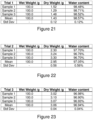
- the wet weight of the sample of fragments was measured.
- the water content was standardised by compressing the Sphagnum to a standard mass per volume by applying a force of 16 g / cm 2 and allowing drainage.
- the dry weight of the sample of fragments was then measured.
- the dry weight is defined as the weight of the Sphagnum when no more water can be removed. This was performed by drying the Sphagnum at 25 °C in a humidity of less than 50% until no further weight loss was recorded. In other examples, the Sphagnum can be heated at 110 °C for 24 hours.
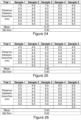
- Each of the three trials involved samples of first generation in vivo Sphagnum harvested after 6 months of growth in a heated indoor greenhouse, where in vitro Sphagnum was applied to produce the in vivo Sphagnum. Each of the trials used Sphagnum palustre. Five sample stems were taken for each trial.
- the distance between branches on each stem was measured using callipers to the nearest 0.5 mm. At least six measurements were taken on each stem. The measurements were started approximately 1 cm below the capitula. The results are shown in Figures 24 to 26 .
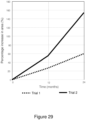
- Trials were conducted at Cors Fochno, Borth, Wales.
- Trial 1 was wild Sphagnum harvested and translocated to the trial site.
- Trial 2 was Sphagnum grown in accordance with the present disclosure. In particular, Trial 2 was Sphagnum grown from second generation in vivo Sphagnum.
- Each trial contained three species: S. papillosum (left of Figures 28 and 29 ), S. capillifolium (middle), and S. palustre (right), and each species had three replicates.
- the trials were on a raised peat bog and left outdoors for 5 months. After 5 months of growth photographs were taken and the percentage growth by increase in area was calculated.
- Trials were conducted at Kinder Scout, Derbyshire Peak District, England.
- Trial 1 was wild Sphagnum harvested and translocated to the trial site.
- Trial 2 was Sphagnum grown in accordance with the present disclosure. In particular, Trial 2 was Sphagnum grown from second generation in vivo Sphagnum. The trials were left outdoors for 24 months. After intervals of 12 months of growth, the percentage increase in area was measured for each trial.
- Suspensions of Sphagnum were prepared in accordance with the present disclosure.
- a control was tested, which contained the suspension without the Sphagnum.
- Trial 1 and Trial 2 were the same suspension, with approximately 100g per L of Sphagnum in the suspension.
- the suspensions comprised a fluid solution of a thickening agent of hydroxyethyl cellulose dissolved in water.
- the thickening agent was Natrosol TM HHX present at 7.25 g per L.
- Trial 2 was the same suspension as Trial 1, but obtained after several hours after initial mixing to test any temperature fluctuation effects.
- a tray was used to observe the speed of horizontal flow of the suspensions.
- the tray had an internal length of 34 cm and a width of 27 cm.
- the tray was divided into a holding region and a flowing region by a divider in the form of a polystyrene pad extending across a width of the tray.
- the holding region was defined as the region between the divider and the end of the tray.
- the holding region had an area of approximately 192 cm 2 .
- a finish line was marked on the tray at a distance of 15 cm from the holding region.
- the tray was placed on a level surface, which was ensured by use of a spirit level.
- 500 ml of the suspension was placed into the holding region of the tray.
- the temperature of the suspension was measured to be 14 °C across each trial.
- the divider retained the suspension in the holding region.
- the divider was then raised to allow the suspension to flow freely across the tray.
- a timer was immediately started when the divider was raised.
- the timer was then stopped when the leading edge flow line of the suspension had entirely crossed the finish line. The time elapsed was then recorded.
- the suspension was then removed from the tray, and the tray was replaced back onto the level surface and the divider lowered into position. This process was repeated three times with different samples of the same suspension to provide four sample times for each suspension. An average of the four samples was then calculated.
- the time for the suspension to flow out of the holding region and across the finish line provides an indication of the viscous properties of the suspension. The more viscous the suspension, the longer it will take for the suspension to cross the finish line.
- Control provided an average time of 15.5 seconds.
- Trial 1 provided an average time of 30.5 seconds. This shows the Sphagnum significantly increases the viscosity of the suspension. This also provides a measure of the desired viscosity of a preferred embodiment of the present disclosure.
- Trial 2 provided an average time of 29.2 seconds, consistent with Trial 1.
- Trial 1 and Trial 2 were suspensions comprising a fluid solution of a thickening agent of hydroxyethyl cellulose dissolved in water.
- Trial 1 contained a thickening agent of Natrosol TM HHX present at 7.25 g per L.
- Trial 2 was the same suspension as Trial 1, but instead contained a thickening agent of Natrosol TM HX present at 9 g per L.
- Each trial was tested at different room temperatures including 10 °C, 15 °C, and 20 °C.
- Trial 1 provided a time of 43.8 seconds at 10 °C, 39.1 seconds at 15 °C, and 32.5 °C at 20 °C.
- Trial 2 provided a time of 46.6 seconds at 10 °C, 35.6 seconds at 15 °C, and 38.0 seconds at 20 °C. This shows that the time between the different compositions (i.e. between different thickening agents) can be similar for different temperatures. In other words, similar viscosity properties can be achieved through appropriate selection of concentration of thickening agent.
Landscapes
- Life Sciences & Earth Sciences (AREA)
- Botany (AREA)
- Environmental Sciences (AREA)
- Health & Medical Sciences (AREA)
- Natural Medicines & Medicinal Plants (AREA)
- Developmental Biology & Embryology (AREA)
- Pretreatment Of Seeds And Plants (AREA)
- Cultivation Of Plants (AREA)
- Harvesting Machines For Specific Crops (AREA)
Claims (14)
- Verfahren zur Bereitstellung eines Saatguts von Sphagnum, umfassend:Bereitstellen von In-vitro-Sphagnum;Aufbringen des Sphagnums auf eine Wachstumsoberfläche;Kultivieren des Sphagnums in vivo auf der Wachstumsoberfläche;Ernten des kultivierten Sphagnums von der Wachstumsoberfläche;Kleinschneiden des geernteten Sphagnums, um eine Vielzahl von Fragmenten von In-vivo-Sphagnum bereitzustellen; undMischen der Vielzahl von Fragmenten von Sphagnum mit einer ersten Fluidlösung, um ein Saatgut von Sphagnum zur Kultivierung bereitzustellen, wobei das Saatgut eine Suspension der Vielzahl von Fragmenten des In-vivo-Sphagnums in der ersten Fluidlösung umfasst.
- Verfahren nach Anspruch 1, wobei das Bereitstellen von In-vitro-Sphagnum ein Kleinschneiden von In-vitro-Sphagnum zu einer Vielzahl von Fragmenten von In-vitro-Sphagnum umfasst.
- Verfahren nach Anspruch 2, wobei das Bereitstellen von In-vitro-Sphagnum ein Mischen der Vielzahl von Fragmenten von In-vitro-Sphagnum mit einer zweiten Fluidlösung, um eine Suspension von In-vitro-Sphagnum bereitzustellen, umfasst.
- Verfahren nach einem vorhergehenden Anspruch, wobei die erste Fluidlösung Wasser und ein in dem Wasser gelöstes Verdickungsmittel umfasst, optional wobei das Verdickungsmittel ein Verdickungsmittel auf Cellulosebasis oder Stärkebasis ist.
- Verfahren nach Anspruch 4, wobei das Verdickungsmittel Hydroxyethylcellulose umfasst, optional wobei die erste Fluidlösung zwischen 5 g und 10 g Hydroxyethylcellulose pro L Wasser umfasst.
- Verfahren nach einem vorhergehenden Anspruch, weiterhin umfassend ein Aufbringen des Saatguts von Sphagnum auf eine Wachstumsoberfläche.
- Verfahren nach Anspruch 6, weiterhin umfassend ein Kultivieren des Sphagnums des Saatguts in vivo auf der Wachstumsoberfläche.
- Verfahren nach Anspruch 7, weiterhin umfassend ein Ernten des Sphagnums des Saatguts von der Wachstumsoberfläche.
- Verfahren nach Anspruch 8, weiterhin umfassend ein Bereitstellen eines Wachstumsmediums, umfassend das geerntete Sphagnum des Saatguts, umfassen ein Trocknen des geernteten Sphagnums des Saatguts.
- Verfahren nach Anspruch 8, weiterhin umfassend ein Kleinschneiden des geernteten Sphagnums von dem Saatgut, um ein zweites Saatgut von Sphagnum zur Kultivierung bereitzustellen, wobei das zweite Saatgut eine Vielzahl von Fragmenten von In-vivo-Sphagnum der zweiten Generation umfasst.
- Verfahren nach Anspruch 10, wobei das Bereitstellen des zweiten Saatguts von Sphagnum ein Mischen der Vielzahl von Fragmenten von In-vivo-Sphagnum der zweiten Generation mit einer dritten Fluidlösung, um eine Suspension von In-vivo-Sphagnum bereitzustellen, umfasst.
- Verfahren nach Anspruch 11, wobei die dritte Fluidlösung Wasser und ein in dem Wasser gelöstes Verdickungsmittel umfasst, optional wobei das Verdickungsmittel ein Verdickungsmittel auf Cellulosebasis oder Stärkebasis ist.
- Verfahren nach Anspruch 12, wobei das Verdickungsmittel Hydroxyethylcellulose umfasst, optional wobei die dritte Fluidlösung zwischen 5 g und 10 g Hydroxyethylcellulose pro L Wasser umfasst.
- Saatgut von Sphagnum, das durch das Verfahren nach einem der Ansprüche 1 bis 5 oder einem der Ansprüche 10 bis 13 erhalten werden kann.
Priority Applications (1)
| Application Number | Priority Date | Filing Date | Title |
|---|---|---|---|
| EP25153292.5A EP4520167A3 (de) | 2020-05-12 | 2021-05-12 | Verfahren zur bereitstellung von samen von sphagnum |
Applications Claiming Priority (3)
| Application Number | Priority Date | Filing Date | Title |
|---|---|---|---|
| GB2006992.8A GB2594955B (en) | 2020-05-12 | 2020-05-12 | Seedstocks of Sphagnum |
| GB2006991.0A GB2594954B (en) | 2020-05-12 | 2020-05-12 | Suspensions of sphagnum |
| PCT/GB2021/051143 WO2021229225A1 (en) | 2020-05-12 | 2021-05-12 | Method of providing seedstocks of sphagnum |
Related Child Applications (2)
| Application Number | Title | Priority Date | Filing Date |
|---|---|---|---|
| EP25153292.5A Division EP4520167A3 (de) | 2020-05-12 | 2021-05-12 | Verfahren zur bereitstellung von samen von sphagnum |
| EP25153292.5A Division-Into EP4520167A3 (de) | 2020-05-12 | 2021-05-12 | Verfahren zur bereitstellung von samen von sphagnum |
Publications (3)
| Publication Number | Publication Date |
|---|---|
| EP4149238A1 EP4149238A1 (de) | 2023-03-22 |
| EP4149238B1 true EP4149238B1 (de) | 2025-04-23 |
| EP4149238C0 EP4149238C0 (de) | 2025-04-23 |
Family
ID=76059918
Family Applications (2)
| Application Number | Title | Priority Date | Filing Date |
|---|---|---|---|
| EP21727200.4A Active EP4149238B1 (de) | 2020-05-12 | 2021-05-12 | Verfahren zur bereitstellung von saatgut von sphagnum |
| EP25153292.5A Pending EP4520167A3 (de) | 2020-05-12 | 2021-05-12 | Verfahren zur bereitstellung von samen von sphagnum |
Family Applications After (1)
| Application Number | Title | Priority Date | Filing Date |
|---|---|---|---|
| EP25153292.5A Pending EP4520167A3 (de) | 2020-05-12 | 2021-05-12 | Verfahren zur bereitstellung von samen von sphagnum |
Country Status (6)
| Country | Link |
|---|---|
| US (1) | US20230180707A1 (de) |
| EP (2) | EP4149238B1 (de) |
| CA (1) | CA3175763A1 (de) |
| ES (1) | ES3026739T3 (de) |
| PL (1) | PL4149238T3 (de) |
| WO (1) | WO2021229225A1 (de) |
Families Citing this family (2)
| Publication number | Priority date | Publication date | Assignee | Title |
|---|---|---|---|---|
| IL321729A (en) * | 2023-01-04 | 2025-08-01 | Corbet Scient Llc | Compounds for improving irrigation efficiency and methods of using them |
| GB2634937A (en) * | 2023-10-26 | 2025-04-30 | Micropropagation Services E M Ltd | Agricultural spreading machine |
Citations (1)
| Publication number | Priority date | Publication date | Assignee | Title |
|---|---|---|---|---|
| GB2478353A (en) * | 2010-03-05 | 2011-09-07 | Annabel Jane Barker | A method for the reseeding and revegetation of an area of an essentially dry peat bog or similar |
Family Cites Families (5)
| Publication number | Priority date | Publication date | Assignee | Title |
|---|---|---|---|---|
| JP2007129912A (ja) * | 2005-11-08 | 2007-05-31 | Mitsuharu Shimura | ミズゴケ栽培ユニット |
| CN103609443B (zh) * | 2013-11-15 | 2015-08-19 | 华东师范大学 | 一种泥炭藓原丝体的获得及培养方法 |
| CN107896986A (zh) * | 2017-09-21 | 2018-04-13 | 华东师范大学 | 一种高质量泥炭藓快速繁殖方法 |
| MX2020007862A (es) * | 2018-01-25 | 2021-01-08 | Jiffy Int As | Aditivos para mejorar la union en medio de crecimiento. |
| GB2584128B (en) * | 2019-05-22 | 2022-01-26 | Micropropagation Services E M Ltd | Methods for cultivating Sphagnum |
-
2021
- 2021-05-12 WO PCT/GB2021/051143 patent/WO2021229225A1/en not_active Ceased
- 2021-05-12 US US17/921,478 patent/US20230180707A1/en active Pending
- 2021-05-12 PL PL21727200.4T patent/PL4149238T3/pl unknown
- 2021-05-12 EP EP21727200.4A patent/EP4149238B1/de active Active
- 2021-05-12 CA CA3175763A patent/CA3175763A1/en active Pending
- 2021-05-12 ES ES21727200T patent/ES3026739T3/es active Active
- 2021-05-12 EP EP25153292.5A patent/EP4520167A3/de active Pending
Patent Citations (1)
| Publication number | Priority date | Publication date | Assignee | Title |
|---|---|---|---|---|
| GB2478353A (en) * | 2010-03-05 | 2011-09-07 | Annabel Jane Barker | A method for the reseeding and revegetation of an area of an essentially dry peat bog or similar |
Non-Patent Citations (1)
| Title |
|---|
| CAPORN S. ET AL: "Sphagnum restoration on degraded blanket and raised bogs in the UK using micropropagated source material : a review of progress", MIRES AND PEAT, 11 May 2018 (2018-05-11), pages 1 - 17, XP055893858, Retrieved from the Internet <URL:http://mires-and-peat.net/media/map20/map_20_09.pdf> [retrieved on 20220221], DOI: 10.19189/MaP.2017.OMB.306 * |
Also Published As
| Publication number | Publication date |
|---|---|
| ES3026739T3 (en) | 2025-06-12 |
| EP4520167A3 (de) | 2025-04-09 |
| WO2021229225A1 (en) | 2021-11-18 |
| PL4149238T3 (pl) | 2025-08-04 |
| EP4520167A2 (de) | 2025-03-12 |
| EP4149238A1 (de) | 2023-03-22 |
| EP4149238C0 (de) | 2025-04-23 |
| CA3175763A1 (en) | 2021-11-18 |
| US20230180707A1 (en) | 2023-06-15 |
Similar Documents
| Publication | Publication Date | Title |
|---|---|---|
| RU2636168C2 (ru) | Композиция для стимулирующей обмазки корней растений | |
| CN104429858B (zh) | 一种快速培育香蕉假植苗的栽培基质及其制备方法 | |
| EP4149238B1 (de) | Verfahren zur bereitstellung von saatgut von sphagnum | |
| CN109618870B (zh) | 一种花卉或树木移栽用培养土及其制备方法 | |
| CN112021139B (zh) | 一种快速人工栽培冷杉属植物幼苗的方法 | |
| CN105612996B (zh) | 一种香榧扦插繁殖方法 | |
| GB2594955A (en) | Seedstocks of Sphagnum | |
| CN115500252B (zh) | 一种剑叶芦竹快速生根的水培方法 | |
| GB2594954A (en) | Suspensions of sphagnum | |
| JP4475666B2 (ja) | ホルミジウムの単藻大量培養方法、このホルミジウムを含有する液体肥料、及びその施肥方法 | |
| CN118614351B (zh) | 一种大花蔓龙胆的栽培方法 | |
| CN103621217B (zh) | 一种大头茶种子萌发及育苗的方法 | |
| CN108848757A (zh) | 一种提高荆条种子发芽率的方法 | |
| JP3993295B2 (ja) | 土壌浸透剤 | |
| CN106718292A (zh) | 用于银杏树的栽植基质及银杏树栽植系统 | |
| GB2604268A (en) | Suspensions of Sphagnum | |
| JP5994003B1 (ja) | カルボキシメチルセルロースを用いたプランター用保水性粒状培養土 | |
| CN117084114A (zh) | 一种箬竹鞭段育苗的方法 | |
| Islam et al. | Feasibility of summer corn (Zea mays L.) production in drought affected areas of northern China using water-saving superabsorbent polymer | |
| CN111374026A (zh) | 一种育苗专用基质及其制备方法 | |
| CN108260421A (zh) | 一种促进银杏扦插生根的方法 | |
| CN106804149B (zh) | 一种促进黑果小檗种子快速发芽的方法 | |
| CN113748783B (zh) | 一种促进二色波罗蜜种子快速萌发成苗的方法 | |
| Faraci | Sodium Alginate Hydrogel Germinator Design, Synthesis, and Testing | |
| JPH10248376A (ja) | セル育苗用培土 |
Legal Events
| Date | Code | Title | Description |
|---|---|---|---|
| STAA | Information on the status of an ep patent application or granted ep patent |
Free format text: STATUS: UNKNOWN |
|
| STAA | Information on the status of an ep patent application or granted ep patent |
Free format text: STATUS: THE INTERNATIONAL PUBLICATION HAS BEEN MADE |
|
| PUAI | Public reference made under article 153(3) epc to a published international application that has entered the european phase |
Free format text: ORIGINAL CODE: 0009012 |
|
| STAA | Information on the status of an ep patent application or granted ep patent |
Free format text: STATUS: REQUEST FOR EXAMINATION WAS MADE |
|
| 17P | Request for examination filed |
Effective date: 20221108 |
|
| AK | Designated contracting states |
Kind code of ref document: A1 Designated state(s): AL AT BE BG CH CY CZ DE DK EE ES FI FR GB GR HR HU IE IS IT LI LT LU LV MC MK MT NL NO PL PT RO RS SE SI SK SM TR |
|
| DAV | Request for validation of the european patent (deleted) | ||
| DAX | Request for extension of the european patent (deleted) | ||
| STAA | Information on the status of an ep patent application or granted ep patent |
Free format text: STATUS: EXAMINATION IS IN PROGRESS |
|
| 17Q | First examination report despatched |
Effective date: 20230831 |
|
| GRAP | Despatch of communication of intention to grant a patent |
Free format text: ORIGINAL CODE: EPIDOSNIGR1 |
|
| STAA | Information on the status of an ep patent application or granted ep patent |
Free format text: STATUS: GRANT OF PATENT IS INTENDED |
|
| INTG | Intention to grant announced |
Effective date: 20240624 |
|
| GRAJ | Information related to disapproval of communication of intention to grant by the applicant or resumption of examination proceedings by the epo deleted |
Free format text: ORIGINAL CODE: EPIDOSDIGR1 |
|
| STAA | Information on the status of an ep patent application or granted ep patent |
Free format text: STATUS: EXAMINATION IS IN PROGRESS |
|
| GRAP | Despatch of communication of intention to grant a patent |
Free format text: ORIGINAL CODE: EPIDOSNIGR1 |
|
| STAA | Information on the status of an ep patent application or granted ep patent |
Free format text: STATUS: GRANT OF PATENT IS INTENDED |
|
| GRAJ | Information related to disapproval of communication of intention to grant by the applicant or resumption of examination proceedings by the epo deleted |
Free format text: ORIGINAL CODE: EPIDOSDIGR1 |
|
| STAA | Information on the status of an ep patent application or granted ep patent |
Free format text: STATUS: EXAMINATION IS IN PROGRESS |
|
| GRAP | Despatch of communication of intention to grant a patent |
Free format text: ORIGINAL CODE: EPIDOSNIGR1 |
|
| STAA | Information on the status of an ep patent application or granted ep patent |
Free format text: STATUS: GRANT OF PATENT IS INTENDED |
|
| INTC | Intention to grant announced (deleted) | ||
| INTG | Intention to grant announced |
Effective date: 20241107 |
|
| INTC | Intention to grant announced (deleted) | ||
| INTG | Intention to grant announced |
Effective date: 20241120 |
|
| GRAS | Grant fee paid |
Free format text: ORIGINAL CODE: EPIDOSNIGR3 |
|
| GRAA | (expected) grant |
Free format text: ORIGINAL CODE: 0009210 |
|
| STAA | Information on the status of an ep patent application or granted ep patent |
Free format text: STATUS: THE PATENT HAS BEEN GRANTED |
|
| AK | Designated contracting states |
Kind code of ref document: B1 Designated state(s): AL AT BE BG CH CY CZ DE DK EE ES FI FR GB GR HR HU IE IS IT LI LT LU LV MC MK MT NL NO PL PT RO RS SE SI SK SM TR |
|
| REG | Reference to a national code |
Ref country code: GB Ref legal event code: FG4D |
|
| REG | Reference to a national code |
Ref country code: CH Ref legal event code: EP |
|
| REG | Reference to a national code |
Ref country code: DE Ref legal event code: R096 Ref document number: 602021029603 Country of ref document: DE |
|
| REG | Reference to a national code |
Ref country code: IE Ref legal event code: FG4D |
|
| REG | Reference to a national code |
Ref country code: ES Ref legal event code: FG2A Ref document number: 3026739 Country of ref document: ES Kind code of ref document: T3 Effective date: 20250612 |
|
| U01 | Request for unitary effect filed |
Effective date: 20250519 |
|
| U07 | Unitary effect registered |
Designated state(s): AT BE BG DE DK EE FI FR IT LT LU LV MT NL PT RO SE SI Effective date: 20250523 |
|
| PGFP | Annual fee paid to national office [announced via postgrant information from national office to epo] |
Ref country code: IE Payment date: 20250605 Year of fee payment: 5 |
|
| U20 | Renewal fee for the european patent with unitary effect paid |
Year of fee payment: 5 Effective date: 20250627 |
|
| PGFP | Annual fee paid to national office [announced via postgrant information from national office to epo] |
Ref country code: ES Payment date: 20250721 Year of fee payment: 5 |
|
| PG25 | Lapsed in a contracting state [announced via postgrant information from national office to epo] |
Ref country code: NO Free format text: LAPSE BECAUSE OF FAILURE TO SUBMIT A TRANSLATION OF THE DESCRIPTION OR TO PAY THE FEE WITHIN THE PRESCRIBED TIME-LIMIT Effective date: 20250723 Ref country code: GR Free format text: LAPSE BECAUSE OF FAILURE TO SUBMIT A TRANSLATION OF THE DESCRIPTION OR TO PAY THE FEE WITHIN THE PRESCRIBED TIME-LIMIT Effective date: 20250724 |
|
| PGFP | Annual fee paid to national office [announced via postgrant information from national office to epo] |
Ref country code: PL Payment date: 20250528 Year of fee payment: 5 |
|
| PGFP | Annual fee paid to national office [announced via postgrant information from national office to epo] |
Ref country code: GB Payment date: 20250728 Year of fee payment: 5 |
|
| PG25 | Lapsed in a contracting state [announced via postgrant information from national office to epo] |
Ref country code: HR Free format text: LAPSE BECAUSE OF FAILURE TO SUBMIT A TRANSLATION OF THE DESCRIPTION OR TO PAY THE FEE WITHIN THE PRESCRIBED TIME-LIMIT Effective date: 20250423 |
|
| PG25 | Lapsed in a contracting state [announced via postgrant information from national office to epo] |
Ref country code: RS Free format text: LAPSE BECAUSE OF FAILURE TO SUBMIT A TRANSLATION OF THE DESCRIPTION OR TO PAY THE FEE WITHIN THE PRESCRIBED TIME-LIMIT Effective date: 20250723 |
|
| PG25 | Lapsed in a contracting state [announced via postgrant information from national office to epo] |
Ref country code: IS Free format text: LAPSE BECAUSE OF FAILURE TO SUBMIT A TRANSLATION OF THE DESCRIPTION OR TO PAY THE FEE WITHIN THE PRESCRIBED TIME-LIMIT Effective date: 20250823 |