EP4149200B1 - Communication apparatus, control method of communication apparatus, computer program, and storage medium - Google Patents
Communication apparatus, control method of communication apparatus, computer program, and storage medium Download PDFInfo
- Publication number
- EP4149200B1 EP4149200B1 EP22194308.7A EP22194308A EP4149200B1 EP 4149200 B1 EP4149200 B1 EP 4149200B1 EP 22194308 A EP22194308 A EP 22194308A EP 4149200 B1 EP4149200 B1 EP 4149200B1
- Authority
- EP
- European Patent Office
- Prior art keywords
- communication
- search
- processing
- communication apparatus
- channel
- Prior art date
- Legal status (The legal status is an assumption and is not a legal conclusion. Google has not performed a legal analysis and makes no representation as to the accuracy of the status listed.)
- Active
Links
Images








Classifications
-
- H—ELECTRICITY
- H04—ELECTRIC COMMUNICATION TECHNIQUE
- H04W—WIRELESS COMMUNICATION NETWORKS
- H04W12/00—Security arrangements; Authentication; Protecting privacy or anonymity
- H04W12/04—Key management, e.g. using generic bootstrapping architecture [GBA]
- H04W12/041—Key generation or derivation
-
- H—ELECTRICITY
- H04—ELECTRIC COMMUNICATION TECHNIQUE
- H04W—WIRELESS COMMUNICATION NETWORKS
- H04W76/00—Connection management
- H04W76/10—Connection setup
-
- H—ELECTRICITY
- H04—ELECTRIC COMMUNICATION TECHNIQUE
- H04L—TRANSMISSION OF DIGITAL INFORMATION, e.g. TELEGRAPHIC COMMUNICATION
- H04L43/00—Arrangements for monitoring or testing data switching networks
- H04L43/12—Network monitoring probes
-
- H—ELECTRICITY
- H04—ELECTRIC COMMUNICATION TECHNIQUE
- H04W—WIRELESS COMMUNICATION NETWORKS
- H04W12/00—Security arrangements; Authentication; Protecting privacy or anonymity
- H04W12/04—Key management, e.g. using generic bootstrapping architecture [GBA]
- H04W12/043—Key management, e.g. using generic bootstrapping architecture [GBA] using a trusted network node as an anchor
- H04W12/0431—Key distribution or pre-distribution; Key agreement
-
- H—ELECTRICITY
- H04—ELECTRIC COMMUNICATION TECHNIQUE
- H04W—WIRELESS COMMUNICATION NETWORKS
- H04W12/00—Security arrangements; Authentication; Protecting privacy or anonymity
- H04W12/04—Key management, e.g. using generic bootstrapping architecture [GBA]
- H04W12/043—Key management, e.g. using generic bootstrapping architecture [GBA] using a trusted network node as an anchor
- H04W12/0433—Key management protocols
-
- H—ELECTRICITY
- H04—ELECTRIC COMMUNICATION TECHNIQUE
- H04W—WIRELESS COMMUNICATION NETWORKS
- H04W12/00—Security arrangements; Authentication; Protecting privacy or anonymity
- H04W12/06—Authentication
- H04W12/069—Authentication using certificates or pre-shared keys
-
- H—ELECTRICITY
- H04—ELECTRIC COMMUNICATION TECHNIQUE
- H04W—WIRELESS COMMUNICATION NETWORKS
- H04W24/00—Supervisory, monitoring or testing arrangements
- H04W24/10—Scheduling measurement reports ; Arrangements for measurement reports
-
- H—ELECTRICITY
- H04—ELECTRIC COMMUNICATION TECHNIQUE
- H04W—WIRELESS COMMUNICATION NETWORKS
- H04W84/00—Network topologies
- H04W84/18—Self-organising networks, e.g. ad-hoc networks or sensor networks
- H04W84/20—Leader-follower arrangements
-
- H—ELECTRICITY
- H04—ELECTRIC COMMUNICATION TECHNIQUE
- H04W—WIRELESS COMMUNICATION NETWORKS
- H04W12/00—Security arrangements; Authentication; Protecting privacy or anonymity
- H04W12/04—Key management, e.g. using generic bootstrapping architecture [GBA]
-
- H—ELECTRICITY
- H04—ELECTRIC COMMUNICATION TECHNIQUE
- H04W—WIRELESS COMMUNICATION NETWORKS
- H04W12/00—Security arrangements; Authentication; Protecting privacy or anonymity
- H04W12/06—Authentication
-
- H—ELECTRICITY
- H04—ELECTRIC COMMUNICATION TECHNIQUE
- H04W—WIRELESS COMMUNICATION NETWORKS
- H04W28/00—Network traffic management; Network resource management
- H04W28/16—Central resource management; Negotiation of resources or communication parameters, e.g. negotiating bandwidth or QoS [Quality of Service]
- H04W28/18—Negotiating wireless communication parameters
-
- H—ELECTRICITY
- H04—ELECTRIC COMMUNICATION TECHNIQUE
- H04W—WIRELESS COMMUNICATION NETWORKS
- H04W68/00—User notification, e.g. alerting and paging, for incoming communication, change of service or the like
-
- H—ELECTRICITY
- H04—ELECTRIC COMMUNICATION TECHNIQUE
- H04W—WIRELESS COMMUNICATION NETWORKS
- H04W72/00—Local resource management
-
- H—ELECTRICITY
- H04—ELECTRIC COMMUNICATION TECHNIQUE
- H04W—WIRELESS COMMUNICATION NETWORKS
- H04W8/00—Network data management
- H04W8/005—Discovery of network devices, e.g. terminals
-
- H—ELECTRICITY
- H04—ELECTRIC COMMUNICATION TECHNIQUE
- H04W—WIRELESS COMMUNICATION NETWORKS
- H04W84/00—Network topologies
- H04W84/02—Hierarchically pre-organised networks, e.g. paging networks, cellular networks, WLAN [Wireless Local Area Network] or WLL [Wireless Local Loop]
- H04W84/10—Small scale networks; Flat hierarchical networks
- H04W84/12—WLAN [Wireless Local Area Networks]
-
- H—ELECTRICITY
- H04—ELECTRIC COMMUNICATION TECHNIQUE
- H04W—WIRELESS COMMUNICATION NETWORKS
- H04W84/00—Network topologies
- H04W84/18—Self-organising networks, e.g. ad-hoc networks or sensor networks
Definitions
- the present invention relates to a communication apparatus, method and computer program.
- setting items include communication parameters required to make wireless communications such as an SSID as a network identifier, encryption method, encryption key, authentication method, and authentication key, and it is very troublesome for the user to manually input these parameters.
- Wi-Fi Protected Access Enhanced Security Implementation Based on IEEE P802.11i standard discloses "Wi-Fi Protected Access” (to be abbreviated as WPA hereinafter) as the industry standard specification of an encryption method, encryption key, authentication method, authentication key, and the like in wireless communication connection processing.
- WPA Wi-Fi Protected Access
- a communication apparatus connectable to a communication network, comprising:
- a method of controlling a communication apparatus connectable to a communication network comprising: a notification step of notifying the presence of the communication apparatus using a communication channel assigned to the communication apparatus among communication channels available for a wireless communication, wherein, in a first period during which the notification step notifies the presence of the communication apparatus, the communication apparatus is capable of receiving a search signal from another communication apparatus and of sending to said another communication apparatus a search response signal in response to said search signal; a search step of searching for another communication apparatus by transmitting a search signal using a search channel, wherein the search channel is one of the communication channels available for a wireless communication; a control step of controlling such that the notification step is performed during the first period, and the search step is performed after the first period, wherein the control step controls the search step so as to set the search channel to a second communication channel and search for another communication apparatus using the second communication channel after executing a search of another communication apparatus using a first communication channel, and wherein the search channel used for a search in the
- a method of controlling a communication apparatus connectable to a communication network comprising:
- a communication apparatus will be described in detail hereinafter with reference to the drawings.
- An example using a wireless LAN system complaint with the IEEE802.11 series will be described hereinafter, but a communication mode is not always limited to a wireless LAN compliant with the IEEE802.11.
- Fig. 1 is a block diagram showing an example of the arrangement of a communication apparatus (providing apparatus or receiving apparatus) which can be connected to a communication network, according to an embodiment of the present invention.
- Reference numeral 101 denotes a whole apparatus.
- Reference numeral 102 denotes a control unit which controls the whole apparatus by executing a computer program stored in a storage unit 103.
- the control unit 102 also executes communication parameter setting control with another apparatus.
- Reference numeral 103 denotes a storage unit which stores the computer program to be executed by the control unit 102, and various kinds of information such as communication parameters.
- Various operations to be described later are implemented when the control unit 102 executes the computer program stored in the storage unit 103.
- Reference numeral 104 denotes a wireless unit used to make wireless communications.
- Reference numeral 105 denotes a display unit which makes various displays, and has a function that can output visually perceivable information like an LCD or LED or can output audible information like a loudspeaker.
- Reference numeral 106 denotes a setting button which gives a trigger to start communication parameter setting processing.
- the control unit 102 executes processing to be described later when it detects a user's operation of the setting button 106.
- Reference numeral 107 denotes an antenna control unit; and 108, an antenna.
- Reference numeral 109 denotes an input unit which allows the user to make various inputs.
- Fig. 2 is a block diagram showing an example of the arrangement of software functional blocks to be executed by respective apparatuses to be described later in a communication parameter setting operation to be described later.
- Reference numeral 201 denotes a whole apparatus.
- Reference numeral 202 denotes a communication parameter auto-setting function block.
- the communication parameter auto-setting function block 202 automatically sets communication parameters required to make wireless communications such as an SSID as a network identifier, encryption method, encryption key, authentication method, and authentication key.
- Reference numeral 203 denotes a packet receiving unit which receives packets associated with various communications.
- the packet receiving unit 203 receives a beacon (notification signal).
- Reference numeral 204 denotes a packet transmitting unit which transmits packets associated with various communications.
- the packet transmitting unit 204 transmits a beacon. Note that the beacon is added with various kinds of information (self-information) of a transmission source apparatus.
- Reference numeral 205 denotes a search signal transmitting unit which controls transmission of an apparatus search signal such as a probe request.
- the probe request can also be expressed as a network search signal used to search for a desired network.
- the search signal transmitting unit 205 transmits the probe request. Also, the search signal transmitting unit 205 transmits a probe response as a reply signal to the received probe request.
- Reference numeral 206 denotes a search signal receiving unit which controls reception of an apparatus search signal such as a probe request from another apparatus.
- the search signal receiving unit 206 receives the probe request. Also, the search signal receiving unit 206 receives a probe response. Note that the apparatus search signal and its reply signal are added with various kinds of information (self-information) of a transmission source apparatus.
- Reference numeral 207 denotes a network control unit which controls network connections.
- the network control unit 207 executes, for example, connection processing to a wireless LAN ad hoc network.
- Apparatus A transmits search signal A in turn (F413).
- Search signal A transmitted from apparatus A also includes an information element indicating that the apparatus has a automatic communication parameter setting processing function or the automatic setting processing is in progress, and an information element indicating "providing apparatus candidate" as the current role.
- the automatic setting protocol processing means processing which exchanges various communication messages that are set in advance to provide communication parameters from a providing apparatus to a receiving apparatus.
- the WPS calls this protocol processing as "Registration protocol" (see non-patent reference 1).
- the receiving apparatus transmits a communication parameter setting launch message to the providing apparatus, and the providing apparatus executes communication parameter providing processing to the receiving apparatus in response to this message. Then, upon completion of the communication parameter providing processing, the providing apparatus transmits a communication parameter setting completion message.
- the roles may be determined using information of beacons which are exchanged with each other.
- apparatus A When apparatus A participates in the network created by apparatus B, it transmits a communication parameter setting launch message to apparatus B (F418), and apparatus B as the providing apparatus executes communication parameter providing processing to apparatus A as the receiving apparatus (F419).
- apparatus B Upon completion of the communication parameter providing processing, apparatus B transmits a communication parameter setting completion message to apparatus A (F420). Then, the communication parameter setting processing is complete, and communication parameters are shared between apparatuses A and B.
- apparatuses A and B execute communication connection processing using the shared communication parameters (F421).
- apparatuses A and B can communicate with each other without forcing the user to make any operation.
- an apparatus may transmit a connection request signal which explicitly indicates the start of the communication connection processing.
- the apparatus as a request source of connection can be promptly recognized upon reception of the connection request signal.
- apparatus B transmits communication parameters of network B to apparatus A, and the communication connection processing is executed using these communication parameters.
- apparatus B can detect that apparatus A participates in network B, and can also easily obtain the number of participants.
- the apparatus may confirm the user whether or not to start connection, and may start the communication connection processing in accordance with a user's operation. For example, upon completion of the communication parameter setting processing, the display unit 105 may display a message which prompts the user to select whether or not to start connection, and the communication connection processing may be started in accordance with a user's input from the input unit 109.
- Apparatus B may transmit, to apparatus A, communication parameters which indicate a network different from network B.
- apparatus B may provide communication parameters required to communicate using network C to apparatus A, and apparatuses A and B may communicate with each other using network C after the providing processing.
- apparatus A or B may start the communication connection processing in response to detection of the other apparatus on network C as a trigger.
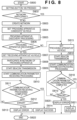
- Fig. 8 is a flowchart showing an example of the operation sequence executed when the setting buttons 106 are pressed on apparatuses A and B, the operation roles of apparatuses A and B, that is, the providing apparatus and receiving apparatus are determined, and the automatic communication parameter setting processing is then executed.
- the setting button 106 is pressed to indicate the start of communication parameter setting processing (S801).
- the beacon notification period of the self channel is short, and the interval until a beacon is notified using the self channel is long. Therefore, apparatus A cannot detect apparatus B, and apparatus B cannot detect apparatus A.
- Apparatus B also executes the same processing as in apparatus A. With this processing, for example, the period (d) in which apparatus A executes the search processing using a channel in which apparatus B forms the network overlaps a period (o) in which apparatus B notifies beacons. As a result, when apparatus B returns a search reply signal in response to a search signal transmitted from apparatus A, apparatus A can detect apparatus B.
- a period (r) in which apparatus B executes the search processing using a channel in which apparatus A forms the network overlaps a period (g) in which apparatus A notifies beacons.
- the probability that a partner communication apparatus is detected can be increased.
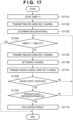
- Fig. 17 has explained the method in which a providing apparatus which has started the communication parameter setting processing is searched for by waiting for reception of a probe response to a probe request (active scan). Since a providing apparatus which is executing the communication parameter setting processing transmits a beacon added with additional information which means automatic communication parameter setting processing, a receiving apparatus may use a method of waiting for reception of that transmitted beacon for a predetermined period of time (passive scan).
- Step S1709 has explained the method in which whether or not the role of a partner included in the information element of the received search reply signal is "providing apparatus" is determined.
- the role of a partner included in the information element of the received search reply signal is "providing apparatus candidate”
- whether or not "providing apparatus” is determined as the role may be determined using information included in the search reply signal. More specifically, for example, an apparatus which transmits a search reply signal transmits the search reply signal which stores an elapsed time period after pressing of the setting button 106. The apparatus which received the search reply signal compares the elapsed time period stored in the search replay signal with an elapsed time period after pressing of its own setting button 106.
- step S816 As a result of comparison, if the setting button 106 of the apparatus that received the search reply signal was pressed earlier than the apparatus that transmitted the search reply signal, the apparatus that received the search reply signal sets "providing apparatus" as the role, and the process advances to step S816.
- the apparatus which received the search reply signal transmits a notification signal to the apparatus that transmitted the search reply signal, and the apparatus which received the notification signal may set "providing apparatus" as the role.
- the search reply signal includes a time at which a user operation was made to issue a start instruction of the communication parameter setting processing
- the discovered communication partner apparatus is not settled as a providing apparatus
- which apparatus is a providing apparatus can be determined with reference to that time.
- the time included in the search reply signal is earlier than a time at which the start instruction of the communication parameter setting processing was issued to the apparatus which received the search reply signal
- the communication partner apparatus is determined as a providing apparatus. With this processing, a providing apparatus can be determined promptly.
- information to be compared is not limited to the elapsed time period after pressing of the button 106.
- the MAC address of the apparatus may be compared, or a Timing Synchronization Function (TSF) value included in the search reply signal may be compared.
- TSF Timing Synchronization Function
- the already existing ad hoc network indicates an ad hoc network which is configured by a plurality of apparatuses using communication parameters shared between the apparatuses which executed the communication parameter setting processing.
- Fig. 5 is a diagram showing a first communication apparatus A 500 (to be referred to as apparatus A hereinafter), second communication apparatus B 501 (to be referred to as apparatus B hereinafter), third communication apparatus C 503 (to be referred to as apparatus C hereinafter), and network 502. Apparatuses A, B, and C have the aforementioned arrangements shown in Figs. 1 and 2 .
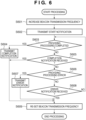
- Fig. 6 is a flowchart for explaining the notification processing operation of a providing apparatus.
- an apparatus is already a participant of the network in step S802 in Fig. 8 , that apparatus starts the processing shown in Fig. 6 .
- the beacon control unit 213 of the providing apparatus increases the beacon transmission frequency (transmission ratio, the number of times of transmission) per unit time by the providing apparatus (S601).
- an apparatus which returns a probe response is an apparatus which transmitted a beacon immediately before reception of a probe request.
- step S601 the providing apparatus sets the CW to be a value smaller than the initial value.
- the number of times beacons are transmitted per unit time by the providing apparatus becomes larger than other apparatuses which are participants of the network.
- the providing apparatus search processing step S805 in Fig. 8
- a probe response from the providing apparatus can be detected within a short period of time.
- the beacon transmission frequency of the providing apparatus is increased, when a new apparatus as a prospective participant searches for a providing apparatus, it can receive a probe response from the providing apparatus at a higher probability.
- the new apparatus as a prospective participant searches for a providing apparatus by a passive scan, it can receive a beacon from the providing apparatus at a higher probability.
- the probability that the limit time of the communication parameter setting processing elapses while a new apparatus as a prospective participant cannot detect the providing apparatus can be reduced.
- the new apparatus as the prospective participant can detect a providing apparatus within a short period of time, a time period required until completion of the communication parameter providing processing can be shortened.
- the providing apparatus broadcasts a start notification message that notifies the start of the automatic communication parameter setting processing (S602).
- the providing apparatus may unicast this start notification message to each apparatus as a participant of the network.
- This start notification message can also be expressed as a message which notifies that apparatus B started an operation as a providing apparatus.
- the providing apparatus waits until the launched providing processing is terminated as an error (S606), the communication parameter providing processing to the receiving apparatus is complete (S603), or it receives an error notification or completion notification message from another apparatus (S605, S608).
- the providing apparatus broadcasts a completion notification message (S604). Note that the providing apparatus may unicast this completion notification message to each apparatus as a participant of the network.
- step S604 If the providing apparatus transmits the completion notification message in step S604 or it receives a completion notification message from another apparatus (S605), the process jumps to step S609.
- the providing apparatus broadcasts an error notification message (S607). Note that the providing apparatus may unicast the error notification message to each apparatus as a participant of the network.
- step S607 If the providing apparatus transmits the error notification message in step S607 or it receives an error notification message from another apparatus (S608), the process advances to step S609.
- apparatus A waits for a completion notification message or error notification message transmitted from the providing apparatus (S704, S705).
- the beacon control unit 213 of apparatus A re-sets (restores) the CW to be the initial value to restore the beacon transmission frequency decreased in step S703 (S706).
- the automatic setting control unit 208 restores the contents of information to be included in a beacon and search reply signal to be transmitted to those before change in step S702 (S707). That is, the automatic setting control unit 208 removes the identification information which is used to uniquely identify the providing apparatus (apparatus B) and is added to the beacon and search reply signal to be transmitted.
- apparatus B launches the processing shown in Fig. 8 (F902). Since apparatus B is already a participant of the network 502 using the communication parameters shared with apparatus A by the automatic communication parameter setting processing, it sets "providing apparatus” as the role, and starts communication parameter providing processing (F902).
- Apparatus A which received the start notification message launches the proxy reply processing shown in Fig. 7 , and decreases the beacon transmission frequency (F905).
- apparatus B increases the beacon transmission frequency and apparatus A decreases the beacon transmission frequency
- apparatus C as a new prospective participant can detect apparatus B as the providing apparatus within a shorter period of time.
- apparatus C launches the processing shown in Fig. 8 . Since apparatus C is not a participant of the network, it executes processing for creating a network, setting "providing apparatus candidate" as its role, and so forth, and then starts providing apparatus search processing. Note that Fig. 9 shows the search processing and subsequent processes, and does not show processes before them. Apparatus C transmits a search signal so as to detect a providing apparatus (F906).
- apparatus A or B returns a search reply signal in response to the search signal transmitted from apparatus C (F907a, F907b).
- apparatus C Upon detection of the presence of the providing apparatus, apparatus C sets "receiving apparatus" as its role (F908). Then, apparatus C participates in the network 502, and receives communication parameters required to make communications on the network 502 from apparatus B as the providing apparatus (F909).
- apparatus B After apparatus B provides the communication parameters to apparatus C, it transmits a completion notification message to apparatus A (F910). After transmission of the completion notification message, apparatus B restores the beacon transmission frequency increased in F903. Upon reception of the completion notification message, apparatus A restores the beacon transmission frequency decreased in F905.
- the user can automatically control apparatus C to participate in the network 502 by operating only the setting button 106.
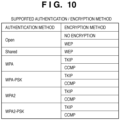
- WEP is an abbreviation for "Wired Equivalent Privacy", and please refer to the IEEE802.11 or IEEE802.11i standard for details.
- WPA authentication method, WPA-PSK authentication method, WPA2 authentication method, and WPA2-PSK authentication method are the standards of authentication methods specified by the Wi-Fi Alliance. These methods are based on an RSNA (Robust Security Network Association) in the IEEE802.11i standard.
- RSNA Robot Security Network Association
- the Open authentication will be described first.
- communication apparatuses set communication parameters shared by the automatic communication parameter setting processing, and search for each other's apparatus to configure an IBSS network.
- This Requester/Responder role determination algorithm may adopt the same method as that of a Supplicant/Authenticator role determination algorithm in the WPA-PSK authentication to be described later.
- a communication parameter providing apparatus may serve as a Responder
- a communication parameter receiving apparatus may serve as a Requester.
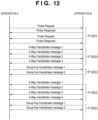
- Apparatuses A and B search for each other's partner (F1201). If these apparatuses can recognize with each other, one of apparatuses A and B, which has a larger MAC address, serves as an Authenticator, and the other apparatus serves as a Supplicant. Then, apparatuses A and B execute first 4-way handshake processing and group key handshake processing (F1202 and F1203).
- the 4-way handshake processing is a mechanism which exchanges random numbers between the Authenticator and Supplicant, and generates an encryption key of a unicast packet called a pairwise key based on a pre-shared key for each session.
- the group key handshake processing is a mechanism which sends an encryption key of a multicast packet or broadcast packet possessed by the Authenticator.
- apparatuses A and B exchange the roles of the Authenticator and Supplicant, and execute 4-way handshake processing and group key handshake processing again (F1204 and F1205). With the above processes, apparatuses A and B are allowed to make encrypted communications.
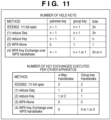
- Fig. 11 shows differences of the numbers of times of key exchange sequences and the numbers of possessed pairwise keys and group keys by the aforementioned four methods.
- n-1 pairwise keys as many as the number of other communication apparatuses are required.
- group keys in addition to group keys as many as the number of other communication apparatuses, a total of two group keys, that is, a current group key and an immediately preceding group key for the apparatus are required. Thus, n+1 group keys are required in total.
- the reason why the two group keys for the apparatus are required is that an apparatus having different group keys exists in an identical network in a transition period depending on the group key handshake progress status.
- n-1 pairwise keys are similarly required, and only one group key is required in all.
- n-1 pairwise keys are similarly required. Since respective apparatuses may possess group keys, or one group key in all, n+1 group keys or only one group key may be required on a case-by-case basis.
- the number of times 4-way handshake processing is executed as redundant processing is reduced to one.
- the group key handshake processing is still executed twice.
- the group key handshake processing is executed once.
- the 4-way handshake processing may be executed once according to the first method, or twice in two ways according to the IEEE802.11i standard.
- the number of times the 4-way handshake processing is executed which is twice per apparatus pair in the IEEE802.11i specification, is reduced to one.
- Pairwise keys are prepared for respective communication channels, but one group key is commonly used per network.
- the group key handshake processing which has to be executed twice in the method compliant with the IEEE802.11i, need only be executed once. Since only one group key is set, the encryption/description processing of a broadcast packet and multicast packet becomes simple because a different key need not be held for each apparatus which transmitted such packets.
- the third method is the same as WPA-None (Optional IBSS Global Pre-Shared Key System) described in non-patent reference 2.
- a large characteristic feature of the third method lies in that no key exchange processing is executed. Hence, the security becomes lower than the normal WPA connection processing, which generates a session key for each connection. Hence, when this method is adopted, the automatic communication parameter setting processing is launched for each connection, and communication keys of the shared communication parameters are randomly generated for each connection, thereby improving the security.
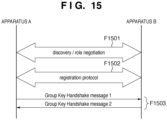
- the fourth method will be described below with reference to Fig. 15 .
- the communication partner search processing and role determination processing in the automatic communication parameter setting processing are executed (F1501).
- communication parameters are transferred from a communication parameter providing apparatus to a communication parameter receiving apparatus (F1502).
- key exchange processing which is not executed in the conventional method, is executed simultaneously with the communication parameter setting processing.
- a random number used in message exchange processing of the communication parameter setting processing is also used as that of the key exchange processing.
- apparatuses A and B share a pairwise key.
- group key exchange processing is executed (F1503).
- the fourth method is characterized in that the key exchange processing is executed together in the automatic communication parameter setting processing.
- the group key exchange processing is separately executed.
- the group key exchange processing is also executed in the communication parameter setting processing, the total connection time can be further shortened.
- a system may select one of these methods, and information indicating a method to be used included in communication parameters may be provided. Also, these methods may be dynamically switched depending on the mode of automatic communication parameter setting processing.
- the processing mode includes, for example, a mode in which communication parameters set by the automatic communication parameter setting processing are permanently used, or the communication parameters are used as temporary session information.
- a mode in which communication parameters set by the automatic communication parameter setting processing are permanently used a mode which uses identical communication parameters when a wireless communication is made again after the power supply is turned off
- a method which assures high security e.g., the first method or fourth method
- a method which prioritizes the processing load over security e.g., the second method or third method
- a key exchange method to be used is not settled based on the processing mode (No in S1602-2)
- the number of communication apparatuses included in an identical network is determined (S1603).
- a suited key exchange method is selected based on the number of communication apparatuses (S1604). For example, in case of two communication apparatuses, the method fully compliant with the IEEE802.11i or the first or fourth method is selected. In case of three or more communication apparatuses, the second or third method may be selected.
- a new apparatus When a new apparatus is added to the network after the communication parameters are easily and securely provided, options about key exchange algorithms are increased, and a key exchange algorithm is automatically determined and set, thus lowering user's stress upon forming a network. Also, a network can be securely, easily, and quickly formed.
- an apparatus in the providing apparatus discovery processing described using Fig. 17 , an apparatus alternately executes beacon transmitting processing on its wireless LAN channel, and providing apparatus discovery processing on another wireless LAN channel. With this processing, the apparatus and the other apparatus can easily detect each other's apparatus.
- the second embodiment will explain an example in which the providing apparatus discovery processing is executed on a predetermined wireless LAN channel.
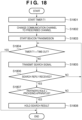
- An apparatus starts the processing described using Fig. 8 in response to a start instruction of automatic communication parameter setting processing (pressing of the setting button 106), and starts the providing apparatus discovery processing in step S805. After the providing apparatus discovery processing is started, the apparatus starts the timer T1 (S1801).
- the apparatus After the wireless LAN channel is changed, the apparatus starts beacon (notification signal) transmitting processing (S1803). After the beacon transmitting processing is started, assume that the apparatus executes beacon transmission control using a beacon interval based on the IEEE802.11 standard, and keeps transmitting beacon signals periodically.
- the apparatus determines if the timer T1 has reached a time-out (S1804). If the timer T1 has not reached a time-out yet, the apparatus transmits a search signal (probe request) (S1805). After the search signal is transmitted, the apparatus determines if a search reply is received (S1806). If no search reply is received, the process returns to step S1804 to determine the remaining time period of the timer T1. If the timer has not reached a time-out yet, the apparatus repeats processing from transmission of a search signal again.
- a search signal probe request
- step S1806 the apparatus confirms the contents of the received search reply signal to determine if the role of a partner apparatus is "communication parameter providing apparatus" (S1807). If the role of the partner apparatus is "communication parameter providing apparatus”, the apparatus holds the search result (S1808), thus ending the providing apparatus discovery processing.
- step S1807 if the role of the partner apparatus is not "communication parameter providing apparatus", the process returns to step S1804 to determine the remaining time period of the timer T1. If the timer has not reached a time-out yet, the apparatus repeats processing from transmission of a search signal again. Note that if the timer T1 has reached a time-out in step S1804, the apparatus determines that no providing apparatus is detected, thus ending the providing apparatus discovery processing.
- the automatic communication parameter setting processing executed by the communication parameter receiving processing in step S810 and the communication parameter providing processing in step S817 is executed using the predetermined communication channel.
- the predetermined communication channel is set as a communication channel in step S815.
- the communication channel is restored to that before the beginning of the automatic communication parameter setting processing.
- the communication channel is restored in steps S820 and S821.
- the communication parameter receiving processing is terminated as an error
- the communication channel may be restored to that before the beginning of the automatic communication parameter setting processing.
- the communication channel may be restored in step S813.
- the providing apparatus discovery processing is executed on the predetermined wireless LAN channel, a providing apparatus can be detected very quickly.
- Communication connection processing may be interrupted during the automatic communication parameter setting processing.
- an interrupted time period of the communication connection processing can be shortened.
- the CW value is changed to increase the number of times beacons are transmitted per unit time by the providing apparatus to be larger than other apparatuses.
- other parameters may be used as long as the providing apparatus can increase the number of times beacons are transmitted to be larger than other apparatuses. For example, if the beacon transmission interval (beacon cycle) can be changed, the providing apparatus decreases the beacon transmission interval, thus increasing the number of times beacons are transmitted per unit time.
- the CW is changed to be larger or smaller than the initial value. Since respective apparatuses do not always have the same CW initial value, if the CW is changed to a minimum value (CWmin) or maximum value (CWmax) within a changeable range, the beacon transmission frequency (the number of times) can be changed more reliably.
- the start notification message is described as a message that notifies that the automatic communication parameter setting processing is started.
- start notification message can also be expressed as a message which notifies the operation of the setting button 106 or a message that allows the providing apparatus to provide communication parameters to another receiving apparatus.
- the present invention may be carried out for other wireless media such as wireless USB, MBOA, Bluetooth ® , UWB, and ZigBee. Also, the present invention may be carried out for wired communication media such as a wired LAN.
- the UWB includes wireless USB, wireless 1394, WINET, and the like.
- the network identifier, encryption method, encryption key, authentication method, and authentication key have been exemplified as the communication parameters. However, other kinds of information may be used, or other kinds of information may be included in the above communication parameters.
- aspects of the present invention can also be realized by a computer of a system or apparatus (or devices such as a CPU or MPU) that reads out and executes a program recorded on a memory device to perform the functions of the above-described embodiment(s), and by a method, the steps of which are performed by a computer of a system or apparatus by, for example, reading out and executing a program recorded on a memory device to perform the functions of the above-described embodiment(s).
- the program is provided to the computer for example via a network or from a recording medium of various types serving as the memory device (e.g., computer-readable medium).
Landscapes
- Engineering & Computer Science (AREA)
- Computer Networks & Wireless Communication (AREA)
- Signal Processing (AREA)
- Computer Security & Cryptography (AREA)
- Mobile Radio Communication Systems (AREA)
- Communication Control (AREA)
- Small-Scale Networks (AREA)
Applications Claiming Priority (4)
| Application Number | Priority Date | Filing Date | Title |
|---|---|---|---|
| JP2008259997A JP5127658B2 (ja) | 2008-10-06 | 2008-10-06 | 通信装置、通信装置の制御方法、コンピュータプログラム及び記憶媒体 |
| EP19216631.2A EP3657900B1 (en) | 2008-10-06 | 2009-09-28 | Communication apparatus, control method of communication apparatus, computer program, and storage medium |
| EP09819147.1A EP2347608A4 (en) | 2008-10-06 | 2009-09-28 | COMMUNICATION APPARATUS, COMMUNICATION APPARATUS CONTROL METHOD, COMPUTER PROGRAM, AND STORAGE MEDIUM |
| PCT/JP2009/067283 WO2010041612A1 (en) | 2008-10-06 | 2009-09-28 | Communication apparatus, control method of communication apparatus, computer program, and storage medium |
Related Parent Applications (3)
| Application Number | Title | Priority Date | Filing Date |
|---|---|---|---|
| EP09819147.1A Division EP2347608A4 (en) | 2008-10-06 | 2009-09-28 | COMMUNICATION APPARATUS, COMMUNICATION APPARATUS CONTROL METHOD, COMPUTER PROGRAM, AND STORAGE MEDIUM |
| EP19216631.2A Division EP3657900B1 (en) | 2008-10-06 | 2009-09-28 | Communication apparatus, control method of communication apparatus, computer program, and storage medium |
| EP19216631.2A Division-Into EP3657900B1 (en) | 2008-10-06 | 2009-09-28 | Communication apparatus, control method of communication apparatus, computer program, and storage medium |
Publications (4)
| Publication Number | Publication Date |
|---|---|
| EP4149200A2 EP4149200A2 (en) | 2023-03-15 |
| EP4149200A3 EP4149200A3 (en) | 2023-05-10 |
| EP4149200C0 EP4149200C0 (en) | 2025-04-09 |
| EP4149200B1 true EP4149200B1 (en) | 2025-04-09 |
Family
ID=42100563
Family Applications (3)
| Application Number | Title | Priority Date | Filing Date |
|---|---|---|---|
| EP22194308.7A Active EP4149200B1 (en) | 2008-10-06 | 2009-09-28 | Communication apparatus, control method of communication apparatus, computer program, and storage medium |
| EP09819147.1A Withdrawn EP2347608A4 (en) | 2008-10-06 | 2009-09-28 | COMMUNICATION APPARATUS, COMMUNICATION APPARATUS CONTROL METHOD, COMPUTER PROGRAM, AND STORAGE MEDIUM |
| EP19216631.2A Active EP3657900B1 (en) | 2008-10-06 | 2009-09-28 | Communication apparatus, control method of communication apparatus, computer program, and storage medium |
Family Applications After (2)
| Application Number | Title | Priority Date | Filing Date |
|---|---|---|---|
| EP09819147.1A Withdrawn EP2347608A4 (en) | 2008-10-06 | 2009-09-28 | COMMUNICATION APPARATUS, COMMUNICATION APPARATUS CONTROL METHOD, COMPUTER PROGRAM, AND STORAGE MEDIUM |
| EP19216631.2A Active EP3657900B1 (en) | 2008-10-06 | 2009-09-28 | Communication apparatus, control method of communication apparatus, computer program, and storage medium |
Country Status (8)
| Country | Link |
|---|---|
| US (6) | US9125237B2 (enExample) |
| EP (3) | EP4149200B1 (enExample) |
| JP (1) | JP5127658B2 (enExample) |
| CN (2) | CN102172058B (enExample) |
| ES (2) | ES3025859T3 (enExample) |
| FI (1) | FI3657900T3 (enExample) |
| PL (1) | PL3657900T3 (enExample) |
| WO (1) | WO2010041612A1 (enExample) |
Families Citing this family (21)
| Publication number | Priority date | Publication date | Assignee | Title |
|---|---|---|---|---|
| JP5127658B2 (ja) | 2008-10-06 | 2013-01-23 | キヤノン株式会社 | 通信装置、通信装置の制御方法、コンピュータプログラム及び記憶媒体 |
| JP5571892B2 (ja) | 2008-10-06 | 2014-08-13 | キヤノン株式会社 | 通信装置、通信方法、コンピュータプログラム、記憶媒体 |
| JP5121668B2 (ja) | 2008-10-22 | 2013-01-16 | キヤノン株式会社 | 通信装置、通信装置の制御方法、プログラム |
| JP5332840B2 (ja) * | 2009-04-08 | 2013-11-06 | ソニー株式会社 | 無線通信装置、無線通信システム、無線通信方法及びプログラム |
| JP5669521B2 (ja) * | 2010-10-29 | 2015-02-12 | オリンパス株式会社 | 無線通信端末および接続設定方法 |
| JP5135417B2 (ja) * | 2010-11-19 | 2013-02-06 | 株式会社東芝 | 無線通信装置 |
| JP5967947B2 (ja) * | 2012-01-25 | 2016-08-10 | キヤノン株式会社 | 通信装置、通信装置の制御方法、プログラム |
| JP5880205B2 (ja) * | 2012-03-28 | 2016-03-08 | ブラザー工業株式会社 | 無線通信装置 |
| DK2956160T3 (en) | 2013-02-15 | 2018-08-06 | Mayo Found Medical Education & Res | INSULIN SECRETING POLYPEPTIDE |
| CN104378836A (zh) * | 2013-08-14 | 2015-02-25 | 中兴通讯股份有限公司 | 一种建立便捷无线连接的方法及装置 |
| CN104427527A (zh) * | 2013-08-22 | 2015-03-18 | 中国移动通信集团公司 | 一种发现符号传输、终端发现小小区的方法和设备 |
| US9900919B1 (en) * | 2014-03-19 | 2018-02-20 | Amazon Technologies, Inc. | Adaptive beacon rate system |
| US10051470B2 (en) * | 2015-03-23 | 2018-08-14 | Qualcomm Incorporated | Schedule selection and connection setup between devices participating in a NAN data link |
| JP6558965B2 (ja) | 2015-06-04 | 2019-08-14 | キヤノン株式会社 | 通信装置、制御方法、及びプログラム |
| JP6525783B2 (ja) * | 2015-07-21 | 2019-06-05 | キヤノン株式会社 | 通信装置、提供方法、および、プログラム |
| JP6676469B2 (ja) * | 2016-05-20 | 2020-04-08 | キヤノン株式会社 | 通信装置及びその制御方法、プログラム |
| JP7071164B2 (ja) | 2018-03-01 | 2022-05-18 | キヤノン株式会社 | 通信装置、通信装置の制御方法、およびプログラム |
| JP7257744B2 (ja) | 2018-04-25 | 2023-04-14 | キヤノン株式会社 | 通信装置、制御方法、及びプログラム |
| JP7157626B2 (ja) | 2018-10-24 | 2022-10-20 | キヤノン株式会社 | 通信装置、通信装置の制御方法、およびプログラム |
| CN109660976B (zh) * | 2018-12-20 | 2021-09-14 | 广州河东科技有限公司 | 设备搜索的方法、装置、系统及存储介质 |
| US12335830B1 (en) * | 2022-08-22 | 2025-06-17 | Amazon Technologies, Inc. | Detecting and controlling different types of Zigbee devices on different networks and channels |
Family Cites Families (57)
| Publication number | Priority date | Publication date | Assignee | Title |
|---|---|---|---|---|
| DE19652227A1 (de) * | 1996-12-16 | 1998-06-18 | Bosch Gmbh Robert | Verfahren und Vorrichtung zum Zuordnen einer Fernbedienung zu einer Basisstation |
| US7039027B2 (en) * | 2000-12-28 | 2006-05-02 | Symbol Technologies, Inc. | Automatic and seamless vertical roaming between wireless local area network (WLAN) and wireless wide area network (WWAN) while maintaining an active voice or streaming data connection: systems, methods and program products |
| JP2003324443A (ja) | 2002-04-26 | 2003-11-14 | Toshiba Corp | アドホック・ネットワークシステム、アドホック・ネットワーク通信方法及び無線端末装置 |
| DE10230617B4 (de) * | 2002-07-03 | 2004-12-23 | Siemens Ag | Automatisches Umschalten zwischen Mobilfunkgeräten |
| CN101662816B (zh) | 2003-02-03 | 2014-03-05 | 索尼株式会社 | 无线通信系统,无线通信设备和无线通信方法及计算机程序 |
| JP4803955B2 (ja) | 2003-08-28 | 2011-10-26 | 京セラ株式会社 | 通信制御装置、通信装置及び通信システム |
| JP4480412B2 (ja) * | 2004-02-06 | 2010-06-16 | 株式会社バッファロー | 無線lan通信システム、無線lan通信方法および無線lan通信プログラム |
| JP4220435B2 (ja) | 2004-05-28 | 2009-02-04 | 株式会社東芝 | 無線通信システムおよび無線端末 |
| EP1762041B1 (en) * | 2004-06-29 | 2011-07-27 | Nokia Corporation | Control of a short-range wireless terminal |
| WO2006018898A1 (ja) | 2004-08-20 | 2006-02-23 | Fujitsu Limited | 無線ネットワークシステム |
| EP1797617A4 (en) | 2004-10-01 | 2009-08-12 | Rochemont L Pierre De | CERAMIC ANTENNA MODULE AND MANUFACTURING METHOD THEREFOR |
| WO2006071650A2 (en) * | 2004-12-23 | 2006-07-06 | Conexant Systems, Inc. | Systems and methods for device discovery |
| JP4105192B2 (ja) | 2005-01-07 | 2008-06-25 | シャープ株式会社 | 通信装置、通信方法、プログラム、および、プログラムを記録したコンピュータ読み取り可能な記録媒体 |
| WO2006098116A1 (ja) | 2005-03-15 | 2006-09-21 | Nec Corporation | 無線通信システムにおける認証方式、それを備える無線端末装置と無線基地局、それらを用いた無線通信システム及びプログラム |
| JP4656637B2 (ja) | 2005-04-27 | 2011-03-23 | キヤノン株式会社 | 通信装置及び通信システムとその通信パラメータ設定方法 |
| JP4900891B2 (ja) | 2005-04-27 | 2012-03-21 | キヤノン株式会社 | 通信装置及び通信方法 |
| JP2006345205A (ja) * | 2005-06-08 | 2006-12-21 | Toyota Industries Corp | 無線lan接続管理方法、無線lan接続管理システム及び設定用無線中継装置 |
| US7920531B2 (en) | 2005-10-11 | 2011-04-05 | Hewlett-Packard Development Company, L.P. | Technique for managing wireless networks |
| JP4832848B2 (ja) | 2005-10-13 | 2011-12-07 | パナソニック株式会社 | 無線アクセスポイント選択方法、無線装置、無線端末ならびにコンピュータプログラム |
| JP4865454B2 (ja) * | 2005-10-17 | 2012-02-01 | キヤノン株式会社 | 設定方法及び通信装置 |
| JP4836241B2 (ja) | 2005-11-10 | 2011-12-14 | 任天堂株式会社 | 通信システム、通信プログラム、および通信端末 |
| US8625548B2 (en) | 2005-11-14 | 2014-01-07 | Broadcom Corporation | Access points of different types exchanging addresses and rules to support end points devices |
| US8374122B2 (en) * | 2005-12-21 | 2013-02-12 | Cisco Technology, Inc. | System and method for integrated WiFi/WiMax neighbor AP discovery and AP advertisement |
| JP4914207B2 (ja) | 2006-02-17 | 2012-04-11 | キヤノン株式会社 | 通信装置及び通信レイヤの役割決定方法 |
| JP4840970B2 (ja) * | 2006-02-23 | 2011-12-21 | キヤノン株式会社 | 通信装置と通信装置の制御方法及びプログラム |
| JP4799213B2 (ja) | 2006-02-28 | 2011-10-26 | 株式会社エヌ・ティ・ティ・ドコモ | 無線通信端末及び無線通信方法 |
| JP2007325064A (ja) | 2006-06-02 | 2007-12-13 | Nagano Japan Radio Co | 無線lanハンドオーバー方法 |
| US7613156B2 (en) * | 2006-06-08 | 2009-11-03 | Motorola, Inc. | Method for energy efficient prospective peer discovery in an ad hoc network |
| US20080031208A1 (en) | 2006-08-04 | 2008-02-07 | Microsoft Corporation | Synchronization between wireless devices while saving power |
| US9049651B2 (en) * | 2006-08-25 | 2015-06-02 | Qualcomm Incorporated | Selection of an access point in a communications system |
| JP5298391B2 (ja) | 2006-09-18 | 2013-09-25 | マーベル インターナショナル リミテッド | 多数のデバイス間のアドホックネットワーク構築 |
| JP4871696B2 (ja) * | 2006-10-27 | 2012-02-08 | キヤノン株式会社 | 通信パラメータの設定処理方法、通信装置、通信装置の制御方法、プログラム |
| KR101099993B1 (ko) * | 2006-12-07 | 2011-12-28 | 미쓰비시덴키 가부시키가이샤 | 무선 통신 시스템, 무선 단말국, 무선 기지국 및 무선 통신 방법 |
| JP4789817B2 (ja) | 2007-01-29 | 2011-10-12 | キヤノン株式会社 | 通信装置及び通信装置の通信方法、プログラム |
| JP2008219358A (ja) | 2007-03-02 | 2008-09-18 | Sony Corp | 無線通信システム、無線通信装置及び無線通信方法、並びにコンピュータ・プログラム |
| JP4942186B2 (ja) | 2007-04-13 | 2012-05-30 | 株式会社前川製作所 | 包装食品の分別前処理装置及びその方法 |
| JP5075526B2 (ja) | 2007-08-10 | 2012-11-21 | 株式会社東芝 | 無線通信装置、および無線通信装置の制御プログラム |
| JP5171167B2 (ja) * | 2007-09-05 | 2013-03-27 | キヤノン株式会社 | 通信パラメータの設定処理を行う通信装置、当該通信装置の制御方法、並びにコンピュータプログラム |
| KR101423337B1 (ko) | 2008-02-22 | 2014-07-25 | 삼성전자주식회사 | 허가된 주파수 대역을 이용하여 애드 훅 네트워크와 인프라네트워크를 연계하는 무선 통신 시스템과 이를 위한 무선단말과 통신 방법 |
| JP5230249B2 (ja) | 2008-04-24 | 2013-07-10 | キヤノン株式会社 | 通信装置、通信装置の制御方法、プログラム、記憶媒体 |
| JP5078736B2 (ja) | 2008-04-28 | 2012-11-21 | キヤノン株式会社 | 通信装置、通信装置の通信方法、プログラム、記憶媒体 |
| FR2932043B1 (fr) * | 2008-06-03 | 2010-07-30 | Groupe Ecoles Telecomm | Procede de tracabilite et de resurgence de flux pseudonymises sur des reseaux de communication, et procede d'emission de flux informatif apte a securiser le trafic de donnees et ses destinataires |
| JP5183307B2 (ja) | 2008-06-10 | 2013-04-17 | キヤノン株式会社 | 通信装置、通信装置の通信方法、プログラム、記憶媒体 |
| JP5153468B2 (ja) | 2008-06-12 | 2013-02-27 | キヤノン株式会社 | 無線通信装置及びその通信方法 |
| JP5307508B2 (ja) | 2008-08-29 | 2013-10-02 | キヤノン株式会社 | 通信装置、通信方法、コンピュータプログラム |
| JP5222081B2 (ja) | 2008-09-24 | 2013-06-26 | キヤノン株式会社 | 通信装置、通信装置の制御方法、コンピュータプログラム、記憶媒体 |
| JP5127658B2 (ja) | 2008-10-06 | 2013-01-23 | キヤノン株式会社 | 通信装置、通信装置の制御方法、コンピュータプログラム及び記憶媒体 |
| JP5571892B2 (ja) | 2008-10-06 | 2014-08-13 | キヤノン株式会社 | 通信装置、通信方法、コンピュータプログラム、記憶媒体 |
| JP5121668B2 (ja) | 2008-10-22 | 2013-01-16 | キヤノン株式会社 | 通信装置、通信装置の制御方法、プログラム |
| JP5435927B2 (ja) | 2008-11-05 | 2014-03-05 | キヤノン株式会社 | 通信装置、制御方法、プログラム |
| JP5448434B2 (ja) | 2008-12-11 | 2014-03-19 | キヤノン株式会社 | 通信装置、通信装置の制御方法、コンピュータプログラム |
| JP5235777B2 (ja) | 2009-05-15 | 2013-07-10 | キヤノン株式会社 | 通信装置、通信装置の制御方法、プログラム |
| JP5759242B2 (ja) | 2011-04-14 | 2015-08-05 | キヤノン株式会社 | 通信装置、その処理方法、及び、プログラム |
| CN106661216B (zh) | 2014-09-30 | 2018-12-07 | 三菱瓦斯化学株式会社 | 聚碳酸酯树脂和光学透镜 |
| JP6558965B2 (ja) | 2015-06-04 | 2019-08-14 | キヤノン株式会社 | 通信装置、制御方法、及びプログラム |
| JP7257744B2 (ja) | 2018-04-25 | 2023-04-14 | キヤノン株式会社 | 通信装置、制御方法、及びプログラム |
| JP7157626B2 (ja) | 2018-10-24 | 2022-10-20 | キヤノン株式会社 | 通信装置、通信装置の制御方法、およびプログラム |
-
2008
- 2008-10-06 JP JP2008259997A patent/JP5127658B2/ja active Active
-
2009
- 2009-09-28 EP EP22194308.7A patent/EP4149200B1/en active Active
- 2009-09-28 EP EP09819147.1A patent/EP2347608A4/en not_active Withdrawn
- 2009-09-28 US US13/122,619 patent/US9125237B2/en active Active
- 2009-09-28 ES ES22194308T patent/ES3025859T3/es active Active
- 2009-09-28 WO PCT/JP2009/067283 patent/WO2010041612A1/en not_active Ceased
- 2009-09-28 FI FIEP19216631.2T patent/FI3657900T3/fi active
- 2009-09-28 ES ES19216631T patent/ES2932700T3/es active Active
- 2009-09-28 CN CN200980139671.3A patent/CN102172058B/zh active Active
- 2009-09-28 EP EP19216631.2A patent/EP3657900B1/en active Active
- 2009-09-28 PL PL19216631.2T patent/PL3657900T3/pl unknown
- 2009-09-28 CN CN201510127800.4A patent/CN104811920B/zh active Active
-
2015
- 2015-08-04 US US14/817,781 patent/US10200903B2/en active Active
-
2018
- 2018-12-11 US US16/216,223 patent/US10462696B2/en active Active
-
2019
- 2019-10-03 US US16/592,208 patent/US11115816B2/en active Active
-
2021
- 2021-08-04 US US17/393,732 patent/US11678179B2/en active Active
-
2023
- 2023-05-05 US US18/143,627 patent/US12047770B2/en active Active
Also Published As
| Publication number | Publication date |
|---|---|
| ES2932700T3 (es) | 2023-01-24 |
| JP5127658B2 (ja) | 2013-01-23 |
| US20230276232A1 (en) | 2023-08-31 |
| US20190110222A1 (en) | 2019-04-11 |
| US20200037193A1 (en) | 2020-01-30 |
| CN102172058B (zh) | 2015-04-08 |
| CN104811920B (zh) | 2018-09-11 |
| EP3657900A1 (en) | 2020-05-27 |
| US10462696B2 (en) | 2019-10-29 |
| US20150341819A1 (en) | 2015-11-26 |
| PL3657900T3 (pl) | 2023-02-06 |
| US12047770B2 (en) | 2024-07-23 |
| CN104811920A (zh) | 2015-07-29 |
| EP4149200A3 (en) | 2023-05-10 |
| US20110189958A1 (en) | 2011-08-04 |
| CN102172058A (zh) | 2011-08-31 |
| EP4149200A2 (en) | 2023-03-15 |
| JP2010093447A (ja) | 2010-04-22 |
| US11678179B2 (en) | 2023-06-13 |
| US10200903B2 (en) | 2019-02-05 |
| FI3657900T3 (fi) | 2023-01-13 |
| US20210368336A1 (en) | 2021-11-25 |
| EP2347608A1 (en) | 2011-07-27 |
| EP4149200C0 (en) | 2025-04-09 |
| EP3657900B1 (en) | 2022-11-09 |
| ES3025859T3 (en) | 2025-06-09 |
| US9125237B2 (en) | 2015-09-01 |
| US11115816B2 (en) | 2021-09-07 |
| WO2010041612A1 (en) | 2010-04-15 |
| EP2347608A4 (en) | 2016-06-01 |
Similar Documents
| Publication | Publication Date | Title |
|---|---|---|
| US12047770B2 (en) | Communication apparatus, control method of communication apparatus, computer program, and storage medium | |
| US8948380B2 (en) | Communication apparatus, control method of communication apparatus, computer program, and storage medium | |
| JP5571892B2 (ja) | 通信装置、通信方法、コンピュータプログラム、記憶媒体 | |
| JP5307508B2 (ja) | 通信装置、通信方法、コンピュータプログラム | |
| JP6218874B2 (ja) | 通信装置、通信装置の制御方法、プログラム | |
| JP5914709B2 (ja) | 通信装置、通信装置の制御方法、プログラム | |
| JP5685333B2 (ja) | 通信装置、通信装置の制御方法、プログラム | |
| JP5501427B2 (ja) | 通信装置、通信装置の制御方法、コンピュータプログラム及び記憶媒体 | |
| JP5649694B2 (ja) | 通信装置、制御方法、及びプログラム |
Legal Events
| Date | Code | Title | Description |
|---|---|---|---|
| PUAI | Public reference made under article 153(3) epc to a published international application that has entered the european phase |
Free format text: ORIGINAL CODE: 0009012 |
|
| STAA | Information on the status of an ep patent application or granted ep patent |
Free format text: STATUS: THE APPLICATION HAS BEEN PUBLISHED |
|
| AC | Divisional application: reference to earlier application |
Ref document number: 2347608 Country of ref document: EP Kind code of ref document: P Ref document number: 3657900 Country of ref document: EP Kind code of ref document: P |
|
| AK | Designated contracting states |
Kind code of ref document: A2 Designated state(s): AT BE BG CH CY CZ DE DK EE ES FI FR GB GR HR HU IE IS IT LI LT LU LV MC MK MT NL NO PL PT RO SE SI SK SM TR |
|
| PUAL | Search report despatched |
Free format text: ORIGINAL CODE: 0009013 |
|
| AK | Designated contracting states |
Kind code of ref document: A3 Designated state(s): AT BE BG CH CY CZ DE DK EE ES FI FR GB GR HR HU IE IS IT LI LT LU LV MC MK MT NL NO PL PT RO SE SI SK SM TR |
|
| RIC1 | Information provided on ipc code assigned before grant |
Ipc: H04W 84/20 20090101ALN20230403BHEP Ipc: H04W 84/12 20090101ALN20230403BHEP Ipc: H04W 8/00 20090101ALN20230403BHEP Ipc: H04W 76/10 20180101AFI20230403BHEP |
|
| STAA | Information on the status of an ep patent application or granted ep patent |
Free format text: STATUS: REQUEST FOR EXAMINATION WAS MADE |
|
| 17P | Request for examination filed |
Effective date: 20231110 |
|
| RBV | Designated contracting states (corrected) |
Designated state(s): AT BE BG CH CY CZ DE DK EE ES FI FR GB GR HR HU IE IS IT LI LT LU LV MC MK MT NL NO PL PT RO SE SI SK SM TR |
|
| STAA | Information on the status of an ep patent application or granted ep patent |
Free format text: STATUS: EXAMINATION IS IN PROGRESS |
|
| 17Q | First examination report despatched |
Effective date: 20240502 |
|
| GRAP | Despatch of communication of intention to grant a patent |
Free format text: ORIGINAL CODE: EPIDOSNIGR1 |
|
| STAA | Information on the status of an ep patent application or granted ep patent |
Free format text: STATUS: GRANT OF PATENT IS INTENDED |
|
| RIC1 | Information provided on ipc code assigned before grant |
Ipc: H04W 84/20 20090101ALN20241022BHEP Ipc: H04W 84/12 20090101ALN20241022BHEP Ipc: H04W 8/00 20090101ALN20241022BHEP Ipc: H04W 76/10 20180101AFI20241022BHEP |
|
| INTG | Intention to grant announced |
Effective date: 20241031 |
|
| GRAS | Grant fee paid |
Free format text: ORIGINAL CODE: EPIDOSNIGR3 |
|
| GRAA | (expected) grant |
Free format text: ORIGINAL CODE: 0009210 |
|
| STAA | Information on the status of an ep patent application or granted ep patent |
Free format text: STATUS: THE PATENT HAS BEEN GRANTED |
|
| AC | Divisional application: reference to earlier application |
Ref document number: 2347608 Country of ref document: EP Kind code of ref document: P Ref document number: 3657900 Country of ref document: EP Kind code of ref document: P |
|
| AK | Designated contracting states |
Kind code of ref document: B1 Designated state(s): AT BE BG CH CY CZ DE DK EE ES FI FR GB GR HR HU IE IS IT LI LT LU LV MC MK MT NL NO PL PT RO SE SI SK SM TR |
|
| REG | Reference to a national code |
Ref country code: GB Ref legal event code: FG4D |
|
| REG | Reference to a national code |
Ref country code: CH Ref legal event code: EP |
|
| REG | Reference to a national code |
Ref country code: IE Ref legal event code: FG4D |
|
| U01 | Request for unitary effect filed |
Effective date: 20250409 |
|
| U07 | Unitary effect registered |
Designated state(s): AT BE BG DE DK EE FI FR IT LT LU LV MT NL PT RO SE SI Effective date: 20250415 |
|
| REG | Reference to a national code |
Ref country code: ES Ref legal event code: FG2A Ref document number: 3025859 Country of ref document: ES Kind code of ref document: T3 Effective date: 20250609 |
|
| U20 | Renewal fee for the european patent with unitary effect paid |
Year of fee payment: 17 Effective date: 20250820 |
|
| PG25 | Lapsed in a contracting state [announced via postgrant information from national office to epo] |
Ref country code: GR Free format text: LAPSE BECAUSE OF FAILURE TO SUBMIT A TRANSLATION OF THE DESCRIPTION OR TO PAY THE FEE WITHIN THE PRESCRIBED TIME-LIMIT Effective date: 20250710 Ref country code: NO Free format text: LAPSE BECAUSE OF FAILURE TO SUBMIT A TRANSLATION OF THE DESCRIPTION OR TO PAY THE FEE WITHIN THE PRESCRIBED TIME-LIMIT Effective date: 20250709 |
|
| PG25 | Lapsed in a contracting state [announced via postgrant information from national office to epo] |
Ref country code: PL Free format text: LAPSE BECAUSE OF FAILURE TO SUBMIT A TRANSLATION OF THE DESCRIPTION OR TO PAY THE FEE WITHIN THE PRESCRIBED TIME-LIMIT Effective date: 20250409 |
|
| PGFP | Annual fee paid to national office [announced via postgrant information from national office to epo] |
Ref country code: GB Payment date: 20250822 Year of fee payment: 17 |
|
| PG25 | Lapsed in a contracting state [announced via postgrant information from national office to epo] |
Ref country code: HR Free format text: LAPSE BECAUSE OF FAILURE TO SUBMIT A TRANSLATION OF THE DESCRIPTION OR TO PAY THE FEE WITHIN THE PRESCRIBED TIME-LIMIT Effective date: 20250409 |
|
| PG25 | Lapsed in a contracting state [announced via postgrant information from national office to epo] |
Ref country code: IS Free format text: LAPSE BECAUSE OF FAILURE TO SUBMIT A TRANSLATION OF THE DESCRIPTION OR TO PAY THE FEE WITHIN THE PRESCRIBED TIME-LIMIT Effective date: 20250809 |
|
| PG25 | Lapsed in a contracting state [announced via postgrant information from national office to epo] |
Ref country code: SM Free format text: LAPSE BECAUSE OF FAILURE TO SUBMIT A TRANSLATION OF THE DESCRIPTION OR TO PAY THE FEE WITHIN THE PRESCRIBED TIME-LIMIT Effective date: 20250409 |
|
| PG25 | Lapsed in a contracting state [announced via postgrant information from national office to epo] |
Ref country code: CZ Free format text: LAPSE BECAUSE OF FAILURE TO SUBMIT A TRANSLATION OF THE DESCRIPTION OR TO PAY THE FEE WITHIN THE PRESCRIBED TIME-LIMIT Effective date: 20250409 |
|
| PG25 | Lapsed in a contracting state [announced via postgrant information from national office to epo] |
Ref country code: SK Free format text: LAPSE BECAUSE OF FAILURE TO SUBMIT A TRANSLATION OF THE DESCRIPTION OR TO PAY THE FEE WITHIN THE PRESCRIBED TIME-LIMIT Effective date: 20250409 |
|
| PGFP | Annual fee paid to national office [announced via postgrant information from national office to epo] |
Ref country code: ES Payment date: 20251001 Year of fee payment: 17 |
|
| PLBE | No opposition filed within time limit |
Free format text: ORIGINAL CODE: 0009261 |
|
| STAA | Information on the status of an ep patent application or granted ep patent |
Free format text: STATUS: NO OPPOSITION FILED WITHIN TIME LIMIT |
|
| REG | Reference to a national code |
Ref country code: CH Ref legal event code: L10 Free format text: ST27 STATUS EVENT CODE: U-0-0-L10-L00 (AS PROVIDED BY THE NATIONAL OFFICE) Effective date: 20260218 |
|
| 26N | No opposition filed |
Effective date: 20260112 |
|
| REG | Reference to a national code |
Ref country code: CH Ref legal event code: H13 Free format text: ST27 STATUS EVENT CODE: U-0-0-H10-H13 (AS PROVIDED BY THE NATIONAL OFFICE) Effective date: 20260504 |