EP4148425B1 - System und verfahren zum testen von monokristallinen komponenten - Google Patents
System und verfahren zum testen von monokristallinen komponenten Download PDFInfo
- Publication number
- EP4148425B1 EP4148425B1 EP22190380.0A EP22190380A EP4148425B1 EP 4148425 B1 EP4148425 B1 EP 4148425B1 EP 22190380 A EP22190380 A EP 22190380A EP 4148425 B1 EP4148425 B1 EP 4148425B1
- Authority
- EP
- European Patent Office
- Prior art keywords
- monocrystalline
- probe
- population
- components
- component
- Prior art date
- Legal status (The legal status is an assumption and is not a legal conclusion. Google has not performed a legal analysis and makes no representation as to the accuracy of the status listed.)
- Active
Links
Images


Classifications
-
- G—PHYSICS
- G01—MEASURING; TESTING
- G01N—INVESTIGATING OR ANALYSING MATERIALS BY DETERMINING THEIR CHEMICAL OR PHYSICAL PROPERTIES
- G01N29/00—Investigating or analysing materials by the use of ultrasonic, sonic or infrasonic waves; Visualisation of the interior of objects by transmitting ultrasonic or sonic waves through the object
- G01N29/22—Details, e.g. general constructional or apparatus details
- G01N29/24—Probes
- G01N29/2468—Probes with delay lines
-
- G—PHYSICS
- G01—MEASURING; TESTING
- G01N—INVESTIGATING OR ANALYSING MATERIALS BY DETERMINING THEIR CHEMICAL OR PHYSICAL PROPERTIES
- G01N29/00—Investigating or analysing materials by the use of ultrasonic, sonic or infrasonic waves; Visualisation of the interior of objects by transmitting ultrasonic or sonic waves through the object
- G01N29/04—Analysing solids
- G01N29/043—Analysing solids in the interior, e.g. by shear waves
-
- G—PHYSICS
- G01—MEASURING; TESTING
- G01N—INVESTIGATING OR ANALYSING MATERIALS BY DETERMINING THEIR CHEMICAL OR PHYSICAL PROPERTIES
- G01N29/00—Investigating or analysing materials by the use of ultrasonic, sonic or infrasonic waves; Visualisation of the interior of objects by transmitting ultrasonic or sonic waves through the object
- G01N29/04—Analysing solids
- G01N29/06—Visualisation of the interior, e.g. acoustic microscopy
- G01N29/0654—Imaging
- G01N29/069—Defect imaging, localisation and sizing using, e.g. time of flight diffraction [TOFD], synthetic aperture focusing technique [SAFT], Amplituden-Laufzeit-Ortskurven [ALOK] technique
-
- G—PHYSICS
- G01—MEASURING; TESTING
- G01N—INVESTIGATING OR ANALYSING MATERIALS BY DETERMINING THEIR CHEMICAL OR PHYSICAL PROPERTIES
- G01N29/00—Investigating or analysing materials by the use of ultrasonic, sonic or infrasonic waves; Visualisation of the interior of objects by transmitting ultrasonic or sonic waves through the object
- G01N29/04—Analysing solids
- G01N29/07—Analysing solids by measuring propagation velocity or propagation time of acoustic waves
-
- G—PHYSICS
- G01—MEASURING; TESTING
- G01N—INVESTIGATING OR ANALYSING MATERIALS BY DETERMINING THEIR CHEMICAL OR PHYSICAL PROPERTIES
- G01N29/00—Investigating or analysing materials by the use of ultrasonic, sonic or infrasonic waves; Visualisation of the interior of objects by transmitting ultrasonic or sonic waves through the object
- G01N29/22—Details, e.g. general constructional or apparatus details
- G01N29/26—Arrangements for orientation or scanning by relative movement of the head and the sensor
- G01N29/262—Arrangements for orientation or scanning by relative movement of the head and the sensor by electronic orientation or focusing, e.g. with phased arrays
-
- G—PHYSICS
- G01—MEASURING; TESTING
- G01N—INVESTIGATING OR ANALYSING MATERIALS BY DETERMINING THEIR CHEMICAL OR PHYSICAL PROPERTIES
- G01N29/00—Investigating or analysing materials by the use of ultrasonic, sonic or infrasonic waves; Visualisation of the interior of objects by transmitting ultrasonic or sonic waves through the object
- G01N29/44—Processing the detected response signal, e.g. electronic circuits specially adapted therefor
- G01N29/4472—Mathematical theories or simulation
-
- G—PHYSICS
- G01—MEASURING; TESTING
- G01N—INVESTIGATING OR ANALYSING MATERIALS BY DETERMINING THEIR CHEMICAL OR PHYSICAL PROPERTIES
- G01N2291/00—Indexing codes associated with group G01N29/00
- G01N2291/02—Indexing codes associated with the analysed material
- G01N2291/028—Material parameters
- G01N2291/0289—Internal structure, e.g. defects, grain size, texture
-
- G—PHYSICS
- G01—MEASURING; TESTING
- G01N—INVESTIGATING OR ANALYSING MATERIALS BY DETERMINING THEIR CHEMICAL OR PHYSICAL PROPERTIES
- G01N2291/00—Indexing codes associated with group G01N29/00
- G01N2291/10—Number of transducers
- G01N2291/106—Number of transducers one or more transducer arrays
Definitions
- the present invention relates to a system and a method for testing of monocrystalline components.
- Non-destructive evaluation (NDE) methods such as ultrasonic testing procedures are commonly used to examine components (e.g., gas turbine engine components) for detecting and characterizing flaws in the components without damaging the components themselves.
- ultrasonic testing may involve transmission of ultrasonic waves through a portion of interest associated with the component. The ultrasonic waves may then be reflected back by deformities or discontinuities present in the portion of interest of the component. Measurement and evaluation of the reflected ultrasonic waves may permit determination of the presence and the characteristics of the flaws.
- Inspection of monocrystalline components may be problematic due to anisotropic material properties, as a result of which a path of propagation of the ultrasonic waves varies with a direction of propagation. This may distort propagation of the ultrasonic wave transmitted through the monocrystalline component and complicate signal interpretation based on reflected ultrasonic waves. Thus, a flaw actually present in the component may not be reliably detected. Additionally, propagation of ultrasonic waves may also depend on a crystallographic orientation of the monocrystalline component. Therefore, each monocrystalline component having individual crystallographic orientation is different in terms of inspection.
- the article of C. NAGESWARAN et al. (“Microstructural quantification, modeling and array ultrasonics to improve the inspection of austenitic welds", INSIGHT - NON-DESTRUCTIVE TESTING AND CONDITION MONITORING, vol. 51, no. 12, 31 December 2009, pages 660-666 ) relates to microstructural quantification, modeling and array ultrasonics to improve the inspection of austenitic welds.
- a method for testing of a population of monocrystalline components includes obtaining a plurality of component parameters associated with the population of monocrystalline components.
- the plurality of component parameters includes a crystal orientation of each monocrystalline component from the population of monocrystalline components with respect to a coordinate axis common to the population of monocrystalline components, a three-dimensional geometry common to the population of monocrystalline components, and a material common to the population of monocrystalline components.
- the crystal orientation includes a crystal angle relative to the coordinate axis.
- the method further includes determining a statistical parameter associated with the population of monocrystalline components based on a statistical distribution of the crystal angle across the population of monocrystalline components.
- the method further includes generating a simulation model of the monocrystalline component representative of the population of monocrystalline components based at least partially on the statistical parameter, the three-dimensional geometry, and the material.
- the method further includes determining at least one probe parameter of an inspection probe arrangement based at least partially on the simulation model and a predetermined region of interest in the three-dimensional geometry.
- the inspection probe arrangement includes at least one probe configured to emit ultrasonic waves.
- the method further includes determining anisotropic delay laws based at least partially on the statistical parameter and the least one probe parameter.
- the method further includes controlling the at least one probe based on the anisotropic delay laws to emit the ultrasonic waves towards the region of interest of at least one monocrystalline component from the population of monocrystalline components in order to test the at least one monocrystalline component for one or more abnormalities.
- the method of the present invention provides a process for development and realisation of the inspection probe arrangement for testing of the monocrystalline components.
- the method involves prior determination of the component parameters associated with the population of monocrystalline components before testing of the monocrystalline components.
- the component parameters includes the crystal orientation of each monocrystalline component, the three-dimensional geometry of the monocrystalline component, and the material of the monocrystalline component.
- the method considers variation in the crystal orientation of the monocrystalline components across the population of monocrystalline components during development and realisation of the inspection probe arrangement itself.
- the method further includes determination of probe parameters based on the simulation model representing the population of the monocrystalline components.
- the simulation model is generated based on the material of the monocrystalline components, thus accounting for anisotropic material properties of the monocrystalline components for determining actual path of the ultrasonic waves in the monocrystalline component.
- the probe parameters may be determined based on the simulation model and considering the entire population of monocrystalline components.
- the method further includes determination of the anisotropic delay laws based at least partially on the statistical parameter and the least one probe parameter. Once the probe parameters are determined, the anisotropic delay laws may be determined for accurate targeting of the ultrasonic wave towards the region of interest.
- the anisotropic delay laws may consider anisotropic material properties of the monocrystalline component for determining delay laws of the inspection probe arrangement. Determination of the anisotropic delay laws may overcome complex geometrical challenges by allowing emission of ultrasonic waves towards the region of interest in the three-dimensional geometry of the monocrystalline components.
- the method enables real time testing of the monocrystalline components and interpretation of results eliminating the need for any post-processing since the method considers anisotropic material properties of monocrystalline components as well as variation in the crystal orientation across the population of monocrystalline components at the development stage of the inspection probe arrangement and before testing the monocrystalline components. Therefore, the inspection probe arrangement developed based on the present method may provide coverage of the population of monocrystalline components for testing using predetermined probe parameters and anisotropic delay laws. Consequently, post processing of images obtained during testing is not required.
- inspection probe arrangement may be compatible with the existing ultrasonic signal acquisition and interpretation systems.
- Use of anisotropic material properties for determination of the probe parameters and the anisotropic delay laws may significantly improve a signal to noise ratio of the inspection probe arrangement and ultrasonic images of the monocrystalline components are obtained more accurately and precisely.
- the statistical parameter includes a value of the at least one crystal angle that appears a maximum number of times in the population of monocrystalline components.
- the statistical parameter may be representative of the maximum number of monocrystalline components in the population of monocrystalline components.
- the simulation model may be generated based on the statistical parameter such that the simulation model may represent monocrystalline components having a crystal angle that appears a maximum number of times in the population of monocrystalline components.
- the method further includes determining a range of the at least one crystal angle for which the ultrasonic waves emitted by the at least one probe in response to the anisotropic delay laws at least partially overlap the region of interest. In some embodiments, the method further includes determining a subset of the monocrystalline components from the population of monocrystalline components having values of the at least one crystal angle that fall within the range of the at least one crystal angle. The range of the at least one crystal angle may represent the values of the crystal angles for which the inspection probe arrangement may be able to test the subset of the monocrystalline components based on the anisotropic delay laws.
- the method further includes determining a set of custom anisotropic delay laws such that the ultrasonic waves emitted by the at least one probe in response to the set of custom anisotropic delay laws at least partially overlap the region of interest for an outlier set of values of the at least one crystal angle that lies outside the range of the at least one crystal angle.
- the set of custom anisotropic delay laws may allow the inspection probe arrangement to test the monocrystalline components for which the at least one crystal angle may lie outside the range of the at least one crystal angle.
- the method further includes controlling the at least one probe based on the anisotropic delay laws and the custom anisotropic delay laws in order to test the population of the monocrystalline components.
- the inspection probe arrangement may be universal and may be used to test any monocrystalline component from the population of monocrystalline components based on the anisotropic delay laws and the set of custom anisotropic delay laws.
- the method further includes determining a crystal orientation of the at least one monocrystalline component. In some embodiments, the method further includes selecting the anisotropic delay laws or one of the set of custom anisotropic delay laws based on the crystal orientation. In some embodiments, the method further includes controlling the at least one probe based on the selected anisotropic delay laws or the one of the set of custom anisotropic delay laws in order to test the at least one monocrystalline component.
- the inspection probe arrangement may allow selection of the anisotropic delay laws or one of the set of custom anisotropic delay laws as applicable based on the crystal orientation of the at least one monocrystalline component in order to test the at least one monocrystalline component.
- the method further includes sequentially controlling the at least one probe based at least on the anisotropic delay laws and the set of custom anisotropic delays laws to test the at least one monocrystalline component if a crystal orientation of the at least one monocrystalline component is unknown.
- the inspection probe arrangement may allow testing of the monocrystalline components even if the crystal orientation of the at least one monocrystalline component is unknown during testing. Further, the method may eliminate measurement of the at least one crystal angle of the monocrystalline component during testing.
- the at least one probe is at least one phased array probe.
- a system for testing a population of monocrystalline components includes at least one probe configured to emit ultrasonic waves towards a region of interest.
- the system further includes a processor communicably coupled to the at least probe and configured to obtain a plurality of component parameters associated with the population of monocrystalline components.
- the plurality of component parameters includes at least one of a crystal orientation of each monocrystalline component from the population of monocrystalline components with respect to a coordinate axis common to the population of monocrystalline components, a three-dimensional geometry common to the population of monocrystalline components, and a material common to the population of monocrystalline components.
- the crystal orientation includes at least one crystal angle relative to the coordinate axis.
- the processor is further configured to determine a statistical parameter associated with the population of monocrystalline components based on a statistical distribution of the at least one crystal angle across the population of monocrystalline components.
- the processor is further configured to generate a simulation model of the monocrystalline component representative of the population of monocrystalline components based at least partially on the statistical parameter, the three-dimensional geometry, and the material.
- the processor is further configured to determine at least one probe parameter of an inspection probe arrangement based at least partially on the simulation model and a predetermined region of interest in the three-dimensional geometry.
- the inspection probe arrangement includes at least one probe configured to emit ultrasonic waves.
- the processor is further configured to determine anisotropic delay laws based at least partially on the statistical parameter and the least one probe parameter.
- the processor is further configured to control the at least one probe based on the anisotropic delay laws to emit the ultrasonic waves towards the region of interest of at least one monocrystalline component from the population of monocrystalline components in order to test the at least one monocrystalline component for one or more abnormalities
- the statistical parameter includes a value of the at least one crystal angle that appears a maximum number of times in the population of monocrystalline components.
- the processor is further configured to determine a range of the at least one crystal angle for which the ultrasonic waves emitted by the at least one probe in response to the anisotropic delay laws at least partially overlap the region of interest. In some embodiments, the processor is further configured to determine a subset of the monocrystalline components from the population of monocrystalline components having values of the at least one crystal angle that fall within the range of the at least one crystal angle.
- the processor is further configured to determine a set of custom anisotropic delay laws such that the ultrasonic waves emitted by the at least one probe in response to the set of custom anisotropic delay laws at least partially overlap the region of interest for an outlier set of values of the at least one crystal angle that lies outside the range of the at least one crystal angle.
- the processor is further configured to control the at least one probe based on the anisotropic delay laws and the set of custom anisotropic delay laws in order to test the population of the monocrystalline components.
- the processor is further configured to determine a crystal orientation of the at least one monocrystalline component. In some embodiments, the processor is further configured to select the anisotropic delay laws or one of the set of custom anisotropic delay laws based on the crystal orientation. In some embodiments, the processor is further configured to control the at least one probe based on the selected anisotropic delay laws or the one of the set of custom anisotropic delay laws in order to test the at least one monocrystalline component.
- the processor is further configured to sequentially control the at least one probe based at least on the anisotropic delay laws and the set of custom anisotropic delays laws in order to test the at least one monocrystalline component if a crystal orientation of the at least one monocrystalline component is unknown.
- the processor may control the at least one probe until all predefined delay laws ( anisotropic delay laws and the set of custom anisotropic delays laws) are used in order to test the at least one monocrystalline component if the crystal orientation of the at least one monocrystalline component is unknown. This may ensure testing of all the monocrystalline components in the population of monocrystalline components including the monocrystalline components for which the at least one crystal angle is from the outlier set of values of the at least one crystal angle.
- the at least one probe includes a plurality of probes and/or the at least one probe is at least one phased array probe.
- crystal generally refers to a three-dimensional ordered arrangement of atoms or molecules, which possesses symmetry characteristics.
- crystal orientation generally refers to an orientation state of the crystal in a structure of the material.
- the term “monocrystalline” generally refers to materials that are a single crystal or that are substantially a single crystal.
- the term “monocrystalline” generally refers to a single crystal material or one that includes a few (typically, 10 or fewer) large crystals that are oriented in the same crystallographic direction, i.e., having crystallographic planes with miller indices that are aligned to one another.
- the crystals in the monocrystalline materials may generally have same crystal orientation.
- anisotropic generally means having at least one property that differs in value when measured in at least one different direction.
- anisotropic material generally refers to a material having at least one property that differs in value when measured in at least one different direction.
- Sound wave generally refers to acoustic waves or pressure waves or vibrations traveling through gas, liquid or solid. Sound waves include ultrasonic, audio and infrasonic waves.
- the terms “ultrasound” or “ultrasonic wave” generally refer to the sound waves having a frequency above the upper limit of audible spectrum of the human ear, usually about 20,000 hertz.
- the terms “ultrasonic” and “ultrasound” are used interchangeably herein.
- an “ultrasonic probe” or “ultrasound probe” or “ultrasound echo probe” generally refers to an element capable of sending ultrasonic waves and/or receiving such waves.
- the term “probe” also encompasses accessory elements necessary for the probe to function in the several embodiments of the invention.
- the term "velocity profile” generally refers to velocity of a sound wave as a function of time and/or distance and/or direction in a material.
- the term “three-dimensional (3D) velocity profile” generally refers to velocity of a sound wave as a function of time and/or distance in a three-dimensional geometry of the material. It is generally known in the art that the velocity of a sound wave in a material depends on the mechanical properties of the material. Thus, the "3D velocity profile" may be a characteristic of the material and may be used for characterizing propagation of a sound wave inside the material.
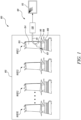
- Figure 1 illustrates a schematic view of a system 100 for testing a population of monocrystalline components 102 according to an embodiment of the present invention.
- the monocrystalline component 102 is a blade of a gas turbine engine (not shown), however, the monocrystalline component 102 may include any solid part or a combination of parts.
- each monocrystalline component 102 includes an aerofoil 104, a root section 108, and a platform 106 positioned adjacent to the root section 108.
- the platform 106 is coupled to the root section 108 for mounting the aerofoil 104.
- the aerofoil 104 may extend longitudinally and/or radially outward in span from the platform 106 to an aerofoil tip 105.
- the platform 106 may extend generally transversely from a bottom 107 of the aerofoil 104.
- the root section 108 may be used for mounting the monocrystalline component 102 on a rotor (not shown) of the gas turbine engine.
- the root section 108 may transfer a torque to the rotor upon receiving a gas impingement on the aerofoil 104.
- the monocrystalline component 102 may include cooling channels (not shown) running between the root section 108 and the aerofoil 104.
- the monocrystalline component 102 as illustrated in Figure 1 is exemplary only and a configuration of the monocrystalline component 102 may take any conventional form, with or without the platform 106 or the root section 108.
- the monocrystalline component 102 may be formed integrally with a disk in a blisk-type configuration that does not include the root section 108.
- the monocrystalline component 102 may include an anisotropic metallic material.
- the monocrystalline component 102 may be produced using directional solidification casting techniques. Directional solidification may allow longitudinal grains of the monocrystalline component 102 to be aligned in a predetermined direction (crystallographic orientation), for example, along a direction of the aerofoil 104.
- the crystallographic orientation of the monocrystalline component 102 may vary across the population of monocrystalline components 102. The crystallographic orientation is interchangeably referred to hereinafter as "the crystal orientation".
- centrifugal forces may force the monocrystalline component 102 outward and induce loading forces into the root section 108. Overtime, such forces may induce abnormalities or defects (e.g., cracks) within the root section 108 due to fatigue at locations that may be radially inward from the platform 106. Accordingly, the monocrystalline component 102 may need to be inspected by an inspection probe arrangement 101 of the system 100 to ensure that the monocrystalline component 102 does not include any defects.
- the abnormalities may occur in the root section 108 of the monocrystalline component 102 where the centrifugal loading is greatest, and a complex geometry of the cooling channels may cause high stress concentrations. The abnormalities may therefore most likely occur in a specific region of the monocrystalline component 102. Such abnormalities may be detected though the inspection probe arrangement 101.
- the inspection probe arrangement 101 may inspect a crack-susceptible region of the monocrystalline component 102.
- the system 100 or the inspection probe arrangement 101 includes at least one probe 110 configured to detect the one or more abnormalities occurring in the monocrystalline component 102.
- the at least one probe 110 is interchangeably referred to hereinafter as "the probe 110".
- the probe 110 may be placed in a position contacting the monocrystalline component 102 radially outward from the platform 106 to inspect the root section 108.
- the probe 110 may utilize ultrasonic waves for detection of the one or more abnormalities.
- the probe 110 may allow inspection of the monocrystalline component 102 in an installed state within the gas turbine engine.
- the ultrasonic waves may be emitted precisely into a region of the root section 108 in which the one or more abnormalities are expected and which, therefore, needs to be inspected. Such a region may be referred to as a region of interest.
- the probe 110 is configured to emit the ultrasonic waves towards the predetermined region of interest.
- the probe 110 may include one or more ultrasonic elements that emit the ultrasonic waves which propagate into the monocrystalline component 102, for example, towards the region of interest.
- the probe 110 may include an array of the ultrasonic elements.
- the ultrasonic waves may be moved in space to scan the region of interest by sequentially activating each ultrasonic element through an inspection program.
- the ultrasonic waves may get reflected when the waves encounter an outer surface of the monocrystalline component 102.
- the probe 110 may convert the reflected ultrasonic waves into electrical signals which may then be used to generate internal images of the monocrystalline component 102 for further analysis. Any abnormality in the monocrystalline component 102 may also reflect or scatter the incident ultrasonic waves. Thus, the reflected ultrasonic waves may be detected by the probe 110 or a separate probe to infer presence of any abnormality.
- the system 100 or the inspection probe arrangement 101 further includes a processor 120 communicably coupled to the at least probe 110 via a cable 111.
- the probe 110 is configured to obtain a three-dimensional (3D) ultrasound image of the region of interest responsive to instructions from the processor 120, e.g., at appropriate times before or during an inspection process.
- the processor 120 may be embodied in a number of different ways.
- the processor 120 may be embodied as various processing means, such as one or more of a microprocessor or other processing elements, a coprocessor, or various other computing or processing devices including integrated circuits such as, for example, an ASIC (application specific integrated circuit), an FPGA (field programmable gate array), or the like.
- the processor 120 may be configured to execute instructions stored in a memory provided with the processor 120 or otherwise accessible to the processor 120.
- the memory may include a cache or random-access memory for the processor 120.
- the memory may be separate from the processor 120, such as a cache memory of a processor, a system memory, or other memory.
- the processor 120 may represent an entity (e.g., physically embodied in circuitry - in the form of processing circuitry) capable of performing operations according to some embodiments while configured accordingly.
- the processor 120 when the processor 120 is embodied as an ASIC, FPGA, or the like, the processor 120 may have specifically configured hardware for conducting the operations described herein.
- the processor 120 when the processor 120 may be embodied as an executor of software instructions, the instructions may specifically configure the processor 120 to perform the operations described herein.
- the processor 120 is coupled to a display device 112.
- external boundaries and dimensions of the monocrystalline component 102, internal boundaries and dimensions of the monocrystalline component 102, and any internal defects within the monocrystalline component 102 may be displayed in real-time on the display device 112 during the inspection process.
- the boundaries, dimensions, and defects are displayed on the display device 112 in real-time three-dimensional (3D) imaging.
- the system 100 may first need to be instituted or configured to be able to test one monocrystalline component 102 from the population of monocrystalline components 102. The steps involved in instituting the system 100 will be described hereinafter in detail.
- Figure 2 illustrates a schematic perspective view of an example of the monocrystalline component 102 from the population of monocrystalline components 102.
- the processor 120 is configured to obtain a plurality of component parameters 115 associated with the population of monocrystalline components 102.
- the component parameters 115 may include attributes of the monocrystalline component 102 based on manufacturing data of the population of monocrystalline components 102.
- the manufacturing data may include, but not limited to, serial number of monocrystalline components 102, manufacturing limits, material, geometry, etc.
- the manufacturing limits may indicate a maximum and a minimum attribute (e.g., tolerance) of the monocrystalline components 102 in the population of monocrystalline components 102.
- the population of monocrystalline components 102 may have a common characteristic such as geometry, material, etc.
- the manufacturing data may be obtained from a database of the population of monocrystalline components 102.
- the manufacturing data may be obtained electronically through a server using wireless communication or through offline means.
- the monocrystalline component 102 defines a coordinate axis 114 common to the population of monocrystalline components 102.
- the coordinate axis 114 includes mutually orthogonal x, y, and z-axes.
- the coordinate axis 114 is also referred to as a primary axis of the monocrystalline component 102.
- Conventional Miller indices 118 of a cubic system e.g., body centred cubic or a face centred cubic crystal
- a crystal 116 of the monocrystalline component 102 may have an orientation which can be defined using such Miller indices 118.
- the Miller index 118 is also referred to as a secondary axis of the monocrystalline component 102. Only one crystal 116 is shown for the purpose of illustration, however, the monocrystalline component 102 may include a number of crystals 116.
- the crystals 116 of the monocrystalline component 102 may have same orientation throughout the monocrystalline component 102 due to manufacturing of the monocrystalline component 102 using directional solidification.
- the crystal orientation 113 includes at least one crystal angle A relative to the coordinate axis 114.
- the at least one crystal angle A includes the angles ⁇ , ⁇ and ⁇ made by the three orthogonal axes [100], [010] and [001] with the coordinate axis 114, respectively.
- the at least one crystal angle A is interchangeably referred to hereinafter as the crystal angle A.
- the monocrystalline component 102 may be elastically anisotropic. Therefore, properties (e.g., mechanical properties) of the monocrystalline component 102 may vary with the orientation of the crystals 116, and thus, it may be advantageous to control the crystal orientation 113 during manufacturing of the monocrystalline component 102. Further, velocity of a sound wave in the monocrystalline component 102 may be dependent on a direction of travel of the sound wave in the monocrystalline component 102. Thus, anisotropy causes propagation of ultrasonic waves in the monocrystalline component 102 dependent on a direction of travel.
- the component parameters 115 include at least one of: the crystal orientation 113 of each monocrystalline component 102 from the population of monocrystalline components 102 with respect to the coordinate axis 114 common to the population of monocrystalline components 102; a three-dimensional (3D) geometry 117 common to the population of monocrystalline components 102; and a material 119 common to the population of monocrystalline components 102.
- the crystal orientation 113 includes the at least one crystal angle A, i.e., the angles ⁇ , ⁇ and ⁇ .
- the 3D geometry 117 may include a computer aided design (CAD) model of the monocrystalline component 102.
- the crystal angle A obtained from the manufacturing data may be first converted into a different coordinate system before being further processed by the processor 120.
- each monocrystalline component 102 in the population of monocrystalline components 102 may include a serial number or a part number. Serial numbers of the monocrystalline components 102 may be obtained from the manufacturing data. Further, a population size and manufacturing limits may also be determined from the manufacturing data. The population size may represent a number of the monocrystalline components 102 in the population of monocrystalline components 102.
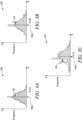
- Figures 3A-3C illustrate examples of statistical distributions 130, 132, 134 of the at least one crystal angle A, i.e., the angles ⁇ , ⁇ and ⁇ , respectively.
- the statistical distribution 130 is a histogram illustrating relative frequencies of occurrence of different values of the angle ⁇ in the population of monocrystalline components 102.
- the statistical distributions 132, 134 are histograms illustrating relative frequencies of occurrence of different values of the angles ⁇ and ⁇ in the population of monocrystalline components 102, respectively.
- the processor 120 is further configured to determine a statistical parameter 140, 142, 144 associated with the population of monocrystalline components 102 based on the statistical distribution 130, 132, 134 of the at least one crystal angle A (or the angles ⁇ , ⁇ , and ⁇ ) across the population of monocrystalline components 102.
- the statistical parameters 140, 142, 144 may be calculated based on the statistical distributions 130, 132, 134 of the angles ⁇ , ⁇ , and ⁇ , respectively.
- the statistical parameter 140, 142, 144 includes a value 140a, 142a, 144a of the at least one crystal angle A (i.e., the respective angles ⁇ , ⁇ , and ⁇ ) that appears a maximum number of times in the population of monocrystalline components 102.
- the value 140a of the statistical parameter 140 may correspond to a value of the angle ⁇ having a maximum frequency of occurrence in the population of monocrystalline components 102.
- the value 140a may represent a value of the angle ⁇ possessed by a majority of the monocrystalline components 102 in the population of monocrystalline components 102.
- each of the values 140a, 142a, 144a may correspond to a mode of the respective statistical distribution 130, 132, 134.
- the statistical parameters 140, 142, 144 may be determined through any other statistical analysis as well without limiting the scope of the present invention.
- one or more of the statistical parameters 140, 142, 144 may correspond to a mean or a median of the corresponding statistical distributions 130, 132, 134.
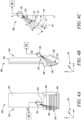
- Figures 4A and 4B illustrate schematic views of a simulation model 150 of the monocrystalline component 102 according to an embodiment of the present invention. Specifically, Figure 4A illustrates a schematic front view and Figure 4B illustrates a schematic side view of the monocrystalline component 102, respectively.
- the processor 120 is further configured to generate the simulation model 150 of the monocrystalline component 102 representative of the population of monocrystalline components 102 based at least partially on the statistical parameter 140, 142, 144, the three-dimensional geometry 117, and the material 119.
- the simulation model 150 may represent the three-dimensional geometry 117 of the monocrystalline component 102 with the least one crystal angle A (or angles ⁇ , ⁇ , and ⁇ ) corresponding to the values 140a, 142a, 144a.
- the simulation model 150 may be obtained considering the most frequently occurring value of the crystal angle A (i.e., the angles ⁇ , ⁇ , and ⁇ ) of the monocrystalline component 102 in the population of monocrystalline components 102.
- the simulation model 150 may be generated by software (e.g., a computer application).
- the at least one probe 110 is configured to emit ultrasonic waves 152 towards a predetermined region of interest 124.
- the predetermined region of interest 124 corresponds to a portion in the three-dimensional geometry 117 of the monocrystalline component 102 where one or more abnormalities 126 is most likely expected to occur.
- the predetermined region of interest 124 may be obtained based on experimental trials and/or prior knowledge.
- the simulation model 150 may allow visualization of a path of the ultrasonic waves 152 in the volume of the monocrystalline component 102.
- the probe 110 is shown at a distance from the platform 106 of the monocrystalline component 102 for clarity.
- the probe 110 and the processor 120 are shown schematically in Figures 4A and 4B for the purpose of illustration. Specifically, the probe 110 and the processor 120 are superimposed on the simulation model 150 for descriptive purposes.
- the software may include a database of 3D velocity profiles of different materials.
- the 3D velocity profiles may be obtained by considering anisotropic properties of the material 119 of the monocrystalline component 102 since properties, such as velocity of sound in the monocrystalline component 102, may vary with a direction of propagation.
- the 3D velocity profiles may allow accurate determination and visualization of the path of the ultrasonic waves 152 in the material 119 of the monocrystalline component 102.
- the software may consider factors such as phase velocity, energy velocity, wave divergence, wave spreading, and/or wave skewing for determining the path of ultrasonic waves 152 in the monocrystalline component 102.
- the processor 120 is further configured to determine at least one probe parameter 122 based at least partially on the simulation model 150 and the predetermined region of interest 124 in the three-dimensional geometry 117.
- the at least one probe parameter 122 is interchangeably referred to hereinafter as "the probe parameter 122".
- the predetermined region of interest 124 is shown as having an oval shape, however, the present invention is not limited to any specific shape, and the oval shape of the region of interest 124 is merely used for the purpose of illustration.
- the probe parameter 122 may be determined based on the path of the ultrasonic waves 152 in the monocrystalline component 102.
- the probe parameter 122 may include a location of the probe 110 on the monocrystalline component 102 relative to the coordinate axis 114.
- the probe parameter 122 may define corresponding X, Y, and Z coordinates of the probe 110 relative to the coordinate axis 114.
- the probe parameter 122 may include an orientation of the probe 110 with respect to the coordinate axis 114.
- the probe parameter 122 may define corresponding angles made by the probe 110 with respect to the coordinate axis 114.
- the probe parameter 122 may include a type of wave to be used for inspection, for example, longitudinal waves, shear waves, or a combination thereof.
- the probe parameter 122 may further include a design and configuration (e.g., 1D, 1.5D, 2D, 2.5D, or 3D ultrasound probe) of the probe 110.
- the design of the probe 110 may include shape, frequency, dimensions, and number of ultrasonic emitter-receiver elements included in the probe 110.
- the probe parameter 122 may further include a pulse-echo configuration and a pitch-catch configuration.
- the pulse-echo configuration includes a single ultrasonic probe with the ultrasonic emitter and receiver elements configured in the same ultrasonic probe, while the pitch-catch configuration includes ultrasonic emitter and receiver elements incorporated in separate ultrasonic probes.
- the at least one probe 110 may include a plurality of probes 110.
- the probe 110 may include a phased array probe.
- the probe 110 may include a number of ultrasonic emitter-receiver elements.
- each ultrasonic element has its own electrical connection and is acoustically isolated from the other ultrasonic elements.
- the ultrasonic elements may emit the ultrasonic waves 152.
- the probe 110 may be placed on the monocrystalline component 102 such that the ultrasonic waves 152 are directed radially outward towards the region of interest 124.
- the probe 110 may include at least one non-phased array transducer configured to transmit the ultrasonic waves 152 into the monocrystalline component 102 at a plurality of angles.
- each ultrasonic element has its own pulser/receiver circuit and produces its own radio-frequency time/amplitude response to scan the region of interest 124.
- the processor 120 is further configured to determine anisotropic delay laws 156 (shown in Figure 4C ) based at least partially on the statistical parameter 140, 142, 144 and the least one probe parameter 122.
- Figure 4C illustrates an example of the anisotropic delay laws 156.
- the anisotropic delay laws 156 may include a set of rules that control a timing of emission of the ultrasonic waves 152 and reception to focus the ultrasonic waves 152 at a given point in the region of interest 124.
- the anisotropic delay laws 156 may be determined such that the probe 110 may successively generate the ultrasonic waves 152 with an angular coverage AC.
- the anisotropic delay laws 156 are determined through the software considering the 3D velocity profile of the material 119 of the monocrystalline component 102.
- the anisotropic delay laws 156 may include parameters associated with the ultrasonic waves 152 such as a wave angle P, a scan range S, a type of focus, and a type of scan.
- the wave angle P may be determined with respect to a reference axis A-A' of the probe 110.
- the wave angle P may include an initial angle P1, a final angle P2, a step size PS and a number of steps between the initial and final angles P1, P2. Individual responses of each ultrasonic element are added by the processor 120 and a resulting scan is displayed on the display device 112.
- the anisotropic delay laws 156 may further be determined in the software based on the region of interest 124, ability of the ultrasonic waves 152 to be reflected from the abnormality 126, a coverage around the region of interest 124, and a false detection of the abnormality 126.
- the simulation model 150 may be verified in experimental trials by validating the probe parameters 122 and the anisotropic delay laws 156 on a sample of the monocrystalline components 102 from the population of monocrystalline components 102 that correspond to values 140a, 142a, 144a of the respective angles ⁇ , ⁇ , ⁇ . Further, the probe parameters 122 and the anisotropic delay laws 156 are approved if validated in the experimental trials.
- the processor 120 is further configured to control the at least one probe 110 based on the anisotropic delay laws 156 to emit the ultrasonic waves 152 towards the region of interest 124 of at least one monocrystalline component 102 from the population of monocrystalline components 102 in order to test the at least one monocrystalline component 102 for the one or more abnormalities 126.
- the system 100 may be able to test a majority of monocrystalline components 102 from the population of monocrystalline components 102 since the anisotropic delay laws 156 are determined based on the statistical parameter 140, 142, 144.
- the processor 120 may record the ultrasonic waves 152 reflected from the monocrystalline component 102 or the one or more abnormalities 126 and the wave angle P at which the reflected ultrasonic waves are received.
- the ultrasonic waves 152 from the probe 110 are electronically swept through a range of wave angles P within the angular coverage AC based on the anisotropic delay laws 156.
- the probe 110 may be controlled to produce a fan-shaped sweep.
- the display device 112 may display the data recorded for the range of wave angles P as a polar plot, generating a cross-sectional view called a "sector scan" image.
- the sector scan image includes the reflections received from monocrystalline component 102 and/or the one or more abnormalities 126.
- An image of the one or more abnormalities 126 will be displayed in the display device 112 if present in the region of interest 124.
- a position and a depth of the one or more abnormalities 126 may be measured directly from the sector scan image.
- the processor 120 may transmit the data to an external device such as, but not limited to, a laptop computer, a personal digital assistant (PDA), a smartphone, a tablet device, a data collector, a server, or a network connection.
- PDA personal digital assistant
- Figure 5 illustrates an example of the statistical distribution 130 corresponding to the crystal angle A (e.g., the angle ⁇ ).
- the processor 120 is further configured to determine a range R1 of the at least one crystal angle A (e.g., the angle ⁇ in Figure 5 ) for which the ultrasonic waves 152 emitted by the at least one probe 110 in response to the anisotropic delay laws 156 at least partially overlap the region of interest 124.
- the range R1 may be determined through the software based on the simulation model 150 and the angular coverage AC of the ultrasonic waves 152 corresponding to different values of the angle ⁇ . In an alternative embodiment, the range R1 may be determined based on an empirical relationship between the angle ⁇ and a path of propagation of the ultrasonic waves 152 within the monocrystalline component 102. In some embodiments, the processor 120 is further configured to determine a subset N1 of the monocrystalline components 102 from the population of monocrystalline components 102 having values of the at least one crystal angle A (e.g., the angle ⁇ in Figure 5 ) that fall within the range R1 of the at least one crystal angle A. Similarly, a range is also determined corresponding to the angles ⁇ and ⁇ . However, the range R1 for the angle ⁇ is only shown for the purpose of illustration.
- the path of propagation of the ultrasonic waves 152 varies with the direction of propagation (and the at least one crystal angle A)
- the at least one crystal angle A may vary across the population of monocrystalline components 102, however, the region of interest 124 may remain at the same location.
- the processor 120 is further configured to determine an outlier set of values R2 that lies outside the range R1 of the at least one crystal angle A (e.g., the angle ⁇ in Figure 5 ) and for which the ultrasonic waves 152 emitted by the probe 110 in response to the anisotropic delay laws 156 may not overlap with the region of interest 124.
- an outlier set of values R2 that lies outside the range R1 of the at least one crystal angle A (e.g., the angle ⁇ in Figure 5 ) and for which the ultrasonic waves 152 emitted by the probe 110 in response to the anisotropic delay laws 156 may not overlap with the region of interest 124.
- the outlier set of values R2 may be determined based on the simulation model 150 corresponding to the outlier set of values R2 and the probe parameters 122 or the anisotropic delay laws 156 corresponding to the statistical parameter 140, 142, 144.
- a degree of overlap may be calculated for the at least one crystal angle A (e.g., the angle ⁇ in Figure 5 ) based on the ultrasonic waves 152 emitted by the probe 110 in response to the anisotropic delay laws 156 and the simulation model 150 corresponding to the at least one crystal angle A.
- the outlier set of values R2 may include all the values of the at least one crystal angle A (e.g., the angle ⁇ in Figure 5 ) where the degree of overlap is less than a predetermined threshold.
- an outlier set of values is also determined corresponding to the angles ⁇ and ⁇ .
- the outlier set of values R2 corresponding to the angle ⁇ is only shown for the purpose of illustration.
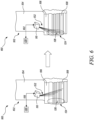
- the processor 120 is further configured to determine a set of custom anisotropic delay laws 162 (shown in Figure 6 ) such that the ultrasonic waves 152 emitted by the at least one probe 110 in response to the set of custom anisotropic delay laws 162 at least partially overlap the region of interest 124 for the outlier set of values R2 of the at least one crystal angle A (or the angles ⁇ , ⁇ and ⁇ ) that lies outside the range R1 of the at least one crystal angle A.
- a set of custom anisotropic delay laws 162 shown in Figure 6
- the processor 120 is further configured to determine a set of custom anisotropic delay laws 162 (shown in Figure 6 ) such that the ultrasonic waves 152 emitted by the at least one probe 110 in response to the set of custom anisotropic delay laws 162 at least partially overlap the region of interest 124 for the outlier set of values R2 of the at least one crystal angle A (or the angles ⁇ , ⁇ and ⁇ ) that lies outside the range R1 of the at least
- Figure 6 illustrates an example of the simulation model 160 of the monocrystalline component 102 corresponding to a value of the crystal angle A from the outlier set of values R2 and the ultrasonic waves 152 emitted by the probe 110 in response to the anisotropic delay laws 156 and one of the set of custom anisotropic delay laws 162.
- the ultrasonic waves 152 do not overlap with the region of interest 124 when the probe 110 is controlled using anisotropic delay laws 156. Consequently, the one or more abnormalities 126 may not be detected. However, the ultrasonic waves 152 at least partially overlap with the region of interest 124 when the probe 110 is controlled using one of the set of custom anisotropic delay laws 162. Consequently, the one or more abnormalities 126 may be detected.
- the set of custom anisotropic delay laws 162 may be determined for different values of the at least one crystal angle A (or the angles ⁇ , ⁇ and ⁇ ) from the outlier set of values R2. Specifically, the set of custom anisotropic delay laws 162 may be determined for each individual value of the at least one crystal angle A (or the angles ⁇ , ⁇ and ⁇ ) from the outlier set of values R2 or a range of values of the at least one crystal angle A.
- the set of custom anisotropic delay laws 162 may be determined through the software based on a path of propagation of the ultrasonic waves 152 in the monocrystalline component 102. In some embodiments, the set of custom anisotropic delay laws 162 may be determined based on manual review of the path of propagation of the ultrasonic waves 152 in the software. Alternatively, the set of custom anisotropic delay laws 162 corresponding to the outlier set of values R2 may be determined automatically from the software based on spatial comparison of the ultrasonic waves 152 emitted by the probe 110 in response to different anisotropic delay laws with the region of interest 124.
- the probe parameters 122 may also be modified to allow the ultrasonic waves 152 emitted by the probe 110 to at least partially overlap the region of interest 124 for the outlier set of values R2.
- a suitable design and configuration e.g., 1D/1.5D/2D/2.5D phased array probe with different number of ultrasonic elements, dimension, and arrangement
- the probe parameter 122 may also be interchanged between pulse-echo configuration and pitch-catch configuration.
- the processor 120 is further configured to control the at least one probe 110 based on the anisotropic delay laws 156 and the set of custom anisotropic delay laws 162 in order to test the population of the monocrystalline components 102.
- the anisotropic delay laws 156 and the set of custom anisotropic delay laws 162 determined above may be used in the inspection process to test the population of the monocrystalline components 102.
- the system 100 allows prior determination of the component parameters 115 associated with the population of monocrystalline components 102 before testing of the monocrystalline components 102.
- the system 100 considers variation in the crystal orientation 113 of the monocrystalline components 102 across the population of monocrystalline components 102 during development and realisation of the inspection probe arrangement 101 itself.
- the simulation models 150, 160 may allow determination of an actual path of the ultrasonic waves 152 in the monocrystalline component 102.
- the anisotropic delay laws 156 and the set of custom anisotropic delay laws 162 may consider anisotropic material properties of the monocrystalline component 102 for determining delay laws of the inspection probe arrangement 101. Thus, the ultrasonic waves 152 may be accurately and reliably directed towards the region of interest 124. Further, the anisotropic delay laws 156 and the set of custom anisotropic delay laws 162 may allow the inspection probe arrangement 101 to test the entire population of the monocrystalline components 102. The set of custom anisotropic delay laws 162 may allow the inspection probe arrangement 101 to test the monocrystalline components 102 for which the at least one crystal angle A may lie outside the range R1 of the at least one crystal angle A.
- the system 100 may eliminate the need for any post-processing of an output of the inspection probe arrangement 101 since anisotropic material properties are already considered during the development and realisation of the inspection probe arrangement 101. This may allow immediate isolation of the monocrystalline components 102 during testing. Further, the testing of monocrystalline components 102 may be performed quickly and in a reliable manner.
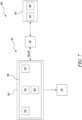
- Figure 7 illustrates a block diagram of the system 100 according to an embodiment of the present invention.
- the processor 120 includes a memory 166 configured to store the crystal orientation 113 (or the at least one crystal angle A) of each monocrystalline component 102 in the population of monocrystalline components 102, the probe parameters 122, the anisotropic delay laws 156, and the set of custom anisotropic delay laws 162.
- the memory 166 may also be external to and communicably coupled to the processor 120.
- the memory 166 may also be configured to store data, such as the manufacturing data of the population of monocrystalline components 102, sector scan images, etc.
- the processor 120 may be configured to execute instructions stored in the memory 166. The functions, acts, or tasks illustrated in the figures or described herein may be performed by the processor 120 by executing the instructions stored in the memory 166.
- the memory 166 may be a main memory, a static memory, or a dynamic memory.
- the memory 166 may include, but may not limited to, computer readable storage media, such as various types of volatile and non-volatile storage media, including, but not limited to, random access memory, read-only memory, programmable read-only memory, electrically programmable read-only memory, electrically erasable read-only memory, flash memory, magnetic tape or disk, optical media, and/or the like.
- the probe 110 is configured to emit ultrasonic waves (e.g., the ultrasonic waves 152) towards the region of interest 124 of the monocrystalline component 102 based on inputs from the processor 120.
- the processor 120 is configured to determine a crystal orientation 168 of the at least one monocrystalline component 102.
- the crystal orientation 168 of the at least one monocrystalline component 102 may be determined from the manufacturing data of the population of monocrystalline components 102 (e.g., using a part number or a specification of the gas turbine engine).
- the processor 120 may determine the crystal orientation 168 based on manual input of the part number or the specification of gas turbine engine.
- the processor 120 is further configured to select the anisotropic delay laws 156 or one of the set of custom anisotropic delay laws 162 based on the crystal orientation 168.
- the processor 120 may select the anisotropic delay laws 156 when the crystal orientation 168 is within a range (e.g., the range R1) of the at least one crystal angle A. If the crystal orientation 168 belongs to an outlier set of the values (e.g., the outlier set of values R2), the processor 120 may select one of the set of custom anisotropic delay laws 162 which corresponds to that crystal orientation 168.
- the processor 120 is further configured to control the at least one probe 110 based on the selected anisotropic delay laws 156 or the one of the set of custom anisotropic delay laws 162 in order to test the at least one monocrystalline component 102.
- the system 100 may allow selection of the anisotropic delay laws 156 or one of the set of custom anisotropic delay laws 162 as applicable based on the crystal orientation 168 of the at least one monocrystalline component 102 in order to test the at least one monocrystalline component 102.
- the processor 120 is further configured to sequentially control the at least one probe 110 based at least on the anisotropic delay laws 156 and the set of custom anisotropic delays laws 162 to test the at least one monocrystalline component 102 if the crystal orientation (168) of the at least one monocrystalline component 102 is unknown.
- the processor 120 may obtain an output (e.g., a set of sectoral scan images) from the at least one probe 110 corresponding to the anisotropic delay laws 156 and the set of custom anisotropic delay laws 162.
- the output may be displayed through the display device 112 and may be verified manually for presence of one or more abnormalities (e.g., the one or more abnormalities 126).
- the system 100 may allow testing of the monocrystalline components 102 even if the crystal orientation (168) of the at least one monocrystalline component 102 is unknown during testing.
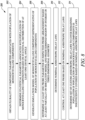
- Figure 8 is a flow chart illustrating a method 200 for testing of the population of monocrystalline components 102.
- the method 200 may be implemented using the system 100 of Figures 1-7 incorporating the teachings of the present invention.
- the method 200 includes obtaining the plurality of component parameters 115 associated with the population of monocrystalline components 102.
- the plurality of component parameters 115 includes at least one of: the crystal orientation 113 of each monocrystalline component 102 from the population of monocrystalline components 102 with respect to the coordinate axis 114 common to the population of monocrystalline components 102; the three-dimensional geometry 117 common to the population of monocrystalline components 102; and the material 119 common to the population of monocrystalline components 102.
- the crystal orientation 113 includes the at least one crystal angle A relative to the coordinate axis 114.
- the method 200 further includes determining the statistical parameter 140, 142, 144 associated with the population of monocrystalline components 102 based on the statistical distribution 130, 132, 134 of the at least one crystal angle A across the population of monocrystalline components 102.
- the statistical parameter 140, 142, 144 includes the value 140a, 142a, 144a of the at least one crystal angle A that appears a maximum number of times in the population of monocrystalline components 102.
- the method 200 further includes generating the simulation model 150 of the monocrystalline component 102 representative of the population of monocrystalline components 102 based at least partially on the statistical parameter 140, 142, 144, the three-dimensional geometry 117, and the material 119.
- the method 200 further includes determining the at least one probe parameter 122 of the inspection probe arrangement 101 based at least partially on the simulation model 150 and the predetermined region of interest 124 in the three-dimensional geometry 117.
- the inspection probe arrangement 101 includes the at least one probe 110 configured to emit the ultrasonic waves 152.
- the method 200 further includes determining the anisotropic delay laws 156 based at least partially on the statistical parameter 140, 142, 144 and the least one probe parameter 122.
- the method 200 further includes controlling the at least one probe 110 based on the anisotropic delay laws 156 to emit the ultrasonic waves 152 towards the region of interest 124 of at least one monocrystalline component 102 from the population of monocrystalline components 102 in order to test the at least one monocrystalline component 102 for the one or more abnormalities 126.
- the method 200 further includes determining the range R1 of the at least one crystal angle A for which the ultrasonic waves 152 emitted by the at least one probe 110 in response to the anisotropic delay laws 156 at least partially overlap the region of interest 124. In some embodiments, the method 200 further includes determining the subset N1 of the monocrystalline components 102 from the population of monocrystalline components 102 having values of the at least one crystal angle A that fall within the range R1 of the at least one crystal angle A.
- the ultrasonic waves 152 emitted by the at least one probe 110 in response to the anisotropic delay laws 156 may be able to at least partially overlap the region of interest 124 for only a percentage (e.g., 70% or 80%) of the monocrystalline components 102 from the population of monocrystalline components 102. This is applicable for the monocrystalline components 102 for which the at least one crystal angle A lies within the range R1 of the at least one crystal angle A.
- the ultrasonic waves 152 emitted by the at least one probe 110 in response to the anisotropic delay laws 156 may not be able to overlap the region of interest 124.
- the population of monocrystalline components 102 may not be entirely tested based on the anisotropic delay laws 156, and hence, the population of monocrystalline components 102 may be insufficiently covered based on the anisotropic delay laws 156.
- the method 200 further includes determining the set of custom anisotropic delay laws 162 if the population of monocrystalline components 102 is insufficiently covered based on the anisotropic delay laws 156.
- the method 200 further includes determining the set of custom anisotropic delay laws 162 such that the ultrasonic waves 152 emitted by the at least one probe 110 in response to the set of custom anisotropic delay laws 162 at least partially overlap the region of interest 124 for the outlier set of values R2 of the at least one crystal angle A that lies outside the range R1 of the at least one crystal angle A.
- the method 200 determines the set of custom anisotropic delay laws 162 to cover the remaining population of the monocrystalline components 102 if the population of monocrystalline components 102 is insufficiently covered based on the anisotropic delay laws 156.
- the method 200 further includes controlling the at least one probe 110 based on the anisotropic delay laws 156 and the set of custom anisotropic delay laws 162 in order to test the population of the monocrystalline components 102.
- the method 200 further includes determining a crystal orientation 168 of the at least one monocrystalline component 102. In some embodiments, the method 200 further includes selecting the anisotropic delay laws 156 or one of the set of custom anisotropic delay laws 162 based on the crystal orientation 168. In some embodiments, the method 200 further includes controlling the at least one probe 110 based on the selected anisotropic delay laws 156 or the one of the set of custom anisotropic delay laws 162 in order to test the at least one monocrystalline component 102.
- the method 200 further includes sequentially controlling the at least one probe 110 based at least on the anisotropic delay laws 156 and the set of custom anisotropic delays laws 162 to test the at least one monocrystalline component 102 if the crystal orientation 168 of the at least one monocrystalline component 102 is unknown.
- system 100 for testing the population of monocrystalline components 102 of the present invention has largely been described above with reference to its use in gas turbine engines, however, the system 100 may also be used for many other applications for non-destructive testing of such monocrystalline components 102. Thus, the system 100 may be useful in non-destructive testing of various other components in other application areas.
Landscapes
- Physics & Mathematics (AREA)
- General Physics & Mathematics (AREA)
- Chemical & Material Sciences (AREA)
- Life Sciences & Earth Sciences (AREA)
- Health & Medical Sciences (AREA)
- Analytical Chemistry (AREA)
- Biochemistry (AREA)
- General Health & Medical Sciences (AREA)
- Immunology (AREA)
- Pathology (AREA)
- Acoustics & Sound (AREA)
- Algebra (AREA)
- Mathematical Analysis (AREA)
- Mathematical Optimization (AREA)
- Mathematical Physics (AREA)
- Pure & Applied Mathematics (AREA)
- Engineering & Computer Science (AREA)
- Signal Processing (AREA)
- Investigating Or Analyzing Materials By The Use Of Ultrasonic Waves (AREA)
Claims (16)
- Verfahren (200) zum Testen einer Population von monokristallinen Komponenten (102), wobei das Verfahren (200) die folgenden Schritte umfasst:
Erhalten einer Vielzahl von Komponentenparametern (115), die der Population von monokristallinen Komponenten (102) zugeordnet ist, wobei die Vielzahl von Komponentenparametern (115) Folgendes umfasst:eine Kristallorientierung (113) jeder monokristallinen Komponente (102) aus der Population von monokristallinen Komponenten (102) in Bezug auf eine Koordinatenachse (114), die der Population von monokristallinen Komponenten (102) gemeinsam ist, eine dreidimensionale Geometrie (117), die der Population von monokristallinen Komponenten (102) gemeinsam ist, und ein Material (119), das der Population von monokristallinen Komponenten (102) gemeinsam ist, wobei die Kristallorientierung (113) einen Kristallwinkel (A) relativ zu der Koordinatenachse (114) umfasst,Bestimmen eines statistischen Parameters (140, 142, 144), welcher der Population von monokristallinen Komponenten (102) zugeordnet ist, basierend auf einer statistischen Verteilung (130, 132, 134) des Kristallwinkels (A) über die Population von monokristallinen Komponenten (102);Erzeugen eines Simulationsmodells (150) der monokristallinen Komponente (102), das repräsentativ für die Population von monokristallinen Komponenten (102) ist, basierend zumindest teilweise auf dem statistischen Parameter (140, 142, 144), der dreidimensionalen Geometrie (117) und dem Material (119);Bestimmen von zumindest einem Sondenparameter (122) einer Inspektionssondenanordnung (101) basierend zumindest teilweise auf dem Simulationsmodell (150) und einer vorbestimmten Region von Interesse (124) in der dreidimensionalen Geometrie (117), wobei die Inspektionssondenanordnung (101) zumindest eine Sonde (110) umfasst, die konfiguriert ist, um Ultraschallwellen (152) zu emittieren,Bestimmen von anisotropen Verzögerungsgesetzen (156) basierend zumindest teilweise auf dem statistischen Parameter (140, 142, 144) und dem zumindest einen Sondenparameter (122); undSteuern der zumindest einen Sonde (110) basierend auf den anisotropen Verzögerungsgesetzen (156), um die Ultraschallwellen (152) in Richtung der Region von Interesse (124) von zumindest einer monokristallinen Komponente (102) aus der Population von monokristallinen Komponenten (102) zu emittieren, um die zumindest eine monokristalline Komponente (102) auf eine oder mehrere Anomalien (126) zu testen. - Verfahren (200) nach Anspruch 1, wobei der statistische Parameter (140, 142, 144) einen Wert (140a, 142a, 144a) des Kristallwinkels (A) umfasst, der in der Population von monokristallinen Komponenten (102) eine maximale Anzahl an Malen vorkommt.
- Verfahren (200) nach Anspruch 1 oder 2, ferner umfassend:Bestimmen eines Bereichs (R1) des Kristallwinkels (A), für den die Ultraschallwellen (152), die durch die zumindest eine Sonde (110) als Reaktion auf die anisotropen Verzögerungsgesetze (156) emittiert werden, die Region von Interesse (124) zumindest teilweise überlappen; undBestimmen eines Teilsatzes (N1) der monokristallinen Komponenten (102) aus der Population von monokristallinen Komponenten (102), die Werte des Kristallwinkels (A) aufweisen, die in den Bereich (R1) des zumindest einen Kristallwinkels (A) fallen.
- Verfahren (200) nach Anspruch 3, ferner umfassend Bestimmen eines Satzes von benutzerdefinierten anisotropen Verzögerungsgesetzen (162), sodass die Ultraschallwellen (152), die durch die zumindest eine Sonde (110) als Reaktion auf den Satz von benutzerdefinierten anisotropen Verzögerungsgesetzen (162) emittiert werden, die Region von Interesse (124) für einen Ausreißersatz von Werten (R2) des Kristallwinkels (A), der außerhalb des Bereichs (R1) des Kristallwinkels (A) liegt, zumindest teilweise überlappen.
- Verfahren (200) nach Anspruch 4, ferner umfassend Steuern der zumindest einen Sonde (110) basierend auf den anisotropen Verzögerungsgesetzen (156) und dem Satz von benutzerdefinierten anisotropen Verzögerungsgesetzen (162), um die Population der monokristallinen Komponenten (102) zu testen.
- Verfahren (200) nach Anspruch 4 oder 5, ferner umfassend:Bestimmen einer Kristallorientierung (168) der zumindest einen monokristallinen Komponente (102);Auswählen der anisotropen Verzögerungsgesetze (156) oder von einem aus dem Satz von benutzerdefinierten anisotropen Verzögerungsgesetzen (162) basierend auf der Kristallorientierung (168); undSteuern der zumindest einen Sonde (110) basierend auf den ausgewählten anisotropen Verzögerungsgesetzen (156) oder dem einem aus dem Satz von benutzerdefinierten anisotropen Verzögerungsgesetzen (162), um die zumindest eine monokristalline Komponente (102) zu testen.
- Verfahren (200) nach Anspruch 4 oder 5, ferner umfassend sequentielles Steuern der zumindest einen Sonde (110) basierend zumindest auf den anisotropen Verzögerungsgesetzen (156) und dem Satz von benutzerdefinierten anisotropen Verzögerungsgesetzen (162), um die zumindest eine monokristalline Komponente (102) zu testen, wenn eine Kristallorientierung (168) der zumindest einen monokristallinen Komponente (102) unbekannt ist.
- Verfahren (200) nach einem vorhergehenden Anspruch, wobei die zumindest eine Sonde (110) zumindest eine Phased-Array-Sonde ist.
- System (100) zum Testen einer Population von monokristallinen Komponenten (102) gemäß dem Verfahren nach einem vorhergehenden Anspruch, wobei das System (100) Folgendes umfasst:zumindest eine Sonde (110), die konfiguriert ist, um Ultraschallwellen (152) in Richtung einer vorbestimmten Region von Interesse (124) zu emittieren, undeinen Prozessor (120), der kommunikativ an die zumindest einen Sonde (110) gekoppelt und zu Folgendem konfiguriert ist:Erhalten einer Vielzahl von Komponentenparametern (115), die der Population von monokristallinen Komponenten (102) zugeordnet ist, wobei die Vielzahl von Komponentenparametern (115) eine Kristallorientierung (113) jeder monokristallinen Komponente (102) aus der Population von monokristallinen Komponenten (102) in Bezug auf eine Koordinatenachse (114), die der Population von monokristallinen Komponenten (102) gemeinsam ist, eine dreidimensionale Geometrie (117), die der Population von monokristallinen Komponenten (102) gemeinsam ist, und ein Material (119), das der Population an monokristallinen Komponenten (102) gemeinsam ist, umfasst, wobei die Kristallorientierung (113) einen Kristallwinkel (A) relativ zu der Koordinatenachse (114) umfasst,Bestimmen eines statistischen Parameters (140, 142, 144), welcher der Population von monokristallinen Komponenten (102) zugeordnet ist, basierend auf einer statistischen Verteilung (130, 132, 134) des Kristallwinkels (A) über die Population von monokristallinen Komponenten (102);Erzeugen eines Simulationsmodells (150) der monokristallinen Komponente (102), das repräsentativ für die Population von monokristallinen Komponenten (102) ist, basierend zumindest teilweise auf dem statistischen Parameter (140, 142, 144), der dreidimensionalen Geometrie (117) und dem Material (119);Bestimmen von zumindest einem Sondenparameter (122) basierend zumindest teilweise auf dem Simulationsmodell (150) und der vorbestimmten Region von Interesse (124) in der dreidimensionalen Geometrie (117),Bestimmen von anisotropen Verzögerungsgesetzen (156) basierend zumindest teilweise auf dem statistischen Parameter (140, 142, 144) und dem zumindest einen Sondenparameter (122); undSteuern der zumindest einen Sonde (110) basierend auf den anisotropen Verzögerungsgesetzen (156), um die Ultraschallwellen (152) in Richtung der Region von Interesse (124) von zumindest einer monokristallinen Komponente (102) aus der Population von monokristallinen Komponenten (102) zu emittieren, um die zumindest eine monokristalline Komponente (102) auf eine oder mehrere Anomalien (126) zu testen.
- System (100) nach Anspruch 9, wobei der statistische Parameter (140, 142, 144) einen Wert (140a, 142a, 144a) des Kristallwinkels (A) umfasst, der in der Population von monokristallinen Komponenten (102) eine maximale Anzahl an Malen vorkommt.
- System (100) nach Anspruch 9 oder 10, wobei der Prozessor (120) ferner zu Folgendem konfiguriert ist:Bestimmen eines Bereichs (R1) des Kristallwinkels (A), für den die Ultraschallwellen (152), die durch die zumindest eine Sonde (110) als Reaktion auf die anisotropen Verzögerungsgesetze (156) emittiert werden, die Region von Interesse (124) zumindest teilweise überlappen; undBestimmen eines Teilsatzes (N1) der monokristallinen Komponenten (102) aus der Population von monokristallinen Komponenten (102), die Werte des Kristallwinkels (A) aufweisen, die in den Bereich (R1) des Kristallwinkels (A) fallen.
- System (100) nach Anspruch 11, wobei der Prozessor (120) ferner konfiguriert ist, um einen Satz von benutzerdefinierten anisotropen Verzögerungsgesetzen (162) zu bestimmen, sodass die Ultraschallwellen (152), die durch die zumindest eine Sonde (110) als Reaktion auf den Satz von benutzerdefinierten anisotropen Verzögerungsgesetzen (162) emittiert werden, die Region von Interesse (124) für einen Ausreißersatz von Werten (R2) des Kristallwinkels (A), der außerhalb des Bereichs (R1) des Kristallwinkels (A) liegt, zumindest teilweise überlappen.
- System (100) nach Anspruch 12, wobei der Prozessor (120) ferner konfiguriert ist, um die zumindest eine Sonde (110) basierend auf den anisotropen Verzögerungsgesetzen (156) und dem Satz von benutzerdefinierten anisotropen Verzögerungsgesetzen (162) zu steuern, um die Population der monokristallinen Komponenten (102) zu testen.
- System (100) nach Anspruch 12 oder 13, wobei der Prozessor (120) ferner zu Folgendem konfiguriert ist:Bestimmen einer Kristallorientierung (168) der zumindest einen monokristallinen Komponente (102);Auswählen der anisotropen Verzögerungsgesetze (156) oder von einem aus dem Satz von benutzerdefinierten anisotropen Verzögerungsgesetzen (162) basierend auf der Kristallorientierung (168); undSteuern der zumindest einen Sonde (110) basierend auf den ausgewählten anisotropen Verzögerungsgesetzen (156) oder dem einem aus dem Satz von benutzerdefinierten anisotropen Verzögerungsgesetzen (162), um die zumindest eine monokristalline Komponente (102) zu testen.
- System (100) nach Anspruch 12 oder 13, wobei der Prozessor (120) ferner konfiguriert ist, um die zumindest eine Sonde (110) sequentiell basierend zumindest auf den anisotropen Verzögerungsgesetzen (156) und dem Satz von benutzerdefinierten anisotropen Verzögerungsgesetzen (162) zu steuern, um die zumindest eine monokristalline Komponente (102) zu testen, wenn eine Kristallorientierung (168) der zumindest einen monokristallinen Komponente (102) unbekannt ist.
- System (100) nach einem der Ansprüche 9 bis 15, wobei die zumindest eine Sonde (110) eine Vielzahl von Sonden (110) umfasst und/oder die zumindest eine Sonde (110) zumindest eine Phased-Array-Sonde ist.
Applications Claiming Priority (1)
| Application Number | Priority Date | Filing Date | Title |
|---|---|---|---|
| GBGB2112995.2A GB202112995D0 (en) | 2021-09-13 | 2021-09-13 | System and method for testing of monocrystalline components |
Publications (2)
| Publication Number | Publication Date |
|---|---|
| EP4148425A1 EP4148425A1 (de) | 2023-03-15 |
| EP4148425B1 true EP4148425B1 (de) | 2023-09-27 |
Family
ID=78149364
Family Applications (1)
| Application Number | Title | Priority Date | Filing Date |
|---|---|---|---|
| EP22190380.0A Active EP4148425B1 (de) | 2021-09-13 | 2022-08-15 | System und verfahren zum testen von monokristallinen komponenten |
Country Status (3)
| Country | Link |
|---|---|
| US (1) | US12442798B2 (de) |
| EP (1) | EP4148425B1 (de) |
| GB (1) | GB202112995D0 (de) |
Family Cites Families (5)
| Publication number | Priority date | Publication date | Assignee | Title |
|---|---|---|---|---|
| DE602005006574D1 (de) * | 2005-10-21 | 2008-06-19 | Rolls Royce Deutschland | Verfahren und Vorrichtung zum zerstörungsfreien Testen von Gasturbinenmotorkomponenten aus Einkristallmaterialien |
| US8477905B2 (en) * | 2009-03-20 | 2013-07-02 | Proto Manufacturing Ltd. | Non-destructive testing systems and methods |
| GB201211373D0 (en) * | 2012-06-27 | 2012-08-08 | Rolls Royce Plc | Method of measuring a crystallo-graphic orientation of an object |
| DE102018202725A1 (de) * | 2018-02-22 | 2019-08-22 | MTU Aero Engines AG | Anordnung von Schaufeln in einem Schaufelkranz auf Grundlage einer primären Kristallorientierung |
| FR3090123B1 (fr) * | 2018-12-17 | 2021-01-15 | Commissariat Energie Atomique | Procédé de reconstruction d’une surface tridimensionnelle par un capteur matriciel ultrasonore |
-
2021
- 2021-09-13 GB GBGB2112995.2A patent/GB202112995D0/en not_active Ceased
-
2022
- 2022-08-15 EP EP22190380.0A patent/EP4148425B1/de active Active
- 2022-08-26 US US17/822,466 patent/US12442798B2/en active Active
Also Published As
| Publication number | Publication date |
|---|---|
| EP4148425A1 (de) | 2023-03-15 |
| US20230079690A1 (en) | 2023-03-16 |
| US12442798B2 (en) | 2025-10-14 |
| GB202112995D0 (en) | 2021-10-27 |
Similar Documents
| Publication | Publication Date | Title |
|---|---|---|
| Wilcox et al. | Advanced reflector characterization with ultrasonic phased arrays in NDE applications | |
| Zhang et al. | The use of ultrasonic arrays to characterize crack-like defects | |
| US7272529B2 (en) | Dual wall turbine blade ultrasonic wall thickness measurement technique | |
| Lane | The development of a 2D ultrasonic array inspection for single crystal turbine blades | |
| CN101711358B (zh) | 利用超声波对检测物体进行无损的材料检测的方法和装置 | |
| CN102914590A (zh) | 用于孔隙度测量和缺陷检测的方法和设备 | |
| Lhuillier et al. | Investigation of the ultrasonic attenuation in anisotropic weld materials with finite element modeling and grain-scale material description | |
| US11747307B2 (en) | Method and system for the non-destructive testing of a mechanical part | |
| US12270786B1 (en) | Method, device, and system for measuring pipeline corrosion | |
| CN106461615A (zh) | 用超声波进行的基于仿真的缺陷分析 | |
| Bolotina et al. | Ultrasonic arrays for quantitative nondestructive testing an engineering approach | |
| CN103097884B (zh) | 用于测定机械部件中存在的缺陷的方位的方法和装置 | |
| EP4148425B1 (de) | System und verfahren zum testen von monokristallinen komponenten | |
| Lane et al. | 3D ultrasonic inspection of anisotropic aerospace components | |
| CN115715367B (zh) | 对多晶材料制成的机械部件的无损检测 | |
| JP7180494B2 (ja) | 超音波探傷装置および超音波探傷方法 | |
| JP2008102120A (ja) | 超音波検査カバレッジ用の完成機械部品の鍛造物を修正する方法 | |
| Nemytova et al. | Comparative classification of flaws using ultrasonic-tomography methods and evaluation of the instantaneous frequency of echo signals | |
| Engle | Quantitative flaw characterization with ultrasonic phased arrays | |
| JPH09318608A (ja) | 材料の非破壊検査方法及びその装置 | |
| Dib et al. | Experimental validation of ultrasonic NDE simulation software | |
| EP4711757A1 (de) | Künstliches fehlerverfahren für eine ultraschallbeugungsinspektionsprobe | |
| Wilcox | Phased array ultrasound | |
| JP2013164361A (ja) | ガイド波を用いた非破壊検査方法 | |
| Vo | Measurements of Grain Size Using Unfocused Ultrasonic Beam |
Legal Events
| Date | Code | Title | Description |
|---|---|---|---|
| PUAI | Public reference made under article 153(3) epc to a published international application that has entered the european phase |
Free format text: ORIGINAL CODE: 0009012 |
|
| STAA | Information on the status of an ep patent application or granted ep patent |
Free format text: STATUS: THE APPLICATION HAS BEEN PUBLISHED |
|
| AK | Designated contracting states |
Kind code of ref document: A1 Designated state(s): AL AT BE BG CH CY CZ DE DK EE ES FI FR GB GR HR HU IE IS IT LI LT LU LV MC MK MT NL NO PL PT RO RS SE SI SK SM TR |
|
| STAA | Information on the status of an ep patent application or granted ep patent |
Free format text: STATUS: REQUEST FOR EXAMINATION WAS MADE |
|
| 17P | Request for examination filed |
Effective date: 20230327 |
|
| RBV | Designated contracting states (corrected) |
Designated state(s): AL AT BE BG CH CY CZ DE DK EE ES FI FR GB GR HR HU IE IS IT LI LT LU LV MC MK MT NL NO PL PT RO RS SE SI SK SM TR |
|
| GRAP | Despatch of communication of intention to grant a patent |
Free format text: ORIGINAL CODE: EPIDOSNIGR1 |
|
| STAA | Information on the status of an ep patent application or granted ep patent |
Free format text: STATUS: GRANT OF PATENT IS INTENDED |
|
| GRAS | Grant fee paid |
Free format text: ORIGINAL CODE: EPIDOSNIGR3 |
|
| RIC1 | Information provided on ipc code assigned before grant |
Ipc: G01N 29/06 20060101ALI20230718BHEP Ipc: G01N 29/44 20060101ALI20230718BHEP Ipc: G01N 29/26 20060101ALI20230718BHEP Ipc: G01N 29/04 20060101AFI20230718BHEP |
|
| GRAA | (expected) grant |
Free format text: ORIGINAL CODE: 0009210 |
|
| STAA | Information on the status of an ep patent application or granted ep patent |
Free format text: STATUS: THE PATENT HAS BEEN GRANTED |
|
| INTG | Intention to grant announced |
Effective date: 20230803 |
|
| P01 | Opt-out of the competence of the unified patent court (upc) registered |
Effective date: 20230810 |
|
| AK | Designated contracting states |
Kind code of ref document: B1 Designated state(s): AL AT BE BG CH CY CZ DE DK EE ES FI FR GB GR HR HU IE IS IT LI LT LU LV MC MK MT NL NO PL PT RO RS SE SI SK SM TR |
|
| REG | Reference to a national code |
Ref country code: GB Ref legal event code: FG4D |
|
| REG | Reference to a national code |
Ref country code: CH Ref legal event code: EP |
|
| REG | Reference to a national code |
Ref country code: DE Ref legal event code: R096 Ref document number: 602022000574 Country of ref document: DE |
|
| REG | Reference to a national code |
Ref country code: IE Ref legal event code: FG4D |
|
| REG | Reference to a national code |
Ref country code: LT Ref legal event code: MG9D |
|
| PG25 | Lapsed in a contracting state [announced via postgrant information from national office to epo] |
Ref country code: GR Free format text: LAPSE BECAUSE OF FAILURE TO SUBMIT A TRANSLATION OF THE DESCRIPTION OR TO PAY THE FEE WITHIN THE PRESCRIBED TIME-LIMIT Effective date: 20231228 |
|
| PG25 | Lapsed in a contracting state [announced via postgrant information from national office to epo] |
Ref country code: SE Free format text: LAPSE BECAUSE OF FAILURE TO SUBMIT A TRANSLATION OF THE DESCRIPTION OR TO PAY THE FEE WITHIN THE PRESCRIBED TIME-LIMIT Effective date: 20230927 Ref country code: RS Free format text: LAPSE BECAUSE OF FAILURE TO SUBMIT A TRANSLATION OF THE DESCRIPTION OR TO PAY THE FEE WITHIN THE PRESCRIBED TIME-LIMIT Effective date: 20230927 Ref country code: NO Free format text: LAPSE BECAUSE OF FAILURE TO SUBMIT A TRANSLATION OF THE DESCRIPTION OR TO PAY THE FEE WITHIN THE PRESCRIBED TIME-LIMIT Effective date: 20231227 Ref country code: LV Free format text: LAPSE BECAUSE OF FAILURE TO SUBMIT A TRANSLATION OF THE DESCRIPTION OR TO PAY THE FEE WITHIN THE PRESCRIBED TIME-LIMIT Effective date: 20230927 Ref country code: LT Free format text: LAPSE BECAUSE OF FAILURE TO SUBMIT A TRANSLATION OF THE DESCRIPTION OR TO PAY THE FEE WITHIN THE PRESCRIBED TIME-LIMIT Effective date: 20230927 Ref country code: HR Free format text: LAPSE BECAUSE OF FAILURE TO SUBMIT A TRANSLATION OF THE DESCRIPTION OR TO PAY THE FEE WITHIN THE PRESCRIBED TIME-LIMIT Effective date: 20230927 Ref country code: GR Free format text: LAPSE BECAUSE OF FAILURE TO SUBMIT A TRANSLATION OF THE DESCRIPTION OR TO PAY THE FEE WITHIN THE PRESCRIBED TIME-LIMIT Effective date: 20231228 Ref country code: FI Free format text: LAPSE BECAUSE OF FAILURE TO SUBMIT A TRANSLATION OF THE DESCRIPTION OR TO PAY THE FEE WITHIN THE PRESCRIBED TIME-LIMIT Effective date: 20230927 |
|
| REG | Reference to a national code |
Ref country code: NL Ref legal event code: MP Effective date: 20230927 |
|
| REG | Reference to a national code |
Ref country code: AT Ref legal event code: MK05 Ref document number: 1615877 Country of ref document: AT Kind code of ref document: T Effective date: 20230927 |
|
| PG25 | Lapsed in a contracting state [announced via postgrant information from national office to epo] |
Ref country code: NL Free format text: LAPSE BECAUSE OF FAILURE TO SUBMIT A TRANSLATION OF THE DESCRIPTION OR TO PAY THE FEE WITHIN THE PRESCRIBED TIME-LIMIT Effective date: 20230927 |
|
| PG25 | Lapsed in a contracting state [announced via postgrant information from national office to epo] |
Ref country code: IS Free format text: LAPSE BECAUSE OF FAILURE TO SUBMIT A TRANSLATION OF THE DESCRIPTION OR TO PAY THE FEE WITHIN THE PRESCRIBED TIME-LIMIT Effective date: 20240127 |
|
| PG25 | Lapsed in a contracting state [announced via postgrant information from national office to epo] |
Ref country code: AT Free format text: LAPSE BECAUSE OF FAILURE TO SUBMIT A TRANSLATION OF THE DESCRIPTION OR TO PAY THE FEE WITHIN THE PRESCRIBED TIME-LIMIT Effective date: 20230927 |
|
| PG25 | Lapsed in a contracting state [announced via postgrant information from national office to epo] |
Ref country code: ES Free format text: LAPSE BECAUSE OF FAILURE TO SUBMIT A TRANSLATION OF THE DESCRIPTION OR TO PAY THE FEE WITHIN THE PRESCRIBED TIME-LIMIT Effective date: 20230927 |
|
| PG25 | Lapsed in a contracting state [announced via postgrant information from national office to epo] |
Ref country code: SM Free format text: LAPSE BECAUSE OF FAILURE TO SUBMIT A TRANSLATION OF THE DESCRIPTION OR TO PAY THE FEE WITHIN THE PRESCRIBED TIME-LIMIT Effective date: 20230927 Ref country code: RO Free format text: LAPSE BECAUSE OF FAILURE TO SUBMIT A TRANSLATION OF THE DESCRIPTION OR TO PAY THE FEE WITHIN THE PRESCRIBED TIME-LIMIT Effective date: 20230927 Ref country code: IS Free format text: LAPSE BECAUSE OF FAILURE TO SUBMIT A TRANSLATION OF THE DESCRIPTION OR TO PAY THE FEE WITHIN THE PRESCRIBED TIME-LIMIT Effective date: 20240127 Ref country code: ES Free format text: LAPSE BECAUSE OF FAILURE TO SUBMIT A TRANSLATION OF THE DESCRIPTION OR TO PAY THE FEE WITHIN THE PRESCRIBED TIME-LIMIT Effective date: 20230927 Ref country code: EE Free format text: LAPSE BECAUSE OF FAILURE TO SUBMIT A TRANSLATION OF THE DESCRIPTION OR TO PAY THE FEE WITHIN THE PRESCRIBED TIME-LIMIT Effective date: 20230927 Ref country code: CZ Free format text: LAPSE BECAUSE OF FAILURE TO SUBMIT A TRANSLATION OF THE DESCRIPTION OR TO PAY THE FEE WITHIN THE PRESCRIBED TIME-LIMIT Effective date: 20230927 Ref country code: AT Free format text: LAPSE BECAUSE OF FAILURE TO SUBMIT A TRANSLATION OF THE DESCRIPTION OR TO PAY THE FEE WITHIN THE PRESCRIBED TIME-LIMIT Effective date: 20230927 Ref country code: SK Free format text: LAPSE BECAUSE OF FAILURE TO SUBMIT A TRANSLATION OF THE DESCRIPTION OR TO PAY THE FEE WITHIN THE PRESCRIBED TIME-LIMIT Effective date: 20230927 Ref country code: PT Free format text: LAPSE BECAUSE OF FAILURE TO SUBMIT A TRANSLATION OF THE DESCRIPTION OR TO PAY THE FEE WITHIN THE PRESCRIBED TIME-LIMIT Effective date: 20240129 |
|
| PG25 | Lapsed in a contracting state [announced via postgrant information from national office to epo] |
Ref country code: PL Free format text: LAPSE BECAUSE OF FAILURE TO SUBMIT A TRANSLATION OF THE DESCRIPTION OR TO PAY THE FEE WITHIN THE PRESCRIBED TIME-LIMIT Effective date: 20230927 Ref country code: IT Free format text: LAPSE BECAUSE OF FAILURE TO SUBMIT A TRANSLATION OF THE DESCRIPTION OR TO PAY THE FEE WITHIN THE PRESCRIBED TIME-LIMIT Effective date: 20230927 |
|
| REG | Reference to a national code |
Ref country code: DE Ref legal event code: R097 Ref document number: 602022000574 Country of ref document: DE |
|
| PG25 | Lapsed in a contracting state [announced via postgrant information from national office to epo] |
Ref country code: DK Free format text: LAPSE BECAUSE OF FAILURE TO SUBMIT A TRANSLATION OF THE DESCRIPTION OR TO PAY THE FEE WITHIN THE PRESCRIBED TIME-LIMIT Effective date: 20230927 |
|
| PG25 | Lapsed in a contracting state [announced via postgrant information from national office to epo] |
Ref country code: DK Free format text: LAPSE BECAUSE OF FAILURE TO SUBMIT A TRANSLATION OF THE DESCRIPTION OR TO PAY THE FEE WITHIN THE PRESCRIBED TIME-LIMIT Effective date: 20230927 |
|
| PLBE | No opposition filed within time limit |
Free format text: ORIGINAL CODE: 0009261 |
|
| STAA | Information on the status of an ep patent application or granted ep patent |
Free format text: STATUS: NO OPPOSITION FILED WITHIN TIME LIMIT |
|
| 26N | No opposition filed |
Effective date: 20240628 |
|
| REG | Reference to a national code |
Ref country code: GB Ref legal event code: S117 Free format text: REQUEST FILED; REQUEST FOR CORRECTION UNDER SECTION 117 FILED ON 24 SEPTEMBER 2024 |
|
| PG25 | Lapsed in a contracting state [announced via postgrant information from national office to epo] |
Ref country code: SI Free format text: LAPSE BECAUSE OF FAILURE TO SUBMIT A TRANSLATION OF THE DESCRIPTION OR TO PAY THE FEE WITHIN THE PRESCRIBED TIME-LIMIT Effective date: 20230927 |
|
| PG25 | Lapsed in a contracting state [announced via postgrant information from national office to epo] |
Ref country code: SI Free format text: LAPSE BECAUSE OF FAILURE TO SUBMIT A TRANSLATION OF THE DESCRIPTION OR TO PAY THE FEE WITHIN THE PRESCRIBED TIME-LIMIT Effective date: 20230927 |
|
| PG25 | Lapsed in a contracting state [announced via postgrant information from national office to epo] |
Ref country code: BG Free format text: LAPSE BECAUSE OF FAILURE TO SUBMIT A TRANSLATION OF THE DESCRIPTION OR TO PAY THE FEE WITHIN THE PRESCRIBED TIME-LIMIT Effective date: 20230927 |
|
| PG25 | Lapsed in a contracting state [announced via postgrant information from national office to epo] |
Ref country code: BG Free format text: LAPSE BECAUSE OF FAILURE TO SUBMIT A TRANSLATION OF THE DESCRIPTION OR TO PAY THE FEE WITHIN THE PRESCRIBED TIME-LIMIT Effective date: 20230927 |
|
| REG | Reference to a national code |
Ref country code: GB Ref legal event code: S117 Free format text: CORRECTIONS ALLOWED; REQUEST FOR CORRECTION UNDER SECTION 117 FILED ON 24 SEPTEMBER 2024 ALLOWED ON 17 FEBRUARY 2025 |
|
| PG25 | Lapsed in a contracting state [announced via postgrant information from national office to epo] |
Ref country code: LU Free format text: LAPSE BECAUSE OF NON-PAYMENT OF DUE FEES Effective date: 20240815 |
|
| PG25 | Lapsed in a contracting state [announced via postgrant information from national office to epo] |
Ref country code: MC Free format text: LAPSE BECAUSE OF FAILURE TO SUBMIT A TRANSLATION OF THE DESCRIPTION OR TO PAY THE FEE WITHIN THE PRESCRIBED TIME-LIMIT Effective date: 20230927 |
|
| REG | Reference to a national code |
Ref country code: BE Ref legal event code: MM Effective date: 20240831 |
|
| PG25 | Lapsed in a contracting state [announced via postgrant information from national office to epo] |
Ref country code: BE Free format text: LAPSE BECAUSE OF NON-PAYMENT OF DUE FEES Effective date: 20240831 |
|
| PG25 | Lapsed in a contracting state [announced via postgrant information from national office to epo] |
Ref country code: IE Free format text: LAPSE BECAUSE OF NON-PAYMENT OF DUE FEES Effective date: 20240815 |
|
| PGFP | Annual fee paid to national office [announced via postgrant information from national office to epo] |
Ref country code: DE Payment date: 20250827 Year of fee payment: 4 |
|
| PGFP | Annual fee paid to national office [announced via postgrant information from national office to epo] |
Ref country code: FR Payment date: 20250825 Year of fee payment: 4 |
|
| PG25 | Lapsed in a contracting state [announced via postgrant information from national office to epo] |
Ref country code: CY Free format text: LAPSE BECAUSE OF FAILURE TO SUBMIT A TRANSLATION OF THE DESCRIPTION OR TO PAY THE FEE WITHIN THE PRESCRIBED TIME-LIMIT; INVALID AB INITIO Effective date: 20220815 |
|
| PG25 | Lapsed in a contracting state [announced via postgrant information from national office to epo] |
Ref country code: HU Free format text: LAPSE BECAUSE OF FAILURE TO SUBMIT A TRANSLATION OF THE DESCRIPTION OR TO PAY THE FEE WITHIN THE PRESCRIBED TIME-LIMIT; INVALID AB INITIO Effective date: 20220815 |
|
| REG | Reference to a national code |
Ref country code: CH Ref legal event code: H13 Free format text: ST27 STATUS EVENT CODE: U-0-0-H10-H13 (AS PROVIDED BY THE NATIONAL OFFICE) Effective date: 20260324 |