EP4148240B1 - Stationärer gasmotor mit einer belüftungsanordnung zur belüftung eines kurbelgehäuses - Google Patents
Stationärer gasmotor mit einer belüftungsanordnung zur belüftung eines kurbelgehäuses Download PDFInfo
- Publication number
- EP4148240B1 EP4148240B1 EP22195411.8A EP22195411A EP4148240B1 EP 4148240 B1 EP4148240 B1 EP 4148240B1 EP 22195411 A EP22195411 A EP 22195411A EP 4148240 B1 EP4148240 B1 EP 4148240B1
- Authority
- EP
- European Patent Office
- Prior art keywords
- crankcase
- gas engine
- ventilation
- intake
- stationary gas
- Prior art date
- Legal status (The legal status is an assumption and is not a legal conclusion. Google has not performed a legal analysis and makes no representation as to the accuracy of the status listed.)
- Active
Links
Images


Classifications
-
- F—MECHANICAL ENGINEERING; LIGHTING; HEATING; WEAPONS; BLASTING
- F01—MACHINES OR ENGINES IN GENERAL; ENGINE PLANTS IN GENERAL; STEAM ENGINES
- F01M—LUBRICATING OF MACHINES OR ENGINES IN GENERAL; LUBRICATING INTERNAL COMBUSTION ENGINES; CRANKCASE VENTILATING
- F01M13/00—Crankcase ventilating or breathing
- F01M13/02—Crankcase ventilating or breathing by means of additional source of positive or negative pressure
-
- F—MECHANICAL ENGINEERING; LIGHTING; HEATING; WEAPONS; BLASTING
- F01—MACHINES OR ENGINES IN GENERAL; ENGINE PLANTS IN GENERAL; STEAM ENGINES
- F01M—LUBRICATING OF MACHINES OR ENGINES IN GENERAL; LUBRICATING INTERNAL COMBUSTION ENGINES; CRANKCASE VENTILATING
- F01M13/00—Crankcase ventilating or breathing
- F01M13/04—Crankcase ventilating or breathing having means for purifying air before leaving crankcase, e.g. removing oil
-
- F—MECHANICAL ENGINEERING; LIGHTING; HEATING; WEAPONS; BLASTING
- F02—COMBUSTION ENGINES; HOT-GAS OR COMBUSTION-PRODUCT ENGINE PLANTS
- F02M—SUPPLYING COMBUSTION ENGINES IN GENERAL WITH COMBUSTIBLE MIXTURES OR CONSTITUENTS THEREOF
- F02M21/00—Apparatus for supplying engines with non-liquid fuels, e.g. gaseous fuels stored in liquid form
- F02M21/02—Apparatus for supplying engines with non-liquid fuels, e.g. gaseous fuels stored in liquid form for gaseous fuels
- F02M21/04—Gas-air mixing apparatus
- F02M21/047—Venturi mixer
-
- F—MECHANICAL ENGINEERING; LIGHTING; HEATING; WEAPONS; BLASTING
- F02—COMBUSTION ENGINES; HOT-GAS OR COMBUSTION-PRODUCT ENGINE PLANTS
- F02M—SUPPLYING COMBUSTION ENGINES IN GENERAL WITH COMBUSTIBLE MIXTURES OR CONSTITUENTS THEREOF
- F02M25/00—Engine-pertinent apparatus for adding non-fuel substances or small quantities of secondary fuel to combustion-air, main fuel or fuel-air mixture
- F02M25/06—Engine-pertinent apparatus for adding non-fuel substances or small quantities of secondary fuel to combustion-air, main fuel or fuel-air mixture adding lubricant vapours
-
- F—MECHANICAL ENGINEERING; LIGHTING; HEATING; WEAPONS; BLASTING
- F02—COMBUSTION ENGINES; HOT-GAS OR COMBUSTION-PRODUCT ENGINE PLANTS
- F02M—SUPPLYING COMBUSTION ENGINES IN GENERAL WITH COMBUSTIBLE MIXTURES OR CONSTITUENTS THEREOF
- F02M35/00—Combustion-air cleaners, air intakes, intake silencers, or induction systems specially adapted for, or arranged on, internal-combustion engines
- F02M35/10—Air intakes; Induction systems
- F02M35/10209—Fluid connections to the air intake system; their arrangement of pipes, valves or the like
- F02M35/10222—Exhaust gas recirculation [EGR]; Positive crankcase ventilation [PCV]; Additional air admission, lubricant or fuel vapour admission
-
- F—MECHANICAL ENGINEERING; LIGHTING; HEATING; WEAPONS; BLASTING
- F01—MACHINES OR ENGINES IN GENERAL; ENGINE PLANTS IN GENERAL; STEAM ENGINES
- F01M—LUBRICATING OF MACHINES OR ENGINES IN GENERAL; LUBRICATING INTERNAL COMBUSTION ENGINES; CRANKCASE VENTILATING
- F01M13/00—Crankcase ventilating or breathing
- F01M13/02—Crankcase ventilating or breathing by means of additional source of positive or negative pressure
- F01M13/021—Crankcase ventilating or breathing by means of additional source of positive or negative pressure of negative pressure
- F01M2013/026—Crankcase ventilating or breathing by means of additional source of positive or negative pressure of negative pressure with pumps sucking air or blow-by gases from the crankcase
-
- F—MECHANICAL ENGINEERING; LIGHTING; HEATING; WEAPONS; BLASTING
- F01—MACHINES OR ENGINES IN GENERAL; ENGINE PLANTS IN GENERAL; STEAM ENGINES
- F01M—LUBRICATING OF MACHINES OR ENGINES IN GENERAL; LUBRICATING INTERNAL COMBUSTION ENGINES; CRANKCASE VENTILATING
- F01M13/00—Crankcase ventilating or breathing
- F01M13/02—Crankcase ventilating or breathing by means of additional source of positive or negative pressure
- F01M13/021—Crankcase ventilating or breathing by means of additional source of positive or negative pressure of negative pressure
- F01M2013/027—Crankcase ventilating or breathing by means of additional source of positive or negative pressure of negative pressure with a turbo charger or compressor
-
- F—MECHANICAL ENGINEERING; LIGHTING; HEATING; WEAPONS; BLASTING
- F01—MACHINES OR ENGINES IN GENERAL; ENGINE PLANTS IN GENERAL; STEAM ENGINES
- F01M—LUBRICATING OF MACHINES OR ENGINES IN GENERAL; LUBRICATING INTERNAL COMBUSTION ENGINES; CRANKCASE VENTILATING
- F01M13/00—Crankcase ventilating or breathing
- F01M13/04—Crankcase ventilating or breathing having means for purifying air before leaving crankcase, e.g. removing oil
- F01M2013/0422—Separating oil and gas with a centrifuge device
-
- F—MECHANICAL ENGINEERING; LIGHTING; HEATING; WEAPONS; BLASTING
- F01—MACHINES OR ENGINES IN GENERAL; ENGINE PLANTS IN GENERAL; STEAM ENGINES
- F01M—LUBRICATING OF MACHINES OR ENGINES IN GENERAL; LUBRICATING INTERNAL COMBUSTION ENGINES; CRANKCASE VENTILATING
- F01M13/00—Crankcase ventilating or breathing
- F01M13/04—Crankcase ventilating or breathing having means for purifying air before leaving crankcase, e.g. removing oil
- F01M2013/0438—Crankcase ventilating or breathing having means for purifying air before leaving crankcase, e.g. removing oil with a filter
Definitions
- the present invention relates to a stationary gas engine according to the preamble of claim 1.
- a gas engine has at least one cylinder and a crankcase.
- a fuel gas-air mixture is burned in the cylinder, high pressure is created. In particular, this pressure is greater than the pressure in the crankcase.
- Some of the gases pass the cylinder as blow-by gases into the crankcase.
- the crankcase must therefore be vented.
- the blow-by gases carry moisture into the crankcase. Depending on the engine, this moisture can condense in the crankcase.
- the resulting condensate mixes with oil in the crankcase and impairs the oil quality. Water in the oil promotes the formation of undesirable oil sludge.
- DE10323265A1 describes an example of an engine with a ventilation device.
- purge air is introduced into the crankcase. This dilutes the blow-by gases and thus lowers the relative humidity in the crankcase. The risk of condensate formation is reduced or eliminated.
- the purge air is either taken from the environment and fed to the crankcase directly or after filtering through a purge air filter.
- the purge air can alternatively be taken from an intake arrangement with a charger behind the charger. The intake air is available here at a high pressure and can be directed into every part of the engine and in particular into the crankcase. However, the pressure of the scavenging air taken from the intake arrangement behind a charger must be regularly reduced. This leads to undesirable energy losses.
- the object of the present invention is to provide a stationary gas engine with a ventilation arrangement for ventilating the crankcase, which is cost-effective, reliable and low-maintenance.
- the ventilation arrangement comprises a ventilation line that extends from a removal point of the intake arrangement to the crankcase. This forms a fluidically conductive connection.
- purge air taken from the intake arrangement at the removal point is guided through the ventilation line into the crankcase.
- the intake arrangement of a stationary gas engine is provided with an air filter. The purge air taken from the intake arrangement is thus already filtered. A further separate purge air filter can be omitted.
- the ventilation arrangement further comprises a return line which extends from a crankcase, in particular a removal point on the crankcase, to a return point on the intake arrangement. This also forms a fluidically conductive connection.
- a return line which extends from a crankcase, in particular a removal point on the crankcase, to a return point on the intake arrangement. This also forms a fluidically conductive connection.
- the extraction point is arranged between the air filter and a gas mixer in the intake arrangement.
- the return point is arranged behind the gas mixer in the intake arrangement in the flow direction of the intake air.
- the gas mixer is a device used to mix fuel gas and intake air before the fuel gas-air mixture passes through the intake arrangement into the cylinder of the stationary gas engine to be burned there.
- a gas mixer is designed as a Venturi nozzle. This locally narrows the cross-section of the intake arrangement and increases the flow speed of the intake air. This causes the pressure to drop locally.
- such a gas mixer has an inlet for the fuel gas. Due to the locally lower pressure in the gas mixer, the fuel gas passes from the inlet into the intake air.
- the gas mixer causes a pressure loss in the intake air flowing through it. Upstream of the gas mixer, in the area of the extraction point, there is a higher pressure than downstream of the gas mixer, in the area of the return point. This pressure difference causes part of the intake air at the extraction point to pass through the ventilation line into the crankcase as purge air. There it mixes with blow-by gases and dilutes them. The purge air passes through the return line together with the blow-by gases into the intake arrangement via the return point and then into at least one cylinder.
- the ventilation line and the return line are unregulated. This means that no control valves are provided in either the ventilation line or the return line.
- the respective gas flows through the ventilation line and the return line are automatically adjusted based on the resistances of the individual passive components with their respective pressure loss curves so that the pressure loss across the gas mixer and in the ventilation arrangement is the same in each case.
- the individual volume flows at certain operating points of the gas engine result from the design of the passive components.
- the stationary gas engine with the ventilation arrangement is particularly simple in construction due to the lack of control devices.
- the gas engine is low-maintenance, inexpensive to manufacture and particularly reliable.
- an equilibrium is automatically established between the part of the intake air that enters the crankcase as scavenging air via the ventilation line and the part that passes through the gas mixer.
- the exact distribution depends on the total volume flow entering the system and the design of the ventilation arrangement or gas mixer.
- the pressure losses due to these depend on the respective line cross-sections and the dimensions of any other components in the respective lines as well as the gas volume flows passing through them.
- the equilibrium is automatically established in such a way that during operation the pressure loss from the extraction point to the return point via the ventilation arrangement is just as great as the pressure loss from the extraction point to the return point via the gas mixer.
- the system is particularly simple in design. No additional air filters or additional control valves with corresponding control devices are required.
- a ventilation arrangement with such a simple design also heats up quickly when the stationary gas engine starts up. This further reduces the risk of condensate forming in the ventilation arrangement, particularly in the area after the crankcase.
- the pressure at the extraction point is below the ambient pressure, as the intake air already experiences a certain pressure loss through the air filter.
- the pressure is further reduced by the respective pressure losses in the gas mixer or in the ventilation arrangement. This inevitably means that the pressure in the crankcase is also lower than the ambient pressure. In the event of any leaks in the crankcase, the pressure gradient between the crankcase and the environment reduces the risk of unwanted oil leaking from the crankcase.
- the ventilation arrangement has only one return point and one extraction point.
- the otherwise necessary complex control arrangements with multiple check valves and/or control valves are eliminated in order to prevent gases from being removed from the intake arrangement at a return point or gases being returned to an extraction point depending on the respective pressure conditions during operation.
- the system according to the invention is particularly simple and requires very little maintenance.
- An oil separator is preferably arranged in the return line, via which oil contained in the gas flow taken from the crankcase can be separated during operation.
- the gases returned via the return line to the return point in the intake arrangement are made up of the purge air, the blow-by gases and any oil droplets carried along by the gas flow. These can be burned in the cylinder.
- An oil separator makes it possible to separate a large part of this oil and preferably return it to the crankcase. Alternatively, the separated oil can be fed to a waste oil container, for example.
- the oil separator particularly preferably has a cyclone filter. This can be the only filter element of the oil separator or can be designed as a pre-filter in front of another filter element of the oil separator.
- the ventilation arrangement enables a high volume flow through the ventilation line or the return line. This applies even more when lines and fittings with large cross-sections are used. Cyclone filters can be used effectively at high flow speeds. Since cyclone filters do not have a filter medium that can become clogged over time, the service life of an oil separator with a corresponding cyclone filter is increased. A stationary gas engine with a ventilation arrangement according to this development is therefore particularly low-maintenance.
- a check valve is installed in the ventilation line. This prevents blow-by gases from entering the ventilation line instead of the return line. into the intake arrangement. In particular, if an oil separator is arranged in the return line, this ensures that blow-by gases are guided via the oil separator.
- the check valve particularly preferably has a valve body that is only subjected to gravity. In particular, this valve body is not subjected to a force in the direction of its valve seat by a spring element. In a stationary gas engine, the orientation of the check valve in space can be determined relative to the direction of gravity, so that a check valve with a valve body that is only subjected to gravity can be used. A valve body of the check valve that is only subjected to gravity has particularly good opening behavior. It is very smooth and low-maintenance.
- the check valve can be designed so that it has a particularly low pressure loss when flowing through it.
- filter screens are arranged in the ventilation line in the flow direction of the purge air before and after the check valve. These prevent any fragments that may arise in the event of damage to the check valve from entering the intake arrangement and possibly into the cylinder and/or other parts of the ventilation arrangement and possibly into the crankcase of the stationary gas engine. This reduces the risk of damage to the engine.
- the check valve is designed as a Tesla valve. This is a passive fluidic valve. It comes without moving parts. This makes it particularly low-maintenance and has good opening characteristics, since a mechanical valve body does not first have to be released from a valve seat.
- a throttle valve is arranged in the intake arrangement, which regulates the amount of fuel gas-air mixture entering the stationary gas engine.
- This throttle valve is arranged behind the return point in the intake arrangement.
- a throttle valve is a movable element that changes the cross-section of the intake arrangement and thus the amount of fuel gas-air mixture entering the cylinder(s) through the intake arrangement.
- the throttle valve can also be arranged between the air filter and the extraction point in the intake arrangement. In both cases, the throttle valve only determines the total volume flow without influencing the distribution of the gas volume flows to the ventilation arrangement and the gas mixer. This arrangement enables the use of a throttle valve to control the gas engine while maintaining a simple and low-maintenance design of the ventilation arrangement.
- the stationary gas engine preferably has a charger, in particular a turbocharger. This is arranged behind the return point on the intake arrangement in the flow direction of the intake air. The gases returned to the return point via the return line are thus returned to the intake arrangement in front of the charger.
- the stationary gas engine with the ventilation arrangement can thus be used both for supercharged gas engines and for gas engines designed as naturally aspirated engines.
- a charge air cooler is particularly preferably arranged behind the charger in the flow direction of the intake air. This can further improve the performance of the gas engine. The amount of the fuel gas-air mixture that can be introduced into the cylinder is increased by the compression and charge air cooling.
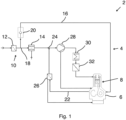
- Fig. 1 shows a stationary gas engine 2 with a ventilation arrangement 4 for ventilating a crankcase 6.
- the gas engine 2 comprises cylinders 8.
- a fuel gas-air mixture is supplied to the cylinders 8 via an intake arrangement 10.
- the intake arrangement 10 comprises an air filter 12, through which ambient air is sucked in and filtered during operation, and a gas mixer 14, in which the intake air is mixed with a fuel gas.
- the crankcase 6 can be ventilated and de-ventilated via the ventilation arrangement 4.
- the ventilation arrangement 4 comprises a ventilation line 16 which extends from a removal point 18 to the crankcase 6.
- the removal point 18 is between the air filter 12 and the gas mixer 14 on the intake arrangement 10.
- the ventilation line 16 has a check valve 20. This prevents blow-by gases entering the crankcase 6 from the cylinder 8 from returning to the extraction point 18 in the intake arrangement 10 via the ventilation line 16.
- the ventilation arrangement 4 further comprises a return line 22, which guides gases taken from the crankcase 6 to the return point 24 on the intake arrangement 10.
- the return point 24 is arranged in the flow direction of the intake air behind the gas mixer 14 in the intake arrangement 10.
- An oil separator 26, which is designed as a filter in the present case, is arranged in the return line 22.
- the gas engine 2 in the embodiment according to Fig. 1 is designed as a supercharged engine.
- the intake arrangement has a charger 28. This compresses the fuel gas-air mixture via a compressor during operation.
- the charger can be designed in particular as an exhaust gas turbocharger.
- a mixture cooler 30 is arranged behind the charger, via which the compressed fuel gas-air mixture can be cooled down. This increases the density of the fuel gas-air mixture and more fuel gas-air mixture can be introduced into the cylinder 8.
- a throttle valve 32 is arranged behind the mixture cooler 30 in the intake arrangement 10. The amount of the fuel gas-air mixture that enters a cylinder 8 can be regulated via the throttle valve 32.
- a line leads from the oil separator 26 back into the crankcase 6. Oil separated in the oil separator 26 is returned to the crankcase 6 via this line. Alternatively, the oil separated in the oil separator 26 can also be fed to a used oil container. A line also leads from the charger 28 back into the crankcase, via which oil and any blow-by gases that escape via seals and/or bearings of the charger 28 are returned to the crankcase 6.
- the check valve 20 Apart from the check valve 20, there are no other valves in the ventilation arrangement 4, in particular in the ventilation line 16 and the return line 22, in particular no regulating or control valves.
- the air that enters through the air filter 12 during operation and is sucked in by the charger 28 is divided at the extraction point 18 into a purge air flow in the ventilation line 16 and an air flow passing through the gas mixer 14.
- the division is made in such a way that the pressure losses for the respective gas flows via the gas mixer 14 or through the ventilation arrangement 4 with the check valve 20, the ventilation line 16, the crankcase 6, the return line 22 and the oil separator 26 up to the return point 24 are the same.
- Fig. 2 shows an alternative design in which the oil separator 26 comprises a cyclone filter 27 which is designed as a pre-filter.
- the gas taken from the crankcase 6 via the return line 22 first enters the cyclone pre-filter 27 of the oil separator 26. This is followed by a filter element of the oil separator 26.
- the ventilation arrangement enables a volume flow through the return line 22, which enables efficient separation of oil in a cyclone pre-filter 27.
- a cyclone filter 27 functions without a filter medium which could become clogged and blocked over time. It is particularly low-maintenance.
- a cyclone pre-filter 27 designed as a cyclone filter can increase the service life of a subsequent filter element of the oil separator 26. It is also possible to implement the oil separator 26 using only a cyclone filter, as is the case in the embodiment according to Fig. 3 is shown.
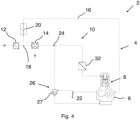
- Fig. 4 shows a further embodiment in which the oil filter 26 is designed as a cyclone filter.
- the engine is not supercharged, but is designed as a naturally aspirated engine.
- the intake arrangement 10 has no charger 28 and no mixture cooler 30. The intake of air through the intake arrangement 10 takes place through the cylinders 8.
- a stationary gas engine according to the invention with a ventilation system 4 for ventilating the crankcase 6 of the gas engine 2 can thus be realized both as a naturally aspirated engine and as a charged engine, in particular as a turbocharged engine.
Landscapes
- Engineering & Computer Science (AREA)
- Mechanical Engineering (AREA)
- General Engineering & Computer Science (AREA)
- Chemical & Material Sciences (AREA)
- Combustion & Propulsion (AREA)
- Chemical Kinetics & Catalysis (AREA)
- General Chemical & Material Sciences (AREA)
- Oil, Petroleum & Natural Gas (AREA)
- Lubrication Details And Ventilation Of Internal Combustion Engines (AREA)
Description
- Die vorliegende Erfindung betrifft einen stationären Gasmotor nach dem Oberbegriff des Anspruchs 1.
- Ein Gasmotor weist zumindest einen Zylinder und ein Kurbelgehäuse auf. Bei der Verbrennung eines Brenngas-Luft-Gemischs im Zylinder entsteht ein hoher Druck. Insbesondere ist dieser größer als der Druck im Kurbelgehäuse. Ein Teil der Gase gelangt als Blow-By Gase am Zylinder vorbei in das Kurbelgehäuse. Das Kurbelgehäuse muss daher entlüftet werden. Die Blow-By Gase tragen Feuchtigkeit in das Kurbelgehäuse ein. Je nach Motor kann es zu einer Kondensation dieser Feuchtigkeit im Kurbelgehäuse kommen. So entstehendes Kondensat vermischt sich mit Öl im Kurbelgehäuse und beeinträchtigt die Ölqualität. Wasser im Öl begünstigt die Bildung von unerwünschtem Ölschlamm.
- Die Gefahr von Kondensatbildung kann durch eine Belüftung des Kurbelgehäuses verringert bzw. ausgeschlossen werden. Die
DE10323265A1 beschreibt ein Beispiel von einem Motor mit einer Be- und Entlüftungsvorrichtung. - Hierbei wird Spülluft in das Kurbelgehäuse eingebracht. Diese verdünnt die Blow-By Gase und senkt so die relative Feuchtigkeit im Kurbelgehäuse. Die Gefahr einer Kondensatbildung wird reduziert bzw. eliminiert. Bei aus dem Stand der Technik bekannten Gasmotoren wird die Spülluft entweder aus der Umgebung entnommen und direkt oder nach Filterung durch einen Spülluftfilter dem Kurbelgehäuse zugeführt. Bei aufgeladenen Gasmotoren kann die Spülluft alternativ aus einer einen Lader aufweisenden Ansauganordnung hinter dem Lader entnommen werden. Die Ansaugluft steht hier mit einem hohen Druck zur Verfügung und kann in jeden Teil des Motors und insbesondere in das Kurbelgehäuse geleitet werden. Dafür muss der Druck einer hinter einem Lader aus der Ansauganordnung entnommenen Spülluft jedoch regelmäßig reduziert werden. Hierbei kommt es zu unerwünschten Energieverlusten.
- Aufgabe der vorliegenden Erfindung ist es, einen stationären Gasmotor mit einer Belüftungsanordnung zur Belüftung des Kurbelgehäuses bereitzustellen, der kostengünstig, zuverlässig und wartungsarm ist.
- Die Aufgabe wird erfindungsgemäß dadurch gelöst, dass die Belüftungsanordnung eine Belüftungsleitung umfasst, die sich von einer Entnahmestelle der Ansauganordnung zu dem Kurbelgehäuse erstreckt. Diese bildet eine fluidisch leitende Verbindung aus. Im Betriebsfall wird an der Entnahmestelle aus der Ansauganordnung entnommene Spülluft durch die Belüftungsleitung in das Kurbelgehäuse geleitet. Die Ansauganordnung eines stationären Gasmotors ist mit einem Luftfilter versehen. Die aus der Ansauganordnung entnommene Spülluft ist somit bereits gefiltert. Ein weiterer separater Spülluftfilter kann entfallen.
- Erfindungsgemäß weist die Belüftungsanordnung weiterhin eine Rückführungsleitung auf, die sich von einer vom Kurbelgehäuse, insbesondere einer Entnahmestelle am Kurbelgehäuse zu einer Rückführstelle an der Ansauganordnung erstreckt. Diese bildet ebenfalls eine fluidisch leitende Verbindung aus. Im Betriebsfall wird die aus dem Kurbelgehäuse entnommene Gasströmung durch die Rückführungsleitung zu der Rückführstelle an der Ansauganordnung zurückgeleitet. Dabei ist die Entnahmestelle zwischen dem Luftfilter und einem Gasmischer in der Ansauganordnung angeordnet. Die Rückführstelle ist in Strömungsrichtung der Ansaugluft hinter dem Gasmischer in der Ansauganordnung angeordnet.
- Der Gasmischer ist eine Vorrichtung, mit der Brenngas und Ansaugluft gemischt werden, bevor das Brenngas-Luft-Gemisch über den weiteren Verlauf der Ansauganordnung in den Zylinder des stationären Gasmotors gelangt, um dort verbrannt zu werden. Typischerweise ist ein solcher Gasmischer als eine Venturi-Düse ausgebildet. Diese verengt den Querschnitt der Ansauganordnung lokal und erhöht die Strömungsgeschwindigkeit der Ansaugluft. Hierdurch sinkt lokal der Druck ab. An dieser Stelle weist ein solcher Gasmischer einen Einlass für das Brenngas auf. Durch den lokal niedrigeren Druck im Gasmischer gelangt das Brenngas aus dem Einlass in die Ansaugluft.
- Der Gasmischer bewirkt einen Druckverlust der ihn durchströmenden Ansaugluft. Vor dem Gasmischer, im Bereich der Entnahmestelle, herrscht ein höherer Druck als hinter dem Gasmischer, im Bereich der Rückführstelle. Diese Druckdifferenz bewirkt, dass ein Teil der Ansaugluft an der Entnahmestelle als Spülluft durch die Belüftungsleitung in das Kurbelgehäuse gelangt. Dort vermischt sie sich mit Blow-By Gasen und verdünnt diese. Über die Rückführungsleitung gelangt die Spülluft zusammen mit den Blow-By Gasen über die Rückführstelle in die Ansauganordnung und anschließend in den zumindest einen Zylinder.
- Erfindungsgemäß sind die Belüftungsleitung und die Rückführungsleitung dabei ungeregelt. Dies bedeutet, dass weder in der Belüftungsleitung noch in der Rückführungsleitung irgendwelche Regelventile vorgesehen sind. Die jeweiligen Gasströme durch die Belüftungsleitung und die Rückführungsleitung stellen sich automatisch aufgrund der Widerstände der einzelnen passiven Komponenten mit ihren jeweiligen Druckverlustkurven so ein, dass der Druckverlust über den Gasmischer und in der Belüftungsanordnung jeweils gleich ist. Die einzelnen Volumenströme bei bestimmten Betriebspunkten des Gasmotors ergeben sich aufgrund der Auslegung der passiven Bauelemente. Der stationäre Gasmotor mit der Belüftungsanordnung ist durch den Verzicht auf Regeleinrichtungen besonders einfach aufgebaut. Der Gasmotor ist wartungsarm, günstig herstellbar und besonders zuverlässig.
- Für jeden Betriebspunkt des Motors stellt sich im Betriebsfall automatisch ein Gleichgewicht ein zwischen dem Teil der Ansaugluft, der als Spülluft über die Belüftungsleitung in das Kurbelgehäuse gelangt, und dem Teil, der durch den Gasmischer hindurchtritt. Die genaue Aufteilung ist abhängig vom Gesamtvolumenstrom, der in das Systemeintritt sowie den Auslegungen der Belüftungsanordnung bzw. des Gasmischers. Die Druckverluste durch diese sind abhängig von den jeweiligen Leitungsquerschnitten und den Abmessungen etwaiger weiterer Bauteile in den jeweiligen Leitungen sowie den jeweils durch diese hindurchtretenden Gasvolumenströmen. Das Gleichgewicht stellt sich automatisch derart ein, dass im Betriebsfall der Druckverlust von Entnahmestelle zur Rückführstelle über die Belüftungsanordnung genauso groß ist wie der Druckverlust von Entnahmestelle zur Rückführstelle über den Gasmischer.
- Eine Regelung des Spülluftstroms über Regelventile entfällt. Das System ist besonders einfach aufgebaut. Es sind keine zusätzlichen Luftfilter oder zusätzliche Regel- oder Steuerventile mit entsprechenden Regel- oder Steuervorrichtungen notwendig. Eine solchermaßen einfache aufgebaute Belüftungsanordnung heizt zudem beim Anfahren des stationären Gasmotors schnell auf. Hierdurch wird die Gefahr von Kondensatbildung in der Belüftungsanordnung, insbesondere im Bereich nach dem Kurbelgehäuse weiter verringert. Im Betriebsfall liegt der Druck an der Entnahmestelle unterhalb des Umgebungsdrucks, da die Ansaugluft durch den Luftfilter bereits einen gewissen Druckverlust erfährt. An der Rückführstelle ist der Druck durch die jeweiligen Druckverluste im Gasmischer bzw. in der Belüftungsanordnung weiter verringert. Hieraus ergibt sich zwangsläufig, dass der Druck im Kurbelgehäuse ebenfalls geringer als der Umgebungsdruck ist. Bei etwaigen Undichtigkeiten des Kurbelgehäuses wird durch das Druckgefälle zwischen Kurbelgehäuse und Umgebung die Gefahr eines ungewollten Ölaustritts aus dem Kurbelgehäuse verringert.
- Vorzugsweise weist die Belüftungsanordnung nur jeweils eine Rückführstelle und eine Entnahmestelle auf. Durch den Verzicht auf mehrere Rückführstellen und/oder mehrere Entnahmestellen entfallen die andernfalls notwendigen komplexe Regelungsanordnungen mit mehreren Rückschlagventilen und/oder Regelventilen, um in Abhängigkeit der jeweiligen Druckverhältnisse im Betriebsfall eine Entnahme von Gasen aus der Ansauganordnung an einer Rückführstelle oder eine Rückführung von Gasen zu einer Entnahmestelle zu verhindern. Das erfindungsgemäße System ist besonders einfach und besonders wartungsarm aufgebaut.
- Bevorzugt ist in der Rückführungsleitung ein Ölabscheider angeordnet, über den im Betriebsfall in der aus dem Kurbelgehäuse entnommenen Gasströmung enthaltenes Öl abscheidbar ist. Die über die Rückführungsleitung zur Rückführstelle in der Ansauganordnung zurückgeführten Gase setzen sich zusammen aus der Spülluft, den Blow-By Gasen sowie etwaigen von der Gasströmung mitgetragenen Öltropfen. Diese können im Zylinder verbrannt werden. Ein Ölabscheider ermöglicht es, einen großen Teil dieses Öls abzuscheiden und vorzugsweise in das Kurbelgehäuse zurückzuführen. Alternativ kann das abgeschiedene Öl beispielsweise einem Altölbehälter zugeführt werden. Besonders bevorzugt weist der Ölabscheider einen Zyklonfilter auf. Dieser kann das einzige Filterelement des Ölabscheiders darstellen oder als Vorfilter vor einem weiteren Filterelement des Ölabscheiders ausgestaltet sein. In der erfindungsgemäßen Ausgestaltung ermöglicht die Belüftungsanordnung einen hohen Volumenstrom durch die Belüftungsleitung bzw. die Rückführungsleitung. Dies gilt umso mehr, wenn Leitungen und Einbauten mit großen Querschnitten verwendet werden. Bei hohen Strömungsgeschwindigkeiten können Zyklonfilter effektiv eingesetzt werden. Da Zyklonfilter kein Filtermedium aufweisen, dass sich im Laufe der Zeit zusetzen kann, wird die Standzeit eines Ölabscheiders mit einem entsprechenden Zyklonfilter erhöht. Ein stationärer Gasmotor mit einer Belüftungsanordnung entsprechend dieser Weiterbildung ist somit besonders wartungsarm.
- Vorzugsweise ist in der Belüftungsleitung ein Rückschlagventil angeordnet. Dieses verhindert, dass Blow-By Gase statt über die Rückführungsleitung über die Belüftungsleitung in die Ansauganordnung gelangen. Insbesondere wenn in der Rückführungsleitung ein Ölabscheider angeordnet ist, wird so sichergestellt, dass Blow-By Gase über den Ölabscheider geführt werden. Besonders bevorzugt weist das Rückschlagventil einen Ventilkörper auf, der ausschließlich schwerkraftbeaufschlagt ist. Insbesondere wird dieser Ventilkörper nicht durch ein Federelement mit einer Kraft in Richtung seines Ventilsitzes beaufschlagt. In einem stationären Gasmotor kann die Ausrichtung des Rückschlagventils im Raum relativ zur Schwerkraftrichtung festgelegt werden, so dass ein Rückschlagventil mit einem lediglich schwerkraftbeaufschlagten Ventilköper verwendbar ist. Ein lediglich schwerkraftbeaufschlagter Ventilkörper des Rückschlagventils weist ein besonders gutes Öffnungsverhalten auf. Es ist sehr leichtgängig und wartungsarm. Zudem kann das Rückschlagventil so gestaltet werden, dass es bei einer Durchströmung einen besonders geringen Druckverlust aufweist.
- Besonders vorzugsweise sind in der Belüftungsleitung in Strömungsrichtung der Spülluft vor und nach dem Rückschlagventil Filtersiebe angeordnet. Diese verhindern, dass bei einer etwaigen Beschädigung des Rückschlagventils entstehende Bruchstücke in die Ansauganordnung und ggf. bis in den Zylinder und/oder in weitere Teile der Belüftungsanordnung und ggf. in das Kurbelgehäuse des stationären Gasmotors gelangen. Hierdurch wird die Gefahr einer Beschädigung des Motors verringert.
- In einer alternativen Ausführungsform ist das Rückschlagventil als Tesla-Ventil ausgebildet. Hierbei handelt es sich um ein passives fluidisches Ventil. Es kommt ohne bewegliche Teile aus. Hierdurch ist es besonders wartungsarm und weist ein gutes Öffnungsverhalten auf, da nicht zunächst ein mechanischer Ventilkörper von einem Ventilsitz gelöst werden muss.
- Bevorzugt ist in der Ansauganordnung eine Drosselklappe angeordnet, die die Menge des in den stationären Gasmotor gelangenden Brenngas-Luft-Gemisches regelt. Diese Drosselklappe ist hinter der Rückführstelle in der Ansauganordnung angeordnet. Eine Drosselklappe stellt ein bewegliches Element dar, das den der Querschnitt der Ansauganordnung und somit die Menge der durch die Ansauganordnung in den bzw. die Zylinder gelangenden Brenngas-Luft-Gemischs verändert. Durch die Anordnung der Drosselklappe hinter der Rückführstelle in der Ansauganordnung wird die Aufteilung der im Betriebsfall durch den Gasmischer und durch die Belüftungsanordnung strömenden Gasvolumenströme nur mittelbar durch die Drosselklappe beeinflusst. Andernfalls wäre zumindest für einzelne Betriebspunkte ein entsprechendes Regelventil in der Belüftungsanordnung vorzusehen, das den Volumenstrom analog zur Stellung der Drosselklappe regelt. Die Drosselklappe kann alternativ auch zwischen Luftfilter und Entnahmestelle in der Ansauganordnung angeordnet sein. In beiden Fällen bestimmt die Drosselklappe lediglich den Gesamtvolumenstrom ohne die Aufteilung der Gasvolumenströme auf die Belüftungsanordnung sowie den Gasmischer zu beeinflussen. Diese Anordnung ermöglicht die Verwendung einer Drosselklappe zur Regelung des Gasmotors bei gleichzeitig einfachem und wartungsarmem Aufbau der Belüftungsanordnung.
- Vorzugsweise weist der stationäre Gasmotor einen Lader, insbesondere einen Turbolader auf. Dieser ist in Strömungsrichtung der Ansaugluft hinter der Rückführstelle an der Ansauganordnung angeordnet. Die über die Rückführungsleitung zur Rückführstelle zurückgeführten Gase werden somit vor dem Lader in die Ansauganordnung zurückgeführt. Der stationäre Gasmotor mit der Belüftungsanordnung kann somit sowohl für aufgeladene Gasmotoren als auch für als Saugmotor ausgebildete Gasmotoren verwendet werden. Besonders bevorzugt ist in Strömungsrichtung der Ansaugluft hinter dem Lader ein Ladeluftkühler angeordnet. Hierdurch kann die Leistung des Gasmotors weiter verbessert werden. Die Menge des Brenngas-Luft-Gemischs, das in den Zylinder eingebracht werden kann, wird durch die Verdichtung und Ladeluftkühlung erhöht.
- Weitere Vorteile und Einzelheiten der Erfindung sind in der nachfolgenden Figurenbeschreibung mit beispielhaften erfindungsgemäßen Ausbildungen zu entnehmen. In den Figuren zeigt auf schematische Weise:
- Fig. 1
- einen erfindungsgemäßen stationären Gasmotor mit einer Belüftungsanordnung,
- Fig. 2
- einen stationären Gasmotor mit einer Belüftungsanordnung in einer alternativen Ausführungsform mit einem Zyklonvorfilter,
- Fig. 3
- einen erfindungsgemäßen stationären Gasmotor mit einer Belüftungsanordnung in einer dritten Ausführungsform, bei dem der Ölabscheider als Zyklonfilter ausgebildet ist,
- Fig. 4
- einen erfindungsgemäßen stationären Gasmotor mit einer Belüftungsanordnung, wobei der Motor als Saugmotor und der Ölabscheider als Zyklonfilter ausgebildet ist.
- Gleich oder ähnlich wirkende Teile sind - sofern dienlich - mit identischen Bezugsziffern versehen. Einzelne technische Merkmale der nachfolgend beschriebenen Ausführungsbeispiele können mit den Merkmalen des Anspruchs 1 sowie mit den Merkmalen einzelner vorher beschriebener Ausführungsbeispiele zu erfindungsgemäßen Gegenständen kombiniert werden.
-
Fig. 1 zeigt einen stationären Gasmotor 2 mit einer Belüftungsanordnung 4 zur Belüftung eines Kurbelgehäuses 6. Der Gasmotor 2 umfasst Zylinder 8. Den Zylindern 8 wird über eine Ansauganordnung 10 ein Brenngas-Luft-Gemisch zugeführt. Die Ansauganordnung 10 umfasst einen Luftfilter 12, durch den im Betriebsfall Umgebungsluft angesaugt und dabei gefiltert wird, sowie einen Gasmischer 14, in dem die Ansaugluft mit einem Brenngas gemischt wird. - Über die Belüftungsanordnung 4 kann das Kurbelgehäuse 6 be- und entlüftet werden. Die Belüftungsanordnung 4 umfasst eine Belüftungsleitung 16, die sich von einer Entnahmestelle 18 zum Kurbelgehäuse 6 erstreckt. Die Entnahmestelle 18 ist zwischen dem Luftfilter 12 und dem Gasmischer 14 an der Ansauganordnung 10 angeordnet. Die Belüftungsleitung 16 weist ein Rückschlagventil 20 auf. Dieses verhindert, dass aus dem Zylinder 8 in das Kurbelgehäuse 6 eintretende Blow-By-Gase über die Belüftungsleitung 16 zur Entnahmestelle 18 in die Ansauganordnung 10 zurückgelangen können.
- Die Belüftungsanordnung 4 umfasst weiterhin eine Rückführungsleitung 22, die aus dem Kurbelgehäuse 6 entnommene Gase zur Rückführstelle 24 an der Ansauganordnung 10 leitet. Die Rückführstelle 24 ist in Strömungsrichtung der Ansaugluft hinter dem Gasmischer 14 in der Ansauganordnung 10 angeordnet. In der Rückführungsleitung 22 ist ein Ölabscheider 26 angeordnet, der vorliegend als Filter ausgebildet ist.
- Der Gasmotor 2 in dem Ausführungsbeispiel gemäß
Fig. 1 ist als aufgeladener Motor ausgebildet. Die Ansauganordnung weist einen Lader 28 auf. Dieser komprimiert im Betriebsfall über einen Verdichter das Benngas-Luft-Gemisch. Der Lader kann insbesondere als Abgasturbolader ausgebildet sein. Hinter dem Lader ist ein Gemischkühler 30 angeordnet, über den das verdichtete Brenngas-Luft-Gemisch heruntergekühlt werden kann. Hierdurch wird die Dichte des Brenngas-Luft-Gemischs erhöht, und es kann mehr Brenngas-Luft-Gemisch in den Zylinder 8 eingeführt werden. Hinter dem Gemischkühler 30 ist eine Drosselklappe 32 in der Ansauganordnung 10 angeordnet. Über die Drosselklappe 32 kann die Menge des Brenngas-Luft-Gemischs, das in einen Zylinder 8 gelangt, geregelt werden. Die konkrete Anordnung der Drosselklappe 32 kurz vor dem Zylinder 8 und insbesondere nicht zwischen der Entnahmestelle 18 und der Rückführstelle 24 ermöglicht, dass die Belüftungsanordnung 4, insbesondere der Volumenstrom der Spülluft, von der Drosselklappe 32 nur mittelbar beeinfluss wird. Von dem Ölabscheider 26 führt eine Leitung zurück in das Kurbelgehäuse 6. Über diese Leitung wird im Ölabscheider 26 abgeschiedenes Öl in das Kurbelgehäuse 6 zurückgeführt. Alternativ kann das im Ölabscheider 26 abgeschiedene Öl auch einem Altölbehälter zugeführt werden. Von dem Lader 28 führt ebenfalls eine Leitung zurück in das Kurbelgehäuse, über die Öl sowie etwaige Blow-By-Gase, die über Dichtungen und/oder Lager des Laders 28 austreten, in das Kurbelgehäuse 6 zurückgeführt werden. - Außer dem Rückschlagventil 20 finden sich in der Belüftungsanordnung 4, insbesondere in der Belüftungsleitung 16 sowie der Rückführungsleitung 22, keinerlei weitere Ventile, insbesondere keine Regel- oder Steuerventile. Die im Betriebsfall durch den Luftfilter 12 eingetretene und vom Lader 28 angesaugte Luft teilt sich an der Entnahmestelle 18 in einen Spülluftstrom in der Belüftungsleitung 16 sowie in einen durch den Gasmischer 14 hindurchtretenden Luftstrom auf. Die Aufteilung erfolgt so, dass für die jeweiligen Gasströme die Druckverluste über den Gasmischer 14 bzw. durch die Belüftungsanordnung 4 mit dem Rückschlagventil 20, der Belüftungsleitung 16, dem Kurbelgehäuse 6, der Rückführungsleitung 22 sowie dem Ölabscheider 26 bis zur Rückführstelle 24 gleich groß sind. Das aus dem Kurbelgehäuse 6 zurückgeführte Gas, aus dem im Ölabscheider 26 zumindest teilweise mitgeführtes Öl entfernt wurde, wird in der Rückführstelle 24 mit dem im Gasmischer 14 erzeugten Brenngas-Luft-Gemisch gemischt und über den Lader 28 verdichtet. Nach einer Kühlung in dem Gemischkühler 30 und einer etwaigen Drosselung über die Drosselklappe 32 gelangen die Gase in den Zylinder 8, wo sie verbrannt und anschließend über ein nicht dargestelltes Abgassystem ausgestoßen werden.
-
Fig. 2 zeigt eine alternative Ausgestaltung, bei der der Ölabscheider 26 einen Zyklonfilter 27 umfasst, der als Vorfilter ausgestaltet ist. Das über die Rückführungsleitung 22 aus dem Kurbelgehäuse 6 entnommene Gas tritt zunächst in den Zyklonvorfilter 27 des Ölabscheiders 26 ein. Anschließend schließt sich ein Filterelement des Ölabscheiders 26 an. Die Belüftungsanordnung ermöglicht einen Volumenstrom durch die Rückführungsleitung 22, der eine effiziente Abscheidung von Öl in einem Zyklonvorfilter 27 ermöglicht. Ein Zyklonfilter 27 funktioniert ohne ein Filtermedium, das sich im Laufe der Zeit zusetzen und verstopfen könnte. Er ist besonders wartungsarm. Durch einen als Zyklonfilter ausgebildeten Zyklonvorfilter 27 kann die Standzeit eines nachfolgenden Filterelements des Ölabscheiders 26 erhöht werden. Es ist auch möglich, den Ölabscheider 26 lediglich durch einen Zyklonfilter zu realisieren, wie dies im Ausführungsbeispiel gemäßFig. 3 dargestellt ist. -
Fig. 4 zeigt ein weiteres Ausführungsbeispiel, bei dem der Ölfilter 26 als Zyklonfilter ausgebildet ist. In diesem Ausführungsbeispiel ist der Motor jedoch nicht aufgeladen, sondern als Saugmotor ausgebildet. Die Ansauganordnung 10 weist keinen Lader 28 und keinen Gemischkühler 30 auf. Das Ansaugen von Luft durch die Ansauganordnung 10 erfolgt durch die Zylinder 8. Ein erfindungsgemäßer stationärer Gasmotor mit einem Belüftungssystem 4 zur Belüftung des Kurbelgehäuses 6 des Gasmotors 2 kann somit sowohl als Saugmotor als auch als aufgeladener Motor, insbesondere als turboaufgeladener Motor realisiert werden.
Claims (11)
- Stationärer Gasmotor (2) mit einer Belüftungsanordnung (4) zur Belüftung eines Kurbelgehäuses (6), umfassend zumindest einen Zylinder (8) und ein Kurbelgehäuse (6), mit einer Ansauganordnung (10), durch die Ansaugluft in den zumindest einen Zylinder (8) des stationären Gasmotors (2) gelangt, wobei in der Ansauganordnung (10) in Strömungsrichtung der Ansaugluft hintereinander ein Luftfilter (12) und ein die Ansaugluft mit einem Brenngas mischender Gasmischer (14) angeordnet sind, und wobei die Belüftungsanordnung (4) eine in das Kurbelgehäuse (6) einmündende und im Betriebsfall Spülluft in das Kurbelgehäuse (6) leitende Belüftungsleitung (16) sowie eine sich von dem Kurbelgehäuse (6) zu einer Rückführstelle (24) an der Ansauganordnung (10) erstreckende und im Betriebsfall eine dem Kurbelgehäuse (6) entnommene Gasströmung zu der Rückführstelle (24) zurückführenden Rückführungsleitung (22) aufweist, wobei die Belüftungsleitung (16) sich von einer Entnahmestelle (18) an der Ansauganordnung (10) zum Kurbelgehäuse (6) erstreckend und im Betriebsfall an der Entnahmestelle (18) aus der Ansauganordnung (10) entnommene Spülluft in das Kurbelgehäuse (6) leitend angeordnet ist, wobei die Entnahmestelle (18) zwischen dem Luftfilter (12) und dem Gasmischer (14) angeordnet ist und wobei die Rückführstelle (24) in Strömungsrichtung der Ansaugluft hinter dem Gasmischer (14) angeordnet ist, wobei die Belüftungsleitung (16) und die Rückführungsleitung (22) ungeregelt sind.
- Stationärer Gasmotor nach Anspruch 1, dadurch gekennzeichnet, dass die Belüftungsanordnung nur jeweils eine Rückführstelle (18) und Entnahmestelle (24) aufweist.
- Stationärer Gasmotor nach Anspruch 1 oder 2, dadurch gekennzeichnet, dass die Rückführungsleitung (22) einen Ölabscheider (26) aufweist, über den im Betriebsfall in der entnommenen Gasströmung enthaltenes Öl abscheidbar ist.
- Stationärer Gasmotor nach Anspruch 3, dadurch gekennzeichnet, dass der Ölabscheider (26) einen Zyklonfilter (27) aufweist.
- Stationärer Gasmotor nach einem der vorherigen Ansprüche, dadurch gekennzeichnet, dass in der Belüftungsleitung (16) ein Rückschlagventil (20) angeordnet ist.
- Stationärer Gasmotor nach Anspruch 5, dadurch gekennzeichnet, dass das Rückschlagventil (20) einen Ventilkörper aufweist, der schwerkraftbeaufschlagt ist.
- Stationärer Gasmotor nach Anspruch 5 oder 6, dadurch gekennzeichnet, dass vor und hinter dem Rückschlagventil (20) jeweils zumindest ein Filtersieb in der Belüftungsleitung (16) angeordnet ist.
- Stationärer Gasmotor nach Anspruch 5, dadurch gekennzeichnet, dass das Rückschlagventil (20) als Tesla-Ventil ausgebildet ist.
- Stationärer Gasmotor nach einem der vorherigen Ansprüche, dadurch gekennzeichnet, dass eine die Menge des in den stationären Gasmotor (2) gelangenden Brenngas-Ansaugluft-Gemischs regelnde Drosselklappe (32) hinter der Rückführstelle in der Ansauganordnung (10) angeordnet ist.
- Stationärer Gasmotor (2) nach einem der vorherigen Ansprüche, gekennzeichnet durch einen Lader (28), insbesondere einen Turbolader, der in Strömungsrichtung der Ansaugluft hinter der Rückführstelle (24) der Ansauganordnung (10) angeordnet ist.
- Stationärer Gasmotor nach Anspruch 10, gekennzeichnet durch einen Ladeluftkühler (30), der in Strömungsrichtung der Ansaugluft hinter dem Lader (30) in der Ansauganordnung (10) angeordnet ist.
Applications Claiming Priority (1)
| Application Number | Priority Date | Filing Date | Title |
|---|---|---|---|
| DE102021123749.1A DE102021123749A1 (de) | 2021-09-14 | 2021-09-14 | Stationärer Gasmotor mit einer Belüftungsanordnung zur Belüftung eines Kurbelgehäuses |
Publications (3)
| Publication Number | Publication Date |
|---|---|
| EP4148240A1 EP4148240A1 (de) | 2023-03-15 |
| EP4148240B1 true EP4148240B1 (de) | 2024-10-02 |
| EP4148240C0 EP4148240C0 (de) | 2024-10-02 |
Family
ID=83319051
Family Applications (1)
| Application Number | Title | Priority Date | Filing Date |
|---|---|---|---|
| EP22195411.8A Active EP4148240B1 (de) | 2021-09-14 | 2022-09-13 | Stationärer gasmotor mit einer belüftungsanordnung zur belüftung eines kurbelgehäuses |
Country Status (2)
| Country | Link |
|---|---|
| EP (1) | EP4148240B1 (de) |
| DE (1) | DE102021123749A1 (de) |
Family Cites Families (6)
| Publication number | Priority date | Publication date | Assignee | Title |
|---|---|---|---|---|
| DE10043796A1 (de) | 2000-09-06 | 2002-03-14 | Daimler Chrysler Ag | Vorrichtung zur Entlüftung eines Kurbelgehäuses einer Brennkraftmaschine |
| DE10323265A1 (de) * | 2003-05-23 | 2004-12-16 | Mahle Filtersysteme Gmbh | Entfeuchtungsverfahren für ein Kurbelgehäuse und zugehörige Vorrichtung |
| DE202006017813U1 (de) | 2006-11-23 | 2008-03-27 | Hengst Gmbh & Co.Kg | Brennkraftmaschine mit einer Kurbelgehäusebelüftungsleitung |
| DE102018213758B4 (de) | 2018-08-15 | 2021-08-19 | Mtu Friedrichshafen Gmbh | Verfahren zum Inbetriebnehmen einer Brennkraftmaschine, Brennkraftmaschine zur Durchführung eines solchen Verfahrens, und Leistungsanordnung mit einer solchen Brennkraftmaschine |
| DE202018006223U1 (de) | 2018-12-17 | 2019-08-23 | Green Gas Germany Gmbh | Gasmotoranordnung |
| CN111022151A (zh) * | 2020-01-07 | 2020-04-17 | 中国重汽集团济南动力有限公司 | 一种重型天然气发动机的曲轴箱通风系统 |
-
2021
- 2021-09-14 DE DE102021123749.1A patent/DE102021123749A1/de active Pending
-
2022
- 2022-09-13 EP EP22195411.8A patent/EP4148240B1/de active Active
Also Published As
| Publication number | Publication date |
|---|---|
| EP4148240A1 (de) | 2023-03-15 |
| DE102021123749A1 (de) | 2023-03-16 |
| EP4148240C0 (de) | 2024-10-02 |
Similar Documents
| Publication | Publication Date | Title |
|---|---|---|
| EP2010760B1 (de) | Entlüftungseinrichtung für eine aufgeladene brennkraftmaschine | |
| EP2010761B1 (de) | Ent- und belüftungseinrichtung für eine aufgeladene brennkraftmaschine | |
| EP1576265B1 (de) | Abgasturbolader für eine brennkraftmaschine | |
| EP1813785B1 (de) | Druckregelventil | |
| DE102012001458A1 (de) | Brennkraftmaschine | |
| DE202005003462U1 (de) | Durchlüftungsanordnung für das Kurbelgehäuse einer Brennkraftmaschine | |
| DE102006054117B4 (de) | Im Teil- und Volllastbetrieb gesteuerte Kurbelgehäuse-Belüftung einer Brennkraftmaschine | |
| DE102017215041A1 (de) | Ölabscheider, Entlüftungssystem und Verbrennungsmotor | |
| DE102014225817B4 (de) | Entlüftungseinrichtung für eine Brennkraftmaschine sowie Brennkraftmaschine | |
| EP4148240B1 (de) | Stationärer gasmotor mit einer belüftungsanordnung zur belüftung eines kurbelgehäuses | |
| EP0130433B1 (de) | Druckwellenlader mit einem Abgasabblasventil | |
| DE102017120139A1 (de) | Ölnebelabscheider mit Druckbegrenzungsventilen | |
| DE102016223984A1 (de) | Ölabscheider zum Abscheiden von Öl aus Blow-by-Gas | |
| DE102016109582B4 (de) | Saugvorrichtung für Brennkraftmaschine mit integriertem Strömungs-Bypass und Rückschlagventil | |
| DE102015208475B4 (de) | Einrichtung zum Abführen von Kondensat aus einer Turboladeranordnung | |
| DE102022000413A1 (de) | Verbrennungskraftmaschine für ein Kraftfahrzeug, insbesondere für einen Kraftwagen, sowie Kraftfahrzeug | |
| DE102017211675B3 (de) | Vorrichtung und Verfahren zur Vermeidung von Kondensatansammlung beim Aufladen einer Brennkraftmaschine | |
| DE102007054762A1 (de) | Kurbelgehäuseent- und -belüftungseinrichtung für eine Brennkraftmaschine | |
| DE102016219774B4 (de) | System für ein Kraftfahrzeug und Verfahren zum Betreiben einer Brennkraftmaschine für ein Kraftfahrzeug | |
| DE102017213565A1 (de) | Kurbelgehäuseentlüftungseinrichtung | |
| DE102014215557A1 (de) | Kühler mit einem Flüssigkeitsabscheider und einem Bypass | |
| DE102021111051B4 (de) | Entlüftungsvorrichtung | |
| DE112018001502T5 (de) | Fluidische PVC-Ventilanordnung und -system | |
| DE202016104756U1 (de) | Abscheidevorrichtung, Entlüftungssystem für ein Kurbelgehäuse sowie Verbrennungsmotor mit einer derartigen Abscheidevorrichtung | |
| DE102006018319B4 (de) | Verfahren und Einrichtung zur Verhinderung der Ablagerung von Emulsionsschlamm und Eisbildung in Ölabscheidern und Druckregelorganen |
Legal Events
| Date | Code | Title | Description |
|---|---|---|---|
| PUAI | Public reference made under article 153(3) epc to a published international application that has entered the european phase |
Free format text: ORIGINAL CODE: 0009012 |
|
| STAA | Information on the status of an ep patent application or granted ep patent |
Free format text: STATUS: THE APPLICATION HAS BEEN PUBLISHED |
|
| AK | Designated contracting states |
Kind code of ref document: A1 Designated state(s): AL AT BE BG CH CY CZ DE DK EE ES FI FR GB GR HR HU IE IS IT LI LT LU LV MC MK MT NL NO PL PT RO RS SE SI SK SM TR |
|
| STAA | Information on the status of an ep patent application or granted ep patent |
Free format text: STATUS: REQUEST FOR EXAMINATION WAS MADE |
|
| 17P | Request for examination filed |
Effective date: 20230628 |
|
| RBV | Designated contracting states (corrected) |
Designated state(s): AL AT BE BG CH CY CZ DE DK EE ES FI FR GB GR HR HU IE IS IT LI LT LU LV MC MK MT NL NO PL PT RO RS SE SI SK SM TR |
|
| GRAP | Despatch of communication of intention to grant a patent |
Free format text: ORIGINAL CODE: EPIDOSNIGR1 |
|
| STAA | Information on the status of an ep patent application or granted ep patent |
Free format text: STATUS: GRANT OF PATENT IS INTENDED |
|
| INTG | Intention to grant announced |
Effective date: 20240426 |
|
| GRAS | Grant fee paid |
Free format text: ORIGINAL CODE: EPIDOSNIGR3 |
|
| GRAA | (expected) grant |
Free format text: ORIGINAL CODE: 0009210 |
|
| STAA | Information on the status of an ep patent application or granted ep patent |
Free format text: STATUS: THE PATENT HAS BEEN GRANTED |
|
| AK | Designated contracting states |
Kind code of ref document: B1 Designated state(s): AL AT BE BG CH CY CZ DE DK EE ES FI FR GB GR HR HU IE IS IT LI LT LU LV MC MK MT NL NO PL PT RO RS SE SI SK SM TR |
|
| REG | Reference to a national code |
Ref country code: GB Ref legal event code: FG4D Free format text: NOT ENGLISH |
|
| REG | Reference to a national code |
Ref country code: CH Ref legal event code: EP |
|
| REG | Reference to a national code |
Ref country code: DE Ref legal event code: R096 Ref document number: 502022001805 Country of ref document: DE |
|
| REG | Reference to a national code |
Ref country code: IE Ref legal event code: FG4D Free format text: LANGUAGE OF EP DOCUMENT: GERMAN |
|
| U01 | Request for unitary effect filed |
Effective date: 20241002 |
|
| U07 | Unitary effect registered |
Designated state(s): AT BE BG DE DK EE FI FR IT LT LU LV MT NL PT RO SE SI Effective date: 20241025 |
|
| PG25 | Lapsed in a contracting state [announced via postgrant information from national office to epo] |
Ref country code: IS Free format text: LAPSE BECAUSE OF FAILURE TO SUBMIT A TRANSLATION OF THE DESCRIPTION OR TO PAY THE FEE WITHIN THE PRESCRIBED TIME-LIMIT Effective date: 20250202 Ref country code: HR Free format text: LAPSE BECAUSE OF FAILURE TO SUBMIT A TRANSLATION OF THE DESCRIPTION OR TO PAY THE FEE WITHIN THE PRESCRIBED TIME-LIMIT Effective date: 20241002 |
|
| PG25 | Lapsed in a contracting state [announced via postgrant information from national office to epo] |
Ref country code: ES Free format text: LAPSE BECAUSE OF FAILURE TO SUBMIT A TRANSLATION OF THE DESCRIPTION OR TO PAY THE FEE WITHIN THE PRESCRIBED TIME-LIMIT Effective date: 20241002 |
|
| PG25 | Lapsed in a contracting state [announced via postgrant information from national office to epo] |
Ref country code: NO Free format text: LAPSE BECAUSE OF FAILURE TO SUBMIT A TRANSLATION OF THE DESCRIPTION OR TO PAY THE FEE WITHIN THE PRESCRIBED TIME-LIMIT Effective date: 20250102 |
|
| PG25 | Lapsed in a contracting state [announced via postgrant information from national office to epo] |
Ref country code: GR Free format text: LAPSE BECAUSE OF FAILURE TO SUBMIT A TRANSLATION OF THE DESCRIPTION OR TO PAY THE FEE WITHIN THE PRESCRIBED TIME-LIMIT Effective date: 20250103 |
|
| PG25 | Lapsed in a contracting state [announced via postgrant information from national office to epo] |
Ref country code: PL Free format text: LAPSE BECAUSE OF FAILURE TO SUBMIT A TRANSLATION OF THE DESCRIPTION OR TO PAY THE FEE WITHIN THE PRESCRIBED TIME-LIMIT Effective date: 20241002 |
|
| PG25 | Lapsed in a contracting state [announced via postgrant information from national office to epo] |
Ref country code: RS Free format text: LAPSE BECAUSE OF FAILURE TO SUBMIT A TRANSLATION OF THE DESCRIPTION OR TO PAY THE FEE WITHIN THE PRESCRIBED TIME-LIMIT Effective date: 20250102 |
|
| PG25 | Lapsed in a contracting state [announced via postgrant information from national office to epo] |
Ref country code: SM Free format text: LAPSE BECAUSE OF FAILURE TO SUBMIT A TRANSLATION OF THE DESCRIPTION OR TO PAY THE FEE WITHIN THE PRESCRIBED TIME-LIMIT Effective date: 20241002 |
|
| PG25 | Lapsed in a contracting state [announced via postgrant information from national office to epo] |
Ref country code: SK Free format text: LAPSE BECAUSE OF FAILURE TO SUBMIT A TRANSLATION OF THE DESCRIPTION OR TO PAY THE FEE WITHIN THE PRESCRIBED TIME-LIMIT Effective date: 20241002 |
|
| U20 | Renewal fee for the european patent with unitary effect paid |
Year of fee payment: 4 Effective date: 20250702 |
|
| PLBE | No opposition filed within time limit |
Free format text: ORIGINAL CODE: 0009261 |
|
| STAA | Information on the status of an ep patent application or granted ep patent |
Free format text: STATUS: NO OPPOSITION FILED WITHIN TIME LIMIT |
|
| 26N | No opposition filed |
Effective date: 20250703 |
|
| REG | Reference to a national code |
Ref country code: CH Ref legal event code: U11 Free format text: ST27 STATUS EVENT CODE: U-0-0-U10-U11 (AS PROVIDED BY THE NATIONAL OFFICE) Effective date: 20251001 |
|
| PGFP | Annual fee paid to national office [announced via postgrant information from national office to epo] |
Ref country code: CZ Payment date: 20250902 Year of fee payment: 4 |
|
| PGFP | Annual fee paid to national office [announced via postgrant information from national office to epo] |
Ref country code: CH Payment date: 20251001 Year of fee payment: 4 |