EP4145173B1 - Verfahren zur entscheidung und bewertung des interlacing einer vielzahl von radarmodes, entsprechendes computerprogramm und entsprechende vorrichtung - Google Patents
Verfahren zur entscheidung und bewertung des interlacing einer vielzahl von radarmodes, entsprechendes computerprogramm und entsprechende vorrichtung Download PDFInfo
- Publication number
- EP4145173B1 EP4145173B1 EP22191985.5A EP22191985A EP4145173B1 EP 4145173 B1 EP4145173 B1 EP 4145173B1 EP 22191985 A EP22191985 A EP 22191985A EP 4145173 B1 EP4145173 B1 EP 4145173B1
- Authority
- EP
- European Patent Office
- Prior art keywords
- radar
- modes
- interleaving
- mode
- mission
- Prior art date
- Legal status (The legal status is an assumption and is not a legal conclusion. Google has not performed a legal analysis and makes no representation as to the accuracy of the status listed.)
- Active
Links
Images



Classifications
-
- G—PHYSICS
- G01—MEASURING; TESTING
- G01S—RADIO DIRECTION-FINDING; RADIO NAVIGATION; DETERMINING DISTANCE OR VELOCITY BY USE OF RADIO WAVES; LOCATING OR PRESENCE-DETECTING BY USE OF THE REFLECTION OR RERADIATION OF RADIO WAVES; ANALOGOUS ARRANGEMENTS USING OTHER WAVES
- G01S13/00—Systems using the reflection or reradiation of radio waves, e.g. radar systems; Analogous systems using reflection or reradiation of waves whose nature or wavelength is irrelevant or unspecified
- G01S13/02—Systems using reflection of radio waves, e.g. primary radar systems; Analogous systems
- G01S13/06—Systems determining position data of a target
- G01S13/42—Simultaneous measurement of distance and other co-ordinates
- G01S13/426—Scanning radar, e.g. 3D radar
-
- G—PHYSICS
- G01—MEASURING; TESTING
- G01S—RADIO DIRECTION-FINDING; RADIO NAVIGATION; DETERMINING DISTANCE OR VELOCITY BY USE OF RADIO WAVES; LOCATING OR PRESENCE-DETECTING BY USE OF THE REFLECTION OR RERADIATION OF RADIO WAVES; ANALOGOUS ARRANGEMENTS USING OTHER WAVES
- G01S13/00—Systems using the reflection or reradiation of radio waves, e.g. radar systems; Analogous systems using reflection or reradiation of waves whose nature or wavelength is irrelevant or unspecified
- G01S13/66—Radar-tracking systems; Analogous systems
- G01S13/72—Radar-tracking systems; Analogous systems for two-dimensional [2D] tracking, e.g. combination of angle and range tracking, track-while-scan radar
-
- G—PHYSICS
- G01—MEASURING; TESTING
- G01S—RADIO DIRECTION-FINDING; RADIO NAVIGATION; DETERMINING DISTANCE OR VELOCITY BY USE OF RADIO WAVES; LOCATING OR PRESENCE-DETECTING BY USE OF THE REFLECTION OR RERADIATION OF RADIO WAVES; ANALOGOUS ARRANGEMENTS USING OTHER WAVES
- G01S7/00—Details of systems according to groups G01S13/00, G01S15/00, G01S17/00
- G01S7/02—Details of systems according to groups G01S13/00, G01S15/00, G01S17/00 of systems according to group G01S13/00
- G01S7/04—Display arrangements
-
- G—PHYSICS
- G01—MEASURING; TESTING
- G01S—RADIO DIRECTION-FINDING; RADIO NAVIGATION; DETERMINING DISTANCE OR VELOCITY BY USE OF RADIO WAVES; LOCATING OR PRESENCE-DETECTING BY USE OF THE REFLECTION OR RERADIATION OF RADIO WAVES; ANALOGOUS ARRANGEMENTS USING OTHER WAVES
- G01S13/00—Systems using the reflection or reradiation of radio waves, e.g. radar systems; Analogous systems using reflection or reradiation of waves whose nature or wavelength is irrelevant or unspecified
- G01S13/02—Systems using reflection of radio waves, e.g. primary radar systems; Analogous systems
- G01S13/06—Systems determining position data of a target
- G01S13/42—Simultaneous measurement of distance and other co-ordinates
- G01S13/44—Monopulse radar, i.e. simultaneous lobing
- G01S13/4463—Monopulse radar, i.e. simultaneous lobing using phased arrays
-
- G—PHYSICS
- G01—MEASURING; TESTING
- G01S—RADIO DIRECTION-FINDING; RADIO NAVIGATION; DETERMINING DISTANCE OR VELOCITY BY USE OF RADIO WAVES; LOCATING OR PRESENCE-DETECTING BY USE OF THE REFLECTION OR RERADIATION OF RADIO WAVES; ANALOGOUS ARRANGEMENTS USING OTHER WAVES
- G01S13/00—Systems using the reflection or reradiation of radio waves, e.g. radar systems; Analogous systems using reflection or reradiation of waves whose nature or wavelength is irrelevant or unspecified
- G01S13/02—Systems using reflection of radio waves, e.g. primary radar systems; Analogous systems
- G01S2013/0236—Special technical features
- G01S2013/0245—Radar with phased array antenna
- G01S2013/0254—Active array antenna
-
- G—PHYSICS
- G01—MEASURING; TESTING
- G01S—RADIO DIRECTION-FINDING; RADIO NAVIGATION; DETERMINING DISTANCE OR VELOCITY BY USE OF RADIO WAVES; LOCATING OR PRESENCE-DETECTING BY USE OF THE REFLECTION OR RERADIATION OF RADIO WAVES; ANALOGOUS ARRANGEMENTS USING OTHER WAVES
- G01S13/00—Systems using the reflection or reradiation of radio waves, e.g. radar systems; Analogous systems using reflection or reradiation of waves whose nature or wavelength is irrelevant or unspecified
- G01S13/02—Systems using reflection of radio waves, e.g. primary radar systems; Analogous systems
- G01S2013/0236—Special technical features
- G01S2013/0272—Multifunction radar
Definitions
- the invention also relates to an associated computer program.
- the invention also relates to an electronic device for deciding and evaluating the interleaving of a plurality of radar modes of at least one radar suitable for being on board a vehicle, in particular an aircraft, or suitable for being placed implemented on board a device for simulating the behavior of said vehicle.
- the invention lies in the field of active surveillance systems.
- the present invention relates to active surveillance systems using at least one mechanically scanned and/or electronically scanned radar, in particular for airborne maritime surveillance, and applies to the use of said at least one radar in progress.
- mission in particular in flight on board an aircraft, or to any device for mission preparation, training or simulation of the behavior of the vehicle on board which such an active surveillance system based on radar(s) is on board.
- the present invention relates to the interleaving of radar modes, required when the objectives of a surveillance mission cannot be entirely fulfilled without the use of several radar modes, and in particular to implement radar time sharing for best satisfy monitoring or tracking functions.
- the interleaving possibilities have notably evolved in terms of degree of freedom with the arrival of electronically scanned radars and/or the coordinated use of several radars to optimize the sharing of tasks and resources.
- the interleaving must be compatible with various constraints such as: the scanning pattern of the radar, that is to say the temporal succession of the spatial regions illuminated by the radar , capable of being free or constrained, the interweaving of non-Doppler, Doppler or other waveforms imposing specific requirements for revisiting the space, the necessity, when the surveillance device based on radar(s) is embedded, to run on digital computers with potentially limited resources, in terms of computing power, memory, energy consumption, execution time, execution stability, the constraint of interleaving possibilities associated with management of a surveillance region by means of a multi-panel system according to methods of power supply, radar cooling, an operator request, etc.
- trajectory of the vehicle carrying a surveillance device based on radar(s) is also capable of being taken into account as an opportunity or, on the contrary, a constraint.
- the decision to interleave radar modes is a combinatorial optimization problem, sometimes lacking a solution depending on the radar modes of desired use.
- the object of the invention is to remedy the drawbacks of the state of the art by proposing an alternative technique for deciding and evaluating the interleaving of a plurality of radar modes of at least one radar suitable for being carried on board. of a vehicle capable of responding to the problem of airborne maritime surveillance by automatically choosing an interleaving of radar modes, while having a character that is both intelligent for the decision-making of such an interleaving by notably having recourse to artificial intelligence, and “explainable” for understanding or interaction with the operator sometimes lacking knowledge of artificial intelligence.
- the order of the steps successively implemented according to the method of the invention provides a complete hierarchy to the decision system so as to make its behavior explainable by returning a definition of the interleaving obtained with an operational meaning for the operator without necessarily being associated with the definition of radar pointing(s).
- an evaluation of the radar modes is first implemented via the determination of an associated utility value, and this by radar sector to be covered in order to spatially optimize each objective of the mission.
- monitoring common comprising for example, a first objective for monitoring a tanker, a second objective for monitoring a jet-ski, etc.
- the method according to the present invention is capable of quickly allowing the radar operator to assess the possibility or not of interleaving a sequence of radar modes previously determined according to a first set of predetermined constraints, while offering a first possibility optional feedback to select other radar modes to interleave or automatically develop new ones by adapting the set of constraints first used.
- the method according to the present invention is then also capable of quickly allowing the radar operator to appreciate the possibility of setting up spatio-temporal sequencing of the interleaving, while offering a second possibility of feedback if the sequencing is impossible in order to repeat the selection of other radar modes to be interleaved or the automatic development of new modes by again adapting the set of constraints used.
- the invention also relates to a computer program comprising software instructions which, when executed by a computer, implement a method for deciding and evaluating the interleaving of a plurality of radar modes such as defined above.
- computer program and software are hereinafter used in a general sense to refer to any type of computer code (e.g., application software, firmware, microcode, or any other form of computer instruction) which can be used to program one or more processors and/or programmable digital calculator(s) to implement the interleaving decision and evaluation method of a plurality of radar modes as defined above.
- computer code e.g., application software, firmware, microcode, or any other form of computer instruction
- the present invention is based on an operational representation of the decision space centered on a radar of the active surveillance system considered, considering for example a distance-bearing-elevation benchmark centered on said radar.
- the different classical conventions or transformation of classical coordinates are then suitable for being used to express the decision problem of interlacing radar modes in such a distance-bearing-elevation reference frame centered on a radar of the active surveillance system considered.
- space is discretized into spatial regions around the radar at the center of the aforementioned reference mark corresponding to sectors, a sector being defined in three dimensions by a distance-bearing-elevation “cone”, or in two dimensions by distances and bearings.
- the management of the radar scanning pattern manageable by sector or by group of sectors depending on the constraints of the sensors, as well as the associated radar pointings are delegated to another not discussed system. afterwards.
- the transition times between panels also consume radar time, which has an influence on the possibilities of mode interleaving, so that these transitions must therefore be considered as resources, which optionally the operator is able to impose a predefined data refresh scheme.
- FIG. 1 schematically represents the method of decision and evaluation of interleaving of a plurality of radar modes according to one embodiment of the invention, such a method aiming to share all radar resources, namely: radar time, power computing and processing resources, power supply, cooling, etc. so as to best respond to the surveillance mission to be accomplished.
- step 12 of obtaining a radar mission to be carried out is implemented by a module for obtaining the electronic device, not shown, for decision and evaluation interleaving a plurality of radar modes according to the present invention, and this in interface with the active surveillance system based on radar(s) and using all the usual radar functions.
- the mission obtained contains the formulation of the mission need (ie at least one objective of said mission) expressed by the operator or a mission system, as well as the inputs necessary for the following stages of the process such as for example the altitude of the aircraft or even the radar, the navigation information of the aircraft, namely its heading and its angular orientation, the temperature of said at least one radar active surveillance system and the associated radar calibration information, external data from the connection data or other such as weather information, etc.
- the mission need ie at least one objective of said mission
- the operator or a mission system as well as the inputs necessary for the following stages of the process such as for example the altitude of the aircraft or even the radar, the navigation information of the aircraft, namely its heading and its angular orientation, the temperature of said at least one radar active surveillance system and the associated radar calibration information, external data from the connection data or other such as weather information, etc.
- the mission objectives formulated by the operator or the mission system are suitable for being distributed, from an interleaving point of view, between, on the one hand, incompatible objectives 12 A requiring the interleaving of several modes radar, and correspond for example to different types of targets, such as aerial targets, surface targets, slow targets such as a tanker, fast targets such as a jet-ski, fugitive/non-fugitive targets, etc., and on the other hand 12 B compatible objectives of the same radar mode.
- Step 14 of determining, according to a first set of predetermined constraints, radar modes suitable for responding to at least one objective of said radar mission, is implemented by a first determination module of the electronic decision device, not shown. and evaluating interleaving of a plurality of radar modes according to the present invention.
- the first determination module, not shown, of the electronic device according to the present invention conventionally comprises a radar mode selection tool and/or an automatic radar mode design tool.
- Step 16 of determining a utility value, per radar sector to be covered, representative of the utility, for each objective of said mission, associated with each of said modes provided by step 14 of determining radar modes is implemented by a second module for determining the electronic device, not shown, for deciding and evaluating the interleaving of a plurality of radar modes according to the present invention.
- Such a step 16 consists of evaluating utilities for each radar mode, each mission objective and each sector. Such an evaluation therefore takes into account three distinct dimensions (i.e. radar mode, mission objective and sector).
- the usefulness evaluation of each mode consists of automatically interpreting, by means of an artificial intelligence tool of said second module for determining the electronic device according to the present invention, the characteristics of each mode and their aggregation with a view to providing a utility rating for each mission objective of each mode and for each sector.
- the determination of a utility value, per radar sector to be covered, representative of the utility for each objective of said mission associated with each of said modes provided by the step of determining radar modes is based on an artificial intelligence tool corresponding to a fuzzy logic system making it possible to introduce an explainable character from the operator's point of view, while being able to adapt to numerous representations of the reality of the mission for reinforcement learning .
- such a fuzzy logic system can be trained by reinforcement learning.
- the determination of a utility value is based on trees with fuzzy logic capable of making the evaluation of utilities explainable to the operator.
- the present invention intends to propose a hierarchy of the combinatorial optimization problem of interleaving a plurality of radar modes by relying in part on the "explainability" inherited from fuzzy logic introduced in particular by LA Zadeh, in the document entitled “ Outline of a new approach to the analysis of complex systems and decision processes ” .
- fuzzy logic is used within an evaluation tree making it possible to characterize the usefulness of a radar detection mode, by mission objective and by sector, taking into account the various constraints and opportunities obtained from said entries as described in more detail later in connection with my figure 2 .
- Such an element corresponding to an evaluation tree making it possible to characterize the usefulness of a radar detection mode is capable of being trained according to the present invention by means of reinforcement learning implemented by an artificial intelligence tool said second module for determining the electronic device according to the present invention.
- Such reinforcement learning is suitable for relying on the strategy developed by N. Ernest et al. as introduced and proven in the document entitled: “Genetic fuzzy based artificial intelligence for unmanned combat aerial vehicle control in simulated air combat missions ” to train a controller based on fuzzy logic, or any other learning training process by classical reinforcement imposing an action - state (from the English state ) - observation - reward (from the English reward ) formalism while being compatible with a modular agent structure making it possible to move from a fuzzy logic tree to a neural network or even a modular exploration-exploitation technique.
- the artificial intelligence tool of said second module for determining the electronic device according to the present invention is, due to its generalization capacity, configured to manage the existing variations between the radar modes used for reinforcement learning training and the radar modes actually engaged during a mission.
- the determination 16 of utility value implemented according to the present invention incorporates a first level of intelligence artificial since it is, according to a particular optional aspect designed in such a way as to be able to be trained by reinforcement learning, and this by introducing an explainable character by the use of fuzzy logic.
- the estimation of the performance of a known and classic mode is suitable for being used to generate one or more inputs of the determination step 16.
- Step 18 of verifying the validation of at least one first condition of interleaving of said necessary and predetermined modes corresponds, in the event of invalidation, to an explainable management of the sacrifices, or in the case of validation, corresponds to the selection of pair(s) (i.e. activity), each pair (i.e. activity) associating a mode and a sector, candidates for interleaving.
- Such a step 18 is implemented by a module for verifying the electronic device, not shown, for deciding and evaluating interleaving of a plurality of radar modes according to the present invention, and receives as input the utility value respectively associated with each mode, per radar sector to be covered, and for each objective of said mission, calculated during step 16 previously described.
- Step 20 of attempting to determine the interleaving sequencing consists of attempting to interleave the activities (i.e. pairs) selected in step 18 by determining a temporal sequencing for the execution of each of these activities while respecting their duration. , their rehearsal period etc.
- the functions of searching for a sequencing of the selected activities are implemented by the third module for determining the electronic device, not shown, for deciding and evaluating the interlacing of a plurality of radar modes according to the present invention.
- the method according to claim 1 further comprises, after determining said sequencing, a step 22 of calculating the resources and radar time remaining available after application of said sequencing, and depending on the result of said calculation, triggers the reiteration of the method according to the present invention from step 14 of determining radar modes.
- the calculations resources are carried out as a preamble to a possible reallocation at the design/mode selection level.
- such a resource calculation step 22 is capable of involving a complete reiteration of the process, particularly when the current surveillance mission has a duration of several hours during which the mission objectives are likely to evolve, in particular due to a variation. application environment for example in terms of tide, swell direction, wind direction, etc.
- a mission objective is modified so as to require an increase in the detection range by reducing the observation time necessary for detection.
- the method according to claim 1 further comprises, a step 24 of determining, per radar sector to be covered, a cost associated with each mode provided by the step of determining radar modes, each cost also being able to be taken into account during said step 18 of verifying the validation of at least one interleaving condition of said necessary and predetermined modes.
- such a calculation 24 of the cost of the modes reflects the consumption of radar resources such as radar time, electrical energy, etc. when it is triggered in a given sector in the form of a cost.
- the method according to claim 1 further comprises a step 26 of prioritizing radar sectors to be used, the prioritization 26 being determined at least as a function of said mission, the priority of each sector being suitable for being also taken into account during said verification step 18 of the validation of at least one interleaving condition of said necessary and predetermined modes.
- the allocation 26 of the priority of the sectors suitable for being implemented by a not shown prioritization module of the electronic decision device and evaluation of interleaving of a plurality of radar modes according to the present invention, represents the operational interest of each sector.
- certain sectors are according to this step 26 operationally priority and are initially allocated all available resources.
- a sector coinciding with a geographical region with repeated coverage is potentially less priority than a sector coinciding with a region which can only be seen once (i.e. in relation to an anticipation model of the trajectory of the aircraft).
- the priority allocation implemented during step 26 is thus based on the expression of the need of the mission, such as lighting priority in front of the aircraft for example, and/or on the set 28 of data of navigation and/or external inputs described above.
- the allocation of priorities 26 according to the present invention is then suitable for incorporating notions of anticipation or compromise.
- a sector is only visible during a certain period of time, its priority is then increased during this time interval.
- the prioritization step 26 is capable of being merged with (ie integrated within) the step 16 of determining a utility value, by radar sector to be covered, representative of the utility, for each objective of said mission, associated with each of said modes provided by step 14 of determining radar modes, instead of being implemented in parallel as illustrated by the figure 1 .
- the verification step 18 takes as inputs the utility values from step 16, the priorities of the sectors from the prioritization step 26, and the costs from step 24.
- the selection 18 of a set of activities is carried out on the basis of maximizing the sum of the utility values in relation to to the costs resulting from step 24 while satisfying said first necessary, but potentially not sufficient, condition for interleaving.
- the electronic device for deciding and evaluating the interleaving of a plurality of radar modes comprises an information processing unit formed for example of a memory and a processor associated with the memory.
- the obtaining module, the first determination module, the second determination module, the verification module, the reiteration module, the third determination module, and optionally the resource calculation module, the module cost calculation, the prioritization module of the electronic decision device and evaluation of interleaving of a plurality of radar modes are each produced in the form of software, or a software brick, executable by the processor of the device according to the present invention.
- the memory of the electronic decision and evaluation device for interleaving a plurality of radar modes is then capable of storing obtaining software, first determination software, second determination software, verification software, a reiteration software, a third determination software, and optionally resource calculation software, cost calculation software, prioritization software.
- the processor is then able to execute each of these software programs.
- the obtaining module, the first determination module, the second determination module, the verification module, the reiteration module, the third determination module, and optionally the resource calculation module, the module cost calculation, the prioritization module of the electronic decision device and evaluation of interleaving of a plurality of radar modes are each produced in the form of a programmable logic component, such as an FPGA (of the English Field Programmable Gate Array ) , or in the form of a dedicated integrated circuit, such as an ASIC (from the English Application Specifies Integrated Circuit ) .
- a programmable logic component such as an FPGA (of the English Field Programmable Gate Array )
- ASIC from the English Application Specifies Integrated Circuit
- the electronic device for deciding and evaluating the interleaving of a plurality of radar modes is produced in the form of one or more software programs, that is to say under form of a computer program, it is also capable of being recorded on a medium, not shown, readable by computer.
- the computer-readable medium is for example a medium capable of storing electronic instructions and of being coupled to a bus of a computer system.
- the readable medium is an optical disk, a magneto-optical disk, a ROM memory, a RAM memory, any type of non-volatile memory (for example EPROM, EEPROM, FLASH, MVRAM), a magnetic card or an optical card.
- a computer program comprising software instructions is then stored on the readable medium.
- the method of deciding and evaluating the interleaving of a plurality of radar modes at the level of a sector depends on the number and type of modes to be considered.
- FIG 2 illustrates an example of a decision tree used by an artificial intelligence tool of said second determination module of the electronic device according to the present invention, for determining a utility value per radar sector to be covered, representative of the utility for each objective of said mission associated with each of the radar modes, such a tree being trainable by reinforcement learning
- the structure of such a decision tree used for determining a utility value, by mode, by sector to be covered and by objective to be fulfilled, depends on the number of candidate modes resulting from step 14 previously described.
- the use of three modes m1, m2, m3 is associated with eight interleaving possibilities per sector, namely: an impossibility of interleaving, m1 mode alone, m2 mode alone, m3 mode alone, l interleaving of modes m1 and m2, interleaving of modes m1 and m3, interleaving of modes m2 and m3, interleaving of modes m1, m2 and m3.
- a more restrictive structure may be used, for example when mode m1 is permanently required, which reduces the number of interleaving possibilities per sector to five, i.e. all the possibilities associated with the use of mode m1 namely: an impossibility of interleaving, mode m1 alone, interleaving of modes m1 and m2, interleaving of modes m1 and m3, interleaving of modes m1, m2 and m3.
- the structure of the tree for evaluating the usefulness of the figure 2 depends on the number of candidate modes and the number of mission objective types in order to suit the current mission profile, considering in particular the target types to be treated and the mode families to be interleaved.
- Such inputs are also suitable for defining more generally the detection capacity of the mode considered as a function of external or environmental conditions such as sea state, wind, etc., the discretization needs on the sector, the position geometry of the carrier and/or target, radar resources, etc.
- the configuration of such a controller is according to the present invention capable of being subjected to automatic training, in particular by reinforcement learning, or, as alternative, suitable for being established by the designer of the active surveillance system based on radar(s) on board a vehicle such as an aircraft.
- the decision tree used specifically according to the present invention for determining a utility value, has several levels corresponding to the classic and known steps of a fuzzy logic system capable of implementing a fuzzification capable of transforming the classic entries 30 in linguistic value.
- the classic inputs 30 are translated into linguistic concepts, here applied to the interleaving of radar modes, these linguistic concepts being represented as fuzzy sets comprising fuzzy subsets each defined by a function of membership (i.e. fuzzification function).
- the first level 32 of the decision tree of the figure 2 corresponds to the transformation of the inputs 30 into fuzzy sets.
- a tree story with fuzzy logic is a first stage for interpreting the inputs 30, capable of interpreting them for example to form fuzzy sets associated with the radar mode considered, and this by spatial coverage sector, such as the fuzzy set of geometric opportunity 34 , the fuzzy set 36 generally representative of the remaining resources in time, memory, etc., the detection capacity 38, and a fuzzy set 40 generally representative of the consumption of the mode considered in time, memory etc.
- geometric opportunity we mean the coverage volume associated with each radar mode, and for example defined in terms of angles, in relation to the useful volume.
- a geometric opportunity corresponds to the fact of detecting an aerial target with a ground radar mode but only for targets flying below the aircraft.
- the instrumented distance and the probability of detection provided within the inputs 30 are taken into account simultaneously to apply a set of predetermined rules to them.
- the first level 32 of the decision tree of the figure 2 is configured to transform inputs 30 into fuzzy sets, by applying fuzzy operations according to a set of predetermined rules.
- Table 1 below represents an example of such a set of predetermined rules applied for the formation of the fuzzy detection capacity set 38: dist. inst. ⁇ p. detection nothing weak Good Excellent Too small nothing nothing nothing nothing nothing nothing nothing nothing nothing nothing nothing nothing nothing nothing nothing Good excellent big nothing weak excellent excellent
- Each combination of inputs 30 gives rise to the application of a rule: for example as illustrated by table 1 above, the fuzzy subset corresponding to a “low” detection capacity results from the combination of a “large” instrumented distance with a “low” detection probability.
- fuzzy notions i.e. membership function
- “large”, “small”, etc. are semantics, fixed according to their linguistic denomination, and communicable to the operator while remaining "dimensional" from a system point of view, considering in particular that a global result associated with a "large” semantics is suitable for corresponding to a very particular range of values that a human designer would not have intuited at first glance.
- an entire fuzzy logic system aims to maximize or reach a satisfactory value for one or more quantities, and the parameterization of the system inducing this satisfactory value is not known in advance (ie no trivial solution to it). inversion of the problem and no analytical solution either, hence the need for learning phase).
- fuzzy logic with membership functions introduces explainable semantics (of the input-output relationship of the system - global and intermediate inputs-outputs at each level of the tree). For example, the detection capacity 38 will be qualified as “good” according to a membership function, but it is first necessary to learn its parameterization.
- the second level 42 of the decision tree of the figure 2 uses the outputs of the first level of interpretation 32 to establish a value judgment (ie semantic utility: for example “useful”, “not useful”, “very useful”), by evaluating in particular for each target (ie objective) usefulness of the mode considered.
- a value judgment ie semantic utility: for example "useful”, “not useful”, “very useful”
- three semantic utilities 44, 46 and 48 are determined within this second level 42 respectively for three types of targets distinct from the current mission: type 1, type 2 and type 3, and this from two inputs corresponding in particular to a geometric opportunity 34 and a detection capacity 38 for each of the three semantic utilities 44, 46 and 48.
- the semantic utility 44 brings together (i.e. aggregates) the evaluations of a radar mode for a type of target from two inputs corresponding in particular to a geometric opportunity 34 and to a detection capacity 38, these inputs being themselves even fuzzy logic subtrees, the depth of which is parameterized during their design according to the relevance of the use of the radar mode considered in the sector considered and for a given type of target. According to a first example, such relevance depends on the very design of the radar mode considered. According to a second example, such relevance depends on the estimated performance with respect to the environment.
- a fuzzy variable 50 globally represents the management of resources associated with the use of the mode considered and receives as input the fuzzy notions 36 and 40 respectively globally representative of a part of the remaining resources in time, memory, etc., and on the other hand the consumption of the mode considered in time, memory etc.
- the implementation of the fuzzy logic associated with each radar mode according to the present invention then implements an aggregation step whose result 52 corresponds to the linguistic fuzzy variable corresponding to the usefulness of the mode considered on a given sector obtained in aggregating the three semantic utilities 44, 46 and 48 determined respectively for three distinct types of targets: type 1, type 2 and type 3, and the fuzzy variable 50 generally representing the resource management associated with the use of the mode considered.
- the aggregation of the different outputs 44, 46, 48 of the subtrees of the figure 2 is implemented automatically by the electronic device according to the present invention which then seeks to automatically mimic the human reflection process consisting of wondering if the mode can contribute to detecting each of the targets of interest, if the radar time allows it, if the computational resources are sufficient, etc.
- Each mode is thus rated according to the detection capacity (and/or another operational function) that it provides for each target and the time it consumes versus the resources 50 that it restores or does not consume (cost).
- the implementation of the fuzzy logic associated with each radar mode then implements a defuzzification step capable of transforming the linguistic fuzzy variable 52 corresponding to the usefulness of the mode considered on a given sector in digital data.
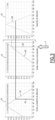
- FIG. 3 illustrates an example of application of the fuzzy logic system according to the present invention.
- the Figure 3 illustrates the combination of a probability of detection according to the “low” interpretation, represented in box 54, with an instrumented distance according to the “high” interpretation, represented in box 56, producing according to the rules of table 1 a fuzzy subset corresponding to a “weak” detection capacity represented in frame 58 by the curve 60 representative of the membership function (ie fuzzification function) defining a detection capacity according to the “weak” interpretation.
- the semantics “low”, “large” etc. is a design choice, imposing a relationship between the parameters of the membership functions (i.e. “weak” less than “large”) and proposing a native explanation of the fuzzy logic system based on degrees of truth.
- the usefulness of a radar mode is “great” with a degree of truth 0.8 when the probability of detection is “great” with a degree of truth 0.7 and when the instrumented distance is “very great” with a degree of truth 0.9.
- Such an explanation taking into account the structure of the fuzzy logic system, is suitable for being generated automatically.
- the probability of detection, provided in the input set 30, associated with the radar mode considered has a value of 51% on the abscissa which, according to the curve of 62 representative of the membership function (ie fuzzification function) defining a “low” detection probability is associated along line 64 with a degree of truth according to weak semantics of a value substantially equal to 0.62.
- the instrumented distance, provided in the input assembly 30, associated with the radar mode considered has a value F of 86 on the abscissa which, according to the fuzzification curve 66 defining a distance “large” instrumented instrument is associated along line 68 with a degree of truth of value substantially equal to 0.78.
- fuzzy logic useful for understanding, but without loss of generality in the description of the invention for other choices at the level of operators, types and parameterizations of membership functions (i.e. fuzzy logic functions) or any other parameter capable of being adapted by reinforcement learning according to the present invention.
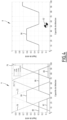
- the input sets of the aggregation step being fuzzy and corresponding in particular to “truncated” membership functions (ie associated with a maximum degree of truth), all the aggregation rules are classically more or less applied, as shown in Part A of the Figure 4 with superposition of membership functions 70, 72 (corresponding to curve 60 of the Figure 3 ), 74, 76 respectively defining a “zero” detection capacity, a “weak” detection capacity, a “good” detection capacity and an “excellent” detection capacity, which amounts to superimposing all of the rules in the table 1.
- the aggregation making it possible to obtain result 52 of the figure 2 then consists of combining its entries 44, 46, 48 and 50 illustrated by the figure 2 and corresponding respectively to the truncations 80, 82, 84, 86, 88 obtained in a manner similar to the truncation of the curve 60 of the Figure 3 , by retaining for example the maximum value when two truncation values are associated with the same abscissa, so as to obtain on part B the resulting curve 90 after defuzzification 92 making it possible to transform the fuzzy linguistic variable 52 corresponding to the usefulness of the mode considered on a given sector in digital data illustrated in part B of the Figure 4 .
- defuzzification 92 corresponds for example to a centroid (ie the center of the area under the blue curve) for which the extracted value is given by the yellow and black checkerboard, namely a detection capacity a little above 50 %.
- the rules indicated in Table 1 are arbitrary in the same way as their number, the type or even the parameterization of the membership functions (triangular functions), which makes it possible to maintain a certain character explainable of the system, in particular by opting for a system of arbitrary rules, with a type of membership function defined in advance, the settings of the membership functions being left to automatic learning by reinforcement as described previously.
- the present invention does not relate to a family of laws for which it is appropriate to “find” the parameters, but to a hierarchy of input-output relationships corresponding to the fuzzy logic system implemented according to the present invention, for which we imposes semantics (a number of membership functions, and their hierarchy, for example small being less than large, etc.). Reinforcement learning makes it possible to learn a parameterization of these functions.
- fuzzy logic system For a properly designed fuzzy logic system, an input-output relationship of the complete system exists due to the universal "approximator" property of fuzzy logic trees so that if one has enough membership and access functions to all rules and input combinations, such a fuzzy logic system is then configured to approximate "any" input-output association which presents a property analogous to that of a neural network, which is why the fuzzy logic system, is according to another embodiment capable of being replaced by such a neural network, such replacement potentially making it possible to accelerate convergence, but this, to the detriment of the loss of the semantic explanation advantageously provided by the fuzzy logic system proposed and previously described.
- the present invention is also suitable for replacing the complete fuzzy logic system described previously by way of example with any input-output correspondence system such as a neural network, etc.
- the final decision to include the mode in the interleaving solution is based on the individual utility score 52 of each mode in relation to its cost of use, as explained previously.
- the outputs 52 of the fuzzy logic trees are utility values and the interleaving decision-making device therefore supplies the verification module not shown suitable for implementing the verification step 18 as illustrated by the figure 1 the utility value from step 16, and optionally by the cost from optional step 24 or even the priority of a sector from optional step 26, of each mode for each sector.
- a mode-sector pair ( M i , S j ) defines an “activity” candidate for interleaving.
- Various additional conditions necessary for interleaving can also be taken into account during verification step 18 such as a minimum refresh period (i.e. absence of revisit before a certain time) etc.
- the decision to sacrifice an activity can be based on the “utility/cost” ratio or implement more sophisticated logic (or even an intelligent agent).
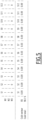
- a selection of activities suitable to be a priori interleaved because verifying at least one predetermined interleaving condition (from the first iteration or at the end of several iterations by modifying the set of constraints from one iteration to another) an example of which is illustrated by the Figure 5 , the number 1 representing selection and the number 0 representing rejection of the activity considered.
- FIG. 6 illustrates an example of interleaving sequencing capable of being obtained in the event of success in step 20 of attempting to determine sequencing according to the present invention.
- Such sequencing is for example obtained by using a conventional scheduler, such as a scheduler using the preemptive scheduling algorithm with dynamic priority: “ Earliest Deadline First ” .
- each activity number corresponds to a selected mode-sector pair ( M i ,S j ).
- the attempt to determine the sequencing fails in particular for reasons of periodicity.
- each feedback/reiteration implemented is capable of being notified if necessary to the operator.
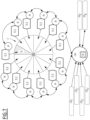
- FIG 7 illustrates a higher level of application of the fuzzy logic system according to the present invention. More precisely, the figure 7 aims to illustrate in particular that the artificial intelligence tool Al, corresponding to a fuzzy logic system of which a decision tree has been illustrated and described previously in relation to the figure 2 , is implemented for the interleaving decision D_E of each radar sector to be covered in order to spatially optimize each objective of the current surveillance mission, by means of the electronic device 94 for interleaving decision and evaluation of a plurality of radar modes according to the invention, from inputs 30 1 ; 30 2 , 30 3 , 30 4 , 30 5 and 30 6 corresponding to the characteristics of each mode.
- the artificial intelligence tool Al corresponding to a fuzzy logic system of which a decision tree has been illustrated and described previously in relation to the figure 2
- the electronic device 94 for interleaving decision and evaluation of a plurality of radar modes according to the invention, from inputs 30 1 ; 30 2 , 30 3 , 30 4 , 30 5 and 30 6 corresponding to the characteristics of
- the present invention thus proposes an interleaving decision solution suitable for responding to the problem of airborne maritime surveillance, in particular by introducing the concept of sector, and has an operational character understandable and adjustable by a user even if it means reducing the possibilities offered by of the classically finely designed interlacing at the level of the antenna pointings and the scanning pattern of the radar(s) of the surveillance system used.
- the notion of sector is advantageously supplemented by the use of a hierarchical and specific structure of the decision process, based in firstly on the evaluation of each candidate mode according to the suitability of its use and its constraints.
- this characterization is based on fuzzy logic, the parameterization of which is notably ensured via reinforcement learning.
- Such an aspect is suitable for introducing artificial intelligence into the interleaving decision process, to be able to manage a certain spatial and temporal depth in order to characterize the usefulness of a mode in a given sector.
- the navigation of the aircraft is capable of influencing the decision
- the use according to the present invention of fuzzy logic makes it possible to provide an immediate linguistic translation of the usefulness of a mode at the destination. of a user, in particular a radar operator.
- the finalization of the interleaving decision according to the present invention comprises two levels, the first making it possible to select quickly and a priori, according to at least one predefined condition, the activities (i.e. mode-sector pair) to be interleaved. , the second relating to the sequencing attempt, in particular by a classic scheduler, and in the event of failure of the sequencing attempt specific to propagating feedbacks: one to generally improve the solution; the other to guarantee quickly finding an interleaving to engage.
- the solution according to the present invention proposes a hierarchy adapted and specific to the problem of maritime surveillance, a particular separation of the stages of the process up to scheduling of the interleaving, while proposing an explainable character from the point of view of the operator in particular using a formulation of the evaluation function of each mode based on a fuzzy logic system that can be configured or trained in particular by reinforcement learning.
Landscapes
- Engineering & Computer Science (AREA)
- Radar, Positioning & Navigation (AREA)
- Remote Sensing (AREA)
- Computer Networks & Wireless Communication (AREA)
- Physics & Mathematics (AREA)
- General Physics & Mathematics (AREA)
- Radar Systems Or Details Thereof (AREA)
Claims (10)
- Verfahren zur Entscheidung und Bewertung des Interlacing einer Vielzahl von Radarmodi von mindestens einem Radar, das geeignet ist, an Bord eines Fahrzeugs, insbesondere eines Luftfahrzeugs, mitgeführt zu werden, oder geeignet ist, an Bord einer Vorrichtung zur Simulation des Verhaltens des genannten Fahrzeugs implementiert zu werden, wobei das genannte Verfahren von einer elektronischen Vorrichtung zur Entscheidung und Bewertung des Interlacing von Radarmodi durchgeführt wird, wobei das Verfahren die folgenden aufeinanderfolgenden Schritte umfasst:- Erhalten (12) einer auszuführenden Radarmission, wobei die Mission mindestens ein zu erfüllendes Ziel umfasst;- Bestimmen (14), gemäß einem ersten Satz von vorbestimmten Einschränkungen, von Radarmodi, die geeignet sind, mindestens ein Ziel der genannten Radarmission zu erfüllen;wobei das Verfahren dadurch gekennzeichnet ist, dass es unter anderem die aufeinander folgenden und hierarchisierten Schritte umfasst:- Bestimmen (16) eines Nutzwerts, pro abzudeckendem Radarsektor, der repräsentativ für den Nutzen für jedes Ziel der Mission ist, das mit jedem der Modi verbunden ist, die durch den Schritt des Bestimmens von Radarmodi bereitgestellt werden;- zumindest aus den Modi und ihrem jeweiligen Nutzwert, Verifizierung (18) der Validierung von mindestens einer ersten Bedingung für das Interlacing der Modi, die notwendig und vorbestimmt ist:- im Falle der Ungültigkeit der mindestens einen ersten Interlacing-Bedingung, Wiederholung des Verfahrens ab dem Schritt der Bestimmung von Radarmodi gemäß einem von Iteration zu Iteration geänderten Satz von Einschränkungen; oder- bei Bestätigung der mindestens einen ersten Interlacing-Bedingung Versuch der Bestimmung (20) der Interlacing-Reihenfolge der Modi:- im Falle eines Fehlschlags des Versuchs, die Sequenz zu bestimmen, Wiederholung des Verfahrens ab dem Verifizierungsschritt für mindestens eine zweite Interlacing-Bedingung der Modi, die notwendig und vorbestimmt sind und bezüglich der mindestens einen ersten Interlacing-Bedingung geändert sind und parallel dazu Wiederholung des Verfahrens ab dem Schritt der Bestimmung von Radarmodi gemäß einem Satz von Beschränkungen, der von Iteration zu Iteration geändert wird;- bei Erfolg des Versuchs, die Sequenzierung zu bestimmen, Erhalt der Sequenzierung.
- Verfahren nach Anspruch 1, das außerdem nach der Bestimmung der Sequenzierung einen Schritt (22) zur Berechnung der nach der Bestimmung der Sequenzierung noch verfügbaren Radarressourcen und -zeit umfasst, und in Abhängigkeit vom Ergebnis der Berechnung, das Verfahren ab dem Schritt der Bestimmung der Radarmoden erneut durchführt.
- Verfahren nach Anspruch 1 oder 2, ferner mit einem Schritt (24) zur Bestimmung, pro abzudeckendem Radarsektor, eines Kostenfaktors, der mit jedem Modus verbunden ist, der durch den Schritt zur Bestimmung von Radarmodi bereitgestellt wird, wobei jeder Kostenpunkt auch geeignet ist, bei dem Schritt der Verifizierung der Validierung von mindestens einer notwendigen und vorbestimmten Bedingung für das Interlacing der Modi berücksichtigt zu werden.
- Verfahren nach einem der vorhergehenden Ansprüche, das außerdem einen Schritt (26) zur Priorisierung von zu verwendenden Radarsektoren umfasst, wobei die Priorisierung zumindest in Abhängigkeit von der genannten Mission bestimmt wird, wobei die Priorität jedes Sektors dazu geeignet ist, auch bei dem Schritt der Verifizierung der Validierung mindestens einer Bedingung für das Interlacing der genannten Modi berücksichtigt zu werden, die notwendig und vorbestimmt ist.
- Verfahren nach Anspruch 4, wobei der Priorisierungsschritt (26) auch unter Berücksichtigung von Navigationsdaten und/oder mindestens einem externen Informationselement zu dem mindestens einen Radar durchgeführt wird, wobei das externe Informationselement zu der Gruppe gehört, die mindestens Folgendes umfasst:- ein Informationselement, das von einem automatischen Identifikationssystem bereitgestellt wird,- ein Element der Wetterinformation,- ein Element des Seestands,- ein Informationselement, das von einem Datenverknüpfungssystem bereitgestellt wird.
- Verfahren nach einem der vorhergehenden Ansprüche, bei dem die Bestimmung eines Nutzwerts pro abzudeckendem Radarsektor, der für den Nutzen jedes Ziels der Mission repräsentativ ist, das mit jedem der Modi verbunden ist, die durch den Schritt der Bestimmung der Radarmodi bereitgestellt werden, auf einem Fuzzy-Logic-System basiert.
- Verfahren nach Anspruch 6, bei dem das Fuzzy-Logic-System durch verstärkendes Lernen trainierbar ist.
- Verfahren nach Anspruch 6 oder 7, bei dem mindestens ein vorbestimmtes Merkmal jedes Modus als Eintrag in einen Baum des genannten Fuzzy-Logic-Systems verwendet wird, wobei das mindestens eine Merkmal zu der Gruppe gehört, die für jeden Modus umfasst:- die geschätzte Entdeckungswahrscheinlichkeit,- die minimal erfassbare äquivalente Radarfläche, die in Abhängigkeit von der mit jedem Sektor verbundenen Entfernung, Erhebung und Peilung geschätzt wird;- eine Information, die repräsentativ für die tatsächliche Nutzung oder Nichtnutzung der Hauptkeulen bei 3dB der maximalen Sendeleistung des mindestens einen Radars ist;- Deckungsbedarf der Mission;- die Formfaktoren jedes Modus;- ein Paar instrumentierte Mindest- und Höchstentfernungen;- ein Bodenerkennungsabdruck, der dem Modus zugeordnet ist, als Funktion der Höhe des Radars;- eine dem genannten Modus zugeordnete Abdeckungsfähigkeit pro Zieltyp des genannten Radars,- eine Beobachtungszeit pro Stufe;- eine Information, die repräsentativ für die Leichtigkeit des genannten Modus ist, interlaced zu werden, wobei die genannte Information durch Vergleich der Zyklusdauer des genannten Modus mit den zugehörigen minimalen und maximalen Wiederbesuchszeiten erhalten wird;- eine Erhebungsfähigkeit;und/oder wobei mindestens eine Betriebsinformation von jedem der Radarmodi als Eingabe in den Baum des Fuzzy-Logik-Systems verwendet wird, wobei die mindestens eine Betriebsinformation zu der Gruppe gehört, die Folgendes umfasst:- eine Anzeige des Verbrauchs der Rechen- und Speicherressourcen jedes der Radarmodi relativ zu den maximalen Kapazitäten des Radars;- eine Betriebstemperatur des Radars;- eine Angabe des Energieverbrauchs infolge der Verwendung jedes dieser Radarmodi;- eine Angabe der Entwicklung der mittleren Zeit bis zum Ausfall infolge der Verwendung jedes der genannten Radarmodi.
- Computerprogramm, umfassend Softwareanweisungen, die, wenn sie von einem Computer ausgeführt werden, die Entscheidungs- und Bewertungsverfahren zum Interlacing einer Vielzahl von Modi mindestens eines Radars nach einem der vorherigen Ansprüche durchführen.
- Elektronische Vorrichtung zur Entscheidung und Bewertung des Interlacing einer Vielzahl von Radarmodi mindestens eines Radars, das geeignet ist, an Bord eines Fahrzeugs, insbesondere eines Luftfahrzeugs, mitgeführt zu werden, oder geeignet ist, an Bord einer Vorrichtung zur Simulation des Verhaltens des genannten Fahrzeugs eingesetzt zu werden, dadurch gekennzeichnet, dass die elektronische Vorrichtung zur Entscheidung und Bewertung des Interlacing von Radarmodi umfasst:- ein Beschaffungsmodul, das so konfiguriert ist, dass es eine auszuführende Radarmission erhält, wobei die Mission mindestens ein zu erfüllendes Ziel umfasst;- ein erstes Bestimmungsmodul, das konfiguriert ist, um gemäß einem ersten Satz von vorbestimmten Einschränkungen Radarmodi zu bestimmen, die geeignet sind, mindestens ein Ziel der genannten Radarmission zu erfüllen;- ein zweites Bestimmungsmodul, das konfiguriert ist, um einen Nutzwert pro abzudeckendem Radarsektor zu bestimmen, der repräsentativ für den Nutzen für jedes Ziel der Mission ist, die mit jedem der Modi verbunden ist, die durch den Schritt der Bestimmung von Radarmodi bereitgestellt werden;- ein Verifizierungsmodul, das so konfiguriert ist, dass es zumindest anhand der Modi und ihrer jeweiligen Nutzwerte die Validierung von mindestens einer ersten Bedingung für das Interlacing der Modi, die notwendig und vorbestimmt ist, verifiziert;- ein Wiederholungsmodul, das konfiguriert ist, um das erste Bestimmungsmodul anzuweisen, die Bestimmung von Radarmodi gemäß einem von Iteration zu Iteration geänderten Satz von Beschränkungen zu wiederholen, wenn die mindestens eine erste Interlacing-Bedingung ungültig wird;- ein drittes Bestimmungsmodul, das so konfiguriert ist, dass es versucht, die Interlacing-Reihenfolge der Modi zu bestimmen, wenn die mindestens eine erste Interlacing-Bedingung bestätigt wird, und um:- im Falle eines Fehlschlags des Versuchs, die Sequenz zu bestimmen, das Verifizierungsmodul anzuweisen, die Verifizierung für mindestens eine zweite Bedingung für das Interlacing der notwendigen und vorbestimmten Modi, die geändert ist in Bezug auf die mindestens eine erste Interlacing-Bedingung, zu wiederholen und parallel dazu, um das erste Bestimmungsmodul anzuweisen, die Bestimmung von Radarmodi gemäß einem Satz von Interlacing, der von Iteration zu Iteration geändert wurde, zu wiederholen;- bei Erfolg des Versuchs, die Sequenzierung zu bestimmen, die Sequenzierung zu erhalten.
Applications Claiming Priority (1)
| Application Number | Priority Date | Filing Date | Title |
|---|---|---|---|
| FR2108888A FR3126504B1 (fr) | 2021-08-25 | 2021-08-25 | Procede de decision et d'evaluation d'entrelacement d'une pluralite de modes radar, programme d'ordinateur et dispositif associes |
Publications (2)
| Publication Number | Publication Date |
|---|---|
| EP4145173A1 EP4145173A1 (de) | 2023-03-08 |
| EP4145173B1 true EP4145173B1 (de) | 2024-06-19 |
Family
ID=79269676
Family Applications (1)
| Application Number | Title | Priority Date | Filing Date |
|---|---|---|---|
| EP22191985.5A Active EP4145173B1 (de) | 2021-08-25 | 2022-08-24 | Verfahren zur entscheidung und bewertung des interlacing einer vielzahl von radarmodes, entsprechendes computerprogramm und entsprechende vorrichtung |
Country Status (2)
| Country | Link |
|---|---|
| EP (1) | EP4145173B1 (de) |
| FR (1) | FR3126504B1 (de) |
Family Cites Families (4)
| Publication number | Priority date | Publication date | Assignee | Title |
|---|---|---|---|---|
| FR2832809B1 (fr) * | 2001-11-26 | 2004-02-13 | Thales Sa | Procede regulation de la charge d'un radar, notamment par adaptation du maillage de veille |
| FR2832807B1 (fr) | 2001-11-26 | 2004-02-13 | Thales Sa | Procede de construction de trames, notamment d'un radar |
| FR3050538B1 (fr) * | 2016-04-22 | 2020-06-19 | Thales | Procede d'optimisation de la detection de cibles marines et radar mettant en oeuvre un tel procede |
| US10558492B2 (en) * | 2016-10-07 | 2020-02-11 | Raytheon Company | System and method for predicting the performance of a radar |
-
2021
- 2021-08-25 FR FR2108888A patent/FR3126504B1/fr active Active
-
2022
- 2022-08-24 EP EP22191985.5A patent/EP4145173B1/de active Active
Also Published As
| Publication number | Publication date |
|---|---|
| EP4145173A1 (de) | 2023-03-08 |
| FR3126504B1 (fr) | 2023-07-21 |
| FR3126504A1 (fr) | 2023-03-03 |
Similar Documents
| Publication | Publication Date | Title |
|---|---|---|
| US8972306B2 (en) | System and method for sensor tasking | |
| US20210284184A1 (en) | Learning point cloud augmentation policies | |
| Shivadekar et al. | Edge AI cosmos blockchain distributed network for precise ablh detection | |
| Langford et al. | Wildfire mapping in Interior Alaska using deep neural networks on imbalanced datasets | |
| FR3103048A1 (fr) | Procede et dispositif de generation de donnees synthetiques d'apprentissage pour machine d'intelligence artificielle pour l'aide a l'atterrissage d'aeronef | |
| US12555373B2 (en) | Automated hazard recognition using multiparameter analysis of aerial imagery | |
| US8201181B2 (en) | System and method for sensor scheduling using fuzzy cognitive maps | |
| EP3364213A1 (de) | Verfahren und system der kontextualiserten wahrnehmung von materiellen körpern | |
| Vasile et al. | Space object identification and classification from hyperspectral material analysis | |
| Zeidler et al. | The VISTA Carina Nebula Survey-II. Spatial distribution of the infrared-excess-selected young stellar population | |
| EP3588387B1 (de) | Verfahren zum testen eines elektronischen kontrollsystems des luftverkehrs, entsprechende elektronische vorrichtung und plattform | |
| CN121145736A (zh) | 一种基于物理引导与数据驱动融合的sar海表流速反演方法 | |
| Meyer et al. | Revealing the potential of spectral and textural predictor variables in a neural network-based rainfall retrieval technique | |
| WO2024218118A1 (fr) | Procédé et dispositif électronique d'aide au pilotage d'un aéronef via la surveillance d'au moins un critère opérationnel, programme d'ordinateur et aéronef associés | |
| EP4145173B1 (de) | Verfahren zur entscheidung und bewertung des interlacing einer vielzahl von radarmodes, entsprechendes computerprogramm und entsprechende vorrichtung | |
| Tagle Casapia et al. | Effective integration of drone technology for mapping and managing palm species in the Peruvian Amazon | |
| EP3997479A1 (de) | Verfahren zur bestimmung der räumlichen abdeckung eines detektionssystems | |
| Rixen et al. | Earth observation strategic research and innovation Agenda | |
| Chen et al. | Co-located OLCI optical imagery and SAR altimetry from Sentinel-3 for enhanced Arctic spring sea ice surface classification | |
| EP4102253A1 (de) | Verfahren und vorrichtung zur auswahl von sensorressourcen eines multisensorsystems | |
| Mary et al. | A game-theoretic federated learning approach for ship detection from aerial images | |
| Li et al. | Photometric redshifts estimation for galaxies by using FOABP-RF | |
| Lei et al. | Reference source‐aided coordinate registration method for over‐the‐horizon radar using ensemble learning | |
| Wei et al. | Shadow verification–based waterline detection for unmanned surface vehicles deployed in complicated natural environment | |
| Parly | Artificial Intelligence in Support of Defence |
Legal Events
| Date | Code | Title | Description |
|---|---|---|---|
| PUAI | Public reference made under article 153(3) epc to a published international application that has entered the european phase |
Free format text: ORIGINAL CODE: 0009012 |
|
| STAA | Information on the status of an ep patent application or granted ep patent |
Free format text: STATUS: THE APPLICATION HAS BEEN PUBLISHED |
|
| AK | Designated contracting states |
Kind code of ref document: A1 Designated state(s): AL AT BE BG CH CY CZ DE DK EE ES FI FR GB GR HR HU IE IS IT LI LT LU LV MC MK MT NL NO PL PT RO RS SE SI SK SM TR |
|
| P01 | Opt-out of the competence of the unified patent court (upc) registered |
Effective date: 20230502 |
|
| STAA | Information on the status of an ep patent application or granted ep patent |
Free format text: STATUS: REQUEST FOR EXAMINATION WAS MADE |
|
| 17P | Request for examination filed |
Effective date: 20230824 |
|
| RBV | Designated contracting states (corrected) |
Designated state(s): AL AT BE BG CH CY CZ DE DK EE ES FI FR GB GR HR HU IE IS IT LI LT LU LV MC MK MT NL NO PL PT RO RS SE SI SK SM TR |
|
| GRAP | Despatch of communication of intention to grant a patent |
Free format text: ORIGINAL CODE: EPIDOSNIGR1 |
|
| STAA | Information on the status of an ep patent application or granted ep patent |
Free format text: STATUS: GRANT OF PATENT IS INTENDED |
|
| RIC1 | Information provided on ipc code assigned before grant |
Ipc: G01S 13/44 20060101ALN20240131BHEP Ipc: G01S 13/02 20060101ALN20240131BHEP Ipc: G01S 7/04 20060101ALI20240131BHEP Ipc: G01S 13/72 20060101ALI20240131BHEP Ipc: G01S 13/42 20060101AFI20240131BHEP |
|
| INTG | Intention to grant announced |
Effective date: 20240214 |
|
| GRAS | Grant fee paid |
Free format text: ORIGINAL CODE: EPIDOSNIGR3 |
|
| GRAA | (expected) grant |
Free format text: ORIGINAL CODE: 0009210 |
|
| STAA | Information on the status of an ep patent application or granted ep patent |
Free format text: STATUS: THE PATENT HAS BEEN GRANTED |
|
| AK | Designated contracting states |
Kind code of ref document: B1 Designated state(s): AL AT BE BG CH CY CZ DE DK EE ES FI FR GB GR HR HU IE IS IT LI LT LU LV MC MK MT NL NO PL PT RO RS SE SI SK SM TR |
|
| REG | Reference to a national code |
Ref country code: GB Ref legal event code: FG4D Free format text: NOT ENGLISH |
|
| REG | Reference to a national code |
Ref country code: CH Ref legal event code: EP |
|
| REG | Reference to a national code |
Ref country code: DE Ref legal event code: R096 Ref document number: 602022004013 Country of ref document: DE |
|
| PG25 | Lapsed in a contracting state [announced via postgrant information from national office to epo] |
Ref country code: BG Free format text: LAPSE BECAUSE OF FAILURE TO SUBMIT A TRANSLATION OF THE DESCRIPTION OR TO PAY THE FEE WITHIN THE PRESCRIBED TIME-LIMIT Effective date: 20240619 |
|
| PG25 | Lapsed in a contracting state [announced via postgrant information from national office to epo] |
Ref country code: FI Free format text: LAPSE BECAUSE OF FAILURE TO SUBMIT A TRANSLATION OF THE DESCRIPTION OR TO PAY THE FEE WITHIN THE PRESCRIBED TIME-LIMIT Effective date: 20240619 Ref country code: HR Free format text: LAPSE BECAUSE OF FAILURE TO SUBMIT A TRANSLATION OF THE DESCRIPTION OR TO PAY THE FEE WITHIN THE PRESCRIBED TIME-LIMIT Effective date: 20240619 |
|
| REG | Reference to a national code |
Ref country code: LT Ref legal event code: MG9D |
|
| PG25 | Lapsed in a contracting state [announced via postgrant information from national office to epo] |
Ref country code: GR Free format text: LAPSE BECAUSE OF FAILURE TO SUBMIT A TRANSLATION OF THE DESCRIPTION OR TO PAY THE FEE WITHIN THE PRESCRIBED TIME-LIMIT Effective date: 20240920 |
|
| REG | Reference to a national code |
Ref country code: NL Ref legal event code: MP Effective date: 20240619 |
|
| PG25 | Lapsed in a contracting state [announced via postgrant information from national office to epo] |
Ref country code: LV Free format text: LAPSE BECAUSE OF FAILURE TO SUBMIT A TRANSLATION OF THE DESCRIPTION OR TO PAY THE FEE WITHIN THE PRESCRIBED TIME-LIMIT Effective date: 20240619 |
|
| PG25 | Lapsed in a contracting state [announced via postgrant information from national office to epo] |
Ref country code: NO Free format text: LAPSE BECAUSE OF FAILURE TO SUBMIT A TRANSLATION OF THE DESCRIPTION OR TO PAY THE FEE WITHIN THE PRESCRIBED TIME-LIMIT Effective date: 20240919 Ref country code: LV Free format text: LAPSE BECAUSE OF FAILURE TO SUBMIT A TRANSLATION OF THE DESCRIPTION OR TO PAY THE FEE WITHIN THE PRESCRIBED TIME-LIMIT Effective date: 20240619 Ref country code: HR Free format text: LAPSE BECAUSE OF FAILURE TO SUBMIT A TRANSLATION OF THE DESCRIPTION OR TO PAY THE FEE WITHIN THE PRESCRIBED TIME-LIMIT Effective date: 20240619 Ref country code: GR Free format text: LAPSE BECAUSE OF FAILURE TO SUBMIT A TRANSLATION OF THE DESCRIPTION OR TO PAY THE FEE WITHIN THE PRESCRIBED TIME-LIMIT Effective date: 20240920 Ref country code: FI Free format text: LAPSE BECAUSE OF FAILURE TO SUBMIT A TRANSLATION OF THE DESCRIPTION OR TO PAY THE FEE WITHIN THE PRESCRIBED TIME-LIMIT Effective date: 20240619 Ref country code: BG Free format text: LAPSE BECAUSE OF FAILURE TO SUBMIT A TRANSLATION OF THE DESCRIPTION OR TO PAY THE FEE WITHIN THE PRESCRIBED TIME-LIMIT Effective date: 20240619 Ref country code: RS Free format text: LAPSE BECAUSE OF FAILURE TO SUBMIT A TRANSLATION OF THE DESCRIPTION OR TO PAY THE FEE WITHIN THE PRESCRIBED TIME-LIMIT Effective date: 20240919 |
|
| PG25 | Lapsed in a contracting state [announced via postgrant information from national office to epo] |
Ref country code: NL Free format text: LAPSE BECAUSE OF FAILURE TO SUBMIT A TRANSLATION OF THE DESCRIPTION OR TO PAY THE FEE WITHIN THE PRESCRIBED TIME-LIMIT Effective date: 20240619 |
|
| REG | Reference to a national code |
Ref country code: AT Ref legal event code: MK05 Ref document number: 1696255 Country of ref document: AT Kind code of ref document: T Effective date: 20240619 |
|
| PG25 | Lapsed in a contracting state [announced via postgrant information from national office to epo] |
Ref country code: NL Free format text: LAPSE BECAUSE OF FAILURE TO SUBMIT A TRANSLATION OF THE DESCRIPTION OR TO PAY THE FEE WITHIN THE PRESCRIBED TIME-LIMIT Effective date: 20240619 |
|
| PG25 | Lapsed in a contracting state [announced via postgrant information from national office to epo] |
Ref country code: PT Free format text: LAPSE BECAUSE OF FAILURE TO SUBMIT A TRANSLATION OF THE DESCRIPTION OR TO PAY THE FEE WITHIN THE PRESCRIBED TIME-LIMIT Effective date: 20241021 |
|
| PG25 | Lapsed in a contracting state [announced via postgrant information from national office to epo] |
Ref country code: PT Free format text: LAPSE BECAUSE OF FAILURE TO SUBMIT A TRANSLATION OF THE DESCRIPTION OR TO PAY THE FEE WITHIN THE PRESCRIBED TIME-LIMIT Effective date: 20241021 |
|
| PG25 | Lapsed in a contracting state [announced via postgrant information from national office to epo] |
Ref country code: PL Free format text: LAPSE BECAUSE OF FAILURE TO SUBMIT A TRANSLATION OF THE DESCRIPTION OR TO PAY THE FEE WITHIN THE PRESCRIBED TIME-LIMIT Effective date: 20240619 |
|
| PG25 | Lapsed in a contracting state [announced via postgrant information from national office to epo] |
Ref country code: EE Free format text: LAPSE BECAUSE OF FAILURE TO SUBMIT A TRANSLATION OF THE DESCRIPTION OR TO PAY THE FEE WITHIN THE PRESCRIBED TIME-LIMIT Effective date: 20240619 |
|
| PG25 | Lapsed in a contracting state [announced via postgrant information from national office to epo] |
Ref country code: IS Free format text: LAPSE BECAUSE OF FAILURE TO SUBMIT A TRANSLATION OF THE DESCRIPTION OR TO PAY THE FEE WITHIN THE PRESCRIBED TIME-LIMIT Effective date: 20241019 Ref country code: AT Free format text: LAPSE BECAUSE OF FAILURE TO SUBMIT A TRANSLATION OF THE DESCRIPTION OR TO PAY THE FEE WITHIN THE PRESCRIBED TIME-LIMIT Effective date: 20240619 |
|
| PG25 | Lapsed in a contracting state [announced via postgrant information from national office to epo] |
Ref country code: CZ Free format text: LAPSE BECAUSE OF FAILURE TO SUBMIT A TRANSLATION OF THE DESCRIPTION OR TO PAY THE FEE WITHIN THE PRESCRIBED TIME-LIMIT Effective date: 20240619 |
|
| PG25 | Lapsed in a contracting state [announced via postgrant information from national office to epo] |
Ref country code: RO Free format text: LAPSE BECAUSE OF FAILURE TO SUBMIT A TRANSLATION OF THE DESCRIPTION OR TO PAY THE FEE WITHIN THE PRESCRIBED TIME-LIMIT Effective date: 20240619 Ref country code: SK Free format text: LAPSE BECAUSE OF FAILURE TO SUBMIT A TRANSLATION OF THE DESCRIPTION OR TO PAY THE FEE WITHIN THE PRESCRIBED TIME-LIMIT Effective date: 20240619 |
|
| PG25 | Lapsed in a contracting state [announced via postgrant information from national office to epo] |
Ref country code: ES Free format text: LAPSE BECAUSE OF FAILURE TO SUBMIT A TRANSLATION OF THE DESCRIPTION OR TO PAY THE FEE WITHIN THE PRESCRIBED TIME-LIMIT Effective date: 20240619 Ref country code: SM Free format text: LAPSE BECAUSE OF FAILURE TO SUBMIT A TRANSLATION OF THE DESCRIPTION OR TO PAY THE FEE WITHIN THE PRESCRIBED TIME-LIMIT Effective date: 20240619 |
|
| PG25 | Lapsed in a contracting state [announced via postgrant information from national office to epo] |
Ref country code: SM Free format text: LAPSE BECAUSE OF FAILURE TO SUBMIT A TRANSLATION OF THE DESCRIPTION OR TO PAY THE FEE WITHIN THE PRESCRIBED TIME-LIMIT Effective date: 20240619 Ref country code: SK Free format text: LAPSE BECAUSE OF FAILURE TO SUBMIT A TRANSLATION OF THE DESCRIPTION OR TO PAY THE FEE WITHIN THE PRESCRIBED TIME-LIMIT Effective date: 20240619 Ref country code: RO Free format text: LAPSE BECAUSE OF FAILURE TO SUBMIT A TRANSLATION OF THE DESCRIPTION OR TO PAY THE FEE WITHIN THE PRESCRIBED TIME-LIMIT Effective date: 20240619 Ref country code: PL Free format text: LAPSE BECAUSE OF FAILURE TO SUBMIT A TRANSLATION OF THE DESCRIPTION OR TO PAY THE FEE WITHIN THE PRESCRIBED TIME-LIMIT Effective date: 20240619 Ref country code: IS Free format text: LAPSE BECAUSE OF FAILURE TO SUBMIT A TRANSLATION OF THE DESCRIPTION OR TO PAY THE FEE WITHIN THE PRESCRIBED TIME-LIMIT Effective date: 20241019 Ref country code: ES Free format text: LAPSE BECAUSE OF FAILURE TO SUBMIT A TRANSLATION OF THE DESCRIPTION OR TO PAY THE FEE WITHIN THE PRESCRIBED TIME-LIMIT Effective date: 20240619 Ref country code: EE Free format text: LAPSE BECAUSE OF FAILURE TO SUBMIT A TRANSLATION OF THE DESCRIPTION OR TO PAY THE FEE WITHIN THE PRESCRIBED TIME-LIMIT Effective date: 20240619 Ref country code: CZ Free format text: LAPSE BECAUSE OF FAILURE TO SUBMIT A TRANSLATION OF THE DESCRIPTION OR TO PAY THE FEE WITHIN THE PRESCRIBED TIME-LIMIT Effective date: 20240619 Ref country code: AT Free format text: LAPSE BECAUSE OF FAILURE TO SUBMIT A TRANSLATION OF THE DESCRIPTION OR TO PAY THE FEE WITHIN THE PRESCRIBED TIME-LIMIT Effective date: 20240619 |
|
| REG | Reference to a national code |
Ref country code: DE Ref legal event code: R097 Ref document number: 602022004013 Country of ref document: DE |
|
| PG25 | Lapsed in a contracting state [announced via postgrant information from national office to epo] |
Ref country code: DK Free format text: LAPSE BECAUSE OF FAILURE TO SUBMIT A TRANSLATION OF THE DESCRIPTION OR TO PAY THE FEE WITHIN THE PRESCRIBED TIME-LIMIT Effective date: 20240619 |
|
| PG25 | Lapsed in a contracting state [announced via postgrant information from national office to epo] |
Ref country code: LU Free format text: LAPSE BECAUSE OF NON-PAYMENT OF DUE FEES Effective date: 20240824 |
|
| PG25 | Lapsed in a contracting state [announced via postgrant information from national office to epo] |
Ref country code: MC Free format text: LAPSE BECAUSE OF FAILURE TO SUBMIT A TRANSLATION OF THE DESCRIPTION OR TO PAY THE FEE WITHIN THE PRESCRIBED TIME-LIMIT Effective date: 20240619 |
|
| PLBE | No opposition filed within time limit |
Free format text: ORIGINAL CODE: 0009261 |
|
| STAA | Information on the status of an ep patent application or granted ep patent |
Free format text: STATUS: NO OPPOSITION FILED WITHIN TIME LIMIT |
|
| 26N | No opposition filed |
Effective date: 20250320 |
|
| REG | Reference to a national code |
Ref country code: BE Ref legal event code: MM Effective date: 20240831 |
|
| PG25 | Lapsed in a contracting state [announced via postgrant information from national office to epo] |
Ref country code: BE Free format text: LAPSE BECAUSE OF NON-PAYMENT OF DUE FEES Effective date: 20240831 |
|
| PG25 | Lapsed in a contracting state [announced via postgrant information from national office to epo] |
Ref country code: IE Free format text: LAPSE BECAUSE OF NON-PAYMENT OF DUE FEES Effective date: 20240824 |
|
| PG25 | Lapsed in a contracting state [announced via postgrant information from national office to epo] |
Ref country code: SE Free format text: LAPSE BECAUSE OF FAILURE TO SUBMIT A TRANSLATION OF THE DESCRIPTION OR TO PAY THE FEE WITHIN THE PRESCRIBED TIME-LIMIT Effective date: 20240619 |
|
| PGFP | Annual fee paid to national office [announced via postgrant information from national office to epo] |
Ref country code: DE Payment date: 20250812 Year of fee payment: 4 |
|
| PGFP | Annual fee paid to national office [announced via postgrant information from national office to epo] |
Ref country code: IT Payment date: 20250901 Year of fee payment: 4 |
|
| PGFP | Annual fee paid to national office [announced via postgrant information from national office to epo] |
Ref country code: FR Payment date: 20250828 Year of fee payment: 4 |
|
| PG25 | Lapsed in a contracting state [announced via postgrant information from national office to epo] |
Ref country code: CY Free format text: LAPSE BECAUSE OF FAILURE TO SUBMIT A TRANSLATION OF THE DESCRIPTION OR TO PAY THE FEE WITHIN THE PRESCRIBED TIME-LIMIT; INVALID AB INITIO Effective date: 20220824 |
|
| PG25 | Lapsed in a contracting state [announced via postgrant information from national office to epo] |
Ref country code: HU Free format text: LAPSE BECAUSE OF FAILURE TO SUBMIT A TRANSLATION OF THE DESCRIPTION OR TO PAY THE FEE WITHIN THE PRESCRIBED TIME-LIMIT; INVALID AB INITIO Effective date: 20220824 |
|
| REG | Reference to a national code |
Ref country code: CH Ref legal event code: H13 Free format text: ST27 STATUS EVENT CODE: U-0-0-H10-H13 (AS PROVIDED BY THE NATIONAL OFFICE) Effective date: 20260324 |