EP4143048B1 - Verkehrssituations-abhängige steuerung eines virtual-reality-geräts - Google Patents
Verkehrssituations-abhängige steuerung eines virtual-reality-geräts Download PDFInfo
- Publication number
- EP4143048B1 EP4143048B1 EP21720714.1A EP21720714A EP4143048B1 EP 4143048 B1 EP4143048 B1 EP 4143048B1 EP 21720714 A EP21720714 A EP 21720714A EP 4143048 B1 EP4143048 B1 EP 4143048B1
- Authority
- EP
- European Patent Office
- Prior art keywords
- vehicle
- user
- evaluated
- data
- generated
- Prior art date
- Legal status (The legal status is an assumption and is not a legal conclusion. Google has not performed a legal analysis and makes no representation as to the accuracy of the status listed.)
- Active
Links
Images
Classifications
-
- B—PERFORMING OPERATIONS; TRANSPORTING
- B60—VEHICLES IN GENERAL
- B60W—CONJOINT CONTROL OF VEHICLE SUB-UNITS OF DIFFERENT TYPE OR DIFFERENT FUNCTION; CONTROL SYSTEMS SPECIALLY ADAPTED FOR HYBRID VEHICLES; ROAD VEHICLE DRIVE CONTROL SYSTEMS FOR PURPOSES NOT RELATED TO THE CONTROL OF A PARTICULAR SUB-UNIT
- B60W50/00—Details of control systems for road vehicle drive control not related to the control of a particular sub-unit, e.g. process diagnostic or vehicle driver interfaces
- B60W50/08—Interaction between the driver and the control system
- B60W50/14—Means for informing the driver, warning the driver or prompting a driver intervention
-
- B—PERFORMING OPERATIONS; TRANSPORTING
- B60—VEHICLES IN GENERAL
- B60K—ARRANGEMENT OR MOUNTING OF PROPULSION UNITS OR OF TRANSMISSIONS IN VEHICLES; ARRANGEMENT OR MOUNTING OF PLURAL DIVERSE PRIME-MOVERS IN VEHICLES; AUXILIARY DRIVES FOR VEHICLES; INSTRUMENTATION OR DASHBOARDS FOR VEHICLES; ARRANGEMENTS IN CONNECTION WITH COOLING, AIR INTAKE, GAS EXHAUST OR FUEL SUPPLY OF PROPULSION UNITS IN VEHICLES
- B60K35/00—Instruments specially adapted for vehicles; Arrangement of instruments in or on vehicles
- B60K35/20—Output arrangements, i.e. from vehicle to user, associated with vehicle functions or specially adapted therefor
- B60K35/29—Instruments characterised by the way in which information is handled, e.g. showing information on plural displays or prioritising information according to driving conditions
-
- B—PERFORMING OPERATIONS; TRANSPORTING
- B60—VEHICLES IN GENERAL
- B60K—ARRANGEMENT OR MOUNTING OF PROPULSION UNITS OR OF TRANSMISSIONS IN VEHICLES; ARRANGEMENT OR MOUNTING OF PLURAL DIVERSE PRIME-MOVERS IN VEHICLES; AUXILIARY DRIVES FOR VEHICLES; INSTRUMENTATION OR DASHBOARDS FOR VEHICLES; ARRANGEMENTS IN CONNECTION WITH COOLING, AIR INTAKE, GAS EXHAUST OR FUEL SUPPLY OF PROPULSION UNITS IN VEHICLES
- B60K35/00—Instruments specially adapted for vehicles; Arrangement of instruments in or on vehicles
- B60K35/10—Input arrangements, i.e. from user to vehicle, associated with vehicle functions or specially adapted therefor
-
- B—PERFORMING OPERATIONS; TRANSPORTING
- B60—VEHICLES IN GENERAL
- B60K—ARRANGEMENT OR MOUNTING OF PROPULSION UNITS OR OF TRANSMISSIONS IN VEHICLES; ARRANGEMENT OR MOUNTING OF PLURAL DIVERSE PRIME-MOVERS IN VEHICLES; AUXILIARY DRIVES FOR VEHICLES; INSTRUMENTATION OR DASHBOARDS FOR VEHICLES; ARRANGEMENTS IN CONNECTION WITH COOLING, AIR INTAKE, GAS EXHAUST OR FUEL SUPPLY OF PROPULSION UNITS IN VEHICLES
- B60K35/00—Instruments specially adapted for vehicles; Arrangement of instruments in or on vehicles
- B60K35/20—Output arrangements, i.e. from vehicle to user, associated with vehicle functions or specially adapted therefor
- B60K35/28—Output arrangements, i.e. from vehicle to user, associated with vehicle functions or specially adapted therefor characterised by the type of the output information, e.g. video entertainment or vehicle dynamics information; characterised by the purpose of the output information, e.g. for attracting the attention of the driver
-
- B—PERFORMING OPERATIONS; TRANSPORTING
- B60—VEHICLES IN GENERAL
- B60K—ARRANGEMENT OR MOUNTING OF PROPULSION UNITS OR OF TRANSMISSIONS IN VEHICLES; ARRANGEMENT OR MOUNTING OF PLURAL DIVERSE PRIME-MOVERS IN VEHICLES; AUXILIARY DRIVES FOR VEHICLES; INSTRUMENTATION OR DASHBOARDS FOR VEHICLES; ARRANGEMENTS IN CONNECTION WITH COOLING, AIR INTAKE, GAS EXHAUST OR FUEL SUPPLY OF PROPULSION UNITS IN VEHICLES
- B60K35/00—Instruments specially adapted for vehicles; Arrangement of instruments in or on vehicles
- B60K35/65—Instruments specially adapted for specific vehicle types or users, e.g. for left- or right-hand drive
- B60K35/654—Instruments specially adapted for specific vehicle types or users, e.g. for left- or right-hand drive the user being the driver
-
- B—PERFORMING OPERATIONS; TRANSPORTING
- B60—VEHICLES IN GENERAL
- B60K—ARRANGEMENT OR MOUNTING OF PROPULSION UNITS OR OF TRANSMISSIONS IN VEHICLES; ARRANGEMENT OR MOUNTING OF PLURAL DIVERSE PRIME-MOVERS IN VEHICLES; AUXILIARY DRIVES FOR VEHICLES; INSTRUMENTATION OR DASHBOARDS FOR VEHICLES; ARRANGEMENTS IN CONNECTION WITH COOLING, AIR INTAKE, GAS EXHAUST OR FUEL SUPPLY OF PROPULSION UNITS IN VEHICLES
- B60K35/00—Instruments specially adapted for vehicles; Arrangement of instruments in or on vehicles
- B60K35/80—Arrangements for controlling instruments
-
- B—PERFORMING OPERATIONS; TRANSPORTING
- B60—VEHICLES IN GENERAL
- B60K—ARRANGEMENT OR MOUNTING OF PROPULSION UNITS OR OF TRANSMISSIONS IN VEHICLES; ARRANGEMENT OR MOUNTING OF PLURAL DIVERSE PRIME-MOVERS IN VEHICLES; AUXILIARY DRIVES FOR VEHICLES; INSTRUMENTATION OR DASHBOARDS FOR VEHICLES; ARRANGEMENTS IN CONNECTION WITH COOLING, AIR INTAKE, GAS EXHAUST OR FUEL SUPPLY OF PROPULSION UNITS IN VEHICLES
- B60K35/00—Instruments specially adapted for vehicles; Arrangement of instruments in or on vehicles
- B60K35/80—Arrangements for controlling instruments
- B60K35/81—Arrangements for controlling instruments for controlling displays
-
- G—PHYSICS
- G02—OPTICS
- G02B—OPTICAL ELEMENTS, SYSTEMS OR APPARATUS
- G02B27/00—Optical systems or apparatus not provided for by any of the groups G02B1/00 - G02B26/00, G02B30/00
- G02B27/01—Head-up displays
- G02B27/017—Head mounted
- G02B27/0172—Head mounted characterised by optical features
-
- G—PHYSICS
- G06—COMPUTING OR CALCULATING; COUNTING
- G06F—ELECTRIC DIGITAL DATA PROCESSING
- G06F1/00—Details not covered by groups G06F3/00 - G06F13/00 and G06F21/00
- G06F1/16—Constructional details or arrangements
- G06F1/1613—Constructional details or arrangements for portable computers
- G06F1/163—Wearable computers, e.g. on a belt
-
- H—ELECTRICITY
- H04—ELECTRIC COMMUNICATION TECHNIQUE
- H04N—PICTORIAL COMMUNICATION, e.g. TELEVISION
- H04N21/00—Selective content distribution, e.g. interactive television or video on demand [VOD]
- H04N21/40—Client devices specifically adapted for the reception of or interaction with content, e.g. set-top-box [STB]; Operations thereof
- H04N21/41—Structure of client; Structure of client peripherals
- H04N21/4104—Peripherals receiving signals from specially adapted client devices
- H04N21/4131—Peripherals receiving signals from specially adapted client devices home appliance, e.g. lighting, air conditioning system, metering devices
-
- H—ELECTRICITY
- H04—ELECTRIC COMMUNICATION TECHNIQUE
- H04N—PICTORIAL COMMUNICATION, e.g. TELEVISION
- H04N21/00—Selective content distribution, e.g. interactive television or video on demand [VOD]
- H04N21/40—Client devices specifically adapted for the reception of or interaction with content, e.g. set-top-box [STB]; Operations thereof
- H04N21/41—Structure of client; Structure of client peripherals
- H04N21/414—Specialised client platforms, e.g. receiver in car or embedded in a mobile appliance
- H04N21/41422—Specialised client platforms, e.g. receiver in car or embedded in a mobile appliance located in transportation means, e.g. personal vehicle
-
- H—ELECTRICITY
- H04—ELECTRIC COMMUNICATION TECHNIQUE
- H04N—PICTORIAL COMMUNICATION, e.g. TELEVISION
- H04N21/00—Selective content distribution, e.g. interactive television or video on demand [VOD]
- H04N21/40—Client devices specifically adapted for the reception of or interaction with content, e.g. set-top-box [STB]; Operations thereof
- H04N21/41—Structure of client; Structure of client peripherals
- H04N21/422—Input-only peripherals, i.e. input devices connected to specially adapted client devices, e.g. global positioning system [GPS]
- H04N21/4223—Cameras
-
- H—ELECTRICITY
- H04—ELECTRIC COMMUNICATION TECHNIQUE
- H04N—PICTORIAL COMMUNICATION, e.g. TELEVISION
- H04N21/00—Selective content distribution, e.g. interactive television or video on demand [VOD]
- H04N21/40—Client devices specifically adapted for the reception of or interaction with content, e.g. set-top-box [STB]; Operations thereof
- H04N21/43—Processing of content or additional data, e.g. demultiplexing additional data from a digital video stream; Elementary client operations, e.g. monitoring of home network or synchronising decoder's clock; Client middleware
- H04N21/44—Processing of video elementary streams, e.g. splicing a video clip retrieved from local storage with an incoming video stream or rendering scenes according to encoded video stream scene graphs
- H04N21/44008—Processing of video elementary streams, e.g. splicing a video clip retrieved from local storage with an incoming video stream or rendering scenes according to encoded video stream scene graphs involving operations for analysing video streams, e.g. detecting features or characteristics in the video stream
-
- H—ELECTRICITY
- H04—ELECTRIC COMMUNICATION TECHNIQUE
- H04N—PICTORIAL COMMUNICATION, e.g. TELEVISION
- H04N21/00—Selective content distribution, e.g. interactive television or video on demand [VOD]
- H04N21/40—Client devices specifically adapted for the reception of or interaction with content, e.g. set-top-box [STB]; Operations thereof
- H04N21/43—Processing of content or additional data, e.g. demultiplexing additional data from a digital video stream; Elementary client operations, e.g. monitoring of home network or synchronising decoder's clock; Client middleware
- H04N21/442—Monitoring of processes or resources, e.g. detecting the failure of a recording device, monitoring the downstream bandwidth, the number of times a movie has been viewed, the storage space available from the internal hard disk
- H04N21/44213—Monitoring of end-user related data
-
- H—ELECTRICITY
- H04—ELECTRIC COMMUNICATION TECHNIQUE
- H04N—PICTORIAL COMMUNICATION, e.g. TELEVISION
- H04N21/00—Selective content distribution, e.g. interactive television or video on demand [VOD]
- H04N21/40—Client devices specifically adapted for the reception of or interaction with content, e.g. set-top-box [STB]; Operations thereof
- H04N21/47—End-user applications
- H04N21/488—Data services, e.g. news ticker
- H04N21/4882—Data services, e.g. news ticker for displaying messages, e.g. warnings, reminders
-
- H—ELECTRICITY
- H04—ELECTRIC COMMUNICATION TECHNIQUE
- H04N—PICTORIAL COMMUNICATION, e.g. TELEVISION
- H04N21/00—Selective content distribution, e.g. interactive television or video on demand [VOD]
- H04N21/80—Generation or processing of content or additional data by content creator independently of the distribution process; Content per se
- H04N21/81—Monomedia components thereof
- H04N21/816—Monomedia components thereof involving special video data, e.g 3D video
-
- B—PERFORMING OPERATIONS; TRANSPORTING
- B60—VEHICLES IN GENERAL
- B60K—ARRANGEMENT OR MOUNTING OF PROPULSION UNITS OR OF TRANSMISSIONS IN VEHICLES; ARRANGEMENT OR MOUNTING OF PLURAL DIVERSE PRIME-MOVERS IN VEHICLES; AUXILIARY DRIVES FOR VEHICLES; INSTRUMENTATION OR DASHBOARDS FOR VEHICLES; ARRANGEMENTS IN CONNECTION WITH COOLING, AIR INTAKE, GAS EXHAUST OR FUEL SUPPLY OF PROPULSION UNITS IN VEHICLES
- B60K2360/00—Indexing scheme associated with groups B60K35/00 or B60K37/00 relating to details of instruments or dashboards
- B60K2360/16—Type of output information
- B60K2360/175—Autonomous driving
-
- B—PERFORMING OPERATIONS; TRANSPORTING
- B60—VEHICLES IN GENERAL
- B60K—ARRANGEMENT OR MOUNTING OF PROPULSION UNITS OR OF TRANSMISSIONS IN VEHICLES; ARRANGEMENT OR MOUNTING OF PLURAL DIVERSE PRIME-MOVERS IN VEHICLES; AUXILIARY DRIVES FOR VEHICLES; INSTRUMENTATION OR DASHBOARDS FOR VEHICLES; ARRANGEMENTS IN CONNECTION WITH COOLING, AIR INTAKE, GAS EXHAUST OR FUEL SUPPLY OF PROPULSION UNITS IN VEHICLES
- B60K2360/00—Indexing scheme associated with groups B60K35/00 or B60K37/00 relating to details of instruments or dashboards
- B60K2360/16—Type of output information
- B60K2360/178—Warnings
-
- B—PERFORMING OPERATIONS; TRANSPORTING
- B60—VEHICLES IN GENERAL
- B60K—ARRANGEMENT OR MOUNTING OF PROPULSION UNITS OR OF TRANSMISSIONS IN VEHICLES; ARRANGEMENT OR MOUNTING OF PLURAL DIVERSE PRIME-MOVERS IN VEHICLES; AUXILIARY DRIVES FOR VEHICLES; INSTRUMENTATION OR DASHBOARDS FOR VEHICLES; ARRANGEMENTS IN CONNECTION WITH COOLING, AIR INTAKE, GAS EXHAUST OR FUEL SUPPLY OF PROPULSION UNITS IN VEHICLES
- B60K2360/00—Indexing scheme associated with groups B60K35/00 or B60K37/00 relating to details of instruments or dashboards
- B60K2360/18—Information management
- B60K2360/186—Displaying information according to relevancy
-
- B—PERFORMING OPERATIONS; TRANSPORTING
- B60—VEHICLES IN GENERAL
- B60K—ARRANGEMENT OR MOUNTING OF PROPULSION UNITS OR OF TRANSMISSIONS IN VEHICLES; ARRANGEMENT OR MOUNTING OF PLURAL DIVERSE PRIME-MOVERS IN VEHICLES; AUXILIARY DRIVES FOR VEHICLES; INSTRUMENTATION OR DASHBOARDS FOR VEHICLES; ARRANGEMENTS IN CONNECTION WITH COOLING, AIR INTAKE, GAS EXHAUST OR FUEL SUPPLY OF PROPULSION UNITS IN VEHICLES
- B60K2360/00—Indexing scheme associated with groups B60K35/00 or B60K37/00 relating to details of instruments or dashboards
- B60K2360/20—Optical features of instruments
- B60K2360/31—Virtual images
-
- B—PERFORMING OPERATIONS; TRANSPORTING
- B60—VEHICLES IN GENERAL
- B60K—ARRANGEMENT OR MOUNTING OF PROPULSION UNITS OR OF TRANSMISSIONS IN VEHICLES; ARRANGEMENT OR MOUNTING OF PLURAL DIVERSE PRIME-MOVERS IN VEHICLES; AUXILIARY DRIVES FOR VEHICLES; INSTRUMENTATION OR DASHBOARDS FOR VEHICLES; ARRANGEMENTS IN CONNECTION WITH COOLING, AIR INTAKE, GAS EXHAUST OR FUEL SUPPLY OF PROPULSION UNITS IN VEHICLES
- B60K2360/00—Indexing scheme associated with groups B60K35/00 or B60K37/00 relating to details of instruments or dashboards
- B60K2360/55—Remote control arrangements
- B60K2360/56—Remote control arrangements using mobile devices
- B60K2360/566—Mobile devices displaying vehicle information
-
- B—PERFORMING OPERATIONS; TRANSPORTING
- B60—VEHICLES IN GENERAL
- B60K—ARRANGEMENT OR MOUNTING OF PROPULSION UNITS OR OF TRANSMISSIONS IN VEHICLES; ARRANGEMENT OR MOUNTING OF PLURAL DIVERSE PRIME-MOVERS IN VEHICLES; AUXILIARY DRIVES FOR VEHICLES; INSTRUMENTATION OR DASHBOARDS FOR VEHICLES; ARRANGEMENTS IN CONNECTION WITH COOLING, AIR INTAKE, GAS EXHAUST OR FUEL SUPPLY OF PROPULSION UNITS IN VEHICLES
- B60K35/00—Instruments specially adapted for vehicles; Arrangement of instruments in or on vehicles
- B60K35/20—Output arrangements, i.e. from vehicle to user, associated with vehicle functions or specially adapted therefor
- B60K35/25—Output arrangements, i.e. from vehicle to user, associated with vehicle functions or specially adapted therefor using haptic output
-
- B—PERFORMING OPERATIONS; TRANSPORTING
- B60—VEHICLES IN GENERAL
- B60K—ARRANGEMENT OR MOUNTING OF PROPULSION UNITS OR OF TRANSMISSIONS IN VEHICLES; ARRANGEMENT OR MOUNTING OF PLURAL DIVERSE PRIME-MOVERS IN VEHICLES; AUXILIARY DRIVES FOR VEHICLES; INSTRUMENTATION OR DASHBOARDS FOR VEHICLES; ARRANGEMENTS IN CONNECTION WITH COOLING, AIR INTAKE, GAS EXHAUST OR FUEL SUPPLY OF PROPULSION UNITS IN VEHICLES
- B60K35/00—Instruments specially adapted for vehicles; Arrangement of instruments in or on vehicles
- B60K35/20—Output arrangements, i.e. from vehicle to user, associated with vehicle functions or specially adapted therefor
- B60K35/26—Output arrangements, i.e. from vehicle to user, associated with vehicle functions or specially adapted therefor using acoustic output
- B60K35/265—Voice
-
- B—PERFORMING OPERATIONS; TRANSPORTING
- B60—VEHICLES IN GENERAL
- B60W—CONJOINT CONTROL OF VEHICLE SUB-UNITS OF DIFFERENT TYPE OR DIFFERENT FUNCTION; CONTROL SYSTEMS SPECIALLY ADAPTED FOR HYBRID VEHICLES; ROAD VEHICLE DRIVE CONTROL SYSTEMS FOR PURPOSES NOT RELATED TO THE CONTROL OF A PARTICULAR SUB-UNIT
- B60W50/00—Details of control systems for road vehicle drive control not related to the control of a particular sub-unit, e.g. process diagnostic or vehicle driver interfaces
- B60W50/08—Interaction between the driver and the control system
- B60W50/14—Means for informing the driver, warning the driver or prompting a driver intervention
- B60W2050/146—Display means
-
- G—PHYSICS
- G02—OPTICS
- G02B—OPTICAL ELEMENTS, SYSTEMS OR APPARATUS
- G02B27/00—Optical systems or apparatus not provided for by any of the groups G02B1/00 - G02B26/00, G02B30/00
- G02B27/01—Head-up displays
- G02B27/0101—Head-up displays characterised by optical features
- G02B2027/0138—Head-up displays characterised by optical features comprising image capture systems, e.g. camera
-
- G—PHYSICS
- G02—OPTICS
- G02B—OPTICAL ELEMENTS, SYSTEMS OR APPARATUS
- G02B27/00—Optical systems or apparatus not provided for by any of the groups G02B1/00 - G02B26/00, G02B30/00
- G02B27/01—Head-up displays
- G02B27/017—Head mounted
- G02B2027/0178—Eyeglass type
Definitions
- the invention relates to a method for controlling a VR device, in particular VR glasses, of a user in a vehicle interior of a vehicle via a communication connection and a vehicle arrangement.
- the user When using a VR device in a vehicle, the user is shielded from what's happening in and around the vehicle. While this enhances the immersive experience, it also decouples the VR device user from significant events occurring within the vehicle. For example, the user cannot directly perceive an impending accident situation in the vehicle or prepare for it. This can frighten or surprise the VR device user.
- WO 2020/035380 A1 relates to a method and system for operating VR glasses during an autonomous journey of a vehicle, in which a vehicle drives autonomously, a driver of the vehicle wears VR glasses connected to a multimedia device, and the VR glasses display an entertainment program of the multimedia device for the driver.
- US 2017/113702 A1 discloses a safety system for an autonomous vehicle that can be used to warn an occupant about a specific activity involving handling an object that could harm the occupant in the event of a sudden deterioration in driving smoothness (an SDRS event).
- the safety system includes a camera that captures images of the occupant and a computer that uses the images to estimate whether the occupant is engaging in a specific activity.
- the computer receives an indication from an autonomous driving control system as to whether an SDRS event is imminent.
- the computer instructs a user interface to warn the occupant about to experience the SDRS event.
- the method according to the invention serves to control a VR device, in particular VR glasses, of a user in a vehicle interior via a communication connection.
- vehicle data is received and evaluated via the communication connection, or already evaluated vehicle data is received.
- at least one traffic event is classified, wherein control commands for controlling the VR device are generated, by means of which the user of the VR device is informed of an unpredictable reaction of the vehicle to the traffic event.
- control commands for controlling the VR device are generated, which signal a need for communication between a vehicle passenger and the user of the VR device.
- the method can be used to forward specific information from the vehicle to the VR device and display it.
- a data channel can be used between the vehicle and the VR device, which can be used for motion compensation when using the VR device.
- the data channel can be based on a wireless or wired communication technology, such as WLAN, Bluetooth, NFC, radio, infrared, Ethernet, USB, and the like.
- the VR device can be configured, for example, as a virtual reality headset.
- VR media content can be output via at least one display integrated into the virtual reality headset or via a portable device, such as a smartphone, inserted into the virtual reality headset.
- the VR device can also include headphones, camera sensors, microphones, and the like to optimize user immersion.
- the communication connection can preferably be based on a wireless transmission standard, such as Bluetooth, and can be established between a vehicle-mounted control unit and the VR device.
- a wireless transmission standard such as Bluetooth
- the method according to the invention allows the user to Notification of special incidents in and around the vehicle.
- the VR device can thus react to traffic events to prevent the VR device user from being startled. This method can thus increase the comfort of using VR media content while driving.
- the at least one traffic event can be defined or classified based on vehicle signals or vehicle data.
- vehicle data can also be provided indirectly to the user of the VR device in the vehicle to enable traffic-situation-dependent control of the VR device.
- Traffic events such as impending rear-end collisions or successful pedestrian detection, are registered by vehicle control units before the vehicle reacts.
- the corresponding evaluation results can be transmitted to the VR device in the form of evaluated vehicle data or directly in the form of control commands. This allows vehicle-side entities that access the vehicle-side sensors to control the VR device. Alternatively or additionally, the vehicle data can be evaluated by the VR device.
- control commands for outputting a message on a display of the VR device, activating transparency of the VR device, outputting an acoustic or graphical notification, pausing or terminating an application of the VR device, and/or deactivating a noise suppression function are generated. This can generate a notification for the user of the VR device that prevents the user from being startled.
- the message on the VR device's display can be in the form of a warning or a notification.
- Acoustic, haptic, and/or visual messages or notifications can be issued as responses to the control commands generated by the VR device.
- the user of the VR device is notified of a vehicle reaction to the traffic event in the form of activation of an emergency braking assistant, an evasive maneuver by the vehicle, arrival or approaching a destination, triggered fatigue detection, or an object detected by vehicle sensors.
- the vehicle can initiate a braking maneuver or an evasive maneuver in response, which is perceived by the user of the VR device suddenly and without warning.
- the method allows the user of the VR device to be considered and notified in advance of such reactions by the vehicle.
- Such control of the VR device enables advance warning or adjustment of the user for the impending reaction of the vehicle, thereby increasing driving comfort for the user.
- the VR device user can be notified directly or indirectly, allowing them to, for example, contribute to keeping the vehicle driver awake and active.
- the VR device user could be offered media offerings that require collaboration with another non-VR user, such as the driver or another vehicle passenger.
- Such VR media content could, for example, be designed as a quiz.
- the user of the VR device can preferably be a vehicle passenger sitting in a rear seat or a passenger seat in the vehicle interior.
- the vehicle can be controlled automatically, semi-automatically, or manually by a driver.
- the user of the VR device is preferably excluded from controlling the vehicle.
- the communication requirement of the vehicle passenger with the user of the VR device is initiated by an input from the vehicle passenger.
- At least one vehicle passenger can initiate an input via the vehicle's media control system to discreetly communicate this communication need to the VR device user. This can be implemented, for example, by activating a button in a graphical interface of the media control system, by pressing a key, or by using a voice-assisted vehicle assistant.
- the VR device user can receive a notification via the communication link.
- the notification or indication of the need for communication can be displayed as a text message on the VR device, played as a voice message over headphones, or signaled by deactivating the headphones' noise cancellation.
- indirect communication via the communication link with the vehicle can prevent the VR device user from being startled.
- control commands for controlling the VR device are generated by a vehicle-mounted control unit and/or by a processor unit of the VR device. This measure allows the calculation of the control commands and the classification of the at least one traffic event to be performed by the vehicle or by the VR device. In particular, calculations, warnings, and calculation results already performed by the vehicle can be used by the VR device. to reduce the power consumption of the VR device and increase the battery life of the VR device.
- vehicle data and/or evaluated vehicle data are transmitted between the vehicle-side control unit and the VR device via a communication connection configured as a Bluetooth connection or a Wi-Fi connection.
- a communication connection configured as a Bluetooth connection or a Wi-Fi connection.
- the communication connection can preferably be implemented as a bidirectional data channel between the vehicle or the vehicle-side control unit and the VR device.
- the corresponding communication connection can be based on one or more in-vehicle or external transmission technologies, such as Bluetooth, Wi-Fi, LTE, 5G, and the like.
- the vehicle arrangement according to the invention comprises a vehicle with a vehicle-mounted control unit and at least one VR device.
- the vehicle arrangement is configured to carry out the method according to the invention.
- the vehicle layout allows the use of VR devices, such as VR glasses or headsets, in a rear or front passenger seat of the vehicle, regardless of whether the ride is automated or manually controlled.
- the VR device user can be alerted to an unpredictable reaction of the vehicle to a traffic event, thus avoiding startling or surprising the user and increasing the ride comfort for the user.
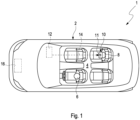
- Figure 1 a vehicle arrangement according to an embodiment of the invention.
- FIG. 1 shows a vehicle assembly 1 according to an exemplary embodiment of the invention.
- the vehicle assembly 1 comprises a vehicle 2, which can be configured as an automated or manually controlled vehicle.
- vehicle interior 4 of the vehicle 2 two vehicle passengers 6, 8 are located, for example.
- a first vehicle passenger is a driver of the vehicle 2.
- a second vehicle passenger 8 wears a virtual reality headset or a VR device 10.
- the second vehicle passenger 8 is thus a user 8 of the VR device 10.
- the first vehicle passenger 6 is a so-called non-VR user.
- Vehicle data can be received and evaluated, or evaluated vehicle data can be received, via the communication connection 14.
- the vehicle data can be determined or received, for example, by a vehicle sensor system 16. Additionally, route guidance information can be taken into account in the form of vehicle data.
- the vehicle sensor system 16 may include, for example, camera sensors, LIDAR sensors, radar sensors and the like.
- the vehicle-side control unit 12 or a processor unit 11 of the VR device 10 can classify a traffic situation or a traffic event Based on the traffic event, a reaction of vehicle 2 to the traffic event can be estimated.
- Critical driving situations can be classified as possible traffic events. In critical driving situations, a safe distance from vehicle 2 is exceeded, resulting in an evasive maneuver or an emergency braking maneuver being initiated. Such driving maneuvers can be initiated automatically by the vehicle-mounted control unit 12 or by an emergency braking assistance function, or by the driver 6. The corresponding driving situation can often be determined in advance using the vehicle sensors 16.
- control commands are generated to control the VR device 10 in order to alert the user 8 of the VR device 10 to an unpredictable reaction of the vehicle 2 or the driver 6 to the traffic event and to prevent the user 8 from being startled.
- a warning message can be displayed in the VR display of the VR device 10 using the generated control commands.
- a see-through function can be activated by the generated control commands.
- some VR devices 10 have camera systems with which the surroundings are captured and evaluated.
- a see-through function displays the video stream of such a camera system instead of the VR display to allow the user 8 a view behind the VR device 10.
- the see-through function can thus be activated and deactivated depending on the traffic situation in order to prepare the user 8 for possible reactions of the vehicle 2.
- vehicle 2 can reach a destination. This can be registered based on vehicle data in the form of navigation data. When approaching the destination, a corresponding message can be displayed in the VR device. 10 so that the user 8 can prepare for the end of VR use.
Landscapes
- Engineering & Computer Science (AREA)
- Transportation (AREA)
- Mechanical Engineering (AREA)
- Chemical & Material Sciences (AREA)
- Combustion & Propulsion (AREA)
- Multimedia (AREA)
- Signal Processing (AREA)
- Automation & Control Theory (AREA)
- Physics & Mathematics (AREA)
- Computer Hardware Design (AREA)
- Human Computer Interaction (AREA)
- Theoretical Computer Science (AREA)
- General Physics & Mathematics (AREA)
- General Engineering & Computer Science (AREA)
- Optics & Photonics (AREA)
- Health & Medical Sciences (AREA)
- General Health & Medical Sciences (AREA)
- Social Psychology (AREA)
- Computer Networks & Wireless Communication (AREA)
- Databases & Information Systems (AREA)
- Traffic Control Systems (AREA)
Description
- Die Erfindung betrifft ein Verfahren zum Steuern eines VR-Geräts, insbesondere einer VR-Brille, eines Benutzers in einem Fahrzeuginnenraum eines Fahrzeugs über eine Kommunikationsverbindung sowie eine Fahrzeuganordnung.
- Es sind derzeit verschiedene theoretische Anwendungsmöglichkeiten für Virtual-Reality-Headsets bzw. VR-Geräte im Fahrzeugbereich bekannt, welche bislang in der Entwicklung sind. Beispielsweise sind Programmbibliotheken bekannt, die es Entwicklern von VR-Medienformaten erlauben, diese Inhalte auf die Fahrzeugbewegungen abzustimmen. Durch die Implementierung der Fahrzeugbewegung in die Ausgabe der VR-Medienformate kann eine intensivere Immersion des Benutzers des VR-Geräts realisiert werden. Des Weiteren kann die Einbeziehung der Fahrzeugbewegung in einer Minimierung der Neigung zu sogenannter Motion-Sickness resultieren.
- Bei der Nutzung eines VR-Geräts im Fahrzeug ist der Benutzer von den Geschehnissen im und um das Fahrzeug abgeschirmt. Einerseits fördert dies das immersive Erlebnis, andererseits ist der Benutzer des VR-Geräts auch von bedeutenden Vorfällen im Fahrzeug abgekoppelt. Beispielsweise kann der Benutzer eine drohende Unfallsituation im Fahrzeug nicht direkt wahrnehmen bzw. sich auf die drohende Unfallsituation einstellen. Hierdurch kann der Benutzer des VR-Geräts erschreckt oder überrascht werden.
-
WO 2020/035380 A1 betrifft ein Verfahren und System zum Betreiben einer VR-Brille während einer autonomen Fahrt eines Fahrzeugs, bei dem ein Fahrzeug autonom fährt, ein Fahrer des Fahrzeugs eine mit einem Multimediagerät verbundene VR-Brille trägt und die VR-Brille ein Unterhaltungsprogramm des Multimediageräts für den Fahrer anzeigt. -
US 2017/113702 A1 offenbart ein Sicherheitssystem für ein autonomes Fahrzeug, das verwendet werden kann, um einen Insassen bei einer bestimmten Aktivität zu warnen, bei der es um den Umgang mit einem Objekt geht, das dem Insassen im Falle einer plötzlichen Verschlechterung der Fahrruhe (einem SDRS-Ereignis) schaden könnte. Das Sicherheitssystem umfasst eine Kamera, die Bilder des Insassen aufnimmt, und einen Computer, der anhand der Bilder abschätzt, ob der Insasse eine bestimmte Aktivität ausübt. Der Computer erhält von einem autonomen Fahrsteuerungssystem einen Hinweis darauf, ob ein SDRS-Ereignis unmittelbar bevorsteht. Als Reaktion auf den Empfang eines Hinweises auf ein bevorstehendes SDRS-Ereignis und die Einschätzung, dass der Insasse an einer bestimmten Aktivität beteiligt ist, weist der Computer eine Benutzerschnittstelle an, den Insassen kurz vor dem SDRS-Ereignis zu warnen. - Aus
DE 10 2013 222580 A1 ist ein Verfahren zum Detektieren einer aufgesetzten Datenbrille bei einem Fahrer in einem Fahrzeug bekannt, bei dem mittels einer Sensorik im Fahrzeug festgestellt wird, ob der Fahrer eine Datenbrille trägt, und in diesem Fall ein Warnsignal erzeugt wird. - Es ist die Aufgabe der vorliegenden Erfindung, ein Verfahren und eine Fahrzeuganordnung bereitzustellen, durch welche ein Benutzer eines Virtual-Reality-Geräts vor einem Erschrecken bzw. Überraschen geschützt wird.
- Erfindungsgemäß wird diese Aufgabe durch ein Verfahren mit den Merkmalen des Anspruchs 1 und eine Fahrzeuganordnung mit den Merkmalen des Anspruchs 7 gelöst. Vorteilhafte Ausgestaltungen und Weiterbildungen ergeben sich aus den abhängigen Ansprüchen.
- Das erfindungsgemäße Verfahren dient zum Steuern eines VR-Geräts, insbesondere einer VR-Brille, eines Benutzers in einem Fahrzeuginnenraum eines Fahrzeugs über eine Kommunikationsverbindung. Bei dem erfindungsgemäßen Verfahren werden über die Kommunikationsverbindung Fahrzeugdaten empfangen und ausgewertet oder bereits ausgewertete Fahrzeugdaten empfangen. Anhand der ausgewerteten Fahrzeugdaten wird mindestens ein Verkehrsereignis klassifiziert, wobei Steuerbefehle zum Steuern des VR-Geräts erzeugt werden, durch welche der Benutzer des VR-Geräts auf eine für den Benutzer unvorhersehbare Reaktion des Fahrzeugs auf das Verkehrsereignis hingewiesen wird. Erfindungsgemäß werden Steuerbefehle zum Steuern des VR-Geräts erzeugt, welche einen Kommunikationsbedarf eines Fahrzeugpassagiers mit dem Benutzer des VR-Geräts signalisieren.
- Durch das Verfahren kann eine Weiterleitung spezifischer Informationen aus dem Fahrzeug an das VR-Gerät und eine Anzeige derselben umgesetzt werden. Dabei kann beispielsweise ein Datenkanal zwischen dem Fahrzeug und dem VR-Gerät verwendet werden, welcher zur Bewegungskompensation bei der Benutzung des VR-Geräts nutzbar ist. Der Datenkanal kann beispielsweise auf einer drahtlosen oder drahtgebundenen Kommunikationstechnologie, wie beispielsweise WLAN, Bluetooth, NFC, Funk, Infrarot, Ethernet, USB und dergleichen basieren.
- Das VR-Gerät kann beispielsweise als ein Virtual-Reality-Headset ausgestaltet sein. Dabei kann eine Ausgabe von VR-Medieninhalten über mindestens ein in das Virtual-Reality-Headset integrierte Display oder über ein in das Virtual-Reality-Headset eingesetzte tragbare Gerät, wie beispielsweise ein Smartphone, erfolgen. Das VR-Gerät kann weiterhin Kopfhörer, Kamerasensoren, Mikrofone und dergleichen aufweisen, um die Immersion des Benutzers zu optimieren.
- Die Kommunikationsverbindung kann vorzugsweise auf einem drahtlosen Übertragungsstandard, wie beispielsweise Bluetooth, basieren und zwischen einem fahrzeugseitigen Steuergerät und dem VR-Gerät ausgebildet sein. Durch die datenleitende Kopplung des VR-Geräts mit dem Fahrzeug kann dem Benutzer nach wie vor ein immersives VR-Erlebnis bereitgestellt werden. Durch das erfindungsgemäße Verfahren kann der Benutzer über besondere Vorkommnisse im und um das Fahrzeug informiert werden. Das VR-Gerät kann somit auf Verkehrsereignisse reagieren, um ein Erschrecken des Benutzers des VR-Geräts zu verhindern. Durch das Verfahren kann somit der Komfort bei der Benutzung von VR-Medieninhalten während einer Fahrt erhöht werden.
- Das mindestens eine Verkehrsereignis kann auf Grundlage von Fahrzeugsignalen bzw. Fahrzeugdaten definiert bzw. klassifiziert werden. Die Fahrzeugdaten können auch mittelbar dem Benutzer des VR-Geräts im Fahrzeug bereitgestellt werden, um eine Verkehrssituations-abhängige Steuerung des VR-Geräts zu ermöglichen.
- Es werden Verkehrsereignisse, wie beispielsweise drohende Auffahrunfälle oder erfolgreiche Fußgängererkennung, fahrzeugseitig durch Steuergeräte bereits registriert bevor eine Reaktion des Fahrzeugs erfolgt. Die entsprechenden Auswerteergebnisse können in Form von ausgewerteten Fahrzeugdaten oder direkt in Form von Steuerbefehlen an das VR-Gerät übermittelt werden. Somit können fahrzeugseitige Instanzen, welche auf die fahrzeugseitige Sensorik zugreifen, zum Steuern des VR-Geräts herangezogen werden. Alternativ oder zusätzlich kann eine Auswertung der Fahrzeugdaten durch das VR-Gerät erfolgen.
- Gemäß einem Ausführungsbeispiel werden die Steuerbefehle zum Ausgeben einer Meldung in einer Anzeige des VR-Geräts, Aktivieren einer Transparenz des VR-Geräts, Ausgeben einer akustischen oder grafischen Benachrichtigung, zum Pausieren oder Beenden einer Applikation des VR-Geräts und/oder zum Aufheben einer Geräuschunterdrückungsfunktion erzeugt. Hierdurch kann eine Benachrichtigung des Benutzers des VR-Geräts generiert werden, welche ein Erschrecken des Benutzers verhindert.
- Die Meldung in der Anzeige des VR-Geräts kann in Form einer Warnung oder eines Hinweises erfolgen. Dabei können akustische, haptische und/oder optische Meldungen bzw. Benachrichtigungen als Reaktionen auf die erzeugten Steuerbefehle durch das VR-Gerät ausgegeben werden.
- Bei einer weiteren Ausführungsform wird der Benutzer des VR-Geräts auf eine Reaktion des Fahrzeugs auf das Verkehrsereignis in Form einer Aktivierung eines Notbremsassistenten, eines Ausweichmanövers des Fahrzeugs, einer Ankunft oder Annäherung an einen Zielort, einer ausgelösten Müdigkeitserkennung oder eines von einer Fahrzeugsensorik erkannten Objekts hingewiesen. Bei derartigen Verkehrsereignissen kann das Fahrzeug als Reaktion ein Bremsmanöver oder ein Ausweichmanöver einleiten, welches durch den Benutzer des VR-Geräts plötzlich und ohne Vorwarnung wahrgenommen wird. Durch das Verfahren kann im Vorfeld zu derartigen Reaktionen des Fahrzeugs der Benutzer des VR-Geräts berücksichtigt und benachrichtigt werden. Eine derartige Ansteuerung des VR-Geräts ermöglicht eine Vorwarnung bzw. eine Einstellung des Benutzers auf die bevorstehende Reaktion des Fahrzeugs, wodurch der Fahrkomfort für den Benutzer erhöht wird.
- Wird der Fahrer durch eine Müdigkeitserkennung des Fahrzeugs als müde erkannt, kann der Benutzer des VR-Geräts direkt oder indirekt darauf hingewiesen werden, sodass er beispielsweise dazu beitragen kann, den Fahrer des Fahrzeugs wach und aktiv zu halten. Beispielsweise könnten dem Benutzer des VR-Geräts Medienangebote vorgeschlagen werden, die eine Kollaboration mit einem weiteren Nicht-VR-Nutzer, wie beispielsweise dem Fahrer oder einem weiteren Fahrzeugpassagier, erfordern. Ein derartiger VR-Medieninhalt kann beispielsweise als ein Quiz ausgestaltet sein.
- Der Benutzer des VR-Geräts kann vorzugsweise ein Fahrzeugpassagier sein, welcher auf einer Rücksitzbank oder einem Beifahrersitz im Fahrzeuginnenraum sitzt. Das Fahrzeug kann dabei automatisiert, teilautomatisiert oder manuell durch einen Fahrer gesteuert werden. Der Benutzer des VR-Geräts ist vorzugsweise von der Steuerung des Fahrzeugs ausgeschlossen.
- Bei einer weiteren Ausgestaltung wird der Kommunikationsbedarf des Fahrzeugpassagiers mit dem Benutzer des VR-Geräts durch eine fahrzeugseitige Eingabe des Fahrzeugpassagiers eingeleitet.
- Bei einem Kommunikationsbedarf kann mindestens ein Fahrzeugpassagier eine Eingabe über eine Mediensteuerung des Fahrzeugs ausführen, um diesen Kommunikationsbedarf dezent dem Benutzer des VR-Geräts mitzuteilen. Dies kann beispielsweise in Form einer Aktivierung eines Buttons in einer grafischen Oberfläche der Mediensteuerung, durch Drücken einer Taste oder durch Nutzung eines sprachgestützten Fahrzeugassistenten umgesetzt werden.
- Der Benutzer des VR-Geräts kann über die Kommunikationsverbindung eine Benachrichtigung erhalten. Die Benachrichtigung bzw. der Hinweis auf den Kommunikationsbedarf kann als Textnachricht im VR-Gerät eingeblendet, als Sprachnachricht über Kopfhörer wiedergegeben oder als eine Deaktivierung einer Geräuschunterdrückung der Kopfhörer signalisiert werden. Im Gegensatz zu einer direkten Kontaktaufnahme, beispielsweise durch Berühren, mit dem Benutzer des VR-Geräts kann ein Erschrecken des Benutzer des VR-Geräts durch die indirekte Kommunikation über die Kommunikationsverbindung mit dem Fahrzeug verhindert werden.
- Gemäß einem weiteren Ausführungsbeispiel werden die Steuerbefehle zum Steuern des VR-Geräts durch ein fahrzeugseitiges Steuergerät und/oder durch eine Prozessoreinheit des VR-Geräts erzeugt. Durch diese Maßnahme können die Berechnung der Steuerbefehle und die Klassifizierung des mindestens einen Verkehrsereignisses fahrzeugseitig oder durch das VR-Gerät erfolgen. Insbesondere können bereits vom Fahrzeug durchgeführte Berechnungen, Warnungen und Rechenergebnisse vom VR-Gerät genutzt werden, um den Leistungsbedarf des VR-Geräts zu verringern und die Batterielaufzeit des VR-Geräts zu erhöhen.
- Nach einer weiteren Ausführungsform werden Fahrzeugdaten und/oder ausgewertete Fahrzeugdaten zwischen dem fahrzeugseitigen Steuergerät und dem VR-Gerät über eine als eine Bluetooth-Verbindung oder eine WLAN-Verbindung ausgestaltete Kommunikationsverbindung übertragen. Durch diese Maßnahme kann eine Kommunikationsverbindung basierend auf unterschiedlichen drahtlosen Übertragungsstandards ausgebildet werden, welche eine Übertragung von Fahrzeugdaten für fahrdynamikabhängige VR-Erlebnisse ermöglicht.
- Die Kommunikationsverbindung kann vorzugsweise als ein bidirektionaler Datenkanal zwischen dem Fahrzeug bzw. dem fahrzeugseitigen Steuergerät und dem VR-Gerät realisiert sein. Die entsprechende Kommunikationsverbindung kann auf einer oder mehreren fahrzeuginternen oder fahrzeugexternen Übertragungstechnologien, wie beispielsweise Bluetooth, WLAN, LTE, 5G und dergleichen, basieren.
- Die erfindungsgemäße Fahrzeuganordnung weist ein Fahrzeug mit einem fahrzeugseitigen Steuergerät und mindestens ein VR-Gerät auf. Die Fahrzeuganordnung ist dazu eingerichtet, das erfindungsgemäße Verfahren auszuführen.
- Die Fahrzeuganordnung ermöglicht die Nutzung von VR-Geräten, wie beispielsweise VR-Brillen oder VR-Headsets, auf einem Rücksitz oder einem Beifahrersitz des Fahrzeugs, unabhängig davon, ob die Fahrt automatisiert oder manuell gesteuert ist. Dabei kann der Benutzer des VR-Geräts auf eine für den Benutzer unvorhersehbare Reaktion des Fahrzeugs auf ein Verkehrsereignis hingewiesen werden, um ein Erschrecken oder ein Überraschen des Benutzers zu vermeiden und den Fahrkomfort für den Benutzer zu erhöhen.
- Die Erfindung ist anhand von Ausführungsformen in den Zeichnungen schematisch dargestellt und wird unter Bezugnahme auf die Zeichnungen weiter beschrieben. Es zeigt:
Figur 1 eine Fahrzeuganordnung gemäß einem erfindungsgemäßen Ausführungsbeispiel. -
Figur 1 zeigt eine Fahrzeuganordnung 1 gemäß einem erfindungsgemäßen Ausführungsbeispiel. Die Fahrzeuganordnung 1 weist ein Fahrzeug 2 auf, welches als ein automatisiert betreibbares oder als ein manuell gesteuertes Fahrzeug ausgestaltet sein kann. In einem Fahrzeuginnenraum 4 des Fahrzeugs 2 befinden sich beispielhaft zwei Fahrzeugpassagiere 6, 8. - Ein erster Fahrzeugpassagier ist ein Fahrer des Fahrzeugs 2. Ein zweiter Fahrzeugpassagier 8 trägt ein Virtual-Reality-Headset bzw. ein VR-Gerät 10. Der zweite Fahrzeugpassagier 8 ist somit ein Benutzer 8 des VR-Geräts 10. Der erste Fahrzeugpassagier 6 ist ein sogenannter Nicht-VR-Nutzer.
- Zwischen einem fahrzeugseitigen Steuergerät 12 und dem VR-Gerät 10 ist eine datenleitende Kommunikationsverbindung 14 hergestellt, welche beispielsweise auf einem Bluetooth Übertragungsstandard basiert. Über die Kommunikationsverbindung 14 können Fahrzeugdaten empfangen und ausgewertet werden oder ausgewertete Fahrzeugdaten empfangen werden. Die Fahrzeugdaten können beispielsweise von einer Fahrzeugsensorik 16 ermittelt oder empfangen werden. Zusätzlich können Informationen einer Routenführung in Form von Fahrzeugdaten berücksichtigt werden.
- Die Fahrzeugsensorik 16 kann beispielsweise Kamerasensoren, LIDAR-Sensoren, Radarsensoren und dergleichen aufweisen.
- Anhand der ausgewerteten Fahrzeugdaten kann durch das fahrzeugseitige Steuergerät 12 oder von einer Prozessoreinheit 11 des VR-Geräts 10 eine Klassifizierung einer Verkehrssituation bzw. eines Verkehrsereignisses durchgeführt werden. Basierend auf dem Verkehrsereignis kann eine Reaktion des Fahrzeugs 2 auf das Verkehrsereignis abgeschätzt werden.
- Als mögliche Verkehrsereignisse können beispielsweise kritischen Fahrsituationen klassifiziert werden. Bei kritischen Fahrsituationen wird ein Sicherheitsabstand des Fahrzeugs 2 unterschritten, sodass ein Ausweichmanöver oder ein Notbremsmanöver eingeleitet wird. Derartige Fahrmanöver können automatisiert durch das fahrzeugseitige Steuergerät 12 bzw. durch eine Notbremsassistenzfunktion oder durch den Fahrer 6 eingeleitet werden. Die entsprechende Fahrsituation kann oftmals bereits im Vorfeld anhand der Fahrzeugsensorik 16 festgestellt werden.
- Nach einer Klassifizierung des Verkehrsereignisses werden Steuerbefehle zum Steuern des VR-Geräts 10 erzeugt, um den Benutzer 8 des VR-Geräts 10 auf eine für den Benutzer 8 unvorhersehbare Reaktion des Fahrzeugs 2 bzw. des Fahrers 6 auf das Verkehrsereignis hinzuweisen und ein Erschrecken des Benutzers 8 zu vermeiden. Hierzu kann eine Einblendung einer Warnmeldung in der VR-Anzeige des VR-Geräts 10 durch die erzeugten Steuerbefehle veranlasst werden.
- Je nach Ausgestaltung des VR-Geräts 10 kann eine See-Through-Funktion durch die erzeugten Steuerbefehle aktiviert werden. Zur Positionierung des VR-Geräts 10 im Raum weisen manche VR-Geräte 10 Kamerasysteme auf, mit welchen die Umgebung erfasst und ausgewertet wird. Eine See-Through-Funktion blendet anstelle der VR-Anzeige den Videostrom eines solchen Kamerasystems ein, um dem Benutzer 8 eine Sicht hinter das VR-Gerät 10 zu ermöglichen. Die See-Through-Funktion kann somit Verkehrssituationsgetrieben aktiviert und deaktiviert werden, um den Benutzer 8 auf eventuelle Reaktionen des Fahrzeugs 2 vorzubereiten.
- Bei einem weiteren beispielhaften Verkehrsereignis kann das Fahrzeug 2 einen Zielort erreichen. Dies kann basierend auf Fahrzeugdaten in Form von Navigationsdaten registriert werden. Bei einer Annäherung an den Zielort kann eine Einblendung eines entsprechenden Hinweises in dem VR-Gerät 10 erfolgen, damit der Benutzer 8 sich auf ein Ende der VR-Nutzung vorbereiten kann.
-
- 1
- Fahrzeuganordnung
- 2
- Fahrzeug
- 4
- Fahrzeuginnenraum
- 6
- erster Fahrzeugpassagier / Fahrer
- 8
- zweiter Fahrzeugpassagier / Benutzer des VR-Geräts
- 10
- VR-Gerät / Virtual-Reality-Headset
- 11
- Prozessoreinheit des VR-Geräts
- 12
- fahrzeugseitiges Steuergerät
- 14
- Kommunikationsverbindung
- 16
- Fahrzeugsensorik
Claims (7)
- Verfahren zum Steuern eines VR-Geräts (10), insbesondere einer VR-Brille, eines Benutzers (8) in einem Fahrzeuginnenraum (4) eines Fahrzeugs (2) über eine Kommunikationsverbindung (14), wobei über die Kommunikationsverbindung (14) Fahrzeugdaten empfangen und ausgewertet werden oder ausgewertete Fahrzeugdaten empfangen werden, und anhand der ausgewerteten Fahrzeugdaten mindestens ein Verkehrsereignis klassifiziert wird, und Steuerbefehle zum Steuern des VR-Geräts (10) erzeugt werden, durch welche der Benutzer (8) des VR-Geräts (10) auf eine für den Benutzer (8) unvorhersehbare Reaktion des Fahrzeugs (2) auf das Verkehrsereignis hingewiesen wird, dadurch gekennzeichnet, dass Steuerbefehle zum Steuern des VR-Geräts (10) erzeugt werden, welche einen Kommunikationsbedarf eines Fahrzeugpassagiers (6) mit dem Benutzer (8) des VR-Geräts (10) signalisieren.
- Verfahren nach Anspruch 1, wobei der Kommunikationsbedarf des Fahrzeugpassagiers (6) mit dem Benutzer (8) des VR-Geräts (10) durch eine fahrzeugseitige Eingabe des Fahrzeugpassagiers (6) eingeleitet wird.
- Verfahren nach Anspruch 1 oder 2, wobei die Steuerbefehle zum Ausgeben einer Meldung in einer Anzeige des VR-Geräts (10), Aktivieren einer Transparenz des VR-Geräts (10), Ausgeben einer akustischen oder grafischen Benachrichtigung, zum Pausieren oder Beenden einer Applikation des VR-Geräts (10) und/oder zum Aufheben einer Geräuschunterdrückungsfunktion erzeugt werden.
- Verfahren nach einem der Ansprüche 1 bis 3, wobei der Benutzer (8) des VR-Geräts (10) auf eine Reaktion des Fahrzeugs (2) auf das Verkehrsereignis in Form einer Aktivierung eines Notbremsassistenten, eines Ausweichmanövers des Fahrzeugs (2), einer Ankunft oder Annäherung an einen Zielort, einer ausgelösten Müdigkeitserkennung oder eines von einer Fahrzeugsensorik (16) erkannten Objekts hingewiesen wird.
- Verfahren nach einem der Ansprüche 1 bis 4, wobei die Steuerbefehle zum Steuern des VR-Geräts (10) durch ein fahrzeugseitiges Steuergerät (12) und/oder durch eine Prozessoreinheit (11) des VR-Geräts (10) erzeugt werden.
- Verfahren nach Anspruch 5, wobei Fahrzeugdaten und/oder ausgewertete Fahrzeugdaten zwischen dem fahrzeugseitigen Steuergerät (12) und dem VR-Gerät (10) über eine als eine Bluetooth-Verbindung oder eine WLAN-Verbindung ausgestaltete Kommunikationsverbindung (14) übertragen werden.
- Fahrzeuganordnung (1), aufweisend ein Fahrzeug (2) mit einem fahrzeugseitigen Steuergerät (12) und mindestens ein VR-Gerät (10), wobei die Fahrzeuganordnung (1) dazu eingerichtet ist, ein Verfahren gemäß einem der vorhergehenden Ansprüche auszuführen.
Applications Claiming Priority (3)
| Application Number | Priority Date | Filing Date | Title |
|---|---|---|---|
| DE102020111827 | 2020-04-30 | ||
| DE102020117852.2A DE102020117852A1 (de) | 2020-04-30 | 2020-07-07 | Verkehrssituations-abhängige Steuerung eines Virtual-Reality-Geräts |
| PCT/EP2021/060064 WO2021219414A1 (de) | 2020-04-30 | 2021-04-19 | Verkehrssituations-abhängige steuerung eines virtual-reality-geräts |
Publications (2)
| Publication Number | Publication Date |
|---|---|
| EP4143048A1 EP4143048A1 (de) | 2023-03-08 |
| EP4143048B1 true EP4143048B1 (de) | 2025-03-12 |
Family
ID=78267605
Family Applications (1)
| Application Number | Title | Priority Date | Filing Date |
|---|---|---|---|
| EP21720714.1A Active EP4143048B1 (de) | 2020-04-30 | 2021-04-19 | Verkehrssituations-abhängige steuerung eines virtual-reality-geräts |
Country Status (5)
| Country | Link |
|---|---|
| US (1) | US12351202B2 (de) |
| EP (1) | EP4143048B1 (de) |
| CN (1) | CN115485163B (de) |
| DE (1) | DE102020117852A1 (de) |
| WO (1) | WO2021219414A1 (de) |
Families Citing this family (1)
| Publication number | Priority date | Publication date | Assignee | Title |
|---|---|---|---|---|
| DE102024122782A1 (de) * | 2024-08-09 | 2026-02-12 | Bayerische Motoren Werke Aktiengesellschaft | Verfahren zum Betreiben eines elektronischen Sicherheitssystems eines Fahrzeugs, sowie elektronisches Sicherheitssystem und Fahrzeug |
Family Cites Families (12)
| Publication number | Priority date | Publication date | Assignee | Title |
|---|---|---|---|---|
| DE102013222580A1 (de) * | 2013-11-07 | 2015-05-07 | Robert Bosch Gmbh | Verfahren zum Detektieren einer aufgesetzten Datenbrille bei einem Fahrer in einem Fahrzeug |
| EP3079041B1 (de) * | 2015-04-10 | 2018-06-27 | Airbus Defence and Space GmbH | Verfahren und system zur bereitstellung einer virtual-reality-umgebung für passagiere von land- und luftfahrzeugen |
| US9704398B2 (en) * | 2015-09-14 | 2017-07-11 | At&T Intellectual Property I, L.P. | Method and apparatus for enhancing driver situational awareness |
| US10059347B2 (en) * | 2015-10-26 | 2018-08-28 | Active Knowledge Ltd. | Warning a vehicle occupant before an intense movement |
| DE102016213916A1 (de) | 2016-07-28 | 2018-02-01 | Volkswagen Aktiengesellschaft | Infotainmentsystem für ein Kraftfahrzeug |
| DE102017211520A1 (de) | 2017-07-06 | 2019-01-10 | Bayerische Motoren Werke Aktiengesellschaft | Verfahren zum Erzeugen einer virtuellen Umgebung für einen Benutzer in einem Fahrzeug, entsprechendes Virtual-Realitysystem sowie Fahrzeug |
| DE102017215406A1 (de) * | 2017-09-04 | 2019-03-07 | Bayerische Motoren Werke Aktiengesellschaft | Verfahren, mobiles Anwendergerät, Computerprogramm zum Erzeugen einer visuellen Information für zumindest einen Insassen eines Fahrzeugs |
| DE102017215404A1 (de) * | 2017-09-04 | 2019-03-07 | Bayerische Motoren Werke Aktiengesellschaft | Verfahren, mobiles Anwendergerät, System, Computerprogramm zur Ansteuerung eines mobilen Anwendergeräts eines Insassen eines Fahrzeugs |
| WO2020035380A1 (de) * | 2018-08-13 | 2020-02-20 | Audi Ag | Betrieb einer vr-brille in einem autonom fahrenden fahrzeug |
| CN109808613B (zh) * | 2019-01-23 | 2026-03-03 | 驭动科技(宁波)有限公司 | 智能驾驶系统行车事件评估检测方法 |
| DE102019002664A1 (de) | 2019-04-11 | 2019-11-07 | Daimler Ag | Verfahren zur Anzeige einer fahrzeugdynamischen virtuellen Realität in einem Fahrzeug |
| CN110712647A (zh) * | 2019-09-23 | 2020-01-21 | 上海理工大学 | 一种远程车辆控制系统 |
-
2020
- 2020-07-07 DE DE102020117852.2A patent/DE102020117852A1/de active Pending
-
2021
- 2021-04-19 CN CN202180031859.7A patent/CN115485163B/zh active Active
- 2021-04-19 US US17/922,159 patent/US12351202B2/en active Active
- 2021-04-19 EP EP21720714.1A patent/EP4143048B1/de active Active
- 2021-04-19 WO PCT/EP2021/060064 patent/WO2021219414A1/de not_active Ceased
Also Published As
| Publication number | Publication date |
|---|---|
| US12351202B2 (en) | 2025-07-08 |
| WO2021219414A1 (de) | 2021-11-04 |
| US20230174090A1 (en) | 2023-06-08 |
| CN115485163B (zh) | 2025-08-22 |
| DE102020117852A1 (de) | 2021-11-04 |
| EP4143048A1 (de) | 2023-03-08 |
| CN115485163A (zh) | 2022-12-16 |
Similar Documents
| Publication | Publication Date | Title |
|---|---|---|
| DE102017130414B4 (de) | Fahrzeug-systeme zur kontextabhängigen beurteilung | |
| DE102012112802B4 (de) | Verfahren zur Steuerung eines Fahrzeugs mit einem ein automatisiertes, teilautomatisiertes und ein manuelles Fahren ermöglichenden Fahrerassistenzsystem | |
| EP2682318B1 (de) | Motorfahrzeugkollisionswarnsystem | |
| CN106274480A (zh) | 用于在半自主驾驶期间能够完成次要任务的方法和设备 | |
| US10207640B2 (en) | Method and system for a warning message in a vehicle | |
| EP2767450A1 (de) | Spurwechselwarnsystem und Verfahren für ein Spurwechselwarnsystem | |
| EP3280617B1 (de) | Vorrichtung und verfahren zur deaktivierung einer auf den fahrer gerichteten kamera in einem fahrerüberwachungssystem | |
| JP2014019301A (ja) | 緊急退避装置 | |
| EP3167634B1 (de) | Verfahren zum sichern eines innenraums eines kraftfahrzeugs | |
| DE102017215404A1 (de) | Verfahren, mobiles Anwendergerät, System, Computerprogramm zur Ansteuerung eines mobilen Anwendergeräts eines Insassen eines Fahrzeugs | |
| Maag et al. | Car Gestures–Advisory warning using additional steering wheel angles | |
| DE102017215405A1 (de) | Verfahren, mobiles Anwendergerät, System, Computerprogramm zur Ansteuerung eines mobilen Anwendergeräts eines Insassen eines Fahrzeugs | |
| JP2024026499A (ja) | 情報提供装置、制御方法、及びプログラム | |
| DE112016007466T5 (de) | Computer eines autonomen fahrzeugs | |
| EP4143048B1 (de) | Verkehrssituations-abhängige steuerung eines virtual-reality-geräts | |
| DE102014214456A1 (de) | Kommunikation von Verkehrsteilnehmern | |
| DE102017200841A1 (de) | Situatives Sperren eines mobilen Endgerätes in einem Kraftfahrzeug zur Erhöhung der Sicherheit | |
| EP3063603B1 (de) | Zuordnen eines head-mounted displays zu einem sitzplatz in einem fahrzeug | |
| WO2023232520A1 (de) | Verfahren zum informationsaustausch zwischen einem fahrzeug und einem fahrzeuginsassen sowie fahrzeug | |
| JP7464757B2 (ja) | 隠された原動機付き車両との衝突リスクの低減 | |
| CN105263779B (zh) | 向驾驶员的通信设备自动提供车辆的监控信息的方法 | |
| DE102017215410A1 (de) | Verfahren, mobiles Anwendergerät, Computerprogramm zur Ansteuerung eines mobilen Anwendergeräts eines Fahrers eines Fahrzeugs | |
| CN114872723B (zh) | 用于评估车辆的至少一个驾驶员辅助系统的干预的方法和评估装置 | |
| DE102023123044B3 (de) | Verfahren zur Handhabung einer Gefahrensituation für ein Fahrzeug und Fahrzeug | |
| WO2026025361A1 (zh) | 提高人员对驾驶系统信任程度的方法、装置、存储介质和计算机程序产品 |
Legal Events
| Date | Code | Title | Description |
|---|---|---|---|
| STAA | Information on the status of an ep patent application or granted ep patent |
Free format text: STATUS: UNKNOWN |
|
| STAA | Information on the status of an ep patent application or granted ep patent |
Free format text: STATUS: THE INTERNATIONAL PUBLICATION HAS BEEN MADE |
|
| PUAI | Public reference made under article 153(3) epc to a published international application that has entered the european phase |
Free format text: ORIGINAL CODE: 0009012 |
|
| STAA | Information on the status of an ep patent application or granted ep patent |
Free format text: STATUS: REQUEST FOR EXAMINATION WAS MADE |
|
| 17P | Request for examination filed |
Effective date: 20221124 |
|
| AK | Designated contracting states |
Kind code of ref document: A1 Designated state(s): AL AT BE BG CH CY CZ DE DK EE ES FI FR GB GR HR HU IE IS IT LI LT LU LV MC MK MT NL NO PL PT RO RS SE SI SK SM TR |
|
| P01 | Opt-out of the competence of the unified patent court (upc) registered |
Effective date: 20230529 |
|
| DAV | Request for validation of the european patent (deleted) | ||
| DAX | Request for extension of the european patent (deleted) | ||
| REG | Reference to a national code |
Ref legal event code: R079 Ipc: B60K0035650000 Ref country code: DE Ref legal event code: R079 Ref document number: 502021006928 Country of ref document: DE Free format text: PREVIOUS MAIN CLASS: B60K0035000000 Ipc: B60K0035650000 |
|
| GRAP | Despatch of communication of intention to grant a patent |
Free format text: ORIGINAL CODE: EPIDOSNIGR1 |
|
| STAA | Information on the status of an ep patent application or granted ep patent |
Free format text: STATUS: GRANT OF PATENT IS INTENDED |
|
| RIC1 | Information provided on ipc code assigned before grant |
Ipc: H04N 21/488 20110101ALI20241127BHEP Ipc: H04N 21/81 20110101ALI20241127BHEP Ipc: H04N 21/4223 20110101ALI20241127BHEP Ipc: H04N 21/442 20110101ALI20241127BHEP Ipc: H04N 21/44 20110101ALI20241127BHEP Ipc: H04N 21/414 20110101ALI20241127BHEP Ipc: H04N 21/41 20110101ALI20241127BHEP Ipc: G02B 27/01 20060101ALI20241127BHEP Ipc: B60K 35/29 20240101ALI20241127BHEP Ipc: B60K 35/28 20240101ALI20241127BHEP Ipc: B60K 35/23 20240101ALI20241127BHEP Ipc: B60K 35/81 20240101ALI20241127BHEP Ipc: B60K 35/65 20240101AFI20241127BHEP |
|
| INTG | Intention to grant announced |
Effective date: 20241212 |
|
| GRAS | Grant fee paid |
Free format text: ORIGINAL CODE: EPIDOSNIGR3 |
|
| GRAA | (expected) grant |
Free format text: ORIGINAL CODE: 0009210 |
|
| STAA | Information on the status of an ep patent application or granted ep patent |
Free format text: STATUS: THE PATENT HAS BEEN GRANTED |
|
| AK | Designated contracting states |
Kind code of ref document: B1 Designated state(s): AL AT BE BG CH CY CZ DE DK EE ES FI FR GB GR HR HU IE IS IT LI LT LU LV MC MK MT NL NO PL PT RO RS SE SI SK SM TR |
|
| REG | Reference to a national code |
Ref country code: GB Ref legal event code: FG4D Free format text: NOT ENGLISH |
|
| REG | Reference to a national code |
Ref country code: CH Ref legal event code: EP |
|
| REG | Reference to a national code |
Ref country code: DE Ref legal event code: R096 Ref document number: 502021006928 Country of ref document: DE |
|
| REG | Reference to a national code |
Ref country code: IE Ref legal event code: FG4D Free format text: LANGUAGE OF EP DOCUMENT: GERMAN |
|
| PG25 | Lapsed in a contracting state [announced via postgrant information from national office to epo] |
Ref country code: RS Free format text: LAPSE BECAUSE OF FAILURE TO SUBMIT A TRANSLATION OF THE DESCRIPTION OR TO PAY THE FEE WITHIN THE PRESCRIBED TIME-LIMIT Effective date: 20250612 |
|
| PG25 | Lapsed in a contracting state [announced via postgrant information from national office to epo] |
Ref country code: FI Free format text: LAPSE BECAUSE OF FAILURE TO SUBMIT A TRANSLATION OF THE DESCRIPTION OR TO PAY THE FEE WITHIN THE PRESCRIBED TIME-LIMIT Effective date: 20250312 |
|
| PGFP | Annual fee paid to national office [announced via postgrant information from national office to epo] |
Ref country code: DE Payment date: 20250430 Year of fee payment: 5 |
|
| PG25 | Lapsed in a contracting state [announced via postgrant information from national office to epo] |
Ref country code: ES Free format text: LAPSE BECAUSE OF FAILURE TO SUBMIT A TRANSLATION OF THE DESCRIPTION OR TO PAY THE FEE WITHIN THE PRESCRIBED TIME-LIMIT Effective date: 20250312 |
|
| REG | Reference to a national code |
Ref country code: LT Ref legal event code: MG9D |
|
| PG25 | Lapsed in a contracting state [announced via postgrant information from national office to epo] |
Ref country code: NO Free format text: LAPSE BECAUSE OF FAILURE TO SUBMIT A TRANSLATION OF THE DESCRIPTION OR TO PAY THE FEE WITHIN THE PRESCRIBED TIME-LIMIT Effective date: 20250612 |
|
| PG25 | Lapsed in a contracting state [announced via postgrant information from national office to epo] |
Ref country code: HR Free format text: LAPSE BECAUSE OF FAILURE TO SUBMIT A TRANSLATION OF THE DESCRIPTION OR TO PAY THE FEE WITHIN THE PRESCRIBED TIME-LIMIT Effective date: 20250312 |
|
| REG | Reference to a national code |
Ref country code: NL Ref legal event code: MP Effective date: 20250312 |
|
| PG25 | Lapsed in a contracting state [announced via postgrant information from national office to epo] |
Ref country code: LV Free format text: LAPSE BECAUSE OF FAILURE TO SUBMIT A TRANSLATION OF THE DESCRIPTION OR TO PAY THE FEE WITHIN THE PRESCRIBED TIME-LIMIT Effective date: 20250312 |
|
| PG25 | Lapsed in a contracting state [announced via postgrant information from national office to epo] |
Ref country code: GR Free format text: LAPSE BECAUSE OF FAILURE TO SUBMIT A TRANSLATION OF THE DESCRIPTION OR TO PAY THE FEE WITHIN THE PRESCRIBED TIME-LIMIT Effective date: 20250613 Ref country code: BG Free format text: LAPSE BECAUSE OF FAILURE TO SUBMIT A TRANSLATION OF THE DESCRIPTION OR TO PAY THE FEE WITHIN THE PRESCRIBED TIME-LIMIT Effective date: 20250312 |
|
| PGFP | Annual fee paid to national office [announced via postgrant information from national office to epo] |
Ref country code: AT Payment date: 20250721 Year of fee payment: 5 |
|
| PG25 | Lapsed in a contracting state [announced via postgrant information from national office to epo] |
Ref country code: NL Free format text: LAPSE BECAUSE OF FAILURE TO SUBMIT A TRANSLATION OF THE DESCRIPTION OR TO PAY THE FEE WITHIN THE PRESCRIBED TIME-LIMIT Effective date: 20250312 |
|
| PG25 | Lapsed in a contracting state [announced via postgrant information from national office to epo] |
Ref country code: SE Free format text: LAPSE BECAUSE OF FAILURE TO SUBMIT A TRANSLATION OF THE DESCRIPTION OR TO PAY THE FEE WITHIN THE PRESCRIBED TIME-LIMIT Effective date: 20250312 |
|
| PG25 | Lapsed in a contracting state [announced via postgrant information from national office to epo] |
Ref country code: SM Free format text: LAPSE BECAUSE OF FAILURE TO SUBMIT A TRANSLATION OF THE DESCRIPTION OR TO PAY THE FEE WITHIN THE PRESCRIBED TIME-LIMIT Effective date: 20250312 |
|
| PG25 | Lapsed in a contracting state [announced via postgrant information from national office to epo] |
Ref country code: PT Free format text: LAPSE BECAUSE OF FAILURE TO SUBMIT A TRANSLATION OF THE DESCRIPTION OR TO PAY THE FEE WITHIN THE PRESCRIBED TIME-LIMIT Effective date: 20250714 |
|
| PG25 | Lapsed in a contracting state [announced via postgrant information from national office to epo] |
Ref country code: IT Free format text: LAPSE BECAUSE OF FAILURE TO SUBMIT A TRANSLATION OF THE DESCRIPTION OR TO PAY THE FEE WITHIN THE PRESCRIBED TIME-LIMIT Effective date: 20250312 Ref country code: PL Free format text: LAPSE BECAUSE OF FAILURE TO SUBMIT A TRANSLATION OF THE DESCRIPTION OR TO PAY THE FEE WITHIN THE PRESCRIBED TIME-LIMIT Effective date: 20250312 |
|
| PG25 | Lapsed in a contracting state [announced via postgrant information from national office to epo] |
Ref country code: CZ Free format text: LAPSE BECAUSE OF FAILURE TO SUBMIT A TRANSLATION OF THE DESCRIPTION OR TO PAY THE FEE WITHIN THE PRESCRIBED TIME-LIMIT Effective date: 20250312 Ref country code: EE Free format text: LAPSE BECAUSE OF FAILURE TO SUBMIT A TRANSLATION OF THE DESCRIPTION OR TO PAY THE FEE WITHIN THE PRESCRIBED TIME-LIMIT Effective date: 20250312 |
|
| PG25 | Lapsed in a contracting state [announced via postgrant information from national office to epo] |
Ref country code: RO Free format text: LAPSE BECAUSE OF FAILURE TO SUBMIT A TRANSLATION OF THE DESCRIPTION OR TO PAY THE FEE WITHIN THE PRESCRIBED TIME-LIMIT Effective date: 20250312 |
|
| PG25 | Lapsed in a contracting state [announced via postgrant information from national office to epo] |
Ref country code: SK Free format text: LAPSE BECAUSE OF FAILURE TO SUBMIT A TRANSLATION OF THE DESCRIPTION OR TO PAY THE FEE WITHIN THE PRESCRIBED TIME-LIMIT Effective date: 20250312 |
|
| PG25 | Lapsed in a contracting state [announced via postgrant information from national office to epo] |
Ref country code: IS Free format text: LAPSE BECAUSE OF FAILURE TO SUBMIT A TRANSLATION OF THE DESCRIPTION OR TO PAY THE FEE WITHIN THE PRESCRIBED TIME-LIMIT Effective date: 20250712 |
|
| REG | Reference to a national code |
Ref country code: CH Ref legal event code: H13 Free format text: ST27 STATUS EVENT CODE: U-0-0-H10-H13 (AS PROVIDED BY THE NATIONAL OFFICE) Effective date: 20251125 |
|
| PG25 | Lapsed in a contracting state [announced via postgrant information from national office to epo] |
Ref country code: LU Free format text: LAPSE BECAUSE OF NON-PAYMENT OF DUE FEES Effective date: 20250419 |
|
| REG | Reference to a national code |
Ref country code: DE Ref legal event code: R097 Ref document number: 502021006928 Country of ref document: DE |
|
| PG25 | Lapsed in a contracting state [announced via postgrant information from national office to epo] |
Ref country code: MC Free format text: LAPSE BECAUSE OF FAILURE TO SUBMIT A TRANSLATION OF THE DESCRIPTION OR TO PAY THE FEE WITHIN THE PRESCRIBED TIME-LIMIT Effective date: 20250312 |
|
| REG | Reference to a national code |
Ref country code: BE Ref legal event code: MM Effective date: 20250430 |
|
| PG25 | Lapsed in a contracting state [announced via postgrant information from national office to epo] |
Ref country code: DK Free format text: LAPSE BECAUSE OF FAILURE TO SUBMIT A TRANSLATION OF THE DESCRIPTION OR TO PAY THE FEE WITHIN THE PRESCRIBED TIME-LIMIT Effective date: 20250312 |
|
| PG25 | Lapsed in a contracting state [announced via postgrant information from national office to epo] |
Ref country code: BE Free format text: LAPSE BECAUSE OF NON-PAYMENT OF DUE FEES Effective date: 20250430 |
|
| PLBE | No opposition filed within time limit |
Free format text: ORIGINAL CODE: 0009261 |
|
| STAA | Information on the status of an ep patent application or granted ep patent |
Free format text: STATUS: NO OPPOSITION FILED WITHIN TIME LIMIT |
|
| PG25 | Lapsed in a contracting state [announced via postgrant information from national office to epo] |
Ref country code: CH Free format text: LAPSE BECAUSE OF NON-PAYMENT OF DUE FEES Effective date: 20250430 |
|
| REG | Reference to a national code |
Ref country code: CH Ref legal event code: L10 Free format text: ST27 STATUS EVENT CODE: U-0-0-L10-L00 (AS PROVIDED BY THE NATIONAL OFFICE) Effective date: 20260121 |
|
| 26N | No opposition filed |
Effective date: 20251215 |
|
| GBPC | Gb: european patent ceased through non-payment of renewal fee |
Effective date: 20250612 |
|
| PG25 | Lapsed in a contracting state [announced via postgrant information from national office to epo] |
Ref country code: GB Free format text: LAPSE BECAUSE OF NON-PAYMENT OF DUE FEES Effective date: 20250612 |
|
| PG25 | Lapsed in a contracting state [announced via postgrant information from national office to epo] |
Ref country code: IE Free format text: LAPSE BECAUSE OF NON-PAYMENT OF DUE FEES Effective date: 20250419 |
|
| PG25 | Lapsed in a contracting state [announced via postgrant information from national office to epo] |
Ref country code: FR Free format text: LAPSE BECAUSE OF NON-PAYMENT OF DUE FEES Effective date: 20250512 |