EP4140739B1 - A method for lamination - Google Patents
A method for lamination Download PDFInfo
- Publication number
- EP4140739B1 EP4140739B1 EP22190723.1A EP22190723A EP4140739B1 EP 4140739 B1 EP4140739 B1 EP 4140739B1 EP 22190723 A EP22190723 A EP 22190723A EP 4140739 B1 EP4140739 B1 EP 4140739B1
- Authority
- EP
- European Patent Office
- Prior art keywords
- sheet
- barrier film
- nip
- roller
- bulk layer
- Prior art date
- Legal status (The legal status is an assumption and is not a legal conclusion. Google has not performed a legal analysis and makes no representation as to the accuracy of the status listed.)
- Active
Links
Images




Classifications
-
- B—PERFORMING OPERATIONS; TRANSPORTING
- B32—LAYERED PRODUCTS
- B32B—LAYERED PRODUCTS, i.e. PRODUCTS BUILT-UP OF STRATA OF FLAT OR NON-FLAT, e.g. CELLULAR OR HONEYCOMB, FORM
- B32B37/00—Methods or apparatus for laminating, e.g. by curing or by ultrasonic bonding
- B32B37/14—Methods or apparatus for laminating, e.g. by curing or by ultrasonic bonding characterised by the properties of the layers
- B32B37/16—Methods or apparatus for laminating, e.g. by curing or by ultrasonic bonding characterised by the properties of the layers with all layers existing as coherent layers before laminating
- B32B37/20—Methods or apparatus for laminating, e.g. by curing or by ultrasonic bonding characterised by the properties of the layers with all layers existing as coherent layers before laminating involving the assembly of continuous webs only
-
- B—PERFORMING OPERATIONS; TRANSPORTING
- B32—LAYERED PRODUCTS
- B32B—LAYERED PRODUCTS, i.e. PRODUCTS BUILT-UP OF STRATA OF FLAT OR NON-FLAT, e.g. CELLULAR OR HONEYCOMB, FORM
- B32B37/00—Methods or apparatus for laminating, e.g. by curing or by ultrasonic bonding
- B32B37/12—Methods or apparatus for laminating, e.g. by curing or by ultrasonic bonding characterised by using adhesives
-
- B—PERFORMING OPERATIONS; TRANSPORTING
- B32—LAYERED PRODUCTS
- B32B—LAYERED PRODUCTS, i.e. PRODUCTS BUILT-UP OF STRATA OF FLAT OR NON-FLAT, e.g. CELLULAR OR HONEYCOMB, FORM
- B32B29/00—Layered products comprising a layer of paper or cardboard
- B32B29/002—Layered products comprising a layer of paper or cardboard as the main or only constituent of a layer, which is next to another layer of the same or of a different material
-
- B—PERFORMING OPERATIONS; TRANSPORTING
- B32—LAYERED PRODUCTS
- B32B—LAYERED PRODUCTS, i.e. PRODUCTS BUILT-UP OF STRATA OF FLAT OR NON-FLAT, e.g. CELLULAR OR HONEYCOMB, FORM
- B32B3/00—Layered products comprising a layer with external or internal discontinuities or unevennesses, or a layer of non-planar shape; Layered products comprising a layer having particular features of form
- B32B3/26—Layered products comprising a layer with external or internal discontinuities or unevennesses, or a layer of non-planar shape; Layered products comprising a layer having particular features of form characterised by a particular shape of the outline of the cross-section of a continuous layer; characterised by a layer with cavities or internal voids ; characterised by an apertured layer
- B32B3/266—Layered products comprising a layer with external or internal discontinuities or unevennesses, or a layer of non-planar shape; Layered products comprising a layer having particular features of form characterised by a particular shape of the outline of the cross-section of a continuous layer; characterised by a layer with cavities or internal voids ; characterised by an apertured layer characterised by an apertured layer, the apertures going through the whole thickness of the layer, e.g. expanded metal, perforated layer, slit layer regular cells B32B3/12
-
- B—PERFORMING OPERATIONS; TRANSPORTING
- B32—LAYERED PRODUCTS
- B32B—LAYERED PRODUCTS, i.e. PRODUCTS BUILT-UP OF STRATA OF FLAT OR NON-FLAT, e.g. CELLULAR OR HONEYCOMB, FORM
- B32B37/00—Methods or apparatus for laminating, e.g. by curing or by ultrasonic bonding
- B32B37/0046—Methods or apparatus for laminating, e.g. by curing or by ultrasonic bonding characterised by constructional aspects of the apparatus
- B32B37/0053—Constructional details of laminating machines comprising rollers; Constructional features of the rollers
-
- B—PERFORMING OPERATIONS; TRANSPORTING
- B32—LAYERED PRODUCTS
- B32B—LAYERED PRODUCTS, i.e. PRODUCTS BUILT-UP OF STRATA OF FLAT OR NON-FLAT, e.g. CELLULAR OR HONEYCOMB, FORM
- B32B37/00—Methods or apparatus for laminating, e.g. by curing or by ultrasonic bonding
- B32B37/10—Methods or apparatus for laminating, e.g. by curing or by ultrasonic bonding characterised by the pressing technique, e.g. using action of vacuum or fluid pressure
- B32B37/1054—Regulating the dimensions of the laminate, e.g. by adjusting the nip or platen gap
-
- B—PERFORMING OPERATIONS; TRANSPORTING
- B32—LAYERED PRODUCTS
- B32B—LAYERED PRODUCTS, i.e. PRODUCTS BUILT-UP OF STRATA OF FLAT OR NON-FLAT, e.g. CELLULAR OR HONEYCOMB, FORM
- B32B37/00—Methods or apparatus for laminating, e.g. by curing or by ultrasonic bonding
- B32B37/12—Methods or apparatus for laminating, e.g. by curing or by ultrasonic bonding characterised by using adhesives
- B32B37/1284—Application of adhesive
-
- B—PERFORMING OPERATIONS; TRANSPORTING
- B32—LAYERED PRODUCTS
- B32B—LAYERED PRODUCTS, i.e. PRODUCTS BUILT-UP OF STRATA OF FLAT OR NON-FLAT, e.g. CELLULAR OR HONEYCOMB, FORM
- B32B41/00—Arrangements for controlling or monitoring lamination processes; Safety arrangements
-
- B—PERFORMING OPERATIONS; TRANSPORTING
- B32—LAYERED PRODUCTS
- B32B—LAYERED PRODUCTS, i.e. PRODUCTS BUILT-UP OF STRATA OF FLAT OR NON-FLAT, e.g. CELLULAR OR HONEYCOMB, FORM
- B32B38/00—Ancillary operations in connection with laminating processes
- B32B38/04—Punching, slitting or perforating
- B32B2038/047—Perforating
-
- B—PERFORMING OPERATIONS; TRANSPORTING
- B32—LAYERED PRODUCTS
- B32B—LAYERED PRODUCTS, i.e. PRODUCTS BUILT-UP OF STRATA OF FLAT OR NON-FLAT, e.g. CELLULAR OR HONEYCOMB, FORM
- B32B2307/00—Properties of the layers or laminate
- B32B2307/70—Other properties
- B32B2307/732—Dimensional properties
- B32B2307/737—Dimensions, e.g. volume or area
- B32B2307/7375—Linear, e.g. length, distance or width
- B32B2307/7376—Thickness
-
- B—PERFORMING OPERATIONS; TRANSPORTING
- B32—LAYERED PRODUCTS
- B32B—LAYERED PRODUCTS, i.e. PRODUCTS BUILT-UP OF STRATA OF FLAT OR NON-FLAT, e.g. CELLULAR OR HONEYCOMB, FORM
- B32B2317/00—Animal or vegetable based
- B32B2317/12—Paper, e.g. cardboard
-
- B—PERFORMING OPERATIONS; TRANSPORTING
- B32—LAYERED PRODUCTS
- B32B—LAYERED PRODUCTS, i.e. PRODUCTS BUILT-UP OF STRATA OF FLAT OR NON-FLAT, e.g. CELLULAR OR HONEYCOMB, FORM
- B32B2439/00—Containers; Receptacles
- B32B2439/40—Closed containers
- B32B2439/62—Boxes, cartons, cases
-
- B—PERFORMING OPERATIONS; TRANSPORTING
- B32—LAYERED PRODUCTS
- B32B—LAYERED PRODUCTS, i.e. PRODUCTS BUILT-UP OF STRATA OF FLAT OR NON-FLAT, e.g. CELLULAR OR HONEYCOMB, FORM
- B32B2439/00—Containers; Receptacles
- B32B2439/70—Food packaging
-
- B—PERFORMING OPERATIONS; TRANSPORTING
- B32—LAYERED PRODUCTS
- B32B—LAYERED PRODUCTS, i.e. PRODUCTS BUILT-UP OF STRATA OF FLAT OR NON-FLAT, e.g. CELLULAR OR HONEYCOMB, FORM
- B32B37/00—Methods or apparatus for laminating, e.g. by curing or by ultrasonic bonding
- B32B37/14—Methods or apparatus for laminating, e.g. by curing or by ultrasonic bonding characterised by the properties of the layers
- B32B37/16—Methods or apparatus for laminating, e.g. by curing or by ultrasonic bonding characterised by the properties of the layers with all layers existing as coherent layers before laminating
- B32B37/20—Methods or apparatus for laminating, e.g. by curing or by ultrasonic bonding characterised by the properties of the layers with all layers existing as coherent layers before laminating involving the assembly of continuous webs only
- B32B37/203—One or more of the layers being plastic
Definitions
- the invention relates to a method for lamination of a barrier film to a bulk layer of a laminated packaging material for packaging of liquid food products, said bulk layer being provided with going-through holes.
- Packaging containers of the single use disposable type for liquid foods are often produced from a packaging laminate based on paperboard or carton.
- One such commonly occurring packaging container is marketed under the trademark Tetra Brik Aseptic ® and is principally employed for aseptic packaging of liquid foods such as milk, fruit juices etc, sold for long term ambient storage.
- the packaging material in this known packaging container is typically a laminate comprising a bulk or core layer, of paper, paperboard or other cellulose-based material, and outer, liquid-tight layers of thermoplastics.
- the laminate in these packaging containers normally comprises at least one additional layer, most commonly an aluminium foil acting as a barrier.
- innermost layer On the inside of the laminate, i.e. the side intended to face the filled food contents of a container produced from the laminate, there is an innermost layer, applied onto the aluminium foil, which innermost, inside layer may be composed of one or several part layers, comprising heat sealable thermoplastic polymers, such as adhesive polymers and/or polyolefins. Also on the outside of the bulk layer, there is an outermost heat sealable polymer layer.
- the method may comprise adjusting the distance between the support roller and the nip roller based on the combined thickness of the bulk layer and the barrier film or sheet. This allows for adaptation of the nip in accordance with the material at hand, which may mitigate the risk for the rollers filling up the going-through holes to an undesirable degree due to the distance not being adapted to the thickness of the material. Thus, the risk for pollution of the lamination equipment is further decreased.
- the distance may be adjusted based on input provided by user by means of a user interface.
- a user friendly and reliable manner of achieving the desired distance is provided.
- the wet lamination station 1 is intended for coating a bulk layer 5 with a barrier film or sheet 6; the laminated bulk layer 5 and barrier film or sheet 6 will subsequently be used to form a packaging material.
- the bulk layer 5 is provided with going-through holes 3, i.e. holes extending right through the material sheet of the bulk layer.
- Each going-through hole 3 may be intended to form a part of an opening structure of a packaging container together with a portion of the barrier film or sheet 6 extending across said going-through hole 3, e.g. in the form of a straw hole as shown in Fig. 1a .
- the going-through holes 3 may be punched holes, e.g. pre-punched holes, forming e.g. straw holes of the final packaging container.
- the barrier film or sheet 6 may be an aluminium foil, a plastic film being provided with a barrier coating, or a paper or cellulose-based sheet being provided with a barrier coating.
- the barrier coating may comprise a polymer selected from the group consisting of vinyl alcohol polymers and copolymers, such as from the group consisting of polyvinyl alcohol (PVOH) and ethylene vinyl alcohol (EVOH), starch, starch derivatives, nanofibrillar cellulose/ microfibrillar cellulose (NFC/ MFC), [nanocrystalline cellulose (NCC)] and of blends of two or more thereof.
- PVH polyvinyl alcohol
- EVOH ethylene vinyl alcohol
- starch starch derivatives
- nanofibrillar cellulose/ microfibrillar cellulose NFC/ MFC
- NCC nanocrystalline cellulose
- the barrier dispersion coating from such dispersions or solutions may be applied by means of dispersion or solution coating at an amount of from 0.2 to 5 g/m2, such as from 0.5 to 4 g/m2, such as from 0.5 to 3.5 g/m2, such as from 1 to 3 g/m2, dry weight.
- the barrier coating may alternatively or additionally comprise material selected from i.a. metals, metal oxides, inorganic oxides and amorphous diamond-like carbon coatings.
- the vapour deposition coating is applied by means of physical vapour deposition (PVD) or chemical vapour deposition (CVD), for example by plasma enhanced chemical vapour deposition (PECVD). It may more specifically be selected from the group consisting of an aluminium metallisation coating and aluminium oxide, AlOx. Preferably it is an aluminium metallisation coating.
- the wet lamination station comprises a lamination unit (not depicted in Figure 1 ).
- the wet lamination station comprises a nip roller 12 and a support roller 11.
- the nip roller 12 and the support roller 11 forms a nip.
- the nip is configured to receive the bulk layer 5 and the barrier film or sheet 6.
- the support roller 11 may be a cooling roller or a chill roller.
- the cooling roller or the chill roller may be cooled by means of an inner water cooling device (not shown).
- the coating unit 16 is configured to apply a wet adhesive.
- the wet adhesive may be in the form of a dispersion or solution based on an aqueous acrylic-polymer adhesion-promoting composition on the barrier film or sheet 6.
- wet lamination only requires amounts of wet adhesive of between 2 and 5 g/m2 of barrier film or sheet for adequate adhesion.
- the coating unit 16 may thus be configured to apply a coating of wet adhesive of between 2 and 5 g/m2 on the barrier film or sheet.
- the wet lamination station 1 comprises a barrier film or sheet feeding unit 24.
- the barrier film or sheet feeding unit 24 is configured to continuously provide the barrier film or sheet 6 through the lamination unit 10.
- the barrier film or sheet 6 may be provided as a continuous web.
- the barrier film or sheet feeding unit 24 may be a reel configured to unwind a roll of web of barrier film or sheet 6 to feed the web of barrier film or sheet 6 through the lamination unit.
- the wet lamination station 1 comprises a bulk layer feeding unit 13.
- the bulk layer feeding unit 13 is configured to continuously provide the bulk layer 5 through the lamination unit 10.
- the bulk layer 5 may be provided as a continuous web.
- the bulk layer feeding unit 13 may be a reel configured to unwind a roll of web of bulk layer to feed the web of bulk layer through the lamination unit.
- the pressure provided by the nip laminates the barrier film or sheet 6 onto the bulk layer 5 thereby achieving a laminated material.
- the laminated material may then be led downstream the nip to a drier 91 of the wet lamination station for drying of the wet adhesive 19.
- the material being in contact with the nip roller 12 and the support roller 11 is such that the nip roller is in contact with the thicker or more stable layer and the support roller is in contact with the thinner, sensitive layer, such as a film or foil.
- the general lamination set-up could however risk a wet adhesive to contact the nip roller as a bulk layer with through-going holes and a thin barrier film or sheet are compressed together in the nip. Due to the nip roller commonly being of a softer material than the support roller, the nip roller could partially fill the going-through holes during the compression thereby contacting a wet adhesive, which could cause pollution by the wet adhesive in the lamination station.
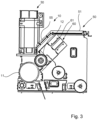
- a lamination unit of the wet lamination station is illustrated.
- the lamination unit 10 forms a part of the wet lamination station.
- the lamination unit 10 comprises the support roller 11 and the nip roller 12.
- the actuator 61 may be connected to the nip roller 12.
- the actuation means may comprise a first and second actuator, connected to a first and second transversal end of the nip roller 12, respectively.
- the nip roller 12 may be of a shoe roller type.
- a nip roller may comprise a press web and a pressure bar connected to the actuator.
- the pressure bar is actuatable by means of the actuator.
- the pressure web runs at the same speed as the support roller, the web of base layer and the barrier film or sheet.
- the pressure is generated by the press web being urged by the pressure bar against the support roller.
- the pressure bar is positioned stationary in relation to the support roller.
- the press web is arranged to slide against a front surface of the bar.
- the outer circumferential surface of the nip roller 12 may be in an elastomeric material.
- the elastomeric material may be rubber.
- the elastomeric material has a Shore hardness of at least 90 ShA and more preferably at least 92 ShA.
- Conventional nip rollers commonly utilizes a relatively soft rubber material. The soft material fills up the going-through holes to a larger extent compared to a harder material. Furthermore, a softer material requires the actuation means to provide a higher pressure to ensure the compression of the material in the nip which further increases the hole-filling effect. The harder rubber material allows for sufficient pressure distribution as well as a comparably lower tendency of filling the going-through holes.
- the nip roller 12 may have a metal core enveloped by an elastomeric coating forming the outer circumferential surface of the nip roller 12.
- the metal core may be in Aluminum or steel.
- the distance or gap between the nip roller 12 and the support roller 11 may be adjustable to accommodate different thicknesses of the barrier film or sheet and bulk layer.
- the wet lamination station may comprise adjusting means for adjusting this distance.
- the adjusting means may be comprised in the lamination unit.
- the adjusting means allows for adjusting of the distance between the support roller 11 and the nip roller 12 based on the combined thickness of the bulk layer 5 and the barrier film or sheet 6, i.e. the adjusting means allows for adjustment of the nip or nip distance.
- the distance is preferably adjusted such that the distance between the support roller 11 and nip roller 12 is smaller than the combined thickness of the bulk layer and the barrier film or sheet.
- the distance between the nip roller 12 and the support roller 11 is preferably smaller than the combined thickness of the bulk layer 5 and the barrier film or sheet 6.
- the distance between the nip roller 12 and the support roller is 60-70% of the combined thickness of the bulk layer 5 and the barrier film or sheet 6.
- the distance may preferably be 0,3 millimeters.
- the wet lamination station may further comprise a controller 82.
- the controller 82 may be operatively connected to the drive unit 30.
- the controller 82 may be configured to control the operation of the drive unit 82.
- a user may thus before the lamination takes place provide instructions to the controller 82 via the user interface 81 by providing user input comprising any one or both the Shore hardness of the outer circumferential surface of the nip roller and the combined thickness of the barrier film or sheet and the bulk layer.
- the controller 82 prompts the actuation means 50 to set the distance between nip roller 12 and the support roller 11 whereby the distance between said nip roller 12 and support roller 11 is adjusted.
- the aforementioned thickness may be provided by means of the controller 82 obtaining external data or sensor data from optical sensors configured to measure the thickness of the bulk layer and barrier film or sheet.
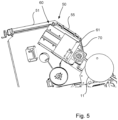
- the nip roller is further arranged to be urged against the movable adjusting member 58, 59 by the actuation means (not depicted in Fig. 6 ).
- the movable adjusting member 58, 59 may thus be arranged to constitute a stop for the actuation of the nip roller 12 against the support roller 11.
- the nip roller 12 and support roller 11 may comprise support bearings at each of their transversal ends.
- the support structure may comprise a first and second rail 78 adjustably receiving a first and second support bearing of the nip roller or support roller.
- the adjusting means 50 may comprise at least one actuator 51.
- the actuator 51 may be a linear actuator such as a linear servo motor.
- the linear actuator 51 may be connected to a movable adjusting member 58, 59.
- the adjusting member is arranged to engage the support roller 11 or nip roller 12 for adjusting the position of the support roller 11 or nip roller 12 relative the support structure 70.
- the linear actuator 51 is connected to the movable adjusting member 58, 59 by means of an arm mechanism 55.
- the arm mechanism 55 is connected to at least one movable adjusting member 58, 59.
- the movable adjusting member 58, 59 is arranged on a threaded shaft 53.
- the threaded shaft 53 is connected to the arm mechanism 55, whereby the arm mechanism 55 is arranged to rotate the threaded shaft in response to actuation by the linear actuator 51, thereby moving the movable adjusting member 58, 59 in turn prompting the adjustment of the distance between the nip roller 12 and the support roller 11.
- the arm mechanism 55 may thus be arranged to convert the linear movement of the linear actuator 51 to the rotational movement of the threaded shaft 53.
- a pair of movable adjusting members 58, 59 may be arranged on the threaded shaft 53 such that rotation of the threaded shaft causes movement of the adjusting members towards each other or away from each other along the threaded shaft 53.
- the movable adjusting members 58, 59 may be arranged in a guiding arrangement arranged to urge the movable adjusting members 58, 59 in a direction extending away from or towards the adjustable roller (in the depicted example the nip roller) in response to rotation of the threaded shaft 53 thereby causing movement of the adjustable roller.
- the guiding arrangement may comprise a guided pin 41, 42 guided in a track 43, 44.
- the track may extend in a diagonal direction relative the threaded shaft 53 in a plane orthogonal to the axial direction of the nip roller and support roller.
- each of the adjusting members of the pair of movable adjusting members 58, 59 is provided with a track 43, 44 in engagement with a stationary guiding pin 41, 42.
- the diagonally directed tracks will also force the adjusting members in a direction extending towards or away from the nip roller 12 due to the engagement between the tracks 41, 42 and guiding pins 43, 44.
- rotation of the threaded shaft in a first direction causes the movable adjusting members 58, 59 to move towards each other and in a direction towards the nip roller 12 thereby urging the nip roller away from support roller 11 due to the movable adjusting members being in engagement with the nip roller 12.
- Rotation of the threaded shaft in a second, opposite, direction causes the movable adjusting members 58, 59 to move away from each other and in a direction away from the nip roller 12 thereby urging the nip roller towards the support roller due to the movable adjusting members being in engagement with the nip roller 12.
- the adjusting means 50 may be constituted by any conventional means for moving the rollers relative each other.
Landscapes
- Physics & Mathematics (AREA)
- Fluid Mechanics (AREA)
- Laminated Bodies (AREA)
- Lining Or Joining Of Plastics Or The Like (AREA)
Applications Claiming Priority (1)
| Application Number | Priority Date | Filing Date | Title |
|---|---|---|---|
| EP21192869 | 2021-08-24 |
Publications (2)
| Publication Number | Publication Date |
|---|---|
| EP4140739A1 EP4140739A1 (en) | 2023-03-01 |
| EP4140739B1 true EP4140739B1 (en) | 2025-07-09 |
Family
ID=77499648
Family Applications (1)
| Application Number | Title | Priority Date | Filing Date |
|---|---|---|---|
| EP22190723.1A Active EP4140739B1 (en) | 2021-08-24 | 2022-08-17 | A method for lamination |
Country Status (7)
| Country | Link |
|---|---|
| US (1) | US20250135764A1 (https=) |
| EP (1) | EP4140739B1 (https=) |
| JP (1) | JP2024532169A (https=) |
| CN (1) | CN117858804A (https=) |
| DK (1) | DK4140739T3 (https=) |
| MX (1) | MX2024001757A (https=) |
| WO (1) | WO2023025628A1 (https=) |
Family Cites Families (9)
| Publication number | Priority date | Publication date | Assignee | Title |
|---|---|---|---|---|
| US7942991B1 (en) * | 2005-09-13 | 2011-05-17 | Loen Mark V | Laminating polyester onto metal substrate |
| BRPI0719128A2 (pt) * | 2006-12-21 | 2013-12-17 | Tetra Laval Holdings & Finance | Laminado para acondicionamento para um recipiente para acondicionamento flexível, método para produzir um laminado para acondicionamento, e, recipiente para acondicionamento flexível para um alimento |
| MX345076B (es) * | 2010-04-15 | 2017-01-16 | Tetra Laval Holdings & Finance | Rodillo de laminación, método para proporcionar un material laminado de empaque y material laminado de empaque. |
| EP2962835A4 (en) * | 2013-02-28 | 2016-03-23 | Fujifilm Corp | STRATIFICATION METHOD AND LAMINATE |
| EP3380328B1 (en) * | 2015-11-27 | 2022-05-11 | Tetra Laval Holdings & Finance S.A. | Method for manufacturing a laminated packaging material |
| EP3409463B1 (en) * | 2017-05-31 | 2020-01-29 | Tetra Laval Holdings & Finance S.A. | Laminated packaging material, packaging containers manufactured therefrom and a method for manufacturing the laminate material |
| CN208469259U (zh) * | 2018-05-09 | 2019-02-05 | 上海乾得智能科技有限公司 | 一种用于补锂工艺中的压合机构 |
| KR102162538B1 (ko) * | 2019-05-15 | 2020-10-07 | 배성순 | 인쇄 필름과 일반 필름의 접착에 의한 포장재의 제조방법 및 상기 제조방법에 의해 제조된 포장재 |
| CN112478901A (zh) * | 2020-12-09 | 2021-03-12 | 珠海冠宇电池股份有限公司 | 一种热复合设备 |
-
2022
- 2022-08-17 JP JP2024509492A patent/JP2024532169A/ja active Pending
- 2022-08-17 DK DK22190723.1T patent/DK4140739T3/da active
- 2022-08-17 WO PCT/EP2022/072918 patent/WO2023025628A1/en not_active Ceased
- 2022-08-17 CN CN202280054311.9A patent/CN117858804A/zh active Pending
- 2022-08-17 EP EP22190723.1A patent/EP4140739B1/en active Active
- 2022-08-17 MX MX2024001757A patent/MX2024001757A/es unknown
- 2022-08-17 US US18/683,416 patent/US20250135764A1/en active Pending
Also Published As
| Publication number | Publication date |
|---|---|
| DK4140739T3 (da) | 2025-09-22 |
| US20250135764A1 (en) | 2025-05-01 |
| MX2024001757A (es) | 2024-02-27 |
| WO2023025628A1 (en) | 2023-03-02 |
| JP2024532169A (ja) | 2024-09-05 |
| EP4140739A1 (en) | 2023-03-01 |
| CN117858804A (zh) | 2024-04-09 |
Similar Documents
| Publication | Publication Date | Title |
|---|---|---|
| US8871318B2 (en) | Robust packaging laminate, method for manufacturing of the packaging laminate and packaging container produced therefrom | |
| US7935400B2 (en) | Packaging laminate, method for its manufacturing and packaging container manufactured from the packaging laminate | |
| EP3206870B1 (en) | A method and apparatus for producing a film laminate for a laminated packaging material. | |
| EP4029686B1 (en) | Barrier-coated cellulose-based substrate, laminated packaging material and packaging container comprising the cellulose-based substrate | |
| EP3409464A1 (en) | Laminated packaging material and opening membrane material, packaging containers manufactured therefrom and method for manufacturing the laminated material | |
| EP4140739B1 (en) | A method for lamination | |
| US20250196479A1 (en) | Barrier-coated substrate, laminated packaging material and packaging container comprising the substrate | |
| EP4140740B1 (en) | A method for lamination | |
| EP4019465B1 (en) | Barrier-coated cellulosebased substrate, laminated packaging material and packaging container comprising the cellulosebased substrate | |
| US20250033337A1 (en) | A packaging material, and a method for producing such packaging material | |
| US20080041021A1 (en) | Packaging laminate, method of producing a packaging container and the packaging container | |
| EP4371755B1 (en) | Laminated packaging material, method for manufacturing it and packaging containers comprising it | |
| US20240367891A1 (en) | Laminated packaging material, and a method for manufacturing |
Legal Events
| Date | Code | Title | Description |
|---|---|---|---|
| PUAI | Public reference made under article 153(3) epc to a published international application that has entered the european phase |
Free format text: ORIGINAL CODE: 0009012 |
|
| STAA | Information on the status of an ep patent application or granted ep patent |
Free format text: STATUS: THE APPLICATION HAS BEEN PUBLISHED |
|
| AK | Designated contracting states |
Kind code of ref document: A1 Designated state(s): AL AT BE BG CH CY CZ DE DK EE ES FI FR GB GR HR HU IE IS IT LI LT LU LV MC MK MT NL NO PL PT RO RS SE SI SK SM TR |
|
| STAA | Information on the status of an ep patent application or granted ep patent |
Free format text: STATUS: REQUEST FOR EXAMINATION WAS MADE |
|
| 17P | Request for examination filed |
Effective date: 20230901 |
|
| RBV | Designated contracting states (corrected) |
Designated state(s): AL AT BE BG CH CY CZ DE DK EE ES FI FR GB GR HR HU IE IS IT LI LT LU LV MC MK MT NL NO PL PT RO RS SE SI SK SM TR |
|
| STAA | Information on the status of an ep patent application or granted ep patent |
Free format text: STATUS: EXAMINATION IS IN PROGRESS |
|
| 17Q | First examination report despatched |
Effective date: 20240318 |
|
| GRAP | Despatch of communication of intention to grant a patent |
Free format text: ORIGINAL CODE: EPIDOSNIGR1 |
|
| STAA | Information on the status of an ep patent application or granted ep patent |
Free format text: STATUS: GRANT OF PATENT IS INTENDED |
|
| RIC1 | Information provided on ipc code assigned before grant |
Ipc: B32B 37/20 20060101ALN20250114BHEP Ipc: B32B 41/00 20060101AFI20250114BHEP |
|
| INTG | Intention to grant announced |
Effective date: 20250129 |
|
| GRAS | Grant fee paid |
Free format text: ORIGINAL CODE: EPIDOSNIGR3 |
|
| GRAA | (expected) grant |
Free format text: ORIGINAL CODE: 0009210 |
|
| STAA | Information on the status of an ep patent application or granted ep patent |
Free format text: STATUS: THE PATENT HAS BEEN GRANTED |
|
| AK | Designated contracting states |
Kind code of ref document: B1 Designated state(s): AL AT BE BG CH CY CZ DE DK EE ES FI FR GB GR HR HU IE IS IT LI LT LU LV MC MK MT NL NO PL PT RO RS SE SI SK SM TR |
|
| REG | Reference to a national code |
Ref country code: GB Ref legal event code: FG4D |
|
| REG | Reference to a national code |
Ref country code: CH Ref legal event code: EP |
|
| REG | Reference to a national code |
Ref country code: IE Ref legal event code: FG4D |
|
| REG | Reference to a national code |
Ref country code: DE Ref legal event code: R096 Ref document number: 602022017223 Country of ref document: DE |
|
| REG | Reference to a national code |
Ref country code: DK Ref legal event code: T3 Effective date: 20250918 |
|
| PGFP | Annual fee paid to national office [announced via postgrant information from national office to epo] |
Ref country code: DE Payment date: 20250926 Year of fee payment: 4 Ref country code: DK Payment date: 20250924 Year of fee payment: 4 |
|
| PGFP | Annual fee paid to national office [announced via postgrant information from national office to epo] |
Ref country code: IT Payment date: 20250901 Year of fee payment: 4 |
|
| PGFP | Annual fee paid to national office [announced via postgrant information from national office to epo] |
Ref country code: AT Payment date: 20251020 Year of fee payment: 4 |
|
| REG | Reference to a national code |
Ref country code: NL Ref legal event code: MP Effective date: 20250709 |
|
| PG25 | Lapsed in a contracting state [announced via postgrant information from national office to epo] |
Ref country code: PT Free format text: LAPSE BECAUSE OF FAILURE TO SUBMIT A TRANSLATION OF THE DESCRIPTION OR TO PAY THE FEE WITHIN THE PRESCRIBED TIME-LIMIT Effective date: 20251110 |
|
| PG25 | Lapsed in a contracting state [announced via postgrant information from national office to epo] |
Ref country code: NL Free format text: LAPSE BECAUSE OF FAILURE TO SUBMIT A TRANSLATION OF THE DESCRIPTION OR TO PAY THE FEE WITHIN THE PRESCRIBED TIME-LIMIT Effective date: 20250709 |
|
| REG | Reference to a national code |
Ref country code: AT Ref legal event code: MK05 Ref document number: 1811517 Country of ref document: AT Kind code of ref document: T Effective date: 20250709 |
|
| PG25 | Lapsed in a contracting state [announced via postgrant information from national office to epo] |
Ref country code: IS Free format text: LAPSE BECAUSE OF FAILURE TO SUBMIT A TRANSLATION OF THE DESCRIPTION OR TO PAY THE FEE WITHIN THE PRESCRIBED TIME-LIMIT Effective date: 20251109 |
|
| PG25 | Lapsed in a contracting state [announced via postgrant information from national office to epo] |
Ref country code: NO Free format text: LAPSE BECAUSE OF FAILURE TO SUBMIT A TRANSLATION OF THE DESCRIPTION OR TO PAY THE FEE WITHIN THE PRESCRIBED TIME-LIMIT Effective date: 20251009 |
|
| REG | Reference to a national code |
Ref country code: LT Ref legal event code: MG9D |
|
| PG25 | Lapsed in a contracting state [announced via postgrant information from national office to epo] |
Ref country code: AT Free format text: LAPSE BECAUSE OF FAILURE TO SUBMIT A TRANSLATION OF THE DESCRIPTION OR TO PAY THE FEE WITHIN THE PRESCRIBED TIME-LIMIT Effective date: 20250709 |
|
| PG25 | Lapsed in a contracting state [announced via postgrant information from national office to epo] |
Ref country code: FI Free format text: LAPSE BECAUSE OF FAILURE TO SUBMIT A TRANSLATION OF THE DESCRIPTION OR TO PAY THE FEE WITHIN THE PRESCRIBED TIME-LIMIT Effective date: 20250709 |
|
| PG25 | Lapsed in a contracting state [announced via postgrant information from national office to epo] |
Ref country code: HR Free format text: LAPSE BECAUSE OF FAILURE TO SUBMIT A TRANSLATION OF THE DESCRIPTION OR TO PAY THE FEE WITHIN THE PRESCRIBED TIME-LIMIT Effective date: 20250709 |
|
| PG25 | Lapsed in a contracting state [announced via postgrant information from national office to epo] |
Ref country code: GR Free format text: LAPSE BECAUSE OF FAILURE TO SUBMIT A TRANSLATION OF THE DESCRIPTION OR TO PAY THE FEE WITHIN THE PRESCRIBED TIME-LIMIT Effective date: 20251010 |
|
| PGFP | Annual fee paid to national office [announced via postgrant information from national office to epo] |
Ref country code: TR Payment date: 20251027 Year of fee payment: 4 |
|
| PG25 | Lapsed in a contracting state [announced via postgrant information from national office to epo] |
Ref country code: SE Free format text: LAPSE BECAUSE OF FAILURE TO SUBMIT A TRANSLATION OF THE DESCRIPTION OR TO PAY THE FEE WITHIN THE PRESCRIBED TIME-LIMIT Effective date: 20250709 |
|
| PG25 | Lapsed in a contracting state [announced via postgrant information from national office to epo] |
Ref country code: LV Free format text: LAPSE BECAUSE OF FAILURE TO SUBMIT A TRANSLATION OF THE DESCRIPTION OR TO PAY THE FEE WITHIN THE PRESCRIBED TIME-LIMIT Effective date: 20250709 |
|
| PG25 | Lapsed in a contracting state [announced via postgrant information from national office to epo] |
Ref country code: PL Free format text: LAPSE BECAUSE OF FAILURE TO SUBMIT A TRANSLATION OF THE DESCRIPTION OR TO PAY THE FEE WITHIN THE PRESCRIBED TIME-LIMIT Effective date: 20250709 Ref country code: BG Free format text: LAPSE BECAUSE OF FAILURE TO SUBMIT A TRANSLATION OF THE DESCRIPTION OR TO PAY THE FEE WITHIN THE PRESCRIBED TIME-LIMIT Effective date: 20250709 |
|
| PG25 | Lapsed in a contracting state [announced via postgrant information from national office to epo] |
Ref country code: RS Free format text: LAPSE BECAUSE OF FAILURE TO SUBMIT A TRANSLATION OF THE DESCRIPTION OR TO PAY THE FEE WITHIN THE PRESCRIBED TIME-LIMIT Effective date: 20251009 |
|
| PG25 | Lapsed in a contracting state [announced via postgrant information from national office to epo] |
Ref country code: ES Free format text: LAPSE BECAUSE OF FAILURE TO SUBMIT A TRANSLATION OF THE DESCRIPTION OR TO PAY THE FEE WITHIN THE PRESCRIBED TIME-LIMIT Effective date: 20250709 |
|
| PG25 | Lapsed in a contracting state [announced via postgrant information from national office to epo] |
Ref country code: RO Free format text: LAPSE BECAUSE OF FAILURE TO SUBMIT A TRANSLATION OF THE DESCRIPTION OR TO PAY THE FEE WITHIN THE PRESCRIBED TIME-LIMIT Effective date: 20250709 |
|
| REG | Reference to a national code |
Ref country code: CH Ref legal event code: H13 Free format text: ST27 STATUS EVENT CODE: U-0-0-H10-H13 (AS PROVIDED BY THE NATIONAL OFFICE) Effective date: 20260324 |
|
| PG25 | Lapsed in a contracting state [announced via postgrant information from national office to epo] |
Ref country code: SM Free format text: LAPSE BECAUSE OF FAILURE TO SUBMIT A TRANSLATION OF THE DESCRIPTION OR TO PAY THE FEE WITHIN THE PRESCRIBED TIME-LIMIT Effective date: 20250709 |
|
| PG25 | Lapsed in a contracting state [announced via postgrant information from national office to epo] |
Ref country code: LU Free format text: LAPSE BECAUSE OF NON-PAYMENT OF DUE FEES Effective date: 20250817 |
|
| PG25 | Lapsed in a contracting state [announced via postgrant information from national office to epo] |
Ref country code: CZ Free format text: LAPSE BECAUSE OF FAILURE TO SUBMIT A TRANSLATION OF THE DESCRIPTION OR TO PAY THE FEE WITHIN THE PRESCRIBED TIME-LIMIT Effective date: 20250709 Ref country code: CH Free format text: LAPSE BECAUSE OF NON-PAYMENT OF DUE FEES Effective date: 20250831 |
|
| PG25 | Lapsed in a contracting state [announced via postgrant information from national office to epo] |
Ref country code: EE Free format text: LAPSE BECAUSE OF FAILURE TO SUBMIT A TRANSLATION OF THE DESCRIPTION OR TO PAY THE FEE WITHIN THE PRESCRIBED TIME-LIMIT Effective date: 20250709 Ref country code: SK Free format text: LAPSE BECAUSE OF FAILURE TO SUBMIT A TRANSLATION OF THE DESCRIPTION OR TO PAY THE FEE WITHIN THE PRESCRIBED TIME-LIMIT Effective date: 20250709 |