EP4139393B1 - Rotomolding compositions with low relative elasticity - Google Patents
Rotomolding compositions with low relative elasticity Download PDFInfo
- Publication number
- EP4139393B1 EP4139393B1 EP21719723.5A EP21719723A EP4139393B1 EP 4139393 B1 EP4139393 B1 EP 4139393B1 EP 21719723 A EP21719723 A EP 21719723A EP 4139393 B1 EP4139393 B1 EP 4139393B1
- Authority
- EP
- European Patent Office
- Prior art keywords
- ethylene copolymer
- density
- polyethylene composition
- molecular weight
- reactor
- Prior art date
- Legal status (The legal status is an assumption and is not a legal conclusion. Google has not performed a legal analysis and makes no representation as to the accuracy of the status listed.)
- Active
Links
Images




Classifications
-
- C—CHEMISTRY; METALLURGY
- C08—ORGANIC MACROMOLECULAR COMPOUNDS; THEIR PREPARATION OR CHEMICAL WORKING-UP; COMPOSITIONS BASED THEREON
- C08L—COMPOSITIONS OF MACROMOLECULAR COMPOUNDS
- C08L23/00—Compositions of homopolymers or copolymers of unsaturated aliphatic hydrocarbons having only one carbon-to-carbon double bond; Compositions of derivatives of such polymers
- C08L23/02—Compositions of homopolymers or copolymers of unsaturated aliphatic hydrocarbons having only one carbon-to-carbon double bond; Compositions of derivatives of such polymers not modified by chemical after-treatment
- C08L23/04—Homopolymers or copolymers of ethene
- C08L23/08—Copolymers of ethene
-
- B—PERFORMING OPERATIONS; TRANSPORTING
- B29—WORKING OF PLASTICS; WORKING OF SUBSTANCES IN A PLASTIC STATE IN GENERAL
- B29C—SHAPING OR JOINING OF PLASTICS; SHAPING OF MATERIAL IN A PLASTIC STATE, NOT OTHERWISE PROVIDED FOR; AFTER-TREATMENT OF THE SHAPED PRODUCTS, e.g. REPAIRING
- B29C41/00—Shaping by coating a mould, core or other substrate, i.e. by depositing material and stripping-off the shaped article; Apparatus therefor
- B29C41/003—Shaping by coating a mould, core or other substrate, i.e. by depositing material and stripping-off the shaped article; Apparatus therefor characterised by the choice of material
-
- B—PERFORMING OPERATIONS; TRANSPORTING
- B29—WORKING OF PLASTICS; WORKING OF SUBSTANCES IN A PLASTIC STATE IN GENERAL
- B29C—SHAPING OR JOINING OF PLASTICS; SHAPING OF MATERIAL IN A PLASTIC STATE, NOT OTHERWISE PROVIDED FOR; AFTER-TREATMENT OF THE SHAPED PRODUCTS, e.g. REPAIRING
- B29C41/00—Shaping by coating a mould, core or other substrate, i.e. by depositing material and stripping-off the shaped article; Apparatus therefor
- B29C41/02—Shaping by coating a mould, core or other substrate, i.e. by depositing material and stripping-off the shaped article; Apparatus therefor for making articles of definite length, i.e. discrete articles
- B29C41/04—Rotational or centrifugal casting, i.e. coating the inside of a mould by rotating the mould
- B29C41/06—Rotational or centrifugal casting, i.e. coating the inside of a mould by rotating the mould about two or more axes
-
- C—CHEMISTRY; METALLURGY
- C08—ORGANIC MACROMOLECULAR COMPOUNDS; THEIR PREPARATION OR CHEMICAL WORKING-UP; COMPOSITIONS BASED THEREON
- C08F—MACROMOLECULAR COMPOUNDS OBTAINED BY REACTIONS ONLY INVOLVING CARBON-TO-CARBON UNSATURATED BONDS
- C08F2/00—Processes of polymerisation
- C08F2/04—Polymerisation in solution
-
- C—CHEMISTRY; METALLURGY
- C08—ORGANIC MACROMOLECULAR COMPOUNDS; THEIR PREPARATION OR CHEMICAL WORKING-UP; COMPOSITIONS BASED THEREON
- C08F—MACROMOLECULAR COMPOUNDS OBTAINED BY REACTIONS ONLY INVOLVING CARBON-TO-CARBON UNSATURATED BONDS
- C08F210/00—Copolymers of unsaturated aliphatic hydrocarbons having only one carbon-to-carbon double bond
- C08F210/16—Copolymers of ethene with alpha-alkenes, e.g. EP rubbers
-
- C—CHEMISTRY; METALLURGY
- C08—ORGANIC MACROMOLECULAR COMPOUNDS; THEIR PREPARATION OR CHEMICAL WORKING-UP; COMPOSITIONS BASED THEREON
- C08L—COMPOSITIONS OF MACROMOLECULAR COMPOUNDS
- C08L23/00—Compositions of homopolymers or copolymers of unsaturated aliphatic hydrocarbons having only one carbon-to-carbon double bond; Compositions of derivatives of such polymers
- C08L23/02—Compositions of homopolymers or copolymers of unsaturated aliphatic hydrocarbons having only one carbon-to-carbon double bond; Compositions of derivatives of such polymers not modified by chemical after-treatment
- C08L23/04—Homopolymers or copolymers of ethene
- C08L23/08—Copolymers of ethene
- C08L23/0807—Copolymers of ethene with unsaturated hydrocarbons only containing four or more carbon atoms
- C08L23/0815—Copolymers of ethene with unsaturated hydrocarbons only containing four or more carbon atoms with aliphatic 1-olefins containing one carbon-to-carbon double bond
-
- B—PERFORMING OPERATIONS; TRANSPORTING
- B29—WORKING OF PLASTICS; WORKING OF SUBSTANCES IN A PLASTIC STATE IN GENERAL
- B29K—INDEXING SCHEME ASSOCIATED WITH SUBCLASSES B29B, B29C OR B29D, RELATING TO MOULDING MATERIALS OR TO MATERIALS FOR MOULDS, REINFORCEMENTS, FILLERS OR PREFORMED PARTS, e.g. INSERTS
- B29K2023/00—Use of polyalkenes or derivatives thereof as moulding material
- B29K2023/04—Polymers of ethylene
- B29K2023/06—PE, i.e. polyethylene
-
- B—PERFORMING OPERATIONS; TRANSPORTING
- B29—WORKING OF PLASTICS; WORKING OF SUBSTANCES IN A PLASTIC STATE IN GENERAL
- B29K—INDEXING SCHEME ASSOCIATED WITH SUBCLASSES B29B, B29C OR B29D, RELATING TO MOULDING MATERIALS OR TO MATERIALS FOR MOULDS, REINFORCEMENTS, FILLERS OR PREFORMED PARTS, e.g. INSERTS
- B29K2023/00—Use of polyalkenes or derivatives thereof as moulding material
- B29K2023/04—Polymers of ethylene
- B29K2023/06—PE, i.e. polyethylene
- B29K2023/0608—PE, i.e. polyethylene characterised by its density
- B29K2023/065—HDPE, i.e. high density polyethylene
-
- B—PERFORMING OPERATIONS; TRANSPORTING
- B29—WORKING OF PLASTICS; WORKING OF SUBSTANCES IN A PLASTIC STATE IN GENERAL
- B29K—INDEXING SCHEME ASSOCIATED WITH SUBCLASSES B29B, B29C OR B29D, RELATING TO MOULDING MATERIALS OR TO MATERIALS FOR MOULDS, REINFORCEMENTS, FILLERS OR PREFORMED PARTS, e.g. INSERTS
- B29K2995/00—Properties of moulding materials, reinforcements, fillers, preformed parts or moulds
- B29K2995/0037—Other properties
- B29K2995/0046—Elastic
-
- B—PERFORMING OPERATIONS; TRANSPORTING
- B29—WORKING OF PLASTICS; WORKING OF SUBSTANCES IN A PLASTIC STATE IN GENERAL
- B29K—INDEXING SCHEME ASSOCIATED WITH SUBCLASSES B29B, B29C OR B29D, RELATING TO MOULDING MATERIALS OR TO MATERIALS FOR MOULDS, REINFORCEMENTS, FILLERS OR PREFORMED PARTS, e.g. INSERTS
- B29K2995/00—Properties of moulding materials, reinforcements, fillers, preformed parts or moulds
- B29K2995/0037—Other properties
- B29K2995/0063—Density
-
- B—PERFORMING OPERATIONS; TRANSPORTING
- B29—WORKING OF PLASTICS; WORKING OF SUBSTANCES IN A PLASTIC STATE IN GENERAL
- B29K—INDEXING SCHEME ASSOCIATED WITH SUBCLASSES B29B, B29C OR B29D, RELATING TO MOULDING MATERIALS OR TO MATERIALS FOR MOULDS, REINFORCEMENTS, FILLERS OR PREFORMED PARTS, e.g. INSERTS
- B29K2995/00—Properties of moulding materials, reinforcements, fillers, preformed parts or moulds
- B29K2995/0037—Other properties
- B29K2995/0077—Yield strength; Tensile strength
-
- B—PERFORMING OPERATIONS; TRANSPORTING
- B29—WORKING OF PLASTICS; WORKING OF SUBSTANCES IN A PLASTIC STATE IN GENERAL
- B29K—INDEXING SCHEME ASSOCIATED WITH SUBCLASSES B29B, B29C OR B29D, RELATING TO MOULDING MATERIALS OR TO MATERIALS FOR MOULDS, REINFORCEMENTS, FILLERS OR PREFORMED PARTS, e.g. INSERTS
- B29K2995/00—Properties of moulding materials, reinforcements, fillers, preformed parts or moulds
- B29K2995/0037—Other properties
- B29K2995/0082—Flexural strength; Flexion stiffness
-
- C—CHEMISTRY; METALLURGY
- C08—ORGANIC MACROMOLECULAR COMPOUNDS; THEIR PREPARATION OR CHEMICAL WORKING-UP; COMPOSITIONS BASED THEREON
- C08L—COMPOSITIONS OF MACROMOLECULAR COMPOUNDS
- C08L2205/00—Polymer mixtures characterised by other features
- C08L2205/02—Polymer mixtures characterised by other features containing two or more polymers of the same C08L -group
- C08L2205/025—Polymer mixtures characterised by other features containing two or more polymers of the same C08L -group containing two or more polymers of the same hierarchy C08L, and differing only in parameters such as density, comonomer content, molecular weight, structure
Definitions
- the present disclosure relates to high density polyethylene compositions for use in rotomolding articles.
- the compositions have high stiffness and ductility.
- the compositions also have a high flow index which facilitates molding, especially for parts with complex shapes and geometries.
- the compositions have a low relative elasticity (G'/G").
- a resin suitable for use in rotomolding manufacture there are a number of different considerations for manufacturing a resin suitable for use in rotomolding manufacture, non-limiting examples include: the resin needs to be capable of production at commercially acceptable rates of production; the resin needs to be suitable for use in the rotomolding process (e.g., for example, having a suitable sintering temperature and a suitable cooling rate to be removed from the mold); and the final rotomolded parts must have suitable properties for the end use applications.
- US2013/310532 A1 discloses resins suitable for rotomolded articles comprising a bimodal polyethylene copolymer.
- US2004/062942 A1 discloses polyethylene blend compositions suitable for rotomolding. The compositions include a first polyethylene and a second polyethylene.
- One embodiment of the invention provides: a bimodal polyethylene composition as defined in the claims.
- Another embodiment provides a process for the production of polyolefin hollow articles, which comprises charging the bimodal polyethylene composition of claim 1 into a mold, heating this mold in an oven to above 280°C, such that the stabilized polyolefin fuses, rotating the mold around at least 2 axes, the plastic material spreading to the walls, cooling the mold while still rotating, opening it, and taking the resultant hollow article out.
- Another embodiment provides a process to make a bimodal polyethylene composition as above, comprising feeding ethylene and one or more C 4-8 comonomers to two sequential solution phase reactors, in the presence of a single site catalyst comprising a phosphinimine ligand together with one or more activators in the first reactor and a Ziegler Natta (ZN) catalyst in the second reactor.
- a single site catalyst comprising a phosphinimine ligand together with one or more activators in the first reactor and a Ziegler Natta (ZN) catalyst in the second reactor.
- ZN Ziegler Natta
- the single catalyst is defined by the formula: wherein M is selected from the group consisting of Ti, Zr and Hf; PI is a phosphinimine ligand of the formula: wherein each R 21 is independently selected from the group consisting of a hydrogen atom; a halogen atom; hydrocarbyl radicals, typically, C 1-10 , which are unsubstituted by or further substituted by a halogen atom; C 1-8 alkoxy radicals; C 6-10 aryl or aryloxy radicals; amido radicals; silyl radicals of the formula: --Si--(R 22 ) 3 wherein each R 22 is independently selected from the group consisting of hydrogen, a C 1-8 alkyl or alkoxy radical and C 6-10 aryl or aryloxy radicals; and a germanyl radical of the formula: --Ge--(R 22 ) 3 wherein R 22 is as defined above; L is a monoanionic cyclopentadienyl-type
- a further embodiment provides a rotomolded part consisting essentially of the above bimodal polyethylene composition.
- rotomolded parts made from the above bimodal polyethylene composition exhibit ductile failure.
- any numerical range recited herein is intended to include all sub-ranges subsumed therein.
- a range of "1 to 10" is intended to include all sub-ranges between and including the recited minimum value of 1 and the recited maximum value of 10; that is, having a minimum value equal to or greater than 1 and a maximum value of equal to or less than 10. Because the disclosed numerical ranges are continuous, they include every value between the minimum and maximum values. Unless expressly indicated otherwise, the various numerical ranges specified in this application are approximations.
- compositional ranges expressed herein are limited in total to and do not exceed 100 percent (volume percent or weight percent) in practice. Where multiple components can be present in a composition, the sum of the maximum amounts of each component can exceed 100 percent, with the understanding that, and as those skilled in the art readily understand, that the amounts of the components actually used will conform to the maximum of 100 percent.
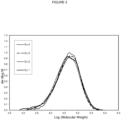
- compositions of the present disclosure are bimodal polyethylene and can be de-convoluted into two distinct components. Typically, this is demonstrated by the presence of a "shoulder" at the right side of a gel permeation chromatography (GPC) curve ( Figure 1 ). In the present case, there is a small shoulder to the right side of the GPC curve as shown in Figure 2 indicating a small amount of a higher molecular weight low density component.
- GPC gel permeation chromatography
- the high molecular weight component has a melt index of from 0.4 to 5 and is present in an amount from about 10 to about 70 weight % of the entire composition, preferably from about 15 to about 50 weight %.
- the lower molecular weight component is present in corresponding amounts from about 90 to about 30 weight %, of the entire composition, preferably from about 85 to about 50 weight % based on the weight of the entire composition.
- the higher molecular weight component has a weight average molecular weight (Mw) from about 70,000 to about 150,000, as determined using gel permeation chromatography (GPC).
- Mw weight average molecular weight
- the higher molecular weight component has a polydispersity (Mw/Mn: weight average molecular weight/number average molecular weight)) of 1.8 to 3.0.
- the melt index, I 2 of the overall composition is from about 4 to 10.
- the higher molecular weight component has a lower density than the lower molecular weight component.
- the density of the higher molecular weight component in the composition may range from about 0.920 to about 0.950 g/cm 3 .
- the density of the component, or that of any other component or the total composition, is a function of the degree of comonomer incorporation.
- the higher molecular weight component preferably does not have any long chain branching.
- the lower molecular weight component has a melt index of from 4 to 1,500.
- the Mw is from about 28,000 to about 72,000, as determined using gel permeation chromatography (GPC) and a polydispersity (Mw/Mn) of from 2.3 to 5.0.
- the lower molecular weight component has a density that is 0.010 to 0.030 g/cc higher than the higher molecular weight component.
- the catalysts used to produce the bimodal polyethylene compositions preferably do not produce long chain branching.
- the overall properties of the bimodal polyethylene compositions include the following:
- the overall polyethylene compositions have a comonomer content of less than 1.2 mole % as measured by Fourier Transform Infra Red (FTIR).
- FTIR Fourier Transform Infra Red
- the polymer may be made using a solution polymerization technique.
- comonomers include C 3-8 ⁇ -olefins; in some cases, 1-hexene or 1-octene are preferred, or; in other cases, 1-octene is preferred.
- Monomers are typically dissolved in an inert hydrocarbon solvent, typically, a C 5-12 hydrocarbon, which may be unsubstituted or substituted by a C 1-4 alkyl group, such as pentane, methyl pentane, hexane, heptane, octane, cyclohexane, methylcyclohexane and hydrogenated naphtha.
- an inert hydrocarbon solvent typically, a C 5-12 hydrocarbon, which may be unsubstituted or substituted by a C 1-4 alkyl group, such as pentane, methyl pentane, hexane, heptane, octane, cyclohexane, methylcyclohexane and hydrogenated naphtha.
- an inert hydrocarbon solvent typically, a C 5-12 hydrocarbon, which may be unsubstituted or substituted by a C 1-4 alkyl group, such as pentane,
- Catalyst and activators are also dissolved in the solvent or suspended in a diluent miscible with the solvent at reaction conditions.
- the single site catalyst is a compound of the formula wherein M is selected from the group consisting of Ti, Zr and Hf; PI is a phosphinimine ligand of the formula: wherein each R 21 is independently selected from the group consisting of a hydrogen atom; a halogen atom; hydrocarbyl radicals, typically, C 1-10 , which are unsubstituted by or further substituted by a halogen atom; C 1-8 alkoxy radicals; C 6-10 aryl or aryloxy radicals; amido radicals; silyl radicals of the formula: --Si--(R 22 ) 3 wherein each R 22 is independently selected from the group consisting of hydrogen, a C 1-8 alkyl or alkoxy radical and C 6-10 aryl or aryloxy radicals; and a germanyl radical of the formula: --Ge--(R 22 ) 3 wherein R 22 is as defined above; L is a monoanionic cyclopentadienyl
- Suitable phosphinimines are those in which each R 21 is a hydrocarbyl radical, preferably a C 1-6 hydrocarbyl radical, most preferably a C 1-4 hydrocarbyl radical.
- cyclopentadienyl refers to a 5-member carbon ring having delocalized bonding within the ring and, typically, being bound to the active catalyst site, generally, a group 4 metal (M) through eta-5-bonds.
- the cyclopentadienyl ligand may be unsubstituted or up to fully substituted with one or more substituents selected from the group consisting of C 1-10 hydrocarbyl radicals which are unsubstituted or further substituted by one or more substituents selected from the group consisting of a halogen atom and a C 1-4 alkyl radical; a halogen atom; a C 1-8 alkoxy radical; a C 6-10 aryl or aryloxy radical; an amido radical which is unsubstituted or substituted by up to two C 1-8 alkyl radicals; a phosphido radical which is unsubstituted or substituted by up to two C 1-8 alkyl radicals; silyl radicals of the formula --Si--(R) 3 wherein each R is independently selected from the group consisting of hydrogen, a C 1-8 alkyl or alkoxy radical, C 6-10 aryl or aryloxy radicals; and germanyl radicals
- the cyclopentadienyl-type ligand may be selected from the group consisting of a cyclopentadienyl radical, an indenyl radical and a fluorenyl radical, which radicals are unsubstituted or up to fully substituted by one or more substituents selected from the group consisting of a fluorine atom, a chlorine atom; C 1-4 alkyl radicals; and a phenyl or benzyl radical which is unsubstituted or substituted by one or more fluorine atoms.
- Activatable ligands Y may be selected from the group consisting of a halogen atom, C 1-4 alkyl radicals, C 6-20 aryl radicals, C 7-12 arylalkyl radicals, C 6-10 phenoxy radicals, amido radicals which may be substituted by up to two C 1-4 alkyl radicals and C 1-4 alkoxy radicals.
- Y is selected from the group consisting of a chlorine atom, a methyl radical, an ethyl radical and a benzyl radical.
- Suitable phosphinimine catalysts are Group 4 organometallic complexes which contain one phosphinimine ligand (as described above) and one cyclopentadienyl-type (L) ligand and two activatable ligands. The catalysts are not bridged.
- the activators for the catalyst are typically selected from the group consisting of aluminoxanes and ionic activators.
- Alumoxanes also known as “aluminoxanes”
- Suitable alumoxane may be of the formula: (R 4 ) 2 AlO(R 4 AlO) m Al(R 4 ) 2 wherein each R 4 is independently selected from the group consisting of C 1-20 hydrocarbyl radicals and m is from 0 to 50, preferably, R 4 is a C 1-4 alkyl radical and m is from 5 to 30.
- R 4 is independently selected from the group consisting of C 1-20 hydrocarbyl radicals and m is from 0 to 50, preferably, R 4 is a C 1-4 alkyl radical and m is from 5 to 30.
- a non-limiting example of a suitable alumoxane is methylalumoxane (or "MAO") in which each R is methyl.
- Alumoxanes are well known as cocatalysts, particularly for metallocene-type catalysts. Alumoxanes are also readily available articles of commerce.
- alumoxane cocatalyst generally requires a molar ratio of aluminum to the transition metal in the catalyst from about 20:1 to about 1000:1; or, in other cases, from about 50:1 to about 250:1.
- MAO typically contains free aluminum alkyl (e.g., trimethylaluminum or "TMA") which may reduce catalyst activity and/or broaden the molecular weight distribution of the polymer. If a narrow molecular weight distribution polymer is required, it is preferred to treat such commercially available MAO with an additive which is capable of reacting with the TMA; non-limiting examples of suitable additives include alcohols or hindered phenols.
- TMA trimethylaluminum
- metallocene catalysts So-called "ionic activators" are also well known for metallocene catalysts. See, for example, U.S. Patent No. 5,198,401 (Hlatky and Turner ) and U.S. Patent No. 5,132,380 (Stevens and Neithamer ).
- ionic activators initially cause the abstraction of one or more of the activatable ligands in a manner which ionizes the catalyst into a cation, then provides a bulky, labile, non-coordinating anion which stabilizes the catalyst in a cationic form.
- the bulky, non-coordinating anion permits olefin polymerization to proceed at the cationic catalyst center (presumably, because the non-coordinating anion is sufficiently labile to be displaced by monomer which coordinates to the catalyst.
- Non-limiting examples of ionic activators are boron-containing ionic activators such as:
- R 7 is a pentafluorophenyl radical
- R 5 is a triphenylmethyl cation
- Z is a nitrogen atom
- R 8 is a C 1-4 alkyl radical or R 8 taken together with the nitrogen atom forms an anilinium radical which is substituted by two C 1-4 alkyl radicals.
- the "ionic activator” may abstract one or more activatable ligands so as to ionize the catalyst center into a cation but not to covalently bond with the catalyst and to provide sufficient distance between the catalyst and the ionizing activator to permit a polymerizable olefin to enter the resulting active site.
- ionic activators include: triethylammonium tetra(phenyl)boron; tripropylammonium tetra(phenyl)boron; tri(n-butyl)ammonium tetra(phenyl)boron; trimethylammonium tetra(p-tolyl)boron; trimethylammonium tetra(o-tolyl)boron; tributylammonium tetra(pentafluorophenyl)boron; tripropylammonium tetra(o,p-dimethylphenyl)boron; tributylammonium tetra(m,m-dimethylphenyl)boron; tributylammonium tetra(p-trifluoromethylphenyl)boron; tributylammonium tetra(pentafluorophenyl)boron; tri(n-butyl)ammonium te
- Readily commercially available ionic activators include: N,N-dimethylaniliniumtetrakispentafluorophenyl borate; triphenylmethylium tetrakispentafluorophenyl borate; and trispentafluorophenyl borane.
- the ionic activator may be use at about molar equivalents of boron to group IV metal in the catalyst. Suitable molar ratios of group IV metal from the catalyst to boron may range from about 1:1 to about 3:1, in other cases, from about 1:1 to about 1:2.
- the ionic activator may be used in combination with an alkylating activator (which may also serve as a scavenger).
- the ionic activator may be selected from the group consisting of (R 3 ) p MgX 2-p wherein X is a halide and each R 3 is independently selected from the group consisting of C 1-10 alkyl radicals and p is 1 or 2; R 3 Li wherein R 3 is as defined above; (R 3 ) q ZnX 2-q wherein R 3 is as defined above, X is halogen and q is 1 or 2; (R 3 ) s AlX 3-s wherein R 3 is as defined above, X is halogen and s is an integer from 1 to 3.
- R 3 is a C 1-4 alkyl radical, and X is chlorine.
- Commercially available compounds include triethyl aluminum (TEAL), diethyl aluminum chloride (DEAC), dibutyl magnesium ((Bu) 2 Mg), and butyl ethyl magnesium (BuEtMg or BuMgEt).
- the molar ratio of group IV metal from the catalyst:metalloid (boron) from the ionic activator:metal from the alkylating agent may range from about 1:1:1 to about 1:3:10, in other cases from about 1:1.3:5 to about 1:1.5:3.
- a ZN catalyst is used in the second reactor.
- Any ZN catalyst system that performs well for the solution polymerization of ethylene (optionally, with one or more alpha olefins comonomers, especially 1-butene; 1-hexene; or 1-octene) is potentially suitable.
- the ZN catalysts disclosed in U.S. Patent Nos. 10,023,706 and 9,695,309 are specific (but non limiting) examples.
- the temperature of the reactor(s) in a high temperature solution process is from about 80°C to about 300°C, in other cases, from about 120°C to 250°C.
- the upper temperature limit will be influenced by considerations that are well known to those skilled in the art, such as a desire to maximize operating temperature (so as to reduce solution viscosity), while still maintaining good polymer properties (as increased polymerization temperatures generally reduce the molecular weight of the polymer).
- the upper polymerization temperature may be between about 200 and about 300°C.
- a process that uses two reactors may be conducted at two temperatures with the temperature of the second reactor being higher than that of the first reactor.
- the most preferred reaction process is a "medium pressure process", meaning that the pressure in the reactor(s) is preferably less than about 6,000 psi (about 42,000 kiloPascals or kPa).
- Preferred pressures are from about 10,000 to about 40,000 kPa (1450-5800 psi), most preferably from about 14,000 to about 22,000 kPa (2,000 psi to 3,000 psi).
- the pressure in the reactor system should be high enough to maintain the polymerization solution as a single phase solution and to provide the necessary upstream pressure to feed the polymer solution from the reactor system through a heat exchanger system and to a devolatilization system.
- Other systems permit the solvent to separate into a polymer rich and polymer lean stream to facilitate polymer separation.
- the solution polymerization process may be conducted in a stirred "reactor system” comprising one or more stirred tank reactors or in one or more loop reactors or in a mixed loop and stirred tank reactor system.
- the reactors may be in tandem or parallel operation.
- the first polymerization reactor preferably operates at lower temperature.
- the residence time in each reactor will depend on the design and the capacity of the reactor.
- the reactors should be operated under conditions to achieve a thorough mixing of the reactants.
- it is preferred that from about 20 to about 60 weight % of the final polymer is polymerized in the first reactor, with the balance being polymerized in the second reactor.
- a useful solution polymerization process uses at least two polymerization reactors in series.
- the polymerization temperature in the first reactor is from about 80°C to about 180°C (in other cases, from about 120°C to 160°C) and the second reactor is typically operated at a higher temperature (up to about 220°C).
- the most preferred reaction process is a "medium pressure process", meaning that the pressure in each reactor is preferably less than about 6,000 psi (about 42,000 kilopascals or kPa), most preferably, from about 2,000 psi to about 3,000 psi (about 14,000 to about 22,000 kPa).
- Mn, Mw and Mz were determined by high temperature Gel Permeation Chromatography (GPC) with differential refractive index detection using universal calibration (ASTM-6467).
- MFD molecular weight distribution
- polydispersity index is the ratio of the weight average molecular weight (Mw) over the number average molecular weight (Mn).
- GPC-FTIR Fourier Transform Infra Red spectrography
- Mathematical de-convolutions were performed to estimate the relative amount of polymer, molecular weight, and comonomer content of the component made in each reactor.
- the short chain branch frequency (SCB per 1000 carbon atoms) of copolymer samples was determined by Fourier Transform Infrared Spectroscopy (FTIR) as per ASTM D6645-01.
- FTIR Fourier Transform Infrared Spectroscopy
- a Thermo-Nicolet 750 Magna-IR Spectrophotometer was used for the measurement.
- FTIR was also used to determine internal, side chain and terminal levels of unsaturation (also referred to as "unsats", for convenience).
- Comonomer content can also be measured using carbon 13 nuclear magnetic resonance (NMR) techniques as discussed in Randall Rev. Macromol. Chem. Phys., C29 (2&3), p. 285 ; U.S. Patent No. 5,292,845 and WO 2005/121239 .
- NMR carbon 13 nuclear magnetic resonance
- thermo raising elution fractionation (TREF).
- a polymer sample (80 to 100 mg) was introduced into the reactor vessel of the Polymer Char crystal-TREF unit.
- the reactor vessel was filled with 35 ml 1,2,4-trichlorobenzene (TCB), heated to the desired dissolution temperature (e.g. 150°C) for 2 hours.
- TBC 1,2,4-trichlorobenzene
- the solution (1.5 ml) was then loaded into the TREF column filled with stainless steel beads.
- a given stabilization temperature e.g. 110°C
- the polymer solution was allowed to crystallize with a temperature drop from the stabilization temperature to 30°C (0.09°C/minute).
- the crystallized sample was eluted with TCB (0.75 mL/minute) with a temperature ramp from 30°C to the stabilization temperature (0.25°C/minute).
- the TREF column was cleaned at the end of the run for 30 minutes at the dissolution temperature.
- the data were processed using Polymer Char software, Excel spreadsheet and TREF software developed in-house.
- CDBI is defined to be the percent of polymer whose composition is within 50% of the median comonomer composition. It is calculated from the composition distribution cure and the normalized cumulative integral of the composition distribution curve, as illustrated in United States Patent No. 5,376,439 .
- Polyethylene composition density (g/cm 3 ) was measured according to ASTM D792.
- the density and melt index of the first and second ethylene polymers that comprise the polyethylene composition were determined based on composition models.
- Melted polymer is extruded through a capillary die under constant extrusion rate.
- the extruded strand is drawn at increasing haul-off speed.
- the force of drawing the melt is continuously monitored, and the maximum steady value of the force level at or prior to the rupture of the filament is defined as the melt strength.
- the ratio of the velocity of draw to the extrusion velocity at die exit is defined as the stretch ratio.
- a polymer melt is extruded through a capillary die under a constant rate and then the polymer strand is drawn at an increasing haul-off speed until it ruptures.
- the maximum steady value of the force in the plateau region of a force versus time curve is defined as the melt strength for the polymer.
- the melt stretch ratio is defined as the ratio of the velocity at pulley over the velocity at the exit of the die.
- Rheological properties were determined using frequency sweep test measurements on a rotational rheometer.
- a sample in the form of a compression molded disk is placed in an environmental test chamber between two test geometries; the upper geometry attached up the drive shaft, and the lower geometry attached to a base.
- the analysis is carried out over a range of frequencies, at a fixed strain and a constant temperature.
- the rheometer was a commercially available instrument (sold under the name DHR-3 by TA Instruments).
- This test technique provides an opportunity to study the various characteristics of a polymer melt where the elastic and viscous modulus (G' and G"), complex viscosity, complex modulus (G*), loss tangent, dynamic viscosity, out of phase component of the complex modulus, phase angle and other rheological properties as a function of oscillation frequency are generated to provide information on the rheological behavior in correlation with the molecular architecture.
- the relative elasticity defined as the ratio of G' over G" at a frequency of 0.05 rad/s. Without wishing to be bound by theory, a relatively low relative elasticity has been observed to correlate with powder densification during the rotational molding process.
- Rotomolded parts were prepared in a rotational molding machine sold under the tradename Rotospeed RS3-160 by Ferry Industries Inc.
- the machine has two arms which rotate about a central axis within an enclosed oven.
- the arms are fitted with plates which rotate on an axis that is roughly perpendicular to the axis of rotation of the arm.
- Each arm is fitted with six cast aluminum molds that produce plastic cubes having dimensions of 12.5 inches (31.8 cm) x 12.5 inches x 12.5 inches.
- the arm rotation was set to about 8 revolutions per minute (rpm) and the plate rotation was set to about 2 rpm.
- Test specimens to be impacted are to be from a rotationally molded part. Test specimens should be conditioned to reach uniform chilling of the specimen cross-section to not less than -40°F ⁇ 3.5°F (-40°C ⁇ 2°C).
- the impact testing technique on rotationally molded part is commonly called the Bruceton Staircase Method or the Up-and-Down Method.
- the procedure establishes the height of a specific dart that will cause 50% of the specimens to fail. Percentage ductility represent the percentage of failures that showed ductile characteristics. Samples are impact tested using the drop weight impact tester. If the sample did not fail at a given height/ weight, either the height or weight is increased incrementally until failure occurs. Once failure has occurred, the height/weight is decreased by the same increment and the process is repeated until all samples are utilized.
- the falling dart should impact the surface of the part that was in contact with the mold when it was molded.
- a ductile failure is the failure desired mode that generally occurs on properly processed samples. A brittle failure or failure by shattering, generally indicate that the optimum properties have not been obtained by the processing parameters used.
- Ductile signified by penetration of the dart though the specimen leaving a hole with stringy fibers at point of failure rather than cracking outwardly from point of failure.
- the area under the dart has elongated and thinned at the point of failure.
- ductility index refers to the percentage of parts in a multi-part test that exhibit ductile failure. For example, if 10 parts are tested and 8 of them exhibit ductile failure (i.e. 80% of the parts exhibited ductile failure), then the test result is reported as having a ductility index of 80%.
- Bimodal polyethylene compositions were prepared at a dual reactor pilot plant.
- the content of the first reactor flows into the second reactor, both of which are well mixed.
- the process operates using continuous feed streams.
- the catalyst cyclopentadienyl tri(tertiary butyl)phosphinimine titanium dichloride
- PI-cat cyclopentadienyl tri(tertiary butyl)phosphinimine titanium dichloride
- the polymerization conditions are provided in Table 1.
- compositions prepared at the pilot plant were stabilized using a conventional additive package for rotational molding applications prior to carrying out plaque testing trials.
- Rotomolding compositions typically contain an additive package to protect the polyethylene from degradation during the processing process and to subsequently protect the rotomolded part from exposure to the atmosphere.
- the compositions of this disclosure are not intended to be limited to the use of any specific additive package.
- inventive compositions shown in the examples contained the following additives (all amounts shown in parts per million by weight relative to the weight of the polyethylene): 500 ppm of hindered phenol ( CAS Registry number 2082-79-3 ); 550 ppm of phosphite ( CAS Registry number 31570-04-4 ); 450 ppm of diphosphite ( CAS Registry number 154862-43-8 ); 250 ppm of hydroxylamine ( CAS Registry number 143925-92-2 ); 750 ppm of Hindered Amine Light Stabilizer (HALS )-1 ( CAS Registry number 70624-18-9 ); 750 ppm of HALS-2 ( CAS Registry number 65447-77-0 ); and 750 ppm of Zinc Oxide.
- 500 ppm of hindered phenol CAS Registry number 2082-79-3
- 550 ppm of phosphite CAS Registry number 31570-04-4
- 450 ppm of diphosphite CAS Registry number 154862-
- Table 2 discloses GPC deconvolution results, wherein Examples 1 and 2 were mathematically deconvoluted into a 1 st ethylene polymer (synthesized in reactor 1) and a 2 nd ethylene polymer (synthesized in reactor 2).
- the density and melt index of the 1 st and 2 nd ethylene polymers were calculated based on fundamental kinetic models (with kinetic constants specific for each catalyst formulation) as well as feed and reactor conditions.
- the equations used to calculate densities and melt indices were descried above (and in U.S. Patent 8,022,143 ). The simulation was based on the configuration of the dual reactor solution pilot plant described above.
- the first ethylene interpolymer was fit to a distribution based on a fundamental kinetic model that describes the behavior of the single site catalyst formulation.
- the second ethylene interpolymer was fit to a distribution based on a fundamental kinetic model that describes the behavior of the heterogeneous catalyst formulation.
- the 1 st plus the 2 nd ethylene polymer comprise 88 wt% of Example 1; the remainder of Example 1 (12 wt%) was synthesized in the tube linking reactor 1 and 2 ( ⁇ 3 wt%, having the same composition as the 1 st ethylene polymer) and the tube following reactor 2 ( ⁇ 10 wt%, having the same composition as the 2 nd ethylene polymer) prior to adding catalyst deactivator.
- Example 3a The properties of pressed plaques of the rotomolding resins disclosed herein (Examples 1 through 4) are shown in Table 3a; comparative resins are shown in Table 3b (Comparative Examples 5 through 8).
- Table 4a The properties of rotomolded parts as well as pressed plaques made from the polyethylene compositions disclosed herein are disclosed in Table 4a; and comparatives in Table 4b and 4c.
- Resins with higher density usually do not perform well in rotomolded applications that also require good toughness.
- Examples 1 and 2 show superior performance over comparative examples with a combination of high density, good toughness (ductility >50%) and high mean failure energy at optimal molding conditions.
- high density polyethylene compositions which offer high stiffness and ductility and which may be useful in the preparation of rotomolded articles.
Landscapes
- Chemical & Material Sciences (AREA)
- Health & Medical Sciences (AREA)
- Chemical Kinetics & Catalysis (AREA)
- Medicinal Chemistry (AREA)
- Polymers & Plastics (AREA)
- Organic Chemistry (AREA)
- Engineering & Computer Science (AREA)
- Mechanical Engineering (AREA)
- Addition Polymer Or Copolymer, Post-Treatments, Or Chemical Modifications (AREA)
- Compositions Of Macromolecular Compounds (AREA)
- Moulding By Coating Moulds (AREA)
- Transition And Organic Metals Composition Catalysts For Addition Polymerization (AREA)
Applications Claiming Priority (2)
| Application Number | Priority Date | Filing Date | Title |
|---|---|---|---|
| US202063012380P | 2020-04-20 | 2020-04-20 | |
| PCT/IB2021/052961 WO2021214584A1 (en) | 2020-04-20 | 2021-04-09 | Rotomolding compositions with low relative elasticity |
Publications (3)
| Publication Number | Publication Date |
|---|---|
| EP4139393A1 EP4139393A1 (en) | 2023-03-01 |
| EP4139393C0 EP4139393C0 (en) | 2024-06-26 |
| EP4139393B1 true EP4139393B1 (en) | 2024-06-26 |
Family
ID=75562784
Family Applications (1)
| Application Number | Title | Priority Date | Filing Date |
|---|---|---|---|
| EP21719723.5A Active EP4139393B1 (en) | 2020-04-20 | 2021-04-09 | Rotomolding compositions with low relative elasticity |
Country Status (10)
| Country | Link |
|---|---|
| US (1) | US12378393B2 (https=) |
| EP (1) | EP4139393B1 (https=) |
| JP (1) | JP7749585B2 (https=) |
| KR (1) | KR102691369B1 (https=) |
| CN (1) | CN115362207B (https=) |
| BR (1) | BR112022021157A2 (https=) |
| CA (1) | CA3176133A1 (https=) |
| ES (1) | ES2987328T3 (https=) |
| MX (1) | MX2022012176A (https=) |
| WO (1) | WO2021214584A1 (https=) |
Families Citing this family (4)
| Publication number | Priority date | Publication date | Assignee | Title |
|---|---|---|---|---|
| US12366767B2 (en) | 2020-04-21 | 2025-07-22 | Johnson & Johnson Vision Care, Inc. | Multi-lens system for presbyopia |
| WO2024224253A1 (en) | 2023-04-24 | 2024-10-31 | Nova Chemicals (International) S.A. | Polymerization process, hdpe polyethylene composition and rotomolded article |
| CN121729456A (zh) * | 2023-09-01 | 2026-03-24 | 陶氏环球技术有限责任公司 | 聚乙烯组合物和膜 |
| WO2025051905A1 (en) * | 2023-09-08 | 2025-03-13 | Totalenergies Onetech | Polyethylene composition and uses thereof |
Family Cites Families (21)
| Publication number | Priority date | Publication date | Assignee | Title |
|---|---|---|---|---|
| US5198401A (en) | 1987-01-30 | 1993-03-30 | Exxon Chemical Patents Inc. | Ionic metallocene catalyst compositions |
| US5382631A (en) | 1988-09-30 | 1995-01-17 | Exxon Chemical Patents Inc. | Linear ethylene interpolymer blends of interpolymers having narrow molecular weight and composition distributions |
| US5382630A (en) | 1988-09-30 | 1995-01-17 | Exxon Chemical Patents Inc. | Linear ethylene interpolymer blends of interpolymers having narrow molecular weight and composition distribution |
| US5064802A (en) | 1989-09-14 | 1991-11-12 | The Dow Chemical Company | Metal complex compounds |
| US6316546B1 (en) * | 1991-03-06 | 2001-11-13 | Exxonmobil Oil Corporation | Ethylene polymer film resins |
| US5292845A (en) | 1992-01-23 | 1994-03-08 | Mitsui Petrochemical Industries, Ltd. | Ethylene/alpha-olefin/7-methyl-1,6-octadiene copolymer rubber and composition of the same |
| KR100262833B1 (ko) | 1992-09-16 | 2000-08-01 | 벤 씨. 카덴헤드 | 물성이개선된연성필름 |
| CA2498087A1 (en) * | 2002-10-01 | 2004-04-15 | Exxonmobil Chemical Patents Inc. | Polyethylene compositions for rotational molding |
| US7790826B2 (en) | 2004-05-06 | 2010-09-07 | DowGlobal Technologies Inc. | Polymer molding compositions |
| US7230054B2 (en) * | 2004-06-29 | 2007-06-12 | Equistar Chemicals, Lp | Polymer resins with improved environmental stress crack resistance |
| CA2629576C (en) | 2008-04-21 | 2016-01-05 | Nova Chemicals Corporation | Closures for bottles |
| BR112012003539A2 (pt) | 2009-08-28 | 2017-05-23 | Dow Global Technologies Llc | artigo rotomoldado e processo para fabricar um artigo |
| CA2752407C (en) | 2011-09-19 | 2018-12-04 | Nova Chemicals Corporation | Polyethylene compositions and closures for bottles |
| EP2599828A1 (en) * | 2011-12-01 | 2013-06-05 | Borealis AG | Multimodal polyethylene composition for the production of pipes with improved slow crack growth resistance |
| CA2777386C (en) * | 2012-05-17 | 2020-06-30 | Nova Chemicals Corporation | Rotomolding resin |
| CA2798854C (en) * | 2012-12-14 | 2020-02-18 | Nova Chemicals Corporation | Polyethylene compositions having high dimensional stability and excellent processability for caps and closures |
| CA2834068C (en) * | 2013-11-18 | 2020-07-28 | Nova Chemicals Corporation | Enhanced escr bimodal rotomolding resin |
| CA2868640C (en) | 2014-10-21 | 2021-10-26 | Nova Chemicals Corporation | Solution polymerization process |
| EP3209722B1 (en) | 2014-10-21 | 2025-07-16 | Nova Chemicals (International) S.A. | Ethylene interpolymer product with dilution index |
| CA2914166C (en) * | 2015-12-08 | 2022-07-26 | Nova Chemicals Corporation | High density rotomolding resin |
| CA2957706C (en) * | 2017-02-13 | 2020-12-15 | Nova Chemicals Corporation | Caps and closures |
-
2021
- 2021-04-09 JP JP2022563390A patent/JP7749585B2/ja active Active
- 2021-04-09 CA CA3176133A patent/CA3176133A1/en active Pending
- 2021-04-09 BR BR112022021157A patent/BR112022021157A2/pt unknown
- 2021-04-09 MX MX2022012176A patent/MX2022012176A/es unknown
- 2021-04-09 US US17/918,625 patent/US12378393B2/en active Active
- 2021-04-09 WO PCT/IB2021/052961 patent/WO2021214584A1/en not_active Ceased
- 2021-04-09 KR KR1020227035961A patent/KR102691369B1/ko active Active
- 2021-04-09 CN CN202180029428.7A patent/CN115362207B/zh active Active
- 2021-04-09 ES ES21719723T patent/ES2987328T3/es active Active
- 2021-04-09 EP EP21719723.5A patent/EP4139393B1/en active Active
Also Published As
| Publication number | Publication date |
|---|---|
| BR112022021157A2 (pt) | 2022-12-06 |
| WO2021214584A1 (en) | 2021-10-28 |
| US12378393B2 (en) | 2025-08-05 |
| CA3176133A1 (en) | 2021-10-28 |
| EP4139393C0 (en) | 2024-06-26 |
| ES2987328T3 (es) | 2024-11-14 |
| JP7749585B2 (ja) | 2025-10-06 |
| CN115362207A (zh) | 2022-11-18 |
| EP4139393A1 (en) | 2023-03-01 |
| MX2022012176A (es) | 2022-10-27 |
| KR102691369B1 (ko) | 2024-08-05 |
| JP2023522910A (ja) | 2023-06-01 |
| US20230159732A1 (en) | 2023-05-25 |
| KR20220155594A (ko) | 2022-11-23 |
| CN115362207B (zh) | 2024-01-09 |
Similar Documents
| Publication | Publication Date | Title |
|---|---|---|
| US9321865B2 (en) | Rotomolding resin | |
| EP4139393B1 (en) | Rotomolding compositions with low relative elasticity | |
| EP3540007B1 (en) | Enhanced escr bimodal rotomolding resin | |
| US6642313B1 (en) | Multimodal polyolefin pipe | |
| CA2914166C (en) | High density rotomolding resin | |
| EP3976666B1 (en) | Enhanced escr and ductility bimodal rotomolding resin |
Legal Events
| Date | Code | Title | Description |
|---|---|---|---|
| STAA | Information on the status of an ep patent application or granted ep patent |
Free format text: STATUS: UNKNOWN |
|
| STAA | Information on the status of an ep patent application or granted ep patent |
Free format text: STATUS: THE INTERNATIONAL PUBLICATION HAS BEEN MADE |
|
| PUAI | Public reference made under article 153(3) epc to a published international application that has entered the european phase |
Free format text: ORIGINAL CODE: 0009012 |
|
| STAA | Information on the status of an ep patent application or granted ep patent |
Free format text: STATUS: REQUEST FOR EXAMINATION WAS MADE |
|
| 17P | Request for examination filed |
Effective date: 20221010 |
|
| AK | Designated contracting states |
Kind code of ref document: A1 Designated state(s): AL AT BE BG CH CY CZ DE DK EE ES FI FR GB GR HR HU IE IS IT LI LT LU LV MC MK MT NL NO PL PT RO RS SE SI SK SM TR |
|
| DAV | Request for validation of the european patent (deleted) | ||
| DAX | Request for extension of the european patent (deleted) | ||
| GRAP | Despatch of communication of intention to grant a patent |
Free format text: ORIGINAL CODE: EPIDOSNIGR1 |
|
| STAA | Information on the status of an ep patent application or granted ep patent |
Free format text: STATUS: GRANT OF PATENT IS INTENDED |
|
| INTG | Intention to grant announced |
Effective date: 20230814 |
|
| GRAJ | Information related to disapproval of communication of intention to grant by the applicant or resumption of examination proceedings by the epo deleted |
Free format text: ORIGINAL CODE: EPIDOSDIGR1 |
|
| STAA | Information on the status of an ep patent application or granted ep patent |
Free format text: STATUS: REQUEST FOR EXAMINATION WAS MADE |
|
| GRAP | Despatch of communication of intention to grant a patent |
Free format text: ORIGINAL CODE: EPIDOSNIGR1 |
|
| STAA | Information on the status of an ep patent application or granted ep patent |
Free format text: STATUS: GRANT OF PATENT IS INTENDED |
|
| INTC | Intention to grant announced (deleted) | ||
| INTG | Intention to grant announced |
Effective date: 20240117 |
|
| GRAS | Grant fee paid |
Free format text: ORIGINAL CODE: EPIDOSNIGR3 |
|
| GRAA | (expected) grant |
Free format text: ORIGINAL CODE: 0009210 |
|
| STAA | Information on the status of an ep patent application or granted ep patent |
Free format text: STATUS: THE PATENT HAS BEEN GRANTED |
|
| AK | Designated contracting states |
Kind code of ref document: B1 Designated state(s): AL AT BE BG CH CY CZ DE DK EE ES FI FR GB GR HR HU IE IS IT LI LT LU LV MC MK MT NL NO PL PT RO RS SE SI SK SM TR |
|
| REG | Reference to a national code |
Ref country code: GB Ref legal event code: FG4D |
|
| REG | Reference to a national code |
Ref country code: CH Ref legal event code: EP |
|
| REG | Reference to a national code |
Ref country code: DE Ref legal event code: R096 Ref document number: 602021014831 Country of ref document: DE |
|
| U01 | Request for unitary effect filed |
Effective date: 20240709 |
|
| U07 | Unitary effect registered |
Designated state(s): AT BE BG DE DK EE FI FR IT LT LU LV MT NL PT RO SE SI Effective date: 20240902 |
|
| PG25 | Lapsed in a contracting state [announced via postgrant information from national office to epo] |
Ref country code: HR Free format text: LAPSE BECAUSE OF FAILURE TO SUBMIT A TRANSLATION OF THE DESCRIPTION OR TO PAY THE FEE WITHIN THE PRESCRIBED TIME-LIMIT Effective date: 20240626 |
|
| PG25 | Lapsed in a contracting state [announced via postgrant information from national office to epo] |
Ref country code: GR Free format text: LAPSE BECAUSE OF FAILURE TO SUBMIT A TRANSLATION OF THE DESCRIPTION OR TO PAY THE FEE WITHIN THE PRESCRIBED TIME-LIMIT Effective date: 20240927 |
|
| PG25 | Lapsed in a contracting state [announced via postgrant information from national office to epo] |
Ref country code: NO Free format text: LAPSE BECAUSE OF FAILURE TO SUBMIT A TRANSLATION OF THE DESCRIPTION OR TO PAY THE FEE WITHIN THE PRESCRIBED TIME-LIMIT Effective date: 20240926 Ref country code: HR Free format text: LAPSE BECAUSE OF FAILURE TO SUBMIT A TRANSLATION OF THE DESCRIPTION OR TO PAY THE FEE WITHIN THE PRESCRIBED TIME-LIMIT Effective date: 20240626 Ref country code: GR Free format text: LAPSE BECAUSE OF FAILURE TO SUBMIT A TRANSLATION OF THE DESCRIPTION OR TO PAY THE FEE WITHIN THE PRESCRIBED TIME-LIMIT Effective date: 20240927 Ref country code: RS Free format text: LAPSE BECAUSE OF FAILURE TO SUBMIT A TRANSLATION OF THE DESCRIPTION OR TO PAY THE FEE WITHIN THE PRESCRIBED TIME-LIMIT Effective date: 20240926 |
|
| REG | Reference to a national code |
Ref country code: ES Ref legal event code: FG2A Ref document number: 2987328 Country of ref document: ES Kind code of ref document: T3 Effective date: 20241114 |
|
| PG25 | Lapsed in a contracting state [announced via postgrant information from national office to epo] |
Ref country code: PL Free format text: LAPSE BECAUSE OF FAILURE TO SUBMIT A TRANSLATION OF THE DESCRIPTION OR TO PAY THE FEE WITHIN THE PRESCRIBED TIME-LIMIT Effective date: 20240626 |
|
| PG25 | Lapsed in a contracting state [announced via postgrant information from national office to epo] |
Ref country code: IS Free format text: LAPSE BECAUSE OF FAILURE TO SUBMIT A TRANSLATION OF THE DESCRIPTION OR TO PAY THE FEE WITHIN THE PRESCRIBED TIME-LIMIT Effective date: 20241026 |
|
| PG25 | Lapsed in a contracting state [announced via postgrant information from national office to epo] |
Ref country code: CZ Free format text: LAPSE BECAUSE OF FAILURE TO SUBMIT A TRANSLATION OF THE DESCRIPTION OR TO PAY THE FEE WITHIN THE PRESCRIBED TIME-LIMIT Effective date: 20240626 |
|
| PG25 | Lapsed in a contracting state [announced via postgrant information from national office to epo] |
Ref country code: SK Free format text: LAPSE BECAUSE OF FAILURE TO SUBMIT A TRANSLATION OF THE DESCRIPTION OR TO PAY THE FEE WITHIN THE PRESCRIBED TIME-LIMIT Effective date: 20240626 |
|
| PG25 | Lapsed in a contracting state [announced via postgrant information from national office to epo] |
Ref country code: SM Free format text: LAPSE BECAUSE OF FAILURE TO SUBMIT A TRANSLATION OF THE DESCRIPTION OR TO PAY THE FEE WITHIN THE PRESCRIBED TIME-LIMIT Effective date: 20240626 |
|
| PG25 | Lapsed in a contracting state [announced via postgrant information from national office to epo] |
Ref country code: SM Free format text: LAPSE BECAUSE OF FAILURE TO SUBMIT A TRANSLATION OF THE DESCRIPTION OR TO PAY THE FEE WITHIN THE PRESCRIBED TIME-LIMIT Effective date: 20240626 Ref country code: SK Free format text: LAPSE BECAUSE OF FAILURE TO SUBMIT A TRANSLATION OF THE DESCRIPTION OR TO PAY THE FEE WITHIN THE PRESCRIBED TIME-LIMIT Effective date: 20240626 Ref country code: PL Free format text: LAPSE BECAUSE OF FAILURE TO SUBMIT A TRANSLATION OF THE DESCRIPTION OR TO PAY THE FEE WITHIN THE PRESCRIBED TIME-LIMIT Effective date: 20240626 Ref country code: IS Free format text: LAPSE BECAUSE OF FAILURE TO SUBMIT A TRANSLATION OF THE DESCRIPTION OR TO PAY THE FEE WITHIN THE PRESCRIBED TIME-LIMIT Effective date: 20241026 Ref country code: CZ Free format text: LAPSE BECAUSE OF FAILURE TO SUBMIT A TRANSLATION OF THE DESCRIPTION OR TO PAY THE FEE WITHIN THE PRESCRIBED TIME-LIMIT Effective date: 20240626 |
|
| U20 | Renewal fee for the european patent with unitary effect paid |
Year of fee payment: 5 Effective date: 20250319 |
|
| PLBE | No opposition filed within time limit |
Free format text: ORIGINAL CODE: 0009261 |
|
| STAA | Information on the status of an ep patent application or granted ep patent |
Free format text: STATUS: NO OPPOSITION FILED WITHIN TIME LIMIT |
|
| 26N | No opposition filed |
Effective date: 20250327 |
|
| PGFP | Annual fee paid to national office [announced via postgrant information from national office to epo] |
Ref country code: ES Payment date: 20250502 Year of fee payment: 5 |
|
| PGFP | Annual fee paid to national office [announced via postgrant information from national office to epo] |
Ref country code: CH Payment date: 20250501 Year of fee payment: 5 |
|
| PG25 | Lapsed in a contracting state [announced via postgrant information from national office to epo] |
Ref country code: MC Free format text: LAPSE BECAUSE OF FAILURE TO SUBMIT A TRANSLATION OF THE DESCRIPTION OR TO PAY THE FEE WITHIN THE PRESCRIBED TIME-LIMIT Effective date: 20240626 |
|
| PGFP | Annual fee paid to national office [announced via postgrant information from national office to epo] |
Ref country code: GB Payment date: 20260319 Year of fee payment: 6 |
|
| PG25 | Lapsed in a contracting state [announced via postgrant information from national office to epo] |
Ref country code: IE Free format text: LAPSE BECAUSE OF NON-PAYMENT OF DUE FEES Effective date: 20250409 |
|
| U20 | Renewal fee for the european patent with unitary effect paid |
Year of fee payment: 6 Effective date: 20260319 |