EP4139141B1 - Klimaanlage mit einer abführvorrichtung zum abführen von kondenswasser - Google Patents
Klimaanlage mit einer abführvorrichtung zum abführen von kondenswasser Download PDFInfo
- Publication number
- EP4139141B1 EP4139141B1 EP21710402.5A EP21710402A EP4139141B1 EP 4139141 B1 EP4139141 B1 EP 4139141B1 EP 21710402 A EP21710402 A EP 21710402A EP 4139141 B1 EP4139141 B1 EP 4139141B1
- Authority
- EP
- European Patent Office
- Prior art keywords
- conditioning system
- condensate
- air conditioning
- air
- control element
- Prior art date
- Legal status (The legal status is an assumption and is not a legal conclusion. Google has not performed a legal analysis and makes no representation as to the accuracy of the status listed.)
- Active
Links
Images




Classifications
-
- F—MECHANICAL ENGINEERING; LIGHTING; HEATING; WEAPONS; BLASTING
- F24—HEATING; RANGES; VENTILATING
- F24F—AIR-CONDITIONING; AIR-HUMIDIFICATION; VENTILATION; USE OF AIR CURRENTS FOR SCREENING
- F24F13/00—Details common to, or for air-conditioning, air-humidification, ventilation or use of air currents for screening
- F24F13/22—Means for preventing condensation or evacuating condensate
- F24F13/222—Means for preventing condensation or evacuating condensate for evacuating condensate
-
- B—PERFORMING OPERATIONS; TRANSPORTING
- B60—VEHICLES IN GENERAL
- B60H—ARRANGEMENTS OF HEATING, COOLING, VENTILATING OR OTHER AIR-TREATING DEVICES SPECIALLY ADAPTED FOR PASSENGER OR GOODS SPACES OF VEHICLES
- B60H1/00—Heating, cooling or ventilating devices
- B60H1/32—Cooling devices
- B60H1/3233—Cooling devices characterised by condensed liquid drainage means
-
- B—PERFORMING OPERATIONS; TRANSPORTING
- B60—VEHICLES IN GENERAL
- B60H—ARRANGEMENTS OF HEATING, COOLING, VENTILATING OR OTHER AIR-TREATING DEVICES SPECIALLY ADAPTED FOR PASSENGER OR GOODS SPACES OF VEHICLES
- B60H1/00—Heating, cooling or ventilating devices
- B60H1/00357—Air-conditioning arrangements specially adapted for particular vehicles
- B60H1/00364—Air-conditioning arrangements specially adapted for particular vehicles for caravans or trailers
-
- B—PERFORMING OPERATIONS; TRANSPORTING
- B60—VEHICLES IN GENERAL
- B60H—ARRANGEMENTS OF HEATING, COOLING, VENTILATING OR OTHER AIR-TREATING DEVICES SPECIALLY ADAPTED FOR PASSENGER OR GOODS SPACES OF VEHICLES
- B60H1/00—Heating, cooling or ventilating devices
- B60H1/00007—Combined heating, ventilating, or cooling devices
- B60H1/00207—Combined heating, ventilating, or cooling devices characterised by the position of the HVAC devices with respect to the passenger compartment
- B60H2001/00235—Devices in the roof area of the passenger compartment
Definitions
- the invention relates to an air conditioning system with a discharge device for discharging condensate water from the air conditioning system.
- Air conditioning systems are used in many areas of application. They allow the temperature in a room to be adjusted, usually by lowering the temperature. They also serve to dry the air in the room, with the moisture in the air accumulating as condensation (an alternative term used is condensate). Air conditioning systems are used in caravans or mobile homes, for example - as examples of mobile vehicles - where it is common to mount the actual air conditioning system on the roof and provide an air distributor in the room to be heated.
- the condensate is usually collected in collecting devices in the air conditioning system and then drained away. There are essentially two variants used for this: one is to provide drainage openings through which the condensate drips onto the roof of the vehicle. Another is to lead the condensate to drainage points, for example near the ground, via a pipe system with hoses and pipes.
- the FR 2 944 481 A1 discloses an air conditioning system with a condensate discharge device with a control element.
- a tray for collecting condensate is described, which opens onto a hose section.
- EN 10 2004 012 871 A1 reveals a tray below the evaporator to collect the condensate with a hose connection in an inclined base.
- a similar structure is shown in the KR 10 2012 0 134 316 A .
- a two-part hose for carrying the condensate is shown in the EN 11 2014 006 214 T5 .
- the two hose sections are each fixed at one end to a drainage device and the dashboard of a vehicle. There is a rotatable coupling element between the two hose sections.
- FR 2 909 934 A1 describes a device for a vehicle with two heat exchangers with which the air to be tempered can be either cooled or heated. A movable flap is provided to regulate the temperature of the air and directs the air flow.
- the object underlying the invention is to propose an air conditioning system with a condensate removal device which allows the two variants of the prior art to be implemented.
- the invention solves the problem by an air conditioning system with a discharge device for discharging condensate from an air conditioning system, wherein the discharge device has a line system for guiding the condensate, wherein the discharge device has a control element, wherein the control element is designed as an open channel rotatable about a longitudinal axis between a first rotation position and a second rotation position, and wherein the control element is designed and arranged such that the control element guides the condensate within the line system in the first rotation position and creates a continuous connection between a drip point for the condensate and an outside area around the air conditioning system in the second rotation position.
- the device according to the invention for draining the condensate from the air conditioning system has a pipe system and a control element.
- the control element is part of the pipe system or is coupled to the pipe system in relation to the routing of the condensate.
- the control element is designed as an open channel that can be rotated about a longitudinal axis. In general, the control element therefore has at least one closed and one open area. By rotating about the longitudinal axis, the orientation of these areas changes relative to the environment, so that the closed or the open area is more likely to be involved in routing the condensate.
- the control element has at least two defined rotation positions (an alternative name can also be: function settings), each of which is associated with a specific way of directing the condensate.
- the two rotation positions are connected, for example, to a locking mechanism or they are end positions, so that further rotation around the longitudinal axis beyond the two rotation positions is not possible because, for example, stops prevent further rotation.
- the drip point generally refers to a transition between the area of the air conditioning system in which the condensate forms and the drainage device.
- the area for collecting the condensate is, for example, a collecting device.
- One advantage of the drainage device is that the control element allows condensate to be drained outside the pipe system. If, for example, the pipe system is partially blocked or frozen, the control element allows the condensate to be drained by rotating the control element.
- control element is designed and arranged so that it can be rotated about the longitudinal axis by the mechanical intervention of a user.
- the channel of the control element opens above the position of the longitudinal axis in a plane (alternative term is section) perpendicular to the longitudinal axis.
- the channel opens in a plane above the plane in which the longitudinal axis lies.
- the control element is made in particular from a known geometric body - such as a cylinder - then the embodiment means that the channel encloses a larger internal volume than the volume that is virtually enclosed by the open or missing area.
- the open area preferably extends axially along the longitudinal axis of the control element.
- the control element has reinforcing ribs in a laterally open area.
- the control element has stabilizing structures in the free area beyond or above the channel shape.
- the drainage device consists in the control element having a balcony that projects outwards.
- the balcony preferably borders on the gutter shape and serves as an extension to ensure that the condensate is safely collected.
- the balcony is at least slightly inclined so that the condensate flows into the gutter in a rotating position.
- the balcony is bordered on an outer side by a closing wall.
- the control element essentially has the shape of a hollow cylinder with an open side area.
- the hollow cylinder has a circular base.
- the channel is deeper than the diameter of the base. Therefore, the outer surface that forms the channel is larger than the outer surface missing due to the open area.
- the internal volume that serves to guide and/or collect the condensate is larger than the portion of the internal volume given by the cylindrical basic shape that is open due to the open side area.
- One embodiment of the discharge device provides that the line system has several hoses and/or pipes.
- One embodiment consists in the air conditioning system being designed for installation on the roof of a mobile vehicle.
- the mobile vehicle is, for example, a caravan, a camper van, a mobile home or a boat.
- the Fig.1 shows a schematic of a caravan 100 as an example of a moving vehicle, on the roof of which there is an air conditioning system 10 - a so-called roof air conditioning system.
- the operation of the air conditioning system 10 leads to condensation forming in the air conditioning system 10, which must be removed.
- the drainage device 1 present here allows switching between guiding the water through the pipe system indicated here from the roof of the caravan 100 towards the ground and directly draining the condensation onto the roof of the caravan 100 or into the outside area 12 that surrounds the air conditioning system 10.
- the condensation passes through a drip point 11 into the drainage device 1.
- the drip point 11 is any collection point for the condensation water, at which the condensation water passes into the drainage device 1.
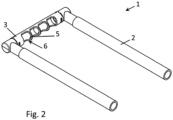
- the control element 3 can be seen, which is located between the two lines of the line system 2.
- the drip point 11 through which the condensate flows into the drainage device 1, is preferably located above the control element 3 (see. Fig.1 ).
- two control elements 3 are provided for an air conditioning system and are arranged mirror-symmetrically to a longitudinal axis of the air conditioning system.
- the condensate can therefore drain off at two different inclinations of the moving vehicle.
- the control element 3 is based on the shape of a hollow cylinder with a circular base, with a laterally open area 6, so that a total of open channel. To stabilize the control element 3, there are three reinforcing ribs 5 in the laterally open area 6.
- the laterally open area 6 begins above the longitudinal axis 4.
- the internal volume enclosed by the remaining - closed - part of the control element 3 is larger than the volume that is also open through the open area 6 and therefore does not enclose the condensate.
- the basic shape of the control element 3 here is a cylinder with a circular base, the depth of the channel is larger than the radius of the base.
- the control element 3 can be rotated around the longitudinal axis 4. In particular in the Fig.3 it can be seen that a rotation position results in a free passage for the condensate. This allows the condensate to escape directly into the outside area 12 around the air conditioning system 10.
- the closed structure of the control element 3 forms a type of tray in which the condensate can flow to the pipe system 2.
- the edge areas of this tray then protrude above the height position of the longitudinal axis 4.
- FIG. 4 to 6 A second embodiment of the discharge device is shown in the Fig. 4 to 6 which are described together. Only the differences to the first design are discussed.
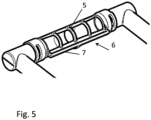
- Fig.5 is an enlarged section of the Fig.4 shown.
- the control element 3 has a balcony 7 that projects radially outwards, which provides a larger collecting area for the condensate.
- the balcony 7 When installed in the air conditioning system, the balcony 7 is located towards the interior. Furthermore, there is a sealing structure with three sealing lips on each of the two sections of the pipe system 2.
- the Fig.6 shows a section through the control element 3 of the Fig.4 and 5 , whereby the control element 3 is rotated so that the condensate is collected and passed on when installed.
- the gutter is thus open upwards in the direction of gravity.
- the balcony 7 has a border at the end facing away from the gutter, which is intended to ensure that the condensate is collected. It can also be seen that the gutter opens above the longitudinal or central axis. If the control element 3 is rotated to the other rotational position in which the condensate is to drain off, the balcony 7 also serves to safely drain off the condensate.
Landscapes
- Engineering & Computer Science (AREA)
- Mechanical Engineering (AREA)
- Chemical & Material Sciences (AREA)
- Combustion & Propulsion (AREA)
- General Engineering & Computer Science (AREA)
- Physics & Mathematics (AREA)
- Thermal Sciences (AREA)
- Devices For Blowing Cold Air, Devices For Blowing Warm Air, And Means For Preventing Water Condensation In Air Conditioning Units (AREA)
- Air-Conditioning For Vehicles (AREA)
- Air Humidification (AREA)
Description
- Die Erfindung bezieht sich auf eine Klimaanlage mit einer Abführvorrichtung zum Abführen von Kondenswasser aus der Klimaanlage.
- Klimaanlagen sind in vielen Anwendungsbereichen im Einsatz. Sie erlauben die Einstellung der Temperatur in einem Raum, wobei zumeist die Temperatur herabgesetzt wird. Weiterhin dienen sie der Trocknung der Raumluft, wobei die in der Luft befindliche Feuchtigkeit als Kondenswasser (eine alternativ gebrauchte Bezeichnung ist Kondensat) anfällt. Klimaanlagen werden z. B. in Wohnwägen oder Wohnmobilen - als Beispiele für bewegbare Gefährte - eingesetzt, wobei es bekannt ist, die eigentliche Klimaanlage auf dem Dach zu montieren und in dem zu temperierenden Raum einen Luftverteiler vorzusehen.
- Das Kondenswasser wird in der Regel in Auffangvorrichtungen in der Klimaanlage gesammelt und dann daraus abgeführt. Hierfür sind im Wesentlichen zwei Varianten im Einsatz: So ist es bekannt, Öffnungen für das Ablaufen vorzusehen, über die das Kondenswasser auf das Dach des Gefährts tropft. Auch ist es bekannt, das Kondenswasser über ein Leitungssystem mit Schläuchen und Leitungen zu Ablaufstellen beispielsweise in Bodennähe zu führen.
- Die
FR 2 944 481 A1 - In der
DE 698 00 470 T2 ist beispielsweise eine Wanne zum Sammeln des Kondenswassers beschrieben, die auf einen Schlauchabschnitt mündet. DieDE 10 2004 012 871 A1 offenbart eine Wanne unterhalb des Verdampfers zum Auffangen des Kondenswassers mit einem Schlauchanschluss in einer geneigten Grundfläche. Einen ähnlichen Aufbau zeigt dieKR 10 2012 0 134 316 A DE 11 2014 006 214 T5 . Die beiden Schlauchabschnitte sind jeweils mit einem Ende an einer Drainageeinrichtung sowie dem Armaturenbrett eines Fahrzeugs fixiert. Zwischen beiden Schlauchabschnitten befindet sich ein verdrehbares Koppelelement. DerDE 10 2014 217 174 A1 lässt sich eine Aufdachklimaanlage mit einer Sammelvorrichtung und einer Leitung für Kondenswasser entnehmen. In derEP 2 112 010 A1 ist eine weitere Aufdachklimaanlage mit mehreren Ausflusslöchern vorgesehen. DieFR 2 909 934 A1 - An einer Seite der Klappe befinden sich ein Schlitz und eine Rinne zum Abführen von Kondenswasser.
- Welche der beiden Varianten (also direkte Öffnungen oder ein Leitungssystem) umgesetzt werden soll, hängt von der Art des Gefährts oder von individuellen Wünschen der Nutzer oder der Gegebenheiten ab. Daher ergibt sich die Notwendigkeit, Klimaanlagen für beide Varianten zu konstruieren und zu produzieren. Alternativ müssen Komponenten der Klimaanlagen ausgetauscht oder durch besondere Elemente ergänzt werden.
- Daher besteht die der Erfindung zugrundeliegende Aufgabe darin, eine Klimaanlage mit einer Abführvorrichtung für das Kondenswasser vorzuschlagen, die eine Realisierung der beiden Varianten des Standes der Technik erlaubt.
- Die Erfindung löst die Aufgabe durch eine Klimaanlage mit einer Abführvorrichtung zum Abführen von Kondenswasser aus einer Klimaanlage, wobei die Abführvorrichtung ein Leitungssystem zur Führung des Kondenswasser aufweist, wobei die Abführvorrichtung ein Regelelement aufweist, wobei das Regelelement als um eine Längsachse zwischen einer ersten Drehposition und einer zweiten Drehposition drehbare offene Rinne ausgestaltet ist, und wobei das Regelelement so ausgestaltet und angeordnet ist, dass das Regelelement in der ersten Drehposition das Kondenswasser innerhalb des Leitungssystems führt und in der zweiten Drehposition eine durchgehende Verbindung zwischen einer Abtropfstelle für das Kondenswasser und einem Außenbereich um die Klimaanlage herstellt.
- Die erfindungsgemäße Vorrichtung zum Abführen des Kondenswassers der Klimaanlage verfügt über ein Leitungssystem und ein Regelelement. Das Regelelement ist dabei je nach Ausgestaltung ein Teil des Leitungssystems oder ist in Bezug auf das Führen des Kondenswassers mit dem Leitungssystem gekoppelt. Das Regelelement ist als offene Rinne ausgeführt, die um eine Längsachse drehbar ist. Ganz allgemein verfügt das Regelelement somit mindestens über einen geschlossenen und einen offenen Bereich. Durch das Drehen um die Längsachse ändert sich die Orientierung dieser Bereiche relativ zur Umgebung, sodass eher der geschlossene oder der geöffnete Bereich an der Führung des Kondenswassers beteiligt ist.
- Das Regelelement verfügt über mindestens zwei definierte Drehpositionen (eine alternative Bezeichnung kann auch sein: Funktionseinstellungen), die jeweils mit einer bestimmten Führung des Kondenswassers verbunden sind. Die beide Drehpositionen sind je nach Ausgestaltung beispielsweise mit einem Einrasten verbunden oder es handelt sich um Endpositionen, sodass ein weiteres Drehen um die Längsachse über die beiden Drehpositionen hinaus nicht möglich ist, weil z. B. Anschläge das Weiterdrehen verhindern. Durch das Drehen des Regelelements zwischen den zwei Drehpositionen um die Längsachse des Regelelements wird das Kondenswasser entweder durch das Leitungssystem oder hinaus in die Umwelt geleitet. Die Abtropfstelle bezeichnet dabei ganz allgemein einen Übergang zwischen dem Bereich der Klimaanlage, in welchem sich das Kondenswasser bildet, und der Abführungsvorrichtung. Der Bereich zum Sammeln des Kondenswassers ist beispielsweise eine Auffangvorrichtung. Ein Vorteil der Abführvorrichtung besteht darin, dass das Regelelement ein Ablassen von Kondenswasser außerhalb des Leitungssystems zulässt. Ist somit beispielsweise das Leitungssystem teilweise verstopft oder eingefroren, so erlaubt das Regelelement das Abführen des Kondenswassers, indem das Regelelement gedreht wird.
- Vorzugsweise ist das Regelelement so ausgestaltet und angeordnet, dass es durch das mechanische Eingreifen eines Nutzers um die Längsachse gedreht werden kann.
- In einer Ausgestaltung ist vorgesehen, dass in einer Ebene (alternative Bezeichnung ist Schnitt) senkrecht zur Längsachse die Rinne des Regelelements oberhalb der Lage der Längsachse mündet. Mit anderen Worten: Die Rinne mündet in einer Ebene oberhalb der Ebene, in welcher die Längsachse liegt. Ergibt sich das Regelelement insbesondere aus einem bekannten geometrischen Körper - wie z. B. einem Zylinder -, so bedeutet die Ausgestaltung, dass die Rinne ein größeres Innenvolumen umschließt als das Volumen, das quasi durch den offenen oder fehlenden Bereich umschlossen wird. Der offene Bereich erstreckt sich vorzugsweise axial entlang der Längsachse des Regelelements.
- Eine Ausgestaltung der Abführvorrichtung sieht vor, dass das Regelelement Verstärkungsrippen in einem seitlich offenen Bereich aufweist. In dieser Ausgestaltung verfügt das Regelelement über stabilisierende Strukturen in dem freien Bereich jenseits bzw. oberhalb der Rinnenform.
- Eine Ausgestaltung der Abführvorrichtung besteht darin, dass das Regelelement einen nach außen ragenden Balkon aufweist. Der Balkon grenzt dabei vorzugsweise an die Rinnenform an und dient als Ausleger dafür, dass das Kondenswasser sicher aufgefangen wird. In einer Ausgestaltung ist der Balkon zumindest leicht geneigt, sodass in einer Drehposition das Kondenswasser in die Rinne hineinfließt. In einer weiteren Ausgestaltung wird der Balkon auf einer Außenseite von einer abschließenden Wandung begrenzt.
- Eine Ausgestaltung der Abführvorrichtung besteht darin, dass das Regelelement im Wesentlichen die Form eines mit einem seitlich offenen Bereich versehenen Hohlzylinders aufweist. In einer Ausgestaltung hat der Hohlzylinder eine kreisförmige Grundfläche. In einer Ausgestaltung ist die Rinne tiefer als der Durchmesser der Grundfläche. Daher ist die Mantelfläche, die die Rinne bildet, größer als die durch den offenen Bereich fehlende Mantelfläche. Dadurch ist das Innenvolumen, das dem Führen und/oder dem Auffangen des Kondenswassers dient, größer als der durch den offenen Seitenbereich offene Anteil des durch die zylindrische Grundform gegebenen Innenvolumens.
- Eine Ausgestaltung der Abführvorrichtung sieht vor, dass das Leitungssystem mehrere Schläuche und/oder Rohre aufweist.
- Eine Ausgestaltung besteht darin, dass die Klimaanlage für eine Montage auf einem Dach eines beweglichen Gefährts ausgestaltet ist. Das bewegliche Gefährt ist beispielsweise ein Wohnwagen, ein Wohnmobil, ein Mobilheim oder ein Boot.
- Im Einzelnen gibt es eine Vielzahl von Möglichkeiten, die erfindungsgemäße Klimaanlage auszugestalten und weiterzubilden. Dazu wird verwiesen einerseits auf die dem unabhängigen Patentanspruch nachgeordneten Patentansprüche, andererseits auf die folgende Beschreibung von Ausführungsbeispielen in Verbindung mit der Zeichnung. Es zeigen die:
- Fig. 1:
- eine schematische Darstellung eines Wohnwagens mit einer Klimaanlage,
- Fig. 2:
- eine räumliche Darstellung einer ersten Ausgestaltung einer Abführvorrichtung,
- Fig. 3:
- einen Schnitt durch die Abführvorrichtung der
Fig. 2 , - Fig. 4:
- eine räumliche Darstellung einer zweiten Ausgestaltung der Abführvorrichtung,
- Fig. 5:
- einen vergrößerten Ausschnitt der
Fig. 4 und - Fig. 6:
- einen Schnitt durch die Abführvorrichtung der
Fig. 4 . - Die
Fig. 1 zeigt schematisch einen Wohnwagen 100 als ein Beispiel für ein bewegtes Gefährt, auf dessen Dach sich eine Klimaanlage 10 - also eine sog. Dachklimaanlage - befindet. Der Betrieb der Klimaanlage 10 führt dazu, dass sich Kondenswasser in der Klimaanlage 10 bildet, welches auszubringen ist. Die hier vorhandene Abführvorrichtung 1 erlaubt das Umschalten zwischen dem Führen über das hier angedeutete Leitungssystem vom Dach des Wohnwagens 100 in Richtung des Bodens und dem direkten Ablassen des Kondenswassers auf das Dach des Wohnwagens 100 bzw. in den Außenbereich 12, welcher die Klimaanlage 10 umgibt. Das Kondenswasser geht dabei über eine Abtropfstelle 11 in die Abführvorrichtung 1 über. Die Abtropfstelle 11 ist dabei eine beliebige Sammelstelle für das Kondenswasser, an welchem das Kondenswasser übergeht in die Abführvorrichtung 1. - In der
Fig. 2 sowie derFig. 3 , welche beide zusammen besprochen werden, ist eine erste Ausgestaltung der Abführvorrichtung 1 dargestellt. - Zu erkennen ist das Regelelement 3, welches sich zwischen den zwei Leitungen des Leitungssystems 2 befindet. Im eingebauten Zustand befindet sich vorzugsweise oberhalb des Regelelements 3 die Abtropfstelle 11, über die das Kondenswasser in die Abführvorrichtung 1 übergeht (vgl.
Fig. 1 ). - In einer Ausgestaltung sind für eine Klimaanlage zwei Regelelemente 3 vorgesehen und spiegelsymmetrisch zu einer Längsachse der Klimaanlage angeordnet. Daher ist das Ablaufen des Kondenswassers bei zwei unterschiedlichen Schrägstellungen des bewegten Gefährts möglich.
- Das Regelelement 3 baut auf der Form eines Hohlzylinders mit einer kreisförmigen Grundfläche auf, wobei ein seitlich offener Bereich 6 vorhanden ist, sodass sich insgesamt eine offene Rinne ergibt. Für die Stabilisierung des Regelelements 3 befinden sich in dem seitlich offenen Bereich 6 drei Verstärkungsrippen 5.
- In der
Fig. 3 mit der eingezeichneten Längsachse 4 ist zu erkennen, dass der seitlich offene Bereich 6 oberhalb der Längsachse 4 beginnt. Dadurch ist das durch den restlichen - geschlossenen - Teil des Regelelements 3 umschlossene Innenvolumen größer als das Volumen, das durch den offenen Bereich 6 ebenfalls offen ist und daher nicht das Kondenswasser umschließt. Da die Grundform des Regelelements 3 hier ein Zylinder mit kreisförmiger Grundfläche ist, ist damit die Tiefe der Rinne größer als der Radius der Grundfläche. Das Regelelement 3 ist um die Längsachse 4 herum drehbar. Insbesondere in derFig. 3 ist zu erkennen, dass eine Drehposition dazu führt, dass sich eine freie Durchgangspassage für das Kondenswasser ergibt. Dies erlaubt es, dass das Kondenswasser direkt in den Außenbereich 12 um die Klimaanlage 10 herum entweichen kann. Wird das Regelelement 3 in eine andere Drehposition gedreht, so bildet die geschlossene Struktur des Regelelements 3 eine Art von Wanne, in der das Kondenswasser zu dem Leitungssystem 2 fließen kann. Dabei überragen dann die Randbereiche dieser Wanne die Höhenposition der Längsachse 4. - Eine zweite Ausgestaltung der Abführvorrichtung ist in den
Fig. 4 bis 6 dargestellt, die gemeinsam beschrieben werden. Dabei werden nur die Unterschiede zur ersten Ausgestaltung diskutiert. In derFig. 5 ist dabei ein vergrößerter Ausschnitt derFig. 4 dargestellt. - Das Regelelement 3 verfügt über einen radial nach außen ragenden Balkon 7, über den eine größere Auffangfläche für das Kondenswasser gegeben ist. Der Balkon 7 befindet sich dabei im in der Klimaanlage eingebauten Zustand in Richtung Innenraum. Weiterhin ist an den beiden Abschnitten des Leitungssystems 2 jeweils eine Dichtstruktur mit drei Dichtlippen vorhanden. Die
Fig. 6 zeigt einen Schnitt durch das Regelelement 3 derFig. 4 und5 , wobei das Regelelement 3 so gedreht ist, dass im eingebauten Zustand das Kondenswasser aufgefangen und weitergeleitet wird. Die Rinne ist somit in Erdschwererichtung nach oben offen. Zu erkennen ist, dass der Balkon 7 an seinem von der Rinne abgewandten Ende eine Berandung aufweist, die das Auffangen des Kondenswassers gewährleisten soll. Weiterhin ist zu erkennen, dass die Rinne oberhalb der Längs- oder Mittenachse mündet. Wird das Regelelement 3 in die andere Drehposition gedreht, in welcher das Kondenswasser ablaufen soll, so dient der Balkon 7 auch dem sicheren Ableiten des Kondenswassers. -
- 1
- Abführvorrichtung
- 2
- Leitungssystem
- 3
- Regelelement
- 4
- Längsachse
- 5
- Verstärkungsrippe
- 6
- seitlich offener Bereich
- 7
- Balkon
- 8
- Dichtstruktur
- 10
- Klimaanlage
- 11
- Abtropfstelle
- 12
- Außenbereich
Claims (5)
- Klimaanlage (10) mit einer Abführvorrichtung (1) zum Abführen von Kondenswasser aus der Klimaanlage (10),wobei die Abführvorrichtung (1) ein Leitungssystem (2) zur Führung des Kondenswassers aufweist,wobei die Abführvorrichtung (1) ein Regelelement (3) aufweist,wobei das Regelelement (3) so ausgestaltet und angeordnet ist, dass das Regelelement (3) in der ersten Drehposition das Kondenswasser innerhalb des Leitungssystems (2) führt und in der zweiten Drehposition eine durchgehende Verbindung zwischen einer Abtropfstelle (11) für das Kondenswasser und einem Außenbereich (12) um die Klimaanlage (10) herstellt, dadurch gekennzeichnet dassdas Regelelement (3) als um eine Längsachse (4) zwischen einer ersten Drehposition und einer zweiten Drehposition drehbare offene Rinne ausgestaltet ist.
- Klimaanlage (10) nach Anspruch 1,
wobei das Regelelement (3) Verstärkungsrippen (5) in einem seitlich offenen Bereich (6) aufweist. - Klimaanlage (10) nach Anspruch 1 oder 2,
wobei das Regelelement (3) einen nach außen ragenden Balkon (7) aufweist. - Klimaanlage (10) nach einem der Ansprüche 1 bis 3,
wobei das Regelelement (3) im Wesentlichen die Form eines mit einem seitlich offenen Bereich (6) versehenen Hohlzylinders aufweist. - Klimaanlage (10) nach einem der Ansprüche 1 bis 4,
wobei die Klimaanlage (10) für eine Montage auf einem Dach eines bewegbaren Gefährts (100) ausgestaltet ist.
Applications Claiming Priority (2)
| Application Number | Priority Date | Filing Date | Title |
|---|---|---|---|
| DE102020002416.5A DE102020002416A1 (de) | 2020-04-22 | 2020-04-22 | Abführvorrichtung zum Abführen von Kondenswasser aus einer Klimaanlage sowie entsprechende Klimaanlage |
| PCT/EP2021/000019 WO2021213695A1 (de) | 2020-04-22 | 2021-02-22 | Klimaanlage mit einer abführvorrichtung zum abführen von kondenswasser |
Publications (2)
| Publication Number | Publication Date |
|---|---|
| EP4139141A1 EP4139141A1 (de) | 2023-03-01 |
| EP4139141B1 true EP4139141B1 (de) | 2024-04-17 |
Family
ID=74859877
Family Applications (1)
| Application Number | Title | Priority Date | Filing Date |
|---|---|---|---|
| EP21710402.5A Active EP4139141B1 (de) | 2020-04-22 | 2021-02-22 | Klimaanlage mit einer abführvorrichtung zum abführen von kondenswasser |
Country Status (7)
| Country | Link |
|---|---|
| US (1) | US20230086543A1 (de) |
| EP (1) | EP4139141B1 (de) |
| CN (1) | CN115427243A (de) |
| AU (1) | AU2021260700A1 (de) |
| CA (1) | CA3170265A1 (de) |
| DE (1) | DE102020002416A1 (de) |
| WO (1) | WO2021213695A1 (de) |
Families Citing this family (2)
| Publication number | Priority date | Publication date | Assignee | Title |
|---|---|---|---|---|
| DE102022003871A1 (de) | 2022-10-18 | 2024-04-18 | Truma Gerätetechnik GmbH & Co. KG | Klimagerät |
| DE102023000458A1 (de) | 2023-02-13 | 2024-08-14 | Truma Gerätetechnik GmbH & Co. KG | Klimagerät |
Family Cites Families (11)
| Publication number | Priority date | Publication date | Assignee | Title |
|---|---|---|---|---|
| US5791156A (en) * | 1997-01-06 | 1998-08-11 | Strautman; Thomas J. | Condensate drain pan for roof mounted vehicle air conditioning unit |
| IT242870Y1 (it) | 1997-07-31 | 2002-02-04 | Nicola Pignolo | Scatola da incasso per l'alimentazione delle unita' interne degliimpianti di condizionamento,provvista di canale raccogli-condensa a |
| DE102004012871A1 (de) | 2004-03-16 | 2005-10-06 | Volkswagen Ag | Klimaanlage für ein Fahrzeug |
| FR2909934A1 (fr) | 2006-12-13 | 2008-06-20 | Renault Sas | Dispositif de climatisation pour vehicule automobile |
| US8056355B2 (en) | 2008-04-24 | 2011-11-15 | Deere & Company | HVAC drain system |
| FR2944481B1 (fr) * | 2009-04-17 | 2012-12-28 | Peugeot Citroen Automobiles Sa | Groupe de climatisation de vehicule automobile avec recuperation des condensats. |
| DE102009060909A1 (de) * | 2009-12-31 | 2011-07-07 | Volkswagen AG, 38440 | Kondenswasser-Auffangeinrichtung für eine Klimaanlage, Klimaanlage und Fahrzeug |
| KR101779354B1 (ko) | 2011-06-02 | 2017-09-18 | 한온시스템 주식회사 | 차량용 공조장치 |
| US9182181B2 (en) * | 2013-02-28 | 2015-11-10 | William C. Adams | Condensate drain trap for an air conditioning system |
| WO2015108278A1 (ko) | 2014-01-20 | 2015-07-23 | 한라비스테온공조 주식회사 | 차량용 공조장치 |
| DE102014217174A1 (de) | 2014-08-28 | 2016-03-17 | Mahle International Gmbh | Klimaanlage |
-
2020
- 2020-04-22 DE DE102020002416.5A patent/DE102020002416A1/de not_active Withdrawn
-
2021
- 2021-02-22 WO PCT/EP2021/000019 patent/WO2021213695A1/de not_active Ceased
- 2021-02-22 AU AU2021260700A patent/AU2021260700A1/en not_active Abandoned
- 2021-02-22 US US17/905,266 patent/US20230086543A1/en not_active Abandoned
- 2021-02-22 CN CN202180029945.4A patent/CN115427243A/zh active Pending
- 2021-02-22 CA CA3170265A patent/CA3170265A1/en active Pending
- 2021-02-22 EP EP21710402.5A patent/EP4139141B1/de active Active
Also Published As
| Publication number | Publication date |
|---|---|
| US20230086543A1 (en) | 2023-03-23 |
| EP4139141A1 (de) | 2023-03-01 |
| AU2021260700A1 (en) | 2022-09-22 |
| CA3170265A1 (en) | 2021-10-28 |
| DE102020002416A1 (de) | 2021-10-28 |
| WO2021213695A1 (de) | 2021-10-28 |
| CN115427243A (zh) | 2022-12-02 |
Similar Documents
| Publication | Publication Date | Title |
|---|---|---|
| EP0770508A2 (de) | Klimaanlage für ein Kraftfahrzeug | |
| EP4139141B1 (de) | Klimaanlage mit einer abführvorrichtung zum abführen von kondenswasser | |
| WO2013164260A1 (de) | Wasserkasten für ein kraftfahrzeug | |
| EP2745664B1 (de) | Bodenwanne zum verbinden eines dachaufbau-kühlgerätes mit dem dach eines schaltschrankes | |
| DE102015109698A1 (de) | Kühlsystem für ein Fahrzeug | |
| DE202011110325U1 (de) | Luftentfeuchtungseinheit | |
| EP3472528A1 (de) | Kühleinrichtung zur montage unter einer raumdecke | |
| EP0905459A2 (de) | Akkumulator für eine nach dem "Orifice"-Prinzip arbeitende Klimaanlage, insbesondere Fahrzeugklimaanlage | |
| DE602004000275T2 (de) | Saugstrahlunterstütztes Ablaufsystem für eine Klimaanlage mit offener Verdampfung | |
| EP0125673B1 (de) | Wärmetauscher | |
| EP3625507B1 (de) | Wärmeaustauschereinrichtung und verfahren zum austausch von wärme zwischen luft und einem in einem wärmeübertrager geführten fluid | |
| DE19637408A1 (de) | Kondenswasser-Auffangschale für eine Klimaanlage eines Kraftfahrzeuges | |
| EP4620708B1 (de) | Heizsystem eines fahrzeugs mit einer bodendurchführung | |
| DE102005043849A1 (de) | Vorrichtung mit Flüssigkeitsablauf | |
| DE202017007333U1 (de) | Wärmeaustauschereinrichtung | |
| DE4323080C1 (de) | Belüftungsvorrichtung | |
| EP1764569B1 (de) | Sammler mit Trockner-/Filtereinheit für einen Kondensator | |
| DE10330340A1 (de) | Deckenluftauslass | |
| DE10110584B4 (de) | Überdach - Entlüfter | |
| WO2016058853A1 (de) | Schienenfahrzeug mit klimaanlage | |
| WO2022228711A1 (de) | Klimagerät | |
| DE102023205677A1 (de) | Elektrische Maschine zum Antrieb eines Kraftfahrzeugs | |
| DE102024204523A1 (de) | Klimaanlagensystem für ein Kraftfahrzeug | |
| EP2752316B1 (de) | Wasserkasten für ein Kraftfahrzeug | |
| DE102021112524A1 (de) | Verdampfereinheit |
Legal Events
| Date | Code | Title | Description |
|---|---|---|---|
| STAA | Information on the status of an ep patent application or granted ep patent |
Free format text: STATUS: UNKNOWN |
|
| STAA | Information on the status of an ep patent application or granted ep patent |
Free format text: STATUS: THE INTERNATIONAL PUBLICATION HAS BEEN MADE |
|
| PUAI | Public reference made under article 153(3) epc to a published international application that has entered the european phase |
Free format text: ORIGINAL CODE: 0009012 |
|
| STAA | Information on the status of an ep patent application or granted ep patent |
Free format text: STATUS: REQUEST FOR EXAMINATION WAS MADE |
|
| 17P | Request for examination filed |
Effective date: 20221024 |
|
| AK | Designated contracting states |
Kind code of ref document: A1 Designated state(s): AL AT BE BG CH CY CZ DE DK EE ES FI FR GB GR HR HU IE IS IT LI LT LU LV MC MK MT NL NO PL PT RO RS SE SI SK SM TR |
|
| P01 | Opt-out of the competence of the unified patent court (upc) registered |
Effective date: 20230514 |
|
| DAV | Request for validation of the european patent (deleted) | ||
| DAX | Request for extension of the european patent (deleted) | ||
| GRAP | Despatch of communication of intention to grant a patent |
Free format text: ORIGINAL CODE: EPIDOSNIGR1 |
|
| STAA | Information on the status of an ep patent application or granted ep patent |
Free format text: STATUS: GRANT OF PATENT IS INTENDED |
|
| INTG | Intention to grant announced |
Effective date: 20231129 |
|
| GRAS | Grant fee paid |
Free format text: ORIGINAL CODE: EPIDOSNIGR3 |
|
| GRAA | (expected) grant |
Free format text: ORIGINAL CODE: 0009210 |
|
| STAA | Information on the status of an ep patent application or granted ep patent |
Free format text: STATUS: THE PATENT HAS BEEN GRANTED |
|
| AK | Designated contracting states |
Kind code of ref document: B1 Designated state(s): AL AT BE BG CH CY CZ DE DK EE ES FI FR GB GR HR HU IE IS IT LI LT LU LV MC MK MT NL NO PL PT RO RS SE SI SK SM TR |
|
| REG | Reference to a national code |
Ref country code: GB Ref legal event code: FG4D Free format text: NOT ENGLISH |
|
| REG | Reference to a national code |
Ref country code: CH Ref legal event code: EP |
|
| REG | Reference to a national code |
Ref country code: DE Ref legal event code: R096 Ref document number: 502021003391 Country of ref document: DE |
|
| REG | Reference to a national code |
Ref country code: IE Ref legal event code: FG4D Free format text: LANGUAGE OF EP DOCUMENT: GERMAN |
|
| REG | Reference to a national code |
Ref country code: SE Ref legal event code: TRGR |
|
| REG | Reference to a national code |
Ref country code: LT Ref legal event code: MG9D |
|
| REG | Reference to a national code |
Ref country code: NL Ref legal event code: MP Effective date: 20240417 |
|
| PG25 | Lapsed in a contracting state [announced via postgrant information from national office to epo] |
Ref country code: NL Free format text: LAPSE BECAUSE OF FAILURE TO SUBMIT A TRANSLATION OF THE DESCRIPTION OR TO PAY THE FEE WITHIN THE PRESCRIBED TIME-LIMIT Effective date: 20240417 |
|
| PG25 | Lapsed in a contracting state [announced via postgrant information from national office to epo] |
Ref country code: NL Free format text: LAPSE BECAUSE OF FAILURE TO SUBMIT A TRANSLATION OF THE DESCRIPTION OR TO PAY THE FEE WITHIN THE PRESCRIBED TIME-LIMIT Effective date: 20240417 |
|
| PG25 | Lapsed in a contracting state [announced via postgrant information from national office to epo] |
Ref country code: IS Free format text: LAPSE BECAUSE OF FAILURE TO SUBMIT A TRANSLATION OF THE DESCRIPTION OR TO PAY THE FEE WITHIN THE PRESCRIBED TIME-LIMIT Effective date: 20240817 |
|
| PG25 | Lapsed in a contracting state [announced via postgrant information from national office to epo] |
Ref country code: BG Free format text: LAPSE BECAUSE OF FAILURE TO SUBMIT A TRANSLATION OF THE DESCRIPTION OR TO PAY THE FEE WITHIN THE PRESCRIBED TIME-LIMIT Effective date: 20240417 |
|
| PG25 | Lapsed in a contracting state [announced via postgrant information from national office to epo] |
Ref country code: FI Free format text: LAPSE BECAUSE OF FAILURE TO SUBMIT A TRANSLATION OF THE DESCRIPTION OR TO PAY THE FEE WITHIN THE PRESCRIBED TIME-LIMIT Effective date: 20240417 Ref country code: HR Free format text: LAPSE BECAUSE OF FAILURE TO SUBMIT A TRANSLATION OF THE DESCRIPTION OR TO PAY THE FEE WITHIN THE PRESCRIBED TIME-LIMIT Effective date: 20240417 |
|
| PG25 | Lapsed in a contracting state [announced via postgrant information from national office to epo] |
Ref country code: GR Free format text: LAPSE BECAUSE OF FAILURE TO SUBMIT A TRANSLATION OF THE DESCRIPTION OR TO PAY THE FEE WITHIN THE PRESCRIBED TIME-LIMIT Effective date: 20240718 |
|
| PG25 | Lapsed in a contracting state [announced via postgrant information from national office to epo] |
Ref country code: PT Free format text: LAPSE BECAUSE OF FAILURE TO SUBMIT A TRANSLATION OF THE DESCRIPTION OR TO PAY THE FEE WITHIN THE PRESCRIBED TIME-LIMIT Effective date: 20240819 |
|
| PG25 | Lapsed in a contracting state [announced via postgrant information from national office to epo] |
Ref country code: ES Free format text: LAPSE BECAUSE OF FAILURE TO SUBMIT A TRANSLATION OF THE DESCRIPTION OR TO PAY THE FEE WITHIN THE PRESCRIBED TIME-LIMIT Effective date: 20240417 |
|
| PG25 | Lapsed in a contracting state [announced via postgrant information from national office to epo] |
Ref country code: PL Free format text: LAPSE BECAUSE OF FAILURE TO SUBMIT A TRANSLATION OF THE DESCRIPTION OR TO PAY THE FEE WITHIN THE PRESCRIBED TIME-LIMIT Effective date: 20240417 |
|
| PG25 | Lapsed in a contracting state [announced via postgrant information from national office to epo] |
Ref country code: LV Free format text: LAPSE BECAUSE OF FAILURE TO SUBMIT A TRANSLATION OF THE DESCRIPTION OR TO PAY THE FEE WITHIN THE PRESCRIBED TIME-LIMIT Effective date: 20240417 |
|
| PG25 | Lapsed in a contracting state [announced via postgrant information from national office to epo] |
Ref country code: PT Free format text: LAPSE BECAUSE OF FAILURE TO SUBMIT A TRANSLATION OF THE DESCRIPTION OR TO PAY THE FEE WITHIN THE PRESCRIBED TIME-LIMIT Effective date: 20240819 Ref country code: PL Free format text: LAPSE BECAUSE OF FAILURE TO SUBMIT A TRANSLATION OF THE DESCRIPTION OR TO PAY THE FEE WITHIN THE PRESCRIBED TIME-LIMIT Effective date: 20240417 Ref country code: NO Free format text: LAPSE BECAUSE OF FAILURE TO SUBMIT A TRANSLATION OF THE DESCRIPTION OR TO PAY THE FEE WITHIN THE PRESCRIBED TIME-LIMIT Effective date: 20240717 Ref country code: LV Free format text: LAPSE BECAUSE OF FAILURE TO SUBMIT A TRANSLATION OF THE DESCRIPTION OR TO PAY THE FEE WITHIN THE PRESCRIBED TIME-LIMIT Effective date: 20240417 Ref country code: IS Free format text: LAPSE BECAUSE OF FAILURE TO SUBMIT A TRANSLATION OF THE DESCRIPTION OR TO PAY THE FEE WITHIN THE PRESCRIBED TIME-LIMIT Effective date: 20240817 Ref country code: HR Free format text: LAPSE BECAUSE OF FAILURE TO SUBMIT A TRANSLATION OF THE DESCRIPTION OR TO PAY THE FEE WITHIN THE PRESCRIBED TIME-LIMIT Effective date: 20240417 Ref country code: GR Free format text: LAPSE BECAUSE OF FAILURE TO SUBMIT A TRANSLATION OF THE DESCRIPTION OR TO PAY THE FEE WITHIN THE PRESCRIBED TIME-LIMIT Effective date: 20240718 Ref country code: FI Free format text: LAPSE BECAUSE OF FAILURE TO SUBMIT A TRANSLATION OF THE DESCRIPTION OR TO PAY THE FEE WITHIN THE PRESCRIBED TIME-LIMIT Effective date: 20240417 Ref country code: ES Free format text: LAPSE BECAUSE OF FAILURE TO SUBMIT A TRANSLATION OF THE DESCRIPTION OR TO PAY THE FEE WITHIN THE PRESCRIBED TIME-LIMIT Effective date: 20240417 Ref country code: BG Free format text: LAPSE BECAUSE OF FAILURE TO SUBMIT A TRANSLATION OF THE DESCRIPTION OR TO PAY THE FEE WITHIN THE PRESCRIBED TIME-LIMIT Effective date: 20240417 Ref country code: RS Free format text: LAPSE BECAUSE OF FAILURE TO SUBMIT A TRANSLATION OF THE DESCRIPTION OR TO PAY THE FEE WITHIN THE PRESCRIBED TIME-LIMIT Effective date: 20240717 |
|
| PG25 | Lapsed in a contracting state [announced via postgrant information from national office to epo] |
Ref country code: DK Free format text: LAPSE BECAUSE OF FAILURE TO SUBMIT A TRANSLATION OF THE DESCRIPTION OR TO PAY THE FEE WITHIN THE PRESCRIBED TIME-LIMIT Effective date: 20240417 |
|
| REG | Reference to a national code |
Ref country code: DE Ref legal event code: R097 Ref document number: 502021003391 Country of ref document: DE |
|
| PG25 | Lapsed in a contracting state [announced via postgrant information from national office to epo] |
Ref country code: EE Free format text: LAPSE BECAUSE OF FAILURE TO SUBMIT A TRANSLATION OF THE DESCRIPTION OR TO PAY THE FEE WITHIN THE PRESCRIBED TIME-LIMIT Effective date: 20240417 |
|
| PG25 | Lapsed in a contracting state [announced via postgrant information from national office to epo] |
Ref country code: CZ Free format text: LAPSE BECAUSE OF FAILURE TO SUBMIT A TRANSLATION OF THE DESCRIPTION OR TO PAY THE FEE WITHIN THE PRESCRIBED TIME-LIMIT Effective date: 20240417 |
|
| PG25 | Lapsed in a contracting state [announced via postgrant information from national office to epo] |
Ref country code: SK Free format text: LAPSE BECAUSE OF FAILURE TO SUBMIT A TRANSLATION OF THE DESCRIPTION OR TO PAY THE FEE WITHIN THE PRESCRIBED TIME-LIMIT Effective date: 20240417 Ref country code: RO Free format text: LAPSE BECAUSE OF FAILURE TO SUBMIT A TRANSLATION OF THE DESCRIPTION OR TO PAY THE FEE WITHIN THE PRESCRIBED TIME-LIMIT Effective date: 20240417 |
|
| PG25 | Lapsed in a contracting state [announced via postgrant information from national office to epo] |
Ref country code: SM Free format text: LAPSE BECAUSE OF FAILURE TO SUBMIT A TRANSLATION OF THE DESCRIPTION OR TO PAY THE FEE WITHIN THE PRESCRIBED TIME-LIMIT Effective date: 20240417 |
|
| PG25 | Lapsed in a contracting state [announced via postgrant information from national office to epo] |
Ref country code: SM Free format text: LAPSE BECAUSE OF FAILURE TO SUBMIT A TRANSLATION OF THE DESCRIPTION OR TO PAY THE FEE WITHIN THE PRESCRIBED TIME-LIMIT Effective date: 20240417 Ref country code: SK Free format text: LAPSE BECAUSE OF FAILURE TO SUBMIT A TRANSLATION OF THE DESCRIPTION OR TO PAY THE FEE WITHIN THE PRESCRIBED TIME-LIMIT Effective date: 20240417 Ref country code: RO Free format text: LAPSE BECAUSE OF FAILURE TO SUBMIT A TRANSLATION OF THE DESCRIPTION OR TO PAY THE FEE WITHIN THE PRESCRIBED TIME-LIMIT Effective date: 20240417 Ref country code: EE Free format text: LAPSE BECAUSE OF FAILURE TO SUBMIT A TRANSLATION OF THE DESCRIPTION OR TO PAY THE FEE WITHIN THE PRESCRIBED TIME-LIMIT Effective date: 20240417 Ref country code: DK Free format text: LAPSE BECAUSE OF FAILURE TO SUBMIT A TRANSLATION OF THE DESCRIPTION OR TO PAY THE FEE WITHIN THE PRESCRIBED TIME-LIMIT Effective date: 20240417 Ref country code: CZ Free format text: LAPSE BECAUSE OF FAILURE TO SUBMIT A TRANSLATION OF THE DESCRIPTION OR TO PAY THE FEE WITHIN THE PRESCRIBED TIME-LIMIT Effective date: 20240417 |
|
| PG25 | Lapsed in a contracting state [announced via postgrant information from national office to epo] |
Ref country code: IT Free format text: LAPSE BECAUSE OF FAILURE TO SUBMIT A TRANSLATION OF THE DESCRIPTION OR TO PAY THE FEE WITHIN THE PRESCRIBED TIME-LIMIT Effective date: 20240417 |
|
| PLBE | No opposition filed within time limit |
Free format text: ORIGINAL CODE: 0009261 |
|
| STAA | Information on the status of an ep patent application or granted ep patent |
Free format text: STATUS: NO OPPOSITION FILED WITHIN TIME LIMIT |
|
| 26N | No opposition filed |
Effective date: 20250120 |
|
| PG25 | Lapsed in a contracting state [announced via postgrant information from national office to epo] |
Ref country code: SI Free format text: LAPSE BECAUSE OF FAILURE TO SUBMIT A TRANSLATION OF THE DESCRIPTION OR TO PAY THE FEE WITHIN THE PRESCRIBED TIME-LIMIT Effective date: 20240417 |
|
| PGFP | Annual fee paid to national office [announced via postgrant information from national office to epo] |
Ref country code: AT Payment date: 20250417 Year of fee payment: 5 |
|
| REG | Reference to a national code |
Ref country code: DE Ref legal event code: R119 Ref document number: 502021003391 Country of ref document: DE |
|
| PG25 | Lapsed in a contracting state [announced via postgrant information from national office to epo] |
Ref country code: MC Free format text: LAPSE BECAUSE OF FAILURE TO SUBMIT A TRANSLATION OF THE DESCRIPTION OR TO PAY THE FEE WITHIN THE PRESCRIBED TIME-LIMIT Effective date: 20240417 |
|
| REG | Reference to a national code |
Ref country code: SE Ref legal event code: EUG Ref country code: CH Ref legal event code: PL |
|
| PG25 | Lapsed in a contracting state [announced via postgrant information from national office to epo] |
Ref country code: LU Free format text: LAPSE BECAUSE OF NON-PAYMENT OF DUE FEES Effective date: 20250222 |
|
| PG25 | Lapsed in a contracting state [announced via postgrant information from national office to epo] |
Ref country code: CH Free format text: LAPSE BECAUSE OF NON-PAYMENT OF DUE FEES Effective date: 20250228 |
|
| GBPC | Gb: european patent ceased through non-payment of renewal fee |
Effective date: 20250222 |
|
| REG | Reference to a national code |
Ref country code: BE Ref legal event code: MM Effective date: 20250228 |
|
| PG25 | Lapsed in a contracting state [announced via postgrant information from national office to epo] |
Ref country code: DE Free format text: LAPSE BECAUSE OF NON-PAYMENT OF DUE FEES Effective date: 20250902 |
|
| PG25 | Lapsed in a contracting state [announced via postgrant information from national office to epo] |
Ref country code: GB Free format text: LAPSE BECAUSE OF NON-PAYMENT OF DUE FEES Effective date: 20250222 |
|
| PG25 | Lapsed in a contracting state [announced via postgrant information from national office to epo] |
Ref country code: FR Free format text: LAPSE BECAUSE OF NON-PAYMENT OF DUE FEES Effective date: 20250228 |
|
| PG25 | Lapsed in a contracting state [announced via postgrant information from national office to epo] |
Ref country code: BE Free format text: LAPSE BECAUSE OF NON-PAYMENT OF DUE FEES Effective date: 20250228 |
|
| PG25 | Lapsed in a contracting state [announced via postgrant information from national office to epo] |
Ref country code: IE Free format text: LAPSE BECAUSE OF NON-PAYMENT OF DUE FEES Effective date: 20250222 |