EP4137894A1 - Dispositif d'affichage mobile lumineux, notamment pour l'horlogerie - Google Patents
Dispositif d'affichage mobile lumineux, notamment pour l'horlogerie Download PDFInfo
- Publication number
- EP4137894A1 EP4137894A1 EP21191936.0A EP21191936A EP4137894A1 EP 4137894 A1 EP4137894 A1 EP 4137894A1 EP 21191936 A EP21191936 A EP 21191936A EP 4137894 A1 EP4137894 A1 EP 4137894A1
- Authority
- EP
- European Patent Office
- Prior art keywords
- display device
- dial
- color
- mobile body
- light source
- Prior art date
- Legal status (The legal status is an assumption and is not a legal conclusion. Google has not performed a legal analysis and makes no representation as to the accuracy of the status listed.)
- Granted
Links
Images
Classifications
-
- G—PHYSICS
- G04—HOROLOGY
- G04B—MECHANICALLY-DRIVEN CLOCKS OR WATCHES; MECHANICAL PARTS OF CLOCKS OR WATCHES IN GENERAL; TIME PIECES USING THE POSITION OF THE SUN, MOON OR STARS
- G04B19/00—Indicating the time by visual means
- G04B19/30—Illumination of dials or hands
-
- G—PHYSICS
- G04—HOROLOGY
- G04B—MECHANICALLY-DRIVEN CLOCKS OR WATCHES; MECHANICAL PARTS OF CLOCKS OR WATCHES IN GENERAL; TIME PIECES USING THE POSITION OF THE SUN, MOON OR STARS
- G04B45/00—Time pieces of which the indicating means or cases provoke special effects, e.g. aesthetic effects
- G04B45/0007—Light-, colour-, line-, or spot-effects caused by parts or pictures moved by the clockwork
Definitions
- the invention relates to a luminous mobile display device.
- the display device applies to the field of horology, such as a needle display device.
- the invention also relates to a timepiece comprising such a luminous mobile display device.
- the display devices can have functions and characteristics of various kinds to display information of all kinds.
- mobile display devices comprising at least a first mobile body, which moves on a dial, so as to be able to indicate information displayed, for example on the dial.
- Such display devices are used to display the time, on watches or clocks. Thanks to mobile hands in rotation on a dial presenting, for example, indexes for the hours, the minutes, even the seconds, one can read the time.
- the object of the invention is to remedy the aforementioned drawbacks, and aims to provide a display device which improves readability and aesthetic appearance.
- the invention relates to a mobile display device, in particular for watchmaking, the display device comprising at least a first mobile body and a dial, the first mobile body being configured to move relative on the dial, so as to indicate a plurality of positions on the dial.
- the display device is remarkable in that it comprises a light source arranged to emit light radiation through the dial, and in that the first mobile body comprises a color filter making it possible to modify the color of a part of the light radiation passing through the first moving body, so that the first moving body has a color different from the dial.
- the part of the radiation passing through the filter of the first mobile body has a different color from the rest of the light radiation passing through the dial.
- the position of the first mobile body is more readable on the dial, in particular in order to read the time with precision.
- the aesthetics of the display is more appealing to the wearer of the watch, and visible in dim light.
- the color filter is a “notch” type notch filter.
- the light source comprises a discrete spectrum of at least two different colors, preferably three different colors, or even more.
- the discrete spectrum is of the RGB type.
- the source comprises at least two lines of RGB type, preferably at least three lines.
- the filter has a transmission spectrum configured to block a color of the discrete spectrum of the light source.
- the appearance of the first moving body is variable depending on its position relative to the dial.
- the first moving body moves, it changes color depending on its position, especially because of the discrete spectrum.
- the dial is semi-transparent.
- the display device comprises a protective glass.
- the color of the first mobile body is variable according to its position relative to the dial.
- the display device comprises a color filter arranged on the light source
- the display device comprises means for activating the light source.
- the display device comprises a second mobile body, for example a second needle, the second mobile body comprising a second color filter.
- the invention also relates to a timepiece comprising such a mobile display device.
- the invention relates to a luminous mobile display device 1, 10, in particular for watchmaking.
- the luminous mobile display device 1, 10 is that of a timepiece, for example a show.
- the display device 1, 10 comprises in particular a dial 3, 13 and a first mobile body 2, 12 which can move relative to the dial 3, 13 to indicate information, for example the time shown by means of a needle arranged above the dial 3, 13.
- the needle is mounted on a rotation shaft 11, which is actuated by a movement 5, 15 of the timepiece 1, 10.
- the movement 5, 10 can for example be a mechanical movement or a quartz movement.
- the display device further comprises a lens 4, 14 to protect the other parts of the display device 1, 10.
- the mobile display device 1, 10 comprises a dial 3, 13 arranged above the movement 5, 15.
- the display device 1 comprises a light source 8, 18 arranged under the dial 3, 13, the light source 8, 18 being configured to emit light radiation 6, 16.
- the light source 8 is for example a light guide illuminated by a light-emitting diode of the LED type 9.
- the light source 8 can be a series of light-emitting diodes, or even an OLED surface, or even a light-emitting sheet.
- An OLED surface is for example obtained by printing, while an electroluminescent sheet can be produced by evaporation.
- the light source 8 emits the light radiation through the dial 3.
- the dial 3 has a specific color corresponding to that of the light radiation 6 emitted by the light source 8.
- Dial 3 is preferably semi-transparent to allow at least part of the light radiation emitted by source 8 to pass. Peripheral part 6 of dial 13 is opaque, since first mobile body 12 does not pass above it. Preferably, dial 3 is entirely illuminated by light source 8.
- the first mobile body 2 of the mobile display device 1 comprises a color filter 20.
- the color filter 20 is preferably a “notch” type notch filter. With such a filter 20, it is easy to select the wavelengths to be blocked.
- a first part of the light radiation 7 passes through the dial 3, then the color filter 20 of the first mobile body 2, and finally the glass 4 to come out of a first particular color.
- the part of the light radiation 7 passing through the dial 3 does not include the color blocked by the filter 20.
- each moving body includes a color filter, in order to be more visible with respect to dial 3.
- the filters of the bodies are different from each other to obtain a different color from each mobile body.
- a second part of the light radiation only passes through dial 3 before leaving crystal 4.
- the second part of the light radiation has a second color.
- the second color is different from the first color 7 because it includes the color blocked by the color filter 20.
- the dial 3 transmits the light radiation in the initial color of the light source 8, while the first mobile body 2 appears in another color thanks to the color filter 20.
- the part of the light radiation 7 passing through the first mobile body 2 has a modified color compared to that of the dial 3, because the first mobile body 2 includes the color filter 20.
- the contrast between the first mobile body 2 and the dial 13 is greater, and further promotes easy reading of the display.
- the visibility of the hour is accentuated.
- the display device 1 is preferably provided with means 23 for actuating the light source 8. This prevents the light source 8 from remaining continuously lit. Thus, the colors of the first mobile body 2 and of the dial are visible when the actuating means 23 are actuated.
- the actuating means 23 comprise for example a button arranged on the case of the timepiece.
- the light source 18 comprises a discrete spectrum of at least two different colors, preferably three different colors, or even more.
- the discrete spectrum is of the RGB type (for Red, Green, Blue in English).
- the light source 18 comprises several small sources of different colors.
- the light source 18 comprises for example at least two lines of the RGB type, preferably at least three lines, which emit multicolored light radiation 16. For example, these lines form a square matrix or concentric circles.
- the first movable body 12 includes a color filter 21 for changing the color of a portion of radiation 17 which passes through the first movable body 12.
- the color filter 21 is preferably a filter “notch” type tape cutter.
- the color filter 21 has a transmit spectrum configured to block a color from the discrete spectrum.
- the color of the first mobile body 17 is different from that of the dial 13. Thanks to the display device according to the invention, the first mobile body 17 has a particular color by relative to dial 13.
- the first mobile body 17 when it moves, it changes color depending on its position on the dial 13. Thanks to the color filter 21 and the light source 18 with a discrete spectrum, the color of the first mobile body 17 is not the same for different positions.
- the part of the radiation 17 which crosses it is variable on the dial 13, so that the first mobile body 12 has a color which changes according to its position on the dial 13. Therefore the color of the part of the radiation 17 which crosses the first mobile body 12 changes according to its position relative to the source 18.
- the body has a particular color different from dial 13, but the color of the first mobile body 12 varies according to its position on dial 13.
- the light 16 emitted by the source is different depending on the position of the dial, because the first body is more or less close to a discrete source of the light source 18.
- the first moving body 12 receives more light of the closest RGB spectrum color.
- the display device 20 is preferably also provided with means 24 for actuating the light source 18.
- the display device comprises a second mobile body.
- the moving bodies are for example an hour hand and a minute hand.
- Additional mobile bodies are possible, for example for the hands of a chronograph, or even a seconds hand.
Landscapes
- Physics & Mathematics (AREA)
- General Physics & Mathematics (AREA)
- Electric Clocks (AREA)
- Electromechanical Clocks (AREA)
Abstract
Description
- L'invention se rapporte à un dispositif d'affichage mobile lumineux. En particulier, le dispositif d'affichage s'applique au domaine de l'horlogerie, tel un dispositif d'affichage à aiguilles.
- L'invention se rapporte également à une pièce d'horlogerie comportant un tel dispositif d'affichage mobile lumineux.
- Les dispositifs d'affichages peuvent avoir des fonctions et des caractéristiques de natures variées pour afficher des informations de toutes sortes. Parmi eux, il existe des dispositifs d'affichages mobiles comportant au moins un premier corps mobile, qui se déplace sur un cadran, de manière à pouvoir indiquer une information affichée, par exemple sur le cadran.
- Dans le domaine de l'horlogerie notamment, de tels dispositifs d'affichage sont utilisés pour afficher l'heure, sur des montres ou des horloges. Grâce à des aiguilles mobiles en rotation sur un cadran présentant, par exemple, des index pour les heures, les minutes, voire les secondes, on peut lire l'heure.
- Cependant, la lisibilité sur ces cadrans n'est pas toujours aisée, de sorte qu'une erreur de lecture est possible, lorsqu'on ne lit pas l'heure avec beaucoup de précaution.
- Pour améliorer la lisibilité, il est usuel de choisir des couleurs contrastées pour les aiguilles et le cadran, voire les index, de manière à pouvoir mieux observer la position des aiguilles sur le cadran, et en déduire l'heure sans erreur.
- Néanmoins, malgré ces améliorations, la différence visuelle d'une heure à l'autre n'est pas résolue. Par conséquent, une méprise est toujours possible.
- Un autre inconvénient de ces dispositifs d'affichages colorés est la monotonie esthétique. En effet, les couleurs du dispositif d'affichage sont généralement immuables, et peuvent engendrer de la lassitude pour le possesseur de la pièce d'horlogerie après un certain temps.
- L'invention a pour but de remédier aux inconvénients précités, et vise à fournir un dispositif d'affichage, qui améliore la lisibilité et l'aspect esthétique.
- A cette fin, l'invention se rapporte à un dispositif d'affichage mobile, notamment pour l'horlogerie, le dispositif d'affichage comportant au moins un premier corps mobile et un cadran, le premier corps mobile étant configuré pour se déplacer par rapport au cadran, de manière à indiquer une pluralité de positions sur le cadran.
- Le dispositif d'affichage est remarquable en ce qu'il comprend une source lumineuse agencée pour émettre un rayonnement lumineux à travers le cadran, et en ce que le premier corps mobile comprend un filtre de couleur permettant de modifier la couleur d'une partie du rayonnement lumineux traversant le premier corps mobile, de manière à ce que le premier corps mobile ait une couleur différente du cadran.
- Ainsi, la partie du rayonnement traversant le filtre du premier corps mobile a une couleur différente du reste du rayonnement lumineux traversant le cadran.
- Grâce au dispositif d'affichage selon l'invention, la position du premier corps mobile est plus lisible sur le cadran, notamment afin de lire l'heure avec précision.
- En outre, l'esthétique de l'affichage est plus attrayant pour le porteur de la montre, et visible dans la pénombre.
- Selon une forme de réalisation particulière de l'invention, le filtre de couleur est un filtre coupe-bande de type « notch ».
- Selon une forme de réalisation particulière de l'invention, la source lumineuse comprend un spectre discret d'au moins deux couleurs différentes, de préférence trois couleurs différentes, voire plus.
- Selon une forme de réalisation particulière de l'invention, le spectre discret est de type RGB.
- Selon une forme de réalisation particulière de l'invention, la source comprend au moins deux lignes de type RGB, de préférence au moins trois lignes.
- Selon une forme de réalisation particulière de l'invention, le filtre a un spectre en transmission configuré pour bloquer une couleur du spectre discret de la source lumineuse.
- Selon une forme de réalisation particulière de l'invention, l'aspect du premier corps mobile est variable en fonction de sa position par rapport au cadran. Lorsque le premier corps mobile se déplace, il change de couleur en fonction de sa position, en particulier à cause du spectre discret.
- Selon une forme de réalisation particulière de l'invention, le cadran est semi-transparent.
- Selon une forme de réalisation particulière de l'invention, le dispositif d'affichage comprend une glace de protection.
- Selon une forme de réalisation particulière de l'invention, la couleur du premier corps mobile est variable en fonction de sa position par rapport au cadran.
- Selon une forme de réalisation particulière de l'invention, le dispositif d'affichage comprend un filtre de couleur disposé sur la source de lumière
- Selon une forme de réalisation particulière de l'invention, le dispositif d'affichage comprend des moyens d'activation de la source lumineuse.
- Selon une forme de réalisation particulière de l'invention, le dispositif d'affichage comprend un deuxième corps mobile, par exemple une deuxième aiguille, le deuxième corps mobile comportant un deuxième filtre de couleur.
- L'invention se rapporte également à une pièce d'horlogerie comportant un tel dispositif d'affichage mobile.
- D'autres particularités et avantages ressortiront clairement de la description qui en est faite ci-après, à titre indicatif et nullement limitatif, en référence aux dessins annexés, dans lesquels :
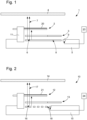
- la
figure 1 est une représentation schématique d'un dispositif d'affichage mobile lumineux selon un premier mode de réalisation de l'invention, - la
figure 2 est une représentation schématique d'un dispositif d'affichage mobile lumineux selon un deuxième mode de réalisation de l'invention. - Comme expliqué ci-dessus, l'invention se rapporte à un dispositif d'affichage mobile lumineux 1, 10, notamment pour l'horlogerie.
- Dans les modes de réalisation ci-dessous, le dispositif d'affichage mobile lumineux 1, 10 est celui d'une pièce d'horlogerie, par exemple une montre. Le dispositif d'affichage 1, 10 comprend notamment un cadran 3, 13 et un premier corps mobile 2, 12 qui peut se déplacer par rapport au cadran 3, 13 pour indiquer une information, par exemple l'heure montrée au moyen d'une aiguille agencée au-dessus du cadran 3, 13. L'aiguille est montée sur un arbre de rotation 11, qui est actionné par un mouvement 5, 15 de la pièce d'horlogerie 1, 10. Le mouvement 5, 10 peut par exemple être un mouvement mécanique ou un mouvement à quartz.
- Le dispositif d'affichage comprend en outre une glace 4, 14 pour protéger les autres parties du dispositif d'affichage 1, 10.
- Le dispositif d'affichage mobile 1, 10 comprend un cadran 3, 13 agencé au-dessus du mouvement 5, 15.
- Le dispositif d'affichage 1 comprend une source de lumière 8, 18 disposée sous le cadran 3, 13, la source de lumière 8, 18 étant configurée pour émettre un rayonnement lumineux 6, 16.
- Sur la
figure 1 , la source de lumière 8 est par exemple un guide de lumière éclairé par une diode électroluminescente de type LED 9. En variante, la source de lumière 8 peut être une série de diodes électroluminescentes, ou encore une surface OLED, voire une feuille électroluminescente. Une surface OLED est par exemple obtenue par impression, tandis qu'une feuille électroluminescente peut être réalisée par évaporation. - La source de lumière 8 émet le rayonnement lumineux à travers le cadran 3. Ainsi, le cadran 3 a une couleur spécifique correspondant à celle du rayonnement lumineux 6 émis par la source de lumière 8.
- Le cadran 3 est de préférence semi-transparent pour laisser passer au moins une partie du rayonnement lumineux émis par la source 8. La partie périphérique 6 du cadran 13 est opaque, car le premier corps mobile 12 ne passe au-dessus. De préférence, le cadran 3 est entièrement illuminé par la source de lumière 8.
- Une partie du rayonnement lumineux 7 traversant le cadran 3 travers le premier corps mobile 2.
- Selon l'invention, le premier corps mobile 2 du dispositif d'affichage mobile 1 comprend un filtre de couleur 20.
- Le filtre de couleur 20 est de préférence un filtre coupe-bande de type « notch ». Avec un tel filtre 20, on peut sélectionner aisément les longueurs d'ondes à bloquer.
- Ainsi, une première partie du rayonnement lumineux 7 traverse le cadran 3, puis le filtre de couleur 20 du premier corps mobile 2, et enfin la glace 4 pour sortir d'une première couleur particulière. La partie du rayonnement lumineux 7 traversant le cadran 3 ne comprend pas la couleur bloquée par le filtre 20.
- Dans le cas où il y a plusieurs corps mobiles, par exemple plusieurs aiguilles, chaque corps mobile comprend un filtre de couleur, afin d'être plus visible par rapport au cadran 3.
- De préférence, les filtres des corps sont différents les uns des autres pour obtenir une couleur différente de chaque corps mobile.
- Une deuxième partie du rayonnement lumineux traverse seulement le cadran 3 avant de sortir de la glace 4. Ainsi, la deuxième partie du rayonnement lumineux a une deuxième couleur. La deuxième couleur est différente de la première couleur 7, car elle comprend la couleur bloquée par le filtre de couleur 20.
- Dans ce mode de réalisation, le cadran 3 transmet le rayonnement lumineux dans la couleur initiale de la source lumineuse 8, tandis que le premier corps mobile 2 apparaît d'une autre couleur grâce au filtre de couleur 20.
- A contrario, la partie du rayonnement lumineux 7 traversant le premier corps mobile 2 a une couleur modifiée par rapport à celle du cadran 3, car le premier corps mobile 2 comprend le filtre de couleur 20.
- En conséquence, le contraste entre le premier corps mobile 2 et le cadran 13 est plus important, et favorise encore davantage une lecture aisée de l'affichage. Ainsi, on accentue la visibilité de l'heure.
- Le dispositif d'affichage 1 est de préférence muni de moyens d'actionnement 23 de la source de lumière 8. Ainsi, on évite que la source de lumière 8 ne reste allumée de manière continue. Ainsi, les couleurs du premier corps mobile 2 et du cadran sont visibles lorsque les moyens d'actionnement 23 sont actionnés. Les moyens d'actionnement 23 comportent par exemple un bouton agencé sur le boîtier de la pièce d'horlogerie.
- Dans un second mode de réalisation, représenté sur la
figure 2 , la source de lumière 18 comprend un spectre discret d'au moins deux couleurs différentes, de préférence trois couleurs différentes, voire plus. Par exemple, le spectre discret est de type RGB (pour Red, Green, Blue en anglais). Ainsi, la source de lumière 18 comprend plusieurs petites sources de couleurs différentes. - La source de lumière 18 comprend par exemple au moins deux lignes de type RGB, de préférence au moins trois lignes, qui émettent un rayonnement lumineux multicolore 16. Par exemple, ces lignes forment une matrice carrée ou des cercles concentriques.
- Comme dans le premier mode de réalisation, le premier corps mobile 12 comprend un filtre de couleur 21 pour modifier la couleur d'une partie de rayonnement 17 qui passe à travers le premier corps mobile 12. Le filtre de couleur 21 est de préférence un filtre coupe-bande de type « notch ». De préférence, le filtre de couleur 21 a un spectre en transmission configuré pour bloquer une couleur du spectre discret.
- En éliminant une couleur du spectre RGB grâce au filtre de couleur 21, la couleur du premier corps mobile 17 est différente de celle du cadran 13. Grâce au dispositif d'affichage selon l'invention, le premier corps mobile 17 a une couleur particulière par rapport au cadran 13.
- De plus, lorsque le premier corps mobile 17 se déplace, il change de couleur en fonction de sa position sur le cadran 13. Grâce au filtre de couleur 21 et à la source de lumière 18 à spectre discret, la couleur du premier corps mobile 17 n'est pas la même pour des positions différentes.
- La partie du rayonnement 17 qui le traverse est variable sur le cadran 13, de sorte que le premier corps mobile 12 a une couleur qui change en fonction de sa position sur le cadran 13. Donc la couleur de la partie de rayonnement 17 qui traverse le premier corps mobile 12 change en fonction de sa position par rapport à la source 18.
- Ainsi, non seulement le corps a une couleur particulière différente du cadran 13, mais la couleur du premier corps mobile 12 varie en fonction de sa position sur le cadran 13.
- En effet, comme la source lumineuse 18 comprend un spectre discret, la lumière 16 émise par la source est différente en fonction de la position du cadran, car le premier corps est plus ou moins proche d'une source discrète de la source lumineuse 18. Le premier corps mobile 12 reçoit plus de lumière de la couleur du spectre RGB la plus proche.
- Le dispositif d'affichage 20 est de préférence également muni de moyens d'actionnement 24 de la source de lumière 18.
- Dans une variante des modes de réalisation décrits précédemment, le dispositif d'affichage comprend un deuxième corps mobile. Dans le cas d'une pièce d'horlogerie, les corps mobiles sont par exemple une aiguille des heures et une aiguille des minutes.
- Des corps mobiles supplémentaires sont possibles, par exemple pour des aiguilles d'un chronographe, voire une aiguille des secondes.
- Pour chaque aiguille on peut choisir un filtre de couleur différent pour qu'elles soient mieux différenciées les unes des autres.
Claims (12)
- Dispositif d'affichage mobile lumineux (1, 10), notamment pour l'horlogerie, le dispositif d'affichage comportant au moins un cadran (3, 13) et un premier corps mobile (2, 12), par exemple une première aiguille, le premier corps mobile (2, 12) étant configuré pour se déplacer par rapport au cadran (3, 13) de manière à indiquer une pluralité de positions sur le cadran (3, 13), caractérisé en ce qu'il comprend une source lumineuse (8, 18) agencée pour émettre un rayonnement lumineux (6, 16) à travers le cadran (3, 13), et en ce que le premier corps mobile (2, 12) comprend un filtre de couleur (20, 21) permettant de modifier la couleur d'une partie du rayonnement lumineux (7, 17) traversant le premier corps mobile (2, 12), de manière à ce que le premier corps mobile (2, 12) ait une couleur différente du cadran (3, 13).
- Dispositif d'affichage selon la revendication 1 ou 2, caractérisé en ce que le filtre de couleur (20, 21) est un filtre coupe-bande de type « notch ».
- Dispositif d'affichage selon l'une, quelconque, des revendications 1 et 2, caractérisé en ce que la source lumineuse (18) comprend un spectre discret d'au moins deux couleurs différentes, de préférence trois couleurs différentes.
- Dispositif d'affichage selon la revendication 3, caractérisé en ce que le filtre de couleur (20, 21) a un spectre en transmission configuré pour bloquer une couleur du spectre discret de la source lumineuse (18).
- Dispositif d'affichage selon la revendication 3 ou 4, caractérisé en ce que le spectre discret est de type RGB,
- Dispositif d'affichage selon la revendication 5, caractérisé en ce que la source (18) comprend au moins deux lignes de type RGB, de préférence au moins trois lignes.
- Dispositif d'affichage selon l'une, quelconque, des revendications 3 à 6, caractérisé en ce que la couleur du premier corps mobile (2, 12) est variable en fonction de sa position par rapport au cadran (3, 13).
- Dispositif d'affichage selon l'une, quelconque, des revendications précédentes, caractérisé en ce que le cadran (3, 13) est semi-transparent.
- Dispositif d'affichage selon l'une, quelconque, des revendications précédentes, caractérisé en ce qu'il comprend une glace (4, 14) de protection.
- Dispositif d'affichage selon l'une, quelconque, des revendications précédentes, caractérisé en ce qu'il comprend des moyens d'activation (23, 24) de la source lumineuse (8,18).
- Dispositif d'affichage selon l'une, quelconque, des revendications précédente, caractérisé en ce qu'il comprend un deuxième corps mobile, par exemple une deuxième aiguille, le deuxième corps mobile comportant un deuxième filtre de couleur.
- Pièce d'horlogerie, caractérisée en ce qu'elle comprend un dispositif d'affichage (1, 10) selon l'une, quelconque, des revendications précédentes.
Priority Applications (6)
| Application Number | Priority Date | Filing Date | Title |
|---|---|---|---|
| EP21191936.0A EP4137894B1 (fr) | 2021-08-18 | 2021-08-18 | Dispositif d'affichage mobile lumineux pour l'horlogerie |
| JP2024509058A JP7739596B2 (ja) | 2021-08-18 | 2022-07-18 | 特に腕時計用の移動式発光表示装置 |
| CN202280056253.3A CN117836723A (zh) | 2021-08-18 | 2022-07-18 | 尤其用于钟表的移动发光显示设备 |
| US18/293,430 US20240329603A1 (en) | 2021-08-18 | 2022-07-18 | Mobile luminous display device, in particular for watches |
| PCT/EP2022/070069 WO2023020761A1 (fr) | 2021-08-18 | 2022-07-18 | Dispositif d'affichage mobile lumineux, notamment pour l'horlogerie |
| EP22743502.1A EP4388373A1 (fr) | 2021-08-18 | 2022-07-18 | Dispositif d'affichage mobile lumineux, notamment pour l'horlogerie |
Applications Claiming Priority (1)
| Application Number | Priority Date | Filing Date | Title |
|---|---|---|---|
| EP21191936.0A EP4137894B1 (fr) | 2021-08-18 | 2021-08-18 | Dispositif d'affichage mobile lumineux pour l'horlogerie |
Publications (2)
| Publication Number | Publication Date |
|---|---|
| EP4137894A1 true EP4137894A1 (fr) | 2023-02-22 |
| EP4137894B1 EP4137894B1 (fr) | 2025-06-04 |
Family
ID=77398485
Family Applications (2)
| Application Number | Title | Priority Date | Filing Date |
|---|---|---|---|
| EP21191936.0A Active EP4137894B1 (fr) | 2021-08-18 | 2021-08-18 | Dispositif d'affichage mobile lumineux pour l'horlogerie |
| EP22743502.1A Pending EP4388373A1 (fr) | 2021-08-18 | 2022-07-18 | Dispositif d'affichage mobile lumineux, notamment pour l'horlogerie |
Family Applications After (1)
| Application Number | Title | Priority Date | Filing Date |
|---|---|---|---|
| EP22743502.1A Pending EP4388373A1 (fr) | 2021-08-18 | 2022-07-18 | Dispositif d'affichage mobile lumineux, notamment pour l'horlogerie |
Country Status (5)
| Country | Link |
|---|---|
| US (1) | US20240329603A1 (fr) |
| EP (2) | EP4137894B1 (fr) |
| JP (1) | JP7739596B2 (fr) |
| CN (1) | CN117836723A (fr) |
| WO (1) | WO2023020761A1 (fr) |
Citations (3)
| Publication number | Priority date | Publication date | Assignee | Title |
|---|---|---|---|---|
| US3798892A (en) * | 1971-12-29 | 1974-03-26 | V Lukens | Clock mechanism |
| FR2265124A1 (en) * | 1974-03-22 | 1975-10-17 | Lukens Victor | Clock or watch with decorative dial face - has display elements for hours minutes and seconds having coloured filters |
| FR2863370A1 (fr) * | 2003-12-04 | 2005-06-10 | Bettina Dadon | Dispositif d'affichage de l'heure comportant des indicateurs colores rotatifs. |
Family Cites Families (7)
| Publication number | Priority date | Publication date | Assignee | Title |
|---|---|---|---|---|
| JPS50126466A (fr) * | 1974-03-25 | 1975-10-04 | ||
| JPS50128554A (fr) * | 1974-03-28 | 1975-10-09 | ||
| EP1870786A1 (fr) * | 2006-06-23 | 2007-12-26 | ETA SA Manufacture Horlogère Suisse | Pièce d'horlogerie munie d'un dispositif d'éclairage comprenant une diode électroluminescente |
| BE1019839A3 (nl) * | 2011-01-14 | 2013-01-08 | Diamond Trading Nv | Uurwerk. |
| EP2717104B1 (fr) * | 2012-10-04 | 2015-07-29 | The Swatch Group Research and Development Ltd. | Illumination d'un quantième |
| EP3637200B1 (fr) * | 2018-10-09 | 2022-09-14 | The Swatch Group Research and Development Ltd | Dispositif d'affichage lumineux |
| EP3845974B1 (fr) * | 2019-12-31 | 2024-02-21 | The Swatch Group Research and Development Ltd | Indicateur mobile pour un dispositif d'affichage analogique |
-
2021
- 2021-08-18 EP EP21191936.0A patent/EP4137894B1/fr active Active
-
2022
- 2022-07-18 US US18/293,430 patent/US20240329603A1/en active Pending
- 2022-07-18 JP JP2024509058A patent/JP7739596B2/ja active Active
- 2022-07-18 CN CN202280056253.3A patent/CN117836723A/zh active Pending
- 2022-07-18 EP EP22743502.1A patent/EP4388373A1/fr active Pending
- 2022-07-18 WO PCT/EP2022/070069 patent/WO2023020761A1/fr not_active Ceased
Patent Citations (3)
| Publication number | Priority date | Publication date | Assignee | Title |
|---|---|---|---|---|
| US3798892A (en) * | 1971-12-29 | 1974-03-26 | V Lukens | Clock mechanism |
| FR2265124A1 (en) * | 1974-03-22 | 1975-10-17 | Lukens Victor | Clock or watch with decorative dial face - has display elements for hours minutes and seconds having coloured filters |
| FR2863370A1 (fr) * | 2003-12-04 | 2005-06-10 | Bettina Dadon | Dispositif d'affichage de l'heure comportant des indicateurs colores rotatifs. |
Also Published As
| Publication number | Publication date |
|---|---|
| US20240329603A1 (en) | 2024-10-03 |
| WO2023020761A1 (fr) | 2023-02-23 |
| EP4388373A1 (fr) | 2024-06-26 |
| CN117836723A (zh) | 2024-04-05 |
| JP2024529172A (ja) | 2024-08-01 |
| JP7739596B2 (ja) | 2025-09-16 |
| EP4137894B1 (fr) | 2025-06-04 |
Similar Documents
| Publication | Publication Date | Title |
|---|---|---|
| EP0663631B1 (fr) | Pièce d'horlogerie avec indication de la partie de la terre visible depuis la lune | |
| EP0940833B1 (fr) | Mécanisme de quantième pour mouvement d'horlogerie | |
| EP0756217B1 (fr) | Mécanisme de quantième annuel pour pièce d'horlogerie | |
| EP3620865B1 (fr) | Piece d'horlogerie mecanique ou electromecanique a entrainement mysterieux | |
| EP3839657B1 (fr) | Mecanisme d'affichage d'horlogerie a la demande | |
| WO2013110657A1 (fr) | Pièce d'horlogerie comportant un affichage analogique et un affichage numérique | |
| EP4102307A1 (fr) | Pièce d'horlogerie à illumination localisée | |
| CH700615B1 (fr) | Mouvement pour montre-bracelet. | |
| EP4137894B1 (fr) | Dispositif d'affichage mobile lumineux pour l'horlogerie | |
| CH718907A2 (fr) | Dispositif d'affichage mobile lumineux, notamment pour l'horlogerie. | |
| EP3696617B1 (fr) | Mecanisme d'affichage de mois et d'annee bissextile pour piece d'horlogerie | |
| US20200110215A1 (en) | Luminous display device | |
| EP0366610A1 (fr) | Montre, notamment montre-bracelet, à affichage multiple par aiguilles | |
| EP4102309B1 (fr) | Piece d'horlogerie comprenant un element d'habillage muni d'une partie en zircone | |
| CH718906A2 (fr) | Dispositif d'affichage lumineux à corps mobile d'aspect variable, notamment pour l'horlogerie. | |
| EP3738004B1 (fr) | Mouvement horloger comportant un organe d'affichage visible simultanement des deux cotes du mouvement | |
| FR2863370A1 (fr) | Dispositif d'affichage de l'heure comportant des indicateurs colores rotatifs. | |
| FR3040218A1 (fr) | Systeme de pieces d’horlogerie a index pivotant | |
| CH718715A2 (fr) | Pièce d'horlogerie à illumination localisée. | |
| CH716556B1 (fr) | Pièce d'horlogerie à mécanisme d'affichage de l'âge de la lune. | |
| FR3023935A1 (fr) | Montre en relief comportant un plateau mobile en rotation pour les heures et un systeme de plaques mobiles en hauteur pour les minutes | |
| WO1994024616A1 (fr) | Montre mysterieuse comportant deux dispositifs d'affichage et moyens de commande destines en particulier a etre utilises avec une telle montre | |
| CH690517A5 (fr) | Pièce d'horlogerie. | |
| EP2293156B1 (fr) | Afficheur numérique mécanique | |
| CH712411A2 (fr) | Mouvement horloger comportant un dispositif d'affichage extra-plat de l'heure courante. |
Legal Events
| Date | Code | Title | Description |
|---|---|---|---|
| PUAI | Public reference made under article 153(3) epc to a published international application that has entered the european phase |
Free format text: ORIGINAL CODE: 0009012 |
|
| STAA | Information on the status of an ep patent application or granted ep patent |
Free format text: STATUS: THE APPLICATION HAS BEEN PUBLISHED |
|
| AK | Designated contracting states |
Kind code of ref document: A1 Designated state(s): AL AT BE BG CH CY CZ DE DK EE ES FI FR GB GR HR HU IE IS IT LI LT LU LV MC MK MT NL NO PL PT RO RS SE SI SK SM TR |
|
| P01 | Opt-out of the competence of the unified patent court (upc) registered |
Effective date: 20230615 |
|
| STAA | Information on the status of an ep patent application or granted ep patent |
Free format text: STATUS: REQUEST FOR EXAMINATION WAS MADE |
|
| 17P | Request for examination filed |
Effective date: 20230822 |
|
| RBV | Designated contracting states (corrected) |
Designated state(s): AL AT BE BG CH CY CZ DE DK EE ES FI FR GB GR HR HU IE IS IT LI LT LU LV MC MK MT NL NO PL PT RO RS SE SI SK SM TR |
|
| GRAP | Despatch of communication of intention to grant a patent |
Free format text: ORIGINAL CODE: EPIDOSNIGR1 |
|
| STAA | Information on the status of an ep patent application or granted ep patent |
Free format text: STATUS: GRANT OF PATENT IS INTENDED |
|
| INTG | Intention to grant announced |
Effective date: 20250130 |
|
| GRAS | Grant fee paid |
Free format text: ORIGINAL CODE: EPIDOSNIGR3 |
|
| GRAA | (expected) grant |
Free format text: ORIGINAL CODE: 0009210 |
|
| STAA | Information on the status of an ep patent application or granted ep patent |
Free format text: STATUS: THE PATENT HAS BEEN GRANTED |
|
| AK | Designated contracting states |
Kind code of ref document: B1 Designated state(s): AL AT BE BG CH CY CZ DE DK EE ES FI FR GB GR HR HU IE IS IT LI LT LU LV MC MK MT NL NO PL PT RO RS SE SI SK SM TR |
|
| REG | Reference to a national code |
Ref country code: GB Ref legal event code: FG4D Free format text: NOT ENGLISH |
|
| REG | Reference to a national code |
Ref country code: CH Ref legal event code: EP |
|
| REG | Reference to a national code |
Ref country code: DE Ref legal event code: R096 Ref document number: 602021031648 Country of ref document: DE |
|
| REG | Reference to a national code |
Ref country code: IE Ref legal event code: FG4D Free format text: LANGUAGE OF EP DOCUMENT: FRENCH |
|
| REG | Reference to a national code |
Ref country code: NL Ref legal event code: MP Effective date: 20250604 |
|
| PG25 | Lapsed in a contracting state [announced via postgrant information from national office to epo] |
Ref country code: FI Free format text: LAPSE BECAUSE OF FAILURE TO SUBMIT A TRANSLATION OF THE DESCRIPTION OR TO PAY THE FEE WITHIN THE PRESCRIBED TIME-LIMIT Effective date: 20250604 Ref country code: ES Free format text: LAPSE BECAUSE OF FAILURE TO SUBMIT A TRANSLATION OF THE DESCRIPTION OR TO PAY THE FEE WITHIN THE PRESCRIBED TIME-LIMIT Effective date: 20250604 |
|
| PGFP | Annual fee paid to national office [announced via postgrant information from national office to epo] |
Ref country code: DE Payment date: 20250724 Year of fee payment: 5 |
|
| REG | Reference to a national code |
Ref country code: LT Ref legal event code: MG9D |
|
| PG25 | Lapsed in a contracting state [announced via postgrant information from national office to epo] |
Ref country code: GR Free format text: LAPSE BECAUSE OF FAILURE TO SUBMIT A TRANSLATION OF THE DESCRIPTION OR TO PAY THE FEE WITHIN THE PRESCRIBED TIME-LIMIT Effective date: 20250905 Ref country code: NO Free format text: LAPSE BECAUSE OF FAILURE TO SUBMIT A TRANSLATION OF THE DESCRIPTION OR TO PAY THE FEE WITHIN THE PRESCRIBED TIME-LIMIT Effective date: 20250904 |
|
| PG25 | Lapsed in a contracting state [announced via postgrant information from national office to epo] |
Ref country code: PL Free format text: LAPSE BECAUSE OF FAILURE TO SUBMIT A TRANSLATION OF THE DESCRIPTION OR TO PAY THE FEE WITHIN THE PRESCRIBED TIME-LIMIT Effective date: 20250604 |
|
| PG25 | Lapsed in a contracting state [announced via postgrant information from national office to epo] |
Ref country code: BG Free format text: LAPSE BECAUSE OF FAILURE TO SUBMIT A TRANSLATION OF THE DESCRIPTION OR TO PAY THE FEE WITHIN THE PRESCRIBED TIME-LIMIT Effective date: 20250604 |
|
| PG25 | Lapsed in a contracting state [announced via postgrant information from national office to epo] |
Ref country code: HR Free format text: LAPSE BECAUSE OF FAILURE TO SUBMIT A TRANSLATION OF THE DESCRIPTION OR TO PAY THE FEE WITHIN THE PRESCRIBED TIME-LIMIT Effective date: 20250604 |
|
| PGFP | Annual fee paid to national office [announced via postgrant information from national office to epo] |
Ref country code: FR Payment date: 20250723 Year of fee payment: 5 Ref country code: AT Payment date: 20251020 Year of fee payment: 5 |
|
| PGFP | Annual fee paid to national office [announced via postgrant information from national office to epo] |
Ref country code: CH Payment date: 20250901 Year of fee payment: 5 |
|
| PG25 | Lapsed in a contracting state [announced via postgrant information from national office to epo] |
Ref country code: RS Free format text: LAPSE BECAUSE OF FAILURE TO SUBMIT A TRANSLATION OF THE DESCRIPTION OR TO PAY THE FEE WITHIN THE PRESCRIBED TIME-LIMIT Effective date: 20250904 |
|
| PG25 | Lapsed in a contracting state [announced via postgrant information from national office to epo] |
Ref country code: LV Free format text: LAPSE BECAUSE OF FAILURE TO SUBMIT A TRANSLATION OF THE DESCRIPTION OR TO PAY THE FEE WITHIN THE PRESCRIBED TIME-LIMIT Effective date: 20250604 |
|
| PG25 | Lapsed in a contracting state [announced via postgrant information from national office to epo] |
Ref country code: NL Free format text: LAPSE BECAUSE OF FAILURE TO SUBMIT A TRANSLATION OF THE DESCRIPTION OR TO PAY THE FEE WITHIN THE PRESCRIBED TIME-LIMIT Effective date: 20250604 |
|
| PG25 | Lapsed in a contracting state [announced via postgrant information from national office to epo] |
Ref country code: PT Free format text: LAPSE BECAUSE OF FAILURE TO SUBMIT A TRANSLATION OF THE DESCRIPTION OR TO PAY THE FEE WITHIN THE PRESCRIBED TIME-LIMIT Effective date: 20251006 |
|
| REG | Reference to a national code |
Ref country code: AT Ref legal event code: MK05 Ref document number: 1800907 Country of ref document: AT Kind code of ref document: T Effective date: 20250604 |
|
| PG25 | Lapsed in a contracting state [announced via postgrant information from national office to epo] |
Ref country code: IS Free format text: LAPSE BECAUSE OF FAILURE TO SUBMIT A TRANSLATION OF THE DESCRIPTION OR TO PAY THE FEE WITHIN THE PRESCRIBED TIME-LIMIT Effective date: 20251004 |
|
| PG25 | Lapsed in a contracting state [announced via postgrant information from national office to epo] |
Ref country code: SM Free format text: LAPSE BECAUSE OF FAILURE TO SUBMIT A TRANSLATION OF THE DESCRIPTION OR TO PAY THE FEE WITHIN THE PRESCRIBED TIME-LIMIT Effective date: 20250604 Ref country code: AT Free format text: LAPSE BECAUSE OF FAILURE TO SUBMIT A TRANSLATION OF THE DESCRIPTION OR TO PAY THE FEE WITHIN THE PRESCRIBED TIME-LIMIT Effective date: 20250604 |
|
| PG25 | Lapsed in a contracting state [announced via postgrant information from national office to epo] |
Ref country code: CZ Free format text: LAPSE BECAUSE OF FAILURE TO SUBMIT A TRANSLATION OF THE DESCRIPTION OR TO PAY THE FEE WITHIN THE PRESCRIBED TIME-LIMIT Effective date: 20250604 |
|
| PG25 | Lapsed in a contracting state [announced via postgrant information from national office to epo] |
Ref country code: EE Free format text: LAPSE BECAUSE OF FAILURE TO SUBMIT A TRANSLATION OF THE DESCRIPTION OR TO PAY THE FEE WITHIN THE PRESCRIBED TIME-LIMIT Effective date: 20250604 |
|
| PG25 | Lapsed in a contracting state [announced via postgrant information from national office to epo] |
Ref country code: SK Free format text: LAPSE BECAUSE OF FAILURE TO SUBMIT A TRANSLATION OF THE DESCRIPTION OR TO PAY THE FEE WITHIN THE PRESCRIBED TIME-LIMIT Effective date: 20250604 |
|
| PG25 | Lapsed in a contracting state [announced via postgrant information from national office to epo] |
Ref country code: IT Free format text: LAPSE BECAUSE OF FAILURE TO SUBMIT A TRANSLATION OF THE DESCRIPTION OR TO PAY THE FEE WITHIN THE PRESCRIBED TIME-LIMIT Effective date: 20250604 |
|
| REG | Reference to a national code |
Ref country code: DE Ref legal event code: R097 Ref document number: 602021031648 Country of ref document: DE |
|
| PG25 | Lapsed in a contracting state [announced via postgrant information from national office to epo] |
Ref country code: RO Free format text: LAPSE BECAUSE OF FAILURE TO SUBMIT A TRANSLATION OF THE DESCRIPTION OR TO PAY THE FEE WITHIN THE PRESCRIBED TIME-LIMIT Effective date: 20250604 |
|
| PG25 | Lapsed in a contracting state [announced via postgrant information from national office to epo] |
Ref country code: MC Free format text: LAPSE BECAUSE OF FAILURE TO SUBMIT A TRANSLATION OF THE DESCRIPTION OR TO PAY THE FEE WITHIN THE PRESCRIBED TIME-LIMIT Effective date: 20250604 |
|
| PLBE | No opposition filed within time limit |
Free format text: ORIGINAL CODE: 0009261 |
|
| STAA | Information on the status of an ep patent application or granted ep patent |
Free format text: STATUS: NO OPPOSITION FILED WITHIN TIME LIMIT |
|
| PG25 | Lapsed in a contracting state [announced via postgrant information from national office to epo] |
Ref country code: DK Free format text: LAPSE BECAUSE OF FAILURE TO SUBMIT A TRANSLATION OF THE DESCRIPTION OR TO PAY THE FEE WITHIN THE PRESCRIBED TIME-LIMIT Effective date: 20250604 |
|
| PG25 | Lapsed in a contracting state [announced via postgrant information from national office to epo] |
Ref country code: LU Free format text: LAPSE BECAUSE OF NON-PAYMENT OF DUE FEES Effective date: 20250818 |
|
| REG | Reference to a national code |
Ref country code: CH Ref legal event code: L10 Free format text: ST27 STATUS EVENT CODE: U-0-0-L10-L00 (AS PROVIDED BY THE NATIONAL OFFICE) Effective date: 20260416 |
|
| 26N | No opposition filed |
Effective date: 20260305 |