EP4137797A1 - Anti-interference detection method and sample analyzer - Google Patents
Anti-interference detection method and sample analyzer Download PDFInfo
- Publication number
- EP4137797A1 EP4137797A1 EP20931137.2A EP20931137A EP4137797A1 EP 4137797 A1 EP4137797 A1 EP 4137797A1 EP 20931137 A EP20931137 A EP 20931137A EP 4137797 A1 EP4137797 A1 EP 4137797A1
- Authority
- EP
- European Patent Office
- Prior art keywords
- sample
- wavelength
- light intensity
- response
- equal
- Prior art date
- Legal status (The legal status is an assumption and is not a legal conclusion. Google has not performed a legal analysis and makes no representation as to the accuracy of the status listed.)
- Granted
Links
Images



Classifications
-
- G—PHYSICS
- G01—MEASURING; TESTING
- G01N—INVESTIGATING OR ANALYSING MATERIALS BY DETERMINING THEIR CHEMICAL OR PHYSICAL PROPERTIES
- G01N21/00—Investigating or analysing materials by the use of optical means, i.e. using sub-millimetre waves, infrared, visible or ultraviolet light
- G01N21/75—Systems in which material is subjected to a chemical reaction, the progress or the result of the reaction being investigated
- G01N21/77—Systems in which material is subjected to a chemical reaction, the progress or the result of the reaction being investigated by observing the effect on a chemical indicator
- G01N21/82—Systems in which material is subjected to a chemical reaction, the progress or the result of the reaction being investigated by observing the effect on a chemical indicator producing a precipitate or turbidity
-
- G—PHYSICS
- G01—MEASURING; TESTING
- G01N—INVESTIGATING OR ANALYSING MATERIALS BY DETERMINING THEIR CHEMICAL OR PHYSICAL PROPERTIES
- G01N21/00—Investigating or analysing materials by the use of optical means, i.e. using sub-millimetre waves, infrared, visible or ultraviolet light
- G01N21/17—Systems in which incident light is modified in accordance with the properties of the material investigated
- G01N21/25—Colour; Spectral properties, i.e. comparison of effect of material on the light at two or more different wavelengths or wavelength bands
- G01N21/31—Investigating relative effect of material at wavelengths characteristic of specific elements or molecules, e.g. atomic absorption spectrometry
- G01N21/314—Investigating relative effect of material at wavelengths characteristic of specific elements or molecules, e.g. atomic absorption spectrometry with comparison of measurements at specific and non-specific wavelengths
-
- G—PHYSICS
- G01—MEASURING; TESTING
- G01N—INVESTIGATING OR ANALYSING MATERIALS BY DETERMINING THEIR CHEMICAL OR PHYSICAL PROPERTIES
- G01N35/00—Automatic analysis not limited to methods or materials provided for in any single one of groups G01N1/00 - G01N33/00; Handling materials therefor
- G01N35/00584—Control arrangements for automatic analysers
- G01N35/00594—Quality control, including calibration or testing of components of the analyser
-
- G—PHYSICS
- G01—MEASURING; TESTING
- G01N—INVESTIGATING OR ANALYSING MATERIALS BY DETERMINING THEIR CHEMICAL OR PHYSICAL PROPERTIES
- G01N21/00—Investigating or analysing materials by the use of optical means, i.e. using sub-millimetre waves, infrared, visible or ultraviolet light
- G01N21/17—Systems in which incident light is modified in accordance with the properties of the material investigated
- G01N21/25—Colour; Spectral properties, i.e. comparison of effect of material on the light at two or more different wavelengths or wavelength bands
- G01N21/31—Investigating relative effect of material at wavelengths characteristic of specific elements or molecules, e.g. atomic absorption spectrometry
- G01N21/314—Investigating relative effect of material at wavelengths characteristic of specific elements or molecules, e.g. atomic absorption spectrometry with comparison of measurements at specific and non-specific wavelengths
- G01N21/3151—Investigating relative effect of material at wavelengths characteristic of specific elements or molecules, e.g. atomic absorption spectrometry with comparison of measurements at specific and non-specific wavelengths using two sources of radiation of different wavelengths
Definitions
- the disclosure relates to the technical field of sample test, and in particular, to an anti-interference test method and a sample analyzer.
- the absorbance of a solution is usually obtained by irradiating the solution in a reaction cup with collimated light and analyzing scattered or transmitted light, so as to obtain a coagulation time or the concentration of a matter to be tested.
- normal plasma is light yellow and transparent and has very low absorbance, while a jaundice and hemolysis sample with an obvious absorption peak, and a chylous sample which may seriously affect the transmittance may affect the measurement and challenge the credibility of the optical method.
- the prior art provides a sample pre-test-based anti-interference method.
- the method needs to perform interferent test on a sample in advance, and determine whether anti-interference measurement needs to be performed on the basis of a test result.
- the embodiments of the disclosure provide an anti-interference test method and a sample analyzer, which are used for realizing anti-interference processing for a sample without sample pre-test.
- a first aspect of the embodiments of the disclosure provides an anti-interference test method, including the following operations.
- a reagent for performing item test is added to a sample and is mixed uniformly to obtain a sample mixture.
- the sample mixture is irradiated by using multi-wavelength light
- the multi-wavelength light may include a primary wavelength and a secondary wavelength corresponding to a measurement item of the sample.
- An initial light intensity ⁇ 1 of the primary wavelength, an initial light intensity ⁇ 2 of the secondary wavelength, and a light intensity threshold value a corresponding to the measurement item are acquired.
- the anti-interference test approach is performed on the sample according to comparison results of ⁇ 1 and ⁇ 2 with ⁇ .
- the operation that the anti-interference test method is performed on the sample according to comparison results of ⁇ 1 and ⁇ 2 with ⁇ may include the following operations.
- the sample is tested by using the primary wavelength.
- the sample is tested by using the secondary wavelength.
- the operation that the anti-interference test approach is performed on the sample according to comparison results of ⁇ 1 and ⁇ 2 with ⁇ may further include the following operations.
- an initial light intensity ⁇ 3 of the sample mixture under the irradiation of the primary wavelength is acquired after increasing the light source intensity corresponding to the primary wavelength, and/or increasing a gain of a sensor circuit for collecting the light intensity.
- anti-interference test is performed on the sample by using the primary wavelength.
- the operation that the anti-interference test method is performed on the sample according to comparison results of ⁇ 1 and ⁇ 2 with ⁇ may further include the following operations.
- an initial light intensity ⁇ 4 of the sample mixture under the irradiation of the secondary wavelength is acquired after increasing a light source intensity corresponding to the secondary wavelength, and/or increasing a gain of a sensor circuit for collecting the light intensity.
- anti-interference test is performed on the sample by using the secondary wavelength.
- the method may further include the following operations.
- the sample mixture is diluted.
- anti-interference test is performed on the sample by using the primary wavelength.
- the method may further include the following operations.
- the sample mixture is diluted.
- anti-interference test is performed on the sample by using the secondary wavelength.
- the method may further include the following operations.
- An initial light intensity ⁇ of the sample mixture under the irradiation of a single wavelength is acquired when the sample is measured by using the single wavelength.
- item test is performed on the sample by using the single wavelength.
- the method may further include the following operations.
- an initial light intensity ⁇ 1 of the sample mixture under the irradiation of the single wavelength is acquired after increasing the light source intensity corresponding to the single wavelength, and/or increasing the gain of a sensor circuit for collecting the light intensity.
- anti-interference test is performed on the sample by using the single wavelength.
- the method may further include the following operations.
- the sample mixture is diluted.
- anti-interference test is performed on the sample by using the single wavelength.
- a second aspect of the embodiments of the disclosure provides a sample analyzer, which may include a measurement container, an optical apparatus, a light intensity collecting apparatus, and a processor.
- the measurement container may be configured to carry a mixture of a sample and a reagent for performing item measurement.
- the optical apparatus may be configured to provide multi-wavelength light and irradiate the mixture by using the multi-wavelength light, herein the multi-wavelength light may include a primary wavelength and a secondary wavelength corresponding to a measurement item of the sample.
- the light intensity collecting apparatus may be configured to acquire initial light intensities ⁇ 1 and ⁇ 2 of the sample mixture under irradiation of the primary wavelength and the secondary wavelength respectively.
- the processor may be configured to:
- the processor may specifically be configured to:
- the processor may further be configured to:
- the processor may further be configured to:
- the processor may further be configured to:
- the processor may further be configured to:
- the processor may further be configured to:
- the processor may further be configured to:
- the processor may further be configured to:
- the sample analyzer may be a coagulation analyzer.
- the embodiments of the disclosure further provide a computer storage medium, which stores a computer program.
- the computer program When being executed by a processor, the computer program is configured to implement the anti-interference test method provided by the first aspect of the embodiments of the disclosure.
- a reagent for performing item test is added to a sample and is mixed uniformly to obtain a sample mixture; the sample mixture is irradiated by using multi-wavelength light, herein the multi-wavelength light includes a primary wavelength and a secondary wavelength corresponding to a measurement item of the sample; the initial light intensity ⁇ 1 of the primary wavelength, the initial light intensity ⁇ 2 of the secondary wavelength, and a light intensity threshold value ⁇ corresponding to the measurement item are acquired; and the anti-interference test method is performed on the sample according to comparison results of ⁇ 1 and ⁇ 2 with ⁇ . Therefore, the anti-interference measurement of the sample is realized without pre-test of sample interference.
- the sample analyzer may include a sample part 10, a reagent part 20, a measurement part 30, a memory 40, and a processor 50.
- the sample analyzer may further include a display operation part 60. The following is a detailed description.
- the sample part 10 is configured to carry a sample in a test solution, suck the sample, and provide the sample to the measurement part 30.
- the sample part 10 in some embodiments may include a sample carrying part 11 and a sample dispensing mechanism 12.
- the sample carrying part 11 is configured to carry the sample.
- the sample carrying part 11 may include a Sample Delivery Module (SDM) and a front-end rail.
- SDM Sample Delivery Module
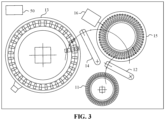
- FIG. 3 is such an example, the sample carrying part 11 may be a sample tray.
- the sample tray includes a plurality of sample positions where sample tubes may be placed.
- a sample By rotating a disc structure of the sample tray, a sample may be scheduled to a corresponding position, such as a position for the sample dispensing mechanism 12 to suck the sample.
- the sample dispensing mechanism 12 is configured to suck the sample and discharge the sample into a reaction cup to be added with the sample.
- the sample dispensing mechanism 12 may include a sample needle.
- the sample needle performs two-dimensional or three-dimensional movement in space through a two-dimensional or three-dimensional driving mechanism, so that the sample needle can move to suck the sample carried by the sample carrying part 11, move to a position of a reaction cup to be added with the sample, and discharge the sample into the reaction cup.
- the reagent part 20 is configured to carry a reagent in a test solution, suck the reagent, and provide the reagent to the measurement part 30.
- the reagent part 20 may include a reagent carrying part 13 and a reagent dispensing mechanism 14.
- the reagent carrying part 13 is configured to carry the reagent.
- the reagent carrying part 13 may be a reagent tray.
- the reagent tray is arranged in a disc structure and has a plurality of positions configured to carry reagent vessels.
- the reagent carrying part 13 can rotate and drive the reagent vessels carried by the reagent carrying part 13 to rotate, so as to rotate the reagent vessels to specific positions, for example, a position for the reagent dispensing mechanism 14 to suck the reagent.
- the sample dispensing mechanism 14 is configured to suck the reagent and discharge the reagent into a reaction cup to be added with the reagent.
- the sample dispensing mechanism 14 may include a reagent needle.
- the reagent needle performs two-dimensional or three-dimensional movement in space through a two-dimensional or three-dimensional driving mechanism, so that the reagent needle can move to suck the reagent carried by the reagent carrying part 13, move to a reaction cup to be added with the reagent, and discharge the reagent into the reaction cup.
- the measurement part 30 is configured to perform item testing on the sample, so as to obtain test data of items.
- the measurement part 30 may include a reaction part 15 and an optical measurement part 16.
- the reaction part is a measurement container.
- the measurement container is configured to carry a mixture prepared by a sample and a testing reagent.
- the optical measurement part 16 is configured to perform optical measurement on the mixture to obtain reaction data of the sample. If the optical measurement part 16 tests the luminous intensity of a reaction solution to be tested, the concentration and the like of a component to be tested in the sample are obtained by querying a calibration curve.
- the optical measurement part 16 includes a multi-wavelength light source, a spectrometer, an optical processing apparatus, and a signal collection apparatus. In some embodiments, the optical measurement part 16 may also be separately arranged outside the reaction part 15.
- an embodiment of the anti-interference test method in the embodiments of the disclosure includes the following steps.
- a reagent for performing item test is added to a sample and is mixed uniformly to obtain a sample mixture.
- the disclosure provides an anti-interference test method.
- the method does not need to determine the content of the interferent in the sample in advance, but directly performs item test on the sample, so that a sample pre-test step is omitted compared with the prior art, and the item test efficiency of the sample is improved.
- a reagent for performing the item test needs to be added to the sample and mixed uniformly to obtain a sample mixture.
- the sample mixture is irradiated by using multi-wavelength light
- the multi-wavelength light may include a primary wavelength and a secondary wavelength corresponding to a measurement item of the sample.
- a general test item When performing multi-wavelength test item analysis (such as immunoturbidimetry-based item test) on the sample, a general test item has the primary wavelength and secondary wavelength corresponding to the test item itself.
- the sample mixture is irradiated by using the multi-wavelength light including at least the primary wavelength and the secondary wavelength.
- the selection of the primary wavelength and the secondary wavelength of the test items mainly depend on the reagent requirements during the test items.
- the primary wavelength can characterize a reaction process between a sample and a reagent as much as possible, and on the other hand, it is also required to ensure that the signal intensity (i.e., the intensity of transmitted light) collected by the optical measurement part in the overall test process meets the requirement of the test items.
- the initial light intensity ⁇ 1 of the primary wavelength, the initial light intensity ⁇ 2 of the secondary wavelength, and a light intensity threshold value a corresponding to the measurement item are acquired.
- the light intensity that can be measured by the optical measurement is greater than a certain threshold value, so as to ensure the accuracy of the item test result of the sample.
- a certain threshold value Each measurement item of the sample corresponds to a respective light intensity threshold value, and the light intensity threshold value is generally determined by experiments.
- the embodiments of the disclosure need to correspondingly obtain an initial light intensity ⁇ 1 of the primary wavelength and an initial light intensity ⁇ 2 of the secondary wavelength matched with a measurement item, and a light intensity threshold value a corresponding to the measurement item, and S404 is executed according to a relationship among various light intensity values.
- an anti-interference test approach is performed on the sample according to comparison results of ⁇ 1 and ⁇ 2 with ⁇ .
- the anti-interference test approach is performed on the sample according to comparison results of ⁇ 1 and ⁇ 2 with ⁇ in the embodiments of the disclosure, so as to ensure the accuracy of the item measurement result of the sample.
- a reagent for performing item test is added to a sample and is mixed uniformly to obtain a sample mixture; the sample mixture is irradiated by using multi-wavelength light, herein the multi-wavelength light includes a primary wavelength and a secondary wavelength corresponding to a measurement item of the sample; an initial light intensity ⁇ 1 of the primary wavelength, an initial light intensity ⁇ 2 of the secondary wavelength, and a light intensity threshold value a corresponding to the measurement item are acquired; and an anti-interference test approach is performed on the sample according to comparison results of ⁇ 1 and ⁇ 2 with ⁇ . Therefore, an anti-interference measurement of the sample is realized without interferent pre-test of the sample.
- FIG. 5 illustrates detailed steps of S404 of the embodiment in FIG. 4 .
- ⁇ 1 is greater than or equal to ⁇
- the sample is tested by using the primary wavelength.
- the initial light intensity of the primary wavelength is not less than the light intensity threshold value corresponding to the measurement item, that is, ⁇ 1 is greater than or equal to ⁇ , that is, when the item test is performed on the sample by using the primary wavelength, the light intensity that can be collected by the optical measurement part can be ensured to meet the requirement of the test items of the sample, then the sample is tested by using the primary wavelength, so as to ensure the accuracy of the measurement item result.
- ⁇ 1 is smaller than a and ⁇ 2 is greater than or equal to ⁇ , the sample is tested by using the secondary wavelength.
- the initial light intensity of the primary wavelength is less than the light intensity threshold value corresponding to the measurement item, but the light intensity corresponding to the measurement item is not greater than the initial light intensity of the secondary wavelength, that is, ⁇ 1 is smaller than a and ⁇ 2 is greater than or equal to ⁇ , that is, when performing the item test on the sample by using the secondary wavelength, the light intensity that can be collected by the optical measurement part can be ensured to meet the requirement of the test items of the sample, then the sample is tested by using the secondary wavelength, so as to ensure the accuracy of the measurement item result.
- the following steps may be executed to realize anti-interference measurement of the sample.
- the following steps may be executed to realize anti-interference measurement of the sample.
- FIG. 6 another embodiment of the anti-interference test method in the embodiments of the disclosure includes the following steps.
- an initial light intensity ⁇ 3 of the sample mixture under irradiation of the primary wavelength is acquired after increasing the light source intensity corresponding to the primary wavelength, and/or increasing a gain of a sensor circuit for collecting the light intensity.
- the initial light intensity of the secondary wavelength is also less than the light intensity threshold value corresponding to the measurement item, that is, ⁇ 2 is smaller than ⁇
- the initial light intensity of the sample mixture under irradiation of the primary wavelength may be acquired again after increasing the light source intensity corresponding to the primary wavelength, and/or increasing the gain of a sensor circuit for collecting the light intensity ⁇ 3 ; and when ⁇ 3 is greater than or equal to ⁇ , the anti-interference test is performed on the sample by using the primary wavelength.
- the sensitivity of an optical detector can be improved regardless of whether increasing the light source intensity corresponding to the primary wavelength, or increasing the gain of a sensor circuit for collecting the light intensity. No matter which mode is adopted, accurate measurement of the measurement item of the sample may be realized as long as the initial light intensity of the primary wavelength is ensured not to be less than the light intensity threshold value corresponding to the measurement item.
- ⁇ 3 is greater than or equal to ⁇ , anti-interference test is performed on the sample by using the primary wavelength.
- the anti-interference measurement may be performed on the sample by using the primary wavelength, so as to ensure the accuracy of the measurement item result of the sample.
- the following steps may also be executed to realize accurate measurement of the test item of the sample.
- FIG. 7 another embodiment of the anti-interference test method in the embodiments of the disclosure includes the following steps.
- the sample mixture may further be diluted, and S702 may be executed after the sample is diluted.
- an initial light intensity ⁇ 5 of the diluted sample solution under irradiation of the primary wavelength is acquired.
- the initial light intensity ⁇ 5 of the diluted sample mixture under irradiation of the primary wavelength is acquired again after the sample mixture is diluted, and S703 is executed when the acquired initial light intensity ⁇ 5 is not less than the light intensity threshold value a corresponding to the measurement item.
- ⁇ 5 is greater than or equal to ⁇ , anti-interference test is performed on the sample by using the primary wavelength.
- the anti-interference test may be performed on the sample by using the primary wavelength continuously, so as to realize accurate measurement of the test item of the sample.
- the initial light intensity of the sample mixture under irradiation of the primary wavelength acquired again is still less than the light intensity threshold value corresponding to the measurement item after increasing the light source intensity corresponding to the primary wavelength, and/or increasing the gain of a sensor circuit for collecting the light intensity, that is, ⁇ 3 is smaller than ⁇ , how to realize a process of anti-interference measurement on the sample is described in detail, so that the accuracy of the test item result of the sample is further improved.
- FIG. 8 another embodiment of the anti-interference measurement method in the embodiments of the disclosure includes the following steps.
- an initial light intensity ⁇ 4 of the sample solution under irradiation of the secondary wavelength is acquired after increasing a light source intensity corresponding to the secondary wavelength, and/or increasing a gain of a sensor circuit for collecting the light intensity.
- the initial light intensity of the secondary wavelength is less than the light intensity threshold value corresponding to the measurement item, that is, ⁇ 2 is smaller than a
- the initial light intensity ⁇ 4 of the sample mixture under irradiation of the secondary wavelength further may be acquired again after increasing the light source intensity corresponding to the secondary wavelength, and/or increasing the gain of a sensor circuit for collecting the light intensity; and when ⁇ 4 is greater than or equal to a, the anti-interference test is performed on the sample by using the secondary wavelength.
- either increasing the light source intensity corresponding to the secondary wavelength or increasing the gain of the sensor circuit for collecting the light intensity is a mode to increase the initial light intensity of the secondary wavelength.
- accurate measurement of the measurement item of the sample may be realized as long as the initial light intensity of the secondary wavelength is ensured not to be less than the light intensity threshold value corresponding to the measurement item.
- ⁇ 4 is greater than or equal to a , then anti-interference test is performed on the sample by using the secondary wavelength.
- the anti-interference measurement may be performed on the sample by using the secondary wavelength, so as to ensure the accuracy of the measurement item result of the sample.
- FIG. 6 and FIG. 8 are two optional embodiments. Since the primary wavelength can better characterize a reaction process between a sample and a reagent, the embodiment of FIG. 6 is a more preferred embodiment compared with the embodiment of FIG. 8 .
- the following steps may also be executed to realize accurate measurement of the test item of the sample.
- another embodiment of the anti-interference test method in the embodiments of the disclosure includes the following steps.
- the sample mixture may further be diluted, and S902 is executed after the sample is diluted.
- the initial light intensity of the diluted sample mixture under the irradiation of the secondary wavelength is acquired.
- the initial light intensity ⁇ 6 of the diluted sample mixture under the irradiation of the secondary wavelength is acquired again after the sample mixture is diluted, and S903 is executed when the acquired initial light intensity ⁇ 6 is not less than the light intensity threshold value a corresponding to the measurement item.
- ⁇ 6 is greater than or equal to a , then anti-interference test is performed on the sample by using the secondary wavelength.
- the anti-interference test may be performed on the sample by using the secondary wavelength continuously, so as to realize accurate measurement of the test item of the sample.
- the initial light intensity of the sample mixture under the irradiation of the secondary wavelength acquired again is still less than the light intensity threshold value corresponding to the measurement item after increasing the light source intensity corresponding to the secondary wavelength, and/or increasing the gain of a sensor circuit for collecting the light intensity, that is, ⁇ 4 is smaller than ⁇ , how to realize a process of anti-interference measurement on the sample is described in detail, so that the accuracy of the test item result of the sample is further improved.
- the anti-interference test method when item test is performed on the sample by using a plurality of wavelengths is described in detail.
- the anti-interference test method for a test item which cannot switch the wavelength is described, such as an anti-interference test method of a chromogenic substrate method.
- There is only a single threshold value for single-wavelength anti-interference i.e., an anti-interference threshold value for the primary wavelength.
- another embodiment of the anti-interference test method in the embodiments of the disclosure includes the following steps.
- an initial light intensity ⁇ of the sample mixture under irradiation of a single wavelength is acquired when the sample is measured by using the single wavelength.
- an initial light intensity ⁇ of the sample mixture under the irradiation of the single wavelength is correspondingly acquired, and the following steps are executed according to the relationship between the single-wavelength initial light intensity and the light intensity corresponding to the measurement item.
- the initial light intensity of the single wavelength is not less than the light intensity corresponding to the measurement item, that is, ⁇ is greater than or equal to a , that is, when the item test is performed on the sample by using the single wavelength, the light intensity that can be collected by the optical measurement part can be ensured to meet the requirement of a test item of the sample, then the sample is tested by using the single wavelength, so as to ensure the accuracy of the measurement item result.
- an initial light intensity ⁇ 1 of the sample mixture under irradiation of the single wavelength is acquired after increasing the light source intensity corresponding to the single wavelength, and/or increasing the gain of a sensor circuit for collecting the light intensity.
- the initial light intensity of the single wavelength is less than the light intensity corresponding to the measurement item, that is, ⁇ is smaller than a
- the initial light intensity ⁇ 1 of the sample mixture under irradiation of the single wavelength is acquired again after increasing the light source intensity corresponding to the single wavelength, and/or increasing the gain of a sensor circuit for collecting the light intensity, and the following steps are executed according to a relationship between the initial light intensity ⁇ 1 and the light intensity a corresponding to the measurement item.
- ⁇ 1 is greater than or equal to a , then anti-interference test is performed on the sample by using the single wavelength.
- the anti-interference test may be performed on the sample by using the single wavelength, so as to ensure accurate measurement of the test item of the sample.
- the sample mixture under the irradiation of the single wavelength acquired again is still less than the light intensity threshold value corresponding to the measurement item after increasing the light source intensity corresponding to the single wavelength, and/or increasing the gain of a sensor circuit for collecting the light intensity, that is, ⁇ 1 is smaller than ⁇ , the sample mixture is diluted continuously, and S 1006 is executed after the diluting is completed.
- the initial light intensity ⁇ 2 of the diluted sample mixture under irradiation of the secondary wavelength is acquired.
- the initial light intensity ⁇ 2 of the diluted sample mixture under irradiation of the single wavelength is acquired after the sample mixture is diluted, and S 1007 is executed according to the relationship between ⁇ 2 and the light intensity a corresponding to the measurement item.
- the light intensity of the single wavelength may ensure the light intensity collected by the optical measurement part, then the anti-interference test is performed on the sample by using the single wavelength, so as to ensure the accuracy of the test item results of the sample.
- the anti-interference test method for the test items that cannot switch the wavelength (that is, using a single wavelength) is described in detail, so as to improve the accuracy of the results of the single-wavelength test items of the sample.
- an embodiment of the sample analyzer in the embodiments of the disclosure includes a measurement container 1101, an optical apparatus 1102, a light intensity collection apparatus 1103, and a processor 1104.
- the measurement container 1101 is configured to carry a mixture of a sample and a reagent for performing item measurement.
- the optical apparatus 1102 is configured to provide multi-wavelength light and irradiate the mixture by using the multi-wavelength light through a multi-wavelength light source 11021 and an optical processing apparatus 11022.
- the multi-wavelength light includes a primary wavelength and a secondary wavelength corresponding to a measurement item of the sample.
- the light intensity collecting apparatus 1103 is configured to acquire initial light intensities ⁇ 1 and ⁇ 2 of the sample mixture under irradiation of the primary wavelength and the secondary wavelength respectively.
- the processor 1104 is configured to:
- the processor 1104 is specifically configured to:
- the processor 1104 is further configured to:
- the processor 1104 is further configured to:
- the processor 1104 is further configured to:
- the processor 1104 is further configured to:
- the processor 1104 is further configured to:
- the processor 1104 is further configured to:
- the processor 1104 is further configured to:
- a reagent for performing item test is added to a sample in the measurement container 1101 and is mixed uniformly to obtain a sample mixture; the sample mixture is irradiated by using multi-wavelength light provided by the multi-wavelength light source 11021 and an optical processing apparatus 11022, herein the multi-wavelength light includes a primary wavelength and a secondary wavelength corresponding to a measurement item of the sample; the initial light intensity ⁇ 1 of the primary wavelength, the initial light intensity ⁇ 2 of the secondary wavelength, and a light intensity threshold value ⁇ corresponding to the measurement item are acquired through the light intensity collection apparatus 1103 and the processor 1104.
- the anti-interference test method is performed on the sample according to comparison results of ⁇ 1 and ⁇ 2 with ⁇ . Therefore, the anti-interference measurement of the sample is realized without pre-test of sample interference.
- the sample analyzer when the sample analyzer performs coagulation item tests, the sample analyzer is a coagulation analyzer. Structural parts and a working principle of the coagulation analyzer may refer to the embodiments described in FIG. 4 to FIG. 10 , which will not be elaborated herein.
- An embodiment of the disclosure further provides a computer-readable storage medium.
- the computer-readable storage medium is configured to realize the functions of the sample analyzer, which stores a computer program thereon.
- the processor may be configured to execute the following steps.
- a reagent for performing item test is added to a sample and is mixed uniformly to obtain a sample mixture.
- the sample mixture is irradiated by using multi-wavelength light
- the multi-wavelength light may include a primary wavelength and a secondary wavelength corresponding to a measurement item of the sample.
- An initial light intensity ⁇ 1 of the primary wavelength, an initial light intensity ⁇ 2 of the secondary wavelength, and a light intensity threshold value a corresponding to the measurement item are acquired.
- the processor when the computer program stored in the computer-readable storage medium is executed by the processor, the processor may also execute the following steps.
- the sample is tested by using the primary wavelength.
- the sample is tested by using the secondary wavelength.
- the processor when the computer program stored in the computer-readable storage medium is executed by the processor, the processor may also execute the following steps.
- an initial light intensity ⁇ 3 of the sample mixture under the irradiation of the primary wavelength is acquired after increasing the light source intensity corresponding to the primary wavelength, and/or increasing the gain of a sensor circuit for collecting the light intensity.
- anti-interference test is performed on the sample by using the primary wavelength.
- the processor when the computer program stored in the computer-readable storage medium is executed by the processor, the processor may also execute the following steps.
- an initial light intensity ⁇ 4 of the sample mixture under the irradiation of the secondary wavelength is acquired after increasing a light source intensity corresponding to the secondary wavelength, and/or increasing a gain of a sensor circuit for collecting the light intensity.
- anti-interference test is performed on the sample by using the secondary wavelength.
- the processor when the computer program stored in the computer-readable storage medium is executed by the processor, the processor may also execute the following steps.
- the sample mixture is diluted.
- anti-interference test is performed on the sample by using the primary wavelength.
- the processor when the computer program stored in the computer-readable storage medium is executed by the processor, the processor may also execute the following steps.
- the sample mixture is diluted.
- anti-interference test is performed on the sample by using the secondary wavelength.
- the processor when the computer program stored in the computer-readable storage medium is executed by the processor, the processor may also execute the following steps.
- An initial light intensity ⁇ of the sample mixture under irradiation of a single wavelength is acquired when the sample is measured by using the single wavelength.
- item test is performed on the sample by using the single wavelength.
- the processor when the computer program stored in the computer-readable storage medium is executed by the processor, the processor may also execute the following steps.
- an initial light intensity ⁇ 1 of the sample mixture under the irradiation of the single wavelength is acquired after increasing the light source intensity corresponding to the single wavelength, and/or increasing the gain of a sensor circuit for collecting the light intensity.
- anti-interference test is performed on the sample by using the single wavelength.
- the processor when the computer program stored in the computer-readable storage medium is executed by the processor, the processor may also execute the following steps.
- the sample mixture is diluted.
- anti-interference test is performed on the sample by using the single wavelength.
- the disclosed system, apparatus, and method may be implemented in other modes.
- the described apparatus embodiment is merely an example.
- the unit division is merely logical function division and may be other division in actual implementation.
- a plurality of units or components may be combined or integrated into another system, or some features may be ignored or may not be performed.
- the displayed or discussed mutual couplings or direct couplings or communication connections may be implemented by using some interfaces.
- the indirect couplings or communication connections between the apparatuses or units may be implemented in electronic, mechanical, or other forms.
- the units described as separate parts may or may not be physically separate, and parts displayed as units may or may not be physical units, may be located in one position, or may be distributed on a plurality of network elements. Some or all of the units may be selected based on actual requirements to achieve the objectives of the solutions of the embodiments.
- functional units in the embodiments of the disclosure may be integrated into one processing unit, or each of the units may exist alone physically, or two or more units may be integrated into one unit.
- the abovementioned integrated unit may be implemented in a hardware form and may also be implemented in form of software functional unit.
- the integrated unit may be stored in a computer-readable storage medium if being implemented in the form of a software functional unit and sold or used as a standalone product. Based on such an understanding, the technical solutions of the disclosure essentially, or the part contributing to the prior art, or all or part of the technical solutions may be implemented in a form of a software product.
- the computer software product is stored in a storage medium, and includes a plurality of instructions for instructing a computer device (which may be a personal computer, a server, a network device, etc.) to execute all or part of the steps of the methods in various embodiments of the disclosure.
- the foregoing storage medium includes: various media that may store program codes, such as a USB Flash Drive, a mobile hard disk drive, a Read-Only Memory (ROM), a Random Access Memory (RAM), a magnetic disk, or an optical disk.
Landscapes
- Physics & Mathematics (AREA)
- Chemical & Material Sciences (AREA)
- General Health & Medical Sciences (AREA)
- General Physics & Mathematics (AREA)
- Life Sciences & Earth Sciences (AREA)
- Spectroscopy & Molecular Physics (AREA)
- Analytical Chemistry (AREA)
- Biochemistry (AREA)
- Pathology (AREA)
- Health & Medical Sciences (AREA)
- Immunology (AREA)
- Engineering & Computer Science (AREA)
- Chemical Kinetics & Catalysis (AREA)
- Plasma & Fusion (AREA)
- Quality & Reliability (AREA)
- Investigating Or Analysing Materials By Optical Means (AREA)
- Investigating Or Analysing Materials By The Use Of Chemical Reactions (AREA)
Abstract
Description
- The disclosure relates to the technical field of sample test, and in particular, to an anti-interference test method and a sample analyzer.
- When coagulation items are tested by using an optical method, the absorbance of a solution is usually obtained by irradiating the solution in a reaction cup with collimated light and analyzing scattered or transmitted light, so as to obtain a coagulation time or the concentration of a matter to be tested.
- In general, normal plasma is light yellow and transparent and has very low absorbance, while a jaundice and hemolysis sample with an obvious absorption peak, and a chylous sample which may seriously affect the transmittance may affect the measurement and challenge the credibility of the optical method.
- On this basis, the prior art provides a sample pre-test-based anti-interference method. The method needs to perform interferent test on a sample in advance, and determine whether anti-interference measurement needs to be performed on the basis of a test result.
- Common anti-interference methods have the following problems.
- 1. Blood sample waste: blood samples are wasted for interferent test.
- 2. Reaction cup waste or colorimetric cell structure addition: the interferent test is usually performed by using a cup splitting method or a colorimetric cell method. The former one is a waste of reaction cups and increases the test cost, and the later one increases the instrument complexity.
- 3. Process addition: an interferent measurement process is added, so that the item test speed for the sample is reduced.
- In view of this, how to realize the anti-interference measurement of the sample without sample pre-test is an urgent problem to be solved.
- The embodiments of the disclosure provide an anti-interference test method and a sample analyzer, which are used for realizing anti-interference processing for a sample without sample pre-test.
- A first aspect of the embodiments of the disclosure provides an anti-interference test method, including the following operations.
- A reagent for performing item test is added to a sample and is mixed uniformly to obtain a sample mixture.
- The sample mixture is irradiated by using multi-wavelength light, herein the multi-wavelength light may include a primary wavelength and a secondary wavelength corresponding to a measurement item of the sample.
- An initial light intensity γ1 of the primary wavelength, an initial light intensity γ2 of the secondary wavelength, and a light intensity threshold value a corresponding to the measurement item are acquired.
- The anti-interference test approach is performed on the sample according to comparison results of γ1 and γ2 with α .
- Preferably, the operation that the anti-interference test method is performed on the sample according to comparison results of γ1 and γ2 with α may include the following operations.
- In response to γ1 being greater than or equal to α, the sample is tested by using the primary wavelength.
- In response to γ1 being smaller than α, and γ2 being greater than or equal to α, the sample is tested by using the secondary wavelength.
- Preferably, the operation that the anti-interference test approach is performed on the sample according to comparison results of γ1 and γ2 with α may further include the following operations.
- In response to γ2 being smaller than a, an initial light intensity γ3 of the sample mixture under the irradiation of the primary wavelength is acquired after increasing the light source intensity corresponding to the primary wavelength, and/or increasing a gain of a sensor circuit for collecting the light intensity.
- In response to γ3 being greater than or equal to a, anti-interference test is performed on the sample by using the primary wavelength.
- Preferably, the operation that the anti-interference test method is performed on the sample according to comparison results of γ1 and γ2 with α may further include the following operations.
- In response to γ2 being smaller than α, an initial light intensity γ4 of the sample mixture under the irradiation of the secondary wavelength is acquired after increasing a light source intensity corresponding to the secondary wavelength, and/or increasing a gain of a sensor circuit for collecting the light intensity.
- In response to γ4 being greater than or equal to α, anti-interference test is performed on the sample by using the secondary wavelength.
- Preferably, the method may further include the following operations.
- In response to γ3 being smaller than α, the sample mixture is diluted.
- An initial light intensity γ5 of the diluted sample solution under the irradiation of the primary wavelength is acquired.
- In response to γ5 being greater than or equal to α, anti-interference test is performed on the sample by using the primary wavelength.
- Preferably, the method may further include the following operations.
- In response to γ4 being smaller than α, the sample mixture is diluted.
- An initial light intensity γ6 of the diluted sample solution under the irradiation of the secondary wavelength is acquired.
- In response to γ6 being greater than or equal to α, anti-interference test is performed on the sample by using the secondary wavelength.
- Preferably, the method may further include the following operations.
- An initial light intensity ϕ of the sample mixture under the irradiation of a single wavelength is acquired when the sample is measured by using the single wavelength.
- In response to ϕ being greater than or equal to a, item test is performed on the sample by using the single wavelength.
- Preferably, the method may further include the following operations.
- In response to ϕ being smaller than α, an initial light intensity ϕ1 of the sample mixture under the irradiation of the single wavelength is acquired after increasing the light source intensity corresponding to the single wavelength, and/or increasing the gain of a sensor circuit for collecting the light intensity.
- In response to ϕ1 being greater than or equal to a, anti-interference test is performed on the sample by using the single wavelength.
- Preferably, the method may further include the following operations.
- In response to ϕ1 being smaller than α, the sample mixture is diluted.
- An initial light intensity ϕ2 of the diluted sample solution under the irradiation of the single wavelength is acquired.
- In response to ϕ2 being greater than or equal to α, anti-interference test is performed on the sample by using the single wavelength.
- A second aspect of the embodiments of the disclosure provides a sample analyzer, which may include a measurement container, an optical apparatus, a light intensity collecting apparatus, and a processor.
- The measurement container may be configured to carry a mixture of a sample and a reagent for performing item measurement.
- The optical apparatus may be configured to provide multi-wavelength light and irradiate the mixture by using the multi-wavelength light, herein the multi-wavelength light may include a primary wavelength and a secondary wavelength corresponding to a measurement item of the sample.
- The light intensity collecting apparatus may be configured to acquire initial light intensities γ1 and γ2 of the sample mixture under irradiation of the primary wavelength and the secondary wavelength respectively.
- The processor may be configured to:
- acquire a light intensity threshold value a corresponding to the measurement item; and
- perform an anti-interference test approach on the sample according to comparison results of γ1 and γ2 with α .
- Preferably, the processor may specifically be configured to:
- in response to γ1 being greater than or equal to α, test the sample by using the primary wavelength; and
- in response to γ1 being smaller than a, and γ2 being greater than or equal to α, test the sample by using the secondary wavelength.
- Preferably, the processor may further be configured to:
- in response to γ1 being smaller than a, acquire an initial light intensity γ3 of the sample mixture under irradiation of the primary wavelength after increasing the light source intensity corresponding to the primary wavelength, and/or increasing a gain of a sensor circuit for collecting the light intensity; and
- in response to γ3 being greater than or equal to a, perform anti-interference test on the sample by using the primary wavelength.
- Preferably, the processor may further be configured to:
- in response to γ2 being smaller than α, acquire an initial light intensity γ4 of the sample solution under irradiation of the secondary wavelength after increasing a light source intensity corresponding to the secondary wavelength, and/or increasing a gain of a sensor circuit for collecting the light intensity; and
- in response to γ4 being greater than or equal to a, perform anti-interference test on the sample by using the secondary wavelength.
- Preferably, the processor may further be configured to:
- in response to γ3 being smaller than α, dilute the sample mixture;
- acquire the initial light intensity of the diluted sample solution under the irradiation of the primary wavelength; and
- in response to γ5 being greater than or equal to α, perform anti-interference test on the sample by using the primary wavelength.
- Preferably, the processor may further be configured to:
- in response to γ4 being smaller than α, dilute the sample mixture;
- acquire an initial light intensity γ6 of the diluted sample solution under the irradiation of the secondary wavelength; and
- in response to γ6 being greater than or equal to α, perform anti-interference test on the sample by using the secondary wavelength.
- Preferably, the processor may further be configured to:
- acquire an initial light intensity ϕ of the sample mixture under the irradiation of a single wavelength when the sample is measured by using the single wavelength; and
- in response to ϕ being greater than or equal to α, perform item test on the sample by using the single wavelength.
- Preferably, the processor may further be configured to:
- in response to ϕ being smaller than a, acquire an initial light intensity ϕ1 of the sample mixture under the irradiation of the single wavelength after increasing the light source intensity corresponding to the single wavelength, and/or increasing the gain of a sensor circuit for collecting the light intensity; and
- in response to ϕ1 being greater than or equal to α, perform anti-interference test on the sample by using the single wavelength.
- Preferably, the processor may further be configured to:
- in response to ϕ1 being smaller than α, dilute the sample mixture;
- acquire an initial light intensity ϕ2 of the diluted sample solution under the irradiation of the single wavelength; and
- in response to ϕ2 being greater than or equal to α, perform anti-interference test on the sample by using the single wavelength.
- Preferably, the sample analyzer may be a coagulation analyzer.
- The embodiments of the disclosure further provide a computer storage medium, which stores a computer program. When being executed by a processor, the computer program is configured to implement the anti-interference test method provided by the first aspect of the embodiments of the disclosure.
- In the technical solution provided by the embodiments of the disclosure, a reagent for performing item test is added to a sample and is mixed uniformly to obtain a sample mixture; the sample mixture is irradiated by using multi-wavelength light, herein the multi-wavelength light includes a primary wavelength and a secondary wavelength corresponding to a measurement item of the sample; the initial light intensity γ1 of the primary wavelength, the initial light intensity γ2 of the secondary wavelength, and a light intensity threshold value α corresponding to the measurement item are acquired; and the anti-interference test method is performed on the sample according to comparison results of γ1 and γ2 with α. Therefore, the anti-interference measurement of the sample is realized without pre-test of sample interference.
-
-
FIG. 1 illustrates a schematic structural diagram of a sample analyzer in the embodiments of the disclosure. -
FIG. 2 illustrates another schematic structural diagram of a sample analyzer in the embodiments of the disclosure. -
FIG. 3 illustrates another schematic structural diagram of a sample analyzer in the embodiments of the disclosure. -
FIG. 4 illustrates a schematic diagram of an embodiment of an anti-interference test method in the embodiments of the disclosure. -
FIG. 5 illustrates detailed steps of S404 of the embodiment inFIG. 4 in the embodiments of the disclosure. -
FIG. 6 illustrates a schematic diagram of another embodiment of an anti-interference test method in the embodiments of the disclosure. -
FIG. 7 illustrates a schematic diagram of another embodiment of an anti-interference test method in the embodiments of the disclosure. -
FIG. 8 illustrates a schematic diagram of another embodiment of the anti-interference test method in the embodiments of the disclosure. -
FIG. 9 illustrates a schematic diagram of another embodiment of an anti-interference test method in the embodiments of the disclosure. -
FIG. 10 illustrates a schematic diagram of another embodiment of an anti-interference test method in the embodiments of the disclosure. -
FIG. 11 illustrates a schematic diagram of an embodiment of a sample analyzer in the embodiments of the disclosure. - Technical solutions in the embodiment of the present disclosure will be clearly and completely described below with reference to the drawings in the embodiments of the present disclosure. Apparently, the described embodiments are merely part rather than all of the embodiments of the present disclosure. On the basis of the embodiments of the present disclosure, all other embodiments obtained on the premise of no creative work of those skilled in the art fall within the scope of protection of the present disclosure.
- Terms "first", "second", "third", "fourth", etc., (if existing), in the specification, claims, and drawings of the disclosure are adopted not to describe a specific sequence or order but to distinguish similar objects. It should be understood that the data termed in such a way are interchangeable in proper circumstances so that the embodiments described herein can be implemented in orders other than the order illustrated or described herein. In addition, terms "include" and "have" and any variations thereof are intended to cover non-exclusive inclusions. For example, it is not limited for processes, methods, systems, products or devices containing a series of steps or units to clearly list those steps or units, and other steps or units which are not clearly listed or are inherent to these processes, methods, products or devices may be included instead.
- The structure of the sample analyzer is described first before specifically describing the disclosure. Referring to
FIG. 1 , in an embodiment, the sample analyzer may include asample part 10, areagent part 20, ameasurement part 30, amemory 40, and aprocessor 50. In some embodiments, referring toFIG. 2 , the sample analyzer may further include adisplay operation part 60. The following is a detailed description. - The
sample part 10 is configured to carry a sample in a test solution, suck the sample, and provide the sample to themeasurement part 30. Referring toFIG. 3 , thesample part 10 in some embodiments may include asample carrying part 11 and asample dispensing mechanism 12. Thesample carrying part 11 is configured to carry the sample. In some embodiments, thesample carrying part 11 may include a Sample Delivery Module (SDM) and a front-end rail. In some other embodiments, for example,FIG. 3 is such an example, thesample carrying part 11 may be a sample tray. The sample tray includes a plurality of sample positions where sample tubes may be placed. By rotating a disc structure of the sample tray, a sample may be scheduled to a corresponding position, such as a position for thesample dispensing mechanism 12 to suck the sample. Thesample dispensing mechanism 12 is configured to suck the sample and discharge the sample into a reaction cup to be added with the sample. For example, thesample dispensing mechanism 12 may include a sample needle. The sample needle performs two-dimensional or three-dimensional movement in space through a two-dimensional or three-dimensional driving mechanism, so that the sample needle can move to suck the sample carried by thesample carrying part 11, move to a position of a reaction cup to be added with the sample, and discharge the sample into the reaction cup. - The
reagent part 20 is configured to carry a reagent in a test solution, suck the reagent, and provide the reagent to themeasurement part 30. In some embodiments, thereagent part 20 may include areagent carrying part 13 and areagent dispensing mechanism 14. Thereagent carrying part 13 is configured to carry the reagent. In an embodiment, thereagent carrying part 13 may be a reagent tray. The reagent tray is arranged in a disc structure and has a plurality of positions configured to carry reagent vessels. Thereagent carrying part 13 can rotate and drive the reagent vessels carried by thereagent carrying part 13 to rotate, so as to rotate the reagent vessels to specific positions, for example, a position for thereagent dispensing mechanism 14 to suck the reagent. There may be one or morereagent carrying parts 13. Thesample dispensing mechanism 14 is configured to suck the reagent and discharge the reagent into a reaction cup to be added with the reagent. In some embodiments, thesample dispensing mechanism 14 may include a reagent needle. The reagent needle performs two-dimensional or three-dimensional movement in space through a two-dimensional or three-dimensional driving mechanism, so that the reagent needle can move to suck the reagent carried by thereagent carrying part 13, move to a reaction cup to be added with the reagent, and discharge the reagent into the reaction cup. - The
measurement part 30 is configured to perform item testing on the sample, so as to obtain test data of items. In some embodiments, themeasurement part 30 may include areaction part 15 and anoptical measurement part 16. Specifically, in the embodiments of the disclosure, the reaction part is a measurement container. The measurement container is configured to carry a mixture prepared by a sample and a testing reagent. Theoptical measurement part 16 is configured to perform optical measurement on the mixture to obtain reaction data of the sample. If theoptical measurement part 16 tests the luminous intensity of a reaction solution to be tested, the concentration and the like of a component to be tested in the sample are obtained by querying a calibration curve. Specifically, in the present embodiment, theoptical measurement part 16 includes a multi-wavelength light source, a spectrometer, an optical processing apparatus, and a signal collection apparatus. In some embodiments, theoptical measurement part 16 may also be separately arranged outside thereaction part 15. - Based on the embodiments described in
FIG. 1 to FIG. 3 , the anti-interference test method in the embodiments of the disclosure is described below. Referring toFIG. 4 , an embodiment of the anti-interference test method in the embodiments of the disclosure includes the following steps. - At 401, a reagent for performing item test is added to a sample and is mixed uniformly to obtain a sample mixture.
- This is different from the prior art, in which it is necessary to measure the content of an interferent in the sample first and analyze the test items of the sample according to the measured content of the interferent, thus causing the problems of too many measurement steps for the test item of the sample and low test efficiency.
- The disclosure provides an anti-interference test method. The method does not need to determine the content of the interferent in the sample in advance, but directly performs item test on the sample, so that a sample pre-test step is omitted compared with the prior art, and the item test efficiency of the sample is improved.
- Specifically, before the item test is performed on the sample, a reagent for performing the item test needs to be added to the sample and mixed uniformly to obtain a sample mixture.
- At 402, the sample mixture is irradiated by using multi-wavelength light, herein the multi-wavelength light may include a primary wavelength and a secondary wavelength corresponding to a measurement item of the sample.
- When performing multi-wavelength test item analysis (such as immunoturbidimetry-based item test) on the sample, a general test item has the primary wavelength and secondary wavelength corresponding to the test item itself. In the present embodiment, after the sample mixture is obtained, the sample mixture is irradiated by using the multi-wavelength light including at least the primary wavelength and the secondary wavelength.
- The selection of the primary wavelength and the secondary wavelength of the test items mainly depend on the reagent requirements during the test items. When performing a test item on the sample, on one hand, it is required that the primary wavelength can characterize a reaction process between a sample and a reagent as much as possible, and on the other hand, it is also required to ensure that the signal intensity (i.e., the intensity of transmitted light) collected by the optical measurement part in the overall test process meets the requirement of the test items.
- At 403, the initial light intensity γ1 of the primary wavelength, the initial light intensity γ2 of the secondary wavelength, and a light intensity threshold value a corresponding to the measurement item are acquired.
- It is easy to understand that when performing the item test on the sample, certain interference will be caused to the item test result of the sample if the content of the interferent in the sample exceeds an interferent content threshold value, so that the accuracy of the item test of the sample is reduced.
- In order to ensure the accuracy of the item test result of the sample, when performing the item test on the sample by using the optical measurement part, it is generally required that the light intensity that can be measured by the optical measurement is greater than a certain threshold value, so as to ensure the accuracy of the item test result of the sample. Each measurement item of the sample corresponds to a respective light intensity threshold value, and the light intensity threshold value is generally determined by experiments.
- Therefore, in order to ensure the accuracy of the item test result of the sample, that is, in order to realize the anti-interference measurement of the sample, the embodiments of the disclosure need to correspondingly obtain an initial light intensity γ1 of the primary wavelength and an initial light intensity γ2 of the secondary wavelength matched with a measurement item, and a light intensity threshold value a corresponding to the measurement item, and S404 is executed according to a relationship among various light intensity values.
- At 404, an anti-interference test approach is performed on the sample according to comparison results of γ1 and γ2 with α .
- After the initial light intensity γ1 of the primary wavelength and the initial light intensity γ2 of the secondary wavelength matched with the measurement item, and the light intensity threshold value a corresponding to the measurement item are obtained, the anti-interference test approach is performed on the sample according to comparison results of γ1 and γ2 with α in the embodiments of the disclosure, so as to ensure the accuracy of the item measurement result of the sample.
- A process of how to perform the anti-interference test approach on the sample according to comparison results of γ1 and γ2 with α will be described in detail in the following embodiments, which will not be elaborated herein.
- In the technical solution according to the embodiments of the disclosure, a reagent for performing item test is added to a sample and is mixed uniformly to obtain a sample mixture; the sample mixture is irradiated by using multi-wavelength light, herein the multi-wavelength light includes a primary wavelength and a secondary wavelength corresponding to a measurement item of the sample; an initial light intensity γ1 of the primary wavelength, an initial light intensity γ2 of the secondary wavelength, and a light intensity threshold value a corresponding to the measurement item are acquired; and an anti-interference test approach is performed on the sample according to comparison results of γ1 and γ2 with α. Therefore, an anti-interference measurement of the sample is realized without interferent pre-test of the sample.
- Based on the embodiment described in
FIG. 4 , S404 is described in detail below, referring toFIG. 5 , which illustrates detailed steps of S404 of the embodiment inFIG. 4 . - At 501, if γ1 is greater than or equal to α, the sample is tested by using the primary wavelength.
- If the initial light intensity of the primary wavelength is not less than the light intensity threshold value corresponding to the measurement item, that is, γ1 is greater than or equal to α, that is, when the item test is performed on the sample by using the primary wavelength, the light intensity that can be collected by the optical measurement part can be ensured to meet the requirement of the test items of the sample, then the sample is tested by using the primary wavelength, so as to ensure the accuracy of the measurement item result.
- At 502, if γ1 is smaller than a and γ2 is greater than or equal to α, the sample is tested by using the secondary wavelength.
- If the initial light intensity of the primary wavelength is less than the light intensity threshold value corresponding to the measurement item, but the light intensity corresponding to the measurement item is not greater than the initial light intensity of the secondary wavelength, that is, γ1 is smaller than a and γ2 is greater than or equal to α, that is, when performing the item test on the sample by using the secondary wavelength, the light intensity that can be collected by the optical measurement part can be ensured to meet the requirement of the test items of the sample, then the sample is tested by using the secondary wavelength, so as to ensure the accuracy of the measurement item result.
- In the embodiments of the disclosure, when performing the item test on the sample by using a plurality of wavelengths, how to implement the anti-interference test approach through wavelength switching is described in detail. When γ1 is greater than or equal to a , the sample is tested by using the primary wavelength; and when γ1 is smaller than a and γ2 is greater than or equal to α, the sample is tested by using the secondary wavelength, so that the accuracy of the item test result of the sample is improved.
- Based on the embodiment described in
FIG. 5 , when the initial light intensity of the secondary wavelength is less than the light intensity corresponding to the measurement item, that is, γ2 is smaller than α, the following steps may be executed to realize anti-interference measurement of the sample. Specifically referring toFIG. 6 , another embodiment of the anti-interference test method in the embodiments of the disclosure includes the following steps. - At 601, if γ2 is smaller than α, an initial light intensity γ3 of the sample mixture under irradiation of the primary wavelength is acquired after increasing the light source intensity corresponding to the primary wavelength, and/or increasing a gain of a sensor circuit for collecting the light intensity.
- If the initial light intensity of the secondary wavelength is also less than the light intensity threshold value corresponding to the measurement item, that is, γ2 is smaller than α, the initial light intensity of the sample mixture under irradiation of the primary wavelength may be acquired again after increasing the light source intensity corresponding to the primary wavelength, and/or increasing the gain of a sensor circuit for collecting the light intensity γ3 ; and when γ3 is greater than or equal to α, the anti-interference test is performed on the sample by using the primary wavelength.
- It is easy to understand that, in the embodiments of the disclosure, the sensitivity of an optical detector can be improved regardless of whether increasing the light source intensity corresponding to the primary wavelength, or increasing the gain of a sensor circuit for collecting the light intensity. No matter which mode is adopted, accurate measurement of the measurement item of the sample may be realized as long as the initial light intensity of the primary wavelength is ensured not to be less than the light intensity threshold value corresponding to the measurement item.
- At 602, if γ3 is greater than or equal to α, anti-interference test is performed on the sample by using the primary wavelength.
- After increasing the light source intensity corresponding to the primary wavelength, and/or increasing the gain of a sensor circuit for collecting the light intensity, as long as γ3 is greater than or equal to a , that is, the initial light intensity of the primary wavelength is not less than the light intensity threshold value corresponding to the measurement item, the anti-interference measurement may be performed on the sample by using the primary wavelength, so as to ensure the accuracy of the measurement item result of the sample.
- In the embodiments of the disclosure, when the light intensity of the secondary wavelength is also less than the light intensity threshold value corresponding to the measurement item, a process of implementing anti-interference measurement of the sample is described in detail, and the accuracy of the item test result of the sample is improved.
- Based on the embodiment described in
FIG. 6 , if the initial light intensity of the sample mixture under irradiation of the primary wavelength acquired again is still less than the light intensity threshold value corresponding to the measurement item after increasing the light source intensity corresponding to the primary wavelength, and/or increasing the gain of a sensor circuit for collecting the light intensity, that is, γ3 is smaller than a , the following steps may also be executed to realize accurate measurement of the test item of the sample. Specifically referring toFIG. 7 , another embodiment of the anti-interference test method in the embodiments of the disclosure includes the following steps. - At 701, if γ3 is smaller than α, the sample mixture is diluted.
- If the initial light intensity of the sample mixture under irradiation of the primary wavelength acquired again is still less than the light intensity threshold value corresponding to the measurement item after increasing the light source intensity corresponding to the primary wavelength, and/or increasing the gain of a sensor circuit for collecting the light intensity, that is, γ3 is smaller than a, the sample mixture may further be diluted, and S702 may be executed after the sample is diluted.
- At 702, an initial light intensity γ5 of the diluted sample solution under irradiation of the primary wavelength is acquired.
- The initial light intensity γ5 of the diluted sample mixture under irradiation of the primary wavelength is acquired again after the sample mixture is diluted, and S703 is executed when the acquired initial light intensity γ5 is not less than the light intensity threshold value a corresponding to the measurement item.
- At 703, if γ5 is greater than or equal to α, anti-interference test is performed on the sample by using the primary wavelength.
- If the acquired initial light intensity of the sample mixture under irradiation of the primary wavelength is not less than the light intensity threshold value corresponding to the measurement item after the sample mixture is diluted, that is, γ5 is greater than or equal to a, the anti-interference test may be performed on the sample by using the primary wavelength continuously, so as to realize accurate measurement of the test item of the sample.
- In the embodiments of the disclosure, if the initial light intensity of the sample mixture under irradiation of the primary wavelength acquired again is still less than the light intensity threshold value corresponding to the measurement item after increasing the light source intensity corresponding to the primary wavelength, and/or increasing the gain of a sensor circuit for collecting the light intensity, that is, γ3 is smaller than α, how to realize a process of anti-interference measurement on the sample is described in detail, so that the accuracy of the test item result of the sample is further improved.
- Based on the embodiment described in
FIG. 5 , when γ2 is smaller than α, the following steps may also be executed, so as to realize anti-interference measurement of the sample. Referring toFIG. 8 , another embodiment of the anti-interference measurement method in the embodiments of the disclosure includes the following steps. - At 801, if γ2 is smaller than α, an initial light intensity γ4 of the sample solution under irradiation of the secondary wavelength is acquired after increasing a light source intensity corresponding to the secondary wavelength, and/or increasing a gain of a sensor circuit for collecting the light intensity.
- If the initial light intensity of the secondary wavelength is less than the light intensity threshold value corresponding to the measurement item, that is, γ2 is smaller than a , the initial light intensity γ4 of the sample mixture under irradiation of the secondary wavelength further may be acquired again after increasing the light source intensity corresponding to the secondary wavelength, and/or increasing the gain of a sensor circuit for collecting the light intensity; and when γ4 is greater than or equal to a, the anti-interference test is performed on the sample by using the secondary wavelength.
- It is easy to understand that, in the embodiments of the disclosure, either increasing the light source intensity corresponding to the secondary wavelength or increasing the gain of the sensor circuit for collecting the light intensity is a mode to increase the initial light intensity of the secondary wavelength. No matter which mode is adopted, accurate measurement of the measurement item of the sample may be realized as long as the initial light intensity of the secondary wavelength is ensured not to be less than the light intensity threshold value corresponding to the measurement item.
- At 802, if γ4 is greater than or equal to a , then anti-interference test is performed on the sample by using the secondary wavelength.
- As long as γ4 is greater than or equal to α, that is, the initial light intensity of the secondary wavelength is not less than the light intensity threshold value corresponding to the measurement item after increasing a light source intensity corresponding to the secondary wavelength, and/or increasing a gain of a sensor circuit for collecting the light intensity, the anti-interference measurement may be performed on the sample by using the secondary wavelength, so as to ensure the accuracy of the measurement item result of the sample.
- In the embodiments of the disclosure, when the initial light intensity of the secondary wavelength is less than the light intensity threshold value corresponding to the measurement item, how to realize a process of the anti-interference measurement of the sample is described in detail, and the accuracy of the item test result of the sample is improved.
- It is to be noted that
FIG. 6 andFIG. 8 are two optional embodiments. Since the primary wavelength can better characterize a reaction process between a sample and a reagent, the embodiment ofFIG. 6 is a more preferred embodiment compared with the embodiment ofFIG. 8 . - Based on the embodiment described in
FIG. 8 , if the initial light intensity of the sample mixture under irradiation of the secondary wavelength acquired again is still less than the light intensity threshold value corresponding to the measurement item after increasing the light source intensity corresponding to the secondary wavelength, and/or increasing the gain of a sensor circuit for collecting the light intensity, that is, γ4 is smaller than a , the following steps may also be executed to realize accurate measurement of the test item of the sample. Specifically referring toFIG. 9 , another embodiment of the anti-interference test method in the embodiments of the disclosure includes the following steps. - At 901, if γ4 is smaller than α, the sample mixture is diluted.
- If the initial light intensity of the sample mixture under irradiation of the secondary wavelength acquired again is still less than the light intensity threshold value corresponding to the measurement item after increasing the light source intensity corresponding to the secondary wavelength, and/or increasing the gain of a sensor circuit for collecting the light intensity, that is, γ4 is smaller than a, the sample mixture may further be diluted, and S902 is executed after the sample is diluted.
- At 902, the initial light intensity of the diluted sample mixture under the irradiation of the secondary wavelength is acquired.
- The initial light intensity γ6 of the diluted sample mixture under the irradiation of the secondary wavelength is acquired again after the sample mixture is diluted, and S903 is executed when the acquired initial light intensity γ6 is not less than the light intensity threshold value a corresponding to the measurement item.
- At 903, if γ6 is greater than or equal to a , then anti-interference test is performed on the sample by using the secondary wavelength.
- If the acquired initial light intensity of the sample mixture under the irradiation of the secondary wavelength is not less than the light intensity threshold value corresponding to the measurement item after the sample mixture is diluted, that is, γ6 is greater than or equal to α, the anti-interference test may be performed on the sample by using the secondary wavelength continuously, so as to realize accurate measurement of the test item of the sample.
- In the embodiments of the disclosure, if the initial light intensity of the sample mixture under the irradiation of the secondary wavelength acquired again is still less than the light intensity threshold value corresponding to the measurement item after increasing the light source intensity corresponding to the secondary wavelength, and/or increasing the gain of a sensor circuit for collecting the light intensity, that is, γ4 is smaller than α, how to realize a process of anti-interference measurement on the sample is described in detail, so that the accuracy of the test item result of the sample is further improved.
- In the embodiments above, the anti-interference test method when item test is performed on the sample by using a plurality of wavelengths is described in detail. The anti-interference test method for a test item which cannot switch the wavelength (that is, using a single wavelength) is described, such as an anti-interference test method of a chromogenic substrate method. There is only a single threshold value for single-wavelength anti-interference, i.e., an anti-interference threshold value for the primary wavelength.
- Specifically, referring to
FIG. 10 , another embodiment of the anti-interference test method in the embodiments of the disclosure includes the following steps. - At 1001, an initial light intensity ϕ of the sample mixture under irradiation of a single wavelength is acquired when the sample is measured by using the single wavelength.
- When the sample is measured by the single wavelength, an initial light intensity ϕ of the sample mixture under the irradiation of the single wavelength is correspondingly acquired, and the following steps are executed according to the relationship between the single-wavelength initial light intensity and the light intensity corresponding to the measurement item.
- At 1002, if ϕ is greater than or equal to α, item test is performed on the sample by using the single wavelength.
- If the initial light intensity of the single wavelength is not less than the light intensity corresponding to the measurement item, that is, ϕ is greater than or equal to a , that is, when the item test is performed on the sample by using the single wavelength, the light intensity that can be collected by the optical measurement part can be ensured to meet the requirement of a test item of the sample, then the sample is tested by using the single wavelength, so as to ensure the accuracy of the measurement item result.
- At 1003, if ϕ is smaller than α, an initial light intensity ϕ1 of the sample mixture under irradiation of the single wavelength is acquired after increasing the light source intensity corresponding to the single wavelength, and/or increasing the gain of a sensor circuit for collecting the light intensity.
- If the initial light intensity of the single wavelength is less than the light intensity corresponding to the measurement item, that is, ϕ is smaller than a, the initial light intensity ϕ1 of the sample mixture under irradiation of the single wavelength is acquired again after increasing the light source intensity corresponding to the single wavelength, and/or increasing the gain of a sensor circuit for collecting the light intensity, and the following steps are executed according to a relationship between the initial light intensity ϕ1 and the light intensity a corresponding to the measurement item.
- At 1004, if ϕ1 is greater than or equal to a , then anti-interference test is performed on the sample by using the single wavelength.
- If the initial light intensity of the sample mixture under irradiation of the single wavelength acquired again is not less than the light intensity threshold value corresponding to the measurement item after increasing the light source intensity corresponding to the single wavelength, and/or increasing the gain of a sensor circuit for collecting the light intensity, that is, ϕ1 is greater than or equal to a , the anti-interference test may be performed on the sample by using the single wavelength, so as to ensure accurate measurement of the test item of the sample.
- At 1005, if ϕ1 is smaller than α, the sample mixture is diluted.
- If the initial light intensity of the sample mixture under the irradiation of the single wavelength acquired again is still less than the light intensity threshold value corresponding to the measurement item after increasing the light source intensity corresponding to the single wavelength, and/or increasing the gain of a sensor circuit for collecting the light intensity, that is, ϕ1 is smaller than α, the sample mixture is diluted continuously, and
S 1006 is executed after the diluting is completed. - At 1006, the initial light intensity ϕ2 of the diluted sample mixture under irradiation of the secondary wavelength is acquired.
- The initial light intensity ϕ2 of the diluted sample mixture under irradiation of the single wavelength is acquired after the sample mixture is diluted, and
S 1007 is executed according to the relationship between ϕ2 and the light intensity a corresponding to the measurement item. - At 1007, if ϕ2 is greater than or equal to α, then anti-interference test is performed on the sample by using the single wavelength.
- If the initial light intensity of the diluted sample mixture under irradiation of the single wavelength is not less than the light intensity threshold value corresponding to the measurement item, that is, the light intensity of the single wavelength may ensure the light intensity collected by the optical measurement part, then the anti-interference test is performed on the sample by using the single wavelength, so as to ensure the accuracy of the test item results of the sample.
- In the embodiments of the disclosure, the anti-interference test method for the test items that cannot switch the wavelength (that is, using a single wavelength) is described in detail, so as to improve the accuracy of the results of the single-wavelength test items of the sample.
- The anti-interference test method in the embodiments of the disclosure is described in detail above. Then, a sample analyzer in the embodiments of the disclosure is described in detail. Referring to
FIG. 11 , an embodiment of the sample analyzer in the embodiments of the disclosure includes a measurement container 1101, an optical apparatus 1102, a light intensity collection apparatus 1103, and aprocessor 1104. - The measurement container 1101 is configured to carry a mixture of a sample and a reagent for performing item measurement.
- The optical apparatus 1102 is configured to provide multi-wavelength light and irradiate the mixture by using the multi-wavelength light through a multi-wavelength
light source 11021 and an optical processing apparatus 11022. Here, the multi-wavelength light includes a primary wavelength and a secondary wavelength corresponding to a measurement item of the sample. - The light intensity collecting apparatus 1103 is configured to acquire initial light intensities γ1 and γ2 of the sample mixture under irradiation of the primary wavelength and the secondary wavelength respectively.
- The
processor 1104 is configured to: - acquire a light intensity threshold value α corresponding to the measurement item; and
- perform an anti-interference test approach on the sample according to comparison results of γ1 and γ2 with α .
- Preferably, the
processor 1104 is specifically configured to: - if γ1 is greater than or equal to a , test the sample by using the primary wavelength; and
- if γ1 is smaller than α ≤ γ2 , test the sample by using the secondary wavelength.
- Preferably, the
processor 1104 is further configured to: - if γ1 is smaller than α, acquire an initial light intensity γ3 of the sample mixture under irradiation of the primary wavelength after increasing a light source intensity corresponding to the primary wavelength, and/or increasing a gain of a sensor circuit for collecting the light intensity; and
- if γ3 is greater than or equal to a , perform anti-interference test on the sample by using the primary wavelength.
- Preferably, the
processor 1104 is further configured to: - if γ2 is smaller than α, acquire an initial light intensity γ4 of the sample solution under irradiation of the secondary wavelength after increasing a light source intensity corresponding to the secondary wavelength, and/or increasing a gain of a sensor circuit for collecting the light intensity; and
- if γ4 is greater than or equal to a , perform anti-interference test on the sample by using the secondary wavelength.
- Preferably, the
processor 1104 is further configured to: - if γ3 is smaller than α, dilute the sample mixture;
- acquire an initial light intensity γ5 of the diluted sample solution under irradiation of the primary wavelength; and
- if γ5 is greater than or equal to a , perform anti-interference test on the sample by using the primary wavelength.
- Preferably, the
processor 1104 is further configured to: - if γ4 is smaller than α, dilute the sample mixture;
- acquire an initial light intensity γ6 of the diluted sample solution under the irradiation of the secondary wavelength; and
- if γ6 is greater than or equal to a , perform anti-interference test on the sample by using the secondary wavelength.
- Preferably, the
processor 1104 is further configured to: - acquire an initial light intensity ϕ of the sample mixture under irradiation of a single wavelength when the sample is measured by using the single wavelength; and
- if ϕ is greater than or equal to a, perform item test on the sample by using the single wavelength.
- Preferably, the
processor 1104 is further configured to: - if ϕ is smaller than a , acquire an initial light intensity ϕ1 of the sample mixture under irradiation of the single wavelength after increasing a light source intensity corresponding to the single wavelength, and/or increasing a gain of a sensor circuit for collecting the light intensity; and
- if ϕ1 is greater than or equal to a , perform anti-interference test on the sample by using the single wavelength.
- Preferably, the
processor 1104 is further configured to: - if ϕ1 is smaller than α, dilute the sample mixture;
- acquire an initial light intensity ϕ2 of the diluted sample solution under irradiation of the single wavelength; and
- if ϕ2 is greater than or equal to α, perform anti-interference test on the sample by using the single wavelength.
- It is to be noted that the functions of various apparatuses in the present embodiment are similar to those described in the embodiments of
FIG. 4 to FIG. 10 , which will not be elaborated herein. - In the technical solution provided by the embodiments of the disclosure, a reagent for performing item test is added to a sample in the measurement container 1101 and is mixed uniformly to obtain a sample mixture; the sample mixture is irradiated by using multi-wavelength light provided by the multi-wavelength
light source 11021 and an optical processing apparatus 11022, herein the multi-wavelength light includes a primary wavelength and a secondary wavelength corresponding to a measurement item of the sample; the initial light intensity γ1 of the primary wavelength, the initial light intensity γ2 of the secondary wavelength, and a light intensity threshold value α corresponding to the measurement item are acquired through the light intensity collection apparatus 1103 and theprocessor 1104. The anti-interference test method is performed on the sample according to comparison results of γ1 and γ2 with α. Therefore, the anti-interference measurement of the sample is realized without pre-test of sample interference. - In addition, when the sample analyzer performs coagulation item tests, the sample analyzer is a coagulation analyzer. Structural parts and a working principle of the coagulation analyzer may refer to the embodiments described in
FIG. 4 to FIG. 10 , which will not be elaborated herein. - An embodiment of the disclosure further provides a computer-readable storage medium. The computer-readable storage medium is configured to realize the functions of the sample analyzer, which stores a computer program thereon. When the computer program is executed by a processor, the processor may be configured to execute the following steps.
- A reagent for performing item test is added to a sample and is mixed uniformly to obtain a sample mixture.
- The sample mixture is irradiated by using multi-wavelength light, herein the multi-wavelength light may include a primary wavelength and a secondary wavelength corresponding to a measurement item of the sample.
- An initial light intensity γ1 of the primary wavelength, an initial light intensity γ2 of the secondary wavelength, and a light intensity threshold value a corresponding to the measurement item are acquired.
- An anti-interference test approach is performed on the sample according to comparison results of γ1 and γ2 with α .
- In some embodiments of the disclosure, when the computer program stored in the computer-readable storage medium is executed by the processor, the processor may also execute the following steps.
- In response to γ1 being greater than or equal to α, the sample is tested by using the primary wavelength.
- In response to γ1 being smaller than α, and γ2 being greater than or equal to α, the sample is tested by using the secondary wavelength.
- In some embodiments of the disclosure, when the computer program stored in the computer-readable storage medium is executed by the processor, the processor may also execute the following steps.
- In response to γ2 being smaller than α, an initial light intensity γ3 of the sample mixture under the irradiation of the primary wavelength is acquired after increasing the light source intensity corresponding to the primary wavelength, and/or increasing the gain of a sensor circuit for collecting the light intensity.
- In response to γ3 being greater than or equal to α, anti-interference test is performed on the sample by using the primary wavelength.
- In some embodiments of the disclosure, when the computer program stored in the computer-readable storage medium is executed by the processor, the processor may also execute the following steps.
- In response to γ2 being smaller than α, an initial light intensity γ4 of the sample mixture under the irradiation of the secondary wavelength is acquired after increasing a light source intensity corresponding to the secondary wavelength, and/or increasing a gain of a sensor circuit for collecting the light intensity.
- In response to γ4 being greater than or equal to α, anti-interference test is performed on the sample by using the secondary wavelength.
- In some embodiments of the disclosure, when the computer program stored in the computer-readable storage medium is executed by the processor, the processor may also execute the following steps.
- In response to γ4 being greater than or equal to α, the sample mixture is diluted.
- An initial light intensity γ5 of the diluted sample solution under the irradiation of the primary wavelength is acquired.
- In response to γ5 being greater than or equal to α, anti-interference test is performed on the sample by using the primary wavelength.
- In some embodiments of the disclosure, when the computer program stored in the computer-readable storage medium is executed by the processor, the processor may also execute the following steps.
- In response to γ4 being smaller than α, the sample mixture is diluted.
- An initial light intensity γ6 of the diluted sample solution under irradiation of the secondary wavelength is acquired.
- In response to γ6 being greater than or equal to a, anti-interference test is performed on the sample by using the secondary wavelength.
- In some embodiments of the disclosure, when the computer program stored in the computer-readable storage medium is executed by the processor, the processor may also execute the following steps.
- An initial light intensity ϕ of the sample mixture under irradiation of a single wavelength is acquired when the sample is measured by using the single wavelength.
- In response to ϕ being greater than or equal to a, item test is performed on the sample by using the single wavelength.
- In some embodiments of the disclosure, when the computer program stored in the computer-readable storage medium is executed by the processor, the processor may also execute the following steps.
- In response to ϕ being smaller than α, an initial light intensity ϕ1 of the sample mixture under the irradiation of the single wavelength is acquired after increasing the light source intensity corresponding to the single wavelength, and/or increasing the gain of a sensor circuit for collecting the light intensity.
- In response to ϕ1 being greater than or equal to α, anti-interference test is performed on the sample by using the single wavelength.
- In some embodiments of the disclosure, when the computer program stored in the computer-readable storage medium is executed by the processor, the processor may also execute the following steps.
- In response to ϕ1 being smaller than α, the sample mixture is diluted.
- An initial light intensity ϕ2 of the diluted sample solution under irradiation of the single wavelength is acquired.
- In response to ϕ2 being greater than or equal to a, anti-interference test is performed on the sample by using the single wavelength.
- It may be clearly understood by a person skilled in the art that, for the purpose of convenient and brief description, for a detailed working process of the foregoing system, apparatus, and unit, reference may be made to a corresponding process in the foregoing method embodiments, and details are not described herein again.
- In the several embodiments provided in the disclosure, it should be understood that the disclosed system, apparatus, and method may be implemented in other modes. For example, the described apparatus embodiment is merely an example. For example, the unit division is merely logical function division and may be other division in actual implementation. For example, a plurality of units or components may be combined or integrated into another system, or some features may be ignored or may not be performed. In addition, the displayed or discussed mutual couplings or direct couplings or communication connections may be implemented by using some interfaces. The indirect couplings or communication connections between the apparatuses or units may be implemented in electronic, mechanical, or other forms.
- The units described as separate parts may or may not be physically separate, and parts displayed as units may or may not be physical units, may be located in one position, or may be distributed on a plurality of network elements. Some or all of the units may be selected based on actual requirements to achieve the objectives of the solutions of the embodiments.
- In addition, functional units in the embodiments of the disclosure may be integrated into one processing unit, or each of the units may exist alone physically, or two or more units may be integrated into one unit. The abovementioned integrated unit may be implemented in a hardware form and may also be implemented in form of software functional unit.
- The integrated unit may be stored in a computer-readable storage medium if being implemented in the form of a software functional unit and sold or used as a standalone product. Based on such an understanding, the technical solutions of the disclosure essentially, or the part contributing to the prior art, or all or part of the technical solutions may be implemented in a form of a software product. The computer software product is stored in a storage medium, and includes a plurality of instructions for instructing a computer device (which may be a personal computer, a server, a network device, etc.) to execute all or part of the steps of the methods in various embodiments of the disclosure. The foregoing storage medium includes: various media that may store program codes, such as a USB Flash Drive, a mobile hard disk drive, a Read-Only Memory (ROM), a Random Access Memory (RAM), a magnetic disk, or an optical disk.
- The foregoing embodiments are merely intended to describe the technical solutions of the disclosure, but not to limit the disclosure. Although the disclosure is described in detail with reference to the foregoing embodiments, persons of ordinary skill in the art should understand that they may still make modifications to the technical solutions described in the foregoing embodiments or make equivalent replacements to some technical features thereof, without departing from the spirit and scope of the technical solutions of the embodiments of the disclosure.
Claims (20)
- An anti-interference test method, comprising:adding a reagent for performing an item test on a sample and mixing uniformly to obtain a sample mixture;irradiating the sample mixture by using multi-wavelength light, wherein the multi-wavelength light comprises a primary wavelength and a secondary wavelength corresponding to a measurement item of the sample;acquiring an initial light intensity γ1 of the primary wavelength, an initial light intensity γ2 of the secondary wavelength, and a light intensity threshold value a corresponding to the measurement item; andperforming an anti-interference test approach on the sample according to comparison results of γ1 and γ2 with α .
- The method of claim 1, wherein performing an anti-interference test approach on the sample according to comparison results of γ1 and γ2 with α comprises:in response to γ1 being greater than or equal to α, testing the sample by using the primary wavelength; andin response to γ1 being smaller than α, and γ2 being greater than or equal to α , testing the sample by using the secondary wavelength.
- The method of claim 2, wherein performing an anti-interference test approach on the sample according to comparison results of γ1 and γ2 with α further comprises:in response to γ2 being smaller than α , acquiring an initial light intensity γ3 of the sample mixture under irradiation of the primary wavelength after increasing at least one of a light source intensity corresponding to the primary wavelength and a gain of a sensor circuit for collecting light intensity; andin response to γ3 being greater than or equal to α , performing the anti-interference test on the sample by using the primary wavelength.
- The method of claim 2, wherein performing an anti-interference test approach on the sample according to comparison results of γ1 and γ2 with α further comprises:in response to γ2 being smaller than α , acquiring an initial light intensity γ4 of the sample mixture under irradiation of the secondary wavelength after increasing at least one of a light source intensity corresponding to the secondary wavelength and a gain of a sensor circuit for collecting light intensity; andin response to γ4 being greater than or equal to α , performing the anti-interference test on the sample by using the secondary wavelength.
- The method of claim 3, further comprising:in response to γ3 being smaller than a, diluting the sample mixture;acquiring an initial light intensity γ5 of the diluted sample mixture under irradiation of the primary wavelength; andin response to γ5 being greater than or equal to α , performing the anti-interference test on the sample by using the primary wavelength.
- The method of claim 4, further comprising:in response to γ4 being smaller than a, diluting the sample mixture;acquiring an initial light intensity γ6 of the diluted sample mixture under irradiation of the secondary wavelength; andin response to γ6 being greater than or equal to α , performing the anti-interference test on the sample by using the secondary wavelength.
- The method of any one of claims 1 to 6, further comprising:acquiring an initial light intensity ϕ of the sample mixture under irradiation of single wavelength when measuring the sample by using the single wavelength; andin response to ϕ being greater than or equal to α , performing the item test on the sample by using the single wavelength.
- The method of claim 7, further comprising:in response to ϕ being smaller than α , acquiring an initial light intensity ϕ1 of the sample mixture under irradiation of the single wavelength after increasing at least one of a light source intensity corresponding to the single wavelength, and a gain of a sensor circuit for collecting light intensity; andin response to ϕ1 being greater than or equal to α , performing the anti-interference test on the sample by using the single wavelength.
- The method of claim 8, further comprising:in response to ϕ1 being smaller than α , diluting the sample mixture;acquiring an initial light intensity ϕ2 of the diluted sample mixture under irradiation of the single wavelength; andin response to ϕ2 being greater than or equal to α , performing the anti-interference test on the sample by using the single wavelength.
- A sample analyzer, comprising:a measurement container, configured to carry a mixture of a sample and a reagent for performing item measurement;an optical apparatus, configured to provide multi-wavelength light and irradiate the mixture by using the multi-wavelength light, wherein the multi-wavelength light comprises a primary wavelength and a secondary wavelength corresponding to a measurement item of the sample;a light intensity collecting apparatus, configured to acquire initial light intensities γ1 and γ2 of the sample mixture under irradiation of the primary wavelength and the secondary wavelength respectively;a processor, configured to:acquire a light intensity threshold value a corresponding to the measurement item; andperform an anti-interference test approach on the sample according to comparison results of γ1 and γ2 with α .
- The sample analyzer of claim 10, wherein the processor is specifically configured to:in response to γ1 being greater than or equal to α , test the sample by using the primary wavelength; andin response to γ1 being smaller than a, and γ2 being greater than or equal to α , test the sample by using the secondary wavelength.
- The sample analyzer of claim 11, wherein the processor is further configured to:in response to γ1 being smaller than α , acquire an initial light intensity γ3 of the sample mixture under irradiation of the primary wavelength after increasing at least one of a light source intensity corresponding to the primary wavelength and a gain of a sensor circuit for collecting light intensity; andin response to γ3 being greater than or equal to α , perform the anti-interference test on the sample by using the primary wavelength.
- The sample analyzer of claim 11, wherein the processor is further configured to:in response to γ2 being smaller than α , acquire an initial light intensity γ4 of the sample mixture under irradiation of the secondary wavelength after increasing at least one of a light source intensity corresponding to the secondary wavelength and increasing a gain of a sensor circuit for collecting light intensity; andin response to γ4 being greater than or equal to a, perform the anti-interference test on the sample by using the secondary wavelength.
- The sample analyzer of claim 12, wherein the processor is further configured to:in response to γ3 being smaller than a, dilute the sample mixture;acquire the initial light intensity γ5 of the diluted sample mixture under irradiation of the primary wavelength; andin response to γ5 being greater than or equal to α , perform anti-interference test on the sample by using the primary wavelength.
- The sample analyzer of claim 13, wherein the processor is further configured to:in response to γ4 being smaller than a, dilute the sample mixture;acquire an initial light intensity γ6 of the diluted sample mixture under irradiation of the secondary wavelength; andin response to γ6 being greater than or equal to α , perform anti-interference test on the sample by using the secondary wavelength.
- The sample analyzer of any one of claims 10 to 15, wherein the processor is further configured to:acquire an initial light intensity ϕ of the sample mixture under irradiation of a single wavelength when measuring the sample by using the single wavelength; andin response to ϕ being greater than or equal to α , perform item test on the sample by using the single wavelength.
- The sample analyzer of claim 16, wherein the processor is further configured to:in response to ϕ being smaller than α , acquire an initial light intensity ϕ1 of the sample mixture under irradiation of the single wavelength after increasing at least one of the light source intensity corresponding to the single wavelength and the gain of a sensor circuit for collecting light intensity; andin response to ϕ1 being greater than or equal to a, perform the anti-interference test on the sample by using the single wavelength.
- The sample analyzer of claim 17, wherein the processor is further configured to:in response to ϕ1 being smaller than α , dilute the sample mixture;acquire an initial light intensity ϕ2 of the diluted sample mixture under irradiation of the single wavelength; andin response to ϕ2 being greater than or equal to α , perform the anti-interference test on the sample by using the single wavelength.
- The sample analyzer of any one of claims 10 to 18, wherein the sample analyzer is a coagulation analyzer.
- A computer storage medium, having a computer program stored thereon, wherein the computer program is executed by a processor to implement the anti-interference test method of any one of claims 1 to 9.
Applications Claiming Priority (1)
| Application Number | Priority Date | Filing Date | Title |
|---|---|---|---|
| PCT/CN2020/084418 WO2021207871A1 (en) | 2020-04-13 | 2020-04-13 | Anti-interference detection method and sample analyzer |
Publications (4)
| Publication Number | Publication Date |
|---|---|
| EP4137797A1 true EP4137797A1 (en) | 2023-02-22 |
| EP4137797A4 EP4137797A4 (en) | 2023-05-03 |
| EP4137797C0 EP4137797C0 (en) | 2025-07-23 |
| EP4137797B1 EP4137797B1 (en) | 2025-07-23 |
Family
ID=78084682
Family Applications (1)
| Application Number | Title | Priority Date | Filing Date |
|---|---|---|---|
| EP20931137.2A Active EP4137797B1 (en) | 2020-04-13 | 2020-04-13 | Anti-interference detection method and sample analyzer |
Country Status (3)
| Country | Link |
|---|---|
| EP (1) | EP4137797B1 (en) |
| CN (1) | CN114787608B (en) |
| WO (1) | WO2021207871A1 (en) |
Family Cites Families (14)
| Publication number | Priority date | Publication date | Assignee | Title |
|---|---|---|---|---|
| CN103941027B (en) * | 2005-03-29 | 2016-09-07 | 希森美康株式会社 | Sample analyzing method and specimen analyzing device |
| JPWO2007004466A1 (en) * | 2005-07-01 | 2009-01-29 | シスメックス株式会社 | Analysis equipment |
| JP4986487B2 (en) * | 2006-03-30 | 2012-07-25 | シスメックス株式会社 | Blood clotting time measurement device |
| EP1845363B1 (en) * | 2006-03-16 | 2014-08-06 | Sysmex Corporation | Sample analyzer |
| JP4925703B2 (en) * | 2006-03-30 | 2012-05-09 | シスメックス株式会社 | Blood coagulation analyzer |
| WO2008077007A1 (en) * | 2006-12-19 | 2008-06-26 | Cytyc Corporation | Method for analyzing blood content of cytological specimens |
| CN102288566A (en) * | 2011-07-29 | 2011-12-21 | 肖才斌 | Portable multifunctional analyzer and testing method thereof |
| EP2657681A1 (en) * | 2012-04-26 | 2013-10-30 | Roche Diagnostics GmbH | Improvement of the sensitivity and the dynamic range of photometric assays by generating multiple calibration curves |
| JP5911443B2 (en) * | 2013-03-06 | 2016-04-27 | シスメックス株式会社 | Blood coagulation analyzer and blood coagulation analysis method |
| EP3051271A1 (en) * | 2015-01-27 | 2016-08-03 | Siemens Healthcare Diagnostics Products GmbH | Method for assaying lipids and other interferents in body fluid samples |
| CN105223137B (en) * | 2015-10-20 | 2017-10-24 | 希肯医疗技术(苏州)有限公司 | A kind of optical measuring device for detection of biological samples |
| CN107315094B (en) * | 2017-07-27 | 2023-12-01 | 深圳传世生物医疗有限公司 | Coagulation analyzer and coagulation analysis method |
| CN208013072U (en) * | 2017-12-27 | 2018-10-26 | 北京哈特凯尔医疗科技有限公司 | The detection device of blood content in a kind of liquid based on double UV check |
| CN110609002B (en) * | 2018-12-29 | 2024-05-31 | 深圳迈瑞生物医疗电子股份有限公司 | Interference detection method and sample analyzer |
-
2020
- 2020-04-13 EP EP20931137.2A patent/EP4137797B1/en active Active
- 2020-04-13 CN CN202080086434.1A patent/CN114787608B/en active Active
- 2020-04-13 WO PCT/CN2020/084418 patent/WO2021207871A1/en not_active Ceased
Also Published As
| Publication number | Publication date |
|---|---|
| EP4137797C0 (en) | 2025-07-23 |
| WO2021207871A1 (en) | 2021-10-21 |
| CN114787608A (en) | 2022-07-22 |
| EP4137797B1 (en) | 2025-07-23 |
| CN114787608B (en) | 2025-09-19 |
| EP4137797A4 (en) | 2023-05-03 |
Similar Documents
| Publication | Publication Date | Title |
|---|---|---|
| US11022558B2 (en) | Coagulation analyzer and coagulation analysis method | |
| JP5859439B2 (en) | Method and apparatus for determining interfering substances and physical dimensions in liquid samples and containers analyzed by a clinical analyzer | |
| US5478750A (en) | Methods for photometric analysis | |
| US9213037B2 (en) | Sample analyzer and sample analyzing method | |
| CN110609002B (en) | Interference detection method and sample analyzer | |
| CN113533226B (en) | An anti-interference measurement method and sample analyzer | |
| US20140295488A1 (en) | Blood cell analyzer and blood cell analyzing method | |
| EP3459007B1 (en) | Systems, apparatus, and related methods for evaluating biological sample integrity | |
| CN112955742B (en) | A blood sample analysis method and coagulation analyzer | |
| CN104931441A (en) | Method and device for quickly detecting hemoglobin | |
| EP4137797B1 (en) | Anti-interference detection method and sample analyzer | |
| CN113533224B (en) | An anti-interference detection method and sample analyzer | |
| CN115598042A (en) | Blood cell detection device, blood cell detection method and storage medium | |
| JP7191613B2 (en) | blood coagulation analyzer | |
| KR102205900B1 (en) | Analysis apparatus and method of checking cartridge installation of the analysis apparatus | |
| EP2103922A1 (en) | Method for identifying wavelength and analytical apparatus | |
| EP3290905B1 (en) | Signal offset determination and correction | |
| CN113640272A (en) | A spectral library establishment and detection method and application based on a portable Raman spectrometer | |
| EP4257984B1 (en) | Sample analysis system and method, sample image analysis system and blood analyzer | |
| JPS6082865A (en) | Automatic chemical analysis apparatus | |
| CN115902251A (en) | Sample result display method and sample analysis device | |
| KR20180077820A (en) | Blood cell analysis apparatus, blood specimen and container detecting method thereof | |
| JP5205124B2 (en) | Automatic analyzer and its management method | |
| JP2000121562A (en) | Device for quantitatively determining coloring substance and storage medium for quantitatively determining coloring substance | |
| US20250258186A1 (en) | Sample measurement apparatus and sample measurement method |
Legal Events
| Date | Code | Title | Description |
|---|---|---|---|
| STAA | Information on the status of an ep patent application or granted ep patent |
Free format text: STATUS: THE INTERNATIONAL PUBLICATION HAS BEEN MADE |
|
| PUAI | Public reference made under article 153(3) epc to a published international application that has entered the european phase |
Free format text: ORIGINAL CODE: 0009012 |
|
| STAA | Information on the status of an ep patent application or granted ep patent |
Free format text: STATUS: REQUEST FOR EXAMINATION WAS MADE |
|
| 17P | Request for examination filed |
Effective date: 20221107 |
|
| AK | Designated contracting states |
Kind code of ref document: A1 Designated state(s): AL AT BE BG CH CY CZ DE DK EE ES FI FR GB GR HR HU IE IS IT LI LT LU LV MC MK MT NL NO PL PT RO RS SE SI SK SM TR |
|
| A4 | Supplementary search report drawn up and despatched |
Effective date: 20230330 |
|
| RIC1 | Information provided on ipc code assigned before grant |
Ipc: G01N 21/82 20060101ALI20230327BHEP Ipc: G01N 21/31 20060101AFI20230327BHEP |
|
| DAV | Request for validation of the european patent (deleted) | ||
| DAX | Request for extension of the european patent (deleted) | ||
| GRAP | Despatch of communication of intention to grant a patent |
Free format text: ORIGINAL CODE: EPIDOSNIGR1 |
|
| STAA | Information on the status of an ep patent application or granted ep patent |
Free format text: STATUS: GRANT OF PATENT IS INTENDED |
|
| INTG | Intention to grant announced |
Effective date: 20250210 |
|
| GRAS | Grant fee paid |
Free format text: ORIGINAL CODE: EPIDOSNIGR3 |
|
| GRAA | (expected) grant |
Free format text: ORIGINAL CODE: 0009210 |
|
| STAA | Information on the status of an ep patent application or granted ep patent |
Free format text: STATUS: THE PATENT HAS BEEN GRANTED |
|
| AK | Designated contracting states |
Kind code of ref document: B1 Designated state(s): AL AT BE BG CH CY CZ DE DK EE ES FI FR GB GR HR HU IE IS IT LI LT LU LV MC MK MT NL NO PL PT RO RS SE SI SK SM TR |
|
| RAP1 | Party data changed (applicant data changed or rights of an application transferred) |
Owner name: SHENZHEN MINDRAY BIO-MEDICAL ELECTRONICS CO., LTD. Owner name: BEIJING MINDRAY MEDICAL INSTRUMENT CO., LTD. |
|
| REG | Reference to a national code |
Ref country code: GB Ref legal event code: FG4D |
|
| REG | Reference to a national code |
Ref country code: CH Ref legal event code: EP |
|
| REG | Reference to a national code |
Ref country code: DE Ref legal event code: R096 Ref document number: 602020055253 Country of ref document: DE |
|
| REG | Reference to a national code |
Ref country code: IE Ref legal event code: FG4D |
|
| U01 | Request for unitary effect filed |
Effective date: 20250805 |
|
| U07 | Unitary effect registered |
Designated state(s): AT BE BG DE DK EE FI FR IT LT LU LV MT NL PT RO SE SI Effective date: 20250818 |
|
| PG25 | Lapsed in a contracting state [announced via postgrant information from national office to epo] |
Ref country code: IS Free format text: LAPSE BECAUSE OF FAILURE TO SUBMIT A TRANSLATION OF THE DESCRIPTION OR TO PAY THE FEE WITHIN THE PRESCRIBED TIME-LIMIT Effective date: 20251123 |
|
| PG25 | Lapsed in a contracting state [announced via postgrant information from national office to epo] |
Ref country code: NO Free format text: LAPSE BECAUSE OF FAILURE TO SUBMIT A TRANSLATION OF THE DESCRIPTION OR TO PAY THE FEE WITHIN THE PRESCRIBED TIME-LIMIT Effective date: 20251023 |
|
| PG25 | Lapsed in a contracting state [announced via postgrant information from national office to epo] |
Ref country code: HR Free format text: LAPSE BECAUSE OF FAILURE TO SUBMIT A TRANSLATION OF THE DESCRIPTION OR TO PAY THE FEE WITHIN THE PRESCRIBED TIME-LIMIT Effective date: 20250723 |
|
| PG25 | Lapsed in a contracting state [announced via postgrant information from national office to epo] |
Ref country code: GR Free format text: LAPSE BECAUSE OF FAILURE TO SUBMIT A TRANSLATION OF THE DESCRIPTION OR TO PAY THE FEE WITHIN THE PRESCRIBED TIME-LIMIT Effective date: 20251024 |
|
| PG25 | Lapsed in a contracting state [announced via postgrant information from national office to epo] |
Ref country code: PL Free format text: LAPSE BECAUSE OF FAILURE TO SUBMIT A TRANSLATION OF THE DESCRIPTION OR TO PAY THE FEE WITHIN THE PRESCRIBED TIME-LIMIT Effective date: 20250723 |
|
| PG25 | Lapsed in a contracting state [announced via postgrant information from national office to epo] |
Ref country code: RS Free format text: LAPSE BECAUSE OF FAILURE TO SUBMIT A TRANSLATION OF THE DESCRIPTION OR TO PAY THE FEE WITHIN THE PRESCRIBED TIME-LIMIT Effective date: 20251023 |
|
| PG25 | Lapsed in a contracting state [announced via postgrant information from national office to epo] |
Ref country code: ES Free format text: LAPSE BECAUSE OF FAILURE TO SUBMIT A TRANSLATION OF THE DESCRIPTION OR TO PAY THE FEE WITHIN THE PRESCRIBED TIME-LIMIT Effective date: 20250723 |
|
| PG25 | Lapsed in a contracting state [announced via postgrant information from national office to epo] |
Ref country code: SM Free format text: LAPSE BECAUSE OF FAILURE TO SUBMIT A TRANSLATION OF THE DESCRIPTION OR TO PAY THE FEE WITHIN THE PRESCRIBED TIME-LIMIT Effective date: 20250723 |
|
| PG25 | Lapsed in a contracting state [announced via postgrant information from national office to epo] |
Ref country code: CZ Free format text: LAPSE BECAUSE OF FAILURE TO SUBMIT A TRANSLATION OF THE DESCRIPTION OR TO PAY THE FEE WITHIN THE PRESCRIBED TIME-LIMIT Effective date: 20250723 |
|
| PG25 | Lapsed in a contracting state [announced via postgrant information from national office to epo] |
Ref country code: SK Free format text: LAPSE BECAUSE OF FAILURE TO SUBMIT A TRANSLATION OF THE DESCRIPTION OR TO PAY THE FEE WITHIN THE PRESCRIBED TIME-LIMIT Effective date: 20250723 |