EP4137412A1 - Eisdetektorsystem und -verfahren - Google Patents
Eisdetektorsystem und -verfahren Download PDFInfo
- Publication number
- EP4137412A1 EP4137412A1 EP21192474.1A EP21192474A EP4137412A1 EP 4137412 A1 EP4137412 A1 EP 4137412A1 EP 21192474 A EP21192474 A EP 21192474A EP 4137412 A1 EP4137412 A1 EP 4137412A1
- Authority
- EP
- European Patent Office
- Prior art keywords
- data
- region
- icing
- model
- current data
- Prior art date
- Legal status (The legal status is an assumption and is not a legal conclusion. Google has not performed a legal analysis and makes no representation as to the accuracy of the status listed.)
- Pending
Links
Images


Classifications
-
- B—PERFORMING OPERATIONS; TRANSPORTING
- B64—AIRCRAFT; AVIATION; COSMONAUTICS
- B64D—EQUIPMENT FOR FITTING IN OR TO AIRCRAFT; FLIGHT SUITS; PARACHUTES; ARRANGEMENT OR MOUNTING OF POWER PLANTS OR PROPULSION TRANSMISSIONS IN AIRCRAFT
- B64D15/00—De-icing or preventing icing on exterior surfaces of aircraft
- B64D15/20—Means for detecting icing or initiating de-icing
-
- B—PERFORMING OPERATIONS; TRANSPORTING
- B64—AIRCRAFT; AVIATION; COSMONAUTICS
- B64D—EQUIPMENT FOR FITTING IN OR TO AIRCRAFT; FLIGHT SUITS; PARACHUTES; ARRANGEMENT OR MOUNTING OF POWER PLANTS OR PROPULSION TRANSMISSIONS IN AIRCRAFT
- B64D15/00—De-icing or preventing icing on exterior surfaces of aircraft
Definitions
- the present disclosure relates generally to ice detection systems and methods, and more specifically to an ice detector system, and method for detecting and distinguishing different icing conditions.
- icing condition detection has been performed by optical detection using a reverse polarized laser, magneto-restrictive detection e.g. by monitoring the frequency change on magnetic probes, temperature detection based on water content estimation or by monitoring electric field variation in capacitive elements.
- Sensing using dual-layer heating and temperature measurements can be used for such detection and the sensor parameters e.g. sampling frequency, temperature, etc. can be controlled to provide faster or more reliable detection based on the confidence levels of the detection as well as, for example, how close the conditions are to the boundary between Appendix C and Appendix O conditions.
- the sensor data needs to be analysed on board the vehicle in real time.
- the present disclosure provides a method of determining and differencing icing conditions comprising: creating a statistical model from test data in which set of data from n data inputs are each plotted as a point in n-dimensional space, and wherein the n-dimensional space is divided into a plurality of regions each representative of a different icing condition according to the data in that region; for a set of current data from n data inputs, using the model to classify the icing condition indicated by the current data, by: obtaining current data from n data inputs; providing the current data as input data to the model; determining the region of the model in which the current data set is located; and identifying the icing condition indicated by the current data set according to the determined region.
- the statistical model may comprise a hierarchical model comprising two or more levels, and wherein using the model to classify the icing condition comprises: providing the current data as input data to a first level of the model; determining a region of the first level of the model in which the current data is located; identifying a first level of icing condition according to the determined region of the first level; providing the current data to a subsequent level based on the determined region of the first level: determining a region of the subsequent level in which the current data is located; identifying the icing condition for the current data set according to the determined region of the subsequent level.
- the first region may be indicative of a dry condition and a second region indicative of a freezing condition.
- the first level defines different regions indicative of a dry condition and a freezing condition
- a second level defines different regions indicative of a freezing condition of a first type e.g. Appendix C, and of a freezing condition of a second type, e.g. Appendix O.
- a system for detecting a classifying icing conditions comprising: means for storing a statistical model from test data in which set of data from n data inputs are each plotted as a point in n-dimensional space, and wherein the n-dimensional space is divided into a plurality of regions each representative of a different icing condition according to the data in that region; means for obtaining current data inputs and providing them to the statistical model, means for performing an algorithm to determine the region of the model in which the current data set is located; and identify the icing condition indicated by the current data set according to the determined region.
- icing conditions are detected and distinguished by hierarchical classification using statistical models.
- the first level is a classifier between dry (non-freezing) and freezing conditions. If a freezing condition is identified, a second level is a classifier between different icing conditions e.g. between Appendix C and Appendix O conditions. This is just one example, and the second level could distinguish between other icing conditions. Further levels could conceivably also be added to further classify conditions.
- the classifiers can be linear or quadratic, and use parameters that are pre-programmed using test data e.g. data from simulation, wind tunnel tests, flight tests or the like.
- the sensor inputs may be compared to known statistics to remove outliers.
- the initial statistics are taken from sensor specifications and are updated using the non-outlier measurements.
- icing conditions are determined using a detection algorithm 10 that receives inputs, 1, from various sensors e.g. sensors on an aircraft surface or the like and, preferably, inputs, 2, indicative of environmental conditions, and provides an output 3 of the detected icing condition classification e.g. dry, Appendix C or Appendix O.
- a detection algorithm 10 that receives inputs, 1, from various sensors e.g. sensors on an aircraft surface or the like and, preferably, inputs, 2, indicative of environmental conditions, and provides an output 3 of the detected icing condition classification e.g. dry, Appendix C or Appendix O.
- the algorithm 10 is a multi-class classification algorithm designed using statistical models.
- Each data set - i.e. set of data from the various sensors and inputs - is plotted as a point in n-dimensional space, where n is the number of data inputs, which includes data, 1, from the sensors plus other data, 2, e.g. from internal measurements e.g. power, data from the flight deck such as air speed, static air temperature, angle of attack, angle of side-slip, etc..
- All the data points corresponding to a single condition class are considered to be samples from a multi-variate distribution.
- the n-dimensional space is divided into regions 'belonging' to each condition class, in which regions the probability distribution of the condition is greater than all other conditions.
- one region may include a set of data points which are more likely to indicate a dry condition, another may include the set of data points which are more likely to indicate an Appendix O condition.
- a first level of classification is performed on the input data 1,2. Based on the pre-programmed parameters, it is determined in which region the condition is in the n-dimensional space. At the first level, in this example, the n-dimensional space is divided into regions where, based on the probability distribution, it is more likely that the condition is dry, and regions where, based on the probability distribution, it is more likely that the conditions are freezing. In the example of Fig. 3A , 98% of dry conditions (from data used in validating the model) are predicted by the model to be dry and 99% of true freezing conditions are detected by the model as freezing.
- the first classifier can be a quadratic classifier.
- x is an n x 1-dimensional vector composed of the input data values
- T indicates transpose
- A is the n x n matrix of quadratic coefficients
- B is the 1 x n vector of linear coefficients
- C is a scalar constant. If the condition is classified as 'freezing' a different classifier is used to determine whether the freezing condition falling under Appendix C or Appendix O ( Fig. 3B ).
- the data inputs 1,2 are compared to known statistics, initially e.g. from sensor specifications, to avoid outliers being used in the classification.
- the initial statistics can be taken from sensor specifications as shown in Fig. 2 .
- sensor specifications 20 and the sensor inputs 21 are input to a bad data detection stage 22.
- Non-outliers are used to form statistical models 23. Based on this, the level of confidence 25 can be derived.
- the statistical models are used to determine the icing condition 26 as discussed above.
- Output from the bad data detection stage 22 that cannot be identified immediately as a non-outlier is provided to a statistics calculator 27.
- the data may be provided back to the bad data detection stage 22 or may be provided to a statistics comparator 30.
- a sensor health alarm 32 might be output.
- icing conditions By determining icing conditions using direct sensing of atmospheric conditions and/or sensor inputs e.g. indicating ice accretion of the sensed surface such as an airframe, an accurate detection and discrimination of icing conditions can be achieved in real time. This can result in fewer failure or safety events.
- the overall effect will also be to decrease costs for all concerned by allowing improved and internationally accepted certification, standards and compliance for a wide range of ice hazards. Ice hazards can be detected quickly and addressed or avoided more quickly thus leading to less damage that needs to be inspected and repaired - e.g. an aircraft is able to quickly detect an unsuitable condition and remove itself from that condition before damage occurs.
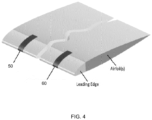
- Figure 4 shows and aircraft wing or aileron on which heaters 50, 60 can be mounted.
- the heaters have multiple temperature sensors (not shown) to sense the temperature distribution on the heater 50, 60, which will change with icing conditions (water content, droplet size etc.).
- the heater depending on icing conditions, will need to be heated using a specific amount of power, which can provide one input indicative of conditions.
- the temperature will, as mentioned above, also change due to conditions, due to water content, which is sensed by the sensors to provide another input to the system.
- the algorithm also uses other inputs 2, which can be atmospheric or external conditions as well as, e.g. flight deck information.
Landscapes
- Engineering & Computer Science (AREA)
- Aviation & Aerospace Engineering (AREA)
- Testing Or Calibration Of Command Recording Devices (AREA)
Priority Applications (2)
| Application Number | Priority Date | Filing Date | Title |
|---|---|---|---|
| EP21192474.1A EP4137412A1 (de) | 2021-08-20 | 2021-08-20 | Eisdetektorsystem und -verfahren |
| US17/889,612 US20230058286A1 (en) | 2021-08-20 | 2022-08-17 | Ice detector system and method |
Applications Claiming Priority (1)
| Application Number | Priority Date | Filing Date | Title |
|---|---|---|---|
| EP21192474.1A EP4137412A1 (de) | 2021-08-20 | 2021-08-20 | Eisdetektorsystem und -verfahren |
Publications (1)
| Publication Number | Publication Date |
|---|---|
| EP4137412A1 true EP4137412A1 (de) | 2023-02-22 |
Family
ID=77447733
Family Applications (1)
| Application Number | Title | Priority Date | Filing Date |
|---|---|---|---|
| EP21192474.1A Pending EP4137412A1 (de) | 2021-08-20 | 2021-08-20 | Eisdetektorsystem und -verfahren |
Country Status (2)
| Country | Link |
|---|---|
| US (1) | US20230058286A1 (de) |
| EP (1) | EP4137412A1 (de) |
Citations (5)
| Publication number | Priority date | Publication date | Assignee | Title |
|---|---|---|---|---|
| US10071808B1 (en) * | 2017-05-18 | 2018-09-11 | The Boeing Company | Aircraft icing conditions detection systems and methods |
| US10214294B1 (en) * | 2015-08-21 | 2019-02-26 | Blue Storm Associates, Inc. | Method and system for predicting potential icing conditions |
| US20190225346A1 (en) * | 2018-01-24 | 2019-07-25 | Airbus Operations (S.A.S.) | Method for detecting freezing conditions for an aircraft by supervised automatic learning |
| US10916129B2 (en) * | 2017-01-30 | 2021-02-09 | International Business Machines Corporation | Roadway condition predictive models |
| CN112832960A (zh) * | 2020-12-23 | 2021-05-25 | 国电南瑞南京控制系统有限公司 | 一种基于深度学习的风机叶片结冰检测方法和存储介质 |
Family Cites Families (4)
| Publication number | Priority date | Publication date | Assignee | Title |
|---|---|---|---|---|
| US20190039742A1 (en) * | 2017-08-01 | 2019-02-07 | Honeywell International Inc. | Managing response to icing threat |
| US10160550B1 (en) * | 2017-12-21 | 2018-12-25 | United Technologies Corporation | Ice detection and real time ice estimation using innovative sensor data learning approaches |
| EP3844842B1 (de) * | 2018-08-31 | 2025-12-24 | Telefonaktiebolaget LM Ericsson (publ) | Antennenradomheizung für punkt-zu-punkt-funkverbindungen |
| US11203438B1 (en) * | 2018-12-13 | 2021-12-21 | Rockwell Collins, Inc. | System and method for deicing |
-
2021
- 2021-08-20 EP EP21192474.1A patent/EP4137412A1/de active Pending
-
2022
- 2022-08-17 US US17/889,612 patent/US20230058286A1/en not_active Abandoned
Patent Citations (5)
| Publication number | Priority date | Publication date | Assignee | Title |
|---|---|---|---|---|
| US10214294B1 (en) * | 2015-08-21 | 2019-02-26 | Blue Storm Associates, Inc. | Method and system for predicting potential icing conditions |
| US10916129B2 (en) * | 2017-01-30 | 2021-02-09 | International Business Machines Corporation | Roadway condition predictive models |
| US10071808B1 (en) * | 2017-05-18 | 2018-09-11 | The Boeing Company | Aircraft icing conditions detection systems and methods |
| US20190225346A1 (en) * | 2018-01-24 | 2019-07-25 | Airbus Operations (S.A.S.) | Method for detecting freezing conditions for an aircraft by supervised automatic learning |
| CN112832960A (zh) * | 2020-12-23 | 2021-05-25 | 国电南瑞南京控制系统有限公司 | 一种基于深度学习的风机叶片结冰检测方法和存储介质 |
Non-Patent Citations (1)
| Title |
|---|
| RASHID TAIMUR ET AL: "Review of marine icing and anti-/de-icing systems", JOURNAL OF MARINE ENGINEERING & TECHNOLOGY, vol. 15, no. 2, 3 May 2016 (2016-05-03), pages 79 - 87, XP055877008, ISSN: 2046-4177, Retrieved from the Internet <URL:https://www.tandfonline.com/doi/pdf/10.1080/20464177.2016.1216734?needAccess=true> [retrieved on 20220110], DOI: 10.1080/20464177.2016.1216734 * |
Also Published As
| Publication number | Publication date |
|---|---|
| US20230058286A1 (en) | 2023-02-23 |
Similar Documents
| Publication | Publication Date | Title |
|---|---|---|
| EP3181452B1 (de) | System und verfahren zur eisdetektion an flugzeugen in einer detektionsfreien zone | |
| EP3739342B1 (de) | Prognostische überwachung komplementärer luftdatensystemsensoren | |
| US8355830B2 (en) | Aircraft health monitoring and design for condition | |
| US11472563B2 (en) | Method for detecting freezing conditions for an aircraft by supervised automatic learning | |
| US11401044B2 (en) | Method and assistance system for detecting a degradation of flight performance | |
| US9304499B2 (en) | Method of verifying the consistency of values given by an incidence probe of an aircraft | |
| CN111433612A (zh) | 用于估计飞行器空中数据的基于模型和飞行信息的组合训练的神经网络系统 | |
| CN105518469A (zh) | 空气数据探针污染监测器 | |
| JP2021524013A (ja) | 近接ポート間の圧力パターンを用いてフラッシュ型エアデータシステムの誤った圧力測定を検出するためのシステム及び方法 | |
| US20110264308A1 (en) | Method And Device For Automatically Estimating An Air Speed Of An Aircraft | |
| US7617023B2 (en) | Process and device for monitoring the validity of a speed cue of an aircraft and system for generating a speed cue comprising such a device | |
| US11203438B1 (en) | System and method for deicing | |
| Lerro et al. | The clean sky 2 midas project-an innovative modular, digital and integrated air data system for fly-by-wire applications | |
| US10311659B2 (en) | Method of analyzing variations of at least one indicator of the behavior of a mechanism fitted to an aircraft | |
| US20230058286A1 (en) | Ice detector system and method | |
| CN110316386A (zh) | 通过分析电流消耗检测飞行器的结冰状况 | |
| US7271741B2 (en) | Method and device for detecting an overstepping of design loads of the fin of an aircraft | |
| US10227142B1 (en) | Systems and methods for detecting impacts to vehicle surfaces | |
| US11807388B2 (en) | Apparatus, method and computer program for monitoring an aircraft engine | |
| Melody et al. | Sensor integration for inflight icing characterization using neural networks | |
| Roberts et al. | Development of the atmospheric icing patch (aip) under the sens4ice programme | |
| CN116902211A (zh) | 一种基于监视数据探测湍流区域的方法 | |
| CN118119905A (zh) | 基于在飞行器飞行期间采集的测量结果来检测飞行器的飞行状态的方法和系统 | |
| Houck et al. | Air data sensor failure detection | |
| CN121919433A (zh) | 计算空气中的水含量的方法和系统 |
Legal Events
| Date | Code | Title | Description |
|---|---|---|---|
| PUAI | Public reference made under article 153(3) epc to a published international application that has entered the european phase |
Free format text: ORIGINAL CODE: 0009012 |
|
| STAA | Information on the status of an ep patent application or granted ep patent |
Free format text: STATUS: THE APPLICATION HAS BEEN PUBLISHED |
|
| AK | Designated contracting states |
Kind code of ref document: A1 Designated state(s): AL AT BE BG CH CY CZ DE DK EE ES FI FR GB GR HR HU IE IS IT LI LT LU LV MC MK MT NL NO PL PT RO RS SE SI SK SM TR |
|
| STAA | Information on the status of an ep patent application or granted ep patent |
Free format text: STATUS: REQUEST FOR EXAMINATION WAS MADE |
|
| 17P | Request for examination filed |
Effective date: 20230822 |
|
| RBV | Designated contracting states (corrected) |
Designated state(s): AL AT BE BG CH CY CZ DE DK EE ES FI FR GB GR HR HU IE IS IT LI LT LU LV MC MK MT NL NO PL PT RO RS SE SI SK SM TR |
|
| P01 | Opt-out of the competence of the unified patent court (upc) registered |
Effective date: 20230922 |
|
| STAA | Information on the status of an ep patent application or granted ep patent |
Free format text: STATUS: EXAMINATION IS IN PROGRESS |
|
| 17Q | First examination report despatched |
Effective date: 20240612 |
|
| 17Q | First examination report despatched |
Effective date: 20240625 |