EP4136729B1 - Mehrfachanschluss-gitterformungssteuerung für gitterverbindungen - Google Patents
Mehrfachanschluss-gitterformungssteuerung für gitterverbindungen Download PDFInfo
- Publication number
- EP4136729B1 EP4136729B1 EP20720033.8A EP20720033A EP4136729B1 EP 4136729 B1 EP4136729 B1 EP 4136729B1 EP 20720033 A EP20720033 A EP 20720033A EP 4136729 B1 EP4136729 B1 EP 4136729B1
- Authority
- EP
- European Patent Office
- Prior art keywords
- virtual
- vsm
- terminal
- power
- unit
- Prior art date
- Legal status (The legal status is an assumption and is not a legal conclusion. Google has not performed a legal analysis and makes no representation as to the accuracy of the status listed.)
- Active
Links
Images








Classifications
-
- H—ELECTRICITY
- H02—GENERATION; CONVERSION OR DISTRIBUTION OF ELECTRIC POWER
- H02J—ELECTRIC POWER NETWORKS; CIRCUIT ARRANGEMENTS OR SYSTEMS FOR SUPPLYING OR DISTRIBUTING ELECTRIC POWER; SYSTEMS FOR STORING ELECTRIC ENERGY
- H02J3/00—Circuit arrangements for AC mains or AC distribution networks
- H02J3/38—Arrangements for feeding a single network from two or more generators or sources in parallel; Arrangements for feeding already energised networks from additional generators or sources in parallel
- H02J3/40—Synchronisation of generators for connection to a network or to another generator
-
- H—ELECTRICITY
- H02—GENERATION; CONVERSION OR DISTRIBUTION OF ELECTRIC POWER
- H02J—ELECTRIC POWER NETWORKS; CIRCUIT ARRANGEMENTS OR SYSTEMS FOR SUPPLYING OR DISTRIBUTING ELECTRIC POWER; SYSTEMS FOR STORING ELECTRIC ENERGY
- H02J3/00—Circuit arrangements for AC mains or AC distribution networks
- H02J3/38—Arrangements for feeding a single network from two or more generators or sources in parallel; Arrangements for feeding already energised networks from additional generators or sources in parallel
-
- H—ELECTRICITY
- H02—GENERATION; CONVERSION OR DISTRIBUTION OF ELECTRIC POWER
- H02J—ELECTRIC POWER NETWORKS; CIRCUIT ARRANGEMENTS OR SYSTEMS FOR SUPPLYING OR DISTRIBUTING ELECTRIC POWER; SYSTEMS FOR STORING ELECTRIC ENERGY
- H02J3/00—Circuit arrangements for AC mains or AC distribution networks
- H02J3/28—Arrangements for balancing of the load in networks by storage of energy
-
- H—ELECTRICITY
- H02—GENERATION; CONVERSION OR DISTRIBUTION OF ELECTRIC POWER
- H02J—ELECTRIC POWER NETWORKS; CIRCUIT ARRANGEMENTS OR SYSTEMS FOR SUPPLYING OR DISTRIBUTING ELECTRIC POWER; SYSTEMS FOR STORING ELECTRIC ENERGY
- H02J3/00—Circuit arrangements for AC mains or AC distribution networks
- H02J3/36—Arrangements for transfer of electric power between AC networks via high-voltage DC [HVDC] links; Arrangements for transfer of electric power between generators and networks via HVDC links
-
- H—ELECTRICITY
- H02—GENERATION; CONVERSION OR DISTRIBUTION OF ELECTRIC POWER
- H02J—ELECTRIC POWER NETWORKS; CIRCUIT ARRANGEMENTS OR SYSTEMS FOR SUPPLYING OR DISTRIBUTING ELECTRIC POWER; SYSTEMS FOR STORING ELECTRIC ENERGY
- H02J3/00—Circuit arrangements for AC mains or AC distribution networks
- H02J3/38—Arrangements for feeding a single network from two or more generators or sources in parallel; Arrangements for feeding already energised networks from additional generators or sources in parallel
- H02J3/46—Controlling the sharing of generated power between the generators, sources or networks
-
- H—ELECTRICITY
- H02—GENERATION; CONVERSION OR DISTRIBUTION OF ELECTRIC POWER
- H02J—ELECTRIC POWER NETWORKS; CIRCUIT ARRANGEMENTS OR SYSTEMS FOR SUPPLYING OR DISTRIBUTING ELECTRIC POWER; SYSTEMS FOR STORING ELECTRIC ENERGY
- H02J2103/00—Details of circuit arrangements for mains or AC distribution networks
- H02J2103/30—Simulating, planning, modelling, reliability check or computer assisted design [CAD] of electric power networks
-
- H—ELECTRICITY
- H02—GENERATION; CONVERSION OR DISTRIBUTION OF ELECTRIC POWER
- H02J—ELECTRIC POWER NETWORKS; CIRCUIT ARRANGEMENTS OR SYSTEMS FOR SUPPLYING OR DISTRIBUTING ELECTRIC POWER; SYSTEMS FOR STORING ELECTRIC ENERGY
- H02J2103/00—Details of circuit arrangements for mains or AC distribution networks
- H02J2103/30—Simulating, planning, modelling, reliability check or computer assisted design [CAD] of electric power networks
- H02J2103/35—Grid-level management of power transmission or distribution systems, e.g. load flow analysis or active network management
-
- Y—GENERAL TAGGING OF NEW TECHNOLOGICAL DEVELOPMENTS; GENERAL TAGGING OF CROSS-SECTIONAL TECHNOLOGIES SPANNING OVER SEVERAL SECTIONS OF THE IPC; TECHNICAL SUBJECTS COVERED BY FORMER USPC CROSS-REFERENCE ART COLLECTIONS [XRACs] AND DIGESTS
- Y02—TECHNOLOGIES OR APPLICATIONS FOR MITIGATION OR ADAPTATION AGAINST CLIMATE CHANGE
- Y02E—REDUCTION OF GREENHOUSE GAS [GHG] EMISSIONS, RELATED TO ENERGY GENERATION, TRANSMISSION OR DISTRIBUTION
- Y02E10/00—Energy generation through renewable energy sources
- Y02E10/50—Photovoltaic [PV] energy
- Y02E10/56—Power conversion systems, e.g. maximum power point trackers
-
- Y—GENERAL TAGGING OF NEW TECHNOLOGICAL DEVELOPMENTS; GENERAL TAGGING OF CROSS-SECTIONAL TECHNOLOGIES SPANNING OVER SEVERAL SECTIONS OF THE IPC; TECHNICAL SUBJECTS COVERED BY FORMER USPC CROSS-REFERENCE ART COLLECTIONS [XRACs] AND DIGESTS
- Y02—TECHNOLOGIES OR APPLICATIONS FOR MITIGATION OR ADAPTATION AGAINST CLIMATE CHANGE
- Y02E—REDUCTION OF GREENHOUSE GAS [GHG] EMISSIONS, RELATED TO ENERGY GENERATION, TRANSMISSION OR DISTRIBUTION
- Y02E60/00—Enabling technologies; Technologies with a potential or indirect contribution to GHG emissions mitigation
-
- Y—GENERAL TAGGING OF NEW TECHNOLOGICAL DEVELOPMENTS; GENERAL TAGGING OF CROSS-SECTIONAL TECHNOLOGIES SPANNING OVER SEVERAL SECTIONS OF THE IPC; TECHNICAL SUBJECTS COVERED BY FORMER USPC CROSS-REFERENCE ART COLLECTIONS [XRACs] AND DIGESTS
- Y04—INFORMATION OR COMMUNICATION TECHNOLOGIES HAVING AN IMPACT ON OTHER TECHNOLOGY AREAS
- Y04S—SYSTEMS INTEGRATING TECHNOLOGIES RELATED TO POWER NETWORK OPERATION, COMMUNICATION OR INFORMATION TECHNOLOGIES FOR IMPROVING THE ELECTRICAL POWER GENERATION, TRANSMISSION, DISTRIBUTION, MANAGEMENT OR USAGE, i.e. SMART GRIDS
- Y04S40/00—Systems for electrical power generation, transmission, distribution or end-user application management characterised by the use of communication or information technologies, or communication or information technology specific aspects supporting them
- Y04S40/20—Information technology specific aspects, e.g. CAD, simulation, modelling, system security
Definitions
- the present disclosure relates to a system and method for a grid forming vector current control, in particular for multi-port grid forming control for grid interties.
- PV inverters have to gradually reduce the injected active power if the grid frequency increases above nominal. This behaviour is a first step into the direction of grid-supporting power converter control. The injected active power is slowly adapted in response to the actual needs of the grid.
- Such a simple method only provides steady-state grid support, i.e. it still relies on synchronous generators in the grid that take over transient load changes.
- the amount of injected power to the grid is adapted according to the demand of the various loads connected to the grid. This is achieved by changing the behaviour from grid-agnostic constant power injection to a behaviour that is closer to a voltage source.
- the converters equipped with such control methods adapt and share the injected power automatically such that they provide the actual power demanded from the various loads in the grid.
- control methods aim to provide "inertia" to the grid, meaning that the rate of change of the grid frequency is limited.
- control mechanisms according to the state of the art may be classified into two main groups.
- the control law is based on the steady-state coupling of frequency (or angle) and power flow in inductive grids.
- Various implementation variants exist and several ways of improving the method have been proposed over the last years.
- the method creates a voltage reference which has to be tracked with additional cascaded voltage- and current control loops. In this respect, reference is made to the documents [1] and [3].
- control law is based on the principle of emulating the behaviour of a synchronous generator.
- the mathematical model describing the behaviour of the generator is implemented in the controller directly.
- implementation variants exist that differ mainly in the level of detail and the complexity of the implemented equations.
- VSM virtual generator or virtual synchronous machine
- the mathematical equations of a synchronous generator are implemented in a controller to emulate the behaviour of the generator.
- VSM virtual synchronous machine
- the machine equations are solved for the stator voltage which is given as a reference either directly to the modulation stage or to subsequent cascaded voltage and current control loops.
- the machine equations are solved for the stator currents which are given as references to subsequent current control loops.
- a current control loop and PLL track the active/reactive power references given by the inverse method and provide current control including current limitation. Also, grid synchronization and grid frequency measurement are provided.
- a virtual impedance loop may emulate a virtual stator impedance.
- Additional components may be used to improve the performance of the virtual generator.
- the additional components may be at least one of the following:
- An additional PLL for the direct method for synchronization with the grid before closing the main circuit breaker (MCB) of the converter or during fault cases, an automatic voltage regulator (AVR) to improve the voltage regulation at the PCC and feedforward gains for the grid current and the PCC voltage to improve the performance of the PI control loops.
- a damper winding emulation is used to improve damping of low-frequency oscillations.
- the virtual inertia effect is emulated with a derivative of the measured grid frequency.
- low-pass filtering the virtual impedance reference is often required to reduce amplification of high frequency noise caused by the derivative used for the calculation of a virtual inductance.
- grid supporting control methods become more and more important in various applications, such as grid connected battery energy storage (BESS), microgrids, PV inverters, railway interties, high-voltage direct current (HVDC) and uninterruptible power supply (UPS).
- BESS grid connected battery energy storage
- HVDC high-voltage direct current
- UPS uninterruptible power supply
- TSOs Transmissions system operators
- Today's grid supporting control methods are predominantly based on two basic concepts, the "virtual generator” concept and the droop control concept. Both methods have several shortcomings such as high complexity, difficult tuning approach with high commissioning effort, and stability issues.
- the mentioned methods may not offer sufficient control performance at the same time in strong grids and in weak grids and therefore either need retuning or control mode changeover during islanding events.
- the solutions according to the state of the art can only provide full grid support on one side of the link, i.e. it is not possible to provide full grid support on both terminals of the HVDC link or the grid intertie station without excessive energy storage in the dc-link between the two terminals.
- TSOs would prefer a solution having full grid-support characteristics on both sides of the terminal.
- FIG. 1 shows an example of a schematic diagram of a grid intertie/ HVDC link according to the prior art.
- the dc-link in this case is represented by a capacitor bank.
- both terminals are controlled using vector current control (VCC) or an equivalent current control scheme, such that the behavior of both converter terminals can be modelled with an equivalent current source (see FIG. 2 ).
- VCC vector current control
- P tr A certain amount of power
- Reactive power can be injected on both terminals independently. Assuming vector current control in the synchronous (dq) reference frame, it is required to calculate correct set-points for the current controller in d- and q-coordinates.
- dc-link voltage control is calculating the reference i Vdc , ctrl ⁇ for a first terminal connected to a first power grid only, however it could also be shared in between the first terminal and a second terminal connected to a second power grid.
- the power transfer set-point P tr can be either a quantity calculated by a slow top-level controller (secondary or tertiary control, power trading) or it can contain in addition a part calculated with a droop curve for steady-state grid support based on the frequency measurement on one terminal.
- a virtual inertia can be emulated on one terminal (cf. [4]). More complex functions considering the grid frequencies on both terminals to determine P tr could also be possible.
- a different state-of-art control method is applied.
- the terminal that is connected to the off-shore wind farm can be controlled in grid forming mode, i.e. a voltage source is emulated (see FIG. 3 ).
- the exchange of active and reactive power between the second terminal and the second grid is not directly controlled.
- Standard vector current control is applied on the first terminal which has to ensure the power balance between the first terminal and the second terminal.
- the dc-link voltage is controlled with the first terminal over i Vdc , ctrl ⁇ .
- one terminal is equipped with virtual synchronous generator control (see FIG. 4 ).
- the other terminal is controlled with standard vector current control.
- the controller on the second terminal emulates the behavior of a synchronous generator.
- the power exchange between the second terminal and the second grid is determined by the parameters and the dynamics of the virtual synchronous generator.
- the steady-state power exchange can be influenced with a power set-point entering the droop curve that is usually implemented for virtual generators.
- the active and reactive power that the virtual generator injects into the grid on the second terminal usually follow droop curves according to P 2 .
- the active and reactive power set-points Pset,2 and Qset,2 are given by a slow top-level controller (secondary or tertiary control, and/or power trading).
- None of the state-of-art control methods can provide full grid support on both terminals of the intertie / HVDC link without having excessive energy storage installed in the dc-link.
- Prior Art document CN 108 493 984 A considered closest prior art document.
- GMVCC grid-forming vector current control
- the method is not only restricted to two-port systems, but it can also be extended to multiport HVDC systems.
- a unique characteristic of grid-forming vector current control is that it emulates the behavior of a virtual synchronous generator, i.e. a spinning wheel, that is connected in parallel with a current source.
- the spinning wheel does not consume or provide any power during steady-state, it only injects power during transients and provides inertia to the system.
- a current source is connected in parallel which acts as a fast governor and provides the steady-state power required by the application.
- this control method is duplicated and applied to control both terminals of the HVDC link / grid intertie.
- the power injected by the virtual generator part of the controller on the first terminal is used to create a power-equivalent current reference for the current source of the second terminal.
- the power injected by the virtual generator part of second terminal is used to create a power-equivalent current reference for the controlled current source on the first terminal.
- the amount of grid support, i.e. the inertial response, on each terminal can be adapted easily and independently with a factor, the k VSM factor which is introduced in GFVCC from 0%-100% of the nominal power of the link.
- a factor the k VSM factor which is introduced in GFVCC from 0%-100% of the nominal power of the link.
- k VSM the same factor, k VSM , can be used to change the system to stiff current control and reduce the virtual generator effect to zero in case of grid faults on each terminal independently.
- a power flow controller can create set-points for both current sources for conventional transmission of active / reactive power over the HVDC-link / grid intertie.
- This power flow controller could incorporate means for power trading and/or steady-state grid support with droop curves or similar methods.
- a dc-link voltage controller can create set-points for the current sources on one or both terminals to control the dc-link voltage of the link.
- the present disclosure relates to a grid forming vector current control system for controlling a grid intertie.
- the system comprises a first terminal configured to be connected to a first power grid, the first terminal comprising a first current control unit, a first virtual admittance unit, and a first phase locked loop, PLL, unit, wherein the first virtual admittance unit and the first PLL unit are configured to emulate an inertia of a first virtual synchronous machine, VSM, and a first virtual current source is connected in parallel to the first VSM.
- the system comprises a second terminal configured to be connected to a second power grid, the second terminal comprising a second current control unit, a second virtual admittance unit, and a second PLL unit, wherein the second virtual admittance unit and the second PLL unit are configured to emulate an inertia of a second virtual synchronous machine, VSM, and a second virtual current source is connected in parallel to the second VSM.
- the system comprises a controller being configured to use the transient power P VSM1 consumed by the first VSM to generate a power-equivalent current reference to control the second virtual current source and to use the transient power P VSM2 consumed by the second VSM to generate a power-equivalent current reference to control the first virtual current source.
- the first terminal comprises a first droop control unit and an output signal of the first droop control unit is connected to the first virtual current source in order to emulate a first speed governor.
- the second terminal comprises a second droop control unit and an output signal of the second droop control unit is connected to the second virtual current source in order to emulate a second speed governor.
- the first terminal comprises a first droop control unit and an output signal of the first droop control unit is connected to the first PLL unit in order to emulate a first virtual mechanical speed governor.
- the second terminal comprises a second droop control unit and an output signal of the second droop control unit is connected to the second PLL unit in order to emulate a second virtual mechanical speed governor.
- a first factor k VSM1 is configured to change the characteristics of the first terminal continuously from voltage source to current source by proportionally scaling the output signals of the first virtual admittance with k VSM1 .
- a second factor k VSM2 is configured to change the characteristics of the second terminal continuously from voltage source to current source by proportionally scaling the output signals of the second virtual admittance with k VSM2 .
- At least one of the first droop control unit, the first virtual admittance unit or the first PLL unit is configured to receive the factor k VSM1 in order to increase or decrease the inertial response of the first terminal to disturbances in the first grid.
- At least one of the second droop control unit, the second virtual admittance unit or the second PLL unit is configured to receive the factor k VSM2 in order to increase or decrease the inertial response of the second terminal to disturbances in the second grid.
- k VSM1 scales a nominal power of the first VSM by proportionally scaling the output signals of the first virtual admittance with k VSM1 , inversely proportionally scaling the proportional gain of the first PLL unit with k VSM1 , and/or proportionally scaling a first droop constant with k VSM1 .
- k VSM2 scales a nominal power of the second VSM by proportionally scaling the output signals of the second virtual admittance with k VSM2 , inversely proportionally scaling the proportional gain of the second PLL unit with k VSM2 , and/or proportionally scaling a second droop constant with k VSM2 .
- k VSM1 scales at least one of a spinning wheel factor or a transient power or the inertia.
- k VSM2 scales at least one of a spinning wheel factor or a transient power or the inertia.
- the system further comprises a third terminal configured to be connected to a third power grid, the third terminal comprising a third droop control unit, a third current control unit, a third virtual admittance unit, and a third PLL unit, wherein the third virtual admittance unit and the third PLL unit are configured to emulate an inertia of a third virtual synchronous machine, VSM, and a third virtual current source is connected in parallel to the third VSM.
- VSM virtual synchronous machine
- the controller is configured to use the transient power P VSM1 consumed by the first VSM and the transient power P VSM2 consumed by the second VSM to generate a power-equivalent current reference to control the third virtual current source, the transient power P VSM1 consumed by the first VSM and the transient power P VSM3 consumed by the third VSM to generate a power-equivalent current reference to control the second virtual current source, and the transient power P VSM2 consumed by the second VSM and the transient power P VSM3 consumed by the third VSM to generate a power-equivalent current reference to control the first virtual current source.
- the present disclosure also relates to a grid forming vector current control method for controlling a grid intertie.
- the method comprises providing a first terminal configured to be connected to a first power grid, the first terminal comprising a first current control unit, a first virtual admittance unit, and a first phase locked loop, PLL, unit; emulating, with the first virtual admittance unit and the first PLL unit, an inertia of a first virtual synchronous machine, VSM; providing a first virtual current source connected in parallel to the first VSM.
- the method also comprises providing a second terminal configured to be connected to a second power grid, the second terminal comprising a second current control unit, a second virtual admittance unit, and a second PLL unit; emulating, with the second virtual admittance unit and the second PLL unit, an inertia of a second virtual synchronous machine, VSM; providing a second virtual current source connected in parallel to the second VSM.
- the method also comprises using the transient power P VSM1 consumed by the first VSM to generate a power-equivalent current reference to control the second virtual current source and using the transient power P VSM2 consumed by the second VSM to generate a power-equivalent current reference to control the first virtual current source.
- the first terminal comprises a first droop control unit and the method comprises connecting an output signal of the first droop control unit to the first virtual current source in order to emulate a first speed governor.
- the second terminal comprises a second droop control unit and the method comprises connecting an output signal of the second droop control unit to the second virtual current source in order to emulate a second speed governor.
- the first terminal comprises a first droop control unit and the method comprises connecting an output signal of the first droop control unit to the first PLL unit in order to emulate a first virtual mechanical speed governor.
- the second terminal comprises a second droop control unit and the method comprises connecting an output signal of the second droop control unit to the second PLL unit in order to emulate a second virtual mechanical speed governor.
- the method comprises applying a first factor k VSM1 to change the characteristics of the first terminal continuously from voltage source to current source by proportionally scaling the output signals of the first virtual admittance with k VSM1 .
- the method comprises applying a second factor k VSM2 to change the characteristics of the second terminal continuously from voltage source to current source by proportionally scaling the output signals of the second virtual admittance with k VSM2 .
- the method comprises feeding the factor k VSM1 into at least one of the first droop control unit, the first virtual admittance unit or the first PLL unit in order to increase or decrease the inertial response of the first terminal to disturbances in the first grid.
- the method comprises feeding the factor k VSM2 into at least one of the second droop control unit, the second virtual admittance unit or the second PLL unit in order to increase or decrease the inertial response of the second terminal to disturbances in the second grid.
- the method comprises scaling, with the factor k VSM1 , a nominal power of the first VSM by proportionally scaling the output signals of the first virtual admittance with k VSM1 , inversely proportionally scaling the proportional gain of the first PLL unit with k VSM1 , and/or proportionally scaling a first droop constant with k VSM1 .
- the method comprises scaling, with the factor k VSM2 , a nominal power of the second VSM by proportionally scaling the output signals of the second virtual admittance with k VSM2 , inversely proportionally scaling the proportional gain of the second PLL unit with k VSM2 , and/or proportionally scaling a second droop constant with k VSM2 .
- the method comprises scaling, with the factor k VSM1 , at least one of a spinning wheel factor or a transient power or the inertia.
- the method comprises scaling, with the factor k VSM2 , at least one of a spinning wheel factor or a transient power or the inertia.
- the method comprises providing a third terminal configured to be connected to a third power grid, the third terminal comprising a third current control unit, a third virtual admittance unit, and a third PLL unit; emulating, with the third virtual admittance unit and the third PLL unit, an inertia of a third virtual synchronous machine, VSM; providing a third virtual current source connected in parallel to the third VSM.
- the method comprises using the transient power P VSM1 consumed by the first VSM and the transient power P VSM2 consumed by the second VSM to generate a power-equivalent current reference to control the third virtual current source.
- the method comprises using the transient power PVSM1 consumed by the first VSM and the transient power PVSM3 consumed by the third VSM to generate a power-equivalent current reference to control the second virtual current source.
- the method comprises using the transient power PVSM2 consumed by the second VSM and the transient power PVSM3 consumed by the third VSM to generate a power-equivalent current reference to control the first virtual current source.
- FIG. 5 schematically depicts the grid forming vector current control (GFVCC) system according to the present disclosure.
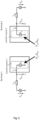
- FIG. 5a shows a virtual synchronous machine (VSM) with a current source connected in parallel
- FIG. 5b shows the equivalent circuit diagram thereof.
- VSM virtual synchronous machine
- the system emulates the combined effect of a virtual machine, whose nominal power and amount of grid support can be scaled independently and online with a single input/parameter and a parallel connected current source.
- the system may be controlled remotely.
- FIG. 6a comprises a phase locked loop (PLL) block fed by a voltage at a point of common coupling (PCC) V pcc as well as a speed control block having a reference frequency f ref as an input.
- PLL phase locked loop
- the output of the PLL is provided to a virtual admittance block together with V pcc and a voltage of the virtual synchronous machine V vsm .
- the speed control output, the virtual admittance output as well as a reference current I ref are then processed in a current control block which outputs a voltage V out .
- FIG. 6b additionally comprises the parameter k VSM as an input to at least one of the PLL, speed control and current control blocks.
- k VSM may also be used to smoothly change the characteristics of the control scheme from voltage source to current source, also supporting a mix of both characteristics.
- a smooth changeover to stiff current control can be beneficial during grid faults to keep synchronism with the grid.
- the control mode does not have to be changed.
- the GFVCC system may also comprise an active voltage regulator (AVR).
- AVR active voltage regulator
- the GFVCC system system emulates the combined effects of virtual inertia, damper winding, virtual stator impedance, AVR and droop governor. Virtual inertia and damper winding are emulated using the standard PLL block.
- the active power setpoint tracking and the droop governor are conceptually implemented with a fast current source. Therefore, there is no performance degradation in strong grids which can be often observed when using VSM control. Thus, a good performance in weak and in strong grids is achieved.
- the method supports unplanned islanding and islanded operation.
- the complexity of the control scheme and the related commissioning effort is very low. Due to the removal of a cascaded voltage control loop and by reusing the PLL to emulate inertia and damping, the number of parameters can be reduced from more than 15 in conventional approaches to only 7 parameters with clear meaning and less interactions. Therefore, the system may also be tuned more easily.
- the GFVCC system provides an explicit current control and current limitation and an explicit PLL for synchronization with the grid before closing an MCB and for preventing loss of synchronism during faults.
- the PLL together with the virtual admittance acts as a virtual swing equation, obviating synchronization using power balance.
- FIG. 7 to 11 show a more detailed overview of the proposed grid supporting control scheme and respective equivalent circuits.
- the control scheme of FIG. 7 is conceptually depicted in FIG. 5a and 5b .
- the control scheme of FIG. 5a can be separated into two functional parts being a VSM without any governor, i.e. a spinning wheel or inertia, respectively, as shown by the dotted line and a current source connected in parallel at the terminals of the virtual synchronous machine.
- the behaviour of the virtual synchronous machine is emulated with the PLL.
- the current source is working in parallel. It acts simultaneously as a fast power setpoint tracker and as a governor, because it ensures steady-state power balance between the grid and the spinning wheel.
- the inertial response with respect to the active power is ensured by the virtual admittance. In the steady state, the complete power flowing to the grid is injected by the current source.
- the spinning wheel injects power only during transients.
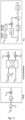
- FIG. 7 shows a GVCC system according to an embodiment having a droop control unit 1, a current control unit 2, a virtual admittance unit 3 and a phase locked loop (PLL) unit 4.
- the virtual admittance unit 3 and the PLL unit 4 are configured to emulate an inertia of the VSM and a virtual current source 5 is connected in parallel to the VSM.
- an output signal of the droop control unit 1 is connected to the virtual current source 5 in order to emulate a speed governor.
- the GVCC system according to a preferred embodiment will now be described in more detail.
- the simplest form of traditional state-of-the-art implementations of a virtual synchronous machine are based on the swing equation.
- the goal of virtual synchronous machine control is to make the behaviour of the converter at the point of common coupling (PCC) equal to the behaviour of a synchronous machine.
- FIG. 8a to 8c are equivalent circuits of respective components, i.e. state-of-the-art virtual machine variants.
- FIG. 8a shows a converter
- FIG. 8b a VSM without virtual inductance
- FIG. 8c a VSM with virtual inductance.
- control method proposed herein is suitable for converters with any type of output filter structure, such as L, LC or LCL.
- the swing equation couples the change of frequency of the voltage source Vc with the active power flowing out or into the machine.
- the converter voltage Vc is equal to the back electromotive force (back-emf) of the virtual machine.
- the converter filter inductance L C is equal to the stator inductance of the virtual machine and the PCC voltage V pcc is equal to the stator voltage of the virtual machine.
- the converter voltage Vc (virtual back-emf) has the rotational frequency ⁇ r to highlight its equivalency with the virtual rotor frequency.
- the PCC voltage (virtual stator voltage) has the rotational frequency ⁇ pcc .
- the virtual back-emf of the machine is designated as V v (with rotational frequency ⁇ r and angle ⁇ r ) and has moved behind the virtual reactance X vs .
- the virtual inductance L vs is in series to the converter filter inductance L C and therefore adds to the total virtual stator inductance of the virtual machine seen from the PCC.
- FIG. 9a and 9b show an equivalent model of a control scheme according to an exemplary embodiment.
- the swing equation is not directly implemented as in traditional approaches.
- the effect of the PLL together with the virtual admittance is compared to the swing equation.
- the sine function can be approximated as sin( ⁇ r - ⁇ pcc ) ⁇ ( ⁇ r - ⁇ pcc ) and the derivative thereof becomes s ⁇ sin( ⁇ r - ⁇ pcc ) ⁇ ⁇ r - ⁇ pcc .
- the governor power will be replaced with the parallel current source in a later step below.
- the proportional gain of the PLL therefore emulates the damper winding effect and the integral gain couples the angle difference with an increase/decrease of frequency, emulating the self-synchronization principle of synchronous machines.
- the PLL does not implicitly couple power flow with the angle difference, because it describes only the evolution of the internal PLL angle ⁇ r . Coupling of power flow and angle difference has to be ensured explicitly with an additional current reference for the current controller.
- the virtual admittance may be implemented with the full dynamic model to ensure passivity and damping of high frequency resonances.
- simplified admittance models are also possible as are more complex models which permit additional filtering functions. Even asymmetric admittance is possible. The minimal requirement is to implement coupling between q-voltage and active current.
- the governor power is replaced by a current source ensuring the steady-state power balance.
- the angle difference ⁇ r - ⁇ pcc is small and cos( ⁇ r - ⁇ pcc ) is close to unity.
- the division by V pcc,d can be replaced with a division by constant V N .
- an active voltage regulator may be added to keep the magnitude of the PCC voltage constant.
- a factor k VSM may be used to adjust or scale the amount of grid support.
- the factor k VSM is continuous and ranges from 0 to 1. With this factor it is possible to scale the nominal power of the virtual machine that can be thought to operate in parallel to the current source with a single factor.
- the connections and inputs of k VSM are shown in FIG. 6b .
- FIG. 11 the modified block diagrams of the droop block, the virtual admittance block and the PLL block are shown in FIG. 11 .
- adjusting the amount of grid support by scaling the nominal power of the VSM is a unique feature of the control structure of GVCC.
- the nominal power of the parallel current source is not affected, and the control structure can therefore continue to operate with conventional current control and with maximum power capability, even if k VSM is set to zero.
- the power transfer capability is linked to the nominal power of the VSM.
- the power flow is controlled by advancing the angle of the virtual back-emf in VSM and the voltage difference is applied over the virtual stator reactance. Reducing the nominal power of the VSM leads to an increase of the reactance and consequently, an increased angle difference is required to transfer the same amount of power. Because the maximum angle difference is limited to 90°, the power transfer capability reduces with the nominal power of the VSM. Consequently, the nominal power of the VSM cannot be independently adjusted in conventional control approaches. Other applications than the ones disclosed herein may also be feasible.
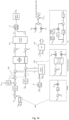
- FIG. 12 shows a schematic block diagram of a grid forming vector current control system for controlling a grid intertie.
- both terminals, the first terminal 100 connected to the first power grid A and the second terminal 200 connected to the second power grid B are controlled using the aforedescribed GFVCC.
- this control scheme emulates a virtual generator, i.e. a virtual synchronous machine (VSM) 150/250 that is connected in parallel with a (virtual) current source 160/260.
- VSM virtual synchronous machine
- the VSM part emulates the inertial response and the low output impedance of a synchronous generator. However it does not contribute to steady-state power exchange because it is missing direct mechanical governor emulation that is implemented in traditional virtual generator control schemes. To compensate the missing governor, a controllable current source 160/260 is virtually connected in parallel to the virtual generator part/VSM 150/250.
- both terminals 100 and 200 of the grid intertie are using GFVCC.
- the transient power consumed by the VSM part 250 of the control on the second terminal 200 is used as a feedforward term, i.e. as a a power-equivalent current reference, for the controllable current source 160 in the first terminal 100.
- the transient power consumed by the virtual generator/VSM part 150 of the control on the first terminal 100 is used as a feedforward term, i.e. as a a power-equivalent current reference, for the controllable current source 260 on the second terminal 200.
- the dc-link voltage control may calculating the reference i Vdc , ctrl ⁇ for the first terminal 100 only, however it may also be shared in between the first terminal 100 and terminal 200.
- the feedforward terms P VSM 2 and P VSM 1 are calculated using i v1d and i v2d only, i.e. the active current created by the virtual spinning wheels of the VSMs. In steady-state, both feedforward terms become zero because i v1d and i v2d become zero.
- the first disclosed concept only emulates inertial responses on both terminals and takes the corresponding power from the opposite terminal to maintain the power balance. The steady-state characteristics are given by the power transfer set-point Pt, and the reactive power defined with Q set1 , Q set2 and the reactive power of the emulated virtual generators (i v1q , i v2q ).
- the power transfer set-point Pt can be either a quantity calculated by a slow top-level controller (secondary or tertiary control, power trading) or it can contain in addition a part calculated with a droop curve for steady-state grid support based on the grid frequency on one terminal. More complex functions considering the grid frequencies on both terminals to determine P tr could also be possible as described below.
- the current references, i.e. the feedforward terms, of the virtual generator part of the control method (I v1,dq , I v2,dq ) are calculated with the unique feature of GFVCC that emulates a virtual generator response with the PLL and a virtual admittance.
- GFVCC it is possible to adjust the nominal power of the virtual generator and therefore the amount of grid support with a single factor k VSM . It can be set for each terminal independently, a feature, k VSM , that could be used to reduce the amount of grid support on the strong grid side of the terminal in order not to disturb the weak grid side too much.
- k VSM a feature that could be used to reduce the amount of grid support on the strong grid side of the terminal in order not to disturb the weak grid side too much.
- GFVCC there are many implementation variants and options for GFVCC, such as current control in other reference frames, improved fault handling with k VSM factor, active damper branch in parallel with the current source and improved handling of asymmetric conditions
- FIG. 13 shows exemplarily a block diagram of the control system for the first terminal 100. It is understood by the skilled person that the control system for the second terminal is analogous. Insofar, the control system disclosed in the embodiment according to FIG. 13 is related to the block diagram of the control system depicted in FIG. 7 .
- Fig. 13 shows a block diagram of the control system for the first terminal 100 according to an embodiment having a first current control unit 110, a first virtual admittance unit 120 and a phase locked loop (PLL) unit 130.
- the first virtual admittance unit 120 and the PLL unit 130 are configured to emulate an inertia of the VSM and a virtual current source 160 is connected in parallel to the VSM.
- the transient power P VSM2 consumed by the second VSM 250 of the second terminal 200 is used by a controller of the control system (controller not shown) to generate a power-equivalent current reference to control the first virtual current source.
- the transient power P VSM1 consumed by the first VSM 150 is used by the controller of the control system to generate a power-equivalent current reference to control the second virtual current source 260 of the second terminal 200.
- a block diagram of the control system for the second terminal 100 according to an embodiment would look correspondingly.
- two control systems according to the embodiment depicted in FIG. 13 could be combined, one for the first terminal 100 and a second one for the second terminal 200, to form a control system for controlling a grid intertie according to the present disclosure.
- a way to determine P tr is described in the following. If the controller of one terminal (e.g. the second terminal 200) is equipped with a typical droop curve, i.e. the terminal comprises a droop control unit, Pt, is determined by the steady-state power flow determined by the droop curve and its offset P set,2 .
- the feedforward term P VSM 2 needs to be extended with the steady-state power P droop ,2 on the second terminal 200 determined by the droop curve.
- Ptr a way to determine P tr is described in the following. If the controllers on both terminals are equipped with typical droop curves, Pt, is determined by the difference of steady-state power flows determined by the droop curves and offset powers.
- Fig. 14 shows a block diagram of the control system for the first terminal 100 according to an embodiment having a first current control unit 110, a first virtual admittance unit 120 and a phase locked loop (PLL) unit 130.
- the first virtual admittance unit 120 and the PLL unit 130 are configured to emulate an inertia of the VSM and a virtual current source 160 is connected in parallel to the VSM.
- the power P VSM2 consumed by the second VSM 250 of the second terminal 200 is used by a controller of the control system (controller not shown) to generate a power-equivalent current reference to control the first virtual current source.
- the power P VSM1 consumed by the first VSM 150 is used by the controller of the control system to generate a power-equivalent current reference to control the second virtual current source 260 of the second terminal 200.
- the control system further comprises a first droop control unit 140 and an output signal of the first droop control unit 140 is connected to the first virtual current source 160 in order to emulate a first speed governor.
- P tr as described according to one of the aforementioned embodiments can be determined using a control system according to the present embodiment. It is further understood, that a control system for the second terminal 200 according to an embodiment would look correspondingly. Moreover, it is further understood by the skilled person that two control systems according to the embodiment depicted in FIG.
- control system 14 could be combined, one for the first terminal 100 and a second one for the second terminal 200, to form a control system for controlling a grid intertie according to the present disclosure. It is further understood by the skilled person that one control system according to the embodiment depicted in FIG. 13 could be combined with one control system according to the embodiment depicted in FIG. 14 , e.g. a control system according to the embodiment depicted in FIG. 13 for the first terminal 100 and a control system according to the embodiment depicted in FIG. 14 for the second terminal 200 or vice versa, to form a control system for controlling a grid intertie according to the present disclosure.
- FIG. 16 shows a schematic block diagram of a grid forming vector current control system for controlling a grid intertie having three terminals as shown in FIG. 15 .
- the present disclosure is not limited to the three terminals but could also comprise any number of terminals.
- all three terminals, the first terminal 100 connected to the first power grid A, the second terminal 200 connected to the second power grid B, and the third terminal 300 connected to the third power grid C are controlled using the aforedescribed GFVCC.
- a controller of the control system uses the transient power P VSM1 consumed by the first VSM and the transient power P VSM2 consumed by the second VSM to generate a power-equivalent current reference to control the third virtual current source, uses the transient power P VSM1 consumed by the first VSM and the transient power P VSM3 consumed by the third VSM to generate a power-equivalent current reference to control the second virtual current source, and uses the transient power P VSM2 consumed by the second VSM and the transient power P VSM3 consumed by the third VSM to generate a power-equivalent current reference to control the first virtual current source.
- FIG. 17 shows a schematic illustration of the behavior of a grid forming vector current control system for controlling a grid intertie in transient grid support mode.
- the power transfer setpoint for the intertie is set to zero.
- a load step is applied in grid A.
- the intertie delivers transient power to the load step and takes the power from grid B.
- a load step with similar absolute magnitude is applied in grid B.
- the intertie delivers transient power to the load step and takes the power from grid A. In both cases the power flow decays to zero after a while because only transient power is exchanged.
- the intertie delivers inertial response on both terminals. A transparent link for transient power flow has been established.
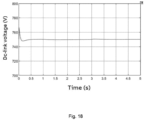
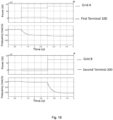
- FIG. 18 shows a schematic illustration of the behavior of the dc-link voltage in transient grid support mode. Both transients have only minor impact on the dc-link voltage and the controller is able to maintain a stable dc-link. Although, according to this embodiment, a downscaled converter on the low-voltage level is used, the same behavior can be expected for medium voltage and high voltage setups.
- FIG. 19 shows a schematic illustration of the behavior of a grid forming vector current control system for controlling a grid intertie in full grid support mode.
- two-sided full grid support (inertial response and steady-state support) is provided.
- the power transfer setpoint for the intertie is set to zero.
- a load step is applied in grid A.
- the intertie delivers transient and steady-state power to the load step and takes the power from grid B.
- a load step with similar absolute magnitude is applied in grid B.
- the load step in per unit is higher and the grid frequency in grid B will fall to a lower value. Consequently, the power flow in the intertie will reverse and start to support grid B, which is heavier loaded compared to grid A.
- the intertie delivers transient and steady-state power to grid B and takes the power from grid A.
- FIG. 20 shows a schematic illustration of the behavior of the dc-link voltage in full grid support mode. Both transients have only minor impact on the dc-link voltage and the controller is able to maintain a stable dc-link. Although, according to this embodiment, a downscaled converter on the low-voltage level is used, the same behavior can be expected for medium voltage and high voltage setups.
- First terminal 100 First current control unit 110 First virtual admittance unit 120 First PLL unit 130 First droop control unit 140 First VSM 150 First virtual current source 160 Second terminal 200 Second current control unit 210 Second virtual admittance unit 220 Second PLL unit 230 Second droop control unit 240 Second VSM 250 Second virtual current source 260 First power grid A Second power grid B Third power grid C
Landscapes
- Engineering & Computer Science (AREA)
- Power Engineering (AREA)
- Supply And Distribution Of Alternating Current (AREA)
- Control Of Eletrric Generators (AREA)
Claims (14)
- Ein System für netzbildende Vektorstromsteuerung zum Steuern einer Netzverbindung, wobei das System Folgendes umfasst:einen ersten Anschluss (100), der dazu ausgelegt ist, mit einem ersten Stromnetz (A) verbunden zu werden, wobei der erste Anschluss (100) eine erste Stromsteuereinheit (110), eine erste virtuelle Admittanzeinheit (120) und eine erste Phasenregelschleifen- ( PLL-) Einheit (130) umfasst, wobei die erste virtuelle Admittanzeinheit (120) und die erste PLL-Einheit (130) dazu ausgelegt sind, eine Trägheit einer ersten virtuellen Synchronmaschine, VSM, (150) zu emulieren, und eine erste virtuelle Stromquelle (160) mit der ersten VSM (150) parallel geschaltet ist;wobei das netzbildende Vektorstromsteuersystem dadurch gekennzeichnet ist, dass es ferner Folgendes umfasst:einen zweiten Anschluss (200), der dazu ausgelegt ist, mit einem zweiten Stromnetz (B) verbunden zu werden, wobei der zweite Anschluss (200) eine zweite Stromsteuereinheit (210), eine zweite virtuelle Admittanzeinheit (220) und eine zweite PLL-Einheit (230) umfasst, wobei die zweite virtuelle Admittanzeinheit (220) und die zweite PLL-Einheit (230) dazu ausgelegt sind, eine Trägheit einer zweiten virtuellen Synchronmaschine, VSM, (250) zu emulieren, und eine zweite virtuelle Stromquelle (260) mit der zweiten VSM (250) parallel geschaltet ist;eine Steuerung, die dazu ausgelegt ist, eine durch die erste VSM (150) aufgenommene transiente Leistung PVSM1 zu verwenden, um eine leistungsäquivalente Stromreferenz zum Steuern der zweiten virtuellen Stromquelle (260) zu erzeugen, und eine durch die zweite VSM (250) aufgenommene transiente Leistung PVSM2 zu verwenden, um eine leistungsäquivalente Stromreferenz zum Steuern der ersten virtuellen Stromquelle (160) zu erzeugen.
- Das System nach Anspruch 1, wobei der erste Anschluss (100) ferner eine erste Statiksteuereinheit (140) umfasst und ein Ausgangssignal der ersten Statiksteuereinheit (140) mit der ersten virtuellen Stromquelle (160) verbunden ist, um einen ersten Drehzahlregler zu emulieren, und wobei der zweite Anschluss (200) vorzugsweise ferner eine zweite Statiksteuereinheit (240) umfasst und ein Ausgangssignal der zweiten Statiksteuereinheit (240) mit der zweiten virtuellen Stromquelle (260) verbunden ist, um einen zweiten Drehzahlregler zu emulieren.
- System nach Anspruch 1, wobei der erste Anschluss (100) ferner eine erste Statiksteuereinheit (140) umfasst und ein Ausgangssignal der ersten Statiksteuereinheit (140) mit der ersten PLL-Einheit (130) verbunden ist, um einen ersten virtuellen mechanischen Drehzahlregler zu emulieren, und wobei der zweite Anschluss (200) vorzugsweise ferner eine zweite Statiksteuereinheit (240) umfasst und ein Ausgangssignal der zweiten Statiksteuereinheit (240) mit der zweiten PLL-Einheit (230) verbunden ist, um einen zweiten virtuellen mechanischen Drehzahlregler zu emulieren.
- System nach einem der vorhergehenden Ansprüche, wobeiein erster Faktor kVSM1 dazu ausgelegt ist, die Charakteristika des ersten Anschlusses (100) kontinuierlich von Spannungsquelle zu Stromquelle zu ändern, indem die Ausgangssignale der ersten virtuellen Admittanz proportional mit kVSM1 skaliert werden; undein zweiter Faktor kVSM2 dazu ausgelegt ist, die Charakteristika des zweiten Anschlusses (200) kontinuierlich von Spannungsquelle zu Stromquelle zu ändern, indem die Ausgangssignale der zweiten virtuellen Admittanz proportional mit kVSM2 skaliert werden.
- System nach Anspruch 4, wobeidie erste Statiksteuereinheit (140) und/oder die erste virtuelle Admittanzeinheit (120) und/oder die erste PLL-Einheit (130) dazu ausgelegt ist, den Faktor kVSM1 zu empfangen, um die Inertialantwort des ersten Anschlusses (100) auf Störungen im ersten Netz zu erhöhen oder zu verringern; unddie zweite Statiksteuereinheit (240) und/oder die zweite virtuelle Admittanzeinheit (220) und/oder die zweite PLL-Einheit (230) dazu ausgelegt ist, den Faktor kVSM2 zu empfangen, um die Inertialantwort des zweiten Anschlusses (200) auf Störungen im zweiten Netz zu erhöhen oder zu verringern;wobei kVSM1 eine Nennleistung der ersten VSM (150) skaliert, indem die Ausgangssignale der ersten virtuellen Admittanz proportional mit kVSM1 skaliert werden, die proportionale Verstärkung der ersten PLL-Einheit (130) umgekehrt proportional mit kVSM1 skaliert wird und eine erste Statikkonstante proportional mit kVSM1 skaliert wird; undwobei kVSM2 eine Nennleistung der zweiten VSM (250) skaliert, indem die Ausgangssignale der zweiten virtuellen Admittanz proportional mit kVSM2 skaliert werden, die proportionale Verstärkung der zweiten PLL-Einheit (230) umgekehrt proportional mit kVSM2 skaliert wird und eine zweite Statikkonstante proportional mit kVSM2 skaliert wird.
- System nach Anspruch 4 oder 5, wobei die Faktoren kVSM1 und kVSM2 einen Drehradfaktor und/oder eine transiente Leistung und/oder die Trägheit skalieren.
- System nach einem der Ansprüche 1 bis 6, das ferner Folgendes umfasst:einen dritten Anschluss, der dazu ausgelegt ist, mit einem dritten Stromnetz verbunden zu werden, wobei der dritte Anschluss eine dritte Statiksteuereinheit, eine dritte Stromsteuereinheit, eine dritte virtuelle Admittanzeinheit und eine dritte PLL-Einheit umfasst, wobei die dritte virtuelle Admittanzeinheit und die dritte PLL-Einheit dazu ausgelegt sind, eine Trägheit einer dritten virtuellen Synchronmaschine, VSM, zu emulieren, und eine dritte virtuelle Stromquelle mit der dritten VSM parallel geschaltet ist; undwobei die Steuerung zu Folgendem ausgelegt ist:Verwenden der durch die erste VSM (150) aufgenommenen transienten Leistung PVSM1 und der durch die zweite VSM (250) aufgenommenen transienten Leistung PVSM2, um eine leistungsäquivalente Stromreferenz zum Steuern der dritten virtuellen Stromquelle zu erzeugen,der durch die erste VSM (150) aufgenommenen transienten Leistung PVSM1 und der durch die dritte VSM aufgenommenen transienten Leistung PVSM3, um eine leistungsäquivalente Stromreferenz zum Steuern der zweiten virtuellen Stromquelle (260) zu erzeugen, undder durch die zweite VSM (250) aufgenommenen transienten Leistung PVSM2 und einer durch die dritte VSM aufgenommenen transienten Leistung PVSM3, um eine leistungsäquivalente Stromreferenz zum Steuern der ersten virtuellen Stromquelle (160) zu erzeugen.
- Ein Verfahren für netzbildende Vektorstromsteuerung zum Steuern einer Netzverbindung, wobei das Verfahren Folgendes umfasst:Bereitstellen eines ersten Anschlusses (100), der dazu ausgelegt ist, mit einem ersten Stromnetz (A) verbunden zu werden, wobei der erste Anschluss (100) eine erste Stromsteuereinheit (110), eine erste virtuelle Admittanzeinheit (120) und eine erste Phasenregelschleifen- (PLL-) Einheit umfasst;Emulieren, mit der ersten virtuellen Admittanzeinheit (120) und der ersten PLL-Einheit (130), einer Trägheit einer ersten virtuellen Synchronmaschine, VSM;Bereitstellen einer ersten virtuellen Stromquelle (160), die mit der ersten VSM (150) parallel geschaltet ist;Bereitstellen eines zweiten Anschlusses (200), der dazu ausgelegt ist, mit einem zweiten Stromnetz (B) verbunden zu werden, wobei der zweite Anschluss (200) eine zweite Stromsteuereinheit (210), eine zweite virtuelle Admittanzeinheit (220) und eine zweite PLL-Einheit (230) umfasst;Emulieren, mit der zweiten virtuellen Admittanzeinheit (220) und der zweiten PLL-Einheit (230), einer Trägheit einer zweiten virtuellen Synchronmaschine, VSM;Bereitstellen einer zweiten virtuellen Stromquelle (260), die mit der zweiten VSM (250) parallel geschaltet ist; undVerwenden einer durch die erste VSM (150) aufgenommenen transienten Leistung PVSM1, um eine leistungsäquivalente Stromreferenz zum Steuern der zweiten virtuellen Stromquelle (260) zu erzeugen, und Verwenden einer durch die zweite VSM (250) aufgenommenen transienten Leistung PVSM2, um eine leistungsäquivalente Stromreferenz zum Steuern der ersten virtuellen Stromquelle (160) zu erzeugen.
- Verfahren nach Anspruch 8,wobei der erste Anschluss (100) ferner eine erste Statiksteuereinheit (140) umfasst und wobei das Verfahren ferner Folgendes umfasst: Verbinden eines Ausgangssignals der ersten Statiksteuereinheit (140) mit der ersten virtuellen Stromquelle (160), um einen ersten Drehzahlregler zu emulieren; undwobei der zweite Anschluss (200) vorzugsweise ferner eine zweite Statiksteuereinheit (240) umfasst und wobei das Verfahren vorzugsweise ferner Folgendes umfasst: Verbinden eines Ausgangssignals der zweiten Statiksteuereinheit (240) mit der zweiten virtuellen Stromquelle (260), um einen zweiten Drehzahlregler zu emulieren.
- Verfahren nach Anspruch 8,
wobei der erste Anschluss (100) ferner eine erste Statiksteuereinheit (140) umfasst und wobei das Verfahren ferner Folgendes umfasst: Verbinden eines Ausgangssignals der ersten Statiksteuereinheit (140) mit der ersten PLL-Einheit (130), um einen ersten virtuellen mechanischen Drehzahlregler zu emulieren, und wobei der zweite Anschluss (200) vorzugsweise ferner eine zweite Statiksteuereinheit (240) umfasst und wobei das Verfahren vorzugsweise ferner Folgendes umfasst: Verbinden eines Ausgangssignals der zweiten Statiksteuereinheit (240) mit der zweiten PLL-Einheit (230), um einen zweiten virtuellen mechanischen Drehzahlregler zu emulieren. - Verfahren nach einem der Ansprüche 8 bis 10, das Folgendes umfasst:Anwenden eines ersten Faktors kVSM1, um die Charakteristika des ersten Anschlusses (100) kontinuierlich von Spannungsquelle zu Stromquelle zu ändern, indem die Ausgangssignale der ersten virtuellen Admittanz proportional mit kVSM1 skaliert werden; undAnwenden eines zweiten Faktors kVSM2, um die Charakteristika des zweiten Anschlusses (200) kontinuierlich von Spannungsquelle zu Stromquelle zu ändern, indem die Ausgangssignale der zweiten virtuellen Admittanz proportional mit kVSM2 skaliert werden.
- Verfahren nach Anspruch 11, das Folgendes umfasst:Einspeisen des Faktors kVSM1 in die erste Statiksteuereinheit (140) und/oder die erste virtuelle Admittanzeinheit (120) und/oder die erste PLL-Einheit (130), um die Inertialantwort des ersten Anschlusses (100) auf Störungen im ersten Netz zu erhöhen oder zu verringern;Einspeisen des Faktors kVSM2 in die zweite Statiksteuereinheit (240) und/oder die zweite virtuelle Admittanzeinheit (220) und/oder die zweite PLL-Einheit (230), um die Inertialantwort des zweiten Anschlusses (200) auf Störungen im zweiten Netz zu erhöhen oder zu verringern;Skalieren, mit dem Faktor kVSM1, einer Nennleistung der ersten VSM (150), indem die Ausgangssignale der ersten virtuellen Admittanz proportional mit kVSM1 skaliert werden, die proportionale Verstärkung der ersten PLL-Einheit (130) umgekehrt proportional mit kVSM1 skaliert wird und eine erste Statikkonstante proportional mit kVSM1 skaliert wird; undSkalieren, mit dem Faktor kVSM2, einer Nennleistung der zweiten VSM (250), indem die Ausgangssignale der zweiten virtuellen Admittanz proportional mit kVSM2 skaliert werden, die proportionale Verstärkung der zweiten PLL-Einheit (230) umgekehrt proportional mit kVSM2 skaliert wird und eine zweite Statikkonstante proportional mit kVSM2 skaliert wird.
- Verfahren nach Anspruch 11 oder 12, das Folgendes umfasst:
Skalieren, mit den Faktoren kVSM1 und kVSM2, eines Drehradfaktors und/oder einer transienten Leistung und/oder der Trägheit. - Verfahren nach einem der Ansprüche 8 bis 13, das ferner Folgendes umfasst:Bereitstellen eines dritten Anschlusses, der dazu ausgelegt ist, mit einem dritten Stromnetz verbunden zu werden, wobei der dritte Anschluss eine dritte Stromsteuereinheit, eine dritte virtuelle Admittanzeinheit und eine dritte PLL-Einheit umfasst;Emulieren, mit der dritten virtuellen Admittanzeinheit und der dritten PLL-Einheit, einer Trägheit einer dritten virtuellen Synchronmaschine, VSM;Bereitstellen einer dritten virtuellen Stromquelle, die mit der dritten VSM parallel geschaltet ist;Verwenden der durch die erste VSM (150) aufgenommenen transienten Leistung PVSM1 und der durch die zweite VSM (250) aufgenommenen transienten Leistung PVSM2, um eine leistungsäquivalente Stromreferenz zum Steuern der dritten virtuellen Stromquelle zu erzeugen,Verwenden der durch die erste VSM (150) aufgenommenen transienten Leistung PVSM1 und einer durch die dritte VSM aufgenommenen transienten Leistung PVSM3, um eine leistungsäquivalente Stromreferenz zum Steuern der zweiten virtuellen Stromquelle (260) zu erzeugen, undVerwenden der durch die zweite VSM (250) aufgenommenen transienten Leistung PVSM2 und der durch die dritte VSM aufgenommenen transienten Leistung PVSM3, um eine leistungsäquivalente Stromreferenz zum Steuern der ersten virtuellen Stromquelle (160) zu erzeugen.
Applications Claiming Priority (1)
| Application Number | Priority Date | Filing Date | Title |
|---|---|---|---|
| PCT/EP2020/060855 WO2021209154A1 (en) | 2020-04-17 | 2020-04-17 | Multi-port grid forming control for grid interties |
Publications (2)
| Publication Number | Publication Date |
|---|---|
| EP4136729A1 EP4136729A1 (de) | 2023-02-22 |
| EP4136729B1 true EP4136729B1 (de) | 2024-04-10 |
Family
ID=70295153
Family Applications (1)
| Application Number | Title | Priority Date | Filing Date |
|---|---|---|---|
| EP20720033.8A Active EP4136729B1 (de) | 2020-04-17 | 2020-04-17 | Mehrfachanschluss-gitterformungssteuerung für gitterverbindungen |
Country Status (4)
| Country | Link |
|---|---|
| US (1) | US11735928B2 (de) |
| EP (1) | EP4136729B1 (de) |
| CN (1) | CN115380447B (de) |
| WO (1) | WO2021209154A1 (de) |
Families Citing this family (6)
| Publication number | Priority date | Publication date | Assignee | Title |
|---|---|---|---|---|
| US11901734B2 (en) * | 2021-11-30 | 2024-02-13 | Vestas Wind Systems A/S | Grid side inverter system arranged for controlling current injection when a phase locked loop controller is misaligned |
| US12009770B2 (en) * | 2022-01-31 | 2024-06-11 | Ge Infrastructure Technology Llc | System and method for providing grid-forming control of an inverter-based resource |
| CN114759584B (zh) * | 2022-05-17 | 2023-05-26 | 国网湖南省电力有限公司 | 考虑储能惯量支撑的电力系统的频率安全稳定判定方法 |
| CN115940151B (zh) * | 2023-01-13 | 2025-07-11 | 湖南大学 | 多台虚拟同步发电机并联结构的低频振荡抑制方法及系统 |
| CN116632924B (zh) * | 2023-07-26 | 2024-01-23 | 广东电网有限责任公司佛山供电局 | 一种多端口柔性互联器的并网启动系统及方法 |
| CN120414697B (zh) * | 2025-07-07 | 2025-08-29 | 四川大学 | 一种适用于虚拟同步发电机的积分前馈解耦方法 |
Family Cites Families (13)
| Publication number | Priority date | Publication date | Assignee | Title |
|---|---|---|---|---|
| CN106329549B (zh) | 2016-09-05 | 2019-04-02 | 华北电力大学 | 一种vsc-hvdc系统类同步机控制器设计方法 |
| CN106655272B (zh) * | 2017-01-16 | 2018-12-04 | 湖南大学 | 抑制故障瞬时冲击电流型虚拟同步逆变器及其控制方法 |
| EP3376627B1 (de) * | 2017-03-14 | 2021-04-28 | ABB Schweiz AG | Verfahren und steuerungssystem zur steuerung eines stromwandlers |
| CN107342596B (zh) | 2017-03-27 | 2020-06-30 | 西安许继电力电子技术有限公司 | 一种vsc-hvdc系统虚拟同步机控制结构及其方法 |
| CN109217346B (zh) | 2017-07-06 | 2021-04-20 | 许继电气股份有限公司 | 基于虚拟同步机的背靠背直流输电系统及控制方法 |
| CN108011390B (zh) | 2017-12-11 | 2019-10-08 | 华中科技大学 | 一种背靠背柔性直流输电系统及双环附加频率控制方法 |
| CN108173278B (zh) | 2018-01-15 | 2019-12-20 | 清华大学 | 新能源vsg调频的直流电压控制装置、方法及优化方法 |
| CN108493984B (zh) * | 2018-02-06 | 2021-10-08 | 国网四川省电力公司电力科学研究院 | 适用于光伏并网系统的虚拟同步发电机控制方法 |
| CN109256803B (zh) * | 2018-10-11 | 2022-07-12 | 国网江苏省电力有限公司泰州供电分公司 | 一种虚拟同步机孤岛运行灵敏度计算方法 |
| CN109586336B (zh) | 2018-11-08 | 2022-07-05 | 国网河南省电力公司电力科学研究院 | 一种基于模块化多电平换流器的虚拟同步机控制方法 |
| ES2724564A1 (es) * | 2019-01-25 | 2019-09-12 | Univ Catalunya Politecnica | Sistema y metodo de control sincrono agregado de una planta de potencia con multiples estaciones de conversion de potencia |
| CN110601272B (zh) * | 2019-10-28 | 2023-09-12 | 南京工程学院 | 一种基于虚拟同步机的背靠背变流器控制方法及系统 |
| CN112600232B (zh) * | 2020-12-04 | 2023-02-07 | 国网新疆电力有限公司 | 基于虚拟同步机的特高压直流输电系统换流站控制系统 |
-
2020
- 2020-04-17 EP EP20720033.8A patent/EP4136729B1/de active Active
- 2020-04-17 CN CN202080099328.7A patent/CN115380447B/zh active Active
- 2020-04-17 WO PCT/EP2020/060855 patent/WO2021209154A1/en not_active Ceased
- 2020-04-17 US US17/919,354 patent/US11735928B2/en active Active
Also Published As
| Publication number | Publication date |
|---|---|
| US20230145847A1 (en) | 2023-05-11 |
| CN115380447B (zh) | 2026-03-17 |
| CN115380447A (zh) | 2022-11-22 |
| EP4136729A1 (de) | 2023-02-22 |
| US11735928B2 (en) | 2023-08-22 |
| WO2021209154A1 (en) | 2021-10-21 |
Similar Documents
| Publication | Publication Date | Title |
|---|---|---|
| EP4136729B1 (de) | Mehrfachanschluss-gitterformungssteuerung für gitterverbindungen | |
| US12381398B2 (en) | Grid forming vector current control | |
| Li et al. | Microgrid power quality enhancement using a three-phase four-wire grid-interfacing compensator | |
| Tan et al. | Coordinated control and energy management of distributed generation inverters in a microgrid | |
| CN107248756A (zh) | 一种提高微电网中多逆变器并联功率分配精度的控制方法 | |
| CN115864520A (zh) | 一种基于高比例光伏能源接入混合电网的控制方法及系统 | |
| Rodriguez et al. | Grid-following and grid-forming PV and wind turbines | |
| Singh et al. | Control of multiple SPV integrated parallel inverters for microgrid applications | |
| Tafizare et al. | Grid-following and grid-forming control modes of the rotor and grid sides converters for seamless and universal operation of the hybrid DFIG-wind/battery energy storage system in grid-connected and stand-alone conditions | |
| Degner et al. | Intelligent local controllers | |
| Schweizer | Bidirectional frequency control and inertia provision with grid interties and HVDC links | |
| Ray | Grid-Forming Converter Control Method to Improve DC-Link Stability in Inverter-Based AC Grids | |
| Muhtadi et al. | Renewable energy based microgrid: Role of the architecture in grid enhancement towards sustainable energy | |
| Gandhar et al. | Application of SSSC for compensation assessment of interconnected power system | |
| Wong et al. | Reactive power sharing study of an islanded microgrid in DIgSILENT PowerFactory | |
| Li et al. | A coordinated control strategy for hybrid black start with an LCC HVDC system and an auxiliary synchronous generator | |
| Xiao et al. | A virtual inertia control strategy of interlinking converters in islanded hybrid AC/DC microgrid | |
| Wang et al. | Strategy for the seamless mode transfer of an inverter in a master-slave control independent microgrid | |
| Tayab et al. | A modified droop controller for parallel operation of single-phase inverters in Islanded microgrid | |
| Roy et al. | An Adaptive Proportionate Robust Diffusion Recursive Least Exponential Hyperbolic Cosine Based Control for Solar Photovoltaic–Wind Driven Doubly-Fed Induction Generator Based Microgrid | |
| US20250357758A1 (en) | Grid-forming control design | |
| Shrestha | Inverter-based Control to Enhance the Resiliency of a Distribution System | |
| Chen et al. | A Current-Sharing Strategy for Single-Phase Inverter Parallel System Based on Multi-Loop Cooperative Control | |
| Long et al. | A New Distributed Voltage Controller for Enabling Volt-Var Support of Microgrids in Grid-Connected Operation | |
| Liao et al. | Modeling and Control for VSG-Based Variable-Speed Pumped Storage Unit with Full-Size Converter |
Legal Events
| Date | Code | Title | Description |
|---|---|---|---|
| STAA | Information on the status of an ep patent application or granted ep patent |
Free format text: STATUS: UNKNOWN |
|
| STAA | Information on the status of an ep patent application or granted ep patent |
Free format text: STATUS: THE INTERNATIONAL PUBLICATION HAS BEEN MADE |
|
| PUAI | Public reference made under article 153(3) epc to a published international application that has entered the european phase |
Free format text: ORIGINAL CODE: 0009012 |
|
| STAA | Information on the status of an ep patent application or granted ep patent |
Free format text: STATUS: REQUEST FOR EXAMINATION WAS MADE |
|
| 17P | Request for examination filed |
Effective date: 20221017 |
|
| AK | Designated contracting states |
Kind code of ref document: A1 Designated state(s): AL AT BE BG CH CY CZ DE DK EE ES FI FR GB GR HR HU IE IS IT LI LT LU LV MC MK MT NL NO PL PT RO RS SE SI SK SM TR |
|
| P01 | Opt-out of the competence of the unified patent court (upc) registered |
Effective date: 20230527 |
|
| DAV | Request for validation of the european patent (deleted) | ||
| DAX | Request for extension of the european patent (deleted) | ||
| GRAP | Despatch of communication of intention to grant a patent |
Free format text: ORIGINAL CODE: EPIDOSNIGR1 |
|
| STAA | Information on the status of an ep patent application or granted ep patent |
Free format text: STATUS: GRANT OF PATENT IS INTENDED |
|
| INTG | Intention to grant announced |
Effective date: 20231024 |
|
| RAP1 | Party data changed (applicant data changed or rights of an application transferred) |
Owner name: HITACHI ENERGY LTD |
|
| GRAS | Grant fee paid |
Free format text: ORIGINAL CODE: EPIDOSNIGR3 |
|
| GRAA | (expected) grant |
Free format text: ORIGINAL CODE: 0009210 |
|
| STAA | Information on the status of an ep patent application or granted ep patent |
Free format text: STATUS: THE PATENT HAS BEEN GRANTED |
|
| AK | Designated contracting states |
Kind code of ref document: B1 Designated state(s): AL AT BE BG CH CY CZ DE DK EE ES FI FR GB GR HR HU IE IS IT LI LT LU LV MC MK MT NL NO PL PT RO RS SE SI SK SM TR |
|
| REG | Reference to a national code |
Ref country code: GB Ref legal event code: FG4D |
|
| REG | Reference to a national code |
Ref country code: CH Ref legal event code: EP |
|
| REG | Reference to a national code |
Ref country code: DE Ref legal event code: R096 Ref document number: 602020028744 Country of ref document: DE |
|
| REG | Reference to a national code |
Ref country code: IE Ref legal event code: FG4D |
|
| REG | Reference to a national code |
Ref country code: LT Ref legal event code: MG9D |
|
| REG | Reference to a national code |
Ref country code: NL Ref legal event code: MP Effective date: 20240410 |
|
| REG | Reference to a national code |
Ref country code: AT Ref legal event code: MK05 Ref document number: 1675921 Country of ref document: AT Kind code of ref document: T Effective date: 20240410 |
|
| PG25 | Lapsed in a contracting state [announced via postgrant information from national office to epo] |
Ref country code: NL Free format text: LAPSE BECAUSE OF FAILURE TO SUBMIT A TRANSLATION OF THE DESCRIPTION OR TO PAY THE FEE WITHIN THE PRESCRIBED TIME-LIMIT Effective date: 20240410 |
|
| PG25 | Lapsed in a contracting state [announced via postgrant information from national office to epo] |
Ref country code: NL Free format text: LAPSE BECAUSE OF FAILURE TO SUBMIT A TRANSLATION OF THE DESCRIPTION OR TO PAY THE FEE WITHIN THE PRESCRIBED TIME-LIMIT Effective date: 20240410 |
|
| PG25 | Lapsed in a contracting state [announced via postgrant information from national office to epo] |
Ref country code: IS Free format text: LAPSE BECAUSE OF FAILURE TO SUBMIT A TRANSLATION OF THE DESCRIPTION OR TO PAY THE FEE WITHIN THE PRESCRIBED TIME-LIMIT Effective date: 20240810 |
|
| PG25 | Lapsed in a contracting state [announced via postgrant information from national office to epo] |
Ref country code: BG Free format text: LAPSE BECAUSE OF FAILURE TO SUBMIT A TRANSLATION OF THE DESCRIPTION OR TO PAY THE FEE WITHIN THE PRESCRIBED TIME-LIMIT Effective date: 20240410 |
|
| PG25 | Lapsed in a contracting state [announced via postgrant information from national office to epo] |
Ref country code: FI Free format text: LAPSE BECAUSE OF FAILURE TO SUBMIT A TRANSLATION OF THE DESCRIPTION OR TO PAY THE FEE WITHIN THE PRESCRIBED TIME-LIMIT Effective date: 20240410 Ref country code: HR Free format text: LAPSE BECAUSE OF FAILURE TO SUBMIT A TRANSLATION OF THE DESCRIPTION OR TO PAY THE FEE WITHIN THE PRESCRIBED TIME-LIMIT Effective date: 20240410 |
|
| PG25 | Lapsed in a contracting state [announced via postgrant information from national office to epo] |
Ref country code: GR Free format text: LAPSE BECAUSE OF FAILURE TO SUBMIT A TRANSLATION OF THE DESCRIPTION OR TO PAY THE FEE WITHIN THE PRESCRIBED TIME-LIMIT Effective date: 20240711 |
|
| PG25 | Lapsed in a contracting state [announced via postgrant information from national office to epo] |
Ref country code: PT Free format text: LAPSE BECAUSE OF FAILURE TO SUBMIT A TRANSLATION OF THE DESCRIPTION OR TO PAY THE FEE WITHIN THE PRESCRIBED TIME-LIMIT Effective date: 20240812 |
|
| PG25 | Lapsed in a contracting state [announced via postgrant information from national office to epo] |
Ref country code: ES Free format text: LAPSE BECAUSE OF FAILURE TO SUBMIT A TRANSLATION OF THE DESCRIPTION OR TO PAY THE FEE WITHIN THE PRESCRIBED TIME-LIMIT Effective date: 20240410 |
|
| PG25 | Lapsed in a contracting state [announced via postgrant information from national office to epo] |
Ref country code: AT Free format text: LAPSE BECAUSE OF FAILURE TO SUBMIT A TRANSLATION OF THE DESCRIPTION OR TO PAY THE FEE WITHIN THE PRESCRIBED TIME-LIMIT Effective date: 20240410 |
|
| PG25 | Lapsed in a contracting state [announced via postgrant information from national office to epo] |
Ref country code: PL Free format text: LAPSE BECAUSE OF FAILURE TO SUBMIT A TRANSLATION OF THE DESCRIPTION OR TO PAY THE FEE WITHIN THE PRESCRIBED TIME-LIMIT Effective date: 20240410 |
|
| PG25 | Lapsed in a contracting state [announced via postgrant information from national office to epo] |
Ref country code: LV Free format text: LAPSE BECAUSE OF FAILURE TO SUBMIT A TRANSLATION OF THE DESCRIPTION OR TO PAY THE FEE WITHIN THE PRESCRIBED TIME-LIMIT Effective date: 20240410 |
|
| PG25 | Lapsed in a contracting state [announced via postgrant information from national office to epo] |
Ref country code: PT Free format text: LAPSE BECAUSE OF FAILURE TO SUBMIT A TRANSLATION OF THE DESCRIPTION OR TO PAY THE FEE WITHIN THE PRESCRIBED TIME-LIMIT Effective date: 20240812 Ref country code: PL Free format text: LAPSE BECAUSE OF FAILURE TO SUBMIT A TRANSLATION OF THE DESCRIPTION OR TO PAY THE FEE WITHIN THE PRESCRIBED TIME-LIMIT Effective date: 20240410 Ref country code: NO Free format text: LAPSE BECAUSE OF FAILURE TO SUBMIT A TRANSLATION OF THE DESCRIPTION OR TO PAY THE FEE WITHIN THE PRESCRIBED TIME-LIMIT Effective date: 20240710 Ref country code: LV Free format text: LAPSE BECAUSE OF FAILURE TO SUBMIT A TRANSLATION OF THE DESCRIPTION OR TO PAY THE FEE WITHIN THE PRESCRIBED TIME-LIMIT Effective date: 20240410 Ref country code: IS Free format text: LAPSE BECAUSE OF FAILURE TO SUBMIT A TRANSLATION OF THE DESCRIPTION OR TO PAY THE FEE WITHIN THE PRESCRIBED TIME-LIMIT Effective date: 20240810 Ref country code: HR Free format text: LAPSE BECAUSE OF FAILURE TO SUBMIT A TRANSLATION OF THE DESCRIPTION OR TO PAY THE FEE WITHIN THE PRESCRIBED TIME-LIMIT Effective date: 20240410 Ref country code: GR Free format text: LAPSE BECAUSE OF FAILURE TO SUBMIT A TRANSLATION OF THE DESCRIPTION OR TO PAY THE FEE WITHIN THE PRESCRIBED TIME-LIMIT Effective date: 20240711 Ref country code: FI Free format text: LAPSE BECAUSE OF FAILURE TO SUBMIT A TRANSLATION OF THE DESCRIPTION OR TO PAY THE FEE WITHIN THE PRESCRIBED TIME-LIMIT Effective date: 20240410 Ref country code: ES Free format text: LAPSE BECAUSE OF FAILURE TO SUBMIT A TRANSLATION OF THE DESCRIPTION OR TO PAY THE FEE WITHIN THE PRESCRIBED TIME-LIMIT Effective date: 20240410 Ref country code: BG Free format text: LAPSE BECAUSE OF FAILURE TO SUBMIT A TRANSLATION OF THE DESCRIPTION OR TO PAY THE FEE WITHIN THE PRESCRIBED TIME-LIMIT Effective date: 20240410 Ref country code: AT Free format text: LAPSE BECAUSE OF FAILURE TO SUBMIT A TRANSLATION OF THE DESCRIPTION OR TO PAY THE FEE WITHIN THE PRESCRIBED TIME-LIMIT Effective date: 20240410 Ref country code: RS Free format text: LAPSE BECAUSE OF FAILURE TO SUBMIT A TRANSLATION OF THE DESCRIPTION OR TO PAY THE FEE WITHIN THE PRESCRIBED TIME-LIMIT Effective date: 20240710 |
|
| REG | Reference to a national code |
Ref country code: CH Ref legal event code: PL |
|
| PG25 | Lapsed in a contracting state [announced via postgrant information from national office to epo] |
Ref country code: LU Free format text: LAPSE BECAUSE OF NON-PAYMENT OF DUE FEES Effective date: 20240417 |
|
| REG | Reference to a national code |
Ref country code: BE Ref legal event code: MM Effective date: 20240430 |
|
| PG25 | Lapsed in a contracting state [announced via postgrant information from national office to epo] |
Ref country code: LU Free format text: LAPSE BECAUSE OF NON-PAYMENT OF DUE FEES Effective date: 20240417 |
|
| REG | Reference to a national code |
Ref country code: DE Ref legal event code: R097 Ref document number: 602020028744 Country of ref document: DE |
|
| PG25 | Lapsed in a contracting state [announced via postgrant information from national office to epo] |
Ref country code: DK Free format text: LAPSE BECAUSE OF FAILURE TO SUBMIT A TRANSLATION OF THE DESCRIPTION OR TO PAY THE FEE WITHIN THE PRESCRIBED TIME-LIMIT Effective date: 20240410 |
|
| PG25 | Lapsed in a contracting state [announced via postgrant information from national office to epo] |
Ref country code: BE Free format text: LAPSE BECAUSE OF NON-PAYMENT OF DUE FEES Effective date: 20240430 |
|
| PG25 | Lapsed in a contracting state [announced via postgrant information from national office to epo] |
Ref country code: EE Free format text: LAPSE BECAUSE OF FAILURE TO SUBMIT A TRANSLATION OF THE DESCRIPTION OR TO PAY THE FEE WITHIN THE PRESCRIBED TIME-LIMIT Effective date: 20240410 |
|
| PG25 | Lapsed in a contracting state [announced via postgrant information from national office to epo] |
Ref country code: CZ Free format text: LAPSE BECAUSE OF FAILURE TO SUBMIT A TRANSLATION OF THE DESCRIPTION OR TO PAY THE FEE WITHIN THE PRESCRIBED TIME-LIMIT Effective date: 20240410 |
|
| PG25 | Lapsed in a contracting state [announced via postgrant information from national office to epo] |
Ref country code: SK Free format text: LAPSE BECAUSE OF FAILURE TO SUBMIT A TRANSLATION OF THE DESCRIPTION OR TO PAY THE FEE WITHIN THE PRESCRIBED TIME-LIMIT Effective date: 20240410 Ref country code: RO Free format text: LAPSE BECAUSE OF FAILURE TO SUBMIT A TRANSLATION OF THE DESCRIPTION OR TO PAY THE FEE WITHIN THE PRESCRIBED TIME-LIMIT Effective date: 20240410 |
|
| PG25 | Lapsed in a contracting state [announced via postgrant information from national office to epo] |
Ref country code: SM Free format text: LAPSE BECAUSE OF FAILURE TO SUBMIT A TRANSLATION OF THE DESCRIPTION OR TO PAY THE FEE WITHIN THE PRESCRIBED TIME-LIMIT Effective date: 20240410 |
|
| PG25 | Lapsed in a contracting state [announced via postgrant information from national office to epo] |
Ref country code: SM Free format text: LAPSE BECAUSE OF FAILURE TO SUBMIT A TRANSLATION OF THE DESCRIPTION OR TO PAY THE FEE WITHIN THE PRESCRIBED TIME-LIMIT Effective date: 20240410 Ref country code: SK Free format text: LAPSE BECAUSE OF FAILURE TO SUBMIT A TRANSLATION OF THE DESCRIPTION OR TO PAY THE FEE WITHIN THE PRESCRIBED TIME-LIMIT Effective date: 20240410 Ref country code: RO Free format text: LAPSE BECAUSE OF FAILURE TO SUBMIT A TRANSLATION OF THE DESCRIPTION OR TO PAY THE FEE WITHIN THE PRESCRIBED TIME-LIMIT Effective date: 20240410 Ref country code: EE Free format text: LAPSE BECAUSE OF FAILURE TO SUBMIT A TRANSLATION OF THE DESCRIPTION OR TO PAY THE FEE WITHIN THE PRESCRIBED TIME-LIMIT Effective date: 20240410 Ref country code: DK Free format text: LAPSE BECAUSE OF FAILURE TO SUBMIT A TRANSLATION OF THE DESCRIPTION OR TO PAY THE FEE WITHIN THE PRESCRIBED TIME-LIMIT Effective date: 20240410 Ref country code: CZ Free format text: LAPSE BECAUSE OF FAILURE TO SUBMIT A TRANSLATION OF THE DESCRIPTION OR TO PAY THE FEE WITHIN THE PRESCRIBED TIME-LIMIT Effective date: 20240410 Ref country code: BE Free format text: LAPSE BECAUSE OF NON-PAYMENT OF DUE FEES Effective date: 20240430 Ref country code: CH Free format text: LAPSE BECAUSE OF NON-PAYMENT OF DUE FEES Effective date: 20240430 Ref country code: MC Free format text: LAPSE BECAUSE OF FAILURE TO SUBMIT A TRANSLATION OF THE DESCRIPTION OR TO PAY THE FEE WITHIN THE PRESCRIBED TIME-LIMIT Effective date: 20240410 |
|
| PG25 | Lapsed in a contracting state [announced via postgrant information from national office to epo] |
Ref country code: IT Free format text: LAPSE BECAUSE OF FAILURE TO SUBMIT A TRANSLATION OF THE DESCRIPTION OR TO PAY THE FEE WITHIN THE PRESCRIBED TIME-LIMIT Effective date: 20240410 |
|
| PLBE | No opposition filed within time limit |
Free format text: ORIGINAL CODE: 0009261 |
|
| STAA | Information on the status of an ep patent application or granted ep patent |
Free format text: STATUS: NO OPPOSITION FILED WITHIN TIME LIMIT |
|
| 26N | No opposition filed |
Effective date: 20250113 |
|
| PG25 | Lapsed in a contracting state [announced via postgrant information from national office to epo] |
Ref country code: IE Free format text: LAPSE BECAUSE OF NON-PAYMENT OF DUE FEES Effective date: 20240417 |
|
| PG25 | Lapsed in a contracting state [announced via postgrant information from national office to epo] |
Ref country code: SI Free format text: LAPSE BECAUSE OF FAILURE TO SUBMIT A TRANSLATION OF THE DESCRIPTION OR TO PAY THE FEE WITHIN THE PRESCRIBED TIME-LIMIT Effective date: 20240410 |
|
| PGFP | Annual fee paid to national office [announced via postgrant information from national office to epo] |
Ref country code: DE Payment date: 20250422 Year of fee payment: 6 |
|
| PGFP | Annual fee paid to national office [announced via postgrant information from national office to epo] |
Ref country code: GB Payment date: 20250423 Year of fee payment: 6 |
|
| PGFP | Annual fee paid to national office [announced via postgrant information from national office to epo] |
Ref country code: FR Payment date: 20250425 Year of fee payment: 6 |
|
| PG25 | Lapsed in a contracting state [announced via postgrant information from national office to epo] |
Ref country code: CY Free format text: LAPSE BECAUSE OF FAILURE TO SUBMIT A TRANSLATION OF THE DESCRIPTION OR TO PAY THE FEE WITHIN THE PRESCRIBED TIME-LIMIT; INVALID AB INITIO Effective date: 20200417 |
|
| PG25 | Lapsed in a contracting state [announced via postgrant information from national office to epo] |
Ref country code: HU Free format text: LAPSE BECAUSE OF FAILURE TO SUBMIT A TRANSLATION OF THE DESCRIPTION OR TO PAY THE FEE WITHIN THE PRESCRIBED TIME-LIMIT; INVALID AB INITIO Effective date: 20200417 |
|
| PG25 | Lapsed in a contracting state [announced via postgrant information from national office to epo] |
Ref country code: SE Free format text: LAPSE BECAUSE OF FAILURE TO SUBMIT A TRANSLATION OF THE DESCRIPTION OR TO PAY THE FEE WITHIN THE PRESCRIBED TIME-LIMIT Effective date: 20240410 |