EP4136311B1 - Vorrichtung zur steuerung einer sperrvorrichtung in einem gebäude - Google Patents
Vorrichtung zur steuerung einer sperrvorrichtung in einem gebäude Download PDFInfo
- Publication number
- EP4136311B1 EP4136311B1 EP21719277.2A EP21719277A EP4136311B1 EP 4136311 B1 EP4136311 B1 EP 4136311B1 EP 21719277 A EP21719277 A EP 21719277A EP 4136311 B1 EP4136311 B1 EP 4136311B1
- Authority
- EP
- European Patent Office
- Prior art keywords
- control
- voltage
- power
- motor
- signal
- Prior art date
- Legal status (The legal status is an assumption and is not a legal conclusion. Google has not performed a legal analysis and makes no representation as to the accuracy of the status listed.)
- Active
Links
Images


Classifications
-
- H—ELECTRICITY
- H02—GENERATION; CONVERSION OR DISTRIBUTION OF ELECTRIC POWER
- H02J—ELECTRIC POWER NETWORKS; CIRCUIT ARRANGEMENTS OR SYSTEMS FOR SUPPLYING OR DISTRIBUTING ELECTRIC POWER; SYSTEMS FOR STORING ELECTRIC ENERGY
- H02J9/00—Circuit arrangements for emergency or stand-by power supply, e.g. for emergency lighting
- H02J9/005—Circuit arrangements for emergency or stand-by power supply, e.g. for emergency lighting using a power saving mode
-
- E—FIXED CONSTRUCTIONS
- E06—DOORS, WINDOWS, SHUTTERS, OR ROLLER BLINDS IN GENERAL; LADDERS
- E06B—FIXED OR MOVABLE CLOSURES FOR OPENINGS IN BUILDINGS, VEHICLES, FENCES OR LIKE ENCLOSURES IN GENERAL, e.g. DOORS, WINDOWS, BLINDS, GATES
- E06B9/00—Screening or protective devices for wall or similar openings, with or without operating or securing mechanisms; Closures of similar construction
- E06B9/56—Operating, guiding or securing devices or arrangements for roll-type closures; Spring drums; Tape drums; Counterweighting arrangements therefor
- E06B9/68—Operating devices or mechanisms, e.g. with electric drive
-
- G—PHYSICS
- G08—SIGNALLING
- G08C—TRANSMISSION SYSTEMS FOR MEASURED VALUES, CONTROL OR SIMILAR SIGNALS
- G08C17/00—Arrangements for transmitting signals characterised by the use of a wireless electrical link
- G08C17/02—Arrangements for transmitting signals characterised by the use of a wireless electrical link using a radio link
-
- E—FIXED CONSTRUCTIONS
- E06—DOORS, WINDOWS, SHUTTERS, OR ROLLER BLINDS IN GENERAL; LADDERS
- E06B—FIXED OR MOVABLE CLOSURES FOR OPENINGS IN BUILDINGS, VEHICLES, FENCES OR LIKE ENCLOSURES IN GENERAL, e.g. DOORS, WINDOWS, BLINDS, GATES
- E06B9/00—Screening or protective devices for wall or similar openings, with or without operating or securing mechanisms; Closures of similar construction
- E06B9/56—Operating, guiding or securing devices or arrangements for roll-type closures; Spring drums; Tape drums; Counterweighting arrangements therefor
- E06B9/68—Operating devices or mechanisms, e.g. with electric drive
- E06B2009/6809—Control
-
- G—PHYSICS
- G08—SIGNALLING
- G08C—TRANSMISSION SYSTEMS FOR MEASURED VALUES, CONTROL OR SIMILAR SIGNALS
- G08C2201/00—Transmission systems of control signals via wireless link
- G08C2201/10—Power supply of remote control devices
- G08C2201/11—Energy harvesting
- G08C2201/114—Solar power
-
- G—PHYSICS
- G08—SIGNALLING
- G08C—TRANSMISSION SYSTEMS FOR MEASURED VALUES, CONTROL OR SIMILAR SIGNALS
- G08C2201/00—Transmission systems of control signals via wireless link
- G08C2201/10—Power supply of remote control devices
- G08C2201/12—Power saving techniques of remote control or controlled devices
Definitions
- the present invention relates to the field of motorized closures or blinds in a building.
- Motorized closing or concealing devices in buildings can be, for example, a roller shutter for a door or window, a blind, a garage door.
- the drive torque required to operate the closing or concealing device depends on the mass to be moved.
- the necessary drive torque is relatively low, less than 10 Nm.
- a solar electrical energy source such as a photovoltaic solar panel delivering a direct electrical voltage, which directly supplies an electrical energy storage element with direct electrical voltage, which electrical energy storage element is capable of directly supplying a direct current motor having a nominal voltage of the order of 12 V and mechanically coupled to the closing or concealing member.
- the system can then operate completely autonomously, requiring no cables to be installed or removed, and not requiring a power supply connected to the public electrical energy distribution network.
- the document EP 3 289 691 A1 discloses a device for controlling the motorization of a closing member, in which an electrical energy accumulator, charged from photovoltaic panels, is connected to a roller shutter motor via a control circuit.
- the control circuit receives a signal by aerial transmission from a remote control.
- the signal is analyzed by the control circuit, which itself uses the charge of the electrical energy accumulator to power the motor according to this signal.
- the control circuit In order to receive and analyze the signal, the control circuit must be permanently supplied with electrical energy from the electrical energy accumulator.
- a first difficulty is that solar energy cannot be captured continuously and at a constant power, particularly during certain periods of low sunshine. This requires the use of electrical energy storage elements with oversized capacity, leading to bulkiness may be incompatible with housing in a motorized box for a concealing device.
- This first difficulty is further increased in the case of a larger mass to be moved.
- the necessary drive torque may be much greater, well above 10 Nm.
- An alternating current electric motor is then used, operating at the usual supply voltage of 230 V, powered from the public electricity distribution network.
- the energy required requires the electrical energy storage element to be significantly oversized if autonomous operation from solar energy is desired.
- One way may then be to inhibit the power supply to the electronic control and power supply circuits of the electric motor, and to reactivate these electronic circuits upon receipt of a start-up signal received from a remote control.
- control signals are generally coded, to avoid untimely actuations caused by the reception of signals from the vicinity.
- the code is rotating, that is to say that it is modified with each control signal.
- a problem proposed by the present invention is to design an improved device for controlling a closing or concealing member in a building, capable on the one hand of operating completely autonomously and in a small volume thanks to a very low consumption of electrical energy in the rest state, and capable on the other hand of recognizing the code of the control signal upon its reception without this requiring several actuations of the remote control by the user.
- the invention aims, where appropriate, to ensure the above functions while using the electronic circuits usually known and present in the control of the occulting organ motors for receiving and recognizing the control signal.
- the motor control device in the absence of control signals emitted by the remote control, the motor control device remains in a standby state, in which only the auxiliary control circuit and the control signal transceiver remain powered from the electrical energy source.
- the electrical energy consumption is greatly reduced, since most of the electronic components of the motor control circuit are kept off-power.
- the auxiliary control circuit and the control signal transceiver remain permanently powered, the latter are capable of receiving, recognizing and storing a control signal as soon as it is emitted by the remote control, without the user having to operate the remote control several times for the control signal to be recognized by the motor control device.
- the auxiliary control circuit first causes the main control circuit to be powered, and then a copy of the stored control signal to be sent to the first control signal receiver
- the first control signal receiver is capable of receiving and recognizing the control signal frame, to generate the corresponding control commands and address them to the power electronic circuit which itself is also powered and can power the electric motor from the electric energy source according to the control commands.
- the consumption of the motor control device is reduced again, by the fact that the auxiliary control circuit returns the control signal transmitter-receiver to its reception mode, and inhibits the power supply of the main control circuit and the electronic power supply circuit.
- the auxiliary control circuit can control the transmission of said identical copy of the stored control signal to the first control signal receiver after a predetermined waiting time which is chosen to be greater than the time necessary for, after its power supply has been established, the first control signal receiver to be able to recognize the frame of said identical copy of the control signal coming from the control signal transmitter-receiver.
- the auxiliary control circuit and the control signal transceiver are preferably low-power electronic circuits, which do not need to have a low-power standby state, and which can therefore be powered continuously without this significantly affecting the autonomy of the motor control device for the closing or concealment organ.
- auxiliary control circuit can advantageously be implemented on the basis of a programmed microcontroller.
- control signal transmitter-receiver can be configured to transmit over the air to the first control signal receiver said identical copy of the stored control signal.
- first known control signal receiver already adapted for controlling the electric motor can be used without modification.
- control signal transceiver can be connected to the first control signal receiver by a conductive link to transmit by conduction to the first control signal receiver said identical copy of the stored control signal.
- the motor control device it is possible to use as a source of electrical energy, according to an embodiment of the present invention, a storage battery powered from a photovoltaic solar panel, while having sufficient autonomy, and without having to oversize the storage battery to be housed in the motor box of the occulting member.
- the present invention further provides an advantage in an embodiment in which the device is powered from the electrical energy distribution network, making it possible to reduce the consumption of electrical energy.
- the electronic power supply circuit comprises two successive stages, namely on the one hand a first stage in the form of a DC-DC voltage-boosting converter which converts the DC electrical voltage of the storage battery into a DC output voltage at least equivalent to the peak voltage of the final voltage wave envisaged for the power supply of the electric motor, and on the other hand a second stage in the form of a DC-AC converter which transforms the DC output voltage of the first stage into a sinusoidal AC voltage capable of powering the electric motor.
- a first stage in the form of a DC-DC voltage-boosting converter which converts the DC electrical voltage of the storage battery into a DC output voltage at least equivalent to the peak voltage of the final voltage wave envisaged for the power supply of the electric motor
- a second stage in the form of a DC-AC converter which transforms the DC output voltage of the first stage into a sinusoidal AC voltage capable of powering the electric motor.
- the first DC-DC stage may comprise an H-bridge of electronic switches, the input points of which are at the terminals of the storage battery, and the junction points of which feed the primary of a voltage-boosting transformer, the secondary of which feeds a rectifier element providing said continuous output voltage.
- the voltage-boosting transformer may be a planar transformer capable of operating at high frequency, so that its volume is reduced and its efficiency is high. Operation at about 50 kHz may be advantageous in order to minimize losses in both the transformer and the electronic switches.
- the second DC-DC stage may comprise an H-bridge of electronic switches, the input points of which are at the terminals of the rectifier element, the junction points of which supply the motor via a low-pass filter, the electronic switches being controlled by a microcontroller programmed to perform bipolar pulse width modulation producing at the junction points a square-wave output voltage with variable duty cycle which, after filtration by the low-pass filter, supplies the motor with a substantially sinusoidal single-phase voltage.
- the invention proposes a closing or concealing member in a building, provided with a motor control device as defined above.
- the device generally comprises an electrical energy source 100, an electronic power supply circuit 5, with two stages 5a and 5b, and an alternating current electric motor 3 mechanically coupled to a concealing member 10.
- a remote control 8 sends, by air, control signals 7 intended for a main control circuit 6 which transforms them into control orders 60 addressed to the electronic power supply circuit 5 to control the rotation of the motor 3 in the appropriate direction and for an appropriate duration.
- the main control circuit 6 is associated with a first control signal receiver 61 capable of receiving and recognizing control signals 7 coming from the remote control 8.
- the control signals 7 emitted by the remote control 8 are in coded form, consisting of a train of pulses according to a predefined frame of a few tens of milliseconds, so as not to be confused with other signals coming from the environment.
- the code is rotating, that is to say that it is modified with each control signal.
- the control signals 7 are intended to be subsequently decoded by the main control circuit 6 to be transformed into control orders 60.
- the first control signal receiver 61, the main control circuit 6 and the electronic power supply circuit, forming a control assembly may be known circuits and commonly used for controlling the actuation of a closing or concealing member 10 in a building.
- the invention may find application in a simple modification of known motorization control devices, by adding additional circuits making it possible to reduce their electrical energy consumption and thus increase their autonomy.
- the present invention comprises additional circuits, namely a control signal transmitter-receiver 81 and an auxiliary control circuit 80.
- each control signal 7 is actually picked up by the control signal transceiver 81, which transmits it to the auxiliary control circuit 80 which stores it.
- the auxiliary control circuit 80 is adapted to then transmit a copy 70 of the control signal 7 to the control signal transceiver 81, which transmits it to the first control signal receiver 61 so that it can be transformed into control orders 60 by the main control circuit 6.
- the transmission of the copy 70 of the stored control signal 7 from the control signal transmitter-receiver 81 to the first control signal receiver 61 is done by air.
- control signal transceiver 81 can be connected to the first control signal receiver 61 by a conductive connection transmitting by conduction to the first control signal receiver 61 the copy 70 of the stored control signal 7.
- the auxiliary control circuit 80 thus firstly fulfils the function of storing the control signal 7 received from the control signal transceiver 81, as well as the function of controlling the control signal transceiver 81.
- control signals 81 to put it either in a reception mode allowing it to receive the control signal 7 emitted by the remote control 8, or in a transmission mode allowing it to transmit the copy 70 of the control signal 7 to the first control signal receiver 61.
- the auxiliary control circuit 80 also fulfills the essential function of controlling the power supply of most of the electrical and electronic circuits of the motor control device, namely the first control signal receiver 61, the main control circuit 6, and the electronic power supply circuit 5.
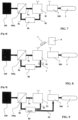
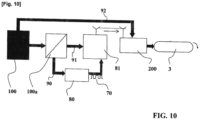
- auxiliary control circuit 80 The functions of the auxiliary control circuit 80 are illustrated in the Figures 7 to 10 , to which reference should now be made.
- Each of these figures shows the essential components of the motor control device, namely the electrical energy source 100, a control assembly 200, the electric motor 3, the auxiliary control circuit 80 and the control signal transmitter-receiver 81.
- the control assembly 200 comprises, in summary form, the known elements illustrated in the figure 1 , namely the first control signal receiver 61, the main control circuit 6 and the power supply electronic circuit 5, which constitute the main control and power supply electronic circuits.
- the auxiliary control circuit 80 and the control signal transmitter-receiver 81 constitute low-consumption auxiliary electronic circuits, permanently powered from the electrical energy source 100, and which are thus capable of permanently ensuring the reception and storage of the control signals 7.
- the state of the motor control device has been illustrated during a waiting phase, waiting to receive a possible control signal from a remote control.
- the auxiliary control circuit 80 sends to the control signal transmitter-receiver 81 a signal 82 which places it in reception mode.
- the auxiliary control circuit 80 commands the cutting of the electrical connection between the electrical energy source 100 and the control assembly 200, so as to inhibit the power supply of the main electronic control and power supply circuits (the first control signal receiver 61, the main control circuit 6, and the electronic power supply circuit 5).
- auxiliary control circuit 80 and the control signal transceiver 81 are powered from the electrical energy source 100.
- this power supply is provided by means of a suitable DC-DC converter 100a, it being observed that the power supply of the low-power electronic circuits of the auxiliary control circuit 80 and of the control signal transceiver 81 generally requires a voltage of the order of 3.3 V, whereas the electrical energy source 100 has a higher voltage, for example 28.8 V.
- the state of the motor control device is illustrated during a phase of reception of a control signal 7 coming from the remote control 8. During this reception phase, the electrical supply of the circuits is maintained as in the waiting phase.
- the control signal transmitter-receiver 81 Upon receipt of the control signal 7, the control signal transmitter-receiver 81 transmits the control signal 7 to the auxiliary control circuit 80, the function of which is then to record it.
- the state of the motor control device has been illustrated during a wake-up phase.
- the auxiliary control circuit 80 sends to the control signal transmitter-receiver 81 a signal 83 to place it in transmission mode, and sends to the control assembly 200 a signal 84 to wake it up.
- the state of the motor control device during a transmission and control phase is illustrated.
- the auxiliary control circuit 80 first controls the reestablishment of the electrical connection between the electrical energy source 100 and the control assembly 200, as indicated by the arrow 92, so as to reestablish the power supply to the main electronic control and power supply circuits comprising the first control signal receiver 61, the main control circuit 6 and the electronic power supply circuit 5.
- the auxiliary control circuit 80 transfers to the control signal transceiver 81 a copy 70 of the control signal 7 that it previously recorded during the reception phase, and causes the control signal transceiver 81 to transmit this copy 70 of the control signal 7 to the first control signal receiver 61.
- this copy 70 of the control signal 7 reaches the control circuit main 6, which decodes the frame and produces the corresponding control orders 60 ( figure 1 ) transmitted to the electronic power supply circuit 5 to power the electric motor 3 from the electrical energy source 100 and to cause its rotation in the appropriate direction of rotation and for the appropriate duration corresponding to the information contained in the frame of the control signal 7.
- the auxiliary control circuit 80 reconfigures the assembly in the waiting phase.
- the auxiliary control circuit 80 can, in practice, be produced from a microcontroller, associated with a memory adapted for the storage of at least one control signal 7, and programmed to execute the steps described above in relation to the Figures 7 to 10 .
- the transceiver 81 may be constituted by an electronic circuit usually used to fulfill the functions of receiving and transmitting electromagnetic waves at short distances.
- the auxiliary control circuit 80 and the control signal transceiver 81 are low-consumption electronic circuits, not requiring a low-consumption standby state, and not significantly affecting the autonomy of the motor control device despite their permanent power supply state.
- the electrical energy source 100 comprises a photovoltaic solar panel 1, directly delivering the energy in electrical form.
- the output voltage of the photovoltaic solar panel 1 is in a range of approximately 12 to 18 V, namely the usual range of output voltages of photovoltaic solar panels.
- the output power of the photovoltaic panel must be as great as possible in relation to the small surface area that one wishes to allocate to it. A typical power of the order of 5 or 6 W peak may be suitable.
- the technology used for the photovoltaic panel must therefore be quite efficient, for example of the monocrystalline or polycrystalline type.
- the electrical energy source 100 further comprises a storage battery 2, powered from the photovoltaic solar panel 1 via a DC-DC charger 4 which converts the low voltage output electrical energy from the photovoltaic solar panel 1 into electrical energy at a higher recharging electrical voltage, of the order of approximately 24 to 30 V, from the storage battery 2.
- the alternating current electric motor 3 is of a type capable of being supplied by an effective single-phase electric voltage in the range between 50 and 1000 volts, advantageously of the order of approximately 230 V, and capable of delivering a nominal torque of 10 Nm to 80 Nm, for example a nominal torque of approximately 50 Nm.
- the nominal voltage of the storage battery 2 is in a range of approximately 24 to 30 V, constituting an intermediate electrical voltage between the nominal voltage delivered by the photovoltaic solar panel 1 and the nominal supply voltage of the electric motor 3, making it easier to reach the voltage necessary for the operation of the electric motor 3.
- each accumulator is a Li-lon battery having a nominal voltage of 3.6 V and whose unit capacity is at least 2600 milliampere hours.
- the storage battery 2 can be produced for example by connecting 8 3.6 V accumulators in series.
- the DC-DC charger 4 is a DC voltage step-up electronic circuit.
- the DC-DC charger 4 is a voltage boost converter, of the parallel chopper type, whose input terminals 40 and 41 are connected to the photovoltaic solar panel 1, and whose output terminals 42 and 43 are connected to the storage battery 2.
- the DC-DC charger 4 comprises an electronic switch 44 of the MOSFET (insulated gate field effect transistor) type, controlled by a control circuit comprising a microcontroller 47b and a shaping circuit 47a.
- the source-drain circuit of the electronic switch 44 is connected in series with an inductor 45 to the input terminals 40 and 41, and its gate 46 receives, via the shaping circuit 47a, a pulsed control signal generated by a microcontroller 47b.
- a capacitor 48 is connected to the output terminals 42 and 43, and a Schottky diode 49 is connected between the electronic switch 44 and the capacitor 48.
- the microcontroller 47b comprises a recorded program by which the microcontroller 47b scans the electrical voltage information at the input terminals 40 and 41, scans the electrical current information delivered by the photovoltaic solar panel 1, and controls the switching of the electronic switch 44 so as to remain as close as possible to the maximum power point of the photovoltaic solar panel 1.
- This maximum power point is located close to 80% of the maximum voltage delivered by the photovoltaic solar panel 1.
- This program may be of the type generally called MPPT (maximum Power Point Tracking), well known to those skilled in the art in the use of solar panels.
- the microcontroller 47b is also programmed to maintain the recharge voltage of the accumulators at the correct level at all times while limiting the current if necessary, in particular when recharging above 80% of the full charge of the accumulators making up the accumulator battery 2.
- the microcontroller 47b can also be programmed to balance the charge of the accumulators which are in series in the accumulator battery 2, by controlling transistors associated with balancing resistors which ensure the discharge of surplus energy from the accumulators when necessary.
- the electronic power supply circuit 5 which is interposed between the storage battery 2 and the electric motor 3 ( Figure 1 ), comprises two successive stages 5a and 5b which transform the output electrical energy at direct electrical voltage of the storage battery 2 into an output electrical energy at alternating voltage capable of powering the alternating current electric motor 3.
- Input terminals 50 and 51 of the electronic power supply circuit 5 are connected to the terminals 42 and 43 of the storage battery 2, while the output terminals 52 and 53 are connected to the alternating current electric motor 3
- FIG. 3 illustrates the first stage 5a of the electronic power supply circuit 5, fulfilling the function of a DC-DC voltage-boosting converter, to convert the relatively low DC voltage of the storage battery 2 into a DC voltage of sufficiently high value, at least equivalent to the peak voltage of the final AC voltage wave envisaged for the power supply of the AC electric motor 3.
- the first DC-DC stage 5a essentially comprises an H-bridge of four electronic switches 52a, 52b, 52c and 52d, which are advantageously each of the MOSFET (insulated gate field effect transistor) type.
- the electronic switches 52a and 52b are both connected in series between the input terminals 50 and 51, and their junction point 55a is connected to a first terminal of the primary of a voltage-boosting transformer 54.
- the electronic switches 52c and 52d are both connected in series between the input terminals 50 and 51. series between input terminals 50 and 51, and their junction point 55b is connected to the second terminal of the primary of the voltage-boosting transformer 54.
- the grids of the electronic switches 52a, 52b, 52c and 52d receive, via shaping circuits 56 and 57, pulse control signals generated by a microcontroller 58 on its outputs 58a and 58b.
- the microcontroller 58 is programmed to successively control by its output 58a the conduction of the pair of electronic switches 52a and 52d, then by its output 58b the conduction of the pair of electronic switches 52b and 52c, producing on the primary of the transformer 54 a square wave power supply with a duty cycle of 1/1.
- the secondary of the voltage-boosting transformer 54 is connected to the input of a rectifier element 59, which in the illustrated embodiment consists of four diodes 59a, 59b, 59c and 59d, and which is associated with one or more filter capacitors 59e to produce on the output terminals 59f and 59g a rectified and filtered electrical voltage.
- a rectifier element 59 which in the illustrated embodiment consists of four diodes 59a, 59b, 59c and 59d, and which is associated with one or more filter capacitors 59e to produce on the output terminals 59f and 59g a rectified and filtered electrical voltage.
- the voltage-boosting transformer 54 is a high-frequency transformer, advantageously of the planar type, capable of operating at high frequency, for example at a frequency of approximately 50 kHz. This allows sufficient power transmission with a transformer of small volume and small footprint.
- the primary winding and the secondary winding may each consist of a stack of flat elementary coils each comprising one or more layers of copper electrically insulated from one another and the ends of which are electrically connected to one another, while the magnetic circuit consists of assembled ferrite cores. Examples of such planar transformers are described for example in the documents EP 3300090 A1 Or US 7,663,460 B2 . As an example, good results can be obtained using a reference planar transformer TP32D2402 produced and marketed by the Chinese company Shaanxi Gold-Stone Electronics Co., LTD.
- the electronic switches 52a, 52b, 52c and 52d operate at a relatively low voltage, the peak voltage being equal to the DC voltage of the storage battery 2, i.e. approximately 24 V to 30 V.
- the current passed through must be quite high, which requires the use of field effect transistors having very good characteristics in the on state.
- these electronic switches must have a switching speed less than or equal to the natural descent of current during switching, so as not to dissipate too much energy unnecessarily during switching.
- this second stage 5b is a DC-AC converter which transforms the continuous output voltage of the first stage 5a into a sinusoidal alternating voltage capable of powering the electric motor 3.
- this second stage 5b is in the form of an H-bridge consisting of four electronic switches 15a, 15b, 15c and 15d, which are advantageously each of the MOSFET (insulated gate field effect transistor) type.
- the electronic switches 15a and 15b are both connected in series between the input terminals 59f and 59g, and their junction point 15e is connected to a first output terminal 52 via a low-pass filter 15.
- the electronic switches 15c and 15d are both connected in series between the input terminals 59f and 59g, and their junction point 15f is connected to the second output terminal 53 via the same low-pass filter 15.
- the gates of the electronic switches 15a, 15b, 15c and 15d receive pulse control signals generated by a microcontroller 15g on its respective outputs.
- the microcontroller 15g is programmed to successively drive the conduction of the pair of electronic switches 15a and 15d to generate a positive pulse 11a at the output, then the conduction of the pair of electronic switches 15b and 15c to generate a negative pulse 11b at the output, with a bipolar pulse width modulation producing at the junction points 15e and 15f an output voltage 11 in square waves with a variable duty cycle as illustrated in FIG. figure 5 .
- the low-pass filter 15 may for example comprise a first inductance 15h in series between the junction point 15e and the output terminal 52, a second inductance 15i in series between the junction point 15f and the output terminal 53, and a capacitor 15j between the output terminals 52 and 53.
- the voltage applied to the motor 3 is close to a sinusoid, as illustrated by the curve 12 on the figure 5 .
- FIG. 6 illustrates a motorization box 71 for a concealment or closing member, the location of the photovoltaic panel 1 on the surface of the motorization box 71, and the location of the electronic assembly 72 composed of the accumulator battery and the various electronic circuits previously described, allowing the power supply and control of the alternating current electric motor at a nominal voltage of 230 V for driving a concealment or closing member.
- the electronic assembly 72 is particularly space-saving, occupying a substantially parallelepiped volume having a length L less than or equal to 350 mm, a height H of approximately 70 mm, a depth P of approximately 20 mm.
Landscapes
- Engineering & Computer Science (AREA)
- Structural Engineering (AREA)
- Power Engineering (AREA)
- General Physics & Mathematics (AREA)
- Business, Economics & Management (AREA)
- Emergency Management (AREA)
- Physics & Mathematics (AREA)
- Architecture (AREA)
- Computer Networks & Wireless Communication (AREA)
- Civil Engineering (AREA)
- Charge And Discharge Circuits For Batteries Or The Like (AREA)
- Control Of Electrical Variables (AREA)
- Blinds (AREA)
- Remote Monitoring And Control Of Power-Distribution Networks (AREA)
- Selective Calling Equipment (AREA)
Claims (15)
- Vorrichtung zur Steuerung eines Antriebs eines Schließ- oder Beschattungselements (10) in einem Gebäude, umfassend:- mindestens einen Elektroantrieb (3), der mechanisch mit dem Schließ- oder Beschattungselement (10) gekoppelt ist,- eine elektrische Energiequelle (100), die eine elektrische Gleichspannung liefert,- eine elektronische Stromversorgung (5) zur Versorgung des Elektroantriebs (3) aus der elektrischen Energiequelle (100) in Abhängigkeit von Steuerbefehlen (60),- eine Hauptsteuerschaltung (6), die, von der elektrischen Energiequelle (100) versorgt, mit einem ersten Steuersignalempfänger (61) verbunden ist und dazu geeignet ist, Steuerbefehle (60) zu erzeugen, die an die elektronische Stromversorgung (5) gerichtet sind,- eine Fernsteuerung (8), die dazu geeignet ist, die Steuersignale (7) über die Luft zu erzeugen und an den ersten Steuersignalempfänger (61) zu übertragen,dadurch gekennzeichnet, dass die Vorrichtung zur Steuerung des Antriebs ferner Folgendes umfasst:- eine Hilfssteuerschaltung (80), die ausgelegt ist, ständig in Bereitschaft zu bleiben, und die einen Speicher umfasst, der in der Lage ist, ein Steuersignal (7) zu speichern,- einen Steuersignal-Sendeempfänger (81), der so ausgelegt ist, dass er in einem Empfangsmodus in Bereitschaft bleibt, um ein von der Fernsteuerung (8) empfangenes Steuersignal (7) zu empfangen und besagtes Steuersignal (7) an die Hilfssteuerung (80) der Schaltung zu übertragen, die es speichert,- die Hilfssteuerschaltung (80), die ferner so ausgelegt ist, dass sie nach Empfang und Speicherung besagten Steuersignals (7) die Stromversorgung der Hauptsteuerschaltung (6) und der elektronischen Stromversorgung (5) herstellt,- die Hilfssteuerschaltung (80), die ferner so ausgelegt ist, dass sie den Steuersignal-Sendeempfänger (81) in einen Sendemodus versetzt und ihn ansteuert, eine identische Kopie (70) des besagten gespeicherten Steuersignals (7) an den ersten Steuersignalempfänger (61) zu senden,- die Hilfssteuerschaltung (80), die ferner so ausgelegt ist, dass sie den Steuersignal-Sendeempfänger (81) in seinen Empfangsmodus zurückversetzt und die Stromversorgung der Hauptsteuerschaltung (6) und der elektronischen Stromversorgung (5) nach Ausführung der Steuerbefehle (60), die auf das an dem Steuersignal-Sendeempfänger (81) empfangenen besagten Steuersignal (7) folgen, sperrt, solange kein neues Signal am Steuersignal-Sendeempfänger (81) empfangen wird.
- Vorrichtung zur Steuerung des Antriebs nach Anspruch 1, dadurch gekennzeichnet, dass die Hilfssteuerschaltung (80) das Senden besagter identischer Kopie (70) des gespeicherten Steuersignals (7) an den ersten Steuersignalempfänger (61) nach einer vorab festgelegten Wartezeit steuert, die größer gewählt ist als die Zeit, die erforderlich ist, damit der erste Steuersignalempfänger (61) nach Herstellung seiner Stromversorgung besagte identische Kopie (70) des Steuersignals (7) vom Steuersignal-Sendeempfänger (81) erkennen kann.
- Vorrichtung zur Steuerung des Antriebs nach einem der Ansprüche 1 und 2, dadurch gekennzeichnet, dass die Hilfssteuerschaltung (80) und der Steuersignal-Sendeempfänger (81) elektronische Schaltungen mit geringem Verbrauch sind, die es nicht erforderlich machen, einen verbrauchsreduzierten Standby-Zustand zu haben.
- Vorrichtung zur Steuerung des Antriebs nach einem der Ansprüche 1 bis 3, dadurch gekennzeichnet, dass die Hilfssteuerschaltung (80) einen programmierten Mikrocontroller umfasst.
- Vorrichtung zur Steuerung des Antriebs nach einem der Ansprüche 1 bis 4, dadurch gekennzeichnet, dass der Steuersignal-Senderempfänger (81) so ausgelegt ist, dass er besagte identische Kopie (70) des gespeicherten Steuersignals (7) über die Luft an den ersten Steuersignalempfänger (61) überträgt.
- Vorrichtung zur Steuerung des Antriebs nach einem der Ansprüche 1 bis 4, dadurch gekennzeichnet, dass der Steuersignal-Senderempfänger (81) mit dem ersten Steuersignalempfänger (61) durch eine leitende Verbindung zur leitungsgebundenen Übertragung besagter identischen Kopie (70) des gespeicherten Steuersignals (7) an den ersten Steuersignalempfänger (61) verbunden ist.
- Vorrichtung zur Steuerung des Antriebs nach einem der Ansprüche 1 bis 6, dadurch gekennzeichnet, dass die elektrische Energiequelle (100) eine Energiespeicherbatterie (2) ist, die von einem Photovoltaik-Solarpanel (1) versorgt ist.
- Vorrichtung zur Steuerung des Antriebs nach Anspruch 7, dadurch gekennzeichnet, dass:- der Elektroantrieb (3) ein Antrieb mit Niederspannungs-Wechselstrom mit einer effektiven elektrischen Spannung im Bereich zwischen 50 und 1000 V, vorteilhafterweise gleich etwa 230 V; ist,- das Photovoltaik-Solarpanel (1) eine elektrische Gleichspannung liefert, die niedriger ist als die effektive elektrische Spannung des Elektroantriebs (3),- die Energiespeicherbatterie (2) eine Nennspannung aufweist, die niedriger ist als besagte effektive elektrische Spannung des Elektroantriebs (3) und höher als die von dem Photovoltaik-Solarpanel (1) gelieferte elektrische Gleichspannung.- ein DC-DC-Ladegerät (4) die elektrische Ausgangsenergie des Photovoltaik-Solarpanels (1) in elektrische Energie mit der elektrischen Spannung zum Wiederaufladen der Energiespeicherbatterie (2) umwandelt,- die elektronische Stromversorgung (5) die elektrische Gleichspannungsausgangsenergie der Energiespeicherbatterie (2) in elektrische Energie mit einer Wechselausgangsspannung umwandelt, die in der Lage ist, besagten Elektroantrieb (3) zu versorgen.
- Vorrichtung zur Steuerung des Antriebs nach einem der Ansprüche 1 bis 8, dadurch gekennzeichnet, dass die elektronische Stromversorgung (5) eine erste Stufe (5a) in Form eines DC-DC-Spannungskonverters umfasst, der die elektrische Gleichspannung der Energiespeicherbatterie (2) auf eine kontinuierliche Ausgangsgleichspannung konvertiert, deren Minimum äquivalent zu der Spitzenspannung der Welle der vorgesehenen Endspannung für die Versorgung des Elektroantriebs (3) ist, und eine zweite Stufe (5b) in Form eines DC-AC-Konverters umfasst, der die direkte Ausgangsgleichspannung der ersten Stufe (5a) in eine sinusförmige Wechselspannung umwandelt, die in der Lage ist, den Elektroantrieb (3) zu versorgen.
- Vorrichtung zur Steuerung des Antriebs nach Anspruch 9, dadurch gekennzeichnet, dass die erste DC-DC-Stufe (5a) eine H-Brücke aus elektronischen Schaltern (52a, 52b, 52c, 52d) umfasst, deren Eingangspunkte (50, 51) an den Anschlüssen der Energiespeicherbatterie (2) liegen und deren Verbindungspunkte (55a, 55b) die Primärseite eines Spannungserhöhungstransformators (54) versorgen, dessen Sekundärseite ein Gleichrichterelement (59) versorgt, welches besagte Ausgangsgleichspannung liefert.
- Vorrichtung zur Steuerung des Antriebs nach Anspruch 10, dadurch gekennzeichnet, dass der Spannungserhöhungstransformator (54) ein planarer Transformator ist, der in der Lage ist, mit hoher Frequenz zu arbeiten.
- Vorrichtung zur Steuerung des Antriebs nach Anspruch 11, dadurch gekennzeichnet, dass die H-Brücke der ersten DC-DC-Stufe (5a) mit einer Frequenz von etwa 50 kHz arbeitet.
- Vorrichtung zur Steuerung des Antriebs nach einem der Ansprüche 9 bis 12, dadurch gekennzeichnet, dass die zweite DC-AC-Stufe (5b) eine H-Brücke aus elektronischen Schaltern (15a, 15b, 15c, 15d) umfasst, deren Eingangspunkte (59f, 59g) an den Anschlüssen des Gleichrichterelements (59) liegen und deren Verbindungspunkte (15e, 15f) über einen Tiefpassfilter (15) den Antrieb (3) versorgen, wobei die elektronischen Schalter (15a, 15b, 15c, 15d) von einem Mikrocontroller (15g) gesteuert werden, der so programmiert ist, dass er eine bipolare Pulsweitenmodulation durchführt, die an den Verbindungspunkten (15e und 15f) mit einem Nocken mit variablem Tastverhältnis eine Ausgangsspannung (11) erzeugt, die nach der Filterung durch den Tiefpassfilter (15) den Antrieb (3) mit einer im Wesentlichen sinusförmigen einphasigen Spannung (12) versorgt.
- Schließ- oder Beschattungselement in einem Gebäude, ausgestattet mit einer Vorrichtung zur Steuerung eines Antriebs nach einem der Ansprüche 1 bis 13.
- Verfahren zur Steuerung eines Antriebs eines Schließ- oder Beschattungselements (10) in einem Gebäude, wobei:- mindestens ein elektrischer Antrieb (3) mechanisch mit dem Schließ- oder Beschattungselement (10) gekoppelt ist,- eine elektrische Energiequelle (100) eine elektrische Gleichspannung liefert,- eine elektronische Stromversorgung (5) den Elektroantrieb (3) aus der elektrischen Energiequelle (100) In Abhängigkeit von Steuerbefehlen (60) versorgt,- eine Hauptsteuerschaltung (6), die, von der elektrischen Energiequelle (100) versorgt und mit einem ersten Steuersignalempfänger (61) verbunden, dazu geeignet ist, Steuerbefehle (60) zu erzeugen, die an die elektronische Stromversorgung (5) gerichtet sind,- während einer Wartephase, in der auf den Empfang eines möglichen Steuersignals (7) von einer Fernsteuerung (8) gewartet wird, die Stromversorgung der Hauptsteuerschaltungen (61, 6) und die Stromversorgung (5) besagten Antriebs (3) gesperrt wird und die elektronischen Hilfssteuerschaltungen (80, 81) mit geringem Stromverbrauch aufrecht erhalten werden, die in der Lage sind, den permanenten Empfang und die Speicherung von Steuersignalen (7) zu gewährleisten,- während einer Empfangsphase die elektronischen Hilfssteuerschaltungen (80, 81) ein über die Luft von der Fernsteuerung (8) empfangenes Steuersignal (7) empfangen und speichern,- während einer Aufweckphase die Hilfselektronikschaltungen (80, 81) die Hauptsteuerschaltungen (61, 6) und Stromversorgung (5) in Bereitschaft versetzen,- während einer Sende- und Steuerphase die Hilfselektronikschaltungen (80, 81) die Wiederherstellung der Versorgung der Hauptsteuerschaltungen (61, 6) und der Stromversorgung (5) steuern und dann nach einer vorab festgelegten Wartezeit eine identische Kopie (70) des zuvor aufgezeichneten Steuersignals (7) an die Hauptsteuerschaltungen (61, 6) übertragen, wobei die Hauptsteuerschaltungen (61, 6) den Datenübertragungsblock des Steuersignals (7) dekodieren und korrespondierende Steuerbefehle (60) erzeugen, die an die Hauptstromversorgung (5) gesendet werden, um den Antrieb (3) gemäß den im Steuersignal (7) enthaltenen Informationen mit Strom zu versorgen,- nach Ausführung der Steuerbefehle (60), ein Zurücksetzen in die Wartephase erfolgt, solange kein neues Signal am Steuersignal-Sendeempfänger (81) empfangen wird.
Applications Claiming Priority (2)
| Application Number | Priority Date | Filing Date | Title |
|---|---|---|---|
| FR2003764A FR3109479B1 (fr) | 2020-04-15 | 2020-04-15 | Commande d’organe d’occultation dans un batiment |
| PCT/IB2021/052947 WO2021209870A1 (fr) | 2020-04-15 | 2021-04-09 | Commande d'organe d'occultation dans un batiment |
Publications (2)
| Publication Number | Publication Date |
|---|---|
| EP4136311A1 EP4136311A1 (de) | 2023-02-22 |
| EP4136311B1 true EP4136311B1 (de) | 2024-12-25 |
Family
ID=71094553
Family Applications (1)
| Application Number | Title | Priority Date | Filing Date |
|---|---|---|---|
| EP21719277.2A Active EP4136311B1 (de) | 2020-04-15 | 2021-04-09 | Vorrichtung zur steuerung einer sperrvorrichtung in einem gebäude |
Country Status (3)
| Country | Link |
|---|---|
| EP (1) | EP4136311B1 (de) |
| FR (1) | FR3109479B1 (de) |
| WO (1) | WO2021209870A1 (de) |
Family Cites Families (6)
| Publication number | Priority date | Publication date | Assignee | Title |
|---|---|---|---|---|
| US20030063715A1 (en) * | 2001-09-28 | 2003-04-03 | The Chamberlain Group | Movable barrier operator with back-up battery monitoring and notification device |
| JP4222490B2 (ja) | 2006-09-29 | 2009-02-12 | Tdk株式会社 | プレーナ型トランス及びスイッチング電源 |
| FR2970500B1 (fr) * | 2011-01-17 | 2015-04-24 | Somfy Sas | Unite d'alimentation electrique de secours pour actionneur, procede de commande et installation de protection solaire, de fermeture ou d'occultation comprenant une telle unite |
| FR3035752B1 (fr) * | 2015-04-29 | 2019-05-31 | Commissariat A L'energie Atomique Et Aux Energies Alternatives | Procede d'echange de donnees entre deux dispositifs electromecaniques |
| FR3037988A1 (fr) * | 2015-06-24 | 2016-12-30 | Simu | Procede de commande en fonctionnement d'un dispositif d'entrainement motorise d'une installation domotique, dispositif d'entrainement motorise et installation associes |
| EP3300090B1 (de) | 2016-09-22 | 2022-02-23 | Thales | Schicht eines planartransformators, gesamtheit der schichten für einen planartransformator und planartransformator |
-
2020
- 2020-04-15 FR FR2003764A patent/FR3109479B1/fr active Active
-
2021
- 2021-04-09 EP EP21719277.2A patent/EP4136311B1/de active Active
- 2021-04-09 WO PCT/IB2021/052947 patent/WO2021209870A1/fr not_active Ceased
Also Published As
| Publication number | Publication date |
|---|---|
| EP4136311A1 (de) | 2023-02-22 |
| FR3109479B1 (fr) | 2022-12-30 |
| FR3109479A1 (fr) | 2021-10-22 |
| WO2021209870A1 (fr) | 2021-10-21 |
Similar Documents
| Publication | Publication Date | Title |
|---|---|---|
| EP1567383B1 (de) | Hybridkraftfahrzeug mit steuerungsvorrichtung zum laden der batterie | |
| CA2929408C (fr) | Procede de charge de vehicule electrique a vehicule electrique | |
| EP3403872B1 (de) | Ladesystem für ein elektro- oder hybridfahrzeug | |
| EP3227137B1 (de) | Verbesserter gleichstromwandler und stromversorgungsvorrichtung | |
| EP2823554B1 (de) | Ladevorrichtung für die batterie eines fahrzeugs mit einem ac-dc wandler mit isoliertem resonanzwandler | |
| FR2738411A1 (fr) | Systeme d'alimentation electrique mixte onduleur et convertisseur alternatif-continu | |
| EP2315931A2 (de) | Verfahren und vorrichtung zur überwachung der startzeit eines wärmemotors eines fahrzeugs | |
| EP4136308B1 (de) | Vorrichtung zum antrieb eines schliess- oder beschattungselements in einem gebäude mittels einer solarenergiequelle | |
| EP2128427A1 (de) | Verfahren und Vorrichtung zur Steuerung der Startzeit einer Fahrzeugwärmekraftmaschine | |
| EP1738456A1 (de) | Elektrische installation zur versorgung eines mit einer backup-einrichtung ausgestatteten stellgliedes | |
| EP4136311B1 (de) | Vorrichtung zur steuerung einer sperrvorrichtung in einem gebäude | |
| EP2820739A1 (de) | Elektrische schaltung zum beladen mindestens einer stromspeicheranordnung mittels eines stromnetzwerks | |
| EP1331716A1 (de) | Elektrisches Energieversorgungsystem eines Kraftfahrzeuges | |
| WO2023057161A1 (fr) | Systeme electrique pour vehicule automobile | |
| EP3721543A1 (de) | Gleichspannungswandler mit vorladung eines ersten stromnetzes aus einem zweiten stromnetz | |
| EP3685485B1 (de) | Verfahren zur steuerung eines ladesystems einer traktionbatterie | |
| WO2023057163A1 (fr) | Systeme electrique pour vehicule automobile | |
| FR2744574A1 (fr) | Procede et dispositif pour charger une batterie alimentant un moteur electrique sous la commande du microprocesseur de la commande impulsionnelle | |
| FR2692418A1 (fr) | Appareillage à moteur électrique à fonctionnement intermittent, notamment store vénitien motorisé, et installation pour l'alimentation électrique d'une pluralité de tels appareillages. | |
| WO2023057329A1 (fr) | Système électrique pour véhicule automobile | |
| WO2022089963A1 (fr) | Dispositif de controle d'un convertisseur dc-dc de chargeur electrique embarque | |
| EP1772303A1 (de) | Verfahren und System zum Einschalten eines Versorgungsbus eines elektrischen Fahrzeugs, Datenträger und Fahrzeug zur Durchführung des Verfahrens | |
| FR2698499A1 (fr) | Circuit pour faire fonctionner une charge inductive. | |
| EP3910780A1 (de) | Stromversorgungsvorrichtung, elektromechanisches stellglied, das eine solche stromversorgungsvorrichtung umfasst, und schliess- , verdunkelungs- oder sonnenschutzanlage, die ein solches elektromechanisches stellglied umfasst | |
| EP2400630A2 (de) | Tragbares Solar-Ladegerät und entsprechendes Verwendungsverfahren |
Legal Events
| Date | Code | Title | Description |
|---|---|---|---|
| STAA | Information on the status of an ep patent application or granted ep patent |
Free format text: STATUS: UNKNOWN |
|
| STAA | Information on the status of an ep patent application or granted ep patent |
Free format text: STATUS: THE INTERNATIONAL PUBLICATION HAS BEEN MADE |
|
| PUAI | Public reference made under article 153(3) epc to a published international application that has entered the european phase |
Free format text: ORIGINAL CODE: 0009012 |
|
| STAA | Information on the status of an ep patent application or granted ep patent |
Free format text: STATUS: REQUEST FOR EXAMINATION WAS MADE |
|
| 17P | Request for examination filed |
Effective date: 20220919 |
|
| AK | Designated contracting states |
Kind code of ref document: A1 Designated state(s): AL AT BE BG CH CY CZ DE DK EE ES FI FR GB GR HR HU IE IS IT LI LT LU LV MC MK MT NL NO PL PT RO RS SE SI SK SM TR |
|
| P01 | Opt-out of the competence of the unified patent court (upc) registered |
Effective date: 20230505 |
|
| DAV | Request for validation of the european patent (deleted) | ||
| DAX | Request for extension of the european patent (deleted) | ||
| STAA | Information on the status of an ep patent application or granted ep patent |
Free format text: STATUS: EXAMINATION IS IN PROGRESS |
|
| 17Q | First examination report despatched |
Effective date: 20230925 |
|
| GRAP | Despatch of communication of intention to grant a patent |
Free format text: ORIGINAL CODE: EPIDOSNIGR1 |
|
| STAA | Information on the status of an ep patent application or granted ep patent |
Free format text: STATUS: GRANT OF PATENT IS INTENDED |
|
| INTG | Intention to grant announced |
Effective date: 20240313 |
|
| GRAJ | Information related to disapproval of communication of intention to grant by the applicant or resumption of examination proceedings by the epo deleted |
Free format text: ORIGINAL CODE: EPIDOSDIGR1 |
|
| STAA | Information on the status of an ep patent application or granted ep patent |
Free format text: STATUS: EXAMINATION IS IN PROGRESS |
|
| INTC | Intention to grant announced (deleted) | ||
| GRAP | Despatch of communication of intention to grant a patent |
Free format text: ORIGINAL CODE: EPIDOSNIGR1 |
|
| STAA | Information on the status of an ep patent application or granted ep patent |
Free format text: STATUS: GRANT OF PATENT IS INTENDED |
|
| INTG | Intention to grant announced |
Effective date: 20240913 |
|
| GRAS | Grant fee paid |
Free format text: ORIGINAL CODE: EPIDOSNIGR3 |
|
| GRAA | (expected) grant |
Free format text: ORIGINAL CODE: 0009210 |
|
| STAA | Information on the status of an ep patent application or granted ep patent |
Free format text: STATUS: THE PATENT HAS BEEN GRANTED |
|
| AK | Designated contracting states |
Kind code of ref document: B1 Designated state(s): AL AT BE BG CH CY CZ DE DK EE ES FI FR GB GR HR HU IE IS IT LI LT LU LV MC MK MT NL NO PL PT RO RS SE SI SK SM TR |
|
| REG | Reference to a national code |
Ref country code: GB Ref legal event code: FG4D Free format text: NOT ENGLISH |
|
| REG | Reference to a national code |
Ref country code: CH Ref legal event code: EP |
|
| REG | Reference to a national code |
Ref country code: DE Ref legal event code: R096 Ref document number: 602021023866 Country of ref document: DE |
|
| REG | Reference to a national code |
Ref country code: IE Ref legal event code: FG4D Free format text: LANGUAGE OF EP DOCUMENT: FRENCH |
|
| REG | Reference to a national code |
Ref country code: LT Ref legal event code: MG9D |
|
| PG25 | Lapsed in a contracting state [announced via postgrant information from national office to epo] |
Ref country code: HR Free format text: LAPSE BECAUSE OF FAILURE TO SUBMIT A TRANSLATION OF THE DESCRIPTION OR TO PAY THE FEE WITHIN THE PRESCRIBED TIME-LIMIT Effective date: 20241225 |
|
| PG25 | Lapsed in a contracting state [announced via postgrant information from national office to epo] |
Ref country code: FI Free format text: LAPSE BECAUSE OF FAILURE TO SUBMIT A TRANSLATION OF THE DESCRIPTION OR TO PAY THE FEE WITHIN THE PRESCRIBED TIME-LIMIT Effective date: 20241225 |
|
| PG25 | Lapsed in a contracting state [announced via postgrant information from national office to epo] |
Ref country code: BG Free format text: LAPSE BECAUSE OF FAILURE TO SUBMIT A TRANSLATION OF THE DESCRIPTION OR TO PAY THE FEE WITHIN THE PRESCRIBED TIME-LIMIT Effective date: 20241225 |
|
| PG25 | Lapsed in a contracting state [announced via postgrant information from national office to epo] |
Ref country code: NO Free format text: LAPSE BECAUSE OF FAILURE TO SUBMIT A TRANSLATION OF THE DESCRIPTION OR TO PAY THE FEE WITHIN THE PRESCRIBED TIME-LIMIT Effective date: 20250325 |
|
| PG25 | Lapsed in a contracting state [announced via postgrant information from national office to epo] |
Ref country code: GR Free format text: LAPSE BECAUSE OF FAILURE TO SUBMIT A TRANSLATION OF THE DESCRIPTION OR TO PAY THE FEE WITHIN THE PRESCRIBED TIME-LIMIT Effective date: 20250326 Ref country code: LV Free format text: LAPSE BECAUSE OF FAILURE TO SUBMIT A TRANSLATION OF THE DESCRIPTION OR TO PAY THE FEE WITHIN THE PRESCRIBED TIME-LIMIT Effective date: 20241225 |
|
| PG25 | Lapsed in a contracting state [announced via postgrant information from national office to epo] |
Ref country code: RS Free format text: LAPSE BECAUSE OF FAILURE TO SUBMIT A TRANSLATION OF THE DESCRIPTION OR TO PAY THE FEE WITHIN THE PRESCRIBED TIME-LIMIT Effective date: 20250325 |
|
| REG | Reference to a national code |
Ref country code: NL Ref legal event code: MP Effective date: 20241225 |
|
| PG25 | Lapsed in a contracting state [announced via postgrant information from national office to epo] |
Ref country code: NL Free format text: LAPSE BECAUSE OF FAILURE TO SUBMIT A TRANSLATION OF THE DESCRIPTION OR TO PAY THE FEE WITHIN THE PRESCRIBED TIME-LIMIT Effective date: 20241225 |
|
| REG | Reference to a national code |
Ref country code: AT Ref legal event code: MK05 Ref document number: 1754301 Country of ref document: AT Kind code of ref document: T Effective date: 20241225 |
|
| PG25 | Lapsed in a contracting state [announced via postgrant information from national office to epo] |
Ref country code: SM Free format text: LAPSE BECAUSE OF FAILURE TO SUBMIT A TRANSLATION OF THE DESCRIPTION OR TO PAY THE FEE WITHIN THE PRESCRIBED TIME-LIMIT Effective date: 20241225 |
|
| PG25 | Lapsed in a contracting state [announced via postgrant information from national office to epo] |
Ref country code: PL Free format text: LAPSE BECAUSE OF FAILURE TO SUBMIT A TRANSLATION OF THE DESCRIPTION OR TO PAY THE FEE WITHIN THE PRESCRIBED TIME-LIMIT Effective date: 20241225 |
|
| PGFP | Annual fee paid to national office [announced via postgrant information from national office to epo] |
Ref country code: DE Payment date: 20250411 Year of fee payment: 5 |
|
| PG25 | Lapsed in a contracting state [announced via postgrant information from national office to epo] |
Ref country code: ES Free format text: LAPSE BECAUSE OF FAILURE TO SUBMIT A TRANSLATION OF THE DESCRIPTION OR TO PAY THE FEE WITHIN THE PRESCRIBED TIME-LIMIT Effective date: 20241225 |
|
| PG25 | Lapsed in a contracting state [announced via postgrant information from national office to epo] |
Ref country code: IS Free format text: LAPSE BECAUSE OF FAILURE TO SUBMIT A TRANSLATION OF THE DESCRIPTION OR TO PAY THE FEE WITHIN THE PRESCRIBED TIME-LIMIT Effective date: 20250425 |
|
| PGFP | Annual fee paid to national office [announced via postgrant information from national office to epo] |
Ref country code: BE Payment date: 20250423 Year of fee payment: 5 |
|
| PG25 | Lapsed in a contracting state [announced via postgrant information from national office to epo] |
Ref country code: PT Free format text: LAPSE BECAUSE OF FAILURE TO SUBMIT A TRANSLATION OF THE DESCRIPTION OR TO PAY THE FEE WITHIN THE PRESCRIBED TIME-LIMIT Effective date: 20250428 |
|
| PG25 | Lapsed in a contracting state [announced via postgrant information from national office to epo] |
Ref country code: EE Free format text: LAPSE BECAUSE OF FAILURE TO SUBMIT A TRANSLATION OF THE DESCRIPTION OR TO PAY THE FEE WITHIN THE PRESCRIBED TIME-LIMIT Effective date: 20241225 |
|
| PG25 | Lapsed in a contracting state [announced via postgrant information from national office to epo] |
Ref country code: AT Free format text: LAPSE BECAUSE OF FAILURE TO SUBMIT A TRANSLATION OF THE DESCRIPTION OR TO PAY THE FEE WITHIN THE PRESCRIBED TIME-LIMIT Effective date: 20241225 Ref country code: RO Free format text: LAPSE BECAUSE OF FAILURE TO SUBMIT A TRANSLATION OF THE DESCRIPTION OR TO PAY THE FEE WITHIN THE PRESCRIBED TIME-LIMIT Effective date: 20241225 |
|
| PG25 | Lapsed in a contracting state [announced via postgrant information from national office to epo] |
Ref country code: SK Free format text: LAPSE BECAUSE OF FAILURE TO SUBMIT A TRANSLATION OF THE DESCRIPTION OR TO PAY THE FEE WITHIN THE PRESCRIBED TIME-LIMIT Effective date: 20241225 |
|
| PG25 | Lapsed in a contracting state [announced via postgrant information from national office to epo] |
Ref country code: CZ Free format text: LAPSE BECAUSE OF FAILURE TO SUBMIT A TRANSLATION OF THE DESCRIPTION OR TO PAY THE FEE WITHIN THE PRESCRIBED TIME-LIMIT Effective date: 20241225 |
|
| PG25 | Lapsed in a contracting state [announced via postgrant information from national office to epo] |
Ref country code: IT Free format text: LAPSE BECAUSE OF FAILURE TO SUBMIT A TRANSLATION OF THE DESCRIPTION OR TO PAY THE FEE WITHIN THE PRESCRIBED TIME-LIMIT Effective date: 20241225 |
|
| PG25 | Lapsed in a contracting state [announced via postgrant information from national office to epo] |
Ref country code: SE Free format text: LAPSE BECAUSE OF FAILURE TO SUBMIT A TRANSLATION OF THE DESCRIPTION OR TO PAY THE FEE WITHIN THE PRESCRIBED TIME-LIMIT Effective date: 20241225 |
|
| REG | Reference to a national code |
Ref country code: DE Ref legal event code: R097 Ref document number: 602021023866 Country of ref document: DE |
|
| PG25 | Lapsed in a contracting state [announced via postgrant information from national office to epo] |
Ref country code: DK Free format text: LAPSE BECAUSE OF FAILURE TO SUBMIT A TRANSLATION OF THE DESCRIPTION OR TO PAY THE FEE WITHIN THE PRESCRIBED TIME-LIMIT Effective date: 20241225 |
|
| PLBE | No opposition filed within time limit |
Free format text: ORIGINAL CODE: 0009261 |
|
| STAA | Information on the status of an ep patent application or granted ep patent |
Free format text: STATUS: NO OPPOSITION FILED WITHIN TIME LIMIT |
|
| REG | Reference to a national code |
Ref country code: CH Ref legal event code: L10 Free format text: ST27 STATUS EVENT CODE: U-0-0-L10-L00 (AS PROVIDED BY THE NATIONAL OFFICE) Effective date: 20251105 |
|
| REG | Reference to a national code |
Ref country code: CH Ref legal event code: H13 Free format text: ST27 STATUS EVENT CODE: U-0-0-H10-H13 (AS PROVIDED BY THE NATIONAL OFFICE) Effective date: 20251125 |
|
| 26N | No opposition filed |
Effective date: 20250926 |
|
| PG25 | Lapsed in a contracting state [announced via postgrant information from national office to epo] |
Ref country code: LU Free format text: LAPSE BECAUSE OF NON-PAYMENT OF DUE FEES Effective date: 20250409 |
|
| PG25 | Lapsed in a contracting state [announced via postgrant information from national office to epo] |
Ref country code: MC Free format text: LAPSE BECAUSE OF FAILURE TO SUBMIT A TRANSLATION OF THE DESCRIPTION OR TO PAY THE FEE WITHIN THE PRESCRIBED TIME-LIMIT Effective date: 20241225 |
|
| GBPC | Gb: european patent ceased through non-payment of renewal fee |
Effective date: 20250409 |
|
| PG25 | Lapsed in a contracting state [announced via postgrant information from national office to epo] |
Ref country code: GB Free format text: LAPSE BECAUSE OF NON-PAYMENT OF DUE FEES Effective date: 20250409 |
|
| PG25 | Lapsed in a contracting state [announced via postgrant information from national office to epo] |
Ref country code: CH Free format text: LAPSE BECAUSE OF NON-PAYMENT OF DUE FEES Effective date: 20250430 |
|
| PG25 | Lapsed in a contracting state [announced via postgrant information from national office to epo] |
Ref country code: IE Free format text: LAPSE BECAUSE OF NON-PAYMENT OF DUE FEES Effective date: 20250409 |
|
| PGFP | Annual fee paid to national office [announced via postgrant information from national office to epo] |
Ref country code: FR Payment date: 20260112 Year of fee payment: 6 |