EP4135350A1 - Traitement d'un signal monophonique dans un décodeur audio 3d restituant un contenu binaural - Google Patents
Traitement d'un signal monophonique dans un décodeur audio 3d restituant un contenu binaural Download PDFInfo
- Publication number
- EP4135350A1 EP4135350A1 EP22197901.6A EP22197901A EP4135350A1 EP 4135350 A1 EP4135350 A1 EP 4135350A1 EP 22197901 A EP22197901 A EP 22197901A EP 4135350 A1 EP4135350 A1 EP 4135350A1
- Authority
- EP
- European Patent Office
- Prior art keywords
- restitution
- signal
- processing
- binauralization
- monophonic
- Prior art date
- Legal status (The legal status is an assumption and is not a legal conclusion. Google has not performed a legal analysis and makes no representation as to the accuracy of the status listed.)
- Pending
Links
- 238000012545 processing Methods 0.000 title claims abstract description 75
- 238000009877 rendering Methods 0.000 title claims abstract description 68
- 238000000034 method Methods 0.000 claims abstract description 28
- 238000001514 detection method Methods 0.000 claims abstract description 14
- 230000005236 sound signal Effects 0.000 claims abstract description 13
- 238000003672 processing method Methods 0.000 claims abstract description 12
- 230000008569 process Effects 0.000 claims abstract description 9
- 239000004334 sorbic acid Substances 0.000 claims abstract description 6
- 239000004291 sulphur dioxide Substances 0.000 claims abstract description 6
- 239000004305 biphenyl Substances 0.000 claims abstract description 5
- WSFSSNUMVMOOMR-UHFFFAOYSA-N formaldehyde Substances O=C WSFSSNUMVMOOMR-UHFFFAOYSA-N 0.000 claims abstract description 4
- 238000004590 computer program Methods 0.000 claims description 8
- 230000006870 function Effects 0.000 description 11
- 230000000694 effects Effects 0.000 description 5
- 238000010276 construction Methods 0.000 description 4
- 210000005069 ears Anatomy 0.000 description 3
- 239000005711 Benzoic acid Substances 0.000 description 2
- 230000006978 adaptation Effects 0.000 description 2
- 238000004891 communication Methods 0.000 description 2
- 238000001914 filtration Methods 0.000 description 2
- 241000948268 Meda Species 0.000 description 1
- 230000005540 biological transmission Effects 0.000 description 1
- 230000006835 compression Effects 0.000 description 1
- 238000007906 compression Methods 0.000 description 1
- 230000009849 deactivation Effects 0.000 description 1
- 230000004907 flux Effects 0.000 description 1
- 210000002837 heart atrium Anatomy 0.000 description 1
- 230000004807 localization Effects 0.000 description 1
- 238000004091 panning Methods 0.000 description 1
- 238000012805 post-processing Methods 0.000 description 1
- 230000004044 response Effects 0.000 description 1
- 230000003068 static effect Effects 0.000 description 1
- 230000002747 voluntary effect Effects 0.000 description 1
Images


Classifications
-
- H—ELECTRICITY
- H04—ELECTRIC COMMUNICATION TECHNIQUE
- H04S—STEREOPHONIC SYSTEMS
- H04S7/00—Indicating arrangements; Control arrangements, e.g. balance control
- H04S7/30—Control circuits for electronic adaptation of the sound field
- H04S7/302—Electronic adaptation of stereophonic sound system to listener position or orientation
- H04S7/303—Tracking of listener position or orientation
- H04S7/304—For headphones
-
- G—PHYSICS
- G10—MUSICAL INSTRUMENTS; ACOUSTICS
- G10L—SPEECH ANALYSIS TECHNIQUES OR SPEECH SYNTHESIS; SPEECH RECOGNITION; SPEECH OR VOICE PROCESSING TECHNIQUES; SPEECH OR AUDIO CODING OR DECODING
- G10L19/00—Speech or audio signals analysis-synthesis techniques for redundancy reduction, e.g. in vocoders; Coding or decoding of speech or audio signals, using source filter models or psychoacoustic analysis
- G10L19/008—Multichannel audio signal coding or decoding using interchannel correlation to reduce redundancy, e.g. joint-stereo, intensity-coding or matrixing
-
- H—ELECTRICITY
- H04—ELECTRIC COMMUNICATION TECHNIQUE
- H04S—STEREOPHONIC SYSTEMS
- H04S2400/00—Details of stereophonic systems covered by H04S but not provided for in its groups
- H04S2400/01—Multi-channel, i.e. more than two input channels, sound reproduction with two speakers wherein the multi-channel information is substantially preserved
-
- H—ELECTRICITY
- H04—ELECTRIC COMMUNICATION TECHNIQUE
- H04S—STEREOPHONIC SYSTEMS
- H04S2400/00—Details of stereophonic systems covered by H04S but not provided for in its groups
- H04S2400/11—Positioning of individual sound objects, e.g. moving airplane, within a sound field
-
- H—ELECTRICITY
- H04—ELECTRIC COMMUNICATION TECHNIQUE
- H04S—STEREOPHONIC SYSTEMS
- H04S2420/00—Techniques used stereophonic systems covered by H04S but not provided for in its groups
- H04S2420/01—Enhancing the perception of the sound image or of the spatial distribution using head related transfer functions [HRTF's] or equivalents thereof, e.g. interaural time difference [ITD] or interaural level difference [ILD]
Definitions
- the present invention relates to the processing of an audio signal in a 3D audio decoding system of standard MPEG-H 3D audio codec type.
- the invention relates more particularly to the processing of a monophonic signal intended to be reproduced on a headset also receiving binaural audio signals.
- binaural refers to a reproduction on headphones or a pair of earphones, of a sound signal with nevertheless spatialization effects.
- a binaural processing of audio signals subsequently called binauralisation or binauralisation processing, uses filters HRTF (for “Head Related Transfer Function” in English) in the frequency domain or HRIR, BRIR (for “Head Related Transfer Function”, “ Binaural Room Impulse Response” in English) in the time domain which reproduce the acoustic transfer functions between the sound sources and the ears of the listener. These filters are used to simulate auditory localization cues that allow a listener to locate sound sources as in a real listening situation.
- the signal from the right ear is obtained by filtering a monophonic signal by the transfer function (HRTF) of the right ear and the signal from the left ear is obtained by filtering this same monophonic signal by the transfer function of the right ear. left ear.
- HRTF transfer function
- NGA Next Generation Audio
- Next Generation Audio type codecs, such as MPEG-H 3D audio described in the referenced document ISO/IEC 23008-3: “High efficiency coding and media delivery in heterogeneous environments - Part 3: 3D audio” published on 07/25/2014 or even AC4 described in the document referenced ETSI TS 103 190: “Digital Audio Compression Standard” published in April 2014
- the signals received at the decoder are initially decoded then undergo processing of binauralization as described above before being played back on headphones.
- the codecs cited therefore provide for the possibility of reproduction on several virtual loudspeakers by listening to a binauralized signal on headphones, but also provide for the possibility of reproduction on several real loudspeakers, of a sound spatialized.
- a processing function for tracking the head of the listener (“Head tracking” in English) which will be called dynamic rendering, as opposed to static rendering.
- This processing makes it possible to take into account the movement of the listener's head to modify the sound reproduction on each ear in order to keep the reproduction of the sound scene stable. In other words, the listener will perceive the sound sources at the same place in the physical space whether he moves or does not move his head.
- a content producer may want a sound signal to be rendered independently of the sound stage, i.e. to be perceived as a sound apart from the sound stage, for example as in the case of an "OFF" voice.
- This type of restitution can make it possible, for example, to give explanations on a sound scene that is otherwise restored.
- the content producer may wish the sound to be reproduced on only one ear to be able to obtain a voluntary "earpiece” type effect, i.e. the sound is only heard with one ear. .
- This sound remains permanently only on this ear even if the listener moves his head, which is the case in the previous example.
- the content producer may also want this sound to be reproduced at a precise position in the sound space, relative to the listener's ear (and not just inside a single ear), even if he shakes his head.
- Such a monophonic signal decoded and placed at the input of a restitution system of an MPEG-H 3D audio or AC4 type codec, will be binauralized.
- the sound will then be distributed over both ears (even if it will be less loud in the contra-lateral ear) and if the listener moves his head, he will not perceive the sound in the same way on his ear, since the head tracking processing, if implemented, will ensure that the position of the sound source remains the same as in the initial soundstage: depending on the position of the head, the sound will therefore appear louder in the either ear.
- a “Dichotic” identification is associated with the contents that should not be processed by binauralization.
- an information bit indicates that a signal is already virtualized. This bit allows the deactivation of post-processing.
- the contents thus identified are contents already formatted for the audio headset, that is to say in binaural. They have two channels.
- earpiece This does not make it possible to restore a monophonic signal independently of the sound scene, at a precise position relative to a listener's ear, which will be referred to as “earpiece” mode.
- earpiece Using state-of-the-art two-channel techniques, one solution would be to create 2-channel content consisting of signal in one channel and silence in the other channel for desired playback on a single ear or to create stereophonic content taking into account the desired spatial position and to identify this content as having already been spatialized before transmitting it.
- the present invention improves the situation.
- a process for processing a monophonic audio signal in a 3D audio decoder comprising a step for processing binauralization of the decoded signals intended to be reproduced spatially by an audio headset.
- the method is such that, upon detection, in a data stream representative of the monophonic signal, of an indication of non-binauralization processing associated with spatial position information of restitution, the decoded monophonic signal is directed directly to a module mixing device comprising a stereophonic rendering engine taking into account the position information to construct two restitution channels processed by a direct mixing stage summing these two channels with a binauralized signal resulting from the binauralization processing, to be reproduced on the headphones .
- stereophonic signals are characterized by the fact that each sound source is present in each of the 2 output channels (left and right) with a difference in intensity (or ILD for “Interaural Level Difference”) and sometimes in time. (or ITD for “Interaural Time Difference”) between the channels.
- ILD Interaural Level Difference
- ITD Interaural Time Difference
- Binaural signals differ from stereophonic signals in that the sources have a filter applied that replicates the acoustic path from the source to the listener's ear.
- the sources are perceived outside the head, at a place located on a sphere, depending on the filter used.
- Stereophonic and binaural signals are similar in that they consist of 2 left and right channels, and are distinguished by the content of these 2 channels.
- This restored mono signal (for monophonic) is then superimposed on the other restored signals which form a 3D sound scene.
- bit rate necessary to indicate this type of content is optimized since it suffices to encode only an indication of position in the sound scene in addition to the indication of non-binauralization to inform the decoder of the processing to be carried out, contrary to a method which would require encoding, transmitting and then decoding a stereophonic signal taking this spatial position into account.
- the restitution spatial position information is binary data indicating a single channel of the restitution audio headphones.
- This information requires only one coding bit, which further limits the necessary bit rate.
- the monophonic signal is a signal of the channel type directed towards the mixing module with the spatial position information of restitution.
- the monophonic signal does not undergo a binauralization processing step and is not processed like the channel type signals usually processed by the methods of the state of the art.
- This signal is processed by a mixing module comprising a stereophonic rendering engine different from that existing for channel type signals.
- This rendering engine consists of duplicating the monophonic signal on the 2 channels, by applying factors that are functions of the spatial position information of restitution, on the two channels.
- This stereophonic rendering engine can also be integrated into the channel rendering engine with differentiated processing according to the detection made for the signal at the input of this rendering engine or to the direct mixing module summing the channels coming from this rendering engine stereophonic to the binauralized signal coming from the binauralization processing module.
- the information on the spatial position of restitution is data on the interaural difference in sound level of the ILD type or more generally information on the level ratio between the left and right channels.
- the monophonic signal is an object type signal associated with a set of restitution parameters comprising the non-binauralization indication and the restitution position information, the signal being directed to the mixing module with the restitution spatial position information.
- the restitution spatial position information is for example an azimuth angle datum.
- This information makes it possible to give a position of reproduction relative to an ear of the wearer of the audio headset so that this sound is reproduced superimposed on a sound scene.
- the monophonic signal does not undergo a binauralization processing step and is not processed like the object type signals usually processed by the methods of the state of the art.
- This signal is processed by a mixing module comprising a stereophonic rendering engine different from that existing for object type signals.
- the binauralization non-processing indication as well as the restitution position information are included in the restitution parameters (Metadata) associated with the object type signal.
- This rendering engine can moreover be integrated into the object rendering engine or into the direct mixing module summing the channels coming from this stereophonic rendering engine to the binauralized signal coming from the binauralization processing module.
- This device has the same advantages as the method described previously, which it implements.
- the stereophonic rendering engine is integrated into the direct mixing module, it is only at the direct mixing module that the restitution channels are constructed, only the position information then being transmitted with the mono signal to the module. direct mixing.
- This signal can be channel type or object type.
- the monophonic signal is a signal of the channel type and the stereophonic rendering engine is integrated with a channel rendering engine which also constructs restitution channels for signals with several channels.
- the monophonic signal is an object type signal and the stereophonic rendering engine is integrated into an object rendering engine which also constructs restitution channels for monophonic signals associated with sets of restitution parameters.
- the present invention relates to an audio decoder comprising a processing device as described as well as a computer program comprising code instructions for the implementation of the steps of the processing method as described, when these instructions are executed by a processor.
- the invention relates to a storage medium, readable by a processor, integrated or not in the processing device, optionally removable, storing a computer program comprising instructions for the execution of the processing method as described previously.
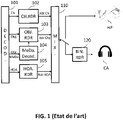
- Block 101 is a core decoding module which decodes both multichannel audio signals (Ch.) of "channel” type, monophonic audio signals of "object” type (Obj.) associated with parameters of spatialization (“Metadata”) (Obj.MeDa.) and audio signals in Higher Order Ambisonic (HOA) audio format.
- Ch. multichannel audio signals
- Obj. monophonic audio signals of "object” type
- Methodadata parameters of spatialization
- HOA Higher Order Ambisonic
- a channel type signal is decoded and processed by a channel renderer 102 (“Channel renderer” in English, also called “Format Converter” in MPEG-H 3D Audio) in order to adapt this channel signal to the audio reproduction system.
- the channel rendering engine knows the characteristics of the playback system and thus provides a signal per playback channel (Rdr.Ch.) to feed either real loudspeakers or virtual loudspeakers (which will then be binauralized for rendering at the helmet).
- restitution channels are mixed by the mixing module 110 with other restitution channels from the object rendering engines 103 and HOA 105 described later.
- Object-type signals are monophonic signals associated with data (“Metadata”) such as spatialization parameters (azimuth angles, elevation) which make it possible to position the monophonic signal in the spatialized sound scene, priority parameters or sound volume settings.
- Metadata such as spatialization parameters (azimuth angles, elevation) which make it possible to position the monophonic signal in the spatialized sound scene, priority parameters or sound volume settings.
- object signals are decoded as well as the associated parameters, by the decoding module 101 and are processed by an object rendering engine 103 ("Object Renderer" in English) which, knowing the characteristics of the restitution system, adapts these monophonic signals to these characteristics.
- the various restitution channels (Rdr.Obj.) thus created are mixed with the other restitution channels from the channel and HOA rendering engines, by the mixing module 110.
- the signals of the surround type (HOA for "Higher Order Ambisonic” in English) are decoded and the decoded surround components are put at the input of a surround rendering engine 105 ("HOA renderer” in English) to adapt these components to the sound reproduction system.
- the restitution channels (Rdr .HOA) created by this HOA rendering engine are mixed at 110 with the restitution channels created by the other rendering engines 102 and 103.
- the signals at the output of the mixing module 110 can be reproduced by real loudspeakers HP located in a reproduction room.
- the signals at the output of the mixing module can directly supply these real loudspeakers, one channel corresponding to one loudspeaker.
- the signals at the output of the mixing module are to be reproduced on a CA audio headset, then these signals are processed by a binauralization processing module 120 according to binauralization techniques described for example in the document cited for the MPEG standard -H 3D audio.
- This method relates to the processing of a monophonic signal in a 3D audio decoder.
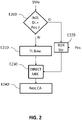
- a step E200 detects whether the data stream (SMo) representative of the monophonic signal (for example the bitstream at the input of the audio decoder) includes an indication of non-binauralization processing associated with information on the spatial position of restitution. Otherwise (N in step E200), the signal must be binauralized. It is processed by a binauralization processing, in step E210, before being reproduced in E240 on an audio reproduction headset. This binauralized signal can be mixed with other stereophonic signals coming from step E220 described below.
- the signal decoded monophonic is sent to a stereophonic rendering engine to be processed by a step E220.
- This indication of non-binauralization can be for example, as in the state of the art, a “Dichotic” identification given to the monophonic signal or another identification understood as an instruction not to process the signal by binauralization processing.
- the spatial position information of restitution can be for example an azimuth angle indicating the position of reproduction of the sound with respect to an ear, right or left, or even an indication of difference in level between the left and right channels as an information of 'ILD allowing to distribute the energy of the monophonic signal between the left and right channels, or even simply the indication of a single channel of restitution, corresponding to the right or left ear. In the latter case, this information is binary information which requires very little bit rate (only 1 bit of information).
- step E220 the position information is taken into account to construct two playback channels for the two headphones of the audio headset. These two restitution channels thus constructed are processed directly by a direct mixing step E230 summing these two stereophonic channels with the two channels of the binauralized signal resulting from the binauralization processing E210.
- Each of the stereophonic restitution channels is then summed with the corresponding channel of the binauralized signal.
- the information on the spatial position of restitution is binary data indicating a single channel of the audio restitution headset
- the two restitution channels constructed in step E220 by the stereophonic rendering engine consist of one channel comprising the monophonic signal, the other channel being zero, and therefore possibly absent.
- the listener equipped with the audio headset hears on the one hand, a spatialized sound scene coming from the binauralized signal, this sound scene is heard by him at the same physical place even if he moves his head in the case of a dynamic rendering and on the other hand, a sound positioned inside the head, between an ear and the center of the head, which is superimposed on the sound stage independently, that is to say that if the listener moves the head, this sound will be heard at the same position relative to an ear.
- This sound is therefore perceived superimposed on the other binauralized sounds of the sound stage, and will act for example as an “OFF” voice to this sound stage.
- FIG. 3 illustrates a first embodiment of a decoder comprising a processing device implementing the processing method described with reference to figure 2 .
- the monophonic signal processed by the method implemented is a channel type signal (Ch.).
- Object type (obj.) and HOA type (HOA) signals are processed in the same way by the respective blocks 303, 304 and 305 as the blocks 103, 104 and 105 described with reference to the figure 1 .
- mixing block 310 performs mixing as described for block 110 of the figure 1 .
- the block 330 receiving the channel-type signals processes a monophonic signal comprising a non-binauralization indication (Di.) associated with restitution spatial position information (Pos.) differently than another signal not comprising this information, in especially a multi-channel signal. For these signals not including this information, they are processed by block 302 in the same way as block 102 described with reference to figure 1 .
- Mi. non-binauralization indication
- Pos. restitution spatial position information
- the block 330 acts as a router or switch and directs the decoded monophonic signal (Mo.) to a stereophonic rendering engine 331.
- This stereophonic rendering engine also receives, from the decoding module, the restitution spatial position information (Pos.). With this information, it constructs two restitution channels (2 Vo.), corresponding to the left and right channels of the restitution audio headphones, so that these channels are restored on the CA audio headphones.
- the restitution spatial position cue is interaural sound level difference cue between the left and right channels. This information makes it possible to define a factor to be applied to each of the restitution channels in order to respect this spatial position of restitution.
- these playback channels are added to the channels of a binauralized signal coming from the binauralization module 320 which performs binauralization processing in the same way as the block 120 of the figure 1 .
- This channel summing step is performed by the direct mixing module 340 which sums the left channel from the stereophonic rendering engine 331 to the left channel of the binauralized signal from the binauralization processing module 320 and the right channel from the of stereophonic rendering 331 to the right channel of the binauralized signal from the binauralization processing module 320, before restitution on the headphones CA.
- the monophonic signal does not pass through the binauralization processing module 320, it is transmitted directly to the stereophonic rendering engine 331 before being mixed directly with a binauralized signal.
- This signal will therefore not undergo head tracking processing either.
- the sound reproduced will therefore be at a reproduction position relative to an ear of the listener and will remain at this position even if the listener moves his head.
- the stereophonic rendering engine 331 can be integrated into the channel rendering engine 302.
- this channel rendering engine implements both the adaptation of the conventional channel type signals, as described in there figure 1 and the construction of the two rendering channels of the rendering engine 331 as explained above by receiving the rendering spatial position information (Pos.). Only the two restitution channels are then redirected to the direct mixing module 340 before restitution on the audio headphones CA.
- the stereophonic rendering engine 331 is integrated into the direct mixing module 340.
- the routing module 330 directs the decoded monophonic signal (for which the indication of non-binauralization has been detected and the restitution spatial position information) to the direct mixing module 340.
- the decoded restitution spatial position information (Pos.) is also transmitted to the direct mixing module 340.
- This mixing module direct then comprising the stereophonic rendering engine, implements the construction of the two restitution channels taking into account the spatial position information of restitution as well as the mixing of these two restitution channels with the restitution channels of a binauralized signal from the binauralization processing module 320.
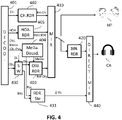
- FIG 4 illustrates a second embodiment of a decoder comprising a processing device implementing the processing method described with reference to figure 2 .
- the monophonic signal processed by the method implemented is an object type signal (Obj.).
- Channel-type (Ch.) and HOA-type (HOA) signals are processed in the same way by respective blocks 402 and 405 as blocks 102 and 105 described with reference to figure 1 .
- mixing block 410 performs mixing as described for block 110 of the figure 1 .
- the block 430 receiving the object type signals (Obj.) processes a monophonic signal differently for which an indication of non-binauralization (Di.) has been detected associated with restitution spatial position information (Pos.) than a other monophonic signal for which this information has not been detected.
- block 430 acts as a router or switch and directs the decoded monophonic signal (Mo.) to a stereophonic rendering engine 431.
- the non-binauralization indication (Di.) as well as the restitution spatial position information (Pos.) are decoded by the decoding block 404 of the metadata or parameters associated with the object type signals.
- the indication of non-binauralization (Di.) is transmitted to the routing block 430 and the spatial position information of restitution is transmitted to the stereophonic rendering engine 431.
- This stereophonic rendering engine thus receiving the restitution spatial position information (Pos.), constructs two restitution channels, corresponding to the left and right channels of the audio restitution headphones, so that these channels are restored on the audio headphones CA.
- the restitution spatial position information is azimuth angle information defining an angle between the desired restitution position and the center of the listener's head.
- This information makes it possible to define a factor to be applied to each of the restitution channels in order to respect this spatial position of restitution.
- the gain factors for the left and right channels can be calculated as presented in the document titled “Virtual Sound Source Positioning Using Vector Base Amplitude Panning” by Ville Pulkki in J. Audio Eng. Soc., Vol.45, No.6, June 1997 .
- g1 and g2 are the factors for the left and right channel signals
- O is the angle between the frontal direction and the object (named azimuth)
- H is the angle between the frontal direction and the position of the top- virtual loudspeaker (corresponding to the half-angle between the loudspeakers), fixed for example at 45°.
- these playback channels are added to the channels of a binauralized signal coming from the binauralization module 420 which performs binauralization processing in the same way as block 120 of the figure 1 .
- This channel summing step is carried out by the direct mixing module 440 which sums the left channel coming from the stereophonic rendering engine 431 to the left channel of the binauralized signal coming from the binauralization processing module 420 and the right channel coming from the stereophonic rendering 431 to the right channel of the binauralized signal coming from the binauralization processing module 420, before restitution on the headphones CA.
- the monophonic signal does not pass through the binauralization processing module 420, it is transmitted directly to the stereophonic rendering engine 431 before being mixed directly with a binauralized signal.
- This signal will therefore not undergo head tracking processing either.
- the sound reproduced will therefore be at a reproduction position relative to an ear of the listener and will remain at this position even if the listener moves his head.
- the stereophonic rendering engine 431 can be integrated into the object rendering engine 403.
- this object rendering engine implements both the adaptation of conventional object type signals, as described in there figure 1 and the construction of the two restitution channels of the rendering engine 431 as explained above by receiving the restitution spatial position information (Pos.) from the decoding module 404 of the parameters. Only the two restitution channels (2Vo.) are then redirected to the direct mixing module 440 before restitution on the audio headphones CA.
- the stereophonic rendering engine 431 is integrated into the direct mixing module 440.
- the routing module 430 directs the decoded monophonic signal (Mo.) (for which the indication non-binauralization and the restitution spatial position information) to the direct mixing module 440.
- the decoded restitution spatial position information (Pos.) is also transmitted to the direct mixing module 440 by the parameter decoding module 404.
- This direct mixing module then comprising the stereophonic rendering engine, implements the construction of the two restitution channels taking into account the spatial position information of restitution as well as the mixing of these two channels restitution with the restitution channels of a binauralized signal coming from the binauralization processing module 420.
- FIG. 5 now illustrates an example of a hardware embodiment of a processing device capable of implementing the processing method according to the invention.
- the device DIS comprises a storage space 530, for example a memory MEM, a processing unit 520 comprising a processor PROC, controlled by a computer program Pg, stored in the memory 530 and implementing the processing method according to the invention .
- the computer program Pg comprises code instructions for implementing the steps of the processing method within the meaning of the invention, when these instructions are executed by the processor PROC, and in particular, upon detection, in a data stream representative of the monophonic signal, of an indication of non-binauralization processing associated with spatial position information of restitution, a step of directing the decoded monophonic signal towards a stereophonic rendering engine taking into account the position information to construct two channels restitution processed directly by a direct mixing step summing these two channels with a binauralized signal resulting from the binauralization processing, to be reproduced on the headphones.
- the description of the picture 2 repeats the steps of an algorithm of such a computer program.
- the program code instructions Pg are for example loaded into a RAM memory (not shown) before being executed by the processor PROC of the processing unit 520.
- the program instructions can be stored on a storage medium such as flash memory, hard disk or any other non-transitory storage medium.
- the device DIS comprises a reception module 510 capable of receiving a data stream SMo representative in particular of a monophonic signal. It comprises a detection module 540 capable of detecting, in this data stream, an indication of non-binauralization processing associated with restitution spatial position information. It comprises a direction module 550, in the case of a positive detection by the detection module 540, of the decoded monophonic signal towards a stereophonic rendering engine 560, the stereophonic rendering engine 560 being capable of taking into account the information of position to build two restitution lanes.
- the device DIS also includes a direct mixing module 570 able to directly process the two restitution channels by summing them with the two channels of a binauralized signal coming from a binaural processing module.
- the restitution channels thus obtained are transmitted to an audio headset CA via an output module 560, to be restored.
- module can correspond to a software component as well as to a hardware component or a set of hardware and software components, a software component itself corresponding to one or more computer programs or subroutines or more generally to any element of a program capable of implementing a function or a set of functions as described for the modules concerned.
- a hardware component corresponds to any element of a hardware assembly (or hardware) able to implement a function or a set of functions for the module concerned (integrated circuit, smart card, memory card, etc.)
- the device can be integrated into an audio decoder as described in picture 3 Or 4 and can be integrated for example into multimedia equipment of the living room decoder type, "set top box” or audio or video content player. They can also be integrated into communication equipment of the mobile telephone or communication gateway type.
Landscapes
- Engineering & Computer Science (AREA)
- Physics & Mathematics (AREA)
- Acoustics & Sound (AREA)
- Signal Processing (AREA)
- Mathematical Physics (AREA)
- Computational Linguistics (AREA)
- Health & Medical Sciences (AREA)
- Audiology, Speech & Language Pathology (AREA)
- Human Computer Interaction (AREA)
- Multimedia (AREA)
- Stereophonic System (AREA)
Applications Claiming Priority (3)
| Application Number | Priority Date | Filing Date | Title |
|---|---|---|---|
| FR1762478A FR3075443A1 (fr) | 2017-12-19 | 2017-12-19 | Traitement d'un signal monophonique dans un decodeur audio 3d restituant un contenu binaural |
| EP18833274.6A EP3729832B1 (fr) | 2017-12-19 | 2018-12-07 | Traitement d'un signal monophonique dans un décodeur audio 3d restituant un contenu binaural |
| PCT/FR2018/053161 WO2019122580A1 (fr) | 2017-12-19 | 2018-12-07 | Traitement d'un signal monophonique dans un décodeur audio 3d restituant un contenu binaural |
Related Parent Applications (2)
| Application Number | Title | Priority Date | Filing Date |
|---|---|---|---|
| EP18833274.6A Division-Into EP3729832B1 (fr) | 2017-12-19 | 2018-12-07 | Traitement d'un signal monophonique dans un décodeur audio 3d restituant un contenu binaural |
| EP18833274.6A Division EP3729832B1 (fr) | 2017-12-19 | 2018-12-07 | Traitement d'un signal monophonique dans un décodeur audio 3d restituant un contenu binaural |
Publications (1)
| Publication Number | Publication Date |
|---|---|
| EP4135350A1 true EP4135350A1 (fr) | 2023-02-15 |
Family
ID=62222744
Family Applications (2)
| Application Number | Title | Priority Date | Filing Date |
|---|---|---|---|
| EP22197901.6A Pending EP4135350A1 (fr) | 2017-12-19 | 2018-12-07 | Traitement d'un signal monophonique dans un décodeur audio 3d restituant un contenu binaural |
| EP18833274.6A Active EP3729832B1 (fr) | 2017-12-19 | 2018-12-07 | Traitement d'un signal monophonique dans un décodeur audio 3d restituant un contenu binaural |
Family Applications After (1)
| Application Number | Title | Priority Date | Filing Date |
|---|---|---|---|
| EP18833274.6A Active EP3729832B1 (fr) | 2017-12-19 | 2018-12-07 | Traitement d'un signal monophonique dans un décodeur audio 3d restituant un contenu binaural |
Country Status (10)
| Country | Link |
|---|---|
| US (1) | US11176951B2 (enExample) |
| EP (2) | EP4135350A1 (enExample) |
| JP (2) | JP7279049B2 (enExample) |
| KR (1) | KR102555789B1 (enExample) |
| CN (1) | CN111492674B (enExample) |
| BR (1) | BR112020012071A2 (enExample) |
| ES (1) | ES2986617T3 (enExample) |
| FR (1) | FR3075443A1 (enExample) |
| PL (1) | PL3729832T3 (enExample) |
| WO (1) | WO2019122580A1 (enExample) |
Families Citing this family (5)
| Publication number | Priority date | Publication date | Assignee | Title |
|---|---|---|---|---|
| FR3075443A1 (fr) | 2017-12-19 | 2019-06-21 | Orange | Traitement d'un signal monophonique dans un decodeur audio 3d restituant un contenu binaural |
| US11895479B2 (en) | 2019-08-19 | 2024-02-06 | Dolby Laboratories Licensing Corporation | Steering of binauralization of audio |
| JP7661742B2 (ja) * | 2021-03-29 | 2025-04-15 | ヤマハ株式会社 | オーディオミキサ及び音響信号の処理方法 |
| TW202348047A (zh) * | 2022-03-31 | 2023-12-01 | 瑞典商都比國際公司 | 用於沉浸式3自由度/6自由度音訊呈現的方法和系統 |
| WO2024212118A1 (zh) * | 2023-04-11 | 2024-10-17 | 北京小米移动软件有限公司 | 音频码流信号处理方法、装置、电子设备和存储介质 |
Citations (2)
| Publication number | Priority date | Publication date | Assignee | Title |
|---|---|---|---|---|
| US20160266865A1 (en) * | 2013-10-31 | 2016-09-15 | Dolby Laboratories Licensing Corporation | Binaural rendering for headphones using metadata processing |
| US20160300577A1 (en) * | 2015-04-08 | 2016-10-13 | Dolby International Ab | Rendering of Audio Content |
Family Cites Families (11)
| Publication number | Priority date | Publication date | Assignee | Title |
|---|---|---|---|---|
| JPH09327100A (ja) * | 1996-06-06 | 1997-12-16 | Matsushita Electric Ind Co Ltd | ヘッドホン再生装置 |
| US20090299756A1 (en) * | 2004-03-01 | 2009-12-03 | Dolby Laboratories Licensing Corporation | Ratio of speech to non-speech audio such as for elderly or hearing-impaired listeners |
| US7634092B2 (en) * | 2004-10-14 | 2009-12-15 | Dolby Laboratories Licensing Corporation | Head related transfer functions for panned stereo audio content |
| KR100754220B1 (ko) * | 2006-03-07 | 2007-09-03 | 삼성전자주식회사 | Mpeg 서라운드를 위한 바이노럴 디코더 및 그 디코딩방법 |
| US8682679B2 (en) * | 2007-06-26 | 2014-03-25 | Koninklijke Philips N.V. | Binaural object-oriented audio decoder |
| ES2592416T3 (es) * | 2008-07-17 | 2016-11-30 | Fraunhofer-Gesellschaft zur Förderung der angewandten Forschung e.V. | Esquema de codificación/decodificación de audio que tiene una derivación conmutable |
| TWI475896B (zh) * | 2008-09-25 | 2015-03-01 | Dolby Lab Licensing Corp | 單音相容性及揚聲器相容性之立體聲濾波器 |
| WO2010085083A2 (en) * | 2009-01-20 | 2010-07-29 | Lg Electronics Inc. | An apparatus for processing an audio signal and method thereof |
| US20120039477A1 (en) * | 2009-04-21 | 2012-02-16 | Koninklijke Philips Electronics N.V. | Audio signal synthesizing |
| PL2446435T3 (pl) * | 2009-06-24 | 2013-11-29 | Fraunhofer Ges Forschung | Dekoder sygnału audio, sposób dekodowania sygnału audio i program komputerowy wykorzystujący kaskadowe etapy przetwarzania obiektów audio |
| FR3075443A1 (fr) | 2017-12-19 | 2019-06-21 | Orange | Traitement d'un signal monophonique dans un decodeur audio 3d restituant un contenu binaural |
-
2017
- 2017-12-19 FR FR1762478A patent/FR3075443A1/fr not_active Ceased
-
2018
- 2018-12-07 JP JP2020533148A patent/JP7279049B2/ja active Active
- 2018-12-07 EP EP22197901.6A patent/EP4135350A1/fr active Pending
- 2018-12-07 US US16/955,398 patent/US11176951B2/en active Active
- 2018-12-07 WO PCT/FR2018/053161 patent/WO2019122580A1/fr not_active Ceased
- 2018-12-07 CN CN201880081437.9A patent/CN111492674B/zh active Active
- 2018-12-07 KR KR1020207018299A patent/KR102555789B1/ko active Active
- 2018-12-07 EP EP18833274.6A patent/EP3729832B1/fr active Active
- 2018-12-07 PL PL18833274.6T patent/PL3729832T3/pl unknown
- 2018-12-07 BR BR112020012071-5A patent/BR112020012071A2/pt unknown
- 2018-12-07 ES ES18833274T patent/ES2986617T3/es active Active
-
2023
- 2023-05-09 JP JP2023077357A patent/JP7639053B2/ja active Active
Patent Citations (2)
| Publication number | Priority date | Publication date | Assignee | Title |
|---|---|---|---|---|
| US20160266865A1 (en) * | 2013-10-31 | 2016-09-15 | Dolby Laboratories Licensing Corporation | Binaural rendering for headphones using metadata processing |
| US20160300577A1 (en) * | 2015-04-08 | 2016-10-13 | Dolby International Ab | Rendering of Audio Content |
Non-Patent Citations (3)
| Title |
|---|
| "Digital Audio Compression Standard", ETSI TS 103 190, April 2014 (2014-04-01) |
| "High efficiency coding and media delivery in heterogeneous environments - Part 3 :3D audio", ISO/IEC 23008-3, 25 July 2014 (2014-07-25) |
| VILLE PULKKI: "Virtual Sound Source Positioning Using Vector Base Amplitude Panning", J. AUDIO ENG. SOC., vol. 45, no. 6, June 1997 (1997-06-01) |
Also Published As
| Publication number | Publication date |
|---|---|
| BR112020012071A2 (pt) | 2020-11-24 |
| JP2021508195A (ja) | 2021-02-25 |
| CN111492674B (zh) | 2022-03-15 |
| EP3729832C0 (fr) | 2024-06-26 |
| EP3729832A1 (fr) | 2020-10-28 |
| KR20200100664A (ko) | 2020-08-26 |
| US11176951B2 (en) | 2021-11-16 |
| WO2019122580A1 (fr) | 2019-06-27 |
| EP3729832B1 (fr) | 2024-06-26 |
| FR3075443A1 (fr) | 2019-06-21 |
| CN111492674A (zh) | 2020-08-04 |
| KR102555789B1 (ko) | 2023-07-13 |
| US20210012782A1 (en) | 2021-01-14 |
| PL3729832T3 (pl) | 2024-11-04 |
| JP7279049B2 (ja) | 2023-05-22 |
| RU2020121890A (ru) | 2022-01-04 |
| ES2986617T3 (es) | 2024-11-12 |
| JP2023099599A (ja) | 2023-07-13 |
| JP7639053B2 (ja) | 2025-03-04 |
Similar Documents
| Publication | Publication Date | Title |
|---|---|---|
| EP3729832B1 (fr) | Traitement d'un signal monophonique dans un décodeur audio 3d restituant un contenu binaural | |
| US10440496B2 (en) | Spatial audio processing emphasizing sound sources close to a focal distance | |
| EP2042001B1 (fr) | Spatialisation binaurale de donnees sonores encodees en compression | |
| WO2011045506A1 (fr) | Traitement de donnees sonores encodees dans un domaine de sous-bandes | |
| FR2790634A1 (fr) | Procede de synthese d'un champ sonore tridimensionnel | |
| US20200344563A1 (en) | Associated Spatial Audio Playback | |
| US11430451B2 (en) | Layered coding of audio with discrete objects | |
| EP3821621A2 (en) | Spatial audio capture, transmission and reproduction | |
| CN114631332B (zh) | 比特流中音频效果元数据的信令 | |
| US12432516B2 (en) | Method and system for spatially rendering three-dimensional (3D) scenes | |
| EP3603076B1 (fr) | Procédé de sélection d'au moins une partie d'image à télécharger par anticipation pour restituer un flux audiovisuel | |
| FR3011373A1 (fr) | Terminal portable d'ecoute haute-fidelite personnalisee | |
| RU2779295C2 (ru) | Обработка монофонического сигнала в декодере 3d-аудио, предоставляющая бинауральный информационный материал | |
| FR3040253B1 (fr) | Procede de mesure de filtres phrtf d'un auditeur, cabine pour la mise en oeuvre du procede, et procedes permettant d'aboutir a la restitution d'une bande sonore multicanal personnalisee | |
| EP3108670B1 (fr) | Procédé et dispositif de restitution d'un signal audio multicanal dans une zone d'écoute | |
| WO2006075079A1 (fr) | Procede d’encodage de pistes audio d’un contenu multimedia destine a une diffusion sur terminaux mobiles |
Legal Events
| Date | Code | Title | Description |
|---|---|---|---|
| PUAI | Public reference made under article 153(3) epc to a published international application that has entered the european phase |
Free format text: ORIGINAL CODE: 0009012 |
|
| STAA | Information on the status of an ep patent application or granted ep patent |
Free format text: STATUS: THE APPLICATION HAS BEEN PUBLISHED |
|
| AC | Divisional application: reference to earlier application |
Ref document number: 3729832 Country of ref document: EP Kind code of ref document: P |
|
| AK | Designated contracting states |
Kind code of ref document: A1 Designated state(s): AL AT BE BG CH CY CZ DE DK EE ES FI FR GB GR HR HU IE IS IT LI LT LU LV MC MK MT NL NO PL PT RO RS SE SI SK SM TR |
|
| STAA | Information on the status of an ep patent application or granted ep patent |
Free format text: STATUS: REQUEST FOR EXAMINATION WAS MADE |
|
| 17P | Request for examination filed |
Effective date: 20230807 |
|
| RBV | Designated contracting states (corrected) |
Designated state(s): AL AT BE BG CH CY CZ DE DK EE ES FI FR GB GR HR HU IE IS IT LI LT LU LV MC MK MT NL NO PL PT RO RS SE SI SK SM TR |
|
| RAP3 | Party data changed (applicant data changed or rights of an application transferred) |
Owner name: ORANGE |
|
| STAA | Information on the status of an ep patent application or granted ep patent |
Free format text: STATUS: EXAMINATION IS IN PROGRESS |
|
| 17Q | First examination report despatched |
Effective date: 20241206 |