EP4134266B1 - Electric vehicle charging system - Google Patents
Electric vehicle charging system Download PDFInfo
- Publication number
- EP4134266B1 EP4134266B1 EP21191166.4A EP21191166A EP4134266B1 EP 4134266 B1 EP4134266 B1 EP 4134266B1 EP 21191166 A EP21191166 A EP 21191166A EP 4134266 B1 EP4134266 B1 EP 4134266B1
- Authority
- EP
- European Patent Office
- Prior art keywords
- coolant
- charging
- cooling
- electric vehicle
- heat exchanger
- Prior art date
- Legal status (The legal status is an assumption and is not a legal conclusion. Google has not performed a legal analysis and makes no representation as to the accuracy of the status listed.)
- Active
Links
Images

Classifications
-
- B—PERFORMING OPERATIONS; TRANSPORTING
- B60—VEHICLES IN GENERAL
- B60L—PROPULSION OF ELECTRICALLY-PROPELLED VEHICLES; SUPPLYING ELECTRIC POWER FOR AUXILIARY EQUIPMENT OF ELECTRICALLY-PROPELLED VEHICLES; ELECTRODYNAMIC BRAKE SYSTEMS FOR VEHICLES IN GENERAL; MAGNETIC SUSPENSION OR LEVITATION FOR VEHICLES; MONITORING OPERATING VARIABLES OF ELECTRICALLY-PROPELLED VEHICLES; ELECTRIC SAFETY DEVICES FOR ELECTRICALLY-PROPELLED VEHICLES
- B60L53/00—Methods of charging batteries, specially adapted for electric vehicles; Charging stations or on-board charging equipment therefor; Exchange of energy storage elements in electric vehicles
- B60L53/30—Constructional details of charging stations
- B60L53/302—Cooling of charging equipment
-
- B—PERFORMING OPERATIONS; TRANSPORTING
- B60—VEHICLES IN GENERAL
- B60L—PROPULSION OF ELECTRICALLY-PROPELLED VEHICLES; SUPPLYING ELECTRIC POWER FOR AUXILIARY EQUIPMENT OF ELECTRICALLY-PROPELLED VEHICLES; ELECTRODYNAMIC BRAKE SYSTEMS FOR VEHICLES IN GENERAL; MAGNETIC SUSPENSION OR LEVITATION FOR VEHICLES; MONITORING OPERATING VARIABLES OF ELECTRICALLY-PROPELLED VEHICLES; ELECTRIC SAFETY DEVICES FOR ELECTRICALLY-PROPELLED VEHICLES
- B60L53/00—Methods of charging batteries, specially adapted for electric vehicles; Charging stations or on-board charging equipment therefor; Exchange of energy storage elements in electric vehicles
- B60L53/10—Methods of charging batteries, specially adapted for electric vehicles; Charging stations or on-board charging equipment therefor; Exchange of energy storage elements in electric vehicles characterised by the energy transfer between the charging station and the vehicle
- B60L53/14—Conductive energy transfer
- B60L53/16—Connectors, e.g. plugs or sockets, specially adapted for charging electric vehicles
-
- B—PERFORMING OPERATIONS; TRANSPORTING
- B60—VEHICLES IN GENERAL
- B60L—PROPULSION OF ELECTRICALLY-PROPELLED VEHICLES; SUPPLYING ELECTRIC POWER FOR AUXILIARY EQUIPMENT OF ELECTRICALLY-PROPELLED VEHICLES; ELECTRODYNAMIC BRAKE SYSTEMS FOR VEHICLES IN GENERAL; MAGNETIC SUSPENSION OR LEVITATION FOR VEHICLES; MONITORING OPERATING VARIABLES OF ELECTRICALLY-PROPELLED VEHICLES; ELECTRIC SAFETY DEVICES FOR ELECTRICALLY-PROPELLED VEHICLES
- B60L53/00—Methods of charging batteries, specially adapted for electric vehicles; Charging stations or on-board charging equipment therefor; Exchange of energy storage elements in electric vehicles
- B60L53/10—Methods of charging batteries, specially adapted for electric vehicles; Charging stations or on-board charging equipment therefor; Exchange of energy storage elements in electric vehicles characterised by the energy transfer between the charging station and the vehicle
- B60L53/14—Conductive energy transfer
- B60L53/18—Cables specially adapted for charging electric vehicles
-
- Y—GENERAL TAGGING OF NEW TECHNOLOGICAL DEVELOPMENTS; GENERAL TAGGING OF CROSS-SECTIONAL TECHNOLOGIES SPANNING OVER SEVERAL SECTIONS OF THE IPC; TECHNICAL SUBJECTS COVERED BY FORMER USPC CROSS-REFERENCE ART COLLECTIONS [XRACs] AND DIGESTS
- Y02—TECHNOLOGIES OR APPLICATIONS FOR MITIGATION OR ADAPTATION AGAINST CLIMATE CHANGE
- Y02T—CLIMATE CHANGE MITIGATION TECHNOLOGIES RELATED TO TRANSPORTATION
- Y02T10/00—Road transport of goods or passengers
- Y02T10/60—Other road transportation technologies with climate change mitigation effect
- Y02T10/70—Energy storage systems for electromobility, e.g. batteries
-
- Y—GENERAL TAGGING OF NEW TECHNOLOGICAL DEVELOPMENTS; GENERAL TAGGING OF CROSS-SECTIONAL TECHNOLOGIES SPANNING OVER SEVERAL SECTIONS OF THE IPC; TECHNICAL SUBJECTS COVERED BY FORMER USPC CROSS-REFERENCE ART COLLECTIONS [XRACs] AND DIGESTS
- Y02—TECHNOLOGIES OR APPLICATIONS FOR MITIGATION OR ADAPTATION AGAINST CLIMATE CHANGE
- Y02T—CLIMATE CHANGE MITIGATION TECHNOLOGIES RELATED TO TRANSPORTATION
- Y02T10/00—Road transport of goods or passengers
- Y02T10/60—Other road transportation technologies with climate change mitigation effect
- Y02T10/7072—Electromobility specific charging systems or methods for batteries, ultracapacitors, supercapacitors or double-layer capacitors
-
- Y—GENERAL TAGGING OF NEW TECHNOLOGICAL DEVELOPMENTS; GENERAL TAGGING OF CROSS-SECTIONAL TECHNOLOGIES SPANNING OVER SEVERAL SECTIONS OF THE IPC; TECHNICAL SUBJECTS COVERED BY FORMER USPC CROSS-REFERENCE ART COLLECTIONS [XRACs] AND DIGESTS
- Y02—TECHNOLOGIES OR APPLICATIONS FOR MITIGATION OR ADAPTATION AGAINST CLIMATE CHANGE
- Y02T—CLIMATE CHANGE MITIGATION TECHNOLOGIES RELATED TO TRANSPORTATION
- Y02T90/00—Enabling technologies or technologies with a potential or indirect contribution to GHG emissions mitigation
- Y02T90/10—Technologies relating to charging of electric vehicles
- Y02T90/12—Electric charging stations
-
- Y—GENERAL TAGGING OF NEW TECHNOLOGICAL DEVELOPMENTS; GENERAL TAGGING OF CROSS-SECTIONAL TECHNOLOGIES SPANNING OVER SEVERAL SECTIONS OF THE IPC; TECHNICAL SUBJECTS COVERED BY FORMER USPC CROSS-REFERENCE ART COLLECTIONS [XRACs] AND DIGESTS
- Y02—TECHNOLOGIES OR APPLICATIONS FOR MITIGATION OR ADAPTATION AGAINST CLIMATE CHANGE
- Y02T—CLIMATE CHANGE MITIGATION TECHNOLOGIES RELATED TO TRANSPORTATION
- Y02T90/00—Enabling technologies or technologies with a potential or indirect contribution to GHG emissions mitigation
- Y02T90/10—Technologies relating to charging of electric vehicles
- Y02T90/14—Plug-in electric vehicles
Definitions
- the present invention relates to an electric vehicle charging system for an electric vehicle.
- One limiting factor in charging cables for electric vehicles is the heat that is generated when high currents flow through the cable and the electrical connector from the charging station to the battery of a vehicle.
- the heat may be actively conducted away from the heat sources using liquids. In this way current rates over 500 A are achieved.
- current rates over 500 A are achieved.
- cooling arrangements are required that comprise and conduct the liquid from heat sinks to the heat sources and back. Additional devices such as pumps are necessary.
- Prior art US 2019/0315239 A1 discloses an electrical contact element for a car charging plug connector.
- the electrical contact element has a contact part and a connection part, wherein the connection part can be connected to an electrical conductor of a cable. Cooling liquid can be delivered to the contact element. As a result, the heat produced on the contact element is extracted directly.
- US 10,109,395 B2 relates to a connection unit for a fluid-cooled cable and to a system composed of a plug-in connector, a fluid-cooled cable and a connection unit.
- the connection unit comprising a housing, which has a cable connecting opening, a fluid inlet opening and a fluid outlet opening.
- US 2019/0074628 A1 relates to a plug-in connector part for plug-in connection to a mating plug-in connector part.
- Prior art DE 10 2011 100 389 A1 discloses a charging cable for transferring electrical energy to an energy storage device of an electric or hybrid vehicle.
- the charging cable comprises a coolant-guiding device, which is arranged inside a cable jacket.
- An objective of the invention may be to provide an electric vehicle charging system, with which high current rates are possible.
- an electric vehicle charging system comprising a charging connector configured to receive a charging cable.
- the charging cable and/or the charging connector provide means for guiding a coolant, cooling the charging cable and/or the charging connector.
- the electric vehicle charging system further comprises a thermal management unit for cooling the coolant.
- the thermal management unit comprises a vapour-compression refrigeration system (VCRS) for cooling the coolant below ambient temperature.
- VCRS vapour-compression refrigeration system
- the charging connector provides the charging current from a charging station to the battery of an electric vehicle.
- charging connector is understood to be a handheld device such as a charging gun or charging nozzle.
- the counterpart of the charging connector on vehicle-side is called socket.
- the charging connector provides a charging cable.
- In the charging cable at least charging wires for conducting the electrical current to the vehicle are arranged.
- a means for guiding a coolant thereby preferably is a cooling cable or cooling line in which the coolant is flowing.
- the coolant could be any fluid with which a cooling effect to the cable in particular the charging wires in the cable and/or the connector, respectively the electric contacts of the connector, is achieved.
- thermal management unit has to be understood comprising all parts, which are used for cooling the coolant.
- the thermal management unit at least comprises a vapour-compression refrigeration system.
- a vapour-compression refrigeration system uses a refrigerant, wherein the refrigerant undergoes a phase change so that a temperature below ambient temperature is achieved.
- a coolant which is cooled to a temperature close to the ambient temperature the use of a vapour-compression refrigeration system results to a higher cooling effect of the connector and/or the cable. Accordingly, the vehicle can be charged with a higher electric current, without exceeding a temperature limit of the vehicle charging system.
- the vehicle charging system also can be used in regions with high ambient temperature like e.g. in the desert. Especially in these areas, a common air-cooled heat exchanger has a low cooling effect on the coolant. Usability of the vehicle charging system therefore is improved.
- the coolant is a refrigerant of the vapour-compression refrigeration system with which the charging cable and/or the charging connector is cooled.
- the refrigerant therefore is directly used for cooling the components of the vehicle charging system. Accordingly, no further circuit is used for cooling the components. Thus, the number of components are reduced. A respective vehicle charging system can be economically provided.
- the refrigerant is directly evaporated in the cooling cable, the heat transfer is improved.
- the vapour-compression refrigeration system comprises an expansion valve for expanding the refrigerant, arranged in the charging connector.
- the refrigerant is provided as compressed fluid to the charging connector.
- the vapour-compression refrigeration system comprises an expansion valve for expanding the refrigerant, arranged in a charging station of the electric vehicle charging system.
- the charging station thereby is a stationary part of the vehicle charging system. In this charging station, usually most of the components are accommodated.
- the vapour-compression refrigeration system is arranged in the charging station.
- the charging connector could be provided smaller compared to the configuration where the expansion valve is arranged in the charging connector. Maintenance of the expansion valve is improved.
- a refrigeration cycle of the vapour-compression refrigeration system is provided separate to a cooling cycle of the coolant, wherein an interconnecting heat exchanger is arranged between both cycles for removing heat of the coolant.
- an interconnecting heat exchanger is arranged between both cycles for removing heat of the coolant.
- two independent cycles are provided, which are merely thermally connected to each other via the interconnecting heat exchanger.
- the interconnecting heat exchanger is a counterflow heat exchanger.
- both cycles are independent from each other the coolant and the refrigerant can be freely chosen without boundary conditions of the other cycle. Accordingly, the coolant and the refrigerant can be selected to have a maximum efficiency.
- the thermal management system comprises the vapour-compression refrigeration system for cooling the coolant provided to the charging connector, and an air-cooled heat exchanger for cooling the coolant provided to the charging cable.
- the thermal management system therefore comprises two totally independent cooling systems. One of these cooling systems cools the electric contacts wherein the other cooling systems cools the electric wires in the cable. Each of the cooling systems has a separate cooling line, so that two cooling loops are provided.
- each system can be optimized to the component to be cooled, so that the electric contacts gets the coolant having a much lower temperature as the cable.
- the cooling loop of the cable preferably is arranged that the coolant supply is through one of the poles, while a coolant return is through the other pole. The cooling loop thereby is simplified.
- the thermal management unit comprises an air-precooling heat exchanger for precooling of the coolant arranged upstream to the interconnecting heat exchanger and between the refrigeration cycle and the cooling cycle of the coolant.
- the air-precooling heat exchanger thereby exchanges the heat of the coolant to the ambient air.
- the coolant is cooled before it enters the interconnecting heat exchanger.
- the compressor stage of the refrigeration cycle can be dimensioned much smaller.
- the same air-cooled heat exchanger is used for precooling the coolant and for cooling the compressed refrigerant of the refrigeration cycle.
- merely one heat exchanger is necessary for cooling the coolant and the refrigerant. The components therefore can be reduced, so that such a vehicle charging system is more economically.
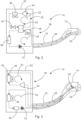
- FIG. 1 shows an electric vehicle charging system 10 according to a first embodiment of the present invention.
- Such an electric charging system 10 comprises a charging connector 14, which has to be connected to a socket (not shown) of an electric vehicle for charging the battery.
- the charging connector 14 is connected with a charging cable 18, extending from a charging station 22.
- a thermal management unit 26 is provided in the charging station 22.
- the thermal management unit 26 comprises a vapour-compression refrigeration system 30 providing a refrigeration cycle 32.
- the vapour-compression refrigeration system 30 comprises a compressor 34 for compressing a refrigerant.
- An air-cooled heat exchanger 38 is arranged downstream to the compressor 34 for cooling the compressed refrigerant.
- An expansion valve 42 is arranged next to the air-cooled heat exchanger 38. With the expansion valve 42, the refrigerant is expanded, so that the temperature of the refrigerant is decrease below ambient temperature.
- the thermal management unit 26 in the charging station 22 is connected to coolant lines 46 provided in the charging cable 18, so that the refrigerant is transported through the coolant lines 46.
- the coolant lines 46 merely cool the charging cable 18 of the vehicle charging system 10. The coolant lines 46 therefore do not extend into the charging connector 14 for cooling electrical contacts 50 of the charging connector 14.
- FIG 2 an electric vehicle charging system 10 according to a second embodiment of the present invention is shown.
- the second embodiment differs to the first embodiment shown in figure 1 by the features that additionally to a refrigeration cycle 32 of the vapour-compression refrigeration system 30, a cooling cycle 54 of the coolant is arranged in the charging station 22.
- the coolant cycle 54 in this embodiment comprises an air-precooling heat exchanger 58 for precooling the coolant medium.
- An interconnecting heat exchanger 62 is arranged downstream to the air-precooling heat exchanger 58.
- the interconnecting heat exchanger 62 is arranged between the cooling cycle 54 of the coolant and the refrigeration cycle 32. By means of the interconnecting heat exchanger 62, heat of the coolant is transferred to the refrigerant of the refrigeration cycle 32, so that the coolant is cooled.
- the coolant is transported to a coolant tank 66, where the coolant is stored.
- a coolant pump 70 is arranged downstream to the coolant tank 66. From the coolant pump 70, the coolant is pumped to the coolant lines 46.
- the coolant lines 46 are provide in the charging cable 18 and the charging connector 14 for cooling the charging cable 18 and the electrical contacts 50 in the charging connector 14.
- the refrigeration cycle 32 comprises downstream to the interconnecting heat exchanger 62 the compressor 34 for compressing the refrigerant.
- the air-cooled heat exchanger 38 is arranged after the compressor 34 for cooling the refrigerant.
- the expansion valve 42 is provided for expanding the refrigerant in the refrigeration cycle 32.
- the air-precooling heat exchanger 58 provided in the cooling cycle 54 for precooling the coolant is omitted.
- FIG. 3 shows an electric vehicle charging system 10 according to a third embodiment of the present invention.
- This embodiment differs to the first embodiment in that in the charging station 22, a cooling cycle 54 is provided additionally to the refrigeration cycle 32.
- the refrigeration cycle 32 thereby cools the electrical contacts 50 of the charging connector 14, while the cooling cycle 54 cools the charging cable 18. Both cycles therefore can be operated independently to each other.
- the third embodiment further differs to the first embodiment in that the expansion valve 42 of the refrigeration cycle 32 is provided in the charging connector 14. The refrigerant therefore is firstly expanded in the charging connector 14. Thereby, a high cooling effect of the electrical contacts 50 is achieved.
Landscapes
- Engineering & Computer Science (AREA)
- Power Engineering (AREA)
- Transportation (AREA)
- Mechanical Engineering (AREA)
- Electric Propulsion And Braking For Vehicles (AREA)
- Charge And Discharge Circuits For Batteries Or The Like (AREA)
Description
- The present invention relates to an electric vehicle charging system for an electric vehicle.
- One limiting factor in charging cables for electric vehicles is the heat that is generated when high currents flow through the cable and the electrical connector from the charging station to the battery of a vehicle. The heat may be actively conducted away from the heat sources using liquids. In this way current rates over 500 A are achieved. For this kind of cooling arrangements are required that comprise and conduct the liquid from heat sinks to the heat sources and back. Additional devices such as pumps are necessary.
- Prior art
US 2019/0315239 A1 discloses an electrical contact element for a car charging plug connector. The electrical contact element has a contact part and a connection part, wherein the connection part can be connected to an electrical conductor of a cable. Cooling liquid can be delivered to the contact element. As a result, the heat produced on the contact element is extracted directly. -
US 10,109,395 B2 -
US 2019/0074628 A1 relates to a plug-in connector part for plug-in connection to a mating plug-in connector part. -
Prior art DE 10 2011 100 389 A1 discloses a charging cable for transferring electrical energy to an energy storage device of an electric or hybrid vehicle. The charging cable comprises a coolant-guiding device, which is arranged inside a cable jacket. - An objective of the invention may be to provide an electric vehicle charging system, with which high current rates are possible.
- The problem is solved by an electric vehicle charging system, having the features of claim 1. Advantageous embodiments of the invention are specified in the dependent claims.
- According to the invention, an electric vehicle charging system comprising a charging connector configured to receive a charging cable. The charging cable and/or the charging connector provide means for guiding a coolant, cooling the charging cable and/or the charging connector. The electric vehicle charging system further comprises a thermal management unit for cooling the coolant. The thermal management unit comprises a vapour-compression refrigeration system (VCRS) for cooling the coolant below ambient temperature.
- The charging connector provides the charging current from a charging station to the battery of an electric vehicle. Thus, "charging connector" is understood to be a handheld device such as a charging gun or charging nozzle. The counterpart of the charging connector on vehicle-side is called socket. For charging the vehicle, the charging connector provides a charging cable. In the charging cable at least charging wires for conducting the electrical current to the vehicle are arranged. A means for guiding a coolant thereby preferably is a cooling cable or cooling line in which the coolant is flowing. However, also other means for guiding the coolant are possible. The coolant could be any fluid with which a cooling effect to the cable in particular the charging wires in the cable and/or the connector, respectively the electric contacts of the connector, is achieved.
- The term thermal management unit has to be understood comprising all parts, which are used for cooling the coolant. According to the invention the thermal management unit at least comprises a vapour-compression refrigeration system. Such a system uses a refrigerant, wherein the refrigerant undergoes a phase change so that a temperature below ambient temperature is achieved. In contrast to a coolant, which is cooled to a temperature close to the ambient temperature the use of a vapour-compression refrigeration system results to a higher cooling effect of the connector and/or the cable. Accordingly, the vehicle can be charged with a higher electric current, without exceeding a temperature limit of the vehicle charging system.
- As the heat loss in the cable increases with a reduced cross section of the wires and an increased length of the cable, with this invention it is possible reducing the cross section of the cable and/or using a longer cable. Further, by using a vapour-compression refrigeration system the vehicle charging system also can be used in regions with high ambient temperature like e.g. in the desert. Especially in these areas, a common air-cooled heat exchanger has a low cooling effect on the coolant. Usability of the vehicle charging system therefore is improved.
- In a preferred embodiment of the invention, the coolant is a refrigerant of the vapour-compression refrigeration system with which the charging cable and/or the charging connector is cooled. The refrigerant therefore is directly used for cooling the components of the vehicle charging system. Accordingly, no further circuit is used for cooling the components. Thus, the number of components are reduced. A respective vehicle charging system can be economically provided. As the refrigerant is directly evaporated in the cooling cable, the heat transfer is improved.
- In a further preferred embodiment of the invention, the vapour-compression refrigeration system comprises an expansion valve for expanding the refrigerant, arranged in the charging connector. In other words, the refrigerant is provided as compressed fluid to the charging connector. By using this configuration the refrigerant is directly expanded in the charging connector, so that the charging connector respectively the electrical contacts can be cooled with a maximum cooling efficiency.
- Alternatively, the vapour-compression refrigeration system comprises an expansion valve for expanding the refrigerant, arranged in a charging station of the electric vehicle charging system. The charging station thereby is a stationary part of the vehicle charging system. In this charging station, usually most of the components are accommodated. Preferably, also the vapour-compression refrigeration system is arranged in the charging station. With this arrangement, the charging connector could be provided smaller compared to the configuration where the expansion valve is arranged in the charging connector. Maintenance of the expansion valve is improved.
- Advantageously, a refrigeration cycle of the vapour-compression refrigeration system is provided separate to a cooling cycle of the coolant, wherein an interconnecting heat exchanger is arranged between both cycles for removing heat of the coolant. In this configuration two independent cycles are provided, which are merely thermally connected to each other via the interconnecting heat exchanger. Preferably, the interconnecting heat exchanger is a counterflow heat exchanger. As both cycles are independent from each other the coolant and the refrigerant can be freely chosen without boundary conditions of the other cycle. Accordingly, the coolant and the refrigerant can be selected to have a maximum efficiency.
- In a further advantageous development, the thermal management system comprises the vapour-compression refrigeration system for cooling the coolant provided to the charging connector, and an air-cooled heat exchanger for cooling the coolant provided to the charging cable. The thermal management system therefore comprises two totally independent cooling systems. One of these cooling systems cools the electric contacts wherein the other cooling systems cools the electric wires in the cable. Each of the cooling systems has a separate cooling line, so that two cooling loops are provided.
- Using two separate cooling systems has the advantage, that each system can be optimized to the component to be cooled, so that the electric contacts gets the coolant having a much lower temperature as the cable.
- As the electrical contacts are already cooled by the other cooling system, it is not necessary to have a separate cooling line directly to the electrical contacts for providing the contacts with the coolest coolant. Therefore, the cooling loop of the cable preferably is arranged that the coolant supply is through one of the poles, while a coolant return is through the other pole. The cooling loop thereby is simplified.
- Preferably, the thermal management unit comprises an air-precooling heat exchanger for precooling of the coolant arranged upstream to the interconnecting heat exchanger and between the refrigeration cycle and the cooling cycle of the coolant. The air-precooling heat exchanger thereby exchanges the heat of the coolant to the ambient air. With the air-precooling heat exchanger, the coolant is cooled before it enters the interconnecting heat exchanger. As the temperature of the coolant entering the interconnecting heat exchanger is already lowered, the compressor stage of the refrigeration cycle can be dimensioned much smaller.
- As cooling of the coolant is provided with the air-precooling heat exchanger it is not necessary running the refrigeration cycle the whole time. The refrigeration cycle therefore can be switched on when required. The energy consumption of the vehicle charging system can be reduced. In addition, if the refrigeration cycle has a failure, the charging system still can be operated at least on a reduced current rate. Such an arrangement therefore is fail safe.
- In an advantage embodiment, the same air-cooled heat exchanger is used for precooling the coolant and for cooling the compressed refrigerant of the refrigeration cycle. In other words, merely one heat exchanger is necessary for cooling the coolant and the refrigerant. The components therefore can be reduced, so that such a vehicle charging system is more economically.
- These and other features, aspects and advantages of the present invention will become better understood with reference to the accompanying figure and the following description. Identical or equivalent elements are in principle provided with the same reference signs.
- The subject matter of the Invention will be explained in more details in the following description illustrated in the drawings, showing in:
- Figure 1
- Electric vehicle charging system according to a first embodiment of the present invention,
- Figure 2
- Electric vehicle charging system according to a second embodiment of the present invention, and
- Figure 3
- Electric vehicle charging system according to a third embodiment of the present invention.
-
Figure 1 shows an electricvehicle charging system 10 according to a first embodiment of the present invention. Such anelectric charging system 10 comprises a chargingconnector 14, which has to be connected to a socket (not shown) of an electric vehicle for charging the battery. The chargingconnector 14 is connected with a chargingcable 18, extending from a chargingstation 22. In the chargingstation 22, athermal management unit 26 is provided. According to the invention, thethermal management unit 26 comprises a vapour-compression refrigeration system 30 providing arefrigeration cycle 32. The vapour-compression refrigeration system 30 comprises acompressor 34 for compressing a refrigerant. An air-cooledheat exchanger 38 is arranged downstream to thecompressor 34 for cooling the compressed refrigerant. - An
expansion valve 42 is arranged next to the air-cooledheat exchanger 38. With theexpansion valve 42, the refrigerant is expanded, so that the temperature of the refrigerant is decrease below ambient temperature. Thethermal management unit 26 in the chargingstation 22 is connected tocoolant lines 46 provided in the chargingcable 18, so that the refrigerant is transported through the coolant lines 46. In the shown embodiment, thecoolant lines 46 merely cool the chargingcable 18 of thevehicle charging system 10. The coolant lines 46 therefore do not extend into the chargingconnector 14 for coolingelectrical contacts 50 of the chargingconnector 14. - In
figure 2 , an electricvehicle charging system 10 according to a second embodiment of the present invention is shown. The second embodiment differs to the first embodiment shown infigure 1 by the features that additionally to arefrigeration cycle 32 of the vapour-compression refrigeration system 30, a coolingcycle 54 of the coolant is arranged in the chargingstation 22. Thecoolant cycle 54 in this embodiment comprises an air-precooling heat exchanger 58 for precooling the coolant medium. An interconnectingheat exchanger 62 is arranged downstream to the air-precooling heat exchanger 58. The interconnectingheat exchanger 62 is arranged between the coolingcycle 54 of the coolant and therefrigeration cycle 32. By means of the interconnectingheat exchanger 62, heat of the coolant is transferred to the refrigerant of therefrigeration cycle 32, so that the coolant is cooled. - After the interconnecting
heat exchanger 62, the coolant is transported to acoolant tank 66, where the coolant is stored. Acoolant pump 70 is arranged downstream to thecoolant tank 66. From thecoolant pump 70, the coolant is pumped to the coolant lines 46. In this embodiment, thecoolant lines 46 are provide in the chargingcable 18 and the chargingconnector 14 for cooling the chargingcable 18 and theelectrical contacts 50 in the chargingconnector 14. - Additionally to the interconnecting
heat exchanger 62, therefrigeration cycle 32 comprises downstream to the interconnectingheat exchanger 62 thecompressor 34 for compressing the refrigerant. The air-cooledheat exchanger 38, is arranged after thecompressor 34 for cooling the refrigerant. Upstream to the interconnectingheat exchanger 62 theexpansion valve 42 is provided for expanding the refrigerant in therefrigeration cycle 32. - In a further embodiment, not shown in the figures, the air-
precooling heat exchanger 58 provided in thecooling cycle 54 for precooling the coolant is omitted. -
Figure 3 shows an electricvehicle charging system 10 according to a third embodiment of the present invention. This embodiment differs to the first embodiment in that in the chargingstation 22, a coolingcycle 54 is provided additionally to therefrigeration cycle 32. Therefrigeration cycle 32 thereby cools theelectrical contacts 50 of the chargingconnector 14, while the coolingcycle 54 cools the chargingcable 18. Both cycles therefore can be operated independently to each other. The third embodiment further differs to the first embodiment in that theexpansion valve 42 of therefrigeration cycle 32 is provided in the chargingconnector 14. The refrigerant therefore is firstly expanded in the chargingconnector 14. Thereby, a high cooling effect of theelectrical contacts 50 is achieved. -
- 10
- vehicle charging system
- 14
- charging connector
- 18
- charging cable
- 22
- charging station
- 26
- thermal management unit
- 30
- vapour-compression refrigeration system
- 32
- refrigeration cycle
- 34
- compressor
- 38
- air-cooled heat exchanger
- 42
- expansion valve
- 46
- coolant line
- 50
- electrical contacts
- 54
- cooling cycle
- 58
- air-precooling heat exchanger
- 62
- interconnecting heat exchanger
- 66
- coolant tank
- 70
- coolant pump
Claims (7)
- Electric vehicle charging system (10) comprising a charging connector (14) configured to receive a charging cable (18), wherein the charging cable (18) and/or the charging connector (14) provide means (46) for guiding a coolant, cooling the charging cable (18) and/or the charging connector (14), and a thermal management unit (26) for cooling the coolant,wherein the thermal management unit (26) comprises a vapour-compression refrigeration system (30) for cooling the coolant below ambient temperature,characterized in that,the vapour-compression refrigeration system (30) comprises an expansion valve (42) for expanding the refrigerant, arranged in the charging connector (14), and that the coolant cools electric contacts (50) of the connector (14).
- Electric vehicle charging system (10) according to claim 1, characterized in that the coolant is a refrigerant of the vapour-compression refrigeration system (30) with which the charging cable (18) and/or the charging connector (14) is cooled.
- Electric vehicle charging system (10) according to claim 2, characterized in that the vapour-compression refrigeration system (30) comprises an expansion valve (42) for expanding the refrigerant, arranged in a charging station (22) of the electric vehicle charging system (10).
- Electric vehicle charging system (10) according to claim 1, characterized in that a refrigeration cycle (32) of the vapour-compression refrigeration system (30) is provided separate to a cooling cycle (54) of the coolant, wherein an interconnecting heat exchanger (62) is arranged between both cycles (32, 54) for removing heat of the coolant.
- Electric vehicle charging system (10) according to one of the preceding claims, characterized in that the thermal management unit (26) comprises the vapour-compression refrigeration system (30) for cooling the coolant provided to the charging connector (14), and an air-cooled heat exchanger (38) for cooling the coolant provided to the charging cable (18).
- Electric vehicle charging system (10) according to claim 4, characterized in that the thermal management unit (26) comprises an air-precooling heat exchanger (58) for precooling the coolant arranged upstream to the interconnecting heat exchanger (62) and between the refrigeration cycle (32) and the cooling cycle (46) of the coolant.
- Electric vehicle charging system (10) according to claim 6, characterized in that the same air-cooled heat exchanger (38, 58) is used for precooling the coolant and for cooling the compressed refrigerant of the refrigeration cycle (32).
Priority Applications (3)
| Application Number | Priority Date | Filing Date | Title |
|---|---|---|---|
| EP21191166.4A EP4134266B1 (en) | 2021-08-13 | 2021-08-13 | Electric vehicle charging system |
| CN202210968114.XA CN115703373B (en) | 2021-08-13 | 2022-08-12 | Electric vehicle charging system |
| US17/887,100 US12583346B2 (en) | 2021-08-13 | 2022-08-12 | Electric vehicle charging system |
Applications Claiming Priority (1)
| Application Number | Priority Date | Filing Date | Title |
|---|---|---|---|
| EP21191166.4A EP4134266B1 (en) | 2021-08-13 | 2021-08-13 | Electric vehicle charging system |
Publications (3)
| Publication Number | Publication Date |
|---|---|
| EP4134266A1 EP4134266A1 (en) | 2023-02-15 |
| EP4134266C0 EP4134266C0 (en) | 2024-10-02 |
| EP4134266B1 true EP4134266B1 (en) | 2024-10-02 |
Family
ID=77338481
Family Applications (1)
| Application Number | Title | Priority Date | Filing Date |
|---|---|---|---|
| EP21191166.4A Active EP4134266B1 (en) | 2021-08-13 | 2021-08-13 | Electric vehicle charging system |
Country Status (3)
| Country | Link |
|---|---|
| US (1) | US12583346B2 (en) |
| EP (1) | EP4134266B1 (en) |
| CN (1) | CN115703373B (en) |
Families Citing this family (6)
| Publication number | Priority date | Publication date | Assignee | Title |
|---|---|---|---|---|
| EP4151450A1 (en) * | 2021-09-21 | 2023-03-22 | ABB E-mobility B.V. | Ev charging connector with air cooling, ev charging system and method |
| LU504428B1 (en) * | 2023-06-06 | 2024-12-06 | Phoenix Contact E Mobility Gmbh | Cooling device of a charging device for charging an electric vehicle |
| EP4501700A1 (en) | 2023-08-01 | 2025-02-05 | ABB E-mobility B.V. | Charging cable assembly and electric vehicle charging system |
| CN221851731U (en) * | 2024-07-19 | 2024-10-18 | 宁德时代新能源科技股份有限公司 | Energy storage equipment |
| CN121404047A (en) * | 2024-07-24 | 2026-01-27 | 华为数字能源技术有限公司 | Charging equipment and charging piles |
| KR102949348B1 (en) * | 2024-10-18 | 2026-04-08 | 씨엠시스템 주식회사 | Power cable, Power cable unit and Charging system using the same |
Family Cites Families (48)
| Publication number | Priority date | Publication date | Assignee | Title |
|---|---|---|---|---|
| US5591937A (en) * | 1994-12-02 | 1997-01-07 | Hughes Aircraft Company | High power, high frequency transmission cable breach detection |
| EP0823767A1 (en) * | 1996-08-07 | 1998-02-11 | SUMITOMO WIRING SYSTEMS, Ltd. | Charging system for electric vehicle |
| DE10201276A1 (en) * | 2002-01-15 | 2003-07-24 | Basf Ag | Use of fluid de-ionizing medium for fuel cell cooling medium de-ionizing and de-ionizing device and method |
| DE102010050562B3 (en) * | 2010-11-05 | 2012-04-05 | Volkswagen Aktiengesellschaft | Device for electrical charging of e.g. electric vehicle, has cooling devices comprising cooling units that are thermally coupled with vehicle connectable plug for cooling portion of plug and closed when separated from plug |
| DE102011100389A1 (en) | 2011-05-04 | 2012-05-24 | Volkswagen Aktiengesellschaft | Charging cable for transmitting electrical energy in energy storage device of e.g. electric vehicle, has current conductor and coolant guiding device that are arranged within cable sheath |
| JP2012238532A (en) | 2011-05-13 | 2012-12-06 | Yazaki Corp | Cable unit for electric vehicle quick charge |
| US20120324911A1 (en) * | 2011-06-27 | 2012-12-27 | Shedd Timothy A | Dual-loop cooling system |
| US8350526B2 (en) * | 2011-07-25 | 2013-01-08 | Lightening Energy | Station for rapidly charging an electric vehicle battery |
| US9786961B2 (en) * | 2011-07-25 | 2017-10-10 | Lightening Energy | Rapid charging electric vehicle and method and apparatus for rapid charging |
| KR20130015843A (en) * | 2011-08-05 | 2013-02-14 | 안황재 | Car airconditioner |
| US20140182684A1 (en) * | 2012-12-31 | 2014-07-03 | Service Solutions U.S. Llc | Refrigerant Removal Device and Method |
| US20160093904A1 (en) * | 2013-02-21 | 2016-03-31 | Robert Bosch Gmbh | Secondary battery recuperator system |
| US9337680B2 (en) * | 2013-03-12 | 2016-05-10 | Ford Global Technologies, Llc | Method and system for controlling an electric vehicle while charging |
| DE102015112347A1 (en) | 2015-07-29 | 2017-02-02 | Dr. Ing. H.C. F. Porsche Aktiengesellschaft | Charging station with a charging cable |
| US11052776B2 (en) * | 2015-09-24 | 2021-07-06 | Ford Global Technologies, Llc | Charging station for electrified vehicles |
| DE102015117508A1 (en) | 2015-10-15 | 2017-04-20 | Phoenix Contact E-Mobility Gmbh | Electrical cable with a fluid line for cooling |
| DE102015120048A1 (en) | 2015-11-19 | 2017-05-24 | Dr. Ing. H.C. F. Porsche Aktiengesellschaft | Electrical line arrangement |
| EP3411883B1 (en) | 2016-02-01 | 2023-08-23 | Huber+Suhner AG | Cable assembly |
| US10788244B2 (en) * | 2016-02-01 | 2020-09-29 | Medtronic Cryocath Lp | Recovery system for N20 |
| CN109076717A (en) | 2016-02-18 | 2018-12-21 | 法拉第未来公司 | Use liquid-cooled charging connector |
| DE102016105371A1 (en) | 2016-03-22 | 2017-09-28 | Phoenix Contact E-Mobility Gmbh | Connector part for plug-in connection with a mating connector part |
| DE102016105311A1 (en) | 2016-03-22 | 2017-09-28 | Phoenix Contact E-Mobility Gmbh | Connector part with a cooled contact element |
| DE102016105347A1 (en) | 2016-03-22 | 2017-09-28 | Phoenix Contact E-Mobility Gmbh | Connector part with a cooled contact element |
| DE102016204894A1 (en) | 2016-03-23 | 2017-09-28 | Phoenix Contact E-Mobility Gmbh | Charging plug and charging station for delivering electrical energy to a receiver of electrical energy |
| DE102016204895B4 (en) | 2016-03-23 | 2020-11-12 | Phoenix Contact E-Mobility Gmbh | Charging connector with a power contact system and charging station for delivering electrical energy to a receiver of electrical energy |
| DE102016206300B4 (en) | 2016-04-14 | 2020-02-13 | Phoenix Contact E-Mobility Gmbh | CHARGING PLUG AND CHARGING STATION FOR DELIVERING ELECTRICAL ENERGY TO A RECEIVER OF ELECTRICAL ENERGY |
| DE102016112306A1 (en) | 2016-07-05 | 2018-01-11 | HARTING Automotive GmbH | Liquid cooled contact element |
| DE102016117011A1 (en) | 2016-09-09 | 2018-03-15 | Itt Manufacturing Enterprises Llc | Electrically conductive contact element for an electrical connector |
| DE102016117261B3 (en) | 2016-09-14 | 2017-11-30 | HARTING Automotive GmbH | System consisting of a connector, a fluid-cooled cable and a connection unit |
| DE102016117439A1 (en) | 2016-09-16 | 2018-03-22 | Phoenix Contact E-Mobility Gmbh | Connector part with cooled contact elements |
| DE102016118191A1 (en) | 2016-09-27 | 2018-03-29 | Phoenix Contact E-Mobility Gmbh | Charging system for charging an electric vehicle |
| CN206797067U (en) * | 2017-01-25 | 2017-12-26 | 沈杞萌 | The cooling system and new-energy automobile of a kind of new-energy automobile |
| DE102017108526A1 (en) | 2017-04-21 | 2018-10-25 | Phoenix Contact E-Mobility Gmbh | Charging plug for a motor vehicle and load contact module for a charging plug |
| DE102017115241A1 (en) | 2017-07-07 | 2019-01-10 | Paxos Consulting & Engineering GmbH & Co. KG | Charging cable system with cooling |
| FR3070556B1 (en) * | 2017-08-29 | 2019-08-16 | Valeo Systemes Thermiques | ELECTRICAL CONNECTION DEVICE FOR A VEHICLE COOLED BY A HEAT TRANSFER CIRCUIT |
| DE102018100827A1 (en) * | 2018-01-16 | 2019-07-18 | Dr. Ing. H.C. F. Porsche Aktiengesellschaft | Charging cable and charging station for electric cars |
| DE102018123455A1 (en) * | 2018-09-24 | 2020-03-26 | HARTING Automotive GmbH | Liquid-cooled cable construction |
| US20200282851A1 (en) * | 2019-03-06 | 2020-09-10 | Tesla, Inc. | Liquid cooled charging cable and connector |
| KR102674661B1 (en) * | 2019-07-11 | 2024-06-13 | 현대자동차주식회사 | Thermal management system for vehicle battery and control method of the same |
| DE102019132689A1 (en) * | 2019-12-02 | 2021-06-02 | Bayerische Motoren Werke Aktiengesellschaft | Thermal management system for a motor vehicle and motor vehicle with one |
| US11577619B2 (en) * | 2020-12-01 | 2023-02-14 | Rivian Ip Holdings, Llc | Charging station with climate control |
| US11628746B1 (en) * | 2022-05-24 | 2023-04-18 | Beta Air, Llc | Ground service systems and devices for an electric aircraft |
| US11735932B2 (en) * | 2021-10-30 | 2023-08-22 | Beta Air, Llc | System and methods for an immediate shutdown of an electric vehicle charger |
| US20230134808A1 (en) * | 2021-10-30 | 2023-05-04 | Beta Air, Llc | Systems and methods for a shutdown of an electric aircraft port in response to a fault detection |
| US12090878B2 (en) * | 2021-10-30 | 2024-09-17 | Beta Air, Llc | Systems and methods for emergency shutdown of an electric aircraft port in response to a disconnection |
| US20230135249A1 (en) * | 2021-10-30 | 2023-05-04 | Beta Air, Llc | Systems and methods for a shutdown of an electric charger in response to a fault detection |
| US20230312138A1 (en) * | 2021-10-31 | 2023-10-05 | Beta Air, Llc | System and method for recharging an electric vehicle |
| US11654787B1 (en) * | 2022-05-24 | 2023-05-23 | Beta Air, Llc | Electric charging station for an electric vehicle and a method for its use |
-
2021
- 2021-08-13 EP EP21191166.4A patent/EP4134266B1/en active Active
-
2022
- 2022-08-12 US US17/887,100 patent/US12583346B2/en active Active
- 2022-08-12 CN CN202210968114.XA patent/CN115703373B/en active Active
Also Published As
| Publication number | Publication date |
|---|---|
| EP4134266C0 (en) | 2024-10-02 |
| EP4134266A1 (en) | 2023-02-15 |
| CN115703373A (en) | 2023-02-17 |
| US20230047203A1 (en) | 2023-02-16 |
| CN115703373B (en) | 2025-11-18 |
| US12583346B2 (en) | 2026-03-24 |
Similar Documents
| Publication | Publication Date | Title |
|---|---|---|
| EP4134266A1 (en) | Electric vehicle charging system | |
| US11479145B2 (en) | Electric storage device for providing electric energy for a charging operation of at least one electrically-driven motor vehicle, and retrofit module and operating method | |
| US11180044B2 (en) | Electric vehicle cooling system | |
| CN112208391B (en) | Thermal management system for battery of vehicle and control method thereof | |
| WO2021013919A1 (en) | Electrical vehicle charging system for charging an electrical vehicle | |
| US9850817B2 (en) | Controller cooling arrangement | |
| US11758699B2 (en) | Charging module for electric vehicle | |
| US20230051961A1 (en) | Electric Vehicle Charging System | |
| CN115352295A (en) | Charging terminal | |
| CN108879823A (en) | Liquid-cooled charging system for electric automobile and its liquid cooling method | |
| CN117261693A (en) | Thermal management system for electric vehicle | |
| CN114435113A (en) | Electric automobile | |
| CN115848183B (en) | Charging terminal and charging system | |
| US20240123850A1 (en) | Charging Connector for an Electric Vehicle | |
| CN104924892A (en) | Cooling circuit for a motor vehicle and use of an electrically non-conductive cooling fluid | |
| CN118922965A (en) | Supplemental cooling system for a motor vehicle powered by a liquid hydrogen fuel cell unit | |
| CN108473040A (en) | Thermal management for electric drive systems | |
| CN216184552U (en) | Cooling mechanism for charging gun, charging gun assembly and thermal management system | |
| CN119031657A (en) | Liquid cooling equipment and charging piles | |
| US20200269723A1 (en) | Cooling system for electric vehicle | |
| US6588522B2 (en) | Vehicle with a fuel cell system and method for operating the same | |
| CN215705725U (en) | Vehicle-mounted battery charging system and vehicle | |
| US20240347813A1 (en) | Hybrid thermal management system | |
| CN107371355B (en) | Cooling plate cooling system for electric vehicle fast charging piles | |
| CN118082488A (en) | Pure electric mine card whole vehicle cooling system and control method thereof |
Legal Events
| Date | Code | Title | Description |
|---|---|---|---|
| PUAI | Public reference made under article 153(3) epc to a published international application that has entered the european phase |
Free format text: ORIGINAL CODE: 0009012 |
|
| STAA | Information on the status of an ep patent application or granted ep patent |
Free format text: STATUS: THE APPLICATION HAS BEEN PUBLISHED |
|
| AK | Designated contracting states |
Kind code of ref document: A1 Designated state(s): AL AT BE BG CH CY CZ DE DK EE ES FI FR GB GR HR HU IE IS IT LI LT LU LV MC MK MT NL NO PL PT RO RS SE SI SK SM TR |
|
| STAA | Information on the status of an ep patent application or granted ep patent |
Free format text: STATUS: REQUEST FOR EXAMINATION WAS MADE |
|
| 17P | Request for examination filed |
Effective date: 20230728 |
|
| RBV | Designated contracting states (corrected) |
Designated state(s): AL AT BE BG CH CY CZ DE DK EE ES FI FR GB GR HR HU IE IS IT LI LT LU LV MC MK MT NL NO PL PT RO RS SE SI SK SM TR |
|
| GRAP | Despatch of communication of intention to grant a patent |
Free format text: ORIGINAL CODE: EPIDOSNIGR1 |
|
| STAA | Information on the status of an ep patent application or granted ep patent |
Free format text: STATUS: GRANT OF PATENT IS INTENDED |
|
| INTG | Intention to grant announced |
Effective date: 20240402 |
|
| GRAS | Grant fee paid |
Free format text: ORIGINAL CODE: EPIDOSNIGR3 |
|
| GRAA | (expected) grant |
Free format text: ORIGINAL CODE: 0009210 |
|
| STAA | Information on the status of an ep patent application or granted ep patent |
Free format text: STATUS: THE PATENT HAS BEEN GRANTED |
|
| AK | Designated contracting states |
Kind code of ref document: B1 Designated state(s): AL AT BE BG CH CY CZ DE DK EE ES FI FR GB GR HR HU IE IS IT LI LT LU LV MC MK MT NL NO PL PT RO RS SE SI SK SM TR |
|
| REG | Reference to a national code |
Ref country code: GB Ref legal event code: FG4D |
|
| REG | Reference to a national code |
Ref country code: CH Ref legal event code: EP |
|
| REG | Reference to a national code |
Ref country code: IE Ref legal event code: FG4D |
|
| REG | Reference to a national code |
Ref country code: DE Ref legal event code: R096 Ref document number: 602021019530 Country of ref document: DE |
|
| U01 | Request for unitary effect filed |
Effective date: 20241025 |
|
| U07 | Unitary effect registered |
Designated state(s): AT BE BG DE DK EE FI FR IT LT LU LV MT NL PT RO SE SI Effective date: 20241107 |
|
| U1N | Appointed representative for the unitary patent procedure changed after the registration of the unitary effect |
Representative=s name: ZIMMERMANN & PARTNERPATENTANWAELTE MBB; DE |
|
| PG25 | Lapsed in a contracting state [announced via postgrant information from national office to epo] |
Ref country code: HR Free format text: LAPSE BECAUSE OF FAILURE TO SUBMIT A TRANSLATION OF THE DESCRIPTION OR TO PAY THE FEE WITHIN THE PRESCRIBED TIME-LIMIT Effective date: 20241002 Ref country code: IS Free format text: LAPSE BECAUSE OF FAILURE TO SUBMIT A TRANSLATION OF THE DESCRIPTION OR TO PAY THE FEE WITHIN THE PRESCRIBED TIME-LIMIT Effective date: 20250202 |
|
| PG25 | Lapsed in a contracting state [announced via postgrant information from national office to epo] |
Ref country code: ES Free format text: LAPSE BECAUSE OF FAILURE TO SUBMIT A TRANSLATION OF THE DESCRIPTION OR TO PAY THE FEE WITHIN THE PRESCRIBED TIME-LIMIT Effective date: 20241002 |
|
| PG25 | Lapsed in a contracting state [announced via postgrant information from national office to epo] |
Ref country code: NO Free format text: LAPSE BECAUSE OF FAILURE TO SUBMIT A TRANSLATION OF THE DESCRIPTION OR TO PAY THE FEE WITHIN THE PRESCRIBED TIME-LIMIT Effective date: 20250102 |
|
| PG25 | Lapsed in a contracting state [announced via postgrant information from national office to epo] |
Ref country code: GR Free format text: LAPSE BECAUSE OF FAILURE TO SUBMIT A TRANSLATION OF THE DESCRIPTION OR TO PAY THE FEE WITHIN THE PRESCRIBED TIME-LIMIT Effective date: 20250103 |
|
| PG25 | Lapsed in a contracting state [announced via postgrant information from national office to epo] |
Ref country code: CZ Free format text: LAPSE BECAUSE OF FAILURE TO SUBMIT A TRANSLATION OF THE DESCRIPTION OR TO PAY THE FEE WITHIN THE PRESCRIBED TIME-LIMIT Effective date: 20241002 Ref country code: PL Free format text: LAPSE BECAUSE OF FAILURE TO SUBMIT A TRANSLATION OF THE DESCRIPTION OR TO PAY THE FEE WITHIN THE PRESCRIBED TIME-LIMIT Effective date: 20241002 |
|
| PG25 | Lapsed in a contracting state [announced via postgrant information from national office to epo] |
Ref country code: RS Free format text: LAPSE BECAUSE OF FAILURE TO SUBMIT A TRANSLATION OF THE DESCRIPTION OR TO PAY THE FEE WITHIN THE PRESCRIBED TIME-LIMIT Effective date: 20250102 |
|
| PG25 | Lapsed in a contracting state [announced via postgrant information from national office to epo] |
Ref country code: SM Free format text: LAPSE BECAUSE OF FAILURE TO SUBMIT A TRANSLATION OF THE DESCRIPTION OR TO PAY THE FEE WITHIN THE PRESCRIBED TIME-LIMIT Effective date: 20241002 |
|
| PG25 | Lapsed in a contracting state [announced via postgrant information from national office to epo] |
Ref country code: SK Free format text: LAPSE BECAUSE OF FAILURE TO SUBMIT A TRANSLATION OF THE DESCRIPTION OR TO PAY THE FEE WITHIN THE PRESCRIBED TIME-LIMIT Effective date: 20241002 |
|
| PLBE | No opposition filed within time limit |
Free format text: ORIGINAL CODE: 0009261 |
|
| STAA | Information on the status of an ep patent application or granted ep patent |
Free format text: STATUS: NO OPPOSITION FILED WITHIN TIME LIMIT |
|
| 26N | No opposition filed |
Effective date: 20250703 |
|
| U20 | Renewal fee for the european patent with unitary effect paid |
Year of fee payment: 5 Effective date: 20250827 |
|
| REG | Reference to a national code |
Ref country code: CH Ref legal event code: H13 Free format text: ST27 STATUS EVENT CODE: U-0-0-H10-H13 (AS PROVIDED BY THE NATIONAL OFFICE) Effective date: 20260324 |
|
| PG25 | Lapsed in a contracting state [announced via postgrant information from national office to epo] |
Ref country code: MC Free format text: LAPSE BECAUSE OF FAILURE TO SUBMIT A TRANSLATION OF THE DESCRIPTION OR TO PAY THE FEE WITHIN THE PRESCRIBED TIME-LIMIT Effective date: 20241002 |
|
| PG25 | Lapsed in a contracting state [announced via postgrant information from national office to epo] |
Ref country code: CH Free format text: LAPSE BECAUSE OF NON-PAYMENT OF DUE FEES Effective date: 20250831 |
|
| GBPC | Gb: european patent ceased through non-payment of renewal fee |
Effective date: 20250813 |