EP4132207A1 - Energiesparverfahren und -vorrichtung für ein benutzerendgerät sowie kommunikationsvorrichtung und speichermedium - Google Patents
Energiesparverfahren und -vorrichtung für ein benutzerendgerät sowie kommunikationsvorrichtung und speichermedium Download PDFInfo
- Publication number
- EP4132207A1 EP4132207A1 EP20929396.8A EP20929396A EP4132207A1 EP 4132207 A1 EP4132207 A1 EP 4132207A1 EP 20929396 A EP20929396 A EP 20929396A EP 4132207 A1 EP4132207 A1 EP 4132207A1
- Authority
- EP
- European Patent Office
- Prior art keywords
- skip period
- period
- skip
- drx
- cycle
- Prior art date
- Legal status (The legal status is an assumption and is not a legal conclusion. Google has not performed a legal analysis and makes no representation as to the accuracy of the status listed.)
- Pending
Links
Images


Classifications
-
- H—ELECTRICITY
- H04—ELECTRIC COMMUNICATION TECHNIQUE
- H04W—WIRELESS COMMUNICATION NETWORKS
- H04W52/00—Power management, e.g. Transmission Power Control [TPC] or power classes
- H04W52/02—Power saving arrangements
- H04W52/0209—Power saving arrangements in terminal devices
- H04W52/0225—Power saving arrangements in terminal devices using monitoring of external events, e.g. the presence of a signal
- H04W52/0248—Power saving arrangements in terminal devices using monitoring of external events, e.g. the presence of a signal dependent on the time of the day, e.g. according to expected transmission activity
-
- H—ELECTRICITY
- H04—ELECTRIC COMMUNICATION TECHNIQUE
- H04W—WIRELESS COMMUNICATION NETWORKS
- H04W52/00—Power management, e.g. Transmission Power Control [TPC] or power classes
- H04W52/02—Power saving arrangements
- H04W52/0209—Power saving arrangements in terminal devices
- H04W52/0225—Power saving arrangements in terminal devices using monitoring of external events, e.g. the presence of a signal
- H04W52/0229—Power saving arrangements in terminal devices using monitoring of external events, e.g. the presence of a signal where the received signal is a wanted signal
-
- H—ELECTRICITY
- H04—ELECTRIC COMMUNICATION TECHNIQUE
- H04W—WIRELESS COMMUNICATION NETWORKS
- H04W72/00—Local resource management
- H04W72/20—Control channels or signalling for resource management
- H04W72/23—Control channels or signalling for resource management in the downlink direction of a wireless link, i.e. towards a terminal
-
- H—ELECTRICITY
- H04—ELECTRIC COMMUNICATION TECHNIQUE
- H04W—WIRELESS COMMUNICATION NETWORKS
- H04W76/00—Connection management
- H04W76/20—Manipulation of established connections
-
- H—ELECTRICITY
- H04—ELECTRIC COMMUNICATION TECHNIQUE
- H04W—WIRELESS COMMUNICATION NETWORKS
- H04W76/00—Connection management
- H04W76/20—Manipulation of established connections
- H04W76/28—Discontinuous transmission [DTX]; Discontinuous reception [DRX]
-
- Y—GENERAL TAGGING OF NEW TECHNOLOGICAL DEVELOPMENTS; GENERAL TAGGING OF CROSS-SECTIONAL TECHNOLOGIES SPANNING OVER SEVERAL SECTIONS OF THE IPC; TECHNICAL SUBJECTS COVERED BY FORMER USPC CROSS-REFERENCE ART COLLECTIONS [XRACs] AND DIGESTS
- Y02—TECHNOLOGIES OR APPLICATIONS FOR MITIGATION OR ADAPTATION AGAINST CLIMATE CHANGE
- Y02D—CLIMATE CHANGE MITIGATION TECHNOLOGIES IN INFORMATION AND COMMUNICATION TECHNOLOGIES [ICT], I.E. INFORMATION AND COMMUNICATION TECHNOLOGIES AIMING AT THE REDUCTION OF THEIR OWN ENERGY USE
- Y02D30/00—Reducing energy consumption in communication networks
- Y02D30/70—Reducing energy consumption in communication networks in wireless communication networks
Definitions
- the disclosure relates to the field of communication technologies, and in particular, to a method and an apparatus for power saving of a user equipment (UE), a communication device and a storage medium.
- UE user equipment
- a wake up service (WUS) mechanism and a discontinuous reception (DRX) mechanism are introduced.
- the DRX includes On Duration time and Opportunity for DRX time.
- On Duration is a listening duration in the DRX.
- a WUS signal in the DRX scene is usually configured before the On Duration of the DRX, the entire On Duration is skipped in response to the WUS signal being not detected by the UE.
- WUS still has the problem of large power consumption.
- DRXs are intensively configured, there may still be a problem of large power consumption.
- the embodiments of the disclosure provide a method and an apparatus for power saving of a user equipment (UE), a communication device and a storage medium.
- UE user equipment
- the UE is enabled to stop monitoring a PDCCH within the skip period. Therefore, the power consumption of the UE is effectively reduced.
- the technical solution is as follows: According to an aspect of the disclosure, a method for power saving of a user equipment (UE) is provided, which is applied to the UE.
- the method includes: acquiring physical downlink control channel (PDCCH) skip period information, where the skip period information indicates a skip period, and the UE skips active time in a first discontinuous reception (DRX) cycle within the skip period; and stopping monitoring a PDCCH within the skip period.
- PDCCH physical downlink control channel
- a method for power saving of a user equipment is provided, which is applied to a network device.
- the method includes: determining physical downlink control channel (PDCCH) skip period information for the UE, where the skip period information indicates a skip period; and the UE skips active time in a first discontinuous reception (DRX) cycle within the skip period; and sending the PDCCH skip period information to the UE.
- PDCCH physical downlink control channel
- an apparatus for power saving of a user equipment includes a first processing module.
- the first processing module is configured to acquire physical downlink control channel (PDCCH) skip period information, where the skip period information indicates a skip period, and the UE skips active time in a first discontinuous reception (DRX) cycle within the skip period; and stop monitoring a PDCCH within the skip period.
- PDCCH physical downlink control channel
- an apparatus for power saving of a user equipment includes a second processing module and a sending module.
- the second processing module is configured to determine physical downlink control channel (PDCCH) skip period information for the UE, where the skip period information indicates a skip period; and the UE skips active time in a first discontinuous reception (DRX) cycle within the skip period.
- the sending module is configured to send the PDCCH skip period information to the UE.
- a user equipment includes: a processor, a transceiver connected to the processor, and a memory for storing instructions executable by the processor.
- the processor is configured to load and execute the instructions, steps in the method for power saving of a user equipment is implemented according to the previous aspect at the user equipment side.
- a network device includes: a processor, a transceiver connected to the processor, and a memory for storing instructions executable by the processor.
- the processor is configured to load and execute the instructions, steps in the method for power saving of a user equipment is implemented according to the previous aspect at the network device side.
- a computer-readable storage medium have executable instructions stored.
- the processor is configured to load and execute the instructions, the method for power saving of a user equipment is implemented according to the above described aspects.
- the UE acquires the PDCCH skip period information, where the skip period information indicates the skip period, and stops monitoring the PDCCH within the skip period.
- the UE skips the active time in the first DRX cycle within the skip period, which effectively saves the power consumption of the UE.
- DRX cycle it is composed of "On Duration” and "Opportunity for DRX".
- On Duration the UE monitors and receives the PDCCH.
- Opportunity for DRX the UE does not receive the PDCCH to reduce power consumption.
- On Duration Time it is the time when the UE keeps awake after waking up from the DRX each time, the UE may search for the PDCCH within this period of time, that is, the UE may monitor the PDCCH within this period of time.
- Inactivity Time it is the time when the UE keeps active after the UE successfully decodes the PDCCH initially sent by a Hybrid Automatic Repeat reQuest (HARQ) when the UE is awake.
- HARQ Hybrid Automatic Repeat reQuest
- Active Time it is the total time that the UE keeps awake after waking up from DRX. During this time period, the UE monitors the PDCCH, including all the states that cause the UE to be active, such as the "On Duration" when the DRX cycle starts, or receiving the initially transmitted PDCCH, or monitoring the retransmission, etc.
- the active time is defined as follows. When the DRX is configured, the active time includes: the On Duration time, the Inactivity Time, the Retransmission Time, and mac-Contention Resolution Time.
- the network device sends to the UE a sleep signaling (i.e., Go to sleep, GTS) for informing the UE that the PDCCH monitoring may be stopped for a period of time.
- the skip period for informing the UE to enter a sleep state may be based on a prior notification by the network device.
- the GTS may be referred to as the PDCCH skipping, which carries information associated with the skip period.
- FIG. 1 illustrates a block diagram of a communication system according to an exemplary embodiment of the disclosure.
- the communication system may include: an access network 12 and a user equipment 14.
- the access network 12 includes several network devices 120.
- the network device 120 may be a base station, which is a device deployed in the access network to provide a wireless communication function for the UE.
- the base station may include various forms of macro base stations, micro base stations, relay stations, access points and so on.
- the names of devices with base station functions may change.
- eNodeBs eNodeBs
- gNodeBs gNodeBs
- base station may change.
- the above devices for providing wireless communication functions for the UE 14 are collectively referred to as network devices.
- the UE 14 may include various handheld devices, vehicle-mounted devices, wearable devices, computing devices, or other processing devices connected to wireless modems with wireless communication capabilities, as well as various forms of user equipment, mobile stations (MS), terminal devices and so on.
- UEs mobile stations
- GSM global system of mobile communication
- CDMA code division multiple access
- WCDMA wideband code division multiple access
- GPRS general packet radio service
- LTE long term evolution
- FDD frequency division duplex
- TDD time division duplex
- LTE-A advanced long term evolution
- NR new radio
- LTE-U LTE-based access to unlicensed spectrum system
- UMTS universal mobile telecommunication system
- WiMAX worldwide interoperability for microwave access
- WLAN wireless local area networks
- WiFi wireless fidelity
- mobile communication systems may not only support conventional communication, but also support, for example, device to device (D2D) communication, machine to machine (M2M) communication, machine type communication (MTC), vehicle to vehicle (V2V) communication and vehicle to everything (V2X) systems, etc.
- D2D device to device
- M2M machine to machine
- MTC machine type communication
- V2V vehicle to vehicle
- V2X vehicle to everything
- FIG. 2 illustrates a schematic diagram of a method for power saving of a user equipment according to an exemplary embodiment of the disclosure, which may be applied to the UE shown in FIG. 1 .
- the method includes the following steps at 201-202.
- the UE acquires physical downlink control channel (PDCCH) skip period information, where the skip period information indicates a skip period.
- PDCCH physical downlink control channel
- the UE skips active time in a first DRX cycle.
- the first DRX cycle is the 1st DRX cycle within the skip period.
- the first DRX cycle may be the 1st DRX cycle after a reception moment.
- the first DRX cycle may be a DRX cycle where the reception moment is located, that is, the currently applied DRX cycle.
- the DRX cycle c1 where the reception moment is located is the first DRX cycle, or the DRX cycle c2 after the reception moment is the first DRX cycle.
- Each DRX cycle includes On Duration time and Opportunity for DRX time.
- the skip period includes active time in the first DRX cycle.
- the above reception moment may include a reception moment of a sleep signaling (i.e., Go To Sleep, GTS).
- a sleep signaling i.e., Go To Sleep, GTS.
- the above skip period is a fixed time length.
- the fixed time length is greater than the length of the active time in the first DRX cycle.
- the skip period is 5s, in which the length of the active time in the first DRX cycle is 1s, and the skip period is greater than the length of the active time.
- the above skip period is the remaining time of the active time of the UE in the first DRX cycle.
- the active time of the first DRX cycle is 1s
- the first DRX cycle is a DRX cycle that is currently running, and the first DRX cycle has been run to the 0.5s of the active time
- the skip period is the remaining 0.5s of the active time.
- the above skip period is configured by the network device.
- the skip period is carried/included in at least one signaling of a downlink control information (DCI) signaling, a radio resource control (RRC) signaling, a medium access control control element (MAC CE) signaling.
- DCI downlink control information
- RRC radio resource control
- MAC CE medium access control control element
- the skip period may be a specific period of time configured by the network side, or a period of time that circulates in a specific period, during which the UE skips the active time of the first DRX cycle.
- the network device notifies the UE to change the skip period through the DCI. In some other alternative embodiments, the network device notifies the UE that different skip periods are used in a DRX short cycle and a DRX long cycle through the RRC. In some other alternative embodiments, the network device notifies the UE that different skip periods are used in a DRX short cycle and a DRX long cycle through the MAC CE. In some other alternative embodiments, the network device informs the UE of the skip period in a MAC CE for activating a secondary component carrier.
- the above skip period is a time period agreed in a communication protocol.
- the network side sends a skip period activation instruction to the UE. After receiving the instruction, the UE determines that the skip period is a specific period agreed in the protocol or a time period that circulates in a specific period, during which the UE skips the active time in the first DRX cycle.
- the UE further determines a parameter n, where the parameter n is used to indicate that the skip period is effective for n DRX cycles after the reception moment.
- the n DRX cycles include the first DRX cycle, where n is a positive integer.
- the above n DRX cycles include at least one of a short DRX cycle and a long DRX cycle.
- the reception moment is a moment of receiving the GTS as an example.
- the parameter n determined by the UE is 3.
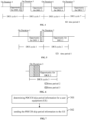
- the UE receives the GTS in the time period 4 before the DRX cycle 5, and the above skip period includes 3 DRX cycles after the moment of receiving GTS. That is, the skip period is effective for 3 DRX cycles (i.e., DRX cycle 5, DRX cycle 6, and DRX cycle 7) after the reception moment.
- the network device when the network device determines that no data will be transmitted to the UE in the next period of time, the network device sends a GTS to the UE, for notifying the UE to stop monitoring the PDCCH according to the configured skip period or the skip period agreed in the communication protocol.
- monitoring the PDCCH is stopped within the skip period.
- the UE stops monitoring the PDCCH within the skip period.
- the UE stops monitoring the PDCCH within the skip period.
- the UE selects a target skip period from the skip periods configured by the network device, and stops monitoring the PDCCH within the target skip period.
- the UE selects a target skip period from the skip periods agreed in the communication protocol, and stops monitoring the PDCCH within the target skip period.
- the UE stops monitoring the PDCCH within the fixed duration, starting from the current DRX cycle or the next DRX cycle.
- the reception moment is a moment of receiving a GTS as an example. As shown in FIG. 5 , after receiving the GTS sent by the network device in the time period 1 of the Opportunity for DRX 1, the UE stops monitoring the PDCCH for the fixed duration, starting from the DRX cycle 2. That is, the UE stops monitoring the PDCCH for the fixed duration, starting from On Duration 2.
- the UE stops monitoring the PDCCH within the above remaining time.
- the reception moment is a moment of receiving a GTS as an example.
- DRX cycle 3 includes On Duration 3 and Opportunity for DRX 3
- On Duration 3 includes time period 2 and time period 3 in the active time
- the UE receives the GTS sent by the network device within the time period 2.
- monitoring the PDCCH is stopped within the time period 3. That is, the UE immediately stops the running On Duration timer or the inactivity timer.
- the UE acquires PDCCH skip period information, where the skip period information indicates the skip period, and stops monitoring the PDCCH within the skip period.
- the UE skips the active time in the first DRX cycle, which effectively saves the power consumption of the UE.
- the method may also stop monitoring the PDCCH in the remaining time of the active time, so that the UE may stop monitoring the PDCCH without completing the PDCCH monitoring in the remaining time.
- the PDCCH monitoring by the UE is effectively controlled, and power consumption of the UE is further reduced.
- the skip period may be configured for a length of the DRX cycle.
- the skip period includes: a first skip period and/or a second skip period.
- the first skip period is a skip period suitable for a DRX short cycle
- the second skip period is a skip period suitable for a DRX long cycle
- the first skip period is different from the second skip period.
- the first skip period is greater than the second skip period, that is, the skip period suitable for the DRX short cycle is greater than the skip period suitable for the DRX long cycle.
- the short-cycle DRX and the long- cycle DRX are configured with different skip periods. As shown in Table 1, a duration from a1 to a2 is a first short cycle, and a skip period configured for the first short cycle is t1; a duration from b1 to b2 is a first long cycle, and a skip period configured for the first long cycle is t2.
- Table 1 Cycle duration Cycle Skip period a1 to a2 First short cycle t1 b1 to b2 First long cycle t2
- DRXs of different short cycles are configured with different skip periods
- DRXs of different long cycles are configured with different skip periods.
- Table 2 Cycle duration Cycle Skip period a1 to a2 First short cycle t1 a3 to a4 Second short cycle t3 b1 to b2 First long cycle t2 B3 to b4 Second long cycle t4
- the DRX short cycles triggered by different reasons may be configured with different skip periods.
- the first DRX short cycle is triggered after the UE receives the MAC CE, and the configured skip period is t5.
- the second DRX short cycle is triggered after the inactivity timer of the UE expires, and the configured skip period is t6.
- the cycle durations of the first DRX short cycle and the second DRX short cycle may be the same or different, and t5 and t6 are different.
- the network device may notify the UE that the above PDCCH skip period information is not used for the DRX long cycle.
- the second skip period is zero, that is, the second skip period suitable for the DRX long cycle is configured to be zero.
- the network device configures the second skip period to be zero. That is, it implicitly indicates that the above PDCCH skipping is not used for the DRX long cycle.
- the network device may notify the UE that the above PDCCH skip period information is not used for the DRX short cycle.
- the first skip period is zero, that is, the first skip period suitable for the DRX short cycle is configured to be zero.
- the network device configures the first skip period to be zero, that is, it implicitly indicates that the above PDCCH skipping is not used for the DRX short cycle.
- the skip period is configured according to the length of the DRX cycle, where a longer skip period is configured for the DRX short cycle, so that more durations may be skipped for the DRX short cycle and the UE is more power-saving.
- the skip periods configured for the DRX short cycle and the DRX long cycle are different, so as to ensure reducing the delay to a minimum in the case of making the UE more power-saving.
- the skip period may be configured for a primary component carrier (PCC) and a secondary component carrier (SCC), respectively.
- the skip period includes: a third skip period and/or a fourth skip period.
- the third skip period is a skip period suitable for a DRX cycle on the PCC
- the fourth skip period is a skip period suitable for a DRX cycle on the SCC.
- the third skip period is different from the fourth skip period.
- the third skip period on the PCC is 3s
- the fourth skip period on the SCC is 6s.
- the fourth skip period is greater than the third skip period, that is, compared with the third skip period on the PCC, a fourth skip period with a longer duration is used on the SCC, so that the UE may save more powers.
- the fourth skip period is 5 seconds (5s)
- the third skip period is 2s.
- the fourth skip period is greater than the second skip period, where the second skip period is a skip period suitable for a DRX long cycle. That is, the skip period suitable for the DRX cycle on the SCC is greater than that of the DRX long cycle.
- the fourth skip period is 6s, and the second skip period is 3s.
- the PDCCH skipping that is notified by the network device to the UE is not used for the PCC.
- the third skip period is zero.
- the network device configures the third skip period to be zero. That is, it implicitly indicates that the above PDCCH skipping is not used for the PCC.
- the PDCCH skipping is configured to be performed by the UE that gets access to a designated secondary serving cell group (Scell group). That is, the UE is allowed to perform the PDCCH skipping after getting access to the designated Scell group, and does not need to perform the PDCCH skipping after getting access to a serving cell group rather than the designated Scell group.
- Scell group secondary serving cell group
- the skip period is configured according to the PCC and SCC respectively, and the fourth skip period configured on the SCC is longer than the third skip period configured on the PCC.
- the duration for stopping monitoring on the SCC is longer, so that the UE may save more powers.
- the skip period may be configured for carrier frequency bands, respectively.
- the skip period includes: a fifth skip period and/or a sixth skip period.
- the 5G frequency range (FR) is divided into FR1 (450MHz-6000MHz, also known as Sub-6GHz) and FR2 (24250MHz-52600MHz, also known as Above-6GHz or millimeter wave) according to the 3GPP definition.
- the fifth skip period is a skip period suitable for a DRX cycle in a DRX group of FR1 frequency band.
- the sixth skip period is a skip period suitable for a DRX cycle in a DRX group of FR2 frequency band.
- the fifth skip period is different from the sixth skip period.
- the fifth skip period is smaller than the sixth skip period. That is, in a scenario where FR2 is used by the SCC, since the bandwidth on FR2 is larger and the data transmission is faster, a monitoring duration of the PDCCH on FR2 may be shorter than a monitoring duration of the PCC.
- the skip period of the DRX cycle suitable for the FR2 frequency band is larger than the skip period of the DRX cycle suitable for the FR1 frequency band.
- the UE may also save more powers by using a larger skip period.
- the network device informs the UE that the PDCCH skipping is not used for the DRX group on FR1. That is, the fifth skip period is zero.
- the network device configures the fifth skip period to be zero, that is, it implicitly indicates that the above PDCCH skipping is not used for the DRX group on FR1.
- the skip period is configured according to the carrier frequency bands, and the skip periods configured in the FR1 and FR2 scenarios are different.
- the monitoring duration of the PDCCH on FR2 may be shorter than the monitoring duration in the FR1 scenario. Therefore, the fourth skip period configured on the SCC is longer than the second skip period. That is, the duration of stopping monitoring in the FR2 scenario is longer, so that the UE may save more powers.
- FIG. 7 illustrates a schematic diagram of a method for power saving of a user equipment according to an exemplary embodiment of the disclosure, which may be applied to the network device shown in FIG. 1 .
- the method includes the following steps at 301-302.
- the network device determines PDCCH skip period information for the UE.
- the above PDCCH skip period information indicates a skip period.
- the UE skips active time in a first DRX cycle.
- the network device determines the skip period for the UE, and then determines the PDCCH skip period information.
- the skip period is configured by the network device for the UE, reference may be made to the detailed description in the above embodiment on the UE side, which may not be repeated here.
- the network device sends the PDCCH skip period information to theUE.
- the skip period is carried in at least one of a downlink control information (DCI) signaling, a radio resource control (RRC) signaling, and a medium access control control element (MAC CE) signaling. That is, the network device enables the skip period to be carried in at least one of the DCI signaling, RRC signaling, and MAC CE signaling, and sends the PDCCH skip period information to the UE through the signaling.
- DCI downlink control information
- RRC radio resource control
- MAC CE medium access control control element
- the network device also configures a parameter n to the UE, where the parameter n is configured to indicate that the skip period is effective for n DRX cycles after a reception moment, and the n DRX cycles include the first DRX cycle, where n is a positive integer .
- the network device configures the parameter 3 to the UE.
- the network device configures the skip period for the UE, where the skip period includes the active time of the UE in the first DRX cycle, and controls the UE to stop monitoring the PDCCH within the skip period, which effectively saves the power consumption of the UE.
- the above first skip period is a skip period for a DRX short cycle that is triggered after the UE receives the MAC CE.
- FIG. 8 which illustrates a schematic diagram of a method for power saving of a user equipment according to an exemplary embodiment of the disclosure. The method may be applied to the UE and the network device as shown in FIG. 1 . The method includes the following steps at 401-405.
- the network device determines PDCCH skip period information for the UE, where the PDCCH skip period information indicates a skip period.
- the above skip period includes a first skip period.
- the first skip period is a skip period suitable for a DRX short cycle that is triggered after the UE receives the MAC CE.
- the above skip period further includes a second skip period.
- the second skip period is a skip period suitable for a DRX long cycle.
- the second skip period is also a skip period suitable for the DRX short cycle that is not triggered after the UE receives the MAC CE.
- the above first skip period is different from the second skip period of the DRX long cycle.
- the first skip period is greater than the second skip period.
- the first skip period is 3s, and the second skip period is 1s.
- the network device sends the PDCCH skip period information to the UE.
- the UE receives the PDCCH skip period information sent by the network device.
- a skip period is configured in the UE, and the skip period includes the first skip period.
- the first skip period is configured in the UE.
- the second skip period is configured in the UE.
- the UE stops monitoring a PDCCH within the first skip period.
- the UE is in the DRX short cycle triggered after receiving the MAC CE. At this time, it may be determined that the data transmission amount on the subsequent PDCCH is small, and the UE selects a longer first skip period to control the time of stopping monitoring the PDCCH.
- the UE selects the second skip period to control the time of stopping monitoring the PDCCH. The first skip period is greater than the second skip period.
- the UE stops monitoring the PDCCH within the first skip period; when the UE is in the DRX long cycle, or the DRX short cycle where the UE is located is not the DRX short cycle triggered after receiving the MAC CE, the UE stops monitoring the PDCCH within the second skip period.
- the skip period may be agreed in a communication protocol.
- the network device configures the skip period for the UE. After the UE receives the GTS, when the UE is in the DRX short cycle triggered after receiving the MAC CE, the UE selects to stop monitoring the PDCCH within the first skip period. That is, after the UE receives the MAC CE, it may be determined that the data transmission amount on the subsequent PDCCH is small, and using the first skip period longer than the second skip period of the DRX long cycle may make the UE more power-saving.
- the above first skip period is a skip period for a DRX short cycle that is triggered after the inactivity timer of the UE expires.
- FIG. 9 which illustrates a schematic diagram of a method for power saving of a user equipment according to an exemplary embodiment of the disclosure. The method may be applied to the UE and the network device as shown in FIG. 1 . The method includes the following steps at 501-505.
- the network device determines PDCCH skip period information for the UE, where the PDCCH skip period information indicates a skip period.
- the above skip period includes a first skip period.
- the first skip period is a skip period suitable for a DRX short cycle that is triggered after the UE receives the MAC CE.
- the above skip period further includes a second skip period.
- the second skip period is a skip period suitable for a DRX long cycle.
- the second skip period is also a skip period suitable for the DRX short cycle that is not triggered after the UE receives the MAC CE.
- the above first skip period is different from the second skip period of the DRX long cycle.
- the first skip period is smaller than the second skip period.
- the skip period of the DRX short cycle is 2s
- the skip period of the DRX long cycle is 4s.
- the network device sends the PDCCH skip period information to the UE.
- the UE receives the PDCCH skip period information sent by the network device.
- a skip period is configured in the UE, and the skip period includes the first skip period.
- the first skip period is configured in the UE.
- the second skip period is configured in the UE.
- the UE stops monitoring a PDCCH within the first skip period.
- the UE when the UE is in the DRX short cycle triggered after the inactivity timer expires, it may be determined that the data transmission amount on the subsequent PDCCH is large, and the UE selects the first skip period with a shorter duration to control the time of stopping monitoring the PDCCH.
- the UE selects the second skip period to control the time of stopping monitoring the PDCCH.
- the first skip period is smaller than the second skip period.
- the UE stops monitoring the PDCCH within the first skip period; when the UE is in the DRX long cycle, or the DRX short cycle where the UE is located is not the DRX short cycle triggered after the inactivity timer expires, the UE stops monitoring the PDCCH within the second skip period.
- the skip period may be agreed in a communication protocol.
- the network device configures the skip period for the UE. After the UE receives the GTS, when the UE is in the DRX short cycle triggered after the inactivity timer expires, the UE selects to stop monitoring the PDCCH within the first skip period. That is, after the inactivity timer of the UE expires, it may be determined that the data transmission amount on the subsequent PDCCH is large, and using the first skip period smaller than the second skip period of the DRX long cycle may reduce the delay probability of data reception while the UE is more power-saving.
- the steps performed by the network device may be implemented independently as embodiments on the network device side; and the steps performed by the UE may be implemented independently as embodiments on the UE side.
- FIG. 10 illustrates a structural block diagram of an apparatus for power saving of a user equipment according to an exemplary embodiment of the disclosure.
- the apparatus may be implemented as a UE, or may be implemented as a part of the UE.
- the apparatus includes a first processing module 601.
- the first processing module 601 is configured to acquire physical downlink control channel (PDCCH) skip period information and stop monitoring a PDCCH within the skip period.
- the skip period information indicates a skip period, and the UE skips active time in a first discontinuous reception (DRX) cycle within the skip period.
- DRX discontinuous reception
- the skip period is of a fixed time length; or the skip period is remaining time of the active time for the UE in the first DRX cycle; or the skip period is a time period configured by the network device; or the skip period is a time period agreed in a communication protocol.
- the skip period includes: a first skip period and/or a second skip period.
- the first skip period is a skip period suitable for a DRX short cycle
- the second skip period is a skip period suitable for a DRX long cycle.
- the first skip period and the second skip period are different.
- the first skip period is greater than the second skip period; or the first skip period is zero; or the second skip period is zero.
- the first skip period is a skip period for the DRX short cycle that is triggered after the UE receives medium access control control element (MAC CE); or the first skip period is a skip period for the DRX short cycle that is triggered after an inactivity timer of the UE expires.
- MAC CE medium access control control element
- the skip period includes: a third skip period and/or a fourth skip period.
- the third skip period is a skip period suitable for a DRX cycle on a primary component carrier (PCC).
- the fourth skip period is a skip period suitable for a DRX cycle on a secondary component carrier (SCC).
- the third skip period is different from the fourth skip period.
- the fourth skip period is greater than the third skip period; or the third skip period is zero.
- the skip period includes: a fifth skip period and/or a sixth skip period.
- the fifth skip period is a skip period suitable for a DRX cycle in a DRX group of FR1 frequency band.
- the sixth skip period is a skip period suitable for a DRX cycle in a DRX group of FR2 frequency band.
- the fifth skip period is different from the sixth skip period.
- the fifth skip period is smaller than the sixth skip period; or the fifth skip period is zero.
- the skip period is carried in at least one of a downlink control information (DCI) signaling, a radio resource control (RRC) signaling, and a medium access control control element (MAC CE) signaling.
- DCI downlink control information
- RRC radio resource control
- MAC CE medium access control control element
- the first processing module 601 is further configured to determine a parameter n, where the parameter n is configured to indicate that the skip period is effective for n DRX cycles after a reception moment, and the n DRX cycles include the first DRX cycle, where n is a positive integer.
- the apparatus acquires the PDCCH skip period information, where the skip period information indicates the skip period.
- the monitoring of the PDCCH is stopped within the skip period.
- the UE skips active time in the first DRX cycle within the skip period, which effectively saves the power consumption of the UE.
- FIG. 11 illustrates a structural block diagram of an apparatus for power saving of a UE according to an exemplary embodiment of the disclosure.
- the apparatus may be implemented as a network device, or may be implemented as a part of the network device, and the device includes a second processing module 701 and a sending module 702.
- the second processing module 701 is configured to determine physical downlink control channel (PDCCH) skip period information for the UE, where the skip period information indicates a skip period; and the UE skips active time in a first discontinuous reception (DRX) cycle within the skip period.
- PDCCH physical downlink control channel
- the sending module 702 is configured to send the PDCCH skip period information to the UE.
- the skip period is of a fixed time length; or the skip period is remaining time of the active time for the UE in the first DRX cycle; or the skip period is a time period configured by the network device; or the skip period is a time period agreed in a communication protocol.
- the skip period includes: a first skip period and/or a second skip period.
- the first skip period is a skip period suitable for a DRX short cycle
- the second skip period is a skip period suitable for a DRX long cycle.
- the first skip period and the second skip period are different.
- the first skip period is greater than the second skip period; or the first skip period is zero; or the second skip period is zero.
- the first skip period is a skip period for the DRX short cycle that is triggered after the UE receives medium access control control element (MAC CE); or the first skip period is a skip period for the DRX short cycle that is triggered after an inactivity timer of the UE expires.
- MAC CE medium access control control element
- the skip period includes: a third skip period and/or a fourth skip period.
- the third skip period is a skip period suitable for a DRX cycle on a primary component carrier (PCC).
- the fourth skip period is a skip period suitable for a DRX cycle on a secondary component carrier (SCC).
- the third skip period is different from the fourth skip period.
- the fourth skip period is greater than the third skip period; or the third skip period is zero.
- the skip period includes: a fifth skip period and/or a sixth skip period.
- the fifth skip period is a skip period suitable for a DRX cycle in a DRX group of FR1 frequency band.
- the sixth skip period is a skip period suitable for a DRX cycle in a DRX group of FR2 frequency band.
- the fifth skip period is different from the sixth skip period.
- the fifth skip period is smaller than the sixth skip period; or the fifth skip period is zero.
- the skip period is carried in at least one of a downlink control information (DCI) signaling, a radio resource control (RRC) signaling, and a medium access control control element (MAC CE) signaling.
- DCI downlink control information
- RRC radio resource control
- MAC CE medium access control control element
- the sending module 702 configures a parameter n for the UE, where the parameter n is configured to indicate that the skip period is effective for n DRX cycles after a reception moment, and the n DRX cycles include the first DRX cycle, where n is a positive integer.
- the apparatus configures a skip period for the UE, and the skip period includes the active time of the UE in the first DRX cycle.
- the apparatus controls the UE to stop monitoring the PDCCH within the skip period, which effectively saves the power consumption of the UE.
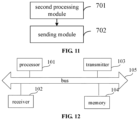
- FIG. 12 illustrates a structural schematic diagram of a communication device (user equipment or network device) according to an exemplary embodiment of the disclosure.
- the communication device includes a processor 101, a receiver 102, a transmitter 103, a memory 104 and a bus 105.
- the processor 101 includes one or more processing cores, and the processor 101 executes various functional applications and information processing by running software programs and modules.
- the receiver 102 and the transmitter 103 may be implemented as a communication component, which may be a communication chip.
- the memory 104 is connected to the processor 101 through the bus 105.
- the memory 104 may be configured to store at least one instruction, and the processor 101 may be configured to execute the at least one instruction, so that various steps in the foregoing method embodiments are implemented.
- the memory 104 may be implemented by any type of volatile or non-volatile storage devices or their combination.
- the volatile or non-volatile storage devices include but not limited to, magnetic or optical disks, an electrically erasable programmable read only memory (EEPROM), an erasable programmable read only memory (EPROM), a static random access memory (SRAM), a read only memory (ROM), a magnetic memory, a flash memory, a programmable read-only memory (PROM).
- a computer-readable storage medium stores at least one piece of instruction, at least one piece of program, a code set or an instruction set, which are loaded and executed by the processor. As such, the method for power saving of a user equipment according to the above method embodiments and executed by the communication device is implemented.
Landscapes
- Engineering & Computer Science (AREA)
- Computer Networks & Wireless Communication (AREA)
- Signal Processing (AREA)
- Mobile Radio Communication Systems (AREA)
Applications Claiming Priority (1)
| Application Number | Priority Date | Filing Date | Title |
|---|---|---|---|
| PCT/CN2020/082857 WO2021196102A1 (zh) | 2020-04-01 | 2020-04-01 | 用户终端的省电方法、装置、通信设备及存储介质 |
Publications (2)
| Publication Number | Publication Date |
|---|---|
| EP4132207A1 true EP4132207A1 (de) | 2023-02-08 |
| EP4132207A4 EP4132207A4 (de) | 2023-05-31 |
Family
ID=71912999
Family Applications (1)
| Application Number | Title | Priority Date | Filing Date |
|---|---|---|---|
| EP20929396.8A Pending EP4132207A4 (de) | 2020-04-01 | 2020-04-01 | Energiesparverfahren und -vorrichtung für ein benutzerendgerät sowie kommunikationsvorrichtung und speichermedium |
Country Status (4)
| Country | Link |
|---|---|
| US (1) | US20230156722A1 (de) |
| EP (1) | EP4132207A4 (de) |
| CN (2) | CN116321381B (de) |
| WO (1) | WO2021196102A1 (de) |
Cited By (1)
| Publication number | Priority date | Publication date | Assignee | Title |
|---|---|---|---|---|
| WO2024197682A1 (en) | 2023-03-30 | 2024-10-03 | Huawei Technologies Co., Ltd. | Devices, methods and system for cell dtx/drx |
Families Citing this family (11)
| Publication number | Priority date | Publication date | Assignee | Title |
|---|---|---|---|---|
| CN114258064B (zh) * | 2020-09-25 | 2025-02-11 | 维沃移动通信有限公司 | 信道监测方法、装置及用户设备 |
| CN112449760B (zh) * | 2020-10-14 | 2023-10-03 | 北京小米移动软件有限公司 | Pdcch发送、pdcch接收方法和装置 |
| CN114390711B (zh) * | 2020-10-22 | 2026-04-17 | 展讯通信(上海)有限公司 | 指示skipping下行控制信息的方法及用户设备、可读存储介质 |
| CN115087082B (zh) * | 2021-03-15 | 2026-02-24 | 维沃移动通信有限公司 | 上行发送处理方法、装置、终端及可读存储介质 |
| WO2022207844A1 (en) * | 2021-04-01 | 2022-10-06 | Fraunhofer-Gesellschaft zur Förderung der angewandten Forschung e.V. | Control channel monitoring enhancements |
| US20230106999A1 (en) * | 2021-10-01 | 2023-04-06 | Qualcomm Incorporated | Techniques for configuring control channel monitoring skip durations |
| WO2023130470A1 (zh) * | 2022-01-10 | 2023-07-13 | 北京小米移动软件有限公司 | 暂停监听的方法、装置、通信设备及存储介质 |
| CN118104318A (zh) * | 2022-09-27 | 2024-05-28 | 北京小米移动软件有限公司 | 一种发送或监听下行控制信息的方法、装置、设备及介质 |
| CN117998534A (zh) * | 2022-10-27 | 2024-05-07 | 维沃移动通信有限公司 | 延迟唤醒终端的指示方法、装置及设备 |
| EP4616647A1 (de) * | 2022-11-07 | 2025-09-17 | Telefonaktiebolaget LM Ericsson (publ) | Schnelle pdcch-überwachung in der trägeraggregation für xr-dienste |
| CN116326134A (zh) * | 2022-12-21 | 2023-06-23 | 北京小米移动软件有限公司 | 信息处理方法及装置、通信设备及存储介质 |
Family Cites Families (26)
| Publication number | Priority date | Publication date | Assignee | Title |
|---|---|---|---|---|
| WO2008057882A2 (en) * | 2006-11-07 | 2008-05-15 | Conexant Systems, Inc. | Systems and methods for management of wireless clients |
| CN101827426B (zh) * | 2009-03-04 | 2013-04-10 | 电信科学技术研究院 | 多载波系统中监听控制信道的方法及装置 |
| CN101932023B (zh) * | 2009-06-19 | 2016-03-02 | 华为技术有限公司 | 载波聚合的不连续接收方法、调度方法及装置 |
| CN107431610A (zh) * | 2013-12-25 | 2017-12-01 | 华为技术有限公司 | 半双工频分双工的通信方法、基站和终端 |
| CN106063333B (zh) * | 2014-03-13 | 2019-11-01 | Lg电子株式会社 | 无线通信系统中指示接入类别限制的跳过的方法和装置 |
| EP3968709B1 (de) * | 2017-03-24 | 2024-11-27 | LG Electronics Inc. | Verfahren und drahtlosvorrichtung zum empfangen einer funkrufnachricht |
| CN110447268B (zh) * | 2017-03-24 | 2021-10-01 | 华为技术有限公司 | 一种指示信息的传输方法和装置 |
| CN109246803B (zh) * | 2017-05-12 | 2021-11-12 | 中兴通讯股份有限公司 | 一种监听寻呼消息的方法、装置、终端和存储介质 |
| CN110731093B (zh) * | 2017-11-17 | 2022-10-21 | Oppo广东移动通信有限公司 | 用于侦听pdcch的方法和终端设备 |
| WO2019113883A1 (zh) * | 2017-12-14 | 2019-06-20 | 北京小米移动软件有限公司 | 用户设备省电方法、装置、用户设备和基站 |
| WO2019139411A1 (ko) * | 2018-01-11 | 2019-07-18 | 엘지전자 주식회사 | 무선 통신 시스템에서 단말의 동작 방법 및 상기 방법을 이용하는 장치 |
| CN113923761A (zh) * | 2018-08-28 | 2022-01-11 | 华为技术有限公司 | 通信方法、装置及存储介质 |
| CN110913462B (zh) * | 2018-09-18 | 2022-02-25 | 大唐移动通信设备有限公司 | 信道的监听、节能信号的处理、装置、终端及网络侧设备 |
| CN112997540B (zh) * | 2018-09-27 | 2025-02-14 | 交互数字专利控股公司 | Nr中的功率节省机制 |
| US11229022B2 (en) * | 2019-03-26 | 2022-01-18 | Samsung Electronics Co., Ltd. | Determination of physical downlink control channel (PDCCH) assignment in power saving mode |
| US11564167B2 (en) * | 2019-04-01 | 2023-01-24 | Apple Inc. | Configurable power saving signal with multiple functionalities in 5G NR |
| CN111865541B (zh) * | 2019-04-30 | 2023-11-21 | 华为技术有限公司 | 一种调度切换方法及装置 |
| WO2020220322A1 (en) * | 2019-04-30 | 2020-11-05 | Nokia Shanghai Bell Co., Ltd. | Timer control in discontinuous reception |
| WO2020223654A1 (en) * | 2019-05-01 | 2020-11-05 | Apple Inc. | Control channel signaling for user equipment (ue) power saving |
| WO2020220378A1 (en) * | 2019-05-02 | 2020-11-05 | Nokia Shanghai Bell Co., Ltd. | Skipping monitoring of downlink control channel during random access procedure |
| CN113812184B (zh) * | 2019-05-09 | 2024-02-13 | 上海诺基亚贝尔股份有限公司 | 非连续接收中的唤醒信令处理 |
| US20220232663A1 (en) * | 2019-06-12 | 2022-07-21 | Nokia Technologies Oy | Mechanism for Handling PDCCH Skipping and Wake Up Signal |
| CN112291834B (zh) * | 2019-07-23 | 2023-11-07 | 华为技术有限公司 | 通信方法及装置 |
| ES3036710T3 (en) * | 2019-07-26 | 2025-09-23 | Beijing Xiaomi Mobile Software Co Ltd | Power conservation method and device, terminal, access network apparatus, and readable storage medium |
| US12108342B2 (en) * | 2019-08-16 | 2024-10-01 | Telefonaktiebolaget Lm Ericsson (Publ) | Technique for skip signal transmission |
| WO2021098053A1 (en) * | 2020-02-14 | 2021-05-27 | Zte Corporation | Power saving methods for a mobile station |
-
2020
- 2020-04-01 CN CN202310333321.2A patent/CN116321381B/zh active Active
- 2020-04-01 EP EP20929396.8A patent/EP4132207A4/de active Pending
- 2020-04-01 CN CN202080000665.6A patent/CN111527773B/zh active Active
- 2020-04-01 US US17/916,563 patent/US20230156722A1/en active Pending
- 2020-04-01 WO PCT/CN2020/082857 patent/WO2021196102A1/zh not_active Ceased
Cited By (2)
| Publication number | Priority date | Publication date | Assignee | Title |
|---|---|---|---|---|
| WO2024197682A1 (en) | 2023-03-30 | 2024-10-03 | Huawei Technologies Co., Ltd. | Devices, methods and system for cell dtx/drx |
| EP4620252A4 (de) * | 2023-03-30 | 2025-11-19 | Huawei Tech Co Ltd | Vorrichtungen, verfahren und system für zell-dtx/drx |
Also Published As
| Publication number | Publication date |
|---|---|
| CN111527773B (zh) | 2023-04-18 |
| CN111527773A (zh) | 2020-08-11 |
| CN116321381A (zh) | 2023-06-23 |
| WO2021196102A1 (zh) | 2021-10-07 |
| US20230156722A1 (en) | 2023-05-18 |
| EP4132207A4 (de) | 2023-05-31 |
| CN116321381B (zh) | 2025-05-27 |
Similar Documents
| Publication | Publication Date | Title |
|---|---|---|
| EP4132207A1 (de) | Energiesparverfahren und -vorrichtung für ein benutzerendgerät sowie kommunikationsvorrichtung und speichermedium | |
| US20230026953A1 (en) | Drx control method and apparatus | |
| US12021631B2 (en) | Efficient sparse network resource usage and connection release | |
| US10973076B2 (en) | Fast switching between control channels during radio resource control connection | |
| US20230066041A1 (en) | Method and apparatus for power saving on sidelink | |
| US12477618B2 (en) | Signal reception method and terminal device | |
| US20250008438A1 (en) | Method and device for discontinuous reception | |
| US12167335B2 (en) | Discontinuous reception method, electronic device and storage medium | |
| WO2021217351A1 (zh) | 一种信道监听方法、电子设备及存储介质 | |
| CN114600510B (zh) | 无线通信的方法、终端设备和网络设备 | |
| US12052665B2 (en) | Methods and apparatuses for using power-saving signal pattern, device and system | |
| WO2021217344A1 (zh) | 一种信道监听方法、电子设备及存储介质 | |
| US12160828B2 (en) | Discontinuous reception processing method, and terminal device | |
| WO2021243704A1 (zh) | Drx参数的切换方法、装置、设备及存储介质 | |
| US12200624B2 (en) | Method for controlling discontinuous reception-onduration timer, terminal device and chip | |
| EP4542942A1 (de) | Verfahren und vorrichtung zur umschaltung des kommunikationsstatus sowie endgerätevorrichtung |
Legal Events
| Date | Code | Title | Description |
|---|---|---|---|
| STAA | Information on the status of an ep patent application or granted ep patent |
Free format text: STATUS: THE INTERNATIONAL PUBLICATION HAS BEEN MADE |
|
| PUAI | Public reference made under article 153(3) epc to a published international application that has entered the european phase |
Free format text: ORIGINAL CODE: 0009012 |
|
| STAA | Information on the status of an ep patent application or granted ep patent |
Free format text: STATUS: REQUEST FOR EXAMINATION WAS MADE |
|
| 17P | Request for examination filed |
Effective date: 20221027 |
|
| AK | Designated contracting states |
Kind code of ref document: A1 Designated state(s): AL AT BE BG CH CY CZ DE DK EE ES FI FR GB GR HR HU IE IS IT LI LT LU LV MC MK MT NL NO PL PT RO RS SE SI SK SM TR |
|
| REG | Reference to a national code |
Ref country code: DE Ref legal event code: R079 Free format text: PREVIOUS MAIN CLASS: H04W0076280000 Ipc: H04W0052020000 |
|
| A4 | Supplementary search report drawn up and despatched |
Effective date: 20230428 |
|
| RIC1 | Information provided on ipc code assigned before grant |
Ipc: H04W 76/28 20180101ALN20230421BHEP Ipc: H04W 52/02 20090101AFI20230421BHEP |
|
| DAV | Request for validation of the european patent (deleted) | ||
| DAX | Request for extension of the european patent (deleted) | ||
| STAA | Information on the status of an ep patent application or granted ep patent |
Free format text: STATUS: EXAMINATION IS IN PROGRESS |
|
| 17Q | First examination report despatched |
Effective date: 20251222 |