EP4131833B1 - Nr-steuerkanalelementdetektionen zur reduzierung von blinddemodulation und -decodierung - Google Patents
Nr-steuerkanalelementdetektionen zur reduzierung von blinddemodulation und -decodierung Download PDFInfo
- Publication number
- EP4131833B1 EP4131833B1 EP22188665.8A EP22188665A EP4131833B1 EP 4131833 B1 EP4131833 B1 EP 4131833B1 EP 22188665 A EP22188665 A EP 22188665A EP 4131833 B1 EP4131833 B1 EP 4131833B1
- Authority
- EP
- European Patent Office
- Prior art keywords
- cces
- group
- symbol
- control channel
- pdcch
- Prior art date
- Legal status (The legal status is an assumption and is not a legal conclusion. Google has not performed a legal analysis and makes no representation as to the accuracy of the status listed.)
- Active
Links
Images




Classifications
-
- H—ELECTRICITY
- H04—ELECTRIC COMMUNICATION TECHNIQUE
- H04L—TRANSMISSION OF DIGITAL INFORMATION, e.g. TELEGRAPHIC COMMUNICATION
- H04L5/00—Arrangements affording multiple use of the transmission path
- H04L5/003—Arrangements for allocating sub-channels of the transmission path
- H04L5/0053—Allocation of signalling, i.e. of overhead other than pilot signals
-
- H—ELECTRICITY
- H04—ELECTRIC COMMUNICATION TECHNIQUE
- H04W—WIRELESS COMMUNICATION NETWORKS
- H04W72/00—Local resource management
- H04W72/20—Control channels or signalling for resource management
-
- H—ELECTRICITY
- H04—ELECTRIC COMMUNICATION TECHNIQUE
- H04L—TRANSMISSION OF DIGITAL INFORMATION, e.g. TELEGRAPHIC COMMUNICATION
- H04L5/00—Arrangements affording multiple use of the transmission path
- H04L5/003—Arrangements for allocating sub-channels of the transmission path
- H04L5/0048—Allocation of pilot signals, i.e. of signals known to the receiver
- H04L5/0051—Allocation of pilot signals, i.e. of signals known to the receiver of dedicated pilots, i.e. pilots destined for a single user or terminal
-
- H—ELECTRICITY
- H04—ELECTRIC COMMUNICATION TECHNIQUE
- H04L—TRANSMISSION OF DIGITAL INFORMATION, e.g. TELEGRAPHIC COMMUNICATION
- H04L5/00—Arrangements affording multiple use of the transmission path
- H04L5/0091—Signalling for the administration of the divided path, e.g. signalling of configuration information
- H04L5/0094—Indication of how sub-channels of the path are allocated
-
- H—ELECTRICITY
- H04—ELECTRIC COMMUNICATION TECHNIQUE
- H04W—WIRELESS COMMUNICATION NETWORKS
- H04W52/00—Power management, e.g. Transmission Power Control [TPC] or power classes
- H04W52/02—Power saving arrangements
- H04W52/0209—Power saving arrangements in terminal devices
- H04W52/0225—Power saving arrangements in terminal devices using monitoring of external events, e.g. the presence of a signal
Definitions
- the present application relates to wireless communications, and more particularly to systems, apparatuses, and methods for performing blind decoding of downlink control channels with reduced resource consumption in a wireless communication system.
- Wireless communication systems are rapidly growing in usage.
- wireless devices such as smart phones and tablet computers have become increasingly sophisticated.
- mobile devices i.e., user equipment devices or UEs
- GPS global positioning system
- UE user equipment
- wireless devices such as cellular phones, base stations and relay stations used in wireless cellular communications.
- increasing the functionality of a UE device can place a significant strain on the battery life of the UE device.
- WO2020/145537 discloses systems for merging IoT and 5G cellular communication systems by providing a power saving signal for transmission.
- US2020/0145918 discloses a cellular communication system in which reference signal information is transmitted in alignment with a DRX cycle length.
- Computer System any of various types of computing or processing systems, including a personal computer system (PC), mainframe computer system, workstation, network appliance, Internet appliance, personal digital assistant (PDA), television system, grid computing system, or other device or combinations of devices.
- PC personal computer system
- mainframe computer system workstation
- network appliance Internet appliance
- PDA personal digital assistant
- television system grid computing system, or other device or combinations of devices.
- computer system may be broadly defined to encompass any device (or combination of devices) having at least one processor that executes instructions from a memory medium.
- UE User Equipment
- UE Device any of various types of computer systems or devices that are mobile or portable and that perform wireless communications.
- UE devices include mobile telephones or smart phones (e.g., iPhone TM , Android TM -based phones), tablet computers (e.g., iPad TM , Samsung Galaxy TM ), portable gaming devices (e.g., Nintendo DS TM , PlayStation Portable TM , Gameboy Advance TM , iPhone TM ), wearable devices (e.g., smart watch, smart glasses), laptops, PDAs, portable Internet devices, music players, data storage devices, other handheld devices, automobiles and/or motor vehicles, unmanned aerial vehicles (UAVs) (e.g., drones), UAV controllers (UACs), etc.
- UAVs unmanned aerial vehicles
- UAVs unmanned aerial vehicles
- UAV controllers UAV controllers
- Wireless Device any of various types of computer systems or devices that perform wireless communications.
- a wireless device can be portable (or mobile) or may be stationary or fixed at a certain location.
- a UE is an example of a wireless device.
- a Communication Device any of various types of computer systems or devices that perform communications, where the communications can be wired or wireless.
- a communication device can be portable (or mobile) or may be stationary or fixed at a certain location.
- a wireless device is an example of a communication device.
- a UE is another example of a communication device.
- Base Station has the full breadth of its ordinary meaning, and at least includes a wireless communication station installed at a fixed location and used to communicate as part of a wireless telephone system or radio system.
- Processing Element refers to various elements or combinations of elements that are capable of performing a function in a device, e.g., in a user equipment device or in a cellular network device.
- Processing elements may include, for example: processors and associated memory, portions or circuits of individual processor cores, entire processor cores, processor arrays, circuits such as an ASIC (Application Specific Integrated Circuit), programmable hardware elements such as a field programmable gate array (FPGA), as well any of various combinations of the above.
- ASIC Application Specific Integrated Circuit
- FPGA field programmable gate array
- Wi-Fi has the full breadth of its ordinary meaning, and at least includes a wireless communication network or RAT that is serviced by wireless LAN (WLAN) access points and which provides connectivity through these access points to the Internet.
- WLAN wireless LAN
- Most modern Wi-Fi networks (or WLAN networks) are based on IEEE 802.11 standards and are marketed under the name "Wi-Fi”.
- Wi-Fi Wi-Fi
- a Wi-Fi (WLAN) network is different from a cellular network.
- Automatically - refers to an action or operation performed by a computer system (e.g., software executed by the computer system) or device (e.g., circuitry, programmable hardware elements, ASICs, etc.), without user input directly specifying or performing the action or operation.
- a computer system e.g., software executed by the computer system
- device e.g., circuitry, programmable hardware elements, ASICs, etc.
- An automatic procedure may be initiated by input provided by the user, but the subsequent actions that are performed "automatically” are not specified by the user, i.e., are not performed "manually", where the user specifies each action to perform.
- a user filling out an electronic form by selecting each field and providing input specifying information is filling out the form manually, even though the computer system must update the form in response to the user actions.
- the form may be automatically filled out by the computer system where the computer system (e.g., software executing on the computer system) analyzes the fields of the form and fills in the form without any user input specifying the answers to the fields.
- the user may invoke the automatic filling of the form, but is not involved in the actual filling of the form (e.g., the user is not manually specifying answers to fields but rather they are being automatically completed).
- the present specification provides various examples of operations being automatically performed in response to actions the user has taken.
- Configured to - Various components may be described as “configured to” perform a task or tasks. In such contexts, “configured to” is a broad recitation generally meaning “having structure that" performs the task or tasks during operation. As such, the component can be configured to perform the task even when the component is not currently performing that task (e.g., a set of electrical conductors may be configured to electrically connect a module to another module, even when the two modules are not connected). In some contexts, “configured to” may be a broad recitation of structure generally meaning “having circuitry that" performs the task or tasks during operation. As such, the component can be configured to perform the task even when the component is not currently on. In general, the circuitry that forms the structure corresponding to "configured to” may include hardware circuits.
- Figure 1 illustrates an exemplary (and simplified) wireless communication system in which aspects of this disclosure may be implemented, according to some embodiments. It is noted that the system of Figure 1 is merely one example of a possible system, and embodiments may be implemented in any of various systems, as desired.
- the exemplary wireless communication system includes a base station 102 which communicates over a transmission medium with one or more (e.g., an arbitrary number of) user devices 106A, 106B, etc. through 106N.
- Each of the user devices may be referred to herein as a "user equipment” (UE) or UE device.
- UE user equipment
- the user devices 106 are referred to as UEs or UE devices.
- the base station 102 may be a base transceiver station (BTS) or cell site, and may include hardware and/or software that enables wireless communication with the UEs 106A through 106N. If the base station 102 is implemented in the context of LTE, it may alternately be referred to as an 'eNodeB' or 'eNB'. If the base station 102 is implemented in the context of 5G NR, it may alternately be referred to as a 'gNodeB' or 'gNB'. The base station 102 may also be equipped to communicate with a network 100 (e.g., a core network of a cellular service provider, a telecommunication network such as a public switched telephone network (PSTN), and/or the Internet, among various possibilities).
- PSTN public switched telephone network
- the base station 102 may facilitate communication among the user devices and/or between the user devices and the network 100.
- the communication area (or coverage area) of the base station may be referred to as a "cell.”
- a base station may sometimes be considered as representing the network insofar as uplink and downlink communications of the UE are concerned.
- a UE communicating with one or more base stations in the network may also be interpreted as the UE communicating with the network.
- the base station 102 and the user devices may be configured to communicate over the transmission medium using any of various radio access technologies (RATs), also referred to as wireless communication technologies, or telecommunication standards, such as GSM, UMTS (WCDMA), LTE, LTE-Advanced (LTE-A), LAA/LTE-U, 5G NR, 3GPP2 CDMA2000 (e.g., 1xRTT, 1xEV-DO, HRPD, eHRPD), Wi-Fi, etc.
- RATs radio access technologies
- GSM Global System for Mobile communications
- WCDMA UMTS
- LTE LTE-Advanced
- LAA/LTE-U LAA/LTE-U
- 5G NR 5G NR
- 3GPP2 CDMA2000 e.g., 1xRTT, 1xEV-DO, HRPD, eHRPD
- Wi-Fi Wi-Fi
- Base station 102 and other similar base stations operating according to the same or a different cellular communication standard may thus be provided as one or more networks of cells, which may provide continuous or nearly continuous overlapping service to UE 106 and similar devices over a geographic area via one or more cellular communication standards.
- a UE 106 may be capable of communicating using multiple wireless communication standards.
- a UE 106 might be configured to communicate using either or both of a 3GPP cellular communication standard or a 3GPP2 cellular communication standard.
- the UE 106 may be configured to perform techniques for performing blind decoding of downlink control channels with reduced resource consumption, such as according to the various methods described herein.
- the UE 106 might also or alternatively be configured to communicate using WLAN, BLUETOOTH TM , one or more global navigational satellite systems (GNSS, e.g., GPS or GLONASS), one and/or more mobile television broadcasting standards (e.g., ATSC-M/H), etc.
- GNSS global navigational satellite systems
- ATSC-M/H mobile television broadcasting standards
- FIG. 2 illustrates an exemplary user equipment 106 (e.g., one of the devices 106A through 106N) in communication with the base station 102, according to some embodiments.
- the UE 106 may be a device with wireless network connectivity such as a mobile phone, a hand-held device, a wearable device, a computer or a tablet, an unmanned aerial vehicle (UAV), an unmanned aerial controller (UAC), an automobile, or virtually any type of wireless device.
- the UE 106 may include a processor (processing element) that is configured to execute program instructions stored in memory. The UE 106 may perform any of the method embodiments described herein by executing such stored instructions.
- the UE 106 may include a programmable hardware element such as an FPGA (field-programmable gate array), an integrated circuit, and/or any of various other possible hardware components that are configured to perform (e.g., individually or in combination) any of the method embodiments described herein, or any portion of any of the method embodiments described herein.
- the UE 106 may be configured to communicate using any of multiple wireless communication protocols. For example, the UE 106 may be configured to communicate using two or more of CDMA2000, LTE, LTE-A, 5G NR, WLAN, or GNSS. Other combinations of wireless communication standards are also possible.
- the UE 106 may include one or more antennas for communicating using one or more wireless communication protocols according to one or more RAT standards. In some embodiments, the UE 106 may share one or more parts of a receive chain and/or transmit chain between multiple wireless communication standards.
- the shared radio may include a single antenna, or may include multiple antennas (e.g., for MIMO) for performing wireless communications.
- a radio may include any combination of a baseband processor, analog RF signal processing circuitry (e.g., including filters, mixers, oscillators, amplifiers, etc.), or digital processing circuitry (e.g., for digital modulation as well as other digital processing). Similarly, the radio may implement one or more receive and transmit chains using the aforementioned hardware.
- the UE 106 may include separate transmit and/or receive chains (e.g., including separate antennas and other radio components) for each wireless communication protocol with which it is configured to communicate.
- the UE 106 may include one or more radios that are shared between multiple wireless communication protocols, and one or more radios that are used exclusively by a single wireless communication protocol.
- the UE 106 may include a shared radio for communicating using either of LTE or CDMA2000 1xRTT (or LTE or NR, or LTE or GSM), and separate radios for communicating using each of Wi-Fi and BLUETOOTH TM .
- LTE or CDMA2000 1xRTT or LTE or NR, or LTE or GSM
- Other configurations are also possible.
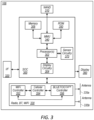
- FIG. 3 illustrates a block diagram of an exemplary UE 106, according to some embodiments.
- the UE 106 may include a system on chip (SOC) 300, which may include portions for various purposes.
- the SOC 300 may include processor(s) 302 which may execute program instructions for the UE 106 and display circuitry 304 which may perform graphics processing and provide display signals to the display 360.
- the SOC 300 may also include sensor circuitry 370, which may include components for sensing or measuring any of a variety of possible characteristics or parameters of the UE 106.
- the sensor circuitry 370 may include motion sensing circuitry configured to detect motion of the UE 106, for example using a gyroscope, accelerometer, and/or any of various other motion sensing components.
- the sensor circuitry 370 may include one or more temperature sensing components, for example for measuring the temperature of each of one or more antenna panels and/or other components of the UE 106. Any of various other possible types of sensor circuitry may also or alternatively be included in UE 106, as desired.
- the processor(s) 302 may also be coupled to memory management unit (MMU) 340, which may be configured to receive addresses from the processor(s) 302 and translate those addresses to locations in memory (e.g., memory 306, read only memory (ROM) 350, NAND flash memory 310) and/or to other circuits or devices, such as the display circuitry 304, radio 330, connector interface (I/F) 320, and/or display 360.
- MMU memory management unit
- the MMU 340 may be configured to perform memory protection and page table translation or set up. In some embodiments, the MMU 340 may be included as a portion of the processor(s) 302.
- the SOC 300 may be coupled to various other circuits of the UE 106.
- the UE 106 may include various types of memory (e.g., including NAND flash 310), a connector interface 320 (e.g., for coupling to a computer system, dock, charging station, etc.), the display 360, and wireless communication circuitry 330 (e.g., for LTE, LTE-A, NR, CDMA2000, BLUETOOTH TM , Wi-Fi, GPS, etc.).
- the UE device 106 may include at least one antenna (e.g., 335a), and possibly multiple antennas (e.g., illustrated by antennas 335a and 335b), for performing wireless communication with base stations and/or other devices.
- Antennas 335a and 335b are shown by way of example, and UE device 106 may include fewer or more antennas. Overall, the one or more antennas are collectively referred to as antenna 335. For example, the UE device 106 may use antenna 335 to perform the wireless communication with the aid of radio circuitry 330. As noted above, the UE may be configured to communicate wirelessly using multiple wireless communication standards in some embodiments.
- the UE 106 may include hardware and software components for implementing methods for the UE 106 to perform blind decoding of downlink control channels with reduced resource consumption, such as described further subsequently herein.
- the processor(s) 302 of the UE device 106 may be configured to implement part or all of the methods described herein, e.g., by executing program instructions stored on a memory medium (e.g., a non-transitory computer-readable memory medium).
- processor(s) 302 may be configured as a programmable hardware element, such as an FPGA (Field Programmable Gate Array), or as an ASIC (Application Specific Integrated Circuit).
- processor(s) 302 may be coupled to and/or may interoperate with other components as shown in Figure 3 , to perform blind decoding of downlink control channels with reduced resource consumption according to various embodiments disclosed herein.
- Processor(s) 302 may also implement various other applications and/or end-user applications running on UE 106.
- radio 330 may include separate controllers dedicated to controlling communications for various respective RAT standards.
- radio 330 may include a Wi-Fi controller 352, a cellular controller (e.g., LTE, LTE-A, and/or NR controller) 354, and BLUETOOTH TM controller 356, and in at least some embodiments, one or more or all of these controllers may be implemented as respective integrated circuits (ICs or chips, for short) in communication with each other and with SOC 300 (and more specifically with processor(s) 302).
- Wi-Fi controller 352 may communicate with cellular controller 354 over a cell-ISM link or WCI interface, and/or BLUETOOTH TM controller 356 may communicate with cellular controller 354 over a cell-ISM link, etc. While three separate controllers are illustrated within radio 330, other embodiments have fewer or more similar controllers for various different RATs that may be implemented in UE device 106.
- controllers may implement functionality associated with multiple radio access technologies.
- the cellular controller 354 may, in addition to hardware and/or software components for performing cellular communication, include hardware and/or software components for performing one or more activities associated with Wi-Fi, such as Wi-Fi preamble detection, and/or generation and transmission of Wi-Fi physical layer preamble signals.
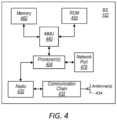
- FIG. 4 illustrates a block diagram of an exemplary base station 102, according to some embodiments. It is noted that the base station of Figure 4 is merely one example of a possible base station. As shown, the base station 102 may include processor(s) 404 which may execute program instructions for the base station 102. The processor(s) 404 may also be coupled to memory management unit (MMU) 440, which may be configured to receive addresses from the processor(s) 404 and translate those addresses to locations in memory (e.g., memory 460 and read only memory (ROM) 450) or to other circuits or devices.
- MMU memory management unit
- the base station 102 may include at least one network port 470.
- the network port 470 may be configured to couple to a telephone network and provide a plurality of devices, such as UE devices 106, access to the telephone network as described above in Figures 1 and 2 .
- the network port 470 (or an additional network port) may also or alternatively be configured to couple to a cellular network, e.g., a core network of a cellular service provider.
- the core network may provide mobility related services and/or other services to a plurality of devices, such as UE devices 106.
- the network port 470 may couple to a telephone network via the core network, and/or the core network may provide a telephone network (e.g., among other UE devices serviced by the cellular service provider).
- a set of resources may be designated (or reserved, granted, etc.) for use in carrying control signals.
- 3GPP has defined a Control Resource Set (CORESET) as a set of physical resources within a specific area in the downlink resource grid, which may be used to carry a Physical Downlink Control Channel (PDCCH).
- CORESET Control Resource Set
- a PDCCH is confined to one CORESET.
- a single CORESET may include 0, 1, or multiple PDCCHs.
- a CORESET may be contiguous or non-contiguous.
- the CORESET may be split between bandwidth parts (BWPs).
- BWPs bandwidth parts
- a CORESET may be configured in time to span 1-3 consecutive OFDM symbols.
- the resource elements (REs) of a CORESET are organized into resource element groups (REGs), with each REG consisting of 12 REs of one OFDM symbol in one resource block (RB).
- a Control Channel Element is also a group of physical resources that can be used to send a PDCCH.
- a PDCCH may consist of a number of Control Channel Elements.
- a PDCCH may consist of 1, 2, 4, 8, or 16 CCEs, and the number of CCEs may be specified as the CCE aggregation level (AL).
- AL CCE aggregation level
- DCI Downlink Control Information
- Each CCE may span the same number of symbols as the coreset, and may consist of 6 REGs, resulting in a total of 72 REs. Of these, 54 REs may be used for PDCCH data, while the remaining 18 may be used for a Demodulation Reference Signal (DMRS).
- DMRS Demodulation Reference Signal
- a DMRS is a reference signal that is specific to a particular UE, and is used to estimate the radio channel.
- the DMRS may be referred to as a channel pilot signal.
- the DMRS may include a known scrambling sequence, in which each DMRS RE includes one symbol of the known sequence.
- the network e.g., a base station, such as a gNB
- the network may beamform the DMRS, and include it only within the PDCCH to which it pertains - a PDCCH directed to the particular UE.
- This is distinct from other radio access technologies (RATs) and wireless communication protocols, such as LTE and LTE-A, in that those RATs transmit a common control pilot, which is always present, regardless of whether a particular control channel is present.
- RATs radio access technologies
- LTE and LTE-A wireless communication protocols
- a UE such as the UE 106, may perform blind decoding to monitor for PDCCH.
- the UE may perform blind decoding on a CORESET, or some portion thereof, to determine whether one or more PDCCH relevant to the UE is present.
- the network may specify a predetermined search space (SS) which may identify a subset of the CORESET to be searched, while the remainder of the CORESET may not be searched.
- SS is a set of predetermined CCEs for the UE to monitor for scheduling assignments/grants relating to a certain component carrier.
- a common search space is shared across all UEs, while a UE-specific search space (USS) applies to a specific UE.
- Certain parameters of a SS such as the number of PDCCH candidates and the size of the SS (e.g., the number of CCEs included in the SS) may be specified by NR standards documentation, and may vary by SS type and aggregation level.
- a PDCCH candidate is a group of CCEs that may potentially contain a PDCCH.
- PDCCH candidates may vary by DCI format and/or AL.
- the size of a PDCCH candidate depends on the AL.
- a SS may define multiple PDCCH candidates, potentially with overlapping CCEs, having different ALs.
- Figure 5 illustrates an example USS, identifying several PDCCH candidates within a CORESET of 45 CCEs, according to some embodiments. As illustrated, the CCEs are arranged from left to right, each having a respective CCE index, from 0 to 44. Each CCE is included in 0-4 PDCCH candidates of differing AL. It should be understood that Figure 5 is one example of a USS, and that many other USS configurations are possible.
- CCEs are included in more than one PDCCH candidate.
- CCEs 0, 1, 22, and 23 are each included in four PDCCH candidates - one of each illustrated AL.
- CCEs 34-37 and 40-44 are not included in any PDCCH candidate. Thus, these CCEs will never carry a PDCCH while the network is utilizing the illustrated SS of Figure 5 .
- a UE may perform blind decoding on some or all of the PDCCH candidates within this search space, to test whether one or more PDCCH candidate carries a PDCCH.
- the UE may perform channel estimation and noise estimation based on DMRS REs of the SS.
- CRC cyclic redundancy check
- each PDCCH candidate may have any one of multiple DCI formats.
- a given CCE may carry only one PDCCH.
- the UE may forego demodulating and decoding any remaining PDCCH candidates including that CCE.
- a CORESET may include multiple PDCCHs.
- identifying a PDCCH in a first PDCCH candidate does not preclude the possibility that a second PDCCH candidate may carry another PDCCH, as long as the first and second PDCCH candidates do not include any of the same CCEs.
- blind decoding it is apparent from the preceding description of blind decoding that a significant amount of power and resources may be used in blind decoding, especially when no PDCCH is present, which results in all PDCCH candidates being tested.
- the UE may perform up to 44 blind decodings, and up to 56 CCE channel estimations. Further compounding this burden, this blind decoding may be repeated per CC.
- methods and systems for reducing power consumption during blind decoding may significantly improve performance of a UE, such as the UE 106.
- a DMRS is present only within its corresponding PDCCH. Thus, if the PDCCH is not transmitted, the DMRS is not present within the PDCCH candidate. This feature of NR may be utilized to reduce power consumed during blind decoding.
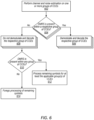
- Figure 6 illustrates a flowchart diagram illustrating a method for performing blind decoding of a PDCCH with reduced power consumption, according to some embodiments.
- the method of Figure 6 may be implemented by a wireless device, such as the UE 106, or by some component thereof, such as by the processor(s) 302 and/or the radio 330 and/or the cellular controller 354.
- the wireless device may perform channel estimation and noise estimation on at least a first symbol of one or more groups of CCEs.
- the groups of CCEs may represent (constitute, include, etc.) PDCCH candidates.
- a single group of CCEs may represent all CCEs in the CORESET or all CCEs included in a SS.
- the wireless device may divide the CORESET into groups of CCEs, wherein each group consists of a number of CCEs equal to the smallest AL value defined for the SS.
- Figure 7 illustrates a USS divided in this manner, according to some embodiments.
- the wireless device may perform channel and noise estimation on each of the groups of 2 CCEs in the USS.
- Figure 7 illustrates an example in which DMRS channel estimation (CE) and noise estimation is performed only on the CCEs included in the SS; i.e., only on the CCEs included in at least one PDCCH candidate.
- CE DMRS channel estimation
- the wireless device may not perform DMRS CE on CCEs 34-37 or 40-44. This may conserve processing resources during the blind decoding process.
- 604-608 may be performed for each of a plurality of CCE groups. For example, 604-608 may be performed for each respective group of CCEs within the CORESET or within the applicable SS. Alternatively, performing 604 once may include determining whether each respective group of CCEs includes a DMRS, and either 606 or 608 may be performed for each respective group, based on the determining.
- the wireless device may perform the channel and noise estimation at 602 based on all symbols of the one or more groups of CCEs, e.g., to improve detection of the DMRSs by detecting the presence of the DMRSs across multiple symbols.
- the wireless device may be expected to detect the DMRS with sufficient reliability based upon only the first symbol of the CORESET. In such scenarios, additional benefits may be realized by performing the channel and noise estimation at 602 on only the first symbol.
- the wireless device may, at 610, determine whether a DMRS is present within the first symbol of any group of CCEs of the CORESET (or of the applicable SS). This determination may be based, e.g., on 604-608 having been performed for each respective group of CCEs, as discussed above. If a DMRS is present in at least one group of CCEs, then the wireless device may, at 612, process any remaining symbols (e.g., second and third symbols, as applicable) for at least the applicable group(s) of CCEs - i.e., the group(s) of CCEs in which a DMRS is present. In some scenarios, this may include repeating 602-608 for any remaining symbols.
- the wireless device may, for any remaining symbols, perform blind decoding of only applicable groups in which a DMRS was present in the first symbol, or of only PDCCH candidates that include the CCEs of an applicable group in which a DMRS was present in the first symbol.
- the wireless device may determine that the CORESET (or SS) is empty, containing no PDCCH directed to the UE. Therefore, the wireless device may, at 614, forego processing of remaining symbols of the CORESET. For example, the wireless device may forego performing channel estimation, noise estimation, demodulation, and decoding of any remaining symbols of the CORESET. Additionally, or alternatively, the wireless device may transition RF transceivers into a low-power state, e.g., for the remainder of the CORESET.
- determining, at 604, whether a DMRS is present may be difficult.
- a DMRS RE may include some power even when a DMRS is not present, e.g., due to noise, transmission of a DMRS to another wireless device, etc.
- additional care may be taken to ensure that such determining is accurate.
- Figure 8 illustrates further example details of how the wireless device may determine whether a DMRS is present within each respective group of CCEs at 604, according to some embodiments. It should be understood that other methods of determining whether a DMRS is present are also envisioned.
- the wireless device may, at 804, determine a group signal strength metric (M g ) for each respective group of CCEs.
- the group signal strength metric M g may be based on the channel and noise estimation performed at 602.
- the wireless device may utilize groups of CCEs having group size equal to the smallest AL value defined for the SS, as discussed above. For example, applied to the USS of Figure 7 , each group would consist of two CCEs.
- the wireless device may determine a group signal strength threshold (T 1 ). This threshold may represent a minimum signal strength at which the wireless device will conclude that a DMRS may be present, and may represent a SNR or some other appropriate indicator of signal strength.
- T 1 group signal strength threshold
- the wireless device may determine, for each respective group of CCEs (or for at least a subset of the groups), whether M g meets T 1 (e.g., whether M g is greater than T 1 , whether M g is equal to or greater than T 1 , etc.). If M g of a respective group does not meet T 1 , then the wireless device may determine that a DMRS is not present in the respective group, and may proceed to 608 based on that determination.
- M g may take into account multiple DMRS REs (e.g., all DMRS REs included in the CCE group), as sampled by multiple antennas.
- M g may include significant processing gain, relative to considering a single DMRS RE.
- each group consisting of two CCEs
- M g may have total processing gain equivalent to processing 72 DMRS REs. This suggests that detection of the presence of DMRS within a respective group may be highly reliable.
- the system may be expected to operate at an SNR level that may allow detection of data REs with much lower processing gain. Thus, detection of DMRS REs may be far more reliable than reception of the PDCCH data.
- T 1 may be set to a level accounting for this processing gain, rather than a level appropriate for receiving PDCCH data.
- the wireless device may conclude that a DMRS may be present in the respective group.
- further evaluation may be advantageous before concluding that a DMRS is present in the respective group.
- the wireless device may, at 810, e.g., in response to determining that M g does meet T 1 , determine a maximum group threshold (T 2 ).
- This threshold may represent a percentage (or fraction, etc.) of a highest value from among the group signal strength metrics M g of the present CORESET (or SS).
- the wireless device may determine the highest value calculated from among the set of group signal strength metrics determined at 804, and may determine T 2 to be a predetermined percentage (e.g., 80% or 90%) of that highest value.
- one or more group of CCEs includes a PDCCH (and thus includes DMRS pilots)
- the group signal strength metric of that one or more group would be notably greater than the group signal strength metric of a group of CCEs that does not include a PDCCH.
- a PDCCH directed to the correct device is likely to have greater signal strength, due to beamforming of the PDCCH toward a specific wireless device.
- the wireless device may determine, for each respective group of CCEs (or for at least a subset of the groups), whether M g meets T 2 . If M g of a respective group does not meet T 2 , then the wireless device may determine that a DMRS is not present in the respective group, and may proceed to 608 based on that determination. If, at 812, M g of a respective group does meet T 2 , then the wireless device may determine that a DMRS is (or is likely to be) present in the respective group, and may proceed to 606 based on that determination.
- Figure 7 illustrates an example of possible results of thresholding according to the method of Figure 8 .
- the wireless device may generate M g for each group of CCEs.
- the present example illustrates M g through M 17 , as the SS includes 36 CCE, organized in groups of 2.
- the wireless device may perform blind decoding of only PDCCH candidates that include the CCEs of those three groups.
- some of the elements shown in Figure 8 may be performed concurrently, in a different order than shown, may be substituted for by other method elements, or may be omitted.
- the wireless device may perform only one of 808 or 812.
- 808 and 812 may be performed concurrently, or in a different order.
- Other elements, not shown, may be included in some implementations.
- the wireless device may further conserver processing resources by prioritizing likely candidates while blind decoding PDCCH candidates. For example, the wireless device may prioritize PDCCH candidates in which all CCEs were determined, at 604, to include a DMRS.
- the wireless device may forego performing blind decoding of these additional PDCCH candidates, instead performing blind decoding only on PDCCH candidates in which all CCEs were found to include a DMRS.
- the wireless device may, before implementing the method of Figure 6 , first determine whether the averaged cell signal strength value meets T 3 . If so, then the wireless device may proceed to implement the method of Figure 6 , to conserve processing resources during blind decoding. However, if the averaged cell signal strength value does not meet T 3 , then the wireless device may forego performing the method of Figure 6 , and may perform blind decoding as known in the prior art.
- the wireless device may perform channel estimation and noise estimation on the CORESET, which may include one or more PDCCH candidates.
- the wireless device may conclude that no PDCCH is present, and may, at 1006, forego demodulating and decoding the CORESET. This may result in conservation of power and other processing resources.
- the wireless device may conclude that a PDCCH is present within the CORESET. However, the wireless device may not yet know which PDCCH candidate(s) contains the PDCCH.
- the wireless device may determine that the respective PDCCH candidate does (or is likely to) contain a PDCCH, and may, at 1016, demodulate and decode the respective PDCCH candidate. In this way, the wireless device may reduce consumption of power and other processing resources, by avoiding demodulating and decoding empty PDCCH candidates.
- personally identifiable information should follow privacy policies and practices that are generally recognized as meeting or exceeding industry or governmental requirements for maintaining the privacy of users.
- personally identifiable information data should be managed and handled so as to minimize risks of unintentional or unauthorized access or use, and the nature of authorized use should be clearly indicated to users.
- Any of the methods described herein for operating a user equipment may be the basis of a corresponding method for operating a base station, by interpreting each message/signal X received by the UE in the downlink as message/signal X transmitted by the base station, and each message/signal Y transmitted in the uplink by the UE as a message/signal Y received by the base station.
- Embodiments of the present disclosure may be realized in any of various forms.
- the present subject matter may be realized as a computer-implemented method, a computer-readable memory medium, or a computer system.
- the present subject matter may be realized using one or more custom-designed hardware devices such as ASICs.
- the present subject matter may be realized using one or more programmable hardware elements such as FPGAs.
- a non-transitory computer-readable memory medium e.g., a non-transitory memory element
- a non-transitory computer-readable memory medium may be configured so that it stores program instructions and/or data, where the program instructions, if executed by a computer system, cause the computer system to perform a method, e.g., any of a method embodiments described herein, or, any combination of the method embodiments described herein, or, any subset of any of the method embodiments described herein, or, any combination of such subsets.
- a device e.g., a UE
- a device may be configured to include a processor (or a set of processors) and a memory medium (or memory element), where the memory medium stores program instructions, where the processor is configured to read and execute the program instructions from the memory medium, where the program instructions are executable to implement any of the various method embodiments described herein (or, any combination of the method embodiments described herein, or, any subset of any of the method embodiments described herein, or, any combination of such subsets).
- the device may be realized in any of various forms.
Landscapes
- Engineering & Computer Science (AREA)
- Signal Processing (AREA)
- Computer Networks & Wireless Communication (AREA)
- Mobile Radio Communication Systems (AREA)
Claims (13)
- Verfahren zum Überwachen für einen Steuerkanal, das Verfahren umfassend:
durch eine kabellose Kommunikationsvorrichtung:Bestimmen, ob ein Steuerkanal-Pilotsignal innerhalb mindestens eines ersten Symbols einer ersten Gruppe von Steuerkanalelementen, CCEs, eines Steuerressourcensatzes vorhanden ist (604);mindestens teilweise als Reaktion auf das Bestimmen, dass das Steuerkanal-Pilotsignal innerhalb mindestens des ersten Symbol der ersten Gruppe von CCEs vorhanden ist, Demodulieren und Decodieren des mindestens des ersten Symbols der ersten Gruppe von CCEs (606); undals Reaktion auf das Bestimmen, dass das Steuerkanal-Pilotsignal nicht mindestens innerhalb des ersten Symbols der ersten Gruppe von CCEs vorhanden ist, Verzicht auf die Demodulation und Decodierung der ersten Gruppe von CCEs (608);dadurch gekennzeichnet, dass das Bestimmen, ob das Steuerkanal-Pilotsignal innerhalb mindestens des ersten Symbols der ersten Gruppe von CCEs vorhanden ist, umfasst:Bestimmen einer jeweiligen Signalstärkemetrik für jede einer Vielzahl von CCEs-Gruppen des Steuerressourcensatzes (804);Bestimmen eines maximalen Gruppenschwellenwerts, T2 , der einen vorbestimmten Prozentsatz einer größten Signalstärkemetrik der jeweiligen Signalstärkemetriken darstellt (810); undBestimmen, dass das Steuerkanal-Pilotsignal nicht innerhalb mindestens des ersten Symbols der ersten Gruppe von CCEs vorhanden ist, wenn die Signalstärkemetrik für mindestens das erste Symbol der ersten Gruppe von CCEs T2 (812) nicht erfüllt. - Verfahren nach Anspruch 1, ferner umfassend:
durch die Drahtloskommunikationsvorrichtung:Bestimmen, ob das Steuerkanal-Pilotsignal innerhalb des ersten Symbols einer beliebigen Gruppe von CCEs des Steuerressourcensatzes vorhanden ist (610);mindestens teilweise als Reaktion auf das Bestimmen, dass das Steuerkanal-Pilotsignal innerhalb des ersten Symbols mindestens einer Gruppe von CCEs vorhanden ist, Verarbeiten nachfolgender Symbole der mindestens einen Gruppe von CCEs (612); undals Reaktion auf das Bestimmen, dass das Steuerkanal-Pilotsignal nicht innerhalb des ersten Symbols einer beliebigen Gruppe von CCEs des Steuerressourcensatzes vorhanden ist, Verzichten auf das Verarbeiten der verbleibenden Symbole des Steuerressourcensatzes (614). - Verfahren nach Anspruch 2, wobei das vorangehende Verarbeiten die vorangehende Demodulation und Decodierung der verbleibenden Symbole des Steuerressourcensatzes einschließt.
- Verfahren nach einem der Ansprüche 2 bis einschließlich 3, wobei das vorangehende Verarbeiten das Umschalten der Transceiverschaltlogik einschließt, die konfiguriert ist, um die Steuerressource zu empfangen und auf einen Niedrigleistungszustand einzustellen.
- Verfahren nach einem der Ansprüche 1 bis einschließlich 4, wobei das Bestimmen, ob das Steuerkanal-Pilotsignal innerhalb mindestens des ersten Symbols der ersten Gruppe von CCEs vorhanden ist, umfasst:Bestimmen einer Signalstärkemetrik für mindestens das erste Symbol der ersten Gruppe von CCEs (804); undBestimmen, dass das Steuerkanal-Pilotsignal nicht innerhalb mindestens des ersten Symbols der ersten Gruppe von CCEs vorhanden ist, wenn die Signalstärkemetrik eine Gruppensignalstärkeschwelle T1 (808) nicht erreicht.
- Verfahren nach Anspruch 5, wobei die Signalstärkemetrik für mindestens das erste Symbol der ersten Gruppe von CCEs auf einer Summe empfangener Abtastwerte von Ressourcenelementen basiert, die für das Steuerkanal-Pilotsymbol innerhalb der ersten Gruppe von CCEs reserviert sind.
- Verfahren nach einem der Ansprüche 1 bis einschließlich 6, wobei die erste Gruppe von CCEs eine Anzahl von CCEs einschließt, die gleich einer minimalen Aggregationsebene des Steuerressourcensatzes sind.
- Verfahren nach einem der Ansprüche 1 bis einschließlich 6, wobei die erste Gruppe von CCEs alle CCEs des Steuerressourcensatzes einschließt.
- Verfahren nach einem der Ansprüche 1 bis einschließlich 6, wobei die erste Gruppe von CCEs alle CCEs eines vordefinierten Suchraums des Steuerressourcensatzes einschließt.
- Einrichtung, umfassend:
Mittel zum Durchführen des Verfahrens nach einem der Ansprüche 1 bis 9. - Einrichtung nach Anspruch 10, wobei die Mittel zum Durchführen des Verfahrens einen Prozessor (302) umfassen, der konfiguriert ist, um eine drahtlose Vorrichtung zu veranlassen, das Verfahren durchzuführen.
- Einrichtung nach Anspruch 11, ferner umfassend:mindestens eine Antenne (335a, 335b); undeine Funkvorrichtung (330), die mit der mindestens einen Antenne (335a, 335b) wirkgekoppelt ist; wobeider Prozessor (302), das mit der Funkvorrichtung (330) wirkgekoppelt ist.
- Nichtflüchtiges computerlesbares Speichermedium, das Softwareanweisungen speichert, die konfiguriert ist, um, wenn sie durch einen Prozessor einer drahtlosen Kommunikationsvorrichtung ausgeführt werden, die drahtlose Kommunikationsvorrichtung veranlassen, das Verfahren nach einem der Ansprüche 1 bis 9 durchzuführen.
Applications Claiming Priority (2)
| Application Number | Priority Date | Filing Date | Title |
|---|---|---|---|
| US202163229782P | 2021-08-05 | 2021-08-05 | |
| US17/879,601 US12335952B2 (en) | 2021-08-05 | 2022-08-02 | NR control channel element detections to reduce blind demodulation and decoding |
Publications (2)
| Publication Number | Publication Date |
|---|---|
| EP4131833A1 EP4131833A1 (de) | 2023-02-08 |
| EP4131833B1 true EP4131833B1 (de) | 2025-07-09 |
Family
ID=82839181
Family Applications (1)
| Application Number | Title | Priority Date | Filing Date |
|---|---|---|---|
| EP22188665.8A Active EP4131833B1 (de) | 2021-08-05 | 2022-08-04 | Nr-steuerkanalelementdetektionen zur reduzierung von blinddemodulation und -decodierung |
Country Status (3)
| Country | Link |
|---|---|
| US (1) | US12335952B2 (de) |
| EP (1) | EP4131833B1 (de) |
| CN (1) | CN115913455B (de) |
Family Cites Families (9)
| Publication number | Priority date | Publication date | Assignee | Title |
|---|---|---|---|---|
| JP3565344B2 (ja) * | 2002-02-21 | 2004-09-15 | 株式会社エヌ・ティ・ティ・ドコモ | 干渉除去システム、及び、干渉除去方法 |
| CN104717748A (zh) * | 2013-12-11 | 2015-06-17 | 北京三星通信技术研究有限公司 | 物理下行控制信道的资源分配方法和装置 |
| US10541785B2 (en) * | 2016-07-18 | 2020-01-21 | Samsung Electronics Co., Ltd. | Carrier aggregation with variable transmission durations |
| US20180368116A1 (en) | 2017-06-16 | 2018-12-20 | Mediatek Inc. | Design of coreset configurations |
| WO2019139955A1 (en) | 2018-01-10 | 2019-07-18 | Idac Holdings, Inc. | Methods for identifying resources of a new radio physical downlink control channel which have been preempted by ultra-reliable low latency communication |
| CN110350953B (zh) * | 2018-04-02 | 2021-05-11 | 中国移动通信有限公司研究院 | Pucch空分复用的方法及网络侧设备 |
| US11202259B2 (en) | 2018-11-02 | 2021-12-14 | Apple Inc. | Apparatus, system, and method for mobile station power saving |
| KR102825049B1 (ko) * | 2019-01-08 | 2025-06-26 | 삼성전자 주식회사 | 무선 통신 시스템에서 전력 절약 신호 전송 방법 및 장치 |
| US11601244B2 (en) * | 2020-01-16 | 2023-03-07 | Qualcomm Incorporated | Space division multiplexing mapping of transmission configuration indicator states to a control channel |
-
2022
- 2022-08-02 US US17/879,601 patent/US12335952B2/en active Active
- 2022-08-04 EP EP22188665.8A patent/EP4131833B1/de active Active
- 2022-08-04 CN CN202210934553.9A patent/CN115913455B/zh active Active
Also Published As
| Publication number | Publication date |
|---|---|
| EP4131833A1 (de) | 2023-02-08 |
| CN115913455A (zh) | 2023-04-04 |
| US12335952B2 (en) | 2025-06-17 |
| CN115913455B (zh) | 2025-09-12 |
| US20230042362A1 (en) | 2023-02-09 |
Similar Documents
| Publication | Publication Date | Title |
|---|---|---|
| US11871346B2 (en) | Wake up signal for cellular communication in unlicensed spectrum | |
| EP3619979B1 (de) | Indexsignalisierung eines synchronisationssignalblocks | |
| US12143334B2 (en) | Configuring and providing physical downlink control channel communications with improved reliability | |
| US12107785B2 (en) | SRS coverage enhancement | |
| US20220303910A1 (en) | Control Signaling for Robust Physical Uplink Shared Channel Transmission | |
| US20250070848A1 (en) | High Speed Single Frequency Network Beam Failure Recovery | |
| US12150139B2 (en) | Physical downlink control channel reception with improved reliability | |
| US20240155573A1 (en) | Time Domain Resource Selection | |
| US12369060B2 (en) | CSSF design for UE with NeedForGap capability | |
| WO2023130307A1 (en) | Inter radio access technology measurement without measurement gap | |
| US20250132875A1 (en) | Channel State Information Reference Signal Transmission and Measurement for Reduced Capability Wireless Device Operation | |
| EP4307808A2 (de) | Verbesserte zuverlässigkeit für strahlausfallwiederherstellung und suchraum und steuerressourcensatzindex 0 | |
| EP4131833A1 (de) | Nr-steuerkanalelementdetektionen zur reduzierung von blinddemodulation und -decodierung | |
| US20260006561A1 (en) | Port Specific Sounding Reference Signal Transmit Power Calculation | |
| US20260066964A1 (en) | Antenna Port Swapping for Single Layer Uplink Multiple Input Multiple Output Operation | |
| WO2026031170A1 (en) | Supporting ue reconfiguration of receive chain sharing | |
| WO2024229598A1 (en) | Lower layer triggered mobility configuration validation | |
| WO2018053787A1 (en) | Autonomous measurement report for carrier aggregation setup |
Legal Events
| Date | Code | Title | Description |
|---|---|---|---|
| PUAI | Public reference made under article 153(3) epc to a published international application that has entered the european phase |
Free format text: ORIGINAL CODE: 0009012 |
|
| STAA | Information on the status of an ep patent application or granted ep patent |
Free format text: STATUS: REQUEST FOR EXAMINATION WAS MADE |
|
| 17P | Request for examination filed |
Effective date: 20220804 |
|
| AK | Designated contracting states |
Kind code of ref document: A1 Designated state(s): AL AT BE BG CH CY CZ DE DK EE ES FI FR GB GR HR HU IE IS IT LI LT LU LV MC MK MT NL NO PL PT RO RS SE SI SK SM TR |
|
| GRAP | Despatch of communication of intention to grant a patent |
Free format text: ORIGINAL CODE: EPIDOSNIGR1 |
|
| STAA | Information on the status of an ep patent application or granted ep patent |
Free format text: STATUS: GRANT OF PATENT IS INTENDED |
|
| INTG | Intention to grant announced |
Effective date: 20250204 |
|
| GRAS | Grant fee paid |
Free format text: ORIGINAL CODE: EPIDOSNIGR3 |
|
| GRAA | (expected) grant |
Free format text: ORIGINAL CODE: 0009210 |
|
| STAA | Information on the status of an ep patent application or granted ep patent |
Free format text: STATUS: THE PATENT HAS BEEN GRANTED |
|
| AK | Designated contracting states |
Kind code of ref document: B1 Designated state(s): AL AT BE BG CH CY CZ DE DK EE ES FI FR GB GR HR HU IE IS IT LI LT LU LV MC MK MT NL NO PL PT RO RS SE SI SK SM TR |
|
| REG | Reference to a national code |
Ref country code: GB Ref legal event code: FG4D |
|
| REG | Reference to a national code |
Ref country code: CH Ref legal event code: EP |
|
| P01 | Opt-out of the competence of the unified patent court (upc) registered |
Free format text: CASE NUMBER: APP_27991/2025 Effective date: 20250611 |
|
| REG | Reference to a national code |
Ref country code: IE Ref legal event code: FG4D |
|
| REG | Reference to a national code |
Ref country code: DE Ref legal event code: R096 Ref document number: 602022017217 Country of ref document: DE |
|
| PGFP | Annual fee paid to national office [announced via postgrant information from national office to epo] |
Ref country code: DE Payment date: 20250825 Year of fee payment: 4 |
|
| PGFP | Annual fee paid to national office [announced via postgrant information from national office to epo] |
Ref country code: AT Payment date: 20251020 Year of fee payment: 4 |
|
| REG | Reference to a national code |
Ref country code: NL Ref legal event code: MP Effective date: 20250709 |
|
| PG25 | Lapsed in a contracting state [announced via postgrant information from national office to epo] |
Ref country code: PT Free format text: LAPSE BECAUSE OF FAILURE TO SUBMIT A TRANSLATION OF THE DESCRIPTION OR TO PAY THE FEE WITHIN THE PRESCRIBED TIME-LIMIT Effective date: 20251110 |
|
| PG25 | Lapsed in a contracting state [announced via postgrant information from national office to epo] |
Ref country code: NL Free format text: LAPSE BECAUSE OF FAILURE TO SUBMIT A TRANSLATION OF THE DESCRIPTION OR TO PAY THE FEE WITHIN THE PRESCRIBED TIME-LIMIT Effective date: 20250709 |
|
| REG | Reference to a national code |
Ref country code: AT Ref legal event code: MK05 Ref document number: 1812885 Country of ref document: AT Kind code of ref document: T Effective date: 20250709 |
|
| PG25 | Lapsed in a contracting state [announced via postgrant information from national office to epo] |
Ref country code: IS Free format text: LAPSE BECAUSE OF FAILURE TO SUBMIT A TRANSLATION OF THE DESCRIPTION OR TO PAY THE FEE WITHIN THE PRESCRIBED TIME-LIMIT Effective date: 20251109 |
|
| PG25 | Lapsed in a contracting state [announced via postgrant information from national office to epo] |
Ref country code: NO Free format text: LAPSE BECAUSE OF FAILURE TO SUBMIT A TRANSLATION OF THE DESCRIPTION OR TO PAY THE FEE WITHIN THE PRESCRIBED TIME-LIMIT Effective date: 20251009 |
|
| REG | Reference to a national code |
Ref country code: LT Ref legal event code: MG9D |
|
| PG25 | Lapsed in a contracting state [announced via postgrant information from national office to epo] |
Ref country code: AT Free format text: LAPSE BECAUSE OF FAILURE TO SUBMIT A TRANSLATION OF THE DESCRIPTION OR TO PAY THE FEE WITHIN THE PRESCRIBED TIME-LIMIT Effective date: 20250709 |
|
| PG25 | Lapsed in a contracting state [announced via postgrant information from national office to epo] |
Ref country code: FI Free format text: LAPSE BECAUSE OF FAILURE TO SUBMIT A TRANSLATION OF THE DESCRIPTION OR TO PAY THE FEE WITHIN THE PRESCRIBED TIME-LIMIT Effective date: 20250709 |
|
| PG25 | Lapsed in a contracting state [announced via postgrant information from national office to epo] |
Ref country code: HR Free format text: LAPSE BECAUSE OF FAILURE TO SUBMIT A TRANSLATION OF THE DESCRIPTION OR TO PAY THE FEE WITHIN THE PRESCRIBED TIME-LIMIT Effective date: 20250709 |
|
| PG25 | Lapsed in a contracting state [announced via postgrant information from national office to epo] |
Ref country code: GR Free format text: LAPSE BECAUSE OF FAILURE TO SUBMIT A TRANSLATION OF THE DESCRIPTION OR TO PAY THE FEE WITHIN THE PRESCRIBED TIME-LIMIT Effective date: 20251010 |
|
| PG25 | Lapsed in a contracting state [announced via postgrant information from national office to epo] |
Ref country code: SE Free format text: LAPSE BECAUSE OF FAILURE TO SUBMIT A TRANSLATION OF THE DESCRIPTION OR TO PAY THE FEE WITHIN THE PRESCRIBED TIME-LIMIT Effective date: 20250709 |
|
| PG25 | Lapsed in a contracting state [announced via postgrant information from national office to epo] |
Ref country code: LV Free format text: LAPSE BECAUSE OF FAILURE TO SUBMIT A TRANSLATION OF THE DESCRIPTION OR TO PAY THE FEE WITHIN THE PRESCRIBED TIME-LIMIT Effective date: 20250709 |
|
| PG25 | Lapsed in a contracting state [announced via postgrant information from national office to epo] |
Ref country code: BG Free format text: LAPSE BECAUSE OF FAILURE TO SUBMIT A TRANSLATION OF THE DESCRIPTION OR TO PAY THE FEE WITHIN THE PRESCRIBED TIME-LIMIT Effective date: 20250709 Ref country code: PL Free format text: LAPSE BECAUSE OF FAILURE TO SUBMIT A TRANSLATION OF THE DESCRIPTION OR TO PAY THE FEE WITHIN THE PRESCRIBED TIME-LIMIT Effective date: 20250709 |
|
| PG25 | Lapsed in a contracting state [announced via postgrant information from national office to epo] |
Ref country code: RS Free format text: LAPSE BECAUSE OF FAILURE TO SUBMIT A TRANSLATION OF THE DESCRIPTION OR TO PAY THE FEE WITHIN THE PRESCRIBED TIME-LIMIT Effective date: 20251009 |
|
| PG25 | Lapsed in a contracting state [announced via postgrant information from national office to epo] |
Ref country code: ES Free format text: LAPSE BECAUSE OF FAILURE TO SUBMIT A TRANSLATION OF THE DESCRIPTION OR TO PAY THE FEE WITHIN THE PRESCRIBED TIME-LIMIT Effective date: 20250709 |
|
| PG25 | Lapsed in a contracting state [announced via postgrant information from national office to epo] |
Ref country code: RO Free format text: LAPSE BECAUSE OF FAILURE TO SUBMIT A TRANSLATION OF THE DESCRIPTION OR TO PAY THE FEE WITHIN THE PRESCRIBED TIME-LIMIT Effective date: 20250709 |
|
| REG | Reference to a national code |
Ref country code: CH Ref legal event code: H13 Free format text: ST27 STATUS EVENT CODE: U-0-0-H10-H13 (AS PROVIDED BY THE NATIONAL OFFICE) Effective date: 20260324 |
|
| PG25 | Lapsed in a contracting state [announced via postgrant information from national office to epo] |
Ref country code: SM Free format text: LAPSE BECAUSE OF FAILURE TO SUBMIT A TRANSLATION OF THE DESCRIPTION OR TO PAY THE FEE WITHIN THE PRESCRIBED TIME-LIMIT Effective date: 20250709 |
|
| REG | Reference to a national code |
Ref country code: DE Ref legal event code: R097 Ref document number: 602022017217 Country of ref document: DE |
|
| PG25 | Lapsed in a contracting state [announced via postgrant information from national office to epo] |
Ref country code: DK Free format text: LAPSE BECAUSE OF FAILURE TO SUBMIT A TRANSLATION OF THE DESCRIPTION OR TO PAY THE FEE WITHIN THE PRESCRIBED TIME-LIMIT Effective date: 20250709 |
|
| PG25 | Lapsed in a contracting state [announced via postgrant information from national office to epo] |
Ref country code: LU Free format text: LAPSE BECAUSE OF NON-PAYMENT OF DUE FEES Effective date: 20250804 Ref country code: IT Free format text: LAPSE BECAUSE OF FAILURE TO SUBMIT A TRANSLATION OF THE DESCRIPTION OR TO PAY THE FEE WITHIN THE PRESCRIBED TIME-LIMIT Effective date: 20250709 |
|
| PG25 | Lapsed in a contracting state [announced via postgrant information from national office to epo] |
Ref country code: CH Free format text: LAPSE BECAUSE OF NON-PAYMENT OF DUE FEES Effective date: 20250831 Ref country code: CZ Free format text: LAPSE BECAUSE OF FAILURE TO SUBMIT A TRANSLATION OF THE DESCRIPTION OR TO PAY THE FEE WITHIN THE PRESCRIBED TIME-LIMIT Effective date: 20250709 |
|
| PG25 | Lapsed in a contracting state [announced via postgrant information from national office to epo] |
Ref country code: EE Free format text: LAPSE BECAUSE OF FAILURE TO SUBMIT A TRANSLATION OF THE DESCRIPTION OR TO PAY THE FEE WITHIN THE PRESCRIBED TIME-LIMIT Effective date: 20250709 Ref country code: SK Free format text: LAPSE BECAUSE OF FAILURE TO SUBMIT A TRANSLATION OF THE DESCRIPTION OR TO PAY THE FEE WITHIN THE PRESCRIBED TIME-LIMIT Effective date: 20250709 |
|
| REG | Reference to a national code |
Ref country code: BE Ref legal event code: MM Effective date: 20250831 |
|
| PLBE | No opposition filed within time limit |
Free format text: ORIGINAL CODE: 0009261 |
|
| STAA | Information on the status of an ep patent application or granted ep patent |
Free format text: STATUS: NO OPPOSITION FILED WITHIN TIME LIMIT |
|
| REG | Reference to a national code |
Ref country code: CH Ref legal event code: L10 Free format text: ST27 STATUS EVENT CODE: U-0-0-L10-L00 (AS PROVIDED BY THE NATIONAL OFFICE) Effective date: 20260521 |
|
| 26N | No opposition filed |
Effective date: 20260410 |
|
| PG25 | Lapsed in a contracting state [announced via postgrant information from national office to epo] |
Ref country code: MC Free format text: LAPSE BECAUSE OF FAILURE TO SUBMIT A TRANSLATION OF THE DESCRIPTION OR TO PAY THE FEE WITHIN THE PRESCRIBED TIME-LIMIT Effective date: 20250709 Ref country code: LT Free format text: LAPSE BECAUSE OF FAILURE TO SUBMIT A TRANSLATION OF THE DESCRIPTION OR TO PAY THE FEE WITHIN THE PRESCRIBED TIME-LIMIT Effective date: 20250709 |
|
| PGFP | Annual fee paid to national office [announced via postgrant information from national office to epo] |
Ref country code: GB Payment date: 20260615 Year of fee payment: 5 |
|
| PG25 | Lapsed in a contracting state [announced via postgrant information from national office to epo] |
Ref country code: BE Free format text: LAPSE BECAUSE OF NON-PAYMENT OF DUE FEES Effective date: 20250831 Ref country code: IE Free format text: LAPSE BECAUSE OF NON-PAYMENT OF DUE FEES Effective date: 20250804 |
|
| PG25 | Lapsed in a contracting state [announced via postgrant information from national office to epo] |
Ref country code: FR Free format text: LAPSE BECAUSE OF NON-PAYMENT OF DUE FEES Effective date: 20250909 |